US10694070B2 - Information processing apparatus, data structure of image file, and non-transitory computer readable medium for managing usage mode of image - Google Patents
Information processing apparatus, data structure of image file, and non-transitory computer readable medium for managing usage mode of image Download PDFInfo
- Publication number
- US10694070B2 US10694070B2 US15/935,062 US201815935062A US10694070B2 US 10694070 B2 US10694070 B2 US 10694070B2 US 201815935062 A US201815935062 A US 201815935062A US 10694070 B2 US10694070 B2 US 10694070B2
- Authority
- US
- United States
- Prior art keywords
- image
- information
- processing apparatus
- information processing
- information related
- Prior art date
- Legal status (The legal status is an assumption and is not a legal conclusion. Google has not performed a legal analysis and makes no representation as to the accuracy of the status listed.)
- Active
Links
Images




Classifications
-
- H—ELECTRICITY
- H04—ELECTRIC COMMUNICATION TECHNIQUE
- H04N—PICTORIAL COMMUNICATION, e.g. TELEVISION
- H04N19/00—Methods or arrangements for coding, decoding, compressing or decompressing digital video signals
- H04N19/46—Embedding additional information in the video signal during the compression process
-
- H—ELECTRICITY
- H04—ELECTRIC COMMUNICATION TECHNIQUE
- H04N—PICTORIAL COMMUNICATION, e.g. TELEVISION
- H04N1/00—Scanning, transmission or reproduction of documents or the like, e.g. facsimile transmission; Details thereof
- H04N1/32—Circuits or arrangements for control or supervision between transmitter and receiver or between image input and image output device, e.g. between a still-image camera and its memory or between a still-image camera and a printer device
- H04N1/34—Circuits or arrangements for control or supervision between transmitter and receiver or between image input and image output device, e.g. between a still-image camera and its memory or between a still-image camera and a printer device for coin-freed systems ; Pay systems
- H04N1/342—Accounting or charging based on content, e.g. charging for access to a particular document
-
- G—PHYSICS
- G06—COMPUTING OR CALCULATING; COUNTING
- G06F—ELECTRIC DIGITAL DATA PROCESSING
- G06F16/00—Information retrieval; Database structures therefor; File system structures therefor
- G06F16/20—Information retrieval; Database structures therefor; File system structures therefor of structured data, e.g. relational data
- G06F16/21—Design, administration or maintenance of databases
- G06F16/219—Managing data history or versioning
-
- G—PHYSICS
- G06—COMPUTING OR CALCULATING; COUNTING
- G06F—ELECTRIC DIGITAL DATA PROCESSING
- G06F21/00—Security arrangements for protecting computers, components thereof, programs or data against unauthorised activity
- G06F21/10—Protecting distributed programs or content, e.g. vending or licensing of copyrighted material ; Digital rights management [DRM]
-
- G—PHYSICS
- G06—COMPUTING OR CALCULATING; COUNTING
- G06F—ELECTRIC DIGITAL DATA PROCESSING
- G06F3/00—Input arrangements for transferring data to be processed into a form capable of being handled by the computer; Output arrangements for transferring data from processing unit to output unit, e.g. interface arrangements
- G06F3/12—Digital output to print unit, e.g. line printer, chain printer
- G06F3/1201—Dedicated interfaces to print systems
- G06F3/1202—Dedicated interfaces to print systems specifically adapted to achieve a particular effect
- G06F3/1203—Improving or facilitating administration, e.g. print management
- G06F3/1207—Improving or facilitating administration, e.g. print management resulting in the user being informed about print result after a job submission
-
- G—PHYSICS
- G06—COMPUTING OR CALCULATING; COUNTING
- G06F—ELECTRIC DIGITAL DATA PROCESSING
- G06F3/00—Input arrangements for transferring data to be processed into a form capable of being handled by the computer; Output arrangements for transferring data from processing unit to output unit, e.g. interface arrangements
- G06F3/12—Digital output to print unit, e.g. line printer, chain printer
- G06F3/1201—Dedicated interfaces to print systems
- G06F3/1223—Dedicated interfaces to print systems specifically adapted to use a particular technique
- G06F3/1237—Print job management
- G06F3/1259—Print job monitoring, e.g. job status
-
- G—PHYSICS
- G06—COMPUTING OR CALCULATING; COUNTING
- G06F—ELECTRIC DIGITAL DATA PROCESSING
- G06F3/00—Input arrangements for transferring data to be processed into a form capable of being handled by the computer; Output arrangements for transferring data from processing unit to output unit, e.g. interface arrangements
- G06F3/12—Digital output to print unit, e.g. line printer, chain printer
- G06F3/1201—Dedicated interfaces to print systems
- G06F3/1278—Dedicated interfaces to print systems specifically adapted to adopt a particular infrastructure
- G06F3/1285—Remote printer device, e.g. being remote from client or server
- G06F3/1287—Remote printer device, e.g. being remote from client or server via internet
-
- G—PHYSICS
- G06—COMPUTING OR CALCULATING; COUNTING
- G06Q—INFORMATION AND COMMUNICATION TECHNOLOGY [ICT] SPECIALLY ADAPTED FOR ADMINISTRATIVE, COMMERCIAL, FINANCIAL, MANAGERIAL OR SUPERVISORY PURPOSES; SYSTEMS OR METHODS SPECIALLY ADAPTED FOR ADMINISTRATIVE, COMMERCIAL, FINANCIAL, MANAGERIAL OR SUPERVISORY PURPOSES, NOT OTHERWISE PROVIDED FOR
- G06Q30/00—Commerce
- G06Q30/02—Marketing; Price estimation or determination; Fundraising
- G06Q30/0283—Price estimation or determination
-
- H—ELECTRICITY
- H04—ELECTRIC COMMUNICATION TECHNIQUE
- H04N—PICTORIAL COMMUNICATION, e.g. TELEVISION
- H04N1/00—Scanning, transmission or reproduction of documents or the like, e.g. facsimile transmission; Details thereof
- H04N1/00127—Connection or combination of a still picture apparatus with another apparatus, e.g. for storage, processing or transmission of still picture signals or of information associated with a still picture
- H04N1/00132—Connection or combination of a still picture apparatus with another apparatus, e.g. for storage, processing or transmission of still picture signals or of information associated with a still picture in a digital photofinishing system, i.e. a system where digital photographic images undergo typical photofinishing processing, e.g. printing ordering
- H04N1/00143—Ordering
-
- H—ELECTRICITY
- H04—ELECTRIC COMMUNICATION TECHNIQUE
- H04N—PICTORIAL COMMUNICATION, e.g. TELEVISION
- H04N1/00—Scanning, transmission or reproduction of documents or the like, e.g. facsimile transmission; Details thereof
- H04N1/00127—Connection or combination of a still picture apparatus with another apparatus, e.g. for storage, processing or transmission of still picture signals or of information associated with a still picture
- H04N1/00323—Connection or combination of a still picture apparatus with another apparatus, e.g. for storage, processing or transmission of still picture signals or of information associated with a still picture with a measuring, monitoring or signaling apparatus, e.g. for transmitting measured information to a central location
-
- G—PHYSICS
- G06—COMPUTING OR CALCULATING; COUNTING
- G06F—ELECTRIC DIGITAL DATA PROCESSING
- G06F3/00—Input arrangements for transferring data to be processed into a form capable of being handled by the computer; Output arrangements for transferring data from processing unit to output unit, e.g. interface arrangements
- G06F3/12—Digital output to print unit, e.g. line printer, chain printer
- G06F3/1201—Dedicated interfaces to print systems
- G06F3/1202—Dedicated interfaces to print systems specifically adapted to achieve a particular effect
- G06F3/1203—Improving or facilitating administration, e.g. print management
-
- G—PHYSICS
- G06—COMPUTING OR CALCULATING; COUNTING
- G06F—ELECTRIC DIGITAL DATA PROCESSING
- G06F3/00—Input arrangements for transferring data to be processed into a form capable of being handled by the computer; Output arrangements for transferring data from processing unit to output unit, e.g. interface arrangements
- G06F3/12—Digital output to print unit, e.g. line printer, chain printer
- G06F3/1201—Dedicated interfaces to print systems
- G06F3/1223—Dedicated interfaces to print systems specifically adapted to use a particular technique
- G06F3/1237—Print job management
- G06F3/1273—Print job history, e.g. logging, accounting, tracking
-
- G—PHYSICS
- G06—COMPUTING OR CALCULATING; COUNTING
- G06Q—INFORMATION AND COMMUNICATION TECHNOLOGY [ICT] SPECIALLY ADAPTED FOR ADMINISTRATIVE, COMMERCIAL, FINANCIAL, MANAGERIAL OR SUPERVISORY PURPOSES; SYSTEMS OR METHODS SPECIALLY ADAPTED FOR ADMINISTRATIVE, COMMERCIAL, FINANCIAL, MANAGERIAL OR SUPERVISORY PURPOSES, NOT OTHERWISE PROVIDED FOR
- G06Q2220/00—Business processing using cryptography
- G06Q2220/10—Usage protection of distributed data files
- G06Q2220/12—Usage or charge determination
Definitions
- the present invention relates to an information processing apparatus, a data structure of an image file, and a non-transitory computer readable medium.
- JPEG Joint Photographic Experts Group
- an information processing apparatus includes a receiver and a transmitter.
- the receiver receives an image associated with attribute information.
- the transmitter transmits information related to the use of the image.
- FIG. 1 is a view illustrating a data structure of a JPEG file used in a first exemplary embodiment
- FIG. 2 is a view illustrating a configuration example of an image processing system according to the first exemplary embodiment
- FIG. 3 is a view illustrating an example of a hardware configuration of a computer
- FIG. 4 is a view illustrating an example of a hardware configuration of an image forming apparatus
- FIG. 5 is a view for explaining an example of a data structure used for recording information related to a use history of an image used in the first exemplary embodiment
- FIG. 6 is a view for explaining an example of use history data managed by a content server
- FIG. 7 is a view for explaining a function of generating information related to a use history among functional components of a controller constituting the computer and a controller constituting an image forming apparatus;
- FIG. 8 is a flowchart illustrating an example of processing operations executed by the controller according to the first exemplary embodiment
- FIG. 9 is a view illustrating a data structure of a JPEG file used in a second exemplary embodiment
- FIG. 10 is a view for explaining an example of use history data prepared for each character in the content server
- FIG. 11 is a view illustrating a data structure of a JPEG file used in a third exemplary embodiment
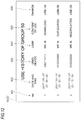
- FIG. 12 is a view for explaining an example of use history data prepared for each group in the content server
- FIG. 13 is a view illustrating a data structure of a JPEG file used in the third exemplary embodiment
- FIG. 14 is a view for explaining an example of use history data prepared for each character and use history data prepared for each group in the content server;
- FIG. 15 is a view illustrating a configuration example of a blockchain used in an image processing system according to a fifth exemplary embodiment
- FIG. 16 is a view illustrating a configuration example of a blockchain used in an image processing system according to a sixth exemplary embodiment
- FIG. 17 is a view illustrating a configuration example of an image processing system according to a seventh exemplary embodiment
- FIG. 18 is a block diagram illustrating an example of a functional configuration of a controller constituting an information processing apparatus (for example, computer) used for recording information that defines a workflow process;
- an information processing apparatus for example, computer
- FIG. 19 is a view for explaining a state in which a region to be registered as an object is designated using a mouse pointer on a still image displayed on an operation screen.
- FIGS. 20A and 20B are views for explaining writing of information that defines the workflow process into attribute information, in which FIG. 20A illustrates a data structure before the information is included in the attribute information of an JPEG file, and FIG. 20B illustrates a state in which the information is added to the attribute information of the JPEG file.
- data of an image corresponding to an object is given as a JPEG file in compliance with the JPEG format.
- data of the image corresponding to the object may be given as an image file in compliance with another format.
- a moving image file in compliance with the moving picture experts group (MPEG) format or the like may also be used.
- FIG. 1 is a view illustrating a data structure of a JPEG file 10 used in a first exemplary embodiment.
- the JPEG file 10 includes: a start of image segment (SOI) 11 indicating a start position of an image; an application type 1 segment (App 1 ) 12 used in the description of Exif information or the like; an application type 11 segment (App 11 ) 13 that is a type of an extended region; image data (ID) 14 ; and an end of image segment (EOI) 15 indicating an end position of the image.
- SOI start of image segment
- App 1 application type 1 segment
- App 11 an application type 11 segment
- ID image data
- EI end of image segment
- the pixel value of each pixel constituting the image is recorded in the image data 14 .
- the image data 14 in FIG. 1 the pixel value of each pixel constituting a robot type character 20 is recorded.
- the character 20 is an example of an object. Therefore, the image data 14 is data of an image corresponding to the character 20 .
- an object is used to mean a region that is treated as a processing target distinguished from other regions.
- the object is not limited to an image called a so-called character, but may be an image of a whole or a portion of a captured range such as a photograph.
- the object may be a portion of a character.
- the image data 14 is given as a color image, but may be given as a grayscale image.
- the region where the image data 14 is stored is an example of a first data region.
- the region interposed between the start of image segment 11 and the end of image segment 15 is also called a frame.
- the JPEG file 10 also includes two segments (not illustrated), that is, a define quantization table segment (DQT) and a define Huffman table segment (DHT). Segments other than these are disposed as required.
- DQT define quantization table segment
- DHT define Huffman table segment
- the application type 1 segment 12 and the application type 11 segment 13 are portions of the attribute information 16 of the JPEG file 10 .
- the attribute information 16 refers to various pieces of information related to the image, and includes, for example, the size of the image, the size of the data, information related to the object, link information, and the like.
- information 13 A which is associated with the image data 14 corresponding to the character 20 is recorded in the application type 11 segment 13 . Further, the information 13 A may be associated with a partial region of the image data 14 .
- information 13 A in the present exemplary embodiment information is recorded which defines a workflow process to be executed by an information processing apparatus (for example, computer) which uses the JPEG file 10 .
- Information related to a use of the image corresponding to the character 20 is transmitted through execution of the workflow process.
- the information related to the use of the image corresponding to the character 20 includes a fact that a user uses the image, a date and time of the use, the content of the use (usage mode), and the like.
- examples of the content of the use (usage mode) include downloading, displaying, duplicating, modifying (editing), printing, recording, transmitting, distributing, broadcasting, and the like.
- the information 13 A in the present exemplary embodiment is described in the text format.
- a Java Script Object Notation which is an example of a data exchange format
- JSON Java Script Object Notation
- the JSON is a language that uses a portion of the object notation in JavaScript (registered trademark) as a syntax base.
- the language used to describe the workflow process is not limited to the JSON.
- Plural pieces of information 13 A may be recorded for one object.
- two pieces of information 13 A may be recorded for one object.
- the information 13 A may not be recorded for an object that does not need to manage a use history.
- one piece of information 13 A is associated with the character 20 as an object, but two pieces of information 13 A may be associated with the character 20 .
- one of the two pieces of information 13 A is a description of the workflow process corresponding to a first language (for example, Japanese, for a first OS), and the other is a description of the workflow process corresponding to a second language (for example, English, for a second OS).
- the language in which the workflow process is to be executed may be designated by the user through a selection screen.
- the contents of the workflow process defined by the two pieces of information 13 A may be different from each other.
- one of the two pieces of information 13 A may be a description of the workflow process for controlling the transmission of the information related to the use of the character 20 as an object, whereas the other may be a description of the workflow process for controlling the operation of a real article corresponding to the character 20 from a remote place.
- the workflow process according to the present exemplary embodiment is defined as a combination of plural processes such as acquiring information, storing information, displaying information, and transmitting information.
- the region that stores the attribute information 16 in which the information 13 A is recorded is an example of a second data region.
- FIG. 2 is a view illustrating a configuration example of an image processing system 100 according to the first exemplary embodiment.
- the image processing system 100 includes a local area network (LAN) 200 in which the JPEG file 10 corresponding to the character 20 is used, a content server 300 that distributes the JPEG file 10 , and a management server 400 that manages a ledger database 410 .
- LAN local area network
- the local area network 200 includes a computer 210 that downloads the JPEG file 10 and an image forming apparatus 220 that forms an image of the character 20 on a recording material (for example, a sheet of paper).
- the image forming apparatus 220 illustrated in FIG. 2 has not only a function of forming an image on a recording material, but also a function of reading an image from a document.
- the computer 210 and the image forming apparatus 220 are examples of an information processing apparatus.
- the computer 210 in the present exemplary embodiment is not limited to a laptop computer, but may be a tablet computer, a smart phone, a mobile phone, a camera, a portable game machine, or the like.
- the computer 210 the image forming apparatus 220 , the content server 300 , and the management server 400 are collectively referred to as terminals.
- FIG. 3 is a view illustrating an example of a hardware configuration of the computer 210 .
- the computer 210 includes a controller 211 that controls the entire apparatus, a storage unit 212 used for storing the JPEG file 10 and the like, a display unit 213 used for displaying an image, an operation receiving unit 214 that receives a user's operation, and a communication unit 215 used for communication with an external device.
- the controller 211 and each unit are connected to each other via a bus 216 .
- the controller 211 is an example of a controller, and is configured with a central processing unit (CPU), a read only memory (ROM), and a random access memory (RAM).
- the ROM stores a basic input/output system (BIOS) and an operation system (OS) executed by the CPU.
- the RAM is used as a work area of a program.
- the controller 211 also executes a workflow process defined by the above-described information 13 A (see FIG. 1 ) through execution of the program.
- the storage unit 212 is configured with a storage device such as a hard disk device or a semiconductor memory.
- a storage device such as a hard disk device or a semiconductor memory.
- information related to a use history of the object is also recorded in the storage unit 212 according to the present exemplary embodiment.
- the display unit 213 is a display device that displays various images.
- the display unit 213 is configured with, for example, a liquid crystal display panel or an organic electro luminescence (EL) display panel.
- EL organic electro luminescence
- the operation receiving unit 214 is a device that receives an operation from the user, and includes, for example, a keyboard, a button, a switch, a touch pad, a touch panel, and the like.
- the communication unit 215 includes, for example, a LAN interface and an Internet of Things (IOT) interface, and communicates with other devices existing on the network in a peer-to-peer manner.
- the communication unit 215 is an example of a communication unit.
- an Ethernet (registered trademark) interface, WiFi (registered trademark), Bluetooth (registered trademark), ZigBee (registered trademark), or the like is used for the communication described here.
- FIG. 4 is a view illustrating an example of a hardware configuration of the image forming apparatus 220 .
- the image forming apparatus 220 includes: a controller 221 that controls the entire apparatus; a storage unit 222 used for storing the JPEG file 10 and the like; a display unit 223 that displays an operation screen and the like; an operation receiving unit 224 that receives a user's operation; a communication unit 225 used for communication with an external device; a printing mechanism 226 that prints an image by, for example, an electrophotographic method or an inkjet method; a transport mechanism 227 that transports a sheet of paper as a recording material; and a reading mechanism 228 that optically reads an image.
- the controller 221 and each unit are connected to each other via a bus 229 .
- the controller 221 is configured with a central processing unit (CPU), a read only memory (ROM), and a random access memory (RAM).
- the ROM stores a basic input/output system (BIOS) and firmware executed by the CPU.
- the RAM is used as a work area of a program.
- the controller 221 controls the operation of each unit through execution of firmware or the like.
- the storage unit 222 is configured with a storage device such as a hard disk device or a semiconductor memory.
- a storage device such as a hard disk device or a semiconductor memory.
- the information related to the use history of the object is recorded in the storage unit 222 according to the present exemplary embodiment.
- the display unit 223 is a display device that displays various images.
- the display unit 223 is configured with, for example, a liquid crystal display panel or an organic EL display panel.
- the operation receiving unit 224 is a device that receives an operation from a user, and includes, for example, a button, a switch, a touch panel, and the like.
- the communication unit 225 includes, for example, a local area network (LAN) interface and an Internet of Things (IOT) interface, and communicates with other devices existing on the network in a peer-to-peer manner.
- the communication unit 215 is an example of a communication unit.
- an Ethernet (registered trademark) interface, WiFi (registered trademark), Bluetooth (registered trademark), ZigBee (registered trademark), or the like is used for the communication described here.
- the printing mechanism 226 has printing units corresponding to four colors of yellow (Y), magenta (M), cyan (C), and black (K).
- Each printing unit of the electrophotographic process includes a photoconductor drum, a charging unit that charges the surface of the photoconductor drum, an exposure unit that irradiates the charged photoconductor drum with a laser beam to draw an image, a developing unit that develops the drawn image as a toner image, a transfer unit that transfers the toner image to a sheet P, and a fixing device that fixes the transferred toner image onto the sheet P.
- the transport mechanism 227 is configured with a mechanism for transporting sheets stored in a sheet tray (not illustrated) one by one to the printing mechanism 226 .
- the reading mechanism 228 includes, for example, an automatic document feeder and a scanner.
- FIG. 2 is referred to again.
- the content server 300 is configured as a so-called computer.
- the content server 300 has a content database (DB) 310 that stores the JPEG file 10 and a ledger database 320 that manages the information related to the use history of the object.
- DB content database
- the management server 400 is configured as a so-called computer.
- the management server 400 has a ledger database 410 that manages the information related to the use history of the object.
- the computer 210 , the image forming apparatus 220 , the management server 400 , and the content server 300 in the present exemplary embodiment share the information related to the use history of the image corresponding to the object (ledger database). That is, common information is held in the ledger database 320 , the ledger database 410 , the ledger database 212 A (see FIG. 3 ), and the ledger database 222 A (see FIG. 4 ).
- This management method is called a distributed ledger method.
- the following method is adopted. That is, every time information related to the use of the image (a block which will be described later) is newly generated, it is verified whether the history of the image is correctly handed over between the plural ledger databases, and when the validity is verified, the individual ledger databases are updated. That is, a technique called the blockchain is adopted for managing the information related to the use of images.
- a branch occurs as a continuation relationship of information related to the use of an image (a block which will be described later), for example, one having a larger number of continuing blocks after branching is regarded as a correct history.
- FIG. 5 is a view for explaining an example of a data structure 500 used for recording information related to a use history of an image used in the first exemplary embodiment.
- information related to an individual use of an image corresponding to one object is managed as a block.
- a new block is required to be linked with a block corresponding to the immediately preceding use.
- This data structure 500 is called a blockchain.
- FIG. 5 a linking relationship among a block t ⁇ 1 corresponding to a (t ⁇ 1)-th use, a block t corresponding to a t-th use, and a block t+1 corresponding to a (t+1)-th use is illustrated.
- Each block includes a hash value 501 calculated for the information of the immediately preceding block and information 502 related to a use corresponding to each block.
- the block t contains the hash value 501 of the block t ⁇ 1. This linking relationship is a chain.
- the information 502 related to the individual use is encrypted using a public key disclosed by the content server 300 . Therefore, only the content server 300 can confirm the use history using its own secret key.
- FIG. 6 is a view for explaining an example of use history data 600 managed by the content server 300 .
- the use history data 600 includes a number 601 indicating how many times the character 20 has been used, a date and time 602 , a used device 603 , a user 604 , a content of use 605 , a charge 606 , and the like.
- the second use of the character 20 is a duplication performed by Mr. N using a device of which the serial number is “XYZ000000” at “23:01:35 on May 7, 2017,” and that a charge of US$0.50 is incurred.
- the date and time 602 , the used device 603 , the user 604 , and the content of use 605 are recorded in individual blocks.
- FIG. 7 is a view for explaining a function of generating information related to a use history among functional components of the controller 211 (see FIG. 3 ) constituting the computer 210 (see FIG. 2 ) and the controller 221 (see FIG. 4 ) constituting the image forming apparatus 220 (see FIG. 2 ).
- the controller 211 includes: an image receiving unit 241 that receives the JPEG file 10 , an attribute information reading unit 242 that reads the attribute information 16 (see FIG. 1 ) from the received JPEG file 10 , and a workflow execution unit 243 that executes the workflow process defined by the information 13 A included in the attribute information 16 .
- the image receiving unit 241 is an example of a receiver
- the workflow execution unit 243 is an example of a transmitter.
- the workflow execution unit 243 generates a new block (see FIG. 5 ) including a usage mode specified by an operation input.
- the newly generated block is transmitted to the content server 300 through a peer-to-peer communication. Further, on condition that the validity of the newly generated block is verified, the workflow execution unit 243 updates the ledger database 212 A ( 222 A) of its own apparatus.
- FIG. 8 is a flowchart illustrating an example of processing operations executed by the controller 211 (see FIG. 3 ) according to the first exemplary embodiment.
- the controller 211 reads the attribute information 16 (see FIG. 1 ) from the JPEG file 10 (see FIG. 1 ) designated as a use target (Step 1 ).
- the controller 211 determines whether there is a description in the JSON format (that is, the information 13 A) in the attribute information 16 (Step 2 ). When it is determined that there is no description in the JSON format (in the case of a negative result), the controller 211 terminates the process without executing subsequent processes. On the other hand, when it is determined that there is a description in the JSON format (in the case of an affirmative result), the controller 211 decodes the description in the JSON format (that is, the information 13 A) and initiates the workflow process (Step 3 ).
- Step 4 the controller 211 specifies an object to be used (Step 4 ) and records the usage mode (Step 5 ).
- Step 4 is provided in preparation for a case where only a portion of objects is used when plural objects are included in the image corresponding to the image data 14 (see FIG. 1 ).
- Examples of the usage mode include printing an image corresponding to an object on a sheet of paper, duplicating to another recording medium different from the currently recorded recording medium, modification, recording, transmitting to another terminal, transmitting (distributing, broadcasting) to an unspecified terminal, and the like.
- the information 13 A that defines the workflow process is handed over to attribute information of the newly created image file.
- the controller 211 generates a block (see FIG. 5 ) including newly generated information of the usage mode (Step 6 ).
- the controller 211 generates the block including the hash value of the content of the immediately preceding block recorded in the ledger database 212 A (see FIG. 3 ) that manages the use history accumulated in its own apparatus, and the data obtained by encrypting newly generated content of use with the public key of the content server 300 (see FIG. 2 ).
- the controller 211 determines whether a communication with another terminal is possible (Step 7 ). While a communication with another terminal is not possible, the controller 211 waits without transmission of the generated block. On the other hand, when it is determined that a communication with another terminal is possible or a communication is restored, the controller 211 transmits the generated block to the content server 300 as a destination in a peer-to-peer manner. Further, the content server 300 notifies other devices, which hold the ledger databases, of the received block in a peer-to-peer manner.
- the controller 211 waits for another terminal (the image forming apparatus 220 , the content server 300 , or the management server 400 in the present exemplary embodiment) to verify the validity of the new block and updates the ledger database 212 A (see FIG. 3 ) (Step 8 ).
- each of the image forming apparatus 220 (see FIG. 2 ) that manages the ledger database 222 A (see FIG. 4 ), the content server 300 (see FIG. 2 ) that manages the ledger database 320 (see FIG. 2 ), and the management server 400 (see FIG. 2 ) that manages the ledger database 410 (see FIG. 2 ) verifies whether the past history is handed over (that is, the validity) such as whether the hash value of the immediately preceding block included in the block is correct.
- each of individual ledger databases is updated.
- the use history of the object (in this case, character 20 ) may be managed by the content server 300 without omission.
- an encryption key (the public key of the content server 300 ) is used to record the newly generated usage mode
- the individual use histories of the image corresponding to the character 20 may be limited only to the content server 300 having the corresponding secret key. That is, even when the ledger database is distributed among plural terminals, the confidentiality of the contents thereof may be maintained.
- the use history of the image may be easily managed unlike a case where the attribute information 16 is used for recording the conditions of capturing.
- FIG. 9 is a view illustrating a data structure of a JPEG file 10 used in a second exemplary embodiment.
- FIG. 9 portions corresponding to those in FIG. 1 are denoted by corresponding reference numerals.
- pixel values constituting a still image including robot type characters 20 and 40 and a bear character 30 are recorded in the data region of image data 14 .
- Each of the characters 20 , 30 , and 40 here is an example of the image corresponding to the object.
- the image data 14 is an example of image data corresponding to the characters 20 , 30 , and 40 .
- information 13 A corresponding to the character 20 , information 13 B corresponding to the character 30 , and information 13 C corresponding to the character 40 are recorded in the application type 11 segment 13 .
- the information 13 A here is linked to a partial region in which the character 20 is displayed
- the information 13 B is linked to a partial region in which the character 30 is displayed
- the information 13 C is linked to a partial region in which the character 40 is displayed.
- the use history is managed for each character.
- FIG. 10 is a view for explaining an example of use history data 600 A to use history data 600 C which are prepared for the respective characters in a content server 300 .
- FIG. 10 portions corresponding to those in FIG. 6 are denoted by corresponding reference numerals.
- the use history data 600 A corresponds to the robot type character 20
- the use history data 600 B corresponds to the bear character 30
- the use history data 600 C corresponds to the robot type character 40 .
- FIG. 11 is a view illustrating a data structure of a JPEG file 10 used in a third exemplary embodiment.
- FIG. 11 portions corresponding to those in FIG. 9 are denoted by corresponding reference numerals.
- pixel values constituting a still image including robot type characters 20 and 40 and a bear character 30 are recorded in a data region of image data 14 .
- the entire image including the characters 20 , 30 , and 40 is managed as one object.
- the use history is managed for one group 50 including plural characters.
- information 13 D is recorded for the entire image region of the image data 14 in an application type 11 segment 13 .
- FIG. 12 is a view for explaining an example of use history data 600 D prepared for each group in a content server 300 .
- FIG. 12 portions corresponding to those in FIG. 6 are denoted by corresponding reference numerals.
- the use history data 600 D is updated.
- the use history may be managed for each group by preparing the information 13 D that defines the workflow process for the group 50 including plural characters included in the image data 14 .
- FIG. 13 is a view illustrating a data structure of a JPEG file 10 used in the third exemplary embodiment.
- FIG. 13 portions corresponding to those in FIG. 9 are denoted by corresponding reference numerals.
- pixel values constituting a still image including robot type characters 20 and 40 and a bear character 30 are recorded in a data region of image data 14 .
- the character 20 is managed as one object, and the characters 30 and 40 are managed as one object. In other words, the characters 30 and 40 are managed as a group 60 .
- information 13 A is recorded in association with the character 20 in the image data 14
- information 13 E is recorded in the entire image region of the characters 30 and 40 .
- FIG. 14 is a view for explaining an example of use history data 600 A prepared for each character and use history data 600 E prepared for each group in the content server 300 .
- the use history data 600 A corresponding to the robot type character 20 and the use history data 600 E of the group 60 corresponding to the bear character 30 and the robot type character 40 are updated.
- the use history of the plural characters included in the image data 14 may be managed on the group basis and on the character basis.
- FIG. 15 is a view illustrating a configuration example of blockchains 700 and 800 used in an image processing system 100 A according to a fifth exemplary embodiment.
- FIG. 15 portions corresponding to those in FIG. 2 are denoted by corresponding reference numerals.
- the image processing system 100 A includes: a server 710 that manages a use history of an object 1 in a computer 210 and an image forming apparatus 220 ; and a server 810 that manages a use history of an object 2 in the computer 210 and the image forming apparatus 220 .
- the server 710 has a storage device that stores a ledger database 720 used for managing the use history of the object 1 .
- the server 810 has a storage device that stores a ledger database 820 used for managing the use history of the object 2 .
- the computer 210 , the image forming apparatus 220 , and the server 710 constitute a blockchain # 1 ( 700 ) for the object 1
- the computer 210 , the image forming apparatus 220 , and the server 810 constitute a blockchain # 2 ( 800 ) for the object 2 .
- the use history of each object may be managed by each of independent entities.
- FIG. 16 is a view illustrating a configuration example of a blockchain used in an image processing system 100 B according to a sixth exemplary embodiment.
- FIG. 16 portions corresponding to those in FIG. 2 are denoted by corresponding reference numerals.
- a content server 300 that receives a notification indicating a use of an object from a computer 210 generates a block in which the content of each use is encrypted and stored, and verifies whether the newly generated block hands over the history information included in the preceding block with other servers 400 and 450 constituting the blockchain (ledger databases 410 and 460 ).
- the computer 210 or the image forming apparatus 220 every time the computer 210 or the image forming apparatus 220 uses the image corresponding to the object, the computer 210 or the image forming apparatus 220 notifies the content of use to the content server 300 as a destination. This notification is executed according to the workflow process defined in information 13 A.
- FIG. 17 is a view illustrating a configuration example of an image processing system 100 C according to a seventh exemplary embodiment.
- FIG. 17 portions corresponding to those in FIG. 16 are denoted by corresponding reference numerals.
- a use of an object in a local area network 200 is notified from a computer 210 to a content server 300 , and managed by a ledger database 320 .
- FIG. 18 is a block diagram illustrating an example of a functional configuration of a controller 900 constituting an information processing apparatus (for example, computer) used for recording information 13 A (see FIG. 1 ) that defines a workflow process.
- an information processing apparatus for example, computer
- the controller 900 functions as: a position detection unit 901 that detects an object region designated by a user; an object detection unit 902 that detects a region of an image to be registered as an object using an image processing technology from image data 14 (see FIG. 1 ) of a JPEG file 10 ; and an attribute information generation unit 903 that generates the attribute information 16 in association with descriptions of workflow processes associated with the detected regions.
- FIG. 19 is a view for explaining a state in which a region to be registered as an object is designated using a mouse pointer 1002 on a still image 1001 displayed on an operation screen 1000 .
- the still image 1001 is displayed on the operation screen 1000 as a small screen (window).
- the still image 1001 includes a robot type character 20 (see FIG. 9 ), a bear character 30 (see FIG. 9 ), and a robot type character 40 (see FIG. 9 ).
- a task bar 1003 is provided and three active application icons 1003 A and the current time 1003 B are displayed.
- a region 1004 is set so as to surround the display region of the bear character 30 included in the still image 1001 with a broken line.
- FIG. 18 is referred to again.
- the position detection unit 901 outputs, for example, the coordinate values of the upper left corner, which is the starting point of the dragging, the number of pixels by which the mouse pointer 1002 moves in the vertical direction until the end of the dragging, and the number of pixels by which the mouse pointer 1002 moves in the horizontal direction until the end of the dragging.
- the object detection unit 902 is used when an image to be used as an object is prepared in advance.
- the object detection unit 902 executes a matching process between the image data 14 (see FIG. 1 ) included in the JPEG file 10 (see FIG. 1 ) and the image of the object prepared in advance, and outputs the coordinate information for specifying the region in which matching is confirmed as position information.
- the attribute information generation unit 903 executes a process of associating a description of a workflow process input through another screen or prepared in advance with each position information. Also, in this exemplary embodiment, the workflow process is described in the JSON format.
- FIGS. 20A and 20B are views for explaining writing of information 13 A that defines the workflow process into attribute information 16 .
- FIG. 20A illustrates a data structure before the information 13 A is included in the attribute information 16 of the JPEG file 10
- FIG. 20B illustrates a state in which the information 13 A is added to the attribute information 16 of the JPEG file 10 .
- the information 13 A defining the workflow process may be added to the existing JPEG file 10 later.
- the information 13 A that defines the processing content (for example, the workflow process) desired to be executed by the information processing apparatus, which uses the JPEG file 10 by using the technology of the present exemplary embodiment, it is possible to easily manage the use history of the image corresponding to the object included in the JPEG file 10 .
- the JPEG file 10 of the still image has been presented as an example of an image file format.
- the image file format may be a vector image.
- the description has been made of the case where the image file is compatible with the image format that handles two-dimensional images.
- the image file may be an image format that handles three-dimensional images.
- a workflow process is recorded using the JSON format.
- the workflow process may be recorded in the format of sound data or a text format other than the JSON format.
- the workflow process may be recorded in another file associated with the JPEG file 10 . For example, when there is a limit on the data region allocated to the attribute information 16 , the workflow process may be recorded in another file.
- the reproduction sound of the sound data may be analyzed to execute the workflow process.
- the sound data may be recorded as a combination of tone signals.
- the workflow process may be executed by analyzing the frequency components and waveform patterns without reproducing the sound data.
- the image corresponding to the object has been presented as an example of the image whose use history is to be managed. It should be noted that the image whose use history is to be managed is not necessarily limited to the image corresponding to the object and may be an image such as a photograph, a novel, a paper, a short poem phrase, a map, and a figure. Also, the use history includes secondarily created images.
- the information on charge is associated with the use history. It should be noted that it is not always necessary to associate the information on charge with the use history. Further, even in the case of associating the information on charge, a use in which charging is incurred depending on the content of the contract related to the use and a use in which charging is not incurred may be provided. In addition, an amount of charge may be set on a basis of the number of times of use and the like.
- the information related to the use is transmitted to a predetermined terminal (for example, the content server 300 (see FIG. 2 )) every time the use occurs.
- a predetermined terminal for example, the content server 300 (see FIG. 2 )
- the transmission of information related to the use may be executed only when a predetermined specific condition is satisfied (for example, when charging is accompanied).
- the information related to the use of the object to be managed is transmitted to an external terminal.
- the storage device in its own apparatus may be a transmission destination.
- the information 13 A may not be information that defines the workflow process.
- the information 13 A may be information for assisting the transmission of the information related to the use or information for instructing a program executable by an information processing apparatus that processes the image to transmit the information related to the use.
- an object is generated every time a use is detected.
- the object may be generated by collectively using plural uses which occur within a predetermined period (for example, 10 minutes).
- the use history is managed by the content server 300 . It is also possible to combine a mechanism for comparing the use history before the use of an image is executed, and determining whether the use is a permitted use.
- the example has been presented in which the number 601 indicating how many times the character 20 has been used, the date and time 602 , the used device 603 , the user 604 , the content of use 605 , and the charge 606 are recorded in the use history data 600 (see FIG. 6 ).
- An application program utilized for the use may be recorded. For example, it may be recorded whether the image is used by a presentation program or an image editing program. In this case, it is possible to designate a specific application program and manage a use status of the image. Of course, in this case, the information of the application program is also notified to another terminal from the computer 210 as the information 502 related to the use (see FIG. 5 ). Further, by using this mechanism, it is possible to distinguish and manage which specific character is used and by which application of which computer the character is used. For example, even for the same character, charging may be managed according to a combination of an application to be used and a computer to be used.
- one item is recorded for one item.
- plural items may be recorded.
- the usage mode of the image of the character to be managed is duplicating, not only the device that receives the duplicating operation but also the device of the duplicating destination may be recorded.
- an application program that receives the operation of the transmission source and an application program on the receiving side may be recorded.
- the image of the character included in the still image file is managed.
- the character included in the moving image file may be managed.
- a use of the image may be managed by designating a specific scene (from a certain reproduction time to a certain reproduction time).
- the use of the image may be managed for each individual character or may be managed for each group.
- the example of the combination of items included in the information 502 (see FIG. 5 ) related to the use of the image notified to another terminal by the terminal which uses the image is illustrated. It may be designated in the information 13 A (see FIG. 1 ) which item is to be notified to another terminal as the information 502 related to the use of the image.
- the item to be managed in a portion of the attribute information 16 (see FIG. 1 ) corresponding to a character to be managed, it is possible to freely change the item to be managed according to the character to be managed.
Landscapes
- Engineering & Computer Science (AREA)
- Theoretical Computer Science (AREA)
- Business, Economics & Management (AREA)
- Multimedia (AREA)
- Physics & Mathematics (AREA)
- General Physics & Mathematics (AREA)
- Signal Processing (AREA)
- General Engineering & Computer Science (AREA)
- Development Economics (AREA)
- Accounting & Taxation (AREA)
- Strategic Management (AREA)
- Finance (AREA)
- Software Systems (AREA)
- Human Computer Interaction (AREA)
- Game Theory and Decision Science (AREA)
- Economics (AREA)
- Marketing (AREA)
- General Business, Economics & Management (AREA)
- Databases & Information Systems (AREA)
- Entrepreneurship & Innovation (AREA)
- Computer Security & Cryptography (AREA)
- Technology Law (AREA)
- Computer Hardware Design (AREA)
- Data Mining & Analysis (AREA)
- Processing Or Creating Images (AREA)
- Information Transfer Between Computers (AREA)
- Facsimiles In General (AREA)
- Information Retrieval, Db Structures And Fs Structures Therefor (AREA)
Abstract
Description
Claims (12)
Applications Claiming Priority (2)
| Application Number | Priority Date | Filing Date | Title |
|---|---|---|---|
| JP2017-176004 | 2017-09-13 | ||
| JP2017176004A JP7180061B2 (en) | 2017-09-13 | 2017-09-13 | Information processing device, information processing method and program |
Publications (2)
| Publication Number | Publication Date |
|---|---|
| US20190079716A1 US20190079716A1 (en) | 2019-03-14 |
| US10694070B2 true US10694070B2 (en) | 2020-06-23 |
Family
ID=65631152
Family Applications (1)
| Application Number | Title | Priority Date | Filing Date |
|---|---|---|---|
| US15/935,062 Active US10694070B2 (en) | 2017-09-13 | 2018-03-26 | Information processing apparatus, data structure of image file, and non-transitory computer readable medium for managing usage mode of image |
Country Status (3)
| Country | Link |
|---|---|
| US (1) | US10694070B2 (en) |
| JP (1) | JP7180061B2 (en) |
| CN (1) | CN109495755B (en) |
Cited By (2)
| Publication number | Priority date | Publication date | Assignee | Title |
|---|---|---|---|---|
| US11709823B2 (en) | 2018-06-22 | 2023-07-25 | Attestiv Inc. | Real time visual validation of digital content using a distributed ledger |
| US12496526B1 (en) | 2022-10-06 | 2025-12-16 | A&C Technology, Inc. | Image drawing non-fungible token video game |
Families Citing this family (9)
| Publication number | Priority date | Publication date | Assignee | Title |
|---|---|---|---|---|
| JP7069962B2 (en) * | 2018-03-29 | 2022-05-18 | 株式会社リコー | Information processing equipment, information processing systems, control methods and programs |
| WO2020230831A1 (en) * | 2019-05-14 | 2020-11-19 | パナソニック インテレクチュアル プロパティ コーポレーション オブ アメリカ | Information transaction method, information user terminal, and program |
| JP7423212B2 (en) * | 2019-07-19 | 2024-01-29 | キヤノン株式会社 | Information processing device, control method, program |
| JP7559761B2 (en) * | 2019-08-21 | 2024-10-02 | ソニーグループ株式会社 | Information processing device, information processing method, program, and information processing system |
| JP7358938B2 (en) * | 2019-11-26 | 2023-10-11 | 株式会社リコー | Communication terminal, image communication system, display method, and program |
| JP7490368B2 (en) * | 2020-01-16 | 2024-05-27 | キヤノン株式会社 | Information processing device, control method, and program |
| JP7438771B2 (en) * | 2020-01-30 | 2024-02-27 | キヤノン株式会社 | Image forming device, control method, and program |
| JP7568898B2 (en) * | 2020-08-21 | 2024-10-17 | 富士通株式会社 | COMMUNICATION PROGRAM, COMMUNICATION METHOD, AND COMMUNICATION DEVICE |
| JP7049715B1 (en) | 2021-07-25 | 2022-04-07 | エレファンテック株式会社 | Image formation system, program |
Citations (5)
| Publication number | Priority date | Publication date | Assignee | Title |
|---|---|---|---|---|
| US20020021304A1 (en) | 2000-08-18 | 2002-02-21 | Harutaka Eguchi | Image processing system for adding add information to image object, image processing method and medium |
| JP2002132558A (en) | 2000-08-18 | 2002-05-10 | Fujitsu Ltd | Image processing apparatus, method, medium, and program |
| US20030191719A1 (en) * | 1995-02-13 | 2003-10-09 | Intertrust Technologies Corp. | Systems and methods for secure transaction management and electronic rights protection |
| JP2004120069A (en) | 2002-09-24 | 2004-04-15 | Canon Inc | Image processing apparatus, image processing method, and program for implementing the method |
| US20100231949A1 (en) * | 2009-03-13 | 2010-09-16 | Shinya Mori | Apparatus, system, and method of image processing, and recording medium storing image processing program |
Family Cites Families (8)
| Publication number | Priority date | Publication date | Assignee | Title |
|---|---|---|---|---|
| JPS6367637A (en) * | 1986-09-10 | 1988-03-26 | Hitachi Ltd | Calculation processing system |
| JP2002175387A (en) | 2000-09-01 | 2002-06-21 | Sony Computer Entertainment Inc | Content usage monitoring method and system, computer program, and recording medium |
| US20070250768A1 (en) | 2004-04-30 | 2007-10-25 | Raiko Funakami | Method, Terminal Device and Program for Dynamic Image Scaling Display in Browsing |
| JP4360381B2 (en) * | 2006-06-05 | 2009-11-11 | ソニー株式会社 | Information processing apparatus, information processing method, and computer program |
| JP4182994B2 (en) * | 2006-07-14 | 2008-11-19 | ソニー株式会社 | Data processing system, information processing apparatus and information processing method, recording / reproducing apparatus, and computer program |
| JP2010252075A (en) | 2009-04-16 | 2010-11-04 | Canon Inc | Image management device |
| JP2013257659A (en) | 2012-06-11 | 2013-12-26 | Nikkei Business Publications Inc | Information processing apparatus, and information processing method and program |
| JP5504370B1 (en) | 2013-10-31 | 2014-05-28 | 株式会社 ディー・エヌ・エー | Server and method for displaying video on client terminal |
-
2017
- 2017-09-13 JP JP2017176004A patent/JP7180061B2/en not_active Expired - Fee Related
-
2018
- 2018-03-26 US US15/935,062 patent/US10694070B2/en active Active
- 2018-08-31 CN CN201811010176.XA patent/CN109495755B/en active Active
Patent Citations (6)
| Publication number | Priority date | Publication date | Assignee | Title |
|---|---|---|---|---|
| US20030191719A1 (en) * | 1995-02-13 | 2003-10-09 | Intertrust Technologies Corp. | Systems and methods for secure transaction management and electronic rights protection |
| US20020021304A1 (en) | 2000-08-18 | 2002-02-21 | Harutaka Eguchi | Image processing system for adding add information to image object, image processing method and medium |
| JP2002132558A (en) | 2000-08-18 | 2002-05-10 | Fujitsu Ltd | Image processing apparatus, method, medium, and program |
| JP2004120069A (en) | 2002-09-24 | 2004-04-15 | Canon Inc | Image processing apparatus, image processing method, and program for implementing the method |
| US20050073594A1 (en) | 2002-09-24 | 2005-04-07 | Canon Kabushiki Kaisha | Image processing apparatus, image processing method, and program for implementing the method |
| US20100231949A1 (en) * | 2009-03-13 | 2010-09-16 | Shinya Mori | Apparatus, system, and method of image processing, and recording medium storing image processing program |
Cited By (3)
| Publication number | Priority date | Publication date | Assignee | Title |
|---|---|---|---|---|
| US11709823B2 (en) | 2018-06-22 | 2023-07-25 | Attestiv Inc. | Real time visual validation of digital content using a distributed ledger |
| US11797519B2 (en) * | 2018-06-22 | 2023-10-24 | Attestiv Inc. | Atomic capture of a set of related files, using a distributed ledger, for proof of authenticity |
| US12496526B1 (en) | 2022-10-06 | 2025-12-16 | A&C Technology, Inc. | Image drawing non-fungible token video game |
Also Published As
| Publication number | Publication date |
|---|---|
| CN109495755A (en) | 2019-03-19 |
| JP7180061B2 (en) | 2022-11-30 |
| US20190079716A1 (en) | 2019-03-14 |
| CN109495755B (en) | 2021-12-10 |
| JP2019053427A (en) | 2019-04-04 |
Similar Documents
| Publication | Publication Date | Title |
|---|---|---|
| US20190079716A1 (en) | Information processing apparatus, data structure of image file, and non-transitory computer readable medium | |
| USRE48430E1 (en) | Two-dimensional code processing method and terminal | |
| JP6643037B2 (en) | Printing system, printing apparatus, and program | |
| JP6172178B2 (en) | Image processing system, image processing apparatus, and image forming apparatus | |
| US10776494B2 (en) | Method for verifying forgery and falsification of executable file in image forming apparatus and image forming apparatus using same | |
| EP2843540A1 (en) | Printing system and information processing apparatus | |
| US20190014121A1 (en) | Information processing system, information processing apparatus, and non-transitory computer readable medium | |
| US9819504B2 (en) | Information processing apparatus, cooperation system and computer readable medium | |
| EP2778893A1 (en) | Device, method and computer program product for workflow processing | |
| JP2016162134A (en) | Portable device, image forming system, and function expansion program | |
| US8994993B2 (en) | Management system, management server, and recording medium | |
| US20140289288A1 (en) | Relay apparatus, system, and non-transitory computer readable medium | |
| US20170264787A1 (en) | Data processing apparatus, data processing method, and non-transitory computer readable medium | |
| US12003676B2 (en) | Non-transitory computer-readable recording medium, terminal device, and display control method | |
| US9875072B2 (en) | Information processing system, terminal device, information processing apparatus and non-transitory computer readable medium | |
| US10079957B2 (en) | Image reading apparatus, image forming apparatus, and non-transitory computer readable medium | |
| US9456094B2 (en) | Electronic device and information providing method that provide assistance to user's operation on how to use electronic equipment | |
| JP2020065233A (en) | Information processing system and information processing method | |
| US11394852B2 (en) | Information processing apparatus, data management apparatus, and non-transitory computer readable medium | |
| US11343393B2 (en) | Display control apparatus, and non-transitory computer readable medium for controlling display time of images | |
| US20160050270A1 (en) | Communication terminal, communication system, communication method, and non-transitory computer readable medium | |
| JP6465070B2 (en) | Information display system | |
| US20140029787A1 (en) | Data transmission device, method for adding copyright notice, and program | |
| CN107111571B (en) | Information processing apparatus, information processing system, information processing method, computer program, and storage medium | |
| US10268423B2 (en) | Image forming apparatus and non-transitory computer readable medium |
Legal Events
| Date | Code | Title | Description |
|---|---|---|---|
| FEPP | Fee payment procedure |
Free format text: ENTITY STATUS SET TO UNDISCOUNTED (ORIGINAL EVENT CODE: BIG.); ENTITY STATUS OF PATENT OWNER: LARGE ENTITY |
|
| AS | Assignment |
Owner name: FUJI XEROX CO.,LTD., JAPAN Free format text: ASSIGNMENT OF ASSIGNORS INTEREST;ASSIGNOR:TOKUCHI, KENGO;REEL/FRAME:045392/0972 Effective date: 20180313 |
|
| STPP | Information on status: patent application and granting procedure in general |
Free format text: NON FINAL ACTION MAILED |
|
| STPP | Information on status: patent application and granting procedure in general |
Free format text: RESPONSE TO NON-FINAL OFFICE ACTION ENTERED AND FORWARDED TO EXAMINER |
|
| STPP | Information on status: patent application and granting procedure in general |
Free format text: NON FINAL ACTION MAILED |
|
| STPP | Information on status: patent application and granting procedure in general |
Free format text: RESPONSE TO NON-FINAL OFFICE ACTION ENTERED AND FORWARDED TO EXAMINER |
|
| STPP | Information on status: patent application and granting procedure in general |
Free format text: FINAL REJECTION MAILED |
|
| STPP | Information on status: patent application and granting procedure in general |
Free format text: DOCKETED NEW CASE - READY FOR EXAMINATION |
|
| STPP | Information on status: patent application and granting procedure in general |
Free format text: NOTICE OF ALLOWANCE MAILED -- APPLICATION RECEIVED IN OFFICE OF PUBLICATIONS |
|
| STPP | Information on status: patent application and granting procedure in general |
Free format text: PUBLICATIONS -- ISSUE FEE PAYMENT RECEIVED |
|
| STCF | Information on status: patent grant |
Free format text: PATENTED CASE |
|
| AS | Assignment |
Owner name: FUJIFILM BUSINESS INNOVATION CORP., JAPAN Free format text: CHANGE OF NAME;ASSIGNOR:FUJI XEROX CO., LTD.;REEL/FRAME:058287/0056 Effective date: 20210401 |
|
| MAFP | Maintenance fee payment |
Free format text: PAYMENT OF MAINTENANCE FEE, 4TH YEAR, LARGE ENTITY (ORIGINAL EVENT CODE: M1551); ENTITY STATUS OF PATENT OWNER: LARGE ENTITY Year of fee payment: 4 |