US10694062B2 - Image forming apparatus and method for controlling the same which includes at least one or more processors, and memory storing instructions to determine whether to perform image formation, and to perform operations for controlling execution of dew condensation elimination processing having occurred in the image forming unit - Google Patents
Image forming apparatus and method for controlling the same which includes at least one or more processors, and memory storing instructions to determine whether to perform image formation, and to perform operations for controlling execution of dew condensation elimination processing having occurred in the image forming unit Download PDFInfo
- Publication number
- US10694062B2 US10694062B2 US15/652,050 US201715652050A US10694062B2 US 10694062 B2 US10694062 B2 US 10694062B2 US 201715652050 A US201715652050 A US 201715652050A US 10694062 B2 US10694062 B2 US 10694062B2
- Authority
- US
- United States
- Prior art keywords
- image forming
- processing
- dew condensation
- forming apparatus
- image
- Prior art date
- Legal status (The legal status is an assumption and is not a legal conclusion. Google has not performed a legal analysis and makes no representation as to the accuracy of the status listed.)
- Active
Links
Images




Classifications
-
- H—ELECTRICITY
- H04—ELECTRIC COMMUNICATION TECHNIQUE
- H04N—PICTORIAL COMMUNICATION, e.g. TELEVISION
- H04N1/00—Scanning, transmission or reproduction of documents or the like, e.g. facsimile transmission; Details thereof
- H04N1/00912—Arrangements for controlling a still picture apparatus or components thereof not otherwise provided for
- H04N1/00925—Inhibiting an operation
-
- H—ELECTRICITY
- H04—ELECTRIC COMMUNICATION TECHNIQUE
- H04N—PICTORIAL COMMUNICATION, e.g. TELEVISION
- H04N1/00—Scanning, transmission or reproduction of documents or the like, e.g. facsimile transmission; Details thereof
- H04N1/00976—Arrangements for regulating environment, e.g. removing static electricity
- H04N1/00978—Temperature control
- H04N1/00981—Temperature control by forced convection, e.g. using fans
-
- H—ELECTRICITY
- H04—ELECTRIC COMMUNICATION TECHNIQUE
- H04N—PICTORIAL COMMUNICATION, e.g. TELEVISION
- H04N1/00—Scanning, transmission or reproduction of documents or the like, e.g. facsimile transmission; Details thereof
- H04N1/00976—Arrangements for regulating environment, e.g. removing static electricity
- H04N1/00992—Humidity control, e.g. removing condensation
-
- H—ELECTRICITY
- H04—ELECTRIC COMMUNICATION TECHNIQUE
- H04N—PICTORIAL COMMUNICATION, e.g. TELEVISION
- H04N2201/00—Indexing scheme relating to scanning, transmission or reproduction of documents or the like, and to details thereof
- H04N2201/0077—Types of the still picture apparatus
- H04N2201/0094—Multifunctional device, i.e. a device capable of all of reading, reproducing, copying, facsimile transception, file transception
Definitions
- the disclosed information relates to an image forming apparatus employing electrophotographic method.
- Dew condensation sometimes occurs in an electrophotographic image forming apparatus due to a change in an environment in which the apparatus is installed, for instance, when a temperature around the apparatus changes.
- the dew condensation in the apparatus may cause an error during image forming, or may result in an image formed with a low image quality.
- Japanese Patent Application Laid-Open No. 2000-209415 discusses a technique in which data received by FAX during night time involving a high risk of dew condensation is output and at the same time stored in a memory.
- Japanese Patent Application Laid-Open No. 2005-39477 discusses a technique in which a dew condensation prevention heater is heated when a high voltage output sharply changes during image forming due to dew condensation.
- the disclosed information is directed to an image forming apparatus capable of guaranteeing an image quality of a printed image, by restricting execution of an image forming operation under a risk of outputting an image with a low image quality due to dew condensation occurring in an image forming apparatus.
- An example of such a condition includes a condition where dew condensation elimination processing is in execution.
- an image forming apparatus includes an image forming unit configured to form an image on a sheet, one or more processors, and memory storing instructions that, when executed by the one or more processors, cause the image forming apparatus to perform operations including: controlling execution of dew condensation elimination processing that is processing for eliminating dew condensation having occurred in the image forming unit, receiving image data to be printed, and restricting, based on a type of a job executed using the received image data, image forming by the image forming unit, in a case where the dew condensation elimination processing is in execution.
- FIG. 1 is a block diagram illustrating an example of a hardware configuration of a multifunction peripheral (MFP) according a first embodiment.
- MFP multifunction peripheral
- FIG. 2 is a diagram illustrating an example of an appearance of an optical scanning system in an image forming unit.
- FIG. 3 is a block diagram illustrating an example of a software configuration of the MFP according to the first embodiment.
- FIG. 4 is a flowchart illustrating an example of dew condensation determination processing and dew condensation elimination processing according to the first embodiment.
- FIG. 5 is a flowchart illustrating an example of facsimile (FAX) reception processing according to the first embodiment.
- FIG. 6 is a flowchart illustrating an example of FAX reception image printing and storing processing according to the first embodiment.
- FIG. 7 is a flowchart illustrating an example of FAX reception image printing processing according to the first embodiment.
- FIG. 8 is a flowchart illustrating an example of personal computer (PC) print job printing processing according to the first embodiment.
- FIG. 9 is a flowchart illustrating an example of FAX reception image printing and storing control and dew condensation elimination processing flag checking processing according to a second embodiment.
- FIG. 10 is a flowchart illustrating an example of dew condensation determination processing according to a third embodiment.
- FIG. 11 is a flowchart illustrating an example of processing of starting the dew condensation determination processing according to the third embodiment.
- FIG. 12 is a flowchart illustrating FAX reception image printing and storing processing according to a fourth embodiment.
- FIG. 1 is a block diagram illustrating an example of a hardware configuration of a multi-function peripheral (MFP) according to the first embodiment.
- MFP multi-function peripheral
- an MFP 10 includes a central processing unit (CPU) 101 , a read only memory (ROM) 102 , a random access memory (RAM) 103 , a display controller 104 , a display unit 105 , an operation controller 106 , and an operation unit 107 .
- the MFP 10 further includes an embedded Multi Media Card (eMMC) host controller 108 , an eMMC 109 , a reading controller 110 , a reading unit 111 , a recording controller 112 , and a recording unit 113 .
- the MFP 10 further includes a universal serial bus (USB) host controller 114 , a modem 115 , a network control unit (NCU) 116 , and a network interface card (NIC) 117 .
- USB universal serial bus
- the CPU 101 controls the devices connected to a system bus 118 . Upon receiving power supply, the CPU 101 executes a boot program stored in the ROM 102 . The CPU 101 executes the boot program, then loads a main program stored in the eMMC 109 serving as a storage, onto the RAM 103 , and jumps to the top of the main program thus loaded.
- the RAM 103 not only functions as an area onto which the main program is loaded, but also functions as a work area for the main program.
- the display controller 104 controls rendering on the display unit 105 .
- the display unit 105 is a liquid crystal display (LCD) that can display a character string of 28 characters ⁇ seven lines, ruled lines, and a scrollbar.
- the operation controller 106 receives an operation input through the operation unit 107 of the MFP 10 .
- the operation unit 107 includes numeric keypads, cursor keys, and a one-touch key.
- the reading unit 111 reads a document.
- the reading unit 111 may include a document feeder.
- the reading unit 111 including the document feeder can automatically read a plurality of documents.
- the reading unit 111 is connected to the reading controller 110 .
- the CPU 101 transmits and receives data to and from the reading unit 111 , via the reading controller 110 .
- the recording unit 113 performs printing (image forming) on a sheet based on electrophotography.
- the recording unit 113 is connected to the recording controller 112 .
- the CPU 101 transmits and receives data to and from the recording unit 113 via the recording controller 112 .
- the USB host controller 114 controls a USB protocol, and mediates access to a USB device such as a USB memory (not illustrated).
- the modem 115 performs signal encoding/decoding required for facsimile (FAX) communications.
- the modem 115 is connected to the NCU 116 .
- the signal encoded by the modem 115 is transmitted to a Public Switched Telephone Network (PSTN) via the NCU 116 .
- PSTN Public Switched Telephone Network
- the NIC 117 transmits and receives data to and from a mail server, a file server, a client terminal, and the like via a local area network (LAN).
- the LAN may be established by Ethernet (registered trademark), and may be a wireless network supporting IEEE802.11.
- the MFP 10 includes the eMMC 109 as a storage.
- the CPU 101 accesses the eMMC 109 via the eMMC host controller 108 .
- a solid state drive (SSD) or a hard disk may be used instead of the eMMC 109 .
- the recording unit 113 includes a CPU 200 , a ROM 201 , a RAM 202 , and a serial interface 203 .
- the recording unit 113 further includes an I/O 204 , an image forming unit 205 , a sheet conveyance system unit 206 , and a temperature sensor 207 .
- the CPU 200 Upon receiving power supply, the CPU 200 executes a recording unit control program stored in the ROM 201 .
- the RAM 202 functions as a work area for the recording unit control program.
- the CPU 200 receives various commands issued by the main program of the MFP 10 via the serial interface 203 , and controls the image forming unit 205 and the sheet conveyance system unit 206 via the I/O 204 connected to a system bus 208 , in accordance with the received various commands. Furthermore, the CPU 200 can acquire a temperature measurement result from the temperature sensor 207 via the I/O 204 .
- the image forming unit 205 employs electrophotography to form an image on a sheet conveyed thereto with the sheet conveyance system unit 206 .
- the temperature sensor 207 is disposed, for example, close to the image forming unit 205 in the MFP 10 , and measures a temperature at a portion close to the image forming unit 205 as an environmental temperature in the MFP 10 .
- a fan 209 discharges air inside the MFP 10 so that an airflow is created in the MFP 10 , whereby a difference between temperatures inside and outside the MFP 10 can be reduced.
- FIG. 2 is a diagram illustrating an example of an appearance of an optical scanning system in the image forming unit 205 .
- a laser driving system circuit 226 supplies driving current to a semiconductor laser 214 serving as a light emitting element.
- the semiconductor laser 214 emits a laser beam in an amount corresponding to the driving current.
- the laser beam emitted by the semiconductor laser 214 is collimated by a collimator lens 216 to be a collimated beam.
- this beam is reflected by a rotating polygon mirror 218 to be scanned on an f ⁇ lens 220 .
- the scanned laser beam forms an image on a surface of the photosensitive drum 210 rotating around a shaft thereof, in such a manner that the photosensitive drum 210 is scanned by the beam in a horizontal direction.
- a reflection mirror 222 is provided at a position corresponding to a scanning position on one end side of the photosensitive drum 210 , and reflects the laser beam emitted onto a scanning start position to a beam detect (BD) element (synchronization signal detection element) 224 .
- BD beam detect
- a timing at which the scanning with the laser beam starts is determined based on an output from the BD element 224 .
- the electrophotographic image forming is hindered, and thus the image sometimes cannot be formed appropriately. In such a case, a quality of an image formed on the sheet cannot be maintained.
- the BD element 224 might not be able to detect a laser beam. In such a case, the laser beam scanning start timing cannot be determined, and thus the MFP 10 falls in an error state.
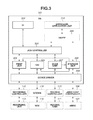
- FIG. 3 is a block diagram illustrating an example of a software configuration of the MFP 10 according to the first embodiment.
- Components illustrated with solid lines in FIG. 3 are software modules implemented by executing the main program loaded onto the RAM 103 by the CPU 101 with the boot program.
- the modules described below, implemented with the main program, is managed and controlled by an operating system (OS) 301 .
- a device driver 308 is combined with the OS 301 .
- the device driver 308 mediates transactions with hardware devices such as the recording controller 112 and the modem 115 .
- a user interface (UI) 302 provides various types of information to a user via the display unit 105 and the operation unit 107 , and receives various instructions from the user.
- a job controller 303 receives jobs such as copy, print, and FAX, and controls execution of the received job.
- a storage unit 306 is a software module that physically stores and manages data, such as an image transmitted or received by FAX and user settings, in the eMMC 109 .
- a scan unit 307 receives this job request and scans the document by controlling the reading unit 111 . Then, FAX image data obtained by the scanning is stored in the storage unit 306 .
- the FAX image data stored in the storage unit 306 is read out by a FAX unit 304 , and is transmitted by FAX to a counterpart via the modem 115 and the NCU 116 .
- the FAX unit 304 acquires image data received by FAX from the counterpart via the modem 115 and the NCU 116 , and stores the image data in the storage unit 306 .
- a print unit 305 transmits various predetermined commands to the recording unit 113 via the recording controller 112 , and receives a status of the recording unit 113 to control operations of the recording unit 113 . For example, when printing a FAX reception image, after transmitting a print command to the recording unit 113 , the print unit 305 reads out an image file stored in the storage unit 306 and transfers image data in the image file to the recording unit 113 .
- the MFP 10 includes a virtual machine (VM)/framework (FW) 309 .
- An expansion application unit 310 includes a certain program written in a script language.
- FIG. 4 is a flowchart illustrating an example of operations in dew condensation determination processing and dew condensation elimination processing executed by the recording unit 113 according to the first embodiment.
- the processing in FIG. 4 may be executed when the MFP 10 is set to operate in a dew condensation elimination mode by user.
- the user can turn ON/OFF the dew condensation elimination processing via the operation unit 107 .
- the content of the user setting is stored in the eMMC 109 or the like.
- the flowchart illustrated in FIG. 4 is executed when a dew condensation elimination processing is ON.
- the dew condensation determination processing from steps S 4 - 001 to S 4 - 008 is a part of the recording unit control program, described with reference to FIG. 2 , which is automatically executed when the CPU 200 of the recording unit 113 receives power supply.
- the CPU 101 may execute a program to cause the CPU 200 to execute the dew condensation determination processing from steps S 4 - 001 to S 4 - 008 .
- step S 4 - 001 the CPU 200 acquires an environmental temperature t(i) in the MFP 10 as a measurement result from the temperature sensor 207 illustrated in FIG. 2 .
- the environmental temperature is, for example, a temperature in the MFP 10 .
- step S 4 - 002 the CPU 200 determines whether the dew condensation elimination processing is in execution.
- the dew condensation elimination processing (described below) is not in execution (NO in step S 4 - 002 )
- the processing proceeds to step S 4 - 003 .
- the processing proceeds to step S 4 - 006 .
- step S 4 - 003 the CPU 200 determines whether an environmental temperature t(i ⁇ 1) measured at a point earlier than the current point by a predetermined time S 1 described below is equal to or lower than a predetermined temperature T 1 .
- the environmental temperature t(i ⁇ 1) is stored in the RAM 202 , and is read out from the RAM 202 in step S 4 - 003 . If the environmental temperature t(i ⁇ 1) is equal to or lower than the predetermined temperature T 1 (YES in step S 4 - 003 ), the processing proceeds to step S 4 - 004 .
- step S 4 - 006 when the environmental temperature t(i ⁇ 1) is higher than the predetermined temperature T 1 (NO in step S 4 - 003 ), the processing proceeds to step S 4 - 006 .
- the processing proceeds from step S 4 - 003 to step S 4 - 006 also in a situation where the environmental temperature measured at the point earlier than the current point by the predetermined time S 1 cannot be obtained.
- An example of such a situation includes a timing immediately after the MFP 10 has started.
- step S 4 - 004 the CPU 200 determines whether a difference between the environmental temperature t(i) acquired in step S 4 - 001 and the environmental temperature t(i ⁇ 1) measured at the point earlier than the current point by the predetermined time S 1 is larger than a predetermined value D. If the difference is larger than the predetermined value D (YES in step S 4 - 004 ), the processing proceeds to step S 4 - 005 . On the other hand, when the difference is not larger than the predetermined value D (NO in step S 4 - 004 ), the processing proceeds to step S 4 - 006 .
- step S 4 - 005 is executed when the environmental temperature t(i ⁇ 1) is determined to be equal to or lower than the predetermined temperature T 1 in step S 4 - 003 , and the difference t(i) ⁇ t(i ⁇ 1) is determined to be larger than the predetermined value D in step S 4 - 004 .
- the CPU 200 starts the dew condensation elimination processing, and the processing proceeds to step S 4 - 006 .
- step S 4 - 006 the CPU 200 stores the environmental temperature t(i) measured in step S 4 - 001 , in the RAM 202 . Then, in step S 4 - 007 , the CPU 200 waits until the predetermined time S 1 elapses. When the predetermined time S 1 has elapsed (YES in step S 4 - 007 ), the processing proceeds to step S 4 - 008 . In step S 4 - 008 , the CPU 200 increments i by one, and the processing returns to step S 4 - 001 . Thus, with steps S 4 - 007 and S 4 - 008 , the environmental temperature t(i) is measured once in every predetermined time S 1 .
- steps S 4 - 010 to S 4 - 014 is the dew condensation elimination processing which is started by the processing in step S 4 - 005 .
- step S 4 - 010 the CPU 200 issues a notification indicating that the dew condensation elimination processing has started (that is, the dew condensation might have occurred in the MFP 10 ) to the CPU 101 via the serial interface 203 (the notification is hereinafter referred to as a dew condensation elimination processing notification).
- the main program executed by the CPU 101 turns ON a dew condensation elimination processing flag in the RAM 202 , upon recognizing reception of the dew condensation elimination processing notification.
- the dew condensation elimination processing flag is ON when the dew condensation elimination processing is in execution in the recording unit 113 .
- step S 4 - 011 the CPU 200 causes full speed rotation of the fan 209 in the MFP 10 .
- This processing is executed to facilitate reduction of the difference between the temperatures inside and outside the MFP 10 , and thus to eliminate the dew condensation having occurred in the MFP 10 and to recover from the state where the dew condensation is likely to be generated.
- the dew condensation elimination processing according to the first embodiment is executed by the full speed rotation of the fan 209 .
- the fan 209 may rotate at a speed other than the full speed as long as the effect of eliminating the dew condensation can be achieved.
- step S 4 - 012 the CPU 200 waits until a predetermined time S 2 elapses with the fan 209 rotating.
- the predetermined time S 2 corresponds to a duration of the full speed rotation of the fan 209 that is expected to eliminate the dew condensation in the MFP 10 .
- step S 4 - 013 the CPU 200 stops the fan 209 .
- the CPU 200 restores the predetermined speed instead of stopping the fan 209 in step S 4 - 013 .
- step S 4 - 014 the CPU 200 issues a notification indicating that the dew condensation elimination processing has been completed (that is, the dew condensation in the MFP 10 has been eliminated) to the CPU 101 in a similar manner to that in step S 4 - 010 . Then, the dew condensation elimination processing is terminated.
- the CPU 101 Upon receiving the notification indicating that the dew condensation elimination processing has been completed, the CPU 101 turns OFF the dew condensation elimination processing flag.
- FIG. 5 is flowchart illustrating an example of FAX reception processing according to the first embodiment. Steps in the flowchart illustrated in FIG. 5 are implemented by the CPU 101 through execution of the main program loaded on the RAM 103 . More specifically, the flowchart is executed by part of programs that constitute the FAX unit 304 . The FAX reception processing starts when FAX is received via the NCU 116 and a negotiation for a FAX reception procedure is completed.
- step S 5 - 001 the CPU 101 waits until reception of a FAX image of a single page is completed.
- reception of the FAX image of a single page is complete (YES in step S 5 - 001 )
- the processing proceeds to step S 5 - 002 .
- step S 5 - 002 the CPU 101 converts the received FAX image into a predetermined image format to be stored by the storage unit 306 in the eMMC 109 as an image file of a single page.
- step S 5 - 003 the CPU 101 determines whether a signal indicating that there is a subsequent page in the FAX reception procedure has been received. When there is a subsequent page (YES in step S 5 - 003 ), the processing returns to step S 5 - 001 . When there is no subsequent page (NO in step S 5 - 003 ), the processing proceeds to step S 5 - 004 . In step S 5 - 004 , the CPU 101 terminates the FAX reception processing.
- FIG. 6 is a flowchart illustrating an example of FAX reception image printing and storing processing according to the first embodiment. Steps in the flowchart illustrated in FIG. 6 are implemented by the CPU 101 through execution of the main program loaded on the RAM 103 . More specifically, the flowchart is executed by part of programs that constitute the print unit 305 . The flowchart is automatically started after initialization processing of the main program.
- step S 6 - 001 the CPU 101 waits for at least one FAX reception job to be generated as a result of executing the FAX reception processing in the flowchart illustrated in FIG. 5 . More specifically, the CPU 101 waits until the storage unit 306 stores a FAX reception image. When the FAX reception image is stored (YES in step S 6 - 001 ), the processing proceeds to step S 6 - 002 .
- step S 6 - 002 the CPU 101 determines whether the dew condensation elimination processing flag is ON. If the dew condensation elimination processing flag is OFF (NO in step S 6 - 002 ), the processing proceeds to step S 6 - 003 . On the other hand, if the dew condensation elimination processing flag is ON (YES in step S 6 - 002 ), the processing proceeds to step S 6 - 005 .
- step S 6 - 003 the CPU 101 determines whether the recording unit 113 is in a printable state. For example, the recording unit 113 is determined to be in a non-printable state (printing disabled) when there is no sheet or toner, or when paper jam occurs during printing. If the recording unit 113 is not in the printing disabled state (NO in step S 6 - 003 ), the processing proceeds to step S 6 - 004 . On the other hand, if the recording unit 113 is in the printing disabled state (YES in step S 6 - 003 ), the processing proceeds to step S 6 - 005 .
- step S 6 - 004 the FAX reception image is printed as will be described in detail below. Then, the processing returns to step S 6 - 001 .
- step S 6 - 005 the CPU 101 requests the UI 302 to display a message, indicating that the FAX reception image is stored in the memory (the eMMC 109 ) without being printed, on the display unit 105 .
- step S 6 - 002 When the dew condensation elimination processing flag is ON in step S 6 - 002 , the dew condensation is assumed to have occurred in the recording unit 113 .
- the printing of the FAX image conducted in this situation might result in erroneous printing or printing an image with a low image quality.
- the FAX image is stored in the memory without being printed.
- the predetermined time S 2 elapses, the dew condensation elimination processing is terminated and thus the dew condensation elimination processing flag is turned OFF, so that the result of the determination in step S 6 - 002 becomes NO.
- the FAX image stored in the memory can be printed in step S 6 - 004 .
- FIG. 7 is a flowchart illustrating an example of FAX reception image printing processing according to the first embodiment. Steps in the flowchart illustrated in FIG. 7 are implemented by the CPU 101 through execution of the main program loaded on the RAM 103 . More specifically, the flowchart is executed by part of programs that constitute the print unit 305 .
- step S 7 - 001 the CPU 101 determines whether the dew condensation elimination processing flag is ON. If the dew condensation elimination processing flag is OFF (NO in step S 7 - 001 ), the processing proceeds to step S 7 - 002 . If the dew condensation elimination processing flag is ON (YES in step S 7 - 001 ), the processing in this flowchart is terminated.
- step S 7 - 002 the CPU 101 determines whether the recording unit 113 is in the printable state. If the recording unit 113 is not in the printing disabled state (NO in step S 7 - 002 ), the processing proceeds to step S 7 - 003 . On the other hand, if the recording unit 113 is in the printing disabled state (YES in step S 7 - 002 ), the processing in the flowchart is terminated.
- step S 7 - 003 the CPU 101 determines whether image data to be printed is stored in the eMMC 109 . If the image data to be printed is stored (YES in step S 7 - 003 ), the processing proceeds to step S 7 - 004 . On the other hand, if the image data to be printed is not stored (NO in step S 7 - 003 ), the processing proceeds to step S 7 - 007 .
- step S 7 - 004 the CPU 101 prints the image to be printed. More specifically, the CPU 101 reads the image data from the eMMC 109 , and issues a command related to the printing and the read image data to the recording unit 113 via the recording controller 112 to cause the recording unit 113 to print the image.
- step S 7 - 005 the CPU 101 determines whether the printing in step S 7 - 004 was successful. If the printing was successful (YES in step S 7 - 005 ), the processing proceeds to step S 7 - 006 . In step S 7 - 006 , the CPU 101 deletes the printed image data from the eMMC 109 . On the other hand, when the printing was not successful (NO in step S 7 - 005 ), the processing returns to step S 7 - 001 , and the CPU 101 attempts to print the image data again.
- step S 7 - 003 If the CPU 101 determines that the image data to be printed is not stored in step S 7 - 003 (NO in step S 7 - 003 ), the processing proceeds to step S 7 - 007 . In step S 7 - 007 , the CPU 101 deletes management information on the FAX reception job from the eMMC 109 , and terminates the FAX reception job printing processing.
- FIG. 8 is a flowchart illustrating an example of personal computer (PC) print job printing processing according to the first embodiment. Steps in the flowchart illustrated in FIG. 8 are implemented by the CPU 101 through execution of the main program loaded on the RAM 103 . More specifically, the flowchart is executed by part of programs that constitute the print unit 305 .
- PC personal computer
- PC print job refers to receiving print data transmitted from a PC, which is an example of an information processing device outside the MFP 10 , via the NIC 117 and performing printing based on the received print data.
- the MFP 10 may be set in advance to permit or not to permit the printing based on the PC print job while the dew condensation elimination processing in the recording unit 113 is in execution.
- a setting is referred to as printing prioritized setting.
- the printing prioritized setting is turn ON and OFF by an instruction from a user or an administrator of the MFP 10 via the operation unit 107 , and the resultant setting is stored in the eMMC 109 . Even when the printing prioritized setting is ON, the printing of the FAX reception image is not permitted while the dew condensation elimination processing is in execution. Thus, the printing prioritized setting is irrelevant to the processing in the flowchart illustrated in FIG. 7 described above.
- step S 8 - 001 the CPU 101 checks whether the printing prioritized setting is ON or OFF. If the printing prioritized setting is OFF (NO in step S 8 - 001 ), the processing proceeds to step S 8 - 002 . On the other hand, if the printing prioritized setting is ON (YES in step S 8 - 001 ), the processing skips step S 8 - 002 and proceeds to step S 8 - 003 . Thus, the printing based on the PC print job is executed even when the dew condensation elimination processing flag is ON, if the printing prioritized setting is ON. If the dew condensation elimination processing flag is ON, the dew condensation elimination processing is executed in the recording unit 113 .
- step S 8 - 002 the CPU 101 determines whether the dew condensation elimination processing flag is ON. If the dew condensation elimination processing flag is OFF (NO in step S 8 - 002 ), the processing proceeds to step S 8 - 003 . On the other hand, if the dew condensation elimination processing flag is ON (YES in step S 8 - 002 ), the processing proceeds to step S 8 - 009 .
- step S 8 - 003 the CPU 101 determines whether the recording unit 113 is in the printable state. If the recording unit 113 is not in the printing disabled state (NO in step S 8 - 003 ), the processing proceeds to step S 8 - 004 . On the other hand, if the recording unit 113 is in the printing disabled state (YES in step S 8 - 003 ), the processing proceeds to step S 8 - 009 .
- step S 8 - 004 the CPU 101 prints image data of a single page to be printed. Then, in step S 8 - 005 , the CPU 101 determines whether the printing in step S 8 - 004 was successful. If the printing was successful (YES in step S 8 - 005 ), the processing proceeds to step S 8 - 006 . On the other hand, if the printing was not successful (NO in step S 8 - 005 ), the processing returns to step S 8 - 001 .
- step S 8 - 006 the CPU 101 deletes the image data of the page that has been successfully printed from the eMMC 109 .
- step S 8 - 007 the CPU 101 determines whether there is image data of the next single page to be printed. When there is the image data of the next single page to be printed (YES in step S 8 - 007 ), the processing returns to step S 8 - 001 , and the image data of the next single page is printed. On the other hand, if there is no image data of the next single page to be printed (NO in step S 8 - 007 ), the processing proceeds to step S 8 - 008 .
- step S 8 - 008 the CPU 101 deletes management information of the PC print job, with the pages that have all been successfully printed, from the eMMC 109 . Then, the PC print job printing processing is terminated.
- step S 8 - 009 the CPU 101 requests the UI 302 to display a message indicating that the printing for the PC print job is suspended due to the dew condensation or because the printing is disabled, on the display unit 105 .
- the dew condensation is likely to have occurred in the MFP 10 when the MFP 10 is executing the dew condensation elimination processing.
- the image forming processing based on the FAX reception is restricted while the dew condensation elimination processing is in execution, and the received FAX image data is stored.
- printing that would only result in a low image quality is prevented from being meaninglessly performed.
- the image data received via FAX is prevented from being lost while the dew condensation is occurring.
- the MFP 10 may also be set in such a manner that a similar control is performed for the PC print job as that for the FAX reception job.
- the processing in the flowchart illustrated in FIG. 8 may be applied to copy processing in which the recording unit 113 prints an image on a document read by the reading unit 111 .
- the same processing is executed in the case where the dew condensation elimination processing flag is ON and in the case where the printing is disabled.
- the processing to be executed may be different between the case where the dew condensation elimination processing flag is ON and the case where the printing is disabled.
- FIG. 9 is a flowchart illustrating an example of FAX reception image printing and storing control and dew condensation elimination processing flag checking processing according to a second embodiment.
- the MFP 10 according to the second embodiment has the same hardware and software configurations as those illustrated in FIGS. 1 to 3 .
- the dew condensation determination processing and the dew condensation elimination processing executed in the recording unit 113 are the same as those illustrated in FIG. 4 .
- Steps in the flowchart illustrated in FIG. 9 are implemented by the CPU 101 through execution of the main program loaded on the RAM 103 .
- steps S 9 - 001 , S 9 - 003 , S 9 - 004 , and S 9 - 005 are respectively the same as steps S 6 - 001 , S 6 - 003 , S 6 - 004 , and S 6 - 005 in the flowchart illustrated in FIG. 6 .
- the MFP 10 may store a setting (forced memory reception setting) 9000 , with which a FAX reception image is stored in the memory without being printed, in the eMMC 109 .
- the CPU 101 checks whether the forced memory reception setting 9000 is ON. If the forced memory reception setting 9000 is ON, the processing proceeds to step S 9 - 006 . On the other hand, if the forced memory reception setting is OFF, the processing proceeds to step S 9 - 003 .
- step S 9 - 006 the CPU 101 stores the FAX reception image in the eMMC 109 without printing the image, and requests the UI 302 to display the message indicating that the image is stored in the memory, on the display unit 105 . Then, the processing returns to step S 9 - 001 .
- the dew condensation elimination processing flag checking processing includes steps S 9 - 007 to S 9 - 012 .
- step S 9 - 007 the CPU 101 checks whether the dew condensation elimination processing flag is ON. If the dew condensation elimination processing flag is ON (YES in step S 9 - 007 ), the processing proceeds to step S 9 - 008 . On the other hand, if the dew condensation elimination processing flag is OFF (NO in step S 9 - 007 ), the processing proceeds to step S 9 - 011 .
- step S 9 - 008 the CPU 101 temporarily stores the current setting value of the forced memory reception setting 9000 in a predetermined area in the eMMC 109 .
- step S 9 - 009 the CPU 101 rewrites the setting of the forced memory reception setting 9000 to a value indicating “store”.
- step S 9 - 010 the CPU 101 requests the UI 302 to disable setting change via the operation unit 107 .
- the UI 302 grays out a menu display for setting the forced memory reception setting 9000 so that the user cannot change the setting.
- step S 9 - 011 the CPU 101 returns the setting value of the forced memory reception setting 9000 to what has been temporarily stored in step S 9 - 008 .
- step S 9 - 012 the CPU 101 requests the UI 302 to permit the setting change on the operation unit 107 .
- the FAX reception image forcibly received by the memory may be made viewable on the display unit 105 or a web browser on a PC connected via the NIC 117 , so that a usability can be improved.
- the MFP 10 that has transitioned to a power saving mode returns to a normal power mode and measures the environmental temperature, when an environmental temperature measurement timing arrives.
- the power saving mode power supply to at least the recording controller 112 and the recording unit 113 is stopped, so that lower power consumption is achieved in the apparatus as a whole, compared with the normal power mode.
- the CPU 101 receives power supply and thus can control the recording unit 113 so that the dew condensation determination processing can be executed.
- the power supply to the CPU 101 may be stopped in the power saving mode. In such a configuration, the CPU 101 may be periodically woken up (that is, may transition to the power supplied state) by a timer, and execute the following processing.
- the power supply to the recording unit 113 stops, and thus the temperature sensor 207 in the recording unit 113 cannot measure the environmental temperature.
- the CPU 101 that can operate in the power saving mode controls the recording controller 112 and the recording unit 113 in such a manner that the recording unit 113 recovers from the power saving mode at a predetermined timing.
- the recording unit 113 that has recovered executes the dew condensation determination processing described with reference to FIG. 4 . If a result of the dew condensation determination processing indicates that the dew condensation elimination processing needs to be executed (Yes in step S 4 - 004 ), the dew condensation elimination processing is executed. If it is determined that the processing needs not to be executed (No in step S 4 - 004 ), the recording unit 113 returns to the power saving mode.
- Dew condensation determination processing is described with reference to FIG. 10 .
- the processing illustrated in FIG. 10 for the recording unit 113 is implemented by the CPU 101 through execution of the program stored in the ROM 102 .
- step S 1001 the CPU 101 determines whether the dew condensation elimination processing flag is ON. The processing in step S 1001 is repeated as long as the dew condensation elimination processing flag is OFF (NO in step S 1001 ). On the other hand, when the dew condensation elimination processing flag is ON (YES in step S 1001 ), the processing proceeds to step S 1002 .
- step S 1002 the CPU 101 determines whether the MFP 10 is in the sleep mode. If the MFP 10 is not in the sleep mode (NO in step S 1002 ), the processing returns to step S 1001 . If the MFP 10 is in the sleep mode (YES in step S 1002 ), the processing returns to step S 1003 .
- step S 1003 the CPU 101 determines whether the sleep mode has been maintained for a predetermined time S 3 .
- the predetermined time S 3 may be, for example, longer than the predetermined time S 1 illustrated in FIG. 4 . If the sleep mode has not been maintained for the predetermined time S 3 yet (NO in step S 1003 ), the processing returns to step S 1001 . On the other hand, when the sleep mode has been maintained for the predetermined time S 3 (YES in step S 1003 ), the processing proceeds to step S 1004 .
- step S 1004 the CPU 101 wakes the recording unit 113 up from the sleep mode. Upon waking up from the sleep mode, the recording unit 113 executes the dew condensation determination processing and the dew condensation elimination processing described with reference to FIG. 4 .
- step S 1005 the CPU 101 receives a notification indicating the result of the dew condensation determination processing from the recording unit 113 . Then, in step S 1006 , the CPU 101 determines whether the transition to the sleep mode is possible, based on the received notification. When a sleep mode transition condition, at least including reception of a notification from the recording unit 113 indicating that the dew condensation is not generated, is satisfied, the CPU 101 according to the present embodiment determines that the transition to the sleep mode is possible. On the other hand, when the dew condensation elimination processing described above with reference to FIG. 4 is executed due to the occurrence of the dew condensation, the CPU 101 determines that the transition to the sleep mode is not possible.
- step S 1006 When the CPU 101 determines that the transition to the sleep mode is not possible (NO in step S 1006 ), the processing returns to step S 1001 .
- step S 1007 the CPU 101 causes the MFP 10 to transition to the sleep mode, and then the processing returns to step S 1001 .
- the result of the dew condensation determination processing is received in step S 1005 .
- this processing may be omitted. If the dew condensation elimination processing is determined to be required as a result of the dew condensation determination processing and thus is executed, an operation such as rotation of the fan 209 starts. Accordingly, the CPU 101 can determine that the transition to the sleep mode is not possible in step S 1006 .
- the CPU 101 may determine that the transition to the sleep mode is possible in step S 1006 and cause the MFP 10 to transition to the sleep mode in step S 1007 , when a predetermined time elapses without such operation as rotation of the fan 209 .
- step S 1101 the CPU 200 determines whether the recording unit 113 has woken up from the sleep mode. If the recording unit 113 has woken up from the sleep mode (Yes in step S 1101 ), the processing proceeds to step S 1102 .
- step S 1102 the CPU 200 determines whether the dew condensation elimination processing flag is ON. If the dew condensation elimination processing flag is OFF (NO in step S 1002 ), the processing is terminated. On the other hand, if the dew condensation elimination processing flag is ON (YES in step S 1002 ), the processing proceeds to step S 1003 .
- step S 1103 the CPU 200 executes the dew condensation determination processing described with reference to FIG. 4 . Then, in step S 1104 , the CPU 200 notifies the CPU 101 of the result of the dew condensation determination processing.
- the environmental temperature in the MFP 10 can be measured periodically even when the MFP 10 is in the sleep mode, and the dew condensation elimination processing can be started when it is determined that the dew condensation has occurred.
- the forced memory reception is performed in the FAX reception printing and storing control, when the dew condensation has occurred.
- the storing of a FAX reception image in the memory without printing the image is not based on the forced memory reception setting. Instead, the FAX reception image is stored in the memory without being printed when it is determined that the MFP 10 is in the printing disabled state including the state where the dew condensation elimination processing is in execution.
- the CPU 101 executes processing illustrated in FIG. 12 , instead of the processing illustrated in FIG. 6 and FIG. 9 .
- the other configuration and processing are the same as those described in the first or the second embodiment, and thus the description thereof will be omitted.
- the processing in FIG. 12 is implemented by the CPU 101 through execution of a program stored in the ROM 102 .
- step S 1201 the CPU 101 determines whether a FAX reception image is stored.
- the processing in step S 1201 is repeated as long as no FAX reception image is stored (NO in step S 1201 ).
- step S 1202 the processing proceeds to step S 1202 .
- step S 1202 the CPU 101 determines whether the MFP 10 is in the printing disabled state.
- the printing disabled state includes the state where the dew condensation elimination processing is in process with the fan 209 rotating.
- step S 1203 the CPU 101 prints the FAX reception image.
- the detail of the FAX reception image printing processing is the same as that described in FIG. 5 , and thus the description thereof will be omitted.
- step S 1204 the CPU 101 performs control in such a manner that the received image is stored in the memory without being printed.
- step S 1205 the CPU 101 requests the display unit 105 to display the message indicating that the image is stored without being printed. Then, the processing returns to step S 1201 .
- the FAX reception image can be prevented from being printed when the dew condensation elimination processing is in execution due to the occurrence of the dew condensation.
- printing that would only result in a low image quality is prevented from being meaninglessly performed.
- the image data received via FAX is prevented from being lost while the dew condensation is occurring.
- the effect described above can be obtained without employing the management involving checking whether the forced memory reception setting flag is ON or OFF as in the first and the second embodiments.
- the FAX reception image is not printed when the dew condensation elimination processing flag is ON.
- the dew condensation elimination processing can be executed without the risk of losing the reception data while the dew condensation is occurring, without suspending the printing. More specifically, step S 6 - 002 may be deleted in FIG. 6 , and step S 7 - 001 in FIG. 7 may be moved to between steps S 7 - 005 and S 7 - 006 and to before step S 7 - 007 . Furthermore, the processing in step S 7 - 003 may be changed to processing of determining whether a page to be printed is remaining.
- the FAX reception image printing processing is executed even when the dew condensation elimination processing flag is ON. Also with this configuration, the dew condensation elimination processing can be executed without the risk of losing the reception data while the dew condensation is occurring. Still, this configuration is not free of a risk of printing an image with a low image quality.
- the recording unit dew condensation determination processing illustrated in FIG. 4 , according to the first embodiment, whether the dew condensation is occurring is determined based on an absolute temperature obtained from the temperature sensor 207 and an amount of change per unit time.
- the dew condensation determination processing is not limited to this.
- the recording unit 113 illustrated in FIG. 2 may further include a humidity sensor. More accurate dew condensation determination processing can be achieved with estimation based on measurement results from the temperature sensor 207 and the humidity sensor. Alternatively, whether the dew condensation has occurred may be determined based on a charged state of the photosensitive drum 210 .
- the dew condensation determination processing is executed in any environment.
- the dew condensation occurs in a limited environment with a low temperature.
- a user environment may be selectable through navigation by the main program at the timing when the MFP 10 is installed, and the recording unit may execute the dew condensation determination processing only when the MFP 10 is used in a location with a low temperature.
- the dew condensation elimination processing according to the embodiments described above is achieved with the full speed rotation of the fan 209 of the image forming unit 205 of the recording unit 113 .
- the dew condensation elimination processing is not limited to this.
- the image forming unit 205 may include a dew condensation prevention heater, and the dew condensation may be eliminated with this heater heated for a predetermined period of time.
- Embodiment(s) can also be realized by a computer of a system or apparatus that reads out and executes computer executable instructions (e.g., one or more programs) recorded on a storage medium (which may also be referred to more fully as a ‘non-transitory computer-readable storage medium’) to perform the functions of one or more of the above-described embodiment(s) and/or that includes one or more circuits (e.g., application specific integrated circuit (ASIC)) for performing the functions of one or more of the above-described embodiment(s), and by a method performed by the computer of the system or apparatus by, for example, reading out and executing the computer executable instructions from the storage medium to perform the functions of one or more of the above-described embodiment(s) and/or controlling the one or more circuits to perform the functions of one or more of the above-described embodiment(s).
- computer executable instructions e.g., one or more programs
- a storage medium which may also be referred to more fully as a ‘non-
- the computer may comprise one or more processors (e.g., central processing unit (CPU), micro processing unit (MPU)) and may include a network of separate computers or separate processors to read out and execute the computer executable instructions.
- the computer executable instructions may be provided to the computer, for example, from a network or the storage medium.
- the storage medium may include, for example, one or more of a hard disk, a random-access memory (RAM), a read only memory (ROM), a storage of distributed computing systems, an optical disk (such as a compact disc (CD), digital versatile disc (DVD), or Blu-ray Disc (BD)TM), a flash memory device, a memory card, and the like.
Landscapes
- Engineering & Computer Science (AREA)
- Multimedia (AREA)
- Signal Processing (AREA)
- Environmental & Geological Engineering (AREA)
- Facsimiles In General (AREA)
- Control Or Security For Electrophotography (AREA)
- Accessory Devices And Overall Control Thereof (AREA)
Abstract
Description
Claims (20)
Applications Claiming Priority (4)
| Application Number | Priority Date | Filing Date | Title |
|---|---|---|---|
| JP2016-145741 | 2016-07-25 | ||
| JP2016145741 | 2016-07-25 | ||
| JP2016247180A JP6821420B2 (en) | 2016-07-25 | 2016-12-20 | Image forming apparatus and its control method |
| JP2016-247180 | 2016-12-20 |
Publications (2)
| Publication Number | Publication Date |
|---|---|
| US20180027140A1 US20180027140A1 (en) | 2018-01-25 |
| US10694062B2 true US10694062B2 (en) | 2020-06-23 |
Family
ID=60989049
Family Applications (1)
| Application Number | Title | Priority Date | Filing Date |
|---|---|---|---|
| US15/652,050 Active US10694062B2 (en) | 2016-07-25 | 2017-07-17 | Image forming apparatus and method for controlling the same which includes at least one or more processors, and memory storing instructions to determine whether to perform image formation, and to perform operations for controlling execution of dew condensation elimination processing having occurred in the image forming unit |
Country Status (2)
| Country | Link |
|---|---|
| US (1) | US10694062B2 (en) |
| CN (1) | CN107659745A (en) |
Families Citing this family (5)
| Publication number | Priority date | Publication date | Assignee | Title |
|---|---|---|---|---|
| JP6752703B2 (en) * | 2016-12-12 | 2020-09-09 | キヤノン株式会社 | Image forming device |
| JP7229672B2 (en) * | 2018-04-27 | 2023-02-28 | キヤノン株式会社 | IMAGE FORMING APPARATUS AND CONTROL METHOD FOR IMAGE FORMING APPARATUS |
| JP7129252B2 (en) * | 2018-07-10 | 2022-09-01 | キヤノン株式会社 | image forming device |
| JP7328009B2 (en) * | 2019-05-30 | 2023-08-16 | キヤノン株式会社 | IMAGE FORMING APPARATUS, CONTROL METHOD AND PROGRAM THEREOF |
| JP7763080B2 (en) * | 2021-11-18 | 2025-10-31 | シャープ株式会社 | Processing device, image processing device, and processing method - Patents.com |
Citations (17)
| Publication number | Priority date | Publication date | Assignee | Title |
|---|---|---|---|---|
| JPS63178654A (en) | 1987-01-19 | 1988-07-22 | Nec Corp | Facsimile equipment |
| US4905092A (en) * | 1987-11-04 | 1990-02-27 | Ricoh Company, Ltd. | Condensation-free data reading machine |
| JP2000151866A (en) | 1998-11-13 | 2000-05-30 | Ricoh Co Ltd | Image forming device |
| JP2000209415A (en) | 1999-01-11 | 2000-07-28 | Ricoh Co Ltd | Facsimile machine |
| US6408144B2 (en) * | 2000-03-29 | 2002-06-18 | Murata Kikai Kabushiki Kaisha | Image forming apparatus for operating under the optimum environment condition |
| JP2003018370A (en) | 2001-07-05 | 2003-01-17 | Canon Inc | Image reading device with high-speed dew condensation improvement configuration |
| US20030111218A1 (en) * | 2001-12-14 | 2003-06-19 | Yukinobu Iguchi | Image forming apparatus |
| JP2005039477A (en) | 2003-07-18 | 2005-02-10 | Ricoh Co Ltd | Image forming apparatus |
| CN1664648A (en) | 2004-03-05 | 2005-09-07 | 夏普株式会社 | Light beam scanning unit and image forming apparatus |
| US20050286092A1 (en) * | 2004-06-25 | 2005-12-29 | Choi Kyung-Chool | Moisture removal apparatus and method of image read out apparatus |
| JP2006091206A (en) | 2004-09-22 | 2006-04-06 | Seiko Epson Corp | Image forming apparatus |
| CN102053541A (en) | 2009-10-30 | 2011-05-11 | 佳能株式会社 | Image forming apparatus |
| US20120076561A1 (en) | 2010-09-27 | 2012-03-29 | Canon Kabushiki Kaisha | Data processing apparatus, condensation removal method and program thereof |
| JP2012103532A (en) | 2010-11-11 | 2012-05-31 | Konica Minolta Business Technologies Inc | Image forming apparatus |
| US20130027755A1 (en) * | 2011-07-26 | 2013-01-31 | Kyocera Document Solutions, Inc. | Image Scanning Apparatus |
| US20150116757A1 (en) | 2013-10-31 | 2015-04-30 | Kyocera Document Solutions Inc. | Image forming apparatus that performs function restriction, image formation method, and recording medium |
| JP2016114865A (en) | 2014-12-17 | 2016-06-23 | 京セラドキュメントソリューションズ株式会社 | Image forming apparatus |
-
2017
- 2017-07-17 US US15/652,050 patent/US10694062B2/en active Active
- 2017-07-25 CN CN201710608720.XA patent/CN107659745A/en active Pending
Patent Citations (19)
| Publication number | Priority date | Publication date | Assignee | Title |
|---|---|---|---|---|
| JPS63178654A (en) | 1987-01-19 | 1988-07-22 | Nec Corp | Facsimile equipment |
| US4905092A (en) * | 1987-11-04 | 1990-02-27 | Ricoh Company, Ltd. | Condensation-free data reading machine |
| JP2000151866A (en) | 1998-11-13 | 2000-05-30 | Ricoh Co Ltd | Image forming device |
| JP2000209415A (en) | 1999-01-11 | 2000-07-28 | Ricoh Co Ltd | Facsimile machine |
| US6408144B2 (en) * | 2000-03-29 | 2002-06-18 | Murata Kikai Kabushiki Kaisha | Image forming apparatus for operating under the optimum environment condition |
| JP2003018370A (en) | 2001-07-05 | 2003-01-17 | Canon Inc | Image reading device with high-speed dew condensation improvement configuration |
| US20030111218A1 (en) * | 2001-12-14 | 2003-06-19 | Yukinobu Iguchi | Image forming apparatus |
| JP2005039477A (en) | 2003-07-18 | 2005-02-10 | Ricoh Co Ltd | Image forming apparatus |
| CN1664648A (en) | 2004-03-05 | 2005-09-07 | 夏普株式会社 | Light beam scanning unit and image forming apparatus |
| US20050286092A1 (en) * | 2004-06-25 | 2005-12-29 | Choi Kyung-Chool | Moisture removal apparatus and method of image read out apparatus |
| JP2006091206A (en) | 2004-09-22 | 2006-04-06 | Seiko Epson Corp | Image forming apparatus |
| CN102053541A (en) | 2009-10-30 | 2011-05-11 | 佳能株式会社 | Image forming apparatus |
| US9454113B2 (en) * | 2009-10-30 | 2016-09-27 | Canon Kabushiki Kaisha | Image forming apparatus |
| US20120076561A1 (en) | 2010-09-27 | 2012-03-29 | Canon Kabushiki Kaisha | Data processing apparatus, condensation removal method and program thereof |
| KR20120031907A (en) | 2010-09-27 | 2012-04-04 | 캐논 가부시끼가이샤 | Data processing apparatus, condensation removal method and program thereof |
| JP2012103532A (en) | 2010-11-11 | 2012-05-31 | Konica Minolta Business Technologies Inc | Image forming apparatus |
| US20130027755A1 (en) * | 2011-07-26 | 2013-01-31 | Kyocera Document Solutions, Inc. | Image Scanning Apparatus |
| US20150116757A1 (en) | 2013-10-31 | 2015-04-30 | Kyocera Document Solutions Inc. | Image forming apparatus that performs function restriction, image formation method, and recording medium |
| JP2016114865A (en) | 2014-12-17 | 2016-06-23 | 京セラドキュメントソリューションズ株式会社 | Image forming apparatus |
Also Published As
| Publication number | Publication date |
|---|---|
| CN107659745A (en) | 2018-02-02 |
| US20180027140A1 (en) | 2018-01-25 |
Similar Documents
| Publication | Publication Date | Title |
|---|---|---|
| KR102331166B1 (en) | Image forming apparatus and method for controlling the same | |
| US20180027140A1 (en) | Image forming apparatus and method for controlling the same | |
| USRE48925E1 (en) | Information processing apparatus, method for controlling power state shift and clearing or not clearing a shift time measured | |
| US9195422B2 (en) | Image forming apparatus and method of controlling the apparatus | |
| US11392439B2 (en) | Program and information processing apparatus | |
| US10574854B2 (en) | Imaging processing apparatus for receiving print data from server and performing image processing and method for controlling the same | |
| CN106341566B (en) | Printing device and method for controlling the printing device | |
| US11700339B2 (en) | Image forming apparatus, control method thereof, and storage medium for changing a display language | |
| US10455103B2 (en) | Power control method of printing apparatus | |
| US10057433B2 (en) | Image forming apparatus, operation control method and non-transitory computer-readable storage medium storing operation control program | |
| JP7802722B2 (en) | Image forming apparatus, control method for image forming apparatus, and program | |
| US20130191623A1 (en) | Information processing apparatus, control method therefor, and storage medium | |
| US20150264210A1 (en) | Image forming apparatus, control method for the same, and storage medium | |
| US10764463B2 (en) | Image forming apparatus, control method therefor, and storage medium for sending notification of an input operation to at least a user interface | |
| JP6776799B2 (en) | Image forming device, information processing method and program | |
| US11039032B2 (en) | Printing apparatus executable of condensation removal processing, method of controlling printing apparatus, and storage medium | |
| US9924059B2 (en) | Apparatus having power-saving function, method of processing information, and computer program product | |
| US20150350478A1 (en) | Method and apparatus for controlling a backlight in a display unit of an image processing apparatus | |
| US11816233B2 (en) | Information processing apparatus | |
| JP2020052136A (en) | Image forming apparatus, control method, and program | |
| JP2020112721A (en) | Image forming apparatus and method for controlling the same | |
| JP2009177366A (en) | Image forming apparatus |
Legal Events
| Date | Code | Title | Description |
|---|---|---|---|
| AS | Assignment |
Owner name: CANON KABUSHIKI KAISHA, JAPAN Free format text: ASSIGNMENT OF ASSIGNORS INTEREST;ASSIGNORS:IKEDA, ATSUSHI;SUGITA, HIKARU;REEL/FRAME:044127/0399 Effective date: 20170705 |
|
| STPP | Information on status: patent application and granting procedure in general |
Free format text: DOCKETED NEW CASE - READY FOR EXAMINATION |
|
| STPP | Information on status: patent application and granting procedure in general |
Free format text: NOTICE OF ALLOWANCE MAILED -- APPLICATION RECEIVED IN OFFICE OF PUBLICATIONS |
|
| STPP | Information on status: patent application and granting procedure in general |
Free format text: AWAITING TC RESP., ISSUE FEE NOT PAID |
|
| STPP | Information on status: patent application and granting procedure in general |
Free format text: NOTICE OF ALLOWANCE MAILED -- APPLICATION RECEIVED IN OFFICE OF PUBLICATIONS |
|
| STPP | Information on status: patent application and granting procedure in general |
Free format text: DOCKETED NEW CASE - READY FOR EXAMINATION |
|
| STPP | Information on status: patent application and granting procedure in general |
Free format text: NOTICE OF ALLOWANCE MAILED -- APPLICATION RECEIVED IN OFFICE OF PUBLICATIONS |
|
| STPP | Information on status: patent application and granting procedure in general |
Free format text: AWAITING TC RESP., ISSUE FEE NOT PAID |
|
| STPP | Information on status: patent application and granting procedure in general |
Free format text: DOCKETED NEW CASE - READY FOR EXAMINATION |
|
| STPP | Information on status: patent application and granting procedure in general |
Free format text: NOTICE OF ALLOWANCE MAILED -- APPLICATION RECEIVED IN OFFICE OF PUBLICATIONS |
|
| STPP | Information on status: patent application and granting procedure in general |
Free format text: PUBLICATIONS -- ISSUE FEE PAYMENT VERIFIED |
|
| STPP | Information on status: patent application and granting procedure in general |
Free format text: NOTICE OF ALLOWANCE MAILED -- APPLICATION RECEIVED IN OFFICE OF PUBLICATIONS |
|
| STCF | Information on status: patent grant |
Free format text: PATENTED CASE |
|
| MAFP | Maintenance fee payment |
Free format text: PAYMENT OF MAINTENANCE FEE, 4TH YEAR, LARGE ENTITY (ORIGINAL EVENT CODE: M1551); ENTITY STATUS OF PATENT OWNER: LARGE ENTITY Year of fee payment: 4 |