US10693833B2 - Address resolution suppression in a logical network - Google Patents
Address resolution suppression in a logical network Download PDFInfo
- Publication number
- US10693833B2 US10693833B2 US15/451,436 US201715451436A US10693833B2 US 10693833 B2 US10693833 B2 US 10693833B2 US 201715451436 A US201715451436 A US 201715451436A US 10693833 B2 US10693833 B2 US 10693833B2
- Authority
- US
- United States
- Prior art keywords
- address
- hypervisor
- host
- virtualized computing
- address resolution
- Prior art date
- Legal status (The legal status is an assumption and is not a legal conclusion. Google has not performed a legal analysis and makes no representation as to the accuracy of the status listed.)
- Active, expires
Links
Images


Classifications
-
- H—ELECTRICITY
- H04—ELECTRIC COMMUNICATION TECHNIQUE
- H04L—TRANSMISSION OF DIGITAL INFORMATION, e.g. TELEGRAPHIC COMMUNICATION
- H04L61/00—Network arrangements, protocols or services for addressing or naming
- H04L61/09—Mapping addresses
- H04L61/10—Mapping addresses of different types
- H04L61/103—Mapping addresses of different types across network layers, e.g. resolution of network layer into physical layer addresses or address resolution protocol [ARP]
-
- H—ELECTRICITY
- H04—ELECTRIC COMMUNICATION TECHNIQUE
- H04L—TRANSMISSION OF DIGITAL INFORMATION, e.g. TELEGRAPHIC COMMUNICATION
- H04L12/00—Data switching networks
- H04L12/28—Data switching networks characterised by path configuration, e.g. LAN [Local Area Networks] or WAN [Wide Area Networks]
- H04L12/46—Interconnection of networks
- H04L12/4633—Interconnection of networks using encapsulation techniques, e.g. tunneling
-
- H—ELECTRICITY
- H04—ELECTRIC COMMUNICATION TECHNIQUE
- H04L—TRANSMISSION OF DIGITAL INFORMATION, e.g. TELEGRAPHIC COMMUNICATION
- H04L12/00—Data switching networks
- H04L12/28—Data switching networks characterised by path configuration, e.g. LAN [Local Area Networks] or WAN [Wide Area Networks]
- H04L12/46—Interconnection of networks
- H04L12/4641—Virtual LANs, VLANs, e.g. virtual private networks [VPN]
-
- H—ELECTRICITY
- H04—ELECTRIC COMMUNICATION TECHNIQUE
- H04L—TRANSMISSION OF DIGITAL INFORMATION, e.g. TELEGRAPHIC COMMUNICATION
- H04L2101/00—Indexing scheme associated with group H04L61/00
- H04L2101/60—Types of network addresses
- H04L2101/618—Details of network addresses
- H04L2101/622—Layer-2 addresses, e.g. medium access control [MAC] addresses
-
- H04L61/6022—
Definitions
- address resolution refers to the process of resolving a protocol address (e.g., Internet Protocol (IP) address) to a hardware address (e.g., Media Access Control (MAC) address).
- IP Internet Protocol
- MAC Media Access Control
- address resolution may be required when a source wishes to communicate with a destination. To learn the hardware address of the destination, the source broadcasts a request message that includes a known protocol address of the destination. In response, the destination will send a response message that includes its hardware address. Other recipients are not required to respond to the broadcasted request message.
- the broadcast nature of the address resolution process may lead to various problems such as network flooding. Address resolution suppression is therefore desirable to limit the amount of broadcast traffic relating to address resolution.
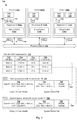
- FIG. 1 is a schematic diagram illustrating an example virtualized computing environment in which address resolution suppression in a logical network may be implemented
- FIG. 2 is a flowchart of an example process for a first host to perform address resolution suppression in a logical network
- FIG. 3 is a flowchart of an example detailed process for a first host to perform address resolution suppression in a logical network
- FIG. 4 is a schematic diagram illustrating an example of a first hypervisor supported by a first host triggering control messages from respective second hypervisors supported by respective second hosts;
- FIG. 5 is a schematic diagram illustrating an example of a first hypervisor supported by a first host receiving control messages from respective second hypervisors supported by respective second hosts;
- FIG. 6 is a schematic diagram illustrating an example of a first hypervisor performing address resolution suppression based on the protocol-to-hardware address mapping information learned in the example in FIG. 5 ;
- FIG. 7 is a schematic diagram illustrating an example of a first hypervisor performing packet forwarding based on the hardware-to-virtual-tunnel-endpoint (VTEP) address mapping information learned in the example in FIG. 5 .
- VTEP hardware-to-virtual-tunnel-endpoint
- FIG. 1 is a schematic diagram illustrating example virtualized computing environment 100 in which address resolution suppression in a logical network may be implemented. It should be understood that, depending on the desired implementation, virtualized computing environment 100 may include additional and/or alternative components than that shown in FIG. 1 .
- virtualized computing environment 100 includes multiple hosts, such as host-A 110 A, host-B 110 B and host-C 110 C that are interconnected via physical network 140 .
- Each host 110 A/ 110 B/ 110 C includes suitable hardware 112 A/ 112 B/ 112 C and virtualization software (e.g., hypervisor-A 114 A, hypervisor-B 114 B, hypervisor-C 114 C) to support various virtual machines.
- host-A 110 A supports VM 1 131 and VM 2 132
- host-B 110 B supports VM 3 133 and VM 4 134
- host-C 110 C supports VM 5 135 and VM 6 136 .
- virtualized computing environment 100 may include any number of hosts (also known as a “computing devices”, “host computers”, “host devices”, “physical servers”, “server systems”, etc.), where each host may be supporting tens or hundreds of virtual machines.
- a virtualized computing instance may represent an addressable data compute node or isolated user space instance.
- any suitable technology may be used to provide isolated user space instances, not just hardware virtualization.
- Other virtualized computing instances may include containers (e.g., running on top of a host operating system without the need for a hypervisor or separate operating system such as Docker, etc.; or implemented as an operating system level virtualization), virtual private servers, client computers, etc.
- the virtual machines may also be complete computational environments, containing virtual equivalents of the hardware and software components of a physical computing system.
- hypervisor may refer generally to a software layer or component that supports the execution of multiple virtualized computing instances, including system-level software that supports namespace containers such as Docker, etc.
- Hypervisor 114 A/ 114 B/ 114 C maintains a mapping between underlying hardware 112 A/ 112 B/ 112 C and virtual resources allocated to respective virtual machines 131 - 136 .
- Hardware 112 A/ 112 B/ 112 C includes suitable physical components, such as central processing unit(s) or processor(s) 120 A/ 120 B/ 120 C; memory 122 A/ 122 B/ 122 C; physical network interface controllers (NICs) 124 A/ 124 B/ 124 C; and storage disk(s) 128 A/ 128 B/ 128 C accessible via storage controller(s) 126 A/ 126 B/ 126 C, etc.
- Virtual resources are allocated to each virtual machine to support a guest operating system (OS) and applications.
- OS guest operating system
- the virtual resources may include virtual CPU, virtual memory, virtual disk, virtual network interface controller (VNIC), etc.
- Hypervisor 114 A/ 114 B/ 114 C further implements virtual switch 116 A/ 116 B/ 116 C to handle egress packets from, and ingress packets to, respective virtual machines 131 - 136 .
- packet may refer generally to a group of bits that can be transported together from a source to a destination, such as message, segment, datagram, etc.
- SDN controller 160 is a “network management entity” that facilitates network virtualization in virtualized computing environment 100 . Through network virtualization, logical networks may be provisioned, changed, stored, deleted and restored programmatically without having to reconfigure the underlying physical hardware. SDN controller 160 may be implemented using physical machine(s), virtual machine(s), or both. One example of an SDN controller is the NSX controller component of VMware NSX® (available from VMware, Inc.) that operates on a central control plane. SDN controller 160 may be a member of a controller cluster (not shown) that is configurable using an SDN manager.
- Logical networks may be formed using any suitable tunneling protocol, such as Virtual eXtension Local Area Network (VXLAN), Stateless Transport Tunneling (STT), Generic Network Virtualization Encapsulation (GENEVE), etc.
- VXLAN is a layer-2 overlay scheme on a layer-3 network that uses tunnel encapsulation to extend layer-2 segments across multiple hosts.
- VM 1 131 on host-A 110 A, VM 3 133 on host-B 110 B, as well as VM 5 135 and VM 6 136 on host-C 110 C may be configured as members of a first VXLAN logical network (e.g., VXLAN 100 ).
- a second VXLAN logical network (e.g., VXLAN 200 ) may be configured with VM 2 132 on host-A 110 A and VM 4 134 on host-B 110 B as members.
- SDN controller 160 is responsible for collecting and disseminating control information relating to logical networks and overlay transport tunnels, such as logical network topology, membership information of logical networks, mobility of the members, firewall rules and policies, etc.
- LCP local control plane
- SDN controller 160 To send and receive the control information, local control plane (LCP) agent 118 A/ 118 B/ 118 C on host 110 A/ 110 B/ 110 C requires control-plane connectivity 150 / 152 / 154 with SDN controller 160 .
- control-plane connectivity may refer generally the ability of SDN controller 160 and host 110 A/ 110 B/ 110 C to communicate with each other, such as over a management network.
- a control-plane channel (or more simply “control channel”) may be established between SDN controller 160 and host 110 A/ 110 B/ 110 C using any suitable protocol, such as using Transmission Control Protocol (TCP) over Secure Sockets Layer (SSL), etc.
- TCP Transmission Control Protocol
- SSL Secure Sockets Layer
- Host 110 A/ 110 B/ 110 C also requires data-plane connectivity with other host(s), such as to facilitate communication among members of a logical network, exchange connectivity status information, etc.
- host-A 110 A requires data-plane connectivity with host-B 110 B for VM 1 131 to be able to send packets to, and receive packets, from VM 3 133 on VXLAN 100 .
- Hypervisor 114 A/ 114 B/ 114 C implements a virtual tunnel endpoint (VTEP) to encapsulate and decapsulate packets with a tunnel header identifying the logical network.
- VTEP virtual tunnel endpoint
- hypervisor-A 114 A implements a first VTEP
- hypervisor-B 114 B implements a second VTEP
- hypervisor-C 114 C implements a third VTEP.
- Encapsulated packets (e.g., from VM 1 131 to VM 3 133 ) may be sent over a tunnel established between a pair of VTEPs (e.g., hypervisor-A 114 A and hypervisor-B 114 B).
- tunnel may generally refer to an end-to-end, bi-directional communication path between a pair of VTEPs.
- data-plane connectivity may refer generally to the ability of two hosts to communicate with each other, such as over physical network 140 (representing a data plane).
- Physical network 140 may include any suitable number of interconnected network devices, such as layer-3 routers, layer-2 switches, gateway devices, etc.
- layer 2 may refer generally to a Media Access Control (MAC) layer; and “layer 3” to a network or Internet Protocol (IP) layer in the Open System Interconnection (OSI) model, although the concepts described herein may be used with other networking models.
- MAC Media Access Control
- IP Internet Protocol
- VM 1 131 on host-A 110 A and VM 3 133 on host-B 110 B on VXLAN 100 .
- VM 1 131 needs to find out the hardware address (e.g., MAC address) of VM 3 133 .
- the process of resolving or translating a known protocol address (e.g., IP address) to an unknown hardware address is known as address resolution.
- address resolution may be performed using Address Resolution Protocol (ARP) for IP version 4 (IPv4) addresses or Neighbor Discovery Protocol (NDP) for IP version 6 (IPv6) addresses.
- ARP Address Resolution Protocol
- IPv4 IP version 4
- NDP Neighbor Discovery Protocol
- VM 1 131 caches address mapping information (IP-3, MAC-3) in an ARP table entry, which expires if VM 1 131 does not communicate with VM 3 133 within a predefined period of time. After the ARP table entry expires, VM 1 131 will have to repeat the above process to relearn the MAC address of VM 3 133 . The address resolution process may be repeated by other virtual machines in a similar manner.
- one approach to suppress address resolution necessitates the assistance of SDN controller 160 to disseminate address mapping information (see 164 in FIG. 1 ) to host 110 A/ 110 B/ 110 C.
- host 110 A/ 110 B/ 110 C may lose control-plane connectivity 150 / 152 / 154 with SDN controller 160 .
- host-A 110 A located at one site might lose control-plane connectivity (see 156 in FIG. 1 ) with SDN controller 160 located in at different site.
- the loss of control-plane connectivity may be caused by a failure at SDN controller 160 , or a controller cluster that includes SDN controller 160 , such as due to power failure, network failure, hardware failure, software failure, etc.
- SDN controller 160 When SDN controller 160 is not available or does not provide any address resolution suppression functionality, it is necessary to broadcast address resolution request messages on a logical network. This has the undesirable effect of increasing the amount of broadcast traffic, which in turn increases the consumption of CPU resource and network bandwidth to forward and process the broadcast traffic. Further, since ARP is a trusting protocol and not designed to cope with malicious entities, the broadcast traffic may be eavesdropped. The lack of authentication mechanism may also lead to ARP poisoning and spoofing. For example, an attacker may create fake ARP response messages to compromise a host's ARP table, thereby increasing the risk of malicious attacks such as host impersonation, denial-of-service (DoS), session hijacking, man-in-the-middle, etc.
- DoS denial-of-service
- address resolution suppression may be performed without the assistance of SDN controller 160 .
- a first hypervisor e.g., hypervisor-A 114 A on host-A 110 A
- may learn protocol-to-hardware address mapping information from one or more second hypervisors e.g., hypervisor-B 114 B on host-B 110 B and hypervisor-C 114 C on host-C 110 C
- SDN controller 160 does not provide any address resolution suppression functionality (known as a primary scheme) or is not available to collect and disseminate address mapping information (known as a secondary scheme).
- host-A 110 A as an example “first host,” host-B 110 B and host-C 110 C as example “second hosts,” hypervisor-A 114 A as an example “first hypervisor,” hypervisor-B 114 B and hypervisor-C 114 C as “second hypervisors,” VM 1 131 as an example “first virtualized computing instance,” VM 3 133 , VM 5 135 and VM 6 136 as example “multiple second virtualized computing instances,” and SDN controller 160 as an example “network management entity.”
- a logical network may be implemented any suitable tunneling protocol, such as VXLAN, GENEVE, STT, etc.
- An address resolution request message or response message may be generated using any suitable address resolution protocol, such as ARP, NDP, etc.
- FIG. 2 is a flowchart of example process 200 for first host 110 A to perform address resolution suppression in a logical network.
- Example process 200 may include one or more operations, functions, or actions illustrated by one or more blocks, such as 210 to 250 . The various blocks may be combined into fewer blocks, divided into additional blocks, and/or eliminated depending on the desired implementation.
- example process 200 may be implemented by any suitable hypervisor 114 A/ 114 B/ 114 C supported by host 110 A/ 110 B/ 110 C, such as using address resolution suppression module 119 A/ 119 B/ 119 C at virtual switch 116 A/ 116 B/ 116 C.
- hypervisor-A 114 A broadcasts a notification message within a logical network (e.g., VXLAN 100 ) to trigger control messages that originate from respective hypervisor-B 114 B supported by host-B 110 B and hypervisor-C 114 C supported by host-C 110 C.
- host-A 110 A may trigger the control messages by configuring the notification message to include (e.g., in a tunnel header) an indication that host-A 110 A is configured to implement address resolution suppression in the logical network without assistance from SDN controller 160 .
- the notification message may be sent in several scenarios.
- SDN controller 160 does not provide any address resolution suppression functionality, and host-A 110 A relies on host-B 110 B and host-C 110 C to learn the necessary mapping information.
- SDN controller 160 provides the address suppression functionality, but there is a loss of control-plane connectivity (see 156 in FIG. 1 ) between host-A 110 A and SDN controller 160 .
- hypervisor-A 114 A learns protocol-to-hardware address mapping information associated with VM 3 133 , VM 5 135 and VM 6 136 located on the logical network (e.g., VXLAN 100 ).
- the protocol-to-hardware address mapping information may be learned from the control messages.
- hypervisor-A 114 A receives a first control message originating from hypervisor-B 114 B at host-B 110 B that includes the IP-to-MAC address mapping information of VM 3 133 at host-B 110 B (see 170 and 172 in FIG. 1 ).
- Hypervisor-A 114 A also receives a second control message that includes the IP-to-MAC address mapping information of VM 5 135 and VM 6 136 from hypervisor-C 114 C at host-C 110 C (see 180 and 182 in FIG. 1 ).
- hypervisor-A 114 A detects an address resolution request message (see 190 in FIG. 1 ) from VM 1 131 .
- the address resolution request message may be an ARP request message (using ARP for IPv4), neighbor solicitation message (using NDP for IPv6), etc.
- the address resolution response message may be an ARP response message (using ARP for IPv4), neighbor advertisement message (using NDP for IPv6), etc.
- hypervisor-A 114 A sends the address resolution response message (see 192 in FIG. 1 ) to VM 1 131 without broadcasting the address resolution request message to VM 3 133 , VM 5 135 and VM 6 136 located on the logical network. As such, the address resolution request message is suppressed.
- host-A 110 A may also learn hardware-to-VTEP (e.g., MAC-to-VTEP) address mapping information from the control messages received from respective hypervisor-B 114 B and hypervisor-C 114 C.
- the hardware-to-VTEP address mapping information may be used to encapsulate an egress packet from VM 1 131 to VM 3 133 .
- the egress packet may be encapsulated with a tunnel header that includes VTEP address information associated with a destination VTEP implemented by hypervisor-B 114 B at host-B 110 B.
- FIG. 3 various examples will be explained using FIG. 3 to FIG. 7 .
- a detailed example process for address resolution suppression will be explained using FIG. 3 , example notification and control messages using FIG. 4 and FIG. 5 , example protocol-to-hardware address mapping information using FIG. 6 , and example hardware-to-VTEP mapping information using FIG. 7 .
- FIG. 3 is a flowchart of example detailed process 300 for first host 110 A to perform address resolution packet suppression in a logical network.
- Example process 300 may include one or more operations, functions, or actions illustrated by one or more blocks, such as 310 to 390 . The various blocks may be combined into fewer blocks, divided into additional blocks, and/or eliminated depending on the desired implementation.
- hypervisor-A 114 A configures a Controller Disconnected Operation (CDO) mode for each logical network of which it is a member.
- CDO Controller Disconnected Operation
- the connectivity loss may be caused by various factors, such as a disruption to control channel 102 , failure (e.g., power, hardware, software, network, etc.) of SDN controller 160 , failure of a control cluster to which SDN controller 160 belongs, failure of local control plane agent 118 A at host-A 110 A (e.g., agent has crashed), etc.
- FIG. 4 is a schematic diagram illustrating example 400 of first hypervisor 114 A supported by first host 110 A triggering control messages from respective second hypervisors 114 B, 114 C supported by respective second hosts 110 B, 110 C.
- hypervisor-A 114 A configures the CDO mode for VXLAN 100 .
- hypervisor-A 114 A at host-A 110 A may trigger control messages from respective hypervisor-B 114 B at host-B 110 B and hypervisor-C 114 C at host-C 110 C using notification messages.
- notification messages e.g., a message that is sent to a user.
- ARP encapsulated ARP request messages will be used as example “notification messages” below.
- any other suitable message format may be used for the notification message.
- HTTP hardware type
- ARP request message 410 also includes four addresses.
- THA target protocol address
- hypervisor-A 114 A generates a notification message by encapsulating ARP request message 410 with a tunnel header associated with the logical network, and broadcasting the notification (i.e., encapsulated ARP request message) within the logical network.
- ARP request message 410 may be encapsulated with a VXLAN header; an outer layer-4 header (e.g., User Datagram Protocol (UDP) header); an outer layer-3 header (e.g., IP header) and an outer layer-2 header (e.g., MAC header).
- the outer IP header includes a source IP address associated with the source VTEP implemented by hypervisor-A 114 A, and a destination IP address associated with the destination VTEP implemented by hypervisor-B 114 B or hypervisor-C 114 C.
- the outer MAC header includes a source MAC address associated with the source VTEP, and a destination MAC address associated with the destination VTEP.
- two notification messages are shown (not all fields are illustrated for simplicity).
- Hypervisor-A 114 A then sends first notification message 420 to hypervisor-B 114 B, and second notification message 430 to hypervisor-C 114 C over physical network 140 .
- This has the effect of broadcasting the encapsulated ARP request message within the logical network.
- any other approach may be used, such as by broadcasting the encapsulated ARP request to a multicast IP address, etc.
- hypervisor 1146 / 114 C In response to receiving notification message 420 / 430 , hypervisor 1146 / 114 C performs decapsulation to obtain ARP request message 410 by removing tunnel header 422 / 432 . Hypervisor 1146 / 114 C also determines whether it supports any member of the logical network identified in tunnel header 422 / 432 . If a particular member is associated with the TPA, ARP request message 410 is forwarded to that member, including VM 3 133 , VM 5 135 and VM 6 136 .
- FIG. 5 is a schematic diagram illustrating example 500 of first hypervisor 114 A supported by first host 110 A receiving control messages from respective second hypervisors 114 B, 114 C supported by respective second hosts 110 B, 110 C.
- proactive ARP response messages will be used as example “control messages.”
- the term “proactive” may refer generally to hypervisor 114 B/ 114 C providing the address mapping information of all members of a logical network in a proactive manner. This should be contrasted with a conventional ARP response message that only reports the address mapping information of one particular member in a reactive manner.
- any other suitable message format may be used.
- hypervisor-B 114 B learns that host-A 110 A is a CDO host from first notification message 420 .
- hypervisor-C 114 C learns that host-A 110 A is a CDO host from second notification message 430 .
- hypervisor 114 A/ 114 B/ 114 C may support multiple VTEPs, such as a first VTEP for VXLAN 100 and a second VTEP for VXLAN 200 .
- SHA MAC-5 (see 532 )
- SPA IP-5 (see 534 )
- THA MAC-1 (see 536 )
- TPA IP-1 (see 538 ).
- hypervisor-A 114 A updates an ARP table based on first control message 510 from hypervisor-B 114 B and second control message 520 from hypervisor-C 114 C.
- the ARP table is updated with the following IP-to-MAC mapping information: (IP-3, MAC-3) associated with VM 3 133 , (IP-5, MAC-5) associated with VM 5 135 and (IP-6, MAC-6) associated with VM 6 136 .
- hypervisor-A 114 A updates a MAC table based on first control message 510 from hypervisor-B 114 B and second control message 520 from hypervisor-C 114 C.
- the MAC table is updated with the following MAC-to-VTEP mapping information: (MAC-3, VTEP-B, IP-B, MAC-B) associated with hypervisor-B 114 B at host-B 110 B, as well as (MAC-5, VTEP-C, IP-C, MAC-C) and (MAC-6, VTEP-C, IP-C, MAC-C) associated with hypervisor-C 114 C at host-C 110 C.
- the IP-to-MAC address mapping information learned by hypervisor-A 114 A may be used to facilitate address resolution suppression for subsequent ARP request messages.
- hypervisor-A 114 A determines whether the requested MAC address in the ARP request is known. If yes, according to blocks 365 and 370 in FIG. 3 , hypervisor-A 114 A performs ARP suppression by generating and sending an ARP response message to the sender.
- FIG. 6 is a schematic diagram illustrating example 600 of first hypervisor 114 A performing address resolution suppression based on the protocol-to-hardware address mapping information learned in the example in FIG. 5 .
- ARP table 610 sets out the IP-to-MAC mapping information learned from first control message 510 from hypervisor-B 114 B and second control message 520 from hypervisor-C 114 C in FIG. 5 .
- VM 1 131 wishes to communicate with another member of the logical network, such as VM 3 133 on host-B 110 B.
- hypervisor-A 114 A performs ARP suppression by generating and sending ARP response message 630 to VM 1 131 .
- hypervisor-A 114 A is able to suppress subsequent ARP request message 620 in FIG. 6 based on the protocol-to-hardware address mapping information learned from hypervisor-B 114 B and hypervisor-C 114 C according to the example in FIG. 5 .
- the MAC-to-VTEP mapping information learned by hypervisor-A 114 A at host-A 110 A from host-B 110 B and host-C 110 C may be used to facilitate subsequent packet forwarding.
- hypervisor-A 114 A in response to detecting an egress packet from a source to a destination on a logical network, hypervisor-A 114 A retrieves the relevant MAC-to-VTEP information from the MAC table.
- hypervisor-A 114 A then encapsulates the egress packet with a tunnel header identifying the destination VTEP associated with the destination MAC address, and sends the encapsulated egress packet via physical network 140 to reach the destination.
- FIG. 7 is a schematic diagram illustrating example 700 of first hypervisor 114 A performing packet forwarding based on the hardware-to-virtual tunnel endpoint (VTEP) address mapping information learned in the example in FIG. 5 .
- MAC table 710 sets out the MAC-to-VTEP mapping information learned from first control message 510 from hypervisor-B 114 B and second control message 520 from hypervisor-C 114 C in FIG. 5 .
- Each entry in MAC table 710 sets out the mapping between a MAC address (see 712 in FIG.
- hypervisor-A 114 A In response to detecting egress packet 720 , hypervisor-A 114 A generates encapsulated packet 730 by encapsulating egress packet 720 with outer tunnel header 732 (labelled “B”).
- Encapsulated packet 730 is then sent from host-A 110 A to host-B 110 B via physical network 140 .
- hypervisor-B 114 B performs decapsulation to remove outer tunnel header 732 of encapsulated packet 730 .
- VM 3 133 is identified as the destination.
- hypervisor-A 114 A In response to detecting egress packet 740 , hypervisor-A 114 A generates encapsulated packet 750 by encapsulating egress packet 740 with outer tunnel header 752 (labelled “C”).
- Hypervisor-A 114 A may update ARP table 610 in FIG. 6 and MAC table 710 in FIG. 7 as the membership of logical network changes. For example, assuming that VXLAN 100 has a new member (e.g., VM 7 on host-B 110 B), hypervisor-A 114 A may repeat blocks 330 to 360 to trigger further control messages from respective hypervisor-B 114 B and hypervisor-C 114 C when VM 1 131 sends an ARP request to resolve a protocol address of VM 7 to its hardware address of VM 7 similar to the examples in FIG. 3 to FIG. 5 . This way, host-A 110 A may update ARP table 610 and MAC table 710 with new protocol-to-hardware address mapping information accordingly. Again, this reduces the likelihood of network flooding when subsequent ARP request messages are detected. Hypervisor-B 114 B and hypervisor-C 114 C may also implement examples of the present disclosure in a similar manner, either according to the primary scheme or secondary scheme discussed above.
- the above examples can be implemented by hardware (including hardware logic circuitry), software or firmware or a combination thereof.
- the above examples may be implemented by any suitable computing device, computer system, etc.
- the computer system may include processor(s), memory unit(s) and physical NIC(s) that may communicate with each other via a communication bus, etc.
- the computer system may include a non-transitory computer-readable medium having stored thereon instructions or program code that, when executed by the processor, cause the processor to perform processes described herein with reference to FIG. 1 to FIG. 7 .
- a computer system capable of acting as SDN controller 160 or host 110 A/ 110 B/ 110 C may be deployed in virtualized computing environment 100 .
- Special-purpose hardwired circuitry may be in the form of, for example, one or more application-specific integrated circuits (ASICs), programmable logic devices (PLDs), field-programmable gate arrays (FPGAs), and others.
- ASICs application-specific integrated circuits
- PLDs programmable logic devices
- FPGAs field-programmable gate arrays
- processor is to be interpreted broadly to include a processing unit, ASIC, logic unit, or programmable gate array etc.
- a computer-readable storage medium may include recordable/non recordable media (e.g., read-only memory (ROM), random access memory (RAM), magnetic disk or optical storage media, flash memory devices, etc.).
Landscapes
- Engineering & Computer Science (AREA)
- Computer Networks & Wireless Communication (AREA)
- Signal Processing (AREA)
- Computer Security & Cryptography (AREA)
- Data Exchanges In Wide-Area Networks (AREA)
Abstract
Description
Claims (21)
Priority Applications (1)
| Application Number | Priority Date | Filing Date | Title |
|---|---|---|---|
| US15/451,436 US10693833B2 (en) | 2017-03-07 | 2017-03-07 | Address resolution suppression in a logical network |
Applications Claiming Priority (1)
| Application Number | Priority Date | Filing Date | Title |
|---|---|---|---|
| US15/451,436 US10693833B2 (en) | 2017-03-07 | 2017-03-07 | Address resolution suppression in a logical network |
Publications (2)
| Publication Number | Publication Date |
|---|---|
| US20180262458A1 US20180262458A1 (en) | 2018-09-13 |
| US10693833B2 true US10693833B2 (en) | 2020-06-23 |
Family
ID=63445211
Family Applications (1)
| Application Number | Title | Priority Date | Filing Date |
|---|---|---|---|
| US15/451,436 Active 2037-12-31 US10693833B2 (en) | 2017-03-07 | 2017-03-07 | Address resolution suppression in a logical network |
Country Status (1)
| Country | Link |
|---|---|
| US (1) | US10693833B2 (en) |
Cited By (9)
| Publication number | Priority date | Publication date | Assignee | Title |
|---|---|---|---|---|
| US11258668B2 (en) | 2020-04-06 | 2022-02-22 | Vmware, Inc. | Network controller for multi-site logical network |
| US11303557B2 (en) | 2020-04-06 | 2022-04-12 | Vmware, Inc. | Tunnel endpoint group records for inter-datacenter traffic |
| US11343227B2 (en) | 2020-09-28 | 2022-05-24 | Vmware, Inc. | Application deployment in multi-site virtualization infrastructure |
| US11374817B2 (en) | 2020-04-06 | 2022-06-28 | Vmware, Inc. | Determining span of logical network element |
| US11496392B2 (en) | 2015-06-27 | 2022-11-08 | Nicira, Inc. | Provisioning logical entities in a multidatacenter environment |
| US11509522B2 (en) | 2020-04-06 | 2022-11-22 | Vmware, Inc. | Synchronization of logical network state between global and local managers |
| US11777793B2 (en) | 2020-04-06 | 2023-10-03 | Vmware, Inc. | Location criteria for security groups |
| US12107722B2 (en) | 2022-07-20 | 2024-10-01 | VMware LLC | Sharing network manager between multiple tenants |
| US12184521B2 (en) | 2023-02-23 | 2024-12-31 | VMware LLC | Framework for providing health status data |
Families Citing this family (4)
| Publication number | Priority date | Publication date | Assignee | Title |
|---|---|---|---|---|
| CN112653628B (en) * | 2020-12-23 | 2022-07-12 | 新华三技术有限公司 | ERSPAN method and network equipment |
| CN113472912B (en) * | 2021-06-10 | 2022-08-26 | 中国联合网络通信集团有限公司 | ARP cache table item updating method, VTEP, VM and device |
| CN116416772A (en) * | 2021-12-31 | 2023-07-11 | 施耐德电气(澳大利亚)有限公司 | Method, apparatus and computer readable medium for implementing communication |
| US12113766B2 (en) * | 2022-12-13 | 2024-10-08 | Microsoft Technology Licensing, Llc | Address resolution protocol request resolution |
Citations (4)
| Publication number | Priority date | Publication date | Assignee | Title |
|---|---|---|---|---|
| US20130254359A1 (en) * | 2012-03-23 | 2013-09-26 | Cisco Technology, Inc. | Address resolution suppression for data center interconnect |
| US9154416B2 (en) * | 2012-03-22 | 2015-10-06 | Brocade Communications Systems, Inc. | Overlay tunnel in a fabric switch |
| US20170026387A1 (en) * | 2015-07-21 | 2017-01-26 | Attivo Networks Inc. | Monitoring access of network darkspace |
| US20180006969A1 (en) * | 2016-06-29 | 2018-01-04 | Cisco Technology, Inc. | Technique for gleaning mac and ip address bindings |
-
2017
- 2017-03-07 US US15/451,436 patent/US10693833B2/en active Active
Patent Citations (4)
| Publication number | Priority date | Publication date | Assignee | Title |
|---|---|---|---|---|
| US9154416B2 (en) * | 2012-03-22 | 2015-10-06 | Brocade Communications Systems, Inc. | Overlay tunnel in a fabric switch |
| US20130254359A1 (en) * | 2012-03-23 | 2013-09-26 | Cisco Technology, Inc. | Address resolution suppression for data center interconnect |
| US20170026387A1 (en) * | 2015-07-21 | 2017-01-26 | Attivo Networks Inc. | Monitoring access of network darkspace |
| US20180006969A1 (en) * | 2016-06-29 | 2018-01-04 | Cisco Technology, Inc. | Technique for gleaning mac and ip address bindings |
Cited By (27)
| Publication number | Priority date | Publication date | Assignee | Title |
|---|---|---|---|---|
| US11496392B2 (en) | 2015-06-27 | 2022-11-08 | Nicira, Inc. | Provisioning logical entities in a multidatacenter environment |
| US11509522B2 (en) | 2020-04-06 | 2022-11-22 | Vmware, Inc. | Synchronization of logical network state between global and local managers |
| US11799726B2 (en) | 2020-04-06 | 2023-10-24 | Vmware, Inc. | Multi-site security groups |
| US11336556B2 (en) | 2020-04-06 | 2022-05-17 | Vmware, Inc. | Route exchange between logical routers in different datacenters |
| US12399886B2 (en) | 2020-04-06 | 2025-08-26 | VMware LLC | Parsing logical network definition for different sites |
| US12255804B2 (en) | 2020-04-06 | 2025-03-18 | VMware LLC | Edge device implanting a logical network that spans across multiple routing tables |
| US11374817B2 (en) | 2020-04-06 | 2022-06-28 | Vmware, Inc. | Determining span of logical network element |
| US11374850B2 (en) * | 2020-04-06 | 2022-06-28 | Vmware, Inc. | Tunnel endpoint group records |
| US11381456B2 (en) | 2020-04-06 | 2022-07-05 | Vmware, Inc. | Replication of logical network data between global managers |
| US11394634B2 (en) | 2020-04-06 | 2022-07-19 | Vmware, Inc. | Architecture for stretching logical switches between multiple datacenters |
| US11438238B2 (en) | 2020-04-06 | 2022-09-06 | Vmware, Inc. | User interface for accessing multi-site logical network |
| US11303557B2 (en) | 2020-04-06 | 2022-04-12 | Vmware, Inc. | Tunnel endpoint group records for inter-datacenter traffic |
| US11258668B2 (en) | 2020-04-06 | 2022-02-22 | Vmware, Inc. | Network controller for multi-site logical network |
| US11316773B2 (en) | 2020-04-06 | 2022-04-26 | Vmware, Inc. | Configuring edge device with multiple routing tables |
| US11882000B2 (en) | 2020-04-06 | 2024-01-23 | VMware LLC | Network management system for federated multi-site logical network |
| US11777793B2 (en) | 2020-04-06 | 2023-10-03 | Vmware, Inc. | Location criteria for security groups |
| US11736383B2 (en) | 2020-04-06 | 2023-08-22 | Vmware, Inc. | Logical forwarding element identifier translation between datacenters |
| US11743168B2 (en) | 2020-04-06 | 2023-08-29 | Vmware, Inc. | Edge device implementing a logical network that spans across multiple routing tables |
| US11870679B2 (en) | 2020-04-06 | 2024-01-09 | VMware LLC | Primary datacenter for logical router |
| US11683233B2 (en) | 2020-04-06 | 2023-06-20 | Vmware, Inc. | Provision of logical network data from global manager to local managers |
| US11528214B2 (en) | 2020-04-06 | 2022-12-13 | Vmware, Inc. | Logical router implementation across multiple datacenters |
| US11757940B2 (en) | 2020-09-28 | 2023-09-12 | Vmware, Inc. | Firewall rules for application connectivity |
| US11601474B2 (en) | 2020-09-28 | 2023-03-07 | Vmware, Inc. | Network virtualization infrastructure with divided user responsibilities |
| US11343283B2 (en) | 2020-09-28 | 2022-05-24 | Vmware, Inc. | Multi-tenant network virtualization infrastructure |
| US11343227B2 (en) | 2020-09-28 | 2022-05-24 | Vmware, Inc. | Application deployment in multi-site virtualization infrastructure |
| US12107722B2 (en) | 2022-07-20 | 2024-10-01 | VMware LLC | Sharing network manager between multiple tenants |
| US12184521B2 (en) | 2023-02-23 | 2024-12-31 | VMware LLC | Framework for providing health status data |
Also Published As
| Publication number | Publication date |
|---|---|
| US20180262458A1 (en) | 2018-09-13 |
Similar Documents
| Publication | Publication Date | Title |
|---|---|---|
| US20180262458A1 (en) | Address resolution suppression in a logical network | |
| US10831920B2 (en) | Filter-based control information query in software-defined networking (SDN) environments | |
| EP2853066B1 (en) | Layer-3 overlay gateways | |
| US10536563B2 (en) | Packet handling based on virtual network configuration information in software-defined networking (SDN) environments | |
| JP5410614B2 (en) | Enterprise layer 2 seamless site expansion in cloud computing | |
| US10992590B2 (en) | Path maximum transmission unit (PMTU) discovery in software-defined networking (SDN) environments | |
| CN102859973B (en) | Method, apparatus and system for address resolution | |
| US10904134B2 (en) | Multicast packet handling in logical networks | |
| EP2891277B1 (en) | Overlay virtual gateway for overlay networks | |
| CN103905283B (en) | Communication means and device based on expansible VLAN | |
| US8982707B2 (en) | Interoperability of data plane based overlays and control plane based overlays in a network environment | |
| US9253140B2 (en) | System and method for optimizing within subnet communication in a network environment | |
| US10530656B2 (en) | Traffic replication in software-defined networking (SDN) environments | |
| EP3240250B1 (en) | Virtual router terminating an overlay tunnel in a storage area network | |
| CN106612224B (en) | Message forwarding method and device applied to VXLAN | |
| US10178024B2 (en) | Traffic forwarding in a network with geographically dispersed sites | |
| US20180375799A1 (en) | Multicast packet handling based on control information in software-defined networking (sdn) environment | |
| US10798048B2 (en) | Address resolution protocol suppression using a flow-based forwarding element | |
| CN105591916B (en) | A kind of message transmitting method and device | |
| US20140092907A1 (en) | Method and system for virtual and physical network integration | |
| US20190028300A1 (en) | Maintaining data-plane connectivity between hosts | |
| US10171302B2 (en) | Network configuration health check in virtualized computing environment | |
| CN108900414B (en) | Forwarding table generation method and device | |
| CN110460684A (en) | Method and device for isolating broadcast domains in the same network segment of VXLAN | |
| US11936612B2 (en) | Address resolution handling at logical distributed routers |
Legal Events
| Date | Code | Title | Description |
|---|---|---|---|
| AS | Assignment |
Owner name: NICIRA, INC., CALIFORNIA Free format text: ASSIGNMENT OF ASSIGNORS INTEREST;ASSIGNORS:MATHEW, SUBIN CYRIAC;TESSMER, ALEXANDER;SHARMA, ANKUR KUMAR;AND OTHERS;REEL/FRAME:041489/0979 Effective date: 20170303 |
|
| STPP | Information on status: patent application and granting procedure in general |
Free format text: NON FINAL ACTION MAILED |
|
| STPP | Information on status: patent application and granting procedure in general |
Free format text: RESPONSE TO NON-FINAL OFFICE ACTION ENTERED AND FORWARDED TO EXAMINER |
|
| STPP | Information on status: patent application and granting procedure in general |
Free format text: FINAL REJECTION MAILED |
|
| STPP | Information on status: patent application and granting procedure in general |
Free format text: DOCKETED NEW CASE - READY FOR EXAMINATION |
|
| STPP | Information on status: patent application and granting procedure in general |
Free format text: NOTICE OF ALLOWANCE MAILED -- APPLICATION RECEIVED IN OFFICE OF PUBLICATIONS |
|
| STPP | Information on status: patent application and granting procedure in general |
Free format text: PUBLICATIONS -- ISSUE FEE PAYMENT RECEIVED |
|
| STCF | Information on status: patent grant |
Free format text: PATENTED CASE |
|
| MAFP | Maintenance fee payment |
Free format text: PAYMENT OF MAINTENANCE FEE, 4TH YEAR, LARGE ENTITY (ORIGINAL EVENT CODE: M1551); ENTITY STATUS OF PATENT OWNER: LARGE ENTITY Year of fee payment: 4 |
|
| AS | Assignment |
Owner name: VMWARE LLC, CALIFORNIA Free format text: MERGER;ASSIGNOR:NICIRA, INC.;REEL/FRAME:070187/0487 Effective date: 20240820 |