US1069366A - Gin-brush. - Google Patents
Gin-brush. Download PDFInfo
- Publication number
- US1069366A US1069366A US72?17412A US1069366DA US1069366A US 1069366 A US1069366 A US 1069366A US 1069366D A US1069366D A US 1069366DA US 1069366 A US1069366 A US 1069366A
- Authority
- US
- United States
- Prior art keywords
- brush
- tufts
- bars
- drum
- gin
- Prior art date
- Legal status (The legal status is an assumption and is not a legal conclusion. Google has not performed a legal analysis and makes no representation as to the accuracy of the status listed.)
- Expired - Lifetime
Links
- 239000002184 metal Substances 0.000 description 6
- 238000010276 construction Methods 0.000 description 3
- 238000003466 welding Methods 0.000 description 2
- 229920000742 Cotton Polymers 0.000 description 1
- 238000007689 inspection Methods 0.000 description 1
- 230000002093 peripheral effect Effects 0.000 description 1
- 230000000284 resting effect Effects 0.000 description 1
Images
Classifications
-
- D—TEXTILES; PAPER
- D01—NATURAL OR MAN-MADE THREADS OR FIBRES; SPINNING
- D01B—MECHANICAL TREATMENT OF NATURAL FIBROUS OR FILAMENTARY MATERIAL TO OBTAIN FIBRES OF FILAMENTS, e.g. FOR SPINNING
- D01B1/00—Mechanical separation of fibres from plant material, e.g. seeds, leaves, stalks
- D01B1/02—Separating vegetable fibres from seeds, e.g. cotton
- D01B1/04—Ginning
Definitions
- My invention relates to gin brushes of the class in which the tufts of bristles are secured to brush bars arranged on the periphery of a drum carried by a driving shaft, which includes the linter brush used in cotton oil mills, and the object of my invention is to provide brush bars of improved construction which permit of the tufts of bristles being secured to them after they are attached to the drum and which also allow worn tufts to be removed and replaced by new ones, without removing the bars from the drum.
- tufts of bristles may be attached to the bars after the latter are firmly attached to the drum and a new row of tufts or any desired number of tufts may be quickly removed from a bar and replaced without disturbing any of the other bars or any other parts of the brush.
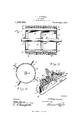
- Figure 1 shows a longitudinal central section through a gin brush embodying my improvements.
- Fig. 2 shows a cross section thereof.
- Fig. 3 is a perspective view of a portion of one of the brush bars embodying my improvements, and illustrates how the tufts are attached to the bars.
- the cylinder A of the drum is preferably made of sheet metal and is supported on the driving shaft B by heads C which are also preferably of sheet metal, pressed into shape and formed with peripheral flanges c and central flanges 0 around the shaft openin s.
- I may use any suitable number of intermediate disks D, flanged at (Z, (Z to support the cylinder and strengthen the drum.
- the cylinder A may be attached to the heads C and the intermediate disks D in any suitable way, and the heads and disks may be secured to the driving shaft in the manner shown, or in any other suitable manner.
- a drum thus constructed is very strong and durable. It will maintain perfect balance under all atmospheric and other conditions, and affords an efficient support for my improved brush bars.
- These bars E are preferably made of sheet metal bent in the manner shown in Fig. 3.
- Each bar preferably comprises a body portion 6 of double thickness, flanged to provide foot portions 6' and bent to form a head F adapted to receive and support the inner ends of the tufts of bristles Gr.
- the head F of each bar has an outer face f preferably flat formed with a series of holes f and said head has, near its base a series of holes y.
- the holes f are of suflicient size to receive the inner or looped ends of the tufts and the holes f receive the cord, wire or similar means H for securing the bristles to the bar.
- Fig. 3 The way in which the tufts are attached to the bar is illustrated in Fig. 3.
- the cord H is looped, as shown, and drawn through the holes f f by a suitable tool, such as a darning needle, and the tufts of bristles are passed through the loops in the manner shown; then the loops are drawn into the head and with them the tufts, the inner or looped ends of the tufts entering the chamber X of the head and being firmly held therein. All the tufts are in like manner attached to the brush bar and the ends of the cord are secured in any suitable way.
- a suitable tool such as a darning needle
- each tuft may be attached by a separate cord or wire.
- the exact shape of the head F shown is not essential as the shape may be somewhat varied, but it is essential that the head should have openings on its outer face to receive the tufts and other openings in the side of the head or near the base thereof to receive the cord or wire.
- the brush bars may be attached to the drum by rivets, bolts or other such devices or by electric welding (spot welding) and the bristles may be attached to the bars either before or after the bars are attached to the drum but after the bars are once attached to the drum it is not necessary to remove them in order to replace the bristles as this can be very quickly and easily done as is obvious from an inspection of the drawing and a consideration of the foregoing specification Without disturbing the bars.
- a gin brush comprising a drum and brush bars secured thereto each comprising a body portion and a head formed with tuftrcceiviug holes on its outer face, cord-r eeeiving holes near its base, and tuft seats between the cord-receiving holes and the outer face of the head, tufts extending into the tuft-receiving holes and resting at their inner ends on the tuft seats, and cords extending through the cord-receiving holes, engaging the tufts and drawing them inward against their seats.
- A. brush bar for gin brushes made of sheet metal bent to form a foot portion adapted to be attached to a brush drum and a head portion having a chamber to receive the looped ends of the tufts, having tuft-receiving holes on its outer face and cord-re DCving holes near its base.
- A. brush bar for gin brushes made of sheet metal bent to form a body portion and a head portion having a chamber to receive the looped ends of the tufts having tuft-re DCving holes on its outer face and cord-receiving holes near the base of the head but above the body portion.
Landscapes
- Engineering & Computer Science (AREA)
- Mechanical Engineering (AREA)
- Textile Engineering (AREA)
- Brushes (AREA)
Description
F. P. WORTMAN.
GIN BRUSH.
APPLICATION FILED OUT. 28, 1912.
Patented Aug; 5, 1913.
m L44 w v m a w a M w W; PW W 4 M M w vbweooeo FFICE FREDERICK P. WORTMAN, 0F ALBANY, GEORGIA.
GIN -BRUSH.
Specification of Letters Patent.
Patented Aug. 5,1913.
Application filed October 28, 1912. Serial No. 728,174.
To all whom, it may concern:
Be itknown that I, FREDERICK P. WVoR'r- MAN, a citizen of the United States, residing at Albany, in the county of Dougherty and State of Georgia, have invented certain new and useful Improvements in Gin- Brushes, of which the following is a specification.
My invention relates to gin brushes of the class in which the tufts of bristles are secured to brush bars arranged on the periphery of a drum carried by a driving shaft, which includes the linter brush used in cotton oil mills, and the object of my invention is to provide brush bars of improved construction which permit of the tufts of bristles being secured to them after they are attached to the drum and which also allow worn tufts to be removed and replaced by new ones, without removing the bars from the drum.
In carrying out my invention, I employ a drum of suitable construction which is supported on a driving shaft in any suitable way, and on the periphery of the drum I arrange brush bars made of sheet metal,
having outer portions or heads formed on their outer faces with tuft-receiving holes and near their bases with a series of holes to receive the cord or wire which fastens the tufts to the bars. The construction is such that the tufts of bristles may be attached to the bars after the latter are firmly attached to the drum and a new row of tufts or any desired number of tufts may be quickly removed from a bar and replaced without disturbing any of the other bars or any other parts of the brush.
In the accompanying drawings :Figure 1 shows a longitudinal central section through a gin brush embodying my improvements. Fig. 2 shows a cross section thereof. Fig. 3 is a perspective view of a portion of one of the brush bars embodying my improvements, and illustrates how the tufts are attached to the bars.
The cylinder A of the drum is preferably made of sheet metal and is supported on the driving shaft B by heads C which are also preferably of sheet metal, pressed into shape and formed with peripheral flanges c and central flanges 0 around the shaft openin s.
I may use any suitable number of intermediate disks D, flanged at (Z, (Z to support the cylinder and strengthen the drum.
The cylinder A may be attached to the heads C and the intermediate disks D in any suitable way, and the heads and disks may be secured to the driving shaft in the manner shown, or in any other suitable manner.
A drum thus constructed is very strong and durable. It will maintain perfect balance under all atmospheric and other conditions, and affords an efficient support for my improved brush bars. These bars E are preferably made of sheet metal bent in the manner shown in Fig. 3. Each bar preferably comprises a body portion 6 of double thickness, flanged to provide foot portions 6' and bent to form a head F adapted to receive and support the inner ends of the tufts of bristles Gr.
The head F of each bar has an outer face f preferably flat formed with a series of holes f and said head has, near its base a series of holes y. The holes f are of suflicient size to receive the inner or looped ends of the tufts and the holes f receive the cord, wire or similar means H for securing the bristles to the bar.
The way in which the tufts are attached to the bar is illustrated in Fig. 3. The cord H is looped, as shown, and drawn through the holes f f by a suitable tool, such as a darning needle, and the tufts of bristles are passed through the loops in the manner shown; then the loops are drawn into the head and with them the tufts, the inner or looped ends of the tufts entering the chamber X of the head and being firmly held therein. All the tufts are in like manner attached to the brush bar and the ends of the cord are secured in any suitable way.
It is obvious that wire may be used instead of cord, and if preferred each tuft may be attached by a separate cord or wire.
The exact shape of the head F shown is not essential as the shape may be somewhat varied, but it is essential that the head should have openings on its outer face to receive the tufts and other openings in the side of the head or near the base thereof to receive the cord or wire.
The brush bars may be attached to the drum by rivets, bolts or other such devices or by electric welding (spot welding) and the bristles may be attached to the bars either before or after the bars are attached to the drum but after the bars are once attached to the drum it is not necessary to remove them in order to replace the bristles as this can be very quickly and easily done as is obvious from an inspection of the drawing and a consideration of the foregoing specification Without disturbing the bars.
Ordinarily much time is involved in the renewing of gin brushes, as the bristles Wear out very quickly. Heretofore it has been the custom to remove each brush bar from the drum to replace the bristles as the cord or Wire which fastens the bristles to the bar has usually been beneath or Within the foot or base of the bar.
I claim as my invention:
1. A gin brush, comprising a drum and brush bars secured thereto each comprising a body portion and a head formed with tuftrcceiviug holes on its outer face, cord-r eeeiving holes near its base, and tuft seats between the cord-receiving holes and the outer face of the head, tufts extending into the tuft-receiving holes and resting at their inner ends on the tuft seats, and cords extending through the cord-receiving holes, engaging the tufts and drawing them inward against their seats.
A. brush bar for gin brushes made of sheet metal bent to form a foot portion adapted to be attached to a brush drum and a head portion having a chamber to receive the looped ends of the tufts, having tuft-receiving holes on its outer face and cord-re ceiving holes near its base.
3. A. brush bar for gin brushes made of sheet metal bent to form a body portion and a head portion having a chamber to receive the looped ends of the tufts having tuft-re ceiving holes on its outer face and cord-receiving holes near the base of the head but above the body portion.
In testimony whereof, I have hereunto subscribed my name.
FREDERICK P. WORTMAN. lVitnesses F. B. BRooKs, ED. HANNEoK.
Copies of this patent may be obtained. for five cents each, by addressing the Commissioner of Patents, Washington, 3). C.
Applications Claiming Priority (1)
| Application Number | Priority Date | Filing Date | Title |
|---|---|---|---|
| US1069366TA |
Publications (1)
| Publication Number | Publication Date |
|---|---|
| US1069366A true US1069366A (en) | 1913-08-05 |
Family
ID=3137603
Family Applications (1)
| Application Number | Title | Priority Date | Filing Date |
|---|---|---|---|
| US72?17412A Expired - Lifetime US1069366A (en) | Gin-brush. |
Country Status (1)
| Country | Link |
|---|---|
| US (1) | US1069366A (en) |
Cited By (1)
| Publication number | Priority date | Publication date | Assignee | Title |
|---|---|---|---|---|
| US3529314A (en) * | 1968-03-08 | 1970-09-22 | Gaylord J Clark | Rotary brush construction |
-
0
- US US72?17412A patent/US1069366A/en not_active Expired - Lifetime
Cited By (1)
| Publication number | Priority date | Publication date | Assignee | Title |
|---|---|---|---|---|
| US3529314A (en) * | 1968-03-08 | 1970-09-22 | Gaylord J Clark | Rotary brush construction |
Similar Documents
| Publication | Publication Date | Title |
|---|---|---|
| US440114A (en) | Brush | |
| US193519A (en) | Improvement in cylindrical brushes | |
| US430077A (en) | Brush | |
| US1018327A (en) | Cotton-gin brush. | |
| US417566A (en) | Norman knowles and william philipson | |
| US524654A (en) | Half to william t | |
| US1038927A (en) | Cotton-seed-delinting drum. | |
| US732999A (en) | Cotton-gin brush. | |
| US458524A (en) | Scratch or matting brush | |
| US581919A (en) | Max proskauee | |
| US771926A (en) | Brush. | |
| US379760A (en) | Cotton-gin | |
| US445005A (en) | Warren b | |
| US461661A (en) | Tooth-brush | |
| US403973A (en) | Cotton-gin brush | |
| US457007A (en) | Tooth-brush | |
| US619134A (en) | Rotary brush | |
| US217039A (en) | Improvement in thrashing-machines | |
| US1766388A (en) | Brush | |
| US489841A (en) | Broom-head | |
| US745434A (en) | Dust-beater. | |
| US103981A (en) | Improvement in cotton-gins | |
| US1191975A (en) | Broom. | |
| US164333A (en) | Improvement in floor-mats | |
| US557104A (en) | Broom or brush |