US10693597B2 - Method and apparatus for transmitting status report for receiver - Google Patents
Method and apparatus for transmitting status report for receiver Download PDFInfo
- Publication number
- US10693597B2 US10693597B2 US15/871,507 US201815871507A US10693597B2 US 10693597 B2 US10693597 B2 US 10693597B2 US 201815871507 A US201815871507 A US 201815871507A US 10693597 B2 US10693597 B2 US 10693597B2
- Authority
- US
- United States
- Prior art keywords
- status report
- format
- rlc status
- rlc
- receiver
- Prior art date
- Legal status (The legal status is an assumption and is not a legal conclusion. Google has not performed a legal analysis and makes no representation as to the accuracy of the status listed.)
- Active, expires
Links
Images


Classifications
-
- H—ELECTRICITY
- H04—ELECTRIC COMMUNICATION TECHNIQUE
- H04L—TRANSMISSION OF DIGITAL INFORMATION, e.g. TELEGRAPHIC COMMUNICATION
- H04L1/00—Arrangements for detecting or preventing errors in the information received
- H04L1/12—Arrangements for detecting or preventing errors in the information received by using return channel
- H04L1/16—Arrangements for detecting or preventing errors in the information received by using return channel in which the return channel carries supervisory signals, e.g. repetition request signals
- H04L1/18—Automatic repetition systems, e.g. Van Duuren systems
- H04L1/1812—Hybrid protocols; Hybrid automatic repeat request [HARQ]
-
- H—ELECTRICITY
- H04—ELECTRIC COMMUNICATION TECHNIQUE
- H04L—TRANSMISSION OF DIGITAL INFORMATION, e.g. TELEGRAPHIC COMMUNICATION
- H04L1/00—Arrangements for detecting or preventing errors in the information received
- H04L1/12—Arrangements for detecting or preventing errors in the information received by using return channel
- H04L1/16—Arrangements for detecting or preventing errors in the information received by using return channel in which the return channel carries supervisory signals, e.g. repetition request signals
- H04L1/1607—Details of the supervisory signal
- H04L1/1642—Formats specially adapted for sequence numbers
- H04L1/165—Variable formats
-
- H—ELECTRICITY
- H04—ELECTRIC COMMUNICATION TECHNIQUE
- H04L—TRANSMISSION OF DIGITAL INFORMATION, e.g. TELEGRAPHIC COMMUNICATION
- H04L1/00—Arrangements for detecting or preventing errors in the information received
- H04L1/12—Arrangements for detecting or preventing errors in the information received by using return channel
- H04L1/16—Arrangements for detecting or preventing errors in the information received by using return channel in which the return channel carries supervisory signals, e.g. repetition request signals
- H04L1/1607—Details of the supervisory signal
- H04L1/1685—Details of the supervisory signal the supervisory signal being transmitted in response to a specific request, e.g. to a polling signal
-
- H—ELECTRICITY
- H04—ELECTRIC COMMUNICATION TECHNIQUE
- H04L—TRANSMISSION OF DIGITAL INFORMATION, e.g. TELEGRAPHIC COMMUNICATION
- H04L1/00—Arrangements for detecting or preventing errors in the information received
- H04L1/12—Arrangements for detecting or preventing errors in the information received by using return channel
- H04L1/16—Arrangements for detecting or preventing errors in the information received by using return channel in which the return channel carries supervisory signals, e.g. repetition request signals
- H04L1/1607—Details of the supervisory signal
- H04L1/1635—Cumulative acknowledgement, i.e. the acknowledgement message applying to all previous messages
-
- H—ELECTRICITY
- H04—ELECTRIC COMMUNICATION TECHNIQUE
- H04L—TRANSMISSION OF DIGITAL INFORMATION, e.g. TELEGRAPHIC COMMUNICATION
- H04L1/00—Arrangements for detecting or preventing errors in the information received
- H04L1/12—Arrangements for detecting or preventing errors in the information received by using return channel
- H04L1/16—Arrangements for detecting or preventing errors in the information received by using return channel in which the return channel carries supervisory signals, e.g. repetition request signals
- H04L1/1607—Details of the supervisory signal
- H04L1/1642—Formats specially adapted for sequence numbers
-
- H—ELECTRICITY
- H04—ELECTRIC COMMUNICATION TECHNIQUE
- H04L—TRANSMISSION OF DIGITAL INFORMATION, e.g. TELEGRAPHIC COMMUNICATION
- H04L1/00—Arrangements for detecting or preventing errors in the information received
- H04L1/12—Arrangements for detecting or preventing errors in the information received by using return channel
- H04L1/16—Arrangements for detecting or preventing errors in the information received by using return channel in which the return channel carries supervisory signals, e.g. repetition request signals
- H04L1/18—Automatic repetition systems, e.g. Van Duuren systems
- H04L1/1829—Arrangements specially adapted for the receiver end
- H04L1/1864—ARQ related signaling
-
- H—ELECTRICITY
- H04—ELECTRIC COMMUNICATION TECHNIQUE
- H04L—TRANSMISSION OF DIGITAL INFORMATION, e.g. TELEGRAPHIC COMMUNICATION
- H04L1/00—Arrangements for detecting or preventing errors in the information received
- H04L1/12—Arrangements for detecting or preventing errors in the information received by using return channel
- H04L1/16—Arrangements for detecting or preventing errors in the information received by using return channel in which the return channel carries supervisory signals, e.g. repetition request signals
- H04L1/18—Automatic repetition systems, e.g. Van Duuren systems
- H04L1/1867—Arrangements specially adapted for the transmitter end
- H04L1/189—Transmission or retransmission of more than one copy of a message
-
- H—ELECTRICITY
- H04—ELECTRIC COMMUNICATION TECHNIQUE
- H04L—TRANSMISSION OF DIGITAL INFORMATION, e.g. TELEGRAPHIC COMMUNICATION
- H04L1/00—Arrangements for detecting or preventing errors in the information received
- H04L1/12—Arrangements for detecting or preventing errors in the information received by using return channel
- H04L1/16—Arrangements for detecting or preventing errors in the information received by using return channel in which the return channel carries supervisory signals, e.g. repetition request signals
- H04L1/18—Automatic repetition systems, e.g. Van Duuren systems
- H04L1/1867—Arrangements specially adapted for the transmitter end
- H04L1/1896—ARQ related signaling
-
- H04W72/0413—
-
- H—ELECTRICITY
- H04—ELECTRIC COMMUNICATION TECHNIQUE
- H04W—WIRELESS COMMUNICATION NETWORKS
- H04W72/00—Local resource management
- H04W72/20—Control channels or signalling for resource management
- H04W72/21—Control channels or signalling for resource management in the uplink direction of a wireless link, i.e. towards the network
-
- H—ELECTRICITY
- H04—ELECTRIC COMMUNICATION TECHNIQUE
- H04W—WIRELESS COMMUNICATION NETWORKS
- H04W80/00—Wireless network protocols or protocol adaptations to wireless operation
- H04W80/02—Data link layer protocols
Definitions
- the present disclosure generally relates to communication technology field, and more particularly, to a method and apparatus for transmitting status report applied for a receiver.
- a radio link control protocol belongs to a part of a layer 2 protocol, and it has a segmentation and automatic repeat-reQuest function (ARQ), and uses two mechanisms of acknowledgment and timeout, to realize a reliable information transmission on a basis of an unreliable link.
- RLC radio link control protocol
- ARQ segmentation and automatic repeat-reQuest function
- a receiver sends a RLC layer status report (i. e, RLC status report) to a sender, wherein the status report may include information such as a sequence number of a packet not received and the like.
- the sender may retransmit the packet not received as indicated in the status report.
- the RLC layer status report may include one or more sequence number (NACK SN) of the RLC layer data packets (i.e. RLC PDUs) that are not received or unacknowledged.
- NACK SN sequence number of the RLC layer data packets
- Embodiments of the present disclosure provide a method and apparatus to improve transmission efficiency of the status report.
- a method for transmitting status report at a receiver including: determining a format of a RLC status report; transmitting the RLC status report to a sender, according to the format of the RLC status report; wherein the receiver is a receiver of a service data, and the sender is a sender of a service data.
- determining a format of a RLC status report may include: identifying the format of the RLC status report configured by the sender.
- the format of the RLC status report is configured per data radio bearer, or, the format of the RLC status report is configured per quality of service Flow mapped on a same data radio bearer.
- determining a format of a RLC status report includes configuring the format of the RLC status report by the receiver
- the method for transmitting status report may further include: indicating the format of the RLC status report to the sender.
- determining a format of a RLC status report may include: receiving a selection criterion for the RLC status report configured by the sender; selecting and configuring the format of the RLC status report from pre-configured formats according to the selection criterion.
- the selection criterion may include any one of the following: selecting the format of the RLC status report according to a rate threshold of the data radio bearer or data stream; selecting the format of the RLC status report according to the number of bits required to transmit the RLC status report in different pre-configured formats; selecting the format of the RLC status report according to the number of RLC data packets transmitted in a single TTI; or selecting the format of the RLC status report according to the number of RLC data packets consecutively not received.
- the format of the RLC status report may be set according to any one of the following: a rate of a data radio bearer, bit number of RLC status reports in different formats, the number of RLC data packets transmitted within a single TTI, the number of RLC data packets consecutively not received, or a device type of the receiver.
- the device type of the receiver may include a machine type communication device and a non-machine type communication device.
- the receiver is an user equipment and the sender is a base station, or, the receiver is a base station and the sender is an user equipment, or, both the sender and the receiver are user equipments.
- an apparatus for transmitting status report applied for a receiver including: a format determining circuitry, configured to determine a format of a RLC status report; a status transmitting circuitry, configured to transmit the RLC status report to a sender, according to the format of the RLC status report; where the receiver is a receiver of a service data, and the sender is a sender of a service data.
- the format determining circuitry may be configured to receive the format of the RLC status report configured by the sender.
- the format of the RLC status report may be configured per data radio bearer, or, the format of the RLC status report may be configured per QoS Flow mapped on a same data radio bearer.
- the format determining circuitry may be configured to determine the format of the RLC status report by the receiver
- the apparatus for transmitting status report may further include: a format indicating circuitry, configured to indicate the format of the RLC status report to the sender.
- the format indicating circuitry may be configured to indicate the format of the RLC status report to the sender in the RLC status report.
- the format determining circuitry may include: a selection criterion receiving sub-circuitry, configured to receive a selection criterion set for the RLC status report by the sender; a format selecting sub-circuitry, configured to select and set the format of the RLC status report from pre-configured formats according to the selection criterion.
- the selection criterion may include any one of the following: selecting the format of the RLC status report according to a rate threshold of the data radio bearer or data stream; selecting the format of the RLC status report according to the number of bits required to transmit the RLC status report in different pre-configured formats; selecting the format of the RLC status report according to the number of RLC data packets transmitted in a single TTI; or selecting the format of the RLC status report according to the number of RLC data packets consecutively not received.
- the format of the RLC status report may be selected according to any one of the following: a rate of a data radio bearer, bit number of RLC status reports in different formats, the number of RLC data packets transmitted within a single TTI, the number of RLC data packets consecutively not received, or a device type of the receiver.
- the device type of the receiver may include a machine type communication device and a non-machine type communication device.
- the receiver may be a user equipment and the sender may be a base station, or, the receiver may be a base station and the sender may be a user equipment, or, both the sender and the receiver may be user equipments.
- Embodiments of the present disclosure may provide following advantages.
- a format of a RLC status report is determined first, and then the RLC status report is transmitted to a sender according to the format of the RLC status report.
- the format of the RLC status report can be flexibly determined as needed, so that the format of the RLC status report can be made more diverse.
- different RLC status reports can be used according to different scenarios, which makes the format of the RLC status report more effective, and more suitable. Therefore, transmission of the RLC status report may need fewer bits, which further improves the transmission efficiency of the method for transmitting status report.
- the format of the RLC status report is configured by the sender, and transmitted to the receiver by the sender, the receiver can transmit the RLC status report directly according to the format configured by the sender, so that the calculation amount of the receiver is small, which can be beneficial to save resources of the receiver; and as the format of the RLC status report is configured by the sender, the sender and the receiver only need to communicate once to determine the format of the RLC status report, which can improve the efficiency of the method for transmitting status report.
- the format of the RLC status report is configured by the receiver, the format can be configured according to a specific parameter of a current scenario. Therefore, the transmission of the RLC status report can be carried out with fewer bits, which can further improve the transmission efficiency of the method for transmitting status report.
- FIG. 1 schematically illustrates a flow chart of a method for transmitting status report applied for a receiver according to an embodiment of this disclosure
- FIG. 2 schematically a flow chart of a specific example of step S 11 in FIG. 1 ;
- FIG. 3 schematically illustrates a flow chart of a method for transmitting status report applied for a receiver according to an embodiment of this disclosure.
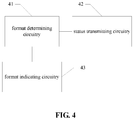
- FIG. 4 schematically illustrates a structural diagram of an apparatus for transmitting status report applied for a receiver of embodiments of this disclosure.
- a RLC layer status report sent by a receiver can indicate a sequence number of a packet that is not received or is not acknowledged, while in the 5G, when the RLC layer does not have a concatenation function, multiple RLC Layer data packets can be transmitted within a transmission time interval (TTI), once the receiver can not accurately decode the packets, multiple RLC layer data packets can lost consecutively.
- TTI may be a duration of a sub frame or a slot, or only a duration of a portion of the slot.
- the sequence number of multiple RLC layer data packets needs to be indicated to the sender one by one, which can result in an information redundancy, and further result in low transmission efficiency.
- the format of the RLC status report can be flexibly determined as needed, so that the format of the RLC status report can be made more diverse.
- different RLC status reports can be used in different scenarios, so that the format of the RLC status report can be made more effective, and more suitable for the current scenario, so that fewer bits need to be used to transmit the RLC status report, and can further improve the transmission efficiency of the method for transmitting status report.
- FIG. 1 schematically illustrates a flow chart of a method for transmitting status report applied for a receiver according to embodiments of this disclosure, the method can include the following steps:
- Step S 11 determining a format of a RLC status report.
- Step S 12 transmitting the RLC status report to a sender, according to the format of the RLC status report.
- a receiver and a transmitter are defined by a transmission direction of a service data
- the device which receives the service data is the receiver
- the device which transmits the service data is the transmitter.
- the base station transmits the service data to the user equipment (UE), the base station serves as the transmitter, the UE serves as the receiver;
- UE user equipment
- the UE transmits the service data to the base station, the base station serves as the receiver, the UE serves as the transmitter;
- both the sender and the receiver can be the UE, the UE that sends the service data is the sender, and the UE that receives the service data is the receiver.
- the RLC status report is a control data corresponding to the service data, and the transmission direction thereof may be different from the transmission direction of the service data.
- the format of the RLC status report is determined by the receiver.
- the format of the RLC status report may be configured by the sender and sent to the receiver; or, the format of the RLC status report may also be set by the receiver.
- the receiver can receive the format of the RLC status report configured by the sender, to determine the format of the RLC status report.
- the format of the RLC status report can also be configured and determined by the receiver.
- the receiver may configure the format of the RLC status report based on a communication requirement or a communication condition, or, the receiver may also configure the format of the RLC status report based on a selection criterion received from the sender.
- the receiver can indicate the determined format of the RLC status report to the sender, after configuring the format of the RLC status report.
- the format of the RLC status report may be indicated to the sender in the RLC status report.
- the format of the RLC status report can be a pre-configured format (for example, predefined formats in the specification), and the pre-configured format can be numbered, when configuring the format of the RLC status report, a corresponding number can be specified, and then indicate to a following peer, the sender and the receiver can be a peer to each other. For example, when the format of the RLC status report is configured by the sender, the number of the format can be indicated to the receiver.
- the sender can configure the format of the RLC status report per data radio bearer, or can configure the format of the RLC status report per Quality of Service (QoS) Flow mapped on the same data radio bearer.
- QoS Quality of Service
- the format of the RLC status report is configured by the sender, and the format of the RLC status report is also transmitted to the receiver by the sender, the receiver can transmit the RLC status report directly according to the format configured by the sender, so that the calculation amount of the receiver is small, which can be beneficial to save resources of the receiver; and as the format of the RLC status report is configured by the sender, the sender and the receiver only need to communicate once to determine the format of the RLC status report, which can improve the efficiency of the method for transmitting status report.
- the format of the RLC status report can be more effective, the receiver can generate RLC status reports with corresponding format for different QoS Flows separately, and therefore the transmission of the RLC status report can be carried out with fewer bits, which can further improve the transmission efficiency of the method for transmitting status report.
- a first method configuring and determining the format of the RLC status report directly by the receiver.
- the format of the RLC status report can be configured according to any one parameter of the following: a rate of a data radio bearer, bit number of RLC status reports in different formats, the number of RLC data packets (i.e. RLC PDUs) transmitted within a single TTI, the number of RLC data packets consecutively not received, or a device type of the receiver.
- the device type of the receiver can include a machine type communication (MTC) device and a non-machine type communication device.
- MTC machine type communication
- a specific parameter type can be determined according to a pre-configured rule, and the format of the RLC status report is configured according to the parameter.
- the format of the RLC status report can be configured by the receiver, and the format can be configured according to a specific parameter of a current scenario, the format configuring is more suitable for the current scenario, so that the transmission of the RLC status report can be carried out with fewer bits, which can further improve the transmission efficiency of the method for transmitting status report.
- the format when the format is configured according to the number of bits of the RLC status report in different formats, by comparing the number of bits of the RLC status report in different formats, the format with the least number of bits can be selected, and then transmit the status report in this format, so the resource occupation can be reduced and the transmission efficiency of the method for transmitting status report can be improved.
- the receiver After configuring and determining the format of the RLC status report, the receiver indicates the format of the RLC status report to the sender, and the sender and the receiver can determine the format of the RLC status report with only one communication, and further the efficiency of the method for transmitting status report can be improved.
- a second method the receiver selects and configures the format of the RLC status report from pre-configured formats according to a received selection criterion.
- step S 11 in FIG. 1 may include the following steps:
- Step S 21 receiving a selection criterion configured for the RLC status report by the sender.
- Step S 22 selecting and configuring the format of the RLC status report from pre-configured formats according to the selection criterion.
- the selection criterion can include any one of the following: selecting the format of the RLC status report according to a rate threshold of the data radio bearer or data stream; selecting the format of the RLC status report according to the number of bits required to transmit the RLC status report in different pre-configured formats; selecting the format of the RLC status report according to the number of RLC data packets transmitted in a single TTI; or selecting the format of the RLC status report according to the number of RLC data packets consecutively not received.
- the selection criterion may indicate the type of format parameter used to configure the RLC status report, in addition, when a specific value of the parameter needs to be compared with the threshold value, the selection criterion may include a corresponding threshold. For example, when the selection criterion indicates that the receiver selects the format of the RLC status report based on the number of RLC data packets transmitted within a single TTI, the selection criterion may also include a threshold for the number of the RLC data packet.
- the format of the RLC status report is configured by the receiver according to the selection criterion and the current parameter value, therefore the selection process of the format of the RLC status report has both the participation of the sender and the receiver.
- the format of the RLC status report is more effective, so that the transmission of the RLC status report in this format can take up less bits, which can further improve the transmission efficiency of the method for transmitting status report.
- the format of the RLC status report is configured by the receiver, the format can be configured according to a specific parameter of the current scenario, the format configuring is more suitable for the current scenario, so that the transmission of the RLC status report can be carried out with fewer bits, which can further improve the transmission efficiency of the method for transmitting status report.
- the transmission of the status report can be completed by the following steps:
- Step S 31 establishing an RRC (Radio Resource Control) connection.
- RRC Radio Resource Control
- the UE accesses the network and establishes an RRC connection.
- Step S 32 configuring a data radio bearer and a corresponding format of the RLC status report.
- the base station can configure relevant parameters of the data radio bearer for the UE, such as an identification of the data radio bearer and a configuration parameter of the layer 2 and the like, the base station can configure a format of the RLC status report for the data radio bearer, and then send to the UE by a RRC signaling.
- the base station can configure the format of the RLC status report corresponding to the bearer to be format 1, otherwise the base station can configure the format to be format 2.
- format 1 may be reported with every sequence number of the RLC data packets not received, and format 2 may be reported with a start sequence number of RLC data packet not received and the number of packets not received continuously.
- Step S 33 establishing a data radio bearer, storing a format of the status report.
- the UE After receiving a signaling, the UE can apply the configuration parameter included in the signaling, to establish the data radio bearer.
- the UE For the format of the RLC status report of the bearer configured by the base station, the UE needs to store it for use when need to report a RLC status report.
- Step S 34 triggering the RLC status report.
- the base station triggers the UE to send a RLC layer status report, and the base station may send an indication to the UE at the RLC layer, to trigger the UE to send the RLC layer status report.
- Step S 35 sending the RLC status report.
- the UE After receiving the trigger indication of the status report, the UE can generate the RLC status report of the corresponding format, according to the format of the RLC status report corresponding to the bearer configured by the base station. Then the UE sends the RLC layer status report to the base station.
- Step S 36 re-transmitting the data packet.
- the base station After receiving the status report, the base station can retransmit a corresponding data packet, according to the sequence number of the RLC data packet in which is not acknowledged or not received, so that the UE can receive the packet completely.
- the base station may also configure other format of the RLC status reports according to a certain data radio bearer, as long as the receiver can use the reported information to assist the sender in determining the RLC data packet is not transmitted successfully.
- a data radio bearer can carry different QoS Flows.
- the base station may configure a different format of the RLC status report for QoS Flows of different QoSs mapped on the same data radio bearer, and then transmit the configuration information to the UE via a RRC signaling.
- the UE After receiving the configuration information, and when the RLC status report needs to be reported, the UE can report the corresponding RLC status report according to the format of the status report corresponding to the different QoS Flows of the data radio bearer, based on the configuration of the base station. If a specific data radio bearer contains two QoS Flows, the base station can configure the format of the RLC status report for these two different QoS flows separately, after receiving the RLC status report, when the UE needs to report the RLC status report, the UE can generate the RLC status report in the corresponding format of for different QoS Flows respectively, and then send to the base station.
- the UE receives the data from the base station, the UE is the receiver and the base station is the sender.
- the UE may determine the format of the RLC status report, and may indicate the format of the selected RLC status report in the RLC status report.
- Format 1 is to report the sequence number of each RLC data packet that is not received
- format 2 is to report a starting sequence number of the RLC data packet that is not received and the number of packets that are not received continuously.
- the UE may establish a plurality of data radio bearers, and determine the format of the RLC status report for each data radio bearer, and then report the RLC status report in a determined format of the RLC status report.
- Several ways can be used for the UE to determine the format of the RLC status report:
- the UE can based on the rate of the data radio bearer, for example a high rate DRB uses the status report in format 2, and a low rate DRB uses the status report in format 1, where the rate refers to a transmission rate, because the downlink is considered, so the rate refers to a transmission rate of the downlink data, the UE may pre-configure a first rate threshold in advance and determine the format of the RLC status report according to a comparison result of the DRB rate with the first rate threshold, when the DRB rate is greater than or equal to the first rate threshold, the status report in format 2 is used, when the rate of DRB is lower than the first rate threshold, the status report in format 1 is used;
- the UE may configure the format of the RLC status report, based on the number of bits occupied by the RLC status report in different formats.
- the UE may choose the RLC status report with a smaller number of bits according to the number of bits required for the status report of the two formats first, and then report it to the base station;
- the UE may select the format of the RLC status report based on the number of RLC PDUs transmitted within a TTI. For example, if the number of RLC PDUs transmitted within a single TTI exceeds or is more than a pre-configured second threshold, the status report format of format 2 is used, and if the number of RLC PDUs transmitted within a single TTI is lower than the pre-configured second threshold, the status report format of format 1 is used;
- the UE may select the format of the RLC status report based on the number of RLC PDUs that are not received consecutively. For example, if the UE continues not receiving multiple RLC PDUs, and the number of RLC PDU that is not received consecutively is equal to or exceeds a pre-configured third threshold, the status report format of format 2 is used, otherwise the status report format of format 1 is used;
- the UE may also configure the format of the RLC status report according to its own device type, for example, if the type of the UE is a machine type communication device, select format 1 as the format of the RLC status report, otherwise format 2 is selected.
- the UE When sending the RLC status report to the base station, the UE can indicate the selected format of the RLC status report in the status report, so that the base station can correctly decode the RLC status report.
- the UE may indicate the selected format of the RLC status report at a particular location in the status report, such as the first bit in the status report may be used to indicate as a data or a status report, the second bit may be used to indicate the format of the RLC status report is format 1 or format 2.
- the base station may choose to retransmit the unacknowledged data packets to the UE.
- the selection criterion of the format of the RLC status report can be configured simultaneously, so that the UE can determine the format of the reported RLC status report, according to the selection criterion, after receiving the selection criterion.
- the base station can configure the selection criterion to be based on the rate threshold, and at the same time the base station can configure a specific threshold, if the rate of the data radio bearer is lower than that specific threshold, a specific RLC status report format is used, if the rate of the data radio bearer is higher than or equal to the specific threshold, a corresponding format of the RLC status report is used.
- the base station may configure the selection criterion to be the RLC status report with the smallest bit number, the UE can determine the number of bits that need to be occupied by the RLC status report with different formats first, and then report the RLC status report with the smallest number of bits when the RLC status report needs to be sent.
- the base station may configure the selection criterion to be based on the number of RLC PDUs transmitted within a single TTI, the base station may configure a specific number threshold, if the number of RLC PDUs transmitted within a single TTI exceeds or is equal to the number threshold, format 2 is used as the status report format, if is lower than the number threshold, format 1 is used as the status report format.
- the base station may configure the selection criterion to be based on the number of RLC PDUs that are not received consecutively, the base station may configure a specific number threshold, if the UE continues not receiving multiple RLC PDUs consecutively, and the number is equal to or exceeds that number threshold, format 2 is used to be the format of the status report, otherwise format 1 is used to be the format of the status report.
- the downlink data transmission is taken as examples, where the base station is the transmitter and the UE is the receiver.
- the method in the above embodiments is also applicable to the uplink data transmission, where the base station is the receiver and the UE is the sender.
- the method in the above embodiments may be applicable to the status report transmission between the UEs, where both the sender and the receiver is UE.
- the embodiment of the present disclosure also provides an apparatus for transmitting status report applied for a receiver, whose structure is shown in FIG. 4 , which may include:
- a format determining circuitry 41 may be configured to determine a format of a RLC status report
- a status transmitting circuitry 42 may be configured to transmit the RLC status report to a sender, according to the format of the RLC status report;
- the receiver is a receiver of a service data
- the sender is a sender of a service data
- the format determining circuitry 41 may be configured to receive the format of the status report configured by the sender.
- the format of the RLC status report may be configured based on a different data radio bearer, or, the format of the RLC status report may be configured based on a data stream of different quality of service (QoS) flows on the same data radio bearer.
- QoS quality of service
- the apparatus for transmitting status report can further include: a format indicating circuitry 43 , which may be configured to indicate the format of the RLC status report to the sender.
- the format indicating circuitry 43 may be configured to indicate the format of the RLC status report to the sender in the RLC status report.
- the format determining circuitry 41 may include:
- a selection criterion receiving sub-circuitry may be configured to receive a selection criterion configured for the RLC status report by the sender;
- a format selecting sub-circuitry may be configured to select and configure the format of the RLC status report from a pre-configured format according to the selection criterion.
- the selection criterion may include any of the following: selecting the format of the RLC status report according to a rate threshold of the data radio bearer or data stream; selecting the format of the RLC status report according to a number of bits required to transmit the RLC status report in different pre-configured formats; selecting the format of the RLC status report according to the number of RLC data packets transmitted in a single TTI; or selecting the format of the RLC status report according to the number of RLC data packets consecutively not received.
- the apparatus may select the format of the RLC status report according to any one of the following: a rate of a data radio bearer, a bit number of RLC status reports in different formats, a number of RLC data packets transmitted within a single TTI, the number of RLC data packets consecutively not received, or a device type of the receiver.
- the device type of the receiver may include a machine type communication device and a non-machine type communication device.
- the receiver is a user equipment and the sender is a base station, or, the receiver is a base station and the sender is a UE, or, both the sender and the receiver are both UEs.
Landscapes
- Engineering & Computer Science (AREA)
- Computer Networks & Wireless Communication (AREA)
- Signal Processing (AREA)
- Mobile Radio Communication Systems (AREA)
Abstract
Description
Claims (10)
Applications Claiming Priority (3)
| Application Number | Priority Date | Filing Date | Title |
|---|---|---|---|
| CN201710064647.4A CN108400842A (en) | 2017-02-04 | 2017-02-04 | A kind of state report sending method and device applied to recipient |
| CN201710064647 | 2017-02-04 | ||
| CN201710064647.4 | 2017-02-04 |
Publications (2)
| Publication Number | Publication Date |
|---|---|
| US20180227086A1 US20180227086A1 (en) | 2018-08-09 |
| US10693597B2 true US10693597B2 (en) | 2020-06-23 |
Family
ID=63038526
Family Applications (1)
| Application Number | Title | Priority Date | Filing Date |
|---|---|---|---|
| US15/871,507 Active 2038-07-21 US10693597B2 (en) | 2017-02-04 | 2018-01-15 | Method and apparatus for transmitting status report for receiver |
Country Status (2)
| Country | Link |
|---|---|
| US (1) | US10693597B2 (en) |
| CN (1) | CN108400842A (en) |
Families Citing this family (6)
| Publication number | Priority date | Publication date | Assignee | Title |
|---|---|---|---|---|
| CN108809526B (en) * | 2017-05-05 | 2020-11-27 | 展讯通信(上海)有限公司 | RLC layer status reporting method and device, storage medium, and user equipment |
| WO2020034133A1 (en) * | 2018-08-16 | 2020-02-20 | 华为技术有限公司 | Communication method and apparatus |
| CN110972089A (en) * | 2018-09-28 | 2020-04-07 | 电信科学技术研究院有限公司 | Method, equipment and computer storage medium for signaling transmission |
| US20200112900A1 (en) * | 2018-10-05 | 2020-04-09 | Mediatek Inc. | Enhancement Of IMS Signaling Reliability In Mobile Communications |
| US11856450B2 (en) * | 2020-02-27 | 2023-12-26 | Qualcomm Incorporated | Range extension for radio link control status reporting |
| US20260082393A1 (en) * | 2024-09-18 | 2026-03-19 | Qualcomm Incorporated | Radio link control (rlc) status reporting |
Citations (10)
| Publication number | Priority date | Publication date | Assignee | Title |
|---|---|---|---|---|
| US20030037033A1 (en) * | 2001-08-20 | 2003-02-20 | Kai Nyman | Naming distribution method for ad hoc networks |
| US20030060235A1 (en) * | 2001-09-26 | 2003-03-27 | Katsumi Yamato | Radio base station apparatus, computer-executable program recorded on a computer-readable medium and a method of setting a connection between a radio base station apparatus and one radio terminal |
| US20040242221A1 (en) * | 2001-10-08 | 2004-12-02 | Christophe Vincent | Methods and devices for radio link adaptation |
| US20080301516A1 (en) * | 2006-01-26 | 2008-12-04 | Huawei Technologies Co., Ltd. | Method and device for retransmitting data |
| US20120195250A1 (en) * | 2011-02-01 | 2012-08-02 | Qualcomm Incorporated | Multiple wireless communication device acknowledgements |
| US20130034014A1 (en) * | 2011-08-05 | 2013-02-07 | Telefonaktiebolaget L M Ericsson (Publ) | Rlc status reporting for eight-carrier hsdpa |
| US20130044726A1 (en) * | 2010-05-03 | 2013-02-21 | Vinay Kumar Shrivastava | Method and system of transfering data in a carrier aggregation environment |
| US20150146617A1 (en) * | 2012-08-06 | 2015-05-28 | Lg Electronics Inc. | Method for transferring a status report and a communication device thereof in a wireless communication system |
| US20160219458A1 (en) * | 2015-01-26 | 2016-07-28 | Qualcomm Incorporated | Methods and apparatus for radio link control switching |
| US20170331670A1 (en) * | 2016-05-13 | 2017-11-16 | Telefonaktiebolaget Lm Ericsson (Publ) | Network Architecture, Methods, and Devices for a Wireless Communications Network |
Family Cites Families (6)
| Publication number | Priority date | Publication date | Assignee | Title |
|---|---|---|---|---|
| US8270348B2 (en) * | 2008-01-31 | 2012-09-18 | Lg Electronics Inc. | Method for sending status information in mobile telecommunications system and receiver of mobile telecommunications |
| CN103428484B (en) * | 2012-05-21 | 2016-11-23 | 华为技术有限公司 | A kind of transmission method and device |
| EP2996419A4 (en) * | 2013-05-10 | 2016-04-20 | Fujitsu Ltd | WIRELESS COMMUNICATION SYSTEM, MOBILE STATION, BASE STATION, AND WIRELESS COMMUNICATION METHOD |
| JP6149928B2 (en) * | 2013-05-10 | 2017-06-21 | 富士通株式会社 | Wireless communication method, wireless communication system, and wireless station |
| JP6349065B2 (en) * | 2013-09-26 | 2018-06-27 | 株式会社Nttドコモ | Mobile communication system |
| CN104518852B (en) * | 2013-09-29 | 2018-06-15 | 普天信息技术研究院有限公司 | A kind of transmission feedback method |
-
2017
- 2017-02-04 CN CN201710064647.4A patent/CN108400842A/en active Pending
-
2018
- 2018-01-15 US US15/871,507 patent/US10693597B2/en active Active
Patent Citations (10)
| Publication number | Priority date | Publication date | Assignee | Title |
|---|---|---|---|---|
| US20030037033A1 (en) * | 2001-08-20 | 2003-02-20 | Kai Nyman | Naming distribution method for ad hoc networks |
| US20030060235A1 (en) * | 2001-09-26 | 2003-03-27 | Katsumi Yamato | Radio base station apparatus, computer-executable program recorded on a computer-readable medium and a method of setting a connection between a radio base station apparatus and one radio terminal |
| US20040242221A1 (en) * | 2001-10-08 | 2004-12-02 | Christophe Vincent | Methods and devices for radio link adaptation |
| US20080301516A1 (en) * | 2006-01-26 | 2008-12-04 | Huawei Technologies Co., Ltd. | Method and device for retransmitting data |
| US20130044726A1 (en) * | 2010-05-03 | 2013-02-21 | Vinay Kumar Shrivastava | Method and system of transfering data in a carrier aggregation environment |
| US20120195250A1 (en) * | 2011-02-01 | 2012-08-02 | Qualcomm Incorporated | Multiple wireless communication device acknowledgements |
| US20130034014A1 (en) * | 2011-08-05 | 2013-02-07 | Telefonaktiebolaget L M Ericsson (Publ) | Rlc status reporting for eight-carrier hsdpa |
| US20150146617A1 (en) * | 2012-08-06 | 2015-05-28 | Lg Electronics Inc. | Method for transferring a status report and a communication device thereof in a wireless communication system |
| US20160219458A1 (en) * | 2015-01-26 | 2016-07-28 | Qualcomm Incorporated | Methods and apparatus for radio link control switching |
| US20170331670A1 (en) * | 2016-05-13 | 2017-11-16 | Telefonaktiebolaget Lm Ericsson (Publ) | Network Architecture, Methods, and Devices for a Wireless Communications Network |
Also Published As
| Publication number | Publication date |
|---|---|
| CN108400842A (en) | 2018-08-14 |
| US20180227086A1 (en) | 2018-08-09 |
Similar Documents
| Publication | Publication Date | Title |
|---|---|---|
| US10667248B2 (en) | Method for processing NDI in random access procedure and a method for transmitting and receiving a signal using the same | |
| EP3920446B1 (en) | Information transmission method, terminal device, and network device | |
| US20220116819A1 (en) | Method and apparatus for reporting rlc layer status, storage medium and user equipment | |
| US20180227086A1 (en) | Method and apparatus for transmitting status report for receiver | |
| KR101467798B1 (en) | Method and apparatus for transmitting state information in a wireless communication system | |
| US9397791B2 (en) | Transmitting data in a mobile communication system | |
| US20090185477A1 (en) | Transmitting Data In A Mobile Communication System | |
| EP2086148A2 (en) | Method for sending status information in mobile telecommunications system and receiver of mobile telecommunications | |
| CN110505711B (en) | Method, apparatus, apparatus and medium for processing scheduling request | |
| EP2863573B1 (en) | Method and apparatus for sending control signaling | |
| CN102067481B (en) | Handling NDI during random access | |
| CN110214432A (en) | Method and node for activation or deactivation of carriers in a communication network supporting carrier aggregation | |
| US20250184047A1 (en) | Infrastructure equipment, mobile terminal, computer software and methods | |
| US20220225351A1 (en) | Method of wireless communication system for enhancing quality of service | |
| US20250233697A1 (en) | Methods, system, and apparatus for retransmission in large propagation delay wireless communications | |
| US12003331B2 (en) | Wireless data transmission apparatus, wireless data reception apparatus and methods | |
| WO2022207719A1 (en) | Dynamic transmission parameter values for retransmissions | |
| EP3203670A1 (en) | Method and apparatus for implementing a retransmission scheme | |
| CN119011091A (en) | Communication method, device and storage medium | |
| GB2461378A (en) | Processing a new data indicator during a random access procedure of a mobile communication system |
Legal Events
| Date | Code | Title | Description |
|---|---|---|---|
| AS | Assignment |
Owner name: SPREADTRUM COMMUNICATIONS (SHANGHAI) CO., LTD., CHINA Free format text: ASSIGNMENT OF ASSIGNORS INTEREST;ASSIGNOR:DENG, YUN;REEL/FRAME:044622/0469 Effective date: 20171130 Owner name: SPREADTRUM COMMUNICATIONS (SHANGHAI) CO., LTD., CH Free format text: ASSIGNMENT OF ASSIGNORS INTEREST;ASSIGNOR:DENG, YUN;REEL/FRAME:044622/0469 Effective date: 20171130 |
|
| FEPP | Fee payment procedure |
Free format text: ENTITY STATUS SET TO UNDISCOUNTED (ORIGINAL EVENT CODE: BIG.); ENTITY STATUS OF PATENT OWNER: LARGE ENTITY |
|
| STPP | Information on status: patent application and granting procedure in general |
Free format text: DOCKETED NEW CASE - READY FOR EXAMINATION |
|
| STPP | Information on status: patent application and granting procedure in general |
Free format text: NON FINAL ACTION MAILED |
|
| STPP | Information on status: patent application and granting procedure in general |
Free format text: RESPONSE TO NON-FINAL OFFICE ACTION ENTERED AND FORWARDED TO EXAMINER |
|
| STPP | Information on status: patent application and granting procedure in general |
Free format text: NOTICE OF ALLOWANCE MAILED -- APPLICATION RECEIVED IN OFFICE OF PUBLICATIONS |
|
| STPP | Information on status: patent application and granting procedure in general |
Free format text: PUBLICATIONS -- ISSUE FEE PAYMENT VERIFIED |
|
| STCF | Information on status: patent grant |
Free format text: PATENTED CASE |
|
| MAFP | Maintenance fee payment |
Free format text: PAYMENT OF MAINTENANCE FEE, 4TH YEAR, LARGE ENTITY (ORIGINAL EVENT CODE: M1551); ENTITY STATUS OF PATENT OWNER: LARGE ENTITY Year of fee payment: 4 |