US10693073B2 - Fullerene derivatives and organic electronic device comprising fullerene derivatives - Google Patents
Fullerene derivatives and organic electronic device comprising fullerene derivatives Download PDFInfo
- Publication number
- US10693073B2 US10693073B2 US15/110,308 US201515110308A US10693073B2 US 10693073 B2 US10693073 B2 US 10693073B2 US 201515110308 A US201515110308 A US 201515110308A US 10693073 B2 US10693073 B2 US 10693073B2
- Authority
- US
- United States
- Prior art keywords
- group
- substituted
- unsubstituted
- electrode
- fullerene derivative
- Prior art date
- Legal status (The legal status is an assumption and is not a legal conclusion. Google has not performed a legal analysis and makes no representation as to the accuracy of the status listed.)
- Active, expires
Links
- 0 [1*]C([2*])(C)/C([3*])=C(/[4*])C([5*])([6*])C Chemical compound [1*]C([2*])(C)/C([3*])=C(/[4*])C([5*])([6*])C 0.000 description 13
- IRJAYSPHWUSAJX-UHFFFAOYSA-N CC1/C=C\C(COC(=O)C2=CCC3=C(C=CC=C3)C2=O)C23C4=C5C6=C7/C8=C9/C%10=C%11/C%12=C%13C%14=C%15C%12=C%12C%16=C%17=C\%15=C%15\C%18=C%14\C%14=C%19\C%20=C%21C%22=C%23C%24=C%20C%20=C%14C\%18=C%14C%18=C(/C%25=C(C%26=C%16C(=C\%12%10)/C8=C/6C%26=C4%25)\C%17=C\%18%15)C12C%14=C%20/C%24=C3\C5=C%23/C7=C%22/C9=C%11\C%21=C/%13%19.CC1/C=C\C(COC(=O)C2CCC3=C(C=CC=C3)C2=O)C23C4=C5C6=C7/C8=C9/C%10=C%11/C%12=C%13C%14=C%15C%12=C%12C%16=C%17=C\%15=C%15\C%18=C%14\C%14=C%19\C%20=C%21C%22=C%23C%24=C%20C%20=C%14C\%18=C%14C%18=C(/C%25=C(C%26=C%16C(=C\%12%10)/C8=C/6C%26=C4%25)\C%17=C\%18%15)C12C%14=C%20/C%24=C3\C5=C%23/C7=C%22/C9=C%11\C%21=C/%13%19.CC1/C=C\C(COC(=O)CCCC2=CC=CC=C2)C23C4=C5C6=C7/C8=C9/C%10=C%11/C%12=C%13C%14=C%15C%12=C%12C%16=C%17=C\%15=C%15\C%18=C%14\C%14=C%19\C%20=C%21C%22=C%23C%24=C%20C%20=C%14C\%18=C%14C%18=C(/C%25=C(C%26=C%16C(=C\%12%10)/C8=C/6C%26=C4%25)\C%17=C\%18%15)C12C%14=C%20/C%24=C3\C5=C%23/C7=C%22/C9=C%11\C%21=C/%13%19 Chemical compound CC1/C=C\C(COC(=O)C2=CCC3=C(C=CC=C3)C2=O)C23C4=C5C6=C7/C8=C9/C%10=C%11/C%12=C%13C%14=C%15C%12=C%12C%16=C%17=C\%15=C%15\C%18=C%14\C%14=C%19\C%20=C%21C%22=C%23C%24=C%20C%20=C%14C\%18=C%14C%18=C(/C%25=C(C%26=C%16C(=C\%12%10)/C8=C/6C%26=C4%25)\C%17=C\%18%15)C12C%14=C%20/C%24=C3\C5=C%23/C7=C%22/C9=C%11\C%21=C/%13%19.CC1/C=C\C(COC(=O)C2CCC3=C(C=CC=C3)C2=O)C23C4=C5C6=C7/C8=C9/C%10=C%11/C%12=C%13C%14=C%15C%12=C%12C%16=C%17=C\%15=C%15\C%18=C%14\C%14=C%19\C%20=C%21C%22=C%23C%24=C%20C%20=C%14C\%18=C%14C%18=C(/C%25=C(C%26=C%16C(=C\%12%10)/C8=C/6C%26=C4%25)\C%17=C\%18%15)C12C%14=C%20/C%24=C3\C5=C%23/C7=C%22/C9=C%11\C%21=C/%13%19.CC1/C=C\C(COC(=O)CCCC2=CC=CC=C2)C23C4=C5C6=C7/C8=C9/C%10=C%11/C%12=C%13C%14=C%15C%12=C%12C%16=C%17=C\%15=C%15\C%18=C%14\C%14=C%19\C%20=C%21C%22=C%23C%24=C%20C%20=C%14C\%18=C%14C%18=C(/C%25=C(C%26=C%16C(=C\%12%10)/C8=C/6C%26=C4%25)\C%17=C\%18%15)C12C%14=C%20/C%24=C3\C5=C%23/C7=C%22/C9=C%11\C%21=C/%13%19 IRJAYSPHWUSAJX-UHFFFAOYSA-N 0.000 description 2
- DMXFBUSZSKAYTD-VHAQIHDCSA-N C/C=C/C1=C(OC)C=C(C)C(OC)=C1.CC1=CC2=C(C=C1)C1=C(/C=C(C3=CC=C(C4=CC=C(C5=CC=C(C)S5)C5=NSN=C45)S3)\C=C/1)N2C(C)C.CC1=CC=C(C2=CC3=C(S2)C2=C(/C=C(/C)S2)C3(C)C)C2=NSN=C12.CC1=CC=C(C2=CC3=C(S2)C2=C(/C=C(/C)S2)S3(C)C)C2=NSN=C12.CC1=CC=C(C2=CC3=C(S2)C2=C(/C=C\S2)N3(C)C)C2=NSN=C12.CCCCCCC1=C(C)SC(C)=C1.CCCCCCCCC1(CCCCCCCC)C2=C(C=CC(C)=C2)C2=C1/C=C(C1=CC=C(C3=CC=C(C4=CC=C(C)S4)C4=NSN=C34)S1)\C=C/2.CCCCCCCCOC1=C2C=C(C)SC2=C(OCCCCCCCC)C2=C1SC(C1=C3SC(C)=CC3=C(C)S1)=C2.COC1=CC(/C(F)=C(/C)F)=C(OC)C=C1C Chemical compound C/C=C/C1=C(OC)C=C(C)C(OC)=C1.CC1=CC2=C(C=C1)C1=C(/C=C(C3=CC=C(C4=CC=C(C5=CC=C(C)S5)C5=NSN=C45)S3)\C=C/1)N2C(C)C.CC1=CC=C(C2=CC3=C(S2)C2=C(/C=C(/C)S2)C3(C)C)C2=NSN=C12.CC1=CC=C(C2=CC3=C(S2)C2=C(/C=C(/C)S2)S3(C)C)C2=NSN=C12.CC1=CC=C(C2=CC3=C(S2)C2=C(/C=C\S2)N3(C)C)C2=NSN=C12.CCCCCCC1=C(C)SC(C)=C1.CCCCCCCCC1(CCCCCCCC)C2=C(C=CC(C)=C2)C2=C1/C=C(C1=CC=C(C3=CC=C(C4=CC=C(C)S4)C4=NSN=C34)S1)\C=C/2.CCCCCCCCOC1=C2C=C(C)SC2=C(OCCCCCCCC)C2=C1SC(C1=C3SC(C)=CC3=C(C)S1)=C2.COC1=CC(/C(F)=C(/C)F)=C(OC)C=C1C DMXFBUSZSKAYTD-VHAQIHDCSA-N 0.000 description 1
- UNORLFCVLGKYGQ-XEKRKUOBSA-N C/C=C/C=C/CO.C/C=C/C=C/COC(=O)C1=C2/C=C\C3=CC=CC4=CC=C(C=C1)C2C43.C12=C3C4=C5C6=C1C1=C7C8=C6C6=C5C5=C9C%10=C6C6=C%11C%12=C%13C%14=C%15C%16=C%17C%18=C%19C(=C3C3=C4C5=C4C5=C3C%19=C3C%17=C%15C%15=C%13C(=C%10%11)C(=C49)C%15=C53)C3=C%18C4=C(C1=C23)C1=C7C(=C86)C%12=C%14C1=C4%16.CC1/C=C\C(COC(=O)C2=CC=C3C/C=C4/CC=CC5=C4C3=C2C=C5)C23=C14/C1=C5/C6=C7\C8=C1C1=C9\C8=C8C%10=C%11C%12=C%13C%14=C%15C%12=C%12C%10=C9/C9=C%12/C%10=C%15/C%12=C%15\C%10=C(C2=C2C%10=C4/C5=C4\C5=C%16C%17=C%18C(=C56)\C7=C8/C%11=C\%18C%13=C%17C5=C%14C%12=C6/C5=C%16\C4=C\%10C/6=C\2%15)\C9=C\13 Chemical compound C/C=C/C=C/CO.C/C=C/C=C/COC(=O)C1=C2/C=C\C3=CC=CC4=CC=C(C=C1)C2C43.C12=C3C4=C5C6=C1C1=C7C8=C6C6=C5C5=C9C%10=C6C6=C%11C%12=C%13C%14=C%15C%16=C%17C%18=C%19C(=C3C3=C4C5=C4C5=C3C%19=C3C%17=C%15C%15=C%13C(=C%10%11)C(=C49)C%15=C53)C3=C%18C4=C(C1=C23)C1=C7C(=C86)C%12=C%14C1=C4%16.CC1/C=C\C(COC(=O)C2=CC=C3C/C=C4/CC=CC5=C4C3=C2C=C5)C23=C14/C1=C5/C6=C7\C8=C1C1=C9\C8=C8C%10=C%11C%12=C%13C%14=C%15C%12=C%12C%10=C9/C9=C%12/C%10=C%15/C%12=C%15\C%10=C(C2=C2C%10=C4/C5=C4\C5=C%16C%17=C%18C(=C56)\C7=C8/C%11=C\%18C%13=C%17C5=C%14C%12=C6/C5=C%16\C4=C\%10C/6=C\2%15)\C9=C\13 UNORLFCVLGKYGQ-XEKRKUOBSA-N 0.000 description 1
- HEHILCTYJMWMTF-WLRBIQNASA-N C/C=C/C=C/CO.C/C=C/C=C/COC(=O)C1=C2C=CC=CC2=CC2=C1C=CC=C2.C12=C3C4=C5C6=C1C1=C7C8=C6C6=C5C5=C9C%10=C6C6=C%11C%12=C%13C%14=C%15C%16=C%17C%18=C%19C(=C3C3=C4C5=C4C5=C3C%19=C3C%17=C%15C%15=C%13C(=C%10%11)C(=C49)C%15=C53)C3=C%18C4=C(C1=C23)C1=C7C(=C86)C%12=C%14C1=C4%16.CC1/C=C\C(COC(=O)C2=C3C=CC=CC3=CC3=C2C=CC=C3)C23=C14/C1=C5/C6=C7\C8=C1C1=C9\C8=C8C%10=C%11C%12=C%13C%14=C%15C%12=C%12C%10=C9/C9=C%12/C%10=C%15/C%12=C%15\C%10=C(C2=C2C%10=C4/C5=C4\C5=C%16C%17=C%18C(=C56)\C7=C8/C%11=C\%18C%13=C%17C5=C%14C%12=C6/C5=C%16\C4=C\%10C/6=C\2%15)\C9=C\13 Chemical compound C/C=C/C=C/CO.C/C=C/C=C/COC(=O)C1=C2C=CC=CC2=CC2=C1C=CC=C2.C12=C3C4=C5C6=C1C1=C7C8=C6C6=C5C5=C9C%10=C6C6=C%11C%12=C%13C%14=C%15C%16=C%17C%18=C%19C(=C3C3=C4C5=C4C5=C3C%19=C3C%17=C%15C%15=C%13C(=C%10%11)C(=C49)C%15=C53)C3=C%18C4=C(C1=C23)C1=C7C(=C86)C%12=C%14C1=C4%16.CC1/C=C\C(COC(=O)C2=C3C=CC=CC3=CC3=C2C=CC=C3)C23=C14/C1=C5/C6=C7\C8=C1C1=C9\C8=C8C%10=C%11C%12=C%13C%14=C%15C%12=C%12C%10=C9/C9=C%12/C%10=C%15/C%12=C%15\C%10=C(C2=C2C%10=C4/C5=C4\C5=C%16C%17=C%18C(=C56)\C7=C8/C%11=C\%18C%13=C%17C5=C%14C%12=C6/C5=C%16\C4=C\%10C/6=C\2%15)\C9=C\13 HEHILCTYJMWMTF-WLRBIQNASA-N 0.000 description 1
- WNSYIXAMOKMFEW-INELNPOJSA-N C/C=C/C=C/CO.C/C=C/C=C/COC(=O)C1=CC2=C(C=CC=C2)C=C1.C12=C3C4=C5C6=C1C1=C7C8=C6C6=C5C5=C9C%10=C6C6=C%11C%12=C%13C%14=C%15C%16=C%17C%18=C%19C(=C3C3=C4C5=C4C5=C3C%19=C3C%17=C%15C%15=C%13C(=C%10%11)C(=C49)C%15=C53)C3=C%18C4=C(C1=C23)C1=C7C(=C86)C%12=C%14C1=C4%16.CC1/C=C\C(COC(=O)C2=CC=C3C=CC=CC3=C2)C23=C14/C1=C5/C6=C7\C8=C1C1=C9\C8=C8C%10=C%11C%12=C%13C%14=C%15C%12=C%12C%10=C9/C9=C%12/C%10=C%15/C%12=C%15\C%10=C(C2=C2C%10=C4/C5=C4\C5=C%16C%17=C%18C(=C56)\C7=C8/C%11=C\%18C%13=C%17C5=C%14C%12=C6/C5=C%16\C4=C\%10C/6=C\2%15)\C9=C\13 Chemical compound C/C=C/C=C/CO.C/C=C/C=C/COC(=O)C1=CC2=C(C=CC=C2)C=C1.C12=C3C4=C5C6=C1C1=C7C8=C6C6=C5C5=C9C%10=C6C6=C%11C%12=C%13C%14=C%15C%16=C%17C%18=C%19C(=C3C3=C4C5=C4C5=C3C%19=C3C%17=C%15C%15=C%13C(=C%10%11)C(=C49)C%15=C53)C3=C%18C4=C(C1=C23)C1=C7C(=C86)C%12=C%14C1=C4%16.CC1/C=C\C(COC(=O)C2=CC=C3C=CC=CC3=C2)C23=C14/C1=C5/C6=C7\C8=C1C1=C9\C8=C8C%10=C%11C%12=C%13C%14=C%15C%12=C%12C%10=C9/C9=C%12/C%10=C%15/C%12=C%15\C%10=C(C2=C2C%10=C4/C5=C4\C5=C%16C%17=C%18C(=C56)\C7=C8/C%11=C\%18C%13=C%17C5=C%14C%12=C6/C5=C%16\C4=C\%10C/6=C\2%15)\C9=C\13 WNSYIXAMOKMFEW-INELNPOJSA-N 0.000 description 1
- ZXTYYRDIIRDSLM-AQANBMPKSA-N C/C=C/C=C/CO.C/C=C/C=C/COC(=O)C1=CC=CC=C1.C12=C3C4=C5C6=C1C1=C7C8=C6C6=C5C5=C9C%10=C6C6=C%11C%12=C%13C%14=C%15C%16=C%17C%18=C%19C(=C3C3=C4C5=C4C5=C3C%19=C3C%17=C%15C%15=C%13C(=C%10%11)C(=C49)C%15=C53)C3=C%18C4=C(C1=C23)C1=C7C(=C86)C%12=C%14C1=C4%16.CC1/C=C\C(COC(=O)C2=CC=CC=C2)C23=C14/C1=C5/C6=C7\C8=C1C1=C9\C8=C8C%10=C%11C%12=C%13C%14=C%15C%12=C%12C%10=C9/C9=C%12/C%10=C%15/C%12=C%15\C%10=C(C2=C2C%10=C4/C5=C4\C5=C%16C%17=C%18C(=C56)\C7=C8/C%11=C\%18C%13=C%17C5=C%14C%12=C6/C5=C%16\C4=C\%10C/6=C\2%15)\C9=C\13 Chemical compound C/C=C/C=C/CO.C/C=C/C=C/COC(=O)C1=CC=CC=C1.C12=C3C4=C5C6=C1C1=C7C8=C6C6=C5C5=C9C%10=C6C6=C%11C%12=C%13C%14=C%15C%16=C%17C%18=C%19C(=C3C3=C4C5=C4C5=C3C%19=C3C%17=C%15C%15=C%13C(=C%10%11)C(=C49)C%15=C53)C3=C%18C4=C(C1=C23)C1=C7C(=C86)C%12=C%14C1=C4%16.CC1/C=C\C(COC(=O)C2=CC=CC=C2)C23=C14/C1=C5/C6=C7\C8=C1C1=C9\C8=C8C%10=C%11C%12=C%13C%14=C%15C%12=C%12C%10=C9/C9=C%12/C%10=C%15/C%12=C%15\C%10=C(C2=C2C%10=C4/C5=C4\C5=C%16C%17=C%18C(=C56)\C7=C8/C%11=C\%18C%13=C%17C5=C%14C%12=C6/C5=C%16\C4=C\%10C/6=C\2%15)\C9=C\13 ZXTYYRDIIRDSLM-AQANBMPKSA-N 0.000 description 1
- SZTLKFSGBSWSHE-AQANBMPKSA-N C/C=C/C=C/CO.C/C=C/C=C/COC(=O)CCC(=O)C1=CC=CC=C1.C12=C3C4=C5C6=C7/C3=C3\C8=C1/C1=C9\C%10=C%11C%12=C9/C9=C%13\C%14=C/%12C%12=C%15/C%16=C%17\C%18=C%19C%20=C%21C(=C6/C6=C5/C5=C(C4=C2%10)/C%11=C/%12C5=C%16/C6=C\%21%17)/C2=C%20/C4=C(C5=C8C1C9C1=C=5C4C%19C(=C\1%13)/C%18=C%15%14)\C3=C\72.CC1/C=C\C(COC(=O)CCC(=O)C2=CC=CC=C2)C23C4=C5C6=C7/C8=C9/C%10=C%11/C%12=C%13C%14=C%15C%12=C%12C%16=C%17=C\%15=C%15\C%18=C%14\C%14=C%19\C%20=C%21C%22=C%23C%24=C%20C%20=C%14C\%18=C%14C%18=C(/C%25=C(C%26=C%16C(=C\%12%10)/C8=C/6C%26=C4%25)\C%17=C\%18%15)C12C%14=C%20/C%24=C3\C5=C%23/C7=C%22/C9=C%11\C%21=C/%13%19 Chemical compound C/C=C/C=C/CO.C/C=C/C=C/COC(=O)CCC(=O)C1=CC=CC=C1.C12=C3C4=C5C6=C7/C3=C3\C8=C1/C1=C9\C%10=C%11C%12=C9/C9=C%13\C%14=C/%12C%12=C%15/C%16=C%17\C%18=C%19C%20=C%21C(=C6/C6=C5/C5=C(C4=C2%10)/C%11=C/%12C5=C%16/C6=C\%21%17)/C2=C%20/C4=C(C5=C8C1C9C1=C=5C4C%19C(=C\1%13)/C%18=C%15%14)\C3=C\72.CC1/C=C\C(COC(=O)CCC(=O)C2=CC=CC=C2)C23C4=C5C6=C7/C8=C9/C%10=C%11/C%12=C%13C%14=C%15C%12=C%12C%16=C%17=C\%15=C%15\C%18=C%14\C%14=C%19\C%20=C%21C%22=C%23C%24=C%20C%20=C%14C\%18=C%14C%18=C(/C%25=C(C%26=C%16C(=C\%12%10)/C8=C/6C%26=C4%25)\C%17=C\%18%15)C12C%14=C%20/C%24=C3\C5=C%23/C7=C%22/C9=C%11\C%21=C/%13%19 SZTLKFSGBSWSHE-AQANBMPKSA-N 0.000 description 1
- CDDQNBXXBFIOHO-IADKHXJVSA-N C/C=C/C=C/COCCCCCCCC.C12=C3C4=C5C6=C1C1=C7C8=C6C6=C5C5=C9C%10=C6C6=C%11C%12=C%13C%14=C%15C%16=C%17C%18=C%19C(=C3C3=C4C5=C4C5=C3C%19=C3C%17=C%15C%15=C%13C(=C%10%11)C(=C49)C%15=C53)C3=C%18C4=C(C1=C23)C1=C7C(=C86)C%12=C%14C1=C4%16.CCCCCCCCOCC1/C=C\C(C)C23=C14C1=C5/C6=C2/C2=C7\C8=C9C%10=C%11C%12=C8C8=C%13/C%14=C(C%15=C%16\C%14=C%14C%17=C%18C%19=C%20C%21=C%22C%19=C%19C%17=C%16/C%16=C%19/C%17=C%22/C%19=C(C%17=C1/C%16=C/%154)/C5=C1C4=C%19C%21=C(C%10=C%20/C%11=C%18/C%14=C/%12%13)/C4=C9/C7=C\16)/C3=C\82 Chemical compound C/C=C/C=C/COCCCCCCCC.C12=C3C4=C5C6=C1C1=C7C8=C6C6=C5C5=C9C%10=C6C6=C%11C%12=C%13C%14=C%15C%16=C%17C%18=C%19C(=C3C3=C4C5=C4C5=C3C%19=C3C%17=C%15C%15=C%13C(=C%10%11)C(=C49)C%15=C53)C3=C%18C4=C(C1=C23)C1=C7C(=C86)C%12=C%14C1=C4%16.CCCCCCCCOCC1/C=C\C(C)C23=C14C1=C5/C6=C2/C2=C7\C8=C9C%10=C%11C%12=C8C8=C%13/C%14=C(C%15=C%16\C%14=C%14C%17=C%18C%19=C%20C%21=C%22C%19=C%19C%17=C%16/C%16=C%19/C%17=C%22/C%19=C(C%17=C1/C%16=C/%154)/C5=C1C4=C%19C%21=C(C%10=C%20/C%11=C%18/C%14=C/%12%13)/C4=C9/C7=C\16)/C3=C\82 CDDQNBXXBFIOHO-IADKHXJVSA-N 0.000 description 1
- PJGSXYOJTGTZAV-UHFFFAOYSA-N CC(=O)C(C)(C)C Chemical compound CC(=O)C(C)(C)C PJGSXYOJTGTZAV-UHFFFAOYSA-N 0.000 description 1
- JVNBXGLWILHEMQ-UHFFFAOYSA-N CC(=O)OC(C)(C)C.COC(=O)C(C)(C)C Chemical compound CC(=O)OC(C)(C)C.COC(=O)C(C)(C)C JVNBXGLWILHEMQ-UHFFFAOYSA-N 0.000 description 1
- CRSOQBOWXPBRES-UHFFFAOYSA-N CC(C)(C)C Chemical compound CC(C)(C)C CRSOQBOWXPBRES-UHFFFAOYSA-N 0.000 description 1
- XSIIUQKQRUUNAV-UHFFFAOYSA-N CC(C1)[U]c2cc(F)ccc2C1=O Chemical compound CC(C1)[U]c2cc(F)ccc2C1=O XSIIUQKQRUUNAV-UHFFFAOYSA-N 0.000 description 1
- GWNTYOWKHSYQHK-UHFFFAOYSA-N CCCCCCCCCCCCN1C(=O)C2=C(C)SC(C3=CC=C(C4=C(OCCCCCCCC)C(C)=C(C5=CC=C(C)S5)C5=NSN=C54)S3)=C2C1=O Chemical compound CCCCCCCCCCCCN1C(=O)C2=C(C)SC(C3=CC=C(C4=C(OCCCCCCCC)C(C)=C(C5=CC=C(C)S5)C5=NSN=C54)S3)=C2C1=O GWNTYOWKHSYQHK-UHFFFAOYSA-N 0.000 description 1
- QMKKJBRRKIKWFK-UHFFFAOYSA-N CNC(=O)C(C)(C)C Chemical compound CNC(=O)C(C)(C)C QMKKJBRRKIKWFK-UHFFFAOYSA-N 0.000 description 1
- WJBZAGQFQHZMCG-UHFFFAOYSA-N CSC(=O)C(C)(C)C Chemical compound CSC(=O)C(C)(C)C WJBZAGQFQHZMCG-UHFFFAOYSA-N 0.000 description 1
Images


Classifications
-
- C—CHEMISTRY; METALLURGY
- C09—DYES; PAINTS; POLISHES; NATURAL RESINS; ADHESIVES; COMPOSITIONS NOT OTHERWISE PROVIDED FOR; APPLICATIONS OF MATERIALS NOT OTHERWISE PROVIDED FOR
- C09K—MATERIALS FOR MISCELLANEOUS APPLICATIONS, NOT PROVIDED FOR ELSEWHERE
- C09K11/00—Luminescent materials, e.g. electroluminescent or chemiluminescent
- C09K11/08—Luminescent materials, e.g. electroluminescent or chemiluminescent containing inorganic luminescent materials
- C09K11/65—Luminescent materials, e.g. electroluminescent or chemiluminescent containing inorganic luminescent materials containing carbon
-
- H01L51/0047—
-
- C—CHEMISTRY; METALLURGY
- C01—INORGANIC CHEMISTRY
- C01B—NON-METALLIC ELEMENTS; COMPOUNDS THEREOF; METALLOIDS OR COMPOUNDS THEREOF NOT COVERED BY SUBCLASS C01C
- C01B32/00—Carbon; Compounds thereof
- C01B32/15—Nano-sized carbon materials
- C01B32/152—Fullerenes
-
- C—CHEMISTRY; METALLURGY
- C01—INORGANIC CHEMISTRY
- C01B—NON-METALLIC ELEMENTS; COMPOUNDS THEREOF; METALLOIDS OR COMPOUNDS THEREOF NOT COVERED BY SUBCLASS C01C
- C01B32/00—Carbon; Compounds thereof
- C01B32/15—Nano-sized carbon materials
- C01B32/152—Fullerenes
- C01B32/156—After-treatment
-
- C—CHEMISTRY; METALLURGY
- C07—ORGANIC CHEMISTRY
- C07C—ACYCLIC OR CARBOCYCLIC COMPOUNDS
- C07C211/00—Compounds containing amino groups bound to a carbon skeleton
-
- C—CHEMISTRY; METALLURGY
- C07—ORGANIC CHEMISTRY
- C07C—ACYCLIC OR CARBOCYCLIC COMPOUNDS
- C07C229/00—Compounds containing amino and carboxyl groups bound to the same carbon skeleton
- C07C229/40—Compounds containing amino and carboxyl groups bound to the same carbon skeleton having amino groups bound to carbon atoms of at least one six-membered aromatic ring and carboxyl groups bound to acyclic carbon atoms of the same carbon skeleton
- C07C229/42—Compounds containing amino and carboxyl groups bound to the same carbon skeleton having amino groups bound to carbon atoms of at least one six-membered aromatic ring and carboxyl groups bound to acyclic carbon atoms of the same carbon skeleton with carboxyl groups linked to the six-membered aromatic ring, or to the condensed ring system containing that ring, by saturated carbon chains
-
- C—CHEMISTRY; METALLURGY
- C07—ORGANIC CHEMISTRY
- C07C—ACYCLIC OR CARBOCYCLIC COMPOUNDS
- C07C33/00—Unsaturated compounds having hydroxy or O-metal groups bound to acyclic carbon atoms
- C07C33/38—Alcohols containing six-membered aromatic rings and other rings and having unsaturation outside the aromatic rings
-
- C—CHEMISTRY; METALLURGY
- C07—ORGANIC CHEMISTRY
- C07C—ACYCLIC OR CARBOCYCLIC COMPOUNDS
- C07C43/00—Ethers; Compounds having groups, groups or groups
- C07C43/02—Ethers
- C07C43/03—Ethers having all ether-oxygen atoms bound to acyclic carbon atoms
- C07C43/14—Unsaturated ethers
- C07C43/164—Unsaturated ethers containing six-membered aromatic rings
- C07C43/168—Unsaturated ethers containing six-membered aromatic rings containing six-membered aromatic rings and other rings
-
- C—CHEMISTRY; METALLURGY
- C07—ORGANIC CHEMISTRY
- C07C—ACYCLIC OR CARBOCYCLIC COMPOUNDS
- C07C53/00—Saturated compounds having only one carboxyl group bound to an acyclic carbon atom or hydrogen
- C07C53/08—Acetic acid
-
- C—CHEMISTRY; METALLURGY
- C07—ORGANIC CHEMISTRY
- C07C—ACYCLIC OR CARBOCYCLIC COMPOUNDS
- C07C59/00—Compounds having carboxyl groups bound to acyclic carbon atoms and containing any of the groups OH, O—metal, —CHO, keto, ether, groups, groups, or groups
- C07C59/40—Unsaturated compounds
- C07C59/76—Unsaturated compounds containing keto groups
- C07C59/84—Unsaturated compounds containing keto groups containing six membered aromatic rings
-
- C—CHEMISTRY; METALLURGY
- C07—ORGANIC CHEMISTRY
- C07C—ACYCLIC OR CARBOCYCLIC COMPOUNDS
- C07C63/00—Compounds having carboxyl groups bound to a carbon atoms of six-membered aromatic rings
- C07C63/04—Monocyclic monocarboxylic acids
- C07C63/06—Benzoic acid
-
- C—CHEMISTRY; METALLURGY
- C07—ORGANIC CHEMISTRY
- C07C—ACYCLIC OR CARBOCYCLIC COMPOUNDS
- C07C63/00—Compounds having carboxyl groups bound to a carbon atoms of six-membered aromatic rings
- C07C63/33—Polycyclic acids
- C07C63/337—Polycyclic acids with carboxyl groups bound to condensed ring systems
- C07C63/34—Polycyclic acids with carboxyl groups bound to condensed ring systems containing two condensed rings
- C07C63/36—Polycyclic acids with carboxyl groups bound to condensed ring systems containing two condensed rings containing one carboxyl group
-
- C—CHEMISTRY; METALLURGY
- C07—ORGANIC CHEMISTRY
- C07C—ACYCLIC OR CARBOCYCLIC COMPOUNDS
- C07C63/00—Compounds having carboxyl groups bound to a carbon atoms of six-membered aromatic rings
- C07C63/33—Polycyclic acids
- C07C63/337—Polycyclic acids with carboxyl groups bound to condensed ring systems
- C07C63/42—Polycyclic acids with carboxyl groups bound to condensed ring systems containing three or more condensed rings
- C07C63/44—Polycyclic acids with carboxyl groups bound to condensed ring systems containing three or more condensed rings containing one carboxyl group
-
- C—CHEMISTRY; METALLURGY
- C07—ORGANIC CHEMISTRY
- C07C—ACYCLIC OR CARBOCYCLIC COMPOUNDS
- C07C69/00—Esters of carboxylic acids; Esters of carbonic or haloformic acids
- C07C69/02—Esters of acyclic saturated monocarboxylic acids having the carboxyl group bound to an acyclic carbon atom or to hydrogen
- C07C69/12—Acetic acid esters
- C07C69/14—Acetic acid esters of monohydroxylic compounds
- C07C69/145—Acetic acid esters of monohydroxylic compounds of unsaturated alcohols
- C07C69/157—Acetic acid esters of monohydroxylic compounds of unsaturated alcohols containing six-membered aromatic rings
-
- C—CHEMISTRY; METALLURGY
- C07—ORGANIC CHEMISTRY
- C07C—ACYCLIC OR CARBOCYCLIC COMPOUNDS
- C07C69/00—Esters of carboxylic acids; Esters of carbonic or haloformic acids
- C07C69/02—Esters of acyclic saturated monocarboxylic acids having the carboxyl group bound to an acyclic carbon atom or to hydrogen
- C07C69/22—Esters of acyclic saturated monocarboxylic acids having the carboxyl group bound to an acyclic carbon atom or to hydrogen having three or more carbon atoms in the acid moiety
- C07C69/24—Esters of acyclic saturated monocarboxylic acids having the carboxyl group bound to an acyclic carbon atom or to hydrogen having three or more carbon atoms in the acid moiety esterified with monohydroxylic compounds
-
- C—CHEMISTRY; METALLURGY
- C07—ORGANIC CHEMISTRY
- C07C—ACYCLIC OR CARBOCYCLIC COMPOUNDS
- C07C69/00—Esters of carboxylic acids; Esters of carbonic or haloformic acids
- C07C69/34—Esters of acyclic saturated polycarboxylic acids having an esterified carboxyl group bound to an acyclic carbon atom
- C07C69/42—Glutaric acid esters
-
- C—CHEMISTRY; METALLURGY
- C07—ORGANIC CHEMISTRY
- C07C—ACYCLIC OR CARBOCYCLIC COMPOUNDS
- C07C69/00—Esters of carboxylic acids; Esters of carbonic or haloformic acids
- C07C69/52—Esters of acyclic unsaturated carboxylic acids having the esterified carboxyl group bound to an acyclic carbon atom
- C07C69/533—Monocarboxylic acid esters having only one carbon-to-carbon double bond
- C07C69/54—Acrylic acid esters; Methacrylic acid esters
-
- C—CHEMISTRY; METALLURGY
- C07—ORGANIC CHEMISTRY
- C07C—ACYCLIC OR CARBOCYCLIC COMPOUNDS
- C07C69/00—Esters of carboxylic acids; Esters of carbonic or haloformic acids
- C07C69/612—Esters of carboxylic acids having a carboxyl group bound to an acyclic carbon atom and having a six-membered aromatic ring in the acid moiety
-
- C—CHEMISTRY; METALLURGY
- C07—ORGANIC CHEMISTRY
- C07C—ACYCLIC OR CARBOCYCLIC COMPOUNDS
- C07C69/00—Esters of carboxylic acids; Esters of carbonic or haloformic acids
- C07C69/612—Esters of carboxylic acids having a carboxyl group bound to an acyclic carbon atom and having a six-membered aromatic ring in the acid moiety
- C07C69/618—Esters of carboxylic acids having a carboxyl group bound to an acyclic carbon atom and having a six-membered aromatic ring in the acid moiety having unsaturation outside the six-membered aromatic ring
-
- C—CHEMISTRY; METALLURGY
- C07—ORGANIC CHEMISTRY
- C07C—ACYCLIC OR CARBOCYCLIC COMPOUNDS
- C07C69/00—Esters of carboxylic acids; Esters of carbonic or haloformic acids
- C07C69/66—Esters of carboxylic acids having esterified carboxylic groups bound to acyclic carbon atoms and having any of the groups OH, O—metal, —CHO, keto, ether, acyloxy, groups, groups, or in the acid moiety
- C07C69/67—Esters of carboxylic acids having esterified carboxylic groups bound to acyclic carbon atoms and having any of the groups OH, O—metal, —CHO, keto, ether, acyloxy, groups, groups, or in the acid moiety of saturated acids
- C07C69/708—Ethers
-
- C—CHEMISTRY; METALLURGY
- C07—ORGANIC CHEMISTRY
- C07C—ACYCLIC OR CARBOCYCLIC COMPOUNDS
- C07C69/00—Esters of carboxylic acids; Esters of carbonic or haloformic acids
- C07C69/66—Esters of carboxylic acids having esterified carboxylic groups bound to acyclic carbon atoms and having any of the groups OH, O—metal, —CHO, keto, ether, acyloxy, groups, groups, or in the acid moiety
- C07C69/67—Esters of carboxylic acids having esterified carboxylic groups bound to acyclic carbon atoms and having any of the groups OH, O—metal, —CHO, keto, ether, acyloxy, groups, groups, or in the acid moiety of saturated acids
- C07C69/716—Esters of keto-carboxylic acids or aldehydo-carboxylic acids
-
- C—CHEMISTRY; METALLURGY
- C07—ORGANIC CHEMISTRY
- C07C—ACYCLIC OR CARBOCYCLIC COMPOUNDS
- C07C69/00—Esters of carboxylic acids; Esters of carbonic or haloformic acids
- C07C69/66—Esters of carboxylic acids having esterified carboxylic groups bound to acyclic carbon atoms and having any of the groups OH, O—metal, —CHO, keto, ether, acyloxy, groups, groups, or in the acid moiety
- C07C69/73—Esters of carboxylic acids having esterified carboxylic groups bound to acyclic carbon atoms and having any of the groups OH, O—metal, —CHO, keto, ether, acyloxy, groups, groups, or in the acid moiety of unsaturated acids
- C07C69/738—Esters of keto-carboxylic acids or aldehydo-carboxylic acids
-
- C—CHEMISTRY; METALLURGY
- C07—ORGANIC CHEMISTRY
- C07C—ACYCLIC OR CARBOCYCLIC COMPOUNDS
- C07C69/00—Esters of carboxylic acids; Esters of carbonic or haloformic acids
- C07C69/74—Esters of carboxylic acids having an esterified carboxyl group bound to a carbon atom of a ring other than a six-membered aromatic ring
- C07C69/757—Esters of carboxylic acids having an esterified carboxyl group bound to a carbon atom of a ring other than a six-membered aromatic ring having any of the groups OH, O—metal, —CHO, keto, ether, acyloxy, groups, groups, or in the acid moiety
-
- C—CHEMISTRY; METALLURGY
- C07—ORGANIC CHEMISTRY
- C07C—ACYCLIC OR CARBOCYCLIC COMPOUNDS
- C07C69/00—Esters of carboxylic acids; Esters of carbonic or haloformic acids
- C07C69/76—Esters of carboxylic acids having a carboxyl group bound to a carbon atom of a six-membered aromatic ring
-
- C—CHEMISTRY; METALLURGY
- C07—ORGANIC CHEMISTRY
- C07C—ACYCLIC OR CARBOCYCLIC COMPOUNDS
- C07C69/00—Esters of carboxylic acids; Esters of carbonic or haloformic acids
- C07C69/76—Esters of carboxylic acids having a carboxyl group bound to a carbon atom of a six-membered aromatic ring
- C07C69/78—Benzoic acid esters
-
- C—CHEMISTRY; METALLURGY
- C07—ORGANIC CHEMISTRY
- C07D—HETEROCYCLIC COMPOUNDS
- C07D333/00—Heterocyclic compounds containing five-membered rings having one sulfur atom as the only ring hetero atom
- C07D333/02—Heterocyclic compounds containing five-membered rings having one sulfur atom as the only ring hetero atom not condensed with other rings
- C07D333/04—Heterocyclic compounds containing five-membered rings having one sulfur atom as the only ring hetero atom not condensed with other rings not substituted on the ring sulphur atom
- C07D333/26—Heterocyclic compounds containing five-membered rings having one sulfur atom as the only ring hetero atom not condensed with other rings not substituted on the ring sulphur atom with hetero atoms or with carbon atoms having three bonds to hetero atoms with at the most one bond to halogen, e.g. ester or nitrile radicals, directly attached to ring carbon atoms
- C07D333/38—Carbon atoms having three bonds to hetero atoms with at the most one bond to halogen, e.g. ester or nitrile radicals
-
- H—ELECTRICITY
- H10—SEMICONDUCTOR DEVICES; ELECTRIC SOLID-STATE DEVICES NOT OTHERWISE PROVIDED FOR
- H10K—ORGANIC ELECTRIC SOLID-STATE DEVICES
- H10K50/00—Organic light-emitting devices
-
- H—ELECTRICITY
- H10—SEMICONDUCTOR DEVICES; ELECTRIC SOLID-STATE DEVICES NOT OTHERWISE PROVIDED FOR
- H10K—ORGANIC ELECTRIC SOLID-STATE DEVICES
- H10K85/00—Organic materials used in the body or electrodes of devices covered by this subclass
- H10K85/20—Carbon compounds, e.g. carbon nanotubes or fullerenes
- H10K85/211—Fullerenes, e.g. C60
- H10K85/215—Fullerenes, e.g. C60 comprising substituents, e.g. PCBM
-
- B—PERFORMING OPERATIONS; TRANSPORTING
- B82—NANOTECHNOLOGY
- B82Y—SPECIFIC USES OR APPLICATIONS OF NANOSTRUCTURES; MEASUREMENT OR ANALYSIS OF NANOSTRUCTURES; MANUFACTURE OR TREATMENT OF NANOSTRUCTURES
- B82Y30/00—Nanotechnology for materials or surface science, e.g. nanocomposites
-
- B—PERFORMING OPERATIONS; TRANSPORTING
- B82—NANOTECHNOLOGY
- B82Y—SPECIFIC USES OR APPLICATIONS OF NANOSTRUCTURES; MEASUREMENT OR ANALYSIS OF NANOSTRUCTURES; MANUFACTURE OR TREATMENT OF NANOSTRUCTURES
- B82Y40/00—Manufacture or treatment of nanostructures
-
- C—CHEMISTRY; METALLURGY
- C07—ORGANIC CHEMISTRY
- C07C—ACYCLIC OR CARBOCYCLIC COMPOUNDS
- C07C2601/00—Systems containing only non-condensed rings
- C07C2601/04—Systems containing only non-condensed rings with a four-membered ring
-
- C—CHEMISTRY; METALLURGY
- C07—ORGANIC CHEMISTRY
- C07C—ACYCLIC OR CARBOCYCLIC COMPOUNDS
- C07C2601/00—Systems containing only non-condensed rings
- C07C2601/06—Systems containing only non-condensed rings with a five-membered ring
- C07C2601/08—Systems containing only non-condensed rings with a five-membered ring the ring being saturated
-
- C—CHEMISTRY; METALLURGY
- C07—ORGANIC CHEMISTRY
- C07C—ACYCLIC OR CARBOCYCLIC COMPOUNDS
- C07C2602/00—Systems containing two condensed rings
- C07C2602/02—Systems containing two condensed rings the rings having only two atoms in common
- C07C2602/04—One of the condensed rings being a six-membered aromatic ring
- C07C2602/10—One of the condensed rings being a six-membered aromatic ring the other ring being six-membered, e.g. tetraline
-
- C—CHEMISTRY; METALLURGY
- C07—ORGANIC CHEMISTRY
- C07C—ACYCLIC OR CARBOCYCLIC COMPOUNDS
- C07C2603/00—Systems containing at least three condensed rings
- C07C2603/02—Ortho- or ortho- and peri-condensed systems
- C07C2603/04—Ortho- or ortho- and peri-condensed systems containing three rings
- C07C2603/22—Ortho- or ortho- and peri-condensed systems containing three rings containing only six-membered rings
- C07C2603/24—Anthracenes; Hydrogenated anthracenes
-
- C—CHEMISTRY; METALLURGY
- C07—ORGANIC CHEMISTRY
- C07C—ACYCLIC OR CARBOCYCLIC COMPOUNDS
- C07C2603/00—Systems containing at least three condensed rings
- C07C2603/02—Ortho- or ortho- and peri-condensed systems
- C07C2603/40—Ortho- or ortho- and peri-condensed systems containing four condensed rings
- C07C2603/42—Ortho- or ortho- and peri-condensed systems containing four condensed rings containing only six-membered rings
- C07C2603/50—Pyrenes; Hydrogenated pyrenes
-
- C—CHEMISTRY; METALLURGY
- C07—ORGANIC CHEMISTRY
- C07C—ACYCLIC OR CARBOCYCLIC COMPOUNDS
- C07C2604/00—Fullerenes, e.g. C60 buckminsterfullerene or C70
-
- H01L51/0036—
-
- H01L51/0037—
-
- H01L51/0043—
-
- H01L51/424—
-
- H01L51/4253—
-
- H—ELECTRICITY
- H10—SEMICONDUCTOR DEVICES; ELECTRIC SOLID-STATE DEVICES NOT OTHERWISE PROVIDED FOR
- H10K—ORGANIC ELECTRIC SOLID-STATE DEVICES
- H10K30/00—Organic devices sensitive to infrared radiation, light, electromagnetic radiation of shorter wavelength or corpuscular radiation
- H10K30/20—Organic devices sensitive to infrared radiation, light, electromagnetic radiation of shorter wavelength or corpuscular radiation comprising organic-organic junctions, e.g. donor-acceptor junctions
-
- H—ELECTRICITY
- H10—SEMICONDUCTOR DEVICES; ELECTRIC SOLID-STATE DEVICES NOT OTHERWISE PROVIDED FOR
- H10K—ORGANIC ELECTRIC SOLID-STATE DEVICES
- H10K30/00—Organic devices sensitive to infrared radiation, light, electromagnetic radiation of shorter wavelength or corpuscular radiation
- H10K30/30—Organic devices sensitive to infrared radiation, light, electromagnetic radiation of shorter wavelength or corpuscular radiation comprising bulk heterojunctions, e.g. interpenetrating networks of donor and acceptor material domains
-
- H—ELECTRICITY
- H10—SEMICONDUCTOR DEVICES; ELECTRIC SOLID-STATE DEVICES NOT OTHERWISE PROVIDED FOR
- H10K—ORGANIC ELECTRIC SOLID-STATE DEVICES
- H10K30/00—Organic devices sensitive to infrared radiation, light, electromagnetic radiation of shorter wavelength or corpuscular radiation
- H10K30/50—Photovoltaic [PV] devices
-
- H—ELECTRICITY
- H10—SEMICONDUCTOR DEVICES; ELECTRIC SOLID-STATE DEVICES NOT OTHERWISE PROVIDED FOR
- H10K—ORGANIC ELECTRIC SOLID-STATE DEVICES
- H10K85/00—Organic materials used in the body or electrodes of devices covered by this subclass
- H10K85/10—Organic polymers or oligomers
- H10K85/111—Organic polymers or oligomers comprising aromatic, heteroaromatic, or aryl chains, e.g. polyaniline, polyphenylene or polyphenylene vinylene
- H10K85/113—Heteroaromatic compounds comprising sulfur or selene, e.g. polythiophene
-
- H—ELECTRICITY
- H10—SEMICONDUCTOR DEVICES; ELECTRIC SOLID-STATE DEVICES NOT OTHERWISE PROVIDED FOR
- H10K—ORGANIC ELECTRIC SOLID-STATE DEVICES
- H10K85/00—Organic materials used in the body or electrodes of devices covered by this subclass
- H10K85/10—Organic polymers or oligomers
- H10K85/111—Organic polymers or oligomers comprising aromatic, heteroaromatic, or aryl chains, e.g. polyaniline, polyphenylene or polyphenylene vinylene
- H10K85/113—Heteroaromatic compounds comprising sulfur or selene, e.g. polythiophene
- H10K85/1135—Polyethylene dioxythiophene [PEDOT]; Derivatives thereof
-
- H—ELECTRICITY
- H10—SEMICONDUCTOR DEVICES; ELECTRIC SOLID-STATE DEVICES NOT OTHERWISE PROVIDED FOR
- H10K—ORGANIC ELECTRIC SOLID-STATE DEVICES
- H10K85/00—Organic materials used in the body or electrodes of devices covered by this subclass
- H10K85/10—Organic polymers or oligomers
- H10K85/151—Copolymers
-
- Y—GENERAL TAGGING OF NEW TECHNOLOGICAL DEVELOPMENTS; GENERAL TAGGING OF CROSS-SECTIONAL TECHNOLOGIES SPANNING OVER SEVERAL SECTIONS OF THE IPC; TECHNICAL SUBJECTS COVERED BY FORMER USPC CROSS-REFERENCE ART COLLECTIONS [XRACs] AND DIGESTS
- Y02—TECHNOLOGIES OR APPLICATIONS FOR MITIGATION OR ADAPTATION AGAINST CLIMATE CHANGE
- Y02E—REDUCTION OF GREENHOUSE GAS [GHG] EMISSIONS, RELATED TO ENERGY GENERATION, TRANSMISSION OR DISTRIBUTION
- Y02E10/00—Energy generation through renewable energy sources
- Y02E10/50—Photovoltaic [PV] energy
- Y02E10/549—Organic PV cells
-
- Y—GENERAL TAGGING OF NEW TECHNOLOGICAL DEVELOPMENTS; GENERAL TAGGING OF CROSS-SECTIONAL TECHNOLOGIES SPANNING OVER SEVERAL SECTIONS OF THE IPC; TECHNICAL SUBJECTS COVERED BY FORMER USPC CROSS-REFERENCE ART COLLECTIONS [XRACs] AND DIGESTS
- Y10—TECHNICAL SUBJECTS COVERED BY FORMER USPC
- Y10S—TECHNICAL SUBJECTS COVERED BY FORMER USPC CROSS-REFERENCE ART COLLECTIONS [XRACs] AND DIGESTS
- Y10S977/00—Nanotechnology
- Y10S977/70—Nanostructure
- Y10S977/734—Fullerenes, i.e. graphene-based structures, such as nanohorns, nanococoons, nanoscrolls or fullerene-like structures, e.g. WS2 or MoS2 chalcogenide nanotubes, planar C3N4, etc.
- Y10S977/735—Carbon buckyball
- Y10S977/737—Carbon buckyball having a modified surface
- Y10S977/738—Modified with biological, organic, or hydrocarbon material
-
- Y—GENERAL TAGGING OF NEW TECHNOLOGICAL DEVELOPMENTS; GENERAL TAGGING OF CROSS-SECTIONAL TECHNOLOGIES SPANNING OVER SEVERAL SECTIONS OF THE IPC; TECHNICAL SUBJECTS COVERED BY FORMER USPC CROSS-REFERENCE ART COLLECTIONS [XRACs] AND DIGESTS
- Y10—TECHNICAL SUBJECTS COVERED BY FORMER USPC
- Y10S—TECHNICAL SUBJECTS COVERED BY FORMER USPC CROSS-REFERENCE ART COLLECTIONS [XRACs] AND DIGESTS
- Y10S977/00—Nanotechnology
- Y10S977/84—Manufacture, treatment, or detection of nanostructure
- Y10S977/842—Manufacture, treatment, or detection of nanostructure for carbon nanotubes or fullerenes
- Y10S977/847—Surface modifications, e.g. functionalization, coating
-
- Y—GENERAL TAGGING OF NEW TECHNOLOGICAL DEVELOPMENTS; GENERAL TAGGING OF CROSS-SECTIONAL TECHNOLOGIES SPANNING OVER SEVERAL SECTIONS OF THE IPC; TECHNICAL SUBJECTS COVERED BY FORMER USPC CROSS-REFERENCE ART COLLECTIONS [XRACs] AND DIGESTS
- Y10—TECHNICAL SUBJECTS COVERED BY FORMER USPC
- Y10S—TECHNICAL SUBJECTS COVERED BY FORMER USPC CROSS-REFERENCE ART COLLECTIONS [XRACs] AND DIGESTS
- Y10S977/00—Nanotechnology
- Y10S977/902—Specified use of nanostructure
- Y10S977/932—Specified use of nanostructure for electronic or optoelectronic application
Definitions
- the present specification relates to a fullerene derivative and an organic electronic device including the same.
- An organic electronic device means a device that needs charge exchanges between an electrode and an organic material using holes and/or electrons.
- An organic electronic device can be categorized into two main groups depending on operation principles. First is an electric device in which excitons form in an organic material layer by the photons brought into the device from an external light source, these excitons are separated into electrons and holes, and these electrons and holes are used as a current source (voltage source) by each of these being transferred to different electrodes. Second is an electronic device in which holes and/or electrons are injected to an organic material semiconductor that forms an interface with an electrode by applying voltage or current to two or more electrodes, and the device is operated by the injected electrons and holes.
- Examples of an organic electronic device include an organic light emitting device, an organic solar cell, an organic transistor, and the like, and these all need a hole injection or transfer material, an electron injection or transfer material, or a light emitting material for the driving of the device.
- an organic solar cell will be described in detail mostly, however, in the organic electronic devices described above, the hole injection or transfer material, the electron injection or transfer material, or the light emitting material is used under similar principles.
- An object of the present specification is to provide an organic electronic device including a fullerene derivative.
- One embodiment of the present specification provides a fullerene derivative represented by the following Chemical Formula 1.
- n is an integer of 1 to 5
- Cn is fullerene of C 60 to C 120 .
- R1 to R6 are the same as or different from each other, and each independently hydrogen; a halogen group; a nitro group; a cyano group; a carboxylic acid group; a hydroxyl group; a substituted or unsubstituted carbonyl group; a sulfo group (—SO 3 H); a substituted or unsubstituted alkyl group; a substituted or unsubstituted alkoxy group; a substituted or unsubstituted cycloalkyl group; a substituted or unsubstituted alkenyl group; a substituted or unsubstituted ester group; a substituted or unsubstituted thioester group; a substituted or unsubstituted amide group; a substituted or unsubstituted ether group; a substituted or unsubstituted sulfonyl group (—SO 2 —); a substituted or unsubstituted al
- o is an integer of 1 to 3, and when o is an integer of 2 or greater, two or more Ls are the same as or different from each other,
- L is substituted or unsubstituted alkylene
- R is hydrogen; a carboxylic acid group; a substituted or unsubstituted carbonyl group; a substituted or unsubstituted alkyl group; a substituted or unsubstituted cycloalkyl group; a substituted or unsubstituted alkenyl group; a substituted or unsubstituted ester group; a substituted or unsubstituted thioester group; a substituted or unsubstituted amide group; a substituted or unsubstituted sulfonyl group (—SO 2 —); a substituted or unsubstituted arylalkyl group; a substituted or unsubstituted aryl group; or a substituted or unsubstituted heteroring group.
- One embodiment of the present specification provides an organic electronic device including a first electrode; a second electrode provided opposite to the first electrode; and one or more organic material layers provided between the first electrode and the second electrode, wherein one or more layers of the organic material layers include the fullerene derivative.
- An organic electronic device including a fullerene derivative according to one embodiment of the present specification exhibits an efficiency increase and/or a stability increase.
- the fullerene derivative according to one embodiment of the present specification can be used in a pure form or as a mixture with impurities in an organic electronic device including an organic solar cell, and may be applied using a vacuum deposition method, a solution coating method and the like.
- the organic electronic device including the fullerene derivative according to one embodiment of the present specification has excellent light efficiency and excellent thermal stability, and has improved lifespan properties.
- FIG. 1 is a diagram showing an organic solar cell according to one embodiment of the present specification.
- FIG. 2 is a diagram showing an NMR graph of Chemical Formula 1-1.
- One embodiment of the present specification provides a fullerene derivative represented by Chemical Formula 1.
- morphology properties with an electron donor may be changed depending on the types of L and the types of R, and accordingly, efficiency may increase.
- the fullerene derivative according to one embodiment of the present specification may have excellent improved solubility in an organic solvent by controlling L and R.
- a new crystalline film structure may be formed with a hydrophobic property together with an alkyl group introduced in order to improve the solubility of an electron donor.
- the fullerene derivative represented by Chemical Formula 1 is represented by the following Chemical Formula 2 or 3.
- R, Cn, n, o, L and R1 to R6 may be the same as the definitions made in Chemical Formula 1.
- R is a substituted or unsubstituted carbonyl group.
- One embodiment of the present specification provides an organic electronic device in which the fullerene derivative represented by Chemical Formula 1 is a fullerene derivative represented by the following Chemical Formula 2-1 or Chemical Formula 3-1.
- R7 and R8 are the same as or different from each other, and each independently hydrogen; a substituted or unsubstituted alkyl group; a substituted or unsubstituted cycloalkyl group; a substituted or unsubstituted alkenyl group; a substituted or unsubstituted ether group; a substituted or unsubstituted sulfonyl group; a substituted or unsubstituted arylalkyl group; substituted or unsubstituted cyclic ketone; a substituted or unsubstituted aryl group; or a substituted or unsubstituted heteroring group.
- a substituted or unsubstituted in the present specification means being substituted with one or more substituents selected from the group consisting of a halogen group; a nitro group; a cyano group; a carboxyl group; a hydroxyl group; a carbonyl group; a sulfo group; an alkyl group; an allyl group; an alkoxy group; a cycloalkyl group; an alkenyl group; an ester group; an ether group; a sulfonyl group; a sulfoxy group; an arylalkyl group; an aryl group; and a heteroring group, or having no substituents, or being substituted with a substituent linking two or more substituents of the substituents illustrated above, or having no substituents.
- a substituent linking two or more substituents may include a biphenyl group. In other words, a biphenyl group may be interpreted as an ary
- substitution means a hydrogen atom bonding to a carbon atom of a compound is changed to another substituent, and the position of substitution is not limited as long as it is a position at which a hydrogen atom is substituted, that is, a position at which a substituent can substitute, and when two or more substituents substitute, the two or more substituents may be the same as or different from each other.
- the halogen group may include fluorine, chlorine, bromine or iodine.
- the carbonyl group may be represented by
- Z is hydrogen; a substituted or unsubstituted alkyl group having 1 to 20 carbon atoms; a substituted or unsubstituted cycloalkyl group having 3 to 60 carbon atoms; a substituted or unsubstituted arylalkyl group having 7 to 50 carbon atoms; a substituted or unsubstituted aryl group having 6 to 60 carbon atoms; a substituted or unsubstituted heteroring group having 2 to 60 carbon atoms.
- the alkyl group may be linear or branched, and the number of carbon atoms, although not particularly limited, is preferably 1 to 40. Specific examples thereof include a methyl group, an ethyl group, a propyl group, a butyl group, a pentyl group, a hexyl group, a heptyl group, an octyl group, a nonanyl group, a decanyl group, an undecanyl group, a dodecanyl group, an icosanyl group and the like, but are not limited thereto, and these may be branched or substituted forms may also be used.
- the cycloalkyl group is not particularly limited, but preferably has 3 to 60 carbon atoms, and specific examples thereof include cyclopropyl, cyclobutyl, cyclopentyl, cyclohexyl, cycloheptyl, cyclooctyl, a norbonyl group, an adamantly group and the like, but are not limited thereto, and substituted forms thereof may also be used.
- the alkoxy group may be linear, branched or cyclic.
- the number of carbon atoms in the alkoxy group is not particularly limited, but is preferably 1 to 40. Specific examples thereof include methoxy, ethoxy, n-propoxy, isopropoxy, i-propyloxy, n-butoxy, isobutoxy, tert-butoxy, sec-butoxy, n-pentyloxy, neopentyloxy, isopentyloxy, n-hexyloxy, 3,3-dimethylbutyloxy, 2-ethylbutyloxy, n-octyloxy, 2-ethylhexyloxy, 2-methylheptyloxy, 2-propylbutyloxy, n-nonyloxy, n-decyloxy and the like, but are not limited thereto.
- the number of carbon atoms in the arylalkyl group is not particularly limited, however, in one embodiment of the present specification, the number of carbon atoms in the arylalkyl group is 7 to 50. Specifically, the aryl part has 6 to 49 carbon atoms, and the alkyl part has 1 to 44 carbon atoms.
- a phenylmethyl group a phenylethyl group, a phenylpropyl group, a phenylisopropyl group, a phenylbutyl group, a phenylisobutyl group, a phenylpentyl group, a phenylisopentyl group, a phenylhexyl group, a phenylisohexyl group, a phenylheptyl group, a phenyloctyl group, a phenylnonanyl group, a phenyldecanyl group, a naphthylmethyl group, a naphthylethyl group, a naphthylpropyl group, a naphthylisopropyl group, a pyrenylmethyl group, a pyrenylethyl group, a pyrenylpropyl group, a a pyren
- the alkenyl group may be linear or branched, and although not particularly limited, the number of carbon atoms is preferably 2 to 40. Specific examples thereof may include vinyl, 1-propenyl, isopropenyl, 1-butenyl, 2-butenyl, 3-butenyl, 1-pentenyl, 2-pentenyl, 3-pentenyl, 3-methyl-1-butenyl, 1,3-butadienyl, allyl, 1-phenylvinyl-1-yl, 2-phenylvinyl-1-yl, 2,2-diphenylvinyl-1-yl, 2-phenyl-2-(naphthyl-1-yl)vinyl-1-yl, 2,2-bis(diphenyl-1-yl)vinyl-1-yl, a stilbenyl group, a styrenyl group and the like, but are not limited thereto.
- Z1 is hydrogen; a substituted or unsubstituted alkyl group having 1 to 60 carbon atoms; a substituted or unsubstituted cycloalkyl group having 3 to 60 carbon atoms; a substituted or unsubstituted arylalkyl group having 7 to 50 carbon atoms; a substituted or unsubstituted aryl group having 6 to 60 carbon atoms; or a substituted or unsubstituted heteroring group having 2 to 60 carbon atoms, and including one or more of N, O and S atoms.
- Z2 is hydrogen; a substituted or unsubstituted alkyl group having 1 to 60 carbon atoms; a substituted or unsubstituted cycloalkyl group having 3 to 60 carbon atoms; a substituted or unsubstituted arylalkyl group having 7 to 50 carbon atoms; a substituted or unsubstituted aryl group having 6 to 60 carbon atoms; or a substituted or unsubstituted heteroring group having 2 to 60 carbon atoms, and including one or more of N, O and S atoms.
- the aryl group may be monocyclic, and although not particularly limited, the number of carbon atoms is preferably 6 to 60.
- Specific examples of the aryl group include a monocyclic aromatic such as a phenyl group, a biphenyl group and a terphenyl group, and a multicyclic aromatic such as a naphthyl group, an anthracenyl group, a phenanthrenyl group, a pyrenyl group, a perylenyl group, a tetracenyl group, a crycenyl group, a fluorenyl group, an acenaphthacenyl group, a triphenylene group and a fluoranthene group, and the like, but the examples are not limited thereto and these groups may be substituted with additional substituents.
- the heteroring group is a group including one or more atoms that are not carbon, that is, heteroatoms, and specifically, the heteroatoms may include one or more atoms selected from the group consisting of O, N, S and the like.
- the number of carbon atoms in the heteroring group is not particularly limited, but is preferably 2 to 60.
- heteroring group examples include a thiophene group, a furan group, a pyrrole group, an imidazole group, a triazole group, an oxazole group, an oxadiazole group, a triazole group, a pyridyl group, a bipyridyl group, a triazine group, an acridyl group, a pyridazine group, a quinolinyl group, an isoquinoline group, an indole group, a carbazole group, a benzoxazole group, a benzimidazole group, a benzothiazole group, a benzocarbazole group, a benzothiophene group, a dibenzothiophene group, a benzofuranyl group, a phenanthroline group, a dibenzofuranyl group and the like, but the examples are not limited thereto and these groups may be substituted with additional substituent
- Z′ is hydrogen; a substituted or unsubstituted alkyl group having 1 to 20 carbon atoms; a substituted or unsubstituted cycloalkyl group having 3 to 60 carbon atoms; a substituted or unsubstituted arylalkyl group having 7 to 50 carbon atoms; a heteroarylalkyl group having 2 to 60 carbon atoms; a substituted or unsubstituted carbonyl group having 1 to 40 carbon atoms; a substituted or unsubstituted aryl group having 6 to 60 carbon atoms; or a substituted or unsubstituted heteroring group having 2 to 60 carbon atoms, and including one or more of N, O and S atoms.
- Adjacent substituents in the present specification mean substituents that substitute neighboring carbons such as R1 or R2 and R3; R3 and R4; R4 and R5 or R6; and R1 or R2 and R5 or R6.
- Adjacent groups bonding to each other to form a hydrocarbon ring or a heteroring in the present specification means adjacent substituents forming a bond to form a 5-membered to 7-membered monocyclic or multicyclic hydrocarbon ring, or a 5-membered to 7-membered monocyclic or multicyclic heteroring group.
- the hydrocarbon ring in the present specification includes all of a cycloalkyl group; a cycloalkenyl group; an aromatic ring group; or an aliphatic ring group, may be monocyclic or multicyclic, and all includes a fused ring in which one, two or more of these bond.
- the heteroring formed in the present specification means that at least one carbon atom in the hydrocarbon ring is substituted with an N, O, or S atom, and the formed heteroring may be an aliphatic ring or an aromatic ring, and may be monocyclic or multicyclic.
- a fused cyclopropane ring, a fused cyclopropene ring, a fused cyclobutane ring, a fused cyclobutene ring, a fused cyclopentane ring, a fused cyclopentene ring, a fused cyclopentadiene ring, a fused cyclohexane ring, a fused cyclohexene ring, a fused cyclohexadiene ring, a fused norbornane ring, a fused bicyclo[2,2,2]octene ring and the like are included in the present specification, but the examples are not limited thereto.
- o is 1.
- L is a substituted or unsubstituted alkylene group.
- L is an alkylene group.
- L is a methylene group.
- R1 is hydrogen
- R2 is hydrogen
- R3 is hydrogen
- R4 is hydrogen
- R5 is hydrogen
- R5 is a substituted or unsubstituted alkyl group.
- R5 is a methyl group.
- R6 is hydrogen
- R6 is a substituted or unsubstituted alkyl group.
- R6 is a methyl group.
- R is hydrogen; a substituted or unsubstituted alkyl group; or a substituted or unsubstituted carbonyl group.
- R is hydrogen
- R is a substituted or unsubstituted alkyl group.
- R is a substituted or unsubstituted an octyl group.
- R is an octyl group.
- R is a substituted or unsubstituted carbonyl group.
- R is a carbonyl group unsubstituted or substituted with a substituent selected from the group consisting of a substituted or unsubstituted alkyl group, a substituted or unsubstituted aryl group, substituted or unsubstituted cyclic ketone, and a substituted or unsubstituted heteroring group including one or more of N, O and S atoms.
- R is a carbonyl group unsubstituted or substituted with a substituted or unsubstituted alkyl group.
- R is a carbonyl group unsubstituted or substituted with an alkyl group.
- R is a carbonyl group unsubstituted or substituted with a branched alkyl group.
- R is a carbonyl group substituted with a 2-methylpentyl group.
- R is a carbonyl group unsubstituted or substituted with a linear alkyl group.
- R is a carbonyl group substituted with a methyl group.
- R is a carbonyl group substituted with an octyl group.
- R is a carbonyl group substituted with a 1-octyl group.
- R is a carbonyl group substituted with a 3-octyl group.
- R is a carbonyl group substituted with an alkyl group unsubstituted or substituted with a substituted or unsubstituted aryl group.
- R is a carbonyl group substituted with an alkyl group unsubstituted or substituted with a phenyl group.
- R is a carbonyl group substituted with a propyl group unsubstituted or substituted with a phenyl group.
- R is a carbonyl group substituted with an alkyl group substituted with a phenyl group unsubstituted or substituted with an amine group.
- R is a carbonyl group substituted with a pentyl group substituted with a phenyl group.
- R is a carbonyl group substituted with an ethyl group substituted with a phenyl group substituted with an amine group substituted with an alkyl group and/or an aryl group.
- R is a carbonyl group substituted with an ethyl group substituted with a phenyl group substituted with a hexylphenylamine group.
- R is a carbonyl group substituted with an alkyl group substituted with an aryl group unsubstituted or substituted with a substituted or unsubstituted heteroring group including one or more of N, O and S atoms.
- R is a carbonyl group substituted with an alkyl group substituted with a phenyl group substituted with a substituted or unsubstituted heteroring group including one or more N atoms.
- R is a carbonyl group substituted with an ethyl group substituted with a phenyl group substituted with a carbazole group.
- R is a carbonyl group substituted with an ethyl group substituted with a phenyl group substituted with a benzimidazole group substituted with a phenyl group.
- R is a carbonyl group substituted with an alkyl group substituted with an alkoxy group.
- R is a carbonyl group substituted with tetraoxatridecanyl.
- R is a carbonyl group substituted with an alkyl group unsubstituted or substituted with a substituted or unsubstituted carbonyl group.
- R is a carbonyl group substituted with an alkyl group substituted with a carbonyl group unsubstituted or substituted with an aryl group.
- R is a carbonyl group substituted with an alkyl group substituted with a carbonyl group substituted with a phenyl group.
- R is a carbonyl group substituted with an ethyl group substituted with a carbonyl group substituted with a phenyl group.
- R is a carbonyl group substituted with a butyl group substituted with a carbonyl group substituted with a phenyl group.
- R is a carbonyl group substituted with an alkyl group substituted with a carbonyl group unsubstituted or substituted with an alkyl group.
- R is a carbonyl group substituted with a butyl group substituted with a carbonyl group substituted with an alkyl group.
- R is a carbonyl group substituted with a butyl group substituted with a carbonyl group substituted with a methyl group.
- R is a carbonyl group substituted with an alkyl group substituted with a substituted or unsubstituted ester group.
- R is a carbonyl group substituted with an alkyl group substituted with an ester group substituted with an alkyl group.
- R is a carbonyl group substituted with a propyl group substituted with an ester group substituted with a methyl group.
- R is a carbonyl group substituted with an alkyl group substituted with a substituted or unsubstituted cyclic ketone group.
- R is a carbonyl group substituted with an alkyl group substituted with a substituted or unsubstituted chromenone group.
- R is a carbonyl group substituted with an alkyl group substituted with a chromenone group substituted with a halogen group.
- R is a carbonyl group substituted with an ethyl group substituted with a chromenone group substituted with fluorine.
- R is a carbonyl group substituted with an alkyl group unsubstituted or substituted with a substituted or unsubstituted heteroring group including one or more of N, O and S atoms.
- R is a carbonyl group substituted with an alkyl group substituted with a substituted or unsubstituted heteroring group including one or more S atoms.
- R is a carbonyl group substituted with an alkyl group substituted with a thiophene group unsubstituted or substituted with an alkyl group.
- R is a carbonyl group substituted with a propyl group substituted with a thiophene group substituted with a hexyl group.
- R is a carbonyl group unsubstituted or substituted with a substituted or unsubstituted aryl group.
- R is a carbonyl group substituted with a substituted or unsubstituted phenyl group.
- R is a carbonyl group substituted with a phenyl group.
- R is a carbonyl group substituted with a substituted or unsubstituted naphthyl group.
- R is a carbonyl group substituted with a naphthyl group.
- R is a carbonyl group substituted with a substituted or unsubstituted anthracenyl group.
- R is a carbonyl group substituted with an anthracenyl group.
- R is a carbonyl group substituted with a substituted or unsubstituted pyrene group.
- R is a carbonyl group substituted with a pyrene group.
- R is a carbonyl group unsubstituted or substituted with a substituted or unsubstituted heteroring group including one or more of N, O and S atoms.
- R is a carbonyl group unsubstituted or substituted with a substituted or unsubstituted heteroring group including one or more S atoms.
- R is a carbonyl group unsubstituted or substituted with a substituted or unsubstituted thiophene group.
- R is a carbonyl group substituted with a thiophene group substituted with a heteroring group including one or more S atoms substituted with an alkyl group.
- R is a carbonyl group substituted with a thiophene group substituted with a thiophene group substituted with an alkyl group.
- R is a carbonyl group substituted with a thiophene group substituted with a thiophene group unsubstituted or substituted with a hexyl group.
- R is a carbonyl group substituted with a substituted or unsubstituted cyclic ketone group.
- R is a carbonyl group substituted with cyclic butanone.
- R is a carbonyl group substituted with cyclic pentanone.
- R is a carbonyl group substituted with naphthalenone.
- R is a carbonyl group substituted with dihydronaphthalenone.
- R is a carbonyl group substituted with a chromenone group.
- R is a carbonyl group substituted with an alkenyl group.
- R is a carbonyl group substituted with a substituted or unsubstituted ethenyl group.
- R is a carbonyl group substituted with an ethenyl group.
- R is a carbonyl group substituted with an ethenyl group substituted with a phenyl group.
- R is a carbonyl group substituted with an ethenyl group substituted with an alkyl group.
- R is a carbonyl group substituted with an ethenyl group substituted with a methyl group.
- R7 and R8 are the same as or different from each other, and each independently a substituted or unsubstituted alkyl group; a substituted or unsubstituted alkenyl group; a substituted or unsubstituted aryl group; substituted or unsubstituted cyclic ketone; or a substituted or unsubstituted heteroring group.
- R8 is a substituted or unsubstituted alkyl group.
- R8 is a branched alkyl group.
- R8 is a 2-methylpentyl group.
- R8 is a linear alkyl group.
- R8 is a substituted or unsubstituted methyl group.
- R8 is a methyl group.
- R8 is an octyl group.
- R8 is a 1-octyl group.
- R8 is a 3-octyl group.
- R8 is an alkyl group unsubstituted or substituted with a substituted or unsubstituted aryl group.
- R8 is an alkyl group unsubstituted or substituted with a phenyl group.
- R8 is a propyl group unsubstituted or substituted with a phenyl group.
- R8 is a pentyl group unsubstituted or substituted with a phenyl group.
- R8 is an alkyl group substituted with a phenyl group unsubstituted or substituted with an amine group.
- R8 is an ethyl group substituted with a phenyl group substituted with an amine group substituted with an alkyl group and/or an aryl group.
- R8 is an ethyl group substituted with a phenyl group substituted with a hexylphenylamine group.
- R8 is an alkyl group substituted with an aryl group unsubstituted or substituted with a substituted or unsubstituted heteroring group including one or more of N, O and S atoms.
- R8 is an alkyl group substituted with a phenyl group substituted with a substituted or unsubstituted heteroring group including one or more N atoms.
- R8 is an ethyl group substituted with a phenyl group substituted with a carbazole group.
- R8 is an ethyl group substituted with a phenyl group substituted with a benzimidazole group substituted with a phenyl group.
- R8 is an alkyl group substituted with an alkoxy group.
- R8 is a tetraoxatridecanyl group.
- R8 is an alkyl group unsubstituted or substituted with a substituted or unsubstituted carbonyl group.
- R8 is an alkyl group substituted with a carbonyl group unsubstituted or substituted with an aryl group.
- R8 is an alkyl group substituted with a carbonyl group substituted with a phenyl group.
- R8 is an ethyl group substituted with a carbonyl group substituted with a phenyl group.
- R8 is a butyl group substituted with a carbonyl group substituted with a phenyl group.
- R8 is an alkyl group substituted with a carbonyl group unsubstituted or substituted with an alkyl group.
- R8 is a butyl group substituted with a carbonyl group substituted with an alkyl group.
- R8 is a butyl group substituted with a carbonyl group substituted with a methyl group.
- R8 is an alkyl group substituted with a substituted or unsubstituted ester group.
- R8 is an alkyl group substituted with an ester group substituted with an alkyl group.
- R8 is a propyl group substituted with an ester group substituted with a methyl group.
- R8 is an alkyl group substituted with a substituted or unsubstituted cyclic ketone group.
- R8 is an alkyl group substituted with a substituted or unsubstituted chromenone group.
- R8 is an alkyl group substituted with a chromenone group substituted with a halogen group.
- R8 is an ethyl group substituted with a chromenone group substituted with fluorine.
- R8 is an alkyl group unsubstituted or substituted with a substituted or unsubstituted heteroring group including one or more of N, O and S atoms.
- R8 is an alkyl group substituted with a substituted or unsubstituted heteroring group including one or more S atoms.
- R8 is an alkyl group substituted with an a thiophene group unsubstituted or substituted with an alkyl group.
- R8 is a propyl group substituted with a thiophene group substituted with a hexyl group.
- R8 is a substituted or unsubstituted aryl group.
- R8 is a substituted or unsubstituted phenyl group.
- R8 is a phenyl group.
- R8 is a substituted or unsubstituted naphthyl group.
- R8 is a naphthyl group.
- R8 is a substituted or unsubstituted pyrene group.
- R8 is a pyrene group.
- R8 is a substituted or unsubstituted anthracene group.
- R8 is an anthracene group.
- R8 is a substituted or unsubstituted heteroring group including one or more of N, O and S atoms.
- R8 is a substituted or unsubstituted heteroring group including one or more S atoms.
- R8 is a substituted or unsubstituted thiophene group.
- R8 is a thiophene group substituted with a thiophene group substituted with a heteroring group including one or more S atoms substituted with an alkyl group.
- R8 is a thiophene group substituted with a thiophene group substituted with an alkyl group.
- R8 is a carbonyl group substituted with a thiophene group substituted with a thiophene group unsubstituted or substituted with a hexyl group.
- R8 is a substituted or unsubstituted cyclic ketone group.
- R8 is a cyclic butanone group.
- R8 is a cyclic pentanone group.
- R8 is a naphthalenone group.
- R8 is a dihydronaphthalenone group.
- R8 is a chromenone group.
- R8 is a substituted or unsubstituted alkenyl group.
- R8 is a substituted or unsubstituted ethenyl group.
- R8 is an ethenyl group.
- R8 is an ethenyl group substituted with a phenyl group.
- R8 is an ethenyl group substituted with an alkyl group.
- R8 is an ethenyl group substituted with a methyl group.
- the fullerene derivative represented by Chemical Formula 1 is represented by any one of the following Chemical Formulae 1-1-1 to 1-1-31.
- n is the same as n defined in Chemical Formula 1.
- the fullerene derivative according to one embodiment of the present specification may further include other structures in addition to the structure within the parenthesis in Chemical Formula 1.
- the fullerene skeleton of the fullerene derivative may be used either alone, or two or more types may be used together in any combination and ratio.
- the fullerene derivative represented by Chemical Formula 1 may be prepared based on the preparation examples described below.
- a fullerene derivative including a structure including cyclohexane may be prepared by conjugated diene and fullerene bonding through a Diels-Alder reaction.
- the fullerene derivative represented by Chemical Formula 1 as well as the fullerene derivatives of Chemical Formulae 1-1-1 to 1-1-27 may be prepared.
- the present specification provides an organic electronic device including a first electrode; a second electrode provided opposite to the first electrode; and one or more organic material layers provided between the first electrode and the second electrode, wherein one or more layers of the organic material layers include the fullerene derivative described above.
- the organic electronic device is selected from the group consisting of an organic light emitting device; an organic solar cell; and an organic transistor.
- the organic electronic device may be an organic light emitting device.
- One embodiment of the present specification provides an organic electronic device as an organic light emitting device including a first electrode, a second electrode, and one or more organic material layers disposed between the first electrode and the second electrode, wherein one or more layers of the organic material layers include the fullerene derivative.
- the organic material layer includes a light emitting layer, and the light emitting layer includes the fullerene derivative.
- the organic material layer includes a hole injection layer or a hole transfer layer, and the hole injection layer or the hole transfer layer includes the fullerene derivative.
- the organic material layer includes an electron injection layer or an electron transfer layer, and the electron injection layer or the electron transfer layer includes the fullerene derivative.
- the organic electronic device may be an organic transistor.
- One embodiment of the present specification provides an organic electronic device as an organic transistor including a source, a drain, a gate and one or more organic material layers, wherein one or more layers of the organic material layers include the fullerene derivative.
- the organic electronic device may be an organic solar cell.
- the organic electronic device is an organic solar cell including a first electrode; a second electrode provided opposite to the first electrode; and one or more organic material layers provided between the first electrode and the second electrode, wherein one or more layers of the organic material layers include the fullerene derivative.
- a principle of an organic solar cell is that a p-type semiconductor forms excitons paired with holes and electrons by light excitation, and the excitons are separated into electrons and holes at a p-n junction.
- the separated electrons and holes are transferred to an n-type semiconductor thin film and a p-type semiconductor thin film, respectively, and are collected in a first electrode and a second electrode, respectively, and as a result, the organic solar cell may be used as an electric energy externally.
- FIG. 1 is a diagram illustrating an organic solar cell according to one embodiment of the present specification.
- the organic solar cell includes a substrate ( 101 ), a first electrode ( 102 ), a hole transfer layer ( 103 ), a photoactive layer ( 104 ) and a second electrode ( 105 ).
- the organic material layer includes a photoactive layer, and an organic material layer provided between the photoactive layer and the first electrode or the second electrode, and the organic material layer provided between the photoactive layer and the first electrode or the second electrode includes the fullerene derivative.
- the organic material layer includes a photoactive layer
- the photoactive layer has a bilayer structure including an n-type organic material layer and a p-type organic material layer
- the n-type organic material layer includes the fullerene derivative
- the organic material layer includes a photoactive layer
- the photoactive layer includes an electron donor material and an electron acceptor material
- the electron acceptor material includes the fullerene derivative
- the electron donor material and the electron acceptor material in the organic solar cell form a bulk heterojunction (BHJ).
- BHJ bulk heterojunction
- a Bulk heterojunction means an electron donor material and an electron acceptor material being mixed together in a photoactive layer.
- the electron acceptor material includes the fullerene derivative that is not heat cured or UV cured.
- the fullerene derivative according to one embodiment of the present specification may be used as it is without heat curing or UV curing.
- the electron acceptor material including the fullerene derivative represented by Chemical Formula 1 may be applied to a photoactive layer as it is without heat curing or UV curing. Therefore, the process has advantages in terms of time and/or costs.
- the electron acceptor material includes the fullerene derivative that is heat cured or UV cured as necessary.
- the electron acceptor material may form a new matrix with an electron donor material through UV or heat curing.
- a new matrix may be formed between the electron acceptor materials through UV or heat curing.
- the n-type organic material layer and/or the electron donor material are preferably compatible with a light absorption wavelength range or a spectrum within sunlight, preferably has a strong light absorbancy, and has excellent electrical properties such as charge mobility.
- the electron donor material includes an organic compound
- the organic compound is an organic compound capable of being used in a solution process.
- the n-type organic material layer and/or the electron donor material include an organic compound, and the organic compound includes a polymer compound or a monomer compound.
- the electron donor material includes the following structures including poly(phenylene vinylene) (PPV)-based polymers or poly(3-hexylthiophene) (P3HT)-based polymers.
- PPV poly(phenylene vinylene)
- P3HT poly(3-hexylthiophene)
- n is an integer of 1 to 1,000
- Rm is hydrogen, a substituted or unsubstituted alkyl group; a substituted or unsubstituted cycloalkyl group; a substituted or unsubstituted alkoxy group; a substituted or unsubstituted alkenyl group; a substituted or unsubstituted aromatic or aliphatic heteroring group including one or more of N, O and S atoms, or a substituted or unsubstituted aryl group.
- the electron donor materials are preferably materials having a small band gap so as to absorb all visible ray regions within sunlight, and are generally polymer compounds, but are not limited thereto, and monomer compounds may be used.
- the electron donor material and the electron acceptor material are mixed in a ratio of 1:100 to 100:1 (w/w). After the electron donor material and the electron acceptor material are mixed, the result may be annealed for 1 second to 24 hours at 30° C. to 300° C. in order to maximize the properties.
- the thickness of the photoactive layer is from 10 nm to 10,000 nm.
- the organic material layer includes a photoactive layer; and an organic material layer provided between the photoactive layer and the first electrode or the second electrode, and the organic material layer provided between the photoactive layer and the first electrode or the second electrode includes the fullerene derivative.
- the organic material layer provided between the photoactive layer and the first electrode or the second electrode includes the fullerene derivative, and the fullerene derivative is an electron acceptor material and an electron transfer material.
- the organic material layer provided between the photoactive layer and the first electrode or the second electrode includes a metal oxide
- an organic material layer is provided between the metal oxide layer and the photoactive layer
- the organic material layer includes the fullerene derivative
- the organic material layer including the fullerene derivative contact with the metal oxide layer.
- the organic material layer provided between the photoactive layer and the first electrode or the second electrode includes the fullerene derivative, and the fullerene derivative is an electron injection material.
- the organic electronic device has a normal structure.
- the organic electronic device has an inverted structure.
- the organic electronic device has a normal structure, and the organic material layer includes a photoactive layer; and an organic material layer provided between the photoactive layer and the second electrode, wherein the organic material layer provided between the photoactive layer and the second electrode includes the fullerene derivative, and the first electrode is an anode electrode and the second electrode is a cathode electrode.
- the organic electronic device has an inverted structure, and the organic material layer includes an organic material layer provided between the photoactive layer and the second electrode, wherein the organic material layer provided between the photoactive layer and the second electrode includes the fullerene derivative, and the first electrode is an anode electrode and the second electrode is a cathode electrode.
- the first electrode may be an anode electrode or a cathode electrode.
- the second electrode may be a cathode electrode or an anode electrode.
- the organic solar cell may have an arrangement in order of an anode electrode, a photoactive layer and a cathode electrode.
- the organic solar cell may also have an arrangement in order of a cathode electrode, a photoactive layer and an anode electrode, but the arrangement is not limited thereto.
- the organic solar cell may also have an arrangement in order of an anode electrode, a hole transfer layer, a photoactive layer, an electron transfer layer and a cathode electrode, or have an arrangement in order of a cathode electrode, an electron transfer layer, a photoactive layer, a hole transfer layer and an anode electrode, however, the arrangement is not limited thereto.
- the organic solar cell may also have an arrangement in order of an anode electrode, a buffer layer, a photoactive layer and a cathode electrode.
- the organic solar cell of the present specification may be prepared using materials and methods known in the art except that the fullerene derivative represented by Chemical Formula 1 is included in one or more layers of the organic material layers of the organic solar cell.
- One embodiment of the present specification provides a method for fabricating an organic solar cell including preparing a substrate; forming a first electrode on the top of the substrate; forming one or more organic material layers including a photoactive layer on the top of the first electrode; and forming a second electrode on the top of the organic material layers, wherein one or more layers of the organic material layers include the fullerene derivative.
- the fullerene derivative may be included in the hole transfer layer; the photoactive layer; and/or the electron transfer layer.
- the organic solar cell according to the present invention may be fabricated by forming an anode by depositing or solution coating a metal, a metal oxide having conductivity, or alloys thereof using a physical vapor deposition (PVD) method such as sputtering or e-beam evaporation, or a solution coating method, forming an organic material layer thereon using a vacuum deposition or solution coating method, and then depositing a material that can be used as a cathode thereon.
- PVD physical vapor deposition
- Each layer of the organic material layers described above may be prepared using a solution process instead of a deposition method using various unimolecular or polymer materials, and examples of the solution process include roll to roll, spin coating, dip coating, casting, roll court, flow coating, doctor blading, screen printing, ink jet printing, gravure printing, offset printing, spray coating, a thermal printing method or the like.
- Each layer of the organic material layers described above may be prepared using a method including dry film-forming methods such as vacuum deposition, sputtering, plasma and ion plating.
- the method may include steps of depositing an anode, laminating a photoactive layer, arraying the photoactive layer, heat treating the photoactive layer and depositing a cathode.
- the step of laminating a photoactive layer may be disposed in a composite thin film structure in which a solution mixed with an electron donor material and an electron acceptor material is sprayed and deposited on the upper side of both electrodes, that is, in a bulk heterojunction.
- the electron acceptor material a mixed solution in which a composite polymer material is dissolved in an organic solvent may be used, and the electron acceptor material may include the fullerene derivative described above.
- the fullerene derivative and P3HT are dissolved in an organic solvent and used.
- the substrate in the present specification may include a glass substrate or a transparent plastic substrate, which has excellent transparency, surface smoothness, handling easiness and water resistance, but is not limited thereto, and substrates typically used in organic solar cells may be used without limit. Specific examples thereof include glass, polyethylene terphthalate (PET), polyethylene naphthalate (PEN), polypropylene (PP), polyimide (PI), triacetyl cellulose (TAC) and the like, but are not limited thereto.
- PET polyethylene terphthalate
- PEN polyethylene naphthalate
- PP polypropylene
- PI polyimide
- TAC triacetyl cellulose
- the anode electrode may include a material that is transparent and has excellent conductivity, but the material is not limited thereto.
- the anode material include metals such as vanadium, chromium, copper, zinc or gold, or alloys thereof; metal oxides such as zinc oxide, indium oxide, indium tin oxide (ITO), molybdenum oxide or indium zinc oxide (IZO); a combination of metals and oxides such as ZnO:Al or SnO 2 :Sb; conductive polymers such as poly(3-methylthiophene), poly[3,4-(ethylene-1,2-dioxy)thiophene] (PEDOT), polypyrrole and polyaniline, and the like, but are not limited thereto.
- anode electrode may be formed by being applied to one surface of a substrate or coated in the form of a film using methods such as sputtering, E-beam, thermal deposition, spin coating, screen printing, ink jet printing, doctor blade or gravure printing.
- the result may go through processes of cleaning, moisture removing and modifying to be hydrophilic.
- the ITO substrate is dried for 1 minute to 30 minutes at 100° C. to 150° C. and preferably for 10 minutes at 120° C. on a heating plate in order to remove moisture, and when the substrate is completely cleaned, the surface of the substrate is modified to be hydrophilic.
- IPA isopropyl alcohol
- the junctional surface potential may be maintained at a level suitable for the surface potential of a photoactive layer.
- a polymer thin film may be readily formed on an anode electrode, and the quality of the thin film may be improved.
- Preprocessing technologies for an anode electrode include a) a surface oxidation method using parallel plate discharge, b) a method of oxidizing the surface through the ozone generated by UV rays in a vacuum, c) an oxidation method using oxygen radicals generated by plasma, and the like.
- One of the methods described above may be selected depending on the condition of an anode electrode or a substrate. However, it is commonly preferable to prevent the leave of the oxygen of the anode electrode or the surface of the substrate and to suppress the remaining of moisture and organic materials as much as possible, no matter which method is used. In this case, practical effects of the preprocessing may be maximized.
- a method of oxidizing the surface through the ozone generated by UV rays may be used.
- a patterned ITO substrate may be fully dried by baking the patterned ITO substrate on a hot plate after being ultrasonic cleaned, and the patterned ITO substrate may be introduced into a chamber and then cleaned by the ozone generated by reacting the oxygen gas with UV light using a UV lamp.
- the method of surface modification of a patterned ITO substrate in the present specification is not particularly limited, and any method oxidizing a substrate may be used.
- the cathode electrode may include a metal having small work function, but is not limited thereto. Specific examples thereof include metals such as magnesium, calcium, sodium, potassium, titanium, indium, yttrium, lithium, gadolinium, aluminum, silver, tin and lead, or alloys thereof; or multilayer structure materials such as LiF/Al, LiO 2 /Al, LiF/Fe, Al:Li, Al:BaF 2 and Al:BaF 2 :Ba, but are not limited thereto.
- metals such as magnesium, calcium, sodium, potassium, titanium, indium, yttrium, lithium, gadolinium, aluminum, silver, tin and lead, or alloys thereof
- multilayer structure materials such as LiF/Al, LiO 2 /Al, LiF/Fe, Al:Li, Al:BaF 2 and Al:BaF 2 :Ba, but are not limited thereto.
- the cathode electrode may be formed by being deposited inside a thermal depositor having a vacuum degree of 5 ⁇ 10 ⁇ 7 torr or less, but the formation is not limited to this method.
- the hole transfer layer and/or the electron transfer layer material play the role of efficiently transferring the electrons and the holes separated in a photoactive layer to an electrode, and the material is not particularly limited.
- the hole transfer layer material may include poly(3,4-ethylenediocythiophene) doped with poly(styrenesulfonic acid) (PEDOT:PSS), molybdenum oxide (MoO x ); vanadium oxide (V 2 O 5 ); nickel oxide (NiO); tungsten oxide (WO x ), and the like, but is not limited thereto.
- PEDOT:PSS poly(styrenesulfonic acid)
- MoO x molybdenum oxide
- V 2 O 5 vanadium oxide
- NiO nickel oxide
- WO x tungsten oxide
- the electron transfer layer material may include electron-extracting metal oxides, and may specifically include a metal complex of 8-hydroxyquinoline; a complex including Alq 3 ; a metal complex including Liq; LiF; Ca; titanium oxide (TiO x ); zinc oxide (ZnO); cesium carbonate (Cs 2 CO 3 ), and the like, but is not limited thereto.
- the photoactive layer may be formed by dissolving a photoactive material such as an electron donor and/or an electron acceptor in an organic solvent, and then applying the solution using a method such as spin coating, dip coating, screen printing, spray coating, doctor blade and brush painting, but the method is not limited thereto.
- a photoactive material such as an electron donor and/or an electron acceptor in an organic solvent
- the organic material layer was dried using anhydrous magnesium sulfate, and then was filtered and vacuum distilled to obtain a liquid compound, and the liquid compound was purified through column chromatography to obtain (2E,4E)-hexa-2,4-dien-1-yl benzoate of Chemical Formula 1-B-2 (2.74 g, 98%).
- Chemical Formula 1-B-4 was prepared in the same manner as Chemical Formula 1-B-2 of Preparation Example 1-1-2, except that naphthalene-2-carbonyl chloride was used instead of benzoyl chloride.
- Chemical Formula 1-B-5 was prepared in the same manner as Chemical Formula 1-B-2 of Preparation Example 1-1-2, except that pyrene-1-carbonyl chloride was used instead of benzoyl chloride.
- Chemical Formula 1-B-6 was prepared in the same manner as Chemical Formula 1-B-2 of Preparation Example 1-1-2, except that anthracene-9-carbonyl chloride was used instead of benzoyl chloride.
- Chemical Formula 1-B-8 was prepared in the same manner as Chemical Formula 1-B-2 of Preparation Example 1-1-2, except that 4-oxo-4-phenylbutanoyl chloride was used instead of benzoyl chloride.
- a composite solution was prepared by dissolving the compound prepared in Preparation Example 1-1-1 and P3HT in a ratio of 1:0.7 in chlorobenzene (CB).
- CB chlorobenzene
- the concentration was adjusted to 2.0 wt %
- the structure of an organic solar cell employed an ITO/PEDOT:PSS/photoactive layer/Al structure.
- the glass substrate coated with ITO was ultrasonic cleaned using distilled water, acetone and 2-propanol, and after the ITO surface was ozone treated for 10 minutes, the surface was spin-coated with PEDOT:PSS (baytrom P) to a thickness of 45 nm, and then heat treated for 10 minutes at 120° C.
- the compound-P3HT composite solution was filtered using a PP syringe filter of 0.45 ⁇ m, then spin-coated, and deposited with Al to a thickness of 200 nm using a thermal evaporator under the vacuum of 3 ⁇ 10 ⁇ 8 torr, and as a result, an organic solar cell was fabricated.
- An organic solar cell was fabricated in the same manner as in Example 1-1, except that Chemical Formula 1-1-2 prepared in Preparation Example 1-1-2 was used instead of Chemical Formula 1-1-1, and the ratio of the P3HT and the fullerene derivative was 1:1.
- An organic solar cell was fabricated in the same manner as in Example 1-1, except that Chemical Formula 1-1-3 prepared in Preparation Example 1-1-3 was used instead of Chemical Formula 1-1-1, and the ratio of the P3HT and the fullerene derivative was 1:1.
- An organic solar cell was fabricated in the same manner as in Example 1-1, except that Chemical Formula 1-1-4 prepared in Preparation Example 1-1-4 was used instead of Chemical Formula 1-1-1, and the ratio of the P3HT and the fullerene derivative was 1:1.
- An organic solar cell was fabricated in the same manner as in Example 1-1, except that Chemical Formula 1-1-2 prepared in Preparation Example 1-1-5 was used instead of Chemical Formula 1-1-5, and the ratio of the P3HT and the fullerene derivative was 1:1.
- An organic solar cell was fabricated in the same manner as in Example 1-1, except that Chemical Formula 1-1-6 prepared in Preparation Example 1-1-6 was used instead of Chemical Formula 1-1-1, and the ratio of the P3HT and the fullerene derivative was 1:1.
- An organic solar cell was fabricated in the same manner as in Example 1-1, except that Chemical Formula 1-1-7 prepared in Preparation Example 1-1-7 was used instead of Chemical Formula 1-1-1, and the ratio of the P3HT and the fullerene derivative was 1:1.
- An organic solar cell was fabricated in the same manner as in Example 1-1, except that Chemical Formula 1-1-8 prepared in Preparation Example 1-1-8 was used instead of Chemical Formula 1-1-1, and the ratio of the P3HT and the compound of Chemical Formula 1-1-8 was 1:0.7.
- An organic solar cell was fabricated in the same manner as in Example 1-1, except that Chemical Formula 1-1-9 prepared in Preparation Example 1-1-9 was used instead of Chemical Formula 1-1-1, and the ratio of the P3HT and the fullerene derivative was 1:1.
- An organic solar cell was fabricated in the same manner as in Example 1-1, except that a polymer represented by the following Chemical Formula 1-2-1 and Chemical Formula 1-1-1 were prepared in 1:0.7.
- a composite solution was prepared by dissolving P3HT and PC 61 BM in a ratio of 1:0.7 in 1,2-dichlorobenzene (DCB).
- DCB 1,2-dichlorobenzene
- concentration was adjusted to 1.0 to 2.0 wt %
- an organic solar cell employed an ITO/PEDOT:PSS/photoactive layer/LiF/Al structure.
- the glass substrate coated with ITO was ultrasonic cleaned using distilled water, acetone and 2-propanol, and after the ITO surface was ozone treated for 10 minutes, the surface was spin-coated with PEDOT:PSS (baytrom P) to a thickness of 45 nm, and then heat treated for 10 minutes at 120° C.
- the compound-PCBM composite solution was filtered using a PP syringe filter of 0.45 ⁇ m, then spin-coated, heat treated for 5 minutes at 120° C., and deposited with LiF to a thickness of 7 ⁇ and then with Al to a thickness of 200 nm using a thermal evaporator under the vacuum of 3 ⁇ 10 ⁇ 8 torr, and as a result, an organic solar cell was fabricated.
- V oc means an open voltage
- J sc means a short-circuit current
- FF means a fill factor
- PCE means energy conversion efficiency.
- the open voltage and the short-circuit current are each an x-axis and a y-axis intercept in the four quadrants of a voltage-current density curve, and as these two values increase, solar cell efficiency is preferably enhanced.
- the fill factor is a value dividing the rectangle area that can be drawn inside the curve by a product of the short-circuit current and the open voltage. The energy conversion efficiency may be obtained when these three values are divided by the intensity of irradiated light, and it is preferable as the value is higher.
- the electron donor material is not limited thereto, and is not limited to polymer compounds or monomer compounds as long as it is a compound capable of being used in a solution process.
- the examples are provided for a device with a normal structure only, however, the examples may be provided for a device with an inverted structure as well.
Landscapes
- Chemical & Material Sciences (AREA)
- Organic Chemistry (AREA)
- Engineering & Computer Science (AREA)
- Materials Engineering (AREA)
- Nanotechnology (AREA)
- Inorganic Chemistry (AREA)
- Physics & Mathematics (AREA)
- Optics & Photonics (AREA)
- Photovoltaic Devices (AREA)
- Electroluminescent Light Sources (AREA)
- Organic Low-Molecular-Weight Compounds And Preparation Thereof (AREA)
- Heterocyclic Compounds Containing Sulfur Atoms (AREA)
- Pyrane Compounds (AREA)
- Indole Compounds (AREA)
- Thin Film Transistor (AREA)
Abstract
Description
- Two-layer organic photovoltaic cell (C. W. Tang, Appl. Phys. Lett., 48, 183 (1996));
- Efficiencies via Network of Internal Donor-Acceptor Heterojunctions (G. Yu, J. Gao, J. C. Hummelen, F. Wudl, A. J. Heeger, Science, 270, 1789 (1995))

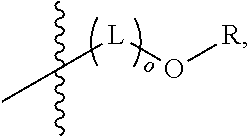
-
- 101: Substrate
- 102: First Electrode
- 103: Hole Transfer Layer
- 104: Photoactive Layer
- 105: Second Electrode


Herein, Z1 is hydrogen; a substituted or unsubstituted alkyl group having 1 to 60 carbon atoms; a substituted or unsubstituted cycloalkyl group having 3 to 60 carbon atoms; a substituted or unsubstituted arylalkyl group having 7 to 50 carbon atoms; a substituted or unsubstituted aryl group having 6 to 60 carbon atoms; or a substituted or unsubstituted heteroring group having 2 to 60 carbon atoms, and including one or more of N, O and S atoms.


Herein, Z′ is hydrogen; a substituted or unsubstituted alkyl group having 1 to 20 carbon atoms; a substituted or unsubstituted cycloalkyl group having 3 to 60 carbon atoms; a substituted or unsubstituted arylalkyl group having 7 to 50 carbon atoms; a heteroarylalkyl group having 2 to 60 carbon atoms; a substituted or unsubstituted carbonyl group having 1 to 40 carbon atoms; a substituted or unsubstituted aryl group having 6 to 60 carbon atoms; or a substituted or unsubstituted heteroring group having 2 to 60 carbon atoms, and including one or more of N, O and S atoms.

means a site that bonds to other substituents or bonding sites.


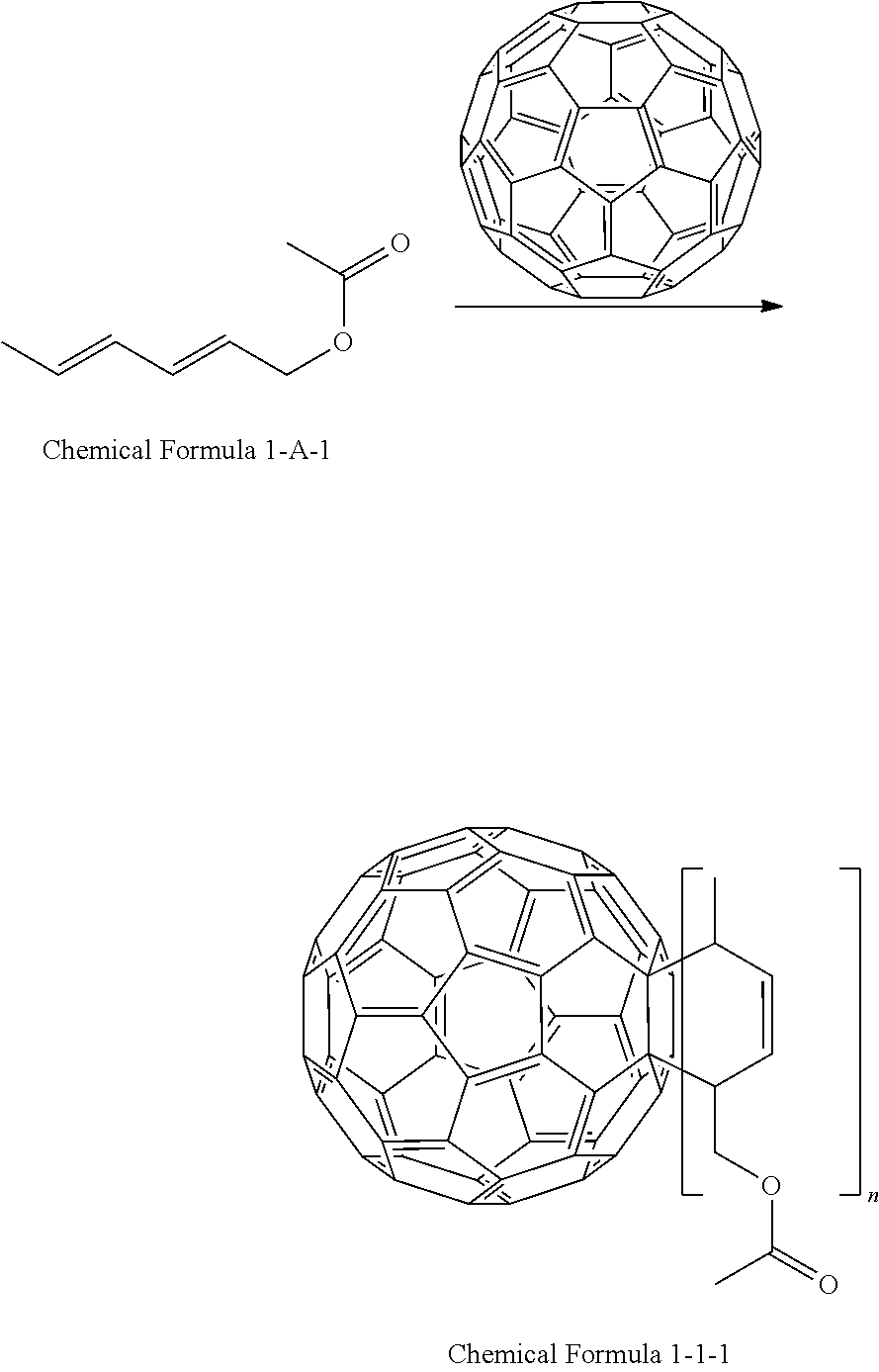


| TABLE 1 | ||||||
| JSC | ||||||
| Active Layer | VOC | (mA/ | PCE | |||
| (P3HT:Compound) | (V) | cm2) | FF | (%) | ||
| Comparative | P3HT:PC61BM = 1:0.7 | 0.65 | 7.71 | 0.59 | 2.91 |
| Example | |||||
| 1-1 | |||||
| Example 1-1 | P3HT:Chemical Formula 1- | 0.63 | 8.90 | 0.54 | 3.03 |
| 1-1 = 1:0.7 | |||||
| Example 1-2 | P3HT:Chemical Formula 1- | 0.64 | 7.41 | 0.62 | 2.76 |
| 1-2 = 1:1 | |||||
| Example 1-3 | P3HT:Chemical Formula 1- | 0.63 | 7.32 | 0.57 | 2.62 |
| 1-3 = 1:1 | |||||
| Example 1-4 | P3HT:Chemical Formula 1- | 0.69 | 4.73 | 0.30 | 0.98 |
| 1-4 = 1:1 | |||||
| Example 1-5 | P3HT:Chemical Formula 1- | 0.63 | 7.72 | 0.66 | 3.21 |
| 1-5 = 1:1 | |||||
| Example 1-6 | P3HT:Chemical Formula 1- | 0.65 | 7.69 | 0.63 | 3.15 |
| 1-6 = 1:1 | |||||
| Example 1-7 | P3HT:Chemical Formula 1- | 0.620 | 9.16 | 0.42 | 2.38 |
| 1-7 = 1:1 | |||||
| Example 1-8 | P3HT:Chemical Formula | 0.67 | 8.98 | 0.65 | 3.91 |
| 1-1-8 = 1:0.7 | |||||
| Example 1-9 | P3HT:Chemical Formula 1- | 0.64 | 7.89 | 0.54 | 2.73 |
| 1-9 = 1:1 | |||||
| Example 1- | Chemical Formula 1-2- | 0.81 | 8.65 | 0.60 | 4.23 |
| 10 | 1:Chemical Formula 1-1- | ||||
| 1 = 1:0.7 | |||||
Claims (18)


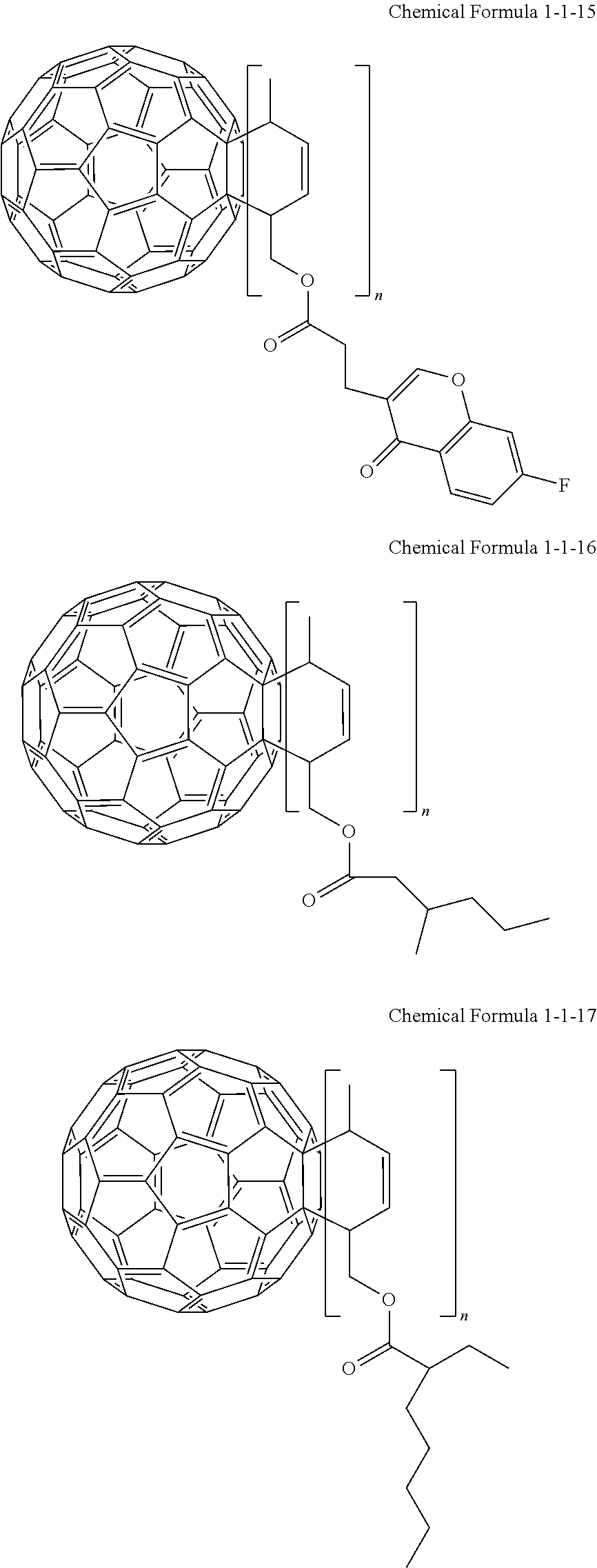


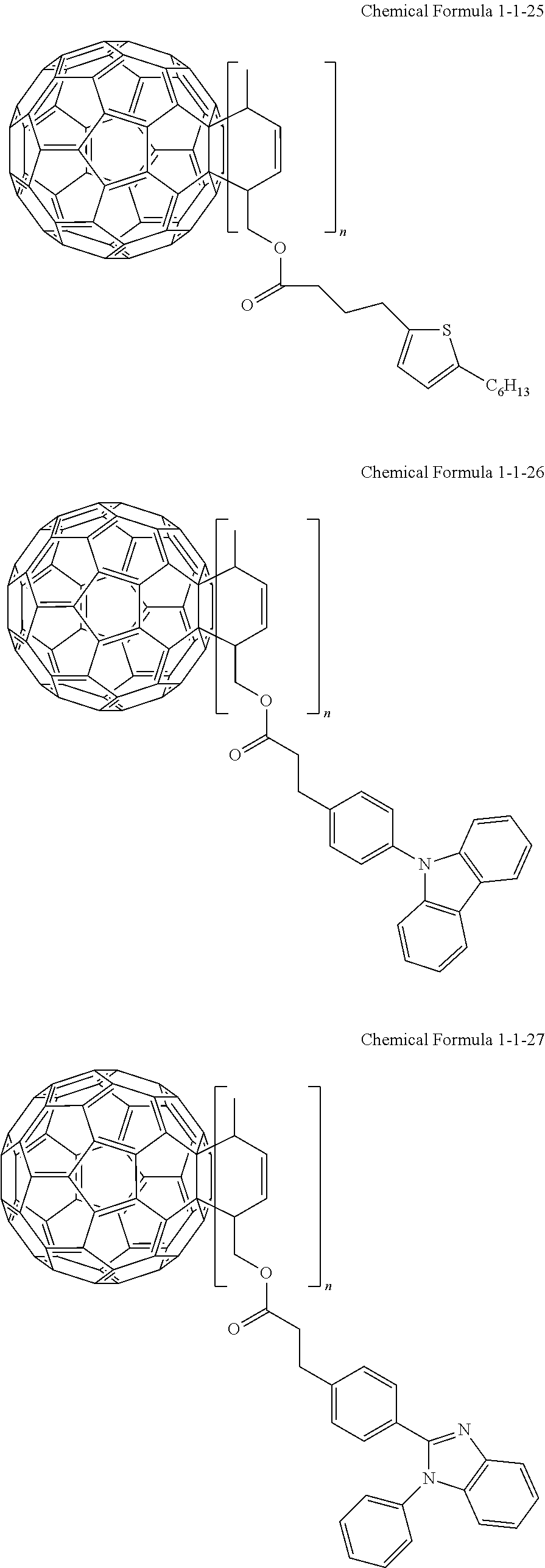


Applications Claiming Priority (5)
| Application Number | Priority Date | Filing Date | Title |
|---|---|---|---|
| KR20140002248 | 2014-01-08 | ||
| KR10-2014-0002248 | 2014-01-08 | ||
| KR1020140106083A KR20150083006A (en) | 2014-01-08 | 2014-08-14 | Fullerene derivatives and organic electronic device comprising fullerene derivatives |
| KR10-2014-0106083 | 2014-08-14 | ||
| PCT/KR2015/000202 WO2015105354A1 (en) | 2014-01-08 | 2015-01-08 | Fullerene derivatives and organic electronic device comprising fullerene derivatives |
Publications (2)
| Publication Number | Publication Date |
|---|---|
| US20160329498A1 US20160329498A1 (en) | 2016-11-10 |
| US10693073B2 true US10693073B2 (en) | 2020-06-23 |
Family
ID=53884870
Family Applications (1)
| Application Number | Title | Priority Date | Filing Date |
|---|---|---|---|
| US15/110,308 Active 2036-01-27 US10693073B2 (en) | 2014-01-08 | 2015-01-08 | Fullerene derivatives and organic electronic device comprising fullerene derivatives |
Country Status (6)
| Country | Link |
|---|---|
| US (1) | US10693073B2 (en) |
| EP (1) | EP3093270B1 (en) |
| JP (1) | JP6306720B2 (en) |
| KR (2) | KR20150083006A (en) |
| CN (1) | CN105899456B (en) |
| TW (1) | TWI628143B (en) |
Families Citing this family (2)
| Publication number | Priority date | Publication date | Assignee | Title |
|---|---|---|---|---|
| JP6833640B2 (en) * | 2017-07-28 | 2021-02-24 | 株式会社東芝 | Photoelectric conversion element and photodetector |
| CN109456269B (en) * | 2018-12-17 | 2021-02-19 | 苏州大学 | Thorium-embedded fullerene derivative and preparation method and application thereof |
Citations (15)
| Publication number | Priority date | Publication date | Assignee | Title |
|---|---|---|---|---|
| CA2117861A1 (en) | 1993-10-12 | 1995-04-13 | Hans J. Bestmann | Fullerene derivatives, a process for their preparation and their use |
| US6448412B1 (en) * | 1995-07-31 | 2002-09-10 | Sphere Biosystems, Inc. | Methods for the preparation and characterization of multi-substituted fullerenes |
| US20030113940A1 (en) * | 2001-07-16 | 2003-06-19 | Erlanger Bernard F. | Antibodies specific for nanotubes and related methods and compositions |
| JP2009135237A (en) | 2007-11-29 | 2009-06-18 | Nagoya Institute Of Technology | Soluble fullerene derivative |
| KR20100062579A (en) | 2008-12-02 | 2010-06-10 | 삼성전자주식회사 | Organic light emitting diode |
| JP2011124361A (en) | 2009-12-10 | 2011-06-23 | Konica Minolta Holdings Inc | Organic photoelectric conversion element, solar battery and optical sensor array |
| KR101059783B1 (en) | 2009-01-29 | 2011-08-26 | 한국화학연구원 | Organic Thin Film Transistors Containing Fullerene Derivatives |
| EP2392555A2 (en) | 2009-01-29 | 2011-12-07 | Korea Research Institute of Chemical Technology (KRICT) | Fullerene derivatives and organic electronic device comprising the same |
| JP2012079832A (en) | 2010-09-30 | 2012-04-19 | Toppan Printing Co Ltd | Block copolymer, organic thin film, photoelectric conversion element, and solar cell |
| EP2445026A1 (en) | 2009-06-18 | 2012-04-25 | Sumitomo Chemical Company, Limited | Organic photoelectric conversion element |
| JP2012089538A (en) | 2010-10-15 | 2012-05-10 | Daikin Ind Ltd | N-type semiconductor material for organic thin film solar cell |
| US8273599B2 (en) | 2006-12-01 | 2012-09-25 | The Regents Of The University Of California | Enhancing performance characteristics of organic semiconducting films by improved solution processing |
| KR20130027284A (en) | 2011-09-07 | 2013-03-15 | 한국과학기술원 | Manufacuring method of fullerene derivatives, fullerene derivatives made by the same, and organic photovoltaic device containing the same |
| US20130306944A1 (en) | 2006-07-06 | 2013-11-21 | Solenne Bv | Blends of Fullerene Derivatives, and Uses Thereof in Electronic Devices |
| JP2014181238A (en) * | 2013-03-15 | 2014-09-29 | Mitsubishi Chemicals Corp | Fullerene derivative and organic electronic device comprising the same |
-
2014
- 2014-08-14 KR KR1020140106083A patent/KR20150083006A/en active Pending
-
2015
- 2015-01-08 TW TW104100901A patent/TWI628143B/en active
- 2015-01-08 KR KR1020150002881A patent/KR101748926B1/en active Active
- 2015-01-08 US US15/110,308 patent/US10693073B2/en active Active
- 2015-01-08 CN CN201580003966.3A patent/CN105899456B/en active Active
- 2015-01-08 JP JP2016545353A patent/JP6306720B2/en active Active
- 2015-01-08 EP EP15735309.5A patent/EP3093270B1/en active Active
Patent Citations (18)
| Publication number | Priority date | Publication date | Assignee | Title |
|---|---|---|---|---|
| JPH07187627A (en) | 1993-10-12 | 1995-07-25 | Hoechst Ag | Fulleren derivatives, their preparation and their use |
| CA2117861A1 (en) | 1993-10-12 | 1995-04-13 | Hans J. Bestmann | Fullerene derivatives, a process for their preparation and their use |
| US6448412B1 (en) * | 1995-07-31 | 2002-09-10 | Sphere Biosystems, Inc. | Methods for the preparation and characterization of multi-substituted fullerenes |
| US20030113940A1 (en) * | 2001-07-16 | 2003-06-19 | Erlanger Bernard F. | Antibodies specific for nanotubes and related methods and compositions |
| US20130306944A1 (en) | 2006-07-06 | 2013-11-21 | Solenne Bv | Blends of Fullerene Derivatives, and Uses Thereof in Electronic Devices |
| US8273599B2 (en) | 2006-12-01 | 2012-09-25 | The Regents Of The University Of California | Enhancing performance characteristics of organic semiconducting films by improved solution processing |
| JP2009135237A (en) | 2007-11-29 | 2009-06-18 | Nagoya Institute Of Technology | Soluble fullerene derivative |
| US20090176995A1 (en) | 2007-11-29 | 2009-07-09 | National University Corporation Nagoya Institute Of Technology | Soluble fullerene derivatives |
| KR20100062579A (en) | 2008-12-02 | 2010-06-10 | 삼성전자주식회사 | Organic light emitting diode |
| KR101059783B1 (en) | 2009-01-29 | 2011-08-26 | 한국화학연구원 | Organic Thin Film Transistors Containing Fullerene Derivatives |
| US20120004476A1 (en) | 2009-01-29 | 2012-01-05 | Korea Research Institute Of Chemical Technology | Fullerene Derivatives and Organic Electronic Device Comprising the Same |
| EP2392555A2 (en) | 2009-01-29 | 2011-12-07 | Korea Research Institute of Chemical Technology (KRICT) | Fullerene derivatives and organic electronic device comprising the same |
| EP2445026A1 (en) | 2009-06-18 | 2012-04-25 | Sumitomo Chemical Company, Limited | Organic photoelectric conversion element |
| JP2011124361A (en) | 2009-12-10 | 2011-06-23 | Konica Minolta Holdings Inc | Organic photoelectric conversion element, solar battery and optical sensor array |
| JP2012079832A (en) | 2010-09-30 | 2012-04-19 | Toppan Printing Co Ltd | Block copolymer, organic thin film, photoelectric conversion element, and solar cell |
| JP2012089538A (en) | 2010-10-15 | 2012-05-10 | Daikin Ind Ltd | N-type semiconductor material for organic thin film solar cell |
| KR20130027284A (en) | 2011-09-07 | 2013-03-15 | 한국과학기술원 | Manufacuring method of fullerene derivatives, fullerene derivatives made by the same, and organic photovoltaic device containing the same |
| JP2014181238A (en) * | 2013-03-15 | 2014-09-29 | Mitsubishi Chemicals Corp | Fullerene derivative and organic electronic device comprising the same |
Non-Patent Citations (16)
| Title |
|---|
| An, et al.: "Unusual Regioselectivity in the Singlet Oxygen Ene Reaction of Cyclohexenobuckminsterfullerenes", XP000542840, American Chemical Society, The Journal of Organic Chemistry, vol. 60, No. 26, Dec. 29, 1995. |
| ChEBI "ethoxycarbonyl group", website—https://www.ebi.ac.uk/chebi/searchld.do?chebild=CHEBI%3A52109, All Pages. (Year: 2018). * |
| English machine translation of Wang "JP 2014-181238 A" provided by the EPO. (Year: 2018). * |
| He et al., "Novel fullerene acceptors: synthesis and application in low band gap polymer solar cells", Journal of Materials Chemistry, 2012 vol. 22, pp. 13391-13394. (Year: 2012). * |
| Janot, et al.: "[60]Fullerene and three [60]fullerene derivatives in membrane model environments", XP055363916, The Royal Society of Chemistry, The Journal of the Chemical Society, vol. 2, No. 2, Jan. 1, 2000, pp. 301-306. |
| JEAN-MARC JANOT, ELISABETH BIENVEN�E, PATRICK SETA, REN� V. BENSASSON, AUGUSTO C. TOM�, ROGER F. ENES, JOS� A. S. CAVALEIRO, SYDNE: "[60]Fullerene and three [60]fullerene derivatives in membrane model environments", JOURNAL OF THE CHEMICAL SOCIETY, PERKIN TRANSACTIONS 2, vol. 2, no. 2, 1 January 2000 (2000-01-01), pages 301 - 306, XP055363916, ISSN: 1470-1820, DOI: 10.1039/a906828g |
| Ohno et al. An Efficient Functionalization of [60 Fullerene. Diels-Alder Reaction using 1,3 Butadienes Substituted with Electron-Withdrawing and Electron-Donating (Silyoxy) Groups, 1996, Tetrahedron, vol. 52, No. 14, pp. 4983-4993. (Year: 1996). * |
| PubChem "ethyl methyl ether", website https://pubchem.ncbi.nlm.nih.gov/compound/Methoxyethane#section=Top, All Pages. (Year: 2018). * |
| Tang: "Two-layer organic photovoltaic cell", Applied Physics Letters, vol. 48, No. 2, Jan. 13, 1986, pp. 183-185. |
| Viana et al., "A novel fullerene lipoic acid derivative: Synthesis and preparation of self-assembled monolayers on gold", Surface Science, 601, All Pages. (Year: 2007). * |
| Viana, A. S., et al., "A novel fullerene lipoic acid derivative: Synthesis and preparation of self-assembled monolayers on gold," Surface Science, 2007, 601(21), pp. 5062-5068. |
| Waldauf et al., "Efficient charge carrier transfer from m-LPPP to C60 derivatives", Optical Materials, vol. 9, 1998, pp. 449-453. (Year: 1998). * |
| Wan, Terence S. M., et al., "Separation of Fullerenes with Non-aqueous Capillary Electrophoresis," Separation of Fullerenes by Liquid Chromatography, Editor(s): Jinno, Kiyokatsu, Royal Society of Chemistry, Cambridge, 1999, pp. 161-176. |
| YI-ZHONG AN, ET AL.: "UNUSUAL REGIOSELECTIVITY IN THE SINGLET OXYGEN ENE REACTION OF CYCLOHEXENOBUCKMINSTERFULLERENES.", JOURNAL OF ORGANIC CHEMISTRY, AMERICAN CHEMICAL SOCIETY, US, vol. 60., no. 26., 29 December 1995 (1995-12-29), US, pages 8330/8331., XP000542840, ISSN: 0022-3263, DOI: 10.1021/jo00131a002 |
| Yu, et al.: "Polymer Photovoltaic Cells: Enhanced Efficiencies via a Network of Internal Donor-Acceptor Heterojunctions", Science, vol. 270, Dec. 15, 1995, pp. 1789-1791. |
| Zhuang, et al.: "Fullerene derivatives as electron donor for organic photovoltaic cells", Applied Physics Letters, vol. 103, 2013, pp. 203301-1-203301-4. |
Also Published As
| Publication number | Publication date |
|---|---|
| TWI628143B (en) | 2018-07-01 |
| KR101748926B1 (en) | 2017-06-20 |
| EP3093270A1 (en) | 2016-11-16 |
| KR20150083006A (en) | 2015-07-16 |
| KR20150083047A (en) | 2015-07-16 |
| CN105899456A (en) | 2016-08-24 |
| US20160329498A1 (en) | 2016-11-10 |
| EP3093270B1 (en) | 2021-09-01 |
| CN105899456B (en) | 2018-02-13 |
| JP6306720B2 (en) | 2018-04-04 |
| TW201609531A (en) | 2016-03-16 |
| JP2017507910A (en) | 2017-03-23 |
| EP3093270A4 (en) | 2017-10-04 |
Similar Documents
| Publication | Publication Date | Title |
|---|---|---|
| KR101573611B1 (en) | Fullerene derivatives, organic solar cell using the same and fabricating method thereof | |
| US9711729B2 (en) | Organic electronic element comprising fullerene derivative | |
| CN109476679A (en) | Heterocyclic compound and organic electronic device comprising the same | |
| US10270038B2 (en) | Fullerene derivative, organic solar cell using same, and preparation method therefor | |
| US20160329498A1 (en) | Fullerene derivatives and organic electronic device comprising fullerene derivatives | |
| KR101620138B1 (en) | Fused cyclic compound, organic solar cell comprising the same and fabricating method thereof | |
| KR101605937B1 (en) | Fused cyclic compound, organic solar cell comprising the same and fabricating method thereof |
Legal Events
| Date | Code | Title | Description |
|---|---|---|---|
| AS | Assignment |
Owner name: LG CHEM, LTD., KOREA, REPUBLIC OF Free format text: ASSIGNMENT OF ASSIGNORS INTEREST;ASSIGNORS:BAE, JAESOON;LEE, JAECHOL;LEE, JIYOUNG;AND OTHERS;REEL/FRAME:039103/0024 Effective date: 20140813 |
|
| STPP | Information on status: patent application and granting procedure in general |
Free format text: RESPONSE TO NON-FINAL OFFICE ACTION ENTERED AND FORWARDED TO EXAMINER |
|
| STPP | Information on status: patent application and granting procedure in general |
Free format text: FINAL REJECTION MAILED |
|
| STPP | Information on status: patent application and granting procedure in general |
Free format text: DOCKETED NEW CASE - READY FOR EXAMINATION |
|
| STPP | Information on status: patent application and granting procedure in general |
Free format text: NON FINAL ACTION MAILED |
|
| STPP | Information on status: patent application and granting procedure in general |
Free format text: RESPONSE TO NON-FINAL OFFICE ACTION ENTERED AND FORWARDED TO EXAMINER |
|
| STPP | Information on status: patent application and granting procedure in general |
Free format text: PUBLICATIONS -- ISSUE FEE PAYMENT VERIFIED |
|
| STCF | Information on status: patent grant |
Free format text: PATENTED CASE |
|
| MAFP | Maintenance fee payment |
Free format text: PAYMENT OF MAINTENANCE FEE, 4TH YEAR, LARGE ENTITY (ORIGINAL EVENT CODE: M1551); ENTITY STATUS OF PATENT OWNER: LARGE ENTITY Year of fee payment: 4 |