US10692939B2 - Multi-view display device - Google Patents
Multi-view display device Download PDFInfo
- Publication number
- US10692939B2 US10692939B2 US16/219,752 US201816219752A US10692939B2 US 10692939 B2 US10692939 B2 US 10692939B2 US 201816219752 A US201816219752 A US 201816219752A US 10692939 B2 US10692939 B2 US 10692939B2
- Authority
- US
- United States
- Prior art keywords
- green
- red
- subpixels
- view image
- blue
- Prior art date
- Legal status (The legal status is an assumption and is not a legal conclusion. Google has not performed a legal analysis and makes no representation as to the accuracy of the status listed.)
- Active
Links
Images




Classifications
-
- H—ELECTRICITY
- H10—SEMICONDUCTOR DEVICES; ELECTRIC SOLID-STATE DEVICES NOT OTHERWISE PROVIDED FOR
- H10K—ORGANIC ELECTRIC SOLID-STATE DEVICES
- H10K59/00—Integrated devices, or assemblies of multiple devices, comprising at least one organic light-emitting element covered by group H10K50/00
- H10K59/10—OLED displays
- H10K59/12—Active-matrix OLED [AMOLED] displays
- H10K59/128—Active-matrix OLED [AMOLED] displays comprising two independent displays, e.g. for emitting information from two major sides of the display
-
- G—PHYSICS
- G09—EDUCATION; CRYPTOGRAPHY; DISPLAY; ADVERTISING; SEALS
- G09G—ARRANGEMENTS OR CIRCUITS FOR CONTROL OF INDICATING DEVICES USING STATIC MEANS TO PRESENT VARIABLE INFORMATION
- G09G3/00—Control arrangements or circuits, of interest only in connection with visual indicators other than cathode-ray tubes
- G09G3/20—Control arrangements or circuits, of interest only in connection with visual indicators other than cathode-ray tubes for presentation of an assembly of a number of characters, e.g. a page, by composing the assembly by combination of individual elements arranged in a matrix no fixed position being assigned to or needed to be assigned to the individual characters or partial characters
- G09G3/22—Control arrangements or circuits, of interest only in connection with visual indicators other than cathode-ray tubes for presentation of an assembly of a number of characters, e.g. a page, by composing the assembly by combination of individual elements arranged in a matrix no fixed position being assigned to or needed to be assigned to the individual characters or partial characters using controlled light sources
- G09G3/30—Control arrangements or circuits, of interest only in connection with visual indicators other than cathode-ray tubes for presentation of an assembly of a number of characters, e.g. a page, by composing the assembly by combination of individual elements arranged in a matrix no fixed position being assigned to or needed to be assigned to the individual characters or partial characters using controlled light sources using electroluminescent panels
- G09G3/32—Control arrangements or circuits, of interest only in connection with visual indicators other than cathode-ray tubes for presentation of an assembly of a number of characters, e.g. a page, by composing the assembly by combination of individual elements arranged in a matrix no fixed position being assigned to or needed to be assigned to the individual characters or partial characters using controlled light sources using electroluminescent panels semiconductive, e.g. using light-emitting diodes [LED]
- G09G3/3208—Control arrangements or circuits, of interest only in connection with visual indicators other than cathode-ray tubes for presentation of an assembly of a number of characters, e.g. a page, by composing the assembly by combination of individual elements arranged in a matrix no fixed position being assigned to or needed to be assigned to the individual characters or partial characters using controlled light sources using electroluminescent panels semiconductive, e.g. using light-emitting diodes [LED] organic, e.g. using organic light-emitting diodes [OLED]
- G09G3/3225—Control arrangements or circuits, of interest only in connection with visual indicators other than cathode-ray tubes for presentation of an assembly of a number of characters, e.g. a page, by composing the assembly by combination of individual elements arranged in a matrix no fixed position being assigned to or needed to be assigned to the individual characters or partial characters using controlled light sources using electroluminescent panels semiconductive, e.g. using light-emitting diodes [LED] organic, e.g. using organic light-emitting diodes [OLED] using an active matrix
-
- H01L27/3218—
-
- H01L27/322—
-
- H01L27/3246—
-
- H01L33/36—
-
- H01L51/5218—
-
- H01L51/5221—
-
- H01L51/5256—
-
- H01L51/5284—
-
- H—ELECTRICITY
- H10—SEMICONDUCTOR DEVICES; ELECTRIC SOLID-STATE DEVICES NOT OTHERWISE PROVIDED FOR
- H10H—INORGANIC LIGHT-EMITTING SEMICONDUCTOR DEVICES HAVING POTENTIAL BARRIERS
- H10H20/00—Individual inorganic light-emitting semiconductor devices having potential barriers, e.g. light-emitting diodes [LED]
- H10H20/80—Constructional details
- H10H20/83—Electrodes
-
- H—ELECTRICITY
- H10—SEMICONDUCTOR DEVICES; ELECTRIC SOLID-STATE DEVICES NOT OTHERWISE PROVIDED FOR
- H10K—ORGANIC ELECTRIC SOLID-STATE DEVICES
- H10K50/00—Organic light-emitting devices
- H10K50/80—Constructional details
- H10K50/805—Electrodes
- H10K50/81—Anodes
- H10K50/818—Reflective anodes, e.g. ITO combined with thick metallic layers
-
- H—ELECTRICITY
- H10—SEMICONDUCTOR DEVICES; ELECTRIC SOLID-STATE DEVICES NOT OTHERWISE PROVIDED FOR
- H10K—ORGANIC ELECTRIC SOLID-STATE DEVICES
- H10K50/00—Organic light-emitting devices
- H10K50/80—Constructional details
- H10K50/805—Electrodes
- H10K50/82—Cathodes
-
- H—ELECTRICITY
- H10—SEMICONDUCTOR DEVICES; ELECTRIC SOLID-STATE DEVICES NOT OTHERWISE PROVIDED FOR
- H10K—ORGANIC ELECTRIC SOLID-STATE DEVICES
- H10K50/00—Organic light-emitting devices
- H10K50/80—Constructional details
- H10K50/84—Passivation; Containers; Encapsulations
- H10K50/844—Encapsulations
- H10K50/8445—Encapsulations multilayered coatings having a repetitive structure, e.g. having multiple organic-inorganic bilayers
-
- H—ELECTRICITY
- H10—SEMICONDUCTOR DEVICES; ELECTRIC SOLID-STATE DEVICES NOT OTHERWISE PROVIDED FOR
- H10K—ORGANIC ELECTRIC SOLID-STATE DEVICES
- H10K50/00—Organic light-emitting devices
- H10K50/80—Constructional details
- H10K50/86—Arrangements for improving contrast, e.g. preventing reflection of ambient light
- H10K50/865—Arrangements for improving contrast, e.g. preventing reflection of ambient light comprising light absorbing layers, e.g. light-blocking layers
-
- H—ELECTRICITY
- H10—SEMICONDUCTOR DEVICES; ELECTRIC SOLID-STATE DEVICES NOT OTHERWISE PROVIDED FOR
- H10K—ORGANIC ELECTRIC SOLID-STATE DEVICES
- H10K59/00—Integrated devices, or assemblies of multiple devices, comprising at least one organic light-emitting element covered by group H10K50/00
- H10K59/10—OLED displays
- H10K59/12—Active-matrix OLED [AMOLED] displays
- H10K59/122—Pixel-defining structures or layers, e.g. banks
-
- H—ELECTRICITY
- H10—SEMICONDUCTOR DEVICES; ELECTRIC SOLID-STATE DEVICES NOT OTHERWISE PROVIDED FOR
- H10K—ORGANIC ELECTRIC SOLID-STATE DEVICES
- H10K59/00—Integrated devices, or assemblies of multiple devices, comprising at least one organic light-emitting element covered by group H10K50/00
- H10K59/30—Devices specially adapted for multicolour light emission
- H10K59/35—Devices specially adapted for multicolour light emission comprising red-green-blue [RGB] subpixels
-
- H—ELECTRICITY
- H10—SEMICONDUCTOR DEVICES; ELECTRIC SOLID-STATE DEVICES NOT OTHERWISE PROVIDED FOR
- H10K—ORGANIC ELECTRIC SOLID-STATE DEVICES
- H10K59/00—Integrated devices, or assemblies of multiple devices, comprising at least one organic light-emitting element covered by group H10K50/00
- H10K59/30—Devices specially adapted for multicolour light emission
- H10K59/35—Devices specially adapted for multicolour light emission comprising red-green-blue [RGB] subpixels
- H10K59/353—Devices specially adapted for multicolour light emission comprising red-green-blue [RGB] subpixels characterised by the geometrical arrangement of the RGB subpixels
-
- H—ELECTRICITY
- H10—SEMICONDUCTOR DEVICES; ELECTRIC SOLID-STATE DEVICES NOT OTHERWISE PROVIDED FOR
- H10K—ORGANIC ELECTRIC SOLID-STATE DEVICES
- H10K59/00—Integrated devices, or assemblies of multiple devices, comprising at least one organic light-emitting element covered by group H10K50/00
- H10K59/30—Devices specially adapted for multicolour light emission
- H10K59/38—Devices specially adapted for multicolour light emission comprising colour filters or colour changing media [CCM]
-
- H—ELECTRICITY
- H10—SEMICONDUCTOR DEVICES; ELECTRIC SOLID-STATE DEVICES NOT OTHERWISE PROVIDED FOR
- H10K—ORGANIC ELECTRIC SOLID-STATE DEVICES
- H10K59/00—Integrated devices, or assemblies of multiple devices, comprising at least one organic light-emitting element covered by group H10K50/00
- H10K59/80—Constructional details
- H10K59/8791—Arrangements for improving contrast, e.g. preventing reflection of ambient light
- H10K59/8792—Arrangements for improving contrast, e.g. preventing reflection of ambient light comprising light absorbing layers, e.g. black layers
-
- G—PHYSICS
- G09—EDUCATION; CRYPTOGRAPHY; DISPLAY; ADVERTISING; SEALS
- G09G—ARRANGEMENTS OR CIRCUITS FOR CONTROL OF INDICATING DEVICES USING STATIC MEANS TO PRESENT VARIABLE INFORMATION
- G09G2320/00—Control of display operating conditions
- G09G2320/02—Improving the quality of display appearance
- G09G2320/028—Improving the quality of display appearance by changing the viewing angle properties, e.g. widening the viewing angle, adapting the viewing angle to the view direction
-
- G—PHYSICS
- G09—EDUCATION; CRYPTOGRAPHY; DISPLAY; ADVERTISING; SEALS
- G09G—ARRANGEMENTS OR CIRCUITS FOR CONTROL OF INDICATING DEVICES USING STATIC MEANS TO PRESENT VARIABLE INFORMATION
- G09G2354/00—Aspects of interface with display user
-
- H01L2251/558—
-
- H01L51/56—
-
- H—ELECTRICITY
- H10—SEMICONDUCTOR DEVICES; ELECTRIC SOLID-STATE DEVICES NOT OTHERWISE PROVIDED FOR
- H10K—ORGANIC ELECTRIC SOLID-STATE DEVICES
- H10K2102/00—Constructional details relating to the organic devices covered by this subclass
- H10K2102/301—Details of OLEDs
- H10K2102/351—Thickness
-
- H—ELECTRICITY
- H10—SEMICONDUCTOR DEVICES; ELECTRIC SOLID-STATE DEVICES NOT OTHERWISE PROVIDED FOR
- H10K—ORGANIC ELECTRIC SOLID-STATE DEVICES
- H10K59/00—Integrated devices, or assemblies of multiple devices, comprising at least one organic light-emitting element covered by group H10K50/00
- H10K59/80—Constructional details
- H10K59/87—Passivation; Containers; Encapsulations
- H10K59/873—Encapsulations
- H10K59/8731—Encapsulations multilayered coatings having a repetitive structure, e.g. having multiple organic-inorganic bilayers
-
- H—ELECTRICITY
- H10—SEMICONDUCTOR DEVICES; ELECTRIC SOLID-STATE DEVICES NOT OTHERWISE PROVIDED FOR
- H10K—ORGANIC ELECTRIC SOLID-STATE DEVICES
- H10K71/00—Manufacture or treatment specially adapted for the organic devices covered by this subclass
Definitions
- the present disclosure relates to a display device, and more particularly, to a multi-view display device.
- a display device and more particularly, to a multi-view display device.
- the present disclosure is suitable for a wide scope of applications, it is particularly suitable for providing a multi-view display device that can display two or more images such that the images can be viewed in multiple directions with a high resolution.
- the flat display devices there are a liquid crystal display (LCD) device, a plasma display panel (PDP) device, a field emission display (FED) device, an electroluminescence display (ELD) device, an organic light emitting diode display (OLED) device, and the like.
- LCD liquid crystal display
- PDP plasma display panel
- FED field emission display
- ELD electroluminescence display
- OLED organic light emitting diode display
- the flat display devices exhibit excellent characteristics such as thin and light profile and reduced power consumption, and thus have rapidly replaced the conventional cathode ray tube (CRT) displays.
- CTR cathode ray tube
- the OLED device is a self-luminescent type device and does not require a backlight unit used in the LCD device as a non-self-luminescent type device. As a result, the OLED device can be lightweight and thin.
- the OLED device has advantages of a viewing angle, a contrast ratio, and power consumption as compared with the LCD device. Furthermore, the OLED device may be driven with a low direct current (DC) voltage and has a rapid response speed. Moreover, since interior components of the OLED device are in a solid state, the OLED device has high durability against the external impact and has a wide operation temperature range.
- DC direct current
- the OLED device is manufactured through a simple process, manufacturing costs can be saved more than the conventional LCD device.
- the OLED device is a self-luminescent device that emits light through an LED, and the LED emits light through an organic electroluminescence phenomenon.
- FIG. 1 is a band diagram illustrating an LED having an emission principle based on an organic electroluminescence phenomenon.
- an LED 10 is formed of an anode 21 , a cathode 25 , and an organic light emitting layer disposed therebetween.
- the organic light emitting layer includes a hole transport layer (HTL) 33 , an electron transport layer (ETL) 35 , and an emitting material layer (EML) 40 interposed between the HTL 33 and the ETL 35 .
- HTL hole transport layer
- ETL electron transport layer
- EML emitting material layer
- HIL hole injection layer
- EIL electron injection layer
- the LED 10 when a positive voltage and a negative voltage are applied to the anode 21 and the cathode 25 , respectively, the holes of the anode 21 and the electrons of the cathode 25 are transported to the EML 40 and form excitons, and when such excitons are transitioned from the excited state to the ground state, light is generated and emitted in the form of visible light by the EML 40 .
- the OLED device including the LED 10 is designed as a two-dimensional display that can be simultaneously viewed by multiple users.
- Such the display characteristic of the display allows a viewer to view the same high-quality image from different directions.
- FIG. 1 is a band diagram of a light emitting diode (LED) having an emission principle based on an organic electroluminescence phenomenon;
- FIG. 2B is a schematic conceptual view for describing a privacy protection mode using a multi-view display device according to an aspect of the present disclosure
- FIG. 3A is a plan view schematically illustrating an arrangement of an array substrate and a color filter encapsulation substrate which constitute a multi-view display device according to an aspect of the present disclosure
- FIG. 3B is a plan view schematically illustrating a state in which an array substrate and a color filter encapsulation substrate overlap with each other according to an aspect of the present disclosure
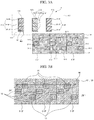
- FIGS. 4A to 4C are cross-sectional views respectively taken along line IV-IV, line IV′-IV′, and line IV′′-IV′′ of FIG. 3B ;
- FIGS. 5A and 5B are graphs of experimental results showing beam angles of light emitted from subpixels according to an aspect of the present disclosure.
- FIG. 2A is a conceptual view schematically illustrating a multi-view display device with which images are visible in three different directions according to an aspect of the present disclosure
- FIG. 2B is a schematic conceptual view for describing a privacy protection mode using a multi-view display device according to an aspect of the present disclosure.
- the multi-view display device displays two or three different images on a single display panel 110 by a method of controlling viewing angles.
- FIG. 2A a triple-view display device with which different images are visible when the display panel 110 is viewed from the center (V 1 ), viewed from the left at an angle of 50° from the center (V 3 ), and viewed from the right at an angle of 50° from the center (V 2 ) is illustrated as an example.
- the multi-view display device simultaneously provides multiple images V 1 , V 2 , and V 3 , which differ from each other according to viewing directions, using the single display panel 110 .
- Light incident from the display panel 110 is divided into the center, left, and right using barriers so that three different images V 1 , V 2 , and V 3 are simultaneously displayed.
- the multi-view display device may be used to watch TV at the center and play game or surf the Internet at the left or right side.
- the multi-view display device may also be applied as a vehicle navigation device and an advertisement display capable of multi-screen display.
- a vehicle navigation device while a navigation screen is provided to a driver and road information to a destination is displayed to the driver, a screen that allows tour information to be searched for may be displayed to a passenger of a front passenger seat, and a passenger of a back passenger seat may be allowed to watch a digital versatile disc (DVD) movie through a screen.
- DVD digital versatile disc
- the multi-view display device When the multi-view display device is applied in the advertisement display field, three different pieces of information can be displayed according to directions in which pedestrians walk. Since the multi-view display device is capable of showing different images V 1 , V 2 , and V 3 to two or more users, the space and cost are significantly saved in comparison to when two or more separate display devices are used.
- the human brain When images seen by two eyes are different due to the binocular disparity, the human brain accurately combines the two pieces of information, and a three-dimensional stereoscopic image can be formed. Such a three-dimensional stereoscopic image causes a person to feel a stereoscopic effect.
- the multi-view display device may realize a privacy protection mode as illustrated in FIG. 2B .
- a privacy protection mode a private image V 1 is only provided to a user who views the display panel 110 from the center, and a user who views the display panel 110 from the left or right views black images or noise images V 2 and V 3 .
- the private image V 1 is an image that the user wants to keep invisible to others for security or privacy.
- FIG. 3A is a plan view schematically illustrating an arrangement of an array substrate and a color filter encapsulation substrate which constitute a multi-view display device according to an aspect of the present disclosure
- FIG. 3B is a plan view schematically illustrating a state in which the array substrate and the color filter encapsulation substrate overlap each other.
- FIGS. 3A and 3B for convenience of description, only a plurality of subpixels R-SP, G-SP, and B-SP which constitute a single unit pixel P and a bank 119 partitioning the plurality of subpixels R-SP, G-SP, and B-SP are illustrated on an array substrate 101 , and only color filters R-CF, G-CF, and B-CF and a black matrix BM are illustrated on a color filter encapsulation substrate 130 .
- the multi-view display device may use an OLED device.
- the OLED device includes the array substrate 101 including a driving thin film transistor DTr (to be shown in FIG. 4A ) and a light emitting diode (LED) E (to be shown in FIG. 4A ), and the color filter encapsulation substrate 130 facing the array substrate 101 .
- the OLED device includes a red subpixel R-SP, a green subpixel G-SP, and a blue subpixel B-SP arranged in a matrix form on the array substrate 101 .
- the red subpixel R-SP may be defined by being divided into first to third red subpixels 1 R-SP, 2 R-SP, and 3 R-SP along a longitudinal direction
- the green subpixel G-SP may be defined by being divided into first to third green subpixels 1 G-SP, 2 G-SP, and 3 G-SP along a longitudinal direction
- the blue subpixel B-SP are also defined by being divided into first to third blue subpixels 1 B-SP, 2 B-SP, and 3 B-SP along a longitudinal direction.
- the red subpixel R-SP, the green subpixel G-SP, and the blue subpixel B-SP neighboring one another constitute a single unit pixel P.
- each of the first to third red, green, and blue subpixels 1 R-SP, 1 G-SP, 1 B-SP, 2 R-SP, 2 G-SP, 2 B-SP, 3 R-SP, 3 G-SP, and 3 B-SP includes an emissive region EA, and the bank 119 is disposed along an edge of each emissive region EA and forms a non-emissive region NEA.
- the subpixels 1 R-SP, 1 G-SP, 1 B-SP, 2 R-SP, 2 G-SP, 2 B-SP, 3 R-SP, 3 G-SP, and 3 B-SP are illustrated as being disposed in parallel at equal widths.
- the subpixels 1 R-SP, 1 G-SP, 1 B-SP, 2 R-SP, 2 G-SP, 2 B-SP, 3 R-SP, 3 G-SP, and 3 B-SP may be disposed at different widths and have various other structures.
- a switching thin film transistor (not illustrated) and a driving thin film transistor DTr are disposed on the non-emissive region NEA of each of the subpixels 1 R-SP, 1 G-SP, 1 B-SP, 2 R-SP, 2 G-SP, 2 B-SP, 3 R-SP, 3 G-SP, and 3 B-SP.
- An LED E (to be shown in FIG. 4A ) which includes a first electrode 111 (to be shown in FIG. 4A ), organic light emitting layer 113 a, 113 b, and 113 c, and a second electrode 115 (to be shown in FIG.
- 4A is disposed on the emissive region EA in each of the subpixels 1 R-SP, 1 G-SP, 1 B-SP, 2 R-SP, 2 G-SP, 2 B-SP, 3 R-SP, 3 G-SP, and 3 B-SP.
- red light is emitted from the red subpixel R-SP
- green light is emitted from the green subpixel G-SP
- blue light is emitted from the blue subpixel B-SP such that the OLED device realizes full color spectrum.
- the first to third organic light emitting layers 113 a, 113 b, and 113 c configured to emit different colors are formed in the red subpixel R-SP, the green subpixel G-SP, and the blue subpixel B-SP, respectively.
- the black matrices BM disposed corresponding to the green color filter G-CF may include a first green opening 1 G-O corresponding to the first green subpixel 1 G-SP, a second green opening 2 G-O corresponding to the second green subpixel 2 G-SP, and a third green opening 3 G-O corresponding to the third green subpixel 3 G-SP.
- the black matrices BM disposed corresponding to the blue color filter B-CF may include a first blue opening 1 B-O corresponding to the first blue subpixel 1 B-SP, a second blue opening 2 B-O corresponding to the second blue subpixel 2 B-SP, and a third blue opening 3 B-O corresponding to the third blue subpixel 3 B-SP.
- the first red, green, and blue openings 1 R-O, 1 G-O, and 1 B-O corresponding to the first red, green, and blue subpixels 1 R-SP, 1 G-SP, and 1 B-SP may be disposed at the central portions of the first red, green, and blue subpixels 1 R-SP, 1 G-SP, and 1 B-SP.
- the second red, green, and blue openings 2 R-O, 2 G-O, and 2 B-O corresponding to the second red, green, and blue subpixels 2 R-SP, 2 G-SP, and 2 B-SP may be disposed toward the left from the central portions of the second red, green, and blue subpixels 2 R-SP, 2 G-SP, and 2 B-SP.
- the blue light emitted from the blue subpixel B-SP may display the third-first (i.e., 3-1) to third-third (i.e., 3-3) view images V 3 - 1 , V 3 - 2 , and V 3 - 3 through the first to third blue openings 1 B-O, 2 B-O, and 3 B-O.
- third-first i.e., 3-1
- third-third i.e., 3-3
- the OLED device includes an array substrate 101 on which a driving thin film transistor DTr and an LED E are formed and a color filter encapsulation substrate 130 facing the array substrate 101 .
- the array substrate 101 and the color filter encapsulation substrate 130 are adhered to each other, thereby forming the OLED device.
- a gate line (not illustrated), a data line (not illustrated), and a power line (not illustrated) are disposed on the array substrate 101 such that each of the subpixels 1 R-SP, 1 G-SP, 1 B-SP, 2 R-SP, 2 G-SP, 2 B-SP, 3 R-SP, 3 G-SP, and 3 B-SP are defined.
- FIG. 4A which is a cross-sectional view taken along line IV-IV and schematically illustrates the first red, green, and blue subpixels 1 R-SP, 1 G-SP, and 1 B-SP
- FIG. 4B which is a cross-sectional view taken along line IV′-IV′ and schematically illustrates the second red, green, and blue subpixels 2 R-SP, 2 G-SP, and 2 B-SP
- FIG. 4A which is a cross-sectional view taken along line IV-IV and schematically illustrates the first red, green, and blue subpixels 1 R-SP, 1 G-SP, and 1 B-SP
- FIG. 4B which is a cross-sectional view taken along line IV′-IV′ and schematically illustrates the second red, green, and blue subpixels 2 R-SP, 2 G-SP, and 2 B-SP
- FIG. 4A which is a cross-sectional view taken along line IV-IV and schematically illustrates the first red, green, and blue subpixels 1 R-SP, 1 G
- a semiconductor layer 103 is disposed on a switching region TrA of each of the subpixels 1 R-SP, 1 G-SP, 1 B-SP, 2 R-SP, 2 G-SP, 2 B-SP, 3 R-SP, 3 G-SP, and 3 B-SP on the array substrate 101 .
- the semiconductor layer 103 may be formed of silicon.
- the semiconductor layer 103 may include an active region 103 a as a channel at a center portion thereof, and source and drain regions 103 b and 103 c doped with high-concentration impurities at both sides of the active region 103 a.
- a gate insulating layer 105 is disposed on the semiconductor layer 103 .
- a gate electrode 107 corresponding to the active region 103 a of the semiconductor layer 103 and a gate line (not illustrated) which extends in one direction are disposed on the gate insulating layer 105 .
- An interlayer insulating layer 109 a is disposed on the gate electrode 107 and the gate line.
- first and second semiconductor layer contact holes 116 configured to respectively expose the source and drain regions 103 b and 103 c are disposed in the interlayer insulating layer 109 a and the gate insulating layer 105 .
- Source and drain electrodes 117 a and 117 b spaced apart from each other and respectively in contact with the source and drain regions 103 b and 103 c through the first and second semiconductor layer contact holes 116 are disposed on the interlayer insulating layer 109 a.
- a passivation layer 109 b having a drain contact hole 118 configured to expose the drain electrode 117 b of the driving thin film transistor DTr is disposed on the source and drain electrodes 117 a and 117 b and the interlayer insulating layer 109 a.
- the source and drain electrodes 117 a and 117 b, the semiconductor layer 103 , the gate insulating layer 105 , and the gate electrode 107 constitute the driving thin film transistor DTr.
- a switching thin film transistor is connected to the driving thin film transistor DTr.
- the switching thin film transistor may be formed of the same structure as the driving thin film transistor DTr.
- the driving thin film transistor DTr having a top gate structure with the semiconductor layer 103 formed as a polycrystalline silicon layer or oxide semiconductor layer is described by way of example.
- the driving thin film transistor DTr may have a bottom gate structure with the semiconductor layer 103 formed as an amorphous silicon layer.
- a light shielding layer (not illustrated) may be disposed below the semiconductor layer 103 .
- a buffer layer (not illustrated) may be disposed between the light shielding layer and the semiconductor layer 103 .
- the first electrode 111 may be formed of metal oxide such as indium tin oxide (ITO) and indium zinc oxide (IZO).
- ITO indium tin oxide
- IZO indium zinc oxide
- the first electrode 111 may be disposed for each of the subpixels 1 R-SP, 1 G-SP, 1 B-SP, 2 R-SP, 2 G-SP, 2 B-SP, 3 R-SP, 3 G-SP, and 3 B-SP.
- a bank 119 may be disposed between the first electrodes 111 disposed in the subpixels R-SP, G-SP, and B-SP.
- the first electrodes 111 may have separated structures for each of the subpixels R-SP, G-SP, and B-SP with the bank 119 as boundaries for each of the subpixels 1 R-SP, 1 G-SP, 1 B-SP, 2 R-SP, 2 G-SP, 2 B-SP, 3 R-SP, 3 G-SP, and 3 B-SP.
- the organic light emitting layers 113 a, 113 b, and 113 c may be disposed on the first electrodes 111 when the bank 119 is formed.
- the organic light emitting layers 113 a, 113 b, and 113 c emit red light, green light, and blue light in the red, green, and blue subpixels 1 R-SP, 1 G-SP, 1 B-SP, 2 R-SP, 2 G-SP, 2 B-SP, 3 R-SP, 3 G-SP, and 3 B-SP.
- the organic light emitting layer 113 a in the red subpixels 1 R-SP, 2 R-SP, and 3 R-SP is a first organic light emitting layer 113 a configured to emit red light
- the organic light emitting layer 113 b in the green subpixels 1 G-SP, 2 G-SP, and 3 G-SP is a second organic light emitting layer 113 b configured to emit green light
- the organic light emitting layer 113 c in the blue subpixels 1 B-SP, 2 B-SP, and 3 B-SP is a third organic light emitting layer 113 c configured to emit blue light.
- the first organic light emitting layer 113 a is disposed on the first to third red subpixels 1 R-SP, 2 R-SP, and 3 R-SP so that all of the first to third red subpixels 1 R-SP, 2 R-SP, and 3 R-SP emit red light.
- the second organic light emitting layer 113 b is disposed on the first to third green subpixels 1 G-SP, 2 G-SP, and 3 G-SP so that all of the first to third green subpixels 1 G-SP, 2 G-SP, and 3 G-SP emit green light.
- the third organic light emitting layer 113 c is disposed on the first to third blue subpixels 1 B-SP, 2 B-SP, and 3 B-SP so that all of the first to third blue subpixels 1 B-SP, 2 B-SP, and 3 B-SP emit blue light.
- the first to third organic light emitting layers 113 a, 113 b, and 113 c may be formed of a single layer formed of an emitting material. To improve luminous efficiency, the first to third organic light emitting layers 113 a, 113 b, and 113 c may be formed of multiple layers including a hole injection layer, a hole transport layer, an emitting material layer, an electron transport layer, and an electron injection layer.
- a second electrode 115 serving as a cathode may be disposed entirely on the organic light emitting layers 113 a, 113 b, and 113 c.
- the second electrode 115 may be formed of a material having a relatively low work function.
- the second electrode 115 may be formed with a single layer or multiple layers using a first metal such as Ag and a second metal such as Mg, and the single layer may be made of an alloy of the first and second metals at a predetermined ratio thereof.
- the holes injected from the first electrode 111 and the electrons provided from the second electrode 115 are transported to the organic light emitting layers 113 a, 113 b, and 113 c and form excitons, and when such excitons are transitioned from an excited state to a ground state, light is generated and emitted in the form of visible light.
- the OLED device is a top emission type in which light emitted from the organic light emitting layers 113 a, 113 b, and 113 c is output to the outside through the second electrode 115 .
- the first electrode 111 further includes a reflective layer (not illustrated) formed of an opaque conductive material.
- the reflective layer may be formed of an aluminum-palladium-copper (APC) alloy, and the first electrode 111 may have a triple layer structure of ITO/APC/ITO.
- the second electrode 115 may be formed of a semi-transmissive conductive material such as Mg, Ag, or an alloy of Mg and Ag.
- a semi-transmissive conductive material such as Mg, Ag, or an alloy of Mg and Ag.
- light output efficiency may be improved by a micro cavity.
- the first to third red, green, and blue subpixels 1 R-SP, 1 G-SP, 1 B-SP, 2 R-SP, 2 G-SP, 2 B-SP, 3 R-SP, 3 G-SP, and 3 B-SP may have different micro cavity depths. This will be described in more detail below.
- the color filter encapsulation substrate 130 which is in the form of a thin film, is formed on the driving thin film transistor DTr and the LED E, and the OLED device is encapsulated by the color filter encapsulation substrate 130 .
- At least two inorganic protective films are stacked to form the color filter encapsulation substrate 130 .
- an organic protective film for supplementing impact resistance of the two inorganic protective films may be interposed between the inorganic protective films.
- the inorganic protective films may completely cover the organic protective film.
- the OLED device can prevent permeation of moisture and oxygen thereinto from the outside.
- the first to third color filters R-CF, G-CF, and B-CF and a barrier layer including black matrices BM are disposed on the color filter encapsulation substrate 130 .
- the black matrices BM may not overlap with the first red, green, and blue subpixels 1 R-SP, 1 G-SP, and 1 B-SP and may completely overlap with the second and third red, green, and blue subpixels 2 R-SP, 2 G-SP, 2 B-SP, 3 R-SP, 3 G-SP, and 3 B-SP.
- the third red, green, and blue openings 3 R-O, 3 G-O, and 3 B-O may be disposed toward the right from the centers of the third red, green, and blue subpixels 3 R-SP, 3 G-SP, and 3 B-SP, respectively.
- the second green opening 2 G-O may be shifted toward the second red subpixel 2 R-SP from the second green subpixel 2 G-SP and disposed on the bank 119 between the second red subpixel 2 R-SP and the second green subpixel 2 G-SP
- the second blue opening 2 B-O may be shifted toward the second green subpixel 2 G-SP from the second blue subpixel 2 B-SP and disposed on the bank 119 between the second green subpixel 2 G-SP and the second blue subpixel 2 B-SP.
- the third red opening 3 R-O may be shifted toward the third green subpixel 3 G-SP from the third red subpixel 3 R-SP and disposed on the bank 119 between the third red subpixel 3 R-SP and the third green subpixel 3 G-SP
- the third green opening 3 G-O may be shifted toward the third blue subpixel 3 B-SP from the third green subpixel 3 G-SP and disposed on the bank 119 between the third green subpixel 3 G-SP and the third blue subpixel 3 B-SP.
- the third blue opening 3 B-O may be disposed on the bank 119 disposed between the third blue subpixel 3 B-SP and a neighboring subpixel to the right thereof.
- the second red opening 2 R-O is illustrated as being disposed in the second red subpixel 2 R-SP, but this is merely for illustrating the driving thin film transistor DTr in the drawings.
- the second red opening 2 R-O may substantially be disposed on the bank 119 disposed between the second red subpixel 2 R-SP and a neighboring subpixel to the left thereof.
- a width of such a black matrix BM including the first to third red, green, and blue openings 1 R-O, 1 G-O, 1 B-O, 2 R-O, 2 G-O, 2 B-O, 3 R-O, 3 G-O, and 3 B-O may have a value equal to (width of each subpixel 1 R-SP, 1 G-SP, 1 B-SP, 2 R-SP, 2 G-SP, 2 B-SP, 3 R-SP, 3 G-SP, and 3 B-SP*0.5).
- the width of the black matrix BM has a value less than (width of each subpixel 1 R-SP, 1 G-SP, 1 B-SP, 2 R-SP, 2 G-SP, 2 B-SP, 3 R-SP, 3 G-SP, and 3 B-SP*0.5)
- light may be mixed and output to neighboring subpixels 1 R-SP, 1 G-SP, 1 B-SP, 2 R-SP, 2 G-SP, 2 B-SP, 3 R-SP, 3 G-SP, and 3 B-SP, and it may become difficult for the OLED device to realize multiple views.
- the widths of the subpixels 1 R-SP, 1 G-SP, 1 B-SP, 2 R-SP, 2 G-SP, 2 B-SP, 3 R-SP, 3 G-SP, and 3 B-SP and the widths of the black matrices BM may be changed by varying the distance between the array substrate 101 and the color filter encapsulation substrate 130 .
- the widths of the first to third red, green, and blue openings 1 R-O, 1 G-O, 1 B-O, 2 R-O, 2 G-O, 2 B-O, 3 R-O, 3 G-O, and 3 B-O and the widths of the color filters R-CF, G-CF, and B-CF may be changed according to a cell gap H 1 , which is the distance between the array substrate 101 and the color filter encapsulation substrate 130 , and a thickness H 2 of the black matrices BM.
- This may be designed within a range that satisfies the following equation 1. (cell gap+black matrix thickness)*tan(60°) ⁇ (subpixel width*1.5) (Equation 1)
- the widths of the first red, green, and blue openings 1 R-O, 1 G-O, and 1 B-O corresponding to the first red, green, and blue subpixels 1 R-SP, 1 G-SP, and 1 B-SP satisfy (cell gap+black matrix thickness)*tan(20°)*2.
- the widths of the second and third red, green, and blue openings 2 R-O, 2 G-O, 2 B-O, 3 R-O, 3 G-O, and 3 B-O corresponding to the second and third red, green, and blue subpixels 2 R-SP, 2 G-SP, 2 B-SP, 3 R-SP, 3 G-SP, and 3 B-SP satisfy (cell gap+black matrix thickness)*tan(60°).
- light emitted from each of the subpixels 1 R-SP, 1 G-SP, 1 B-SP, 2 R-SP, 2 G-SP, 2 B-SP, 3 R-SP, 3 G-SP, and 3 B-SP is emitted forward with a beam angle of about 40° (marked as region E).
- red light, green light, and blue light emitted from the first red, blue, and green subpixels 1 R-SP, 1 G-SP, and 1 B-SP travel forward toward the color filter encapsulation substrate 130 with a beam angle in a range of ⁇ 20 to +20°.
- all of red light, green light, and blue light emitted from the second and third red, green, and blue subpixels 2 R-SP, 2 G-SP, 2 B-SP, 3 R-SP, 3 G-SP, and 3 B-SP travel sideward toward the color filter encapsulation substrate 130 with a beam angle in a range of ⁇ 60 to ⁇ 20° and +20 to +60° (marked as region F).
- a luminance of light emitted forward is the highest, and a luminance of light emitted sideward is lower than that of light emitted forward.
- the widths of the first red, green, and blue openings 1 R-O, 1 G-O, and 1 B-O disposed corresponding to the first red, green, and blue subpixels 1 R-SP, 1 G-SP, and 1 B-SP which emit light forward may satisfy (cell gap+black matrix thickness)*tan(20°)*2, and the second and third red, green, and blue openings 2 R-O, 2 G-O, 2 B-O, 3 R-O, 3 G-O, and 3 B-O disposed corresponding to the second and third red, green, and blue subpixels 2 R-SP, 2 G-SP, 2 B-SP, 3 R-SP, 3 G-SP, and 3 B-SP may have widths that satisfy (cell gap+black matrix thickness)*tan(60°).
- the red color filter R-CF is disposed corresponding to the red subpixels 1 R-SP, 2 R-SP, and 3 R-SP
- the green color filter G-CF is disposed corresponding to the green subpixels 1 G-SP, 2 G-SP, and 3 G-SP
- the blue color filter B-CF is disposed corresponding to the blue subpixels 1 B-SP, 2 B-SP, and 3 B-SP.
- all of the first to third red subpixels 1 R-SP, 2 R-SP, and 3 R-SP of the red subpixels 1 R-SP, 2 R-SP, and 3 R-SP are disposed to overlap with the red color filter R-CF
- all of the first to third green subpixels 1 G-SP, 2 G-SP, and 3 G-SP of the green subpixels 1 G-SP, 2 G-SP, and 3 G-SP are disposed to overlap with the green color filter G-CF
- all of the first to third blue subpixels 1 B-SP, 2 B-SP, and 3 B-SP of the blue subpixels 1 B-SP, 2 B-SP, and 3 B-SP are disposed to overlap with the blue color filter B-CF.
- light emitted from the first green subpixel 1 G-SP among the green subpixels 1 G-SP, 2 G-SP, and 3 G-SP passes through the green color filter G-CF through the first green opening 1 G-O and displays the second-first view image V 2 - 1
- light emitted from the second green subpixel 2 G-SP among the green subpixels 1 G-SP, 2 G-SP, and 3 G-SP passes through the green color filter G-CF through the second green opening 2 G-O and displays the second-second view image V 2 - 2
- light emitted from the third green subpixel 3 G-SP among the green subpixels 1 G-SP, 2 G-SP, and 3 G-SP passes through the green color filter G-CF through the third green opening 3 G-O and displays the second-third view image V 2 - 3 .
- light emitted from the first blue subpixel 1 B-SP among the blue subpixels 1 B-SP, 2 B-SP, and 3 B-SP passes through the blue color filter B-CF through the first blue opening 1 B-O and displays the third-first view image V 3 - 1
- light emitted from the second blue subpixel 2 B-SP among the blue subpixels 1 B-SP, 2 B-SP, and 3 B-SP passes through the blue color filter B-CF through the second blue opening 2 B-O and displays the third-second view image V 3 - 2
- light emitted from the third blue subpixel 3 B-SP among the blue subpixels 1 B-SP, 2 B-SP, and 3 B-SP passes through the blue color filter B-CF through the third blue opening 3 B-O and displays the third-third view image V 3 - 3 .
- the first-first view image V 1 - 1 displayed through the red color filter R-CF, the second-first view image V 2 - 1 displayed through the green color filter G-CF, and the third-first view image V 3 - 1 displayed through the blue color filter B-CF realize the first view image V 1 .
- the first-second view image V 1 - 2 , the second-second view image V 2 - 2 , and the third-second view image V 3 - 2 realize the second view image V 2
- the first-third view image V 1 - 3 , the second-third view image V 2 - 3 , and the third-third view image V 3 - 3 realize the third view image V 3 .
- the OLED device of this aspect realizes the multi-view display device.
- the gaps between the subpixels 1 R-SP, 1 G-SP, 1 B-SP, 2 R-SP, 2 G-SP, 2 B-SP, 3 R-SP, 3 G-SP, and 3 B-SP are adjusted, and positions of the openings 1 R-O, 1 G-O, 1 B-O, 2 R-O, 2 G-O, 2 B-O, 3 R-O, 3 G-O, and 3 B-O of the black matrices BM are adjusted.
- the first-first to first-third view images V 1 - 1 , V 1 - 2 , and V 1 - 3 displayed from the red subpixels 1 R-SP, 2 R-SP, and 3 R-SP are output to regions of first to third view images V 1 , V 2 , and V 3 , respectively
- the second-first to second-third view images V 2 - 1 , V 2 - 2 , and V 2 - 3 displayed from the green subpixels 1 G-SP, 2 G-SP, and 3 G-SP are output to regions of the first to third view images V 1 , V 2 , and V 3 , respectively.
- the third-first to third-third view images V 3 - 1 , V 3 - 2 , and V 3 - 3 displayed from the blue subpixels 1 B-SP, 2 B-SP, and 3 B-SP are output to regions of the first to third view images V 1 , V 2 , and V 3 , respectively.
- first-first to first-third view images V 1 - 1 , V 1 - 2 , and V 1 - 3 of red light may be output to the regions of the first to third view images V 1 , V 2 , and V 3 , respectively, using the first to third red subpixels 1 R-SP, 2 R-SP, and 3 R-SP
- the second-first to second-third view images V 2 - 1 , V 2 - 2 , and V 2 - 3 of green light may be output to the regions of the first to third view images V 1 , V 2 , and V 3 , respectively, using the first to third green subpixels 1 G-SP, 2 G-SP, and 3 G-SP
- the third-first to third-third view images V 3 - 1 , V 3 - 2 , and V 3 - 3 of blue light may be output to the regions of the first to third view images V 1 , V 2 , and V 3 , respectively, using the first to third blue subpixels 1 B-SP, 2 B-SP
- the first-first view image V 1 - 1 , the second-first view image V 2 - 1 , and the third-first view images V 3 - 1 realize the first view image V 1 .
- the second-first view images V 2 - 1 , the second-second view images V 2 - 2 , and the second-third view images V 2 - 3 realize the second view images V 2 .
- the first-third view images V 1 - 3 , the second-third view images V 2 - 3 , and the third-third view images V 3 - 3 realize the third view images V 3 .
- a triple-view display device may be realized using a single display device, and a three-dimensional stereoscopic image may also be realized using a single display device.
- the first to third red subpixels 1 R-SP, 2 R-SP, and 3 R-SP configured to display the first-first to first-third view images V 1 - 1 , V 1 - 2 , and V 1 - 3 are defined by dividing the red subpixels 1 R-SP, 2 R-SP, and 3 R-SP on which the first organic light emitting layer 113 a is deposited
- the first to third green subpixels 1 G-SP, 2 G-SP, and 3 G-SP configured to display the second-first to second-third view images V 2 - 1 , V 2 - 2 , and V 2 - 3 are defined by dividing the green subpixels 1 G-SP, 2 G-SP, and 3 G-SP on which the second organic light emitting layer 113 b is deposited
- the first to third blue subpixels 1 B-SP, 2 B-SP, and 3 B-SP configured to display the third-first to third-third view images V
- the size of the OLED device of this aspect may be increased, the lifetime thereof may be extended, and power consumption thereof may be reduced.
- the OLED device uses light emitted forward from the first red, green, and blue subpixels 1 R-SP, 1 G-SP, and 1 B-SP and uses light emitted sideward from the second and third red, green, and blue subpixels 2 R-SP, 2 G-SP, 2 B-SP, 3 R-SP, 3 G-SP, and 3 B-SP, a luminance difference occurs between the light emitted from the first red, green, and blue subpixels 1 R-SP, 1 G-SP, and 1 B-SP, and the light emitted from the second and third red, green, and blue subpixels 2 R-SP, 2 G-SP, 2 B-SP, 3 R-SP, 3 G-SP, and 3 B-SP.
- a micro cavity depth differs for each of the first red, green, and blue subpixels 1 R-SP, 1 G-SP, and 1 B-SP and the second and third red, green, and blue subpixels 2 R-SP, 2 G-SP, 2 B-SP, 3 R-SP, 3 G-SP, and 3 B-SP.
- the micro cavity effect refers to an effect in which lights reflected between mirrors are destructively or constructively interfered with each other, only a light having a specific wavelength remains and a light having other wavelengths is cancelled, thereby increasing intensity of a light having a specific wavelength.
- a depth or length of a micro cavity between the first electrode 111 and the second electrode 115 or between the first and second electrodes 111 and 115 and the EML of the organic light emitting layers 113 a, 113 b or 113 c may be configured for each of the red, green, and blue subpixels 1 R-SP, 1 G-SP, 1 B-SP, 2 R-SP, 2 G-SP, 2 B-SP, 3 R-SP, 3 G-SP, and 3 B-SP such that a resonant wavelength corresponding to a desired peak color wavelength.
- an efficient micro cavity depth may be defined using an optical length which is a wavelength. Since a wavelength of red light is greater than a wavelength of green light, a micro cavity depth of the red subpixels 1 R-SP, 2 R-SP, and 3 R-SP may be configured to be greater than a micro cavity depth of the green subpixels 1 G-SP, 2 G-SP, and 3 G-SP.
- a micro cavity depth of the green subpixels 1 G-SP, 2 G-SP, and 3 G-SP may be configured to be greater than a micro cavity depth of the blue subpixels 1 B-SP, 2 B-SP, and 3 B-SP.
- the red, green, and blue subpixels 1 R-SP, 1 G-SP, 1 B-SP, 2 R-SP, 2 G-SP, 2 B-SP, 3 R-SP, 3 G-SP, and 3 B-SP are defined by being divided into first to third red, green, and blue subpixels 1 R-SP, 1 G-SP, 1 B-SP, 2 R-SP, 2 G-SP, 2 B-SP, 3 R-SP, 3 G-SP, and 3 B-SP, and the first to third red, green, and blue subpixels 1 R-SP, 1 G-SP, 1 B-SP, 2 R-SP, 2 G-SP, 2 B-SP, 3 R-SP, 3 G-SP, and 3 B-SP display different view images.
- a micro cavity depth differs for each of the first to third red subpixels 1 R-SP, 2 R-SP, and 3 R-SP, for each of the first to third green subpixels 1 G-SP, 2 G-SP, and 3 G-SP, and for each of the first to third blue subpixels 1 B-SP, 2 B-SP, and 3 B-SP.
- n is a refractive index of an EML of the organic light emitting layers 113 a, 113 b, and 113 c
- d is a distance between the EML and the second electrode 115
- m is a constant
- ⁇ is a desired center-wavelength.
- the first red subpixel 1 R-SP is designed to have a micro cavity depth of 2800 nm
- the OLED device due to the arrangement structure of the subpixels 1 R-SP, 1 G-SP, 1 B-SP, 2 R-SP, 2 G-SP, 2 B-SP, 3 R-SP, 3 G-SP, and 3 B-SP and the color filters R-CF, G-CF, and B-CF, the gaps between the subpixels 1 R-SP, 1 G-SP, 1 B-SP, 2 R-SP, 2 G-SP, 2 B-SP, 3 R-SP, 3 G-SP, and 3 B-SP, and the arrangement structure of the openings 1 R-O, 1 G-O, 1 B-O, 2 R-O, 2 G-O, 2 B-O, 3 R-O, 3 G-O, and 3 B-O of the black matrix BM, the first-first view image V 1 - 1 , the first-second view image V 1 - 2 , and the first-third view image V 1 - 3 of red light are displayed through the first to third red subpixels
- the first to third red subpixels 1 R-SP, 2 R-SP, and 3 R-SP configured to display the first-first to first-third view images V 1 - 1 , V 1 - 2 , and V 1 - 3 are defined by dividing the red subpixels 1 R-SP, 2 R-SP, and 3 R-SP on which the first organic light emitting layer 113 a is deposited, the first to third green subpixels 1 G-SP, 2 G-SP, and 3 G-SP configured to display the second-first to second-third view images V 2 - 1 , V 2 - 2 , and V 2 - 3 are defined by dividing the green subpixels 1 G-SP, 2 G-SP, and 3 G-SP on which the second organic light emitting layer 113 b is deposited, and the first to third blue subpixels 1 B-SP, 2 B-SP, and 3 B-SP configured to display the third-first to third-third view images
Landscapes
- Engineering & Computer Science (AREA)
- Physics & Mathematics (AREA)
- Optics & Photonics (AREA)
- Computer Hardware Design (AREA)
- General Physics & Mathematics (AREA)
- Theoretical Computer Science (AREA)
- Microelectronics & Electronic Packaging (AREA)
- Chemical & Material Sciences (AREA)
- Inorganic Chemistry (AREA)
- Electroluminescent Light Sources (AREA)
- Devices For Indicating Variable Information By Combining Individual Elements (AREA)
Abstract
Description
(cell gap+black matrix thickness)*tan(60°)<(subpixel width*1.5) (Equation 1)
nd=(2m−1)λ(m=1, 2, . . . ) (Equation 2)
nd=(2m−1)λ/sin(40°)(m=1, 2, . . . ) (Equation 3)
Claims (20)
Applications Claiming Priority (2)
| Application Number | Priority Date | Filing Date | Title |
|---|---|---|---|
| KR10-2017-0173899 | 2017-12-18 | ||
| KR1020170173899A KR102467221B1 (en) | 2017-12-18 | 2017-12-18 | Multi-view display device |
Publications (2)
| Publication Number | Publication Date |
|---|---|
| US20190189705A1 US20190189705A1 (en) | 2019-06-20 |
| US10692939B2 true US10692939B2 (en) | 2020-06-23 |
Family
ID=66816361
Family Applications (1)
| Application Number | Title | Priority Date | Filing Date |
|---|---|---|---|
| US16/219,752 Active US10692939B2 (en) | 2017-12-18 | 2018-12-13 | Multi-view display device |
Country Status (3)
| Country | Link |
|---|---|
| US (1) | US10692939B2 (en) |
| KR (1) | KR102467221B1 (en) |
| CN (1) | CN110010654B (en) |
Cited By (2)
| Publication number | Priority date | Publication date | Assignee | Title |
|---|---|---|---|---|
| US12039925B2 (en) | 2020-03-31 | 2024-07-16 | Samsung Display Co., Ltd. | Display panel having division areas and fabricating method of the same |
| US12477902B2 (en) | 2021-08-02 | 2025-11-18 | Samsung Display Co., Ltd. | Display device comprising division patterns within light emitting areas |
Families Citing this family (9)
| Publication number | Priority date | Publication date | Assignee | Title |
|---|---|---|---|---|
| KR102463582B1 (en) * | 2017-12-18 | 2022-11-03 | 엘지디스플레이 주식회사 | Multi-view display device |
| KR102552508B1 (en) * | 2018-11-20 | 2023-07-11 | 현대자동차주식회사 | Vehicle display apparatus, apparatus for controlling the same, and system having the same |
| CN110137237B (en) * | 2019-06-06 | 2022-01-04 | 京东方科技集团股份有限公司 | Peep-proof device and display device |
| WO2022014843A1 (en) * | 2020-07-14 | 2022-01-20 | 삼성전자 주식회사 | Display device and operating method therefor |
| US11973072B2 (en) | 2020-09-16 | 2024-04-30 | Samsung Display Co., Ltd. | Display device including first and second light blocking patterns |
| KR20220156133A (en) | 2021-05-17 | 2022-11-25 | 삼성디스플레이 주식회사 | Display device |
| KR20230021219A (en) * | 2021-08-04 | 2023-02-14 | 현대자동차주식회사 | Apparatus for controlling display of vehicle and method thereof |
| KR20230033059A (en) * | 2021-08-26 | 2023-03-08 | 삼성디스플레이 주식회사 | Display device |
| CN116249404A (en) * | 2023-03-10 | 2023-06-09 | 京东方科技集团股份有限公司 | Display panel, display device and driving method thereof |
Citations (6)
| Publication number | Priority date | Publication date | Assignee | Title |
|---|---|---|---|---|
| US20100085517A1 (en) * | 2008-10-07 | 2010-04-08 | Lg Display Co., Ltd | Multi-view display device |
| US20120200795A1 (en) * | 2011-02-08 | 2012-08-09 | Nlt Technologies, Ltd. | Liquid crystal display device |
| US20130002974A1 (en) * | 2011-06-29 | 2013-01-03 | Toppan Printing Co., Ltd. | Counter substrate for liquid crystal display and liquid crystal display device |
| US20150176775A1 (en) * | 2013-12-20 | 2015-06-25 | Apple Inc. | Display Having Backlight With Narrowband Collimated Light Sources |
| US20150340655A1 (en) * | 2012-12-27 | 2015-11-26 | Lg Display Co., Ltd. | Organic light emitting display and method of manufacturing the same |
| US20170192263A1 (en) * | 2015-12-31 | 2017-07-06 | Infovision Optoelectronics (Kunshan) Co., Ltd. | Liquid crystal display with switchable viewing angle and method of viewing angle control |
Family Cites Families (6)
| Publication number | Priority date | Publication date | Assignee | Title |
|---|---|---|---|---|
| KR20100080032A (en) * | 2008-12-31 | 2010-07-08 | 엘지디스플레이 주식회사 | Multi view display device |
| RU2013151162A (en) * | 2011-04-19 | 2015-05-27 | Конинклейке Филипс Н.В. | LIGHT OUTPUT PANEL AND DEVICE HAVING IT |
| JP2013044926A (en) * | 2011-08-24 | 2013-03-04 | Mitsubishi Electric Corp | Multiple-view display device and manufacturing method thereof |
| JP6518890B2 (en) * | 2014-03-31 | 2019-05-29 | 株式会社Joled | Display device and electronic device |
| CN104503116B (en) * | 2015-01-19 | 2017-10-10 | 京东方科技集团股份有限公司 | A kind of substrate, grating, display panel and display device |
| KR102465445B1 (en) * | 2015-12-04 | 2022-11-09 | 엘지디스플레이 주식회사 | Stereoscopic Image Display Device |
-
2017
- 2017-12-18 KR KR1020170173899A patent/KR102467221B1/en active Active
-
2018
- 2018-12-13 US US16/219,752 patent/US10692939B2/en active Active
- 2018-12-18 CN CN201811548574.7A patent/CN110010654B/en active Active
Patent Citations (6)
| Publication number | Priority date | Publication date | Assignee | Title |
|---|---|---|---|---|
| US20100085517A1 (en) * | 2008-10-07 | 2010-04-08 | Lg Display Co., Ltd | Multi-view display device |
| US20120200795A1 (en) * | 2011-02-08 | 2012-08-09 | Nlt Technologies, Ltd. | Liquid crystal display device |
| US20130002974A1 (en) * | 2011-06-29 | 2013-01-03 | Toppan Printing Co., Ltd. | Counter substrate for liquid crystal display and liquid crystal display device |
| US20150340655A1 (en) * | 2012-12-27 | 2015-11-26 | Lg Display Co., Ltd. | Organic light emitting display and method of manufacturing the same |
| US20150176775A1 (en) * | 2013-12-20 | 2015-06-25 | Apple Inc. | Display Having Backlight With Narrowband Collimated Light Sources |
| US20170192263A1 (en) * | 2015-12-31 | 2017-07-06 | Infovision Optoelectronics (Kunshan) Co., Ltd. | Liquid crystal display with switchable viewing angle and method of viewing angle control |
Cited By (2)
| Publication number | Priority date | Publication date | Assignee | Title |
|---|---|---|---|---|
| US12039925B2 (en) | 2020-03-31 | 2024-07-16 | Samsung Display Co., Ltd. | Display panel having division areas and fabricating method of the same |
| US12477902B2 (en) | 2021-08-02 | 2025-11-18 | Samsung Display Co., Ltd. | Display device comprising division patterns within light emitting areas |
Also Published As
| Publication number | Publication date |
|---|---|
| KR20190072822A (en) | 2019-06-26 |
| US20190189705A1 (en) | 2019-06-20 |
| CN110010654B (en) | 2023-05-05 |
| CN110010654A (en) | 2019-07-12 |
| KR102467221B1 (en) | 2022-11-14 |
Similar Documents
| Publication | Publication Date | Title |
|---|---|---|
| US10804330B2 (en) | Multi-view display device | |
| US10692939B2 (en) | Multi-view display device | |
| KR102539570B1 (en) | Organic light emitting diodes display | |
| KR102603232B1 (en) | Display device | |
| KR20240014566A (en) | Organic light emitting display, head mounted display including the same, and method for manufacturing the same | |
| TWI528545B (en) | Display device | |
| US8581271B2 (en) | Display apparatus using separate organic electroluminescent elements in a single pixel | |
| EP3496176A1 (en) | Electroluminescent display device | |
| US9176327B2 (en) | Three-dimensional display for naked eyes | |
| KR102611997B1 (en) | Display device | |
| US20170236880A1 (en) | Electro-optical device and electronic apparatus | |
| KR102402173B1 (en) | Two-way organic light emitting diodes | |
| KR102445868B1 (en) | organic light emitting display device | |
| KR20200080741A (en) | Display device | |
| KR20200061624A (en) | Display device | |
| KR20190038320A (en) | Organic light emitting diode display device | |
| KR102665230B1 (en) | Display device | |
| KR102519547B1 (en) | Organic light emitting diodes, Head mounted display including the same, and method for manufacturing the same. | |
| KR102752574B1 (en) | Display device | |
| KR102174959B1 (en) | 3 dimensional stereography image displayable device including quantum dot | |
| KR102618977B1 (en) | Display device | |
| KR102676375B1 (en) | Display device |
Legal Events
| Date | Code | Title | Description |
|---|---|---|---|
| AS | Assignment |
Owner name: LG DISPLAY CO., LTD., KOREA, REPUBLIC OF Free format text: ASSIGNMENT OF ASSIGNORS INTEREST;ASSIGNOR:YANG, YU-CHEOL;REEL/FRAME:047872/0758 Effective date: 20181126 |
|
| FEPP | Fee payment procedure |
Free format text: ENTITY STATUS SET TO UNDISCOUNTED (ORIGINAL EVENT CODE: BIG.); ENTITY STATUS OF PATENT OWNER: LARGE ENTITY |
|
| STPP | Information on status: patent application and granting procedure in general |
Free format text: DOCKETED NEW CASE - READY FOR EXAMINATION |
|
| STPP | Information on status: patent application and granting procedure in general |
Free format text: NOTICE OF ALLOWANCE MAILED -- APPLICATION RECEIVED IN OFFICE OF PUBLICATIONS |
|
| STPP | Information on status: patent application and granting procedure in general |
Free format text: PUBLICATIONS -- ISSUE FEE PAYMENT VERIFIED |
|
| STCF | Information on status: patent grant |
Free format text: PATENTED CASE |
|
| MAFP | Maintenance fee payment |
Free format text: PAYMENT OF MAINTENANCE FEE, 4TH YEAR, LARGE ENTITY (ORIGINAL EVENT CODE: M1551); ENTITY STATUS OF PATENT OWNER: LARGE ENTITY Year of fee payment: 4 |