US10692444B2 - Systems and methods for controlling operation of a backlight for a display panel - Google Patents

Systems and methods for controlling operation of a backlight for a display panel Download PDF

Info

Publication number
US10692444B2
US10692444B2 US16/140,446 US201816140446A US10692444B2 US 10692444 B2 US10692444 B2 US 10692444B2 US 201816140446 A US201816140446 A US 201816140446A US 10692444 B2 US10692444 B2 US 10692444B2
Authority
US
United States
Prior art keywords
display
backlight
data pattern
graphical
display signal
Prior art date
Legal status (The legal status is an assumption and is not a legal conclusion. Google has not performed a legal analysis and makes no representation as to the accuracy of the status listed.)
Active
Application number
US16/140,446
Other versions
US20200098321A1 (en
Inventor
Jonathan Cooper
Bruno Gauthier
Trevor Lai
Current Assignee (The listed assignees may be inaccurate. Google has not performed a legal analysis and makes no representation or warranty as to the accuracy of the list.)
Bose Corp
Original Assignee
Bose Corp
Priority date (The priority date is an assumption and is not a legal conclusion. Google has not performed a legal analysis and makes no representation as to the accuracy of the date listed.)
Filing date
Publication date
Application filed by Bose Corp filed Critical Bose Corp
Priority to US16/140,446 priority Critical patent/US10692444B2/en
Priority to JP2019003355A priority patent/JP2020052384A/en
Assigned to BOSE CORPORATION reassignment BOSE CORPORATION ASSIGNMENT OF ASSIGNORS INTEREST (SEE DOCUMENT FOR DETAILS). Assignors: COOPER, JONATHAN, GAUTHIER, BRUNO, LAI, TREVOR
Publication of US20200098321A1 publication Critical patent/US20200098321A1/en
Application granted granted Critical
Publication of US10692444B2 publication Critical patent/US10692444B2/en
Assigned to BANK OF AMERICA, N.A., AS ADMINISTRATIVE AGENT reassignment BANK OF AMERICA, N.A., AS ADMINISTRATIVE AGENT SECURITY INTEREST Assignors: BOSE CORPORATION
Active legal-status Critical Current
Anticipated expiration legal-status Critical

Links

Images

Classifications

    • GPHYSICS
    • G09EDUCATION; CRYPTOGRAPHY; DISPLAY; ADVERTISING; SEALS
    • G09GARRANGEMENTS OR CIRCUITS FOR CONTROL OF INDICATING DEVICES USING STATIC MEANS TO PRESENT VARIABLE INFORMATION
    • G09G3/00Control arrangements or circuits, of interest only in connection with visual indicators other than cathode-ray tubes
    • G09G3/20Control arrangements or circuits, of interest only in connection with visual indicators other than cathode-ray tubes for presentation of an assembly of a number of characters, e.g. a page, by composing the assembly by combination of individual elements arranged in a matrix no fixed position being assigned to or needed to be assigned to the individual characters or partial characters
    • G09G3/34Control arrangements or circuits, of interest only in connection with visual indicators other than cathode-ray tubes for presentation of an assembly of a number of characters, e.g. a page, by composing the assembly by combination of individual elements arranged in a matrix no fixed position being assigned to or needed to be assigned to the individual characters or partial characters by control of light from an independent source
    • G09G3/3406Control of illumination source
    • GPHYSICS
    • G02OPTICS
    • G02FOPTICAL DEVICES OR ARRANGEMENTS FOR THE CONTROL OF LIGHT BY MODIFICATION OF THE OPTICAL PROPERTIES OF THE MEDIA OF THE ELEMENTS INVOLVED THEREIN; NON-LINEAR OPTICS; FREQUENCY-CHANGING OF LIGHT; OPTICAL LOGIC ELEMENTS; OPTICAL ANALOGUE/DIGITAL CONVERTERS
    • G02F1/00Devices or arrangements for the control of the intensity, colour, phase, polarisation or direction of light arriving from an independent light source, e.g. switching, gating or modulating; Non-linear optics
    • G02F1/01Devices or arrangements for the control of the intensity, colour, phase, polarisation or direction of light arriving from an independent light source, e.g. switching, gating or modulating; Non-linear optics for the control of the intensity, phase, polarisation or colour 
    • G02F1/13Devices or arrangements for the control of the intensity, colour, phase, polarisation or direction of light arriving from an independent light source, e.g. switching, gating or modulating; Non-linear optics for the control of the intensity, phase, polarisation or colour  based on liquid crystals, e.g. single liquid crystal display cells
    • G02F1/133Constructional arrangements; Operation of liquid crystal cells; Circuit arrangements
    • G02F1/1333Constructional arrangements; Manufacturing methods
    • G02F1/1335Structural association of cells with optical devices, e.g. polarisers or reflectors
    • G02F1/1336Illuminating devices
    • G02F1/133602Direct backlight
    • GPHYSICS
    • G06COMPUTING OR CALCULATING; COUNTING
    • G06FELECTRIC DIGITAL DATA PROCESSING
    • G06F1/00Details not covered by groups G06F3/00 - G06F13/00 and G06F21/00
    • G06F1/16Constructional details or arrangements
    • G06F1/1601Constructional details related to the housing of computer displays, e.g. of CRT monitors, of flat displays
    • G06F1/1605Multimedia displays, e.g. with integrated or attached speakers, cameras, microphones
    • GPHYSICS
    • G06COMPUTING OR CALCULATING; COUNTING
    • G06FELECTRIC DIGITAL DATA PROCESSING
    • G06F1/00Details not covered by groups G06F3/00 - G06F13/00 and G06F21/00
    • G06F1/26Power supply means, e.g. regulation thereof
    • G06F1/32Means for saving power
    • G06F1/3203Power management, i.e. event-based initiation of a power-saving mode
    • G06F1/3234Power saving characterised by the action undertaken
    • G06F1/325Power saving in peripheral device
    • G06F1/3265Power saving in display device
    • GPHYSICS
    • G06COMPUTING OR CALCULATING; COUNTING
    • G06FELECTRIC DIGITAL DATA PROCESSING
    • G06F1/00Details not covered by groups G06F3/00 - G06F13/00 and G06F21/00
    • G06F1/26Power supply means, e.g. regulation thereof
    • G06F1/32Means for saving power
    • G06F1/3203Power management, i.e. event-based initiation of a power-saving mode
    • G06F1/3234Power saving characterised by the action undertaken
    • G06F1/3287Power saving characterised by the action undertaken by switching off individual functional units in the computer system
    • GPHYSICS
    • G09EDUCATION; CRYPTOGRAPHY; DISPLAY; ADVERTISING; SEALS
    • G09GARRANGEMENTS OR CIRCUITS FOR CONTROL OF INDICATING DEVICES USING STATIC MEANS TO PRESENT VARIABLE INFORMATION
    • G09G3/00Control arrangements or circuits, of interest only in connection with visual indicators other than cathode-ray tubes
    • G09G3/20Control arrangements or circuits, of interest only in connection with visual indicators other than cathode-ray tubes for presentation of an assembly of a number of characters, e.g. a page, by composing the assembly by combination of individual elements arranged in a matrix no fixed position being assigned to or needed to be assigned to the individual characters or partial characters
    • G09G3/34Control arrangements or circuits, of interest only in connection with visual indicators other than cathode-ray tubes for presentation of an assembly of a number of characters, e.g. a page, by composing the assembly by combination of individual elements arranged in a matrix no fixed position being assigned to or needed to be assigned to the individual characters or partial characters by control of light from an independent source
    • G09G3/36Control arrangements or circuits, of interest only in connection with visual indicators other than cathode-ray tubes for presentation of an assembly of a number of characters, e.g. a page, by composing the assembly by combination of individual elements arranged in a matrix no fixed position being assigned to or needed to be assigned to the individual characters or partial characters by control of light from an independent source using liquid crystals
    • G09G3/3611Control of matrices with row and column drivers
    • GPHYSICS
    • G09EDUCATION; CRYPTOGRAPHY; DISPLAY; ADVERTISING; SEALS
    • G09GARRANGEMENTS OR CIRCUITS FOR CONTROL OF INDICATING DEVICES USING STATIC MEANS TO PRESENT VARIABLE INFORMATION
    • G09G2320/00Control of display operating conditions
    • G09G2320/06Adjustment of display parameters
    • G09G2320/0626Adjustment of display parameters for control of overall brightness
    • YGENERAL TAGGING OF NEW TECHNOLOGICAL DEVELOPMENTS; GENERAL TAGGING OF CROSS-SECTIONAL TECHNOLOGIES SPANNING OVER SEVERAL SECTIONS OF THE IPC; TECHNICAL SUBJECTS COVERED BY FORMER USPC CROSS-REFERENCE ART COLLECTIONS [XRACs] AND DIGESTS
    • Y02TECHNOLOGIES OR APPLICATIONS FOR MITIGATION OR ADAPTATION AGAINST CLIMATE CHANGE
    • Y02DCLIMATE CHANGE MITIGATION TECHNOLOGIES IN INFORMATION AND COMMUNICATION TECHNOLOGIES [ICT], I.E. INFORMATION AND COMMUNICATION TECHNOLOGIES AIMING AT THE REDUCTION OF THEIR OWN ENERGY USE
    • Y02D10/00Energy efficient computing, e.g. low power processors, power management or thermal management

Definitions

  • the disclosure relates to display units for electronic devices and related devices and methods, and, particularly, to display units having backlit display panels.
  • a method of controlling operation of a display unit of an electronic device includes generating a display signal by a display controller; interpreting the display signal by the display unit to display a content of the display signal on a display panel of the display unit; comparing the content of the display signal to a known data pattern; and operating the display unit in accordance to an operating parameter corresponding to the known data pattern if the known data pattern is detected in the display signal.
  • the display signal comprises data pertaining to a plurality of individual frames for the content
  • the comparing comprises comparing one or more the frames to the known data pattern.
  • the operating occurs only if a preset number of the frames in successive order contain the known data pattern. In one example, the operating ceases for portions of the display signal in which the known data pattern is not detected.
  • the operating parameter relates to a brightness level of a backlight configured to illuminate the display panel.
  • the known data pattern corresponds to an entirely blank or black display.
  • operating the display unit in accordance to the operating parameter includes turning the backlight off upon detection of the known data pattern.
  • the known data pattern comprises an array of all zeros.
  • operating the display unit in accordance to the operating parameter includes turning the backlight on for portions of the display signal in which the display signal contains any non-zero values.
  • the operating comprises increasing the brightness level of the backlight for portions of the display signal in which the known data pattern is detected.
  • the comparing is performed by the display controller and the operating is performed by a product controller.
  • detection logic of the display controller performs the comparing, the method further comprising communicating results of the comparing to the product controller.
  • the communicating comprises modifying a system file of an operating system and reading the system file by the product controller, the system file comprising instructions pertaining to the operating parameter.
  • a display unit configured to interpret a display signal received by the display unit from a display controller, and to display a content of the display signal; and a backlight configured to emit light through the display panel and to operate at a brightness level corresponding to a known data pattern if the known data pattern is detected in the content.
  • an electronic display control system in another aspect, includes a display controller configured to generate a display signal; a display unit comprising a display panel and a backlight, the display unit configured to interpret the display signal and to display a content of the display signal on the display panel; detection logic configured to compare the display signal to a known data pattern; and a product controller configured to control operation of the backlight in accordance with an operating parameter corresponding to the known data pattern if the known data pattern is detected by the detection logic in the display signal.
  • the known data pattern corresponds to the content being displayed as blank, nothing, or all black.
  • the product controller is configured to turn the backlight off for portions of the display signal in which the known data pattern is detected.
  • the display panel is a liquid crystal display panel.
  • an electronic device that includes a control system according to the examples disclosed herein.
  • the electronic device comprises a stereo or loudspeaker system.
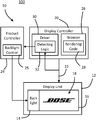
  • FIG. 1 is a block diagram of display and control components for an electronic device according to one example disclosed herein.
  • FIG. 2 is a flowchart illustrating a method for controlling a display of an electronic device according to one example disclosed herein.
  • the present disclosure describes various systems and methods for controlling operation of a display unit of an electronic device, and more particularly to operating a backlight for a display panel if a known data pattern is detected in the content of a display signal sent to the display unit.
  • a wirelessly controlled speaker system may include a display panel that enables the speaker system to display information obtained from the internet, e.g., websites, graphics, images, text, metadata pertaining to streaming or playing audio files, etc.
  • Certain display panel types such as liquid crystal displays (LCDs) may benefit from backlighting, in which a backlight assembly is provided to emit light through the LCD panel since LCD panels do not provide their own illumination.
  • LCDs liquid crystal displays
  • the backlight may be desirable to turn the backlight off when the electronic device is not being used and/or use of the display panel is not desired.
  • the light emitted by a backlight may be undesirable to some users even if set to a relatively low brightness level with the display panel displaying a blank or all black screen.
  • One possibility includes turning on and off the backlight depending on whether the electronic device is in a network standby mode, e.g., in which a connection to the internet or other network is disabled, since there is no web-based information to display when in this mode.
  • a network standby mode e.g., in which a connection to the internet or other network is disabled
  • turning the backlight off during network standby may also disable a user from viewing other non-network related information, such as a volume bar graphic or menu when a user attempts to adjust volume or other setting of the electronic device.
  • operating the backlight only when in a network standby mode would not enable power consumption to be reduced when the display panel is not needed in other modes.
  • an electronic device is configured with detection logic that compares a display signal to the display unit to one or more known data patterns.
  • the known data pattern could consist of an array of all zeros, or other pattern that corresponds to the display panel being instructed to display nothing (e.g., a blank or all black screen).
  • operating parameters of the display unit can be set accordingly. For example, the backlight can be turned off when it is detected that the display signal is instructing the display panel to display a blank or all black screen, and/or to be turned on when this pattern is not detected.
  • FIG. 1 depicts a control system 10 for an electronic device 100 having a display unit 12 .
  • the electronic device 100 may be a stereo, a toy, a children's monitor, an appliance, or any other device that includes an embedded, integrated, or attached electronic monitor, screen, or other display.
  • the display unit 12 may be a monitor or screen utilizing any technology that benefits from illumination by a backlight 14 .
  • the display unit 12 may include a display panel 16 , e.g., a liquid crystal display (LCD) panel, arranged in conjunction with the backlight 14 .
  • the backlight 14 may include one or more light sources, such as light emitting diodes (LEDs), configured to illuminate the display panel 16 (e.g., to direct light through the panel 16 from behind).
  • LEDs light emitting diodes
  • the display panel 16 may be configured to depict graphical content 18 in the form of text, images, colors, graphics, shapes, symbols, or other electronically generated and/or displayed indicia.
  • the display panel 16 may have any desired pixel resolution, refresh rate, or other parameters defining the operation of the display panel 16 .
  • the content 18 is shown as a corporate logo, but it is to be understood that this is merely one example and any other content may be depicted.
  • Those of ordinary skill in the art will recognize other technologies, types, and arrangements of backlit displays that can be used for the display unit 12 than that shown.
  • the content 18 to be depicted on the display panel may be determined, set, and/or managed by a display controller 20 .
  • the display controller 20 may comprise various hardware and software components that together create a display signal 22 that can be received by the display unit 12 and interpreted by the display unit 12 to generate the content 18 based on the display signal 22 .
  • the display signal 22 may be an array of values that the display unit 12 utilizes to instruct the pixels of the display panel 16 to operate at certain colors for depicting the content 18 as instructed by the display controller 20 .
  • the control system 10 may also include a product controller 24 for controlling the functions, features, and/or operation of various components of the electronic device 100 , including the backlight 14 .
  • the product controller 24 may include a backlight control 25 arranged to turn the backlight 14 on and off, and/or to set a brightness setting for the backlight 14 (e.g., set an intensity of the light sources of the backlight 14 to a value between 0% and 100%).
  • the backlight control 25 may include a switching device, such as an electronic relay, metal-oxide-semiconductor field-effect transistor (MOSFET), or other switch.
  • MOSFET metal-oxide-semiconductor field-effect transistor
  • Transducers or other components may be included to provide a variable output if a larger degree of control of the brightness level is desired.
  • the product controller 24 is in communication with a light sensor that adjusts the brightness of the backlight 14 automatically in response to the ambient light level.
  • the product controller 24 is in communication with a communication module (e.g., either directly or indirectly via an operating system), such as an antenna, radio, transceiver, etc. such that a level for the backlight is automatically adjusted when the electronic device 100 enters a network standby mode.
  • the product controller 24 may also control operation of electro-acoustic transducers, actuators, sensors, or other hardware components of the electronic device 100 , as applicable.
  • the product controller 24 may be in communication with a user interface, such as a graphical user interface (managed via the operating system), or a physical button, knob, switch, etc., to facilitate user control over hardware components via the product controller 24 .
  • a user interface may enable a user to set the brightness level for the backlight 14 .
  • control system 10 is illustrated in FIG. 1 with a high level of abstraction to facilitate discussion of various features and components herein and should not be considered limiting.
  • the display controller 20 , the product controller 24 , etc. may be any collection of software and/or hardware configured to enable the functionality and features described herein. While illustrated as separate entities, certain computational resources and components (e.g., memory, processor, wired or wireless communication modules, etc.) may be shared by or between the display controller 20 and the product controller 24 , each may have designated resources, or there may be a combination of shared and designated resources.
  • the display controller 20 and product controller 24 may also share, include, or be incorporated as a part of the same software components, such as an operating system (e.g., Linux) or firmware for the electronic device 100 .
  • an operating system e.g., Linux
  • the display controller 20 may include a browser application 26 arranged to facilitate retrieval of remote data (e.g., via a wired or wireless data connection to the internet or other remote network location) for display on the display unit 12 .
  • the browser application 26 may be a Web Platform for Embedded (WPE) browser.
  • the browser 26 may include rendering code 28 , such as Hypertext Markup Language (HTML) 5 , JavaScript, or any other language, standard, protocol, or technology to assist in rendering the retrieved data to create the display signal 22 .
  • HTML Hypertext Markup Language
  • JavaScript JavaScript
  • any other language, standard, protocol, or technology to assist in rendering the retrieved data to create the display signal 22 .
  • the retrieved data can be converted into a form that enables the content 18 to be displayed on the panel 16 in a desired form or manner, e.g., as a website, user interface, graphics, tables, etc.
  • the display controller 20 may also include a display driver 30 arranged to enable an operating system of the electronic device 100
  • the control system 10 may include detection logic 32 configured to retrieve the display signal 22 and analyze each frame for the content 18 defined by the display signal 22 for one or more preset data patterns. If a preset data pattern is detected in the display signal 22 , then this information may be relayed to the product controller 24 , which operates the backlight control 25 to set a mode of operation of the backlight 14 that corresponds to the detected pattern. That is, any given layout for the content 18 will be represented by a unique data pattern in the display signal 22 . For example, referring specifically to the example for the content 18 in FIG. 1 , the data of the display signal 22 will take a particular form in order to instruct production of the BOSE® logo, as shown.
  • the backlight 14 may be controlled in a desired manner, e.g., brightly illuminated the display panel 16 to enhance visibility the content 18 , dimmed to reduce power consumption, etc.
  • an instruction to render the content 18 as a completely blank or black screen may be implemented as an array of all zeros for the display signal 22 . If a blank or black screen is instructed to be displayed, then the product controller 24 may be configured to completely turn off, or substantially dim, the backlight 14 upon the detection logic 32 recognizing the corresponding pattern (e.g., an array of all zeros).
  • the power usage of the display unit 12 can be reduced by only turning the backlight 14 on when the display signal 22 indicates something other than a blank or black screen as the content 18 . Additionally, this avoids a situation in which (particularly under low ambient light conditions), the light from the backlight 14 is visible despite nothing being displayed by the display panel 16 , which may be aesthetically and functionally undesirable to users.
  • the detection logic 32 can look at designated frames (e.g., every frame) that are being rendered to determine one or more operational parameters for the display unit 12 (e.g., whether the backlight 14 should be turned on or off). If the current frame (or current set of frames) is some known pattern (e.g., all zeroes, which indicates entirely black content, nothing, or a blank screen) then operation of the display unit 12 can commence in accordance with the parameters corresponding to the detected pattern (e.g., the backlight 14 can be disabled).
  • designated frames e.g., every frame
  • operational parameters for the display unit 12 e.g., whether the backlight 14 should be turned on or off. If the current frame (or current set of frames) is some known pattern (e.g., all zeroes, which indicates entirely black content, nothing, or a blank screen) then operation of the display unit 12 can commence in accordance with the parameters corresponding to the detected pattern (e.g., the backlight 14 can be disabled).
  • the detection logic 32 may sit one layer below the browser application 26 , e.g., as part of the driver 30 as shown. In one example, the detection logic 32 may be included by another component, such as the product controller 24 , the display unit 12 , etc.
  • the display driver 30 is a Linux display driver that is configured to modify a system file (e.g., expose a/sysfs/interface) upon detection of the known pattern, which the product controller 24 reads to determine operation of the backlight 14 (or other component of the display unit 12 ).
  • FIG. 2 illustrates a flowchart describing a method 50 for operating a control system (e.g., the control system 10 ) according to one example.
  • the method 50 starts at step 52 in which display data and/or a request or instruction to display certain content is retrieved by one or more components of the control system.
  • the data is retrieved by a web browser (e.g., the browser application 26 ), while at step 56 the data is retrieved from a user and/or operating system.
  • the step 54 may include retrieving data over the internet for displaying a website or the like.
  • the step 56 may include receiving a user input via a user interface (e.g., graphical or physical), via a sensor (such as an ambient light sensor), etc., as discussed above.
  • a user interface e.g., graphical or physical
  • a sensor such as an ambient light sensor
  • the steps 54 and 56 proceed to steps 58 A and 58 B, respectively, in which the display signal (e.g., the signal 22 ) for rendering the desired content (e.g., the content 18 ) is generated (e.g., by the display controller 20 ).
  • the step 58 A may proceed additional rendering by a graphics processing unit (GPU) at step 60 .
  • graphics processing unit GPU
  • content at step 58 A for a web browser may include a website layout or other information obtained from the internet.
  • the content in step 58 B may include system functions, such as a graphical representation of a volume of the electro-acoustic transducers (e.g., a volume bar, graph, or number indicating the current volume level) that appears when a user adjusts volume.
  • the content in step 58 B may include a countdown before the electric device turns off, a manufacturer brand name or logo for the electronic device, a representation of the current time monitored by an embedded clock of the electronic device, a representative of a current status or operating mode of the electronic device, etc.
  • the display signal can be processed one frame at a time to construct a memory map for each frame at step 62 .
  • the memory can be compared to the one or more known patterns, e.g., stored in memory.
  • Frame buffering may be implemented at step 64 to facilitate continuous processing each frame, or a number of frames, in a stream of display data.
  • it is determined e.g., via the detection logic 32 ) whether a current frame matches the known pattern (or one of the known patterns if more than one known pattern is stored). It is to be appreciated that instead of a single frame, multiple successive frames could be compared to the known pattern(s) and a corresponding action only triggered if the known pattern is present for a selected number of successive frames.
  • the known pattern corresponds to a blank or black screen (e.g., an array of all zeros, as discussed above), although it is to be appreciated that any other known patterns could be utilized at that this is merely one example.
  • the method 50 may proceed to step 68 in which it is determined whether the backlight (e.g., the backlight 14 ) is already turned on. If the backlight is currently on, then it can be turned off at step 70 (e.g., to reduce the total power consumption when nothing is being requested for display, i.e., when the content of the display is blank).
  • step 68 may end at step 72 . It is to be appreciated that the step 72 may be an end for a single cycle for the method 50 , which causes the method to be repeated at an earlier step for one or more subsequent cycles, with respect to one or more subsequent frames of display data.
  • step 74 it is determined whether the backlight is currently off. If the backlight is off, then it can be turned on at step 76 , or the method (or cycle thereof) can end at step 72 as discussed above. In this way, as soon as anything gets rendered that results in a non-zero value in the display signal, it is ensured that the backlight is turned on.
  • the herein described analysis of the content of a display signal can be extended to any known pattern (other than all zeros) to result in any corresponding action of a display unit.

Landscapes

  • Engineering & Computer Science (AREA)
  • Physics & Mathematics (AREA)
  • Theoretical Computer Science (AREA)
  • General Physics & Mathematics (AREA)
  • Computer Hardware Design (AREA)
  • General Engineering & Computer Science (AREA)
  • Nonlinear Science (AREA)
  • Crystallography & Structural Chemistry (AREA)
  • Chemical & Material Sciences (AREA)
  • Mathematical Physics (AREA)
  • Optics & Photonics (AREA)
  • Multimedia (AREA)
  • Human Computer Interaction (AREA)
  • Computing Systems (AREA)
  • Liquid Crystal Display Device Control (AREA)
  • Control Of Indicators Other Than Cathode Ray Tubes (AREA)
  • Liquid Crystal (AREA)

Abstract

An electronic device, a display control system, and a method for controlling operation of a display unit of an electronic device. The method includes generating a display signal by a display controller. The display signal is interpreted by the display unit to display a content of the display signal on a display panel of the display unit. The content of the display signal is compared to a known data pattern. The display unit is operated in accordance to an operating parameter corresponding to the known data pattern if the known data pattern is detected in the display signal.

Description

BACKGROUND
The disclosure relates to display units for electronic devices and related devices and methods, and, particularly, to display units having backlit display panels.
SUMMARY
All examples and features mentioned below can be combined in any technically possible way.
In one aspect, a method of controlling operation of a display unit of an electronic device is provided. The method includes generating a display signal by a display controller; interpreting the display signal by the display unit to display a content of the display signal on a display panel of the display unit; comparing the content of the display signal to a known data pattern; and operating the display unit in accordance to an operating parameter corresponding to the known data pattern if the known data pattern is detected in the display signal.
In one example, the display signal comprises data pertaining to a plurality of individual frames for the content, and the comparing comprises comparing one or more the frames to the known data pattern. In one example, the operating occurs only if a preset number of the frames in successive order contain the known data pattern. In one example, the operating ceases for portions of the display signal in which the known data pattern is not detected.
In one example, the operating parameter relates to a brightness level of a backlight configured to illuminate the display panel. In one example, the known data pattern corresponds to an entirely blank or black display. In one example, operating the display unit in accordance to the operating parameter includes turning the backlight off upon detection of the known data pattern. In one example, the known data pattern comprises an array of all zeros. In one example, operating the display unit in accordance to the operating parameter includes turning the backlight on for portions of the display signal in which the display signal contains any non-zero values.
In one example, the operating comprises increasing the brightness level of the backlight for portions of the display signal in which the known data pattern is detected. In one example, the comparing is performed by the display controller and the operating is performed by a product controller. In one example, detection logic of the display controller performs the comparing, the method further comprising communicating results of the comparing to the product controller. In one example, the communicating comprises modifying a system file of an operating system and reading the system file by the product controller, the system file comprising instructions pertaining to the operating parameter.
In one aspect, a display unit is provided. The display unit includes a display panel configured to interpret a display signal received by the display unit from a display controller, and to display a content of the display signal; and a backlight configured to emit light through the display panel and to operate at a brightness level corresponding to a known data pattern if the known data pattern is detected in the content.
In another aspect, an electronic display control system is provided. The control system includes a display controller configured to generate a display signal; a display unit comprising a display panel and a backlight, the display unit configured to interpret the display signal and to display a content of the display signal on the display panel; detection logic configured to compare the display signal to a known data pattern; and a product controller configured to control operation of the backlight in accordance with an operating parameter corresponding to the known data pattern if the known data pattern is detected by the detection logic in the display signal.
In one example, the known data pattern corresponds to the content being displayed as blank, nothing, or all black. In one example, the product controller is configured to turn the backlight off for portions of the display signal in which the known data pattern is detected. In one example, the display panel is a liquid crystal display panel.
In one aspect, an electronic device is provided that includes a control system according to the examples disclosed herein. In one example, the electronic device comprises a stereo or loudspeaker system.
BRIEF DESCRIPTION OF THE DRAWINGS
FIG. 1 is a block diagram of display and control components for an electronic device according to one example disclosed herein.
FIG. 2 is a flowchart illustrating a method for controlling a display of an electronic device according to one example disclosed herein.
DETAILED DESCRIPTION
The present disclosure describes various systems and methods for controlling operation of a display unit of an electronic device, and more particularly to operating a backlight for a display panel if a known data pattern is detected in the content of a display signal sent to the display unit.
Many electronic devices, such as a speaker system or other audio equipment, include display panels for visually communicating information to a user. For example, a wirelessly controlled speaker system may include a display panel that enables the speaker system to display information obtained from the internet, e.g., websites, graphics, images, text, metadata pertaining to streaming or playing audio files, etc. Certain display panel types, such as liquid crystal displays (LCDs) may benefit from backlighting, in which a backlight assembly is provided to emit light through the LCD panel since LCD panels do not provide their own illumination.
For electronic devices with backlit display panels, it may be desirable to turn the backlight off when the electronic device is not being used and/or use of the display panel is not desired. For example, when the electronic device is used in low-ambient light conditions the light emitted by a backlight may be undesirable to some users even if set to a relatively low brightness level with the display panel displaying a blank or all black screen.
One possibility includes turning on and off the backlight depending on whether the electronic device is in a network standby mode, e.g., in which a connection to the internet or other network is disabled, since there is no web-based information to display when in this mode. However, turning the backlight off during network standby may also disable a user from viewing other non-network related information, such as a volume bar graphic or menu when a user attempts to adjust volume or other setting of the electronic device. Additionally, operating the backlight only when in a network standby mode would not enable power consumption to be reduced when the display panel is not needed in other modes.
As described herein, an electronic device is configured with detection logic that compares a display signal to the display unit to one or more known data patterns. For example, the known data pattern could consist of an array of all zeros, or other pattern that corresponds to the display panel being instructed to display nothing (e.g., a blank or all black screen). When the known data pattern is detected, then operating parameters of the display unit can be set accordingly. For example, the backlight can be turned off when it is detected that the display signal is instructing the display panel to display a blank or all black screen, and/or to be turned on when this pattern is not detected.
FIG. 1 depicts a control system 10 for an electronic device 100 having a display unit 12. For example, the electronic device 100 may be a stereo, a toy, a children's monitor, an appliance, or any other device that includes an embedded, integrated, or attached electronic monitor, screen, or other display.
The display unit 12 may be a monitor or screen utilizing any technology that benefits from illumination by a backlight 14. For example, the display unit 12 may include a display panel 16, e.g., a liquid crystal display (LCD) panel, arranged in conjunction with the backlight 14. The backlight 14 may include one or more light sources, such as light emitting diodes (LEDs), configured to illuminate the display panel 16 (e.g., to direct light through the panel 16 from behind).
The display panel 16 may be configured to depict graphical content 18 in the form of text, images, colors, graphics, shapes, symbols, or other electronically generated and/or displayed indicia. The display panel 16 may have any desired pixel resolution, refresh rate, or other parameters defining the operation of the display panel 16. In the illustrated example, the content 18 is shown as a corporate logo, but it is to be understood that this is merely one example and any other content may be depicted. Those of ordinary skill in the art will recognize other technologies, types, and arrangements of backlit displays that can be used for the display unit 12 than that shown.
The content 18 to be depicted on the display panel may be determined, set, and/or managed by a display controller 20. That is, the display controller 20 may comprise various hardware and software components that together create a display signal 22 that can be received by the display unit 12 and interpreted by the display unit 12 to generate the content 18 based on the display signal 22. For example, the display signal 22 may be an array of values that the display unit 12 utilizes to instruct the pixels of the display panel 16 to operate at certain colors for depicting the content 18 as instructed by the display controller 20.
The control system 10 may also include a product controller 24 for controlling the functions, features, and/or operation of various components of the electronic device 100, including the backlight 14. For example, the product controller 24 may include a backlight control 25 arranged to turn the backlight 14 on and off, and/or to set a brightness setting for the backlight 14 (e.g., set an intensity of the light sources of the backlight 14 to a value between 0% and 100%). For example, if it is desired to simply enable the backlight 14 to be turned on and off, then the backlight control 25 may include a switching device, such as an electronic relay, metal-oxide-semiconductor field-effect transistor (MOSFET), or other switch. Transducers or other components may be included to provide a variable output if a larger degree of control of the brightness level is desired. In one example, the product controller 24 is in communication with a light sensor that adjusts the brightness of the backlight 14 automatically in response to the ambient light level. In one example, the product controller 24 is in communication with a communication module (e.g., either directly or indirectly via an operating system), such as an antenna, radio, transceiver, etc. such that a level for the backlight is automatically adjusted when the electronic device 100 enters a network standby mode.
The product controller 24 may also control operation of electro-acoustic transducers, actuators, sensors, or other hardware components of the electronic device 100, as applicable. The product controller 24 may be in communication with a user interface, such as a graphical user interface (managed via the operating system), or a physical button, knob, switch, etc., to facilitate user control over hardware components via the product controller 24. For example, a user interface may enable a user to set the brightness level for the backlight 14.
It is to be appreciated that the control system 10 is illustrated in FIG. 1 with a high level of abstraction to facilitate discussion of various features and components herein and should not be considered limiting. For example, the display controller 20, the product controller 24, etc. may be any collection of software and/or hardware configured to enable the functionality and features described herein. While illustrated as separate entities, certain computational resources and components (e.g., memory, processor, wired or wireless communication modules, etc.) may be shared by or between the display controller 20 and the product controller 24, each may have designated resources, or there may be a combination of shared and designated resources. The display controller 20 and product controller 24 may also share, include, or be incorporated as a part of the same software components, such as an operating system (e.g., Linux) or firmware for the electronic device 100.
In the illustrated example, the display controller 20 may include a browser application 26 arranged to facilitate retrieval of remote data (e.g., via a wired or wireless data connection to the internet or other remote network location) for display on the display unit 12. The browser application 26 may be a Web Platform for Embedded (WPE) browser. The browser 26 may include rendering code 28, such as Hypertext Markup Language (HTML) 5, JavaScript, or any other language, standard, protocol, or technology to assist in rendering the retrieved data to create the display signal 22. In this way, the retrieved data can be converted into a form that enables the content 18 to be displayed on the panel 16 in a desired form or manner, e.g., as a website, user interface, graphics, tables, etc. The display controller 20 may also include a display driver 30 arranged to enable an operating system of the electronic device 100 to communicate properly with display-related hardware components, such as the display unit 12, a graphics card or graphics processing unit (GPU), etc.
The control system 10 may include detection logic 32 configured to retrieve the display signal 22 and analyze each frame for the content 18 defined by the display signal 22 for one or more preset data patterns. If a preset data pattern is detected in the display signal 22, then this information may be relayed to the product controller 24, which operates the backlight control 25 to set a mode of operation of the backlight 14 that corresponds to the detected pattern. That is, any given layout for the content 18 will be represented by a unique data pattern in the display signal 22. For example, referring specifically to the example for the content 18 in FIG. 1, the data of the display signal 22 will take a particular form in order to instruct production of the BOSE® logo, as shown. Upon detection of a data pattern in the display signal 22 indicating that the content 18 is to produce a specific graphic, word, image, etc., such as the illustrated logo, the backlight 14 may be controlled in a desired manner, e.g., brightly illuminated the display panel 16 to enhance visibility the content 18, dimmed to reduce power consumption, etc.
As another example, an instruction to render the content 18 as a completely blank or black screen may be implemented as an array of all zeros for the display signal 22. If a blank or black screen is instructed to be displayed, then the product controller 24 may be configured to completely turn off, or substantially dim, the backlight 14 upon the detection logic 32 recognizing the corresponding pattern (e.g., an array of all zeros). Advantageously, in this way, the power usage of the display unit 12 can be reduced by only turning the backlight 14 on when the display signal 22 indicates something other than a blank or black screen as the content 18. Additionally, this avoids a situation in which (particularly under low ambient light conditions), the light from the backlight 14 is visible despite nothing being displayed by the display panel 16, which may be aesthetically and functionally undesirable to users.
In this way, the detection logic 32 can look at designated frames (e.g., every frame) that are being rendered to determine one or more operational parameters for the display unit 12 (e.g., whether the backlight 14 should be turned on or off). If the current frame (or current set of frames) is some known pattern (e.g., all zeroes, which indicates entirely black content, nothing, or a blank screen) then operation of the display unit 12 can commence in accordance with the parameters corresponding to the detected pattern (e.g., the backlight 14 can be disabled).
The detection logic 32 may sit one layer below the browser application 26, e.g., as part of the driver 30 as shown. In one example, the detection logic 32 may be included by another component, such as the product controller 24, the display unit 12, etc. In one example, the display driver 30 is a Linux display driver that is configured to modify a system file (e.g., expose a/sysfs/interface) upon detection of the known pattern, which the product controller 24 reads to determine operation of the backlight 14 (or other component of the display unit 12).
FIG. 2 illustrates a flowchart describing a method 50 for operating a control system (e.g., the control system 10) according to one example. The method 50 starts at step 52 in which display data and/or a request or instruction to display certain content is retrieved by one or more components of the control system. In this example, at step 54 the data is retrieved by a web browser (e.g., the browser application 26), while at step 56 the data is retrieved from a user and/or operating system. For example, the step 54 may include retrieving data over the internet for displaying a website or the like. The step 56 may include receiving a user input via a user interface (e.g., graphical or physical), via a sensor (such as an ambient light sensor), etc., as discussed above.
The steps 54 and 56 proceed to steps 58A and 58B, respectively, in which the display signal (e.g., the signal 22) for rendering the desired content (e.g., the content 18) is generated (e.g., by the display controller 20). If applicable, the step 58A may proceed additional rendering by a graphics processing unit (GPU) at step 60. For example, as noted above, content at step 58A for a web browser may include a website layout or other information obtained from the internet. In a device, such as a loudspeaker, including one or more electro-acoustic transducers, the content in step 58B may include system functions, such as a graphical representation of a volume of the electro-acoustic transducers (e.g., a volume bar, graph, or number indicating the current volume level) that appears when a user adjusts volume. As another example, the content in step 58B may include a countdown before the electric device turns off, a manufacturer brand name or logo for the electronic device, a representation of the current time monitored by an embedded clock of the electronic device, a representative of a current status or operating mode of the electronic device, etc.
In either case, the display signal can be processed one frame at a time to construct a memory map for each frame at step 62. As discussed above, the memory can be compared to the one or more known patterns, e.g., stored in memory. Frame buffering may be implemented at step 64 to facilitate continuous processing each frame, or a number of frames, in a stream of display data. At step 66 it is determined (e.g., via the detection logic 32) whether a current frame matches the known pattern (or one of the known patterns if more than one known pattern is stored). It is to be appreciated that instead of a single frame, multiple successive frames could be compared to the known pattern(s) and a corresponding action only triggered if the known pattern is present for a selected number of successive frames.
With respect to the method 50, the known pattern corresponds to a blank or black screen (e.g., an array of all zeros, as discussed above), although it is to be appreciated that any other known patterns could be utilized at that this is merely one example. Accordingly, if step 66 indicates that the current frame matches the known pattern (corresponding to a blank or all black content), the method 50 may proceed to step 68 in which it is determined whether the backlight (e.g., the backlight 14) is already turned on. If the backlight is currently on, then it can be turned off at step 70 (e.g., to reduce the total power consumption when nothing is being requested for display, i.e., when the content of the display is blank). Of course, as noted above, any other operation may be performed on the backlight (as opposed to turning it off) corresponding to whichever known pattern is detected (e.g., dimming, brightening, setting a specified brightness level, etc.). If the backlight is already turned off, then step 68 may end at step 72. It is to be appreciated that the step 72 may be an end for a single cycle for the method 50, which causes the method to be repeated at an earlier step for one or more subsequent cycles, with respect to one or more subsequent frames of display data.
Returning to step 66, if the memory map for the current frame (or frames) does not match the known pattern (or patterns), then the method 50 may proceed to step 74. At step 74 it is determined whether the backlight is currently off. If the backlight is off, then it can be turned on at step 76, or the method (or cycle thereof) can end at step 72 as discussed above. In this way, as soon as anything gets rendered that results in a non-zero value in the display signal, it is ensured that the backlight is turned on. As discussed above, the herein described analysis of the content of a display signal can be extended to any known pattern (other than all zeros) to result in any corresponding action of a display unit.
While several inventive examples have been described and illustrated herein, those of ordinary skill in the art will readily envision a variety of other means and/or structures for performing the function and/or obtaining the results and/or one or more of the advantages described herein, and each of such variations and/or modifications is deemed to be within the scope of the inventive examples described herein. More generally, those skilled in the art will readily appreciate that all parameters, dimensions, materials, and configurations described herein are meant to be exemplary and that the actual parameters, dimensions, materials, and/or configurations will depend upon the specific application or applications for which the inventive teachings is/are used. Those skilled in the art will recognize, or be able to ascertain using no more than routine experimentation, many equivalents to the specific inventive examples described herein. It is, therefore, to be understood that the foregoing examples are presented by way of example only and that, within the scope of the appended claims and equivalents thereto, inventive examples may be practiced otherwise than as specifically described and claimed. Inventive examples of the present disclosure are directed to each individual feature, system, article, material, and/or method described herein. In addition, any combination of two or more such features, systems, articles, materials, and/or methods, if such features, systems, articles, materials, and/or methods are not mutually inconsistent, is included within the inventive scope of the present disclosure.
Claims (15)

The invention claimed is:
1. A method of controlling operation of a display unit of an electronic device, comprising:
generating a graphical display signal by a display controller;
interpreting the graphical display signal by the display unit to display a content of the graphical display signal on a display panel of the display unit;
comparing the content of the graphical display signal to a known graphical data pattern wherein the known graphical data pattern comprises data entailing a specific graphic, word, or image; and
operating the display unit in accordance to an operating parameter corresponding to the known graphical data pattern if the known graphical data pattern is detected in the display signal while the electronic device is in a network standby mode;
wherein operating the display unit according to an operating parameter includes turning on a backlight of the display unit, turning off the backlight of the display unit, or adjusting a brightness level of the backlight of the display unit.
2. The method of claim 1, wherein the graphical display signal comprises data pertaining to a plurality of individual frames for the content, and the comparing comprises comparing one or more the frames to the known graphical data pattern.
3. The method of claim 2, wherein the operating occurs only if a preset number of the frames in successive order contain the known graphical data pattern.
4. The method of claim 1, wherein the operating ceases for portions of the graphical display signal in which the known graphical data pattern is not detected.
5. The method of claim 1, wherein operating the display unit in accordance to the operating parameter comprises turning the backlight on for portions of the display signal in which the graphical display signal contains any non-zero values.
6. The method of claim 1, wherein the operating comprises increasing the brightness level of the backlight for portions of the graphical display signal in which the known graphical data pattern is detected.
7. The method of claim 1, wherein the comparing is performed by the display controller and the operating is performed by a product controller.
8. The method of claim 7, wherein detection logic of the display controller performs the comparing, the method further comprising communicating results of the comparing to the product controller.
9. The method of claim 8, wherein the communicating comprises modifying a system file of an operating system and reading the system file by the product controller, the system file comprising instructions pertaining to the operating parameter.
10. A display unit, comprising:
a display panel configured to interpret a graphical display signal received by the display unit from a display controller, and to display a content of the display signal across the entire display panel; and
a backlight configured to emit light through the display panel and to operate at a brightness level corresponding to a known graphical data pattern if the known graphical data pattern is detected in the content of the entire display panel while the electronic device is in a network standby mode and wherein the known graphical data pattern comprises data entailing a specific graphic, word, or image.
11. An electronic display control system, comprising:
a display controller configured to generate a graphical display signal;
a display unit comprising a display panel and a backlight, the display unit configured to interpret the graphical display signal and to display a content of the graphical display signal on the display panel;
detection logic configured to compare the graphical display signal to a known graphical data pattern wherein the known graphical data pattern comprises data entailing a specific graphic, word, or image; and
a product controller configured to control operation of the backlight in accordance with an operating parameter corresponding to the known graphical data pattern if the known graphical data pattern is detected by the detection logic in the graphical display signal while the electronic device is in a network standby mode;
wherein operation of the backlight in accordance with the operating parameter includes turning on the backlight, turning off the backlight, or adjusting a brightness level of the backlight.
12. The electronic display control system of claim 11, wherein the product controller is configured to turn the backlight off for portions of the graphical display signal in which the known graphical data pattern is detected.
13. The electronic display control system of claim 11, wherein the display panel is a liquid crystal display panel.
14. An electronic device comprising the control system of claim 11.
15. The electronic device of claim 14, wherein the electronic device comprises a stereo or loudspeaker system.
US16/140,446 2018-09-24 2018-09-24 Systems and methods for controlling operation of a backlight for a display panel Active US10692444B2 (en)

Priority Applications (2)

Application Number Priority Date Filing Date Title
US16/140,446 US10692444B2 (en) 2018-09-24 2018-09-24 Systems and methods for controlling operation of a backlight for a display panel
JP2019003355A JP2020052384A (en) 2018-09-24 2019-01-11 Systems and methods for controlling operation of backlight for display panel

Applications Claiming Priority (1)

Application Number Priority Date Filing Date Title
US16/140,446 US10692444B2 (en) 2018-09-24 2018-09-24 Systems and methods for controlling operation of a backlight for a display panel

Publications (2)

Publication Number Publication Date
US20200098321A1 US20200098321A1 (en) 2020-03-26
US10692444B2 true US10692444B2 (en) 2020-06-23

Family

ID=69884974

Family Applications (1)

Application Number Title Priority Date Filing Date
US16/140,446 Active US10692444B2 (en) 2018-09-24 2018-09-24 Systems and methods for controlling operation of a backlight for a display panel

Country Status (2)

Country Link
US (1) US10692444B2 (en)
JP (1) JP2020052384A (en)

Families Citing this family (2)

* Cited by examiner, † Cited by third party
Publication number Priority date Publication date Assignee Title
WO2020090115A1 (en) * 2018-11-02 2020-05-07 三菱電機株式会社 Electric motor control device
US12272321B2 (en) * 2022-09-21 2025-04-08 Apple Inc. Method and apparatus for LED driver to reduce cross talk or flicker

Citations (8)

* Cited by examiner, † Cited by third party
Publication number Priority date Publication date Assignee Title
JP2002108796A (en) 2000-09-29 2002-04-12 Sanyo Electric Co Ltd Display device for computer
US20090152445A1 (en) * 2007-12-13 2009-06-18 Apple Inc. Display device control based on integrated ambient light detection and lighting source characteristics
EP2214154A2 (en) 2009-01-30 2010-08-04 Hitachi Consumer Electronics Co. Ltd. A video display apparatus
US20110156898A1 (en) * 2006-12-08 2011-06-30 Eric Taillefer Environment sensing system for the hearing-impaired
US20130093797A1 (en) * 2011-10-17 2013-04-18 Hon Hai Precision Industry Co., Ltd. Backlight control unit and display device using same and backlight control method
JP2013142869A (en) 2012-01-12 2013-07-22 Sharp Corp Display device and control method therefor
JP2014160170A (en) 2013-02-20 2014-09-04 Nec Casio Mobile Communications Ltd Display control device, method for controlling the same, information device, and program
JP2018092261A (en) 2016-11-30 2018-06-14 シャープ株式会社 Display device, television receiver, display device control method, control program, and recording medium

Patent Citations (9)

* Cited by examiner, † Cited by third party
Publication number Priority date Publication date Assignee Title
JP2002108796A (en) 2000-09-29 2002-04-12 Sanyo Electric Co Ltd Display device for computer
US20110156898A1 (en) * 2006-12-08 2011-06-30 Eric Taillefer Environment sensing system for the hearing-impaired
US20090152445A1 (en) * 2007-12-13 2009-06-18 Apple Inc. Display device control based on integrated ambient light detection and lighting source characteristics
EP2214154A2 (en) 2009-01-30 2010-08-04 Hitachi Consumer Electronics Co. Ltd. A video display apparatus
JP2010175913A (en) 2009-01-30 2010-08-12 Hitachi Ltd Image display apparatus
US20130093797A1 (en) * 2011-10-17 2013-04-18 Hon Hai Precision Industry Co., Ltd. Backlight control unit and display device using same and backlight control method
JP2013142869A (en) 2012-01-12 2013-07-22 Sharp Corp Display device and control method therefor
JP2014160170A (en) 2013-02-20 2014-09-04 Nec Casio Mobile Communications Ltd Display control device, method for controlling the same, information device, and program
JP2018092261A (en) 2016-11-30 2018-06-14 シャープ株式会社 Display device, television receiver, display device control method, control program, and recording medium

Non-Patent Citations (1)

* Cited by examiner, † Cited by third party
Title
Notice of Reasons for Rejection; Office Action Issued in Counterpart Application; Japanese Patent Application No. 2019-3355, pp. 1-9, dated Dec. 9, 2019.

Also Published As

Publication number Publication date
JP2020052384A (en) 2020-04-02
US20200098321A1 (en) 2020-03-26

Similar Documents

Publication Publication Date Title
US10783836B2 (en) Method and apparatus for controlling liquid crystal display brightness, and liquid crystal display device
KR101418552B1 (en) User interface apparatus and method for dimming status
US10181294B2 (en) Method and apparatus for controlling liquid crystal display brightness, and liquid crystal display device
KR102730157B1 (en) Display apparatus and method for displaying
US10635373B2 (en) Display apparatus and method of controlling the same
KR102790278B1 (en) Apparatus and method for Display
US20160260390A1 (en) Backlight brightness adjusting method and device, and liquid crystal display device
JP3998323B2 (en) Screen generator
KR20160015925A (en) Apparatus for Displaying Image and Driving Method Thereof
KR20090008306A (en) Event-based environmental lighting control
US20150130727A1 (en) Display apparatus and method of controlling a display apparatus
JP2005318142A (en) Television image receiving device
KR20200050283A (en) Image display device and operating method for the same
US20170006337A1 (en) Desktop display method and device, and smart television
CN101257599A (en) Ambient light system and method for generating the same
US10692444B2 (en) Systems and methods for controlling operation of a backlight for a display panel
US20200249965A1 (en) Display Device with Built-In Web Browser for Graphical User Interface in an Embedded System
EP4485055A1 (en) Peep-proof control method for liquid crystal display device, and liquid crystal display device
US20130093797A1 (en) Backlight control unit and display device using same and backlight control method
US20180301121A1 (en) Electronic apparatus and method for displaying contents thereof
CN111557098B (en) Electronic device and display method thereof
US12057079B2 (en) Display device
KR20020096896A (en) Method of controlling display method, display-use signal producing device, display device, and display system for implementing the method
CN111479352B (en) Display device and lighting control method
CN109817166B (en) Display device and driving method thereof

Legal Events

Date Code Title Description
FEPP Fee payment procedure

Free format text: ENTITY STATUS SET TO UNDISCOUNTED (ORIGINAL EVENT CODE: BIG.); ENTITY STATUS OF PATENT OWNER: LARGE ENTITY

AS Assignment

Owner name: BOSE CORPORATION, MASSACHUSETTS

Free format text: ASSIGNMENT OF ASSIGNORS INTEREST;ASSIGNORS:COOPER, JONATHAN;GAUTHIER, BRUNO;LAI, TREVOR;SIGNING DATES FROM 20181022 TO 20181023;REEL/FRAME:048108/0527

STPP Information on status: patent application and granting procedure in general

Free format text: PUBLICATIONS -- ISSUE FEE PAYMENT RECEIVED

STCF Information on status: patent grant

Free format text: PATENTED CASE

MAFP Maintenance fee payment

Free format text: PAYMENT OF MAINTENANCE FEE, 4TH YEAR, LARGE ENTITY (ORIGINAL EVENT CODE: M1551); ENTITY STATUS OF PATENT OWNER: LARGE ENTITY

Year of fee payment: 4

AS Assignment

Owner name: BANK OF AMERICA, N.A., AS ADMINISTRATIVE AGENT, MASSACHUSETTS

Free format text: SECURITY INTEREST;ASSIGNOR:BOSE CORPORATION;REEL/FRAME:070438/0001

Effective date: 20250228