US10691682B2 - Storing and processing JSON documents in a SQL database table - Google Patents
Storing and processing JSON documents in a SQL database table Download PDFInfo
- Publication number
- US10691682B2 US10691682B2 US15/724,457 US201715724457A US10691682B2 US 10691682 B2 US10691682 B2 US 10691682B2 US 201715724457 A US201715724457 A US 201715724457A US 10691682 B2 US10691682 B2 US 10691682B2
- Authority
- US
- United States
- Prior art keywords
- json
- database
- document
- node
- sql
- Prior art date
- Legal status (The legal status is an assumption and is not a legal conclusion. Google has not performed a legal analysis and makes no representation as to the accuracy of the status listed.)
- Active, expires
Links
Images


Classifications
-
- G—PHYSICS
- G06—COMPUTING OR CALCULATING; COUNTING
- G06F—ELECTRIC DIGITAL DATA PROCESSING
- G06F16/00—Information retrieval; Database structures therefor; File system structures therefor
- G06F16/20—Information retrieval; Database structures therefor; File system structures therefor of structured data, e.g. relational data
- G06F16/24—Querying
- G06F16/242—Query formulation
- G06F16/2433—Query languages
- G06F16/2438—Embedded query languages
-
- G—PHYSICS
- G06—COMPUTING OR CALCULATING; COUNTING
- G06F—ELECTRIC DIGITAL DATA PROCESSING
- G06F16/00—Information retrieval; Database structures therefor; File system structures therefor
- G06F16/20—Information retrieval; Database structures therefor; File system structures therefor of structured data, e.g. relational data
- G06F16/22—Indexing; Data structures therefor; Storage structures
-
- G—PHYSICS
- G06—COMPUTING OR CALCULATING; COUNTING
- G06F—ELECTRIC DIGITAL DATA PROCESSING
- G06F16/00—Information retrieval; Database structures therefor; File system structures therefor
- G06F16/20—Information retrieval; Database structures therefor; File system structures therefor of structured data, e.g. relational data
- G06F16/22—Indexing; Data structures therefor; Storage structures
- G06F16/221—Column-oriented storage; Management thereof
-
- G—PHYSICS
- G06—COMPUTING OR CALCULATING; COUNTING
- G06F—ELECTRIC DIGITAL DATA PROCESSING
- G06F16/00—Information retrieval; Database structures therefor; File system structures therefor
- G06F16/20—Information retrieval; Database structures therefor; File system structures therefor of structured data, e.g. relational data
- G06F16/22—Indexing; Data structures therefor; Storage structures
- G06F16/2228—Indexing structures
- G06F16/2246—Trees, e.g. B+trees
-
- G—PHYSICS
- G06—COMPUTING OR CALCULATING; COUNTING
- G06F—ELECTRIC DIGITAL DATA PROCESSING
- G06F16/00—Information retrieval; Database structures therefor; File system structures therefor
- G06F16/20—Information retrieval; Database structures therefor; File system structures therefor of structured data, e.g. relational data
- G06F16/28—Databases characterised by their database models, e.g. relational or object models
- G06F16/282—Hierarchical databases, e.g. IMS, LDAP data stores or Lotus Notes
Definitions
- Embodiments are generally directed to a wide scale range of databases and data processing, and more specifically to storing JSON (JavaScript Object Notation) documents in a SQL (Structured Query Language) database table.
- JSON JavaScript Object Notation
- SQL Structured Query Language
- Relational databases are structured and data is defined and stored as related entities with attributes across tables (i.e. schemas), thus requiring structures (e.g. tables) to be defined in order to contain and work with the data.
- Structures e.g. tables
- Different relational database management systems implement different data types.
- RDBMS relational database management systems
- SQLite3 which is an embedded open source relational database management system
- MySQL/MariaDB which is a popular and commonly used open source RDBMS
- PostgreSQL which is an ANSII SQL-compliant and open source objective-RDBMS
- Oracle which is a popular and commonly used commercial RDBMS.
- NoSQL databases and management systems are schema-less and are not based on a single model (e.g. relational model of RDBMSs) so each database can adopt a different model, depending on its target-functionality.
- There are a few different operational models and functioning systems for NoSQL databases such as key/value-based, column-family-based, document-based, and graph-based.
- Popular NoSQL databases currently include MongoDB, which is a popular document-oriented database, Oracle NoSQL, and Cassandra DB.
- NoSQL databases generally offer the benefits of scalability and easy expansion, suitability for big data applications, and ready usage of low-cost hardware platforms.
- the NoSQL database environment is relatively immature compared to the RDBMS world.
- Modern SQL databases benefit from many years of development and optimization, and offer high performance and availability on virtually every common computer platform.
- Most critical data processing applications therefore, use SQL RDBMS databases as part of an overall data processing system.
- many different client devices may source data that represent different data types and that perform different functional operations.
- each data module that accesses a database table may be implemented in upwards of a thousand lines of code.
- NoSQL databases are profoundly limited in their ability to manage these applications.
- key-store databases such as Redis
- JSON documents can only store JSON documents as single bodies of text (a “text blob”).
- Text blob can only store JSON documents as single bodies of text
- any query code will need to re-parse the entire JSON text body to be used.
- document-store databases like MongoDB, require custom query functions to retrieve each different kind of JSON document and data. Any changes to JSON document layouts will break the query functions, thus requiring extensive rewrites of application code.
- FIG. 1 illustrates a large-scale network system with devices that implement one or more embodiments of a natural language translation interface and process, under some embodiments.
- FIG. 2 illustrates a JSON adapter, under some embodiments.
- FIG. 3 illustrates a method of converting JSON nodes to database rows in a conversion process of the JSON adapter, under some embodiments.
- FIG. 4A is a flowchart that illustrates a method for creating a JSON-style table in a SQL database, under an embodiment.
- FIG. 4B is a flowchart that illustrates a method for inserting a JSON document into the SQL table with a single SQL insert query, under an embodiment.
- FIG. 4C is a flowchart that illustrates a method for retrieving JSON documents with a single SQL select query, under an embodiment.
- FIG. 5 illustrates an example JSON database, under some embodiments.
- FIG. 6 is a block diagram of a JSON database system, including a JSON adapter, under some embodiments.
- FIG. 7 is a block diagram of a computer system used to execute one or more software components of a JSON adapter, under some embodiments.
- a computer-usable medium or computer-readable medium may be any physical medium that can contain or store the program for use by or in connection with the instruction execution system, apparatus or device.
- the computer-readable storage medium or computer-usable medium may be, but is not limited to, a random-access memory (RAM), read-only memory (ROM), or a persistent store, such as a mass storage device, hard drives, CDROM, DVDROM, tape, erasable programmable read-only memory (EPROM or flash memory), or any magnetic, electromagnetic, optical, or electrical means or system, apparatus or device for storing information.
- RAM random-access memory
- ROM read-only memory
- a persistent store such as a mass storage device, hard drives, CDROM, DVDROM, tape, erasable programmable read-only memory (EPROM or flash memory), or any magnetic, electromagnetic, optical, or electrical means or system, apparatus or device for storing information.
- the computer-readable storage medium or computer-usable medium may be any combination of these devices or even paper or another suitable medium upon which the program code is printed, as the program code can be electronically captured, via, for instance, optical scanning of the paper or other medium, then compiled, interpreted, or otherwise processed in a suitable manner, if necessary, and then stored in a computer memory.
- Applications, software programs or computer-readable instructions may be referred to as components or modules. Applications may be hardwired or hard coded in hardware or take the form of software executing on a general-purpose computer or be hardwired or hard coded in hardware such that when the software is loaded into and/or executed by the computer, the computer becomes an apparatus for practicing the invention.
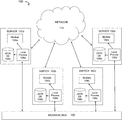
- FIG. 1 illustrates a computer network that implements a SQL database processing system storing JSON document data for networked devices, under some embodiments.
- System 100 comprises a large-scale network that includes a number of different devices, such as server computers 102 a and 102 d and switches 102 b and 102 c . These devices are coupled to a central network 110 , which may be a WAN, LAN, cloud, or other type of network. The devices are also coupled to each other through a message bus 105 .
- the elements of system 100 execute application program(s) to perform distributed network operations.
- the collection of switches and servers cooperate to manage the operation of a network.
- Each network element sources or generates data, which is processed and stored in the system by one or more computers and storage devices.
- a generalized application may involve network traffic control in which the system operates like an autonomous traffic control system.
- a system controller watches the traffic and builds models of traffic behavior, and applies user-defined policies combined with traffic models to operate a network. It defines a shared watchdog process to monitor the health of the traffic, the system and all of its parts, and monitors traffic in real-time, compares real-time traffic with traffic models, and takes appropriate action as required. It also sets and manages the configuration and state of all member servers and switches, and new servers and switches are automatically configured and provisioned.
- the system may also be configured to present users with a dashboard to advise on on-going operations and provide alerts for certain issues.
- each server and switch element of system 100 consists of a local process 106 a - d that accesses models 104 a - d and stores data in a respective JSON database 108 a - d .
- a reference number such as 102 may refer to all or any of elements 102 a - d .
- switches depend on network fabric topology and network objectives, and servers depend on performance needed to process of fraction of traffic in real-time. Traffic models and algorithms are used to select important traffic for processing.
- Models 104 implement a hierarchical control and processing structure. In an embodiment, all models and processes are defined in JSON documents saved in the JSON database 108 .
- each server/switch 102 has a local process 106 with an in-memory JSON database 108 that stores model processes 104 .
- Models are JSON documents loaded on demand from the JSON database and run in a worker process by the local process.
- the model processes perform data processing and analytics, situation recognition, and control actions.
- the models and local process may, together or separately, be referred to as or embodied in an “application” or executable program module.
- the model processes read/write to the JSON database on demand.
- the local process 106 interfaces to a respective JSON database 108 , the message bus 105 , and other server/switch resources.
- the local process 106 accesses both local and remote JSON database resources. Remote access is provided via the message bus.
- FIG. 1 shows only some possible components of system 100 , and many other network resources or elements may also be provided, such as networked appliances, storage devices, bridges, routers, WAN/LAN/WiFi interfaces, and other similar devices or computing resources.
- network 110 that itself contains a number of different computing resources (e.g., computers, interface devices, and so on).
- FIG. 1 is intended to be an example of a representative system implementing a database management process under some embodiments, and many other topographies and combinations of network elements are also possible.
- the local process 106 in each device 102 uses SQLite3 (or similar) in-process, in-memory database to implement a JSON database.
- SQLite3 saves data in a database file that loads upon system start.
- the local process is implemented in Javascript using Node.js.
- Models are JSON document loadable sub-processes saved in a JSON database.
- the message bus 105 may be implemented as direct IP sockets, or other message management system, such as Zero MQ, and the messages transmitted over the message bus are JSON documents.
- FIG. 2 illustrates a JSON adapter, under some embodiments.
- a data processing application 200 interfaces with SQL database engines 208 that store and retrieve data from storage media or devices 210 .
- An application adapter 202 provides application-level JSON storage handling functions, and the DB driver 206 handles communications with the selected backend database engine 208 , which is SQL (or Sqlite3) for the embodiment shown.
- the backend database engine 208 handles interaction with the storage medium 210 .
- the system typically needs one each of the application adapter, JSON adapter, and DB driver in the programming language that the application uses, and it needs a DB Driver 206 for the specific SQL database engine being used.
- application 200 includes a JSON adapter 204 .
- This component is configured to parse JSON documents (which may be provided in a JSON document tree) into a SQL insert, update, or delete queries; and inflate JSON rows back into JSON documents in response to a user SQL select query.
- the JSON adapter thus provides two main novel features. The first is storing an entire set of JSON documents with a single SQL insert query in a single table of a SQL database, and the second is to facilitate the retrieving of any JSON documents using a single SQL query.
- the JSON adapter defines a SQL schema for a JSON database table that can represent any node from a JSON document.
- the JSON schema represents the implicit property, the ⁇ name:value ⁇ pair, at the core of JSON.
- This allows entire JSON documents to be recorded in a single table in a common SQL database like Sqlite3, PostgreSQL, MySQL, Oracle, etc.
- a Javascript library supporting JSON databases is built.
- a JSON DB Library function reads the JSON documents and auto-generates SQL insert statements. An entire JSON document can be saved to the JSON database with a single insert query.
- JavaScript natively supports the JSON data standard, and many programming languages have multiple JSON libraries for integrating standard JSON data.
- FIG. 3 illustrates a method of converting JSON nodes to database rows in a conversion process of the JSON adapter, under some embodiments.
- an example JSON document tree is presented as follows in the example code segment:
- Example JSON Document Tree ⁇ “one” : 213, “two” : “hello”, “three” : true, “four” : false, “five” : null, “six” : [ 345, “flower”, true, [ ], ⁇ ⁇ ], “seven” : ⁇ “aa1” : 456, “bb2” : “cat” “cc3” : [ ], “dd4” : ⁇ ⁇ ⁇ ⁇ ⁇
- This example JSON document tree has 17 nodes, starting with the containing anonymous object.
- the nodes include examples of each of the 6 JSON data types: object, array, string, number, Boolean, and null. There are two empty array nodes and two empty object nodes.
- the open bracket ⁇ denotes an anonymous object node.
- Property nodes comprise data elements that have values, such as the nodes “one” to “five.”
- a property node has a single value, while an array can have multiple values, as shown for the example array property node “six.”
- Sub-array element nodes are included as shown as part of the array property node.
- An example object property node is shown for data element “seven” with associated sub-object property nodes.
- the conversion process 203 converts the JSON nodes to DB rows in a SQL database. In this conversion, JSON nodes become rows in the JSON database table.
- Database table 304 illustrates an example database that is generated from the example JSON document tree 302 .
- id is a unique identification number; path specifies node path to the root of the JSON document; type is a JSON datatype specifier string, and is one of: object, array, string, number, Boolean, null; name is the JSON node name if node is an object property, and is empty otherwise; and value is the JSON node value if node is a scalar value (string, number, Boolean, or null), and is empty otherwise.
- the id is assigned automatically as a sequential numerical value; the path is the list of node ids back to the document root; the type is a standard JSON datatype; the name is generally user configurable, and the value is an actual value.
- the example data base table 304 of FIG. 3 is shown as follows:
- each id entry has a unique path, such as ⁇ 0,1>, ⁇ 0,1,2>, ⁇ 0,1,3>, and so on.
- paths generally start at 0 (for example ⁇ 0,1,6>) to include the JSON database table as an anonymous array that is the root of the table's document collection.
- the type, names, and values for each id are then provided as entries for the database row for that id.
- the schema and storage of the database table that is converted from the document tree facilitates a powerful query and retrieval process.
- the path field is a string that records a JSON node's path to its document root.
- the numbers in the path is the list node parent ids leading back to the JSON document root.
- Using a SQL query to search for a specific sub-document path will return all the node-rows belonging to the sub-document.
- the returned rows are inflated back into JSON by using the path value to guide reconstruction of the original JSON document tree. In this way, entire JSON document trees can be retrieved using a single SQL query, which is very fast compared to standard known processes.
- the following example code segment illustrates an example query that may be performed on a JSON database table, such as table 304 .
- the query is: retrieve sub-object at id 13 in table 304 , and the code is shown as follows:
- Javascript JSON DB library has functions to inflate rows from JSON DB into live Javascript data-object.
- FIGS. 4A-C are three flowcharts that respectively illustrate a method for representing JSON documents as rows in an SQL table, a method for inserting a JSON document into the SQL table with a single SQL insert query, and a method for retrieving JSON documents with a single SQL select query, under some embodiments.
- the processes in FIGS. 4A-C take a JSON document tree that may contain a number of sub-documents and converts them to a set of individual rows in a single SQL database table.
- a defined schema that dictates storage of the nodes in the table rows allows a single query to return any or all documents in the original JSON document tree.
- FIG. 4A illustrates a process that creates JSON tables in an SQL Database to setup a JSON Database.
- FIG. 4B is a flowchart that illustrates a process of writing a JSON document to a JSON SQL database. As shown in FIG. 4B , a JSON document 410 is deflated in process step 412 . The process then executes an insert query 414 to write the JSON document to the JSON SQL database 416 with this single insert query.
- a select query may request the document by id.
- Executing the select query reads the entire JSON document sub-tree from the database.
- the JSON adapter inflates JSON rows returned by the database into a JSON document.
- FIG. 4C is a flowchart that illustrates a process of reading a JSON document from the database. As shown in FIG. 4C , the process executes a single select query 422 on JSON SQL database 420 . It then inflates the JSON rows that are returned through this query in step 424 to produce the JSON document 426 .
- This schema described above can essentially represent any node from a JSON document tree.
- This schema itself leverages the implicit ⁇ name:value ⁇ pair property that is at the core of JSON.
- This schema is applied to create a JSON table in the SQL database.
- the entire JSON document tree is then stored in a single SQL database table by converting the JSON nodes into database rows using the defined schema.
- This conversion can be accomplished by using a JSON Adapter library function that reads JSON documents and auto-generates SQL insert statements.
- the path field records the path of a JSON node to its document root in a hierarchical listing of parent node id's.
- a user will use the SQL select query to search for a specific sub-document or set of sub-documents among all of the JSON documents provided in the original JSON document tree. As shown in FIGS. 4A-C , the process responds to the user query by returning all node-rows belonging to the sub-document. The returned rows are then inflated back into JSON by using the path value to guide reconstruction of the original JSON document tree. Using this method allows entire JSON document trees to be retrieved using a single SQL select query.
- Embodiments of the data processing system are built on the JSON (JavaScript Object Notation) standardized data-serialization protocol.
- JSON is a text format that is completely language independent, but it is easily human and machine readable, and so is easy for machines to parse and generate. It is flexible, and covers important data structures and data types, and has become widely used as the data-interchange format for web-based applications and APIs.
- JSON is built on two structures: (1) A collection of name/value pairs, which is typically realized as an object, record, struct, dictionary, hash table, keyed list, or associative array; and (2) an ordered list of values, which is typically realized as an array, vector, list, or sequence.
- An object is an unordered set of name/value pairs. An object begins with ⁇ (left brace) and ends with ⁇ (right brace). Each name is followed by a : (colon) and the name/value pairs are separated by , (commas).
- An array is an ordered collection of values. An array begins with [ (left bracket) and ends with ] (right bracket). Values are separated by , (commas).
- a value can be a string in double quotes, or a number, or true or false or null, or an object or an array. These structures can be nested.
- a string is a sequence of zero or more Unicode characters, wrapped in double quotes, using backslash escapes.
- a character is represented as a single character string.
- a string is very much like a C or Java string.
- a number is like a C or Java number, except that the octal and hexadecimal formats are not used.
- FIG. 5 illustrates an example JSON database 500 , under some embodiments. As shown in FIG. 5 , the JSON database 500 includes a number of individual tables denoted json-table-1 to json-table-4, and a root JSON database table.
- JSON document nodes are stored as SQL rows according to the JSON schema.
- a JSON document structure is recorded by the path field for each JSON document node.
- Multiple JSON tables can be created to partition JSON data for any logical or performance reason. Tables can be application specific.
- the table named json_db is designated as the JSON DB root table. The index from this table will loaded when the database starts up.
- Javascript JSON Adapter library provides functions for easy utilization of a JSON database.
- the Javascript JSON DB library is used to generate insert/update queries for live JSON documents. It inflates JSON rows retrieved from a JSON table back into a live JSON document. It should be noted that although shown for a particular programming language, the Javascript JSON Adapter library can be rewritten for C, Java, Python, or any other appropriate language.
- JSON tables such as those in FIG. 2 are relatively easy to create.
- JSON tables such as those in FIG. 2 are relatively easy to create.
- code segment illustrating creation of a JSON table, under some embodiments:
- drop table if exists json-table create table json-table ( id integer not null primary key autoincrement, path varchar(1024) default ′′′′, -- node ancestor ids type varchar(8) default ′′′′, -- node type name varchar(1024) default ′′′′, -- node name value text default ′′“ -- node value ); create index json_path_idx on json-table(path);
- the basic SQL syntax shown in the code segment above is specific for the SQLite3 database. SQL syntax for other database products are almost identical.
- the Javascript JSON Adapter library has functions to create, copy, and drop JSON tables of specified name.
- Application data objects are application data types.
- Application data objects are live inflated expressions of literal JSON document trees.
- Application data objects may be data-only objects, with multiple data properties and may lack object methods or functions.
- An application data object, as a literal JSON document tree, can be stored as a list of JSON document node rows in the JSON database.
- Application data objects can be retrieved and inflated from the JSON database via a single SQL query. When updating an application data object back to the JSON database, only the differences are updated.
- Person Data Object joe ⁇ id : 1, // db id type : ′person.1′, // data type sdate : 1468541108, // meta data cdate : 1468541108, enable : 1, name : ′′Joe Black′′, // data position : ′′Chief Trouble Maker′′, note : ′′Joe is a good guy gone bad.“ ⁇
- a Person Data Object is an application data type.
- the Person Data Object is the live inflated version of its JSON document tree representation.
- the id property links a person data object to its row in the JSON table.
- the type property (with version number) identifies the application data object as the Person data type, version 1; and Meta data is application bookkeeping data; and Data is the Person data type payload.
- a JSON database can hold JSON document trees for multiple applications.
- Applications can be totally independent or can be components of a larger operational unit that works together.
- Application frameworks hold app meta data, operational data structures, and process transient data. Frameworks can save the functional state of operations so that processing can resume where it left off after an interruption. Frameworks allow applications to become miniature DSLs via key-commands and scripts saved in the meta.symbols sub-object.
- Application Framework Object app ⁇ id : 20, // db id meta: ⁇ // meta data type : ‘application’, name : ‘name-string’, symbols : ⁇ ⁇ ⁇ , data : ⁇ // app data types : ⁇ type1 : [ ], type2 : [ ] ⁇ , other : ⁇ ⁇ ⁇ ⁇
- An application framework describes an application that uses the JSON database.
- An application can retrieve its inflated framework from the JSON database with a single query.
- the application framework has three main properties: its database id, a meta sub-object, and a data sub-object.
- the meta object has the application type and name, and an application specific symbols sub-object.
- the data object has a types sub-object that holds arrays of application data-objects by type.
- the types sub-object lists available application data types. The other sub-object is for other data needs.
- the meta.symbols sub-object holds important information about the application and its operation;
- the data.types sub-object holds lists of app-typed application data objects that the application processes or uses to perform its functions; and
- the data.other sub-object holds transient data used by the application for operations performance.
- a distributed index enables local processes 106 to easily identify, access, and use local and remote resources. This allows distributed applications to share the workload of complex distributed processes like a network of switches collaborating to manage network traffic.
- the distributed database shares configurations and setups, ongoing state and status; it also shares the decision process on how to divide up the workload, and the working data.
- each local process follows specific read/write rules when working with remote data and processes, and distributed communications are performed via the message management system of bus 105 .
- index is a JSON document saved in each JSON-style table that provides meta data about the extended distributed JSON database and indexes references to important JSON documents to simplify access. Indexed JSON documents can reside in any separate database belonging to the JSON database collective.
- index ⁇ id : 1, meta : ⁇ type : ′′index′′, name : ′′index-name′′, symbols : ⁇ ⁇ , table : ′′tb-name′′, database : ′′db-name′′, databases : [ ⁇ database : ′′db-name′′, tables : [ ′′tb-name1′′, ′′tb-name2′′, ... ] ⁇ , ... ], ...
- the index object provides access to JSON Doc references by name.
- the meta.databases array holds a list of all databases (plus their tables) in the extended JSON Database collective.
- the meta.symbols object holds references to important JSON Doc resources by key-name.
- Each JSON database has a root json_db table whose index is loaded automatically when the JSON database starts up. This root index provides access to JSON Documents important for distributed JSON database operation.
- the index.meta.name names an index, making it possible to put multiple indexes into a single JSON-style table for any purpose.
- the JSON document references in the index object may have optional table and/or database entries to indicate that the referenced doc resides in an alternate table or remote database/table.
- a JSON database is built on an open source SQLite3 database implemented with node.js and JavaScript.
- the base JSON SQL query templates are saved in the JSON database and are customized on the fly when a JSON query is executed.
- users simply call the JSON application driver interface API to implement the system.
- FIG. 6 is a block diagram of a JSON database system, including a JSON adapter, under some embodiments.
- the JSON database 606 of system 600 uses a deep-nested JSON table.
- the JSON database table json_db defines a simple SQL schema (id, path, type, name, value) for the JSON database.
- One key benefit to the JSON database is that its schema never changes. Since all data can be represented as a JSON document tree, and the json_db table can hold any and all the desired JSON data, then the json_db can hold any and all data present in a JSON document tree. New data can be stored in the JSON database without ever needing to change the JSON database schema.
- the JSON database interface code does not need to be changed to support any changes in the kinds of data that any application needs to save in the JSON database.
- the json_db table can defined as follows:
- the json_db record format can be expressed as:
- ⁇ id number, -- primary key, auto-indexed path: string, -- element ancestor ids list 1, 2, 3,... type: string, -- element type: object, array, string, number, boolean, null name: string, -- element name value: text -- element value ⁇
- the database driver 604 is an abstract interface driver to some specific SQL database product. This driver assembles and executes customized JSON SQL queries and returns JSON row data or results/errors.
- the J-Service component 602 is a JSON application driver that collects parameters and chooses queries for the database driver 604 for final assembly and execution; it then receives JSON data rows for inflation into JSON document trees.
- the JSON application driver has multiple methods for selecting any subset of a JSON document tree, and converting the raw rows into any desired format, such as straight JSON text or JavaScript objects in a typical implementation.
- the JSON application driver is made to be agnostic to the backend SQL database product and will work on any SQL database product supported by a database driver.
- Basic functions include: Get query, Find query, Insert query, Update query, Delete JSON documents, Create a JSON-style table, Drop a JSON-style table, and Copy JSON documents from one table to another table.
- the database and JSON application drivers can handle any ad-hoc or document tree based query and will return the selected JSON data or JSON document sub-tree.
- An application only interacts with the JSON Application driver.
- An entire JSON document or document sub-tree can be inserted into the JSON Database with a single query, and an entire JSON document or document sub-tree can be returned with a single query.
- Each row in a JSON-style table represents a property and has the following fields: id, path, type, name, and value.
- the JSON-style table has only five fields and can hold arbitrary JSON document trees of any size or depth. Rows in a JSON-style table represent nodes in JSON document trees.
- SQL queries are easy and simple to write and execute.
- JSON document data can be selected ad-hoc, random-style, or via the path, i.e., document tree style. Query operations on the JSON database are very flexible.
- the json_db records always have a primary-key id, a path string, and type. Array and object records do not use the value field. Object property records use both the name and value fields; array element records do not use the name field; value fields are text strings that represent strings, numbers, Booleans, and null.
- a Primary-key id provides a unique numeric identifier for all json_db element property records.
- the original element order in objects and arrays is preserved by the primary-key id, as property records are written in the original JSON doc order to the json_db table. Use ‘order_by_id’ clause to insure original order.
- Property records are written depth first.
- the path is an ancestor ids list linking back through all parent objects and/or arrays on a property record's (a JSON element) path to the root.
- Paths have the form ‘,1, 2, 3, 4, 5, ’; the commas (or any other special char) provide search ability.
- the size parameters are variable and depend on implementation, but 1024 characters provide JSON documents with a path depth up to 384 levels. Double 1024 and the path depth increases to about 768 levels.
- the last id in the path array is the record's own self id.
- the path makes it possible to retrieve all elements for an arbitrary JSON document (tree) with a single select query.
- Type is a string that specifies the JSON type of a property record.
- Type is one of object, array, string, number, Boolean, or null, and may be extended with more types, as long as in conformance with the JSON standard.
- the name is the property record's name string in its JSON parent object; empty otherwise, and 1024 characters provide for very long names.
- the value holds the property record's scalar value as a text string; value is one of string, number, true, false, and null as text strings; empty otherwise.
- Any number of different application types may utilize the JSON document to SQL table conversion method and system described herein.
- One example use case is a web service to monitor the operation of security cameras installed in large facilities. Cameras are plugged into Power over Ethernet (POE) switches that provide power to cameras via their Ethernet cable connection. Often, cameras shutdown or experience a problem and stop functioning, requiring a technician to visit the camera location to force a restart.
- a camera application web service provides a connection to the cameras (via the Internet) and to the POE switches supporting the cameras. The camera application provides the capability for operators to shutoff and restart cameras remotely, either by restarting the camera directly or by restarting the POE port on the switch connected to the camera.
- the camera application uses a wealth of data to support security camera management, and typical data stored includes: buildings, building addresses, camera locations, people with access, access roles, encrypted login credentials, contact information, switches, switch models, switch commands, user to switch access links, devices (cameras), device models, device commands, user to device access links, notes, and queries.
- Such an application may have on the order of 20 to 50 or more database tables, depending on the size of the facility and complexity of the system.
- Each type of data (as represented by the database tables) requires about four modules: router, service, model, and data.
- Each of these modules performs specific functional and business operations, where each module can be upwards of a thousand lines of code.
- 50 database tables may require 200 modules, or about 200,000 lines of code that must be developed, tested, and maintained.
- Other modules are required to handle specific application and business logic.
- a system that has 20 database tables may require on the order of 60,000 lines of code, which is clearly a significant amount of code to write, debug, and maintain.
- the camera application is written in JavaScript using node.js, Express, and the Sqlite3 database.
- Storing the JSON data in an SQL database table reduces the multiple tables required in the traditional database schema design to just a single table. In one implementation, this replaces the need for some 60,000 lines of code with only about 4,000 lines of code, which is a 93.3% reduction in code, while still accomplishing the same function.
- the code is simpler, and the matching business code is simpler due to the use of JSON.
- Another example use case is an OS10 distributed database. Installing the JSON database on OS10 is straightforward because OS10 is a version of Linux. Installation packages for SQLite3 and Node.js exist for every version of Linux.
- the JSON DB's two main drivers are less than 2000 lines of Javascript code and the JSON DB Schema.sql file is under 100 lines.
- the JSON DB Javascript code only includes the Sqlite3 driver packages and almost nothing else. Compilation is not necessary with Javascript; just copy to an appropriate node setup directory and it is ready to go. Given that Sqlite3 is an in-memory database, this implementation of the JSON DB is also in-memory. Developers would incorporate the JSON DB code into their applications to access the database.
- JSON DB Once the JSON DB is installed, it can be used as a distributed database on OS10.
- a standard communication protocol can be used to move JSON data between OS10 (and other) systems.
- Each system can manage its own local JSON data as well as maintain copies of every other systems' JSON data as a distributed backup. Since SQL database maintain ACID consistency through transactions, linked transactions between different systems can maintain JSON data consistency across distributed data sets. When a new system came online, it could download the default JSON data set for local customization.
- the JSON DB can have any number of JSON-style tables, and thus can hold multiple backups, or different DBs for different network condition.
- a third use case is a phone-home backend database.
- a server captures the state of the local system and local network in a series of snap-shots to be used to model and monitor network state and performance.
- Specific JSON-style tables can be setup to do structural-functional system logging that can be readout in JSON for easy post-processing.
- Simple programs can be implemented to monitor network loading to choose less busy times to push logs and data to off-network JSON DB storage for high-end network analytics.
- Automated network management functions could compare real-time network performance against historical behavior to guide ongoing network operations.
- JSON DB can have multiple JSON-style tables for multiple purposes. All have the same schema and hold the same JSON data format. Easy SQL queries can copy JSON data from one table to another quickly. Building a distributed JSON DB that spans multiple computers is as easy as moving data from one machine to another. New kinds of application data can be added to the system without having to change database schemas or any database interface code. The simple flexibility of JSON data and the ease with which new application data types and structures can be added makes ongoing development of network analytics capabilities much easier than in present systems.
- JSON database on an SQL database gives the flexibility of the JSON data standard on the power of an SQL database.
- the JSON database on SQL is much easier to use and runs faster than NoSQL databases like MongoDB and Redis.
- the system is able to retrieve an entire JSON data tree with a single SQL query.
- Writing and updating JSON data trees in the database can also be done with a single query string.
- the entire table-full of JSON data can be retrieved as a JSON data-tree with a single query.
- the JSON database performance is the same as the underlying SQL database product used by the JSON database because JSON DB queries are essentially simple SQL queries.
- An additional major advantage to the JSON DB approach is that changes in application data require no changes to the JSON database schema or interface code. Maintenance on the JSON DB is virtually never required.
- JSON has a simple, specific, implicit data structure built into its core, i.e., a data structure that can be used in a database table to represent each of the 6 native JSON datatypes: object, array, string, number, boolean, and null.
- This core implicit data structure is an object property i.e. the ⁇ key: value ⁇ pair.
- JSON data structures implement hierarchical data trees, the JSON document trees. This is because JSON objects can have properties with sub-objects and sub-arrays as values, and JSON arrays can have sub-objects and sub-arrays as element values.
- the method described herein encodes the structure of JSON document trees by recording the path from each data item in the tree back to the root of the JSON document tree. This makes it possible to obtain an entire JSON document sub-tree from the JSON database with a single SQL query.
- each application is written in the JavaScript language using the Sqlite3 or similar SQL database.
- the DBMS includes a JSON interface that provides a relatively simple way to store JSON data in an SQL database table that reduces the multiple tables required in the traditional database schema design to just a single table.
- system 100 includes a JSON adapter component or module that may be implemented as a computer implemented software process, or as a hardware component, or both. As such, it may be an executable module executed by the one or more computers in the network, or it may be embodied as a hardware component or circuit provided in the system.
- the network environment of FIG. 1 may comprise any number of individual client-server networks coupled over the Internet or similar large-scale network or portion thereof. Each node in the network(s) comprises a computing device capable of executing software code to perform the processing steps described herein.
- FIG. 7 is a block diagram of a computer system used to execute one or more software components of a JSON adapter, under some embodiments.
- the computer system 1000 includes a monitor 1050 , keyboard 1015 , and mass storage devices 1020 .
- Computer system 1000 further includes subsystems such as central processor 1010 , system memory 1005 , input/output (I/O) controller 1021 , display adapter 1025 , serial or universal serial bus (USB) port 1030 , network interface 1035 , and speaker 1040 .
- the system may also be used with computer systems with additional or fewer subsystems.
- a computer system could include more than one processor 1010 (i.e., a multiprocessor system) or a system may include a cache memory.
- Arrows such as 1045 represent the system bus architecture of computer system 1000 . However, these arrows are illustrative of any interconnection scheme serving to link the subsystems. For example, speaker 1040 could be connected to the other subsystems through a port or have an internal direct connection to central processor 1010 .
- the processor may include multiple processors or a multicore processor, which may permit parallel processing of information.
- Computer system 1000 shown in FIG. 7 is an example of a computer system suitable for use with the present system. Other configurations of subsystems suitable for use with the present invention will be readily apparent to one of ordinary skill in the art.
- Computer software products may be written in any of various suitable programming languages.
- the computer software product may be an independent application with data input and data display modules.
- the computer software products may be classes that may be instantiated as distributed objects.
- the computer software products may also be component software.
- An operating system for the system may be one of the Microsoft Windows®. family of systems (e.g., Windows Server), Linux, Mac OS X, IRIX32, or IRIX64. Other operating systems may be used.
- Microsoft Windows is a trademark of Microsoft Corporation.
- Embodiments of the natural language processing and machine learning, as well as cognitive computing are all elements of technology that are on long term technology roadmaps.
- the ability to provision, control, and interact with a device that is resident in a network topology using Natural Language provides a disruptive shift to the normal method of this operation by eliminating specialized certifications and understanding of specific products.
- the use of generalized language mechanisms to provide the interface levels provides a market differentiator for device interaction
- Embodiments may be applied to data, storage, industrial networks, and the like, in any scale of physical, virtual or hybrid physical/virtual network, such as a very large-scale wide area network (WAN), metropolitan area network (MAN), or cloud based network system, however, those skilled in the art will appreciate that embodiments are not limited thereto, and may include smaller-scale networks, such as LANs (local area networks).
- WAN wide area network
- MAN metropolitan area network
- cloud based network system such as a very large-scale wide area network (WAN), metropolitan area network (MAN), or cloud based network system
- LANs local area networks
- aspects of the one or more embodiments described herein may be implemented on one or more computers executing software instructions, and the computers may be networked in a client-server arrangement or similar distributed computer network.
- the network may comprise any number of server and client computers and storage devices, along with virtual data centers (vCenters) including multiple virtual machines.
- vCenters virtual data centers
- the network provides connectivity to the various systems, components, and resources, and may be implemented using protocols such as Transmission Control Protocol (TCP) and/or Internet Protocol (IP), well known in the relevant arts.
- TCP Transmission Control Protocol
- IP Internet Protocol
- the network may represent a cloud-based network environment in which applications, servers and data are maintained and provided through a centralized cloud-computing platform.
- Various functions described above may be performed by a single process or groups of processes, on a single computer or distributed over several computers. Processes may invoke other processes to handle certain tasks.
- a single storage device may be used, or several may be used to take the place of a single storage device.
- the words “comprise,” “comprising,” and the like are to be construed in an inclusive sense as opposed to an exclusive or exhaustive sense; that is to say, in a sense of “including, but not limited to.” Words using the singular or plural number also include the plural or singular number respectively. Additionally, the words “herein,” “hereunder,” “above,” “below,” and words of similar import refer to this application as a whole and not to any particular portions of this application. When the word “or” is used in reference to a list of two or more items, that word covers all of the following interpretations of the word: any of the items in the list, all of the items in the list and any combination of the items in the list.
Landscapes
- Engineering & Computer Science (AREA)
- Theoretical Computer Science (AREA)
- Databases & Information Systems (AREA)
- Physics & Mathematics (AREA)
- Data Mining & Analysis (AREA)
- General Engineering & Computer Science (AREA)
- General Physics & Mathematics (AREA)
- Software Systems (AREA)
- Mathematical Physics (AREA)
- Computational Linguistics (AREA)
- Information Retrieval, Db Structures And Fs Structures Therefor (AREA)
Abstract
Description
| Example JSON Document Tree |
| { |
| “one” : 213, | |
| “two” : “hello”, | |
| “three” : true, | |
| “four” : false, | |
| “five” : null, | |
| “six” : [ |
| 345, | |
| “flower”, | |
| true, | |
| [ ], | |
| { } | |
| ], |
| “seven” : { |
| “aa1” : 456, | |
| “bb2” : “cat” | |
| “cc3” : [ ], | |
| “dd4” : { } | |
| } |
| } | ||
| JSON Database Table |
| 1,<0,1>,”object”,””,””; | ||
| 2,<0,1,2>,”number”,”one”,”213”; | ||
| 3,<0,1,3>,”string”,”two”,”hello”; | ||
| 4,<0,1,4>,”boolean”,”three”,”true”; | ||
| 5,<0,1,5>,”boolean”,”four”,”false”; | ||
| 6,<0,1,6>,”null”,”five”,”null”; | ||
| 7,<0,1,7>,”array”,”six”,””; | ||
| 8,<0,1,7,8>,”number”,””,”345”; | ||
| 9,<0,1,7,9>,”string”,””,”flower”; | ||
| 10,<0,1,7,10>,”boolean”,””,”true”; | ||
| 11,<0,1,7,11>,”array”,””,””; | ||
| 12,<0,1,7,12>,”object”,””,””; | ||
| 13,<0,1,13>,”object”,”seven”,””; | ||
| 14,<0,1,13,14>,”number”,”aa1”,”456”; | ||
| 15,<0,1,13,15>,”string”,”bb2”,”cat”; | ||
| 16,<0,1,13,16>,”array”,”cc3”,””; | ||
| 17,<0,1,13,17>,”object”,”dd4”,””; | ||
| select * from json-table | ||
| where path like ‘<0,1,13%’ | ||
| order by id; | ||
| 13,<0,1,13>,”object”,”seven”,”” | ||
| 14,<0,1,13,14>,”number”,”aa1”,”456” | ||
| 15,<0,1,13,15>,”string”,”bb2”,”cat” | ||
| 16,<0,1,13,16>,”array”,”cc3”,”” | ||
| 17,<0,1,13,17 >,”object”,”dd4”,”” | ||
| { | ||
| “seven” : { |
| “aa1” : 456, | |
| “bb2” : “cat” | |
| “cc3” : [ ], | |
| “dd4” : { } | |
| } |
| } | ||
| drop table if exists json-table; |
| create table json-table ( |
| id | integer not null primary key autoincrement, |
| path | varchar(1024) | default ″″, | -- node ancestor ids | |
| type | varchar(8) | default ″″, | -- node type | |
| name | varchar(1024) | default ″″, | -- node name | |
| value | text | default ″“ | -- node value |
| ); |
| create index json_path_idx on json-table(path); |
| Person Data Object |
| joe = { |
| id : 1, | // db id | |
| type : ′person.1′, | // data type | |
| sdate : 1468541108, | // meta data |
| cdate : 1468541108, | |
| enable : 1, |
| name : ″Joe Black″, | // data |
| position : ″Chief Trouble Maker″, | ||
| note : ″Joe is a good guy gone bad.“ | ||
| } | ||
| Application Framework Object |
| app = { |
| id : 20, | // db id | |
| meta: { | // meta data |
| type : ‘application’, | |
| name : ‘name-string’, | |
| symbols : { } | |
| }, |
| data : { | // app data |
| types : { |
| type1 : [ ], | |
| type2 : [ ] | |
| }, |
| other : { } | |
| } |
| } | ||
| index = { |
| id : 1, | |
| meta : { |
| type : ″index″, | |
| name : ″index-name″, | |
| symbols : { }, | |
| table : ″tb-name″, | |
| database : ″db-name″, | |
| databases : [ |
| { database : ″db-name″, tables : [ ″tb-name1″, ″tb-name2″, |
| ... ] }, |
| ... |
| ], | |
| ... |
| }, | |
| index : { |
| name1 : { id: num, path: ″path-str″ }, | |
| name2 : { table: ″tb-name″, id: num, path: ″path-str″ }, | |
| name3 : { database: ″db-name″, table: “tb″, id: num, path: |
| ″path-str″ }, |
| ... |
| } |
| } |
| drop table if exists json_db; |
| create table json_db ( |
| id | integer | not null primary key autoincrement, | |
| path | varchar(1024) | default “”, | |
| type | varchar(8) | default “”, | |
| name | varchar(1024) | default “”, | |
| value | text | default “” |
| ); |
| { | ||
| id: | number, | -- primary key, auto-indexed | |
| path: | string, | -- element |
|
| type: | string, | -- element type: object, array, string, |
| number, boolean, null |
| name: | string, | -- element name | |
| value: | text | -- element value |
| } | ||
Claims (19)
Priority Applications (1)
| Application Number | Priority Date | Filing Date | Title |
|---|---|---|---|
| US15/724,457 US10691682B2 (en) | 2017-10-04 | 2017-10-04 | Storing and processing JSON documents in a SQL database table |
Applications Claiming Priority (1)
| Application Number | Priority Date | Filing Date | Title |
|---|---|---|---|
| US15/724,457 US10691682B2 (en) | 2017-10-04 | 2017-10-04 | Storing and processing JSON documents in a SQL database table |
Publications (2)
| Publication Number | Publication Date |
|---|---|
| US20190102389A1 US20190102389A1 (en) | 2019-04-04 |
| US10691682B2 true US10691682B2 (en) | 2020-06-23 |
Family
ID=65898033
Family Applications (1)
| Application Number | Title | Priority Date | Filing Date |
|---|---|---|---|
| US15/724,457 Active 2038-08-07 US10691682B2 (en) | 2017-10-04 | 2017-10-04 | Storing and processing JSON documents in a SQL database table |
Country Status (1)
| Country | Link |
|---|---|
| US (1) | US10691682B2 (en) |
Cited By (6)
| Publication number | Priority date | Publication date | Assignee | Title |
|---|---|---|---|---|
| US11693852B1 (en) | 2021-04-12 | 2023-07-04 | Amdocs Development Limited | System, method, and computer program for normalizing a JSON structure |
| US11768834B1 (en) | 2023-05-03 | 2023-09-26 | Newday Database Technology, Inc. | Storing and querying general data type documents in SQL relational databases |
| US20230376465A1 (en) * | 2022-05-23 | 2023-11-23 | Dell Products L.P. | Data Schema Compacting Operation When Performing a Data Schema Mapping Operation |
| US12007960B2 (en) | 2022-04-22 | 2024-06-11 | Dell Products L.P. | Methods make web and business application data access agnostic to schema variations and migrations |
| US12061578B2 (en) | 2022-05-23 | 2024-08-13 | Dell Products L.P. | Application program interface for use with a data schema mapping operation |
| WO2025212456A1 (en) * | 2024-04-02 | 2025-10-09 | Oracle International Corporation | Effective and efficient support of json datatype comparison |
Families Citing this family (48)
| Publication number | Priority date | Publication date | Assignee | Title |
|---|---|---|---|---|
| US10860576B2 (en) * | 2018-01-26 | 2020-12-08 | Vmware, Inc. | Splitting a query into native query operations and post-processing operations |
| US11507540B1 (en) * | 2018-02-15 | 2022-11-22 | EMC IP Holding Company LLC | Decentralized file system and message bus architecture for processing training sets in multi-cloud computing environment |
| US11055650B2 (en) * | 2018-02-27 | 2021-07-06 | Logistiview, Inc. | Execution systems using unstructured data |
| US10949390B2 (en) | 2018-03-19 | 2021-03-16 | Vmware Inc. | Asynchronous queries on secondary data cores in a distributed computing system |
| KR101949154B1 (en) * | 2018-09-17 | 2019-02-18 | (주)투비소프트 | Electronic device for transforming structure of dataset using javascript object notation and operating method thereof |
| CN110147413B (en) * | 2019-04-26 | 2023-06-02 | 平安科技(深圳)有限公司 | Data storage method, data query method, device, equipment and storage medium |
| US20200379983A1 (en) * | 2019-05-31 | 2020-12-03 | Walmart Apollo, Llc | Structured query facilitation apparatus and method |
| CN110618983B (en) * | 2019-08-15 | 2023-01-06 | 复旦大学 | Multidimensional analysis and visualization method of industrial big data based on JSON document structure |
| CN112559606A (en) * | 2019-09-26 | 2021-03-26 | 北京国双科技有限公司 | Conversion method and conversion device for JSON format data |
| CN111068328B (en) * | 2019-11-19 | 2023-05-05 | 深圳市其乐游戏科技有限公司 | Game advertisement configuration form generation method, terminal equipment and medium |
| CN110928939A (en) * | 2019-11-21 | 2020-03-27 | 浪潮软件股份有限公司 | Method for converting Sql result set into Json data based on tree structure |
| CN111061787A (en) * | 2019-11-21 | 2020-04-24 | 新浪网技术(中国)有限公司 | Method and system for processing object relation in relational database |
| CN111125215A (en) * | 2019-12-06 | 2020-05-08 | 厦门天锐科技股份有限公司 | Method capable of configuring JSON to convert database |
| CN111159178B (en) * | 2019-12-12 | 2023-06-13 | 浙江华云信息科技有限公司 | Data map path navigation method based on big data SQL analysis |
| US11341135B2 (en) * | 2020-02-28 | 2022-05-24 | International Business Machines Corporation | Optimizing JSON document usage |
| CN113467777B (en) * | 2020-03-30 | 2025-05-09 | 阿里巴巴集团控股有限公司 | Path identification method, device and system |
| CN111639075B (en) * | 2020-05-09 | 2023-05-12 | 武汉大学 | Non-relational database vector data management method based on flattened R tree |
| CN111752840B (en) * | 2020-06-28 | 2023-08-08 | 中电长城(长沙)信息技术有限公司 | Cross-system financial self-service equipment SP automatic test method, equipment and medium |
| CN111931471B (en) * | 2020-08-31 | 2024-04-16 | 平安银行股份有限公司 | Form collection method, device, electronic device and storage medium |
| CN112130860B (en) * | 2020-09-23 | 2023-09-05 | 北京奇艺世纪科技有限公司 | JSON object analysis method and device, electronic equipment and storage medium |
| CN112765250B (en) * | 2021-01-18 | 2024-05-28 | 北京睿企信息科技有限公司 | Method and device for supporting json data conversion into relational database |
| CN113779121B (en) * | 2021-02-08 | 2025-03-18 | 北京沃东天骏信息技术有限公司 | Data conversion method and device, storage medium, and electronic device |
| CN113239102A (en) * | 2021-05-17 | 2021-08-10 | 上海中通吉网络技术有限公司 | Json-based method for querying database result |
| CN113407124A (en) * | 2021-07-16 | 2021-09-17 | 首约科技(北京)有限公司 | Data storage device across data sources |
| CN113836212B (en) * | 2021-09-27 | 2023-09-08 | 易保网络技术(上海)有限公司 | Method for automatically generating Json data by database data, readable medium and electronic equipment |
| US12579113B2 (en) * | 2021-10-08 | 2026-03-17 | At&T Intellectual Property I, L.P. | Bidirectional schema modification on tree-structured schemas |
| CN114168530B (en) * | 2021-12-10 | 2024-09-17 | 深圳市毕美科技有限公司 | Three-dimensional data storage method, device, equipment and storage medium |
| CN114428830B (en) * | 2021-12-30 | 2025-05-06 | 国网新疆电力有限公司昌吉供电公司 | A method for storing intelligent terminal measurement data based on MongoDB library |
| CN114610710B (en) * | 2022-01-18 | 2024-12-13 | 华南理工大学 | A method and system for multi-user data reporting and collection |
| CN114547524B (en) * | 2022-03-07 | 2023-03-03 | 无锡雪浪数制科技有限公司 | Method, equipment and storage medium for synchronizing HTTP interface data |
| CN114625810B (en) * | 2022-03-14 | 2025-04-25 | 中国船舶重工集团公司第七0七研究所 | A device management system and data access control method based on sqlite3 |
| CN114676194B (en) * | 2022-03-15 | 2025-07-25 | 江门职业技术学院 | Distributed database lateral expansion method and device and computer equipment |
| CN115168371A (en) * | 2022-05-28 | 2022-10-11 | 深圳希施玛数据科技有限公司 | Data processing method and device, computer equipment and storage medium |
| US12287777B2 (en) * | 2022-10-14 | 2025-04-29 | Oracle International Corporation | Natively supporting JSON duality view in a database management system |
| US20240126727A1 (en) * | 2022-10-14 | 2024-04-18 | Oracle International Corporation | Techniques for comprehensively supporting json schema in a rdbms |
| US12298946B2 (en) | 2022-10-14 | 2025-05-13 | Oracle International Corporation | Natively supporting JSON duality view in a database management system |
| CN115577032A (en) * | 2022-10-26 | 2023-01-06 | 平安银行股份有限公司 | A JSON-to-SQL method, device, terminal and storage medium |
| CN115905287B (en) * | 2022-11-30 | 2026-04-03 | 奇安信网神信息技术(北京)股份有限公司 | Data processing methods, apparatus, electronic devices and storage media |
| CN116431627A (en) * | 2022-12-06 | 2023-07-14 | 福建新大陆通信科技股份有限公司 | Method, system, device and medium for generating electronic device database table |
| CN115857944A (en) * | 2022-12-07 | 2023-03-28 | 上海通联金融服务有限公司 | Method for analyzing json array field and displaying json array field in rows based on sql |
| CN116095201B (en) * | 2023-01-03 | 2026-01-30 | 北京思特奇信息技术股份有限公司 | A method for parsing multi-level complex messages in 5G communication scenarios |
| US12619466B2 (en) * | 2023-01-27 | 2026-05-05 | Bank Of America Corporation | System and method for generating consolidated resource access control data in an electronic network |
| CN116108235B (en) * | 2023-02-20 | 2023-11-10 | 上海安博通信息科技有限公司 | Path acquisition method and device for tree structure and processing equipment |
| CN116483801B (en) * | 2023-04-14 | 2026-02-13 | 北京科技大学 | A method and system for schema conversion from relational database to document database |
| CN116610679B (en) * | 2023-07-17 | 2023-10-17 | 金锐同创(北京)科技股份有限公司 | json data analysis method, json data analysis device, computer equipment and computer medium |
| CN116975067B (en) * | 2023-09-21 | 2023-12-26 | 北京四维纵横数据技术有限公司 | Method, device, computer equipment and medium for storing modeless data |
| CN117971864B (en) * | 2024-01-16 | 2026-02-24 | 山东浪潮科学研究院有限公司 | Method for converting tree-shaped structure JSON data into SQL statement query conditions |
| CN121009871B (en) * | 2025-10-27 | 2026-01-09 | 成达文化科技(广州)有限公司 | Methods for dynamically exporting complex data based on templated configuration, computer program products and systems |
Citations (1)
| Publication number | Priority date | Publication date | Assignee | Title |
|---|---|---|---|---|
| US20160321375A1 (en) * | 2015-04-29 | 2016-11-03 | Oracle International Corporation | Dynamically Updating Data Guide For Hierarchical Data Objects |
-
2017
- 2017-10-04 US US15/724,457 patent/US10691682B2/en active Active
Patent Citations (1)
| Publication number | Priority date | Publication date | Assignee | Title |
|---|---|---|---|---|
| US20160321375A1 (en) * | 2015-04-29 | 2016-11-03 | Oracle International Corporation | Dynamically Updating Data Guide For Hierarchical Data Objects |
Cited By (7)
| Publication number | Priority date | Publication date | Assignee | Title |
|---|---|---|---|---|
| US11693852B1 (en) | 2021-04-12 | 2023-07-04 | Amdocs Development Limited | System, method, and computer program for normalizing a JSON structure |
| US12007960B2 (en) | 2022-04-22 | 2024-06-11 | Dell Products L.P. | Methods make web and business application data access agnostic to schema variations and migrations |
| US20230376465A1 (en) * | 2022-05-23 | 2023-11-23 | Dell Products L.P. | Data Schema Compacting Operation When Performing a Data Schema Mapping Operation |
| US11841838B1 (en) * | 2022-05-23 | 2023-12-12 | Dell Products L.P. | Data schema compacting operation when performing a data schema mapping operation |
| US12061578B2 (en) | 2022-05-23 | 2024-08-13 | Dell Products L.P. | Application program interface for use with a data schema mapping operation |
| US11768834B1 (en) | 2023-05-03 | 2023-09-26 | Newday Database Technology, Inc. | Storing and querying general data type documents in SQL relational databases |
| WO2025212456A1 (en) * | 2024-04-02 | 2025-10-09 | Oracle International Corporation | Effective and efficient support of json datatype comparison |
Also Published As
| Publication number | Publication date |
|---|---|
| US20190102389A1 (en) | 2019-04-04 |
Similar Documents
| Publication | Publication Date | Title |
|---|---|---|
| US20190102389A1 (en) | Storing and processing json documents in a sql database table | |
| JP7322119B2 (en) | Queries to data sources on the network | |
| US8688686B2 (en) | SQL queries for simple network management protocol management information base tables | |
| US7970823B2 (en) | System for sharing data objects among applications | |
| US10929417B2 (en) | Transforming and loading data utilizing in-memory processing | |
| US9032011B2 (en) | Management of data object sharing among applications | |
| US10044522B1 (en) | Tree-oriented configuration management service | |
| US8799315B2 (en) | Selective construction of data search result per search request specifying path information | |
| US9424003B1 (en) | Schema-less system output object parser and code generator | |
| CN108431810A (en) | proxy database | |
| US10901973B1 (en) | Methods and apparatus for a semantic multi-database data lake | |
| JP2016207202A (en) | Computer program for executing query mediator, multilingual data tier query method, multilingual data tier query method | |
| US20140310690A1 (en) | System and Method for Generating Automated Test Cases for Command Line Based Applications | |
| CN102982075A (en) | Heterogeneous data source access supporting system and method thereof | |
| CN105335412A (en) | Method and device for data conversion and data migration | |
| US20140059064A1 (en) | Using views of subsets of nodes of a schema to generate data transformation jobs to transform input files in first data formats to output files in second data formats | |
| CN117033348B (en) | SQL conversion method, SQL conversion device, SQL conversion computer equipment and SQL storage medium | |
| US20240403007A1 (en) | Microservice Creation Method and Related Device | |
| US10726004B2 (en) | Enterprise integration processing for mainframe COBOL programs | |
| CN115202663A (en) | Data processing method, device and storage medium | |
| CN108173948B (en) | Distributed test data real-time exchange method | |
| US12292863B2 (en) | Metadata-based generic parsing | |
| CN116561095A (en) | Data migration method, device, electronic device and storage medium | |
| Lentner et al. | ODRA: A Next Generation Object-Oriented Environment for Rapid Database Application Development | |
| US12353385B2 (en) | Method for fast and efficient computing of tree form-factors |
Legal Events
| Date | Code | Title | Description |
|---|---|---|---|
| AS | Assignment |
Owner name: DELL PRODUCTS LP, TEXAS Free format text: ASSIGNMENT OF ASSIGNORS INTEREST;ASSIGNORS:LEGAULT, COLLIN;SAWAL, VINAY;AMBERDEN, BRUCE;REEL/FRAME:043779/0035 Effective date: 20171002 |
|
| FEPP | Fee payment procedure |
Free format text: ENTITY STATUS SET TO UNDISCOUNTED (ORIGINAL EVENT CODE: BIG.); ENTITY STATUS OF PATENT OWNER: LARGE ENTITY |
|
| STPP | Information on status: patent application and granting procedure in general |
Free format text: DOCKETED NEW CASE - READY FOR EXAMINATION |
|
| AS | Assignment |
Owner name: THE BANK OF NEW YORK MELLON TRUST COMPANY, N.A., A Free format text: PATENT SECURITY AGREEMENT (NOTES);ASSIGNORS:DELL PRODUCTS L.P.;EMC CORPORATION;EMC IP HOLDING COMPANY LLC;AND OTHERS;REEL/FRAME:044535/0109 Effective date: 20171128 Owner name: CREDIT SUISSE AG, CAYMAN ISLANDS BRANCH, AS COLLAT Free format text: PATENT SECURITY AGREEMENT (CREDIT);ASSIGNORS:DELL PRODUCTS L.P.;EMC CORPORATION;EMC IP HOLDING COMPANY LLC;AND OTHERS;REEL/FRAME:044535/0001 Effective date: 20171128 Owner name: CREDIT SUISSE AG, CAYMAN ISLANDS BRANCH, AS COLLATERAL AGENT, NORTH CAROLINA Free format text: PATENT SECURITY AGREEMENT (CREDIT);ASSIGNORS:DELL PRODUCTS L.P.;EMC CORPORATION;EMC IP HOLDING COMPANY LLC;AND OTHERS;REEL/FRAME:044535/0001 Effective date: 20171128 Owner name: THE BANK OF NEW YORK MELLON TRUST COMPANY, N.A., AS COLLATERAL AGENT, TEXAS Free format text: PATENT SECURITY AGREEMENT (NOTES);ASSIGNORS:DELL PRODUCTS L.P.;EMC CORPORATION;EMC IP HOLDING COMPANY LLC;AND OTHERS;REEL/FRAME:044535/0109 Effective date: 20171128 |
|
| AS | Assignment |
Owner name: THE BANK OF NEW YORK MELLON TRUST COMPANY, N.A., T Free format text: SECURITY AGREEMENT;ASSIGNORS:CREDANT TECHNOLOGIES, INC.;DELL INTERNATIONAL L.L.C.;DELL MARKETING L.P.;AND OTHERS;REEL/FRAME:049452/0223 Effective date: 20190320 Owner name: THE BANK OF NEW YORK MELLON TRUST COMPANY, N.A., TEXAS Free format text: SECURITY AGREEMENT;ASSIGNORS:CREDANT TECHNOLOGIES, INC.;DELL INTERNATIONAL L.L.C.;DELL MARKETING L.P.;AND OTHERS;REEL/FRAME:049452/0223 Effective date: 20190320 |
|
| STPP | Information on status: patent application and granting procedure in general |
Free format text: NON FINAL ACTION MAILED |
|
| STPP | Information on status: patent application and granting procedure in general |
Free format text: RESPONSE TO NON-FINAL OFFICE ACTION ENTERED AND FORWARDED TO EXAMINER |
|
| STPP | Information on status: patent application and granting procedure in general |
Free format text: NOTICE OF ALLOWANCE MAILED -- APPLICATION RECEIVED IN OFFICE OF PUBLICATIONS |
|
| AS | Assignment |
Owner name: THE BANK OF NEW YORK MELLON TRUST COMPANY, N.A., TEXAS Free format text: SECURITY AGREEMENT;ASSIGNORS:CREDANT TECHNOLOGIES INC.;DELL INTERNATIONAL L.L.C.;DELL MARKETING L.P.;AND OTHERS;REEL/FRAME:053546/0001 Effective date: 20200409 |
|
| STPP | Information on status: patent application and granting procedure in general |
Free format text: PUBLICATIONS -- ISSUE FEE PAYMENT VERIFIED |
|
| STCF | Information on status: patent grant |
Free format text: PATENTED CASE |
|
| AS | Assignment |
Owner name: WYSE TECHNOLOGY L.L.C., CALIFORNIA Free format text: RELEASE OF SECURITY INTEREST AT REEL 044535 FRAME 0001;ASSIGNOR:CREDIT SUISSE AG, CAYMAN ISLANDS BRANCH;REEL/FRAME:058298/0475 Effective date: 20211101 Owner name: EMC IP HOLDING COMPANY LLC, TEXAS Free format text: RELEASE OF SECURITY INTEREST AT REEL 044535 FRAME 0001;ASSIGNOR:CREDIT SUISSE AG, CAYMAN ISLANDS BRANCH;REEL/FRAME:058298/0475 Effective date: 20211101 Owner name: EMC CORPORATION, MASSACHUSETTS Free format text: RELEASE OF SECURITY INTEREST AT REEL 044535 FRAME 0001;ASSIGNOR:CREDIT SUISSE AG, CAYMAN ISLANDS BRANCH;REEL/FRAME:058298/0475 Effective date: 20211101 Owner name: DELL PRODUCTS L.P., TEXAS Free format text: RELEASE OF SECURITY INTEREST AT REEL 044535 FRAME 0001;ASSIGNOR:CREDIT SUISSE AG, CAYMAN ISLANDS BRANCH;REEL/FRAME:058298/0475 Effective date: 20211101 |
|
| AS | Assignment |
Owner name: DELL MARKETING CORPORATION (SUCCESSOR-IN-INTEREST TO WYSE TECHNOLOGY L.L.C.), TEXAS Free format text: RELEASE OF SECURITY INTEREST IN PATENTS PREVIOUSLY RECORDED AT REEL/FRAME (044535/0109);ASSIGNOR:THE BANK OF NEW YORK MELLON TRUST COMPANY, N.A., AS NOTES COLLATERAL AGENT;REEL/FRAME:060753/0414 Effective date: 20220329 Owner name: EMC IP HOLDING COMPANY LLC, TEXAS Free format text: RELEASE OF SECURITY INTEREST IN PATENTS PREVIOUSLY RECORDED AT REEL/FRAME (044535/0109);ASSIGNOR:THE BANK OF NEW YORK MELLON TRUST COMPANY, N.A., AS NOTES COLLATERAL AGENT;REEL/FRAME:060753/0414 Effective date: 20220329 Owner name: EMC CORPORATION, MASSACHUSETTS Free format text: RELEASE OF SECURITY INTEREST IN PATENTS PREVIOUSLY RECORDED AT REEL/FRAME (044535/0109);ASSIGNOR:THE BANK OF NEW YORK MELLON TRUST COMPANY, N.A., AS NOTES COLLATERAL AGENT;REEL/FRAME:060753/0414 Effective date: 20220329 Owner name: DELL PRODUCTS L.P., TEXAS Free format text: RELEASE OF SECURITY INTEREST IN PATENTS PREVIOUSLY RECORDED AT REEL/FRAME (044535/0109);ASSIGNOR:THE BANK OF NEW YORK MELLON TRUST COMPANY, N.A., AS NOTES COLLATERAL AGENT;REEL/FRAME:060753/0414 Effective date: 20220329 |
|
| AS | Assignment |
Owner name: DELL MARKETING L.P. (ON BEHALF OF ITSELF AND AS SUCCESSOR-IN-INTEREST TO CREDANT TECHNOLOGIES, INC.), TEXAS Free format text: RELEASE OF SECURITY INTEREST IN PATENTS PREVIOUSLY RECORDED AT REEL/FRAME (053546/0001);ASSIGNOR:THE BANK OF NEW YORK MELLON TRUST COMPANY, N.A., AS NOTES COLLATERAL AGENT;REEL/FRAME:071642/0001 Effective date: 20220329 Owner name: DELL INTERNATIONAL L.L.C., TEXAS Free format text: RELEASE OF SECURITY INTEREST IN PATENTS PREVIOUSLY RECORDED AT REEL/FRAME (053546/0001);ASSIGNOR:THE BANK OF NEW YORK MELLON TRUST COMPANY, N.A., AS NOTES COLLATERAL AGENT;REEL/FRAME:071642/0001 Effective date: 20220329 Owner name: DELL PRODUCTS L.P., TEXAS Free format text: RELEASE OF SECURITY INTEREST IN PATENTS PREVIOUSLY RECORDED AT REEL/FRAME (053546/0001);ASSIGNOR:THE BANK OF NEW YORK MELLON TRUST COMPANY, N.A., AS NOTES COLLATERAL AGENT;REEL/FRAME:071642/0001 Effective date: 20220329 Owner name: DELL USA L.P., TEXAS Free format text: RELEASE OF SECURITY INTEREST IN PATENTS PREVIOUSLY RECORDED AT REEL/FRAME (053546/0001);ASSIGNOR:THE BANK OF NEW YORK MELLON TRUST COMPANY, N.A., AS NOTES COLLATERAL AGENT;REEL/FRAME:071642/0001 Effective date: 20220329 Owner name: EMC CORPORATION, MASSACHUSETTS Free format text: RELEASE OF SECURITY INTEREST IN PATENTS PREVIOUSLY RECORDED AT REEL/FRAME (053546/0001);ASSIGNOR:THE BANK OF NEW YORK MELLON TRUST COMPANY, N.A., AS NOTES COLLATERAL AGENT;REEL/FRAME:071642/0001 Effective date: 20220329 Owner name: DELL MARKETING CORPORATION (SUCCESSOR-IN-INTEREST TO FORCE10 NETWORKS, INC. AND WYSE TECHNOLOGY L.L.C.), TEXAS Free format text: RELEASE OF SECURITY INTEREST IN PATENTS PREVIOUSLY RECORDED AT REEL/FRAME (053546/0001);ASSIGNOR:THE BANK OF NEW YORK MELLON TRUST COMPANY, N.A., AS NOTES COLLATERAL AGENT;REEL/FRAME:071642/0001 Effective date: 20220329 Owner name: EMC IP HOLDING COMPANY LLC, TEXAS Free format text: RELEASE OF SECURITY INTEREST IN PATENTS PREVIOUSLY RECORDED AT REEL/FRAME (053546/0001);ASSIGNOR:THE BANK OF NEW YORK MELLON TRUST COMPANY, N.A., AS NOTES COLLATERAL AGENT;REEL/FRAME:071642/0001 Effective date: 20220329 |
|
| MAFP | Maintenance fee payment |
Free format text: PAYMENT OF MAINTENANCE FEE, 4TH YEAR, LARGE ENTITY (ORIGINAL EVENT CODE: M1551); ENTITY STATUS OF PATENT OWNER: LARGE ENTITY Year of fee payment: 4 |