US10690793B2 - Simultaneous source acquisition and separation on general related sampling grids - Google Patents
Simultaneous source acquisition and separation on general related sampling grids Download PDFInfo
- Publication number
- US10690793B2 US10690793B2 US16/185,069 US201816185069A US10690793B2 US 10690793 B2 US10690793 B2 US 10690793B2 US 201816185069 A US201816185069 A US 201816185069A US 10690793 B2 US10690793 B2 US 10690793B2
- Authority
- US
- United States
- Prior art keywords
- sources
- source
- activation
- wavefield
- grids
- Prior art date
- Legal status (The legal status is an assumption and is not a legal conclusion. Google has not performed a legal analysis and makes no representation as to the accuracy of the status listed.)
- Active
Links
Images




Classifications
-
- G—PHYSICS
- G01—MEASURING; TESTING
- G01V—GEOPHYSICS; GRAVITATIONAL MEASUREMENTS; DETECTING MASSES OR OBJECTS; TAGS
- G01V1/00—Seismology; Seismic or acoustic prospecting or detecting
- G01V1/38—Seismology; Seismic or acoustic prospecting or detecting specially adapted for water-covered areas
- G01V1/3808—Seismic data acquisition, e.g. survey design
-
- G—PHYSICS
- G01—MEASURING; TESTING
- G01V—GEOPHYSICS; GRAVITATIONAL MEASUREMENTS; DETECTING MASSES OR OBJECTS; TAGS
- G01V1/00—Seismology; Seismic or acoustic prospecting or detecting
- G01V1/28—Processing seismic data, e.g. for interpretation or for event detection
- G01V1/32—Transforming one recording into another or one representation into another
- G01V1/325—Transforming one representation into another
-
- G—PHYSICS
- G01—MEASURING; TESTING
- G01V—GEOPHYSICS; GRAVITATIONAL MEASUREMENTS; DETECTING MASSES OR OBJECTS; TAGS
- G01V1/00—Seismology; Seismic or acoustic prospecting or detecting
- G01V1/003—Seismic data acquisition in general, e.g. survey design
-
- G—PHYSICS
- G01—MEASURING; TESTING
- G01V—GEOPHYSICS; GRAVITATIONAL MEASUREMENTS; DETECTING MASSES OR OBJECTS; TAGS
- G01V1/00—Seismology; Seismic or acoustic prospecting or detecting
- G01V1/003—Seismic data acquisition in general, e.g. survey design
- G01V1/005—Seismic data acquisition in general, e.g. survey design with exploration systems emitting special signals, e.g. frequency swept signals, pulse sequences or slip sweep arrangements
-
- G—PHYSICS
- G01—MEASURING; TESTING
- G01V—GEOPHYSICS; GRAVITATIONAL MEASUREMENTS; DETECTING MASSES OR OBJECTS; TAGS
- G01V1/00—Seismology; Seismic or acoustic prospecting or detecting
- G01V1/28—Processing seismic data, e.g. for interpretation or for event detection
- G01V1/288—Event detection in seismic signals, e.g. microseismics
-
- G—PHYSICS
- G01—MEASURING; TESTING
- G01V—GEOPHYSICS; GRAVITATIONAL MEASUREMENTS; DETECTING MASSES OR OBJECTS; TAGS
- G01V1/00—Seismology; Seismic or acoustic prospecting or detecting
- G01V1/28—Processing seismic data, e.g. for interpretation or for event detection
- G01V1/36—Effecting static or dynamic corrections on records, e.g. correcting spread; Correlating seismic signals; Eliminating effects of unwanted energy
- G01V1/364—Seismic filtering
-
- G—PHYSICS
- G01—MEASURING; TESTING
- G01V—GEOPHYSICS; GRAVITATIONAL MEASUREMENTS; DETECTING MASSES OR OBJECTS; TAGS
- G01V2210/00—Details of seismic processing or analysis
- G01V2210/10—Aspects of acoustic signal generation or detection
- G01V2210/12—Signal generation
- G01V2210/127—Cooperating multiple sources
-
- G—PHYSICS
- G01—MEASURING; TESTING
- G01V—GEOPHYSICS; GRAVITATIONAL MEASUREMENTS; DETECTING MASSES OR OBJECTS; TAGS
- G01V2210/00—Details of seismic processing or analysis
- G01V2210/10—Aspects of acoustic signal generation or detection
- G01V2210/12—Signal generation
- G01V2210/129—Source location
- G01V2210/1293—Sea
-
- G—PHYSICS
- G01—MEASURING; TESTING
- G01V—GEOPHYSICS; GRAVITATIONAL MEASUREMENTS; DETECTING MASSES OR OBJECTS; TAGS
- G01V2210/00—Details of seismic processing or analysis
- G01V2210/40—Transforming data representation
- G01V2210/44—F-k domain
Definitions
- the present disclosure relates to methods for acquiring and separating contributions from two or more different simultaneously emitting sources in a common set of measured signals representing a wavefield where the sources traverse general, related sampling grids.
- the present invention relates to acquiring and separating contributions from two or more different simultaneously emitting seismic sources traversing general, related sampling grids and separating sets of recorded and/or processed seismic signals.
- the current disclosure relates to marine seismic surveying, including in particular marine seismic data acquisition.
- marine seismic surveying including in particular marine seismic data acquisition.
- the general practice of marine seismic surveying is described below in relation to FIG. 18 .
- Prospecting for subsurface hydrocarbon deposits ( 1801 ) in a marine environment ( FIG. 18 ) is routinely carried out using one or more vessels ( 1802 ) towing seismic sources ( 1803 - 1805 ).
- the one or more vessels can also tow receivers or receivers ( 1806 - 1808 ) can be placed on the seabed ( 1814 ).
- Seismic sources typically employ a number of so-called airguns ( 1809 - 1811 ) which operate by repeatedly filling up a chamber in the gun with a volume of air using a compressor and releasing the compressed air at suitable chosen times (and depth) into the water column ( 1812 ).
- the pressure wave Upon incidence at the seafloor (or seabed) ( 1814 ), the pressure wave is partially transmitted deeper into the subsurface as elastic waves of various types ( 1815 - 1817 ) and partially reflected upwards ( 1818 ).
- the elastic wave energy propagating deeper into the subsurface partitions whenever discontinuities in subsurface material properties occur.
- the elastic waves in the subsurface are also subject to an elastic attenuation which reduces the amplitude of the waves depending on the number of cycles or wavelengths.
- Some of the energy reflected upwards ( 1820 - 1821 ) is sensed and recorded by suitable receivers placed on the seabed ( 1806 - 1808 ), or towed behind one or more vessels.
- the receivers depending on the type, sense and record a variety of quantities associated with the reflected energy, for example, one or more components of the particle displacement, velocity or acceleration vector (using geophones, mems [micro-electromechanical] or other devices, as is well known in the art), or the pressure variations (using hydrophones).
- the wave field recordings made by the receivers are stored locally in a memory device and/or transmitted over a network for storage and processing by one or more computers.
- Waves emitted by the source in the upward direction also reflect downward from the sea surface ( 1819 ), which acts as a nearly perfect mirror for acoustic waves.
- One seismic source typically includes one or more airgun arrays ( 1803 - 1805 ): that is, multiple airgun elements ( 1809 - 1811 ) towed in, e.g., a linear configuration spaced apart several meters and at substantially the same depth, whose air is released (near-) simultaneously, typically to increase the amount of energy directed towards (and emitted into) the subsurface.
- Seismic acquisition proceeds by the source vessel ( 1802 ) sailing along many lines or trajectories ( 1822 ) and releasing air from the airguns from one or more source arrays (also known as firing or shooting) once the vessel or arrays reach particular pre-determined positions along the line or trajectory ( 1823 - 1825 ), or, at fixed, pre-determined times or time intervals.
- the source vessel ( 1802 ) is shown in three consecutive positions ( 1823 - 1825 ), also called shot positions.
- a combination of many sail-lines ( 1822 ) can form, for example, an areal grid of source positions with associated inline source spacings ( 1826 ) and crossline source spacings.
- Receivers can be similarly laid out in one or more lines forming an areal configuration with associated inline receiver spacings ( 1827 ) and crossline receiver spacings.
- a common and long-standing problem in physical wavefield experimentation is how to separate recorded signals from two or more simultaneously emitting sources.
- the simultaneous source problem has (ideally) been the most pertinent problem to solve to efficiently acquire data for 3D reflection seismic imaging of complex Earth subsurface structures.
- Modern digital data processing of wavefields uses a discretized version of the original wavefield, say g, that is obtained by sampling g on a discrete set.
- the Nyquist-Shannon sampling theorem shows how g can be recovered from its samples; for an infinite number of equidistant samples and given sample rate k s , perfect reconstruction is guaranteed provided that the underlying signal was bandlimited to
- ⁇ k N k s /2 (Shannon, 1949; Nyquist, 1928), where k N is the so-called Nyquist wavenumber.
- the Nyquist-Shannon sampling theorem is equally relevant both to signals generated from a single source being recorded on multiple receivers (receiver-side sampling) as well as signals generated from multiple sources and recorded at a single receiver (source-side sampling).
- the wavefield g is measured at a specific recording location for a source that is excited at different source positions along a straight line.
- the sampling theorem then dictates how the source locations must be sampled for a given frequency of the source and phase velocity of the wavefield.
- FIGS. 1A and 1B illustrate how in a conventional marine seismic survey all signal energy of two source typically sits inside a “signal cone” (horizontally striped) bounded by the propagation velocity of the recording medium and how this energy can be split in a transform domain by applying a modulation to the second source;
- FIG. 2 is the function D 1 ( ⁇ , ⁇ ) from Eq. (3) for a set of apparition blended synthetic data with noise.
- the left panel shows horizontally striped the region described by Eq. (1), while the horizontally striped part in the center of the right panel shows the diamond shaped conditions Eq. (4), and the aliasing/mixing effects from Eqs. (3) and (5) is highlighted by speckles/dots;
- FIG. 3 shows the effect of the source ghost when acquiring a data with varying source depths can be thought of as ghost sources (open white stars) excited at mirror locations across the sea surface with opposite polarity compared to the true sources (solid black stars), where the responses due to the open white stars represents the deghosted the data on the source side;
- FIG. 4 (top panel) contains blended data in the Fourier domain and the lower panel the recovered four functions
- FIG. 5 shows the shot location grids for four simultaneous sources and the location of 64 point diffractors in a subsurface model, and the right panel shows a zoom-in on the shot location grids around the origin. Two of the sources acquire their shot locations with one grid spacing while the other two sources acquire their sources with different grid spacing;
- FIG. 6 shows the encoding time delays for the shot locations in the shot location grids of each of the four simultaneous sources of FIG. 5 ;
- FIG. 7 shows the regions of the inline-crossline (Kx-Ky) horizontal wavenumber domain that each of the four sources of FIG. 5 map into after encoding the shots with the the encoding time delays of FIG. 6 and using the different (smaller) scales (grid spacings) for sources 2 and 3 compared to the scales (grid spacings) used for sources 1 and 4;
- FIG. 8 shows three slices (top, middle, bottom) through the 3D volume of synthetic simultaneous source data modeled for the four sources and their shot locations in FIG. 5 , encoded using the time delays of FIG. 6 , simultaneously shooting into a single receiver at the origin above a model with 64 point scatterers (left column).
- the middle column the same three slices of the separated, remodeled data are shown.
- the right column the residual (i.e., the unmodeled part of the total simultaneous source wavefield) is shown;
- FIG. 9 shows three slices (top, middle, bottom) through the 3D volume of the frequency-inline-crossline (F-Kx-Ky) wavenumber amplitude spectrum of the synthetic simultaneous source data modeled for the four sources and their shot locations in FIG. 5 , encoded using the time delays of FIG. 6 , simultaneously shooting into a single receiver at the origin above a model with 64 point scatterers (left column), and in the middle column, the same slices are shown of the separated, remodeled data, while in the right column, the residual (i.e., the unmodeled part of the total simultaneous source wavefield) is shown;
- F-Kx-Ky frequency-inline-crossline
- FIG. 10 shows three slices (top, middle, bottom) through the 3D volume of the frequency-inline-crossline (F-Kx-Ky) wavenumber amplitude spectrum of the synthetic simultaneous source data modeled for the fourth source and its shot locations in FIG. 5 , activated independently and without encoding time delays, shooting into a single receiver at the origin above a model with 64 point scatterers (left column), and in the middle column, the same slices are shown for the separated data, while in the right column, the difference between the modeled (reference) and separated data for the fourth source is shown;
- F-Kx-Ky frequency-inline-crossline
- FIG. 11 shows three slices (top, middle, bottom) through the 3D volume of the frequency-inline-crossline (F-Kx-Ky) wavenumber amplitude spectrum of the synthetic simultaneous source data modeled for the third source and its shot locations in FIG. 5 , activated independently and without encoding time delays, shooting into a single receiver at the origin above a model with 64 point scatterers (left column), and in the middle column, the same slices are shown for the separated data, while in the right column, the difference between the modeled (reference) and separated data for the third source is shown;
- F-Kx-Ky frequency-inline-crossline
- FIG. 12 shows three slices (top, middle, bottom) through the 3D volume of synthetic simultaneous source data modeled for the fourth source and its shot locations in FIG. 5 , activated independently and without encoding time delays, shooting into a single receiver at the origin above a model with 64 point scatterers (left column), and in the middle column, the same slices are shown for the separated data, while in the right column, the difference between the modeled (reference) and separated data for the fourth source is shown;
- FIG. 13 shows three slices (top, middle, bottom) through the 3D volume of synthetic simultaneous source data modeled for the third source and its shot locations in FIG. 5 , activated independently and without encoding time delays, shooting into a single receiver at the origin above a model with 64 point scatterers (left column), and in the middle column, the same slices are shown for the separated data, while in the right column, the difference between the modeled (reference) and separated data for the third source is shown;
- FIG. 14 shows synthetic ghosted simultaneous source data modeled for a simple three-reflector model, with the sources shooting into a single receiver and doubly encoded and the results after decoding the first encoding (2 nd and 3 rd panel from the left), resorting (4 th panel from the left) and the deghosted result after decoding the second encoding (5 th panel from the left).
- FIG. 15 discloses methods for towing of source arrays at different tow depths but offset to each other
- FIG. 16 discloses various configurations for towing one or more source arrays at varying or alternating tow depths
- FIG. 17 discloses sub-arrays of a seismic source array that are towed at different depth levels encoded using seismic apparition principles
- FIG. 18 illustrates the general practice of marine seismic surveying
- FIG. 19 summarizes key steps in the methods proposed herein in a flowchart.
- FIG. 20 illustrates hardware components of a computer.
- the slowest observable (apparent) velocity of a signal along a line of recordings in any kind of wave experimentation is identical to the slowest physical propagation velocity in the medium where the recordings are made.
- ⁇ k frequency-wavenumber
- the slowest observable velocity of arrivals corresponds to the propagation velocity in water (around 1500 m/s).
- the support of a function may be spread over a larger region of, e.g., the wavenumber-frequency domain and in such cases the term “bounded support” and “limited support” will also be understood as “effective numerical support” as it will still be possible to apply the methods described herein.
- the terms “cone” and “cone-shaped” used herein are used to indicate the shape of the “bounded” or “effective numerical” support of the data of interest (e.g., the data that would be recorded firing the sources individually [i.e. non-simultaneously]) in the frequency-wavenumber domain.
- the actual support is approximately conic or approximately cone-shaped.
- the support could be locally wider or less wide than strictly defined by a cone.
- the terms “cone” and “cone-shaped” should be understood to include approximately conic and approximately cone-shaped.
- bounded support or “limited support” and “effective numerical support” to refer to data with “conic support” or “cone-shaped support” even though in the strict mathematical sense a “cone” is not bounded (as it extends to infinite temporal frequency).
- the “boundedness” should be understood to refer to the support of the data along the wavenumber axis/axes, whereas “conic” refers to the overall shape of the support in the frequency-wavenumber domain.
- the term “cone-shaped support” or similar refers to the shape of the support of e.g. the data of interest (in the frequency-wavenumber domain), if it were regularly sampled along a linear trajectory in 2D or Cartesian grid in 3D. That is, it refers only to the existence of such a support and not to the actual observed support of the data of interest in the simultaneous source input data or of the separated data of interest sampled as desired.
- the support of both of these depends on the chosen regularly or irregularly sampled straight or curved input (activation) and output (separation) lines or grids. Such variations are within the scope of the appended claims.
- the methods described herein can either be applied directly to the input data, provided the curvature has not widened the support of the data interest such that it significantly overlaps with itself.
- the support used in the methods described herein can be different from cone-shaped.
- the methods described herein are used to reconstruct the data of interest in a transform domain which corresponds to, e.g., best-fitting regularly sampled and/or straight activation lines or Cartesian grids, followed by computing the separated data of interest in the non-transformed domain at desired regular or irregularly sampled locations.
- a source is excited sequentially for multiple source locations along a line while recording the reflected wavefield on at least one receiver.
- the source may be characterized by its temporal signature.
- the source may be excited using the same signature from source location to source location, denoted by integer n.
- every second source may have a constant signature and every other second source may have a signature which can for example be a scaled or filtered function of the first source signature.
- this scaling or convolution filter be denoted by a(t), with frequency-domain transform A( ⁇ ).
- Analyzed in the frequency domain using for example a receiver gather (one receiver station measuring the response from a sequence of sources) recorded in this way, can be constructed from the following modulating function m(n) applied to a conventionally sampled and recorded set of wavefield signals:
- m ⁇ ( n ) 1 2 ⁇ [ 1 + e i ⁇ ⁇ ⁇ ⁇ ⁇ n ] + 1 2 ⁇ A ⁇ [ 1 - e i ⁇ ⁇ ⁇ ⁇ ⁇ n ] . ( 0.1 )
- Eq. 0.2 shows that the recorded data f will be scaled and replicated into two places in the spectral domain as illustrated in FIG. 1B and as quantified in Tab. I for different choices of A( ⁇ ).
- wavefield apparition or “signal apparition” in the meaning of “the act of becoming visible”.
- the wavefield caused by the periodic source sequence is nearly “ghostly apparent” and isolated.
- the concept may be extended to the simultaneous acquisition of more than two source lines by choosing different modulation functions for each source.
- FIG. 1B also illustrates a possible limitation of signal apparition.
- the H + and H ⁇ parts are separated within the respective lozenge-shaped regions in FIG. 1B .
- the triangle-shaped parts they interfere and may no longer be separately predicted without further assumptions.
- the maximum non-aliased frequency for a certain spatial sampling is reduced by a factor of two after applying signal apparition. Assuming that data are adequately sampled, the method nevertheless enables full separation of data recorded in wavefield experimentation where two source lines are acquired simultaneously.
- Deviations from perfectly periodic acquisition can be termed non-periodic and grouped into non-periodic controlled (or intentional) and non-periodic uncontrolled cases (such as caused by currents, rough seas, etc., which are beyond influence by the acquisition crew).
- non-periodic acquisition can be composed of a periodic part, overlain by a non-periodic part.
- the signal cone will be scaled and replicated additional times along the wavenumber axis and the effects can be dealt with by various methods, including modelling and inverting such scaled replications using cyclic convolution functions as described in more detail later.
- periodic or aperiodic variations in source locations can similarly be used to apparate the wavefield signals. This can be understood for example by noting that a variation in the source location produces (angle-dependent) time shifts and therefore can be used to encode the data using the apparition methods described above.
- the recorded reflections from the interfaces between the strata lie (approximately) on hyperbolic trajectories in the space-time domain.
- the change in two-way traveltime of such reflections as a function of the source-receiver distance (or offset) is known as the normal moveout (NMO) and depends on the zero-offset two-way traveltime and the corresponding average sound speed in the overlying strata.
- NMO correction Correction of the normal moveout is a standard procedure in seismic data processing which aims to remove the offset dependent part of the traveltime and align the reflected arrivals according to their zero-offset traveltime such that they can be summed yielding an initial “stack image” of the subsurface with increased signal-to-noise ratio.
- NMO correction is a very efficient way to reduce the maximum time-dip in the recorded data.
- NMO correction tends to stretch the data at large offsets and at early times, effectively changing (lowering) the frequency content in a space- and time-dependent manner.
- NMO correction also modifies the apparition encoding filters a(t) in an offset- and time-dependent manner.
- effects can be accurately predicted or modelled either from theory and first principles and/or numerical experiments. For example, if the encoding filters used were pure time delays, then the time delay after NMO correction can be predicted accurately by multiplying with an expression for NMO stretch due to Barnes (1992):
- the space-time dependent effect of the NMO correction on encoding filters can be considered by evaluating the effect of NMO correction at t 0 on a discrete delta function ⁇ (t ⁇ t x ) and on a(t)* ⁇ (t ⁇ t x ), respectively, and computing, e.g., the ratio of the resulting responses in the frequency domain.
- an effective modulation function takes into account, e.g., the space-time dependent effects of the NMO correction, or any other coordinate transform, on the encoding filters.
- the well-known convolution theorem states that convolution in the time or space domain corresponds to multiplication in the temporal frequency or spatial frequency domain, respectively.
- cyclic convolution can be implemented conveniently as a matrix multiplication or using computationally fast methods such as the fast Fourier transform (FFT).
- the recorded simultaneous source data can be modelled in the frequency-wavenumber domain as the sum of the fk-domain wavefields due to the individual sources, multiplied by one or more corresponding cyclic convolution matrices. Then, the fk-domain wavefields due to the individual sources can be obtained by inverting the data through the model. Note that in this context, here and elsewhere, setting up and solving a system of equations can equally be understood as modelling and inversion, respectively.
- the effect of a general aperiodic modulation as compared to a periodic modulation can thus be understood as introducing additional, scaled replications (beyond the replications at (multiples of)+/ ⁇ Nyquist horizontal wavenumber) of the individual signal cones of the sources, which describe the known to be compact support of the sources, along the wavenumber axis/axes. Both the position and the scaling factor of the replications then are exactly given by the (discrete) Fourier transform of the aperiodic modulation function.
- the S-transform decomposes a time-signal into a time-frequency representation, localizing signals in both time and frequency. It provides a frequency-dependent resolution in accordance with the uncertainty principle while maintaining a direct relationship with the Fourier spectrum.
- the NMO is a coordinate transformation that reduces the spatial bandwidth of the recorded data, and therefore limiting the effect of aliasing.
- the constraint comes from assuming that the functions f 1 and f 2 represent the recording of a wavefield at time t at a fixed receiver coordinate, source coordinate x, and fixed depth, where the recorded wave field at this depth is a solution to the homogeneous wave equation with a velocity c.
- D 1 ⁇ ( ⁇ , ⁇ ) f 1 ⁇ ⁇ ( ⁇ , ⁇ ) + f 2 ⁇ ⁇ ( ⁇ , ⁇ ) ⁇ a ⁇ 0 ⁇ ( ⁇ ) ⁇ e - 2 ⁇ ⁇ ⁇ ⁇ i ⁇ ⁇ ⁇ t ⁇ ⁇ + a ⁇ 1 ⁇ ( ⁇ ) ⁇ e 2 ⁇ ⁇ ⁇ ⁇ i ⁇ ⁇ ⁇ t ⁇ ⁇ 2 .
- This provides information on how to recover the wavefields f 1 and f 2 for frequencies either up to the limit c/(4 ⁇ x ), or more generally, satisfying the (diamond shaped) condition (4).
- the overlaps of the cones are illustrated in FIG. 2 , where the left panel shows horizontally striped the cone given by (1), and the right panel the diamond shaped region described by (4). In this approach the deblending takes place by considering the data available in the central cone of FIG. 2 .
- seismic data can locally be well described by sums of plane waves with different directions.
- the plane waves carry the imprint of the source wavelet, and according to ray theory the data from such a plane event should have the same directionality for the frequency range that covers the source wavelet.
- This directionality penalty is equivalent to, by means of local coordinate transformations, imposing a bandwidth limitation in undesired directions for the purpose of suppressing aliasing.
- structure tensors For the two known wavefields h 1 and h 2 the corresponding structure tensors are defined as
- T 1 ⁇ ( t , x ) ( ( K * ( ⁇ h 1 ⁇ t ) 2 ) ⁇ ( t , x ) ( K * ⁇ h 1 ⁇ t ⁇ ⁇ h 1 ⁇ x ) ⁇ ( t , x ) ( K * ⁇ h 1 ⁇ t ⁇ ⁇ h 1 ⁇ x ) ⁇ ( t , x ) ( K * ( ⁇ h 1 ⁇ x ) 2 ) ⁇ ( t , x ) . ) , and similarly for T 2 and h 2 .
- the function K describes a smooth, localizing windows, for instance a Gaussian.
- the eigenvalues of T 1 and T 2 will point-wise describe the local energy in the direction of maximum and minimum variation, and the associated eigenvectors contain the corresponding directions.
- the tensors are computed as elementwise convolutions of the outer product of the gradient of the underlying function, and this directly defines the generalization to higher dimensions. For the sake of simplicity, we describe here the two-dimensional case.
- the eigenvectors e 1 1 (t, x) and e 2 1 (t, x) define local coordinate transformation that describe directions of large and small variations. Along the directions specified by e 2 1 (t, x) only low-frequency components are to be dominant, and by suppressing the bandwidth of the reconstructions in these directions is an efficient way of de-aliasing the separated sources.
- a F ( F c ⁇ F c * F c ⁇ TF c * F c ⁇ T * ⁇ F c * F c ⁇ F c * )
- a D ⁇ ⁇ ( F c ⁇ D 1 ⁇ F c * F c ⁇ D 2 ⁇ F c * ) . Equating the Fréchet derivatives of (9) with respect to ⁇ circumflex over (f) ⁇ 1 and ⁇ circumflex over (f) ⁇ 2 to zero then yield the linear relationship
- the purpose of the coordinate transformations is to make the effective support of ⁇ circumflex over (f) ⁇ 1 n and ⁇ circumflex over (f) ⁇ 2 n be smaller than ⁇ circumflex over (f) ⁇ 1 and ⁇ circumflex over (f) ⁇ 2 , or at least that the energy content that is contained in regions of the form (4) relative to the total energy is higher for the functions ⁇ circumflex over (f) ⁇ 1 n and ⁇ circumflex over (f) ⁇ 2 n in comparison to that of ⁇ circumflex over (f) ⁇ 1 and ⁇ circumflex over (f) ⁇ 2 . In this way the aliasing effects when making reconstructions with limited frequency support hopefully be reduced.
- the reduction of the aliasing effect for, say the first source may have a negative influence on the aliasing of the second source when applying the coordinate transformations to blended data.
- the data cannot be separated directly, but the effects on both the sources need to be taken into account.
- the interplay between the two sources and the coordinate transformations can be modelled by means of linear systems, and by solving these systems we can obtain de-aliased deblending.
- d 1 n and d 2 n can be computed by resampling of the measured data d.
- d 1 n and d 2 n can be computed by resampling of the measured data d.
- d 1 n and d 2 n can be computed using the (non-aliased) Fourier representations ⁇ circumflex over (f) ⁇ 1 n and ⁇ circumflex over (f) ⁇ 2 n .
- ⁇ 0 ⁇ ( j ) j ⁇ ⁇ , - N ⁇ 2 ⁇ j ⁇ N ⁇ 2 , with a sampling in the corresponding frequency variable
- mapping ⁇ that is indexing the points ( ⁇ (j′), ⁇ (k′)), i.e., such that all the points ( ⁇ ( ⁇ (l)), ⁇ ( ⁇ (l))) satisfy a condition similar to (4).
- the apparition encoding function will be “immune” to the stretch effect of NMO correction such that the described non time-variant separation methods can be used.
- stretch-free NMO operators which have been proposed previously (e.g., Trickett, 2003; Zhang et al., 2012).
- Another method to handle aliased data when using, e.g., time-shifts as apparition encoding functions is to use NMO and create a look-up table of many solutions for different time shifts. We then piece together solutions sample by sample by choosing the appropriate sample in time and space for the time shift for a specific sample taking into account both the original time shift and the distortion introduced by NMO correction.
- (source) ghost reflections may also be considered simultaneous sources and, e.g., the methods summarized above for improved separation in the presence of aliasing also apply to the problem of (source) deghosting by simultaneous source deblending in the presence of aliasing.
- n x is the shot number (spaced uniformly along a line) in the x-direction and n y is the number of the parallel shot-line and m 1 (n x , n y ) is the modulating function:
- the function a is a redatuming operator which is both a temporal and spatial filter [hence the convolution in space in equation (13)], which can be written in the frequency-wavenumber domain as:
- the action of a can then be obtained from the relation
- af ⁇ ( t , x , y ) Re ⁇ ( 2 ( 2 ⁇ ⁇ ) 3 / 2 ⁇ ⁇ 0 ⁇ ⁇ ⁇ ⁇ R 2 ⁇ f ⁇ ⁇ ( ⁇ , k x , k y ) ⁇ A ⁇ ( ⁇ , k x , k y ) ⁇ e i ⁇ ( t ⁇ ⁇ ⁇ + xk x + yk y ) ⁇ d ⁇ ⁇ ⁇ ⁇ dk x ⁇ dk y ) .
- Equation (16) shows that data from (staggered) ghost sources ⁇ tilde over (p) ⁇ g (n x , n y ) will be scaled and replicated or partitioned into two places in the spectral domain.
- equations (16) and (20) also tell what the mix of desired and ghost sources is that occur around k N along the k x -axis (in the following denoted by F N ):
- Equations (21) and (22) can be combined to give an expression for the wavefield of interest emitted from the desired source (i.e., the source-side deghosted wavefield):
- the deghosted wavefield i.e., the wavefield of interest
- the deghosted wavefield of interest can be computed explicitly.
- A can be determined accurately for a 3D acquisition geometry. If the cross-line spacing is coarse or if only a single line of data is acquired, it may be necessary to resort two a 2D approximation of A.
- Equations (16), (20), (24) and (25) therefore allow us to isolate the wavefields due to the (virtual) ghost sources and or the desired (physical) sources separately without knowing the redatuming operators A, B or C.
- the system of equations also allows to solve for the redatuming operator itself.
- Knowledge of such redatuming operators is important in many applications in seismic data processing such as in imaging of seismic data or in removing multiples in the data for instance.
- Equations (26) and (27) can be solved explicitly or iteratively for arbitrary values of z 1 and sources ⁇ z such that we no longer need any information about what the redatuming operator looks like and instead can solve for the desired wavefield due to the physical sources only, and or the wavefield due to the (virtual) ghost sources and or the redatuming operator.
- cone-shaped supports or constraints and the related diamond-shaped constraints in the frequency-wavenumber domain take on other shapes and forms in other transform domains and it should be understood when we refer to the support or the constraints as being so shaped in the fk-domain that this includes using the corresponding other shapes and forms in the other well-known transform domains as generally used in seismic data processing.
- A ( 3 / 2 0 - 1 / 2 1 ) .
- ⁇ n ( n 1 N 1 , n 2 N 2 ) for 0 ⁇ n 1 ⁇ N 1 and 0 ⁇ n 2 ⁇ N 2 where n 1 , n 2 , N 1 and N 2 are non-negative integers.
- the Poisson sum can then be written
- D ⁇ A - T ⁇ ( N 1 ⁇ ( k 1 + ⁇ 1 ⁇ ( k , n ) ) + n 1 N 1 , N 2 ⁇ ( k 2 + ⁇ 2 ⁇ ( k , n ) ) + n 2 N 2 ) ⁇ : ⁇ 0 ⁇ k 1 ⁇ P 1 , 0 ⁇ k 2 ⁇ P 2 , 0 ⁇ n 1 ⁇ N 1 , 0 ⁇ n 2 ⁇ N 2 ⁇ .
- Hexagonal sampling A simple example of apparition for hexagonal sampling is shown in FIG. 4 .
- FIG. 4 top panel contains blended data in the Fourier domain; the lower panel the recovered four functions. The previous formalism can be made easier in this case.
- the setup can be generalized by incorporating additional coordinate transformations.
- the simplest such class of transformations concerns individual affine maps for each of the functions.
- the expression A in (28) is replaced by individual matrices A p as well as modulation factors corresponding to shifts in the affine maps.
- the relations (28) now still relate the Fourier transform of the encoded data d on a Bravais grid, with the Fourier transforms of the underlying functions f p on individual Bravais grids.
- synchronous shooting or “synchronous activation” will be used in the context of: a way of acquiring data with multiple sources where the relative locations of the consecutive shots of each source trace out the same or an affinely transformed version of the spatial pattern (i.e., a grid), including Bravais sampling grids, as a function of time and where the sources are activated near-simultaneously and one or more source activation parameters are varied (a) periodically across the spatial pattern of shots.
- multi-scale apparition will be used in the context of: synchronous shooting but where the (regular) spatial pattern traced out as a function of time by the relative locations of consecutive shots of each of the sources is a scaled version of the (rotated or skewed) spatial pattern of the other sources.
- multi-scale apparition in the following is only a special case of the more general case of synchronous acquisition of affinely related grids.
- (regular) spatial patterns that can be used for synchronous shooting are: (1) Equidistant sampling with the sampling interval in y equal to the sampling interval in x, (2) Equidistant sampling with the sampling interval in y unequal to the sampling interval in x, (3) (intentionally) Irregular sampling, and (4) Hexagonal sampling.
- the offset vectors relating the synchronously acquired positions, or more generally the affine transformations relating the shot locations determine the amount of overlap in the subsurface coverage ranging from:
- no offset i.e. the simultaneous shots are on top of each other and the amount of overlap is 100%.
- all source-receiver positions define the same 3D Green's function, to (2) small offsets on the order of ⁇ x/2 ⁇ y/2, where ⁇ x and ⁇ y denote the inline shot spacing and the crossline line spacing, respectively.
- the simultaneous shots are on grids/patterns that are staggered with respect to each other by a small amount such as, e.g., half the inline and crossline shot spacing.
- FIGS. 5-13 One advantageous aspect of the generalised apparition methods and equations described above for the cases where the sampling grids are related by affine transformations and/or are Bravais grids, is now illustrated in more detail, namely, the ability better fill the available (empty) Kx-Ky space by choosing suitably scaled (and offset/rotated/skewed) versions of the related source sampling grids.
- FIG. 5 Left panel shows the shot location grids for four simultaneous sources and the location of 64 point diffractors in a subsurface model.
- Right panel shows a zoom-in on the shot location grids around the origin. Two of the sources acquire their shot locations with one grid spacing while the other two sources acquire their sources with a different grid spacing.
- the shot spacing of the shot grids associated with sources two and three is (1 ⁇ sqrt(2)/2)/(sqrt(2)/2) ⁇ 0.4145 times smaller than the scale and shot spacing of the shot grids associated with sources one and four.
- FIG. 6 shows the encoding time delays for the shot locations in the shot location grids of each of the four simultaneous sources of FIG. 5 .
- the 2D modulation functions (specifically, the time delays applied to each of the sources once they simultaneously reach a particular shot point) are shown in Figure Y.
- FIG. 7 Shows the regions of the inline-crossline (Kx-Ky) horizontal wavenumber domain that each of the four sources of FIG. 5 map into after encoding the shots with the the encoding time delays of FIG. 6 and using the different (smaller) scales (grid spacings) for sources 2 and 3 compared to the scales (grid spacings) used for sources 1 and 4.
- Source one is not apparated.
- Source four is apparated to the corners.
- Sources two and three are apparated to the +/ ⁇ KxN and +/ ⁇ KyN, respectively.
- FIGS. 8,12,13 repeatedly three slices from 3D volumes of t,x,y data are shown.
- the middle panel is a t-y slice at the central x position of the corresponding shot grid
- the bottom panel is a t-x slice at the central y position of the corresponding shot grid. Note that for the simultaneous source (remodeled) input data and residual, the shot positions from source one are shown for reference.
- FIG. 8 Shows three slices (top, middle, bottom) through the 3D volume of synthetic simultaneous source data modeled for the four sources and their shot locations in FIG. 5 , encoded using the time delays of FIG. 6 , simultaneously shooting into a single receiver at the origin above a model with 64 point scatterers (left column).
- the middle column the same three slices of the separated, remodeled data are shown.
- the residual i.e., the unmodeled part of the total simultaneous source wavefield
- FIG. 9 Shows three slices (top, middle, bottom) through the 3D volume of the frequency-inline-crossline (F-Kx-Ky) wavenumber amplitude spectrum of the synthetic simultaneous source data modeled for the four sources and their shot locations in FIG. 5 , encoded using the time delays of FIG. 6 , simultaneously shooting into a single receiver at the origin above a model with 64 point scatterers (left column).
- the middle column the same slices are shown of the separated, remodeled data.
- the residual i.e., the unmodeled part of the total simultaneous source wavefield
- FIG. 10 Shows three slices (top, middle, bottom) through the 3D volume of the frequency-inline-crossline (F-Kx-Ky) wavenumber amplitude spectrum of the synthetic simultaneous source data modeled for the fourth source and its shot locations in FIG. 5 , activated independently and without encoding time delays, shooting into a single receiver at the origin above a model with 64 point scatterers (left column).
- the middle column the same slices are shown for the separated data.
- the difference between the modeled (reference) and separated data for the fourth source is shown.
- FIG. 11 Shows three slices (top, middle, bottom) through the 3D volume of the frequency-inline-crossline (F-Kx-Ky) wavenumber amplitude spectrum of the synthetic simultaneous source data modeled for the third source and its shot locations in FIG. 5 , activated independently and without encoding time delays, shooting into a single receiver at the origin above a model with 64 point scatterers (left column).
- the middle column the same slices are shown for the separated data.
- the difference between the modeled (reference) and separated data for the third source is shown.
- FIG. 12 Shows three slices (top, middle, bottom) through the 3D volume of synthetic simultaneous source data modeled for the fourth source and its shot locations in FIG. 5 , activated independently and without encoding time delays, shooting into a single receiver at the origin above a model with 64 point scatterers (left column). In the middle column, the same slices are shown for the separated data. In the right column, the difference between the modeled (reference) and separated data for the fourth source is shown.
- FIG. 13 Shows three slices (top, middle, bottom) through the 3D volume of synthetic simultaneous source data modeled for the third source and its shot locations in FIG. 5 , activated independently and without encoding time delays, shooting into a single receiver at the origin above a model with 64 point scatterers (left column). In the middle column, the same slices are shown for the separated data. In the right column, the difference between the modeled (reference) and separated data for the third source is shown.
- FIGS. 12 and 13 Comparing FIGS. 12 and 13 , the different scales at which the wavefield has been sampled are clearly visible, especially in the time slices.
- the separations shown in FIG. 10-13 show low error indicating that the sources relative bandwidth of the sources has been modeled accurately and the separation problem, due to the more parsimonious filling of the Kx-Ky domain, has become well-posed for the entire F-Kx-Ky domain at least until 35 Hz.
- Traces from the separated data which still have free-surface reflections or ghosts in them, can then be interleaved in such a manner that the previously described source deghosting method can be applied. More specifically, as an example, one can interleave all the odd traces from the separated S 1 data and all the even traces from the S 2 data, resulting in a dataset with varying source depth, on which the deghosting method can be applied.
- Source S 1 is activated at 15 m depth and source S 2 is activated at 25 m depth. Every first of two consecutive shots, S 2 is activated simultaneously with S 1 . Every second of two consecutive shots, S 2 is activated 16 ms following S 1 . Every fifth trace of the simultaneous source input data is shown in the leftmost panel. In the 2nd and 3rd panels from the left, the separated S 1 and S 2 data are shown, respectively. In the 4th panel from the left, the even traces are taken from the separated S 2 data and interleaved with the odd traces from the separated S 1 data. Source deghosting according to the method described previously is applied to this data and the resulting deghosted S 1 data are shown in the 5th panel from the left.
- This example demonstrates how seismic apparition principles can be combined in a single acquisition, with source deghosting principles resulting in broadband data. More importantly, it shows how data can be double encoded and decoded with a particular acquisition and processing scheme. Variations of these methods may be derived, as well as further benefits may be obtained by performing the sim-source separation and the source-side deghosting jointly.
- S 2 and S 3 are always activated at the same time.
- S 2 and S 3 are (jointly) activated simultaneously with S 1 and on every second of two consecutive shots, S 2 and S 3 are (jointly) activated, e.g., 12 ms after S 1 .
- S 2 and S 3 are jointly encoded relative to S 1 using apparition principles, they can be separated from S 1 using the techniques described earlier.
- the crossline source sampling is poor compared to the inline source sampling.
- the inline shot spacing is advantageous to select such that it at least more than two times denser than the crossline shot line spacing.
- the inline shot spacing is around four times denser than the crossline line spacing (e.g., inline shot spacing of 12.5 m, crossline shot line spacing of 50 m).
- Inline apparition can then be used to simultaneously acquire two parallel shot lines and perfectly separate these in processing up to a temporal frequency corresponding to half the aliasing frequency of the unencoded data.
- the 12.5 m spacing aliases a horizontally propagating wave at 60 Hz
- inline apparition decodes the data perfectly up to at least 30 Hz.
- the complete crossline dealiasing between 15 and 30 Hz is achieved when using the inline apparition technique to acquire shot lines exactly in between the shots lines spaced every 50 m.
- the simultaneous shot lines might be offset a small amount in the crossline direction, resulting in effective crossline gradient measurements which could be used in a crossline multi-channel interpolation.
- the simultaneous shot lines can, when all taken together, be understood as a filtered (shifted) and decimated version of an underlying unaliased signal. Multiple of such filtered (shifted) and decimated versions can be reconstructed using the well-known Generalized sampling expansion by Papoulis (1977).
- irregularly spaced Fourier transforms or spectral reconstruction techniques may be used to de-alias the sim-source separated data in the crossline direction.
- seismic apparition principles can be applied in conjunction with and/or during the imaging process: using one-way or two-way wavefield extrapolation methods one can extrapolate the recorded receiver wavefields back into the subsurface and separation using the apparition principles described herein can be applied after the receiver extrapolation.
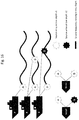
- FIGS. 15, 16 and 17 illustrate source acquisition configurations, for any type of source, that provide further benefits as will be clear from the descriptions.
- FIG. 15 methods for towing of source arrays at different tow depths but offset to each other are disclosed.
- Multiple source arrays can be at a single depth level, potentially excited simultaneously.
- This source configuration or layout is different to existing methods as the simultaneous or near-simultaneous shots of the sources at different tow depths do not interfere with each other, while the encoding methods disclosed herein enable separating the source side ghost.
- the disclosed configurations constitute an efficient way of acquiring seismic data for some of the methods described herein.
- FIG. 16 various configurations for towing one or more source arrays at varying or alternating tow depths are disclosed, including: (1) Periodically varying, e.g. on a sine or cosine trajectory, (2) Aperiodically varying, and (3) shooting simultaneously or shooting sequentially.
- the configurations with varying tow depths teach how some of the methods described herein could be acquired efficiently.
- sub-arrays of a seismic source array that are towed at different depth levels, including at a constant depth and at a periodically or aperiodically varying depth, are shown. These subarrays are excited individually or can be excited in concert with subarrays from other source arrays. This method is different to traditional over/under sources as it does not aim to overcome the source side ghost notch by shooting over/under source sub-arrays simultaneously, but offers an acquisition scheme that can be processed and encoded for separation using the methods described herein. Examples are V-shaped or A-shaped configurations of source sub-arrays.
- periodic and aperiodic modulation functions can directly be imposed on individual receivers through various means to, for instance, have the amplitude strengths varying.
- modulation function potentially in combination with modulation functions on the source side, can be employed taking advantage of the methods described herein to for instance more efficiently de-alias the data as part of the acquisition and/or seismic processing.
- processing local subsets can further reduce the aliasing ambiguity and improve the separation.
- the methods described herein apply to different types of wavefield signals recorded (simultaneously or non-simultaneously) using different types of sensors, including but not limited to; pressure and/or one or more components of the particle motion vector (where the motion can be: displacement, velocity, or acceleration) associated with compressional waves propagating in acoustic media and/or shear waves in elastic media.
- pressure and/or one or more components of the particle motion vector where the motion can be: displacement, velocity, or acceleration
- the motion can be: displacement, velocity, or acceleration
- multi-component measurements are the pressure and vertical component of particle velocity recorded by an ocean bottom cable or node-based seabed seismic sensor, the crossline and vertical component of particle acceleration recorded in a multi-sensor towed-marine seismic streamer, or the three component acceleration recorded by a microelectromechanical system (MEMS) sensor deployed e.g. in a land seismic survey.
- MEMS microelectromechanical system
- the methods described herein can be applied to each of the measured components independently, or to two or more of the measured components jointly.
- Joint processing may involve processing vectorial or tensorial quantities representing or derived from the multi-component data and may be advantageous as additional features of the signals can be used in the separation.
- particular combinations of types of measurements enable, by exploiting the physics of wave propagation, processing steps whereby e.g. the multi-component signal is separated into contributions propagating in different directions (e.g., wavefield separation), certain spurious reflected waves are eliminated (e.g., deghosting), or waves with a particular (non-linear) polarization are suppressed (e.g., polarization filtering).
- the methods described herein may be applied in conjunction with, simultaneously with, or after such processing of two or more of the multiple components.
- the obtained wavefield signals consist of/comprise one or more components
- the techniques, methods and systems that are disclosed herein may be applied to all marine, seabed, borehole, land and transition zone seismic surveys, that includes planning, acquisition and processing. This includes for instance time-lapse seismic, permanent reservoir monitoring, VSP and reverse VSP, and instrumented borehole surveys (e.g. distributed acoustic sensing). Moreover, the techniques, methods and systems disclosed herein may also apply to non-seismic surveys that are based on wavefield data to obtain an image of the subsurface.
- a first step Obtaining wavefield recordings based on the synchronous activation of at least two sources across two or more activation lines or grids varying at least one parameter between the sources from one activation to the following selected from one or more of a group consisting of source signal amplitude, source signal spectrum, source activation time, source location at activation time and source depth, such that the varying causes one or more scaled replications of a wavefield with limited cone-shaped support in the frequency-wavenumber domain of at least one of the sources along one or more wavenumber axes or directions and where the activation lines or grids are Bravais grids or can be related by affine transformations.
- a contribution is separated of at least one of the at least two sources to the obtained wavefield recordings as generated by the at least two sources individually in the absence of the other sources, or in the absence of effective simultaneous sources.
- sub-surface representations of structures or Earth media properties are generated from the contribution of at least one of the at least two sources.
- the generated sub-surface representations are output.
- a computer program can comprise machine-readable instructions to perform the following tasks:
- a (local) storage medium e.g., disk/tape
- a (remote) network location
- Computer programs may run with or without user interaction, which takes place using input and output devices such as keyboards or a mouse and display. Users can influence the program execution based on intermediate results shown on the display or by entering suitable values for parameters that are required for the program execution. For example, in one embodiment, the user could be prompted to enter information about e.g., the average inline shot point interval or source spacing. Alternatively, such information could be extracted or computed from metadata that are routinely stored with the seismic data, including for example data stored in the so-called headers of each seismic trace.
- the computer includes a CPU 2000 (an example of “processing circuitry”) that performs the processes described above.
- the process data and instructions may be stored in memory 2002 .
- These processes and instructions may also be stored on a storage medium disk such as a hard drive (HDD) or portable storage medium or may be stored remotely.
- the claimed advancements are not limited by the form of the computer-readable media on which the instructions of the inventive process are stored.
- the instructions may be stored on CDs, DVDs, in FLASH memory, RAM, ROM, PROM, EPROM, EEPROM, hard disk or any other information processing device with which computer communicates, such as a server or another computer.
- claimed advancements may be provided as a utility application, background daemon, or component of an operating system, or combination thereof, executing in conjunction with CPU 2000 and an operating system such as Microsoft Windows 7, UNIX, Solaris, LINUX, Apple MAC-OS and other systems known to those skilled in the art.
- an operating system such as Microsoft Windows 7, UNIX, Solaris, LINUX, Apple MAC-OS and other systems known to those skilled in the art.
- CPU 2000 can be a Xenon or Core processor from Intel of America or an Opteron processor from AMD of America, or may be other processor types that would be recognized by one of ordinary skill in the art.
- the CPU 2000 can be implemented on an FPGA, ASIC, PLD or using discrete logic circuits, as one of ordinary skill in the art would recognize.
- C P U 2000 may be implemented as multiple processors cooperatively working in parallel to perform the instructions of the inventive processes described above.
Landscapes
- Life Sciences & Earth Sciences (AREA)
- Physics & Mathematics (AREA)
- Engineering & Computer Science (AREA)
- Remote Sensing (AREA)
- Environmental & Geological Engineering (AREA)
- Geology (AREA)
- Acoustics & Sound (AREA)
- General Life Sciences & Earth Sciences (AREA)
- General Physics & Mathematics (AREA)
- Geophysics (AREA)
- Oceanography (AREA)
- Business, Economics & Management (AREA)
- Emergency Management (AREA)
- Geophysics And Detection Of Objects (AREA)
Abstract
Description
which can also be written as

which follows from a standard Fourier transform result (wavenumber shift) (Bracewell, 1999).
| TABLE I |
| Mapping of signal to cone centered at k = 0 (H+) and cone centered at |
| k = kN (H−) for different choices of A (ω) for signal separation |
| or signal apparition in Eq. (0.2). |
| A (ω) | H− = (1 − A)/2 | H+ = (1 + A)/2 |
| 1 | 0 | 1 |
| −1 | 1 | 0 |
| 0 | ½ | ½ |
| ½ | ¼ | ¾ |
| eiωT | (1 − eiωT)/2 | (1 + eiωT)/2 |
| 1 + eiωT | −eiωT/2 | 1 + eiωT/2 |
-
- 1. NMO correct the (partially) aliased simultaneous source recordings using an invertible NMO transform, effectively reducing the maximum time-dip in the data.
- 2. Compute the S-transform of each NMO corrected simultaneous source trace. The resulting time-frequency representation implies a frequency spectrum for every time sample of every trace.
- 3. Iterate over all time samples of the S-transformed NMO-corrected sim source traces. For every time sample:
- a. Compute the offset (and current time) dependent effect of NMO stretch on the encoding filters using, e.g., Eq. 0.3 from Barnes (1992), providing the frequency spectrum of the effective encoding filters.
- b. Loop over all the (positive/negative) frequencies. For every frequency do:
- i. Compute the wavenumber transform of the S-transformed NMO-corrected simultaneous source data at the current time sample and frequency.
- ii. Compute the wavenumber transform of the effective modulation function.
- iii. Using the cyclic convolution principle and the computed wavenumber transform of the effective modulation function, compute a forward modelling operator that relates the source one and source two contributions at the current time sample and frequency to the corresponding sim source data.
- iv. Invert the sim source data at the current time sample and current frequency using the forward modelling operator.
- v. Compute the inverse wavenumber transform of the inverted source one and source two contributions and store the results.
- c. Optional (if all the frequencies are computed): Compute the negative frequencies from the positive frequencies using complex conjugate mirroring.
- d. Store the separated frequency spectra for the current time-step building the S-transforms of the separated data one time sample by one.
- 4. Inverse S-transform the obtained S-transform data for source one and source two, obtaining the NMO corrected separated source one and source two data.
- 5. Inverse NMO correct separated s1 and s2 data.
{circumflex over (f)}(ξ)=∫−∞ ∞ f(x)e −2πixξ dx,
for the Fourier transform in one variable, and consequently {circumflex over (f)}(ω, ξ) for the Fourier transform of two dimensional function f(t, x) with a time (t) and spatial (x) dependence.
i.e., the recorded data is now modelled as a sum of the two functions, but where one of them has been subjected to a periodic time shift. In a more general version more general filtering operations than time shifts can be applied. Let ak be filter operators (acting on the time variable) where the k dependence is such it only depends on if k is odd or even, i.e., that ak=ak(mod2).
then only the terms where k=0 above contribute, and the following simplified relation holds
implying that {circumflex over (f)}2(ω, ξ) can be recovered from
In a similar fashion, {circumflex over (f)}1(ω, ξ) can be recovered from
In this way, the deblending can be achieved by direct consideration of the data in the shifted cones illustrated in
h 1 =w*f 1 ,h 2 =w*f 2 (7)
and similarly for T2 and h2. Above, the function K describes a smooth, localizing windows, for instance a Gaussian. The eigenvalues of T1 and T2 will point-wise describe the local energy in the direction of maximum and minimum variation, and the associated eigenvectors contain the corresponding directions. The tensors are computed as elementwise convolutions of the outer product of the gradient of the underlying function, and this directly defines the generalization to higher dimensions. For the sake of simplicity, we describe here the two-dimensional case.
s 2 1(t,x)=0,
which in turn means that
∇f 1 ·e 2 1=0. (8)
These functions have the property that
implying that (8) will be satisfied in the case where there is locally only energy in one direction, and where an equal amount of penalty will be applied in the case where there is the same amount of energy in both directions. Note that the local coordinate transformations are now implicitly given in the operator S.
∫∫((∇f 1)T S(T 1)∇f 1)(t,x)dtdx,
and
∫∫((∇f 2)T S(T 2)∇f 2)(t,x)dtdx,
for the two wavefields. The expressions above describe the energy in the undesirable direction, given the knowledge of the bandpass filtered versions h1 and h2, respectively. The de-aliasing is now taken place by punishing high frequencies (by the derivatives) along the directions given by the local coordinate transformations specified by e1 1(t, x) and e2 1(t, x).
with the additional constraint that {circumflex over (f)}1 and {circumflex over (f)}2 have support on the cone defined by (1). To obtain a unique approximate solution, we now add the directionality penalties and consider
with the same cone constraint. To find the minima of (9), we compute the Fréchet derivatives of the objective function (9) with respect to the functions {circumflex over (f)}1 and {circumflex over (f)}2 and equate them to zero as they should at a minimum. The first term in (9) is straightforward to derive, and concerning the other two terms it is readily verified using partial integrations that their Fréchet derivatives are described by the elliptic operators
D m(f)=∇(S(T m)∇f)
b 1=
Furthermore, introduce
Equating the Fréchet derivatives of (9) with respect to {circumflex over (f)}1 and {circumflex over (f)}2 to zero then yield the linear relationship
for the solution of (9). This equation can be solved using an iterative solver for linear equations, for instance the conjugate gradient method. The operators in AF are realized using standard FFT, and the operators in AD are computed using a combination of Fourier transforms and differential schemes, that also may be implemented by using FFT. The operator AF describe the fit to data, while the operator AD describe the de-aliasing that takes places using the local coordinate transformations induced from e1 1(t, x) and e2 1(t, x).
De-Aliasing Using Coordinate Transformations
Mutual Parabolic Change of Coordinates
t=E k(τ)=τ+qx 2,
for some choice of parameter q. Now, let
d Par(τ,k)=d(E k(τ),k)=

and let
f 1 par(τ,x)=f 1(τ+qx 2 ,x) and f 2 par(τ,x)=f 2(x+qx 2 ,x).
Clearly, it holds that
(
It then holds that
d par(τ,k)=
and the regular apparition technique can now be directly applied to dpar(τ, k) to deblend f1 par and f2 par and hence also f1 and f2.
Separate Coordinate Systems and NMO
E 1 k:

be continuous bijective coordinate transformations, and let
f 1 n(τ,kΔ x)=f 1(E 1 k(τ),kΔ x), and f 2 n(τ,kΔ x)=f 2(E 2 kτ),kΔ x).
d 1 n(τ,k)=f 1(E 1 k(τ)+Δt(−1)k ,kΔ x)+f 2(E 1 k(τ),kΔ x)
and
d 2 n(τ,k)=f 1(τ),kΔ x)+f 2(E 2 k(τ)−Δt(−1)k ,kΔ x)
d 1 n(τ,k)=(
and
d 2 n(τ,k)=(
respectively. Suppose now that T is sampled discretely at equally spaced points, specifically
with a sampling in the corresponding frequency variable
where (ΔTΔΩ)−1=Nτ. Also, let Ξ(k′) be an equally spaced sampling of the spatial frequency parameter ξ.
τm,k 11=(E 1 k)−1(E 1 k(τ)+Δt(−1)k),kΔ x),
τm,k 12=(E 2 k)−1(E 1 k(τ),kΔ x),
τm,k 21=(E 1 k)−1(E 2 k(τ),kΔ x),
τm,k 22=(E 2 k)−1(E 2 k(τ)−Δt(−1)k),kΔ x),

d 1 n=
and
d 2 n=
Sf(τ,k)=(−1)k f(τ,k).
as the operator that is shifting information to the cones of interest. This implies that the {circumflex over (f)}2 n is almost in the null-space of the mapping
({circumflex over (f)} 1 n ,{circumflex over (f)} 2 n)

and similarly, {circumflex over (f)}1 n is almost in the null-space of the mapping
({circumflex over (f)} 1 n ,{circumflex over (f)} 2 n)
or in other words, the mapping
({circumflex over (f)} 1 n ,{circumflex over (f)} 2 n)

is almost block-diagonal. The matrix describing the map above will be square, and hence an iterative method such as the generalized minimal residual method (GMRES) could be applied to this problem, given the right hand side
and define sign(t)=2Θ(t)−1. Let us define the NMO mapping Eτ
t=E τ
This mapping is bijective with inverse
This coordinate transformation is chosen such that
is continuous.
{tilde over (p)} g(n x ,n y)=m 1(n x ,n y)*p g(n x ,n y), (13)
where Δz=z2−z1. The action of a can then be obtained from the relation
{tilde over (p)} d(n x ,n y)=m 2(n x ,n y)*p d(n x ,n y), (17)
where m2 (nx, ny) is the modulating function:
B(ω,k x ,k y)=A −1. (19)
p d =−CP g (24)
where C is a redatuming operator that depends on the depth of the shallow sources z1 but that is related to the above defined operators A and B and knowledge or assumptions concerning the reflection coefficient of the free surface reflector, e.g. the sea surface, and is −1 in equation (24):
C=A 2z
B A ={Ak,k=(k 1 ,k 2)∈

where A is a 2×2 matrix. Associated with this grid is the dual grid
B A ⊥ ={x∈
It can be verified that
B A ⊥ =B A
and the hexagon (rhombic) grid generated from
Recall the two-dimensional Poisson sum formula
Now, let l∈BA and let m∈BA ⊥. Each such element can thus be indexed as lk and mk,
respectively. Moreover, choose
for 0≤n1<N1 and 0≤n2<N2 where n1, n2, N1 and N2 are non-negative integers. The Poisson sum can then be written
m n N =A −Tξn,
which allows us to rewrite the above relation as
f(l k +b)=0,
if
k∉{(n 1 ,n 2)∈
then the left hand sum above reduces to a regular two-dimensional discrete Fourier transform which can be rapidly evaluated using FFT.

At each such point, linear combinations of the form
d(k,p,t)=Σp∈P p∈P(h p q *f p(l k,p,⋅))(t),
are measured during the acquisition. A Fourier transformation with respect to the time variable thus gives
and an additional Fourier series expansion of {circumflex over (d)}t yields
can be mapped to some domain

Ω∩B A ⊥⊂
Specifically, this mean that there exists a mapping ι:
f p(R p(k))=g p(Ak).
(2) small offsets on the order of Δx/2˜Δy/2, where Δx and Δy denote the inline shot spacing and the crossline line spacing, respectively. The simultaneous shots are on grids/patterns that are staggered with respect to each other by a small amount such as, e.g., half the inline and crossline shot spacing. In this case, clearly the shifts of the simultaneous sources are small compared to the extent (e.g., line length) of the shot pattern and all sources essentially still see the same subsurface. Reconstruction methods can be applied that take advantage of the fact that the sources see the same subsurface, to
(3) large offsets on the order of Lx˜Ly where Lx and Ly denote, e.g., the shot line length and the crossline extent of all shotlines, respectively. In this case, the simultaneous shots are completely separated in terms of their midpoints and all sources see a different part of the full 3D Green's function and illuminate a different part of the subsurface. No overlap can be exploited and the number of unknowns not reduced. On the other hand, this type of acquisition is the most efficient way to acquire, e.g., a 3D common receiver gather in part or in full.
Kx-Ky Space-Filling Multi-Scale Apparition
- [Halliday et al., 2014] Halliday and Laws, Seismic acquisition using phase-shifted sweeps: US Patent application US20140278119A1 (2014).
- [Shannon, 1949] C. E. Shannon, Proc. Inst. of Radio Eng. 37, 10 (1949).
- [Nyquist, 1928] H. Nyquist, Trans. AWE. 47, 617 (1928).
- [Ikelle, 2010] L. T. Ikelle, Coding and Decoding: Seismic Data: The Concept of Multishooting. (Elsevier, 2010), Vol. 39.
- [Abma et al., 2015] R. Abma, D. Howe, M. Foster, I. Ahmed, M. Tanis, Q. Zhang, A. Arogunmati and G. Alexander, Geophysics. 80, WD37 (2015).
- [Kumar et al., 2015] R. Kumar, H. Wason and F. J. Herrmann, Geophysics. 80, WD73 (2015).
- [Mueller et al., 2015] M. B. Mueller, D. F. Halliday, D. J. van Manen and J. O. A. Robertsson, Geophysics. 80, V133 (2015).
- [Robertsson, 2015] Robertsson, J. O. A., R. M. Laws, and J. E. Kragh, 2015, Marine seismic methods, in Resources in the near-surface Earth (eds. L. Slater and D. Bercovici), Treatise on Geophysics, 2nd edition (ed. G. Schubert), Elsevier-Pergamon, Oxford.
- [Bracewell, 1999] R. Bracewell, The Fourier Transform & Its Applications (McGraw-Hill Science, 1999).
- [Barnes, 1992] A. E. Barnes, GEOPHYSICS, 57(5), 749-751 (1992).
- [Stockwell, 1996] R. G. Stockwell, L. Mansinha, and R. P. Lowe. Signal Processing, IEEE Transactions on 44(4), 998-1001 (1996).
- [Dragoset, 1995] W. H. Dragoset. Geophysical applications of adaptive-noise cancellation. 65th SEG meeting, Houston, USA, Expanded Abstracts, 1389-1392.
- [Trickett, 2003] S. R. Trickett, Stretch-free stacking. In 2003 SEG Annual Meeting. Society of Exploration Geophysicists.
- [Zhang et al., 2012] B. Zhang, K. Zhang, S. Guo, and K. J. Marfurt, Nonstretching NMO correction of prestack time-migrated gathers using a matching-pursuit algorithm. Geophysics, 78(1), U9-U18 (2012).
- [Papoulis, 1977] A. Papoulis, Generalized sampling expansion. Circuits and Systems, IEEE Transactions on 24, no. 11, 652-654 (1977).
- [Xu et al., 2005] S. Xu, Y. Zhang, D. Pham, and G. Lambare, Antileakage Fourier transform for seismic data regularization. Geophysics 70, no. 4, V87-V95 (2005).
Claims (20)
Applications Claiming Priority (5)
| Application Number | Priority Date | Filing Date | Title |
|---|---|---|---|
| GB1608297.6 | 2016-05-12 | ||
| GB1608297.6A GB2550181A (en) | 2016-05-12 | 2016-05-12 | Simultaneous source acquisition and separation on general related sampling grids |
| GB1619036.5 | 2016-11-10 | ||
| GB1619036.5A GB2550228A (en) | 2016-05-12 | 2016-11-10 | Simultaneous source acquisition and separation on general related sampling grids |
| PCT/IB2017/052667 WO2017195093A1 (en) | 2016-05-12 | 2017-05-08 | Simultaneous source acquisition and separation on general related sampling grids |
Related Parent Applications (1)
| Application Number | Title | Priority Date | Filing Date |
|---|---|---|---|
| PCT/IB2017/052667 Continuation WO2017195093A1 (en) | 2016-05-12 | 2017-05-08 | Simultaneous source acquisition and separation on general related sampling grids |
Publications (2)
| Publication Number | Publication Date |
|---|---|
| US20190079205A1 US20190079205A1 (en) | 2019-03-14 |
| US10690793B2 true US10690793B2 (en) | 2020-06-23 |
Family
ID=56320244
Family Applications (1)
| Application Number | Title | Priority Date | Filing Date |
|---|---|---|---|
| US16/185,069 Active US10690793B2 (en) | 2016-05-12 | 2018-11-09 | Simultaneous source acquisition and separation on general related sampling grids |
Country Status (4)
| Country | Link |
|---|---|
| US (1) | US10690793B2 (en) |
| EP (1) | EP3455650A1 (en) |
| GB (2) | GB2550181A (en) |
| WO (1) | WO2017195093A1 (en) |
Cited By (2)
| Publication number | Priority date | Publication date | Assignee | Title |
|---|---|---|---|---|
| US11243319B2 (en) * | 2018-03-05 | 2022-02-08 | Apparition Geoservices Gmbh | Method for seismic data acquisition and processing |
| US11280925B2 (en) * | 2016-11-10 | 2022-03-22 | Apparition Geoservices Gmbh | Simultaneous source acquisition and separation method |
Families Citing this family (14)
| Publication number | Priority date | Publication date | Assignee | Title |
|---|---|---|---|---|
| GB2565336A (en) * | 2017-08-10 | 2019-02-13 | Seismic Apparition Gmbh | Method for seismic data acquisition and processing |
| AU2018368796B2 (en) * | 2017-11-20 | 2023-10-12 | Shearwater Geoservices Software Inc. | Offshore application of non-uniform optimal sampling survey design |
| CN108469560B (en) * | 2018-03-16 | 2020-01-14 | 武汉大学 | Electromagnetic interference objective complexity evaluation method based on rapid S-transform time-frequency space model |
| WO2019246297A1 (en) | 2018-06-20 | 2019-12-26 | Pgs Geophysical As | Long-offset acquisition |
| GB2584285A (en) * | 2019-05-26 | 2020-12-02 | Apparition Geoservices Gmbh | Method for seismic data acquisition and processing |
| CN110231117A (en) * | 2019-06-10 | 2019-09-13 | 中设设计集团股份有限公司 | A kind of drag-line fundamental frequency feature identification method based on S-transformation |
| US12105240B2 (en) | 2019-10-28 | 2024-10-01 | Pgs Geophysical As | Long-offset acquisition with improved low frequency performance for full wavefield inversion |
| US12072461B2 (en) | 2019-10-28 | 2024-08-27 | Pgs Geophysical As | Modified simultaneous long-offset acquisition with improved low frequency performance for full wavefield inversion |
| US12313801B2 (en) * | 2020-03-06 | 2025-05-27 | Schlumberger Technology Corporation | Marine seismic imaging |
| BR112022026483A2 (en) | 2020-06-26 | 2023-01-31 | Nestle Sa | PROCESS FOR PREPARING STABLE PLANT-BASED YOGHURT ANALOGS DURING STORAGE AND YOGHURT ANALOGS THEREOF |
| CN116009090B (en) * | 2021-10-22 | 2025-07-18 | 中国石油化工股份有限公司 | Joint inversion method, system and electronic equipment based on cross gradient function |
| WO2024129865A1 (en) * | 2022-12-16 | 2024-06-20 | Schlumberger Technology Corporation | System and methods for hexagonal phase encoding for marine vibrators |
| CN117251673B (en) * | 2023-11-17 | 2024-03-01 | 中国海洋大学 | Dynamic tracking method for marine fishery resources |
| US20250314796A1 (en) * | 2024-04-09 | 2025-10-09 | Schlumberger Technology Corporation | Methods and systems to generate components of the directional gradient of the seismic wavefield |
Citations (10)
| Publication number | Priority date | Publication date | Assignee | Title |
|---|---|---|---|---|
| US4628492A (en) * | 1984-01-11 | 1986-12-09 | Mobil Oil Corporation | Method of avoiding aliasing in slant stacking of seismic data |
| WO2001071385A1 (en) | 2000-03-23 | 2001-09-27 | Geco As | Seismic source arrays |
| US6545944B2 (en) | 2001-05-30 | 2003-04-08 | Westerngeco L.L.C. | Method for acquiring and processing of data from two or more simultaneously fired sources |
| US20100161235A1 (en) | 2007-03-09 | 2010-06-24 | Ikelle Luc T | Imaging of multishot seismic data |
| US20130135965A1 (en) | 2011-11-28 | 2013-05-30 | Ying Ji | Separation of simultaneous source data |
| US20140278119A1 (en) | 2013-03-15 | 2014-09-18 | Westerngeco L.L.C. | Seismic acquisition using phase-shifted sweeps |
| US20140355379A1 (en) | 2013-05-31 | 2014-12-04 | Westerngeco L.L.C. | Methods and systems for marine survey acquisition |
| WO2015036554A2 (en) | 2013-09-12 | 2015-03-19 | Cgg Services Sa | Ghost-suppression optimized seismic source and method |
| US9158016B2 (en) * | 2012-04-30 | 2015-10-13 | Conocophillips Company | Multi-dimensional data reconstruction constrained by a regularly interpolated model |
| WO2016023598A1 (en) | 2014-08-15 | 2016-02-18 | Statoil Petroleum As | Method and apparatus for processing seismic data |
Family Cites Families (2)
| Publication number | Priority date | Publication date | Assignee | Title |
|---|---|---|---|---|
| BR112014017319A8 (en) * | 2012-01-13 | 2017-07-04 | Geco Technology Bv | method for conducting a marine seismic survey using a simultaneous source technique having nss firing sequences, marine seismic survey system, processing system for processing |
| CN106461803B (en) * | 2014-03-20 | 2019-01-18 | 施蓝姆伯格技术公司 | Air-gun array data reconstruction Pulse Source seismic data is ignited from Annual distribution formula |
-
2016
- 2016-05-12 GB GB1608297.6A patent/GB2550181A/en not_active Withdrawn
- 2016-11-10 GB GB1619036.5A patent/GB2550228A/en not_active Withdrawn
-
2017
- 2017-05-08 EP EP17724918.2A patent/EP3455650A1/en not_active Withdrawn
- 2017-05-08 WO PCT/IB2017/052667 patent/WO2017195093A1/en not_active Ceased
-
2018
- 2018-11-09 US US16/185,069 patent/US10690793B2/en active Active
Patent Citations (10)
| Publication number | Priority date | Publication date | Assignee | Title |
|---|---|---|---|---|
| US4628492A (en) * | 1984-01-11 | 1986-12-09 | Mobil Oil Corporation | Method of avoiding aliasing in slant stacking of seismic data |
| WO2001071385A1 (en) | 2000-03-23 | 2001-09-27 | Geco As | Seismic source arrays |
| US6545944B2 (en) | 2001-05-30 | 2003-04-08 | Westerngeco L.L.C. | Method for acquiring and processing of data from two or more simultaneously fired sources |
| US20100161235A1 (en) | 2007-03-09 | 2010-06-24 | Ikelle Luc T | Imaging of multishot seismic data |
| US20130135965A1 (en) | 2011-11-28 | 2013-05-30 | Ying Ji | Separation of simultaneous source data |
| US9158016B2 (en) * | 2012-04-30 | 2015-10-13 | Conocophillips Company | Multi-dimensional data reconstruction constrained by a regularly interpolated model |
| US20140278119A1 (en) | 2013-03-15 | 2014-09-18 | Westerngeco L.L.C. | Seismic acquisition using phase-shifted sweeps |
| US20140355379A1 (en) | 2013-05-31 | 2014-12-04 | Westerngeco L.L.C. | Methods and systems for marine survey acquisition |
| WO2015036554A2 (en) | 2013-09-12 | 2015-03-19 | Cgg Services Sa | Ghost-suppression optimized seismic source and method |
| WO2016023598A1 (en) | 2014-08-15 | 2016-02-18 | Statoil Petroleum As | Method and apparatus for processing seismic data |
Non-Patent Citations (18)
| Title |
|---|
| A. Papoulis, Generalized sampling expansion. IEEE Transactions on Circuits and Systems, vol. Cas-24, No. 11, Nov. 1977, pp. 652-654. |
| Abma, R., et al., "Independent Simultaneous Source Acquisition and Processing", Geophysics, vol. 80 No. 6, Nov.-Dec. 2015, pp. WD37-WD44. |
| Barnes, A.E., "Another look at NMO Stretch", Geophysics, vol. 57 No. 5, May 1992, pp. 749-751. |
| Bracewell, R., "The Fourier Transform & Its Applications", McGraw-Hill Science, 1999, pp. 111-115, and 268-269. |
| Dragoset, B., et al., "Geophysical Application of Adaptive-Noise Cancellation", 65th SEG meeting, Expanded Abstracts, 1995, pp. 1389-1392. |
| Ikelle, L.T., "Coding and Decoding: Seismic Data: The Concept of Multishooting", Handbook of Geophysical Exploration: Seismic Exploration, Elsevier, vol. 39, 2010, pp. 293-294, 321-324, 337 and 341. |
| International Search Report and Written Opinion of the International Searching Authority dated Jul. 21, 2017, in PCT/IB2017/052667. |
| Kumar, R., et al., "Source Separation for Simultaneous Towed-Streamer Marine Acquisition-A Compressed Sensing Approach", Geophysics, vol. 80 No. 6, Nov.-Dec. 2015, pp. WD73-WD88. |
| Kumar, R., et al., "Source Separation for Simultaneous Towed-Streamer Marine Acquisition—A Compressed Sensing Approach", Geophysics, vol. 80 No. 6, Nov.-Dec. 2015, pp. WD73-WD88. |
| Mueller, M.B., et al., "The Benefit of Encoded Source Sequences for Simultaneous Source Separation", Geophysics, vol. 80 No. 5, Sep.-Oct. 2015, pp. VI33-VI43. |
| Nick Moldoveanu et al., "Multivessel coil shooting acquisition with simultaneous sources" Seg Technical Program Expanded Abstracts 2012, Oct. 25, 2012, pp. 1-6, ZP055127792. |
| Nyquist, H., "Certain Topics in Telegraph Transmission Theory", Transactions A.I.E.E., Feb. 1928, pp. 617-644. |
| Robertsson, J.O.A., et al., "Tools and Techniques: Marine Seismic Methods", Geophysics, 2nd Edition, vol. 11. Oxford: Elsevier; 2015, pp. 175-208. |
| Shannon, C.E., "Communication in the Presence of Noise", Proceedings of the I.R.E., vol. 37, Jan. 1949, pp. 10-21. |
| Stockwell, R.G., et al., "Localization of the Complex Spectrum: The S Transform", IEEE Transactions on Signal Processing, vol. 44 No. 4, Apr. 1996, pp. 998-1001. |
| Trickett, S.R., "Stretch-free Stacking", SEG Annual Meeting, Society of Exploration Geophysicists, 2003, 4 pages. |
| Xu et al., Antileakage Fourier transform for seismic data regularization. Geophysics vol. 70, No. 4, (Jul.-Aug. 2005); pp. V87-V95. |
| Zhang, B., et al., "Nonstretching NMO correction of prestack time-migrated gathers using a matching-pursuit algorithm", Geophysics, vol. 78 No. 1, Jan.-Feb. 2013, pp. U9-U18. |
Cited By (2)
| Publication number | Priority date | Publication date | Assignee | Title |
|---|---|---|---|---|
| US11280925B2 (en) * | 2016-11-10 | 2022-03-22 | Apparition Geoservices Gmbh | Simultaneous source acquisition and separation method |
| US11243319B2 (en) * | 2018-03-05 | 2022-02-08 | Apparition Geoservices Gmbh | Method for seismic data acquisition and processing |
Also Published As
| Publication number | Publication date |
|---|---|
| GB2550228A (en) | 2017-11-15 |
| GB201608297D0 (en) | 2016-06-29 |
| WO2017195093A1 (en) | 2017-11-16 |
| US20190079205A1 (en) | 2019-03-14 |
| EP3455650A1 (en) | 2019-03-20 |
| GB2550181A (en) | 2017-11-15 |
Similar Documents
| Publication | Publication Date | Title |
|---|---|---|
| US20190079205A1 (en) | Simultaneous source acquisition and separation on general related sampling grids | |
| US11029432B2 (en) | De-aliased source separation method | |
| US8116166B2 (en) | 3D deghosting of multicomponent or over / under streamer recordings using cross-line wavenumber spectra of hydrophone data | |
| US8792296B2 (en) | Method and apparatus for deghosting seismic data | |
| US11112517B2 (en) | System and method for interpolating seismic data | |
| US11550072B2 (en) | Method and apparatus for deblending seismic data using a non-blended dataset | |
| US9405027B2 (en) | Attentuating noise acquired in an energy measurement | |
| US11002870B2 (en) | Method for deghosting and redatuming operator estimation | |
| US9091787B2 (en) | Separation of simultaneous source data | |
| US11280925B2 (en) | Simultaneous source acquisition and separation method | |
| GB2503325A (en) | Receiver-based ghost filter generation | |
| EP3004942A2 (en) | Systems and methods for de-noising seismic data | |
| WO2017149418A1 (en) | Source separation method | |
| GB2560991A (en) | Method for seismic acquisition and processing | |
| US11255992B2 (en) | Deblending method using patterned acquisition seismic data | |
| Higgins | Recovery of the reflection response for marine walkaway VSP | |
| Abbasi | Attenuation of multiples in 2D short streamer length multi-channel seismic data, Gulf of Callifornia |
Legal Events
| Date | Code | Title | Description |
|---|---|---|---|
| AS | Assignment |
Owner name: SEISMIC APPARITION GMBH, SWITZERLAND Free format text: ASSIGNMENT OF ASSIGNORS INTEREST;ASSIGNORS:VAN MANEN, DIRK-JAN;ANDERSSON, FREDRIK;ROBERTSSON, JOHAN;AND OTHERS;REEL/FRAME:047458/0869 Effective date: 20181108 |
|
| FEPP | Fee payment procedure |
Free format text: ENTITY STATUS SET TO UNDISCOUNTED (ORIGINAL EVENT CODE: BIG.); ENTITY STATUS OF PATENT OWNER: SMALL ENTITY |
|
| FEPP | Fee payment procedure |
Free format text: ENTITY STATUS SET TO SMALL (ORIGINAL EVENT CODE: SMAL); ENTITY STATUS OF PATENT OWNER: SMALL ENTITY |
|
| STPP | Information on status: patent application and granting procedure in general |
Free format text: DOCKETED NEW CASE - READY FOR EXAMINATION |
|
| STPP | Information on status: patent application and granting procedure in general |
Free format text: NON FINAL ACTION MAILED |
|
| STPP | Information on status: patent application and granting procedure in general |
Free format text: RESPONSE TO NON-FINAL OFFICE ACTION ENTERED AND FORWARDED TO EXAMINER |
|
| STPP | Information on status: patent application and granting procedure in general |
Free format text: NOTICE OF ALLOWANCE MAILED -- APPLICATION RECEIVED IN OFFICE OF PUBLICATIONS |
|
| STPP | Information on status: patent application and granting procedure in general |
Free format text: PUBLICATIONS -- ISSUE FEE PAYMENT RECEIVED |
|
| STCF | Information on status: patent grant |
Free format text: PATENTED CASE |
|
| AS | Assignment |
Owner name: APPARITION GEOSERVICES GMBH, SWITZERLAND Free format text: ASSIGNMENT OF ASSIGNORS INTEREST;ASSIGNOR:SEISMIC APPARITION GMBH;REEL/FRAME:056869/0333 Effective date: 20210713 |
|
| MAFP | Maintenance fee payment |
Free format text: PAYMENT OF MAINTENANCE FEE, 4TH YR, SMALL ENTITY (ORIGINAL EVENT CODE: M2551); ENTITY STATUS OF PATENT OWNER: SMALL ENTITY Year of fee payment: 4 |