US10690791B2 - Method, system and non-transitory computer-readable medium for forming a seismic image of a geological structure - Google Patents

Method, system and non-transitory computer-readable medium for forming a seismic image of a geological structure Download PDF

Info

Publication number
US10690791B2
US10690791B2 US15/543,458 US201515543458A US10690791B2 US 10690791 B2 US10690791 B2 US 10690791B2 US 201515543458 A US201515543458 A US 201515543458A US 10690791 B2 US10690791 B2 US 10690791B2
Authority
US
United States
Prior art keywords
region
seismic wave
geological structure
wave data
predicted
Prior art date
Legal status (The legal status is an assumption and is not a legal conclusion. Google has not performed a legal analysis and makes no representation as to the accuracy of the status listed.)
Expired - Fee Related, expires
Application number
US15/543,458
Other versions
US20180011210A1 (en
Inventor
Meixia WANG
Sheng Xu
Current Assignee (The listed assignees may be inaccurate. Google has not performed a legal analysis and makes no representation or warranty as to the accuracy of the list.)
Statoil (beijing) Business Consulting Service Co Ltd
Statoil Gulf Services LLC
Original Assignee
Statoil (beijing) Business Consulting Service Co Ltd
Statoil Gulf Services LLC
Priority date (The priority date is an assumption and is not a legal conclusion. Google has not performed a legal analysis and makes no representation as to the accuracy of the date listed.)
Filing date
Publication date
Application filed by Statoil (beijing) Business Consulting Service Co Ltd, Statoil Gulf Services LLC filed Critical Statoil (beijing) Business Consulting Service Co Ltd
Assigned to Statoil Gulf Services LLC, Statoil (Beijing) Business Consulting Service Co., Ltd. reassignment Statoil Gulf Services LLC ASSIGNMENT OF ASSIGNORS INTEREST (SEE DOCUMENT FOR DETAILS). Assignors: WANG, Meixia, XU, SHENG
Publication of US20180011210A1 publication Critical patent/US20180011210A1/en
Application granted granted Critical
Publication of US10690791B2 publication Critical patent/US10690791B2/en
Expired - Fee Related legal-status Critical Current
Adjusted expiration legal-status Critical

Links

Images

Classifications

    • GPHYSICS
    • G01MEASURING; TESTING
    • G01VGEOPHYSICS; GRAVITATIONAL MEASUREMENTS; DETECTING MASSES OR OBJECTS; TAGS
    • G01V1/00Seismology; Seismic or acoustic prospecting or detecting
    • G01V1/28Processing seismic data, e.g. for interpretation or for event detection
    • GPHYSICS
    • G01MEASURING; TESTING
    • G01VGEOPHYSICS; GRAVITATIONAL MEASUREMENTS; DETECTING MASSES OR OBJECTS; TAGS
    • G01V2210/00Details of seismic processing or analysis
    • G01V2210/40Transforming data representation
    • G01V2210/43Spectral
    • GPHYSICS
    • G01MEASURING; TESTING
    • G01VGEOPHYSICS; GRAVITATIONAL MEASUREMENTS; DETECTING MASSES OR OBJECTS; TAGS
    • G01V2210/00Details of seismic processing or analysis
    • G01V2210/50Corrections or adjustments related to wave propagation
    • G01V2210/57Trace interpolation or extrapolation, e.g. for virtual receiver; Anti-aliasing for missing receivers
    • GPHYSICS
    • G01MEASURING; TESTING
    • G01VGEOPHYSICS; GRAVITATIONAL MEASUREMENTS; DETECTING MASSES OR OBJECTS; TAGS
    • G01V2210/00Details of seismic processing or analysis
    • G01V2210/50Corrections or adjustments related to wave propagation
    • G01V2210/58Media-related
    • G01V2210/582Dispersion
    • GPHYSICS
    • G01MEASURING; TESTING
    • G01VGEOPHYSICS; GRAVITATIONAL MEASUREMENTS; DETECTING MASSES OR OBJECTS; TAGS
    • G01V2210/00Details of seismic processing or analysis
    • G01V2210/60Analysis
    • G01V2210/67Wave propagation modeling
    • G01V2210/673Finite-element; Finite-difference
    • YGENERAL TAGGING OF NEW TECHNOLOGICAL DEVELOPMENTS; GENERAL TAGGING OF CROSS-SECTIONAL TECHNOLOGIES SPANNING OVER SEVERAL SECTIONS OF THE IPC; TECHNICAL SUBJECTS COVERED BY FORMER USPC CROSS-REFERENCE ART COLLECTIONS [XRACs] AND DIGESTS
    • Y02TECHNOLOGIES OR APPLICATIONS FOR MITIGATION OR ADAPTATION AGAINST CLIMATE CHANGE
    • Y02ATECHNOLOGIES FOR ADAPTATION TO CLIMATE CHANGE
    • Y02A90/00Technologies having an indirect contribution to adaptation to climate change
    • Y02A90/30Assessment of water resources

Definitions

  • the present invention relates to seismic data, and more particularly to a method, system and non-transitory computer-readable medium for forming a seismic image of a geological structure.
  • FD dispersion in space could be ameliorated by long stencil method or spectral method.
  • the time extrapolation calculated by one side extrapolation of time steps could not be easily implemented by spectral methods, introducing errors that are proportional to the time of propagation, and with phenomena that different frequency components of wavefields propagate with different velocities.
  • the high frequency components tend to propagate faster than expected.
  • These time dispersion errors might distort the phase and introduce severe artifacts to the data and images, especially for long time propagation.
  • the time dispersion might cause mispositioning of reflectors, especially for deep reflectors with high frequency and imaged from long offset data.
  • the time dispersion errors may be improved by reducing the time steps used in the FD method, the computational cost dramatically increases.
  • a method for forming a seismic image of a geological structure comprises: obtaining seismic wave data at a first region of the geological structure, the seismic wave data including a plurality of seismic wave traces; calculating a predicted time dispersion error of an actual time dispersion error that results from a use of a finite difference approximation in calculating predicted seismic wave data at a second region of the geological structure as if a seismic wave propagates from the first region to the second region of the geological structure; compensating each of the seismic wave traces of the seismic wave data at the first region of the geological structure with the predicted time dispersion error, before using the finite difference method to calculate the predicted seismic wave data at the second region of the geological structure; calculating a corrected predicted seismic wave data at the second region of the geological structure by applying the finite difference approximation to the seismic wave data at the first region of the geological structure compensated with the predicted time dispersion
  • a system for forming a seismic image of a geological structure comprises: a plurality of seismic sensors configured to collect seismic wave data at a first region of the geological structure, the seismic wave data including a plurality of seismic wave traces; and a seismic imaging generating apparatus configured to: receive the seismic wave data at the first region of the geological structure collected by the plurality of seismic sensors, calculate a predicted time dispersion error of an actual time dispersion error that results from a use of a finite difference approximation in calculating predicted seismic wave data at a second region of the geological structure as if a seismic wave propagates from the first region to the second region of the geological structure, compensate each of the seismic wave traces of the seismic wave data at the first region of the geological structure with the predicted time dispersion error, before using the finite difference method to calculate the predicted seismic wave data at the second region of the geological structure; calculate a corrected predicted seismic wave data at the second region of the geological structure by applying the finite difference approx
  • a non-transitory computer-readable medium containing computer executable instructions for performing a method for forming a seismic image of a geological structure comprises: obtaining seismic wave data at a first region of the geological structure, the seismic wave data including a plurality of seismic wave traces; calculating a predicted time dispersion error of an actual time dispersion error that results from a use of a finite difference approximation in calculating predicted seismic wave data at a second region of the geological structure as if a seismic wave propagates from the first region to the second region of the geological structure; compensating each of the seismic wave traces of the seismic wave data at the first region of the geological structure with the predicted time dispersion error, before using the finite difference method to calculate the predicted seismic wave data at the second region of the geological structure; calculating a corrected predicted seismic wave data at the second region of the geological structure by applying the finite difference approximation to the seismic wave data at the first region of
  • FIG. 1( a ) shows a relative error
  • FIG. 1( b ) shows a relative error
  • FIG. 2( a ) shows a 1D modeling example in the 2 nd order FD scheme in accordance with an embodiment of the present invention
  • FIG. 2( b ) shows a 1D modeling example in the 4 th order FD scheme in accordance with an embodiment of the present invention
  • FIG. 3 shows a fine time step example calculated by the pseudo-spectral method in the 2 nd order scheme
  • FIG. 4( a ) shows a 1D RTM example with and without applying the FTDT correction on data in the 2 nd order FD scheme
  • FIG. 4( b ) shows a 1D RTM example with and without applying the FTDT correction on data in the 4 th order FD scheme
  • FIG. 5 shows shots used in a 3D SEAM TTI example
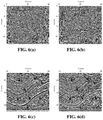
  • FIG. 6( a ) shows an RTM image generated by the conventional RTM
  • FIG. 6( b ) shows an RTM image generated by applying the FTDT correction on data before back propagation in accordance with an embodiment of the present invention
  • FIG. 6( c ) shows an enlarged view of the deep part in FIG. 6( a ) ;
  • FIG. 6( d ) shows an enlarged view of the deep part in FIG. 6( b ) .
  • FIG. 7 shows a system for forming a seismic image of a geological structure in accordance with an embodiment of the present invention.
  • the present invention is directed to reduction and/or elimination of the time dispersion errors such that more accurate seismic image of a geological structure can be formed without sacrificing computational efficiency or increasing computational cost.
  • Equation (1) Equation (1)
  • L is a space differential operator
  • Lu 1 ⁇ ⁇ ⁇ ⁇ x j ⁇ ( C i , j , k , l ⁇ ⁇ ⁇ u k ⁇ x l ) , with ⁇ as the density and C ijkt as the stiffness tensor.
  • ⁇ t is the time step
  • mapping F is defined as
  • Equation (3) ⁇ can be an operator as in Equation (2) or it can be a variable. Therefore, F is a functional of the operator or a function of the variable.
  • Equation (4) a 2n-order (n is a positive integer) FD scheme is as follows: u ( t+ ⁇ t )+ u ( t ⁇ t ) ⁇ 2 u ( t ) ⁇ 2 F ( L,n, ⁇ t ) u, (5)
  • Equation (5) The FD schemes for time and space discretization of wave equations can be treated separately, such as the FD in time is an integral for a given 2 nd order time derivative and the FD in space is a regular 1 st order or 2 nd order derivative. Therefore, time dispersion could be considered independently from space dispersion.
  • the time dispersion in Equation (5) (i.e., the left hand side of Equation (5)) can be predicted as follows.
  • the time dispersion is analyzed and the predicted dispersion is compared with what is calculated by pseudo-spectral method to verify the accuracy of the predicted dispersion that is predicted in accordance with an embodiment of the present invention.
  • a simple 1D model is used to demonstrate how the time dispersion is predicted.
  • the Fourier transform of u(t+ ⁇ t) on the left hand side of Equation (5) is e ⁇ i ⁇ t û( ⁇ ) if there is no approximation error.
  • the phase shift is not exactly ⁇ t. Since the phase shift is related to the frequency and time step, it is assumed to be ⁇ ( ⁇ , ⁇ t). Then the corresponding transform of u(t+ ⁇ t) is e ⁇ i ⁇ ( ⁇ , ⁇ t) û( ⁇ ) is made.
  • Equation (8) when the frequency is low and the time step ⁇ t is small enough, ⁇ ( ⁇ , ⁇ t) is close to ⁇ t. Therefore, the time dispersion error is small when the frequency is low and the time step ⁇ t is small. However, the error
  • FIG. 1 ⁇ ⁇ ⁇ ( ⁇ , ⁇ ⁇ ⁇ t ) - ⁇ ⁇ ⁇ t ⁇ ⁇ ⁇ ⁇ t for the 2 nd order FD scheme is shown in FIG. 1 .
  • FTDT Forward Time Dispersion Transform
  • u _ ⁇ ( t ) 1 2 ⁇ ⁇ ⁇ ⁇ u ⁇ ⁇ ( ⁇ ) ⁇ e - i ⁇ ⁇ ⁇ ( ⁇ , ⁇ ⁇ ⁇ t ) ⁇ ⁇ ⁇ t ⁇ d ⁇ ⁇ ⁇ ⁇ .
  • step (3) is a “modified” inverse Fourier transform, in which, instead of using ⁇ t as in an inverse Fourier transform, it has been replaced with the phase shift ⁇ ( ⁇ , ⁇ t). This results in the FTDT predicted trace û(t).
  • the 2 nd order and 4 th order FD schemes are used as examples.
  • a 1D model with a constant velocity 1500 m/s is used.
  • the source is a Ricker wavelet with peak frequency 10 Hz.
  • Distance between the source and the receiver is 18 km.
  • the blue solid line is the trace calculated by the pseudo-spectral method
  • the red dashed line is the trace predicted by the FTDT method
  • the green solid line is the analytical solution
  • the black dashed line is obtained by applying ITDT on the trace calculated by pseudo-spectral method (blue line).
  • the FTDT predicted traces are obtained by applying the FTDT transform on the analytical traces (the green line in FIGS. 2( a ) and 2( b ) ) which are accurate and have no numerical errors.
  • the perfect match between the blue solid line (the pseudo-spectral method) and the red dashed line (the FTDT method) in FIGS. 2( a ) and 2( b ) shows that the FTDT method accurately predicts the time dispersion for a long propagation time. It is also observed that the modeled wavelet shape is severely distorted because of time dispersion.
  • u ⁇ ′ ⁇ ( ⁇ ) 1 2 ⁇ ⁇ ⁇ ⁇ u ⁇ ( t ) ⁇ e i ⁇ ⁇ ⁇ ( ⁇ , ⁇ ⁇ ⁇ t ) ⁇ ⁇ ⁇ t ⁇ t ⁇ d ⁇ ⁇ t to transform the trace in the frequency domain with the phase shift ⁇ ( ⁇ , ⁇ t);
  • step (2) is a “modified” Fourier transform, in which, instead of using ⁇ t as in Fourier transform, it has been replaced with the phase shift ⁇ ( ⁇ , ⁇ t).
  • ITDT is the inverse procedure of FTDT, and it can remove time dispersion errors in the synthetic data.
  • the ITDT correction is applied to the traces calculated by the pseudo-spectral method (the blue line in FIGS. 2( a ) and 2( b ) ), and the result is compared with the analytical solutions (the green line in FIGS. 2( a ) and 2( b ) ).
  • the ITDT corrected traces are shown as the black dashed line in FIGS. 2( a ) and 2( b ) . It can be observed that the phase distortion is removed after the ITDT correction is applied.
  • the time dispersion results using finer time steps are also shown in FIG. 3 .
  • the distance between the receiver and the source is 18 km
  • the present invention can also be applied to seismic imaging.
  • the quality of RTM images is also affected by numerical errors from time dispersion.
  • the phase can be distorted, resulting in the shifted depth.
  • the FTDT correction can be applied on the data before backward propagation.
  • the workflow for RTM imaging can be as follows:
  • the FTDT correction on data before backward propagation compensates for the RTM image distortion introduced by forward modeling and backward modeling by phase shifting the seismic wave data at the first region of the geological structure with an amount corresponding to the predicted time dispersion error.
  • the entire RTM workflow does not change the computational cost/time too much. The cost of FTDT is negligible compared to the computational time of RTM, thus guaranteeing the efficiency.
  • FIGS. 4( a ) and 4( b ) impulse response tests for both the 2 nd order and 4 th order FD schemes are illustrated in FIGS. 4( a ) and 4( b ) . These tests are based on the same 1D model used in FIGS. 2( a ) and 2( b ) .
  • the input data is a Ricker wavelet with peak frequency 10 Hz and an impulse at 12 s.
  • the RTM results for the 2 nd order and 4 th order FD schemes are shown in FIGS. 4( a ) and ( b ) , respectively.
  • the FTDT correction is applied on the 3D SEAM (SEG Advanced Modeling Corporation) TTI (tilted transverse isotropy) model.
  • 3D SEAM SEG Advanced Modeling Corporation
  • TTI tilt transverse isotropy
  • the 2 nd order FD time scheme and the TTI equation proposed by Xu and Zhou (Xu, S., and H. Zhou, 2014, Accurate simulations of pure quasi - P - waves in complex anisotropic media: Geophysics, 79, no. 6, T341-T348) are used for forward and backward propagations.
  • a total number of 342 shots shown in FIG. 5 are selected for RTM imaging, and the black lines show the selected 6 shot lines with the 342 shots.
  • the same time step ⁇ t 3.032 ms for wave propagation in both cases using 2 nd order FD time scheme.
  • the maximum frequency used for migration is 20 Hz. Comparing FIGS. 6( a ) and ( b ) , it can be observed that the events in FIG. 6( b ) are much clearer and more focused by using the FTDT correction method.
  • FIGS. 6( c ) and 6( d ) respectively show the enlarged view of the deep part in FIGS. 6( a ) and 6( b ) , which clearly show that the RTM image generated by applying the FTDT correction on data before backward propagation provides better image quality: 1) better wavelets have been achieved with much less ripple effects (arrows A); 2) the reflector depth has been corrected to the right position (arrow C); and 3) a better focused image has been obtained which is indicated by the improvement of focusing on the image of diffraction points and the unconformity reflector at sediments and base of salt (arrows B).
  • These illustrated examples clearly indicate that the FTDT correction method works well in complex 3D imaging and in both isotropic media and anisotropic media.
  • time dispersion transform FTDT and its inverse transform ITDT when properly chosen, can remove time dispersion in seismic modeling and imaging.
  • the forward transform FTDT can almost perfectly predict the time dispersion in FD modeling, and can be applied to eliminate time dispersion artifacts in RTM images.
  • the inverse transform ITDT can be used to remove time dispersion errors in synthetic modeling. These transforms remove time dispersion errors with a negligible cost increase.
  • a relatively large time step is also allowed for wave propagation, which significantly increases efficiency while ensuring accuracy.
  • the illustrated examples show how the present invention can be applied in seismic modeling and imaging applications, and show the time dispersion can be respectably handled in both isotropic and anisotropic media.
  • the present invention can also be used in least-squares RTM and FWI algorithms to improve efficiency and accuracy. This significantly enhances the seismic processing workflow, and generates high quality images of complex subsurface geological structures for oil and gas exploration and any other geological exploration.
  • the illustrated embodiments illustrate a method for forming a seismic image of a geological structure, comprising obtaining seismic wave data at a first region of the geological structure, the seismic wave data including a plurality of seismic wave traces; calculating a predicted time dispersion error of an actual time dispersion error that results from a use of a finite difference approximation in calculating predicted seismic wave data at a second region of the geological structure as if a seismic wave propagates from the first region to the second region of the geological structure; compensating each of the seismic wave traces of the seismic wave data at the first region of the geological structure with the predicted time dispersion error, before using the finite difference method to calculate the predicted seismic wave data at the second region of the geological structure; calculating a corrected predicted seismic wave data at the second region of the geological structure by applying the finite difference approximation to the seismic wave data at the first region of the geological structure compensated with the predicted time dispersion error; and generating a seismic image of the second region
  • is an angular frequency of the seismic wave trace
  • ⁇ t is a time step of the finite difference approximation
  • n is an order of the finite difference approximation, and n is a positive integer
  • the step of compensating the seismic wave data at the first region of the geological structure with the predicted time dispersion error is performed in a frequency domain.
  • the step of calculating the corrected predicted seismic wave data at the second region of the geological structure comprises: transforming the seismic wave data at the first region of the geological structure compensated with the predicted time dispersion error in the frequency domain into a time domain, such that the actual time dispersion error is negated by the predicted time dispersion error in the time domain.
  • the step of compensating the seismic wave data at the first region of the geological structure with the predicted time dispersion error comprises: phase shifting the seismic wave data at the first region of the geological structure with an amount corresponding to the predicted time dispersion error, before using the finite difference method to calculate the predicted seismic wave data at the second region of the geological structure.
  • the step of phase shifting the seismic wave data at the first region of the geological structure with an amount corresponding to the predicted time dispersion error is performed in a frequency domain.
  • the present invention can be implemented in a system 700 for forming a seismic image of a geological structure, which comprises a plurality of seismic sensors 710 configured to collect seismic wave data 720 at a first region 732 of the geological structure, the seismic wave data 720 including a plurality of seismic wave traces; and a seismic imaging generating apparatus 740 configured to: receive the seismic wave data 720 at the first region 732 of the geological structure collected by the plurality of seismic sensors 710 , calculate a predicted time dispersion error of an actual time dispersion error that results from a use of a finite difference approximation in calculating predicted seismic wave data at a second region 734 of the geological structure as if a seismic wave propagates from the first region 732 to the second region 734 of the geological structure, compensate each of the seismic wave traces of the seismic wave data at the first region of the geological structure with the predicted time dispersion error, before using the finite difference method to calculate the predicted seismic wave
  • the seismic imaging generating apparatus 740 can be realized in digital electronic circuitry or hardware, including a programmable processor, a computer, a server, or multiple processors, computers or servers and their structural equivalents, or in combinations of one or more of them.
  • the present invention can be implemented as one or more computer program products, i.e., one or more modules of computer program instructions encoded on a non-transitory computer readable medium for execution by, or to control the operation of, data processing apparatus.
  • the computer readable medium can be a machine-readable storage device, a machine-readable storage substrate, a memory device, a composition of matter effecting a machine-readable propagated signal, or a combination of one or more of them.

Landscapes

  • Engineering & Computer Science (AREA)
  • Remote Sensing (AREA)
  • Physics & Mathematics (AREA)
  • Life Sciences & Earth Sciences (AREA)
  • Acoustics & Sound (AREA)
  • Environmental & Geological Engineering (AREA)
  • Geology (AREA)
  • General Life Sciences & Earth Sciences (AREA)
  • General Physics & Mathematics (AREA)
  • Geophysics (AREA)
  • Geophysics And Detection Of Objects (AREA)

Abstract

A method, system and non-transitory computer-readable medium for forming a seismic image of a geological structure are provided. After obtaining seismic wave data including a plurality of seismic wave traces at a first region of the geological structure, a predicted time dispersion error of an actual time dispersion error that results from a use of a finite difference approximation in calculating predicted seismic wave data at a second region of the geological structure as if a seismic wave propagates from the first region to the second region of the geological structure, is calculated. A corrected predicted seismic wave data at the second region of the geological structure is calculated by applying the finite difference approximation to the seismic wave data at the first region of the geological structure compensated with the predicted time dispersion error. A seismic image of the second region of the geological structure is generated using the corrected predicted seismic wave data, such that the actual time dispersion error is negated by the predicted time dispersion error.

Description

CROSS-REFERENCE TO RELATED APPLICATIONS
None
BACKGROUND OF THE INVENTION 1. Field of the Invention
The present invention relates to seismic data, and more particularly to a method, system and non-transitory computer-readable medium for forming a seismic image of a geological structure.
2. Background of the Invention
The research of seismic imaging on complex geological structures currently focuses on the development of algorithms that are based on two-way wave equations, such as reverse-time migration (RTM) and full-waveform inversion (FWI). However, the wave propagation has dominated the computational time/cost for seismic imaging on complex geological structures, and the accuracy and efficiency of wave propagation are crucial to the success of real applications of these algorithms. One commonly used method to calculate wave field is the finite difference (FD) method.
To improve the efficiency of wave propagation calculation, conventional ways tend to use large sampling rate of discretization. However, numerical dispersion due to discretization of time and space derivatives can introduce severe numerical errors in synthetic data and migrated images, especially when the sampling rate is large. Therefore, reduction of numerical dispersion has become important for efficient and accurate wave propagation algorithms.
FD dispersion in space could be ameliorated by long stencil method or spectral method. However, the time extrapolation calculated by one side extrapolation of time steps could not be easily implemented by spectral methods, introducing errors that are proportional to the time of propagation, and with phenomena that different frequency components of wavefields propagate with different velocities. For example, for the conventional 2nd order FD time scheme, it appears that the high frequency components tend to propagate faster than expected. These time dispersion errors might distort the phase and introduce severe artifacts to the data and images, especially for long time propagation. For seismic imaging, the time dispersion might cause mispositioning of reflectors, especially for deep reflectors with high frequency and imaged from long offset data. Although the time dispersion errors may be improved by reducing the time steps used in the FD method, the computational cost dramatically increases.
SUMMARY OF THE INVENTION
Accordingly, it is an object of the present invention to provide a method, system and non-transitory computer-readable medium for forming a seismic image of a geological structure that can reduce and/or eliminate the FD time dispersion errors at marginal computational cost.
To achieve the above-mentioned object, according to a first aspect of the present invention, a method for forming a seismic image of a geological structure, the method comprises: obtaining seismic wave data at a first region of the geological structure, the seismic wave data including a plurality of seismic wave traces; calculating a predicted time dispersion error of an actual time dispersion error that results from a use of a finite difference approximation in calculating predicted seismic wave data at a second region of the geological structure as if a seismic wave propagates from the first region to the second region of the geological structure; compensating each of the seismic wave traces of the seismic wave data at the first region of the geological structure with the predicted time dispersion error, before using the finite difference method to calculate the predicted seismic wave data at the second region of the geological structure; calculating a corrected predicted seismic wave data at the second region of the geological structure by applying the finite difference approximation to the seismic wave data at the first region of the geological structure compensated with the predicted time dispersion error; and generating a seismic image of the second region of the geological structure using the corrected predicted seismic wave data, such that the actual time dispersion error is negated by the predicted time dispersion error.
According to a second aspect of the present invention, a system for forming a seismic image of a geological structure comprises: a plurality of seismic sensors configured to collect seismic wave data at a first region of the geological structure, the seismic wave data including a plurality of seismic wave traces; and a seismic imaging generating apparatus configured to: receive the seismic wave data at the first region of the geological structure collected by the plurality of seismic sensors, calculate a predicted time dispersion error of an actual time dispersion error that results from a use of a finite difference approximation in calculating predicted seismic wave data at a second region of the geological structure as if a seismic wave propagates from the first region to the second region of the geological structure, compensate each of the seismic wave traces of the seismic wave data at the first region of the geological structure with the predicted time dispersion error, before using the finite difference method to calculate the predicted seismic wave data at the second region of the geological structure; calculate a corrected predicted seismic wave data at the second region of the geological structure by applying the finite difference approximation to the seismic wave data at the first region of the geological structure compensated with the predicted time dispersion error, and generate a seismic image of the second region of the geological structure using the corrected predicted seismic wave data, such that the actual time dispersion error is negated by the predicted time dispersion error.
According to a second aspect of the present invention, a non-transitory computer-readable medium containing computer executable instructions for performing a method for forming a seismic image of a geological structure is provided. The computer executable instructions comprises: obtaining seismic wave data at a first region of the geological structure, the seismic wave data including a plurality of seismic wave traces; calculating a predicted time dispersion error of an actual time dispersion error that results from a use of a finite difference approximation in calculating predicted seismic wave data at a second region of the geological structure as if a seismic wave propagates from the first region to the second region of the geological structure; compensating each of the seismic wave traces of the seismic wave data at the first region of the geological structure with the predicted time dispersion error, before using the finite difference method to calculate the predicted seismic wave data at the second region of the geological structure; calculating a corrected predicted seismic wave data at the second region of the geological structure by applying the finite difference approximation to the seismic wave data at the first region of the geological structure compensated with the predicted time dispersion error; and generating a seismic image of the second region of the geological structure using the corrected predicted seismic wave data, such that the actual time dispersion error is negated by the predicted time dispersion error.
Further scope of applicability of the present invention will become apparent from the detailed description given hereinafter. However, it should be understood that the detailed description and specific examples, while indicating preferred embodiments of the invention, are given by way of illustration only, since various changes and modifications within the spirit and scope of the invention will become apparent to those skilled in the art from this detailed description.
BRIEF DESCRIPTION OF THE DRAWINGS
The present invention will become more fully understood from the detailed description given hereinbelow and the accompanying drawings which are given by way of illustration only, and thus are not limitative of the present invention, and wherein:
FIG. 1(a) shows a relative error
θ ( ω , Δ t ) - ωΔ t ωΔ t
with respective to the frequency for the 2nd order FD scheme;
FIG. 1(b) shows a relative error
θ ( ω , Δ t ) - ωΔ t ωΔ t
with respective to the time step Δt for the 2nd order FD scheme;
FIG. 2(a) shows a 1D modeling example in the 2nd order FD scheme in accordance with an embodiment of the present invention;
FIG. 2(b) shows a 1D modeling example in the 4th order FD scheme in accordance with an embodiment of the present invention;
FIG. 3 shows a fine time step example calculated by the pseudo-spectral method in the 2nd order scheme;
FIG. 4(a) shows a 1D RTM example with and without applying the FTDT correction on data in the 2nd order FD scheme;
FIG. 4(b) shows a 1D RTM example with and without applying the FTDT correction on data in the 4th order FD scheme;
FIG. 5 shows shots used in a 3D SEAM TTI example;
FIG. 6(a) shows an RTM image generated by the conventional RTM;
FIG. 6(b) shows an RTM image generated by applying the FTDT correction on data before back propagation in accordance with an embodiment of the present invention;
FIG. 6(c) shows an enlarged view of the deep part in FIG. 6(a); and
FIG. 6(d) shows an enlarged view of the deep part in FIG. 6(b).
FIG. 7 shows a system for forming a seismic image of a geological structure in accordance with an embodiment of the present invention.
DETAILED DESCRIPTION OF THE ILLUSTRATED EMBODIMENTS
The present invention will now be described in detail with reference to the accompanying drawings, wherein the same reference numerals will be used to identify the same or similar elements throughout the several views. It should be noted that the drawings should be viewed in the direction of orientation of the reference numerals.
The present invention is directed to reduction and/or elimination of the time dispersion errors such that more accurate seismic image of a geological structure can be formed without sacrificing computational efficiency or increasing computational cost.
In order to effectively reduce or eliminate the time dispersion errors, an investigation of the time dispersion problem is necessary. The investigation starts with a general wave equation. With absence of source term, the propagation can be described by Equation (1) as follows:
2 u t 2 - Lu = 0 , ( 1 )
where
u=u({right arrow over (x)}, t) is the wavefield, which may represent pressure for an acoustic case or displacement vector for an elastic case,
t is time, and
L is a space differential operator.
In acoustic case, Lu=v2Δ, with Δ as the Laplacian operator
( Δ - 2 x 1 2 + 2 x 2 2 + 2 x 3 2 )
and v=v({right arrow over (x)}) as the velocity. In elastic case,
Lu = 1 μ · x j ( C i , j , k , l u k x l ) ,
with ρ as the density and Cijkt as the stiffness tensor.
The term Lu involves space derivative operator that is assumed to be accurately calculated by the Fourier method. With respect to the time dispersion and its corrections, based on Taylor expansion, a general time scheme can be obtained by the following Equation (2)
u ( t + Δ t ) + u ( t - Δ t ) - 2 u ( t ) = 2 F ( 2 t 2 , + , Δ t ) u , ( 2 )
where
Δt is the time step, and
the mapping F is defined as
F ( χ , n , Δ t ) = k = 1 n Δ t 2 k ( 2 k ) ! χ k . ( 3 )
In Equation (3), χ can be an operator as in Equation (2) or it can be a variable. Therefore, F is a functional of the operator or a function of the variable. In Equation (2), the time derivative terms on the right hand side are computed by space derivatives as follows
u(t+Δt)+u(t−Δt)−2u(t)=2F(L,+∞,Δt)u,  (4)
In practice, only a limited number of terms is used on the right hand side of Equation (4). For example, a 2n-order (n is a positive integer) FD scheme is as follows:
u(t+Δt)+u(t−Δt)−2u(t)≅2F(L,n,Δt)u,  (5)
It should be noted that the symbol “≅” is used in Equation (5), because Equation (5) is just an approximation instead of the exact equality relation. If n=1, Equation (5) is the 2nd order FD scheme. If n=2, Equation (5) is the 4th order FD scheme.
As can been seen in Equation (5), The FD schemes for time and space discretization of wave equations can be treated separately, such as the FD in time is an integral for a given 2nd order time derivative and the FD in space is a regular 1st order or 2nd order derivative. Therefore, time dispersion could be considered independently from space dispersion.
Forward Time Dispersion Transform (FTDT)
The time dispersion in Equation (5) (i.e., the left hand side of Equation (5)) can be predicted as follows. The time dispersion is analyzed and the predicted dispersion is compared with what is calculated by pseudo-spectral method to verify the accuracy of the predicted dispersion that is predicted in accordance with an embodiment of the present invention. In this illustrated example, a simple 1D model is used to demonstrate how the time dispersion is predicted.
To analyze the time dispersion, a time Fourier transform û(ω)=∫u(t)eiωtdt is applied to Equation (5). In theory, the Fourier transform of u(t+Δt) on the left hand side of Equation (5) is e−iωΔtû(ω) if there is no approximation error. However, because of time dispersion from FD approximation, the phase shift is not exactly ωΔt. Since the phase shift is related to the frequency and time step, it is assumed to be θ(ω, Δt). Then the corresponding transform of u(t+Δt) is e−iθ(ω,Δt)û(ω) is made. Similarly, the transform of u(t−Δt) is eiθ(ω,Δt)û(ω). Since the space derivatives on the right hand side of Equation (5) are calculated accurately with no numerical errors, the corresponding Fourier transform is not affected. Based on the above analysis, Equation (5) becomes as follows:
e −θ(ω,Δt) ·û(ω)+e iθ(ω,Δt) ·û(ω)−2û(ω)=2F(−ω2 ,n,Δt)û(ω),   (6)
which implies:
cos(θ(ω,Δt))=1|F2 ,n,Δt).  (7)
As a result, Equation (8) is obtained as follows:
θ(ω,Δt)=sgn (ω)·a cos(1+F(−ω2 ,n,Δt)).  (8)
According to Equation (8), when the frequency is low and the time step Δt is small enough, θ(ω, Δt) is close to ωΔt. Therefore, the time dispersion error is small when the frequency is low and the time step Δt is small. However, the error |θ(ω, Δt)−ωΔt| increases
with the time step and frequency. The relative error
θ ( ω , Δ t ) - ωΔ t ωΔ t
for the 2nd order FD scheme is shown in FIG. 1.
To predict the time dispersion from the FD schemes, a “Forward Time Dispersion Transform” (FTDT) is proposed here, which should be implemented for every single time trace u(t) which has no time dispersion errors, as described in the following steps:
(1) Calculate θ(ω, Δt) by Equation (8) for valid frequencies;
(2) Apply Fourier Transform to the trace: û(ω)=∫u(t)eiωtdt to transform the trace into the frequency domain;
(3) Apply inverse “modified” Fourier transform to obtain the predicted trace in the time domain:
u _ ( t ) = 1 2 π u ^ ( ω ) e - i θ ( ω , Δ t ) Δ t d ω .
It should be noted that step (3) is a “modified” inverse Fourier transform, in which, instead of using ωΔt as in an inverse Fourier transform, it has been replaced with the phase shift θ(ω, Δt). This results in the FTDT predicted trace û(t).
To verify the accuracy of the FTDT prediction, the 2nd order and 4th order FD schemes are used as examples. In the illustrated examples shown in FIGS. 2(a) and 2(b), a 1D model with a constant velocity 1500 m/s is used. The source is a Ricker wavelet with peak frequency 10 Hz. Distance between the source and the receiver is 18 km. The blue solid line is the trace calculated by the pseudo-spectral method, the red dashed line is the trace predicted by the FTDT method, the green solid line is the analytical solution, and the black dashed line is obtained by applying ITDT on the trace calculated by pseudo-spectral method (blue line).
In order to verify the prediction capability of the FTDT method, the comparison between the FTDT predicted traces and those calculated by the pseudo-spectral method are illustrated. The FTDT predicted traces are obtained by applying the FTDT transform on the analytical traces (the green line in FIGS. 2(a) and 2(b)) which are accurate and have no numerical errors. The time steps are Δt=3 ms in the 2nd order modeling and Δt=9 ms in the 4th order modeling. In the illustrated examples, the perfect match between the blue solid line (the pseudo-spectral method) and the red dashed line (the FTDT method) in FIGS. 2(a) and 2(b) shows that the FTDT method accurately predicts the time dispersion for a long propagation time. It is also observed that the modeled wavelet shape is severely distorted because of time dispersion.
Inverse Time Dispersion Transform (ITDT)
In view of the above, it is clear that the time dispersion is predicted accurately by the proposed FTDT method. Since the time dispersion has been accurately predicted, a “modified” inverse Fourier transform can be used to compensate for the time dispersion. In order to eliminate the time dispersion, an “Inverse Time Dispersion Transform” (ITDT) is applied to every single modeled trace as follows:
(1) Calculate θ(ω, Δt) by Equation (8) for valid frequencies;
(2) Apply a “modified” Fourier transform:
u ^ ( ω ) = 1 2 π u ( t ) e i θ ( ω , Δ t ) Δ t t d t
to transform the trace in the frequency domain with the phase shift θ(ω, Δt);
(3) Apply inverse Fourier transform: ū′(t)=∫û′(ω)e−iωtdω to obtain the ITDT corrected trace ū′(τ) in the time domain.
It should be noted that step (2) is a “modified” Fourier transform, in which, instead of using ωΔt as in Fourier transform, it has been replaced with the phase shift θ(ω, Δt).
In particular, ITDT is the inverse procedure of FTDT, and it can remove time dispersion errors in the synthetic data. To verify its effectiveness, the ITDT correction is applied to the traces calculated by the pseudo-spectral method (the blue line in FIGS. 2(a) and 2(b)), and the result is compared with the analytical solutions (the green line in FIGS. 2(a) and 2(b)). The ITDT corrected traces are shown as the black dashed line in FIGS. 2(a) and 2(b). It can be observed that the phase distortion is removed after the ITDT correction is applied. The fact that the ITDT-corrected traces match perfectly with the analytical solutions for both the 2nd order and 4th order schemes shown in FIGS. 2(a) and 2(b) indicates that the ITDT method works well to remove the time dispersion errors in synthetic modeling.
For comparison purposes, the time dispersion results using finer time steps are also shown in FIG. 3. In this example, the distance between the receiver and the source is 18 km, and the 2nd order scheme calculated by the pseudo-spectral method is illustrated, showing the modeled trace (black dashed line) using a time step Δt=0.5 ms and its comparison with the analytical solution (green solid line). Although using a very fine time step, with five times more computational cost than using a time step Δt=3 ms, some numerical errors still exist in the trace modeled by the pseudo-spectral method (the black dashed line in FIG. 3). On the other hand, when the ITDT method is used, larger time steps can be used and computational time is dramatically reduced, while the time dispersion errors are effectively removed, as shown in FIG. 2(a). This clearly shows the superiority of the ITDT correction method for synthetic modeling.
Similar to seismic modeling, the present invention can also be applied to seismic imaging. For example, the quality of RTM images is also affected by numerical errors from time dispersion. The phase can be distorted, resulting in the shifted depth. To eliminate the time dispersion errors in RTM imaging, the FTDT correction can be applied on the data before backward propagation. In an embodiment of the present invention, the workflow for RTM imaging can be as follows:
(1) Forward propagation to calculate forward seismic wave data at the second region of the geological structure;
(2) Apply FTDT on the seismic wave data before backward propagation to compensate each of the seismic wave traces of the seismic wave data at the first region of the geological structure with a predicted time dispersion error;
(3) Backward propagation to calculate a corrected predicted backward seismic wave data at the second region of the geological structure by applying the finite difference approximation to the seismic wave data at the first region of the geological structure compensated with the predicted time dispersion error; and
(4) Apply imaging condition to generate a seismic image of the second region of the geological structure using the corrected predicted seismic wave data, such that the actual time dispersion error is negated by the predicted time dispersion error.
In particular, the FTDT correction on data before backward propagation compensates for the RTM image distortion introduced by forward modeling and backward modeling by phase shifting the seismic wave data at the first region of the geological structure with an amount corresponding to the predicted time dispersion error. In addition, the entire RTM workflow does not change the computational cost/time too much. The cost of FTDT is negligible compared to the computational time of RTM, thus guaranteeing the efficiency.
1D RTM Example
To demonstrate the effectiveness of the present invention for RTM imaging, impulse response tests for both the 2nd order and 4th order FD schemes are illustrated in FIGS. 4(a) and 4(b). These tests are based on the same 1D model used in FIGS. 2(a) and 2(b). The input data is a Ricker wavelet with peak frequency 10 Hz and an impulse at 12 s. The RTM results for the 2nd order and 4th order FD schemes are shown in FIGS. 4(a) and (b), respectively. The time steps are Δt=3 ms for the 2nd order scheme and Δt=9 ms for the 4th order scheme. The comparisons between the RTM responses with and without the FTDT correction show that the severe phase distortion is removed and the depth becomes accurate by applying the FTDT correction method. Except for a little computational time spent on applying FTDT to the input data, this approach does not increase memory cost or any further computational cost. This allows the use of large time steps for imaging, which significantly improves efficiency.
3D TTI RTM Example
In this example, the FTDT correction is applied on the 3D SEAM (SEG Advanced Modeling Corporation) TTI (tilted transverse isotropy) model. In particular, the 2nd order FD time scheme and the TTI equation proposed by Xu and Zhou (Xu, S., and H. Zhou, 2014, Accurate simulations of pure quasi-P-waves in complex anisotropic media: Geophysics, 79, no. 6, T341-T348) are used for forward and backward propagations. A total number of 342 shots shown in FIG. 5 are selected for RTM imaging, and the black lines show the selected 6 shot lines with the 342 shots.
The RTM image (at X=8360 m) generated by the conventional RTM is shown in FIG. 6(a), while the RTM image (at X=8360 m) generated by applying the FTDT correction on data before backward propagation is shown in FIG. 6(b). In addition, the same time step Δt=3.032 ms for wave propagation in both cases using 2nd order FD time scheme. The maximum frequency used for migration is 20 Hz. Comparing FIGS. 6(a) and (b), it can be observed that the events in FIG. 6(b) are much clearer and more focused by using the FTDT correction method. The depth of the events, especially for the deep events, is also corrected to the right position by applying the FTDT correction on data before backward propagation. FIGS. 6(c) and 6(d) respectively show the enlarged view of the deep part in FIGS. 6(a) and 6(b), which clearly show that the RTM image generated by applying the FTDT correction on data before backward propagation provides better image quality: 1) better wavelets have been achieved with much less ripple effects (arrows A); 2) the reflector depth has been corrected to the right position (arrow C); and 3) a better focused image has been obtained which is indicated by the improvement of focusing on the image of diffraction points and the unconformity reflector at sediments and base of salt (arrows B). These illustrated examples clearly indicate that the FTDT correction method works well in complex 3D imaging and in both isotropic media and anisotropic media.
In view of the above, it is clear that the time dispersion transform FTDT and its inverse transform ITDT, when properly chosen, can remove time dispersion in seismic modeling and imaging. The forward transform FTDT can almost perfectly predict the time dispersion in FD modeling, and can be applied to eliminate time dispersion artifacts in RTM images. The inverse transform ITDT can be used to remove time dispersion errors in synthetic modeling. These transforms remove time dispersion errors with a negligible cost increase. In addition, a relatively large time step is also allowed for wave propagation, which significantly increases efficiency while ensuring accuracy.
The illustrated examples show how the present invention can be applied in seismic modeling and imaging applications, and show the time dispersion can be respectably handled in both isotropic and anisotropic media. The present invention can also be used in least-squares RTM and FWI algorithms to improve efficiency and accuracy. This significantly enhances the seismic processing workflow, and generates high quality images of complex subsurface geological structures for oil and gas exploration and any other geological exploration.
In view of the above, the illustrated embodiments illustrate a method for forming a seismic image of a geological structure, comprising obtaining seismic wave data at a first region of the geological structure, the seismic wave data including a plurality of seismic wave traces; calculating a predicted time dispersion error of an actual time dispersion error that results from a use of a finite difference approximation in calculating predicted seismic wave data at a second region of the geological structure as if a seismic wave propagates from the first region to the second region of the geological structure; compensating each of the seismic wave traces of the seismic wave data at the first region of the geological structure with the predicted time dispersion error, before using the finite difference method to calculate the predicted seismic wave data at the second region of the geological structure; calculating a corrected predicted seismic wave data at the second region of the geological structure by applying the finite difference approximation to the seismic wave data at the first region of the geological structure compensated with the predicted time dispersion error; and generating a seismic image of the second region of the geological structure using the corrected predicted seismic wave data, such that the actual time dispersion error is negated by the predicted time dispersion error.
In an embodiment of the present invention, the step of calculating the predicted time dispersion error comprises: estimating a phase shift that results from the use of the finite difference approximation in calculating predicted seismic wave data at the second region of the geological structure, wherein the phase shift is θ(ω, Δt)=sgn(ω)·a cos(1+F(−ω2, n, Δt)), where
ω is an angular frequency of the seismic wave trace,
Δt is a time step of the finite difference approximation,
2n is an order of the finite difference approximation, and n is a positive integer, and
F ( - ω 2 , n , Δ t ) = k = 1 n Δ t 2 k ( 2 k ) ! ( - ω 2 ) k ,
and
wherein the predicted time dispersion error is |θ(ω, Δt) ωΔt|.
In an embodiment of the present invention, the step of compensating the seismic wave data at the first region of the geological structure with the predicted time dispersion error is performed in a frequency domain.
In an embodiment of the present invention, the step of calculating the corrected predicted seismic wave data at the second region of the geological structure comprises: transforming the seismic wave data at the first region of the geological structure compensated with the predicted time dispersion error in the frequency domain into a time domain, such that the actual time dispersion error is negated by the predicted time dispersion error in the time domain.
In an embodiment of the present invention, the step of compensating the seismic wave data at the first region of the geological structure with the predicted time dispersion error comprises: phase shifting the seismic wave data at the first region of the geological structure with an amount corresponding to the predicted time dispersion error, before using the finite difference method to calculate the predicted seismic wave data at the second region of the geological structure.
In an embodiment of the present invention, the step of phase shifting the seismic wave data at the first region of the geological structure with an amount corresponding to the predicted time dispersion error is performed in a frequency domain.
In addition, as shown in FIG. 7, in one embodiment, the present invention can be implemented in a system 700 for forming a seismic image of a geological structure, which comprises a plurality of seismic sensors 710 configured to collect seismic wave data 720 at a first region 732 of the geological structure, the seismic wave data 720 including a plurality of seismic wave traces; and a seismic imaging generating apparatus 740 configured to: receive the seismic wave data 720 at the first region 732 of the geological structure collected by the plurality of seismic sensors 710, calculate a predicted time dispersion error of an actual time dispersion error that results from a use of a finite difference approximation in calculating predicted seismic wave data at a second region 734 of the geological structure as if a seismic wave propagates from the first region 732 to the second region 734 of the geological structure, compensate each of the seismic wave traces of the seismic wave data at the first region of the geological structure with the predicted time dispersion error, before using the finite difference method to calculate the predicted seismic wave data at the second region of the geological structure, calculate a corrected predicted seismic wave data at the second region of the geological structure by applying the finite difference approximation to the seismic wave data at the first region of the geological structure compensated with the predicted time dispersion error, and generate a seismic image of the second region of the geological structure using the corrected predicted seismic wave data, such that the actual time dispersion error is negated by the predicted time dispersion error.
In an embodiment of the present invention, the seismic imaging generating apparatus 740 can be realized in digital electronic circuitry or hardware, including a programmable processor, a computer, a server, or multiple processors, computers or servers and their structural equivalents, or in combinations of one or more of them.
In another embodiment, the present invention can be implemented as one or more computer program products, i.e., one or more modules of computer program instructions encoded on a non-transitory computer readable medium for execution by, or to control the operation of, data processing apparatus. The computer readable medium can be a machine-readable storage device, a machine-readable storage substrate, a memory device, a composition of matter effecting a machine-readable propagated signal, or a combination of one or more of them.
The invention being thus described, it will be obvious that the same may be varied in many ways. Such variations are not to be regarded as a departure from the spirit and scope of the invention, and all such modifications as would be obvious to one skilled in the art are intended to be included within the scope of the following claims.

Claims (24)

What is claimed is:
1. A method for forming a seismic image of a geological structure, the method comprising:
obtaining seismic wave data at a first region of the geological structure, the seismic wave data including a plurality of seismic wave traces;
calculating a predicted time dispersion error of an actual time dispersion error that results from a use of a finite difference approximation in calculating predicted seismic wave data at a second region of the geological structure as if a seismic wave propagates from the first region to the second region of the geological structure;
compensating each of the seismic wave traces of the seismic wave data at the first region of the geological structure with the predicted time dispersion error, before using the finite difference method to calculate the predicted seismic wave data at the second region of the geological structure;
calculating a corrected predicted seismic wave data at the second region of the geological structure by applying the finite difference approximation to the seismic wave data at the first region of the geological structure compensated with the predicted time dispersion error; and
generating a seismic image of the second region of the geological structure using the corrected predicted seismic wave data, such that the actual time dispersion error is negated by the predicted time dispersion error.
2. The method of claim 1, wherein the step of calculating the predicted time dispersion error comprises:
estimating a phase shift that results from the use of the finite difference approximation in calculating predicted seismic wave data at the second region of the geological structure,
wherein the phase shift is θ(ω, Δt)=sgn(ω)·a cos(1+F(−ω2, n, Δt)), where
ω is an angular frequency of the seismic wave trace,
Δt is a time step of the finite difference approximation,
2n is an order of the finite difference approximation, and n is a positive integer, and
F ( - ω 2 , n , Δ t ) = k = 1 n Δ t 2 k ( 2 k ) ! ( - ω 2 ) k ,
and wherein the predicted time dispersion error is |θ(ω, Δt)−ωΔt|.
3. The method of claim 1, wherein the step of compensating the seismic wave data at the first region of the geological structure with the predicted time dispersion error is performed in a frequency domain.
4. The method of claim 3, wherein the step of calculating the corrected predicted seismic wave data at the second region of the geological structure comprises:
transforming the seismic wave data at the first region of the geological structure compensated with the predicted time dispersion error in the frequency domain into a time domain, such that the actual time dispersion error is negated by the predicted time dispersion error in the time domain.
5. The method of claim 1, wherein the step of compensating the seismic wave data at the first region of the geological structure with the predicted time dispersion error comprises:
phase shifting the seismic wave data at the first region of the geological structure with an amount corresponding to the predicted time dispersion error, before using the finite difference method to calculate the predicted seismic wave data at the second region of the geological structure.
6. The method of claim 5, wherein the step of phase shifting the seismic wave data at the first region of the geological structure with an amount corresponding to the predicted time dispersion error is performed in a frequency domain.
7. The method of claim 6, wherein the step of calculating the corrected predicted seismic wave data at the second region of the geological structure comprises:
transforming the seismic wave data at the first region of the geological structure compensated with the predicted time dispersion error in the frequency domain into a time domain, such that the actual time dispersion error is negated by the predicted time dispersion error in the time domain.
8. The method of claim 1, wherein the step of calculating the corrected predicted seismic wave data at the second region of the geological structure comprises:
transforming the seismic wave data at the first region of the geological structure compensated with the predicted time dispersion error in a frequency domain into a time domain, such that the actual time dispersion error is negated by the predicted time dispersion error in the time domain.
9. A system for forming a seismic image of a geological structure, comprising:
a plurality of seismic sensors configured to collect seismic wave data at a first region of the geological structure, the seismic wave data including a plurality of seismic wave traces; and
a seismic imaging generating apparatus configured to:
receive the seismic wave data at the first region of the geological structure collected by the plurality of seismic sensors,
calculate a predicted time dispersion error of an actual time dispersion error that results from a use of a finite difference approximation in calculating predicted seismic wave data at a second region of the geological structure as if a seismic wave propagates from the first region to the second region of the geological structure,
compensate each of the seismic wave traces of the seismic wave data at the first region of the geological structure with the predicted time dispersion error, before using the finite difference method to calculate the predicted seismic wave data at the second region of the geological structure,
calculate a corrected predicted seismic wave data at the second region of the geological structure by applying the finite difference approximation to the seismic wave data at the first region of the geological structure compensated with the predicted time dispersion error, and
generate a seismic image of the second region of the geological structure using the corrected predicted seismic wave data, such that the actual time dispersion error is negated by the predicted time dispersion error.
10. The system of claim 9, wherein the seismic imaging generating apparatus is configured to calculate the predicted time dispersion error by estimating a phase shift that results from the use of the finite difference approximation in calculating predicted seismic wave data at the second region of the geological structure,
wherein the phase shift is θ(ω, Δt)=sgn(ω)·a cos(1+F(−ω2, n, Δt)), where
ω is an angular frequency of the seismic wave trace,
Δt is a time step of the finite difference approximation,
2n is an order of the finite difference approximation, and n is a positive integer, and
F ( - ω 2 , n , Δ t ) = k = 1 n Δ t 2 k ( 2 k ) ! ( - ω 2 ) k ,
and
wherein the predicted time dispersion error is |θ(ω, Δt)−ωΔt|.
11. The system of claim 9, wherein the seismic imaging generating apparatus is configured to compensate the seismic wave data at the first region of the geological structure with the predicted time dispersion error in a frequency domain.
12. The system of claim 11, wherein the seismic imaging generating apparatus is configured to calculate the corrected predicted seismic wave data at the second region of the geological structure by transforming the seismic wave data at the first region of the geological structure compensated with the predicted time dispersion error in the frequency domain into a time domain, such that the actual time dispersion error is negated by the predicted time dispersion error in the time domain.
13. The system of claim 9, wherein the seismic imaging generating apparatus is configured to compensate the seismic wave data at the first region of the geological structure with the predicted time dispersion error by phase shifting the seismic wave data at the first region of the geological structure with an amount corresponding to the predicted time dispersion error, before using the finite difference method to calculate the predicted seismic wave data at the second region of the geological structure.
14. The system of claim 13, wherein the seismic imaging generating apparatus is configured to phase shift the seismic wave data at the first region of the geological structure with an amount corresponding to the predicted time dispersion error in a frequency domain.
15. The system of claim 14, wherein the seismic imaging generating apparatus is configured to calculate the corrected predicted seismic wave data at the second region of the geological structure by transforming the seismic wave data at the first region of the geological structure compensated with the predicted time dispersion error in the frequency domain into a time domain, such that the actual time dispersion error is negated by the predicted time dispersion error in the time domain.
16. The system of claim 9, wherein the seismic imaging generating apparatus is configured to calculate the corrected predicted seismic wave data at the second region of the geological structure by transforming the seismic wave data at the first region of the geological structure compensated with the predicted time dispersion error in a frequency domain into a time domain, such that the actual time dispersion error is negated by the predicted time dispersion error in the time domain.
17. A non-transitory computer-readable medium containing computer executable instructions for performing a method for forming a seismic image of a geological structure, the computer executable instructions comprising:
obtaining seismic wave data at a first region of the geological structure, the seismic wave data including a plurality of seismic wave traces;
calculating a predicted time dispersion error of an actual time dispersion error that results from a use of a finite difference approximation in calculating predicted seismic wave data at a second region of the geological structure as if a seismic wave propagates from the first region to the second region of the geological structure;
compensating each of the seismic wave traces of the seismic wave data at the first region of the geological structure with the predicted time dispersion error, before using the finite difference method to calculate the predicted seismic wave data at the second region of the geological structure;
calculating a corrected predicted seismic wave data at the second region of the geological structure by applying the finite difference approximation to the seismic wave data at the first region of the geological structure compensated with the predicted time dispersion error; and
generating a seismic image of the second region of the geological structure using the corrected predicted seismic wave data, such that the actual time dispersion error is negated by the predicted time dispersion error.
18. The non-transitory computer-readable medium of claim 17, wherein the computer executable instructions of calculating the predicted time dispersion error comprise:
estimating a phase shift that results from the use of the finite difference approximation in calculating predicted seismic wave data at the second region of the geological structure,
wherein the phase shift is θ(ω, Δt)=sgn(ω)·a cos(1+F(−ωw2, n, Δt)), where
ω is an angular frequency of the seismic wave trace,
Δt is a time step of the finite difference approximation,
2n is an order of the finite difference approximation, and n is a positive integer, and
F ( - ω 2 , n , Δ t ) = k = 1 n Δ t 2 k ( 2 k ) ! ( - ω 2 ) k ,
and
wherein the predicted time dispersion error is |θ(ω, Δt)−ωΔt|.
19. The non-transitory computer-readable medium of claim 17, wherein the computer executable instructions of compensating the seismic wave data at the first region of the geological structure with the predicted time dispersion error are performed in a frequency domain.
20. The non-transitory computer-readable medium of claim 19, wherein the computer executable instructions of calculating the corrected predicted seismic wave data at the second region of the geological structure comprise:
transforming the seismic wave data at the first region of the geological structure compensated with the predicted time dispersion error in the frequency domain into a time domain, such that the actual time dispersion error is negated by the predicted time dispersion error in the time domain.
21. The non-transitory computer-readable medium of claim 17, wherein the computer executable instructions of compensating the seismic wave data at the first region of the geological structure with the predicted time dispersion error comprise:
phase shifting the seismic wave data at the first region of the geological structure with an amount corresponding to the predicted time dispersion error, before using the finite difference method to calculate the predicted seismic wave data at the second region of the geological structure.
22. The non-transitory computer-readable medium of claim 21, wherein the computer executable instructions of phase shifting the seismic wave data at the first region of the geological structure with an amount corresponding to the predicted time dispersion error are performed in a frequency domain.
23. The non-transitory computer-readable medium of claim 22, wherein the computer executable instructions of calculating the corrected predicted seismic wave data at the second region of the geological structure comprise:
transforming the seismic wave data at the first region of the geological structure compensated with the predicted time dispersion error in the frequency domain into a time domain, such that the actual time dispersion error is negated by the predicted time dispersion error in the time domain.
24. The non-transitory computer-readable medium of claim 17, wherein the computer executable instructions of calculating the corrected predicted seismic wave data at the second region of the geological structure comprise:
transforming the seismic wave data at the first region of the geological structure compensated with the predicted time dispersion error in a frequency domain into a time domain, such that the actual time dispersion error is negated by the predicted time dispersion error in the time domain.
US15/543,458 2015-01-14 2015-04-28 Method, system and non-transitory computer-readable medium for forming a seismic image of a geological structure Expired - Fee Related US10690791B2 (en)

Applications Claiming Priority (4)

Application Number Priority Date Filing Date Title
CNPCT/CN2015/070655 2015-01-14
CN2015070655 2015-01-14
WOPCT/CN2015/070655 2015-01-14
PCT/EP2015/059139 WO2016112997A1 (en) 2015-01-14 2015-04-28 Method, system and non-transitory computer-readable medium for forming a seismic image of a geological structure

Publications (2)

Publication Number Publication Date
US20180011210A1 US20180011210A1 (en) 2018-01-11
US10690791B2 true US10690791B2 (en) 2020-06-23

Family

ID=56405268

Family Applications (1)

Application Number Title Priority Date Filing Date
US15/543,458 Expired - Fee Related US10690791B2 (en) 2015-01-14 2015-04-28 Method, system and non-transitory computer-readable medium for forming a seismic image of a geological structure

Country Status (9)

Country Link
US (1) US10690791B2 (en)
EP (1) EP3245540B1 (en)
CN (1) CN107407737B (en)
AU (1) AU2015377943B2 (en)
BR (1) BR112017015075B1 (en)
CA (1) CA2973278C (en)
EA (1) EA036891B1 (en)
MX (1) MX386247B (en)
WO (1) WO2016112997A1 (en)

Families Citing this family (2)

* Cited by examiner, † Cited by third party
Publication number Priority date Publication date Assignee Title
US11275190B2 (en) * 2018-05-16 2022-03-15 Saudi Arabian Oil Company Generating diffraction images based on wave equations
CN113391353B (en) * 2020-03-11 2024-06-25 中国石油天然气集团有限公司 Seismic data processing method and device

Citations (13)

* Cited by examiner, † Cited by third party
Publication number Priority date Publication date Assignee Title
US20030055567A1 (en) * 2001-06-28 2003-03-20 Steve Kelly Method and system for migration of seismic data
US20040117123A1 (en) * 2002-10-02 2004-06-17 Exxonmobil Upstream Research Company Method for compensating mild lateral velocity variations in pre-stack time migration in the frequency-wavenumber domain
US20040196738A1 (en) * 2003-04-07 2004-10-07 Hillel Tal-Ezer Wave migration by a krylov space expansion of the square root exponent operator, for use in seismic imaging
US20070225937A1 (en) * 2002-04-20 2007-09-27 Spiesberger John L Estimation algorithms and location techniques
US20090248312A1 (en) * 2008-03-31 2009-10-01 Sheng-Yuan Hsu Integration of geomechanics and seismic analysis for passive seismic feasibility analysis
US20100088035A1 (en) * 2008-10-06 2010-04-08 Etgen John T Pseudo-analytical method for the solution of wave equations
CN101840001A (en) 2010-02-10 2010-09-22 中国科学院地质与地球物理研究所 Acquiring method and device of geological structure three-dimensional imaging data
US20110255371A1 (en) * 2009-01-09 2011-10-20 Charlie Jing Hydrocarbon Detection With Passive Seismic Data
US20120113750A1 (en) * 2010-11-08 2012-05-10 Saudi Arabian Oil Company Non-hyperbolic correction of seismic data
US20120243371A1 (en) * 2011-03-23 2012-09-27 Chevron U.S.A. Inc. System and method for seismic data modeling and migration
CN103149585A (en) 2013-01-30 2013-06-12 中国石油天然气集团公司 Elastic migration seismic wave field construction method and elastic migration seismic wave field construction device
CN103713319A (en) 2013-12-31 2014-04-09 张远银 Prestack inversion method based on seismic restrained modeling
US20170235002A1 (en) * 2014-10-24 2017-08-17 Westerngeco Llc Joint Interpolation and Deghosting of Seismic Data

Family Cites Families (1)

* Cited by examiner, † Cited by third party
Publication number Priority date Publication date Assignee Title
US9864082B2 (en) * 2008-11-06 2018-01-09 Pgs Geophysical As Fourier finite-difference migration for three dimensional tilted transverse isotropic media

Patent Citations (13)

* Cited by examiner, † Cited by third party
Publication number Priority date Publication date Assignee Title
US20030055567A1 (en) * 2001-06-28 2003-03-20 Steve Kelly Method and system for migration of seismic data
US20070225937A1 (en) * 2002-04-20 2007-09-27 Spiesberger John L Estimation algorithms and location techniques
US20040117123A1 (en) * 2002-10-02 2004-06-17 Exxonmobil Upstream Research Company Method for compensating mild lateral velocity variations in pre-stack time migration in the frequency-wavenumber domain
US20040196738A1 (en) * 2003-04-07 2004-10-07 Hillel Tal-Ezer Wave migration by a krylov space expansion of the square root exponent operator, for use in seismic imaging
US20090248312A1 (en) * 2008-03-31 2009-10-01 Sheng-Yuan Hsu Integration of geomechanics and seismic analysis for passive seismic feasibility analysis
US20100088035A1 (en) * 2008-10-06 2010-04-08 Etgen John T Pseudo-analytical method for the solution of wave equations
US20110255371A1 (en) * 2009-01-09 2011-10-20 Charlie Jing Hydrocarbon Detection With Passive Seismic Data
CN101840001A (en) 2010-02-10 2010-09-22 中国科学院地质与地球物理研究所 Acquiring method and device of geological structure three-dimensional imaging data
US20120113750A1 (en) * 2010-11-08 2012-05-10 Saudi Arabian Oil Company Non-hyperbolic correction of seismic data
US20120243371A1 (en) * 2011-03-23 2012-09-27 Chevron U.S.A. Inc. System and method for seismic data modeling and migration
CN103149585A (en) 2013-01-30 2013-06-12 中国石油天然气集团公司 Elastic migration seismic wave field construction method and elastic migration seismic wave field construction device
CN103713319A (en) 2013-12-31 2014-04-09 张远银 Prestack inversion method based on seismic restrained modeling
US20170235002A1 (en) * 2014-10-24 2017-08-17 Westerngeco Llc Joint Interpolation and Deghosting of Seismic Data

Non-Patent Citations (6)

* Cited by examiner, † Cited by third party
Title
Chinese Office Action and Search Report, dated Sep. 20, 2018, for Chinese Application No. 201580077150.5, with English translations.
International Search Report for PCT/EP2015/059139 (PCT/ISA/210) dated Jan. 21, 2016.
Liu et al., "A new time-space domain high-order finite-difference method for the acoustic wave equation", Journal of Computational Physics, vol . 228, No. 23, 2009, pp. 8779-8806.
Written Opinion of the International Searching Authority for PCT/EP2015/059139 (PCT/ISA/237) dated Jan. 21, 2016.
Yu et al., "Identification of the Carbonate Reservoir Based on Spectral Decomposition," Progress in Geophys., vol. 28, No. 3, Jun. 2013, pp. 1440-1446, with English abstract.
Zhao et al., "Stability and Numerical Dispersion Analysis of Finite-Difference Method for the Diffusive-Viscous Wave Equation", International Journal of Numerical Analysis and Modeling, Series B. vol. 5, No. 1-2, pp. 66-78.

Also Published As

Publication number Publication date
EA036891B1 (en) 2021-01-12
AU2015377943B2 (en) 2021-04-01
MX386247B (en) 2025-03-18
EA201791534A1 (en) 2018-01-31
AU2015377943A1 (en) 2017-08-03
WO2016112997A1 (en) 2016-07-21
CN107407737A (en) 2017-11-28
EP3245540A1 (en) 2017-11-22
EP3245540B1 (en) 2023-11-08
CA2973278A1 (en) 2016-07-21
BR112017015075B1 (en) 2022-08-23
CA2973278C (en) 2023-09-19
BR112017015075A2 (en) 2018-04-10
CN107407737B (en) 2020-06-09
US20180011210A1 (en) 2018-01-11
MX2017009169A (en) 2018-04-20

Similar Documents

Publication Publication Date Title
Wang et al. Finite-difference time dispersion transforms for wave propagation
US8614930B2 (en) System and method for seismic data modeling and migration
US8775143B2 (en) Simultaneous source encoding and source separation as a practical solution for full wavefield inversion
US8437998B2 (en) Hybrid method for full waveform inversion using simultaneous and sequential source method
Zhang et al. Robust source-independent elastic full-waveform inversion in the time domain
KR101182839B1 (en) Method and Apparatus for Time domain Reverse Time Migration with Source Estimation
Fang et al. Lowrank seismic-wave extrapolation on a staggered grid
US20170299745A1 (en) Prestack egs migration method for seismic wave multi-component data
Chiu Multidimensional interpolation using a model-constrained minimum weighted norm interpolation
Bai et al. A structural rank reduction operator for removing artifacts in least-squares reverse time migration
Li et al. Equivalent accuracy at a fraction of the cost: Overcoming temporal dispersion
CN110441816B (en) Wavelet-independent multi-source full waveform inversion method and device without crosstalk
Malcolm et al. Rapid 4D FWI using a local wave solver
Wu et al. An efficient Helmholtz solver for acoustic transversely isotropic media
Sun et al. Preconditioning least-squares RTM in viscoacoustic media by Q-compensated RTM
Araujo et al. Symplectic scheme and the Poynting vector in reverse-time migration
EP2622378B1 (en) Hybrid method for full waveform inversion using simultaneous and sequential source method
US10690791B2 (en) Method, system and non-transitory computer-readable medium for forming a seismic image of a geological structure
Chen et al. Migration of viscoacoustic data using acoustic reverse time migration with hybrid deblurring filters
Bai et al. Gaussian beam reconstruction of seismic data
Perrone et al. Linearized wave-equation migration velocity analysis by image warping
Raknes et al. Challenges and solutions for performing 3D time-domain elastic full-waveform inversion
Chai et al. Q-compensated acoustic impedance inversion of attenuated seismic data: Numerical and field-data experiments
Matson An overview of wavelet estimation using free-surface multiple removal
Gu et al. An application of internal multiple prediction and primary reflection retrieval to salt structures

Legal Events

Date Code Title Description
AS Assignment

Owner name: STATOIL (BEIJING) BUSINESS CONSULTING SERVICE CO., LTD., CHINA

Free format text: ASSIGNMENT OF ASSIGNORS INTEREST;ASSIGNORS:WANG, MEIXIA;XU, SHENG;REEL/FRAME:043827/0508

Effective date: 20170815

Owner name: STATOIL (BEIJING) BUSINESS CONSULTING SERVICE CO.,

Free format text: ASSIGNMENT OF ASSIGNORS INTEREST;ASSIGNORS:WANG, MEIXIA;XU, SHENG;REEL/FRAME:043827/0508

Effective date: 20170815

Owner name: STATOIL GULF SERVICES LLC, TEXAS

Free format text: ASSIGNMENT OF ASSIGNORS INTEREST;ASSIGNORS:WANG, MEIXIA;XU, SHENG;REEL/FRAME:043827/0508

Effective date: 20170815

STPP Information on status: patent application and granting procedure in general

Free format text: DOCKETED NEW CASE - READY FOR EXAMINATION

STPP Information on status: patent application and granting procedure in general

Free format text: NON FINAL ACTION MAILED

STPP Information on status: patent application and granting procedure in general

Free format text: NOTICE OF ALLOWANCE MAILED -- APPLICATION RECEIVED IN OFFICE OF PUBLICATIONS

STPP Information on status: patent application and granting procedure in general

Free format text: PUBLICATIONS -- ISSUE FEE PAYMENT RECEIVED

STCF Information on status: patent grant

Free format text: PATENTED CASE

FEPP Fee payment procedure

Free format text: MAINTENANCE FEE REMINDER MAILED (ORIGINAL EVENT CODE: REM.); ENTITY STATUS OF PATENT OWNER: LARGE ENTITY

LAPS Lapse for failure to pay maintenance fees

Free format text: PATENT EXPIRED FOR FAILURE TO PAY MAINTENANCE FEES (ORIGINAL EVENT CODE: EXP.); ENTITY STATUS OF PATENT OWNER: LARGE ENTITY

STCH Information on status: patent discontinuation

Free format text: PATENT EXPIRED DUE TO NONPAYMENT OF MAINTENANCE FEES UNDER 37 CFR 1.362

FP Lapsed due to failure to pay maintenance fee

Effective date: 20240623