US10690467B2 - Rocket delay apparatuses, systems and methods - Google Patents
Rocket delay apparatuses, systems and methods Download PDFInfo
- Publication number
- US10690467B2 US10690467B2 US16/121,230 US201816121230A US10690467B2 US 10690467 B2 US10690467 B2 US 10690467B2 US 201816121230 A US201816121230 A US 201816121230A US 10690467 B2 US10690467 B2 US 10690467B2
- Authority
- US
- United States
- Prior art keywords
- delay
- ejection
- closure
- bulkhead
- rocket
- Prior art date
- Legal status (The legal status is an assumption and is not a legal conclusion. Google has not performed a legal analysis and makes no representation as to the accuracy of the status listed.)
- Active
Links
Images







Classifications
-
- F—MECHANICAL ENGINEERING; LIGHTING; HEATING; WEAPONS; BLASTING
- F42—AMMUNITION; BLASTING
- F42C—AMMUNITION FUZES; ARMING OR SAFETY MEANS THEREFOR
- F42C19/00—Details of fuzes
- F42C19/08—Primers; Detonators
- F42C19/0815—Intermediate ignition capsules, i.e. self-contained primary pyrotechnic module transmitting the initial firing signal to the secondary explosive, e.g. using electric, radio frequency, optical or percussion signals to the secondary explosive
-
- F—MECHANICAL ENGINEERING; LIGHTING; HEATING; WEAPONS; BLASTING
- F02—COMBUSTION ENGINES; HOT-GAS OR COMBUSTION-PRODUCT ENGINE PLANTS
- F02K—JET-PROPULSION PLANTS
- F02K9/00—Rocket-engine plants, i.e. plants carrying both fuel and oxidant therefor; Control thereof
- F02K9/95—Rocket-engine plants, i.e. plants carrying both fuel and oxidant therefor; Control thereof characterised by starting or ignition means or arrangements
-
- F—MECHANICAL ENGINEERING; LIGHTING; HEATING; WEAPONS; BLASTING
- F02—COMBUSTION ENGINES; HOT-GAS OR COMBUSTION-PRODUCT ENGINE PLANTS
- F02K—JET-PROPULSION PLANTS
- F02K9/00—Rocket-engine plants, i.e. plants carrying both fuel and oxidant therefor; Control thereof
- F02K9/08—Rocket-engine plants, i.e. plants carrying both fuel and oxidant therefor; Control thereof using solid propellants
- F02K9/10—Shape or structure of solid propellant charges
-
- F—MECHANICAL ENGINEERING; LIGHTING; HEATING; WEAPONS; BLASTING
- F02—COMBUSTION ENGINES; HOT-GAS OR COMBUSTION-PRODUCT ENGINE PLANTS
- F02K—JET-PROPULSION PLANTS
- F02K9/00—Rocket-engine plants, i.e. plants carrying both fuel and oxidant therefor; Control thereof
- F02K9/08—Rocket-engine plants, i.e. plants carrying both fuel and oxidant therefor; Control thereof using solid propellants
- F02K9/26—Burning control
-
- F—MECHANICAL ENGINEERING; LIGHTING; HEATING; WEAPONS; BLASTING
- F02—COMBUSTION ENGINES; HOT-GAS OR COMBUSTION-PRODUCT ENGINE PLANTS
- F02K—JET-PROPULSION PLANTS
- F02K9/00—Rocket-engine plants, i.e. plants carrying both fuel and oxidant therefor; Control thereof
- F02K9/08—Rocket-engine plants, i.e. plants carrying both fuel and oxidant therefor; Control thereof using solid propellants
- F02K9/32—Constructional parts; Details not otherwise provided for
-
- F—MECHANICAL ENGINEERING; LIGHTING; HEATING; WEAPONS; BLASTING
- F42—AMMUNITION; BLASTING
- F42B—EXPLOSIVE CHARGES, e.g. FOR BLASTING, FIREWORKS, AMMUNITION
- F42B15/00—Self-propelled projectiles or missiles, e.g. rockets; Guided missiles
- F42B15/10—Missiles having a trajectory only in the air
-
- F—MECHANICAL ENGINEERING; LIGHTING; HEATING; WEAPONS; BLASTING
- F42—AMMUNITION; BLASTING
- F42C—AMMUNITION FUZES; ARMING OR SAFETY MEANS THEREFOR
- F42C19/00—Details of fuzes
- F42C19/08—Primers; Detonators
- F42C19/0819—Primers or igniters for the initiation of rocket motors, i.e. pyrotechnical aspects thereof
Definitions
- rocket systems particularly used with model or hobby rockets are typically either a single-use type, limited re-use type or may employ a re-loadable system or kit.
- Some of these prior systems nevertheless still possess some disadvantages, including often complicated mechanisms or limited manipulability of controlled substances, the controlled substances usually being the propellant grains and/or consumable delay elements. These are often referred to as pyrotechnic elements and need appropriate manipulation tools and procedures for use therewith.
- delay modifiable rockets Disclosed here are delay modifiable rockets, rocket motors and/or delay manipulation tools and/or methods for altering the timing of the delay to be provided thereby. Such are particularly useful either for a rocket motor for one or more of limited re-use, single use or a reloadable rocket motor system.
- FIG. 1 is a cross-sectional view of an exemplar rocket motor according hereto;
- FIG. 2 is an exploded partially sectional and isometric view of a portion of an exemplar rocket, particularly of parts of an ejection delay assembly thereof;
- FIG. 3 is an exploded, partially sectional and isometric view of an exemplar forward closure assembly with an ejection delay assembly which may be used therewith;
- FIG. 4 is an isometric, partially cut-away view of an exemplar forward closure assembly with an ejection delay assembly disposed therein;
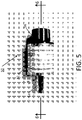
- FIG. 5 is an elevational front side view of an exemplar delay tool according hereto;
- FIG. 6 is a slightly enlarged cross-sectional view of a delay tool as in FIG. 5 taken along line 6 - 6 thereof;
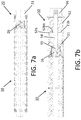
- FIG. 7 which includes and is defined by sub-part FIGS. 7 a and 7 b , provides cross-sectional views of a rocket motor and delay ( FIG. 7 a ) and a rocket motor and delay as in FIGS. 1-4 and a delay tool as in FIGS. 5 and 6 applied thereto ( FIG. 7 b );
- FIG. 8 is an elevational front side view of a delay tool as from FIGS. 5 and 6 in a first operational position relative to a rocket motor delay useable herewith/herein;
- FIG. 9 is a side view of a delay tool as from FIGS. 5, 6 and 8 in a second operational position relative to a rocket motor delay;
- FIG. 10 is a side view of a delay tool as from FIGS. 5, 6, 8 and 9 with an alternative added operational element;
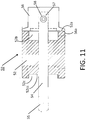
- FIG. 11 is a cross-sectional side view of a delay tool as from FIGS. 5 and 6 with a portion thereof flipped into an alternative operational position;
- FIG. 12 is a cross-sectional view of a re-loadable alternative rocket motor
- FIG. 13 which includes and is defined by sub-part FIGS. 13 a and 13 b , provides cross-sectional views of re-loadable alternative rocket motors and drill delay tools in alternative operative dispositions relative thereto;
- FIG. 14 is an isometric view of a propellant grain assembly of a rocket motor usable herewith;
- FIG. 15 is a partially sectional isometric view of a rocket motor casing with a propellant grain disposed therein;
- FIG. 16 is a partially sectional isometric view of a rocket motor hereof including a rocket motor casing with a propellant grain and a forward closure assembly with an ejection delay assembly disposed therein;
- FIG. 17 is a partially sectional isometric view of a rocket motor like that of FIGS. 1 and/or 16 with an ejection charge included and an ejection charge cap in place;
- FIG. 18 is a partially sectional isometric view of a rocket motor like that of FIGS. 1 and/or 16 and/or 17 with an igniter installed; and,
- FIGS. 19 and 20 provide flow charts of use according hereto.
- delay manipulatable rocket systems As summarized above, and set forth in more detail hereinbelow, disclosed here are delay manipulatable rocket systems, rocket motor apparatuses, delay manipulation tools, systems and methods for delay manipulation as may particularly be useful either for a rocket motor for one or more of single use, limited re-use or a reloadable rocket motor systems.
- single use motors with modifiable delays modified in distinctive ways and/or, implementations may include single use motors with distinctive modifiability/variability of the size/amount of the ejection charge (e.g., the diameter, the bigger or smaller size of a parachute compartment may need more ejection charge for operation, and yet, too much can cause undesirable breakage of the payload and/or rocket or rocket motor).
- a user would need to break open a pre-packaged ejection charge, which has heretofore been undesirable. Indeed variability in ejection charge size has typically required NAR/NFPA certification; i.e., consumer rocketry rules haven't allowed consumer modified ejection or delay modification unless pre-certified by the NFPA. Also, conventional rocket motor systems have not structurally allowed delay modification easily; e.g., single use motors typically have the delay bulkhead pre-affixed to the propellant chamber making access via the propellant side infeasible, and have the ejection charge pre-loaded in the ejection well, making access to the delay not possible.
- Reloadable motors conventionally provide similar problems in many designs where ejection side access to the delay is often not available and propellant side access to the delay is not direct either.
- one tool may be a substantially universal tool—for single use and for reloadable motor systems, either for modification from the ejection end or the propellant side; i.e., delay modification according hereto may be achieved from the ejection side also.
- Rocket systems with the delay manipulability and/or with which exemplar delay tools hereof may be used will first be described briefly, with details of manipulation and alternative exemplar delay tools then addressed.
- the current implementations of rocket systems generally include either single use or limited use systems or reloadable rocket motor systems.
- component parts and/or kits may be provided for loadable, typically single use rockets and/or for limited re-use or for reloadable use rocket systems.
- All these types of implementations generally include: a rocket motor housing, the rocket motor housing adapted to contain propellant; an aft closure with a nozzle, the aft closure connected or connectable to the housing; a forward closure connected or connectable to the housing; wherein one or both of the aft closure and the forward closure are connectable to the housing in a manner adapted for one or more of limited re-use or single use or, as described further below, reloadable, re-usable rocket motor implementations.
- the rocket motor is made loadable by insertion by the end-user of the propellant and any delay and/or ejection charge or charges followed by or with the single or limited use attachment of the forward and/or aft closures.
- the closures may be permanently affixed for a single use system, or removably loaded for limited re-use.
- the housing and aft closure, with nozzle may be either permanently affixed together or more often detachably attachable to each other as by being respectively removably connectable, as in an example, where they may be cooperatively threaded for a screwing together and un-screwable removal from each other.
- the forward closure may then be either permanently affixed in such a reloadable system, or it may also be removably disposed for full or limited re-use.
- the reloadable rocket motor is loaded by insertion by the end-user of the propellant and any delay and/or ejection charge or charges whether through the aft or forward end; then, the aft or the forward closure or both would attached/inserted to complete the loading.
- the aft or forward closure may be removably attachable or either may be pre-affixed to the housing, pre-molded as such or permanently or substantially permanently connected, with loading of the housing through the alternate opening closable by a closure member.
- the other closure may then be connected permanently or substantially permanently after loading for a removably connectable re-use.
- Such rocket motor casings may thus be simply loadable and may be adapted for one or more of limited re-use, single use or reloadable use in that one or both of the aft closure and the forward closure are connected or connectable, perhaps removably so, to the casing in a manner whereby one or the other may be pre-affixed or also removably attachable to the casing. If pre-affixed, whether integrally formed with, or later attached thereto in a permanent or substantially permanent form, this may ease the loading of the motor for use, and in some cases, re-use, reloadable or otherwise.
- a rocket motor apparatus or system 10 having a casing 11 , with a loadable (single use) or re-loadable (herein, limited re-use) or reloadable (RMS) kit 15 (generally the parts disposed or to-be-disposed within casing 11 ).
- a loadable (single use) or re-loadable (herein, limited re-use) or reloadable (RMS) kit 15 generally the parts disposed or to-be-disposed within casing 11 .
- Some distinctions in some kits 15 may be identified where single use or re-use or reloadable may be available, or desired (see e.g., the examples of FIGS. 12 and 13 , below).
- FIG. 1 a single or limited re-use implementation 10 with a fixedly attached (i.e., not removable) aft closure 12 (a re-loadable alternative is shown in more detail and described more specifically relative to FIGS. 12-13 , below).
- the casing 11 in this example has an aft closure 12 built-in, as in either integrally formed therewith or at some point affixed thereto permanently, or substantially permanently.
- this first description will be of the fixed aft closure type, though the delay manipulation operability would also be functional within the following description even if a fixed forward closure system is used.
- a nozzle 14 is shown built-into the aft closure 12 , and thus forms a part of the assembly of the casing 11 .
- the aft closure 12 is shown pre-affixed to the casing 11 in some of the drawing examples herein, it may be that the forward closure element 21 (see description thereof below) is pre-affixed to the casing 11 , with the aft closure 12 to be connectable and thus later connected to the casing after loading of the interior elements.
- a load/reload kit 15 may include a propellant grain 16 with a liner (often a long paper tube) 17 , and a forward closure assembly 20 , which may include a forward closure element 21 (sometimes also/alternatively referred to as a bulkhead), a forward insulator 22 (typically a black fiber washer) between the propellant and the fore closure, a forward closure o-ring 23 (indicated with a leader line in dashed line form in FIG. 1 (and also FIG.
- a delay insulator 24 As this may be a typical option for re-use, but likely not typically used for single-use as an epoxy or other permanent seal may be used instead (see FIGS. 3 and 7 , below), a delay insulator 24 , a delay o-ring 25 , a delay element 26 , a delay spacer 27 , an ejection charge 28 with ejection charge retainer cap 29 (often a rubber cap) (typically, the ejection charge may be contained within a discrete storage/transport container (not shown)).
- a more detailed assembly operation is described in the following, particularly with reference to FIGS. 2-4 and 14-18 , inter alia.
- a first set of such assembly operations may include the following.
- a light coat of an acceptable rocket motor grease may be applied to any o-rings, particularly to the delay o-ring 25 , and to the forward closure o-ring 23 , if used.
- FIG. 2 shows an assembly of a delay system, e.g., of a delay element 26 within an insulator 24 with a spacer 27 and an o-ring 25 .
- the delay element 26 , delay insulator 24 , delay spacer 27 and delay o-ring 25 may then be assembled as shown, particularly in moving from the exploded view of FIG. 2 to the assembled view of FIG. 3 . Then as indicated in moving from FIG. 3 to FIG. 4 , the delay charge assembly (of FIG. 3 ) may be inserted into the delay cavity 21 a (which might be lightly greased) of forward closure 21 , delay o-ring 25 end first, until it is seated against the forward end of the forward closure 21 .
- the other well 21 e is the ejection well for the ejection charge (described further below). Note it may be that the delay elements ( 24 , 25 , 26 and/or 27 ) of FIGS.
- FIGS. 1 and 7 a Disposition within the rocket motor may then be made such as is shown in FIGS. 1 and 7 a for two alternative examples.
- a delay manipulation device 50 also sometimes referred to herein as a delay drilling tool 50 is shown in FIG. 5 and the cross-section of FIG. 6 , may be used herewith/herein.
- a tool or device 50 may include a body structure or frame 52 , a drilling bit 54 and a drill knob 56 connected internally to the drilling bit.
- This knob to bit connection is shown better in FIG. 6 by a bolt or screw 58 , though other forms of connection might be used as well or instead.
- the drill bit 54 has a drilling end portion 55 and a connection end portion 57 as shown in FIG. 6 .
- the as-supplied delay element will have a first time delay period associated therewith without manipulation (the material thereof will be disposed to be consumed within a period of time known as the first time delay period), and if the user wants to use the longest (as-supplied) time delay, no further manipulation would be necessary, i.e., the delay drilling tool would not be used and instead the user would proceed to complete the loading process for launch as described in further detail herein.
- the delay drilling tool 50 will be assembled into a disposition such as that shown in either FIG. 5 or 6 , In moving from FIGS.
- FIG. 7 b delay tool in contact disposition for operation
- the user would then place the open end of body or frame 52 with the drill bit end portion 55 of the tool over the motor bulkhead/forward closure 21 to the position as shown in FIG. 7 b ; particularly so that the inner transverse surface 52 bb of body 52 comes into operational contact with or otherwise adjacent upper surface 21 b of bulkhead 21 .
- the user would hold the tool 50 and bulkhead 21 firmly against each other and turn the drill knob 56 several times clockwise until the drill knob 56 sits flush against the drill tool body/frame 52 . In so doing, the drill bit digs into the delay 26 to the position of FIG. 7 b , and a desired amount of delay material from delay 26 is removed therefrom.
- FIG. 8 shows a first position before any drilling or turning of the knob is initiated (see space disposed between knob 56 and frame body 52 defined between opposing surfaces 52 a and 56 a ), and FIG. 9 shows the completed position after drilling (see no space between frame body 52 and knob 56 ).
- the position of FIGS. 7 b and 9 shows the frame 52 acting as a stop to stop/restrict the ability for any further incursion by the drill bit head 55 into the delay element 26 .
- this operation results in a drilling into the body of the delay element 26 and effective removal of some of the material thereof. This reduction of material from the body of the delay element 26 will result in a reduced time for burn through of the delay element and thus a reduced delay before the ejection charge is ignited to eject/deploy the recovery system.
- the user will then remove the tool 50 from the bulkhead 21 and thus also from the delay element 26 , and then, the user will shake out the shavings from the delay element 26 from the tool and motor bulkhead. Typically, the user will then dispose of the delay shavings by burning the shavings with a safe method and in a safe location.
- a feature hereof can be included and involve adaptations that allow a user to select different time periods of delay with alternative selections as to the orientation and use of the tool.
- a spacer 59 such as is shown in FIG. 10 may be interposed between the knob 56 and the frame body 52 .
- the spacer 59 would then provide a sooner stop by setting a desired thickness between the upper surface 52 a of the frame body 52 and the under surface 56 a of the knob 56 so that each of these surfaces come into operable contact with the spacer or washer 59 rather than coming into contact with each other as shown in FIGS. 8 to 9 .
- the result is a selected somewhat less material removed from the delay element 26 and thus a longer burn-through time period and hence a longer delay before ejection charge firing and ejection deployment.
- a different delay period might then be selectable using a frame body 52 like that shown in cross section of FIG. 6 and flipped in FIG. 11 relative to the drill bit/knob 54 / 56 combination, where the shallower well 52 c is now disposed at or near the drilling end 55 of the drill bit 54 so that the drill bit 54 may now not be allowed to drill as deep into a delay element 26 when in use.
- the deeper well 52 b is now adjacent the knob 56 .
- the wells 52 b and 52 c actually engage the top portion of the bulkhead 21 as shown in FIG. 7 b (inner transverse surface (either of surfaces 52 bb or 52 cc , surface 52 cc identified in FIG.
- the frame 52 may provide, for a particular exemplar device 50 , either a 4 or an 8 second less delay than the un-drilled delay element would provide—the 4 seconds-less delay corresponding to the shallower well 52 c being flipped into position (see FIG. 11 ) such that it is at the drill bit end 55 and engages bulkhead 21 , and the 8 seconds-less delay corresponding to the use of the deeper well 52 b at the drill bit end 55 and engaged with bulkhead 21 to remove more delay material from delay element 26 .
- the spacer/washer 59 (see FIG. 10 disposition between the drill knob and the tool) can then be pre-selected to provide another desired interval of time delay between those provided by the alternate wells 52 b/c if the user wants to remove 2 seconds less than the value printed on the tool, i.e., 2 or 6 seconds-less delay period based on corresponding delay material removal—the 2 second delay corresponding to the period achieved if the shallower 4 second well 52 c is selected for disposition at and engaged with the bulkhead 21 and the spacer 59 is also used, and the 6 second delay corresponding to the use of the 8 second deeper well 52 b and the washer 59 .
- the delay material may be drilled out from either the ejection end or the propellant side.
- a foreword closure that may be initially disparate from the rocket motor but assembled therewith after a delay drilling procedure.
- a propellant side delay may be drilled using a tool 50 , in some implementations before the fore closure has been attached to the rocket motor.
- the fore closure can be contacted by the tool 50 from the propellant side, the tool engaging an appropriate surface of the fore closure, and the drilling operation completed.
- the fore closure with the selected and modified delay can then be attached to the rocket, either fixed in place as in single-use (sometimes with epoxy or like), or removably disposed therein as in limited re-use or reloadable (see below for more description of reloadable options).
- FIG. 12 is a reloadable implementation 100 with a removably attached/attachable aft closure 120 .
- the casing 110 in this example has an aft closure 120 affixable thereto but detachably so.
- a nozzle 14 is shown built-into the aft closure 120 (not unlike the built-in nozzle 14 of the fixed closure 12 of the single use/limited re-use example of FIG.
- the aft closure 120 is shown removably attached to the casing 110 in the drawing examples herein, it may be that the forward closure element 210 is pre- and/or permanently affixed or affixable to the casing 110 , however, as shown in this implementation, the forward closure 210 here is also removably attachable with the aft closure 120 to be connected to the casing 110 before or after loading of the interior rocket motor elements, if before, then, the propellant grains, etc. would be loaded from the forward end, if after, then, the grains would be loaded from the aft end.
- a reload kit 150 may include a propellant grain 16 with a liner (often a long paper tube) 17 , and a forward closure assembly 200 , which may include a forward closure element 210 (sometimes also/alternatively referred to as a bulkhead), a forward insulator 22 between the propellant and the fore closure, a forward closure o-ring 23 as this may be a typical option for re-use, a delay insulator 24 , a delay element 26 , an ejection charge 28 with ejection charge retainer cap 29 (typically, the ejection charge may be contained within a discrete storage/transport container (not shown)).
- Assembly is not unlike that described above for the other implementations, the primary exceptions being that the forward bulkhead and the aft closure will be attached to the rocket motor casing, one or the other before the insertion of the motor fuel and related components. Then, the other of the aft closure and the forward bulkhead would be attached to finish the assembly.
- a drilling procedure is conducted or conductible before or after the forward closure is attached to the casing, and/or it may be that the drilling operation may be completed from either end of the forward closure, whether the ejection end or the propellant end; implementations of each being described here with reference to FIG. 13 .
- the delay is manipulated as was shown for the single use (limited re-use) example(s) above through the ejection well and thus, may take place before or after the disposition of the fore closure on or in the casing 110 ; however, in an alternative operation with a reloadable system wherein a delay adjustment is performed before the forward bulkhead is attached to the rocket motor casing will also be described below.
- a delay tool 50 is shown as operatively disposed relative to a forward closure, as for example here, a fore closure 210 , here operatively engaging the delay material 26 through the ejection well 21 e .
- a tool 50 having a body 52 and a drill bit 54 with a drill end 55 engaging the material 26 is disposed such that the inner transverse surface 52 bb is engaged with bulkhead upper surface 21 b .
- knob 56 is operated to turn the drill and remove material from the delay charge 26 to a depth D, to reduce the delay period before the ejection charge would be ignited to deliver the payload (not shown).
- timing of the delay manipulation may be accomplished here also like that done for and as shown in and described relative to FIGS. 8-11 (e.g., flipping the body 52 and/or using a spacer 59 ), the description thereof from above incorporated herein as if fully set forth here.
- a “universal” tool for delay manipulation may thus be achieved for use with either or both of single use and/or reloadable motor systems (and limited re-use systems).
- a delay manipulation device 500 also sometimes referred to herein as a delay drilling tool 500 is shown in FIG. 13 b , and includes a frame 520 , a drilling bit 54 and a drill knob 56 connected to the drilling bit.
- This knob to bit connection is shown in FIG. 13 by a screw 58 , though other forms of connection might be used as well or instead.
- the drill bit 54 has drilling end portion 55 and a connection end portion 57 as shown in FIG. 13 .
- the as-supplied delay element will have a first time delay period associated therewith without manipulation, and if the user wants to use the longest (as-supplied) time delay, no further manipulation would be necessary, i.e., the delay drilling tool would not be used and instead the user would proceed to complete the loading process for launch as described above and in further detail below.
- the delay drilling tool will be assembled into a disposition such as that shown in either FIG. 13 .
- FIG. 13 b shows an end position after drilling or turning of the knob has been completed. Note, a preliminary position would not be unlike that shown for the prior implementation; see FIG.
- FIG. 13 b shows the frame 520 acting as a stop to stop/restrict the ability for any further incursion by the drill bit head 55 into the delay element 26 .
- this operation then results in a drilling into the body of the delay element 26 and effective removal of some of the material thereof. This reduction of material from the body of the delay element 26 will result in a reduced time for burn through of the delay element and thus a reduced delay before the ejection charge is ignited to eject/deploy the recovery system.
- internal structures such as internal cylindrical structures 52 d and 52 e within the respective wells 52 b and 52 c might be used for establishing the preferred seat of the tool 500 against the bulkhead 210 , here as seated adjacent the delay element and/or the delay well structure of the bulkhead.
- Alternative seating structures like this are not intended to be limiting, merely illustrative of alternative structures of the frame 52 or 520 to set the tool in a desired position to drill out a desired quantity of delay material to achieve the modified delay period.
- the user will then remove the tool 500 from the bulkhead 210 and thus also the delay element 26 , and then, the user will shake out the shavings from the delay element 26 from the tool and motor bulkhead. Typically, the user will then dispose of the shavings by burning with a safe method and in a safe location.
- an alternative feature hereof may also involve adaptations that allow a selection of different time periods of delay with alternative selections as to the use of the tool.
- a spacer 59 such as is shown in FIG. 10 may be interposed between the knob 56 and the frame body 520 of the tool 500 of FIG. 13 b (spacer 59 not shown in FIG. 13 ).
- the spacer 59 would then provide a desired thickness between the upper surface 52 a of the frame body 520 and the under surface 56 a of the knob 56 so that each of these surfaces come into operable contact with the spacer or washer 59 (spacer 59 not shown in FIG.
- a longer delay period might then be selectable using a frame body like that shown in cross section of FIG. 13 and flipped as was the prior implementation flipped in FIG. 11 where the shallower well 52 c would then be disposed at or near the drilling end 55 of the drill bit 54 so that the drill bit 54 may then not be allowed to drill as deep into a delay element 26 when in use.
- the deeper well 52 b would then be adjacent the knob 56 .
- the wells 52 b and 52 c actually engage the interior delay portion of the bulkhead 210 as shown in FIG. 13 , and thus, this sets whether and how deep the drill bit may drill into the delay material 26 .
- the frame 520 may provide, for a particular example, a 4 or an 8 second less delay than the un-drilled delay element would provide—the 4 second delay corresponding to the shallower well 52 c being flipped into position (see FIG.
- a first operation 202 includes selecting the desired delay time relative to the tool; whether using a delay spacer, or one or the other of a larger or smaller well; then, the operation 203 of applying the tool to the bulkhead, and particularly with putting the drill bit into contact with the delay charge in the bulkhead, and finally, in operation 206 , the user drills to remove the delay material and thus modify, and set the delay time.
- some implementations may have some dependence on the type of delay material for control of burn rate relative to material removed and geometry of removed material; i.e., 1) it may be found desirable to employ a delay material that burns flat, i.e., a pre-understood appreciation for the burn rate of the delay material relative to amount and geometry and volume may be preferred for most implementations and so also may want consideration of tube material and sizing for appreciation of controlled burning of delay material relative to time and amount of material burned 2) also may want consideration of how the delay is sealed in bulkhead—some alternative dispositions and sealing materials may create different burn rates and, 3) may also want understanding and/or control of motor pressure to ensure controlled burn rate for the delay relative to the quantity existent versus removed.
- case assembly may further include the following.
- an exemplar propellant grain 16 may be installed into the liner 17 (before or after the liner 17 is inserted in the motor casing 11 ).
- the liner assembly, propellant 16 and liner 17 is disposed/inserted in the motor casing 11 until it is seated against the nozzle end of the case, e.g., at aft closure 12 .
- the forward insulator 22 installed into the motor casing 11 until it is seated against the liner/propellant combination. A forward cavity 11 a of casing 11 is then left for the forward closure element 21 .
- the forward closure element 21 is inserted in the casing 11 .
- this may be either an epoxy finish, or this may be a threaded area 21 c as well for ease of insertion and locking of the forward closure assembly therein whether in single use or re-usable form.
- the previously assembled forward closure assembly 20 may then be threaded into the open end 11 a of the motor casing 11 until it is seated against the forward insulator 22 or, if in single use form, then, additional epoxy may be applied during and after insertion of closure assembly 20 in the casing 11 .
- the completed assembly may then be set for insertion of the ejection charge as described below.
- the ejection charge installation may include the following.
- An ejection charge is obtained, usually a black powder charge which may come in a special container therefor.
- the ejection charge 28 (see FIG. 17 ) is then dispensed into the ejection charge well 21 b (see FIG. 16 ) of the forward closure bulkhead 21 .
- the ejection charge cap 29 may then be pressed into the ejection charge well (see FIGS. 1 and 17 ).
- An aft thrust ring 19 (see FIG. 1 ) may be bonded to the nozzle end of the case 11 , e.g., at aft closure 12 .
- Aft thrust ring 19 may interact with a rocket body (not shown) to carry the rocket body. Ring 19 may be affixed before or after the insertion of the loadable/re-loadable kit elements.
- an igniter 30 e.g., a FirstFireTM igniter from RCS Rocket Motor Components, Cedar City Utah
- an igniter 30 may be inserted through the nozzle throat 14 until it stops against the delay element 26 .
- the aft exposed end of the igniter 30 may be engaged by a rubberband igniter holder 32 (or other holder, e.g., tape, glue or the like, particularly if in single-use form).
- a few operations generally may be summarized as shown for example in FIG. 19 .
- One implementation of an assembly method 100 may include first obtaining or otherwise starting with a rocket motor casing with either an aft or forward closure affixed thereto.
- an operation 104 may include loading the propellant into the casing. (A dashed line arrow between operations 102 and 104 indicates that these steps may be pre-performed, as at a manufacturer factory, and may not necessarily occur in the order shown.) Note further that the pre-formation and/or packaging of rocket motor elements can include establishing a pre-determined amount of propellant which might aid packaging for transportation in commerce under federal regulations (e.g. DOT regulations).
- a follow-on operation 106 may then include attaching a previously un-affixed closure, either the aft or forward closure, whichever was not priorly affixed to the casing.
- the rocket may then be ready to fly. Note, additional operations may occur as well, as for example, if an ejection delay is desired, wherein it would be loaded into the casing as well prior to final assembly of the rocket. Note also that a dashed line is shown connecting operation 106 back to operation 102 , this signifying the option of re-use in some circumstances as described herein.
- the rocket motor 10 may then be ignited and the rocket may then be flown.
- NAR/NFPA certification has been typically required for delay modification; i.e., consumer rocketry rules have not allowed consumer modified ejection or delay modification unless pre-certified by NFPA. This may be due to the fixed motor size created by a pre-formed casing with one pre-affixed end closure, aft or fore; the maximum amount of propellant (and other combustibles), then being fixed as well.
- component parts or a kit may be provided by a manufacturer or distributor to achieve the combination or combinations hereof.
- a component may be a housing with a fore or aft closure affixed. Another cooperative component therewith would be the other of the closures, not priorly affixed.
- Propellant in appropriate size/quantity may be a further component.
- a kit could include each of these and perhaps also instructions for assembly and/or use.
- the forward closure or bulkhead 21 is substantially integral with the housing 11 rather than the aft closure 12 being so. Then, after loading internal propellant 16 (typically with a liner 17 ), such a discrete aft closure 12 may be subsequently attached to the housing 11 . In such case, this could also be either limited re-use or single use, thus, such an aft closure 12 may be attached to the housing either with epoxy, or other adhesive, for substantially permanent affixation, and thus single use; or, with an O-ring, and a greased connection, screwed or otherwise connected to assure a sufficient seal, though being openable for re-use.
- a delay charge arrangement may be used as well, being insertable into the fore closure typically prior to insertion of propellant; however, it may prove less simple with a fixed fore closure to insert such a delay charge 26 with associated hardware (o-ring 25 , insulator 24 , spacer 27 , separator 22 ) in and through the length of the rocket motor housing 11 .
- An alternative here is to use no delay, or a different kind of delay, as for example an electronic (timing, altitude or speed or g-force sensing) delay. Note, such alternative delays (or no delays) could be used with an affixed aft closure system as shown in FIG. 1 , as well.
- the rocket motor 10 may be simplified elementally to a housing or casing 11 , an aft closure 12 with nozzle 14 , and a fore closure 21 (in such instance, the fore closure having no openings, and serving substantially the sole purpose of closing the fore end of the rocket motor).
- the form defines a propellant combustion chamber in the housing 11 , between the fore and aft closures to direct exhaust gases through the nozzle 14 .
- the housing 11 may have either the aft closure or the fore closure integral therewith or permanently or substantially permanently affixed thereto.
- the other of the aft and fore closure is then connectable to the housing either in a relatively permanent fashion (e.g., epoxy) for single use, or removably attachable for re-use.
Landscapes
- Engineering & Computer Science (AREA)
- General Engineering & Computer Science (AREA)
- Chemical & Material Sciences (AREA)
- Combustion & Propulsion (AREA)
- Mechanical Engineering (AREA)
- Aviation & Aerospace Engineering (AREA)
- Earth Drilling (AREA)
- Surgical Instruments (AREA)
Abstract
Description
Claims (7)
Priority Applications (1)
| Application Number | Priority Date | Filing Date | Title |
|---|---|---|---|
| US16/121,230 US10690467B2 (en) | 2013-02-21 | 2018-09-04 | Rocket delay apparatuses, systems and methods |
Applications Claiming Priority (4)
| Application Number | Priority Date | Filing Date | Title |
|---|---|---|---|
| US201361767767P | 2013-02-21 | 2013-02-21 | |
| US14/187,140 US9416753B2 (en) | 2013-02-21 | 2014-02-21 | Rocket delay apparatuses, systems and methods |
| US15/238,335 US10066918B2 (en) | 2013-02-21 | 2016-08-16 | Rocket delay apparatuses, systems and methods |
| US16/121,230 US10690467B2 (en) | 2013-02-21 | 2018-09-04 | Rocket delay apparatuses, systems and methods |
Related Parent Applications (1)
| Application Number | Title | Priority Date | Filing Date |
|---|---|---|---|
| US15/238,335 Continuation US10066918B2 (en) | 2013-02-21 | 2016-08-16 | Rocket delay apparatuses, systems and methods |
Publications (2)
| Publication Number | Publication Date |
|---|---|
| US20190011243A1 US20190011243A1 (en) | 2019-01-10 |
| US10690467B2 true US10690467B2 (en) | 2020-06-23 |
Family
ID=51350195
Family Applications (3)
| Application Number | Title | Priority Date | Filing Date |
|---|---|---|---|
| US14/187,140 Active US9416753B2 (en) | 2013-02-21 | 2014-02-21 | Rocket delay apparatuses, systems and methods |
| US15/238,335 Active US10066918B2 (en) | 2013-02-21 | 2016-08-16 | Rocket delay apparatuses, systems and methods |
| US16/121,230 Active US10690467B2 (en) | 2013-02-21 | 2018-09-04 | Rocket delay apparatuses, systems and methods |
Family Applications Before (2)
| Application Number | Title | Priority Date | Filing Date |
|---|---|---|---|
| US14/187,140 Active US9416753B2 (en) | 2013-02-21 | 2014-02-21 | Rocket delay apparatuses, systems and methods |
| US15/238,335 Active US10066918B2 (en) | 2013-02-21 | 2016-08-16 | Rocket delay apparatuses, systems and methods |
Country Status (5)
| Country | Link |
|---|---|
| US (3) | US9416753B2 (en) |
| EP (1) | EP2959150B1 (en) |
| AU (1) | AU2014223788B2 (en) |
| CA (1) | CA2901295C (en) |
| WO (1) | WO2014133911A2 (en) |
Families Citing this family (2)
| Publication number | Priority date | Publication date | Assignee | Title |
|---|---|---|---|---|
| CA2901295C (en) | 2013-02-21 | 2022-03-22 | Gary C. Rosenfield | Rocket delay apparatuses, systems and methods |
| CN110259602B (en) * | 2019-06-21 | 2020-06-05 | 北京理工大学 | A rechargeable multi-pulse solid rocket motor |
Citations (6)
| Publication number | Priority date | Publication date | Assignee | Title |
|---|---|---|---|---|
| US3125955A (en) * | 1964-03-24 | Toy rocket motor | ||
| US4355577A (en) * | 1979-08-24 | 1982-10-26 | Ady Michael S | Model rocket propulsion system |
| US5309712A (en) * | 1991-05-03 | 1994-05-10 | Mund Jr Charles J | Solid fuel rocket motor seals |
| US6079202A (en) * | 1998-04-17 | 2000-06-27 | Cesaroni; Anthony J. | Reloadable/modular solid propellant rocket motor |
| US20100024428A1 (en) * | 2006-07-31 | 2010-02-04 | Rosenfield Gary C | Rocket Apparatus and/or Method |
| US20100237197A1 (en) * | 2005-07-15 | 2010-09-23 | Rosenfield Gary C | Rocket ejection delay apparatus and/or method |
Family Cites Families (1)
| Publication number | Priority date | Publication date | Assignee | Title |
|---|---|---|---|---|
| CA2901295C (en) | 2013-02-21 | 2022-03-22 | Gary C. Rosenfield | Rocket delay apparatuses, systems and methods |
-
2014
- 2014-02-21 CA CA2901295A patent/CA2901295C/en active Active
- 2014-02-21 US US14/187,140 patent/US9416753B2/en active Active
- 2014-02-21 WO PCT/US2014/017834 patent/WO2014133911A2/en not_active Ceased
- 2014-02-21 AU AU2014223788A patent/AU2014223788B2/en not_active Revoked
- 2014-02-21 EP EP14757693.8A patent/EP2959150B1/en active Active
-
2016
- 2016-08-16 US US15/238,335 patent/US10066918B2/en active Active
-
2018
- 2018-09-04 US US16/121,230 patent/US10690467B2/en active Active
Patent Citations (6)
| Publication number | Priority date | Publication date | Assignee | Title |
|---|---|---|---|---|
| US3125955A (en) * | 1964-03-24 | Toy rocket motor | ||
| US4355577A (en) * | 1979-08-24 | 1982-10-26 | Ady Michael S | Model rocket propulsion system |
| US5309712A (en) * | 1991-05-03 | 1994-05-10 | Mund Jr Charles J | Solid fuel rocket motor seals |
| US6079202A (en) * | 1998-04-17 | 2000-06-27 | Cesaroni; Anthony J. | Reloadable/modular solid propellant rocket motor |
| US20100237197A1 (en) * | 2005-07-15 | 2010-09-23 | Rosenfield Gary C | Rocket ejection delay apparatus and/or method |
| US20100024428A1 (en) * | 2006-07-31 | 2010-02-04 | Rosenfield Gary C | Rocket Apparatus and/or Method |
Non-Patent Citations (1)
| Title |
|---|
| NPL, Youtube video https://www.youtube.com/watch?v=8MXI5OcTgs4 May 19, 2010 "Using the Cesaroni ProDAT Tool for Reloadable Rocket Motors". * |
Also Published As
| Publication number | Publication date |
|---|---|
| EP2959150B1 (en) | 2018-08-29 |
| AU2014223788A1 (en) | 2015-09-10 |
| US20190011243A1 (en) | 2019-01-10 |
| EP2959150A4 (en) | 2016-11-23 |
| WO2014133911A3 (en) | 2015-10-29 |
| US10066918B2 (en) | 2018-09-04 |
| EP2959150A2 (en) | 2015-12-30 |
| US20160356589A1 (en) | 2016-12-08 |
| US9416753B2 (en) | 2016-08-16 |
| CA2901295C (en) | 2022-03-22 |
| US20140230678A1 (en) | 2014-08-21 |
| WO2014133911A2 (en) | 2014-09-04 |
| AU2014223788B2 (en) | 2017-09-28 |
| CA2901295A1 (en) | 2014-09-04 |
Similar Documents
| Publication | Publication Date | Title |
|---|---|---|
| US7086337B2 (en) | Non-lethal projectile ammunition | |
| US20190011243A1 (en) | Rocket delay apparatuses, systems and methods | |
| US5155295A (en) | Cartridge assembly | |
| US20160054105A1 (en) | Firearm Ammunition Case Insert | |
| US5579636A (en) | Pyrotechnic valve, igniter and combustion preheater for hybrid rocket motors | |
| US5129324A (en) | Cartridge assembly | |
| CA2776804A1 (en) | Cartridge ammunition having a bursting device as a connection between projectile and propulsion | |
| US12553684B2 (en) | Non-lethal gas operated gun | |
| US6470806B1 (en) | Cartridge format delay igniter | |
| US7578238B1 (en) | Base bleed boat tail converter for projectile | |
| US12601575B2 (en) | Range extension device | |
| US6796244B2 (en) | Opening and closing a container | |
| US3175494A (en) | Liquid propellant projectile unit | |
| US10746133B2 (en) | Rocket apparatuses, systems and methods | |
| US4461214A (en) | Cartridge loaded hybrid propellant | |
| US3071883A (en) | Underwater projectile | |
| US10852106B2 (en) | Firearm ammunition with projectile housing propellant | |
| US3070014A (en) | Jet propulsion device | |
| JP4953101B2 (en) | Air gun cartridge | |
| JP2005055169A (en) | Lighter | |
| US7546804B1 (en) | Artillery charge with laser ignition | |
| US20100024428A1 (en) | Rocket Apparatus and/or Method | |
| JP3390730B2 (en) | Revolver type air gun | |
| FR2719373A1 (en) | Propulsion unit for riot control grenade | |
| JP5354963B2 (en) | Cannonball firing speed change device |
Legal Events
| Date | Code | Title | Description |
|---|---|---|---|
| FEPP | Fee payment procedure |
Free format text: ENTITY STATUS SET TO UNDISCOUNTED (ORIGINAL EVENT CODE: BIG.); ENTITY STATUS OF PATENT OWNER: SMALL ENTITY |
|
| FEPP | Fee payment procedure |
Free format text: ENTITY STATUS SET TO SMALL (ORIGINAL EVENT CODE: SMAL); ENTITY STATUS OF PATENT OWNER: SMALL ENTITY |
|
| STPP | Information on status: patent application and granting procedure in general |
Free format text: DOCKETED NEW CASE - READY FOR EXAMINATION |
|
| STPP | Information on status: patent application and granting procedure in general |
Free format text: NON FINAL ACTION MAILED |
|
| STPP | Information on status: patent application and granting procedure in general |
Free format text: RESPONSE TO NON-FINAL OFFICE ACTION ENTERED AND FORWARDED TO EXAMINER |
|
| STPP | Information on status: patent application and granting procedure in general |
Free format text: NOTICE OF ALLOWANCE MAILED -- APPLICATION RECEIVED IN OFFICE OF PUBLICATIONS |
|
| STPP | Information on status: patent application and granting procedure in general |
Free format text: PUBLICATIONS -- ISSUE FEE PAYMENT VERIFIED |
|
| STCF | Information on status: patent grant |
Free format text: PATENTED CASE |
|
| MAFP | Maintenance fee payment |
Free format text: PAYMENT OF MAINTENANCE FEE, 4TH YR, SMALL ENTITY (ORIGINAL EVENT CODE: M2551); ENTITY STATUS OF PATENT OWNER: SMALL ENTITY Year of fee payment: 4 |
|
| AS | Assignment |
Owner name: RCS ROCKET MOTOR COMPONENTS, LLC, CALIFORNIA Free format text: ASSIGNMENT OF ASSIGNORS INTEREST;ASSIGNOR:ROSENFIELD, GARY;REEL/FRAME:072024/0655 Effective date: 20250527 |
|
| AS | Assignment |
Owner name: RCS ROCKET MOTOR COMPONENTS, INC., CALIFORNIA Free format text: ENTITY CONVERSION;ASSIGNOR:RCS ROCKET MOTOR COMPONENTS, LLC;REEL/FRAME:072505/0569 Effective date: 20250604 |
|
| AS | Assignment |
Owner name: CITIBANK, N.A., AS AGENT, NEW YORK Free format text: SECURITY INTEREST;ASSIGNOR:RCS ROCKET MOTOR COMPONENTS, INC.;REEL/FRAME:072079/0985 Effective date: 20250821 |