US10664117B1 - Composite transparent touch panel - Google Patents
Composite transparent touch panel Download PDFInfo
- Publication number
- US10664117B1 US10664117B1 US16/362,649 US201916362649A US10664117B1 US 10664117 B1 US10664117 B1 US 10664117B1 US 201916362649 A US201916362649 A US 201916362649A US 10664117 B1 US10664117 B1 US 10664117B1
- Authority
- US
- United States
- Prior art keywords
- columns
- capacitive
- sensing
- electromagnetic
- circuit pattern
- Prior art date
- Legal status (The legal status is an assumption and is not a legal conclusion. Google has not performed a legal analysis and makes no representation as to the accuracy of the status listed.)
- Active
Links
Images




Classifications
-
- G—PHYSICS
- G06—COMPUTING OR CALCULATING; COUNTING
- G06F—ELECTRIC DIGITAL DATA PROCESSING
- G06F3/00—Input arrangements for transferring data to be processed into a form capable of being handled by the computer; Output arrangements for transferring data from processing unit to output unit, e.g. interface arrangements
- G06F3/01—Input arrangements or combined input and output arrangements for interaction between user and computer
- G06F3/03—Arrangements for converting the position or the displacement of a member into a coded form
- G06F3/041—Digitisers, e.g. for touch screens or touch pads, characterised by the transducing means
- G06F3/046—Digitisers, e.g. for touch screens or touch pads, characterised by the transducing means by electromagnetic means
-
- G—PHYSICS
- G06—COMPUTING OR CALCULATING; COUNTING
- G06F—ELECTRIC DIGITAL DATA PROCESSING
- G06F3/00—Input arrangements for transferring data to be processed into a form capable of being handled by the computer; Output arrangements for transferring data from processing unit to output unit, e.g. interface arrangements
- G06F3/01—Input arrangements or combined input and output arrangements for interaction between user and computer
- G06F3/03—Arrangements for converting the position or the displacement of a member into a coded form
- G06F3/041—Digitisers, e.g. for touch screens or touch pads, characterised by the transducing means
- G06F3/044—Digitisers, e.g. for touch screens or touch pads, characterised by the transducing means by capacitive means
- G06F3/0445—Digitisers, e.g. for touch screens or touch pads, characterised by the transducing means by capacitive means using two or more layers of sensing electrodes, e.g. using two layers of electrodes separated by a dielectric layer
-
- G—PHYSICS
- G06—COMPUTING OR CALCULATING; COUNTING
- G06F—ELECTRIC DIGITAL DATA PROCESSING
- G06F3/00—Input arrangements for transferring data to be processed into a form capable of being handled by the computer; Output arrangements for transferring data from processing unit to output unit, e.g. interface arrangements
- G06F3/01—Input arrangements or combined input and output arrangements for interaction between user and computer
- G06F3/03—Arrangements for converting the position or the displacement of a member into a coded form
- G06F3/041—Digitisers, e.g. for touch screens or touch pads, characterised by the transducing means
- G06F3/044—Digitisers, e.g. for touch screens or touch pads, characterised by the transducing means by capacitive means
- G06F3/0446—Digitisers, e.g. for touch screens or touch pads, characterised by the transducing means by capacitive means using a grid-like structure of electrodes in at least two directions, e.g. using row and column electrodes
-
- G—PHYSICS
- G06—COMPUTING OR CALCULATING; COUNTING
- G06F—ELECTRIC DIGITAL DATA PROCESSING
- G06F2203/00—Indexing scheme relating to G06F3/00 - G06F3/048
- G06F2203/041—Indexing scheme relating to G06F3/041 - G06F3/045
- G06F2203/04104—Multi-touch detection in digitiser, i.e. details about the simultaneous detection of a plurality of touching locations, e.g. multiple fingers or pen and finger
-
- G—PHYSICS
- G06—COMPUTING OR CALCULATING; COUNTING
- G06F—ELECTRIC DIGITAL DATA PROCESSING
- G06F2203/00—Indexing scheme relating to G06F3/00 - G06F3/048
- G06F2203/041—Indexing scheme relating to G06F3/041 - G06F3/045
- G06F2203/04106—Multi-sensing digitiser, i.e. digitiser using at least two different sensing technologies simultaneously or alternatively, e.g. for detecting pen and finger, for saving power or for improving position detection
-
- G—PHYSICS
- G06—COMPUTING OR CALCULATING; COUNTING
- G06F—ELECTRIC DIGITAL DATA PROCESSING
- G06F2203/00—Indexing scheme relating to G06F3/00 - G06F3/048
- G06F2203/041—Indexing scheme relating to G06F3/041 - G06F3/045
- G06F2203/04112—Electrode mesh in capacitive digitiser: electrode for touch sensing is formed of a mesh of very fine, normally metallic, interconnected lines that are almost invisible to see. This provides a quite large but transparent electrode surface, without need for ITO or similar transparent conductive material
Definitions
- the invention relates to a transparent touch panel mounted on a display, particularly to a transparent touch panel with both capacitive and electromagnetic touch sensing functions.
- ITO indium tin oxide
- X/Y axes antenna arrays of current electromagnetic touch sensors utilize metal material. Because metal wires would resist light, such a type of touch sensors is usually mounted under displays to prevent visibility of the displays from being attenuated.
- capacitive sensing electrodes and their signal paths of a current transparent capacitive touch sensor are made by etching an ITO film form a touch sensing circuit pattern, so there are both an electrode portion formed by conductive material and a scraped portion formed by removing conductive material.
- the electrode portion and the scraped portion have different transmittance to cause unevenness of refraction of light penetrating through the ITO film. This will result in obvious pattern or grain when a user is viewing the display.
- touch sensing electrodes and signal paths of a touch sensor become narrower and narrower in size.
- narrowed electrodes and signal paths will increase impedance to attenuate signals.
- conductivity of ITO films has been hard to satisfy requirements.
- induction coils or antenna arrays of electromagnetic touch sensors must have low impedance and general ITO films cannot satisfy this requirement, they are usually made by metal wires or films with high conductivity.
- metal wires cannot allow light to penetrate, a shading effect and an optical interference pattern (Moire) will occur when they are arranged in front of a display. This affects image quality seriously.
- such metal wires can only be used on the back of a display. This will increase thickness of overall display module and be adverse to the requirement of compactness.
- an electromagnetic pen is used on an electromagnetic touch sensor under a display panel, a problem of inputting accuracy degradation of the electromagnetic pen used at edges of the image will occur. Therefore, how to make an electromagnetic touch sensor have low impedance to be capable of being arranged in front of a display without attenuating visibility of an image shown on the display is a serious issue to be solved.
- An object of the invention is to provide an improved composite transparent touch panel, which has both capacitive and electromagnetic touch sensing modes to provide two touch input manners.
- Such a multiple touch input function is advantageous to development and application of new application software.
- Another object of the invention is to provide an improved composite transparent touch panel, which has uniform transmittance to be capable of being mounted in front of a display with keeping visibility of an image shown on the display.
- Still another object of the invention is to provide an improved composite transparent touch panel, which can improve conductive efficiency of touch signals to be advantageous to design and application of large-sized touch panels.
- an improved composite transparent touch panel which includes:
- a base layer having a colored bezel on a periphery of a side thereof, and the colored bezel defining a shaded area and a visible area surrounded by the shaded area;
- a first sensing layer having first capacitive sensing columns and first electromagnetic antenna columns, the first capacitive sensing columns and the first electromagnetic antenna columns being arranged along a first direction and separately insulatively interlaced with each other to form a first circuit pattern, a first end of each of the first capacitive sensing columns being provided with a first capacitive signal contact, a first end of each of the first electromagnetic antenna columns being provided with a first electromagnetic signal contact, a second end of each of the first electromagnetic antenna columns being connected to a first connecting wire, the first connecting wires electrically connecting the first electromagnetic antenna columns in series, the first circuit pattern being located in the visible area, and the first capacitive signal contacts, the first electromagnetic signal contacts and the first connecting wires are located in the shaded area;
- a first auxiliary conductive layer having a first mirroring pattern substantially identical to the first circuit pattern except the first electromagnetic signal contacts and the first electromagnetic signal contacts so as to make the first mirroring pattern correspondingly electrically connect to the first circuit pattern, and a first gap being formed between each first capacitive signal contact and a corresponding one of the first electromagnetic signal contacts, wherein a width of the first gap is above 200 ⁇ m;
- a second sensing layer having second capacitive sensing columns and second electromagnetic antenna columns, the second capacitive sensing columns and the second electromagnetic antenna columns being arranged along a second direction and separately insulatively interlaced with each other to form a second circuit pattern, a first end of each of the second capacitive sensing columns being provided with a second capacitive signal contact, a first end of each of the second electromagnetic antenna columns being provided with a second electromagnetic signal contact, a second end of each of the second electromagnetic antenna columns being connected to a second connecting wire, the second connecting wires electrically connecting the second electromagnetic antenna columns in series, the second circuit pattern being located in the visible area, and the second capacitive signal contacts, the second electromagnetic signal contacts and the second connecting wires are located in the shaded area;
- a second auxiliary conductive layer having a second mirroring pattern substantially identical to the second circuit pattern except the second electromagnetic signal contacts and the second electromagnetic signal contacts so as to make the second mirroring pattern correspondingly electrically connect to the second circuit pattern, and a second gap being formed between each second capacitive signal contact and a corresponding one of the second electromagnetic signal contacts, wherein a width of the second gap is above 200 ⁇ m;
- the first direction is orthogonal to the second direction
- the first capacitive sensing columns are orthogonal to the second capacitive sensing columns to constitute a rectangular-lattice-shaped array of diamond-shaped capacitive sensing units
- the first electromagnetic antenna columns are orthogonal to the second electromagnetic antenna columns to constitute a rectangular-lattice-shaped electromagnetic antenna array
- each of the first capacitive signal contacts, the first electromagnetic signal contacts, the second capacitive signal contacts and the second electromagnetic signal contacts is connected to a signal wire, so that touch sensing signals captured by both the first sensing layer and the second sensing layer can be sent to an external signal processor through the signal wires.
- each of the first and second sensing layers is formed by a metal oxide film made of indium tin oxide (ITO), indium zinc oxide (IZO), aluminum zinc oxide (AZO) or antimony tin oxide (ATO).
- ITO indium tin oxide
- IZO indium zinc oxide
- AZO aluminum zinc oxide
- ATO antimony tin oxide
- each of the first and second auxiliary layers is formed by a metal mesh or graphene film, and the metal mesh is woven by metal wires made of gold, silver, copper, aluminum, molybdenum or nickel, but not limited to these.
- the first circuit pattern further comprises a first insulative column between each first capacitive sensing column and a corresponding one of the first electromagnetic antenna columns
- the second circuit pattern further comprises a second insulative column between each second capacitive sensing column and a corresponding one of the second electromagnetic antenna columns
- the first and second insulative columns are separately shaped into multiple discontinuous areas made of a conductive material, and the areas is a hexagon, triangle, rectangle, trapezoid, strip, polygon or circle in shape, but not limited to these.
- the insulative layer is made of solid optically clear adhesive (OCA) or liquid optical clear resin (OCR), but not limited to these.
- OCA solid optically clear adhesive
- OCR liquid optical clear resin
- FIG. 1 is a cross-sectional view of a laminated structure of the invention
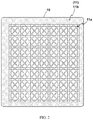
- FIG. 2 is a top plan view of the invention
- FIG. 3 is a back plan view of the invention
- FIG. 4 is a plan view of the first sensing layer of the invention.
- FIG. 5 is an enlarged view of part A in FIG. 4 ;
- FIG. 6 is a plan view of the first auxiliary conductive layer of the invention.
- FIG. 7 is an enlarged view of part B in FIG. 6 ;
- FIG. 8 is a plan view of the first auxiliary conductive layer superposed on the first sensing layer of the invention.
- FIG. 9 is an enlarged view of part C in FIG. 8 ;
- FIG. 10 is a plan view of the second auxiliary conductive layer superposed on the second sensing layer of the invention.
- FIG. 11 is an enlarged view of part A in FIG. 4 , which shows the first insulative column arranged in multiple tiny areas.
- the composite transparent touch panel of the invention includes a base layer 10 , a first sensing layer 20 , a first auxiliary conductive layer 30 , an insulative layer 40 , a second sensing layer 50 and a second auxiliary conductive layer 60 .
- the base layer 10 is a glass thin plate with high transmittance and great mechanic strength.
- a periphery of a side of the base layer 10 has a colored bezel 11 formed an insulative black matrix (BM) material.
- the colored bezel 11 defines a shaded area 11 b and a visible area 11 a surrounded by the shaded area 11 b.
- the first sensing layer 20 (i.e., Y-axis sensing layer) is an ITO (indium tin oxide) conductive film and has first capacitive sensing columns (i.e., Y-axis sensing columns) 21 , first insulative columns 24 and first electromagnetic antenna columns (i.e., Y-axis electromagnetic antenna columns) 26 , all of which are arranged along a first direction (i.e., Y-axis direction).
- Each of the first insulative columns 24 is arranged between one of the first capacitive sensing columns 21 and one of the first electromagnetic antenna columns 26 to form a first circuit pattern 20 a . As shown in FIG.
- each of the first capacitive sensing columns 21 is composed of a string of diamond first capacitive sensing units 21 a .
- An upper end of each of the first capacitive sensing columns 21 is provided with a first capacitive signal contact 21 b .
- An upper end of each of the first electromagnetic antenna columns 26 is provided with a first electromagnetic signal contact 27 and a lower end of each of the first electromagnetic antenna columns 26 is connected to a first connecting wire 28 .
- the first connecting wires 28 electrically connect each of the first electromagnetic antenna columns 26 in series.
- the first circuit pattern 20 a is located in the visible area 11 a
- the first capacitive signal contacts 21 b , the first electromagnetic signal contacts 27 and the first connecting wires 28 are located in the shaded area 11 b.
- the first auxiliary conductive layer 30 is a metal mesh layer and has a first mirroring pattern 30 a substantially identical to the first circuit pattern 20 a except the first electromagnetic signal contacts 21 b and the first electromagnetic signal contacts 27 .
- the first mirroring pattern 30 a is correspondingly electrically connected to the first circuit pattern 20 a .
- a gap D is formed between each first capacitive signal contact 21 b and a corresponding one of the first electromagnetic signal contacts 27 .
- a width of the gap D is above 200 ⁇ m.
- the second sensing layer 50 (i.e., X-axis sensing layer) is an ITO (indium tin oxide) conductive film and has second capacitive sensing columns (i.e., X-axis sensing columns) 51 , second insulative columns 54 and second electromagnetic antenna columns (i.e., X-axis electromagnetic antenna columns) 56 .
- Each of the second insulative columns 54 is arranged between one of the second capacitive sensing columns 51 and one of the second electromagnetic antenna columns 56 to form a second circuit pattern 50 a .
- each of the second capacitive sensing columns 51 is composed of a string of diamond second capacitive sensing units 51 a .
- a right end of each of the second capacitive sensing columns 51 is provided with a second capacitive signal contact 51 b .
- a right end of each of the second electromagnetic antenna columns 56 is provided with a second electromagnetic signal contact 57 and a left end of each of the second electromagnetic antenna columns 56 is connected to a second connecting wire 58 .
- the second connecting wires 58 electrically connect each of the second electromagnetic antenna columns 56 in series.
- the second circuit pattern 50 a is located in the visible area 11 a
- the second capacitive signal contacts 51 b , the second electromagnetic signal contacts 57 and the second connecting wires 58 are located in the shaded area 11 b.
- the second auxiliary conductive layer 60 is a metal mesh layer and has a second mirroring pattern 60 a substantially identical to the second circuit pattern 50 a except the second electromagnetic signal contacts 51 b and the second electromagnetic signal contacts 57 .
- the second mirroring pattern 60 a is correspondingly electrically connected to the second circuit pattern 50 a .
- a gap D is formed between each second capacitive signal contact 51 b and a corresponding one of the second electromagnetic signal contacts 57 .
- a width of the gap D is above 200 ⁇ m.
- the first auxiliary conductive layer 30 is electrically connected to the first sensing layer 20
- the second auxiliary conductive layer 60 is electrically connected to the second sensing layer 50
- the transparent insulative layer 40 is sandwiched between the first sensing layer 20 and the second sensing layer 50 so that the first sensing layer 20 can be isolated from the second sensing layer 50 .
- the insulative layer 40 may be made of solid optically clear adhesive (OCA) or liquid optical clear resin (OCR) so as to insulate and bond the two sensing layers 20 , 50 . As shown in FIGS.
- the first capacitive sensing columns 21 are orthogonal to the second capacitive sensing column 51 when the two sensing layers 20 , 50 have been assembled so as to make the first and second capacitive sensing units 21 a , 51 a arranged in an B interlaced and complementary manner to constitute a rectangular-lattice-shaped array of diamond-shaped capacitive sensing units.
- the first electromagnetic antenna columns 26 are orthogonal to the second electromagnetic antenna columns 56 to constitute a rectangular-lattice-shaped electromagnetic antenna array.
- the first capacitive signal contacts 21 b on the first sensing layer 20 , the second capacitive signal contacts 51 b on the second sensing layer 50 , the first electromagnetic signal contacts 27 and the second electromagnetic signal contacts 57 are arranged within the shaded area 11 b and they can be separately connected to a signal processor (not shown) through the signal wires 25 , 55 .
- the invention adopts ITO conductive films as a main part of sensing and cooperates with a metal mesh conductive material as auxiliary conductive layers to combine a capacitive touch sensor and an electromagnetic touch sensor to form a transparent touch sensor structure with double touch sensing modes, which may be mounted in front of a display.
- the invention further divides the two ITO conductive films as the first and second sensing layers 20 , 50 into multiple capacitive sensing columns and insulative columns, most of the conductive material of the ITO conductive films is remained except a small part which is removed to form insulation, so the scraped area of each ITO conductive film only occupies a small portion so as to improve evenness of transmittance of the sensing layers and overcome the problem of interference to images shown on a display.
- the two auxiliary conductive layers 30 , 60 are made of a metal mesh material with high conductivity, and the metal mesh material is made by woven tiny metal wires (such as silver nanowires) to form a mesh sheet with high transmittance of hollowing rate of above 95%.
- the metal mesh material of the auxiliary conductive layers 30 , 60 is lower than the ITO films used by the sensing layers 20 , 50 in impedance, the transmission efficiency of touch signals from the capacitive sensing columns 21 , 51 and the electromagnetic sensing columns 26 , 56 can be increased and attenuation in transmission of touch signals can also be reduced when the auxiliary conductive layers 30 , 60 are electrically connected to the sensing layers 20 , 50 .
- transmission quality of touch signals is improved to be advantageous to design and application of large-sized touch panels, and the number of touch sensing layers can be decreased and overall thickness of the touch panel can be reduced to save costs of material.
- the metal mesh conductive material with high transmittance is composed of nanometer wires which is invisible to the naked eye even if they are not transparent, so it would not impair visibility of a whole touch sensor when it is put in the visible area 11 a .
- the metal mesh conductive material is electrically connected onto an ITO conductive film, so even if either of the both malfunctions, signals can be transmitted through the other one. As a result, a high yield rate in manufacture can be guaranteed and product life can be extended. That is, the invention possesses several advantages.
- the conductive material of the first and second insulative columns 24 , 54 are shaped into multiple disconnected small areas S.
- An insulative gap S 1 is formed between two adjacent small areas S.
- a width of the insulative gap S 1 is above 50 ⁇ m and a depth thereof can totally cut off the conductive material of the first and second sensing layers 20 , 50 .
- the small areas S may be a hexagon, triangle, rectangle, trapezoid, strip, polygon, circle or any combination thereof in shape.
Landscapes
- Engineering & Computer Science (AREA)
- General Engineering & Computer Science (AREA)
- Theoretical Computer Science (AREA)
- Physics & Mathematics (AREA)
- Human Computer Interaction (AREA)
- General Physics & Mathematics (AREA)
- Electromagnetism (AREA)
- Position Input By Displaying (AREA)
Abstract
A touch panel includes a base layer having a shaded area and a visible area; a first sensing layer having first capacitive sensing columns (FCSCs) and first electromagnetic antenna columns (FEACs), which are insulated; a first auxiliary conductive layer having a circuit pattern substantially identical to the first sensing layer, and the circuit pattern correspondingly electrically connecting to the first sensing layer; a second sensing layer having second capacitive sensing columns (SCSCs) and second electromagnetic antenna columns (SEACs), which are insulated; a second auxiliary conductive layer having a circuit pattern substantially identical to the second sensing layer, and the circuit pattern correspondingly connect to the second sensing layer; and an insulative layer between the first and second sensing layer. The FCSCs are orthogonal to the SCSCs to constitute a diamond-lattice-shaped capacitive sensing unit array, and the FEACs are orthogonal to the SEACs to constitute a diamond-lattice-shaped electromagnetic antenna array.
Description
The invention relates to a transparent touch panel mounted on a display, particularly to a transparent touch panel with both capacitive and electromagnetic touch sensing functions.
Current capacitive touch sensors are usually made of transparent and conductive indium tin oxide (ITO) material. They can be mounted on displays because of their transparency. X/Y axes antenna arrays of current electromagnetic touch sensors utilize metal material. Because metal wires would resist light, such a type of touch sensors is usually mounted under displays to prevent visibility of the displays from being attenuated.
Furthermore, capacitive sensing electrodes and their signal paths of a current transparent capacitive touch sensor are made by etching an ITO film form a touch sensing circuit pattern, so there are both an electrode portion formed by conductive material and a scraped portion formed by removing conductive material. The electrode portion and the scraped portion have different transmittance to cause unevenness of refraction of light penetrating through the ITO film. This will result in obvious pattern or grain when a user is viewing the display. Particularly, when the touch sensor is mounted on a display, deformation, vague or distortion of images will occur. Besides, with more and more precision development of electronic products, touch sensing electrodes and signal paths of a touch sensor become narrower and narrower in size. However, narrowed electrodes and signal paths will increase impedance to attenuate signals. Especially for the applications of large-sized touch panels, conductivity of ITO films has been hard to satisfy requirements.
On the other hand, because induction coils or antenna arrays of electromagnetic touch sensors must have low impedance and general ITO films cannot satisfy this requirement, they are usually made by metal wires or films with high conductivity. However, metal wires cannot allow light to penetrate, a shading effect and an optical interference pattern (Moire) will occur when they are arranged in front of a display. This affects image quality seriously. As a result, such metal wires can only be used on the back of a display. This will increase thickness of overall display module and be adverse to the requirement of compactness. Also, when an electromagnetic pen is used on an electromagnetic touch sensor under a display panel, a problem of inputting accuracy degradation of the electromagnetic pen used at edges of the image will occur. Therefore, how to make an electromagnetic touch sensor have low impedance to be capable of being arranged in front of a display without attenuating visibility of an image shown on the display is a serious issue to be solved.
An object of the invention is to provide an improved composite transparent touch panel, which has both capacitive and electromagnetic touch sensing modes to provide two touch input manners. Such a multiple touch input function is advantageous to development and application of new application software.
Another object of the invention is to provide an improved composite transparent touch panel, which has uniform transmittance to be capable of being mounted in front of a display with keeping visibility of an image shown on the display.
Still another object of the invention is to provide an improved composite transparent touch panel, which can improve conductive efficiency of touch signals to be advantageous to design and application of large-sized touch panels.
To accomplish the above objects, the invention provides an improved composite transparent touch panel, which includes:
a base layer, having a colored bezel on a periphery of a side thereof, and the colored bezel defining a shaded area and a visible area surrounded by the shaded area;
a first sensing layer, having first capacitive sensing columns and first electromagnetic antenna columns, the first capacitive sensing columns and the first electromagnetic antenna columns being arranged along a first direction and separately insulatively interlaced with each other to form a first circuit pattern, a first end of each of the first capacitive sensing columns being provided with a first capacitive signal contact, a first end of each of the first electromagnetic antenna columns being provided with a first electromagnetic signal contact, a second end of each of the first electromagnetic antenna columns being connected to a first connecting wire, the first connecting wires electrically connecting the first electromagnetic antenna columns in series, the first circuit pattern being located in the visible area, and the first capacitive signal contacts, the first electromagnetic signal contacts and the first connecting wires are located in the shaded area;
a first auxiliary conductive layer, having a first mirroring pattern substantially identical to the first circuit pattern except the first electromagnetic signal contacts and the first electromagnetic signal contacts so as to make the first mirroring pattern correspondingly electrically connect to the first circuit pattern, and a first gap being formed between each first capacitive signal contact and a corresponding one of the first electromagnetic signal contacts, wherein a width of the first gap is above 200 μm;
a second sensing layer, having second capacitive sensing columns and second electromagnetic antenna columns, the second capacitive sensing columns and the second electromagnetic antenna columns being arranged along a second direction and separately insulatively interlaced with each other to form a second circuit pattern, a first end of each of the second capacitive sensing columns being provided with a second capacitive signal contact, a first end of each of the second electromagnetic antenna columns being provided with a second electromagnetic signal contact, a second end of each of the second electromagnetic antenna columns being connected to a second connecting wire, the second connecting wires electrically connecting the second electromagnetic antenna columns in series, the second circuit pattern being located in the visible area, and the second capacitive signal contacts, the second electromagnetic signal contacts and the second connecting wires are located in the shaded area;
a second auxiliary conductive layer, having a second mirroring pattern substantially identical to the second circuit pattern except the second electromagnetic signal contacts and the second electromagnetic signal contacts so as to make the second mirroring pattern correspondingly electrically connect to the second circuit pattern, and a second gap being formed between each second capacitive signal contact and a corresponding one of the second electromagnetic signal contacts, wherein a width of the second gap is above 200 μm; and
an insulative layer disposed between the first sensing layer and the second sensing layer;
wherein the first direction is orthogonal to the second direction, the first capacitive sensing columns are orthogonal to the second capacitive sensing columns to constitute a rectangular-lattice-shaped array of diamond-shaped capacitive sensing units, the first electromagnetic antenna columns are orthogonal to the second electromagnetic antenna columns to constitute a rectangular-lattice-shaped electromagnetic antenna array, and each of the first capacitive signal contacts, the first electromagnetic signal contacts, the second capacitive signal contacts and the second electromagnetic signal contacts is connected to a signal wire, so that touch sensing signals captured by both the first sensing layer and the second sensing layer can be sent to an external signal processor through the signal wires.
Preferably, each of the first and second sensing layers is formed by a metal oxide film made of indium tin oxide (ITO), indium zinc oxide (IZO), aluminum zinc oxide (AZO) or antimony tin oxide (ATO).
Preferably, each of the first and second auxiliary layers is formed by a metal mesh or graphene film, and the metal mesh is woven by metal wires made of gold, silver, copper, aluminum, molybdenum or nickel, but not limited to these.
Preferably, the first circuit pattern further comprises a first insulative column between each first capacitive sensing column and a corresponding one of the first electromagnetic antenna columns, and the second circuit pattern further comprises a second insulative column between each second capacitive sensing column and a corresponding one of the second electromagnetic antenna columns, the first and second insulative columns are separately shaped into multiple discontinuous areas made of a conductive material, and the areas is a hexagon, triangle, rectangle, trapezoid, strip, polygon or circle in shape, but not limited to these.
Preferably, the insulative layer is made of solid optically clear adhesive (OCA) or liquid optical clear resin (OCR), but not limited to these.
Preferred embodiments are depicted in the drawings. For the sake of clarity and readability, elements in the drawings are not shown in an exact proportion and size and the proportion of some elements are magnified in size. Irrelated details have been omitted for simplification.
As shown in FIG. 1 , the composite transparent touch panel of the invention includes a base layer 10, a first sensing layer 20, a first auxiliary conductive layer 30, an insulative layer 40, a second sensing layer 50 and a second auxiliary conductive layer 60.
As shown in FIGS. 1 and 2 , the base layer 10 is a glass thin plate with high transmittance and great mechanic strength. A periphery of a side of the base layer 10 has a colored bezel 11 formed an insulative black matrix (BM) material. The colored bezel 11 defines a shaded area 11 b and a visible area 11 a surrounded by the shaded area 11 b.
Please refer to FIGS. 2-5 . The first sensing layer 20 (i.e., Y-axis sensing layer) is an ITO (indium tin oxide) conductive film and has first capacitive sensing columns (i.e., Y-axis sensing columns) 21, first insulative columns 24 and first electromagnetic antenna columns (i.e., Y-axis electromagnetic antenna columns) 26, all of which are arranged along a first direction (i.e., Y-axis direction). Each of the first insulative columns 24 is arranged between one of the first capacitive sensing columns 21 and one of the first electromagnetic antenna columns 26 to form a first circuit pattern 20 a. As shown in FIG. 5 , each of the first capacitive sensing columns 21 is composed of a string of diamond first capacitive sensing units 21 a. An upper end of each of the first capacitive sensing columns 21 is provided with a first capacitive signal contact 21 b. An upper end of each of the first electromagnetic antenna columns 26 is provided with a first electromagnetic signal contact 27 and a lower end of each of the first electromagnetic antenna columns 26 is connected to a first connecting wire 28. The first connecting wires 28 electrically connect each of the first electromagnetic antenna columns 26 in series. As shown in FIGS. 2 and 3 , the first circuit pattern 20 a is located in the visible area 11 a, and the first capacitive signal contacts 21 b, the first electromagnetic signal contacts 27 and the first connecting wires 28 are located in the shaded area 11 b.
Please refer to FIGS. 3 and 6-9 . The first auxiliary conductive layer 30 is a metal mesh layer and has a first mirroring pattern 30 a substantially identical to the first circuit pattern 20 a except the first electromagnetic signal contacts 21 b and the first electromagnetic signal contacts 27. The first mirroring pattern 30 a is correspondingly electrically connected to the first circuit pattern 20 a. A gap D is formed between each first capacitive signal contact 21 b and a corresponding one of the first electromagnetic signal contacts 27. Preferably, a width of the gap D is above 200 μm. When the first auxiliary conductive layer 30 is connected onto the first sensing layer 20, the gaps D makes edges of the first auxiliary conductive layer 30 be out of contact with both the first capacitive signal contacts 21 b and the first electromagnetic signal contacts 27.
Please refer to FIGS. 2, 3 and 10 . The second sensing layer 50 (i.e., X-axis sensing layer) is an ITO (indium tin oxide) conductive film and has second capacitive sensing columns (i.e., X-axis sensing columns) 51, second insulative columns 54 and second electromagnetic antenna columns (i.e., X-axis electromagnetic antenna columns) 56. Each of the second insulative columns 54 is arranged between one of the second capacitive sensing columns 51 and one of the second electromagnetic antenna columns 56 to form a second circuit pattern 50 a. As shown in FIGS. 6 and 10 , each of the second capacitive sensing columns 51 is composed of a string of diamond second capacitive sensing units 51 a. A right end of each of the second capacitive sensing columns 51 is provided with a second capacitive signal contact 51 b. A right end of each of the second electromagnetic antenna columns 56 is provided with a second electromagnetic signal contact 57 and a left end of each of the second electromagnetic antenna columns 56 is connected to a second connecting wire 58. The second connecting wires 58 electrically connect each of the second electromagnetic antenna columns 56 in series. The second circuit pattern 50 a is located in the visible area 11 a, and the second capacitive signal contacts 51 b, the second electromagnetic signal contacts 57 and the second connecting wires 58 are located in the shaded area 11 b.
The second auxiliary conductive layer 60 is a metal mesh layer and has a second mirroring pattern 60 a substantially identical to the second circuit pattern 50 a except the second electromagnetic signal contacts 51 b and the second electromagnetic signal contacts 57. The second mirroring pattern 60 a is correspondingly electrically connected to the second circuit pattern 50 a. A gap D is formed between each second capacitive signal contact 51 b and a corresponding one of the second electromagnetic signal contacts 57. Preferably, a width of the gap D is above 200 μm. When the second auxiliary conductive layer 60 is connected onto the second sensing layer 50, the gaps D makes edges of the second auxiliary conductive layer 60 be out of contact with both the second capacitive signal contacts 51 b and the second electromagnetic signal contacts 57.
Please refer back to FIG. 1 . The first auxiliary conductive layer 30 is electrically connected to the first sensing layer 20, the second auxiliary conductive layer 60 is electrically connected to the second sensing layer 50, and the transparent insulative layer 40 is sandwiched between the first sensing layer 20 and the second sensing layer 50 so that the first sensing layer 20 can be isolated from the second sensing layer 50. The insulative layer 40 may be made of solid optically clear adhesive (OCA) or liquid optical clear resin (OCR) so as to insulate and bond the two sensing layers 20, 50. As shown in FIGS. 2 and 3 , the first capacitive sensing columns 21 are orthogonal to the second capacitive sensing column 51 when the two sensing layers 20, 50 have been assembled so as to make the first and second capacitive sensing units 21 a, 51 a arranged in an B interlaced and complementary manner to constitute a rectangular-lattice-shaped array of diamond-shaped capacitive sensing units. The first electromagnetic antenna columns 26 are orthogonal to the second electromagnetic antenna columns 56 to constitute a rectangular-lattice-shaped electromagnetic antenna array. The first capacitive signal contacts 21 b on the first sensing layer 20, the second capacitive signal contacts 51 b on the second sensing layer 50, the first electromagnetic signal contacts 27 and the second electromagnetic signal contacts 57 are arranged within the shaded area 11 b and they can be separately connected to a signal processor (not shown) through the signal wires 25, 55.
According to the above description, the invention adopts ITO conductive films as a main part of sensing and cooperates with a metal mesh conductive material as auxiliary conductive layers to combine a capacitive touch sensor and an electromagnetic touch sensor to form a transparent touch sensor structure with double touch sensing modes, which may be mounted in front of a display. The invention further divides the two ITO conductive films as the first and second sensing layers 20, 50 into multiple capacitive sensing columns and insulative columns, most of the conductive material of the ITO conductive films is remained except a small part which is removed to form insulation, so the scraped area of each ITO conductive film only occupies a small portion so as to improve evenness of transmittance of the sensing layers and overcome the problem of interference to images shown on a display. In addition, the two auxiliary conductive layers 30, 60 are made of a metal mesh material with high conductivity, and the metal mesh material is made by woven tiny metal wires (such as silver nanowires) to form a mesh sheet with high transmittance of hollowing rate of above 95%. Because the metal mesh material of the auxiliary conductive layers 30, 60 is lower than the ITO films used by the sensing layers 20, 50 in impedance, the transmission efficiency of touch signals from the capacitive sensing columns 21, 51 and the electromagnetic sensing columns 26, 56 can be increased and attenuation in transmission of touch signals can also be reduced when the auxiliary conductive layers 30, 60 are electrically connected to the sensing layers 20, 50. As a result, transmission quality of touch signals is improved to be advantageous to design and application of large-sized touch panels, and the number of touch sensing layers can be decreased and overall thickness of the touch panel can be reduced to save costs of material. Further, the metal mesh conductive material with high transmittance is composed of nanometer wires which is invisible to the naked eye even if they are not transparent, so it would not impair visibility of a whole touch sensor when it is put in the visible area 11 a. Besides, the metal mesh conductive material is electrically connected onto an ITO conductive film, so even if either of the both malfunctions, signals can be transmitted through the other one. As a result, a high yield rate in manufacture can be guaranteed and product life can be extended. That is, the invention possesses several advantages.
Please refer to FIG. 11 . In another embodiment, the conductive material of the first and second insulative columns 24, 54 are shaped into multiple disconnected small areas S. An insulative gap S1 is formed between two adjacent small areas S. A width of the insulative gap S1 is above 50 μm and a depth thereof can totally cut off the conductive material of the first and second sensing layers 20, 50. The small areas S may be a hexagon, triangle, rectangle, trapezoid, strip, polygon, circle or any combination thereof in shape. By arrangement of the small areas S, both flatness and evenness of transmittance of the two sensing layers 20, 50 can be improved and noise capacitance can be reduced to obtain a better electric property.
Claims (8)
1. A composite transparent touch panel comprising:
a base layer, having a colored bezel on a periphery of a side thereof, and the colored bezel defining a shaded area and a visible area surrounded by the shaded area;
a first sensing layer, having first capacitive sensing columns and first electromagnetic antenna columns, the first capacitive sensing columns and the first electromagnetic antenna columns being arranged along a first direction and separately insulatively interlaced with each other to form a first circuit pattern, a first end of each of the first capacitive sensing columns being provided with a corresponding one first capacitive signal contact, a first end of each of the first electromagnetic antenna columns being provided with a corresponding one first electromagnetic signal contact, second ends of the first electromagnetic antenna columns being connected to a first connecting wire, the first connecting wire electrically connecting the second ends of the first electromagnetic antenna columns in series, the first circuit pattern being located in the visible area, and the first capacitive signal contacts, the first electromagnetic signal contacts and the first connecting wire are located in the shaded area;
a first auxiliary conductive layer, having a first mirroring pattern substantially identical to the first circuit pattern except the first capacitive signal contacts and the first electromagnetic signal contacts so as to make the first mirroring pattern correspondingly electrically connect to the first circuit pattern, and a first gap being formed between each first capacitive signal contact and a corresponding one of the first electromagnetic signal contacts;
a second sensing layer, having second capacitive sensing columns and second electromagnetic antenna columns, the second capacitive sensing columns and the second electromagnetic antenna columns being arranged along a second direction and separately insulatively interlaced with each other to form a second circuit pattern, a first end of each of the second capacitive sensing columns being provided with a second capacitive signal contact, a first end of each of the second electromagnetic antenna columns being provided with a second electromagnetic signal contact, second ends of the second electromagnetic antenna columns being connected to a second connecting wire, the second connecting wire electrically connecting the second ends of the second electromagnetic antenna columns in series, the second circuit pattern being located in the visible area, and the second capacitive signal contacts, the second electromagnetic signal contacts and the second connecting wire are located in the shaded area;
a second auxiliary conductive layer, having a second mirroring pattern substantially identical to the second circuit pattern except the second capacitive signal contacts and the second electromagnetic signal contacts so as to make the second mirroring pattern correspondingly electrically connect to the second circuit pattern, and a second gap being formed between each second capacitive signal contact and a corresponding one of the second electromagnetic signal contacts; and
an insulative layer disposed between the first sensing layer and the second sensing layer;
wherein the first direction is orthogonal to the second direction, the first capacitive sensing columns are orthogonal to the second capacitive sensing columns to constitute a rectangular-lattice-shaped array of diamond-shaped capacitive sensing units, and the first electromagnetic antenna columns to constitute a rectangular-lattice-shaped electromagnetic antenna array.
2. The touch panel of claim 1 , wherein each of the first and second sensing layers is formed by a metal oxide film made of indium tin oxide, indium zinc oxide, aluminum zinc oxide or antimony tin oxide.
3. The touch panel of claim 1 , wherein each of the first and second auxiliary layers is formed by a metal mesh or graphene film.
4. The touch panel of claim 3 , wherein the metal mesh is woven by metal wires made of gold, silver, copper, aluminum, molybdenum or nickel.
5. The touch panel of claim 1 , wherein a width of each of the first and second gaps is above 200 μm.
6. The touch panel of claim 1 , wherein the first circuit pattern further comprises a first insulative column between each first capacitive sensing column and a corresponding one of the first electromagnetic antenna columns, and the second circuit pattern further comprises a second insulative column between each second capacitive sensing column and a corresponding one of the second electromagnetic antenna columns.
7. The touch panel of claim 6 , wherein the first and second insulative columns are separately shaped into multiple disconnected areas made of a conductive material.
8. The touch panel of claim 1 , wherein the insulative layer is made of solid optically clear adhesive (OCA) or liquid optical clear resin (OCR).
Priority Applications (1)
| Application Number | Priority Date | Filing Date | Title |
|---|---|---|---|
| US16/362,649 US10664117B1 (en) | 2019-03-24 | 2019-03-24 | Composite transparent touch panel |
Applications Claiming Priority (1)
| Application Number | Priority Date | Filing Date | Title |
|---|---|---|---|
| US16/362,649 US10664117B1 (en) | 2019-03-24 | 2019-03-24 | Composite transparent touch panel |
Publications (1)
| Publication Number | Publication Date |
|---|---|
| US10664117B1 true US10664117B1 (en) | 2020-05-26 |
Family
ID=70775034
Family Applications (1)
| Application Number | Title | Priority Date | Filing Date |
|---|---|---|---|
| US16/362,649 Active US10664117B1 (en) | 2019-03-24 | 2019-03-24 | Composite transparent touch panel |
Country Status (1)
| Country | Link |
|---|---|
| US (1) | US10664117B1 (en) |
Cited By (3)
| Publication number | Priority date | Publication date | Assignee | Title |
|---|---|---|---|---|
| US11073958B2 (en) * | 2016-01-29 | 2021-07-27 | Sharp Kabushiki Kaisha | Antenna device |
| CN114568915A (en) * | 2020-11-30 | 2022-06-03 | 宸美(厦门)光电有限公司 | Electronic curtain and electronic device |
| US11493809B2 (en) * | 2021-01-14 | 2022-11-08 | Tpk Advanced Solutions Inc. | Electronic curtain and electronic device |
Citations (2)
| Publication number | Priority date | Publication date | Assignee | Title |
|---|---|---|---|---|
| US20160139701A1 (en) * | 2014-04-09 | 2016-05-19 | Boe Technology Group Co., Ltd. | Touch screen and display device |
| US20160179266A1 (en) * | 2013-03-13 | 2016-06-23 | Beijing Boe Optoelectronics Technology Co., Ltd. | Touch module and manufacture method thereof |
-
2019
- 2019-03-24 US US16/362,649 patent/US10664117B1/en active Active
Patent Citations (2)
| Publication number | Priority date | Publication date | Assignee | Title |
|---|---|---|---|---|
| US20160179266A1 (en) * | 2013-03-13 | 2016-06-23 | Beijing Boe Optoelectronics Technology Co., Ltd. | Touch module and manufacture method thereof |
| US20160139701A1 (en) * | 2014-04-09 | 2016-05-19 | Boe Technology Group Co., Ltd. | Touch screen and display device |
Cited By (4)
| Publication number | Priority date | Publication date | Assignee | Title |
|---|---|---|---|---|
| US11073958B2 (en) * | 2016-01-29 | 2021-07-27 | Sharp Kabushiki Kaisha | Antenna device |
| CN114568915A (en) * | 2020-11-30 | 2022-06-03 | 宸美(厦门)光电有限公司 | Electronic curtain and electronic device |
| CN114568915B (en) * | 2020-11-30 | 2023-09-22 | 宸美(厦门)光电有限公司 | Electronic curtains and electronic devices |
| US11493809B2 (en) * | 2021-01-14 | 2022-11-08 | Tpk Advanced Solutions Inc. | Electronic curtain and electronic device |
Similar Documents
| Publication | Publication Date | Title |
|---|---|---|
| US9270267B2 (en) | Touch panel and method of manufacturing the same | |
| US8665230B2 (en) | Sensing display device | |
| US8593413B2 (en) | Sensory structure of capacitive touch panel and capacitive touch panel having the same | |
| US20100328248A1 (en) | Capacitive touch screen with reduced electrode trace resistance | |
| US20110007011A1 (en) | Capacitive touch screen with a mesh electrode | |
| US20110032207A1 (en) | Capacitive touch sensor | |
| US9459744B2 (en) | Touch panel substrate and display device | |
| US20100309160A1 (en) | Capacitive sensing assembly of touch panel | |
| US20230376159A1 (en) | Touch substrate, method for manufacturing touch substrate and display apparatus | |
| CN105718114A (en) | Smartphone | |
| US11119620B2 (en) | Electronic device | |
| JP2013105275A (en) | Touch panel | |
| US10664117B1 (en) | Composite transparent touch panel | |
| KR20120138288A (en) | Capacitive type touch panel | |
| JP3221633U (en) | Combined transparent touch panel | |
| US10725596B2 (en) | Composite transparent touch sensor | |
| US11307716B2 (en) | Capacitive touch glass structure | |
| US20140151214A1 (en) | Touch electrode device | |
| KR200493360Y1 (en) | Capacitive touch glass structure | |
| JP3217788U (en) | Transparent capacitive touch sensor structure | |
| CN110515479B (en) | Method for reducing local area impedance value of transparent conductive film and product thereof | |
| KR200492693Y1 (en) | Improved composite transparent touch panel | |
| US10976881B2 (en) | Complex transparent touch sensor | |
| TWM579770U (en) | Improved composite transparent touch pad | |
| CN209728721U (en) | Improved composite transparent touchpad |
Legal Events
| Date | Code | Title | Description |
|---|---|---|---|
| FEPP | Fee payment procedure |
Free format text: ENTITY STATUS SET TO UNDISCOUNTED (ORIGINAL EVENT CODE: BIG.); ENTITY STATUS OF PATENT OWNER: SMALL ENTITY |
|
| FEPP | Fee payment procedure |
Free format text: ENTITY STATUS SET TO SMALL (ORIGINAL EVENT CODE: SMAL); ENTITY STATUS OF PATENT OWNER: SMALL ENTITY |
|
| STCF | Information on status: patent grant |
Free format text: PATENTED CASE |
|
| MAFP | Maintenance fee payment |
Free format text: PAYMENT OF MAINTENANCE FEE, 4TH YR, SMALL ENTITY (ORIGINAL EVENT CODE: M2551); ENTITY STATUS OF PATENT OWNER: SMALL ENTITY Year of fee payment: 4 |