US10659915B2 - Anti-disaster system, information generating method and storage medium - Google Patents
Anti-disaster system, information generating method and storage medium Download PDFInfo
- Publication number
- US10659915B2 US10659915B2 US16/462,629 US201616462629A US10659915B2 US 10659915 B2 US10659915 B2 US 10659915B2 US 201616462629 A US201616462629 A US 201616462629A US 10659915 B2 US10659915 B2 US 10659915B2
- Authority
- US
- United States
- Prior art keywords
- disaster
- control apparatus
- base station
- position processing
- information
- Prior art date
- Legal status (The legal status is an assumption and is not a legal conclusion. Google has not performed a legal analysis and makes no representation as to the accuracy of the status listed.)
- Active
Links
- 238000000034 method Methods 0.000 title claims description 17
- 238000012545 processing Methods 0.000 claims abstract description 145
- 238000001514 detection method Methods 0.000 claims abstract description 68
- 238000004891 communication Methods 0.000 claims description 35
- 238000013475 authorization Methods 0.000 claims description 12
- 238000010586 diagram Methods 0.000 description 34
- 230000006870 function Effects 0.000 description 10
- 230000010365 information processing Effects 0.000 description 8
- 238000011835 investigation Methods 0.000 description 5
- 238000004364 calculation method Methods 0.000 description 3
- 238000004590 computer program Methods 0.000 description 2
- 238000012986 modification Methods 0.000 description 2
- 230000004048 modification Effects 0.000 description 2
- 230000004044 response Effects 0.000 description 2
- 239000004065 semiconductor Substances 0.000 description 2
- 239000000969 carrier Substances 0.000 description 1
- 230000001413 cellular effect Effects 0.000 description 1
- 230000008859 change Effects 0.000 description 1
- 238000005516 engineering process Methods 0.000 description 1
- 238000004880 explosion Methods 0.000 description 1
- 239000004973 liquid crystal related substance Substances 0.000 description 1
- 230000007774 longterm Effects 0.000 description 1
- 238000010295 mobile communication Methods 0.000 description 1
- 230000003287 optical effect Effects 0.000 description 1
- 230000008569 process Effects 0.000 description 1
- 238000005070 sampling Methods 0.000 description 1
- 239000000779 smoke Substances 0.000 description 1
- 230000001360 synchronised effect Effects 0.000 description 1
- 230000001052 transient effect Effects 0.000 description 1
Images




Classifications
-
- H—ELECTRICITY
- H04—ELECTRIC COMMUNICATION TECHNIQUE
- H04W—WIRELESS COMMUNICATION NETWORKS
- H04W4/00—Services specially adapted for wireless communication networks; Facilities therefor
- H04W4/02—Services making use of location information
- H04W4/029—Location-based management or tracking services
-
- H—ELECTRICITY
- H04—ELECTRIC COMMUNICATION TECHNIQUE
- H04W—WIRELESS COMMUNICATION NETWORKS
- H04W4/00—Services specially adapted for wireless communication networks; Facilities therefor
- H04W4/02—Services making use of location information
- H04W4/021—Services related to particular areas, e.g. point of interest [POI] services, venue services or geofences
-
- H—ELECTRICITY
- H04—ELECTRIC COMMUNICATION TECHNIQUE
- H04W—WIRELESS COMMUNICATION NETWORKS
- H04W4/00—Services specially adapted for wireless communication networks; Facilities therefor
- H04W4/02—Services making use of location information
- H04W4/021—Services related to particular areas, e.g. point of interest [POI] services, venue services or geofences
- H04W4/022—Services related to particular areas, e.g. point of interest [POI] services, venue services or geofences with dynamic range variability
-
- H—ELECTRICITY
- H04—ELECTRIC COMMUNICATION TECHNIQUE
- H04W—WIRELESS COMMUNICATION NETWORKS
- H04W4/00—Services specially adapted for wireless communication networks; Facilities therefor
- H04W4/90—Services for handling of emergency or hazardous situations, e.g. earthquake and tsunami warning systems [ETWS]
-
- H—ELECTRICITY
- H04—ELECTRIC COMMUNICATION TECHNIQUE
- H04W—WIRELESS COMMUNICATION NETWORKS
- H04W64/00—Locating users or terminals or network equipment for network management purposes, e.g. mobility management
Definitions
- the present invention relates to an anti-disaster system, an information generating method and a storage medium storing a computer program, and more particularly to an anti-disaster system that determines positions of one or more mobile stations (MSs) in a disaster region.
- MSs mobile stations
- a notification and protection related to the disaster will be much more efficient. For example, if we can know the position of all people before the disaster occurs, we can change emergency lever for notification and protection in accordance with position information. For example, if there are no people in an area affected by the disaster, there is no need for notification and protection.
- the position information may help making immediate rescue plan or may avoid an unnecessary search.
- the position information is important for anti-disaster.
- an anti-disaster field there are equipment (instruments).
- position equipment for fireman is used.
- life detector instrument is used to detect human heat, sound, pulse, etc.
- Patent literatures (PTLs) 1 and 2 disclose a wireless network system such as a cellar system used for determining position of the mobile terminal. Further, in Patent literatures 3 to 6, various technologies related to mobile communication are disclosed.
- Patent Literature 7 discloses a position estimation method using RSS (Received Signal Strength) data obtained from a plurality of base stations. In this method, distances between the base stations and terminal are estimated based on the RSS data.
- RSS Received Signal Strength
- JP 2011-215001A Japanese Patent Laid-open Publication No. JP 2011-215001A
- the possible candidate is the wireless network system (cellular system) as disclosed in Patent literatures 1 and 2.
- the technique of positioning of people using the wireless network system is applied to anti-disaster, problem will occurs. More specifically, in such a large scale positioning, there are two issues in the current cellar system.
- an anti-disaster system comprising: a plurality of disaster detection apparatuses each of which detects an occurrence of disaster; a plurality of position processing apparatuses each of which generates distribution information which indicates a number of mobile stations in each position; a plurality of base stations each of which communicates with the mobile station; and a control apparatus that communicates with the plurality of disaster detection apparatuses, the plurality of base stations and the plurality of position processing apparatuses.
- One disaster detection apparatus, one position processing apparatus and at least one base station are located in a same region.
- the control apparatus determines a disaster region concerned among a plurality of regions, based on a message from the disaster detection apparatus located in the disaster region concerned.
- the control apparatus instructs the position processing apparatus located in the disaster region concerned to generate the distribution information based on information from the base station located in the disaster region concerned.
- an information generating method in an anti-disaster system comprising: a plurality of disaster detection apparatuses each of which detects an occurrence of disaster; a plurality of position processing apparatuses each of which generates distribution information which indicates a number of mobile stations in each position; a plurality of base stations each of which communicates with the mobile station; and a control apparatus that communicates with the plurality of disaster detection apparatuses, the plurality of base stations and the plurality of position processing apparatuses.
- One disaster detection apparatus, one position processing apparatus and at least one base station are located in a same region.
- the information generating method comprising: the control apparatus determining a disaster region concerned among a plurality of regions, based on a message from the disaster detection apparatus located in the disaster region concerned, and the control apparatus instructing the position processing apparatus located in the disaster region concerned to generate the distribution information based on information from the base station located in the disaster region concerned.
- a storage medium storing an anti-disaster program executed by a computer embedded on a control apparatus included in an anti-disaster system, the anti-disaster system further including: a plurality of disaster detection apparatuses each of which detects an occurrence of disaster; a plurality of position processing apparatuses each of which generates distribution information which indicates a number of mobile stations in each position; and a plurality of base stations each of which communicates with the mobile station.
- One disaster detection apparatus, one position processing apparatus and at least one base station are located in a same region.
- the program causes the computer to execute: communicating with the plurality of disaster detection apparatuses, the plurality of base stations and the plurality of position processing apparatuses; determining a disaster region concerned among a plurality of regions, based on a message from the disaster detection apparatus located in the disaster region concerned, and instructing the position processing apparatus located in the disaster region concerned to generate the distribution information based on information from the base station located in the disaster region concerned.
- the above-mentioned program can be recorded in a computer-readable storage medium.
- the storage medium may be a non-transient medium such as a semiconductor memory, a hard disk, a magnetic recording medium, or an optical recording medium.
- the present invention can be embodied as a computer program product.
- an anti-disaster system which contributes to obtaining information for anti-disaster with small computation while protecting the privacy is provided.
- FIG. 1 illustrates an outline of an example embodiment.
- FIG. 2 is a conceptual view of an anti-disaster system according to a first example embodiment.
- FIG. 3 is a conceptual view of a relationship between each apparatuses described in FIG. 2 .
- FIG. 4 is a block diagram showing a hardware configuration of a control apparatus.
- FIG. 5 is a block diagram showing a hardware configuration of a disaster detection apparatus.
- FIG. 6 is a block diagram showing a hardware configuration of a base station.
- FIG. 7 is a block diagram showing processing modules of an authority server.
- FIG. 8 is a block diagram showing processing modules of the control apparatus.
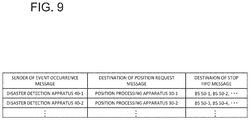
- FIG. 9 is a diagram showing an example stored in a memory.
- FIG. 10 is a block diagram showing processing modules of the position processing apparatus.
- FIG. 11 is a diagram for explaining a calculation of the position information.
- FIG. 12 is diagram for explaining the calculation of the position information.
- FIG. 13 is a diagram showing an example of the distribution information.
- FIG. 14 is a block diagram showing processing modules of the disaster detection apparatus.
- FIG. 15 is a block diagram showing processing modules of the base station.
- FIG. 16 is a diagram showing an example of FIFO.
- FIG. 17 is a sequence diagram showing the operation of the anti-disaster system according to the first example embodiment.
- FIG. 18 is a diagram for explanation of a second example embodiment.
- FIG. 19 is a diagram for explanation of a third example embodiment.
- FIG. 20 is a block diagram showing processing modules of a base station according to the third example embodiment.
- FIG. 21 is a conceptual view of an anti-disaster system according to a fourth example embodiment.
- FIG. 22 is a block diagram showing processing modules of a control apparatus according to the fourth example embodiment.
- FIG. 23 is a block diagram showing processing modules of a base station according to the fourth example embodiment.
- FIG. 24 is a conceptual view of an anti-disaster system according to a fifth example embodiment.
- FIG. 25 is a block diagram showing processing modules of a base station according to the fifth example embodiment.
- FIG. 26 is a conceptual view of a suspect investigation system according to the sixth example embodiment.
- FIG. 27 is a block diagram showing processing modules of a data server according to the sixth example embodiment.
- FIG. 28 is a block diagram showing processing modules of a base station according to the sixth example embodiment.
- An anti-disaster system comprising: a plurality of disaster detection apparatuses 101 each of which detects an occurrence of disaster; a plurality of position processing apparatuses 102 each of which generates distribution information which indicates a number of mobile stations in each position; a plurality of base stations 103 each of which communicates with the mobile station; and a control apparatus 104 that communicates with the plurality of disaster detection apparatuses 101 , the plurality of base stations 103 and the plurality of position processing apparatuses 102 .
- One disaster detection apparatus, one position processing apparatus and at least one base station are located in a same region.
- the control apparatus 104 determines a disaster region concerned among a plurality of regions, based on a message from the disaster detection apparatus 101 located in the disaster region concerned.
- the control apparatus 104 instructs the position processing apparatus 102 located in the disaster region concerned to generate the distribution information based on information from the base station 103 located in the disaster region concerned.
- the control apparatus 104 determines a region where the disaster happened based on the message received from the disaster detection apparatus 101 in the disaster region concerned. After that, the control apparatus 104 instructs only the position processing apparatus 102 located in the disaster region concerned to generate the distribution information (information for anti-disaster). A computation regarding information is limited to the disaster region concerned, thereby information for anti-disaster is obtained with small computation. In addition, by not including identifier (ID) of each mobile station in the distribution information, personal privacy is protected.
- ID identifier
- FIG. 2 is a conceptual view of an anti-disaster system according to the first example embodiment.
- the anti-disaster system comprises an authority server 10 , a control apparatus 20 , a position processing apparatus 30 , a disaster detection apparatus 40 , base stations 50 and mobile stations 60 .
- Apparatuses in FIG. 2 are connected with each other via such a network as internet.
- the mobile station (MS) 60 and the base station (BS) 50 perform communication through wireless signal.
- the mobile station 60 and base station 50 communicate with each other by a LTE (Long Term Evolution) or 3G (third generation).
- LTE Long Term Evolution
- 3G third generation
- the authority server 10 is located in a public institution such as fire department or Meteorological Agency.
- the authority server 10 gives an authorization to the control apparatus 20 so as to handle distribution information.
- the control apparatus 20 is located in a control center which manages each region.
- the control apparatus is configured to communicate with a plurality of disaster detection apparatuses 40 , a plurality of base stations 50 and a plurality of position processing apparatuses 30 .
- the control apparatus 20 deals with anti-disaster information of each region. More specifically, when a disaster happens, the control apparatus 20 instructs the position processing apparatus 30 located in the disaster region concerned to generate distribution information. At that time, the control apparatus 20 sends a position request message to the position processing apparatus 30 . When the position processing apparatus 30 receives the position request message, the position processing apparatus 30 generates the distribution information and send this information to the control apparatus 20 .
- the control apparatus 20 forwards the generated distribution information to the authority server 10 .
- control apparatus 20 instructs each base station 50 located in the disaster region concerned to send information (channel information described later) to the position processing apparatus 30 in the disaster region. At that time, the control apparatus 20 sends a stop FIFO (First-In First Out) message to each base station 50 as the instruction. It should be noted that the stop FIFO message will be explained later.
- stop FIFO First-In First Out
- the distribution information indicates a number of mobile stations 60 located in the disaster region in each position (in each address).
- the authority server 10 can know how many people exist in the region where the disaster happened. That is, the authority server 10 can use the distribution information for anti-disaster. For example, when tsunami or flood happens, the authority server 10 issues an evacuation advisory to the region of disaster or makes rescue plan.
- the position processing apparatus 30 is located in each region.
- the position processing apparatus 30 calculates position information which indicates a position (or coordinates) regarding each mobile station 60 located in the disaster region based on information obtained from the base stations 50 . More specifically, the position processing apparatus 30 calculates the position information based on channel information.
- the channel information is obtained from the communication between the base station 50 and the mobile station 60 . That is, the channel information is obtained so as to calculate the position information (address or coordinates information of each mobile station 60 ).
- a RSS Receiveived Signal Strength
- channel information is not limited to RSS.
- the disaster detection apparatus 40 is located in each region.
- the disaster detection apparatus 40 detects an occurrence of disaster (or event).
- the disaster detection apparatus 40 is a firebox or a seismic intensity meter for tsunami. It should be noted that a sensor included in the detection apparatus 40 is different in accordance with the disaster.
- the disaster detection apparatus 40 detects the occurrence of disaster, the disaster detection apparatus 40 sends a disaster occurrence message to the control apparatus 20 . By receiving this message, the control apparatus 40 can determine the disaster region concerned among a plurality of regions which the control apparatus manages.
- the base station 50 has a memory to store the channel information regarding each mobile station 60 .
- a FIFO memory is exemplified as the memory.
- FIG. 3 is a conceptual view of a relationship between apparatuses described in FIG. 2 .
- the position processing apparatus 30 and the disaster detection apparatus 40 are located in each region. Further, each region includes a plurality of the base stations 50 . That is, one disaster detection apparatus 40 , one position processing apparatus 30 and at least one base station 50 are located in same region.
- the disaster detection apparatus 40 corresponding to the disaster region sends the disaster occurrence message to the control apparatus 20 .
- the control apparatus 20 determines the disaster region based on a sender of the disaster occurrence message. For example, when the control apparatus 20 receives the disaster occurrence message from the disaster detection apparatus 40 in region 1 , the control apparatus 20 determines that the disaster happened in region 1 .
- control apparatus 20 sends the position request message to the position processing apparatus 30 included in the disaster region.
- control apparatus 20 sends the position request message to the position processing apparatus 30 in region 1 .
- control apparatus 20 sends the stop FIFO message to base stations 50 in the disaster region.
- control apparatus 20 sends the stop FIFO message to the base stations 50 in region 1 .
- the base station 50 and the mobile station 60 communicate with each other.
- the base station 50 continues to calculate the channel information and stores the calculated channel information in the FIFO.
- the base station 50 When the base station 50 receives the stop FIFO message (i.e., disaster happens), the base station 50 stops updating the FIFO with the channel information and sends the stored channel information to the position processing apparatus 30 . It should be noted that updating FIFO is stopped so as to prevent that necessary data (channel information) for calculating the position information in the event of the disaster will lost.
- the position processing apparatus 30 When the position processing apparatus 30 receives the position request message from the control apparatus 20 , the position processing apparatus 30 calculates the position information regarding each mobile station 60 in the disaster region. In the above-mentioned example, the position processing apparatus 30 in region 1 calculates the position information regarding the mobile stations 60 in region 1 .
- the position processing apparatus 30 After that, the position processing apparatus 30 generates the distribution information. More specifically, the position processing apparatus 30 collects each the position information regarding the mobile station 60 to generate the distribution information.
- the distribution information includes address (or coordinates) information of the mobile station 60 in the disaster region. In the above-mentioned example, the distribution information includes the position (coordinates) of the mobile stations 60 in region 1 .
- the position processing apparatus 30 sends the distribution information to the control apparatus 20 .
- the control apparatus 20 sends the received distribution information to the authority server 10 .
- FIG. 4 is a block diagram showing a hardware configuration of the control apparatus 20 .
- the control apparatus 20 is realized by a computer and has a configuration described in FIG. 4 .
- the control apparatus 20 comprises a CPU (Central Processing Unit) 21 , a memory 22 , an input/output interface 23 and a NIC (Network Interface Card) 24 . Those elements are connected to each other through an internal bus.
- the configuration in FIG. 4 does not limit the hardware configuration of the control apparatus 20 .
- the control apparatus 20 may comprise an element not described in FIG. 4 , or may not comprise the input/output interface 23 or the NIC 24 in necessary. Further, the number of CPU 21 or the like is not limited to the example in FIG. 4 . For example, a plurality of CPUs may be included in the control apparatus 20 .
- the memory 22 is a RAM (Random Access Memory), ROM (Read Only Memory) or a HDD (Hard Disk Drive) or the like.
- the input/output interface 23 is an interface for a display apparatus or input apparatus not shown in FIG. 4 .
- the display apparatus is a liquid crystal display or the like.
- the input apparatus is such an apparatus receiving user operation as a keyboard and mouse.
- a USB (Universal Serial Bus) memory is included as the input apparatus.
- the function of the control apparatus 20 can be realized by various types of processing module after-mentioned.
- the processing module can be realized by that the CPU 21 executes a program stored in the memory 22 .
- the program can be updated by downloading the program via a network or a storage medium storing the program.
- the above-mentioned processing module can be realized by a semiconductor chip. That is, it is sufficient that there is means for executing the function of the above-mentioned processing module on a hardware and/or software.
- the authority server 10 and the position processing apparatus 30 may have same configuration as the control apparatus 20 . Therefore, explanations of those apparatuses are omitted.
- FIG. 5 is a block diagram showing a hardware configuration of the disaster detection apparatus 40 .
- the disaster detection apparatus 40 has a configuration described in FIG. 5 .
- the disaster detection apparatus 40 has a sensor 33 in addition to a CPU 31 , a memory 32 and a NIC 34 .
- the sensor 33 detects an occurrence of disaster. Type of the sensor 33 is changed in accordance with the disaster. For example, in fire application, smoke detector is used as the sensor 33 . It should be noted that explanation of the CPU 31 or the like is omitted.
- the function of the disaster detection apparatus 40 can be realized by execution of a program stored in memory 32 .
- FIG. 6 is a block diagram showing a hardware configuration of the base station 50 .
- the base station 50 has a configuration described in FIG. 6 .
- the base station 50 has a transmitter/receiver 43 in addition to a CPU 41 , a memory 42 and a NIC 44 .
- the transmitter/receiver 43 is connected to an antenna 45 .
- the transmitter/receiver 43 demodulates and decodes a received signal via the antenna 45 . Further, the transmitter/receiver 43 outputs the decoded data to the CPU 41 .
- the transmitter/receiver 43 encodes and modulates a data from the CPU 41 . Further, the transmitter/receiver 43 transmits the modulated data to the mobile station 60 via the antenna 45 .
- explanation of the CPU 41 or the like is omitted.
- the function of the base station 50 can be realized by execution of a program stored in memory 42 .
- FIG. 7 is a block diagram showing processing modules of the authority server 10 according to the first example embodiment.
- the authority server 10 comprises a communication unit 201 , an authorization unit 202 and a distribution information processing unit 203 .
- the communication unit 201 is means for controlling communication with other apparatus (for example, the control apparatus 20 or the like).
- the authorization unit 202 is means for giving the control apparatus 20 an authorization to handle the distribution information.
- the distribution information processing unit 203 is means for processing the distribution information.
- the distribution information processing unit 203 visualizes the distribution information so that the user (for example, anti-disaster personnel) can determine a necessary support.
- the user provided this information may make rescue plan or the like.
- FIG. 8 is a block diagram showing processing modules of the control apparatus 20 according to the first example embodiment. As shown in FIG. 8 , the control apparatus 20 comprises a communication unit 301 and an event processing unit 302 .
- the communication unit 301 is means for controlling communication with other apparatus (for example, the authority server 10 or the like).
- the event processing unit 302 is means for processing the disaster occurrence message from the disaster detection apparatus 40 . More specifically, when the event processing unit 302 receives the disaster occurrence message, the event processing unit 302 refers to information stored in memory so as to determine the position processing apparatus 30 as destination of the position request message and the base stations 50 as destination of the stop FIFO message. For example, information shown in FIG. 9 is stored in the memory. Referring to such information, the event processing unit 302 can determine the destination of sending messages. It should be noted that information shown as FIG. 9 is prepared in advance by an administrator of the system and stored in the memory.
- the event processing unit 302 sends this information to the authority server 10 .
- FIG. 10 is a block diagram showing processing modules of the position processing apparatus 30 according to the first example embodiment.
- the position processing apparatus 30 comprises a communication unit 401 , a position information calculating unit 402 and a distribution information generating unit 403 .
- the communication unit 401 is means for controlling communication with other apparatus (for example, the control apparatus 20 or the like).
- the position information calculating unit 402 is means for calculating the position information. More specifically, the position information calculating unit 402 calculates address information of each mobile station 60 based on the channel information received from the base station 50 .
- the base station 50 When the base station 50 receives the stop FIFO message, the base station 50 sends the channel information (for example, RSS data) for each mobile station with which the base station 50 communicates.
- the received channel information is stored in the memory of the position processing apparatus 30 .
- FIG. 11 As a result, such information shown in FIG. 11 is obtained.
- RSS data for each mobile station 60 are managed being associated with IDs (identifiers) of the mobile station 60 and base station 50 .
- the channel information is managed for each mobile station 60 with ID.
- the position information calculating unit 402 calculates the position information of the each mobile station 60 based on the channel information. More specifically, the position information calculating unit 402 calculates the position information by a method disclosed in Patent Literature 7. It should be noted that the method for calculating the position information is not limited to the method of Patent Literature 7. Various fingerprint methods can be used for calculating the position information. For example, AoA (Angle of Arrival) method using channel impulse response data may be used for calculating the position information.
- AoA Angle of Arrival
- the position information calculating unit 402 stores the calculated information in the memory. After that, the position information calculating unit 402 notifies the distribution information generating unit 403 of completion of calculating the channel information. As a result, information shown in FIG. 12 is stored in the memory.
- the distribution information generating unit 403 is means for generating the distribution information. More specifically, the distribution information generating unit 403 generates the distribution information based on the calculated position information (for example, information shown in FIG. 12 ). The distribution information generating unit 403 counts a number of the mobile station 60 in each position (address or coordinates). After that, the distribution information generating unit 403 summarizes the counted number to generate the distribution information. As a result, the distribution information shown in FIG. 13 is obtained. The generated distribution information is sent to the control apparatus 20 . It should be noted that ID of the mobile station 60 is not included in the distribution information.
- FIG. 14 is a block diagram showing processing modules of the disaster detection apparatus 40 according to the first example embodiment.
- the disaster detection apparatus 40 comprises a communication unit 501 and a sensor control unit 502 .
- the communication unit 501 is means for controlling communication with other apparatus (for example, the control apparatus 20 or the like).
- the sensor control unit 502 is means for controlling the sensor included in apparatus. More specifically, if the sensor 33 outputs signal which indicates that disaster happens, the sensor control unit 502 sends the disaster occurrence message to the control apparatus 20 .
- FIG. 15 is a block diagram showing processing modules of the base station 50 according to the first example embodiment.
- the base station 50 comprises a first communication unit 601 , a second communication unit 602 , a FIFO control unit 603 and a channel information calculating unit 604 .
- the first communication unit 601 is means for communicating with the mobile station 60 .
- the second communication unit 602 is means for communicating with other apparatus (for example, the control apparatus 10 or the like).
- the second communication unit 602 communicates with other apparatus by wired network or wireless network.
- the FIFO control unit 603 is means for controlling a FIFO configured in the memory.
- the FIFO control unit 603 stops updating the FIFO. After that, the FIFO control unit 603 sends contents of FIFO to the position processing apparatus 30 .
- the channel information calculating unit 604 is means for calculating the channel information (for example, RSS data).
- the channel information calculating unit 604 calculates the RSS data when the base station communicates with the mobile station 60 .
- the calculated RSS data is stored in FIFO.
- FIG. 17 is a sequence diagram showing the operation of the anti-disaster system according to the first example embodiment.
- FIG. 17 it is assumed that authorization is given to the control apparatus 20 in advance.
- step S 01 the mobile station 60 communicates with the base station 50 .
- step S 02 the base station 50 calculates the channel information regarding the mobile station 60 with which the base station 50 communicates.
- step S 03 the base station 50 stores the calculated channel information in FIFO.
- the disaster detection apparatus 40 sends the disaster occurrence message to the control apparatus 20 (step S 11 ).
- step S 12 the control apparatus 20 checks whether the control apparatus has the authorization from the authority server 10 . If there is the authorization, the control apparatus 20 sends the stop FIFO message to the corresponding base station 50 (step S 13 ). In addition, the control apparatus 20 sends the position request message to the corresponding position processing apparatus 30 (step S 14 ). Thus, in a case where the control apparatus 20 has an authorization by the public institution (for example, fire department or the like), the control apparatus 20 instructs the position processing apparatus 30 to generate the distribution information.
- the public institution for example, fire department or the like
- the base station 50 When the base station 50 receives the stop FIFO message, the base station 50 stops updating the FIFO (step S 15 ). After that, the base station sends the channel information to the processing apparatus 30 (step S 16 ).
- the position processing apparatus 30 When the position processing apparatus 30 receives the position request message and the channel information, the position processing apparatus 30 starts to calculate the position information (step S 17 ). After that, the position processing apparatus 30 generates the distribution information based on the calculated position information (step S 18 ). The generated distribution information is sent to the control apparatus 20 .
- the control apparatus 20 sends the distribution information to the authority server 10 (step S 19 ). That is, the control apparatus 20 provides the received distribution information to the public institution (i.e., the authority server 10 ).
- the control apparatus 20 determines the disaster region concerned in accordance with the disaster occurrence message.
- the control apparatus 20 can send the position request message and the stop FIFO message to necessary region, positioning information in the disaster region can be obtained with small computation. That is, positioning information regarding irrelevant region to the disaster is not necessary, and computation of position information is limited to the disaster region.
- the distribution information sent to the authority server 10 does not include ID of the mobile station 60 , the privacy is protected.
- the distribution information is made, taking into account the time difference. As a result, more accurate distribution information is made.
- FIG. 18 is a diagram for explanation of the second example embodiment.
- the disaster detection apparatus 40 sends the disaster occurrence message which includes time stamp. That is, the sensor control unit 502 stores the time when the disaster happened, and generates the disaster occurrence message with time stamp of the disaster occurrence. This message is sent control apparatus 20 .
- the control apparatus 20 sends the stop FIFO message which includes the time stamp. This time stamp indicates the time when the disaster happened.
- the base station 50 sends the channel information which is taken into account the time stamp. More specifically, the FIFO control unit 603 selects the closest channel information (RSS data) to the time of the disaster occurrence based on the time stamp. In more detail, the FIFO control unit 603 subtracts time indicated by the time stamp from current time so as to obtain time difference. After that, the FIFO control unit 603 divides the time difference in a sampling period of the RSS data so as to obtain sample number from the latest RSS data to a target RSS data. The target RSS data corresponds to the data in the occurrence of the disaster. This target RSS data is read out and sent to the position processing apparatus 30 . In this way, the base station 50 reads out the calculated channel information corresponding to the time of disaster occurrence.
- RSS data closest channel information
- the position processing apparatus 30 generates the distribution information using the above-mentioned RSS data. As a result, the distribution information close to the disaster occurrence is generated. It should be noted that in the second example embodiment, each apparatus (at least of the disaster detection apparatus 40 and the base station 50 ) is synchronized by a time server.
- RSS data with generated time is stored in FIFO, and this time is used for selection of the target RSS data.
- the distribution information which includes an address of the mobile station 60 in idle state at the occurrence of the disaster is generated.
- FIG. 19 is a diagram for explanation of the third example embodiment.
- the base station 50 when the base station 50 receives the stop FIFO message, the base station 50 sends a wake up signal to the mobile station 60 in an idle state. By the wake up signal, the mobile station 60 in the idle state returns to a normal state. After the base station 50 acquires the channel information (the RSS data) regarding the retuned mobile station 60 , the base station 50 sends the channel information of the retuned mobile station 60 to the position processing apparatus 30 .
- the base station 50 acquires the channel information (the RSS data) regarding the retuned mobile station 60 .
- the base station 50 comprises a wake up unit 605 in addition to the element described in FIG. 15 (refer to FIG. 20 ).
- the distribution information includes all the position of the mobile station in the disaster region.
- the function of the position processing apparatus 30 is realized in the control apparatus 20 .
- FIG. 21 is a conceptual view of an anti-disaster system according to the fourth example embodiment.
- the control apparatus 20 comprise FIFO and the function of the position processing apparatus 30 .
- the control apparatus 20 has processing modules described in FIG. 22 .
- a FIFO control unit 303 a position information calculating unit 304 and a distribution information generating unit 305 are added into the control apparatus 20 in FIG. 8 . Because those elements can be similar to the above-mentioned elements in the first example embodiment, explanations thereof are omitted.
- the FIFO control unit 603 is deleted from the base station 50 in the first example embodiment.
- the system can be built at a low cost.
- C-RAN Centralized Radio Access Network
- computing ability of the base station is integrated into a single apparatus, it is preferred that the single apparatus (i.e., the control apparatus) performs position calculation, too.
- the function of the position processing apparatus 30 is realized in the base station 50 .
- FIG. 24 is a conceptual view of an anti-disaster system according to the fifth example embodiment.
- each base station 50 comprises the function of the position processing apparatus 30 .
- the base station 50 has processing modules described in FIG. 25 .
- a position information calculating unit 606 and a distribution information generating unit 607 are added into the base station 50 in FIG. 15 . Because those elements can be similar to the above-mentioned elements in the first example embodiment, explanations thereof are omitted.
- the base station 60 needs information which other base station 50 has so as to calculate the position information regarding the mobile station 60 . In this case, it is sufficient that the base stations 60 communicate with each other and exchange the necessary information. Alternatively, one of the base stations 60 may calculate the position information and generate the distribution information as a representative.
- the distribution information can be obtained by simple system configuration.
- FIG. 26 is a conceptual view of the suspect investigation system according to the sixth example embodiment.
- the suspect investigation system comprises a police station server 70 , a data server 71 , base stations 50 a and mobile stations 60 .
- the police station server 70 gives authorization to the data server 71 .
- the police station server 70 notifies the data server 71 of a suspect user ID (ID of mobile station 60 which the suspect has).
- the data server deals with position information regarding the suspect.
- the data server 71 determines a region where the mobile station 60 of the suspect exists based on the suspect user ID. After that, the data server 71 sends a suspect position request message including the suspect user ID to the base station 50 a in the determined region. After the base station 50 a receives the suspect position request message, the base station 50 a calculates the suspect position information (i.e., position or coordinates of the suspect). This information is sent to the police station server 70 via the data server 71 .
- the data server 71 comprises a communication unit 701 , an ID monitor unit 702 and a suspect position information processing unit 703 (refer to FIG. 27 ).
- the communication unit 701 is means for controlling communication with other apparatus (for example, the police station server 70 or the like).
- the ID monitor unit 702 manages a relationship between the suspect user ID and corresponding base station 50 a based on information obtained from communication carriers.
- the ID monitor unit 702 determines the base station 50 a where the suspect position request message are sent based on the notified suspect user ID from the police station server 70 .
- the suspect position information processing unit 703 sends the suspect position request message to the base station 50 a determined by the ID monitor unit 702 .
- the base station 50 a receives this message, the base station 50 a sends suspect position information to the data server 71 .
- the suspect position information processing unit 703 sends the suspect position information received from the base station 50 a to the police station server 71 .
- the base station 50 a comprises a first communication unit 801 , a second communication unit 802 , a FIFO control unit 803 , a channel information calculating unit 804 and a suspect position information calculating unit 805 .
- the first communication unit 801 , the second communication unit 802 , the FIFO control unit 803 and the channel information calculating unit 804 can be similar to the elements explained in the first example embodiment, detailed explanations of those elements are omitted. That is, when the base station 50 a communicates with the mobile station 60 , the channel information (for example, RSS data) is calculated by the channel information calculating unit 804 . The calculated channel information is stored in FIFO for each mobile station 60 . In addition, when the base station 50 a receives the suspect position request message, the FIFO control unit 803 stops updating FIFO.
- the channel information for example, RSS data
- the suspect position information calculating unit 803 is means for calculating position (coordinates) of the suspect based on the suspect user ID. More specifically, the suspect position information calculating unit 803 calculates the position of the mobile station having same ID as the suspect user ID notified from the data server 71 using the channel information store in FIFO. The suspect position information calculating unit 803 sends the suspect position information to the data server 71 .
- suspect is detected immediately.
- FIFO is used as a memory storing the channel information.
- a memory which can store the channel information for each mobile station may be used.
- updating the FIFO is stopped when the disaster occurs. However, if there is a sufficient capacity in the FIFO, it is not necessary to stop updating the FIFO.
- control apparatus 20 sends the stop FIFO message to the base station 50 .
- the position processing apparatus 30 can send the stop FIFO message to the base station 50 . That is, in response to receiving the position request message, the position processing apparatus 30 may send the stop FIFO message.
- the disaster detection apparatus 40 sends the disaster occurrence message to only the control apparatus 20 .
- the disaster detection apparatus 40 can also send the disaster occurrence message to apparatuses, which are included in disaster region, other than the control apparatus 20 .
- the position processing apparatus 30 and the base station 50 can perform the necessary processing, immediately.
- the authority server 10 and the control apparatus 20 are separate apparatuses.
- the authority server 10 may include the function of the control apparatus 20 .
- another apparatus may be located between the authority server 10 and the control apparatus 20 .
- Patent Literature given above is hereby incorporated by reference into this specification.
- the example embodiments may be changed and adjusted within the aspect of the entire disclosure (including claims) of the present invention and based on the basic technological concept.
- various disclosed elements may be combined and selected in a variety of ways. That is, it is to be understood that modifications, changes as well as selections and combinations of elements that may be made by those skilled in the art within the entire disclosure of the present invention are requested to be included.
Landscapes
- Engineering & Computer Science (AREA)
- Computer Networks & Wireless Communication (AREA)
- Signal Processing (AREA)
- Business, Economics & Management (AREA)
- Health & Medical Sciences (AREA)
- Emergency Management (AREA)
- Environmental & Geological Engineering (AREA)
- Public Health (AREA)
- Alarm Systems (AREA)
- Mobile Radio Communication Systems (AREA)
- Position Fixing By Use Of Radio Waves (AREA)
- Emergency Alarm Devices (AREA)
Abstract
Description
- (Mode 1)
- The
mode 1 is the same as the anti-disaster system according to the first aspect. - (Mode 2)
- The anti-disaster system according to
mode 1, wherein in a case where the control apparatus has an authorization by a public institution, the control apparatus instructs the position processing apparatus to generate the distribution information. - (Mode 3)
- The anti-disaster system according to
mode 2, wherein the position processing apparatus sends the generated distribution information to the control apparatus, and - the control apparatus provides the received distribution information to the public institution.
- (Mode 4)
- The anti-disaster system according to any one of
modes 1 to 3, wherein when the disaster detection apparatus detects the occurrence of disaster, the disaster detection apparatus sends a disaster occurrence message to the control apparatus, and - the control apparatus determines the disaster region concerned based on a sender of the disaster occurrence message.
- (Mode 5)
- The anti-disaster system according to any one of
modes 1 to 4, wherein the control apparatus sends a position request message to the position processing apparatus located in the disaster region concerned, and - when the position processing apparatus receives the position request message, the position processing apparatus generates the distribution information.
- (Mode 6)
- The anti-disaster system according to any one of
modes 1 to 5, wherein the control apparatus instructs the base station located in the disaster region concerned to send channel information, which is calculated by a communication with the mobile station, to the position processing apparatus located in the disaster region concerned. - (Mode 7)
- The anti-disaster system according to mode 6, wherein the position processing apparatus calculates position information, which indicates a position of the mobile station located in the disaster region concerned, based on the channel information received from the base station located in the disaster region concerned.
- (Mode 8)
- The anti-disaster system according to mode 7, wherein the position processing apparatus generates the distribution information based on the calculated position information.
- (Mode 9)
- The anti-disaster system according to any one of modes 6 to 8, wherein the base station comprises FIFO (First-In First-Out) memory which stores the calculated channel information.
- (Mode 10)
- The anti-disaster system according to mode 9, wherein the control apparatus sends a stop FIFO message to the base station located in the disaster region concerned as the instruction, and
- when the base station receives the stop FIFO message, the base station stops updating the FIFO memory and reads out the calculated channel information, which is sent to the position processing apparatus, from the FIFO memory.
- (Mode 11)
- The anti-disaster system according to
mode 10, wherein the base station reads out the calculated channel information corresponding to a time of disaster occurrence. - (Mode 12)
- The anti-disaster system according to any one of
modes 1 to 11, wherein the position processing apparatus generates the distribution information not including identifier of the mobile station. - (Mode 13)
- The anti-disaster system according to any one of
modes 1 to 12, wherein the base station sends a wake up signal to wake up the mobile station in idle state. - (Mode 14)
- The anti-disaster system according to
mode 1, wherein the control apparatus generates the distribution information instead of the position processing apparatus. - (Mode 15)
- The anti-disaster system according to
mode 1, wherein the control apparatus instructs the base station located in the disaster region concerned, in place of the position processing apparatus, to generate the distribution information. - (Mode 16)
- The
mode 16 is the same as the information generating method according to the second aspect. - (Mode 17)
- The
mode 17 is the same as the storage medium according to the third aspect. - (Mode 18)
- A control apparatus included in an anti-disaster system, the anti-disaster system further including:
- a plurality of disaster detection apparatuses each of which detects an occurrence of disaster;
- a plurality of position processing apparatuses each of which generates distribution information which indicates a number of mobile stations in each position; and
- a plurality of base stations each of which communicates with the mobile station; wherein
- one disaster detection apparatus, one position processing apparatus and at least one base station are located in a same region, and wherein the control apparatus communicates with the plurality of disaster detection apparatuses, the plurality of base stations and the plurality of position processing apparatuses, and
- the control apparatus determines a disaster region concerned among a plurality of regions, based on a message from the disaster detection apparatus located in the disaster region concerned, and
- the control apparatus instructs the position processing apparatus located in the disaster region concerned to generate the distribution information based on information from the base station located in the disaster region concerned.
- (Mode 19)
- A suspect investigation system, comprising:
- a plurality of base stations each of which communicates with the mobile station; and
- a data server that communicates with the plurality of base stations, wherein
- the data server determines the base station that is a destination of a suspect position request including a suspect user ID, based on information provided from a police station, and
- the base station received the suspect position request calculates a suspect position information which indicates a position of the suspect based on information which is obtained from a communication with the mobile station.
- 10 authority server
- 20, 104 control apparatus
- 21, 31, 41 CPU (Central Processing Unit)
- 22, 32, 42 memory
- 23 input/output interface
- 24, 34, 44 NIC (Network Interface Card)
- 30, 102 position processing apparatus
- 33 sensor
- 40, 101 disaster detection apparatus
- 43 transmitter/receiver
- 45 antenna
- 50, 50 a, 103 base station (BS)
- 60 mobile station (MS)
- 70 police station server
- 71 data server
- 201, 301, 401, 501, 701 communication unit
- 202 authorization unit
- 203 distribution information processing unit
- 302 event processing unit
- 303, 603, 803 FIFO control unit
- 304, 402, 606 position information calculating unit
- 305, 403, 607 distribution information generating unit
- 502 sensor control unit
- 601,801 first communication unit
- 602, 802 second communication unit
- 604, 803 channel information calculating unit
- 605 wake up unit
- 702 id monitor unit
- 703 suspect position information processing unit
- 805 suspect position information calculating unit
Claims (16)
Applications Claiming Priority (1)
| Application Number | Priority Date | Filing Date | Title |
|---|---|---|---|
| PCT/JP2016/085037 WO2018096662A1 (en) | 2016-11-25 | 2016-11-25 | Anti-disaster system, infromation generating method and storage medium |
Publications (2)
| Publication Number | Publication Date |
|---|---|
| US20190306655A1 US20190306655A1 (en) | 2019-10-03 |
| US10659915B2 true US10659915B2 (en) | 2020-05-19 |
Family
ID=57681697
Family Applications (1)
| Application Number | Title | Priority Date | Filing Date |
|---|---|---|---|
| US16/462,629 Active US10659915B2 (en) | 2016-11-25 | 2016-11-25 | Anti-disaster system, information generating method and storage medium |
Country Status (3)
| Country | Link |
|---|---|
| US (1) | US10659915B2 (en) |
| JP (1) | JP6725077B2 (en) |
| WO (1) | WO2018096662A1 (en) |
Citations (22)
| Publication number | Priority date | Publication date | Assignee | Title |
|---|---|---|---|---|
| WO1997014257A1 (en) | 1995-10-13 | 1997-04-17 | Accucom Wireless Services, Inc. | Mobile telephone location system and method |
| WO2002052873A2 (en) | 2000-12-26 | 2002-07-04 | Telefonaktiebolaget Lm Ericsson (Publ) | Mobile terminal and system and method for determining the geographic location of a mobile terminal |
| US20020183069A1 (en) | 2001-04-25 | 2002-12-05 | David Myr | Method and system for mobile station positioning in cellular communication networks |
| EP1353524A1 (en) | 2002-04-10 | 2003-10-15 | Deaf Alerter plc | Communication system for sending alerting messages and/or alarm signals |
| JP2005080211A (en) | 2003-09-03 | 2005-03-24 | Hitachi Software Eng Co Ltd | Safety information providing system |
| JP2007265115A (en) | 2006-03-29 | 2007-10-11 | Nomura Research Institute Ltd | System and method for predicting the number of people in a disaster area |
| JP2007335935A (en) | 2006-06-12 | 2007-12-27 | Hitachi Ltd | Monitoring system, monitoring device, monitoring method, management device, and management method |
| JP2011090632A (en) | 2009-10-26 | 2011-05-06 | Fujitsu Ltd | Hazardous area determination device and hazardous area determination method |
| JP2011215001A (en) | 2010-03-31 | 2011-10-27 | Oki Electric Industry Co Ltd | Position estimation device and method of estimating position |
| US20120190295A1 (en) | 2011-01-20 | 2012-07-26 | Samsung Electronics Co., Ltd. | Method and apparatus for providing and receiving disaster information |
| US20120208493A1 (en) * | 2009-12-17 | 2012-08-16 | Giwon Park | Apparatus and method for providing an emergency service in a broadband wireless communication system |
| US20120231727A1 (en) | 2009-11-04 | 2012-09-13 | Ntt Docomo, Inc. | Disaster information provision system and disaster information provision method |
| JP2012226526A (en) | 2011-04-19 | 2012-11-15 | Nec Commun Syst Ltd | Position information acquiring system, base station device and position information acquiring method |
| US20120302199A1 (en) | 2011-05-25 | 2012-11-29 | Rio Co., Ltd. | Safety confirmation system, mobile terminal for use in safety confirmation system, and safety confirmation method |
| EP2555503A1 (en) | 2011-08-03 | 2013-02-06 | Juniper Networks, Inc. | Disaster response system |
| US20130052983A1 (en) | 2011-08-25 | 2013-02-28 | Avaya Inc. | METHOD BY WHICH PSAPs CAN IDENTIFY AND REQUEST INFORMATION FROM CELLULAR DEVICES THAT ARE NEAR EMERGENT EVENTS |
| US20130157610A1 (en) * | 2010-08-24 | 2013-06-20 | Evigilo Ltd. | Method and system of managing distribution of alerts |
| JP2014060507A (en) | 2012-09-14 | 2014-04-03 | Nec Commun Syst Ltd | Position information collection system, mobile terminal, and position information collection method |
| US20140302877A1 (en) | 2008-03-14 | 2014-10-09 | William J. Johnson | System and method for location based exchange vicinity interest specification |
| EP2908300A1 (en) | 2012-10-09 | 2015-08-19 | Nec Corporation | Disaster information management device, disaster information system, management method for disaster information, and program for managing disaster information |
| GB2526585A (en) | 2014-05-28 | 2015-12-02 | Vodafone Ip Licensing Ltd | User location tracking |
| US20160029194A1 (en) * | 2014-07-24 | 2016-01-28 | Samsung Electronics Co., Ltd. | Operating method and device for disaster information |
-
2016
- 2016-11-25 JP JP2019528159A patent/JP6725077B2/en active Active
- 2016-11-25 WO PCT/JP2016/085037 patent/WO2018096662A1/en not_active Ceased
- 2016-11-25 US US16/462,629 patent/US10659915B2/en active Active
Patent Citations (22)
| Publication number | Priority date | Publication date | Assignee | Title |
|---|---|---|---|---|
| WO1997014257A1 (en) | 1995-10-13 | 1997-04-17 | Accucom Wireless Services, Inc. | Mobile telephone location system and method |
| WO2002052873A2 (en) | 2000-12-26 | 2002-07-04 | Telefonaktiebolaget Lm Ericsson (Publ) | Mobile terminal and system and method for determining the geographic location of a mobile terminal |
| US20020183069A1 (en) | 2001-04-25 | 2002-12-05 | David Myr | Method and system for mobile station positioning in cellular communication networks |
| EP1353524A1 (en) | 2002-04-10 | 2003-10-15 | Deaf Alerter plc | Communication system for sending alerting messages and/or alarm signals |
| JP2005080211A (en) | 2003-09-03 | 2005-03-24 | Hitachi Software Eng Co Ltd | Safety information providing system |
| JP2007265115A (en) | 2006-03-29 | 2007-10-11 | Nomura Research Institute Ltd | System and method for predicting the number of people in a disaster area |
| JP2007335935A (en) | 2006-06-12 | 2007-12-27 | Hitachi Ltd | Monitoring system, monitoring device, monitoring method, management device, and management method |
| US20140302877A1 (en) | 2008-03-14 | 2014-10-09 | William J. Johnson | System and method for location based exchange vicinity interest specification |
| JP2011090632A (en) | 2009-10-26 | 2011-05-06 | Fujitsu Ltd | Hazardous area determination device and hazardous area determination method |
| US20120231727A1 (en) | 2009-11-04 | 2012-09-13 | Ntt Docomo, Inc. | Disaster information provision system and disaster information provision method |
| US20120208493A1 (en) * | 2009-12-17 | 2012-08-16 | Giwon Park | Apparatus and method for providing an emergency service in a broadband wireless communication system |
| JP2011215001A (en) | 2010-03-31 | 2011-10-27 | Oki Electric Industry Co Ltd | Position estimation device and method of estimating position |
| US20130157610A1 (en) * | 2010-08-24 | 2013-06-20 | Evigilo Ltd. | Method and system of managing distribution of alerts |
| US20120190295A1 (en) | 2011-01-20 | 2012-07-26 | Samsung Electronics Co., Ltd. | Method and apparatus for providing and receiving disaster information |
| JP2012226526A (en) | 2011-04-19 | 2012-11-15 | Nec Commun Syst Ltd | Position information acquiring system, base station device and position information acquiring method |
| US20120302199A1 (en) | 2011-05-25 | 2012-11-29 | Rio Co., Ltd. | Safety confirmation system, mobile terminal for use in safety confirmation system, and safety confirmation method |
| EP2555503A1 (en) | 2011-08-03 | 2013-02-06 | Juniper Networks, Inc. | Disaster response system |
| US20130052983A1 (en) | 2011-08-25 | 2013-02-28 | Avaya Inc. | METHOD BY WHICH PSAPs CAN IDENTIFY AND REQUEST INFORMATION FROM CELLULAR DEVICES THAT ARE NEAR EMERGENT EVENTS |
| JP2014060507A (en) | 2012-09-14 | 2014-04-03 | Nec Commun Syst Ltd | Position information collection system, mobile terminal, and position information collection method |
| EP2908300A1 (en) | 2012-10-09 | 2015-08-19 | Nec Corporation | Disaster information management device, disaster information system, management method for disaster information, and program for managing disaster information |
| GB2526585A (en) | 2014-05-28 | 2015-12-02 | Vodafone Ip Licensing Ltd | User location tracking |
| US20160029194A1 (en) * | 2014-07-24 | 2016-01-28 | Samsung Electronics Co., Ltd. | Operating method and device for disaster information |
Non-Patent Citations (3)
| Title |
|---|
| International Search Report for PCT Application No. PCT/JP2016/085037, dated Aug. 18. 2017. |
| Japanese Office Action for JP Application No. 2019-528159 dated Mar. 17, 2020 with English Translation. |
| Written opinion for PCT Application No. PCT/JP2016/085037. |
Also Published As
| Publication number | Publication date |
|---|---|
| JP2019537154A (en) | 2019-12-19 |
| JP6725077B2 (en) | 2020-07-15 |
| US20190306655A1 (en) | 2019-10-03 |
| WO2018096662A1 (en) | 2018-05-31 |
Similar Documents
| Publication | Publication Date | Title |
|---|---|---|
| US10149114B2 (en) | Systems and methods for providing geolocation services in a mobile-based crowdsourcing platform | |
| US9591466B2 (en) | Method and apparatus for activating an emergency beacon signal | |
| US20160291124A1 (en) | Determining a location of a transmitter device | |
| US20160029194A1 (en) | Operating method and device for disaster information | |
| US9686650B2 (en) | Wireless beacon filtering and untrusted data detection | |
| US11502743B2 (en) | Relay device, information processing system, and non-transitory computer readable medium storing relay processing program | |
| KR102150173B1 (en) | Apparatus and method for providing safety status information on building | |
| EP3809386A1 (en) | Guardian service provision system, program, and guardian service provision method | |
| JP2017212004A (en) | Notification system | |
| US10659915B2 (en) | Anti-disaster system, information generating method and storage medium | |
| JP2016025386A (en) | Position authentication device, terminal, position authentication method and program | |
| US11889463B2 (en) | Violation citation system and method | |
| KR101101269B1 (en) | Record media recording the emergency reporting system, method and method for executing the emergency reporting system | |
| US10338188B2 (en) | Location assistance with a dynamically updated beacon payload from an electronic device | |
| US11176799B2 (en) | Global positioning system equipped with hazard detector and a system for providing hazard alerts thereby | |
| Adikpe et al. | A review on technology-based contact tracing solutions and its application in developing countries | |
| JP5001411B2 (en) | Portable terminal device, safety state determination method, and safety state determination program | |
| JP2019153937A (en) | Communication control system and communication control method | |
| JP2007228478A (en) | Earthquake disaster information provision system and base station equipment | |
| JP2022141428A (en) | Terminals, servers, systems and programs | |
| JP5473024B2 (en) | Victim detection system and method | |
| US20240133687A1 (en) | Systems and methods for determining an altitude of a wireless station | |
| JP5272887B2 (en) | COMMUNICATION DEVICE, INFORMATION PROVIDING METHOD, AND PROGRAM | |
| WO2026050717A1 (en) | Systems, apparatuses, and methods for detecting hazardous events | |
| FI20225366A1 (en) | A telecommunication system with an improved embedded controller for a computer system, methods for controlling system tasks of said computer system, and an improved embedded controller |
Legal Events
| Date | Code | Title | Description |
|---|---|---|---|
| AS | Assignment |
Owner name: NEC CORPORATION, JAPAN Free format text: ASSIGNMENT OF ASSIGNORS INTEREST;ASSIGNOR:PENG, XIAO;REEL/FRAME:049238/0239 Effective date: 20181213 |
|
| FEPP | Fee payment procedure |
Free format text: ENTITY STATUS SET TO UNDISCOUNTED (ORIGINAL EVENT CODE: BIG.); ENTITY STATUS OF PATENT OWNER: LARGE ENTITY |
|
| STPP | Information on status: patent application and granting procedure in general |
Free format text: NON FINAL ACTION MAILED |
|
| STPP | Information on status: patent application and granting procedure in general |
Free format text: RESPONSE TO NON-FINAL OFFICE ACTION ENTERED AND FORWARDED TO EXAMINER |
|
| STPP | Information on status: patent application and granting procedure in general |
Free format text: NOTICE OF ALLOWANCE MAILED -- APPLICATION RECEIVED IN OFFICE OF PUBLICATIONS |
|
| STPP | Information on status: patent application and granting procedure in general |
Free format text: PUBLICATIONS -- ISSUE FEE PAYMENT VERIFIED |
|
| STCF | Information on status: patent grant |
Free format text: PATENTED CASE |
|
| MAFP | Maintenance fee payment |
Free format text: PAYMENT OF MAINTENANCE FEE, 4TH YEAR, LARGE ENTITY (ORIGINAL EVENT CODE: M1551); ENTITY STATUS OF PATENT OWNER: LARGE ENTITY Year of fee payment: 4 |