US10652157B2 - Systems and methods of receiving informational content based on transmitted application information - Google Patents
Systems and methods of receiving informational content based on transmitted application information Download PDFInfo
- Publication number
- US10652157B2 US10652157B2 US15/840,266 US201715840266A US10652157B2 US 10652157 B2 US10652157 B2 US 10652157B2 US 201715840266 A US201715840266 A US 201715840266A US 10652157 B2 US10652157 B2 US 10652157B2
- Authority
- US
- United States
- Prior art keywords
- information processing
- processing terminal
- server
- application
- information
- Prior art date
- Legal status (The legal status is an assumption and is not a legal conclusion. Google has not performed a legal analysis and makes no representation as to the accuracy of the status listed.)
- Active, expires
Links
- 238000000034 method Methods 0.000 title claims description 161
- 230000010365 information processing Effects 0.000 claims abstract description 479
- 230000008569 process Effects 0.000 claims description 148
- 238000012545 processing Methods 0.000 claims description 94
- 238000003672 processing method Methods 0.000 claims description 5
- 230000006854 communication Effects 0.000 description 48
- 238000004891 communication Methods 0.000 description 34
- 238000010586 diagram Methods 0.000 description 18
- 230000006870 function Effects 0.000 description 11
- 230000008859 change Effects 0.000 description 10
- 238000011161 development Methods 0.000 description 4
- 230000005540 biological transmission Effects 0.000 description 3
- 238000010295 mobile communication Methods 0.000 description 3
- 230000004044 response Effects 0.000 description 3
- 230000000694 effects Effects 0.000 description 2
- 230000001133 acceleration Effects 0.000 description 1
- 238000005516 engineering process Methods 0.000 description 1
- 238000012986 modification Methods 0.000 description 1
- 230000004048 modification Effects 0.000 description 1
- 230000004043 responsiveness Effects 0.000 description 1
- 230000001360 synchronised effect Effects 0.000 description 1
Images




Classifications
-
- H—ELECTRICITY
- H04—ELECTRIC COMMUNICATION TECHNIQUE
- H04L—TRANSMISSION OF DIGITAL INFORMATION, e.g. TELEGRAPHIC COMMUNICATION
- H04L47/00—Traffic control in data switching networks
- H04L47/10—Flow control; Congestion control
- H04L47/24—Traffic characterised by specific attributes, e.g. priority or QoS
- H04L47/2475—Traffic characterised by specific attributes, e.g. priority or QoS for supporting traffic characterised by the type of applications
-
- H—ELECTRICITY
- H04—ELECTRIC COMMUNICATION TECHNIQUE
- H04L—TRANSMISSION OF DIGITAL INFORMATION, e.g. TELEGRAPHIC COMMUNICATION
- H04L47/00—Traffic control in data switching networks
- H04L47/10—Flow control; Congestion control
- H04L47/24—Traffic characterised by specific attributes, e.g. priority or QoS
-
- H—ELECTRICITY
- H04—ELECTRIC COMMUNICATION TECHNIQUE
- H04L—TRANSMISSION OF DIGITAL INFORMATION, e.g. TELEGRAPHIC COMMUNICATION
- H04L63/00—Network architectures or network communication protocols for network security
- H04L63/10—Network architectures or network communication protocols for network security for controlling access to devices or network resources
- H04L63/102—Entity profiles
-
- H—ELECTRICITY
- H04—ELECTRIC COMMUNICATION TECHNIQUE
- H04L—TRANSMISSION OF DIGITAL INFORMATION, e.g. TELEGRAPHIC COMMUNICATION
- H04L65/00—Network arrangements, protocols or services for supporting real-time applications in data packet communication
- H04L65/1066—Session management
- H04L65/1073—Registration or de-registration
-
- H—ELECTRICITY
- H04—ELECTRIC COMMUNICATION TECHNIQUE
- H04L—TRANSMISSION OF DIGITAL INFORMATION, e.g. TELEGRAPHIC COMMUNICATION
- H04L65/00—Network arrangements, protocols or services for supporting real-time applications in data packet communication
- H04L65/40—Support for services or applications
-
- H—ELECTRICITY
- H04—ELECTRIC COMMUNICATION TECHNIQUE
- H04L—TRANSMISSION OF DIGITAL INFORMATION, e.g. TELEGRAPHIC COMMUNICATION
- H04L65/00—Network arrangements, protocols or services for supporting real-time applications in data packet communication
- H04L65/60—Network streaming of media packets
-
- H04L67/26—
-
- H—ELECTRICITY
- H04—ELECTRIC COMMUNICATION TECHNIQUE
- H04L—TRANSMISSION OF DIGITAL INFORMATION, e.g. TELEGRAPHIC COMMUNICATION
- H04L67/00—Network arrangements or protocols for supporting network services or applications
- H04L67/2866—Architectures; Arrangements
- H04L67/30—Profiles
-
- H—ELECTRICITY
- H04—ELECTRIC COMMUNICATION TECHNIQUE
- H04L—TRANSMISSION OF DIGITAL INFORMATION, e.g. TELEGRAPHIC COMMUNICATION
- H04L67/00—Network arrangements or protocols for supporting network services or applications
- H04L67/50—Network services
- H04L67/55—Push-based network services
Definitions
- the technology relates to an information processing system for transmitting a content from a server to an information processing terminal.
- a distribution system for distributing news to a user For example, there is a system for recording in advance an article distributed to a user and distributing to the user a related article related to the distributed article.
- the present application discloses an information processing system, an information processing apparatus, a storage medium having stored therein an information processing program, and an information processing method that are capable of providing a content corresponding to an application to be used by a user for the user.
- An example of an information processing system includes an information processing terminal and a server configured to communicate with the information processing terminal.
- the information processing terminal includes: one or more processors; and a first transceiver.
- the one or more processors of the information processing terminal are configured to: start an application in accordance with an instruction of a user; and transmit identification information of the started application to the server, using the first transceiver.
- the server includes: one or more processors; a memory; and a second transceiver.
- the memory of the server is configured to store specifying information in association with identification information of an application, wherein the specifying information specifies, from among a plurality of contents, a content or a group of contents as a target to be transmitted to the information processing terminal.
- the one or more processors of the server are configured to: receive identification information from the information processing terminal, using the second transceiver; and select, from among the specifying information stored in the memory, specifying information associated with the identification information received from the information processing terminal.
- the one or more processors of the information processing terminal or the server are configured to register a content or a group of contents specified by the selected specifying information, as a target to be transmitted to the information processing terminal regarding the information processing terminal.
- a server can provide a content corresponding to an application to be used by the user for the user. Further, the user does not need to give an instruction to register an application separately from an instruction to start the application. Thus, it is possible to reduce the trouble of the user regarding registration.
- the one or more processors of the information processing terminal may transmit identification information of the application to the server.
- an information processing system can register a content (or a group of contents).
- a content or a group of contents.
- the one or more processors of the information processing terminal may transmit identification information of the application to the server.
- the one or more processors of the information processing terminal or the server may register a content or a group of contents.
- the one or more processors of the information processing terminal may be further configured to cancel the registration of the content or the group that has already been registered.
- the information processing terminal can cancel registration.
- the one or more processors of the information processing terminal or the server may register the content or the group of contents.
- an information processing system does not register a content (or a group of contents) of which the registration has previously been canceled, even if the content or the group of contents is selected by specifying information selection means. According to this, it is possible to reduce the possibility that a content (or a group of contents) is registered against the intention of the user.
- the one or more processors of the information processing terminal may transmit the identification information to the server after the information processing terminal becomes able to communicate with the server.
- the information processing terminal can transmit identification information to the server.
- the one or more processors of the server may be further configured to transmit the selected specifying information to the information processing terminal, using the first transceiver.
- the one or more processors of the information processing terminal may be further configured to receive the specifying information from the server, using the second transceiver.
- the one or more processors of the information processing terminal may register a content or a group of contents specified by the specifying information received from the server.
- the information processing terminal can reflect the change at this time.
- the one or more processors of the information processing terminal may execute in a background a process of registering a content or a group of contents specified by specifying information associated with identification information of the application.
- the information processing terminal can execute a registration process soon.
- the memory of the server may store a plurality of pieces of specifying information in association with a single piece of identification information.
- the one or more processors of the server may select each of the plurality of pieces of specifying information.
- the information processing system in accordance with the start of an application made once, can register a plurality of contents (or a plurality of groups of contents). This can further improve convenience for the user.
- the one or more processors of the information processing terminal may: start a game application; and transmit identification information of the started game application to the server.
- an information processing system can register a content (or a group of contents) in accordance with the start of a game application.
- the one or more processors of the server may be further configured to, under the condition that a content is a registered content or a content included in a registered group, transmit the content among the plurality of contents to the information processing terminal, using the second transceiver.
- the one or more processors of the information processing terminal may be further configured to: receive the content from the server, using the first transceiver; and display on a display the content received from the server.
- the server can provide a content regarding registration for the information processing terminal, and the information processing terminal can present the provided content for the user.
- the present specification discloses an example of the information processing terminal or the server in the above (1) to (12). Further, the present specification discloses an example of a storage medium having stored therein an information processing program for causing a computer of an information processing terminal (or a server) to function as means of the information processing terminal (or the server) in the above (1) to (12). Further, the present specification discloses an example of an information processing method executed by the information processing system in the above (1) to (12).
- the information processing apparatus According to the information processing system, the information processing apparatus, the storage medium having stored therein the information processing program, or the information processing method, it is possible to provide a content corresponding to an application to be used by a user for the user.
- FIG. 1 is a block diagram showing a non-limiting example of the configuration of an information processing system according to an exemplary embodiment
- FIG. 2 is a block diagram showing a non-limiting example of the configuration of a server
- FIG. 3 is a block diagram showing a non-limiting example of the configuration of an information processing terminal
- FIG. 4 is a diagram showing a non-limiting example of the flow of the process of registering a news channel
- FIG. 5 is a diagram showing a non-limiting example of a registration rule table
- FIG. 6 is a diagram showing a non-limiting example of the flow of the process in which the server provides news for the information processing terminal;
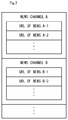
- FIG. 7 is a diagram showing a non-limiting example of list information
- FIG. 8 is a diagram showing non-limiting examples of various pieces of information used in a process executed by the server
- FIG. 9 is a flow chart showing a non-limiting example of the flow of the process executed by the server.
- FIG. 10 is a diagram showing non-limiting examples of various pieces of information used in a process executed by the information processing terminal
- FIG. 11 is a flow chart showing a non-limiting example of the flow of the process executed by the information processing terminal.
- FIG. 12 is a flow chart showing a non-limiting example of the flow of the process executed by the information processing terminal.
- FIG. 1 is a block diagram showing an example of the configuration of the information processing system according to the exemplary embodiment.
- the information processing system includes a server 1 and an information processing terminal 2 .
- the server 1 and the information processing terminal 2 can connect to a network 3 such as the Internet and/or a mobile communication network.
- the server 1 and the information processing terminal 2 can communicate with each other via the network 3 .
- FIG. 1 shows a single information processing terminal 2
- the information processing system may include a plurality of information processing terminals.
- the server 1 provides a news content for the information processing terminal 2 (see FIG. 1 ).
- the content provided for the information processing terminal 2 is any content.
- the content may be a moving image, a still image, an application, and/or the like.
- news provided for the information processing terminal 2 is managed by classifying the news into groups termed news channels.
- a user of the information processing terminal 2 registers the news channel of news to be provided for the information processing terminal 2 . Consequently, news belonging to the registered news channel is provided for the information processing terminal 2 .
- the server 1 manages the registration of a news channel regarding the information processing terminal 2 (the details will be described later).
- news provided for the information processing terminal 2 is managed on a news-channel-by-news-channel basis.
- news provided for the information processing terminal 2 may be managed on a news-by-news basis (see “[4. Operation and Effect and Variations of Exemplary Embodiment]” described later).
- the information processing terminal 2 is an example of the information processing apparatus owned by a user and is, for example, a smartphone, a mobile or stationary game apparatus, a mobile phone, a tablet terminal, a wearable terminal, a personal computer, or the like.
- the information processing terminal 2 can execute various applications. In the exemplary embodiment, the information processing terminal 2 can execute at least one game application. Further, the information processing terminal 2 receives, from the server 1 , data of news provided for the information processing terminal 2 itself and presents the news to the user at an appropriate timing.
- FIG. 2 is a block diagram showing an example of the configuration of the server 1 .
- Components shown in FIG. 2 and included in the server 1 are achieved by one or more information processing apparatuses.
- a “server” refers to a single information processing apparatus (i.e., a server apparatus), and when the function of the server is achieved by a plurality of server apparatuses, also refers to the entirety of a server apparatus group (i.e., a server system). That is, a “server” may be a server apparatus, or may be a server system. It should be noted that when a plurality of information processing apparatuses are included in the server system, the information processing apparatuses may be placed in the same place, or may be placed in different places.
- the server 1 when the server 1 includes an information processing apparatus for transmitting data of news to the information processing terminal 2 , and an information processing apparatus for managing the registration of a news channel, these two information processing apparatuses may be placed in different places.
- the hardware configuration of the server 1 according to the exemplary embodiment may be similar to the hardware configuration of a conventional server.
- the server 1 includes a processing section 11 and a storage section 12 .
- the processing section 11 is electrically connected to components 12 to 15 of the server 1 .
- the processing section 11 includes a CPU (Central Processing Unit) and a memory.
- the CPU executes a program stored in the storage section 12 , using the memory, thereby executing various types of information processing.
- the storage section 12 is any storage device (also referred to as “storage medium”) accessible by the processing section 11 .
- the storage section 12 stores a program to be executed by the processing section 11 , data to be used in information processing performed by the processing section 11 , data obtained by the information processing, and the like.
- the storage section 12 at least stores a program (referred to as a “server-side program”) for information processing to be executed on the server side to manage the registration of a news channel.
- the server 1 includes a communication section 13 .
- the communication section 13 has the function of connecting to the network 3 and communicating with another apparatus (e.g., the information processing terminal 2 ) via the network 3 .
- the processing section 11 communicates with another apparatus via the network 3 using the communication section 13 (in other words, via the communication section 13 ).
- the server 1 includes an input section 14 and a display section 15 as input/output interfaces. For example, when an update of a registration rule described later ( FIG. 5 ) is present, a server administrator performs work for the update using the input/output interfaces.
- FIG. 3 is a block diagram showing an example of the configuration of the information processing terminal 2 .
- the information processing terminal 2 includes a processing section 21 and a storage section 22 .
- the processing section 21 is electrically connected to components 22 to 25 of the information processing terminal 2 .
- the processing section 21 includes a CPU (Central Processing Unit) and a memory.
- the CPU executes a program (including the above game application) stored in the storage section 22 , using the memory, thereby executing various types of information processing.
- the storage section 22 stores a program to be executed by the processing section 21 , data to be used in information processing performed by the processing section 21 , data obtained by the information processing, and the like.
- the storage section 22 may be a storage medium built into the information processing terminal 2 , or may be a storage medium attachable to and detachable from the information processing terminal 2 .
- the information processing terminal 2 includes an input section 23 .
- the input section 23 may be any input device for receiving an input provided by the user.
- the input section 23 includes a touch panel provided on a screen of a display section 24 described later.
- the input section 23 may include a button, an inertial sensor (e.g., an acceleration sensor or a gyro sensor), and/or the like in addition to (or instead of) the touch panel.
- the information processing terminal 2 includes a display section 24 .
- the display section 24 displays an image (e.g., a game image or the like) generated by information processing executed by the processing section 21 of the information processing terminal 2 .
- the information processing terminal 2 may include a speaker, a microphone, a camera, and/or the like.
- the information processing terminal 2 includes a communication section 25 .
- the communication section 25 has the function of connecting to a wireless LAN using a communication module authenticated for Wi-Fi, for example.
- the processing section 21 connects to the network 3 via a wireless LAN using the communication section 25 (in other words, via the communication section 25 ) and communicates with another apparatus (e.g., the server 1 or the like).
- another apparatus e.g., the server 1 or the like.
- the communication section 25 may have the function of connecting to a mobile communication network (in other words, a mobile phone network) and performing communication, or may have both the function of connecting to a mobile communication network and the function of connecting to a wireless LAN.
- FIG. 4 is a diagram showing an example of the flow of the process of registering a news channel.
- the information processing terminal 2 starts an application in accordance with an instruction given by the user (step S 1 ).
- the information processing terminal 2 transmits app identification information regarding the application to the server 1 (step S 2 ).
- the app identification information includes identification information (e.g., ID) allowing the identification of the started application.
- ID identification information
- unique identification information is assigned in advance to each application that can be executed by the information processing terminal 2 .
- the information processing terminal 2 can execute a plurality of applications.
- the plurality of applications may include a game application and also include an application of a type different from the game application.
- the plurality of applications include an application for displaying an image (e.g., a menu image or an entrance image) to be displayed first after the information processing terminal 2 is started.
- the information processing terminal 2 transmits app identification information to the server 1 .
- the information processing terminal 2 may execute an application that is not compatible with a news provision service performed by the server 1 (i.e., an application of which app identification information is not transmitted in accordance with the start of the application).
- the information processing terminal 2 transmits app identification information of the application to the server 1 . That is, even when a certain application that has previously been started is started again, the information processing terminal 2 transmits app identification information to the server 1 .
- this can enable the information processing terminal 2 to efficiently deal with a change in a registration rule in the server 1 .
- the information processing terminal 2 in a case where the information processing terminal 2 is in the state where the information processing terminal 2 cannot communicate with the server 1 when an application is started, the information processing terminal 2 transmits app identification information to the server 1 after the information processing terminal 2 becomes able to communicate with the server 1 . That is, in the above case, the information processing terminal 2 saves app identification information regarding the started application (see step S 44 shown in FIG. 11 described later). Then, when the information processing terminal 2 becomes able to communicate with the server 1 after that, the information processing terminal 2 transmits the saved app identification information to the server 1 . According to this, even in a case where the information processing terminal 2 cannot communicate with the server 1 when an application is started, the information processing terminal 2 can certainly transmit app identification information to the server 1 .
- app identification information includes country information and language information.
- the country information indicates a country to which the user of the information processing terminal 2 belongs.
- the information processing terminal 2 stores account information of the user.
- the account information includes country information.
- the information processing terminal 2 can acquire the country information from the account information stored in the information processing terminal 2 itself and include the acquired country information in app identification information.
- the language information indicates a language used in the information processing terminal 2 .
- a language is set when the information processing terminal 2 is initialized, and the information processing terminal 2 stores language information indicating the set language.
- the information processing terminal 2 can include the language information stored in the information processing terminal 2 itself in app identification information.
- the server 1 receives the app identification information transmitted from the information processing terminal 2 (step S 3 ). Then, the server 1 specifies a news channel corresponding to the application indicated by the received app identification information (step S 4 ). In the exemplary embodiment, a news channel is specified using a registration rule table stored in the server 1 .
- FIG. 5 is a diagram showing an example of the registration rule table.
- the registration rule table is a table indicating the association (i.e., a registration rule) between app identification information (more specifically, a condition regarding app identification information) and channel specifying information.
- the channel specifying information is information for specifying a news channel and is, for example, information indicating the name of a news channel and/or unique identification information for each news channel.
- a condition regarding an application, a country, and a language indicated by the app identification information is associated with a news channel indicated by the channel specifying information.
- the condition that “the app identification information indicates an application A and also indicates that the country is Japan or the language is Japanese” is associated with an “app A channel”.
- the “app A channel” is, for example, a news channel including Japanese news regarding the application A.
- the condition that “the app identification information indicates an application B and also indicates that the country is Japan or the language is Japanese” is associated with an “app B channel” and a “development manufacturer X channel”.
- the “app B channel” is, for example, a news channel including Japanese news regarding the application B.
- the “development manufacturer X channel” is a news channel including Japanese news regarding a development manufacturer X of the application B.
- a single piece of app identification information may be associated with a plurality of news channels.
- the condition that “the app identification information indicates an application C and also indicates that the country is a country in the English-speaking world or the language is English” is associated with an “app C channel”.
- the “app C channel” is, for example, a news channel including English news regarding the application C.
- an application to be started in the information processing terminal 2 is associated with the news channel of news regarding the application and/or the news channel of news regarding the development manufacturer of the application.
- the association (in other words, the content of the registration rule) between an application and a news channel in the registration rule is any association.
- a menu display application for displaying the above menu image may be associated with a shop news channel including news regarding an application that can be purchased and used in the information processing terminal 2 .
- the registration rule may not be a table format, and may be information in any format indicating the association between app identification information (in other words, an application) and channel specifying information (in other words, a news channel).
- the server 1 When the app identification information received from the information processing terminal 2 satisfies any of the conditions included in the registration rule table, the server 1 specifies a news channel associated with the condition. For example, in the example shown in FIG. 5 , when the app identification information indicates the application A and also indicates Japan or Japanese, the server 1 specifies the app A channel.
- the server transmits, to the information processing terminal 2 , channel specifying information indicating the specified news channel (step S 5 ).
- the information processing terminal 2 which is the transmission destination of the channel specifying information, is the information processing terminal 2 having transmitted app identification information corresponding to the channel specifying information. It should be noted that when a plurality of news channels are specified in step S 4 , channel specifying information indicating the plurality of news channels is transmitted from the server 1 to the information processing terminal 2 . It should be noted that when the specified news channel has already been registered, the server 1 may not transmit channel specifying information.
- the information processing terminal 2 receives the channel specifying information transmitted from the server 1 (step S 6 ). Then, the information processing terminal 2 registers the news channel indicated by the received channel specifying information (step S 7 ). Here, the information processing terminal 2 stores registered channel information indicating a registered news channel regarding the information processing terminal 2 itself. In step S 7 , the information processing terminal 2 updates the registered channel information by adding the news channel indicated by the received channel specifying information to news channels that have already been registered in the past. It should be noted that when the specified news channel has already been registered, the information processing terminal 2 may not update the registered channel information.
- a registered news channel is managed on the information processing terminal 2 side and also managed on the server 1 side. Specifically, when newly registering a news channel in the above step S 7 , the information processing terminal 2 transmits a registration notification to the server 1 (see FIG. 4 ).
- the registration notification includes identification information of the newly registered news channel.
- the server 1 When receiving the registration notification from the information processing terminal 2 , the server 1 registers the specified news channel regarding the information processing terminal 2 (step S 8 ).
- the server 1 stores registered channel information similar to the registered channel information stored in the information processing terminal 2 .
- the server 1 creates and stores registered channel information for each information processing terminal in advance.
- the server 1 updates the registered channel information by including a news channel indicated by identification information included in a received registration notification.
- the server 1 may register the specified news channel. At this time, the information processing terminal 2 may not transmit a registration notification to the server 1 .
- the registration of a news channel is also managed on the information processing terminal 2 side.
- the information processing terminal 2 has the function of connecting to the network 3 via a wireless LAN.
- a situation is possible where the information processing terminal 2 cannot communicate with the server 1 .
- the registration is managed on the information processing terminal 2 side.
- the user can cancel the registration of a news channel by giving a predetermined cancellation instruction.
- app identification information is transmitted from the information processing terminal 2 to the server 1 .
- app identification information is transmitted to the server 1 .
- channel specifying information is transmitted from the server 1 to the information processing terminal 2 .
- the information processing terminal 2 registers the news channel again in accordance with the fact that the channel specifying information is received, the news channel may be registered against the intention of the user having canceled the registration of the news channel.
- step S 7 when the received channel specifying information indicates a news channel of which the registration has been canceled in the past, the information processing terminal 2 does not register the news channel (see step S 50 shown in FIG. 11 described later). It should be noted that in the exemplary embodiment, the information processing terminal 2 stores information (referred to as “canceled channel information”) indicating the history of a news channel of which the registration has been canceled. Then, in the above step S 7 , based on the canceled channel information, the information processing terminal 2 determines whether or not the channel specifying information received from the server 1 indicates a news channel of which the registration has been canceled in the past.
- canceled channel information information indicating the history of a news channel of which the registration has been canceled.
- the information processing terminal 2 registers the news channel. According to this, it is possible to reduce the possibility that a news channel is registered against the intention of the user.
- step S 8 similarly to the registration process on the information processing terminal 2 side, a news channel of which the registration has been canceled in the past is not registered. That is, similarly to the information processing terminal 2 , the server 1 also stores the canceled channel information, and based on the canceled channel information, determines whether or not a news channel indicated by the registration notification received from the information processing terminal 2 is a news channel of which the registration has been canceled in the past.
- the registration execution condition is a condition regarding communication performed in the started application.
- the registration execution condition is that a predetermined communication process is not being executed in the started application.
- the predetermined communication process is, for example, a communication process in which the amount of communication is relatively large, and more specifically, is the game processing of an online game or the game processing of a communication competition.
- the information processing terminal 2 executes the processes regarding the registration in the background while the started application is being executed. According to this, the information processing terminal 2 can register a news channel while the application is being executed, without influencing the predetermined communication process in the application. It should be noted that the predetermined communication process does not need to include all communication processes in the started application.
- the predetermined communication process may not include a communication process in which the amount of communication is relatively small (specifically, the process of merely receiving a notification regarding a game, the process of merely uploading a game result to the server, or the like) among the communication processes in the application.
- the information processing terminal 2 executes the above processes regarding the registration. Consequently, even when a predetermined communication process is executed, it is possible to certainly execute processes regarding registration.
- the above processes regarding the registration regarding an application started by an instruction of the user are executed by the function of a system application different from the user application. That is, the information processing terminal 2 executes a predetermined system application, thereby performing the above processes regarding the registration. Thus, the information processing terminal 2 executes the system application in parallel while a started user application is being executed, and thereby can execute the above processes regarding the registration in the background while the user application is being executed.
- step S 2 when the user starts an application in the information processing terminal 2 , app identification information is transmitted to the server 1 (step S 2 ), and a news channel corresponding to the application is registered (step S 7 or S 8 ).
- the information processing terminal 2 can register a news channel corresponding to an application to be used by the user, and the server 1 can provide news corresponding to the application for the information processing terminal 2 .
- a news channel is automatically registered.
- the user does not need to perform a registration operation separately from the operation of starting the application.
- the information processing terminal 2 transmits app identification information of the application to the server 1 . According to this, when an application is repeatedly used in the information processing terminal 2 , app identification information is repeatedly transmitted to the server 1 .
- a new news channel may be added, or the association between an application and a news channel may be changed, thereby changing the registration rule.
- a news channel is registered based on the latest registration rule at this time.
- the information processing terminal 2 can perform a registration process on which the latest registration rule is reflected.
- the information processing terminal 2 of a user frequently using a certain application transmits app identification information with high frequency, and thereby can deal with a change in the registration rule regarding the application on the server 1 side with excellent responsiveness.
- the information processing terminal 2 of a user using a certain application with low frequency transmits app identification information with low frequency.
- the information processing terminal 2 transmits app identification information, and thereby can perform a registration process with appropriate frequency.
- the information processing terminal 2 may not transmit app identification information at all timings when an application is started. For example, with a limit of a predetermined number of times in a predetermined period (specifically, with a limit of once a day), and in accordance with the fact that an application is started, the information processing terminal 2 may transmit app identification information.
- the information processing terminal 2 transmits app identification information to the application the server 1 . According to this, at an appropriate timing, the information processing terminal 2 can perform a registration process on which the latest registration rule is reflected, and also reduce the possibility that unnecessary communication is performed between the information processing terminal 2 and the server 1 . Thus, it is possible to reduce the amount of communication.
- a news channel is registered. That is, in the exemplary embodiment, as a condition for the information processing terminal 2 to register a news channel (referred to as a “registration condition”), the fact that an application corresponding to the news channel is started is used.
- the information processing terminal 2 uses, as the registration condition, conditions described below in addition to the fact that an application is started.
- the information processing terminal 2 uses, as another registration condition, “the fact that the user gives a registration instruction”. Specifically, the information processing terminal 2 displays on the display section 24 a list image for news channels provided by the server 1 .
- the list image includes news channels registered in the information processing terminal 2 and news channels that have not yet been registered in the information processing terminal 2 .
- the condition for displaying the list image is any condition
- the timing when the list image is displayed is any timing.
- the list image is displayed.
- the information processing terminal 2 receives the input of a registration instruction to newly register a news channel displayed on the list image.
- the information processing terminal 2 newly registers a news channel regarding the registration instruction.
- the information processing terminal 2 may use, as another registration condition, “the fact that a new application becomes able to be executed in the information processing terminal 2 ”. That is, when a new application is installed in the information processing terminal 2 , or when a storage medium having stored therein an application is connected to the information processing terminal 2 , the information processing terminal 2 may register a news channel corresponding to the application. It should be noted that a method in which the information processing terminal 2 specifies a news channel to be newly registered is any method. For example, the information processing terminal 2 may transmit app identification information indicating an application that newly becomes able to be executed to the server 1 .
- the server 1 and the information processing terminal 2 can newly register a news channel by processes similar to the above steps S 3 to S 8 .
- the information processing terminal 2 may store in advance the same registration rule as the registration rule stored in the server 1 , and based on the registration rule, specify a news channel corresponding to an uninstalled application.
- this predetermined condition may be “the fact that the user gives a registration instruction”, or may be “the fact that a new application becomes able to be executed in the information processing terminal 2 ”. According to this, it is possible to increase the opportunity to register a news channel. Thus, it is possible to further improve convenience for the user.
- the information processing terminal 2 cancels the registration of a news channel that has already been registered. For example, when the above list image is displayed on the display section 24 , the information processing terminal 2 receives the input of a cancellation instruction to cancel the registration of a news channel that is displayed on the list image and has already been registered. In accordance with the fact that the user gives a cancellation instruction, the information processing terminal 2 cancels the registration of a news channel regarding the cancellation instruction.
- the information processing terminal 2 may cancel the registration of a news channel corresponding to the application.
- a method for specifying a news channel of which the registration is to be canceled is any method.
- the information processing terminal 2 may transmit, to the server 1 , canceled app information indicating an uninstalled application.
- the server 1 specifies a news channel associated with the application indicated by the canceled app information received from the information processing terminal 2 , cancels the registration of the news channel, and transmits, to the information processing terminal 2 , canceled channel information indicating the news channel.
- the information processing terminal 2 cancels the registration of the news channel indicated by the canceled channel information received from the server 1 .
- the information processing terminal 2 may store the same registration rule as the registration rule stored in the server 1 in advance, and based on the registration rule, specify a news channel corresponding to an uninstalled application. It should be noted that before the registration of a news channel is canceled, the information processing terminal 2 may confirm with the user whether or not the registration is allowed to be canceled.
- the information processing terminal 2 transmits change information indicating a change regarding the content of the registration of the news channel to the server 1 .
- the server 1 updates the content of the registered channel information. Consequently, it is possible to match the contents of the registered channel information of the information processing terminal 2 and the registered channel information of the server 1 .
- a news channel may be newly registered similarly to a case where an application is started. The details are described below.
- the information processing terminal 2 when an account of the user corresponding to a new country is newly registered in the information processing terminal 2 , the information processing terminal 2 transmits country information to the server 1 . It should be noted that in the exemplary embodiment, accounts of a plurality of users can be registered in a single information processing terminal 2 . When an account of a new user is registered in the information processing terminal 2 , then first, the information processing terminal 2 determines whether or not a country corresponding to the registered account (i.e., a country indicated by country information included in account information of the account) is a new country. That is, the information processing terminal 2 determines whether or not the country corresponding to the registered account is different from countries corresponding to one or more accounts that have already been registered.
- a country corresponding to the registered account i.e., a country indicated by country information included in account information of the account
- the information processing terminal 2 acquires the country information included in the registered account information and transmits the acquired country information to the server 1 .
- country information is not transmitted.
- the server 1 When receiving the country information from the information processing terminal 2 , then based on the country indicated by the newly received country information and an application indicated by app identification information acquired by the information processing terminal 2 in the past, the server 1 specifies a news channel to be registered. That is, the server 1 determines whether or not a condition included in the registration rule is satisfied. When the condition is satisfied, the server 1 specifies a news channel associated with the satisfied condition. As a result, processes similar to the above steps S 5 to S 8 are executed, thereby newly registering the specified news channel. For example, in the example shown in FIG.
- the information processing terminal 2 transmits, to the server 1 , app identification information including country information indicating the United States of America.
- the server 1 specifies the app C channel.
- the information processing terminal 2 when the setting of the language is changed in the information processing terminal 2 , the information processing terminal 2 transmits language information to the server 1 . That is, when the setting of the language is changed in the information processing terminal 2 , the information processing terminal 2 transmits, to the server 1 , language information indicating the language after the change.
- the server 1 When receiving the language information from the information processing terminal 2 , then based on the language indicated by the newly received language information and an application indicated by app identification information acquired from the information processing terminal 2 in the past, the server 1 specifies a news channel to be registered. This specifying method is similar to the method for specifying a news channel in a case where country information is received.
- the registration of a news channel is managed on an information-processing-terminal-by-information-processing-terminal basis, and news is provided in the situation where an account of a user who is using the information processing terminal 2 is not specified.
- the above list image is displayed on the display section 24 in the state where an account of the user is not specified.
- news on the same news channel is provided regardless of an account of a user who is using the information processing terminal 2 .
- the registration of a news channel can be updated.
- FIG. 6 is a diagram showing an example of the flow of the process in which the server provides news for the information processing terminal.
- the server 1 gives a notification that there is news to be transmitted (step S 10 ).
- the timing when this notification is given is any timing. For example, when new news is added, and/or at predetermined time intervals, the server 1 gives the above notification.
- the information processing terminal 2 When receiving the notification from the server 1 , the information processing terminal 2 requests a news list (step S 11 ).
- the news list is a list of news that is currently being distributed from the server 1 to each information processing terminal.
- a news list is prepared for each news channel.
- the information processing terminal 2 may request a news list, for example, in the following cases in addition to a case where the information processing terminal 2 receives a notification from the server 1 .
- the server 1 When receiving from the information processing terminal 2 the request for a news list, the server 1 selects a news channel of which the news list is to be transmitted to the information processing terminal 2 (step S 12 ). That is, the server 1 selects a news channel registered regarding the information processing terminal 2 . It should be noted that when a plurality of news channels are registered regarding the information processing terminal 2 , the plurality of news channels are selected. The server 1 transmits list information including the news list of the selected news channel to the information processing terminal 2 (step S 13 ).
- FIG. 7 is a diagram showing an example of the list information.
- the list information includes news lists regarding a news channel A and a news channel B.
- the list information indicates a news list for each news channel.
- the news list includes information indicating news that is being distributed.
- the news list includes, as the information, information of a URL (the URLs of news A- 1 , A- 2 , B- 1 , and B- 2 in FIG. 7 ).
- the number of news lists included in the list information may be any number, and the number of pieces of news included in each news list may be any number.
- the information processing terminal 2 when receiving the list information from the server 1 , selects, from the news list included in the list information, news that has not yet been acquired by the information processing terminal 2 itself (step S 14 ). It should be noted that the information processing terminal 2 saves, in advance, data of news acquired in the process of step S 17 described later, and in the process of step S 14 , selects news that is not saved. Further, the timing when the information processing terminal 2 executes the process of selecting news is any timing. For example, this timing may be the timing when the above list image is displayed on the display section 24 , or may be the timing when the list information is received.
- the information processing terminal 2 makes a request to acquire the selected news (step S 15 ). Specifically, the information processing terminal 2 accesses the URL of the selected news included in the news list received from the server 1 . It should be noted that the timing when the information processing terminal 2 makes a request to acquire the news is any timing. For example, in accordance with the fact that a user instruction to display the news is given to the information processing terminal 2 , the information processing terminal 2 makes a request to acquire the news.
- the server 1 When receiving from the information processing terminal 2 the request to acquire the news, the server 1 transmits, to the information processing terminal 2 , data of the news regarding the request (step S 16 ).
- the information processing terminal 2 receives the data of the news from the server 1 (step S 17 ) and displays the news indicated by the received data of the news on the display section 24 (step S 18 ).
- the server 1 under the condition that news is included in a registered news channel, the server 1 transmits the news among a news group that can be provided (step S 16 ).
- the information processing terminal 2 receives the news from the server 1 and displays the received news on the display section 24 . Consequently, the server 1 can provide news belonging to a registered news channel for the information processing terminal 2 .
- FIG. 8 is a diagram showing examples of various pieces of information to be used in the process executed by the server 1 .
- the various pieces of information shown in FIG. 8 are stored, for example, in the storage section 12 of the server 1 .
- the storage section 12 stores the above registration rule table and registration management information.
- the registration management information includes terminal identification information, the above registered channel information, and the above canceled channel information.
- the terminal identification information is unique identification information (e.g., ID) for each information processing terminal. It should be noted that when the information processing system includes a plurality of information processing terminals, registration management information is created and stored for each information processing terminal.
- the storage section 12 stores news management information.
- the news management information includes news channel information for each news channel.
- the news channel information includes channel identification information and news information.
- the channel identification information is information similar to the above channel specifying information, and for example, is information indicating the name of a news channel and/or unique identification information for each news channel.
- the news information includes data of news, information indicating a URL for accessing the data, and information indicating whether or not the news is being distributed. It should be noted that in the exemplary embodiment, the news channel information includes news information for each piece of news belonging to a news channel.
- FIG. 9 is a flow chart showing an example of the flow of the process executed by the server 1 (referred to as a “server process”). It should be noted that a series of processes shown in FIG. 9 is continuously executed during the operation of the server 1 . It should be noted that in the exemplary embodiment, a description is given on the assumption that the processing section 11 (specifically, the CPU) of the server 1 executes the server-side program, thereby executing the processes of steps shown in FIG. 9 . Alternatively, the processes of some of the steps in the flow chart may be executed by a processor other than the CPU, or a dedicated circuit.
- the processing section 11 of the server 1 executes the processes of the steps shown in FIG. 9 , using the memory (the same applies to the processing section 21 of the information processing terminal 2 executing the processes of steps in FIGS. 11 and 12 described later). That is, the CPU of the processing section 11 stores, in the memory, information (in other words, data) obtained by each processing step. Then, when the information is to be used in the subsequent processing steps, the CPU reads the information from the memory and uses the information.
- step S 21 shown in FIG. 9 the processing section 11 determines whether or not app identification information is received from the information processing terminal 2 . That is, the processing section 11 determines whether or not the communication section 13 receives app identification information from the information processing terminal 2 .
- the process of step S 22 is executed.
- the processes of steps S 22 to S 25 are skipped, and the process of step S 27 described later is executed.
- step S 22 the processing section 11 specifies a news channel corresponding to the app identification information received from the information processing terminal 2 . That is, based on the registration rule table stored in the storage section 12 , the processing section 11 specifies a news channel.
- the news channel is specified by the method described above in “[2-1. Overview of Registration Process]” (step S 4 shown in FIG. 4 ).
- step S 23 the process of step S 23 is executed.
- step S 23 the processing section 11 determines whether or not the specified news channel is a news channel of which the registration has been canceled in the past (in other words, whether or not the specified news channel has a history in which the registration has been canceled). Based on the canceled channel information stored in the storage section 12 , the processing section 11 makes the determination. When the result of the determination is negative in step S 23 , the process of step S 24 is executed. On the other hand, when the result of the determination is affirmative in step S 23 , the process of step S 24 is skipped, and the process of step S 25 described later is executed. In this case, the news channel is not registered.
- step S 24 the processing section 11 causes the communication section 13 to transmit, to the information processing terminal 2 , channel specifying information indicating the news channel specified in step S 22 (step S 5 shown in FIG. 4 ).
- step S 25 the process of step S 25 is executed.
- step S 25 the processing section 11 determines whether or not the above registration notification is received from the information processing terminal 2 . That is, the processing section 11 determines whether or not the communication section 13 receives a registration notification from the information processing terminal 2 .
- the process of step S 26 is executed.
- the process of step S 26 is skipped, and the process of step S 27 described later is executed.
- step S 26 the processing section 11 registers the news channel indicated by the registration notification received from the information processing terminal 2 (step S 8 shown in FIG. 4 ). That is, the processing section 11 updates the registered channel information stored in the storage section 12 , by including the news channel indicated by the registration notification.
- step S 27 the process of step S 27 is executed.
- step S 27 the processing section 11 determines whether or not the timing of giving the information processing terminal 2 a notification that there is news to be transmitted arrives.
- the process of step S 28 is executed.
- the process of step S 28 is skipped, and the process of step S 29 described later is executed.
- step S 28 the processing section 11 gives the information processing terminal 2 a notification that there is news to be transmitted (step S 10 shown in FIG. 6 ). It should be noted that in accordance with this notification, the information processing terminal 2 requests a news list from the server 1 (step S 57 shown in FIG. 12 ). After step S 28 , the process of step S 29 is executed.
- step S 29 the processing section 11 determines whether or not the request for a news list is received from the information processing terminal 2 . That is, the processing section 11 determines whether or not the communication section 13 receives, from the information processing terminal 2 , information indicating the above request.
- the process of step S 30 is executed.
- the processes of steps S 30 and S 31 are skipped, and the process of step S 32 described later is executed.
- step S 30 the processing section 11 selects a news channel of which the news list is to be transmitted to the information processing terminal 2 (step S 12 shown in FIG. 6 ). That is, the processing section 11 selects a news channel indicated by the registered channel information stored in the storage section 12 and regarding the information processing terminal 2 (in other words, a registered news channel).
- step S 30 the process of step S 31 is executed.
- step S 31 the processing section 11 transmits list information including a news list regarding the news channel selected in step S 30 to the information processing terminal 2 (step S 13 ). That is, based on the news management information stored in the storage section 12 , the processing section 11 generates a news list regarding the selected news channel. Then, using the communication section 13 , the processing section 11 transmits list information including the generated news list to the information processing terminal 2 . It should be noted that receiving the list information, the information processing terminal 2 makes a request to acquire news to the server 1 (step S 59 shown in FIG. 12 ). After step S 31 , the process of step S 32 is executed.
- step S 32 the processing section 11 determines whether or not the request to acquire news is received from the information processing terminal 2 . That is, the processing section 11 determines whether or not the communication section 13 receives information indicating the above request from the information processing terminal 2 .
- the process of step S 33 is executed.
- the process of step S 21 is executed again.
- step S 33 the processing section 11 causes the communication section 13 to transmit, to the information processing terminal 2 , data of the news regarding the request received in step S 32 .
- step S 33 the process of step S 21 is executed again.
- the processing section 11 repeatedly executes the series of processes in the above steps S 21 to S 33 . It should be noted that when a plurality of information processing terminals access the server 1 , the processing section 11 may execute the above series of processes for the information processing terminals in parallel.
- FIG. 10 is a diagram showing examples of various pieces of information to be used in the process executed by the information processing terminal 2 .
- the various pieces of information shown in FIG. 10 are stored, for example, in the storage section 22 of the information processing terminal 2 or the memory of the processing section 11 .
- the storage section 22 stores an application program and registration management information.
- the application program is a program for an application (including the above user application and the above system application) that can be executed by the information processing terminal 2 .
- the registration management information includes the above registered channel information and the above canceled channel information.
- FIGS. 11 and 12 are flow charts showing an example of the flow of the process executed by the information processing terminal 2 (referred to as a “terminal process”). It should be noted that a series of processes shown in FIGS. 11 and 12 is continuously executed during the operation of the information processing terminal 2 . However, when the information processing terminal 2 is in a sleep state, part or all of the above series of processes may not be executed. It should be noted that in the exemplary embodiment, a description is given on the assumption that the processing section 21 (specifically, the CPU) of the information processing terminal 2 executes a program (e.g., an OS (operating system) program) stored in the storage section 22 , thereby executing the processes of steps shown in FIGS. 11 and 12 . Alternatively, the processes of some of the steps in the flow charts may be executed by a processor other than the CPU, or a dedicated circuit.
- a program e.g., an OS (operating system) program
- step S 41 shown in FIG. 11 first, the processing section 21 determines whether or not an instruction to start an application is given by the user. That is, the processing section 21 acquires, from the input section 23 , input information indicating an input to the input section 23 and determines whether or not an instruction is input.
- the process of step S 42 is executed.
- the process of step S 45 described later is executed.
- step S 42 the processing section 21 starts the application for which the start instruction is given by the user (step S 1 shown in FIG. 4 ). That is, the processing section 21 starts the execution of a program for the application stored in the storage section 22 .
- step S 43 the process of step S 43 is executed.
- step S 43 the processing section 21 determines whether or not the information processing terminal 2 can communicate with the server 1 .
- the processing section 21 determines whether or not the communication section 25 is connected to a wireless LAN, or whether or not the communication section 25 can communicate with the server 1 via a wireless LAN.
- the process of step S 44 is executed.
- the process of step S 47 described later is executed.
- step S 44 the processing section 21 saves identification information of the application started in step S 42 in the storage section 22 .
- step S 45 the process of step S 45 is executed.
- step S 45 the processing section 21 determines whether or not the information processing terminal 2 becomes able to communicate with the server 1 . It should be noted that the processing section 21 makes the determination in step S 45 by a method similar to that of the determination process in the above step S 43 . When the result of the determination is affirmative in step S 45 , the process of step S 46 is executed. On the other hand, when the result of the determination is negative in step S 45 , the process of step S 52 described later is executed.
- step S 46 the processing section 21 determines whether or not the identification information of the application is saved in the storage section 22 .
- This determination process is the process of determining whether or not the identification information of the application is saved in the process of step S 44 while the information processing terminal 2 is offline (i.e., during the period in which the information processing terminal 2 cannot communicate with the server 1 ).
- the process of step S 47 is executed.
- the process of step S 52 described later is executed.
- step S 47 the processing section 21 determines whether or not the above registration execution condition is satisfied. That is, the processing section 21 determines whether or not a predetermined communication process is executed in the application that is started in step S 42 and being executed. When the result of the determination is affirmative in step S 47 , the process of step S 48 is executed. On the other hand, when the result of the determination is negative in step S 47 , the process of step S 52 described later is executed. In this case, the processes regarding the registration of a news channel are not executed at the current moment.
- step S 48 the processing section 21 transmits app identification information regarding the application started in step S 42 to the server 1 (step S 2 shown in FIG. 4 ). That is, based on information stored in the storage section 22 (specifically, the identification information of the application, country information, and language information), the processing section 21 generates app identification information and causes the communication section 25 to transmit the generated app identification information to the server 1 . In response to this, when there is a news channel to be newly registered, the server 1 transmits channel specifying information to the information processing terminal 2 (steps S 21 to S 25 shown in FIG. 9 ). After step S 48 , the process of step S 49 is executed.
- step S 49 the processing section 21 determines whether or not the channel specifying information is received from the server 1 . That is, the processing section 21 determines whether or not the communication section 25 receives the channel specifying information from the server 1 .
- the process of step S 50 is executed.
- the processes of steps S 50 and S 51 are skipped, and the process of step S 52 described later is executed.
- step S 50 the processing section 21 determines whether or not a news channel indicated by the channel specifying information received in step S 49 is a news channel of which the registration has been canceled in the past. Based on the canceled channel information stored in the storage section 22 , the processing section 21 makes the determination. When the result of the determination is negative in step S 50 , the process of step S 51 is executed. On the other hand, when the result of the determination is affirmative in step S 50 , the process of step S 51 is skipped, and the process of step S 52 described later is executed.
- step S 51 the processing section 21 registers the news channel indicated by the channel specifying information received in step S 49 (step S 7 shown in FIG. 4 ). That is, the processing section 21 updates the registered channel information stored in the storage section 22 , by including the news channel. Further, the processing section 21 transmits to the server 1 a registration notification indicating the news channel. That is, the processing section 21 generates information of a registration notification including identification information indicating the news channel and causes the communication section 25 to transmit the generated information of the registration notification to the server 1 . In response to this, the server 1 registers the news channel indicated by the registration notification (step S 26 shown in FIG. 9 ). After step S 51 , the process of step S 52 is executed.
- step S 44 country information or language information is saved instead of the identification information of the application, and in step S 48 , country information or language information is transmitted instead of the app identification information to the server 1 . Consequently, also in the above case, it is possible to newly register a news channel similarly to a case where an application is started.
- step S 52 the processing section 21 determines whether or not another registration condition described above (i.e., the fact that the user gives a registration instruction) is satisfied.
- step S 53 the process of step S 53 is executed.
- step S 54 the process of step S 54 described later is executed.
- step S 53 the processing section 21 registers a news channel regarding the registration instruction given by the user. It should be noted that a specific process for registering the news channel in step S 53 is similar to the above process of step S 51 . After step S 53 , the process of step S 54 is executed.
- step S 54 the processing section 21 determines whether or not the above cancellation condition is satisfied.
- the process of step S 55 is executed.
- the process of step S 55 is skipped, and the process of step S 56 described later is executed.
- step S 55 the processing section 21 cancels the registration of a news channel satisfying the cancellation condition. It should be noted that a method for specifying the news channel satisfying the cancellation condition is as described above in “(Cancellation of Registration)”. The processing section 21 updates the registered channel information stored in the storage section 22 , by deleting the news channel satisfying the cancellation condition from news channels that have already been registered. After step S 55 , the process of step S 56 is executed.
- step S 56 the processing section 21 determines whether or not the processing section 21 is to request a news list from the server 1 . That is, in the various cases described above in “[2-2. Overview of News Provision Process]”, the processing section 21 determines that the processing section 21 is to request a news list.
- the process of step S 57 is executed.
- the process of step S 57 is skipped, and the process of step S 58 described later is executed.
- step S 57 the processing section 21 requests a news list from the server 1 . That is, the processing section 21 causes the communication section 25 to transmit information indicating the above request to the server 1 . In response to this, the server 1 transmits list information including the news list regarding the above request to the information processing terminal 2 (steps S 29 to S 31 shown in FIG. 9 ). After step S 57 , the process of step S 58 is executed.
- step S 58 the processing section 21 determines whether or not the list information is received from the server 1 . That is, the processing section 21 determines whether or not the communication section 25 receives the list information from the server 1 .
- the process of step S 59 is executed.
- the processes of steps S 59 and S 60 are skipped, and the process of step S 61 described later is executed.
- step S 59 the processing section 21 acquires news that has not yet been acquired by the information processing terminal 2 .
- the process of acquiring the news is the series of processes in steps S 14 to S 17 shown in FIG. 6 . That is, the processing section 21 acquires the news by executing the processes of the above step S 14 , S 15 , and S 17 .
- step S 60 the process of step S 60 is executed.
- step S 60 the processing section 21 determines whether or not the news is to be displayed.
- the processing section 21 makes the determination in step S 60 , for example, based on whether or not the user gives an instruction to display the news, or whether or not the timing when the news is automatically displayed arrives (e.g., the information processing terminal 2 is started).
- the process of step S 61 is executed.
- the process of step S 61 is skipped, and the above process of step S 41 is executed again.
- step S 61 the processing section 21 displays the news on the display section 24 (step S 18 shown in FIG. 6 ).
- the displayed news may be, for example, news selected by the user from a plurality of pieces of news of which the titles are displayed on a list image, or may be news selected in accordance with an algorithm determined in advance (e.g., news acquired last).
- step S 61 the above process of step S 41 is executed again. Thereafter, the information processing terminal 2 repeatedly executes the series of processes in steps S 41 to S 61 .
- the information processing terminal 2 has the following configurations.
- the information processing system has the following configuration.
- the information processing system manages registration on the basis of a news channel to which news belongs.
- the information processing system may manage registration on a news-by-news basis.
- the server 1 stores, as a registration rule, information in which an application and news are associated with each other. That is, the specifying information storage means stores specifying information for specifying, from among a content (i.e., news) group, a content as a target to be transmitted to the information processing terminal, in association with identification information of an application. Also based on this, similarly to the above exemplary embodiment, the server 1 can provide news corresponding to a started application for the information processing terminal 2 .
- both the server 1 and the information processing terminal 2 include the registration means.
- only either one of the server 1 and the information processing terminal 2 may include the registration means. That is, the registration of a news channel may be managed by only either one of the server 1 and the information processing terminal 2 .
- “registering regarding the information processing terminal” refers to, for example, registration in association with identification information of the information processing terminal (or information of an account of the user of the information processing terminal), and registration in the information processing terminal. That is, the registration means may be means for executing the process of storing the above registered channel information in association with identification information of the information processing terminal, or may be means for executing the process of storing the registered channel information in the information processing terminal.
- a news channel is registered using as a trigger the fact that an application is started in the information processing terminal 2 .
- an operation used as a trigger for the registration of a news channel is not limited to the start of an application.
- the information processing terminal 2 may transmit app identification information regarding the application to the server 1 . That is, the information processing terminal 2 may transmit, to the server 1 , app identification information regarding an application started in the information processing terminal 2 and/or an application having newly become able to be executed in the information processing terminal 2 .
- the information processing terminal 2 may transmit app identification information regarding the application to the server 1 .
- the shop application is an application having, for example, the function of accessing a server for providing an application that can be executed by the information processing terminal 2 , and the function of enabling the user to purchase the application.
- a predetermined operation regarding an application e.g., the operation of starting an application, the operation of making a new application executable, or the operation of registering an application in favorites
- the information processing terminal 2 may transmit app identification information to the server 1 .
- the registration of a news channel is managed with respect to each information processing terminal. That is, registered channel information is set and stored with respect to each information processing terminal.
- the registration of a news channel may be managed with respect to each user (in other words, with respect to each account of a user).
- the server 1 stores, in advance, registered channel information with respect to each account of a user set in the information processing terminal 2 .
- the information processing system newly registers a news channel in accordance with the fact that an application is started in the information processing terminal 2
- the information processing system updates registered channel information regarding an account of a user for which the application is started. According to this, also when a plurality of users use a single information processing terminal, it is possible to manage the registration of a news channel with respect to each user.
- a part of the process executed on the server 1 side in the above exemplary embodiment may be executed on the information processing terminal 2 side. Further, in another exemplary embodiment, a part of the process executed on the information processing terminal 2 side in the above exemplary embodiment may be executed on the server 1 side.
- the exemplary embodiment can be used for, for example, an information processing apparatus such as a game apparatus or a smartphone, and an information processing system in order, for example, to provide a content corresponding to an application to be used by a user for the user.
- an information processing apparatus such as a game apparatus or a smartphone
- an information processing system in order, for example, to provide a content corresponding to an application to be used by a user for the user.
Landscapes
- Engineering & Computer Science (AREA)
- Computer Networks & Wireless Communication (AREA)
- Signal Processing (AREA)
- Multimedia (AREA)
- Computer Hardware Design (AREA)
- Computer Security & Cryptography (AREA)
- Computing Systems (AREA)
- General Engineering & Computer Science (AREA)
- Business, Economics & Management (AREA)
- General Business, Economics & Management (AREA)
- Information Transfer Between Computers (AREA)
- Management, Administration, Business Operations System, And Electronic Commerce (AREA)
Abstract
Description
-
- A case where the
information processing terminal 2 shifts from the state where theinformation processing terminal 2 cannot communicate with theserver 1 to the state where theinformation processing terminal 2 can communicate with theserver 1 - A case where the
information processing terminal 2 is turned on - A case where the user gives an instruction
- A case where the
-
- Application start means (step S42) for starting an application in accordance with an instruction of the user
- Identification information transmission means (step S48) for transmitting identification information of the started application (i.e., app identification information) to the
server 1 Further, theserver 1 has the following configurations. - Specifying information storage means (i.e., the
storage section 12 for storing a registration rule) for storing specifying information for specifying, from among a content (i.e., news) group, a group of contents (i.e., a news channel) as a target to be transmitted to the information processing terminal (i.e., channel specifying information), in association with the identification information of the application - Identification information reception means (step S21) for receiving identification information from the
information processing terminal 2 - Specifying information selection means (step S22) for selecting, from among the specifying information stored in the specifying information storage means, specifying information associated with the identification information received from the
information processing terminal 2
-
- Registration means (step S26 or S51) for registering a group specified by the selected specifying information, as a target to be transmitted to the
information processing terminal 2 regarding the information processing terminal
(Variations Regarding Registration of Content)
- Registration means (step S26 or S51) for registering a group specified by the selected specifying information, as a target to be transmitted to the
Claims (15)
Applications Claiming Priority (2)
| Application Number | Priority Date | Filing Date | Title |
|---|---|---|---|
| JP2017-119428 | 2017-06-19 | ||
| JP2017119428A JP6979803B2 (en) | 2017-06-19 | 2017-06-19 | Information processing system, information processing device, information processing program, and information processing method |
Publications (2)
| Publication Number | Publication Date |
|---|---|
| US20180367628A1 US20180367628A1 (en) | 2018-12-20 |
| US10652157B2 true US10652157B2 (en) | 2020-05-12 |
Family
ID=64657803
Family Applications (1)
| Application Number | Title | Priority Date | Filing Date |
|---|---|---|---|
| US15/840,266 Active 2038-06-19 US10652157B2 (en) | 2017-06-19 | 2017-12-13 | Systems and methods of receiving informational content based on transmitted application information |
Country Status (2)
| Country | Link |
|---|---|
| US (1) | US10652157B2 (en) |
| JP (1) | JP6979803B2 (en) |
Families Citing this family (4)
| Publication number | Priority date | Publication date | Assignee | Title |
|---|---|---|---|---|
| JP6979803B2 (en) * | 2017-06-19 | 2021-12-15 | 任天堂株式会社 | Information processing system, information processing device, information processing program, and information processing method |
| US11816526B2 (en) | 2019-06-24 | 2023-11-14 | Suncorporation | Function execution system |
| KR102766994B1 (en) * | 2021-07-30 | 2025-02-11 | 주식회사 카카오 | Method for providing subscription service, system, user device, and application implementing the method |
| JP7822428B2 (en) * | 2024-07-05 | 2026-03-02 | 任天堂株式会社 | System, method, and program |
Citations (23)
| Publication number | Priority date | Publication date | Assignee | Title |
|---|---|---|---|---|
| US20010052012A1 (en) * | 2000-06-30 | 2001-12-13 | Rinne Janne Petri | Quality of service definition for data streams |
| US20030218765A1 (en) * | 2002-04-26 | 2003-11-27 | Tsutomu Ohishi | Apparatus for controlling launch of application and method |
| US20040257994A1 (en) * | 2003-06-17 | 2004-12-23 | Cymphonix Corporation | System and method for network communications management |
| US20050144032A1 (en) * | 2003-12-26 | 2005-06-30 | Sega Corporation | Information supply terminal |
| JP2005242758A (en) | 2004-02-27 | 2005-09-08 | Fuji Xerox Co Ltd | Article selection device and news distribution device |
| US20060002317A1 (en) * | 2004-07-01 | 2006-01-05 | Punaganti Venkata Murali Krish | Information feeder framework |
| US20080106597A1 (en) * | 1999-10-12 | 2008-05-08 | Vigilos, Inc. | System and method for storing and remotely retrieving surveillance video images |
| US20090292824A1 (en) * | 2005-01-21 | 2009-11-26 | Internap Network Services Corporation | System And Method For Application Acceleration On A Distributed Computer Network |
| US20110185052A1 (en) * | 2010-01-28 | 2011-07-28 | Oki Electric Industry Co., Ltd. | COMMUNICATION CONTROL APPARATUS FOR CONTROLLING QoS ACCORDING TO APPLICATIONS AND NETWORK STATE |
| US20110313916A1 (en) * | 2009-02-23 | 2011-12-22 | Niven-Jenkins Benjamin P | Streamed content distribution service |
| US20130054698A1 (en) * | 2011-08-22 | 2013-02-28 | Johnny Hsienchow Lee | System and method for location-based recommendations |
| US20130238472A1 (en) * | 2012-03-06 | 2013-09-12 | Jerry Fan | Systems and Methods for Billing Content Providers for Designated Content Delivered Over a Data Network |
| US8612612B1 (en) * | 2011-09-28 | 2013-12-17 | Juniper Networks, Inc. | Dynamic policy control for application flow processing in a network device |
| US20140094195A1 (en) * | 2012-09-28 | 2014-04-03 | Tencent Technology (Shenzhen) Company Limited | Terminal location obtaining method, device, and system |
| US20140169172A1 (en) * | 2012-12-18 | 2014-06-19 | At&T Intellectual Property I, L.P. | Dynamic in-band service control mechanism in mobile network |
| US20140325057A1 (en) * | 2013-04-24 | 2014-10-30 | Albert T. Borawski | Methods and apparatus to create a panel of media device users |
| US20160203519A1 (en) * | 2015-01-09 | 2016-07-14 | Facebook, Inc. | Presenting content to an online system user promoting interaction with an application based on installation of the application on a client device |
| US20170244866A1 (en) * | 2016-02-24 | 2017-08-24 | Konica Minolta, Inc. | Image processing system, information processing device, image processing device and non-transitory recording medium |
| US20170351872A1 (en) * | 2016-06-03 | 2017-12-07 | Beijing Xiaomi Mobile Software Co., Ltd. | Method, device, and system for sending and receiving information |
| US20180032521A1 (en) * | 2016-07-27 | 2018-02-01 | Google Inc. | Triggering application information |
| US10120606B2 (en) * | 2016-07-25 | 2018-11-06 | Samsung Electronics Co., Ltd. | Data storage devices including storage controller circuits to select data streams based on application tags and computing systems including the same |
| US20180359612A1 (en) * | 2017-06-09 | 2018-12-13 | Blackberry Limited | Providing Data File Updates Using Multimedia Broadcast Multicast Services |
| US20180367628A1 (en) * | 2017-06-19 | 2018-12-20 | Nintendo Co., Ltd. | Information processing system, information processing apparatus, storage medium having stored therein information processing program, and information processing method |
Family Cites Families (7)
| Publication number | Priority date | Publication date | Assignee | Title |
|---|---|---|---|---|
| JP2002073673A (en) * | 2000-09-01 | 2002-03-12 | Nippon Telegr & Teleph Corp <Ntt> | User preference sharing method, user agent search method, and user agent location notification method |
| JP2002202927A (en) * | 2000-11-02 | 2002-07-19 | Sony Computer Entertainment Inc | Entertainment system, server device, content distribution method, content distribution program, and storage medium storing content distribution program |
| US6732092B2 (en) * | 2001-09-28 | 2004-05-04 | Client Dynamics, Inc. | Method and system for database queries and information delivery |
| US8763090B2 (en) * | 2009-08-11 | 2014-06-24 | Sony Computer Entertainment America Llc | Management of ancillary content delivery and presentation |
| WO2013190545A1 (en) * | 2012-06-17 | 2013-12-27 | Skycure Ltd | Access control system for a mobile device |
| JP2015062096A (en) * | 2013-09-23 | 2015-04-02 | 株式会社ミル・プロジェ. | Content distribution system |
| JP5805294B1 (en) * | 2014-12-19 | 2015-11-04 | ヤフー株式会社 | Distribution device, distribution method, distribution program, terminal device, selection method, and selection program |
-
2017
- 2017-06-19 JP JP2017119428A patent/JP6979803B2/en active Active
- 2017-12-13 US US15/840,266 patent/US10652157B2/en active Active
Patent Citations (24)
| Publication number | Priority date | Publication date | Assignee | Title |
|---|---|---|---|---|
| US20080106597A1 (en) * | 1999-10-12 | 2008-05-08 | Vigilos, Inc. | System and method for storing and remotely retrieving surveillance video images |
| US20010052012A1 (en) * | 2000-06-30 | 2001-12-13 | Rinne Janne Petri | Quality of service definition for data streams |
| US20030218765A1 (en) * | 2002-04-26 | 2003-11-27 | Tsutomu Ohishi | Apparatus for controlling launch of application and method |
| US20040257994A1 (en) * | 2003-06-17 | 2004-12-23 | Cymphonix Corporation | System and method for network communications management |
| US20050144032A1 (en) * | 2003-12-26 | 2005-06-30 | Sega Corporation | Information supply terminal |
| JP2005242758A (en) | 2004-02-27 | 2005-09-08 | Fuji Xerox Co Ltd | Article selection device and news distribution device |
| US20060002317A1 (en) * | 2004-07-01 | 2006-01-05 | Punaganti Venkata Murali Krish | Information feeder framework |
| US20090292824A1 (en) * | 2005-01-21 | 2009-11-26 | Internap Network Services Corporation | System And Method For Application Acceleration On A Distributed Computer Network |
| US20110313916A1 (en) * | 2009-02-23 | 2011-12-22 | Niven-Jenkins Benjamin P | Streamed content distribution service |
| US20110185052A1 (en) * | 2010-01-28 | 2011-07-28 | Oki Electric Industry Co., Ltd. | COMMUNICATION CONTROL APPARATUS FOR CONTROLLING QoS ACCORDING TO APPLICATIONS AND NETWORK STATE |
| US20130054698A1 (en) * | 2011-08-22 | 2013-02-28 | Johnny Hsienchow Lee | System and method for location-based recommendations |
| US8612612B1 (en) * | 2011-09-28 | 2013-12-17 | Juniper Networks, Inc. | Dynamic policy control for application flow processing in a network device |
| US20130238472A1 (en) * | 2012-03-06 | 2013-09-12 | Jerry Fan | Systems and Methods for Billing Content Providers for Designated Content Delivered Over a Data Network |
| US20140094195A1 (en) * | 2012-09-28 | 2014-04-03 | Tencent Technology (Shenzhen) Company Limited | Terminal location obtaining method, device, and system |
| US20140169172A1 (en) * | 2012-12-18 | 2014-06-19 | At&T Intellectual Property I, L.P. | Dynamic in-band service control mechanism in mobile network |
| US20140325057A1 (en) * | 2013-04-24 | 2014-10-30 | Albert T. Borawski | Methods and apparatus to create a panel of media device users |
| US20160203519A1 (en) * | 2015-01-09 | 2016-07-14 | Facebook, Inc. | Presenting content to an online system user promoting interaction with an application based on installation of the application on a client device |
| US20170244866A1 (en) * | 2016-02-24 | 2017-08-24 | Konica Minolta, Inc. | Image processing system, information processing device, image processing device and non-transitory recording medium |
| US20170351872A1 (en) * | 2016-06-03 | 2017-12-07 | Beijing Xiaomi Mobile Software Co., Ltd. | Method, device, and system for sending and receiving information |
| US10120606B2 (en) * | 2016-07-25 | 2018-11-06 | Samsung Electronics Co., Ltd. | Data storage devices including storage controller circuits to select data streams based on application tags and computing systems including the same |
| US20180032521A1 (en) * | 2016-07-27 | 2018-02-01 | Google Inc. | Triggering application information |
| US20180359612A1 (en) * | 2017-06-09 | 2018-12-13 | Blackberry Limited | Providing Data File Updates Using Multimedia Broadcast Multicast Services |
| US20180367628A1 (en) * | 2017-06-19 | 2018-12-20 | Nintendo Co., Ltd. | Information processing system, information processing apparatus, storage medium having stored therein information processing program, and information processing method |
| JP2019003532A (en) * | 2017-06-19 | 2019-01-10 | 任天堂株式会社 | Information processing system, information processing apparatus, information processing program, and information processing method |
Also Published As
| Publication number | Publication date |
|---|---|
| JP2019003532A (en) | 2019-01-10 |
| JP6979803B2 (en) | 2021-12-15 |
| US20180367628A1 (en) | 2018-12-20 |
Similar Documents
| Publication | Publication Date | Title |
|---|---|---|
| US9478195B2 (en) | Transferring state information between electronic devices | |
| JP4684656B2 (en) | Mobile device, content distribution system, and content distribution method | |
| US20130124672A1 (en) | System and Method for Delivering Media Assets in a Cloud Environment | |
| WO2018164736A1 (en) | Reverse casting from a first screen device to a second screen device | |
| EP2763094A1 (en) | Method of displaying user interface on device, and device | |
| US20170311024A1 (en) | Pre-roll advertisement playing method, terminal, and video server | |
| CN110990741A (en) | Page display method and device, electronic equipment, server and storage medium | |
| US20180367628A1 (en) | Information processing system, information processing apparatus, storage medium having stored therein information processing program, and information processing method | |
| US9942164B2 (en) | Mobile information terminal and program thereof | |
| CN106713323B (en) | page content preview method, client, server and system | |
| US11018931B2 (en) | Data driven user interface for configuring device settings | |
| CN102457579B (en) | A kind of method and system realizing Business Processing in cloud terminal | |
| JP2017530496A (en) | Device control method, apparatus, program, and recording medium | |
| JP2013108851A (en) | In-vehicle apparatus system and in-vehicle apparatus used for the same | |
| JP5878671B1 (en) | System, method, and program for distributing digital content | |
| CN105553831A (en) | Message delivery method and system | |
| JP2006343855A (en) | Content relay apparatus and content relay method | |
| US20210234859A1 (en) | Non-transitory computer-readable storage medium, data access control method, and authorization server | |
| US10805427B1 (en) | Backup and restore of customer devices | |
| US20150222712A1 (en) | Information processing terminal and control method | |
| JP2018018246A (en) | Electronic apparatus, presentation method and program | |
| US20210240416A1 (en) | Communication system, server system, and terminal apparatus | |
| CN114205651B (en) | Resource processing method, device, equipment and storage medium | |
| US9728227B2 (en) | Display system, information terminal, display device, and recording medium | |
| CN112084449A (en) | Terminal operation method, operation server control method, terminal and medium |
Legal Events
| Date | Code | Title | Description |
|---|---|---|---|
| AS | Assignment |
Owner name: NINTENDO CO., LTD., JAPAN Free format text: ASSIGNMENT OF ASSIGNORS INTEREST;ASSIGNORS:YAMASHITA, YOSHIKAZU;KAMIKAWA, YOJI;HOSOI, TAKASHI;AND OTHERS;SIGNING DATES FROM 20171128 TO 20171129;REEL/FRAME:044385/0161 |
|
| FEPP | Fee payment procedure |
Free format text: ENTITY STATUS SET TO UNDISCOUNTED (ORIGINAL EVENT CODE: BIG.); ENTITY STATUS OF PATENT OWNER: LARGE ENTITY |
|
| STPP | Information on status: patent application and granting procedure in general |
Free format text: DOCKETED NEW CASE - READY FOR EXAMINATION |
|
| STPP | Information on status: patent application and granting procedure in general |
Free format text: NON FINAL ACTION MAILED |
|
| STPP | Information on status: patent application and granting procedure in general |
Free format text: RESPONSE TO NON-FINAL OFFICE ACTION ENTERED AND FORWARDED TO EXAMINER |
|
| STPP | Information on status: patent application and granting procedure in general |
Free format text: FINAL REJECTION MAILED |
|
| STPP | Information on status: patent application and granting procedure in general |
Free format text: DOCKETED NEW CASE - READY FOR EXAMINATION |
|
| STPP | Information on status: patent application and granting procedure in general |
Free format text: NOTICE OF ALLOWANCE MAILED -- APPLICATION RECEIVED IN OFFICE OF PUBLICATIONS |
|
| STCF | Information on status: patent grant |
Free format text: PATENTED CASE |
|
| MAFP | Maintenance fee payment |
Free format text: PAYMENT OF MAINTENANCE FEE, 4TH YEAR, LARGE ENTITY (ORIGINAL EVENT CODE: M1551); ENTITY STATUS OF PATENT OWNER: LARGE ENTITY Year of fee payment: 4 |