US10649203B2 - Display panel, display device and control method thereof - Google Patents
Display panel, display device and control method thereof Download PDFInfo
- Publication number
- US10649203B2 US10649203B2 US15/978,519 US201815978519A US10649203B2 US 10649203 B2 US10649203 B2 US 10649203B2 US 201815978519 A US201815978519 A US 201815978519A US 10649203 B2 US10649203 B2 US 10649203B2
- Authority
- US
- United States
- Prior art keywords
- light
- rectangular prism
- display panel
- prism
- panel according
- Prior art date
- Legal status (The legal status is an assumption and is not a legal conclusion. Google has not performed a legal analysis and makes no representation as to the accuracy of the status listed.)
- Expired - Fee Related, expires
Links
- 238000000034 method Methods 0.000 title claims abstract description 12
- 239000003086 colorant Substances 0.000 claims abstract description 21
- 239000000758 substrate Substances 0.000 claims abstract description 14
- 239000011248 coating agent Substances 0.000 claims description 21
- 238000000576 coating method Methods 0.000 claims description 21
- 230000008054 signal transmission Effects 0.000 claims description 9
- 238000005516 engineering process Methods 0.000 description 5
- 238000012423 maintenance Methods 0.000 description 5
- 238000004519 manufacturing process Methods 0.000 description 4
- 238000012986 modification Methods 0.000 description 2
- 230000004048 modification Effects 0.000 description 2
- 230000008569 process Effects 0.000 description 2
- 238000004458 analytical method Methods 0.000 description 1
- 230000005540 biological transmission Effects 0.000 description 1
- 230000015572 biosynthetic process Effects 0.000 description 1
- 230000008859 change Effects 0.000 description 1
- 238000013461 design Methods 0.000 description 1
- 238000011161 development Methods 0.000 description 1
- 238000002474 experimental method Methods 0.000 description 1
- 239000004973 liquid crystal related substance Substances 0.000 description 1
- 238000003786 synthesis reaction Methods 0.000 description 1
- 239000010409 thin film Substances 0.000 description 1
- 238000002834 transmittance Methods 0.000 description 1
Images




Classifications
-
- G—PHYSICS
- G02—OPTICS
- G02B—OPTICAL ELEMENTS, SYSTEMS OR APPARATUS
- G02B26/00—Optical devices or arrangements for the control of light using movable or deformable optical elements
- G02B26/007—Optical devices or arrangements for the control of light using movable or deformable optical elements the movable or deformable optical element controlling the colour, i.e. a spectral characteristic, of the light
-
- G—PHYSICS
- G02—OPTICS
- G02B—OPTICAL ELEMENTS, SYSTEMS OR APPARATUS
- G02B26/00—Optical devices or arrangements for the control of light using movable or deformable optical elements
- G02B26/08—Optical devices or arrangements for the control of light using movable or deformable optical elements for controlling the direction of light
- G02B26/0875—Optical devices or arrangements for the control of light using movable or deformable optical elements for controlling the direction of light by means of one or more refracting elements
- G02B26/0883—Optical devices or arrangements for the control of light using movable or deformable optical elements for controlling the direction of light by means of one or more refracting elements the refracting element being a prism
-
- G—PHYSICS
- G02—OPTICS
- G02B—OPTICAL ELEMENTS, SYSTEMS OR APPARATUS
- G02B27/00—Optical systems or apparatus not provided for by any of the groups G02B1/00 - G02B26/00, G02B30/00
- G02B27/10—Beam splitting or combining systems
- G02B27/1006—Beam splitting or combining systems for splitting or combining different wavelengths
-
- G—PHYSICS
- G02—OPTICS
- G02B—OPTICAL ELEMENTS, SYSTEMS OR APPARATUS
- G02B27/00—Optical systems or apparatus not provided for by any of the groups G02B1/00 - G02B26/00, G02B30/00
- G02B27/10—Beam splitting or combining systems
- G02B27/12—Beam splitting or combining systems operating by refraction only
- G02B27/126—The splitting element being a prism or prismatic array, including systems based on total internal reflection
-
- H—ELECTRICITY
- H02—GENERATION; CONVERSION OR DISTRIBUTION OF ELECTRIC POWER
- H02K—DYNAMO-ELECTRIC MACHINES
- H02K33/00—Motors with reciprocating, oscillating or vibrating magnet, armature or coil system
- H02K33/16—Motors with reciprocating, oscillating or vibrating magnet, armature or coil system with polarised armatures moving in alternate directions by reversal or energisation of a single coil system
Definitions
- the present disclosure relates to a field of display technology, and in particular to a display panel, a display device and a control method thereof.
- the display screen as a device capable of both outputting and inputting, is an important tool for visualizing the operation of the electronic device through a specific transmission device.
- Electronic devices such as televisions, mobile phones, computers, and smart wearable devices that are closest to us in life are inseparable from the display screen, some for operation, and others for viewing.
- the existing display screens currently on the market mainly include: LCD (liquid crystal display), LED (light emitting diode) display, plasma display, etc.
- a display panel including a plurality of display units on a base substrate, where each display unit includes: a driving component; and a light splitting component driven by the driving component to convert incident light into light of different colors.
- the driving component includes: a magnetic field generation component; a conductive coil in a magnetic field generated by the magnetic field generation component; and a rotary shaft connected to the conductive coil; where the light splitting component includes a prism connected to the rotating shaft capable of rotating the prism, and the prism is capable of converting the incident light into different colors of light at different rotation angles.
- the prism is a rectangular prism
- an extension direction of the rotary shaft is identical to an extension direction of an intersection line where two orthogonal surfaces of the rectangular prism intersect.
- the display unit further includes: a first light-shielding pattern at a light-incident side of the rectangular prism, where the first light-shielding pattern includes a first opening corresponding to the rectangular prism; a second light-shielding pattern at a light-emitting side of the rectangular prism, where the second light-shielding pattern includes a second opening opposite to the first opening.
- the rectangular prism includes a first orthogonal surface, a second orthogonal surface and an oblique surface connecting the first orthogonal surface and the second orthogonal surface; a first light-shielding coating is on the first orthogonal surface and configured to completely shield the first opening in the case that the rectangular prism is in an initial state.
- a second light-shielding coating is on an edge of the oblique surface of the rectangular prism adjacent to the first orthogonal surface of the rectangular prism.
- a third light-shielding coating is on an edge of the second orthogonal surface of the rectangular prism adjacent to the oblique surface of the rectangular prism.
- a fourth light-shielding coating is on an edge of the oblique surface of the rectangular prism adjacent to the second orthogonal surface of the rectangular prism.
- the magnetic field generation component includes two permanent magnets opposite to each other, and the conductive coil is between the two permanent magnets.
- the display panel further includes a signal transmission line connected to the conductive coil and configured to output a current to the conductive coil.
- the display panel further includes a first light-shielding pattern arranged at a light-incident side of the rectangular prism and having a plurality of first openings and a second light-shielding pattern arranged at a light-emitting side of the rectangular prism and having a plurality of second openings, where orthographic projections of the first openings onto the base substrate overlap orthographic projections of the second openings onto the base substrate.
- a shape of the first light-shielding pattern is identical to the second light-shielding pattern.
- the rectangular prism includes a first orthogonal surface, a second orthogonal surface and an oblique surface connecting the first orthogonal surface and the second orthogonal surface; a first light-shielding coating is on the first orthogonal surface, and an orthographic projection of the first light-shielding coating onto the base substrate overlaps the orthographic projection of the first opening onto the base substrate and the orthographic projection of the second opening onto the base substrate in the case that the rectangular prism is in an initial state.
- a display device is further provided in the present disclosure, including the above display panel and a backlight source configured to provide backlight for the display panel.
- the display device further includes a signal transmission line connected to the conductive coil and configured to output a current to the conductive coil and a driving circuit configured to output different magnitudes of current to the signal transmission line.
- a control method of the above display device is further provided in the present disclosure, including: controlling the driving component to drive the light splitting component to convert incident light into light of different colors.
- control method further includes: controlling a magnitude of a current output to the conductive coil, to control a rotation angle of the prism.
- FIG. 1 is a plane view of a display panel in some embodiments of the present disclosure
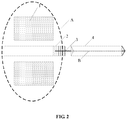
- FIG. 2 is a schematic view of a driving component in some embodiments of the present disclosure
- FIG. 3 is a schematic view of a display unit displaying a dark image in some embodiments of the present disclosure
- FIG. 4 is a schematic view of a display unit displaying a color image in some embodiments of the present disclosure
- FIG. 5 is a schematic view of a first light-shielding pattern in some embodiments of the present disclosure.
- FIG. 6 is a schematic view of a display device in some embodiments of the present disclosure.
- a display panel, a display device and a control method thereof are provided in the present disclosure, so as to solve the technical issue of lacking of color expression of the display screen in the related art.
- a display panel is provided in some embodiments of the present disclosure, including a plurality of display units on a base substrate, where each display unit includes: a driving component; and a light splitting component driven by the driving component to convert incident light into light of different colors.
- the light splitting component can be switched among different states, and in different states, the split light component may convert the incident white light into different colors of light.
- the driving component drives the light splitting component to switch among different states.
- the light splitting component may convert the incident white light into light of different colors.
- the display panel in some embodiments of the present disclosure splits white light to obtain the color light rather than using RGB to synthesize colors, so the color purity is good.
- the color display may be performed just by the driving component and the light splitting component, therefore the circuit structure is simple, and the manufacturing process thereof is simple, and it is convenient for maintenance.
- the driving component includes: a magnetic field generation component; a conductive coil 2 in a magnetic field generated by the magnetic field generation component; and a rotary shaft 3 connected to the conductive coil 2 .
- the light splitting component includes a prism connected to the rotating shaft 3 capable of rotating the prism, and the prism is capable of converting the incident white light 11 into different colors of light at different rotation angles.
- the prism is a rectangular prism.
- the type of the prism is not limited, as long as the prism is capable of splitting white light into color light.
- the driving circuit 21 may output a current to the conductive coil 2 in each display unit 22 .
- the conductive coil 2 is controlled to rotate, so that the rotary shaft 3 may rotate, thereby driving the prism to rotate, so that the prism is capable of converting the incident white light 11 into different colors of light.
- the magnetic field generation component A includes two permanent magnets 1 opposite to each other, and the conductive coil 2 is between the two permanent magnets 1 .
- the prism is a rectangular prism 4 , and an extension direction of the rotary shaft 3 is identical to an extension direction of an intersection line B where two orthogonal surfaces of the rectangular prism 4 intersect.
- the rectangular prism includes a two orthogonal surfaces and an oblique surface, and the intersection line B is where the two orthogonal surfaces of the rectangular prism 4 intersect.
- the display panel further includes a signal transmission line connected to the conductive coil 2 and configured to output a current to the conductive coil 2 .
- the signal transmission line is connected to the conductive coil 2 and the driving circuit 21 .
- a series circuit is formed through the conductive coils in the magnetic field formed by the permanent magnets.
- the circuit structure is significantly simplified, the working principle is simpler, and the number of electrical elements in the pixel area is reduced, the composition is simpler, thereby reducing the design cost and maintenance costs for later maintenance, reducing the difficulty of poor analysis, and making it easier to be updated.
- the display panel in some embodiments may be applied to a large-scale public display screen, such as an advertisement display screen of a large commercial center.
- the display unit 22 further includes a first light-shielding pattern 6 at a light-incident side of the rectangular prism 4 , where the first light-shielding pattern 6 includes a first opening 13 corresponding to the rectangular prism 4 .
- the display unit 22 further includes a second light-shielding pattern 5 at a light-emitting side of the rectangular prism 4 .
- the second light-shielding pattern includes a second opening 14 opposite to the first opening 13 .
- a first light-shielding coating 7 is on the first orthogonal surface of the rectangular prism 4 .
- the first light-shielding coating 7 is capable of completely shielding the first opening 13 , so as to enable the display unit 22 to display a dark image.
- the display unit 22 it is necessary to have an original moment to make the prism to be in the initial state as shown in FIG. 3 , and the white light 11 emitted by the backlight and through the first opening 13 is shielded by the first light-shielding coating 7 of the prism, then the display unit 22 is in the full black mode.
- a second light-shielding coating 8 is arranged on an edge of the oblique surface of the rectangular prism 4 adjacent to the first orthogonal surface of the rectangular prism 4 .
- a third light-shielding coating 9 is arranged on an edge of the second orthogonal surface of the rectangular prism 4 adjacent to the oblique surface of the rectangular prism 4 .
- a fourth light-shielding coating 10 is arranged on an edge of the oblique surface of the rectangular prism 4 adjacent to the second orthogonal surface of the rectangular prism 4 . It is able to prevent interference of various refracted light, reflected light, transmitted light, and the like through the second light-shielding coating 8 , the third light-shielding coating 9 and the fourth light-shielding coating 10 .
- the rectangular prism 4 may rotate by an angle from 0 to ⁇ , and the rectangular prism 4 may split the white light 11 into different colors of the color light 12 within an angle ranging from 0 to ⁇ .
- the correspondence between the rotation angle and the color of the light obtained by the light splitting may be determined in advance through a large number of experiments.
- the color of the light to be displayed is firstly determined, and then the rectangular prism 4 is controlled rotated by a corresponding angle. In the 0- ⁇ rotation angle range, the actual light splitting angle change may be very large, so the prism can split enough colors to be used.
- the value of a may be determined according to the required color light, and a is generally from 15° to 35°.
- a display device is further provided in some embodiments of the present disclosure, including the above display panel and a backlight source configured to provide backlight for the display panel.
- the backlight source may be a white light backlight source 16 .
- the display device in some embodiments of the present disclosure may split the white light emitted by the white backlight source 16 to obtain color light rather than using RGB to synthesize colors, so the color purity is good.
- the display device in some embodiments of the present disclosure includes the white backlight source 16 , the first light-shielding pattern 6 , a prism layer 15 , and the second light-shielding pattern 5 stacked in sequence.
- the first light-shielding pattern 6 has a plurality of first openings 13 , and each first opening 13 corresponds to a prism.
- a shape of the second light-shielding pattern 5 is identical to the first light-shielding pattern 6 , and the second openings 14 of the second light-shielding pattern 5 are in a one-to-one correspondence to the first openings 13 of the first light-shielding pattern 6 .
- the prism layer 15 includes a plurality of prisms, and each prism corresponds to one first opening 13 . After the light emitted by the white backlight source 16 passes through the first opening 13 , the prism layer 15 and the second opening 14 , it can be converted into a color light 12 .
- the display device in some embodiments of the present disclosure has a large aperture ratio in the pixel area and a high transmittance, and the power consumption of the backlight source may be significantly reduced.
- the structures of the first light-shielding pattern and the second light-shielding pattern are simple and practical, and the first light-shielding pattern is the same as the second light-shielding pattern, therefore they are easy to be aligned and replaced with each other.
- the display device further includes a driving circuit configured to output different magnitudes of current to the signal transmission line. Due to the process limitations, the size of the prism cannot be very small. Therefore, the display panel in some embodiments may be applied to a large-scale public display screen, such as an advertisement display screen of a large commercial center.
- a control method of the above display device is further provided in some embodiments of the present disclosure, including: controlling the driving component to drive the light splitting component to convert incident light into light of different colors.
- the driving component is controlled to drive the light splitting component to switch among different states, so as to enable the light splitting component to convert the incident white light into light of different colors.
- the driving component drives the light splitting component to switch among different states.
- the light splitting component may convert the incident white light into light of different colors.
- the display panel in some embodiments of the present disclosure splits white light to obtain the color light rather than using RGB to synthesize colors, so the color purity is good.
- the color display may be performed just by the driving component and the light splitting component, therefore the circuit structure is simple, and the manufacturing process thereof is simple, and it is convenient for maintenance.
- the driving component includes: a magnetic field generation component; a conductive coil 2 in a magnetic field generated by the magnetic field generation component; and a rotary shaft 3 connected to the conductive coil 2 .
- the light splitting component includes a prism connected to the rotating shaft 3 .
- the control method further includes: controlling a magnitude of a current output to the conductive coil 2 , to control a rotation angle of the prism.
- the driving circuit 21 may output a current to the conductive coil 2 in each display unit 22 .
- the conductive coil 2 is controlled to rotate, so that the rotary shaft 3 may rotate, thereby driving the prism to rotate, so that the prism is capable of converting the incident white light 11 into different colors of light.
Landscapes
- Physics & Mathematics (AREA)
- General Physics & Mathematics (AREA)
- Optics & Photonics (AREA)
- Astronomy & Astrophysics (AREA)
- Spectroscopy & Molecular Physics (AREA)
- Control Of Indicators Other Than Cathode Ray Tubes (AREA)
- Mechanical Light Control Or Optical Switches (AREA)
- Electrochromic Elements, Electrophoresis, Or Variable Reflection Or Absorption Elements (AREA)
- Devices For Indicating Variable Information By Combining Individual Elements (AREA)
Abstract
Description
Claims (16)
Applications Claiming Priority (3)
| Application Number | Priority Date | Filing Date | Title |
|---|---|---|---|
| CN201710884657 | 2017-09-26 | ||
| CN201710884657.2A CN107632447A (en) | 2017-09-26 | 2017-09-26 | Display panel, display device and its control method |
| CN201710884657.2 | 2017-09-26 |
Publications (2)
| Publication Number | Publication Date |
|---|---|
| US20190094528A1 US20190094528A1 (en) | 2019-03-28 |
| US10649203B2 true US10649203B2 (en) | 2020-05-12 |
Family
ID=61101653
Family Applications (1)
| Application Number | Title | Priority Date | Filing Date |
|---|---|---|---|
| US15/978,519 Expired - Fee Related US10649203B2 (en) | 2017-09-26 | 2018-05-14 | Display panel, display device and control method thereof |
Country Status (2)
| Country | Link |
|---|---|
| US (1) | US10649203B2 (en) |
| CN (1) | CN107632447A (en) |
Families Citing this family (2)
| Publication number | Priority date | Publication date | Assignee | Title |
|---|---|---|---|---|
| CN111007670A (en) * | 2019-12-06 | 2020-04-14 | 维沃移动通信有限公司 | Optical assembly and electronic equipment |
| CN117082903A (en) * | 2023-08-21 | 2023-11-17 | 维沃移动通信有限公司 | Display modules and electronic equipment |
Citations (8)
| Publication number | Priority date | Publication date | Assignee | Title |
|---|---|---|---|---|
| US5185660A (en) | 1989-11-01 | 1993-02-09 | Aura Systems, Inc. | Actuated mirror optical intensity modulation |
| CN1375716A (en) | 2002-04-23 | 2002-10-23 | 上海交通大学 | Electromagnetic micromechanical photoswitch array |
| US20050231662A1 (en) * | 2004-03-05 | 2005-10-20 | Tadaaki Isozaki | Reflection type liquid crystal display device, display apparatus, and projection system |
| CN102129137A (en) | 2010-01-13 | 2011-07-20 | 瀚宇彩晶股份有限公司 | Liquid crystal display and method of manufacturing the same |
| CN103234153A (en) | 2013-04-28 | 2013-08-07 | 京东方科技集团股份有限公司 | Direct-down-type backlight and liquid crystal display device |
| CN103487983A (en) | 2013-09-17 | 2014-01-01 | 京东方科技集团股份有限公司 | Array substrate, display panel and display device thereof |
| CN103969719A (en) | 2014-04-11 | 2014-08-06 | 京东方科技集团股份有限公司 | Triangular prism plate and display device |
| CN105093774A (en) | 2015-08-21 | 2015-11-25 | 京东方科技集团股份有限公司 | MEMS micro-mirror, display panel and display device |
Family Cites Families (1)
| Publication number | Priority date | Publication date | Assignee | Title |
|---|---|---|---|---|
| CN104698593B (en) * | 2015-02-10 | 2017-08-29 | 邓伟廷 | Prism display screen |
-
2017
- 2017-09-26 CN CN201710884657.2A patent/CN107632447A/en active Pending
-
2018
- 2018-05-14 US US15/978,519 patent/US10649203B2/en not_active Expired - Fee Related
Patent Citations (9)
| Publication number | Priority date | Publication date | Assignee | Title |
|---|---|---|---|---|
| US5185660A (en) | 1989-11-01 | 1993-02-09 | Aura Systems, Inc. | Actuated mirror optical intensity modulation |
| CN1375716A (en) | 2002-04-23 | 2002-10-23 | 上海交通大学 | Electromagnetic micromechanical photoswitch array |
| US20050231662A1 (en) * | 2004-03-05 | 2005-10-20 | Tadaaki Isozaki | Reflection type liquid crystal display device, display apparatus, and projection system |
| CN102129137A (en) | 2010-01-13 | 2011-07-20 | 瀚宇彩晶股份有限公司 | Liquid crystal display and method of manufacturing the same |
| CN103234153A (en) | 2013-04-28 | 2013-08-07 | 京东方科技集团股份有限公司 | Direct-down-type backlight and liquid crystal display device |
| US20150253626A1 (en) | 2013-04-28 | 2015-09-10 | Boe Technology Group Co., Inc. | Direct-type backlight and liquid crystal display device |
| CN103487983A (en) | 2013-09-17 | 2014-01-01 | 京东方科技集团股份有限公司 | Array substrate, display panel and display device thereof |
| CN103969719A (en) | 2014-04-11 | 2014-08-06 | 京东方科技集团股份有限公司 | Triangular prism plate and display device |
| CN105093774A (en) | 2015-08-21 | 2015-11-25 | 京东方科技集团股份有限公司 | MEMS micro-mirror, display panel and display device |
Non-Patent Citations (1)
| Title |
|---|
| First Office Action for Chinese Application No. 201710884657.2, dated Nov. 4, 2019, 8 Pages. |
Also Published As
| Publication number | Publication date |
|---|---|
| CN107632447A (en) | 2018-01-26 |
| US20190094528A1 (en) | 2019-03-28 |
Similar Documents
| Publication | Publication Date | Title |
|---|---|---|
| US20210405407A1 (en) | Liquid crystal display panel, liquid crystal display device, and electronic device | |
| US10247985B2 (en) | Color filter substrate, display panel and display device | |
| CN106023909B (en) | Display device and its display methods | |
| CN104965348B (en) | A kind of display panel and electronic equipment | |
| US12039947B2 (en) | Display device and driving method thereof | |
| WO2018214422A1 (en) | Display device and driving method therefor | |
| CN102707487A (en) | Transparent display device and electronic equipment employing same | |
| US10451931B2 (en) | Transflective display panel and transflective display device | |
| US12001092B2 (en) | Display panel and display device | |
| US20140043565A1 (en) | Sunlight readable lcd devices employing directional light guiding film | |
| CN203909438U (en) | Display panel and display device | |
| CN110764301A (en) | Electronic equipment | |
| CN111158188A (en) | A display panel and display device | |
| US20260020487A1 (en) | Display panel, manufacturing method therefor and display apparatus | |
| US12067927B2 (en) | Display apparatus and mobile terminal | |
| CN109765724A (en) | A kind of liquid crystal display die set and mobile terminal | |
| CN107728383A (en) | Double-side display device and its display module | |
| CN103676383B (en) | Liquid crystal display panel compatible with 2D and 3D display modes and display method | |
| US20190094528A1 (en) | Display panel, display device and control method thereof | |
| WO2021258864A1 (en) | Display screen and electronic device | |
| TWI529460B (en) | Backlight unit, display device, and electronic device | |
| TWI704391B (en) | Reflective electronic display device | |
| CN109212832B (en) | Liquid crystal display panel and manufacturing method thereof, liquid crystal display device | |
| CN115236899B (en) | Backlight module and display device | |
| CN215932299U (en) | Display panel and display device |
Legal Events
| Date | Code | Title | Description |
|---|---|---|---|
| AS | Assignment |
Owner name: BOE TECHNOLOGY GROUP CO., LTD., CHINA Free format text: ASSIGNMENT OF ASSIGNORS INTEREST;ASSIGNORS:WANG, KAI;HUANG, ZHONGHAO;REEL/FRAME:045795/0471 Effective date: 20180227 Owner name: CHONGQING BOE OPTOELECTRONICS TECHNOLOGY CO., LTD. Free format text: ASSIGNMENT OF ASSIGNORS INTEREST;ASSIGNORS:WANG, KAI;HUANG, ZHONGHAO;REEL/FRAME:045795/0471 Effective date: 20180227 Owner name: CHONGQING BOE OPTOELECTRONICS TECHNOLOGY CO., LTD., CHINA Free format text: ASSIGNMENT OF ASSIGNORS INTEREST;ASSIGNORS:WANG, KAI;HUANG, ZHONGHAO;REEL/FRAME:045795/0471 Effective date: 20180227 |
|
| FEPP | Fee payment procedure |
Free format text: ENTITY STATUS SET TO UNDISCOUNTED (ORIGINAL EVENT CODE: BIG.); ENTITY STATUS OF PATENT OWNER: LARGE ENTITY |
|
| STPP | Information on status: patent application and granting procedure in general |
Free format text: DOCKETED NEW CASE - READY FOR EXAMINATION |
|
| STPP | Information on status: patent application and granting procedure in general |
Free format text: NON FINAL ACTION MAILED |
|
| STPP | Information on status: patent application and granting procedure in general |
Free format text: NOTICE OF ALLOWANCE MAILED -- APPLICATION RECEIVED IN OFFICE OF PUBLICATIONS |
|
| ZAAA | Notice of allowance and fees due |
Free format text: ORIGINAL CODE: NOA |
|
| ZAAB | Notice of allowance mailed |
Free format text: ORIGINAL CODE: MN/=. |
|
| STPP | Information on status: patent application and granting procedure in general |
Free format text: NOTICE OF ALLOWANCE MAILED -- APPLICATION RECEIVED IN OFFICE OF PUBLICATIONS |
|
| ZAAA | Notice of allowance and fees due |
Free format text: ORIGINAL CODE: NOA |
|
| ZAAB | Notice of allowance mailed |
Free format text: ORIGINAL CODE: MN/=. |
|
| STCF | Information on status: patent grant |
Free format text: PATENTED CASE |
|
| FEPP | Fee payment procedure |
Free format text: MAINTENANCE FEE REMINDER MAILED (ORIGINAL EVENT CODE: REM.); ENTITY STATUS OF PATENT OWNER: LARGE ENTITY |
|
| LAPS | Lapse for failure to pay maintenance fees |
Free format text: PATENT EXPIRED FOR FAILURE TO PAY MAINTENANCE FEES (ORIGINAL EVENT CODE: EXP.); ENTITY STATUS OF PATENT OWNER: LARGE ENTITY |
|
| STCH | Information on status: patent discontinuation |
Free format text: PATENT EXPIRED DUE TO NONPAYMENT OF MAINTENANCE FEES UNDER 37 CFR 1.362 |
|
| FP | Lapsed due to failure to pay maintenance fee |
Effective date: 20240512 |