US10643677B2 - Negative kick on bit line control transistors for faster bit line settling during sensing - Google Patents
Negative kick on bit line control transistors for faster bit line settling during sensing Download PDFInfo
- Publication number
- US10643677B2 US10643677B2 US16/018,571 US201816018571A US10643677B2 US 10643677 B2 US10643677 B2 US 10643677B2 US 201816018571 A US201816018571 A US 201816018571A US 10643677 B2 US10643677 B2 US 10643677B2
- Authority
- US
- United States
- Prior art keywords
- bit line
- voltage
- level
- current
- memory
- Prior art date
- Legal status (The legal status is an assumption and is not a legal conclusion. Google has not performed a legal analysis and makes no representation as to the accuracy of the status listed.)
- Active
Links
Images




Classifications
-
- G—PHYSICS
- G11—INFORMATION STORAGE
- G11C—STATIC STORES
- G11C7/00—Arrangements for writing information into, or reading information out from, a digital store
- G11C7/12—Bit line control circuits, e.g. drivers, boosters, pull-up circuits, pull-down circuits, precharging circuits, equalising circuits, for bit lines
-
- G—PHYSICS
- G11—INFORMATION STORAGE
- G11C—STATIC STORES
- G11C11/00—Digital stores characterised by the use of particular electric or magnetic storage elements; Storage elements therefor
- G11C11/56—Digital stores characterised by the use of particular electric or magnetic storage elements; Storage elements therefor using storage elements with more than two stable states represented by steps, e.g. of voltage, current, phase, frequency
- G11C11/5621—Digital stores characterised by the use of particular electric or magnetic storage elements; Storage elements therefor using storage elements with more than two stable states represented by steps, e.g. of voltage, current, phase, frequency using charge storage in a floating gate
- G11C11/5642—Sensing or reading circuits; Data output circuits
-
- G—PHYSICS
- G11—INFORMATION STORAGE
- G11C—STATIC STORES
- G11C11/00—Digital stores characterised by the use of particular electric or magnetic storage elements; Storage elements therefor
- G11C11/56—Digital stores characterised by the use of particular electric or magnetic storage elements; Storage elements therefor using storage elements with more than two stable states represented by steps, e.g. of voltage, current, phase, frequency
- G11C11/5671—Digital stores characterised by the use of particular electric or magnetic storage elements; Storage elements therefor using storage elements with more than two stable states represented by steps, e.g. of voltage, current, phase, frequency using charge trapping in an insulator
-
- G—PHYSICS
- G11—INFORMATION STORAGE
- G11C—STATIC STORES
- G11C13/00—Digital stores characterised by the use of storage elements not covered by groups G11C11/00, G11C23/00, or G11C25/00
- G11C13/0002—Digital stores characterised by the use of storage elements not covered by groups G11C11/00, G11C23/00, or G11C25/00 using resistive RAM [RRAM] elements
- G11C13/0004—Digital stores characterised by the use of storage elements not covered by groups G11C11/00, G11C23/00, or G11C25/00 using resistive RAM [RRAM] elements comprising amorphous/crystalline phase transition cells
-
- G—PHYSICS
- G11—INFORMATION STORAGE
- G11C—STATIC STORES
- G11C13/00—Digital stores characterised by the use of storage elements not covered by groups G11C11/00, G11C23/00, or G11C25/00
- G11C13/0002—Digital stores characterised by the use of storage elements not covered by groups G11C11/00, G11C23/00, or G11C25/00 using resistive RAM [RRAM] elements
- G11C13/0021—Auxiliary circuits
- G11C13/0023—Address circuits or decoders
- G11C13/0028—Word-line or row circuits
-
- G—PHYSICS
- G11—INFORMATION STORAGE
- G11C—STATIC STORES
- G11C13/00—Digital stores characterised by the use of storage elements not covered by groups G11C11/00, G11C23/00, or G11C25/00
- G11C13/0002—Digital stores characterised by the use of storage elements not covered by groups G11C11/00, G11C23/00, or G11C25/00 using resistive RAM [RRAM] elements
- G11C13/0021—Auxiliary circuits
- G11C13/0038—Power supply circuits
-
- G—PHYSICS
- G11—INFORMATION STORAGE
- G11C—STATIC STORES
- G11C16/00—Erasable programmable read-only memories
- G11C16/02—Erasable programmable read-only memories electrically programmable
- G11C16/04—Erasable programmable read-only memories electrically programmable using variable threshold transistors, e.g. FAMOS
- G11C16/0466—Erasable programmable read-only memories electrically programmable using variable threshold transistors, e.g. FAMOS comprising cells with charge storage in an insulating layer, e.g. metal-nitride-oxide-silicon [MNOS], silicon-oxide-nitride-oxide-silicon [SONOS]
- G11C16/0475—Erasable programmable read-only memories electrically programmable using variable threshold transistors, e.g. FAMOS comprising cells with charge storage in an insulating layer, e.g. metal-nitride-oxide-silicon [MNOS], silicon-oxide-nitride-oxide-silicon [SONOS] comprising two or more independent storage sites which store independent data
-
- G—PHYSICS
- G11—INFORMATION STORAGE
- G11C—STATIC STORES
- G11C16/00—Erasable programmable read-only memories
- G11C16/02—Erasable programmable read-only memories electrically programmable
- G11C16/06—Auxiliary circuits, e.g. for writing into memory
- G11C16/24—Bit-line control circuits
-
- G—PHYSICS
- G11—INFORMATION STORAGE
- G11C—STATIC STORES
- G11C16/00—Erasable programmable read-only memories
- G11C16/02—Erasable programmable read-only memories electrically programmable
- G11C16/06—Auxiliary circuits, e.g. for writing into memory
- G11C16/26—Sensing or reading circuits; Data output circuits
-
- G—PHYSICS
- G11—INFORMATION STORAGE
- G11C—STATIC STORES
- G11C16/00—Erasable programmable read-only memories
- G11C16/02—Erasable programmable read-only memories electrically programmable
- G11C16/06—Auxiliary circuits, e.g. for writing into memory
- G11C16/34—Determination of programming status, e.g. threshold voltage, overprogramming or underprogramming, retention
- G11C16/3418—Disturbance prevention or evaluation; Refreshing of disturbed memory data
-
- G—PHYSICS
- G11—INFORMATION STORAGE
- G11C—STATIC STORES
- G11C16/00—Erasable programmable read-only memories
- G11C16/02—Erasable programmable read-only memories electrically programmable
- G11C16/06—Auxiliary circuits, e.g. for writing into memory
- G11C16/34—Determination of programming status, e.g. threshold voltage, overprogramming or underprogramming, retention
- G11C16/3418—Disturbance prevention or evaluation; Refreshing of disturbed memory data
- G11C16/3427—Circuits or methods to prevent or reduce disturbance of the state of a memory cell when neighbouring cells are read or written
-
- G—PHYSICS
- G11—INFORMATION STORAGE
- G11C—STATIC STORES
- G11C7/00—Arrangements for writing information into, or reading information out from, a digital store
- G11C7/10—Input/output [I/O] data interface arrangements, e.g. I/O data control circuits, I/O data buffers
- G11C7/1051—Data output circuits, e.g. read-out amplifiers, data output buffers, data output registers, data output level conversion circuits
- G11C7/1057—Data output buffers, e.g. comprising level conversion circuits, circuits for adapting load
-
- G—PHYSICS
- G11—INFORMATION STORAGE
- G11C—STATIC STORES
- G11C7/00—Arrangements for writing information into, or reading information out from, a digital store
- G11C7/10—Input/output [I/O] data interface arrangements, e.g. I/O data control circuits, I/O data buffers
- G11C7/1078—Data input circuits, e.g. write amplifiers, data input buffers, data input registers, data input level conversion circuits
- G11C7/1084—Data input buffers, e.g. comprising level conversion circuits, circuits for adapting load
-
- G—PHYSICS
- G11—INFORMATION STORAGE
- G11C—STATIC STORES
- G11C16/00—Erasable programmable read-only memories
- G11C16/02—Erasable programmable read-only memories electrically programmable
- G11C16/04—Erasable programmable read-only memories electrically programmable using variable threshold transistors, e.g. FAMOS
- G11C16/0483—Erasable programmable read-only memories electrically programmable using variable threshold transistors, e.g. FAMOS comprising cells having several storage transistors connected in series
Definitions
- the present disclosure pertains generally to operation of memory devices, and more specifically to improving bit line settling.
- a charge-trapping material such as a floating gate or a charge-trapping material can be used in non-volatile memory devices to store a charge that represents a data state.
- a charge-trapping material can be arranged vertically in a three-dimensional (3D) stacked memory structure, or horizontally in a two-dimensional (2D) memory structure.
- 3D memory structure is the Bit Cost Scalable (BiCS) architecture which comprises a stack of alternating conductive and dielectric layers.
- a non-volatile memory device includes memory cells which may be arranged in strings, for instance, where select gate transistors are provided at the ends of the string to selectively connect a channel of the string to a source line or bit line.
- select gate transistors are provided at the ends of the string to selectively connect a channel of the string to a source line or bit line.
- Apparatuses, methods and systems are presented for improving settling time of bit lines in a memory device during a read or verify operation.
- One general aspect includes an apparatus comprising: a set of memory cells and a control circuit coupled to the set of memory cells.
- the control circuit comprises a row decoder circuit that is configured to apply a read voltage to a selected word line coupled to the set of memory cells, and a current sense circuit that is configured to turn off a bit line control transistor coupling a selected bit line of a memory cell to the current sense circuit in response to the applied read voltage, the turned off bit line control transistor inhibiting a current flow from the current sense circuit through the selected bit line such that a settling of a voltage of the selected bit line is undisturbed.
- Some implementations may optionally include one or more of the following features: that the current sense circuit is configured to turn off the bit line control transistor by lowering a control gate voltage of the bit line control transistor from a first level to a second level during the settling of the voltage of the selected bit line; that the current sense circuit is configured to turn on the bit line control transistor before performing current sensing by raising the control gate voltage from the second level to the first level; that the current sense circuit is configured to lower the control gate voltage of the bit line control transistor from the first level to the second level by about 100 millivolts; that the current sense circuit is configured to turn off the bit line control transistor to inhibit the current flow from the sense circuit through the selected bit line by a factor of about 10 such that a settling time of the voltage of the selected bit line is shortened; that the row decoder circuit is configured to apply a set of increasing read voltage to the selected word line during a sequential read operation; that the current sense circuit is configured to turn off the bit line control transistor in response to a second read voltage applied to the selected word line following a
- Another general aspect includes an apparatus comprising: a control circuit coupled to a set of memory cells that is configured to increase a level of a read voltage on a selected word line coupled to the set of memory cells, after the increase in the level of the read voltage, lower a control gate voltage of a bit line control transistor coupled to a selected bit line of a memory cell to inhibit a current flow from a sense circuit through the selected bit line when a voltage of the selected bit line is settling, and raise the control gate voltage of the bit line control transistor before performing current sensing to determine a level of cell current sunk into the source by the memory cell.
- control circuit is configured to lower the control gate voltage of the bit line control transistor, from a first level to a second level, when the voltage of the selected bit line is settling from a fixed level to a new level; and that a duration for lowering the control gate voltage of the bit line control transistor is predetermined.
- Another general aspect includes a system comprising: a set of memory cells connected to a word line and a plurality of bit lines, and a control circuit coupled to the set of memory cells to perform a sequential read operation on the set of memory cells.
- the control circuit comprises: a row decoder circuit configured to increase a read voltage from a first read level to a second read level on the word line, and a current sense circuit configured to decrease, from a target level to a first level, a control gate voltage of a bit line control transistor coupled to a bit line of a memory cell after the increase in the read voltage to the second read level, the decrease of the control gate voltage reducing a bleeding current from the current sense circuit flowing into the bit line which speeds up a discharge of a capacitance of the bit line by the memory cell, and to increase, from the first level to the target level, the control gate voltage before determining a cell current flowing through the memory cell.
- Some implementations may optionally include one or more of the following features: that a depth between the first level and the second level is predetermined; that discharge of the capacitance of the bit line by the memory cell results in a voltage of the bit line dropping by about 0.1 V; that the discharge of the capacitance of the bit line by the memory cell occurs during a transition of the memory cell from a non-conductive state to a conductive state; and that bleeding current from the current sense circuit flowing into the bit line reduces by a factor of about 10 during the discharge of the capacitance of the bit line.
- Another general aspect includes a method comprising: applying, by a row decoder circuit, a second read voltage to a selected word line coupled to a set of memory cells after a first read voltage in a sequential read operation, the second read voltage higher than the first read voltage, sinking, by a memory cell associated with the selected word line, a cell current into a source during a transition of the memory cell from a non-conductive state to a conductive state in response to the second read voltage, pulling down a voltage of a selected bit line coupled to the memory cell in response to sinking the cell current, while pulling down the voltage of the selected word line, lowering, by a current sense circuit, a control gate voltage of a bit line control transistor coupled to the selected bit line, from a target level to a first level, to reduce a bleeding current from the current sense circuit flowing into the selected bit line, the reduced bleeding current shortening a settling time of the voltage of the selected bit line, and raising, by the current sense circuit, the control gate voltage of the bit line control transistor, from the first
- Some implementations may optionally include one or more of the following features: that the first read voltage corresponds to a first data state of the memory cell and the second read voltage corresponds to a second data state of the memory cell; that the voltage of the selected bit line is pulled down from a fixed level to settle at a new level; and that the bleeding current from the current sense circuit is reduced from about 100 nanoamperes to about 10 nanoamperes.
- Another general aspect includes an apparatus comprising: means for applying a read voltage to a selected word line coupled to a set of memory cells, means for turning off a bit line control transistor coupled to a selected bit line of a memory cell after applying the read voltage to inhibit a current flow from a sense circuit through the selected bit line such that a settling of a voltage of the selected bit line is undisturbed, and means for turning on the bit line control transistor before performing current sensing to determine a level of cell current sunk into a source by the memory cell.
- FIG. 1 is a block diagram of an example memory device.
- FIG. 2 depicts an example block diagram of a sense block in the column control circuitry of FIG. 1 .
- FIG. 3 depicts an example block diagram of a sense block in the column control circuitry of FIG. 1 .
- FIG. 4 depicts an example circuit for providing voltages to blocks of memory cells.
- FIG. 5 depicts an example memory cell.
- FIG. 6 is a perspective view of a memory device including a set of blocks in an example 3D configuration of the memory structure of FIG. 1 .
- FIG. 7A depicts an example cross-sectional view of a portion of one of the blocks of FIG. 6 .
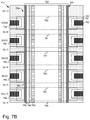
- FIG. 7B depicts a close-up view of a region of FIG. 7A .
- FIG. 8 depicts an example implementation of a memory structure of FIG. 1 .
- FIG. 9 depicts a further perspective view of the sub-blocks of FIG. 8 .
- FIG. 10A depicts an example threshold voltage distribution of a set of memory cells in which four data states are used.
- FIG. 10B depicts an example threshold voltage distribution of a set of memory cells in which eight data states are used.
- FIG. 11A depicts a waveform of an example programming operation.
- FIG. 11B depicts an example of the program voltage of FIG. 11A and a preceding bit line and/or source line charging period.
- FIG. 11C depicts a plot of example waveforms in a read operation.
- FIG. 12 depicts an example encoding of bits and a series of read voltages corresponding to data states of a set of memory cells in which eight data states are used.
- FIG. 13 depicts a configuration of a NAND string and components for sensing.
- FIG. 14 depicts an example plot of a relationship between currents flowing in the bit line and a voltage of the bit line.
- FIG. 15A depicts a flowchart of an example process for performing a sense operation.
- FIG. 15B depicts a flowchart of an example multi-page read operation.
- FIGS. 16A to 16D depict example plots of voltages and currents in the sensing process of FIG. 15A .
- FIG. 17 depicts a plot of fail bit count versus a time difference between word line voltage change and sensing.
- each NAND string includes a number of memory cells connected in series between one or more drain-side select gate transistors (SGD transistors), on a drain-side of the NAND string which is connected to a bit line, and one or more source-side select gate transistors (SGS transistors), on a source-side of the NAND string which is connected to a source line.
- SGD transistors drain-side select gate transistors
- SGS transistors source-side select gate transistors
- the memory cells can be arranged with a common control gate line (e.g., word line) which acts a control gate.
- a set of word lines extends from the source side of a block to the drain side of a block.
- Memory cells can be connected in other types of strings and in other ways as well.
- the memory cells may be arranged in vertical memory strings in a stack, where the stack includes alternating conductive and dielectric layers.
- the conductive layers act as word lines which are connected to the memory cells.
- Each memory string may have the shape of a pillar which intersects with the word lines to form the memory cells.
- the memory cells can include data memory cells, which are eligible to store user data, and dummy or non-data memory cells which are ineligible to store user data.
- a dummy word line is connected to a dummy memory cell.
- One or more dummy memory cells may be provided at the drain and/or source ends of a string of memory cells to provide a gradual transition in the channel voltage gradient.
- the memory cells are programmed according to a word line programming order.
- the programming may start at the word line at the source side of the block and proceed to the word line at the drain side of the block.
- each word line is completely programmed before programming a next word line.
- a first word line, WL 0 is programmed using one or more programming passes until the programming is completed.
- a second word line, WL 1 is programmed using one or more programming passes until the programming is completed, and so forth.
- a programming pass may include a set of increasing program voltages which are applied to the word line in respective program loops or program-verify iterations, such as depicted in FIG. 11A . Verify operations may be performed after each program voltage to determine whether the memory cells have completed programming. When programming is completed for a memory cell, it can be locked out from further programming while programming continues for other memory cells in subsequent program loops.
- the memory cells may also be programmed according to a sub-block programming order, where memory cells in one sub-block, or portion of a block, are programmed before programming memory cells in another sub-block.
- Each memory cell may be associated with a data state according to write data associated with a program command.
- a memory device includes memory cells which store words of user data as code words. Each code word includes symbols, and each data state represents one of the symbols. When a cell stores n bits of data, the symbols can have one of 2 ⁇ circumflex over ( ) ⁇ n possible values.
- the data states include an erased state and one or more programmed states.
- a programmed state is a data state to which a memory cell is to be programmed in a programming operation.
- the symbol or data state which is to be represented by a cell is identified by one or more bits of write data in latches associated with the memory cell. This data state is the assigned data state.
- Each data state corresponds to a different range of threshold voltages (Vth).
- a programmed state is a state which is reached by programming a memory cell so that its Vth increases from the Vth range of the erased state to a higher Vth range. Based on its assigned data state, a memory cell will either remain in the erased state or be programmed to a programmed data state. For example, in a one bit per cell memory device, there are two data states including the erased state and the programmed state. In a two-bit per cell memory device, there are four data states including the erased state and three higher data states referred to as the A, B and C data states (see FIG. 10A ).
- a three-bit per cell memory device there are eight data states including the erased state and seven higher data states referred to as the A, B, C, D, E, F and G data states (see FIG. 10B ).
- A, B, C, D, E, F and G data states see FIG. 10B .
- the data states may be referred to as the S 0 -S 15 data states where S 0 is the erased state.
- a sequential read operation can involve applying a series of read voltages to a word line while sensing circuitry determines whether cells connected to the word line are in a conductive or non-conductive state. If a cell is in a non-conductive state, the Vth of the memory cell exceeds the read voltage.
- the read voltages are set at levels which are expected to be between the threshold voltage levels of adjacent data states.
- the voltages of the unselected word lines are ramped up to a read pass level which is high enough to place the unselected memory cells in a strongly conductive state, to avoid interfering with the sensing of the selected memory cells. See FIG. 11C .
- a read operation may involve reading a number of pages of data. Reading a page of data may involve waiting for voltage of the word lines and bit lines to settle before sensing can be performed on the bit lines.
- Various approaches can be used to sense the bit line.
- One approach is using current sensing to determine a level of current which flows through at least a memory cell and sinks into a source based on the programmed data state of the memory cell.
- the memory cell coupled to a word line may transition from an ‘off’ state to an ‘on’ state when the read voltage on the selected word line is changed to a higher level in a sequential read operation. This transition from the ‘off’ state to the ‘on’ state is the dominant factor determining the settling time of a selected bit line.
- a current icell flows in the NAND string, which discharges a capacitance of the bit line such that a change in the level of current is visible from the sense circuit (e.g., sense amplifier) during current sensing.
- the sense circuit e.g., sense amplifier
- this triggers the sense circuit coupled to the bit line to inject sense amplifier current ISA into the bit line which interferes with the settling of the voltage of the bit line and prolongs the settling time. See FIG. 14 .
- a current from the sense circuit flowing into the bit line is stopped and a transition of the memory cell from an ‘off’ state to an ‘on’ state is thereby improved by briefly providing the bit line control (BLC) transistor in a non-conductive state during the bit line settling.
- the BLC transistor may be a component of the sense circuit which couples the bit line to the sense circuit.
- the BLC transistor may be turned off, e.g., made non-conductive, which stops the current flow from the sense circuit through the bit line when the bit line is settling.
- One approach involves applying a negative kick to the BLC transistor, where the control gate voltage of the BLC transistor is dropped briefly after the read voltage is raised to the desired read level on a selected word line.
- the negative kick is applied to the BLC transistor after the read voltage on the selected word line is changed to a second word line level or higher in the sequential read operation for reading a page of data.
- the negative kick exponentially reduces the bleeding current from the sense circuit flowing through the bit line when the voltage of the bit line is settling.
- the current icell may quickly discharge the capacitance of the bit line without any hindrance, which shortens the settling time of the bit line. As a consequence, the transition of the memory cell from the ‘off’ state to the ‘on’ state is improved.
- FIG. 1 is a block diagram of an example memory device.
- the memory device 100 such as a non-volatile storage system, may include one or more memory die 108 .
- the memory die 108 includes a memory structure 126 of memory cells, such as an array of memory cells, control circuitry 110 , and read/write circuits 128 .
- the memory structure 126 is addressable by word lines via a row decoder 124 and by bit lines via a column decoder 132 .
- the read/write circuits 128 include multiple sense blocks 130 from 1, 2, . . . , n (sensing circuitry) and allow a page of memory cells to be read or programmed in parallel.
- a controller 122 is included in the same memory device 100 (e.g., a removable storage card) as the one or more memory die 108 .
- the controller 122 may be separate from the memory die 108 .
- Commands and data are transferred between the host 140 and controller 122 via a data bus 120 , and between the controller 122 and the one or more memory die 108 via lines 118 .
- the memory structure 126 can be multidimensional (e.g., 2D or 3D).
- the memory structure 126 may include one or more array of memory cells including a 3D array.
- the memory structure 126 may include a monolithic 3D memory structure in which multiple memory levels are formed above (and not in) a single substrate, such as a wafer, with no intervening substrates.
- the memory structure 126 may include any type of non-volatile memory that is monolithically formed in one or more physical levels of arrays of memory cells having an active area disposed above a silicon substrate.
- the memory structure 126 may be in a non-volatile memory device having circuitry associated with the operation of the memory cells, whether the associated circuitry is above or within the substrate.
- the control circuitry 110 cooperates with the read/write circuits 128 to perform memory operations on the memory structure 126 .
- the control circuitry 110 includes a state machine 112 , a storage region 113 , an on-chip address decoder 114 , a power control/program voltage module 116 , and a bit line control circuit 119 .
- the state machine 112 provides chip-level control of memory operations.
- the storage region 113 may be provided, e.g., for operational parameters and software/code.
- the state machine is programmable by the software. In other embodiments, the state machine does not use software and is completely implemented in hardware (e.g., electrical circuits).
- the on-chip address decoder 114 provides an address interface between that used by the host 140 or a memory controller 122 to the hardware address used by the decoders 124 and 132 .
- the power control module 116 controls the power and voltages supplied to the word lines, select gate lines, bit lines and source lines during memory operations. It can include drivers for word lines, SGS and SGD transistors and source lines.
- the sense blocks 130 can include bit line drivers, in one approach.
- An SGS transistor is a select gate transistor at a source end or source side of a NAND string
- an SGD transistor is a select gate transistor at a drain-end or drain side of a NAND string.
- the bit line control circuit 119 can be used to provide a negative voltage kick to the bit line control (BLC) transistor in the sense circuit, where the control gate voltage of the BLC transistor is dropped briefly during a sensing operation to inhibit the bleeding current flowing through the bit line from the sense circuit and improve settling speed of the bit line.
- the power control module 116 and the bit line control circuit 119 can be used to implement the techniques described herein including the processes of FIG. 15A to 15B .
- a control circuit may include any one of, or a combination of, control circuitry 110 , state machine 112 , decoders 114 , 124 and 132 , power control/program voltage module 116 , bit line control circuit 119 , sense blocks 130 , read/write circuits 128 , controller 122 , and so forth.
- the off-chip controller 122 (which in one embodiment is an electrical circuit) may comprise a processor 122 c , storage devices (memory) such as ROM 122 a and RAM 122 b and an error-correction code (ECC) engine 145 .
- the ECC engine 145 can correct a number of read errors.
- a memory interface 122 d may also be provided.
- the memory interface 122 d in communication with ROM 122 a , RAM 122 b , and processor 122 c , is an electrical circuit that provides an electrical interface between controller 122 and memory die 108 .
- the memory interface 122 d can change the format or timing of signals, provide a buffer, isolate from surges, latch I/O and so forth.
- the processor 122 c can issue commands to the control circuitry 110 (or any other component of the memory die 108 ) via the memory interface 122 d.
- a storage device 126 a of the memory structure 126 includes code such as a set of instructions, and the processor 122 c is operable to execute the set of instructions to provide the functionality described herein. Alternatively or additionally, the processor 122 c can access code from the storage device 126 a of the memory structure 126 , such as a reserved area of memory cells in one or more word lines.
- code can be used by the controller 122 to access the memory structure 126 , such as for programming, read and erase operations.
- the code can include boot code and control code (e.g., a set of instructions).
- the boot code is software that initializes the controller 122 during a booting or startup process and enables the controller 122 to access the memory structure 126 .
- the code can be used by the controller 122 to control one or more memory structures 126 .
- the processor 122 c fetches the boot code from the ROM 122 a or storage device 126 a for execution, and the boot code initializes the system components and loads the control code into the RAM 122 b . Once the control code is loaded into the RAM 122 b , it is executed by the processor 122 c .
- the control code includes drivers to perform basic tasks such as controlling and allocating memory, prioritizing the processing of instructions, and controlling input and output ports.
- control code can include instructions to perform the functions described herein including the steps of the flowcharts discussed further below, and provide the voltage waveforms including those discussed further below.
- a control circuit can be configured to execute the instructions to perform the functions described herein.
- the host 140 is a computing device (e.g., laptop, desktop, smartphone, tablet, digital camera) that includes one or more processors, one or more processor readable storage devices (RAM, ROM, flash memory, hard disk drive, solid state memory) that store processor readable code (e.g., software) for programming the one or more processors to perform the methods described herein.
- the host 140 may also include additional system memory, one or more input/output interfaces and/or one or more input/output devices in communication with the one or more processors.
- non-volatile memory in addition to NAND flash memory can also be used.
- Semiconductor memory devices include volatile memory devices, such as dynamic random access memory (“DRAM”) or static random access memory (“SRAM”) devices, non-volatile memory devices, such as resistive random access memory (“ReRAM”), electrically erasable programmable read only memory (“EEPROM”), flash memory (which can also be considered a subset of EEPROM), ferroelectric random access memory (“FRAM”), and magnetoresistive random access memory (“MRAM”), and other semiconductor elements capable of storing information.
- volatile memory devices such as dynamic random access memory (“DRAM”) or static random access memory (“SRAM”) devices
- non-volatile memory devices such as resistive random access memory (“ReRAM”), electrically erasable programmable read only memory (“EEPROM”), flash memory (which can also be considered a subset of EEPROM), ferroelectric random access memory (“FRAM”), and magnetoresistive random access memory (“MRAM”), and other semiconductor elements capable of storing information.
- ReRAM resistive random access memory
- EEPROM electrically erasable
- the memory devices can be formed from passive and/or active elements, in any combinations.
- passive semiconductor memory elements include ReRAM device elements, which in some embodiments include a resistivity switching storage element, such as an anti-fuse or phase change material, and optionally a steering element, such as a diode or transistor.
- active semiconductor memory elements include EEPROM and flash memory device elements, which in some embodiments include elements containing a charge storage region, such as a floating gate, conductive nanoparticles, or a charge storage dielectric material.
- NAND memory typically contain memory elements connected in series.
- a NAND string is an example of a set of series-connected transistors comprising memory cells and SG transistors.
- a NAND memory array may be configured so that the array is composed of multiple strings of memory in which a string is composed of multiple memory elements sharing a single bit line and accessed as a group.
- memory elements may be configured so that each element is individually accessible, e.g., a NOR memory array.
- NAND and NOR memory configurations are examples, and memory elements may be otherwise configured.
- the semiconductor memory elements located within and/or over a substrate may be arranged in two or three dimensions, such as a 2D memory structure or a 3D memory structure.
- the semiconductor memory elements are arranged in a single plane or a single memory device level.
- memory elements are arranged in a plane (e.g., in an x-y direction plane) which extends substantially parallel to a major surface of a substrate that supports the memory elements.
- the substrate may be a wafer over or in which the layer of the memory elements are formed or it may be a carrier substrate which is attached to the memory elements after they are formed.
- the substrate may include a semiconductor such as silicon.
- the memory elements may be arranged in the single memory device level in an ordered array, such as in a plurality of rows and/or columns. However, the memory elements may be arrayed in non-regular or non-orthogonal configurations.
- the memory elements may each have two or more electrodes or contact lines, such as bit lines and word lines.
- a 3D memory array is arranged so that memory elements occupy multiple planes or multiple memory device levels, thereby forming a structure in three dimensions (i.e., in the x, y and z directions, where the z direction is substantially perpendicular and the x and y directions are substantially parallel to the major surface of the substrate).
- a 3D memory structure may be vertically arranged as a stack of multiple 2D memory device levels.
- a 3D memory array may be arranged as multiple vertical columns (e.g., columns extending substantially perpendicular to the major surface of the substrate, i.e., in the y direction) with each column having multiple memory elements.
- the columns may be arranged in a 2D configuration, e.g., in an x-y plane, resulting in a 3D arrangement of memory elements with elements on multiple vertically stacked memory planes.
- Other configurations of memory elements in three dimensions can also constitute a 3D memory array.
- the memory elements may be coupled together to form a NAND string within a single horizontal (e.g., x-y) memory device level.
- the memory elements may be coupled together to form a vertical NAND string that traverses across multiple horizontal memory device levels.
- Other 3D configurations can be envisioned wherein some NAND strings contain memory elements in a single memory level while other strings contain memory elements which span through multiple memory levels.
- 3D memory arrays may also be designed in a NOR configuration and in a ReRAM configuration.
- a monolithic 3D memory array typically, one or more memory device levels are formed above a single substrate.
- the monolithic 3D memory array may also have one or more memory layers at least partially within the single substrate.
- the substrate may include a semiconductor such as silicon.
- the layers constituting each memory device level of the array are typically formed on the layers of the underlying memory device levels of the array.
- layers of adjacent memory device levels of a monolithic 3D memory array may be shared or have intervening layers between memory device levels.
- 2D arrays may be formed separately and then packaged together to form a non-monolithic memory device having multiple layers of memory.
- non-monolithic stacked memories can be constructed by forming memory levels on separate substrates and then stacking the memory levels atop each other. The substrates may be thinned or removed from the memory device levels before stacking, but as the memory device levels are initially formed over separate substrates, the resulting memory arrays are not monolithic 3D memory arrays.
- multiple 2D memory arrays or 3D memory arrays may be formed on separate chips and then packaged together to form a stacked-chip memory device.
- Associated circuitry is typically required for operation of the memory elements and for communication with the memory elements.
- memory devices may have circuitry used for controlling and driving memory elements to accomplish functions such as programming and reading.
- This associated circuitry may be on the same substrate as the memory elements and/or on a separate substrate.
- a controller for memory read-write operations may be located on a separate controller chip and/or on the same substrate as the memory elements.
- FIG. 2 is a block diagram depicting one embodiment of the sense block 130 of FIG. 1 .
- An individual sense block 130 is partitioned into one or more core portions, referred to as sense modules 180 or sense amplifiers, and a common portion, referred to as a managing circuit 190 .
- Each of the sense modules in a group communicates with the associated managing circuit via data bus 172 .
- there are one or more managing circuits which communicate with the sense modules of a set of storage elements.
- Sense module 180 includes sense circuitry 170 that performs sensing by determining whether a conduction current in a connected bit line is above or below a predetermined threshold level.
- Managing circuit 190 comprises a processor 192 , four example sets of data latches 194 - 197 and an I/O Interface 198 coupled between the set of data latches 194 - 197 and data bus 120 .
- One set of data latches can be provided for each sense module 180 , and data latches identified by LDL and UDL may be provided for each set. In some cases, additional data latches may be used.
- LDL stores a bit for a lower page of data
- UDL stores a bit for an upper page of data. This is in a four-level or two-bits per storage element memory device.
- One additional data latch per bit line can be provided for each additional data bit per storage element.
- Processor 192 performs computations, such as to determine the data stored in the sensed storage element and store the determined data in the set of data latches.
- Each set of data latches 194 - 197 is used to store data bits determined by processor 192 during a read operation, and to store data bits imported from the data bus 120 during a programming operation which represent write data meant to be programmed into the memory.
- I/O interface 198 provides an interface between data latches 194 - 197 and the data bus 120 .
- bit line latch 182 serves double duty, both as a latch for latching the output of the sense module 180 and also as a bit line latch as described above.
- each processor 192 will include an output line (not depicted) such that each of the output lines is wired-OR'd together.
- the output lines are inverted prior to being connected to the wired-OR line. This configuration enables a quick determination during the program verification process of when the programming process has completed because the state machine 112 receiving the wired-OR can determine when all bits being programmed have reached the desired level. For example, when each bit has reached its desired level, a logic zero for that bit will be sent to the wired-OR line (or a data one is inverted). When all bits output a data 0 (or a data one inverted), then the state machine 112 knows to terminate the programming process.
- the state machine 112 needs to read the wired-OR line eight times, or logic is added to processor 192 to accumulate the results of the associated bit lines such that the state machine 112 need only read the wired-OR line one time. Similarly, by choosing the logic levels correctly, the global state machine can detect when the first bit changes its state and change the algorithms accordingly.
- the data to be programmed (write data) is stored in the set of data latches 194 - 197 from the data bus 120 , in the LDL and UDL latches, in a two-bit per storage element implementation. In a three-bit per storage element implementation, an additional data latch may be used.
- the programming operation under the control of the state machine 112 , includes a series of programming voltage pulses applied to the control gates of the addressed storage elements. Each program pulse is followed by a read back (verify) to determine if the storage element has been programmed to the desired memory state. In some cases, processor 192 monitors the read back memory state relative to the desired memory state.
- the processor 192 sets the bit line latch 182 so as to cause the bit line to be pulled to a state designating program inhibit. This inhibits the storage element coupled to the bit line from further programming even if program pulses appear on its control gate.
- the processor 192 initially loads the bit line latch 182 and the sense circuitry 170 sets it to an inhibit value during the verify process.
- Each set of data latches 194 - 197 may be implemented as a stack of data latches for each sense module 180 . In one embodiment, there are three data latches per sense module 180 . In some implementations, the data latches 194 - 197 are implemented as a shift register so that the parallel data stored therein is converted to serial data for data bus 120 , and vice versa. All the data latches corresponding to the read/write block of storage elements can be linked together to form a block shift register so that a block of data can be input or output by serial transfer. In particular, the bank of read/write modules is adapted so that each of its set of data latches will shift data in to or out of the data bus 120 in sequence as if they are part of a shift register for the entire read/write block.
- the data latches 194 - 197 identify when an associated storage element has reached certain mileposts in programming operations. For example, latches may identify that a storage element's Vth is below a particular verify level.
- the data latches indicate whether a storage element currently stores one or more bits from a page of data.
- the LDL latches can be used to store a lower page of data.
- An LDL latch is flipped (e.g., from 0 to 1) when a lower page bit is stored in an associated storage element.
- a UDL latch is flipped when an upper page bit is stored in an associated storage element. This occurs when an associated storage element completes programming, e.g., when its Vth exceeds a target verify level such as VvA, VvB or VvC.
- FIG. 3 depicts another example block diagram of a sense block 130 in the column control circuitry of FIG. 1 .
- the column control circuitry can include multiple sense blocks, where each sense block performs sensing, e.g., read, program-verify or erase-verify operations for multiple memory cells via respective bit lines.
- a sense block 130 includes multiple sense circuits, also referred to as sense amplifiers. Each sense circuit is associated with data latches and caches.
- the example sense circuits 350 a , 351 a , 352 a and 353 a are associated with caches 350 c , 351 c , 352 c and 353 c , respectively.
- a sense circuit controller 360 can communicate with the set, e.g., sixteen, of sense circuits and latches.
- the sense circuit controller may include a pre-charge circuit 361 which provides a voltage to each sense circuit for setting a pre-charge voltage.
- the sense circuit controller may also include a memory 362 and a processor 363 .
- FIG. 4 depicts an example circuit for providing voltages to blocks of memory cells.
- a row decoder 401 provides voltages to word lines and select gates of each block in set of blocks 410 .
- the set could be in a plane and includes blocks BLK 0 to BLK 7 , for instance.
- the row decoder 401 provides a control signal to pass gates 422 which connect the blocks to the row decoder 401 .
- operations e.g., program, read or erase
- the row decoder 401 can connect global control lines 402 to local control lines 403 .
- the control lines represent conductive paths.
- Voltages are provided on the global control lines 402 from voltage sources 420 .
- the voltage sources 420 may provide voltages to switches 421 which connect to the global control lines 402 .
- Pass gates 424 also referred to as pass transistors or transfer transistors, are controlled to pass voltages from the voltage sources 420 to the switches 421 .
- the voltage sources 420 can provide voltages on data and dummy word lines (WL), SGS control gates and SGD control gates, for example.
- the various components may receive commands from a controller such as the state machine 112 or the controller 122 to perform the functions described herein.
- a source line voltage source 430 provides a voltage Vsl to the source lines/diffusion region in the substrate via control lines 432 .
- the source diffusion region 433 is common to the blocks.
- a set of bit lines 442 is also shared by the blocks.
- a bit line voltage source 440 provides voltages to the bit lines.
- the voltage sources 420 are near the bit line voltage source.
- FIG. 5 depicts an example memory cell 500 .
- the memory cell 500 includes a control gate CG which receives a word line voltage Vwl, a drain D at a voltage Vd, a source S at a voltage Vs, and a channel CH at a voltage Vch.
- FIG. 6 is a perspective view of a memory device 600 including a set of blocks in an example 3D configuration of the memory structure 126 of FIG. 1 .
- On the substrate are example blocks BLK 0 , BLK 1 , BLK 2 and BLK 3 of memory cells (storage elements) and peripheral areas with circuitry for use by the blocks.
- the peripheral area 604 runs along an edge of each block while the peripheral area 605 is at an end of the set of blocks.
- the circuitry can include voltage drivers which can be connected to control gate layers, bit lines and source lines of the blocks. In one approach, control gate layers at a common height in the blocks are commonly driven.
- the substrate 601 can also carry circuitry under the blocks, and one or more lower metal layers which are patterned in conductive paths to carry signals of the circuitry.
- the blocks are formed in an intermediate region 602 of the memory device.
- one or more upper metal layers are patterned in conductive paths to carry signals of the circuitry.
- Each block includes a stacked area of memory cells, where alternating levels of the stack represent word lines.
- each block has opposing tiered sides from which vertical contacts extend upward to an upper metal layer to form connections to conductive paths. While four blocks are depicted as an example, two or more blocks can be used, extending in the x- and/or y-directions. Typically, the length of the blocks is much longer in the x-direction than the width in the y-direction.
- the blocks are in a plane, and the length of the plane, in the x-direction, represents a direction in which signal paths to word lines extend in the one or more upper metal layers (a word line or SGD line direction), and the width of the plane, in the y-direction, represents a direction in which signal paths to bit lines extend in the one or more upper metal layers (a bit line direction).
- the z-direction represents a height of the memory device.
- the blocks could also be arranged in multiple planes.
- FIG. 7A depicts an example cross-sectional view of a portion of one of the blocks of FIG. 6 .
- the block includes a stack 710 of alternating conductive and dielectric layers.
- the block includes conductive layers spaced apart vertically, and the conductive layers include word lines connected to the memory cells and select gate lines connected to SGD and SGS transistors.
- the conductive layers comprise two SGD layers, two SGS layers, two source side dummy word line layers (or word lines) WLD 3 and WLD 4 , two drain side dummy word line layers WLD 1 and WLD 2 , and eleven data word line layers (or data word lines) WLL 0 -WLL 10 .
- WLL 0 is a source side data word line and WLD 3 is a dummy word line layer which is adjacent to the source side data word line.
- WLD 4 is another dummy word line layer which is adjacent to WLD 3 .
- WLL 10 is a drain side data word line and WLD 1 is a dummy word line layer which is adjacent to the drain side data word line.
- WLD 2 is another dummy word line layer which is adjacent to WLD 1 .
- the dielectric layers are labelled as DL 0 -DL 19 .
- regions of the stack which include NAND strings NS 1 and NS 2 are depicted. Each NAND string encompasses a memory hole 718 or 719 which is filled with materials which form memory cells adjacent to the word lines. Region 722 of the stack is shown in greater detail in FIG. 7B .
- the stack includes a substrate 711 .
- a portion of the source line SL includes an n-type source diffusion layer 711 a in the substrate which is in contact with a source end of each string of memory cells in a block.
- the n-type source diffusion layer 711 a is formed in a p-type well region 711 b , which in turn is formed in an n-type well region 711 c , which in turn is formed in a p-type semiconductor substrate 711 d , in one possible implementation.
- the n-type source diffusion layer may be shared by all of the blocks in a plane, in one approach.
- NS 1 has a source-end 713 at a bottom 716 b of the stack 716 and a drain-end 715 at a top 716 a of the stack.
- Metal-filled slits 717 and 720 may be provided periodically across the stack as interconnects which extend through the stack, such as to connect the source line to a line above the stack. The slits may be used during the formation of the word lines and subsequently filled with metal.
- a portion of a bit line BL 0 is also depicted.
- a conductive via 721 connects the drain-end 715 to BL 0 .
- the block of memory cells includes a stack of alternating control gate and dielectric layers, and the memory cells are arranged in vertically extending memory holes in the stack.
- each block comprises a terraced edge in which vertical interconnects, e.g., pillars or posts, connect to each layer, including the SGS, WL and SGD layers, and extend upward to horizontal paths to voltage sources.
- vertical interconnects e.g., pillars or posts
- This example includes two SGD transistors, two drain side dummy memory cells, two source side dummy memory cells and two SGS transistors in each string, as an example.
- one or more SGD transistors and one or more SGS transistors may be provided in a memory string.
- An isolation region IR may be provided to separate portions of the SGD layers from one another to provide one independently driven SGD line or layer portion per sub-block.
- the isolation region includes an insulating material such as oxide.
- the word line layers are common to all sub-blocks in a block.
- FIG. 7B depicts a close-up view of the region 722 of FIG. 7A .
- Memory cells are formed at the different levels of the stack at the intersection of a word line layer and a memory hole.
- SGD transistors 780 , and 781 are provided above dummy memory cells 782 and 783 and a data memory cell MC.
- a number of layers can be deposited along the sidewall (SW) of the memory hole 730 and/or within each word line layer, e.g., using atomic layer deposition.
- each pillar 799 or column which is formed by the materials within a memory hole 730 can include a blocking oxide 767 , a charge-trapping layer 763 or film such as silicon nitride (Si3N4) or other nitride, a tunneling layer 764 , a channel 765 (e.g., comprising polysilicon), and a dielectric core 766 .
- a word line layer can include a blocking oxide/block high-k material 760 , a metal barrier 761 , and a conductive metal 762 such as Tungsten as a control gate.
- control gates 790 , 791 , 792 , 793 , and 794 are provided.
- the layers except the metal are provided in the memory hole 730 .
- some of the layers can be in the control gate layer. Additional pillars are similarly formed in the different memory holes.
- the pillar 799 can form a columnar active area (AA) of a NAND string.
- Each memory string includes a channel which extends continuously from the source-end select gate transistor to the drain-end select gate transistor.
- Each of the memory holes can be filled with a plurality of annular layers including a blocking oxide layer, a charge trapping layer, a tunneling layer and a channel layer.
- a core region of each of the memory holes is filled with a body material, and the plurality of annular layers are between the core region and the word line in each of the memory holes.
- the NAND string can be considered to have a floating body channel because the length of the channel is not formed on a substrate. Further, the NAND string is provided by a plurality of word line layers above one another in a stack, and separated from one another by dielectric layers.
- FIG. 8 depicts an example implementation of the memory structure 126 of FIG. 1 including NAND strings in sub-blocks in a 3D configuration.
- a block BLK of memory cells is formed from a stack of alternating conductive and dielectric layers.
- the block includes conductive layers spaced apart vertically, and the conductive layers spaced apart vertically include word lines connected to the memory cells and select gate lines connected to SGD (drain-side select gate) and SGS (source-side select gate) transistors.
- the conductive layers include two SGD layers, two SGS layers and four dummy word line layers (or word lines) WLD 1 , WLD 2 , WLD 3 and WLD 4 , in addition to data word line layers (or word lines) WLL 0 -WLL 10 .
- the dielectric layers include DL 0 -DL 19 .
- Each NAND string may be formed in a memory hole in the stack filled with materials which form memory cells adjacent to the word lines.
- each block can be divided into sub-blocks and each sub-block includes multiple NAND strings, where one example NAND string is depicted.
- sub-blocks SB 0 , SB 1 , SB 2 and SB 3 include example NAND strings 800 n , 810 n , 820 n and 830 n , respectively.
- the NAND strings have data word lines, dummy word lines and select gate lines.
- Each sub-block includes a set of NAND strings which extend in the x direction and which have a common SGD line.
- SB 0 has SGD lines or SGD layer portions 884 and 888 in the SGD 0 and SGD 1 layers, respectively.
- SB 1 has SGD layer portions 885 and 889 in the SGD 0 and SGD 1 layers, respectively.
- SB 2 has SGD layer portions 886 and 890 in the SGD 0 and SGD 1 layers, respectively.
- SB 3 has SGD layer portions 887 and 891 in the SGD 0 and SGD 1 layers, respectively.
- Each of the data word line layers WLL 0 to WLL 10 and the SGS layers SGS 0 and SGS 1 is shared by all of the sub-blocks SB 0 to SB 3 .
- the dummy word line layers are also shared by all of the sub-blocks.
- the NAND strings 800 n , 810 n , 820 n and 830 n are in sub-blocks SB 0 , SB 1 , SB 2 and SB 3 , respectively. Programming of the block may occur one sub-block at a time. Within each sub-block, a word line programming order may be followed, e.g., starting at WL 0 , the source-side word line and proceeding one word line at a time to WLL 10 , the drain-side word line.
- the NAND strings 800 n , 810 n , 820 n and 830 n have channels 800 a , 810 a , 820 a and 830 a , respectively.
- Each channel has a drain end and a source end.
- the channel 800 a has a drain end 896 and a source end 897 .
- NAND string 800 n includes SGS transistors 800 and 801 , dummy memory cells 802 and 803 , data memory cells 804 , 805 , 806 , 807 , 808 , 809 , 810 , 811 , 812 , 813 , and 814 , dummy memory cells 815 and 816 , and SGD transistors 817 and 818 .
- NAND string 810 n includes SGS transistors 820 and 821 , dummy memory cells 822 and 823 , data memory cells 824 , 825 , 826 , 827 , 828 , 829 , 830 , 831 , 832 , 833 , and 834 , dummy memory cells 835 and 836 , and SGD transistors 837 and 838 .
- NAND string 820 n includes SGS transistors 840 and 841 , dummy memory cells 842 and 843 , data memory cells 844 , 845 , 846 , 847 , 848 , 849 , 850 , 851 , 852 , 853 , and 854 , dummy memory cells 855 and 856 , and SGD transistors 857 and 858 .
- NAND string 830 n includes SGS transistors 860 and 861 , dummy memory cells 862 and 863 , data memory cells 864 , 865 , 866 , 867 , 868 , 869 , 870 , 871 , 872 , 873 , and 874 , dummy memory cells 875 and 876 , and SGD transistors 877 and 878 .
- FIG. 9 depicts a further perspective view of the sub-blocks SB 0 -SB 3 of FIG. 8 .
- a sub-block is a portion of a block and represents a set of memory strings which are programmed together and which have a common SGD line. Also, each memory string in a sub-block is connected to a different bit line, in one approach.
- Example memory cells are depicted which extend in the x direction along word lines in each sub-block. Each memory cell 980 is depicted as a cube for simplicity.
- SB 0 includes NAND strings 900 n , 901 n , 902 n and 903 n .
- SB 1 includes NAND strings 910 n , 911 n , 912 n and 913 n .
- SB 2 includes NAND strings 920 n , 921 n , 922 n and 923 n .
- SB 3 includes NAND strings 930 n , 931 n , 932 n and 933 n . Bit lines are connected to sets of NAND strings.
- a bit line BL 0 is connected to NAND strings 900 n , 910 n , 920 n and 930 n
- a bit line BL 1 is connected to NAND strings 901 n , 911 n , 921 n and 931 n
- a bit line BL 2 is connected to NAND strings 902 n , 912 n , 922 n and 932 n
- a bit line BL 3 is connected to NAND strings 903 n , 913 n , 923 n and 933 n .
- Sensing circuitry may be connected to each bit line.
- sensing circuitry 981 , 982 , 983 and 984 are connected to bit lines BL 0 , BL 1 , BL 2 and BL 3 , respectively.
- the NAND strings are examples of vertical memory strings which extend upward from a substrate.
- Programming and reading can occur for selected cells of one word line and one sub-block at a time. This allows each selected cell to be controlled by a respective bit line and/or source line.
- an example set 995 of memory cells (including an example memory cell 980 ) in SB 0 is connected to WLL 4 .
- the sets 996 , 997 and 998 include data memory cells in SB 1 , SB 2 and SB 3 are connected to WLL 4 .
- the source lines SL 0 -SL 3 are connected to one another and driven by a common voltage source.
- the source lines SL 0 -SL 3 can be separate from one another and driven at respective voltages by separate voltage sources.
- FIG. 10A depicts an example threshold voltage (Vth) distribution of a set of memory cells connected to a selected word line after a programming operation in which four data states are used.
- Vth distribution 1000 is provided for erased (Er) state memory cells.
- Three Vth distributions 1001 , 1002 , and 1003 represent assigned data states A, B and C, respectively, which are reached by memory cells when their Vth exceeds the erase-verify voltage VvA, VvB or VvC, respectively.
- a single verify voltage is used which is common to the different assigned data states.
- This example uses four data states. Other numbers of data states can be used as well, such as eight or sixteen.
- the optimum read voltages generally are midway between the Vth distributions of adjacent data states.
- Read voltages VrA, VrB and VrC are used to read data from a set of memory cells having this Vth distribution. These verify voltages and read voltages are examples of control gate read levels of the selected word line voltage. Each read voltage demarcates a lower boundary of a data state of a plurality of data states. For example, VrA demarcates a lower boundary of the A state. An erase-verify voltage VvEr is used in an erase-verify test to determine whether the erase operation is completed.
- the final Vth distribution can be achieved by using one or more programming passes.
- Each pass may use incremental step pulse programming, for instance.
- program loops are performed for a selected word line.
- a program loop comprises a program portion in which a program voltage is applied to the word line followed by a verify portion in which one or more verify tests are performed.
- Each programmed state has a verify voltage which is used in the verify test for the state.
- a programming operation can use one or more programming passes.
- a single-pass programming operation involves one sequence of multiple program-verify operations (or program loops) which are performed starting from an initial Vpgm level and proceeding to a final Vpgm level until the threshold voltages of a set of selected memory cells reach the verify voltages of the assigned data states. All memory cells may initially be in the erased state at the beginning of the programming pass. After the programming pass is completed, the data can be read from the memory cells using read voltages which are between the Vth distributions. At the same time, a read pass voltage, Vpass (e.g., 8-10 V), also referred to as Vread, is applied to the remaining word lines.
- Vpass e.g. 8-10 V
- the system can determine the data state which is represented by a memory cell.
- These voltages are demarcation voltages because they demarcate between Vth ranges of different data states.
- the data which is programmed or read can be arranged in pages. For example, with four data states, or two bits per cell, two pages of data can be stored. An example encoding of bits for each state is 11, 10, 00 and 01, respectively, in the format of upper page (UP) bit/lower page (LP) bit.
- a LP read may use VrA and VrC and an UP read may use VrB.
- a lower or upper bit can represent data of a lower or upper page, respectively.
- the data of the lower page can be determined by reading the memory cells using read voltages of VrA and VrC.
- the UP is an example of a page which can be read by using one read voltage applied to a selected word line.
- the LP is an example of a page which can be read by using two read voltages applied to a selected word line.
- FIG. 10B depicts an example Vth distribution of a set of memory cells in which eight data states are used.
- Vth distributions 1020 1021 , 1022 , 1023 , 1024 , 1025 , 1026 and 1027 , respectively.
- program-verify voltages VvA, VvB, VvC, VvD, VvE, VvF and VvG respectively, in one possible approach. In another approach, a single verify voltage is used which is common to the different assigned data states.
- VrA, VrB, VrC, VrD, VrE, VrF and VrG we have read voltages VrA, VrB, VrC, VrD, VrE, VrF and VrG, respectively, and example encoding of bits of 111, 110, 100, 000, 010, 011, 001 and 101, respectively.
- the bit format is: UP/MP/LP.
- An erase-verify voltage VvEr is used during an erase operation.
- a LP read may use VrA and VrE.
- a MP read may use VrB, VrD and VrF.
- An UP read may use VrC and VrG. See FIG. 12A .
- FIG. 11A depicts a waveform 1100 of an example programming operation.
- the horizontal axis depicts a program loop (PL) number and the vertical axis depicts control gate or word line voltage.
- a programming operation can involve applying a pulse train to a selected word line, where the pulse train includes multiple program loops or program-verify iterations.
- the program portion of the program-verify iteration includes a program voltage
- the verify portion of the program-verify iteration includes one or more verify voltages.
- Each program voltage includes two steps, in one approach. Further, Incremental Step Pulse Programming (ISPP) is used in this example, in which the program voltage steps up in each successive program loop using a fixed or varying step size. This example uses ISPP in a single programming pass in which the programming is completed. ISPP can also be used in each programming pass of a multi-pass operation.
- ISPP Incremental Step Pulse Programming
- the waveform 1100 includes a series of program voltages 1101 , 1102 , 1103 , 1104 , 1105 . . . 1106 that are applied to a word line selected for programming and to an associated set of non-volatile memory cells.
- One or more verify voltages can be provided after each program voltage as an example, based on the target data states which are being verified. 0 V may be applied to the selected word line between the program and verify voltages.
- A- and B-state verify voltages of VvA and VvB, respectively, (waveform 1110 ) may be applied after each of the program voltages 1101 and 1102 .
- A-, B- and C-state verify voltages of VvA, VvB and VvC may be applied after each of the program voltages 1103 and 1104 .
- E-, F- and G-state verify voltages of VvE, VvF and VvG may be applied after the final program voltage 1106 .
- FIG. 11B depicts an example of the program voltage 1101 of FIG. 11A and a preceding bit line and/or source line charging period.
- the program voltage may be applied to a set of memory cells connected to a selected word line. In the set, some of the cells are biased at their bit line and/or source line to allow programming and some may be biased to inhibit programming.
- the bit line and/or source line voltages can be elevated from a reference voltage (e.g., 0 V) to control the programming speed based on their assigned data state.
- the program voltage may initially step up to an intermediate level, Vpass, before stepping up to its peak level, Vpgm, in a program voltage time period 1151 .
- a time period 1150 can be for charging up or setting the bit line (BL) and/or source line (SL) voltages to respective non-zero, positive levels.
- BL bit line
- SL source line
- the charge up period could overlap with the program voltage, at the start of the time period 1151 . Performing the charge up while the program voltage is at Vpass could be acceptable since Vpass does not have a strong programming effect.
- FIG. 11C depicts a plot of example waveforms in a read operation.
- a read operation may involve reading a number of pages of data.
- a control gate read voltage is applied to a selected word line while a pass voltage, Vread, is applied to the remaining unselected word lines.
- Sense circuitry is then used to determine whether a cell is in a conductive state.
- Vread is ramped up and then back down separately during the read voltages of each of the lower, middle, and upper pages as depicted by plots 1170 , 1171 and 1172 , respectively.
- This example waveform is for an eight-state memory device with three pages of data. The example can be modified for fewer states (e.g., four states and two pages) or additional states (e.g., sixteen states and four pages).
- the A and E states are read using a read voltage waveform 1170 a having voltages of VrA and VrE, respectively.
- the B, D and F states are read using a read voltage waveform 1171 a having voltages of VrB, VrD and VrF, respectively.
- the C and G states are read using a read voltage waveform 1172 a having voltages of VrC and VrG, respectively.
- the bit line and/or source line can be charged up in a read operation. The charging up can occur during the ramp up of each sense voltage, for instance.
- FIG. 12 depicts an example encoding of bits and a series of read voltages corresponding to data states of a set of memory cells in which eight data states are used.
- FIG. 12 in particular depicts three pages of data stored in the format of lower page (LP), middle page (MP), and upper page (UP) using three bits per cell, although it should be understood that other configurations are possible and contemplated.
- a current sensing operation can involve applying multiple and consecutive read voltages to a word line coupled to the set of memory cells for reading a bit corresponding to a page.
- a LP read uses a sequence of two word line read voltages: AR and ER.
- the set of memory cells corresponding to the ER state are in the ‘on’ state and the set of memory cells corresponding to the states A-G remain in the ‘off’ state.
- the set of memory cells corresponding to states A-D are now turned ‘on’ and the set of memory cells in states E to G remain in the ‘off’ state.
- the memory cells corresponding to the states A to D make a transition from the ‘off’ state to the ‘on’ state for the LP read.
- FIG. 13 depicts a configuration of a NAND string and components for sensing.
- a NAND string 1312 can include a set of memory cells (e.g., four shown in FIG. 13 ) which are in communication with word lines, such as WL 0 , WL 1 , WL 2 and WL 3 , respectively depicted in FIG. 13 .
- word lines such as WL 0 , WL 1 , WL 2 and WL 3 , respectively depicted in FIG. 13 .
- any suitable number of memory cells and word lines can be used, and are often arranged adjacent to one another in a block or other set of non-volatile memory cells, for example, as shown in FIG. 8 .
- the selected word line is WL 1 .
- the voltage of WL 1 is coupled to the control gates of the memory cells on the word line WL 1 as the control gate read voltage, Vcgr.
- Vcgr control gate read voltage
- a selected memory cell coupled to the word line WL 1 may undergo transition from an ‘off’ state to an ‘on’ if the gate-to-source voltage is greater than the memory cell's threshold voltage.
- the memory cells are coupled to a p-well region of a substrate.
- a bit line 1310 having a voltage Vbl is depicted, in addition to sense components 1300 .
- a bit line sense (BLS) transistor 1306 and a bit line control (BLC) transistor 1304 are coupled to the bit line 1310 .
- the BLS transistor 1306 and the BLC transistor 1304 are turned off (e.g., made non-conductive) or turned on (e.g., made conductive) in response to control signals from the control 1308 during sense operations.
- a conductive BLC transistor 1304 is disposed between the current sensing module 1302 and the NAND string 1312 and the bit line 1310 and facilitates communication between the current sensing module 1302 , the NAND string 1312 , and/or the bit line.
- a sense operation such as a read or verify operation
- a pre-charge operation occurs in which a capacitor in the current sensing module 1302 is charged.
- the conductive BLC transistor 1304 allows the pre-charging of the capacitor.
- the pre-charged capacitor in the current sensing module 1302 discharges through the bit line and into the source so that the source acts as a current sink.
- the pre-charged capacitor at the drain of the NAND string 1312 may be pre-charged to a potential which exceeds a potential of the source so that a current flows through the selected memory cell and sinks into the source when the selected memory cell is in the conductive state.
- Vcgr read compare voltage
- the current sensing module 1302 can sense the memory cell current, Icell (also referred to herein as icell). In one possible approach, the current sensing module 1302 uses a cell current discriminator as a comparator of current levels to determine whether the conduction current is higher or lower than a given demarcation current.
- the current sensing module 1302 can determine whether the selected memory cell is in a conductive or non-conductive state by the level of current. For example, the current sensing module 1302 can sense a current in the NAND string 1312 of the selected memory cell at one or more strobes from the control 1308 . Generally, a higher current may flow when the selected memory cell is in a conductive state and a lower current may flow when the selected memory cell is in a non-conductive state.
- a threshold voltage of the selected memory cell may be at or above, or below a compare level, such as a verify level or a read level, when it is in a non-conductive state or a conductive state, respectively, although other threshold logic may also be applicable.
- Sense circuitry e.g., current sensing module 1302 and associated components, etc. holds the Vbl constant, so the sense circuitry can measure icell with the bit line “clamped” to that voltage.
- the current (icell) flows through the bit line, a voltage drop can occur across a transistor in the current path which causes a voltage of the bit line 1310 to slightly go down.
- This voltage drop in the bit line 1310 can slow down the transition of the memory cell from the ‘off’ state to the ‘on’ state in the read operation.
- the current (icell) can drive a discharge of the capacitance of the bit line 1310 and lower Vbl.
- the sense circuitry is configured to wait for Vbl to settle before it can sense the current icell.
- the BLC transistor 1304 which couples the bit line 1310 to the current sensing module 1302 , is conductive and can allow some current from the sense circuitry to flow into the bit line 1310 .
- This current bleeding from the sense circuitry into the bit line disturbs the bit line settling. For example, the bit line settling time is prolonged because the capacitance discharge of the bit line by icell is hindered due to the current flow from the sense circuitry through the bit line.
- FIG. 14 depicts an example plot of a relationship between currents flowing in the bit line and Vbl of the bit line.
- the memory cell current (icell) may flow through the NAND string to the source when the selected memory cell switches from an ‘off’ state to an ‘on’ state.
- the flow of icell causes Vbl to drop.
- the current (ISA) from the sense circuit is injected into the bit line when Vbl drops. This slows down the discharge of the bit line capacitance by icell and consequently the settling time for Vbl.
- ISA is stopped from flowing through the bit line by applying a negative kick to the control gate of the BLC transistor during the settling of Vbl.
- FIG. 15A depicts a flowchart of an example sensing process 1500 which advantageously inhibits a current from a sense circuit flowing through a selected bit line to facilitate faster bit line settling.
- a sensing process can occur, e.g., as a verify test in a programming operation, where the verify test determines whether the Vth of a memory cell exceeds a verify voltage of its assigned data state, or in a read operation which involves ascertaining the data state of a memory cell (after it has been programmed) by determining a highest read voltage which results in the memory cell being in a non-conductive state and/or a lowest read voltage which results in the memory cell being in a conductive state.
- a sensing process can involve sequentially applying one or more voltages to a selected word line while current sensing whether the associated memory cells are in a conductive or non-conductive state.
- Step 1502 begins a sensing process for selected memory cells which are connected to a selected word line WL in a selected sub-block of a block. For example, in FIG. 9 , assume SB 0 is the selected sub-block and SB 1 -SB 3 are unselected sub-blocks.
- Step 1504 includes pre-charging a selected bit line for sensing.
- Step 1506 increases a voltage of the selected word line from a previous (e.g., first) read level to a next (e.g., second) read level in a sequential read operation. For example, see FIG. 16A .
- Step 1508 includes turning off a bit line control transistor during a settling of a voltage of the bit line after the voltage of the selected word line is increased.
- Step 1510 includes turning on the bit line control transistor before performing current sensing of the selected bit line.
- the BLC transistor makes a transition from a conductive state to a non-conductive state and back to the conductive state during the settling of the voltage of the bit line. Turning on or providing the BLC transistor in a conductive state can involve applying a control gate voltage which exceeds the Vth of the BLC transistor, plus a margin. Turning off or providing the BLC transistor in a non-conductive state can involve applying a control gate voltage which does not exceed the Vth of the BLC transistor.
- Step 1512 includes determining whether a memory cell is conductive or non-conductive using the current sensing.
- the current sensing determines a level of current which flows through a selected memory cell and sinks into the source.
- a decision step 1514 determines if another sense operation is to be performed. If decision step 1514 is true, a next sense operation begins at step 1506 . If decision step 1514 is false, the sensing operation is completed at step 1516 .
- the steps depicted are not necessarily performed sequentially in the order shown. Instead, some steps can overlap.
- FIG. 15B depicts a flowchart of an example multi-page read operation 1520 which can use the sensing process of FIG. 15A .
- a lower page may be read using VrA and VrE
- a middle page may be read using VrB
- upper page may be read using VrC and VrG.
- the read data from each page is output from the sense circuits to the controller, in one approach.
- Step 1522 begins a multi-page read operation.
- Step 1524 includes reading a page of data, such as by using the process of FIG. 15A .
- Step 1526 includes outputting the data to a controller. If a decision step 1528 determines that there is another page to read, step 1524 is repeated. If the decision step 1528 determines that there is no further page to read, the read operation is done at step 1530 .
- FIGS. 16A to 16D depict example plots of voltages and currents in the sensing process of FIG. 15A .
- a common time line on a horizontal axis is used in these figures.
- the vertical axis represents a voltage.
- the vertical axis represents current.
- Time points t 0 , t 1 . . . represent increasing time. The time points are not necessarily equally spaced or to scale.
- FIG. 16A depicts an example plot 1602 of a voltage of a selected word line, Vwl.
- the starting and ending levels of the plot 1602 can be 0 V, in one approach.
- the control circuit uses one or more control gate read levels in a sensing process.
- the sensing process is a sequential read operation of a lower page of data which uses control gate read levels of VrA and VrE, as shown in the eight-state example of FIG. 10B and FIG. 11C .
- VrA can be about 0-0.5 V in some examples, while VrE might be about 6 V.
- the control circuit sets Vwl to VrA prior to t 0 in the sequential read operation. At t 0 , the control circuit raises Vwl from VrA to VrE in the sequential read operation.
- FIG. 16B depicts an example plot 1604 of a voltage on a control gate of the bit line control transistor, Vblc, where a negative kick is used.
- the control circuit Prior to t 0 , the control circuit holds Vblc at a target level to provide the bit line control transistor in a conductive state, in one approach.
- the target level of Vblc is Vbl+Vth of bit line control transistor.
- the control circuit Shortly after t 0 , the control circuit lowers Vblc with a negative kick 1604 a during a time period when Vbl (depicted in plot 1608 ) is settling between t 0 and t 1 .
- the control circuit applies the negative kick 1604 a at about 100 nanoseconds after t 0 , when the Vwl is raised from VrA to VrE in plot 1602 .
- the negative kick 1604 a is offset from the target level by about 100 millivolts.
- the negative kick 1604 a is relatively short in duration, in one approach, compared to the duration of the sensing process.
- the duration of the negative kick 1604 a can be five microseconds compared to 30 microseconds of settling time.
- the control circuit raises Vblc back up to the target level from the negative kick. In one approach, the control circuit raises Vblc back up to the target level from the negative kick prior to cell current measure at t 2 by the sense circuit.
- the negative kick 1604 a provides the bit line control transistor in a non-conductive state.
- the negative kick 1604 a can beneficially inhibit a current flow from the sense circuit ISA (as depicted in plot 1610 ) through the bit line (and address the negative effects described elsewhere herein, such as with respect to FIGS. 13-14 ) to provide faster bit line settling. For instance, by selectively decreasing Vblc during the time in which Vbl is settling, the current from the sense circuit ISA flowing into the bit line can be exponentially reduced by a factor of about 10. As a further example, the negative kick 1604 a reduces the current from the sense circuit ISA from about 100 nanoamperes to about 10 nanoamperes.
- FIG. 16C depicts a first example plot 1606 of a memory cell current Icell and a second example plot 1610 of sense amplifier current ISA from the sense circuit.
- Icell starts to flow in the NAND string if a selected memory cell is transitioning from an off state to an on state in response to the control circuit raising Vwl, from VrA to VrE, in plot 1602 .
- Vwl voltage
- VrA voltage
- VrE voltage
- FIG. 16C depicts a negative kick on Vblc
- ISA from the sense circuit increases exponentially (shown in dashed lines) and flows into the bit line when Vbl is dropping.
- ISA is stopped between t 0 and t 2 .
- ISA flows after the end of negative kick on Vblc.
- FIG. 16D depicts an example plot 1608 of the voltage of the bit line, Vbl.
- the sense circuit holds Vbl at a fixed voltage (e.g., 1.5 V).
- Vbl is lowered in response to a selected memory cell transitioning from the ‘off’ state to the ‘on’ state and Icell flowing in the NAND string.
- the transition of the selected memory cell from the ‘off’ state to the ‘on’ state is complete when Icell discharges Vbl from the fixed voltage (e.g., 1.5 V) to a new voltage (e.g., 1.4 V).
- the settling of Vbl is slower (shown in dashed lines). With negative kick on Vblc, the settling of Vbl is advantageously faster.
- sensing operations can be performed successively, for example, one for each verify or read level in a sequential read.
- the same source and p-well voltages (not shown) are applied in each sense operation, but the selected word line voltage is changed.
- a first voltage can be applied to the control gate/word line of a selected memory cell, the source voltage applied to the source, and the p-well voltage applied to the p-well.
- a determination is then made as to whether the memory cell is in a conductive state or a non-conductive state using current sensing while applying the first voltage and the source voltage.
- there may be noise and a transition of memory cells from ‘on’ state to ‘off’ state is dominant.
- a second sensing operation includes applying a second voltage to the control gate while applying the same source and p-well voltages.
- the negative kick on Vblc is applied after applying the second voltage or higher voltages in the sequential read operation. This is because a transition of memory cells from ‘off’ state to ‘on’ state is dominant in the second sensing operation and later.
- the negative kick on Vblc is applied to improve the transition of memory cells from ‘off’ state to ‘on’ state.
- Successive sensing operations similarly can vary the selected word line voltage while using the negative kick on Vblc.
- sensing can be performed concurrently for multiple memory cells which are associated with a common word line and source.
- the multiple memory cells may be in adjacent or non-adjacent NAND strings. All bit line sensing involves concurrent sensing of memory cells in adjacent NAND strings.
- the sensing includes determining, in concurrent sensing operations, whether each of the non-volatile memory cells is in the conductive or non-conductive state using current sensing.
- FIG. 17 depicts a plot of fail bit count (FBC) versus a time difference between word line voltage change and sensing.
- the vertical axis depicts FBC and the horizontal axis depicts time in microseconds.
- Plot 1702 depicts a FBC measured using negative kick.
- Plot 1704 depicts FBC measured without using negative kick.
- the horizontal rule 1706 is an example of an acceptable FBC.
- Without negative kick on Vblc there is a waiting time of about 20 microseconds before sensing is performed in a conventional read operation. With negative kick on Vblc, the waiting time is about 14 microseconds. Thus, the negative kick on Vblc provides an improvement in read speed by about 6 microseconds.
- the offset and duration of negative kick on Vblc is optimized using the plot of the FBC and the time difference between word line voltage change and sensing.
- the FBC can be measured for varied negative kick level and duration and a combination of parameters that best optimizes the read speed can be predetermined for a manufactured memory device.
- the means described in the present disclosure can include the components of the memory device 100 of FIG. 1 , for example.
- the power control module 116 controls the power and voltages supplied to the word lines, select gate lines and bit lines during memory operations.
- the means described above can include the components of FIG. 4 including the decoders, voltage drivers, switches, and pass transistors.
- the means can further include any of the control circuits in FIG. 1 such as the control circuitry 110 and controller 122 .
- the means for turning a bit line control transistor on and off can include the power control/program voltage circuit 116 , the bit line control circuit 119 of FIG. 1 and the bit line voltage source 440 of FIG. 4 , or other logic hardware, and/or executable code stored on a computer readable storage medium.
- Other embodiments may include similar or equivalent means for transmitting data.
Landscapes
- Engineering & Computer Science (AREA)
- Computer Hardware Design (AREA)
- Microelectronics & Electronic Packaging (AREA)
- Chemical & Material Sciences (AREA)
- Crystallography & Structural Chemistry (AREA)
- Read Only Memory (AREA)
Abstract
Description
Claims (20)
Priority Applications (2)
| Application Number | Priority Date | Filing Date | Title |
|---|---|---|---|
| US16/018,571 US10643677B2 (en) | 2018-06-26 | 2018-06-26 | Negative kick on bit line control transistors for faster bit line settling during sensing |
| US16/866,051 US20200265880A1 (en) | 2018-06-26 | 2020-05-04 | Negative kick on bit line control transistors for faster bit line settling during sensing |
Applications Claiming Priority (1)
| Application Number | Priority Date | Filing Date | Title |
|---|---|---|---|
| US16/018,571 US10643677B2 (en) | 2018-06-26 | 2018-06-26 | Negative kick on bit line control transistors for faster bit line settling during sensing |
Related Child Applications (1)
| Application Number | Title | Priority Date | Filing Date |
|---|---|---|---|
| US16/866,051 Continuation US20200265880A1 (en) | 2018-06-26 | 2020-05-04 | Negative kick on bit line control transistors for faster bit line settling during sensing |
Publications (2)
| Publication Number | Publication Date |
|---|---|
| US20190392874A1 US20190392874A1 (en) | 2019-12-26 |
| US10643677B2 true US10643677B2 (en) | 2020-05-05 |
Family
ID=68980759
Family Applications (2)
| Application Number | Title | Priority Date | Filing Date |
|---|---|---|---|
| US16/018,571 Active US10643677B2 (en) | 2018-06-26 | 2018-06-26 | Negative kick on bit line control transistors for faster bit line settling during sensing |
| US16/866,051 Abandoned US20200265880A1 (en) | 2018-06-26 | 2020-05-04 | Negative kick on bit line control transistors for faster bit line settling during sensing |
Family Applications After (1)
| Application Number | Title | Priority Date | Filing Date |
|---|---|---|---|
| US16/866,051 Abandoned US20200265880A1 (en) | 2018-06-26 | 2020-05-04 | Negative kick on bit line control transistors for faster bit line settling during sensing |
Country Status (1)
| Country | Link |
|---|---|
| US (2) | US10643677B2 (en) |
Cited By (4)
| Publication number | Priority date | Publication date | Assignee | Title |
|---|---|---|---|---|
| US11139018B1 (en) | 2020-08-31 | 2021-10-05 | Sandisk Technologies Llc | Memory device with temporary kickdown of source voltage before sensing |
| US11894052B2 (en) | 2022-04-12 | 2024-02-06 | Stmicroelectronics S.R.L. | Compensated analog computation for an in-memory computation system |
| US11942144B2 (en) | 2022-01-24 | 2024-03-26 | Stmicroelectronics S.R.L. | In-memory computation system with drift compensation circuit |
| US12462858B2 (en) | 2022-12-23 | 2025-11-04 | Stmicroelectronics S.R.L. | In-memory computation device having improved drift compensation |
Families Citing this family (2)
| Publication number | Priority date | Publication date | Assignee | Title |
|---|---|---|---|---|
| KR102743810B1 (en) | 2019-06-10 | 2024-12-18 | 에스케이하이닉스 주식회사 | Semiconductor device and operating method of semiconductor device |
| US12057179B2 (en) * | 2022-03-04 | 2024-08-06 | Macronix International Co., Ltd. | Memory device with high content density |
Citations (57)
| Publication number | Priority date | Publication date | Assignee | Title |
|---|---|---|---|---|
| US4477736A (en) | 1980-11-07 | 1984-10-16 | Hitachi, Ltd. | Semiconductor integrated circuit device including means for reducing the amount of potential variation on a reference voltage line |
| US5027320A (en) | 1989-09-22 | 1991-06-25 | Cypress Semiconductor Corp. | EPROM circuit having enhanced programmability and improved speed and reliability |
| US5398201A (en) | 1989-04-05 | 1995-03-14 | Hitachi, Ltd. | Bit-line drive circuit for a semiconductor memory |
| US5729492A (en) | 1995-04-28 | 1998-03-17 | Sgs-Thomson Microelectronics S.R.L. | Sense amplifier having capacitively coupled input for offset compensation |
| US5872739A (en) | 1997-04-17 | 1999-02-16 | Radiant Technologies | Sense amplifier for low read-voltage memory cells |
| US5903495A (en) | 1996-03-18 | 1999-05-11 | Kabushiki Kaisha Toshiba | Semiconductor device and memory system |
| EP0994483A1 (en) | 1998-10-15 | 2000-04-19 | STMicroelectronics, Inc. | Apparatus and method for noise reduction in DRAM |
| EP1282131A2 (en) | 2001-08-02 | 2003-02-05 | STMicroelectronics, Inc. | Reference generator circuit and method for nonvolatile memory devices |
| US6674668B2 (en) | 1999-12-28 | 2004-01-06 | Kabushiki Kaisha Toshiba | Read circuit on nonvolatile semiconductor memory |
| US6920060B2 (en) | 2002-08-14 | 2005-07-19 | Intel Corporation | Memory device, circuits and methods for operating a memory device |
| US20060291291A1 (en) | 2005-06-22 | 2006-12-28 | Kabushiki Kaisha Toshiba | Non-volatile semiconductor memory device |
| US7158402B2 (en) | 2003-08-06 | 2007-01-02 | Texas Instruments Incorporated | Asymmetric static random access memory device having reduced bit line leakage |
| US7184356B2 (en) | 2003-07-31 | 2007-02-27 | Kabushiki Kaisha Toshiba | Semiconductor memory device |
| US7352626B1 (en) | 2005-08-29 | 2008-04-01 | Spansion Llc | Voltage regulator with less overshoot and faster settling time |
| US7447079B2 (en) | 2007-04-05 | 2008-11-04 | Sandisk Corporation | Method for sensing negative threshold voltages in non-volatile storage using current sensing |
| US20080273394A1 (en) | 2007-05-02 | 2008-11-06 | Infineon Technologies Ag | Symmetric differential current sense amplifier |
| US20090059686A1 (en) | 2007-09-04 | 2009-03-05 | Chih-Ta Star Sung | Sensing scheme for the semiconductor memory |
| US7529135B2 (en) | 2006-12-28 | 2009-05-05 | Sandisk Corporation | Apparatus for controlling bitline bias voltage |
| US7590002B2 (en) | 2006-12-29 | 2009-09-15 | Sandisk Corporation | Resistance sensing and compensation for non-volatile storage |
| US7593265B2 (en) | 2007-12-28 | 2009-09-22 | Sandisk Corporation | Low noise sense amplifier array and method for nonvolatile memory |
| WO2009145923A1 (en) | 2008-05-30 | 2009-12-03 | Aplus Flash Technology, Inc. | Nand string based flash memory device, array and circuit having parallel bit lines and source lines |
| US20090323421A1 (en) | 2008-06-27 | 2009-12-31 | Seungpil Lee | Memory device with power noise minimization during sensing |
| US7732748B2 (en) | 2006-08-31 | 2010-06-08 | Aptina Imaging Corporation | Active pixel image sensor with reduced readout delay |
| US20100202207A1 (en) | 2008-11-25 | 2010-08-12 | Nima Mokhlesi | All-bit-line erase verify and soft program verify |
| US20110090745A1 (en) | 2009-10-20 | 2011-04-21 | Stmicroelectronics (Rousset) Sas | Sense amplifier with fast bitline precharge means |
| US20110116320A1 (en) | 2009-11-13 | 2011-05-19 | Fanglin Zhang | Voltage generator to compensate sense amplifier trip point over temperature in non-volatile memory |
| US8045391B2 (en) | 2007-06-07 | 2011-10-25 | Sandisk Technologies Inc. | Non-volatile memory and method with improved sensing having bit-line lockout control |
| US20110261628A1 (en) | 1997-05-30 | 2011-10-27 | Round Rock Research, Llc | 256 Meg dynamic random access memory |
| US8144537B2 (en) | 2008-11-11 | 2012-03-27 | Stmicroelectronics Pvt. Ltd. | Balanced sense amplifier for single ended bitline memory architecture |
| US8279687B2 (en) | 2010-05-13 | 2012-10-02 | International Business Machines Corporation | Single supply sub VDD bit-line precharge SRAM and method for level shifting |
| US8406057B2 (en) * | 2010-04-09 | 2013-03-26 | Kabushiki Kaisha Toshiba | Nonvolatile semiconductor storage device |
| US20130286738A1 (en) | 2012-04-27 | 2013-10-31 | Kabushiki Kaisha Toshiba | Semiconductor memory apparatus |
| US8665657B2 (en) | 2010-05-17 | 2014-03-04 | Panasonic Corporation | Semiconductor memory device |
| US8670285B2 (en) | 2012-02-02 | 2014-03-11 | Sandisk Technologies Inc. | Reducing weak-erase type read disturb in 3D non-volatile memory |
| US20140247676A1 (en) | 2013-02-11 | 2014-09-04 | Sandisk 3D Llc | Charge Pump with a Power-Controlled Clock Buffer to Reduce Power Consumption and Output Voltage Ripple |
| US8971141B2 (en) | 2012-06-28 | 2015-03-03 | Sandisk Technologies Inc. | Compact high speed sense amplifier for non-volatile memory and hybrid lockout |
| US9036426B2 (en) | 2011-06-02 | 2015-05-19 | Micron Technology, Inc. | Memory cell sensing using a boost voltage |
| CN105185404A (en) | 2015-07-30 | 2015-12-23 | 上海华虹宏力半导体制造有限公司 | Charge transfer type sense amplifier |
| US9236128B1 (en) | 2015-02-02 | 2016-01-12 | Sandisk Technologies Inc. | Voltage kick to non-selected word line during programming |
| US20160012903A1 (en) | 2014-07-10 | 2016-01-14 | Sandisk Technologies Inc. | Segmentation of Blocks for Faster Bit Line Settling/Recovery in Non-Volatile Memory Devices |
| US9286994B1 (en) | 2015-01-26 | 2016-03-15 | Sandisk Technologies Inc. | Method of reducing hot electron injection type of read disturb in dummy memory cells |
| US9318210B1 (en) | 2015-02-02 | 2016-04-19 | Sandisk Technologies Inc. | Word line kick during sensing: trimming and adjacent word lines |
| US9336892B1 (en) | 2015-06-02 | 2016-05-10 | Sandisk Technologies Inc. | Reducing hot electron injection type of read disturb in 3D non-volatile memory |
| US9361993B1 (en) | 2015-01-21 | 2016-06-07 | Sandisk Technologies Inc. | Method of reducing hot electron injection type of read disturb in memory |
| WO2016093996A1 (en) | 2014-12-12 | 2016-06-16 | Intel Corporation | Apparatus for boosting source-line voltage to reduce leakage in resistive memories |
| US9412463B1 (en) | 2015-06-02 | 2016-08-09 | Sandisk Technologies Llc | Reducing hot electron injection type of read disturb in 3D non-volatile memory for edge word lines |
| US20160307638A1 (en) * | 2014-09-16 | 2016-10-20 | Kabushiki Kaisha Toshiba | Semiconductor memory device |
| US9570168B2 (en) | 2014-08-22 | 2017-02-14 | Samsung Electronics Co., Ltd. | Nonvolatile memory device with reduced coupling noise and driving method thereof |
| US20170062033A1 (en) | 2015-08-25 | 2017-03-02 | Kabushiki Kaisha Toshiba | Semiconductor memory device |
| US9703719B2 (en) | 2015-05-08 | 2017-07-11 | Sandisk Technologies Llc | Fast read for non-volatile storage |
| US9704572B2 (en) | 2015-03-20 | 2017-07-11 | Sandisk Technologies Llc | Sense amplifier with integrating capacitor and methods of operation |
| US9747992B1 (en) | 2016-06-03 | 2017-08-29 | Sandisk Technologies Llc | Non-volatile memory with customized control of injection type of disturb during read operations |
| US9761320B1 (en) | 2016-12-19 | 2017-09-12 | Sandisk Technologies Llc | Reducing hot electron injection type of read disturb during read recovery phase in 3D memory |
| US20170330615A1 (en) | 2016-05-10 | 2017-11-16 | Taiwan Semiconductor Manufacturing Co., Ltd. | Fast sense amplifier with bit-line pre-charging |
| US20170352430A1 (en) | 2016-06-03 | 2017-12-07 | Sandisk Technologies Llc | Non-volatile memory with customized control of injection type of disturb during program verify for improved program performance |
| US20180047442A1 (en) | 2016-03-25 | 2018-02-15 | Taiwan Semiconductor Manufacturing Co., Ltd. | Memory with keeper circuit |
| US9922705B1 (en) | 2017-06-13 | 2018-03-20 | Sandisk Technologies Llc | Reducing select gate injection disturb at the beginning of an erase operation |
-
2018
- 2018-06-26 US US16/018,571 patent/US10643677B2/en active Active
-
2020
- 2020-05-04 US US16/866,051 patent/US20200265880A1/en not_active Abandoned
Patent Citations (59)
| Publication number | Priority date | Publication date | Assignee | Title |
|---|---|---|---|---|
| US4477736A (en) | 1980-11-07 | 1984-10-16 | Hitachi, Ltd. | Semiconductor integrated circuit device including means for reducing the amount of potential variation on a reference voltage line |
| US5398201A (en) | 1989-04-05 | 1995-03-14 | Hitachi, Ltd. | Bit-line drive circuit for a semiconductor memory |
| US5027320A (en) | 1989-09-22 | 1991-06-25 | Cypress Semiconductor Corp. | EPROM circuit having enhanced programmability and improved speed and reliability |
| US5729492A (en) | 1995-04-28 | 1998-03-17 | Sgs-Thomson Microelectronics S.R.L. | Sense amplifier having capacitively coupled input for offset compensation |
| US5903495A (en) | 1996-03-18 | 1999-05-11 | Kabushiki Kaisha Toshiba | Semiconductor device and memory system |
| US5872739A (en) | 1997-04-17 | 1999-02-16 | Radiant Technologies | Sense amplifier for low read-voltage memory cells |
| US20110261628A1 (en) | 1997-05-30 | 2011-10-27 | Round Rock Research, Llc | 256 Meg dynamic random access memory |
| EP0994483A1 (en) | 1998-10-15 | 2000-04-19 | STMicroelectronics, Inc. | Apparatus and method for noise reduction in DRAM |
| US6674668B2 (en) | 1999-12-28 | 2004-01-06 | Kabushiki Kaisha Toshiba | Read circuit on nonvolatile semiconductor memory |
| EP1282131A2 (en) | 2001-08-02 | 2003-02-05 | STMicroelectronics, Inc. | Reference generator circuit and method for nonvolatile memory devices |
| US6920060B2 (en) | 2002-08-14 | 2005-07-19 | Intel Corporation | Memory device, circuits and methods for operating a memory device |
| US7184356B2 (en) | 2003-07-31 | 2007-02-27 | Kabushiki Kaisha Toshiba | Semiconductor memory device |
| US7158402B2 (en) | 2003-08-06 | 2007-01-02 | Texas Instruments Incorporated | Asymmetric static random access memory device having reduced bit line leakage |
| US20060291291A1 (en) | 2005-06-22 | 2006-12-28 | Kabushiki Kaisha Toshiba | Non-volatile semiconductor memory device |
| US7352626B1 (en) | 2005-08-29 | 2008-04-01 | Spansion Llc | Voltage regulator with less overshoot and faster settling time |
| US7732748B2 (en) | 2006-08-31 | 2010-06-08 | Aptina Imaging Corporation | Active pixel image sensor with reduced readout delay |
| US7529135B2 (en) | 2006-12-28 | 2009-05-05 | Sandisk Corporation | Apparatus for controlling bitline bias voltage |
| US7590002B2 (en) | 2006-12-29 | 2009-09-15 | Sandisk Corporation | Resistance sensing and compensation for non-volatile storage |
| US7447079B2 (en) | 2007-04-05 | 2008-11-04 | Sandisk Corporation | Method for sensing negative threshold voltages in non-volatile storage using current sensing |
| US20080273394A1 (en) | 2007-05-02 | 2008-11-06 | Infineon Technologies Ag | Symmetric differential current sense amplifier |
| US8045391B2 (en) | 2007-06-07 | 2011-10-25 | Sandisk Technologies Inc. | Non-volatile memory and method with improved sensing having bit-line lockout control |
| US20090059686A1 (en) | 2007-09-04 | 2009-03-05 | Chih-Ta Star Sung | Sensing scheme for the semiconductor memory |
| US7593265B2 (en) | 2007-12-28 | 2009-09-22 | Sandisk Corporation | Low noise sense amplifier array and method for nonvolatile memory |
| WO2009145923A1 (en) | 2008-05-30 | 2009-12-03 | Aplus Flash Technology, Inc. | Nand string based flash memory device, array and circuit having parallel bit lines and source lines |
| US20090323421A1 (en) | 2008-06-27 | 2009-12-31 | Seungpil Lee | Memory device with power noise minimization during sensing |
| US8144537B2 (en) | 2008-11-11 | 2012-03-27 | Stmicroelectronics Pvt. Ltd. | Balanced sense amplifier for single ended bitline memory architecture |
| US20100202207A1 (en) | 2008-11-25 | 2010-08-12 | Nima Mokhlesi | All-bit-line erase verify and soft program verify |
| US20110090745A1 (en) | 2009-10-20 | 2011-04-21 | Stmicroelectronics (Rousset) Sas | Sense amplifier with fast bitline precharge means |
| US20110116320A1 (en) | 2009-11-13 | 2011-05-19 | Fanglin Zhang | Voltage generator to compensate sense amplifier trip point over temperature in non-volatile memory |
| US8406057B2 (en) * | 2010-04-09 | 2013-03-26 | Kabushiki Kaisha Toshiba | Nonvolatile semiconductor storage device |
| US8279687B2 (en) | 2010-05-13 | 2012-10-02 | International Business Machines Corporation | Single supply sub VDD bit-line precharge SRAM and method for level shifting |
| US8665657B2 (en) | 2010-05-17 | 2014-03-04 | Panasonic Corporation | Semiconductor memory device |
| US9036426B2 (en) | 2011-06-02 | 2015-05-19 | Micron Technology, Inc. | Memory cell sensing using a boost voltage |
| US8670285B2 (en) | 2012-02-02 | 2014-03-11 | Sandisk Technologies Inc. | Reducing weak-erase type read disturb in 3D non-volatile memory |
| US20130286738A1 (en) | 2012-04-27 | 2013-10-31 | Kabushiki Kaisha Toshiba | Semiconductor memory apparatus |
| US8971141B2 (en) | 2012-06-28 | 2015-03-03 | Sandisk Technologies Inc. | Compact high speed sense amplifier for non-volatile memory and hybrid lockout |
| US20140247676A1 (en) | 2013-02-11 | 2014-09-04 | Sandisk 3D Llc | Charge Pump with a Power-Controlled Clock Buffer to Reduce Power Consumption and Output Voltage Ripple |
| US9633742B2 (en) | 2014-07-10 | 2017-04-25 | Sandisk Technologies Llc | Segmentation of blocks for faster bit line settling/recovery in non-volatile memory devices |
| US20160012903A1 (en) | 2014-07-10 | 2016-01-14 | Sandisk Technologies Inc. | Segmentation of Blocks for Faster Bit Line Settling/Recovery in Non-Volatile Memory Devices |
| US9570168B2 (en) | 2014-08-22 | 2017-02-14 | Samsung Electronics Co., Ltd. | Nonvolatile memory device with reduced coupling noise and driving method thereof |
| US20160307638A1 (en) * | 2014-09-16 | 2016-10-20 | Kabushiki Kaisha Toshiba | Semiconductor memory device |
| WO2016093996A1 (en) | 2014-12-12 | 2016-06-16 | Intel Corporation | Apparatus for boosting source-line voltage to reduce leakage in resistive memories |
| US9361993B1 (en) | 2015-01-21 | 2016-06-07 | Sandisk Technologies Inc. | Method of reducing hot electron injection type of read disturb in memory |
| US9286994B1 (en) | 2015-01-26 | 2016-03-15 | Sandisk Technologies Inc. | Method of reducing hot electron injection type of read disturb in dummy memory cells |
| US9406391B1 (en) | 2015-01-26 | 2016-08-02 | Sandisk Technologies Llc | Method of reducing hot electron injection type of read disturb in dummy memory cells |
| US9236128B1 (en) | 2015-02-02 | 2016-01-12 | Sandisk Technologies Inc. | Voltage kick to non-selected word line during programming |
| US9318210B1 (en) | 2015-02-02 | 2016-04-19 | Sandisk Technologies Inc. | Word line kick during sensing: trimming and adjacent word lines |
| US9704572B2 (en) | 2015-03-20 | 2017-07-11 | Sandisk Technologies Llc | Sense amplifier with integrating capacitor and methods of operation |
| US9703719B2 (en) | 2015-05-08 | 2017-07-11 | Sandisk Technologies Llc | Fast read for non-volatile storage |
| US9412463B1 (en) | 2015-06-02 | 2016-08-09 | Sandisk Technologies Llc | Reducing hot electron injection type of read disturb in 3D non-volatile memory for edge word lines |
| US9336892B1 (en) | 2015-06-02 | 2016-05-10 | Sandisk Technologies Inc. | Reducing hot electron injection type of read disturb in 3D non-volatile memory |
| CN105185404A (en) | 2015-07-30 | 2015-12-23 | 上海华虹宏力半导体制造有限公司 | Charge transfer type sense amplifier |
| US20170062033A1 (en) | 2015-08-25 | 2017-03-02 | Kabushiki Kaisha Toshiba | Semiconductor memory device |
| US20180047442A1 (en) | 2016-03-25 | 2018-02-15 | Taiwan Semiconductor Manufacturing Co., Ltd. | Memory with keeper circuit |
| US20170330615A1 (en) | 2016-05-10 | 2017-11-16 | Taiwan Semiconductor Manufacturing Co., Ltd. | Fast sense amplifier with bit-line pre-charging |
| US9747992B1 (en) | 2016-06-03 | 2017-08-29 | Sandisk Technologies Llc | Non-volatile memory with customized control of injection type of disturb during read operations |
| US20170352430A1 (en) | 2016-06-03 | 2017-12-07 | Sandisk Technologies Llc | Non-volatile memory with customized control of injection type of disturb during program verify for improved program performance |
| US9761320B1 (en) | 2016-12-19 | 2017-09-12 | Sandisk Technologies Llc | Reducing hot electron injection type of read disturb during read recovery phase in 3D memory |
| US9922705B1 (en) | 2017-06-13 | 2018-03-20 | Sandisk Technologies Llc | Reducing select gate injection disturb at the beginning of an erase operation |
Non-Patent Citations (3)
| Title |
|---|
| Kushwah, Priyanka et al, "Reduction of Leakage Power & Noise for DRAM Design using Sleep Transistor Technique," 2015 Fifth International Conference on Advanced Computing & Communication Technologies, Feb. 2015. |
| Sinha, M., et al., High-performance and low-voltage sense-amplifier techniques for sub-90nm SRAM, IEEE International SOC Conference, Sep. 17-20, 2003, p. 113-116, IEEE, Portland, OR. |
| Yang, Shao Ming et al., "Low-Voltage Embedded NAND-ROM Macros Using Data-Aware Sensing Reference Scheme for VDDmin, Speed and Power Improvement," IEEE Journal of Solid-State Circuits, vol. 48, No. 2, Feb. 2013, 14 pages. |
Cited By (4)
| Publication number | Priority date | Publication date | Assignee | Title |
|---|---|---|---|---|
| US11139018B1 (en) | 2020-08-31 | 2021-10-05 | Sandisk Technologies Llc | Memory device with temporary kickdown of source voltage before sensing |
| US11942144B2 (en) | 2022-01-24 | 2024-03-26 | Stmicroelectronics S.R.L. | In-memory computation system with drift compensation circuit |
| US11894052B2 (en) | 2022-04-12 | 2024-02-06 | Stmicroelectronics S.R.L. | Compensated analog computation for an in-memory computation system |
| US12462858B2 (en) | 2022-12-23 | 2025-11-04 | Stmicroelectronics S.R.L. | In-memory computation device having improved drift compensation |
Also Published As
| Publication number | Publication date |
|---|---|
| US20200265880A1 (en) | 2020-08-20 |
| US20190392874A1 (en) | 2019-12-26 |
Similar Documents
| Publication | Publication Date | Title |
|---|---|---|
| US10643713B1 (en) | Toggling power supply for faster bit line settling during sensing | |
| US11037640B2 (en) | Multi-pass programming process for memory device which omits verify test in first program pass | |
| US10297323B2 (en) | Reducing disturbs with delayed ramp up of dummy word line after pre-charge during programming | |
| US10008271B1 (en) | Programming of dummy memory cell to reduce charge loss in select gate transistor | |
| US11017869B2 (en) | Programming process combining adaptive verify with normal and slow programming speeds in a memory device | |
| US10283202B1 (en) | Reducing disturbs with delayed ramp up of selected word line voltage after pre-charge during programming | |
| US10446244B1 (en) | Adjusting voltage on adjacent word line during verify of memory cells on selected word line in multi-pass programming | |
| US10235294B1 (en) | Pre-read voltage pulse for first read error handling | |
| US10373697B1 (en) | Programming dummy memory cells in erase operation to reduce threshold voltage downshift for select gate transistors | |
| US9922705B1 (en) | Reducing select gate injection disturb at the beginning of an erase operation | |
| US9887002B1 (en) | Dummy word line bias ramp rate during programming | |
| US10249372B2 (en) | Reducing hot electron injection type of read disturb in 3D memory device during signal switching transients | |
| US10510413B1 (en) | Multi-pass programming with modified pass voltages to tighten threshold voltage distributions | |
| US10217518B1 (en) | Reducing hot electron injection type of read disturb in 3D memory device having connected source-end select gates | |
| US10957394B1 (en) | NAND string pre-charge during programming by injecting holes via substrate | |
| US10153051B1 (en) | Program-verify of select gate transistor with doped channel in NAND string | |
| US10643677B2 (en) | Negative kick on bit line control transistors for faster bit line settling during sensing | |
| US10636487B2 (en) | Memory device with bit lines disconnected from NAND strings for fast programming | |
| US10276248B1 (en) | Early ramp down of dummy word line voltage during read to suppress select gate transistor downshift | |
| US10381083B1 (en) | Bit line control that reduces select gate transistor disturb in erase operations | |
| US10726929B1 (en) | Programming process which compensates for data state of adjacent memory cell in a memory device | |
| US10665306B1 (en) | Memory device with discharge voltage pulse to reduce injection type of program disturb | |
| US10978160B2 (en) | Mitigating grown bad blocks | |
| US11475957B2 (en) | Optimized programming with a single bit per memory cell and multiple bits per memory cell | |
| US10068651B1 (en) | Channel pre-charge to suppress disturb of select gate transistors during erase in memory |
Legal Events
| Date | Code | Title | Description |
|---|---|---|---|
| FEPP | Fee payment procedure |
Free format text: ENTITY STATUS SET TO UNDISCOUNTED (ORIGINAL EVENT CODE: BIG.); ENTITY STATUS OF PATENT OWNER: LARGE ENTITY |
|
| AS | Assignment |
Owner name: SANDISK TECHNOLOGIES LLC, TEXAS Free format text: ASSIGNMENT OF ASSIGNORS INTEREST;ASSIGNOR:YABE, HIROKI;REEL/FRAME:047906/0121 Effective date: 20180625 |
|
| STPP | Information on status: patent application and granting procedure in general |
Free format text: RESPONSE TO NON-FINAL OFFICE ACTION ENTERED AND FORWARDED TO EXAMINER |
|
| STPP | Information on status: patent application and granting procedure in general |
Free format text: NOTICE OF ALLOWANCE MAILED -- APPLICATION RECEIVED IN OFFICE OF PUBLICATIONS |
|
| STCF | Information on status: patent grant |
Free format text: PATENTED CASE |
|
| MAFP | Maintenance fee payment |
Free format text: PAYMENT OF MAINTENANCE FEE, 4TH YEAR, LARGE ENTITY (ORIGINAL EVENT CODE: M1551); ENTITY STATUS OF PATENT OWNER: LARGE ENTITY Year of fee payment: 4 |
|
| AS | Assignment |
Owner name: SANDISK TECHNOLOGIES, INC., CALIFORNIA Free format text: ASSIGNMENT OF ASSIGNORS INTEREST;ASSIGNOR:SANDISK TECHNOLOGIES LLC;REEL/FRAME:069796/0423 Effective date: 20241227 |
|
| AS | Assignment |
Owner name: SANDISK TECHNOLOGIES, INC., CALIFORNIA Free format text: PARTIAL RELEASE OF SECURITY INTERESTS;ASSIGNOR:JPMORGAN CHASE BANK, N.A., AS AGENT;REEL/FRAME:071382/0001 Effective date: 20250424 Owner name: JPMORGAN CHASE BANK, N.A., AS COLLATERAL AGENT, ILLINOIS Free format text: SECURITY AGREEMENT;ASSIGNOR:SANDISK TECHNOLOGIES, INC.;REEL/FRAME:071050/0001 Effective date: 20250424 |