US10632425B2 - Composition for interfacial polymerization of polyamide and method for manufacturing reverse osmosis membrane using same - Google Patents
Composition for interfacial polymerization of polyamide and method for manufacturing reverse osmosis membrane using same Download PDFInfo
- Publication number
- US10632425B2 US10632425B2 US15/749,478 US201715749478A US10632425B2 US 10632425 B2 US10632425 B2 US 10632425B2 US 201715749478 A US201715749478 A US 201715749478A US 10632425 B2 US10632425 B2 US 10632425B2
- Authority
- US
- United States
- Prior art keywords
- polyamide
- composition
- chemical formula
- interfacial polymerization
- compound
- Prior art date
- Legal status (The legal status is an assumption and is not a legal conclusion. Google has not performed a legal analysis and makes no representation as to the accuracy of the status listed.)
- Active, expires
Links
- HXTLZVDNQVTTMT-UHFFFAOYSA-N C.C.[H]OCC(F)(F)C(F)(F)F Chemical compound C.C.[H]OCC(F)(F)C(F)(F)F HXTLZVDNQVTTMT-UHFFFAOYSA-N 0.000 description 3
- ABAMAZQNEYSUPW-UHFFFAOYSA-N C1=CC=CC=C1.CC.CC Chemical compound C1=CC=CC=C1.CC.CC ABAMAZQNEYSUPW-UHFFFAOYSA-N 0.000 description 2
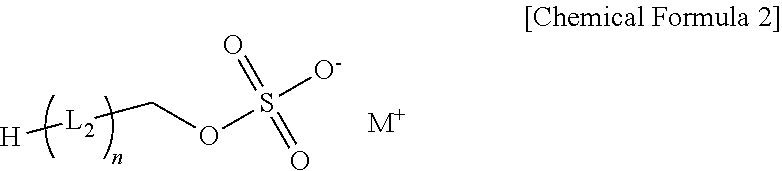
- YEXVRFVIIFLVFB-UHFFFAOYSA-M [CH3+].[H]CCOS(=O)(=O)[O-] Chemical compound [CH3+].[H]CCOS(=O)(=O)[O-] YEXVRFVIIFLVFB-UHFFFAOYSA-M 0.000 description 2
Images


Classifications
-
- B—PERFORMING OPERATIONS; TRANSPORTING
- B01—PHYSICAL OR CHEMICAL PROCESSES OR APPARATUS IN GENERAL
- B01D—SEPARATION
- B01D67/00—Processes specially adapted for manufacturing semi-permeable membranes for separation processes or apparatus
- B01D67/0002—Organic membrane manufacture
- B01D67/0006—Organic membrane manufacture by chemical reactions
-
- B—PERFORMING OPERATIONS; TRANSPORTING
- B01—PHYSICAL OR CHEMICAL PROCESSES OR APPARATUS IN GENERAL
- B01D—SEPARATION
- B01D61/00—Processes of separation using semi-permeable membranes, e.g. dialysis, osmosis or ultrafiltration; Apparatus, accessories or auxiliary operations specially adapted therefor
- B01D61/02—Reverse osmosis; Hyperfiltration ; Nanofiltration
-
- B—PERFORMING OPERATIONS; TRANSPORTING
- B01—PHYSICAL OR CHEMICAL PROCESSES OR APPARATUS IN GENERAL
- B01D—SEPARATION
- B01D61/00—Processes of separation using semi-permeable membranes, e.g. dialysis, osmosis or ultrafiltration; Apparatus, accessories or auxiliary operations specially adapted therefor
- B01D61/02—Reverse osmosis; Hyperfiltration ; Nanofiltration
- B01D61/025—Reverse osmosis; Hyperfiltration
-
- B—PERFORMING OPERATIONS; TRANSPORTING
- B01—PHYSICAL OR CHEMICAL PROCESSES OR APPARATUS IN GENERAL
- B01D—SEPARATION
- B01D65/00—Accessories or auxiliary operations, in general, for separation processes or apparatus using semi-permeable membranes
- B01D65/08—Prevention of membrane fouling or of concentration polarisation
-
- B—PERFORMING OPERATIONS; TRANSPORTING
- B01—PHYSICAL OR CHEMICAL PROCESSES OR APPARATUS IN GENERAL
- B01D—SEPARATION
- B01D67/00—Processes specially adapted for manufacturing semi-permeable membranes for separation processes or apparatus
-
- B—PERFORMING OPERATIONS; TRANSPORTING
- B01—PHYSICAL OR CHEMICAL PROCESSES OR APPARATUS IN GENERAL
- B01D—SEPARATION
- B01D69/00—Semi-permeable membranes for separation processes or apparatus characterised by their form, structure or properties; Manufacturing processes specially adapted therefor
- B01D69/10—Supported membranes; Membrane supports
-
- B—PERFORMING OPERATIONS; TRANSPORTING
- B01—PHYSICAL OR CHEMICAL PROCESSES OR APPARATUS IN GENERAL
- B01D—SEPARATION
- B01D69/00—Semi-permeable membranes for separation processes or apparatus characterised by their form, structure or properties; Manufacturing processes specially adapted therefor
- B01D69/10—Supported membranes; Membrane supports
- B01D69/107—Organic support material
-
- B—PERFORMING OPERATIONS; TRANSPORTING
- B01—PHYSICAL OR CHEMICAL PROCESSES OR APPARATUS IN GENERAL
- B01D—SEPARATION
- B01D69/00—Semi-permeable membranes for separation processes or apparatus characterised by their form, structure or properties; Manufacturing processes specially adapted therefor
- B01D69/12—Composite membranes; Ultra-thin membranes
- B01D69/1213—Laminated layers
-
- B—PERFORMING OPERATIONS; TRANSPORTING
- B01—PHYSICAL OR CHEMICAL PROCESSES OR APPARATUS IN GENERAL
- B01D—SEPARATION
- B01D69/00—Semi-permeable membranes for separation processes or apparatus characterised by their form, structure or properties; Manufacturing processes specially adapted therefor
- B01D69/12—Composite membranes; Ultra-thin membranes
- B01D69/125—In situ manufacturing by polymerisation, polycondensation, cross-linking or chemical reaction
-
- B—PERFORMING OPERATIONS; TRANSPORTING
- B01—PHYSICAL OR CHEMICAL PROCESSES OR APPARATUS IN GENERAL
- B01D—SEPARATION
- B01D69/00—Semi-permeable membranes for separation processes or apparatus characterised by their form, structure or properties; Manufacturing processes specially adapted therefor
- B01D69/12—Composite membranes; Ultra-thin membranes
- B01D69/125—In situ manufacturing by polymerisation, polycondensation, cross-linking or chemical reaction
- B01D69/1251—In situ manufacturing by polymerisation, polycondensation, cross-linking or chemical reaction by interfacial polymerisation
-
- B—PERFORMING OPERATIONS; TRANSPORTING
- B01—PHYSICAL OR CHEMICAL PROCESSES OR APPARATUS IN GENERAL
- B01D—SEPARATION
- B01D71/00—Semi-permeable membranes for separation processes or apparatus characterised by the material; Manufacturing processes specially adapted therefor
- B01D71/06—Organic material
- B01D71/30—Polyalkenyl halides
- B01D71/32—Polyalkenyl halides containing fluorine atoms
-
- B—PERFORMING OPERATIONS; TRANSPORTING
- B01—PHYSICAL OR CHEMICAL PROCESSES OR APPARATUS IN GENERAL
- B01D—SEPARATION
- B01D71/00—Semi-permeable membranes for separation processes or apparatus characterised by the material; Manufacturing processes specially adapted therefor
- B01D71/06—Organic material
- B01D71/56—Polyamides, e.g. polyester-amides
-
- B—PERFORMING OPERATIONS; TRANSPORTING
- B01—PHYSICAL OR CHEMICAL PROCESSES OR APPARATUS IN GENERAL
- B01D—SEPARATION
- B01D71/00—Semi-permeable membranes for separation processes or apparatus characterised by the material; Manufacturing processes specially adapted therefor
- B01D71/06—Organic material
- B01D71/58—Other polymers having nitrogen in the main chain, with or without oxygen or carbon only
-
- C—CHEMISTRY; METALLURGY
- C02—TREATMENT OF WATER, WASTE WATER, SEWAGE, OR SLUDGE
- C02F—TREATMENT OF WATER, WASTE WATER, SEWAGE, OR SLUDGE
- C02F1/00—Treatment of water, waste water, or sewage
- C02F1/44—Treatment of water, waste water, or sewage by dialysis, osmosis or reverse osmosis
-
- C—CHEMISTRY; METALLURGY
- C02—TREATMENT OF WATER, WASTE WATER, SEWAGE, OR SLUDGE
- C02F—TREATMENT OF WATER, WASTE WATER, SEWAGE, OR SLUDGE
- C02F1/00—Treatment of water, waste water, or sewage
- C02F1/44—Treatment of water, waste water, or sewage by dialysis, osmosis or reverse osmosis
- C02F1/441—Treatment of water, waste water, or sewage by dialysis, osmosis or reverse osmosis by reverse osmosis
-
- C—CHEMISTRY; METALLURGY
- C08—ORGANIC MACROMOLECULAR COMPOUNDS; THEIR PREPARATION OR CHEMICAL WORKING-UP; COMPOSITIONS BASED THEREON
- C08G—MACROMOLECULAR COMPOUNDS OBTAINED OTHERWISE THAN BY REACTIONS ONLY INVOLVING UNSATURATED CARBON-TO-CARBON BONDS
- C08G69/00—Macromolecular compounds obtained by reactions forming a carboxylic amide link in the main chain of the macromolecule
-
- C—CHEMISTRY; METALLURGY
- C08—ORGANIC MACROMOLECULAR COMPOUNDS; THEIR PREPARATION OR CHEMICAL WORKING-UP; COMPOSITIONS BASED THEREON
- C08G—MACROMOLECULAR COMPOUNDS OBTAINED OTHERWISE THAN BY REACTIONS ONLY INVOLVING UNSATURATED CARBON-TO-CARBON BONDS
- C08G69/00—Macromolecular compounds obtained by reactions forming a carboxylic amide link in the main chain of the macromolecule
- C08G69/02—Polyamides derived from amino-carboxylic acids or from polyamines and polycarboxylic acids
- C08G69/08—Polyamides derived from amino-carboxylic acids or from polyamines and polycarboxylic acids derived from amino-carboxylic acids
- C08G69/14—Lactams
- C08G69/16—Preparatory processes
- C08G69/18—Anionic polymerisation
-
- C—CHEMISTRY; METALLURGY
- C08—ORGANIC MACROMOLECULAR COMPOUNDS; THEIR PREPARATION OR CHEMICAL WORKING-UP; COMPOSITIONS BASED THEREON
- C08J—WORKING-UP; GENERAL PROCESSES OF COMPOUNDING; AFTER-TREATMENT NOT COVERED BY SUBCLASSES C08B, C08C, C08F, C08G or C08H
- C08J5/00—Manufacture of articles or shaped materials containing macromolecular substances
- C08J5/20—Manufacture of shaped structures of ion-exchange resins
- C08J5/22—Films, membranes or diaphragms
-
- C—CHEMISTRY; METALLURGY
- C08—ORGANIC MACROMOLECULAR COMPOUNDS; THEIR PREPARATION OR CHEMICAL WORKING-UP; COMPOSITIONS BASED THEREON
- C08L—COMPOSITIONS OF MACROMOLECULAR COMPOUNDS
- C08L77/00—Compositions of polyamides obtained by reactions forming a carboxylic amide link in the main chain; Compositions of derivatives of such polymers
-
- B—PERFORMING OPERATIONS; TRANSPORTING
- B01—PHYSICAL OR CHEMICAL PROCESSES OR APPARATUS IN GENERAL
- B01D—SEPARATION
- B01D2323/00—Details relating to membrane preparation
- B01D2323/12—Specific ratios of components used
-
- B—PERFORMING OPERATIONS; TRANSPORTING
- B01—PHYSICAL OR CHEMICAL PROCESSES OR APPARATUS IN GENERAL
- B01D—SEPARATION
- B01D2323/00—Details relating to membrane preparation
- B01D2323/15—Use of additives
- B01D2323/216—Surfactants
-
- B—PERFORMING OPERATIONS; TRANSPORTING
- B01—PHYSICAL OR CHEMICAL PROCESSES OR APPARATUS IN GENERAL
- B01D—SEPARATION
- B01D2323/00—Details relating to membrane preparation
- B01D2323/15—Use of additives
- B01D2323/217—Emulgator or emulsion/foam forming agents
-
- C—CHEMISTRY; METALLURGY
- C02—TREATMENT OF WATER, WASTE WATER, SEWAGE, OR SLUDGE
- C02F—TREATMENT OF WATER, WASTE WATER, SEWAGE, OR SLUDGE
- C02F2201/00—Apparatus for treatment of water, waste water or sewage
- C02F2201/002—Construction details of the apparatus
- C02F2201/007—Modular design
-
- C—CHEMISTRY; METALLURGY
- C02—TREATMENT OF WATER, WASTE WATER, SEWAGE, OR SLUDGE
- C02F—TREATMENT OF WATER, WASTE WATER, SEWAGE, OR SLUDGE
- C02F2303/00—Specific treatment goals
- C02F2303/20—Prevention of biofouling
Definitions
- the present specification relates to a composition for interfacial polymerization of polyamide and a reverse osmosis membrane using the same.
- the solvent moving from the solution with a low solute concentration to the solution with a high solute concentration by passing through the membrane is referred to as osmosis, and herein, the pressure applied to the solution with a high solute concentration caused by the solvent migration is referred to as an osmotic pressure.
- an osmotic pressure the pressure applied to the solution with a high solute concentration caused by the solvent migration.
- reverse osmosis the solvent migrates to the solution with a low solute concentration, and this phenomenon is referred to as reverse osmosis.
- a water-treatment membrane using such a reverse osmosis phenomenon separates molecular-level materials and removes salts from salt water or sea water, and is used to supply water for domestic use, construction, and industrial use.
- Typical examples of such a water-treatment membrane may include a polyamide-based water-treatment membrane, and the polyamide-based water-treatment membrane is manufactured using a method of forming a polyamide active layer on a microporous support layer, and more specifically, is manufactured using a method of forming a microporous support by forming a polysulfone layer on a nonwoven fabric, forming a mPD layer by immersing this microporous support into an aqueous m-phenylenediamine (mPD) solution, and forming a polyamide layer through interfacial polymerization by immersing this again in a trimesoyl chloride (TMC) organic solvent to bring the mPD layer into contact with the TMC.
- TMC trimesoyl chloride
- Flux and salt rejection are used as important indexes representing membrane performance in the water-treatment membrane.
- the present specification is directed to providing a composition for interfacial polymerization of polyamide and a method for preparing a reverse osmosis membrane using the same.
- composition for interfacial polymerization of polyamide including at least one of an amine compound and an acyl halide compound; a surfactant; and a compound represented by the following Chemical Formula 1.
- x and y are the same as or different from each other, and each independently an integer of 1 to 30,
- a ratio of x and y is from 1:1 to 1:3, and
- L 1 is a linear or branched alkylene group.
- Another embodiment of the present specification provides a method for preparing a reverse osmosis membrane including forming a polyamide active layer on a support using the composition for interfacial polymerization of polyamide.
- Still another embodiment of the present specification provides a reverse osmosis membrane prepared using the method for manufacturing a reverse osmosis membrane.
- Yet another embodiment of the present specification provides a water-treatment module including the reverse osmosis membrane.
- a reverse osmosis membrane prepared using a preparation method according to one embodiment of the present specification has excellent flux and salt rejection.
- coatability is enhanced by using a fluorocarbon series compound with a surfactant during interfacial polymerization, and as a result, a reverse osmosis membrane having a wider effective membrane area, which means an area actually experiencing reverse osmosis in the whole reverse osmosis membrane region, and having a smaller performance deviation can be prepared.
- FIG. 1 illustrates a reverse osmosis membrane according to one embodiment of the present specification.
- a description of a certain member being placed “on” another member includes not only a case of the certain member adjoining the another member but a case of still another member being present between the two members.
- composition for interfacial polymerization of polyamide including at least one of an amine compound and an acyl halide compound; a surfactant; and a compound represented by the following Chemical Formula 1.
- x and y are the same as or different from each other, and each independently an integer of 0 to 30,
- a ratio of x and y is from 1:1 to 1:3, and
- L 1 is a linear or branched alkylene group.
- L 1 of Chemical Formula 1 is a linear alkylene group.
- L 1 of Chemical Formula 1 is an ethylene group.
- x is an integer of 0 to 6. More preferably, x is an integer of 1 to 6.
- y is an integer of 0 to 15. More preferably, y is an integer of 1 to 15.
- a ratio of x and y is from 1:1 to 1:2.5.
- the composition for interfacial polymerization of polyamide including the compound represented by Chemical Formula 1 has reduced surface tension. Accordingly, when forming a polyamide active layer on a support using the composition for interfacial polymerization of polyamide, coatability for the support surface is enhanced uniformly forming the polyamide active layer, and as a result, a reverse osmosis membrane having a smaller surface performance deviation may be prepared.
- commercially-available materials may be used as the compound represented by Chemical Formula 1, and examples thereof may include, but are not limited to, Zonyl® FSO-100, FS-300, FSN and the like manufactured by DuPont.
- the content of the compound represented by Chemical Formula 1 may be greater than 0% by weight and less than or equal to 0.1% by weight with respect to 100% by weight of the whole composition for interfacial polymerization of polyamide.
- the compound represented by Chemical Formula 1 may be included in 0.001% by weight to 0.06% by weight in the composition for interfacial polymerization of polyamide.
- the compound represented by Chemical Formula 1 may be included in 0.002% by weight to 0.01% by weight in the composition for interfacial polymerization of polyamide.
- the compound represented by Chemical Formula 1 When the content of the compound represented by Chemical Formula 1 satisfies the above-mentioned range, the compound represented by Chemical Formula 1 lowers surface tension of the composition for interfacial polymerization of polyamide enabling even interfacial polymerization on the support, and as a result, a uniform active layer may be formed.
- composition for interfacial polymerization of polyamide only includes sodium lauryl sulphate (SLS) as a surfactant without including the compound represented by Chemical Formula 1
- SLS sodium lauryl sulphate
- surface tension is measured to be 32.4 mN/m, however, when the compound represented by Chemical Formula 1 is included in 0.0025% together with the surfactant, surface tension decreases to 27.8 mN/m.
- mPD m-phenylenediamine
- the surfactant may be represented by the following Chemical Formula 2.
- n is an integer of 0 to 10
- L 2 is a linear or branched alkylene group
- M + is any one selected from the group consisting of Li + , Na + and K + .
- L 2 of Chemical Formula 2 is a linear alkylene group.
- L 2 of Chemical Formula 2 is an ethylene group.
- sodium lauryl sulphate may be used as the surfactant.
- the content of the surfactant may be greater than 0% by weight and less than or equal to 0.1% by weight with respect to 100% by weight of the whole composition for interfacial polymerization of polyamide. In one embodiment, the content of the surfactant may be from 0.001% by weight to 0.1% by weight with respect to 100% by weight of the whole composition for interfacial polymerization of polyamide.
- SLS sodium lauryl sulphate
- HLB hydrophile-lipophile balance
- CMC critical micelle concentration
- SLS is used in an aqueous solution layer in a concentration of greater than 0% by weight and less than or equal to 0.1% by weight based on 100% by weight of the whole composition for interfacial polymerization of polyamide.
- polyamide is quickly formed at an interface of an aqueous solution layer and an organic solution layer, and herein, the surfactant makes the layer thin and uniform and allows uniform polyamide active layer formation by m-phenylenediamine (mPD) present in the aqueous solution layer readily migrating to the organic solution layer.
- mPD m-phenylenediamine
- the composition for interfacial polymerization of polyamide may include at least one of an amine compound and an acyl halide compound; the surfactant; and the compound represented by Chemical Formula 1.
- the compound represented by Chemical Formula 1 may be included in greater than 0% by weight and less than or equal to 0.1% by weight, preferably in 0.001% by weight to 0.06% by weight, and more preferably in 0.002% by weight to 0.01% by weight in the composition for interfacial polymerization of polyamide based on 100% by weight of the whole composition.
- the amine compound is consists of an aromatic amine compound, and the aromatic amine compound may include a compound represented by the following Chemical Formula 3.
- n is an integer of 1 to 3
- m is an integer of 1 or 2.
- Chemical Formula 3 a methyl group bonds to a benzene ring of the aromatic amine compound, and the methyl group performs a role of lowering packing efficiency of the polyamide active layer formed through interfacial polymerization. This increases a free volume of the polyamide active layer, and therefore, flux may be enhanced when preparing a reverse osmosis membrane using the composition for interfacial polymerization of polyamide including the compound represented by Chemical Formula 3 as the amine compound.
- n of Chemical Formula 3 is 1.
- n of Chemical Formula 3 is 2.
- n of Chemical Formula 3 is 3.
- m of Chemical Formula 3 is 1.
- m of Chemical Formula 3 is 2.
- the amine compound is consists of an aromatic amine compound, and specifically, does not include an aliphatic amine compound participating as a monomer in the interfacial polymerization.
- the amine compound may further include one or more types selected from the group consisting of m-phenylenediamine, p-phenylenediamine, 1,3,6-benzenetriamine, 4-chloro-1,3-phenylenediamine, 6-chloro-1,3-phenylenediamine and 3-chloro-1,4-phenylenediamine.
- the amine compound is preferably m-phenylenediamine.
- the compound represented by Chemical Formula 3 may include one or more types selected from the group consisting of 2,3-diaminotoluene, 2,4-diaminotoluene, 2,5-diaminotoluene, 2,6-diaminotoluene, 3,4-diaminotoluene, 2,4,6-trimethyl-m-phenylenediamine, m-toluidine, p-toluidine, o-toluidine, 2,3-dimethylaniline, 2,4-dimethylaniline, 2,5-dimethylaniline and 2,6-dimethylaniline.
- the composition for interfacial polymerization of polyamide may be an aqueous solution including the amine compound; the surfactant; and the compound represented by Chemical Formula 1.
- the rest other than the amine compound; the surfactant; and the compound represented by Chemical Formula 1 in the composition for interfacial polymerization of polyamide may all be water.
- the content of the amine compound may be from 0% by weight to 5% by weight with respect to the aqueous solution. Specifically, according to one embodiment of the present specification, the content of the amine compound is more preferably from 0% by weight to 4% by weight with respect to the aqueous solution.
- a result of enhancing flux may be obtained when introducing the compound represented by Chemical Formula 3.
- the composition for interfacial polymerization of polyamide may be an aqueous solution including the amine compound including the compound represented by Chemical Formula 3; the surfactant; and the compound represented by Chemical Formula 1.
- the content of the compound represented by Chemical Formula 3 may be from 0.1% by weight to 5% by weight with respect to the aqueous solution. Specifically, according to one embodiment of the present specification, the content of the compound represented by Chemical Formula 3 is more preferably from 0.5% by weight to 4% by weight with respect to the aqueous solution.
- flux when the compound represented by Chemical Formula 3 is included in 0.5% by weight to 4% by weight with respect to the aqueous solution, flux may be enhanced when preparing a reverse osmosis membrane compared to when the compound represented by Chemical Formula 3 is not used.
- the composition for interfacial polymerization of polyamide may be an organic solution including the acyl halide compound; the surfactant; and the compound represented by Chemical Formula 1.
- the rest other than the acyl halide compound; the surfactant; and the compound represented by Chemical Formula 1 in the composition for interfacial polymerization of polyamide may all be an organic solvent.
- the acyl halide compound is not limited as long as it is capable of being used for polyamide polymerization, and aromatic compounds having 2 to 3 carboxylic acid halides, for example, mixtures of one, two or more types selected from the group consisting of trimesoyl chloride, isophthaloyl chloride and terephthaloyl chloride may be preferably used.
- the content of the acyl halide compound may be from 0.05% by weight to 1% by weight with respect to 100% by weight of the organic solution.
- organic solvent included in the organic solution aliphatic hydrocarbon solvents, for example, hydrophobic liquids that are not mixed with water such as Freon, hexane, cyclohexane, heptane and alkane having 5 to 12 carbon atoms may be used.
- alkane having 5 to 12 carbon atoms, and IsoPar (Exxon), ISOL-C (SK Chem.) and ISOL-G (Exxon) that are mixture thereof, and the like may be used, however, the organic solvent is not limited thereto.
- One embodiment of the present specification provides a method for preparing a reverse osmosis membrane including forming a polyamide active layer on a support using the composition for interfacial polymerization of polyamide described above.
- the composition for interfacial polymerization of polyamide includes the amine compound, the surfactant and the compound represented by Chemical Formula 1, and the polyamide active layer is formed through interfacial polymerization by bringing the composition for interfacial polymerization of polyamide into contact with the acyl halide compound.
- the composition for interfacial polymerization of polyamide includes the acyl halide compound, the surfactant and the compound represented by Chemical Formula 1, and the polyamide active layer is formed through interfacial polymerization by bringing the composition for interfacial polymerization of polyamide into contact with the amine compound.
- the amine compound and the acyl halide compound In the preparation method, when the amine compound and the acyl halide compound are brought into contact with other, the amine compound and the acyl halide compound produce polyamide through interfacial polymerization while reacting, and the result is adsorbed to a microporous support to form a thin film.
- the compound represented by Chemical Formula 1 lowers surface tension of the composition to have the interfacial polymerization evenly occur on the support surface, and therefore, a uniform reverse osmosis membrane may be prepared by the present disclosure.
- the contact may form the polyamide active layer through methods such as immersion, spray or coating.
- the preparation method may further go through a step of removing an excess aqueous solution including the amine compound as necessary.
- the aqueous solution including the amine compound formed on the support is present too much, the composition in the aqueous solution may be non-uniform, and when the composition in the aqueous solution is non-uniform, a non-uniform polyamide active layer may be formed by interfacial polymerization thereafter.
- an excess aqueous solution is preferably removed after forming an amine aqueous solution layer on the support.
- the excess aqueous solution removal is not particularly limited, and, for example, a sponge, an air knife, nitrogen gas blowing, natural drying, a press roll or the like may be used for the removal.
- the method of forming a polyamide active layer on the support is not particularly limited. For example, methods of spraying, coating, immersion, dropping and the like may be used.
- One embodiment of the present specification provides a method for preparing a reverse osmosis membrane including preparing a support; and forming a polyamide active layer on the support using the composition for interfacial polymerization of polyamide described above.
- those that are porous may be used as the support.
- nonwoven fabrics generally used in the art may be used as the support, and types, thicknesses or the degree of porosity of the nonwoven fabric may vary as necessary.
- those forming a coating layer made of polymer materials on a nonwoven fabric may be used as the support.
- the polymer material may include polysulfone, polyether sulfone, polycarbonate, polyethylene oxide, polyimide, polyether imide, polyetheretherketone, polypropylene, polymethylpentene, polymethyl chloride, polyvinylidene fluoride and the like, but are not limited thereto.
- polysulfone may be used as the polymer material.
- the support may have a thickness of 60 ⁇ m to 100 ⁇ m, however, the thickness is not limited thereto and may be adjusted as necessary.
- the support preferably has pore sizes of 1 nm to 500 nm, however, the pore size is not limited thereto.
- a reverse osmosis membrane including a support; and a polyamide active layer provided on the support, and having a flux deviation of 1 GFD or less.
- the reverse osmosis membrane has a flux deviation of 0.9 GFD or less.
- the reverse osmosis membrane has a flux deviation of 0.5 GFD or less.
- a reverse osmosis membrane including a support; and a polyamide active layer provided on the support, and having a salt rejection deviation of 2% or less.
- the reverse osmosis membrane has a salt rejection deviation of 0.1% or less.
- the reverse osmosis membrane has a salt rejection deviation of 0.05% or less.
- One embodiment of the present specification provides a reverse osmosis membrane including a support; and a polyamide active layer provided on the support, and having a flux deviation of 1 GFD or less and a salt rejection deviation of 2% or less.
- the polyamide layer is uniformly formed, and, when collecting a sample of the reverse osmosis membrane and measuring salt rejection and flux at different points, the deviation is low.
- uniformity of the reverse osmosis membrane may be identified using rhodamine, a trace dye used for determining flux and direction of a solution.
- the “deviation” is obtained through evaluating salt rejection and flux of two reverse osmosis membrane coupons using the same composition, and then calculating the standard deviation.
- This reverse osmosis membrane includes a support; and a polyamide active layer provided on the support, wherein the polyamide active layer is formed using a composition for interfacial polymerization of polyamide including at least one of an amine compound and an acyl halide compound; a surfactant; and the compound represented by Chemical Formula 1.
- the compound represented by Chemical Formula 1 and the surfactant may be included in a composition including the amine compound, for example, in an aqueous solution layer composition, or in a composition including the acyl halide compound, for example, in an organic layer composition.
- the compound represented by Chemical Formula 1 and the surfactant are preferably included in the aqueous solution layer.
- the reverse osmosis membrane described above may further include additional layers as necessary.
- the reverse osmosis membrane may further include an anti-fouling layer provided on the polyamide active layer.
- One embodiment of the present disclosure provides a water-treatment module including at least one or more of the reverse osmosis membranes described above.
- the water-treatment module is not particularly limited, and examples thereof may include a plate & frame module, a tubular module, a hollow & fiber module, a spiral wound module or the like.
- the water-treatment module includes the reverse osmosis membrane according to one embodiment of the present disclosure described above, the water-treatment module is not particularly limited in other constitutions and manufacturing methods, and general means known in the art may be employed without limit.
- the water-treatment module according to one embodiment of the present specification has excellent salt rejection and flux, and, by using a reverse osmosis membrane having a large effective membrane area, is useful in water-treatment systems such as household/industrial water-purification systems, sewage treatment systems or sea to fresh water treatment systems having a small performance deviation and enhanced uniformity.
- a contact angle ( ⁇ ) decreases.
- a cell evaluation device of a reverse osmosis membrane was formed using a flat permeable cell, a high pressure pump, a storage tank and a cooling device.
- the structure of the flat permeable cell was a cross-flow type and the effective area of the cell was 29.6 cm 2 .
- aqueous solution layer was formed on a support using a composition including m-phenylenediamine (mPD), sodium lauryl sulphate (SLS) as a surfactant, and Zonyl® FSO-100 as a compound represented by Chemical Formula 1.
- mPD m-phenylenediamine
- SLS sodium lauryl sulphate
- Zonyl® FSO-100 as a compound represented by Chemical Formula 1.
- an organic layer was formed by coating a composition including trimesoyl chloride (TMC), 1,3,5-trimethylbenzene (TMB) and Isopar-G on the aqueous solution layer to perform interfacial polymerization, and as a result, a reverse osmosis membrane was prepared.
- TMC trimesoyl chloride
- TMB 1,3,5-trimethylbenzene
- Isopar-G Isopar-G
- a reverse osmosis membrane was prepared in the same manner as in Example 1 except that 2,6-diaminotoluene (2,6-DAT), a compound represented by Chemical Formula 3, was used instead of mPD as the amine compound.
- 2,6-diaminotoluene (2,6-DAT) a compound represented by Chemical Formula 3
- mPD a compound represented by Chemical Formula 3
- a reverse osmosis membrane was prepared in the same manner as in Example 1 except that FSO-100, the compound represented by Chemical Formula 1, was not used in the aqueous solution layer of Example 1.
- a reverse osmosis membrane was prepared in the same manner as in Example 1 except that the aqueous solution layer of Example 1 further included polyvinyl pyrrolidone (PVP).
- PVP polyvinyl pyrrolidone
- a reverse osmosis membrane was prepared in the same manner as in Example 1 except that SLS, the surfactant, was not used in the aqueous solution layer of Example 1.
- the reverse osmosis membrane prepared as above went through a stabilizing stage having a sufficient composite membrane consolidation effect by constantly maintaining an operating pressure. After that, the reverse osmosis membrane was stabilized for 30 minutes while passing distilled water through the reverse osmosis membrane until flux became constant.
- Flux was measured by flowing down a 250 ppm NaCl solution for 60 minutes under a 60 psi condition until 40 mL to 50 mL permeated.
- Salt rejection was measured using a conductivity meter, and determined by the following Equation (2). This is due to the fact that an electrical conductivity value for a salt concentration is non-linear, and particularly, the deviation is not large at low salt rejection.
- Salt ⁇ ⁇ rejection C permeate C feed ⁇ 100 Equaiton ⁇ ⁇ ( 2 )
- GFD a flux unit
- GFD Permeate ⁇ ⁇ volume ⁇ ⁇ ( Gallon ) membrane ⁇ ⁇ area ⁇ ⁇ ( ft 2 ) ⁇ day
- Example 1 of Table 1 when preparing a reverse osmosis membrane using the compound represented by Chemical Formula 1 as a coatability enhancer together with a surfactant, a uniform reverse osmosis membrane having excellent salt rejection and also a significantly smaller salt rejection deviation while having a similar level of flux was obtained compared to Comparative Example 1 using only a surfactant, and Comparative Example 2 further including polyvinyl pyrrolidone (PVP) in addition to a surfactant and the compound represented by Chemical Formula 1.
- PVP polyvinyl pyrrolidone
- Example 2 using the compound represented by Chemical Formula 3 as an amine compound, a reverse osmosis membrane having both excellent salt rejection and flux was obtained compared to Comparative Examples 1 to 3.
Landscapes
- Chemical & Material Sciences (AREA)
- Chemical Kinetics & Catalysis (AREA)
- Engineering & Computer Science (AREA)
- Water Supply & Treatment (AREA)
- Organic Chemistry (AREA)
- Manufacturing & Machinery (AREA)
- Polymers & Plastics (AREA)
- Health & Medical Sciences (AREA)
- Medicinal Chemistry (AREA)
- Nanotechnology (AREA)
- Hydrology & Water Resources (AREA)
- Environmental & Geological Engineering (AREA)
- Life Sciences & Earth Sciences (AREA)
- Materials Engineering (AREA)
- Separation Using Semi-Permeable Membranes (AREA)
- Polyamides (AREA)
Abstract
Description

-
- 100: Nonwoven Fabric
- 200: Porous Support Layer
- 300: Polyamide Active Layer
- 400: Salt Water
- 500: Purified Water
- 600: Concentrated Water


| TABLE 1 | |||||
| Salt | |||||
| Surface | Rejection | ||||
| Tension | (%) | Flux (GFD) | |||
| Composition | (mN/m) | (Deviation) | (Deviation) | ||
| Example 1 | mPD 3 wt % + SLS | 27.8 | 94.09 | 35.08 |
| 0.06 wt % + FSO- | (0.03) | (0.87) | ||
| 100 | ||||
| 0.005 wt % | ||||
| Example 2 | 2,6-DAT 3 wt % + | 29.2 | 90.19 | 40.63 |
| SLS 0.06 wt % + | (1.71) | (0.43) | ||
| FSO-100 | ||||
| 0.005 wt % | ||||
| Comparative | mPD 3 wt % + SLS | 32.4 | 84.81 | 36.78 |
| Example 1 | 0.06 wt % | (10.31) | (0.61) | |
| Comparative | mPD 3 wt % + SLS | 29.7 | 88.82 | 33.82 |
| Example 2 | 0.06 wt % + PVP | (4.49) | (0.08) | |
| 0.0025 wt % + | ||||
| FSO-100 | ||||
| 0.0025 wt % | ||||
| Comparative | mPD 3 wt % + | 13.6 | 87.98 | 21.96 |
| Example 3 | FSO-100 0.06 wt % | (0.07) | (1.91) | |
Claims (14)


Applications Claiming Priority (5)
| Application Number | Priority Date | Filing Date | Title |
|---|---|---|---|
| KR10-2016-0039705 | 2016-03-31 | ||
| KR20160039705 | 2016-03-31 | ||
| KR10-2016-0039691 | 2016-03-31 | ||
| KR20160039691 | 2016-03-31 | ||
| PCT/KR2017/003556 WO2017171474A1 (en) | 2016-03-31 | 2017-03-31 | Composition for interfacial polymerization of polyamide and method for manufacturing reverse osmosis membrane using same |
Publications (2)
| Publication Number | Publication Date |
|---|---|
| US20180229189A1 US20180229189A1 (en) | 2018-08-16 |
| US10632425B2 true US10632425B2 (en) | 2020-04-28 |
Family
ID=59965025
Family Applications (1)
| Application Number | Title | Priority Date | Filing Date |
|---|---|---|---|
| US15/749,478 Active 2037-12-13 US10632425B2 (en) | 2016-03-31 | 2017-03-31 | Composition for interfacial polymerization of polyamide and method for manufacturing reverse osmosis membrane using same |
Country Status (6)
| Country | Link |
|---|---|
| US (1) | US10632425B2 (en) |
| EP (1) | EP3315533B1 (en) |
| JP (1) | JP6624278B2 (en) |
| KR (1) | KR101961344B1 (en) |
| CN (1) | CN107922610B (en) |
| WO (1) | WO2017171474A1 (en) |
Families Citing this family (6)
| Publication number | Priority date | Publication date | Assignee | Title |
|---|---|---|---|---|
| CN111788251B (en) | 2018-06-15 | 2023-03-28 | 株式会社Lg化学 | Composition for interfacial polymerization of polyamide and method for manufacturing water treatment separation membrane by using the same |
| KR102165415B1 (en) | 2018-12-13 | 2020-10-15 | 현대 파워텍 주식회사 | Apparatus and method for controlling continuously bariable transmission |
| CN111560258A (en) * | 2020-05-27 | 2020-08-21 | 江苏集萃智能液晶科技有限公司 | Temperature-sensitive color developing liquid crystal microcapsule and preparation method thereof |
| CN112892230B (en) * | 2021-02-01 | 2022-04-26 | 浙江工业大学 | High-desalination polyamide composite reverse osmosis membrane for seawater desalination and preparation method thereof |
| KR20240004242A (en) * | 2021-02-10 | 2024-01-11 | 아쿠아 멤브레인스 인코포레이티드 | Spacer compatible with active layer of fluid filtration member |
| CN113786738A (en) * | 2021-08-26 | 2021-12-14 | 同济大学 | A method for recycling a scrapped low-pressure membrane based on interface wettability regulation and a prepared polyamide nanofiltration membrane |
Citations (13)
| Publication number | Priority date | Publication date | Assignee | Title |
|---|---|---|---|---|
| EP0015149A1 (en) | 1979-02-22 | 1980-09-03 | FilmTec Corporation | Interfacially synthesized reverse osmosis membrane, process for the preparation thereof and its use in a process for removing solute from solute-containing water |
| KR19990019008A (en) | 1997-08-28 | 1999-03-15 | 한형수 | Manufacturing method of high flow rate reverse osmosis membrane |
| US20040222146A1 (en) | 2003-05-06 | 2004-11-11 | Nitto Denko Corporation | Composite semipermeable membrane and process for producing the same |
| CN101524626A (en) | 2008-03-07 | 2009-09-09 | 浙江欧美环境工程有限公司 | External pressure type hollow fiber nano filtering film and preparation method thereof |
| EP2140929A1 (en) | 2008-07-02 | 2010-01-06 | Woongjin Chemical Co., Ltd. | Selective membrane having a high fouling resistance and preparation method thereof |
| KR20100078822A (en) | 2008-12-30 | 2010-07-08 | 주식회사 효성 | Manufacturing method for polyamide-based reverse osmosis membrane and polyamide-based reverse osmosis membrane manufactured thereby |
| KR20120022414A (en) | 2010-09-02 | 2012-03-12 | 웅진케미칼 주식회사 | Fouling resistance polyamide reverse osmosis membrane and manufacturing method thereof |
| US20130018136A1 (en) | 2010-03-23 | 2013-01-17 | Solvay Sa | Polyamide compositions comprising a substance comprising alkylene oxide moieties |
| KR20140058325A (en) | 2012-11-05 | 2014-05-14 | 주식회사 엘지화학 | Polyamide-based water-treatment membrane having an excellent antifouling property and manufacturing method thereof |
| KR20140070457A (en) | 2012-11-30 | 2014-06-10 | 주식회사 엘지화학 | Water treatment membrane having a high chlorine resistance and a high permeability and method of manufacturing the same |
| CN103946324A (en) | 2011-11-17 | 2014-07-23 | Lg化学株式会社 | Aqueous dispersion composition, back sheet for an eco-friendly photovoltaic module, and method for manufacturing same |
| US9139732B2 (en) | 2010-03-23 | 2015-09-22 | Solvay Sa | Polymer compositions comprising semi-aromatic polyamides and graphene materials |
| WO2016002819A1 (en) | 2014-06-30 | 2016-01-07 | 東レ株式会社 | Composite semipermeable membrane |
-
2017
- 2017-03-31 EP EP17775898.4A patent/EP3315533B1/en active Active
- 2017-03-31 US US15/749,478 patent/US10632425B2/en active Active
- 2017-03-31 CN CN201780002875.7A patent/CN107922610B/en active Active
- 2017-03-31 JP JP2018504898A patent/JP6624278B2/en active Active
- 2017-03-31 WO PCT/KR2017/003556 patent/WO2017171474A1/en not_active Ceased
- 2017-03-31 KR KR1020170041941A patent/KR101961344B1/en active Active
Patent Citations (27)
| Publication number | Priority date | Publication date | Assignee | Title |
|---|---|---|---|---|
| EP0015149A1 (en) | 1979-02-22 | 1980-09-03 | FilmTec Corporation | Interfacially synthesized reverse osmosis membrane, process for the preparation thereof and its use in a process for removing solute from solute-containing water |
| KR19990019008A (en) | 1997-08-28 | 1999-03-15 | 한형수 | Manufacturing method of high flow rate reverse osmosis membrane |
| US20040222146A1 (en) | 2003-05-06 | 2004-11-11 | Nitto Denko Corporation | Composite semipermeable membrane and process for producing the same |
| KR20040095185A (en) | 2003-05-06 | 2004-11-12 | 닛토덴코 가부시키가이샤 | Composite semipermeable membrane and process for producing the same |
| CN1550254A (en) | 2003-05-06 | 2004-12-01 | �ն��繤��ʽ���� | Composite semi-permeable membrane and production method thereof |
| JP4500002B2 (en) | 2003-05-06 | 2010-07-14 | 日東電工株式会社 | Composite semipermeable membrane and method for producing the same |
| CN101524626A (en) | 2008-03-07 | 2009-09-09 | 浙江欧美环境工程有限公司 | External pressure type hollow fiber nano filtering film and preparation method thereof |
| EP2140929A1 (en) | 2008-07-02 | 2010-01-06 | Woongjin Chemical Co., Ltd. | Selective membrane having a high fouling resistance and preparation method thereof |
| KR20100003799A (en) | 2008-07-02 | 2010-01-12 | 웅진케미칼 주식회사 | Selective membrane having a high fouling resistance and preparation method thereof |
| KR20100078822A (en) | 2008-12-30 | 2010-07-08 | 주식회사 효성 | Manufacturing method for polyamide-based reverse osmosis membrane and polyamide-based reverse osmosis membrane manufactured thereby |
| JP2013522437A (en) | 2010-03-23 | 2013-06-13 | ソルヴェイ(ソシエテ アノニム) | Polyamide composition comprising a material comprising an alkylene oxide moiety |
| US9139732B2 (en) | 2010-03-23 | 2015-09-22 | Solvay Sa | Polymer compositions comprising semi-aromatic polyamides and graphene materials |
| US8691905B2 (en) | 2010-03-23 | 2014-04-08 | Solvay Sa | Polyamide compositions comprising a substance comprising alkylene oxide moieties |
| US20130018136A1 (en) | 2010-03-23 | 2013-01-17 | Solvay Sa | Polyamide compositions comprising a substance comprising alkylene oxide moieties |
| KR20120022414A (en) | 2010-09-02 | 2012-03-12 | 웅진케미칼 주식회사 | Fouling resistance polyamide reverse osmosis membrane and manufacturing method thereof |
| CN103946324A (en) | 2011-11-17 | 2014-07-23 | Lg化学株式会社 | Aqueous dispersion composition, back sheet for an eco-friendly photovoltaic module, and method for manufacturing same |
| US20140246085A1 (en) | 2011-11-17 | 2014-09-04 | Lg Chem, Ltd. | Aqueous dispersion composition, back sheet for an eco-friendly photovoltaic module, and method for manufacturing same |
| KR20140058325A (en) | 2012-11-05 | 2014-05-14 | 주식회사 엘지화학 | Polyamide-based water-treatment membrane having an excellent antifouling property and manufacturing method thereof |
| CN103917288A (en) | 2012-11-05 | 2014-07-09 | Lg化学株式会社 | Polyamide water treatment separation membrane with improved antifouling performance and preparation method thereof |
| US9649597B2 (en) | 2012-11-05 | 2017-05-16 | Lg Chem, Ltd. | Polyamide water-treatment separation membrane with improved antifouling properties and manufacturing method thereof |
| EP2929928A1 (en) | 2012-11-05 | 2015-10-14 | LG Chem, Ltd. | Polyamide-based water treatment separating film having superior contamination resistance and method for manufacturing same |
| KR20140070457A (en) | 2012-11-30 | 2014-06-10 | 주식회사 엘지화학 | Water treatment membrane having a high chlorine resistance and a high permeability and method of manufacturing the same |
| US8925738B2 (en) | 2012-11-30 | 2015-01-06 | Lg Chem, Ltd. | Water treatment membrane having high chlorine resistance and high permeability and method of manufacturing the same |
| CN104023830A (en) | 2012-11-30 | 2014-09-03 | Lg化学株式会社 | Water treatment membrane with high chlorine resistance and high permeability and preparation method thereof |
| US20140224728A1 (en) | 2012-11-30 | 2014-08-14 | Lg Chem, Ltd. | Water treatment membrane having high chlorine resistance and high permeability and method of manufacturing the same |
| WO2016002819A1 (en) | 2014-06-30 | 2016-01-07 | 東レ株式会社 | Composite semipermeable membrane |
| US20170120201A1 (en) | 2014-06-30 | 2017-05-04 | Toray Industries, Inc. | Composite semipermeable membrane |
Non-Patent Citations (3)
| Title |
|---|
| Golden Valley, Surfactant Chemistry, Second Edition, University of Science and Technology of China; (2013); p. 257-259. |
| Ou et al., Quick check manual on the properties and selection of plastic additives, First Edition, National Defense Industry Press; (2012); p. 444. |
| Therien-Aubin et al., "Antifouling Polymer Coating for Reverse Osmosis Membrane," Polymer Preprints 51(1): 377-378 (2010). |
Also Published As
| Publication number | Publication date |
|---|---|
| WO2017171474A1 (en) | 2017-10-05 |
| EP3315533B1 (en) | 2019-08-14 |
| JP2018527437A (en) | 2018-09-20 |
| KR20170113450A (en) | 2017-10-12 |
| KR101961344B1 (en) | 2019-03-25 |
| EP3315533A1 (en) | 2018-05-02 |
| JP6624278B2 (en) | 2019-12-25 |
| US20180229189A1 (en) | 2018-08-16 |
| CN107922610A (en) | 2018-04-17 |
| CN107922610B (en) | 2020-07-10 |
| EP3315533A4 (en) | 2018-08-01 |
Similar Documents
| Publication | Publication Date | Title |
|---|---|---|
| US20180229189A1 (en) | Composition for interfacial polymerization of polyamide and method for manufacturing reverse osmosis membrane using same | |
| Kushida et al. | Organic solvent mixture separation using fluorine-incorporated thin film composite reverse osmosis membrane | |
| KR101432218B1 (en) | Reveres osmosis membrane having properties of high salt rejection and high flux and manufacturing method thereof | |
| CN104023830B (en) | Water treatment membrane with high chlorine resistance and high permeability and preparation method thereof | |
| KR101394317B1 (en) | High flux reverse osmosis membrane comprising carbodiimide compound and manufacturing method thereof | |
| US10155204B2 (en) | High-functional polyamide-based dry water treatment separator and method for manufacturing same | |
| WO2020241860A1 (en) | Forward osmosis membrane, forward osmosis membrane module, and manufacturing method thereof | |
| US20190247800A1 (en) | Composite semipermeable membrane | |
| US20130292325A1 (en) | Method for preparing reverse osmosis membrane, and reverse osmosis membrane prepared thereby | |
| JPWO2020059769A1 (en) | Forward osmosis membrane and membrane module containing it | |
| KR20130076498A (en) | Reverse osmosis membrane having ultra hydrophilic layer and method of manufacturing the same | |
| US11517861B2 (en) | Water treatment separation membrane, water treatment module comprising same, and manufacturing method therefor | |
| US11992812B2 (en) | Composition for polyamide interfacial polymerization, and method for manufacturing water treatment separation membrane by using same | |
| US20230182084A1 (en) | Composite reverse osmosis membrane and production method thereof | |
| JP2017213501A (en) | Composite semipermeable membrane and method for producing composite semipermeable membrane | |
| WO2016136966A1 (en) | Composite semipermeable membrane | |
| JP2006026484A (en) | Method for producing high salt rejection composite reverse osmosis membrane | |
| KR102637321B1 (en) | Gas separation membrane, gas separation membrane module comprising the same and preparation method for the same | |
| KR102878288B1 (en) | Composition for interfacial polymerizing polyamide and method for manufacturing water-treatment membrane using same | |
| KR20190071188A (en) | Method for manufacturing water-treatment membrane and water-treatment membrane manufactured thereby | |
| US20240286089A1 (en) | Separation membrane with excellent fouling resistance and method for manufacturing same | |
| US20170291990A1 (en) | Method for manufacturing polyamide-based water-treatment separator having excellent permeation flux characteristics and water-treatment separator manufactured by same | |
| KR20210095476A (en) | Manufacturing method for water-treatment membrane and the water-treatment membrane manufactured by using same | |
| KR20170104831A (en) | Composition for interfacial polymerizing polyamide, method for preparing reverse osmosis membrane using the same, and reverse osmosis membrane and water treatment module | |
| Alsalhy et al. | Polyvinyl alcohol/polyvinyl chloride (PVA/PVC) hollow fiber composite nanofiltration membranes for water treatment |
Legal Events
| Date | Code | Title | Description |
|---|---|---|---|
| AS | Assignment |
Owner name: LG CHEM, LTD., KOREA, REPUBLIC OF Free format text: ASSIGNMENT OF ASSIGNORS INTEREST;ASSIGNORS:GIL, HYUNGBAE;JEON, BYUNGHO;RYU, HYUIN;AND OTHERS;REEL/FRAME:044793/0074 Effective date: 20170314 |
|
| FEPP | Fee payment procedure |
Free format text: ENTITY STATUS SET TO UNDISCOUNTED (ORIGINAL EVENT CODE: BIG.); ENTITY STATUS OF PATENT OWNER: LARGE ENTITY |
|
| AS | Assignment |
Owner name: LG CHEM, LTD., KOREA, REPUBLIC OF Free format text: CORRECTIVE ASSIGNMENT TO CORRECT THE ASSIGNOR'S DATA PREVIOUSLY RECORDED ON REEL 044793 FRAME 0074. ASSIGNOR(S) HEREBY CONFIRMS THE ASSIGNMENT;ASSIGNORS:GIL, HYUNGBAE;JEON, BYUNGHO;RYU, HYUIN;AND OTHERS;REEL/FRAME:045278/0820 Effective date: 20170314 |
|
| STPP | Information on status: patent application and granting procedure in general |
Free format text: DOCKETED NEW CASE - READY FOR EXAMINATION |
|
| STPP | Information on status: patent application and granting procedure in general |
Free format text: NON FINAL ACTION MAILED |
|
| STPP | Information on status: patent application and granting procedure in general |
Free format text: RESPONSE TO NON-FINAL OFFICE ACTION ENTERED AND FORWARDED TO EXAMINER |
|
| STCF | Information on status: patent grant |
Free format text: PATENTED CASE |
|
| MAFP | Maintenance fee payment |
Free format text: PAYMENT OF MAINTENANCE FEE, 4TH YEAR, LARGE ENTITY (ORIGINAL EVENT CODE: M1551); ENTITY STATUS OF PATENT OWNER: LARGE ENTITY Year of fee payment: 4 |
|
| AS | Assignment |
Owner name: NANOH2O CO., LTD., KOREA, REPUBLIC OF Free format text: ASSIGNMENT OF ASSIGNORS INTEREST;ASSIGNOR:LG CHEM, LTD.;REEL/FRAME:073784/0326 Effective date: 20251112 |