US10611684B2 - Recovery and beneficiation of pozzolan deposits for enhanced performance in concrete - Google Patents
Recovery and beneficiation of pozzolan deposits for enhanced performance in concrete Download PDFInfo
- Publication number
- US10611684B2 US10611684B2 US15/751,100 US201615751100A US10611684B2 US 10611684 B2 US10611684 B2 US 10611684B2 US 201615751100 A US201615751100 A US 201615751100A US 10611684 B2 US10611684 B2 US 10611684B2
- Authority
- US
- United States
- Prior art keywords
- fly ash
- high calcium
- calcium fly
- cement
- processed
- Prior art date
- Legal status (The legal status is an assumption and is not a legal conclusion. Google has not performed a legal analysis and makes no representation as to the accuracy of the status listed.)
- Active, expires
Links
Images




Classifications
-
- C—CHEMISTRY; METALLURGY
- C04—CEMENTS; CONCRETE; ARTIFICIAL STONE; CERAMICS; REFRACTORIES
- C04B—LIME, MAGNESIA; SLAG; CEMENTS; COMPOSITIONS THEREOF, e.g. MORTARS, CONCRETE OR LIKE BUILDING MATERIALS; ARTIFICIAL STONE; CERAMICS; REFRACTORIES; TREATMENT OF NATURAL STONE
- C04B18/00—Use of agglomerated or waste materials or refuse as fillers for mortars, concrete or artificial stone; Treatment of agglomerated or waste materials or refuse, specially adapted to enhance their filling properties in mortars, concrete or artificial stone
- C04B18/04—Waste materials; Refuse
- C04B18/06—Combustion residues, e.g. purification products of smoke, fumes or exhaust gases
- C04B18/08—Flue dust, i.e. fly ash
-
- C—CHEMISTRY; METALLURGY
- C04—CEMENTS; CONCRETE; ARTIFICIAL STONE; CERAMICS; REFRACTORIES
- C04B—LIME, MAGNESIA; SLAG; CEMENTS; COMPOSITIONS THEREOF, e.g. MORTARS, CONCRETE OR LIKE BUILDING MATERIALS; ARTIFICIAL STONE; CERAMICS; REFRACTORIES; TREATMENT OF NATURAL STONE
- C04B20/00—Use of materials as fillers for mortars, concrete or artificial stone according to more than one of groups C04B14/00 - C04B18/00 and characterised by shape or grain distribution; Treatment of materials according to more than one of the groups C04B14/00 - C04B18/00 specially adapted to enhance their filling properties in mortars, concrete or artificial stone; Expanding or defibrillating materials
- C04B20/02—Treatment
- C04B20/023—Chemical treatment
-
- C—CHEMISTRY; METALLURGY
- C04—CEMENTS; CONCRETE; ARTIFICIAL STONE; CERAMICS; REFRACTORIES
- C04B—LIME, MAGNESIA; SLAG; CEMENTS; COMPOSITIONS THEREOF, e.g. MORTARS, CONCRETE OR LIKE BUILDING MATERIALS; ARTIFICIAL STONE; CERAMICS; REFRACTORIES; TREATMENT OF NATURAL STONE
- C04B20/00—Use of materials as fillers for mortars, concrete or artificial stone according to more than one of groups C04B14/00 - C04B18/00 and characterised by shape or grain distribution; Treatment of materials according to more than one of the groups C04B14/00 - C04B18/00 specially adapted to enhance their filling properties in mortars, concrete or artificial stone; Expanding or defibrillating materials
- C04B20/02—Treatment
- C04B20/023—Chemical treatment
- C04B20/0232—Chemical treatment with carbon dioxide
-
- C—CHEMISTRY; METALLURGY
- C04—CEMENTS; CONCRETE; ARTIFICIAL STONE; CERAMICS; REFRACTORIES
- C04B—LIME, MAGNESIA; SLAG; CEMENTS; COMPOSITIONS THEREOF, e.g. MORTARS, CONCRETE OR LIKE BUILDING MATERIALS; ARTIFICIAL STONE; CERAMICS; REFRACTORIES; TREATMENT OF NATURAL STONE
- C04B20/00—Use of materials as fillers for mortars, concrete or artificial stone according to more than one of groups C04B14/00 - C04B18/00 and characterised by shape or grain distribution; Treatment of materials according to more than one of the groups C04B14/00 - C04B18/00 specially adapted to enhance their filling properties in mortars, concrete or artificial stone; Expanding or defibrillating materials
- C04B20/02—Treatment
- C04B20/026—Comminuting, e.g. by grinding or breaking; Defibrillating fibres other than asbestos
-
- C—CHEMISTRY; METALLURGY
- C04—CEMENTS; CONCRETE; ARTIFICIAL STONE; CERAMICS; REFRACTORIES
- C04B—LIME, MAGNESIA; SLAG; CEMENTS; COMPOSITIONS THEREOF, e.g. MORTARS, CONCRETE OR LIKE BUILDING MATERIALS; ARTIFICIAL STONE; CERAMICS; REFRACTORIES; TREATMENT OF NATURAL STONE
- C04B28/00—Compositions of mortars, concrete or artificial stone, containing inorganic binders or the reaction product of an inorganic and an organic binder, e.g. polycarboxylate cements
- C04B28/02—Compositions of mortars, concrete or artificial stone, containing inorganic binders or the reaction product of an inorganic and an organic binder, e.g. polycarboxylate cements containing hydraulic cements other than calcium sulfates
-
- C—CHEMISTRY; METALLURGY
- C04—CEMENTS; CONCRETE; ARTIFICIAL STONE; CERAMICS; REFRACTORIES
- C04B—LIME, MAGNESIA; SLAG; CEMENTS; COMPOSITIONS THEREOF, e.g. MORTARS, CONCRETE OR LIKE BUILDING MATERIALS; ARTIFICIAL STONE; CERAMICS; REFRACTORIES; TREATMENT OF NATURAL STONE
- C04B28/00—Compositions of mortars, concrete or artificial stone, containing inorganic binders or the reaction product of an inorganic and an organic binder, e.g. polycarboxylate cements
- C04B28/02—Compositions of mortars, concrete or artificial stone, containing inorganic binders or the reaction product of an inorganic and an organic binder, e.g. polycarboxylate cements containing hydraulic cements other than calcium sulfates
- C04B28/021—Ash cements, e.g. fly ash cements ; Cements based on incineration residues, e.g. alkali-activated slags from waste incineration ; Kiln dust cements
-
- Y—GENERAL TAGGING OF NEW TECHNOLOGICAL DEVELOPMENTS; GENERAL TAGGING OF CROSS-SECTIONAL TECHNOLOGIES SPANNING OVER SEVERAL SECTIONS OF THE IPC; TECHNICAL SUBJECTS COVERED BY FORMER USPC CROSS-REFERENCE ART COLLECTIONS [XRACs] AND DIGESTS
- Y02—TECHNOLOGIES OR APPLICATIONS FOR MITIGATION OR ADAPTATION AGAINST CLIMATE CHANGE
- Y02W—CLIMATE CHANGE MITIGATION TECHNOLOGIES RELATED TO WASTEWATER TREATMENT OR WASTE MANAGEMENT
- Y02W30/00—Technologies for solid waste management
- Y02W30/50—Reuse, recycling or recovery technologies
- Y02W30/91—Use of waste materials as fillers for mortars or concrete
Definitions
- This patent application pertains to the processing and use of processed high calcium fly ash to enhance performance in concrete.
- Fly ash the finely divided material collected by electrostatic precipitators from the flue gases at coal-fired power plants, has become an essential component of concrete. Concrete proportioned with fly ash shows improved performance not attainable by the use of hydraulic cement alone. Fly ash has physical and chemical synergistic effects with hydraulic cement in concrete. The type and extent of these effects depend on the particle size distribution and chemical composition of fly ash. Fly ash is classified based on its chemical composition into two categories: class F and C, per ASTM C 618. Generally, class F fly ashes have a predominant alumino-silicate glass phase which provides pozzolanic properties while class C fly ashes have a predominant calcium-alumino-silicate glass phase which is pozzolanic as well as cementitious.
- a method for enhancing the performance of concrete includes, providing a cementitious mixture comprising cement and processed high calcium fly ash; wherein a processing of the processed high calcium fly ash neutralizes a cementitious reactivity of a high calcium fly ash, wherein a pozzolanic reactivity of the processed high calcium fly ash is maintained during the processing of the high calcium fly ash.
- the processing of the high calcium fly ash includes hydrating and carbonating the high calcium fly ash.
- the processing further includes excavating the high calcium fly ash from a landfill or surface impoundment after the hydrating and carbonating.
- a calcium oxide content of the high calcium fly ash is greater than about 10% or 15% prior to the neutralization of the cementitious reactivity of the high calcium fly ash.
- about 30-60% of the cement in the cementitious mixture is replaced with the processed high calcium fly ash, and a set time of the cementitious mixture is less than or equal to about 120% of the set time of a control, the control is 100% cement.
- Replacing the cement in the cementitious mixture with the processed high calcium fly ash reduces a risk of an alkali-silica reaction in the cementitious mixture.
- the set time of the cementitious mixture is less than or equal to about 110% or 120% of the set time of the control.
- greater than about 5% of the cement in the cementitious mixture is replaced with the processed high calcium fly ash, and a set time of the cementitious mixture is between about 105-120% of the set time of a control, the control is 100% cement.
- Replacing the cement in the cementitious mixture with the processed high calcium fly ash reduces a risk of an alkali-silica reaction in the concrete when compared to the control, reduces an amount of CO 2 embodied in the concrete when compared to the control, and reduces the amount of energy embodied in the concrete when compared to the control.
- the processed high calcium fly ash is included of primary ettringite and/or calcite, thereby increasing its effectiveness in reducing a risk of sulfate attack in the concrete.
- a set time and an optimum sulfate content of the cementitious mixture is regulated by blending the cement with the processed high calcium fly ash, and a source of sulfate.
- the set time and the optimum sulfate content of the cementitious mixture is further regulated by blending virgin fly ash with the cement, the processed high calcium fly ash, and a source of sulfate.
- the virgin fly ash and the processed fly ash are combined by blending or inter-grinding virgin fly ash and processed fly ash.
- the cementitious mixture requires less than 105 or 110% of the water required by a control, when the cementitious mixtures contains about 20% processed high calcium fly ash and about 80% cement, wherein the control is a cementitious mixture with 100% cement.
- the processing of the high calcium fly ash further includes grinding the high calcium fly ash after neutralization and hydration, wherein the grinding of the high calcium fly ash during the processing exposes a particle surface on the high calcium fly ash with sites for pozzolanic reactions to occur.
- a specific surface area of the particle surface is between about 1.5-15 m 2 /g, 2-10 m 2 /g, or 3-5 m 2 /g after the grinding.
- the cementitious mixture is included of about 20% processed high calcium fly ash and about 80% cement, wherein a compressive strength of the cementitious mixture is greater than about 70% or 80% of a compressive strength of a control, wherein the control is a cementitious mixture with 100% cement.
- the cementitious mixture has at least about 5% or 10% less calcium hydroxide per gram of cement than a control at 28 days after hydration, wherein the control is a cementitious mixture with 100% cement.
- the cementitious mixture is included of cement, processed high calcium fly ash, and virgin high calcium fly ash.
- the virgin fly ash and the processed fly ash are combined by blending or inter-grinding virgin fly ash and processed fly ash.
- a ratio of processed high calcium fly ash:virgin high calcium fly ash in the cementitious mixture is about 50:50, 80:20, or 65:35.
- a portland-pozzolan blended cement mixture includes clinker, gypsum, and a pozzolanic material, the pozzolanic material including processed high calcium fly ash.
- a processing of the processed high calcium fly ash neutralizes a cementitious reactivity of a high calcium fly ash while maintaining a pozzolanic reactivity of the high calcium fly ash.
- the clinker is ground at a cement plant and blended with the gypsum and virgin fly ash and the processed high calcium fly ash.
- the clinker is ground at a cement plant and blended with the gypsum and fly ash and the processed high calcium fly ash.
- the processing of the high calcium fly ash includes hydrating and carbonating the high calcium fly ash.
- the processing further includes excavating the high calcium fly ash from a landfill or surface impoundment after the hydrating and carbonating.
- the calcium oxide content of the high calcium fly ash is greater than about 10% or 15% prior to the neutralization of the cementitious reactivity of the high calcium fly ash.
- about 30-60% of the cement in the cement mixture is replaced with the processed high calcium fly ash, and a set time of the cement mixture is less than or equal to about 120%, 110%, or 105% of the set time of a control, the control is 100% cement. Replacing the cement in the cement mixture with the processed high calcium fly ash reduces a risk of an alkali-silica reaction in the cement mixture.
- the control is 100% cement. Replacing the cement in the cement mixture with the processed high calcium fly ash reduces a risk of an alkali-silica reaction compared to the control, reduces an amount of CO 2 embodied in the cement when compared to the control, and reduces the amount of energy embodied in the cement when compared to the control.
- the processed high calcium fly ash is included of primary ettringite and/or calcite, thereby reducing a risk of sulfate attack.
- a set time and an optimum sulfate content of the cement mixture is regulated by blending the cement with the processed high calcium fly ash and the clinker.
- the set time and the optimum sulfate content of the cementitious mixture is further regulated by blending virgin fly ash with the cement, the processed high calcium fly ash, and the clinker.
- the virgin fly ash and the processed fly ash are combined by blending or inter-grinding virgin fly ash and processed fly ash.
- the cement mixture requires less than 110% or 105% of the water required by a control, when the cement mixtures contains about 20% processed high calcium fly ash and about 80% cement, wherein the control is a cement mixture with 100% cement.
- the processing of the high calcium fly ash further includes grinding the high calcium fly ash after neutralization and hydration, wherein the grinding of the high calcium fly ash during the processing exposes a particle surface on the high calcium fly ash with sites for pozzolanic reactions to occur.
- a specific surface area of the particle surface is between about 1.5-15 m 2 /g, 2-10 m 2 /g, or 3-5 m 2 /g after the grinding.
- the cement mixture is included of about 20% processed high calcium fly ash and about 80% cement, wherein a compressive strength of the cement mixture is greater than about 70% or 80% of a compressive strength of a control, wherein the control is a cement mixture with 100% cement.
- the cement mixture is included of about 20%, 10% or 5% processed high calcium fly ash and about 80% cement, wherein the cement mixture has at least about 3% less calcium hydroxide per gram of cement than a control at 28 days after hydration, wherein the control is a cement mixture with 100% cement.
- the cement mixture is included of cement, processed high calcium fly ash, and virgin high calcium fly ash.
- the virgin fly ash and the processed fly ash are combined by blending or inter-grinding virgin fly ash and processed fly ash.
- the ratio of processed high calcium fly ash:virgin high calcium fly ash in the cement mixture is about 50:50, 80:20, or 65:35.
- method for processing high calcium fly ash includes reclaiming high calcium fly ash, wherein the high calcium fly ash is hydrated and neutralized before reclaiming.
- the processing of the high calcium fly ash neutralizes a cementitious reactivity of the high calcium fly ash, while pozzolanic reactivity of the high calcium fly ash is maintained during the processing of the high calcium fly ash.
- the processing of the high calcium fly ash includes hydrating and carbonating the high calcium fly ash; and the reclaiming includes excavating the high calcium fly ash from a landfill or surface impoundment after the hydrating and carbonating.
- the processing of the high calcium fly ash further includes grinding the high calcium fly ash after excavating the high calcium fly ash, wherein the grinding of the high calcium fly ash during the processing exposes a particle surface on the high calcium fly ash with sites for pozzolanic reactions to occur.
- a specific surface area of the particle surface is between about 1.5-15 m 2 /g, 2-10 m 2 /g, or 3-5 m 2 /g after the grinding.
- the processing of the high calcium fly ash includes drying and crushing the high calcium fly ash before the grinding.
- the processing of the high calcium fly ash further includes grinding clinker at a cement plant and blending with the gypsum and virgin fly ash and the processed high calcium fly ash.
- the processing of the high calcium fly ash includes hydrating and carbonating the high calcium fly ash.
- the processing of the high calcium fly ash further includes grinding the high calcium fly ash after hydrating and carbonating the high calcium fly ash, wherein the grinding of the high calcium fly ash during the processing exposes a particle surface on the high calcium fly ash with sites for pozzolanic reactions to occur.
- the processing of the high calcium fly ash includes drying and crushing the high calcium fly ash before the grinding.
- the processing of the high calcium fly ash further includes grinding clinker at a cement plant and blending with the gypsum and virgin fly ash and the processed high calcium fly ash.
- the calcium oxide content of the high calcium fly ash is greater than about 10% prior to the neutralization of the cementitious reactivity of the high calcium fly ash.
- the high calcium fly ash is included of primary ettringite and/or calcite after the processing, thereby increasing its effectiveness in reducing a risk of sulfate attack in concrete.
- the particle size distribution of the high calcium fly ash after processing is similar to that of virgin or as-produced run-of-plant fresh high calcium fly ash.
- FIG. 1 is a chart showing the effect of virgin high calcium fly ash at different replacement values on the set time of cement paste
- FIG. 2 is photographs at the macro and micro scale of virgin, hydrated, and processed high calcium fly ash in accordance with an exemplary embodiment of the invention
- FIG. 3 is a graph showing the heat evolution of cement control and cement paste blends containing high calcium fly ash with the x-axis showing time after hydration in accordance with an exemplary embodiment of the invention
- FIG. 4 is a chart showing the effect on the set time of cement paste containing 15% of virgin high calcium fly ash compared to processed high calcium fly ash and a blend of 50% virgin and 50% processed high calcium fly ash from five different sources with the y-axis showing the time of set as a percentage of the set time of a 100% cement paste in accordance with an exemplary embodiment of the invention;
- FIG. 5 is a graph showing the particle size distribution of two processed high calcium fly ash samples compared to their virgin class C fly ash counterparts with the y-axis showing the percentage of particles exceeding the various particle diameters shown on the x-axis in accordance with an exemplary embodiment of the invention
- FIG. 6 is a graph showing the isotherm adsorption/desorption curves of virgin and processed high calcium fly ash with the quantity adsorbed on the y-axis and the relative pressure on the x-axis in accordance with an exemplary embodiment of the invention
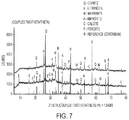
- FIG. 7 is a graph showing the X-ray diffraction (XRD) patterns of virgin class C fly ash and processed high calcium fly ash in accordance with an exemplary embodiment of the invention
- FIG. 8 is an overlaid graph and chart showing the compressive strength of mortar containing processed high calcium fly ash and 100% cement mortar with the compressive strength on the y-axis and the x-axis showing time after hydration in accordance with an exemplary embodiment of the invention
- FIG. 9 is a chart showing the effectiveness of ASR mitigation for cement containing processed high calcium fly ash according to ASTM C 441 and set time with the y-axis showing the effectiveness of mitigating ASR and the x-axis showing the replacement level of the cement with processed class C fly ash in accordance with an exemplary embodiment of the invention.
- FIG. 10 is a graph showing the heat evolution of cement control and cement paste blends containing high calcium fly ash with the x-axis showing time after hydration in accordance with an exemplary embodiment of the invention.
- Approximating language may be applied to modify any quantitative representation that could permissibly vary without resulting in a change in the basic function to which it is related. Accordingly, a value modified by a term or terms, such as “about”, is not limited to the precise value specified. In at least some instances, the approximating language may correspond to the precision of an instrument for measuring the value. Range limitations may be combined and/or interchanged, and such ranges are identified and include all the sub-ranges stated herein unless context or language indicates otherwise. Other than in the operating examples or where otherwise indicated, all numbers or expressions referring to quantities of ingredients, reaction conditions and the like, used in the specification and the claims, are to be understood as modified in all instances by the term “about”.
- the terms “comprises”, “comprising”, “includes”, “including”, “has”, “having”, or any other variation thereof, are intended to cover a non-exclusive inclusion.
- a process, method, article or apparatus that comprises a list of elements is not necessarily limited to only those elements, but may include other elements not expressly listed or inherent to such process, method, article, or apparatus.
- the reactive calcium can include calcium oxide (CaO).
- reactive calcium can also include calcium aluminate, such as when the high calcium fly ash is reacted with cement.
- high calcium fly ash can include fly ash having a reactive calcium content greater than about 5% (calcium oxide (CaO) greater than about 5%).
- high calcium fly ash can include fly ash having a reactive calcium content greater than about 10% (calcium oxide (CaO) greater than about 10%).
- high calcium fly ash can include fly ash having a reactive calcium content greater than about 15% (calcium oxide (CaO) greater than about 15%).
- High calcium fly ash can include class C fly ash and also class F fly ash with a sufficient reactive calcium (calcium oxide) content.
- One of the most conspicuous effects high calcium fly ash can have in concrete is abnormal set times. Although many factors affect setting behavior such as water-to-cement ratio, temperature, amount of cementitious material, chemical admixtures and type of cement being used, the chemical composition and amount of high calcium fly ash in concrete play a dominant role in the extent of this set time offset.
- FIG. 1 shows the effect of five high calcium class C fly ashes from different sources, designated as FA 1 through FA 5, at different replacement levels on cement paste.
- the five high calcium fly ashes increased the time of set for the cement paste, and this effect is even more pronounced as the replacement level of cement with class C fly ash increases.
- Delayed set times can significantly affect the rate of construction. In concrete that requires finishing, the timing of the operations may be delayed resulting increased labor costs. It can also affect the overall construction schedule, which can cause concrete producers and contractors to incur fines due to delays. Currently, concrete producers limit the amount of class C fly ash in concrete to maintain predictability and minimize abnormal set times.
- Set times can also be affected by the sulfate content in cementitious systems.
- the optimum sulfate content of cement/fly ash cementitious systems is highly dependent on the amount of soluble sulfur and calcium aluminate in fly ash. Sulfate in fly ash will contribute to reach the optimum sulfate content while calcium aluminates will increase the sulfate demand.
- class C fly ash has not been as effective at reducing the risk of sulfate attack in concrete as class F fly ash. More specifically, the presence of reactive calcium aluminosilicates within class C fly ash can form monosulfate and calcium aluminate hydrates, which are susceptible to sulfate attack.
- a method for processing high calcium fly ash whereby the variability of the effects of high calcium fly ash in concrete is mitigated due to the neutralization of the hydraulic activity in the high calcium fly ash by neutralizing the reactive calcium while maintaining pozzolanic reactivity in the high calcium fly ash, when compared to virgin or as-produced run-of-plant fresh high calcium fly ash.
- This process involves hydrating of high calcium fly ash in a landfill or surface impoundment, carbonating the hydrates and/or free lime in the high calcium fly ash with atmospheric carbon dioxide, and subsequently excavating the material and grinding it to a particle size distribution similar to that of virgin or as-produced run-of-plant fresh high calcium fly ash.
- the objective of this processing is to hydrate the reactive calcium in the high calcium fly ash in network modifier roles, thereby reducing or nullifying further hydraulic reactions.
- the hydrates generated during this processing may carbonate over time, especially when exposed to the environment. Since the high calcium fly ash is reacted in the absence of hydraulic cement and thus without the required calcium hydroxide and alkalinity provided by the cement for the pozzolanic reaction to take place, the pozzolanic sites are left unreacted. Then, by grinding the hardened high calcium fly ash, these pozzolanic sites are re-exposed. The resulting particle size distribution is such that desirable effects inherent to virgin fly ash are returned to the processed fly ash.
- fine calcium carbonate (CaCO 3 ) present in processed fly ash promotes heterogeneous hydration by providing nucleation sites. This unexpected result goes against traditional thinking in the industry, which is that carbonating high calcium fly ash, such as in a landfill or surface impoundment eliminates any (reacts all available) pozzolanic sites within the high calcium fly ash.
- the method of processing the high calcium fly ash can include the recovery and beneficiation (reclamation) of high calcium fly ash from landfills or surface impoundments that has been hydrated and carbonated.
- the recovery process includes drying, milling and storing of the hydrated and carbonated high calcium fly ash.
- the processed high calcium fly ash enhances the performance of concrete. More specifically, the processed high calcium fly ash effectively mitigates alkali-silica reaction (ASR), reduces the risk of sulfate attack, and enhances early hydration in concrete, without increasing the set time of the concrete. Therefore, the processed high calcium fly ash can be used to regulate set time by introducing the processed high calcium fly ash either as a separate addition to concrete or as set-regulated fly ash-PFA blend.
- ASR alkali-silica reaction
- some exemplary embodiments methods for the processing of the high calcium fly ash can include excavating the hydrated and carbonated high calcium fly ash, drying the high calcium fly ash, and inter-grinding the high calcium fly ash with clinker and gypsum to obtain a set-regulated fly ash-cement blend with an optimum sulfate content. This method of processing high calcium fly ash will be discussed in more depth below.
- this processing of the high calcium fly ash also promotes the consumption of the readily soluble sulfate in the high calcium fly ash, which leads to the formation of primary ettringite (stable ettringite) in the processed high calcium, fly ash.
- primary ettringite stable ettringite
- Primary ettringite is ettringite that is present in cement within the first few hours of mixing.
- Primary ettringite is a beneficial component of portland cement systems, since it helps to control stiffening in fresh, plastic concrete.
- Primary ettringite is generally uniformly and discretely dispersed throughout the cement paste at a submicroscopic level (less than a micrometer in cross-section). Primary ettringite is contrasted with delayed ettringite, which can be formed in cement later ages (after the first few hours of mixing) by calcium hydroxide reacting with soluble sulfur.
- the formation of primary ettringite in the processed high calcium fly ash indicates that the processed high calcium fly ash is not susceptible to sulfate attack. Accordingly, the method of processing of the high calcium fly ash described herein results in the formation of primary ettringite in the processed high calcium fly ash, which reduces the risk of sulfate attack in concrete containing the processed high calcium fly ash. Thereby, processing increases the effectiveness of the high calcium fly ash at reducing the risk of sulfate attack in concrete. This is unlike virgin or as-produced run-of-plant (unprocessed) high calcium fly ash, in which monosulfate hydrates and calcium aluminate hydrates may form, instead of primary ettringite. Monosulfate hydrates and calcium aluminate hydrates are susceptible to sulfate attack.
- FIG. 2 shows photographs of the high calcium fly ash at both macro and micro zoom levels, with the left column showing the high calcium fly ash at the macro scale and the right column showing the high calcium fly ash at the micro scale. More specifically, the top two pictures of FIG. 2 show the virgin high calcium class C fly ash prior to processing. The middle two pictures show the high calcium class C fly ash after hydration, but prior to grinding. The lower two pictures show the high calcium class C fly ash after processing (processed high calcium class C fly ash) in both columns.
- an external source of sulfate may be added during processing to optimize the sulfate content of the processed high calcium fly ash.
- the external source of sulfate may be gypsum.
- clinker can be inter-ground with pulverized fly ash (PFA) and gypsum to make a blended cement.
- FIG. 3 shows the addition of sulfate during high calcium fly ash processing.
- Sulfate can be incorporated by intergrinding hardened high calcium fly ash and clinker with a source of sulfate during processing, or blending the high calcium fly ash and cement with a source of sulfate during or after processing.
- FIG. 3 shows the heat evolution of cement paste with a 45% replacement of processed high calcium class C fly ash from source FA1. This heat evolution profile is typical of an under-sulfated system. Upon comparing the 45% processed FA1 and 45% Processed FA1+2% SO 3 traces in FIG.
- the graph demonstrates that the addition of 2% calcium sulfate can turn the premature exotherm peak shown for cement paste with a 45% replacement of processed high calcium class C fly ash from source FA1 to a heat evolution peak akin that of a well-balanced cement-fly ash-sulfate system, such as 100% cement.
- processed high calcium fly ash can be mixed with virgin fly ash, such as virgin high calcium fly ash. This mixture can be used to partially replace cement in a blended cement mixture, thereby regulating the set time of the concrete in which it is used.
- FIG. 4 is a chart showing the effect on the set time of cement paste containing 15% of virgin high calcium fly ash compared to processed high calcium fly ash and a blend of 50% virgin and 50% processed high calcium fly ash from five different sources, designated as FA 1 through FA 5.
- the y-axis shows the time of set as a percentage of the set time of a 100% cement paste.
- FIG. 4 shows the effects that virgin and processed high calcium fly ashes from different sources have on set time of cement paste at a 15% replacement level.
- FIG. 4 also shows a 50/50 blend thereof of virgin and processed high calcium fly ashes, which exhibits lesser set time offset than its two counterparts.
- the blend ratio of virgin and processed fly ash can be adjusted to achieve the desired set time. Accordingly, by adjusting the mixture (blend) of virgin and processed high calcium fly ash that partially replaces cement, the same set time can be achieved as the control (100% cement only).
- FIG. 4 demonstrates that partially replacing cement with processed high calcium fly ash can slightly reduce the time of set compared to a 100% cement mixture. Conversely, partially replacing cement with virgin high calcium fly ash typically generates mixtures with longer set times. Therefore, by blending virgin fly ash with processed high calcium fly ash, set times for the cement containing the blended fly ash can be optimized.
- FIG. 5 is a graph showing the particle size distribution of two processed high calcium class C fly ash samples compared to their virgin high calcium class C fly ash counterparts with the y-axis showing the percentage of particles exceeding the various particle diameters shown on the x-axis. This figure shows the processed high calcium fly ash material has been returned to a similar particle size distribution to that of its precursor virgin high calcium fly ash.
- Table 1 shows specific surface area (SSA) results obtained by Brunauer-Emmett-Teller (BET) specific surface area analysis for five processed and virgin high calcium class C fly ash samples, including FA1 virgin and FA1 processed shown in FIG. 5 .
- the results show the SSA of processed high calcium fly ash is higher than that of virgin high calcium fly ash, which shows that particle surfaces in the high calcium fly ash have been re-exposed during the processing of the high calcium fly ash, such as during grinding.
- This re-exposed particles surfaces in the processed high calcium fly ash provide sites for the pozzolanic reaction to occur on the surface of high calcium fly ash after grinding during processing. Therefore, as can be seen, the specific surface area of the processed high calcium fly ash can be increased by grinding during processing, when compared to virgin high calcium fly ash.
- the SSA of the processed high calcium fly ash is between about 1.5-15 m 2 /g, preferably between about 2-10 m 2 /g, and most preferably between about 3-5 m 2 /g.
- the processed high calcium fly ash SSA is selected such that the mortar mixture requires less than 105% of the water required by control (a mortar mixture with 100% cement), when the mortar mixtures contains about 20% processed high calcium fly ash and about 80% cement. Therefore, in one exemplary embodiment, the processed high calcium fly ash SSA is selected such that the mortar mixture requires less than 110% of the water required by control (a mortar mixture with 100% cement), when the mortar mixtures contains about 20% processed high calcium fly ash and about 80% cement.
- the processed high calcium fly ash SSA is selected such that the cementitious mixture requires less than 105% of the water required by control (a cementitious mixture with 100% cement), when the cementitious mixtures contains about 20% processed high calcium fly ash and about 80% cement. Therefore, in one exemplary embodiment, the processed high calcium fly ash SSA is selected such that the cementitious mixture requires less than 110% of the water required by control (a cementitious mixture with 100% cement), when the cementitious mixtures contains about 20% processed high calcium fly ash and about 80% cement.
- FIG. 6 is a graph showing the isotherm adsorption/desorption curves of virgin and processed high calcium class C fly ash with the quantity adsorbed on the y-axis and the relative pressure on the x-axis.
- FIG. 6 it can be seen that a more noticeable hysteresis loop is present in the processed high calcium class C fly ash, when compared to the trace for the virgin high calcium class C fly ash.
- This more noticeable hysteresis loop present for processed high calcium fly ash is an indication that the processing of the high calcium fly ash has increased the amount of slit-like mesopores, versus the virgin high calcium fly ash.
- the presence of the mesoporous hydrates in the processed high calcium fly ash indicates that the processing of the high calcium fly ash at least partially nullifies the effect of reactive calcium that was present in the high calcium fly ash, thus neutralizing the cementitious reactivity of the high calcium fly ash. This is in contrast to virgin high calcium fly ash, in which the cementitious reactivity is maintained.
- FIG. 7 is a graph showing the X-ray diffraction (XRD) patterns of virgin high calcium class C fly ash and processed high calcium class C fly ash.
- table 2 is a quantitative XRD analysis of the high calcium class C fly ash before and after processing.
- XRD X-ray diffraction
- the processing of the high calcium fly ash promotes the formation of primary ettringite and calcium carbonate.
- the formation of the primary ettringite and calcium carbonate in the processed high calcium fly ash increases the effectiveness of the processed high calcium fly ash at mitigating sulfate attack, when the processed high calcium fly ash partially replaces cement in concrete.
- Table 2 contains the results of an XRD analysis of the same high calcium fly ash from FIG. 7 before and after processing (virgin and processed high calcium fly ash). Table 2 confirms the processed high calcium fly ash contains about 6% hydrates and carbonates. This also confirms the reactive calcium present in the virgin high calcium fly ash has been neutralized during processing and is no longer present in the processed high calcium fly ash, thus neutralizing the cementitious reactivity of the high calcium fly ash. Further, these results also confirm processed high calcium fly ash still contains a high amount of amorphous material, which is often associated with pozzolanic reactivity. Thus, the processing maintains the pozzolanic reactivity of the high calcium fly ash.
- the amount of amorphous material contained with the processed high calcium fly ash is about 64%. In another exemplary embodiment, the amount of amorphous material contained with the processed high calcium fly ash is greater than about 40%. In an additional exemplary embodiment, the amount of amorphous material contained with the processed high calcium fly ash is greater than about 60%.
- FIG. 8 is an overlaid graph and chart showing the compressive strength of 100% cement mortar and a mortar where 45% of the Portland cement has been replaced with processed class C fly ash.
- the compressive strength is shown on the y-axis of FIG. 8 and the time after hydration is shown on the x-axis.
- FIG. 8 highlights the improvement in later-age strengths provided by the processed high calcium fly ash, further demonstrating that the pozzolanic sites of the high calcium fly ash are in fact re-exposed and active after its processing. Therefore, this again shows that the processing of the high calcium fly ash conserves the pozzolanic reactivity of the high calcium fly ash.
- the compressive strength of a mortar mixture containing about 20% processed high calcium fly ash and about 80% cement is greater than about 70% of the compressive strength of control (a mortar mixture with 100% cement). In another exemplary embodiment, the compressive strength of a mortar mixture containing about 20% processed high calcium fly ash and about 80% cement is greater than about 80% of the compressive strength of control (a mortar mixture with 100% cement).
- the compressive strength of a cementitious mixture containing about 20% processed high calcium fly ash and about 80% cement is greater than about 70% of the compressive strength of control (a cementitious mixture with 100% cement). In another exemplary embodiment, the compressive strength of a cementitious mixture containing about 20% processed high calcium fly ash and about 80% cement is greater than about 80% of the compressive strength of control (a cementitious mixture with 100% cement).
- the processing of the high calcium fly ash neutralizes the hydraulic activity of the high calcium fly ash, while conserving the pozzolanic reactivity of the high calcium fly ash.
- the processed high calcium fly ash enhances the performance of concrete when a portion of the cement is replaced by the processed high calcium fly ash.
- the table shows the calcium hydroxide (Ca(OH) 2 ) content of cement paste monitored at different ages, namely 7 days, 28 days, and 56 days after hydration of the cement paste.
- the table shows the calcium hydroxide content for the cement control paste (100% cement), cement paste where 20% of the cement was replaced with virgin high calcium class C fly ash taken from location FA2, cement paste where 20% of the cement was replaced with processed high calcium class C fly ash taken from location FA2, cement paste where 20% of the cement was replaced with virgin high calcium class C fly ash taken from location FA3, and cement paste where 20% of the cement was replaced with processed high calcium class C fly ash taken from location FA3.
- cementitious paste with 20% replacement of cement with processed high calcium fly ash has at least about 3% less calcium hydroxide per gram of cement than control cementitious paste (100% cement—made with no fly ash) at 28 days after hydration of the cementitious paste. In another embodiment, cementitious paste with 20% replacement of cement with processed high calcium fly ash has at least about 5% less calcium hydroxide per gram of cement than control cement paste (100% cement—made with no fly ash) at 28 days after hydration of the cementitious paste.
- cementitious paste with 20% replacement of cement with processed high calcium fly ash has at least about 10% less calcium hydroxide per gram of cement than control cement paste (100% cement—made with no fly ash) at 28 days after hydration of the cementitious paste.
- cementitious mixture with 20% replacement of cement with processed high calcium fly ash has at least about 3% less calcium hydroxide per gram of cement than control cementitious mixture (100% cement—made with no fly ash) at 28 days after hydration of the cementitious mixture.
- cementitious mixture with 20% replacement of cement with processed high calcium fly ash has at least about 5% less calcium hydroxide per gram of cement than control cementitious mixture (100% cement—made with no fly ash) at 28 days after hydration of the cementitious mixture.
- cementitious mixture with 20% replacement of cement with processed high calcium fly ash has at least about 10% less calcium hydroxide per gram of cement than control cementitious mixture (100% cement—made with no fly ash) at 28 days after hydration of the cementitious mixture.
- the processed high calcium fly ash reduces the risk of internal sulfate attack in concrete is reduced. Therefore, since the pozzolanic reactivity is maintained in the processed high calcium fly ash, the pozzolanic sites remain available to react with the calcium hydroxide in the concrete. The reaction of the calcium hydroxide at the pozzolanic sites reduces the amount of calcium hydroxide available to react with the soluble sulfur to form delayed ettringite, thereby reducing the risk of internal sulfate attack.
- FIG. 9 is a chart showing the effectiveness of alkali-silica reaction (ASR) mitigation for cement containing processed high calcium class C fly ash according to ASTM C 441 (mortar) and set time.
- the y-axis of FIG. 9 shows the effectiveness of mitigating ASR and the x-axis shows the replacement level of the cement with processed high calcium class C fly ash.
- the high calcium fly ash remains an effective ASR mitigator after processing because the processed high calcium fly ash reduces expansion of the concrete, which further demonstrates that pozzolanic sites in the high calcium fly ash remain unreacted during processing. Stated alternatively, this demonstrates that the pozzolanic reactivity in the high calcium fly ash is maintained during processing.
- the high calcium fly ash would no longer remain an effective ASR mitigator after processing, if the pozzolanic sites in the high calcium fly ash did not remain unreacted during processing. Stated alternatively, the high calcium fly ash would no longer remain an effective ASR mitigator after processing, if the pozzolanic reactivity of the high calcium fly ash was not maintained during processing.
- table 4 shows the set time of cement mixtures containing processed high calcium fly ash are not increased by the presence of the high calcium fly ash. This is due to the fact that the pre-hydration during the processing of the high calcium fly ash neutralizes the reactive calcium in the high calcium fly ash, thereby neutralizing the cementitious reactivity of the high calcium fly ash.
- high calcium fly ash can be used to effectively reduce the risk of ASR in concrete by replacing cement with upwards of 20% of high calcium fly ash, especially when highly-reactive aggregates are used.
- a concrete mixture where 30-60% of the cement is replaced by virgin high calcium fly ash will produce set times at least 30% longer than control (concrete mixture with no high calcium fly ash—100% concrete), with some set times being even up to 50% longer than control (concrete mixture with no high calcium fly ash—100% concrete). This is highly inconvenient as it creates delays for the worker crews that have to wait for the concrete to set in order to perform post-concrete pour operations.
- processed high calcium fly ash when processed high calcium fly ash is used to replace concrete, as opposed to virgin high calcium fly ash, users can greatly reduce the risk of ASR, and reduce the amount of embodied CO 2 , in concrete by replacing about 30% to 60% of the cement content with processed high calcium fly ash, while maintaining the setting time at less than about 105-110% of a cement control mixture.
- the set time of a cementitious mixture is less than or equal to about 105% of the set time of control (100% cement), where about 30-60% of the cement in the cementitious mixture is replaced by processed high calcium fly ash.
- the set time of a cementitious mixture is less than or equal to about 110% of the set time of control (100% cement), where about 30-60% of the cement in the cementitious mixture is replaced by processed high calcium fly ash.
- the set time of a cementitious mixture is less than or equal to about 120% of the set time of control (100% cement), where about 30-60% of the cement in the cementitious mixture is replaced by processed high calcium fly ash.
- the set time of a cementitious mixture is less than or equal to about 105-120% of the set time of control (100% cement), where about 15-60% of the cement in the cementitious mixture is replaced by processed high calcium fly ash. In a further exemplary embodiment, the set time of a cementitious mixture is less than or equal to about 105-120% of the set time of control (100% cement), where greater than about 25% of the cement in the cementitious mixture is replaced by processed high calcium fly ash. In an additional exemplary embodiment, the set time of a cementitious mixture is less than or equal to about 105-120% of the set time of control (100% cement), where greater than about 5% of the cement in the cementitious mixture is replaced by processed high calcium fly ash.
- an amount of CO2 embodied in concrete is reduced, compared with control (100% cement), when a portion of the cement is a cementitious mixture is replaced by high processed calcium fly ash.
- an amount of energy embodied in concrete is reduced, compared with control (100% cement), when a portion of the cement is a cementitious mixture is replaced by high processed calcium fly ash.
- FIGS. 4 and 9 and table 4 below show that the risk of ASR can be reduced by increasing the amount processed high calcium fly ash (or virgin/processed blends) with respect to cement, without having an undesirable effect of extending the time of set.
- Table 5 shows the characterization and testing of processed high calcium fly ash inter-ground with a source of sulfate, namely clinker and gypsum, to produce blended cement.
- the results contained in this table show that processed fly ash can be inter-ground with clinker and gypsum at different levels to produce blended cement meeting the requirements of ASTM C 595.
- the sulfate provided by the clinker and gypsum are available to balance the sulfate content in the cementitious system containing the processed high calcium fly ash, since at least part of the readily soluble sulfate in the high calcium fly ash was consumed during processing to form primary ettringite.
- Table 6 shows the characterization and testing of blends of cement and processed high calcium fly ash. The results contained in this table show that processed high calcium fly ash can be blended with cement at different levels to produce blended cement meeting the requirements of ASTM C 595.
- FIG. 10 is a graph showing the heat evolution of cement control and cement paste blends containing high calcium fly ash with the x-axis showing time after hydration. While it is necessary for some heat to be present in concrete as it cures, too much heat can cause cracking due to thermal stress. As can be seen upon review of FIGS. 3, 9, and 10 , the addition of processed high calcium fly ash to cement allows for the reduction in heat generation by increased replacement of cement with high calcium fly ash, while maintaining virtually no set time delay. This is a relatively lower heat generation compared to when virgin high calcium fly ash is added to cement.
- this disclosure is also directed to a method for processing the high calcium fly ash discussed above.
- the high calcium fly ash is called processed high calcium fly ash.
- the high calcium fly ash has cementitious reactivity due to containing reactive calcium, such as calcium oxide (CaO) and/or calcium aluminate in an amount sufficient to lead to the negative effects discussed above when used in cement and concrete.
- reactive calcium such as calcium oxide (CaO) and/or calcium aluminate
- the negative effects attributed to the cementitious activity of high calcium fly ash include, but are not limited to abnormal set times and susceptibility to sulfate attack.
- the high calcium flu ash Prior to processing, the high calcium flu ash also has cementitious reactivity, which is maintained during the processing.
- the processing of the high calcium fly ash includes hydrating the high calcium fly ash with water and carbonating the hydrates and/or free lime in the high calcium fly ash with carbon dioxide.
- this hydrating can take place in locations including, but not limited to, a landfill or surface impoundment.
- the carbonating can be in the form of exposing the high calcium fly ash to atmospheric carbon dioxide in the landfill or surface impoundment.
- the above discussed hydrating and carbonating can also be characterized as pre-hydrating and pre-carbonating, since they are taking place prior to the hydrating and carbonating of the processed high calcium fly ash in a cementitious mixture or concrete.
- the objective of this processing is to hydrate the reactive calcium in the high calcium fly ash in network modifier roles, thereby reducing or nullifying further cementitious reactivity caused by the reactive calcium (calcium oxide).
- the hydrates generated during this processing carbonate over time, especially when exposed to the environment. Since the high calcium fly ash is reacted in the absence of hydraulic cement during this processing, and thus without the required calcium hydroxide and alkalinity provided by the cement for the pozzolanic reaction to take place, the pozzolanic sites are left unreacted following hydration and carbonation. Thereby pozzolanic reactivity is maintained in the processed high calcium fly ash.
- the cementitious reactivity of the high calcium fly ash is neutralized due to the neutralization of the reactive calcium, such as calcium aluminate and/or calcium oxide, during the hydration and carbonation of the high calcium fly ash. Since the reactive calcium is neutralized, the processed high calcium fly ash does not disturb the balance of the reactive calcium in the cement. Having an excess of reactive calcium in the mixture can lead to undesirable events, such as flash set, due to early heat during set generated by the excess reactive calcium. Thereby, since the hydration and carbonation of the high calcium fly ash neutralizes the reactive calcium, the cementitious reactivity of the high calcium fly ash is neutralized, while the pozzolanic activity of the high calcium fly ash is maintained.
- the reactive calcium such as calcium aluminate and/or calcium oxide
- the method further includes excavating the hydrated and carbonated high calcium fly ash.
- the hydrated and carbonated high calcium fly ash can be excavated (reclaimed) from the landfill or surface impoundment through excavation.
- the hydrated and carbonated high calcium fly ash is at least partially dried prior to excavation (reclamation).
- the method can also include crushing the excavated high calcium fly ash to a size acceptable for the dryer.
- the excavated high calcium fly ash can be crushed to a size sufficient to pass through ⁇ 3 ⁇ 4′′ to ⁇ 1 ⁇ 8′′ mesh.
- the excavated high calcium fly ash can be crushed to a size sufficient to pass through ⁇ 3 ⁇ 8′′ to ⁇ 1 ⁇ 2′′ mesh.
- the method can include drying the crushed high calcium fly ash using a dryer.
- the crushed high calcium fly ash is dried until the high calcium fly ash has a moisture content of 1-5%.
- the method can include grinding the dried high calcium fly ash to a particle size distribution similar to that of virgin or as-produced run-of-plant fresh high calcium fly ash.
- the grinding re-exposes the particle surfaces in the high calcium fly ash, thereby providing sites for the pozzolanic reaction to occur.
- the grinding can include inter-grinding the dried high calcium fly ash at a cement production plant.
- the grinding can be low energy milling.
- a grinder can be one or more of a roller mill, stir media mill or a ball mill.
- the method can also include incorporating sulfate into the high calcium fly ash, such as by blending or inter-grinding the high calcium fly ash with a source of sulfate.
- the blending or inter-grinding can take place during or after grinding the dried high calcium fly ash to obtain an optimum sulfate content.
- the source of sulfate may be clinker and/or gypsum.
- the dried high calcium fly ash can be ground to a size of less than about 35% of the ground high calcium fly ash is retained on 325 mesh (about 35% of particles are larger than 45 microns). In another exemplary embodiment, the dried high calcium fly ash can be ground to a size of less than about 10% of the ground high calcium fly ash is retained on 325 mesh (about 10% of particles are larger than 45 microns). In an exemplary embodiment, the dried high calcium fly ash can be ground to a size of less than about 0% of the ground high calcium fly ash is retained on 325 mesh (all of particles are smaller than 45 microns).
- the ground high calcium fly ash is processed high calcium fly ash having the properties described and shown in the figures, tables, and corresponding text above, and can be stored until it is to be used in a cementitious mixture.
- the processed high calcium fly ash has neutralized cementitious reactivity, such as is evidenced by reducing set times, while maintaining pozzolanic reactivity, when compared to cement mixtures containing only virgin high calcium fly ash.
- the processed high calcium fly ash can be used in a portland-pozzolan blended cement mixture.
- the portland-pozzolan blended cement mixture can include clinker, gypsum, and a pozzolanic material.
- the pozzolanic material can include processed high calcium fly ash,
Landscapes
- Chemical & Material Sciences (AREA)
- Engineering & Computer Science (AREA)
- Ceramic Engineering (AREA)
- Materials Engineering (AREA)
- Organic Chemistry (AREA)
- Structural Engineering (AREA)
- Environmental & Geological Engineering (AREA)
- Chemical Kinetics & Catalysis (AREA)
- Combustion & Propulsion (AREA)
- Civil Engineering (AREA)
- Inorganic Chemistry (AREA)
- General Chemical & Material Sciences (AREA)
- Curing Cements, Concrete, And Artificial Stone (AREA)
- Processing Of Solid Wastes (AREA)
Abstract
Description
| TABLE 1 |
| Specific Surface Area of Five Virgin and Processed |
| High Calcium Fly Ash Samples |
| BET SSA (m2/g) | |||
| FA1 Virgin | 2.62 | ||
| FA1 Processed | 5.59 | ||
| FA2 Virgin | 1.25 | ||
| FA2 Processed | 3.12 | ||
| FA3 Virgin | 0.6 | ||
| FA3 Processed | 6.48 | ||
| FA4 Virgin | 2.06 | ||
| FA4 Processed | 1.59 | ||
| FA5 Virgin | 0.4 | ||
| FA5 Processed | 13.56 | ||
| TABLE 2 |
| XRD Quantitative Analysis of Virgin and |
| Processed High Calcium Class C Fly Ash FA1 |
| FA1 Virgin | FA1 Processed | |||
| Quartz | 8.70% | 8.93% | ||
| Hematite | 6.73% | 5.78% | ||
| Periclase | 2.55% | 2.89 | ||
| Ettringite | ||||
| 0% | 4.57 | |||
| Calcite | ||||
| 0% | 1.90% | |||
| Anhydrite | 1.98% | 1.79% | ||
| Merwinite | 13.18% | 10.27% | ||
| Amorphous | 66.82% | 63.63% | ||
| TABLE 3 |
| Calcium Hydroxide Consumption on Cement Paste |
| Amountof Ca(OH)2 (g)/g of |
| 7 |
28 |
56 days | |
| Cement Control | 0.2331 | 0.2173 | 0.2063 |
| FA2 Virgin | 0.2184 | 0.2068 | 0.2059 |
| FA2 Processed | 0.2139 | 0.1864 | 0.1831 |
| FA3 Virgin | 0.2412 | 0.1843 | 0.1833 |
| FA3 Processed | 0.1959 | 0.1998 | 0.1748 |
| TABLE 4 |
| |
| 45% | |||||
| Processed | |||||
| 45% Virgin | High | ||||
| Cement | High Calcium | Calcium Fly | |||
| Control | Fly Ash FA1 | Ash FA1 | |||
| Set Time (hh:mm) | 4:45 | 7:50 | 4:40 | ||
| Set Time (percent of | — | 165% | 98% | ||
| Cement Control) | |||||
| Effectiveness | — | 66% | 66% | ||
| Mitigating ASR (% | |||||
| reduction in | |||||
| expansion) | |||||
| TABLE 5 |
| Characterization and Testing of Inter-ground |
| Processed High Calcium Fly Ash With Clinker and Gypsum |
| | IP | 15 | |
IP 25 | ||
| (Clinker + | (15% | (20% | (25% | |||
| 3.75% | Processed | Processed | Processed | |||
| Gypsum | fly ash) | fly ash) | fly ash) | |||
| Chemical | Magnesium Oxide | 2.12 | 2.46 | 2.53 | 2.65 |
| Analysis | (MgO), % | ||||
| Sulfate (SO3), % | 2.08 | 2.31 | 2.4 | 2.46 | |
| Loss on Ignition, % | 0.43 | 1.58 | 1.77 | 2.07 | |
| Physical | Fineness, % retained | 12.62 | 10.6 | 9.45 | 13.77 |
| Analysis | on 325 mesh | ||||
| Autoclave Length | 0.023 | 0.012 | 0.007 | 0.06 | |
| Change, % of control | |||||
| Time of Initial Setting, | 2:15 | 2:15 | 2:30 | 2:30 | |
| hh:mm, Vicat Test | |||||
| Air Content of Mortar, | 7.3 | 4.93 | 4.41 | 2.96 | |
| volume, | |||||
| Compressive | |||||
| 3 days | 2751 | 2653 | 2733 | 2557 | |
| Strength, |
7 days | 3600 | 3838 | 3623 | 3622 |
| 28 days | 5048 | 5565 | 5454 | 5148 | |
| TABLE 6 |
| Characterization and Testing of Processed |
| High Calcium Fly ash/Cement Blends |
| |
|
IP 40 | |||
| (20% | (30% | (40% | |||
| Cement | Processed | Processed | Processed | ||
| Control | fly ash) | fly ash) | fly ash) | ||
| Chemical | Magnesium Oxide | 2.94 | 3.14 | 3.25 | 3.34 |
| Analysis | (MgO), % | ||||
| Sulfate (SO3), % | 2.84 | 2.14 | 2.07 | 1.98 | |
| Loss on Ignition, % | 1.06 | 1.28 | 1.58 | 1.79 | |
| Physical | Fineness, % retained | 2.67 | 7.62 | 9.68 | 11.28 |
| Analysis | on 325 mesh | ||||
| Autoclave Length | 0.0025 | 0.019 | 0.033 | 0.026 | |
| Change, % of control | |||||
| Time of Initial Setting, | 3:00 | 3:30 | 3:45 | 4:15 | |
| hh:mm, Vicat Test | |||||
| Air Content of Mortar, | 6.61 | 4.67 | 4.76 | 5.14 | |
| | |||||
| Compressive | |||||
| 3 days | 3890 | 2947 | 2446 | 2017 | |
| Strength, |
7 days | 4957 | 3918 | 3327 | 3108 |
| 28 days | 6573 | 5488 | 5255 | 4907 | |
Claims (18)
Priority Applications (1)
| Application Number | Priority Date | Filing Date | Title |
|---|---|---|---|
| US15/751,100 US10611684B2 (en) | 2015-08-07 | 2016-08-08 | Recovery and beneficiation of pozzolan deposits for enhanced performance in concrete |
Applications Claiming Priority (3)
| Application Number | Priority Date | Filing Date | Title |
|---|---|---|---|
| US201562202349P | 2015-08-07 | 2015-08-07 | |
| PCT/US2016/046081 WO2017027483A1 (en) | 2015-08-07 | 2016-08-08 | Recovery and beneficiation of pozzolan deposits for enhanced performance in concrete |
| US15/751,100 US10611684B2 (en) | 2015-08-07 | 2016-08-08 | Recovery and beneficiation of pozzolan deposits for enhanced performance in concrete |
Publications (2)
| Publication Number | Publication Date |
|---|---|
| US20190337849A1 US20190337849A1 (en) | 2019-11-07 |
| US10611684B2 true US10611684B2 (en) | 2020-04-07 |
Family
ID=57983581
Family Applications (1)
| Application Number | Title | Priority Date | Filing Date |
|---|---|---|---|
| US15/751,100 Active 2037-02-09 US10611684B2 (en) | 2015-08-07 | 2016-08-08 | Recovery and beneficiation of pozzolan deposits for enhanced performance in concrete |
Country Status (5)
| Country | Link |
|---|---|
| US (1) | US10611684B2 (en) |
| EP (1) | EP3331835A4 (en) |
| AU (1) | AU2016304811B2 (en) |
| CA (1) | CA2995111A1 (en) |
| WO (1) | WO2017027483A1 (en) |
Families Citing this family (3)
| Publication number | Priority date | Publication date | Assignee | Title |
|---|---|---|---|---|
| CN108564287A (en) * | 2018-04-19 | 2018-09-21 | 石家庄铁道大学 | A kind of heavy haul railway bridge pier sulphate corrosion risk evaluating method |
| CN108734384A (en) * | 2018-04-19 | 2018-11-02 | 山东铁正工程试验检测中心有限公司 | A kind of heavy haul railway bridge pier sulphate corrosion risk assessment device |
| WO2020041589A1 (en) | 2018-08-23 | 2020-02-27 | Boral Resources Llc | Aggregate materials and methods of preparation thereof |
Citations (8)
| Publication number | Priority date | Publication date | Assignee | Title |
|---|---|---|---|---|
| WO1998051640A1 (en) | 1997-05-15 | 1998-11-19 | Mbt Holding Ag | A cementitious mixture containing high pozzolan cement replacement and compatibilizing admixtures therefor |
| US5928420A (en) | 1998-09-24 | 1999-07-27 | Lafarge Canada, Inc. | Cement composition for alkali-reactive aggregate and for sulphate resistance |
| US20060201395A1 (en) | 2005-03-08 | 2006-09-14 | Barger Gregory S | Blended fly ash pozzolans |
| US20070215353A1 (en) * | 2006-03-16 | 2007-09-20 | William Marsh Rice University | Compositions and methods for controlling the setting behavior of cement slurries using carbonated fly ash |
| CN101050076A (en) | 2007-05-17 | 2007-10-10 | 张涉 | Method for stabilizing fly ash of municipal incinerator, and utilization of resource |
| US20110065854A1 (en) | 2008-05-13 | 2011-03-17 | Abdel-Mohsen Onsy Mohamed | Method for treating particulate material |
| US20120298011A1 (en) | 2008-12-23 | 2012-11-29 | Silva Denise A | Suppression of antagonistic hydration reactions in blended cements |
| KR101346561B1 (en) * | 2012-11-30 | 2014-02-14 | 한국남부발전 주식회사 | Admixing material which used flyash and manufacturing method of this |
-
2016
- 2016-08-08 US US15/751,100 patent/US10611684B2/en active Active
- 2016-08-08 WO PCT/US2016/046081 patent/WO2017027483A1/en not_active Ceased
- 2016-08-08 EP EP16835769.7A patent/EP3331835A4/en not_active Withdrawn
- 2016-08-08 AU AU2016304811A patent/AU2016304811B2/en not_active Ceased
- 2016-08-08 CA CA2995111A patent/CA2995111A1/en not_active Abandoned
Patent Citations (8)
| Publication number | Priority date | Publication date | Assignee | Title |
|---|---|---|---|---|
| WO1998051640A1 (en) | 1997-05-15 | 1998-11-19 | Mbt Holding Ag | A cementitious mixture containing high pozzolan cement replacement and compatibilizing admixtures therefor |
| US5928420A (en) | 1998-09-24 | 1999-07-27 | Lafarge Canada, Inc. | Cement composition for alkali-reactive aggregate and for sulphate resistance |
| US20060201395A1 (en) | 2005-03-08 | 2006-09-14 | Barger Gregory S | Blended fly ash pozzolans |
| US20070215353A1 (en) * | 2006-03-16 | 2007-09-20 | William Marsh Rice University | Compositions and methods for controlling the setting behavior of cement slurries using carbonated fly ash |
| CN101050076A (en) | 2007-05-17 | 2007-10-10 | 张涉 | Method for stabilizing fly ash of municipal incinerator, and utilization of resource |
| US20110065854A1 (en) | 2008-05-13 | 2011-03-17 | Abdel-Mohsen Onsy Mohamed | Method for treating particulate material |
| US20120298011A1 (en) | 2008-12-23 | 2012-11-29 | Silva Denise A | Suppression of antagonistic hydration reactions in blended cements |
| KR101346561B1 (en) * | 2012-11-30 | 2014-02-14 | 한국남부발전 주식회사 | Admixing material which used flyash and manufacturing method of this |
Non-Patent Citations (2)
| Title |
|---|
| International Search Report issued in International Application No. PCT/US/2016/046081 dated Aug. 5, 2017. |
| Written Opinion of the International Searching Authority in International Application No. PCT/US2016/046081 dated Jan. 17, 2017. |
Also Published As
| Publication number | Publication date |
|---|---|
| US20190337849A1 (en) | 2019-11-07 |
| CA2995111A1 (en) | 2017-02-16 |
| WO2017027483A1 (en) | 2017-02-16 |
| AU2016304811A1 (en) | 2018-02-15 |
| EP3331835A4 (en) | 2018-08-15 |
| AU2016304811B2 (en) | 2019-01-17 |
| EP3331835A1 (en) | 2018-06-13 |
Similar Documents
| Publication | Publication Date | Title |
|---|---|---|
| US12221380B2 (en) | Pozzolanic compositions containing coal ash and remediation agents for use in cementitious materials | |
| US10611690B2 (en) | Carbonatable calcium silicate compositions and methods thereof | |
| EP3498681A1 (en) | Use of carbonated recycled concrete fines as supplementary cementitious material | |
| EP2801559B1 (en) | Method of enhancing the latent hydraulic and/or pozzolanic reactivity of materials | |
| Voglis et al. | Portland-limestone cements. Their properties and hydration compared to those of other composite cements | |
| Bentz | Powder Additions to Mitigate Retardation in High-Volume Fly Ash Mixtures. | |
| US10556834B2 (en) | Hazing control for carbonatable calcium silicate-based cements and concretes | |
| Pal | Developing low-clinker ternary blends for indian cement industry | |
| Kong et al. | Improvement of strength and microstructure of low-carbon cementitious materials with high volume of calcined coal gangue | |
| US10611684B2 (en) | Recovery and beneficiation of pozzolan deposits for enhanced performance in concrete | |
| Defáveri et al. | Glass wool residue: a potential supplementary cementitious material | |
| JP7180742B1 (en) | Cement composition and its manufacturing method | |
| WO2014140614A1 (en) | Cement composition and method of producing the same | |
| Mansouri et al. | Experimental investigation of energy consumption and CO2 emission in cement kiln in effect of replacement natural pozzolan by method of grinding clinker and pozzolan separately | |
| US11401216B2 (en) | Calcium carbonate composition for use in concrete | |
| Sanytsky et al. | Eco-efficient blended cements with high volume supplementary cementitious materials | |
| CN110304885A (en) | The cement mortar and preparation method thereof of high additive solid waste preparation | |
| Grdic et al. | Resistance of concrete made with finely milled cathode ray tube glass as a supplementary cementitious materials to sulphate attack | |
| Lin et al. | Elucidating the pozzolanic characteristics of pastes containing circulating fluidized bed fly ash | |
| Attaei et al. | On the effect of monoethanolamine and N-methyldiethanolamine on the carbonation rate and mechanical properties of cementitious materials | |
| CA3016363C (en) | Hazing control for carbonatable calcium silicate-based cements and concretes | |
| HK40104160A (en) | Cement composition and method for producing same | |
| HK40104160B (en) | Cement composition and method for producing same | |
| KR20170118264A (en) | Cement Zero Concrete Composition & Plastering dry mortar using the same |
Legal Events
| Date | Code | Title | Description |
|---|---|---|---|
| FEPP | Fee payment procedure |
Free format text: ENTITY STATUS SET TO UNDISCOUNTED (ORIGINAL EVENT CODE: BIG.); ENTITY STATUS OF PATENT OWNER: LARGE ENTITY |
|
| AS | Assignment |
Owner name: HEADWATERS INCORPORATED, UTAH Free format text: ASSIGNMENT OF ASSIGNORS INTEREST;ASSIGNORS:MINKARA, RAFIC Y.;DIAZ-LOYA, ELEAZAR IVAN;RHODES, DOUGLAS S.;SIGNING DATES FROM 20180503 TO 20180510;REEL/FRAME:045802/0235 |
|
| STPP | Information on status: patent application and granting procedure in general |
Free format text: RESPONSE TO NON-FINAL OFFICE ACTION ENTERED AND FORWARDED TO EXAMINER |
|
| STPP | Information on status: patent application and granting procedure in general |
Free format text: NOTICE OF ALLOWANCE MAILED -- APPLICATION RECEIVED IN OFFICE OF PUBLICATIONS |
|
| STPP | Information on status: patent application and granting procedure in general |
Free format text: PUBLICATIONS -- ISSUE FEE PAYMENT RECEIVED |
|
| STCF | Information on status: patent grant |
Free format text: PATENTED CASE |
|
| AS | Assignment |
Owner name: BORAL INDUSTRIES INC., GEORGIA Free format text: MERGER;ASSIGNOR:HEADWATERS INCORPORATED;REEL/FRAME:055566/0317 Effective date: 20200630 |
|
| AS | Assignment |
Owner name: BORAL RESOURCES LLC, GEORGIA Free format text: ASSIGNMENT OF ASSIGNORS INTEREST;ASSIGNOR:BORAL INDUSTRIES INC.;REEL/FRAME:058614/0959 Effective date: 20211202 |
|
| AS | Assignment |
Owner name: UMB BANK, N.A., TEXAS Free format text: SECURITY INTEREST;ASSIGNOR:BORAL RESOURCES LLC;REEL/FRAME:059002/0270 Effective date: 20220210 Owner name: MUFG BANK, LTD., NEW YORK Free format text: SECURITY INTEREST;ASSIGNOR:BORAL RESOURCES LLC;REEL/FRAME:059003/0211 Effective date: 20220210 |
|
| AS | Assignment |
Owner name: EM RESOURCES LLC, UTAH Free format text: CHANGE OF NAME;ASSIGNOR:BORAL RESOURCES LLC;REEL/FRAME:059482/0239 Effective date: 20220217 |
|
| MAFP | Maintenance fee payment |
Free format text: PAYMENT OF MAINTENANCE FEE, 4TH YEAR, LARGE ENTITY (ORIGINAL EVENT CODE: M1551); ENTITY STATUS OF PATENT OWNER: LARGE ENTITY Year of fee payment: 4 |
|
| AS | Assignment |
Owner name: EM RESOURCES LLC (FORMERLY KNOWN AS BORAL RESOURCES LLC), UTAH Free format text: RELEASE BY SECURED PARTY;ASSIGNOR:MUFG BANK, LTD;REEL/FRAME:067799/0395 Effective date: 20240620 |
|
| AS | Assignment |
Owner name: MIZUHO BANK, LTD., NEW YORK Free format text: PATENT SECURITY AGREEMENT;ASSIGNOR:EM RESOURCES LLC;REEL/FRAME:067963/0364 Effective date: 20240620 |
|
| AS | Assignment |
Owner name: EM RESOURCES LLC (F/K/A BORAL RESOURCES LLC), UTAH Free format text: RELEASE OF SECURITY INTEREST IN PATENTS RECORDED AT R/F 059002/0270;ASSIGNOR:UMB BANK, N.A.;REEL/FRAME:070191/0325 Effective date: 20250212 |
|
| AS | Assignment |
Owner name: JEFFERIES FINANCE LLC, AS COLLATERAL AGENT, NEW YORK Free format text: SECURITY INTEREST;ASSIGNOR:EM RESOURCES LLC;REEL/FRAME:070696/0397 Effective date: 20250212 |
|
| AS | Assignment |
Owner name: EM RESOURCES LLC, UTAH Free format text: RELEASE OF SECURITY INTEREST IN PATENTS AT REEL/FRAME NO. 70696/0397;ASSIGNOR:JEFFERIES FINANCE LLC, AS COLLATERAL AGENT;REEL/FRAME:072910/0155 Effective date: 20250915 |
|
| AS | Assignment |
Owner name: EM RESOURCES LLC, UTAH Free format text: RELEASE OF SECURITY INTEREST IN PATENTS AT REEL/FRAME NO. 67963/0364;ASSIGNOR:MIZUHO BANK, LTD., AS AGENT;REEL/FRAME:072872/0638 Effective date: 20250915 |