US10597559B2 - Method of manufacturing a composite panel containing lauan or other moisture-carrying or moisture-absorbing material using adhesion promoter and panel made using the method - Google Patents
Method of manufacturing a composite panel containing lauan or other moisture-carrying or moisture-absorbing material using adhesion promoter and panel made using the method Download PDFInfo
- Publication number
- US10597559B2 US10597559B2 US15/588,082 US201715588082A US10597559B2 US 10597559 B2 US10597559 B2 US 10597559B2 US 201715588082 A US201715588082 A US 201715588082A US 10597559 B2 US10597559 B2 US 10597559B2
- Authority
- US
- United States
- Prior art keywords
- promoter
- consisting essentially
- layer consisting
- solvent
- substrate
- Prior art date
- Legal status (The legal status is an assumption and is not a legal conclusion. Google has not performed a legal analysis and makes no representation as to the accuracy of the status listed.)
- Active
Links
- 238000004519 manufacturing process Methods 0.000 title claims abstract description 11
- 239000002131 composite material Substances 0.000 title claims abstract description 8
- 239000011358 absorbing material Substances 0.000 title claims abstract description 5
- 238000000034 method Methods 0.000 title claims description 36
- 239000002318 adhesion promoter Substances 0.000 title description 2
- 239000011347 resin Substances 0.000 claims abstract description 26
- 229920005989 resin Polymers 0.000 claims abstract description 26
- 239000000758 substrate Substances 0.000 claims abstract description 22
- 239000002904 solvent Substances 0.000 claims description 23
- 238000005507 spraying Methods 0.000 claims description 8
- ZWEHNKRNPOVVGH-UHFFFAOYSA-N 2-Butanone Chemical compound CCC(C)=O ZWEHNKRNPOVVGH-UHFFFAOYSA-N 0.000 claims description 6
- CSCPPACGZOOCGX-UHFFFAOYSA-N Acetone Chemical compound CC(C)=O CSCPPACGZOOCGX-UHFFFAOYSA-N 0.000 claims description 5
- 239000003365 glass fiber Substances 0.000 claims description 5
- PPBRXRYQALVLMV-UHFFFAOYSA-N Styrene Chemical compound C=CC1=CC=CC=C1 PPBRXRYQALVLMV-UHFFFAOYSA-N 0.000 claims description 4
- YRKCREAYFQTBPV-UHFFFAOYSA-N acetylacetone Chemical compound CC(=O)CC(C)=O YRKCREAYFQTBPV-UHFFFAOYSA-N 0.000 claims description 4
- 238000001035 drying Methods 0.000 claims description 4
- 229910052720 vanadium Inorganic materials 0.000 claims description 4
- 229910052500 inorganic mineral Inorganic materials 0.000 claims description 3
- 239000000463 material Substances 0.000 claims description 3
- 239000011707 mineral Substances 0.000 claims description 3
- 239000011120 plywood Substances 0.000 claims description 3
- 238000005096 rolling process Methods 0.000 claims description 3
- 235000015096 spirit Nutrition 0.000 claims description 3
- VVQNEPGJFQJSBK-UHFFFAOYSA-N Methyl methacrylate Chemical compound COC(=O)C(C)=C VVQNEPGJFQJSBK-UHFFFAOYSA-N 0.000 claims description 2
- JLTDJTHDQAWBAV-UHFFFAOYSA-N N,N-dimethylaniline Chemical compound CN(C)C1=CC=CC=C1 JLTDJTHDQAWBAV-UHFFFAOYSA-N 0.000 claims description 2
- CTQNGGLPUBDAKN-UHFFFAOYSA-N O-Xylene Chemical compound CC1=CC=CC=C1C CTQNGGLPUBDAKN-UHFFFAOYSA-N 0.000 claims description 2
- 150000001412 amines Chemical class 0.000 claims description 2
- 159000000014 iron salts Chemical class 0.000 claims description 2
- GYVGXEWAOAAJEU-UHFFFAOYSA-N n,n,4-trimethylaniline Chemical compound CN(C)C1=CC=C(C)C=C1 GYVGXEWAOAAJEU-UHFFFAOYSA-N 0.000 claims description 2
- NTMXFHGYWJIAAE-UHFFFAOYSA-N n,n-diethyl-3-oxobutanamide Chemical compound CCN(CC)C(=O)CC(C)=O NTMXFHGYWJIAAE-UHFFFAOYSA-N 0.000 claims description 2
- LEONUFNNVUYDNQ-UHFFFAOYSA-N vanadium atom Chemical compound [V] LEONUFNNVUYDNQ-UHFFFAOYSA-N 0.000 claims description 2
- 239000008096 xylene Substances 0.000 claims description 2
- 150000001868 cobalt Chemical class 0.000 claims 1
- 150000001879 copper Chemical class 0.000 claims 1
- 239000002023 wood Substances 0.000 claims 1
- 239000000203 mixture Substances 0.000 description 6
- 239000007921 spray Substances 0.000 description 6
- 239000011152 fibreglass Substances 0.000 description 4
- 150000002978 peroxides Chemical class 0.000 description 4
- -1 Copper salts Chemical class 0.000 description 3
- 230000032798 delamination Effects 0.000 description 3
- 230000008901 benefit Effects 0.000 description 2
- 239000010941 cobalt Substances 0.000 description 2
- 229910017052 cobalt Inorganic materials 0.000 description 2
- 238000007796 conventional method Methods 0.000 description 2
- 238000007689 inspection Methods 0.000 description 2
- 238000006116 polymerization reaction Methods 0.000 description 2
- 238000012360 testing method Methods 0.000 description 2
- XLYOFNOQVPJJNP-UHFFFAOYSA-N water Substances O XLYOFNOQVPJJNP-UHFFFAOYSA-N 0.000 description 2
- 238000006243 chemical reaction Methods 0.000 description 1
- GUTLYIVDDKVIGB-UHFFFAOYSA-N cobalt atom Chemical compound [Co] GUTLYIVDDKVIGB-UHFFFAOYSA-N 0.000 description 1
- WXNKCDDCJOBQEE-UHFFFAOYSA-N cobalt;propan-2-one Chemical compound [Co].CC(C)=O WXNKCDDCJOBQEE-UHFFFAOYSA-N 0.000 description 1
- 229910052802 copper Inorganic materials 0.000 description 1
- 239000010949 copper Substances 0.000 description 1
- 230000001747 exhibiting effect Effects 0.000 description 1
- 239000000835 fiber Substances 0.000 description 1
- 239000000945 filler Substances 0.000 description 1
- 239000003999 initiator Substances 0.000 description 1
- 230000002452 interceptive effect Effects 0.000 description 1
- 229910052748 manganese Inorganic materials 0.000 description 1
- 239000011572 manganese Substances 0.000 description 1
- 239000010445 mica Substances 0.000 description 1
- 229910052618 mica group Inorganic materials 0.000 description 1
- 230000002093 peripheral effect Effects 0.000 description 1
- 230000002787 reinforcement Effects 0.000 description 1
Images



Classifications
-
- C—CHEMISTRY; METALLURGY
- C09—DYES; PAINTS; POLISHES; NATURAL RESINS; ADHESIVES; COMPOSITIONS NOT OTHERWISE PROVIDED FOR; APPLICATIONS OF MATERIALS NOT OTHERWISE PROVIDED FOR
- C09J—ADHESIVES; NON-MECHANICAL ASPECTS OF ADHESIVE PROCESSES IN GENERAL; ADHESIVE PROCESSES NOT PROVIDED FOR ELSEWHERE; USE OF MATERIALS AS ADHESIVES
- C09J5/00—Adhesive processes in general; Adhesive processes not provided for elsewhere, e.g. relating to primers
- C09J5/02—Adhesive processes in general; Adhesive processes not provided for elsewhere, e.g. relating to primers involving pretreatment of the surfaces to be joined
-
- B—PERFORMING OPERATIONS; TRANSPORTING
- B32—LAYERED PRODUCTS
- B32B—LAYERED PRODUCTS, i.e. PRODUCTS BUILT-UP OF STRATA OF FLAT OR NON-FLAT, e.g. CELLULAR OR HONEYCOMB, FORM
- B32B37/00—Methods or apparatus for laminating, e.g. by curing or by ultrasonic bonding
- B32B37/12—Methods or apparatus for laminating, e.g. by curing or by ultrasonic bonding characterised by using adhesives
-
- B—PERFORMING OPERATIONS; TRANSPORTING
- B32—LAYERED PRODUCTS
- B32B—LAYERED PRODUCTS, i.e. PRODUCTS BUILT-UP OF STRATA OF FLAT OR NON-FLAT, e.g. CELLULAR OR HONEYCOMB, FORM
- B32B17/00—Layered products essentially comprising sheet glass, or glass, slag, or like fibres
- B32B17/06—Layered products essentially comprising sheet glass, or glass, slag, or like fibres comprising glass as the main or only constituent of a layer, next to another layer of a specific material
- B32B17/062—Layered products essentially comprising sheet glass, or glass, slag, or like fibres comprising glass as the main or only constituent of a layer, next to another layer of a specific material of wood
-
- B—PERFORMING OPERATIONS; TRANSPORTING
- B32—LAYERED PRODUCTS
- B32B—LAYERED PRODUCTS, i.e. PRODUCTS BUILT-UP OF STRATA OF FLAT OR NON-FLAT, e.g. CELLULAR OR HONEYCOMB, FORM
- B32B2255/00—Coating on the layer surface
- B32B2255/08—Coating on the layer surface on wood layer
-
- B—PERFORMING OPERATIONS; TRANSPORTING
- B32—LAYERED PRODUCTS
- B32B—LAYERED PRODUCTS, i.e. PRODUCTS BUILT-UP OF STRATA OF FLAT OR NON-FLAT, e.g. CELLULAR OR HONEYCOMB, FORM
- B32B2255/00—Coating on the layer surface
- B32B2255/26—Polymeric coating
-
- B—PERFORMING OPERATIONS; TRANSPORTING
- B32—LAYERED PRODUCTS
- B32B—LAYERED PRODUCTS, i.e. PRODUCTS BUILT-UP OF STRATA OF FLAT OR NON-FLAT, e.g. CELLULAR OR HONEYCOMB, FORM
- B32B2307/00—Properties of the layers or laminate
- B32B2307/40—Properties of the layers or laminate having particular optical properties
- B32B2307/406—Bright, glossy, shiny surface
-
- B—PERFORMING OPERATIONS; TRANSPORTING
- B32—LAYERED PRODUCTS
- B32B—LAYERED PRODUCTS, i.e. PRODUCTS BUILT-UP OF STRATA OF FLAT OR NON-FLAT, e.g. CELLULAR OR HONEYCOMB, FORM
- B32B2607/00—Walls, panels
Definitions
- the present method involves applying promoter at the resin-substrate (e.g., lauan) interface.
- This is preferably done by spraying the promoter onto the top surface of the resin before the lauan is placed on top, but it may instead be done by spraying or rolling the promoter onto the lauan itself.
- it may be done by providing promoter at the resin-lauan interface in any manner that may be convenient (provided that little to no extra promoter is added to the rest of the resin layer). The present inventor has found that doing this may reduce the likelihood of delamination even with lauan that happens to have a high moisture content that would otherwise be problematic, and in fact, may enable one to reduce or even practically eliminate the problem rather than just managing it.
- a method of manufacturing a lauan composite panel, and the panel so made are provided.
- a layer of gel coat is formed on a mold surface, a wet laminate containing a resin is applied to the layer of gel coat on the mold surface, a lauan or other substrate is placed on the wet laminate, and the combination is cured.
- a layer of a bonding promoter Prior to curing, there is provided a layer of a bonding promoter at the interface of the lauan substrate with the wet laminate, additional to any amount of promoter(s) present in the resin of the wet laminate.
- FIG. 1 is an illustration of one preferred embodiment of a method according to the present invention.
- FIG. 2 is an illustration of a second preferred embodiment.
- FIG. 3 is an illustration of a third preferred embodiment.
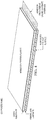
- FIG. 4 is an illustration of a panel made according to the process of FIG. 1, 2 or 3 .
- FIG. 5 is a cross-sectional view of the panel shown in FIG. 4 .
- the conventional method of manufacturing a lauan composite panel involves forming a layer of gel coat on the surface of a mold of at least the size of the panel to be made.
- a wet laminate of a resin containing a promoter and possibly peroxide, and fiber glass fibers as a reinforcement.
- the wet laminate may be sprayed onto the gel coat, such as by spraying the resin onto the gel coat, followed by (or mixed with) the glass fibers, and then rolling the surface of the layer to achieve evenness.
- a sheet of lauan is then positioned on the wet laminate; for a typical panel, a number of pieces of lauan are actually used, and are placed abutting each other to cover the wet laminate.
- the wet laminate is then cured. This may be done by encasing the entire mold in a vacuum bag, exposing the mold with the gel coat and other layers on it to a vacuum, and applying heat. Alternatively, heat alone may be used.
- FIG. 1 illustrates one preferred embodiment of a method according to the present disclosure.
- a horizontal flat mold is provided, and is coated with a gel coat layer (not illustrated).
- a first spray head shown toward the right in that Figure, is used to spray the mix of resin and glass fibers onto the gel coat.
- this mix may also include a promoter in an amount sufficient to achieve proper polymerization of the resin during curing, but should not contain so much as to change the curing time.
- a second spray head sprays promoter onto the wet laminate, as shown to the left of the first spray head.
- This promoter may be the same as is included in the wet laminate itself, but that need not be the case, as discussed below.
- the wet laminate, coated with the promoter by the second spraying head is then covered with the required number of pieces of lauan. (To be more precise, the wet laminate may not be exactly and completely covered by the lauan, as a peripheral portion of the laminate may remain uncovered.)
- the entire mold When the entire mold has been provided with each of the mentioned layers, it is enclosed in a vacuum bag (not illustrated), and the resin of the wet laminate is cured under vacuum and heat. Alternatively, other techniques of curing may be used. The finished panel is then released from the mold and cut to size if necessary.
- FIGS. 4 and 5 An example of a panel manufactured in this fashion is shown in FIGS. 4 and 5 .
- one surface of the panel is formed by the lauan substrate, which is bonded to the fiberglass laminate.
- the other side of the laminate is bonded to the high-gloss gel coat.
- the interface layer between the lauan substrate and the fiberglass laminate is labeled, and the thin layer of adhesion promoter is illustrated as well (see FIG. 4 ).
- the mixture ratio of solvent to promotor can range, for example, from 10:1 to 1000:1, or more particularly from 20:1 to 800:1, or from 50:1 to 500:1, or from 100:1 to 300:1.
- One preferred embodiment applies 1% cobalt-acetone drying solution as the solvent-promoter mixture, applied to the lauan with target coverage of 3 grams/square foot (about 32 grams/square meter).
- Another example uses cobalt with mineral spirits.
- Other mixtures, as stated, may be used.
- the promoter used in the solvent-promoter mixture may be one (or more) also used in the resin, or instead may include one or more not used in the resin.
- FIG. 2 A second example of a preferred embodiment of the method is illustrated in FIG. 2 .
- the promoter instead of spraying the promoter onto the wet laminate, the promoter is sprayed onto one surface of the lauan shortly before the lauan is positioned on the wet laminate.
- Each sheet of lauan, after being sprayed with the proper amount of promoter solution, is turned over and placed with the sprayed surface in contact with the wet laminate.
- FIG. 3 Another example is illustrated in FIG. 3 , in which the promoter solution is again applied to the lauan rather than to the wet laminate, but the application is done using a roller rather than a spray head.
- FIG. 2 after application of the promoter, each sheet of lauan is inverted and positioned with the coated surface in contact with the wet laminate.
- FIGS. 2 and 3 the rest of the procedure is the same as in that illustrated in FIG. 1 .
- any other mechanized or manual method of application of the promoter that may be found convenient may be used.
- an individual mold may be used for each panel, or a continuous mold may be used. Again, the mold may be moved past each work station in turn for application of the gel coat, of the wet laminate, of the promoter and of the lauan, and then for the curing, or alternatively the mold may be stationary.
- Results obtained have been good, based on testing including for regularity of product surface or surface profile, and mechanical, such as flex, tensile and, block pull tests, with moisture contents from 0 to 19% (and, particularly, with high moisture content, of e.g., 13-18% and especially 14-17%; all % are weight-%).
- the inventor has found that advantageous results may be obtained regardless of whether the lauan used is sanded or not, and for different thicknesses of lauan.
- the method may yield advantageous results whether the resin used contains a filler, such as mica, or not. Further, it is believed that this method may produce satisfactory results with any moisture content up to the level at which the lauan would be unacceptable based on other criteria.
- the method is applicable as well to the manufacture of other types of article in which it is desired to bond lauan or a similar material to a resin layer, whether containing glass fibers or not.
- the method is also applicable to other woods than lauan, such as plywood, and to other substrates that may carry or absorb moisture.
Landscapes
- Life Sciences & Earth Sciences (AREA)
- Engineering & Computer Science (AREA)
- Wood Science & Technology (AREA)
- Chemical & Material Sciences (AREA)
- Organic Chemistry (AREA)
- Laminated Bodies (AREA)
Abstract
Description
-
- Promotors, including but not limited to:
- Copper salts
- Manganese salts
- Iron salts
- Cobalt salts
- Amine accelerators
- Dimethyl aniline
- Dimethyl-p-toluidine
- Vanadium accelerators
- Vanadium monobutyl dihydrophosphite
- 2,4-Pentanedione
- N,N-Diethylacetoacetamide
- Solvents, including but not limited to:
- Mineral spirits
- Methyl ethyl ketone
- Styrene
- Acetone
- Methyl methacrylate
- Xylene
- Promotors, including but not limited to:
Claims (19)
Priority Applications (2)
| Application Number | Priority Date | Filing Date | Title |
|---|---|---|---|
| US15/588,082 US10597559B2 (en) | 2016-06-06 | 2017-05-05 | Method of manufacturing a composite panel containing lauan or other moisture-carrying or moisture-absorbing material using adhesion promoter and panel made using the method |
| US16/805,658 US11273623B2 (en) | 2016-06-06 | 2020-02-28 | Composite panel containing lauan or other moisture-carrying or moisture-absorbing material using adhesion promoter |
Applications Claiming Priority (2)
| Application Number | Priority Date | Filing Date | Title |
|---|---|---|---|
| US201662345946P | 2016-06-06 | 2016-06-06 | |
| US15/588,082 US10597559B2 (en) | 2016-06-06 | 2017-05-05 | Method of manufacturing a composite panel containing lauan or other moisture-carrying or moisture-absorbing material using adhesion promoter and panel made using the method |
Related Child Applications (1)
| Application Number | Title | Priority Date | Filing Date |
|---|---|---|---|
| US16/805,658 Division US11273623B2 (en) | 2016-06-06 | 2020-02-28 | Composite panel containing lauan or other moisture-carrying or moisture-absorbing material using adhesion promoter |
Publications (2)
| Publication Number | Publication Date |
|---|---|
| US20170348956A1 US20170348956A1 (en) | 2017-12-07 |
| US10597559B2 true US10597559B2 (en) | 2020-03-24 |
Family
ID=60482943
Family Applications (2)
| Application Number | Title | Priority Date | Filing Date |
|---|---|---|---|
| US15/588,082 Active US10597559B2 (en) | 2016-06-06 | 2017-05-05 | Method of manufacturing a composite panel containing lauan or other moisture-carrying or moisture-absorbing material using adhesion promoter and panel made using the method |
| US16/805,658 Active US11273623B2 (en) | 2016-06-06 | 2020-02-28 | Composite panel containing lauan or other moisture-carrying or moisture-absorbing material using adhesion promoter |
Family Applications After (1)
| Application Number | Title | Priority Date | Filing Date |
|---|---|---|---|
| US16/805,658 Active US11273623B2 (en) | 2016-06-06 | 2020-02-28 | Composite panel containing lauan or other moisture-carrying or moisture-absorbing material using adhesion promoter |
Country Status (1)
| Country | Link |
|---|---|
| US (2) | US10597559B2 (en) |
Citations (20)
| Publication number | Priority date | Publication date | Assignee | Title |
|---|---|---|---|---|
| US3320203A (en) * | 1963-04-01 | 1967-05-16 | Monsanto Co | Sprayable polyvinyl butyral wood primer for polyurethane or polyester finish |
| US4350788A (en) | 1980-09-26 | 1982-09-21 | Nippon Gohsei Kagaku Kogyo Kabushiki Kaisha | Synthetic resin emulsion and its uses |
| US4390401A (en) | 1981-02-23 | 1983-06-28 | Celanese Corporation | Acrylate or methacrylate esters of alkylene oxide adducts of alkyl/aryl phenols as wetting agents for ultraviolet curable coating compositions |
| US4678532A (en) | 1985-03-21 | 1987-07-07 | Perkins Industries, Inc. | Treatment of wood veneers in plywood manufacturing |
| US5110392A (en) | 1983-05-20 | 1992-05-05 | Toagosei Chemical Industry Co., Ltd. | Primer composition containing an organometallic compound for binding substrates with a cyanocrylate adhesive |
| US5741594A (en) | 1995-08-28 | 1998-04-21 | The Dow Chemical Company | Adhesion promoter for a laminate comprising a substantially linear polyolefin |
| US6212846B1 (en) * | 2000-02-09 | 2001-04-10 | Franklin E. Johnston | Isosceles joist |
| US20050183813A1 (en) * | 2002-01-31 | 2005-08-25 | Gonsalves James F. | Process for manufacturing a composite sheet |
| US20090068477A1 (en) | 2006-05-16 | 2009-03-12 | Sika Technology Ag | Method for Applying an Adhesion Promoter Composition by Means of an Ultrasonic Atomizer |
| US20100068497A1 (en) * | 2007-05-23 | 2010-03-18 | Hexcel Composites Limited | Adhesion promoting layer for composite assemblies |
| US20100181018A1 (en) * | 2009-01-16 | 2010-07-22 | Daniel Walczyk | Consolidating and Curing of Thermoset Composite Parts by Pressing Between a Heated Rigid Mold and Customized Rubber-faced Mold |
| US8071491B2 (en) | 2001-11-07 | 2011-12-06 | FledForm Technologies, LLC | Process, composition and coating of laminate material |
| US20120048598A1 (en) * | 2009-04-30 | 2012-03-01 | Shingo Kaimori | Adhesive resin composition, and laminate and flexible printed wiring board using the same |
| US8221874B1 (en) | 2009-09-23 | 2012-07-17 | Crane Composites Inc. | Durable glass fiber reinforced panel |
| US20140113126A1 (en) | 2006-03-24 | 2014-04-24 | Henkel US IP LLC | Sprayable water-based adhesive |
| US8778458B2 (en) | 2009-08-31 | 2014-07-15 | Byk-Chemie Gmbh | Adhesion promoter for coatings on different substrate surfaces |
| WO2014118210A1 (en) * | 2013-01-29 | 2014-08-07 | Evonik Industries Ag | Fibre-composite-hybrid components |
| US9144955B2 (en) | 2013-09-04 | 2015-09-29 | Johns Manville | Blended thermoplastic and thermoset materials and methods |
| WO2015168670A1 (en) | 2014-05-02 | 2015-11-05 | Dow Global Technologies Llc | Phosphate adhesion promoters |
| US20160032158A1 (en) | 2013-03-15 | 2016-02-04 | Firestone Building Products Co., LLC | Bonding adhesive and adhered roofing systems prepared using the same |
Family Cites Families (3)
| Publication number | Priority date | Publication date | Assignee | Title |
|---|---|---|---|---|
| AT305636B (en) * | 1971-05-28 | 1973-03-12 | Basf Ag | Unsaturated polyester resin |
| US20080263967A1 (en) * | 2007-04-27 | 2008-10-30 | Culveyhouse Donald E | Slide-out room with pitched roof |
| JP5024205B2 (en) * | 2007-07-12 | 2012-09-12 | 三菱瓦斯化学株式会社 | Prepreg and laminate |
-
2017
- 2017-05-05 US US15/588,082 patent/US10597559B2/en active Active
-
2020
- 2020-02-28 US US16/805,658 patent/US11273623B2/en active Active
Patent Citations (22)
| Publication number | Priority date | Publication date | Assignee | Title |
|---|---|---|---|---|
| US3320203A (en) * | 1963-04-01 | 1967-05-16 | Monsanto Co | Sprayable polyvinyl butyral wood primer for polyurethane or polyester finish |
| US4350788A (en) | 1980-09-26 | 1982-09-21 | Nippon Gohsei Kagaku Kogyo Kabushiki Kaisha | Synthetic resin emulsion and its uses |
| US4390401A (en) | 1981-02-23 | 1983-06-28 | Celanese Corporation | Acrylate or methacrylate esters of alkylene oxide adducts of alkyl/aryl phenols as wetting agents for ultraviolet curable coating compositions |
| US5110392A (en) | 1983-05-20 | 1992-05-05 | Toagosei Chemical Industry Co., Ltd. | Primer composition containing an organometallic compound for binding substrates with a cyanocrylate adhesive |
| US4678532A (en) | 1985-03-21 | 1987-07-07 | Perkins Industries, Inc. | Treatment of wood veneers in plywood manufacturing |
| US5741594A (en) | 1995-08-28 | 1998-04-21 | The Dow Chemical Company | Adhesion promoter for a laminate comprising a substantially linear polyolefin |
| US6212846B1 (en) * | 2000-02-09 | 2001-04-10 | Franklin E. Johnston | Isosceles joist |
| US8071491B2 (en) | 2001-11-07 | 2011-12-06 | FledForm Technologies, LLC | Process, composition and coating of laminate material |
| US20050183813A1 (en) * | 2002-01-31 | 2005-08-25 | Gonsalves James F. | Process for manufacturing a composite sheet |
| US20140113126A1 (en) | 2006-03-24 | 2014-04-24 | Henkel US IP LLC | Sprayable water-based adhesive |
| US20090068477A1 (en) | 2006-05-16 | 2009-03-12 | Sika Technology Ag | Method for Applying an Adhesion Promoter Composition by Means of an Ultrasonic Atomizer |
| US20100068497A1 (en) * | 2007-05-23 | 2010-03-18 | Hexcel Composites Limited | Adhesion promoting layer for composite assemblies |
| US20100181018A1 (en) * | 2009-01-16 | 2010-07-22 | Daniel Walczyk | Consolidating and Curing of Thermoset Composite Parts by Pressing Between a Heated Rigid Mold and Customized Rubber-faced Mold |
| US20120048598A1 (en) * | 2009-04-30 | 2012-03-01 | Shingo Kaimori | Adhesive resin composition, and laminate and flexible printed wiring board using the same |
| US8778458B2 (en) | 2009-08-31 | 2014-07-15 | Byk-Chemie Gmbh | Adhesion promoter for coatings on different substrate surfaces |
| US20140220355A1 (en) | 2009-08-31 | 2014-08-07 | Byk-Chemie Gmbh | Object or an article whose surface is provided with a coating produced using and adhesion promoter |
| US8221874B1 (en) | 2009-09-23 | 2012-07-17 | Crane Composites Inc. | Durable glass fiber reinforced panel |
| WO2014118210A1 (en) * | 2013-01-29 | 2014-08-07 | Evonik Industries Ag | Fibre-composite-hybrid components |
| US20150375478A1 (en) * | 2013-01-29 | 2015-12-31 | Evonik Degussa Gmbh | Fibre composite hybrid components |
| US20160032158A1 (en) | 2013-03-15 | 2016-02-04 | Firestone Building Products Co., LLC | Bonding adhesive and adhered roofing systems prepared using the same |
| US9144955B2 (en) | 2013-09-04 | 2015-09-29 | Johns Manville | Blended thermoplastic and thermoset materials and methods |
| WO2015168670A1 (en) | 2014-05-02 | 2015-11-05 | Dow Global Technologies Llc | Phosphate adhesion promoters |
Non-Patent Citations (1)
| Title |
|---|
| C.B. Vick, "Adhesive Bonding of Wood Materials", Chap. 9 of USDA Forest Service, Forest Products Laboratory, Wood Handbook : Wood as an Engineering Material., 1999. General technical report FPL ; GTR-113, pp. 9.1-9.24 (1999). |
Also Published As
| Publication number | Publication date |
|---|---|
| US11273623B2 (en) | 2022-03-15 |
| US20170348956A1 (en) | 2017-12-07 |
| US20200199411A1 (en) | 2020-06-25 |
Similar Documents
| Publication | Publication Date | Title |
|---|---|---|
| UA127004C2 (en) | A veneered element and method of producing such a veneered element | |
| AU2015349059B2 (en) | Method for finishing a wood board | |
| US4556529A (en) | Method for bonding molded components sheeting or shaped members | |
| US20080041003A1 (en) | Method and system for edge-coating wood substrates | |
| CN101367219A (en) | E0 grade flame retardant, wear-resistant, mildew-proof and moisture-proof type veneer veneer plywood manufacturing method | |
| CN103770430A (en) | Flexible compound decorative veneer facing process | |
| WO1988000134A1 (en) | Decorative sheet and method of manufacturing the same | |
| US20200156347A1 (en) | Wood particle board | |
| RU2007141403A (en) | SURFACE COVERING CURED IN SEVERAL STAGES | |
| US11273623B2 (en) | Composite panel containing lauan or other moisture-carrying or moisture-absorbing material using adhesion promoter | |
| CN101456198A (en) | Dampproof, antitarnish decoration veneer and preparation method thereof | |
| JP4185940B2 (en) | Floor base material manufacturing method and floor material manufacturing method | |
| CN108909119A (en) | A kind of PVC pre-coating film and its preparation method and application suitable for vacuum forming technique | |
| CN102896665A (en) | Solid wood combined base board and machining and production method for same | |
| DK141777B (en) | Method of coating the edges of particle board and fibreboard and the like on cellulose-based moldings. | |
| JP2000503253A (en) | Method for producing a board having a homogeneous decorative surface layer containing an electron beam cured varnish | |
| KR200239236Y1 (en) | Paper foil structure for furniture board | |
| JP5294496B2 (en) | Manufacturing method of building material and building material | |
| JPS63147603A (en) | Manufacture of heat-resistant floor material | |
| CN105089248B (en) | A kind of manufacture method of timber floor | |
| RU2498908C2 (en) | Building board and method of its making | |
| JP2017177584A (en) | Manufacturing method of decorative interior material | |
| GB1568285A (en) | Method of manufacturing surface treated boards from wood veneer or chips | |
| JPS63205201A (en) | Decorative flitch and manufacture thereof | |
| GB727657A (en) | Improvements in or relating to the manufacture of laminated, resin-impregnated hollow articles such as boat-hulls |
Legal Events
| Date | Code | Title | Description |
|---|---|---|---|
| AS | Assignment |
Owner name: CRANE COMPOSITES, INC., ILLINOIS Free format text: ASSIGNMENT OF ASSIGNORS INTEREST;ASSIGNOR:BLEDSOE, JAMES G.;REEL/FRAME:042399/0226 Effective date: 20170504 |
|
| STPP | Information on status: patent application and granting procedure in general |
Free format text: FINAL REJECTION MAILED |
|
| STPP | Information on status: patent application and granting procedure in general |
Free format text: DOCKETED NEW CASE - READY FOR EXAMINATION |
|
| STPP | Information on status: patent application and granting procedure in general |
Free format text: NON FINAL ACTION MAILED |
|
| STPP | Information on status: patent application and granting procedure in general |
Free format text: RESPONSE TO NON-FINAL OFFICE ACTION ENTERED AND FORWARDED TO EXAMINER |
|
| STPP | Information on status: patent application and granting procedure in general |
Free format text: NOTICE OF ALLOWANCE MAILED -- APPLICATION RECEIVED IN OFFICE OF PUBLICATIONS |
|
| STPP | Information on status: patent application and granting procedure in general |
Free format text: PUBLICATIONS -- ISSUE FEE PAYMENT VERIFIED |
|
| STCF | Information on status: patent grant |
Free format text: PATENTED CASE |
|
| FEPP | Fee payment procedure |
Free format text: MAINTENANCE FEE REMINDER MAILED (ORIGINAL EVENT CODE: REM.); ENTITY STATUS OF PATENT OWNER: LARGE ENTITY |
|
| FEPP | Fee payment procedure |
Free format text: SURCHARGE FOR LATE PAYMENT, LARGE ENTITY (ORIGINAL EVENT CODE: M1554); ENTITY STATUS OF PATENT OWNER: LARGE ENTITY |
|
| MAFP | Maintenance fee payment |
Free format text: PAYMENT OF MAINTENANCE FEE, 4TH YEAR, LARGE ENTITY (ORIGINAL EVENT CODE: M1551); ENTITY STATUS OF PATENT OWNER: LARGE ENTITY Year of fee payment: 4 |
|
| AS | Assignment |
Owner name: CERBERUS BUSINESS FINANCE AGENCY, LLC, NEW YORK Free format text: SECURITY INTEREST;ASSIGNOR:CRANE COMPOSITES, INC.;REEL/FRAME:069724/0759 Effective date: 20250102 |