US10593699B2 - Ferroelectric memory device - Google Patents
Ferroelectric memory device Download PDFInfo
- Publication number
- US10593699B2 US10593699B2 US15/839,849 US201715839849A US10593699B2 US 10593699 B2 US10593699 B2 US 10593699B2 US 201715839849 A US201715839849 A US 201715839849A US 10593699 B2 US10593699 B2 US 10593699B2
- Authority
- US
- United States
- Prior art keywords
- material layer
- ferroelectric
- ferroelectric material
- layer
- polarization
- Prior art date
- Legal status (The legal status is an assumption and is not a legal conclusion. Google has not performed a legal analysis and makes no representation as to the accuracy of the status listed.)
- Active
Links
Images


Classifications
-
- H01L27/1159—
-
- H—ELECTRICITY
- H10—SEMICONDUCTOR DEVICES; ELECTRIC SOLID-STATE DEVICES NOT OTHERWISE PROVIDED FOR
- H10N—ELECTRIC SOLID-STATE DEVICES NOT OTHERWISE PROVIDED FOR
- H10N70/00—Solid-state devices having no potential barriers, and specially adapted for rectifying, amplifying, oscillating or switching
- H10N70/801—Constructional details of multistable switching devices
- H10N70/881—Switching materials
-
- G—PHYSICS
- G11—INFORMATION STORAGE
- G11C—STATIC STORES
- G11C11/00—Digital stores characterised by the use of particular electric or magnetic storage elements; Storage elements therefor
- G11C11/21—Digital stores characterised by the use of particular electric or magnetic storage elements; Storage elements therefor using electric elements
- G11C11/22—Digital stores characterised by the use of particular electric or magnetic storage elements; Storage elements therefor using electric elements using ferroelectric elements
- G11C11/223—Digital stores characterised by the use of particular electric or magnetic storage elements; Storage elements therefor using electric elements using ferroelectric elements using MOS with ferroelectric gate insulating film
-
- G—PHYSICS
- G11—INFORMATION STORAGE
- G11C—STATIC STORES
- G11C11/00—Digital stores characterised by the use of particular electric or magnetic storage elements; Storage elements therefor
- G11C11/21—Digital stores characterised by the use of particular electric or magnetic storage elements; Storage elements therefor using electric elements
- G11C11/22—Digital stores characterised by the use of particular electric or magnetic storage elements; Storage elements therefor using electric elements using ferroelectric elements
- G11C11/225—Auxiliary circuits
- G11C11/2275—Writing or programming circuits or methods
-
- H01L29/4958—
-
- H01L29/513—
-
- H01L29/516—
-
- H01L29/517—
-
- H01L29/78391—
-
- H—ELECTRICITY
- H10—SEMICONDUCTOR DEVICES; ELECTRIC SOLID-STATE DEVICES NOT OTHERWISE PROVIDED FOR
- H10B—ELECTRONIC MEMORY DEVICES
- H10B51/00—Ferroelectric RAM [FeRAM] devices comprising ferroelectric memory transistors
-
- H—ELECTRICITY
- H10—SEMICONDUCTOR DEVICES; ELECTRIC SOLID-STATE DEVICES NOT OTHERWISE PROVIDED FOR
- H10B—ELECTRONIC MEMORY DEVICES
- H10B51/00—Ferroelectric RAM [FeRAM] devices comprising ferroelectric memory transistors
- H10B51/30—Ferroelectric RAM [FeRAM] devices comprising ferroelectric memory transistors characterised by the memory core region
-
- H—ELECTRICITY
- H10—SEMICONDUCTOR DEVICES; ELECTRIC SOLID-STATE DEVICES NOT OTHERWISE PROVIDED FOR
- H10D—INORGANIC ELECTRIC SEMICONDUCTOR DEVICES
- H10D30/00—Field-effect transistors [FET]
- H10D30/60—Insulated-gate field-effect transistors [IGFET]
- H10D30/701—IGFETs having ferroelectric gate insulators, e.g. ferroelectric FETs
-
- H—ELECTRICITY
- H10—SEMICONDUCTOR DEVICES; ELECTRIC SOLID-STATE DEVICES NOT OTHERWISE PROVIDED FOR
- H10D—INORGANIC ELECTRIC SEMICONDUCTOR DEVICES
- H10D64/00—Electrodes of devices having potential barriers
- H10D64/60—Electrodes characterised by their materials
- H10D64/66—Electrodes having a conductor capacitively coupled to a semiconductor by an insulator, e.g. MIS electrodes
- H10D64/665—Electrodes having a conductor capacitively coupled to a semiconductor by an insulator, e.g. MIS electrodes the conductor comprising a layer of elemental metal contacting the insulator, e.g. tungsten or molybdenum
- H10D64/666—Electrodes having a conductor capacitively coupled to a semiconductor by an insulator, e.g. MIS electrodes the conductor comprising a layer of elemental metal contacting the insulator, e.g. tungsten or molybdenum the conductor further comprising additional layers
-
- H—ELECTRICITY
- H10—SEMICONDUCTOR DEVICES; ELECTRIC SOLID-STATE DEVICES NOT OTHERWISE PROVIDED FOR
- H10D—INORGANIC ELECTRIC SEMICONDUCTOR DEVICES
- H10D64/00—Electrodes of devices having potential barriers
- H10D64/60—Electrodes characterised by their materials
- H10D64/66—Electrodes having a conductor capacitively coupled to a semiconductor by an insulator, e.g. MIS electrodes
- H10D64/68—Electrodes having a conductor capacitively coupled to a semiconductor by an insulator, e.g. MIS electrodes characterised by the insulator, e.g. by the gate insulator
- H10D64/681—Electrodes having a conductor capacitively coupled to a semiconductor by an insulator, e.g. MIS electrodes characterised by the insulator, e.g. by the gate insulator having a compositional variation, e.g. multilayered
- H10D64/685—Electrodes having a conductor capacitively coupled to a semiconductor by an insulator, e.g. MIS electrodes characterised by the insulator, e.g. by the gate insulator having a compositional variation, e.g. multilayered being perpendicular to the channel plane
-
- H—ELECTRICITY
- H10—SEMICONDUCTOR DEVICES; ELECTRIC SOLID-STATE DEVICES NOT OTHERWISE PROVIDED FOR
- H10D—INORGANIC ELECTRIC SEMICONDUCTOR DEVICES
- H10D64/00—Electrodes of devices having potential barriers
- H10D64/60—Electrodes characterised by their materials
- H10D64/66—Electrodes having a conductor capacitively coupled to a semiconductor by an insulator, e.g. MIS electrodes
- H10D64/68—Electrodes having a conductor capacitively coupled to a semiconductor by an insulator, e.g. MIS electrodes characterised by the insulator, e.g. by the gate insulator
- H10D64/689—Electrodes having a conductor capacitively coupled to a semiconductor by an insulator, e.g. MIS electrodes characterised by the insulator, e.g. by the gate insulator having ferroelectric layers
-
- H—ELECTRICITY
- H10—SEMICONDUCTOR DEVICES; ELECTRIC SOLID-STATE DEVICES NOT OTHERWISE PROVIDED FOR
- H10D—INORGANIC ELECTRIC SEMICONDUCTOR DEVICES
- H10D64/00—Electrodes of devices having potential barriers
- H10D64/60—Electrodes characterised by their materials
- H10D64/66—Electrodes having a conductor capacitively coupled to a semiconductor by an insulator, e.g. MIS electrodes
- H10D64/68—Electrodes having a conductor capacitively coupled to a semiconductor by an insulator, e.g. MIS electrodes characterised by the insulator, e.g. by the gate insulator
- H10D64/691—Electrodes having a conductor capacitively coupled to a semiconductor by an insulator, e.g. MIS electrodes characterised by the insulator, e.g. by the gate insulator comprising metallic compounds, e.g. metal oxides or metal silicates
-
- H—ELECTRICITY
- H10—SEMICONDUCTOR DEVICES; ELECTRIC SOLID-STATE DEVICES NOT OTHERWISE PROVIDED FOR
- H10N—ELECTRIC SOLID-STATE DEVICES NOT OTHERWISE PROVIDED FOR
- H10N70/00—Solid-state devices having no potential barriers, and specially adapted for rectifying, amplifying, oscillating or switching
- H10N70/801—Constructional details of multistable switching devices
- H10N70/841—Electrodes
-
- H—ELECTRICITY
- H10—SEMICONDUCTOR DEVICES; ELECTRIC SOLID-STATE DEVICES NOT OTHERWISE PROVIDED FOR
- H10N—ELECTRIC SOLID-STATE DEVICES NOT OTHERWISE PROVIDED FOR
- H10N70/00—Solid-state devices having no potential barriers, and specially adapted for rectifying, amplifying, oscillating or switching
- H10N70/801—Constructional details of multistable switching devices
- H10N70/881—Switching materials
- H10N70/883—Oxides or nitrides
Definitions
- Embodiments of the present disclosure relate to a ferroelectric memory device.
- a ferroelectric material refers to a material having spontaneous electrical polarization in the absence of an applied external electric field.
- a ferroelectric material can be controlled by an externally applied electric field to maintain either of two stable remanent polarization states on a hysteresis curve.
- a ferroelectric material may be utilized to store logic information of “0” or “1” in a nonvolatile manner.
- a technique for storing a plurality of levels of logic information that can be differentiated by changing a fraction of a switchable domain region in a ferroelectric material, through adjustment of a magnitude of an external electric field.
- a target memory cell should reliably maintain a partially switched polarization orientation state, during a read operation of the target memory cell or a write operation of a memory cell adjacent to the target memory cell.
- a ferroelectric memory device includes a substrate, a ferroelectric structure having a first ferroelectric material layer, an electrical floating layer, and a second ferroelectric material layer that are sequentially stacked or disposed on the substrate, and a gate electrode layer disposed on the ferroelectric structure.
- a hysteresis loop of the second ferroelectric material layer differs from a hysteresis loop of the first ferroelectric material layer.
- a ferroelectric memory device includes a substrate having a source region and a drain region.
- the ferroelectric memory device includes a ferroelectric structure having a first ferroelectric material layer, an electrical floating layer, and a second ferroelectric material layer that are sequentially stacked or disposed on the substrate.
- the ferroelectric memory device includes a gate electrode layer disposed on the second ferroelectric material layer. A coercive electric field of the first ferroelectric material layer is different from that of the second ferroelectric material layer.
- the electrical floating layer comprises a conductive material.
- FIG. 1 is a cross-sectional view schematically illustrating the ferroelectric memory device.
- FIG. 2 is a graph schematically illustrating hysteresis loops of ferroelectric material layers according to an embodiment of the present disclosure.
- FIGS. 3A, 4A, 5A and 6A are views of a portion of the ferroelectric memory device of FIG. 1 , schematically illustrating operations writing a plurality of levels of logic information according to embodiments of the present disclosure.
- FIGS. 3B, 4B, 5B and 6B are hysteresis loops of the ferroelectric memory device corresponding to the write operations illustrated in FIGS. 3A, 4A, 5A and 6A , respectively.
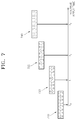
- FIG. 7 is a view schematically illustrating a write operation for a ferroelectric memory device according to an embodiment of the present disclosure.
- each step or process in a method or a manufacturing method need not be performed in any order set forth in the disclosure unless a specific sequence is explicitly described.
- each step or process in a method or manufacturing method disclosed herein may be performed sequentially in the stated order, may be performed out of sequence from the stated order, or may be performed substantially at the same time as one or more other steps or processes.
- the steps or processes may also be performed in a reverse order.
- FIG. 1 is a cross-sectional view schematically illustrating a ferroelectric memory device 1 according to an embodiment of the present disclosure.
- a ferroelectric memory device 1 may include a substrate 101 and a ferroelectric structure 10 disposed on the substrate 101 .
- the ferroelectric structure 10 may include a first ferroelectric material layer 120 , an electrical floating layer 130 , and a second ferroelectric material layer 140 that are sequentially stacked or disposed on the substrate 101 .
- the ferroelectric structure 10 may further include an interfacial insulation layer 110 disposed between the substrate 101 and the first ferroelectric material layer 120 .
- the ferroelectric memory device 1 may be a transistor type device with a channel resistance that differs depending on the polarization orientation of the first and second ferroelectric material layers 120 and 140 .
- the substrate 101 may, for example, include a semiconductor material.
- the substrate 101 may be a silicon (Si) substrate, a gallium arsenide (GaAs) substrate, an indium phosphide (InP) substrate, a germanium (Ge) substrate, or a silicon germanium (SiGe) substrate, as non-limiting examples.
- the substrate 101 may be doped to have conductivity.
- the substrate 101 may be doped with p-type impurities.
- the substrate 101 may have at least one region doped with p-type impurities.
- a source region 160 and a drain region 170 may be disposed in the substrate 101 at respective ends or sides of the ferroelectric structure 10 , and formed in an upper portion of substrate 101 .
- the source region 160 and the drain region 170 may be p-type doped regions in the substrate 101 .
- the interfacial insulation layer 110 may be disposed on the substrate 101 .
- the interfacial insulation layer 110 may function to suppress material diffusion between the substrate 101 and the first ferroelectric material layer 120 .
- the interfacial insulation layer 110 may also function to suppress the transfer of electric charges from a channel of the substrate 101 to the first ferroelectric insulation layer 120 during a read operation of the ferroelectric memory device 1 .
- the interfacial insulation layer 110 may be omitted.
- the first ferroelectric material layer 120 may be disposed on the interfacial insulation layer 110 .
- the first ferroelectric material layer 120 may include a ferroelectric material having remanent polarization therein.
- the remanent polarization can induce electrons as conductive carriers in the substrate 101 below the first ferroelectric material layer 120 .
- a channel resistance of the ferroelectric memory device 1 may be determined depending on the density of the induced electrons.
- the first ferroelectric material layer 120 may include a metal oxide.
- the first ferroelectric material layer 120 may include a hafnium oxide, a zirconium oxide, a hafnium zirconium oxide, or a combination thereof, as non-limiting examples.
- the first ferroelectric material layer 120 may include at least one dopant.
- the dopant may include carbon (C), silicon (Si), magnesium (Mg), aluminum (Al), yttrium (Y), nitrogen (N), germanium (Ge), tin (Sn), strontium (Sr), lead (Pb), calcium (Ca), barium (Ba), titanium (Ti), zirconium (Zr), gadolinium (Gd), lanthanum (La), or a combination of two or more thereof, as non-limiting examples.
- the first ferroelectric material layer 120 may include a material having a perovskite crystalline structure.
- the first ferroelectric material layer 120 may include a lead zirconium titanium oxide (Pb[Zr x Ti 1-x ]O 3 0 ⁇ x ⁇ 1, PZT), a barium titanium oxide (BaTiO 3 ), or the like, as non-limiting examples.
- the electrical floating layer 130 may be disposed on the first ferroelectric material layer 120 .
- the electrical floating layer 130 may include a conductive material.
- the conductive material may include metal, a metal nitride, a metal oxide, a metal silicide, a doped semiconductor, or a combination of two or more thereof, as non-limiting examples.
- the electrical floating layer 130 may include a tungsten layer, a titanium layer, a copper layer, an aluminum layer, a platinum layer, an iridium layer, a ruthenium layer, a tungsten nitride layer, a titanium nitride layer, a tantalum nitride layer, an iridium oxide layer, a ruthenium oxide layer, a tungsten carbide layer, a titanium carbide layer, a tungsten silicide layer, a titanium silicide layer, a tantalum silicide layer, an n-type doped silicon layer, or the like, as non-limiting examples.
- Electrons in the electrical floating layer 130 can be induced to collect at different densities at regions of the electrical floating layer 130 interfacing with, or adjacent to, the first ferroelectric material layer 120 and the second ferroelectric material layer 140 .
- the electron densities depend on the degree of polarization orientation of the first ferroelectric material layer 120 and the second ferroelectric material layer 140 .
- the second ferroelectric material layer 140 may be disposed on the electrical floating layer 130 .
- the second ferroelectric material layer 140 may have a different ferroelectric property from the first ferroelectric material layer 120 .
- a hysteresis loop of the second ferroelectric material layer 140 may differ from a hysteresis loop of the first ferroelectric material layer 120 .
- a coercive electric field of the first ferroelectric material layer is different from that of the second ferroelectric material layer.
- an absolute value of the coercive electric field of the second ferroelectric material layer 140 may be greater than an absolute value of the coercive electric field of the first ferroelectric material layer 120 .
- the second ferroelectric material layer 140 may include a metal oxide. In an embodiment, the second ferroelectric material layer 140 may include a different metal oxide from a metal oxide of the first ferroelectric material layer 120 . The second ferroelectric material layer 140 may include at least one kind of dopant. In another embodiment, the first ferroelectric material layer 120 and the second ferroelectric material layer 140 may include the same metal oxides, but may each have different dopants. The second ferroelectric material layer 140 may include at least one of a hafnium oxide, a zirconium oxide, a hafnium zirconium oxide, as non-limiting examples.
- the dopant may include carbon (C), silicon (Si), magnesium (Mg), aluminum (Al), yttrium (Y), nitrogen (N), germanium (Ge), tin (Sn), strontium (Sr), lead (Pb), calcium (Ca), barium (Ba), titanium (Ti), zirconium (Zr), gadolinium (Gd), lanthanum (La), or a combination of two or more thereof, as non-limiting examples.
- the second ferroelectric material layer 140 may include a material having a perovskite crystalline structure.
- the second ferroelectric material layer 140 may include a lead zirconium titanium oxide (Pb[Zr x Ti 1-x ]O 3 0 ⁇ x ⁇ 1, PZT), a barium titanium oxide (BaTiO 3 ), or the like, as non-limiting examples.
- the second ferroelectric material layer 140 may have a different ferroelectric material than that of the first ferroelectric material layer 120 .
- the gate electrode layer 150 may be disposed on the second ferroelectric material layer 140 .
- the gate electrode layer 150 may include a conductive material.
- the gate electrode layer 150 may include tungsten (W), titanium (Ti), copper (Cu), aluminum (Al), platinum (Pt), iridium (Ir), ruthenium (Ru), a tungsten nitride, a titanium nitride, a tantalum nitride, an iridium oxide, a ruthenium oxide, a tungsten carbide, a titanium carbide, a tungsten silicide, a titanium silicide, a tantalum silicide, or a combination of two or more thereof, as non-limiting examples.
- a write operation to the ferroelectric memory device 1 may be performed by controlling the polarization orientation of the second ferroelectric material layer 140 using a write voltage applied to the gate electrode layer 150 .
- the polarization orientation state of the second ferroelectric material layer 140 can be adjusted to a plurality of levels by changing the write voltage.
- a method of adjusting the polarization orientation state to a plurality of levels may include changing the fraction of the domain region having a polarization that is oriented in the same direction by changing a magnitude of the write voltage or an application condition, such as an application time, or a duration, of an applied predetermined write voltage as described with reference to FIG. 7 .
- the second ferroelectric material layer 140 may have two polarization orientations: a first polarization orientation in upward orientation and a second polarization orientation in a downward orientation. It is possible to write a plurality of levels of polarization orientation states by changing the fraction or portion, in the second ferroelectric material layer 140 , of the domain region having the first polarization orientation and the domain region having the second polarization orientation. Multiple combinations of fractions or portions of domain regions with different polarization orientations in the second ferroelectric material layer can be contemplated. As a result, a plurality of levels, and at least two levels, of logic information can be written in the second ferroelectric material layer 140 .
- the density of electrons induced to collect at a region of the second ferroelectric material layer 140 interfacing with, or adjacent to, the electrical floating layer 130 can be determined or measured. Then, the hysteresis loop of the first ferroelectric material layer 120 can be changed by the determined electron density of the second ferroelectric material layer 140 .
- a read operation for the ferroelectric memory device 1 may be performed by applying a predetermined gate voltage to the ferroelectric structure 10 and applying a predetermined read operation voltage between the source region 160 and drain region 170 to measure a current between the source region 160 and drain region 170 .
- the polarization characteristic of the ferroelectric structure 10 including the first ferroelectric material layer 120 and the second ferroelectric material layer 140 is determined based on the current measurement.
- the polarization characteristic of the ferroelectric structure 10 may be changed by the remanent polarization written in the second ferroelectric material layer 140 .
- the read operation may be performed by applying a gate voltage within a range in which the polarization orientation state stored in the second ferroelectric material layer 140 is not changed. Accordingly, during the read operation, the remanent polarization stored in the target memory cell or the adjacent memory cell is not changed, so that a plurality of levels of logic information can be reliably stored.
- FIG. 2 is a graph schematically illustrating hysteresis loops of ferroelectric material layers according to an embodiment of the present disclosure.
- the first and second hysteresis loops 210 and 220 may correspond to the hysteresis loops of the first and second ferroelectric material layers 120 and 140 , respectively, of the embodiment described above and with reference to FIG. 1 .
- the first ferroelectric material layer 120 may have a pair of remanent polarization P r1 , ⁇ P r1 symmetrical to each other with respect to origin, and a pair of coercive electric fields E c1 , ⁇ E c1 symmetrical to each other with respect to origin.
- the first ferroelectric material layer 120 may have a first and second saturation polarization P p1 , ⁇ P n1 in a first and second saturation electric fields E p1 , ⁇ E n1 , respectively.
- the second ferroelectric material layer 140 may have a pair of remanent polarization P r2 , ⁇ P r2 symmetrical to each other with respect to origin, and a pair of coercive electric fields E c2 , ⁇ E c2 symmetrical to each other with respect to origin.
- the second ferroelectric material layer 140 may have first and second saturation polarization P p2 , ⁇ P n2 in the first and second saturation electric fields E p2 , ⁇ E n2 , respectively.
- the absolute values of the coercive electric fields E c2 , ⁇ E c2 of the second ferroelectric material layer 140 may be greater than the absolute values of the coercive electric fields E c1 , ⁇ E c1 of the first ferroelectric material layer 120 .
- the absolute values of the remanent polarizations P r2 , ⁇ P r2 of the second ferroelectric material layer 140 may be smaller than the absolute values of the remanent polarizations P r1 , ⁇ P r1 of the first ferroelectric material layer 120 .
- the absolute values of the coercive electric fields E c2 , ⁇ E c2 of the second ferroelectric material layer 140 may be greater than the absolute values of the coercive electric fields E c1 , ⁇ E c1 of the first ferroelectric material layer 120 , and the absolute values of the remanent polarizations P r2 , ⁇ P r2 of the second ferroelectric material layer may be equal to or greater than the absolute values of the remanent polarizations P r1 , ⁇ P r1 of the first ferroelectric material layer 120 .
- FIGS. 3A, 4A, 5A and 6A are views of a portion of the ferroelectric memory device of FIG. 1 , schematically illustrating operations writing a plurality of levels of logic information according to embodiments of the present disclosure.
- FIGS. 3B, 4B, 5B and 6B are hysteresis loops of the ferroelectric memory device corresponding to the write operations of FIGS. 3A, 4A, 5A and 6A , respectively.
- FIGS. 3A, 4A, 5A and 6A The configuration of the ferroelectric memory devices illustrated in FIGS. 3A, 4A, 5A and 6A is substantially the same as the configuration of a ferroelectric memory device 1 described above and with reference to FIG. 1 .
- FIGS. 3A, 4A, 5A and 6A schematically illustrate operations writing the polarization orientation in the second ferroelectric material layer 140 .
- FIGS. 3B, 4B, 5B and 6B schematically illustrate hysteresis loops of the ferroelectric structure 10 , which are changed depending on the remanent polarization orientation written in the second ferroelectric material layer 140 after completion of the write operations of FIGS. 3A, 4A, 5A and 6A .
- a first write voltage may be applied to the ferroelectric structure 10 from a power supply V.
- the first write voltage changes the polarization orientation in the entire second ferroelectric material layer 140 to a first polarization orientation state having downward polarization P dn .
- the first write voltage may correspond to an electric field greater than the coercive electric field E c2 of the second hysteresis loop 220 described above and with reference to FIG. 2 .
- the first write voltage may correspond to an electric field greater than the first saturation electric field E p2 of the second hysteresis loop 220 .
- FIG. 3B there is illustrated a hysteresis loop of the ferroelectric structure 10 having predetermined coercive electric fields E c3p , ⁇ E c3n and remanent polarization P r3p , ⁇ P r3n .
- Saturation polarization P 3p and ⁇ P 3n corresponding to the saturation electric fields E 3p , ⁇ E 3n are illustrated on the hysteresis loop.
- the second ferroelectric material layer 140 After the first write voltage is applied, if the second ferroelectric material layer 140 has the first polarization orientation state, then the hysteresis loop of the ferroelectric structure 10 may not be symmetrical with respect to the origin.
- the coercive electric field E c3p when a positive electric field is applied may be smaller than the absolute value of coercive electric field ⁇ E c3n when a negative electric field is applied.
- the saturation electric field E 3p when a positive electric field is applied may be smaller than the absolute value of saturation electric field ⁇ E 3n when a negative electric field is applied.
- the first polarization orientation state of the second ferroelectric material layer 140 may assist in switching the polarization orientation of the first ferroelectric material layer 120 from upward polarization state to a downward polarization state.
- a second write voltage may be applied to a ferroelectric structure 10 from a power supply V.
- the second write voltage changes the polarization orientation in the entire second ferroelectric material layer 140 to a second polarization orientation state having an upward polarization P up .
- the second write voltage may correspond to a negative electric field having an absolute value greater than that of the coercive electric field ⁇ E c2 of the second hysteresis loop 220 described above and with reference to FIG. 2 .
- the second write voltage may correspond to a negative electric field having an absolute value greater than that of the second saturation electric field ⁇ E n2 of the second hysteresis loop 220 .
- FIG. 4B there is illustrated a hysteresis loop of the ferroelectric structure 10 having coercive electric fields E c4p , ⁇ E c4n and remanent polarization P r4p , ⁇ P r4n .
- Saturation polarization P 4p , ⁇ P 4n corresponding to the saturation electric fields E 4p , ⁇ E 4n are illustrated on the hysteresis loop.
- the hysteresis loop of the ferroelectric structure 10 may not be symmetrical with respect to the origin.
- the coercive electric field E c4p when a positive electric field is applied may be greater than the absolute value of coercive electric field ⁇ E c4n , when a negative electric field is applied.
- the saturation electric field E 4p when a positive electric field is applied may be greater than the absolute value of saturation electric field ⁇ E 4n when a negative electric field is applied.
- the orientation state (upward polarization P up ) of the second ferroelectric material layer 140 may prevent, suppress or impede the polarization orientation of the first ferroelectric material layer 120 from switching from an upward polarization state to a downward polarization state.
- a third write voltage may be applied to a ferroelectric structure 10 from the power supply V.
- the third write voltage changes the polarization orientation in the second ferroelectric material layer 140 to a third polarization orientation state having both a fraction or portion of the layer in an upward polarization P up and a fraction or portion of the layer in a downward polarization P dn .
- the fraction of the downward polarization P dn may be greater than the fraction of the upward polarization P up .
- the domain region having an orientation state of the downward polarization P dn in the second ferroelectric material layer 140 may be greater than the domain region having an orientation state of the upward polarization P up .
- FIG. 5B there is illustrated a hysteresis loop of the ferroelectric structure 10 having coercive electric fields E c5p , ⁇ E c5n and remanent polarization P r5p , ⁇ P r5n .
- Saturation polarization P 5p , ⁇ P 5n corresponding to the saturation electric fields E 5p , ⁇ E 5n are illustrated on the hysteresis loop.
- the hysteresis loop of the ferroelectric structure 10 may not be symmetrical with respect to the origin.
- intermediate polarization P i5 when a positive electric field with a value between E 5a and E 5b is applied, intermediate polarization P i5 may be generated.
- the absolute value of the intermediate polarization P i5 may be smaller than the absolute values of the remanent polarizations P r5p , ⁇ P r5n . Further, the absolute value of the intermediate polarization P i5 may be smaller than the absolute values of the remanent polarizations P r3p , ⁇ P r3n of the hysteresis loop described above and with reference to FIG. 3B .
- the absolute value of the intermediate polarization P i5 may also be smaller than the absolute values of the remanent polarizations P r4p , ⁇ P r4n of the hysteresis loop described above and with reference to FIG. 4B .
- the upward polarization P up distributed in the second ferroelectric material layer 140 during the application of the positive electric field prevents, suppresses or impedes the switching of the polarization orientation of the first ferroelectric material layer 120 to the down polarization P dn .
- the saturation electric field E 5p at the positive bias of the hysteresis loop illustrated in FIG. 5B may be greater than the saturation electric field E 3p at the positive bias of the hysteresis loop illustrated in FIG. 3B .
- the coercive electric fields E c5p and ⁇ E c5n may be substantially the same as the coercive electric fields E c3p and ⁇ E c3n of the hysteresis loop of FIG. 3B .
- a fourth write voltage may be applied to a ferroelectric structure 10 from a power supply V.
- the fourth write voltage changes the polarization orientation in the second ferroelectric material layer 140 to a fourth polarization state having both a fraction or portion of the layer in an upward polarization P up and a fraction or portion of the layer in a down polarization P dn .
- the fraction of the upward polarization P up may be greater than the fraction of the down polarization P dn .
- the domain region having an orientation state of the upward polarization P up may be greater than a domain region having the orientation state of the down polarization P dn in the second ferroelectric material layer 140 .
- FIG. 6B there is illustrated a hysteresis loop of the ferroelectric structure 10 having coercive electric fields E c6p , ⁇ E c6n and remanent polarization P r6p , ⁇ P r6n .
- Saturation polarization P 6p , ⁇ P 6n corresponding to the saturation electric fields E 6p , ⁇ E 6n are illustrated on the hysteresis loop.
- the hysteresis loop of the ferroelectric structure 10 may not be symmetrical with respect to the origin.
- intermediate polarization ⁇ P i6 may be generated.
- the absolute value of the intermediate polarization ⁇ P i6 may be smaller than the absolute values of the remanent polarizations P r6p , ⁇ P r6n .
- the absolute value of the intermediate polarization ⁇ P i6 may be smaller than the absolute values of the remanent polarizations P r3p , ⁇ P r3n of the hysteresis loop described above and with reference to FIG. 33 and the absolute values of the remanent polarizations P r4p , ⁇ P r4n of the hysteresis loop described above with reference to FIG. 43 .
- the downward polarization P dn distributed in the second ferroelectric material layer 140 during the application of a negative electric field prevents, suppresses or impedes the switching of the polarization orientation of the first ferroelectric material layer 120 to an upward polarization P up .
- the absolute values of saturation electric fields ⁇ E 6n in the negative electric field of the hysteresis loop illustrated in FIG. 6B may be greater than the absolute value of saturation electric field ⁇ E 4n in the negative electric field of the hysteresis loop shown in FIG. 4B .
- an electric field interval E 6a through E 6b generating the intermediate polarization ⁇ P i6 in the hysteresis loop of FIG. 6B may be substantially the same as an electric field interval E 5a through E 5b generating the intermediate polarization P i5 in the hysteresis loop of FIG. 5B .
- the intermediate polarization P i5 of the hysteresis loop of FIG. 5B and the intermediate polarization ⁇ P i6 of the hysteresis loop of FIG. 6B may have different values from each other. In other words, different intermediate polarization may occur in the same electric field depending on the orientation state of the remanent polarization in the second ferroelectric material layer 140 .
- a ferroelectric memory device 1 may include a ferroelectric structure 10 having first and second ferroelectric material layers 120 and 140 disposed between the substrate 101 and the gate electrode layer 150 .
- the first and second ferroelectric material layers 120 and 140 may have different hysteresis loops.
- the absolute value of the coercive electric field of the second ferroelectric material layer 140 may be greater than the absolute value of the coercive electric field of the first ferroelectric material layer 120 .
- a write operation for a ferroelectric memory device 1 can control the remanent polarization orientation of a second ferroelectric material layer 140 and implement a plurality of levels of information by varying the write voltage applied to the gate electrode layer 150 .
- the second ferroelectric material layer 140 may have the remanent polarization orientation illustrated in FIGS. 3A, 4A, 5A and 6A .
- the behavior of the hysteresis loop of the entire ferroelectric structure 10 may be changed depending on the state of the remanent polarization written in the second ferroelectric material layer 140 .
- a read operation for the ferroelectric memory device 1 may be performed by applying a gate voltage to the gate electrode layer 150 , by applying a read operation voltage between the source and drain regions and by reading a current between the source and drain regions.
- the gate voltage has a magnitude that does not change the remanent polarization orientation of the second ferroelectric material layer 140 . Accordingly, the gate voltage may be less than the voltage corresponding to the coercive electric field E c2 of the second hysteresis loop 220 corresponding to a second ferroelectric material layer 140 in FIG. 2 .
- the ferroelectric structure 10 may be implemented with a plurality, and at least two, of intermediate polarization values.
- a read operation does not change the remanent polarization orientation stored in the second ferroelectric material layer 140 , such that the remanent polarization orientation of the second ferroelectric material layer 140 can be reliably maintained.
- a ferroelectric memory device 1 that can stably store a plurality of levels of logic information.
- FIG. 7 is a view schematically illustrating a write operation for a ferroelectric material layer according to an embodiment of the present disclosure.
- the ferroelectric material layer may correspond to the second ferroelectric material layer 140 of the ferroelectric memory element 1 described above and with reference to FIG. 1 .
- FIG. 7 schematically illustrates the remanent polarization orientation of the second ferroelectric material layer 140 according to a write operation.
- a voltage corresponding to a negative electric field having an absolute value equal to or greater than the absolute value of the second saturation electric field ⁇ E n2 of the second hysteresis loop 220 of FIG. 2 may be applied to the second ferroelectric material layer 140 .
- the remanent polarization can be oriented to an upward polarization Pup throughout the second ferroelectric material layer 140 .
- a first write voltage corresponding to a positive electric field equal to or greater than the first saturation electric field E p2 of the second hysteresis loop 220 of FIG. 2 may be applied at a first time t 0 .
- the first time t 0 may be limited such that the upward polarization P up is not switched to the downward polarization P dn .
- the state 710 may correspond to the orientation state of the remanent polarization of the second ferroelectric material layer 140 described above and with reference to FIG. 4A .
- a second write voltage of the same polarity and magnitude as the first write voltage is applied over a the time period increasing to a second time t 1 . Accordingly, a portion of the upward polarization P up in the second ferroelectric material layer 140 may be switched to the downward polarization P dn .
- the state 720 may correspond to the orientation state of the remanent polarization of the second ferroelectric material layer 140 described above and with reference to FIG. 6A .
- a third write voltage having the same polarity and magnitude as the first write voltage is applied over a time period increasing to a third time t 2 . Accordingly, a higher fraction of the upward polarization P up in the second ferroelectric material layer 140 can be switched to the downward polarization P dn .
- the state 730 may correspond to the orientation state of the remanent polarization of the second ferroelectric material layer 140 described above with and reference to FIG. 5A .
- a fourth write voltage having the same polarity and magnitude as the first write voltage is applied over a time period increasing to a fourth time t 3 . Accordingly, any remaining upward polarization P up of the second ferroelectric material layer 140 can all be switched to the down polarization P dn .
- the state 740 may correspond to the orientation state of the remanent polarization of the second ferroelectric material layer 140 described above and with reference to FIG. 3A .
- the write operation for a plurality of levels of information for the second ferroelectric material layer 140 can be performed.
- the write operation can be achieved by applying a voltage corresponding to an electric field equal to or greater than the saturation electric field of the second ferroelectric substance layer 140 , and adjusting the electric field application time.
Landscapes
- Engineering & Computer Science (AREA)
- Computer Hardware Design (AREA)
- Semiconductor Memories (AREA)
Abstract
Description
Claims (7)
Priority Applications (1)
| Application Number | Priority Date | Filing Date | Title |
|---|---|---|---|
| US16/784,194 US10978483B2 (en) | 2017-03-21 | 2020-02-06 | Ferroelectric memory device |
Applications Claiming Priority (2)
| Application Number | Priority Date | Filing Date | Title |
|---|---|---|---|
| KR1020170035343A KR20180106662A (en) | 2017-03-21 | 2017-03-21 | Ferroelectric Memory Device |
| KR10-2017-0035343 | 2017-03-21 |
Related Child Applications (1)
| Application Number | Title | Priority Date | Filing Date |
|---|---|---|---|
| US16/784,194 Division US10978483B2 (en) | 2017-03-21 | 2020-02-06 | Ferroelectric memory device |
Publications (2)
| Publication Number | Publication Date |
|---|---|
| US20180277550A1 US20180277550A1 (en) | 2018-09-27 |
| US10593699B2 true US10593699B2 (en) | 2020-03-17 |
Family
ID=63582895
Family Applications (2)
| Application Number | Title | Priority Date | Filing Date |
|---|---|---|---|
| US15/839,849 Active US10593699B2 (en) | 2017-03-21 | 2017-12-13 | Ferroelectric memory device |
| US16/784,194 Active US10978483B2 (en) | 2017-03-21 | 2020-02-06 | Ferroelectric memory device |
Family Applications After (1)
| Application Number | Title | Priority Date | Filing Date |
|---|---|---|---|
| US16/784,194 Active US10978483B2 (en) | 2017-03-21 | 2020-02-06 | Ferroelectric memory device |
Country Status (2)
| Country | Link |
|---|---|
| US (2) | US10593699B2 (en) |
| KR (1) | KR20180106662A (en) |
Families Citing this family (11)
| Publication number | Priority date | Publication date | Assignee | Title |
|---|---|---|---|---|
| KR20190055661A (en) * | 2017-11-15 | 2019-05-23 | 에스케이하이닉스 주식회사 | Method of Operating Ferroelectric Device |
| US11349008B2 (en) | 2018-09-27 | 2022-05-31 | Taiwan Semiconductor Manufacturing Co., Ltd. | Negative capacitance transistor having a multilayer ferroelectric structure or a ferroelectric layer with a gradient doping profile |
| US11282945B2 (en) * | 2018-11-29 | 2022-03-22 | Taiwan Semiconductor Manufacturing Co., Ltd. | Negative-capacitance field effect transistor |
| KR102620866B1 (en) * | 2018-12-27 | 2024-01-04 | 에스케이하이닉스 주식회사 | semiconductor device including dielectric structure having ferroelectric layer and non-ferroelectric layer |
| KR102827209B1 (en) | 2019-07-29 | 2025-07-01 | 삼성전자주식회사 | Semiconductor device and method for fabricating the same |
| KR102681259B1 (en) | 2019-08-06 | 2024-07-03 | 에스케이하이닉스 주식회사 | Ferroelectric Memory Device having Ferroelectric Induction Layer |
| KR102866393B1 (en) * | 2020-07-07 | 2025-09-29 | 삼성전자주식회사 | Semiconductor memory devices |
| KR102876506B1 (en) * | 2020-07-07 | 2025-10-23 | 삼성전자주식회사 | Semiconductor memory devices |
| KR102417572B1 (en) * | 2020-12-01 | 2022-07-06 | 광주과학기술원 | Complex thin film with ferroelectric and magnetic, memcapacitor comprising the same, and method of fabricating of the same |
| US11868621B2 (en) * | 2021-06-22 | 2024-01-09 | Seagate Technology Llc | Data storage with multi-level read destructive memory |
| CN120152293B (en) * | 2025-03-05 | 2025-12-16 | 北京大学 | A three-dimensional ferroelectric memory array and its fabrication and operation methods |
Citations (3)
| Publication number | Priority date | Publication date | Assignee | Title |
|---|---|---|---|---|
| US7034349B2 (en) | 2002-09-19 | 2006-04-25 | Cova Technologies, Inc. | Ferroelectric transistor for storing two data bits |
| US7297602B2 (en) | 2003-09-09 | 2007-11-20 | Sharp Laboratories Of America, Inc. | Conductive metal oxide gate ferroelectric memory transistor |
| US20170338350A1 (en) * | 2016-05-17 | 2017-11-23 | Globalfoundries Inc. | Semiconductor device and method |
Family Cites Families (1)
| Publication number | Priority date | Publication date | Assignee | Title |
|---|---|---|---|---|
| US7298018B2 (en) * | 2004-12-02 | 2007-11-20 | Agency For Science, Technology And Research | PLT/PZT ferroelectric structure |
-
2017
- 2017-03-21 KR KR1020170035343A patent/KR20180106662A/en not_active Withdrawn
- 2017-12-13 US US15/839,849 patent/US10593699B2/en active Active
-
2020
- 2020-02-06 US US16/784,194 patent/US10978483B2/en active Active
Patent Citations (3)
| Publication number | Priority date | Publication date | Assignee | Title |
|---|---|---|---|---|
| US7034349B2 (en) | 2002-09-19 | 2006-04-25 | Cova Technologies, Inc. | Ferroelectric transistor for storing two data bits |
| US7297602B2 (en) | 2003-09-09 | 2007-11-20 | Sharp Laboratories Of America, Inc. | Conductive metal oxide gate ferroelectric memory transistor |
| US20170338350A1 (en) * | 2016-05-17 | 2017-11-23 | Globalfoundries Inc. | Semiconductor device and method |
Also Published As
| Publication number | Publication date |
|---|---|
| US20180277550A1 (en) | 2018-09-27 |
| KR20180106662A (en) | 2018-10-01 |
| US20200176458A1 (en) | 2020-06-04 |
| US10978483B2 (en) | 2021-04-13 |
Similar Documents
| Publication | Publication Date | Title |
|---|---|---|
| US10978483B2 (en) | Ferroelectric memory device | |
| US10388786B2 (en) | Nonvolatile memory device | |
| US11508846B2 (en) | Ferroelectric memory device | |
| US10923501B2 (en) | Ferroelectric memory device and method of manufacturing the same | |
| JP7657907B2 (en) | High density low voltage NV differential memory bitcell with shared plate line - Patents.com | |
| US10903363B2 (en) | Ferroelectric semiconductor device | |
| US10475924B2 (en) | Ferroelectric memory devices | |
| US10720437B2 (en) | Ferroelectric memory device having vertical channel between source line and bit line | |
| US12262542B2 (en) | Ferroelectric memory device | |
| US10522564B2 (en) | Ferroelectric memory device and method of manufacturing the same | |
| US11056508B2 (en) | Ferroelectric memory device | |
| US8304823B2 (en) | Integrated circuit including a ferroelectric memory cell and method of manufacturing the same | |
| US10515698B2 (en) | Ferroelectric memory device and method of manufacturing the same | |
| KR20190008048A (en) | Ferroelectric Memory Device | |
| US10847541B2 (en) | Ferroelectric memory device and a method of manufacturing the same | |
| US10283184B2 (en) | Nonvolatile memory device having ferroelectric memory element and resistive memory element and method of writing signal in nonvolatile memory device having the same | |
| US10804295B2 (en) | Ferroelectric memory device | |
| KR20240060480A (en) | Inserting inhibition layer for inducing antiferroelectricity to ferroelectric structure | |
| KR20220142663A (en) | Memory device using polarizable material |
Legal Events
| Date | Code | Title | Description |
|---|---|---|---|
| AS | Assignment |
Owner name: SK HYNIX INC., KOREA, REPUBLIC OF Free format text: ASSIGNMENT OF ASSIGNORS INTEREST;ASSIGNOR:YOO, HYANGKEUN;REEL/FRAME:044375/0845 Effective date: 20171211 |
|
| FEPP | Fee payment procedure |
Free format text: ENTITY STATUS SET TO UNDISCOUNTED (ORIGINAL EVENT CODE: BIG.); ENTITY STATUS OF PATENT OWNER: LARGE ENTITY |
|
| STPP | Information on status: patent application and granting procedure in general |
Free format text: NON FINAL ACTION MAILED |
|
| STPP | Information on status: patent application and granting procedure in general |
Free format text: RESPONSE TO NON-FINAL OFFICE ACTION ENTERED AND FORWARDED TO EXAMINER |
|
| STPP | Information on status: patent application and granting procedure in general |
Free format text: NON FINAL ACTION MAILED |
|
| STPP | Information on status: patent application and granting procedure in general |
Free format text: RESPONSE TO NON-FINAL OFFICE ACTION ENTERED AND FORWARDED TO EXAMINER |
|
| STPP | Information on status: patent application and granting procedure in general |
Free format text: FINAL REJECTION MAILED |
|
| STPP | Information on status: patent application and granting procedure in general |
Free format text: RESPONSE AFTER FINAL ACTION FORWARDED TO EXAMINER |
|
| STPP | Information on status: patent application and granting procedure in general |
Free format text: ADVISORY ACTION MAILED |
|
| STPP | Information on status: patent application and granting procedure in general |
Free format text: NOTICE OF ALLOWANCE MAILED -- APPLICATION RECEIVED IN OFFICE OF PUBLICATIONS |
|
| STPP | Information on status: patent application and granting procedure in general |
Free format text: PUBLICATIONS -- ISSUE FEE PAYMENT VERIFIED |
|
| STCF | Information on status: patent grant |
Free format text: PATENTED CASE |
|
| MAFP | Maintenance fee payment |
Free format text: PAYMENT OF MAINTENANCE FEE, 4TH YEAR, LARGE ENTITY (ORIGINAL EVENT CODE: M1551); ENTITY STATUS OF PATENT OWNER: LARGE ENTITY Year of fee payment: 4 |