US10584095B2 - Method of producing a sodium salt of (2,6-dichlorophenyl)amide carbopentoxysulfanilic acid - Google Patents
Method of producing a sodium salt of (2,6-dichlorophenyl)amide carbopentoxysulfanilic acid Download PDFInfo
- Publication number
- US10584095B2 US10584095B2 US15/758,410 US201615758410A US10584095B2 US 10584095 B2 US10584095 B2 US 10584095B2 US 201615758410 A US201615758410 A US 201615758410A US 10584095 B2 US10584095 B2 US 10584095B2
- Authority
- US
- United States
- Prior art keywords
- acid
- dichlorophenyl
- amide
- carbopentoxysulfanilic
- sodium salt
- Prior art date
- Legal status (The legal status is an assumption and is not a legal conclusion. Google has not performed a legal analysis and makes no representation as to the accuracy of the status listed.)
- Active
Links
- XKMIWSZFVIYIOH-UHFFFAOYSA-N C1=CC=NC=C1.C1=CC=NC=C1.CCCCCOC(=O)NC1=CC=C(S(=O)(=O)Cl)C=C1.CCCCCOC(=O)NC1=CC=C(S(=O)(=O)NC2=C(Cl)C=CC=C2Cl)C=C1.Cl.NC1=C(Cl)C=CC=C1Cl Chemical compound C1=CC=NC=C1.C1=CC=NC=C1.CCCCCOC(=O)NC1=CC=C(S(=O)(=O)Cl)C=C1.CCCCCOC(=O)NC1=CC=C(S(=O)(=O)NC2=C(Cl)C=CC=C2Cl)C=C1.Cl.NC1=C(Cl)C=CC=C1Cl XKMIWSZFVIYIOH-UHFFFAOYSA-N 0.000 description 1
- YETCARLORUXFEQ-UHFFFAOYSA-N CCCCCO.CCCCCOC(=O)NC1=CC=CC=C1.O=C=NC1=CC=CC=C1 Chemical compound CCCCCO.CCCCCOC(=O)NC1=CC=CC=C1.O=C=NC1=CC=CC=C1 YETCARLORUXFEQ-UHFFFAOYSA-N 0.000 description 1
- IWOFFMCXDBGJLE-UHFFFAOYSA-N CCCCCOC(=O)NC1=CC=C(S(=O)(=O)Cl)C=C1 Chemical compound CCCCCOC(=O)NC1=CC=C(S(=O)(=O)Cl)C=C1 IWOFFMCXDBGJLE-UHFFFAOYSA-N 0.000 description 1
- NHWDIRNIOJTQCG-UHFFFAOYSA-N CCCCCOC(=O)NC1=CC=C(S(=O)(=O)Cl)C=C1.CCCCCOC(=O)NC1=CC=CC=C1.O Chemical compound CCCCCOC(=O)NC1=CC=C(S(=O)(=O)Cl)C=C1.CCCCCOC(=O)NC1=CC=CC=C1.O NHWDIRNIOJTQCG-UHFFFAOYSA-N 0.000 description 1
- FLKATMPQSJPQRZ-UHFFFAOYSA-N CCCCCOC(=O)NC1=CC=C(S(=O)(=O)N([Na])C2=C(Cl)C=CC=C2Cl)C=C1 Chemical compound CCCCCOC(=O)NC1=CC=C(S(=O)(=O)N([Na])C2=C(Cl)C=CC=C2Cl)C=C1 FLKATMPQSJPQRZ-UHFFFAOYSA-N 0.000 description 1
- JMFPXNMCDLUEEP-UHFFFAOYSA-M CCCCCOC(=O)NC1=CC=C(S(=O)(=O)N([Na])C2=C(Cl)C=CC=C2Cl)C=C1.CCCCCOC(=O)NC1=CC=C(S(=O)(=O)NC2=C(Cl)C=CC=C2Cl)C=C1.CCO.O.O[Na] Chemical compound CCCCCOC(=O)NC1=CC=C(S(=O)(=O)N([Na])C2=C(Cl)C=CC=C2Cl)C=C1.CCCCCOC(=O)NC1=CC=C(S(=O)(=O)NC2=C(Cl)C=CC=C2Cl)C=C1.CCO.O.O[Na] JMFPXNMCDLUEEP-UHFFFAOYSA-M 0.000 description 1
- XCCDMFBKYMXVIZ-UHFFFAOYSA-N CCCCCOC(=O)NC1=CC=C(S(=O)(=O)NC2=C(Cl)C=CC=C2Cl)C=C1 Chemical compound CCCCCOC(=O)NC1=CC=C(S(=O)(=O)NC2=C(Cl)C=CC=C2Cl)C=C1 XCCDMFBKYMXVIZ-UHFFFAOYSA-N 0.000 description 1
Images


Classifications
-
- C—CHEMISTRY; METALLURGY
- C07—ORGANIC CHEMISTRY
- C07C—ACYCLIC OR CARBOCYCLIC COMPOUNDS
- C07C315/00—Preparation of sulfones; Preparation of sulfoxides
- C07C315/04—Preparation of sulfones; Preparation of sulfoxides by reactions not involving the formation of sulfone or sulfoxide groups
-
- C—CHEMISTRY; METALLURGY
- C07—ORGANIC CHEMISTRY
- C07C—ACYCLIC OR CARBOCYCLIC COMPOUNDS
- C07C317/00—Sulfones; Sulfoxides
- C07C317/26—Sulfones; Sulfoxides having sulfone or sulfoxide groups and nitrogen atoms, not being part of nitro or nitroso groups, bound to the same carbon skeleton
- C07C317/32—Sulfones; Sulfoxides having sulfone or sulfoxide groups and nitrogen atoms, not being part of nitro or nitroso groups, bound to the same carbon skeleton with sulfone or sulfoxide groups bound to carbon atoms of six-membered aromatic rings of the carbon skeleton
-
- C—CHEMISTRY; METALLURGY
- C07—ORGANIC CHEMISTRY
- C07C—ACYCLIC OR CARBOCYCLIC COMPOUNDS
- C07C303/00—Preparation of esters or amides of sulfuric acids; Preparation of sulfonic acids or of their esters, halides, anhydrides or amides
- C07C303/36—Preparation of esters or amides of sulfuric acids; Preparation of sulfonic acids or of their esters, halides, anhydrides or amides of amides of sulfonic acids
- C07C303/38—Preparation of esters or amides of sulfuric acids; Preparation of sulfonic acids or of their esters, halides, anhydrides or amides of amides of sulfonic acids by reaction of ammonia or amines with sulfonic acids, or with esters, anhydrides, or halides thereof
-
- C—CHEMISTRY; METALLURGY
- C07—ORGANIC CHEMISTRY
- C07C—ACYCLIC OR CARBOCYCLIC COMPOUNDS
- C07C311/00—Amides of sulfonic acids, i.e. compounds having singly-bound oxygen atoms of sulfo groups replaced by nitrogen atoms, not being part of nitro or nitroso groups
- C07C311/15—Sulfonamides having sulfur atoms of sulfonamide groups bound to carbon atoms of six-membered aromatic rings
- C07C311/21—Sulfonamides having sulfur atoms of sulfonamide groups bound to carbon atoms of six-membered aromatic rings having the nitrogen atom of at least one of the sulfonamide groups bound to a carbon atom of a six-membered aromatic ring
-
- C—CHEMISTRY; METALLURGY
- C07—ORGANIC CHEMISTRY
- C07C—ACYCLIC OR CARBOCYCLIC COMPOUNDS
- C07C311/00—Amides of sulfonic acids, i.e. compounds having singly-bound oxygen atoms of sulfo groups replaced by nitrogen atoms, not being part of nitro or nitroso groups
- C07C311/30—Sulfonamides, the carbon skeleton of the acid part being further substituted by singly-bound nitrogen atoms, not being part of nitro or nitroso groups
- C07C311/37—Sulfonamides, the carbon skeleton of the acid part being further substituted by singly-bound nitrogen atoms, not being part of nitro or nitroso groups having the sulfur atom of at least one of the sulfonamide groups bound to a carbon atom of a six-membered aromatic ring
- C07C311/38—Sulfonamides, the carbon skeleton of the acid part being further substituted by singly-bound nitrogen atoms, not being part of nitro or nitroso groups having the sulfur atom of at least one of the sulfonamide groups bound to a carbon atom of a six-membered aromatic ring having sulfur atoms of sulfonamide groups and amino groups bound to carbon atoms of six-membered rings of the same carbon skeleton
- C07C311/44—Sulfonamides, the carbon skeleton of the acid part being further substituted by singly-bound nitrogen atoms, not being part of nitro or nitroso groups having the sulfur atom of at least one of the sulfonamide groups bound to a carbon atom of a six-membered aromatic ring having sulfur atoms of sulfonamide groups and amino groups bound to carbon atoms of six-membered rings of the same carbon skeleton having the nitrogen atom of at least one of the sulfonamide groups bound to a carbon atom of a six-membered aromatic ring
-
- C—CHEMISTRY; METALLURGY
- C07—ORGANIC CHEMISTRY
- C07C—ACYCLIC OR CARBOCYCLIC COMPOUNDS
- C07C311/00—Amides of sulfonic acids, i.e. compounds having singly-bound oxygen atoms of sulfo groups replaced by nitrogen atoms, not being part of nitro or nitroso groups
- C07C311/30—Sulfonamides, the carbon skeleton of the acid part being further substituted by singly-bound nitrogen atoms, not being part of nitro or nitroso groups
- C07C311/45—Sulfonamides, the carbon skeleton of the acid part being further substituted by singly-bound nitrogen atoms, not being part of nitro or nitroso groups at least one of the singly-bound nitrogen atoms being part of any of the groups, X being a hetero atom, Y being any atom, e.g. N-acylaminosulfonamides
- C07C311/47—Y being a hetero atom
-
- C—CHEMISTRY; METALLURGY
- C07—ORGANIC CHEMISTRY
- C07C—ACYCLIC OR CARBOCYCLIC COMPOUNDS
- C07C317/00—Sulfones; Sulfoxides
- C07C317/26—Sulfones; Sulfoxides having sulfone or sulfoxide groups and nitrogen atoms, not being part of nitro or nitroso groups, bound to the same carbon skeleton
- C07C317/32—Sulfones; Sulfoxides having sulfone or sulfoxide groups and nitrogen atoms, not being part of nitro or nitroso groups, bound to the same carbon skeleton with sulfone or sulfoxide groups bound to carbon atoms of six-membered aromatic rings of the carbon skeleton
- C07C317/34—Sulfones; Sulfoxides having sulfone or sulfoxide groups and nitrogen atoms, not being part of nitro or nitroso groups, bound to the same carbon skeleton with sulfone or sulfoxide groups bound to carbon atoms of six-membered aromatic rings of the carbon skeleton having sulfone or sulfoxide groups and amino groups bound to carbon atoms of six-membered aromatic rings being part of the same non-condensed ring or of a condensed ring system containing that ring
- C07C317/38—Sulfones; Sulfoxides having sulfone or sulfoxide groups and nitrogen atoms, not being part of nitro or nitroso groups, bound to the same carbon skeleton with sulfone or sulfoxide groups bound to carbon atoms of six-membered aromatic rings of the carbon skeleton having sulfone or sulfoxide groups and amino groups bound to carbon atoms of six-membered aromatic rings being part of the same non-condensed ring or of a condensed ring system containing that ring with the nitrogen atom of at least one amino group being part of any of the groups, X being a hetero atom, Y being any atom, e.g. N-acylaminosulfones
- C07C317/42—Y being a hetero atom
Definitions
- the invention relates to the field of organic chemistry and medicine, in particular to a method for the preparation of synthetic biologically active derivatives of carbopentoxysulfanilic acid, specifically to a process for the preparation of the sodium salt of (2,6-dichlorophenyl)amide of carbopentoxysulfanilic acid, which has a pronounced antiviral activity mostly against various viruses of the herpes family (Herpesviridae), and can be used in medicine, veterinary and cosmetology for the prevention and treatment of diseases associated with the herpes family viruses.
- Amyl ester of carbamic acid is synthesized. Phenyl isocyanate (11.5 g-0.096 mol) is mixed with pentanol (amyl alcohol) (8.5 g-0.096 mol), the reaction mass is heated, and after 1 hour the mixture solidifies in the form of colorless crystals. The yield of amyl ester of carbamic acid is about 100%.
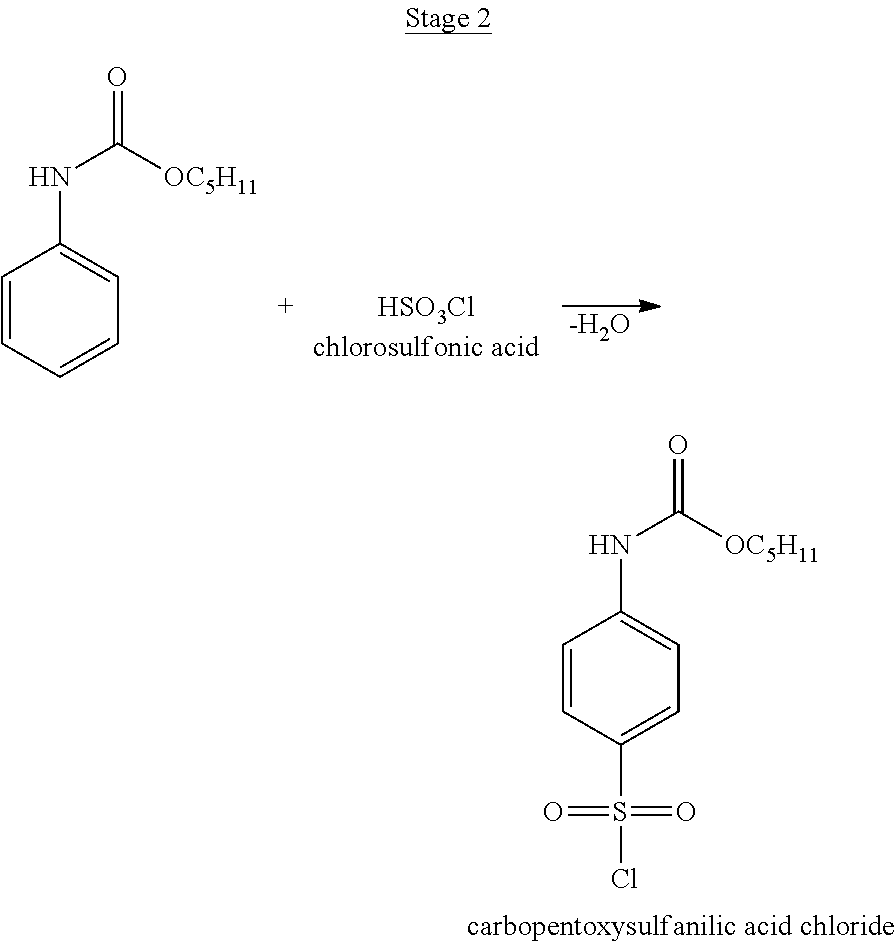
- Carbopentoxysulfanilic acid chloride is synthesized. To chlorosulfonic acid (17.5 g to 0.150 mol) heated to 30° C., amyl ether of phenylcarbamic acid (2.07 g-0.010 moles) is slowly added while stirring, maintaining the temperature of the reaction mass at a level no higher than 35° C. Then the mixture is slowly heated to 50° C. and kept at a temperature of 50-55° C. for 2 hours. The resulting sulphomass is poured onto ice while stirring, keeping the temperature below 20° C. The precipitate is filtered off, washed with ice water up to the pH of filtrate 7, dried in air and then in a desiccator. The yield of carbopentoxy sulfanilic acid chloride is about 100%.
- (2,6-dichlorophenyl)amide of carbopentoxysulfanilic acid is synthesized.
- 2,6-dichloroaniline 2.2 g to 0.0136 mol
- pyridine 3.23 g-0.0406 mol
- carbopentoxysulfanilic acid chloride 6.2 g-0.0203 mol
- 20 ml of hot water are added to the mass, the mixture is acidified with hydrochloric acid to pH 3-4 and cooled to the room temperature.
- the resulting precipitate is filtered off, washed with water until the odor of pyridine disappears, and dried.
- the yield of (2,6-dichlorophenyl)amide of carbopentoxysulfanilic acid is about 40%.
- the sodium salt of (2,6-dichlorophenyl)amide of carbopentoxysulfanilic acid is synthesized.
- 0.232 g of sodium hydroxide (NaOH) are dissolved in 5 ml of ethyl alcohol (C 2 H 5 OH), and 2.5 g of (2,6-dichlorophenyl)amide of carbopentoxysulfanilic acid are dissolved in 30 ml of ethyl alcohol (C 2 H 5 OH).
- the two solutions are mixed and stirred for 20 minutes, after which the ethyl alcohol is distilled off under vacuum. The remaining precipitate is dried.
- the product yield was 2.1 g (80%).
- the sodium salt of (2,6-dichlorophenyl)amide of carbopentoxysulfanilic acid is obtained.
- the disadvantage of this method is the low overall yield of the final product, sodium salt of (2,6-dichlorophenyl)amide of carbopentoxysulfanilic acid, which does not exceed 32% as yields of the intermediate products and the final product at individual stages are 100, 100, 40 and 80%, respectively.
- the total yield of sodium salt of (2,6-dichlorophenyl)amide of carbopentoxysulfanilic acid does not exceed 32%.
- the reaction mass in the preparation of (2,6-dichlorophenyl)amide of carbopentoxysulfanilic acid that includes synthesis of (2,6-dichlorophenyl)amide of carbopentoxysulfanilic acid by mixing 2,6-dichloroaniline and pyridine, then adding carbopentoxysulfanilic acid chloride to the mixture, mixing of the reaction mass in a medium acidified with a solution of hydrochloric acid, segregation of the precipitate, its washing and drying, and subsequent synthesis of the sodium salt of (2,6-dichlorophenyl)amide of carbopentoxysulfanilic acid by mixing the solutions in ethanol of sodium hydroxide and (2,6-dichlorophenyl)amide of carbopentoxysulfanilic acid, stirring the resulting mixture, distilling off the ethanol and drying the precipitate; the reaction mass in the preparation of (2,6-dichlorophenyl)amide of carbopentoxysulfani
- washing of the precipitate can be carried out with water acidified with a solution of hydrochloric acid to a pH of 5-5.5. This ensures complete purification of the product from the excess of pyridine, while the excess of hydrochloric acid is successfully removed during subsequent crystallization.
- the technical result is achieved that is to increase the yield and the purity of the target (2,6-dichlorophenyl)amide of carbopentoxysulfanilic acid.
- FIG. 1 shows the proton magnetic resonance spectrum of the sodium salt of (2,6-dichlorophenyl) amide of carbopentoxysulfanilic acid.
- FIG. 2 shows the ultraviolet spectrum of the sodium salt of (2,6-dichlorophenyl) amide of carbopentoxysulfanilic acid.
- FIG. 3 shows the infrared spectrum of the sodium salt of (2,6-dichlorophenyl) amide of carbopentoxysulfanilic acid.
- Phenyl isocyanate (11.5 g-0.096 mol) was mixed with pentanol (amyl alcohol) (8.5 g-0.096 mol), the reaction mass was heated, and after 1 hour the mixture solidified in the form of colorless crystals. Amyl ester of carbamic acid was obtained; the yield was about 100%.
- the yields of the intermediate products and the final product at the individual stages were 100, 100, 70 and 80%, respectively.
- the total yield of sodium salt of (2,6-dichlorophenyl)amide of carbopentoxysulfanilic acid was 56%.
- the structure of the synthesized product is proved by the methods of proton magnetic resonance (NMR), ultraviolet (UV) and infrared (IR) spectroscopy.
- the characteristic signals in the NMR spectrum are the singlet of NH group in the range of 9.7 ppm and the multiplet in the range of 6.5 ⁇ 7.5 ppm ( FIG. 1 ).
- the ultraviolet absorption spectrum of the solution obtained in the range from 200 to 380 nm has a maximum of 247 ⁇ 2 nm with an arm of (275 ⁇ 2 nm) ( FIG. 2 ).
- the characteristic absorption bands in the IR spectrum are shown in FIG. 3 (vibrations of the C—H bond in the 3600 cm ⁇ 1 range, NH in the 2900 cm ⁇ 1 range, C ⁇ O-1700 cm ⁇ 1 ).
- the invention is implemented using common materials and equipment, resulting, according to the applicant's opinion, in compliance of the invention with the “Industrial Applicability” (“IA”) patentability criterion.
- IA Industry Applicability
Landscapes
- Chemical & Material Sciences (AREA)
- Organic Chemistry (AREA)
- Chemical Kinetics & Catalysis (AREA)
- Organic Low-Molecular-Weight Compounds And Preparation Thereof (AREA)
Abstract
Description



Claims (8)


Applications Claiming Priority (3)
| Application Number | Priority Date | Filing Date | Title |
|---|---|---|---|
| RU2015141264 | 2015-09-15 | ||
| RU2015141264/04A RU2605602C1 (en) | 2015-09-15 | 2015-09-15 | Method of producing sodium salt of (2,6-dichlorophenyl)amide carbopentoxysulphanilic acid |
| PCT/RU2016/000624 WO2017048156A1 (en) | 2015-09-15 | 2016-09-13 | Method of producing a sodium salt of (2,6-dichlorophenyl)amide carbopentoxysulphanilic acid |
Publications (2)
| Publication Number | Publication Date |
|---|---|
| US20180244612A1 US20180244612A1 (en) | 2018-08-30 |
| US10584095B2 true US10584095B2 (en) | 2020-03-10 |
Family
ID=57793602
Family Applications (1)
| Application Number | Title | Priority Date | Filing Date |
|---|---|---|---|
| US15/758,410 Active US10584095B2 (en) | 2015-09-15 | 2016-09-13 | Method of producing a sodium salt of (2,6-dichlorophenyl)amide carbopentoxysulfanilic acid |
Country Status (4)
| Country | Link |
|---|---|
| US (1) | US10584095B2 (en) |
| EP (1) | EP3351530B1 (en) |
| RU (1) | RU2605602C1 (en) |
| WO (1) | WO2017048156A1 (en) |
Citations (13)
| Publication number | Priority date | Publication date | Assignee | Title |
|---|---|---|---|---|
| DE3544409A1 (en) | 1984-12-21 | 1986-10-16 | VEB Fahlberg-List Chemische und pharmazeutische Fabriken, DDR 3013 Magdeburg | 2-Arylsulphonamido-benzo- and acetophenones and their oximes, processes for their preparation and their use in medicaments |
| RU1405269C (en) | 1986-07-09 | 1993-12-30 | Институт биохимии АН ЛитССР | N-2-fluorenonesulfonyl derivatives of threo-dl-phenylserine showing antiviral activity with respect to herpes simplex virus type i |
| WO2000034234A1 (en) | 1998-12-04 | 2000-06-15 | Rimma Iliinichna Ashkinazi | Aryl- and heteroarylamides of carboalkoxysulfanilic acids |
| EP1038868A2 (en) | 1999-03-20 | 2000-09-27 | Bayer Aktiengesellschaft | Sulfonamides as antiviral agents |
| RU2182828C1 (en) | 2001-02-23 | 2002-05-27 | Поздняков Владимир Николаевич | Composition showing anti-hiv and anti-herpes activity |
| US6417181B1 (en) | 1998-01-23 | 2002-07-09 | Bayer Aktiengesellschaft | Naphthyl-substituted and anilide-substituted sulfonamides |
| US20030086992A1 (en) | 2001-10-24 | 2003-05-08 | Akiko Tanaka | Anti-HSV agent for inhibiting replication of HSV-1 and HSV-2 and method of producing a substance having anti-HSV activity |
| US6569864B1 (en) | 2001-07-11 | 2003-05-27 | Novactyl, Inc. | Pharmaceutical agents containing acyclovir, fusaric acid and derivatives thereof |
| DE10210319A1 (en) | 2002-03-08 | 2003-09-18 | Bayer Ag | New thiazole-5-sulfonamide derivatives, useful for the treatment of viral infections in humans and animals, especially herpes simplex or human cytomegalovirus infections |
| US20040157848A1 (en) | 2002-12-19 | 2004-08-12 | Pharmacia Corporation | Methods and compositions for the treatment of herpes virus infections using cyclooxygenase-2 selective inhibitors or cyclooxygenase-2 inhibitors in combination with antiviral agents |
| US20050037032A1 (en) | 1999-03-24 | 2005-02-17 | Catania Anna P. | Composition and method of treatment for urogenital conditions |
| RU2373951C1 (en) | 2008-04-07 | 2009-11-27 | Михаил Юрьевич Руденко | Method for prevention and treatment of chronic, frequently recurrent herpes virus infection |
| RU2452490C1 (en) | 2010-12-27 | 2012-06-10 | Виктор Вениаминович Тец | Drug with herpes virus family activity |
-
2015
- 2015-09-15 RU RU2015141264/04A patent/RU2605602C1/en active
-
2016
- 2016-09-13 US US15/758,410 patent/US10584095B2/en active Active
- 2016-09-13 EP EP16846947.6A patent/EP3351530B1/en active Active
- 2016-09-13 WO PCT/RU2016/000624 patent/WO2017048156A1/en not_active Ceased
Patent Citations (19)
| Publication number | Priority date | Publication date | Assignee | Title |
|---|---|---|---|---|
| DE3544409A1 (en) | 1984-12-21 | 1986-10-16 | VEB Fahlberg-List Chemische und pharmazeutische Fabriken, DDR 3013 Magdeburg | 2-Arylsulphonamido-benzo- and acetophenones and their oximes, processes for their preparation and their use in medicaments |
| RU1405269C (en) | 1986-07-09 | 1993-12-30 | Институт биохимии АН ЛитССР | N-2-fluorenonesulfonyl derivatives of threo-dl-phenylserine showing antiviral activity with respect to herpes simplex virus type i |
| US6417181B1 (en) | 1998-01-23 | 2002-07-09 | Bayer Aktiengesellschaft | Naphthyl-substituted and anilide-substituted sulfonamides |
| RU2199526C2 (en) | 1998-12-04 | 2003-02-27 | Ашкинази Римма Ильинична | Aryl- and heterylamides of carboalkoxy-sulfanilic acids |
| WO2000034234A1 (en) | 1998-12-04 | 2000-06-15 | Rimma Iliinichna Ashkinazi | Aryl- and heteroarylamides of carboalkoxysulfanilic acids |
| EP1136472A1 (en) | 1998-12-04 | 2001-09-26 | Rimma Iliinichna Ashkinazi | Aryl- and heteroarylamides of carboalkoxysulfanilic acids |
| EP1038868A2 (en) | 1999-03-20 | 2000-09-27 | Bayer Aktiengesellschaft | Sulfonamides as antiviral agents |
| US20050037032A1 (en) | 1999-03-24 | 2005-02-17 | Catania Anna P. | Composition and method of treatment for urogenital conditions |
| RU2182828C1 (en) | 2001-02-23 | 2002-05-27 | Поздняков Владимир Николаевич | Composition showing anti-hiv and anti-herpes activity |
| US6569864B1 (en) | 2001-07-11 | 2003-05-27 | Novactyl, Inc. | Pharmaceutical agents containing acyclovir, fusaric acid and derivatives thereof |
| US20030086992A1 (en) | 2001-10-24 | 2003-05-08 | Akiko Tanaka | Anti-HSV agent for inhibiting replication of HSV-1 and HSV-2 and method of producing a substance having anti-HSV activity |
| DE10210319A1 (en) | 2002-03-08 | 2003-09-18 | Bayer Ag | New thiazole-5-sulfonamide derivatives, useful for the treatment of viral infections in humans and animals, especially herpes simplex or human cytomegalovirus infections |
| US20040157848A1 (en) | 2002-12-19 | 2004-08-12 | Pharmacia Corporation | Methods and compositions for the treatment of herpes virus infections using cyclooxygenase-2 selective inhibitors or cyclooxygenase-2 inhibitors in combination with antiviral agents |
| RU2373951C1 (en) | 2008-04-07 | 2009-11-27 | Михаил Юрьевич Руденко | Method for prevention and treatment of chronic, frequently recurrent herpes virus infection |
| RU2452490C1 (en) | 2010-12-27 | 2012-06-10 | Виктор Вениаминович Тец | Drug with herpes virus family activity |
| WO2012091610A1 (en) | 2010-12-27 | 2012-07-05 | Tets Viktor Veniaminovich | Drug with activity against the herpes virus family |
| US20130287841A1 (en) | 2010-12-27 | 2013-10-31 | Viktor Veniaminovich Tets | Drug with Activity against the Herpes Virus Family |
| EP2659891A1 (en) | 2010-12-27 | 2013-11-06 | Tets, Viktor Veniaminovich | Drug with activity against the herpes virus family |
| US9567295B2 (en) * | 2010-12-27 | 2017-02-14 | Viktor Veniaminovich Tets | Drug with activity against the herpes virus family |
Non-Patent Citations (17)
| Title |
|---|
| Berge, S.M. et al., "Pharmaceutical Salts" Journal of Pharmaceutical Sciences (1977) vol. 66, Issue 1, pp. 1-19. |
| Didkovskii et al., "Gerpes˜virusnaya infekstiya: Klinicheskoe znachenie I printsipy terapii (Herpes Virus Infection: Clinical Significance and Principles of Therapy)" Russkii Meditsinskii Zhurnal (2004) vol. 12, No. 7, pp. 459-464. |
| English translation (2014) of RU 2199526 (2003), 6 pages total. |
| Extended European Search Report issued in European Application No. 11853372.8, dated Dec. 10, 2013. |
| Furman et al., "Aciclovir-resistant mutants of herpes simplex virus typr 1 express altered DNA polymerase or reduced aciclovir phosphorylating activities" J. Virol. (1981) vol. 3, pp. 936-941. |
| International Preliminary Report on Patentability issued by the International Searching Authority in International Application No. PCT/RU2016/000624, dated Mar. 20, 2018. |
| International Preliminary Report on Patentability issued in corresponding International Application No. PCT/RU2011/000060 dated Jul. 2, 2013. (translation included). |
| International Preliminary Report on Patentability issued in International Application No. PCT/RU2014/000420 dated Oct. 12, 2015 and English Translation thereof, 9 pages. |
| International Search Report and Written Opinion dated Sep. 25, 2014, issued in International Application No. PCT/RU2014/000420. (translation included). |
| International Search Report and Written Opinion dated Sep. 29, 2011, issued in International Application No. PCT/RU2011/000060. (translation included). |
| International Search Report issued by the International Searching Authority in International Application No. PCT/RU2016/000624 dated Mar. 6, 2017. |
| Mashkovskiy, Lekarstvenniye Sredstva, Moscow (2001) vol. 2, pp. 321-334. |
| Noueiry, A.O. et al., "Identification of Novel Small-Molecule Inhibitors of West Nile Virus Infection" Journal of Virology (2007) vol. 81, No. 21, pp. 11992-12004. |
| Pharmaceutical Salts: Properties, Selection, and Use (p. 331 )(Stahl et al., Ed.)(2002). |
| Rothaus, "Genital Herpes" (NEJM Resident 360 (Aug. 18, 2016))(retrieved from <https://resident360.nejm.org/content_items/genital-herpes> on Jun. 24, 2017), 3 pages total. |
| Supplemental/Extended European Search Report issued in European Patent Application No. 14806838.0 dated Jan. 13, 2017, 9 pages. |
| Written Opinion issued by the International Searching Authority in International Application No. PCT/RU2016/000624 dated Mar. 6, 2017. |
Also Published As
| Publication number | Publication date |
|---|---|
| US20180244612A1 (en) | 2018-08-30 |
| EP3351530B1 (en) | 2020-08-12 |
| WO2017048156A1 (en) | 2017-03-23 |
| EP3351530A4 (en) | 2019-04-10 |
| RU2605602C1 (en) | 2016-12-27 |
| EP3351530A1 (en) | 2018-07-25 |
Similar Documents
| Publication | Publication Date | Title |
|---|---|---|
| EP3129356B1 (en) | A process for producing enzalutamide | |
| JP2017513863A (en) | Polymorphic forms of 4,5-dihydro-1H-pyrrolo [2,3-F] quinoline-2,7,9-tricarboxylic acid and its disodium salt, methods for their preparation and their use | |
| JP2016508514A (en) | Process for the preparation of enantiomerically enriched 3-aminopiperidine | |
| JPH08134055A (en) | Production of 3-o-substituted-ascorbic acid | |
| US10584095B2 (en) | Method of producing a sodium salt of (2,6-dichlorophenyl)amide carbopentoxysulfanilic acid | |
| CN101180263B (en) | Preparation method of substituted tetrafluorobenzylaniline compound and pharmaceutically acceptable salt thereof | |
| JP2022184396A (en) | Method for producing 1-alkyl-5-hydroxypyrazole | |
| EP3110797B1 (en) | Process for the preparation of 5-fluorotryptophol | |
| US20200407355A1 (en) | Crystalline forms of venetoclax | |
| RU2611179C2 (en) | Method for improvement of winter wheat yield | |
| JP6284942B2 (en) | Improved method for preparing 2-amino-5,8-dimethoxy [1,2,4] triazolo [1,5-c] pyrimidine from 4-amino-2,5-dimethoxypyrimidine | |
| US2852553A (en) | Production of nitrosophenylaminoacid esters | |
| EP3640240B1 (en) | Method for purifying ropinirole hydrochloride | |
| RU2643315C2 (en) | Method of producing 3-(2-morpholinoethyl)-1,2,4-triazo[5,6-b]indole dihydrochloride | |
| CN111303063A (en) | Synthesis of Furazolidone Metabolite AOZ | |
| JP2003503368A (en) | Method for preparing (-)-(1S, 4R) N-protected 4-amino-2-cyclopentene-1-carboxylic acid ester | |
| RU2440343C1 (en) | 5-methyl-4-nitrosopyrazoles and synthesis method thereof | |
| JP2007031328A (en) | Method for producing L-carnosine | |
| JP2025060464A (en) | Preparation of crystalline forms of anti-Parkinson's drugs | |
| US10544114B2 (en) | Process for preparing oxathiazin-like compounds | |
| KR20190049980A (en) | Process for synthesizing ramalin not using Tin as a heavy metal | |
| EP3326999B1 (en) | Salicyloylcarnitin sulfonates | |
| CN108203410B (en) | Synthesis and application of edaravone impurity | |
| JPH0853425A (en) | Production of 1,2,3-triazole derivative | |
| CN103124719B (en) | The synthetic method of diclofenac choline salt |
Legal Events
| Date | Code | Title | Description |
|---|---|---|---|
| FEPP | Fee payment procedure |
Free format text: ENTITY STATUS SET TO UNDISCOUNTED (ORIGINAL EVENT CODE: BIG.); ENTITY STATUS OF PATENT OWNER: SMALL ENTITY |
|
| FEPP | Fee payment procedure |
Free format text: ENTITY STATUS SET TO SMALL (ORIGINAL EVENT CODE: SMAL); ENTITY STATUS OF PATENT OWNER: SMALL ENTITY |
|
| AS | Assignment |
Owner name: VIKTOR VENIAMINOVICH TETS, RUSSIAN FEDERATION Free format text: ASSIGNMENT OF ASSIGNORS INTEREST;ASSIGNOR:KRUTIKOV, VIKTOR IOSIFOVICH;REEL/FRAME:045581/0796 Effective date: 20180411 Owner name: GEORGY VIKTOROVICH TETS, RUSSIAN FEDERATION Free format text: ASSIGNMENT OF ASSIGNORS INTEREST;ASSIGNOR:KRUTIKOV, VIKTOR IOSIFOVICH;REEL/FRAME:045581/0796 Effective date: 20180411 |
|
| STPP | Information on status: patent application and granting procedure in general |
Free format text: NON FINAL ACTION MAILED |
|
| STPP | Information on status: patent application and granting procedure in general |
Free format text: RESPONSE TO NON-FINAL OFFICE ACTION ENTERED AND FORWARDED TO EXAMINER |
|
| STPP | Information on status: patent application and granting procedure in general |
Free format text: FINAL REJECTION MAILED |
|
| STPP | Information on status: patent application and granting procedure in general |
Free format text: NOTICE OF ALLOWANCE MAILED -- APPLICATION RECEIVED IN OFFICE OF PUBLICATIONS |
|
| STPP | Information on status: patent application and granting procedure in general |
Free format text: PUBLICATIONS -- ISSUE FEE PAYMENT RECEIVED |
|
| STCF | Information on status: patent grant |
Free format text: PATENTED CASE |
|
| FEPP | Fee payment procedure |
Free format text: MAINTENANCE FEE REMINDER MAILED (ORIGINAL EVENT CODE: REM.); ENTITY STATUS OF PATENT OWNER: SMALL ENTITY |
|
| FEPP | Fee payment procedure |
Free format text: SURCHARGE FOR LATE PAYMENT, SMALL ENTITY (ORIGINAL EVENT CODE: M2554); ENTITY STATUS OF PATENT OWNER: SMALL ENTITY |
|
| MAFP | Maintenance fee payment |
Free format text: PAYMENT OF MAINTENANCE FEE, 4TH YR, SMALL ENTITY (ORIGINAL EVENT CODE: M2551); ENTITY STATUS OF PATENT OWNER: SMALL ENTITY Year of fee payment: 4 |