US10580997B2 - Condensed cyclic compound and organic light-emitting device including the same - Google Patents
Condensed cyclic compound and organic light-emitting device including the same Download PDFInfo
- Publication number
- US10580997B2 US10580997B2 US15/585,829 US201715585829A US10580997B2 US 10580997 B2 US10580997 B2 US 10580997B2 US 201715585829 A US201715585829 A US 201715585829A US 10580997 B2 US10580997 B2 US 10580997B2
- Authority
- US
- United States
- Prior art keywords
- group
- substituted
- formula
- deuterium
- formulae
- Prior art date
- Legal status (The legal status is an assumption and is not a legal conclusion. Google has not performed a legal analysis and makes no representation as to the accuracy of the status listed.)
- Active, expires
Links
- 0 *C1=CC=C([5*])C=C1.C.CC.CC.CC.CC.CC.CC.CC.C[C@@H]1C2=C(C=CC=C2)N(C)[C@@H]1C.[Ar]N1C2=C(C=CC=C2)C2=C1/C=C\C=C/2 Chemical compound *C1=CC=C([5*])C=C1.C.CC.CC.CC.CC.CC.CC.CC.C[C@@H]1C2=C(C=CC=C2)N(C)[C@@H]1C.[Ar]N1C2=C(C=CC=C2)C2=C1/C=C\C=C/2 0.000 description 40
- UCHPZENZQCOXHP-UHFFFAOYSA-N C1=CC=C(C2=CC(C3=CC=CC=C3)=CC(N3C4=CC=C(N5C6=C(C=CC=C6)C6=C5C=CC5=C6OC6=C5C=CC=C6)C=C4C4=C3C=CC=C4)=C2)C=C1 Chemical compound C1=CC=C(C2=CC(C3=CC=CC=C3)=CC(N3C4=CC=C(N5C6=C(C=CC=C6)C6=C5C=CC5=C6OC6=C5C=CC=C6)C=C4C4=C3C=CC=C4)=C2)C=C1 UCHPZENZQCOXHP-UHFFFAOYSA-N 0.000 description 5
- GKMQFBGWPSCOBE-UHFFFAOYSA-N C1=CC=C(C2=CC=CC(N3C4=CC=C(N5C6=C(C=CC=C6)C6=C5C=CC5=C6OC6=C5C=CC=C6)C=C4C4=C3C=CC=C4)=C2)C=C1 Chemical compound C1=CC=C(C2=CC=CC(N3C4=CC=C(N5C6=C(C=CC=C6)C6=C5C=CC5=C6OC6=C5C=CC=C6)C=C4C4=C3C=CC=C4)=C2)C=C1 GKMQFBGWPSCOBE-UHFFFAOYSA-N 0.000 description 4
- XASOZRAVXAMEOU-UHFFFAOYSA-N CC1(C)C2=CC3=C(C=C2C2=C1C=CC=C2)C1=C(C=CC=C1)N3C1=CC2=C(C=C1)N(C1=CC(C3=CC=CC=C3)=CC=C1)C1=C2C=CC=C1 Chemical compound CC1(C)C2=CC3=C(C=C2C2=C1C=CC=C2)C1=C(C=CC=C1)N3C1=CC2=C(C=C1)N(C1=CC(C3=CC=CC=C3)=CC=C1)C1=C2C=CC=C1 XASOZRAVXAMEOU-UHFFFAOYSA-N 0.000 description 4
- QAKJLSKTLMKISS-UHFFFAOYSA-N C1=CC=C(C2=CC(C3=CC=CC=C3)=CC(N3C4=CC=C(N5C6=C(C=CC=C6)C6=C5C5=C(C=C6)C6=C(C=CC=C6)N5C5=CC=CC=C5)C=C4C4=C3C=CC=C4)=C2)C=C1.F Chemical compound C1=CC=C(C2=CC(C3=CC=CC=C3)=CC(N3C4=CC=C(N5C6=C(C=CC=C6)C6=C5C5=C(C=C6)C6=C(C=CC=C6)N5C5=CC=CC=C5)C=C4C4=C3C=CC=C4)=C2)C=C1.F QAKJLSKTLMKISS-UHFFFAOYSA-N 0.000 description 3
- CEQQCGVHVHYJNX-UHFFFAOYSA-N C1=CC=C(C2=CC=CC(N3C4=C(C=CC=C4)C4=C\C(N5C6=C(C=CC=C6)C6=C5C5=C(C=C6)C6=C(C=CC=C6)O5)=C/C=C\43)=C2)C=C1 Chemical compound C1=CC=C(C2=CC=CC(N3C4=C(C=CC=C4)C4=C\C(N5C6=C(C=CC=C6)C6=C5C5=C(C=C6)C6=C(C=CC=C6)O5)=C/C=C\43)=C2)C=C1 CEQQCGVHVHYJNX-UHFFFAOYSA-N 0.000 description 3
- IEPOUCISYDNSFP-UHFFFAOYSA-N C1=CC=C(C2=CC=CC(N3C4=CC=C(N5C6=C(C=CC=C6)C6=C5C=CC5=C6SC6=C5C=CC=C6)C=C4C4=C3C=CC=C4)=C2)C=C1 Chemical compound C1=CC=C(C2=CC=CC(N3C4=CC=C(N5C6=C(C=CC=C6)C6=C5C=CC5=C6SC6=C5C=CC=C6)C=C4C4=C3C=CC=C4)=C2)C=C1 IEPOUCISYDNSFP-UHFFFAOYSA-N 0.000 description 3
- MLTMYYLNRRXFPR-IEOVAKBOSA-N C1=CC=C(C2=NC(C3=CC=CC=C3)=NC(C3=CC=CC(N4C5=CC=C(N6C7=C(C=CC=C7)C7=C6C6=C(C=C7)C7=C(C=CC=C7)O6)C=C5C5=C4/C=C\C=C/5)=C3)=N2)C=C1.[2HH] Chemical compound C1=CC=C(C2=NC(C3=CC=CC=C3)=NC(C3=CC=CC(N4C5=CC=C(N6C7=C(C=CC=C7)C7=C6C6=C(C=C7)C7=C(C=CC=C7)O6)C=C5C5=C4/C=C\C=C/5)=C3)=N2)C=C1.[2HH] MLTMYYLNRRXFPR-IEOVAKBOSA-N 0.000 description 3
- FVYQFACRWYHYRQ-UHFFFAOYSA-N CC.CC.CC.[Ar]N1C2=C(C=CC=C2)C2=C1/C=C\C=C/2 Chemical compound CC.CC.CC.[Ar]N1C2=C(C=CC=C2)C2=C1/C=C\C=C/2 FVYQFACRWYHYRQ-UHFFFAOYSA-N 0.000 description 3
- MZYDBGLUVPLRKR-UHFFFAOYSA-N C1=CC(N2C3=C(C=CC=C3)C3=C2C=CC=C3)=CC(N2C3=C(C=CC=C3)C3=C2C=CC=C3)=C1 Chemical compound C1=CC(N2C3=C(C=CC=C3)C3=C2C=CC=C3)=CC(N2C3=C(C=CC=C3)C3=C2C=CC=C3)=C1 MZYDBGLUVPLRKR-UHFFFAOYSA-N 0.000 description 2
- ZLGMNAROGNWOJH-UHFFFAOYSA-N C1=CC=C(C2=C(N3C4=CC(N5C6=C(C=CC=C6)C6=C5C5=C(C=C6)OC6=C5C=CC=C6)=CC=C4C4=C3C=CC=C4)C=CC=C2)C=C1.C1=CC=C(C2=CC=CC(N3C4=C(C=CC=C4)C4=C\C(N5C6=C(C=CC=C6)C6=C5C5=C(C=C6)C6=C(C=CC=C6)O5)=C/C=C\43)=C2)C=C1.C1=CC=C(C2=CC=CC(N3C4=CC(N5C6=C(C=CC=C6)C6=C5C5=C(C=C6)OC6=C5C=CC=C6)=CC=C4C4=C3C=CC=C4)=C2)C=C1 Chemical compound C1=CC=C(C2=C(N3C4=CC(N5C6=C(C=CC=C6)C6=C5C5=C(C=C6)OC6=C5C=CC=C6)=CC=C4C4=C3C=CC=C4)C=CC=C2)C=C1.C1=CC=C(C2=CC=CC(N3C4=C(C=CC=C4)C4=C\C(N5C6=C(C=CC=C6)C6=C5C5=C(C=C6)C6=C(C=CC=C6)O5)=C/C=C\43)=C2)C=C1.C1=CC=C(C2=CC=CC(N3C4=CC(N5C6=C(C=CC=C6)C6=C5C5=C(C=C6)OC6=C5C=CC=C6)=CC=C4C4=C3C=CC=C4)=C2)C=C1 ZLGMNAROGNWOJH-UHFFFAOYSA-N 0.000 description 2
- JBMGAWXIYAAFBX-UHFFFAOYSA-N C1=CC=C(C2=C(N3C4=CC(N5C6=C(C=CC=C6)C6=C5C=C5OC7=C(/C=C\C=C/7)C5=C6)=CC=C4C4=C3C=CC=C4)C=CC=C2)C=C1.C1=CC=C(C2=C(N3C4=CC=CC(N5C6=C(C=CC=C6)C6=C5/C=C\C5=C6SC6=C5C=CC=C6)=C4C4=C3C=CC=C4)C=CC=C2)C=C1.C1=CC=C(C2=CC=CC(N3C4=CC(N5C6=C(C=CC=C6)C6=C5C=C5OC7=C(/C=C\C=C/7)C5=C6)=CC=C4C4=C3C=CC=C4)=C2)C=C1.C1=CC=C(C2=CC=CC(N3C4=CC=CC(N5C6=C(C=CC=C6)C6=C5/C=C\C5=C6SC6=C5C=CC=C6)=C4C4=C3C=CC=C4)=C2)C=C1 Chemical compound C1=CC=C(C2=C(N3C4=CC(N5C6=C(C=CC=C6)C6=C5C=C5OC7=C(/C=C\C=C/7)C5=C6)=CC=C4C4=C3C=CC=C4)C=CC=C2)C=C1.C1=CC=C(C2=C(N3C4=CC=CC(N5C6=C(C=CC=C6)C6=C5/C=C\C5=C6SC6=C5C=CC=C6)=C4C4=C3C=CC=C4)C=CC=C2)C=C1.C1=CC=C(C2=CC=CC(N3C4=CC(N5C6=C(C=CC=C6)C6=C5C=C5OC7=C(/C=C\C=C/7)C5=C6)=CC=C4C4=C3C=CC=C4)=C2)C=C1.C1=CC=C(C2=CC=CC(N3C4=CC=CC(N5C6=C(C=CC=C6)C6=C5/C=C\C5=C6SC6=C5C=CC=C6)=C4C4=C3C=CC=C4)=C2)C=C1 JBMGAWXIYAAFBX-UHFFFAOYSA-N 0.000 description 2
- OTYQYPAHZSPDSL-UHFFFAOYSA-N C1=CC=C(C2=CC(C3=CC=CC=C3)=CC(N3C4=CC=C(N5C6=C(C=CC=C6)C6=C5/C=C\C5=C6OC6=C5C=CC=C6)C=C4C4=C3C=CC=C4)=C2)C=C1.C1=CC=C(C2=CC=CC(N3C4=C(C=CC=C4)C4=C\C(N5C6=C(C=CC=C6)C6=C5C=CC5=C6SC6=C5C=CC=C6)=C/C=C\43)=C2)C=C1.C1=CC=C(C2=CC=CC(N3C4=CC(N5C6=C(C=CC=C6)C6=C5C=CC5=C6OC6=C5/C=C\C=C/6)=CC=C4C4=C3C=CC=C4)=C2)C=C1.C1=CC=C(C2=CC=CC(N3C4=CC=C(N5C6=C(C=CC=C6)C6=C5/C=C\C5=C6OC6=C5C=CC=C6)C=C4C4=C3C=CC=C4)=C2)C=C1 Chemical compound C1=CC=C(C2=CC(C3=CC=CC=C3)=CC(N3C4=CC=C(N5C6=C(C=CC=C6)C6=C5/C=C\C5=C6OC6=C5C=CC=C6)C=C4C4=C3C=CC=C4)=C2)C=C1.C1=CC=C(C2=CC=CC(N3C4=C(C=CC=C4)C4=C\C(N5C6=C(C=CC=C6)C6=C5C=CC5=C6SC6=C5C=CC=C6)=C/C=C\43)=C2)C=C1.C1=CC=C(C2=CC=CC(N3C4=CC(N5C6=C(C=CC=C6)C6=C5C=CC5=C6OC6=C5/C=C\C=C/6)=CC=C4C4=C3C=CC=C4)=C2)C=C1.C1=CC=C(C2=CC=CC(N3C4=CC=C(N5C6=C(C=CC=C6)C6=C5/C=C\C5=C6OC6=C5C=CC=C6)C=C4C4=C3C=CC=C4)=C2)C=C1 OTYQYPAHZSPDSL-UHFFFAOYSA-N 0.000 description 2
- JDLVIKURWSIWLO-UHFFFAOYSA-N C1=CC=C(C2=CC=CC(N3C4=CC(N5C6=C(C=CC=C6)C6=C5C5=C(C=C6)OC6=C5C=CC=C6)=CC=C4C4=C3C=CC=C4)=C2)C=C1 Chemical compound C1=CC=C(C2=CC=CC(N3C4=CC(N5C6=C(C=CC=C6)C6=C5C5=C(C=C6)OC6=C5C=CC=C6)=CC=C4C4=C3C=CC=C4)=C2)C=C1 JDLVIKURWSIWLO-UHFFFAOYSA-N 0.000 description 2
- MROCLUMXYNBXDM-UHFFFAOYSA-N *.C1=CC=C(N2C3=C(C=CC=C3)C3=C2C=CC(N2C4=C(C=CC=C4)C4=C2C2=C(C=C4)C4=C(C=CC=C4)O2)=C3)C=C1 Chemical compound *.C1=CC=C(N2C3=C(C=CC=C3)C3=C2C=CC(N2C4=C(C=CC=C4)C4=C2C2=C(C=C4)C4=C(C=CC=C4)O2)=C3)C=C1 MROCLUMXYNBXDM-UHFFFAOYSA-N 0.000 description 1
- HIIQXQDGQJFRFJ-UHFFFAOYSA-N B.C1=CC=C(N2C3=C(C=CC=C3)C3=C2C=CC(N2C4=C(C=CC=C4)C4=C2C=C2OC5=C(C=CC=C5)C2=C4)=C3)C=C1 Chemical compound B.C1=CC=C(N2C3=C(C=CC=C3)C3=C2C=CC(N2C4=C(C=CC=C4)C4=C2C=C2OC5=C(C=CC=C5)C2=C4)=C3)C=C1 HIIQXQDGQJFRFJ-UHFFFAOYSA-N 0.000 description 1
- FVWLQJZBJNYOEH-HGUGXOTLSA-N BN=P.C1=CC=C(N(C2=CC3=C(C=C2)C2=C(C=C(N(C4=CC=CC=C4)C4=C5C=CC=CC5=CC=C4)C=C2)C32C3=CC=CC=C3C3=C2C=CC=C3)C2=C3C=CC=CC3=CC=C2)C=C1.C1=CC=C(N(C2=CC=C(C3=CC=C(N(C4=CC=CC=C4)C4=C5C=CC=CC5=CC=C4)C=C3)C=C2)C2=CC=CC3=C2C=CC=C3)C=C1.C1=CC=C(N(C2=CC=C(C3=CC=C(N(C4=CC=CC=C4)C4=CC5=C(C=CC=C5)C=C4)C=C3)C=C2)C2=CC3=C(C=CC=C3)C=C2)C=C1.CC1=CC(N(C2=CC=CC=C2)C2=CC3=C(C=C2)C2=C(C=C(N(C4=CC=CC=C4)C4=CC=CC(C)=C4)C=C2)C32C3=CC=CC=C3C3=C2C=CC=C3)=CC=C1.CC1=CC=CC(N(C2=CC=CC=C2)C2=CC=C(C3=CC=C(N(C4=CC=CC=C4)C4=CC=CC(C)=C4)C=C3)C=C2)=C1.[2H]P[3H] Chemical compound BN=P.C1=CC=C(N(C2=CC3=C(C=C2)C2=C(C=C(N(C4=CC=CC=C4)C4=C5C=CC=CC5=CC=C4)C=C2)C32C3=CC=CC=C3C3=C2C=CC=C3)C2=C3C=CC=CC3=CC=C2)C=C1.C1=CC=C(N(C2=CC=C(C3=CC=C(N(C4=CC=CC=C4)C4=C5C=CC=CC5=CC=C4)C=C3)C=C2)C2=CC=CC3=C2C=CC=C3)C=C1.C1=CC=C(N(C2=CC=C(C3=CC=C(N(C4=CC=CC=C4)C4=CC5=C(C=CC=C5)C=C4)C=C3)C=C2)C2=CC3=C(C=CC=C3)C=C2)C=C1.CC1=CC(N(C2=CC=CC=C2)C2=CC3=C(C=C2)C2=C(C=C(N(C4=CC=CC=C4)C4=CC=CC(C)=C4)C=C2)C32C3=CC=CC=C3C3=C2C=CC=C3)=CC=C1.CC1=CC=CC(N(C2=CC=CC=C2)C2=CC=C(C3=CC=C(N(C4=CC=CC=C4)C4=CC=CC(C)=C4)C=C3)C=C2)=C1.[2H]P[3H] FVWLQJZBJNYOEH-HGUGXOTLSA-N 0.000 description 1
- SJAUGFZYJBUAAT-UHFFFAOYSA-N BrC1=C/C2=C(\C=C/1)N(C1=CC(C3=CC=CC=C3)=CC(C3=CC=CC=C3)=C1)C1=C2C=CC=C1 Chemical compound BrC1=C/C2=C(\C=C/1)N(C1=CC(C3=CC=CC=C3)=CC(C3=CC=CC=C3)=C1)C1=C2C=CC=C1 SJAUGFZYJBUAAT-UHFFFAOYSA-N 0.000 description 1
- RLRTZTBYUWXHGT-UHFFFAOYSA-N BrC1=C/C=C2\C3=C(C=CC=C3)N(C3=CC(C4=CC=CC=C4)=CC=C3)\C2=C\1 Chemical compound BrC1=C/C=C2\C3=C(C=CC=C3)N(C3=CC(C4=CC=CC=C4)=CC=C3)\C2=C\1 RLRTZTBYUWXHGT-UHFFFAOYSA-N 0.000 description 1
- LJLQVEUIZBXSBD-UHFFFAOYSA-N BrC1=CC=C2C(=C1)C1=C(C=CC=C1)N2C1=CC(C2=CC=CC=C2)=CC=C1.C1=CC2=C(C=C1)C1=C(/C=C\C3=C1OC1=C3C=CC=C1)C2.C1=CC=C(C2=CC=CC(N3C4=C(C=C(N5C6=C(C=CC=C6)C6=C5C=CC5=C6OC6=C5C=CC=C6)C=C4)C4=C3/C=C\C=C/4)=C2)C=C1 Chemical compound BrC1=CC=C2C(=C1)C1=C(C=CC=C1)N2C1=CC(C2=CC=CC=C2)=CC=C1.C1=CC2=C(C=C1)C1=C(/C=C\C3=C1OC1=C3C=CC=C1)C2.C1=CC=C(C2=CC=CC(N3C4=C(C=C(N5C6=C(C=CC=C6)C6=C5C=CC5=C6OC6=C5C=CC=C6)C=C4)C4=C3/C=C\C=C/4)=C2)C=C1 LJLQVEUIZBXSBD-UHFFFAOYSA-N 0.000 description 1
- QNUOLIBAMUPRHW-UHFFFAOYSA-N C.C1=CC=C(C2=CC=C(N3C4=C(C=CC=C4)C4=C3C=CC(N3C5=C(C=CC=C5)C5=C3C3=C(C=C5)C5=C(C=CC=C5)O3)=C4)C=C2)C=C1 Chemical compound C.C1=CC=C(C2=CC=C(N3C4=C(C=CC=C4)C4=C3C=CC(N3C5=C(C=CC=C5)C5=C3C3=C(C=C5)C5=C(C=CC=C5)O3)=C4)C=C2)C=C1 QNUOLIBAMUPRHW-UHFFFAOYSA-N 0.000 description 1
- COCWKIZMRIKJFY-UHFFFAOYSA-N C.C1=CC=C(C2=CC=NC3=C4/N=C\C=C(\C5=CC=CC=C5)C4=CC=C23)C=C1.CBP.CC1=NC2=C3/N=C(C)\C=C(\C4=CC=CC=C4)C3=CC=C2C(C2=CC=CC=C2)=C1 Chemical compound C.C1=CC=C(C2=CC=NC3=C4/N=C\C=C(\C5=CC=CC=C5)C4=CC=C23)C=C1.CBP.CC1=NC2=C3/N=C(C)\C=C(\C4=CC=CC=C4)C3=CC=C2C(C2=CC=CC=C2)=C1 COCWKIZMRIKJFY-UHFFFAOYSA-N 0.000 description 1
- RQZNASRQMOAVTB-QRGJVGTBSA-N C.CC.CC.C[C@@H]1C2=C(C=CC=C2)N(C)[C@@H]1C Chemical compound C.CC.CC.C[C@@H]1C2=C(C=CC=C2)N(C)[C@@H]1C RQZNASRQMOAVTB-QRGJVGTBSA-N 0.000 description 1
- NBKBEUKTRFGYMV-UHFFFAOYSA-L C/C1=O/[Pt]23/O=C(/C)C4=CC=CC=C4N2C2=CC=CC=C2N3C2=CC=CC=C21.C1=CC=C(N2C3=CC=CC4=N3[Pt@]3(C5=CC=CC=C54)C4=C(C=CC=C4)C4=N3C2=CC=C4)C=C1.C1=CC=C2C(=C1)C1=CC=CC3=N1[Pt@@]21C2=C(C=CC=C2)C2=N1C(=CC=C2)O3.CC(C)(C)C1=CC(N2C3=CC=CC4=N3[Pt@@]3(C5=CC=CC=C5C5=CC=CC2=N53)C2=C4C=CC=C2)=CC(C(C)(C)C)=C1.CC1(C)C2=CC=CC3=N2[Pt@]2(C4=CC(F)=CC(F)=C43)C3=C(C(F)=CC(F)=C3)C3=N2C1=CC=C3.CC1(C)C2=CC=CC3=N2[Pt@]2(C4=NC=CC=C43)C3=C(C=CC=N3)C3=N2C1=CC=C3 Chemical compound C/C1=O/[Pt]23/O=C(/C)C4=CC=CC=C4N2C2=CC=CC=C2N3C2=CC=CC=C21.C1=CC=C(N2C3=CC=CC4=N3[Pt@]3(C5=CC=CC=C54)C4=C(C=CC=C4)C4=N3C2=CC=C4)C=C1.C1=CC=C2C(=C1)C1=CC=CC3=N1[Pt@@]21C2=C(C=CC=C2)C2=N1C(=CC=C2)O3.CC(C)(C)C1=CC(N2C3=CC=CC4=N3[Pt@@]3(C5=CC=CC=C5C5=CC=CC2=N53)C2=C4C=CC=C2)=CC(C(C)(C)C)=C1.CC1(C)C2=CC=CC3=N2[Pt@]2(C4=CC(F)=CC(F)=C43)C3=C(C(F)=CC(F)=C3)C3=N2C1=CC=C3.CC1(C)C2=CC=CC3=N2[Pt@]2(C4=NC=CC=C43)C3=C(C=CC=N3)C3=N2C1=CC=C3 NBKBEUKTRFGYMV-UHFFFAOYSA-L 0.000 description 1
- CUQGKGMUSQKHFO-UHFFFAOYSA-N C1=CC(N2C3=C(C=CC=C3)C3=C2C=CC=C3)=NC(N2C3=C(C=CC=C3)C3=C2C=CC=C3)=C1 Chemical compound C1=CC(N2C3=C(C=CC=C3)C3=C2C=CC=C3)=NC(N2C3=C(C=CC=C3)C3=C2C=CC=C3)=C1 CUQGKGMUSQKHFO-UHFFFAOYSA-N 0.000 description 1
- XMOIETJYZBDLDE-UHFFFAOYSA-N C1=CC2=C(C=C1)C1=C(/C=C\C3=C1SC1=C3C=CC=C1)C2 Chemical compound C1=CC2=C(C=C1)C1=C(/C=C\C3=C1SC1=C3C=CC=C1)C2 XMOIETJYZBDLDE-UHFFFAOYSA-N 0.000 description 1
- PXIMQVIHTBUXRY-UHFFFAOYSA-N C1=CC2=C(C=C1)C1=C(C2)C2=C(/C=C\1)C1=C(C=CC=C1)O2 Chemical compound C1=CC2=C(C=C1)C1=C(C2)C2=C(/C=C\1)C1=C(C=CC=C1)O2 PXIMQVIHTBUXRY-UHFFFAOYSA-N 0.000 description 1
- NQEXWHPYINFSNW-UHFFFAOYSA-N C1=CC2=C(C=C1)C1=C(C2)C2=C(/C=C\1)OC1=C2C=CC=C1 Chemical compound C1=CC2=C(C=C1)C1=C(C2)C2=C(/C=C\1)OC1=C2C=CC=C1 NQEXWHPYINFSNW-UHFFFAOYSA-N 0.000 description 1
- STAINBIAWLIXPY-UHFFFAOYSA-M C1=CC2=C(C=C1)C1=N(CO2)C2=C(C=CC=C2)S1.[Li]1OC2=CC=CC3=C2/N1=C\C=C/3 Chemical compound C1=CC2=C(C=C1)C1=N(CO2)C2=C(C=CC=C2)S1.[Li]1OC2=CC=CC3=C2/N1=C\C=C/3 STAINBIAWLIXPY-UHFFFAOYSA-M 0.000 description 1
- FXFNBRAORDJPPX-UHFFFAOYSA-N C1=CC2=C3C(=C1)OC1=N4C(=CC=C1)C1=CC=CC5=N1[Pt]34C1=C2C=CC=C1O5.C1=CC=C(N(C2=CC=CC=C2)C2=CC=C(N3C4=CC=CC5=C4[Pt@@]4(C6=C3C=CC=C6C3=CC=CC=N34)N3=C5C=CC=C3)C=C2)C=C1.C1=CC=C(N2C3=CC=CC4=C3[Pt@]3(C5=C2C=CC=C5C2=CC=CC=N23)N2=C4C=CC=C2)C=C1.C1=CC=C2C(=C1)C1=C(C=CC=C1)N2C1=CC=C(N2C3=CC=CC4=C3[Pt@@]3(C5=C2C=CC=C5C2=CC=CC=N23)N2=C4C=CC=C2)C=C1.CC(C)(C)C1=CC(N2C3=CC=CC4=C3[Pt@]3(C5=C2C=CC=C5C2=CC=CC=N23)N2=C4C=CC=C2)=CC(C(C)(C)C)=C1.CC1=CC(C)=C(N2C3=CC=CC4=C3[Pt@]3(C5=C2C=CC=C5C2=CC=CC=N23)N2=C4C=CC=C2)C(C)=C1 Chemical compound C1=CC2=C3C(=C1)OC1=N4C(=CC=C1)C1=CC=CC5=N1[Pt]34C1=C2C=CC=C1O5.C1=CC=C(N(C2=CC=CC=C2)C2=CC=C(N3C4=CC=CC5=C4[Pt@@]4(C6=C3C=CC=C6C3=CC=CC=N34)N3=C5C=CC=C3)C=C2)C=C1.C1=CC=C(N2C3=CC=CC4=C3[Pt@]3(C5=C2C=CC=C5C2=CC=CC=N23)N2=C4C=CC=C2)C=C1.C1=CC=C2C(=C1)C1=C(C=CC=C1)N2C1=CC=C(N2C3=CC=CC4=C3[Pt@@]3(C5=C2C=CC=C5C2=CC=CC=N23)N2=C4C=CC=C2)C=C1.CC(C)(C)C1=CC(N2C3=CC=CC4=C3[Pt@]3(C5=C2C=CC=C5C2=CC=CC=N23)N2=C4C=CC=C2)=CC(C(C)(C)C)=C1.CC1=CC(C)=C(N2C3=CC=CC4=C3[Pt@]3(C5=C2C=CC=C5C2=CC=CC=N23)N2=C4C=CC=C2)C(C)=C1 FXFNBRAORDJPPX-UHFFFAOYSA-N 0.000 description 1
- FRGPQKXWSHJYFK-UHFFFAOYSA-H C1=CC2=C3C(=C1)O[Al]14(OC5=CC=CC6=C5N1=CC=C6)(OC1=CC=CC5=C1/N4=C\C=C/5)N3=CC=C2.C1=CC=C(C2=NN=C(C3=CC=CC=C3)N2C2=CC=CC3=C2C=CC=C3)C=C1.CC(C)(C)C1=CC=C(C2=NN=C(C3=CC=C(C4=CC=CC=C4)C=C3)N2C2=CC=CC=C2)C=C1.CC1=N2C3=C(C=CC=C3O[AlH]23(OC2=CC=C(C4=CC=CC=C4)C=C2)O/C2=C/C=C\C4=C2N3=C(C)C=C4)C=C1 Chemical compound C1=CC2=C3C(=C1)O[Al]14(OC5=CC=CC6=C5N1=CC=C6)(OC1=CC=CC5=C1/N4=C\C=C/5)N3=CC=C2.C1=CC=C(C2=NN=C(C3=CC=CC=C3)N2C2=CC=CC3=C2C=CC=C3)C=C1.CC(C)(C)C1=CC=C(C2=NN=C(C3=CC=C(C4=CC=CC=C4)C=C3)N2C2=CC=CC=C2)C=C1.CC1=N2C3=C(C=CC=C3O[AlH]23(OC2=CC=C(C4=CC=CC=C4)C=C2)O/C2=C/C=C\C4=C2N3=C(C)C=C4)C=C1 FRGPQKXWSHJYFK-UHFFFAOYSA-H 0.000 description 1
- JIUSLJDUPAXGKQ-UHFFFAOYSA-N C1=CC2=CC=CC(C3=CC=C(C4=NC(C5=CC6=C(C=CC=C6)C=C5)=NC(C5=CC6=C(C=CC=C6)C=C5)=N4)C=C3)=C2N=C1.C1=CC=C(N2C3=C(C=CC=C3)/N=C\2C2=CC=C(C3=CC4=C(\C5=CC6=C(C=CC=C6)C=C5)C5=CC=CC=C5/C(C5=CC6=C(C=CC=C6)C=C5)=C\4C=C3)C=C2)C=C1.C1=CC=C2C(=C1)/C(C1=CC3=C(C=CC=C3)C=C1)=C1/C=CC(C3=CC=C(C4=CC5=C(C=CC=C5)N=C4)N=C3)=C/C1=C/2C1=CC2=C(C=CC=C2)C=C1 Chemical compound C1=CC2=CC=CC(C3=CC=C(C4=NC(C5=CC6=C(C=CC=C6)C=C5)=NC(C5=CC6=C(C=CC=C6)C=C5)=N4)C=C3)=C2N=C1.C1=CC=C(N2C3=C(C=CC=C3)/N=C\2C2=CC=C(C3=CC4=C(\C5=CC6=C(C=CC=C6)C=C5)C5=CC=CC=C5/C(C5=CC6=C(C=CC=C6)C=C5)=C\4C=C3)C=C2)C=C1.C1=CC=C2C(=C1)/C(C1=CC3=C(C=CC=C3)C=C1)=C1/C=CC(C3=CC=C(C4=CC5=C(C=CC=C5)N=C4)N=C3)=C/C1=C/2C1=CC2=C(C=CC=C2)C=C1 JIUSLJDUPAXGKQ-UHFFFAOYSA-N 0.000 description 1
- NPACGFLJARXPBP-UHFFFAOYSA-N C1=CC2=CC=N3C(=C2C=C1)OC1=CC=CC2=C1[Pt]31C3=C2C=CC=C3OC2=C3C=CC=CC3=CC=N21.CC1(C)C2=CC=CC3=C2[Pt]2(C4=C3C=CC=C4C(C)(C)C3=CC=CC=N32)N2=CC=CC=C21.CN1C2=C(C=CC=C2)C2=C1C1=N3C(=CC=C1)CC1=CC=CC4=N1[Pt]23C1=C4N(C)C2=C1C=CC=C2.FC1=CC(F)=C2CC3=C(F)C=C(F)C4=C3[Pt@@]3(C2=C1C1=CC=CC=N13)N1=C4C=CC=C1.O=C1C2=CC=C3/C=C\C4=CC=C5C(=O)C6=CC=CC=N6[Pt]6(C2=C3C4=C56)N2=CC=CC=C12.O=C1C2=CC=CC3=C2[Pt@@]2(C4=C(C=CC=C14)C1=N2C=CC2=C1C=CC=C2)N1=CC=C2C=CC=CC2=C31 Chemical compound C1=CC2=CC=N3C(=C2C=C1)OC1=CC=CC2=C1[Pt]31C3=C2C=CC=C3OC2=C3C=CC=CC3=CC=N21.CC1(C)C2=CC=CC3=C2[Pt]2(C4=C3C=CC=C4C(C)(C)C3=CC=CC=N32)N2=CC=CC=C21.CN1C2=C(C=CC=C2)C2=C1C1=N3C(=CC=C1)CC1=CC=CC4=N1[Pt]23C1=C4N(C)C2=C1C=CC=C2.FC1=CC(F)=C2CC3=C(F)C=C(F)C4=C3[Pt@@]3(C2=C1C1=CC=CC=N13)N1=C4C=CC=C1.O=C1C2=CC=C3/C=C\C4=CC=C5C(=O)C6=CC=CC=N6[Pt]6(C2=C3C4=C56)N2=CC=CC=C12.O=C1C2=CC=CC3=C2[Pt@@]2(C4=C(C=CC=C14)C1=N2C=CC2=C1C=CC=C2)N1=CC=C2C=CC=CC2=C31 NPACGFLJARXPBP-UHFFFAOYSA-N 0.000 description 1
- FEZOXDHHICNBPD-UHFFFAOYSA-N C1=CC=C(C2=C(N3C4=CC=CC5=C4[Pt@]4(C6=C3C=CC=C6C3=CC=CC=N34)N3=C5C=CC=C3)C=CC=C2)C=C1.CC12CCC(C3=C4\C5=N(C=C6C=CC=CC6=C5)[Pt]5(N4\N=C/31)N1/N=C3C(=C/1C1=N5C=C4C=CC=CC4=C1)\C1CCC\3(C)C1(C)C)C2(C)C.CC12CCC(C3=C4\C5=N(C=CC6=CC=CC=C65)[Pt]5(N4\N=C/31)N1/N=C3C(=C/1C1=N5C=CC4=CC=CC=C41)\C1CCC\3(C)C1(C)C)C2(C)C.CC12CCC(C3=C4\C5=N(C=CC=C5)[Pt]5(N4\N=C/31)N1/N=C3C(=C/1C1=N5C=CC=C1)\C1CCC\3(C)C1(C)C)C2(C)C.CC1=NN2C(=C1)C1=N(C=CC=C1)[Pt]21N2N=C(C)C=C2C2=N1C=CC=C2 Chemical compound C1=CC=C(C2=C(N3C4=CC=CC5=C4[Pt@]4(C6=C3C=CC=C6C3=CC=CC=N34)N3=C5C=CC=C3)C=CC=C2)C=C1.CC12CCC(C3=C4\C5=N(C=C6C=CC=CC6=C5)[Pt]5(N4\N=C/31)N1/N=C3C(=C/1C1=N5C=C4C=CC=CC4=C1)\C1CCC\3(C)C1(C)C)C2(C)C.CC12CCC(C3=C4\C5=N(C=CC6=CC=CC=C65)[Pt]5(N4\N=C/31)N1/N=C3C(=C/1C1=N5C=CC4=CC=CC=C41)\C1CCC\3(C)C1(C)C)C2(C)C.CC12CCC(C3=C4\C5=N(C=CC=C5)[Pt]5(N4\N=C/31)N1/N=C3C(=C/1C1=N5C=CC=C1)\C1CCC\3(C)C1(C)C)C2(C)C.CC1=NN2C(=C1)C1=N(C=CC=C1)[Pt]21N2N=C(C)C=C2C2=N1C=CC=C2 FEZOXDHHICNBPD-UHFFFAOYSA-N 0.000 description 1
- ZLPBHJLNZKAMET-UHFFFAOYSA-M C1=CC=C(C2=CC3=C4C(=C2)N(C2=CC=CC=C2)C2=N5C(=CC(C6=CC=CC=C6)=C2)C2=CC=CC=N2[Pt@]45N2=C3C=CC=C2)C=C1.C1=CC=C(N2C3=CC=CC4=C3[Pt@]3(C5=C2C=CC=C5C2=N3C=CS2)N2=C4SC=C2)C=C1.C1=CC=C2C(=C1)C1=CC=CC3=N1[Pt@@]21OC2=C(SC=C2)C2=CC=CC3=N21.CCCCCCCCC1=CC=C(N2C3=CC=CC4=C3[Pt]3(C5=C2C=CC=C5C2=CC=CC=N23)N2=C4C=CC=C2)C=C1.O=C1C2=CC=CC3=C2[Pt@@]2(C4=C1C=CC=C4C1=CC=CC=N12)N1=C3C=CC=C1 Chemical compound C1=CC=C(C2=CC3=C4C(=C2)N(C2=CC=CC=C2)C2=N5C(=CC(C6=CC=CC=C6)=C2)C2=CC=CC=N2[Pt@]45N2=C3C=CC=C2)C=C1.C1=CC=C(N2C3=CC=CC4=C3[Pt@]3(C5=C2C=CC=C5C2=N3C=CS2)N2=C4SC=C2)C=C1.C1=CC=C2C(=C1)C1=CC=CC3=N1[Pt@@]21OC2=C(SC=C2)C2=CC=CC3=N21.CCCCCCCCC1=CC=C(N2C3=CC=CC4=C3[Pt]3(C5=C2C=CC=C5C2=CC=CC=N23)N2=C4C=CC=C2)C=C1.O=C1C2=CC=CC3=C2[Pt@@]2(C4=C1C=CC=C4C1=CC=CC=N12)N1=C3C=CC=C1 ZLPBHJLNZKAMET-UHFFFAOYSA-M 0.000 description 1
- IWWYDWKVDWUBFK-UHFFFAOYSA-N C1=CC=C(C2=CC=C(N(C3=CC=C(C4=CC5=C(C=C4)N(C4=CC=CC=C4)C4=C5/C=C\C=C/4)C=C3)C3=CC=C4C(=C3)C(C3=CC=CC=C3)(C3=CC=CC=C3)C3=C4C=CC=C3)C=C2)C=C1.C1=CC=C(C2=CC=C(N(C3=CC=C(C4=CC5=C(C=C4)N(C4=CC=CC=C4)C4=C5/C=C\C=C/4)C=C3)C3=CC=C4C(=C3)C3(C5=C4C=CC=C5)C4=C(C=CC=C4)C4=C3C=CC=C4)C=C2)C=C1.CC1(C)C2=CC(N(C3=CC=CC=C3)C3=CC=C(C4=CC5=C(C=C4)N(C4=CC=C(C6=CC=CC=C6)C=C4)C4=C5/C=C\C=C/4)C=C3)=CC=C2C2=C1C=CC=C2 Chemical compound C1=CC=C(C2=CC=C(N(C3=CC=C(C4=CC5=C(C=C4)N(C4=CC=CC=C4)C4=C5/C=C\C=C/4)C=C3)C3=CC=C4C(=C3)C(C3=CC=CC=C3)(C3=CC=CC=C3)C3=C4C=CC=C3)C=C2)C=C1.C1=CC=C(C2=CC=C(N(C3=CC=C(C4=CC5=C(C=C4)N(C4=CC=CC=C4)C4=C5/C=C\C=C/4)C=C3)C3=CC=C4C(=C3)C3(C5=C4C=CC=C5)C4=C(C=CC=C4)C4=C3C=CC=C4)C=C2)C=C1.CC1(C)C2=CC(N(C3=CC=CC=C3)C3=CC=C(C4=CC5=C(C=C4)N(C4=CC=C(C6=CC=CC=C6)C=C4)C4=C5/C=C\C=C/4)C=C3)=CC=C2C2=C1C=CC=C2 IWWYDWKVDWUBFK-UHFFFAOYSA-N 0.000 description 1
- TTZIJIBBILRMAJ-UHFFFAOYSA-N C1=CC=C(C2=CC=C(N(C3=CC=C(C4=CC=C(N(C5=CC=C(C6=CC=CC=C6)C=C5)C5=CC6=C(C=C5)N(C5=CC=CC=C5)C5=C6C=CC=C5)C=C4)C=C3)C3=CC=C4C(=C3)C3=C(C=CC=C3)N4C3=CC=CC=C3)C=C2)C=C1.C1=CC=C(C2=CC=CC(N(C3=CC=C(C4=CC=C(N(C5=CC=CC(C6=CC=CC=C6)=C5)C5=CC6=C(C=C5)N(C5=CC=CC=C5)C5=C6C=CC=C5)C=C4)C=C3)C3=CC=C4C(=C3)C3=C(C=CC=C3)N4C3=CC=CC=C3)=C2)C=C1.FC1=CC=C(N2C3=CC=C(N(C4=CC=CC=C4)C4=CC=C(C5=CC=C(N(C6=CC=CC=C6)C6=CC7=C(C=C6)N(C6=CC=C(F)C=C6)C6=C7C=CC=C6)C=C5)C=C4)C=C3C3=C2C=CC=C3)C=C1 Chemical compound C1=CC=C(C2=CC=C(N(C3=CC=C(C4=CC=C(N(C5=CC=C(C6=CC=CC=C6)C=C5)C5=CC6=C(C=C5)N(C5=CC=CC=C5)C5=C6C=CC=C5)C=C4)C=C3)C3=CC=C4C(=C3)C3=C(C=CC=C3)N4C3=CC=CC=C3)C=C2)C=C1.C1=CC=C(C2=CC=CC(N(C3=CC=C(C4=CC=C(N(C5=CC=CC(C6=CC=CC=C6)=C5)C5=CC6=C(C=C5)N(C5=CC=CC=C5)C5=C6C=CC=C5)C=C4)C=C3)C3=CC=C4C(=C3)C3=C(C=CC=C3)N4C3=CC=CC=C3)=C2)C=C1.FC1=CC=C(N2C3=CC=C(N(C4=CC=CC=C4)C4=CC=C(C5=CC=C(N(C6=CC=CC=C6)C6=CC7=C(C=C6)N(C6=CC=C(F)C=C6)C6=C7C=CC=C6)C=C5)C=C4)C=C3C3=C2C=CC=C3)C=C1 TTZIJIBBILRMAJ-UHFFFAOYSA-N 0.000 description 1
- FSXJQUHLJABBKR-UHFFFAOYSA-N C1=CC=C(C2=CC=CC(N3C4=CC(N5C6=C(C=CC=C6)C6=C5C=C5OC7=C(C=CC=C7)C5=C6)=CC=C4C4=C3C=CC=C4)=C2)C=C1.C1=CC=C(C2=CC=CC(N3C4=CC=CC(N5C6=C(C=CC=C6)C6=C5C=CC5=C6SC6=C5C=CC=C6)=C4C4=C3C=CC=C4)=C2)C=C1 Chemical compound C1=CC=C(C2=CC=CC(N3C4=CC(N5C6=C(C=CC=C6)C6=C5C=C5OC7=C(C=CC=C7)C5=C6)=CC=C4C4=C3C=CC=C4)=C2)C=C1.C1=CC=C(C2=CC=CC(N3C4=CC=CC(N5C6=C(C=CC=C6)C6=C5C=CC5=C6SC6=C5C=CC=C6)=C4C4=C3C=CC=C4)=C2)C=C1 FSXJQUHLJABBKR-UHFFFAOYSA-N 0.000 description 1
- AZVGVVVRSVUHPU-UHFFFAOYSA-N C1=CC=C(C2=CC=CC(N3C4=CC(N5C6=C(C=CC=C6)C6=C5C=CC5=C6OC6=C5/C=C\C=C/6)=CC=C4C4=C3C=CC=C4)=C2)C=C1 Chemical compound C1=CC=C(C2=CC=CC(N3C4=CC(N5C6=C(C=CC=C6)C6=C5C=CC5=C6OC6=C5/C=C\C=C/6)=CC=C4C4=C3C=CC=C4)=C2)C=C1 AZVGVVVRSVUHPU-UHFFFAOYSA-N 0.000 description 1
- SBVQYMNLNFEQDB-UHFFFAOYSA-N C1=CC=C(C2=CC=CC(N3C4=CC(N5C6=C(C=CC=C6)C6=C5C=CC5=C6OC6=C5/C=C\C=C/6)=CC=C4C4=C3C=CC=C4)=C2)C=C1.C1=CC=C(C2=CC=CC(N3C4=CC=C(N5C6=C(C=CC=C6)C6=C5C=CC5=C6OC6=C5C=CC=C6)C=C4C4=C3C=CC=C4)=C2)C=C1.C1=CC=C(C2=CC=CC(N3C4=CC=C(N5C6=C(C=CC=C6)C6=C5C=CC5=C6SC6=C5C=CC=C6)C=C4C4=C3C=CC=C4)=C2)C=C1 Chemical compound C1=CC=C(C2=CC=CC(N3C4=CC(N5C6=C(C=CC=C6)C6=C5C=CC5=C6OC6=C5/C=C\C=C/6)=CC=C4C4=C3C=CC=C4)=C2)C=C1.C1=CC=C(C2=CC=CC(N3C4=CC=C(N5C6=C(C=CC=C6)C6=C5C=CC5=C6OC6=C5C=CC=C6)C=C4C4=C3C=CC=C4)=C2)C=C1.C1=CC=C(C2=CC=CC(N3C4=CC=C(N5C6=C(C=CC=C6)C6=C5C=CC5=C6SC6=C5C=CC=C6)C=C4C4=C3C=CC=C4)=C2)C=C1 SBVQYMNLNFEQDB-UHFFFAOYSA-N 0.000 description 1
- BUMVHDXKMOGFPV-UHFFFAOYSA-N C1=CC=C(N(C2=CC=C(C3=CC=C(N(C4=CC=CC=C4)C4=CC5=C(C=C4)N(C4=CC=CC=C4)C4=C5C=CC=C4)C=C3)C=C2)C2=CC=C3C(=C2)C2=C(C=CC=C2)N3C2=CC=CC=C2)C=C1.C1=CC=C(N2C3=CC=C(N(C4=CC=C(C5=CC=C(N(C6=CC7=C(C=C6)N(C6=CC=CC=C6)C6=C7C=CC=C6)C6=CC=CC7=C6C=CC=C7)C=C5)C=C4)C4=C5C=CC=CC5=CC=C4)C=C3C3=C2C=CC=C3)C=C1.CC1=CC=C(N(C2=CC=C(C3=CC=C(N(C4=CC=C(C)C=C4)C4=CC5=C(C=C4)N(C4=CC=CC=C4)C4=C5C=CC=C4)C=C3)C=C2)C2=CC=C3C(=C2)C2=C(C=CC=C2)N3C2=CC=CC=C2)C=C1.FC1=CC=C(N(C2=CC=C(C3=CC=C(N(C4=CC=C(F)C=C4)C4=CC5=C(C=C4)N(C4=CC=CC=C4)C4=C5C=CC=C4)C=C3)C=C2)C2=CC=C3C(=C2)C2=C(C=CC=C2)N3C2=CC=CC=C2)C=C1.[C-]#[N+]C1=CC=C(N(C2=CC=C(C3=CC=C(N(C4=CC=C(C#N)C=C4)C4=CC5=C(C=C4)N(C4=CC=CC=C4)C4=C5C=CC=C4)C=C3)C=C2)C2=CC=C3C(=C2)C2=C(C=CC=C2)N3C2=CC=CC=C2)C=C1 Chemical compound C1=CC=C(N(C2=CC=C(C3=CC=C(N(C4=CC=CC=C4)C4=CC5=C(C=C4)N(C4=CC=CC=C4)C4=C5C=CC=C4)C=C3)C=C2)C2=CC=C3C(=C2)C2=C(C=CC=C2)N3C2=CC=CC=C2)C=C1.C1=CC=C(N2C3=CC=C(N(C4=CC=C(C5=CC=C(N(C6=CC7=C(C=C6)N(C6=CC=CC=C6)C6=C7C=CC=C6)C6=CC=CC7=C6C=CC=C7)C=C5)C=C4)C4=C5C=CC=CC5=CC=C4)C=C3C3=C2C=CC=C3)C=C1.CC1=CC=C(N(C2=CC=C(C3=CC=C(N(C4=CC=C(C)C=C4)C4=CC5=C(C=C4)N(C4=CC=CC=C4)C4=C5C=CC=C4)C=C3)C=C2)C2=CC=C3C(=C2)C2=C(C=CC=C2)N3C2=CC=CC=C2)C=C1.FC1=CC=C(N(C2=CC=C(C3=CC=C(N(C4=CC=C(F)C=C4)C4=CC5=C(C=C4)N(C4=CC=CC=C4)C4=C5C=CC=C4)C=C3)C=C2)C2=CC=C3C(=C2)C2=C(C=CC=C2)N3C2=CC=CC=C2)C=C1.[C-]#[N+]C1=CC=C(N(C2=CC=C(C3=CC=C(N(C4=CC=C(C#N)C=C4)C4=CC5=C(C=C4)N(C4=CC=CC=C4)C4=C5C=CC=C4)C=C3)C=C2)C2=CC=C3C(=C2)C2=C(C=CC=C2)N3C2=CC=CC=C2)C=C1 BUMVHDXKMOGFPV-UHFFFAOYSA-N 0.000 description 1
- YGGWFXWUKYPDIO-UEXXUXETSA-G C1=CC=C(N2C3=CC4=CC=CC5=N4[Pt@@]4(N3C3=C2C=CC=C3)N2C3=C(C=CC=C3)N(C3=CC=CC=C3)/C2=C/C2=CC=CC5=N24)C=C1.C1=CC=C2C(=C1)O[Pd@@]13OC4=C(C=CC=C4)C4=CC=CC(=N41)C1=N3C2=CC=C1.C1=CC=C2C(=C1)O[Pt]13OC4=C(C=CC=C4)C4=C5C(=CC=C4)O/C(=N\51)C1=N3C3=C2C=CC=C3O1.C1=CC=N2C(=C1)CC1=CC=CC3=C1[Pt]21C2=C3C=CC=C2CC2=CC=CC=N21.CC(C)(C)C1=CC2=N3C(=C1)C1=CC=CC=C1O[Pt@]31OC3=C(C=CC=C3)C3=CC(C(C)(C)C)=CC2=N31.CC1=CC(C)=O[Ir]2(O1)C1=CC3=C(C=C1C1=N2C=CC2=C1C=CC=C2)C(C)(C)C1=C3C=CC=C1 Chemical compound C1=CC=C(N2C3=CC4=CC=CC5=N4[Pt@@]4(N3C3=C2C=CC=C3)N2C3=C(C=CC=C3)N(C3=CC=CC=C3)/C2=C/C2=CC=CC5=N24)C=C1.C1=CC=C2C(=C1)O[Pd@@]13OC4=C(C=CC=C4)C4=CC=CC(=N41)C1=N3C2=CC=C1.C1=CC=C2C(=C1)O[Pt]13OC4=C(C=CC=C4)C4=C5C(=CC=C4)O/C(=N\51)C1=N3C3=C2C=CC=C3O1.C1=CC=N2C(=C1)CC1=CC=CC3=C1[Pt]21C2=C3C=CC=C2CC2=CC=CC=N21.CC(C)(C)C1=CC2=N3C(=C1)C1=CC=CC=C1O[Pt@]31OC3=C(C=CC=C3)C3=CC(C(C)(C)C)=CC2=N31.CC1=CC(C)=O[Ir]2(O1)C1=CC3=C(C=C1C1=N2C=CC2=C1C=CC=C2)C(C)(C)C1=C3C=CC=C1 YGGWFXWUKYPDIO-UEXXUXETSA-G 0.000 description 1
- DGFKZTGZGJKACO-KMHAACEFSA-J C1=CC=C(N2C3=CC=CC4=N3[Pt]3(OC5=CC=CC=C54)OC4=CC=CC=C4C4=N3C2=CC=C4)C=C1.CC1(C)C2=CC=CC3=N2[Pt]2(OC4=CC=CC=C43)OC3=CC=CC=C3C3=N2C1=CC=C3.CC1C2=C(C=CC=C2)N2=C1C1=N3C(=CC=C1)CC1=CC=CC4=N1[Pt]32N1=C4C(C)C2=C1C=CC=C2.CCC1=C(CC)/C2=C/C3=C(CC)C(CC)=C4/C=C5/C(C)=C(C)C(C)=N5[Pt@]5(N34)N2C1=CC1=N5C=CC=C1.FC1=CC(F)=C2C(=C1)[Pt@@]13C4=C(C(F)=CC(F)=C4)C4=N1C(=CC=C4)CC1=CC=CC2=N13 Chemical compound C1=CC=C(N2C3=CC=CC4=N3[Pt]3(OC5=CC=CC=C54)OC4=CC=CC=C4C4=N3C2=CC=C4)C=C1.CC1(C)C2=CC=CC3=N2[Pt]2(OC4=CC=CC=C43)OC3=CC=CC=C3C3=N2C1=CC=C3.CC1C2=C(C=CC=C2)N2=C1C1=N3C(=CC=C1)CC1=CC=CC4=N1[Pt]32N1=C4C(C)C2=C1C=CC=C2.CCC1=C(CC)/C2=C/C3=C(CC)C(CC)=C4/C=C5/C(C)=C(C)C(C)=N5[Pt@]5(N34)N2C1=CC1=N5C=CC=C1.FC1=CC(F)=C2C(=C1)[Pt@@]13C4=C(C(F)=CC(F)=C4)C4=N1C(=CC=C4)CC1=CC=CC2=N13 DGFKZTGZGJKACO-KMHAACEFSA-J 0.000 description 1
- RMPUPLXZQPBFBC-UHFFFAOYSA-H C1=CC=C(N2C=C3C4=C(C=CC=C4)O[Pt@]45OC6=CC=CC=C6C6=C/N(C7=CC=CC=C7)\C(=N/64)C2=N35)C=C1.C1=CC=C2C(=C1)S[Pt]13SC4=C(C=CC=C4)C4=CC=NC(=N41)C1=N3C2=CC=N1.CN1C2=C3C(=CC=C2)C(=O)O[Pt@@]24OC(=O)C5=CC=CC6=C5/N2=C(/C1=N34)N6C.CN1C2=CC=CC=C2C2=N3C4=C(C=CC5=C4N4=C(C=C5C5=CC=CC=C5)C5=C(C=CC=C5)N(C)[Pt@]134)C(C1=CC=CC=C1)=C2.FC1=CC(F)=C2C(=C1)[Pt@@]13C4=C(C(F)=CC(F)=C4)C4=N1C(=CC=C4)N(C1=CC=CC=C1)C1=CC=CC2=N13 Chemical compound C1=CC=C(N2C=C3C4=C(C=CC=C4)O[Pt@]45OC6=CC=CC=C6C6=C/N(C7=CC=CC=C7)\C(=N/64)C2=N35)C=C1.C1=CC=C2C(=C1)S[Pt]13SC4=C(C=CC=C4)C4=CC=NC(=N41)C1=N3C2=CC=N1.CN1C2=C3C(=CC=C2)C(=O)O[Pt@@]24OC(=O)C5=CC=CC6=C5/N2=C(/C1=N34)N6C.CN1C2=CC=CC=C2C2=N3C4=C(C=CC5=C4N4=C(C=C5C5=CC=CC=C5)C5=C(C=CC=C5)N(C)[Pt@]134)C(C1=CC=CC=C1)=C2.FC1=CC(F)=C2C(=C1)[Pt@@]13C4=C(C(F)=CC(F)=C4)C4=N1C(=CC=C4)N(C1=CC=CC=C1)C1=CC=CC2=N13 RMPUPLXZQPBFBC-UHFFFAOYSA-H 0.000 description 1
- AXNUILYBQMVHJW-FOZVVUDMSA-J C1=CC=C2C(=C1)[Ir]N1=C2C2=C(C=CC=C2)C=C1.CC1=CC(C)=O[Ir@]2(O1)C1=CC=CC=C1C1=N2C=CC2=C1C=CC=C2.CC1=CC(C)=O[Ir]2(O1)C1=C(SC3=C1C=CC=C3)C1=CC=CC=N12.CC1=CC2=N(N1C)[Ir@]1(OC2=O)C2=CC(F)=CC(F)=C2C2=N1C=CC=C2.CNCC1=CC2=N(C=C1)[Ir@@]1(OC(=O)C3=N1N(C)C(C)=C3)C1=CC(F)=CC(F)=C12 Chemical compound C1=CC=C2C(=C1)[Ir]N1=C2C2=C(C=CC=C2)C=C1.CC1=CC(C)=O[Ir@]2(O1)C1=CC=CC=C1C1=N2C=CC2=C1C=CC=C2.CC1=CC(C)=O[Ir]2(O1)C1=C(SC3=C1C=CC=C3)C1=CC=CC=N12.CC1=CC2=N(N1C)[Ir@]1(OC2=O)C2=CC(F)=CC(F)=C2C2=N1C=CC=C2.CNCC1=CC2=N(C=C1)[Ir@@]1(OC(=O)C3=N1N(C)C(C)=C3)C1=CC(F)=CC(F)=C12 AXNUILYBQMVHJW-FOZVVUDMSA-J 0.000 description 1
- GYQHIGVVHALTID-IROGFXLBSA-K C1=CC=C2C(=C1)[Ir]N1=C2C=CC2=C1C=CC=C2.CC1=CC(C)=O[Ir@]2(O1)C1=C(SC3=C1C=CC=C3)C1=CC=CC=N12.CC1=CC(C)=O[Ir]2(O1)C1=CC3=C(C=C1C1=N2C2=C(C=CC=C2)C=C1)C(C)(C)C1=C3C=CC=C1.CC1=CC(C)=O[Ir]2(O1)C1=CC=CC=C1C1=N2C2=C(C=CC=C2)C=C1 Chemical compound C1=CC=C2C(=C1)[Ir]N1=C2C=CC2=C1C=CC=C2.CC1=CC(C)=O[Ir@]2(O1)C1=C(SC3=C1C=CC=C3)C1=CC=CC=N12.CC1=CC(C)=O[Ir]2(O1)C1=CC3=C(C=C1C1=N2C2=C(C=CC=C2)C=C1)C(C)(C)C1=C3C=CC=C1.CC1=CC(C)=O[Ir]2(O1)C1=CC=CC=C1C1=N2C2=C(C=CC=C2)C=C1 GYQHIGVVHALTID-IROGFXLBSA-K 0.000 description 1
- MCKFDPPSLORVOS-BXPXCZKQSA-L C1=CC=C2C(=C1)[Ir]N1=C2C=CC=C1.CC(C)(C)C1=CC(C(C)(C)C)=O[Ir@]2(O1)C1=CC(F)=CC(F)=C1C1=N2C=CC(CO)=C1.CC1=CC2=N(C=C1)[Ir]C1=CC(F)=NC(F)=C12.CN(C)C1=CC2=N(C=C1)[Ir]C1=CC(F)=NC(F)=C12.FC1=CC(F)=C2C(=C1)[Ir]N1=CC=CN21.O=C1O[Ir@]2(C3=CC(F)=CC(F)=C3C3=N2C=CC=C3)N2=C1C=CC=C2 Chemical compound C1=CC=C2C(=C1)[Ir]N1=C2C=CC=C1.CC(C)(C)C1=CC(C(C)(C)C)=O[Ir@]2(O1)C1=CC(F)=CC(F)=C1C1=N2C=CC(CO)=C1.CC1=CC2=N(C=C1)[Ir]C1=CC(F)=NC(F)=C12.CN(C)C1=CC2=N(C=C1)[Ir]C1=CC(F)=NC(F)=C12.FC1=CC(F)=C2C(=C1)[Ir]N1=CC=CN21.O=C1O[Ir@]2(C3=CC(F)=CC(F)=C3C3=N2C=CC=C3)N2=C1C=CC=C2 MCKFDPPSLORVOS-BXPXCZKQSA-L 0.000 description 1
- VULHYRAYXYTONQ-UHFFFAOYSA-N C=Nc1ccccc1 Chemical compound C=Nc1ccccc1 VULHYRAYXYTONQ-UHFFFAOYSA-N 0.000 description 1
- CRLMNIRPBNXSBA-UHFFFAOYSA-N CC(C)C1=CC=CC(C(C)C)=C1N1C=CN2=C1C1=CC(C#N)=CC=C1[Ir]2.CC1=CC2=C(C=C1)C1=N(C=CC=C1)[Ir]2.CC1=CN2=C(C=C1)C1=C(C=CC=C1)[Ir]2.FC1=CC(F)=C2C(=C1)[Ir]1(N3=CC=CN3B(N3C=CC=N3)(N3C=CC=N3)N3/C=C\C=N/31)N1=C2C=CC=C1 Chemical compound CC(C)C1=CC=CC(C(C)C)=C1N1C=CN2=C1C1=CC(C#N)=CC=C1[Ir]2.CC1=CC2=C(C=C1)C1=N(C=CC=C1)[Ir]2.CC1=CN2=C(C=C1)C1=C(C=CC=C1)[Ir]2.FC1=CC(F)=C2C(=C1)[Ir]1(N3=CC=CN3B(N3C=CC=N3)(N3C=CC=N3)N3/C=C\C=N/31)N1=C2C=CC=C1 CRLMNIRPBNXSBA-UHFFFAOYSA-N 0.000 description 1
- POTZVILGTDCJFC-UHFFFAOYSA-N CC.CC.CC.CC.CC.CC.CC.CC.CC1=C/C2=C(\C=C/1)C1=C(C=CC=C1)N2[Ar].[Ar].[Ar].[Ar].[Ar]/C1=C/C=C\C2=C1C1=C(C=CC=C1)N2[Ar].[Ar]/C1=C/C=C\C2=C1N([Ar])C1=C2C=CC=C1.[Ar]C1=C/C2=C(\C=C/1)N([Ar])C1=C2C=CC=C1 Chemical compound CC.CC.CC.CC.CC.CC.CC.CC.CC1=C/C2=C(\C=C/1)C1=C(C=CC=C1)N2[Ar].[Ar].[Ar].[Ar].[Ar]/C1=C/C=C\C2=C1C1=C(C=CC=C1)N2[Ar].[Ar]/C1=C/C=C\C2=C1N([Ar])C1=C2C=CC=C1.[Ar]C1=C/C2=C(\C=C/1)N([Ar])C1=C2C=CC=C1 POTZVILGTDCJFC-UHFFFAOYSA-N 0.000 description 1
- SJWLBXLMBDYZTR-UHFFFAOYSA-N CC.CC.CC.CC.CC.CC.CC.CC.[Ar].[Ar].[Ar].[Ar].[Ar]/C1=C/C=C\C2=C1C1=C(C=CC=C1)N2[Ar].[Ar]/C1=C/C=C\C2=C1N([Ar])C1=C2C=CC=C1.[Ar]C1=C/C2=C(\C=C/1)C1=C(C=CC=C1)N2[Ar].[Ar]C1=C/C2=C(\C=C/1)N([Ar])C1=C2C=CC=C1 Chemical compound CC.CC.CC.CC.CC.CC.CC.CC.[Ar].[Ar].[Ar].[Ar].[Ar]/C1=C/C=C\C2=C1C1=C(C=CC=C1)N2[Ar].[Ar]/C1=C/C=C\C2=C1N([Ar])C1=C2C=CC=C1.[Ar]C1=C/C2=C(\C=C/1)C1=C(C=CC=C1)N2[Ar].[Ar]C1=C/C2=C(\C=C/1)N([Ar])C1=C2C=CC=C1 SJWLBXLMBDYZTR-UHFFFAOYSA-N 0.000 description 1
- NZMJFPYDFCNDBY-UHFFFAOYSA-N CC1(C)C2=CC(N(C3=CC=C(C4=CC5=C(C=C4)N(C4=CC=CC=C4)C4=C5/C=C\C=C/4)C=C3)C3=CC=C4C(=C3)C(C)(C)C3=C4C=CC=C3)=CC=C2C2=C1C=CC=C2.CC1(C)C2=CC(N(C3=CC=C4C(=C3)C(C)(C)C3=C4C=CC=C3)C3=CC4=C(C=C3)N(C3=CC=CC=C3)C3=C4/C=C\C=C/3)=CC=C2C2=C1C=CC=C2.CC1(C)C2=CC(N(C3=CC=CC=C3)C3=CC=C(C4=CC5=C(C=C4)N(C4=CC=CC=C4)C4=C5/C=C\C=C/4)C4=C3C=CC=C4)=CC=C2C2=C1C=CC=C2 Chemical compound CC1(C)C2=CC(N(C3=CC=C(C4=CC5=C(C=C4)N(C4=CC=CC=C4)C4=C5/C=C\C=C/4)C=C3)C3=CC=C4C(=C3)C(C)(C)C3=C4C=CC=C3)=CC=C2C2=C1C=CC=C2.CC1(C)C2=CC(N(C3=CC=C4C(=C3)C(C)(C)C3=C4C=CC=C3)C3=CC4=C(C=C3)N(C3=CC=CC=C3)C3=C4/C=C\C=C/3)=CC=C2C2=C1C=CC=C2.CC1(C)C2=CC(N(C3=CC=CC=C3)C3=CC=C(C4=CC5=C(C=C4)N(C4=CC=CC=C4)C4=C5/C=C\C=C/4)C4=C3C=CC=C4)=CC=C2C2=C1C=CC=C2 NZMJFPYDFCNDBY-UHFFFAOYSA-N 0.000 description 1
- AWTZLCWHVLPJCP-UHFFFAOYSA-N CC1(C)C2=CC(N(C3=CC=C(C4=CC5=C(C=C4)N(C4=CC=CC=C4)C4=C5/C=C\C=C/4)C=C3)C3=CC=CC(C4=CC=CC=C4)=C3)=CC=C2C2=C1C=CC=C2.CC1(C)C2=CC(N(C3=CC=C(C4=CC=CC=C4)C=C3)C3=CC=C(C4=CC5=C(C=C4)N(C4=CC=CC=C4)C4=C5/C=C\C=C/4)C=C3)=CC=C2C2=C1C=CC=C2.CC1(C)C2=CC(N(C3=CC=CC=C3)C3=CC=C(C4=CC5=C(C=C4)N(C4=CC=CC=C4)C4=C5/C=C\C=C/4)C=C3)=CC=C2C2=C1C=CC=C2 Chemical compound CC1(C)C2=CC(N(C3=CC=C(C4=CC5=C(C=C4)N(C4=CC=CC=C4)C4=C5/C=C\C=C/4)C=C3)C3=CC=CC(C4=CC=CC=C4)=C3)=CC=C2C2=C1C=CC=C2.CC1(C)C2=CC(N(C3=CC=C(C4=CC=CC=C4)C=C3)C3=CC=C(C4=CC5=C(C=C4)N(C4=CC=CC=C4)C4=C5/C=C\C=C/4)C=C3)=CC=C2C2=C1C=CC=C2.CC1(C)C2=CC(N(C3=CC=CC=C3)C3=CC=C(C4=CC5=C(C=C4)N(C4=CC=CC=C4)C4=C5/C=C\C=C/4)C=C3)=CC=C2C2=C1C=CC=C2 AWTZLCWHVLPJCP-UHFFFAOYSA-N 0.000 description 1
- PXRGZACZEWWSGG-UHFFFAOYSA-N CC1(C)C2=CC(N(C3=CC=C(C4=CC5=C(C=C4)N(C4=CC=CC=C4)C4=C5/C=C\C=C/4)C=C3)C3=CC=CC(C4=CC=CN=C4)=C3)=CC=C2C2=C1C=CC=C2.CC1(C)C2=CC(N(C3=CC=C(C4=CC5=C(C=C4)N(C4=CC=CC=C4)C4=C5/C=C\C=C/4)C=C3)C3=CC=CC=N3)=CC=C2C2=C1C=CC=C2.CC1(C)C2=CC(N(C3=CC=C(C4=CN=CC=C4)C=C3)C3=CC=C(C4=CC5=C(C=C4)N(C4=CC=CC=C4)C4=C5/C=C\C=C/4)C=C3)=CC=C2C2=C1C=CC=C2 Chemical compound CC1(C)C2=CC(N(C3=CC=C(C4=CC5=C(C=C4)N(C4=CC=CC=C4)C4=C5/C=C\C=C/4)C=C3)C3=CC=CC(C4=CC=CN=C4)=C3)=CC=C2C2=C1C=CC=C2.CC1(C)C2=CC(N(C3=CC=C(C4=CC5=C(C=C4)N(C4=CC=CC=C4)C4=C5/C=C\C=C/4)C=C3)C3=CC=CC=N3)=CC=C2C2=C1C=CC=C2.CC1(C)C2=CC(N(C3=CC=C(C4=CN=CC=C4)C=C3)C3=CC=C(C4=CC5=C(C=C4)N(C4=CC=CC=C4)C4=C5/C=C\C=C/4)C=C3)=CC=C2C2=C1C=CC=C2 PXRGZACZEWWSGG-UHFFFAOYSA-N 0.000 description 1
- UVTBWVUYKRDZBF-UHFFFAOYSA-K CC12CCC(C3=C4\C5=N(C=CC6=CC=CC=C65)[Pt]5(OC(=O)C6=N5C=CC=C6)N4/N=C\31)C2(C)C.CC1=NN2C(=C1)C1=N(C=CC=C1)O21(=S)(C=O)(C=O)N2N=C(C)C=C2C2=N1C=CC=C2.CC1=NN2C(=C1)C1=N(C=CC=C1)[Pt]2(Cl)Cl.CC1=NN2C(=C1)C1=N(C=CC=C1)[Pt]21N2N=C(C(F)(F)F)C=C2C2=N1C=CC=C2.CC1=NN2C(=C1)C1=N(C=CN=C1)[Pt]21N2N=C(C)C=C2C2=N1C=CN=C2.CC1=NN2C(=N1)C1=N(C=CC=C1)[Pt]21N2N=C(C)N=C2C2=N1C=CC=C2 Chemical compound CC12CCC(C3=C4\C5=N(C=CC6=CC=CC=C65)[Pt]5(OC(=O)C6=N5C=CC=C6)N4/N=C\31)C2(C)C.CC1=NN2C(=C1)C1=N(C=CC=C1)O21(=S)(C=O)(C=O)N2N=C(C)C=C2C2=N1C=CC=C2.CC1=NN2C(=C1)C1=N(C=CC=C1)[Pt]2(Cl)Cl.CC1=NN2C(=C1)C1=N(C=CC=C1)[Pt]21N2N=C(C(F)(F)F)C=C2C2=N1C=CC=C2.CC1=NN2C(=C1)C1=N(C=CN=C1)[Pt]21N2N=C(C)C=C2C2=N1C=CN=C2.CC1=NN2C(=N1)C1=N(C=CC=C1)[Pt]21N2N=C(C)N=C2C2=N1C=CC=C2 UVTBWVUYKRDZBF-UHFFFAOYSA-K 0.000 description 1
- YWZZRAQPULEAEP-UHFFFAOYSA-K CC1=CC2=N(C=C1)[Ir@@]1(OC(=O)C3=N1C=CC=C3)C1=CC(F)=NC(F)=C12.CC1=CC2=N(C=C1)[Ir@@]1(OC(=O)C3=N1N(C)C(C)=C3)C1=CC(F)=CC(F)=C12.CC1=CC2=N(C=C1)[Ir@@]1(OC(=O)C3=N1N(C)C(C)=C3)C1=CC(F)=NC(F)=C12.FC1=NC(F)=C2C(=C1)[Ir]N1=C2C=CC=C1.[C-]#[N+]C1=C(F)C=C2[Ir]N3=C(C=C(C)C=C3)C2=C1F Chemical compound CC1=CC2=N(C=C1)[Ir@@]1(OC(=O)C3=N1C=CC=C3)C1=CC(F)=NC(F)=C12.CC1=CC2=N(C=C1)[Ir@@]1(OC(=O)C3=N1N(C)C(C)=C3)C1=CC(F)=CC(F)=C12.CC1=CC2=N(C=C1)[Ir@@]1(OC(=O)C3=N1N(C)C(C)=C3)C1=CC(F)=NC(F)=C12.FC1=NC(F)=C2C(=C1)[Ir]N1=C2C=CC=C1.[C-]#[N+]C1=C(F)C=C2[Ir]N3=C(C=C(C)C=C3)C2=C1F YWZZRAQPULEAEP-UHFFFAOYSA-K 0.000 description 1
- OZFRZZDEILMVIJ-UHFFFAOYSA-N CC1=CC=CC2=C1C1=N(C=CC=C1)[Ir]2.CC1=CC=CN2=C1C1=C(C=CC=C1)[Ir]2.CC1=NN2C(=C1)C1=N(C=CC=C1)O21(=S)([PH](C)(C2=CC=CC=C2)C2=CC=CC=C2)([PH](C)(C2=CC=CC=C2)C2=CC=CC=C2)N2N=C(C#CC(F)(F)(F)(F)(F)(F)F)C=C2C2=N1C=CC=C2.CC1=NN2C(=C1)C1=N(C=CC=C1)O21(=S)([PH](C2=CC=CC=C2)(C2=CC=CC=C2)C2=CC=CC=C2)([PH](C2=CC=CC=C2)(C2=CC=CC=C2)C2=CC=CC=C2)N2N=C(C)C=C2C2=N1C=CC=C2.C[PH](C1=CC=CC=C1)(C1=CC=CC=C1)O12(=S)([PH](C)(C3=CC=CC=C3)C3=CC=CC=C3)(N3N=C(C(F)(F)F)C=C3C3=N1C=CC=C3)N1N=C(C(F)(F)F)C=C1C1=N2C=CC=C1.C[PH](C1=CC=CC=C1)(C1=CC=CC=C1)O12(=S)([PH](C)(C3=CC=CC=C3)C3=CC=CC=C3)(N3N=C(C(F)(F)F)N=C3C3=N1C=CC=C3)N1N=C(C(F)(F)F)N=C1C1=N2C=CC=C1 Chemical compound CC1=CC=CC2=C1C1=N(C=CC=C1)[Ir]2.CC1=CC=CN2=C1C1=C(C=CC=C1)[Ir]2.CC1=NN2C(=C1)C1=N(C=CC=C1)O21(=S)([PH](C)(C2=CC=CC=C2)C2=CC=CC=C2)([PH](C)(C2=CC=CC=C2)C2=CC=CC=C2)N2N=C(C#CC(F)(F)(F)(F)(F)(F)F)C=C2C2=N1C=CC=C2.CC1=NN2C(=C1)C1=N(C=CC=C1)O21(=S)([PH](C2=CC=CC=C2)(C2=CC=CC=C2)C2=CC=CC=C2)([PH](C2=CC=CC=C2)(C2=CC=CC=C2)C2=CC=CC=C2)N2N=C(C)C=C2C2=N1C=CC=C2.C[PH](C1=CC=CC=C1)(C1=CC=CC=C1)O12(=S)([PH](C)(C3=CC=CC=C3)C3=CC=CC=C3)(N3N=C(C(F)(F)F)C=C3C3=N1C=CC=C3)N1N=C(C(F)(F)F)C=C1C1=N2C=CC=C1.C[PH](C1=CC=CC=C1)(C1=CC=CC=C1)O12(=S)([PH](C)(C3=CC=CC=C3)C3=CC=CC=C3)(N3N=C(C(F)(F)F)N=C3C3=N1C=CC=C3)N1N=C(C(F)(F)F)N=C1C1=N2C=CC=C1 OZFRZZDEILMVIJ-UHFFFAOYSA-N 0.000 description 1
- PRCUBEMUDNRNSY-XTPDIVBZSA-N CCC1=C(CC)/C2=C/C3=C(CC)C(CC)=C4/C=C5/C(CC)=C(CC)/C6=C/C7=C(CC)C(CC)=C8C=C1N2[Pt@](N87)(N65)[N@]34 Chemical compound CCC1=C(CC)/C2=C/C3=C(CC)C(CC)=C4/C=C5/C(CC)=C(CC)/C6=C/C7=C(CC)C(CC)=C8C=C1N2[Pt@](N87)(N65)[N@]34 PRCUBEMUDNRNSY-XTPDIVBZSA-N 0.000 description 1
- PNZAPHWWJCKQAY-BTJFOMQUSA-N N#CC(C#N)=C1C(F)=C(F)C(=C(C#N)C#N)C(F)=C1F.[C-]#[N+]C1=C(F)C(F)=C(/C(C#N)=C2C(=C(/C#N)C3=C(F)C(F)=C(C#N)C(C)=C3F)C/2=C(/[N+]#[C-])C2=C(F)C(F)=C(C#N)C(F)=C2F)C(F)=C1F.[C-]#[N+]C1=NC2=C(N=C1C#N)C1=C(N=C(C#N)C(C#N)=N1)C1=C2N=C([N+]#[C-])C(C#N)=N1 Chemical compound N#CC(C#N)=C1C(F)=C(F)C(=C(C#N)C#N)C(F)=C1F.[C-]#[N+]C1=C(F)C(F)=C(/C(C#N)=C2C(=C(/C#N)C3=C(F)C(F)=C(C#N)C(C)=C3F)C/2=C(/[N+]#[C-])C2=C(F)C(F)=C(C#N)C(F)=C2F)C(F)=C1F.[C-]#[N+]C1=NC2=C(N=C1C#N)C1=C(N=C(C#N)C(C#N)=N1)C1=C2N=C([N+]#[C-])C(C#N)=N1 PNZAPHWWJCKQAY-BTJFOMQUSA-N 0.000 description 1
- QSNDOXHACUFJCR-UHFFFAOYSA-N c(cc1)ccc1-c1nc(-c2ccccc2)nc(-c2cccc(-[n](c(cccc3)c3c3c4)c3ccc4-[n]3c(c4c(cc5)c(cccc6)c6[o]4)c5c4ccccc34)c2)n1 Chemical compound c(cc1)ccc1-c1nc(-c2ccccc2)nc(-c2cccc(-[n](c(cccc3)c3c3c4)c3ccc4-[n]3c(c4c(cc5)c(cccc6)c6[o]4)c5c4ccccc34)c2)n1 QSNDOXHACUFJCR-UHFFFAOYSA-N 0.000 description 1
Images


Classifications
-
- H01L51/0072—
-
- C—CHEMISTRY; METALLURGY
- C07—ORGANIC CHEMISTRY
- C07D—HETEROCYCLIC COMPOUNDS
- C07D491/00—Heterocyclic compounds containing in the condensed ring system both one or more rings having oxygen atoms as the only ring hetero atoms and one or more rings having nitrogen atoms as the only ring hetero atoms, not provided for by groups C07D451/00 - C07D459/00, C07D463/00, C07D477/00 or C07D489/00
- C07D491/02—Heterocyclic compounds containing in the condensed ring system both one or more rings having oxygen atoms as the only ring hetero atoms and one or more rings having nitrogen atoms as the only ring hetero atoms, not provided for by groups C07D451/00 - C07D459/00, C07D463/00, C07D477/00 or C07D489/00 in which the condensed system contains two hetero rings
- C07D491/04—Ortho-condensed systems
- C07D491/044—Ortho-condensed systems with only one oxygen atom as ring hetero atom in the oxygen-containing ring
- C07D491/048—Ortho-condensed systems with only one oxygen atom as ring hetero atom in the oxygen-containing ring the oxygen-containing ring being five-membered
-
- C—CHEMISTRY; METALLURGY
- C07—ORGANIC CHEMISTRY
- C07D—HETEROCYCLIC COMPOUNDS
- C07D495/00—Heterocyclic compounds containing in the condensed system at least one hetero ring having sulfur atoms as the only ring hetero atoms
- C07D495/02—Heterocyclic compounds containing in the condensed system at least one hetero ring having sulfur atoms as the only ring hetero atoms in which the condensed system contains two hetero rings
- C07D495/04—Ortho-condensed systems
-
- C—CHEMISTRY; METALLURGY
- C09—DYES; PAINTS; POLISHES; NATURAL RESINS; ADHESIVES; COMPOSITIONS NOT OTHERWISE PROVIDED FOR; APPLICATIONS OF MATERIALS NOT OTHERWISE PROVIDED FOR
- C09K—MATERIALS FOR MISCELLANEOUS APPLICATIONS, NOT PROVIDED FOR ELSEWHERE
- C09K11/00—Luminescent materials, e.g. electroluminescent or chemiluminescent
- C09K11/02—Use of particular materials as binders, particle coatings or suspension media therefor
- C09K11/025—Use of particular materials as binders, particle coatings or suspension media therefor non-luminescent particle coatings or suspension media
-
- C—CHEMISTRY; METALLURGY
- C09—DYES; PAINTS; POLISHES; NATURAL RESINS; ADHESIVES; COMPOSITIONS NOT OTHERWISE PROVIDED FOR; APPLICATIONS OF MATERIALS NOT OTHERWISE PROVIDED FOR
- C09K—MATERIALS FOR MISCELLANEOUS APPLICATIONS, NOT PROVIDED FOR ELSEWHERE
- C09K11/00—Luminescent materials, e.g. electroluminescent or chemiluminescent
- C09K11/06—Luminescent materials, e.g. electroluminescent or chemiluminescent containing organic luminescent materials
-
- H01L51/0071—
-
- H—ELECTRICITY
- H10—SEMICONDUCTOR DEVICES; ELECTRIC SOLID-STATE DEVICES NOT OTHERWISE PROVIDED FOR
- H10K—ORGANIC ELECTRIC SOLID-STATE DEVICES
- H10K50/00—Organic light-emitting devices
- H10K50/10—OLEDs or polymer light-emitting diodes [PLED]
- H10K50/11—OLEDs or polymer light-emitting diodes [PLED] characterised by the electroluminescent [EL] layers
- H10K50/12—OLEDs or polymer light-emitting diodes [PLED] characterised by the electroluminescent [EL] layers comprising dopants
-
- H—ELECTRICITY
- H10—SEMICONDUCTOR DEVICES; ELECTRIC SOLID-STATE DEVICES NOT OTHERWISE PROVIDED FOR
- H10K—ORGANIC ELECTRIC SOLID-STATE DEVICES
- H10K50/00—Organic light-emitting devices
- H10K50/10—OLEDs or polymer light-emitting diodes [PLED]
- H10K50/18—Carrier blocking layers
- H10K50/181—Electron blocking layers
-
- H—ELECTRICITY
- H10—SEMICONDUCTOR DEVICES; ELECTRIC SOLID-STATE DEVICES NOT OTHERWISE PROVIDED FOR
- H10K—ORGANIC ELECTRIC SOLID-STATE DEVICES
- H10K85/00—Organic materials used in the body or electrodes of devices covered by this subclass
- H10K85/60—Organic compounds having low molecular weight
- H10K85/649—Aromatic compounds comprising a hetero atom
- H10K85/657—Polycyclic condensed heteroaromatic hydrocarbons
-
- H—ELECTRICITY
- H10—SEMICONDUCTOR DEVICES; ELECTRIC SOLID-STATE DEVICES NOT OTHERWISE PROVIDED FOR
- H10K—ORGANIC ELECTRIC SOLID-STATE DEVICES
- H10K85/00—Organic materials used in the body or electrodes of devices covered by this subclass
- H10K85/60—Organic compounds having low molecular weight
- H10K85/649—Aromatic compounds comprising a hetero atom
- H10K85/657—Polycyclic condensed heteroaromatic hydrocarbons
- H10K85/6572—Polycyclic condensed heteroaromatic hydrocarbons comprising only nitrogen in the heteroaromatic polycondensed ring system, e.g. phenanthroline or carbazole
-
- C—CHEMISTRY; METALLURGY
- C09—DYES; PAINTS; POLISHES; NATURAL RESINS; ADHESIVES; COMPOSITIONS NOT OTHERWISE PROVIDED FOR; APPLICATIONS OF MATERIALS NOT OTHERWISE PROVIDED FOR
- C09K—MATERIALS FOR MISCELLANEOUS APPLICATIONS, NOT PROVIDED FOR ELSEWHERE
- C09K2211/00—Chemical nature of organic luminescent or tenebrescent compounds
- C09K2211/10—Non-macromolecular compounds
- C09K2211/1003—Carbocyclic compounds
- C09K2211/1007—Non-condensed systems
-
- C—CHEMISTRY; METALLURGY
- C09—DYES; PAINTS; POLISHES; NATURAL RESINS; ADHESIVES; COMPOSITIONS NOT OTHERWISE PROVIDED FOR; APPLICATIONS OF MATERIALS NOT OTHERWISE PROVIDED FOR
- C09K—MATERIALS FOR MISCELLANEOUS APPLICATIONS, NOT PROVIDED FOR ELSEWHERE
- C09K2211/00—Chemical nature of organic luminescent or tenebrescent compounds
- C09K2211/10—Non-macromolecular compounds
- C09K2211/1018—Heterocyclic compounds
- C09K2211/1025—Heterocyclic compounds characterised by ligands
- C09K2211/1044—Heterocyclic compounds characterised by ligands containing two nitrogen atoms as heteroatoms
-
- C—CHEMISTRY; METALLURGY
- C09—DYES; PAINTS; POLISHES; NATURAL RESINS; ADHESIVES; COMPOSITIONS NOT OTHERWISE PROVIDED FOR; APPLICATIONS OF MATERIALS NOT OTHERWISE PROVIDED FOR
- C09K—MATERIALS FOR MISCELLANEOUS APPLICATIONS, NOT PROVIDED FOR ELSEWHERE
- C09K2211/00—Chemical nature of organic luminescent or tenebrescent compounds
- C09K2211/18—Metal complexes
- C09K2211/185—Metal complexes of the platinum group, i.e. Os, Ir, Pt, Ru, Rh or Pd
-
- H01L2251/552—
-
- H01L51/0085—
-
- H01L51/5016—
-
- H01L51/5056—
-
- H01L51/5072—
-
- H01L51/5088—
-
- H01L51/5092—
-
- H01L51/5096—
-
- H—ELECTRICITY
- H10—SEMICONDUCTOR DEVICES; ELECTRIC SOLID-STATE DEVICES NOT OTHERWISE PROVIDED FOR
- H10K—ORGANIC ELECTRIC SOLID-STATE DEVICES
- H10K2101/00—Properties of the organic materials covered by group H10K85/00
- H10K2101/10—Triplet emission
-
- H—ELECTRICITY
- H10—SEMICONDUCTOR DEVICES; ELECTRIC SOLID-STATE DEVICES NOT OTHERWISE PROVIDED FOR
- H10K—ORGANIC ELECTRIC SOLID-STATE DEVICES
- H10K2101/00—Properties of the organic materials covered by group H10K85/00
- H10K2101/30—Highest occupied molecular orbital [HOMO], lowest unoccupied molecular orbital [LUMO] or Fermi energy values
-
- H—ELECTRICITY
- H10—SEMICONDUCTOR DEVICES; ELECTRIC SOLID-STATE DEVICES NOT OTHERWISE PROVIDED FOR
- H10K—ORGANIC ELECTRIC SOLID-STATE DEVICES
- H10K50/00—Organic light-emitting devices
- H10K50/10—OLEDs or polymer light-emitting diodes [PLED]
- H10K50/11—OLEDs or polymer light-emitting diodes [PLED] characterised by the electroluminescent [EL] layers
-
- H—ELECTRICITY
- H10—SEMICONDUCTOR DEVICES; ELECTRIC SOLID-STATE DEVICES NOT OTHERWISE PROVIDED FOR
- H10K—ORGANIC ELECTRIC SOLID-STATE DEVICES
- H10K50/00—Organic light-emitting devices
- H10K50/10—OLEDs or polymer light-emitting diodes [PLED]
- H10K50/14—Carrier transporting layers
- H10K50/15—Hole transporting layers
-
- H—ELECTRICITY
- H10—SEMICONDUCTOR DEVICES; ELECTRIC SOLID-STATE DEVICES NOT OTHERWISE PROVIDED FOR
- H10K—ORGANIC ELECTRIC SOLID-STATE DEVICES
- H10K50/00—Organic light-emitting devices
- H10K50/10—OLEDs or polymer light-emitting diodes [PLED]
- H10K50/14—Carrier transporting layers
- H10K50/16—Electron transporting layers
-
- H—ELECTRICITY
- H10—SEMICONDUCTOR DEVICES; ELECTRIC SOLID-STATE DEVICES NOT OTHERWISE PROVIDED FOR
- H10K—ORGANIC ELECTRIC SOLID-STATE DEVICES
- H10K50/00—Organic light-emitting devices
- H10K50/10—OLEDs or polymer light-emitting diodes [PLED]
- H10K50/17—Carrier injection layers
-
- H—ELECTRICITY
- H10—SEMICONDUCTOR DEVICES; ELECTRIC SOLID-STATE DEVICES NOT OTHERWISE PROVIDED FOR
- H10K—ORGANIC ELECTRIC SOLID-STATE DEVICES
- H10K50/00—Organic light-emitting devices
- H10K50/10—OLEDs or polymer light-emitting diodes [PLED]
- H10K50/17—Carrier injection layers
- H10K50/171—Electron injection layers
-
- H—ELECTRICITY
- H10—SEMICONDUCTOR DEVICES; ELECTRIC SOLID-STATE DEVICES NOT OTHERWISE PROVIDED FOR
- H10K—ORGANIC ELECTRIC SOLID-STATE DEVICES
- H10K50/00—Organic light-emitting devices
- H10K50/10—OLEDs or polymer light-emitting diodes [PLED]
- H10K50/18—Carrier blocking layers
-
- H—ELECTRICITY
- H10—SEMICONDUCTOR DEVICES; ELECTRIC SOLID-STATE DEVICES NOT OTHERWISE PROVIDED FOR
- H10K—ORGANIC ELECTRIC SOLID-STATE DEVICES
- H10K85/00—Organic materials used in the body or electrodes of devices covered by this subclass
- H10K85/30—Coordination compounds
- H10K85/341—Transition metal complexes, e.g. Ru(II)polypyridine complexes
- H10K85/342—Transition metal complexes, e.g. Ru(II)polypyridine complexes comprising iridium
-
- H—ELECTRICITY
- H10—SEMICONDUCTOR DEVICES; ELECTRIC SOLID-STATE DEVICES NOT OTHERWISE PROVIDED FOR
- H10K—ORGANIC ELECTRIC SOLID-STATE DEVICES
- H10K85/00—Organic materials used in the body or electrodes of devices covered by this subclass
- H10K85/30—Coordination compounds
- H10K85/341—Transition metal complexes, e.g. Ru(II)polypyridine complexes
- H10K85/346—Transition metal complexes, e.g. Ru(II)polypyridine complexes comprising platinum
-
- H—ELECTRICITY
- H10—SEMICONDUCTOR DEVICES; ELECTRIC SOLID-STATE DEVICES NOT OTHERWISE PROVIDED FOR
- H10K—ORGANIC ELECTRIC SOLID-STATE DEVICES
- H10K85/00—Organic materials used in the body or electrodes of devices covered by this subclass
- H10K85/30—Coordination compounds
- H10K85/341—Transition metal complexes, e.g. Ru(II)polypyridine complexes
- H10K85/348—Transition metal complexes, e.g. Ru(II)polypyridine complexes comprising osmium
-
- H—ELECTRICITY
- H10—SEMICONDUCTOR DEVICES; ELECTRIC SOLID-STATE DEVICES NOT OTHERWISE PROVIDED FOR
- H10K—ORGANIC ELECTRIC SOLID-STATE DEVICES
- H10K85/00—Organic materials used in the body or electrodes of devices covered by this subclass
- H10K85/60—Organic compounds having low molecular weight
- H10K85/631—Amine compounds having at least two aryl rest on at least one amine-nitrogen atom, e.g. triphenylamine
-
- H—ELECTRICITY
- H10—SEMICONDUCTOR DEVICES; ELECTRIC SOLID-STATE DEVICES NOT OTHERWISE PROVIDED FOR
- H10K—ORGANIC ELECTRIC SOLID-STATE DEVICES
- H10K85/00—Organic materials used in the body or electrodes of devices covered by this subclass
- H10K85/60—Organic compounds having low molecular weight
- H10K85/631—Amine compounds having at least two aryl rest on at least one amine-nitrogen atom, e.g. triphenylamine
- H10K85/633—Amine compounds having at least two aryl rest on at least one amine-nitrogen atom, e.g. triphenylamine comprising polycyclic condensed aromatic hydrocarbons as substituents on the nitrogen atom
-
- H—ELECTRICITY
- H10—SEMICONDUCTOR DEVICES; ELECTRIC SOLID-STATE DEVICES NOT OTHERWISE PROVIDED FOR
- H10K—ORGANIC ELECTRIC SOLID-STATE DEVICES
- H10K85/00—Organic materials used in the body or electrodes of devices covered by this subclass
- H10K85/60—Organic compounds having low molecular weight
- H10K85/631—Amine compounds having at least two aryl rest on at least one amine-nitrogen atom, e.g. triphenylamine
- H10K85/636—Amine compounds having at least two aryl rest on at least one amine-nitrogen atom, e.g. triphenylamine comprising heteroaromatic hydrocarbons as substituents on the nitrogen atom
Definitions
- the present disclosure relates to a condensed cyclic compound and an organic light-emitting device including the same.
- OLEDs Organic light-emitting devices
- OLEDs are self-emission devices have wide viewing angles, high contrast ratios, and short response times.
- organic light-emitting devices display excellent luminance, driving voltage, and response speed characteristics, and produce full-color images.
- an organic light-emitting device includes an anode, a cathode, and an organic layer disposed between the anode and the cathode, wherein the organic layer includes an emission layer.
- a hole transport region may be disposed between the anode and the emission layer, and an electron transport region may be disposed between the emission layer and the cathode.
- Holes provided from the anode may move toward the emission layer through the hole transport region, and electrons provided from the cathode may move toward the emission layer through the electron transport region.
- Carriers such as holes and electrons, recombine in the emission layer to produce excitons. These excitons transition from an excited state to a ground state, thereby generating light.
- Ar 1 may be a group represented by Formula 2A
- Ar 2 may be a group represented by Formula 2B
- ring A 1 in Formula 2B may be a dibenzofuran ring or a dibenzothiophene ring,
- R 1 to R 3 , R 11 , and R 12 in Formulae 1, 2A, and 2B may each independently be selected from:
- a1 and a3 in Formulae 1 and 2A may each independently be an integer selected from 0 to 3, wherein, when a1 is two or more, two or more groups R 1 may be identical to or different from each other, and when a3 is two or more, two or more groups R 3 may be identical to or different from each other,
- a2 and a12 in Formulae 1 and 2B may each independently be an integer selected from 0 to 4, wherein, when a2 is two or more, two or more groups R 2 may be identical to or different from each other, and when a12 is two or more, two or more groups R 12 may be identical to or different from each other,
- a11 in Formula 2B may be an integer selected from 0 to 6, wherein, when a11 is two or more, two or more groups R 11 may be identical to or different from each other,
- R 4 in Formula 2A may be selected from:
- a phenyl group a biphenyl group, and a terphenyl group
- a phenyl group a biphenyl group, and a terphenyl group, each substituted with at least one selected from deuterium, a C 1 -C 20 alkyl group, and a C 1 -C 20 alkoxy group,
- a4 in Formula 2A may be an integer selected from 1 to 4, wherein a4 is two or more, two or more groups R 4 may be identical to or different from each other,
- R 5 in Formula 2A may be selected from:
- * in Formulae 2A and 2B indicates a binding site to a neighboring atom.
- an organic light-emitting device including:
- the organic layer includes an emission layer
- organic layer includes at least one condensed cyclic compound represented by Formula 1.
- FIG. 1 is a schematic diagram of a structure of an organic light-emitting device according to an embodiment.
- first, second, third etc. may be used herein to describe various elements, components, regions, layers, and/or sections, these elements, components, regions, layers, and/or sections should not be limited by these terms. These terms are only used to distinguish one element, component, region, layer, or section from another element, component, region, layer, or section. Thus, a first element, component, region, layer, or section discussed below could be termed a second element, component, region, layer, or section without departing from the teachings of the present embodiments.
- Exemplary embodiments are described herein with reference to cross section illustrations that are schematic illustrations of idealized embodiments. As such, variations from the shapes of the illustrations as a result, for example, of manufacturing techniques and/or tolerances, are to be expected. Thus, embodiments described herein should not be construed as limited to the particular shapes of regions as illustrated herein but are to include deviations in shapes that result, for example, from manufacturing. For example, a region illustrated or described as flat may, typically, have rough and/or nonlinear features. Moreover, sharp angles that are illustrated may be rounded. Thus, the regions illustrated in the figures are schematic in nature and their shapes are not intended to illustrate the precise shape of a region and are not intended to limit the scope of the present claims.
- “About” or “approximately” as used herein is inclusive of the stated value and means within an acceptable range of deviation for the particular value as determined by one of ordinary skill in the art, considering the measurement in question and the error associated with measurement of the particular quantity (i.e., the limitations of the measurement system). For example, “about” can mean within one or more standard deviations, or within ⁇ 30%, 20%, 10%, 5% of the stated value.
- a condensed cyclic compound is represented by Formula 1:
- Ar 1 may be a group represented by Formula 2A
- Ar 2 may be a group represented by Formula 2B. Descriptions of Formulae 2A and 2B will be provided below:
- Ar 1 in Formula 1 may be one selected from groups represented by Formulae 2A-1 to 2A-5, but embodiments are not limited thereto:
- R 3 to R 5 may each independently be the same as described elsewhere herein in connection with those provided in the present specification,
- a3 may be an integer selected from 0 to 2
- R 4a and R 4b may each independently be the same as described herein in connection with R 4 , and
- * indicates a binding site to a neighboring atom.
- ring A 1 may be a dibenzofuran ring or a dibenzothiophene ring.
- Ar 2 in Formula 1 may be one selected from groups represented by Formulae 2B-1 to 2B-6, but embodiments are not limited thereto:
- X 1 may be O or S
- R 12 and a12 may each independently be the same as described elsewhere herein in connection with those provided in the present specification,
- R 13 to R 18 may each independently be the same as described herein in connection with R 11 , and
- * indicates a binding site to a neighboring atom.
- R 1 to R 3 , R 11 , and R 12 may each independently be selected from:
- R 1 to R 3 , R 11 , and R 12 may each independently be selected from:
- a phenyl group, a biphenyl group, and a terphenyl group each substituted with at least one selected from deuterium, a C 1 -C 20 alkyl group, a C 1 -C 20 alkoxy group, a phenyl group, a biphenyl group, and a terphenyl group.
- R 1 to R 3 , R 11 , and R 12 may each independently be selected from:
- a phenyl group, a biphenyl group, and a terphenyl group each substituted with at least one selected from deuterium, a phenyl group, a biphenyl group, and a terphenyl group, but embodiments are not limited thereto.
- a1 and a3 each indicate the number of R 1 and the number of R 3 , and may each independently be an integer selected from 0 to 3.
- a1 is two or more, two or more groups R 1 may be identical to or different from each other, and when a3 is two or more, two or more groups R 3 may be identical to or different from each other.
- a2 and a12 each indicate the number of R 2 and the number of R 12 , and may each independently be an integer selected from 0 to 4.
- a2 is two or more, two or more groups R 2 may be identical to or different from each other, and when a12 is two or more, two or more groups R 12 may be identical to or different from each other.
- a11 indicates the number of R 11 , and may be an integer selected from 0 to 6.
- two or more groups R 11 may be identical to or different from each other.
- a1 to a3, a11, and a12 may each independently be 0, 1, or 2, and for example, may be 0 or 1. However, embodiments are not limited thereto.
- R 4 may be selected from:
- a phenyl group a biphenyl group, and a terphenyl group
- a phenyl group a biphenyl group, and a terphenyl group, each substituted with at least one selected from deuterium, a C 1 -C 20 alkyl group, and a C 1 -C 20 alkoxy group.
- R 4 in Formula 2A does not include an electron-transporting moiety.
- R 4 may be selected from groups represented by Formulae 3-1 to 3-7:
- R 21 to R 23 may each independently be hydrogen, deuterium, a C 1 -C 10 alkyl group, or a C 1 -C 10 alkoxy group,
- a21 may be an integer selected from 0 to 5
- a22 and a23 may each independently be an integer selected from 0 to 4, and
- * indicates a binding site to a neighboring atom.
- the condensed cyclic compound represented by Formula 1 may have a relatively high triplet state T 1 energy level.
- a4 indicates the number of R 4 , and may be an integer selected from 1 to 4.
- R 4 may be identical to or different from each other. Since a4 cannot be 0, Formula 2A has to include at least one R 4 as described above.
- a4 may be 1 or 2. However, embodiments are not limited thereto.
- R 5 may be selected from:
- R 5 cannot be a ring (i.e., a cyclic group), and in this regard, R 4 in Formula 2A may be substituted only at an ortho- or meta-position relative to a carbon atom combined with “N” of a carbazole ring of Formula 1 and Ar 1 of Formula 1.
- R 5 may be hydrogen, deuterium, a C 1 -C 10 alkyl group, or a C 1 -C 10 alkoxy group. However, embodiments are not limited thereto.
- * indicates a binding site to a neighboring atom.
- the condensed cyclic compound represented by Formula 1 may be represented by one selected from Formulae 1-1 to 1-4:
- Ar 1 , Ar 2 , R 1 , R 2 , a1, and a2 may each independently be the same as described elsewhere herein in connection with those provided in the present specification.
- Ar 1 in Formulae 1-1 to 1-4 may be one selected from groups represented by Formulae 2A-1 to 2A-5,
- R 3 and R 5 may each independently be the same as described elsewhere herein in connection with those provided in the present specification,
- a3 may be an integer selected from 0 to 2
- R 4 , R 4a , and R 4b may each independently be selected from groups represented by Formulae 3-1 to 3-7, but embodiments are not limited thereto.
- Ar 2 in Formulae 1-1 to 1-4 may be selected from groups represented by Formulae 2B-1 to 2B-6.
- the condensed cyclic compound represented by Formula 1 may be one selected from Compounds 1 to 11, but embodiments are not limited thereto:
- Ar 1 may be a group represented by Formula 2A above.
- the condensed cyclic compound represented by Formula 1 may have a relatively low highest occupied molecular orbital (HOMO) energy level (that is, a relatively large absolute value of a HOMO energy level in a range of, for example, about 5.0 to about 5.3 electron volts (eV), based on simulation data below), and accordingly, may exhibit excellent hole injection and transport characteristics.
- the condensed cyclic compound represented by Formula 1 may have a relatively high triplet state T 1 energy level (for example, a triplet state T 1 energy level of 2.95 eV or more, based on simulation data below).
- an electronic device such as an organic light-emitting device, includes the condensed cyclic compound represented by Formula 1
- the condensed cyclic compound represented by Formula 1 may contribute to implementing high luminous efficiency and long lifespan.
- Ar 2 in Formula 1 may be a group represented by Formula 2B above. Since ring A 1 in Formula 2B is “a dibenzofuran ring or a dibenzothiophene ring”, the condensed cyclic compound represented by Formula 1 may have a relatively high triplet state T 1 energy level. Thus, when an electronic device, such as an organic light-emitting device, includes the condensed cyclic compound represented by Formula 1, the organic light-emitting device may have high luminous efficiency and long lifespan.
- HOMO, LUMO, triplet state T 1 , and singlet state S 1 energy levels of Compounds 1, 2, 3, 4, 9, and 11 and Compounds D, E and F are calculated by Density Function Theory (DFT) methods of Gaussian programs in which molecular structures are optimized at the B3LYP/6-31G(d,p) levels, and the results are shown in Table 1.
- DFT Density Function Theory
- the condensed cyclic compound represented by Formula 1 may be suitable for use in an organic layer of an organic light-emitting device, and for example, may be suitable for use as a host or a material for forming a hole transport region in an emission layer in an organic layer.
- an organic light-emitting device including:
- organic layer includes an emission layer and at least one condensed cyclic compound represented by Formula 1.
- the organic light-emitting device may include the condensed cyclic compound represented by Formula 1 in the organic layer, thereby exhibiting low driving voltage, high luminous efficiency, high power efficiency, high quantum emission efficiency, and long lifespan.
- the condensed cyclic compound represented by Formula 1 may be used between a pair of electrodes in the organic light-emitting device.
- at least one selected from the emission layer, a hole transport region between the first electrode and the emission layer (for example, the hole transport region including a hole injection layer, a hole transport layer, an electron blocking layer, or a combination thereof), and an electron transport region between the emission layer and the second electrode (for example, the electron transport region including a hole blocking layer, an electron transport layer, an electron injection layer, or a combination thereof) may include the condensed cyclic compound represented by Formula 1.
- the emission layer may include the condensed cyclic compound represented by Formula 1.
- the condensed cyclic compound represented by Formula 1 in the emission layer may serve as a host, and the emission layer may further include a dopant (for example, a fluorescent dopant or a phosphorescent dopant).
- the emission layer may be a green emission layer emitting green light or a blue emission layer emitting blue light.
- the emission layer may include the condensed cyclic compound represented by Formula 1, and the emission layer may further include a phosphorescent dopant, wherein the emission layer may emit blue light.
- the emission layer may include a host and a dopant, wherein the host may include the condensed cyclic compound represented by Formula 1.
- an amount of the host may be greater than that of the dopant.
- the hole transport region may include the condensed cyclic compound represented by Formula 1.
- the hole transport region may include a hole transport layer, and the hole transport layer may include the condensed cyclic compound represented by Formula 1.
- the hole transport region may include a hole transport layer and an electron blocking layer
- the electron blocking layer may be disposed between the hole transport layer and the emission layer and may include the condensed cyclic compound represented by Formula 1.
- the hole transport region may include a hole transport layer and an electron blocking layer, wherein the electron blocking layer may be disposed between the hole transport layer and the emission layer, and the electron blocking layer and the emission layer may each include the condensed cyclic compound represented by Formula 1.
- the condensed cyclic compound represented by Formula 1 in the electron blocking layer may be identical to or different from the condensed cyclic compound represented by Formula 1 in the emission layer.
- (an organic layer) includes at least one condensed cyclic compound may include an embodiment in which “(an organic layer) includes identical condensed cyclic compounds represented by Formula 1” and an embodiment in which (an organic layer) includes two or more different condensed cyclic compounds represented by Formula 1”.
- the organic layer may include, as the condensed cyclic compound represented by Formula 1, only Compound 1.
- Compound 1 may be included in the emission layer of the organic light-emitting device.
- the organic layer may include, as the condensed cyclic compound represented by Formula 1, Compound 1 and Compound 2.
- Compound 1 and Compound 2 may be included in an identical layer (for example, Compound 1 and Compound 2 may both be included in the emission layer), or in different layers (for example, Compound 1 may be included in the emission layer and Compound 2 may be included in the electron blocking layer).
- the first electrode may be an anode, which is a hole injection electrode
- the second electrode may be a cathode, which is an electron injection electrode
- the first electrode may be a cathode, which is an electron injection electrode
- the second electrode may be an anode, which is a hole injection electrode.
- the first electrode may be an anode
- the second electrode may be a cathode
- the organic layer may include:
- a hole transport region that is disposed between the first electrode and the emission layer, wherein the hole transport region includes at least one selected from a hole injection layer, a hole transport layer, and an electron blocking layer, and
- an electron transport region that is disposed between the emission layer and the second electrode, wherein the electron transport region includes at least one selected from a hole blocking layer, an electron transport layer, and an electron injection layer.
- organic layer may refer to a single layer and/or a plurality of layers disposed between the first electrode and the second electrode of the organic light-emitting device.
- the “organic layer” may include not only an organic compound, but also a metal-containing organometallic complex.
- FIG. 1 is a schematic cross-sectional view of an organic light-emitting device 10 according to an embodiment.
- the organic light-emitting device 10 includes a first electrode 11 , an organic layer 15 , and a second electrode 19 , which are sequentially stacked in this stated order.
- a substrate may be additionally disposed under the first electrode 11 or above the second electrode 19 .
- the substrate any substrate that is used in general organic light-emitting devices may be used, and the substrate may be a glass substrate or a transparent plastic substrate, each having excellent mechanical strength, thermal stability, transparency, surface smoothness, ease of handling, and water-resistance.
- the first electrode 11 may be, for example, formed by depositing or sputtering a material for forming the first electrode 11 on the substrate.
- the first electrode 11 may be an anode.
- the material for forming the first electrode 11 may be selected from materials with a high work function to facilitate hole injection.
- the first electrode 11 may be a reflective electrode, a semi-transmissive electrode, or a transmissive electrode.
- the material for forming the first electrode 11 may be indium tin oxide (ITO), indium zinc oxide (IZO), tin oxide (SnO 2 ), and zinc oxide (ZnO).
- metals such as magnesium (Mg), aluminum (Al), aluminum-lithium (Al—Li), calcium (Ca), magnesium-indium (Mg—In), and magnesium-silver (Mg—Ag), may be used as the material for forming the first electrode 11 .
- the first electrode 11 may have a single-layered structure or a multi-layered structure including two or more layers.
- the first electrode 11 may have a three-layered structure of ITO/Ag/ITO, but the structure of the first electrode 11 is not limited thereto.
- the organic layer 15 may be disposed on the first electrode 11 .
- the organic layer 15 may include a hole transport region, an emission layer; and an electron transport region.
- the hole transport region may be disposed between the first electrode 11 and the emission layer.
- the hole transport region may include a hole injection layer, a hole transport layer, an electron blocking layer, a buffer layer, or a combination thereof.
- the hole transport region may include only either a hole injection layer or a hole transport layer.
- the hole transport region may have a structure of hole injection layer/hole transport layer, a structure of hole injection layer/hole transport layer/electron blocking layer, or a structure of hole transport layer/electron blocking layer, wherein the layers of each structure are sequentially stacked from the first electrode 11 in the stated order.
- the hole injection layer may be formed on the first electrode 11 by using one or more suitable methods selected from vacuum deposition, spin coating, casting, and Langmuir-Blodgett (LB) deposition.
- suitable methods selected from vacuum deposition, spin coating, casting, and Langmuir-Blodgett (LB) deposition.
- the deposition conditions may vary depending on a material that is used to form the hole injection layer to be deposited, and the structure and thermal characteristics of the hole injection layer to be formed.
- the deposition conditions may include a deposition temperature of about 100° C. to about 500° C., a vacuum pressure of about 10 ⁇ 8 torr to about 10 ⁇ 3 torr, and a deposition rate of about 0.01 Angstroms per second ( ⁇ /sec) to about 100 ⁇ /sec, but the deposition conditions are not limited thereto.
- the coating conditions may vary depending on a material that is used to form the hole injection layer to be deposited, and the structure and thermal characteristics of the hole injection layer to be formed.
- a coating speed may be from about 2,000 revolutions per minute (rpm) to about 5,000 rpm and a temperature at which a heat treatment is performed to remove a solvent after coating may be from about 80° C. to about 200° C., but the coating conditions are not limited thereto.
- Conditions for forming a hole transport layer and an electron blocking layer may be understood by referring to conditions for forming the hole injection layer.
- the hole transport region may include, for example, at least one selected from m-MTDATA, TDATA, 2-TNATA, NPB, ⁇ -NPB, TPD, Spiro-TPD, Spiro-NPB, methylated-NPB, TAPC, HMTPD, 4,4′,4′′-tris(N-carbazolyl)triphenylamine (TCTA), polyaniline/dodecylbenzene sulfonic acid (PANI/DBSA), poly(3,4-ethylenedioxythiophene)/poly(4-styrene sulfonate) (PEDOT/PSS), polyaniline/camphor sulfonic acid (PANI/CSA), polyaniline/poly(4-styrene sulfonate) (PANI/PSS), a compound represented by Formula 201, and a compound represented by Formula 202:
- Ar 101 and Ar 102 may each independently be selected from:
- xa and xb may each independently be an integer selected from 0 to 5, or may be 0, 1, or 2.
- xa may be 1, and xb may be 0, but embodiments are not limited thereto.
- R 101 to R 108 , R 111 to R 119 , and R 121 to R 124 may each independently be selected from:
- a C 1 -C 10 alkyl group and a C 1 -C 10 alkoxy group each substituted with at least one selected from deuterium, —F, —Cl, —Br, —I, a hydroxyl group, a cyano group, a nitro group, an amino group, an amidino group, a hydrazine group, a hydrazone group, a carboxylic acid group or a salt thereof, a sulfonic acid group or a salt thereof, and a phosphoric acid group or a salt thereof,
- a phenyl group a naphthyl group, an anthracenyl group, a fluorenyl group, and a pyrenyl group;
- a phenyl group, a naphthyl group, an anthracenyl group, a fluorenyl group, and a pyrenyl group each substituted with at least one selected from deuterium, —F, —Cl, —Br, —I, a hydroxyl group, a cyano group, a nitro group, an amino group, an amidino group, a hydrazine group, a hydrazone group, a carboxylic acid group or a salt thereof, a sulfonic acid group or a salt thereof, a phosphoric acid group or a salt thereof, a C 1 -C 10 alkyl group, and a C 1 -C 10 alkoxy group, but embodiments are not limited thereto.
- R 109 may be selected from:
- a phenyl group a naphthyl group, an anthracenyl group, and a pyridinyl group
- a phenyl group, a naphthyl group, an anthracenyl group, and a pyridinyl group each substituted with at least one selected from deuterium, —F, —Cl, —Br, —I, a hydroxyl group, a cyano group, a nitro group, an amino group, an amidino group, a hydrazine group, a hydrazone group, a carboxylic acid group or a salt thereof, a sulfonic acid group or a salt thereof, a phosphoric acid group or a salt thereof, a C 1 -C 20 alkyl group, a C 1 -C 20 alkoxy group, a phenyl group, a naphthyl group, an anthracenyl group, and a pyridinyl group.
- the compound represented by Formula 201 may be represented by Formula 201A, but embodiments are not limited thereto:
- R 101 , R 111 , R 112 , and R 109 may each independently be the same as described elsewhere herein in connection with those provided in the present specification.
- the compound represented by Formula 201 and the compound represented by Formula 202 may each independently include any of Compounds HT1 to HT20, but embodiments are not limited thereto:
- a thickness of the hole transport region may be in a range of about 100 ⁇ to about 10,000 ⁇ , for example, about 100 ⁇ to about 1,000 ⁇ .
- a thickness of the hole injection layer may be in a range of about 100 ⁇ to about 10,000 ⁇ , for example, about 100 ⁇ to about 1,000 ⁇
- a thickness of the hole transport layer may be in a range of about 50 ⁇ to about 2,000 ⁇ , for example, about 100 ⁇ to about 1,500 ⁇ . While not wishing to be bound by theory, it is understood that when the thicknesses of the hole transport region, the hole injection layer, and the hole transport layer are within these ranges, satisfactory hole transporting characteristics may be obtained without a substantial increase in driving voltage.
- the hole transport region may further include, in addition to these materials, a charge-generation material for improving conductive properties.
- the charge-generation material may be homogeneously or non-homogeneously dispersed in the hole transport region.
- the charge-generation material may be, for example, a p-dopant.
- the p-dopant may be one selected from a quinone derivative, a metal oxide, and a cyano group-containing compound, but embodiments are not limited thereto.
- Non-limiting examples of the p-dopant are a quinone derivative, such as tetracyanoquinonedimethane (TCNQ) and 2,3,5,6-tetrafluoro-tetracyano-1,4-benzoquinonedimethane (F4-TCNQ); a metal oxide, such as a tungsten oxide and a molybdenum oxide; and a cyano group-containing compound, such as Compounds HT-D1 and HP-1, but embodiments are not limited thereto.
- a quinone derivative such as tetracyanoquinonedimethane (TCNQ) and 2,3,5,6-tetrafluoro-tetracyano-1,4-benzoquinonedimethane (F4-TCNQ)
- a metal oxide such as a tungsten oxide and a molybdenum oxide
- a cyano group-containing compound such as Compounds HT-D1 and HP-1, but embodiment
- the hole transport region may further include a buffer layer.
- the buffer layer may compensate for an optical resonance distance according to a wavelength of light emitted from the emission layer, and thus, the efficiency of a formed organic light-emitting device may be improved.
- the emission layer may be formed on the hole transport region by using one or more suitable methods selected from vacuum deposition, spin coating, casting, and LB deposition.
- suitable methods selected from vacuum deposition, spin coating, casting, and LB deposition.
- the deposition and coating conditions for the emission layer may be similar with those for forming the hole injection layer, although deposition and coating conditions may vary depending on a material that is used to form the emission layer.
- the hole transport region may further include an electron blocking layer.
- the electron blocking layer may include a known compound, such as mCP, but embodiments are not limited thereto:
- the electron blocking layer may include the condensed cyclic compound represented by Formula 1, but embodiments are not limited thereto.
- the emission layer may be patterned into a red emission layer, a green emission layer, and a blue emission layer.
- the emission layer may have a stacked structure including a red emission layer, a green emission layer and/or a blue emission layer, thereby emitting light.
- the emission layer may include the condensed cyclic compound represented by Formula 1.
- the emission layer may further include a dopant, wherein the dopant may include at least one of a phosphorescent dopant and a fluorescent dopant.
- a host in the emission layer may include the condensed cyclic compound represented by Formula 1.
- a dopant in the emission layer may be a fluorescent dopant that emits light according to a fluorescent emission mechanism, or a phosphorescent dopant that emits light according to a phosphorescent emission mechanism.
- a dopant in the emission layer may be a phosphorescent dopant, wherein the phosphorescent dopant may include an organometallic compound represented by Formula 81: M(L 81 ) n81 (L 82 ) n82 Formula 81
- M may be selected from iridium (Ir), platinum (Pt), osmium (Os), titanium (Ti), zirconium (Zr), hafnium (Hf), europium (Eu), terbium (Tb), thulium (Tm), and rhodium (Rh),
- L 81 may be a ligand represented by Formula 81A, and n81 may be an integer selected from 1 to 3, wherein, when n81 is two or more, two or more groups L 81 may be identical to or different from each other,
- L 82 may be an organic ligand, and n82 may be an integer selected from 0 to 4, wherein, when n82 is two or more, two or more groups L 82 may be identical to or different from each other,
- Y 81 to Y 84 may each independently be C or N,
- Y 81 and Y 82 may be linked via a single bond or a double bond
- Y 83 and Y 84 may be linked via a single bond or a double bond
- CY 81 and CY 82 may each independently be selected from a C 5 -C 30 carbocyclic group and a C 1 -C 30 heterocarbocyclic group,
- CY 81 and CY 82 may be further optionally linked to each other via an organic linking group
- R 81 to R 85 may each independently be selected from hydrogen, deuterium, —F, —Cl, —Br, —I, a hydroxyl group, a cyano group, a nitro group, an amino group, an amidino group, a hydrazine group, a hydrazone group, a carboxylic acid group or a salt thereof, a sulfonic acid group or a salt thereof, a phosphoric acid group or a salt thereof, —SF 5 , a substituted or unsubstituted C 1 -C 60 alkyl group, a substituted or unsubstituted C 2 -C 60 alkenyl group, a substituted or unsubstituted C 2 -C 60 alkynyl group, a substituted or unsubstituted C 1 -C 60 alkoxy group, a substituted or unsubstituted C 3 -C 10 cycloalkyl group, a substituted or unsubsti
- a81 to a83 may each independently be an integer selected from 0 to 5,
- two or more groups R 82 may be identical to or different from each other,
- two or more neighboring groups R 81 may be linked to form a saturated or unsaturated ring
- two or more neighboring groups R 82 may be linked to form a saturated or unsaturated ring
- * and *′ in Formula 81A each independently indicate a binding site to M of Formula 81,
- At least one substituent selected from the substituted C 1 -C 60 alkyl group, the substituted C 2 -C 60 alkenyl group, the substituted C 2 -C 60 alkynyl group, the substituted C 1 -C 60 alkoxy group, the substituted C 3 -C 10 cycloalkyl group, the substituted C 1 -C 10 heterocycloalkyl group, the substituted C 3 -C 10 cycloalkenyl group, the substituted C 1 -C 10 heterocycloalkenyl group, the substituted C 6 -C 60 aryl group, the substituted C 6 -C 60 aryloxy group, the substituted C 6 -C 60 arylthio group, the substituted C 1 -C 60 heteroaryl group, the substituted monovalent non-aromatic condensed polycyclic group, and the substituted monovalent non-aromatic condensed heteropolycyclic group may be selected from deuterium, —F, —Cl, —Br
- Q 81 to Q 89 and Q 91 to Q 93 may each independently be selected from hydrogen, deuterium, a C 1 -C 60 alkyl group, a C 1 -C 60 alkoxy group, a C 3 -C 10 cycloalkyl group, a C 1 -C 10 heterocycloalkyl group, a C 3 -C 10 cycloalkenyl group, a C 1 -C 10 heterocycloalkenyl group, a C 6 -C 60 aryl group, a C 1 -C 60 heteroaryl group, a monovalent non-aromatic condensed polycyclic group, and a monovalent non-aromatic condensed heteropolycyclic group.
- a83 may be 1 or 2
- R 83 to R 85 may each independently be selected from:
- an n-propyl group an iso-propyl group, an n-butyl group, an iso-butyl group, a sec-butyl group, a tert-butyl group, an n-pentyl group, an iso-pentyl group, a sec-pentyl group, a tert-pentyl group, a phenyl group, and a naphthyl group;
- an n-propyl group an iso-propyl group, an iso-propyl group, an n-butyl group, an iso-butyl group, a sec-butyl group, a tert-butyl group, an n-pentyl group, an iso-pentyl group, a sec-pentyl group, a tert-pentyl group, a phenyl group, and a naphthyl group, each substituted with at least one selected from deuterium, a C 1 -C 10 alkyl group, and a phenyl group, but embodiments are not limited thereto.
- Y 81 may be N
- Y 82 and Y 83 may each independently be C
- Y 84 may be N or C
- CY 81 and CY 82 may each independently be selected from a cyclopentadiene group, a benzene group, a heptalene group, an indene group, a naphthalene group, an azulene group, a heptalene group, an indacene group, an acenaphthylene group, a fluorene group, a spiro-bifluorene group, a benzofluorene group, a dibenzofluorene group, a phenalene group, a phenanthrene group, an anthracene group, a fluoranthene group, a triphenylene group, a pyrene group, a chrysene group, a naphthacene group, a picene group, a perylene group, a pentacene group, a hexacene group, a pentaphene group, a rub
- Y 81 may be N, Y 82 to Y 84 may each independently be C, CY 81 may be selected from a 5-membered ring including, as a ring-forming atom, two N atoms, and CY 82 may be selected from a benzene group, a naphthalene group, a fluorene group, a dibenzofuran group, and a dibenzothiophene group, but embodiments are not limited thereto.
- Y 81 may be N, Y 82 to Y 84 may each independently be C, CY 81 may be an imidazole group or a 2,3-dihydro-1H-imidazole group, and CY 82 may be selected from a benzene group, a naphthalene group, a fluorene group, a dibenzofuran group, and a dibenzothiophene group, but embodiments are not limited thereto.
- Y 81 may be N
- Y 82 to Y 84 may each independently be C,
- CY 81 may be selected from a pyrrole group, a pyrazole group, an imidazole group, a triazole group, an oxazole group, an isoxazole group, an oxadiazole group, a thiazole group, an isothiazole group, a thiadiazole group, a pyridine group, a pyrimidine group, a quinoline group, an isoquinoline group, a benzoquinoline group, a phthalazine group, a naphthyridine group, a quinoxaline group, a quinazoline group, a cinnoline group, a benzimidazole group, an isobenzothiazole group, a benzoxazole group, and an isobenzoxazole group, and
- CY 82 may be selected from a cyclopentadiene group, a benzene group, a naphthalene group, a fluorene group, a benzofluorene group, a dibenzofluorene group, a phenanthrene group, an anthracene group, a triphenylene group, a pyrene group, a chrysene group, a perylene group, a benzofuran group, a benzothiophene group, a benzocarbazole group, a dibenzocarbazole group, a dibenzofuran group, a dibenzothiophene group, a dibenzothiophene sulfone group, a carbazole group, and a dibenzosilol group.
- R 81 and R 82 may each independently be selected from:
- a C 1 -C 20 alkyl group and a C 1 -C 20 alkoxy group each substituted with at least one selected from deuterium, —F, —Cl, —Br, —I, —CD 3 , —CD 2 H, —CDH 2 , —CF 3 , —CF 2 H, —CFH 2 , a hydroxyl group, a cyano group, a nitro group, an amino group, an amidino group, a hydrazine group, a hydrazone group, a carboxylic acid group or a salt thereof, a sulfonic acid group or a salt thereof, a phosphoric acid group or a salt thereof, a C 1 -C 10 alkyl group, a cyclopentyl group, a cyclohexyl group, a cycloheptyl group, a cyclooctyl group, an adamantanyl group, a norbornanyl
- a cyclopentyl group a cyclohexyl group, a cycloheptyl group, a cyclooctyl group, an adamantanyl group, a norbornanyl group, a norbornenyl group, a cyclopentenyl group, a cyclohexenyl group, a cycloheptenyl group, a phenyl group, a naphthyl group, a fluorenyl group, a phenanthrenyl group, an anthracenyl group, a fluoranthenyl group, a triphenylenyl group, a pyrenyl group, a chrysenyl group, a pyrrolyl group, a thiophenyl group, a furanyl group, an imidazolyl group, a pyrazolyl group, a thiazolyl group, an isothiazolyl group, an ox
- a cyclopentyl group a cyclohexyl group, a cycloheptyl group, a cyclooctyl group, an adamantanyl group, a norbornanyl group, a norbornenyl group, a cyclopentenyl group, a cyclohexenyl group, a cycloheptenyl group, a phenyl group, a naphthyl group, a fluorenyl group, a phenanthrenyl group, an anthracenyl group, a fluoranthenyl group, a triphenylenyl group, a pyrenyl group, a chrysenyl group, a pyrrolyl group, a thiophenyl group, a furanyl group, an imidazolyl group, a pyrazolyl group, a thiazolyl group, an isothiazolyl group, an ox
- Q 86 to Q 89 may each independently be selected from:
- an n-propyl group an iso-propyl group, an n-butyl group, an iso-butyl group, a sec-butyl group, a tert-butyl group, an n-pentyl group, an iso-pentyl group, a sec-pentyl group, a tert-pentyl group, a phenyl group, and a naphthyl group;
- an n-propyl group an iso-propyl group, an iso-propyl group, an n-butyl group, an iso-butyl group, a sec-butyl group, a tert-butyl group, an n-pentyl group, an iso-pentyl group, a sec-pentyl group, a tert-pentyl group, a phenyl group, and a naphthyl group, each substituted with at least one selected from deuterium, a C 1 -C 10 alkyl group, and a phenyl group.
- R 81 and R 82 may each independently be selected from:
- Q 86 to Q 89 may each independently be selected from:
- an n-propyl group an iso-propyl group, an n-butyl group, an iso-butyl group, a sec-butyl group, a tert-butyl group, an n-pentyl group, an iso-pentyl group, a sec-pentyl group, a tert-pentyl group, a phenyl group, and a naphthyl group;
- an n-propyl group an iso-propyl group, an iso-propyl group, an n-butyl group, an iso-butyl group, a sec-butyl group, a tert-butyl group, an n-pentyl group, an iso-pentyl group, a sec-pentyl group, a tert-pentyl group, a phenyl group, and a naphthyl group, each substituted with at least one selected from deuterium, a C 1 -C 10 alkyl group, and a phenyl group.
- R 81 and R 82 may each independently be selected from hydrogen, deuterium, —F, a cyano group, a nitro group, —SF 5 , —CH 3 , —CD 3 , —CD 2 H, —CDH 2 , —CF 3 , —CF 2 H, —CFH 2 , groups represented by Formulae 9-1 to 9-19, and groups represented by Formulae 10-1 to 10-30, but embodiments are not limited thereto:
- the sum of a81 and a82 may be 1 or greater, wherein at least one selected from R 81 in the number of a81 and R 82 in the number of a82 may be a cyano group.
- a82 in Formula 81A, may be one or more, wherein at least one selected from R 82 in the number of a82 may be a cyano group.
- R 81 in the number of a81 and R 82 in the number of a82 may be deuterium.
- L 82 may be selected from ligands represented by Formulae 3-1(1) to 3-1(60), 3-1(61) to 3-1(69), 3-1(71) to 3-1(79), 3-1(81) to 3-1(88), 3-1(91) to 3-1(98), and 3-1(101) to 3-1(114):
- X 1 may be O, S, C(Z 21 )(Z 22 ), or N(Z 23 ),
- X 31 may be N or C(Z 1a ),
- X 32 may be N or C(Z 1b ),
- X 41 may be O, S, N(Z 1a ), or C(Z 1a )(Z 1b ),
- Z 1 to Z 4 , Z 1a , Z 1b , Z 1c , Z 1d , Z 2a , Z 2b , Z 2c , Z 2d , Z 11 to Z 14 , and Z 21 to Z 23 may each independently be selected from:
- a C 1 -C 20 alkyl group and a C 1 -C 20 alkoxy group each substituted with at least one selected from deuterium, —F, —Cl, —Br, —I, —CD 3 , —CD 2 H, —CDH 2 , —CF 3 , —CF 2 H, —CFH 2 , a hydroxyl group, a cyano group, a nitro group, an amino group, an amidino group, a hydrazine group, a hydrazone group, a carboxylic acid group or a salt thereof, a sulfonic acid group or a salt thereof, a phosphoric acid group or a salt thereof, a C 1 -C 10 alkyl group, a cyclopentyl group, a cyclohexyl group, a cycloheptyl group, a cyclooctyl group, an adamantanyl group, a norbornanyl
- a cyclopentyl group a cyclohexyl group, a cycloheptyl group, a cyclooctyl group, an adamantanyl group, a norbornanyl group, a norbornenyl group, a cyclopentenyl group, a cyclohexenyl group, a cycloheptenyl group, a phenyl group, a naphthyl group, a fluorenyl group, a phenanthrenyl group, an anthracenyl group, a fluoranthenyl group, a triphenylenyl group, a pyrenyl group, a chrysenyl group, a pyrrolyl group, a thiophenyl group, a furanyl group, an imidazolyl group, a pyrazolyl group, a thiazolyl group, an isothiazolyl group, an ox
- a cyclopentyl group a cyclohexyl group, a cycloheptyl group, a cyclooctyl group, an adamantanyl group, a norbornanyl group, a norbornenyl group, a cyclopentenyl group, a cyclohexenyl group, a cycloheptenyl group, a phenyl group, a naphthyl group, a fluorenyl group, a phenanthrenyl group, an anthracenyl group, a fluoranthenyl group, a triphenylenyl group, a pyrenyl group, a chrysenyl group, a pyrrolyl group, a thiophenyl group, a furanyl group, an imidazolyl group, a pyrazolyl group, a thiazolyl group, an isothiazolyl group, an ox
- Q 86 to Q 89 may each independently be selected from:
- an n-propyl group an iso-propyl group, an n-butyl group, an iso-butyl group, a sec-butyl group, a tert-butyl group, an n-pentyl group, an iso-pentyl group, a sec-pentyl group, a tert-pentyl group, a phenyl group, and a naphthyl group;
- an n-propyl group an iso-propyl group, an n-butyl group, an iso-butyl group, a sec-butyl group, a tert-butyl group, an n-pentyl group, an iso-pentyl group, a sec-pentyl group, a tert-pentyl group, a phenyl group, and a naphthyl group, each substituted with at least one selected from deuterium, a C 1 -C 10 alkyl group, and a phenyl group,
- d2 and e2 may each independently be 0 or 2
- e3 may be an integer selected from 0 to 3
- d4 and e4 may each independently be an integer selected from 0 to 4,
- d6 and e6 may each independently be an integer selected from 0 to 6,
- d8 and e8 may each independently be an integer selected from 0 to 8, and
- * and *′ each indicate a binding site to M of Formula 1.
- Z 1 to Z 4 , Z 1a , Z 1b , Z 1c , Z 1d , Z 2a , Z 2b , Z 2c , Z 2d , Z 11 to Z 14 , and Z 21 to Z 23 may each independently be selected from hydrogen, deuterium, —F, a cyano group, a nitro group, —SF 5 , —CH 3 , —CD 3 , —CD 2 H, —CDH 2 , —CF 3 , —CF 2 H, —CFH 2 , groups represented by Formulae 9-1 to 9-19, and groups represented by Formulae 10-1 to 10-30, but embodiments are not limited thereto.
- M may be Ir, and the sum of n81 and n82 may be 3; or
- M may be Pt, and the sum of n81 and n82 may be 2.
- the organometallic compound represented by Formula 81 may be an electrically neutral compound, rather than a salt consisting of a pair of a cation and an anion.
- the phosphorescent dopant may include at least one selected from Compounds PD1 to PD79 and FIr6, but embodiments are not limited thereto:
- the phosphorescent dopant may include PtOEP:
- an amount of the dopant may be generally in a range of about 0.01 to about 20 parts by weight based on 100 parts by weight, but embodiments are not limited thereto.
- a thickness of the emission layer may be in a range of about 100 ⁇ to about 1,000 ⁇ , for example, about 200 ⁇ to about 600 ⁇ . While not wishing to be bound by theory, it is understood that when the thickness of the emission layer is within these ranges, excellent light-emitting characteristics may be obtained without a substantial increase in driving voltage.
- the electron transport region may be disposed on the emission layer.
- the electron transport region may include at least one selected from a hole blocking layer, an electron transport layer, and an electron injection layer.
- the electron transport region may have a structure of hole blocking layer/electron transport layer/electron injection layer or a structure of electron transport layer/electron injection layer, but the structure of the electron transport region is not limited thereto.
- the electron transport layer may have a single-layered structure or a multi-layered structure including two or more materials.
- Conditions for forming a hole blocking layer, an electron transport layer, and an electron injection layer of the electron transport region may be understood by referring to conditions for forming the hole injection layer.
- the hole blocking layer may include, for example, at least one of BCP and Bphen, but embodiments are not limited thereto:
- a thickness of the hole blocking layer may be in a range of about 20 ⁇ to about 1,000 ⁇ , for example, about 30 ⁇ to about 300 ⁇ . While not wishing to be bound by theory, it is understood that when the thickness of the hole blocking layer is within these ranges, excellent hole blocking characteristics may be obtained without a substantial increase in driving voltage.
- the electron transport layer may further include at least one selected from BCP, Bphen, Alq 3 , BAlq, TAZ, and NTAZ:
- the electron transport layer may include at least one selected from Compounds ET1, ET2, and ET3, but embodiments are not limited thereto:
- a thickness of the electron transport layer may be in a range of about 100 ⁇ to about 1,000 ⁇ , for example, about 150 ⁇ to about 500 ⁇ . While not wishing to be bound by theory, it is understood that when the thickness of the electron transport layer is within these ranges, satisfactory electron transporting characteristics may be obtained without a substantial increase in driving voltage.
- the electron transport layer may further include, in addition to these materials, a metal-containing material.
- the metal-containing material may include a lithium (Li) complex.
- the Li complex may include, for example, Compound ET-D1 (lithium quinolate LiQ)) or Compound ET-D2:
- the electron transport region may include an electron injection layer that facilitates electron injection from the second electrode 19 .
- the electron injection layer may include at least one selected from LiF, NaCl, CsF, Li 2 O, and BaO.
- a thickness of the electron injection layer may be in a range of about 1 ⁇ to about 100 ⁇ , for example, about 3 ⁇ to about 90 ⁇ . While not wishing to be bound by theory, it is understood that when the thickness of the electron injection layer is within these ranges, satisfactory electron injecting characteristics may be obtained without a substantial increase in driving voltage.
- the second electrode 19 may be disposed on the organic layer 15 .
- the second electrode 19 may be a cathode.
- a material for forming the second electrode 19 may be a metal having a relatively low work function, an alloy, an electrically conductive compound, and a combination thereof.
- Li, Mg, Al, Al—Li, Ca, Mg—In, or Mg—Ag may be used as a material for forming the second electrode 19 .
- a transmissive electrode formed using ITO or IZO may be used as the second electrode 19 .
- the organic light-emitting device 10 has been described with reference to FIG. 1 , but is not limited thereto.
- a C 1 -C 60 alkyl group as used herein refers to a linear or branched aliphatic saturated hydrocarbon monovalent group having 1 to 60 carbon atoms. Examples thereof include a methyl group, an ethyl group, a propyl group, an iso-butyl group, a sec-butyl group, a tert-butyl group, a pentyl group, an iso-amyl group, and a hexyl group.
- a C 1 -C 60 alkylene group as used herein refers to a divalent group having the same structure as the C 1 -C 60 alkyl group.
- a C 1 -C 60 alkoxy group as used herein refers to a monovalent group represented by —OA 101 (wherein A 101 is the C 1 -C 60 alkyl group). Examples thereof include a methoxy group, an ethoxy group, and an iso-propyloxy (iso-propoxy) group.
- a C 2 -C 60 alkenyl group as used herein refers to a hydrocarbon group formed by including at least one carbon-carbon double bond in the middle or at either terminal end of the C 2 -C 60 alkyl group. Examples thereof include an ethenyl group, a propenyl group, and a butenyl group.
- a C 2 -C 60 alkenylene group as used herein refers to a divalent group having the same structure as the C 2 -C 60 alkenyl group.
- a C 2 -C 60 alkynyl group as used herein refers to a hydrocarbon group formed by including at least one carbon-carbon triple bond in the middle or at either terminal end of the C 2 -C 60 alkyl group. Examples thereof include an ethynyl group and a propynyl group.
- a C 2 -C 60 alkynylene group as used herein refers to a divalent group having the same structure as the C 2 -C 60 alkynyl group.
- a C 3 -C 10 cycloalkyl group as used herein refers to a monovalent saturated hydrocarbon monocyclic group having 3 to 10 carbon atoms. Examples thereof include a cyclopropyl group, a cyclobutyl group, a cyclopentyl group, a cyclohexyl group, and a cycloheptyl group.
- a C 3 -C 10 cycloalkylene group as used herein refers to a divalent group having the same structure as the C 3 -C 10 cycloalkyl group.
- a C 1 -C 10 heterocycloalkyl group as used herein refers to a monovalent saturated monocyclic group having at least one heteroatom selected from N, O, P, Si, and S as a ring-forming atom and 1 to 10 carbon atoms. Examples thereof include a tetrahydrofuranyl group and a tetrahydrothiophenyl group.
- a C 1 -C 10 heterocycloalkylene group as used herein refers to a divalent group having the same structure as the C 1 -C 10 heterocycloalkyl group.
- a C 3 -C 10 cycloalkenyl group as used herein refers to a monovalent monocyclic group that has 3 to 10 carbon atoms and at least one carbon-carbon double bond in the ring thereof, and which is not aromatic. Examples thereof include a cyclopentenyl group, a cyclohexenyl group, and a cycloheptenyl group.
- a C 3 -C 10 cycloalkenylene group as used herein refers to a divalent group having the same structure as the C 3 -C 10 cycloalkenyl group.
- a C 1 -C 10 heterocycloalkenyl group as used herein refers to a monovalent monocyclic group that has at least one heteroatom selected from N, O, P, Si, and S as a ring-forming atom, 1 to 10 carbon atoms, and at least one carbon-carbon double bond in the ring.
- Examples of the C 1 -C 10 heterocycloalkenyl group include a 2,3-dihydrofuranyl group and a 2,3-dihydrothiophenyl group.
- a C 1 -C 10 heterocycloalkenylene group as used herein refers to a divalent group having the same structure as the C 1 -C 10 heterocycloalkenyl group.
- a C 6 -C 60 aryl group as used herein refers to a monovalent group having a carbocyclic aromatic system having 6 to 60 carbon atoms
- a C 6 -C 60 arylene group as used herein refers to a divalent group having a carbocyclic aromatic system having 6 to 60 carbon atoms.
- Examples of the C 6 -C 60 aryl group include a phenyl group, a naphthyl group, an anthracenyl group, a phenanthrenyl group, a pyrenyl group, and a chrysenyl group.
- the C 6 -C 60 aryl group and the C 6 -C 60 arylene group each include two or more rings, the respective rings may be fused to each other.
- a C 1 -C 60 heteroaryl group as used herein refers to a monovalent group having a heterocyclic aromatic system that has at least one heteroatom selected from N, O, P, Si, and S as a ring-forming atom, and 1 to 60 carbon atoms.
- a C 1 -C 60 heteroarylene group as used herein refers to a divalent group having a carbocyclic aromatic system that has at least one heteroatom selected from N, O, P, Si, and S as a ring-forming atom and 1 to 60 carbon atoms.
- Examples of the C 1 -C 60 heteroaryl group include a pyridinyl group, a pyrimidinyl group, a pyrazinyl group, a pyridazinyl group, a triazinyl group, a quinolinyl group, and an isoquinolinyl group.
- the C 1 -C 60 heteroaryl group and the C 1 -C 60 heteroarylene group each include two or more rings, the respective rings may be fused to each other.
- a C 6 -C 60 aryloxy group as used herein indicates —OA 102 (wherein A 102 is the C 6 -C 60 aryl group), and a C 6 -C 60 arylthio group as used herein indicates —SA 103 (wherein A 103 is the C 6 -C 60 aryl group).
- a monovalent non-aromatic condensed polycyclic group as used herein refers to a monovalent group (for example, a group having 8 to 60 carbon atoms) that has two or more rings condensed to each other, only carbon atoms as a ring forming atom, and which is non-aromatic in the entire molecular structure.
- An example of the non-aromatic condensed polycyclic group includes a fluorenyl group.
- a divalent non-aromatic condensed polycyclic group as used herein refers to a divalent group having the same structure as the monovalent non-aromatic condensed polycyclic group.
- a monovalent non-aromatic condensed heteropolycyclic group as used herein refers to a monovalent group (for example, a group having 2 to 60 carbon atoms) that has two or more rings condensed to each other, has a heteroatom selected from N, O, P, Si, and S, other than carbon atoms, as a ring-forming atom, and which is non-aromatic in the entire molecular structure.
- An example of the monovalent non-aromatic condensed heteropolycyclic group includes a carbazolyl group.
- a divalent non-aromatic condensed heteropolycyclic group as used herein refers to a divalent group having the same structure as the monovalent non-aromatic condensed heteropolycyclic group.
- the number of carbon atoms in the resulting “substituted” group is defined as the sum of the carbon atoms contained in the original (unsubstituted) group and the carbon atoms (if any) contained in the substituent.
- the term “substituted C 1 -C 30 alkyl” refers to a C 1 -C 30 alkyl group substituted with C 6 -C 30 aryl group
- the total number of carbon atoms in the resulting aryl substituted alkyl group is C 7 -C 60 .
- biphenyl group refers to a monovalent group in which two benzene groups are linked via a single bond.
- terphenyl group refers to a monovalent group in which three benzene groups are linked via a single bond.
- the mixed reaction solution was cooled, a worked-up using water and a dichloromethane, dried over MgSO 4 , and concentrated.
- the resulting reaction product was purified by silica gel column chromatography to give 12 g of pale yellow solid, which was recrystallized using methyl chloride (MC)/ethyl acetate (EA), to thereby obtain 9.2 g (yield: 71%) of Compound 1.
- the synthesized compound was identified using LC-MS.
- Evaluation Example 1 Evaluation of HOMO and LUMO Energy Levels
- Each compound was diluted with CHCl 3 at a concentration of 1 ⁇ energy 10 ⁇ 5 molar (M), and a Shimadzu UV-350 spectrometer level was used to measure a UV absorption spectrum for each evalua- compound at room temperature, to thereby calculate LUMO tion energy levels for each compound based on the optical band gap (Eg) at edges of the absorption spectrum and HOMO energy levels for each compound.
- T 1 A mixture of 2-MeTHF and each compound energy (i.e., a mixture prepared by dissolving 1 mg of each compound level in 3 cubic centimeters (cc) of 2-MeTHF) was loaded into a evalua- quartz cell.
- the resulting quartz cell was loaded into liquid tion nitrogen (77 Kelvins, K), and a photoluminescence spectrum thereof was measured by using a photoluminescence measuring meter. Then, T 1 energy levels were calculated based on peaks observed at the beginning of short wavelengths of the photoluminescence spectrum wavelengths.
- TGA thermo gravimetric analysis
- DSC differential scanning calorimetry
- ITO indium tin oxide
- Compounds HT3 and HP-1 were co-deposited on the ITO electrode of the glass substrate to form a hole injection layer having a thickness of 100 ⁇ , Compound HT3 was deposited on the hole injection layer to form a hole transport layer having a thickness of 1,300 ⁇ , and mCP was deposited on the hole transport layer to form an electron blocking layer having a thickness of 150 ⁇ , thereby forming a hole transport region.
- Compound 1 (as a host) and Compound PD79 (as dopant having an amount of 10 percent by weight, wt %) were co-deposited on the hole transport region to form an emission layer having a thickness of 400 ⁇ .
- BCP was vacuum-deposited on the emission layer to form a hole blocking layer having a thickness of 100 ⁇
- Compound ET3 and Liq were vacuum-deposited together on the hole blocking layer to form an electron transport layer having a thickness of 250 ⁇
- Liq was deposited on the electron transport layer to form an electron injection layer having a thickness of 5 ⁇ .
- Al was deposited on the electron injection layer to form an Al second electrode (i.e., a cathode) having a thickness of 1,000 ⁇ , thereby completing the manufacture of an organic light-emitting device.
- Organic light-emitting devices of Examples 2 to 6 and Comparative Examples 1 to 7 were each manufactured in substantially the same manner as in Example 1, except that compounds for forming the electron blocking layer and the emission layer are changed as shown in Table 5.
- the driving voltage, current density, luminous efficiency, power efficiency, quantum emission efficiency, and lifespan of the organic light-emitting devices of Examples 1 to 6 and Comparative Examples 1 to 7 were measured using a Keithley 2400 current-voltage meter and a Minolta Cs-1000A luminance meter, and the results are shown in Table 5.
- T 95 at 500 candelas per square meter, cd/m 2 ) in the lifespan results means the time until the brightness of the organic light-emitting devices reaches about 95% of the initial brightness (100%).
- the organic light-emitting devices of Examples 1 to 6 had at least one selected from lower driving voltage, higher luminous efficiency, higher power efficiency, higher quantum emission efficiency, and longer lifespan, compared to the organic light-emitting devices of Comparative Examples 1 to 7.
- a condensed cyclic compound represented by Formula 1 has excellent electric characteristics and thermal stability, and an organic light-emitting device including the condensed cyclic compound represented by Formula 1 has low driving voltage, high luminous efficiency, high power efficiency, high quantum emission efficiency, and long lifespan characteristics.
Landscapes
- Chemical & Material Sciences (AREA)
- Organic Chemistry (AREA)
- Engineering & Computer Science (AREA)
- Materials Engineering (AREA)
- Physics & Mathematics (AREA)
- Spectroscopy & Molecular Physics (AREA)
- Optics & Photonics (AREA)
- Electroluminescent Light Sources (AREA)
Abstract

wherein in Formula 1, a1, a2, Ar1, Ar2, R1, and R2 are the same as described in the specification.
Description


| TABLE 1 | ||||
| Compound No. | HOMO (eV) | LUMO (eV) | T1 (eV) | S1 (eV) |
| 1 | −5.063 | −1.106 | 3.005 | 3.544 |
| 2 | −5.124 | −1.087 | 2.990 | 3.581 |
| 3 | −5.071 | −1.241 | 3.005 | 3.498 |
| 4 | −5.114 | −1.139 | 2.974 | 3.565 |
| 9 | −5.258 | −1.057 | 2.976 | 3.651 |
| 11 | −5.141 | −1.077 | 2.969 | 3.669 |
| D | −5.155 | −2.037 | 2.707 | 2.77 |
| E | −4.961 | −1.12 | 2.907 | 3.47 |
| F | −4.972 | −1.217 | 2.925 | 3.407 |
         |
||||


M(L81)n81(L82)n82 Formula 81


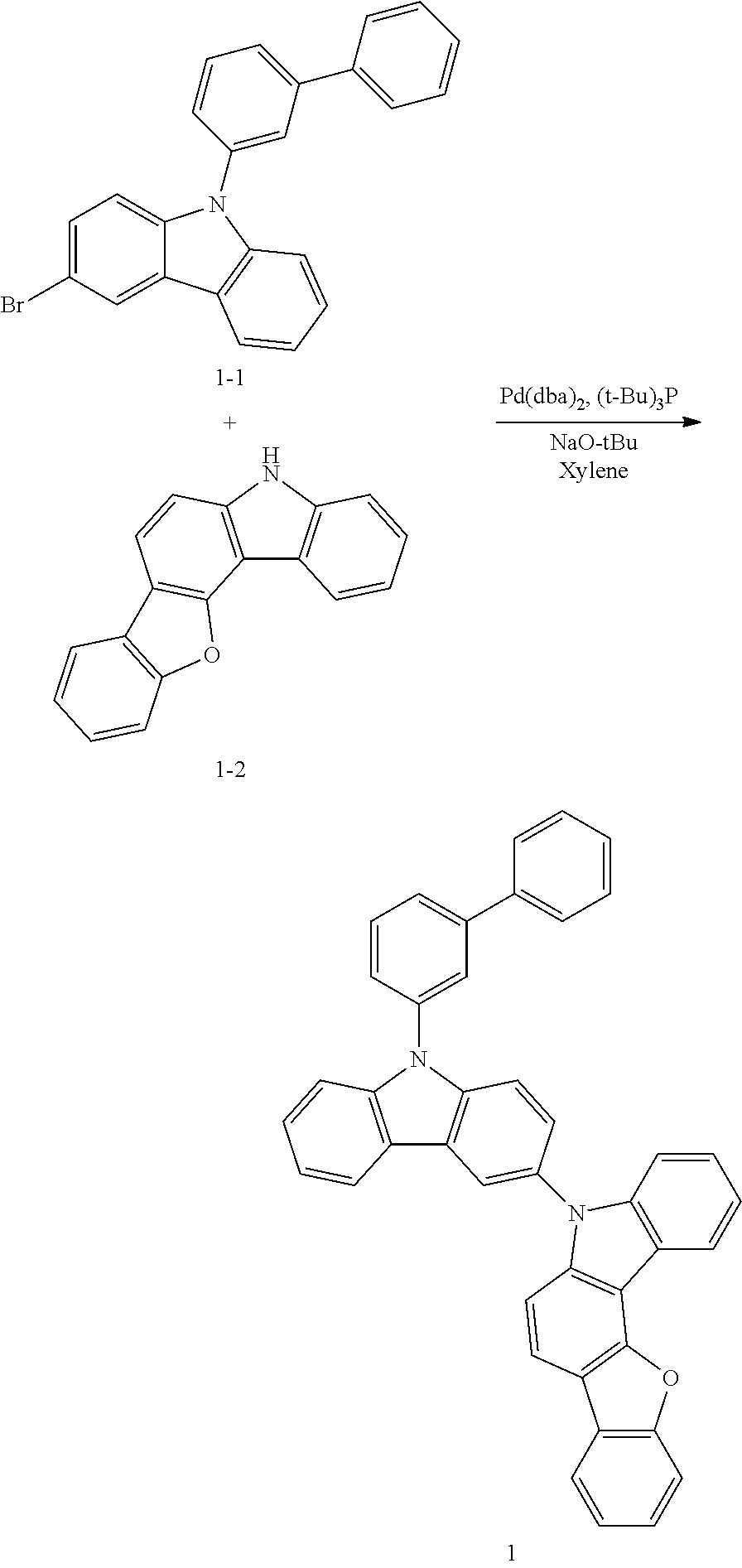


| TABLE 2 | |
| HOMO | Cyclic voltammetry (CV) (electrolyte: 0.1 molar (M) Bu4NPF6/ |
| energy | solvent: CH2Cl2/electrode: 3-electrode system (operation |
| level | electrode: Pt disc (1 millimeters (mm) diameter), standard |
| evalua- | electrode: Pt wire, auxiliary electrode: Pt wire)) was used |
| tion | to obtain a potential (V)-current (A) graph for each compound, |
| to there by calculate HOMO energy levels for each compound | |
| based on an oxidation onset on the graph. | |
| LUMO | Each compound was diluted with CHCl3 at a concentration of 1 × |
| |
10−5 molar (M), and a Shimadzu UV-350 spectrometer |
| level | was used to measure a UV absorption spectrum for each |
| evalua- | compound at room temperature, to thereby calculate LUMO |
| tion | energy levels for each compound based on the optical band gap |
| (Eg) at edges of the absorption spectrum and HOMO energy | |
| levels for each compound. | |
| T1 | A mixture of 2-MeTHF and each compound |
| energy | (i.e., a mixture prepared by dissolving 1 mg of each compound |
| level | in 3 cubic centimeters (cc) of 2-MeTHF) was loaded into a |
| evalua- | quartz cell. The resulting quartz cell was loaded into liquid |
| tion | nitrogen (77 Kelvins, K), and a photoluminescence spectrum |
| thereof was measured by using a photoluminescence | |
| measuring meter. Then, T1 energy levels were calculated based | |
| on peaks observed at the beginning of short wavelengths | |
| of the photoluminescence spectrum wavelengths. | |
| TABLE 3 | ||||
| Compound No. | HOMO (eV) | LUMO (eV) | T1 (eV) | |
| 1 | −5.56 | −2.15 | 3.05 | |
| 2 | −5.64 | −2.39 | 3.05 | |
| 3 | −5.51 | −2.33 | 2.80 | |
| 4 | −5.56 | −2.19 | 2.84 | |
| 9 | −5.66 | −2.14 | 2.87 | |
| 11 | −5.53 | −2.13 | 2.84 | |
| D | −5.56 | −2.82 | 2.77 | |
| E | −5.44 | −2.05 | 2.79 | |
| F | −5.67 | −2.17 | 2.78 | |
         |
||||
| TABLE 4 | ||
| Compound No. | Tg (° C.) | |
| 1 | 132 | |
| 2 | 129 | |
| 4 | 140 | |
| 9 | 124 | |
| 11 | 128 | |
| A′ | 72 | |
 |
||
| TABLE 5 | ||||||||
| Quantum | ||||||||
| Driving | Luminous | Power | emission | |||||
| Electron blocking | Host in emission | voltage | efficiency | Efficiency | efficiency | |||
| layer | layer | (V) | (cd/A) | (lm/W) | (%) | Lifespan at T95 (hr) | ||
| Example 1 | mCP | Compound 1 | 5.3 | 28.3 | 16.6 | 18.0 | 33 | |
| Example 2 | mCP | Compound 3 | 5.5 | 27.9 | 15.9 | 17.7 | 27 | |
| Example 3 | mCP | Compound 4 | 5.6 | 29.3 | 16.6 | 18.6 | 28 | |
| Example 4 | | Compound | 11 | 5.8 | 28.3 | 15.4 | 18.0 | 31 |
| Example 5 | Compound 1 | Compound 1 | 4.3 | 12.1 | 8.8 | 7.7 | 65 | |
| Example 6 | Compound 3 | Compound 3 | 4.8 | 18.4 | 12.0 | 11.7 | 30 | |
| Comparative Example 1 | mCP | Compound A | 5.1 | 27.5 | 16.9 | 17.5 | 20 | |
| Comparative Example 2 | mCP | Compound B | 5.9 | 18.2 | 9.7 | 11.6 | 11 | |
| Comparative Example 3 | mCP | Compound C | 5.3 | 23.4 | 13.8 | 14.9 | 16 | |
| Comparative Example 4 | mCP | Compound D | 6.6 | 10.8 | 5.2 | 6.9 | 25 | |
| Comparative Example 5 | mCP | Compound E | 4.5 | 27.3 | 18.9 | 14.5 | 18 | |
| Comparative Example 6 | mCP | Compound F | 6.0 | 25.5 | 13.3 | 13.5 | 22 | |
| Comparative Example 7 | mCP | mCP | 6.6 | 25.6 | 12.1 | 13.6 | 8 | |
            |
||||||||
Claims (21)


M(L81)n81(L82)n82 Formula 81


Applications Claiming Priority (2)
| Application Number | Priority Date | Filing Date | Title |
|---|---|---|---|
| KR1020160068841A KR102587955B1 (en) | 2016-06-02 | 2016-06-02 | Condensed cyclic compound and organic light emitting device including the same |
| KR10-2016-0068841 | 2016-06-02 |
Publications (2)
| Publication Number | Publication Date |
|---|---|
| US20170352819A1 US20170352819A1 (en) | 2017-12-07 |
| US10580997B2 true US10580997B2 (en) | 2020-03-03 |
Family
ID=60483575
Family Applications (1)
| Application Number | Title | Priority Date | Filing Date |
|---|---|---|---|
| US15/585,829 Active 2037-10-31 US10580997B2 (en) | 2016-06-02 | 2017-05-03 | Condensed cyclic compound and organic light-emitting device including the same |
Country Status (2)
| Country | Link |
|---|---|
| US (1) | US10580997B2 (en) |
| KR (1) | KR102587955B1 (en) |
Cited By (2)
| Publication number | Priority date | Publication date | Assignee | Title |
|---|---|---|---|---|
| US11991927B2 (en) | 2020-01-28 | 2024-05-21 | Samsung Electronics Co., Ltd. | Organic light-emitting device |
| US12433151B2 (en) | 2020-11-05 | 2025-09-30 | Samsung Display Co., Ltd. | Heterocyclic compound, light-emitting device including the heterocyclic compound, and electronic apparatus including the light-emitting device |
Families Citing this family (6)
| Publication number | Priority date | Publication date | Assignee | Title |
|---|---|---|---|---|
| KR102637792B1 (en) | 2018-03-22 | 2024-02-19 | 삼성디스플레이 주식회사 | Organic light emitting device and electronic device including the same |
| KR102666983B1 (en) * | 2019-02-26 | 2024-05-20 | 삼성디스플레이 주식회사 | Organic light emitting device |
| KR102804493B1 (en) | 2019-04-30 | 2025-05-09 | 삼성디스플레이 주식회사 | Organic light emitting device |
| KR20220142993A (en) * | 2020-02-17 | 2022-10-24 | 이데미쓰 고산 가부시키가이샤 | Organic electroluminescent devices and electronic devices |
| KR20220085924A (en) | 2020-12-15 | 2022-06-23 | 삼성디스플레이 주식회사 | Light emitting device and electronic apparatus comprising same |
| JPWO2023276918A1 (en) * | 2021-06-29 | 2023-01-05 |
Citations (11)
| Publication number | Priority date | Publication date | Assignee | Title |
|---|---|---|---|---|
| JP2011256143A (en) | 2010-06-10 | 2011-12-22 | Fujifilm Corp | Carbazole-based compound having specific structure, and charge transport material and organic electroluminescent element using the same |
| WO2013088973A1 (en) | 2011-12-15 | 2013-06-20 | 新日鉄住金化学株式会社 | Organic electroluminescent element |
| KR20130084093A (en) | 2012-01-16 | 2013-07-24 | 롬엔드하스전자재료코리아유한회사 | Novel organic electroluminescence compounds and organic electroluminescence device using the same |
| WO2013127563A1 (en) | 2012-02-27 | 2013-09-06 | Saint-Gobain Glass France | Composite pane having a sun protection and a heat protection function |
| US20130234119A1 (en) | 2011-12-05 | 2013-09-12 | Idemitsu Kosan Co., Ltd. | Material for organic electroluminescence device and organic electroluminescence device |
| KR20130112342A (en) | 2012-04-03 | 2013-10-14 | 롬엔드하스전자재료코리아유한회사 | Novel carbazole compounds and organic electroluminescence device containing the same |
| WO2013165189A1 (en) | 2012-05-02 | 2013-11-07 | Rohm And Haas Electronic Materials Korea Ltd. | Novel organic electroluminescence compounds and organic electroluminescence device containing the same |
| US20140158992A1 (en) | 2012-12-07 | 2014-06-12 | Universal Display Corporation | Carbazole Compounds For Delayed Fluorescence |
| US20140225046A1 (en) * | 2011-09-21 | 2014-08-14 | Merck Patent Gmbh | Carbazole derivatives for organic electroluminescence devices |
| WO2014204464A1 (en) | 2013-06-20 | 2014-12-24 | Universal Display Corporation | Phosphorescent organic light emitting devices having a hole-transporting host in the emissive region |
| KR20150047858A (en) | 2013-10-25 | 2015-05-06 | 주식회사 두산 | Organic compounds and organic electro luminescence device comprising the same |
Family Cites Families (3)
| Publication number | Priority date | Publication date | Assignee | Title |
|---|---|---|---|---|
| WO2013179645A1 (en) * | 2012-05-30 | 2013-12-05 | 出光興産株式会社 | Organic-electroluminescent-element material, and organic electroluminescent element using same |
| US8907227B2 (en) * | 2012-08-02 | 2014-12-09 | Hong Kong Science and Technology Research Institute Company Limited | Multiple surface integrated devices on low resistivity substrates |
| KR20150130928A (en) * | 2014-05-14 | 2015-11-24 | 롬엔드하스전자재료코리아유한회사 | Multi-component host material and organic electroluminescent device comprising the same |
-
2016
- 2016-06-02 KR KR1020160068841A patent/KR102587955B1/en active Active
-
2017
- 2017-05-03 US US15/585,829 patent/US10580997B2/en active Active
Patent Citations (15)
| Publication number | Priority date | Publication date | Assignee | Title |
|---|---|---|---|---|
| JP2011256143A (en) | 2010-06-10 | 2011-12-22 | Fujifilm Corp | Carbazole-based compound having specific structure, and charge transport material and organic electroluminescent element using the same |
| US20140225046A1 (en) * | 2011-09-21 | 2014-08-14 | Merck Patent Gmbh | Carbazole derivatives for organic electroluminescence devices |
| US20130234119A1 (en) | 2011-12-05 | 2013-09-12 | Idemitsu Kosan Co., Ltd. | Material for organic electroluminescence device and organic electroluminescence device |
| WO2013088973A1 (en) | 2011-12-15 | 2013-06-20 | 新日鉄住金化学株式会社 | Organic electroluminescent element |
| KR20130084093A (en) | 2012-01-16 | 2013-07-24 | 롬엔드하스전자재료코리아유한회사 | Novel organic electroluminescence compounds and organic electroluminescence device using the same |
| US20140364625A1 (en) * | 2012-01-16 | 2014-12-11 | Rohm And Haas Electronic Materials Korea Ltd. | Novel organic electroluminescent compounds and organic electroluminescent device using the same |
| WO2013127563A1 (en) | 2012-02-27 | 2013-09-06 | Saint-Gobain Glass France | Composite pane having a sun protection and a heat protection function |
| KR20130112342A (en) | 2012-04-03 | 2013-10-14 | 롬엔드하스전자재료코리아유한회사 | Novel carbazole compounds and organic electroluminescence device containing the same |
| US20150105563A1 (en) | 2012-04-03 | 2015-04-16 | Rohm And Haas Electronic Materials Korea Ltd. | Novel organic electroluminescent compounds and organic electroluminescent device comprising the same |
| KR20130127563A (en) | 2012-05-02 | 2013-11-25 | 롬엔드하스전자재료코리아유한회사 | Novel organic electroluminescence compounds and organic electroluminescence device containing the same |
| WO2013165189A1 (en) | 2012-05-02 | 2013-11-07 | Rohm And Haas Electronic Materials Korea Ltd. | Novel organic electroluminescence compounds and organic electroluminescence device containing the same |
| US20150115205A1 (en) * | 2012-05-02 | 2015-04-30 | Rohm And Haas Electronic Materials Korea Ltd. | Novel organic electroluminescence compounds and organic electroluminescence device containing the same |
| US20140158992A1 (en) | 2012-12-07 | 2014-06-12 | Universal Display Corporation | Carbazole Compounds For Delayed Fluorescence |
| WO2014204464A1 (en) | 2013-06-20 | 2014-12-24 | Universal Display Corporation | Phosphorescent organic light emitting devices having a hole-transporting host in the emissive region |
| KR20150047858A (en) | 2013-10-25 | 2015-05-06 | 주식회사 두산 | Organic compounds and organic electro luminescence device comprising the same |
Cited By (2)
| Publication number | Priority date | Publication date | Assignee | Title |
|---|---|---|---|---|
| US11991927B2 (en) | 2020-01-28 | 2024-05-21 | Samsung Electronics Co., Ltd. | Organic light-emitting device |
| US12433151B2 (en) | 2020-11-05 | 2025-09-30 | Samsung Display Co., Ltd. | Heterocyclic compound, light-emitting device including the heterocyclic compound, and electronic apparatus including the light-emitting device |
Also Published As
| Publication number | Publication date |
|---|---|
| KR20170136823A (en) | 2017-12-12 |
| US20170352819A1 (en) | 2017-12-07 |
| KR102587955B1 (en) | 2023-10-16 |
Similar Documents
| Publication | Publication Date | Title |
|---|---|---|
| US11785840B2 (en) | Organometallic compound, organic light-emitting device including the organometallic compound, and diagnosis composition including the organometallic compound | |
| US12358876B2 (en) | Condensed cyclic compound and organic light-emitting device including the same | |
| US10243149B2 (en) | Composition, thin film including the composition, and organic light-emitting device including the composition or the thin film | |
| US10155724B2 (en) | Condensed cyclic compound, composition including the same, and organic light-emitting device including the condensed cyclic compound | |
| US10003035B2 (en) | Organometallic compound and organic light-emitting device including the same | |
| US20200358012A1 (en) | Organometallic compound and organic light-emitting device including the same | |
| US11189807B2 (en) | Organometallic compound and organic light-emitting device including the same | |
| US20170352819A1 (en) | Condensed cyclic compound and organic light-emitting device including the same | |
| US20190229276A1 (en) | Condensed cyclic compound, composition including the condensed cyclic compound, and organic light-emitting device including condensed cyclic compound | |
| US11201300B2 (en) | Condensed cyclic compound and organic light-emitting device including condensed cyclic compound | |
| US20230284518A1 (en) | Organic light-emitting device | |
| US11594689B2 (en) | Organic light-emitting device | |
| US10164200B2 (en) | Organometallic compound and organic light-emitting device including the same | |
| US11124521B2 (en) | Condensed cyclic compound and organic light-emitting device including the same | |
| US20230422613A1 (en) | Heterocyclic compound and organic light-emitting device including the same | |
| US20260062433A1 (en) | Organometallic compound, organic light-emitting device including the same, and electronic apparatus including the organic light-emitting device | |
| US12588404B2 (en) | Organometallic compound, organic light-emitting device including the same, and electronic apparatus including the organic light-emitting device | |
| US20200199110A1 (en) | Heterocyclic compound and organic light-emitting device including the same | |
| US11469381B2 (en) | Condensed cyclic compound and organic light-emitting device including the same | |
| US11053228B2 (en) | Condensed cyclic compound, composition including the condensed cyclic compound, and organic light-emitting device including the condensed cyclic compound | |
| US20230183277A1 (en) | Organometallic compound, organic light-emitting device including the same, and electronic apparatus including the organic light-emitting device | |
| US20230130271A1 (en) | Organometallic compound, organic light-emitting device including the same, and electronic apparatus including organic light-emitting device | |
| US12281106B2 (en) | Condensed cyclic compound, organic light-emitting device including same, and electronic device including organic light-emitting device | |
| US12563961B2 (en) | Organometallic compound, organic light-emitting device including organometallic compound, and electronic apparatus including organic light-emitting device | |
| US20240147831A1 (en) | Organometallic compound, organic light-emitting device including the organometallic compound, and electronic apparatus including the organic light-emitting device |
Legal Events
| Date | Code | Title | Description |
|---|---|---|---|
| STPP | Information on status: patent application and granting procedure in general |
Free format text: NON FINAL ACTION MAILED |
|
| STPP | Information on status: patent application and granting procedure in general |
Free format text: RESPONSE TO NON-FINAL OFFICE ACTION ENTERED AND FORWARDED TO EXAMINER |
|
| STPP | Information on status: patent application and granting procedure in general |
Free format text: NON FINAL ACTION MAILED |
|
| STPP | Information on status: patent application and granting procedure in general |
Free format text: RESPONSE TO NON-FINAL OFFICE ACTION ENTERED AND FORWARDED TO EXAMINER |
|
| STPP | Information on status: patent application and granting procedure in general |
Free format text: NOTICE OF ALLOWANCE MAILED -- APPLICATION RECEIVED IN OFFICE OF PUBLICATIONS |
|
| AS | Assignment |
Owner name: SAMSUNG ELECTRONICS CO., LTD., KOREA, REPUBLIC OF Free format text: ASSIGNMENT OF ASSIGNORS INTEREST;ASSIGNORS:SON, JHUNMO;CHAE, MIYOUNG;HUH, DALHO;AND OTHERS;REEL/FRAME:051199/0142 Effective date: 20170222 Owner name: SAMSUNG SDI CO., LTD., KOREA, REPUBLIC OF Free format text: ASSIGNMENT OF ASSIGNORS INTEREST;ASSIGNORS:SON, JHUNMO;CHAE, MIYOUNG;HUH, DALHO;AND OTHERS;REEL/FRAME:051199/0142 Effective date: 20170222 |
|
| AS | Assignment |
Owner name: SAMSUNG ELECTRONICS CO., LTD., KOREA, REPUBLIC OF Free format text: ASSIGNMENT OF ASSIGNORS INTEREST;ASSIGNORS:SAMSUNG ELECTRONICS CO., LTD.;SAMSUNG SDI CO., LTD.;REEL/FRAME:051366/0480 Effective date: 20191205 Owner name: SAMSUNG SDI CO., LTD., KOREA, REPUBLIC OF Free format text: ASSIGNMENT OF ASSIGNORS INTEREST;ASSIGNORS:SAMSUNG ELECTRONICS CO., LTD.;SAMSUNG SDI CO., LTD.;REEL/FRAME:051366/0480 Effective date: 20191205 |
|
| STPP | Information on status: patent application and granting procedure in general |
Free format text: PUBLICATIONS -- ISSUE FEE PAYMENT RECEIVED |
|
| STPP | Information on status: patent application and granting procedure in general |
Free format text: PUBLICATIONS -- ISSUE FEE PAYMENT VERIFIED |
|
| STCF | Information on status: patent grant |
Free format text: PATENTED CASE |
|
| MAFP | Maintenance fee payment |
Free format text: PAYMENT OF MAINTENANCE FEE, 4TH YEAR, LARGE ENTITY (ORIGINAL EVENT CODE: M1551); ENTITY STATUS OF PATENT OWNER: LARGE ENTITY Year of fee payment: 4 |