US10571879B2 - Portable human-machine interface device - Google Patents
Portable human-machine interface device Download PDFInfo
- Publication number
- US10571879B2 US10571879B2 US15/893,049 US201815893049A US10571879B2 US 10571879 B2 US10571879 B2 US 10571879B2 US 201815893049 A US201815893049 A US 201815893049A US 10571879 B2 US10571879 B2 US 10571879B2
- Authority
- US
- United States
- Prior art keywords
- industrial
- hmi device
- portable
- application
- display
- Prior art date
- Legal status (The legal status is an assumption and is not a legal conclusion. Google has not performed a legal analysis and makes no representation as to the accuracy of the status listed.)
- Active
Links
Images


Classifications
-
- G—PHYSICS
- G05—CONTROLLING; REGULATING
- G05B—CONTROL OR REGULATING SYSTEMS IN GENERAL; FUNCTIONAL ELEMENTS OF SUCH SYSTEMS; MONITORING OR TESTING ARRANGEMENTS FOR SUCH SYSTEMS OR ELEMENTS
- G05B19/00—Program-control systems
- G05B19/02—Program-control systems electric
- G05B19/04—Program control other than numerical control, i.e. in sequence controllers or logic controllers
- G05B19/042—Program control other than numerical control, i.e. in sequence controllers or logic controllers using digital processors
-
- G—PHYSICS
- G05—CONTROLLING; REGULATING
- G05B—CONTROL OR REGULATING SYSTEMS IN GENERAL; FUNCTIONAL ELEMENTS OF SUCH SYSTEMS; MONITORING OR TESTING ARRANGEMENTS FOR SUCH SYSTEMS OR ELEMENTS
- G05B2219/00—Program-control systems
- G05B2219/20—Pc systems
- G05B2219/24—Pc safety
- G05B2219/24012—Use camera of handheld device, head mounted display
-
- G—PHYSICS
- G05—CONTROLLING; REGULATING
- G05B—CONTROL OR REGULATING SYSTEMS IN GENERAL; FUNCTIONAL ELEMENTS OF SUCH SYSTEMS; MONITORING OR TESTING ARRANGEMENTS FOR SUCH SYSTEMS OR ELEMENTS
- G05B2219/00—Program-control systems
- G05B2219/30—Nc systems
- G05B2219/32—Operator till task planning
- G05B2219/32128—Gui graphical user interface
-
- G—PHYSICS
- G05—CONTROLLING; REGULATING
- G05B—CONTROL OR REGULATING SYSTEMS IN GENERAL; FUNCTIONAL ELEMENTS OF SUCH SYSTEMS; MONITORING OR TESTING ARRANGEMENTS FOR SUCH SYSTEMS OR ELEMENTS
- G05B2219/00—Program-control systems
- G05B2219/30—Nc systems
- G05B2219/37—Measurements
- G05B2219/37095—Digital handheld device with data interface
Definitions
- Industrial automation environments typically include various machines, such as drives, pumps, motors, and robots. Each machine continually produces operational data over time related to the performance of the machine, such as the machine's pressure, temperature, speed, and other metrics.
- Industrial environments also commonly include a Human-Machine Interface (HMI).
- HMI Human-Machine Interface
- An HMI typically receives and processes the status data from the machines to generate various graphical displays, which may indicate the current and historical performance of the machines.
- an HMI graphical display might indicate status metrics of a drive, the pressure of a pump, the speed of a motor, or the output of a robot.
- the HMI may also provide a mechanism for an operator to send control instructions to a control system that controls the machines. For example, an operator might use the HMI to direct the control system to update drive parameters, turn on a pump, speed-up a motor, or stop a robot.
- HMI systems often require a user to operate an HMI by providing user input as physical touches directly into the HMI system, often requiring the use of a mouse, keyboard, touch screen, or similar input devices.
- Traditional HMI systems also commonly include a built-in display screen for displaying graphical content to the user.
- a portable HMI device is connected to a display system via a video interface, wherein the video interface provides interchangeability between a plurality of different display systems.
- a plurality of applications for display on the display system is stored in the portable HMI device.
- a remote navigation interface of the portable HMI device receives a selection transmitted from a remote navigation device, wherein the selection is associated with an industrial operation application of the applications displayed on the display system.
- the portable HMI device processes the selection of the industrial operation application and responsively executes the industrial operation application to communicate with an application server.
- a communication interface of the portable HMI device receives industrial operation data associated with the industrial operation application transmitted from the application server over a communication network for display on the display system.
- FIG. 1 is a block diagram that illustrates a communication system in an industrial automation environment in an implementation.
- FIG. 2 is a flow diagram that illustrates an operation of a communication system in an exemplary implementation.
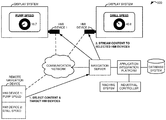
- FIG. 3 is a block diagram that illustrates an operational scenario of a communication system in an exemplary implementation.
- FIG. 4 is a block diagram that illustrates an operational scenario of a communication system in an exemplary implementation.
- FIG. 5 is a block diagram that illustrates an operational scenario of a communication system in an exemplary implementation.
- FIG. 6 is a block diagram that illustrates a portable human-machine interface (HMI) device in an exemplary implementation.
- HMI human-machine interface
- FIG. 7 is a block diagram that illustrates a computing system in an exemplary implementation.
- a portable human-machine interface (HMI) device can be connected to general-purpose display systems such as modern high-definition televisions (HDTVs) and monitors.
- the portable HMI device typically has one or more applications stored thereon for display on the display system, enabling a user to navigate through and select among the applications using a remote navigation device, such as an infrared remote control, smartphone, tablet, or some other wireless device.
- a remote navigation device such as an infrared remote control, smartphone, tablet, or some other wireless device.
- the applications on the portable HMI device can be executed to request and receive content for the portable HMI device to provide visualizations and control of various industrial automation operations.
- the portable HMI device could receive and display key performance indicators (KPIs) related to operational data associated with machines in an industrial automation environment, such as parameters, pressures, temperatures, speeds, production rates, or some other status metrics.
- KPIs key performance indicators
- the operational data for some KPIs may comprise dynamic charts or trends, real-time video, or some other graphical content.
- FIG. 1 illustrates a communication system in an industrial automation environment
- FIG. 2 illustrates a process that employs the communication system to facilitate management and monitoring of industrial operations
- FIGS. 3-5 illustrate various operational scenarios involving portable HMI devices according to different exemplary implementations.
- FIG. 6 illustrates an exemplary portable HMI device and
- FIG. 7 illustrates an exemplary computing system which may be used to perform any of the processes and operational scenarios described herein.
- communication system 100 is illustrated in an industrial automation environment in an exemplary implementation.
- communication system 100 includes portable human-machine interface (HMI) device 101 , display system 110 , remote navigation device 120 , communication network 130 , application server 140 , database system 150 , and machine system 160 .
- Portable HMI device 101 comprises processing system 102 , storage system 103 , software 105 , application 106 , communication interface 107 , video interface 108 , and remote navigation interface 109 .
- Video interface 108 and display system 110 are connected over link 111 .
- Remote navigation interface 109 and remote navigation device 120 are in communication over communication link 121 .
- communication link 121 could be connected over a communication network, including communication network 130 .
- Communication interface 107 and communication network 130 communicate over communication link 131 .
- communication links 121 and 131 could comprise the same link.
- Communication network 130 and application server 140 are in communication over communication link 141 .
- Application server 140 and database system 150 communicate over communication link 151
- application server 140 and machine system 160 communicate over communication link 161 .
- Machine system 160 and database system 150 are in communication over communication link 171 . Note that there would typically be many more machine systems in most industrial automation environments, but the number of machine systems shown in FIG. 1 has been restricted for clarity. An operation involving communication system 100 will now be described with respect to the flow diagram of FIG. 2 in one exemplary implementation.
- FIG. 2 is a flow diagram that illustrates an operation of communication system 100 in an exemplary implementation. The steps of the operation are indicated below parenthetically. The following discussion of the operation of FIG. 2 will proceed with reference to elements of communication system 100 and portable HMI device 101 of FIG. 1 in order to illustrate its operations, but note that the details provided in FIG. 1 are merely exemplary and not intended to limit the scope of the operation to the specific implementation shown in FIG. 1 .
- FIG. 2 may be employed to operate portable HMI device 101 to facilitate management and monitoring of industrial operations in an industrial automation environment.
- video interface 108 of portable HMI device 101 connects to display system 110 , wherein video interface 108 provides interchangeability between a plurality of different display systems ( 201 ).
- Display system 110 could comprise any type of general-purpose display, such as a cathode ray tube (CRT) screen, liquid crystal display (LCD) monitor or television, organic light-emitting diode (OLED) display, plasma display panel (PDP), rear-projection television, image projector, and any other kind of display device.
- CTR cathode ray tube
- LCD liquid crystal display
- OLED organic light-emitting diode
- PDP plasma display panel
- rear-projection television image projector, and any other kind of display device.
- Video interface 108 provides interchangeability between these and other types of display systems, typically through use of standardized interfaces such as high-definition multimedia interface (HDMI), digital visual interface (DVI), video graphics array (VGA), wireless display interfaces such as Intel® WiDi and Apple® AirPlay, and any other video interface.
- HDMI high-definition multimedia interface
- DVI digital visual interface
- VGA video graphics array
- wireless display interfaces such as Intel® WiDi and Apple® AirPlay, and any other video interface.
- Storage system 103 of portable HMI device 101 stores a plurality of applications for display on display system 110 ( 202 ).
- the applications could be associated with different industrial automation operations, such as operational status metrics of machines, key performance indicators (KPIs), control instructions for directing the operation of machines, and any other application associated with industrial operations.
- the applications could also be associated with various system operations, such as configuration settings for portable HMI device 101 , including network and server setup and access credentials.
- the applications could also assist in navigating through various graphical user interfaces (GUIs), display screens, and visualizations displayed by portable HMI device 101 on display system 110 .
- GUIs graphical user interfaces
- the applications could be used to set alarms, timers, shift changes, and other conditions that trigger various responses, such as navigating to relevant content or transferring control instructions to certain machine systems.
- Some of the applications could also comprise streaming applications that can provide live streaming content from application server 140 for display on display system 110 .
- a user of portable HMI device 101 can also add and remove applications from storage system 103 of portable HMI device 101 in some implementations.
- Portable HMI device 101 receives a selection in remote navigation interface 109 transmitted from remote navigation device 120 , wherein the selection is associated with an industrial operation application 106 of the applications displayed on display system 110 ( 203 ).
- remote navigation device 120 could comprise an infrared remote control, personal computer, smartphone, tablet computer, video game controller, or some other device capable of communicating wirelessly with portable HMI device 101 .
- Remote navigation device 120 communicates with portable HMI device 101 via remote navigation interface 109 , which could use Bluetooth, Wi-Fi (IEEE 802.11), infrared, cellular, or any other wireless communication protocol.
- the remote navigation interface 109 would typically receive the user's selection transmitted from remote navigation device 120 , where the selection is associated with requesting execution, screen navigation, or some other operation associated with an industrial operation application 106 .
- remote navigation device 120 comprises a computer, tablet, smartphone, or some other advanced computing device
- a user could operate remote navigation device 120 to connect directly to application server 140 , select the target portable HMI device 101 and the content for device 101 to display on display system 110 , and trigger the navigations through the various views, screens, and other content.
- Portable HMI device 101 processes the selection of the industrial operation application 106 and responsively executes industrial operation application 106 to communicate with application server 140 ( 204 ).
- the industrial operation application 106 is associated with a particular industrial automation plant, production line, group of machine systems, or even a specific machine, or the selection indicates the desired data source.
- the selection typically specifies content for retrieval, such as performance metrics, machine operational status, KPIs, charts, trend diagrams, or other content the user desires to view on display system 110 .
- the specified content can be user-generated and/or customized and stored in the application server 140 for on-demand retrieval and use by a particular user.
- the selection associated with industrial operation application 106 could also include machine instructions for controlling the operation of one or more machines.
- Portable HMI device 101 processes the selection and responsively executes industrial operation application 106 which communicates with application server 140 to request the content, deliver machine control instructions, request new screen content for display on display system 110 in response to a navigation request, or any other action associated with the user's selection.
- Communication interface 107 of portable HMI device 101 receives industrial operation data associated with industrial operation application 106 transmitted from application server 140 over communication network 130 for display on display system 110 ( 205 ).
- the industrial operation data received by portable HMI device from application server 140 typically comprises the content requested by the user's selection associated with industrial operation application 106 as discussed above.
- application server 140 could retrieve the requested content from database system 150 and/or machine system 160 .
- database system 150 could store historical operation data gathered over time from machine system 160 and other machine systems.
- the industrial operation data could comprise a new screen for display on display system 110 that the user navigated to using remote navigation device 120 , which could include various performance metrics, machine operational status reports, KPIs, charts, trend diagrams, or any other selected content.
- Portable HMI device 101 receives this content from application server 140 transmitted over communication network 130 and displays the received content on display system 110 for viewing by the user.
- portable HMI device 101 is capable of interchangeably connecting to various general-purpose display systems, receiving selections and screen navigations from remote navigation device 120 , and receiving content for display transmitted from application server 140 in response to the user selections.
- portable HMI device 101 provides reduced hardware, setup, and operational costs over traditional HMI systems, and facilitates remote access to industrial operations. Additionally, portable HMI device 101 provides portability of industrial systems interfaces and the flexibility to adapt to fast-moving developments in display technologies.
- FIG. 3 an operational scenario of communication system 300 is illustrated in an exemplary implementation.
- the operational scenario of FIG. 3 shows a typical one-time setup scenario for easily and securely configuring a portable HMI device.
- the portable HMI device is first connected to a display system, such as a standard HDTV or monitor, typically using an HDMI connection, although other wired or wireless connections are also possible.
- the functionality of the HMI device could also be built-in to a display system in some implementations, similar to modern Smart TVs.
- the HMI device starts a network for configuration and setup.
- the HMI device would communicate with a mobile device being used as a remote navigation device over a personal area network (PAN) using Bluetooth or Wi-Fi protocols, but other wireless communication scenarios are possible.
- PAN personal area network
- the HMI device can have a unique device code, which is shown as “H4Z9” in this example.
- a user of the remote navigation device could enter this code into an application in order to identify the HMI device to the target network connected to the server.
- the remote navigation device can be used to securely configure the HMI device with the network and server information. Once the HMI device receives the configuration data, the HMI device can disable its local network and connect to the target network for communication with the server.
- the user can navigate through various applications stored on the HMI device and select different screens and content to view on the display system.
- the HMI device requests that content from the navigation server and the navigation server responsively provides it back to the HMI device for display on the display system.
- the navigation server can also be configured to send content to the HMI device automatically, such as periodically updating status metrics on predetermined intervals, providing alerts when alarms are triggered or threshold values are crossed, or event-related navigations such as shift changes. All of these unattended navigation features can be preprogrammed for a particular HMI device by a user interacting with the HMI device and the navigation server using the remote navigation device.
- the navigation server would retrieve the desired content from the application integration platform, database system, or directly from a machine system and/or its industrial controller.
- the navigation server and/or the application integration platform could comprise a FactoryTalk® VantagePoint server system provided by Rockwell Automation, Inc. in at least some implementations.
- the navigation server, application integration platform, and database system could all be combined in the same computing system in some examples.
- FIG. 4 an operational scenario of communication system 400 is illustrated in an exemplary implementation.
- the operational scenario of FIG. 4 shows a user operating a remote navigation device to request content for delivery to a portable HMI device.
- the user is communicating directly with the navigation server to select the content for streaming to the HMI device, instead of requesting the content using applications on the HMI device that direct the HMI device to request the content.
- Some situations when a user may want to interact directly with the navigation server instead of the portable HMI device include when the user is not physically located at the same location as the portable HMI device and/or the display system or cannot otherwise view the display system, when the user is setting up unattended navigation rules or triggers for the navigation server to deliver content to the HMI device at later times, or for any other reason desired by the user.
- the remote navigation device comprises a smartphone, tablet, laptop, or some other computing device having its own display screen.
- the user operates the remote navigation device to communicate with the navigation server over a communication network, such as the Internet.
- the remote navigation device could have applications installed thereon which the user could execute to display various configuration and content selection options for requesting content for delivery to a specified portable HMI device.
- the navigation server could provide web-based content that the user could access and view on the remote navigation device by entering a uniform resource locator (URL) into a web browser of the remote navigation device, enabling the user to input content selections and other instructions into web forms provided by the navigation server.
- URL uniform resource locator
- the user has selected the “machine status” and “drill speed” KPIs for delivery to the portable HMI device to display on its connected display system.
- the user would typically also identify the target HMI device in the request to the navigation server by specifying a device identifier associated with the portable HMI device, an internet protocol (IP) address, a uniform resource identifier (URI), or any other identifying information associated with the target HMI device.
- IP internet protocol
- URI uniform resource identifier
- the user could also specify the particular machine system, assembly line, production plant, or any other data source for the requested content, along with any unattended delivery preferences such as timed intervals for receiving updated data, event triggers for delivering data or alerts such as alarms, scheduled navigations, shift changes, thresholds, or other events, and any other content delivery preferences.
- unattended delivery preferences such as timed intervals for receiving updated data, event triggers for delivering data or alerts such as alarms, scheduled navigations, shift changes, thresholds, or other events, and any other content delivery preferences.
- the navigation server retrieves the requested data from data sources such as the application integration platform, database system, and/or specified machine systems, and delivers the content to the target portable HMI device over the communication network.
- the HMI device receives the content and responsively displays the data for viewing on the display system.
- the “machine status” and “drill speed” content requested by the user on the remote navigation device is received and displayed by the portable HMI device, as shown on the display system of communication system 400 .
- the navigation server could continually feed dynamic data to the portable HMI device for this requested content, enabling a user to view the current machine status and drill speed in real time.
- FIG. 5 an operational scenario of communication system 500 is illustrated in an exemplary implementation.
- the operational scenario of FIG. 5 shows a user operating a remote navigation device to request content for delivery to multiple portable HMI devices.
- the user is communicating directly with the navigation server to select the content for streaming to the HMI devices.
- the user is a manager or supervisor of an industrial production plant, and is operating the remote navigation device to select various KPIs for delivery to portable HMI devices at separate remote locations.
- the user has selected the desired content and the target HMI devices that are to receive the content.
- the user has selected the “pump speed” KPI of a specified machine system for delivery to “HMI Device 1”, and the “drill speed” KPI for “HMI Device 2”.
- the remote navigation device transmits these selections and any other display preferences or instructions for delivery to the navigation server over the communication network.
- the navigation server retrieves the requested data from applicable data sources and delivers the content to the appropriate target HMI devices over the communication network.
- the specified portable HMI devices receive the content and responsively display the data for viewing on their respective display systems.
- the “pump speed” content is received and displayed by portable HMI device 1
- the “drill speed” content is received and displayed by portable HMI device 2, as shown on their associated display systems.
- the navigation server could continually feed dynamic data to the portable HMI devices for this requested content, enabling users to view the current pump speed and drill speed in real time.
- the multiple HMI devices could work in concert under the control of the common navigation server, enabling coordinated navigation of multiple HMI devices at once, such as displaying content that “follows” a user or remote navigation device moving to a closest display system.
- the navigation server could also enable coordinated screen changes on multiple displays, either triggered manually by a user operating a remote navigation device or triggered automatically by the navigation server, such as in response to alarms, KPI value threshold crossings, shift changes, or any other events.
- portable HMI device 101 may be representative of any computing apparatus, device, or system on which the operations disclosed herein or variations thereof may be suitably implemented.
- Portable HMI device 101 includes processing system 102 , storage system 103 , software 105 , application 106 , communication interface 107 , video interface 108 , and remote navigation interface 109 .
- communication interface 107 , video interface 108 , and remote navigation interface 109 could all utilize the same antenna or communication transceiver, and components 107 - 109 could all comprise the same communication interface in some examples.
- Processing system 102 is operatively coupled with storage system 103 , communication interface 107 , video interface 108 , and remote navigation interface 109 .
- Processing system 102 loads and executes software 105 from storage system 103 .
- Software 105 includes application 106 .
- software 105 directs portable HMI device 101 to operate as described herein for the process shown in FIG. 2 or variations thereof.
- Portable HMI device 101 may optionally include additional devices, features, or functionality not discussed here for purposes of brevity.
- portable HMI device 101 could comprise an enclosure having a dongle form factor, wherein at least processing system 102 and storage system 103 are contained within the enclosure.
- a dongle is a very small form factor typically no greater than a few inches in length and capable of fitting in a human hand.
- Remote navigation device 120 may be representative of any computing apparatus, device, or system on which the operations disclosed herein or variations thereof may be suitably implemented.
- Remote navigation device 120 provides an example of a computing system that could be used to communicate with portable HMI device 101 and/or application server 140 in some implementations.
- Examples of remote navigation device 120 include mobile computing devices, such as cell phones, tablet computers, laptop computers, notebook computers, and gaming devices, as well as any other type of mobile computing devices and any combination or variation thereof.
- Examples of remote navigation device 120 also include infrared remote controllers, desktop computers, server computers, and virtual machines, as well as any other type of computing system, variation, or combination thereof.
- Remote navigation device 120 may optionally include additional devices, features, or functionality not discussed here for purposes of brevity.
- Communication network 130 could comprise multiple network elements such as routers, gateways, telecommunication switches, servers, processing systems, or other communication equipment and systems for providing communication and data services.
- communication network 130 could comprise wireless communication nodes, telephony switches, Internet routers, network gateways, computer systems, communication links, or some other type of communication equipment—including combinations thereof.
- Communication network 130 may also comprise optical networks, asynchronous transfer mode (ATM) networks, packet networks, local area networks (LAN), metropolitan area networks (MAN), wide area networks (WAN), or other network topologies, equipment, or systems—including combinations thereof.
- ATM asynchronous transfer mode
- Communication network 130 may be configured to communicate over metallic, wireless, or optical links.
- Communication network 130 may be configured to use time-division multiplexing (TDM), Internet Protocol (IP), Ethernet, optical networking, wireless protocols, communication signaling, or some other communication format—including combinations thereof.
- TDM time-division multiplexing
- IP Internet Protocol
- Ethernet optical networking
- wireless protocols communication signaling
- communication network 130 includes further access nodes and associated equipment for providing communication services to several computer systems across a large geographic region.
- Application server 140 comprises a processing system and communication transceiver.
- Application server 140 may also include other components such as a router, server, data storage system, and power supply.
- Application server 140 may reside in a single device or may be distributed across multiple devices.
- Application server 140 may be a discrete system or may be integrated within other systems—including other systems within communication system 100 .
- application server 140 could comprise a network switch, router, switching system, packet gateway, network gateway system, Internet access node, application server, database system, service node, firewall, or some other communication system, including combinations thereof.
- application server 140 could be included in industrial appliances, or could even be embedded in industrial control devices like controllers, drives, electronic operator interfaces (EOIs), network cards, and the like.
- application server 140 could comprise a FactoryTalk® VantagePoint server system provided by Rockwell Automation, Inc. in at least some implementations.
- Database system 150 comprises a data storage system.
- database system 150 could comprise a disk, tape, integrated circuit, solid state drive, drive array, or some other memory device, including combinations thereof.
- database system 150 could also comprise a processing system and communication transceiver.
- Database system 150 may also include other components such as a router, server, and power supply.
- Database system 150 may reside in a single device or may be distributed across multiple devices.
- Database system 150 may be a discrete system or may be integrated within other systems, including other systems within communication system 100 .
- database system 150 could comprise a database system, session initiation protocol (SIP) server, packet data serving node (PDSN), network switch, mobile switching center, router, switching system, packet gateway, network gateway system, Internet access node, application server, service node, firewall, or some other communication system, including combinations thereof.
- SIP session initiation protocol
- PDSN packet data serving node
- network switch mobile switching center
- router switching system
- packet gateway packet gateway
- Internet access node application server
- service node firewall
- firewall or some other communication system, including combinations thereof.
- Machine system 160 is typically located in an industrial automation environment, such as an automobile manufacturing factory, food processing plant, oil drilling operation, microprocessor fabrication facility, or some other type of industrial enterprise.
- Machine system 160 could comprise a sensor, drive, pump, filter, drill, motor, robot, fabrication machinery, mill, printer, or any other industrial automation equipment, including their associated control systems.
- a control system could comprise, for example, an industrial controller, automation controller, programmable logic controller (PLC), or any other controller used in automation control.
- machine system 160 could comprise other industrial equipment, such as a brew kettle in a brewery, a reserve of coal or other resources, or any other element that may reside in an industrial automation environment.
- Machine system 160 continually produces operational data over time.
- the operational data indicates the current status of machine system 160 , such as parameters, pressure, temperature, speed, energy usage, operational equipment effectiveness (OEE), mean time between failure (MTBF), mean time to repair (MTTR), voltage, throughput volumes, times, tank levels, or any other performance status metrics.
- the operational data may comprise dynamic charts or trends, real-time video, or some other graphical content.
- Machine system 160 and/or its associated controller system is capable of transferring the operational data over a communication link to database system 150 and application server 140 , typically via a communication network.
- Communication links 111 , 121 , 131 , 141 , 151 , 161 , and 171 use metal, air, space, optical fiber such as glass or plastic, or some other material as the transport medium—including combinations thereof.
- Communication links 111 , 121 , 131 , 141 , 151 , 161 , and 171 could use various communication protocols, such as TDM, IP, Ethernet, telephony, optical networking, hybrid fiber coax (HFC), communication signaling, wireless protocols, or some other communication format—including combinations thereof.
- Communication links 111 , 121 , 131 , 141 , 151 , 161 , and 171 could be direct links or may include intermediate networks, systems, or devices.
- Portable HMI device 601 provides an example of portable HMI device 101 , although device 101 may use alternative configurations.
- Portable HMI device 601 includes processing system 602 , storage system 603 , software 605 , communication interface 607 , video interface 608 , and remote navigation interface 609 .
- Processing system 602 is operatively coupled with storage system 603 , communication interface 607 , video interface 608 , and remote navigation interface 609 .
- Processing system 602 loads and executes software 605 from storage system 603 .
- portable HMI device 601 When executed by portable HMI device 601 in general, and processing system 602 in particular, software 605 directs portable HMI device 601 to operate as described herein for the operations of FIGS. 2-5 or variations thereof.
- Portable HMI device 601 may optionally include additional devices, features, or functionality not discussed here for purposes of brevity.
- Processing system 602 may comprise a microprocessor and other circuitry that retrieves and executes software 605 from storage system 603 .
- Processing system 602 may be implemented within a single processing device but may also be distributed across multiple processing devices or sub-systems that cooperate in executing program instructions. Examples of processing system 602 include general purpose central processing units, application specific processors, and logic devices, as well as any other type of processing device, combinations, or variations thereof.
- Storage system 603 may comprise any computer-readable storage media readable by processing system 602 and capable of storing software 605 .
- Storage system 603 may include volatile and nonvolatile, removable and non-removable media implemented in any method or technology for storage of information, such as computer-readable instructions, data structures, program modules, or other data.
- storage system 603 may also include communication media over which software 605 may be communicated.
- Storage system 603 may be implemented as a single storage device but may also be implemented across multiple storage devices or sub-systems co-located or distributed relative to each other.
- Storage system 603 may comprise additional elements, such as a controller, capable of communicating with processing system 602 .
- storage media include random-access memory, read-only memory, magnetic disks, optical disks, flash memory, virtual memory and non-virtual memory, magnetic cassettes, magnetic tape, magnetic disk storage or other magnetic storage devices, or any other medium which can be used to store the desired information and that may be accessed by an instruction execution system, as well as any combination or variation thereof, or any other type of storage media.
- the storage media a propagated signal.
- Software 605 includes application 606 .
- Application 606 could comprise an industrial operation application in some examples.
- Software 605 may be implemented in program instructions and among other functions may, when executed by portable HMI device 601 in general or processing system 602 in particular, direct portable HMI device 601 or processing system 602 to connect to a display system via video interface 608 of portable HMI device 601 , wherein video interface 608 provides interchangeability between a plurality of different display systems.
- Software 605 may further direct portable HMI device 601 or processing system 602 to store a plurality of applications in storage system 603 for display on the display system.
- Software 605 may further direct portable HMI device 601 or processing system 602 to direct remote navigation interface 609 to receive a selection transmitted from a remote navigation device, wherein the selection is associated with an industrial operation application 606 of the applications displayed on the display system.
- Software 605 may further direct portable HMI device 601 or processing system 602 to process the selection of the industrial operation application 606 and responsively execute the industrial operation application 606 to communicate with an application server.
- Software 605 may further direct portable HMI device 601 or processing system 602 to direct communication interface 607 to receive industrial operation data associated with the industrial operation application 606 transmitted from the application server over a communication network for display on the display system.
- Software 605 may include additional processes, programs, or components, such as operating system software or other application software.
- Software 605 may also comprise firmware or some other form of machine-readable processing instructions executable by processing system 602 .
- software 605 may, when loaded into processing system 602 and executed, transform portable HMI device 601 overall from a general-purpose computing system into a special-purpose computing system customized to facilitate management of industrial operations as described herein for each implementation.
- encoding software 605 on storage system 603 may transform the physical structure of storage system 603 .
- the specific transformation of the physical structure may depend on various factors in different implementations of this description. Examples of such factors may include, but are not limited to the technology used to implement the storage media of storage system 603 and whether the computer storage media are characterized as primary or secondary storage.
- software 605 may transform the physical state of the semiconductor memory when the program is encoded therein.
- software 605 may transform the state of transistors, capacitors, or other discrete circuit elements constituting the semiconductor memory.
- a similar transformation may occur with respect to magnetic or optical media.
- Other transformations of physical media are possible without departing from the scope of the present description, with the foregoing examples provided only to facilitate this discussion.
- communication interface 607 may include communication connections and devices that allow for communication between portable HMI device 601 and other computing systems (not shown) over a communication network or collection of networks (not shown). Examples of connections and devices that together allow for inter-system communication may include network interface cards, antennas, power amplifiers, RF circuitry, transceivers, near field communications components, and other communication circuitry. The connections and devices may communicate over communication media to exchange communications with other computing systems or networks of systems, such as metal, glass, air, or any other suitable communication media.
- the aforementioned communication media, network, connections, and devices are well known and need not be discussed at length here.
- Video interface 608 provides interchangeability between many different types of display systems, typically through use of standardized interfaces.
- video interface 608 is shown with a high-definition multimedia interface (HDMI) connector, but video interface 608 could have alternative configurations in other examples, including but not limited to digital visual interface (DVI), video graphics array (VGA), wireless display interfaces such as Intel® WiDi and Apple® AirPlay, or any other video interface, including combinations thereof.
- HDMI high-definition multimedia interface
- DVI digital visual interface
- VGA video graphics array
- wireless display interfaces such as Intel® WiDi and Apple® AirPlay, or any other video interface, including combinations thereof.
- Remote navigation interface 609 may include communication connections and devices that allow for communication between portable HMI device 601 and a remote navigation device or other computing systems (not shown). Examples of connections and devices that together allow for inter-system communication may include infrared transceivers, network interface circuitry, antennas, power amplifiers, RF circuitry, wireless transceivers, near field communications circuitry, and other communication components. The connections and devices may communicate over communication media to exchange communications with a remote navigation device or other computing systems. Remote navigation interface 609 may receive user input such as selections and navigations transmitted from a remote navigation device as described herein. Remote navigation interface 609 may share some or all of its communication components with communication interface 607 in some implementations.
- computing system 700 is illustrated in an exemplary implementation.
- Computing system 700 provides an example of application server 140 and/or a navigation server, although these servers could use alternative configurations in other implementations.
- Computing system 700 also provides an example of a remote navigation device, such as remote navigation device 120 , although device 120 could use alternative configurations.
- Computing system 700 includes processing system 701 , storage system 703 , software 705 , communication interface 707 , and optional user interface 709 .
- Software 705 includes application 706 .
- Computing system 700 may be representative of any computing apparatus, system, or systems on which the operations described herein or variations thereof may be suitably implemented.
- Examples of computing system 700 include mobile computing devices, such as cell phones, tablet computers, laptop computers, notebook computers, and gaming devices, as well as any other type of mobile computing devices and any combination or variation thereof. Note that the features and functionality of computing system 700 may apply as well to desktop computers, server computers, and virtual machines, as well as any other type of computing system, variation, or combination thereof.
- Computing system 700 includes processing system 701 , storage system 703 , software 705 , communication interface 707 , and user interface 709 .
- Processing system 701 is operatively coupled with storage system 703 , communication interface 707 , and user interface 709 .
- Processing system 701 loads and executes software 705 from storage system 703 .
- software 705 directs computing system 700 to operate as described herein for the operations described in FIGS. 2-5 or variations thereof.
- Computing system 700 may optionally include additional devices, features, or functionality not discussed herein for purposes of brevity.
- processing system 701 may comprise a microprocessor and other circuitry that retrieves and executes software 705 from storage system 703 .
- Processing system 701 may be implemented within a single processing device but may also be distributed across multiple processing devices or sub-systems that cooperate in executing program instructions. Examples of processing system 701 include general purpose central processing units, application specific processors, and logic devices, as well as any other type of processing device, combinations, or variations thereof.
- Storage system 703 may comprise any computer-readable media or storage media readable by processing system 701 and capable of storing software 705 .
- Storage system 703 may include volatile and nonvolatile, removable and non-removable media implemented in any method or technology for storage of information, such as computer-readable instructions, data structures, program modules, or other data.
- Storage system 703 may be implemented as a single storage device but may also be implemented across multiple storage devices or sub-systems co-located or distributed relative to each other.
- Storage system 703 may comprise additional elements, such as a controller, capable of communicating with processing system 701 .
- storage media examples include random-access memory, read-only memory, magnetic disks, optical disks, flash memory, virtual memory and non-virtual memory, magnetic cassettes, magnetic tape, magnetic disk storage or other magnetic storage devices, or any other medium which can be used to store the desired information and that may be accessed by an instruction execution system, as well as any combination or variation thereof, or any other type of storage media.
- the storage media a propagated signal.
- processing system 701 loads and executes portions of software 705 , such as application 706 , to facilitate management of industrial operations as described herein.
- software 705 may be implemented in program instructions and among other functions may, when executed by computing system 700 in general or processing system 701 in particular, direct computing system 700 or processing system 701 to communicate with a portable HMI device and transmit industrial operation data associated with an industrial operation application for delivery to the portable HMI device over a communication network for display on a display system.
- software 705 may direct computing system 700 or processing system 701 to transmit a selection for receipt by a remote navigation interface of a portable HMI device, wherein the selection is associated with an industrial operation application of a plurality of applications displayed on a display system that is connected to the portable HMI device.
- Software 705 may include additional processes, programs, or components, such as operating system software or other application software. Examples of operating systems include Windows®, iOS®, and Android®, as well as any other suitable operating system. Software 705 may also comprise firmware or some other form of machine-readable processing instructions executable by processing system 701 . In general, software 705 may, when loaded into processing system 701 and executed, transform computing system 700 overall from a general-purpose computing system into a special-purpose computing system customized to facilitate management and monitoring of industrial operations as described herein for each implementation. For example, encoding software 705 on storage system 703 may transform the physical structure of storage system 703 . The specific transformation of the physical structure may depend on various factors in different implementations of this description. Examples of such factors may include, but are not limited to the technology used to implement the storage media of storage system 703 and whether the computer-storage media are characterized as primary or secondary storage.
- software 705 may transform the physical state of the semiconductor memory when the program is encoded therein.
- software 705 may transform the state of transistors, capacitors, or other discrete circuit elements constituting the semiconductor memory.
- a similar transformation may occur with respect to magnetic or optical media.
- Other transformations of physical media are possible without departing from the scope of the present description, with the foregoing examples provided only to facilitate this discussion.
- computing system 700 is generally intended to represent a computing system with which software 705 is deployed and executed in order to implement the operations described herein (and variations thereof). However, computing system 700 may also represent any computing system on which software 705 may be staged and from where software 705 may be distributed, transported, downloaded, or otherwise provided to yet another computing system for deployment and execution, or yet additional distribution. For example, computing system 700 could be configured to deploy software 705 over the internet to one or more client computing systems for execution thereon, such as in a cloud-based deployment scenario.
- Communication interface 707 may include communication connections and devices that allow for communication between computing system 700 and other computing systems (not shown) or services, over a communication network 711 or collection of networks. In some implementations, communication interface 707 receives dynamic data 721 over communication network 711 . Examples of connections and devices that together allow for inter-system communication may include network interface cards, antennas, power amplifiers, RF circuitry, transceivers, and other communication circuitry. The aforementioned network, connections, and devices are well known and need not be discussed at length here.
- User interface 709 may include a voice input device, a touch input device for receiving a gesture from a user, a motion input device for detecting non-touch gestures and other motions by a user, and other comparable input devices and associated processing elements capable of receiving user input from a user.
- Output devices such as a display system, speakers, haptic devices, and other types of output devices may also be included in user interface 709 .
- the aforementioned user input devices are well known in the art and need not be discussed at length here.
- User interface 709 may also include associated user interface software executable by processing system 701 in support of the various user input and output devices discussed above. Separately or in conjunction with each other and other hardware and software elements, the user interface software and devices may provide a graphical user interface, a natural user interface, or any other kind of user interface. User interface 709 may be omitted in some implementations.
Landscapes
- Engineering & Computer Science (AREA)
- Physics & Mathematics (AREA)
- General Physics & Mathematics (AREA)
- Automation & Control Theory (AREA)
- User Interface Of Digital Computer (AREA)
- Human Computer Interaction (AREA)
- Manufacturing & Machinery (AREA)
Abstract
Description
Claims (16)
Priority Applications (1)
| Application Number | Priority Date | Filing Date | Title |
|---|---|---|---|
| US15/893,049 US10571879B2 (en) | 2015-04-07 | 2018-02-09 | Portable human-machine interface device |
Applications Claiming Priority (2)
| Application Number | Priority Date | Filing Date | Title |
|---|---|---|---|
| US14/680,325 US9891608B2 (en) | 2015-04-07 | 2015-04-07 | Portable human-machine interface device |
| US15/893,049 US10571879B2 (en) | 2015-04-07 | 2018-02-09 | Portable human-machine interface device |
Related Parent Applications (1)
| Application Number | Title | Priority Date | Filing Date |
|---|---|---|---|
| US14/680,325 Continuation US9891608B2 (en) | 2015-04-07 | 2015-04-07 | Portable human-machine interface device |
Publications (2)
| Publication Number | Publication Date |
|---|---|
| US20180164763A1 US20180164763A1 (en) | 2018-06-14 |
| US10571879B2 true US10571879B2 (en) | 2020-02-25 |
Family
ID=57111353
Family Applications (2)
| Application Number | Title | Priority Date | Filing Date |
|---|---|---|---|
| US14/680,325 Active 2036-03-13 US9891608B2 (en) | 2015-04-07 | 2015-04-07 | Portable human-machine interface device |
| US15/893,049 Active US10571879B2 (en) | 2015-04-07 | 2018-02-09 | Portable human-machine interface device |
Family Applications Before (1)
| Application Number | Title | Priority Date | Filing Date |
|---|---|---|---|
| US14/680,325 Active 2036-03-13 US9891608B2 (en) | 2015-04-07 | 2015-04-07 | Portable human-machine interface device |
Country Status (1)
| Country | Link |
|---|---|
| US (2) | US9891608B2 (en) |
Families Citing this family (9)
| Publication number | Priority date | Publication date | Assignee | Title |
|---|---|---|---|---|
| US9285800B2 (en) * | 2011-11-11 | 2016-03-15 | Rockwell Automation Technologies, Inc | Systems and methods for asynchronous searching and filtering of data |
| US20190101884A1 (en) * | 2017-09-29 | 2019-04-04 | Rockwell Automation Technologies, Inc. | Event driven triggering of thin client resolution |
| US11009848B2 (en) * | 2018-06-08 | 2021-05-18 | Rockwell Automation Technologies, Inc. | Scalable intelligent query-based interface to navigate and find industrial information on a visual interface |
| EP3603902B1 (en) * | 2018-08-02 | 2023-06-28 | Schneider Electric Industries SAS | Method for building and/or maintaining an industrial machine |
| US11782593B1 (en) | 2019-06-09 | 2023-10-10 | Advanced Electronic Design, Inc. | Wireless personal protection device and methods of use |
| CN112130484A (en) * | 2020-08-27 | 2020-12-25 | 南京蹑波物联网科技有限公司 | Internet-based warehouse monitoring equipment and using method thereof |
| US12339651B2 (en) * | 2022-05-31 | 2025-06-24 | Rockwell Automation Technologies, Inc. | Historical data extraction and trend identification from industrial streaming image data |
| US12339636B2 (en) * | 2022-05-31 | 2025-06-24 | Rockwell Automation Technologies, Inc. | Live streaming visualizations of industrial equipment operation |
| US20250076842A1 (en) * | 2023-09-01 | 2025-03-06 | Rockwell Automation Technologies, Inc. | Human interface module (him) connectivity and interface for contextualized health statistics in an industrial automation environment |
Citations (14)
| Publication number | Priority date | Publication date | Assignee | Title |
|---|---|---|---|---|
| US20040098148A1 (en) * | 2002-11-14 | 2004-05-20 | Retlich Kevin A. | Industrial control and monitoring method and system |
| US20090222113A1 (en) * | 2008-03-03 | 2009-09-03 | Bruce Gordon Fuller | Automation human machine interface having virtual graphic controls |
| US20100082131A1 (en) * | 2008-09-30 | 2010-04-01 | John Joseph Baier | System and method for the automatic aggregation of industrial automation displays |
| US20120243158A1 (en) * | 2011-03-22 | 2012-09-27 | Gregoire Alexandre Gentil | Self-powered hdmi dongle |
| US20130211559A1 (en) * | 2012-02-09 | 2013-08-15 | Rockwell Automation Technologies, Inc. | Cloud-based operator interface for industrial automation |
| US20130290706A1 (en) * | 2012-04-30 | 2013-10-31 | General Electric Company | System and method for securing controllers |
| US20130291016A1 (en) | 2010-12-29 | 2013-10-31 | Advanced Digital Broadcast S.A. | Television user interface |
| US20150052557A1 (en) | 2012-07-27 | 2015-02-19 | Magine Holding AB | System and a method adapted to display epg media content from the world wide web |
| US20150177719A1 (en) * | 2012-08-03 | 2015-06-25 | Toshiba Mitsubishi-Electric Industrial Systems Corporation | Plant control monitoring system |
| US20150235279A1 (en) | 2014-02-18 | 2015-08-20 | Kabushiki Kaisha Toshiba | Information processing apparatus and image data transmitting method |
| US20150317591A1 (en) | 2014-05-02 | 2015-11-05 | Rockwell Automation Technologies, Inc. | Mobile computing application for industrial automation manufacturing data |
| US20160072797A1 (en) | 2014-09-10 | 2016-03-10 | At&T Intellectual Property I, Lp | Mobile virtual communication and entertainment service |
| US20160192011A1 (en) | 2013-07-26 | 2016-06-30 | Vodoke Asia Pacific Limited | System and method for networked communication of information content by way of a display screen and a remote controller |
| US9848247B2 (en) * | 2016-04-27 | 2017-12-19 | Blackfire Research Corporation | Media computing device with multiple virtual screens and personal area network capability |
-
2015
- 2015-04-07 US US14/680,325 patent/US9891608B2/en active Active
-
2018
- 2018-02-09 US US15/893,049 patent/US10571879B2/en active Active
Patent Citations (14)
| Publication number | Priority date | Publication date | Assignee | Title |
|---|---|---|---|---|
| US20040098148A1 (en) * | 2002-11-14 | 2004-05-20 | Retlich Kevin A. | Industrial control and monitoring method and system |
| US20090222113A1 (en) * | 2008-03-03 | 2009-09-03 | Bruce Gordon Fuller | Automation human machine interface having virtual graphic controls |
| US20100082131A1 (en) * | 2008-09-30 | 2010-04-01 | John Joseph Baier | System and method for the automatic aggregation of industrial automation displays |
| US20130291016A1 (en) | 2010-12-29 | 2013-10-31 | Advanced Digital Broadcast S.A. | Television user interface |
| US20120243158A1 (en) * | 2011-03-22 | 2012-09-27 | Gregoire Alexandre Gentil | Self-powered hdmi dongle |
| US20130211559A1 (en) * | 2012-02-09 | 2013-08-15 | Rockwell Automation Technologies, Inc. | Cloud-based operator interface for industrial automation |
| US20130290706A1 (en) * | 2012-04-30 | 2013-10-31 | General Electric Company | System and method for securing controllers |
| US20150052557A1 (en) | 2012-07-27 | 2015-02-19 | Magine Holding AB | System and a method adapted to display epg media content from the world wide web |
| US20150177719A1 (en) * | 2012-08-03 | 2015-06-25 | Toshiba Mitsubishi-Electric Industrial Systems Corporation | Plant control monitoring system |
| US20160192011A1 (en) | 2013-07-26 | 2016-06-30 | Vodoke Asia Pacific Limited | System and method for networked communication of information content by way of a display screen and a remote controller |
| US20150235279A1 (en) | 2014-02-18 | 2015-08-20 | Kabushiki Kaisha Toshiba | Information processing apparatus and image data transmitting method |
| US20150317591A1 (en) | 2014-05-02 | 2015-11-05 | Rockwell Automation Technologies, Inc. | Mobile computing application for industrial automation manufacturing data |
| US20160072797A1 (en) | 2014-09-10 | 2016-03-10 | At&T Intellectual Property I, Lp | Mobile virtual communication and entertainment service |
| US9848247B2 (en) * | 2016-04-27 | 2017-12-19 | Blackfire Research Corporation | Media computing device with multiple virtual screens and personal area network capability |
Also Published As
| Publication number | Publication date |
|---|---|
| US20180164763A1 (en) | 2018-06-14 |
| US9891608B2 (en) | 2018-02-13 |
| US20160299496A1 (en) | 2016-10-13 |
Similar Documents
| Publication | Publication Date | Title |
|---|---|---|
| US10571879B2 (en) | Portable human-machine interface device | |
| US20230393725A1 (en) | Industrial automation visualization dashboard creation paradigm | |
| US11363452B2 (en) | Systems and methods for real-time remote control of mobile applications | |
| EP3318941B1 (en) | Industrial automation system machine analytics for a connected enterprise | |
| US11816312B2 (en) | Mobile scalable compute module | |
| US11619924B2 (en) | Combined visualization thin client HMI system and method | |
| US20200363935A1 (en) | Device-to-device communication in an industrial automation environment | |
| EP3098764A1 (en) | Presentation of tasks to a user | |
| CN102421028A (en) | Control method of smart television, remote control device and control system | |
| US10809681B2 (en) | Data collection for assistance in an industrial automation environment | |
| US9015224B2 (en) | Interactive response of a remote monitoring and management system | |
| US20170103239A1 (en) | Identification of industrial equipment using micro-location services | |
| CN104391581A (en) | Mobile terminal and method for projecting operation interface of application program thereof | |
| EP3486762A1 (en) | Mobile data snapshots | |
| US20160349967A1 (en) | Offline investigation in an industrial automation environment | |
| US10462194B2 (en) | Minimizing productivity loss in a collaborative sharing environment | |
| US20170108851A1 (en) | Industrial automation electronic pinboard | |
| US11075775B2 (en) | Home automation system including cloud server based maintenance operation communication and related methods | |
| US11009848B2 (en) | Scalable intelligent query-based interface to navigate and find industrial information on a visual interface | |
| HK40009669A (en) | Systems and methods for real-time remote control of mobile applications | |
| HK40009669B (en) | Systems and methods for real-time remote control of mobile applications | |
| JP2008123078A (en) | Information control system and device controller | |
| JP2015125458A (en) | Information processor, control method therefor, program, and recording medium | |
| CN103530077A (en) | Computer management system |
Legal Events
| Date | Code | Title | Description |
|---|---|---|---|
| AS | Assignment |
Owner name: ROCKWELL AUTOMATION TECHNOLOGIES, INC., OHIO Free format text: ASSIGNMENT OF ASSIGNORS INTEREST;ASSIGNORS:REICHARD, DOUGLAS J.;GOVINDARAJ, SUBBIAN;REEL/FRAME:044883/0894 Effective date: 20150331 |
|
| FEPP | Fee payment procedure |
Free format text: ENTITY STATUS SET TO UNDISCOUNTED (ORIGINAL EVENT CODE: BIG.); ENTITY STATUS OF PATENT OWNER: LARGE ENTITY |
|
| STPP | Information on status: patent application and granting procedure in general |
Free format text: NON FINAL ACTION MAILED |
|
| STPP | Information on status: patent application and granting procedure in general |
Free format text: RESPONSE TO NON-FINAL OFFICE ACTION ENTERED AND FORWARDED TO EXAMINER |
|
| STPP | Information on status: patent application and granting procedure in general |
Free format text: FINAL REJECTION MAILED |
|
| STPP | Information on status: patent application and granting procedure in general |
Free format text: ADVISORY ACTION MAILED |
|
| STPP | Information on status: patent application and granting procedure in general |
Free format text: DOCKETED NEW CASE - READY FOR EXAMINATION |
|
| STPP | Information on status: patent application and granting procedure in general |
Free format text: NOTICE OF ALLOWANCE MAILED -- APPLICATION RECEIVED IN OFFICE OF PUBLICATIONS |
|
| STPP | Information on status: patent application and granting procedure in general |
Free format text: PUBLICATIONS -- ISSUE FEE PAYMENT VERIFIED |
|
| STCF | Information on status: patent grant |
Free format text: PATENTED CASE |
|
| MAFP | Maintenance fee payment |
Free format text: PAYMENT OF MAINTENANCE FEE, 4TH YEAR, LARGE ENTITY (ORIGINAL EVENT CODE: M1551); ENTITY STATUS OF PATENT OWNER: LARGE ENTITY Year of fee payment: 4 |