US10571077B2 - Cooled-hydrogen supply station and a cooling apparatus for hydrogen - Google Patents

Cooled-hydrogen supply station and a cooling apparatus for hydrogen Download PDF

Info

Publication number
US10571077B2
US10571077B2 US16/070,023 US201716070023A US10571077B2 US 10571077 B2 US10571077 B2 US 10571077B2 US 201716070023 A US201716070023 A US 201716070023A US 10571077 B2 US10571077 B2 US 10571077B2
Authority
US
United States
Prior art keywords
coolant
hydrogen
cooled
passage
air
Prior art date
Legal status (The legal status is an assumption and is not a legal conclusion. Google has not performed a legal analysis and makes no representation as to the accuracy of the status listed.)
Active, expires
Application number
US16/070,023
Other versions
US20190032849A1 (en
Inventor
Atsushi Seki
Katsutoshi Sakai
Hirofumi Inoue
Current Assignee (The listed assignees may be inaccurate. Google has not performed a legal analysis and makes no representation or warranty as to the accuracy of the list.)
Shinwa Controls Co Ltd
Original Assignee
Shinwa Controls Co Ltd
Priority date (The priority date is an assumption and is not a legal conclusion. Google has not performed a legal analysis and makes no representation as to the accuracy of the date listed.)
Filing date
Publication date
Application filed by Shinwa Controls Co Ltd filed Critical Shinwa Controls Co Ltd
Assigned to SHINWA CONTROLS CO., LTD. reassignment SHINWA CONTROLS CO., LTD. ASSIGNMENT OF ASSIGNORS INTEREST (SEE DOCUMENT FOR DETAILS). Assignors: INOUE, HIROFUMI, SAKAI, KATSUTOSHI, SEKI, ATSUSHI
Publication of US20190032849A1 publication Critical patent/US20190032849A1/en
Application granted granted Critical
Publication of US10571077B2 publication Critical patent/US10571077B2/en
Active legal-status Critical Current
Adjusted expiration legal-status Critical

Links

Images

Classifications

    • FMECHANICAL ENGINEERING; LIGHTING; HEATING; WEAPONS; BLASTING
    • F17STORING OR DISTRIBUTING GASES OR LIQUIDS
    • F17CVESSELS FOR CONTAINING OR STORING COMPRESSED, LIQUEFIED OR SOLIDIFIED GASES; FIXED-CAPACITY GAS-HOLDERS; FILLING VESSELS WITH, OR DISCHARGING FROM VESSELS, COMPRESSED, LIQUEFIED, OR SOLIDIFIED GASES
    • F17C5/00Methods or apparatus for filling containers with liquefied, solidified, or compressed gases under pressures
    • F17C5/06Methods or apparatus for filling containers with liquefied, solidified, or compressed gases under pressures for filling with compressed gases
    • FMECHANICAL ENGINEERING; LIGHTING; HEATING; WEAPONS; BLASTING
    • F25REFRIGERATION OR COOLING; COMBINED HEATING AND REFRIGERATION SYSTEMS; HEAT PUMP SYSTEMS; MANUFACTURE OR STORAGE OF ICE; LIQUEFACTION SOLIDIFICATION OF GASES
    • F25BREFRIGERATION MACHINES, PLANTS OR SYSTEMS; COMBINED HEATING AND REFRIGERATION SYSTEMS; HEAT PUMP SYSTEMS
    • F25B1/00Compression machines, plants or systems with non-reversible cycle
    • FMECHANICAL ENGINEERING; LIGHTING; HEATING; WEAPONS; BLASTING
    • F25REFRIGERATION OR COOLING; COMBINED HEATING AND REFRIGERATION SYSTEMS; HEAT PUMP SYSTEMS; MANUFACTURE OR STORAGE OF ICE; LIQUEFACTION SOLIDIFICATION OF GASES
    • F25BREFRIGERATION MACHINES, PLANTS OR SYSTEMS; COMBINED HEATING AND REFRIGERATION SYSTEMS; HEAT PUMP SYSTEMS
    • F25B17/00Sorption machines, plants or systems, operating intermittently, e.g. absorption or adsorption type
    • F25B17/02Sorption machines, plants or systems, operating intermittently, e.g. absorption or adsorption type the absorbent or adsorbent being a liquid, e.g. brine
    • FMECHANICAL ENGINEERING; LIGHTING; HEATING; WEAPONS; BLASTING
    • F25REFRIGERATION OR COOLING; COMBINED HEATING AND REFRIGERATION SYSTEMS; HEAT PUMP SYSTEMS; MANUFACTURE OR STORAGE OF ICE; LIQUEFACTION SOLIDIFICATION OF GASES
    • F25BREFRIGERATION MACHINES, PLANTS OR SYSTEMS; COMBINED HEATING AND REFRIGERATION SYSTEMS; HEAT PUMP SYSTEMS
    • F25B49/00Arrangement or mounting of control or safety devices
    • FMECHANICAL ENGINEERING; LIGHTING; HEATING; WEAPONS; BLASTING
    • F25REFRIGERATION OR COOLING; COMBINED HEATING AND REFRIGERATION SYSTEMS; HEAT PUMP SYSTEMS; MANUFACTURE OR STORAGE OF ICE; LIQUEFACTION SOLIDIFICATION OF GASES
    • F25BREFRIGERATION MACHINES, PLANTS OR SYSTEMS; COMBINED HEATING AND REFRIGERATION SYSTEMS; HEAT PUMP SYSTEMS
    • F25B7/00Compression machines, plants or systems, with cascade operation, i.e. with two or more circuits, the heat from the condenser of one circuit being absorbed by the evaporator of the next circuit
    • FMECHANICAL ENGINEERING; LIGHTING; HEATING; WEAPONS; BLASTING
    • F25REFRIGERATION OR COOLING; COMBINED HEATING AND REFRIGERATION SYSTEMS; HEAT PUMP SYSTEMS; MANUFACTURE OR STORAGE OF ICE; LIQUEFACTION SOLIDIFICATION OF GASES
    • F25BREFRIGERATION MACHINES, PLANTS OR SYSTEMS; COMBINED HEATING AND REFRIGERATION SYSTEMS; HEAT PUMP SYSTEMS
    • F25B9/00Compression machines, plants or systems, in which the refrigerant is air or other gas of low boiling point
    • F25B9/002Compression machines, plants or systems, in which the refrigerant is air or other gas of low boiling point characterised by the refrigerant
    • FMECHANICAL ENGINEERING; LIGHTING; HEATING; WEAPONS; BLASTING
    • F25REFRIGERATION OR COOLING; COMBINED HEATING AND REFRIGERATION SYSTEMS; HEAT PUMP SYSTEMS; MANUFACTURE OR STORAGE OF ICE; LIQUEFACTION SOLIDIFICATION OF GASES
    • F25DREFRIGERATORS; COLD ROOMS; ICE-BOXES; COOLING OR FREEZING APPARATUS NOT OTHERWISE PROVIDED FOR
    • F25D17/00Arrangements for circulating cooling fluids; Arrangements for circulating gas, e.g. air, within refrigerated spaces
    • F25D17/02Arrangements for circulating cooling fluids; Arrangements for circulating gas, e.g. air, within refrigerated spaces for circulating liquids, e.g. brine
    • FMECHANICAL ENGINEERING; LIGHTING; HEATING; WEAPONS; BLASTING
    • F25REFRIGERATION OR COOLING; COMBINED HEATING AND REFRIGERATION SYSTEMS; HEAT PUMP SYSTEMS; MANUFACTURE OR STORAGE OF ICE; LIQUEFACTION SOLIDIFICATION OF GASES
    • F25DREFRIGERATORS; COLD ROOMS; ICE-BOXES; COOLING OR FREEZING APPARATUS NOT OTHERWISE PROVIDED FOR
    • F25D29/00Arrangement or mounting of control or safety devices
    • F25D29/001Arrangement or mounting of control or safety devices for cryogenic fluid systems
    • FMECHANICAL ENGINEERING; LIGHTING; HEATING; WEAPONS; BLASTING
    • F17STORING OR DISTRIBUTING GASES OR LIQUIDS
    • F17CVESSELS FOR CONTAINING OR STORING COMPRESSED, LIQUEFIED OR SOLIDIFIED GASES; FIXED-CAPACITY GAS-HOLDERS; FILLING VESSELS WITH, OR DISCHARGING FROM VESSELS, COMPRESSED, LIQUEFIED, OR SOLIDIFIED GASES
    • F17C2201/00Vessel construction, in particular geometry, arrangement or size
    • F17C2201/05Size
    • F17C2201/054Size medium (>1 m3)
    • FMECHANICAL ENGINEERING; LIGHTING; HEATING; WEAPONS; BLASTING
    • F17STORING OR DISTRIBUTING GASES OR LIQUIDS
    • F17CVESSELS FOR CONTAINING OR STORING COMPRESSED, LIQUEFIED OR SOLIDIFIED GASES; FIXED-CAPACITY GAS-HOLDERS; FILLING VESSELS WITH, OR DISCHARGING FROM VESSELS, COMPRESSED, LIQUEFIED, OR SOLIDIFIED GASES
    • F17C2205/00Vessel construction, in particular mounting arrangements, attachments or identifications means
    • F17C2205/01Mounting arrangements
    • F17C2205/0103Exterior arrangements
    • F17C2205/0111Boxes
    • FMECHANICAL ENGINEERING; LIGHTING; HEATING; WEAPONS; BLASTING
    • F17STORING OR DISTRIBUTING GASES OR LIQUIDS
    • F17CVESSELS FOR CONTAINING OR STORING COMPRESSED, LIQUEFIED OR SOLIDIFIED GASES; FIXED-CAPACITY GAS-HOLDERS; FILLING VESSELS WITH, OR DISCHARGING FROM VESSELS, COMPRESSED, LIQUEFIED, OR SOLIDIFIED GASES
    • F17C2205/00Vessel construction, in particular mounting arrangements, attachments or identifications means
    • F17C2205/01Mounting arrangements
    • F17C2205/0123Mounting arrangements characterised by number of vessels
    • F17C2205/013Two or more vessels
    • FMECHANICAL ENGINEERING; LIGHTING; HEATING; WEAPONS; BLASTING
    • F17STORING OR DISTRIBUTING GASES OR LIQUIDS
    • F17CVESSELS FOR CONTAINING OR STORING COMPRESSED, LIQUEFIED OR SOLIDIFIED GASES; FIXED-CAPACITY GAS-HOLDERS; FILLING VESSELS WITH, OR DISCHARGING FROM VESSELS, COMPRESSED, LIQUEFIED, OR SOLIDIFIED GASES
    • F17C2221/00Handled fluid, in particular type of fluid
    • F17C2221/01Pure fluids
    • F17C2221/012Hydrogen
    • FMECHANICAL ENGINEERING; LIGHTING; HEATING; WEAPONS; BLASTING
    • F17STORING OR DISTRIBUTING GASES OR LIQUIDS
    • F17CVESSELS FOR CONTAINING OR STORING COMPRESSED, LIQUEFIED OR SOLIDIFIED GASES; FIXED-CAPACITY GAS-HOLDERS; FILLING VESSELS WITH, OR DISCHARGING FROM VESSELS, COMPRESSED, LIQUEFIED, OR SOLIDIFIED GASES
    • F17C2223/00Handled fluid before transfer, i.e. state of fluid when stored in the vessel or before transfer from the vessel
    • F17C2223/01Handled fluid before transfer, i.e. state of fluid when stored in the vessel or before transfer from the vessel characterised by the phase
    • F17C2223/0107Single phase
    • F17C2223/0123Single phase gaseous, e.g. CNG, GNC
    • FMECHANICAL ENGINEERING; LIGHTING; HEATING; WEAPONS; BLASTING
    • F17STORING OR DISTRIBUTING GASES OR LIQUIDS
    • F17CVESSELS FOR CONTAINING OR STORING COMPRESSED, LIQUEFIED OR SOLIDIFIED GASES; FIXED-CAPACITY GAS-HOLDERS; FILLING VESSELS WITH, OR DISCHARGING FROM VESSELS, COMPRESSED, LIQUEFIED, OR SOLIDIFIED GASES
    • F17C2223/00Handled fluid before transfer, i.e. state of fluid when stored in the vessel or before transfer from the vessel
    • F17C2223/03Handled fluid before transfer, i.e. state of fluid when stored in the vessel or before transfer from the vessel characterised by the pressure level
    • F17C2223/036Very high pressure (>80 bar)
    • FMECHANICAL ENGINEERING; LIGHTING; HEATING; WEAPONS; BLASTING
    • F17STORING OR DISTRIBUTING GASES OR LIQUIDS
    • F17CVESSELS FOR CONTAINING OR STORING COMPRESSED, LIQUEFIED OR SOLIDIFIED GASES; FIXED-CAPACITY GAS-HOLDERS; FILLING VESSELS WITH, OR DISCHARGING FROM VESSELS, COMPRESSED, LIQUEFIED, OR SOLIDIFIED GASES
    • F17C2225/00Handled fluid after transfer, i.e. state of fluid after transfer from the vessel
    • F17C2225/01Handled fluid after transfer, i.e. state of fluid after transfer from the vessel characterised by the phase
    • F17C2225/0107Single phase
    • F17C2225/0123Single phase gaseous, e.g. CNG, GNC
    • FMECHANICAL ENGINEERING; LIGHTING; HEATING; WEAPONS; BLASTING
    • F17STORING OR DISTRIBUTING GASES OR LIQUIDS
    • F17CVESSELS FOR CONTAINING OR STORING COMPRESSED, LIQUEFIED OR SOLIDIFIED GASES; FIXED-CAPACITY GAS-HOLDERS; FILLING VESSELS WITH, OR DISCHARGING FROM VESSELS, COMPRESSED, LIQUEFIED, OR SOLIDIFIED GASES
    • F17C2225/00Handled fluid after transfer, i.e. state of fluid after transfer from the vessel
    • F17C2225/03Handled fluid after transfer, i.e. state of fluid after transfer from the vessel characterised by the pressure level
    • F17C2225/036Very high pressure, i.e. above 80 bars
    • FMECHANICAL ENGINEERING; LIGHTING; HEATING; WEAPONS; BLASTING
    • F17STORING OR DISTRIBUTING GASES OR LIQUIDS
    • F17CVESSELS FOR CONTAINING OR STORING COMPRESSED, LIQUEFIED OR SOLIDIFIED GASES; FIXED-CAPACITY GAS-HOLDERS; FILLING VESSELS WITH, OR DISCHARGING FROM VESSELS, COMPRESSED, LIQUEFIED, OR SOLIDIFIED GASES
    • F17C2227/00Transfer of fluids, i.e. method or means for transferring the fluid; Heat exchange with the fluid
    • F17C2227/03Heat exchange with the fluid
    • F17C2227/0337Heat exchange with the fluid by cooling
    • F17C2227/0341Heat exchange with the fluid by cooling using another fluid
    • FMECHANICAL ENGINEERING; LIGHTING; HEATING; WEAPONS; BLASTING
    • F17STORING OR DISTRIBUTING GASES OR LIQUIDS
    • F17CVESSELS FOR CONTAINING OR STORING COMPRESSED, LIQUEFIED OR SOLIDIFIED GASES; FIXED-CAPACITY GAS-HOLDERS; FILLING VESSELS WITH, OR DISCHARGING FROM VESSELS, COMPRESSED, LIQUEFIED, OR SOLIDIFIED GASES
    • F17C2227/00Transfer of fluids, i.e. method or means for transferring the fluid; Heat exchange with the fluid
    • F17C2227/03Heat exchange with the fluid
    • F17C2227/0337Heat exchange with the fluid by cooling
    • F17C2227/0341Heat exchange with the fluid by cooling using another fluid
    • F17C2227/0344Air cooling
    • FMECHANICAL ENGINEERING; LIGHTING; HEATING; WEAPONS; BLASTING
    • F17STORING OR DISTRIBUTING GASES OR LIQUIDS
    • F17CVESSELS FOR CONTAINING OR STORING COMPRESSED, LIQUEFIED OR SOLIDIFIED GASES; FIXED-CAPACITY GAS-HOLDERS; FILLING VESSELS WITH, OR DISCHARGING FROM VESSELS, COMPRESSED, LIQUEFIED, OR SOLIDIFIED GASES
    • F17C2227/00Transfer of fluids, i.e. method or means for transferring the fluid; Heat exchange with the fluid
    • F17C2227/03Heat exchange with the fluid
    • F17C2227/0337Heat exchange with the fluid by cooling
    • F17C2227/0341Heat exchange with the fluid by cooling using another fluid
    • F17C2227/0344Air cooling
    • F17C2227/0346Air cooling by forced circulation, e.g. using a fan
    • FMECHANICAL ENGINEERING; LIGHTING; HEATING; WEAPONS; BLASTING
    • F17STORING OR DISTRIBUTING GASES OR LIQUIDS
    • F17CVESSELS FOR CONTAINING OR STORING COMPRESSED, LIQUEFIED OR SOLIDIFIED GASES; FIXED-CAPACITY GAS-HOLDERS; FILLING VESSELS WITH, OR DISCHARGING FROM VESSELS, COMPRESSED, LIQUEFIED, OR SOLIDIFIED GASES
    • F17C2227/00Transfer of fluids, i.e. method or means for transferring the fluid; Heat exchange with the fluid
    • F17C2227/03Heat exchange with the fluid
    • F17C2227/0337Heat exchange with the fluid by cooling
    • F17C2227/0341Heat exchange with the fluid by cooling using another fluid
    • F17C2227/0355Heat exchange with the fluid by cooling using another fluid in a closed loop
    • FMECHANICAL ENGINEERING; LIGHTING; HEATING; WEAPONS; BLASTING
    • F17STORING OR DISTRIBUTING GASES OR LIQUIDS
    • F17CVESSELS FOR CONTAINING OR STORING COMPRESSED, LIQUEFIED OR SOLIDIFIED GASES; FIXED-CAPACITY GAS-HOLDERS; FILLING VESSELS WITH, OR DISCHARGING FROM VESSELS, COMPRESSED, LIQUEFIED, OR SOLIDIFIED GASES
    • F17C2227/00Transfer of fluids, i.e. method or means for transferring the fluid; Heat exchange with the fluid
    • F17C2227/03Heat exchange with the fluid
    • F17C2227/0337Heat exchange with the fluid by cooling
    • F17C2227/0358Heat exchange with the fluid by cooling by expansion
    • FMECHANICAL ENGINEERING; LIGHTING; HEATING; WEAPONS; BLASTING
    • F17STORING OR DISTRIBUTING GASES OR LIQUIDS
    • F17CVESSELS FOR CONTAINING OR STORING COMPRESSED, LIQUEFIED OR SOLIDIFIED GASES; FIXED-CAPACITY GAS-HOLDERS; FILLING VESSELS WITH, OR DISCHARGING FROM VESSELS, COMPRESSED, LIQUEFIED, OR SOLIDIFIED GASES
    • F17C2227/00Transfer of fluids, i.e. method or means for transferring the fluid; Heat exchange with the fluid
    • F17C2227/03Heat exchange with the fluid
    • F17C2227/0367Localisation of heat exchange
    • F17C2227/0388Localisation of heat exchange separate
    • FMECHANICAL ENGINEERING; LIGHTING; HEATING; WEAPONS; BLASTING
    • F17STORING OR DISTRIBUTING GASES OR LIQUIDS
    • F17CVESSELS FOR CONTAINING OR STORING COMPRESSED, LIQUEFIED OR SOLIDIFIED GASES; FIXED-CAPACITY GAS-HOLDERS; FILLING VESSELS WITH, OR DISCHARGING FROM VESSELS, COMPRESSED, LIQUEFIED, OR SOLIDIFIED GASES
    • F17C2227/00Transfer of fluids, i.e. method or means for transferring the fluid; Heat exchange with the fluid
    • F17C2227/03Heat exchange with the fluid
    • F17C2227/0367Localisation of heat exchange
    • F17C2227/0388Localisation of heat exchange separate
    • F17C2227/0393Localisation of heat exchange separate using a vaporiser
    • FMECHANICAL ENGINEERING; LIGHTING; HEATING; WEAPONS; BLASTING
    • F17STORING OR DISTRIBUTING GASES OR LIQUIDS
    • F17CVESSELS FOR CONTAINING OR STORING COMPRESSED, LIQUEFIED OR SOLIDIFIED GASES; FIXED-CAPACITY GAS-HOLDERS; FILLING VESSELS WITH, OR DISCHARGING FROM VESSELS, COMPRESSED, LIQUEFIED, OR SOLIDIFIED GASES
    • F17C2250/00Accessories; Control means; Indicating, measuring or monitoring of parameters
    • F17C2250/04Indicating or measuring of parameters as input values
    • F17C2250/0404Parameters indicated or measured
    • F17C2250/043Pressure
    • FMECHANICAL ENGINEERING; LIGHTING; HEATING; WEAPONS; BLASTING
    • F17STORING OR DISTRIBUTING GASES OR LIQUIDS
    • F17CVESSELS FOR CONTAINING OR STORING COMPRESSED, LIQUEFIED OR SOLIDIFIED GASES; FIXED-CAPACITY GAS-HOLDERS; FILLING VESSELS WITH, OR DISCHARGING FROM VESSELS, COMPRESSED, LIQUEFIED, OR SOLIDIFIED GASES
    • F17C2250/00Accessories; Control means; Indicating, measuring or monitoring of parameters
    • F17C2250/04Indicating or measuring of parameters as input values
    • F17C2250/0404Parameters indicated or measured
    • F17C2250/0439Temperature
    • FMECHANICAL ENGINEERING; LIGHTING; HEATING; WEAPONS; BLASTING
    • F17STORING OR DISTRIBUTING GASES OR LIQUIDS
    • F17CVESSELS FOR CONTAINING OR STORING COMPRESSED, LIQUEFIED OR SOLIDIFIED GASES; FIXED-CAPACITY GAS-HOLDERS; FILLING VESSELS WITH, OR DISCHARGING FROM VESSELS, COMPRESSED, LIQUEFIED, OR SOLIDIFIED GASES
    • F17C2260/00Purposes of gas storage and gas handling
    • F17C2260/02Improving properties related to fluid or fluid transfer
    • F17C2260/025Reducing transfer time
    • FMECHANICAL ENGINEERING; LIGHTING; HEATING; WEAPONS; BLASTING
    • F17STORING OR DISTRIBUTING GASES OR LIQUIDS
    • F17CVESSELS FOR CONTAINING OR STORING COMPRESSED, LIQUEFIED OR SOLIDIFIED GASES; FIXED-CAPACITY GAS-HOLDERS; FILLING VESSELS WITH, OR DISCHARGING FROM VESSELS, COMPRESSED, LIQUEFIED, OR SOLIDIFIED GASES
    • F17C2265/00Effects achieved by gas storage or gas handling
    • F17C2265/06Fluid distribution
    • F17C2265/061Fluid distribution for supply of supplying vehicles
    • FMECHANICAL ENGINEERING; LIGHTING; HEATING; WEAPONS; BLASTING
    • F17STORING OR DISTRIBUTING GASES OR LIQUIDS
    • F17CVESSELS FOR CONTAINING OR STORING COMPRESSED, LIQUEFIED OR SOLIDIFIED GASES; FIXED-CAPACITY GAS-HOLDERS; FILLING VESSELS WITH, OR DISCHARGING FROM VESSELS, COMPRESSED, LIQUEFIED, OR SOLIDIFIED GASES
    • F17C2265/00Effects achieved by gas storage or gas handling
    • F17C2265/06Fluid distribution
    • F17C2265/065Fluid distribution for refuelling vehicle fuel tanks
    • FMECHANICAL ENGINEERING; LIGHTING; HEATING; WEAPONS; BLASTING
    • F17STORING OR DISTRIBUTING GASES OR LIQUIDS
    • F17CVESSELS FOR CONTAINING OR STORING COMPRESSED, LIQUEFIED OR SOLIDIFIED GASES; FIXED-CAPACITY GAS-HOLDERS; FILLING VESSELS WITH, OR DISCHARGING FROM VESSELS, COMPRESSED, LIQUEFIED, OR SOLIDIFIED GASES
    • F17C2270/00Applications
    • F17C2270/01Applications for fluid transport or storage
    • F17C2270/0134Applications for fluid transport or storage placed above the ground
    • F17C2270/0139Fuel stations
    • FMECHANICAL ENGINEERING; LIGHTING; HEATING; WEAPONS; BLASTING
    • F17STORING OR DISTRIBUTING GASES OR LIQUIDS
    • F17CVESSELS FOR CONTAINING OR STORING COMPRESSED, LIQUEFIED OR SOLIDIFIED GASES; FIXED-CAPACITY GAS-HOLDERS; FILLING VESSELS WITH, OR DISCHARGING FROM VESSELS, COMPRESSED, LIQUEFIED, OR SOLIDIFIED GASES
    • F17C2270/00Applications
    • F17C2270/01Applications for fluid transport or storage
    • F17C2270/0165Applications for fluid transport or storage on the road
    • F17C2270/0168Applications for fluid transport or storage on the road by vehicles
    • FMECHANICAL ENGINEERING; LIGHTING; HEATING; WEAPONS; BLASTING
    • F17STORING OR DISTRIBUTING GASES OR LIQUIDS
    • F17CVESSELS FOR CONTAINING OR STORING COMPRESSED, LIQUEFIED OR SOLIDIFIED GASES; FIXED-CAPACITY GAS-HOLDERS; FILLING VESSELS WITH, OR DISCHARGING FROM VESSELS, COMPRESSED, LIQUEFIED, OR SOLIDIFIED GASES
    • F17C2270/00Applications
    • F17C2270/01Applications for fluid transport or storage
    • F17C2270/0165Applications for fluid transport or storage on the road
    • F17C2270/0184Fuel cells
    • FMECHANICAL ENGINEERING; LIGHTING; HEATING; WEAPONS; BLASTING
    • F25REFRIGERATION OR COOLING; COMBINED HEATING AND REFRIGERATION SYSTEMS; HEAT PUMP SYSTEMS; MANUFACTURE OR STORAGE OF ICE; LIQUEFACTION SOLIDIFICATION OF GASES
    • F25DREFRIGERATORS; COLD ROOMS; ICE-BOXES; COOLING OR FREEZING APPARATUS NOT OTHERWISE PROVIDED FOR
    • F25D2600/00Control issues
    • F25D2600/04Controlling heat transfer
    • YGENERAL TAGGING OF NEW TECHNOLOGICAL DEVELOPMENTS; GENERAL TAGGING OF CROSS-SECTIONAL TECHNOLOGIES SPANNING OVER SEVERAL SECTIONS OF THE IPC; TECHNICAL SUBJECTS COVERED BY FORMER USPC CROSS-REFERENCE ART COLLECTIONS [XRACs] AND DIGESTS
    • Y02TECHNOLOGIES OR APPLICATIONS FOR MITIGATION OR ADAPTATION AGAINST CLIMATE CHANGE
    • Y02EREDUCTION OF GREENHOUSE GAS [GHG] EMISSIONS, RELATED TO ENERGY GENERATION, TRANSMISSION OR DISTRIBUTION
    • Y02E60/00Enabling technologies; Technologies with a potential or indirect contribution to GHG emissions mitigation
    • Y02E60/30Hydrogen technology
    • Y02E60/32Hydrogen storage
    • YGENERAL TAGGING OF NEW TECHNOLOGICAL DEVELOPMENTS; GENERAL TAGGING OF CROSS-SECTIONAL TECHNOLOGIES SPANNING OVER SEVERAL SECTIONS OF THE IPC; TECHNICAL SUBJECTS COVERED BY FORMER USPC CROSS-REFERENCE ART COLLECTIONS [XRACs] AND DIGESTS
    • Y02TECHNOLOGIES OR APPLICATIONS FOR MITIGATION OR ADAPTATION AGAINST CLIMATE CHANGE
    • Y02PCLIMATE CHANGE MITIGATION TECHNOLOGIES IN THE PRODUCTION OR PROCESSING OF GOODS
    • Y02P90/00Enabling technologies with a potential contribution to greenhouse gas [GHG] emissions mitigation
    • Y02P90/45Hydrogen technologies in production processes
    • YGENERAL TAGGING OF NEW TECHNOLOGICAL DEVELOPMENTS; GENERAL TAGGING OF CROSS-SECTIONAL TECHNOLOGIES SPANNING OVER SEVERAL SECTIONS OF THE IPC; TECHNICAL SUBJECTS COVERED BY FORMER USPC CROSS-REFERENCE ART COLLECTIONS [XRACs] AND DIGESTS
    • Y02TECHNOLOGIES OR APPLICATIONS FOR MITIGATION OR ADAPTATION AGAINST CLIMATE CHANGE
    • Y02TCLIMATE CHANGE MITIGATION TECHNOLOGIES RELATED TO TRANSPORTATION
    • Y02T10/00Road transport of goods or passengers
    • Y02T10/60Other road transportation technologies with climate change mitigation effect
    • Y02T10/70Energy storage systems for electromobility, e.g. batteries

Definitions

  • the present invention relates to a cooled-hydrogen supply station configured to supply cooled hydrogen to a fuel cell vehicle or the like, and a cooling apparatus for hydrogen used in the cooled-hydrogen supply station.
  • a fuel cell vehicle using hydrogen as a fuel emits no exhaust gas.
  • a fuel cell vehicle is environmentally friendly.
  • various developments have been advanced in recent years.
  • development of the vehicle itself is important, and development of a hydrogen supply station configured to supply hydrogen to a fuel cell vehicle is also important.
  • JP 5632065 B a water-cooled refrigeration unit is adopted for cooling the first coolant.
  • the present inventors have intensively studied the matter of replacing the water-cooled refrigeration unit with an air-cooled condenser that can create cooling effects by driving an air-cooling fan.
  • the present inventors have intensively studied the matter of achieving energy-saving effects by adopting an inverter control with regard to a driving control of the air-cooling fan.
  • the present invention has been made based on the above background.
  • the object of the present invention is to provide a cooled-hydrogen supply station that adopts an air-cooled condenser having an air-cooling fan driven in accordance with an inverter control and that is capable of cooling hydrogen with sufficiently high efficiency and, preferably, with high precision, and to provide a hydrogen cooling apparatus used in the cooled-hydrogen supply station.
  • the present invention is a cooled-hydrogen supply station comprising: a first coolant passage through which a first coolant circulates; an air-cooled condenser disposed on a part of the first coolant passage so as to enable cooling of the first coolant by driving an air-cooling fan; a second coolant passage through which a second coolant flows; a first heat exchanger enabling cooling of the second coolant by the first coolant, between another part of the first coolant passage and a part of the second coolant passage; a pressure detecting sensor configured to detect a pressure of the first coolant from the air-cooled condenser to the first heat exchanger; an inverter controller configured to inverter control a driving rotational speed of the air-cooling fan based on the pressure detected by the pressure detecting sensor in such a manner that the pressure is maintained between 1.5 MPa and 1.7 MPa; a hydrogen storage unit in which hydrogen is stored; a hydrogen passage through which the hydrogen stored in the hydrogen storage unit is transported; and a second heat exchanger enabling cooling of
  • the hydrogen is cooled to a temperature within an error span between +2° C. and ⁇ 3° C. with respect to a set temperature within the temperature range of between ⁇ 43° C. and ⁇ 20° C. by the second heat exchanger; a hydrogen cooling power for cooling hydrogen to ⁇ 40° C. is between 13.5 kW and 16.5 kW; the hydrogen passage has an outlet port from which the hydrogen having been cooled by the second heat exchanger is discharged; and a flow rate of the hydrogen discharged from the outlet port is between 4.5 kg/3 minutes and 5.5 kg/3 minutes.
  • the hydrogen cooling power for cooling hydrogen down to ⁇ 40° C. is between 13.5 kW and 16.5 kW (between 13.5 kW@ ⁇ 40° C. and 16.5 kW@ ⁇ 40° C.)
  • hydrogen can be cooled with high efficiency, i.e., hydrogen can be cooled in a significantly energy-saving manner.
  • the hydrogen is configured to be cooled to a temperature within an error span between +2° C. and ⁇ 3° C. with respect to a set temperature within the temperature range of between ⁇ 43° C. and ⁇ 20° C. by the second heat exchanger. That is, according to the cooled-hydrogen supply station developed by the present inventors, since the cooling precision within an error span between +2° C. and ⁇ 3° C. with respect to a set temperature within the temperature range of between ⁇ 43° C. and ⁇ 20° C. can be achieved, hydrogen can be cooled with sufficiently high efficiency and with high precision.
  • the hydrogen passage has an outlet port from which the hydrogen having been cooled by the second heat exchanger is discharged, and that a flow rate of the hydrogen discharged from the outlet port is between 4.5 kg/3 minutes and 5.5 kg/3 minutes. Due to such a discharging flow rate of the hydrogen, supply of the hydrogen to at least one fuel cell vehicle can be completed within 3 minutes (a hydrogen capacity of a current general fuel cell vehicle is 5 kg).
  • the present inventors have confirmed that, in the cooled-hydrogen supply station, when the first coolant is flon and the second coolant is potassium formate solution, specifically, “cold brine” manufactured by Showa Corporation, the aforementioned respective performances can be realized.
  • the driving rotational speed of the air-cooling fan is set at 57.5 Hz.
  • the driving rotational speed of the air-cooling fan is maintained at 32.9 Hz.
  • the air-cooling fan has to have an explosion-proof type of structure against hydrogen.
  • the explosion-proof type of structure against hydrogen there is an improved explosion resistance (safety-increased explosion proof) as an explosion-proof electrical equipment standard which can be used in a danger zone where hydrogen exists.
  • the cooled-hydrogen supply station further comprises: a valve configured to control a circulating rate of the first coolant through the air-cooled condenser; a temperature sensor configured to detect a temperature of the second coolant just after the first heat exchanger in the second coolant passage; and a temperature feedback control unit configured to control the valve based on a detection result of the temperature sensor.
  • the second coolant can be controlled at a desired temperature with high precision, by a simple temperature feedback control.
  • an open degree of the valve during the operation is 40% or more, and an upper limit thereof is for example 50%.
  • a lower limit of the open degree of the valve during the operation is 10%, and for example the open degree of the valve during the operation is between 20% and 30%.
  • the valve may be an electronic expansion valve, for example.
  • an output power of the compressor is reduced to a range of between 60% and 80%.
  • the output power of the compressor may be reduced to 70%
  • the open degree of the valve may be reduced to 12.8%.
  • a hot gas bypassing passage that bypasses the air-cooled condenser in the first coolant passage may be further provided
  • a second valve that controls a circulating rate of the first coolant through the hot gas bypassing passage may be further provided, and an open degree of the second valve may be set at 100%.
  • the cooled-hydrogen supply station is operated by selecting any of a first operation mode and a second operation mode, that the hydrogen is cooled to ⁇ 20° C. in the first operation mode, and that the hydrogen is cooled to ⁇ 40° C. in the second operation mode.
  • the probability is low, the first operation mode corresponding to an idling operation condition is selected. On the other hand, if the probability is high, the second operation mode corresponding to a standby condition is selected. Thus, consumption of energy for cooling the hydrogen can be efficiently restrained.
  • the selection of the first operation mode and the second operation mode may be automatically carried out depending on a time zone.
  • the first operation mode is selected, while in a daytime zone where there is a high probability that the hydrogen has to be supplied (e.g., during business hours), the second operation mode is selected.
  • consumption of energy for cooling the hydrogen can be efficiently restrained.
  • the second coolant passage may further include a tank unit; and a coolant-amount regulating mechanism configured to maintain a liquid level of the second coolant in the tank unit within a predetermined range may be connected to the tank unit.
  • the liquid level of the second coolant in the tank unit is maintained within a predetermined range, even if a corrosive liquefied coolant is used as the second coolant and the second coolant expands and/or contracts due to a change in temperature, it is possible to prevent occurrence of corrosion and/or adhesion of precipitates on an inner wall of the tank unit, which might be caused by a rise and fall of the liquid level of the second coolant.
  • the present invention is a hydrogen cooling apparatus configured to cool hydrogen transported in a hydrogen passage; the hydrogen cooling apparatus comprising: a first coolant passage through which a first coolant circulates; an air-cooled condenser disposed on a part of the first coolant passage so as to enable cooling of the first coolant by driving an air-cooling fan; a second coolant passage through which a second coolant flows; a first heat exchanger enabling cooling of the second coolant by the first coolant, between another part of the first coolant passage and a part of the second coolant passage; a pressure detecting sensor configured to detect a pressure of the first coolant from the air-cooled condenser to the first heat exchanger; an inverter controller configured to inverter control a driving rotational speed of the air-cooling fan based on the pressure detected by the pressure detecting sensor in such a manner that the pressure is maintained between 1.5 MPa and 1.7 MPa; and a second heat exchanger enabling cooling of the hydrogen by the second coolant, between another part of the second cool
  • the hydrogen is cooled to a temperature within an error span between +2° C. and ⁇ 3° C. with respect to a set temperature within the temperature range of between ⁇ 43° C. and ⁇ 20° C. by the second heat exchanger; a hydrogen cooling power for cooling hydrogen to ⁇ 40° C. is between 13.5 kW and 16.5 kW; the hydrogen passage has an outlet port from which the hydrogen having been cooled by the second heat exchanger is discharged; and a flow rate of the hydrogen discharged from the outlet port is between 4.5 kg/3 minutes and 5.5 kg/3 minutes.
  • the hydrogen cooling power for cooling hydrogen down to ⁇ 40° C. is between 13.5 kW and 16.5 kW, hydrogen can be cooled with high efficiency, i.e., hydrogen can be cooled in a significantly energy-saving manner.
  • the hydrogen is configured to be cooled to a temperature within an error span between +2° C. and ⁇ 3° C. with respect to a set temperature within the temperature range of between ⁇ 43° C. and ⁇ 20° C. by the second heat exchanger. That is, according to the cooled-hydrogen supply station developed by the present inventors, since the cooling precision within an error span between +2° C. and ⁇ 3° C. with respect to a set temperature within the temperature range of between ⁇ 43° C. and ⁇ 20° C. can be achieved, hydrogen can be cooled with sufficiently high efficiency and with high precision.
  • the hydrogen passage has an outlet port from which the hydrogen having been cooled by the second heat exchanger is discharged, and that a flow rate of the hydrogen discharged from the outlet port is between 4.5 kg/3 minutes and 5.5 kg/3 minutes. Due to such a discharging flow rate of the hydrogen, supply of the hydrogen to at least one fuel cell vehicle can be completed within 3 minutes (a hydrogen capacity of a current general fuel cell vehicle is 5 kg).
  • the present inventors have confirmed that, in the cooled-hydrogen supply station, when the first coolant is flon and the second coolant is potassium formate solution, specifically, “cold brine” manufactured by Showa Corporation, the aforementioned respective performances can be realized.
  • FIG. 1 is a system view of a cooled-hydrogen supply station according to an embodiment of the present invention
  • FIG. 2 is a schematic perspective view of a hydrogen cooling apparatus in the cooled-hydrogen supply station according to the embodiment of the present invention
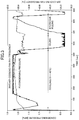
  • FIG. 3 is a graph showing an example of correspondence between a condensing pressure of a first coolant and a driving frequency of an air-cooling fan, in the cooled-hydrogen supply station according to the embodiment of the present invention
  • FIG. 4 is a graph showing an example of correspondence between a temperature of a second coolant and an open degree of an electronic expansion valve, in the cooled-hydrogen supply station according to the embodiment of the present invention
  • FIG. 5 is a table showing an example of operation state, in the cooled-hydrogen supply station according to the embodiment of the present invention.
  • FIG. 6 is a table showing another example of operation state, in the cooled-hydrogen supply station according to the embodiment of the present invention.
  • FIG. 1 is a system view of a cooled-hydrogen supply station 1 according to the embodiment of the present invention.
  • FIG. 2 is a schematic perspective view of a hydrogen cooling apparatus 2 in the cooled-hydrogen supply station 1 .
  • the cooled-hydrogen supply station 1 includes a hydrogen storage unit 11 in which hydrogen is stored, and a hydrogen passage 12 through which the hydrogen stored in the hydrogen storage unit 11 is transported.
  • a downstream end of the hydrogen passage 12 defines an outlet port 13 (typically, a nozzle for filling).
  • the hydrogen is supplied from the outlet port 13 to a fuel supply port of a fuel cell vehicle.
  • the outlet port 13 and the fuel supply port of a fuel cell vehicle are air-tightly connected to each other.
  • Compressed hydrogen is stored in the hydrogen storage unit 11 in the present embodiment.
  • the compressed hydrogen is supplied into the hydrogen passage 12 .
  • the hydrogen is compressed in such a manner that a rate of the hydrogen to be discharged from the outlet port 13 (a rate of hydrogen to be supplied to a fuel cell vehicle) is between 4.5 kg/3 minutes and 5.5 kg/3 minutes, in particular, 5.0 kg/3 min.
  • the cooled-hydrogen supply station 1 includes: a first coolant passage 21 through which a first coolant circulates; a air-cooled condenser 22 disposed on a part of the first coolant passage 21 to enable cooling of the first coolant by driving an air-cooling fan; a second coolant passage 23 through which a second coolant flows; and a first heat exchanger 24 enabling cooling of the second coolant by the first coolant, between another part of the first coolant passage 21 (a part different from the part that is cooled by the air-cooled condenser 22 ) and a part of the second coolant passage 23 .
  • a circulation direction of the first coolant in the first coolant passage 21 is indicated by the arrows in FIG. 1 . That is, the first coolant is cooled by the air-cooled condenser 22 , the first coolant then passes through the first heat exchanger 24 , and the first coolant returns again to the air-cooled condenser 22 .
  • a compressor 25 In order to circulate the first coolant in this direction, there is provided a compressor 25 at a part of the first coolant passage 21 extending from the first heat exchanger 24 to the air-cooled condenser 22 .
  • a pressure detecting sensor 26 in order to detect a pressure of the first coolant (condensing pressure) at a part of the first coolant passage 21 extending from the air-cooled condenser 22 to the first heat exchanger 24 .
  • an inverter controller 27 configured to inverter control a driving rotational speed of the air-cooling fan 22 f based on the pressure detected by the pressure detecting sensor 26 in such a manner that the pressure is maintained between 1.5 MPa and 1.7 MPa (by setting a target at 1.6 MPa). Specifically, as shown in FIGS.
  • the inverter controller 27 of the embodiment is configured to set the driving rotational speed of the air-cooling fan at 57.5 Hz while the pressure detected by the pressure detecting sensor 26 is increased or at a high level thereof (during an initial cooling of the first coolant at an initial operation and during a cooling of hydrogen by the second heat exchanger (during a filling of hydrogen)), and to maintain the driving rotational speed of the air-cooling fan at 32.9 Hz while the pressure detected by the pressure detecting sensor 26 is decreased or at a low level thereof (during an idling state).
  • an electronic expansion valve 28 between the pressure detecting sensor 26 and the first heat exchanger 24 as a valve configured to control a circulating rate of the first coolant through the air-cooled condenser 22 .
  • a temperature sensor configured to detect a temperature of the second coolant just after the first heat exchanger 24 in the second coolant passage 23
  • a temperature feedback control unit 30 configured to control the electronic expansion valve 28 based on a detection result of the temperature sensor 29 .
  • a hot gas bypassing passage 31 that bypasses the air-cooled condenser 22 in the first coolant passage 21 , and a second valve 32 that controls a circulating rate of the first coolant through the hot gas bypassing passage 31 .
  • a second heat exchanger 40 enabling cooling of the hydrogen by the second coolant is disposed between another part of the second coolant passage 23 (a part different from the part that is cooled by the first heat exchanger 24 ) and a part of the hydrogen passage 12 .
  • the second heat exchange 40 is configured to cool the hydrogen in the hydrogen passage 12 , before the hydrogen reaches the outlet opening 13 .
  • the second coolant passage 23 is composed of: a first half passage including the part of the second coolant passage 23 where heat is exchanged between the part of the second coolant passage 23 and the other part of the first coolant passage 21 by the first heat exchanger 24 ; a second half passage including the other part of the second coolant passage 23 where heat is exchanged between the other part of the second coolant passage 23 and the part of the hydrogen passage 12 by the second heat exchanger 40 ; and a tank unit 23 T connecting the first half passage and the second half passage.
  • the tank unit 23 T is substantially fully filled with the second coolant. Due to a pump 23 p (not shown) provided on the first half passage, as shown in the arrows in FIG. 1 , the second coolant, which has been supplied from the tank unit 23 T to the first half passage, flows through the first heat exchanger 24 so as to be cooled by the first coolant, and then flows into the second haft passage. The second coolant which has been supplied to the second half passage flows through the second heat exchanger 40 to cool the hydrogen (so that the second coolant is heated), and then returns to the tank unit 23 T.
  • an operation of the pump 23 is controlled in such a manner that a flow rate of the second coolant is between 135 L/min@0.3 Mpa and 165 L/min@0.3 Mpa (i.e., between 135 L/min and 165 L/min at a flow pressure of 0.3 Mpa), in particular, 150 L/min@0.3 Mpa (i.e., 150 L/min at a flow pressure of 0.3 Mpa).
  • the operation of the pump 23 is feedback-controlled based on flow rate values (detection result) detected by flow rate sensors (not shown) that are suitably disposed.
  • the hydrogen in the hydrogen passage 12 is configured to be adjusted to a set temperature within a temperature range of between ⁇ 43° C. and ⁇ 20° C. via the second heat exchange 40 , by adjusting a temperature of the second coolant flowing through the second heat exchanger 40 by means of any control of the electronic expansion valve 28 or the like. Specifically, as shown in FIG.
  • a feedback control is carried out based on a temperature value (detection value) of the second coolant detected by the temperature sensor 29 , in such a manner that when the temperature of the second coolant is higher than ⁇ 40° C., an open degree of the electronic expansion valve 28 during the operation is 40% or more, and an upper limit thereof is for example 50%, and that when the temperature of the second coolant is not higher than ⁇ 40° C., a lower limit of the open degree of the electronic expansion valve 28 during the operation is 10%, and for example the open degree of the electronic expansion valve 28 during the operation is between 20% and 30%.
  • flon is used as the first coolant circulating in the first coolant passage 21 .
  • HFC-based mixture coolant R404A manufactured by Du Pont-Mitsui Fluorochemicals Co., Ltd.
  • cold brine FP-40 (potassium formate solution) manufactured by Showa Corporation is used as the second coolant flowing in the second coolant passage 23 .
  • the cold brine FP-40 serving as the second coolant is a liquefied coolant, and is capable of holding flowability within a temperature range of between ⁇ 43° C. and ⁇ 20° C. Further, the cold brine FP-40 serving as the second coolant may expand or contract depending on a temperature thereof. When the second coolant expands or contracts, a liquid level of the second coolant in the tank unit 23 T rises or falls, which might cause corrosion thereof. However, in the present embodiment, in order to prevent this corrosion, a coolant-amount regulating mechanism 33 configured to maintain a liquid level of the second coolant in the tank unit 23 T within a predetermined range (preferably at a predetermined liquid level height) is connected to the tank unit 23 T.
  • the coolant-amount regulating mechanism 33 has a regulating tank 33 A and a check valve (not shown) that are connected to the tank unit 23 T.
  • the coolant-amount regulating mechanism 33 is configured to replenish the second coolant from the regulating tank 33 A into the tank unit 23 T, so as to maintain the liquid level of the second coolant within the predetermined range.
  • the coolant-amount regulating mechanism 33 is configured to discharge the second coolant from the tank unit 23 T through the check valve so as to maintain the liquid level of the second coolant within the predetermined range.
  • the hydrogen storage unit 11 and the hydrogen passage 12 passing through the second heat exchanger 40 constitute a hydrogen supply dispenser 10 in the cooled-hydrogen supply station 1 .
  • a part of the cooled-hydrogen supply station 1 other than the hydrogen storage unit 11 and the hydrogen passage 12 , can be understood as a hydrogen cooling apparatus 20 .
  • the cooled-hydrogen supply station 1 is formed by combining the hydrogen supply dispenser 10 and the hydrogen cooling apparatus 20 via the second heat exchanger 40 .
  • the air-cooling fan 22 f has to have an explosion-proof type of structure against hydrogen.
  • the explosion-proof type of structure against hydrogen there is an improved explosion resistance (safety-increased explosion proof) as an explosion-proof electrical equipment standard which can be used in a danger zone where hydrogen exists.
  • the air-cooled condenser 22 is used, and by suitably selecting the plurality of coolant passages and the respective coolants circulating through these coolant passages, the cooled-hydrogen supply station 1 can achieve a hydrogen cooling power of 13.5 kW to 16.5 kW for cooling hydrogen down to ⁇ 40° C. (13.5 kW@ ⁇ 40° C. to 16.5 kW@ ⁇ 40° C.). That is, a power between 13.5 kW and 16.5 kW can be achieved as a cooling performance to maintain the hydrogen at ⁇ 40° C. Further, a cooling precision within an error span between +2° C. and ⁇ 3° C. with respect to a set temperature within the temperature range of between ⁇ 43° C. and ⁇ 20° C. can be achieved.
  • the cooled-hydrogen supply station 1 can be operated by selecting any of a first operation mode and a second operation mode.
  • the first operation mode the hydrogen is cooled to ⁇ 20° C.
  • the second operation mode the hydrogen is cooled to ⁇ 40° C.
  • the selection of the first operation mode or the second operation mode is automatically carried out depending on a time zone. For example, in the present embodiment, the first operation mode is selected from 5:00 pm to 9:00 am, and the second operation mode is selected in a time zone other than between 5:00 pm to 9:00 am.
  • setting of a time zone in which the first operation mode is selected and a time zone in which the second operation mode is selected can be manually changed.
  • a housing 20 C of the hydrogen cooling apparatus 20 can be provided with a touch panel so that an operator can manually operate the touch panel.
  • the selection itself of the first operation mode or the second operation mode may be manually carried out through the touch panel or the like.
  • the selection of the first operation mode or the second operation mode may be automatically carried out in response to an outside air temperature.
  • the hydrogen supply station 1 is operated by selecting the first operation mode in which the hydrogen is cooled to ⁇ 20° C. or the second operation mode in which the hydrogen is cooled to ⁇ 40° C.
  • the temperature of the second coolant, which has passed through the first heat exchanger 24 is detected by the temperature sensor 29 .
  • the feedback control unit 30 controls the electronic expansion valve 28 of the first coolant passage 21 , if needed, depending on a difference between the temperature of the second coolant, which has been detected by the temperature sensor 29 , and ⁇ 20° C.
  • the temperature of the second coolant is controlled at ⁇ 20° C.
  • the compressor 25 of the first coolant passage 21 is driven so that the first coolant in the first coolant passage 21 is started to circulate in the direction of the arrows in FIG. 1 .
  • the pump 23 p of the second coolant passage 23 is driven so that the second coolant is started to circulate in the direction of the arrows in FIG. 1 .
  • the first coolant circulating in the first coolant passage 21 passes through the first heat exchanger 24
  • the second coolant circulating in the second coolant passage 23 passes through the first heat exchanger 24 .
  • the second coolant is cooled by the first coolant through the first heat exchanger 24 .
  • the second coolant flows through the second heat exchanger 40 of the second half passage of the second coolant passage 23 , and then returns to the tank unit 23 T.
  • the temperature of the second coolant, which has passed through the first heat exchanger 24 is detected by the temperature sensor 29 .
  • the feedback control unit 30 controls the electronic expansion valve 28 of the first coolant passage 21 , if needed, depending on a difference between the temperature of the second coolant, which has been detected by the temperature sensor 29 , and ⁇ 40° C. (see FIG. 4 ). Thus, the temperature of the second coolant is controlled at ⁇ 40° C.
  • a hydrogen filling operation is started. That is, the hydrogen in a compressed state is supplied from the hydrogen storage unit 11 through the hydrogen passage 12 to the outlet port 13 (and to a fuel cell vehicle). At this time, the hydrogen through the hydrogen passage 12 is precisely cooled down to ⁇ 40° C. by the second coolant through the second heat exchanger 40 . In addition, at this time, the flow rate of the circulating second coolant is between 135 L/min@0.3 Mpa and 165 L/min@0.3 Mpa, in particular, 150 L/min@0.3 Mpa.
  • the second coolant After flowing through the second heat exchanger 40 so as to have a higher temperature, the second coolant returns to the tank unit 23 T.
  • the temperature of the second coolant is detected by the temperature sensor 29 , and the open degree of the electronic expansion valve 28 is controlled by the temperature feedback control unit 30 based on the detected temperature (see FIG. 4 ).
  • the temperature of the second coolant circulating in the second half passage can be stably maintained at ⁇ 40° C.
  • the second coolant can be cooled with high precision to a temperature with an error span between +2° C. and ⁇ 3° C.
  • the hydrogen cooled by the second coolant can be also cooled with high precision to a temperature with an error span between +2° C. and ⁇ 3° C.
  • the second operation mode in the present embodiment it takes 120 minutes for the second coolant that has been at an external temperature of +40° C., for example, to be cooled to ⁇ 40° C. In addition, it takes only 30 minutes for the second coolant that has been cooled at ⁇ 20° C. in the first operation mode to be further cooled to ⁇ 40° C.
  • the cooled-hydrogen supply station 1 in the present embodiment can supply the hydrogen, which has been cooled with high precision as described above, to a fuel cell vehicle at a flow rate of between 4.5 kg/3 minutes and 5.5 kg/3 minutes, in particular, 5.0 kg/3 minutes.
  • a fuel cell vehicle at a flow rate of between 4.5 kg/3 minutes and 5.5 kg/3 minutes, in particular, 5.0 kg/3 minutes.
  • another succeeding fuel cell vehicle can be supplied with hydrogen, after an interval of only 7 minutes, at the same flow rate of between 4.5 kg/3 minutes and 5.5 kg/3 minutes, in particular, 5.0 kg/3 minutes.
  • a cooling power for stably maintaining the second coolant that has been cooled to ⁇ 40° C. at the same temperature of ⁇ 40° C. is between 13.5 kW@ ⁇ 40° C. and 16.5 kW@ ⁇ 40° C., in particular, 15.0 kW@ ⁇ 40° C.
  • the compressor 25 on the first coolant passage 21 and the pump 23 p on the second coolant passage 23 may be driven continuously from the first operation mode.
  • the compressor 25 on the first coolant passage 21 and the pump 23 p on the second coolant passage 23 may be driven continuously from the second operation mode.
  • the cold brine FP-40 serving as the second coolant may expand or contract depending on a temperature thereof.
  • the coolant-amount regulating mechanism 33 functions such that the liquid level of the second coolant in the tank unit 23 T is maintained within a predetermined range (preferably at a predetermined liquid level height), in order to prevent that the liquid level of the second coolant in the tank unit 23 T rises or falls to cause corrosion or the like.
  • the coolant-amount regulating mechanism 33 replenishes the second coolant from the regulating tank 33 A into the tank unit 23 T, so as to maintain the liquid level of the second coolant within the predetermined range.
  • the coolant-amount regulating mechanism 33 discharges the second coolant from the tank unit 23 T to the outside through the check valve, so as to maintain the liquid level of the second coolant within the predetermined range.
  • the hydrogen cooling power of between 13.5 kW@ ⁇ 40° C. and 16.5 kW@ ⁇ 40° C. can be achieved, the hydrogen can be cooled with high efficiency, i.e., the hydrogen can be cooled in a significantly energy-saving manner.
  • the hydrogen can be cooled with sufficiently high efficiency and with high precision.
  • the driving rotational speed of the air-cooling fan 22 f is set at 57.5 Hz.
  • the driving rotational speed of the air-cooling fan 22 f is maintained at 32.9 Hz.
  • the open degree of the electronic expansion valve 28 during the operation is 40% or more, and an upper limit thereof is for example 50%, and when the temperature of the second coolant is not higher than ⁇ 40° C., a lower limit of the open degree of the electronic expansion valve 28 during the operation is 10%, and for example the open degree of the electronic expansion valve 28 during the operation is between 20% and 30%.
  • the second valve 32 configured to control the circulating rate of the first coolant through the hot gas bypassing passage 31 is feed-back controlled to be opened based on a pressure value (detection value) of the first coolant detected by the pressure detecting sensor 41 , in such a manner that the pressure detected by the pressure detecting sensor 41 is maintained at ⁇ 46 kPa or more.
  • a pressure value detection value
  • FIG. 5 Such an operation state is shown in FIG. 5 .
  • the cooled-hydrogen supply station 1 is operated by selecting any of the first operation mode and the second operation mode.
  • the hydrogen is cooled to ⁇ 20° C.
  • the second operation mode the hydrogen is cooled to ⁇ 40° C.
  • the probability is low, the first operation mode corresponding to an idling operation condition is selected.
  • the probability is high, the second operation mode corresponding to a standby condition is selected.
  • the selection of the first operation mode and the second operation mode is automatically carried out depending on a time zone.
  • a nighttime zone where there is a low probability that the hydrogen has to be supplied e.g., outside business hours
  • the first operation mode is selected
  • a daytime zone where there is a high probability that the hydrogen has to be supplied e.g., during business hours
  • the second operation mode is selected.
  • consumption of energy for cooling the hydrogen can be efficiently restrained.
  • FIG. 6 shows another example of operation state, which is different from FIG. 5 .
  • the output power of the compressor 25 is reduced to 70%
  • the open degree of the electronic expansion valve 28 is reduced to 12.8%
  • the open degree of the second valve 32 is set at 100%. According to this operation state as well, effective energy-saving effects can be achieved.

Landscapes

  • Engineering & Computer Science (AREA)
  • Mechanical Engineering (AREA)
  • General Engineering & Computer Science (AREA)
  • Physics & Mathematics (AREA)
  • Thermal Sciences (AREA)
  • Chemical & Material Sciences (AREA)
  • Combustion & Propulsion (AREA)
  • Fuel Cell (AREA)
  • Filling Or Discharging Of Gas Storage Vessels (AREA)

Abstract

The present invention is a hydrogen cooling apparatus comprising: a air-cooled condenser disposed on a part of a first coolant passage so as to enable cooling of a first coolant by driving an air-cooling fan; a first heat exchanger enabling cooling of a second coolant by the first coolant, between another part of the first coolant passage and a part of a second coolant passage; and a second heat exchanger enabling cooling of hydrogen by the second coolant, between another part of the second coolant passage and a part of a hydrogen passage. A driving rotational speed of the air-cooling fan is inverter controlled in such a manner that a pressure of the first coolant from the air-cooled condenser to the first heat exchanger is maintained between 1.5 MPa and 1.7 MPa.

Description

TECHNICAL FIELD
The present invention relates to a cooled-hydrogen supply station configured to supply cooled hydrogen to a fuel cell vehicle or the like, and a cooling apparatus for hydrogen used in the cooled-hydrogen supply station.
BACKGROUND ART
A fuel cell vehicle using hydrogen as a fuel emits no exhaust gas. Thus, such a fuel cell vehicle is environmentally friendly. Under the circumstances, in order to use such a fuel cell vehicle more widely, various developments have been advanced in recent years. In order for prevalence of such a fuel cell vehicle, development of the vehicle itself is important, and development of a hydrogen supply station configured to supply hydrogen to a fuel cell vehicle is also important.
With regard to such a hydrogen supply station, the applicant has already obtained a patent (JP 5632065 B). The hydrogen supply station disclosed by this patent can achieve highly precise and sufficiently highly efficient cooling.
SUMMARY OF INVENTION
In the invention disclosed in JP 5632065 B, a water-cooled refrigeration unit is adopted for cooling the first coolant.
The present inventors have intensively studied the matter of replacing the water-cooled refrigeration unit with an air-cooled condenser that can create cooling effects by driving an air-cooling fan. In addition, the present inventors have intensively studied the matter of achieving energy-saving effects by adopting an inverter control with regard to a driving control of the air-cooling fan.
The present invention has been made based on the above background. The object of the present invention is to provide a cooled-hydrogen supply station that adopts an air-cooled condenser having an air-cooling fan driven in accordance with an inverter control and that is capable of cooling hydrogen with sufficiently high efficiency and, preferably, with high precision, and to provide a hydrogen cooling apparatus used in the cooled-hydrogen supply station.
The present invention is a cooled-hydrogen supply station comprising: a first coolant passage through which a first coolant circulates; an air-cooled condenser disposed on a part of the first coolant passage so as to enable cooling of the first coolant by driving an air-cooling fan; a second coolant passage through which a second coolant flows; a first heat exchanger enabling cooling of the second coolant by the first coolant, between another part of the first coolant passage and a part of the second coolant passage; a pressure detecting sensor configured to detect a pressure of the first coolant from the air-cooled condenser to the first heat exchanger; an inverter controller configured to inverter control a driving rotational speed of the air-cooling fan based on the pressure detected by the pressure detecting sensor in such a manner that the pressure is maintained between 1.5 MPa and 1.7 MPa; a hydrogen storage unit in which hydrogen is stored; a hydrogen passage through which the hydrogen stored in the hydrogen storage unit is transported; and a second heat exchanger enabling cooling of the hydrogen by the second coolant, between another part of the second coolant passage and a part of the hydrogen passage; wherein: the inverter controller is configured to increase the driving rotational speed of the air-cooling fan or maintain the driving rotational speed of the air-cooling fan at a high level thereof while the pressure detected by the pressure detecting sensor is increased or at a high level thereof, and to decrease the driving rotational speed of the air-cooling fan or maintain the driving rotational speed of the air-cooling fan at a low level thereof while the pressure detected by the pressure detecting sensor is decreased or at a low level thereof; the first coolant is flon; the second coolant is potassium formate solution; a flow rate of the second coolant flowing through the second coolant passage is between 135 L/min and 165 L/min at a flow pressure of 0.3 Mpa; the hydrogen is cooled down to a temperature range of between −43° C. and −20° C. by the second heat exchanger; the hydrogen is cooled to a temperature within an error span between +2° C. and −3° C. with respect to a set temperature within the temperature range of between −43° C. and −20° C. by the second heat exchanger; a hydrogen cooling power for cooling hydrogen to −40° C. is between 13.5 kW and 16.5 kW; the hydrogen passage has an outlet port from which the hydrogen having been cooled by the second heat exchanger is discharged; and a flow rate of the hydrogen discharged from the outlet port is between 4.5 kg/3 minutes and 5.5 kg/3 minutes.
According to the cooled-hydrogen supply station developed by the present inventors, since it is achieved that the hydrogen cooling power for cooling hydrogen down to −40° C. is between 13.5 kW and 16.5 kW (between 13.5 kW@−40° C. and 16.5 kW@−40° C.), hydrogen can be cooled with high efficiency, i.e., hydrogen can be cooled in a significantly energy-saving manner.
In addition, the hydrogen is configured to be cooled to a temperature within an error span between +2° C. and −3° C. with respect to a set temperature within the temperature range of between −43° C. and −20° C. by the second heat exchanger. That is, according to the cooled-hydrogen supply station developed by the present inventors, since the cooling precision within an error span between +2° C. and −3° C. with respect to a set temperature within the temperature range of between −43° C. and −20° C. can be achieved, hydrogen can be cooled with sufficiently high efficiency and with high precision.
In addition, in the cooled-hydrogen supply station, the hydrogen passage has an outlet port from which the hydrogen having been cooled by the second heat exchanger is discharged, and that a flow rate of the hydrogen discharged from the outlet port is between 4.5 kg/3 minutes and 5.5 kg/3 minutes. Due to such a discharging flow rate of the hydrogen, supply of the hydrogen to at least one fuel cell vehicle can be completed within 3 minutes (a hydrogen capacity of a current general fuel cell vehicle is 5 kg).
The present inventors have confirmed that, in the cooled-hydrogen supply station, when the first coolant is flon and the second coolant is potassium formate solution, specifically, “cold brine” manufactured by Showa Corporation, the aforementioned respective performances can be realized.
In addition, differently from the invention disclosed in JP 5632065 B, since the air-cooled condenser is adopted instead of the water-cooled refrigeration unit, it is not necessary to use any cooling-water utility equipment. Thus, degree of freedom associated with an installation place is remarkably improved. Furthermore, with regard to the driving control of the air-cooling fan, since the inverter control based on the pressure of the first coolant from the air-cooled condenser to the first heat exchanger is adopted, the desired energy-saving effects and highly precise operation can be achieved.
Specifically, for example, while the pressure detected by the pressure detecting sensor is increased or at a high level thereof (during a high load, for example, during an initial cooling of the first coolant for an initial operation or during a cooling of hydrogen by the second heat exchanger), the driving rotational speed of the air-cooling fan is set at 57.5 Hz. On the other hand, while the pressure detected by the pressure detecting sensor is decreased or at a low level thereof (during a low load, for example, during an idling state), the driving rotational speed of the air-cooling fan is maintained at 32.9 Hz. Thereby, effective energy-saving effects can be achieved, and the condensing pressure of the first coolant is stable within the range of between 1.5 MPa and 1.7 MPa, so that the first coolant can be always used in a stable state thereof (see FIG. 3).
Herein, it is necessary to dispose the air-cooling fan in a state wherein the air-cooling fan is exposed to an outside gas. Thus, the air-cooling fan has to have an explosion-proof type of structure against hydrogen. As an example of the explosion-proof type of structure against hydrogen, there is an improved explosion resistance (safety-increased explosion proof) as an explosion-proof electrical equipment standard which can be used in a danger zone where hydrogen exists.
Specifically, for example, the cooled-hydrogen supply station further comprises: a valve configured to control a circulating rate of the first coolant through the air-cooled condenser; a temperature sensor configured to detect a temperature of the second coolant just after the first heat exchanger in the second coolant passage; and a temperature feedback control unit configured to control the valve based on a detection result of the temperature sensor. In this case, the second coolant can be controlled at a desired temperature with high precision, by a simple temperature feedback control.
To be more specific, when the temperature of the second coolant is higher than −40° C., an open degree of the valve during the operation is 40% or more, and an upper limit thereof is for example 50%. When the temperature of the second coolant is not higher than −40° C., a lower limit of the open degree of the valve during the operation is 10%, and for example the open degree of the valve during the operation is between 20% and 30%. The valve may be an electronic expansion valve, for example.
In a case wherein the first coolant is caused to circulate through the first coolant passage by driving a compressor, when the temperature of the second coolant is not higher than −40° C., it is further preferable that an output power of the compressor is reduced to a range of between 60% and 80%. For example, the output power of the compressor may be reduced to 70%, and the open degree of the valve may be reduced to 12.8%. In this case, preferably, a hot gas bypassing passage that bypasses the air-cooled condenser in the first coolant passage may be further provided, a second valve that controls a circulating rate of the first coolant through the hot gas bypassing passage may be further provided, and an open degree of the second valve may be set at 100%.
In addition, in the cooled-hydrogen supply station, it is preferable that the cooled-hydrogen supply station is operated by selecting any of a first operation mode and a second operation mode, that the hydrogen is cooled to −20° C. in the first operation mode, and that the hydrogen is cooled to −40° C. in the second operation mode.
For example, depending on probability that the hydrogen has to be supplied, if the probability is low, the first operation mode corresponding to an idling operation condition is selected. On the other hand, if the probability is high, the second operation mode corresponding to a standby condition is selected. Thus, consumption of energy for cooling the hydrogen can be efficiently restrained.
For example, the selection of the first operation mode and the second operation mode may be automatically carried out depending on a time zone. In this case, for example, in a nighttime zone where there is a low probability that the hydrogen has to be supplied (e.g., outside business hours), the first operation mode is selected, while in a daytime zone where there is a high probability that the hydrogen has to be supplied (e.g., during business hours), the second operation mode is selected. Thus, in the nighttime zone where there is a less probability that the hydrogen has to be supplied, consumption of energy for cooling the hydrogen can be efficiently restrained.
In addition, in the cooled-hydrogen supply station, the second coolant passage may further include a tank unit; and a coolant-amount regulating mechanism configured to maintain a liquid level of the second coolant in the tank unit within a predetermined range may be connected to the tank unit.
In this case, since the liquid level of the second coolant in the tank unit is maintained within a predetermined range, even if a corrosive liquefied coolant is used as the second coolant and the second coolant expands and/or contracts due to a change in temperature, it is possible to prevent occurrence of corrosion and/or adhesion of precipitates on an inner wall of the tank unit, which might be caused by a rise and fall of the liquid level of the second coolant.
In addition, the present invention is a hydrogen cooling apparatus configured to cool hydrogen transported in a hydrogen passage; the hydrogen cooling apparatus comprising: a first coolant passage through which a first coolant circulates; an air-cooled condenser disposed on a part of the first coolant passage so as to enable cooling of the first coolant by driving an air-cooling fan; a second coolant passage through which a second coolant flows; a first heat exchanger enabling cooling of the second coolant by the first coolant, between another part of the first coolant passage and a part of the second coolant passage; a pressure detecting sensor configured to detect a pressure of the first coolant from the air-cooled condenser to the first heat exchanger; an inverter controller configured to inverter control a driving rotational speed of the air-cooling fan based on the pressure detected by the pressure detecting sensor in such a manner that the pressure is maintained between 1.5 MPa and 1.7 MPa; and a second heat exchanger enabling cooling of the hydrogen by the second coolant, between another part of the second coolant passage and a part of the hydrogen passage; wherein: the first coolant is flon; the second coolant is potassium formate solution; a flow rate of the second coolant flowing through the second coolant passage is between 135 L/min and 165 L/min at a flow pressure of 0.3 Mpa; the hydrogen is cooled down to a temperature range of between −43° C. and −20° C. by the second heat exchanger; the hydrogen is cooled to a temperature within an error span between +2° C. and −3° C. with respect to a set temperature within the temperature range of between −43° C. and −20° C. by the second heat exchanger; a hydrogen cooling power for cooling hydrogen to −40° C. is between 13.5 kW and 16.5 kW; the hydrogen passage has an outlet port from which the hydrogen having been cooled by the second heat exchanger is discharged; and a flow rate of the hydrogen discharged from the outlet port is between 4.5 kg/3 minutes and 5.5 kg/3 minutes.
According to the present invention, since it is achieved that the hydrogen cooling power for cooling hydrogen down to −40° C. is between 13.5 kW and 16.5 kW, hydrogen can be cooled with high efficiency, i.e., hydrogen can be cooled in a significantly energy-saving manner.
In addition, the hydrogen is configured to be cooled to a temperature within an error span between +2° C. and −3° C. with respect to a set temperature within the temperature range of between −43° C. and −20° C. by the second heat exchanger. That is, according to the cooled-hydrogen supply station developed by the present inventors, since the cooling precision within an error span between +2° C. and −3° C. with respect to a set temperature within the temperature range of between −43° C. and −20° C. can be achieved, hydrogen can be cooled with sufficiently high efficiency and with high precision.
In addition, in the cooled-hydrogen supply station, the hydrogen passage has an outlet port from which the hydrogen having been cooled by the second heat exchanger is discharged, and that a flow rate of the hydrogen discharged from the outlet port is between 4.5 kg/3 minutes and 5.5 kg/3 minutes. Due to such a discharging flow rate of the hydrogen, supply of the hydrogen to at least one fuel cell vehicle can be completed within 3 minutes (a hydrogen capacity of a current general fuel cell vehicle is 5 kg).
In addition, the present inventors have confirmed that, in the cooled-hydrogen supply station, when the first coolant is flon and the second coolant is potassium formate solution, specifically, “cold brine” manufactured by Showa Corporation, the aforementioned respective performances can be realized.
In addition, differently from the invention disclosed in JP 5632065 B, since the air-cooled condenser is adopted instead of the water-cooled refrigeration unit, it is not necessary to use any cooling-water utility equipment. Thus, degree of freedom associated with an installation place is remarkably improved. Furthermore, with regard to the driving control of the air-cooling fan, since the inverter control based on the pressure of the first coolant from the air-cooled condenser to the first heat exchanger is adopted, the desired energy-saving effects and highly precise operation can be achieved.
BRIEF DESCRIPTION OF DRAWINGS
FIG. 1 is a system view of a cooled-hydrogen supply station according to an embodiment of the present invention,
FIG. 2 is a schematic perspective view of a hydrogen cooling apparatus in the cooled-hydrogen supply station according to the embodiment of the present invention,
FIG. 3 is a graph showing an example of correspondence between a condensing pressure of a first coolant and a driving frequency of an air-cooling fan, in the cooled-hydrogen supply station according to the embodiment of the present invention,
FIG. 4 is a graph showing an example of correspondence between a temperature of a second coolant and an open degree of an electronic expansion valve, in the cooled-hydrogen supply station according to the embodiment of the present invention,
FIG. 5 is a table showing an example of operation state, in the cooled-hydrogen supply station according to the embodiment of the present invention, and
FIG. 6 is a table showing another example of operation state, in the cooled-hydrogen supply station according to the embodiment of the present invention.
DESCRIPTION OF EMBODIMENTS
An embodiment of the present invention will be described below with reference to the attached drawings. FIG. 1 is a system view of a cooled-hydrogen supply station 1 according to the embodiment of the present invention. FIG. 2 is a schematic perspective view of a hydrogen cooling apparatus 2 in the cooled-hydrogen supply station 1.
As shown in FIG. 1, the cooled-hydrogen supply station 1 includes a hydrogen storage unit 11 in which hydrogen is stored, and a hydrogen passage 12 through which the hydrogen stored in the hydrogen storage unit 11 is transported. A downstream end of the hydrogen passage 12 defines an outlet port 13 (typically, a nozzle for filling). The hydrogen is supplied from the outlet port 13 to a fuel supply port of a fuel cell vehicle. When the hydrogen is supplied, the outlet port 13 and the fuel supply port of a fuel cell vehicle are air-tightly connected to each other.
Compressed hydrogen is stored in the hydrogen storage unit 11 in the present embodiment. Thus, the compressed hydrogen is supplied into the hydrogen passage 12. In the present embodiment, the hydrogen is compressed in such a manner that a rate of the hydrogen to be discharged from the outlet port 13 (a rate of hydrogen to be supplied to a fuel cell vehicle) is between 4.5 kg/3 minutes and 5.5 kg/3 minutes, in particular, 5.0 kg/3 min.
In addition, as shown in FIG. 1, the cooled-hydrogen supply station 1 includes: a first coolant passage 21 through which a first coolant circulates; a air-cooled condenser 22 disposed on a part of the first coolant passage 21 to enable cooling of the first coolant by driving an air-cooling fan; a second coolant passage 23 through which a second coolant flows; and a first heat exchanger 24 enabling cooling of the second coolant by the first coolant, between another part of the first coolant passage 21 (a part different from the part that is cooled by the air-cooled condenser 22) and a part of the second coolant passage 23.
A circulation direction of the first coolant in the first coolant passage 21 is indicated by the arrows in FIG. 1. That is, the first coolant is cooled by the air-cooled condenser 22, the first coolant then passes through the first heat exchanger 24, and the first coolant returns again to the air-cooled condenser 22. In order to circulate the first coolant in this direction, there is provided a compressor 25 at a part of the first coolant passage 21 extending from the first heat exchanger 24 to the air-cooled condenser 22.
In addition, there is provided a pressure detecting sensor 26 in order to detect a pressure of the first coolant (condensing pressure) at a part of the first coolant passage 21 extending from the air-cooled condenser 22 to the first heat exchanger 24. Furthermore, there is provided an inverter controller 27 configured to inverter control a driving rotational speed of the air-cooling fan 22 f based on the pressure detected by the pressure detecting sensor 26 in such a manner that the pressure is maintained between 1.5 MPa and 1.7 MPa (by setting a target at 1.6 MPa). Specifically, as shown in FIGS. 3 and 5, the inverter controller 27 of the embodiment is configured to set the driving rotational speed of the air-cooling fan at 57.5 Hz while the pressure detected by the pressure detecting sensor 26 is increased or at a high level thereof (during an initial cooling of the first coolant at an initial operation and during a cooling of hydrogen by the second heat exchanger (during a filling of hydrogen)), and to maintain the driving rotational speed of the air-cooling fan at 32.9 Hz while the pressure detected by the pressure detecting sensor 26 is decreased or at a low level thereof (during an idling state).
Furthermore, there is provided an electronic expansion valve 28 between the pressure detecting sensor 26 and the first heat exchanger 24, as a valve configured to control a circulating rate of the first coolant through the air-cooled condenser 22. On the other hand, there is provided a temperature sensor configured to detect a temperature of the second coolant just after the first heat exchanger 24 in the second coolant passage 23, and there is provided a temperature feedback control unit 30 configured to control the electronic expansion valve 28 based on a detection result of the temperature sensor 29.
In addition, there are provided a hot gas bypassing passage 31 that bypasses the air-cooled condenser 22 in the first coolant passage 21, and a second valve 32 that controls a circulating rate of the first coolant through the hot gas bypassing passage 31.
In addition, a second heat exchanger 40 enabling cooling of the hydrogen by the second coolant is disposed between another part of the second coolant passage 23 (a part different from the part that is cooled by the first heat exchanger 24) and a part of the hydrogen passage 12. The second heat exchange 40 is configured to cool the hydrogen in the hydrogen passage 12, before the hydrogen reaches the outlet opening 13.
In the present embodiment, the second coolant passage 23 is composed of: a first half passage including the part of the second coolant passage 23 where heat is exchanged between the part of the second coolant passage 23 and the other part of the first coolant passage 21 by the first heat exchanger 24; a second half passage including the other part of the second coolant passage 23 where heat is exchanged between the other part of the second coolant passage 23 and the part of the hydrogen passage 12 by the second heat exchanger 40; and a tank unit 23T connecting the first half passage and the second half passage.
The tank unit 23T is substantially fully filled with the second coolant. Due to a pump 23 p (not shown) provided on the first half passage, as shown in the arrows in FIG. 1, the second coolant, which has been supplied from the tank unit 23T to the first half passage, flows through the first heat exchanger 24 so as to be cooled by the first coolant, and then flows into the second haft passage. The second coolant which has been supplied to the second half passage flows through the second heat exchanger 40 to cool the hydrogen (so that the second coolant is heated), and then returns to the tank unit 23T. In the present embodiment, an operation of the pump 23 is controlled in such a manner that a flow rate of the second coolant is between 135 L/min@0.3 Mpa and 165 L/min@0.3 Mpa (i.e., between 135 L/min and 165 L/min at a flow pressure of 0.3 Mpa), in particular, 150 L/min@0.3 Mpa (i.e., 150 L/min at a flow pressure of 0.3 Mpa). Specifically, the operation of the pump 23 is feedback-controlled based on flow rate values (detection result) detected by flow rate sensors (not shown) that are suitably disposed.
In addition, the hydrogen in the hydrogen passage 12 is configured to be adjusted to a set temperature within a temperature range of between −43° C. and −20° C. via the second heat exchange 40, by adjusting a temperature of the second coolant flowing through the second heat exchanger 40 by means of any control of the electronic expansion valve 28 or the like. Specifically, as shown in FIG. 4, a feedback control is carried out based on a temperature value (detection value) of the second coolant detected by the temperature sensor 29, in such a manner that when the temperature of the second coolant is higher than −40° C., an open degree of the electronic expansion valve 28 during the operation is 40% or more, and an upper limit thereof is for example 50%, and that when the temperature of the second coolant is not higher than −40° C., a lower limit of the open degree of the electronic expansion valve 28 during the operation is 10%, and for example the open degree of the electronic expansion valve 28 during the operation is between 20% and 30%.
Herein, in the present embodiment, flon is used as the first coolant circulating in the first coolant passage 21. Specifically, there is used HFC-based mixture coolant R404A manufactured by Du Pont-Mitsui Fluorochemicals Co., Ltd. Meanwhile, cold brine FP-40 (potassium formate solution) manufactured by Showa Corporation is used as the second coolant flowing in the second coolant passage 23.
The cold brine FP-40 serving as the second coolant is a liquefied coolant, and is capable of holding flowability within a temperature range of between −43° C. and −20° C. Further, the cold brine FP-40 serving as the second coolant may expand or contract depending on a temperature thereof. When the second coolant expands or contracts, a liquid level of the second coolant in the tank unit 23T rises or falls, which might cause corrosion thereof. However, in the present embodiment, in order to prevent this corrosion, a coolant-amount regulating mechanism 33 configured to maintain a liquid level of the second coolant in the tank unit 23T within a predetermined range (preferably at a predetermined liquid level height) is connected to the tank unit 23T. The coolant-amount regulating mechanism 33 has a regulating tank 33A and a check valve (not shown) that are connected to the tank unit 23T. When the second coolant is cooled to contract, the coolant-amount regulating mechanism 33 is configured to replenish the second coolant from the regulating tank 33A into the tank unit 23T, so as to maintain the liquid level of the second coolant within the predetermined range. On the other hand, when the second coolant is heated to expand, the coolant-amount regulating mechanism 33 is configured to discharge the second coolant from the tank unit 23T through the check valve so as to maintain the liquid level of the second coolant within the predetermined range.
In FIG. 1, the hydrogen storage unit 11 and the hydrogen passage 12 passing through the second heat exchanger 40 constitute a hydrogen supply dispenser 10 in the cooled-hydrogen supply station 1. On the other hand, a part of the cooled-hydrogen supply station 1, other than the hydrogen storage unit 11 and the hydrogen passage 12, can be understood as a hydrogen cooling apparatus 20. The cooled-hydrogen supply station 1 is formed by combining the hydrogen supply dispenser 10 and the hydrogen cooling apparatus 20 via the second heat exchanger 40.
Herein, as shown in FIG. 2, it is necessary to dispose the air-cooling fan 22 f in a state wherein the air-cooling fan 22 f is exposed to an outside gas. Thus, the air-cooling fan 22 f has to have an explosion-proof type of structure against hydrogen. As an example of the explosion-proof type of structure against hydrogen, there is an improved explosion resistance (safety-increased explosion proof) as an explosion-proof electrical equipment standard which can be used in a danger zone where hydrogen exists.
In the aforementioned cooled-hydrogen supply station 1, the air-cooled condenser 22 is used, and by suitably selecting the plurality of coolant passages and the respective coolants circulating through these coolant passages, the cooled-hydrogen supply station 1 can achieve a hydrogen cooling power of 13.5 kW to 16.5 kW for cooling hydrogen down to −40° C. (13.5 kW@−40° C. to 16.5 kW@−40° C.). That is, a power between 13.5 kW and 16.5 kW can be achieved as a cooling performance to maintain the hydrogen at −40° C. Further, a cooling precision within an error span between +2° C. and −3° C. with respect to a set temperature within the temperature range of between −43° C. and −20° C. can be achieved.
In addition, the cooled-hydrogen supply station 1 according to the present embodiment can be operated by selecting any of a first operation mode and a second operation mode. In the first operation mode, the hydrogen is cooled to −20° C. Meanwhile, in the second operation mode, the hydrogen is cooled to −40° C. The selection of the first operation mode or the second operation mode is automatically carried out depending on a time zone. For example, in the present embodiment, the first operation mode is selected from 5:00 pm to 9:00 am, and the second operation mode is selected in a time zone other than between 5:00 pm to 9:00 am.
In addition, in the present embodiment, setting of a time zone in which the first operation mode is selected and a time zone in which the second operation mode is selected can be manually changed. Specifically, as shown in FIG. 2, a housing 20C of the hydrogen cooling apparatus 20 can be provided with a touch panel so that an operator can manually operate the touch panel.
Furthermore, the selection itself of the first operation mode or the second operation mode may be manually carried out through the touch panel or the like. Alternatively, the selection of the first operation mode or the second operation mode may be automatically carried out in response to an outside air temperature.
Next, an operation of the hydrogen supply station 1 according to the present embodiment is explained.
The hydrogen supply station 1 according to the present embodiment is operated by selecting the first operation mode in which the hydrogen is cooled to −20° C. or the second operation mode in which the hydrogen is cooled to −40° C.
An operation of the hydrogen supply station 1 in the first operation mode is explained firstly. Upon start of the operation in the first operation mode, the compressor 25 of the first coolant passage 21 is driven so that the first coolant in the first coolant passage 21 is started to circulate in the direction of the arrows in FIG. 1. In addition, the pump 23 p of the second coolant passage 23 is driven so that the second coolant is started to circulate in the direction of the arrows in FIG. 1. Thus, the first coolant circulating in the first coolant passage 21 passes through the first heat exchanger 24, and the second coolant circulating in the second coolant passage 23 passes through the first heat exchanger 24. At this time, the second coolant is cooled by the first coolant through the first heat exchanger 24. Subsequently, the second coolant flows through the second heat exchanger 40 of the second half passage of the second coolant passage 23, and then returns to the tank unit 23T.
The temperature of the second coolant, which has passed through the first heat exchanger 24 is detected by the temperature sensor 29. The feedback control unit 30 controls the electronic expansion valve 28 of the first coolant passage 21, if needed, depending on a difference between the temperature of the second coolant, which has been detected by the temperature sensor 29, and −20° C. Thus, the temperature of the second coolant is controlled at −20° C.
Next, an operation of the hydrogen supply station 1 in the second operation mode is explained. Upon start of the operation in the second operation mode as well, the compressor 25 of the first coolant passage 21 is driven so that the first coolant in the first coolant passage 21 is started to circulate in the direction of the arrows in FIG. 1. In addition, the pump 23 p of the second coolant passage 23 is driven so that the second coolant is started to circulate in the direction of the arrows in FIG. 1. Thus, the first coolant circulating in the first coolant passage 21 passes through the first heat exchanger 24, and the second coolant circulating in the second coolant passage 23 passes through the first heat exchanger 24. At this time, the second coolant is cooled by the first coolant through the first heat exchanger 24. Subsequently, the second coolant flows through the second heat exchanger 40 of the second half passage of the second coolant passage 23, and then returns to the tank unit 23T.
The temperature of the second coolant, which has passed through the first heat exchanger 24 is detected by the temperature sensor 29. The feedback control unit 30 controls the electronic expansion valve 28 of the first coolant passage 21, if needed, depending on a difference between the temperature of the second coolant, which has been detected by the temperature sensor 29, and −40° C. (see FIG. 4). Thus, the temperature of the second coolant is controlled at −40° C.
In this state, a hydrogen filling operation is started. That is, the hydrogen in a compressed state is supplied from the hydrogen storage unit 11 through the hydrogen passage 12 to the outlet port 13 (and to a fuel cell vehicle). At this time, the hydrogen through the hydrogen passage 12 is precisely cooled down to −40° C. by the second coolant through the second heat exchanger 40. In addition, at this time, the flow rate of the circulating second coolant is between 135 L/min@0.3 Mpa and 165 L/min@0.3 Mpa, in particular, 150 L/min@0.3 Mpa.
After flowing through the second heat exchanger 40 so as to have a higher temperature, the second coolant returns to the tank unit 23T. The temperature of the second coolant is detected by the temperature sensor 29, and the open degree of the electronic expansion valve 28 is controlled by the temperature feedback control unit 30 based on the detected temperature (see FIG. 4). Thus, the temperature of the second coolant circulating in the second half passage can be stably maintained at −40° C.
In fact, according to the cooled-hydrogen supply station 1 developed by the present inventors, the second coolant can be cooled with high precision to a temperature with an error span between +2° C. and −3° C. Thus, the hydrogen cooled by the second coolant can be also cooled with high precision to a temperature with an error span between +2° C. and −3° C.
According to the second operation mode in the present embodiment, it takes 120 minutes for the second coolant that has been at an external temperature of +40° C., for example, to be cooled to −40° C. In addition, it takes only 30 minutes for the second coolant that has been cooled at −20° C. in the first operation mode to be further cooled to −40° C.
The cooled-hydrogen supply station 1 in the present embodiment can supply the hydrogen, which has been cooled with high precision as described above, to a fuel cell vehicle at a flow rate of between 4.5 kg/3 minutes and 5.5 kg/3 minutes, in particular, 5.0 kg/3 minutes. In addition, according to the cooled-hydrogen supply station 1 in the present embodiment, after the hydrogen has been supplied to a certain fuel cell vehicle at a flow rate of between 4.5 kg/3 minutes and 5.5 kg/3 minutes, in particular, 5.0 kg/3 minutes, another succeeding fuel cell vehicle can be supplied with hydrogen, after an interval of only 7 minutes, at the same flow rate of between 4.5 kg/3 minutes and 5.5 kg/3 minutes, in particular, 5.0 kg/3 minutes.
A cooling power for stably maintaining the second coolant that has been cooled to −40° C. at the same temperature of −40° C. is between 13.5 kW@−40° C. and 16.5 kW@−40° C., in particular, 15.0 kW@−40° C.
When the first operation mode is switched to the second operation mode, the compressor 25 on the first coolant passage 21 and the pump 23 p on the second coolant passage 23 may be driven continuously from the first operation mode. Similarly, when the second operation mode is switched to the first operation mode as well, the compressor 25 on the first coolant passage 21 and the pump 23 p on the second coolant passage 23 may be driven continuously from the second operation mode.
In addition, in both of the first operation mode and the second operation mode, the cold brine FP-40 serving as the second coolant may expand or contract depending on a temperature thereof. In the present embodiment, even when the second coolant expands or contracts, the coolant-amount regulating mechanism 33 functions such that the liquid level of the second coolant in the tank unit 23T is maintained within a predetermined range (preferably at a predetermined liquid level height), in order to prevent that the liquid level of the second coolant in the tank unit 23T rises or falls to cause corrosion or the like. When the second coolant is cooled to contract, the coolant-amount regulating mechanism 33 replenishes the second coolant from the regulating tank 33A into the tank unit 23T, so as to maintain the liquid level of the second coolant within the predetermined range. On the other hand, when the second coolant is heated to expand, the coolant-amount regulating mechanism 33 discharges the second coolant from the tank unit 23T to the outside through the check valve, so as to maintain the liquid level of the second coolant within the predetermined range.
According to the cooled-hydrogen supply station 1 in the present embodiment, since the hydrogen cooling power of between 13.5 kW@−40° C. and 16.5 kW@−40° C. can be achieved, the hydrogen can be cooled with high efficiency, i.e., the hydrogen can be cooled in a significantly energy-saving manner.
Further, in the present embodiment, since the cooling precision within an error span between +2° C. and −3° C. with respect to a set temperature within the temperature range of between −43° C. and −20° C. can be achieved, the hydrogen can be cooled with sufficiently high efficiency and with high precision.
In addition, differently from the invention disclosed in JP 5632065 B, since the air-cooled condenser 22 is adopted instead of the conventional water-cooled refrigeration unit, it is not necessary to use any cooling-water utility equipment. Thus, degree of freedom associated with an installation place is remarkably improved. Furthermore, with regard to the driving control of the air-cooling fan 22 f, since the inverter control based on the pressure of the first coolant between from the air-cooled condenser 22 to the first heat exchanger 24 is adopted, the desired energy-saving effects and highly precise operation can be achieved.
Specifically, while the pressure detected by the pressure detecting sensor 26 is increased or at a high level thereof (during an initial cooling of the first coolant at an initial operation and during a cooling of hydrogen by the second heat exchanger 40), the driving rotational speed of the air-cooling fan 22 f is set at 57.5 Hz. On the other hand, while the pressure detected by the pressure detecting sensor 26 is decreased or at a low level thereof (during an idling state), the driving rotational speed of the air-cooling fan 22 f is maintained at 32.9 Hz. Thereby, effective energy-saving effects can be achieved. In addition, such a control makes the condensing pressure of the first coolant stable within the range of between 1.5 MPa and 1.7 MPa, so that the first coolant can be always used in a stable state thereof (see FIG. 3).
In addition, according to the present embodiment, as shown in FIG. 4, when the temperature of the second coolant is higher than −40° C., the open degree of the electronic expansion valve 28 during the operation is 40% or more, and an upper limit thereof is for example 50%, and when the temperature of the second coolant is not higher than −40° C., a lower limit of the open degree of the electronic expansion valve 28 during the operation is 10%, and for example the open degree of the electronic expansion valve 28 during the operation is between 20% and 30%. Thereby as well, effective energy-saving effects can be achieved. In this case, the second valve 32 configured to control the circulating rate of the first coolant through the hot gas bypassing passage 31 is feed-back controlled to be opened based on a pressure value (detection value) of the first coolant detected by the pressure detecting sensor 41, in such a manner that the pressure detected by the pressure detecting sensor 41 is maintained at −46 kPa or more. Such an operation state is shown in FIG. 5.
In addition, according to the cooled-hydrogen supply station 1 in the present embodiment, the cooled-hydrogen supply station 1 is operated by selecting any of the first operation mode and the second operation mode. In the first operation mode, the hydrogen is cooled to −20° C. Meanwhile, in the second operation mode, the hydrogen is cooled to −40° C. Thus, depending on probability that the hydrogen has to be supplied, if the probability is low, the first operation mode corresponding to an idling operation condition is selected. On the other hand, if the probability is high, the second operation mode corresponding to a standby condition is selected. Thus, consumption of energy for cooling the hydrogen can be efficiently restrained.
Specifically, according to the present embodiment, the selection of the first operation mode and the second operation mode is automatically carried out depending on a time zone. In a nighttime zone where there is a low probability that the hydrogen has to be supplied (e.g., outside business hours), the first operation mode is selected, while in a daytime zone where there is a high probability that the hydrogen has to be supplied (e.g., during business hours), the second operation mode is selected. Thus, in the nighttime zone where there is a less probability that the hydrogen has to be supplied, consumption of energy for cooling the hydrogen can be efficiently restrained.
Next, FIG. 6 shows another example of operation state, which is different from FIG. 5. In the example shown in FIG. 6, when the temperature of the second coolant is higher than −40° C., the output power of the compressor 25 is reduced to 70%, the open degree of the electronic expansion valve 28 is reduced to 12.8%, and the open degree of the second valve 32 is set at 100%. According to this operation state as well, effective energy-saving effects can be achieved.
1 cooled-hydrogen supply station
10 hydrogen supply dispenser
11 hydrogen storage unit
12 hydrogen passage
13 outlet port
20 hydrogen cooling apparatus
21 first coolant passage
22 air-cooled condenser
22 f air-cooling fan
23 second coolant passage
23T tank unit
24 first heat exchanger
25 compressor
26 pressure detecting sensor
27 inverter controller
28 electronic expansion valve
29 temperature sensor
30 temperature feedback control unit
31 hot gas bypassing passage
32 second valve
33 coolant-amount regulating mechanism
33A coolant-amount regulating tank
40 second heat exchanger
41 pressure detecting sensor

Claims (9)

What is claimed is:
1. A cooled-hydrogen supply station comprising:
a first coolant passage through which a first coolant circulates;
an air-cooled condenser disposed on a part of the first coolant passage so as to enable cooling of the first coolant by driving an air-cooling fan;
a second coolant passage through which a second coolant flows;
a first heat exchanger enabling cooling of the second coolant by the first coolant, between another part of the first coolant passage and a part of the second coolant passage;
a pressure detecting sensor configured to detect a pressure of the first coolant from the air-cooled condenser to the first heat exchanger;
an inverter controller configured to inverter control a driving rotational speed of the air-cooling fan based on the pressure detected by the pressure detecting sensor in such a manner that the pressure is maintained between 1.5 MPa and 1.7 MPa;
a hydrogen storage unit in which hydrogen is stored;
a hydrogen passage through which the hydrogen stored in the hydrogen storage unit is transported; and
a second heat exchanger enabling cooling of the hydrogen by the second coolant, between another part of the second coolant passage and a part of the hydrogen passage;
wherein:
the inverter controller is configured to increase the driving rotational speed of the air-cooling fan or maintain the driving rotational speed of the air-cooling fan at a high level thereof while the pressure detected by the pressure detecting sensor is increased or at a high level thereof, and to decrease the driving rotational speed of the air-cooling fan or maintain the driving rotational speed of the air-cooling fan at a low level thereof while the pressure detected by the pressure detecting sensor is decreased or at a low level thereof;
the first coolant is flon;
the second coolant is potassium formate solution;
a flow rate of the second coolant flowing through the second coolant passage is between 135 L/min and 165 L/min at a flow pressure of 0.3 MPa;
the hydrogen is cooled down to a temperature range of between −43° C. and −20° C. by the second heat exchanger;
the hydrogen is cooled to a temperature within an error span between +2° C. and −3° C. with respect to a set temperature within the temperature range of between −43° C. and −20° C. by the second heat exchanger;
a hydrogen cooling power for cooling hydrogen to −40° C. is between 13.5 kW and 16.5 kW;
the hydrogen passage has an outlet port from which the hydrogen having been cooled by the second heat exchanger is discharged; and
a flow rate of the hydrogen discharged from the outlet port is between 4.5 kg/3 minutes and 5.5 kg/3 minutes.
2. The cooled-hydrogen supply station according to claim 1, wherein
the air-cooling fan has an explosion-proof type of structure against hydrogen.
3. The cooled-hydrogen supply station according to claim 1, further comprising:
a valve configured to control a circulating rate of the first coolant through the air-cooled condenser;
a temperature sensor configured to detect a temperature of the second coolant just after the first heat exchanger in the second coolant passage; and
a temperature feedback control unit configured to control the valve based on a detection result of the temperature sensor.
4. The cooled-hydrogen supply station according to claim 3, wherein
when the temperature of the second coolant is higher than −40° C., an open degree of the valve is between 40% to 50%, and
when the temperature of the second coolant is not higher than −40° C., the open degree of the valve is between 10% to 30%.
5. The cooled-hydrogen supply station according to claim 3, wherein
a compressor is configured to cause the first coolant to circulate through the first coolant passage, and
when the temperature of the second coolant is not higher than −40° C., an output power of the compressor is reduced to a range of between 60% and 80%.
6. The cooled-hydrogen supply station according to claim 1, wherein:
the cooled-hydrogen supply station is operated by selecting any of a first operation mode and a second operation mode;
the hydrogen is cooled to −20° C. in the first operation mode; and
the hydrogen is cooled to −40° C. in the second operation mode.
7. The cooled-hydrogen supply station according to claim 6, wherein
the selection of the first operation mode or the second operation mode is automatically carried out depending on a time zone.
8. The cooled-hydrogen supply station according to according to claim 1, wherein:
the second coolant passage further includes a tank unit; and
a coolant-amount regulating mechanism configured to maintain a liquid level of the second coolant in the tank unit within a predetermined range is connected to the tank unit.
9. A hydrogen cooling apparatus configured to cool hydrogen transported in a hydrogen passage; the hydrogen cooling apparatus comprising:
a first coolant passage through which a first coolant circulates;
an air-cooled condenser disposed on a part of the first coolant passage so as to enable cooling of the first coolant by driving an air-cooling fan;
a second coolant passage through which a second coolant flows;
a first heat exchanger enabling cooling of the second coolant by the first coolant, between another part of the first coolant passage and a part of the second coolant passage;
a pressure detecting sensor configured to detect a pressure of the first coolant from the air-cooled condenser to the first heat exchanger;
an inverter controller configured to inverter control a driving rotational speed of the air-cooling fan based on the pressure detected by the pressure detecting sensor in such a manner that the pressure is maintained between 1.5 MPa and 1.7 MPa; and
a second heat exchanger enabling cooling of the hydrogen by the second coolant, between another part of the second coolant passage and a part of the hydrogen passage;
wherein:
the first coolant is flon;
the second coolant is potassium formate solution;
a flow rate of the second coolant flowing through the second coolant passage is between 135 L/min and 165 L/min at a flow pressure of 0.3, MPa;
the hydrogen is cooled down to a temperature range of between −43° C. and −20° C. by the second heat exchanger;
the hydrogen is cooled to a temperature within an error span between +2° C. and −3° C. with respect to a set temperature within the temperature range of between −43° C. and −20° C. by the second heat exchanger;
a hydrogen cooling power for cooling hydrogen to −40° C. is between 13.5 kW and 16.5 kW;
the hydrogen passage has an outlet port from which the hydrogen having been cooled by the second heat exchanger is discharged; and
a flow rate of the hydrogen discharged from the outlet port is between 4.5 kg/3 minutes and 5.5 kg/3 minutes.
US16/070,023 2016-01-22 2017-01-19 Cooled-hydrogen supply station and a cooling apparatus for hydrogen Active 2037-02-16 US10571077B2 (en)

Applications Claiming Priority (3)

Application Number Priority Date Filing Date Title
JP2016-011107 2016-01-22
JP2016011107A JP6643105B2 (en) 2016-01-22 2016-01-22 Cooling hydrogen supply station and hydrogen cooling device
PCT/JP2017/001658 WO2017126580A1 (en) 2016-01-22 2017-01-19 Cold hydrogen supply station and hydrogen cooling device

Publications (2)

Publication Number Publication Date
US20190032849A1 US20190032849A1 (en) 2019-01-31
US10571077B2 true US10571077B2 (en) 2020-02-25

Family

ID=59362379

Family Applications (1)

Application Number Title Priority Date Filing Date
US16/070,023 Active 2037-02-16 US10571077B2 (en) 2016-01-22 2017-01-19 Cooled-hydrogen supply station and a cooling apparatus for hydrogen

Country Status (7)

Country Link
US (1) US10571077B2 (en)
EP (1) EP3406960B1 (en)
JP (1) JP6643105B2 (en)
KR (1) KR102098574B1 (en)
CN (1) CN108474519B (en)
TW (1) TWI644070B (en)
WO (1) WO2017126580A1 (en)

Cited By (1)

* Cited by examiner, † Cited by third party
Publication number Priority date Publication date Assignee Title
US11015763B2 (en) * 2016-02-23 2021-05-25 Tokico System Solutions, Ltd. Expansion turbine and compressor-type high-pressure hydrogen filling system and control method for same

Families Citing this family (22)

* Cited by examiner, † Cited by third party
Publication number Priority date Publication date Assignee Title
US10478929B2 (en) 2017-03-08 2019-11-19 A3 Labs LLC Energy source supply systems, energy source supply devices, and related methods
JP6831311B2 (en) * 2017-09-15 2021-02-17 株式会社神戸製鋼所 Gas supply device and how to start operation of the gas supply device
DK179886B1 (en) 2018-03-07 2019-08-27 Nel Hydrogen A/S A hydrogen refueling station and a method for controlling the hydrogen refueling station
US11499765B2 (en) 2018-08-01 2022-11-15 L'air Liquide, Societe Anonyme Pour L'etude Et L'exploitation Des Procedes Georges Claude Device and process for refueling containers with pressurized gas
US11506339B2 (en) 2018-08-01 2022-11-22 L'air Liquide, Societe Anonyme Pour L'etude Et L'exploitation Des Procedes Georges Claude Device and process for refueling containers with pressurized gas
CN110792923A (en) * 2018-08-01 2020-02-14 乔治洛德方法研究和开发液化空气有限公司 Device and method for filling a container with a pressurized gas
PL240127B1 (en) * 2019-05-29 2022-02-21 Techcool Spolka Z Ograniczona Odpowiedzialnoscia Cooling system for freezers, especially plate freezers
JP6624623B1 (en) * 2019-06-26 2019-12-25 伸和コントロールズ株式会社 Temperature control device and temperature control device
JP7357915B2 (en) 2019-10-07 2023-10-10 伸和コントロールズ株式会社 Hydrogen cooling equipment, hydrogen supply system and refrigerator
CN111006129B (en) * 2019-12-12 2020-11-20 郑州宇通客车股份有限公司 Hydrogenation precooling control method and system for hydrogenation station
KR102310951B1 (en) * 2020-01-22 2021-10-08 주식회사 효성 Gas supply system and gas filling device using the same
KR102217530B1 (en) * 2020-10-28 2021-02-19 주식회사 삼정이엔씨 Control system for a cooling apparatus of hydrogen gas charger
KR102485401B1 (en) * 2020-11-26 2023-01-05 하이리움산업(주) Hydrogen charging station system to prevent condensation in the hydrogen charging port and providing method thereof
CN112611118B (en) * 2020-12-07 2022-05-06 上海泰坦科技股份有限公司 Low-temperature cooling liquid circulating pump
IT202100004298A1 (en) * 2021-02-24 2022-08-24 Nuovo Pignone Tecnologie Srl HYDROGEN COMPRESSION SYSTEM AND METHOD OF PRODUCING HYDROGEN AT LOW TEMPERATURE AND HIGH PRESSURE
US11287089B1 (en) * 2021-04-01 2022-03-29 Air Products And Chemicals, Inc. Process for fueling of vehicle tanks with compressed hydrogen comprising heat exchange of the compressed hydrogen with chilled ammonia
CN113217806B (en) * 2021-06-02 2022-12-06 中国长江三峡集团有限公司 Two-stage cooling hydrogenation system based on natural cold source and control method
KR102367535B1 (en) * 2021-08-03 2022-02-25 하이에어코리아 주식회사 The brine circuit of the low-temperature freezer for cooling the hydrogen charger
FR3140414B1 (en) * 2022-09-29 2024-10-11 Air Liquide Device and method for filling a pressurized gas tank
AU2023399659A1 (en) * 2022-12-01 2025-06-12 Psiquantum, Corp. Cryogenic cabinet
USD1066321S1 (en) 2022-12-06 2025-03-11 Psiquantum, Corp. Computer cabinet
JP2025005169A (en) * 2023-06-27 2025-01-16 株式会社ディスコ Cooling mechanism

Citations (6)

* Cited by examiner, † Cited by third party
Publication number Priority date Publication date Assignee Title
JP2007100906A (en) 2005-10-06 2007-04-19 Toho Gas Co Ltd Hydrogen supply station
TW201225405A (en) 2010-12-07 2012-06-16 Ta Hwa Inst Technology Dual chamber fuel cell power supply
JP2013024287A (en) 2011-07-19 2013-02-04 Taiyo Nippon Sanso Corp Hydrogen gas filling device
US20130139996A1 (en) 2011-11-18 2013-06-06 Shinwa Controls Co., Ltd. Method and system for conditioning air
US8522834B2 (en) 2009-10-19 2013-09-03 Toyota Jidosha Kabushiki Kaisha Gas filling device, gas filling system, gas filling method and moving device
JP5632065B1 (en) 2013-12-27 2014-11-26 伸和コントロールズ株式会社 Cooling hydrogen supply station and hydrogen cooling device

Family Cites Families (14)

* Cited by examiner, † Cited by third party
Publication number Priority date Publication date Assignee Title
EP2072884A1 (en) * 2002-09-25 2009-06-24 Taiyo Nippon Sanso Corporation Apparatus and method for filling fuel
US6755225B1 (en) * 2003-01-24 2004-06-29 Quantum Fuel Systems Technologies Worldwide, Inc. Transportable hydrogen refueling station
JP2005083567A (en) * 2003-09-11 2005-03-31 Taiyo Nippon Sanso Corp Fuel filling device and method
CN100437101C (en) * 2004-01-16 2008-11-26 亚太燃料电池科技股份有限公司 Detection and function verification unit for water-cooled fuel cell system component
JP4246768B2 (en) * 2004-05-19 2009-04-02 パナソニック株式会社 Fuel cell system
JP4542414B2 (en) * 2004-11-18 2010-09-15 株式会社豊田自動織機 Hydrogen tank cooling system for hydrogen fuel vehicle
JP2006220275A (en) * 2005-02-14 2006-08-24 Hitachi Ltd Filling equipment
JP5525188B2 (en) * 2009-06-09 2014-06-18 本田技研工業株式会社 Hydrogen filling apparatus and hydrogen filling method
JP5839546B2 (en) * 2011-06-30 2016-01-06 株式会社神戸製鋼所 Hydrogen station
US9261238B2 (en) * 2012-07-06 2016-02-16 Air Products And Chemicals, Inc. Method for dispensing a gas
FR3008166B1 (en) * 2013-07-05 2015-06-26 Air Liquide STATION AND METHOD FOR FILLING GAS RESERVOIRS
JP2015031420A (en) * 2013-07-31 2015-02-16 株式会社神戸製鋼所 Hydrogen gas cooling method and hydrogen gas cooling system
JP6276160B2 (en) * 2014-05-16 2018-02-07 株式会社神戸製鋼所 Gas supply system and hydrogen station
JP5721875B1 (en) * 2014-02-24 2015-05-20 伸和コントロールズ株式会社 Chiller device

Patent Citations (9)

* Cited by examiner, † Cited by third party
Publication number Priority date Publication date Assignee Title
JP2007100906A (en) 2005-10-06 2007-04-19 Toho Gas Co Ltd Hydrogen supply station
US8522834B2 (en) 2009-10-19 2013-09-03 Toyota Jidosha Kabushiki Kaisha Gas filling device, gas filling system, gas filling method and moving device
TW201225405A (en) 2010-12-07 2012-06-16 Ta Hwa Inst Technology Dual chamber fuel cell power supply
JP2013024287A (en) 2011-07-19 2013-02-04 Taiyo Nippon Sanso Corp Hydrogen gas filling device
US20130139996A1 (en) 2011-11-18 2013-06-06 Shinwa Controls Co., Ltd. Method and system for conditioning air
JP2013108652A (en) 2011-11-18 2013-06-06 Shinwa Controls Co Ltd Air conditioning method, and air conditioner
JP5632065B1 (en) 2013-12-27 2014-11-26 伸和コントロールズ株式会社 Cooling hydrogen supply station and hydrogen cooling device
TW201541004A (en) 2013-12-27 2015-11-01 Shinwa Controls Co Ltd Cooling hydrogen supply station and hydrogen cooling device
US20150345705A1 (en) 2013-12-27 2015-12-03 Shinwa Controls Co., Ltd Cooled-hydrogen supply station and hydrogen cooling apparatus

Non-Patent Citations (2)

* Cited by examiner, † Cited by third party
Title
International Search Report and Written Opinion (Application No. PCT/JP2017/001658) dated Mar. 28, 2017.
Taiwanese Office Action (Application No. 105142508) dated May 29, 2018.

Cited By (1)

* Cited by examiner, † Cited by third party
Publication number Priority date Publication date Assignee Title
US11015763B2 (en) * 2016-02-23 2021-05-25 Tokico System Solutions, Ltd. Expansion turbine and compressor-type high-pressure hydrogen filling system and control method for same

Also Published As

Publication number Publication date
CN108474519B (en) 2019-12-10
KR20180100438A (en) 2018-09-10
US20190032849A1 (en) 2019-01-31
CN108474519A (en) 2018-08-31
EP3406960A1 (en) 2018-11-28
JP6643105B2 (en) 2020-02-12
WO2017126580A1 (en) 2017-07-27
JP2017129259A (en) 2017-07-27
EP3406960B1 (en) 2021-08-04
TW201736792A (en) 2017-10-16
KR102098574B1 (en) 2020-04-08
EP3406960A4 (en) 2020-01-22
TWI644070B (en) 2018-12-11

Similar Documents

Publication Publication Date Title
US10571077B2 (en) Cooled-hydrogen supply station and a cooling apparatus for hydrogen
US9574709B2 (en) Cooled-hydrogen supply station and hydrogen cooling apparatus
JP6828821B2 (en) Phase change cooling device and phase change cooling method
US10197307B2 (en) Air conditioner with oil level control for both gas and electric heat pump cycles
CN105805825B (en) A kind of air-conditioning and its control method
JPWO2015064347A1 (en) Steam generating apparatus and steam generating heat pump
KR20170112781A (en) Chiller for semiconductor process using thermoelement
CN111678254A (en) Air source heat pump unit
EP2706303B1 (en) Heat pump system
US20220381485A1 (en) Hydrogen cooling apparatus, hydrogen supply system, and refrigerator
JP2008128809A (en) Temperature adjustment device for testing
CN117423936A (en) Liquid cooling system, water chilling unit and energy storage system
CN205690741U (en) The military idle call cold regulation supporting for laser instrument and self-protecting device
CN221327871U (en) Liquid cooling system, water chilling unit and energy storage system
US12018864B2 (en) Sorption system and method for operating same
HK1208062B (en) Cold hydrogen supply station and hydrogen-cooling device
CN113686036B (en) Cooling system and control method for regulating temperature of cooling equipment
JP2019158302A (en) Heat source system
TW202539045A (en) Fuel cell cooling system and fuel cell temperature control method
CN118669893A (en) Double-cold-source multi-connected evaporation air conditioning system and control method

Legal Events

Date Code Title Description
AS Assignment

Owner name: SHINWA CONTROLS CO., LTD., JAPAN

Free format text: ASSIGNMENT OF ASSIGNORS INTEREST;ASSIGNORS:SEKI, ATSUSHI;SAKAI, KATSUTOSHI;INOUE, HIROFUMI;REEL/FRAME:046343/0632

Effective date: 20180703

FEPP Fee payment procedure

Free format text: ENTITY STATUS SET TO UNDISCOUNTED (ORIGINAL EVENT CODE: BIG.); ENTITY STATUS OF PATENT OWNER: LARGE ENTITY

STPP Information on status: patent application and granting procedure in general

Free format text: DOCKETED NEW CASE - READY FOR EXAMINATION

STPP Information on status: patent application and granting procedure in general

Free format text: NOTICE OF ALLOWANCE MAILED -- APPLICATION RECEIVED IN OFFICE OF PUBLICATIONS

STPP Information on status: patent application and granting procedure in general

Free format text: PUBLICATIONS -- ISSUE FEE PAYMENT VERIFIED

STCF Information on status: patent grant

Free format text: PATENTED CASE

MAFP Maintenance fee payment

Free format text: PAYMENT OF MAINTENANCE FEE, 4TH YEAR, LARGE ENTITY (ORIGINAL EVENT CODE: M1551); ENTITY STATUS OF PATENT OWNER: LARGE ENTITY

Year of fee payment: 4