US10569239B2 - Continuous extruding kneader for producing mixture for electrode active material layer, and method for producing mixture for electrode active material layer, electrode laminate, and all-solid-state battery using it - Google Patents
Continuous extruding kneader for producing mixture for electrode active material layer, and method for producing mixture for electrode active material layer, electrode laminate, and all-solid-state battery using it Download PDFInfo
- Publication number
- US10569239B2 US10569239B2 US15/613,397 US201715613397A US10569239B2 US 10569239 B2 US10569239 B2 US 10569239B2 US 201715613397 A US201715613397 A US 201715613397A US 10569239 B2 US10569239 B2 US 10569239B2
- Authority
- US
- United States
- Prior art keywords
- kneading
- section
- kneading section
- active material
- supply
- Prior art date
- Legal status (The legal status is an assumption and is not a legal conclusion. Google has not performed a legal analysis and makes no representation as to the accuracy of the status listed.)
- Active, expires
Links
- 239000000203 mixture Substances 0.000 title claims abstract description 74
- 239000007772 electrode material Substances 0.000 title claims abstract description 69
- 238000004519 manufacturing process Methods 0.000 title description 10
- 238000004898 kneading Methods 0.000 claims abstract description 295
- 239000000463 material Substances 0.000 claims abstract description 156
- 238000001125 extrusion Methods 0.000 claims abstract description 70
- 238000011144 upstream manufacturing Methods 0.000 claims abstract description 59
- 239000007784 solid electrolyte Substances 0.000 claims abstract description 50
- 230000003139 buffering effect Effects 0.000 claims description 16
- 239000011230 binding agent Substances 0.000 claims description 13
- 239000002612 dispersion medium Substances 0.000 claims description 12
- 238000000034 method Methods 0.000 description 18
- 239000006182 cathode active material Substances 0.000 description 15
- 238000010586 diagram Methods 0.000 description 14
- 239000006183 anode active material Substances 0.000 description 12
- OKTJSMMVPCPJKN-UHFFFAOYSA-N Carbon Chemical compound [C] OKTJSMMVPCPJKN-UHFFFAOYSA-N 0.000 description 8
- 230000001965 increasing effect Effects 0.000 description 8
- 239000007787 solid Substances 0.000 description 8
- 150000002500 ions Chemical class 0.000 description 7
- 239000011248 coating agent Substances 0.000 description 6
- 238000000576 coating method Methods 0.000 description 6
- -1 conduction aid Substances 0.000 description 5
- 230000000694 effects Effects 0.000 description 5
- 239000011149 active material Substances 0.000 description 4
- 239000000470 constituent Substances 0.000 description 4
- 229910021450 lithium metal oxide Inorganic materials 0.000 description 4
- VNWKTOKETHGBQD-UHFFFAOYSA-N methane Chemical compound C VNWKTOKETHGBQD-UHFFFAOYSA-N 0.000 description 4
- WHXSMMKQMYFTQS-UHFFFAOYSA-N Lithium Chemical compound [Li] WHXSMMKQMYFTQS-UHFFFAOYSA-N 0.000 description 3
- HBBGRARXTFLTSG-UHFFFAOYSA-N Lithium ion Chemical compound [Li+] HBBGRARXTFLTSG-UHFFFAOYSA-N 0.000 description 3
- 239000003575 carbonaceous material Substances 0.000 description 3
- 238000007599 discharging Methods 0.000 description 3
- 229910002804 graphite Inorganic materials 0.000 description 3
- 239000010439 graphite Substances 0.000 description 3
- 229910052744 lithium Inorganic materials 0.000 description 3
- 229910001416 lithium ion Inorganic materials 0.000 description 3
- 229910044991 metal oxide Inorganic materials 0.000 description 3
- 150000004706 metal oxides Chemical class 0.000 description 3
- 239000002203 sulfidic glass Substances 0.000 description 3
- OYPRJOBELJOOCE-UHFFFAOYSA-N Calcium Chemical compound [Ca] OYPRJOBELJOOCE-UHFFFAOYSA-N 0.000 description 2
- 229920000049 Carbon (fiber) Polymers 0.000 description 2
- DGAQECJNVWCQMB-PUAWFVPOSA-M Ilexoside XXIX Chemical compound C[C@@H]1CC[C@@]2(CC[C@@]3(C(=CC[C@H]4[C@]3(CC[C@@H]5[C@@]4(CC[C@@H](C5(C)C)OS(=O)(=O)[O-])C)C)[C@@H]2[C@]1(C)O)C)C(=O)O[C@H]6[C@@H]([C@H]([C@@H]([C@H](O6)CO)O)O)O.[Na+] DGAQECJNVWCQMB-PUAWFVPOSA-M 0.000 description 2
- 229910009297 Li2S-P2S5 Inorganic materials 0.000 description 2
- 229910009228 Li2S—P2S5 Inorganic materials 0.000 description 2
- IMNFDUFMRHMDMM-UHFFFAOYSA-N N-Heptane Chemical compound CCCCCCC IMNFDUFMRHMDMM-UHFFFAOYSA-N 0.000 description 2
- 239000002033 PVDF binder Substances 0.000 description 2
- 239000005062 Polybutadiene Substances 0.000 description 2
- 239000006230 acetylene black Substances 0.000 description 2
- 239000000654 additive Substances 0.000 description 2
- XUPYJHCZDLZNFP-UHFFFAOYSA-N butyl butanoate Chemical compound CCCCOC(=O)CCC XUPYJHCZDLZNFP-UHFFFAOYSA-N 0.000 description 2
- 229910052791 calcium Inorganic materials 0.000 description 2
- 239000011575 calcium Substances 0.000 description 2
- 239000006229 carbon black Substances 0.000 description 2
- 239000004917 carbon fiber Substances 0.000 description 2
- 239000002134 carbon nanofiber Substances 0.000 description 2
- 239000002041 carbon nanotube Substances 0.000 description 2
- 229910021393 carbon nanotube Inorganic materials 0.000 description 2
- 230000002708 enhancing effect Effects 0.000 description 2
- 239000003273 ketjen black Substances 0.000 description 2
- 239000002931 mesocarbon microbead Substances 0.000 description 2
- 229920002857 polybutadiene Polymers 0.000 description 2
- 229920001343 polytetrafluoroethylene Polymers 0.000 description 2
- 239000004810 polytetrafluoroethylene Substances 0.000 description 2
- 229920002981 polyvinylidene fluoride Polymers 0.000 description 2
- 238000003825 pressing Methods 0.000 description 2
- 229910052708 sodium Inorganic materials 0.000 description 2
- 239000011734 sodium Substances 0.000 description 2
- DURPTKYDGMDSBL-UHFFFAOYSA-N 1-butoxybutane Chemical compound CCCCOCCCC DURPTKYDGMDSBL-UHFFFAOYSA-N 0.000 description 1
- YCKRFDGAMUMZLT-UHFFFAOYSA-N Fluorine atom Chemical compound [F] YCKRFDGAMUMZLT-UHFFFAOYSA-N 0.000 description 1
- 229910003554 Li(Ni0.25Mn0.75)2O4 Inorganic materials 0.000 description 1
- 229910008706 Li2NiMn3O8 Inorganic materials 0.000 description 1
- 229910011317 Li3V2P3O12 Inorganic materials 0.000 description 1
- 229910012808 LiCoMnO4 Inorganic materials 0.000 description 1
- 229910032387 LiCoO2 Inorganic materials 0.000 description 1
- 229910011279 LiCoPO4 Inorganic materials 0.000 description 1
- 229910052493 LiFePO4 Inorganic materials 0.000 description 1
- 229910010835 LiI-Li2S-P2S5 Inorganic materials 0.000 description 1
- 229910010840 LiI—Li2S—P2S5 Inorganic materials 0.000 description 1
- 229910000668 LiMnPO4 Inorganic materials 0.000 description 1
- 229910003327 LiNbO3 Inorganic materials 0.000 description 1
- 229910014422 LiNi1/3Mn1/3Co1/3O2 Inorganic materials 0.000 description 1
- 229910003005 LiNiO2 Inorganic materials 0.000 description 1
- 229910002097 Lithium manganese(III,IV) oxide Inorganic materials 0.000 description 1
- 229920005822 acrylic binder Polymers 0.000 description 1
- 238000004220 aggregation Methods 0.000 description 1
- 230000002776 aggregation Effects 0.000 description 1
- 229910045601 alloy Inorganic materials 0.000 description 1
- 239000000956 alloy Substances 0.000 description 1
- 229910052782 aluminium Inorganic materials 0.000 description 1
- 229910003481 amorphous carbon Inorganic materials 0.000 description 1
- 229910052799 carbon Inorganic materials 0.000 description 1
- 229910052804 chromium Inorganic materials 0.000 description 1
- 238000009694 cold isostatic pressing Methods 0.000 description 1
- 230000000052 comparative effect Effects 0.000 description 1
- 230000006835 compression Effects 0.000 description 1
- 238000007906 compression Methods 0.000 description 1
- 229910052802 copper Inorganic materials 0.000 description 1
- 238000007606 doctor blade method Methods 0.000 description 1
- 229920001971 elastomer Polymers 0.000 description 1
- 239000003792 electrolyte Substances 0.000 description 1
- 238000010828 elution Methods 0.000 description 1
- 239000010419 fine particle Substances 0.000 description 1
- 229910052731 fluorine Inorganic materials 0.000 description 1
- 239000011737 fluorine Substances 0.000 description 1
- 239000011888 foil Substances 0.000 description 1
- 229910052737 gold Inorganic materials 0.000 description 1
- 229910021385 hard carbon Inorganic materials 0.000 description 1
- 229910052742 iron Inorganic materials 0.000 description 1
- 230000002427 irreversible effect Effects 0.000 description 1
- 239000011244 liquid electrolyte Substances 0.000 description 1
- 229910052751 metal Inorganic materials 0.000 description 1
- 239000002184 metal Substances 0.000 description 1
- 239000007769 metal material Substances 0.000 description 1
- 238000003801 milling Methods 0.000 description 1
- 239000002245 particle Substances 0.000 description 1
- 229910052697 platinum Inorganic materials 0.000 description 1
- 239000011164 primary particle Substances 0.000 description 1
- 230000001737 promoting effect Effects 0.000 description 1
- 239000005060 rubber Substances 0.000 description 1
- 229910021384 soft carbon Inorganic materials 0.000 description 1
- 239000010935 stainless steel Substances 0.000 description 1
- 229910001220 stainless steel Inorganic materials 0.000 description 1
- 229920003048 styrene butadiene rubber Polymers 0.000 description 1
- 229910052719 titanium Inorganic materials 0.000 description 1
- RIUWBIIVUYSTCN-UHFFFAOYSA-N trilithium borate Chemical compound [Li+].[Li+].[Li+].[O-]B([O-])[O-] RIUWBIIVUYSTCN-UHFFFAOYSA-N 0.000 description 1
- 238000003826 uniaxial pressing Methods 0.000 description 1
- 229910052725 zinc Inorganic materials 0.000 description 1
Images




Classifications
-
- H—ELECTRICITY
- H01—ELECTRIC ELEMENTS
- H01M—PROCESSES OR MEANS, e.g. BATTERIES, FOR THE DIRECT CONVERSION OF CHEMICAL ENERGY INTO ELECTRICAL ENERGY
- H01M4/00—Electrodes
- H01M4/02—Electrodes composed of, or comprising, active material
- H01M4/04—Processes of manufacture in general
- H01M4/0402—Methods of deposition of the material
- H01M4/0411—Methods of deposition of the material by extrusion
-
- B—PERFORMING OPERATIONS; TRANSPORTING
- B01—PHYSICAL OR CHEMICAL PROCESSES OR APPARATUS IN GENERAL
- B01F—MIXING, e.g. DISSOLVING, EMULSIFYING OR DISPERSING
- B01F27/00—Mixers with rotary stirring devices in fixed receptacles; Kneaders
- B01F27/60—Mixers with rotary stirring devices in fixed receptacles; Kneaders with stirrers rotating about a horizontal or inclined axis
- B01F27/72—Mixers with rotary stirring devices in fixed receptacles; Kneaders with stirrers rotating about a horizontal or inclined axis with helices or sections of helices
- B01F27/721—Mixers with rotary stirring devices in fixed receptacles; Kneaders with stirrers rotating about a horizontal or inclined axis with helices or sections of helices with two or more helices in the same receptacle
- B01F27/723—Mixers with rotary stirring devices in fixed receptacles; Kneaders with stirrers rotating about a horizontal or inclined axis with helices or sections of helices with two or more helices in the same receptacle the helices intermeshing to knead the mixture
-
- B01F7/085—
-
- B—PERFORMING OPERATIONS; TRANSPORTING
- B01—PHYSICAL OR CHEMICAL PROCESSES OR APPARATUS IN GENERAL
- B01F—MIXING, e.g. DISSOLVING, EMULSIFYING OR DISPERSING
- B01F23/00—Mixing according to the phases to be mixed, e.g. dispersing or emulsifying
- B01F23/50—Mixing liquids with solids
- B01F23/53—Mixing liquids with solids using driven stirrers
-
- B—PERFORMING OPERATIONS; TRANSPORTING
- B01—PHYSICAL OR CHEMICAL PROCESSES OR APPARATUS IN GENERAL
- B01F—MIXING, e.g. DISSOLVING, EMULSIFYING OR DISPERSING
- B01F23/00—Mixing according to the phases to be mixed, e.g. dispersing or emulsifying
- B01F23/50—Mixing liquids with solids
- B01F23/57—Mixing high-viscosity liquids with solids
-
- B—PERFORMING OPERATIONS; TRANSPORTING
- B01—PHYSICAL OR CHEMICAL PROCESSES OR APPARATUS IN GENERAL
- B01F—MIXING, e.g. DISSOLVING, EMULSIFYING OR DISPERSING
- B01F27/00—Mixers with rotary stirring devices in fixed receptacles; Kneaders
- B01F27/05—Stirrers
- B01F27/11—Stirrers characterised by the configuration of the stirrers
- B01F27/114—Helically shaped stirrers, i.e. stirrers comprising a helically shaped band or helically shaped band sections
- B01F27/1143—Helically shaped stirrers, i.e. stirrers comprising a helically shaped band or helically shaped band sections screw-shaped, e.g. worms
-
- B—PERFORMING OPERATIONS; TRANSPORTING
- B01—PHYSICAL OR CHEMICAL PROCESSES OR APPARATUS IN GENERAL
- B01F—MIXING, e.g. DISSOLVING, EMULSIFYING OR DISPERSING
- B01F27/00—Mixers with rotary stirring devices in fixed receptacles; Kneaders
- B01F27/05—Stirrers
- B01F27/11—Stirrers characterised by the configuration of the stirrers
- B01F27/19—Stirrers with two or more mixing elements mounted in sequence on the same axis
- B01F27/192—Stirrers with two or more mixing elements mounted in sequence on the same axis with dissimilar elements
- B01F27/1921—Stirrers with two or more mixing elements mounted in sequence on the same axis with dissimilar elements comprising helical elements and paddles
-
- B—PERFORMING OPERATIONS; TRANSPORTING
- B01—PHYSICAL OR CHEMICAL PROCESSES OR APPARATUS IN GENERAL
- B01F—MIXING, e.g. DISSOLVING, EMULSIFYING OR DISPERSING
- B01F27/00—Mixers with rotary stirring devices in fixed receptacles; Kneaders
- B01F27/60—Mixers with rotary stirring devices in fixed receptacles; Kneaders with stirrers rotating about a horizontal or inclined axis
- B01F27/72—Mixers with rotary stirring devices in fixed receptacles; Kneaders with stirrers rotating about a horizontal or inclined axis with helices or sections of helices
- B01F27/721—Mixers with rotary stirring devices in fixed receptacles; Kneaders with stirrers rotating about a horizontal or inclined axis with helices or sections of helices with two or more helices in the same receptacle
- B01F27/722—Mixers with rotary stirring devices in fixed receptacles; Kneaders with stirrers rotating about a horizontal or inclined axis with helices or sections of helices with two or more helices in the same receptacle the helices closely surrounded by a casing
- B01F27/7221—Mixers with rotary stirring devices in fixed receptacles; Kneaders with stirrers rotating about a horizontal or inclined axis with helices or sections of helices with two or more helices in the same receptacle the helices closely surrounded by a casing the stirrers being composed of helices and paddles on the same shaft, e.g. helically arranged ovally shaped paddles
-
- B—PERFORMING OPERATIONS; TRANSPORTING
- B01—PHYSICAL OR CHEMICAL PROCESSES OR APPARATUS IN GENERAL
- B01F—MIXING, e.g. DISSOLVING, EMULSIFYING OR DISPERSING
- B01F27/00—Mixers with rotary stirring devices in fixed receptacles; Kneaders
- B01F27/60—Mixers with rotary stirring devices in fixed receptacles; Kneaders with stirrers rotating about a horizontal or inclined axis
- B01F27/72—Mixers with rotary stirring devices in fixed receptacles; Kneaders with stirrers rotating about a horizontal or inclined axis with helices or sections of helices
- B01F27/726—Mixers with rotary stirring devices in fixed receptacles; Kneaders with stirrers rotating about a horizontal or inclined axis with helices or sections of helices with two helices with opposite pitch on the same shaft; with two helices on the same axis, driven in opposite directions or at different speeds
-
- B01F3/1221—
-
- B01F3/14—
-
- B01F7/00416—
-
- B01F7/0065—
-
- B01F7/083—
-
- H—ELECTRICITY
- H01—ELECTRIC ELEMENTS
- H01M—PROCESSES OR MEANS, e.g. BATTERIES, FOR THE DIRECT CONVERSION OF CHEMICAL ENERGY INTO ELECTRICAL ENERGY
- H01M10/00—Secondary cells; Manufacture thereof
- H01M10/05—Accumulators with non-aqueous electrolyte
- H01M10/058—Construction or manufacture
- H01M10/0585—Construction or manufacture of accumulators having only flat construction elements, i.e. flat positive electrodes, flat negative electrodes and flat separators
-
- H—ELECTRICITY
- H01—ELECTRIC ELEMENTS
- H01M—PROCESSES OR MEANS, e.g. BATTERIES, FOR THE DIRECT CONVERSION OF CHEMICAL ENERGY INTO ELECTRICAL ENERGY
- H01M4/00—Electrodes
- H01M4/02—Electrodes composed of, or comprising, active material
- H01M4/62—Selection of inactive substances as ingredients for active masses, e.g. binders, fillers
- H01M4/624—Electric conductive fillers
- H01M4/625—Carbon or graphite
-
- H—ELECTRICITY
- H01—ELECTRIC ELEMENTS
- H01M—PROCESSES OR MEANS, e.g. BATTERIES, FOR THE DIRECT CONVERSION OF CHEMICAL ENERGY INTO ELECTRICAL ENERGY
- H01M10/00—Secondary cells; Manufacture thereof
- H01M10/05—Accumulators with non-aqueous electrolyte
- H01M10/052—Li-accumulators
-
- H—ELECTRICITY
- H01—ELECTRIC ELEMENTS
- H01M—PROCESSES OR MEANS, e.g. BATTERIES, FOR THE DIRECT CONVERSION OF CHEMICAL ENERGY INTO ELECTRICAL ENERGY
- H01M10/00—Secondary cells; Manufacture thereof
- H01M10/05—Accumulators with non-aqueous electrolyte
- H01M10/056—Accumulators with non-aqueous electrolyte characterised by the materials used as electrolytes, e.g. mixed inorganic/organic electrolytes
- H01M10/0561—Accumulators with non-aqueous electrolyte characterised by the materials used as electrolytes, e.g. mixed inorganic/organic electrolytes the electrolyte being constituted of inorganic materials only
- H01M10/0562—Solid materials
-
- H—ELECTRICITY
- H01—ELECTRIC ELEMENTS
- H01M—PROCESSES OR MEANS, e.g. BATTERIES, FOR THE DIRECT CONVERSION OF CHEMICAL ENERGY INTO ELECTRICAL ENERGY
- H01M2300/00—Electrolytes
- H01M2300/0017—Non-aqueous electrolytes
- H01M2300/0065—Solid electrolytes
- H01M2300/0068—Solid electrolytes inorganic
-
- Y—GENERAL TAGGING OF NEW TECHNOLOGICAL DEVELOPMENTS; GENERAL TAGGING OF CROSS-SECTIONAL TECHNOLOGIES SPANNING OVER SEVERAL SECTIONS OF THE IPC; TECHNICAL SUBJECTS COVERED BY FORMER USPC CROSS-REFERENCE ART COLLECTIONS [XRACs] AND DIGESTS
- Y02—TECHNOLOGIES OR APPLICATIONS FOR MITIGATION OR ADAPTATION AGAINST CLIMATE CHANGE
- Y02E—REDUCTION OF GREENHOUSE GAS [GHG] EMISSIONS, RELATED TO ENERGY GENERATION, TRANSMISSION OR DISTRIBUTION
- Y02E60/00—Enabling technologies; Technologies with a potential or indirect contribution to GHG emissions mitigation
- Y02E60/10—Energy storage using batteries
-
- Y—GENERAL TAGGING OF NEW TECHNOLOGICAL DEVELOPMENTS; GENERAL TAGGING OF CROSS-SECTIONAL TECHNOLOGIES SPANNING OVER SEVERAL SECTIONS OF THE IPC; TECHNICAL SUBJECTS COVERED BY FORMER USPC CROSS-REFERENCE ART COLLECTIONS [XRACs] AND DIGESTS
- Y02—TECHNOLOGIES OR APPLICATIONS FOR MITIGATION OR ADAPTATION AGAINST CLIMATE CHANGE
- Y02P—CLIMATE CHANGE MITIGATION TECHNOLOGIES IN THE PRODUCTION OR PROCESSING OF GOODS
- Y02P70/00—Climate change mitigation technologies in the production process for final industrial or consumer products
- Y02P70/50—Manufacturing or production processes characterised by the final manufactured product
Definitions
- the present invention relates to a continuous extrusion kneader for producing a mixture for electrode active material layer of a battery, and methods using the continuous extrusion kneader for producing a mixture for electrode active material layer, an electrode laminate and an all-solid battery.
- an all-solid battery has, as one of structural elements, an electrode active material layer containing an electrode active material and a solid electrolyte, etc.
- the electrode active material as used herein indicates a cathode active material in a positive electrode and an anode active material in a negative electrode.
- an electrode active material layer comprises kneading materials such as electrode active material and solid electrolyte to provide a mixture, and the kneading is often performed using a continuous extrusion kneader. At the time of kneading, aggregation of materials is prevented generally by applying a high shear force to the materials such as solid electrolyte and electrode active material.
- Patent Document 1 describes a continuous extrusion kneader for producing a mixture for electrode active material layer, comprising, from upstream to downstream, a first kneading section for kneading a solid electrolyte supplied from a first supply section, and a second kneading section for kneading the solid electrolyte kneaded in the first kneading section and an active material newly supplied from a second supply section.
- Patent Document 1 Japanese Unexamined Patent Publication No. 2015-125877
- an object of the present invention is to provide a continuous extrusion kneader for producing a sufficiently kneaded mixture for electrode active material layer.
- the gist of the present invention is as follows.
- a continuous extrusion kneader for producing a mixture for electrode active material layer comprising, from upstream toward downstream,
- a first supply section for supplying at least a part of a solid electrolyte
- a first kneading section for kneading the material supplied from the first supply section to provide an intermediate mixture
- a second supply section for supplying at least a part of an electrode active material to the intermediate mixture
- a second kneading section for kneading the intermediate mixture and the material supplied from the second supply section
- the first kneading section comprises a forward kneading section for kneading the material supplied from the first supply section and conveying the material downstream, and a reverse kneading section for kneading the material supplied from the forward kneading section and applying a force to the material in the upstream direction.
- the additional kneading section comprises an additional forward kneading section for kneading the material supplied from the upstream and conveying the material downstream, and an additional reverse kneading section for kneading the material supplied from the additional forward kneading section and applying a force to the material in the upstream direction.
- the continuous extrusion kneader according to any one of items ⁇ 1> to ⁇ 3>, further comprises, between the most downstream portion of the first kneading section and the most upstream portion of the second supply section, a material supply buffering section in which while kneading the material supplied from the first kneading section, the material during kneading is forced by the material supplied from the first kneading section to be conveyed to the second supply section.
- the electrode active material be supplied to the intermediate mixture in the second supply section and kneaded in the second kneading section to provide a mixture for electrode active material layer.
- a method for producing an electrode laminate having an electrode current collector and an electrode active material layer comprising producing a mixture for electrode active material layer by the method according to item ⁇ 7>, and applying the mixture for electrode active material layer onto the electrode current collector to provide an electrode active material layer.
- a method for producing an all-solid battery in which a cathode current collector, a cathode active material layer, a solid electrolyte layer, an anode active material layer, and an anode current collector are stacked in this order comprising producing an electrode laminate having the electrode current collector and the electrode active material layer by the method according to ⁇ 8>, and stacking the electrode laminate on the solid electrolyte layer.
- a continuous extrusion kneader for producing a sufficiently kneaded mixture for electrode active material layer is provided.
- FIG. 1 A schematic diagram of the continuous extrusion kneader for producing a mixture for electrode active material layer according to a first embodiment of the present invention.
- FIG. 2 A diagram illustrating the material supply step in the continuous extrusion kneader according to the first embodiment of the present invention.
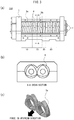
- FIG. 3 A schematic diagram of the first kneading section in the continuous extrusion kneader according to the first embodiment of the present invention.
- FIG. 4 A schematic diagram of a conventional continuous extrusion kneader for producing a mixture for an electrode active material layer.
- FIG. 5 A schematic diagram of the continuous extrusion kneader for producing a mixture for electrode active material layer according to a second embodiment of the present invention.
- FIG. 6 A schematic diagram of the continuous extrusion kneader for producing a mixture for electrode active material layer according to a third embodiment of the present invention.
- FIG. 7 A schematic diagram of the continuous extrusion kneader for producing a mixture for electrode active material layer according to a fourth embodiment of the present invention.
- the continuous extrusion kneader generally has a hollow barrel and one or a plurality of rotary shafts provided at predetermined intervals within the barrel.
- the continuous extrusion kneader includes a single-screw continuous extrusion kneader and a multi-screw continuous extrusion kneader, for example, a twin-screw continuous extrusion kneader, a triple-screw extrusion kneader, etc.
- the rotary shaft may have generally a screw mainly for conveying a material and a paddle, etc. mainly for kneading a material.
- the screw and paddle on the rotary shaft are rotated along with the rotation of the rotary shaft, and the continuous extrusion kneader can perform operations such as kneading, compression and temporary reverse conveyance while conveying from upstream to downstream the material supplied into the barrel and can continuously produce a kneaded mixture.
- the paddle can knead a material by applying a shear force to the material.
- the shape of the paddle is not particularly limited, and a paddle having any shape such as circular, elliptic, substantially triangular or gear-shaped can be used.
- the paddle is sometimes called kneading, rotor, gear, etc.
- the continuous extrusion kneader at the time of producing the mixture for an electrode active material layer by kneading the materials such as electrode active material and solid electrolyte, for obtaining a mixture having excellent dispersibility while reducing damage of the electrode active material, it is considered effective to increase the shear energy imparted to the solid electrolyte and reduce the shear energy imparted to the electrode active material.
- kneading of a solid electrolyte must be sufficiently performed in the step of not containing an electrode active material.
- the present inventors have discovered that only by providing, from upstream toward downstream, a first supply section for supplying a solid electrolyte and a first kneading section for kneading the supplied solid electrolyte as in the conventional continuous extrusion kneader, the filling factor of an intermediate mixture in the first kneading section cannot be increased and insufficient kneading of a solid electrolyte may be caused.
- the continuous extrusion kneader of the present invention comprises,
- a first supply section for supplying at least a part of a solid electrolyte
- a first kneading section for kneading the material supplied from the first supply section to provide an intermediate mixture
- a second supply section for supplying at least a part of an electrode active material to the intermediate mixture
- a second kneading section for kneading the intermediate mixture and the material supplied from the second supply section
- the first kneading section comprises a forward kneading section for kneading the material supplied from the first supply section and conveying the material downstream, and a reverse kneading section for kneading the material supplied from the forward kneading section and applying a force to the material in the upstream direction.
- the filling factor of the intermediate mixture in the first kneading section can be increased. More specifically, increase of the filling factor leads to enhancing the efficiency of shear energy and reducing the occurrence of pass-through in which the supplied material is not kneaded for a sufficient time within the barrel but is immediately discharged to the downstream side. As a result, the solid electrolyte can be sufficiently kneaded. For this reason, according to the continuous extrusion kneader of the present invention, a sufficiently kneaded mixture for electrode active material layer can be produced.
- the continuous extrusion kneader of the present invention comprises a first supply section, a first kneading section, a second supply section, and a second kneading section in this order from upstream to downstream. Respective sections are described below.
- the first supply section indicates a section that is located on the upstream side relative to the first kneading section and can perform supply of a material.
- a material such as electrode active material, conduction aid, dispersion medium and binder can be supplied.
- the material supplied into the barrel in the first supply section can be conveyed to the first kneading section by a screw, etc. on the rotary shaft.
- the first kneading section indicates a section that is located on the downstream side relative to the first supply section but on the upstream side relative to the second supply section and can perform kneading of the material.
- the first kneading section comprises at least one paddle on the rotary shaft and can knead the material supplied from the first supply section to provide an intermediate mixture.
- the intermediate mixture can be conveyed to the second supply section by a screw, etc. on the rotary shaft.
- the forward kneading section indicates a section that is a constituent element of the first kneading section and can knead the material supplied from the first supply section.
- the forward kneading section comprises at least one paddle on the rotary shaft and can knead the material supplied from the first supply section to provide an intermediate mixture.
- the material can be conveyed to the reverse kneading section by a screw, etc. on the rotary shaft.
- the reverse kneading section indicates a section that is a constituent element of the first kneading section and can knead the material supplied from the forward supply section and apply a force to the material in the upstream direction.
- the reverse kneading section applies a force in the upstream direction to the material and can thereby increase the filling factor of the material in the first kneading section and promote the kneading.
- the material supplied from the forward kneading section is forced by the material supplied from the upstream to be conveyed downstream while being subject to a force in the upstream direction by the reverse kneading section.
- the first kneading section may further comprise at least one additional kneading section on the downstream side relative to the reverse kneading section.
- the additional kneading section is a constitutional element of the first kneading section.
- the additional kneading section comprises an additional forward kneading section on the upstream side and an additional reverse kneading section on the downstream side. That is, the additional forward kneading section and the additional reverse kneading section are constituent elements of the additional kneading section.
- the material conveyed from the upstream is kneaded to be conveyed downstream.
- the additional forward kneading section comprises at least one paddle on the rotary shaft and can knead the material supplied from the upstream.
- the material can be conveyed to the additional reverse kneading section by a screw, etc. on the rotary shaft.
- the upstream of the additional forward kneading section is the reverse kneading section.
- the upstream of the most-upstream additional kneading section is the reverse kneading section
- the upstream of the additional kneading section other than the most-upstream additional kneading section is the additional reverse kneading section.
- the material supplied from the additional forward kneading section is kneaded, and a force in the upstream direction is applied to the material, whereby the filling factor of the material in the additional kneading section can be increased and the filling factor of the material in the first kneading section as a whole can be increased.
- the material supplied from the additional forward kneading section is forced into the material supplied from the additional forward kneading section to be conveyed downstream while being subject to a force in the upstream direction by the additional reverse kneading section.
- the downstream of the additional reverse kneading section is the second supply section.
- the downstream of the most-downstream additional kneading section is the second supply section, and the downstream of the additional kneading section other than the most-downstream additional kneading section is the additional forward kneading section.
- the second supply section indicates a section that is located on the downstream side relative to the first kneading section but on the upstream side relative to the second kneading section and can perform supply of the material.
- at least a part of an electrode active material can be supplied to the intermediate mixture within the barrel, and optionally at least a part of other materials such as solid electrolyte, conduction aid, dispersion medium and binder can be supplied.
- the material supplied into the barrel in the second supply section can be conveyed to the second kneading section by a screw, etc. on the rotary shaft.
- the second kneading section indicates a section that is located on the downstream side relative to the second supply section and can perform kneading of the material.
- the second kneading section comprises at least one paddle on the rotary shaft and can knead the intermediate mixture kneaded in the first kneading section and the material supplied from the second supply section to produce a mixture for electrode active material layer.
- a screw directed to cause the material to reversely flow from downstream to upstream (hereinafter, sometimes referred to as “reverse screw”), etc. is provided on the rotary shaft so that the filling factor of the material in the second kneading section ( 40 ) can be maintained at a level that is not excessively high.
- the continuous extrusion kneader of the present invention may further comprises a material supply buffering section between the most downstream portion of the first kneading section and the most upstream portion of the second supply section.
- the material supply buffering section while kneading the material conveyed from the first kneading section, the material during kneading is forced by the material supplied from the first kneading section to be conveyed to the second supply section.
- the most downstream portion of the first kneading section comprises a reverse kneading section or an additional reverse kneading section.
- a force in the upstream direction is applied to the material during kneading.
- the second supply section the material supplied into the barrel is conveyed to the second kneading section by a screw, etc. on the rotary shaft.
- the intermediate mixture containing an insufficiently milled solid electrolyte can be prevented from being conveyed from the first kneading section to the second supply section.
- the filling factor of the material can be expected to increase in the first kneading section as a whole.
- the mixture for electrode active material layer indicates a mixture for cathode active material layer in a positive electrode and indicates a material for anode active material layer in a negative electrode.
- the mixture for cathode active material layer contains a cathode active material and a solid electrolyte and in addition, optionally contains additives, such as conduction aid, binder and dispersion medium.
- the mixture for anode active material layer contains an anode active material and a solid electrolyte and, in addition, optionally contains additives, such as conduction aid, binder and dispersion medium.
- the cathode active material may be any material capable of storing an ion such as lithium, sodium and calcium at the time of discharging and any material capable of optionally releasing the ion at the time of charging.
- the cathode active material is not limited but includes, for example, a layered lithium metal oxide such as LiCoO 2 , LiNiO 2 and LiNi 1/3 Mn 1/3 Co 1/3 O 2 , a spinel-type lithium metal oxide such as LiMn 2 O 4 , Li(Ni 0.25 Mn 0.75 ) 2 O 4 , LiCoMnO 4 and Li 2 NiMn 3 O 8 , an olivine-type lithium metal oxide such as LiCoPO 4 , LiMnPO 4 and LiFePO 4 , and an NASICON-type lithium metal oxide such as Li 3 V 2 P 3 O 12 .
- a layered lithium metal oxide such as LiCoO 2 , LiNiO 2 and LiNi 1/3 Mn 1/3 Co 1/3 O 2
- a coated cathode active material can be used for the cathode active material.
- the coating of the cathode active material is not particularly limited as long as it is a material having ion conductivity, but examples thereof include a metal oxide.
- the coating can be formed of a lithium ion-conducting oxide represented by the formula Li x AO y , for example, a metal oxide such as Li 3 BO 3 and LiNbO 3 .
- This coating can be expected to produce an effect of enabling, for example, suppressing an elution of the cathode active material at the time of discharging/charging or a reaction of the cathode active material with the solid electrolyte.
- the anode active material may be any material capable of releasing an ion such as lithium, sodium and calcium at the time of discharging and any material capable of optionally storing the ion at the time of charging.
- the anode active material is not limited but includes, for example, a carbon material, a metal oxide material, and a metal material.
- the carbon material is not limited as long as it is a material containing carbon, but examples thereof include graphite, mesocarbon microbead (MCMB), high orientation pyrolytic graphite (HOPG), hard carbon, and soft carbon, etc.
- a coated anode active material can be used.
- the coating of the anode active material is not particularly limited as long as it is a material having ion conductivity, but examples thereof include an amorphous carbon coating on graphite. Such coating can be expected to produce an effect of, for example, reduction in the irreversible capacity, i.e., the difference between discharge capacity and charge capacity.
- the solid electrolyte can be any material that has ion conductivity and is solid at normal temperature, for example, at 15 to 25° C.
- the solid electrolyte includes, for example, a sulfide solid electrolyte, an oxide solid electrolyte, and an oxynitride solid electrolyte, etc.
- the sulfide solid electrolyte is not limited but, for example, in the case of a lithium ion battery, examples thereof include an Li 2 S—P 2 S 5 system, etc. More specifically, the sulfide solid electrolyte includes Li 2 S—P 2 S 5 , LiI—Li 2 S—P 2 S 5 , etc.
- the dispersion medium is not particularly limited but includes, for example, an organic dispersion medium such as butyl butyrate, dibutyl ether and heptane, etc.
- the conduction aid is not particularly limited as long as it is a material having electrical conductivity and capable of enhancing the electron conductivity of the electrode active material, but the conduction aid includes a carbon material such as carbon black (CB), e.g., acetylene black (AB), Ketjen black (KB), carbon fiber (CF), carbon nanotube (CNT), and carbon nanofiber (CNF),etc.
- CB carbon black
- AB acetylene black
- KB carbon fiber
- CNT carbon nanotube
- CNF carbon nanofiber
- the binder is not particularly limited as long as it can immobilize a material such as cathode active material, etc, but examples thereof include a fluorine-containing binder such as polyvinylidene fluoride (PVdF) and polytetrafluoroethylene (PTFE), a rubber-based binder such as butadiene rubber (BR) and styrene butadiene rubber (SBR), and an acrylic binder, etc.
- PVdF polyvinylidene fluoride
- PTFE polytetrafluoroethylene
- BR butadiene rubber
- SBR styrene butadiene rubber
- acrylic binder etc.
- the method of the present invention for producing a mixture for electrode active material layer is a method for producing a mixture for electrode active material layer by using the continuous extrusion kneader of the present invention and is a method comprising letting at least a part of the solid electrolyte be supplied to the first supply section and kneaded in the first kneading section to provide an intermediate mixture, and letting at least a part of the electrode active material be supplied to the intermediate mixture in the second supply section and kneaded in the second kneading section to provide a mixture for electrode active material layer.
- the method of the present invention for Producing an electrode laminate is a method comprising producing a mixture for electrode active material layer by the method of the present invention and applying the mixture for electrode active material layer onto an electrode current collector to form an electrode active material layer.
- the electrode laminate comprises an electrode current collector and an electrode active material layer and indicates a cathode laminate in a positive electrode and an anode laminate in a negative electrode.
- the electrode current collector has a function of collecting current from the electrode active material layer.
- the form of the electrode current collector is not limited but includes, for example, a foil, a plate, a mesh, and a porous body, etc.
- the material of the electrode current collector is not limited but includes, for example, a stainless steel and a metal or alloy of Al, Cu, Cr, Au, Pt, Fe, Ti or Zn, etc.
- the method for applying the mixture is not particularly limited as long as it is a method for forming a uniform electrode active material layer, and examples thereof include a doctor blade method, etc.
- the method of the present invention for producing an all-solid battery is a method comprising producing an electrode laminate by the method of the present invention and stacking the electrode laminate on the solid electrolyte layer.
- the all-solid battery has at least one cell structure in which a cathode current collector, a cathode active material layer, a solid electrolyte layer, an anode active material layer, and an anode current collector are stacked in this order.
- the method for stacking the laminate may be any method and comprises, for example, a pressing method such as uniaxial pressing, cold isostatic pressing (CIP) and roll pressing, etc.
- a pressing method such as uniaxial pressing, cold isostatic pressing (CIP) and roll pressing, etc.
- FIG. 1 is a schematic diagram of the continuous extrusion kneader for producing a mixture for electrode active material layer according to a first embodiment.
- the continuous extrusion kneader may be a twin-screw continuous extrusion kneader ( 100 ) comprising a hollow barrel ( 1 ) and two rotary shafts ( 2 ) provided at predetermined intervals within the barrel.
- the twin-screw extrusion kneader ( 100 ) may comprise, from upstream toward downstream, a first supply section ( 10 ) for supplying at least a part of a solid electrolyte, a first kneading section ( 20 ) for kneading the material supplied from the first supply section to provide an intermediate mixture, a second supply section ( 30 ) for supplying at least a part of an electrode active material to the intermediate mixture, and a second kneading section ( 40 ) for kneading the intermediate mixture and the material supplied from the second supply section, and the first kneading section may comprise a forward kneading section ( 21 ) for kneading the material supplied from the first supply section and conveying the material downstream, and a reverse kneading section ( 22 ) for kneading the material supplied from the forward kneading section ( 21 ) and applying a force in
- FIG. 2 is a diagram illustrating the material supply step in the continuous extrusion kneader ( 100 ) according to the first embodiment.
- a solid electrolyte, a binder and a dispersion medium may be supplied into the barrel
- an electrode active material and a conduction aid may be supplied into the barrel.
- the material supplied can be conveyed to the first kneading section ( 20 ) by a screw ( 3 a ) provided on the rotary shaft ( 2 ).
- FIGS. 3( a ) to ( c ) depict a diagram illustrating the first kneading section ( 20 ) in the continuous extrusion kneader ( 100 ) according to the first embodiment.
- FIG. 3( b ) shows a cross-sectional view of the forward kneading section ( 21 ) in an A-A cross-section illustrated in FIG. 3( a ) .
- a substantially triangular paddle ( 4 ) illustrated which is provided on the rotary shaft ( 2 ), can knead a material by applying a shear force to the material.
- the reverse screw ( 3 b ) illustrated in FIG. 3( c ) which is provided on the rotary shaft ( 2 ), can apply a force in the upstream direction to the material supplied from the forward kneading section ( 21 ).
- applying a force in the upstream direction leads to increasing the filling factor of the material in the first kneading section ( 20 ) and promoting the kneading, as a result, the kneading of the solid electrolyte is sufficiently performed.
- the material supplied from the forward kneading section ( 21 ) can be forced by the material supplied from the first supply section ( 10 ) to be conveyed to the second supply section ( 30 ) while being subject to a force in the upstream direction by the reverse kneading section ( 22 ).
- the screw ( 3 a ) provided on the rotary shaft ( 2 ) can convey the intermediate mixture and the material supplied, to the second kneading section ( 40 ).
- the paddle ( 4 ) provided on the rotary shaft ( 2 ) can apply a shear force to the intermediate mixture and the material supplied in the second supply section ( 30 ), and the material can thereby be kneaded to provide a mixture used for the active material layer of a battery.
- FIG. 5 is a schematic diagram of the continuous extrusion kneader for producing a mixture for electrode active material layer according to a second embodiment.
- the difference from the continuous extrusion kneader according to the first embodiment illustrated in FIG. 1 is described.
- the left side is the upstream side
- the right side is the downstream side.
- the first kneading section ( 20 ) comprises an additional kneading section ( 24 ) on the downstream side relative to the reverse kneading section ( 22 ).
- the kneading section comprises two additional kneading sections ( 24 ), but the present invention is not limited thereto. More specifically, the kneading section may comprise one additional kneading section ( 24 ) or two or more additional kneading sections.
- the effect of increasing the filling factor of the first kneading section ( 20 ) as a whole is described later.
- the additional kneading section ( 24 ) comprises an additional forward kneading section ( 25 ) on the upstream side and an additional reverse kneading section ( 26 ) on the downstream side.
- the material supplied from the upstream is kneaded and at the same time, conveyed downstream.
- the structure of the additional forward kneading section ( 25 ) may be the same as that of the forward kneading section ( 21 ).
- the material supplied from the additional forward kneading section ( 25 ) is kneaded and at the same time, a force in the upstream direction is applied to the material, whereby the filling factor of the material in the additional kneading section ( 24 ) as a whole is increased and the filling factor of the material in the first kneading section ( 20 ) increases.
- kneading is promoted, and the kneading of the solid electrolyte is sufficiently performed.
- the structure of the additional reverse kneading section ( 26 ) may be the same as that of the reverse kneading section ( 22 ). That is, the material supplied from the additional forward kneading section ( 25 ) is forced by the material supplied from the additional forward kneading section ( 25 ) to be conveyed downstream while being subject to a force in the upstream direction by the additional reverse kneading section ( 26 ).
- a reverse screw ( 3 b ) may be provided on the rotary shaft ( 2 ) in the most downstream portion ( 41 ) of the second kneading section ( 40 ).
- FIG. 6 is a schematic diagram of the continuous extrusion kneader for producing a mixture for electrode active material layer according to a third embodiment.
- the difference from the continuous extrusion kneader according to the second embodiment illustrated in FIG. 5 is described.
- the left side is the upstream side
- the right side is the downstream side.
- the twin-screw continuous extrusion kneader ( 100 ) comprises a material supply buffering section ( 50 ) between the most downstream portion of the first kneading section ( 20 ) and the most upstream portion of the second supply section ( 30 ).
- the material supply buffering section ( 50 ) the material supplied from the first kneading section ( 20 ) is kneaded by the paddle ( 4 ).
- the material during kneading is conveyed to the second supply section ( 30 ) by the material supplied from the first kneading section ( 20 ).
- the most downstream portion of the first kneading section ( 20 ) comprises an additional reverse kneading section ( 26 ).
- the reverse screw ( 3 b ) applies a force in the upstream direction to the material during kneading.
- the second supply section ( 30 ) the material supplied into the barrel ( 1 ) is conveyed to the second kneading section ( 40 ) by the screw ( 3 a ) on the rotary shaft ( 2 ).
- the material in the additional reverse kneading section ( 26 ) can be prevented from being drawn in by the screw ( 3 a ) of the second supply section ( 30 ).
- the intermediate mixture containing an insufficiently milled solid electrolyte can be prevented from being conveyed from the first kneading section ( 20 ) to the second supply section ( 30 ).
- the material supply buffering section ( 50 ) described in the third embodiment can be applied also to the continuous extrusion kneader in which an additional kneading section ( 24 ) is not provided.
- FIG. 7 is a schematic diagram of the continuous extrusion kneader for producing a mixture for electrode active material layer according to a fourth embodiment.
- the continuous extrusion kneader according to the fourth embodiment is a kneader fabricated by providing a material supply buffering section in the continuous extrusion kneader of the first embodiment.
- the difference from the continuous extrusion kneader according to the first embodiment illustrated in FIG. 1 is described.
- the left side is the upstream side
- the right side is the downstream side.
- the twin-screw continuous extrusion kneader ( 100 ) comprises a material supply buffering section ( 50 ) between the most downstream portion of the first kneading section ( 20 ) and the most upstream portion of the second supply section ( 30 ).
- the action and effects of the material supply buffering section ( 50 ) are the same as in the third embodiment.
- FIG. 4 is a schematic diagram of a conventional twin-screw continuous extrusion kneader.
- a solid electrolyte, etc. are supplied to the first supply section, an electrode active material, etc. are supplied to the second supply section, and these materials are kneaded while being conveyed only in the direction from upstream to downstream, whereby a mixture for active material layer of a battery is produced.
- the filling factor of the material in the first kneading section can be increased, so that a sufficiently kneaded mixture for active material layer can be produced.
Landscapes
- Chemical & Material Sciences (AREA)
- Chemical Kinetics & Catalysis (AREA)
- Electrochemistry (AREA)
- General Chemical & Material Sciences (AREA)
- Engineering & Computer Science (AREA)
- Manufacturing & Machinery (AREA)
- Dispersion Chemistry (AREA)
- Battery Electrode And Active Subsutance (AREA)
- Physics & Mathematics (AREA)
- Condensed Matter Physics & Semiconductors (AREA)
- General Physics & Mathematics (AREA)
- Inorganic Chemistry (AREA)
Abstract
Description
- 1 Barrel
- 2 Rotary shaft
- 3 a Screw
- 3 b Reverse screw
- 4 Paddle
- 10 First supply section
- 20 First kneading section
- 21 Forward kneading section
- 22 Reverse kneading section
- 24 Additional kneading section
- 25 Additional forward kneading section
- 26 Additional reverse kneading section
- 30 Second supply section
- 40 Second kneading section
- 41 Most downstream portion
- 50 Material supply buffering section
- 100 Twin-screw continuous extrusion kneader
- 101 Conventional twin-screw continuous extrusion kneader
Claims (8)
Applications Claiming Priority (4)
| Application Number | Priority Date | Filing Date | Title |
|---|---|---|---|
| JP2016-112618 | 2016-06-06 | ||
| JP2016112618 | 2016-06-06 | ||
| JP2017-109299 | 2017-06-01 | ||
| JP2017109299A JP7013681B2 (en) | 2016-06-06 | 2017-06-01 | A continuous extrusion kneader for producing a mixture for an electrode active material layer, and a method for producing a mixture for an electrode active material layer, an electrode laminate, and an all-solid-state battery using the continuous extrusion kneader. |
Publications (2)
| Publication Number | Publication Date |
|---|---|
| US20170348652A1 US20170348652A1 (en) | 2017-12-07 |
| US10569239B2 true US10569239B2 (en) | 2020-02-25 |
Family
ID=60482560
Family Applications (1)
| Application Number | Title | Priority Date | Filing Date |
|---|---|---|---|
| US15/613,397 Active 2037-09-06 US10569239B2 (en) | 2016-06-06 | 2017-06-05 | Continuous extruding kneader for producing mixture for electrode active material layer, and method for producing mixture for electrode active material layer, electrode laminate, and all-solid-state battery using it |
Country Status (1)
| Country | Link |
|---|---|
| US (1) | US10569239B2 (en) |
Families Citing this family (4)
| Publication number | Priority date | Publication date | Assignee | Title |
|---|---|---|---|---|
| US10675598B2 (en) * | 2015-03-24 | 2020-06-09 | South Dakota Board Of Regents | High shear thin film machine for dispersion and simultaneous orientation-distribution of nanoparticles within polymer matrix |
| JP7129644B2 (en) | 2017-06-19 | 2022-09-02 | パナソニックIpマネジメント株式会社 | battery modules and vehicles |
| JP7236662B2 (en) * | 2018-07-05 | 2023-03-10 | パナソニックIpマネジメント株式会社 | Battery modules, battery packs, and vehicles |
| CN117205827A (en) * | 2022-06-02 | 2023-12-12 | 江苏天奈科技股份有限公司 | Granulation equipment, complete crushing and granulation equipment and carbon nanotube processing technology |
Citations (3)
| Publication number | Priority date | Publication date | Assignee | Title |
|---|---|---|---|---|
| US3524730A (en) * | 1963-12-26 | 1970-08-18 | Toray Industries | Apparatus for carrying out a polycondensation reaction continuously |
| JP2015125877A (en) | 2013-12-26 | 2015-07-06 | トヨタ自動車株式会社 | Continuous extruding kneader for mixture for electrode active material layer |
| US20160052171A1 (en) * | 2013-03-21 | 2016-02-25 | Toyota Jidosha Kabushiki Kaisha | Twin-screw extruding kneader and method for producing electrode mixture using the same |
-
2017
- 2017-06-05 US US15/613,397 patent/US10569239B2/en active Active
Patent Citations (3)
| Publication number | Priority date | Publication date | Assignee | Title |
|---|---|---|---|---|
| US3524730A (en) * | 1963-12-26 | 1970-08-18 | Toray Industries | Apparatus for carrying out a polycondensation reaction continuously |
| US20160052171A1 (en) * | 2013-03-21 | 2016-02-25 | Toyota Jidosha Kabushiki Kaisha | Twin-screw extruding kneader and method for producing electrode mixture using the same |
| JP2015125877A (en) | 2013-12-26 | 2015-07-06 | トヨタ自動車株式会社 | Continuous extruding kneader for mixture for electrode active material layer |
Also Published As
| Publication number | Publication date |
|---|---|
| US20170348652A1 (en) | 2017-12-07 |
Similar Documents
| Publication | Publication Date | Title |
|---|---|---|
| US10297818B2 (en) | Device and method for producing composite active material powder using a production device including a rotating body with blades each having a tapered section at an end part thereof on a front side in a rotation/movement direction of the rotating body | |
| EP3451423B1 (en) | Negative electrode slurry, negative electrode plate and electrochemical energy storage device | |
| CN105098224B (en) | Rechargeable nonaqueous electrolytic battery and its manufacture method | |
| CN104766993B (en) | Rechargeable nonaqueous electrolytic battery | |
| KR20180121411A (en) | Positive electrode, lithium secondarty battery comprising the positive electrode, and method for manufacturing the positive electrode | |
| KR102227311B1 (en) | Method for recycling positive electrode material | |
| US20200373624A1 (en) | All-solid-state battery having high energy density and method of manufacturing same | |
| CN106532158A (en) | All-solid battery system and manufacturing method thereof | |
| CN111989805A (en) | Positive electrode material for lithium secondary battery, and positive electrode for lithium secondary battery and lithium secondary battery comprising same | |
| CN107134591A (en) | The manufacture method of active material, solid state battery and active material | |
| WO2020034875A1 (en) | Sulfur-based positive electrode active material for use in solid-state battery, preparation for material, and applications thereof | |
| US20170348652A1 (en) | Continuous extruding kneader for producing mixture for electrode active material layer, and method for producing mixture for electrode active material layer, electrode laminate, and all-solid-state battery using it | |
| JP7313536B2 (en) | High-nickel electrode sheet with reduced reactivity with moisture and method for producing the same | |
| CN108807843A (en) | MULTILAYER COMPOSITE cathode and preparation method thereof and alkali metal battery including it | |
| JP6136917B2 (en) | Continuous extrusion kneader for mixture for electrode active material layer | |
| TW201603350A (en) | High performance all solid lithium sulfur battery with fast lithium ion conduction | |
| CN101887970A (en) | Preparation method of lithium-ion secondary battery cathode sheet | |
| EP4177985A1 (en) | Negative electrode and secondary battery comprising same | |
| JP7013681B2 (en) | A continuous extrusion kneader for producing a mixture for an electrode active material layer, and a method for producing a mixture for an electrode active material layer, an electrode laminate, and an all-solid-state battery using the continuous extrusion kneader. | |
| US20230178747A1 (en) | Method for manufacturing electrode for all-solid-state batteries by semi-dry process | |
| WO2019082575A1 (en) | Current collector electrode sheet manufacturing method, compression roller, current collector electrode sheet, and battery | |
| CN115394950A (en) | Method for manufacturing all-solid-state battery electrodes and all-solid-state battery electrodes manufactured thereby | |
| JP2014143064A (en) | Secondary battery and method for manufacturing the same | |
| CN115191051A (en) | Solid-state battery | |
| US10319987B2 (en) | Active material with expansion structure for use in lithium ion batteries |
Legal Events
| Date | Code | Title | Description |
|---|---|---|---|
| AS | Assignment |
Owner name: TOYOTA JIDOSHA KABUSHIKI KAISHA, JAPAN Free format text: ASSIGNMENT OF ASSIGNORS INTEREST;ASSIGNORS:ISHIGAKI, YUKI;INOUE, HIROYUKI;REEL/FRAME:043201/0959 Effective date: 20170728 |
|
| STPP | Information on status: patent application and granting procedure in general |
Free format text: RESPONSE TO NON-FINAL OFFICE ACTION ENTERED AND FORWARDED TO EXAMINER |
|
| STPP | Information on status: patent application and granting procedure in general |
Free format text: FINAL REJECTION MAILED |
|
| STPP | Information on status: patent application and granting procedure in general |
Free format text: NOTICE OF ALLOWANCE MAILED -- APPLICATION RECEIVED IN OFFICE OF PUBLICATIONS |
|
| STPP | Information on status: patent application and granting procedure in general |
Free format text: AWAITING TC RESP, ISSUE FEE PAYMENT VERIFIED |
|
| STPP | Information on status: patent application and granting procedure in general |
Free format text: PUBLICATIONS -- ISSUE FEE PAYMENT VERIFIED |
|
| STCF | Information on status: patent grant |
Free format text: PATENTED CASE |
|
| MAFP | Maintenance fee payment |
Free format text: PAYMENT OF MAINTENANCE FEE, 4TH YEAR, LARGE ENTITY (ORIGINAL EVENT CODE: M1551); ENTITY STATUS OF PATENT OWNER: LARGE ENTITY Year of fee payment: 4 |