US10569186B2 - Hexavalent chromium free etch manganese recovery system - Google Patents
Hexavalent chromium free etch manganese recovery system Download PDFInfo
- Publication number
- US10569186B2 US10569186B2 US16/030,880 US201816030880A US10569186B2 US 10569186 B2 US10569186 B2 US 10569186B2 US 201816030880 A US201816030880 A US 201816030880A US 10569186 B2 US10569186 B2 US 10569186B2
- Authority
- US
- United States
- Prior art keywords
- solution
- manganese
- process solution
- acid
- evaporator
- Prior art date
- Legal status (The legal status is an assumption and is not a legal conclusion. Google has not performed a legal analysis and makes no representation as to the accuracy of the status listed.)
- Expired - Fee Related
Links
Images


Classifications
-
- B—PERFORMING OPERATIONS; TRANSPORTING
- B01—PHYSICAL OR CHEMICAL PROCESSES OR APPARATUS IN GENERAL
- B01D—SEPARATION
- B01D1/00—Evaporating
- B01D1/14—Evaporating with heated gases or vapours or liquids in contact with the liquid
-
- B—PERFORMING OPERATIONS; TRANSPORTING
- B01—PHYSICAL OR CHEMICAL PROCESSES OR APPARATUS IN GENERAL
- B01D—SEPARATION
- B01D1/00—Evaporating
- B01D1/22—Evaporating by bringing a thin layer of the liquid into contact with a heated surface
-
- B—PERFORMING OPERATIONS; TRANSPORTING
- B01—PHYSICAL OR CHEMICAL PROCESSES OR APPARATUS IN GENERAL
- B01D—SEPARATION
- B01D1/00—Evaporating
- B01D1/26—Multiple-effect evaporating
-
- B—PERFORMING OPERATIONS; TRANSPORTING
- B01—PHYSICAL OR CHEMICAL PROCESSES OR APPARATUS IN GENERAL
- B01D—SEPARATION
- B01D3/00—Distillation or related exchange processes in which liquids are contacted with gaseous media, e.g. stripping
- B01D3/08—Distillation or related exchange processes in which liquids are contacted with gaseous media, e.g. stripping in rotating vessels; Atomisation on rotating discs
- B01D3/085—Distillation or related exchange processes in which liquids are contacted with gaseous media, e.g. stripping in rotating vessels; Atomisation on rotating discs using a rotary evaporator
-
- B—PERFORMING OPERATIONS; TRANSPORTING
- B01—PHYSICAL OR CHEMICAL PROCESSES OR APPARATUS IN GENERAL
- B01D—SEPARATION
- B01D3/00—Distillation or related exchange processes in which liquids are contacted with gaseous media, e.g. stripping
- B01D3/10—Vacuum distillation
-
- C—CHEMISTRY; METALLURGY
- C09—DYES; PAINTS; POLISHES; NATURAL RESINS; ADHESIVES; COMPOSITIONS NOT OTHERWISE PROVIDED FOR; APPLICATIONS OF MATERIALS NOT OTHERWISE PROVIDED FOR
- C09K—MATERIALS FOR MISCELLANEOUS APPLICATIONS, NOT PROVIDED FOR ELSEWHERE
- C09K13/00—Etching, surface-brightening or pickling compositions
-
- C—CHEMISTRY; METALLURGY
- C09—DYES; PAINTS; POLISHES; NATURAL RESINS; ADHESIVES; COMPOSITIONS NOT OTHERWISE PROVIDED FOR; APPLICATIONS OF MATERIALS NOT OTHERWISE PROVIDED FOR
- C09K—MATERIALS FOR MISCELLANEOUS APPLICATIONS, NOT PROVIDED FOR ELSEWHERE
- C09K13/00—Etching, surface-brightening or pickling compositions
- C09K13/04—Etching, surface-brightening or pickling compositions containing an inorganic acid
-
- C—CHEMISTRY; METALLURGY
- C23—COATING METALLIC MATERIAL; COATING MATERIAL WITH METALLIC MATERIAL; CHEMICAL SURFACE TREATMENT; DIFFUSION TREATMENT OF METALLIC MATERIAL; COATING BY VACUUM EVAPORATION, BY SPUTTERING, BY ION IMPLANTATION OR BY CHEMICAL VAPOUR DEPOSITION, IN GENERAL; INHIBITING CORROSION OF METALLIC MATERIAL OR INCRUSTATION IN GENERAL
- C23C—COATING METALLIC MATERIAL; COATING MATERIAL WITH METALLIC MATERIAL; SURFACE TREATMENT OF METALLIC MATERIAL BY DIFFUSION INTO THE SURFACE, BY CHEMICAL CONVERSION OR SUBSTITUTION; COATING BY VACUUM EVAPORATION, BY SPUTTERING, BY ION IMPLANTATION OR BY CHEMICAL VAPOUR DEPOSITION, IN GENERAL
- C23C18/00—Chemical coating by decomposition of either liquid compounds or solutions of the coating forming compounds, without leaving reaction products of surface material in the coating; Contact plating
- C23C18/16—Chemical coating by decomposition of either liquid compounds or solutions of the coating forming compounds, without leaving reaction products of surface material in the coating; Contact plating by reduction or substitution, e.g. electroless plating
- C23C18/18—Pretreatment of the material to be coated
- C23C18/1851—Pretreatment of the material to be coated of surfaces of non-metallic or semiconducting in organic material
- C23C18/1872—Pretreatment of the material to be coated of surfaces of non-metallic or semiconducting in organic material by chemical pretreatment
- C23C18/1886—Multistep pretreatment
- C23C18/1893—Multistep pretreatment with use of organic or inorganic compounds other than metals, first
-
- C—CHEMISTRY; METALLURGY
- C23—COATING METALLIC MATERIAL; COATING MATERIAL WITH METALLIC MATERIAL; CHEMICAL SURFACE TREATMENT; DIFFUSION TREATMENT OF METALLIC MATERIAL; COATING BY VACUUM EVAPORATION, BY SPUTTERING, BY ION IMPLANTATION OR BY CHEMICAL VAPOUR DEPOSITION, IN GENERAL; INHIBITING CORROSION OF METALLIC MATERIAL OR INCRUSTATION IN GENERAL
- C23C—COATING METALLIC MATERIAL; COATING MATERIAL WITH METALLIC MATERIAL; SURFACE TREATMENT OF METALLIC MATERIAL BY DIFFUSION INTO THE SURFACE, BY CHEMICAL CONVERSION OR SUBSTITUTION; COATING BY VACUUM EVAPORATION, BY SPUTTERING, BY ION IMPLANTATION OR BY CHEMICAL VAPOUR DEPOSITION, IN GENERAL
- C23C18/00—Chemical coating by decomposition of either liquid compounds or solutions of the coating forming compounds, without leaving reaction products of surface material in the coating; Contact plating
- C23C18/16—Chemical coating by decomposition of either liquid compounds or solutions of the coating forming compounds, without leaving reaction products of surface material in the coating; Contact plating by reduction or substitution, e.g. electroless plating
- C23C18/18—Pretreatment of the material to be coated
- C23C18/20—Pretreatment of the material to be coated of organic surfaces, e.g. resins
- C23C18/22—Roughening, e.g. by etching
- C23C18/24—Roughening, e.g. by etching using acid aqueous solutions
-
- C—CHEMISTRY; METALLURGY
- C25—ELECTROLYTIC OR ELECTROPHORETIC PROCESSES; APPARATUS THEREFOR
- C25D—PROCESSES FOR THE ELECTROLYTIC OR ELECTROPHORETIC PRODUCTION OF COATINGS; ELECTROFORMING; APPARATUS THEREFOR
- C25D13/00—Electrophoretic coating characterised by the process
- C25D13/12—Electrophoretic coating characterised by the process characterised by the article coated
- C25D13/16—Wires; Strips; Foils
-
- C—CHEMISTRY; METALLURGY
- C25—ELECTROLYTIC OR ELECTROPHORETIC PROCESSES; APPARATUS THEREFOR
- C25D—PROCESSES FOR THE ELECTROLYTIC OR ELECTROPHORETIC PRODUCTION OF COATINGS; ELECTROFORMING; APPARATUS THEREFOR
- C25D13/00—Electrophoretic coating characterised by the process
- C25D13/22—Servicing or operating apparatus or multistep processes
- C25D13/24—Regeneration of process liquids
-
- C—CHEMISTRY; METALLURGY
- C25—ELECTROLYTIC OR ELECTROPHORETIC PROCESSES; APPARATUS THEREFOR
- C25D—PROCESSES FOR THE ELECTROLYTIC OR ELECTROPHORETIC PRODUCTION OF COATINGS; ELECTROFORMING; APPARATUS THEREFOR
- C25D21/00—Processes for servicing or operating cells for electrolytic coating
- C25D21/16—Regeneration of process solutions
-
- C—CHEMISTRY; METALLURGY
- C08—ORGANIC MACROMOLECULAR COMPOUNDS; THEIR PREPARATION OR CHEMICAL WORKING-UP; COMPOSITIONS BASED THEREON
- C08J—WORKING-UP; GENERAL PROCESSES OF COMPOUNDING; AFTER-TREATMENT NOT COVERED BY SUBCLASSES C08B, C08C, C08F, C08G or C08H
- C08J7/00—Chemical treatment or coating of shaped articles made of macromolecular substances
- C08J7/12—Chemical modification
-
- C—CHEMISTRY; METALLURGY
- C23—COATING METALLIC MATERIAL; COATING MATERIAL WITH METALLIC MATERIAL; CHEMICAL SURFACE TREATMENT; DIFFUSION TREATMENT OF METALLIC MATERIAL; COATING BY VACUUM EVAPORATION, BY SPUTTERING, BY ION IMPLANTATION OR BY CHEMICAL VAPOUR DEPOSITION, IN GENERAL; INHIBITING CORROSION OF METALLIC MATERIAL OR INCRUSTATION IN GENERAL
- C23C—COATING METALLIC MATERIAL; COATING MATERIAL WITH METALLIC MATERIAL; SURFACE TREATMENT OF METALLIC MATERIAL BY DIFFUSION INTO THE SURFACE, BY CHEMICAL CONVERSION OR SUBSTITUTION; COATING BY VACUUM EVAPORATION, BY SPUTTERING, BY ION IMPLANTATION OR BY CHEMICAL VAPOUR DEPOSITION, IN GENERAL
- C23C18/00—Chemical coating by decomposition of either liquid compounds or solutions of the coating forming compounds, without leaving reaction products of surface material in the coating; Contact plating
- C23C18/16—Chemical coating by decomposition of either liquid compounds or solutions of the coating forming compounds, without leaving reaction products of surface material in the coating; Contact plating by reduction or substitution, e.g. electroless plating
- C23C18/31—Coating with metals
Definitions
- the present disclosure relates to a hexavalent chromium free etch manganese recovery system.
- etching the substrate followed by activation, followed by electroless metallization.
- Electroless metallization renders the nonconductive substrate conductive, thereby allowing for subsequent traditional electroplating processes.
- the etching of the substrate is accomplished by dipping the nonconductive substrate in a chromic acid-sulfuric acid mixture.
- the present technology provides a method for recovering manganese for use in a manganese etchant process.
- the method includes neutralizing with a neutralizer solution a nonconductive substrate after etching the substrate with an etchant solution.
- the neutralizer solution comprises a solution comprised of an acid and an oxidizer.
- At least a portion of the used neutralizer solution or manganese containing rinse, herein referred to as process solution, is removed and sent to an evaporating processing tank, where the process solution is evaporated to remove any oxidizer and concentrate from the remaining used process solution.
- the concentrated process solution is added to an etchant or acid rinse solution. In other embodiments, the concentrated process solution is concentrated to greater than or equal to about 2 g/L Mn.
- the evaporator assembly comprises an atmospheric evaporator or vacuum evaporator. In other embodiments, the evaporator assembly comprises an evaporating processing tank. In yet other embodiments, the evaporating processing tank is warmed and treated with a vigorous air treatment. In various embodiments, the etchant solution comprises a source of manganese ions.
- the present technology also provides a method for recovering a manganese etchant solution for use in a manganese etch.
- the method includes neutralizing with a neutralizer solution a nonconductive substrate after etching the substrate with an etchant solution.
- the neutralizer solution comprises at least one of an acid and an oxidizer.
- At least a portion of the process solution is concentrated to a concentration of the etchant solution.
- the concentrated process solution is fed into the etchant process.
- the concentrated process solution is concentrated to greater than or equal to about 2 g/L Mn.
- the neutralizer solution comprises an acid and an oxidizer.
- at least a portion of the process solution is transferred into an evaporator processing tank for concentrating the process solution.
- the evaporator assembly may further comprise an atmospheric evaporator or vacuum evaporator.
- the evaporator assembly may further comprise an evaporating processing tank.
- the evaporating processing tank may be warmed and treated with a vigorous air treatment.
- the etchant solution comprises a source of manganese ions.
- the present technology further provides an evaporating system for recovering manganese etchant solution.
- the evaporating system comprises an evaporator assembly, and the evaporator assembly is configured to evaporate water from a process solution to form a concentrated process solution.
- the evaporator assembly is transferrably connected to a process tank configured for use in an electroless metallization process.
- the process tank contains a process solution that is configured to be transferred into the evaporating tank.
- the evaporator assembly further comprises an evaporating processing tank.
- the evaporating processing tank further comprises a heater and an air agitator.
- the evaporator assembly discharges the concentrated process solution when it is concentrated to greater than or equal to about 2 g/L Mn. In even further embodiments, the evaporator assembly discharges the concentrated process solution into a tank in an etchant process.
- the etchant process may comprise a source of manganese ions. In various embodiments, the process solution comprises an acid.
- FIG. 1 shows a flowchart of a process for preparing an electrolessly metallized substrate
- FIG. 2 shows a representative evaporating assembly according to the present disclosure
- FIG. 3 Shows a flow diagram for an evaporator assembly on a general Manganese Ion Source
- FIG. 4 shows a flowchart of a process for an evaporator collecting from an acid rinse to supply an etchant bath and/or acid rinse.
- FIG. 5 shows the processing parameters for an example of manganese recovery employing an evaporating assembly using an acid rinse as a source of manganese ions
- FIG. 6 is a graph depicting the results of the example of FIG. 4 ;
- FIG. 7 shows a flowchart of a process for an evaporator collecting from a neutralizer process to supply an acid rinse
- FIG. 8 shows the processing parameters for another example of manganese recovery employing an evaporating assembly
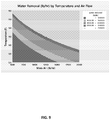
- FIG. 9 is a graph depicting the results of the example of FIG. 7 .
- Example embodiments are provided so that this disclosure will be thorough, and will fully convey the scope to those who are skilled in the art. Numerous specific details are set forth such as examples of specific compositions, components, devices, and methods, to provide a thorough understanding of embodiments of the present disclosure. It will be apparent to those skilled in the art that specific details need not be employed, that example embodiments may be embodied in many different forms and that neither should be construed to limit the scope of the disclosure. In some example embodiments, well-known processes, well-known device structures, and well-known technologies are not described in detail.
- compositions, materials, components, elements, features, integers, operations, and/or process steps are also specifically includes embodiments consisting of, or consisting essentially of, such recited compositions, materials, components, elements, features, integers, operations, and/or process steps.
- the alternative embodiment excludes any additional compositions, materials, components, elements, features, integers, operations, and/or process steps, while in the case of “consisting essentially of,” any additional compositions, materials, components, elements, features, integers, operations, and/or process steps that materially affect the basic and novel characteristics are excluded from such an embodiment, but any compositions, materials, components, elements, features, integers, operations, and/or process steps that do not materially affect the basic and novel characteristics can be included in the embodiment.
- Spatially or temporally relative terms such as “before,” “after,” “inner,” “outer,” “beneath,” “below,” “lower,” “above,” “upper,” and the like, may be used herein for ease of description to describe one element or feature's relationship to another element(s) or feature(s) as illustrated in the figures.
- Spatially or temporally relative terms may be intended to encompass different orientations of the device or system in use or operation in addition to the orientation depicted in the figures.
- ranges includes disclosure of all values and further divided ranges within the entire range, including endpoints and sub-ranges given for the ranges.
- ranges are, unless specified otherwise, inclusive of endpoints and include disclosure of all distinct values and further divided ranges within the entire range.
- a range of “from A to B” or “from about A to about B” is inclusive of A and of B.
- the present disclosure provides methods for improving manufacturing processes for etching and metallizing nonconductive substrates. More specifically, the present disclosure provides methods of reclaiming manganese etchant solution used to etch a nonconductive substrate.
- Manganese etchant solutions are useful to prepare nonconductive substrates for electroless metallization, and such substrates are particularly suitable for use in components of an automobile or other vehicle, and may additionally be used in a variety of other industries and applications, including aerospace components, farm equipment, industrial equipment, home decor and heavy machinery, by way of non-limiting example.
- the present methods and materials are particularly suitable for forming lightweight, corrosion resistant components for a vehicle, including vehicle fascia, and interior and exterior decorative trim, by way of non-limiting example.
- the present invention is directed to further streamlining processes for metallizing electrically nonconductive substrates and to reduce the manufacturing and operational costs associated therewith.
- Metallization of electrically nonconductive substrates generally comprises the following: (A) etching a substrate; (B) rendering the electrically nonconductive substrate electrically conductive; and (C) metallizing the substrate rendered electrically conductive.
- Appropriate nonconductive substrates for use according to the disclosure herein include many different plastics and include many plastic resins including phenolic, urea formaldehyde, polyethersulfone, polyacetal, diallyl phthalate, polyetherimide, Teflon, polyarylether, polycarbone, polyphenylene oxide, mineral-reinforced nylone, and polysulfone.
- Particularly suitable plastics for use according to the disclosure herein is acrylonitrile-butadiene-styrene (ABS), and Polycarbonate acrylonitrile-butadiene-styrene (PC/ABS).
- the nonconductive substrate is cleaned by cleaner 202 .
- the substrate is then rinsed in a series of one or more rinses 203 .
- the nonconductive substrate is then optionally pre-etched by pre-etch 204 . Pre-etching the nonconductive substrate swells the nonconductive substrate, making it more susceptible to etching. For any substrates immersed in the pre-etching solution a rinsing process of one or more rinses 205 is completed. Regardless of whether the optional cleaning and pre-etch steps occur, the nonconductive substrate is rinsed in an acid containing rinse 206 prior to being etched in etching bath 207 .
- Etching bath 207 comprises a manganese containing etchant solution.
- the etched substrate may be conditioned with a conditioner to promote activation.
- the etched substrate may be rinsed in a solution 208 containing some or all of the acid components of the etching bath to remove any excess acid or other undesirable materials on the etched substrate.
- the etched substrate is not conditioned or rinsed. Rather, after the nonconductive substrate is etched, the etched substrate is neutralized in neutralizer 209 . Neutralizing removes the etched substrate of any remaining etchant.
- the etched substrate is rinsed, it may be reclaimed as a neutralizer by adding an oxidizer and agitating the rinsate.
- the etched substrate is pre-activated prior to activation. Pre-activation operates to facilitate absorption of the activator.
- the etched substrate is activated by exposing the etched substrate to activator 210 .
- Activator 210 is typically a metal colloid or ionic solution selected from the metals of transition group VIII of the Periodic Table of the Elements and more preferably is selected from the group consisting of palladium, platinum, iridium, rhodium, and mixtures thereof along with a tin salt. Most preferably, activator 212 is palladium.
- Activator 212 fills the pores created by etching, After activation, the etched substrate undergoes accelerating 214 . Accelerating 214 removes excess materials from the metal colloid, thereby ensuring metallization of the etched substrate as a result of the mechanical connection of the metal of the metal colloid with the pores of the etched substrate. After acceleration, the parts are immersed in the electroless nickel or electroless copper 216 to complete the metallization of the substrate.
- an exemplary evaporating system comprising an evaporator assembly is further provided for use in connection with the Acid Rinse 208 or neutralizer 209 . More specifically, referring to FIG. 2 , an exemplary evaporator assembly 10 is shown according to the disclosure herein. Evaporator assembly 10 is comprised of evaporator processing tank 20 and evaporator 30 .
- FIG. 3 an exemplary evaporating system is shown according to the disclosure herein.
- a portion of a source of Manganese ions 102 is syphoned off via a first conduit 104 .
- First conduit 104 directs the portion of the bath to vacuum evaporator 106 .
- the portion of the bath directed to vacuum evaporator 106 is evaporated in vacuum evaporator 106 .
- Evaporating in vacuum evaporator results in distillate water and concentrated liquid.
- the concentrated liquid is directed through second conduit 108 and fed back into Manganese Ion source 102 .
- the distillate water may be further collected, processed, and reused or discarded.
- the source of manganese ions may be any one of a Manganese-based etchant bath, a rinsate accumulated during rinsing an etched substrate, and a solution accumulated during neutralizing an etched substrate that may have been rinsed. It is further envisioned that an evaporator may evaporate any of (1) at least a portion of a manganese-based etchant bath, (2) the acid collection bath following the etching phase, (3) the rinsate accumulated during rinsing an etched substrate, and (4) a solution accumulated during neutralizing an etched substrate before or after rinsing, or that there may be corresponding evaporators for each.
- First conduit 104 may comprise any medium for transferring a liquid from one area to another and may include, as non-limiting examples, piping, tubing, channel, ductwork, or any other transferring assembly capable of transferring a liquid from one area to another.
- First conduit 104 may be formed of any material exhibiting suitable acid resistance.
- First conduit 104 may further comprise a filter for prohibiting particulates from entering vacuum evaporator 106 .
- First conduit 104 may further comprise a pump for increasing the flow to the vacuum evaporator 106 .
- First conduit 104 may further comprise a one-way valve for prohibiting at least a portion of the manganese-based etchant bath from returning to manganese Ion source 102 via first conduit 104 .
- suitable vacuum evaporators for use according to the present invention are those that are capable of resisting acid corrosion and capable of concentrating strong acids, including the following acids used in manganese-based etchant baths: phosphoric acid, peroxomonophosphoric acid, peroxodisphosphoric acid, sulfuric acid, peroxomonosulfuric acid, and peroxodisulfuric acid, and methane sulfonic acid.
- suitable vacuum evaporators are comprised of materials that resist corrosive acid attack at high acid concentrations (e.g., acid concentrations approaching the limit of how well vacuum evaporators presently can evaporate water).
- suitable vacuum evaporators include single effect evaporators, including single effect climbing film evaporators; multiple effect evaporators, including triple effect evaporators; and rising thin film vacuum evaporators.
- the vacuum evaporators according to the present disclosure further include vacuum distillation units, including rotary evaporators and dry vacuum distillation columns.
- the vacuum evaporator employs a heat source to further speed up the rate of evaporation. Suitable heat sources include heat exchangers including steam and oil heat exchangers. After evaporation, the concentrated acid may subsequently be purified.
- evaporator processing tank 20 is a container for holding process solution for evaporation and may further comprise a heater and/or an air agitator to facilitate evaporation of the process solution.
- evaporator 30 is a vacuum evaporator.
- Vacuum evaporators generally operate by reducing the pressure in a liquid-filled container below the vapor pressure of the liquid so that the liquid therefore evaporates.
- evaporator 30 is an atmospheric evaporator.
- Atmospheric evaporators are generally known as units that spray a solution to be evaporated onto a panel for evaporating the solution.
- the sprayer is configured to spray the solution such that a maximum amount of surface area of the solution is exposed to air, thereby accelerating evaporation of the solution.
- the process solution comprises an acid based rinse for an etching process.
- Rinsing of the etched substrate in a rinse comprising a dilute acid matrix of the same acids present in the etching process allows for cleaner parts while maintain oxidation state of any Mn(VII) removed from etching bath by the substrate.
- the neutralizer comprises a mixture of an acid and an oxidizer.
- Etching the nonconductive substrate via a source of Mn(VII) ions results in reducing the Mn(VII) ions to manganese dioxide.
- Neutralizing the etched substrate via a mixture of an acid and an oxidizer accomplishes at least the following benefits.
- manganese dioxide can adhere to the etched substrate and interferes with the mechanical connection between the metal colloid and the etched substrate, which can result in non-uniform and poor electroless metallization and therefore ultimately poor metallization of the substrate.
- a mixture of an acid and an oxidizer removes the manganese dioxide that had accumulated on the etched substrate, thereby ensuring adequate metallization.
- Second, manganese dioxide dissolves to water-soluble Mn(II) ions which can ultimately be reintroduced into a solution for generating Mn(VII) ions.
- the evaporator assembly may evaporate any oxidizer present in the process solution along with water. After evaporation is complete, the evaporated process solution comprises dissolved manganese ions and the acids present in the solution. Importantly, the manganese ions remain in solution after evaporation.
- the evaporated process solution is added to an etching process tank. Before adding the evaporated process solution, rebalancing the evaporated process solution may be required to make the evaporated process solution comparable to the solution of the etching process tank.
- the etching process tank is part of a manganese-based etchant solution bath. In other preferred embodiments the etching process tank is part of an acid-based rinse process
- the etching bath comprises an acidic bath comprising a source of Mn(VII) ions and a one or more acids.
- etching bath 207 may further comprise an Mn(VII) regeneration unit for oxidizing a manganese species of less than +7 to Mn(VII).
- the regeneration unit may be separate from etching bath 207 and regenerated Mn(VII) may be subsequently introduced into etching bath 207 after regeneration in the regeneration unit.
- FIGS. 4 and 5 an example of the manganese recovery rates achievable in association with the method is presented in FIGS. 4 and 5 .
- FIG. 3 which shows a process flow for an evaporator process where a first evaporator assembly is fluidly coupled to the Acid Rinse 208 as the input to the evaporation assembly with the option to output to Acid Rinse 206 or the Etch Bath 208 .
- FIG. 4 the parameters illustrated for one example set of processing conditions which produce an acceptable result.
- FIG. 5 demonstrates as a graphical depiction the recovery rates obtained under the parameters over a range of operating conditions.
- the evaporator fluidly coupled to the manganese ion source is utilized at pressures at or below 1.8 psig to achieve the desired concentration levels.
- the desired concentration levels are a function of the processing line speed and the solutions fluid properties within the treatment tank.
- an etch bath operating at a specific gravity 1.650 it has been found that operating a vacuum evaporator on an acid concentration rinse at a pressure at or below 0.8 psig with a temperature controlled to be at or above 140° F., serves to sufficiently concentrate the evaporate so that it can be reintroduced into the treatment tank.
- FIG. 6 shows a process flow for an evaporator system fluidly coupled to Neutralizer 209 as the source of solution either and Acid Rinse 206 or Acid Rinse 208 as the output.
- FIG. 7 outlines the parameters for an example embodiment where according to FIG. 6 .
- FIG. 7 demonstrates as a graphical depiction the recovery rates obtained under a range of parameters.
Landscapes
- Chemical & Material Sciences (AREA)
- Chemical Kinetics & Catalysis (AREA)
- Engineering & Computer Science (AREA)
- Materials Engineering (AREA)
- Organic Chemistry (AREA)
- Metallurgy (AREA)
- Mechanical Engineering (AREA)
- General Chemical & Material Sciences (AREA)
- Electrochemistry (AREA)
- Inorganic Chemistry (AREA)
- ing And Chemical Polishing (AREA)
- Vaporization, Distillation, Condensation, Sublimation, And Cold Traps (AREA)
- Removal Of Specific Substances (AREA)
- Inorganic Compounds Of Heavy Metals (AREA)
Abstract
Description
Claims (24)
Priority Applications (2)
| Application Number | Priority Date | Filing Date | Title |
|---|---|---|---|
| US16/030,880 US10569186B2 (en) | 2017-07-10 | 2018-07-10 | Hexavalent chromium free etch manganese recovery system |
| US16/747,105 US20200222825A1 (en) | 2017-07-10 | 2020-01-20 | Hexavalent chromium free etch manganese recovery system |
Applications Claiming Priority (2)
| Application Number | Priority Date | Filing Date | Title |
|---|---|---|---|
| US201762530473P | 2017-07-10 | 2017-07-10 | |
| US16/030,880 US10569186B2 (en) | 2017-07-10 | 2018-07-10 | Hexavalent chromium free etch manganese recovery system |
Related Child Applications (1)
| Application Number | Title | Priority Date | Filing Date |
|---|---|---|---|
| US16/747,105 Division US20200222825A1 (en) | 2017-07-10 | 2020-01-20 | Hexavalent chromium free etch manganese recovery system |
Publications (2)
| Publication Number | Publication Date |
|---|---|
| US20190009184A1 US20190009184A1 (en) | 2019-01-10 |
| US10569186B2 true US10569186B2 (en) | 2020-02-25 |
Family
ID=63143298
Family Applications (2)
| Application Number | Title | Priority Date | Filing Date |
|---|---|---|---|
| US16/030,880 Expired - Fee Related US10569186B2 (en) | 2017-07-10 | 2018-07-10 | Hexavalent chromium free etch manganese recovery system |
| US16/747,105 Abandoned US20200222825A1 (en) | 2017-07-10 | 2020-01-20 | Hexavalent chromium free etch manganese recovery system |
Family Applications After (1)
| Application Number | Title | Priority Date | Filing Date |
|---|---|---|---|
| US16/747,105 Abandoned US20200222825A1 (en) | 2017-07-10 | 2020-01-20 | Hexavalent chromium free etch manganese recovery system |
Country Status (7)
| Country | Link |
|---|---|
| US (2) | US10569186B2 (en) |
| EP (1) | EP3652360A1 (en) |
| JP (1) | JP2020526638A (en) |
| CN (2) | CN113481490A (en) |
| BR (1) | BR112020000505A2 (en) |
| MX (1) | MX2019015038A (en) |
| WO (1) | WO2019012416A1 (en) |
Citations (9)
| Publication number | Priority date | Publication date | Assignee | Title |
|---|---|---|---|---|
| US4310382A (en) | 1979-01-25 | 1982-01-12 | Schering Ag | Method of and a device for vaporizing and recovering water from aqueous solutions |
| US4952290A (en) | 1989-03-16 | 1990-08-28 | Amp Incorporated | Waste water treatment and recovery system |
| US20020028505A1 (en) * | 2000-09-01 | 2002-03-07 | Toyota Jidosha Kabushiki Kaisha | Apparatus for removing sulfur-containing component in fuel |
| US20040129677A1 (en) | 2002-12-20 | 2004-07-08 | Jean-Claude Portner | Surface treatment of polyacetal articles |
| US20110311433A1 (en) * | 2010-06-17 | 2011-12-22 | Mads Lykke | Process and system for production of concentrated sulphuric acid from off-gas |
| US20130186862A1 (en) * | 2012-01-23 | 2013-07-25 | Macdermid Acumen, Inc. | Electrolytic Generation of Manganese (III) Ions in Strong Sulfuric Acid |
| US20150064346A1 (en) | 2012-03-15 | 2015-03-05 | Atotech Deutschland Gmbh | Process for metallizing nonconductive plastic surfaces |
| US20170088971A1 (en) * | 2015-09-30 | 2017-03-30 | Macdermid Acumen, Inc. | Treatment of Etch Baths |
| US20170130354A1 (en) * | 2014-03-24 | 2017-05-11 | Atotech Deutschland Gmbh | Method of forming a metal layer and method of manufacturing a substrate having such metal layer |
Family Cites Families (7)
| Publication number | Priority date | Publication date | Assignee | Title |
|---|---|---|---|---|
| US4853095A (en) * | 1988-03-09 | 1989-08-01 | Macdermid, Incorporated | Conversion of manganese dioxide to permanganate |
| JP5403535B2 (en) * | 2008-12-10 | 2014-01-29 | 奥野製薬工業株式会社 | Method for electrolytic treatment of etching solution |
| EP2287357B1 (en) * | 2009-08-18 | 2016-04-13 | Rohm and Haas Electronic Materials, L.L.C. | Preparing substrates containing polymers for metallization |
| DE102011111294B4 (en) * | 2011-08-26 | 2018-12-20 | Atotech Deutschland Gmbh | Process for the treatment of plastic substrates and apparatus for the regeneration of a treatment solution |
| AU2014249521B2 (en) * | 2013-03-12 | 2018-03-01 | Macdermid Acumen, Inc. | Electrolytic generation of manganese (III) ions in strong sulfuric acid |
| JP5830807B2 (en) * | 2013-10-22 | 2015-12-09 | 奥野製薬工業株式会社 | Composition for etching treatment of resin material |
| ES2785400T3 (en) * | 2014-04-01 | 2020-10-06 | Atotech Deutschland Gmbh | Composition and procedure for metallizing non-conductive plastic surfaces |
-
2018
- 2018-07-10 EP EP18752265.1A patent/EP3652360A1/en not_active Withdrawn
- 2018-07-10 MX MX2019015038A patent/MX2019015038A/en unknown
- 2018-07-10 CN CN202110688903.3A patent/CN113481490A/en active Pending
- 2018-07-10 BR BR112020000505-3A patent/BR112020000505A2/en not_active Application Discontinuation
- 2018-07-10 JP JP2020501200A patent/JP2020526638A/en not_active Abandoned
- 2018-07-10 WO PCT/IB2018/055067 patent/WO2019012416A1/en not_active Ceased
- 2018-07-10 CN CN201880044537.4A patent/CN110869529B/en not_active Expired - Fee Related
- 2018-07-10 US US16/030,880 patent/US10569186B2/en not_active Expired - Fee Related
-
2020
- 2020-01-20 US US16/747,105 patent/US20200222825A1/en not_active Abandoned
Patent Citations (9)
| Publication number | Priority date | Publication date | Assignee | Title |
|---|---|---|---|---|
| US4310382A (en) | 1979-01-25 | 1982-01-12 | Schering Ag | Method of and a device for vaporizing and recovering water from aqueous solutions |
| US4952290A (en) | 1989-03-16 | 1990-08-28 | Amp Incorporated | Waste water treatment and recovery system |
| US20020028505A1 (en) * | 2000-09-01 | 2002-03-07 | Toyota Jidosha Kabushiki Kaisha | Apparatus for removing sulfur-containing component in fuel |
| US20040129677A1 (en) | 2002-12-20 | 2004-07-08 | Jean-Claude Portner | Surface treatment of polyacetal articles |
| US20110311433A1 (en) * | 2010-06-17 | 2011-12-22 | Mads Lykke | Process and system for production of concentrated sulphuric acid from off-gas |
| US20130186862A1 (en) * | 2012-01-23 | 2013-07-25 | Macdermid Acumen, Inc. | Electrolytic Generation of Manganese (III) Ions in Strong Sulfuric Acid |
| US20150064346A1 (en) | 2012-03-15 | 2015-03-05 | Atotech Deutschland Gmbh | Process for metallizing nonconductive plastic surfaces |
| US20170130354A1 (en) * | 2014-03-24 | 2017-05-11 | Atotech Deutschland Gmbh | Method of forming a metal layer and method of manufacturing a substrate having such metal layer |
| US20170088971A1 (en) * | 2015-09-30 | 2017-03-30 | Macdermid Acumen, Inc. | Treatment of Etch Baths |
Non-Patent Citations (1)
| Title |
|---|
| International Search Report and Written Opinion for International Application No. PCT/IB2018/055067, dated Oct. 22, 2018, 12 pages. |
Also Published As
| Publication number | Publication date |
|---|---|
| CN110869529B (en) | 2021-07-06 |
| WO2019012416A1 (en) | 2019-01-17 |
| BR112020000505A2 (en) | 2020-07-14 |
| MX2019015038A (en) | 2020-08-17 |
| EP3652360A1 (en) | 2020-05-20 |
| US20200222825A1 (en) | 2020-07-16 |
| CN110869529A (en) | 2020-03-06 |
| CN113481490A (en) | 2021-10-08 |
| JP2020526638A (en) | 2020-08-31 |
| US20190009184A1 (en) | 2019-01-10 |
Similar Documents
| Publication | Publication Date | Title |
|---|---|---|
| KR102401889B1 (en) | How to treat plastic surfaces | |
| EP3536821A1 (en) | Method for treating plastic surface | |
| EP1558786A2 (en) | Pretreatment method for electroless plating material and method for producing member having plated coating | |
| CN109364758A (en) | A kind of chlorine-resistant high-performance reverse osmosis composite membrane and preparation method thereof | |
| US20200222825A1 (en) | Hexavalent chromium free etch manganese recovery system | |
| CN105220132B (en) | Prepare and contain polymer substrate for what is metallized | |
| WO2020067365A1 (en) | Method for producing organic solvent solution of quaternary ammonium hydroxide | |
| CN109594080A (en) | A kind of surface treatment method of titanium alloy | |
| JP2001164389A (en) | Method for recovering washing water for phosphate coating chemical conversion treatment and metal surface treatment apparatus | |
| US20060042954A1 (en) | Method for plating resin material | |
| EP0641870B1 (en) | Process for preparing plastic surfaces to be plated | |
| US20190009185A1 (en) | Hexavalent chromium free etch manganese vacuum evaporation system | |
| JP6815394B2 (en) | Etching bath treatment | |
| WO2020052426A1 (en) | Method for preparing super-hydrophobic surface having dendritic structure | |
| CN107922996A (en) | Systems and methods for recovering catalytic precious metals from aqueous electrochemical treatment solutions | |
| CN105624679A (en) | Copper-etching solution, preparation method and application thereof, and copper etching method | |
| JP2002332583A (en) | Method and apparatus for treating washing water for phosphate film chemical conversion treatment | |
| EP3666926B1 (en) | Methods of generating manganese (iii) ions in mixed aqueous acid solutions using ozone | |
| JP2004500976A (en) | Method of treating object using colloidal palladium solution | |
| TWI870636B (en) | Method for etching at least one surface of a plastic substrate | |
| JP2009142733A (en) | Insoluble electrode and electrochemical liquid processing equipment | |
| JPH0138394B2 (en) | ||
| CN107115794A (en) | One step builds the method and its application of super-hydrophobic water-oil separationg film | |
| CN105297099B (en) | A kind of method of electrolyzing organic in Copper substrate surface construction bionic super-hydrophobic film | |
| JP2020118958A (en) | Quaternary ammonium hydroxide organic solvent solution |
Legal Events
| Date | Code | Title | Description |
|---|---|---|---|
| FEPP | Fee payment procedure |
Free format text: ENTITY STATUS SET TO UNDISCOUNTED (ORIGINAL EVENT CODE: BIG.); ENTITY STATUS OF PATENT OWNER: LARGE ENTITY |
|
| STPP | Information on status: patent application and granting procedure in general |
Free format text: NON FINAL ACTION MAILED |
|
| STPP | Information on status: patent application and granting procedure in general |
Free format text: FINAL REJECTION MAILED |
|
| STPP | Information on status: patent application and granting procedure in general |
Free format text: NOTICE OF ALLOWANCE MAILED -- APPLICATION RECEIVED IN OFFICE OF PUBLICATIONS |
|
| AS | Assignment |
Owner name: SRG GLOBAL, INC., MICHIGAN Free format text: ASSIGNMENT OF ASSIGNORS INTEREST;ASSIGNORS:BAUMAN, MARK;LACEY, DANIEL;VOGELPOHL, GERRY;REEL/FRAME:051253/0689 Effective date: 20191211 |
|
| STPP | Information on status: patent application and granting procedure in general |
Free format text: PUBLICATIONS -- ISSUE FEE PAYMENT VERIFIED |
|
| STCF | Information on status: patent grant |
Free format text: PATENTED CASE |
|
| STPP | Information on status: patent application and granting procedure in general |
Free format text: PUBLICATIONS -- ISSUE FEE PAYMENT VERIFIED |
|
| STCF | Information on status: patent grant |
Free format text: PATENTED CASE |
|
| AS | Assignment |
Owner name: SRG GLOBAL, LLC, MICHIGAN Free format text: CHANGE OF NAME;ASSIGNOR:SRG GLOBAL, INC.;REEL/FRAME:057570/0162 Effective date: 20191231 |
|
| FEPP | Fee payment procedure |
Free format text: MAINTENANCE FEE REMINDER MAILED (ORIGINAL EVENT CODE: REM.); ENTITY STATUS OF PATENT OWNER: LARGE ENTITY |
|
| LAPS | Lapse for failure to pay maintenance fees |
Free format text: PATENT EXPIRED FOR FAILURE TO PAY MAINTENANCE FEES (ORIGINAL EVENT CODE: EXP.); ENTITY STATUS OF PATENT OWNER: LARGE ENTITY |
|
| STCH | Information on status: patent discontinuation |
Free format text: PATENT EXPIRED DUE TO NONPAYMENT OF MAINTENANCE FEES UNDER 37 CFR 1.362 |
|
| FP | Lapsed due to failure to pay maintenance fee |
Effective date: 20240225 |