US10565015B2 - Spiroketal-based C2-symmetric scaffold for asymmetric catalysis - Google Patents
Spiroketal-based C2-symmetric scaffold for asymmetric catalysis Download PDFInfo
- Publication number
- US10565015B2 US10565015B2 US16/134,568 US201816134568A US10565015B2 US 10565015 B2 US10565015 B2 US 10565015B2 US 201816134568 A US201816134568 A US 201816134568A US 10565015 B2 US10565015 B2 US 10565015B2
- Authority
- US
- United States
- Prior art keywords
- compound
- mmol
- independently selected
- admixing
- room temperature
- Prior art date
- Legal status (The legal status is an assumption and is not a legal conclusion. Google has not performed a legal analysis and makes no representation as to the accuracy of the status listed.)
- Active
Links
- 0 *C1OC2(OC(*)C3=C2C(C)=CC=C3)C2=C(C)C=CC=C21 Chemical compound *C1OC2(OC(*)C3=C2C(C)=CC=C3)C2=C(C)C=CC=C21 0.000 description 14
- BPHCMTDQBZPJOZ-ZBKIVJSUSA-N CC[C@@H]1O[C@@]2(O[C@@H](CC)C3=C2C(OS(=O)(=O)C(F)(F)F)=CC=C3)C2=C(P(=O)(C3=CC=CC=C3)C3=CC=CC=C3)C=CC=C21 Chemical compound CC[C@@H]1O[C@@]2(O[C@@H](CC)C3=C2C(OS(=O)(=O)C(F)(F)F)=CC=C3)C2=C(P(=O)(C3=CC=CC=C3)C3=CC=CC=C3)C=CC=C21 BPHCMTDQBZPJOZ-ZBKIVJSUSA-N 0.000 description 3
- AUAZQOKMIHRMTH-GAOSQQNJSA-N CC[C@@H]1O[C@]2(O[C@@H](CC)C3=C2C(C)=CC=C3)C2=C(C)C=CC=C21 Chemical compound CC[C@@H]1O[C@]2(O[C@@H](CC)C3=C2C(C)=CC=C3)C2=C(C)C=CC=C21 AUAZQOKMIHRMTH-GAOSQQNJSA-N 0.000 description 3
- BPHCMTDQBZPJOZ-LNFMTQTQSA-N CC[C@@H]1O[C@]2(O[C@@H](CC)C3=C2C(OS(=O)(=O)C(F)(F)F)=CC=C3)C2=C(P(=O)(C3=CC=CC=C3)C3=CC=CC=C3)C=CC=C21 Chemical compound CC[C@@H]1O[C@]2(O[C@@H](CC)C3=C2C(OS(=O)(=O)C(F)(F)F)=CC=C3)C2=C(P(=O)(C3=CC=CC=C3)C3=CC=CC=C3)C=CC=C21 BPHCMTDQBZPJOZ-LNFMTQTQSA-N 0.000 description 3
- YNTRQKBTKZTLRK-QKBJIULESA-N CC[C@@H]1O[C@]2(O[C@@H](CC)C3=C2C(OS(=O)(=O)C(F)(F)F)=CC=C3)C2=C(OS(=O)(=O)C(F)(F)F)C=CC=C21 Chemical compound CC[C@@H]1O[C@]2(O[C@@H](CC)C3=C2C(OS(=O)(=O)C(F)(F)F)=CC=C3)C2=C(OS(=O)(=O)C(F)(F)F)C=CC=C21 YNTRQKBTKZTLRK-QKBJIULESA-N 0.000 description 2
- YMFDHKOYLATDND-JTQLQIEISA-N CC[C@H](O)C1=CC=CC(C)=C1 Chemical compound CC[C@H](O)C1=CC=CC(C)=C1 YMFDHKOYLATDND-JTQLQIEISA-N 0.000 description 2
- DKDFZVIPTCQQBK-RUOFXXOUSA-N C1=CC2CCC1C2.C=CC1=CC=CC=C1OS(=O)(=O)C(F)(F)F.CC[C@@H]1O[C@]2(O[C@@H](CC)C3=C2C(P(=O)(C2=CC=CC=C2)C2=CC=CC=C2)=CC=C3)C2=C1C=CC=C2P(C1=CC=CC=C1)C1=CC=CC=C1.O=PC1=CC=CC2=C1[C@@]1(CCC3=C1C(P)=CC=C3)CC2.[Ar].[Ar].[Ar].[Ar].[H][C@@]12C3=CC=CC=C3C(=C)[C@]1([H])[C@H]1CC[C@@H]2C1 Chemical compound C1=CC2CCC1C2.C=CC1=CC=CC=C1OS(=O)(=O)C(F)(F)F.CC[C@@H]1O[C@]2(O[C@@H](CC)C3=C2C(P(=O)(C2=CC=CC=C2)C2=CC=CC=C2)=CC=C3)C2=C1C=CC=C2P(C1=CC=CC=C1)C1=CC=CC=C1.O=PC1=CC=CC2=C1[C@@]1(CCC3=C1C(P)=CC=C3)CC2.[Ar].[Ar].[Ar].[Ar].[H][C@@]12C3=CC=CC=C3C(=C)[C@]1([H])[C@H]1CC[C@@H]2C1 DKDFZVIPTCQQBK-RUOFXXOUSA-N 0.000 description 1
- VMVUTUMDRLFZOA-JTUYTVCMSA-N C1=CC=C(C2=CC=CC=N2)C=C1.C1=CC=C(P(C2=CC=CC=C2)C2=CC=C3C=CC=CC3=C2C2=C(P(C3=CC=CC=C3)C3=CC=CC=C3)C=CC3=CC=CC=C32)C=C1.C1=CC=C(P(C2=CC=CC=C2)C2=CC=C3OCOC3=C2C2=C(P(C3=CC=CC=C3)C3=CC=CC=C3)C=CC3OCOC23)C=C1.CC(CCC1=CC=CC=C1)C1=C(C2=CC=CC=N2)C=CC=C1.CC[C@@H]1OC2(O[C@@H](CC)C3=C2C(P(C2=CC=CC=C2)C2=CC=CC=C2)=CC=C3)C2=C1C=CC=C2P(C1=CC=CC=C1)C1=CC=CC=C1.COC/C=C/C1=CC=CC=C1 Chemical compound C1=CC=C(C2=CC=CC=N2)C=C1.C1=CC=C(P(C2=CC=CC=C2)C2=CC=C3C=CC=CC3=C2C2=C(P(C3=CC=CC=C3)C3=CC=CC=C3)C=CC3=CC=CC=C32)C=C1.C1=CC=C(P(C2=CC=CC=C2)C2=CC=C3OCOC3=C2C2=C(P(C3=CC=CC=C3)C3=CC=CC=C3)C=CC3OCOC23)C=C1.CC(CCC1=CC=CC=C1)C1=C(C2=CC=CC=N2)C=CC=C1.CC[C@@H]1OC2(O[C@@H](CC)C3=C2C(P(C2=CC=CC=C2)C2=CC=CC=C2)=CC=C3)C2=C1C=CC=C2P(C1=CC=CC=C1)C1=CC=CC=C1.COC/C=C/C1=CC=CC=C1 VMVUTUMDRLFZOA-JTUYTVCMSA-N 0.000 description 1
- RZPHLUIVTAKLLQ-FWDUNYPQSA-N C1=CC=C(P(C2=CC=CC=C2)C2=CC=CC3=C2C2(CC3)CCC3=C2C(P(C2=CC=CC=C2)C2=CC=CC=C2)=CC=C3)C=C1.CC(=O)OC(/C=C/C1=CC=CC=C1)C1=CC=CC=C1.CC[C@@H]1OC2(O[C@@H](CC)C3=C2C(P(C2=CC=CC=C2)C2=CC=CC=C2)=CC=C3)C2=C1C=CC=C2P(C1=CC=CC=C1)C1=CC=CC=C1.COC(=O)C(C(C)=O)[C@H](/C=C/C1=CC=CC=C1)C1=CC=CC=C1.COC(=O)CC(C)=O Chemical compound C1=CC=C(P(C2=CC=CC=C2)C2=CC=CC3=C2C2(CC3)CCC3=C2C(P(C2=CC=CC=C2)C2=CC=CC=C2)=CC=C3)C=C1.CC(=O)OC(/C=C/C1=CC=CC=C1)C1=CC=CC=C1.CC[C@@H]1OC2(O[C@@H](CC)C3=C2C(P(C2=CC=CC=C2)C2=CC=CC=C2)=CC=C3)C2=C1C=CC=C2P(C1=CC=CC=C1)C1=CC=CC=C1.COC(=O)C(C(C)=O)[C@H](/C=C/C1=CC=CC=C1)C1=CC=CC=C1.COC(=O)CC(C)=O RZPHLUIVTAKLLQ-FWDUNYPQSA-N 0.000 description 1
- GKUCYJQAJYSXPG-OYOKIUCLSA-N C1=CC=C(P(OC2=CC=C3C=CC=CC3=C2C2=C(OP(C3=CC=CC=C3)C3=CC=CC=C3)C=CC3=CC=CC=C32)C2=CC=CC=C2)C=C1.C1=CC=C(P(OC2=CC=CC3=C2C2(CC3)CCC3=C2C(OP(C2=CC=CC=C2)C2=CC=CC=C2)=CC=C3)C2=CC=CC=C2)C=C1.CC1=NC2=CC=CC=C2C=C1.CC1=NC2=CC=CC=C2C=C1.CC[C@H]1OC2(O[C@H](CC)C3=C2C(OP(C2=CC=CC=C2)C2=CC=CC=C2)=CC=C3)C2=C1C=CC=C2OP(C1=CC=CC=C1)C1=CC=CC=C1 Chemical compound C1=CC=C(P(OC2=CC=C3C=CC=CC3=C2C2=C(OP(C3=CC=CC=C3)C3=CC=CC=C3)C=CC3=CC=CC=C32)C2=CC=CC=C2)C=C1.C1=CC=C(P(OC2=CC=CC3=C2C2(CC3)CCC3=C2C(OP(C2=CC=CC=C2)C2=CC=CC=C2)=CC=C3)C2=CC=CC=C2)C=C1.CC1=NC2=CC=CC=C2C=C1.CC1=NC2=CC=CC=C2C=C1.CC[C@H]1OC2(O[C@H](CC)C3=C2C(OP(C2=CC=CC=C2)C2=CC=CC=C2)=CC=C3)C2=C1C=CC=C2OP(C1=CC=CC=C1)C1=CC=CC=C1 GKUCYJQAJYSXPG-OYOKIUCLSA-N 0.000 description 1
- IIXDCLXRMJQEAM-UHFFFAOYSA-N CC(C)OP(C)OC(C)C Chemical compound CC(C)OP(C)OC(C)C IIXDCLXRMJQEAM-UHFFFAOYSA-N 0.000 description 1
- SPNHUMWMKXWVIU-QMMMGPOBSA-N CC1=CC([C@H](C)O)=CC=C1 Chemical compound CC1=CC([C@H](C)O)=CC=C1 SPNHUMWMKXWVIU-QMMMGPOBSA-N 0.000 description 1
- IGKXNKBBSOQVHA-SZZGMOBASA-N CC[C@@H]1OC2(O[C@@H](CC)C3=C2C(O)=CC=C3)C2=C1C=CC=C2O.CC[C@@H]1OC2(O[C@@H](CC)C3=C2C(O)=CC=C3)C2=C1C=CC=C2O.CC[C@@H]1OC2(O[C@@H](CC)C3=C2C(OP(C2=CC=CC=C2)C2=CC=CC=C2)=CC=C3)C2=C1C=CC=C2OP(C1=CC=CC=C1)C1=CC=CC=C1.CC[C@@H]1OC2(O[C@@H](CC)C3=C2C(OP(C2=CC=CC=C2)C2=CC=CC=C2)=CC=C3)C2=C1C=CC=C2OP(C1=CC=CC=C1)C1=CC=CC=C1.CC[C@@H]1OC23O[C@@H](CC)C4=C2C(=CC=C4)OP(N(C)C)OC2=CC=CC1=C23.CC[C@@H]1O[C@@]23O[C@@H](CC)C4=C2C(=CC=C4)OP(N(C)C)OC2=C[C+]=CC1=C23.O=[Si]=O Chemical compound CC[C@@H]1OC2(O[C@@H](CC)C3=C2C(O)=CC=C3)C2=C1C=CC=C2O.CC[C@@H]1OC2(O[C@@H](CC)C3=C2C(O)=CC=C3)C2=C1C=CC=C2O.CC[C@@H]1OC2(O[C@@H](CC)C3=C2C(OP(C2=CC=CC=C2)C2=CC=CC=C2)=CC=C3)C2=C1C=CC=C2OP(C1=CC=CC=C1)C1=CC=CC=C1.CC[C@@H]1OC2(O[C@@H](CC)C3=C2C(OP(C2=CC=CC=C2)C2=CC=CC=C2)=CC=C3)C2=C1C=CC=C2OP(C1=CC=CC=C1)C1=CC=CC=C1.CC[C@@H]1OC23O[C@@H](CC)C4=C2C(=CC=C4)OP(N(C)C)OC2=CC=CC1=C23.CC[C@@H]1O[C@@]23O[C@@H](CC)C4=C2C(=CC=C4)OP(N(C)C)OC2=C[C+]=CC1=C23.O=[Si]=O IGKXNKBBSOQVHA-SZZGMOBASA-N 0.000 description 1
- SWUVGGIZGKSRNK-HIEUCVKCSA-N CC[C@@H]1OC2(O[C@@H](CC)C3=C2C(OS(=O)(=O)C(F)(F)F)=CC=C3)C2=C1C=CC=C2OS(=O)(=O)C(F)(F)F.CC[C@@H]1OC2(O[C@@H](CC)C3=C2C(OS(=O)(=O)C(F)(F)F)=CC=C3)C2=C1C=CC=C2OS(=O)(=O)C(F)(F)F.CC[C@@H]1OC2(O[C@@H](CC)C3=C2C(OS(=O)(=O)C(F)(F)F)=CC=C3)C2=C1C=CC=C2OS(=O)(=O)C(F)(F)F.CC[C@@H]1OC2(O[C@@H](CC)C3=C2C(OS(=O)(=O)C(F)(F)F)=CC=C3)C2=C1C=CC=C2OS(=O)(=O)C(F)(F)F.CC[C@@H]1OC2(O[C@@H](CC)C3=C2C(P(C2=CC=CC=C2)C2=CC=CC=C2)=CC=C3)C2=C1C=CC=C2P(C1=CC=CC=C1)C1=CC=CC=C1.CC[C@@H]1OC2(O[C@@H](CC)C3=C2C(P(C2=CC=CC=C2)C2=CC=CC=C2)=CC=C3)C2=C1C=CC=C2P(C1=CC=CC=C1)C1=CC=CC=C1.CC[C@@H]1O[C@@]2(O[C@@H](CC)C3=C2C(P(=O)(C2=CC=CC=C2)C2=CC=CC=C2)=CC=C3)C2=C1C=CC=C2OS(=O)(=O)C(F)(F)F.CC[C@@H]1O[C@@]2(O[C@@H](CC)C3=C2C(P(=O)(C2=CC=CC=C2)C2=CC=CC=C2)=CC=C3)C2=C1C=CC=C2P(C1=CC=CC=C1)C1=CC=CC=C1.CC[C@@H]1O[C@]2(O[C@@H](CC)C3=C2C(P(=O)(C2=CC=CC=C2)C2=CC=CC=C2)=CC=C3)C2=C1C=CC=C2OS(=O)(=O)C(F)(F)F.CC[C@@H]1O[C@]2(O[C@@H](CC)C3=C2C(P(=O)(C2=CC=CC=C2)C2=CC=CC=C2)=CC=C3)C2=C1C=CC=C2P(C1=CC=CC=C1)C1=CC=CC=C1.CC[C@@H]1O[C@]2(O[C@@H](CC)C3=C2C(P(C2=CC=CC=C2)C2=CC=CC=C2)=CC=C3)C2=C1C=CC=C2OS(=O)(=O)C(F)(F)F Chemical compound CC[C@@H]1OC2(O[C@@H](CC)C3=C2C(OS(=O)(=O)C(F)(F)F)=CC=C3)C2=C1C=CC=C2OS(=O)(=O)C(F)(F)F.CC[C@@H]1OC2(O[C@@H](CC)C3=C2C(OS(=O)(=O)C(F)(F)F)=CC=C3)C2=C1C=CC=C2OS(=O)(=O)C(F)(F)F.CC[C@@H]1OC2(O[C@@H](CC)C3=C2C(OS(=O)(=O)C(F)(F)F)=CC=C3)C2=C1C=CC=C2OS(=O)(=O)C(F)(F)F.CC[C@@H]1OC2(O[C@@H](CC)C3=C2C(OS(=O)(=O)C(F)(F)F)=CC=C3)C2=C1C=CC=C2OS(=O)(=O)C(F)(F)F.CC[C@@H]1OC2(O[C@@H](CC)C3=C2C(P(C2=CC=CC=C2)C2=CC=CC=C2)=CC=C3)C2=C1C=CC=C2P(C1=CC=CC=C1)C1=CC=CC=C1.CC[C@@H]1OC2(O[C@@H](CC)C3=C2C(P(C2=CC=CC=C2)C2=CC=CC=C2)=CC=C3)C2=C1C=CC=C2P(C1=CC=CC=C1)C1=CC=CC=C1.CC[C@@H]1O[C@@]2(O[C@@H](CC)C3=C2C(P(=O)(C2=CC=CC=C2)C2=CC=CC=C2)=CC=C3)C2=C1C=CC=C2OS(=O)(=O)C(F)(F)F.CC[C@@H]1O[C@@]2(O[C@@H](CC)C3=C2C(P(=O)(C2=CC=CC=C2)C2=CC=CC=C2)=CC=C3)C2=C1C=CC=C2P(C1=CC=CC=C1)C1=CC=CC=C1.CC[C@@H]1O[C@]2(O[C@@H](CC)C3=C2C(P(=O)(C2=CC=CC=C2)C2=CC=CC=C2)=CC=C3)C2=C1C=CC=C2OS(=O)(=O)C(F)(F)F.CC[C@@H]1O[C@]2(O[C@@H](CC)C3=C2C(P(=O)(C2=CC=CC=C2)C2=CC=CC=C2)=CC=C3)C2=C1C=CC=C2P(C1=CC=CC=C1)C1=CC=CC=C1.CC[C@@H]1O[C@]2(O[C@@H](CC)C3=C2C(P(C2=CC=CC=C2)C2=CC=CC=C2)=CC=C3)C2=C1C=CC=C2OS(=O)(=O)C(F)(F)F SWUVGGIZGKSRNK-HIEUCVKCSA-N 0.000 description 1
- VFSUJTGTQIUFJT-QBNWYYDHSA-N CC[C@@H]1OC2(O[C@@H](CC)C3=C2C(OS(=O)(=O)C(F)(F)F)=CC=C3)C2=C1C=CC=C2OS(=O)(=O)C(F)(F)F.CC[C@@H]1OC2(O[C@@H](CC)C3=C2C(OS(=O)(=O)C(F)(F)F)=CC=C3)C2=C1C=CC=C2OS(=O)(=O)C(F)(F)F.CC[C@@H]1OC2(O[C@@H](CC)C3=C2C(OS(=O)(=O)C(F)(F)F)=CC=C3)C2=C1C=CC=C2OS(=O)(=O)C(F)(F)F.CC[C@@H]1OC2(O[C@@H](CC)C3=C2C(P(C2=CC=CC=C2)C2=CC=CC=C2)=CC=C3)C2=C1C=CC=C2P(C1=CC=CC=C1)C1=CC=CC=C1.CC[C@@H]1O[C@]2(O[C@@H](CC)C3=C2C(P(=O)(C2=CC=CC=C2)C2=CC=CC=C2)=CC=C3)C2=C1C=CC=C2OS(=O)(=O)C(F)(F)F.CC[C@@H]1O[C@]2(O[C@@H](CC)C3=C2C(P(=O)(C2=CC=CC=C2)C2=CC=CC=C2)=CC=C3)C2=C1C=CC=C2P(C1=CC=CC=C1)C1=CC=CC=C1.CC[C@@H]1O[C@]2(O[C@@H](CC)C3=C2C(P(C2=CC=CC=C2)C2=CC=CC=C2)=CC=C3)C2=C1C=CC=C2OS(=O)(=O)C(F)(F)F Chemical compound CC[C@@H]1OC2(O[C@@H](CC)C3=C2C(OS(=O)(=O)C(F)(F)F)=CC=C3)C2=C1C=CC=C2OS(=O)(=O)C(F)(F)F.CC[C@@H]1OC2(O[C@@H](CC)C3=C2C(OS(=O)(=O)C(F)(F)F)=CC=C3)C2=C1C=CC=C2OS(=O)(=O)C(F)(F)F.CC[C@@H]1OC2(O[C@@H](CC)C3=C2C(OS(=O)(=O)C(F)(F)F)=CC=C3)C2=C1C=CC=C2OS(=O)(=O)C(F)(F)F.CC[C@@H]1OC2(O[C@@H](CC)C3=C2C(P(C2=CC=CC=C2)C2=CC=CC=C2)=CC=C3)C2=C1C=CC=C2P(C1=CC=CC=C1)C1=CC=CC=C1.CC[C@@H]1O[C@]2(O[C@@H](CC)C3=C2C(P(=O)(C2=CC=CC=C2)C2=CC=CC=C2)=CC=C3)C2=C1C=CC=C2OS(=O)(=O)C(F)(F)F.CC[C@@H]1O[C@]2(O[C@@H](CC)C3=C2C(P(=O)(C2=CC=CC=C2)C2=CC=CC=C2)=CC=C3)C2=C1C=CC=C2P(C1=CC=CC=C1)C1=CC=CC=C1.CC[C@@H]1O[C@]2(O[C@@H](CC)C3=C2C(P(C2=CC=CC=C2)C2=CC=CC=C2)=CC=C3)C2=C1C=CC=C2OS(=O)(=O)C(F)(F)F VFSUJTGTQIUFJT-QBNWYYDHSA-N 0.000 description 1
- FDYVEYBGTSJTNB-PDULLTOSSA-N CC[C@@H]1OC2(O[C@@H](CC)C3=C2C(OS(=O)(=O)C(F)(F)F)=CC=C3)C2=C1C=CC=C2OS(=O)(=O)C(F)(F)F.CC[C@@H]1OC2(O[C@@H](CC)C3=C2C(P(C2=CC=CC=C2)C2=CC=CC=C2)=CC=C3)C2=C1C=CC=C2P(C1=CC=CC=C1)C1=CC=CC=C1.CC[C@@H]1O[C@@]2(O[C@@H](CC)C3=C2C(P(=O)(C2=CC=CC=C2)C2=CC=CC=C2)=CC=C3)C2=C1C=CC=C2OS(=O)(=O)C(F)(F)F.CC[C@@H]1O[C@@]2(O[C@@H](CC)C3=C2C(P(=O)(C2=CC=CC=C2)C2=CC=CC=C2)=CC=C3)C2=C1C=CC=C2P(C1=CC=CC=C1)C1=CC=CC=C1 Chemical compound CC[C@@H]1OC2(O[C@@H](CC)C3=C2C(OS(=O)(=O)C(F)(F)F)=CC=C3)C2=C1C=CC=C2OS(=O)(=O)C(F)(F)F.CC[C@@H]1OC2(O[C@@H](CC)C3=C2C(P(C2=CC=CC=C2)C2=CC=CC=C2)=CC=C3)C2=C1C=CC=C2P(C1=CC=CC=C1)C1=CC=CC=C1.CC[C@@H]1O[C@@]2(O[C@@H](CC)C3=C2C(P(=O)(C2=CC=CC=C2)C2=CC=CC=C2)=CC=C3)C2=C1C=CC=C2OS(=O)(=O)C(F)(F)F.CC[C@@H]1O[C@@]2(O[C@@H](CC)C3=C2C(P(=O)(C2=CC=CC=C2)C2=CC=CC=C2)=CC=C3)C2=C1C=CC=C2P(C1=CC=CC=C1)C1=CC=CC=C1 FDYVEYBGTSJTNB-PDULLTOSSA-N 0.000 description 1
- PYHGIFILBMUGFF-KQEMDSIRSA-N CC[C@@H]1O[C@@]2(O[C@@H](C)C3=CC=CC(C4=N[C@H](C5=CC=CC=C5)CO4)=C32)C2=C1C=CC=C2C1=N[C@H](C2=CC=CC=C2)CO1.CC[C@@H]1O[C@@]2(O[C@@H](CC)C3=C2C(C)=CC=C3)C2=C(OP(C3=CC=CC=C3)C3=CC=CC=C3)C=CC=C21.CC[C@@H]1O[C@@]2(O[C@@H](CC)C3=C2C(C)=CC=C3)C2=C(P(C3=CC=CC=C3)C3=CC=CC=C3)C=CC=C21.CC[C@@H]1O[C@@]2(O[C@@H](CC)C3=C2C(C)=CC=C3)C2=C(P(C3=CC=CC=C3)C3=CC=CC=C3)C=CC=C21.CC[C@@H]1O[C@@]23O[C@@H](CC)C4=C2C(=CC=C4)OP(N(C)C)OC2=C3C1=CC=C2.CC[C@@H]1O[C@]2(O[C@@H](C)C3=CC=CC(C4=N[C@H](C5=CC=CC=C5)CO4)=C32)C2=C1C=CC=C2C1=N[C@H](C2=CC=CC=C2)CO1.CC[C@@H]1O[C@]2(O[C@@H](CC)C3=C2C(C)=CC=C3)C2=C(OP(C3=CC=CC=C3)C3=CC=CC=C3)C=CC=C21.CC[C@@H]1O[C@]2(O[C@@H](CC)C3=C2C(C)=CC=C3)C2=C(P(C3=CC=CC=C3)C3=CC=CC=C3)C=CC=C21.CC[C@@H]1O[C@]2(O[C@@H](CC)C3=C2C(C)=CC=C3)C2=C(P(C3=CC=CC=C3)C3=CC=CC=C3)C=CC=C21.CC[C@@H]1O[C@]23O[C@@H](CC)C4=C2C(=CC=C4)OP(N(C)C)OC2=C3C1=CC=C2.O.O Chemical compound CC[C@@H]1O[C@@]2(O[C@@H](C)C3=CC=CC(C4=N[C@H](C5=CC=CC=C5)CO4)=C32)C2=C1C=CC=C2C1=N[C@H](C2=CC=CC=C2)CO1.CC[C@@H]1O[C@@]2(O[C@@H](CC)C3=C2C(C)=CC=C3)C2=C(OP(C3=CC=CC=C3)C3=CC=CC=C3)C=CC=C21.CC[C@@H]1O[C@@]2(O[C@@H](CC)C3=C2C(C)=CC=C3)C2=C(P(C3=CC=CC=C3)C3=CC=CC=C3)C=CC=C21.CC[C@@H]1O[C@@]2(O[C@@H](CC)C3=C2C(C)=CC=C3)C2=C(P(C3=CC=CC=C3)C3=CC=CC=C3)C=CC=C21.CC[C@@H]1O[C@@]23O[C@@H](CC)C4=C2C(=CC=C4)OP(N(C)C)OC2=C3C1=CC=C2.CC[C@@H]1O[C@]2(O[C@@H](C)C3=CC=CC(C4=N[C@H](C5=CC=CC=C5)CO4)=C32)C2=C1C=CC=C2C1=N[C@H](C2=CC=CC=C2)CO1.CC[C@@H]1O[C@]2(O[C@@H](CC)C3=C2C(C)=CC=C3)C2=C(OP(C3=CC=CC=C3)C3=CC=CC=C3)C=CC=C21.CC[C@@H]1O[C@]2(O[C@@H](CC)C3=C2C(C)=CC=C3)C2=C(P(C3=CC=CC=C3)C3=CC=CC=C3)C=CC=C21.CC[C@@H]1O[C@]2(O[C@@H](CC)C3=C2C(C)=CC=C3)C2=C(P(C3=CC=CC=C3)C3=CC=CC=C3)C=CC=C21.CC[C@@H]1O[C@]23O[C@@H](CC)C4=C2C(=CC=C4)OP(N(C)C)OC2=C3C1=CC=C2.O.O PYHGIFILBMUGFF-KQEMDSIRSA-N 0.000 description 1
- FJVWYMSNQTXAFS-LLXOUNDVSA-N CC[C@@H]1O[C@@]2(O[C@@H](C)C3=CC=CC(C4=N[C@H](C5=CC=CC=C5)CO4)=C32)C2=C1C=CC=C2C1=N[C@H](C2=CC=CC=C2)CO1.CC[C@@H]1O[C@@]2(O[C@@H](CC)C3=C2C(OP(C2=CC=CC=C2)C2=CC=CC=C2)=CC=C3)C2=C(C)C=CC=C21.CC[C@@H]1O[C@@]2(O[C@@H](CC)C3=C2C(P(C2=CC=CC=C2)C2=CC=CC=C2)=CC=C3)C2=C(C)C=CC=C21.CC[C@@H]1O[C@@]2(O[C@@H](CC)C3=C2C(P(C2=CC=CC=C2)C2=CC=CC=C2)=CC=C3)C2=C(C=O)C=CC=C21.CC[C@@H]1O[C@@]23O[C@@H](CC)C4=C2C(=CC=C4)OP(N(C)C)OC2=C3C1=CC=C2.CC[C@@H]1O[C@]2(O[C@@H](C)C3=CC=CC(C4=N[C@H](C5=CC=CC=C5)CO4)=C32)C2=C1C=CC=C2C1=N[C@H](C2=CC=CC=C2)CO1.CC[C@@H]1O[C@]2(O[C@@H](CC)C3=C2C(OP(C2=CC=CC=C2)C2=CC=CC=C2)=CC=C3)C2=C(C)C=CC=C21.CC[C@@H]1O[C@]2(O[C@@H](CC)C3=C2C(P(C2=CC=CC=C2)C2=CC=CC=C2)=CC=C3)C2=C(C)C=CC=C21.CC[C@@H]1O[C@]2(O[C@@H](CC)C3=C2C(P(C2=CC=CC=C2)C2=CC=CC=C2)=CC=C3)C2=C(C=O)C=CC=C21.CC[C@@H]1O[C@]23O[C@@H](CC)C4=C2C(=CC=C4)OP(N(C)C)OC2=C3C1=CC=C2 Chemical compound CC[C@@H]1O[C@@]2(O[C@@H](C)C3=CC=CC(C4=N[C@H](C5=CC=CC=C5)CO4)=C32)C2=C1C=CC=C2C1=N[C@H](C2=CC=CC=C2)CO1.CC[C@@H]1O[C@@]2(O[C@@H](CC)C3=C2C(OP(C2=CC=CC=C2)C2=CC=CC=C2)=CC=C3)C2=C(C)C=CC=C21.CC[C@@H]1O[C@@]2(O[C@@H](CC)C3=C2C(P(C2=CC=CC=C2)C2=CC=CC=C2)=CC=C3)C2=C(C)C=CC=C21.CC[C@@H]1O[C@@]2(O[C@@H](CC)C3=C2C(P(C2=CC=CC=C2)C2=CC=CC=C2)=CC=C3)C2=C(C=O)C=CC=C21.CC[C@@H]1O[C@@]23O[C@@H](CC)C4=C2C(=CC=C4)OP(N(C)C)OC2=C3C1=CC=C2.CC[C@@H]1O[C@]2(O[C@@H](C)C3=CC=CC(C4=N[C@H](C5=CC=CC=C5)CO4)=C32)C2=C1C=CC=C2C1=N[C@H](C2=CC=CC=C2)CO1.CC[C@@H]1O[C@]2(O[C@@H](CC)C3=C2C(OP(C2=CC=CC=C2)C2=CC=CC=C2)=CC=C3)C2=C(C)C=CC=C21.CC[C@@H]1O[C@]2(O[C@@H](CC)C3=C2C(P(C2=CC=CC=C2)C2=CC=CC=C2)=CC=C3)C2=C(C)C=CC=C21.CC[C@@H]1O[C@]2(O[C@@H](CC)C3=C2C(P(C2=CC=CC=C2)C2=CC=CC=C2)=CC=C3)C2=C(C=O)C=CC=C21.CC[C@@H]1O[C@]23O[C@@H](CC)C4=C2C(=CC=C4)OP(N(C)C)OC2=C3C1=CC=C2 FJVWYMSNQTXAFS-LLXOUNDVSA-N 0.000 description 1
- JAOMHTITCZEIAM-TWOQFEAHSA-N CC[C@@H]1O[C@@]2(O[C@@H](CC)C3=C2C(C)=CC=C3)C2=C(OS(=O)(=O)C(F)(F)F)C=CC=C21 Chemical compound CC[C@@H]1O[C@@]2(O[C@@H](CC)C3=C2C(C)=CC=C3)C2=C(OS(=O)(=O)C(F)(F)F)C=CC=C21 JAOMHTITCZEIAM-TWOQFEAHSA-N 0.000 description 1
- MVSYXISGKAZKQP-PWKBKHJJSA-N CC[C@@H]1O[C@]2(O[C@@H](CC)C3=C2C(OS(=O)(=O)C(F)(F)F)=CC=C3)C2=C(OS(=O)(=O)C(F)(F)F)C=CC=C21.CC[C@@H]1O[C@]2(O[C@H](CC)C3=C2C(OS(=O)(=O)C(F)(F)F)=CC=C3)C2=C(OS(=O)(=O)C(F)(F)F)C=CC=C21 Chemical compound CC[C@@H]1O[C@]2(O[C@@H](CC)C3=C2C(OS(=O)(=O)C(F)(F)F)=CC=C3)C2=C(OS(=O)(=O)C(F)(F)F)C=CC=C21.CC[C@@H]1O[C@]2(O[C@H](CC)C3=C2C(OS(=O)(=O)C(F)(F)F)=CC=C3)C2=C(OS(=O)(=O)C(F)(F)F)C=CC=C21 MVSYXISGKAZKQP-PWKBKHJJSA-N 0.000 description 1
- YNTRQKBTKZTLRK-KSMMKXTCSA-N CC[C@@H]1O[C@]2(O[C@H](CC)C3=C2C(OS(=O)(=O)C(F)(F)F)=CC=C3)C2=C(OS(=O)(=O)C(F)(F)F)C=CC=C21 Chemical compound CC[C@@H]1O[C@]2(O[C@H](CC)C3=C2C(OS(=O)(=O)C(F)(F)F)=CC=C3)C2=C(OS(=O)(=O)C(F)(F)F)C=CC=C21 YNTRQKBTKZTLRK-KSMMKXTCSA-N 0.000 description 1
- UTRHSJUYCHFWCO-RLNDCVDZSA-N CC[C@H]1OC2(O[C@H](CC)C3=C2C(C(=O)O)=CC=C3)C2=C1C=CC=C2C(=O)O.CC[C@H]1OC2(O[C@H](CC)C3=C2C(OS(=O)(=O)C(F)(F)F)=CC=C3)C2=C1C=CC=C2OS(=O)(=O)C(F)(F)F Chemical compound CC[C@H]1OC2(O[C@H](CC)C3=C2C(C(=O)O)=CC=C3)C2=C1C=CC=C2C(=O)O.CC[C@H]1OC2(O[C@H](CC)C3=C2C(OS(=O)(=O)C(F)(F)F)=CC=C3)C2=C1C=CC=C2OS(=O)(=O)C(F)(F)F UTRHSJUYCHFWCO-RLNDCVDZSA-N 0.000 description 1
- HKUZTMLZKLYKED-UQGSKNIXSA-N CC[C@H]1OC2(O[C@H](CC)C3=C2C(C(=O)O)=CC=C3)C2=C1C=CC=C2C(=O)O.CC[C@H]1O[C@@]2(O[C@H](CC)C3=C2C(C(=O)N[C@@H](CO)C2=CC=CC=C2)=CC=C3)C2=C1C=CC=C2C(=O)C[C@@H](CO)C1=CC=CC=C1.N[C@@H](CO)C1=CC=CC=C1 Chemical compound CC[C@H]1OC2(O[C@H](CC)C3=C2C(C(=O)O)=CC=C3)C2=C1C=CC=C2C(=O)O.CC[C@H]1O[C@@]2(O[C@H](CC)C3=C2C(C(=O)N[C@@H](CO)C2=CC=CC=C2)=CC=C3)C2=C1C=CC=C2C(=O)C[C@@H](CO)C1=CC=CC=C1.N[C@@H](CO)C1=CC=CC=C1 HKUZTMLZKLYKED-UQGSKNIXSA-N 0.000 description 1
- HKUZTMLZKLYKED-KVBRBBLASA-N CC[C@H]1OC2(O[C@H](CC)C3=C2C(C(=O)O)=CC=C3)C2=C1C=CC=C2C(=O)O.CC[C@H]1O[C@]2(O[C@H](CC)C3=C2C(C(=O)N[C@@H](CO)C2=CC=CC=C2)=CC=C3)C2=C1C=CC=C2C(=O)C[C@@H](CO)C1=CC=CC=C1.N[C@@H](CO)C1=CC=CC=C1 Chemical compound CC[C@H]1OC2(O[C@H](CC)C3=C2C(C(=O)O)=CC=C3)C2=C1C=CC=C2C(=O)O.CC[C@H]1O[C@]2(O[C@H](CC)C3=C2C(C(=O)N[C@@H](CO)C2=CC=CC=C2)=CC=C3)C2=C1C=CC=C2C(=O)C[C@@H](CO)C1=CC=CC=C1.N[C@@H](CO)C1=CC=CC=C1 HKUZTMLZKLYKED-KVBRBBLASA-N 0.000 description 1
- YDPFIMWHYGMSND-YNJSRHQYSA-N CC[C@H]1OC2(O[C@H](CC)C3=C2C(C2=N[C@H](C4=CC=CC=C4)CO2)=CC=C3)C2=C1C=CC=C2C1=N[C@H](C2=CC=CC=C2)CO1.CC[C@H]1O[C@@]2(O[C@H](CC)C3=C2C(C(=O)N[C@@H](CO)C2=CC=CC=C2)=CC=C3)C2=C1C=CC=C2C(=O)C[C@@H](CO)C1=CC=CC=C1 Chemical compound CC[C@H]1OC2(O[C@H](CC)C3=C2C(C2=N[C@H](C4=CC=CC=C4)CO2)=CC=C3)C2=C1C=CC=C2C1=N[C@H](C2=CC=CC=C2)CO1.CC[C@H]1O[C@@]2(O[C@H](CC)C3=C2C(C(=O)N[C@@H](CO)C2=CC=CC=C2)=CC=C3)C2=C1C=CC=C2C(=O)C[C@@H](CO)C1=CC=CC=C1 YDPFIMWHYGMSND-YNJSRHQYSA-N 0.000 description 1
- LVQFSONLWGHUAK-CSDVFDEYSA-N CC[C@H]1OC2(O[C@H](CC)C3=C2C(O)=CC=C3)C2=C1C=CC=C2O.CC[C@H]1OC2(O[C@H](CC)C3=C2C(O)=CC=C3)C2=C1C=CC=C2O.CC[C@H]1OC2(O[C@H](CC)C3=C2C(OCOC)=CC=C3)C2=C1C=CC=C2OCOC.CC[C@H]1OC2(O[C@H](CC)C3=C2C(OP(C2=CC=CC=C2)C2=CC=CC=C2)=CC=C3)C2=C1C=CC=C2OP(C1=CC=CC=C1)C1=CC=CC=C1.CC[C@H]1OC2(O[C@H](CC)C3=C2C(OP(C2=CC=CC=C2)C2=CC=CC=C2)=CC=C3)C2=C1C=CC=C2OP(C1=CC=CC=C1)C1=CC=CC=C1.CO.O=[Si]=O Chemical compound CC[C@H]1OC2(O[C@H](CC)C3=C2C(O)=CC=C3)C2=C1C=CC=C2O.CC[C@H]1OC2(O[C@H](CC)C3=C2C(O)=CC=C3)C2=C1C=CC=C2O.CC[C@H]1OC2(O[C@H](CC)C3=C2C(OCOC)=CC=C3)C2=C1C=CC=C2OCOC.CC[C@H]1OC2(O[C@H](CC)C3=C2C(OP(C2=CC=CC=C2)C2=CC=CC=C2)=CC=C3)C2=C1C=CC=C2OP(C1=CC=CC=C1)C1=CC=CC=C1.CC[C@H]1OC2(O[C@H](CC)C3=C2C(OP(C2=CC=CC=C2)C2=CC=CC=C2)=CC=C3)C2=C1C=CC=C2OP(C1=CC=CC=C1)C1=CC=CC=C1.CO.O=[Si]=O LVQFSONLWGHUAK-CSDVFDEYSA-N 0.000 description 1
Images


Classifications
-
- G—PHYSICS
- G06—COMPUTING OR CALCULATING; COUNTING
- G06F—ELECTRIC DIGITAL DATA PROCESSING
- G06F9/00—Arrangements for program control, e.g. control units
- G06F9/06—Arrangements for program control, e.g. control units using stored programs, i.e. using an internal store of processing equipment to receive or retain programs
- G06F9/46—Multiprogramming arrangements
- G06F9/50—Allocation of resources, e.g. of the central processing unit [CPU]
- G06F9/5005—Allocation of resources, e.g. of the central processing unit [CPU] to service a request
- G06F9/5011—Allocation of resources, e.g. of the central processing unit [CPU] to service a request the resources being hardware resources other than CPUs, Servers and Terminals
- G06F9/5022—Mechanisms to release resources
-
- B—PERFORMING OPERATIONS; TRANSPORTING
- B01—PHYSICAL OR CHEMICAL PROCESSES OR APPARATUS IN GENERAL
- B01J—CHEMICAL OR PHYSICAL PROCESSES, e.g. CATALYSIS OR COLLOID CHEMISTRY; THEIR RELEVANT APPARATUS
- B01J31/00—Catalysts comprising hydrides, coordination complexes or organic compounds
- B01J31/16—Catalysts comprising hydrides, coordination complexes or organic compounds containing coordination complexes
- B01J31/18—Catalysts comprising hydrides, coordination complexes or organic compounds containing coordination complexes containing nitrogen, phosphorus, arsenic or antimony as complexing atoms, e.g. in pyridine ligands, or in resonance therewith, e.g. in isocyanide ligands C=N-R or as complexed central atoms
- B01J31/1805—Catalysts comprising hydrides, coordination complexes or organic compounds containing coordination complexes containing nitrogen, phosphorus, arsenic or antimony as complexing atoms, e.g. in pyridine ligands, or in resonance therewith, e.g. in isocyanide ligands C=N-R or as complexed central atoms the ligands containing nitrogen
- B01J31/181—Cyclic ligands, including e.g. non-condensed polycyclic ligands, comprising at least one complexing nitrogen atom as ring member, e.g. pyridine
- B01J31/1825—Ligands comprising condensed ring systems, e.g. acridine, carbazole
- B01J31/183—Ligands comprising condensed ring systems, e.g. acridine, carbazole with more than one complexing nitrogen atom, e.g. phenanthroline
- B01J31/1835—Ligands comprising condensed ring systems, e.g. acridine, carbazole with more than one complexing nitrogen atom, e.g. phenanthroline comprising aliphatic or saturated rings
-
- B—PERFORMING OPERATIONS; TRANSPORTING
- B01—PHYSICAL OR CHEMICAL PROCESSES OR APPARATUS IN GENERAL
- B01J—CHEMICAL OR PHYSICAL PROCESSES, e.g. CATALYSIS OR COLLOID CHEMISTRY; THEIR RELEVANT APPARATUS
- B01J31/00—Catalysts comprising hydrides, coordination complexes or organic compounds
- B01J31/16—Catalysts comprising hydrides, coordination complexes or organic compounds containing coordination complexes
- B01J31/18—Catalysts comprising hydrides, coordination complexes or organic compounds containing coordination complexes containing nitrogen, phosphorus, arsenic or antimony as complexing atoms, e.g. in pyridine ligands, or in resonance therewith, e.g. in isocyanide ligands C=N-R or as complexed central atoms
- B01J31/1845—Catalysts comprising hydrides, coordination complexes or organic compounds containing coordination complexes containing nitrogen, phosphorus, arsenic or antimony as complexing atoms, e.g. in pyridine ligands, or in resonance therewith, e.g. in isocyanide ligands C=N-R or as complexed central atoms the ligands containing phosphorus
- B01J31/185—Phosphites ((RO)3P), their isomeric phosphonates (R(RO)2P=O) and RO-substitution derivatives thereof
- B01J31/186—Mono- or diamide derivatives thereof
-
- B—PERFORMING OPERATIONS; TRANSPORTING
- B01—PHYSICAL OR CHEMICAL PROCESSES OR APPARATUS IN GENERAL
- B01J—CHEMICAL OR PHYSICAL PROCESSES, e.g. CATALYSIS OR COLLOID CHEMISTRY; THEIR RELEVANT APPARATUS
- B01J31/00—Catalysts comprising hydrides, coordination complexes or organic compounds
- B01J31/16—Catalysts comprising hydrides, coordination complexes or organic compounds containing coordination complexes
- B01J31/18—Catalysts comprising hydrides, coordination complexes or organic compounds containing coordination complexes containing nitrogen, phosphorus, arsenic or antimony as complexing atoms, e.g. in pyridine ligands, or in resonance therewith, e.g. in isocyanide ligands C=N-R or as complexed central atoms
- B01J31/1845—Catalysts comprising hydrides, coordination complexes or organic compounds containing coordination complexes containing nitrogen, phosphorus, arsenic or antimony as complexing atoms, e.g. in pyridine ligands, or in resonance therewith, e.g. in isocyanide ligands C=N-R or as complexed central atoms the ligands containing phosphorus
- B01J31/1875—Phosphinites (R2P(OR), their isomeric phosphine oxides (R3P=O) and RO-substitution derivatives thereof)
-
- B—PERFORMING OPERATIONS; TRANSPORTING
- B01—PHYSICAL OR CHEMICAL PROCESSES OR APPARATUS IN GENERAL
- B01J—CHEMICAL OR PHYSICAL PROCESSES, e.g. CATALYSIS OR COLLOID CHEMISTRY; THEIR RELEVANT APPARATUS
- B01J31/00—Catalysts comprising hydrides, coordination complexes or organic compounds
- B01J31/16—Catalysts comprising hydrides, coordination complexes or organic compounds containing coordination complexes
- B01J31/24—Phosphines, i.e. phosphorus bonded to only carbon atoms, or to both carbon and hydrogen atoms, including e.g. sp2-hybridised phosphorus compounds such as phosphabenzene, phosphole or anionic phospholide ligands
- B01J31/2404—Cyclic ligands, including e.g. non-condensed polycyclic ligands, the phosphine-P atom being a ring member or a substituent on the ring
- B01J31/2442—Cyclic ligands, including e.g. non-condensed polycyclic ligands, the phosphine-P atom being a ring member or a substituent on the ring comprising condensed ring systems
- B01J31/2447—Cyclic ligands, including e.g. non-condensed polycyclic ligands, the phosphine-P atom being a ring member or a substituent on the ring comprising condensed ring systems and phosphine-P atoms as substituents on a ring of the condensed system or on a further attached ring
- B01J31/2452—Cyclic ligands, including e.g. non-condensed polycyclic ligands, the phosphine-P atom being a ring member or a substituent on the ring comprising condensed ring systems and phosphine-P atoms as substituents on a ring of the condensed system or on a further attached ring with more than one complexing phosphine-P atom
-
- B—PERFORMING OPERATIONS; TRANSPORTING
- B01—PHYSICAL OR CHEMICAL PROCESSES OR APPARATUS IN GENERAL
- B01J—CHEMICAL OR PHYSICAL PROCESSES, e.g. CATALYSIS OR COLLOID CHEMISTRY; THEIR RELEVANT APPARATUS
- B01J31/00—Catalysts comprising hydrides, coordination complexes or organic compounds
- B01J31/16—Catalysts comprising hydrides, coordination complexes or organic compounds containing coordination complexes
- B01J31/24—Phosphines, i.e. phosphorus bonded to only carbon atoms, or to both carbon and hydrogen atoms, including e.g. sp2-hybridised phosphorus compounds such as phosphabenzene, phosphole or anionic phospholide ligands
- B01J31/2404—Cyclic ligands, including e.g. non-condensed polycyclic ligands, the phosphine-P atom being a ring member or a substituent on the ring
- B01J31/2442—Cyclic ligands, including e.g. non-condensed polycyclic ligands, the phosphine-P atom being a ring member or a substituent on the ring comprising condensed ring systems
- B01J31/249—Spiro-condensed ring systems
-
- B—PERFORMING OPERATIONS; TRANSPORTING
- B01—PHYSICAL OR CHEMICAL PROCESSES OR APPARATUS IN GENERAL
- B01J—CHEMICAL OR PHYSICAL PROCESSES, e.g. CATALYSIS OR COLLOID CHEMISTRY; THEIR RELEVANT APPARATUS
- B01J31/00—Catalysts comprising hydrides, coordination complexes or organic compounds
- B01J31/16—Catalysts comprising hydrides, coordination complexes or organic compounds containing coordination complexes
- B01J31/24—Phosphines, i.e. phosphorus bonded to only carbon atoms, or to both carbon and hydrogen atoms, including e.g. sp2-hybridised phosphorus compounds such as phosphabenzene, phosphole or anionic phospholide ligands
- B01J31/2495—Ligands comprising a phosphine-P atom and one or more further complexing phosphorus atoms covered by groups B01J31/1845 - B01J31/1885, e.g. phosphine/phosphinate or phospholyl/phosphonate ligands
-
- C—CHEMISTRY; METALLURGY
- C07—ORGANIC CHEMISTRY
- C07C—ACYCLIC OR CARBOCYCLIC COMPOUNDS
- C07C13/00—Cyclic hydrocarbons containing rings other than, or in addition to, six-membered aromatic rings
- C07C13/28—Polycyclic hydrocarbons or acyclic hydrocarbon derivatives thereof
- C07C13/32—Polycyclic hydrocarbons or acyclic hydrocarbon derivatives thereof with condensed rings
- C07C13/54—Polycyclic hydrocarbons or acyclic hydrocarbon derivatives thereof with condensed rings with three condensed rings
- C07C13/605—Polycyclic hydrocarbons or acyclic hydrocarbon derivatives thereof with condensed rings with three condensed rings with a bridged ring system
-
- C—CHEMISTRY; METALLURGY
- C07—ORGANIC CHEMISTRY
- C07C—ACYCLIC OR CARBOCYCLIC COMPOUNDS
- C07C2/00—Preparation of hydrocarbons from hydrocarbons containing a smaller number of carbon atoms
- C07C2/86—Preparation of hydrocarbons from hydrocarbons containing a smaller number of carbon atoms by condensation between a hydrocarbon and a non-hydrocarbon
- C07C2/868—Preparation of hydrocarbons from hydrocarbons containing a smaller number of carbon atoms by condensation between a hydrocarbon and a non-hydrocarbon the non-hydrocarbon contains sulfur as hetero-atom
-
- C—CHEMISTRY; METALLURGY
- C07—ORGANIC CHEMISTRY
- C07C—ACYCLIC OR CARBOCYCLIC COMPOUNDS
- C07C67/00—Preparation of carboxylic acid esters
- C07C67/30—Preparation of carboxylic acid esters by modifying the acid moiety of the ester, such modification not being an introduction of an ester group
- C07C67/333—Preparation of carboxylic acid esters by modifying the acid moiety of the ester, such modification not being an introduction of an ester group by isomerisation; by change of size of the carbon skeleton
- C07C67/343—Preparation of carboxylic acid esters by modifying the acid moiety of the ester, such modification not being an introduction of an ester group by isomerisation; by change of size of the carbon skeleton by increase in the number of carbon atoms
-
- C—CHEMISTRY; METALLURGY
- C07—ORGANIC CHEMISTRY
- C07C—ACYCLIC OR CARBOCYCLIC COMPOUNDS
- C07C69/00—Esters of carboxylic acids; Esters of carbonic or haloformic acids
- C07C69/612—Esters of carboxylic acids having a carboxyl group bound to an acyclic carbon atom and having a six-membered aromatic ring in the acid moiety
- C07C69/618—Esters of carboxylic acids having a carboxyl group bound to an acyclic carbon atom and having a six-membered aromatic ring in the acid moiety having unsaturation outside the six-membered aromatic ring
-
- C—CHEMISTRY; METALLURGY
- C07—ORGANIC CHEMISTRY
- C07D—HETEROCYCLIC COMPOUNDS
- C07D213/00—Heterocyclic compounds containing six-membered rings, not condensed with other rings, with one nitrogen atom as the only ring hetero atom and three or more double bonds between ring members or between ring members and non-ring members
- C07D213/02—Heterocyclic compounds containing six-membered rings, not condensed with other rings, with one nitrogen atom as the only ring hetero atom and three or more double bonds between ring members or between ring members and non-ring members having three double bonds between ring members or between ring members and non-ring members
- C07D213/04—Heterocyclic compounds containing six-membered rings, not condensed with other rings, with one nitrogen atom as the only ring hetero atom and three or more double bonds between ring members or between ring members and non-ring members having three double bonds between ring members or between ring members and non-ring members having no bond between the ring nitrogen atom and a non-ring member or having only hydrogen or carbon atoms directly attached to the ring nitrogen atom
- C07D213/24—Heterocyclic compounds containing six-membered rings, not condensed with other rings, with one nitrogen atom as the only ring hetero atom and three or more double bonds between ring members or between ring members and non-ring members having three double bonds between ring members or between ring members and non-ring members having no bond between the ring nitrogen atom and a non-ring member or having only hydrogen or carbon atoms directly attached to the ring nitrogen atom with substituted hydrocarbon radicals attached to ring carbon atoms
- C07D213/28—Radicals substituted by singly-bound oxygen or sulphur atoms
- C07D213/30—Oxygen atoms
-
- C—CHEMISTRY; METALLURGY
- C07—ORGANIC CHEMISTRY
- C07D—HETEROCYCLIC COMPOUNDS
- C07D215/00—Heterocyclic compounds containing quinoline or hydrogenated quinoline ring systems
- C07D215/02—Heterocyclic compounds containing quinoline or hydrogenated quinoline ring systems having no bond between the ring nitrogen atom and a non-ring member or having only hydrogen atoms or carbon atoms directly attached to the ring nitrogen atom
- C07D215/04—Heterocyclic compounds containing quinoline or hydrogenated quinoline ring systems having no bond between the ring nitrogen atom and a non-ring member or having only hydrogen atoms or carbon atoms directly attached to the ring nitrogen atom with only hydrogen atoms or radicals containing only hydrogen and carbon atoms, directly attached to the ring carbon atoms
- C07D215/06—Heterocyclic compounds containing quinoline or hydrogenated quinoline ring systems having no bond between the ring nitrogen atom and a non-ring member or having only hydrogen atoms or carbon atoms directly attached to the ring nitrogen atom with only hydrogen atoms or radicals containing only hydrogen and carbon atoms, directly attached to the ring carbon atoms having only hydrogen atoms, hydrocarbon or substituted hydrocarbon radicals, attached to the ring nitrogen atom
-
- C—CHEMISTRY; METALLURGY
- C07—ORGANIC CHEMISTRY
- C07D—HETEROCYCLIC COMPOUNDS
- C07D493/00—Heterocyclic compounds containing oxygen atoms as the only ring hetero atoms in the condensed system
- C07D493/02—Heterocyclic compounds containing oxygen atoms as the only ring hetero atoms in the condensed system in which the condensed system contains two hetero rings
- C07D493/10—Spiro-condensed systems
-
- C—CHEMISTRY; METALLURGY
- C07—ORGANIC CHEMISTRY
- C07F—ACYCLIC, CARBOCYCLIC OR HETEROCYCLIC COMPOUNDS CONTAINING ELEMENTS OTHER THAN CARBON, HYDROGEN, HALOGEN, OXYGEN, NITROGEN, SULFUR, SELENIUM OR TELLURIUM
- C07F15/00—Compounds containing elements of Groups 8, 9, 10 or 18 of the Periodic Table
- C07F15/0006—Compounds containing elements of Groups 8, 9, 10 or 18 of the Periodic Table compounds of the platinum group
- C07F15/0033—Iridium compounds
-
- C—CHEMISTRY; METALLURGY
- C07—ORGANIC CHEMISTRY
- C07F—ACYCLIC, CARBOCYCLIC OR HETEROCYCLIC COMPOUNDS CONTAINING ELEMENTS OTHER THAN CARBON, HYDROGEN, HALOGEN, OXYGEN, NITROGEN, SULFUR, SELENIUM OR TELLURIUM
- C07F15/00—Compounds containing elements of Groups 8, 9, 10 or 18 of the Periodic Table
- C07F15/0006—Compounds containing elements of Groups 8, 9, 10 or 18 of the Periodic Table compounds of the platinum group
- C07F15/006—Palladium compounds
-
- C—CHEMISTRY; METALLURGY
- C07—ORGANIC CHEMISTRY
- C07F—ACYCLIC, CARBOCYCLIC OR HETEROCYCLIC COMPOUNDS CONTAINING ELEMENTS OTHER THAN CARBON, HYDROGEN, HALOGEN, OXYGEN, NITROGEN, SULFUR, SELENIUM OR TELLURIUM
- C07F9/00—Compounds containing elements of Groups 5 or 15 of the Periodic Table
- C07F9/02—Phosphorus compounds
- C07F9/547—Heterocyclic compounds, e.g. containing phosphorus as a ring hetero atom
- C07F9/6561—Heterocyclic compounds, e.g. containing phosphorus as a ring hetero atom containing systems of two or more relevant hetero rings condensed among themselves or condensed with a common carbocyclic ring or ring system, with or without other non-condensed hetero rings
-
- C—CHEMISTRY; METALLURGY
- C07—ORGANIC CHEMISTRY
- C07F—ACYCLIC, CARBOCYCLIC OR HETEROCYCLIC COMPOUNDS CONTAINING ELEMENTS OTHER THAN CARBON, HYDROGEN, HALOGEN, OXYGEN, NITROGEN, SULFUR, SELENIUM OR TELLURIUM
- C07F9/00—Compounds containing elements of Groups 5 or 15 of the Periodic Table
- C07F9/02—Phosphorus compounds
- C07F9/547—Heterocyclic compounds, e.g. containing phosphorus as a ring hetero atom
- C07F9/6564—Heterocyclic compounds, e.g. containing phosphorus as a ring hetero atom having phosphorus atoms, with or without nitrogen, oxygen, sulfur, selenium or tellurium atoms, as ring hetero atoms
- C07F9/6571—Heterocyclic compounds, e.g. containing phosphorus as a ring hetero atom having phosphorus atoms, with or without nitrogen, oxygen, sulfur, selenium or tellurium atoms, as ring hetero atoms having phosphorus and oxygen atoms as the only ring hetero atoms
- C07F9/657154—Cyclic esteramides of oxyacids of phosphorus
-
- G—PHYSICS
- G06—COMPUTING OR CALCULATING; COUNTING
- G06F—ELECTRIC DIGITAL DATA PROCESSING
- G06F11/00—Error detection; Error correction; Monitoring
- G06F11/30—Monitoring
- G06F11/3003—Monitoring arrangements specially adapted to the computing system or computing system component being monitored
- G06F11/3037—Monitoring arrangements specially adapted to the computing system or computing system component being monitored where the computing system component is a memory, e.g. virtual memory, cache
-
- G—PHYSICS
- G06—COMPUTING OR CALCULATING; COUNTING
- G06F—ELECTRIC DIGITAL DATA PROCESSING
- G06F9/00—Arrangements for program control, e.g. control units
- G06F9/06—Arrangements for program control, e.g. control units using stored programs, i.e. using an internal store of processing equipment to receive or retain programs
- G06F9/46—Multiprogramming arrangements
- G06F9/48—Program initiating; Program switching, e.g. by interrupt
- G06F9/4806—Task transfer initiation or dispatching
- G06F9/4843—Task transfer initiation or dispatching by program, e.g. task dispatcher, supervisor, operating system
- G06F9/485—Task life-cycle, e.g. stopping, restarting, resuming execution
-
- G—PHYSICS
- G06—COMPUTING OR CALCULATING; COUNTING
- G06F—ELECTRIC DIGITAL DATA PROCESSING
- G06F9/00—Arrangements for program control, e.g. control units
- G06F9/06—Arrangements for program control, e.g. control units using stored programs, i.e. using an internal store of processing equipment to receive or retain programs
- G06F9/46—Multiprogramming arrangements
- G06F9/50—Allocation of resources, e.g. of the central processing unit [CPU]
- G06F9/5005—Allocation of resources, e.g. of the central processing unit [CPU] to service a request
- G06F9/5011—Allocation of resources, e.g. of the central processing unit [CPU] to service a request the resources being hardware resources other than CPUs, Servers and Terminals
- G06F9/5016—Allocation of resources, e.g. of the central processing unit [CPU] to service a request the resources being hardware resources other than CPUs, Servers and Terminals the resource being the memory
-
- B—PERFORMING OPERATIONS; TRANSPORTING
- B01—PHYSICAL OR CHEMICAL PROCESSES OR APPARATUS IN GENERAL
- B01J—CHEMICAL OR PHYSICAL PROCESSES, e.g. CATALYSIS OR COLLOID CHEMISTRY; THEIR RELEVANT APPARATUS
- B01J2231/00—Catalytic reactions performed with catalysts classified in B01J31/00
- B01J2231/30—Addition reactions at carbon centres, i.e. to either C-C or C-X multiple bonds
- B01J2231/32—Addition reactions to C=C or C-C triple bonds
-
- B—PERFORMING OPERATIONS; TRANSPORTING
- B01—PHYSICAL OR CHEMICAL PROCESSES OR APPARATUS IN GENERAL
- B01J—CHEMICAL OR PHYSICAL PROCESSES, e.g. CATALYSIS OR COLLOID CHEMISTRY; THEIR RELEVANT APPARATUS
- B01J2231/00—Catalytic reactions performed with catalysts classified in B01J31/00
- B01J2231/30—Addition reactions at carbon centres, i.e. to either C-C or C-X multiple bonds
- B01J2231/32—Addition reactions to C=C or C-C triple bonds
- B01J2231/323—Hydrometalation, e.g. bor-, alumin-, silyl-, zirconation or analoguous reactions like carbometalation, hydrocarbation
-
- B—PERFORMING OPERATIONS; TRANSPORTING
- B01—PHYSICAL OR CHEMICAL PROCESSES OR APPARATUS IN GENERAL
- B01J—CHEMICAL OR PHYSICAL PROCESSES, e.g. CATALYSIS OR COLLOID CHEMISTRY; THEIR RELEVANT APPARATUS
- B01J2231/00—Catalytic reactions performed with catalysts classified in B01J31/00
- B01J2231/40—Substitution reactions at carbon centres, e.g. C-C or C-X, i.e. carbon-hetero atom, cross-coupling, C-H activation or ring-opening reactions
- B01J2231/42—Catalytic cross-coupling, i.e. connection of previously not connected C-atoms or C- and X-atoms without rearrangement
- B01J2231/4205—C-C cross-coupling, e.g. metal catalyzed or Friedel-Crafts type
- B01J2231/4261—Heck-type, i.e. RY + C=C, in which R is aryl
-
- B—PERFORMING OPERATIONS; TRANSPORTING
- B01—PHYSICAL OR CHEMICAL PROCESSES OR APPARATUS IN GENERAL
- B01J—CHEMICAL OR PHYSICAL PROCESSES, e.g. CATALYSIS OR COLLOID CHEMISTRY; THEIR RELEVANT APPARATUS
- B01J2231/00—Catalytic reactions performed with catalysts classified in B01J31/00
- B01J2231/40—Substitution reactions at carbon centres, e.g. C-C or C-X, i.e. carbon-hetero atom, cross-coupling, C-H activation or ring-opening reactions
- B01J2231/44—Allylic alkylation, amination, alkoxylation or analogues
-
- B—PERFORMING OPERATIONS; TRANSPORTING
- B01—PHYSICAL OR CHEMICAL PROCESSES OR APPARATUS IN GENERAL
- B01J—CHEMICAL OR PHYSICAL PROCESSES, e.g. CATALYSIS OR COLLOID CHEMISTRY; THEIR RELEVANT APPARATUS
- B01J2231/00—Catalytic reactions performed with catalysts classified in B01J31/00
- B01J2231/60—Reduction reactions, e.g. hydrogenation
- B01J2231/64—Reductions in general of organic substrates, e.g. hydride reductions or hydrogenations
- B01J2231/641—Hydrogenation of organic substrates, i.e. H2 or H-transfer hydrogenations, e.g. Fischer-Tropsch processes
- B01J2231/646—Hydrogenation of organic substrates, i.e. H2 or H-transfer hydrogenations, e.g. Fischer-Tropsch processes of aromatic or heteroaromatic rings
-
- B—PERFORMING OPERATIONS; TRANSPORTING
- B01—PHYSICAL OR CHEMICAL PROCESSES OR APPARATUS IN GENERAL
- B01J—CHEMICAL OR PHYSICAL PROCESSES, e.g. CATALYSIS OR COLLOID CHEMISTRY; THEIR RELEVANT APPARATUS
- B01J2531/00—Additional information regarding catalytic systems classified in B01J31/00
- B01J2531/02—Compositional aspects of complexes used, e.g. polynuclearity
- B01J2531/0238—Complexes comprising multidentate ligands, i.e. more than 2 ionic or coordinative bonds from the central metal to the ligand, the latter having at least two donor atoms, e.g. N, O, S, P
- B01J2531/0241—Rigid ligands, e.g. extended sp2-carbon frameworks or geminal di- or trisubstitution
-
- B—PERFORMING OPERATIONS; TRANSPORTING
- B01—PHYSICAL OR CHEMICAL PROCESSES OR APPARATUS IN GENERAL
- B01J—CHEMICAL OR PHYSICAL PROCESSES, e.g. CATALYSIS OR COLLOID CHEMISTRY; THEIR RELEVANT APPARATUS
- B01J2531/00—Additional information regarding catalytic systems classified in B01J31/00
- B01J2531/80—Complexes comprising metals of Group VIII as the central metal
- B01J2531/82—Metals of the platinum group
- B01J2531/824—Palladium
-
- B—PERFORMING OPERATIONS; TRANSPORTING
- B01—PHYSICAL OR CHEMICAL PROCESSES OR APPARATUS IN GENERAL
- B01J—CHEMICAL OR PHYSICAL PROCESSES, e.g. CATALYSIS OR COLLOID CHEMISTRY; THEIR RELEVANT APPARATUS
- B01J2531/00—Additional information regarding catalytic systems classified in B01J31/00
- B01J2531/80—Complexes comprising metals of Group VIII as the central metal
- B01J2531/82—Metals of the platinum group
- B01J2531/827—Iridium
-
- B—PERFORMING OPERATIONS; TRANSPORTING
- B01—PHYSICAL OR CHEMICAL PROCESSES OR APPARATUS IN GENERAL
- B01J—CHEMICAL OR PHYSICAL PROCESSES, e.g. CATALYSIS OR COLLOID CHEMISTRY; THEIR RELEVANT APPARATUS
- B01J2540/00—Compositional aspects of coordination complexes or ligands in catalyst systems
- B01J2540/10—Non-coordinating groups comprising only oxygen beside carbon or hydrogen
-
- B—PERFORMING OPERATIONS; TRANSPORTING
- B01—PHYSICAL OR CHEMICAL PROCESSES OR APPARATUS IN GENERAL
- B01J—CHEMICAL OR PHYSICAL PROCESSES, e.g. CATALYSIS OR COLLOID CHEMISTRY; THEIR RELEVANT APPARATUS
- B01J31/00—Catalysts comprising hydrides, coordination complexes or organic compounds
- B01J31/16—Catalysts comprising hydrides, coordination complexes or organic compounds containing coordination complexes
- B01J31/18—Catalysts comprising hydrides, coordination complexes or organic compounds containing coordination complexes containing nitrogen, phosphorus, arsenic or antimony as complexing atoms, e.g. in pyridine ligands, or in resonance therewith, e.g. in isocyanide ligands C=N-R or as complexed central atoms
- B01J31/1805—Catalysts comprising hydrides, coordination complexes or organic compounds containing coordination complexes containing nitrogen, phosphorus, arsenic or antimony as complexing atoms, e.g. in pyridine ligands, or in resonance therewith, e.g. in isocyanide ligands C=N-R or as complexed central atoms the ligands containing nitrogen
- B01J31/181—Cyclic ligands, including e.g. non-condensed polycyclic ligands, comprising at least one complexing nitrogen atom as ring member, e.g. pyridine
- B01J31/184—Cyclic ligands, including e.g. non-condensed polycyclic ligands, comprising at least one complexing nitrogen atom as ring member, e.g. pyridine mixed aromatic/aliphatic ring systems, e.g. indoline
-
- C—CHEMISTRY; METALLURGY
- C07—ORGANIC CHEMISTRY
- C07C—ACYCLIC OR CARBOCYCLIC COMPOUNDS
- C07C2603/00—Systems containing at least three condensed rings
- C07C2603/56—Ring systems containing bridged rings
- C07C2603/86—Ring systems containing bridged rings containing four rings
-
- G—PHYSICS
- G06—COMPUTING OR CALCULATING; COUNTING
- G06F—ELECTRIC DIGITAL DATA PROCESSING
- G06F2201/00—Indexing scheme relating to error detection, to error correction, and to monitoring
- G06F2201/81—Threshold
Definitions
- the disclosure relates to scaffolds for asymmetric catalysis and, more specifically, relates to a spiroketal-based C2-symmetric scaffold for asymmetric catalysis.
- BINOL 1,1′-Bi-2-naphthol
- BINAP 1,1′-Bi-2-naphthol
- Rh and Ru-catalyzed asymmetric hydrogenations were instrumental in popularizing the field of asymmetric organometallic catalysis.
- BINAP has been used in countless unrelated reactions with excellent results.
- BINOL-derived ligands are not a panacea, however, as in many reactions their performance is unsatisfactory. For this reason, chemists in the field strive to develop new powerful and general ligands.
- Acetal-containing ligands have been of great utility to asymmetric catalysis and several important scaffolds containing acetal functionality are depicted in FIG. 1 . While the acetal functionality cannot withhold strongly acidic or Lewis acidic conditions, these functionalities are compatible with most of the reaction conditions traditionally employed in transition metal catalysis. Additionally, the presence of the oxygenation in the ligand backbone can affect the electronic and structural properties of the ligand, and the synthesis of such ligands could offer significant advantages over the preparation of similar carbon-substituted analogs. Not surprisingly, acetal-containing ligands are present in the list of products vendored by Strem (cf. FIG. 1 ) as well as other suppliers (Sigma, etc.).
- SPINOL 1,1-spirobiindane-7,7-diol
- each R is independently selected from the group consisting of C 1-8 alkyl, C 1-8 heteroalkyl having 1-4 heteroatoms independently selected from N, O, and S, C 3-6 cycloalkyl, 3-10 membered heterocycloalkyl having 1-4 heteroatoms independently selected from N, O, and S, C 6-10 aryl, and 5-10 membered heteroaryl having 1-4 heteroatoms independently selected from N, O, and S
- each X is independently selected from OH, PAr 2 , P(O)Ar 2 , OPAr 2 , C 3-6 cycloalkyl, 3-10 membered heterocycloalkyl having 1-4 heteroatoms independently selected from N, O, and S, C 6-10 aryl, and 5-10 membered heteroaryl having 1-4 heteroatoms independently selected from N, O, and S, or each X together form O 2 PNR′ 2
- Ar is C 6-10 aryl, and each R′ is independently selected from hydrogen and C 1-8 alkyl.
- Another aspect of the disclosure provides a catalyst comprising a compound of formula (I) according to the disclosure and a transition metal.
- Another aspect of the disclosure provides methods of forming a reaction products having a chiral center, the methods comprising admixing a first reactant, a second reactant, and the catalyst of the disclosure under conditions sufficient to allow reaction of the first reactant and the second reactant to form a reaction product, wherein the reaction product comprises a chiral center and the reaction produces an enantiomeric excess (ee) of the reaction product.
- step (b) adding an organolithium reagent to the cooled solution of step (a) to form a mixture, (c) warming the mixture of step (b) to room temperature and keeping it at room temperature to dissolve suspended material and form a solution, (d) cooling the solution of step (c) to 0° C., (e) admixing the solution of step (d) and diethyl carbonate at 0° C. (f) warming the reaction mixture of step (e) to room temperature, and (g) admixing the reaction mixture of step (f) with acetic acid.
- Yet another aspect of the disclosure provides a method of preparing compound (S,S,S)-8:
- Yet another aspect of the disclosure provides a method of preparing compound (R,S,S)-8:
- FIG. 1A shows the structure of a commercial ligand, SPINOL.
- FIG. 1B shows the structure of commercial acetal-containing ligands SEGPHOS, (S,S,S)-SKP, and TADDOL.
- FIG. 1C shows the SPIROL ligand of the disclosure.
- FIG. 1D shows the generic structures of (R,S,S)-SPIROL derivatives and (S,S,S)-SPIROL derivatives of the disclosure.
- FIG. 2A shows the use of Ir(I) complexed with (S,S,S)-SPIRAP 11 for the hydroarylation of olefins.
- FIG. 2B shows the direct comparison of (S,S,S)-SPIRAP 11 and commercially available spiro diphosphine (SDP) ligand in Pd(0)-catalyzed allylic alcohol substitution with malonates.
- FIG. 2C shows the use of (S,S,S)-10 ligand in asymmetric Pd(0)-catalyzed Heck reactions.
- FIG. 2D shows the use of (S,R,R)-12 ligand in asymmetric Ir(I)-catalyzed hydrogenation reactions.
- FIG. 3A shows (R,S,S)/(S,R,R) diastereomers of SPIRAP, SPIRAP(O), SPIRAPO, and SPIRAP-PdCl 2 complexes of the disclosure.
- FIG. 3B shows (R,R,R)/(S,S,S) diastereomers of, SPIRAP(O), SPIRAPO, and SPIRAP-PdCl 2 complexes of the disclosure.
- FIG. 4A shows (S)-Ph-(R,S,S)-SPIROX of the disclosure.
- FIG. 4B shows (S)-Ph-(S,S,S)-SPIROX of the disclosure.
- each R is independently selected from the group consisting of C 1-8 alkyl, C 1-8 heteroalkyl having 1-4 heteroatoms independently selected from N, O, and S, C 3-6 cycloalkyl, 3-10 membered heterocycloalkyl having 1-4 heteroatoms independently selected from N, O, and S, C 6-10 aryl, and 5-10 membered heteroaryl having 1-4 heteroatoms independently selected from N, O, and S
- each X is independently selected from OH, PAr 2 , P(O)Ar 2 , OPAr 2 , C 3-6 cycloalkyl, 3-10 membered heterocycloalkyl having 1-4 heteroatoms independently selected from N, O, and S, C 6-10 aryl, and 5-10 membered heteroaryl having 1-4 heteroatoms independently selected from N, O, and S, or each X together form O 2 PNR′ 2
- Ar is C 6-10 aryl, and each R′ is independently selected from hydrogen and C 1-8 alkyl.
- the compounds of the disclosures are scaffolds based on a chiral spiroketal analog of SPINOL, termed SPIROL ( FIG. 1 ).
- SPIROL chiral spiroketal analog of SPINOL
- the compounds of the disclosure are advantageous over SPINOL for one or more reasons, such as the substitution of the carbon-carbon bonds of SPINOL for carbon-oxygen bonds in SPIROL can allow for a short synthesis; the inclusion of fixed stereocenters in the benzylic position of SPIROL precludes the need for a chiral resolution; and the SPIROL ligands demonstrate excellent performance in one or more transformations, including, but not limited to asymmetric hydroarylation, asymmetric allylic alkylation, hydrogenation, and/or asymmetric intermolecular Heck reaction and domino cyclization.
- SPIROL derivatives a new type of spiroketal-based ligands, possess C2-symmetry and chirality, and the directionality of the C—X bonds (as well as overall 3D structure of the scaffold) is similar to the SPINOL-based backbone.
- SPINOL and SPIROL are similar in terms of the key structural features, these ligands are not completely identical due to oxygenation and two additional stereogenic centers present in SPIROL.
- the SPIROL scaffold is less stable to highly Brönsted acidic and strongly Lewis acidic conditions (in comparison to SPINOL), but is compatible with the majority of moderately acidic, neutral, and basic reactions conditions employed in transition metal catalysis.
- each R is independently selected from the group consisting of C 1-8 alkyl, C 1-8 heteroalkyl having 1-4 heteroatoms independently selected from N, O, and S, C 3-6 cycloalkyl, 3-10 membered heterocycloalkyl having 1-4 heteroatoms independently selected from N, O, and S, C 6-10 aryl, and 5-10 membered heteroaryl having 1-4 heteroatoms independently selected from N, O, and S; each X is independently selected from OH, PAr 2 , P(O)Ar 2 , OPAr 2 , C 3-6 cycloalkyl, 3-10 membered heterocycloalkyl having 1-4 heteroatoms independently selected from N, O, and S, or together form O 2 PNR′ 2 ; wherein Ar is C 6-10 aryl and each R′ is independently selected from hydrogen and C 1-8 alkyl.
- the compound of formula (I) can be a compound of formula (IA):
- the compound of formula (I) can be a compound of formula (IB):
- X can be independently selected from OH, PAr 2 , P(O)Ar 2 , OPAr 2 , C 3-6 cycloalkyl, 3-10 membered heterocycloalkyl having 1-4 heteroatoms independently selected from N, O, and S, or together form O 2 PNR′ 2 (i.e., form a structure of
- At least one X is OH. In some embodiments, each X is OH. In some embodiments, at least one X is PAr 2 . In refinements of the foregoing embodiment, one or both Ar can be phenyl. In some embodiments, both X are PAr 2 . In refinements of the foregoing embodiment, one or both Ar can be phenyl. In embodiments, at least one X is OPAr 2 . In refinements of the foregoing embodiment, one or both Ar can be phenyl. In some embodiments, both X are OPAr 2 . In refinements of the foregoing embodiment, one or both Ar can be phenyl. In embodiments, at least one X is P(O)Ar 2 .
- one or both Ar can be phenyl. In some embodiments, both X are P(O)Ar 2 . In refinements of the foregoing embodiment, one or both Ar can be phenyl. In some embodiments, one X can be PAr 2 and one X can be P(O)Ar 2 . In refinements of the foregoing embodiments, one or more Ar can be phenyl. In some embodiments, one X can be PAr 2 and one X can OPAr 2 . In refinements of the foregoing embodiments, one or more Ar can be phenyl. In some embodiments, one X can be OPAr 2 and one X can be P(O)Ar 2 .
- one or more Ar can be phenyl.
- one X can be a 5-member heterocycle comprising one N atom and one O atom.
- X can be 4,5-dihydrooxazole or 4,5-dihydrooxazole substituted with Ar.
- both X can be 5-member heterocycles comprising one N atom and one O atom.
- both X can be 4,5-dihydrooxazole or 4,5-dihydrooxazole substituted with Ar.
- one or both X can be 4-phenyl-4,5-dihydrooxazole.
- one X can be PAr 2 and one X can be 4,5-dihydrooxazole or 4,5-dihydrooxazole substituted with Ar.
- one X can be OPAr 2 and one X can be 4,5-dihydrooxazole or 4,5-dihydrooxazole substituted with Ar.
- one X can be P(O)Ar 2 and one X can be 4,5-dihydrooxazole or 4,5-dihydrooxazole substituted with Ar.
- both X together can form O 2 PNR′ 2 .
- Each R′ can independently be hydrogen or C 1-8 alkyl. In some embodiments, at least one R′ can be hydrogen. In some embodiments, both R′ can be hydrogen. In some embodiments, at least one R′ can be a C 1-8 alkyl. In some embodiments, both R′ can be C 1-8 alkyl. In some embodiments, one R′ can hydrogen and one R′ can C 1-8 alkyl. In some embodiments, at least one R′ can be methyl. In some embodiments, both R′ can be methyl. In some embodiments, one R′ can be hydrogen and one R′ can be methyl. In some embodiments, at least one R′ can be ethyl. In some embodiments, both R′ can be ethyl. In some embodiments, one R′ can be hydrogen and one R′ can be ethyl. In some embodiments, one R′ can be methyl and one R′ can be ethyl. In some embodiments, one R′
- R can be selected from C 1-8 alkyl, C 1-8 heteroalkyl having 1-4 heteroatoms independently selected from N, O, and S, C 3-6 cycloalkyl, 3-10 membered heterocycloalkyl having 1-4 heteroatoms independently selected from N, O, and S, C 6-10 aryl, and 5-10 membered heteroaryl having 1-4 heteroatoms independently selected from N, O, and S.
- at least one R can be C 1-8 alkyl.
- both R can be C 1-8 alkyl.
- R is selected from methyl, ethyl, propyl, butyl, pentyl, or hexyl.
- at least one R can be ethyl.
- both R can be ethyl.
- at least one R can be heteroalkyl.
- the at least one R can be C 1-8 heteroalkyl having 1 to 4 heteroatoms selected from N, O, and S.
- both R can be heteroalkyl.
- each R can independently be C 1-8 heteroalkyl having 1 to 4 heteroatoms selected from N, O, and S.
- one or both R can be selected from methoxy, ethoxy, propoxy, and butoxy.
- at least one R can be C 3-6 cycloalkyl.
- each R can be C 3-6 cycloalkyl.
- At least one R can be a 3 to 10 member heterocycle having 1 to 4 heteroatoms selected from N, O, and S. In embodiments, both R can be a 3 to 10 member heterocycle having 1 to 4 heteroatoms selected from N, O, and S. In some embodiments, at least one R can be C 6-10 aryl. In some embodiments, both R can be C 6-10 aryl. In some embodiments, at least one R can be phenyl. In some embodiments, both R can be phenyl. In embodiments, at least one R can be a 5 to 10 membered heteroaryl having 1 to 4 heteroatoms independently selected from N, O, and S.
- both R can be 5 to 10 membered heteroaryl having 1 to 4 heteroatoms independently selected from N, O, and S.
- one R can be alkyl and one R can be heteroalkyl.
- one R can be alkyl and one R can by cycloalkyl.
- one R can be alkyl and one R can be heterocycloalkyl.
- one R can be alkyl and one R can be aryl.
- one R can be alkyl and one R can be heteroaryl.
- one R can be heteroalkyl and one R can by cycloalkyl.
- one R can be heteroalkyl and one R can be heterocycloalkyl. In some embodiments, one R can be heteroalkyl and one R can be aryl. In some embodiments, one R can be heteroalkyl and one R can be heteroaryl. In some embodiments, one R can be cycloalkyl and one R can be heterocycloalkyl. In some embodiments, one R can be cycloalkyl and one R can be aryl. In some embodiments, one R can be cycloalkyl and one R can be heteroaryl. In some embodiments, one R can be heterocycloalkyl and one R can be aryl. In some embodiments, one R can be heterocycloalkyl and one R can be heteroaryl. In some embodiments, one R can be aryl. In some embodiments, one R can be heterocycloalkyl and one R can be heteroaryl. In some embodiments, one R can be aryl. In some embodiments, one R can be heterocycloalkyl and one
- the compound of formula (I) can have a structure selected from the arum consisting of:
- Another aspect of the disclosure provides a catalyst including a compound of the disclosure and a transition metal.
- the catalysts of the disclosure can advantageously be used to bring about one or more transformations, including, but not limited to, asymmetric hydroarylation, asymmetric allylic alkylation, hydrogenation, and asymmetric intermolecular Heck reaction and domino cyclization.
- the transition metal of the catalyst can comprise iridium, palladium, rhodium, platinum, copper, nickel, cobalt, or gold. In some embodiments, the transition metal can be iridium. In some embodiments, the transition metal can be palladium.
- the disclosure further provides methods of preparing a catalyst, the method including admixing a compound of formula (I) and a transition metal to form the catalyst.
- the transition metal is provided in a salt form.
- the transition metal or salt thereof comprises bis(1,5-cyclooctadiene)diiridium(I) dichloride ([Ir(COD)Cl] 2 ), allylpalladium(II) chloride dimer ([Pd(allyl)Cl] 2 ), or bis(dibenxylideneacetone)palladium(0) (Pd(dba) 2 ).
- the compound of formula (I) and the transition metal can be admixed under any suitable conditions for forming the catalyst.
- the compound of formula (I) and the transition metal can be provided in a molar ratio of about 6:1 to about 1:1, about 5:1 to about 1:1, about 4:1 to about 1:1, about 3:1 to about 1:1, about 2.5:1 to about 1:1, about 2:1 to about 1:1, about 1.5:1 to about 1:1, about 1.25:1 to about 1:1.
- the compound of formula (I) is provided in a molar excess relative to the amount of transition metal.
- Another aspect of the disclosure provides methods of forming a reaction product having a chiral center, the methods comprising admixing a first reactant, a second reactant, and the catalyst of the disclosure under conditions sufficient to allow reaction of the first reactant and the second reactant to form the reaction product, wherein the reaction product comprises a chiral center and is produced in an enantiomeric excess (ee) (e.g., is not racemic).
- ee enantiomeric excess
- the reaction product is the product of an asymmetric hydroarylation.
- the first reactant and second reactant can be an asymmetric alkene and an aromatic compound.
- An asymmetric alkene is an alkene wherein each carbon of the double bond comprises different substituents from the other carbon of the double bond.
- one carbon of the double bond can comprise two methyl group substituents, while the other carbon of the double bond comprises a methyl and a hydrogen.
- Sufficient conditions for asymmetric hydroarylation are well known in the art.
- the reaction product is the product of an asymmetric allylic alkylation.
- the first reactant and second reactant can be an asymmetric alkene having a leaving group in an allylic position and a nucleophilic compound. Sufficient conditions for an asymmetric allylic alkylation are well known in the art.
- the reaction product is the product of an asymmetric intermolecular Heck reaction.
- the first reactant and second reactant can be an unsaturated halide (e.g., vinyl halide or aryl halide) or unsaturated triflate (e.g., vinyl triflate or aryl triflate) and an alkene.
- unsaturated halide e.g., vinyl halide or aryl halide
- unsaturated triflate e.g., vinyl triflate or aryl triflate
- the reaction product is the product of a hydrogenation reaction.
- the first reactant and second reactant can include hydrogen gas and an unsaturated compound (e.g., alkene or alkyne). Sufficient conditions for hydrogenation are well known in the art.
- the compounds disclosed herein may be identified either by their chemical structure and/or chemical name herein. When the chemical structure and chemical name conflict, the chemical structure is determinative of the identity of the compound.
- alkyl refers to straight chained and branched saturated hydrocarbon groups containing one to thirty carbon atoms, for example, one to twenty carbon atoms, or one to ten carbon atoms.
- C n means the alkyl group has “n” carbon atoms.
- C 4 alkyl refers to an alkyl group that has 4 carbon atoms.
- C 1-7 alkyl refers to an alkyl group having a number of carbon atoms encompassing the entire range (i.e., 1 to 7 carbon atoms), as well as all subgroups (e.g., 1-6, 2-7, 1-5, 3-6, 1, 2, 3, 4, 5, 6, and 7 carbon atoms).
- alkyl groups include, methyl, ethyl, n-propyl, isopropyl, n-butyl, sec-butyl (2-methylpropyl), t-butyl (1,1-dimethylethyl), 3,3-dimethylpentyl, and 2-ethylhexyl.
- an alkyl group can be an unsubstituted alkyl group or a substituted alkyl group.
- heteroalkyl is defined similarly as alkyl, except the chain further contains one to four heteroatoms independently selected from oxygen, nitrogen, and sulfur.
- heteroalkyl groups include methoxy (O-methyl), ethoxy (—O-ethyl), propoxy (—O-propyl), and butoxy (O-n-butyl, O-sec-butyl, or O-t-butyl).
- the heteroatom(s) can be the point of attachment to the rest of the compound (e.g., —OCH 3 ) or can be within the alkyl chain (e.g., —CH 2 OCH 2 CH 3 and —CH 2 CH 2 NHCH 3 ).
- cycloalkyl refers to an aliphatic cyclic hydrocarbon group containing three to six carbon atoms (e.g., 3, 4, 5, or 6 carbon atoms).
- C n means the cycloalkyl group has “n” carbon atoms.
- C 5 cycloalkyl refers to a cycloalkyl group that has 5 carbon atoms in the ring.
- C 3-6 cycloalkyl refers to cycloalkyl groups having a number of carbon atoms encompassing the entire range (i.e., 3 to 6 carbon atoms), as well as all subgroups (e.g., 3-4, 3-5, 4-6, 4-5, 3, 4, 5, and 6 carbon atoms).
- Nonlimiting examples of cycloalkyl groups include cyclopropyl, cyclobutyl, cyclopentyl, cyclohexyl, cycloheptyl, and cyclooctyl.
- a cycloalkyl group can be an unsubstituted cycloalkyl group or a substituted cycloalkyl group.
- heterocycloalkyl is defined similarly as cycloalkyl, except the ring contains one to four heteroatoms independently selected from oxygen, nitrogen, and sulfur.
- heterocycloalkyl groups include piperdine, tetrahydrofuran, tetrahydropyran, dihydrofuran, morpholine, oxazepaneyl, and the like.
- Cycloalkyl and heterocycloalkyl groups can be saturated or partially unsaturated ring systems optionally substituted with, for example, one to three groups, independently selected from alkyl, alkylene, OH, C(O)NH 2 , NH 2 , oxo ( ⁇ O), aryl, haloalkyl, halo, and OH.
- Heterocycloalkyl groups optionally can be further N-substituted as described herein. Unless otherwise indicated, a heterocycloalkyl group can be an unsubstituted heterocycloalkyl group or a substituted heterocycloalkyl group.
- aryl refers to monocyclic or polycyclic (e.g., fused bicyclic and fused tricyclic) carbocyclic aromatic ring systems.
- aryl groups include, but are not limited to, phenyl, naphthyl, tetrahydronaphthyl, phenanthrenyl, biphenylenyl, indanyl, indenyl, anthracenyl, fluorenyl, tetralinyl.
- an aryl group can be an unsubstituted aryl group or a substituted aryl group.
- heteroaryl refers to monocyclic or polycyclic (e.g., fused bicyclic and fused tricyclic) aromatic ring systems, wherein one to four ring atoms are selected from oxygen, nitrogen, and sulfur, and the remaining ring atoms are carbon, said ring system being joined to the remainder of the molecule by any of the ring atoms.
- heteroaryl groups include, but are not limited to, pyridyl, pyridazinyl, pyrazinyl, pyrimidinyl, pyrrolyl, pyrazolyl, imidazolyl, thiazolyl, tetrazolyl, oxazolyl, isooxazolyl, thiadiazolyl, oxadiazolyl, furanyl, thienyl, quinolinyl, isoquinolinyl, benzoxazolyl, benzimidazolyl, benzofuranyl, benzothiazolyl, triazinyl, triazolyl, purinyl, pyrazinyl, purinyl, indolinyl, phthalzinyl, indazolyl, quinolinyl, isoquinolinyl, cinnolinyl, quinazolinyl, naphthyridinyl, pyridopyridinyl
- a protecting group is a readily removable group that is not a constituent of the particularly desired end product of the compounds of the present invention.
- Protecting groups can be removed readily (i.e., without the occurrence of undesired secondary reactions) for example by solvolysis, reduction, or photolysis.
- Non-limiting examples of protecting groups include, but are not limited to, methoxymethyl acetal (MOM), benzyl (Bn), and benzyloxymethyl acetal (BOM) groups.
- a “substituted” functional group is a functional group having at least one hydrogen radical that is substituted with a non-hydrogen radical (i.e., a substituent).
- non-hydrogen radicals include, but are not limited to, alkyl, cycloalkyl, alkenyl, cycloalkenyl, alkynyl, ether, aryl, heteroaryl, heterocycloalkyl, hydroxyl, oxy (or oxo), alkoxy, ester, thioester, acyl, carboxyl, cyano, nitro, amino, sulfhydryl, and halo.
- the substituents can be bound to the same carbon or two or more different carbon atoms.
- enantiomeric excess refers to an excess of one enantiomer of a chiral compound relative to the amount of the other enantiomer present in a composition, for example, about a 5%, about a 10%, about a 25%, about a 50%, about a 75%, about an 85%, about a 90%, or about a 95% excess of one enantiomer relative to the other.
- a racemic mixture has an ee of 0%, while a single completely pure enantiomer has an ee of 100%.
- Another aspect of the disclosure provides preparing compound (S,S,S)-4:
- step (b) adding an organolithium reagent to the cooled solution of step (a) to form a mixture, (c) warming the mixture of step (b) to room temperature and keeping it at room temperature to dissolve suspended material and form a solution, (d) cooling the solution of step (c) to 0° C., (e) admixing the solution of step (d) and diethyl carbonate at 0° C. (f) warming the reaction mixture of step (e) to room temperature, and (g) admixing the reaction mixture of step (f) with acetic acid.
- the protecting group can be selected from the group consisting of methoxymethyl acetal (MOM), benzyl (Bn), and benzoxymethyl acetal (BOM).
- the solution of compound (S)-2 can be cooled to 0° C. using any suitable means, for example, an ice bath. The rate of cooling the solution of compound (S)-2 is not particularly limiting as long as the solution is at 0° C. when the organolithium reagent is added in step (b).
- the solvent of the solution of compound (S)-2 can be any suitable solvent that solvates the compound of (S)-2.
- the solvent of the solution of compound (S)-2 will be a non-aqueous, dry solvent such that there is no water present for the organolithium reagent added in step (b) to react with.
- Suitable solvents can include, but are not limited to, hexanes, toluene, pentane, tetrahydrofuran, diethyl ether, hexamethylphosphoramide (HMPA), and combinations of the foregoing.
- the solvent can also be selected to moderate the rate of metalation of compound (S)-2 by the organolithium reagent, as is known in the art.
- the organolithium reagent can be any organolithium reagent capable of lithiating compound (S)-2 at the carbon between the protected hydroxyl group and the propanol substituent.
- Suitable organolithium reagents include, but are not limited to, n-butyllithium, t-butyllithium, s-butyllithium, isopropyllithium, methyllithium, and pentyllithium.
- the organolithium reagent comprises n-butyllithium, t-butyllithium, or s-butyllithium.
- the organolithium reagent comprises n-butyllithium.
- the organolithium reagent can be added to the solution of step (a) in a molar ratio of about 2:1 to about 1:1 relative to the amount of compound (S)-2.
- the organolithium reagent can be added over any suitable amount of time, for example, over three hours, over two hours, or over one hour.
- step (c) warming to room temperature takes place without the addition of heat, for example, the cold bath is removed and the mixture allowed to warm to room temperature, unassisted, over time.
- the mixture can be allowed to warm to room temperature for at least 12 hours, at least 10 hours, at least 8 hours, at least 6 hours, at least 4 hours, at least 3 hours, at least 2 hours, or at least 1 hour.
- step (c) further comprises adding additional solvent to dissolve the suspended material.
- the additional solvent comprises tetrahydrofuran.
- the solution of step (c) can be cooled to 0° C. using any suitable means, for example, an ice bath.
- the rate of cooling the solution of step (c) is not particularly limiting as long as the solution is at 0° C. when the diethyl carbonate is added in step (e).
- the solution of step (d) can be mixed with diethyl carbonate.
- the molar ratio of diethyl carbonate added relative to the amount of compound (S)-2 used can be in a range of about 2:1 to about 1:1.
- the moles of diethyl carbonate added is about half the moles of compound (S)-2 used, plus an excess of 5 to 10%, resulting in a molar ratio of diethyl carbonate to compound (S)-2 of about 1.8:1 to about 1.9:1.
- the mixture of diethyl carbonate with the solution of step (d) can be stirred for any amount of time suitable to allow complete reaction, for example, about 1 hour, about 2 hours, about 3 hours, about 4 hours, or about 5 hours.
- step (f) warming to room temperature takes place without the addition of heat, for example, the cold bath is removed and the mixture allowed to warm to room temperature, unassisted, over time.
- the mixture can be allowed to warm to room temperature for at least 12 hours, at least 10 hours, at least 8 hours, at least 6 hours, at least 4 hours, at least 3 hours, at least 2 hours, or at least 1 hour.
- the mixture of step (f) can be admixed with excess acetic acid.
- the acetic acid can be added at ambient temperature (e.g., 20° C. to 25° C.).
- the acetic acid can be added slowly, for example, over 5 minutes, over 10 minutes, over 30 minutes, or over an hour or more.
- the resulting mixture can be stirred for any amount of time suitable to allow complete reaction, for example, about 1 hour, about 2 hours, about 3 hours, about 4 hours, or about 5 hours.
- the method further comprises quenching the reaction mixture of step (e) with a saturated solution of sodium bicarbonate (NaHCO 3 ).
- the method can further comprise separating the aqueous fraction and extracting with ethyl acetate (EtOAc) at least three times.
- EtOAc ethyl acetate
- the combined organic layers can be washed with brine, dried over sodium sulfate (Na 2 SO 4 ) and concentrated in vacuo, and purified by flash column chromatography (FCC) (SiO 2 10% EtOAc in hexanes).
- the spirocyclic core (4) is promptly assembled in two steps from simple benzaldehydes 1. Succinctly, this is achieved by an enantioselective dialkylzinc addition followed by a one-pot deprotonation/dimerization/spirocyclization cascade (Scheme 1). In addition to methoxymethyl acetal (MOM)-protected 2 and 4, the same transformations have been applied to generate benzyl (Bn)- and benzyloxymethyl acetal (BOM)-protected variants 2 and 4 with similar yields and selectivities.
- MOM methoxymethyl acetal
- BOM benzyloxymethyl acetal
- the Bn-protected route is favored because the benzylated analog of 1 is commercially available (shortening the route) and its later deprotection is achieved cleanly.
- Using asymmetric Noyori alkylzinc addition (one of the most reliable and well-understood enantioselective transformations) allows avoiding the racemate resolution steps that are used in SPINOL construction.
- the spirocyclic core constructed one-pot dimerization of 2 into 4 also offers synthetic advantage as SPINOL-core construction requires significantly more steps/reagents/waste.
- the spiroketalization method is truly robust, offering 67% yield of cyclized product, 15% of recovered starting material, and 9% of intermediate isobenzofuranone 5.
- the resulting diol (R,S,S)-6 can be equilibrated cleanly and with moderate selectivities to the epimer (S,S,S)-6 by stirring with silica.
- the diol mixture can be almost quantitatively converted to the ditriflates 7 with unchanged diastereomeric ratio (d.r.) under standard triflation conditions (Scheme 2).
- the recovered ditriflate (R,S,S)-7 could be purified by recrystallization in cyclohexane, and then coupled to diphenyl phosphine oxide under similar conditions but at 100° C. to afford (R,S,S)-8 in good yield.
- This compound could then be elaborated in a similar fashion to phosphine oxide/phosphine (R,S,S)-10 and diphosphine (R,S,S)-11 in good yields (Scheme 4).
- Another aspect of the disclosure provides a method of preparing compound (S,S,S)-8:
- the triflate compound further comprises (R,S,S)-7.
- the diphenylphosphine oxide and the triflate compound can be admixed in an oxygen-free atmosphere, for example, in a glove box.
- the diphenylphosphine oxide and triflate compound can be admixed in a molar ratio of about 1:1.
- the diphenylphosphine oxide can be added in a slight molar excess, relative to the triflate compound.
- the catalyst can be a palladium (II) complex, a platinum (II) complex, a Palladium (0) complex, or a platinum (0) complex.
- the catalyst comprises palladium (II) acetate, bis(dibenzylideneacetone)palladium(0), or tris(dibenzylideneacetone)dipalladium(0).
- the catalyst comprises palladium (II) acetate.
- the admixing comprises mixing the diphenylphosphine oxide and triflate compound in a solvent. Suitable solvents include, but are not limited to, dimethyl sulfoxide (DMSO) and N,N-diisopropylethylamine. The admixing can be done at ambient temperature (20° C. to 25° C.).
- the reaction mixture can be stirred at ambient temperature for at least 15 minutes, at least 30 minutes, at least an hour, or at least 2 hours.
- the reaction mixture can then be heated to at least 60° C., at least 70° C., at least 80° C., or at least 90° C., for example, in a range of about 70° C. to about 90° C., and the mixture can stir at elevated temperature for at least 4 hours, at least 6 hours, at least 8 hours, at least 10 hours, or at least 12 hours.
- the reaction mixture can then be cooled to room temperature and (S,S,S)-8 isolated by partitioning between EtOAc and NaHCO 3 , extraction of the aqueous phase with EtOAc, and washing, drying, and concentrating the combined organic layers.
- Another aspect of the disclosure provides a method of preparing compound (R,S,S)-8:
- the diphenylphosphine oxide and the triflate compound can be admixed in an oxygen-free atmosphere, for example, in a glove box.
- the diphenylphosphine oxide and triflate compound can be admixed in a molar ratio of about 1:1.
- the diphenylphosphine oxide can be added in a slight molar excess, relative to the triflate compound.
- the catalyst can be a palladium (II) complex, a platinum (II) complex, a Palladium (0) complex, or a platinum (0) complex.
- the catalyst comprises palladium (II) acetate, bis(dibenzylideneacetone)palladium(0), or tris(dibenzylideneacetone)dipalladium(0).
- the catalyst comprises palladium (II) acetate.
- the admixing comprises mixing the diphenylphosphine oxide and triflate compound in a solvent. Suitable solvents include, but are not limited to, dimethyl sulfoxide (DMSO) and N,N-diisopropylethylamine. The admixing can be done at ambient temperature (20° C. to 25° C.).
- the reaction mixture can be stirred at ambient temperature for at least 15 minutes, at least 30 minutes, at least an hour, or at least 2 hours.
- the reaction mixture can then be heated to at least 80° C., at least 90° C., at least 100° C., or at least 110° C., for example, in a range of about 90° C. to about 110° C., and the mixture can stir at elevated temperature for at least 4 hours, at least 6 hours, at least 8 hours, at least 10 hours, or at least 12 hours.
- the reaction mixture can then be cooled to room temperature and (S,S,S)-8 isolated by partitioning between EtOAc and NaHCO 3 , extraction of the aqueous phase with EtOAc, and washing, drying, and concentrating the combined organic layers.
- SPIROL derivatives is that it is highly modular.
- the exceptionally direct route to the diol core 6 can be used to obtain, for example, useful diphosphinites (R,S,S)-12 and (S,S,S)-12 (easily separated by flash column chromatography on silica) and phosphoramidites (R,S,S)-13 and (S,S,S)-13 in only a total of 4 steps (Scheme 5).
- FIG. 2A outlines the use of Ir(I) complexed with (S,S,S)-SPIRAP 11 for the hydroarylation of olefins that appeared in literature this year.
- ligand (S,S,S)-11 demonstrated the best performance, surpassing BINAP and modified BINAP ligands.
- the direct comparison of ligand (S,S,S)-SPIRAP 11 and commercially available SDP ligand ( FIG. 2B ) in Pd(0)-catalyzed allylic alcohol substitution with malonates indicates that both ligands perform similarly well in this reaction.
- the SPIROL-based ligands such as (S,S,S)-10, (S,S,S)-11, and (S,R,R)-12 demonstrate very similar performance when compared side-by-side to commercially available SPINOL-based ligands. Concise and fast assembly of these ligands without chiral resolution of racemic intermediate makes this class of ligands significantly cheaper and more available than SPINOL-based ligands.
- NH 4 Cl ammonium chloride
- the ditriflates can be separated by FCC (SiO 2 , 4% EtOAc in hexanes), but for convenience we chose to do a chemical resolution (vide infra).
- FCC SiO 2 , 4% EtOAc in hexanes
- the crude compound was added to a solution of methanol (MeOH) (40 mL) and 30% aqueous potassium hydroxide (KOH) (40 mL) and stirred at refluxing for 10 h.
- the resulting mixture was cooled to room temperature, diluted with water (200 mL) and adjusted pH to 4-5 with 6 M hydrochloric acid (HCl), and extracted with ethyl acetate (120 mL) three times.
- the combined organic layer was washed with water and saturated brine, dried over anhydrous MgSO 4 , and concentrated.
- the crude compound was purified by FCC (SiO 2 , 0 ⁇ 50% EtOAc in hexanes) to obtain 2.82 g of oil product ((R,R,R)-8) (66% yield over 2 steps).
- the isomeric ratio of the free SPIROL after deprotection of MOM groups was variable, because epimerization happens in silica-containing solutions and the d.r. is dependent on the solvent.
- SiO 2 in PhMe lightly favors equilibration towards the (R,S,S)-6 isomer, while EtOAc/Hexanes mixtures slightly favor the (S,S,S)-6 isomer.
- the ((S,R,S)-6 epimer is undesired and removed in later steps.
- a much better second-generation route involves using Bn-protecting groups.
- the deprotection is then carried out by hydrogenolysis under standard conditions to afford (R,S,S)-6 cleanly, as described below.
- reaction mixture was then stirred at room temperature for 1 h, before being heated to 80° C. After 8 h, reaction mixture was cooled to room temperature and partitioned between EtOAc (60 mL) and a half saturated aqueous solution of NaHCO 3 (60 mL). After separating the layers, the aqueous phase was extracted with EtOAc twice. Combined organic layers were washed with brine, dried over Na 2 SO 4 , and concentrated in vacuo. Crude product was purified by FCC (SiO 2 , 10 ⁇ 50% EtOAc in hexanes) to yield two fractions.
- the desired product was further purified by two recrystallizations from cyclohexane with excellent recovery.
- the first recrystallization of 5.71 g of the product mixture gave 5.33 g of a 1:26 mixture of epimeric product (S,R,S)-8 and desired phosphine oxide (S,S,S)-8, respectively (97% recovery of product).
- Chiral HPLC analysis showed that the desired product was enantioenriched to >99% ee.
- a second recrystallization of 5.02 g of this mixture produced 4.58 g of almost pure (S,S,S)-8 (1:65 with respect to (S,R,S)-8) (93% recovery of product), as a white foam.
- Recovered (R,S,S)-8 from the reaction above was recrystallized from cyclohexane and then resubjected to the same reaction conditions (3.94 g, 6.85 mmol), except reaction mixture was heated to 100° C. for 24 h. Reaction mixture was cooled to room temperature, and diluted with EtOAc After separating the layers, the aqueous phase was extracted with EtOAc twice. Combined organic layers were washed with brine, dried over Na 2 SO 4 , and concentrated in vacuo. Crude product was purified by FCC (SiO 2 , 10 ⁇ 50% EtOAc in hexanes) to yield two fractions. At 5% EtOAc in hexanes, some impure starting material was recovered (98.9 mg).
- Phosphine oxide (S,S,S)-8 (4.95 g, 7.88 mmol), PhMe (80 mL), and Diisopropylethylamine (55 mL, 316.8 mmol) were cooled to 0° C. before addition of trichlorosilane (12.5 mL, 126.1 mmol) over 10 min.
- the flask was sealed with a glass stopped and heated to 80° C. After 20 h, the mixture was cooled to room temperature and quenched carefully by transferring it to a flask containing a saturated aqueous solution of NaHCO 3 (120 mL) at 0° C., with diethyl ether washings.
- reaction mixture was cooled down to room temperature and partitioned between EtOAc (160 mL) and a half saturated aqueous solution of NaHCO 3 (160 mL). After separating the layers, the aqueous phase was extracted with EtOAc twice. Combined organic layers were washed with brine, dried over Na 2 SO 4 , and concentrated in vacuo. Crude was purified by FCC (SiO 2 , 20 ⁇ 30% EtOAc in hexanes) to yield (S,S,S)-SPIRAP(O) ((S,S,S)-10)(3.95 g, 93.5% yield) as white foam.
- SPIRAPO SPIROL-Derived Diphosphinites
- Alkenyl ether (14) was prepared according to Matsubara, et al., J. Am. Chem. Soc. 2010, 132 (20), 6880-6881.
- a flask was charged with a suspension of sodium hydride (NaH) (60%, prewashed with hexanes, 520 mg, 21.7 mmol) and THF (30 mL) before addition of cinnamyl alcohol (1.4 mL, 10.87 mmol). After stirring at room temperature for 100 min, methyl iodide (2.0 mL, 32.6 mmol) was added at room temperature. After 3 h, reaction mixture was filtered through a SiO 2 pad, with 50% EtOAc in hexanes elution.
- (E)-1,3-diphenylallyl acetate was synthesized following a slightly modified as reported by Gao, et al., RSC Adv. 2015, 5(43), 33818-33822.
- (E)-chalcone (988 mg, 4.74 mmol) and methanol (12 mL) were cooled to 0° C. before portionwise addition of sodium borohydride (365 mg, 9.66 mmol). Reaction mixture was then warmed to room temperature. After 1 h, reaction mixture was partitioned between EtOAc (30 mL) and water (30 mL). After separating the layers, the aqueous solution was extracted with EtOAc twice.
- the catalyst solution was transferred to the substrate flask by syringe with dioxane washings (1 mL).
- dimethyl malonate (45 ⁇ L, 0.39 mmol) and 1,4-dioxane (1 mL) were cooled to 0° C., and then treated with a 1 M solution of diethylzinc in hexanes (390 ⁇ L, 0.39 mmol).
- the substrate flask was cooled with an ice bath while the reagent solution was slowly transferred via syringe with dioxane washings (1 mL). Reaction mixture was then warmed to room temperature.
- reaction mixture was diluted with EtOAc (5 mL) and quenched with a saturated aqueous solution of NH 4 Cl (5 mL). After separating the layers, the aqueous solution was extracted with EtOAc twice. Combined organic layers were washed with brine, dried over Na 2 SO 4 , and concentrated in vacuo. Crude product was purified by FCC (SiO 2 , gradient 0 ⁇ 10% EtOAc in hexanes) to afford pure product 16 (59.8 mg, 94% yield, 96.6% ee) as colorless oil.
- FCC SiO 2 , gradient 0 ⁇ 10% EtOAc in hexanes
- 2-vinylphenyl trifluoromethanesulfonate was synthesized following a two-step procedure as reported by Hu, et al., Angew. Chemie Int. Ed. 2013, 52 (33), 8676-8680.
- Methyltriphenyl-phosphonium bromide (3.52 g, 9.85 mmol) and diethyl ether (60 mL) were cooled to 0° C. before the addition of potassium tert-butoxide (KOt-Bu) (2.16 g, 19.25 mmol). After 15 min, a solution of salicylaldehyde (1 mL, 9.38 mmol) in diethyl ether (30 mL) was added.
- Kt-Bu potassium tert-butoxide
- the asymmetric Heck reaction was performed as follows. Bis(dibenzylideneacetone)palladium(0) (4.7 mg, 0.0082 mmol), (S,S,S)-SPIRAP(O) (6.5 mg, 0.0098 mmol) were added to a Schlenk tube strictly under nitrogen. 1,4-dioxane (320 ⁇ L) was added, and the mixture was stirred at room temperature. After 30 min, 2-vinyltriflate (60 ⁇ L, 0.32 mmol), norbornene (122.1 mg, 1.30 mmol), and diisopropylethylamine (110 ⁇ L, 0.63 mmol) were added and then the mixture was heated to 70° C.
Landscapes
- Chemical & Material Sciences (AREA)
- Organic Chemistry (AREA)
- Engineering & Computer Science (AREA)
- Theoretical Computer Science (AREA)
- Software Systems (AREA)
- Physics & Mathematics (AREA)
- Chemical Kinetics & Catalysis (AREA)
- Inorganic Chemistry (AREA)
- Materials Engineering (AREA)
- General Physics & Mathematics (AREA)
- General Engineering & Computer Science (AREA)
- Biochemistry (AREA)
- Life Sciences & Earth Sciences (AREA)
- Health & Medical Sciences (AREA)
- General Health & Medical Sciences (AREA)
- Molecular Biology (AREA)
- Computing Systems (AREA)
- Mathematical Physics (AREA)
- Quality & Reliability (AREA)
- Organic Low-Molecular-Weight Compounds And Preparation Thereof (AREA)
Abstract

wherein each R is independently selected from the group consisting of C1-8 alkyl, C1-8 heteroalkyl having 1-4 heteroatoms independently selected from N, O, and S, C3-6 cycloalkyl, 3-10 membered heterocycloalkyl having 1-4 heteroatoms independently selected from N, O, and S, C6-10 aryl, and 5-10 membered heteroaryl having 1-4 heteroatoms independently selected from N, O, and S; each X is independently selected from OH, PAr2, P(O)Ar2, OPAr2, C3-6 cycloalkyl, 3-10 membered heterocycloalkyl having 1-4 heteroatoms independently selected from N, O, and S or each X together form O2PNR′2; Ar is C6-10aryl; and each R′ is independently selected from hydrogen and C1-8 alkyl. Also provided are methods of making and using the compound of formula (I).
Description

wherein each R is independently selected from the group consisting of C1-8 alkyl, C1-8 heteroalkyl having 1-4 heteroatoms independently selected from N, O, and S, C3-6 cycloalkyl, 3-10 membered heterocycloalkyl having 1-4 heteroatoms independently selected from N, O, and S, C6-10 aryl, and 5-10 membered heteroaryl having 1-4 heteroatoms independently selected from N, O, and S, each X is independently selected from OH, PAr2, P(O)Ar2, OPAr2, C3-6 cycloalkyl, 3-10 membered heterocycloalkyl having 1-4 heteroatoms independently selected from N, O, and S, C6-10 aryl, and 5-10 membered heteroaryl having 1-4 heteroatoms independently selected from N, O, and S, or each X together form O2PNR′2, Ar is C6-10 aryl, and each R′ is independently selected from hydrogen and C1-8 alkyl.

the method comprising (a) cooling a solution of compound (S)-2:

to 0° C., wherein PG is a hydroxy protecting group, (b) adding an organolithium reagent to the cooled solution of step (a) to form a mixture, (c) warming the mixture of step (b) to room temperature and keeping it at room temperature to dissolve suspended material and form a solution, (d) cooling the solution of step (c) to 0° C., (e) admixing the solution of step (d) and diethyl carbonate at 0° C. (f) warming the reaction mixture of step (e) to room temperature, and (g) admixing the reaction mixture of step (f) with acetic acid.

the method comprising admixing diphenylphosphine oxide with compound (S,S,S)-7 and, optionally, compound (S,R,S)-7 in the presence of a catalyst to form compound (S,S,S)-8, wherein the temperature of the admixing is 70° C. to 90° C.
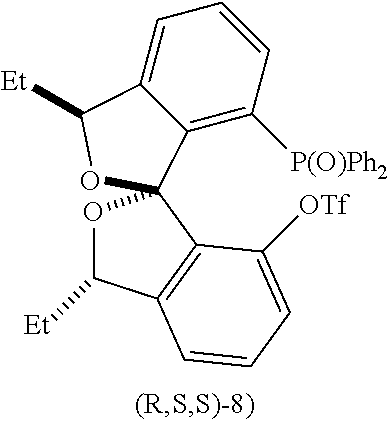
the method comprising admixing diphenylphosphine oxide with compound (R,S,S)-7 in the presence of a catalyst to form compound (R,S,S)-8, wherein the temperature of the admixing is 90° C. to 110° C.

wherein each R is independently selected from the group consisting of C1-8 alkyl, C1-8 heteroalkyl having 1-4 heteroatoms independently selected from N, O, and S, C3-6 cycloalkyl, 3-10 membered heterocycloalkyl having 1-4 heteroatoms independently selected from N, O, and S, C6-10 aryl, and 5-10 membered heteroaryl having 1-4 heteroatoms independently selected from N, O, and S, each X is independently selected from OH, PAr2, P(O)Ar2, OPAr2, C3-6 cycloalkyl, 3-10 membered heterocycloalkyl having 1-4 heteroatoms independently selected from N, O, and S, C6-10 aryl, and 5-10 membered heteroaryl having 1-4 heteroatoms independently selected from N, O, and S, or each X together form O2PNR′2, Ar is C6-10 aryl, and each R′ is independently selected from hydrogen and C1-8 alkyl.

wherein each R is independently selected from the group consisting of C1-8 alkyl, C1-8 heteroalkyl having 1-4 heteroatoms independently selected from N, O, and S, C3-6 cycloalkyl, 3-10 membered heterocycloalkyl having 1-4 heteroatoms independently selected from N, O, and S, C6-10 aryl, and 5-10 membered heteroaryl having 1-4 heteroatoms independently selected from N, O, and S; each X is independently selected from OH, PAr2, P(O)Ar2, OPAr2, C3-6 cycloalkyl, 3-10 membered heterocycloalkyl having 1-4 heteroatoms independently selected from N, O, and S, or together form O2PNR′2; wherein Ar is C6-10 aryl and each R′ is independently selected from hydrogen and C1-8 alkyl.

wherein the compounds of formula (IA) are (R,S,S)-SPIROL derivatives.

wherein the compounds of formula (IB) are (S,S,S)-SPIROL derivatives.

In some embodiments, at least one X is OH. In some embodiments, each X is OH. In some embodiments, at least one X is PAr2. In refinements of the foregoing embodiment, one or both Ar can be phenyl. In some embodiments, both X are PAr2. In refinements of the foregoing embodiment, one or both Ar can be phenyl. In embodiments, at least one X is OPAr2. In refinements of the foregoing embodiment, one or both Ar can be phenyl. In some embodiments, both X are OPAr2. In refinements of the foregoing embodiment, one or both Ar can be phenyl. In embodiments, at least one X is P(O)Ar2. In refinements of the foregoing embodiment, one or both Ar can be phenyl. In some embodiments, both X are P(O)Ar2. In refinements of the foregoing embodiment, one or both Ar can be phenyl. In some embodiments, one X can be PAr2 and one X can be P(O)Ar2. In refinements of the foregoing embodiments, one or more Ar can be phenyl. In some embodiments, one X can be PAr2 and one X can OPAr2. In refinements of the foregoing embodiments, one or more Ar can be phenyl. In some embodiments, one X can be OPAr2 and one X can be P(O)Ar2. In refinements of the foregoing embodiments, one or more Ar can be phenyl. In some embodiments, one X can be a 5-member heterocycle comprising one N atom and one O atom. In refinements of the foregoing embodiments, X can be 4,5-dihydrooxazole or 4,5-dihydrooxazole substituted with Ar. In some embodiments, both X can be 5-member heterocycles comprising one N atom and one O atom. In refinements of the foregoing embodiments, both X can be 4,5-dihydrooxazole or 4,5-dihydrooxazole substituted with Ar. In some embodiments, one or both X can be 4-phenyl-4,5-dihydrooxazole. In some embodiments, one X can be PAr2 and one X can be 4,5-dihydrooxazole or 4,5-dihydrooxazole substituted with Ar. In some embodiments, one X can be OPAr2 and one X can be 4,5-dihydrooxazole or 4,5-dihydrooxazole substituted with Ar. In some embodiments, one X can be P(O)Ar2 and one X can be 4,5-dihydrooxazole or 4,5-dihydrooxazole substituted with Ar.


the method comprising (a) cooling a solution of compound (S)-2:

to 0° C., wherein PG is a hydroxy protecting group, (b) adding an organolithium reagent to the cooled solution of step (a) to form a mixture, (c) warming the mixture of step (b) to room temperature and keeping it at room temperature to dissolve suspended material and form a solution, (d) cooling the solution of step (c) to 0° C., (e) admixing the solution of step (d) and diethyl carbonate at 0° C. (f) warming the reaction mixture of step (e) to room temperature, and (g) admixing the reaction mixture of step (f) with acetic acid.


the method comprising admixing diphenylphosphine oxide with a triflate compound comprising (S,S,S)-7

and, optionally, compound (S,R,S)-7

in the presence of a catalyst to form compound (S,S,S)-8, wherein the temperature of the admixing is 70° C. to 90° C.

the method comprising admixing diphenylphosphine oxide with triflate compound

in the presence of a catalyst to form compound (R,S,S)-8 wherein the temperature of the admixing is 90° C. to 110° C.


Substrate Synthesis

Substrate Synthesis

Substrate Synthesis

Claims (24)


Priority Applications (1)
| Application Number | Priority Date | Filing Date | Title |
|---|---|---|---|
| US16/134,568 US10565015B2 (en) | 2017-09-18 | 2018-09-18 | Spiroketal-based C2-symmetric scaffold for asymmetric catalysis |
Applications Claiming Priority (2)
| Application Number | Priority Date | Filing Date | Title |
|---|---|---|---|
| US201762559903P | 2017-09-18 | 2017-09-18 | |
| US16/134,568 US10565015B2 (en) | 2017-09-18 | 2018-09-18 | Spiroketal-based C2-symmetric scaffold for asymmetric catalysis |
Publications (2)
| Publication Number | Publication Date |
|---|---|
| US20190084995A1 US20190084995A1 (en) | 2019-03-21 |
| US10565015B2 true US10565015B2 (en) | 2020-02-18 |
Family
ID=65720301
Family Applications (1)
| Application Number | Title | Priority Date | Filing Date |
|---|---|---|---|
| US16/134,568 Active US10565015B2 (en) | 2017-09-18 | 2018-09-18 | Spiroketal-based C2-symmetric scaffold for asymmetric catalysis |
Country Status (1)
| Country | Link |
|---|---|
| US (1) | US10565015B2 (en) |
Families Citing this family (1)
| Publication number | Priority date | Publication date | Assignee | Title |
|---|---|---|---|---|
| CN114315906B (en) * | 2022-01-05 | 2023-07-07 | 中国科学院上海有机化学研究所 | Spirobis-dihydrobenzosilole phosphite compound, its preparation method and application |
Citations (16)
| Publication number | Priority date | Publication date | Assignee | Title |
|---|---|---|---|---|
| CN1439643A (en) | 2003-02-21 | 2003-09-03 | 南开大学 | Spiro-diphosphine ligand |
| WO2005023742A2 (en) | 2003-08-29 | 2005-03-17 | Eastman Kodak Company | Chiral compounds and compositions containing the same |
| JP2005283370A (en) | 2004-03-30 | 2005-10-13 | Sumitomo Chemical Co Ltd | NMR chiral shift reagent comprising optically active spiro compounds |
| JP2006070001A (en) | 2004-09-06 | 2006-03-16 | Daiso Co Ltd | Chiral phase transfer catalyst with spiro skeleton, its preparation method and catalytic asymmetric reaction using the same |
| CN1760198A (en) | 2005-11-09 | 2006-04-19 | 南开大学 | New type spirocyclic phosphic ester, preparation method and application in asymmetric addition reaction |
| US20060091357A1 (en) | 2004-10-29 | 2006-05-04 | Welter Thomas R | Photochemically active chiral compounds and compositions containing the same |
| CN1884290A (en) | 2006-07-11 | 2006-12-27 | 南开大学 | Phosphorus-oxazoline ligand with spiro backbone and its uses in asymmetrical catalytic hydrogenation |
| CN1887893A (en) | 2006-07-24 | 2007-01-03 | 南开大学 | New-type spiro phosphonite and its application in the asymmetrical catalytic hydrogenation of enamine |
| CN102030780A (en) | 2010-10-26 | 2011-04-27 | 浙江大学 | Chiral spiro-phosphate and preparation method and application thereof |
| US20130063693A1 (en) | 2011-09-09 | 2013-03-14 | Chien-Hsien Cheng | Chiral dopants, liquid crystal matrix and manufacturing method thereof and liquid crystal display |
| CN103087106A (en) | 2013-01-31 | 2013-05-08 | 中国科学院上海有机化学研究所 | Chirality phosphine nitrogen compound containing N-aryl as well as synthetic method and application thereof |
| US20130135574A1 (en) | 2011-11-25 | 2013-05-30 | Industrial Technology Research Institute | Liquid crystal compounds, and liquid crystal displays and photochromic materials comprising the liquid crystal compounds |
| WO2014196920A1 (en) | 2013-06-05 | 2014-12-11 | Sol Voltaics Ab | A solar cell structure and a method of its fabrication |
| WO2014196930A1 (en) | 2013-06-05 | 2014-12-11 | Nanyang Technological University | Spiro-1,1'-biindane-7,7-bisphosphine oxides as highly active supporting ligands for palladium-catalyzed asymmetric heck reaction |
| CN105327121A (en) | 2015-12-11 | 2016-02-17 | 广东聚智诚科技有限公司 | Traditional Chinese medicine composition for treating female postmenopausal osteoporosis and preparing method thereof |
| CN105503542A (en) | 2014-09-24 | 2016-04-20 | 常熟浸大科技有限公司 | Chiral ligand 1,1'-spirobiindane-7,7'-diol synthesis method |
-
2018
- 2018-09-18 US US16/134,568 patent/US10565015B2/en active Active
Patent Citations (16)
| Publication number | Priority date | Publication date | Assignee | Title |
|---|---|---|---|---|
| CN1439643A (en) | 2003-02-21 | 2003-09-03 | 南开大学 | Spiro-diphosphine ligand |
| WO2005023742A2 (en) | 2003-08-29 | 2005-03-17 | Eastman Kodak Company | Chiral compounds and compositions containing the same |
| JP2005283370A (en) | 2004-03-30 | 2005-10-13 | Sumitomo Chemical Co Ltd | NMR chiral shift reagent comprising optically active spiro compounds |
| JP2006070001A (en) | 2004-09-06 | 2006-03-16 | Daiso Co Ltd | Chiral phase transfer catalyst with spiro skeleton, its preparation method and catalytic asymmetric reaction using the same |
| US20060091357A1 (en) | 2004-10-29 | 2006-05-04 | Welter Thomas R | Photochemically active chiral compounds and compositions containing the same |
| CN1760198A (en) | 2005-11-09 | 2006-04-19 | 南开大学 | New type spirocyclic phosphic ester, preparation method and application in asymmetric addition reaction |
| CN1884290A (en) | 2006-07-11 | 2006-12-27 | 南开大学 | Phosphorus-oxazoline ligand with spiro backbone and its uses in asymmetrical catalytic hydrogenation |
| CN1887893A (en) | 2006-07-24 | 2007-01-03 | 南开大学 | New-type spiro phosphonite and its application in the asymmetrical catalytic hydrogenation of enamine |
| CN102030780A (en) | 2010-10-26 | 2011-04-27 | 浙江大学 | Chiral spiro-phosphate and preparation method and application thereof |
| US20130063693A1 (en) | 2011-09-09 | 2013-03-14 | Chien-Hsien Cheng | Chiral dopants, liquid crystal matrix and manufacturing method thereof and liquid crystal display |
| US20130135574A1 (en) | 2011-11-25 | 2013-05-30 | Industrial Technology Research Institute | Liquid crystal compounds, and liquid crystal displays and photochromic materials comprising the liquid crystal compounds |
| CN103087106A (en) | 2013-01-31 | 2013-05-08 | 中国科学院上海有机化学研究所 | Chirality phosphine nitrogen compound containing N-aryl as well as synthetic method and application thereof |
| WO2014196920A1 (en) | 2013-06-05 | 2014-12-11 | Sol Voltaics Ab | A solar cell structure and a method of its fabrication |
| WO2014196930A1 (en) | 2013-06-05 | 2014-12-11 | Nanyang Technological University | Spiro-1,1'-biindane-7,7-bisphosphine oxides as highly active supporting ligands for palladium-catalyzed asymmetric heck reaction |
| CN105503542A (en) | 2014-09-24 | 2016-04-20 | 常熟浸大科技有限公司 | Chiral ligand 1,1'-spirobiindane-7,7'-diol synthesis method |
| CN105327121A (en) | 2015-12-11 | 2016-02-17 | 广东聚智诚科技有限公司 | Traditional Chinese medicine composition for treating female postmenopausal osteoporosis and preparing method thereof |
Non-Patent Citations (14)
| Title |
|---|
| Birman et al., 1,1′-Spirobiindane-7,7′-diol: a novel, C2-symmetric chiral ligand, Tetrahedron: Asymmetry, 1091):125-31 (Jan. 1999). |
| Chiral Catalysts & Ligands, Daicel Chiral Technologies (China) Co., Ltd., downloaded from the Internet at: <http://www.daicelchiraltech.cn/reagents/list02.aspx?pid=72057594037927936&cid=77124143618719744> (published before Sep. 2017). |
| Coric et al., Kinetic resolution of homoaldols via catalytic asymmetric transacetalization, J. Am. Chem. Soc., 132(49):17370-3 (Dec. 2010). |
| Ding et al., Spiro skeletons: a class of privileged structure for chiral ligand design, Chem. Asian J., 4(1):32-41 (Jan. 2009). |
| Dubinnyi et al., Novel peptide chemistry in terrestrial animals: natural luciferin analogues from the bioluminescent earthworm Fridericia heliota, Chemistry, 21(10):3942-7 (Mar. 2015). |
| Ebe et al., Iridium-Catalyzed Regio- and Enantioselective Hydroarylation of Alkenyl Ethers by Olefin Isomerization, Angew. Chem. Int. Ed. Engl., 56(20):5607-11 (May 2017). |
| Gao et al., Base-promoted [1,4]-Wittig rearrangement of chalcone-derived allylic ethers leading to aromatic β-benzyl ketones, RSC Adv., 43(5):33818-22 (2015). |
| Hu et al., Palladium-catalyzed asymmetric intermolecular cyclization, Angew. Chem. Int. Ed. Engl., 52(33):8676-80 (Aug. 2013). |
| Matsubara et al., Nickel-catalyzed allylic substitution of simple alkenes, J. Am. Chem. Soc., 132(20):6880-1 (May 2010). |
| Noyori, Asymmetric catalysis: science and opportunities (Nobel lecture), Angew. Chem. Int. Ed. Engl., 41(12):2008-22 (Jun. 2002). |
| Tang et al., Asymmetric hydrogenation of quinolines with high substrate/catalyst ratio, Chem. Commun. (Camb), (6):613-5 (Feb. 2007). |
| Xie et al., Application of SDP Ligands for Pd-Catalyzed Allylic Alkylation, Adv. Synth. Catal., 346(6):625-32 (2004). |
| Xie et al., Synthesis of spiro diphosphines and their application in asymmetric hydrogenation of ketones, J. Am. Chem. Soc., 125(15):4404-5 (Apr. 2003). |
| Xu et al., SPINOL-derived phosphoric acids: synthesis and application in enantioselective Friedel-Crafts reaction of indoles with imines, J. Org. Chem., 75(24):8677-80 (Dec. 2010). |
Also Published As
| Publication number | Publication date |
|---|---|
| US20190084995A1 (en) | 2019-03-21 |
Similar Documents
| Publication | Publication Date | Title |
|---|---|---|
| US8552212B2 (en) | Chiral phosphorus ligands | |
| CA2954642A1 (en) | Process for preparing substituted phenylalkanes | |
| US10565015B2 (en) | Spiroketal-based C2-symmetric scaffold for asymmetric catalysis | |
| CN102746338B (en) | Spiroketal frame bidentate phosphoramidite ligand as well as preparation method and application thereof | |
| CN112645909A (en) | Method for synthesizing alpha-benzyl benzofuran compound | |
| CN115850328B (en) | Cyclopropane skeleton diphosphine ligand and its cobalt complex and preparation method and application thereof | |
| CN111777479A (en) | A kind of catalytic asymmetric synthesis method of chiral nitrogen-containing heteroaromatic compounds | |
| CN107286202A (en) | Synthetic method and the application of chiral Ugi ' s amine and its derivative and optical isomer | |
| CN105688987A (en) | Novel chiral phosphoric acid catalyst as well as synthetic method and application thereof | |
| CN117924173B (en) | Chiral phase transfer catalysts based on aniline quaternary ammonium salts and their application in asymmetric alkylation of amino acid derivatives | |
| CN109535120B (en) | Preparation method of 7-substituted-3,4,4,7-tetrahydrocyclobutanocoumarin-5-one | |
| US10544177B2 (en) | Chiral dihydrobenzooxaphosphole ligands and synthesis thereof | |
| US7232933B2 (en) | Preparation and use of diols | |
| JPWO2015122502A1 (en) | Process for producing optically active compound and novel metal-diamine complex | |
| CN113956276B (en) | A polysubstituted alkylarylazo compound, its synthesis method and application | |
| JP3610014B2 (en) | Improved process for asymmetric hydrogenation | |
| CN101218218A (en) | Novel Pyrocatechol Derivatives | |
| CN105859527B (en) | Axial chirality ring diphenol compound and preparation method and application | |
| CN111517934B (en) | Gamma-alkenyl ketone and synthetic method thereof | |
| KR102823550B1 (en) | Method of preparing alkenylated ortho-carborane | |
| CN112442042B (en) | A kind of preparation method of spirocyclic indole compound | |
| US6255540B1 (en) | Methods for producing two-substituted glycerols having various levels of protection | |
| TW202608905A (en) | Chiral aminophosphine ligands, iridium catalysts comprising these ligands and use of these catalysts in asymmetric hydrogenations | |
| JPS59130298A (en) | Manufacture of bisphosphine dioxide | |
| CN107286203A (en) | The preparation method and application of chiral Ugi ' s amine and its derivative and optical isomer |
Legal Events
| Date | Code | Title | Description |
|---|---|---|---|
| FEPP | Fee payment procedure |
Free format text: ENTITY STATUS SET TO UNDISCOUNTED (ORIGINAL EVENT CODE: BIG.); ENTITY STATUS OF PATENT OWNER: SMALL ENTITY |
|
| AS | Assignment |
Owner name: THE REGENTS OF THE UNIVERSITY OF MICHIGAN, MICHIGA Free format text: ASSIGNMENT OF ASSIGNORS INTEREST;ASSIGNORS:NAGORNY, PAVEL;SUN, SIYUAN;ARGUELLES, ALONSO;SIGNING DATES FROM 20180201 TO 20180316;REEL/FRAME:046907/0273 Owner name: THE REGENTS OF THE UNIVERSITY OF MICHIGAN, MICHIGAN Free format text: ASSIGNMENT OF ASSIGNORS INTEREST;ASSIGNORS:NAGORNY, PAVEL;SUN, SIYUAN;ARGUELLES, ALONSO;SIGNING DATES FROM 20180201 TO 20180316;REEL/FRAME:046907/0273 |
|
| FEPP | Fee payment procedure |
Free format text: ENTITY STATUS SET TO SMALL (ORIGINAL EVENT CODE: SMAL); ENTITY STATUS OF PATENT OWNER: SMALL ENTITY |
|
| STPP | Information on status: patent application and granting procedure in general |
Free format text: DOCKETED NEW CASE - READY FOR EXAMINATION |
|
| STPP | Information on status: patent application and granting procedure in general |
Free format text: NON FINAL ACTION MAILED |
|
| STPP | Information on status: patent application and granting procedure in general |
Free format text: NON FINAL ACTION MAILED |
|
| STPP | Information on status: patent application and granting procedure in general |
Free format text: RESPONSE TO NON-FINAL OFFICE ACTION ENTERED AND FORWARDED TO EXAMINER |
|
| STPP | Information on status: patent application and granting procedure in general |
Free format text: NOTICE OF ALLOWANCE MAILED -- APPLICATION RECEIVED IN OFFICE OF PUBLICATIONS |
|
| STPP | Information on status: patent application and granting procedure in general |
Free format text: PUBLICATIONS -- ISSUE FEE PAYMENT RECEIVED |
|
| STCF | Information on status: patent grant |
Free format text: PATENTED CASE |
|
| MAFP | Maintenance fee payment |
Free format text: PAYMENT OF MAINTENANCE FEE, 4TH YR, SMALL ENTITY (ORIGINAL EVENT CODE: M2551); ENTITY STATUS OF PATENT OWNER: SMALL ENTITY Year of fee payment: 4 |