US10564447B2 - Contact lens for corrected-cornea crosslinking, corrected-cornea crosslinking method, and ring-shaped contact lens - Google Patents

Contact lens for corrected-cornea crosslinking, corrected-cornea crosslinking method, and ring-shaped contact lens Download PDF

Info

Publication number
US10564447B2
US10564447B2 US15/038,054 US201415038054A US10564447B2 US 10564447 B2 US10564447 B2 US 10564447B2 US 201415038054 A US201415038054 A US 201415038054A US 10564447 B2 US10564447 B2 US 10564447B2
Authority
US
United States
Prior art keywords
cornea
region
contact lens
pressing
lens
Prior art date
Legal status (The legal status is an assumption and is not a legal conclusion. Google has not performed a legal analysis and makes no representation as to the accuracy of the status listed.)
Active, expires
Application number
US15/038,054
Other versions
US20160299356A1 (en
Inventor
Iwane Mitsui
Current Assignee (The listed assignees may be inaccurate. Google has not performed a legal analysis and makes no representation or warranty as to the accuracy of the list.)
Individual
Original Assignee
Individual
Priority date (The priority date is an assumption and is not a legal conclusion. Google has not performed a legal analysis and makes no representation as to the accuracy of the date listed.)
Filing date
Publication date
Application filed by Individual filed Critical Individual
Publication of US20160299356A1 publication Critical patent/US20160299356A1/en
Application granted granted Critical
Publication of US10564447B2 publication Critical patent/US10564447B2/en
Active legal-status Critical Current
Adjusted expiration legal-status Critical

Links

Images

Classifications

    • GPHYSICS
    • G02OPTICS
    • G02CSPECTACLES; SUNGLASSES OR GOGGLES INSOFAR AS THEY HAVE THE SAME FEATURES AS SPECTACLES; CONTACT LENSES
    • G02C7/00Optical parts
    • G02C7/02Lenses; Lens systems ; Methods of designing lenses
    • G02C7/04Contact lenses for the eyes
    • G02C7/047Contact lens fitting; Contact lenses for orthokeratology; Contact lenses for specially shaped corneae
    • AHUMAN NECESSITIES
    • A61MEDICAL OR VETERINARY SCIENCE; HYGIENE
    • A61FFILTERS IMPLANTABLE INTO BLOOD VESSELS; PROSTHESES; DEVICES PROVIDING PATENCY TO, OR PREVENTING COLLAPSING OF, TUBULAR STRUCTURES OF THE BODY, e.g. STENTS; ORTHOPAEDIC, NURSING OR CONTRACEPTIVE DEVICES; FOMENTATION; TREATMENT OR PROTECTION OF EYES OR EARS; BANDAGES, DRESSINGS OR ABSORBENT PADS; FIRST-AID KITS
    • A61F9/00Methods or devices for treatment of the eyes; Devices for putting in contact-lenses; Devices to correct squinting; Apparatus to guide the blind; Protective devices for the eyes, carried on the body or in the hand
    • A61F9/0008Introducing ophthalmic products into the ocular cavity or retaining products therein
    • A61F9/0017Introducing ophthalmic products into the ocular cavity or retaining products therein implantable in, or in contact with, the eye, e.g. ocular inserts
    • AHUMAN NECESSITIES
    • A61MEDICAL OR VETERINARY SCIENCE; HYGIENE
    • A61NELECTROTHERAPY; MAGNETOTHERAPY; RADIATION THERAPY; ULTRASOUND THERAPY
    • A61N5/00Radiation therapy
    • A61N5/06Radiation therapy using light
    • A61N5/0613Apparatus adapted for a specific treatment
    • A61N5/062Photodynamic therapy, i.e. excitation of an agent
    • GPHYSICS
    • G02OPTICS
    • G02CSPECTACLES; SUNGLASSES OR GOGGLES INSOFAR AS THEY HAVE THE SAME FEATURES AS SPECTACLES; CONTACT LENSES
    • G02C7/00Optical parts
    • G02C7/02Lenses; Lens systems ; Methods of designing lenses
    • G02C7/021Lenses; Lens systems ; Methods of designing lenses with pattern for identification or with cosmetic or therapeutic effects
    • AHUMAN NECESSITIES
    • A61MEDICAL OR VETERINARY SCIENCE; HYGIENE
    • A61FFILTERS IMPLANTABLE INTO BLOOD VESSELS; PROSTHESES; DEVICES PROVIDING PATENCY TO, OR PREVENTING COLLAPSING OF, TUBULAR STRUCTURES OF THE BODY, e.g. STENTS; ORTHOPAEDIC, NURSING OR CONTRACEPTIVE DEVICES; FOMENTATION; TREATMENT OR PROTECTION OF EYES OR EARS; BANDAGES, DRESSINGS OR ABSORBENT PADS; FIRST-AID KITS
    • A61F9/00Methods or devices for treatment of the eyes; Devices for putting in contact-lenses; Devices to correct squinting; Apparatus to guide the blind; Protective devices for the eyes, carried on the body or in the hand
    • A61F9/007Methods or devices for eye surgery
    • A61F9/013Instruments for compensation of ocular refraction ; Instruments for use in cornea removal, for reshaping or performing incisions in the cornea
    • AHUMAN NECESSITIES
    • A61MEDICAL OR VETERINARY SCIENCE; HYGIENE
    • A61NELECTROTHERAPY; MAGNETOTHERAPY; RADIATION THERAPY; ULTRASOUND THERAPY
    • A61N5/00Radiation therapy
    • A61N5/06Radiation therapy using light
    • A61N2005/0635Radiation therapy using light characterised by the body area to be irradiated
    • A61N2005/0643Applicators, probes irradiating specific body areas in close proximity
    • A61N2005/0645Applicators worn by the patient
    • A61N2005/0647Applicators worn by the patient the applicator adapted to be worn on the head
    • A61N2005/0648Applicators worn by the patient the applicator adapted to be worn on the head the light being directed to the eyes
    • GPHYSICS
    • G02OPTICS
    • G02CSPECTACLES; SUNGLASSES OR GOGGLES INSOFAR AS THEY HAVE THE SAME FEATURES AS SPECTACLES; CONTACT LENSES
    • G02C7/00Optical parts
    • G02C7/16Shades; shields; Obturators, e.g. with pinhole, with slot

Definitions

  • the present invention relates to a contact lens for corrected-cornea crosslinking that changes a shape of the cornea of a patient while being mounted for a given period of time and fixes the shape thereof in a state of correcting myopia, hyperopia, astigmatism, or keratoconus cornea, and a corrected-cornea crosslinking method.
  • the present invention relates to a ring-shaped contact lens, a ring-shaped cornea-correction contact lens, and a ring-shaped color contact lens, which include a through hole at a portion corresponding to the central area of a corneal dome or the pupil, and, in particular, a ring-shaped cornea-correction contact lens that changes a shape of the cornea of a patient while being mounted for a given period of time, thereby causing a state of correcting hyperopia, and a corrected-cornea crosslinking method and a color contact lens for dress up using the same.
  • Patent Literature 1 a contact lens for changing a shape of the cornea of a patient by being mounted during sleep and the like, and correcting myopia and/or astigmatism at the time when the contact lens is removed. Subsequently, the inventor has also developed a similar contact lens for correcting hyperopia.
  • a relief region 3 constituted by a concave portion and a pressing region 4 constituted by a convex portion are formed on a side of the lens in contact with a cornea 2 of a patient.
  • a part of the cornea is pushed downward by the pressing region 4 and, as a reaction thereof, a part of the cornea 2 is projected into the relief region 3 , so that the cornea 2 is corrected into a shape in which desirable naked eye vision can be obtained or a shape in which keratoconus cornea is smoothly suppressed.
  • a relief region 5 and a pressing region 6 are reversed to each other as compared to the case of correcting myopia.
  • the pressing region 4 is formed to project in a convex curved-surface shape at a position corresponding to the center of the corneal dome to be pressed when the contact lens 1 A is mounted on the cornea 2 .
  • the relief region 3 is constituted by an annular concave portion that has a cross section in a concave circular arc shape at a position encircling the outer periphery of the pressing region 4 , and configured such that a part of the cornea 2 enters the annular concave portion thereof as a reaction of the cornea 2 pushed downward by the pressing region 4 .
  • the contact lens 1 A also includes an anchor region 7 having a shape aligned with a contour of the cornea 2 , when the contact lens 1 A is mounted on the cornea 2 , at a position encircling the outer periphery of the relief region 3 , and a peripheral portion 8 further encircling the outer periphery of the anchor region 7 .
  • a shape of the cornea can be fixed to some extent in a state of being corrected by a contact lens by combining this crosslinking method and the above-mentioned contact lenses (publicly unknown).
  • This color contact lens for dress up is composed of a central portion corresponding to the pupil and an annular portion arranged on the outside thereof.
  • the annular portion is applied with annular coloring while the central portion is uncolored, and this contact lens does not have an eyesight correcting function.
  • the conventional contact lens for vision correction or the color contact lens for dress up have, for example, such problems that they cannot be used in the case of diseases such as dry eye and that the center of these lenses is shifted from a position of the pupil during the wearing thereof. Further, a portion of the lens corresponding to the central portion of the corneal dome or the pupil needs to be transparent, and thus there is a problem that a 3D printer forming a final product in an opaque state cannot be used for forming the lens.
  • Patent Literature 1 Japanese Patent No. 3881221
  • An object of the present invention is to provide a contact lens for corrected-cornea crosslinking and a corrected-cornea crosslinking method capable of accurately correcting the cornea using the contact lens for correcting vision or astigmatism through the analysis of the behavior of the cornea of which strength is enhanced by the crosslinking, and fixing the cornea in the corrected state.
  • another object of the present invention is to provide a ring-shaped contact lens, a ring-shaped cornea-correction contact lens, a corrected-cornea crosslinking method, and a color contact lens for dress up, wherein a contact lens for correcting vision and a color contact lens for dress up can be used in a case of dry eye by allowing supply of oxygen and a lacrimal fluid to the surface of the central portion of the corneal dome, can be formed of an opaque material, and can be prevented from being shifted from a position having the pupil as a center.
  • the inventor has found, as a result of his/her earnest studies, that the cornea of which strength is enhanced by the crosslinking is projected forward by an elastically restoring force of the eyeball and invented a contact lens for corrected-cornea crosslinking and a corrected-cornea crosslinking method capable of achieving aimed naked eye vision by taking this restoring force into consideration.
  • the inventor has found, as a result of his/her earnest studies, that the relief region is not necessarily brought into contact with the cornea in correcting the cornea for hyperopia and presbyopia and that a color contact lens for dress up may have a portion corresponding to the pupil formed in a so-called transparent state, thereby developing a ring-shaped cornea-correction contact lens and a ring-shaped color contact lens for dress up having a central portion formed as a through hole.
  • a contact lens for corrected-cornea crosslinking comprising a relief region constituted by a concave portion and a pressing region constituted by a convex region, each being formed on a side of the contact lens in contact with a cornea of a patient, the contact lens being for correcting at least one of naked eye vision and keratoconus cornea by pressing the relief region and the pressing region to the cornea and changing a shape thereof, wherein: when the contact lens is mounted on the cornea, the pressing region is projected in a convex curved-surface shape at a position corresponding to a center of a corneal dome to be pressed, thereby forming a concave curved-surface on the cornea; and the relief region is constituted by an annular concave portion that has a cross section in a concave circular arc shape, the relief region being formed at a position encircling an outer periphery of the pressing region, the contact lens further comprising: an anchor region having a shape aligned with a contour of the cornea when
  • a contact lens for corrected-cornea crosslinking comprising a relief region constituted by a concave portion and a pressing region constituted by a convex region, each being formed on a side of the contact lens in contact with a cornea of a patient, the contact lens being for correcting at least one of naked eye vision and keratoconus cornea by pressing the relief region and the pressing region to the cornea and changing a shape thereof, wherein: when the contact lens is mounted on the cornea, the relief region is formed in a concave curved-surface shape at a position being in contact with a center of a corneal dome, thereby forming a convex curved-surface on the cornea; and the pressing region is constituted by an annular convex portion that has a cross section in a convex circular arc shape, the pressing region being formed at a position encircling an outer periphery of the relief region, the contact lens further comprising: an anchor region having a shape aligned with a contour of the cornea when the contact lens
  • a corrected-cornea crosslinking method comprising: a step of infiltrating a riboflavin solution into a corneal tissue; a step of mounting the contact lens for corrected-cornea crosslinking according to any of claims 1 to 5 on the cornea after infiltration of the riboflavin in such a manner that the cornea is pressed by the pressing region and a part of the cornea pressed by deformation of the cornea that is pressed enters the relief region; and a step of irradiating, while the contact lens for corrected-cornea crosslinking is mounted on the cornea, the cornea with ultraviolet rays via the contact lens for corrected-cornea crosslinking, thereby crosslinking collagen fibers that constitute the cornea.
  • a ring-shaped contact lens comprising a through hole at a portion thereof corresponding to a pupil during wearing of the lens.
  • a ring-shaped cornea-correction contact lens comprising a relief region constituted by a concave portion and a pressing region constituted by a convex region, each being formed on a side of the contact lens in contact with a cornea of a patient, the cornea-correction contact lens being for correcting at least one of hyperopia or presbyopia by pressing at least the pressing region to the cornea and changing a shape thereof, wherein: when the contact lens is mounted on the cornea, the relief region is formed as a through hole at a position corresponding to a central area of a corneal dome, so that the cornea is projected into the through hole to form a convex curved-surface; and the pressing region is constituted by an annular convex portion having a cross section in a convex circular arc shape, the pressing region being formed at a position encircling an outer periphery of the relief region, the cornea-correction contact lens further comprising at least an anchor region of: an anchor region having a shape aligned with
  • a corrected-cornea crosslinking method comprising: a step of infiltrating a riboflavin solution into a corneal tissue; a step of mounting the ring-shaped cornea-correction contact lens described in (4) or (5) on the cornea after infiltration of the riboflavin in such a manner that the cornea is pressed by the pressing region and a part of the cornea pressed by deformation of the cornea that is pressed enters the relief region; and a step of irradiating, while the ring-shaped cornea-correction contact lens is mounted on the cornea, the cornea with ultraviolet rays via the through hole, thereby crosslinking collagen fibers that constitute the cornea.
  • a color contact lens for dress up comprising: a through hole at a portion thereof corresponding to a pupil of a wearer; and an annular coloring portion at its periphery.
  • the contact lens for corrected-cornea crosslinking provides an advantageous effect that a shape of the cornea after crosslinking can be accurately set so as to be capable of recovering aimed eye vision by setting a concave part and a convex part of the contact lens for deforming the cornea in consideration of corneal deformation (spring back) occurring after crosslinking based on the elastically restoring force of the eyeball in advance.
  • the ring-shaped contact lens according to the present invention has a central portion corresponding to the central area of the corneal dome or the pupil formed as a through hole when being mounted and thus provides such advantageous effects that the contact lens can be used in the case of dry eye by allowing supply of oxygen and a lacrimal fluid to the surface of the central portion of the corneal dome, can be formed of an opaque material, and can also be prevented from being shifted from a position having the pupil as a center.
  • FIG. 1 is a cross-sectional view schematically illustrating a contact lens for corrected-cornea crosslinking according to Example 1 of the present invention.
  • FIG. 2 is a rear view of the contact lens taken along line II-II of FIG. 1 .
  • FIG. 3 is a cross-sectional view schematically illustrating a contact lens for corrected-cornea crosslinking according to Example 2 of the present invention.
  • FIG. 4 is a cross-sectional view schematically illustrating a ring-shaped cornea-correction contact lens according to Example 3 of the present invention.
  • FIG. 5 is a rear view of the contact lens taken along line V-V of FIG. 4 .
  • FIG. 6 is a cross-sectional view schematically illustrating Example of a color contact lens for dress up.
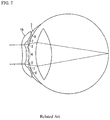
  • FIG. 7 is a cross-sectional view schematically illustrating a conventional contact lens for correcting myopia, shown together with a part of the cornea and the eyeball.
  • FIG. 8 is a cross-sectional view schematically illustrating a conventional contact lens for correcting hyperopia, shown in the same manner as FIG. 7 .
  • a relief region constituted by a concave portion and a pressing region constituted by a convex portion are formed on a side of the lens in contact with the cornea of a patient.
  • a part of the cornea is pushed downward by the pressing region and, as a reaction thereof, a part of the cornea is projected into the relief region, so that the cornea is corrected into a shape in which desirable naked eye vision can be obtained or a shape in which keratoconus cornea is smoothly suppressed.
  • the contact lens is removed after corneal deformation is fixed by crosslinking in this state, a return of deformation occurs due to spring back of the cornea.
  • a curvature of the curve of the convex portion or the concave portion is set anticipating this return in advance.
  • the above-mentioned values of +5.0 D to +10.0 D are a correction amount obtained by taking into consideration corneal deformation (spring back) after crosslinking based on the elastically restoring force of the eyeball, and deduced from a large number of treatment cases performed by the inventor.
  • the outer diameter D 1 of a peripheral portion be set larger than an average outer diameter D 0 of the outer peripheral edge of the human cornea by 3.0 mm to 5.0 mm, and that a UV-shielding membrane for shielding ultraviolet rays be provided to the lens in an annular region, on a side in contact with the cornea, from a position having a diameter of D 0 —3.0 mm to D 0 —5.0 mm to the outermost periphery in the peripheral portion.
  • a material of the UV-shielding membrane for shielding ultraviolet rays a material harmless to the cornea, for example, a gold thin film, a titanium thin film, a silver thin film, and the like may be used.
  • UV-shielding membrane When the UV-shielding membrane is provided outside the contact lens, ultraviolet rays incident on the central area of the contact lens are reflected/diffracted inside and sometimes reach the outer peripheral edge of the cornea. Thus, the UV-shielding membrane is provided on the side in contact with the cornea.
  • a relief region constituted by a concave portion and a pressing region constituted by a convex portion are formed on a side of the lens in contact with the cornea of a patient of hyperopia or presbyopia.
  • the relief region has a central area corresponding to the central area of the corneal dome formed as a through hole, into which a part of the cornea pressed by the pressing region is to be projected.
  • a contact lens 10 for correcting myopia according to Example 1 of the present invention is used by being mounted on a cornea 12 .
  • Reference numeral 14 in FIG. 1 denotes a crystalline lens.
  • the contact lens 10 for correcting myopia is configured to include: a pressing region 18 formed to project in a convex curved-surface shape at a position corresponding to the center of a corneal dome (a front end surface of the cornea having the most protruding portion) to be pressed; a relief region 20 constituted by an annular concave portion having a cross section in a concave circular arc shape, the relief region 20 being formed at a position encircling the outer periphery of the pressing region 18 ; an anchor region 24 having a shape aligned with a contour 22 (see FIG.
  • the anchor region 24 being provided at a position encircling the outer periphery of the pressing region 18 ; and a peripheral portion 26 encircling the outer periphery of the anchor region 24 .
  • FIG. 1 a conventional contact lens (hereinafter referred to as a conventional lens) 1 A for correcting myopia, shown in FIG. 7 , is shown by a two-dot chain line.
  • a conventional contact lens 1 A for correcting myopia shown in FIG. 7 .
  • the pressing region 18 is projected towards a direction of the cornea 12 as compared to the conventional lens 1 A, and conversely the relief region 20 is formed as a deeper annular concave portion than a relief region 3 of the conventional lens 1 A. Furthermore, the peripheral portion 26 is larger than a peripheral portion 8 and extended along the contour of the cornea 12 .
  • R s a curvature of the convex curved-surface of the pressing region 18 in Example 1
  • R 0 a curvature of the convex curved-surface of the conventional lens 1 A
  • the aforementioned curvature R 0 is a curvature of a concave curved-surface to be formed on the cornea 12 for correcting at least one of naked eye vision and keratoconus cornea of a patient.
  • the reason why R s is set to satisfy R s >R 0 is that when the cornea of a patient is pressed by the pressing region having a convex curved-surface of curvature R 0 and then the pressing is released, the cornea is deformed so as to lessen the curvature of the concave curved-surface at the central area of the corneal dome due to the elastically restoring force (spring back) of the eyeball, and thus R s is set anticipating this spring back amount in advance.
  • this spring back amount is defined as ⁇ R
  • an outer diameter D 1 of the peripheral portion 26 of the contact lens 10 for correcting myopia is set larger than an average outer diameter D 0 of the outer peripheral edge of the human cornea by 3.0 mm to 5.0 mm, and the UV-shielding membrane 28 for shielding ultraviolet rays is provided to the lens in an annular region, on a side in contact with the cornea 12 , from a position having a diameter of D 0 —3.0 mm to D 0 —5.0 mm to the outermost periphery in the peripheral portion 26 .
  • This UV-shielding membrane 28 is preferably made of a material that is harmless even when being in contact with the cornea 12 , including, for example, a thin film of gold, titanium, silver, and the like.
  • the peripheral portion 26 of the cornea 12 is not damaged by ultraviolet ray irradiation during crosslinking, thus pluripotent cells for regenerating the cornea can be preserved.
  • a riboflavin (vitamin B2) solution is infiltrated into the cornea 12 by instillation.
  • the contact lens 10 for correcting myopia of Example 1 is mounted on the cornea 12 in such a manner that the cornea 12 is pressed by the pressing region 18 located in the center of the lens and a part of the cornea pressed by deformation of the cornea 12 that is pressed enters the relief region 20 .
  • the cornea 12 is irradiated with ultraviolet rays via the contact lens 10 for correcting myopia, thereby crosslinking collagen fibers that constitute the cornea.
  • the UV-shielding membrane 28 is formed in the contact lens 10 for correcting myopia on the side in contact with the cornea 12 so as to cover the peripheral portion 26 , thus ultraviolet rays do not reach the cornea 12 .
  • pluripotent cells of the cornea 12 localized inside the peripheral portion 26 , are not damaged.
  • the cornea 12 is fixed in the same shape as imparted by the pressing region 18 and the relief region 20 .
  • the central area of the cornea 12 is projected due to the elastically restoring force of the eyeball.
  • the curvature R s of the convex curved-surface of the pressing region 18 is set anticipating the spring back amount in advance, a curvature of the concave curved-surface formed on the cornea 12 becomes R 0 after spring back.
  • FIG. 3 a conventional contact lens 1 B for correcting hyperopia, shown in FIG. 8 , is shown by a two-dot chain line.
  • the contact lens 110 for correcting hyperopia of Example 2 has a configuration in which a concave part and a convex part are switched between the pressing region and the relief region as compared to the contact lens 10 for correcting myopia shown above in FIG. 1 .
  • a relief region 120 is formed in a concave curved-surface shape at a position being in contact with the central area of the corneal dome when the lens 110 is mounted on the cornea 12 , and a pressing region 118 is constituted by an annular convex portion having a cross section in a convex circular arc shape, the pressing region 118 being formed at a position encircling the outer periphery of the relief region 120 .
  • an anchor region 124 is provided at a position encircling the outer periphery of the pressing region 118 and formed into a shape aligned with a contour of the cornea when the lens 110 is mounted on the cornea 12 .
  • a peripheral portion 126 is arranged so as to encircle the outer periphery of the anchor region 124 .
  • Reference numeral 128 in FIG. 3 denotes a UV-shielding membrane.
  • This value is a correction amount obtained by taking into consideration a spring back amount ⁇ r due to the elastically restoring force of the eyeball at the central area of the corneal dome after releasing the pressing force of the contact lens 110 for correcting hyperopia, and is deduced from a large number of treatment cases performed by the inventor.
  • crosslinking is performed to the corrected cornea using the contact lens 110 for correcting hyperopia
  • crosslinking is performed in the same process as the contact lens 10 for correcting myopia according to the aforementioned Example 1.
  • a ring-shaped cornea-correction contact lens (hereinafter referred to as a ring-shaped lens) 111 is intended for correcting hyperopia or presbyopia and used by being mounted on a cornea 12 .
  • the ring-shaped lens 111 is configured to include: a relief region 121 formed as a through hole at a position corresponding to the center of a corneal dome (a front end surface of the cornea having the most protruding portion) or the pupil; a pressing region 119 constituted by an annular convex portion having a cross section in a convex circular arc shape on the cornea side, the pressing region 119 being formed at a position encircling the outer periphery of the relief region 121 ; an anchor region 24 having a shape aligned with a contour 22 (see FIG.
  • the anchor region 24 being provided at a position encircling the outer periphery of the pressing region 20 ; and a peripheral portion 126 encircling the outer periphery of the anchor region 24 .
  • the pressing region 119 is formed in a convex circular arc shape on the cornea side, and an inner peripheral surface 121 A of the through hole as the relief region 121 is smoothly continuous with a convex circular arc 119 A of the pressing region 119 and formed in a convex circular arc shape on the center side of the through hole.
  • FIG. 4 the conventional lens 1 B, shown in FIG. 8 , is shown by a two-dot chain line.
  • an outer diameter D 1 of the peripheral portion 126 of the ring-shaped lens 111 is set larger than an average outer diameter D 0 of the outer peripheral edge of the human cornea by 3.0 mm to 5.0 mm, and a UV-shielding membrane 28 128 for shielding ultraviolet rays is provided to the lens in an annular region, on the side in contact with the cornea 12 , from a position having a diameter of D 0 ⁇ 3.0 mm to D 0 ⁇ 5.0 mm to the outermost periphery in the peripheral portion 126 .
  • This UV-shielding membrane 128 is preferably made of a material that is harmless even when being in contact with the cornea 12 , including, for example, a thin film of gold, titanium, silver, and the like.
  • Correction of hyperopia or presbyopia by the ring-shaped lens 111 of Example 3 is normally performed by wearing the lens during sleep.
  • the ring-shaped lens 10 is pressed by the eyelid during sleep, so that a part of the cornea 12 pressed by the pressing region 119 is pushed into the relief region 121 forming a through hole and, then, the cornea 12 is deformed into a convex lens shape.
  • hyperopia or presbyopia is corrected.
  • relief region 121 is formed as a through hole, the air and the lacrimal fluid are easily permeated in this part, and thus the cornea can be supplied with oxygen and moistened. Further, the eyelid does not directly touch the ring-shaped lens 111 in the through hole portion and thus easily slides over the ring-shaped lens 111 with less discomfort. Furthermore, as described above, since a part of the cornea 12 pressed by the pressing region 119 is projected into the through hole as the relief region 121 , the ring-shaped lens 111 is hardly movable relative to the cornea 12 and can be suppressed from being shifted during sleep.
  • the ring-shaped lens 111 has the relief region 121 formed as a through hole at a position corresponding to the pupil, and thus one can see things through this through hole in a usual manner and can wear the lens not only during sleep but also in normal daily life conditions.
  • crosslinking refers to a process for fixing the cornea in the corrected state, which is otherwise returned to its original condition of myopia or hyperopia by a restoring force of the cornea when a conventional cornea-correction contact lens is not put on for a long period.
  • This fixing process is performed by irradiating ultraviolet rays on a corneal tissue in a state of being infiltrated with riboflavin (vitamin B2) and crosslinking collagens constituting the cornea to one another.
  • a riboflavin (vitamin B2) solution is infiltrated into the cornea 12 by instillation.
  • the ring-shaped lens 111 of Example 3 is mounted on the cornea 12 in such a manner that the cornea 12 is pressed by the pressing region 119 and a part of the cornea pressed by deformation of the cornea 12 that is pressed enters the relief region 121 formed as the through hole.
  • the cornea 12 is irradiated with ultraviolet rays via the relief region 121 formed as the through hole, thereby crosslinking collagen fibers that constitute the cornea 12 .
  • the UV-shielding membrane 128 is formed in the ring-shaped lens 111 on the side in contact with the cornea 12 so as to cover the peripheral portion 126 , and thus ultraviolet rays do not reach the cornea 12 .
  • pluripotent cells of the cornea 12 localized inside the peripheral portion 126 , are not damaged.
  • the cornea 12 is fixed in the same shape as imparted by the pressing region 119 and the relief region 121 .
  • the ring-shaped lens 111 of the aforementioned Example 3 may be formed transparent using the same material as a conventional contact lens. Furthermore, it may be colored or formed with an opaque material.
  • the contact lens be produced, for example, by a 3D printer.
  • the lens becomes opaque due to boundaries between granular inks that remain.
  • it needs to be subjected to a heat treatment.
  • the ring-shaped lens of the present invention is formed as a through hole at a position corresponding to the pupil or the central area of the corneal dome when the lens is mounted, therefore allowing its peripheral portions to be opaque. As such, the ring-shaped lens of the present invention does not need to be subjected to a heat treatment or the like after being produced by a 3D printer.
  • a UV-shielding material (an ultraviolet ray-shielding material) may be used as a material for producing the ring-shaped lens.
  • the ring-shaped lens 111 may be formed with the UV-shielding material at least in the pressing region 119 or as a whole.
  • the ring-shaped lens when used in the above corrected-cornea crosslinking method, only a portion corresponding to the UV-shielding membrane 128 needs to be formed with the UV-shielding material, and when the lens is not used in the crosslinking method, the peripheral portion 126 and the UV-shielding membrane 128 may not be provided.
  • Example 4 of the present invention will be described with reference to FIG. 6 .
  • Example 4 the present invention is applied to a color contact lens for dress up.
  • This color contact lens for dress up (hereinafter, referred to as a ring-shaped color lens) 130 according to Example 4 is not intended for correcting vision and thus has a simple curved-surface shape along the surface of the cornea 12 , where a through hole 132 is formed at a position corresponding to the pupil or the central area of the corneal dome of a wearer and an annular coloring portion 132 is formed at its periphery.
  • an inner peripheral surface 132 A of the through hole 132 is continuous with an inside surface 131 of the lens in contact with the cornea 12 and formed in a convex circular arc shape on the center side of the through hole 132 .
  • an end position of the through hole 132 on the side being in contact with the cornea 12 is formed in a circular arc shape, and thus any damage is not given to the cornea 12 or any discomfort is not given to the wearer.
  • a part of the cornea 12 is slightly projected into the through hole 132 side, thus the position of the lens relative to the eyeball is stabilized. Further, as in the case of the ring-shaped lens 111 of Example 3, oxygen and the lacrimal fluid can be supplied inside the through hole 32 .
  • a contact lens for corrected-cornea crosslinking can be used for fixing the cornea by crosslinking in a state that a shape of the cornea is corrected by the contact lens.

Landscapes

  • Health & Medical Sciences (AREA)
  • Ophthalmology & Optometry (AREA)
  • Physics & Mathematics (AREA)
  • General Health & Medical Sciences (AREA)
  • Life Sciences & Earth Sciences (AREA)
  • Engineering & Computer Science (AREA)
  • Biomedical Technology (AREA)
  • General Physics & Mathematics (AREA)
  • Optics & Photonics (AREA)
  • Public Health (AREA)
  • Animal Behavior & Ethology (AREA)
  • Veterinary Medicine (AREA)
  • Vascular Medicine (AREA)
  • Heart & Thoracic Surgery (AREA)
  • Biophysics (AREA)
  • Pathology (AREA)
  • Nuclear Medicine, Radiotherapy & Molecular Imaging (AREA)
  • Radiology & Medical Imaging (AREA)
  • Eyeglasses (AREA)

Abstract

In a contact lens for corrected-cornea crosslinking, a relief region constituted by a concave portion and a pressing region constituted by a convex portion are formed on a side of the lens in contact with a cornea of a patient. When these regions are pressed to the cornea to change a shape thereof, and a curvature of the concave curved-surface to be formed on the cornea is defined as R0 and a curvature of the convex curved-surface of the pressing region is defined as Rs, Rs is set, for example for correcting myopia, to satisfy Rs=R0+5.0 D to R0+10.0 D. When the contact lens having such a configuration is used for correcting the cornea and fixing the corrected state by crosslinking, the shape of the cornea can be accurately formed.

Description

TECHNICAL FIELD
The present invention relates to a contact lens for corrected-cornea crosslinking that changes a shape of the cornea of a patient while being mounted for a given period of time and fixes the shape thereof in a state of correcting myopia, hyperopia, astigmatism, or keratoconus cornea, and a corrected-cornea crosslinking method.
Further, the present invention relates to a ring-shaped contact lens, a ring-shaped cornea-correction contact lens, and a ring-shaped color contact lens, which include a through hole at a portion corresponding to the central area of a corneal dome or the pupil, and, in particular, a ring-shaped cornea-correction contact lens that changes a shape of the cornea of a patient while being mounted for a given period of time, thereby causing a state of correcting hyperopia, and a corrected-cornea crosslinking method and a color contact lens for dress up using the same.
BACKGROUND ART
For example, the inventor proposes, in Patent Literature 1, a contact lens for changing a shape of the cornea of a patient by being mounted during sleep and the like, and correcting myopia and/or astigmatism at the time when the contact lens is removed. Subsequently, the inventor has also developed a similar contact lens for correcting hyperopia.
As shown in FIG. 7, in a contact lens 1A for correcting myopia as described above, a relief region 3 constituted by a concave portion and a pressing region 4 constituted by a convex portion are formed on a side of the lens in contact with a cornea 2 of a patient. By pressing the relief region 3 and the pressing region 4 to the cornea 2, a part of the cornea is pushed downward by the pressing region 4 and, as a reaction thereof, a part of the cornea 2 is projected into the relief region 3, so that the cornea 2 is corrected into a shape in which desirable naked eye vision can be obtained or a shape in which keratoconus cornea is smoothly suppressed.
As shown in FIG. 8, in a contact lens 1B for correcting hyperopia, a relief region 5 and a pressing region 6 are reversed to each other as compared to the case of correcting myopia.
In the contact lens 1A for correcting myopia, the pressing region 4 is formed to project in a convex curved-surface shape at a position corresponding to the center of the corneal dome to be pressed when the contact lens 1A is mounted on the cornea 2. In contrast, the relief region 3 is constituted by an annular concave portion that has a cross section in a concave circular arc shape at a position encircling the outer periphery of the pressing region 4, and configured such that a part of the cornea 2 enters the annular concave portion thereof as a reaction of the cornea 2 pushed downward by the pressing region 4. The contact lens 1A also includes an anchor region 7 having a shape aligned with a contour of the cornea 2, when the contact lens 1A is mounted on the cornea 2, at a position encircling the outer periphery of the relief region 3, and a peripheral portion 8 further encircling the outer periphery of the anchor region 7.
When the above-mentioned contact lenses 1A and 1B are not put on for a long period, myopia or hyperopia is returned to its original condition by a restoring force of the cornea, thus it is desirable that the cornea be fixed in a corrected state.
On the other hand, there has been known a refraction correction surgery in which a corneal tissue in a state of being infiltrated with riboflavin (vitamin B2) is irradiated with ultraviolet rays for crosslinking collagens constituting the cornea to one another, thereby enhancing strength of the cornea and fixing the cornea.
It is expected that a shape of the cornea can be fixed to some extent in a state of being corrected by a contact lens by combining this crosslinking method and the above-mentioned contact lenses (publicly unknown).
However, although the above-described crosslinking can suppress the progress of keratoconus cornea of a patient, eyesight varies after the crosslinking and it is difficult to correct eyesight to be normal. As such, it is speculated that there is a high probability of being unable to recover eyesight as aimed even when the above-mentioned contact lenses for correction are used.
Further, apart from the contact lens for vision correction, there is a color contact lens for dress up.
This color contact lens for dress up is composed of a central portion corresponding to the pupil and an annular portion arranged on the outside thereof. The annular portion is applied with annular coloring while the central portion is uncolored, and this contact lens does not have an eyesight correcting function.
The conventional contact lens for vision correction or the color contact lens for dress up have, for example, such problems that they cannot be used in the case of diseases such as dry eye and that the center of these lenses is shifted from a position of the pupil during the wearing thereof. Further, a portion of the lens corresponding to the central portion of the corneal dome or the pupil needs to be transparent, and thus there is a problem that a 3D printer forming a final product in an opaque state cannot be used for forming the lens.
CITATION LIST Patent Literature
Patent Literature 1: Japanese Patent No. 3881221
SUMMARY OF INVENTION Technical Problem
An object of the present invention is to provide a contact lens for corrected-cornea crosslinking and a corrected-cornea crosslinking method capable of accurately correcting the cornea using the contact lens for correcting vision or astigmatism through the analysis of the behavior of the cornea of which strength is enhanced by the crosslinking, and fixing the cornea in the corrected state.
Solution to Problem
Further, another object of the present invention is to provide a ring-shaped contact lens, a ring-shaped cornea-correction contact lens, a corrected-cornea crosslinking method, and a color contact lens for dress up, wherein a contact lens for correcting vision and a color contact lens for dress up can be used in a case of dry eye by allowing supply of oxygen and a lacrimal fluid to the surface of the central portion of the corneal dome, can be formed of an opaque material, and can be prevented from being shifted from a position having the pupil as a center.
The inventor has found, as a result of his/her earnest studies, that the cornea of which strength is enhanced by the crosslinking is projected forward by an elastically restoring force of the eyeball and invented a contact lens for corrected-cornea crosslinking and a corrected-cornea crosslinking method capable of achieving aimed naked eye vision by taking this restoring force into consideration.
Further the inventor has found, as a result of his/her earnest studies, that the relief region is not necessarily brought into contact with the cornea in correcting the cornea for hyperopia and presbyopia and that a color contact lens for dress up may have a portion corresponding to the pupil formed in a so-called transparent state, thereby developing a ring-shaped cornea-correction contact lens and a ring-shaped color contact lens for dress up having a central portion formed as a through hole.
In summary, the above-described objectives are achieved by the following aspects of the present invention.
(1) A contact lens for corrected-cornea crosslinking, comprising a relief region constituted by a concave portion and a pressing region constituted by a convex region, each being formed on a side of the contact lens in contact with a cornea of a patient, the contact lens being for correcting at least one of naked eye vision and keratoconus cornea by pressing the relief region and the pressing region to the cornea and changing a shape thereof, wherein: when the contact lens is mounted on the cornea, the pressing region is projected in a convex curved-surface shape at a position corresponding to a center of a corneal dome to be pressed, thereby forming a concave curved-surface on the cornea; and the relief region is constituted by an annular concave portion that has a cross section in a concave circular arc shape, the relief region being formed at a position encircling an outer periphery of the pressing region, the contact lens further comprising: an anchor region having a shape aligned with a contour of the cornea when the contact lens is mounted on the cornea, the anchor region being provided at a position encircling an outer periphery of the relief region; and a peripheral portion encircling an outer periphery of the anchor region, wherein the contact lens is configured such that, when a curvature of the concave curved-surface to be formed on the cornea is defined as R0 and a curvature of the convex curved-surface of the pressing region is defined as Rs, Rs is set to satisfy Rs=R0+5.0 D to R0+10.0 D.
(2) A contact lens for corrected-cornea crosslinking, comprising a relief region constituted by a concave portion and a pressing region constituted by a convex region, each being formed on a side of the contact lens in contact with a cornea of a patient, the contact lens being for correcting at least one of naked eye vision and keratoconus cornea by pressing the relief region and the pressing region to the cornea and changing a shape thereof, wherein: when the contact lens is mounted on the cornea, the relief region is formed in a concave curved-surface shape at a position being in contact with a center of a corneal dome, thereby forming a convex curved-surface on the cornea; and the pressing region is constituted by an annular convex portion that has a cross section in a convex circular arc shape, the pressing region being formed at a position encircling an outer periphery of the relief region, the contact lens further comprising: an anchor region having a shape aligned with a contour of the cornea when the contact lens is mounted on the cornea, the anchor region being provided at a position encircling an outer periphery of the pressing region; and a peripheral portion encircling an outer periphery of the anchor region, wherein the contact lens is configured such that, when a curvature of the convex curved-surface to be formed on the cornea is defined as r0 and a curvature of the concave curved-surface of the relief region is defined as rs, rs is set to satisfy rs=r0−6.5 D to r0−11.5 D.
(3) A corrected-cornea crosslinking method comprising: a step of infiltrating a riboflavin solution into a corneal tissue; a step of mounting the contact lens for corrected-cornea crosslinking according to any of claims 1 to 5 on the cornea after infiltration of the riboflavin in such a manner that the cornea is pressed by the pressing region and a part of the cornea pressed by deformation of the cornea that is pressed enters the relief region; and a step of irradiating, while the contact lens for corrected-cornea crosslinking is mounted on the cornea, the cornea with ultraviolet rays via the contact lens for corrected-cornea crosslinking, thereby crosslinking collagen fibers that constitute the cornea.
(4) A ring-shaped contact lens comprising a through hole at a portion thereof corresponding to a pupil during wearing of the lens.
(5) A ring-shaped cornea-correction contact lens, comprising a relief region constituted by a concave portion and a pressing region constituted by a convex region, each being formed on a side of the contact lens in contact with a cornea of a patient, the cornea-correction contact lens being for correcting at least one of hyperopia or presbyopia by pressing at least the pressing region to the cornea and changing a shape thereof, wherein: when the contact lens is mounted on the cornea, the relief region is formed as a through hole at a position corresponding to a central area of a corneal dome, so that the cornea is projected into the through hole to form a convex curved-surface; and the pressing region is constituted by an annular convex portion having a cross section in a convex circular arc shape, the pressing region being formed at a position encircling an outer periphery of the relief region, the cornea-correction contact lens further comprising at least an anchor region of: an anchor region having a shape aligned with a contour of the cornea when the lens is mounted on the cornea, the anchor region being provided at a position encircling an outer periphery of the pressing region; and a peripheral portion encircling an outer periphery of the anchor region.
(6) A corrected-cornea crosslinking method comprising: a step of infiltrating a riboflavin solution into a corneal tissue; a step of mounting the ring-shaped cornea-correction contact lens described in (4) or (5) on the cornea after infiltration of the riboflavin in such a manner that the cornea is pressed by the pressing region and a part of the cornea pressed by deformation of the cornea that is pressed enters the relief region; and a step of irradiating, while the ring-shaped cornea-correction contact lens is mounted on the cornea, the cornea with ultraviolet rays via the through hole, thereby crosslinking collagen fibers that constitute the cornea.
(7) A color contact lens for dress up, comprising: a through hole at a portion thereof corresponding to a pupil of a wearer; and an annular coloring portion at its periphery.
Advantageous Effects of Invention
The contact lens for corrected-cornea crosslinking according to the present invention provides an advantageous effect that a shape of the cornea after crosslinking can be accurately set so as to be capable of recovering aimed eye vision by setting a concave part and a convex part of the contact lens for deforming the cornea in consideration of corneal deformation (spring back) occurring after crosslinking based on the elastically restoring force of the eyeball in advance.
Further, since the ring-shaped contact lens according to the present invention has a central portion corresponding to the central area of the corneal dome or the pupil formed as a through hole when being mounted and thus provides such advantageous effects that the contact lens can be used in the case of dry eye by allowing supply of oxygen and a lacrimal fluid to the surface of the central portion of the corneal dome, can be formed of an opaque material, and can also be prevented from being shifted from a position having the pupil as a center.
BRIEF DESCRIPTION OF DRAWINGS
FIG. 1 is a cross-sectional view schematically illustrating a contact lens for corrected-cornea crosslinking according to Example 1 of the present invention.
FIG. 2 is a rear view of the contact lens taken along line II-II of FIG. 1.
FIG. 3 is a cross-sectional view schematically illustrating a contact lens for corrected-cornea crosslinking according to Example 2 of the present invention.
FIG. 4 is a cross-sectional view schematically illustrating a ring-shaped cornea-correction contact lens according to Example 3 of the present invention.
FIG. 5 is a rear view of the contact lens taken along line V-V of FIG. 4.
FIG. 6 is a cross-sectional view schematically illustrating Example of a color contact lens for dress up.
FIG. 7 is a cross-sectional view schematically illustrating a conventional contact lens for correcting myopia, shown together with a part of the cornea and the eyeball.
FIG. 8 is a cross-sectional view schematically illustrating a conventional contact lens for correcting hyperopia, shown in the same manner as FIG. 7.
DESCRIPTION OF EMBODIMENTS
In the contact lens according to the present embodiment, a relief region constituted by a concave portion and a pressing region constituted by a convex portion are formed on a side of the lens in contact with the cornea of a patient. By pressing the relief region and the pressing region to the cornea, a part of the cornea is pushed downward by the pressing region and, as a reaction thereof, a part of the cornea is projected into the relief region, so that the cornea is corrected into a shape in which desirable naked eye vision can be obtained or a shape in which keratoconus cornea is smoothly suppressed. When the contact lens is removed after corneal deformation is fixed by crosslinking in this state, a return of deformation occurs due to spring back of the cornea. Thus, a curvature of the curve of the convex portion or the concave portion is set anticipating this return in advance.
The feature of the present invention is that, in the case of correcting myopia, when a curvature of the concave curved-surface to be formed on the cornea is defined as R0 and a curvature of the convex curved-surface of the pressing region is defined as Rs, Rs is set to satisfy Rs=R0+5.0 D to R0+10.0 D.
In this formula, the above-mentioned values of +5.0 D to +10.0 D are a correction amount obtained by taking into consideration corneal deformation (spring back) after crosslinking based on the elastically restoring force of the eyeball, and deduced from a large number of treatment cases performed by the inventor.
The above-mentioned values are determined as follows: when the cornea of a patient is pressed at the pressing region of curvature R0 and then the pressing is released, the curvature Rs is obtained as Rs=R0+ΔR where ΔR is a spring back amount at the central area of a corneal dome due to the elastically restoring force of the eyeball.
Furthermore, another feature of the present invention is that, in the case of correcting hyperopia, the pressing region and the relief region are reversed to those of the case of correcting myopia, and the feature thereof is that, when a curvature of the convex curved-surface to be formed on the cornea is defined as r0 and a curvature of the concave curved-surface of the relief region is defined as rs, rs is set to satisfy rs=r0−6.5 D to r0−11.5 D. Also in this formula, the above-mentioned values of −6.5 D to −11.5 D are deduced from treatment cases.
Also in the case of correcting hyperopia, the above-mentioned values are based on the fact that, when a spring back amount at the central area of the corneal dome due to the elastically restoring force of the eyeball is defined as Δr, the curvature rs is obtained by rs=r0−Δr.
Further, it is preferred that, in the contact lens for corrected-cornea crosslinking, the outer diameter D1 of a peripheral portion be set larger than an average outer diameter D0 of the outer peripheral edge of the human cornea by 3.0 mm to 5.0 mm, and that a UV-shielding membrane for shielding ultraviolet rays be provided to the lens in an annular region, on a side in contact with the cornea, from a position having a diameter of D0—3.0 mm to D0—5.0 mm to the outermost periphery in the peripheral portion.
When the outer peripheral edge of the cornea (corneal limbus) where pluripotent cells lie is crosslinked by ultraviolet ray irradiation during crosslinking, it becomes difficult to regenerate the cornea. The UV-shielding membrane prevents this from occurring.
As a material of the UV-shielding membrane for shielding ultraviolet rays, a material harmless to the cornea, for example, a gold thin film, a titanium thin film, a silver thin film, and the like may be used.
When the UV-shielding membrane is provided outside the contact lens, ultraviolet rays incident on the central area of the contact lens are reflected/diffracted inside and sometimes reach the outer peripheral edge of the cornea. Thus, the UV-shielding membrane is provided on the side in contact with the cornea.
Further, in the ring-shaped cornea-correction contact lens according to another present embodiment, a relief region constituted by a concave portion and a pressing region constituted by a convex portion are formed on a side of the lens in contact with the cornea of a patient of hyperopia or presbyopia. By pressing the relief region and the pressing region to the cornea, a part of the cornea is pushed downward by the pressing region and, as a reaction thereof, a part of the cornea is projected into the relief region, so that the cornea is corrected into a shape in which desirable naked eye vision can be obtained. The relief region has a central area corresponding to the central area of the corneal dome formed as a through hole, into which a part of the cornea pressed by the pressing region is to be projected.
Example 1
As shown in FIG. 1, a contact lens 10 for correcting myopia according to Example 1 of the present invention is used by being mounted on a cornea 12. Reference numeral 14 in FIG. 1 denotes a crystalline lens.
The contact lens 10 for correcting myopia is configured to include: a pressing region 18 formed to project in a convex curved-surface shape at a position corresponding to the center of a corneal dome (a front end surface of the cornea having the most protruding portion) to be pressed; a relief region 20 constituted by an annular concave portion having a cross section in a concave circular arc shape, the relief region 20 being formed at a position encircling the outer periphery of the pressing region 18; an anchor region 24 having a shape aligned with a contour 22 (see FIG. 2) of the cornea when the contact lens is mounted on the cornea 12, the anchor region 24 being provided at a position encircling the outer periphery of the pressing region 18; and a peripheral portion 26 encircling the outer periphery of the anchor region 24.
In FIG. 1, a conventional contact lens (hereinafter referred to as a conventional lens) 1A for correcting myopia, shown in FIG. 7, is shown by a two-dot chain line.
In the contact lens 10 for correcting myopia according to Example 1, as shown by a solid line in FIG. 1, the pressing region 18 is projected towards a direction of the cornea 12 as compared to the conventional lens 1A, and conversely the relief region 20 is formed as a deeper annular concave portion than a relief region 3 of the conventional lens 1A. Furthermore, the peripheral portion 26 is larger than a peripheral portion 8 and extended along the contour of the cornea 12.
In this configuration, when a curvature of the convex curved-surface of the pressing region 18 in Example 1 is defined as Rs and a curvature of the convex curved-surface of the conventional lens 1A is defined as R0, Rs is set to satisfy Rs=R0+5.0 D to R0+10.0 D.
The aforementioned curvature R0 is a curvature of a concave curved-surface to be formed on the cornea 12 for correcting at least one of naked eye vision and keratoconus cornea of a patient. The reason why Rs is set to satisfy Rs>R0 is that when the cornea of a patient is pressed by the pressing region having a convex curved-surface of curvature R0 and then the pressing is released, the cornea is deformed so as to lessen the curvature of the concave curved-surface at the central area of the corneal dome due to the elastically restoring force (spring back) of the eyeball, and thus Rs is set anticipating this spring back amount in advance. As a result, when this spring back amount is defined as ΔR, the curvature Rs is obtained by Rs=R0+ΔR.
Specifically, the spring back amount varies by patient and ΔR is obtained by trial-and-error. However it was found, from treatment cases, that this could be solved by setting Rs to generally satisfy Rs=R0+5.0 D to R0+10.0 D.
As shown in FIG. 1 and FIG. 2, an outer diameter D1 of the peripheral portion 26 of the contact lens 10 for correcting myopia is set larger than an average outer diameter D0 of the outer peripheral edge of the human cornea by 3.0 mm to 5.0 mm, and the UV-shielding membrane 28 for shielding ultraviolet rays is provided to the lens in an annular region, on a side in contact with the cornea 12, from a position having a diameter of D0—3.0 mm to D0—5.0 mm to the outermost periphery in the peripheral portion 26. This UV-shielding membrane 28 is preferably made of a material that is harmless even when being in contact with the cornea 12, including, for example, a thin film of gold, titanium, silver, and the like.
As shown in FIG. 2, when the UV-shielding membrane 28 is formed, the peripheral portion 26 of the cornea 12 is not damaged by ultraviolet ray irradiation during crosslinking, thus pluripotent cells for regenerating the cornea can be preserved.
Next, a description will be given of a process for fixing the cornea 12, which is corrected by using the aforementioned contact lens 10 for correcting myopia, by crosslinking.
First, a riboflavin (vitamin B2) solution is infiltrated into the cornea 12 by instillation.
Next, after infiltration of riboflavin, the contact lens 10 for correcting myopia of Example 1 is mounted on the cornea 12 in such a manner that the cornea 12 is pressed by the pressing region 18 located in the center of the lens and a part of the cornea pressed by deformation of the cornea 12 that is pressed enters the relief region 20.
While keeping this state, the cornea 12 is irradiated with ultraviolet rays via the contact lens 10 for correcting myopia, thereby crosslinking collagen fibers that constitute the cornea.
The UV-shielding membrane 28 is formed in the contact lens 10 for correcting myopia on the side in contact with the cornea 12 so as to cover the peripheral portion 26, thus ultraviolet rays do not reach the cornea 12. Thus, pluripotent cells of the cornea 12, localized inside the peripheral portion 26, are not damaged.
Further, even when the contact lens 10 for correcting myopia is removed after completion of the ultraviolet ray irradiation, the cornea 12 is fixed in the same shape as imparted by the pressing region 18 and the relief region 20.
After the contact lens 10 for correcting myopia is removed, the central area of the cornea 12 is projected due to the elastically restoring force of the eyeball. However since the curvature Rs of the convex curved-surface of the pressing region 18 is set anticipating the spring back amount in advance, a curvature of the concave curved-surface formed on the cornea 12 becomes R0 after spring back.
Example 2
Next, a contact lens 110 for correcting hyperopia according to Example 2, shown in FIG. 3, will be described. In FIG. 3, a conventional contact lens 1B for correcting hyperopia, shown in FIG. 8, is shown by a two-dot chain line.
The contact lens 110 for correcting hyperopia of Example 2 has a configuration in which a concave part and a convex part are switched between the pressing region and the relief region as compared to the contact lens 10 for correcting myopia shown above in FIG. 1.
In the contact lens 110 for correcting hyperopia, a relief region 120 is formed in a concave curved-surface shape at a position being in contact with the central area of the corneal dome when the lens 110 is mounted on the cornea 12, and a pressing region 118 is constituted by an annular convex portion having a cross section in a convex circular arc shape, the pressing region 118 being formed at a position encircling the outer periphery of the relief region 120.
Furthermore, an anchor region 124 is provided at a position encircling the outer periphery of the pressing region 118 and formed into a shape aligned with a contour of the cornea when the lens 110 is mounted on the cornea 12. A peripheral portion 126 is arranged so as to encircle the outer periphery of the anchor region 124. Reference numeral 128 in FIG. 3 denotes a UV-shielding membrane.
Further, in the contact lens 110 for correcting hyperopia according to Example 2, when a curvature of the convex curved-surface to be formed on the cornea 12 is defined as r0 and a curvature of the concave curved-surface of the relief region 120 is defined as rs for vision correction, rs is set to satisfy rs=r0−6.5 D to r0−11.5 D.
This value is a correction amount obtained by taking into consideration a spring back amount Δr due to the elastically restoring force of the eyeball at the central area of the corneal dome after releasing the pressing force of the contact lens 110 for correcting hyperopia, and is deduced from a large number of treatment cases performed by the inventor. The curvature rs is obtained as rs=r0−Δr.
When crosslinking is performed to the corrected cornea using the contact lens 110 for correcting hyperopia, crosslinking is performed in the same process as the contact lens 10 for correcting myopia according to the aforementioned Example 1.
Example 3
As shown in FIG. 4, a ring-shaped cornea-correction contact lens (hereinafter referred to as a ring-shaped lens) 111 according to Example 3 of the present invention is intended for correcting hyperopia or presbyopia and used by being mounted on a cornea 12.
The ring-shaped lens 111 is configured to include: a relief region 121 formed as a through hole at a position corresponding to the center of a corneal dome (a front end surface of the cornea having the most protruding portion) or the pupil; a pressing region 119 constituted by an annular convex portion having a cross section in a convex circular arc shape on the cornea side, the pressing region 119 being formed at a position encircling the outer periphery of the relief region 121; an anchor region 24 having a shape aligned with a contour 22 (see FIG. 5) of the cornea 12 when the lens is mounted on the cornea 12, the anchor region 24 being provided at a position encircling the outer periphery of the pressing region 20; and a peripheral portion 126 encircling the outer periphery of the anchor region 24.
In the cross section of the ring-shaped lens 111, the pressing region 119 is formed in a convex circular arc shape on the cornea side, and an inner peripheral surface 121A of the through hole as the relief region 121 is smoothly continuous with a convex circular arc 119A of the pressing region 119 and formed in a convex circular arc shape on the center side of the through hole.
In FIG. 4, the conventional lens 1B, shown in FIG. 8, is shown by a two-dot chain line.
As shown in FIG. 4 and FIG. 5, an outer diameter D1 of the peripheral portion 126 of the ring-shaped lens 111 is set larger than an average outer diameter D0 of the outer peripheral edge of the human cornea by 3.0 mm to 5.0 mm, and a UV-shielding membrane 28 128 for shielding ultraviolet rays is provided to the lens in an annular region, on the side in contact with the cornea 12, from a position having a diameter of D0−3.0 mm to D0−5.0 mm to the outermost periphery in the peripheral portion 126. This UV-shielding membrane 128 is preferably made of a material that is harmless even when being in contact with the cornea 12, including, for example, a thin film of gold, titanium, silver, and the like.
Correction of hyperopia or presbyopia by the ring-shaped lens 111 of Example 3 is normally performed by wearing the lens during sleep. The ring-shaped lens 10 is pressed by the eyelid during sleep, so that a part of the cornea 12 pressed by the pressing region 119 is pushed into the relief region 121 forming a through hole and, then, the cornea 12 is deformed into a convex lens shape. By performing this process, hyperopia or presbyopia is corrected.
During the correction process mentioned above, since relief region 121 is formed as a through hole, the air and the lacrimal fluid are easily permeated in this part, and thus the cornea can be supplied with oxygen and moistened. Further, the eyelid does not directly touch the ring-shaped lens 111 in the through hole portion and thus easily slides over the ring-shaped lens 111 with less discomfort. Furthermore, as described above, since a part of the cornea 12 pressed by the pressing region 119 is projected into the through hole as the relief region 121, the ring-shaped lens 111 is hardly movable relative to the cornea 12 and can be suppressed from being shifted during sleep.
Further, the ring-shaped lens 111 has the relief region 121 formed as a through hole at a position corresponding to the pupil, and thus one can see things through this through hole in a usual manner and can wear the lens not only during sleep but also in normal daily life conditions.
Next, a description will be given of a process for fixing the cornea 12, which is corrected using the aforementioned ring-shaped lens 111, by crosslinking. In this description, crosslinking refers to a process for fixing the cornea in the corrected state, which is otherwise returned to its original condition of myopia or hyperopia by a restoring force of the cornea when a conventional cornea-correction contact lens is not put on for a long period. This fixing process is performed by irradiating ultraviolet rays on a corneal tissue in a state of being infiltrated with riboflavin (vitamin B2) and crosslinking collagens constituting the cornea to one another.
First, a riboflavin (vitamin B2) solution is infiltrated into the cornea 12 by instillation.
Next, after infiltration of riboflavin, the ring-shaped lens 111 of Example 3 is mounted on the cornea 12 in such a manner that the cornea 12 is pressed by the pressing region 119 and a part of the cornea pressed by deformation of the cornea 12 that is pressed enters the relief region 121 formed as the through hole.
While keeping this state, the cornea 12 is irradiated with ultraviolet rays via the relief region 121 formed as the through hole, thereby crosslinking collagen fibers that constitute the cornea 12.
The UV-shielding membrane 128 is formed in the ring-shaped lens 111 on the side in contact with the cornea 12 so as to cover the peripheral portion 126, and thus ultraviolet rays do not reach the cornea 12. Thus, pluripotent cells of the cornea 12, localized inside the peripheral portion 126, are not damaged.
Further, even when the ring-shaped lens 111 is removed after completion of the ultraviolet ray irradiation, the cornea 12 is fixed in the same shape as imparted by the pressing region 119 and the relief region 121.
It is noted that the ring-shaped lens 111 of the aforementioned Example 3 may be formed transparent using the same material as a conventional contact lens. Furthermore, it may be colored or formed with an opaque material.
Further, it may be considered that the contact lens be produced, for example, by a 3D printer. In this case, even if an ink material is transparent, the lens becomes opaque due to boundaries between granular inks that remain. Thus, in order to make the entire lens transparent, it needs to be subjected to a heat treatment.
The ring-shaped lens of the present invention is formed as a through hole at a position corresponding to the pupil or the central area of the corneal dome when the lens is mounted, therefore allowing its peripheral portions to be opaque. As such, the ring-shaped lens of the present invention does not need to be subjected to a heat treatment or the like after being produced by a 3D printer.
Further, a UV-shielding material (an ultraviolet ray-shielding material) may be used as a material for producing the ring-shaped lens. In this case, the ring-shaped lens 111 may be formed with the UV-shielding material at least in the pressing region 119 or as a whole.
Further, when the ring-shaped lens is used in the above corrected-cornea crosslinking method, only a portion corresponding to the UV-shielding membrane 128 needs to be formed with the UV-shielding material, and when the lens is not used in the crosslinking method, the peripheral portion 126 and the UV-shielding membrane 128 may not be provided.
Example 4
Next, Example 4 of the present invention will be described with reference to FIG. 6.
In Example 4, the present invention is applied to a color contact lens for dress up.
This color contact lens for dress up (hereinafter, referred to as a ring-shaped color lens) 130 according to Example 4 is not intended for correcting vision and thus has a simple curved-surface shape along the surface of the cornea 12, where a through hole 132 is formed at a position corresponding to the pupil or the central area of the corneal dome of a wearer and an annular coloring portion 132 is formed at its periphery.
Further, in a cross section of the color lens for dress up 130, an inner peripheral surface 132A of the through hole 132 is continuous with an inside surface 131 of the lens in contact with the cornea 12 and formed in a convex circular arc shape on the center side of the through hole 132.
Accordingly, an end position of the through hole 132 on the side being in contact with the cornea 12 is formed in a circular arc shape, and thus any damage is not given to the cornea 12 or any discomfort is not given to the wearer.
In this ring-shaped color lens 130, a part of the cornea 12 is slightly projected into the through hole 132 side, thus the position of the lens relative to the eyeball is stabilized. Further, as in the case of the ring-shaped lens 111 of Example 3, oxygen and the lacrimal fluid can be supplied inside the through hole 32.
INDUSTRIAL APPLICABILITY
A contact lens for corrected-cornea crosslinking can be used for fixing the cornea by crosslinking in a state that a shape of the cornea is corrected by the contact lens.
REFERENCE SIGNS LIST
    • 1A, 1B conventional lens
    • 10 contact lens for correcting myopia
    • 12 cornea
    • 14 crystalline lens
    • 18, 118, 119 pressing region
    • 20, 120, 121 relief region
    • 22 contour
    • 24, 124 anchor region
    • 26, 126 peripheral portion
    • 28, 128 UV-shielding membrane
    • 110 contact lens for correcting hyperopia
    • 111 ring-shaped cornea-correction contact lens (ring-shaped lens)
    • 130 color contact lens for dress up (ring-shaped color lens)

Claims (11)

The invention claimed is:
1. A contact lens for corrected-cornea crosslinking, comprising a relief region constituted by a concave portion and a pressing region constituted by a convex region, each being formed on a side of the contact lens in contact with a cornea of a patient, the contact lens being for correcting at least one of naked eye vision and keratoconus cornea by pressing the relief region and the pressing region in the direction of the cornea and changing a shape thereof, wherein:
when the contact lens is mounted on the cornea, the pressing region is projected in a convex curved-surface shape at a position being in contact with a center of a corneal dome, thereby forming a concave curved-surface on the cornea; and
the relief region is constituted by an annular concave portion that has a cross section in a concave circular arc shape, the relief region being formed at a position encircling an outer periphery of the pressing region, the contact lens further comprising:
an anchor region having a shape aligned with a contour of the cornea when the contact lens is mounted on the cornea, the anchor region being provided at a position encircling an outer periphery of the relief region; and
a peripheral portion encircling an outer periphery of the anchor region, wherein the contact lens is configured such that ultraviolet rays are irradiatable in the contact lens while the contact lens is mounted on the cornea and, when a curvature of the concave curved-surface to be formed on the cornea is defined as R0 and a curvature of the convex curved-surface of the pressing region is defined as RS, the curvature RS is set to satisfy RS=R0+5.0 D to R0+10.0 D.
2. The contact lens for corrected-cornea crosslinking according to claim 1, wherein, when the cornea of the patient is pressed by the pressing region of the convex curved-surface and then the pressing is released, and a spring back amount due to an elastically restoring force of an eyeball at the central area of the corneal dome is defined as ΔR, the curvature RS is obtained by RS=R0+ΔR, where ΔR is within the range of 5.0 D to 10.0 D.
3. A contact lens for corrected-cornea crosslinking, comprising a relief region constituted by a concave portion and a pressing region constituted by a convex region, each being formed on a side of the contact lens in contact with a cornea of a patient, the contact lens being for correcting at least one of naked eye vision and keratoconus cornea by pressing the relief region and the pressing region in the direction of the cornea and changing a shape thereof, wherein:
when the contact lens is mounted on the cornea, the relief region is formed in a concave curved-surface shape at a position corresponding to a center of a corneal dome, thereby forming a convex curved-surface on the cornea; and
the pressing region is constituted by an annular convex portion that has a cross section in a convex circular arc shape, the pressing region being formed at a position encircling an outer periphery of the relief region and in contact with a non-central portion of the cornea, the contact lens further comprising:
an anchor region having a shape aligned with a contour of the cornea when the contact lens is mounted on the cornea, the anchor region being provided at a position encircling an outer periphery of the pressing region; and
a peripheral portion encircling an outer periphery of the anchor region, wherein the contact lens is configured such that ultraviolet rays are irradiatable in the contact lens while the contact lens is mounted on the cornea and, when the curvature of the convex curved-surface to be formed on the cornea is defined as r0 and a curvature of the concave curved-surface of the relief region is defined as rS, the curvature rS is set to satisfy rS=r0+Δr, where Δr is within the range of −6.5 D to −11.5 D.
4. The contact lens for corrected-cornea crosslinking according to claim 3, wherein, when the cornea of the patient is pressed by the relief region of the concave curved-surface and then the pressing is released after crosslinking, and a spring back amount due to an elastically restoring force of an eyeball at the central area of the corneal dome is defined as Δr, the curvature rS is obtained by rS=r0+Δr, where Δr is within the range of −6.5 D to −11.5 D.
5. The contact lens for corrected-cornea crosslinking according to claim 1, wherein an outer diameter D1 of the peripheral portion is set larger than an average outer diameter D0 of an outer peripheral edge of a human cornea by 3.0 mm to 5.0 mm, and a UV-shielding membrane for shielding ultraviolet rays is provided to the lens in an annular region, on a side in contact with the cornea, from a position having a diameter of D0−3.0 mm to D0−5.0 mm to an outermost periphery in the peripheral portion.
6. The contact lens for corrected-cornea crosslinking according to claim 2, wherein an outer diameter D1 of the peripheral portion is set larger than an average outer diameter D0 of an outer peripheral edge of a human cornea by 3.0 mm to 5.0 mm, and a UV-shielding membrane for shielding ultraviolet rays is provided to the lens in an annular region, on a side in contact with the cornea, from a position having a diameter of D0−3.0 mm to D0−5.0 mm to an outermost periphery in the peripheral portion.
7. The contact lens for corrected-cornea crosslinking according to claim 3, wherein an outer diameter D1 of the peripheral portion is set larger than an average outer diameter D0 of an outer peripheral edge of a human cornea by 3.0 mm to 5.0 mm, and a UV-shielding membrane for shielding ultraviolet rays is provided to the lens in an annular region, on a side in contact with the cornea, from a position having a diameter of D0−3.0 mm to D0−5.0 mm to an outermost periphery in the peripheral portion.
8. The contact lens for corrected-cornea crosslinking according to claim 4, wherein an outer diameter D1 of the peripheral portion is set larger than an average outer diameter D0 of an outer peripheral edge of a human cornea by 3.0 mm to 5.0 mm, and a UV-shielding membrane for shielding ultraviolet rays is provided to the lens in an annular region, on a side in contact with the cornea, from a position having a diameter of D0−3.0 mm to D0−5.0 mm to an outermost periphery in the peripheral portion.
9. A corrected-cornea crosslinking method comprising:
a step of infiltrating a riboflavin solution into a corneal tissue;
a step of mounting the contact lens for corrected-cornea crosslinking according to claim 1 on the cornea after infiltration of the riboflavin in such a manner that the cornea is pressed by the pressing region and a part of the cornea pressed by deformation of the cornea that is pressed enters the relief region; and
a step of irradiating, while the contact lens for corrected-cornea crosslinking is mounted on the cornea, the cornea with ultraviolet rays via the contact lens for corrected-cornea crosslinking, thereby crosslinking collagen fibers that constitute the cornea.
10. A ring-shaped cornea-correction contact lens, comprising a relief region constituted by a through hole and a pressing region constituted by a convex region, each being formed on a side of the contact lens in contact with a cornea of a patient, the cornea-correction contact lens being for correcting at least one of hyperopia or presbyopia by pressing at least the pressing region to the cornea and changing a shape thereof, wherein:
when the contact lens is mounted on the cornea, the relief region is formed as a through hole at a position corresponding to a central area of a corneal dome, so that the cornea is projected into the through hole to form a convex curved-surface; and
the pressing region is constituted by an annular convex portion having a cross section in a convex circular arc shape, the pressing region being formed at a position encircling an outer periphery of the relief region, the cornea-correction contact lens further comprising at least an anchor region having a shape aligned with a contour of the cornea when the lens is mounted on the cornea, the anchor region being provided at a position encircling an outer periphery of the pressing region; and a peripheral portion encircling an outer periphery of the anchor region,
the peripheral portion which includes the outer periphery of the anchor region and of which outer diameter D1 is set larger than an average outer diameter D0 of an outer peripheral edge of a human cornea by 3.0 mm to 5.0 mm; and a UV-shielding membrane for shielding ultraviolet rays provided to the lens in an annular region, on a side in contact with the cornea, from a position having a diameter of D0−3.0 mm to D0−5.0 mm to an outermost periphery in the peripheral portion.
11. A corrected-cornea crosslinking method comprising:
a step of infiltrating a riboflavin solution into a corneal tissue;
a step of mounting the ring-shaped cornea-correction contact lens according to claim 3 on the cornea after infiltration of the riboflavin in such a manner that the cornea is pressed by the pressing region and a part of the cornea pressed by deformation of the cornea that is pressed enters the relief region; and
a step of irradiating, while the ring-shaped cornea-correction contact lens is mounted on the cornea, the cornea with ultraviolet rays via the through hole, thereby crosslinking collagen fibers that constitute the cornea.
US15/038,054 2013-11-20 2014-11-17 Contact lens for corrected-cornea crosslinking, corrected-cornea crosslinking method, and ring-shaped contact lens Active 2036-07-23 US10564447B2 (en)

Applications Claiming Priority (5)

Application Number Priority Date Filing Date Title
JP2013-240284 2013-11-20
JP2013240284 2013-11-20
JP2014209472 2014-10-10
JP2014-209472 2014-10-10
PCT/JP2014/080313 WO2015076215A1 (en) 2013-11-20 2014-11-17 Contact lens for cornea-correction crosslinking, cornea-correction crosslinking method, and ring-shaped contact lens

Publications (2)

Publication Number Publication Date
US20160299356A1 US20160299356A1 (en) 2016-10-13
US10564447B2 true US10564447B2 (en) 2020-02-18

Family

ID=53179478

Family Applications (1)

Application Number Title Priority Date Filing Date
US15/038,054 Active 2036-07-23 US10564447B2 (en) 2013-11-20 2014-11-17 Contact lens for corrected-cornea crosslinking, corrected-cornea crosslinking method, and ring-shaped contact lens

Country Status (3)

Country Link
US (1) US10564447B2 (en)
EP (1) EP3073316B1 (en)
WO (1) WO2015076215A1 (en)

Cited By (1)

* Cited by examiner, † Cited by third party
Publication number Priority date Publication date Assignee Title
US20200133024A1 (en) * 2017-06-22 2020-04-30 Laboratoire Precilens Orthokeratology contact lens for treating myopia

Families Citing this family (4)

* Cited by examiner, † Cited by third party
Publication number Priority date Publication date Assignee Title
US10001660B1 (en) * 2017-02-24 2018-06-19 Edward Chow Methods of designing reverse geometry lenses for myopia control
CN116583779A (en) * 2020-10-19 2023-08-11 朱尼1公司 Contact lenses to correct astigmatism
KR20260004583A (en) 2021-03-03 2026-01-08 쉔양칸겐더메디컬사이언스앤드테크놀로지씨오엘티디 Geometric volume control corneal refractive therapy contact lens
EP4273619A1 (en) * 2022-05-04 2023-11-08 Pauné Fabré, Jaime Orthokeratology contact lens

Citations (28)

* Cited by examiner, † Cited by third party
Publication number Priority date Publication date Assignee Title
US4592752A (en) 1985-08-02 1986-06-03 Neefe Charles W Non-optical corneal drug delivery
US5245367A (en) 1991-11-12 1993-09-14 David Miller Annular mask contact lenses
US5270051A (en) 1991-10-15 1993-12-14 Harris Donald H Enzyme-orthokeratology
JPH09502542A (en) 1993-09-13 1997-03-11 ピルキントン バーンズ ハインド インコーポレイテッド Annular mask contact lens
US5695509A (en) * 1995-03-10 1997-12-09 El Hage; Sami G. Aspherical optical molds for continuous reshaping the cornea based on topographical analysis
US5929968A (en) * 1995-11-01 1999-07-27 Cotie; Robert L. Scleral-corneal contact lens
US5972011A (en) * 1997-06-20 1999-10-26 Becton Dickinson And Company Multi-plane corneal incision form
JP2000298251A (en) 1999-04-13 2000-10-24 Nippon Optical:Kk Decorative ring for contact lens
US20020159025A1 (en) 2000-06-27 2002-10-31 Legerton Jerome A. Contact lens and methods of manufacture and fitting such lenses and computer program product
US20020186344A1 (en) 2000-11-17 2002-12-12 Hsiao-Ching Tung Orthokeratology and bi-focal contact lens
US20030083743A1 (en) 2000-07-18 2003-05-01 Edward Perez Method of producing an epithelial flap
JP2003144479A (en) 2001-11-16 2003-05-20 Iwane Mitsui Contact lens for correcting myopia and/or astigmatism
US20030220653A1 (en) 2000-07-18 2003-11-27 Edward Perez Methods for producing epithelial flaps on the cornea and for placement of ocular devices and lenses beneath an epithelial flap or membrane, epithelial delaminating devices, and structures of epithelium and ocular devices and lenses
JP2006043150A (en) 2004-08-04 2006-02-16 Nidek Co Ltd Orthokeratology prescription support system
US20060152673A1 (en) 2005-01-12 2006-07-13 Cotie Robert L Corneal-scleral orthokeratology contact lens
US20090171305A1 (en) 2006-01-05 2009-07-02 El Hage Sami G Combination therapy for long-lasting ckr
WO2009090763A1 (en) 2008-01-16 2009-07-23 Tokuichiro Hasegawa Vision corrective jig and cooling fluid injection tool for the jig
WO2009149116A2 (en) 2008-06-06 2009-12-10 Global-Ok Vision, Inc. Soft contact lenses for treating ametropia
US20110237999A1 (en) 2010-03-19 2011-09-29 Avedro Inc. Systems and methods for applying and monitoring eye therapy
US20110288466A1 (en) 2010-04-13 2011-11-24 Avedro, Inc. Systems and methods for activating cross-linking in an eye
US20120215155A1 (en) 2010-03-19 2012-08-23 Avedro Inc. Controlled cross-linking initiation and corneal topography feedback systems for directing cross-linking
US20120268711A1 (en) * 2011-04-20 2012-10-25 Dar-Chung Lai Assistive device for aiding vision correction and rehabilitation
US20120283621A1 (en) 2010-03-19 2012-11-08 Avedro, Inc. Sterilizing application of cross-linking agent
US20120289886A1 (en) 2010-04-13 2012-11-15 Avedro, Inc. Controlled application of cross-linking agent
WO2013052511A2 (en) 2011-10-02 2013-04-11 Avedro, Inc. Systems and methods for applying and monitoring eye therapy
JP2013518672A (en) 2010-02-01 2013-05-23 モンテフィオーレ メディカル センター Methods and devices for cross-linking of corneal collagen and for the treatment of ocular disorders
ES2406380A1 (en) 2010-04-30 2013-06-06 Jaume Paune Fabre Orthoqueratology contact lens. (Machine-translation by Google Translate, not legally binding)
US20140043588A1 (en) 2012-08-10 2014-02-13 Osio Corporation d/b/a Yolia Health Contact lens use in the treatment of an ophthalmologic condition

Patent Citations (48)

* Cited by examiner, † Cited by third party
Publication number Priority date Publication date Assignee Title
US4592752A (en) 1985-08-02 1986-06-03 Neefe Charles W Non-optical corneal drug delivery
US5270051A (en) 1991-10-15 1993-12-14 Harris Donald H Enzyme-orthokeratology
JPH07500267A (en) 1991-10-15 1995-01-12 イスタ ファーマスーティカルズ インコーポレイテッド Enzyme-Corneal Correction
US5626865A (en) 1991-10-15 1997-05-06 Advanced Corneal Systems, Inc. Enzyme-orthokeratology
US5245367A (en) 1991-11-12 1993-09-14 David Miller Annular mask contact lenses
US5757458A (en) 1991-11-12 1998-05-26 Pilkington Barnes Hind, Inc. Annular mask contact lenses
US5786883A (en) 1991-11-12 1998-07-28 Pilkington Barnes Hind, Inc. Annular mask contact lenses
JPH09502542A (en) 1993-09-13 1997-03-11 ピルキントン バーンズ ハインド インコーポレイテッド Annular mask contact lens
US5695509A (en) * 1995-03-10 1997-12-09 El Hage; Sami G. Aspherical optical molds for continuous reshaping the cornea based on topographical analysis
US5929968A (en) * 1995-11-01 1999-07-27 Cotie; Robert L. Scleral-corneal contact lens
US5972011A (en) * 1997-06-20 1999-10-26 Becton Dickinson And Company Multi-plane corneal incision form
JP2000298251A (en) 1999-04-13 2000-10-24 Nippon Optical:Kk Decorative ring for contact lens
JP2004517345A (en) 2000-06-27 2004-06-10 パラゴン ビジョン Contact lenses and methods of making and fitting such lenses and computer program products
US20060126015A1 (en) 2000-06-27 2006-06-15 Crt Technology, Inc Contact lens and methods of manufacture and fitting such lenses and computer program product
US20080212020A1 (en) 2000-06-27 2008-09-04 Crt Technology, Inc. Contact lens and methods of manufacture and fitting such lenses and computer program product
US20070296915A1 (en) 2000-06-27 2007-12-27 Crt Technology, Inc. Contact lens and methods of manufacture and fitting such lenses and computer program product
US20100073635A1 (en) 2000-06-27 2010-03-25 Crt Technology, Inc. Contact lens and methods of manufacture and fitting such lenses and computer program product
US20020159025A1 (en) 2000-06-27 2002-10-31 Legerton Jerome A. Contact lens and methods of manufacture and fitting such lenses and computer program product
US20100039620A1 (en) 2000-06-27 2010-02-18 Crt Technology, Inc. Contact lens and methods of manufacture and fitting such lenses and computer program product
JP2004504627A (en) 2000-07-18 2004-02-12 ペレズ, エドワード Prefabricated corneal tissue lens and method of overlaying cornea to correct vision (II)
US20030220653A1 (en) 2000-07-18 2003-11-27 Edward Perez Methods for producing epithelial flaps on the cornea and for placement of ocular devices and lenses beneath an epithelial flap or membrane, epithelial delaminating devices, and structures of epithelium and ocular devices and lenses
US20050070942A1 (en) 2000-07-18 2005-03-31 Edward Perez Device for lifting an epitheleal layer and placing a corrective lens beneath it
US20030105521A1 (en) 2000-07-18 2003-06-05 Edward Perez Pre-fabricated corneal tissue lens and method of corneal overlay to correct vision
US20030083743A1 (en) 2000-07-18 2003-05-01 Edward Perez Method of producing an epithelial flap
US20020186344A1 (en) 2000-11-17 2002-12-12 Hsiao-Ching Tung Orthokeratology and bi-focal contact lens
US20040070732A1 (en) 2001-11-16 2004-04-15 Iwane Mitsui Contact lens for correcting myopia and/or astigmatism
US6926406B2 (en) * 2001-11-16 2005-08-09 Iwane Mitsui Contact lens for correcting myopia and/or astigmatism
US20030095232A1 (en) 2001-11-16 2003-05-22 Iwane Mitsui Contact lens for correcting myopia and/or astigmatism
JP3881221B2 (en) 2001-11-16 2007-02-14 石根 三井 Contact lenses for myopia and / or astigmatism correction
JP2003144479A (en) 2001-11-16 2003-05-20 Iwane Mitsui Contact lens for correcting myopia and/or astigmatism
JP2006043150A (en) 2004-08-04 2006-02-16 Nidek Co Ltd Orthokeratology prescription support system
US20060152673A1 (en) 2005-01-12 2006-07-13 Cotie Robert L Corneal-scleral orthokeratology contact lens
US20090171305A1 (en) 2006-01-05 2009-07-02 El Hage Sami G Combination therapy for long-lasting ckr
WO2009090763A1 (en) 2008-01-16 2009-07-23 Tokuichiro Hasegawa Vision corrective jig and cooling fluid injection tool for the jig
US20110166535A1 (en) 2008-01-16 2011-07-07 Tokuichiro Hasegawa Vision corrective jig and cooling fluid injection tool for the jig
WO2009149116A2 (en) 2008-06-06 2009-12-10 Global-Ok Vision, Inc. Soft contact lenses for treating ametropia
JP2013518672A (en) 2010-02-01 2013-05-23 モンテフィオーレ メディカル センター Methods and devices for cross-linking of corneal collagen and for the treatment of ocular disorders
US20130211389A1 (en) 2010-02-01 2013-08-15 Montefiore Medical Center Methods and Devices for Crosslinking of Corneal Collagen and For Treatment of Disorders of the Eye
US20120215155A1 (en) 2010-03-19 2012-08-23 Avedro Inc. Controlled cross-linking initiation and corneal topography feedback systems for directing cross-linking
US20120283621A1 (en) 2010-03-19 2012-11-08 Avedro, Inc. Sterilizing application of cross-linking agent
US20110237999A1 (en) 2010-03-19 2011-09-29 Avedro Inc. Systems and methods for applying and monitoring eye therapy
JP2013521988A (en) 2010-03-19 2013-06-13 アヴェドロ・インコーポレーテッド Systems and methods for applying and monitoring eye treatments
US20110288466A1 (en) 2010-04-13 2011-11-24 Avedro, Inc. Systems and methods for activating cross-linking in an eye
US20120289886A1 (en) 2010-04-13 2012-11-15 Avedro, Inc. Controlled application of cross-linking agent
ES2406380A1 (en) 2010-04-30 2013-06-06 Jaume Paune Fabre Orthoqueratology contact lens. (Machine-translation by Google Translate, not legally binding)
US20120268711A1 (en) * 2011-04-20 2012-10-25 Dar-Chung Lai Assistive device for aiding vision correction and rehabilitation
WO2013052511A2 (en) 2011-10-02 2013-04-11 Avedro, Inc. Systems and methods for applying and monitoring eye therapy
US20140043588A1 (en) 2012-08-10 2014-02-13 Osio Corporation d/b/a Yolia Health Contact lens use in the treatment of an ophthalmologic condition

Non-Patent Citations (3)

* Cited by examiner, † Cited by third party
Title
Jul. 27, 2017 Search Report issued in European Patent Application No. 14863215.1.
Jun. 2, 2016 International Preliminary Report on Patentability issued in International Patent Application No. PCT/JP2014/080313.
Mar. 3, 2015 International Search Report issued in International Patent Application No. PCT/JP2014/080313.

Cited By (2)

* Cited by examiner, † Cited by third party
Publication number Priority date Publication date Assignee Title
US20200133024A1 (en) * 2017-06-22 2020-04-30 Laboratoire Precilens Orthokeratology contact lens for treating myopia
US11454825B2 (en) * 2017-06-22 2022-09-27 Laboratoire Precilens Orthokeratology contact lens for treating myopia

Also Published As

Publication number Publication date
EP3073316A4 (en) 2017-08-30
EP3073316A1 (en) 2016-09-28
EP3073316B1 (en) 2018-12-26
US20160299356A1 (en) 2016-10-13
WO2015076215A1 (en) 2015-05-28

Similar Documents

Publication Publication Date Title
JP5828535B1 (en) Contact lenses for straightening corneal cross-linking
RU2724357C2 (en) Contact lens comprising non-coaxial elementary lenses for preventing and/or slowing the progression of myopia
JP6797536B2 (en) Ring-shaped clear layer in cosmetic contact lenses
US10564447B2 (en) Contact lens for corrected-cornea crosslinking, corrected-cornea crosslinking method, and ring-shaped contact lens
KR101383496B1 (en) Soft contact lens
US5963297A (en) Orthokeratology contact lens and method therefor
TWI570470B (en) Ophthalmic device
TW202013017A (en) Ophthalmic lens comprising lenslets for preventing and/or slowing myopia progression
JP6388771B2 (en) Contact lens with peripheral high modulus zone
KR20130057419A (en) Corneal remodelling contact lenses and methods of treating refractive error using corneal remodelling
CN117631322A (en) Contact lens
JP2021092820A (en) Comfort-optimized contact lens system for non-rotationally symmetric eye aberration
TWI746619B (en) Contact lens with improved visual performance and minimized halo utilizing pupil apodization
WO2017096995A1 (en) Soft cornea-contacting lens
CN108601673A (en) Correct corneal collagen crosslinking contact lenses and its manufacturing method
CN205157909U (en) Soft corneal contact lens
CN214896075U (en) Scleral lenses to avoid scleral foreign bodies
JP5881083B2 (en) Contact lenses for straightening corneal cross-linking
JP6120338B2 (en) Ring-shaped cornea correction contact lens
ES2421464B1 (en) MIOPIA CORRECTORA-STABILIZING CONTACT LENS
JP2015036080A5 (en) Contact lenses for straightening corneal cross-linking
JP6526443B2 (en) Contact lenses with apparent movement and other optical effects
KR101954070B1 (en) Post LASIK Rigid Gas Permeable Contact Lens
CN217506292U (en) Hard corneal contact lens
RU2792078C2 (en) Ophthalmic lenses containing elementary lenses for prevention and/or slowing down of myopia progression

Legal Events

Date Code Title Description
STPP Information on status: patent application and granting procedure in general

Free format text: NON FINAL ACTION MAILED

STPP Information on status: patent application and granting procedure in general

Free format text: RESPONSE TO NON-FINAL OFFICE ACTION ENTERED AND FORWARDED TO EXAMINER

STPP Information on status: patent application and granting procedure in general

Free format text: FINAL REJECTION MAILED

STPP Information on status: patent application and granting procedure in general

Free format text: NOTICE OF ALLOWANCE MAILED -- APPLICATION RECEIVED IN OFFICE OF PUBLICATIONS

STPP Information on status: patent application and granting procedure in general

Free format text: PUBLICATIONS -- ISSUE FEE PAYMENT RECEIVED

STCF Information on status: patent grant

Free format text: PATENTED CASE

MAFP Maintenance fee payment

Free format text: PAYMENT OF MAINTENANCE FEE, 4TH YR, SMALL ENTITY (ORIGINAL EVENT CODE: M2551); ENTITY STATUS OF PATENT OWNER: SMALL ENTITY

Year of fee payment: 4