US10563064B2 - Anthracene-based organic dyes and preparation methods thereof - Google Patents
Anthracene-based organic dyes and preparation methods thereof Download PDFInfo
- Publication number
- US10563064B2 US10563064B2 US16/088,710 US201716088710A US10563064B2 US 10563064 B2 US10563064 B2 US 10563064B2 US 201716088710 A US201716088710 A US 201716088710A US 10563064 B2 US10563064 B2 US 10563064B2
- Authority
- US
- United States
- Prior art keywords
- formula
- group
- alkyl group
- compound
- group substituted
- Prior art date
- Legal status (The legal status is an assumption and is not a legal conclusion. Google has not performed a legal analysis and makes no representation as to the accuracy of the status listed.)
- Active
Links
- 0 CC1=C2C=CC=CC2=C(C)C2=C1C=CC=C2.[1*:0]C1([2*:0])/C2=C/C=C\C3=C2C(=C2C=CC=CC2=C3C)*12C1=C3C(=CC=CC3=C(C)C3=C1C=CC=C3)C2([3*:0])[4*:0] Chemical compound CC1=C2C=CC=CC2=C(C)C2=C1C=CC=C2.[1*:0]C1([2*:0])/C2=C/C=C\C3=C2C(=C2C=CC=CC2=C3C)*12C1=C3C(=CC=CC3=C(C)C3=C1C=CC=C3)C2([3*:0])[4*:0] 0.000 description 17
- QYYOPHVEDNICJV-UHFFFAOYSA-N CC1=C(C)C2=C(O1)C(C)=C(C)O2.CC1=C(C)C2=C(S1)C(C)=C(C)S2.CC1=C(C)C2=C([Se]1)C(C)=C(C)[Se]2.CC1=C(C)C2=C([Te]1)C(C)=C(C)[Te]2.CC1=CC(C)=C(C)C=C1C Chemical compound CC1=C(C)C2=C(O1)C(C)=C(C)O2.CC1=C(C)C2=C(S1)C(C)=C(C)S2.CC1=C(C)C2=C([Se]1)C(C)=C(C)[Se]2.CC1=C(C)C2=C([Te]1)C(C)=C(C)[Te]2.CC1=CC(C)=C(C)C=C1C QYYOPHVEDNICJV-UHFFFAOYSA-N 0.000 description 4
- DLCXOELQOUVAET-UHFFFAOYSA-N CC1=CC=C(N(C)C2=CC=C(C)C=C2)C=C1.CC1=CC=C2C3=CC=C(N(C)C4=CC5=C(C=C4)C4=C(C=C(C)C=C4)C5(C)C)C=C3C(C)(C)C2=C1.CC1=CC=C2C3=CC=C(N(C)C4=CC5=C(C=C4)C4=C(C=C(C)C=C4)N5C)C=C3N(C)C2=C1 Chemical compound CC1=CC=C(N(C)C2=CC=C(C)C=C2)C=C1.CC1=CC=C2C3=CC=C(N(C)C4=CC5=C(C=C4)C4=C(C=C(C)C=C4)C5(C)C)C=C3C(C)(C)C2=C1.CC1=CC=C2C3=CC=C(N(C)C4=CC5=C(C=C4)C4=C(C=C(C)C=C4)N5C)C=C3N(C)C2=C1 DLCXOELQOUVAET-UHFFFAOYSA-N 0.000 description 3
- YEHRZVALXSGWCN-UHFFFAOYSA-N CC#CC1=CC=C(N(C2=CC=C(C)C=C2)C2=CC=C(C)C=C2)C=C1.CC#CC1=CC=C(N(C2=CC=C3C4=CC=C(C)C=C4C(C)(C)C3=C2)C2=CC3=C(C=C2)C2=C(C=C(C)C=C2)C3(C)C)C=C1.CC#CC1=CC=C(N(C2=CC=C3C4=CC=C(C)C=C4N(C)C3=C2)C2=CC3=C(C=C2)C2=C(C=C(C)C=C2)N3C)C=C1 Chemical compound CC#CC1=CC=C(N(C2=CC=C(C)C=C2)C2=CC=C(C)C=C2)C=C1.CC#CC1=CC=C(N(C2=CC=C3C4=CC=C(C)C=C4C(C)(C)C3=C2)C2=CC3=C(C=C2)C2=C(C=C(C)C=C2)C3(C)C)C=C1.CC#CC1=CC=C(N(C2=CC=C3C4=CC=C(C)C=C4N(C)C3=C2)C2=CC3=C(C=C2)C2=C(C=C(C)C=C2)N3C)C=C1 YEHRZVALXSGWCN-UHFFFAOYSA-N 0.000 description 2
- OJLIDBNFGLGAGK-UHFFFAOYSA-N CC.CC#CC1=CC=CC=C1 Chemical compound CC.CC#CC1=CC=CC=C1 OJLIDBNFGLGAGK-UHFFFAOYSA-N 0.000 description 2
- BRZWRCGIAQRJLC-UHFFFAOYSA-N CCCCCCOC1=CC=C(N(C2=CC=C(OCCCCCC)C=C2)C2=C3/C=C\C=C4/C3=C(C3=C2C=CC=C3)C2=C(/C=C3\C(=C/2)\C(C2=CC=C(CCCCCC)C=C2)(C2=CC=C(CCCCCC)C=C2)C2=CC=CC5=C2\C3=C2/C=CC=C/C2=C/5C#CC2=CC=C(C3=CC=C(C)C=C3)C3=NSN=C23)C4(C2=CC=C(CCCCCC)C=C2)C2=CC=C(CCCCCC)C=C2)C=C1.CCCCCCOC1=CC=C(N(C2=CC=C(OCCCCCC)C=C2)C2=C3C=CC=CC3=C(C#CC3=CC=C(C4=CC=C(C)C=C4)C4=NSN=C34)C3=C2C=CC=C3)C=C1 Chemical compound CCCCCCOC1=CC=C(N(C2=CC=C(OCCCCCC)C=C2)C2=C3/C=C\C=C4/C3=C(C3=C2C=CC=C3)C2=C(/C=C3\C(=C/2)\C(C2=CC=C(CCCCCC)C=C2)(C2=CC=C(CCCCCC)C=C2)C2=CC=CC5=C2\C3=C2/C=CC=C/C2=C/5C#CC2=CC=C(C3=CC=C(C)C=C3)C3=NSN=C23)C4(C2=CC=C(CCCCCC)C=C2)C2=CC=C(CCCCCC)C=C2)C=C1.CCCCCCOC1=CC=C(N(C2=CC=C(OCCCCCC)C=C2)C2=C3C=CC=CC3=C(C#CC3=CC=C(C4=CC=C(C)C=C4)C4=NSN=C34)C3=C2C=CC=C3)C=C1 BRZWRCGIAQRJLC-UHFFFAOYSA-N 0.000 description 2
- RBSJKVRQUPZALD-UHFFFAOYSA-N C.C.C.C.C.C.C.C.C.C.C.C.CC.CC#CC1=CC=C(N(C2=CC=C(C)C=C2)C2=CC=C(C)C=C2)C=C1.CC#CC1=CC=C(N(C2=CC=C3C4=CC=C(C)C=C4C(C)(C)C3=C2)C2=CC3=C(C=C2)C2=C(C=C(C)C=C2)C3(C)C)C=C1.CC#CC1=CC=C(N(C2=CC=C3C4=CC=C(C)C=C4N(C)C3=C2)C2=CC3=C(C=C2)C2=C(C=C(C)C=C2)N3C)C=C1.CC#CC1=CC=CC=C1 Chemical compound C.C.C.C.C.C.C.C.C.C.C.C.CC.CC#CC1=CC=C(N(C2=CC=C(C)C=C2)C2=CC=C(C)C=C2)C=C1.CC#CC1=CC=C(N(C2=CC=C3C4=CC=C(C)C=C4C(C)(C)C3=C2)C2=CC3=C(C=C2)C2=C(C=C(C)C=C2)C3(C)C)C=C1.CC#CC1=CC=C(N(C2=CC=C3C4=CC=C(C)C=C4N(C)C3=C2)C2=CC3=C(C=C2)C2=C(C=C(C)C=C2)N3C)C=C1.CC#CC1=CC=CC=C1 RBSJKVRQUPZALD-UHFFFAOYSA-N 0.000 description 1
- XWZKDFNYELSLRG-UHFFFAOYSA-N CC1(C)OB(C2=C3C=CC=CC3=CC3=C2C=CC=C3)OC1(C)C.CC1=CC=C(N(C2=CC=C(C)C=C2)C2=C3C=CC=CC3=C(B3OC(C)(C)C(C)(C)O3)C3=C2C=CC=C3)C=C1.CC1=CC=C(N(C2=CC=C(C)C=C2)C2=C3C=CC=CC3=C(B3OC(C)(C)C(C)(C)O3)C3=C2C=CC=C3)C=C1.CC1=CC=C(N(C2=CC=C(C)C=C2)C2=C3C=CC=CC3=CC3=C2C=CC=C3)C=C1.CCCCCCC1=CC=C(C2(C3=CC=C(CCCCCC)C=C3)C3=CC4=C(C=C3C3=C5C=CC=CC5=CC5=C3/C2=C\C=C/5)C(C2=CC=C(CCCCCC)C=C2)(C2=CC=C(CCCCCC)C=C2)/C2=C/C=C\C3=C(N(C5=CC=C(C)C=C5)C5=CC=C(C)C=C5)C5=C(C=CC=C5)C4=C32)C=C1.CCOC(=O)C1=C(Br)C=C(CC)C(Br)=C1.CCOC(=O)C1=CC(C2=C3C=CC=CC3=C(N(C3=CC=C(C)C=C3)C3=CC=C(C)C=C3)C3=C2C=CC=C3)=C(CC)C=C1C1=C2C=CC=CC2=CC2=C1C=CC=C2.O=C=O.O=C=O Chemical compound CC1(C)OB(C2=C3C=CC=CC3=CC3=C2C=CC=C3)OC1(C)C.CC1=CC=C(N(C2=CC=C(C)C=C2)C2=C3C=CC=CC3=C(B3OC(C)(C)C(C)(C)O3)C3=C2C=CC=C3)C=C1.CC1=CC=C(N(C2=CC=C(C)C=C2)C2=C3C=CC=CC3=C(B3OC(C)(C)C(C)(C)O3)C3=C2C=CC=C3)C=C1.CC1=CC=C(N(C2=CC=C(C)C=C2)C2=C3C=CC=CC3=CC3=C2C=CC=C3)C=C1.CCCCCCC1=CC=C(C2(C3=CC=C(CCCCCC)C=C3)C3=CC4=C(C=C3C3=C5C=CC=CC5=CC5=C3/C2=C\C=C/5)C(C2=CC=C(CCCCCC)C=C2)(C2=CC=C(CCCCCC)C=C2)/C2=C/C=C\C3=C(N(C5=CC=C(C)C=C5)C5=CC=C(C)C=C5)C5=C(C=CC=C5)C4=C32)C=C1.CCOC(=O)C1=C(Br)C=C(CC)C(Br)=C1.CCOC(=O)C1=CC(C2=C3C=CC=CC3=C(N(C3=CC=C(C)C=C3)C3=CC=C(C)C=C3)C3=C2C=CC=C3)=C(CC)C=C1C1=C2C=CC=CC2=CC2=C1C=CC=C2.O=C=O.O=C=O XWZKDFNYELSLRG-UHFFFAOYSA-N 0.000 description 1
- IXVNTUUSNHZSTO-UHFFFAOYSA-N CC1(C)OB(C2=C3C=CC=CC3=CC3=C2C=CC=C3)OC1(C)C.CC1=CC=C(N(C2=CC=C(C)C=C2)C2=C3C=CC=CC3=C(B3OC(C)(C)C(C)(C)O3)C3=C2C=CC=C3)C=C1.CCCCCCC1=CC=C(C2(C3=CC=C(CCCCCC)C=C3)C3=C(SC4=C3SC3=C4C(C4=CC=C(CCCCCC)C=C4)(C4=CC=C(CCCCCC)C=C4)/C4=C/C=C\C5=C(N(C6=CC=C(C)C=C6)C6=CC=C(C)C=C6)C6=C(C=CC=C6)C3=C54)C3=C4C(=C(C#CC5=CC=C(C6=CC=C(C(=O)O)C=C6)C6=NSN=C56)C5=C3C=CC=C5)/C=C\C=C/42)C=C1.CCCCCCC1=CC=C(C2(C3=CC=C(CCCCCC)C=C3)C3=C(SC4=C3SC3=C4C(C4=CC=C(CCCCCC)C=C4)(C4=CC=C(CCCCCC)C=C4)/C4=C/C=C\C5=C(N(C6=CC=C(C)C=C6)C6=CC=C(C)C=C6)C6=C(C=CC=C6)C3=C54)C3=C4C(=CC5=C3C=CC=C5)/C=C\C=C/42)C=C1.CCOC(=O)C1=C(C2=C3C=CC=CC3=CC3=C2C=CC=C3)SC2=C1SC(C1=C3C=CC=CC3=C(N(C3=CC=C(C)C=C3)C3=CC=C(C)C=C3)C3=C1C=CC=C3)=C2CC.CCOC(=O)C1=C(Cl)SC2=C1SC(Cl)=C2CC.O=C=O.O=C=O Chemical compound CC1(C)OB(C2=C3C=CC=CC3=CC3=C2C=CC=C3)OC1(C)C.CC1=CC=C(N(C2=CC=C(C)C=C2)C2=C3C=CC=CC3=C(B3OC(C)(C)C(C)(C)O3)C3=C2C=CC=C3)C=C1.CCCCCCC1=CC=C(C2(C3=CC=C(CCCCCC)C=C3)C3=C(SC4=C3SC3=C4C(C4=CC=C(CCCCCC)C=C4)(C4=CC=C(CCCCCC)C=C4)/C4=C/C=C\C5=C(N(C6=CC=C(C)C=C6)C6=CC=C(C)C=C6)C6=C(C=CC=C6)C3=C54)C3=C4C(=C(C#CC5=CC=C(C6=CC=C(C(=O)O)C=C6)C6=NSN=C56)C5=C3C=CC=C5)/C=C\C=C/42)C=C1.CCCCCCC1=CC=C(C2(C3=CC=C(CCCCCC)C=C3)C3=C(SC4=C3SC3=C4C(C4=CC=C(CCCCCC)C=C4)(C4=CC=C(CCCCCC)C=C4)/C4=C/C=C\C5=C(N(C6=CC=C(C)C=C6)C6=CC=C(C)C=C6)C6=C(C=CC=C6)C3=C54)C3=C4C(=CC5=C3C=CC=C5)/C=C\C=C/42)C=C1.CCOC(=O)C1=C(C2=C3C=CC=CC3=CC3=C2C=CC=C3)SC2=C1SC(C1=C3C=CC=CC3=C(N(C3=CC=C(C)C=C3)C3=CC=C(C)C=C3)C3=C1C=CC=C3)=C2CC.CCOC(=O)C1=C(Cl)SC2=C1SC(Cl)=C2CC.O=C=O.O=C=O IXVNTUUSNHZSTO-UHFFFAOYSA-N 0.000 description 1
- FWJHYCMNSCCSIW-UHFFFAOYSA-N CC1=CC=C(N(C2=CC=C(C)C=C2)C2=C3C=CC=CC3=C(C#CC3=CC=C(C4=CC=C(C(=O)O)C=C4)C4=NSN=C34)C3=C2C=CC=C3)C=C1.CC1=CC=C(N(C2=CC=C(C)C=C2)C2=C3C=CC=CC3=CC3=C2C=CC=C3)C=C1.CCCCCCOC1=CC=C(I)C=C1.NC1=C2C=CC=CC2=CC2=C1C=CC=C2 Chemical compound CC1=CC=C(N(C2=CC=C(C)C=C2)C2=C3C=CC=CC3=C(C#CC3=CC=C(C4=CC=C(C(=O)O)C=C4)C4=NSN=C34)C3=C2C=CC=C3)C=C1.CC1=CC=C(N(C2=CC=C(C)C=C2)C2=C3C=CC=CC3=CC3=C2C=CC=C3)C=C1.CCCCCCOC1=CC=C(I)C=C1.NC1=C2C=CC=CC2=CC2=C1C=CC=C2 FWJHYCMNSCCSIW-UHFFFAOYSA-N 0.000 description 1
- FUNPBCRTHJXOBL-UHFFFAOYSA-N CCCCCCC1=CC=C(C2(C3=CC=C(CCCCCC)C=C3)C3=CC4=C(C=C3C3=C5C=CC=CC5=C(C#CC5=CC=C(C6=CC=C(C(=O)O)C=C6)C6=NSN=C56)C5=C3/C2=C\C=C/5)C(C2=CC=C(CCCCCC)C=C2)(C2=CC=C(CCCCCC)C=C2)/C2=C/C=C\C3=C(N(C5=CC=C(C)C=C5)C5=CC=C(C)C=C5)C5=C(C=CC=C5)C4=C32)C=C1 Chemical compound CCCCCCC1=CC=C(C2(C3=CC=C(CCCCCC)C=C3)C3=CC4=C(C=C3C3=C5C=CC=CC5=C(C#CC5=CC=C(C6=CC=C(C(=O)O)C=C6)C6=NSN=C56)C5=C3/C2=C\C=C/5)C(C2=CC=C(CCCCCC)C=C2)(C2=CC=C(CCCCCC)C=C2)/C2=C/C=C\C3=C(N(C5=CC=C(C)C=C5)C5=CC=C(C)C=C5)C5=C(C=CC=C5)C4=C32)C=C1 FUNPBCRTHJXOBL-UHFFFAOYSA-N 0.000 description 1
- HOARNGVSBOMUSD-UHFFFAOYSA-N CCCCCCOC1=CC=C(N(C2=CC=C(OCCCCCC)C=C2)C2=C3/C=C\C=C4/C3=C(C3=C2C=CC=C3)C2=C(C3=C(S2)C2=C(S3)C3=C5C(=C(C#CC6=CC=C(C7=CC=C(C)C=C7)C7=NSN=C67)C6=C3C=CC=C6)C=CC=C5(CC3=CC=C(CCCCCC)C=C3)C2C2=CC=C(CCCCCC)C=C2)C4(C2=CC=C(CCCCCC)C=C2)C2=CC=C(CCCCCC)C=C2)C=C1 Chemical compound CCCCCCOC1=CC=C(N(C2=CC=C(OCCCCCC)C=C2)C2=C3/C=C\C=C4/C3=C(C3=C2C=CC=C3)C2=C(C3=C(S2)C2=C(S3)C3=C5C(=C(C#CC6=CC=C(C7=CC=C(C)C=C7)C7=NSN=C67)C6=C3C=CC=C6)C=CC=C5(CC3=CC=C(CCCCCC)C=C3)C2C2=CC=C(CCCCCC)C=C2)C4(C2=CC=C(CCCCCC)C=C2)C2=CC=C(CCCCCC)C=C2)C=C1 HOARNGVSBOMUSD-UHFFFAOYSA-N 0.000 description 1
- CLNOKGUQMWSKDH-UHFFFAOYSA-N CCCCCCOC1=CC=C(N(C2=CC=C(OCCCCCC)C=C2)C2=C3/C=C\C=C4/C3=C(C3=C2C=CC=C3)C2=C(C3=C(S2)C2=C(S3)C3=C5C(=C(C#CC6=CC=C(C7=CC=C(C)C=C7)C7=NSN=C67)C6=C3C=CC=C6)C=CC=C5(CC3=CC=C(CCCCCC)C=C3)C2C2=CC=C(CCCCCC)C=C2)C4(C2=CC=C(CCCCCC)C=C2)C2=CC=C(CCCCCC)C=C2)C=C1.CCCCCCOC1=CC=C(N(C2=CC=C(OCCCCCC)C=C2)C2=C3/C=C\C=C4/C3=C(C3=C2C=CC=C3)C2=C(C=C3C(=C2)C(C2=CC=C(CCCCCC)C=C2)(C2=CC=C(CCCCCC)C=C2)/C2=C/C=C\C5=C2C3=C2C=CC=CC2=C5C#CC2=CC=C(C3=CC=C(C)C=C3)C3=NSN=C23)C4(C2=CC=C(CCCCCC)C=C2)C2=CC=C(CCCCCC)C=C2)C=C1 Chemical compound CCCCCCOC1=CC=C(N(C2=CC=C(OCCCCCC)C=C2)C2=C3/C=C\C=C4/C3=C(C3=C2C=CC=C3)C2=C(C3=C(S2)C2=C(S3)C3=C5C(=C(C#CC6=CC=C(C7=CC=C(C)C=C7)C7=NSN=C67)C6=C3C=CC=C6)C=CC=C5(CC3=CC=C(CCCCCC)C=C3)C2C2=CC=C(CCCCCC)C=C2)C4(C2=CC=C(CCCCCC)C=C2)C2=CC=C(CCCCCC)C=C2)C=C1.CCCCCCOC1=CC=C(N(C2=CC=C(OCCCCCC)C=C2)C2=C3/C=C\C=C4/C3=C(C3=C2C=CC=C3)C2=C(C=C3C(=C2)C(C2=CC=C(CCCCCC)C=C2)(C2=CC=C(CCCCCC)C=C2)/C2=C/C=C\C5=C2C3=C2C=CC=CC2=C5C#CC2=CC=C(C3=CC=C(C)C=C3)C3=NSN=C23)C4(C2=CC=C(CCCCCC)C=C2)C2=CC=C(CCCCCC)C=C2)C=C1 CLNOKGUQMWSKDH-UHFFFAOYSA-N 0.000 description 1
- WUSUMSLAPBWQFY-UHFFFAOYSA-N CCCCCCOC1=CC=C(N(C2=CC=C(OCCCCCC)C=C2)C2=C3/C=C\C=C4/C3=C(C3=C2C=CC=C3)C2=C(C3=C(S2)C2=C(S3)C3=C5C(=CC=C/C5=C(\C#CC5=CC=C(C6=CC=C(C)C=C6)C6=NSN=C56)C5=C3C=CC=C5)C2(C2=CC=C(CCCCCC)C=C2)C2=CC=C(CCCCCC)C=C2)C4(C2=CC=C(CCCCCC)C=C2)C2=CC=C(CCCCCC)C=C2)C=C1 Chemical compound CCCCCCOC1=CC=C(N(C2=CC=C(OCCCCCC)C=C2)C2=C3/C=C\C=C4/C3=C(C3=C2C=CC=C3)C2=C(C3=C(S2)C2=C(S3)C3=C5C(=CC=C/C5=C(\C#CC5=CC=C(C6=CC=C(C)C=C6)C6=NSN=C56)C5=C3C=CC=C5)C2(C2=CC=C(CCCCCC)C=C2)C2=CC=C(CCCCCC)C=C2)C4(C2=CC=C(CCCCCC)C=C2)C2=CC=C(CCCCCC)C=C2)C=C1 WUSUMSLAPBWQFY-UHFFFAOYSA-N 0.000 description 1
Images


Classifications
-
- C—CHEMISTRY; METALLURGY
- C07—ORGANIC CHEMISTRY
- C07D—HETEROCYCLIC COMPOUNDS
- C07D285/00—Heterocyclic compounds containing rings having nitrogen and sulfur atoms as the only ring hetero atoms, not provided for by groups C07D275/00 - C07D283/00
-
- C—CHEMISTRY; METALLURGY
- C07—ORGANIC CHEMISTRY
- C07D—HETEROCYCLIC COMPOUNDS
- C07D495/00—Heterocyclic compounds containing in the condensed system at least one hetero ring having sulfur atoms as the only ring hetero atoms
- C07D495/02—Heterocyclic compounds containing in the condensed system at least one hetero ring having sulfur atoms as the only ring hetero atoms in which the condensed system contains two hetero rings
- C07D495/06—Peri-condensed systems
-
- C—CHEMISTRY; METALLURGY
- C07—ORGANIC CHEMISTRY
- C07D—HETEROCYCLIC COMPOUNDS
- C07D285/00—Heterocyclic compounds containing rings having nitrogen and sulfur atoms as the only ring hetero atoms, not provided for by groups C07D275/00 - C07D283/00
- C07D285/01—Five-membered rings
- C07D285/02—Thiadiazoles; Hydrogenated thiadiazoles
-
- C—CHEMISTRY; METALLURGY
- C07—ORGANIC CHEMISTRY
- C07D—HETEROCYCLIC COMPOUNDS
- C07D285/00—Heterocyclic compounds containing rings having nitrogen and sulfur atoms as the only ring hetero atoms, not provided for by groups C07D275/00 - C07D283/00
- C07D285/01—Five-membered rings
- C07D285/02—Thiadiazoles; Hydrogenated thiadiazoles
- C07D285/14—Thiadiazoles; Hydrogenated thiadiazoles condensed with carbocyclic rings or ring systems
-
- C—CHEMISTRY; METALLURGY
- C09—DYES; PAINTS; POLISHES; NATURAL RESINS; ADHESIVES; COMPOSITIONS NOT OTHERWISE PROVIDED FOR; APPLICATIONS OF MATERIALS NOT OTHERWISE PROVIDED FOR
- C09B—ORGANIC DYES OR CLOSELY-RELATED COMPOUNDS FOR PRODUCING DYES, e.g. PIGMENTS; MORDANTS; LAKES
- C09B1/00—Dyes with anthracene nucleus not condensed with any other ring
-
- C—CHEMISTRY; METALLURGY
- C09—DYES; PAINTS; POLISHES; NATURAL RESINS; ADHESIVES; COMPOSITIONS NOT OTHERWISE PROVIDED FOR; APPLICATIONS OF MATERIALS NOT OTHERWISE PROVIDED FOR
- C09B—ORGANIC DYES OR CLOSELY-RELATED COMPOUNDS FOR PRODUCING DYES, e.g. PIGMENTS; MORDANTS; LAKES
- C09B1/00—Dyes with anthracene nucleus not condensed with any other ring
- C09B1/16—Amino-anthraquinones
- C09B1/20—Preparation from starting materials already containing the anthracene nucleus
- C09B1/26—Dyes with amino groups substituted by hydrocarbon radicals
- C09B1/32—Dyes with amino groups substituted by hydrocarbon radicals substituted by aryl groups
-
- C—CHEMISTRY; METALLURGY
- C09—DYES; PAINTS; POLISHES; NATURAL RESINS; ADHESIVES; COMPOSITIONS NOT OTHERWISE PROVIDED FOR; APPLICATIONS OF MATERIALS NOT OTHERWISE PROVIDED FOR
- C09B—ORGANIC DYES OR CLOSELY-RELATED COMPOUNDS FOR PRODUCING DYES, e.g. PIGMENTS; MORDANTS; LAKES
- C09B3/00—Dyes with an anthracene nucleus condensed with one or more carbocyclic rings
- C09B3/78—Other dyes in which the anthracene nucleus is condensed with one or more carbocyclic rings
- C09B3/82—Preparation from starting materials already containing the condensed anthracene nucleus
-
- C—CHEMISTRY; METALLURGY
- C09—DYES; PAINTS; POLISHES; NATURAL RESINS; ADHESIVES; COMPOSITIONS NOT OTHERWISE PROVIDED FOR; APPLICATIONS OF MATERIALS NOT OTHERWISE PROVIDED FOR
- C09B—ORGANIC DYES OR CLOSELY-RELATED COMPOUNDS FOR PRODUCING DYES, e.g. PIGMENTS; MORDANTS; LAKES
- C09B5/00—Dyes with an anthracene nucleus condensed with one or more heterocyclic rings with or without carbocyclic rings
-
- C—CHEMISTRY; METALLURGY
- C09—DYES; PAINTS; POLISHES; NATURAL RESINS; ADHESIVES; COMPOSITIONS NOT OTHERWISE PROVIDED FOR; APPLICATIONS OF MATERIALS NOT OTHERWISE PROVIDED FOR
- C09B—ORGANIC DYES OR CLOSELY-RELATED COMPOUNDS FOR PRODUCING DYES, e.g. PIGMENTS; MORDANTS; LAKES
- C09B5/00—Dyes with an anthracene nucleus condensed with one or more heterocyclic rings with or without carbocyclic rings
- C09B5/002—Dyes with an anthracene nucleus condensed with one or more heterocyclic rings with or without carbocyclic rings the heterocyclic rings being condensed in peri position and in 1-2 or 2-3 position
- C09B5/006—Dyes with an anthracene nucleus condensed with one or more heterocyclic rings with or without carbocyclic rings the heterocyclic rings being condensed in peri position and in 1-2 or 2-3 position only S-containing hetero rings
-
- C—CHEMISTRY; METALLURGY
- C09—DYES; PAINTS; POLISHES; NATURAL RESINS; ADHESIVES; COMPOSITIONS NOT OTHERWISE PROVIDED FOR; APPLICATIONS OF MATERIALS NOT OTHERWISE PROVIDED FOR
- C09B—ORGANIC DYES OR CLOSELY-RELATED COMPOUNDS FOR PRODUCING DYES, e.g. PIGMENTS; MORDANTS; LAKES
- C09B57/00—Other synthetic dyes of known constitution
- C09B57/008—Triarylamine dyes containing no other chromophores
-
- H—ELECTRICITY
- H01—ELECTRIC ELEMENTS
- H01G—CAPACITORS; CAPACITORS, RECTIFIERS, DETECTORS, SWITCHING DEVICES, LIGHT-SENSITIVE OR TEMPERATURE-SENSITIVE DEVICES OF THE ELECTROLYTIC TYPE
- H01G9/00—Electrolytic capacitors, rectifiers, detectors, switching devices, light-sensitive or temperature-sensitive devices; Processes of their manufacture
- H01G9/20—Light-sensitive devices
-
- H—ELECTRICITY
- H01—ELECTRIC ELEMENTS
- H01G—CAPACITORS; CAPACITORS, RECTIFIERS, DETECTORS, SWITCHING DEVICES, LIGHT-SENSITIVE OR TEMPERATURE-SENSITIVE DEVICES OF THE ELECTROLYTIC TYPE
- H01G9/00—Electrolytic capacitors, rectifiers, detectors, switching devices, light-sensitive or temperature-sensitive devices; Processes of their manufacture
- H01G9/20—Light-sensitive devices
- H01G9/2059—Light-sensitive devices comprising an organic dye as the active light absorbing material, e.g. adsorbed on an electrode or dissolved in solution
-
- H—ELECTRICITY
- H10—SEMICONDUCTOR DEVICES; ELECTRIC SOLID-STATE DEVICES NOT OTHERWISE PROVIDED FOR
- H10K—ORGANIC ELECTRIC SOLID-STATE DEVICES
- H10K85/00—Organic materials used in the body or electrodes of devices covered by this subclass
- H10K85/60—Organic compounds having low molecular weight
- H10K85/615—Polycyclic condensed aromatic hydrocarbons, e.g. anthracene
-
- H—ELECTRICITY
- H10—SEMICONDUCTOR DEVICES; ELECTRIC SOLID-STATE DEVICES NOT OTHERWISE PROVIDED FOR
- H10K—ORGANIC ELECTRIC SOLID-STATE DEVICES
- H10K85/00—Organic materials used in the body or electrodes of devices covered by this subclass
- H10K85/60—Organic compounds having low molecular weight
- H10K85/615—Polycyclic condensed aromatic hydrocarbons, e.g. anthracene
- H10K85/624—Polycyclic condensed aromatic hydrocarbons, e.g. anthracene containing six or more rings
-
- H—ELECTRICITY
- H10—SEMICONDUCTOR DEVICES; ELECTRIC SOLID-STATE DEVICES NOT OTHERWISE PROVIDED FOR
- H10K—ORGANIC ELECTRIC SOLID-STATE DEVICES
- H10K85/00—Organic materials used in the body or electrodes of devices covered by this subclass
- H10K85/60—Organic compounds having low molecular weight
- H10K85/631—Amine compounds having at least two aryl rest on at least one amine-nitrogen atom, e.g. triphenylamine
- H10K85/633—Amine compounds having at least two aryl rest on at least one amine-nitrogen atom, e.g. triphenylamine comprising polycyclic condensed aromatic hydrocarbons as substituents on the nitrogen atom
-
- H—ELECTRICITY
- H10—SEMICONDUCTOR DEVICES; ELECTRIC SOLID-STATE DEVICES NOT OTHERWISE PROVIDED FOR
- H10K—ORGANIC ELECTRIC SOLID-STATE DEVICES
- H10K85/00—Organic materials used in the body or electrodes of devices covered by this subclass
- H10K85/60—Organic compounds having low molecular weight
- H10K85/631—Amine compounds having at least two aryl rest on at least one amine-nitrogen atom, e.g. triphenylamine
- H10K85/636—Amine compounds having at least two aryl rest on at least one amine-nitrogen atom, e.g. triphenylamine comprising heteroaromatic hydrocarbons as substituents on the nitrogen atom
-
- H—ELECTRICITY
- H10—SEMICONDUCTOR DEVICES; ELECTRIC SOLID-STATE DEVICES NOT OTHERWISE PROVIDED FOR
- H10K—ORGANIC ELECTRIC SOLID-STATE DEVICES
- H10K85/00—Organic materials used in the body or electrodes of devices covered by this subclass
- H10K85/60—Organic compounds having low molecular weight
- H10K85/649—Aromatic compounds comprising a hetero atom
- H10K85/657—Polycyclic condensed heteroaromatic hydrocarbons
-
- H—ELECTRICITY
- H01—ELECTRIC ELEMENTS
- H01G—CAPACITORS; CAPACITORS, RECTIFIERS, DETECTORS, SWITCHING DEVICES, LIGHT-SENSITIVE OR TEMPERATURE-SENSITIVE DEVICES OF THE ELECTROLYTIC TYPE
- H01G9/00—Electrolytic capacitors, rectifiers, detectors, switching devices, light-sensitive or temperature-sensitive devices; Processes of their manufacture
- H01G9/20—Light-sensitive devices
- H01G9/2027—Light-sensitive devices comprising an oxide semiconductor electrode
- H01G9/2031—Light-sensitive devices comprising an oxide semiconductor electrode comprising titanium oxide, e.g. TiO2
-
- Y—GENERAL TAGGING OF NEW TECHNOLOGICAL DEVELOPMENTS; GENERAL TAGGING OF CROSS-SECTIONAL TECHNOLOGIES SPANNING OVER SEVERAL SECTIONS OF THE IPC; TECHNICAL SUBJECTS COVERED BY FORMER USPC CROSS-REFERENCE ART COLLECTIONS [XRACs] AND DIGESTS
- Y02—TECHNOLOGIES OR APPLICATIONS FOR MITIGATION OR ADAPTATION AGAINST CLIMATE CHANGE
- Y02E—REDUCTION OF GREENHOUSE GAS [GHG] EMISSIONS, RELATED TO ENERGY GENERATION, TRANSMISSION OR DISTRIBUTION
- Y02E10/00—Energy generation through renewable energy sources
- Y02E10/50—Photovoltaic [PV] energy
- Y02E10/542—Dye sensitized solar cells
Definitions
- This invention relates to the field of dye-sensitized solar cells, and particularly to anthracene-based organic dyes and preparation methods thereof.
- dye-sensitized solar cells Compared to conventional inorganic semiconductor solar cells, dye-sensitized solar cells have relatively low-cost of production, abundant colors, and good appearance, and may be produced into semitransparent products. Flexible dye-sensitized solar cells can be widely used in daily life due to their relatively lightweight, foldable and windable properties.
- dyes used in commercial solar cells are all ruthenium complexes containing the precious metal.
- the resource of ruthenium is insufficient, and the cost of ruthenium-based materials is high, which severely impedes their productions and applications in a large scale, and thereby pure organic dyes have been the general trend.
- only few devices can achieve a power conversion efficiency over 10% produced with pure organic dyes at present.
- the complicated synthesis of most of the materials used in high efficient devices hinders the development of the pure organic dyes in dye sensitized solar cells.
- there are few highly efficient blue dyes and thus the universality and practicability in application are limited.
- one of technical problems to be solved by the invention is to provide an organic dye.
- the organic dye provided by the invention not only has a simple preparation method, but also has a high power conversion efficiency when being used in a solar cell.
- the invention provides an organic dye having a structure of formula (I) or formula (II):
- R a is H, an amino group substituted with a C 6 -C 50 aryl group, an amino group substituted with a C 6 -C 50 heteroaryl group, an unsaturated hydrocarbyl group substituted with a C 6 -C 50 aryl group, an unsaturated hydrocarbyl group substituted with a C 6 -C 50 heteroaryl group, a phenyl group substituted with a C 1 -C 36 alkyl group, or a phenyl group substituted with a C 1 -C 36 alkoxy group;
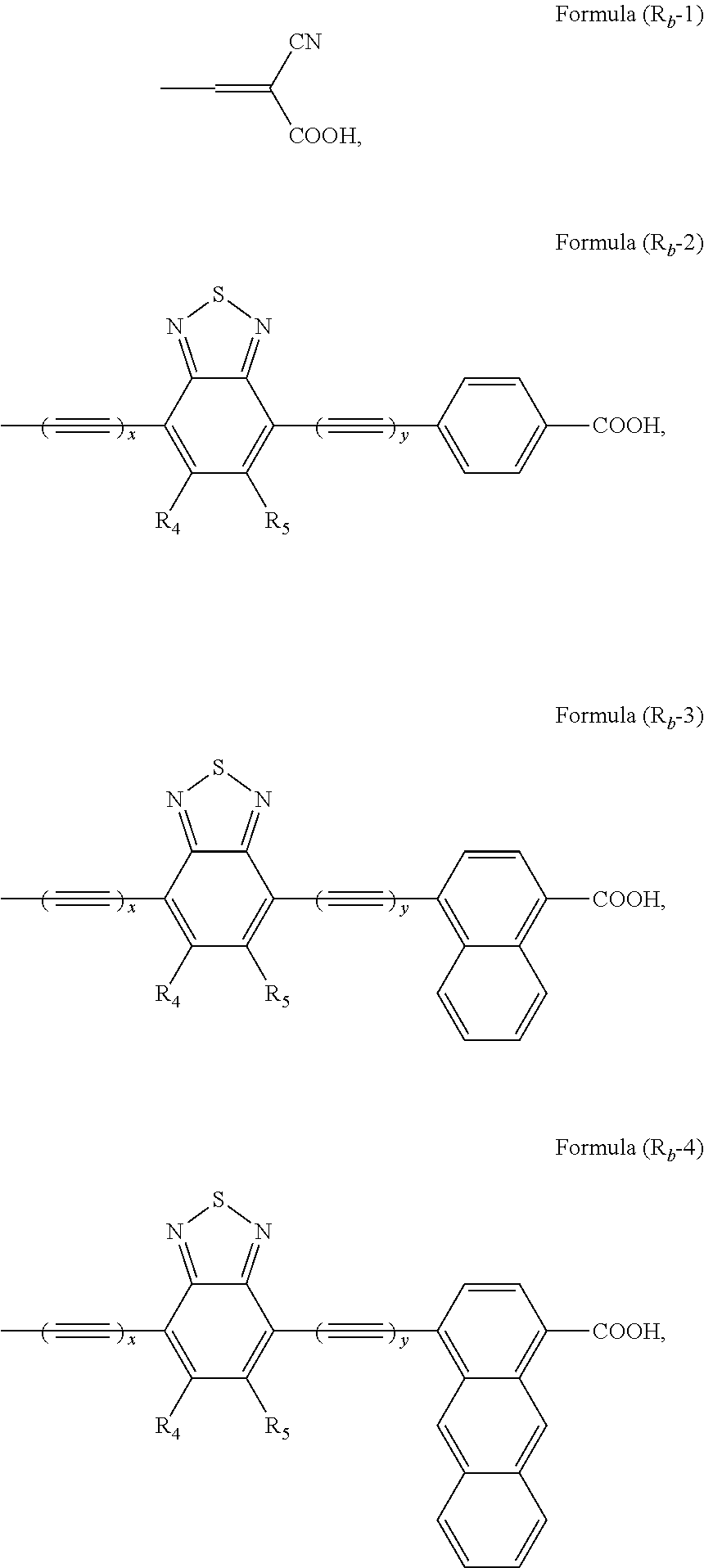
- R b is formula (R b -1), formula (R b -2), formula (R b -3), or formula (R b -4):
- x and y are independently selected from 0 or 1, and both R 4 and R 5 are H;
- A is a C 6 -C 30 aryl group, a C 4 -C 30 oxygen-containing heteroaryl group, a C 4 -C 30 sulfur-containing heteroaryl group, a C 4 -C 30 selenium-containing heteroaryl group, or a C 4 -C 30 tellurium-containing heteroaryl group;
- R 2-1 , R 2-2 , R 2-3 , and R 24 are independently selected from H, a C 1 -C 36 alkyl group, a phenyl group substituted with a C 1 -C 36 alkyl group, or a phenyl group substituted with a C 1 -C 36 alkoxy group.
- R a is formula (R a -1), formula (R a -2), formula (R a -3), formula (R a -4), formula (R a -5), formula (R a -6), or formula (R a -7):
- R a-3-3 , R a-3-4 , R a-6-3 , and R a-6-4 are independently selected from H or a C 1 -C 36 alkyl group;
- R a-1-1 , R a-1-2 , R a-2-1 , R a-2-2 , R a-3-1 , R a-3-2 , R a-4-1 , R a-4-2 , R a-5-1 , R a-5-2 , R a-6-1 , and R a-6-2 are independently selected from H, a C 1 -C 36 alkyl group, or a C 1 -C 36 alkoxy group;
- R a-2-3 , R a-2-4 , R a-2-5 , R a-2-6 , R a-5-3 , R a-5-4 , R a-5-5 , and R a-5-6 are independently selected from H, a C 1 -C 36 alkyl group, a phenyl group substituted with a C 1 -C 36 alkoxy group, or a phenyl group substituted with a C 1 -C 36 alkyl group;
- R a-7-1 is selected from H, a C 1 -C 36 alkyl group, or a C 1 -C 36 alkoxy group;
- z is 0 or 1.
- R a-3-3 , R a-3-4 , R a-6-3 , and R a-6-4 are independently selected from a C 6 -C 30 alkyl group;
- R a-1-1 , R a-1-2 , R a-2-1 , R a-2-2 , R a-3-1 , R a-3-2 , R a-4-1 , R a-4-2 , R a-5-1 , R a-5-2 , R a-6-1 , and R a-6-2 are independently selected from a C 6 -C 30 alkyl group or a C 6 -C 30 alkoxy group;
- R a-2-3 , R a-2-4 , R a-2-5 , R a-2-6 , R a-5-3 , R a-5-4 , R a-5-5 , and R a-5-6 are independently selected from a C 6 -C 30 alkyl group, a phenyl group substituted with a C 6 -C 30 alkoxy group, or a phenyl group substituted with a C 6 -C 30 alkyl group;
- R a-7-1 is selected from a C 6 -C 30 alkyl group or a C 6 -C 30 alkoxy group.
- A is formula (A-1), formula (A-2), formula (A-3), formula (A-4), or formula (A-5):
- R 2-1 , R 2-2 , R 2-3 , and R 2-4 are independently selected from a C 6 -C 30 alkyl group, a phenyl group substituted with a C 6 -C 30 alkyl group, or a phenyl group substituted with a C 6 -C 30 alkoxy group.
- the organic dye has the structure of formula (I-1), formula (II-1), or formula (II-2):
- the invention also provides a method for producing the organic dye comprising:
- R a is H, an amino group substituted with a C 6 -C 50 aryl group, an amino group substituted with a C 6 -C 50 heteroaryl group, an unsaturated hydrocarbyl group substituted with a C 6 -C 50 aryl group, an unsaturated hydrocarbyl group substituted with a C 6 -C 50 heteroaryl group, a phenyl group substituted with a C 1 -C 36 alkyl group, or a phenyl group substituted with a C 1 -C 36 alkoxy group;
- A is a C 6 -C 30 aryl group, a C 4 -C 30 oxygen-containing heteroaryl group, a C 4 -C 30 sulfur-containing heteroaryl group, a C 4 -C 30 selenium-containing heteroaryl group, or a C 4 -C 30 tellurium-containing heteroaryl group;
- R 2-1 , R 2-2 , R 2-3 , and R 2-4 are independently selected from H, a C 1 -C 36 alkyl group, a phenyl group substituted with a C 1 -C 36 alkyl group, or a phenyl group substituted with a C 1 -C 36 alkoxy group;
- R b is formula (R b -1), formula (R b -2), formula (R b -3), or formula (R b -4),
- x and y are independently selected from 0 or 1, and both R 4 and R 5 are H;
- X 1 is H, Br, or I.
- the compound having the structure of formula (IV) is prepared according to a following method:
- R 6-1 and R 7-1 are independently selected from Sn(CH 3 ) 3 —, Sn(n-Bu) 3 —, or a borate ester group,
- R 8-1 and R 8-2 are independently selected from a C 1 -C 8 alkyl group
- X 2 and X 3 are independently selected from Cl, Br, or I;
- the step 2) specifically comprises:
- the catalyst used in the step 2-2) is a polymer resin with macroporous and strongly acidic properties.
- the invention provides an organic dye having the structure of formula (I) or formula (II).
- the organic dye provided by the invention is obtained by modifying an anthracene with R a and R b or modifying anthracene-based groups decorated with an aryl group or a heteroaryl group with R a and R b , thereby the power conversion efficiency of a dye sensitized solar cell is significantly improved when the organic dye prepared according to the present invention is applied in a dye-sensitized solar cell.
- the experimental results reveal that the power conversion efficiency of the solar cell fabricated with the organic dye produced by the present invention can be up to 12.0%.
- the preparation method of the organic dye according to the present invention is quite simple together with abundant raw materials and low cost, making it possible to be commercialized.
- FIG. 1 is a schematic illustration of the device of the dye-sensitized solar cell provided by the invention
- FIG. 2 is a schematic illustration of a light absorbing layer in the dye-sensitized solar cell provided by the invention
- FIG. 3 is a process flow chart of the manufacture of the dye-sensitized solar cell provided by the invention.
- the invention provides an organic dye having the structure of formula (I) or formula (II):
- R a is H, an amino group substituted with a C 6 -C 50 aryl group, an amino group substituted with a C 6 -C 50 heteroaryl group, an unsaturated hydrocarbyl group substituted with a C 6 -C 50 aryl group, an unsaturated hydrocarbyl group substituted with a C 6 -C 50 heteroaryl group, a phenyl group substituted with a C 1 -C 36 alkyl group, or a phenyl group substituted with a C 1 -C 36 alkoxy group;
- R b is formula (R b -1), formula (R b -2), formula (R b -3), or formula (R b -4):
- x and y are independently selected from 0 or 1, and both R 4 and R 5 are H;
- A is a C 6 -C 30 aryl group, a C 4 -C 30 oxygen-containing heteroaryl group, a C 4 -C 30 sulfur-containing heteroaryl group, a C 4 -C 30 selenium-containing heteroaryl group, or a C 4 -C 30 tellurium-containing heteroaryl group;
- R 2-1 , R 2-2 , R 2-3 , and R 2-4 are independently selected from H, a C 1 -C 36 alkyl group, a phenyl group substituted with a C 1 -C 36 alkyl group, or a phenyl group substituted with a C 1 -C 36 alkoxy group.
- alkyl group alkoxy group
- aryl group heteroaryl group
- hydrocarbyl group hydrocarbyl group
- R a is preferably an amino group substituted with a C 12 -C 35 aryl group, an amino group substituted with a C 12 -C 35 heteroaryl group, an unsaturated hydrocarbyl group substituted with a C 12 -C 35 aryl group, an unsaturated hydrocarbyl group substituted with a C 12 -C 35 heteroaryl group, a phenyl group substituted with a C 5 -C 30 alkyl group, or a phenyl group substituted with a C 5 -C 30 alkoxy group.
- R a is an amino group substituted with a C 18 -C 30 aryl group, an amino group substituted with a C 18 -C 30 heteroaryl group, an unsaturated hydrocarbyl group substituted with a C 18 -C 30 aryl group, an unsaturated hydrocarbyl group substituted with a C 18 -C 30 heteroaryl group, a phenyl group substituted with a C 10 -C 20 alkyl group, or a phenyl group substituted with a C 10 -C 20 alkoxy group.
- R a is formula (R a -1), formula (R a -2), formula (R a -3), formula (R a -4), formula (R a -5), formula (R a -6), or formula (R a -7):
- R a-3-3 , R a-3-4 , R a-6-3 , and R a-6-4 are independently selected from H or a C 1 -C 36 alkyl group;
- R a-1-1 , R a-1-2 , R a-2-1 , R a-2-2 , R a-3-1 , R a-3-2 , R a-4-1 , R a-4-2 , R a-5-1 , R a-5-2 , R a-6-1 , and R a-6-2 are independently selected from H, a C 1 -C 36 alkyl group, or a C 1 -C 36 alkoxy group;
- R a-2-3 , R a-2 R a-2-5 , R a-2-6 , R a-5-3 , R a-5-4 , R a-5-5 , and R a-5-6 are independently selected from H, a C 1 -C 36 alkyl group, a phenyl group substituted with a C 1 -C 36 alkoxy group, or a phenyl group substituted with a C 1 -C 36 alkyl group;
- R a-7-1 is selected from H, a C 1 -C 36 alkyl group, or a C 1 -C 36 alkoxy group;
- z is 0 or 1.
- R a-3-3 is preferably a C 5 -C 30 alkyl group, more preferably a C 7 -C 20 alkyl group, and most preferably a C 10 -C 15 alkyl group
- R a-3-4 is preferably a C 5 -C 30 alkyl group, more preferably a C 7 -C 20 alkyl group, and most preferably a C 10 -C 15 alkyl group
- R a-6-3 is preferably a C 5 -C 30 alkyl group, more preferably a C 7 -C 20 alkyl group, and most preferably a C 10 -C 15 alkyl group
- R a-6-4 is preferably a C 5 -C 30 alkyl group, more preferably a C 7 -C 20 alkyl group, and most preferably a C 10 -C 15 alkyl group.
- R a-1-1 is preferably a C 5 -C 30 alkyl group or a C 5 -C 30 alkoxy group, more preferably a C 7 -C 20 alkyl group or a C 7 -C 20 alkoxy group, and most preferably a C 10 -C 15 alkyl group or a C 10 -C 15 alkoxy group;
- R a-2-1 is preferably a C 5 -C 30 alkyl group or a C 5 -C 30 alkoxy group, more preferably a C 7 -C 20 alkyl group or a C 7 -C 20 alkoxy group, and most preferably a C 10 -C 15 alkyl group or a C 10 -C 15 alkoxy group;
- R a-3-1 is preferably a C 5 -C 30 alkyl group or a C 5 -C 30 alkoxy group, more preferably a C 7 -C 20 alkyl group or a C 7 -C 20 alkoxy group, and
- R a-2-3 is preferably a C 5 -C 30 alkyl group, a phenyl group substituted with a C 5 -C 30 alkoxy group, or a phenyl group substituted with a C 5 -C 30 alkyl group, more preferably a C 7 -C 20 alkyl group, a phenyl group substituted with a C 7 -C 20 alkoxy group, or a phenyl group substituted with a C 7 -C 20 alkyl group, and most preferably a C 10 -C 15 alkyl group, a phenyl group substituted with a C 10 -C 15 alkoxy group, or a phenyl group substituted with a C 10 -C 15 alkyl group;
- R a-2-4 is preferably a C 5 -C 30 alkyl group, a phenyl group substituted with a C 5 -C 30 alkoxy group, or a phenyl group substituted with a
- R a-7-1 is preferably a C 5 -C 30 alkyl group, a phenyl group substituted with a C 5 -C 30 alkoxy group, or a phenyl group substituted with a C 5 -C 30 alkyl group, more preferably a C 7 -C 20 alkyl group, a phenyl group substituted with a C 7 -C 20 alkoxy group, or a phenyl group substituted with a C 7 -C 20 alkyl group, and most preferably a C 10 -C 15 alkyl group, a phenyl group substituted with a C 10 -C 15 alkoxy group, or a phenyl group substituted with a C 10 -C 15 alkyl group.
- A is preferably a C 10 -C 20 aryl group, a C 6 -C 20 oxygen-containing heteroaryl group, a C 6 -C 20 sulfur-containing heteroaryl group, a C 6 -C 20 selenium-containing heteroaryl group, or a C 6 -C 20 tellurium-containing heteroaryl group, more preferably a C 14 -C 18 aryl group, a C 12 -C 18 oxygen-containing heteroaryl group, a C 12 -C 18 sulfur-containing heteroaryl group, a C 12 -C 18 selenium-containing heteroaryl group, or a C 12 -C 18 tellurium-containing heteroaryl group, and most preferably formula (A-1), formula (A-2), formula (A-3), formula (A-4), or formula (A-5),
- R 2-1 is preferably a C 6 -C 30 alkyl group, a phenyl group substituted with a C 6 -C 30 alkyl group, or a phenyl group substituted with a C 6 -C 30 alkoxy group, more preferably a C 8 -C 20 alkyl group, a phenyl group substituted with a C 8 -C 20 alkyl group, or a phenyl group substituted with a C 8 -C 20 alkoxy group, and most preferably a C 10 -C 15 alkyl group, a phenyl group substituted with a C 10 -C 15 alkyl group, or a phenyl group substituted with a C 10 -C 15 alkoxy group;
- R 2-2 is preferably a C 6 -C 30 alkyl group, a phenyl group substituted with a C 6 -C 30 alkyl group, or a phenyl group substituted with a C 6 -
- the organic dye has the structure of formula (I-1), formula (II-1), or formula (II-2):
- the invention also provides a preparation method for the organic dye of the invention, comprising: reacting a compound having the structure of formula (III) or formula (IV) with a compound having the structure of formula (V) to obtain a compound having the structure of formula (I) or formula (II);
- R a is H, an amino group substituted with a C 6 -C 50 aryl group, an amino group substituted with a C 6 -C 50 heteroaryl group, an unsaturated hydrocarbyl group substituted with a C 6 -C 50 aryl group, an unsaturated hydrocarbyl group substituted with a C 6 -C 50 heteroaryl group, a phenyl group substituted with a C 1 -C 36 alkyl group, or a phenyl group substituted with a C 1 -C 36 alkoxy group;
- R b is formula (R b -1), formula (R b -2), formula (R b -3), or formula (R b -4),
- x and y are independently selected from 0 or 1, and both R 4 and R 5 are H;
- A is a C 6 -C 30 aryl group, a C 4 -C 30 oxygen-containing heteroaryl group, a C 4 -C 30 sulfur-containing heteroaryl group, a C 4 -C 30 selenium-containing heteroaryl group, or a C 4 -C 30 tellurium-containing heteroaryl group;
- R 2-1 , R 2-2 , R 2-3 , and R 24 are independently selected from H, a C 1 -C 36 alkyl group, a phenyl group substituted with a C 1 -C 36 alkyl group, or a phenyl group substituted with a C 1 -C 36 alkoxy group;
- X 1 is H, Br, or I.
- a compound having the structure of formula (III) or formula (IV) is reacted with a compound having the structure of formula (V) to obtain a compound having the structure of formula (I) or formula (II).
- the reaction condition is not particularly limited in the present invention.
- N-bromosuccinimide (NBS) is preferably used to activate a compound having the structure of formula (III) or formula (IV), and the activated compound then is reacted with a compound having the structure of formula (V) to obtain a compound having the structure of formula (I) or formula (II).
- the catalyst used is preferably cesium carbonate, and a toluene mixed solution of Pd 2 (dba) 3 and an organic phosphine ligand P(t-Bu) 3 .
- the source of the raw material is not particularly limited, as long as it can be prepared or obtained by a method generally known in the art, wherein the compound having the structure of formula (IV) is preferably prepared according to the following method:
- R 6-1 and R 7-1 are independently selected from Sn(CH 3 ) 3 —, Sn(n-Bu) 3 —, or a borate ester group,
- R 8-1 and R 8-2 are independently selected from a C 1 -C 8 alkyl group
- X 2 and X 3 are independently selected from Cl, Br, or I;
- a compound having the structure of formula (VI), a compound having the structure of formula (VII), and a compound having the structure of formula (VIII) are mixed and reacted to obtain a compound having the structure of formula (IX); wherein the amount of each raw material used in the reaction is not particularly limited in the method of the invention, and a suitable amount may be selected by those skilled in the art according to the practical requirement;
- the catalyst used in the reaction is preferably tris(dibenzylideneacetone) dipalladium and P(t-Bu) 3 , or tris(dibenzylideneacetone) dipalladium, P(t-Bu) 3 , and CsCO 3 , or Pd(OAc) 2 and an organic phosphine ligand 2-bicyclohexylphosphine-2′,6′-dimethoxybiphenyl (Sphos).
- the solvent used in the reaction is preferably toluene, 1,4-dioxane or
- the compound having the structure of formula (IX) is converted to a compound having the structure of formula (IV), which is preferably prepared according to the following method:
- the reaction procedure of the step 2-1) of the invention is not particularly limited, and it can be carried out by a reaction procedure generally known in the art.
- the catalyst used in the step 2-2) is preferably a polymer resin with macroporous and strongly acidic sulfonic acid type, and more preferably a solid acid catalyst Amberlyst 15.
- the invention provides an organic dye having the structure of formula (I) or formula (II).
- the organic dye produced by the invention is obtained by modifying anthracene with R a and R b or modifying anthracene-based groups decorated with an aryl group or a heteroaryl group with R a and R b , thereby the power conversion efficiency of a dye sensitized solar cell is significantly improved when the organic dye prepared according to the present invention is applied in a dye-sensitized solar cell.
- the preparation method of the organic dye according to the present invention is quite simple with abundant raw materials and low cost, making it possible to be commercialized.
- the compound having the structure of formula (XI) was synthesized according to the reference document (Hirano, K.; Urban, S.; Wang, C.; Glorius, Frank. Org. Lett. 2009, 11, 1019).
- the compound having the structure of formula (XII) was synthesized according to the reference document (Hiroko, Y.; Ikuyoshi, T.; Kazuchika, O.; Takeshi, E. Mol. Cryst. Liq. Cryst. A 2001, 369, 47).
- Butyl 4-(7-ethynylbenzo[c][1,2,5]thiadiazol-4-yl)benzoate (namely Triple-bond benzothiadiazole butyl benzoate) was synthesized according to the reference document (L. Yang, Y. Ren, Z. Yao, C. Yan, W. Ma and P. Wang, J. Phys. Chem. C, 2015, 119, 980).
- the sources of other raw material compounds, solvents, and catalysts in the preparation process of dyes are not particularly limited, and they can be commercially available or prepared with the methods well known in the art.
- the intermediate compound of the formula (III) (2 g) was dissolved in tetrahydrofuran (THF) (30 mL). NBS (684 mg) was added to the reaction mixture, which was stirred at room temperature for 10 minutes. 30 mL water was added, and the mixed solution was extracted with chloroform three times (3 ⁇ 15 mL). The organic phases were combined, and dried with anhydrous sodium sulfate. The desiccant was removed by filtration.
- THF tetrahydrofuran
- reaction system was cooled to room-temperature. 20 mL aqueous solution of phosphoric acid (0.1 mol/L) was added, and the mixed solution was extracted with chloroform three times. The organic phases were combined and dried with anhydrous sodium sulfate. The desiccant was removed by filtration. The filtrate was concentrated, and then was purified by column chromatography with trichloromethane/methanol (20/1 in volume ratio) as an eluent to obtain 354 mg of the compound of formula (I-1) with a yield of 81%.
- the compound of formula (VII-1) was synthesized according to the reference document (Kawamorita, S.; Ohmiya, H.; Iwai, T.; Sawamura, M. Angew. Chem. Int. Ed. 2011, 50, 8363).
- the sources of other raw material compounds, solvents, and catalysts in the preparation process of dyes are not particularly limited, and can be commercially available or prepared by a method well known in the art.
- reaction system was cooled to room-temperature. 20 mL aqueous solution of phosphoric acid (0.1 M) was added, and the mixed solution was extracted with chloroform three times. The organic phases were combined and dried with anhydrous sodium sulfate. The desiccant was removed by filtration. The filtrate was concentrated, and then was purified by column chromatography with trichloromethane/methanol (20/1 in volume ratio) as an eluent to obtain 767 mg of the compound having the structure of formula (II-1) with a yield of 81%.
- the compound of formula (VIII-2) was synthesized according to the reference document (Kunz, T.; Knochel, P. Chem. Eur. J. 2011, 17, 866).
- the sources of other raw material compounds, solvents, and catalysts in the preparation process of dyes are not particularly limited, and can be commercially available or prepared by a method well known in the art.
- reaction system was cooled to room-temperature. 20 mL aqueous solution of phosphoric acid (0.1 M) was added, and the mixed solution was extracted with chloroform three times. The organic phases were combined and dried with anhydrous sodium sulfate. The desiccant was removed by filtration. The filtrate was concentrated, and then was purified by column chromatography with trichloromethane/methanol (20/1 in volume ratio) as an eluent to obtain 850 mg of the compound having the structure of formula (II-2) with a yield of 81%.
- the organic dyes obtained in Examples 1-3 i.e., the compound having the structure of formula (I-1), the compound having the structure of formula (II-1), and the compound having the structure of formula (II-2) were prepared into a 150 ⁇ mol/L ethanol/toluene (7/3 in volume ratio) solution, respectively.
- a bilayer membrane electrode with TiO 2 -structure was immerged in the solution described above for 12 hours to adsorb the organic dye molecule as a photo-sensitizer onto the TiO 2 membrane.
- the electrode was taken out, and then a glass electrode coated with nanoplatinum was sealed annularly by a hot melt method. At last, an electrolyte was filled into the gap between the two electrodes to construct a dye-sensitized solar cell.
- FIG. 1 is a schematic illustration of the device of the dye-sensitized solar cell provided by the invention
- FIG. 2 is a schematic illustration of a light absorbing layer in the dye-sensitized solar cell provided by the invention
- FIG. 3 is a process flow chart of the manufacture of the dye-sensitized solar cell provided by the invention. As shown in FIG.
- the dye sensitized solar cell according to the present invention having a conventional construction, is consisted of two transparent substrate layers 1 , a conductive layer 2 , a light absorption layer 3 , a hole transport layer 6 and the counter electrode 7 .
- the conductive layer 2 Inside the two transparent substrate layers 1 , the conductive layer 2 , the light absorption layer 3 , the hole transport layer 6 and the counter electrode 7 are attached successively.
- the light absorption layer 3 is consisted of a semitransparent micro/nanoparticle layer 4 and an organic dye layer 5 , wherein the semitransparent micro/nanoparticle layer 4 is attached to the conductive layer 2 , while the organic dye layer 5 is attached to the hole transport layer 6 .
- Table 1 was the results of performance tests of the dye-sensitized solar cells fabricated with the organic dyes provided in Examples of the invention.
Landscapes
- Chemical & Material Sciences (AREA)
- Organic Chemistry (AREA)
- Engineering & Computer Science (AREA)
- Power Engineering (AREA)
- Materials Engineering (AREA)
- Physics & Mathematics (AREA)
- Spectroscopy & Molecular Physics (AREA)
- Microelectronics & Electronic Packaging (AREA)
- Plural Heterocyclic Compounds (AREA)
- Heterocyclic Carbon Compounds Containing A Hetero Ring Having Oxygen Or Sulfur (AREA)
- Hybrid Cells (AREA)
- Low-Molecular Organic Synthesis Reactions Using Catalysts (AREA)
Abstract
Description


| TABLE 1 | ||||
| Short-circuit | Open-circuit | |||
| Organic | current density | voltage | Fill | Cell efficiency |
| dye | [mA cm−2] | [mV] | Factor | [%] |
| Example 1 | 13.40 | 793 | 0.727 | 7.7 |
| Example 2 | 15.64 | 840 | 0.723 | 9.5 |
| Example 3 | 20.09 | 814 | 0.734 | 12.0 |
Claims (12)



Applications Claiming Priority (3)
| Application Number | Priority Date | Filing Date | Title |
|---|---|---|---|
| CN201610191810.9 | 2016-03-30 | ||
| CN201610191810.9A CN105802272B (en) | 2016-03-30 | 2016-03-30 | A kind of anthryl organic dyestuff and preparation method thereof |
| PCT/CN2017/083435 WO2017167315A1 (en) | 2016-03-30 | 2017-05-08 | Anthracenyl organic dye and preparation method therefor |
Publications (2)
| Publication Number | Publication Date |
|---|---|
| US20190112480A1 US20190112480A1 (en) | 2019-04-18 |
| US10563064B2 true US10563064B2 (en) | 2020-02-18 |
Family
ID=56459178
Family Applications (1)
| Application Number | Title | Priority Date | Filing Date |
|---|---|---|---|
| US16/088,710 Active US10563064B2 (en) | 2016-03-30 | 2017-05-08 | Anthracene-based organic dyes and preparation methods thereof |
Country Status (7)
| Country | Link |
|---|---|
| US (1) | US10563064B2 (en) |
| EP (1) | EP3438098A4 (en) |
| JP (1) | JP2019524901A (en) |
| KR (1) | KR20190004705A (en) |
| CN (1) | CN105802272B (en) |
| AU (1) | AU2017243134A1 (en) |
| WO (1) | WO2017167315A1 (en) |
Families Citing this family (3)
| Publication number | Priority date | Publication date | Assignee | Title |
|---|---|---|---|---|
| CN105802272B (en) * | 2016-03-30 | 2017-09-29 | 中国科学院长春应用化学研究所 | A kind of anthryl organic dyestuff and preparation method thereof |
| CN107541093B (en) * | 2017-08-30 | 2019-06-21 | 浙江大学 | A kind of anthracene-based fused-ring aromatic hydrocarbon organic dye and preparation method thereof |
| TWI691581B (en) * | 2019-01-11 | 2020-04-21 | 元智大學 | Anthracene-containing material, organic light-emitting diode element and method for manufacturing anthracene-containing material |
Family Cites Families (11)
| Publication number | Priority date | Publication date | Assignee | Title |
|---|---|---|---|---|
| JP5755459B2 (en) * | 2010-02-15 | 2015-07-29 | 株式会社Adeka | Fused polycyclic aromatic hydrocarbon compound and photoelectric conversion device using the compound |
| CN103819929B (en) * | 2013-12-09 | 2015-07-22 | 中国科学院长春应用化学研究所 | Phenanthro-carbazole donor-acceptor organic dye and application thereof in dye-sensitized solar cell |
| TWI473780B (en) * | 2014-04-09 | 2015-02-21 | Nat Univ Chung Hsing | Photosensitive dye compound and dye-sensitized solar cell |
| KR101758614B1 (en) * | 2014-05-27 | 2017-07-17 | 고려대학교 산학협력단 | Novel Polycyclic Fused Ring Derivatives, Organic Dye Sensitizers Containing The Same for Highly Efficient Dye-sensitized Solar Cells And Dye-sensitized Solar Cells Containing The Same |
| CN104497620B (en) * | 2014-12-25 | 2017-02-22 | 中国科学院长春应用化学研究所 | Organic dye with rigid donors, preparation method of organic dye and dye-sensitized solar cell |
| CN104610775B (en) * | 2015-01-14 | 2017-11-28 | 中国科学院长春应用化学研究所 | A kind of phenanthro- carbazoles dyestuff and preparation method thereof and dye-sensitized solar cells |
| CN104962102B (en) * | 2015-06-17 | 2018-07-27 | 中国科学院长春应用化学研究所 | A kind of dye-sensitized solar cells, the organic dyestuff and preparation method thereof containing dihydro-thiophene and * and carbazole and diazosulfide structure |
| CN104987748B (en) * | 2015-07-29 | 2017-04-19 | 中国科学院长春应用化学研究所 | Organic dye, preparation method thereof and application thereof |
| CN105086499B (en) * | 2015-08-20 | 2017-04-19 | 中国科学院长春应用化学研究所 | Photosensitive dye, and preparation method and solar cell thereof |
| CN105153735B (en) * | 2015-08-20 | 2017-08-25 | 中国科学院长春应用化学研究所 | A kind of dye photoactivation agent and its preparation method and application |
| CN105802272B (en) * | 2016-03-30 | 2017-09-29 | 中国科学院长春应用化学研究所 | A kind of anthryl organic dyestuff and preparation method thereof |
-
2016
- 2016-03-30 CN CN201610191810.9A patent/CN105802272B/en not_active Expired - Fee Related
-
2017
- 2017-05-08 WO PCT/CN2017/083435 patent/WO2017167315A1/en not_active Ceased
- 2017-05-08 AU AU2017243134A patent/AU2017243134A1/en not_active Abandoned
- 2017-05-08 KR KR1020187031385A patent/KR20190004705A/en not_active Ceased
- 2017-05-08 EP EP17773344.1A patent/EP3438098A4/en not_active Withdrawn
- 2017-05-08 US US16/088,710 patent/US10563064B2/en active Active
- 2017-05-08 JP JP2018551119A patent/JP2019524901A/en active Pending
Non-Patent Citations (1)
| Title |
|---|
| Yang et al. Macromolecules 2006, 39, 5696-5704 (Year: 2006). * |
Also Published As
| Publication number | Publication date |
|---|---|
| EP3438098A4 (en) | 2019-11-13 |
| EP3438098A1 (en) | 2019-02-06 |
| US20190112480A1 (en) | 2019-04-18 |
| KR20190004705A (en) | 2019-01-14 |
| JP2019524901A (en) | 2019-09-05 |
| CN105802272A (en) | 2016-07-27 |
| AU2017243134A1 (en) | 2018-11-01 |
| CN105802272B (en) | 2017-09-29 |
| WO2017167315A1 (en) | 2017-10-05 |
Similar Documents
| Publication | Publication Date | Title |
|---|---|---|
| JP4576494B2 (en) | Photosensitizing dye | |
| JP2001525108A (en) | Photocell | |
| US11177403B2 (en) | Perovskite solar cell | |
| CN106433187B (en) | A kind of organic dye based on tetrathienopyrrole and its preparation method and application | |
| KR102335394B1 (en) | Organic Blue Dyes featuring a Diketopyrrolopyrrole, Preparation Method Thereof, and Dye-sensitized Solar Cells Comprising the Same | |
| US10563064B2 (en) | Anthracene-based organic dyes and preparation methods thereof | |
| US9447115B2 (en) | Organic dyes, process for producing the same and use thereof | |
| JP6281975B2 (en) | Asymmetric squarylium derivative, donor material comprising the same, and organic thin film solar cell using the same | |
| CN107541093B (en) | A kind of anthracene-based fused-ring aromatic hydrocarbon organic dye and preparation method thereof | |
| KR101598426B1 (en) | Novel Hole Transporting Materials for Solid State Dye-sensitized and Organic/Inorganic Hybrid Solar Cells | |
| KR101657455B1 (en) | Novel Hole Transporting Materials for Solid State Dye-sensitized and Organic/Inorganic Hybrid Solar Cells | |
| US9627633B2 (en) | Perylene functionalized porphyrin dyes for dye-sensitized solar cells | |
| KR101499476B1 (en) | Porphyrin Derivatives, Organic Dye Sensitizers Containing The Same for Highly Efficient Dye-sensitized Solar Cells And Dye-sensitized Solar Cells Containing The Same | |
| CN105086499B (en) | Photosensitive dye, and preparation method and solar cell thereof | |
| JP6591691B2 (en) | Photoelectric conversion element, dye-sensitized solar cell, and dipyrromethene complex compound | |
| CN104987748B (en) | Organic dye, preparation method thereof and application thereof | |
| KR101453553B1 (en) | Dual-Channel Anchorable Amine Derivatives, Organic Dye Sensitizers Containing The Same for Highly Efficient Dye-sensitized Solar Cells And Dye-sensitized Solar Cells Containing The Same | |
| KR101722003B1 (en) | Novel Porphyrin Derivatives, Organic Dye Sensitizers Containing The Same for Highly Efficient Dye-sensitized Solar Cells And Dye-sensitized Solar Cells Containing The Same | |
| KR20130066446A (en) | Dual-channel anchorable heterocyclic derivatives, organic dye sensitizers containing the same for highly efficient dye-sensitized solar cells and dye-sensitized solar cells containing the same | |
| KR101205922B1 (en) | Ruthenium Complex Compound And Dye-sensitized Solar Cells Comprising The Same | |
| KR101778292B1 (en) | Triphenylene derivatives, method of preparation thereof and organic solar cell comprising the same | |
| CN113321942A (en) | Sensitizing dye, sensitizing dye composition for photoelectric conversion, photoelectric conversion element, and dye-sensitized solar cell | |
| JP2017011240A (en) | Photoelectric conversion element, dye-sensitized solar cell, metal complex dye and dye solution |
Legal Events
| Date | Code | Title | Description |
|---|---|---|---|
| FEPP | Fee payment procedure |
Free format text: ENTITY STATUS SET TO UNDISCOUNTED (ORIGINAL EVENT CODE: BIG.); ENTITY STATUS OF PATENT OWNER: SMALL ENTITY |
|
| FEPP | Fee payment procedure |
Free format text: ENTITY STATUS SET TO SMALL (ORIGINAL EVENT CODE: SMAL); ENTITY STATUS OF PATENT OWNER: SMALL ENTITY |
|
| AS | Assignment |
Owner name: CHANGCHUN INSTITUTE OF APPLIED CHEMISTRY CHINESE A Free format text: ASSIGNMENT OF ASSIGNORS INTEREST;ASSIGNORS:WANG, PENG;REN, YAMENG;ZHANG, MIN;AND OTHERS;REEL/FRAME:048861/0243 Effective date: 20181008 Owner name: CHANGCHUN INSTITUTE OF APPLIED CHEMISTRY CHINESE ACADEMY OF SCIENCES, CHINA Free format text: ASSIGNMENT OF ASSIGNORS INTEREST;ASSIGNORS:WANG, PENG;REN, YAMENG;ZHANG, MIN;AND OTHERS;REEL/FRAME:048861/0243 Effective date: 20181008 |
|
| STPP | Information on status: patent application and granting procedure in general |
Free format text: DOCKETED NEW CASE - READY FOR EXAMINATION |
|
| STPP | Information on status: patent application and granting procedure in general |
Free format text: NON FINAL ACTION MAILED |
|
| STPP | Information on status: patent application and granting procedure in general |
Free format text: RESPONSE TO NON-FINAL OFFICE ACTION ENTERED AND FORWARDED TO EXAMINER |
|
| STPP | Information on status: patent application and granting procedure in general |
Free format text: NOTICE OF ALLOWANCE MAILED -- APPLICATION RECEIVED IN OFFICE OF PUBLICATIONS |
|
| STPP | Information on status: patent application and granting procedure in general |
Free format text: PUBLICATIONS -- ISSUE FEE PAYMENT RECEIVED |
|
| STCF | Information on status: patent grant |
Free format text: PATENTED CASE |
|
| CC | Certificate of correction | ||
| MAFP | Maintenance fee payment |
Free format text: PAYMENT OF MAINTENANCE FEE, 4TH YR, SMALL ENTITY (ORIGINAL EVENT CODE: M2551); ENTITY STATUS OF PATENT OWNER: SMALL ENTITY Year of fee payment: 4 |