US10532986B2 - Cyclic compound acting as PDE4 inhibitor - Google Patents
Cyclic compound acting as PDE4 inhibitor Download PDFInfo
- Publication number
- US10532986B2 US10532986B2 US16/325,626 US201716325626A US10532986B2 US 10532986 B2 US10532986 B2 US 10532986B2 US 201716325626 A US201716325626 A US 201716325626A US 10532986 B2 US10532986 B2 US 10532986B2
- Authority
- US
- United States
- Prior art keywords
- compound
- group
- pharmaceutically acceptable
- acceptable salt
- mmol
- Prior art date
- Legal status (The legal status is an assumption and is not a legal conclusion. Google has not performed a legal analysis and makes no representation as to the accuracy of the status listed.)
- Active
Links
- WHLJYQOKHQCYCP-MRXNPFEDSA-N CCOC1=CC([C@@H](CS(C)(=O)=O)N2C(=O)NC3=CC(Br)=CC=C32)=CC=C1OC Chemical compound CCOC1=CC([C@@H](CS(C)(=O)=O)N2C(=O)NC3=CC(Br)=CC=C32)=CC=C1OC WHLJYQOKHQCYCP-MRXNPFEDSA-N 0.000 description 15
- 0 CCOC1=CC(C(CS(C)(=O)=O)N2C(=O)CC3=CC=CC=C32)=CC=C1OC.[1*]C Chemical compound CCOC1=CC(C(CS(C)(=O)=O)N2C(=O)CC3=CC=CC=C32)=CC=C1OC.[1*]C 0.000 description 11
- PMZDDYGZGWORPV-MRXNPFEDSA-N CCOC1=CC([C@@H](CS(C)(=O)=O)N2C(=O)NC3=CC(Cl)=CC=C32)=CC=C1OC Chemical compound CCOC1=CC([C@@H](CS(C)(=O)=O)N2C(=O)NC3=CC(Cl)=CC=C32)=CC=C1OC PMZDDYGZGWORPV-MRXNPFEDSA-N 0.000 description 10
- XBBVHBGCHQOPBL-HXUWFJFHSA-N CCOC1=CC([C@@H](CS(C)(=O)=O)N2C(=O)NC3=C/C(B4OC(C)(C)C(C)(C)O4)=C\C=C\32)=CC=C1OC Chemical compound CCOC1=CC([C@@H](CS(C)(=O)=O)N2C(=O)NC3=C/C(B4OC(C)(C)C(C)(C)O4)=C\C=C\32)=CC=C1OC XBBVHBGCHQOPBL-HXUWFJFHSA-N 0.000 description 9
- BISJIXWGQSBNOI-QGZVFWFLSA-N CCOC1=CC([C@@H](CS(C)(=O)=O)N2C(=O)NC3=CC(C)=CC=C32)=CC=C1OC Chemical compound CCOC1=CC([C@@H](CS(C)(=O)=O)N2C(=O)NC3=CC(C)=CC=C32)=CC=C1OC BISJIXWGQSBNOI-QGZVFWFLSA-N 0.000 description 8
- YNHOPYLPLWXXJP-MRXNPFEDSA-N CCOC1=CC([C@@H](CS(C)(=O)=O)N2C(=O)NC3=CC(F)=CC=C32)=CC=C1OC Chemical compound CCOC1=CC([C@@H](CS(C)(=O)=O)N2C(=O)NC3=CC(F)=CC=C32)=CC=C1OC YNHOPYLPLWXXJP-MRXNPFEDSA-N 0.000 description 8
- XVOSTNTZHQFTFN-OAHLLOKOSA-N CCOC1=CC([C@@H](CS(C)(=O)=O)N2C(=O)NC3=C(Br)C=CC=C32)=CC=C1OC Chemical compound CCOC1=CC([C@@H](CS(C)(=O)=O)N2C(=O)NC3=C(Br)C=CC=C32)=CC=C1OC XVOSTNTZHQFTFN-OAHLLOKOSA-N 0.000 description 7
- YXHQYOHNDBLSSJ-JOCHJYFZSA-N CCOC1=CC([C@@H](CS(C)(=O)=O)N2C(=O)NC3=CC(C4=CC=CC=C4F)=CC=C32)=CC=C1OC Chemical compound CCOC1=CC([C@@H](CS(C)(=O)=O)N2C(=O)NC3=CC(C4=CC=CC=C4F)=CC=C32)=CC=C1OC YXHQYOHNDBLSSJ-JOCHJYFZSA-N 0.000 description 6
- INQOMBQAUSQDDS-UHFFFAOYSA-N CI Chemical compound CI INQOMBQAUSQDDS-UHFFFAOYSA-N 0.000 description 6
- RTMMSCJWQYWMNK-UHFFFAOYSA-N O=S(=O)(OCC(F)(F)F)C(F)(F)F Chemical compound O=S(=O)(OCC(F)(F)F)C(F)(F)F RTMMSCJWQYWMNK-UHFFFAOYSA-N 0.000 description 5
- RQGBMLVYTFGMEA-UHFFFAOYSA-N [C-]#[N+]CBr Chemical compound [C-]#[N+]CBr RQGBMLVYTFGMEA-UHFFFAOYSA-N 0.000 description 5
- ZUBSOOAAXYCXMN-UHFFFAOYSA-N CC1=CC=C(S(=O)(=O)OCC(F)F)C=C1 Chemical compound CC1=CC=C(S(=O)(=O)OCC(F)F)C=C1 ZUBSOOAAXYCXMN-UHFFFAOYSA-N 0.000 description 4
- GCRKTXGJWQKPAC-GOSISDBHSA-N CCOC1=CC([C@@H](CS(C)(=O)=O)N2C(=O)NC3=C2C=CC(C(C)=O)=C3)=CC=C1OC Chemical compound CCOC1=CC([C@@H](CS(C)(=O)=O)N2C(=O)NC3=C2C=CC(C(C)=O)=C3)=CC=C1OC GCRKTXGJWQKPAC-GOSISDBHSA-N 0.000 description 4
- QLOKOSIEOAPGEL-OAHLLOKOSA-N CCOC1=CC([C@@H](CS(C)(=O)=O)N2C(=O)NC3=CC(F)=CC(F)=C32)=CC=C1OC Chemical compound CCOC1=CC([C@@H](CS(C)(=O)=O)N2C(=O)NC3=CC(F)=CC(F)=C32)=CC=C1OC QLOKOSIEOAPGEL-OAHLLOKOSA-N 0.000 description 4
- FFWQLZFIMNTUCZ-UHFFFAOYSA-N FC1=C(CBr)C=CC=C1 Chemical compound FC1=C(CBr)C=CC=C1 FFWQLZFIMNTUCZ-UHFFFAOYSA-N 0.000 description 4
- WLVKDFJTYKELLQ-UHFFFAOYSA-N OB(O)C1CC1 Chemical compound OB(O)C1CC1 WLVKDFJTYKELLQ-UHFFFAOYSA-N 0.000 description 4
- LDLCZOVUSADOIV-UHFFFAOYSA-N OCCBr Chemical compound OCCBr LDLCZOVUSADOIV-UHFFFAOYSA-N 0.000 description 4
- FWIQSLMYJZEDKG-UHFFFAOYSA-N C=C(C)C.CC(=O)OC(C)C.CC(C)=O.CC(C)C.CC1=CC=CC=C1.CC1=CC=CC=N1.CC1=CC=CS1.CC1=CCOCC1.CC1=CN=CC=N1.CC1=CNN=C1.CC1=NC=CC=N1.CC1=NC=CS1.CC1=NN=CC=C1.CC1CC1.CC1CCOCC1.CCC(C)=O.CCOC(C)=O.CN1C=CC=N1 Chemical compound C=C(C)C.CC(=O)OC(C)C.CC(C)=O.CC(C)C.CC1=CC=CC=C1.CC1=CC=CC=N1.CC1=CC=CS1.CC1=CCOCC1.CC1=CN=CC=N1.CC1=CNN=C1.CC1=NC=CC=N1.CC1=NC=CS1.CC1=NN=CC=C1.CC1CC1.CC1CCOCC1.CCC(C)=O.CCOC(C)=O.CN1C=CC=N1 FWIQSLMYJZEDKG-UHFFFAOYSA-N 0.000 description 3
- AEUAQSZUECZZTQ-UHFFFAOYSA-N CC(=O)N1CCCC1.CCC1=C(F)C=CC=C1 Chemical compound CC(=O)N1CCCC1.CCC1=C(F)C=CC=C1 AEUAQSZUECZZTQ-UHFFFAOYSA-N 0.000 description 3
- XFFWZJBVLYAPFW-UHFFFAOYSA-N CC(=O)OC(C)(C)C.CC(C)C.CC1CC1.CCC.CCC.CCOC.CN(C)C.COC Chemical compound CC(=O)OC(C)(C)C.CC(C)C.CC1CC1.CCC.CCC.CCOC.CN(C)C.COC XFFWZJBVLYAPFW-UHFFFAOYSA-N 0.000 description 3
- HOZPQJOVUSYHSK-UHFFFAOYSA-N CC(C)C.CC1CC1.CCC#N.CCC(F)(F)F.CCC(F)F.CCC1=C(F)C=CC=C1.CCC1=CC(F)=CC=C1.CCC1=CC=C(F)C=C1.CCC1CCC1.CCCO.CCCOC.CCCS(C)(=O)=O Chemical compound CC(C)C.CC1CC1.CCC#N.CCC(F)(F)F.CCC(F)F.CCC1=C(F)C=CC=C1.CCC1=CC(F)=CC=C1.CCC1=CC=C(F)C=C1.CCC1CCC1.CCCO.CCCOC.CCCS(C)(=O)=O HOZPQJOVUSYHSK-UHFFFAOYSA-N 0.000 description 3
- SVNVBSQGYHSNDU-UHFFFAOYSA-N CC(C)C.CC1CC1.CCCS(C)(=O)=O Chemical compound CC(C)C.CC1CC1.CCCS(C)(=O)=O SVNVBSQGYHSNDU-UHFFFAOYSA-N 0.000 description 3
- OSBZXWFDRDWJTG-UHFFFAOYSA-N CC(C)N(C)C.CCN(C)C.CN(C)C.CN(C)C1CC1.CN(C)CC#N.CN(C)CC(F)(F)F.CN(C)CC(F)F.CN(C)CC1=C(F)C=CC=C1.CN(C)CC1=CC(F)=CC=C1.CN(C)CC1=CC=C(F)C=C1.CN(C)CC1CCC1.CN(C)CCO.CN(C)CCS(C)(=O)=O.CNC.COC.COCCN(C)C Chemical compound CC(C)N(C)C.CCN(C)C.CN(C)C.CN(C)C1CC1.CN(C)CC#N.CN(C)CC(F)(F)F.CN(C)CC(F)F.CN(C)CC1=C(F)C=CC=C1.CN(C)CC1=CC(F)=CC=C1.CN(C)CC1=CC=C(F)C=C1.CN(C)CC1CCC1.CN(C)CCO.CN(C)CCS(C)(=O)=O.CNC.COC.COCCN(C)C OSBZXWFDRDWJTG-UHFFFAOYSA-N 0.000 description 3
- JQGYBNARNZWLOX-UHFFFAOYSA-N CC1=C(F)C=CC=C1.CC1=CC(F)=CC=C1.CC1=CC=C(F)C=C1.CC1CC1.CC1CCC1 Chemical compound CC1=C(F)C=CC=C1.CC1=CC(F)=CC=C1.CC1=CC=C(F)C=C1.CC1CC1.CC1CCC1 JQGYBNARNZWLOX-UHFFFAOYSA-N 0.000 description 3
- GJAVKIZNSBHQJH-UHFFFAOYSA-N CC1=C(F)C=CC=C1.CN1CCCC1 Chemical compound CC1=C(F)C=CC=C1.CN1CCCC1 GJAVKIZNSBHQJH-UHFFFAOYSA-N 0.000 description 3
- YLCVTQXZUGFMFS-UHFFFAOYSA-N CC1=CC=CC=C1.CN1CCCC1 Chemical compound CC1=CC=CC=C1.CN1CCCC1 YLCVTQXZUGFMFS-UHFFFAOYSA-N 0.000 description 3
- RDHPKYGYEGBMSE-UHFFFAOYSA-N CCBr Chemical compound CCBr RDHPKYGYEGBMSE-UHFFFAOYSA-N 0.000 description 3
- FHVHCUWAUYILAZ-UHFFFAOYSA-N CCC1=C(F)C=CC=C1.CCC1=CC(F)=CC=C1.CCC1=CC=C(F)C=C1.CCC1CCC1 Chemical compound CCC1=C(F)C=CC=C1.CCC1=CC(F)=CC=C1.CCC1=CC=C(F)C=C1.CCC1CCC1 FHVHCUWAUYILAZ-UHFFFAOYSA-N 0.000 description 3
- BTSGEFJTOQUPLR-OAHLLOKOSA-N CCOC1=CC([C@@H](CS(C)(=O)=O)N2C(=O)NC3=C(Cl)C=CC=C32)=CC=C1OC Chemical compound CCOC1=CC([C@@H](CS(C)(=O)=O)N2C(=O)NC3=C(Cl)C=CC=C32)=CC=C1OC BTSGEFJTOQUPLR-OAHLLOKOSA-N 0.000 description 3
- LBUNNMJLXWQQBY-UHFFFAOYSA-N OB(O)C1=CC=C(F)C=C1 Chemical compound OB(O)C1=CC=C(F)C=C1 LBUNNMJLXWQQBY-UHFFFAOYSA-N 0.000 description 3
- INHPUMHBQGDMMS-UHFFFAOYSA-N C=C(C)C.CC(=O)N1CCCC1.CC(=O)OC(C)C.CC(=O)OCC(F)(F)F.CC(C)=O.CC(C)C.CC(F)(F)F.CC1=C(C#N)C=CC=C1.CC1=C(C(C)C)C=CC=C1.CC1=C(C(F)(F)F)C=CC=C1.CC1=C(C)C=CC=C1.CC1=C(C)N=CC=N1.CC1=C(Cl)C=CC=C1.CC1=C(F)C=CC=N1.CC1=CC(F)=CC=C1.CC1=CC=C(F)C=C1.CC1=CC=CC=C1.CC1=CC=CC=C1F.CC1=CC=CS1.CC1=CC=NN=C1C.CC1=CCOCC1.CC1=CN(C)N=C1.CC1=NC=C(F)C=N1.CC1=NC=CN=C1C1CC1.CC1=NC=CN=C1N(C)C.CC1=NC=CS1.CC1CC1.CC1CCOCC1.CCC(C)=O.CCC1=C(C)C=CC=C1.CCC1=C(F)C=CC=C1.CCOC(C)=O.CCOC1=C(C)C=CC=C1.CN1C=CC=N1.COC1=C(C)C=CC=C1 Chemical compound C=C(C)C.CC(=O)N1CCCC1.CC(=O)OC(C)C.CC(=O)OCC(F)(F)F.CC(C)=O.CC(C)C.CC(F)(F)F.CC1=C(C#N)C=CC=C1.CC1=C(C(C)C)C=CC=C1.CC1=C(C(F)(F)F)C=CC=C1.CC1=C(C)C=CC=C1.CC1=C(C)N=CC=N1.CC1=C(Cl)C=CC=C1.CC1=C(F)C=CC=N1.CC1=CC(F)=CC=C1.CC1=CC=C(F)C=C1.CC1=CC=CC=C1.CC1=CC=CC=C1F.CC1=CC=CS1.CC1=CC=NN=C1C.CC1=CCOCC1.CC1=CN(C)N=C1.CC1=NC=C(F)C=N1.CC1=NC=CN=C1C1CC1.CC1=NC=CN=C1N(C)C.CC1=NC=CS1.CC1CC1.CC1CCOCC1.CCC(C)=O.CCC1=C(C)C=CC=C1.CCC1=C(F)C=CC=C1.CCOC(C)=O.CCOC1=C(C)C=CC=C1.CN1C=CC=N1.COC1=C(C)C=CC=C1 INHPUMHBQGDMMS-UHFFFAOYSA-N 0.000 description 2
- FMKOJHQHASLBPH-UHFFFAOYSA-N CC(C)I Chemical compound CC(C)I FMKOJHQHASLBPH-UHFFFAOYSA-N 0.000 description 2
- NSJVYHOPHZMZPN-UHFFFAOYSA-N CC1=C(B(O)O)C=CC=C1 Chemical compound CC1=C(B(O)O)C=CC=C1 NSJVYHOPHZMZPN-UHFFFAOYSA-N 0.000 description 2
- AWQUFMVPXZDXCI-UHFFFAOYSA-N CCOC(=O)C1=CC2=C(C=C1)N(C(CS(C)(=O)=O)C1=CC=C(OC)C(OCC)=C1)C(=O)N2CC(F)F.CCOC1=C(OC)C=CC(C(CS(C)(=O)=O)N2C(=O)NC3=C2C=CC=C3C2=CC=C(F)C=C2)=C1.CCOC1=C(OC)C=CC(C(CS(C)(=O)=O)N2C(=O)NC3=C2C=CC=C3C2=CC=CC(F)=C2)=C1.CCOC1=C(OC)C=CC(C(CS(C)(=O)=O)N2C(=O)NC3=C2C=CC=C3C2=CC=CC=C2F)=C1.CCOC1=C(OC)C=CC(C(CS(C)(=O)=O)N2C(=O)NC3=C2C=CC=C3C2CC2)=C1.CCOC1=CC(C(CS(C)(=O)=O)N2C(=O)N(CCS(C)(=O)=O)C3=CC(Br)=CC=C32)=CC=C1OC Chemical compound CCOC(=O)C1=CC2=C(C=C1)N(C(CS(C)(=O)=O)C1=CC=C(OC)C(OCC)=C1)C(=O)N2CC(F)F.CCOC1=C(OC)C=CC(C(CS(C)(=O)=O)N2C(=O)NC3=C2C=CC=C3C2=CC=C(F)C=C2)=C1.CCOC1=C(OC)C=CC(C(CS(C)(=O)=O)N2C(=O)NC3=C2C=CC=C3C2=CC=CC(F)=C2)=C1.CCOC1=C(OC)C=CC(C(CS(C)(=O)=O)N2C(=O)NC3=C2C=CC=C3C2=CC=CC=C2F)=C1.CCOC1=C(OC)C=CC(C(CS(C)(=O)=O)N2C(=O)NC3=C2C=CC=C3C2CC2)=C1.CCOC1=CC(C(CS(C)(=O)=O)N2C(=O)N(CCS(C)(=O)=O)C3=CC(Br)=CC=C32)=CC=C1OC AWQUFMVPXZDXCI-UHFFFAOYSA-N 0.000 description 2
- SWBHFZOJCQHIPU-UHFFFAOYSA-N CCOC(=O)C1=CC=C2C(=C1)N(CC(F)(F)F)C(=O)N2C(CS(C)(=O)=O)C1=CC=C(OC)C(OCC)=C1.CCOC1=CC(C(CS(C)(=O)=O)N2C(=O)N(CC(F)(F)F)C3=C2C=CC(Cl)=C3)=CC=C1OC.CCOC1=CC(C(CS(C)(=O)=O)N2C(=O)N(CC(F)F)C3=C2C=CC(Cl)=C3)=CC=C1OC Chemical compound CCOC(=O)C1=CC=C2C(=C1)N(CC(F)(F)F)C(=O)N2C(CS(C)(=O)=O)C1=CC=C(OC)C(OCC)=C1.CCOC1=CC(C(CS(C)(=O)=O)N2C(=O)N(CC(F)(F)F)C3=C2C=CC(Cl)=C3)=CC=C1OC.CCOC1=CC(C(CS(C)(=O)=O)N2C(=O)N(CC(F)F)C3=C2C=CC(Cl)=C3)=CC=C1OC SWBHFZOJCQHIPU-UHFFFAOYSA-N 0.000 description 2
- ZDAXBRWNHNWKBO-HSZRJFAPSA-N CCOC1=C(OC)C=CC([C@@H](CS(C)(=O)=O)N2C(=O)NC3=C2C=CC(C2=C(C)C=CC=C2)=C3)=C1 Chemical compound CCOC1=C(OC)C=CC([C@@H](CS(C)(=O)=O)N2C(=O)NC3=C2C=CC(C2=C(C)C=CC=C2)=C3)=C1 ZDAXBRWNHNWKBO-HSZRJFAPSA-N 0.000 description 2
- JBTWRVOJCUMARK-JOCHJYFZSA-N CCOC1=C(OC)C=CC([C@@H](CS(C)(=O)=O)N2C(=O)NC3=C2C=CC(C2=CC=C(F)C=C2)=C3)=C1 Chemical compound CCOC1=C(OC)C=CC([C@@H](CS(C)(=O)=O)N2C(=O)NC3=C2C=CC(C2=CC=C(F)C=C2)=C3)=C1 JBTWRVOJCUMARK-JOCHJYFZSA-N 0.000 description 2
- RZUDNIRRRJHBHZ-MRXNPFEDSA-N CCOC1=C(OC)C=CC([C@@H](CS(C)(=O)=O)N2C(=O)NC3=C2C=CC=C3)=C1 Chemical compound CCOC1=C(OC)C=CC([C@@H](CS(C)(=O)=O)N2C(=O)NC3=C2C=CC=C3)=C1 RZUDNIRRRJHBHZ-MRXNPFEDSA-N 0.000 description 2
- BKSOCEFOPXILRV-UHFFFAOYSA-N CCOC1=CC(C(CS(C)(=O)=O)N2C(=O)N(CC(F)F)C3=C(Cl)C=CC=C32)=CC=C1OC.CCOC1=CC(C(CS(C)(=O)=O)N2C(=O)NC3=C(C(C)=O)C=CC=C32)=CC=C1OC Chemical compound CCOC1=CC(C(CS(C)(=O)=O)N2C(=O)N(CC(F)F)C3=C(Cl)C=CC=C32)=CC=C1OC.CCOC1=CC(C(CS(C)(=O)=O)N2C(=O)NC3=C(C(C)=O)C=CC=C32)=CC=C1OC BKSOCEFOPXILRV-UHFFFAOYSA-N 0.000 description 2
- VAQCOFPLEKAWBS-UHFFFAOYSA-N CCOC1=CC(C(CS(C)(=O)=O)N2C(=O)NC3=C(C(C)C)C=CC=C32)=CC=C1OC.CCOC1=CC(C(CS(C)(=O)=O)N2C(=O)NC3=C(C4=C(F)C=CC=N4)C=CC=C32)=CC=C1OC.CCOC1=CC(C(CS(C)(=O)=O)N2C(=O)NC3=C(C4=CN(C)N=C4)C=CC=C32)=CC=C1OC.CCOC1=CC(C(CS(C)(=O)=O)N2C(=O)NC3=C(C4=NC=C(F)C=N4)C=CC=C32)=CC=C1OC.CCOC1=CC(C(CS(C)(=O)=O)N2C(=O)NC3=C2C=CC=C3C2=CC=CC=C2)=CC=C1OC.CCOC1=CC(C(CS(C)(=O)=O)N2C(=O)NC3=CC(C(=O)CC)=CC=C32)=CC=C1OC Chemical compound CCOC1=CC(C(CS(C)(=O)=O)N2C(=O)NC3=C(C(C)C)C=CC=C32)=CC=C1OC.CCOC1=CC(C(CS(C)(=O)=O)N2C(=O)NC3=C(C4=C(F)C=CC=N4)C=CC=C32)=CC=C1OC.CCOC1=CC(C(CS(C)(=O)=O)N2C(=O)NC3=C(C4=CN(C)N=C4)C=CC=C32)=CC=C1OC.CCOC1=CC(C(CS(C)(=O)=O)N2C(=O)NC3=C(C4=NC=C(F)C=N4)C=CC=C32)=CC=C1OC.CCOC1=CC(C(CS(C)(=O)=O)N2C(=O)NC3=C2C=CC=C3C2=CC=CC=C2)=CC=C1OC.CCOC1=CC(C(CS(C)(=O)=O)N2C(=O)NC3=CC(C(=O)CC)=CC=C32)=CC=C1OC VAQCOFPLEKAWBS-UHFFFAOYSA-N 0.000 description 2
- IUMGXRHGULHFNA-QGZVFWFLSA-N CCOC1=CC([C@@H](CS(C)(=O)=O)N2C(=O)N(C)C3=C/C(Cl)=C\C=C\32)=CC=C1OC Chemical compound CCOC1=CC([C@@H](CS(C)(=O)=O)N2C(=O)N(C)C3=C/C(Cl)=C\C=C\32)=CC=C1OC IUMGXRHGULHFNA-QGZVFWFLSA-N 0.000 description 2
- XAXUKPQXKPVGED-HSZRJFAPSA-N CCOC1=CC([C@@H](CS(C)(=O)=O)N2C(=O)N(CC3=C(F)C=CC=C3)C3=C/C=C\C=C\32)=CC=C1OC Chemical compound CCOC1=CC([C@@H](CS(C)(=O)=O)N2C(=O)N(CC3=C(F)C=CC=C3)C3=C/C=C\C=C\32)=CC=C1OC XAXUKPQXKPVGED-HSZRJFAPSA-N 0.000 description 2
- LKMLWUGTQMRRSM-JOCHJYFZSA-N CCOC1=CC([C@@H](CS(C)(=O)=O)N2C(=O)NC3=C(C4=C(C)C=CC=C4)C=CC=C32)=CC=C1OC Chemical compound CCOC1=CC([C@@H](CS(C)(=O)=O)N2C(=O)NC3=C(C4=C(C)C=CC=C4)C=CC=C32)=CC=C1OC LKMLWUGTQMRRSM-JOCHJYFZSA-N 0.000 description 2
- YGKWUPQENLSYSQ-HXUWFJFHSA-N CCOC1=CC([C@@H](CS(C)(=O)=O)N2C(=O)NC3=C(C4=CCOCC4)C=CC=C32)=CC=C1OC Chemical compound CCOC1=CC([C@@H](CS(C)(=O)=O)N2C(=O)NC3=C(C4=CCOCC4)C=CC=C32)=CC=C1OC YGKWUPQENLSYSQ-HXUWFJFHSA-N 0.000 description 2
- OOFHEXZJUUUYCV-MRXNPFEDSA-N CCOC1=CC([C@@H](CS(C)(=O)=O)N2C(=O)NC3=C2C=CC(C(=O)O)=C3)=CC=C1OC Chemical compound CCOC1=CC([C@@H](CS(C)(=O)=O)N2C(=O)NC3=C2C=CC(C(=O)O)=C3)=CC=C1OC OOFHEXZJUUUYCV-MRXNPFEDSA-N 0.000 description 2
- PFMMDOBWERLRHR-MRXNPFEDSA-N CCOC1=CC([C@@H](CS(C)(=O)=O)N2C(=O)NC3=CC(C)=CC(F)=C32)=CC=C1OC Chemical compound CCOC1=CC([C@@H](CS(C)(=O)=O)N2C(=O)NC3=CC(C)=CC(F)=C32)=CC=C1OC PFMMDOBWERLRHR-MRXNPFEDSA-N 0.000 description 2
- SCBZBMXPJYMXRC-UHFFFAOYSA-N FC1=CC=CC(CBr)=C1 Chemical compound FC1=CC=CC(CBr)=C1 SCBZBMXPJYMXRC-UHFFFAOYSA-N 0.000 description 2
- KNXQDJCZSVHEIW-UHFFFAOYSA-N OB(O)C1=CC(F)=CC=C1 Chemical compound OB(O)C1=CC(F)=CC=C1 KNXQDJCZSVHEIW-UHFFFAOYSA-N 0.000 description 2
- AEILLAXRDHDKDY-UHFFFAOYSA-N BrCC1CC1 Chemical compound BrCC1CC1 AEILLAXRDHDKDY-UHFFFAOYSA-N 0.000 description 1
- FLHFTXCMKFVKRP-UHFFFAOYSA-N BrCC1CCC1 Chemical compound BrCC1CCC1 FLHFTXCMKFVKRP-UHFFFAOYSA-N 0.000 description 1
- JABNRNOVIVZYFO-UHFFFAOYSA-N C.COC1=CC=C(C(CS(C)(=O)=O)N2C(=O)NC3=C2C=CC(Br)=C3)C=C1.COC1=CC=C(C(CS(C)(=O)=O)N2C(=O)NC3=C2C=CC(C2=C(F)C=CC=C2)=C3)C=C1.C[W].OB(O)C1=CC=CC=C1F Chemical compound C.COC1=CC=C(C(CS(C)(=O)=O)N2C(=O)NC3=C2C=CC(Br)=C3)C=C1.COC1=CC=C(C(CS(C)(=O)=O)N2C(=O)NC3=C2C=CC(C2=C(F)C=CC=C2)=C3)C=C1.C[W].OB(O)C1=CC=CC=C1F JABNRNOVIVZYFO-UHFFFAOYSA-N 0.000 description 1
- MEAGJWWKLKZZCM-DXHAJAKUSA-N C/N=C(/CS(C)(=O)=O)C1=CC=C(OC)C=C1.COC1=CC=C(C#N)C=C1.COC1=CC=C(C(=O)CS(C)(=O)=O)C=C1.COC1=CC=C(C(CC2=C(N)C=C(Br)C=C2)CS(C)(=O)=O)C=C1.COC1=CC=C(C(CC2=C([N+](=O)[O-])C=C(Br)C=C2)CS(C)(=O)=O)C=C1.COC1=CC=C(C(N)CS(C)(=O)=O)C=C1.CON.CS(C)(=O)=O.Cl.O=[N+]([O-])C1=CC(Br)=CC=C1F Chemical compound C/N=C(/CS(C)(=O)=O)C1=CC=C(OC)C=C1.COC1=CC=C(C#N)C=C1.COC1=CC=C(C(=O)CS(C)(=O)=O)C=C1.COC1=CC=C(C(CC2=C(N)C=C(Br)C=C2)CS(C)(=O)=O)C=C1.COC1=CC=C(C(CC2=C([N+](=O)[O-])C=C(Br)C=C2)CS(C)(=O)=O)C=C1.COC1=CC=C(C(N)CS(C)(=O)=O)C=C1.CON.CS(C)(=O)=O.Cl.O=[N+]([O-])C1=CC(Br)=CC=C1F MEAGJWWKLKZZCM-DXHAJAKUSA-N 0.000 description 1
- MXTJNRHMQBCETP-FIHJFZSDSA-N C1=CNN=C1.CCOC1=C(OC)C=CC([C@@H](CS(C)(=O)=O)N2C(=O)NC3=C2C=CC=C3N2C=CC=N2)=C1.CCOC1=C(OC)C=CC([C@H](CC2=C(N)C(N3C=CC=N3)=CC=C2)CS(C)(=O)=O)=C1.CCOC1=C(OC)C=CC([C@H](CC2=C([N+](=O)[O-])C(Br)=CC=C2)CS(C)(=O)=O)=C1.CCOC1=C(OC)C=CC([C@H](CC2=C([N+](=O)[O-])C(N3C=CC=N3)=CC=C2)CS(C)(=O)=O)=C1.C[W] Chemical compound C1=CNN=C1.CCOC1=C(OC)C=CC([C@@H](CS(C)(=O)=O)N2C(=O)NC3=C2C=CC=C3N2C=CC=N2)=C1.CCOC1=C(OC)C=CC([C@H](CC2=C(N)C(N3C=CC=N3)=CC=C2)CS(C)(=O)=O)=C1.CCOC1=C(OC)C=CC([C@H](CC2=C([N+](=O)[O-])C(Br)=CC=C2)CS(C)(=O)=O)=C1.CCOC1=C(OC)C=CC([C@H](CC2=C([N+](=O)[O-])C(N3C=CC=N3)=CC=C2)CS(C)(=O)=O)=C1.C[W] MXTJNRHMQBCETP-FIHJFZSDSA-N 0.000 description 1
- OUNICOVBPWXQQI-RTFBFDJBSA-N C1CCNC1.CCOC1=C(OC)C=CC([C@@H](CS(C)(=O)=O)N2C(=O)NC3=C2C=CC=C3C(=O)N2CCCC2)=C1.CCOC1=C(OC)C=CC([C@H](CC2=C(N)C(C(=O)N3CCCC3)=CC=C2)CS(C)(=O)=O)=C1.CCOC1=C(OC)C=CC([C@H](CC2=C([N+](=O)[O-])C(Br)=CC=C2)CS(C)(=O)=O)=C1.CCOC1=C(OC)C=CC([C@H](CC2=C([N+](=O)[O-])C(C(=O)N3CCCC3)=CC=C2)CS(C)(=O)=O)=C1.C[W] Chemical compound C1CCNC1.CCOC1=C(OC)C=CC([C@@H](CS(C)(=O)=O)N2C(=O)NC3=C2C=CC=C3C(=O)N2CCCC2)=C1.CCOC1=C(OC)C=CC([C@H](CC2=C(N)C(C(=O)N3CCCC3)=CC=C2)CS(C)(=O)=O)=C1.CCOC1=C(OC)C=CC([C@H](CC2=C([N+](=O)[O-])C(Br)=CC=C2)CS(C)(=O)=O)=C1.CCOC1=C(OC)C=CC([C@H](CC2=C([N+](=O)[O-])C(C(=O)N3CCCC3)=CC=C2)CS(C)(=O)=O)=C1.C[W] OUNICOVBPWXQQI-RTFBFDJBSA-N 0.000 description 1
- GYFJBBSRVMRJTO-YVTNURBISA-N C=C(C)B(F)(F)F.C=C(C)C1=C([N+](=O)[O-])C(C[C@H](CS(C)(=O)=O)C2=CC=C(OC)C(OCC)=C2)=CC=C1.CCOC1=C(OC)C=CC([C@H](CC2=C([N+](=O)[O-])C(Br)=CC=C2)CS(C)(=O)=O)=C1.CCOC1=CC([C@@H](CS(C)(=O)=O)N2C(=O)NC3=C(C(C)C)C=CC=C32)=CC=C1OC.CCOC1=CC([C@H](CC2=CC=CC(C(C)C)=C2N)CS(C)(=O)=O)=CC=C1OC.C[W].[KH] Chemical compound C=C(C)B(F)(F)F.C=C(C)C1=C([N+](=O)[O-])C(C[C@H](CS(C)(=O)=O)C2=CC=C(OC)C(OCC)=C2)=CC=C1.CCOC1=C(OC)C=CC([C@H](CC2=C([N+](=O)[O-])C(Br)=CC=C2)CS(C)(=O)=O)=C1.CCOC1=CC([C@@H](CS(C)(=O)=O)N2C(=O)NC3=C(C(C)C)C=CC=C32)=CC=C1OC.CCOC1=CC([C@H](CC2=CC=CC(C(C)C)=C2N)CS(C)(=O)=O)=CC=C1OC.C[W].[KH] GYFJBBSRVMRJTO-YVTNURBISA-N 0.000 description 1
- TXRANNVFOHWIMZ-UHFFFAOYSA-N C=C(C)B(F)(F)F.[KH] Chemical compound C=C(C)B(F)(F)F.[KH] TXRANNVFOHWIMZ-UHFFFAOYSA-N 0.000 description 1
- XSIQHUUVVBMKCU-UHFFFAOYSA-N C=C(C)C.CC(=O)OC(C)C.CC(=O)OCC(F)(F)F.CC(C)=O.CC(C)C.CC(F)(F)F.CC1=C(C(F)(F)F)C=CC=C1.CC1=C(C)C=CC=C1.CC1=C(C)N=CC=N1.CC1=C(F)C=CC=N1.CC1=CC(F)=CC=C1.CC1=CC=C(F)C=C1.CC1=CC=CC=C1.CC1=CC=CC=C1C#N.CC1=CC=CC=C1C(C)C.CC1=CC=CC=C1F.CC1=CC=CS1.CC1=CC=NN=C1C.CC1=CCOCC1.CC1=CN(C)N=C1.CC1=NC=C(F)C=N1.CC1=NC=CN=C1N(C)C.CC1=NC=CS1.CC1CC1.CC1CCOCC1.CCC(C)=O.CCC1=CC=CC=C1C.CCOC(C)=O.CCOC1=C(C)C=CC=C1.CN1C=CC=N1.COC1=C(C)C=CC=C1 Chemical compound C=C(C)C.CC(=O)OC(C)C.CC(=O)OCC(F)(F)F.CC(C)=O.CC(C)C.CC(F)(F)F.CC1=C(C(F)(F)F)C=CC=C1.CC1=C(C)C=CC=C1.CC1=C(C)N=CC=N1.CC1=C(F)C=CC=N1.CC1=CC(F)=CC=C1.CC1=CC=C(F)C=C1.CC1=CC=CC=C1.CC1=CC=CC=C1C#N.CC1=CC=CC=C1C(C)C.CC1=CC=CC=C1F.CC1=CC=CS1.CC1=CC=NN=C1C.CC1=CCOCC1.CC1=CN(C)N=C1.CC1=NC=C(F)C=N1.CC1=NC=CN=C1N(C)C.CC1=NC=CS1.CC1CC1.CC1CCOCC1.CCC(C)=O.CCC1=CC=CC=C1C.CCOC(C)=O.CCOC1=C(C)C=CC=C1.CN1C=CC=N1.COC1=C(C)C=CC=C1 XSIQHUUVVBMKCU-UHFFFAOYSA-N 0.000 description 1
- QIYQOUUMLADPHP-UHFFFAOYSA-N C=C(C)C1=C2NC(=O)N(C(CS(C)(=O)=O)C3=CC=C(OC)C(OCC)=C3)C2=CC=C1.CCOC1=C(OC)C=CC(C(CS(C)(=O)=O)N2C(=O)OC3=C2C=CC(Br)=C3)=C1.CCOC1=CC(C(CS(C)(=O)=O)N2C(=O)NC3=C(C4=CCOCC4)C=CC=C32)=CC=C1OC.CCOC1=CC(C(CS(C)(=O)=O)N2C(=O)NC3=C(CC4=C(F)C=CC=C4)C=CC=C32)=CC=C1OC.CCOC1=CC(C(CS(C)(=O)=O)N2C(=O)NC3=CC(C(=O)O)=CC=C32)=CC=C1OC.CCOC1=CC(C(CS(C)(=O)=O)N2C(=O)NC3=CC=CC=C32)=CC=C1OC Chemical compound C=C(C)C1=C2NC(=O)N(C(CS(C)(=O)=O)C3=CC=C(OC)C(OCC)=C3)C2=CC=C1.CCOC1=C(OC)C=CC(C(CS(C)(=O)=O)N2C(=O)OC3=C2C=CC(Br)=C3)=C1.CCOC1=CC(C(CS(C)(=O)=O)N2C(=O)NC3=C(C4=CCOCC4)C=CC=C32)=CC=C1OC.CCOC1=CC(C(CS(C)(=O)=O)N2C(=O)NC3=C(CC4=C(F)C=CC=C4)C=CC=C32)=CC=C1OC.CCOC1=CC(C(CS(C)(=O)=O)N2C(=O)NC3=CC(C(=O)O)=CC=C32)=CC=C1OC.CCOC1=CC(C(CS(C)(=O)=O)N2C(=O)NC3=CC=CC=C32)=CC=C1OC QIYQOUUMLADPHP-UHFFFAOYSA-N 0.000 description 1
- ZHATUPJIWGBPQL-UHFFFAOYSA-N C=C(C)C1=C2NC(=O)N(C(CS(C)(=O)=O)C3=CC=C(OC)C(OCC)=C3)C2=CC=C1.CCOC1=CC(C(CS(C)(=O)=O)N2C(=O)NC3=C(C4=CCOCC4)C=CC=C32)=CC=C1OC.CCOC1=CC(C(CS(C)(=O)=O)N2C(=O)NC3=C(C4CCOCC4)C=CC=C32)=CC=C1OC Chemical compound C=C(C)C1=C2NC(=O)N(C(CS(C)(=O)=O)C3=CC=C(OC)C(OCC)=C3)C2=CC=C1.CCOC1=CC(C(CS(C)(=O)=O)N2C(=O)NC3=C(C4=CCOCC4)C=CC=C32)=CC=C1OC.CCOC1=CC(C(CS(C)(=O)=O)N2C(=O)NC3=C(C4CCOCC4)C=CC=C32)=CC=C1OC ZHATUPJIWGBPQL-UHFFFAOYSA-N 0.000 description 1
- JWSHUQVGOMBCSG-MCBMZKAASA-N C=C(C)C1=C2NC(=O)N([C@@H](CS(C)(=O)=O)C3=CC=C(OC)C(OCC)=C3)C2=CC=C1.CCOC1=CC([C@H](CS(C)(=O)=O)N2C(=O)NC3=C(C4=C(C)C=CC=C4)C=CC=C32)=CC=C1OC.CCOC1=CC([C@H](CS(C)(=O)=O)N2C(=O)NC3=C(C4=C(OC)C=CC=C4)C=CC=C32)=CC=C1OC.CCOC1=CC([C@H](CS(C)(=O)=O)N2C(=O)NC3=C(C4=CCOCC4)C=CC=C32)=CC=C1OC.CCOC1=CC([C@H](CS(C)(=O)=O)N2C(=O)NC3=C(C4CCOCC4)C=CC=C32)=CC=C1OC Chemical compound C=C(C)C1=C2NC(=O)N([C@@H](CS(C)(=O)=O)C3=CC=C(OC)C(OCC)=C3)C2=CC=C1.CCOC1=CC([C@H](CS(C)(=O)=O)N2C(=O)NC3=C(C4=C(C)C=CC=C4)C=CC=C32)=CC=C1OC.CCOC1=CC([C@H](CS(C)(=O)=O)N2C(=O)NC3=C(C4=C(OC)C=CC=C4)C=CC=C32)=CC=C1OC.CCOC1=CC([C@H](CS(C)(=O)=O)N2C(=O)NC3=C(C4=CCOCC4)C=CC=C32)=CC=C1OC.CCOC1=CC([C@H](CS(C)(=O)=O)N2C(=O)NC3=C(C4CCOCC4)C=CC=C32)=CC=C1OC JWSHUQVGOMBCSG-MCBMZKAASA-N 0.000 description 1
- ZHATUPJIWGBPQL-DBTMDCRKSA-N C=C(C)C1=C2NC(=O)N([C@@H](CS(C)(=O)=O)C3=CC=C(OC)C(OCC)=C3)C2=CC=C1.CCOC1=CC([C@H](CS(C)(=O)=O)N2C(=O)NC3=C(C4=CCOCC4)C=CC=C32)=CC=C1OC.CCOC1=CC([C@H](CS(C)(=O)=O)N2C(=O)NC3=C(C4CCOCC4)C=CC=C32)=CC=C1OC Chemical compound C=C(C)C1=C2NC(=O)N([C@@H](CS(C)(=O)=O)C3=CC=C(OC)C(OCC)=C3)C2=CC=C1.CCOC1=CC([C@H](CS(C)(=O)=O)N2C(=O)NC3=C(C4=CCOCC4)C=CC=C32)=CC=C1OC.CCOC1=CC([C@H](CS(C)(=O)=O)N2C(=O)NC3=C(C4CCOCC4)C=CC=C32)=CC=C1OC ZHATUPJIWGBPQL-DBTMDCRKSA-N 0.000 description 1
- BXDKQFOJDKHVTI-IVQWKCTISA-N C=C(C)C1=C2NC(=O)N([C@H](CS(C)(=O)=O)C3=CC=C(OC)C(OCC)=C3)C2=CC=C1.CCOC1=C(OC)C=CC([C@@H](CS(C)(=O)=O)N2C(=O)NC3=C2C=CC=C3C(=O)N2CCCC2)=C1.CCOC1=CC([C@@H](CS(C)(=O)=O)N2C(=O)NC3=C(C4=C(C)C=CC=C4)C=CC=C32)=CC=C1OC.CCOC1=CC([C@@H](CS(C)(=O)=O)N2C(=O)NC3=C(C4=C(OC)C=CC=C4)C=CC=C32)=CC=C1OC.CCOC1=CC([C@@H](CS(C)(=O)=O)N2C(=O)NC3=C(C4=CCOCC4)C=CC=C32)=CC=C1OC.CCOC1=CC([C@@H](CS(C)(=O)=O)N2C(=O)NC3=C(C4CCOCC4)C=CC=C32)=CC=C1OC Chemical compound C=C(C)C1=C2NC(=O)N([C@H](CS(C)(=O)=O)C3=CC=C(OC)C(OCC)=C3)C2=CC=C1.CCOC1=C(OC)C=CC([C@@H](CS(C)(=O)=O)N2C(=O)NC3=C2C=CC=C3C(=O)N2CCCC2)=C1.CCOC1=CC([C@@H](CS(C)(=O)=O)N2C(=O)NC3=C(C4=C(C)C=CC=C4)C=CC=C32)=CC=C1OC.CCOC1=CC([C@@H](CS(C)(=O)=O)N2C(=O)NC3=C(C4=C(OC)C=CC=C4)C=CC=C32)=CC=C1OC.CCOC1=CC([C@@H](CS(C)(=O)=O)N2C(=O)NC3=C(C4=CCOCC4)C=CC=C32)=CC=C1OC.CCOC1=CC([C@@H](CS(C)(=O)=O)N2C(=O)NC3=C(C4CCOCC4)C=CC=C32)=CC=C1OC BXDKQFOJDKHVTI-IVQWKCTISA-N 0.000 description 1
- ZHATUPJIWGBPQL-QFCDMXHHSA-N C=C(C)C1=C2NC(=O)N([C@H](CS(C)(=O)=O)C3=CC=C(OC)C(OCC)=C3)C2=CC=C1.CCOC1=CC([C@@H](CS(C)(=O)=O)N2C(=O)NC3=C(C4=CCOCC4)C=CC=C32)=CC=C1OC.CCOC1=CC([C@@H](CS(C)(=O)=O)N2C(=O)NC3=C(C4CCOCC4)C=CC=C32)=CC=C1OC Chemical compound C=C(C)C1=C2NC(=O)N([C@H](CS(C)(=O)=O)C3=CC=C(OC)C(OCC)=C3)C2=CC=C1.CCOC1=CC([C@@H](CS(C)(=O)=O)N2C(=O)NC3=C(C4=CCOCC4)C=CC=C32)=CC=C1OC.CCOC1=CC([C@@H](CS(C)(=O)=O)N2C(=O)NC3=C(C4CCOCC4)C=CC=C32)=CC=C1OC ZHATUPJIWGBPQL-QFCDMXHHSA-N 0.000 description 1
- ALIWXWLKCKPMMT-GOSISDBHSA-N C=C(C)C1=C2\NC(=O)N([C@H](CS(C)(=O)=O)C3=CC=C(OC)C(OCC)=C3)\C2=C\C=C\1 Chemical compound C=C(C)C1=C2\NC(=O)N([C@H](CS(C)(=O)=O)C3=CC=C(OC)C(OCC)=C3)\C2=C\C=C\1 ALIWXWLKCKPMMT-GOSISDBHSA-N 0.000 description 1
- GHNYQQONBPYGMH-UHFFFAOYSA-N CC(=O)N1CCCC1.CC1=C(Cl)C=CC=C1.CC1=NC=CN=C1C1CC1.CCC1=C(F)C=CC=C1 Chemical compound CC(=O)N1CCCC1.CC1=C(Cl)C=CC=C1.CC1=NC=CN=C1C1CC1.CCC1=C(F)C=CC=C1 GHNYQQONBPYGMH-UHFFFAOYSA-N 0.000 description 1
- KTZUVUWIBZMHMC-UHFFFAOYSA-N CC(C)C1=C(B(O)O)C=CC=C1 Chemical compound CC(C)C1=C(B(O)O)C=CC=C1 KTZUVUWIBZMHMC-UHFFFAOYSA-N 0.000 description 1
- KFZMGEQAYNKOFK-UHFFFAOYSA-N CC(C)O Chemical compound CC(C)O KFZMGEQAYNKOFK-UHFFFAOYSA-N 0.000 description 1
- HSHVWFFUJIXEHM-UHFFFAOYSA-N CC.CCOC1=CC(C(CS(C)(=O)=O)N2C(=O)CC3=CC=CC=C32)=CC=C1OC Chemical compound CC.CCOC1=CC(C(CS(C)(=O)=O)N2C(=O)CC3=CC=CC=C32)=CC=C1OC HSHVWFFUJIXEHM-UHFFFAOYSA-N 0.000 description 1
- WZHWPZQQPWKEAV-UHFFFAOYSA-N CC1=C(Cl)N=CC=N1 Chemical compound CC1=C(Cl)N=CC=N1 WZHWPZQQPWKEAV-UHFFFAOYSA-N 0.000 description 1
- ILCVXFBYPRWVNP-BGBBXRRNSA-N CC1=CC([N+](=O)[O-])=C(F)C(F)=C1.CCOC1=CC([C@@H](CS(C)(=O)=O)N2C(=O)NC3=CC(C)=CC(F)=C32)=CC=C1OC.CCOC1=CC([C@H](CC2=C(F)C=C(C)C=C2N)CS(C)(=O)=O)=CC=C1OC.CCOC1=CC([C@H](CC2=C(F)C=C(C)C=C2[N+](=O)[O-])CS(C)(=O)=O)=CC=C1OC.CCOC1=CC([C@H](N)CS(C)(=O)=O)=CC=C1OC.C[W] Chemical compound CC1=CC([N+](=O)[O-])=C(F)C(F)=C1.CCOC1=CC([C@@H](CS(C)(=O)=O)N2C(=O)NC3=CC(C)=CC(F)=C32)=CC=C1OC.CCOC1=CC([C@H](CC2=C(F)C=C(C)C=C2N)CS(C)(=O)=O)=CC=C1OC.CCOC1=CC([C@H](CC2=C(F)C=C(C)C=C2[N+](=O)[O-])CS(C)(=O)=O)=CC=C1OC.CCOC1=CC([C@H](N)CS(C)(=O)=O)=CC=C1OC.C[W] ILCVXFBYPRWVNP-BGBBXRRNSA-N 0.000 description 1
- JUCXIWZFENGFJP-UHFFFAOYSA-N CC1=CC=NN=C1Cl Chemical compound CC1=CC=NN=C1Cl JUCXIWZFENGFJP-UHFFFAOYSA-N 0.000 description 1
- DDMIAWAEIMNZME-BLVIQVPLSA-N CCC(=O)C1=CC([N+](=O)[O-])=C(Cl)C=C1.CCC(=O)C1=CC=C(Cl)C=C1.CCC(F)(F)C1=CC([N+](=O)[O-])=C(F)C=C1.CCOC1=CC([C@@H](CS(C)(=O)=O)N2C(=O)NC3=CC(C(=O)CC)=CC=C32)=CC=C1OC.CCOC1=CC([C@H](CC2=CC=C(C(=O)CC)C=C2N)CS(C)(=O)=O)=CC=C1OC.CCOC1=CC([C@H](CC2=CC=C(C(F)(F)CC)C=C2[N+](=O)[O-])CS(C)(=O)=O)=CC=C1OC.CCOC1=CC([C@H](N)CS(C)(=O)=O)=CC=C1OC.C[W] Chemical compound CCC(=O)C1=CC([N+](=O)[O-])=C(Cl)C=C1.CCC(=O)C1=CC=C(Cl)C=C1.CCC(F)(F)C1=CC([N+](=O)[O-])=C(F)C=C1.CCOC1=CC([C@@H](CS(C)(=O)=O)N2C(=O)NC3=CC(C(=O)CC)=CC=C32)=CC=C1OC.CCOC1=CC([C@H](CC2=CC=C(C(=O)CC)C=C2N)CS(C)(=O)=O)=CC=C1OC.CCOC1=CC([C@H](CC2=CC=C(C(F)(F)CC)C=C2[N+](=O)[O-])CS(C)(=O)=O)=CC=C1OC.CCOC1=CC([C@H](N)CS(C)(=O)=O)=CC=C1OC.C[W] DDMIAWAEIMNZME-BLVIQVPLSA-N 0.000 description 1
- QSSPYZOSTJDTTL-UHFFFAOYSA-N CCC1=C(B(O)O)C=CC=C1 Chemical compound CCC1=C(B(O)O)C=CC=C1 QSSPYZOSTJDTTL-UHFFFAOYSA-N 0.000 description 1
- LFQSCWFLJHTTHZ-UHFFFAOYSA-N CCO Chemical compound CCO LFQSCWFLJHTTHZ-UHFFFAOYSA-N 0.000 description 1
- RBRRRALIDXHNKP-GOSISDBHSA-N CCOC(=O)C1=C/C2=C(\C=C/1)N([C@H](CS(C)(=O)=O)C1=CC=C(OC)C(OCC)=C1)C(=O)N2 Chemical compound CCOC(=O)C1=C/C2=C(\C=C/1)N([C@H](CS(C)(=O)=O)C1=CC=C(OC)C(OCC)=C1)C(=O)N2 RBRRRALIDXHNKP-GOSISDBHSA-N 0.000 description 1
- WWZKJCWYCZMKLP-LJQANCHMSA-N CCOC(=O)C1=C/C=C2C(=C/1)/N(C)C(=O)N/2[C@H](CS(C)(=O)=O)C1=CC=C(OC)C(OCC)=C1 Chemical compound CCOC(=O)C1=C/C=C2C(=C/1)/N(C)C(=O)N/2[C@H](CS(C)(=O)=O)C1=CC=C(OC)C(OCC)=C1 WWZKJCWYCZMKLP-LJQANCHMSA-N 0.000 description 1
- JFYJDWARAQNPHA-LJQANCHMSA-N CCOC(=O)C1=C/C=C2C(=C/1)/N(CC(F)(F)F)C(=O)N/2[C@H](CS(C)(=O)=O)C1=CC=C(OC)C(OCC)=C1 Chemical compound CCOC(=O)C1=C/C=C2C(=C/1)/N(CC(F)(F)F)C(=O)N/2[C@H](CS(C)(=O)=O)C1=CC=C(OC)C(OCC)=C1 JFYJDWARAQNPHA-LJQANCHMSA-N 0.000 description 1
- DUHVLXGMYZKYSP-LJQANCHMSA-N CCOC(=O)C1=C/C=C2C(=C/1)/N(CC(F)F)C(=O)N/2[C@H](CS(C)(=O)=O)C1=CC=C(OC)C(OCC)=C1 Chemical compound CCOC(=O)C1=C/C=C2C(=C/1)/N(CC(F)F)C(=O)N/2[C@H](CS(C)(=O)=O)C1=CC=C(OC)C(OCC)=C1 DUHVLXGMYZKYSP-LJQANCHMSA-N 0.000 description 1
- XSIKIUNQWGHJBT-FADHQJSHSA-N CCOC(=O)C1=CC2=C(C=C1)N([C@@H](CS(C)(=O)=O)C1=CC=C(OC)C(OCC)=C1)C(=O)N2CC(F)F.CCOC(=O)C1=CC=C2C(=C1)N(CC(F)(F)F)C(=O)N2[C@@H](CS(C)(=O)=O)C1=CC=C(OC)C(OCC)=C1.CCOC1=CC([C@H](CS(C)(=O)=O)N2C(=O)N(CC(F)(F)F)C3=C2C=CC(Cl)=C3)=CC=C1OC.CCOC1=CC([C@H](CS(C)(=O)=O)N2C(=O)N(CC(F)F)C3=C2C=CC(Cl)=C3)=CC=C1OC Chemical compound CCOC(=O)C1=CC2=C(C=C1)N([C@@H](CS(C)(=O)=O)C1=CC=C(OC)C(OCC)=C1)C(=O)N2CC(F)F.CCOC(=O)C1=CC=C2C(=C1)N(CC(F)(F)F)C(=O)N2[C@@H](CS(C)(=O)=O)C1=CC=C(OC)C(OCC)=C1.CCOC1=CC([C@H](CS(C)(=O)=O)N2C(=O)N(CC(F)(F)F)C3=C2C=CC(Cl)=C3)=CC=C1OC.CCOC1=CC([C@H](CS(C)(=O)=O)N2C(=O)N(CC(F)F)C3=C2C=CC(Cl)=C3)=CC=C1OC XSIKIUNQWGHJBT-FADHQJSHSA-N 0.000 description 1
- DSJMGOAALDBFLR-JNVMLISYSA-N CCOC(=O)C1=CC2=C(C=C1)N([C@@H](CS(C)(=O)=O)C1=CC=C(OC)C(OCC)=C1)C(=O)N2CC(F)F.CCOC1=C(OC)C=CC([C@H](CS(C)(=O)=O)N2C(=O)NC3=C2C=CC=C3C2CC2)=C1.CCOC1=CC([C@H](CS(C)(=O)=O)N2C(=O)N(CCS(C)(=O)=O)C3=CC(Br)=CC=C32)=CC=C1OC Chemical compound CCOC(=O)C1=CC2=C(C=C1)N([C@@H](CS(C)(=O)=O)C1=CC=C(OC)C(OCC)=C1)C(=O)N2CC(F)F.CCOC1=C(OC)C=CC([C@H](CS(C)(=O)=O)N2C(=O)NC3=C2C=CC=C3C2CC2)=C1.CCOC1=CC([C@H](CS(C)(=O)=O)N2C(=O)N(CCS(C)(=O)=O)C3=CC(Br)=CC=C32)=CC=C1OC DSJMGOAALDBFLR-JNVMLISYSA-N 0.000 description 1
- LMXHSAQJZVEBCI-PCUGVQLPSA-N CCOC(=O)C1=CC2=C(C=C1)N([C@H](CS(C)(=O)=O)C1=CC=C(OC)C(OCC)=C1)C(=O)N2CC(F)F.CCOC(=O)C1=CC=C2C(=C1)N(CC(F)(F)F)C(=O)N2[C@H](CS(C)(=O)=O)C1=CC=C(OC)C(OCC)=C1.CCOC1=C(OC)C=CC([C@@H](CS(C)(=O)=O)N2C(=O)NC3=C2C=CC=C3C2=CC=CC=C2F)=C1.CCOC1=C(OC)C=CC([C@@H](CS(C)(=O)=O)N2C(=O)NC3=C2C=CC=C3C2CC2)=C1.CCOC1=CC([C@@H](CS(C)(=O)=O)N2C(=O)N(CCS(C)(=O)=O)C3=CC(Br)=CC=C32)=CC=C1OC Chemical compound CCOC(=O)C1=CC2=C(C=C1)N([C@H](CS(C)(=O)=O)C1=CC=C(OC)C(OCC)=C1)C(=O)N2CC(F)F.CCOC(=O)C1=CC=C2C(=C1)N(CC(F)(F)F)C(=O)N2[C@H](CS(C)(=O)=O)C1=CC=C(OC)C(OCC)=C1.CCOC1=C(OC)C=CC([C@@H](CS(C)(=O)=O)N2C(=O)NC3=C2C=CC=C3C2=CC=CC=C2F)=C1.CCOC1=C(OC)C=CC([C@@H](CS(C)(=O)=O)N2C(=O)NC3=C2C=CC=C3C2CC2)=C1.CCOC1=CC([C@@H](CS(C)(=O)=O)N2C(=O)N(CCS(C)(=O)=O)C3=CC(Br)=CC=C32)=CC=C1OC LMXHSAQJZVEBCI-PCUGVQLPSA-N 0.000 description 1
- AWQUFMVPXZDXCI-CVCQVQNXSA-N CCOC(=O)C1=CC2=C(C=C1)N([C@H](CS(C)(=O)=O)C1=CC=C(OC)C(OCC)=C1)C(=O)N2CC(F)F.CCOC1=C(OC)C=CC([C@@H](CS(C)(=O)=O)N2C(=O)NC3=C2C=CC=C3C2=CC=C(F)C=C2)=C1.CCOC1=C(OC)C=CC([C@@H](CS(C)(=O)=O)N2C(=O)NC3=C2C=CC=C3C2=CC=CC(F)=C2)=C1.CCOC1=C(OC)C=CC([C@@H](CS(C)(=O)=O)N2C(=O)NC3=C2C=CC=C3C2=CC=CC=C2F)=C1.CCOC1=C(OC)C=CC([C@@H](CS(C)(=O)=O)N2C(=O)NC3=C2C=CC=C3C2CC2)=C1.CCOC1=CC([C@@H](CS(C)(=O)=O)N2C(=O)N(CCS(C)(=O)=O)C3=CC(Br)=CC=C32)=CC=C1OC Chemical compound CCOC(=O)C1=CC2=C(C=C1)N([C@H](CS(C)(=O)=O)C1=CC=C(OC)C(OCC)=C1)C(=O)N2CC(F)F.CCOC1=C(OC)C=CC([C@@H](CS(C)(=O)=O)N2C(=O)NC3=C2C=CC=C3C2=CC=C(F)C=C2)=C1.CCOC1=C(OC)C=CC([C@@H](CS(C)(=O)=O)N2C(=O)NC3=C2C=CC=C3C2=CC=CC(F)=C2)=C1.CCOC1=C(OC)C=CC([C@@H](CS(C)(=O)=O)N2C(=O)NC3=C2C=CC=C3C2=CC=CC=C2F)=C1.CCOC1=C(OC)C=CC([C@@H](CS(C)(=O)=O)N2C(=O)NC3=C2C=CC=C3C2CC2)=C1.CCOC1=CC([C@@H](CS(C)(=O)=O)N2C(=O)N(CCS(C)(=O)=O)C3=CC(Br)=CC=C32)=CC=C1OC AWQUFMVPXZDXCI-CVCQVQNXSA-N 0.000 description 1
- SLIHCBOFXHWLSF-UHFFFAOYSA-N CCOC(=O)C1=CC=C2C(=C1)N(C(CS(C)(=O)=O)C1=CC=C(OC)C(OCC)=C1)C(=O)N2C.CCOC(=O)C1=CC=C2CC(=O)N(C(CS(C)(=O)=O)C3=CC=C(OC)C(OCC)=C3)C2=C1.CCOC(=O)C1=CC=CC2=C1NC(=O)N2C(CS(C)(=O)=O)C1=CC(OCC)=C(OC)C=C1.CCOC1=CC(C(CS(C)(=O)=O)N2C(=O)CC3=CC=C(C(=O)OC(C)C)C=C32)=CC=C1OC.CCOC1=CC(C(CS(C)(=O)=O)N2C(=O)CC3=CC=C(C(=O)OCC(F)(F)F)C=C32)=CC=C1OC.COC1=CC=C(C(CS(C)(=O)=O)N2C(=O)NC3=C2C=CC(C2=CC=CC=C2F)=C3)C=C1 Chemical compound CCOC(=O)C1=CC=C2C(=C1)N(C(CS(C)(=O)=O)C1=CC=C(OC)C(OCC)=C1)C(=O)N2C.CCOC(=O)C1=CC=C2CC(=O)N(C(CS(C)(=O)=O)C3=CC=C(OC)C(OCC)=C3)C2=C1.CCOC(=O)C1=CC=CC2=C1NC(=O)N2C(CS(C)(=O)=O)C1=CC(OCC)=C(OC)C=C1.CCOC1=CC(C(CS(C)(=O)=O)N2C(=O)CC3=CC=C(C(=O)OC(C)C)C=C32)=CC=C1OC.CCOC1=CC(C(CS(C)(=O)=O)N2C(=O)CC3=CC=C(C(=O)OCC(F)(F)F)C=C32)=CC=C1OC.COC1=CC=C(C(CS(C)(=O)=O)N2C(=O)NC3=C2C=CC(C2=CC=CC=C2F)=C3)C=C1 SLIHCBOFXHWLSF-UHFFFAOYSA-N 0.000 description 1
- HWOXYCOPLWLDNC-UHFFFAOYSA-N CCOC(=O)C1=CC=C2C(=C1)N(C(CS(C)(=O)=O)C1=CC=C(OC)C(OCC)=C1)C(=O)N2C.CCOC1=CC(C(CS(C)(=O)=O)N2C(=O)N(CC(F)(F)F)C3=C2C=CC(F)=C3)=CC=C1OC.CCOC1=CC(C(CS(C)(=O)=O)N2C(=O)N(CC(F)F)C3=C2C=CC(F)=C3)=CC=C1OC Chemical compound CCOC(=O)C1=CC=C2C(=C1)N(C(CS(C)(=O)=O)C1=CC=C(OC)C(OCC)=C1)C(=O)N2C.CCOC1=CC(C(CS(C)(=O)=O)N2C(=O)N(CC(F)(F)F)C3=C2C=CC(F)=C3)=CC=C1OC.CCOC1=CC(C(CS(C)(=O)=O)N2C(=O)N(CC(F)F)C3=C2C=CC(F)=C3)=CC=C1OC HWOXYCOPLWLDNC-UHFFFAOYSA-N 0.000 description 1
- KTIVBFMQLMUBIY-UHFFFAOYSA-N CCOC(=O)C1=CC=C2C(=C1)N(CC(F)(F)F)C(=O)N2C(CS(C)(=O)=O)C1=CC=C(OC)C(OCC)=C1.CCOC1=CC(C(CS(C)(=O)=O)N2C(=O)N(CC(F)(F)F)C3=C2C=CC(Cl)=C3)=CC=C1OC.CCOC1=CC(C(CS(C)(=O)=O)N2C(=O)N(CC(F)(F)F)C3=C2C=CC(F)=C3)=CC=C1OC.CCOC1=CC(C(CS(C)(=O)=O)N2C(=O)N(CC(F)F)C3=C2C=CC(Cl)=C3)=CC=C1OC.CCOC1=CC(C(CS(C)(=O)=O)N2C(=O)N(CC(F)F)C3=C2C=CC(F)=C3)=CC=C1OC Chemical compound CCOC(=O)C1=CC=C2C(=C1)N(CC(F)(F)F)C(=O)N2C(CS(C)(=O)=O)C1=CC=C(OC)C(OCC)=C1.CCOC1=CC(C(CS(C)(=O)=O)N2C(=O)N(CC(F)(F)F)C3=C2C=CC(Cl)=C3)=CC=C1OC.CCOC1=CC(C(CS(C)(=O)=O)N2C(=O)N(CC(F)(F)F)C3=C2C=CC(F)=C3)=CC=C1OC.CCOC1=CC(C(CS(C)(=O)=O)N2C(=O)N(CC(F)F)C3=C2C=CC(Cl)=C3)=CC=C1OC.CCOC1=CC(C(CS(C)(=O)=O)N2C(=O)N(CC(F)F)C3=C2C=CC(F)=C3)=CC=C1OC KTIVBFMQLMUBIY-UHFFFAOYSA-N 0.000 description 1
- SWBHFZOJCQHIPU-VEIRXRFYSA-N CCOC(=O)C1=CC=C2C(=C1)N(CC(F)(F)F)C(=O)N2[C@@H](CS(C)(=O)=O)C1=CC=C(OC)C(OCC)=C1.CCOC1=CC([C@H](CS(C)(=O)=O)N2C(=O)N(CC(F)(F)F)C3=C2C=CC(Cl)=C3)=CC=C1OC.CCOC1=CC([C@H](CS(C)(=O)=O)N2C(=O)N(CC(F)F)C3=C2C=CC(Cl)=C3)=CC=C1OC Chemical compound CCOC(=O)C1=CC=C2C(=C1)N(CC(F)(F)F)C(=O)N2[C@@H](CS(C)(=O)=O)C1=CC=C(OC)C(OCC)=C1.CCOC1=CC([C@H](CS(C)(=O)=O)N2C(=O)N(CC(F)(F)F)C3=C2C=CC(Cl)=C3)=CC=C1OC.CCOC1=CC([C@H](CS(C)(=O)=O)N2C(=O)N(CC(F)F)C3=C2C=CC(Cl)=C3)=CC=C1OC SWBHFZOJCQHIPU-VEIRXRFYSA-N 0.000 description 1
- QHXYETQJLQVICN-LRVDGDMFSA-N CCOC(=O)C1=CC=C2C(=C1)N([C@@H](CS(C)(=O)=O)C1=CC=C(OC)C(OCC)=C1)C(=O)N2C.CCOC(=O)C1=CC=C2CC(=O)N([C@@H](CS(C)(=O)=O)C3=CC=C(OC)C(OCC)=C3)C2=C1.CCOC1=C(OC)C=CC([C@H](CS(C)(=O)=O)N2C(=O)N(CC(F)(F)F)C3=C2C=CC(F)=C3)=C1.CCOC1=C(OC)C=CC([C@H](CS(C)(=O)=O)N2C(=O)N(CC(F)F)C3=C2C=CC(F)=C3)=C1.CCOC1=CC([C@H](CS(C)(=O)=O)N2C(=O)CC3=CC=C(C(=O)OC(C)C)C=C32)=CC=C1OC Chemical compound CCOC(=O)C1=CC=C2C(=C1)N([C@@H](CS(C)(=O)=O)C1=CC=C(OC)C(OCC)=C1)C(=O)N2C.CCOC(=O)C1=CC=C2CC(=O)N([C@@H](CS(C)(=O)=O)C3=CC=C(OC)C(OCC)=C3)C2=C1.CCOC1=C(OC)C=CC([C@H](CS(C)(=O)=O)N2C(=O)N(CC(F)(F)F)C3=C2C=CC(F)=C3)=C1.CCOC1=C(OC)C=CC([C@H](CS(C)(=O)=O)N2C(=O)N(CC(F)F)C3=C2C=CC(F)=C3)=C1.CCOC1=CC([C@H](CS(C)(=O)=O)N2C(=O)CC3=CC=C(C(=O)OC(C)C)C=C32)=CC=C1OC QHXYETQJLQVICN-LRVDGDMFSA-N 0.000 description 1
- HWOXYCOPLWLDNC-VEIRXRFYSA-N CCOC(=O)C1=CC=C2C(=C1)N([C@@H](CS(C)(=O)=O)C1=CC=C(OC)C(OCC)=C1)C(=O)N2C.CCOC1=CC([C@H](CS(C)(=O)=O)N2C(=O)N(CC(F)(F)F)C3=C2C=CC(F)=C3)=CC=C1OC.CCOC1=CC([C@H](CS(C)(=O)=O)N2C(=O)N(CC(F)F)C3=C2C=CC(F)=C3)=CC=C1OC Chemical compound CCOC(=O)C1=CC=C2C(=C1)N([C@@H](CS(C)(=O)=O)C1=CC=C(OC)C(OCC)=C1)C(=O)N2C.CCOC1=CC([C@H](CS(C)(=O)=O)N2C(=O)N(CC(F)(F)F)C3=C2C=CC(F)=C3)=CC=C1OC.CCOC1=CC([C@H](CS(C)(=O)=O)N2C(=O)N(CC(F)F)C3=C2C=CC(F)=C3)=CC=C1OC HWOXYCOPLWLDNC-VEIRXRFYSA-N 0.000 description 1
- VUJWEONPCCJOKZ-JIIZJBKMSA-N CCOC(=O)C1=CC=C2C(=C1)N([C@H](CS(C)(=O)=O)C1=CC=C(OC)C(OCC)=C1)C(=O)N2C.CCOC1=CC([C@@H](CS(C)(=O)=O)N2C(=O)N(CC(F)(F)F)C3=C2C=CC(Cl)=C3)=CC=C1OC.CCOC1=CC([C@@H](CS(C)(=O)=O)N2C(=O)N(CC(F)(F)F)C3=C2C=CC(F)=C3)=CC=C1OC.CCOC1=CC([C@@H](CS(C)(=O)=O)N2C(=O)N(CC(F)F)C3=C2C=CC(Cl)=C3)=CC=C1OC.CCOC1=CC([C@@H](CS(C)(=O)=O)N2C(=O)N(CC(F)F)C3=C2C=CC(F)=C3)=CC=C1OC Chemical compound CCOC(=O)C1=CC=C2C(=C1)N([C@H](CS(C)(=O)=O)C1=CC=C(OC)C(OCC)=C1)C(=O)N2C.CCOC1=CC([C@@H](CS(C)(=O)=O)N2C(=O)N(CC(F)(F)F)C3=C2C=CC(Cl)=C3)=CC=C1OC.CCOC1=CC([C@@H](CS(C)(=O)=O)N2C(=O)N(CC(F)(F)F)C3=C2C=CC(F)=C3)=CC=C1OC.CCOC1=CC([C@@H](CS(C)(=O)=O)N2C(=O)N(CC(F)F)C3=C2C=CC(Cl)=C3)=CC=C1OC.CCOC1=CC([C@@H](CS(C)(=O)=O)N2C(=O)N(CC(F)F)C3=C2C=CC(F)=C3)=CC=C1OC VUJWEONPCCJOKZ-JIIZJBKMSA-N 0.000 description 1
- HWOXYCOPLWLDNC-VFROHXCPSA-N CCOC(=O)C1=CC=C2C(=C1)N([C@H](CS(C)(=O)=O)C1=CC=C(OC)C(OCC)=C1)C(=O)N2C.CCOC1=CC([C@@H](CS(C)(=O)=O)N2C(=O)N(CC(F)(F)F)C3=C2C=CC(F)=C3)=CC=C1OC.CCOC1=CC([C@@H](CS(C)(=O)=O)N2C(=O)N(CC(F)F)C3=C2C=CC(F)=C3)=CC=C1OC Chemical compound CCOC(=O)C1=CC=C2C(=C1)N([C@H](CS(C)(=O)=O)C1=CC=C(OC)C(OCC)=C1)C(=O)N2C.CCOC1=CC([C@@H](CS(C)(=O)=O)N2C(=O)N(CC(F)(F)F)C3=C2C=CC(F)=C3)=CC=C1OC.CCOC1=CC([C@@H](CS(C)(=O)=O)N2C(=O)N(CC(F)F)C3=C2C=CC(F)=C3)=CC=C1OC HWOXYCOPLWLDNC-VFROHXCPSA-N 0.000 description 1
- KJJIHWKOHXNJBV-UHFFFAOYSA-N CCOC(=O)C1=CC=C2CC(=O)N(C(CS(C)(=O)=O)C3=CC=C(OC)C(OCC)=C3)C2=C1.CCOC1=CC(C(CS(C)(=O)=O)N2C(=O)CC3=CC=C(C(=O)OC(C)C)C=C32)=CC=C1OC.CCOC1=CC(C(CS(C)(=O)=O)N2C(=O)CC3=CC=C(C(=O)OCC(F)(F)F)C=C32)=CC=C1OC Chemical compound CCOC(=O)C1=CC=C2CC(=O)N(C(CS(C)(=O)=O)C3=CC=C(OC)C(OCC)=C3)C2=C1.CCOC1=CC(C(CS(C)(=O)=O)N2C(=O)CC3=CC=C(C(=O)OC(C)C)C=C32)=CC=C1OC.CCOC1=CC(C(CS(C)(=O)=O)N2C(=O)CC3=CC=C(C(=O)OCC(F)(F)F)C=C32)=CC=C1OC KJJIHWKOHXNJBV-UHFFFAOYSA-N 0.000 description 1
- VPWLQUCOOGYDTD-TYYDAMBKSA-N CCOC(=O)C1=CC=C2CC(=O)N([C@@H](CS(C)(=O)=O)C3=CC=C(OC)C(OCC)=C3)C2=C1.CCOC(=O)C1=CC=CC2=C1NC(=O)N2[C@@H](CS(C)(=O)=O)C1=CC(OCC)=C(OC)C=C1.CCOC1=C(OC)C=CC([C@H](CS(C)(=O)=O)N2C(=O)NC3=C2C=CC=C3Br)=C1.CCOC1=CC([C@H](CS(C)(=O)=O)N2C(=O)CC3=CC=C(C(=O)OC(C)C)C=C32)=CC=C1OC.CCOC1=CC([C@H](CS(C)(=O)=O)N2C(=O)CC3=CC=C(C(=O)OCC(F)(F)F)C=C32)=CC=C1OC.COC1=CC=C([C@H](CS(C)(=O)=O)N2C(=O)NC3=C2C=CC(C2=CC=CC=C2F)=C3)C=C1 Chemical compound CCOC(=O)C1=CC=C2CC(=O)N([C@@H](CS(C)(=O)=O)C3=CC=C(OC)C(OCC)=C3)C2=C1.CCOC(=O)C1=CC=CC2=C1NC(=O)N2[C@@H](CS(C)(=O)=O)C1=CC(OCC)=C(OC)C=C1.CCOC1=C(OC)C=CC([C@H](CS(C)(=O)=O)N2C(=O)NC3=C2C=CC=C3Br)=C1.CCOC1=CC([C@H](CS(C)(=O)=O)N2C(=O)CC3=CC=C(C(=O)OC(C)C)C=C32)=CC=C1OC.CCOC1=CC([C@H](CS(C)(=O)=O)N2C(=O)CC3=CC=C(C(=O)OCC(F)(F)F)C=C32)=CC=C1OC.COC1=CC=C([C@H](CS(C)(=O)=O)N2C(=O)NC3=C2C=CC(C2=CC=CC=C2F)=C3)C=C1 VPWLQUCOOGYDTD-TYYDAMBKSA-N 0.000 description 1
- JMRIZPLJMANDLD-FNPKQFKESA-N CCOC(=O)C1=CC=C2CC(=O)N([C@H](CS(C)(=O)=O)C3=CC=C(OC)C(OCC)=C3)C2=C1.CCOC(=O)C1=CC=CC2=C1NC(=O)N2[C@H](CS(C)(=O)=O)C1=CC(OCC)=C(OC)C=C1.CCOC1=CC([C@@H](CS(C)(=O)=O)N2C(=O)CC3=CC=C(C(=O)OC(C)C)C=C32)=CC=C1OC.CCOC1=CC([C@@H](CS(C)(=O)=O)N2C(=O)CC3=CC=C(C(=O)OCC(F)(F)F)C=C32)=CC=C1OC.COC1=CC=C(C(CS(C)(=O)=O)N2C(=O)NC3=C2C=CC(C2=CC=CC=C2F)=C3)C=C1 Chemical compound CCOC(=O)C1=CC=C2CC(=O)N([C@H](CS(C)(=O)=O)C3=CC=C(OC)C(OCC)=C3)C2=C1.CCOC(=O)C1=CC=CC2=C1NC(=O)N2[C@H](CS(C)(=O)=O)C1=CC(OCC)=C(OC)C=C1.CCOC1=CC([C@@H](CS(C)(=O)=O)N2C(=O)CC3=CC=C(C(=O)OC(C)C)C=C32)=CC=C1OC.CCOC1=CC([C@@H](CS(C)(=O)=O)N2C(=O)CC3=CC=C(C(=O)OCC(F)(F)F)C=C32)=CC=C1OC.COC1=CC=C(C(CS(C)(=O)=O)N2C(=O)NC3=C2C=CC(C2=CC=CC=C2F)=C3)C=C1 JMRIZPLJMANDLD-FNPKQFKESA-N 0.000 description 1
- KJJIHWKOHXNJBV-HTDMQGBTSA-N CCOC(=O)C1=CC=C2CC(=O)N([C@H](CS(C)(=O)=O)C3=CC=C(OC)C(OCC)=C3)C2=C1.CCOC1=CC([C@@H](CS(C)(=O)=O)N2C(=O)CC3=CC=C(C(=O)OC(C)C)C=C32)=CC=C1OC.CCOC1=CC([C@@H](CS(C)(=O)=O)N2C(=O)CC3=CC=C(C(=O)OCC(F)(F)F)C=C32)=CC=C1OC Chemical compound CCOC(=O)C1=CC=C2CC(=O)N([C@H](CS(C)(=O)=O)C3=CC=C(OC)C(OCC)=C3)C2=C1.CCOC1=CC([C@@H](CS(C)(=O)=O)N2C(=O)CC3=CC=C(C(=O)OC(C)C)C=C32)=CC=C1OC.CCOC1=CC([C@@H](CS(C)(=O)=O)N2C(=O)CC3=CC=C(C(=O)OCC(F)(F)F)C=C32)=CC=C1OC KJJIHWKOHXNJBV-HTDMQGBTSA-N 0.000 description 1
- GRUDQVLDIDPLPU-UHFFFAOYSA-N CCOC(=O)C1=CC=CC2=C1NC(=O)N2C(CS(C)(=O)=O)C1=CC(OCC)=C(OC)C=C1.CCOC1=C(OC(F)F)C=CC(C(CS(C)(=O)=O)N2C(=O)NC3=C2C=CC(C2=C(F)C=CC=C2)=C3)=C1.CCOC1=C(OC)C=CC(C(CS(C)(=O)=O)N2C(=O)NC3=C2C=CC(C2=NN=CC=C2C)=C3)=C1.CCOC1=C(OC)C=CC(C(CS(C)(=O)=O)N2C(=O)NC3=C2C=CC=C3Br)=C1.CCOC1=CC(C(CS(C)(=O)=O)N2C(=O)NC3=CC(C4=C(OCC)C=CC=C4)=CC=C32)=CC=C1OC.COC1=CC=C(C(CS(C)(=O)=O)N2C(=O)NC3=C2C=CC(C2=CC=CC=C2F)=C3)C=C1 Chemical compound CCOC(=O)C1=CC=CC2=C1NC(=O)N2C(CS(C)(=O)=O)C1=CC(OCC)=C(OC)C=C1.CCOC1=C(OC(F)F)C=CC(C(CS(C)(=O)=O)N2C(=O)NC3=C2C=CC(C2=C(F)C=CC=C2)=C3)=C1.CCOC1=C(OC)C=CC(C(CS(C)(=O)=O)N2C(=O)NC3=C2C=CC(C2=NN=CC=C2C)=C3)=C1.CCOC1=C(OC)C=CC(C(CS(C)(=O)=O)N2C(=O)NC3=C2C=CC=C3Br)=C1.CCOC1=CC(C(CS(C)(=O)=O)N2C(=O)NC3=CC(C4=C(OCC)C=CC=C4)=CC=C32)=CC=C1OC.COC1=CC=C(C(CS(C)(=O)=O)N2C(=O)NC3=C2C=CC(C2=CC=CC=C2F)=C3)C=C1 GRUDQVLDIDPLPU-UHFFFAOYSA-N 0.000 description 1
- KJTVIBIMWZGNOY-PKONDAIGSA-N CCOC(=O)C1=CC=CC2=C1NC(=O)N2[C@@H](CS(C)(=O)=O)C1=CC(OCC)=C(OC)C=C1.CCOC1=C(OC(F)F)C=CC([C@H](CS(C)(=O)=O)N2C(=O)NC3=C2C=CC(C2=C(F)C=CC=C2)=C3)=C1.CCOC1=C(OC)C=CC([C@H](CS(C)(=O)=O)N2C(=O)NC3=C2C=CC=C3Br)=C1.CCOC1=CC([C@H](CS(C)(=O)=O)N2C(=O)CC3=CC=C(C(=O)OCC(F)(F)F)C=C32)=CC=C1OC.COC1=CC=C([C@H](CS(C)(=O)=O)N2C(=O)NC3=C2C=CC(C2=CC=CC=C2F)=C3)C=C1 Chemical compound CCOC(=O)C1=CC=CC2=C1NC(=O)N2[C@@H](CS(C)(=O)=O)C1=CC(OCC)=C(OC)C=C1.CCOC1=C(OC(F)F)C=CC([C@H](CS(C)(=O)=O)N2C(=O)NC3=C2C=CC(C2=C(F)C=CC=C2)=C3)=C1.CCOC1=C(OC)C=CC([C@H](CS(C)(=O)=O)N2C(=O)NC3=C2C=CC=C3Br)=C1.CCOC1=CC([C@H](CS(C)(=O)=O)N2C(=O)CC3=CC=C(C(=O)OCC(F)(F)F)C=C32)=CC=C1OC.COC1=CC=C([C@H](CS(C)(=O)=O)N2C(=O)NC3=C2C=CC(C2=CC=CC=C2F)=C3)C=C1 KJTVIBIMWZGNOY-PKONDAIGSA-N 0.000 description 1
- YMLKMXUZVITVOX-QGZVFWFLSA-N CCOC(=O)C1=CC=CC2=C1NC(=O)N2[C@H](CS(C)(=O)=O)C1=CC(OCC)=C(OC)C=C1 Chemical compound CCOC(=O)C1=CC=CC2=C1NC(=O)N2[C@H](CS(C)(=O)=O)C1=CC(OCC)=C(OC)C=C1 YMLKMXUZVITVOX-QGZVFWFLSA-N 0.000 description 1
- GRUDQVLDIDPLPU-UANOWPJQSA-N CCOC(=O)C1=CC=CC2=C1NC(=O)N2[C@H](CS(C)(=O)=O)C1=CC(OCC)=C(OC)C=C1.CCOC1=C(OC(F)F)C=CC([C@@H](CS(C)(=O)=O)N2C(=O)NC3=C2C=CC(C2=C(F)C=CC=C2)=C3)=C1.CCOC1=C(OC)C=CC([C@@H](CS(C)(=O)=O)N2C(=O)NC3=C2C=CC=C3Br)=C1.CCOC1=C(OC)C=CC([C@@H](CS(C)(=O)=O)N2C(=O)NC3=CC(C4=NN=CC=C4C)=CC=C32)=C1.CCOC1=CC([C@@H](CS(C)(=O)=O)N2C(=O)NC3=C2C=CC(C2=C(OCC)C=CC=C2)=C3)=CC=C1OC.COC1=CC=C(C(CS(C)(=O)=O)N2C(=O)NC3=C2C=CC(C2=CC=CC=C2F)=C3)C=C1 Chemical compound CCOC(=O)C1=CC=CC2=C1NC(=O)N2[C@H](CS(C)(=O)=O)C1=CC(OCC)=C(OC)C=C1.CCOC1=C(OC(F)F)C=CC([C@@H](CS(C)(=O)=O)N2C(=O)NC3=C2C=CC(C2=C(F)C=CC=C2)=C3)=C1.CCOC1=C(OC)C=CC([C@@H](CS(C)(=O)=O)N2C(=O)NC3=C2C=CC=C3Br)=C1.CCOC1=C(OC)C=CC([C@@H](CS(C)(=O)=O)N2C(=O)NC3=CC(C4=NN=CC=C4C)=CC=C32)=C1.CCOC1=CC([C@@H](CS(C)(=O)=O)N2C(=O)NC3=C2C=CC(C2=C(OCC)C=CC=C2)=C3)=CC=C1OC.COC1=CC=C(C(CS(C)(=O)=O)N2C(=O)NC3=C2C=CC(C2=CC=CC=C2F)=C3)C=C1 GRUDQVLDIDPLPU-UANOWPJQSA-N 0.000 description 1
- DLYJSVYPACTNGY-TVQLPHFBSA-N CCOC(=O)C1=CC=CC2=C1NC(=O)N2[C@H](CS(C)(=O)=O)C1=CC(OCC)=C(OC)C=C1.CCOC1=C(OC)C=CC([C@@H](CS(C)(=O)=O)N2C(=O)NC3=C2C=CC=C3Br)=C1.C[W].C[W] Chemical compound CCOC(=O)C1=CC=CC2=C1NC(=O)N2[C@H](CS(C)(=O)=O)C1=CC(OCC)=C(OC)C=C1.CCOC1=C(OC)C=CC([C@@H](CS(C)(=O)=O)N2C(=O)NC3=C2C=CC=C3Br)=C1.C[W].C[W] DLYJSVYPACTNGY-TVQLPHFBSA-N 0.000 description 1
- QYUBKJJLORPUPX-UHFFFAOYSA-M CCOC1=C(O)C=CC(C#N)=C1.CCOC1=C(OC(F)F)C=CC(C#N)=C1.CCOC1=C(OC(F)F)C=CC(C(CC2=C(N)C=C(Br)C=C2)CS(C)(=O)=O)=C1.CCOC1=C(OC(F)F)C=CC(C(CC2=C([N+](=O)[O-])C=C(Br)C=C2)CS(C)(=O)=O)=C1.CCOC1=C(OC(F)F)C=CC(C(N)CS(C)(=O)=O)=C1.CS(C)(=O)=O.O=C(O[Na])C(F)(F)Cl.O=[N+]([O-])C1=CC(Br)=CC=C1F.OB(O)C1=CC=CC=C1F Chemical compound CCOC1=C(O)C=CC(C#N)=C1.CCOC1=C(OC(F)F)C=CC(C#N)=C1.CCOC1=C(OC(F)F)C=CC(C(CC2=C(N)C=C(Br)C=C2)CS(C)(=O)=O)=C1.CCOC1=C(OC(F)F)C=CC(C(CC2=C([N+](=O)[O-])C=C(Br)C=C2)CS(C)(=O)=O)=C1.CCOC1=C(OC(F)F)C=CC(C(N)CS(C)(=O)=O)=C1.CS(C)(=O)=O.O=C(O[Na])C(F)(F)Cl.O=[N+]([O-])C1=CC(Br)=CC=C1F.OB(O)C1=CC=CC=C1F QYUBKJJLORPUPX-UHFFFAOYSA-M 0.000 description 1
- XQFCSSQWCJQSRJ-UHFFFAOYSA-N CCOC1=C(OC(F)F)C=CC(C(CC2=C(N)C=C(C3=CC=CC=C3F)C=C2)CS(C)(=O)=O)=C1.CCOC1=C(OC(F)F)C=CC(C(CS(C)(=O)=O)N2C(=O)NC3=C2C=CC(C2=CC=CC=C2F)=C3)=C1.C[W] Chemical compound CCOC1=C(OC(F)F)C=CC(C(CC2=C(N)C=C(C3=CC=CC=C3F)C=C2)CS(C)(=O)=O)=C1.CCOC1=C(OC(F)F)C=CC(C(CS(C)(=O)=O)N2C(=O)NC3=C2C=CC(C2=CC=CC=C2F)=C3)=C1.C[W] XQFCSSQWCJQSRJ-UHFFFAOYSA-N 0.000 description 1
- CZGNJSWZGIOENR-UHFFFAOYSA-N CCOC1=C(OC(F)F)C=CC(C(CS(C)(=O)=O)N2C(=O)NC3=C2C=CC(C2=C(F)C=CC=C2)=C3)=C1.CCOC1=C(OC)C=CC(C(CS(C)(=O)=O)N2C(=O)NC3=C2C=CC(C2=C(C)N=CC=N2)=C3)=C1.CCOC1=C(OC)C=CC(C(CS(C)(=O)=O)N2C(=O)NC3=C2C=CC(C2=C(F)C=CC=N2)=C3)=C1.CCOC1=C(OC)C=CC(C(CS(C)(=O)=O)N2C(=O)NC3=C2C=CC(C2=NN=CC=C2C)=C3)=C1.CCOC1=C(OC)C=CC(C(CS(C)(=O)=O)N2C(=O)NC3=C2C=CC=C3F)=C1.CCOC1=CC(C(CS(C)(=O)=O)N2C(=O)NC3=CC(C4=C(OCC)C=CC=C4)=CC=C32)=CC=C1OC Chemical compound CCOC1=C(OC(F)F)C=CC(C(CS(C)(=O)=O)N2C(=O)NC3=C2C=CC(C2=C(F)C=CC=C2)=C3)=C1.CCOC1=C(OC)C=CC(C(CS(C)(=O)=O)N2C(=O)NC3=C2C=CC(C2=C(C)N=CC=N2)=C3)=C1.CCOC1=C(OC)C=CC(C(CS(C)(=O)=O)N2C(=O)NC3=C2C=CC(C2=C(F)C=CC=N2)=C3)=C1.CCOC1=C(OC)C=CC(C(CS(C)(=O)=O)N2C(=O)NC3=C2C=CC(C2=NN=CC=C2C)=C3)=C1.CCOC1=C(OC)C=CC(C(CS(C)(=O)=O)N2C(=O)NC3=C2C=CC=C3F)=C1.CCOC1=CC(C(CS(C)(=O)=O)N2C(=O)NC3=CC(C4=C(OCC)C=CC=C4)=CC=C32)=CC=C1OC CZGNJSWZGIOENR-UHFFFAOYSA-N 0.000 description 1
- VQYPGOKNAIUPNL-UHFFFAOYSA-N CCOC1=C(OC(F)F)C=CC(C(CS(C)(=O)=O)N2C(=O)NC3=C2C=CC(C2=CC=CC=C2F)=C3)=C1 Chemical compound CCOC1=C(OC(F)F)C=CC(C(CS(C)(=O)=O)N2C(=O)NC3=C2C=CC(C2=CC=CC=C2F)=C3)=C1 VQYPGOKNAIUPNL-UHFFFAOYSA-N 0.000 description 1
- QYKBLLOEKXWWEX-PWXRVWRLSA-N CCOC1=C(OC(F)F)C=CC([C@@H](CS(C)(=O)=O)N2C(=O)NC3=C2C=CC(C2=C(F)C=CC=C2)=C3)=C1.CCOC1=C(OC)C=CC([C@@H](CS(C)(=O)=O)N2C(=O)NC3=C2C=CC(C2=C(C)N=CC=N2)=C3)=C1.CCOC1=C(OC)C=CC([C@@H](CS(C)(=O)=O)N2C(=O)NC3=C2C=CC(C2=NN=CC=C2C)=C3)=C1.CCOC1=C(OC)C=CC([C@@H](CS(C)(=O)=O)N2C(=O)NC3=C2C=CC=C3Br)=C1.CCOC1=CC([C@@H](CS(C)(=O)=O)N2C(=O)NC3=CC(C4=C(OCC)C=CC=C4)=CC=C32)=CC=C1OC Chemical compound CCOC1=C(OC(F)F)C=CC([C@@H](CS(C)(=O)=O)N2C(=O)NC3=C2C=CC(C2=C(F)C=CC=C2)=C3)=C1.CCOC1=C(OC)C=CC([C@@H](CS(C)(=O)=O)N2C(=O)NC3=C2C=CC(C2=C(C)N=CC=N2)=C3)=C1.CCOC1=C(OC)C=CC([C@@H](CS(C)(=O)=O)N2C(=O)NC3=C2C=CC(C2=NN=CC=C2C)=C3)=C1.CCOC1=C(OC)C=CC([C@@H](CS(C)(=O)=O)N2C(=O)NC3=C2C=CC=C3Br)=C1.CCOC1=CC([C@@H](CS(C)(=O)=O)N2C(=O)NC3=CC(C4=C(OCC)C=CC=C4)=CC=C32)=CC=C1OC QYKBLLOEKXWWEX-PWXRVWRLSA-N 0.000 description 1
- MBNOFCXXBBNOTK-RXFKKYJXSA-N CCOC1=C(OC(F)F)C=CC([C@H](CS(C)(=O)=O)N2C(=O)NC3=C2C=CC(C2=C(F)C=CC=C2)=C3)=C1.CCOC1=C(OC)C=CC([C@H](CS(C)(=O)=O)N2C(=O)NC3=C2C=CC(C2=C(C)N=CC=N2)=C3)=C1.CCOC1=C(OC)C=CC([C@H](CS(C)(=O)=O)N2C(=O)NC3=C2C=CC(C2=C(F)C=CC=N2)=C3)=C1.CCOC1=C(OC)C=CC([C@H](CS(C)(=O)=O)N2C(=O)NC3=C2C=CC(C2=CC=C(F)C=C2)=C3)=C1.CCOC1=C(OC)C=CC([C@H](CS(C)(=O)=O)N2C(=O)NC3=C2C=CC(C2=NN=CC=C2C)=C3)=C1.CCOC1=CC([C@H](CS(C)(=O)=O)N2C(=O)NC3=CC(C4=C(OCC)C=CC=C4)=CC=C32)=CC=C1OC Chemical compound CCOC1=C(OC(F)F)C=CC([C@H](CS(C)(=O)=O)N2C(=O)NC3=C2C=CC(C2=C(F)C=CC=C2)=C3)=C1.CCOC1=C(OC)C=CC([C@H](CS(C)(=O)=O)N2C(=O)NC3=C2C=CC(C2=C(C)N=CC=N2)=C3)=C1.CCOC1=C(OC)C=CC([C@H](CS(C)(=O)=O)N2C(=O)NC3=C2C=CC(C2=C(F)C=CC=N2)=C3)=C1.CCOC1=C(OC)C=CC([C@H](CS(C)(=O)=O)N2C(=O)NC3=C2C=CC(C2=CC=C(F)C=C2)=C3)=C1.CCOC1=C(OC)C=CC([C@H](CS(C)(=O)=O)N2C(=O)NC3=C2C=CC(C2=NN=CC=C2C)=C3)=C1.CCOC1=CC([C@H](CS(C)(=O)=O)N2C(=O)NC3=CC(C4=C(OCC)C=CC=C4)=CC=C32)=CC=C1OC MBNOFCXXBBNOTK-RXFKKYJXSA-N 0.000 description 1
- AACAAPNMNXEPSS-UHFFFAOYSA-N CCOC1=C(OC)C=CC(C(CS(C)(=O)=O)N2C(=O)CC3=C2C=CC(C2=CC=CC=C2F)=C3)=C1.CCOC1=C(OC)C=CC(C(CS(C)(=O)=O)N2C(=O)NC3=C2C(F)=CC(Br)=C3)=C1.CCOC1=CC(C(CS(C)(=O)=O)N2C(=O)NC3=CC(Br)=CC=C32)=CC=C1OC.CCOC1=CC(C(CS(C)(=O)=O)N2C(=O)NC3=CC(C(F)(F)F)=CC=C32)=CC=C1OC.CCOC1=CC(C(CS(C)(=O)=O)N2C(=O)NC3=CC(Cl)=CC=C32)=CC=C1OC.CCOC1=CC(C(CS(C)(=O)=O)N2C(=O)NC3=CC(F)=CC=C32)=CC=C1OC Chemical compound CCOC1=C(OC)C=CC(C(CS(C)(=O)=O)N2C(=O)CC3=C2C=CC(C2=CC=CC=C2F)=C3)=C1.CCOC1=C(OC)C=CC(C(CS(C)(=O)=O)N2C(=O)NC3=C2C(F)=CC(Br)=C3)=C1.CCOC1=CC(C(CS(C)(=O)=O)N2C(=O)NC3=CC(Br)=CC=C32)=CC=C1OC.CCOC1=CC(C(CS(C)(=O)=O)N2C(=O)NC3=CC(C(F)(F)F)=CC=C32)=CC=C1OC.CCOC1=CC(C(CS(C)(=O)=O)N2C(=O)NC3=CC(Cl)=CC=C32)=CC=C1OC.CCOC1=CC(C(CS(C)(=O)=O)N2C(=O)NC3=CC(F)=CC=C32)=CC=C1OC AACAAPNMNXEPSS-UHFFFAOYSA-N 0.000 description 1
- WGVLVFGIAXOUFS-UHFFFAOYSA-N CCOC1=C(OC)C=CC(C(CS(C)(=O)=O)N2C(=O)CC3=C2C=CC(C2=CC=CC=C2F)=C3)=C1.CCOC1=CC(C(CS(C)(=O)=O)N2C(=O)N(CCO)C3=CC(C(F)(F)F)=CC=C32)=CC=C1OC.CCOC1=CC(C(CS(C)(=O)=O)N2C(=O)N(CCO)C3=CC(F)=CC(F)=C32)=CC=C1OC.CCOC1=CC(C(CS(C)(=O)=O)N2C(=O)N(CCO)C3=CC(F)=CC=C32)=CC=C1OC.CCOC1=CC(C(CS(C)(=O)=O)N2C(=O)NC3=CC(F)=CC=C32)=CC=C1OC Chemical compound CCOC1=C(OC)C=CC(C(CS(C)(=O)=O)N2C(=O)CC3=C2C=CC(C2=CC=CC=C2F)=C3)=C1.CCOC1=CC(C(CS(C)(=O)=O)N2C(=O)N(CCO)C3=CC(C(F)(F)F)=CC=C32)=CC=C1OC.CCOC1=CC(C(CS(C)(=O)=O)N2C(=O)N(CCO)C3=CC(F)=CC(F)=C32)=CC=C1OC.CCOC1=CC(C(CS(C)(=O)=O)N2C(=O)N(CCO)C3=CC(F)=CC=C32)=CC=C1OC.CCOC1=CC(C(CS(C)(=O)=O)N2C(=O)NC3=CC(F)=CC=C32)=CC=C1OC WGVLVFGIAXOUFS-UHFFFAOYSA-N 0.000 description 1
- USIPDYZBCJTKRN-UHFFFAOYSA-N CCOC1=C(OC)C=CC(C(CS(C)(=O)=O)N2C(=O)N(CC#N)C3=C2C=CC(C2=C(F)C=CC=C2)=C3)=C1.CCOC1=C(OC)C=CC(C(CS(C)(=O)=O)N2C(=O)N(CC3=C(F)C=CC=C3)C3=C2C=CC(Br)=C3)=C1.CCOC1=C(OC)C=CC(C(CS(C)(=O)=O)N2C(=O)N(CC3=CC(F)=CC=C3)C3=C2C=CC(Br)=C3)=C1.CCOC1=C(OC)C=CC(C(CS(C)(=O)=O)N2C(=O)N(CC3=CC=C(F)C=C3)C3=C2C=CC(Br)=C3)=C1.CCOC1=C(OC)C=CC(C(CS(C)(=O)=O)N2C(=O)NC3=C2C=CC(C2=CC(F)=CC=C2)=C3)=C1.CCOC1=C(OC)C=CC(C(CS(C)(=O)=O)N2C(=O)NC3=C2C=CC(C2=CC=C(F)C=C2)=C3)=C1 Chemical compound CCOC1=C(OC)C=CC(C(CS(C)(=O)=O)N2C(=O)N(CC#N)C3=C2C=CC(C2=C(F)C=CC=C2)=C3)=C1.CCOC1=C(OC)C=CC(C(CS(C)(=O)=O)N2C(=O)N(CC3=C(F)C=CC=C3)C3=C2C=CC(Br)=C3)=C1.CCOC1=C(OC)C=CC(C(CS(C)(=O)=O)N2C(=O)N(CC3=CC(F)=CC=C3)C3=C2C=CC(Br)=C3)=C1.CCOC1=C(OC)C=CC(C(CS(C)(=O)=O)N2C(=O)N(CC3=CC=C(F)C=C3)C3=C2C=CC(Br)=C3)=C1.CCOC1=C(OC)C=CC(C(CS(C)(=O)=O)N2C(=O)NC3=C2C=CC(C2=CC(F)=CC=C2)=C3)=C1.CCOC1=C(OC)C=CC(C(CS(C)(=O)=O)N2C(=O)NC3=C2C=CC(C2=CC=C(F)C=C2)=C3)=C1 USIPDYZBCJTKRN-UHFFFAOYSA-N 0.000 description 1
- AEXLKICJHBJXBK-UHFFFAOYSA-N CCOC1=C(OC)C=CC(C(CS(C)(=O)=O)N2C(=O)N(CC#N)C3=CC(C4=C(F)C=CC=C4)=CC=C32)=C1.CCOC1=C(OC)C=CC(C(CS(C)(=O)=O)N2C(=O)N(CC3=C(F)C=CC=C3)C3=C2C=CC(Br)=C3)=C1.CCOC1=CC(C(CS(C)(=O)=O)N2C(=O)N(C)C3=CC(C4=C(F)C=CC=C4)=CC=C32)=CC=C1OC.CCOC1=CC(C(CS(C)(=O)=O)N2C(=O)N(CC#N)C3=CC(F)=CC=C32)=CC=C1OC.CCOC1=CC(C(CS(C)(=O)=O)N2C(=O)N(CC(F)(F)F)C3=CC(C(F)(F)F)=CC=C32)=CC=C1OC.CCOC1=CC(C(CS(C)(=O)=O)N2C(=O)N(CC)C3=CC(C4=C(F)C=CC=C4)=CC=C32)=CC=C1OC Chemical compound CCOC1=C(OC)C=CC(C(CS(C)(=O)=O)N2C(=O)N(CC#N)C3=CC(C4=C(F)C=CC=C4)=CC=C32)=C1.CCOC1=C(OC)C=CC(C(CS(C)(=O)=O)N2C(=O)N(CC3=C(F)C=CC=C3)C3=C2C=CC(Br)=C3)=C1.CCOC1=CC(C(CS(C)(=O)=O)N2C(=O)N(C)C3=CC(C4=C(F)C=CC=C4)=CC=C32)=CC=C1OC.CCOC1=CC(C(CS(C)(=O)=O)N2C(=O)N(CC#N)C3=CC(F)=CC=C32)=CC=C1OC.CCOC1=CC(C(CS(C)(=O)=O)N2C(=O)N(CC(F)(F)F)C3=CC(C(F)(F)F)=CC=C32)=CC=C1OC.CCOC1=CC(C(CS(C)(=O)=O)N2C(=O)N(CC)C3=CC(C4=C(F)C=CC=C4)=CC=C32)=CC=C1OC AEXLKICJHBJXBK-UHFFFAOYSA-N 0.000 description 1
- SPIMBJAKXHPRIB-UHFFFAOYSA-N CCOC1=C(OC)C=CC(C(CS(C)(=O)=O)N2C(=O)N(CC3=CC(F)=CC=C3)C3=C2C=CC(Br)=C3)=C1.CCOC1=C(OC)C=CC(C(CS(C)(=O)=O)N2C(=O)N(CC3=CC=C(F)C=C3)C3=C2C=CC(Br)=C3)=C1.CCOC1=C(OC)C=CC(C(CS(C)(=O)=O)N2C(=O)NC3=C2C=CC(C2=C(C)N=CC=N2)=C3)=C1.CCOC1=C(OC)C=CC(C(CS(C)(=O)=O)N2C(=O)NC3=C2C=CC(C2=C(F)C=CC=N2)=C3)=C1.CCOC1=C(OC)C=CC(C(CS(C)(=O)=O)N2C(=O)NC3=C2C=CC(C2=CC(F)=CC=C2)=C3)=C1.CCOC1=C(OC)C=CC(C(CS(C)(=O)=O)N2C(=O)NC3=C2C=CC(C2=CC=C(F)C=C2)=C3)=C1 Chemical compound CCOC1=C(OC)C=CC(C(CS(C)(=O)=O)N2C(=O)N(CC3=CC(F)=CC=C3)C3=C2C=CC(Br)=C3)=C1.CCOC1=C(OC)C=CC(C(CS(C)(=O)=O)N2C(=O)N(CC3=CC=C(F)C=C3)C3=C2C=CC(Br)=C3)=C1.CCOC1=C(OC)C=CC(C(CS(C)(=O)=O)N2C(=O)NC3=C2C=CC(C2=C(C)N=CC=N2)=C3)=C1.CCOC1=C(OC)C=CC(C(CS(C)(=O)=O)N2C(=O)NC3=C2C=CC(C2=C(F)C=CC=N2)=C3)=C1.CCOC1=C(OC)C=CC(C(CS(C)(=O)=O)N2C(=O)NC3=C2C=CC(C2=CC(F)=CC=C2)=C3)=C1.CCOC1=C(OC)C=CC(C(CS(C)(=O)=O)N2C(=O)NC3=C2C=CC(C2=CC=C(F)C=C2)=C3)=C1 SPIMBJAKXHPRIB-UHFFFAOYSA-N 0.000 description 1
- DCIVMDQCFODRBB-UHFFFAOYSA-N CCOC1=C(OC)C=CC(C(CS(C)(=O)=O)N2C(=O)NC3=C(C(=O)N4CCCC4)C=CC=C32)=C1.CCOC1=CC(C(CS(C)(=O)=O)N2C(=O)NC3=C(C4=C(C)C=CC=C4)C=CC=C32)=CC=C1OC.CCOC1=CC(C(CS(C)(=O)=O)N2C(=O)NC3=C(C4=C(OC)C=CC=C4)C=CC=C32)=CC=C1OC.CCOC1=CC(C(CS(C)(=O)=O)N2C(=O)NC3=C(C4=CC=CS4)C=CC=C32)=CC=C1OC.CCOC1=CC(C(CS(C)(=O)=O)N2C(=O)NC3=C(C4=NC=CS4)C=CC=C32)=CC=C1OC.[H]N1C(=O)N(C(CS(C)(=O)=O)C2=CC=C(OC)C(OCC)=C2)C2=CC=CC(N3C=CC=N3)=C21 Chemical compound CCOC1=C(OC)C=CC(C(CS(C)(=O)=O)N2C(=O)NC3=C(C(=O)N4CCCC4)C=CC=C32)=C1.CCOC1=CC(C(CS(C)(=O)=O)N2C(=O)NC3=C(C4=C(C)C=CC=C4)C=CC=C32)=CC=C1OC.CCOC1=CC(C(CS(C)(=O)=O)N2C(=O)NC3=C(C4=C(OC)C=CC=C4)C=CC=C32)=CC=C1OC.CCOC1=CC(C(CS(C)(=O)=O)N2C(=O)NC3=C(C4=CC=CS4)C=CC=C32)=CC=C1OC.CCOC1=CC(C(CS(C)(=O)=O)N2C(=O)NC3=C(C4=NC=CS4)C=CC=C32)=CC=C1OC.[H]N1C(=O)N(C(CS(C)(=O)=O)C2=CC=C(OC)C(OCC)=C2)C2=CC=CC(N3C=CC=N3)=C21 DCIVMDQCFODRBB-UHFFFAOYSA-N 0.000 description 1
- JLRQMLXLYGHNNU-UHFFFAOYSA-N CCOC1=C(OC)C=CC(C(CS(C)(=O)=O)N2C(=O)NC3=C2C(F)=CC(Br)=C3)=C1.CCOC1=CC(C(CS(C)(=O)=O)N2C(=O)NC3=CC(Br)=CC=C32)=CC=C1OC.CCOC1=CC(C(CS(C)(=O)=O)N2C(=O)NC3=CC(C(F)(F)F)=CC=C32)=CC=C1OC.CCOC1=CC(C(CS(C)(=O)=O)N2C(=O)NC3=CC(Cl)=CC=C32)=CC=C1OC Chemical compound CCOC1=C(OC)C=CC(C(CS(C)(=O)=O)N2C(=O)NC3=C2C(F)=CC(Br)=C3)=C1.CCOC1=CC(C(CS(C)(=O)=O)N2C(=O)NC3=CC(Br)=CC=C32)=CC=C1OC.CCOC1=CC(C(CS(C)(=O)=O)N2C(=O)NC3=CC(C(F)(F)F)=CC=C32)=CC=C1OC.CCOC1=CC(C(CS(C)(=O)=O)N2C(=O)NC3=CC(Cl)=CC=C32)=CC=C1OC JLRQMLXLYGHNNU-UHFFFAOYSA-N 0.000 description 1
- XZMNQTIRRSPEGP-UHFFFAOYSA-N CCOC1=C(OC)C=CC(C(CS(C)(=O)=O)N2C(=O)NC3=C2C=CC(C2=NC=CN=C2C2CC2)=C3)=C1.CCOC1=CC(C(CS(C)(=O)=O)N2C(=O)CC3=C(Cl)C=CC=C32)=CC=C1OC.CCOC1=CC(C(CS(C)(=O)=O)N2C(=O)N(CC(F)(F)F)C3=C(Cl)C=CC=C32)=CC=C1OC.CCOC1=CC(C(CS(C)(=O)=O)N2C(=O)N(CC3=C(F)C=CC=C3)C3=CC(C(F)(F)F)=CC(F)=C32)=CC=C1OC.CCOC1=CC(C(CS(C)(=O)=O)N2C(=O)N(CC3=C(F)C=CC=C3)C3=CC=CC=C32)=CC=C1OC.CCOC1=CC(C(CS(C)(=O)=O)N2C(=O)NC3=CC(C4=NC=CN=C4N(C)C)=CC=C32)=CC=C1OC Chemical compound CCOC1=C(OC)C=CC(C(CS(C)(=O)=O)N2C(=O)NC3=C2C=CC(C2=NC=CN=C2C2CC2)=C3)=C1.CCOC1=CC(C(CS(C)(=O)=O)N2C(=O)CC3=C(Cl)C=CC=C32)=CC=C1OC.CCOC1=CC(C(CS(C)(=O)=O)N2C(=O)N(CC(F)(F)F)C3=C(Cl)C=CC=C32)=CC=C1OC.CCOC1=CC(C(CS(C)(=O)=O)N2C(=O)N(CC3=C(F)C=CC=C3)C3=CC(C(F)(F)F)=CC(F)=C32)=CC=C1OC.CCOC1=CC(C(CS(C)(=O)=O)N2C(=O)N(CC3=C(F)C=CC=C3)C3=CC=CC=C32)=CC=C1OC.CCOC1=CC(C(CS(C)(=O)=O)N2C(=O)NC3=CC(C4=NC=CN=C4N(C)C)=CC=C32)=CC=C1OC XZMNQTIRRSPEGP-UHFFFAOYSA-N 0.000 description 1
- KWEBHYMJJJXEHM-UHFFFAOYSA-N CCOC1=C(OC)C=CC(C(CS(C)(=O)=O)N2C(=O)NC3=C2C=CC(C2=NC=CN=C2C2CC2)=C3)=C1.CCOC1=CC(C(CS(C)(=O)=O)N2C(=O)CC3=C(Cl)C=CC=C32)=CC=C1OC.CCOC1=CC(C(CS(C)(=O)=O)N2C(=O)N(CC3=C(F)C=CC=C3)C3=CC(C(F)(F)F)=CC(F)=C32)=CC=C1OC.CCOC1=CC(C(CS(C)(=O)=O)N2C(=O)N(CC3=C(F)C=CC=C3)C3=CC=CC=C32)=CC=C1OC.CCOC1=CC(C(CS(C)(=O)=O)N2C(=O)NC3=CC(C4=C(C#N)C=CC=C4)=CC=C32)=CC=C1OC.CCOC1=CC(C(CS(C)(=O)=O)N2C(=O)NC3=CC(C4=NC=CN=C4N(C)C)=CC=C32)=CC=C1OC Chemical compound CCOC1=C(OC)C=CC(C(CS(C)(=O)=O)N2C(=O)NC3=C2C=CC(C2=NC=CN=C2C2CC2)=C3)=C1.CCOC1=CC(C(CS(C)(=O)=O)N2C(=O)CC3=C(Cl)C=CC=C32)=CC=C1OC.CCOC1=CC(C(CS(C)(=O)=O)N2C(=O)N(CC3=C(F)C=CC=C3)C3=CC(C(F)(F)F)=CC(F)=C32)=CC=C1OC.CCOC1=CC(C(CS(C)(=O)=O)N2C(=O)N(CC3=C(F)C=CC=C3)C3=CC=CC=C32)=CC=C1OC.CCOC1=CC(C(CS(C)(=O)=O)N2C(=O)NC3=CC(C4=C(C#N)C=CC=C4)=CC=C32)=CC=C1OC.CCOC1=CC(C(CS(C)(=O)=O)N2C(=O)NC3=CC(C4=NC=CN=C4N(C)C)=CC=C32)=CC=C1OC KWEBHYMJJJXEHM-UHFFFAOYSA-N 0.000 description 1
- XFMXDRRJHDIVEQ-UHFFFAOYSA-N CCOC1=C(OC)C=CC(C(CS(C)(=O)=O)N2C(=O)NC3=C2C=CC=C3C(=O)N2CCCC2)=C1.CCOC1=CC(C(CS(C)(=O)=O)N2C(=O)NC3=C(C4=C(C)C=CC=C4)C=CC=C32)=CC=C1OC.CCOC1=CC(C(CS(C)(=O)=O)N2C(=O)NC3=C(C4=C(OC)C=CC=C4)C=CC=C32)=CC=C1OC.CCOC1=CC(C(CS(C)(=O)=O)N2C(=O)NC3=C(C4=CC=CS4)C=CC=C32)=CC=C1OC.CCOC1=CC(C(CS(C)(=O)=O)N2C(=O)NC3=C(C4=NC=CS4)C=CC=C32)=CC=C1OC.CCOC1=CC(C(CS(C)(=O)=O)N2C(=O)NC3=C(C4CCOCC4)C=CC=C32)=CC=C1OC.[H]N1C(=O)N(C(CS(C)(=O)=O)C2=CC=C(OC)C(OCC)=C2)C2=CC=CC(N3C=CC=N3)=C21 Chemical compound CCOC1=C(OC)C=CC(C(CS(C)(=O)=O)N2C(=O)NC3=C2C=CC=C3C(=O)N2CCCC2)=C1.CCOC1=CC(C(CS(C)(=O)=O)N2C(=O)NC3=C(C4=C(C)C=CC=C4)C=CC=C32)=CC=C1OC.CCOC1=CC(C(CS(C)(=O)=O)N2C(=O)NC3=C(C4=C(OC)C=CC=C4)C=CC=C32)=CC=C1OC.CCOC1=CC(C(CS(C)(=O)=O)N2C(=O)NC3=C(C4=CC=CS4)C=CC=C32)=CC=C1OC.CCOC1=CC(C(CS(C)(=O)=O)N2C(=O)NC3=C(C4=NC=CS4)C=CC=C32)=CC=C1OC.CCOC1=CC(C(CS(C)(=O)=O)N2C(=O)NC3=C(C4CCOCC4)C=CC=C32)=CC=C1OC.[H]N1C(=O)N(C(CS(C)(=O)=O)C2=CC=C(OC)C(OCC)=C2)C2=CC=CC(N3C=CC=N3)=C21 XFMXDRRJHDIVEQ-UHFFFAOYSA-N 0.000 description 1
- TWMTVMYRBGBKNU-UHFFFAOYSA-N CCOC1=C(OC)C=CC(C(CS(C)(=O)=O)N2C(=O)OC3=C2C=CC(Br)=C3)=C1.CCOC1=CC(C(CS(C)(=O)=O)N2C(=O)NC3=C(CC4=C(F)C=CC=C4)C=CC=C32)=CC=C1OC.CCOC1=CC(C(CS(C)(=O)=O)N2C(=O)NC3=CC(C(=O)O)=CC=C32)=CC=C1OC.CCOC1=CC(C(CS(C)(=O)=O)N2C(=O)NC3=CC=CC=C32)=CC=C1OC Chemical compound CCOC1=C(OC)C=CC(C(CS(C)(=O)=O)N2C(=O)OC3=C2C=CC(Br)=C3)=C1.CCOC1=CC(C(CS(C)(=O)=O)N2C(=O)NC3=C(CC4=C(F)C=CC=C4)C=CC=C32)=CC=C1OC.CCOC1=CC(C(CS(C)(=O)=O)N2C(=O)NC3=CC(C(=O)O)=CC=C32)=CC=C1OC.CCOC1=CC(C(CS(C)(=O)=O)N2C(=O)NC3=CC=CC=C32)=CC=C1OC TWMTVMYRBGBKNU-UHFFFAOYSA-N 0.000 description 1
- ORZHIZZCVMHJMV-UHFFFAOYSA-N CCOC1=C(OC)C=CC(C(CS(C)(=O)=O)N2C(=O)OC3=CC(Br)=CC=C32)=C1 Chemical compound CCOC1=C(OC)C=CC(C(CS(C)(=O)=O)N2C(=O)OC3=CC(Br)=CC=C32)=C1 ORZHIZZCVMHJMV-UHFFFAOYSA-N 0.000 description 1
- PLMRHVRQIKUUJT-UHFFFAOYSA-N CCOC1=C(OC)C=CC(C(CS(C)(=O)=O)N2C(=O)OC3=CC(Br)=CC=C32)=C1.CCOC1=C(OC)C=CC(C(O)CS(C)(=O)=O)=C1.CS(C)(=O)=O.C[W].O=C1NC2=CC=C(Br)C=C2O1.[H]C(=O)C1=CC(OCC)=C(OC)C=C1 Chemical compound CCOC1=C(OC)C=CC(C(CS(C)(=O)=O)N2C(=O)OC3=CC(Br)=CC=C32)=C1.CCOC1=C(OC)C=CC(C(O)CS(C)(=O)=O)=C1.CS(C)(=O)=O.C[W].O=C1NC2=CC=C(Br)C=C2O1.[H]C(=O)C1=CC(OCC)=C(OC)C=C1 PLMRHVRQIKUUJT-UHFFFAOYSA-N 0.000 description 1
- YSXIIASGRFUXKO-UHFFFAOYSA-N CCOC1=C(OC)C=CC(C(CS(C)=O)N2C(=O)N(C3CC3)C3=C2C=CC(C2=C(F)C=CC=C2)=C3)=C1.CCOC1=CC(C(CS(C)(=O)=O)N2C(=O)N(C(C)C)C3=CC(C4=CC=CC=C4F)=CC=C32)=CC=C1OC.CCOC1=CC(C(CS(C)(=O)=O)N2C(=O)N(CC#N)C3=CC(C(F)(F)F)=CC=C32)=CC=C1OC.CCOC1=CC(C(CS(C)(=O)=O)N2C(=O)N(CC#N)C3=CC(F)=CC(F)=C32)=CC=C1OC.CCOC1=CC(C(CS(C)(=O)=O)N2C(=O)N(CC(F)F)C3=C2C=CC(C(F)(F)F)=C3)=CC=C1OC.CCOC1=CC(C(CS(C)(=O)=O)N2C(=O)N(CCO)C3=CC(Cl)=CC=C32)=CC=C1OC.O Chemical compound CCOC1=C(OC)C=CC(C(CS(C)=O)N2C(=O)N(C3CC3)C3=C2C=CC(C2=C(F)C=CC=C2)=C3)=C1.CCOC1=CC(C(CS(C)(=O)=O)N2C(=O)N(C(C)C)C3=CC(C4=CC=CC=C4F)=CC=C32)=CC=C1OC.CCOC1=CC(C(CS(C)(=O)=O)N2C(=O)N(CC#N)C3=CC(C(F)(F)F)=CC=C32)=CC=C1OC.CCOC1=CC(C(CS(C)(=O)=O)N2C(=O)N(CC#N)C3=CC(F)=CC(F)=C32)=CC=C1OC.CCOC1=CC(C(CS(C)(=O)=O)N2C(=O)N(CC(F)F)C3=C2C=CC(C(F)(F)F)=C3)=CC=C1OC.CCOC1=CC(C(CS(C)(=O)=O)N2C(=O)N(CCO)C3=CC(Cl)=CC=C32)=CC=C1OC.O YSXIIASGRFUXKO-UHFFFAOYSA-N 0.000 description 1
- OSIPXWAUGUGTRV-UHFFFAOYSA-N CCOC1=C(OC)C=CC(C(CS(C)=O)N2C(=O)N(C3CC3)C3=C2C=CC(C2=C(F)C=CC=C2)=C3)=C1.CCOC1=CC(C(CS(C)(=O)=O)N2C(=O)N(C(C)C)C3=CC(C4=CC=CC=C4F)=CC=C32)=CC=C1OC.CCOC1=CC(C(CS(C)(=O)=O)N2C(=O)N(CC)C3=CC(C(F)(F)F)=CC=C32)=CC=C1OC.O Chemical compound CCOC1=C(OC)C=CC(C(CS(C)=O)N2C(=O)N(C3CC3)C3=C2C=CC(C2=C(F)C=CC=C2)=C3)=C1.CCOC1=CC(C(CS(C)(=O)=O)N2C(=O)N(C(C)C)C3=CC(C4=CC=CC=C4F)=CC=C32)=CC=C1OC.CCOC1=CC(C(CS(C)(=O)=O)N2C(=O)N(CC)C3=CC(C(F)(F)F)=CC=C32)=CC=C1OC.O OSIPXWAUGUGTRV-UHFFFAOYSA-N 0.000 description 1
- KWCFPXSCKLJQGX-NMVAHIKASA-N CCOC1=C(OC)C=CC([C@@H](CS(C)(=O)=O)C2C(=O)CC3=C2C=CC(C2=CC=CC=C2F)=C3)=C1.CCOC1=C(OC)C=CC([C@@H](CS(C)(=O)=O)N2C(=O)NC3=C2C(F)=CC(Br)=C3)=C1.CCOC1=CC([C@@H](CS(C)(=O)=O)N2C(=O)NC3=CC(Br)=CC=C32)=CC=C1OC.CCOC1=CC([C@@H](CS(C)(=O)=O)N2C(=O)NC3=CC(C(F)(F)F)=CC=C32)=CC=C1OC.CCOC1=CC([C@@H](CS(C)(=O)=O)N2C(=O)NC3=CC(Cl)=CC=C32)=CC=C1OC Chemical compound CCOC1=C(OC)C=CC([C@@H](CS(C)(=O)=O)C2C(=O)CC3=C2C=CC(C2=CC=CC=C2F)=C3)=C1.CCOC1=C(OC)C=CC([C@@H](CS(C)(=O)=O)N2C(=O)NC3=C2C(F)=CC(Br)=C3)=C1.CCOC1=CC([C@@H](CS(C)(=O)=O)N2C(=O)NC3=CC(Br)=CC=C32)=CC=C1OC.CCOC1=CC([C@@H](CS(C)(=O)=O)N2C(=O)NC3=CC(C(F)(F)F)=CC=C32)=CC=C1OC.CCOC1=CC([C@@H](CS(C)(=O)=O)N2C(=O)NC3=CC(Cl)=CC=C32)=CC=C1OC KWCFPXSCKLJQGX-NMVAHIKASA-N 0.000 description 1
- WGVLVFGIAXOUFS-NSPVDNAQSA-N CCOC1=C(OC)C=CC([C@@H](CS(C)(=O)=O)N2C(=O)CC3=C2C=CC(C2=CC=CC=C2F)=C3)=C1.CCOC1=CC([C@@H](CS(C)(=O)=O)N2C(=O)N(CCO)C3=CC(C(F)(F)F)=CC=C32)=CC=C1OC.CCOC1=CC([C@@H](CS(C)(=O)=O)N2C(=O)N(CCO)C3=CC(F)=CC(F)=C32)=CC=C1OC.CCOC1=CC([C@@H](CS(C)(=O)=O)N2C(=O)N(CCO)C3=CC(F)=CC=C32)=CC=C1OC.CCOC1=CC([C@@H](CS(C)(=O)=O)N2C(=O)NC3=CC(F)=CC=C32)=CC=C1OC Chemical compound CCOC1=C(OC)C=CC([C@@H](CS(C)(=O)=O)N2C(=O)CC3=C2C=CC(C2=CC=CC=C2F)=C3)=C1.CCOC1=CC([C@@H](CS(C)(=O)=O)N2C(=O)N(CCO)C3=CC(C(F)(F)F)=CC=C32)=CC=C1OC.CCOC1=CC([C@@H](CS(C)(=O)=O)N2C(=O)N(CCO)C3=CC(F)=CC(F)=C32)=CC=C1OC.CCOC1=CC([C@@H](CS(C)(=O)=O)N2C(=O)N(CCO)C3=CC(F)=CC=C32)=CC=C1OC.CCOC1=CC([C@@H](CS(C)(=O)=O)N2C(=O)NC3=CC(F)=CC=C32)=CC=C1OC WGVLVFGIAXOUFS-NSPVDNAQSA-N 0.000 description 1
- LGNPETMWBNZUSV-HSZRJFAPSA-N CCOC1=C(OC)C=CC([C@@H](CS(C)(=O)=O)N2C(=O)N(C)C3=C2C=CC(C2=C(F)C=CC=C2)=C3)=C1 Chemical compound CCOC1=C(OC)C=CC([C@@H](CS(C)(=O)=O)N2C(=O)N(C)C3=C2C=CC(C2=C(F)C=CC=C2)=C3)=C1 LGNPETMWBNZUSV-HSZRJFAPSA-N 0.000 description 1
- XDSYZASPHBWWNN-BGILLPIHSA-N CCOC1=C(OC)C=CC([C@@H](CS(C)(=O)=O)N2C(=O)N(C3CC3)C3=CC(C4=C(F)C=CC=C4)=CC=C32)=C1.CCOC1=CC([C@@H](CS(C)(=O)=O)N2C(=O)C(C(C)C)C3=CC(C4=CC=CC=C4F)=CC=C32)=CC=C1OC.CCOC1=CC([C@@H](CS(C)(=O)=O)N2C(=O)N(CC#N)C3=CC(C(F)(F)F)=CC=C32)=CC=C1OC.CCOC1=CC([C@@H](CS(C)(=O)=O)N2C(=O)N(CC#N)C3=CC(F)=CC(F)=C32)=CC=C1OC.CCOC1=CC([C@@H](CS(C)(=O)=O)N2C(=O)N(CC)C3=CC(C(F)(F)F)=CC=C32)=CC=C1OC Chemical compound CCOC1=C(OC)C=CC([C@@H](CS(C)(=O)=O)N2C(=O)N(C3CC3)C3=CC(C4=C(F)C=CC=C4)=CC=C32)=C1.CCOC1=CC([C@@H](CS(C)(=O)=O)N2C(=O)C(C(C)C)C3=CC(C4=CC=CC=C4F)=CC=C32)=CC=C1OC.CCOC1=CC([C@@H](CS(C)(=O)=O)N2C(=O)N(CC#N)C3=CC(C(F)(F)F)=CC=C32)=CC=C1OC.CCOC1=CC([C@@H](CS(C)(=O)=O)N2C(=O)N(CC#N)C3=CC(F)=CC(F)=C32)=CC=C1OC.CCOC1=CC([C@@H](CS(C)(=O)=O)N2C(=O)N(CC)C3=CC(C(F)(F)F)=CC=C32)=CC=C1OC XDSYZASPHBWWNN-BGILLPIHSA-N 0.000 description 1
- RNRYEAOIYIYQDQ-RDDZFJKWSA-N CCOC1=C(OC)C=CC([C@@H](CS(C)(=O)=O)N2C(=O)N(CC#N)C3=C2C=CC(C2=C(F)C=CC=C2)=C3)=C1.CCOC1=C(OC)C=CC([C@@H](CS(C)(=O)=O)N2C(=O)N(CC3=C(F)C=CC=C3)C3=C2C=CC(Br)=C3)=C1.CCOC1=CC([C@@H](CS(C)(=O)=O)N2C(=O)N(CC#N)C3=CC(F)=CC=C32)=CC=C1OC.CCOC1=CC([C@@H](CS(C)(=O)=O)N2C(=O)N(CC(F)(F)F)C3=CC(C(F)(F)F)=CC=C32)=CC=C1OC.CCOC1=CC([C@@H](CS(C)(=O)=O)N2C(=O)N(CC)C3=CC(C4=C(F)C=CC=C4)=CC=C32)=CC=C1OC Chemical compound CCOC1=C(OC)C=CC([C@@H](CS(C)(=O)=O)N2C(=O)N(CC#N)C3=C2C=CC(C2=C(F)C=CC=C2)=C3)=C1.CCOC1=C(OC)C=CC([C@@H](CS(C)(=O)=O)N2C(=O)N(CC3=C(F)C=CC=C3)C3=C2C=CC(Br)=C3)=C1.CCOC1=CC([C@@H](CS(C)(=O)=O)N2C(=O)N(CC#N)C3=CC(F)=CC=C32)=CC=C1OC.CCOC1=CC([C@@H](CS(C)(=O)=O)N2C(=O)N(CC(F)(F)F)C3=CC(C(F)(F)F)=CC=C32)=CC=C1OC.CCOC1=CC([C@@H](CS(C)(=O)=O)N2C(=O)N(CC)C3=CC(C4=C(F)C=CC=C4)=CC=C32)=CC=C1OC RNRYEAOIYIYQDQ-RDDZFJKWSA-N 0.000 description 1
- AEXLKICJHBJXBK-URPNXZCISA-N CCOC1=C(OC)C=CC([C@@H](CS(C)(=O)=O)N2C(=O)N(CC#N)C3=CC(C4=C(F)C=CC=C4)=CC=C32)=C1.CCOC1=C(OC)C=CC([C@@H](CS(C)(=O)=O)N2C(=O)N(CC3=C(F)C=CC=C3)C3=C2C=CC(Br)=C3)=C1.CCOC1=CC([C@@H](CS(C)(=O)=O)N2C(=O)N(C)C3=CC(C4=C(F)C=CC=C4)=CC=C32)=CC=C1OC.CCOC1=CC([C@@H](CS(C)(=O)=O)N2C(=O)N(CC#N)C3=CC(F)=CC=C32)=CC=C1OC.CCOC1=CC([C@@H](CS(C)(=O)=O)N2C(=O)N(CC(F)(F)F)C3=CC(C(F)(F)F)=CC=C32)=CC=C1OC.CCOC1=CC([C@@H](CS(C)(=O)=O)N2C(=O)N(CC)C3=CC(C4=C(F)C=CC=C4)=CC=C32)=CC=C1OC Chemical compound CCOC1=C(OC)C=CC([C@@H](CS(C)(=O)=O)N2C(=O)N(CC#N)C3=CC(C4=C(F)C=CC=C4)=CC=C32)=C1.CCOC1=C(OC)C=CC([C@@H](CS(C)(=O)=O)N2C(=O)N(CC3=C(F)C=CC=C3)C3=C2C=CC(Br)=C3)=C1.CCOC1=CC([C@@H](CS(C)(=O)=O)N2C(=O)N(C)C3=CC(C4=C(F)C=CC=C4)=CC=C32)=CC=C1OC.CCOC1=CC([C@@H](CS(C)(=O)=O)N2C(=O)N(CC#N)C3=CC(F)=CC=C32)=CC=C1OC.CCOC1=CC([C@@H](CS(C)(=O)=O)N2C(=O)N(CC(F)(F)F)C3=CC(C(F)(F)F)=CC=C32)=CC=C1OC.CCOC1=CC([C@@H](CS(C)(=O)=O)N2C(=O)N(CC)C3=CC(C4=C(F)C=CC=C4)=CC=C32)=CC=C1OC AEXLKICJHBJXBK-URPNXZCISA-N 0.000 description 1
- DMTHBBBHXXGHLH-XMMPIXPASA-N CCOC1=C(OC)C=CC([C@@H](CS(C)(=O)=O)N2C(=O)N(CC)C3=C2C=CC(C2=C(F)C=CC=C2)=C3)=C1 Chemical compound CCOC1=C(OC)C=CC([C@@H](CS(C)(=O)=O)N2C(=O)N(CC)C3=C2C=CC(C2=C(F)C=CC=C2)=C3)=C1 DMTHBBBHXXGHLH-XMMPIXPASA-N 0.000 description 1
- JCBATGMDQFWGGH-HSZRJFAPSA-N CCOC1=C(OC)C=CC([C@@H](CS(C)(=O)=O)N2C(=O)N(CC3=C(F)C=CC=C3)C3=C2C=CC(Br)=C3)=C1 Chemical compound CCOC1=C(OC)C=CC([C@@H](CS(C)(=O)=O)N2C(=O)N(CC3=C(F)C=CC=C3)C3=C2C=CC(Br)=C3)=C1 JCBATGMDQFWGGH-HSZRJFAPSA-N 0.000 description 1
- BQTRYQGHRLROIG-HSZRJFAPSA-N CCOC1=C(OC)C=CC([C@@H](CS(C)(=O)=O)N2C(=O)N(CC3=CC(F)=CC=C3)C3=C2C=CC(Br)=C3)=C1 Chemical compound CCOC1=C(OC)C=CC([C@@H](CS(C)(=O)=O)N2C(=O)N(CC3=CC(F)=CC=C3)C3=C2C=CC(Br)=C3)=C1 BQTRYQGHRLROIG-HSZRJFAPSA-N 0.000 description 1
- SPIMBJAKXHPRIB-GHSGSLRASA-N CCOC1=C(OC)C=CC([C@@H](CS(C)(=O)=O)N2C(=O)N(CC3=CC(F)=CC=C3)C3=C2C=CC(Br)=C3)=C1.CCOC1=C(OC)C=CC([C@@H](CS(C)(=O)=O)N2C(=O)N(CC3=CC=C(F)C=C3)C3=C2C=CC(Br)=C3)=C1.CCOC1=C(OC)C=CC([C@@H](CS(C)(=O)=O)N2C(=O)NC3=C2C=CC(C2=C(C)N=CC=N2)=C3)=C1.CCOC1=C(OC)C=CC([C@@H](CS(C)(=O)=O)N2C(=O)NC3=C2C=CC(C2=C(F)C=CC=N2)=C3)=C1.CCOC1=C(OC)C=CC([C@@H](CS(C)(=O)=O)N2C(=O)NC3=C2C=CC(C2=CC(F)=CC=C2)=C3)=C1.CCOC1=C(OC)C=CC([C@@H](CS(C)(=O)=O)N2C(=O)NC3=C2C=CC(C2=CC=C(F)C=C2)=C3)=C1 Chemical compound CCOC1=C(OC)C=CC([C@@H](CS(C)(=O)=O)N2C(=O)N(CC3=CC(F)=CC=C3)C3=C2C=CC(Br)=C3)=C1.CCOC1=C(OC)C=CC([C@@H](CS(C)(=O)=O)N2C(=O)N(CC3=CC=C(F)C=C3)C3=C2C=CC(Br)=C3)=C1.CCOC1=C(OC)C=CC([C@@H](CS(C)(=O)=O)N2C(=O)NC3=C2C=CC(C2=C(C)N=CC=N2)=C3)=C1.CCOC1=C(OC)C=CC([C@@H](CS(C)(=O)=O)N2C(=O)NC3=C2C=CC(C2=C(F)C=CC=N2)=C3)=C1.CCOC1=C(OC)C=CC([C@@H](CS(C)(=O)=O)N2C(=O)NC3=C2C=CC(C2=CC(F)=CC=C2)=C3)=C1.CCOC1=C(OC)C=CC([C@@H](CS(C)(=O)=O)N2C(=O)NC3=C2C=CC(C2=CC=C(F)C=C2)=C3)=C1 SPIMBJAKXHPRIB-GHSGSLRASA-N 0.000 description 1
- JCZNVRCFAYRRKE-XFIKYLIKSA-N CCOC1=C(OC)C=CC([C@@H](CS(C)(=O)=O)N2C(=O)N(CC3=CC(F)=CC=C3)C3=C2C=CC(Br)=C3)=C1.CCOC1=C(OC)C=CC([C@@H](CS(C)(=O)=O)N2C(=O)N(CC3=CC=C(F)C=C3)C3=C2C=CC(Br)=C3)=C1.CCOC1=C(OC)C=CC([C@@H](CS(C)(=O)=O)N2C(=O)NC3=C2C=CC(C2=C(F)C=CC=N2)=C3)=C1.CCOC1=C(OC)C=CC([C@@H](CS(C)(=O)=O)N2C(=O)NC3=C2C=CC(C2=CC(F)=CC=C2)=C3)=C1.CCOC1=C(OC)C=CC([C@@H](CS(C)(=O)=O)N2C(=O)NC3=C2C=CC(C2=CC=C(F)C=C2)=C3)=C1 Chemical compound CCOC1=C(OC)C=CC([C@@H](CS(C)(=O)=O)N2C(=O)N(CC3=CC(F)=CC=C3)C3=C2C=CC(Br)=C3)=C1.CCOC1=C(OC)C=CC([C@@H](CS(C)(=O)=O)N2C(=O)N(CC3=CC=C(F)C=C3)C3=C2C=CC(Br)=C3)=C1.CCOC1=C(OC)C=CC([C@@H](CS(C)(=O)=O)N2C(=O)NC3=C2C=CC(C2=C(F)C=CC=N2)=C3)=C1.CCOC1=C(OC)C=CC([C@@H](CS(C)(=O)=O)N2C(=O)NC3=C2C=CC(C2=CC(F)=CC=C2)=C3)=C1.CCOC1=C(OC)C=CC([C@@H](CS(C)(=O)=O)N2C(=O)NC3=C2C=CC(C2=CC=C(F)C=C2)=C3)=C1 JCZNVRCFAYRRKE-XFIKYLIKSA-N 0.000 description 1
- BHYSAAZZXPBDMC-HSZRJFAPSA-N CCOC1=C(OC)C=CC([C@@H](CS(C)(=O)=O)N2C(=O)N(CC3=CC=C(F)C=C3)C3=C2C=CC(Br)=C3)=C1 Chemical compound CCOC1=C(OC)C=CC([C@@H](CS(C)(=O)=O)N2C(=O)N(CC3=CC=C(F)C=C3)C3=C2C=CC(Br)=C3)=C1 BHYSAAZZXPBDMC-HSZRJFAPSA-N 0.000 description 1
- DCIVMDQCFODRBB-QUQPVWFVSA-N CCOC1=C(OC)C=CC([C@@H](CS(C)(=O)=O)N2C(=O)NC3=C(C(=O)N4CCCC4)C=CC=C32)=C1.CCOC1=CC([C@@H](CS(C)(=O)=O)N2C(=O)NC3=C(C4=C(C)C=CC=C4)C=CC=C32)=CC=C1OC.CCOC1=CC([C@@H](CS(C)(=O)=O)N2C(=O)NC3=C(C4=C(OC)C=CC=C4)C=CC=C32)=CC=C1OC.CCOC1=CC([C@@H](CS(C)(=O)=O)N2C(=O)NC3=C(C4=CC=CS4)C=CC=C32)=CC=C1OC.CCOC1=CC([C@@H](CS(C)(=O)=O)N2C(=O)NC3=C(C4=NC=CS4)C=CC=C32)=CC=C1OC.[H]N1C(=O)N([C@H](CS(C)(=O)=O)C2=CC=C(OC)C(OCC)=C2)C2=CC=CC(N3C=CC=N3)=C21 Chemical compound CCOC1=C(OC)C=CC([C@@H](CS(C)(=O)=O)N2C(=O)NC3=C(C(=O)N4CCCC4)C=CC=C32)=C1.CCOC1=CC([C@@H](CS(C)(=O)=O)N2C(=O)NC3=C(C4=C(C)C=CC=C4)C=CC=C32)=CC=C1OC.CCOC1=CC([C@@H](CS(C)(=O)=O)N2C(=O)NC3=C(C4=C(OC)C=CC=C4)C=CC=C32)=CC=C1OC.CCOC1=CC([C@@H](CS(C)(=O)=O)N2C(=O)NC3=C(C4=CC=CS4)C=CC=C32)=CC=C1OC.CCOC1=CC([C@@H](CS(C)(=O)=O)N2C(=O)NC3=C(C4=NC=CS4)C=CC=C32)=CC=C1OC.[H]N1C(=O)N([C@H](CS(C)(=O)=O)C2=CC=C(OC)C(OCC)=C2)C2=CC=CC(N3C=CC=N3)=C21 DCIVMDQCFODRBB-QUQPVWFVSA-N 0.000 description 1
- JLRQMLXLYGHNNU-HXKIECBMSA-N CCOC1=C(OC)C=CC([C@@H](CS(C)(=O)=O)N2C(=O)NC3=C2C(F)=CC(Br)=C3)=C1.CCOC1=CC([C@@H](CS(C)(=O)=O)N2C(=O)NC3=CC(Br)=CC=C32)=CC=C1OC.CCOC1=CC([C@@H](CS(C)(=O)=O)N2C(=O)NC3=CC(C(F)(F)F)=CC=C32)=CC=C1OC.CCOC1=CC([C@@H](CS(C)(=O)=O)N2C(=O)NC3=CC(Cl)=CC=C32)=CC=C1OC Chemical compound CCOC1=C(OC)C=CC([C@@H](CS(C)(=O)=O)N2C(=O)NC3=C2C(F)=CC(Br)=C3)=C1.CCOC1=CC([C@@H](CS(C)(=O)=O)N2C(=O)NC3=CC(Br)=CC=C32)=CC=C1OC.CCOC1=CC([C@@H](CS(C)(=O)=O)N2C(=O)NC3=CC(C(F)(F)F)=CC=C32)=CC=C1OC.CCOC1=CC([C@@H](CS(C)(=O)=O)N2C(=O)NC3=CC(Cl)=CC=C32)=CC=C1OC JLRQMLXLYGHNNU-HXKIECBMSA-N 0.000 description 1
- MVVLEVJVHDISPP-PZUDXSRISA-N CCOC1=C(OC)C=CC([C@@H](CS(C)(=O)=O)N2C(=O)NC3=C2C=CC(Br)=C3)=C1.CCOC1=C(OC)C=CC([C@@H](CS(C)(=O)=O)N2C(=O)NC3=C2C=CC=C3)=C1.C[W].C[W] Chemical compound CCOC1=C(OC)C=CC([C@@H](CS(C)(=O)=O)N2C(=O)NC3=C2C=CC(Br)=C3)=C1.CCOC1=C(OC)C=CC([C@@H](CS(C)(=O)=O)N2C(=O)NC3=C2C=CC=C3)=C1.C[W].C[W] MVVLEVJVHDISPP-PZUDXSRISA-N 0.000 description 1
- GVGCAFWTJYVXEC-JOCHJYFZSA-N CCOC1=C(OC)C=CC([C@@H](CS(C)(=O)=O)N2C(=O)NC3=C2C=CC(C2=CC(F)=CC=C2)=C3)=C1 Chemical compound CCOC1=C(OC)C=CC([C@@H](CS(C)(=O)=O)N2C(=O)NC3=C2C=CC(C2=CC(F)=CC=C2)=C3)=C1 GVGCAFWTJYVXEC-JOCHJYFZSA-N 0.000 description 1
- IAJDDMDFMCOJMW-OAQYLSRUSA-N CCOC1=C(OC)C=CC([C@@H](CS(C)(=O)=O)N2C(=O)NC3=C2C=CC(C2=NC=CN=C2C2CC2)=C3)=C1 Chemical compound CCOC1=C(OC)C=CC([C@@H](CS(C)(=O)=O)N2C(=O)NC3=C2C=CC(C2=NC=CN=C2C2CC2)=C3)=C1 IAJDDMDFMCOJMW-OAQYLSRUSA-N 0.000 description 1
- KWEBHYMJJJXEHM-JTRVCCBPSA-N CCOC1=C(OC)C=CC([C@@H](CS(C)(=O)=O)N2C(=O)NC3=C2C=CC(C2=NC=CN=C2C2CC2)=C3)=C1.CCOC1=CC([C@@H](CS(C)(=O)=O)N2C(=O)CC3=C(Cl)C=CC=C32)=CC=C1OC.CCOC1=CC([C@@H](CS(C)(=O)=O)N2C(=O)N(CC3=C(F)C=CC=C3)C3=CC(C(F)(F)F)=CC(F)=C32)=CC=C1OC.CCOC1=CC([C@@H](CS(C)(=O)=O)N2C(=O)N(CC3=C(F)C=CC=C3)C3=CC=CC=C32)=CC=C1OC.CCOC1=CC([C@@H](CS(C)(=O)=O)N2C(=O)NC3=CC(C4=C(C#N)C=CC=C4)=CC=C32)=CC=C1OC.CCOC1=CC([C@@H](CS(C)(=O)=O)N2C(=O)NC3=CC(C4=NC=CN=C4N(C)C)=CC=C32)=CC=C1OC Chemical compound CCOC1=C(OC)C=CC([C@@H](CS(C)(=O)=O)N2C(=O)NC3=C2C=CC(C2=NC=CN=C2C2CC2)=C3)=C1.CCOC1=CC([C@@H](CS(C)(=O)=O)N2C(=O)CC3=C(Cl)C=CC=C32)=CC=C1OC.CCOC1=CC([C@@H](CS(C)(=O)=O)N2C(=O)N(CC3=C(F)C=CC=C3)C3=CC(C(F)(F)F)=CC(F)=C32)=CC=C1OC.CCOC1=CC([C@@H](CS(C)(=O)=O)N2C(=O)N(CC3=C(F)C=CC=C3)C3=CC=CC=C32)=CC=C1OC.CCOC1=CC([C@@H](CS(C)(=O)=O)N2C(=O)NC3=CC(C4=C(C#N)C=CC=C4)=CC=C32)=CC=C1OC.CCOC1=CC([C@@H](CS(C)(=O)=O)N2C(=O)NC3=CC(C4=NC=CN=C4N(C)C)=CC=C32)=CC=C1OC KWEBHYMJJJXEHM-JTRVCCBPSA-N 0.000 description 1
- DCCVAUZFWCCTCO-FSVTZMNZSA-N CCOC1=C(OC)C=CC([C@@H](CS(C)(=O)=O)N2C(=O)NC3=C2C=CC(C2=NC=CN=C2C2CC2)=C3)=C1.CCOC1=CC([C@@H](CS(C)(=O)=O)N2C(=O)N(CC(F)(F)F)C3=C(Cl)C=CC=C32)=CC=C1OC.CCOC1=CC([C@@H](CS(C)(=O)=O)N2C(=O)N(CC3=C(F)C=CC=C3)C3=CC(C(F)(F)F)=CC(F)=C32)=CC=C1OC.CCOC1=CC([C@@H](CS(C)(=O)=O)N2C(=O)NC3=C(Cl)C=CC=C32)=CC=C1OC.CCOC1=CC([C@@H](CS(C)(=O)=O)N2C(=O)NC3=CC(C4=NC=CN=C4N(C)C)=CC=C32)=CC=C1OC Chemical compound CCOC1=C(OC)C=CC([C@@H](CS(C)(=O)=O)N2C(=O)NC3=C2C=CC(C2=NC=CN=C2C2CC2)=C3)=C1.CCOC1=CC([C@@H](CS(C)(=O)=O)N2C(=O)N(CC(F)(F)F)C3=C(Cl)C=CC=C32)=CC=C1OC.CCOC1=CC([C@@H](CS(C)(=O)=O)N2C(=O)N(CC3=C(F)C=CC=C3)C3=CC(C(F)(F)F)=CC(F)=C32)=CC=C1OC.CCOC1=CC([C@@H](CS(C)(=O)=O)N2C(=O)NC3=C(Cl)C=CC=C32)=CC=C1OC.CCOC1=CC([C@@H](CS(C)(=O)=O)N2C(=O)NC3=CC(C4=NC=CN=C4N(C)C)=CC=C32)=CC=C1OC DCCVAUZFWCCTCO-FSVTZMNZSA-N 0.000 description 1
- WAMWRRVGFKGRAZ-XUOKKYIASA-N CCOC1=C(OC)C=CC([C@@H](CS(C)(=O)=O)N2C(=O)NC3=C2C=CC=C3Br)=C1.CCOC1=C(OC)C=CC([C@@H](CS(C)(=O)=O)N2C(=O)NC3=C2C=CC=C3C2=C(F)C=CC=C2)=C1.C[W].C[W].OB(O)C1=CC=CC=C1F Chemical compound CCOC1=C(OC)C=CC([C@@H](CS(C)(=O)=O)N2C(=O)NC3=C2C=CC=C3Br)=C1.CCOC1=C(OC)C=CC([C@@H](CS(C)(=O)=O)N2C(=O)NC3=C2C=CC=C3C2=C(F)C=CC=C2)=C1.C[W].C[W].OB(O)C1=CC=CC=C1F WAMWRRVGFKGRAZ-XUOKKYIASA-N 0.000 description 1
- NDGDTKNVNGQRTF-LJQANCHMSA-N CCOC1=C(OC)C=CC([C@@H](CS(C)(=O)=O)N2C(=O)NC3=C2C=CC=C3C(=O)N2CCCC2)=C1 Chemical compound CCOC1=C(OC)C=CC([C@@H](CS(C)(=O)=O)N2C(=O)NC3=C2C=CC=C3C(=O)N2CCCC2)=C1 NDGDTKNVNGQRTF-LJQANCHMSA-N 0.000 description 1
- RYDBNKXCRCOVSO-OAQYLSRUSA-N CCOC1=C(OC)C=CC([C@@H](CS(C)(=O)=O)N2C(=O)NC3=C2C=CC=C3C2=C(F)C=CC=C2)=C1 Chemical compound CCOC1=C(OC)C=CC([C@@H](CS(C)(=O)=O)N2C(=O)NC3=C2C=CC=C3C2=C(F)C=CC=C2)=C1 RYDBNKXCRCOVSO-OAQYLSRUSA-N 0.000 description 1
- LGWRLKWIVDCDKA-OAQYLSRUSA-N CCOC1=C(OC)C=CC([C@@H](CS(C)(=O)=O)N2C(=O)NC3=C2C=CC=C3C2=CC(F)=CC=C2)=C1 Chemical compound CCOC1=C(OC)C=CC([C@@H](CS(C)(=O)=O)N2C(=O)NC3=C2C=CC=C3C2=CC(F)=CC=C2)=C1 LGWRLKWIVDCDKA-OAQYLSRUSA-N 0.000 description 1
- FNWNIYYEZRABTC-OAQYLSRUSA-N CCOC1=C(OC)C=CC([C@@H](CS(C)(=O)=O)N2C(=O)NC3=C2C=CC=C3C2=CC=C(F)C=C2)=C1 Chemical compound CCOC1=C(OC)C=CC([C@@H](CS(C)(=O)=O)N2C(=O)NC3=C2C=CC=C3C2=CC=C(F)C=C2)=C1 FNWNIYYEZRABTC-OAQYLSRUSA-N 0.000 description 1
- HYKRIXOXHGBLIE-LBZSZTAPSA-N CCOC1=C(OC)C=CC([C@@H](CS(C)(=O)=O)N2C(=O)NC3=C2C=CC=C3C2=CC=C(F)C=C2)=C1.CCOC1=C(OC)C=CC([C@@H](CS(C)(=O)=O)N2C(=O)NC3=C2C=CC=C3C2=CC=CC(F)=C2)=C1.CCOC1=CC([C@@H](CS(C)(=O)=O)N2C(=O)NC3=C(C4=NC=C(F)C=N4)C=CC=C32)=CC=C1OC.CCOC1=CC([C@@H](CS(C)(=O)=O)N2C(=O)NC3=C2C=CC=C3C2=CC=CC=C2)=CC=C1OC.CCOC1=CC([C@@H](CS(C)(=O)=O)N2C(=O)NC3=CC(C(=O)CC)=CC=C32)=CC=C1OC Chemical compound CCOC1=C(OC)C=CC([C@@H](CS(C)(=O)=O)N2C(=O)NC3=C2C=CC=C3C2=CC=C(F)C=C2)=C1.CCOC1=C(OC)C=CC([C@@H](CS(C)(=O)=O)N2C(=O)NC3=C2C=CC=C3C2=CC=CC(F)=C2)=C1.CCOC1=CC([C@@H](CS(C)(=O)=O)N2C(=O)NC3=C(C4=NC=C(F)C=N4)C=CC=C32)=CC=C1OC.CCOC1=CC([C@@H](CS(C)(=O)=O)N2C(=O)NC3=C2C=CC=C3C2=CC=CC=C2)=CC=C1OC.CCOC1=CC([C@@H](CS(C)(=O)=O)N2C(=O)NC3=CC(C(=O)CC)=CC=C32)=CC=C1OC HYKRIXOXHGBLIE-LBZSZTAPSA-N 0.000 description 1
- HABYUNBOYAVOHY-OAQYLSRUSA-N CCOC1=C(OC)C=CC([C@@H](CS(C)(=O)=O)N2C(=O)NC3=C2C=CC=C3C2=CC=CC=C2)=C1 Chemical compound CCOC1=C(OC)C=CC([C@@H](CS(C)(=O)=O)N2C(=O)NC3=C2C=CC=C3C2=CC=CC=C2)=C1 HABYUNBOYAVOHY-OAQYLSRUSA-N 0.000 description 1
- WSIWFUSISFKWNQ-GOSISDBHSA-N CCOC1=C(OC)C=CC([C@@H](CS(C)(=O)=O)N2C(=O)NC3=C2C=CC=C3C2CC2)=C1 Chemical compound CCOC1=C(OC)C=CC([C@@H](CS(C)(=O)=O)N2C(=O)NC3=C2C=CC=C3C2CC2)=C1 WSIWFUSISFKWNQ-GOSISDBHSA-N 0.000 description 1
- SKXZZDHJQLRXSJ-GOSISDBHSA-N CCOC1=C(OC)C=CC([C@@H](CS(C)(=O)=O)N2C(=O)NC3=C2C=CC=C3N2C=CC=N2)=C1 Chemical compound CCOC1=C(OC)C=CC([C@@H](CS(C)(=O)=O)N2C(=O)NC3=C2C=CC=C3N2C=CC=N2)=C1 SKXZZDHJQLRXSJ-GOSISDBHSA-N 0.000 description 1
- TWMTVMYRBGBKNU-FRRRDINLSA-N CCOC1=C(OC)C=CC([C@@H](CS(C)(=O)=O)N2C(=O)OC3=C2C=CC(Br)=C3)=C1.CCOC1=CC([C@@H](CS(C)(=O)=O)N2C(=O)NC3=C(CC4=C(F)C=CC=C4)C=CC=C32)=CC=C1OC.CCOC1=CC([C@@H](CS(C)(=O)=O)N2C(=O)NC3=CC(C(=O)O)=CC=C32)=CC=C1OC.CCOC1=CC([C@@H](CS(C)(=O)=O)N2C(=O)NC3=CC=CC=C32)=CC=C1OC Chemical compound CCOC1=C(OC)C=CC([C@@H](CS(C)(=O)=O)N2C(=O)OC3=C2C=CC(Br)=C3)=C1.CCOC1=CC([C@@H](CS(C)(=O)=O)N2C(=O)NC3=C(CC4=C(F)C=CC=C4)C=CC=C32)=CC=C1OC.CCOC1=CC([C@@H](CS(C)(=O)=O)N2C(=O)NC3=CC(C(=O)O)=CC=C32)=CC=C1OC.CCOC1=CC([C@@H](CS(C)(=O)=O)N2C(=O)NC3=CC=CC=C32)=CC=C1OC TWMTVMYRBGBKNU-FRRRDINLSA-N 0.000 description 1
- OSIPXWAUGUGTRV-GLDWGKJPSA-N CCOC1=C(OC)C=CC([C@@H](CS(C)=O)N2C(=O)N(C3CC3)C3=C2C=CC(C2=C(F)C=CC=C2)=C3)=C1.CCOC1=CC([C@@H](CS(C)(=O)=O)N2C(=O)N(C(C)C)C3=CC(C4=CC=CC=C4F)=CC=C32)=CC=C1OC.CCOC1=CC([C@@H](CS(C)(=O)=O)N2C(=O)N(CC)C3=CC(C(F)(F)F)=CC=C32)=CC=C1OC.O Chemical compound CCOC1=C(OC)C=CC([C@@H](CS(C)=O)N2C(=O)N(C3CC3)C3=C2C=CC(C2=C(F)C=CC=C2)=C3)=C1.CCOC1=CC([C@@H](CS(C)(=O)=O)N2C(=O)N(C(C)C)C3=CC(C4=CC=CC=C4F)=CC=C32)=CC=C1OC.CCOC1=CC([C@@H](CS(C)(=O)=O)N2C(=O)N(CC)C3=CC(C(F)(F)F)=CC=C32)=CC=C1OC.O OSIPXWAUGUGTRV-GLDWGKJPSA-N 0.000 description 1
- GGUQNEOQYIHFOM-IEAQBQCWSA-N CCOC1=C(OC)C=CC([C@H](CS(C)(=O)=O)N2C(=O)CC3=C2C=CC(C2=CC=CC=C2F)=C3)=C1.CCOC1=CC([C@H](CS(C)(=O)=O)N2C(=O)NC3=CC(C(F)(F)F)=CC=C32)=CC=C1OC.CCOC1=CC([C@H](CS(C)(=O)=O)N2C(=O)NC3=CC(F)=CC=C32)=CC=C1OC Chemical compound CCOC1=C(OC)C=CC([C@H](CS(C)(=O)=O)N2C(=O)CC3=C2C=CC(C2=CC=CC=C2F)=C3)=C1.CCOC1=CC([C@H](CS(C)(=O)=O)N2C(=O)NC3=CC(C(F)(F)F)=CC=C32)=CC=C1OC.CCOC1=CC([C@H](CS(C)(=O)=O)N2C(=O)NC3=CC(F)=CC=C32)=CC=C1OC GGUQNEOQYIHFOM-IEAQBQCWSA-N 0.000 description 1
- RVOHPLLBMDGQPU-QDLDLWMHSA-N CCOC1=C(OC)C=CC([C@H](CS(C)(=O)=O)N2C(=O)N(C3CC3)C3=C2C=CC(C2=C(F)C=CC=C2)=C3)=C1.CCOC1=CC([C@H](CS(C)(=O)=O)N2C(=O)N(C(C)C)C3=CC(C4=CC=CC=C4F)=CC=C32)=CC=C1OC.CCOC1=CC([C@H](CS(C)(=O)=O)N2C(=O)N(CC#N)C3=CC(C(F)(F)F)=CC=C32)=CC=C1OC.CCOC1=CC([C@H](CS(C)(=O)=O)N2C(=O)N(CC#N)C3=CC(F)=CC(F)=C32)=CC=C1OC.CCOC1=CC([C@H](CS(C)(=O)=O)N2C(=O)N(CC(F)F)C3=CC(C(F)(F)F)=CC=C32)=CC=C1OC Chemical compound CCOC1=C(OC)C=CC([C@H](CS(C)(=O)=O)N2C(=O)N(C3CC3)C3=C2C=CC(C2=C(F)C=CC=C2)=C3)=C1.CCOC1=CC([C@H](CS(C)(=O)=O)N2C(=O)N(C(C)C)C3=CC(C4=CC=CC=C4F)=CC=C32)=CC=C1OC.CCOC1=CC([C@H](CS(C)(=O)=O)N2C(=O)N(CC#N)C3=CC(C(F)(F)F)=CC=C32)=CC=C1OC.CCOC1=CC([C@H](CS(C)(=O)=O)N2C(=O)N(CC#N)C3=CC(F)=CC(F)=C32)=CC=C1OC.CCOC1=CC([C@H](CS(C)(=O)=O)N2C(=O)N(CC(F)F)C3=CC(C(F)(F)F)=CC=C32)=CC=C1OC RVOHPLLBMDGQPU-QDLDLWMHSA-N 0.000 description 1
- OPKJSLVZQFQTND-WAJCRQQUSA-N CCOC1=C(OC)C=CC([C@H](CS(C)(=O)=O)N2C(=O)N(CC#N)C3=C2C=CC(C2=C(F)C=CC=C2)=C3)=C1.CCOC1=C(OC)C=CC([C@H](CS(C)(=O)=O)N2C(=O)N(CC3=C(F)C=CC=C3)C3=C2C=CC(Br)=C3)=C1.CCOC1=C(OC)C=CC([C@H](CS(C)(=O)=O)N2C(=O)N(CC3=CC(F)=CC=C3)C3=C2C=CC(Br)=C3)=C1.CCOC1=C(OC)C=CC([C@H](CS(C)(=O)=O)N2C(=O)N(CC3=CC=C(F)C=C3)C3=C2C=CC(Br)=C3)=C1.CCOC1=C(OC)C=CC([C@H](CS(C)(=O)=O)N2C(=O)NC3=C2C=CC(C2=CC(F)=CC=C2)=C3)=C1.CCOC1=CC([C@H](CS(C)(=O)=O)N2C(=O)N(CC#N)C3=CC(F)=CC=C32)=CC=C1OC Chemical compound CCOC1=C(OC)C=CC([C@H](CS(C)(=O)=O)N2C(=O)N(CC#N)C3=C2C=CC(C2=C(F)C=CC=C2)=C3)=C1.CCOC1=C(OC)C=CC([C@H](CS(C)(=O)=O)N2C(=O)N(CC3=C(F)C=CC=C3)C3=C2C=CC(Br)=C3)=C1.CCOC1=C(OC)C=CC([C@H](CS(C)(=O)=O)N2C(=O)N(CC3=CC(F)=CC=C3)C3=C2C=CC(Br)=C3)=C1.CCOC1=C(OC)C=CC([C@H](CS(C)(=O)=O)N2C(=O)N(CC3=CC=C(F)C=C3)C3=C2C=CC(Br)=C3)=C1.CCOC1=C(OC)C=CC([C@H](CS(C)(=O)=O)N2C(=O)NC3=C2C=CC(C2=CC(F)=CC=C2)=C3)=C1.CCOC1=CC([C@H](CS(C)(=O)=O)N2C(=O)N(CC#N)C3=CC(F)=CC=C32)=CC=C1OC OPKJSLVZQFQTND-WAJCRQQUSA-N 0.000 description 1
- HWRLIMNMICCQCF-HUCSPDNFSA-N CCOC1=C(OC)C=CC([C@H](CS(C)(=O)=O)N2C(=O)N(CC3=CC(F)=CC=C3)C3=C2C=CC(Br)=C3)=C1.CCOC1=C(OC)C=CC([C@H](CS(C)(=O)=O)N2C(=O)N(CC3=CC=C(F)C=C3)C3=C2C=CC(Br)=C3)=C1.CCOC1=C(OC)C=CC([C@H](CS(C)(=O)=O)N2C(=O)NC3=C2C=CC(C2=CC(F)=CC=C2)=C3)=C1.CCOC1=CC([C@H](CS(C)(=O)=O)N2C(=O)N(CC#N)C3=CC(C4=C(F)C=CC=C4)=CC=C32)=CC=C1OC.CCOC1=CC([C@H](CS(C)(=O)=O)N2C(=O)N(CC3=C(F)C=CC=C3)C3=CC(Br)=CC=C32)=CC=C1OC Chemical compound CCOC1=C(OC)C=CC([C@H](CS(C)(=O)=O)N2C(=O)N(CC3=CC(F)=CC=C3)C3=C2C=CC(Br)=C3)=C1.CCOC1=C(OC)C=CC([C@H](CS(C)(=O)=O)N2C(=O)N(CC3=CC=C(F)C=C3)C3=C2C=CC(Br)=C3)=C1.CCOC1=C(OC)C=CC([C@H](CS(C)(=O)=O)N2C(=O)NC3=C2C=CC(C2=CC(F)=CC=C2)=C3)=C1.CCOC1=CC([C@H](CS(C)(=O)=O)N2C(=O)N(CC#N)C3=CC(C4=C(F)C=CC=C4)=CC=C32)=CC=C1OC.CCOC1=CC([C@H](CS(C)(=O)=O)N2C(=O)N(CC3=C(F)C=CC=C3)C3=CC(Br)=CC=C32)=CC=C1OC HWRLIMNMICCQCF-HUCSPDNFSA-N 0.000 description 1
- ZWZCOQMICMBBMY-AULPICRISA-N CCOC1=C(OC)C=CC([C@H](CS(C)(=O)=O)N2C(=O)NC3=C(C4=C(C)C=CC=C4)C=CC=C32)=C1.CCOC1=C(OC)C=CC([C@H](CS(C)(=O)=O)N2C(=O)NC3=C2C=CC=C3C(=O)N2CCCC2)=C1.CCOC1=CC([C@H](CS(C)(=O)=O)N2C(=O)NC3=C(C4=C(OC)C=CC=C4)C=CC=C32)=CC=C1OC Chemical compound CCOC1=C(OC)C=CC([C@H](CS(C)(=O)=O)N2C(=O)NC3=C(C4=C(C)C=CC=C4)C=CC=C32)=C1.CCOC1=C(OC)C=CC([C@H](CS(C)(=O)=O)N2C(=O)NC3=C2C=CC=C3C(=O)N2CCCC2)=C1.CCOC1=CC([C@H](CS(C)(=O)=O)N2C(=O)NC3=C(C4=C(OC)C=CC=C4)C=CC=C32)=CC=C1OC ZWZCOQMICMBBMY-AULPICRISA-N 0.000 description 1
- VKDKVMOPXOSDOM-KGWNOCJMSA-N CCOC1=C(OC)C=CC([C@H](CS(C)(=O)=O)N2C(=O)NC3=C2C(F)=CC(Br)=C3)=C1.CCOC1=CC([C@@H](CS(C)(=O)=O)N2C(=O)N(CC(F)(F)F)C3=C(Cl)C=CC=C32)=CC=C1OC.CCOC1=CC([C@@H](CS(C)(=O)=O)N2C(=O)N(CC(F)F)C3=C(Cl)C=CC=C32)=CC=C1OC.CCOC1=CC([C@@H](CS(C)(=O)=O)N2C(=O)NC3=C(C(C)=O)C=CC=C32)=CC=C1OC.CCOC1=CC([C@H](CS(C)(=O)=O)N2C(=O)NC3=CC(Br)=CC=C32)=CC=C1OC.CCOC1=CC([C@H](CS(C)(=O)=O)N2C(=O)NC3=CC(Cl)=CC=C32)=CC=C1OC Chemical compound CCOC1=C(OC)C=CC([C@H](CS(C)(=O)=O)N2C(=O)NC3=C2C(F)=CC(Br)=C3)=C1.CCOC1=CC([C@@H](CS(C)(=O)=O)N2C(=O)N(CC(F)(F)F)C3=C(Cl)C=CC=C32)=CC=C1OC.CCOC1=CC([C@@H](CS(C)(=O)=O)N2C(=O)N(CC(F)F)C3=C(Cl)C=CC=C32)=CC=C1OC.CCOC1=CC([C@@H](CS(C)(=O)=O)N2C(=O)NC3=C(C(C)=O)C=CC=C32)=CC=C1OC.CCOC1=CC([C@H](CS(C)(=O)=O)N2C(=O)NC3=CC(Br)=CC=C32)=CC=C1OC.CCOC1=CC([C@H](CS(C)(=O)=O)N2C(=O)NC3=CC(Cl)=CC=C32)=CC=C1OC VKDKVMOPXOSDOM-KGWNOCJMSA-N 0.000 description 1
- RJOFLXVAUOBFMV-FNENLFLQSA-N CCOC1=C(OC)C=CC([C@H](CS(C)(=O)=O)N2C(=O)NC3=C2C(F)=CC(Br)=C3)=C1.CCOC1=CC([C@@H](CS(C)(=O)=O)N2C(=O)N(CC(F)F)C3=C(Cl)C=CC=C32)=CC=C1OC.CCOC1=CC([C@@H](CS(C)(=O)=O)N2C(=O)NC3=C(C(C)=O)C=CC=C32)=CC=C1OC.CCOC1=CC([C@H](CS(C)(=O)=O)N2C(=O)NC3=CC(Br)=CC=C32)=CC=C1OC.CCOC1=CC([C@H](CS(C)(=O)=O)N2C(=O)NC3=CC(Cl)=CC=C32)=CC=C1OC Chemical compound CCOC1=C(OC)C=CC([C@H](CS(C)(=O)=O)N2C(=O)NC3=C2C(F)=CC(Br)=C3)=C1.CCOC1=CC([C@@H](CS(C)(=O)=O)N2C(=O)N(CC(F)F)C3=C(Cl)C=CC=C32)=CC=C1OC.CCOC1=CC([C@@H](CS(C)(=O)=O)N2C(=O)NC3=C(C(C)=O)C=CC=C32)=CC=C1OC.CCOC1=CC([C@H](CS(C)(=O)=O)N2C(=O)NC3=CC(Br)=CC=C32)=CC=C1OC.CCOC1=CC([C@H](CS(C)(=O)=O)N2C(=O)NC3=CC(Cl)=CC=C32)=CC=C1OC RJOFLXVAUOBFMV-FNENLFLQSA-N 0.000 description 1
- KCHZSHTZVCAUEX-YTPXDJGGSA-N CCOC1=C(OC)C=CC([C@H](CS(C)(=O)=O)N2C(=O)NC3=C2C=CC(C2=C(C)N=CC=N2)=C3)=C1.CCOC1=C(OC)C=CC([C@H](CS(C)(=O)=O)N2C(=O)NC3=C2C=CC(C2=C(F)C=CC=N2)=C3)=C1.CCOC1=C(OC)C=CC([C@H](CS(C)(=O)=O)N2C(=O)NC3=C2C=CC(C2=C(OCC)C=CC=C2)=C3)=C1.CCOC1=C(OC)C=CC([C@H](CS(C)(=O)=O)N2C(=O)NC3=C2C=CC(C2=CC=C(F)C=C2)=C3)=C1.CCOC1=C(OC)C=CC([C@H](CS(C)(=O)=O)N2C(=O)NC3=C2C=CC(C2=NN=CC=C2C)=C3)=C1 Chemical compound CCOC1=C(OC)C=CC([C@H](CS(C)(=O)=O)N2C(=O)NC3=C2C=CC(C2=C(C)N=CC=N2)=C3)=C1.CCOC1=C(OC)C=CC([C@H](CS(C)(=O)=O)N2C(=O)NC3=C2C=CC(C2=C(F)C=CC=N2)=C3)=C1.CCOC1=C(OC)C=CC([C@H](CS(C)(=O)=O)N2C(=O)NC3=C2C=CC(C2=C(OCC)C=CC=C2)=C3)=C1.CCOC1=C(OC)C=CC([C@H](CS(C)(=O)=O)N2C(=O)NC3=C2C=CC(C2=CC=C(F)C=C2)=C3)=C1.CCOC1=C(OC)C=CC([C@H](CS(C)(=O)=O)N2C(=O)NC3=C2C=CC(C2=NN=CC=C2C)=C3)=C1 KCHZSHTZVCAUEX-YTPXDJGGSA-N 0.000 description 1
- PKCYJRFZDSNTOB-DXYXSJHBSA-N CCOC1=C(OC)C=CC([C@H](CS(C)(=O)=O)N2C(=O)NC3=C2C=CC(C2=NC=CN=C2C2CC2)=C3)=C1.CCOC1=CC([C@H](CS(C)(=O)=O)N2C(=O)CC3=C(Cl)C=CC=C32)=CC=C1OC.CCOC1=CC([C@H](CS(C)(=O)=O)N2C(=O)N(CC(F)(F)F)C3=C(Cl)C=CC=C32)=CC=C1OC.CCOC1=CC([C@H](CS(C)(=O)=O)N2C(=O)N(CC(F)F)C3=CC=CC=C32)=CC=C1OC.CCOC1=CC([C@H](CS(C)(=O)=O)N2C(=O)N(CC3=C(F)C=CC=C3)C3=CC(C(F)(F)F)=CC(F)=C32)=CC=C1OC.CCOC1=CC([C@H](CS(C)(=O)=O)N2C(=O)NC3=C(C(C)=O)C=CC=C32)=CC=C1OC Chemical compound CCOC1=C(OC)C=CC([C@H](CS(C)(=O)=O)N2C(=O)NC3=C2C=CC(C2=NC=CN=C2C2CC2)=C3)=C1.CCOC1=CC([C@H](CS(C)(=O)=O)N2C(=O)CC3=C(Cl)C=CC=C32)=CC=C1OC.CCOC1=CC([C@H](CS(C)(=O)=O)N2C(=O)N(CC(F)(F)F)C3=C(Cl)C=CC=C32)=CC=C1OC.CCOC1=CC([C@H](CS(C)(=O)=O)N2C(=O)N(CC(F)F)C3=CC=CC=C32)=CC=C1OC.CCOC1=CC([C@H](CS(C)(=O)=O)N2C(=O)N(CC3=C(F)C=CC=C3)C3=CC(C(F)(F)F)=CC(F)=C32)=CC=C1OC.CCOC1=CC([C@H](CS(C)(=O)=O)N2C(=O)NC3=C(C(C)=O)C=CC=C32)=CC=C1OC PKCYJRFZDSNTOB-DXYXSJHBSA-N 0.000 description 1
- UMIVGBHDYGBUGA-DKRRHUKCSA-N CCOC1=C(OC)C=CC([C@H](CS(C)(=O)=O)N2C(=O)NC3=C2C=CC(C2=NC=CN=C2C2CC2)=C3)=C1.CCOC1=CC([C@H](CS(C)(=O)=O)N2C(=O)N(CC(F)(F)F)C3=C(Cl)C=CC=C32)=CC=C1OC.CCOC1=CC([C@H](CS(C)(=O)=O)N2C(=O)N(CC3=C(F)C=CC=C3)C3=CC(C(F)(F)F)=CC(F)=C32)=CC=C1OC.CCOC1=CC([C@H](CS(C)(=O)=O)N2C(=O)NC3=C(Cl)C=CC=C32)=CC=C1OC Chemical compound CCOC1=C(OC)C=CC([C@H](CS(C)(=O)=O)N2C(=O)NC3=C2C=CC(C2=NC=CN=C2C2CC2)=C3)=C1.CCOC1=CC([C@H](CS(C)(=O)=O)N2C(=O)N(CC(F)(F)F)C3=C(Cl)C=CC=C32)=CC=C1OC.CCOC1=CC([C@H](CS(C)(=O)=O)N2C(=O)N(CC3=C(F)C=CC=C3)C3=CC(C(F)(F)F)=CC(F)=C32)=CC=C1OC.CCOC1=CC([C@H](CS(C)(=O)=O)N2C(=O)NC3=C(Cl)C=CC=C32)=CC=C1OC UMIVGBHDYGBUGA-DKRRHUKCSA-N 0.000 description 1
- VCYPSEWBNJBWCP-TYZFWRCJSA-N CCOC1=C(OC)C=CC([C@H](CS(C)(=O)=O)N2C(=O)NC3=C2C=CC=C3C(=O)N2CCCC2)=C1.CCOC1=CC([C@H](CS(C)(=O)=O)N2C(=O)NC3=C(C(C)C)C=CC=C32)=CC=C1OC.CCOC1=CC([C@H](CS(C)(=O)=O)N2C(=O)NC3=C(C4=CC=CS4)C=CC=C32)=CC=C1OC.CCOC1=CC([C@H](CS(C)(=O)=O)N2C(=O)NC3=C(C4=NC=CS4)C=CC=C32)=CC=C1OC.CCOC1=CC([C@H](CS(C)(=O)=O)N2C(=O)NC3=C(N4C=CC=N4)C=CC=C32)=CC=C1OC Chemical compound CCOC1=C(OC)C=CC([C@H](CS(C)(=O)=O)N2C(=O)NC3=C2C=CC=C3C(=O)N2CCCC2)=C1.CCOC1=CC([C@H](CS(C)(=O)=O)N2C(=O)NC3=C(C(C)C)C=CC=C32)=CC=C1OC.CCOC1=CC([C@H](CS(C)(=O)=O)N2C(=O)NC3=C(C4=CC=CS4)C=CC=C32)=CC=C1OC.CCOC1=CC([C@H](CS(C)(=O)=O)N2C(=O)NC3=C(C4=NC=CS4)C=CC=C32)=CC=C1OC.CCOC1=CC([C@H](CS(C)(=O)=O)N2C(=O)NC3=C(N4C=CC=N4)C=CC=C32)=CC=C1OC VCYPSEWBNJBWCP-TYZFWRCJSA-N 0.000 description 1
- BPTPSTGASCXEHH-VHEBOICXSA-N CCOC1=C(OC)C=CC([C@H](CS(C)(=O)=O)N2C(=O)NC3=C2C=CC=C3C2=CC=C(F)C=C2)=C1.CCOC1=C(OC)C=CC([C@H](CS(C)(=O)=O)N2C(=O)NC3=C2C=CC=C3C2=CC=CC(F)=C2)=C1.CCOC1=C(OC)C=CC([C@H](CS(C)(=O)=O)N2C(=O)NC3=C2C=CC=C3C2=CC=CC=C2F)=C1 Chemical compound CCOC1=C(OC)C=CC([C@H](CS(C)(=O)=O)N2C(=O)NC3=C2C=CC=C3C2=CC=C(F)C=C2)=C1.CCOC1=C(OC)C=CC([C@H](CS(C)(=O)=O)N2C(=O)NC3=C2C=CC=C3C2=CC=CC(F)=C2)=C1.CCOC1=C(OC)C=CC([C@H](CS(C)(=O)=O)N2C(=O)NC3=C2C=CC=C3C2=CC=CC=C2F)=C1 BPTPSTGASCXEHH-VHEBOICXSA-N 0.000 description 1
- PBJBEFKFSBXQDQ-ASQKTAILSA-N CCOC1=C(OC)C=CC([C@H](CS(C)(=O)=O)N2C(=O)NC3=C2C=CC=C3C2=CC=C(F)C=C2)=C1.CCOC1=C(OC)C=CC([C@H](CS(C)(=O)=O)N2C(=O)NC3=C2C=CC=C3C2=CC=CC(F)=C2)=C1.CCOC1=C(OC)C=CC([C@H](CS(C)(=O)=O)N2C(=O)NC3=C2C=CC=C3C2=CC=CC=C2F)=C1.CCOC1=C(OC)C=CC([C@H](CS(C)(=O)=O)N2C(=O)NC3=C2C=CC=C3C2CC2)=C1.CCOC1=CC([C@H](CS(C)(=O)=O)N2C(=O)N(CCS(C)(=O)=O)C3=CC(Br)=CC=C32)=CC=C1OC Chemical compound CCOC1=C(OC)C=CC([C@H](CS(C)(=O)=O)N2C(=O)NC3=C2C=CC=C3C2=CC=C(F)C=C2)=C1.CCOC1=C(OC)C=CC([C@H](CS(C)(=O)=O)N2C(=O)NC3=C2C=CC=C3C2=CC=CC(F)=C2)=C1.CCOC1=C(OC)C=CC([C@H](CS(C)(=O)=O)N2C(=O)NC3=C2C=CC=C3C2=CC=CC=C2F)=C1.CCOC1=C(OC)C=CC([C@H](CS(C)(=O)=O)N2C(=O)NC3=C2C=CC=C3C2CC2)=C1.CCOC1=CC([C@H](CS(C)(=O)=O)N2C(=O)N(CCS(C)(=O)=O)C3=CC(Br)=CC=C32)=CC=C1OC PBJBEFKFSBXQDQ-ASQKTAILSA-N 0.000 description 1
- JCMFDLKDCPAYEY-VMWSDIQUSA-N CCOC1=C(OC)C=CC([C@H](CS(C)(=O)=O)N2C(=O)OC3=C2C=CC(Br)=C3)=C1.CCOC1=CC([C@H](CS(C)(=O)=O)N2C(=O)NC3=C(CC4=C(F)C=CC=C4)C=CC=C32)=CC=C1OC.CCOC1=CC([C@H](CS(C)(=O)=O)N2C(=O)NC3=CC(C(=O)O)=CC=C32)=CC=C1OC.CCOC1=CC([C@H](CS(C)(=O)=O)N2C(=O)NC3=CC(F)=CC(F)=C32)=CC=C1OC.CCOC1=CC([C@H](CS(C)(=O)=O)N2C(=O)NC3=CC=CC=C32)=CC=C1OC Chemical compound CCOC1=C(OC)C=CC([C@H](CS(C)(=O)=O)N2C(=O)OC3=C2C=CC(Br)=C3)=C1.CCOC1=CC([C@H](CS(C)(=O)=O)N2C(=O)NC3=C(CC4=C(F)C=CC=C4)C=CC=C32)=CC=C1OC.CCOC1=CC([C@H](CS(C)(=O)=O)N2C(=O)NC3=CC(C(=O)O)=CC=C32)=CC=C1OC.CCOC1=CC([C@H](CS(C)(=O)=O)N2C(=O)NC3=CC(F)=CC(F)=C32)=CC=C1OC.CCOC1=CC([C@H](CS(C)(=O)=O)N2C(=O)NC3=CC=CC=C32)=CC=C1OC JCMFDLKDCPAYEY-VMWSDIQUSA-N 0.000 description 1
- TWMTVMYRBGBKNU-BNKVIYKWSA-N CCOC1=C(OC)C=CC([C@H](CS(C)(=O)=O)N2C(=O)OC3=C2C=CC(Br)=C3)=C1.CCOC1=CC([C@H](CS(C)(=O)=O)N2C(=O)NC3=C(CC4=C(F)C=CC=C4)C=CC=C32)=CC=C1OC.CCOC1=CC([C@H](CS(C)(=O)=O)N2C(=O)NC3=CC(C(=O)O)=CC=C32)=CC=C1OC.CCOC1=CC([C@H](CS(C)(=O)=O)N2C(=O)NC3=CC=CC=C32)=CC=C1OC Chemical compound CCOC1=C(OC)C=CC([C@H](CS(C)(=O)=O)N2C(=O)OC3=C2C=CC(Br)=C3)=C1.CCOC1=CC([C@H](CS(C)(=O)=O)N2C(=O)NC3=C(CC4=C(F)C=CC=C4)C=CC=C32)=CC=C1OC.CCOC1=CC([C@H](CS(C)(=O)=O)N2C(=O)NC3=CC(C(=O)O)=CC=C32)=CC=C1OC.CCOC1=CC([C@H](CS(C)(=O)=O)N2C(=O)NC3=CC=CC=C32)=CC=C1OC TWMTVMYRBGBKNU-BNKVIYKWSA-N 0.000 description 1
- OSIPXWAUGUGTRV-XUEMCJDWSA-N CCOC1=C(OC)C=CC([C@H](CS(C)=O)N2C(=O)N(C3CC3)C3=C2C=CC(C2=C(F)C=CC=C2)=C3)=C1.CCOC1=CC([C@H](CS(C)(=O)=O)N2C(=O)N(C(C)C)C3=CC(C4=CC=CC=C4F)=CC=C32)=CC=C1OC.CCOC1=CC([C@H](CS(C)(=O)=O)N2C(=O)N(CC)C3=CC(C(F)(F)F)=CC=C32)=CC=C1OC.O Chemical compound CCOC1=C(OC)C=CC([C@H](CS(C)=O)N2C(=O)N(C3CC3)C3=C2C=CC(C2=C(F)C=CC=C2)=C3)=C1.CCOC1=CC([C@H](CS(C)(=O)=O)N2C(=O)N(C(C)C)C3=CC(C4=CC=CC=C4F)=CC=C32)=CC=C1OC.CCOC1=CC([C@H](CS(C)(=O)=O)N2C(=O)N(CC)C3=CC(C(F)(F)F)=CC=C32)=CC=C1OC.O OSIPXWAUGUGTRV-XUEMCJDWSA-N 0.000 description 1
- MHLUEPJVORIBHL-CVWYEWOQSA-N CCOC1=C(OC)C=CC([C@H](C[SH](C)(=O)O)N2C(=O)CC3=C2C=CC(C2=CC=CC=C2F)=C3)=C1.CCOC1=CC([C@H](CS(C)(=O)=O)N2C(=O)N(CCO)C3=CC(C(F)(F)F)=CC=C32)=CC=C1OC.CCOC1=CC([C@H](CS(C)(=O)=O)N2C(=O)N(CCO)C3=CC(F)=CC=C32)=CC=C1OC.CCOC1=CC([C@H](CS(C)(=O)=O)N2C(=O)NC3=CC(C(F)(F)F)=CC=C32)=CC=C1OC.CCOC1=CC([C@H](CS(C)(=O)=O)N2C(=O)NC3=CC(F)=CC=C32)=CC=C1OC Chemical compound CCOC1=C(OC)C=CC([C@H](C[SH](C)(=O)O)N2C(=O)CC3=C2C=CC(C2=CC=CC=C2F)=C3)=C1.CCOC1=CC([C@H](CS(C)(=O)=O)N2C(=O)N(CCO)C3=CC(C(F)(F)F)=CC=C32)=CC=C1OC.CCOC1=CC([C@H](CS(C)(=O)=O)N2C(=O)N(CCO)C3=CC(F)=CC=C32)=CC=C1OC.CCOC1=CC([C@H](CS(C)(=O)=O)N2C(=O)NC3=CC(C(F)(F)F)=CC=C32)=CC=C1OC.CCOC1=CC([C@H](CS(C)(=O)=O)N2C(=O)NC3=CC(F)=CC=C32)=CC=C1OC MHLUEPJVORIBHL-CVWYEWOQSA-N 0.000 description 1
- XWCOEYNOTJLPSG-UHFFFAOYSA-N CCOC1=CC(C(CS(C)(=O)=O)N2C(=O)N(C(C)C)C3=CC(Cl)=CC=C32)=CC=C1OC.CCOC1=CC(C(CS(C)(=O)=O)N2C(=O)N(CC#N)C3=CC(Cl)=CC=C32)=CC=C1OC.CCOC1=CC(C(CS(C)(=O)=O)N2C(=O)N(CC3CC3)C3=CC(Cl)=CC=C32)=CC=C1OC.CCOC1=CC(C(CS(C)(=O)=O)N2C(=O)N(CC3CCC3)C3=CC(Cl)=CC=C32)=CC=C1OC.CCOC1=CC(C(CS(C)(=O)=O)N2C(=O)N(CCOC)C3=CC(Cl)=CC=C32)=CC=C1OC.CCOC1=CC(C(CS(C)(=O)=O)N2C(=O)NC3=CC(C4=C(C)C=CC=C4)=CC=C32)=CC=C1OC Chemical compound CCOC1=CC(C(CS(C)(=O)=O)N2C(=O)N(C(C)C)C3=CC(Cl)=CC=C32)=CC=C1OC.CCOC1=CC(C(CS(C)(=O)=O)N2C(=O)N(CC#N)C3=CC(Cl)=CC=C32)=CC=C1OC.CCOC1=CC(C(CS(C)(=O)=O)N2C(=O)N(CC3CC3)C3=CC(Cl)=CC=C32)=CC=C1OC.CCOC1=CC(C(CS(C)(=O)=O)N2C(=O)N(CC3CCC3)C3=CC(Cl)=CC=C32)=CC=C1OC.CCOC1=CC(C(CS(C)(=O)=O)N2C(=O)N(CCOC)C3=CC(Cl)=CC=C32)=CC=C1OC.CCOC1=CC(C(CS(C)(=O)=O)N2C(=O)NC3=CC(C4=C(C)C=CC=C4)=CC=C32)=CC=C1OC XWCOEYNOTJLPSG-UHFFFAOYSA-N 0.000 description 1
- OOVHNENROQMCDW-UHFFFAOYSA-N CCOC1=CC(C(CS(C)(=O)=O)N2C(=O)N(C(C)C)C3=CC(Cl)=CC=C32)=CC=C1OC.CCOC1=CC(C(CS(C)(=O)=O)N2C(=O)N(CC3CCC3)C3=CC(Cl)=CC=C32)=CC=C1OC.CCOC1=CC(C(CS(C)(=O)=O)N2C(=O)N(CCOC)C3=CC(Cl)=CC=C32)=CC=C1OC Chemical compound CCOC1=CC(C(CS(C)(=O)=O)N2C(=O)N(C(C)C)C3=CC(Cl)=CC=C32)=CC=C1OC.CCOC1=CC(C(CS(C)(=O)=O)N2C(=O)N(CC3CCC3)C3=CC(Cl)=CC=C32)=CC=C1OC.CCOC1=CC(C(CS(C)(=O)=O)N2C(=O)N(CCOC)C3=CC(Cl)=CC=C32)=CC=C1OC OOVHNENROQMCDW-UHFFFAOYSA-N 0.000 description 1
- XCMUOXQBUPNMAE-UHFFFAOYSA-N CCOC1=CC(C(CS(C)(=O)=O)N2C(=O)N(C)C3=CC(C(F)(F)F)=CC=C32)=CC=C1OC.CCOC1=CC(C(CS(C)(=O)=O)N2C(=O)N(C)C3=CC(Cl)=CC=C32)=CC=C1OC.CCOC1=CC(C(CS(C)(=O)=O)N2C(=O)N(C)C3=CC(F)=CC(F)=C32)=CC=C1OC.CCOC1=CC(C(CS(C)(=O)=O)N2C(=O)N(C)C3=CC(F)=CC=C32)=CC=C1OC.CCOC1=CC(C(CS(C)(=O)=O)N2C(=O)N(C3CC3)C3=CC(C(F)(F)F)=CC=C32)=CC=C1OC.CCOC1=CC(C(CS(C)(=O)=O)N2C(=O)N(CC)C3=CC(Cl)=CC=C32)=CC=C1OC Chemical compound CCOC1=CC(C(CS(C)(=O)=O)N2C(=O)N(C)C3=CC(C(F)(F)F)=CC=C32)=CC=C1OC.CCOC1=CC(C(CS(C)(=O)=O)N2C(=O)N(C)C3=CC(Cl)=CC=C32)=CC=C1OC.CCOC1=CC(C(CS(C)(=O)=O)N2C(=O)N(C)C3=CC(F)=CC(F)=C32)=CC=C1OC.CCOC1=CC(C(CS(C)(=O)=O)N2C(=O)N(C)C3=CC(F)=CC=C32)=CC=C1OC.CCOC1=CC(C(CS(C)(=O)=O)N2C(=O)N(C3CC3)C3=CC(C(F)(F)F)=CC=C32)=CC=C1OC.CCOC1=CC(C(CS(C)(=O)=O)N2C(=O)N(CC)C3=CC(Cl)=CC=C32)=CC=C1OC XCMUOXQBUPNMAE-UHFFFAOYSA-N 0.000 description 1
- GKIGUKNLAAFMNM-UHFFFAOYSA-N CCOC1=CC(C(CS(C)(=O)=O)N2C(=O)N(C)C3=CC(C(F)(F)F)=CC=C32)=CC=C1OC.CCOC1=CC(C(CS(C)(=O)=O)N2C(=O)N(C)C3=CC(Cl)=CC=C32)=CC=C1OC.CCOC1=CC(C(CS(C)(=O)=O)N2C(=O)N(C)C3=CC(F)=CC(F)=C32)=CC=C1OC.CCOC1=CC(C(CS(C)(=O)=O)N2C(=O)N(C)C3=CC(F)=CC=C32)=CC=C1OC.CCOC1=CC(C(CS(C)(=O)=O)N2C(=O)N(CC)C3=CC(C(F)(F)F)=CC=C32)=CC=C1OC.CCOC1=CC(C(CS(C)(=O)=O)N2C(=O)N(CC)C3=CC(Cl)=CC=C32)=CC=C1OC Chemical compound CCOC1=CC(C(CS(C)(=O)=O)N2C(=O)N(C)C3=CC(C(F)(F)F)=CC=C32)=CC=C1OC.CCOC1=CC(C(CS(C)(=O)=O)N2C(=O)N(C)C3=CC(Cl)=CC=C32)=CC=C1OC.CCOC1=CC(C(CS(C)(=O)=O)N2C(=O)N(C)C3=CC(F)=CC(F)=C32)=CC=C1OC.CCOC1=CC(C(CS(C)(=O)=O)N2C(=O)N(C)C3=CC(F)=CC=C32)=CC=C1OC.CCOC1=CC(C(CS(C)(=O)=O)N2C(=O)N(CC)C3=CC(C(F)(F)F)=CC=C32)=CC=C1OC.CCOC1=CC(C(CS(C)(=O)=O)N2C(=O)N(CC)C3=CC(Cl)=CC=C32)=CC=C1OC GKIGUKNLAAFMNM-UHFFFAOYSA-N 0.000 description 1
- KSGMLTAZFXLULN-UHFFFAOYSA-N CCOC1=CC(C(CS(C)(=O)=O)N2C(=O)N(C)C3=CC(C4=C(F)C=CC=C4)=CC=C32)=CC=C1OC.CCOC1=CC(C(CS(C)(=O)=O)N2C(=O)N(CC#N)C3=CC(F)=CC=C32)=CC=C1OC.CCOC1=CC(C(CS(C)(=O)=O)N2C(=O)N(CC(F)(F)F)C3=CC(C(F)(F)F)=CC=C32)=CC=C1OC.CCOC1=CC(C(CS(C)(=O)=O)N2C(=O)N(CC)C3=CC(C4=C(F)C=CC=C4)=CC=C32)=CC=C1OC.CCOC1=CC(C(CS(C)(=O)=O)N2C(=O)N(CCO)C3=CC(C(F)(F)F)=CC=C32)=CC=C1OC.CCOC1=CC(C(CS(C)(=O)=O)N2C(=O)N(CCO)C3=CC(F)=CC(F)=C32)=CC=C1OC.CCOC1=CC(C(CS(C)(=O)=O)N2C(=O)N(CCO)C3=CC(F)=CC=C32)=CC=C1OC Chemical compound CCOC1=CC(C(CS(C)(=O)=O)N2C(=O)N(C)C3=CC(C4=C(F)C=CC=C4)=CC=C32)=CC=C1OC.CCOC1=CC(C(CS(C)(=O)=O)N2C(=O)N(CC#N)C3=CC(F)=CC=C32)=CC=C1OC.CCOC1=CC(C(CS(C)(=O)=O)N2C(=O)N(CC(F)(F)F)C3=CC(C(F)(F)F)=CC=C32)=CC=C1OC.CCOC1=CC(C(CS(C)(=O)=O)N2C(=O)N(CC)C3=CC(C4=C(F)C=CC=C4)=CC=C32)=CC=C1OC.CCOC1=CC(C(CS(C)(=O)=O)N2C(=O)N(CCO)C3=CC(C(F)(F)F)=CC=C32)=CC=C1OC.CCOC1=CC(C(CS(C)(=O)=O)N2C(=O)N(CCO)C3=CC(F)=CC(F)=C32)=CC=C1OC.CCOC1=CC(C(CS(C)(=O)=O)N2C(=O)N(CCO)C3=CC(F)=CC=C32)=CC=C1OC KSGMLTAZFXLULN-UHFFFAOYSA-N 0.000 description 1
- VAGOCEXGULLYNA-UHFFFAOYSA-N CCOC1=CC(C(CS(C)(=O)=O)N2C(=O)N(C3CC3)C3=CC(C(F)(F)F)=CC=C32)=CC=C1OC.CCOC1=CC(C(CS(C)(=O)=O)N2C(=O)N(C3CC3)C3=CC(Cl)=CC=C32)=CC=C1OC.CCOC1=CC(C(CS(C)(=O)=O)N2C(=O)N(C3CC3)C3=CC(Cl)=CC=C32)=CC=C1OC.CCOC1=CC(C(CS(C)(=O)=O)N2C(=O)N(C3CC3)C3=CC(F)=CC=C32)=CC=C1OC.CCOC1=CC(C(CS(C)(=O)=O)N2C(=O)NC3=CC(C(F)(F)F)=CC(F)=C32)=CC=C1OC.CCOC1=CC(C(CS(C)(=O)=O)N2C(=O)NC3=CC(F)=CC(F)=C32)=CC=C1OC Chemical compound CCOC1=CC(C(CS(C)(=O)=O)N2C(=O)N(C3CC3)C3=CC(C(F)(F)F)=CC=C32)=CC=C1OC.CCOC1=CC(C(CS(C)(=O)=O)N2C(=O)N(C3CC3)C3=CC(Cl)=CC=C32)=CC=C1OC.CCOC1=CC(C(CS(C)(=O)=O)N2C(=O)N(C3CC3)C3=CC(Cl)=CC=C32)=CC=C1OC.CCOC1=CC(C(CS(C)(=O)=O)N2C(=O)N(C3CC3)C3=CC(F)=CC=C32)=CC=C1OC.CCOC1=CC(C(CS(C)(=O)=O)N2C(=O)NC3=CC(C(F)(F)F)=CC(F)=C32)=CC=C1OC.CCOC1=CC(C(CS(C)(=O)=O)N2C(=O)NC3=CC(F)=CC(F)=C32)=CC=C1OC VAGOCEXGULLYNA-UHFFFAOYSA-N 0.000 description 1
- HSHASEMIWKEAFO-UHFFFAOYSA-N CCOC1=CC(C(CS(C)(=O)=O)N2C(=O)N(C3CC3)C3=CC(Cl)=CC=C32)=CC=C1OC.CCOC1=CC(C(CS(C)(=O)=O)N2C(=O)N(C3CC3)C3=CC(F)=CC=C32)=CC=C1OC.CCOC1=CC(C(CS(C)(=O)=O)N2C(=O)NC3=CC(C(F)(F)F)=CC(F)=C32)=CC=C1OC.CCOC1=CC(C(CS(C)(=O)=O)N2C(=O)NC3=CC(F)=CC(F)=C32)=CC=C1OC Chemical compound CCOC1=CC(C(CS(C)(=O)=O)N2C(=O)N(C3CC3)C3=CC(Cl)=CC=C32)=CC=C1OC.CCOC1=CC(C(CS(C)(=O)=O)N2C(=O)N(C3CC3)C3=CC(F)=CC=C32)=CC=C1OC.CCOC1=CC(C(CS(C)(=O)=O)N2C(=O)NC3=CC(C(F)(F)F)=CC(F)=C32)=CC=C1OC.CCOC1=CC(C(CS(C)(=O)=O)N2C(=O)NC3=CC(F)=CC(F)=C32)=CC=C1OC HSHASEMIWKEAFO-UHFFFAOYSA-N 0.000 description 1
- SNWWVMFZWGRDML-UHFFFAOYSA-N CCOC1=CC(C(CS(C)(=O)=O)N2C(=O)N(CC#N)C3=CC(C(F)(F)F)=CC=C32)=CC=C1OC.CCOC1=CC(C(CS(C)(=O)=O)N2C(=O)N(CC#N)C3=CC(Cl)=CC=C32)=CC=C1OC.CCOC1=CC(C(CS(C)(=O)=O)N2C(=O)N(CC#N)C3=CC(F)=CC(F)=C32)=CC=C1OC.CCOC1=CC(C(CS(C)(=O)=O)N2C(=O)N(CC(F)F)C3=C2C=CC(C(F)(F)F)=C3)=CC=C1OC.CCOC1=CC(C(CS(C)(=O)=O)N2C(=O)N(CC3CC3)C3=CC(Cl)=CC=C32)=CC=C1OC.CCOC1=CC(C(CS(C)(=O)=O)N2C(=O)N(CCO)C3=CC(Cl)=CC=C32)=CC=C1OC Chemical compound CCOC1=CC(C(CS(C)(=O)=O)N2C(=O)N(CC#N)C3=CC(C(F)(F)F)=CC=C32)=CC=C1OC.CCOC1=CC(C(CS(C)(=O)=O)N2C(=O)N(CC#N)C3=CC(Cl)=CC=C32)=CC=C1OC.CCOC1=CC(C(CS(C)(=O)=O)N2C(=O)N(CC#N)C3=CC(F)=CC(F)=C32)=CC=C1OC.CCOC1=CC(C(CS(C)(=O)=O)N2C(=O)N(CC(F)F)C3=C2C=CC(C(F)(F)F)=C3)=CC=C1OC.CCOC1=CC(C(CS(C)(=O)=O)N2C(=O)N(CC3CC3)C3=CC(Cl)=CC=C32)=CC=C1OC.CCOC1=CC(C(CS(C)(=O)=O)N2C(=O)N(CCO)C3=CC(Cl)=CC=C32)=CC=C1OC SNWWVMFZWGRDML-UHFFFAOYSA-N 0.000 description 1
- RNPDLTFKYTWSKM-UHFFFAOYSA-N CCOC1=CC(C(CS(C)(=O)=O)N2C(=O)N(CC(F)(F)F)C3=C(Cl)C=CC=C32)=CC=C1OC.CCOC1=CC(C(CS(C)(=O)=O)N2C(=O)N(CC(F)F)C3=C(Cl)C=CC=C32)=CC=C1OC.CCOC1=CC(C(CS(C)(=O)=O)N2C(=O)NC3=C(C(C)=O)C=CC=C32)=CC=C1OC Chemical compound CCOC1=CC(C(CS(C)(=O)=O)N2C(=O)N(CC(F)(F)F)C3=C(Cl)C=CC=C32)=CC=C1OC.CCOC1=CC(C(CS(C)(=O)=O)N2C(=O)N(CC(F)F)C3=C(Cl)C=CC=C32)=CC=C1OC.CCOC1=CC(C(CS(C)(=O)=O)N2C(=O)NC3=C(C(C)=O)C=CC=C32)=CC=C1OC RNPDLTFKYTWSKM-UHFFFAOYSA-N 0.000 description 1
- OOVHNENROQMCDW-ZEUYKVKWSA-N CCOC1=CC(C(CS(C)(=O)=O)N2C(=O)N(CCOC)C3=CC(Cl)=CC=C32)=CC=C1OC.CCOC1=CC([C@@H](CS(C)(=O)=O)N2C(=O)N(C(C)C)C3=CC(Cl)=CC=C32)=CC=C1OC.CCOC1=CC([C@@H](CS(C)(=O)=O)N2C(=O)N(CC3CCC3)C3=CC(Cl)=CC=C32)=CC=C1OC Chemical compound CCOC1=CC(C(CS(C)(=O)=O)N2C(=O)N(CCOC)C3=CC(Cl)=CC=C32)=CC=C1OC.CCOC1=CC([C@@H](CS(C)(=O)=O)N2C(=O)N(C(C)C)C3=CC(Cl)=CC=C32)=CC=C1OC.CCOC1=CC([C@@H](CS(C)(=O)=O)N2C(=O)N(CC3CCC3)C3=CC(Cl)=CC=C32)=CC=C1OC OOVHNENROQMCDW-ZEUYKVKWSA-N 0.000 description 1
- XTXGMHFKWPUBPV-UHFFFAOYSA-N CCOC1=CC(C(CS(C)(=O)=O)N2C(=O)N(CCS(C)(=O)=O)C3=C/C(Br)=C\C=C\32)=CC=C1OC Chemical compound CCOC1=CC(C(CS(C)(=O)=O)N2C(=O)N(CCS(C)(=O)=O)C3=C/C(Br)=C\C=C\32)=CC=C1OC XTXGMHFKWPUBPV-UHFFFAOYSA-N 0.000 description 1
- DHQRQXWLYBACTJ-UHFFFAOYSA-N CCOC1=CC(C(CS(C)(=O)=O)N2C(=O)NC3=CC(C4=C(C(C)C)C=CC=C4)=CC=C32)=CC=C1OC.CCOC1=CC(C(CS(C)(=O)=O)N2C(=O)NC3=CC(C4=C(C(F)(F)F)C=CC=C4)=CC=C32)=CC=C1OC.CCOC1=CC(C(CS(C)(=O)=O)N2C(=O)NC3=CC(C4=C(C)C=CC=C4)=CC=C32)=CC=C1OC.CCOC1=CC(C(CS(C)(=O)=O)N2C(=O)NC3=CC(C4=C(CC)C=CC=C4)=CC=C32)=CC=C1OC.CCOC1=CC(C(CS(C)(=O)=O)N2C(=O)NC3=CC(C4=C(Cl)C=CC=C4)=CC=C32)=CC=C1OC.CCOC1=CC(C(CS(C)(=O)=O)N2C(=O)NC3=CC(C4=C(OC)C=CC=C4)=CC=C32)=CC=C1OC Chemical compound CCOC1=CC(C(CS(C)(=O)=O)N2C(=O)NC3=CC(C4=C(C(C)C)C=CC=C4)=CC=C32)=CC=C1OC.CCOC1=CC(C(CS(C)(=O)=O)N2C(=O)NC3=CC(C4=C(C(F)(F)F)C=CC=C4)=CC=C32)=CC=C1OC.CCOC1=CC(C(CS(C)(=O)=O)N2C(=O)NC3=CC(C4=C(C)C=CC=C4)=CC=C32)=CC=C1OC.CCOC1=CC(C(CS(C)(=O)=O)N2C(=O)NC3=CC(C4=C(CC)C=CC=C4)=CC=C32)=CC=C1OC.CCOC1=CC(C(CS(C)(=O)=O)N2C(=O)NC3=CC(C4=C(Cl)C=CC=C4)=CC=C32)=CC=C1OC.CCOC1=CC(C(CS(C)(=O)=O)N2C(=O)NC3=CC(C4=C(OC)C=CC=C4)=CC=C32)=CC=C1OC DHQRQXWLYBACTJ-UHFFFAOYSA-N 0.000 description 1
- QTSUFCBHEZHFPX-UHFFFAOYSA-N CCOC1=CC(C(CS(C)(=O)=O)N2C(=O)NC3=CC(C4=C(C(C)C)C=CC=C4)=CC=C32)=CC=C1OC.CCOC1=CC(C(CS(C)(=O)=O)N2C(=O)NC3=CC(C4=C(C(F)(F)F)C=CC=C4)=CC=C32)=CC=C1OC.CCOC1=CC(C(CS(C)(=O)=O)N2C(=O)NC3=CC(C4=C(CC#N)C=CC=C4)=CC=C32)=CC=C1OC.CCOC1=CC(C(CS(C)(=O)=O)N2C(=O)NC3=CC(C4=C(CC)C=CC=C4)=CC=C32)=CC=C1OC.CCOC1=CC(C(CS(C)(=O)=O)N2C(=O)NC3=CC(C4=C(Cl)C=CC=C4)=CC=C32)=CC=C1OC.CCOC1=CC(C(CS(C)(=O)=O)N2C(=O)NC3=CC(C4=C(OC)C=CC=C4)=CC=C32)=CC=C1OC Chemical compound CCOC1=CC(C(CS(C)(=O)=O)N2C(=O)NC3=CC(C4=C(C(C)C)C=CC=C4)=CC=C32)=CC=C1OC.CCOC1=CC(C(CS(C)(=O)=O)N2C(=O)NC3=CC(C4=C(C(F)(F)F)C=CC=C4)=CC=C32)=CC=C1OC.CCOC1=CC(C(CS(C)(=O)=O)N2C(=O)NC3=CC(C4=C(CC#N)C=CC=C4)=CC=C32)=CC=C1OC.CCOC1=CC(C(CS(C)(=O)=O)N2C(=O)NC3=CC(C4=C(CC)C=CC=C4)=CC=C32)=CC=C1OC.CCOC1=CC(C(CS(C)(=O)=O)N2C(=O)NC3=CC(C4=C(Cl)C=CC=C4)=CC=C32)=CC=C1OC.CCOC1=CC(C(CS(C)(=O)=O)N2C(=O)NC3=CC(C4=C(OC)C=CC=C4)=CC=C32)=CC=C1OC QTSUFCBHEZHFPX-UHFFFAOYSA-N 0.000 description 1
- SPBHIXYLPGDJNW-LJQANCHMSA-N CCOC1=CC([C@@H](CS(C)(=O)=O)N2C(=O)N(C(C)C)C3=C/C(Cl)=C\C=C\32)=CC=C1OC Chemical compound CCOC1=CC([C@@H](CS(C)(=O)=O)N2C(=O)N(C(C)C)C3=C/C(Cl)=C\C=C\32)=CC=C1OC SPBHIXYLPGDJNW-LJQANCHMSA-N 0.000 description 1
- DAKDZVXBQOZRQQ-RUZDIDTESA-N CCOC1=CC([C@@H](CS(C)(=O)=O)N2C(=O)N(C(C)C)C3=CC(C4=CC=CC=C4F)=CC=C32)=CC=C1OC Chemical compound CCOC1=CC([C@@H](CS(C)(=O)=O)N2C(=O)N(C(C)C)C3=CC(C4=CC=CC=C4F)=CC=C32)=CC=C1OC DAKDZVXBQOZRQQ-RUZDIDTESA-N 0.000 description 1
- HNLBQVFNUSFHNO-BFVVTVABSA-N CCOC1=CC([C@@H](CS(C)(=O)=O)N2C(=O)N(C(C)C)C3=CC(Cl)=CC=C32)=CC=C1OC.CCOC1=CC([C@@H](CS(C)(=O)=O)N2C(=O)N(CC#N)C3=CC(Cl)=CC=C32)=CC=C1OC.CCOC1=CC([C@@H](CS(C)(=O)=O)N2C(=O)N(CC(F)F)C3=CC(C(F)(F)F)=CC=C32)=CC=C1OC.CCOC1=CC([C@@H](CS(C)(=O)=O)N2C(=O)N(CC3CC3)C3=CC(Cl)=CC=C32)=CC=C1OC.CCOC1=CC([C@@H](CS(C)(=O)=O)N2C(=O)N(CCO)C3=CC(Cl)=CC=C32)=CC=C1OC Chemical compound CCOC1=CC([C@@H](CS(C)(=O)=O)N2C(=O)N(C(C)C)C3=CC(Cl)=CC=C32)=CC=C1OC.CCOC1=CC([C@@H](CS(C)(=O)=O)N2C(=O)N(CC#N)C3=CC(Cl)=CC=C32)=CC=C1OC.CCOC1=CC([C@@H](CS(C)(=O)=O)N2C(=O)N(CC(F)F)C3=CC(C(F)(F)F)=CC=C32)=CC=C1OC.CCOC1=CC([C@@H](CS(C)(=O)=O)N2C(=O)N(CC3CC3)C3=CC(Cl)=CC=C32)=CC=C1OC.CCOC1=CC([C@@H](CS(C)(=O)=O)N2C(=O)N(CCO)C3=CC(Cl)=CC=C32)=CC=C1OC HNLBQVFNUSFHNO-BFVVTVABSA-N 0.000 description 1
- FHLVQAGVYHZNJM-QGZVFWFLSA-N CCOC1=CC([C@@H](CS(C)(=O)=O)N2C(=O)N(C)C3=C/C(C(F)(F)F)=C\C=C\32)=CC=C1OC Chemical compound CCOC1=CC([C@@H](CS(C)(=O)=O)N2C(=O)N(C)C3=C/C(C(F)(F)F)=C\C=C\32)=CC=C1OC FHLVQAGVYHZNJM-QGZVFWFLSA-N 0.000 description 1
- UDJIRJGFMWQVHB-QGZVFWFLSA-N CCOC1=CC([C@@H](CS(C)(=O)=O)N2C(=O)N(C)C3=C/C(F)=C\C=C\32)=CC=C1OC Chemical compound CCOC1=CC([C@@H](CS(C)(=O)=O)N2C(=O)N(C)C3=C/C(F)=C\C=C\32)=CC=C1OC UDJIRJGFMWQVHB-QGZVFWFLSA-N 0.000 description 1
- XCMUOXQBUPNMAE-WEANHSTOSA-N CCOC1=CC([C@@H](CS(C)(=O)=O)N2C(=O)N(C)C3=CC(C(F)(F)F)=CC=C32)=CC=C1OC.CCOC1=CC([C@@H](CS(C)(=O)=O)N2C(=O)N(C)C3=CC(Cl)=CC=C32)=CC=C1OC.CCOC1=CC([C@@H](CS(C)(=O)=O)N2C(=O)N(C)C3=CC(F)=CC(F)=C32)=CC=C1OC.CCOC1=CC([C@@H](CS(C)(=O)=O)N2C(=O)N(C)C3=CC(F)=CC=C32)=CC=C1OC.CCOC1=CC([C@@H](CS(C)(=O)=O)N2C(=O)N(C3CC3)C3=CC(C(F)(F)F)=CC=C32)=CC=C1OC.CCOC1=CC([C@@H](CS(C)(=O)=O)N2C(=O)N(CC)C3=CC(Cl)=CC=C32)=CC=C1OC Chemical compound CCOC1=CC([C@@H](CS(C)(=O)=O)N2C(=O)N(C)C3=CC(C(F)(F)F)=CC=C32)=CC=C1OC.CCOC1=CC([C@@H](CS(C)(=O)=O)N2C(=O)N(C)C3=CC(Cl)=CC=C32)=CC=C1OC.CCOC1=CC([C@@H](CS(C)(=O)=O)N2C(=O)N(C)C3=CC(F)=CC(F)=C32)=CC=C1OC.CCOC1=CC([C@@H](CS(C)(=O)=O)N2C(=O)N(C)C3=CC(F)=CC=C32)=CC=C1OC.CCOC1=CC([C@@H](CS(C)(=O)=O)N2C(=O)N(C3CC3)C3=CC(C(F)(F)F)=CC=C32)=CC=C1OC.CCOC1=CC([C@@H](CS(C)(=O)=O)N2C(=O)N(CC)C3=CC(Cl)=CC=C32)=CC=C1OC XCMUOXQBUPNMAE-WEANHSTOSA-N 0.000 description 1
- LTDZETYAHITBCI-KMHYMOAUSA-N CCOC1=CC([C@@H](CS(C)(=O)=O)N2C(=O)N(C)C3=CC(C(F)(F)F)=CC=C32)=CC=C1OC.CCOC1=CC([C@@H](CS(C)(=O)=O)N2C(=O)N(C)C3=CC(F)=CC(F)=C32)=CC=C1OC.CCOC1=CC([C@@H](CS(C)(=O)=O)N2C(=O)N(C)C3=CC(F)=CC=C32)=CC=C1OC.CCOC1=CC([C@@H](CS(C)(=O)=O)N2C(=O)N(CC)C3=CC(Cl)=CC=C32)=CC=C1OC Chemical compound CCOC1=CC([C@@H](CS(C)(=O)=O)N2C(=O)N(C)C3=CC(C(F)(F)F)=CC=C32)=CC=C1OC.CCOC1=CC([C@@H](CS(C)(=O)=O)N2C(=O)N(C)C3=CC(F)=CC(F)=C32)=CC=C1OC.CCOC1=CC([C@@H](CS(C)(=O)=O)N2C(=O)N(C)C3=CC(F)=CC=C32)=CC=C1OC.CCOC1=CC([C@@H](CS(C)(=O)=O)N2C(=O)N(CC)C3=CC(Cl)=CC=C32)=CC=C1OC LTDZETYAHITBCI-KMHYMOAUSA-N 0.000 description 1
- XUUVKHYJXFLTHU-NSPVDNAQSA-N CCOC1=CC([C@@H](CS(C)(=O)=O)N2C(=O)N(C)C3=CC(C4=C(F)C=CC=C4)=CC=C32)=CC=C1OC.CCOC1=CC([C@@H](CS(C)(=O)=O)N2C(=O)N(CCO)C3=CC(C(F)(F)F)=CC=C32)=CC=C1OC.CCOC1=CC([C@@H](CS(C)(=O)=O)N2C(=O)N(CCO)C3=CC(F)=CC(F)=C32)=CC=C1OC.CCOC1=CC([C@@H](CS(C)(=O)=O)N2C(=O)N(CCO)C3=CC(F)=CC=C32)=CC=C1OC.CCOC1=CC([C@@H](CS(C)(=O)=O)N2C(=O)NC3=CC(F)=CC=C32)=CC=C1OC Chemical compound CCOC1=CC([C@@H](CS(C)(=O)=O)N2C(=O)N(C)C3=CC(C4=C(F)C=CC=C4)=CC=C32)=CC=C1OC.CCOC1=CC([C@@H](CS(C)(=O)=O)N2C(=O)N(CCO)C3=CC(C(F)(F)F)=CC=C32)=CC=C1OC.CCOC1=CC([C@@H](CS(C)(=O)=O)N2C(=O)N(CCO)C3=CC(F)=CC(F)=C32)=CC=C1OC.CCOC1=CC([C@@H](CS(C)(=O)=O)N2C(=O)N(CCO)C3=CC(F)=CC=C32)=CC=C1OC.CCOC1=CC([C@@H](CS(C)(=O)=O)N2C(=O)NC3=CC(F)=CC=C32)=CC=C1OC XUUVKHYJXFLTHU-NSPVDNAQSA-N 0.000 description 1
- BZADLRRSUFQBIE-FTKSJMTISA-N CCOC1=CC([C@@H](CS(C)(=O)=O)N2C(=O)N(C)C3=CC(Cl)=CC=C32)=CC=C1OC.CCOC1=CC([C@@H](CS(C)(=O)=O)N2C(=O)N(C3CC3)C3=CC(C(F)(F)F)=CC=C32)=CC=C1OC.CCOC1=CC([C@@H](CS(C)(=O)=O)N2C(=O)N(C3CC3)C3=CC(Cl)=CC=C32)=CC=C1OC.CCOC1=CC([C@@H](CS(C)(=O)=O)N2C(=O)N(C3CC3)C3=CC(F)=CC=C32)=CC=C1OC.CCOC1=CC([C@@H](CS(C)(=O)=O)N2C(=O)NC3=CC(C(F)(F)F)=CC(F)=C32)=CC=C1OC Chemical compound CCOC1=CC([C@@H](CS(C)(=O)=O)N2C(=O)N(C)C3=CC(Cl)=CC=C32)=CC=C1OC.CCOC1=CC([C@@H](CS(C)(=O)=O)N2C(=O)N(C3CC3)C3=CC(C(F)(F)F)=CC=C32)=CC=C1OC.CCOC1=CC([C@@H](CS(C)(=O)=O)N2C(=O)N(C3CC3)C3=CC(Cl)=CC=C32)=CC=C1OC.CCOC1=CC([C@@H](CS(C)(=O)=O)N2C(=O)N(C3CC3)C3=CC(F)=CC=C32)=CC=C1OC.CCOC1=CC([C@@H](CS(C)(=O)=O)N2C(=O)NC3=CC(C(F)(F)F)=CC(F)=C32)=CC=C1OC BZADLRRSUFQBIE-FTKSJMTISA-N 0.000 description 1
- FTJUQIFXWFXJCN-MRXNPFEDSA-N CCOC1=CC([C@@H](CS(C)(=O)=O)N2C(=O)N(C)C3=C\C(F)=C/C(F)=C\32)=CC=C1OC Chemical compound CCOC1=CC([C@@H](CS(C)(=O)=O)N2C(=O)N(C)C3=C\C(F)=C/C(F)=C\32)=CC=C1OC FTJUQIFXWFXJCN-MRXNPFEDSA-N 0.000 description 1
- HYGUZHODZARMDS-LJQANCHMSA-N CCOC1=CC([C@@H](CS(C)(=O)=O)N2C(=O)N(C3CC3)C3=C/C(C(F)(F)F)=C\C=C\32)=CC=C1OC Chemical compound CCOC1=CC([C@@H](CS(C)(=O)=O)N2C(=O)N(C3CC3)C3=C/C(C(F)(F)F)=C\C=C\32)=CC=C1OC HYGUZHODZARMDS-LJQANCHMSA-N 0.000 description 1
- MDSJHRJLVCUOKK-LJQANCHMSA-N CCOC1=CC([C@@H](CS(C)(=O)=O)N2C(=O)N(C3CC3)C3=C/C(F)=C\C=C\32)=CC=C1OC Chemical compound CCOC1=CC([C@@H](CS(C)(=O)=O)N2C(=O)N(C3CC3)C3=C/C(F)=C\C=C\32)=CC=C1OC MDSJHRJLVCUOKK-LJQANCHMSA-N 0.000 description 1
- AVRAATHDCVEVOB-RUZDIDTESA-N CCOC1=CC([C@@H](CS(C)(=O)=O)N2C(=O)N(C3CC3)C3=C2/C=C\C(C2=C(F)C=CC=C2)=C/3)=CC=C1OC Chemical compound CCOC1=CC([C@@H](CS(C)(=O)=O)N2C(=O)N(C3CC3)C3=C2/C=C\C(C2=C(F)C=CC=C2)=C/3)=CC=C1OC AVRAATHDCVEVOB-RUZDIDTESA-N 0.000 description 1
- PFXNNTZQIGCWMS-LJQANCHMSA-N CCOC1=CC([C@@H](CS(C)(=O)=O)N2C(=O)N(C3CC3)C3=CC(Cl)=CC=C32)=CC=C1OC Chemical compound CCOC1=CC([C@@H](CS(C)(=O)=O)N2C(=O)N(C3CC3)C3=CC(Cl)=CC=C32)=CC=C1OC PFXNNTZQIGCWMS-LJQANCHMSA-N 0.000 description 1
- HSHASEMIWKEAFO-VWIIOURSSA-N CCOC1=CC([C@@H](CS(C)(=O)=O)N2C(=O)N(C3CC3)C3=CC(Cl)=CC=C32)=CC=C1OC.CCOC1=CC([C@@H](CS(C)(=O)=O)N2C(=O)N(C3CC3)C3=CC(F)=CC=C32)=CC=C1OC.CCOC1=CC([C@@H](CS(C)(=O)=O)N2C(=O)NC3=CC(C(F)(F)F)=CC(F)=C32)=CC=C1OC.CCOC1=CC([C@@H](CS(C)(=O)=O)N2C(=O)NC3=CC(F)=CC(F)=C32)=CC=C1OC Chemical compound CCOC1=CC([C@@H](CS(C)(=O)=O)N2C(=O)N(C3CC3)C3=CC(Cl)=CC=C32)=CC=C1OC.CCOC1=CC([C@@H](CS(C)(=O)=O)N2C(=O)N(C3CC3)C3=CC(F)=CC=C32)=CC=C1OC.CCOC1=CC([C@@H](CS(C)(=O)=O)N2C(=O)NC3=CC(C(F)(F)F)=CC(F)=C32)=CC=C1OC.CCOC1=CC([C@@H](CS(C)(=O)=O)N2C(=O)NC3=CC(F)=CC(F)=C32)=CC=C1OC HSHASEMIWKEAFO-VWIIOURSSA-N 0.000 description 1
- KWANZBHADGJGCH-XRJMALGCSA-N CCOC1=CC([C@@H](CS(C)(=O)=O)N2C(=O)N(C3CC3)C3=CC(Cl)=CC=C32)=CC=C1OC.CCOC1=CC([C@@H](CS(C)(=O)=O)N2C(=O)NC3=CC(Cl)=CC=C32)=CC=C1OC.C[W].C[W] Chemical compound CCOC1=CC([C@@H](CS(C)(=O)=O)N2C(=O)N(C3CC3)C3=CC(Cl)=CC=C32)=CC=C1OC.CCOC1=CC([C@@H](CS(C)(=O)=O)N2C(=O)NC3=CC(Cl)=CC=C32)=CC=C1OC.C[W].C[W] KWANZBHADGJGCH-XRJMALGCSA-N 0.000 description 1
- KJXAMMVHZOKXSR-GOSISDBHSA-N CCOC1=CC([C@@H](CS(C)(=O)=O)N2C(=O)N(CC#N)C3=C/C(Cl)=C\C=C\32)=CC=C1OC Chemical compound CCOC1=CC([C@@H](CS(C)(=O)=O)N2C(=O)N(CC#N)C3=C/C(Cl)=C\C=C\32)=CC=C1OC KJXAMMVHZOKXSR-GOSISDBHSA-N 0.000 description 1
- SNWWVMFZWGRDML-GFTJSFQZSA-N CCOC1=CC([C@@H](CS(C)(=O)=O)N2C(=O)N(CC#N)C3=CC(C(F)(F)F)=CC=C32)=CC=C1OC.CCOC1=CC([C@@H](CS(C)(=O)=O)N2C(=O)N(CC#N)C3=CC(Cl)=CC=C32)=CC=C1OC.CCOC1=CC([C@@H](CS(C)(=O)=O)N2C(=O)N(CC#N)C3=CC(F)=CC(F)=C32)=CC=C1OC.CCOC1=CC([C@@H](CS(C)(=O)=O)N2C(=O)N(CC(F)F)C3=C2C=CC(C(F)(F)F)=C3)=CC=C1OC.CCOC1=CC([C@@H](CS(C)(=O)=O)N2C(=O)N(CC3CC3)C3=CC(Cl)=CC=C32)=CC=C1OC.CCOC1=CC([C@@H](CS(C)(=O)=O)N2C(=O)N(CCO)C3=CC(Cl)=CC=C32)=CC=C1OC Chemical compound CCOC1=CC([C@@H](CS(C)(=O)=O)N2C(=O)N(CC#N)C3=CC(C(F)(F)F)=CC=C32)=CC=C1OC.CCOC1=CC([C@@H](CS(C)(=O)=O)N2C(=O)N(CC#N)C3=CC(Cl)=CC=C32)=CC=C1OC.CCOC1=CC([C@@H](CS(C)(=O)=O)N2C(=O)N(CC#N)C3=CC(F)=CC(F)=C32)=CC=C1OC.CCOC1=CC([C@@H](CS(C)(=O)=O)N2C(=O)N(CC(F)F)C3=C2C=CC(C(F)(F)F)=C3)=CC=C1OC.CCOC1=CC([C@@H](CS(C)(=O)=O)N2C(=O)N(CC3CC3)C3=CC(Cl)=CC=C32)=CC=C1OC.CCOC1=CC([C@@H](CS(C)(=O)=O)N2C(=O)N(CCO)C3=CC(Cl)=CC=C32)=CC=C1OC SNWWVMFZWGRDML-GFTJSFQZSA-N 0.000 description 1
- DUOWMPOWZKMMDF-QGZVFWFLSA-N CCOC1=CC([C@@H](CS(C)(=O)=O)N2C(=O)N(CC#N)C3=CC(F)=CC(F)=C32)=CC=C1OC Chemical compound CCOC1=CC([C@@H](CS(C)(=O)=O)N2C(=O)N(CC#N)C3=CC(F)=CC(F)=C32)=CC=C1OC DUOWMPOWZKMMDF-QGZVFWFLSA-N 0.000 description 1
- GZAKJXDDFYUDJA-MRXNPFEDSA-N CCOC1=CC([C@@H](CS(C)(=O)=O)N2C(=O)N(CC(F)(F)F)C3=C(Cl)/C=C/C=C\32)=CC=C1OC Chemical compound CCOC1=CC([C@@H](CS(C)(=O)=O)N2C(=O)N(CC(F)(F)F)C3=C(Cl)/C=C/C=C\32)=CC=C1OC GZAKJXDDFYUDJA-MRXNPFEDSA-N 0.000 description 1
- OZZDJMHDAJPOLF-QGZVFWFLSA-N CCOC1=CC([C@@H](CS(C)(=O)=O)N2C(=O)N(CC(F)(F)F)C3=C/C(C(F)(F)F)=C\C=C\32)=CC=C1OC Chemical compound CCOC1=CC([C@@H](CS(C)(=O)=O)N2C(=O)N(CC(F)(F)F)C3=C/C(C(F)(F)F)=C\C=C\32)=CC=C1OC OZZDJMHDAJPOLF-QGZVFWFLSA-N 0.000 description 1
- FNGWKGBUZIKANU-QGZVFWFLSA-N CCOC1=CC([C@@H](CS(C)(=O)=O)N2C(=O)N(CC(F)(F)F)C3=C/C(Cl)=C\C=C\32)=CC=C1OC Chemical compound CCOC1=CC([C@@H](CS(C)(=O)=O)N2C(=O)N(CC(F)(F)F)C3=C/C(Cl)=C\C=C\32)=CC=C1OC FNGWKGBUZIKANU-QGZVFWFLSA-N 0.000 description 1
- KCSSDPDSLPPZHW-QGZVFWFLSA-N CCOC1=CC([C@@H](CS(C)(=O)=O)N2C(=O)N(CC(F)(F)F)C3=C2/C=C\C(F)=C/3)=CC=C1OC Chemical compound CCOC1=CC([C@@H](CS(C)(=O)=O)N2C(=O)N(CC(F)(F)F)C3=C2/C=C\C(F)=C/3)=CC=C1OC KCSSDPDSLPPZHW-QGZVFWFLSA-N 0.000 description 1
- RSILXOXQAHXDCB-MRXNPFEDSA-N CCOC1=CC([C@@H](CS(C)(=O)=O)N2C(=O)N(CC(F)F)C3=C(Cl)/C=C/C=C\32)=CC=C1OC Chemical compound CCOC1=CC([C@@H](CS(C)(=O)=O)N2C(=O)N(CC(F)F)C3=C(Cl)/C=C/C=C\32)=CC=C1OC RSILXOXQAHXDCB-MRXNPFEDSA-N 0.000 description 1
- TTXKDURCKOHGGP-QGZVFWFLSA-N CCOC1=CC([C@@H](CS(C)(=O)=O)N2C(=O)N(CC(F)F)C3=C2/C=C\C(C(F)(F)F)=C/3)=CC=C1OC Chemical compound CCOC1=CC([C@@H](CS(C)(=O)=O)N2C(=O)N(CC(F)F)C3=C2/C=C\C(C(F)(F)F)=C/3)=CC=C1OC TTXKDURCKOHGGP-QGZVFWFLSA-N 0.000 description 1
- KSFHBCYVBOJVJV-QGZVFWFLSA-N CCOC1=CC([C@@H](CS(C)(=O)=O)N2C(=O)N(CC(F)F)C3=C2/C=C\C(F)=C/3)=CC=C1OC Chemical compound CCOC1=CC([C@@H](CS(C)(=O)=O)N2C(=O)N(CC(F)F)C3=C2/C=C\C(F)=C/3)=CC=C1OC KSFHBCYVBOJVJV-QGZVFWFLSA-N 0.000 description 1
- CPXLOQCEHZUFRV-QGZVFWFLSA-N CCOC1=CC([C@@H](CS(C)(=O)=O)N2C(=O)N(CC(F)F)C3=CC(Cl)=CC=C32)=CC=C1OC Chemical compound CCOC1=CC([C@@H](CS(C)(=O)=O)N2C(=O)N(CC(F)F)C3=CC(Cl)=CC=C32)=CC=C1OC CPXLOQCEHZUFRV-QGZVFWFLSA-N 0.000 description 1
- BRKKHHOABLUXAR-BLAXYHRASA-N CCOC1=CC([C@@H](CS(C)(=O)=O)N2C(=O)N(CC(F)F)C3=CC(Cl)=CC=C32)=CC=C1OC.CCOC1=CC([C@@H](CS(C)(=O)=O)N2C(=O)NC3=CC(Cl)=CC=C32)=CC=C1OC.C[W].C[W] Chemical compound CCOC1=CC([C@@H](CS(C)(=O)=O)N2C(=O)N(CC(F)F)C3=CC(Cl)=CC=C32)=CC=C1OC.CCOC1=CC([C@@H](CS(C)(=O)=O)N2C(=O)NC3=CC(Cl)=CC=C32)=CC=C1OC.C[W].C[W] BRKKHHOABLUXAR-BLAXYHRASA-N 0.000 description 1
- UJKGLRPXZZLPQR-GOSISDBHSA-N CCOC1=CC([C@@H](CS(C)(=O)=O)N2C(=O)N(CC)C3=C/C(C(F)(F)F)=C\C=C\32)=CC=C1OC Chemical compound CCOC1=CC([C@@H](CS(C)(=O)=O)N2C(=O)N(CC)C3=C/C(C(F)(F)F)=C\C=C\32)=CC=C1OC UJKGLRPXZZLPQR-GOSISDBHSA-N 0.000 description 1
- NTQVPCSWZVFHAD-GOSISDBHSA-N CCOC1=CC([C@@H](CS(C)(=O)=O)N2C(=O)N(CC)C3=CC(Cl)=CC=C32)=CC=C1OC Chemical compound CCOC1=CC([C@@H](CS(C)(=O)=O)N2C(=O)N(CC)C3=CC(Cl)=CC=C32)=CC=C1OC NTQVPCSWZVFHAD-GOSISDBHSA-N 0.000 description 1
- GXYRDPKSOHDXPN-PTYGMJHRSA-N CCOC1=CC([C@@H](CS(C)(=O)=O)N2C(=O)N(CC3=C(F)C=CC=C3)C3=CC=CC=C32)=CC=C1OC.CCOC1=CC([C@@H](CS(C)(=O)=O)N2C(=O)NC3=CC(C4=C(C#N)C=CC=C4)=CC=C32)=CC=C1OC.CCOC1=CC([C@@H](CS(C)(=O)=O)N2C(=O)NC3=CC(C4=C(C(C)C)C=CC=C4)=CC=C32)=CC=C1OC.CCOC1=CC([C@@H](CS(C)(=O)=O)N2C(=O)NC3=CC(C4=C(C(F)(F)F)C=CC=C4)=CC=C32)=CC=C1OC.CCOC1=CC([C@@H](CS(C)(=O)=O)N2C(=O)NC3=CC(C4=C(CC)C=CC=C4)=CC=C32)=CC=C1OC Chemical compound CCOC1=CC([C@@H](CS(C)(=O)=O)N2C(=O)N(CC3=C(F)C=CC=C3)C3=CC=CC=C32)=CC=C1OC.CCOC1=CC([C@@H](CS(C)(=O)=O)N2C(=O)NC3=CC(C4=C(C#N)C=CC=C4)=CC=C32)=CC=C1OC.CCOC1=CC([C@@H](CS(C)(=O)=O)N2C(=O)NC3=CC(C4=C(C(C)C)C=CC=C4)=CC=C32)=CC=C1OC.CCOC1=CC([C@@H](CS(C)(=O)=O)N2C(=O)NC3=CC(C4=C(C(F)(F)F)C=CC=C4)=CC=C32)=CC=C1OC.CCOC1=CC([C@@H](CS(C)(=O)=O)N2C(=O)NC3=CC(C4=C(CC)C=CC=C4)=CC=C32)=CC=C1OC GXYRDPKSOHDXPN-PTYGMJHRSA-N 0.000 description 1
- AZFUKJIAHMXRJS-HSZRJFAPSA-N CCOC1=CC([C@@H](CS(C)(=O)=O)N2C(=O)N(CC3=C(F)C=CC=C3)C3=C\C(C)=C/C(F)=C\32)=CC=C1OC Chemical compound CCOC1=CC([C@@H](CS(C)(=O)=O)N2C(=O)N(CC3=C(F)C=CC=C3)C3=C\C(C)=C/C(F)=C\32)=CC=C1OC AZFUKJIAHMXRJS-HSZRJFAPSA-N 0.000 description 1
- RUQQCXAKYUTRKM-HXUWFJFHSA-N CCOC1=CC([C@@H](CS(C)(=O)=O)N2C(=O)N(CC3CC3)C3=C/C(Cl)=C\C=C\32)=CC=C1OC Chemical compound CCOC1=CC([C@@H](CS(C)(=O)=O)N2C(=O)N(CC3CC3)C3=C/C(Cl)=C\C=C\32)=CC=C1OC RUQQCXAKYUTRKM-HXUWFJFHSA-N 0.000 description 1
- DIUICICTLLWCGZ-OAQYLSRUSA-N CCOC1=CC([C@@H](CS(C)(=O)=O)N2C(=O)N(CC3CCC3)C3=C/C(Cl)=C\C=C\32)=CC=C1OC Chemical compound CCOC1=CC([C@@H](CS(C)(=O)=O)N2C(=O)N(CC3CCC3)C3=C/C(Cl)=C\C=C\32)=CC=C1OC DIUICICTLLWCGZ-OAQYLSRUSA-N 0.000 description 1
- ODDBKIDZTITIHI-BLFGEKLCSA-N CCOC1=CC([C@@H](CS(C)(=O)=O)N2C(=O)N(CC3CCC3)C3=CC(Cl)=CC=C32)=CC=C1OC.CCOC1=CC([C@@H](CS(C)(=O)=O)N2C(=O)N(CCOC)C3=CC(Cl)=CC=C32)=CC=C1OC.CCOC1=CC([C@@H](CS(C)(=O)=O)N2C(=O)NC3=CC(C4=C(C)C=CC=C4)=CC=C32)=CC=C1OC.CCOC1=CC([C@@H](CS(C)(=O)=O)N2C(=O)NC3=CC(C4=C(Cl)C=CC=C4)=CC=C32)=CC=C1OC.CCOC1=CC([C@@H](CS(C)(=O)=O)N2C(=O)NC3=CC(C4=C(OC)C=CC=C4)=CC=C32)=CC=C1OC Chemical compound CCOC1=CC([C@@H](CS(C)(=O)=O)N2C(=O)N(CC3CCC3)C3=CC(Cl)=CC=C32)=CC=C1OC.CCOC1=CC([C@@H](CS(C)(=O)=O)N2C(=O)N(CCOC)C3=CC(Cl)=CC=C32)=CC=C1OC.CCOC1=CC([C@@H](CS(C)(=O)=O)N2C(=O)NC3=CC(C4=C(C)C=CC=C4)=CC=C32)=CC=C1OC.CCOC1=CC([C@@H](CS(C)(=O)=O)N2C(=O)NC3=CC(C4=C(Cl)C=CC=C4)=CC=C32)=CC=C1OC.CCOC1=CC([C@@H](CS(C)(=O)=O)N2C(=O)NC3=CC(C4=C(OC)C=CC=C4)=CC=C32)=CC=C1OC ODDBKIDZTITIHI-BLFGEKLCSA-N 0.000 description 1
- VZPVTYWHONYOQP-GOSISDBHSA-N CCOC1=CC([C@@H](CS(C)(=O)=O)N2C(=O)N(CCO)C3=C/C(C(F)(F)F)=C\C=C\32)=CC=C1OC Chemical compound CCOC1=CC([C@@H](CS(C)(=O)=O)N2C(=O)N(CCO)C3=C/C(C(F)(F)F)=C\C=C\32)=CC=C1OC VZPVTYWHONYOQP-GOSISDBHSA-N 0.000 description 1
- FRENYHZOVJZKDT-GOSISDBHSA-N CCOC1=CC([C@@H](CS(C)(=O)=O)N2C(=O)N(CCO)C3=C/C(Cl)=C\C=C\32)=CC=C1OC Chemical compound CCOC1=CC([C@@H](CS(C)(=O)=O)N2C(=O)N(CCO)C3=C/C(Cl)=C\C=C\32)=CC=C1OC FRENYHZOVJZKDT-GOSISDBHSA-N 0.000 description 1
- KLEOECUBXJZORI-GOSISDBHSA-N CCOC1=CC([C@@H](CS(C)(=O)=O)N2C(=O)N(CCO)C3=C/C(F)=C\C=C\32)=CC=C1OC Chemical compound CCOC1=CC([C@@H](CS(C)(=O)=O)N2C(=O)N(CCO)C3=C/C(F)=C\C=C\32)=CC=C1OC KLEOECUBXJZORI-GOSISDBHSA-N 0.000 description 1
- LOPDAXGGPZLZGR-QGZVFWFLSA-N CCOC1=CC([C@@H](CS(C)(=O)=O)N2C(=O)N(CCO)C3=C\C(F)=C/C(F)=C\32)=CC=C1OC Chemical compound CCOC1=CC([C@@H](CS(C)(=O)=O)N2C(=O)N(CCO)C3=C\C(F)=C/C(F)=C\32)=CC=C1OC LOPDAXGGPZLZGR-QGZVFWFLSA-N 0.000 description 1
- OFSDTFMEONJSEB-LJQANCHMSA-N CCOC1=CC([C@@H](CS(C)(=O)=O)N2C(=O)N(CCOC)C3=C/C(Cl)=C\C=C\32)=CC=C1OC Chemical compound CCOC1=CC([C@@H](CS(C)(=O)=O)N2C(=O)N(CCOC)C3=C/C(Cl)=C\C=C\32)=CC=C1OC OFSDTFMEONJSEB-LJQANCHMSA-N 0.000 description 1
- APSNSPGWHKZEMJ-TVQLPHFBSA-N CCOC1=CC([C@@H](CS(C)(=O)=O)N2C(=O)NC3=C(Br)C=CC=C32)=CC=C1OC.CCOC1=CC([C@@H](CS(C)(=O)=O)N2C(=O)NC3=C(C(C)=O)C=CC=C32)=CC=C1OC.C[W].C[W] Chemical compound CCOC1=CC([C@@H](CS(C)(=O)=O)N2C(=O)NC3=C(Br)C=CC=C32)=CC=C1OC.CCOC1=CC([C@@H](CS(C)(=O)=O)N2C(=O)NC3=C(C(C)=O)C=CC=C32)=CC=C1OC.C[W].C[W] APSNSPGWHKZEMJ-TVQLPHFBSA-N 0.000 description 1
- UCPZYTRRFWDWIY-SYIQWIBBSA-N CCOC1=CC([C@@H](CS(C)(=O)=O)N2C(=O)NC3=C(Br)C=CC=C32)=CC=C1OC.CCOC1=CC([C@H](CC2=CC=CC(Br)=C2N)CS(C)(=O)=O)=CC=C1OC.CCOC1=CC([C@H](CC2=CC=CC(Br)=C2[N+](=O)[O-])CS(C)(=O)=O)=CC=C1OC.CCOC1=CC([C@H](N)CS(C)(=O)=O)=CC=C1OC.C[W].O=[N+]([O-])C1=C(F)C=CC=C1Br Chemical compound CCOC1=CC([C@@H](CS(C)(=O)=O)N2C(=O)NC3=C(Br)C=CC=C32)=CC=C1OC.CCOC1=CC([C@H](CC2=CC=CC(Br)=C2N)CS(C)(=O)=O)=CC=C1OC.CCOC1=CC([C@H](CC2=CC=CC(Br)=C2[N+](=O)[O-])CS(C)(=O)=O)=CC=C1OC.CCOC1=CC([C@H](N)CS(C)(=O)=O)=CC=C1OC.C[W].O=[N+]([O-])C1=C(F)C=CC=C1Br UCPZYTRRFWDWIY-SYIQWIBBSA-N 0.000 description 1
- DQXOLBVQHQBBOM-QGZVFWFLSA-N CCOC1=CC([C@@H](CS(C)(=O)=O)N2C(=O)NC3=C(C(C)=O)C=CC=C32)=CC=C1OC Chemical compound CCOC1=CC([C@@H](CS(C)(=O)=O)N2C(=O)NC3=C(C(C)=O)C=CC=C32)=CC=C1OC DQXOLBVQHQBBOM-QGZVFWFLSA-N 0.000 description 1
- JEFZTJRUNCCRLE-GOSISDBHSA-N CCOC1=CC([C@@H](CS(C)(=O)=O)N2C(=O)NC3=C(C(C)C)C=CC=C32)=CC=C1OC Chemical compound CCOC1=CC([C@@H](CS(C)(=O)=O)N2C(=O)NC3=C(C(C)C)C=CC=C32)=CC=C1OC JEFZTJRUNCCRLE-GOSISDBHSA-N 0.000 description 1
- OKTTWYBYWHJZQD-RVGNOMGFSA-N CCOC1=CC([C@@H](CS(C)(=O)=O)N2C(=O)NC3=C(C(C)C)C=CC=C32)=CC=C1OC.CCOC1=CC([C@@H](CS(C)(=O)=O)N2C(=O)NC3=C(C4=C(F)C=CC=N4)C=CC=C32)=CC=C1OC.CCOC1=CC([C@@H](CS(C)(=O)=O)N2C(=O)NC3=C(C4=CC=CS4)C=CC=C32)=CC=C1OC.CCOC1=CC([C@@H](CS(C)(=O)=O)N2C(=O)NC3=C(C4=CN(C)N=C4)C=CC=C32)=CC=C1OC.CCOC1=CC([C@@H](CS(C)(=O)=O)N2C(=O)NC3=C(C4=NC=CS4)C=CC=C32)=CC=C1OC.CCOC1=CC([C@@H](CS(C)(=O)=O)N2C(=O)NC3=C(N4C=CC=N4)C=CC=C32)=CC=C1OC Chemical compound CCOC1=CC([C@@H](CS(C)(=O)=O)N2C(=O)NC3=C(C(C)C)C=CC=C32)=CC=C1OC.CCOC1=CC([C@@H](CS(C)(=O)=O)N2C(=O)NC3=C(C4=C(F)C=CC=N4)C=CC=C32)=CC=C1OC.CCOC1=CC([C@@H](CS(C)(=O)=O)N2C(=O)NC3=C(C4=CC=CS4)C=CC=C32)=CC=C1OC.CCOC1=CC([C@@H](CS(C)(=O)=O)N2C(=O)NC3=C(C4=CN(C)N=C4)C=CC=C32)=CC=C1OC.CCOC1=CC([C@@H](CS(C)(=O)=O)N2C(=O)NC3=C(C4=NC=CS4)C=CC=C32)=CC=C1OC.CCOC1=CC([C@@H](CS(C)(=O)=O)N2C(=O)NC3=C(N4C=CC=N4)C=CC=C32)=CC=C1OC OKTTWYBYWHJZQD-RVGNOMGFSA-N 0.000 description 1
- VAQCOFPLEKAWBS-OFTGIAKRSA-N CCOC1=CC([C@@H](CS(C)(=O)=O)N2C(=O)NC3=C(C(C)C)C=CC=C32)=CC=C1OC.CCOC1=CC([C@@H](CS(C)(=O)=O)N2C(=O)NC3=C(C4=C(F)C=CC=N4)C=CC=C32)=CC=C1OC.CCOC1=CC([C@@H](CS(C)(=O)=O)N2C(=O)NC3=C(C4=CN(C)N=C4)C=CC=C32)=CC=C1OC.CCOC1=CC([C@@H](CS(C)(=O)=O)N2C(=O)NC3=C(C4=NC=C(F)C=N4)C=CC=C32)=CC=C1OC.CCOC1=CC([C@@H](CS(C)(=O)=O)N2C(=O)NC3=C2C=CC=C3C2=CC=CC=C2)=CC=C1OC.CCOC1=CC([C@@H](CS(C)(=O)=O)N2C(=O)NC3=CC(C(=O)CC)=CC=C32)=CC=C1OC Chemical compound CCOC1=CC([C@@H](CS(C)(=O)=O)N2C(=O)NC3=C(C(C)C)C=CC=C32)=CC=C1OC.CCOC1=CC([C@@H](CS(C)(=O)=O)N2C(=O)NC3=C(C4=C(F)C=CC=N4)C=CC=C32)=CC=C1OC.CCOC1=CC([C@@H](CS(C)(=O)=O)N2C(=O)NC3=C(C4=CN(C)N=C4)C=CC=C32)=CC=C1OC.CCOC1=CC([C@@H](CS(C)(=O)=O)N2C(=O)NC3=C(C4=NC=C(F)C=N4)C=CC=C32)=CC=C1OC.CCOC1=CC([C@@H](CS(C)(=O)=O)N2C(=O)NC3=C2C=CC=C3C2=CC=CC=C2)=CC=C1OC.CCOC1=CC([C@@H](CS(C)(=O)=O)N2C(=O)NC3=CC(C(=O)CC)=CC=C32)=CC=C1OC VAQCOFPLEKAWBS-OFTGIAKRSA-N 0.000 description 1
- CQHYWIFECKTYCT-GPROEKJNSA-N CCOC1=CC([C@@H](CS(C)(=O)=O)N2C(=O)NC3=C(C4=C(C)C=CC=C4)C=CC=C32)=CC=C1OC.CCOC1=CC([C@H](CC2=CC=CC(Br)=C2[N+](=O)[O-])CS(C)(=O)=O)=CC=C1OC.CCOC1=CC([C@H](CC2=CC=CC(C3=C(C)C=CC=C3)=C2N)CS(C)(=O)=O)=CC=C1OC.CCOC1=CC([C@H](CC2=CC=CC(C3=C(C)C=CC=C3)=C2[N+](=O)[O-])CS(C)(=O)=O)=CC=C1OC.C[W] Chemical compound CCOC1=CC([C@@H](CS(C)(=O)=O)N2C(=O)NC3=C(C4=C(C)C=CC=C4)C=CC=C32)=CC=C1OC.CCOC1=CC([C@H](CC2=CC=CC(Br)=C2[N+](=O)[O-])CS(C)(=O)=O)=CC=C1OC.CCOC1=CC([C@H](CC2=CC=CC(C3=C(C)C=CC=C3)=C2N)CS(C)(=O)=O)=CC=C1OC.CCOC1=CC([C@H](CC2=CC=CC(C3=C(C)C=CC=C3)=C2[N+](=O)[O-])CS(C)(=O)=O)=CC=C1OC.C[W] CQHYWIFECKTYCT-GPROEKJNSA-N 0.000 description 1
- PGUPRPMQSMLHGH-OAQYLSRUSA-N CCOC1=CC([C@@H](CS(C)(=O)=O)N2C(=O)NC3=C(C4=C(OC)C=CC=C4)C=CC=C32)=CC=C1OC Chemical compound CCOC1=CC([C@@H](CS(C)(=O)=O)N2C(=O)NC3=C(C4=C(OC)C=CC=C4)C=CC=C32)=CC=C1OC PGUPRPMQSMLHGH-OAQYLSRUSA-N 0.000 description 1
- JMNCZHQIDRMMFJ-PHNHYSBDSA-N CCOC1=CC([C@@H](CS(C)(=O)=O)N2C(=O)NC3=C(C4=C(OC)C=CC=C4)C=CC=C32)=CC=C1OC.CCOC1=CC([C@H](CC2=CC=CC(Br)=C2[N+](=O)[O-])CS(C)(=O)=O)=CC=C1OC.CCOC1=CC([C@H](CC2=CC=CC(C3=C(OC)C=CC=C3)=C2N)CS(C)(=O)=O)=CC=C1OC.CCOC1=CC([C@H](CC2=CC=CC(C3=C(OC)C=CC=C3)=C2[N+](=O)[O-])CS(C)(=O)=O)=CC=C1OC.C[W] Chemical compound CCOC1=CC([C@@H](CS(C)(=O)=O)N2C(=O)NC3=C(C4=C(OC)C=CC=C4)C=CC=C32)=CC=C1OC.CCOC1=CC([C@H](CC2=CC=CC(Br)=C2[N+](=O)[O-])CS(C)(=O)=O)=CC=C1OC.CCOC1=CC([C@H](CC2=CC=CC(C3=C(OC)C=CC=C3)=C2N)CS(C)(=O)=O)=CC=C1OC.CCOC1=CC([C@H](CC2=CC=CC(C3=C(OC)C=CC=C3)=C2[N+](=O)[O-])CS(C)(=O)=O)=CC=C1OC.C[W] JMNCZHQIDRMMFJ-PHNHYSBDSA-N 0.000 description 1
- FMDICXSWKSEZCA-GOSISDBHSA-N CCOC1=CC([C@@H](CS(C)(=O)=O)N2C(=O)NC3=C(C4=CC=CS4)/C=C/C=C\32)=CC=C1OC Chemical compound CCOC1=CC([C@@H](CS(C)(=O)=O)N2C(=O)NC3=C(C4=CC=CS4)/C=C/C=C\32)=CC=C1OC FMDICXSWKSEZCA-GOSISDBHSA-N 0.000 description 1
- UYFUIRLTHZVJHL-BSOXXGRKSA-N CCOC1=CC([C@@H](CS(C)(=O)=O)N2C(=O)NC3=C(C4=CCOCC4)C=CC=C32)=CC=C1OC.CCOC1=CC([C@H](CC2=CC=CC(Br)=C2[N+](=O)[O-])CS(C)(=O)=O)=CC=C1OC.CCOC1=CC([C@H](CC2=CC=CC(C3=CCOCC3)=C2N)CS(C)(=O)=O)=CC=C1OC.CCOC1=CC([C@H](CC2=CC=CC(C3=CCOCC3)=C2[N+](=O)[O-])CS(C)(=O)=O)=CC=C1OC.C[W] Chemical compound CCOC1=CC([C@@H](CS(C)(=O)=O)N2C(=O)NC3=C(C4=CCOCC4)C=CC=C32)=CC=C1OC.CCOC1=CC([C@H](CC2=CC=CC(Br)=C2[N+](=O)[O-])CS(C)(=O)=O)=CC=C1OC.CCOC1=CC([C@H](CC2=CC=CC(C3=CCOCC3)=C2N)CS(C)(=O)=O)=CC=C1OC.CCOC1=CC([C@H](CC2=CC=CC(C3=CCOCC3)=C2[N+](=O)[O-])CS(C)(=O)=O)=CC=C1OC.C[W] UYFUIRLTHZVJHL-BSOXXGRKSA-N 0.000 description 1
- IQOZVALVUWRQIL-LJQANCHMSA-N CCOC1=CC([C@@H](CS(C)(=O)=O)N2C(=O)NC3=C(C4=CN(C)N=C4)C=CC=C32)=CC=C1OC Chemical compound CCOC1=CC([C@@H](CS(C)(=O)=O)N2C(=O)NC3=C(C4=CN(C)N=C4)C=CC=C32)=CC=C1OC IQOZVALVUWRQIL-LJQANCHMSA-N 0.000 description 1
- MFNQVURAWLHMQJ-JLTILLGUSA-N CCOC1=CC([C@@H](CS(C)(=O)=O)N2C(=O)NC3=C(C4=CN(C)N=C4)C=CC=C32)=CC=C1OC.CCOC1=CC([C@H](CC2=CC=CC(Br)=C2[N+](=O)[O-])CS(C)(=O)=O)=CC=C1OC.CCOC1=CC([C@H](CC2=CC=CC(C3=CN(C)N=C3)=C2N)CS(C)(=O)=O)=CC=C1OC.CCOC1=CC([C@H](CC2=CC=CC(C3=CN(C)N=C3)=C2[N+](=O)[O-])CS(C)(=O)=O)=CC=C1OC.CN1C=C(B2OC(C)(C)C(C)(C)O2)C=N1.C[W] Chemical compound CCOC1=CC([C@@H](CS(C)(=O)=O)N2C(=O)NC3=C(C4=CN(C)N=C4)C=CC=C32)=CC=C1OC.CCOC1=CC([C@H](CC2=CC=CC(Br)=C2[N+](=O)[O-])CS(C)(=O)=O)=CC=C1OC.CCOC1=CC([C@H](CC2=CC=CC(C3=CN(C)N=C3)=C2N)CS(C)(=O)=O)=CC=C1OC.CCOC1=CC([C@H](CC2=CC=CC(C3=CN(C)N=C3)=C2[N+](=O)[O-])CS(C)(=O)=O)=CC=C1OC.CN1C=C(B2OC(C)(C)C(C)(C)O2)C=N1.C[W] MFNQVURAWLHMQJ-JLTILLGUSA-N 0.000 description 1
- NFIJBOXXXMAIHT-GOSISDBHSA-N CCOC1=CC([C@@H](CS(C)(=O)=O)N2C(=O)NC3=C(C4=NC=C(F)C=N4)C=CC=C32)=CC=C1OC Chemical compound CCOC1=CC([C@@H](CS(C)(=O)=O)N2C(=O)NC3=C(C4=NC=C(F)C=N4)C=CC=C32)=CC=C1OC NFIJBOXXXMAIHT-GOSISDBHSA-N 0.000 description 1
- UJKCGFRJUDIYDX-VMDRXYJQSA-N CCOC1=CC([C@@H](CS(C)(=O)=O)N2C(=O)NC3=C(C4=NC=C(F)C=N4)C=CC=C32)=CC=C1OC.CCOC1=CC([C@H](CC2=CC=CC(B3OC(C)(C)C(C)(C)O3)=C2[N+](=O)[O-])CS(C)(=O)=O)=CC=C1OC.CCOC1=CC([C@H](CC2=CC=CC(C3=NC=C(F)C=N3)=C2N)CS(C)(=O)=O)=CC=C1OC.CCOC1=CC([C@H](CC2=CC=CC(C3=NC=C(F)C=N3)=C2[N+](=O)[O-])CS(C)(=O)=O)=CC=C1OC.C[W] Chemical compound CCOC1=CC([C@@H](CS(C)(=O)=O)N2C(=O)NC3=C(C4=NC=C(F)C=N4)C=CC=C32)=CC=C1OC.CCOC1=CC([C@H](CC2=CC=CC(B3OC(C)(C)C(C)(C)O3)=C2[N+](=O)[O-])CS(C)(=O)=O)=CC=C1OC.CCOC1=CC([C@H](CC2=CC=CC(C3=NC=C(F)C=N3)=C2N)CS(C)(=O)=O)=CC=C1OC.CCOC1=CC([C@H](CC2=CC=CC(C3=NC=C(F)C=N3)=C2[N+](=O)[O-])CS(C)(=O)=O)=CC=C1OC.C[W] UJKCGFRJUDIYDX-VMDRXYJQSA-N 0.000 description 1
- QPIKGWGYPDAGOL-LJQANCHMSA-N CCOC1=CC([C@@H](CS(C)(=O)=O)N2C(=O)NC3=C(C4=NC=CC=C4F)C=CC=C32)=CC=C1OC Chemical compound CCOC1=CC([C@@H](CS(C)(=O)=O)N2C(=O)NC3=C(C4=NC=CC=C4F)C=CC=C32)=CC=C1OC QPIKGWGYPDAGOL-LJQANCHMSA-N 0.000 description 1
- ZCXHLMGQPBOGIR-XZEKTBJOSA-N CCOC1=CC([C@@H](CS(C)(=O)=O)N2C(=O)NC3=C(C4=NC=CC=C4F)C=CC=C32)=CC=C1OC.CCOC1=CC([C@H](CC2=CC=CC(B3OC(C)(C)C(C)(C)O3)=C2[N+](=O)[O-])CS(C)(=O)=O)=CC=C1OC.CCOC1=CC([C@H](CC2=CC=CC(C3=NC=CC=C3F)=C2N)CS(C)(=O)=O)=CC=C1OC.CCOC1=CC([C@H](CC2=CC=CC(C3=NC=CC=C3F)=C2[N+](=O)[O-])CS(C)(=O)=O)=CC=C1OC.C[W] Chemical compound CCOC1=CC([C@@H](CS(C)(=O)=O)N2C(=O)NC3=C(C4=NC=CC=C4F)C=CC=C32)=CC=C1OC.CCOC1=CC([C@H](CC2=CC=CC(B3OC(C)(C)C(C)(C)O3)=C2[N+](=O)[O-])CS(C)(=O)=O)=CC=C1OC.CCOC1=CC([C@H](CC2=CC=CC(C3=NC=CC=C3F)=C2N)CS(C)(=O)=O)=CC=C1OC.CCOC1=CC([C@H](CC2=CC=CC(C3=NC=CC=C3F)=C2[N+](=O)[O-])CS(C)(=O)=O)=CC=C1OC.C[W] ZCXHLMGQPBOGIR-XZEKTBJOSA-N 0.000 description 1
- JQKICLYUJVPQOV-QGZVFWFLSA-N CCOC1=CC([C@@H](CS(C)(=O)=O)N2C(=O)NC3=C(C4=NC=CS4)C=CC=C32)=CC=C1OC Chemical compound CCOC1=CC([C@@H](CS(C)(=O)=O)N2C(=O)NC3=C(C4=NC=CS4)C=CC=C32)=CC=C1OC JQKICLYUJVPQOV-QGZVFWFLSA-N 0.000 description 1
- YXAARAQMPDTBHS-RUNWLYTASA-N CCOC1=CC([C@@H](CS(C)(=O)=O)N2C(=O)NC3=C(C4=NC=CS4)C=CC=C32)=CC=C1OC.CCOC1=CC([C@H](CC2=CC=CC(B3OC(C)(C)C(C)(C)O3)=C2[N+](=O)[O-])CS(C)(=O)=O)=CC=C1OC.CCOC1=CC([C@H](CC2=CC=CC(C3=NC=CS3)=C2N)CS(C)(=O)=O)=CC=C1OC.CCOC1=CC([C@H](CC2=CC=CC(C3=NC=CS3)=C2[N+](=O)[O-])CS(C)(=O)=O)=CC=C1OC.C[W] Chemical compound CCOC1=CC([C@@H](CS(C)(=O)=O)N2C(=O)NC3=C(C4=NC=CS4)C=CC=C32)=CC=C1OC.CCOC1=CC([C@H](CC2=CC=CC(B3OC(C)(C)C(C)(C)O3)=C2[N+](=O)[O-])CS(C)(=O)=O)=CC=C1OC.CCOC1=CC([C@H](CC2=CC=CC(C3=NC=CS3)=C2N)CS(C)(=O)=O)=CC=C1OC.CCOC1=CC([C@H](CC2=CC=CC(C3=NC=CS3)=C2[N+](=O)[O-])CS(C)(=O)=O)=CC=C1OC.C[W] YXAARAQMPDTBHS-RUNWLYTASA-N 0.000 description 1
- GMQLKWSOERIVJU-HXUWFJFHSA-N CCOC1=CC([C@@H](CS(C)(=O)=O)N2C(=O)NC3=C(C4CCOCC4)C=CC=C32)=CC=C1OC Chemical compound CCOC1=CC([C@@H](CS(C)(=O)=O)N2C(=O)NC3=C(C4CCOCC4)C=CC=C32)=CC=C1OC GMQLKWSOERIVJU-HXUWFJFHSA-N 0.000 description 1
- XIOIAKBZRSTCLE-LATSNQBLSA-N CCOC1=CC([C@@H](CS(C)(=O)=O)N2C(=O)NC3=C(C4CCOCC4)C=CC=C32)=CC=C1OC.CCOC1=CC([C@H](CC2=CC=CC(C3=CCOCC3)=C2[N+](=O)[O-])CS(C)(=O)=O)=CC=C1OC.CCOC1=CC([C@H](CC2=CC=CC(C3CCOCC3)=C2N)CS(C)(=O)=O)=CC=C1OC.C[W] Chemical compound CCOC1=CC([C@@H](CS(C)(=O)=O)N2C(=O)NC3=C(C4CCOCC4)C=CC=C32)=CC=C1OC.CCOC1=CC([C@H](CC2=CC=CC(C3=CCOCC3)=C2[N+](=O)[O-])CS(C)(=O)=O)=CC=C1OC.CCOC1=CC([C@H](CC2=CC=CC(C3CCOCC3)=C2N)CS(C)(=O)=O)=CC=C1OC.C[W] XIOIAKBZRSTCLE-LATSNQBLSA-N 0.000 description 1
- JAHYMQIFWFVBOO-JOCHJYFZSA-N CCOC1=CC([C@@H](CS(C)(=O)=O)N2C(=O)NC3=C(CC4=C(F)C=CC=C4)C=CC=C32)=CC=C1OC Chemical compound CCOC1=CC([C@@H](CS(C)(=O)=O)N2C(=O)NC3=C(CC4=C(F)C=CC=C4)C=CC=C32)=CC=C1OC JAHYMQIFWFVBOO-JOCHJYFZSA-N 0.000 description 1
- RLKPBTCPTHZCRX-XSTWIQCSSA-N CCOC1=CC([C@@H](CS(C)(=O)=O)N2C(=O)NC3=C(CC4=C(F)C=CC=C4)C=CC=C32)=CC=C1OC.CCOC1=CC([C@@H](CS(C)(=O)=O)N2C(=O)NC3=CC(C(=O)O)=CC=C32)=CC=C1OC.CCOC1=CC([C@@H](CS(C)(=O)=O)N2C(=O)NC3=CC(F)=CC(F)=C32)=CC=C1OC.CCOC1=CC([C@@H](CS(C)(=O)=O)N2C(=O)NC3=CC=CC=C32)=CC=C1OC.COCC1=C(OC)C=CC([C@@H](CS(C)(=O)=O)N2C(=O)OC3=C2C=CC(Br)=C3)=C1 Chemical compound CCOC1=CC([C@@H](CS(C)(=O)=O)N2C(=O)NC3=C(CC4=C(F)C=CC=C4)C=CC=C32)=CC=C1OC.CCOC1=CC([C@@H](CS(C)(=O)=O)N2C(=O)NC3=CC(C(=O)O)=CC=C32)=CC=C1OC.CCOC1=CC([C@@H](CS(C)(=O)=O)N2C(=O)NC3=CC(F)=CC(F)=C32)=CC=C1OC.CCOC1=CC([C@@H](CS(C)(=O)=O)N2C(=O)NC3=CC=CC=C32)=CC=C1OC.COCC1=C(OC)C=CC([C@@H](CS(C)(=O)=O)N2C(=O)OC3=C2C=CC(Br)=C3)=C1 RLKPBTCPTHZCRX-XSTWIQCSSA-N 0.000 description 1
- PTRNMIOFCQAPRY-DTSWXSGWSA-N CCOC1=CC([C@@H](CS(C)(=O)=O)N2C(=O)NC3=C(CC4=C(F)C=CC=C4)C=CC=C32)=CC=C1OC.CCOC1=CC([C@H](CC2=CC=CC(B3OC(C)(C)C(C)(C)O3)=C2[N+](=O)[O-])CS(C)(=O)=O)=CC=C1OC.CCOC1=CC([C@H](CC2=CC=CC(Br)=C2[N+](=O)[O-])CS(C)(=O)=O)=CC=C1OC.CCOC1=CC([C@H](CC2=CC=CC(CC3=C(F)C=CC=C3)=C2N)CS(C)(=O)=O)=CC=C1OC.CCOC1=CC([C@H](CC2=CC=CC(CC3=C(F)C=CC=C3)=C2[N+](=O)[O-])CS(C)(=O)=O)=CC=C1OC.C[W].FC1=CC=CC=C1CBr Chemical compound CCOC1=CC([C@@H](CS(C)(=O)=O)N2C(=O)NC3=C(CC4=C(F)C=CC=C4)C=CC=C32)=CC=C1OC.CCOC1=CC([C@H](CC2=CC=CC(B3OC(C)(C)C(C)(C)O3)=C2[N+](=O)[O-])CS(C)(=O)=O)=CC=C1OC.CCOC1=CC([C@H](CC2=CC=CC(Br)=C2[N+](=O)[O-])CS(C)(=O)=O)=CC=C1OC.CCOC1=CC([C@H](CC2=CC=CC(CC3=C(F)C=CC=C3)=C2N)CS(C)(=O)=O)=CC=C1OC.CCOC1=CC([C@H](CC2=CC=CC(CC3=C(F)C=CC=C3)=C2[N+](=O)[O-])CS(C)(=O)=O)=CC=C1OC.C[W].FC1=CC=CC=C1CBr PTRNMIOFCQAPRY-DTSWXSGWSA-N 0.000 description 1
- VDZFGLIFFQWMGV-SYIQWIBBSA-N CCOC1=CC([C@@H](CS(C)(=O)=O)N2C(=O)NC3=C(Cl)C=CC=C32)=CC=C1OC.CCOC1=CC([C@H](CC2=CC=CC(Cl)=C2N)CS(C)(=O)=O)=CC=C1OC.CCOC1=CC([C@H](CC2=CC=CC(Cl)=C2[N+](=O)[O-])CS(C)(=O)=O)=CC=C1OC.CCOC1=CC([C@H](N)CS(C)(=O)=O)=CC=C1OC.C[W].O=[N+]([O-])C1=C(F)C=CC=C1Cl Chemical compound CCOC1=CC([C@@H](CS(C)(=O)=O)N2C(=O)NC3=C(Cl)C=CC=C32)=CC=C1OC.CCOC1=CC([C@H](CC2=CC=CC(Cl)=C2N)CS(C)(=O)=O)=CC=C1OC.CCOC1=CC([C@H](CC2=CC=CC(Cl)=C2[N+](=O)[O-])CS(C)(=O)=O)=CC=C1OC.CCOC1=CC([C@H](N)CS(C)(=O)=O)=CC=C1OC.C[W].O=[N+]([O-])C1=C(F)C=CC=C1Cl VDZFGLIFFQWMGV-SYIQWIBBSA-N 0.000 description 1
- ZXJCCPOALNZPDZ-RUZDIDTESA-N CCOC1=CC([C@@H](CS(C)(=O)=O)N2C(=O)NC3=C/C(C4=C(C(C)C)C=CC=C4)=C\C=C\32)=CC=C1OC Chemical compound CCOC1=CC([C@@H](CS(C)(=O)=O)N2C(=O)NC3=C/C(C4=C(C(C)C)C=CC=C4)=C\C=C\32)=CC=C1OC ZXJCCPOALNZPDZ-RUZDIDTESA-N 0.000 description 1
- AVPSWZAQCXKJCX-JOCHJYFZSA-N CCOC1=CC([C@@H](CS(C)(=O)=O)N2C(=O)NC3=C/C(C4=C(C(F)(F)F)C=CC=C4)=C\C=C\32)=CC=C1OC Chemical compound CCOC1=CC([C@@H](CS(C)(=O)=O)N2C(=O)NC3=C/C(C4=C(C(F)(F)F)C=CC=C4)=C\C=C\32)=CC=C1OC AVPSWZAQCXKJCX-JOCHJYFZSA-N 0.000 description 1
- NPKKNEIPBNVRIO-HXUWFJFHSA-N CCOC1=CC([C@@H](CS(C)(=O)=O)N2C(=O)NC3=C/C(C4=C(C)N=CC=N4)=C\C=C\32)=CC=C1OC Chemical compound CCOC1=CC([C@@H](CS(C)(=O)=O)N2C(=O)NC3=C/C(C4=C(C)N=CC=N4)=C\C=C\32)=CC=C1OC NPKKNEIPBNVRIO-HXUWFJFHSA-N 0.000 description 1
- YBPLMNOSMFXKDG-XMMPIXPASA-N CCOC1=CC([C@@H](CS(C)(=O)=O)N2C(=O)NC3=C/C(C4=C(CC)C=CC=C4)=C\C=C\32)=CC=C1OC Chemical compound CCOC1=CC([C@@H](CS(C)(=O)=O)N2C(=O)NC3=C/C(C4=C(CC)C=CC=C4)=C\C=C\32)=CC=C1OC YBPLMNOSMFXKDG-XMMPIXPASA-N 0.000 description 1
- LTXACJJVNGAQJF-JOCHJYFZSA-N CCOC1=CC([C@@H](CS(C)(=O)=O)N2C(=O)NC3=C/C(C4=C(Cl)C=CC=C4)=C\C=C\32)=CC=C1OC Chemical compound CCOC1=CC([C@@H](CS(C)(=O)=O)N2C(=O)NC3=C/C(C4=C(Cl)C=CC=C4)=C\C=C\32)=CC=C1OC LTXACJJVNGAQJF-JOCHJYFZSA-N 0.000 description 1
- IXZBYISOVNPQAZ-HXUWFJFHSA-N CCOC1=CC([C@@H](CS(C)(=O)=O)N2C(=O)NC3=C/C(C4=C(F)C=CC=N4)=C\C=C\32)=CC=C1OC Chemical compound CCOC1=CC([C@@H](CS(C)(=O)=O)N2C(=O)NC3=C/C(C4=C(F)C=CC=N4)=C\C=C\32)=CC=C1OC IXZBYISOVNPQAZ-HXUWFJFHSA-N 0.000 description 1
- POFIPTOYSVZPRD-JOCHJYFZSA-N CCOC1=CC([C@@H](CS(C)(=O)=O)N2C(=O)NC3=C/C(C4=C(OC)C=CC=C4)=C\C=C\32)=CC=C1OC Chemical compound CCOC1=CC([C@@H](CS(C)(=O)=O)N2C(=O)NC3=C/C(C4=C(OC)C=CC=C4)=C\C=C\32)=CC=C1OC POFIPTOYSVZPRD-JOCHJYFZSA-N 0.000 description 1
- KBMRREORODETKQ-HXUWFJFHSA-N CCOC1=CC([C@@H](CS(C)(=O)=O)N2C(=O)NC3=C2/C=C\C(C2=C(N(C)C)N=CC=N2)=C/3)=CC=C1OC Chemical compound CCOC1=CC([C@@H](CS(C)(=O)=O)N2C(=O)NC3=C2/C=C\C(C2=C(N(C)C)N=CC=N2)=C/3)=CC=C1OC KBMRREORODETKQ-HXUWFJFHSA-N 0.000 description 1
- ALOPJHPXLCCYMU-HXUWFJFHSA-N CCOC1=CC([C@@H](CS(C)(=O)=O)N2C(=O)NC3=C2/C=C\C(C2=NN=CC=C2C)=C/3)=CC=C1OC Chemical compound CCOC1=CC([C@@H](CS(C)(=O)=O)N2C(=O)NC3=C2/C=C\C(C2=NN=CC=C2C)=C/3)=CC=C1OC ALOPJHPXLCCYMU-HXUWFJFHSA-N 0.000 description 1
- IHWFFBTYDUKKOY-DNMJAZPNSA-N CCOC1=CC([C@@H](CS(C)(=O)=O)N2C(=O)NC3=C2C=CC(B2OC(C)(C)C(C)(C)O2)=C3)=CC=C1OC.CCOC1=CC([C@@H](CS(C)(=O)=O)N2C(=O)NC3=C2C=CC(C(C)=O)=C3)=CC=C1OC.C[W] Chemical compound CCOC1=CC([C@@H](CS(C)(=O)=O)N2C(=O)NC3=C2C=CC(B2OC(C)(C)C(C)(C)O2)=C3)=CC=C1OC.CCOC1=CC([C@@H](CS(C)(=O)=O)N2C(=O)NC3=C2C=CC(C(C)=O)=C3)=CC=C1OC.C[W] IHWFFBTYDUKKOY-DNMJAZPNSA-N 0.000 description 1
- AZLOKUTXOUPHQB-LSSQBEGASA-N CCOC1=CC([C@@H](CS(C)(=O)=O)N2C(=O)NC3=C2C=CC(C(=O)O)=C3)=CC=C1OC.CCOC1=CC([C@@H](CS(C)(=O)=O)N2C(=O)NC3=C2C=CC(C(C)=O)=C3)=CC=C1OC.C[W].C[W] Chemical compound CCOC1=CC([C@@H](CS(C)(=O)=O)N2C(=O)NC3=C2C=CC(C(=O)O)=C3)=CC=C1OC.CCOC1=CC([C@@H](CS(C)(=O)=O)N2C(=O)NC3=C2C=CC(C(C)=O)=C3)=CC=C1OC.C[W].C[W] AZLOKUTXOUPHQB-LSSQBEGASA-N 0.000 description 1
- IXOCWSZJBHUPNA-CILYUALLSA-N CCOC1=CC([C@@H](CS(C)(=O)=O)N2C(=O)NC3=CC(B4OC(C)(C)C(C)(C)O4)=CC=C32)=CC=C1OC.CCOC1=CC([C@@H](CS(C)(=O)=O)N2C(=O)NC3=CC(Br)=CC=C32)=CC=C1OC.CCOC1=CC([C@@H](CS(C)(=O)=O)N2C(=O)NC3=CC(C4=C(OCC)C=CC=C4)=CC=C32)=CC=C1OC.C[W].C[W] Chemical compound CCOC1=CC([C@@H](CS(C)(=O)=O)N2C(=O)NC3=CC(B4OC(C)(C)C(C)(C)O4)=CC=C32)=CC=C1OC.CCOC1=CC([C@@H](CS(C)(=O)=O)N2C(=O)NC3=CC(Br)=CC=C32)=CC=C1OC.CCOC1=CC([C@@H](CS(C)(=O)=O)N2C(=O)NC3=CC(C4=C(OCC)C=CC=C4)=CC=C32)=CC=C1OC.C[W].C[W] IXOCWSZJBHUPNA-CILYUALLSA-N 0.000 description 1
- FCAXTBUMDHFDQK-OAHLLOKOSA-N CCOC1=CC([C@@H](CS(C)(=O)=O)N2C(=O)NC3=CC(Br)=CC(F)=C32)=CC=C1OC Chemical compound CCOC1=CC([C@@H](CS(C)(=O)=O)N2C(=O)NC3=CC(Br)=CC(F)=C32)=CC=C1OC FCAXTBUMDHFDQK-OAHLLOKOSA-N 0.000 description 1
- BAYYNIHERDQBRW-WJQGMJNASA-N CCOC1=CC([C@@H](CS(C)(=O)=O)N2C(=O)NC3=CC(Br)=CC(F)=C32)=CC=C1OC.CCOC1=CC([C@H](CC2=C(F)C=C(Br)C=C2N)CS(C)(=O)=O)=CC=C1OC.CCOC1=CC([C@H](CC2=C(F)C=C(Br)C=C2[N+](=O)[O-])CS(C)(=O)=O)=CC=C1OC.CCOC1=CC([C@H](N)CS(C)(=O)=O)=CC=C1OC.C[W].O=[N+]([O-])C1=C(F)C(F)=CC(Br)=C1 Chemical compound CCOC1=CC([C@@H](CS(C)(=O)=O)N2C(=O)NC3=CC(Br)=CC(F)=C32)=CC=C1OC.CCOC1=CC([C@H](CC2=C(F)C=C(Br)C=C2N)CS(C)(=O)=O)=CC=C1OC.CCOC1=CC([C@H](CC2=C(F)C=C(Br)C=C2[N+](=O)[O-])CS(C)(=O)=O)=CC=C1OC.CCOC1=CC([C@H](N)CS(C)(=O)=O)=CC=C1OC.C[W].O=[N+]([O-])C1=C(F)C(F)=CC(Br)=C1 BAYYNIHERDQBRW-WJQGMJNASA-N 0.000 description 1
- NAPUHCOOOATNEV-YUOSELRWSA-N CCOC1=CC([C@@H](CS(C)(=O)=O)N2C(=O)NC3=CC(Br)=CC=C32)=CC=C1OC.CCOC1=CC([C@@H](CS(C)(=O)=O)N2C(=O)NC3=CC(C4=CC=CC=C4F)=CC=C32)=CC=C1OC.C[W].C[W] Chemical compound CCOC1=CC([C@@H](CS(C)(=O)=O)N2C(=O)NC3=CC(Br)=CC=C32)=CC=C1OC.CCOC1=CC([C@@H](CS(C)(=O)=O)N2C(=O)NC3=CC(C4=CC=CC=C4F)=CC=C32)=CC=C1OC.C[W].C[W] NAPUHCOOOATNEV-YUOSELRWSA-N 0.000 description 1
- SVIJUOMEWOJQMB-BGBBXRRNSA-N CCOC1=CC([C@@H](CS(C)(=O)=O)N2C(=O)NC3=CC(Br)=CC=C32)=CC=C1OC.CCOC1=CC([C@H](CC2=CC=C(Br)C=C2N)CS(C)(=O)=O)=CC=C1OC.CCOC1=CC([C@H](CC2=CC=C(Br)C=C2[N+](=O)[O-])CS(C)(=O)=O)=CC=C1OC.CCOC1=CC([C@H](N)CS(C)(=O)=O)=CC=C1OC.C[W].O=[N+]([O-])C1=C(F)C=CC(Br)=C1 Chemical compound CCOC1=CC([C@@H](CS(C)(=O)=O)N2C(=O)NC3=CC(Br)=CC=C32)=CC=C1OC.CCOC1=CC([C@H](CC2=CC=C(Br)C=C2N)CS(C)(=O)=O)=CC=C1OC.CCOC1=CC([C@H](CC2=CC=C(Br)C=C2[N+](=O)[O-])CS(C)(=O)=O)=CC=C1OC.CCOC1=CC([C@H](N)CS(C)(=O)=O)=CC=C1OC.C[W].O=[N+]([O-])C1=C(F)C=CC(Br)=C1 SVIJUOMEWOJQMB-BGBBXRRNSA-N 0.000 description 1
- MOHNAIODKFTHTJ-WYVHFSGGSA-N CCOC1=CC([C@@H](CS(C)(=O)=O)N2C(=O)NC3=CC(Br)=CC=C32)=CC=C1OC.CCOC1=CC([C@H](CC2=CC=C(Br)C=C2[N+](=O)[O-])CS(C)(=O)=O)=CC=C1OC.CCOC1=CC([C@H](CC2=CC=C(C)C=C2N)CS(C)(=O)=O)=CC=C1OC.CCOC1=CC([C@H](N)CS(C)(=O)=O)=CC=C1OC.C[W].O=[N+]([O-])C1=C(Cl)C=CC(Br)=C1 Chemical compound CCOC1=CC([C@@H](CS(C)(=O)=O)N2C(=O)NC3=CC(Br)=CC=C32)=CC=C1OC.CCOC1=CC([C@H](CC2=CC=C(Br)C=C2[N+](=O)[O-])CS(C)(=O)=O)=CC=C1OC.CCOC1=CC([C@H](CC2=CC=C(C)C=C2N)CS(C)(=O)=O)=CC=C1OC.CCOC1=CC([C@H](N)CS(C)(=O)=O)=CC=C1OC.C[W].O=[N+]([O-])C1=C(Cl)C=CC(Br)=C1 MOHNAIODKFTHTJ-WYVHFSGGSA-N 0.000 description 1
- PBTKTLYLOKDVQB-GOSISDBHSA-N CCOC1=CC([C@@H](CS(C)(=O)=O)N2C(=O)NC3=CC(C(=O)CC)=CC=C32)=CC=C1OC Chemical compound CCOC1=CC([C@@H](CS(C)(=O)=O)N2C(=O)NC3=CC(C(=O)CC)=CC=C32)=CC=C1OC PBTKTLYLOKDVQB-GOSISDBHSA-N 0.000 description 1
- DHQRQXWLYBACTJ-YAYDBZQDSA-N CCOC1=CC([C@@H](CS(C)(=O)=O)N2C(=O)NC3=CC(C4=C(C(C)C)C=CC=C4)=CC=C32)=CC=C1OC.CCOC1=CC([C@@H](CS(C)(=O)=O)N2C(=O)NC3=CC(C4=C(C(F)(F)F)C=CC=C4)=CC=C32)=CC=C1OC.CCOC1=CC([C@@H](CS(C)(=O)=O)N2C(=O)NC3=CC(C4=C(C)C=CC=C4)=CC=C32)=CC=C1OC.CCOC1=CC([C@@H](CS(C)(=O)=O)N2C(=O)NC3=CC(C4=C(CC)C=CC=C4)=CC=C32)=CC=C1OC.CCOC1=CC([C@@H](CS(C)(=O)=O)N2C(=O)NC3=CC(C4=C(Cl)C=CC=C4)=CC=C32)=CC=C1OC.CCOC1=CC([C@@H](CS(C)(=O)=O)N2C(=O)NC3=CC(C4=C(OC)C=CC=C4)=CC=C32)=CC=C1OC Chemical compound CCOC1=CC([C@@H](CS(C)(=O)=O)N2C(=O)NC3=CC(C4=C(C(C)C)C=CC=C4)=CC=C32)=CC=C1OC.CCOC1=CC([C@@H](CS(C)(=O)=O)N2C(=O)NC3=CC(C4=C(C(F)(F)F)C=CC=C4)=CC=C32)=CC=C1OC.CCOC1=CC([C@@H](CS(C)(=O)=O)N2C(=O)NC3=CC(C4=C(C)C=CC=C4)=CC=C32)=CC=C1OC.CCOC1=CC([C@@H](CS(C)(=O)=O)N2C(=O)NC3=CC(C4=C(CC)C=CC=C4)=CC=C32)=CC=C1OC.CCOC1=CC([C@@H](CS(C)(=O)=O)N2C(=O)NC3=CC(C4=C(Cl)C=CC=C4)=CC=C32)=CC=C1OC.CCOC1=CC([C@@H](CS(C)(=O)=O)N2C(=O)NC3=CC(C4=C(OC)C=CC=C4)=CC=C32)=CC=C1OC DHQRQXWLYBACTJ-YAYDBZQDSA-N 0.000 description 1
- LGPMWAZZUANAHX-HSZRJFAPSA-N CCOC1=CC([C@@H](CS(C)(=O)=O)N2C(=O)NC3=CC(C4=C(OCC)C=CC=C4)=CC=C32)=CC=C1OC Chemical compound CCOC1=CC([C@@H](CS(C)(=O)=O)N2C(=O)NC3=CC(C4=C(OCC)C=CC=C4)=CC=C32)=CC=C1OC LGPMWAZZUANAHX-HSZRJFAPSA-N 0.000 description 1
- VZRNSPOBNPFMJA-BGBBXRRNSA-N CCOC1=CC([C@@H](CS(C)(=O)=O)N2C(=O)NC3=CC(Cl)=CC=C32)=CC=C1OC.CCOC1=CC([C@H](CC2=CC=C(Cl)C=C2N)CS(C)(=O)=O)=CC=C1OC.CCOC1=CC([C@H](CC2=CC=C(Cl)C=C2[N+](=O)[O-])CS(C)(=O)=O)=CC=C1OC.CCOC1=CC([C@H](N)CS(C)(=O)=O)=CC=C1OC.C[W].O=[N+]([O-])C1=C(F)C=CC(Cl)=C1 Chemical compound CCOC1=CC([C@@H](CS(C)(=O)=O)N2C(=O)NC3=CC(Cl)=CC=C32)=CC=C1OC.CCOC1=CC([C@H](CC2=CC=C(Cl)C=C2N)CS(C)(=O)=O)=CC=C1OC.CCOC1=CC([C@H](CC2=CC=C(Cl)C=C2[N+](=O)[O-])CS(C)(=O)=O)=CC=C1OC.CCOC1=CC([C@H](N)CS(C)(=O)=O)=CC=C1OC.C[W].O=[N+]([O-])C1=C(F)C=CC(Cl)=C1 VZRNSPOBNPFMJA-BGBBXRRNSA-N 0.000 description 1
- BZENHOUNYFLEGP-WJQGMJNASA-N CCOC1=CC([C@@H](CS(C)(=O)=O)N2C(=O)NC3=CC(F)=CC(F)=C32)=CC=C1OC.CCOC1=CC([C@H](CC2=C(F)C=C(F)C=C2N)CS(C)(=O)=O)=CC=C1OC.CCOC1=CC([C@H](CC2=C(F)C=C(F)C=C2[N+](=O)[O-])CS(C)(=O)=O)=CC=C1OC.CCOC1=CC([C@H](N)CS(C)(=O)=O)=CC=C1OC.C[W].O=[N+]([O-])C1=C(F)C(F)=CC(F)=C1 Chemical compound CCOC1=CC([C@@H](CS(C)(=O)=O)N2C(=O)NC3=CC(F)=CC(F)=C32)=CC=C1OC.CCOC1=CC([C@H](CC2=C(F)C=C(F)C=C2N)CS(C)(=O)=O)=CC=C1OC.CCOC1=CC([C@H](CC2=C(F)C=C(F)C=C2[N+](=O)[O-])CS(C)(=O)=O)=CC=C1OC.CCOC1=CC([C@H](N)CS(C)(=O)=O)=CC=C1OC.C[W].O=[N+]([O-])C1=C(F)C(F)=CC(F)=C1 BZENHOUNYFLEGP-WJQGMJNASA-N 0.000 description 1
- OFWQJFHYUMKOOB-BGBBXRRNSA-N CCOC1=CC([C@@H](CS(C)(=O)=O)N2C(=O)NC3=CC(F)=CC=C32)=CC=C1OC.CCOC1=CC([C@H](CC2=CC=C(F)C=C2N)CS(C)(=O)=O)=CC=C1OC.CCOC1=CC([C@H](CC2=CC=C(F)C=C2[N+](=O)[O-])CS(C)(=O)=O)=CC=C1OC.CCOC1=CC([C@H](N)CS(C)(=O)=O)=CC=C1OC.C[W].O=[N+]([O-])C1=C(F)C=CC(F)=C1 Chemical compound CCOC1=CC([C@@H](CS(C)(=O)=O)N2C(=O)NC3=CC(F)=CC=C32)=CC=C1OC.CCOC1=CC([C@H](CC2=CC=C(F)C=C2N)CS(C)(=O)=O)=CC=C1OC.CCOC1=CC([C@H](CC2=CC=C(F)C=C2[N+](=O)[O-])CS(C)(=O)=O)=CC=C1OC.CCOC1=CC([C@H](N)CS(C)(=O)=O)=CC=C1OC.C[W].O=[N+]([O-])C1=C(F)C=CC(F)=C1 OFWQJFHYUMKOOB-BGBBXRRNSA-N 0.000 description 1
- ZMDWXCNYACOXQA-LIJCNLDASA-N CCOC1=CC([C@H](CS(C)(=O)=O)N2C(=O)N(C(C)C)C3=CC(Cl)=CC=C32)=CC=C1OC.CCOC1=CC([C@H](CS(C)(=O)=O)N2C(=O)N(CC#N)C3=CC(Cl)=CC=C32)=CC=C1OC.CCOC1=CC([C@H](CS(C)(=O)=O)N2C(=O)N(CC3CC3)C3=CC(Cl)=CC=C32)=CC=C1OC.CCOC1=CC([C@H](CS(C)(=O)=O)N2C(=O)N(CC3CCC3)C3=CC(Cl)=CC=C32)=CC=C1OC.CCOC1=CC([C@H](CS(C)(=O)=O)N2C(=O)N(CCO)C3=CC(Cl)=CC=C32)=CC=C1OC Chemical compound CCOC1=CC([C@H](CS(C)(=O)=O)N2C(=O)N(C(C)C)C3=CC(Cl)=CC=C32)=CC=C1OC.CCOC1=CC([C@H](CS(C)(=O)=O)N2C(=O)N(CC#N)C3=CC(Cl)=CC=C32)=CC=C1OC.CCOC1=CC([C@H](CS(C)(=O)=O)N2C(=O)N(CC3CC3)C3=CC(Cl)=CC=C32)=CC=C1OC.CCOC1=CC([C@H](CS(C)(=O)=O)N2C(=O)N(CC3CCC3)C3=CC(Cl)=CC=C32)=CC=C1OC.CCOC1=CC([C@H](CS(C)(=O)=O)N2C(=O)N(CCO)C3=CC(Cl)=CC=C32)=CC=C1OC ZMDWXCNYACOXQA-LIJCNLDASA-N 0.000 description 1
- OOVHNENROQMCDW-UOPQIKRQSA-N CCOC1=CC([C@H](CS(C)(=O)=O)N2C(=O)N(C(C)C)C3=CC(Cl)=CC=C32)=CC=C1OC.CCOC1=CC([C@H](CS(C)(=O)=O)N2C(=O)N(CC3CCC3)C3=CC(Cl)=CC=C32)=CC=C1OC.CCOC1=CC([C@H](CS(C)(=O)=O)N2C(=O)N(CCOC)C3=CC(Cl)=CC=C32)=CC=C1OC Chemical compound CCOC1=CC([C@H](CS(C)(=O)=O)N2C(=O)N(C(C)C)C3=CC(Cl)=CC=C32)=CC=C1OC.CCOC1=CC([C@H](CS(C)(=O)=O)N2C(=O)N(CC3CCC3)C3=CC(Cl)=CC=C32)=CC=C1OC.CCOC1=CC([C@H](CS(C)(=O)=O)N2C(=O)N(CCOC)C3=CC(Cl)=CC=C32)=CC=C1OC OOVHNENROQMCDW-UOPQIKRQSA-N 0.000 description 1
- NRLOADQTPGDYHR-VSVJIDLMSA-N CCOC1=CC([C@H](CS(C)(=O)=O)N2C(=O)N(C)C3=CC(C(F)(F)F)=CC=C32)=CC=C1OC.CCOC1=CC([C@H](CS(C)(=O)=O)N2C(=O)N(C)C3=CC(F)=CC(F)=C32)=CC=C1OC.CCOC1=CC([C@H](CS(C)(=O)=O)N2C(=O)N(C)C3=CC(F)=CC=C32)=CC=C1OC.CCOC1=CC([C@H](CS(C)(=O)=O)N2C(=O)N(CC)C3=CC(C(F)(F)F)=CC=C32)=CC=C1OC.CCOC1=CC([C@H](CS(C)(=O)=O)N2C(=O)N(CC)C3=CC(Cl)=CC=C32)=CC=C1OC Chemical compound CCOC1=CC([C@H](CS(C)(=O)=O)N2C(=O)N(C)C3=CC(C(F)(F)F)=CC=C32)=CC=C1OC.CCOC1=CC([C@H](CS(C)(=O)=O)N2C(=O)N(C)C3=CC(F)=CC(F)=C32)=CC=C1OC.CCOC1=CC([C@H](CS(C)(=O)=O)N2C(=O)N(C)C3=CC(F)=CC=C32)=CC=C1OC.CCOC1=CC([C@H](CS(C)(=O)=O)N2C(=O)N(CC)C3=CC(C(F)(F)F)=CC=C32)=CC=C1OC.CCOC1=CC([C@H](CS(C)(=O)=O)N2C(=O)N(CC)C3=CC(Cl)=CC=C32)=CC=C1OC NRLOADQTPGDYHR-VSVJIDLMSA-N 0.000 description 1
- WEXHXNWOCPHZPH-NJUZNCISSA-N CCOC1=CC([C@H](CS(C)(=O)=O)N2C(=O)N(C)C3=CC(C(F)(F)F)=CC=C32)=CC=C1OC.CCOC1=CC([C@H](CS(C)(=O)=O)N2C(=O)N(C)C3=CC(F)=CC(F)=C32)=CC=C1OC.CCOC1=CC([C@H](CS(C)(=O)=O)N2C(=O)N(CC)C3=CC(Cl)=CC=C32)=CC=C1OC Chemical compound CCOC1=CC([C@H](CS(C)(=O)=O)N2C(=O)N(C)C3=CC(C(F)(F)F)=CC=C32)=CC=C1OC.CCOC1=CC([C@H](CS(C)(=O)=O)N2C(=O)N(C)C3=CC(F)=CC(F)=C32)=CC=C1OC.CCOC1=CC([C@H](CS(C)(=O)=O)N2C(=O)N(CC)C3=CC(Cl)=CC=C32)=CC=C1OC WEXHXNWOCPHZPH-NJUZNCISSA-N 0.000 description 1
- LXKHVZAAPSJFNF-NOIAUBNMSA-N CCOC1=CC([C@H](CS(C)(=O)=O)N2C(=O)N(C)C3=CC(C4=C(F)C=CC=C4)=CC=C32)=CC=C1OC.CCOC1=CC([C@H](CS(C)(=O)=O)N2C(=O)N(CC(F)(F)F)C3=CC(C(F)(F)F)=CC=C32)=CC=C1OC.CCOC1=CC([C@H](CS(C)(=O)=O)N2C(=O)N(CC)C3=CC(C4=C(F)C=CC=C4)=CC=C32)=CC=C1OC.CCOC1=CC([C@H](CS(C)(=O)=O)N2C(=O)N(CCO)C3=CC(C(F)(F)F)=CC=C32)=CC=C1OC.CCOC1=CC([C@H](CS(C)(=O)=O)N2C(=O)N(CCO)C3=CC(F)=CC(F)=C32)=CC=C1OC.CCOC1=CC([C@H](CS(C)(=O)=O)N2C(=O)N(CCO)C3=CC(F)=CC=C32)=CC=C1OC Chemical compound CCOC1=CC([C@H](CS(C)(=O)=O)N2C(=O)N(C)C3=CC(C4=C(F)C=CC=C4)=CC=C32)=CC=C1OC.CCOC1=CC([C@H](CS(C)(=O)=O)N2C(=O)N(CC(F)(F)F)C3=CC(C(F)(F)F)=CC=C32)=CC=C1OC.CCOC1=CC([C@H](CS(C)(=O)=O)N2C(=O)N(CC)C3=CC(C4=C(F)C=CC=C4)=CC=C32)=CC=C1OC.CCOC1=CC([C@H](CS(C)(=O)=O)N2C(=O)N(CCO)C3=CC(C(F)(F)F)=CC=C32)=CC=C1OC.CCOC1=CC([C@H](CS(C)(=O)=O)N2C(=O)N(CCO)C3=CC(F)=CC(F)=C32)=CC=C1OC.CCOC1=CC([C@H](CS(C)(=O)=O)N2C(=O)N(CCO)C3=CC(F)=CC=C32)=CC=C1OC LXKHVZAAPSJFNF-NOIAUBNMSA-N 0.000 description 1
- LMBVWQUJRXBWGT-VEIRXRFYSA-N CCOC1=CC([C@H](CS(C)(=O)=O)N2C(=O)N(C)C3=CC(Cl)=CC=C32)=CC=C1OC.CCOC1=CC([C@H](CS(C)(=O)=O)N2C(=O)N(C)C3=CC(F)=CC=C32)=CC=C1OC.CCOC1=CC([C@H](CS(C)(=O)=O)N2C(=O)N(C3CC3)C3=CC(C(F)(F)F)=CC=C32)=CC=C1OC Chemical compound CCOC1=CC([C@H](CS(C)(=O)=O)N2C(=O)N(C)C3=CC(Cl)=CC=C32)=CC=C1OC.CCOC1=CC([C@H](CS(C)(=O)=O)N2C(=O)N(C)C3=CC(F)=CC=C32)=CC=C1OC.CCOC1=CC([C@H](CS(C)(=O)=O)N2C(=O)N(C3CC3)C3=CC(C(F)(F)F)=CC=C32)=CC=C1OC LMBVWQUJRXBWGT-VEIRXRFYSA-N 0.000 description 1
- BZADLRRSUFQBIE-DVEWCOFYSA-N CCOC1=CC([C@H](CS(C)(=O)=O)N2C(=O)N(C)C3=CC(Cl)=CC=C32)=CC=C1OC.CCOC1=CC([C@H](CS(C)(=O)=O)N2C(=O)N(C3CC3)C3=CC(C(F)(F)F)=CC=C32)=CC=C1OC.CCOC1=CC([C@H](CS(C)(=O)=O)N2C(=O)N(C3CC3)C3=CC(Cl)=CC=C32)=CC=C1OC.CCOC1=CC([C@H](CS(C)(=O)=O)N2C(=O)N(C3CC3)C3=CC(F)=CC=C32)=CC=C1OC.CCOC1=CC([C@H](CS(C)(=O)=O)N2C(=O)NC3=CC(C(F)(F)F)=CC(F)=C32)=CC=C1OC Chemical compound CCOC1=CC([C@H](CS(C)(=O)=O)N2C(=O)N(C)C3=CC(Cl)=CC=C32)=CC=C1OC.CCOC1=CC([C@H](CS(C)(=O)=O)N2C(=O)N(C3CC3)C3=CC(C(F)(F)F)=CC=C32)=CC=C1OC.CCOC1=CC([C@H](CS(C)(=O)=O)N2C(=O)N(C3CC3)C3=CC(Cl)=CC=C32)=CC=C1OC.CCOC1=CC([C@H](CS(C)(=O)=O)N2C(=O)N(C3CC3)C3=CC(F)=CC=C32)=CC=C1OC.CCOC1=CC([C@H](CS(C)(=O)=O)N2C(=O)NC3=CC(C(F)(F)F)=CC(F)=C32)=CC=C1OC BZADLRRSUFQBIE-DVEWCOFYSA-N 0.000 description 1
- HSHASEMIWKEAFO-OXBMNDLTSA-N CCOC1=CC([C@H](CS(C)(=O)=O)N2C(=O)N(C3CC3)C3=CC(Cl)=CC=C32)=CC=C1OC.CCOC1=CC([C@H](CS(C)(=O)=O)N2C(=O)N(C3CC3)C3=CC(F)=CC=C32)=CC=C1OC.CCOC1=CC([C@H](CS(C)(=O)=O)N2C(=O)NC3=CC(C(F)(F)F)=CC(F)=C32)=CC=C1OC.CCOC1=CC([C@H](CS(C)(=O)=O)N2C(=O)NC3=CC(F)=CC(F)=C32)=CC=C1OC Chemical compound CCOC1=CC([C@H](CS(C)(=O)=O)N2C(=O)N(C3CC3)C3=CC(Cl)=CC=C32)=CC=C1OC.CCOC1=CC([C@H](CS(C)(=O)=O)N2C(=O)N(C3CC3)C3=CC(F)=CC=C32)=CC=C1OC.CCOC1=CC([C@H](CS(C)(=O)=O)N2C(=O)NC3=CC(C(F)(F)F)=CC(F)=C32)=CC=C1OC.CCOC1=CC([C@H](CS(C)(=O)=O)N2C(=O)NC3=CC(F)=CC(F)=C32)=CC=C1OC HSHASEMIWKEAFO-OXBMNDLTSA-N 0.000 description 1
- JUISKHVEGPFMMO-HDFDEHMTSA-N CCOC1=CC([C@H](CS(C)(=O)=O)N2C(=O)N(CC#N)C3=C2C(F)=CC(F)=C3)=CC=C1OC.CCOC1=CC([C@H](CS(C)(=O)=O)N2C(=O)N(CC#N)C3=CC(C(F)(F)F)=CC=C32)=CC=C1OC.CCOC1=CC([C@H](CS(C)(=O)=O)N2C(=O)N(CC(F)F)C3=C2C=CC(C(F)(F)F)=C3)=CC=C1OC Chemical compound CCOC1=CC([C@H](CS(C)(=O)=O)N2C(=O)N(CC#N)C3=C2C(F)=CC(F)=C3)=CC=C1OC.CCOC1=CC([C@H](CS(C)(=O)=O)N2C(=O)N(CC#N)C3=CC(C(F)(F)F)=CC=C32)=CC=C1OC.CCOC1=CC([C@H](CS(C)(=O)=O)N2C(=O)N(CC(F)F)C3=C2C=CC(C(F)(F)F)=C3)=CC=C1OC JUISKHVEGPFMMO-HDFDEHMTSA-N 0.000 description 1
- ZHPNQXLOFWYMCR-LFZKOBMXSA-N CCOC1=CC([C@H](CS(C)(=O)=O)N2C(=O)N(CC#N)C3=CC(Cl)=CC=C32)=CC=C1OC.CCOC1=CC([C@H](CS(C)(=O)=O)N2C(=O)N(CC3CC3)C3=CC(Cl)=CC=C32)=CC=C1OC.CCOC1=CC([C@H](CS(C)(=O)=O)N2C(=O)N(CCO)C3=CC(Cl)=CC=C32)=CC=C1OC Chemical compound CCOC1=CC([C@H](CS(C)(=O)=O)N2C(=O)N(CC#N)C3=CC(Cl)=CC=C32)=CC=C1OC.CCOC1=CC([C@H](CS(C)(=O)=O)N2C(=O)N(CC3CC3)C3=CC(Cl)=CC=C32)=CC=C1OC.CCOC1=CC([C@H](CS(C)(=O)=O)N2C(=O)N(CCO)C3=CC(Cl)=CC=C32)=CC=C1OC ZHPNQXLOFWYMCR-LFZKOBMXSA-N 0.000 description 1
- QFMXPSBITNRENN-MEWLOKQJSA-N CCOC1=CC([C@H](CS(C)(=O)=O)N2C(=O)N(CC#N)C3=CC(F)=CC=C32)=CC=C1OC.CCOC1=CC([C@H](CS(C)(=O)=O)N2C(=O)N(CC(F)(F)F)C3=CC(C(F)(F)F)=CC=C32)=CC=C1OC.CCOC1=CC([C@H](CS(C)(=O)=O)N2C(=O)N(CC)C3=CC(C4=C(F)C=CC=C4)=CC=C32)=CC=C1OC.CCOC1=CC([C@H](CS(C)(=O)=O)N2C(=O)N(CCO)C3=CC(C4=C(F)C=CC=C4)=CC=C32)=CC=C1OC.CCOC1=CC([C@H](CS(C)(=O)=O)N2C(=O)N(CCO)C3=CC(F)=CC=C32)=CC=C1OC Chemical compound CCOC1=CC([C@H](CS(C)(=O)=O)N2C(=O)N(CC#N)C3=CC(F)=CC=C32)=CC=C1OC.CCOC1=CC([C@H](CS(C)(=O)=O)N2C(=O)N(CC(F)(F)F)C3=CC(C(F)(F)F)=CC=C32)=CC=C1OC.CCOC1=CC([C@H](CS(C)(=O)=O)N2C(=O)N(CC)C3=CC(C4=C(F)C=CC=C4)=CC=C32)=CC=C1OC.CCOC1=CC([C@H](CS(C)(=O)=O)N2C(=O)N(CCO)C3=CC(C4=C(F)C=CC=C4)=CC=C32)=CC=C1OC.CCOC1=CC([C@H](CS(C)(=O)=O)N2C(=O)N(CCO)C3=CC(F)=CC=C32)=CC=C1OC QFMXPSBITNRENN-MEWLOKQJSA-N 0.000 description 1
- MRNJRVHNIYBFSB-FNWVVCOUSA-N CCOC1=CC([C@H](CS(C)(=O)=O)N2C(=O)N(CC3=C(F)C=CC=C3)C3=CC=CC=C32)=CC=C1OC.CCOC1=CC([C@H](CS(C)(=O)=O)N2C(=O)NC3=CC(C4=C(C#N)C=CC=C4)=CC=C32)=CC=C1OC.CCOC1=CC([C@H](CS(C)(=O)=O)N2C(=O)NC3=CC(C4=NC=CN=C4N(C)C)=CC=C32)=CC=C1OC Chemical compound CCOC1=CC([C@H](CS(C)(=O)=O)N2C(=O)N(CC3=C(F)C=CC=C3)C3=CC=CC=C32)=CC=C1OC.CCOC1=CC([C@H](CS(C)(=O)=O)N2C(=O)NC3=CC(C4=C(C#N)C=CC=C4)=CC=C32)=CC=C1OC.CCOC1=CC([C@H](CS(C)(=O)=O)N2C(=O)NC3=CC(C4=NC=CN=C4N(C)C)=CC=C32)=CC=C1OC MRNJRVHNIYBFSB-FNWVVCOUSA-N 0.000 description 1
- JMSHTSGJAMEQLD-HUXBZZINSA-N CCOC1=CC([C@H](CS(C)(=O)=O)N2C(=O)N(CC3=C(F)C=CC=C3)C3=CC=CC=C32)=CC=C1OC.CCOC1=CC([C@H](CS(C)(=O)=O)N2C(=O)NC3=CC(C4=C(C(C)C)C=CC=C4)=CC=C32)=CC=C1OC.CCOC1=CC([C@H](CS(C)(=O)=O)N2C(=O)NC3=CC(C4=C(CC#N)C=CC=C4)=CC=C32)=CC=C1OC.CCOC1=CC([C@H](CS(C)(=O)=O)N2C(=O)NC3=CC(C4=C(CC)C=CC=C4)=CC=C32)=CC=C1OC.CCOC1=CC([C@H](CS(C)(=O)=O)N2C(=O)NC3=CC(C4=NC=CN=C4N(C)C)=CC=C32)=CC=C1OC Chemical compound CCOC1=CC([C@H](CS(C)(=O)=O)N2C(=O)N(CC3=C(F)C=CC=C3)C3=CC=CC=C32)=CC=C1OC.CCOC1=CC([C@H](CS(C)(=O)=O)N2C(=O)NC3=CC(C4=C(C(C)C)C=CC=C4)=CC=C32)=CC=C1OC.CCOC1=CC([C@H](CS(C)(=O)=O)N2C(=O)NC3=CC(C4=C(CC#N)C=CC=C4)=CC=C32)=CC=C1OC.CCOC1=CC([C@H](CS(C)(=O)=O)N2C(=O)NC3=CC(C4=C(CC)C=CC=C4)=CC=C32)=CC=C1OC.CCOC1=CC([C@H](CS(C)(=O)=O)N2C(=O)NC3=CC(C4=NC=CN=C4N(C)C)=CC=C32)=CC=C1OC JMSHTSGJAMEQLD-HUXBZZINSA-N 0.000 description 1
- PLJSKVKXKMDQSL-LTURKXBASA-N CCOC1=CC([C@H](CS(C)(=O)=O)N2C(=O)N(CCOC)C3=CC(Cl)=CC=C32)=CC=C1OC.CCOC1=CC([C@H](CS(C)(=O)=O)N2C(=O)NC3=CC(C4=C(C(F)(F)F)C=CC=C4)=CC=C32)=CC=C1OC.CCOC1=CC([C@H](CS(C)(=O)=O)N2C(=O)NC3=CC(C4=C(C)C=CC=C4)=CC=C32)=CC=C1OC.CCOC1=CC([C@H](CS(C)(=O)=O)N2C(=O)NC3=CC(C4=C(Cl)C=CC=C4)=CC=C32)=CC=C1OC.CCOC1=CC([C@H](CS(C)(=O)=O)N2C(=O)NC3=CC(C4=C(OC)C=CC=C4)=CC=C32)=CC=C1OC Chemical compound CCOC1=CC([C@H](CS(C)(=O)=O)N2C(=O)N(CCOC)C3=CC(Cl)=CC=C32)=CC=C1OC.CCOC1=CC([C@H](CS(C)(=O)=O)N2C(=O)NC3=CC(C4=C(C(F)(F)F)C=CC=C4)=CC=C32)=CC=C1OC.CCOC1=CC([C@H](CS(C)(=O)=O)N2C(=O)NC3=CC(C4=C(C)C=CC=C4)=CC=C32)=CC=C1OC.CCOC1=CC([C@H](CS(C)(=O)=O)N2C(=O)NC3=CC(C4=C(Cl)C=CC=C4)=CC=C32)=CC=C1OC.CCOC1=CC([C@H](CS(C)(=O)=O)N2C(=O)NC3=CC(C4=C(OC)C=CC=C4)=CC=C32)=CC=C1OC PLJSKVKXKMDQSL-LTURKXBASA-N 0.000 description 1
- MXOOWTYYWYQRBQ-JNVMLISYSA-N CCOC1=CC([C@H](CS(C)(=O)=O)N2C(=O)NC3=C(C(C)C)C=CC=C32)=CC=C1OC.CCOC1=CC([C@H](CS(C)(=O)=O)N2C(=O)NC3=C(C4=C(F)C=CC=N4)C=CC=C32)=CC=C1OC.CCOC1=CC([C@H](CS(C)(=O)=O)N2C(=O)NC3=C(C4=CN(C)N=C4)C=CC=C32)=CC=C1OC Chemical compound CCOC1=CC([C@H](CS(C)(=O)=O)N2C(=O)NC3=C(C(C)C)C=CC=C32)=CC=C1OC.CCOC1=CC([C@H](CS(C)(=O)=O)N2C(=O)NC3=C(C4=C(F)C=CC=N4)C=CC=C32)=CC=C1OC.CCOC1=CC([C@H](CS(C)(=O)=O)N2C(=O)NC3=C(C4=CN(C)N=C4)C=CC=C32)=CC=C1OC MXOOWTYYWYQRBQ-JNVMLISYSA-N 0.000 description 1
- POHMRNRDLQOJFX-HYOIEGCJSA-N CCOC1=CC([C@H](CS(C)(=O)=O)N2C(=O)NC3=C(C4=C(F)C=CC=N4)C=CC=C32)=CC=C1OC.CCOC1=CC([C@H](CS(C)(=O)=O)N2C(=O)NC3=C(C4=CN(C)N=C4)C=CC=C32)=CC=C1OC.CCOC1=CC([C@H](CS(C)(=O)=O)N2C(=O)NC3=C(C4=NC=C(F)C=N4)C=CC=C32)=CC=C1OC.CCOC1=CC([C@H](CS(C)(=O)=O)N2C(=O)NC3=C2C=CC=C3C2=CC=CC=C2)=CC=C1OC.CCOC1=CC([C@H](CS(C)(=O)=O)N2C(=O)NC3=CC(C(=O)CC)=CC=C32)=CC=C1OC Chemical compound CCOC1=CC([C@H](CS(C)(=O)=O)N2C(=O)NC3=C(C4=C(F)C=CC=N4)C=CC=C32)=CC=C1OC.CCOC1=CC([C@H](CS(C)(=O)=O)N2C(=O)NC3=C(C4=CN(C)N=C4)C=CC=C32)=CC=C1OC.CCOC1=CC([C@H](CS(C)(=O)=O)N2C(=O)NC3=C(C4=NC=C(F)C=N4)C=CC=C32)=CC=C1OC.CCOC1=CC([C@H](CS(C)(=O)=O)N2C(=O)NC3=C2C=CC=C3C2=CC=CC=C2)=CC=C1OC.CCOC1=CC([C@H](CS(C)(=O)=O)N2C(=O)NC3=CC(C(=O)CC)=CC=C32)=CC=C1OC POHMRNRDLQOJFX-HYOIEGCJSA-N 0.000 description 1
- LSGQZCSSBQJKJF-KMCSLLJUSA-N CCOC1=CC([C@H](CS(C)(=O)=O)N2C(=O)NC3=C(C4=CC=CS4)C=CC=C32)=CC=C1OC.CCOC1=CC([C@H](CS(C)(=O)=O)N2C(=O)NC3=C(C4=NC=CS4)C=CC=C32)=CC=C1OC.[H]N1C(=O)N([C@@H](CS(C)(=O)=O)C2=CC=C(OC)C(OCC)=C2)C2=CC=CC(N3C=CC=N3)=C21 Chemical compound CCOC1=CC([C@H](CS(C)(=O)=O)N2C(=O)NC3=C(C4=CC=CS4)C=CC=C32)=CC=C1OC.CCOC1=CC([C@H](CS(C)(=O)=O)N2C(=O)NC3=C(C4=NC=CS4)C=CC=C32)=CC=C1OC.[H]N1C(=O)N([C@@H](CS(C)(=O)=O)C2=CC=C(OC)C(OCC)=C2)C2=CC=CC(N3C=CC=N3)=C21 LSGQZCSSBQJKJF-KMCSLLJUSA-N 0.000 description 1
- IMRFAECXWXACLU-OUFZPMKCSA-N CCOC1=CC([C@H](CS(C)(=O)=O)N2C(=O)NC3=C(C4=NC=C(F)C=N4)C=CC=C32)=CC=C1OC.CCOC1=CC([C@H](CS(C)(=O)=O)N2C(=O)NC3=C2C=CC=C3C2=CC=CC=C2)=CC=C1OC.CCOC1=CC([C@H](CS(C)(=O)=O)N2C(=O)NC3=CC(C(=O)CC)=CC=C32)=CC=C1OC Chemical compound CCOC1=CC([C@H](CS(C)(=O)=O)N2C(=O)NC3=C(C4=NC=C(F)C=N4)C=CC=C32)=CC=C1OC.CCOC1=CC([C@H](CS(C)(=O)=O)N2C(=O)NC3=C2C=CC=C3C2=CC=CC=C2)=CC=C1OC.CCOC1=CC([C@H](CS(C)(=O)=O)N2C(=O)NC3=CC(C(=O)CC)=CC=C32)=CC=C1OC IMRFAECXWXACLU-OUFZPMKCSA-N 0.000 description 1
- DPOHFKFLKUDPQK-QYEYKQMISA-N CCOC1=CC([C@H](CS(C)(=O)=O)N2C(=O)NC3=CC(C4=C(C(C)C)C=CC=C4)=CC=C32)=CC=C1OC.CCOC1=CC([C@H](CS(C)(=O)=O)N2C(=O)NC3=CC(C4=C(C(F)(F)F)C=CC=C4)=CC=C32)=CC=C1OC.CCOC1=CC([C@H](CS(C)(=O)=O)N2C(=O)NC3=CC(C4=C(CC)C=CC=C4)=CC=C32)=CC=C1OC Chemical compound CCOC1=CC([C@H](CS(C)(=O)=O)N2C(=O)NC3=CC(C4=C(C(C)C)C=CC=C4)=CC=C32)=CC=C1OC.CCOC1=CC([C@H](CS(C)(=O)=O)N2C(=O)NC3=CC(C4=C(C(F)(F)F)C=CC=C4)=CC=C32)=CC=C1OC.CCOC1=CC([C@H](CS(C)(=O)=O)N2C(=O)NC3=CC(C4=C(CC)C=CC=C4)=CC=C32)=CC=C1OC DPOHFKFLKUDPQK-QYEYKQMISA-N 0.000 description 1
- NCKPSJMMLJANJI-WIXXCQGSSA-N CCOC1=CC([C@H](CS(C)(=O)=O)N2C(=O)NC3=CC(C4=C(C)C=CC=C4)=CC=C32)=CC=C1OC.CCOC1=CC([C@H](CS(C)(=O)=O)N2C(=O)NC3=CC(C4=C(Cl)C=CC=C4)=CC=C32)=CC=C1OC.CCOC1=CC([C@H](CS(C)(=O)=O)N2C(=O)NC3=CC(C4=C(OC)C=CC=C4)=CC=C32)=CC=C1OC Chemical compound CCOC1=CC([C@H](CS(C)(=O)=O)N2C(=O)NC3=CC(C4=C(C)C=CC=C4)=CC=C32)=CC=C1OC.CCOC1=CC([C@H](CS(C)(=O)=O)N2C(=O)NC3=CC(C4=C(Cl)C=CC=C4)=CC=C32)=CC=C1OC.CCOC1=CC([C@H](CS(C)(=O)=O)N2C(=O)NC3=CC(C4=C(OC)C=CC=C4)=CC=C32)=CC=C1OC NCKPSJMMLJANJI-WIXXCQGSSA-N 0.000 description 1
- FMDICXSWKSEZCA-SFHVURJKSA-N CCOc(cc([C@H](CS(C)(=O)=O)N(c(cccc1-c2ccc[s]2)c1N1)C1=O)cc1)c1OC Chemical compound CCOc(cc([C@H](CS(C)(=O)=O)N(c(cccc1-c2ccc[s]2)c1N1)C1=O)cc1)c1OC FMDICXSWKSEZCA-SFHVURJKSA-N 0.000 description 1
- SKXZZDHJQLRXSJ-SFHVURJKSA-N CCOc1cc([C@H](CS(C)(=O)=O)N(c(cccc2-[n]3nccc3)c2N2)C2=O)ccc1OC Chemical compound CCOc1cc([C@H](CS(C)(=O)=O)N(c(cccc2-[n]3nccc3)c2N2)C2=O)ccc1OC SKXZZDHJQLRXSJ-SFHVURJKSA-N 0.000 description 1
- JQKICLYUJVPQOV-KRWDZBQOSA-N CCOc1cc([C@H](CS(C)(=O)=O)N(c(cccc2-c3ncc[s]3)c2N2)C2=O)ccc1OC Chemical compound CCOc1cc([C@H](CS(C)(=O)=O)N(c(cccc2-c3ncc[s]3)c2N2)C2=O)ccc1OC JQKICLYUJVPQOV-KRWDZBQOSA-N 0.000 description 1
- NBSISWRDSKEDPS-UHFFFAOYSA-N CCc(cccc1OC(N2CCCC2)=O)c1F Chemical compound CCc(cccc1OC(N2CCCC2)=O)c1F NBSISWRDSKEDPS-UHFFFAOYSA-N 0.000 description 1
- OYOQJUBQXIJGFR-UHFFFAOYSA-N CN(C)C1=C(Cl)N=CC=N1 Chemical compound CN(C)C1=C(Cl)N=CC=N1 OYOQJUBQXIJGFR-UHFFFAOYSA-N 0.000 description 1
- AVFZOVWCLRSYKC-UHFFFAOYSA-N CN1CCCC1 Chemical compound CN1CCCC1 AVFZOVWCLRSYKC-UHFFFAOYSA-N 0.000 description 1
- ROEQGIFOWRQYHD-UHFFFAOYSA-N COC1=C(B(O)O)C=CC=C1 Chemical compound COC1=C(B(O)O)C=CC=C1 ROEQGIFOWRQYHD-UHFFFAOYSA-N 0.000 description 1
- SQZGAKUIOZBNEL-UHFFFAOYSA-N COC1=CC=C(C(CS(C)(=O)=O)N2C(=O)NC3=C2C=CC(C2=C(F)C=CC=C2)=C3)C=C1 Chemical compound COC1=CC=C(C(CS(C)(=O)=O)N2C(=O)NC3=C2C=CC(C2=C(F)C=CC=C2)=C3)C=C1 SQZGAKUIOZBNEL-UHFFFAOYSA-N 0.000 description 1
- YZUPZGFPHUVJKC-UHFFFAOYSA-N COCCBr Chemical compound COCCBr YZUPZGFPHUVJKC-UHFFFAOYSA-N 0.000 description 1
- NIEGKADUBXVLHF-UHFFFAOYSA-N CS(=O)(=O)CCBr Chemical compound CS(=O)(=O)CCBr NIEGKADUBXVLHF-UHFFFAOYSA-N 0.000 description 1
- IKYQHZYJFMQTST-UHFFFAOYSA-N ClC1=NC=CN=C1C1CC1 Chemical compound ClC1=NC=CN=C1C1CC1 IKYQHZYJFMQTST-UHFFFAOYSA-N 0.000 description 1
- SVAZIMBLBHOVIR-UHFFFAOYSA-N FC1=C(Cl)N=CC=C1 Chemical compound FC1=C(Cl)N=CC=C1 SVAZIMBLBHOVIR-UHFFFAOYSA-N 0.000 description 1
- NVNPLEPBDPJYRZ-UHFFFAOYSA-N FC1=CC=C(CBr)C=C1 Chemical compound FC1=CC=C(CBr)C=C1 NVNPLEPBDPJYRZ-UHFFFAOYSA-N 0.000 description 1
- AFMPMSCZPVNPEM-UHFFFAOYSA-N N#CC1=C(Br)C=CC=C1 Chemical compound N#CC1=C(Br)C=CC=C1 AFMPMSCZPVNPEM-UHFFFAOYSA-N 0.000 description 1
- JNSBEPKGFVENFS-UHFFFAOYSA-N OB(O)C1=C(C(F)(F)F)C=CC=C1 Chemical compound OB(O)C1=C(C(F)(F)F)C=CC=C1 JNSBEPKGFVENFS-UHFFFAOYSA-N 0.000 description 1
- RRCMGJCFMJBHQC-UHFFFAOYSA-N OB(O)C1=C(Cl)C=CC=C1 Chemical compound OB(O)C1=C(Cl)C=CC=C1 RRCMGJCFMJBHQC-UHFFFAOYSA-N 0.000 description 1
- HXITXNWTGFUOAU-UHFFFAOYSA-N OB(O)C1=CC=CC=C1 Chemical compound OB(O)C1=CC=CC=C1 HXITXNWTGFUOAU-UHFFFAOYSA-N 0.000 description 1
- ARYHTUPFQTUBBG-UHFFFAOYSA-N OB(O)C1=CC=CS1 Chemical compound OB(O)C1=CC=CS1 ARYHTUPFQTUBBG-UHFFFAOYSA-N 0.000 description 1
- QUHCGLVBCLTCPW-HSZRJFAPSA-N [C-]#[N+]C1=C(C2=C/C3=C(\C=C/2)N([C@H](CS(C)(=O)=O)C2=CC=C(OC)C(OCC)=C2)C(=O)N3)C=CC=C1 Chemical compound [C-]#[N+]C1=C(C2=C/C3=C(\C=C/2)N([C@H](CS(C)(=O)=O)C2=CC=C(OC)C(OCC)=C2)C(=O)N3)C=CC=C1 QUHCGLVBCLTCPW-HSZRJFAPSA-N 0.000 description 1
- WIILPKCWBYHVKL-XMMPIXPASA-N [C-]#[N+]CN1C(=O)N([C@H](CS(C)(=O)=O)C2=CC(OCC)=C(OC)C=C2)C2=C1C=C(C1=C(F)C=CC=C1)C=C2 Chemical compound [C-]#[N+]CN1C(=O)N([C@H](CS(C)(=O)=O)C2=CC(OCC)=C(OC)C=C2)C2=C1C=C(C1=C(F)C=CC=C1)C=C2 WIILPKCWBYHVKL-XMMPIXPASA-N 0.000 description 1
- CGLCRIUZAYKIRY-GOSISDBHSA-N [C-]#[N+]CN1C(=O)N([C@H](CS(C)(=O)=O)C2=CC=C(OC)C(OCC)=C2)C2=C\C=C(C(F)(F)F)/C=C\21 Chemical compound [C-]#[N+]CN1C(=O)N([C@H](CS(C)(=O)=O)C2=CC=C(OC)C(OCC)=C2)C2=C\C=C(C(F)(F)F)/C=C\21 CGLCRIUZAYKIRY-GOSISDBHSA-N 0.000 description 1
- YMZSBGKIMQVHBB-GOSISDBHSA-N [C-]#[N+]CN1C(=O)N([C@H](CS(C)(=O)=O)C2=CC=C(OC)C(OCC)=C2)C2=C\C=C(F)/C=C\21 Chemical compound [C-]#[N+]CN1C(=O)N([C@H](CS(C)(=O)=O)C2=CC=C(OC)C(OCC)=C2)C2=C\C=C(F)/C=C\21 YMZSBGKIMQVHBB-GOSISDBHSA-N 0.000 description 1
Classifications
-
- C—CHEMISTRY; METALLURGY
- C07—ORGANIC CHEMISTRY
- C07D—HETEROCYCLIC COMPOUNDS
- C07D235/00—Heterocyclic compounds containing 1,3-diazole or hydrogenated 1,3-diazole rings, condensed with other rings
- C07D235/02—Heterocyclic compounds containing 1,3-diazole or hydrogenated 1,3-diazole rings, condensed with other rings condensed with carbocyclic rings or ring systems
- C07D235/04—Benzimidazoles; Hydrogenated benzimidazoles
- C07D235/24—Benzimidazoles; Hydrogenated benzimidazoles with hetero atoms or with carbon atoms having three bonds to hetero atoms with at the most one bond to halogen, e.g. ester or nitrile radicals, directly attached in position 2
- C07D235/26—Oxygen atoms
-
- A—HUMAN NECESSITIES
- A61—MEDICAL OR VETERINARY SCIENCE; HYGIENE
- A61K—PREPARATIONS FOR MEDICAL, DENTAL OR TOILETRY PURPOSES
- A61K31/00—Medicinal preparations containing organic active ingredients
- A61K31/33—Heterocyclic compounds
- A61K31/395—Heterocyclic compounds having nitrogen as a ring hetero atom, e.g. guanethidine or rifamycins
- A61K31/41—Heterocyclic compounds having nitrogen as a ring hetero atom, e.g. guanethidine or rifamycins having five-membered rings with two or more ring hetero atoms, at least one of which being nitrogen, e.g. tetrazole
- A61K31/4164—1,3-Diazoles
- A61K31/4184—1,3-Diazoles condensed with carbocyclic rings, e.g. benzimidazoles
-
- A—HUMAN NECESSITIES
- A61—MEDICAL OR VETERINARY SCIENCE; HYGIENE
- A61K—PREPARATIONS FOR MEDICAL, DENTAL OR TOILETRY PURPOSES
- A61K31/00—Medicinal preparations containing organic active ingredients
- A61K31/33—Heterocyclic compounds
- A61K31/395—Heterocyclic compounds having nitrogen as a ring hetero atom, e.g. guanethidine or rifamycins
- A61K31/41—Heterocyclic compounds having nitrogen as a ring hetero atom, e.g. guanethidine or rifamycins having five-membered rings with two or more ring hetero atoms, at least one of which being nitrogen, e.g. tetrazole
- A61K31/42—Oxazoles
- A61K31/423—Oxazoles condensed with carbocyclic rings
-
- A—HUMAN NECESSITIES
- A61—MEDICAL OR VETERINARY SCIENCE; HYGIENE
- A61P—SPECIFIC THERAPEUTIC ACTIVITY OF CHEMICAL COMPOUNDS OR MEDICINAL PREPARATIONS
- A61P29/00—Non-central analgesic, antipyretic or antiinflammatory agents, e.g. antirheumatic agents; Non-steroidal antiinflammatory drugs [NSAID]
-
- A—HUMAN NECESSITIES
- A61—MEDICAL OR VETERINARY SCIENCE; HYGIENE
- A61P—SPECIFIC THERAPEUTIC ACTIVITY OF CHEMICAL COMPOUNDS OR MEDICINAL PREPARATIONS
- A61P37/00—Drugs for immunological or allergic disorders
-
- C—CHEMISTRY; METALLURGY
- C07—ORGANIC CHEMISTRY
- C07D—HETEROCYCLIC COMPOUNDS
- C07D263/00—Heterocyclic compounds containing 1,3-oxazole or hydrogenated 1,3-oxazole rings
- C07D263/52—Heterocyclic compounds containing 1,3-oxazole or hydrogenated 1,3-oxazole rings condensed with carbocyclic rings or ring systems
- C07D263/54—Benzoxazoles; Hydrogenated benzoxazoles
- C07D263/58—Benzoxazoles; Hydrogenated benzoxazoles with hetero atoms or with carbon atoms having three bonds to hetero atoms with at the most one bond to halogen, e.g. ester or nitrile radicals, directly attached in position 2
-
- C—CHEMISTRY; METALLURGY
- C07—ORGANIC CHEMISTRY
- C07D—HETEROCYCLIC COMPOUNDS
- C07D401/00—Heterocyclic compounds containing two or more hetero rings, having nitrogen atoms as the only ring hetero atoms, at least one ring being a six-membered ring with only one nitrogen atom
- C07D401/02—Heterocyclic compounds containing two or more hetero rings, having nitrogen atoms as the only ring hetero atoms, at least one ring being a six-membered ring with only one nitrogen atom containing two hetero rings
- C07D401/04—Heterocyclic compounds containing two or more hetero rings, having nitrogen atoms as the only ring hetero atoms, at least one ring being a six-membered ring with only one nitrogen atom containing two hetero rings directly linked by a ring-member-to-ring-member bond
-
- C—CHEMISTRY; METALLURGY
- C07—ORGANIC CHEMISTRY
- C07D—HETEROCYCLIC COMPOUNDS
- C07D401/00—Heterocyclic compounds containing two or more hetero rings, having nitrogen atoms as the only ring hetero atoms, at least one ring being a six-membered ring with only one nitrogen atom
- C07D401/02—Heterocyclic compounds containing two or more hetero rings, having nitrogen atoms as the only ring hetero atoms, at least one ring being a six-membered ring with only one nitrogen atom containing two hetero rings
- C07D401/10—Heterocyclic compounds containing two or more hetero rings, having nitrogen atoms as the only ring hetero atoms, at least one ring being a six-membered ring with only one nitrogen atom containing two hetero rings linked by a carbon chain containing aromatic rings
-
- C—CHEMISTRY; METALLURGY
- C07—ORGANIC CHEMISTRY
- C07D—HETEROCYCLIC COMPOUNDS
- C07D403/00—Heterocyclic compounds containing two or more hetero rings, having nitrogen atoms as the only ring hetero atoms, not provided for by group C07D401/00
- C07D403/02—Heterocyclic compounds containing two or more hetero rings, having nitrogen atoms as the only ring hetero atoms, not provided for by group C07D401/00 containing two hetero rings
- C07D403/04—Heterocyclic compounds containing two or more hetero rings, having nitrogen atoms as the only ring hetero atoms, not provided for by group C07D401/00 containing two hetero rings directly linked by a ring-member-to-ring-member bond
-
- C—CHEMISTRY; METALLURGY
- C07—ORGANIC CHEMISTRY
- C07D—HETEROCYCLIC COMPOUNDS
- C07D403/00—Heterocyclic compounds containing two or more hetero rings, having nitrogen atoms as the only ring hetero atoms, not provided for by group C07D401/00
- C07D403/02—Heterocyclic compounds containing two or more hetero rings, having nitrogen atoms as the only ring hetero atoms, not provided for by group C07D401/00 containing two hetero rings
- C07D403/06—Heterocyclic compounds containing two or more hetero rings, having nitrogen atoms as the only ring hetero atoms, not provided for by group C07D401/00 containing two hetero rings linked by a carbon chain containing only aliphatic carbon atoms
-
- C—CHEMISTRY; METALLURGY
- C07—ORGANIC CHEMISTRY
- C07D—HETEROCYCLIC COMPOUNDS
- C07D403/00—Heterocyclic compounds containing two or more hetero rings, having nitrogen atoms as the only ring hetero atoms, not provided for by group C07D401/00
- C07D403/02—Heterocyclic compounds containing two or more hetero rings, having nitrogen atoms as the only ring hetero atoms, not provided for by group C07D401/00 containing two hetero rings
- C07D403/10—Heterocyclic compounds containing two or more hetero rings, having nitrogen atoms as the only ring hetero atoms, not provided for by group C07D401/00 containing two hetero rings linked by a carbon chain containing aromatic rings
-
- C—CHEMISTRY; METALLURGY
- C07—ORGANIC CHEMISTRY
- C07D—HETEROCYCLIC COMPOUNDS
- C07D405/00—Heterocyclic compounds containing both one or more hetero rings having oxygen atoms as the only ring hetero atoms, and one or more rings having nitrogen as the only ring hetero atom
- C07D405/02—Heterocyclic compounds containing both one or more hetero rings having oxygen atoms as the only ring hetero atoms, and one or more rings having nitrogen as the only ring hetero atom containing two hetero rings
- C07D405/04—Heterocyclic compounds containing both one or more hetero rings having oxygen atoms as the only ring hetero atoms, and one or more rings having nitrogen as the only ring hetero atom containing two hetero rings directly linked by a ring-member-to-ring-member bond
-
- C—CHEMISTRY; METALLURGY
- C07—ORGANIC CHEMISTRY
- C07D—HETEROCYCLIC COMPOUNDS
- C07D405/00—Heterocyclic compounds containing both one or more hetero rings having oxygen atoms as the only ring hetero atoms, and one or more rings having nitrogen as the only ring hetero atom
- C07D405/02—Heterocyclic compounds containing both one or more hetero rings having oxygen atoms as the only ring hetero atoms, and one or more rings having nitrogen as the only ring hetero atom containing two hetero rings
- C07D405/10—Heterocyclic compounds containing both one or more hetero rings having oxygen atoms as the only ring hetero atoms, and one or more rings having nitrogen as the only ring hetero atom containing two hetero rings linked by a carbon chain containing aromatic rings
-
- C—CHEMISTRY; METALLURGY
- C07—ORGANIC CHEMISTRY
- C07D—HETEROCYCLIC COMPOUNDS
- C07D409/00—Heterocyclic compounds containing two or more hetero rings, at least one ring having sulfur atoms as the only ring hetero atoms
- C07D409/02—Heterocyclic compounds containing two or more hetero rings, at least one ring having sulfur atoms as the only ring hetero atoms containing two hetero rings
- C07D409/04—Heterocyclic compounds containing two or more hetero rings, at least one ring having sulfur atoms as the only ring hetero atoms containing two hetero rings directly linked by a ring-member-to-ring-member bond
-
- C—CHEMISTRY; METALLURGY
- C07—ORGANIC CHEMISTRY
- C07D—HETEROCYCLIC COMPOUNDS
- C07D409/00—Heterocyclic compounds containing two or more hetero rings, at least one ring having sulfur atoms as the only ring hetero atoms
- C07D409/02—Heterocyclic compounds containing two or more hetero rings, at least one ring having sulfur atoms as the only ring hetero atoms containing two hetero rings
- C07D409/10—Heterocyclic compounds containing two or more hetero rings, at least one ring having sulfur atoms as the only ring hetero atoms containing two hetero rings linked by a carbon chain containing aromatic rings
-
- C—CHEMISTRY; METALLURGY
- C07—ORGANIC CHEMISTRY
- C07D—HETEROCYCLIC COMPOUNDS
- C07D417/00—Heterocyclic compounds containing two or more hetero rings, at least one ring having nitrogen and sulfur atoms as the only ring hetero atoms, not provided for by group C07D415/00
- C07D417/02—Heterocyclic compounds containing two or more hetero rings, at least one ring having nitrogen and sulfur atoms as the only ring hetero atoms, not provided for by group C07D415/00 containing two hetero rings
- C07D417/04—Heterocyclic compounds containing two or more hetero rings, at least one ring having nitrogen and sulfur atoms as the only ring hetero atoms, not provided for by group C07D415/00 containing two hetero rings directly linked by a ring-member-to-ring-member bond
-
- C—CHEMISTRY; METALLURGY
- C07—ORGANIC CHEMISTRY
- C07D—HETEROCYCLIC COMPOUNDS
- C07D417/00—Heterocyclic compounds containing two or more hetero rings, at least one ring having nitrogen and sulfur atoms as the only ring hetero atoms, not provided for by group C07D415/00
- C07D417/02—Heterocyclic compounds containing two or more hetero rings, at least one ring having nitrogen and sulfur atoms as the only ring hetero atoms, not provided for by group C07D415/00 containing two hetero rings
- C07D417/10—Heterocyclic compounds containing two or more hetero rings, at least one ring having nitrogen and sulfur atoms as the only ring hetero atoms, not provided for by group C07D415/00 containing two hetero rings linked by a carbon chain containing aromatic rings
Definitions
- the present invention relates to a class of phosphodiesterase-4 (PDE4) inhibitor and a use thereof in manufacturing a medicament for treating a disease related to PDE4.
- PDE4 phosphodiesterase-4
- Specifically related is a compound as shown in formula (I) and a pharmaceutically acceptable salt thereof.
- Tumor necrosis factor alpha is a cytokine released primarily by mononuclear phagocytes in response to immunostimulators.
- TNF- ⁇ is capable of enhancing most cellular processes, such as differentiation, recruitment, proliferation, and proteolytic degradation.
- TNF- ⁇ confers protection against infective agents, tumors, and tissue damage.
- excessive release of TNF- ⁇ also cause diseases, when administered to mammals or humans, TNF- ⁇ causes or aggravates inflammation, fever, cardiovascular effects, hemorrhage, coagulation, and acute responses similar to those seen during acute infections and shock states.
- Enhanced or uncontrolled TNF- ⁇ production in animals or humans often indicates a number of diseases, for example, endotoxemia and/or toxic shock syndrome, cachexia, adult respiratory distress syndrome, cancers such as solid tumors and hematological tumors, heart disease such as congestive heart failure; viral infection, and genetic, inflammatory, allergic, or autoimmune diseases.
- diseases for example, endotoxemia and/or toxic shock syndrome, cachexia, adult respiratory distress syndrome, cancers such as solid tumors and hematological tumors, heart disease such as congestive heart failure; viral infection, and genetic, inflammatory, allergic, or autoimmune diseases.
- Cancer is a particularly devastating disease, and the increased TNF- ⁇ levels in blood indicates cancer or a risk of cancer spreading.
- cancer cells fail to survive in the circulatory system, one of the reasons being that the inner wall of blood vessels acts as a barrier to tumor-cell extravasation.
- ELAM-1 on endothelial cells was shown to mediate the increased adhesion of colon cancer cells to endothelium treated with cytokines.
- Cyclic adenosine monophosphate also plays a role in many diseases and conditions. It has been shown that the elevation of cAMP in inflammatory leukocytes inhibits their activation and then release inflammatory mediators, including TNF- ⁇ and nuclear factor ⁇ B (NF- ⁇ B). Increased levels of cAMP also lead to the relaxation of airway smooth muscle.
- PDE cyclic nucleotide phosphodiesterases
- PDE-4 The family of PDE-4 can be divided into four subtypes (PDE-4A, B, C, D) based on different genetic codes, wherein PDE-4A, PDE-4B and PDE-4D are more widely expressed in inflammatory cells (such as B cells, T cells and neutrophils) than PDE-4C.
- PDE-4A, PDE-4B and PDE-4D are more widely expressed in inflammatory cells (such as B cells, T cells and neutrophils) than PDE-4C.
- the inhibition of PDE4 leads to an increase in cAMP levels, thereby regulating TNF- ⁇ levels for therapeutic purposes.
- the present invention provides a compound as shown in formula (I) and a pharmaceutically acceptable salt thereof,
- X is O, or N(R 2 );
- R 2 is H, F, Cl, Br, I, OH, NH 2 , R 3 -L 1 -, or selected from the group consisting of C 1-6 alkyl, C 1-6 heteroalkyl, C 3-6 cycloalkyl, 3-6 membered heterocycloalkyl, phenyl and 5-6 membered heteroaryl, each of which is optionally substituted by 1, 2 or 3 R;
- R 3 is selected from the group consisting of C 3-6 cycloalkyl, 3-6 membered heterocycloalkyl, phenyl and 5-6 membered heteroaryl, each of which is optionally substituted by 1, 2 or 3 R;
- L 1 is —CH 2 —, —CH 2 CH 2 —, O, S, NH, or —C( ⁇ O)—;
- n 1, 2 or 3;
- R 1 is H, F, Cl, Br, I, OH, NH 2 , or COOH, R 4 -L 2 -, or selected from the group consisting of C 1-6 alkyl, C 1-6 heteroalkyl, C 2-6 alkenyl, C 3-6 cycloalkenyl, 3-6 membered heterocycloalkenyl, C 3-6 cycloalkyl, 3-6 membered heterocycloalkyl, phenyl and 5-6 membered heteroaryl, each of which is optionally substituted by 1, 2 or 3 R;
- R 4 is selected from the group consisting of C 3-6 cycloalkyl, 3-6 membered heterocycloalkyl, 3-6 membered heterocycloalkenyl, phenyl and 5-6 membered heteroaryl, each of which is optionally substituted by 1, 2 or 3 R;
- L 2 is —CH 2 —, —CH 2 CH 2 —, O, S, NH, —C( ⁇ O)NH—, —C( ⁇ O)O—, or —C( ⁇ O)—;
- R is H, halogen, OH, NH 2 , CN, or selected from the group consisting of C 1-6 alkyl, C 1-6 heteroalkyl, C 3-6 cycloalkyl, 3-6 membered heterocycloalkyl, each of which is optionally substituted by 1, 2 or 3 R;
- R′ is H, F, Cl, Br, I, OH, CN, NH 2 , Me, Et, CF 3 , CHF 2 , CH 2 F, NHCH 3 , or N(CH 3 ) 2 ;
- hetero in the C 1-6 heteroalkyl, 3-6 membered heterocycloalkyl, 5-6 membered heteroaryl and 3-6 membered heterocycloalkenyl is selected from the group consisting of —C( ⁇ O)NH—, —NH—, —C( ⁇ NH)—, —S( ⁇ O) 2 NH—, —S( ⁇ O)NH—, —O—, —S—, ⁇ O, ⁇ S, —C( ⁇ O)O—, —C( ⁇ O)—, —C( ⁇ S)—, —S( ⁇ O) 2 — and —NHC( ⁇ O)NH—;
- the number of the heteroatom or the heteroatom group is independently 1, 2 or 3.
- R is H, F, Cl, Br, I, OH, CN or NH 2 , or selected from the group consisting of C 1-3 alkyl, C 1-3 alkoxy, C 1-3 alkylthio, C 1-3 alkylamino, C 1-4 -alkyl-OC( ⁇ O)—, alkyl)amino, C 3-6 cycloalkyl, each of which is optionally substituted by 1, 2 or 3 R;
- R is H, F, Cl, Br, I, OH, CN, NH 2 , Me, CF 3 , CHF 2 , CH 2 F, Et,
- R 3 is selected from the group consisting of cyclopropyl, cyclobutyl, phenyl, pyridyl, pyrimidinyl, pyrazinyl, thienyl, imidazolyl, pyrazolyl, oxazolyl, thiazolyl, isoxazolyl, isothiazolyl, each of which is optionally substituted by 1, 2 or 3 R;
- R 3 is
- R 3 -L 1 - is
- R 2 is H, F, Cl, Br, I, OH, NH 2 or R 3 -L 1 -, or selected from the group consisting of C 1-3 alkyl, C 1-3 -alkyl-S( ⁇ O) 2 —C 1-3 alkyl-, cyclopropyl, cyclobutyl, phenyl and 5-6 membered heteroaryl, each of which is optionally substituted by 1, 2 or 3 R.
- R 2 is H, F, Cl, Br, I, OH, NH 2 or R 3 -L 1 -, or selected from the group consisting of Me, Et, each of which is optionally substituted by 1, 2 or 3 R.
- R 2 is H, F, Cl, Br, I, OH, CN, NH 2 , COOH, Me, Et,
- X is
- R 4 is selected from the group consisting of phenyl, pyrrolidinyl, pyridyl, pyrimidinyl, pyrazinyl, and pyridazinyl, each of which is optionally substituted by 1, 2 or 3 R.
- R 4 is selected from the group consisting of
- R 4 is
- R 4 -L 2 - is
- R 1 is H, F, Cl, Br, I, OH, NH 2 , COOH or R 4 -L 2 -, or selected from the group consisting of C 1-3 alkyl, C 1-3 alkyl-C( ⁇ O)—, C 1-3 alkyl-OC( ⁇ O)—, C 2-4 alkenyl, C 4-6 cycloalkenyl, 3,6-dihydro-2H-pyranyl, C 3-6 cycloalkyl, tetrahydropyranyl, phenyl, pyridyl, pyrimidinyl, pyrazinyl, pyridazinyl, pyrazolyl, imidazolyl, thienyl, thiazolyl, isothiazolyl, oxazolyl and isoxazolyl, each of which is optionally substituted by 1, 2 or 3 R.
- R 1 is H, F, Cl, Br, I, OH, NH 2 , COOH or R 4 -L 2 -, or selected from the group consisting of Me, Et,
- R 1 is H, F, Cl, Br, I, OH, NH 2 , COOH,
- R is H, F, Cl, Br, I, OH, CN or NH 2 , or selected from the group consisting of C 1-3 alkyl, C 1-3 alkoxy, C 1-3 alkylthio, C 1-3 alkylamino, C 1-4 alkyl-OC( ⁇ O)—, alkyl)amino, C 3-6 cycloalkyl, each of which is optionally substituted by 1, 2 or 3 R, and other variables are as defined above.
- R is H, F, Cl, Br, I, OH, CN, NH 2 , Me, CF 3 , CHF 2 , CH 2 F, Et,
- R 3 is selected from the group consisting of cyclopropyl, cyclobutyl, phenyl, pyridyl, pyrimidinyl, pyrazinyl, thienyl, imidazolyl, pyrazolyl, oxazolyl, thiazolyl, isoxazolyl and isothiazolyl, each of which is optionally substituted by 1, 2 or 3 R, and other variables are as defined above.
- R 3 is
- R 3 -L 1 - is
- R 2 is H, F, Cl, Br, I, OH, NH 2 or R 3 -L 1 -, or selected from the group consisting of C 1-3 alkyl, C 1-3 -alkyl-S( ⁇ O) 2 — C 1-3 alkyl-, cyclopropyl, cyclobutyl, phenyl and 5-6 membered heteroaryl, each of which is optionally substituted by 1, 2 or 3 R, and other variables are as defined above.
- R 2 is H, F, Cl, Br, I, OH, NH 2 or R 3 -L 1 -, or selected from the group consisting of Me, Et,
- R 2 is H, F, Cl, Br, I, OH, NH 2 , COOH, Me, Et,
- X is
- R 4 is selected from the group consisting of phenyl, pyrrolidinyl, pyridyl, pyrimidinyl, pyrazinyl, and pyridazinyl, each of which is optionally substituted by 1, 2 or 3 R, and other variables are as defined above.
- R 4 is selected from the group consisting of
- R 4 is
- R 4 -L 2 - is
- R 1 is H, F, Cl, Br, I, OH, NH 2 , COOH or R 4 -L 2 -, or selected from the group consisting of C 1-3 alkyl, C 1-3 alkyl-C( ⁇ O)—, C 1-3 alkyl-OC( ⁇ O)—, C 2-4 alkenyl, C 4-6 cycloalkenyl, 3,6-dihydro-2H-pyranyl, C 3-6 cycloalkyl, tetrahydropyranyl, phenyl, pyridyl, pyrimidinyl, pyrazinyl, pyridazinyl, pyrazolyl, imidazolyl, thienyl, thiazolyl, isothiazolyl, oxazolyl and isoxazolyl, each of which is optionally substituted by 1, 2 or 3 R, and other variables are as defined above.
- R 1 is H, F, Cl, Br, I, OH, NH 2 , COOH or R 4 -L 2 -, or selected from the group consisting of Me, Et,
- R is H, F, Cl, Br, I, OH, NH 2 , COOH,
- R 1 and R 2 are defined as above.
- R 1 and R 2 are defined as above.
- the present invention also provides a compound as shown in formula below or a pharmaceutically acceptable salt thereof, which is selected from the group consisting of
- the compound or the pharmaceutically acceptable salt thereof is selected from the group consisting of
- the present invention also provides a pharmaceutical composition, comprising a therapeutically effective amount of the compound or the pharmaceutically acceptable salt thereof as the active ingredient, and a pharmaceutically acceptable carrier.
- the present invention also provides a use of the compound or the pharmaceutically acceptable salt thereof in manufacturing a medicament for treating a disease related to PDE4.
- the compound of the present invention reduces the distribution in the brain, potentially reducing vomiting and side effects associated with the brain. It significantly increases the inhibitory effect of the compound of the present invention on TNF- ⁇ in hPBMC and reduces the therapeutically effective dose in animal experiments, thereby reducing the therapeutically effective dose for human and increasing the safety factor therefor. It has improved the characteristics of pharmacokinetics and is expected to be administered to a human once a day.
- pharmaceutically acceptable salt refers to a salt of the compound of the present invention that is prepared by reacting the compound having a specific substituent of the present invention with a relatively non-toxic acid or base.
- a base addition salt can be obtained by bringing the neutral form of the compound into contact with a sufficient amount of base in a pure solution or a suitable inert solvent.
- the pharmaceutically acceptable base addition salt includes a salt of sodium, potassium, calcium, ammonium, organic amine or magnesium or similar salts.
- an acid addition salt can be obtained by bringing the neutral form of the compound into contact with a sufficient amount of acid in a pure solution or a suitable inert solvent.
- the pharmaceutically acceptable acid addition salt include an inorganic acid salt, wherein the inorganic acid includes, for example, hydrochloric acid, hydrobromic acid, nitric acid, carbonic acid, bicarbonate, phosphoric acid, monohydrogen phosphate, dihydrogen phosphate, sulfuric acid, hydrogen sulfate, hydroiodic acid, phosphorous acid, and the like; and an organic acid salt, wherein the organic acid includes, for example, acetic acid, propionic acid, isobutyric acid, maleic acid, malonic acid, benzoic acid, succinic acid, suberic acid, fumaric acid, lactic acid, mandelic acid, phthalic acid, benzenesulfonic acid, p-toluenesulfonic acid, citric acid
- the neutral form of the compound is thereby regenerated.
- the difference between the parent form of the compound and its various salt forms lies in specific physical properties, such as different solubility in a polar solvent.
- “Pharmaceutically acceptable salt” used herein belongs to a derivative of the compound of the present invention, wherein, the parent compound is modified by forming a salt with an acid or a base.
- the pharmaceutically acceptable salt include but are not limited to an inorganic acid or organic acid salt of a basic moiety such as amine, an alkali metal salt or an organic salt of an acidic moiety such as carboxylic acid, and the like.
- the pharmaceutically acceptable salt includes conventional non-toxic salt or quaternary ammonium salt of the parent compound, such as a salt formed by a non-toxic inorganic acid or an organic acid.
- the conventional non-toxic salt includes but is not limited to the salt derived from an inorganic acid and an organic acid, wherein the inorganic acid or organic acid is selected from the group consisting of 2-acetoxybenzoic acid, 2-hydroxyethanesulfonic acid, acetic acid, ascorbic acid, benzenesulfonic acid, benzoic acid, bicarbonate, carbonic acid, citric acid, edetic acid, ethanedisulfonic acid, ethanesulfonic acid, fumaric acid, glucoheptose, gluconic acid, glutamic acid, glycolic acid, hydrobromic acid, hydrochloric acid, hydroiodide, hydroxyl, hydroxynaphthalene, isethionic acid, lactic acid, lactose, dodecyl sulfonic acid, maleic acid, malic acid, mandelic acid, methanesulfonic acid, nitric acid, oxalic acid, pamoic acid,
- the pharmaceutically acceptable salt of the present invention can be prepared from the parent compound that contains an acidic or basic moiety by conventional chemical method.
- such salt can be prepared by reacting the free acid or base form of the compound with a stoichiometric amount of an appropriate base or acid in water or an organic solvent or a mixture thereof.
- non-aqueous media such as ether, ethyl acetate, ethanol, isopropanol or acetonitrile are preferred.
- the compound provided by the present invention also exists in prodrug form.
- the prodrug of the compound described herein is the compound that readily undergoes chemical change under physiological condition to be converted into the compound of the present invention. Additionally, the prodrug can be converted to the compound of the present invention by a chemical or biochemical method in vivo environment.
- Certain compounds of the present invention can exist in an nonsolvated form or a solvated form, including hydrated form.
- the solvated form is equivalent to the nonsolvated form, and both are encompassed within the scope of the present invention.
- Certain compounds of the present invention can have an asymmetric carbon atom (optical center) or a double bond.
- the racemate, diastereomer, geometric isomer and individual isomer are all encompassed within the scope of the present invention.
- the absolute configuration of a stereogenic center is represented by a wedged solid bond ( ) and a wedged dashed bond ( ), and the relative configuration of a stereogenic center is represented by a straight solid bond ( ) and a straight dashed bond ( ).
- E and Z geometric isomers are included unless otherwise specified.
- all tautomeric forms are encompassed within the scope of the present invention.
- the compound of the present invention may have a specific geometric or stereoisomeric form.
- the present invention contemplates all such compounds, including cis and trans isomer, ( ⁇ )- and (+)-enantiomer, (R)- and (S)-enantiomer, diastereoisomer, (D)-isomer, (L)-isomer, and racemic mixture and other mixtures, for example, an enantiomer or diastereoisomer enriched mixture, all of which are encompassed within the scope of the present invention.
- the substituent such as alkyl may have an additional asymmetric carbon atom. All these isomers and mixtures thereof are encompassed within the scope of the present invention.
- Optically active (R)- and (S)-isomer, or D and L isomer can be prepared using chiral synthesis or chiral reagents or other conventional techniques. If one kind of enantiomer of certain compound of the present invention is to be obtained, the pure desired enantiomer can be obtained by asymmetric synthesis or derivative action of chiral auxiliary followed by separating the resulting diastereomeric mixture and cleaving the auxiliary group.
- the compound when the molecule contains a basic functional group (such as amino) or an acidic functional group (such as carboxyl), the compound reacts with an appropriate optically active acid or base to form a salt of the diastereomeric isomer which is then subjected to diastereomeric resolution through the conventional method in the art to give the pure enantiomer.
- the enantiomer and the diastereoisomer are generally isolated through chromatography which uses a chiral stationary phase and optionally combines with a chemical derivative method (such as carbamate generated from amine).
- the compound of the present invention may contain an unnatural proportion of atomic isotope at one or more than one atom(s) that constitute the compound.
- the compound can be radiolabeled with a radioactive isotope, such as tritium ( 3 H), iodine-125 ( 125 I) or C-14 ( 14 C). All isotopic variations of the compound of the present invention, whether radioactive or not, are encompassed within the scope of the present invention.
- pharmaceutically acceptable carrier refers to any agent or carrier medium which is capable of delivering an effective amount of the active substance of the present invention, does not interfere with the biological activity of the active substance and has no toxic side effect on the host or patient.
- the representative carrier includes water, oil, vegetable and mineral, cream base, lotion base, ointment base and the like.
- the base includes a suspending agent, a thickener, a penetration enhancer and the like. Their formulations are well known to the skilled in the cosmetic field or the topical pharmaceutical field.
- excipient generally refers to a carrier, a diluent and/or a medium required for formulating an effective pharmaceutical composition.
- an “effective amount” of the active substance in the composition refers to an amount required for achieving a desired effect when combining with another active substance in the composition.
- the effective amount varies from person to person and is determined depending on the age and general condition of the recipient as well as the specific active substance. The appropriate effective amount in an individual case can be determined by the skilled in the art based on routine experiment.
- active ingredient refers to a chemical entity which can effectively treat the target disorder, disease or condition.
- substituted means one or more than one hydrogen atom(s) on a specific atom are substituted with the substituent, including deuterium and hydrogen variants, as long as the valence of the specific atom is normal and the substituted compound is stable.
- substituent is a ketone (i.e. ⁇ O)
- it means two hydrogen atoms are substituted.
- Positions on an aromatic ring cannot be substituted with a ketone.
- optionally substituted means an atom can be substituted with a substituent or not, unless otherwise specified, the type and number of the substituent may be arbitrary as long as being chemically achievable.
- variable such as R
- the definition of the variable at each occurrence is independent.
- the group can be optionally substituted with up to two R, wherein the definition of R at each occurrence is independent.
- a combination of the substituent and/or the variant thereof is allowed only when the combination results in a stable compound.
- linking group When the number of a linking group is 0, such as —(CRR) 0 —, it means that the linking group is a single bond.
- one of the variables When one of the variables is selected from a single bond, it means that the two groups linked by the single bond are connected directly. For example, when L in A-L-Z represents a single bond, the structure of A-L-Z is actually A-Z.
- substituent When a substituent is vacant, it means that the substituent does not exist.
- X when X is vacant in A-X, the structure of A-X is actually A.
- a bond of a substituent can be cross-linked to more than one atom on a ring, such substituent can be bonded to any atom of the ring.
- an enumerative substituent does not indicate by which atom it is attached to a compound included in the general chemical formula but not specifically mentioned, such substituent can be bonded by any of its atoms.
- a combination of substituents and/or variants thereof is allowed only when such combination can result in a stable compound.
- substituent R can be located at any position on cyclohexyl or cyclohexadiene.
- hetero represents a heteroatom or a heteroatom group (e.g., an atom group containing a heteroatom), including the atom except carbon (C) and hydrogen (H) and the atom group containing the above heteroatom, for example, including oxygen (O), nitrogen (N), sulfur (S), silicon (Si), germanium (Ge), aluminum (Al), boron (B), —O—, —S—, ⁇ O, ⁇ S, —C( ⁇ O)O—, —C( ⁇ O)—, —C( ⁇ S)—, —S( ⁇ O), —S( ⁇ O) 2 —, and the group consisting of —C( ⁇ O)N(H)—, —N(H)—, —C( ⁇ NH)—, —S( ⁇ O) 2 N(H)— and —S( ⁇ O)N(H)—, each of which is optionally substituted.
- a heteroatom group e.g., an atom group containing a heteroatom
- ring refers to a substituted or unsubstituted cycloalkyl, heterocycloalkyl, cycloalkenyl, heterocycloalkenyl, cycloalkynyl, heterocycloalkynyl, aryl or heteroaryl.
- the so-called ring includes a single ring, a ring assembly, a spiral ring, a fused ring or a bridged ring.
- the number of the atom on the ring is usually defined as the member number of the ring, for example, a “5-7 membered ring” means that 5 to 7 atoms are arranged on a ring.
- the ring optionally contains 1 to 3 heteroatoms.
- a “5-7 membered ring” includes, for example, phenyl, pyridinyl and piperidinyl; on the other hand, the term “5-7 membered heterocycloalkyl ring” includes pyridyl and piperidinyl, but excluding phenyl.
- the term “ring” also includes a ring system containing at least one ring, wherein each ring independently meets the above definition.
- heterocycle refers to a stable monocyclic, bicyclic or tricyclic ring containing a heteroatom or a heteroatom group, which can be saturated, partially unsaturated or unsaturated (aromatic) and can contain carbon atoms and 1, 2, 3 or 4 ring heteroatoms independently selected from N, O and S, wherein any of the above heterocycle can be fused to a benzene ring to form a bicyclic ring.
- Nitrogen and sulfur heteroatoms can optionally be oxidized (i.e., NO and S(O)p, p is 1 or 2).
- Nitrogen atom can be substituted or unsubstituted (i.e., N or NR, wherein R is H or other substituents already defined herein).
- the heterocycle can be attached to the pendant group of any heteroatom or carbon atom to form a stable structure. If the resulting compound is stable, the heterocycle described herein may have a substitution at a carbon or nitrogen position. Nitrogen atom on the heterocycle is optionally quaternized. In a preferred embodiment, when the total number of S and O atom of the heterocycle is more than 1, the heteroatom is not adjacent to each other. In another preferred embodiment, the total number of S and O atom of the heterocycle is not more than 1.
- aromatic heterocyclic group refers to a stable 5-, 6- or 7-membered monocyclic or bicyclic or 7-, 8-, 9- or 10-membered bicyclic heterocyclic aromatic ring which contains carbon atoms and 1, 2, 3 or 4 ring heteroatoms independently selected from N, O and S.
- Nitrogen atom can be substituted or unsubstituted (i.e., N or NR, wherein R is H or other substituents already defined herein).
- Nitrogen and sulfur heteroatoms may optionally be oxidized (i.e., NO and S(O)p, p is 1 or 2).
- a bridged ring is formed when one or more than one atom (i.e, C, O, N or S) link two non-adjacent carbon or nitrogen atoms.
- a preferred bridged ring includes, but not limited to one carbon atom, two carbon atoms, one nitrogen atom, two nitrogen atoms and one carbon-nitrogen group. It is worth noting that a bridge always converts a monocyclic ring to a tricyclic ring. In a bridged ring, the substituent on the ring may also be present on the bridge.
- heterocyclic compound examples include, but are not limited to: acridinyl, azocinyl, benzimidazolyl, benzofuranyl, benzomercaptofuranyl, benzomercaptophenyl, benzoxazolyl, benzoxazolinyl, benzothiazolyl, benzotriazolyl, benzotetrazolyl, benzoisoxazolyl, benzoisothiazolyl, benzoimidazolinyl, carbazolyl, 4aH-carbazolyl, carbolinyl, chromanyl, chromene, cinnolinyl decahydroquinolinyl, 2H,6H-1,5,2-dithiazinyl, dihydrofuro[2,3-b]tetrahydrofuranyl, furanyl, furazanyl, imidazolidinyl, imidazolinyl, imidazolyl, 1H-indazolyl, ind
- hydrocarbyl or its hyponyms (e.g. alkyl, alkenyl, alkynyl, and aryl, etc.), by itself or as part of another substituent, refers to a linear, branched chain or cyclic hydrocarbon radical or any combination thereof. They can be fully saturated (e.g. alkyl), mono- or polyunsaturated (e.g. alkenyl, alkynyl, and aryl), can be mono-, di- or poly-substituted, can be monovalent (e.g. methyl), divalent (e.g. methylene) or multivalent (e.g.
- methenyl can also include a divalent or multivalent group, have a specified number of carbon atom (for example, C 1 -C 12 indicates 1 to 12 carbon atoms, C 1-12 is selected from C 1 , C 2 , C 3 , C 4 , C 5 , C 6 , C 7 , C 8 , C 9 , C 10 , C 11 and C 12 ; C 3-12 is selected from C 3 , C 4 , C 5 , C 6 , C 7 , C 8 , C 9 , C 10 , C 11 and C 12 ).
- hydrocarbyl includes, but is not limited to aliphatic hydrocarbyl and aromatic hydrocarbyl.
- the aliphatic hydrocarbyl includes linear and cyclic hydrocarbyl, specifically includes but not limited to alkyl, alkenyl, and alkynyl.
- the aromatic hydrocarbyl includes but is not limited to 6-12 membered aromatic hydrocarbyl such as phenyl, naphthyl and the like.
- the term “hydrocarbyl” refers to a linear or branched group or a combination thereof which can be fully saturated, mono- or polyunsaturated, and can include a divalent or multivalent group.
- saturated hydrocarbyl group examples include, but are not limited to, methyl, ethyl, n-propyl, isopropyl, n-butyl, tert-butyl, isobutyl, sec-butyl, cyclohexyl, (cyclohexyl)methyl, cyclopropylmethyl, and the homolog or isomer of n-amyl, n-hexyl, n-heptyl, n-octyl and other atom groups.
- the unsaturated hydrocarbyl has one or more than one double or triple bonds.
- unsaturated alkyl examples include but are not limited to, vinyl, 2-propenyl, butenyl, crotyl, 2-isopentenyl, 2-(butadienyl), 2,4-pentadienyl, 3-(1,4-pentadienyl), ethynyl, 1- and 3-propynyl, 3-butynyl, and more higher homologs and isomers.
- heterohydrocarbyl or its hyponyms (such as heteroalkyl, heteroalkenyl, heteroalkynyl, and heteroaryl, etc.), by itself or as part of another substituent, refers to a stable linear, branched or cyclic hydrocarbon group or any combination thereof, which has a specified number of carbon atoms and at least one heteroatom.
- heteroalkyl by itself or in combination with another term refers to a stable linear chain, branched hydrocarbon radical or a combination thereof which has a specified number of carbon atoms and at least one heteroatom.
- a heteroatom is selected from B, O, N and S, wherein nitrogen and sulfur atoms are optionally oxidized and the nitrogen atom is optionally quaternized.
- the heteroatom or heteroatom group can be located at any interior position of a heterohydrocarbyl, including the position where the hydrocarbyl attaches to the rest part of the molecule.
- alkoxy”, “alkylamino” and “alkylthio” (or thioalkyl) are used by the conventional meaning and refer to an alkyl group connected to the rest part of the molecule via an oxygen atom, an amino or a sulfur atom respectively.
- Examples include, but are not limited to, —CH 2 —CH 2 —O—CH 3 , —CH 2 —CH 2 —NH—CH 3 , —CH 2 —CH 2 —N(CH 3 )—CH 3 , —CH 2 —S—CH 2 —CH 3 , —CH 2 —CH 2 , —S(O)—CH 3 , —CH 2 —CH 2 —S(O) 2 —CH 3 , —CH ⁇ CH—O—CH 3 , —CH 2 —CH ⁇ N—OCH 3 and —CH ⁇ CH—N(CH 3 )—CH 3 .
- Up to two consecutive heteroatoms can be present, such as, —CH 2 —NH—OCH 3 .
- cyclohydrocarbyl “heterocyclohydrocarbyl” or its hyponyms (such as aryl, heteroaryl, cycloalkyl, heterocycloalkyl, cycloalkenyl, heterocycloalkenyl, cycloalkynyl, heterocycloalkynyl, etc.) by itself or in combination with another term refers to cyclized “hydrocarbyl” or “heterohydrocarbyl”.
- heterohydrocarbyl or heterocyclohydrocarbyl e.g. heteroalkyl, and heterocycloalkyl
- one heteroatom can occupy the position where the heterocycle attaches to the remainder position of the molecule.
- cycloalkyl examples include, but are not limited to, cyclopentyl, cyclohexyl, 1-cyclohexenyl, 3-cyclohexenyl, cycloheptyl and the like.
- heterocycloalkyl examples include 1-(1,2,5,6-tetrahydropyridyl), 1-piperidinyl, 2-piperidinyl, 3-piperidinyl, 4-morpholinyl, 3-morpholinyl, tetrahydrofuran-2-yl, tetrahydrofuran-3-yl, tetrahydro-thiophen-2-yl, tetrahydro-thiophen-3-yl, 1-piperazinyl and 2-piperazinyl.
- alkyl refers to a linear chain or branched saturated hydrocarbon group, can be mono-substituted (e.g. —CH 2 F) or poly-substituted (e.g. —CF 3 ), can be monovalent (e.g. methyl), divalent (e.g. methylene) or multivalent (e.g. methenyl).
- alkyl examples include methyl (Me), ethyl (Et), propyl (such as n-propyl and isopropyl), butyl (such as n-butyl, isobutyl, s-butyl, t-butyl), pentyl (such as n-pentyl, isopentyl, neopentyl) and the like.
- alkenyl refers to an alkyl group having one or more than one carbon-carbon double bonds at any position on the chain, can be mono-substituted or poly-substituted, and can be monovalent, divalent or multivalent.
- alkenyl include ethenyl, propenyl, butenyl, pentenyl, hexenyl, butadienyl, pentadienyl, hexadienyl, and the like.
- alkynyl refers to an alkyl group having one or more than one carbon-carbon triple bonds at any position on the chain, can be mono-substituted or poly-substituted, and can be monovalent, divalent or multivalent.
- alkynyl include ethynyl, propynyl, butynyl, pentynyl, hexynyl, and the like.
- cycloalkyl includes any stable cyclic or polycyclic hydrocarbyl, and any carbon atom is saturated, can be mono-substituted or poly-substituted, and can be monovalent, divalent or multivalent.
- Examples of cycloalkyl include, but are not limited to, cyclopropyl, norbornanyl, [2.2.2]bicyclooctane, [4.4.0]bicyclodecanyl and the like.
- cycloalkenyl includes any stable cyclic or polycyclic hydrocarbyl having one or more than one unsaturated carbon-carbon single bonds at any position on the ring, can be mono-substituted or poly-substituted, and can be monovalent, divalent or multivalent.
- examples of the cycloalkenyl include, but are not limited to, cyclopentenyl, cyclohexenyl and the like.
- cycloalkynyl includes any stable cyclic or polycyclic hydrocarbyl having one or more carbon-carbon triple bonds at any position on the ring, can be mono-substituted or poly-substituted, and can be monovalent, divalent or multivalent.
- halo or “halogen” by itself or as part of another substituent refers to fluorine, chlorine, bromine or iodine atom.
- haloalkyl is meant to include monohaloalkyl and polyhaloalkyl.
- halo(C 1 -C 4 )alkyl is meant to include, but not limited to, trifluoromethyl, 2,2,2-trifluoroethyl, 4-chlorobutyl, 3-bromopropyl and the like.
- haloalkyl include, but not limited to trifluoromethyl, trichloromethyl, pentafluoroethyl and pentachloroethyl.
- alkoxy represents any alkyl defined above having a specified number of carbon atoms attached by an oxygen bridge. Unless otherwise specified, C 1-6 alkoxy includes C 1 , C 2 , C 3 , C 4 , C 5 and C 6 alkoxy. Examples of alkoxy include, but not limited to methoxy, ethoxy, n-propoxy, isopropoxy, n-butoxy, sec-butoxy, tert-butoxy, n-pentyloxy and S-pentoxy.
- aryl refers to a polyunsaturated aromatic substituent, can be mono-, di- or poly-substituted, can be a monovalent, divalent or multivalent, can be a single ring or a multiple ring (e.g. one to three rings; wherein at least one ring is aromatic), which are fused together or connected covalently.
- heteroaryl refers to an aryl (or ring) containing one to four heteroatoms. In an illustrative example, the heteroatom is selected from B, O, N and S, wherein nitrogen and sulfur atoms are optionally oxidized and nitrogen atom is optionally quaternized.
- a heteroaryl may attach to the rest part of a molecule via a heteroatom.
- aryl or heteroaryl include phenyl, naphthyl, biphenyl, pyrrolyl, pyrazolyl, imidazolyl, pyrazinyl, oxazolyl, phenyl-oxazolyl, isoxazolyl, thiazolyl, furanyl, thienyl, pyridyl, pyrimidinyl benzothiazolyl, purinyl, benzimidazolyl, indolyl, isoquinolyl, quinoxalinyl, quinolyl, 1-naphthyl, 2-naphthyl, 4-biphenyl, 1-pyrrolyl, 2-pyrrolyl, 3-pyrrolyl, 3-pyrazolyl, 2-imidazolyl, 4-imidazolyl, pyrazinyl, 2-oxazolyl, 4-oxazolyl,
- aryl when aryl combines with other terms (such as aryloxy, arylthio, arylalkyl), the aryl includes the aryl and heteroaryl ring as defined above.
- aralkyl is meant to include the group (e.g. benzyl, phenethyl, pyridylmethyl, etc.) where an aryl is attached to an alkyl, including an alkyl where the carbon atom (e.g. methylene) has been replaced by an atom such as oxygen, for example, phenoxymethyl, 2-pyridyloxy, 3-(1-naphthyloxy)propyl, and the like.
- leaving group refers to a functional group or atom which can be replaced by another functional group or atom through a substitution reaction (such as affinity substitution reaction).
- representative leaving groups include triflate; chlorine, bromine and iodine; sulfonate group, such as mesylate, tosylate, p-bromobenzenesulfonate, p-toluenesulfonates and the like; acyloxy, such as acetoxy, trifluoroacetoxy and the like.
- protecting group includes, but is not limited to “amino protecting group”, “hydroxy protecting group” or “thio protecting group”.
- amino protecting group refers to a protecting group suitable for blocking the side reaction on the nitrogen of an amino.
- Representative amino protecting groups include, but are not limited to: formyl; acyl, such as alkanoyl (e.g.
- acetyl, trichloroacetyl or trifluoroacetyl alkoxycarbonyl, such as tert-butoxycarbonyl (Boc); arylmethoxycarbonyl such as benzyloxycarbonyl (Cbz) and 9-fluorenylmethoxycarbonyl (Fmoc); arylmethyl such as benzyl (Bn), trityl (Tr), 1,1-bis-(4′-methoxyphenyl)methyl; silyl such as trimethylsilyl (TMS) and tert-butyldimethylsilyl (TBS) and the like.
- alkoxycarbonyl such as tert-butoxycarbonyl (Boc); arylmethoxycarbonyl such as benzyloxycarbonyl (Cbz) and 9-fluorenylmethoxycarbonyl (Fmoc); arylmethyl such as benzyl (Bn), trity
- hydroxy protecting group refers to a protecting group suitable for blocking the side reaction on hydroxy.
- Representative hydroxy protecting groups include, but are not limited to: alkyl such as methyl, ethyl and tert-butyl; acyl such as alkanoyl (e.g. acetyl); arylmethyl such as benzyl (Bn), p-methoxybenzyl (PMB), 9-fluorenylmethyl (Fm), and diphenylmethyl (benzhydryl, DPM); silyl such as trimethylsilyl (TMS) and tert-butyl dimethyl silyl (TBS) and the like.
- alkyl such as methyl, ethyl and tert-butyl
- acyl such as alkanoyl (e.g. acetyl)
- arylmethyl such as benzyl (Bn), p-methoxybenzyl (PMB), 9-fluorenylmethyl (Fm
- the compound of the present invention can be prepared by a variety of synthetic methods well known to the skilled in the art, including the following enumerative embodiment, the embodiment formed by the following enumerative embodiment in combination with other chemical synthesis methods and the equivalent replacement well known to the skilled in the art.
- the preferred embodiment includes, but is not limited to the embodiment of the present invention.
- aq refers to aqueous
- HATU 2-(7-Azabenzotriazol-1-yl)-N,N,N′,N′-tetramethyluroniumhexafluorophosphate
- EDC N-(3-Dimethylaminopropyl)-N′-ethylcarbodiimide hydrochloride
- m-CPBA 3-chloroperoxybenzoic acid
- eq refers to equal
- CDI refers to carbonyldiimidazole
- DCM refers to dichloromethane
- PE refers to petroleum ether
- DIAD diisopropyl azodiformate
- DMF diisopropyl azodiformate
- DMF N,N-dimethylformamide
- DMSO dimethyl sulfoxide
- N-acetyl-L-leucinate salt 500.00 mg, 1.12 mmol
- compound WX001-2 and compound WX009-1 (248.86 mg, 1.13 mmol) were dissolved in N,N-dimethylformamide (5.00 mL) at room temperature, followed by the addition of potassium carbonate (300.21 mg, 2.17 mmol).
- the reaction mixture was heated to 80° C. and stirred for 4 hours. After the reaction, the mixture was cooled to room temperature, quenched with saturated brine (10 mL), diluted with water (30 mL) and extracted with dichloromethane (20 mL ⁇ 3).
- Dimethyl sulfone (5.22 g, 55.50 mmol) was dissolved in tetrahydrofuran (50.00 mL) under nitrogen atmosphere and cooled to 0° C., followed by the dropwise addition of n-butyllithium (2.5 M, 22.20 mL) with stirring at 0° C. for 1 hour. Then, a solution of the compound WX077-1 (5.00 g, 27.75 mmol) in tetrahydrofuran (20.00 mL) was added dropwise to the above system, and the mixture was stirred at 0° C. for 1.5 hours.
- Zinc powder (315.60 mg, 4.83 mmol) and ammonium chloride (258.17 mg, 4.83 mmol) were added to a solution of compound WX080-1 (230.00 mg, 482.65 ⁇ mol) in methanol (10.00 mL) at room temperature.
- the reaction mixture was stirred at room temperature for 12 hours.
- insolubles was removed by filtration, and the filtrate was concentrated under reduced pressure to remove solvent.
- the obtained residue was added to dichloromethane (30 mL) with stirring for 30 min, followed by filtration.
- the filtrate was concentrated under reduced pressure to obtain the target product WX080-2.
- Oxybenzene boronic acid (77.05 mg, 507.04 ⁇ mol) and (1,1′-bis(diphenylphosphino)ferrocene) palladium dichloride (15.46 mg, 21.13 ⁇ mol) were added to a solution of the compound WX007-2 (200.00 mg, 422.53 ⁇ mol) and potassium carbonate (175.19 mg, 1.27 mmol) in 1,4-dioxane (6.00 mL) and water (2.00 mL) at room temperature.
- the reaction mixture was heated to 80° C. and stirred for 16 hours under a nitrogen atmosphere. After the reaction, the reaction mixture was poured into water (10 mL) and extracted with ethyl acetate (10 mL ⁇ 3).
- Zinc powder (248.20 mg, 3.80 mmol) and ammonium chloride (203.03 mg, 3.80 mmol) were added to a solution of compound WX082-1 (190.00 mg, 379.57 ⁇ mol) in methanol (10.00 mL) at room temperature. The reaction was stirred at room temperature for 0.1 hour. After the reaction, insolubles was removed by filtration and the filter cake was washed with dichloromethane (20 mL ⁇ 2). The filtrate was combined and concentrated under reduced pressure to obtain the target product WX082-2.
- Triphosgene (42.88 mg, 144.50 ⁇ mol) was added in one time to a solution of compound WX082-2 (170.00 mg, 361.26 ⁇ mol) and triethylamine (182.78 mg, 1.81 mmol) in tetrahydrofuran (25.00 mL) at 0° C.
- the reaction mixture was stirred at 0° C. for 2.5 hours.
- the mixture was poured into water (10 mL) and extracted with ethyl acetate (10 mL ⁇ 3). The organic phases were combined, washed with brine (10 mL ⁇ 2) and dried over anhydrous sodium sulfate, followed by filtration. The filtrate was concentrated under reduced pressure.
- Benzoboronic acid (68.94 mg, 507.04 ⁇ mol) and (1,1′-bis(diphenylphosphino)ferrocene) palladium dichloride (15.46 mg, 21.13 ⁇ mol) were added to a solution of the compound WX007-2 (200.00 mg, 422.53 ⁇ mol) and potassium carbonate (175.19 mg, 1.27 mmol) in 1,4-dioxane (6.00 mL) and water (2.00 mL) at room temperature. The reaction mixture was heated to 80° C. and stirred for 16 hours under nitrogen atmosphere. After the reaction, the mixture was cooled to room temperature, poured into water (10 mL) and extracted with ethyl acetate (10 mL ⁇ 3).
- Zinc powder (242.90 mg, 3.71 mmol) and ammonium chloride (198.70 mg, 3.71 mmol) were added to a solution of compound WX083-1 (180.00 mg, 371.46 ⁇ mol) in methanol (10.00 mL) at room temperature. The reaction was stirred at room temperature for 0.1 hour. After the reaction, insolubles was removed by filtration, and the filter cake was washed with dichloromethane (20 mL ⁇ 2). The filtrate was combined and concentrated under reduced pressure to obtain the target product WX083-2. (20 mL, EtOAc). MS-ESI m/z: 477.2 [M+Na] + .
- Triphosgene (37.86 mg, 127.59 ⁇ mol) was added in one time to a solution of compound WX083-2 (145.00 mg, 318.98 ⁇ mol.) and triethylamine (161.39 mg, 1.59 mmol) in tetrahydrofuran (25.00 mL) at 0° C.
- the reaction mixture was stirred at 0° C. for 2.5 hours.
- the solution was poured into water (10 mL) and extracted with ethyl acetate (10 mL ⁇ 3). The organic phases were combined, washed with brine (10 mL ⁇ 2) and dried over anhydrous sodium sulfate, followed by filtration. The filtrate was concentrated under reduced pressure to remove the solvent.
- Cuprous iodide 40.24 mg, 211.26 ⁇ mol
- (1S, 2S)-cyclohexane-1,2-diamine 48.25 mg, 422.53 ⁇ mol
- potassium carbonate 218.99 mg, 1.58 mmol
- WX007-2 500.00 mg, 1.06 mmol
- pyrazole 107.87 mg, 1.58 mmol
- 1,4-dioxane 5.00 mL
- Zinc powder (567.99 mg, 8.69 mmol) and ammonium chloride (464.62 mg, 8.69 mmol) were added to a solution of compound WX084-1 (400.00 mg, 868.62 ⁇ mol) in methanol (10.00 mL) at room temperature. The reaction was stirred at room temperature for 1 hour. After the reaction, insolubles was removed by filtration, and the filtrate was concentrated under reduced pressure. Dichloromethane (15 mL) was added to the residue with stirring at room temperature for 5 minutes, followed by filtration to remove insolubles. The filtrate was concentrated under reduced pressure to obtain the target product WX084-2.
- Triethylamine (292.00 mg, 2.89 mmol) and (1,1′-bis(diphenylphosphino)ferrocene) palladium dichloride dichloromethane complex (224.58 mg, 275.00 ⁇ mol) were added to a solution of compound WX007-2 (1.30 g, 2.75 mmol) and pyrrolidine (254.25 mg, 3.58 mmol) in N,N-dimethylformamide (30.00 mL).
- the reaction mixture was heated to 80° C. and stirred for 24 hours under a carbon monoxide (50 psi) atmosphere. After the reaction, the mixture was cooled to room temperature, and the insolubles was removed by filtration.
- Zinc powder (186.24 mg, 2.85 mmol) was slowly added to a solution of compound WX085-1 (280.00 mg, 569.62 ⁇ mol) and ammonium chloride (304.69 mg, 5.70 mmol) in methanol (10.00 mL) at room temperature.
- the reaction mixture was stirred at room temperature for 2 hours under a nitrogen atmosphere. After the reaction, the insolubles was removed by filtration and the filtrate was concentrated under reduced pressure.
- Dichloromethane (15 mL) was added to the obtained residue with stirring at room temperature for 5 minutes, followed by filtration. The filtrate was concentrated under reduced pressure to obtain the target product WX085-2.
- Zinc powder (299.26 mg, 4.58 mmol) and ammonium chloride (244.80 mg, 4.58 mmol) were added to a solution of compound WX094-2 (230.00 mg, 457.66 ⁇ mol) in methanol (10.00 mL) at room temperature.
- the reaction mixture was stirred at room temperature for 12 hours.
- insolubles was removed by filtration, and the filtrate was concentrated under reduced pressure.
- Dichloromethane (30 mL) was added to the obtained residue with stirring for 30 minutes, followed by filtration to remove the insolubles.
- the filtrate was concentrated under reduced pressure to remove the solvent to obtain the target product WX094-3.
- Triphosgene (31.83 mg, 107.25 ⁇ mol) was added in one time to a solution of compound WX095-2 (120.00 mg, 268.11 ⁇ mol) and triethylamine (135.65 mg, 1.34 mmol) in tetrahydrofuran (25.00 mL) at 0° C.
- the reaction mixture was warmed to room temperature and stirred for 16 hours under nitrogen atmosphere. After the reaction, the mixture was poured into water (10 mL) and extracted with ethyl acetate (10 mL ⁇ 3). The organic phase was combined, washed with water (10 mL ⁇ 2) and dried over anhydrous sodium sulfate, followed by filtration. The filtrate was concentrated under reduced pressure.
- Triphosgene (43.82 mg, 147.66 ⁇ mol) was added in one time to a solution of compound WX096-2 (170.00 mg, 369.15 ⁇ mol) and triethylamine (186.77 mg, 1.85 mmol) in tetrahydrofuran (25.00 mL) at 0° C.
- the reaction mixture was stirred at 0° C. for 2.5 hours.
- water (10 mL) was added and extracted with ethyl acetate (10 mL ⁇ 3).
- the organic phases were combined, washed with saturated brine (10 mL ⁇ 2) and dried over anhydrous sodium sulfate, followed by filtration.
- the filtrate was concentrated under reduced pressure.
- the assay is based on the fluorescence polarization measuring AMP/GMP production as a result of the enzyme activity by displacement of Tracer binding to the AMP/GMP antibody.
- the reaction was terminated by adding detecting mixture (Transcreener® AMP 2 /GMP 2 antibody and AMP 2 /GMP 2 AlexaFluor 633 tracer) and incubated for 90 minutes with gentle mixing.
- detecting mixture Transcreener® AMP 2 /GMP 2 antibody and AMP 2 /GMP 2 AlexaFluor 633 tracer
- the fluorescence polarization signal was converted into nM based on the AMP/GMP standard curve and the percent enzyme activity relative to DMSO calculated by Excel. GraphPad Prism was used to plot the curves (Drawing Medicine Icon)
- the compounds of the present invention all exhibit excellent in vitro inhibitory activity against PDE4B.
Landscapes
- Chemical & Material Sciences (AREA)
- Organic Chemistry (AREA)
- Health & Medical Sciences (AREA)
- Veterinary Medicine (AREA)
- Medicinal Chemistry (AREA)
- Pharmacology & Pharmacy (AREA)
- Life Sciences & Earth Sciences (AREA)
- Animal Behavior & Ethology (AREA)
- General Health & Medical Sciences (AREA)
- Public Health (AREA)
- Epidemiology (AREA)
- Chemical Kinetics & Catalysis (AREA)
- General Chemical & Material Sciences (AREA)
- Nuclear Medicine, Radiotherapy & Molecular Imaging (AREA)
- Pain & Pain Management (AREA)
- Rheumatology (AREA)
- Engineering & Computer Science (AREA)
- Bioinformatics & Cheminformatics (AREA)
- Immunology (AREA)
- Pharmaceuticals Containing Other Organic And Inorganic Compounds (AREA)
- Plural Heterocyclic Compounds (AREA)
Abstract

Description


each of which is optionally substituted by 1, 2 or 3 R.


each of which is optionally substituted by 1, 2 or 3 R.


and other variables are as defined above.

and other variables are as defined above.

and other variables are as defined above.

each of which is optionally substituted by 1, 2 or 3 R, and other variables are as defined above.

and other variables are as defined above.

and other variables are as defined above.

each of which is optionally substituted by 1, 2 or 3 R, and other variables are as defined above.

and other variables are as defined above.

and other variables are as defined above.

each of which is optionally substituted by 1, 2 or 3 R, and other variables are as defined above.

and other variables are as defined above.

wherein, R1 and R2 are defined as above.


wherein, R1 and R2 are defined as above.


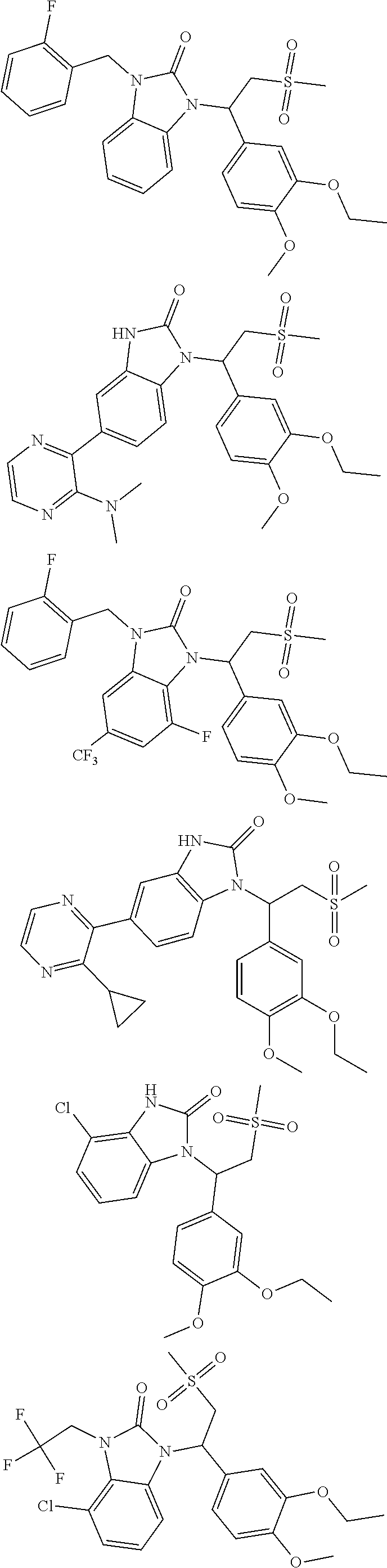


means that the substituent R can be located at any position on cyclohexyl or cyclohexadiene.

Synthesis Route:


Synthesis Route:


Synthesis Route:


Synthesis Route:


Synthesis Route:


Synthesis Route:


Synthesis Route:


Synthesis Route:


Synthesis Route:


Synthesis Route:


Synthesis Route:

| TABLE 1 | ||||
| Embodi- | Com- | |||
| ment | Fragment 1 | Fragment 2 | Structure | pound |
| 12 |
 |
 |
 |
WX012 |
| WX009 | ||||
| 13 |
 |
 |
 |
WX013 |
| WX009 | ||||
| 14 |
 |
 |
 |
WX014 |
| WX009 | ||||
| 15 |
 |
 |
 |
WX015 |
| WX009 | ||||
| 16 |
 |
 |
 |
WX016 |
| WX009 | ||||
| 17 |
 |
 |
 |
WX017 |
| WX009 | ||||
| 18 |
 |
 |
 |
WX018 |
| WX009 | ||||
| 19 |
 |
 |
 |
WX019 |
| WX009 | ||||
| TABLE 2 | |||
| Embodiment | Compound | HNMR | LCMS |
| 12 | WX012 | 1H NMR (400 MHz, CDCl3) δ: 8.74 (br s, | MS-ESI |
| 1H), 7.44-7.35 (m, 1H), 7.30 (d, J = 8.0 Hz, | m/z: | ||
| 2H), 7.26-7.13 (m, 4H), 7.12-6.97 (m, 2H), | 485.2 | ||
| 6.83 (d, J = 8.0 Hz, 1H), 5.86 (dd, J = 4.0, 9.3 | [M + H]+. | ||
| Hz, 1H), 4.78 (dd, J = 9.3, 14.6 Hz, 1H), | |||
| 4.08 (q, J = 6.9 Hz, 2H), 3.98-3.78 (m, 4H), | |||
| 2.81 (s, 3H), 1.43 (t, J = 6.9 Hz, 3H). | |||
| 13 | WX013 | 1H NMR (400 MHz, CDCl3) δ: 8.98 (br s, | MS-ESI |
| 1H), 7.47 (dd, J = 5.3, 8.5 Hz, 2H), 7.23 (d, | m/z: | ||
| J = 11.3 Hz, 2H), 7.19-7.03 (m, 5H), 6.83 | 485.2 | ||
| (d, J = 8.0 Hz, 1H), 5.87 (d, J = 5.5 Hz, 1H), | [M + H]+. | ||
| 4.84-4.70 (m, 1H), 4.08 (q, J = 6.9 Hz, 2H), | |||
| 3.96-3.77 (m, 4H), 2.81 (s, 3H), 1.42 (t, | |||
| J = 6.9 Hz, 3H). | |||
| 14 | WX014 | 1H NMR (400 MHz, CDCl3) δ: 9.08 (br s, | MS-ESI |
| 1H), 7.25-7.13 (m, 6H), 7.11-7.01 (m, 3H), | m/z: | ||
| 6.83 (d, J = 8.5 Hz, 1H), 5.85 (dd, J = 4.6, 9.2 | 481.0 | ||
| Hz, 1H), 4.75 (dd, J = 9.4, 14.7 Hz, 1H), | [M + H]+. | ||
| 4.07 (q, J = 6.9 Hz, 2H), 3.90 (dd, J = 4.6, | |||
| 14.7 Hz, 1H), 3.83 (s, 3H), 2.79 (s, 3H), | |||
| 2.24 (s, 3H), 1.42 (t, J = 7.0 Hz, 3H). | |||
| 15 | WX015 | 1H NMR (400 MHz, CDCl3) δ: 10.11 (s, | MS-ESI |
| 1H), 7.49-7.45 (m, 1H), 7.34-7.26 (m, 3H), | m/z: | ||
| 7.22-7.16 (m, 4H), 7.16-7.09 (m, 1H), 6.84 | 501.0 | ||
| (d, J = 8.3 Hz, 1H), 5.89 (dd, J = 4.5, 9.0 Hz, | [M + H]+. | ||
| 1H), 4.78 (dd, J = 9.0, 14.8 Hz, 1H), 4.17- | |||
| 4.03 (m, 2H), 3.95 (dd, J = 4.5, 14.8 Hz, | |||
| 1H), 3.84 (s, 3H), 2.80 (s, 3H), 1.40 (t, | |||
| J = 7.0 Hz, 3H). | |||
| 16 | WX016 | 1H NMR (400 MHz, CDCl3) δ: 8.70 (br s, | MS-ESI |
| 1H), 7.36-7.24 (m, 4H), 7.20-7.13 (m, 2H), | m/z: | ||
| 7.09 (dd, J = 1.8, 8.3 Hz, 1H), 7.06-6.98 (m, | 497.0 | ||
| 2H), 6.84 (d, J = 8.3 Hz, 1H), 5.85 (dd, | [M + H]+. | ||
| J = 4.5, 9.3 Hz, 1H), 4.80 (dd, J = 9.3, 14.8 | |||
| Hz, 1H), 4.09 (q, J = 7.0 Hz, 2H), 3.93-3.87 | |||
| (m, 1H), 3.85 (s, 3H), 3.82 (s, 3H), 2.79 (s, | |||
| 3H), 1.44 (t, J = 6.9 Hz, 3H). | |||
| 17 | WX017 | 1H NMR (400 MHz, CDCl3) δ: 9.96 (br s, | MS-ESI |
| 1H), 7.73 (d, J = 7.8 Hz, 1H), 7.58-7.51 (m, | m/z: | ||
| 1H), 7.50-7.40 (m, 1H), 7.30 (d, J = 7.3 Hz, | 535.1 | ||
| 1H), 7.17 (br s, 1H), 7.13 (d, J = 8.0 Hz, | [M + H]+. | ||
| 1H), 7.09 (d, J = 8.5 Hz, 1H), 7.07-7.02 (m, | |||
| 2H), 6.83 (d, J = 8.3 Hz, 1H), 5.85 (dd, | |||
| J = 4.6, 8.4 Hz, 1H), 4.72 (dd, J = 9.3, 14.6 | |||
| Hz, 1H), 4.05 (q, J = 6.7 Hz, 2H), 3.93 (dd, | |||
| J = 4.0, 14.8 Hz, 1H), 3.83 (s, 3H), 2.75 (s, | |||
| 3H), 1.37 (t, J = 6.8 Hz, 3H). | |||
| 18 | WX018 | 1H NMR (400 MHz, CDCl3) δ: 7.42-7.31 | MS-ESI |
| (m, 2H), 7.24-7.16 (m, 2H), 7.12 (d, J = 7.8 | m/z: | ||
| Hz, 3H), 7.04-6.94 (m, 2H), 6.85 (d, J = 8.3 | 509.1 | ||
| Hz, 1H), 5.88-5.78 (m, 1H), 4.78 (dd, | [M + H]+. | ||
| J = 9.4, 14.9 Hz, 1H), 4.09 (q, J = 6.8 Hz, | |||
| 2H), 3.95-3.81 (m, 4H), 3.07-2.97 (m, 1H), | |||
| 2.86-2.73 (m, 3H), 1.47-1.39 (m, 3H), 1.14 | |||
| (d, J = 6.8 Hz, 6H). | |||
| 19 | WX019 | 1H NMR (400 MHz, CDCl3) δ: 9.62 (br s, | MS-ESI |
| 1H), 7.34-7.27 (m, 2H), 7.23-7.15 (m, 3H), | m/z: | ||
| 7.13 (d, J = 7.5 Hz, 1H), 7.11-7.03 (m, 3H), | 495.1 | ||
| 6.84 (d, J = 8.3 Hz, 1H), 5.89 (dd, J = 4.5, 9.0 | [M + H]+. | ||
| Hz, 1H), 4.70 (dd, J = 9.4, 14.7 Hz, 1H), | |||
| 4.08 (q, J = 6.9 Hz, 2H), 3.92 (dd, J = 4.5, | |||
| 14.8 Hz, 1H), 3.84 (s, 3H), 2.80 (s, 3H), | |||
| 2.56 (q, J = 7.5 Hz, 2H), 1.42 (t, J = 6.9 Hz, | |||
| 3H), 1.08 (t, J = 7.5 Hz, 3H). | |||

Synthesis Route:

| TABLE 3 | ||||
| Embodi- | Com- | |||
| ment | Fragment 1 | Fragment 2 | Structure | pound |
| 21 |
 |
 |
 |
WX021 |
| WX004 | ||||
| 22 |
 |
 |
 |
WX022 |
| WX002 | ||||
| 23 |
 |
 |
 |
WX023 |
| WX011 | ||||
| TABLE 4 | |||
| Embodiment | Compound | HNMR | LCMS |
| 21 | WX021 | 1H NMR (400 MHz, MeOD) δ: 7.30 (d, | MS-ESI |
| J = 1.5 Hz, 1H), 7.17-7.10 (m, 2H), 7.07 (d, | m/z: | ||
| J = 8.5 Hz, 2H), 6.95 (d, J = 8.5 Hz, 1H), | 449.1 | ||
| 6.02 (dd, J = 3.8, 10.8 Hz, 1H), 4.56 (dd, | [M + H]+. | ||
| J = 10.8, 14.3 Hz, 1H), 4.16-3.97 (m, 3H), | |||
| 3.82 (s, 3H), 3.04-2.87 (m, 4H), 1.39 (t, | |||
| J = 6.8 Hz, 3H), 1.20-1.06 (m, 2H), 1.01- | |||
| 0.93 (m, 2H). | |||
| 22 | WX022 | 1H NMR (400 MHz, MeOD) δ: 7.52 (s, | MS-ESI |
| 1H), 7.44-7.31 (m, 2H), 7.15 (d, J = 1.5 Hz, | m/z: | ||
| 1H), 7.11-7.05 (m, 1H), 6.96 (d, J = 8.5 Hz, | 499.1 | ||
| 1H), 6.09 (dd, J = 3.8, 10.8 Hz, 1H), 4.60 | [M + H]+. | ||
| (dd, J = 11.0, 14.6 Hz, 1H), 4.17-3.97 (m, | |||
| 3H), 3.83 (s, 3H), 3.05-2.94 (m, 4H), 1.39 | |||
| (t, J = 6.8 Hz, 3H), 1.23-1.13 (m, 2H), 1.05- | |||
| 0.93 (m, 2H). | |||
| 23 | WX023 | 1H NMR (400 MHz, CDCl3) δ: 7.48-7.37 | MS-ESI |
| (m, 2H), 7.36-7.29 (m, 1H), 7.26-7.12 (m, | m/z: | ||
| 5H), 7.09 (d, J = 8.0 Hz, 1H), 6.83 (d, J = 8.3 | 525.2 | ||
| Hz, 1H), 5.80 (dd, J = 4.4, 8.9 Hz, 1H), 4.75 | [M + H]+. | ||
| (dd, J = 9.3, 14.6 Hz, 1H), 4.10 (q, J = 6.8 Hz, | |||
| 2H), 3.95-3.79 (m, 4H), 2.92 (d, J = 3.3 Hz, | |||
| 1H), 2.76 (s, 3H), 1.46 (t, J = 6.9 Hz, 3H), | |||
| 1.14 (d, J = 4.8 Hz, 2H), 1.02 (d, J = 2.8 Hz, | |||
| 2H). | |||

Synthesis Route:

| TABLE 5 | ||||
| Embodi- | Com- | |||
| ment | Fragment 1 | Fragment 2 | Structure | pound |
| 25 |
 |
 |
 |
WX025 |
| WX024-1 | ||||
| 26 |
 |
 |
 |
WX026 |
| WX024-1 | ||||
| 27 |
 |
 |
 |
WX027 |
| WX024-1 | ||||
| 28 |
 |
 |
 |
WX028 |
| WX024-1 | ||||
| 29 |
 |
 |
 |
WX029 |
| WX024-1 | ||||
| 30 |
 |
 |
 |
WX030 |
| WX024-1 | ||||
| TABLE 6 | |||
| Embodiment | Compound | HNMR | LCMS |
| 25 | WX025 | 1H NMR (400 MHz, CDCl3) δ: 9.38 (s, 1H), | MS-ESI |
| 8.50 (d, J = 4.5 Hz, 1H), 7.80-7.72 (m, 2H), | m/z: | ||
| 7.48 (ddd, J = 1.1, 8.3, 11.2 Hz, 1H), 7.27- | 486.1 | ||
| 7.22 (m, 1H), 7.20 (d, J = 8.3 Hz, 1H), 7.15 | [M + H]+. | ||
| (d, J = 2.0 Hz, 1H), 7.07 (dd, J = 2.0, 8.5 Hz, | |||
| 1H), 6.83 (d, J = 8.3 Hz, 1H), 5.87 (dd, | |||
| J = 4.5, 9.3 Hz, 1H), 4.75 (dd, J = 9.4, 14.9 | |||
| Hz, 1H), 4.07 (q, J = 6.9 Hz, 2H), 3.91 (dd, | |||
| J = 4.5, 14.8 Hz, 1H), 3.83 (s, 3H), 2.77 (s, | |||
| 3H), 1.41 (t, J = 7.0 Hz, 3H). | |||
| 26 | WX026 | 1H NMR (400 MHz, CDCl3) δ: 9.30 (s, 1H), | MS-ESI |
| 8.48-8.41 (m, 2H), 7.35-7.29 (m, 2H), 7.18 | m/z: | ||
| (d, J = 8.0 Hz, 1H), 7.14 (d, J = 2.0 Hz, 1H), | 483.1 | ||
| 7.07 (dd, J = 1.9, 8.4 Hz, 1H), 6.83 (d, J = 8.5 | [M + H]+. | ||
| Hz, 1H), 5.87 (dd, J = 4.5, 9.3 Hz, 1H), 4.75 | |||
| (dd, J = 9.5, 14.8 Hz, 1H), 4.07 (q, J = 7.0 | |||
| Hz, 2H), 3.89 (dd, J = 4.5, 14.8 Hz, 1H), | |||
| 3.84 (s, 3H), 2.79 (s, 3H), 2.65 (s, 3H), 1.42 | |||
| (t, J = 7.0 Hz, 3H). | |||
| 27 | WX027 | 1H NMR (400 MHz, CDCl3) δ: 9.50 (s, 1H), | MS-ESI |
| 9.05 (d, J = 5.0 Hz, 1H), 7.53 (s, 1H), 7.41 | m/z: | ||
| (d, J = 5.3 Hz, 1H), 7.27 (d, J = 1.3 Hz, 1H), | 484.1 | ||
| 7.24-7.14 (m, 2H), 7.09 (dd, J = 2.0, 8.3 Hz, | [M + H]+. | ||
| 1H), 6.86 (d, J = 8.3 Hz, 1H), 5.88 (dd, | |||
| J = 4.4, 9.4 Hz, 1H), 4.83 (dd, J = 9.5, 15.1 | |||
| Hz, 1H), 4.10 (q, J = 6.9 Hz, 2H), 3.92-3.82 | |||
| (m, 4H), 2.82 (s, 3H), 2.44 (s, 3H), 1.46 (t, | |||
| J = 7.0 Hz, 3H). | |||
| 28 | WX028 | 1H NMR (400 MHz, CDCl3) δ: 9.55 (br s, | MS-ESI |
| 1H), 7.77 (d, J = 7.5 Hz, 1H), 7.70-7.61 (m, | m/z: | ||
| 1H), 7.54-7.42 (m, 2H), 7.34-7.23 (m, 3H), | 492.1 | ||
| 7.16 (d, J = 1.5 Hz, 1H), 7.10 (dd, J = 1.8, 8.3 | [M + H]+. | ||
| Hz, 1H), 6.86 (d, J = 8.3 Hz, 1H), 5.91 (dd, | |||
| J = 4.8, 9.3 Hz, 1H), 4.74 (dd, J = 9.4, 14.7 | |||
| Hz, 1H), 4.10 (q, J = 7.0 Hz, 2H), 3.94 (dd, | |||
| J = 4.4, 14.7 Hz, 1H), 3.86 (s, 3H), 2.84 (s, | |||
| 3H), 1.44 (t, J = 7.0 Hz, 3H). | |||
| 29 | WX029 | 1H NMR (400 MHz, CDCl3) δ: 9.20 (br, s, | MS-ESI |
| 1H), 8.17-7.96 (m, 2H), 7.61-7.43 (m, 2H), | m/z: | ||
| 7.20-7.00 (m, 3H), 6.81 (d, J = 8.0 Hz, 1H), | 512.2 | ||
| 5.85 (d, J = 4.5 Hz, 1H), 4.77-4.61 (m, 1H), | [M + H]+. | ||
| 4.06 (q, J = 6.9 Hz, 2H), 3.93-3.73 (m, 4H), | |||
| 2.82-2.77 (m, 9H), 1.42 (t, J = 6.9 Hz, 3H). | |||
| 30 | WX030 | 1H NMR (400 MHz, CDCl3) δ: 9.73 (br s, | MS-ESI |
| 1H), 8.60 (br s, 1H), 8.47 (br s, 1H), 7.62 | m/z: | ||
| (br s, 1H), 7.48 (d, J = 6.0 Hz, 1H), 7.22- | 509.1 | ||
| 7.05 (m, 3H), 6.84 (d, J = 8.0 Hz, 1H), 5.88 | [M + H]+. | ||
| (d, J = 5.5 Hz, 1H), 4.82-4.66 (m, 1H), 4.08 | |||
| (q, J = 6.5 Hz, 2H), 3.85 (s, 4H), 2.82 (s, | |||
| 3H), 2.34 (br s, 1H), 1.45-1.36 (m, 3H), | |||
| 1.30 (br s, 2H), 1.13 (d, J = 5.5 Hz, 2H). | |||

Synthesis Route:

| TABLE 7 | ||||
| Embodi- | Com- | |||
| ment | Fragment 1 | Fragment 2 | Structure | pound |
| 32 |
 |
 |
 |
WX032 |
| WX024-1 | ||||
| 33 |
 |
 |
 |
WX033 |
| WX024-1 | ||||
| TABLE 8 | |||
| Embodiment | Compound | HNMR | LCMS |
| 32 | WX032 | 1H NMR (400 MHz, CDCl3) δ: 8.70 (br s, | MS-ESI |
| 1H), 7.85 (dd, J = 1.3, 8.3 Hz, 1H), 7.74 (s, | m/z: | ||
| 1H), 7.16-7.09 (m, 2H), 7.05 (d, J = 8.3 Hz, | 477.2 | ||
| 1H), 6.82 (d, J = 8.3 Hz, 1H), 5.85 (dd, | [M + H]+. | ||
| J = 4.4, 9.4 Hz, 1H), 5.23 (quin, J = 6.2 Hz, | |||
| 1H), 4.70 (dd, J = 9.8, 14.6 Hz, 1H), 4.06 (q, | |||
| J = 7.0 Hz, 2H), 3.92-3.79 (m, 4H), 2.78 (s, | |||
| 3H), 1.43 (t, J = 7.0 Hz, 3H), 1.35 (d, J = 6.3 | |||
| Hz, 6H). | |||
| 33 | WX033 | 1H NMR (400 MHz, CDCl3) δ: 9.61 (br s, | MS-ESI |
| 1H), 7.86 (dd, J = 1.0, 8.5 Hz, 1H), 7.73 (s, | m/z: | ||
| 1H), 7.20-6.99 (m, 3H), 6.82 (d, J = 8.3 Hz, | 539.1 | ||
| 1H), 5.89 (dd, J = 4.1, 9.7 Hz, 1H), 4.80- | [M + H]+. | ||
| 4.62 (m, 3H), 4.05 (q, J = 6.9 Hz, 2H), 3.89 | |||
| (dd, J = 4.3, 14.6 Hz, 1H), 3.83 (s, 3H), 2.84 | |||
| (s, 3H), 1.41 (t, J = 6.9 Hz, 3H). | |||

Synthesis Route:


Synthesis Route:


Synthesis Route:

| TABLE 9 | ||||
| Embodi- | Com- | |||
| ment | Fragment 1 | Fragment 2 | Structure | pound |
| 37 |
 |
 |
 |
WX037 |
| WX003 | ||||
| 38 |
 |
 |
 |
WX038 |
| WX003 | ||||
| 39 |
 |
 |
 |
WX039 |
| WX003 | ||||
| 40 |
 |
 |
 |
WX040 |
| WX003 | ||||
| 41 |
 |
 |
 |
WX041 |
| WX003 | ||||
| 42 |
 |
 |
 |
WX042 |
| WX003 | ||||
| 43 |
 |
 |
 |
WX043 |
| WX003 | ||||
| 44 |
 |
 |
 |
WX044 |
| WX003 | ||||
| 45 |
 |
 |
 |
WX045 |
| WX003 | ||||
| 46 |
 |
 |
 |
WX046 |
| WX004 | ||||
| 47 |
 |
 |
 |
WX047 |
| WX004 | ||||
| 48 |
 |
 |
 |
WX048 |
| WX004 | ||||
| 49 |
 |
 |
 |
WX049 |
| WX004 | ||||
| 50 |
 |
 |
 |
WX050 |
| WX004 | ||||
| 51 |
 |
 |
 |
WX051 |
| WX002 | ||||
| 52 |
 |
 |
 |
WX052 |
| WX002 | ||||
| 53 |
 |
 |
 |
WX053 |
| WX002 | ||||
| 54 |
 |
 |
 |
WX054 |
| WX002 | ||||
| 55 |
 |
 |
 |
WX055 |
| WX002 | ||||
| 56 |
 |
 |
 |
WX056 |
| WX002 | ||||
| 57 |
 |
 |
 |
WX057 |
| WX005 | ||||
| 58 |
 |
 |
 |
WX058 |
| WX005 | ||||
| 59 |
 |
 |
 |
WX059 |
| WX005 | ||||
| 60 |
 |
 |
 |
WX060 |
| WX006 | ||||
| 61 |
 |
 |
 |
WX061 |
| WX008 | ||||
| 62 |
 |
 |
 |
WX062 |
| WX008 | ||||
| 63 |
 |
 |
 |
WX063 |
| WX009 | ||||
| 64 |
 |
 |
 |
WX064 |
| WX009 | ||||
| 65 |
 |
 |
 |
WX065 |
| WX009 | ||||
| 66 |
 |
 |
 |
WX066 |
| WX009 | ||||
| 67 |
 |
 |
 |
WX067 |
| WX010 | ||||
| 68 |
 |
 |
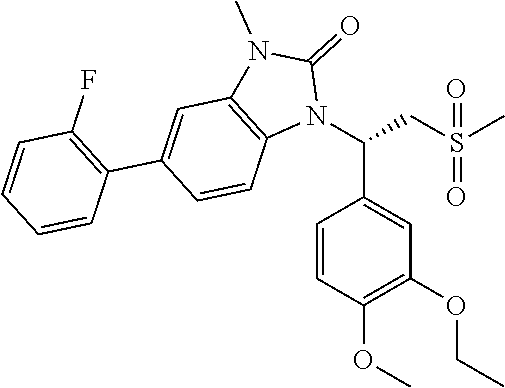 |
WX068 |
| WX011 | ||||
| 69 |
 |
 |
 |
WX069 |
| WX011 | ||||
| 70 |
 |
 |
 |
WX070 |
| WX011 | ||||
| 71 |
 |
 |
 |
WX071 |
| WX011 | ||||
| 72 |
 |
 |
 |
WX072 |
| WX031 | ||||
| 73 |
 |
 |
 |
WX073 |
| WX031 | ||||
| 74 |
 |
 |
 |
WX074 |
| WX031 | ||||
| TABLE 10 | |||
| Embodiment | Compound | HNMR | LCMS |
| 37 | WX037 | 1H NMR (400 MHz, CDCl3) δ: 7.12- | MS-ESI |
| 6.82 (m, 6H), 5.75 (dd, J = 4.4, 10.0 Hz, | m/z: 529.0 | ||
| 1H), 4.78-4.72 (m, 1H), 4.49-4.38 (m, | [M + Na]+. | ||
| 2H), 4.08-4.03 (m, 2H), 3.85-3.80 (m, | |||
| 4H), 2.75 (s, 3H), 1.45 (t, J = 7.2 Hz, | |||
| 3H). | |||
| 38 | WX038 | 1H NMR (400 MHz, MeOD) δ: 7.22- | MS-ESI |
| 7.13 (m, 2H), 7.10 (d, J = 1.8 Hz, 1H), | m/z: 439.1 | ||
| 7.06-7.01 (m, 2H), 6.92 (d, J = 8.5 Hz, | [M + H]+. | ||
| 1H), 6.02 (dd, J = 3.8, 10.5 Hz, 1H), | |||
| 4.57 (dd, J = 10.5, 14.6 Hz, 1H), 4.11- | |||
| 3.97 (m, 3H), 3.79 (s, 3H), 3.39 (s, 3H), | |||
| 2.95 (s, 3H), 1.35 (t, J = 7.0 Hz, 3H). | |||
| 39 | WX039 | 1H NMR (400 MHz, MeOD) δ: 7.25 (s, | MS-ESI |
| 1H), 7.20-7.02 (m, 4H), 6.95 (d, J = 8.3 | m/z: 453.1 | ||
| Hz, 1H), 6.05 (dd, J = 3.5, 10.5 Hz, 1H), | [M + H]+. | ||
| 4.61 (dd, J = 10.9, 14.4 Hz, 1H), 4.18- | |||
| 3.90 (m, 5H), 3.82 (s, 3H), 2.97 (s, 3H), | |||
| 1.41-1.28 (m, 6H). | |||
| 40 | WX040 | 1H NMR (400 MHz, CDCl3) δ: 7.15 (d, | MS-ESI |
| J = 1.8 Hz, 1H), 7.11-7.00 (m, 4H), 6.84 | m/z: 479.1 | ||
| (d, J = 8.3 Hz, 1H), 5.76 (dd, J = 4.5, 9.5 | [M + H]+. | ||
| Hz, 1H), 4.81 (dd, J = 9.8, 14.8 Hz, 1H), | |||
| 4.09 (q, J = 6.9 Hz, 2H), 3.91-3.73 (m, | |||
| 6H), 2.75 (s, 3H), 1.46 (t, J = 6.9 Hz, | |||
| 3H), 1.26-1.18 (m, 1H), 0.61-0.52 (m, | |||
| 2H), 0.44 (br d, J = 4.3 Hz, 2H). | |||
| 41 | WX041 | 1H NMR (400 MHz, CDCl3) δ: 7.1 (s, | MS-ESI |
| 1H), 7.07-7.00 (m, 4H), 6.83 (d, J = 8.0 | m/z: 493.1 | ||
| Hz, 1H), 5.78-5.75 (m, 1H), 4.83-4.77 | [M + H]+. | ||
| (m, 1H), 4.07 (q, J = 6.0 Hz, 2H), 3.92- | |||
| 3.83 (m, 6H), 2.82-2.80 (m, 1H), 2.75 | |||
| (s, 3H), 2.04-1.85 (m, 6H), 1.46 (t, | |||
| J = 10.8 Hz, 3H). | |||
| 42 | WX042 | 1H NMR (400 MHz, CDCl3) δ: 7.21- | MS-ESI |
| 6.90 (m, 5H), 6.83 (br s, 1H), 5.76 (br | m/z: 483.0 | ||
| s, 1H), 4.78 (br s, 1H), 4.24-3.98 (m, | [M + H]+. | ||
| 4H), 3.87-3.63 (m, 6H), 3.31 (br s, 3H), | |||
| 2.73 (br s, 3H), 1.45 (br s, 3H). | |||
| 43 | WX043 | 1H NMR (400 MHz, CDCl3) δ: 7.14- | MS-ESI |
| 7.02 (m, 4H), 6.94 (d, J = 8.3 Hz, 1H), | m/z: 469.1 | ||
| 6.86 (d, J = 8.3 Hz, 1H), 5.89 (dd, | [M + H]+. | ||
| J = 3.4, 10.4 Hz, 1H), 4.66 (dd, J = 10.8, | |||
| 14.3 Hz, 1H), 4.10-4.02 (m, 4H), 3.98- | |||
| 3.92 (m, 2H), 3.88 (s, 3H), 3.78 (dd, | |||
| J = 3.4, 14.7 Hz, 1H), 2.89 (s, 3H), 1.46 | |||
| (t, J = 6.9 Hz, 3H). | |||
| 44 | WX044 | 1H NMR (400 MHz, CDCl3) δ: 7.17- | MS-ESI |
| 7.02 (m, 5H), 6.85 (d, J = 8.0 Hz, 1H), | m/z: 467.2 | ||
| 5.80 (d, J = 5.3 Hz, 1H), 4.72 (d, J = 9.5 | [M + H]+. | ||
| Hz, 1H), 4.09 (q, J = 7.0 Hz, 2H), 3.96- | |||
| 3.82 (m, 4H), 2.77 (s, 3H), 2.19-2.16 | |||
| (m, 1H), 1.54 (br d, J = 6.3 Hz, 6H), | |||
| 1.46 (t, J = 6.9 Hz, 3H). | |||
| 45 | WX045 | 1H NMR (400 MHz, CDCl3) δ: 7.28 (s, | MS-ESI |
| 1H), 7.19-7.00 (m, 4H), 6.86 (d, J = 7.5 | m/z: 486.1 | ||
| Hz, 1H), 5.80 (br s, 1H), 4.80 (br s, | [M + Na]+. | ||
| 2H), 4.63 (d, J = 11.3 Hz, 1H), 4.09 (d, | |||
| J = 6.5 Hz, 2H), 3.87 (br s, 4H), 2.82 (br | |||
| s, 3H), 1.47 (br s, 3H). | |||
| 46 | WX046 | 1H NMR (400 MHz, CDCl3) δ: 7.10- | MS-ESI |
| 7.03 (m, 1H), 7.02 (d, J = 5.6 Hz, 2H), | m/z: 495.0 | ||
| 6.83-6.82 (m, 3H), 6.03 (t, J = 65 Hz, | [M + Na]+. | ||
| 1H), 5.80-5.77 (m, 1H), 4.73-4.69 (m, | |||
| 1H), 4.23-4.18 (m, 2H), 4.09-4.04 (m, | |||
| 2H), 3.81 (s, 3H), 3.93-3.80 (m, 1H), | |||
| 2.77 (br. s., 3H), 1.44 (t, J = 7.2 Hz, | |||
| 3H). | |||
| 47 | WX047 | 1H NMR (400 MHz, CDCl3) δ: 7.12 (d, | MS-ESI |
| J = 2.0 Hz, 1H), 7.08-6.96 (m, 2H), | m/z: 491.0 | ||
| 6.91-6.79 (m, 3H), 5.75 (dd, J = 4.3, 9.8 | [M + H]+. | ||
| Hz, 1H), 4.76 (dd, J = 9.8, 14.8 Hz, 1H), | |||
| 4.60-4.30 (m, 2H), 4.06 (q, J = 7.0 Hz, | |||
| 2H), 3.90-3.76 (m, 4H), 2.75 (s, 3H), | |||
| 1.44 (t, J = 7.0 Hz, 3H). | |||
| 48 | WX048 | 1H NMR (400 MHz, MeOD) δ: 7.21- | MS-ESI |
| 7.11 (m, 2H), 7.07 (dd, J = 1.5, 8.3 Hz, | m/z: 423.1 | ||
| 1H), 7.03-6.91 (m, 2H), 6.87-6.76 (m, | [M + H]+. | ||
| 1H), 6.05 (dd, J = 3.8, 10.5 Hz, 1H), | |||
| 4.61 (dd, J = 10.5, 14.6 Hz, 1H), 4.13- | |||
| 3.98 (m, 3H), 3.82 (s, 3H), 3.42 (s, 3H), | |||
| 2.97 (s, 3H), 1.38 (t, J = 6.9 Hz, 3H). | |||
| 49 | WX049 | 1H NMR (400 MHz, CD3OD) δ: 7.34- | MS-ESI |
| 7.05 (m, 4H), 7.00-6.83 (m, 2H), 6.05 | m/z: 448.1 | ||
| (dd, J = 3.8, 10.5 Hz, 1H), 5.04 (s, 2H), | [M + H]+. | ||
| 4.62 (dd, J = 10.8, 14.6 Hz, 1H), 4.21- | |||
| 4.00 (m, 3H), 3.83 (s, 3H), 2.99 (s, 3H), | |||
| 1.38 (t, J = 6.9 Hz, 3H). | |||
| 50 | WX050 | 1H NMR (400 MHz, CD3OD) δ: 7.22- | MS-ESI |
| 7.04 (m, 4H), 6.95 (d, J = 8.0 Hz, 1H), | m/z: 453.1 | ||
| 6.86-6.75 (m, 1H), 6.04 (dd, J = 3.8, | [M + H]+. | ||
| 10.3 Hz, 1H), 4.64 (dd, J = 10.3, 14.8 | |||
| Hz, 1H), 4.15-3.96 (m, 5H), 3.89-3.75 | |||
| (m, 5H), 2.95 (s, 3H), 1.38 (t, J = 7.0 Hz, | |||
| 3H). | |||
| 51 | WX051 | 1H NMR (400 MHz, MeOD) δ: 7.54 (s, | MS-ESI |
| 1H), 7.47-7.33 (m, 2H), 7.23-7.06 (m, | m/z: 545.0 | ||
| 2H), 6.96 (d, J = 8.0 Hz, 1H), 6.41-6.01 | [M + Na]+. | ||
| (m, 2H), 4.66 (dd, J = 11.0, 14.6 Hz, | |||
| 1H), 4.41 (dt, J = 3.3, 14.9 Hz, 2H), | |||
| 4.16-3.95 (m, 3H), 3.82 (s, 3H), 2.99 (s, | |||
| 3H), 1.37 (t, J = 7.0 Hz, 3H). | |||
| 52 | WX052 | 1H NMR (400 MHz, CD3OD) δ: 7.58 (s, | MS-ESI |
| 1H), 7.51-7.37 (m, 2H), 7.24-7.05 (m, | m/z: 541.1 | ||
| 2H), 6.97 (d, J = 8.5 Hz, 1H), 6.12 (dd, | [M + H]+. | ||
| J = 3.6, 10.7 Hz, 1H), 4.85-4.65 (m, | |||
| 3H), 4.21-3.94 (m, 3H), 3.83 (s, 3H), | |||
| 2.99 (s, 3H), 1.38 (t, J = 7.0 Hz, 3H). | |||
| 53 | WX053 | 1H NMR (400 MHz, MeOD) δ: 7.51- | MS-ESI |
| 7.34 (m, 3H), 7.16 (d, J = 1.5 Hz, 1H), | m/z: 473.1 | ||
| 7.13-7.04 (m, 1H), 6.96 (d, J = 8.5 Hz, | [M + H]+. | ||
| 1H), 6.12 (dd, J = 4.0, 10.5 Hz, 1H), | |||
| 4.64 (dd, J = 10.8, 14.3 Hz, 1H), 4.20- | |||
| 3.99 (m, 3H), 3.83 (s, 3H), 3.48 (s, 3H), | |||
| 2.99 (s, 3H), 1.38 (t, J = 7.0 Hz, 3H). | |||
| 54 | WX054 | 1H NMR (400 MHz, MeOD) δ: 7.54- | MS-ESI |
| 7.32 (m, 3H), 7.23-7.04 (m, 2H), 6.97 | m/z: 487.1 | ||
| (d, J = 8.0 Hz, 1H), 6.12 (dd, J = 3.8, 10.8 | [M + H]+. | ||
| Hz, 1H), 4.65 (dd, J = 10.8, 14.3 Hz, | |||
| 1H), 4.19-3.99 (m, 5H), 3.83 (s, 3H), | |||
| 3.00 (s, 3H), 1.40-1.30 (m, 6H). | |||
| 55 | WX055 | 1H NMR (400 MHz, MeOD) δ: 7.65 (s, | MS-ESI |
| 1H), 7.56-7.36 (m, 2H), 7.22-7.06 (m, | m/z: 520.1 | ||
| 2H), 6.97 (d, J = 8.0 Hz, 1H), 6.12 (dd, | [M + Na]+. | ||
| J = 3.8, 10.8 Hz, 1H), 5.11 (s, 2H), 4.65 | |||
| (dd, J = 10.5, 14.6 Hz, 1H), 4.23-3.98 | |||
| (m, 3H), 3.83 (s, 3H), 3.01 (s, 3H), 1.38 | |||
| (t, J = 7.0 Hz, 3H). | |||
| 56 | WX056 | 1H NMR (400 MHz, CD3OD) δ: 7.56 (s, | MS-ESI |
| 1H), 7.39 (s, 2H), 7.18 (d, J = 2.0 Hz, | m/z: 503.1 | ||
| 1H), 7.11 (dd, J = 2.0, 8.3 Hz, 1H), 6.96 | [M + H]+. | ||
| (d, J = 8.3 Hz, 1H), 6.11 (dd, J = 4.0, | |||
| 10.5 Hz, 1H), 4.67 (dd, J = 10.5, 14.6 | |||
| Hz, 1H), 4.19-3.98 (m, 5H), 3.88-3.82 | |||
| (m, 5H), 2.98 (s, 3H), 1.39 (t, J = 7.0 Hz, | |||
| 3H). | |||
| 57 | WX057 | 1H NMR (400 MHz, MeOD) δ: 7.11 (br | MS-ESI |
| s, 1H), 7.05-6.84 (m, 3H), 6.83-6.72 | m/z: 441.0 | ||
| (m, 1H), 6.23 (d, J = 7.3 Hz, 1H), 4.88- | [M + H]+. | ||
| 4.77 (m, 1H), 4.15-3.99 (m, 3H), 3.82 | |||
| (s, 3H), 3.42 (s, 3H), 3.00 (s, 3H), 1.39 | |||
| (t, J = 7.0 Hz, 3H). | |||
| 58 | WX058 | 1H NMR (400 MHz, MeOD) δ: 7.26- | MS-ESI |
| 6.99 (m, 3H), 6.99-6.78 (m, 2H), 6.23 | m/z: 488.1 | ||
| (d, J = 7.0 Hz, 1H), 5.04 (s, 2H), 4.85- | [M + Na]+. | ||
| 4.77 (m, 1H), 4.21-3.94 (m, 3H), 3.83 | |||
| (s, 3H), 3.01 (s, 3H), 1.38 (t, J = 6.9 Hz, | |||
| 3H). | |||
| 59 | WX059 | 1H NMR (400 MHz, CD3OD) δ: 7.13 | MS-ESI |
| (br s, 1H), 7.06-6.90 (m, 3H), 6.83-6.70 | m/z: 471.1 | ||
| (m, 1H), 6.24 (d, J = 7.5 Hz, 1H), 4.88- | [M + H]+. | ||
| 4.87 (m, 1H), 4.15-3.96 (m, 5H), 3.90- | |||
| 3.76 (m, 5H), 2.99 (s, 3H), 1.38 (t, | |||
| J = 6.9 Hz, 3H). | |||
| 60 | WX060 | 1H NMR (400 MHz, CDCl3) δ: 7.26 (br | MS-ESI |
| s, 2H), 7.21-7.04 (m, 5H), 7.01 (s, 1H), | m/z: 607.0 | ||
| 6.83 (d, J = 8.3 Hz, 1H), 6.22 (br s, 1H), | [M + Na]+. | ||
| 5.24-5.03 (m, 2H), 4.8 (br, s, 1H), 4.06 | |||
| (q, J = 6.8 Hz, 2H), 3.85 (s, 4H), 2.82 (br | |||
| s, 3H), 1.44 (t, J = 6.8 Hz, 3H). | |||
| 61 | WX061 | 1H NMR (400 MHz, CDCl3) δ: 7.11 (d, | MS-ESI |
| J = 2.3 Hz, 1H), 7.10-7.03 (m, 3H), 7.01 | m/z: 511.0 | ||
| (dd, J = 2.0, 8.3 Hz, 1H), 6.82 (d, J = 8.3 | [M + Na]+. | ||
| Hz, 1H), 6.30-5.92 (m, 1H), 5.77 (dd, | |||
| J = 4.5, 9.8 Hz, 1H), 4.81 (dd, J = 9.8, | |||
| 14.8 Hz, 1H), 4.73-4.58 (m, 2H), 4.06 | |||
| (q, J = 7.0 Hz, 2H), 3.88-3.73 (m, 4H), | |||
| 2.76 (s, 3H), 1.44 (t, J = 7.0 Hz, 3H). | |||
| 62 | WX062 | 1H NMR (400 MHz, CDCl3) δ: 7.12 (d, | MS-ESI |
| J = 2.3 Hz, 1H), 7.10-7.06 (m, 3H), 7.00 | m/z: 529.0 | ||
| (dd, J = 2.0, 8.3 Hz, 1H), 6.81 (d, J = 8.3 | [M + Na]+. | ||
| Hz, 1H), 5.76 (dd, J = 4.4, 9.7 Hz, 1H), | |||
| 5.03-4.77 (m, 3H), 4.09-4.01 (m, 2H), | |||
| 3.86-3.76 (m, 4H), 2.74 (s, 3H), 1.44 (t, | |||
| J = 7.0 Hz, 3H). | |||
| 63 | WX063 | 1H NMR (400 MHz, CDCl3) δ: 7.25 (s, | MS-ESI |
| 1H), 7.21 (d, J = 8.3 Hz, 1H), 7.02 (s, | m/z: 574.9 | ||
| 1H), 6.98 (d, J = 8.5 Hz, 1H), 6.91 (d, | [M + H]+, | ||
| J = 8.5 Hz, 1H), 6.82 (d, J = 8.3 Hz, 1H), | 577.0 | ||
| 5.84 (dd, J = 3.6, 10.4 Hz, 1H), 4.62 (dd, | [M + H + 2]+. | ||
| J = 10.5, 14.3 Hz, 1H), 4.44-4.23 (m, | |||
| 2H), 4.08-4.00 (m, 2H), 3.84 (s, 3H), | |||
| 3.75 (dd, J = 3.6, 14.4 Hz, 1H), 3.55- | |||
| 3.34 (m, 2H), 2.90 (s, 3H), 2.86 (s, 3H), | |||
| 1.43 (t, J = 6.9 Hz, 3H). | |||
| 64 | WX064 | 1H NMR (400 MHz, CDCl3) δ: 7.33- | MS-ESI |
| 7.27 (m, 1H), 7.26-7.16 (m, 2H), 7.14- | m/z: 577.1 | ||
| 6.93 (m, 6H), 6.83 (d, J = 8.3 Hz, 1H), | [M + H]+, | ||
| 5.79 (dd, J = 4.3, 9.8 Hz, 1H), 5.17-5.02 | 579.0 | ||
| (m, 2H), 4.78 (dd, J = 9.8, 14.6 Hz, 1H), | [M + H + 2]+. | ||
| 4.04 (q, J = 7.0 Hz, 2H), 3.90-3.78 (m, | |||
| 4H), 2.74 (s, 3H), 1.44 (t, J = 6.9 Hz, | |||
| 3H). | |||
| 65 | WX065 | 1H NMR (400 MHz, CDCl3) δ: 7.30 (d, | MS-ESI |
| J = 6.0 Hz, 1H), 7.19 (d, J = 7.8 Hz, 1H), | m/z: 577.0 | ||
| 7.14-6.91 (m, 7H), 6.84 (d, J = 8.0 Hz, | [M + H]+, | ||
| 1H), 5.82 (d, J = 7.8 Hz, 1H), 5.03 (s, | 579.1 | ||
| 2H), 4.75 (t, J = 11.0 Hz, 1H), 4.05 (q, | [M + H + 2]+. | ||
| J = 6.5 Hz, 2H), 3.86 (s, 4H), 2.79 (s, | |||
| 3H), 1.44 (t, J = 6.5 Hz, 3H). | |||
| 66 | WX066 | 1H NMR (400 MHz, CDCl3) δ: 7.31- | MS-ESI |
| 7.22 (m, 2H), 7.18 (dd, J = 1.6, 8.4 Hz, | m/z: 577.0 | ||
| 1H), 7.10 (s, 1H), 7.07-6.91 (m, 5H), | [M + H]+, | ||
| 6.83 (d, J = 8.3 Hz, 1H), 5.82 (dd, J = 3.6, | 579.0 | ||
| 9.7 Hz, 1H), 5.00 (d, J = 2.0 Hz, 2H), | [M + H + 2]+. | ||
| 4.74 (dd, J = 10.0, 14.3 Hz, 1H), 4.04 (q, | |||
| J = 7.0 Hz, 2H), 3.90-3.78 (m, 4H), 2.77 | |||
| (s, 3H), 1.44 (t, J = 6.9 Hz, 3H). | |||
| 67 | WX067 | 1H NMR (400 MHz, CDCl3) δ: 7.31- | MS-ESI |
| 7.21 (m, 2H), 7.16 (d, J = 2.0 Hz, 1H), | m/z: 499.1 | ||
| 7.14-7.09 (m, 1H), 7.09-7.01 (m, 5H), | [M + H]+. | ||
| 6.96 (d, J = 7.3 Hz, 1H), 6.82 (d, J = 8.5 | |||
| Hz, 1H), 5.84 (dd, J = 4.5, 9.5 Hz, 1H), | |||
| 5.24-5.04 (m, 2H), 4.83 (dd, J = 9.7, | |||
| 14.9 Hz, 1H), 4.05 (q, J = 7.0 Hz, 2H), | |||
| 3.93-3.78 (m, 4H), 2.71 (s, 3H), 1.43 (t, | |||
| J = 6.9 Hz, 3H). | |||
| 68 | WX068 | 1H NMR (400 MHz, CDCl3) δ: 7.42 (dt, | MS-ESI |
| J = 1.8, 7.8 Hz, 1H), 7.37-7.28 (m, 2H), | m/z: 499.1 | ||
| 7.25-7.12 (m, 5H), 7.09 (dd, J = 2.0, 8.3 | [M + H]+. | ||
| Hz, 1H), 6.84 (d, J = 8.3 Hz, 1H), 5.84 | |||
| (dd, J = 4.8, 9.3 Hz, 1H), 4.78 (dd, | |||
| J = 9.3, 14.8 Hz, 1H), 4.10 (q, J = 7.0 Hz, | |||
| 2H), 3.90 (dd, J = 4.6, 14.9 Hz, 1H), | |||
| 3.85 (s, 3H), 3.45 (s, 3H), 2.76 (s, 3H), | |||
| 1.46 (t, J = 7.0 Hz, 3H). | |||
| 69 | WX069 | 1H NMR (400 MHz, CDCl3) δ: 7.42 (dt, | MS-ESI |
| J = 1.8, 7.8 Hz, 1H), 7.31 (ddd, J = 1.9, | m/z: 513.1 | ||
| 5.4, 7.8 Hz, 1H), 7.26-7.12 (m, 6H), | [M + H]+. | ||
| 7.08 (dd, J = 2.0, 8.3 Hz, 1H), 6.84 (d, | |||
| J = 8.3 Hz, 1H), 5.83 (dd, J = 4.5, 9.3 Hz, | |||
| 1H), 4.82 (dd, J = 9.5, 14.8 Hz, 1H), | |||
| 4.10 (q, J = 7.0 Hz, 2H), 3.98 (dq, J = 2.9, | |||
| 7.2 Hz, 2H), 3.85 (s, 4H), 2.75 (s, 3H), | |||
| 1.46 (t, J = 6.9 Hz, 3H), 1.35 (t, J = 7.2 | |||
| Hz, 3H). | |||
| 70 | WX070 | 1H NMR (400 MHz, CDCl3) δ: 7.42 (dt, | MS-ESI |
| J = 1.8, 7.8 Hz, 1H), 7.37-7.29 (m, 2H), | m/z: 527.2 | ||
| 7.26-7.12 (m, 5H), 7.08 (dd, J = 2.0, 8.3 | [M + H]+. | ||
| Hz, 1H), 6.84 (d, J = 8.5 Hz, 1H), 5.83 | |||
| (dd, J = 4.5, 9.5 Hz, 1H), 4.91-4.65 (m, | |||
| 2H), 4.10 (q, J = 7.0 Hz, 2H), 3.90-3.82 | |||
| (m, 4H), 2.75 (s, 3H), 1.56 (d, J = 6.8 | |||
| Hz, 6H), 1.45 (t, J = 7.0 Hz, 3H). | |||
| 71 | WX071 | 1H NMR (400 MHz, CDCl3) δ: 7.47- | MS-ESI |
| 7.28 (m, 4H), 7.26-7.11 (m, 4H), 7.08 | m/z: 524.0 | ||
| (d, J = 7.8 Hz, 1H), 6.86 (d, J = 8.3 Hz, | [M + H]+. | ||
| 1H), 5.86 (dd, J = 4.4, 9.2 Hz, 1H), 4.93- | |||
| 4.77 (m, 2H), 4.68 (dd, J = 9.4, 14.7 Hz, | |||
| 1H), 4.10 (q, J = 6.8 Hz, 2H), 3.96-3.82 | |||
| (m, 4H), 2.80 (s, 3H), 1.47 (t, J = 6.9 Hz, | |||
| 3H). | |||
| 72 | WX072 | 1H NMR (400 MHz, CDCl3) δ: 7.88 (d, | MS-ESI |
| J = 8.3 Hz, 1H), 7.74 (s, 1H), 7.18-7.08 | m/z: 527.1 | ||
| (m, 2H), 7.03 (d, J = 8.3 Hz, 1H), 6.33- | [M + H]+. | ||
| 5.61 (m, 2H), 4.70 (dd, J = 9.8, 14.6 Hz, | |||
| 1H), 4.42-4.17 (m, 4H), 4.05 (q, J = 6.9 | |||
| Hz, 2H), 3.89-3.80 (m, 4H), 2.76 (s, | |||
| 3H), 1.80 (br s, 1H), 1.41 (td, J = 7.0, | |||
| 18.8 Hz, 6H). | |||
| 73 | WX073 | 1H NMR (400 MHz, CDCl3) δ: 7.90 (d, | MS-ESI |
| J = 8.0 Hz, 1H), 7.74 (s, 1H), 7.19 (d, | m/z: 545.2 | ||
| J = 8.5 Hz, 1H), 7.11 (s, 1H), 7.03 (d, | [M + H]+. | ||
| J = 8.0 Hz, 1H), 6.82 (d, J = 8.3 Hz, 1H), | |||
| 5.83 (dd, J = 4.4, 9.4 Hz, 1H), 4.73 (dd, | |||
| J = 9.8, 14.6 Hz, 1H), 4.62-4.31 (m, | |||
| 4H), 4.04 (q, J = 6.9 Hz, 2H), 3.90-3.78 | |||
| (m, 4H), 2.74 (s, 3H), 1.40 (td, J = 7.1, | |||
| 17.0 Hz, 6H). | |||
| 74 | WX074 | 1H NMR (400 MHz, CDCl3) δ: 7.86 | MS-ESI |
| (dd, J = 1.5, 8.3 Hz, 1H), 7.67 (d, J = 1.3 | m/z: 477.1 | ||
| Hz, 1H), 7.16-7.10 (m, 2H), 7.05 (dd, | [M + H]+. | ||
| J = 2.0, 8.3 Hz, 1H), 6.82 (d, J = 8.3 Hz, | |||
| 1H), 5.84 (dd, J = 4.6, 9.4 Hz, 1H), 4.69 | |||
| (dd, J = 9.3, 14.6 Hz, 1H), 4.38 (q, | |||
| J = 7.1 Hz, 2H), 4.06 (dq, J = 2.1, 7.0 Hz, | |||
| 2H), 3.95-3.80 (m, 4H), 3.45 (s, 3H), | |||
| 2.75 (s, 3H), 1.41 (td, J = 7.1, 18.4 Hz, | |||
| 6H). | |||

Synthesis Route:


Synthesis Route:


Synthesis Route:


Synthesis Route:


Synthesis Route:


Synthesis Route:


Synthesis Route:


Synthesis Route:


Synthesis Route:


Synthesis Route:


Synthesis Route:


Synthesis Route:


Synthesis Route:

| TABLE 11 | ||||
| Embodi- | Com- | |||
| ment | Fragment 1 | Fragment 2 | Structure | pound |
| 88 |
 |
 |
 |
WX088 |
| WX007 | ||||
| 89 |
 |
 |
 |
WX089 |
| WX007 | ||||
| 90 |
 |
 |
 |
WX090 |
| WX007 | ||||
| 91 |
 |
 |
 |
WX091 |
| WX007 | ||||
| 92 |
 |
 |
 |
WX092 |
| WX007 | ||||
| 93 |
 |
 |
 |
WX093 |
| WX007 | ||||
| TABLE 12 | |||
| Embodiment | Compound | HNMR | LCMS |
| 88 | WX088 | 1H NMR (400 MHz, CD3OD) δ: 7.49 (dt, | MS-ESI |
| J = 6.0, 8.0 Hz, 1H), 7.34 (d, J = 7.8 Hz, 1H), | m/z: | ||
| 7.27 (td, J = 2.0, 9.9 Hz, 1H), 7.21-7.17 (m, | 485.1 | ||
| 1H), 7.16-7.06 (m, 5H), 6.95 (d, J = 8.3 Hz, | [M + H]+. | ||
| 1H), 6.07 (dd, J = 3.9, 10.4 Hz, 1H), 4.66 | |||
| (dd, J = 10.5, 14.6 Hz, 1H), 4.12-4.00 (m, | |||
| 3H), 3.81 (s, 3H), 2.96 (s, 3H), 1.36 (t, | |||
| J = 6.9 Hz, 3H). | |||
| 89 | WX089 | 1H NMR (400 MHz, CD3OD) δ: 7.55-7.50 | MS-ESI |
| (m, 2H), 7.24-7.14 (m, 4H), 7.13-7.07 (m, | m/z: | ||
| 2H), 7.06-7.03 (m, 1H), 6.94 (d, J = 8.3 Hz, | 485.0 | ||
| 1H), 6.06 (dd, J = 3.9, 10.4 Hz, 1H), 4.65 | [M + H]+. | ||
| (dd, J = 10.4, 14.7 Hz, 1H), 4.12-3.98 (m, | |||
| 3H), 3.81 (s, 3H), 2.96 (s, 3H), 1.36 (t, | |||
| J = 6.9 Hz, 3H). | |||
| 90 | WX090 | 1H NMR (400 MHz, CDCl3) δ: 8.67 (br s, | MS-ESI |
| 1H), 7.52-7.48 (m, 4H), 7.43-7.36 (m, 1H), | m/z: | ||
| 7.20-7.05 (m, 5H), 6.82 (d, J = 8.3 Hz, 1H), | 467.1 | ||
| 5.77 (dd, J = 4.8, 9.3 Hz, 1H), 4.76 (dd, | [M + H]+. | ||
| J = 9.2, 14.9 Hz, 1H), 4.04 (q, J = 7.0 Hz, | |||
| 2H), 3.92-3.77 (m, 4H), 2.71 (s, 3H), 1.42 | |||
| (t, J = 7.0 Hz, 3H). | |||
| 91 | WX091 | 1H NMR (400 MHz, CD3OD) δ: 7.11 (d, | MS-ESI |
| J = 2.0 Hz, 1H), 7.05 (dd, J = 1.8, 8.3 Hz, | m/z: | ||
| 1H), 6.98-6.88 (m, 3H), 6.64 (dd, J = 1.4, | 431.1 | ||
| 6.9 Hz, 1H), 6.02 (dd, J = 3.8, 10.3 Hz, 1H), | [M + H]+. | ||
| 4.61 (dd, J = 10.3, 14.6 Hz, 1H), 4.09-3.96 | |||
| (m, 3H), 3.79 (s, 3H), 2.92 (s, 3H), 2.02- | |||
| 1.93 (m, 1H), 1.35 (t, J = 6.9 Hz, 3H), 1.02- | |||
| 0.93 (m, 2H), 0.73-0.64 (m, 2H). | |||
| 92 | WX092 | 1H NMR (400 MHz, CDCl3) δ: 8.07 (s., 1 | MS-ESI |
| H), 7.18 (s, 1 H), 7.11-6.97 (m, 4 H), 6.82 | m/z: | ||
| (d, J = 8.3 Hz, 1 H), 5.8 (d, J = 4.3 Hz, 1 H), | 431.1 | ||
| 5.34 (s, 1 H), 5.18 (s, 1 H), 4.87-4.67 (m, | [M + H]+. | ||
| 1 H), 4.08 (q, J = 7.0 Hz, 2 H), 3.93-3.68 (m, | |||
| 4 H), 2.75 (s, 3 H), 2.15 (s, 3 H), 1.44 (t, | |||
| J = 6.9 Hz, 3 H). | |||
| 93 | WX093 | 1H NMR (400 MHz, CDCl3) δ: 8.45 (s, 1H), | MS-ESI |
| 7.40 (d, J = 5.2 Hz, 1H), 7.25-7.09 (m, 7H), | m/z: | ||
| 6.84 (d, J = 4.0 Hz, 1H), 5.79(d, J = 4.0 Hz, | 473.0 | ||
| 1H), 4.78 (dd, J = 14.0, 9.6 Hz, 1H), 4.08 (q, | [M + H]+. | ||
| J = 14.4 Hz, 2H), 3.89-3.84 (m, 4H), 2.76 (s, | |||
| 3H), 1.44 (t, J = 6.8 Hz, 3H). | |||

Synthesis Route:


Synthesis Route:


Synthesis Route:


Synthesis Route:


Synthesis Route:

| TABLE 13 |
| In vitro screening test results of the |
| compounds of the present invention |
| Compound | IC50(nM) | ||
| WX001 | 3.68 | ||
| WX002 | 6.27 | ||
| WX003 | 2.22 | ||
| WX004 | 11.5 | ||
| WX005 | 92.4 | ||
| WX006 | 25.7 | ||
| WX007 | 9.20 | ||
| WX008 | 22.3 | ||
| WX009 | 6.29 | ||
| WX010 | 19.5 | ||
| WX011 | 0.526 | ||
| WX012 | 2.18 | ||
| WX013 | 6.11 | ||
| WX014 | 0.606 | ||
| WX015 | 0.676 | ||
| WX016 | <0.5 | ||
| WX017 | <0.5 | ||
| WX018 | <0.5 | ||
| WX019 | <0.5 | ||
| WX020 | 12.6 | ||
| WX021 | 64.4 | ||
| WX022 | 39.5 | ||
| WX023 | 1.89 | ||
| WX024 | <0.5 | ||
| WX025 | 1.42 | ||
| WX026 | 8.44 | ||
| WX027 | 17.8 | ||
| WX028 | <0.5 | ||
| WX029 | <0.5 | ||
| WX030 | 1.31 | ||
| WX031 | 3.30 | ||
| WX032 | 2.05 | ||
| WX033 | 1.10 | ||
| WX034 | 22.4 | ||
| WX035 | 8.30 | ||
| WX036 | 9.12 | ||
| WX037 | 10.8 | ||
| WX038 | 7.99 | ||
| WX039 | 9.96 | ||
| WX040 | 7.54 | ||
| WX041 | 11.9 | ||
| WX042 | 6.83 | ||
| WX043 | 4.50 | ||
| WX044 | 5.12 | ||
| WX045 | 3.56 | ||
| WX046 | 10.1 | ||
| WX047 | 44.9 | ||
| WX048 | 57.8 | ||
| WX049 | 11.4 | ||
| WX050 | 30.6 | ||
| WX051 | 26.9 | ||
| WX052 | 13.7 | ||
| WX053 | 26.4 | ||
| WX054 | 13.2 | ||
| WX055 | 21.2 | ||
| WX056 | 4.28 | ||
| WX057 | 99.6 | ||
| WX058 | 8.46 | ||
| WX059 | 68.3 | ||
| WX060 | 34.4 | ||
| WX061 | 39.0 | ||
| WX062 | 54.9 | ||
| WX063 | 20.8 | ||
| WX064 | 0.910 | ||
| WX065 | 1.43 | ||
| WX066 | 1.54 | ||
| WX067 | 10.1 | ||
| WX068 | 0.707 | ||
| WX069 | 0.477 | ||
| WX070 | 1.25 | ||
| WX071 | <0.5 | ||
| WX072 | 14.8 | ||
| WX073 | 31.8 | ||
| WX074 | 10.2 | ||
| WX075 | 0.680 | ||
| WX076 | 21.8 | ||
| WX077 | 46.8 | ||
| WX078 | 0.822 | ||
| WX079 | 2.53 | ||
| WX080 | 1.03 | ||
| WX081 | 1.38 | ||
| WX082 | <0.5 | ||
| WX083 | <0.5 | ||
| WX084 | 18.1 | ||
| WX085 | 5.64 | ||
| WX086 | 36.2 | ||
| WX087 | 1.29 | ||
| WX088 | 2.40 | ||
| WX089 | 2.52 | ||
| WX090 | 0.341 | ||
| WX091 | 3.98 | ||
| WX092 | 2.15 | ||
| WX093 | 1.25 | ||
| WX094 | <0.5 | ||
| WX095 | 6.58 | ||
| WX096 | 7.30 | ||
| WX097 | 5.04 | ||
| WX098 | 18.1 | ||
| / | / | ||
Claims (24)


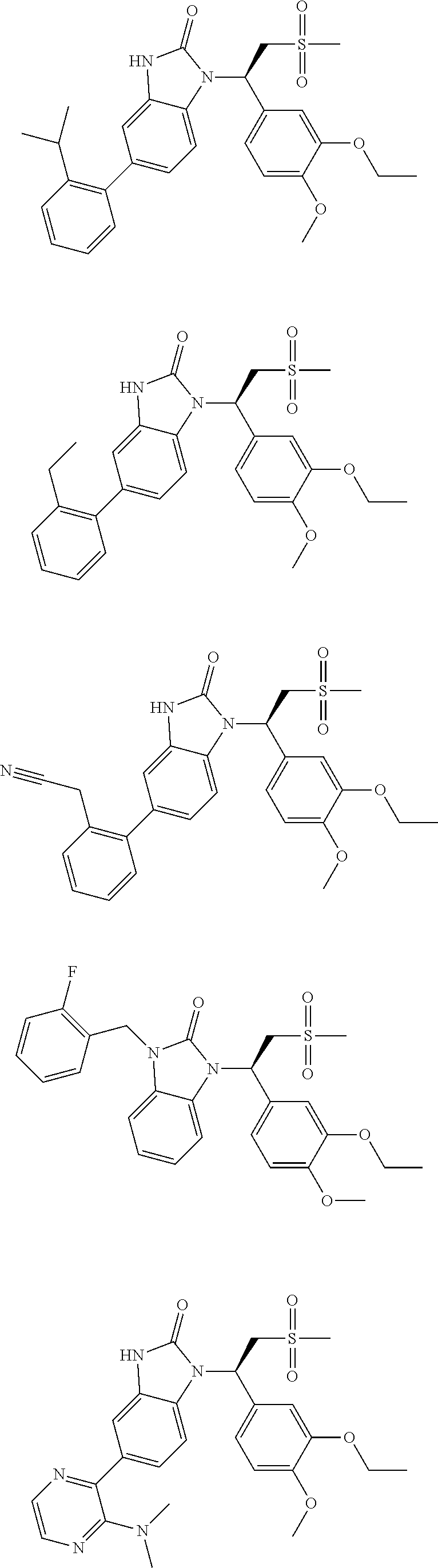


Applications Claiming Priority (4)
| Application Number | Priority Date | Filing Date | Title |
|---|---|---|---|
| CN201610706073.1 | 2016-08-22 | ||
| CN201610706073 | 2016-08-22 | ||
| CN201610706073 | 2016-08-22 | ||
| PCT/CN2017/098462 WO2018036470A1 (en) | 2016-08-22 | 2017-08-22 | Cyclic compound acting as pde4 inhibitor |
Publications (2)
| Publication Number | Publication Date |
|---|---|
| US20190210975A1 US20190210975A1 (en) | 2019-07-11 |
| US10532986B2 true US10532986B2 (en) | 2020-01-14 |
Family
ID=61246426
Family Applications (1)
| Application Number | Title | Priority Date | Filing Date |
|---|---|---|---|
| US16/325,626 Active US10532986B2 (en) | 2016-08-22 | 2017-08-22 | Cyclic compound acting as PDE4 inhibitor |
Country Status (6)
| Country | Link |
|---|---|
| US (1) | US10532986B2 (en) |
| EP (1) | EP3502099B1 (en) |
| JP (1) | JP7050054B2 (en) |
| CN (1) | CN109563051B (en) |
| ES (1) | ES2852098T3 (en) |
| WO (1) | WO2018036470A1 (en) |
Cited By (1)
| Publication number | Priority date | Publication date | Assignee | Title |
|---|---|---|---|---|
| US11325907B2 (en) | 2018-01-29 | 2022-05-10 | Medshine Discovery Inc. | Crystal form of 1H-imidazo[4,5-b]pyridine-2(3H)-one compound and preparation process therefor |
Families Citing this family (3)
| Publication number | Priority date | Publication date | Assignee | Title |
|---|---|---|---|---|
| JP2022539257A (en) * | 2019-07-04 | 2022-09-07 | メッドシャイン ディスカバリー インコーポレイテッド | Crystals, solvates, crystals of solvates of benzimidazol-2-one compounds, and methods for preparing them |
| JP2023531113A (en) * | 2020-02-24 | 2023-07-21 | スーヂョウ ロングボタイ ファーマシューティカルズ カンパニー リミテッド | PDE4 INHIBITOR COMPOUNDS AND MEDICINE USES THEREOF |
| EP4326713A4 (en) * | 2021-04-12 | 2025-03-19 | Impact Therapeutics (Shanghai), Inc. | SUBSTITUTED FUSED BICYCLIC COMPOUNDS AS PARP INHIBITORS AND THEIR USE |
Citations (3)
| Publication number | Priority date | Publication date | Assignee | Title |
|---|---|---|---|---|
| WO2002072576A1 (en) * | 2001-03-09 | 2002-09-19 | Pfizer Products Inc. | Benzimidazole anti-inflammatory compounds |
| US20040192748A1 (en) * | 2002-09-13 | 2004-09-30 | Boehringer Ingelheim Parmaceuticals, Inc. | Heterocyclic compounds |
| US20160159801A1 (en) * | 2013-06-21 | 2016-06-09 | Zenith Epigenetics Corp. | Novel bicyclic bromodomain inhibitors |
Family Cites Families (6)
| Publication number | Priority date | Publication date | Assignee | Title |
|---|---|---|---|---|
| US8119676B2 (en) * | 2006-08-26 | 2012-02-21 | Abbott GmbH & Co. HG | Substituted benzimidazolone derivatives, medicaments comprising them and their use |
| WO2011021678A1 (en) * | 2009-08-21 | 2011-02-24 | 武田薬品工業株式会社 | Fused heterocyclic compound |
| EP2603079B1 (en) * | 2010-08-12 | 2018-09-19 | Merck Sharp & Dohme Corp. | Positive allosteric modulators of mglur2 |
| BR112015019276A2 (en) | 2013-02-19 | 2017-07-18 | Pfizer | azabenzimidazole compounds as inhibitors of pde4 isoenzymes for the treatment of snc disorders and other disorders |
| JP2014114308A (en) | 2014-01-31 | 2014-06-26 | Celgene Corp | Solid forms comprising (+)-2-[1-(3-ethoxy-4-methoxyphenyl)-2-methylsulfonylethyl]-4-acetylaminoisoindoline-1,3-dione, compositions thereof, and uses thereof |
| AR101196A1 (en) | 2014-07-16 | 2016-11-30 | Gruenenthal Gmbh | SUBSTITUTED PYRIMIDINE COMPOUNDS |
-
2017
- 2017-08-22 CN CN201780046018.7A patent/CN109563051B/en active Active
- 2017-08-22 WO PCT/CN2017/098462 patent/WO2018036470A1/en not_active Ceased
- 2017-08-22 ES ES17842893T patent/ES2852098T3/en active Active
- 2017-08-22 EP EP17842893.4A patent/EP3502099B1/en active Active
- 2017-08-22 US US16/325,626 patent/US10532986B2/en active Active
- 2017-08-22 JP JP2019510933A patent/JP7050054B2/en active Active
Patent Citations (3)
| Publication number | Priority date | Publication date | Assignee | Title |
|---|---|---|---|---|
| WO2002072576A1 (en) * | 2001-03-09 | 2002-09-19 | Pfizer Products Inc. | Benzimidazole anti-inflammatory compounds |
| US20040192748A1 (en) * | 2002-09-13 | 2004-09-30 | Boehringer Ingelheim Parmaceuticals, Inc. | Heterocyclic compounds |
| US20160159801A1 (en) * | 2013-06-21 | 2016-06-09 | Zenith Epigenetics Corp. | Novel bicyclic bromodomain inhibitors |
Cited By (1)
| Publication number | Priority date | Publication date | Assignee | Title |
|---|---|---|---|---|
| US11325907B2 (en) | 2018-01-29 | 2022-05-10 | Medshine Discovery Inc. | Crystal form of 1H-imidazo[4,5-b]pyridine-2(3H)-one compound and preparation process therefor |
Also Published As
| Publication number | Publication date |
|---|---|
| CN109563051B (en) | 2024-06-11 |
| JP7050054B2 (en) | 2022-04-07 |
| EP3502099B1 (en) | 2020-12-09 |
| JP2019529364A (en) | 2019-10-17 |
| WO2018036470A1 (en) | 2018-03-01 |
| EP3502099A1 (en) | 2019-06-26 |
| ES2852098T3 (en) | 2021-09-13 |
| EP3502099A4 (en) | 2020-03-04 |
| US20190210975A1 (en) | 2019-07-11 |
| CN109563051A (en) | 2019-04-02 |
Similar Documents
| Publication | Publication Date | Title |
|---|---|---|
| US11040968B2 (en) | Pyridine derivative as ASK1 inhibitor and preparation method and use thereof | |
| US10662189B2 (en) | PDE4 inhibitor | |
| US11117899B2 (en) | [1,2,4]triazolo[1,5-c]pyrimidine derivative as A2A receptor inhibitor | |
| US12528791B2 (en) | Thyroid hormone receptor beta agonist compounds | |
| CN115315427B (en) | HPK1 inhibitors and preparation methods and uses thereof | |
| CN112839655B (en) | Thyroid hormone receptor β agonist compounds | |
| US10532986B2 (en) | Cyclic compound acting as PDE4 inhibitor | |
| US11312715B2 (en) | Fused ring derivative as A2A receptor inhibitor | |
| US11053260B2 (en) | Tri-cycle compound and applications thereof | |
| US11643388B2 (en) | Inhibitors of alpha 2 beta 1 integrin and methods of use thereof | |
| KR102283677B1 (en) | SGLT inhibitors and their applications | |
| US11384065B2 (en) | Heterocyclic compound as CSF-1R inhibitor and use thereof | |
| US10519143B2 (en) | Substituted-indole-compounds as estrogen receptor down-regulators | |
| US11155523B2 (en) | Biphenyl compound as CCR2/CCR5 receptor antagonist | |
| US11014943B2 (en) | Azetidine derivative | |
| US20250361241A1 (en) | Hpk1 inhibitor and medical use thereof | |
| US20250059206A1 (en) | Fused ring compound acting as shp2 inhibitor | |
| US10851112B2 (en) | Anti-HCMV virus compound | |
| US20180104220A1 (en) | Imidazole compound | |
| HK40002597A (en) | Pde4 inhibitor | |
| HK40002597B (en) | Pde4 inhibitor |
Legal Events
| Date | Code | Title | Description |
|---|---|---|---|
| FEPP | Fee payment procedure |
Free format text: ENTITY STATUS SET TO UNDISCOUNTED (ORIGINAL EVENT CODE: BIG.); ENTITY STATUS OF PATENT OWNER: LARGE ENTITY |
|
| AS | Assignment |
Owner name: MEDSHINE DISCOVERY INC., CHINA Free format text: ASSIGNMENT OF ASSIGNORS INTEREST;ASSIGNORS:LUO, YUNFU;YANG, CHUNDAO;LEI, MAOYI;AND OTHERS;REEL/FRAME:048473/0941 Effective date: 20190125 |
|
| STPP | Information on status: patent application and granting procedure in general |
Free format text: NON FINAL ACTION MAILED |
|
| STPP | Information on status: patent application and granting procedure in general |
Free format text: NOTICE OF ALLOWANCE MAILED -- APPLICATION RECEIVED IN OFFICE OF PUBLICATIONS |
|
| STPP | Information on status: patent application and granting procedure in general |
Free format text: PUBLICATIONS -- ISSUE FEE PAYMENT RECEIVED |
|
| STPP | Information on status: patent application and granting procedure in general |
Free format text: PUBLICATIONS -- ISSUE FEE PAYMENT VERIFIED |
|
| STCF | Information on status: patent grant |
Free format text: PATENTED CASE |
|
| MAFP | Maintenance fee payment |
Free format text: PAYMENT OF MAINTENANCE FEE, 4TH YEAR, LARGE ENTITY (ORIGINAL EVENT CODE: M1551); ENTITY STATUS OF PATENT OWNER: LARGE ENTITY Year of fee payment: 4 |