US1052257A - Machine for feeding sheets and like articles. - Google Patents
Machine for feeding sheets and like articles. Download PDFInfo
- Publication number
- US1052257A US1052257A US64046411A US1911640464A US1052257A US 1052257 A US1052257 A US 1052257A US 64046411 A US64046411 A US 64046411A US 1911640464 A US1911640464 A US 1911640464A US 1052257 A US1052257 A US 1052257A
- Authority
- US
- United States
- Prior art keywords
- articles
- sheet
- sheets
- machine
- arm
- Prior art date
- Legal status (The legal status is an assumption and is not a legal conclusion. Google has not performed a legal analysis and makes no representation as to the accuracy of the status listed.)
- Expired - Lifetime
Links
- 241000347389 Serranus cabrilla Species 0.000 description 31
- 239000011435 rock Substances 0.000 description 14
- 230000003028 elevating effect Effects 0.000 description 4
- 239000002184 metal Substances 0.000 description 4
- 238000004804 winding Methods 0.000 description 4
- FPIPGXGPPPQFEQ-OVSJKPMPSA-N all-trans-retinol Chemical compound OC\C=C(/C)\C=C\C=C(/C)\C=C\C1=C(C)CCCC1(C)C FPIPGXGPPPQFEQ-OVSJKPMPSA-N 0.000 description 2
- 101150091111 ACAN gene Proteins 0.000 description 1
- 101100422770 Caenorhabditis elegans sup-1 gene Proteins 0.000 description 1
- 241001125879 Gobio Species 0.000 description 1
- POSKOXIJDWDKPH-UHFFFAOYSA-N Kelevan Chemical compound ClC1(Cl)C2(Cl)C3(Cl)C4(Cl)C(CC(=O)CCC(=O)OCC)(O)C5(Cl)C3(Cl)C1(Cl)C5(Cl)C42Cl POSKOXIJDWDKPH-UHFFFAOYSA-N 0.000 description 1
- 229910000831 Steel Inorganic materials 0.000 description 1
- 241000153282 Theope Species 0.000 description 1
- 241000193803 Therea Species 0.000 description 1
- 241000135164 Timea Species 0.000 description 1
- 239000011717 all-trans-retinol Substances 0.000 description 1
- 235000019169 all-trans-retinol Nutrition 0.000 description 1
- 210000001691 amnion Anatomy 0.000 description 1
- NEHMKBQYUWJMIP-UHFFFAOYSA-N chloromethane Chemical compound ClC NEHMKBQYUWJMIP-UHFFFAOYSA-N 0.000 description 1
- 238000010276 construction Methods 0.000 description 1
- 230000006870 function Effects 0.000 description 1
- 230000013707 sensory perception of sound Effects 0.000 description 1
- 239000010959 steel Substances 0.000 description 1
Images




Classifications
-
- B—PERFORMING OPERATIONS; TRANSPORTING
- B65—CONVEYING; PACKING; STORING; HANDLING THIN OR FILAMENTARY MATERIAL
- B65H—HANDLING THIN OR FILAMENTARY MATERIAL, e.g. SHEETS, WEBS, CABLES
- B65H3/00—Separating articles from piles
- B65H3/02—Separating articles from piles using friction forces between articles and separator
- B65H3/06—Rollers or like rotary separators
- B65H3/0684—Rollers or like rotary separators on moving support, e.g. pivoting, for bringing the roller or like rotary separator into contact with the pile
Definitions
- Ronnn'r E. -Kn. ⁇ i rER and ARTHUR KE PE citizens of the United States, residing atRensselaeI', in the county of Rensselaer and State of New York, have invented certain new andquseful Improvements in Machines'for 'Feeding Sheets and Like Articles; and we do hereby declare the following to be a full. clear, and exact de-- scription of the inventiornfsuch asayill en-' able others skilled in the art to whichlit apperteins to ma'ke and use the same.
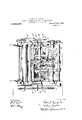
- Figure 1 represents a right side elevation of the ma chineor embodiment of our invention which we have selectedfor purposes of illustration.
- Fig. 2 is a left side elevation of the same.
- Fig. 3 is a top plan view of the machine.
- Fig. 4 is afront elevat on thereof.
- Fig. 5 is a vertical'long itudinal sectional view of the machine taken on the line 5 5, Fig. 3, looking in the direction of the'arrows in that figure. the parts being shown in the positions which they occupy when. the .comber has combed forward the topmost sheets of.the.
- separating mechanism is also provided for separating the topmostsheet from the rest of the pile and a dividing device is pro-- vlded which is moved between the separated sheet and the balance of the pile and preferably carries the sheet, into engagement with a feed roller, which is preferably a continuously moving roller and which feeds and delivers the sheet selected by the separating and dividing mechanism;.1neans a re also provided for' pushing back the upper sheets of the pile which may have been partially thrust forward when the topmostshect was combed out, so that the topmost sheet will always occupy a predetermined position at the beginning of each cycle of operation of the apparatus.
- Means are also provided for automatically advancing the support for the pile of sheets or other articles, so as to'maintain the topmost sheet ,ilL practically uniform relationwith the on and particularly with! respect to the conibei as we term the device for combing or forming out the top. sheet.
- B represents. thefeed table which is supported upon horizontal brackets 7), I) each of to the inner faces of the side frames A, A.
- The-rackbarsB, B are engaged by pinions c. c secured toa transverse actuating shaft LC. mounted in hearings in the side frames.
- the shaft,C is provided .at one end, see Fig. i 2, with a ratchet wheel 0' whiohis en aged 1 by .a lockingpawl .c secured to the ad aoent which is secured to m vertically disposed; rack bar B mounted in guides b, secured parts of the apparatus which operate therea rigid structure capable of supporting variside frame and also by a pawl 62 pivoted to a short arm secured to a rock shaft D mounted in 'the side frames of the machine, the said'pawl d being held in engagement with the ratchet wheel 0 by a spring (Z
- the rock shaft 1) just referred to carries the comber or device for fanning or combing out the topmost sheet of the pile, 4 In this nstance we have shown for this purpose a rotary disk E provided with a
- Thedisk-E is mounted on a shaft 0 which is carried at. the outer end of. aframe 6? which is r gidly secured to ,the rock shaft D.
- Rotary motion is imof the machine and wheel f which is connected by means of a Shown an upon the top- 0f; the
- the shaftcf is provided with .a sprocket wheel '6 engaged by the sprocket chain c" which passes over a driving sprocket f on a shaft F mounted in the side frames provided with a sprocket with a driving sprocket g on the main driving or cam shaft G of the mahine, which is-mounted in the side frames chain .7
- cam G inaddition to raising and lowering the comber, also operate the arm. d and pawl (1 so as to effecta rotation, of the shaft C, thereby slowly, and gradually raising the rack bars, Bfland. the paper supporting de- This vertical feed of the paper operates automatically regardless of the variations inthicknessof the sheets of paper or other articles to be fed, for, should the table B lieraised more rapidly than the sheets withdrawnffrom the thickness of the when the comber descends pile warrants,
- h represents'gme feed j roller wh ch' ris pile the friction roller mounted upon the shaft H,supported in the side frames above the delivery end of the table B and we also prefer to provide a delivery rolle'r it forward of the feed roller 72 and an idle roller 7L located above and in contact with the delivery roller h for taking the sheets or articles as fed by the feed roller h and delivering them from tl1e ma-. chine.
- the delivery roller h is mounted on a shaft H carried in the side frames and the idle roller 71 is provided with'gudge ons 70 slots .in the sidefframes or parts secured thereto, for hold-mg the idle'roller in its proper position
- continuous motion is transmitted to the feed roller 7'5 which engage vertically disposed guidesmr" h and the delivery roller h by means of a sprocket chain-hf which passes around a driving sprocket f on the shaft F, and an idle sprocket k secured to one of the side frames at the forward end of the machine,
- Each of the separators L is normallypressed yieldingly toward the pile' 'of sheets or like articles by means of a very light spring Z suitably connected to the separator L at one end and having its other end connected to an arm. It projecting downwardly from the arm K.
- a very light spring Z suitably connected to the separator L at one end and having its other end connected to an arm. It projecting downwardly from the arm K.
- the f" separator from a piece of sheet'steel or other metal in the form of,a blade, the lower end of which is bent outwardly and then upwardly .toform a short arm 1 and the pivot connect ing the separator to the outer end of the arm- K, passes through both the main body of the separat'dr and the short paralle'l'portion or arm Z thus providing an elongated bearv ing for this pivotal connections
- Thehpper end of the spring Z is preferably connected tothe shortarm Z-,'"as shown inFi 5 and the lower end of the spring is provi ed with a fiexibleconnection Z which is wound upon a small'drum Z secured in position onthe Losses? arm k by ascrew or bolt and by turning this drum more or less the tension of the spring can be very delicately adjusted.
- the shaft J which carries the arms K to which theseparators are connected, is provided with an actuating arm 7' having at its outer enda friction roller which engages a cam G on the shaftG, said cambeing constructed to impart the desired movement to the separator or separators.
- the friction roller y" is'held in engagement with the cam G by means of a spring j secured atone end to the arm 7' and at the other end to a stationary part'of the machine, in this i stance a cross bar a, see Fig. 4.
- Each of the separators L is disengaged from the. sheet or like article and held normally out of engagement therewith during a portion of the cycle of the machine, by a device which we term a kick-oil, one of said devices being provided for each of the separators-
- Each kick-off consists of a verti c'ally disposed arm m (rigidly secured to.a
- rock shaftlM mounted in the side frames of the machine) and provided at its upper exit] with a stud or pin m" for engaging the separator on therear side thereof.
- the rock .shaft. M is provided with an arm m extending upwardly therefrom and provided with a friction roll m which engages a cam G on the shaft- G for operating the kickofls' at the propertime.
- the actuating arm m is held-in engagement with the cam G? 5 by a spring and in this instance we have two being shown herein. Ea'ch of these jog:
- gers consists'ofa vertically disposed arm-N is provided at its upper end with a vertically disposed: plateportion n extending latel-ally on one or both sides of the arm, in this case on both sides as clearly shown in Fig. 4.
- the rock shaft is provided with an actuating arm 0 carrying at its outer end a friction roller 0..Wh1Ch engages acan -G 6n; the shaft G.
- the friction roller 0" is 7 held in engagement with said cam by means of a'spring, n this'instanc'e a spring a, see
- the front guides consistof verticallydisposed arms provided at their lower ends with collars p rigidly but adjustablysecured to one of the cross bars a of the machine, as clearly shown in Figs. 5 and 6; in'this instance-the collars 79 are secured to the'cross bar by a set screw 7).
- the rear guide consists, of a cross bar R provided with depending guide fingers 1' engaging the rear ends of the sheets or other articles, the said cross bar being supported on horizontal rails Q, Q; secured to the side cross bar It is provided with a strap 1" extending over the top of the same and having its epdfl 4i extending downwardly outsideof the; rails the cross bar R lying between said rails," and the downwardly ex- -tendingends r of the strap are provided with set screws 7 for securing the cross bar rigidly in position with respect-to therails Obviously tlie cross bar may be ad justed to different positions on the rails, to-' ward and from the front guides P, P to accommodate sheets or, articles of: different lengths. v 7
- said table or support is preferably made of open or slatted construction with longitudinal openings between the slats in vertical alinement with the fingers r of the rear guides, so that said fingers will not interfere with thevertical movement of the table B, as shown in the drawings, in Figs. 5 and 6 of which the fingers 'r are shown extend: ing into the ope portions of thetable.
- S represents the divider which is disposed horizontally and arranged to reciprocate.
- a horizontal plate which is supported in part upon the cross rod (1 upon which it slides and in part by a vertical arm t to which it is piyotally connected at its outer or foremost end.
- the arm is rigidly secured to a rock shaft T mounted in the lower part of the side frames and said rock shaft is provided with an actuating arm 15' carrying at its upper end a friction roller t engaging a cam G on the shaft G, see Figs. 4c and 6.
- the rearward end of the divider is inadejwedgeshaped as shown at s and in rear of said wedge shaped portion a pressure roller 8 is mounted ro-,
- said pressure roller being in line withthe feed roller, hand adapted to press the separated sheet or other article into contactwith the feed roller h.
- the operation of the machine is as follows: The pile of sheets or other articles to be fed by the machine is placed upon the table B with the front edges against the front-guides P, tlie table B being lowered by releasing the pawls c and d and allowing the rack bars to slide to their lowest position. The rear guide is then adjusted so as to engage the rear edges of the pile of sheets or other articles. Assuming that the machine'is in position to commence its cycle of operations and that the comber is in raised osition, the table B is then raised by hand until the topmost sheet is nearly in engagement with the comber when the machine may be started. The machine is operated' either by hand or by power but preferably power, motion being imparted in any desired way to the shaft G.
- the comber will drum or fan out the uppermost sheets as indicated in Fig. 5, thetopmostsheet being fanned or combed out farther than those immediately beneath it, the front guides l f terminating at this point below the top of the pile so as not to interfere with this fanning out or combing out operation.
- the kick-offs are moved backward so as to permit the separators to move rearwardly until.
- chine that this will be done.
- ltisonly nee.- cssary that they should push any of the up stead of under the sheet next to be selected.
- a separator consist- "provided withserrated portions and having and the blade and extending through the into contact'with the v.iel ng separators,
- a machine for feeding'sh'eets andlike articles the combination .with a supporting table, a feed roller adjacent to one edge ofsaid table, and a pressure roller and means for moving the pressure roller toward and from-the feed roller, of a separator, consist ing of athin metal blade having one endprovided withserrated port-ions, an actuatdrmn carried by a part connected to said gaging said winding drum. andmeans for said winding devic'e'in any position towhich it may be adjusted.
- Ra'feed roller located adjacent to the position 50f said pile; a divider provided with a roller adapted to cooperate with the feed roller,
- dividing device adapted to pass beneath'the raised portions of the topmost-sl1eet, a roller carried by' said dividing device, and means for moving said dividing device toward the pile of sheets to cause its roller to press the separated topmost sheet into contact with i i the feed roller.
- a movable separat r disposed obliquely to and extend-. ing across the plane of the topmost sheet,
- comber means for operating the. comber to cause it to movethe topmost sheet toward the sepamost article, a feed roller, a movable dividrator and a horizontally moving dividing device, and means for movlng the -d1V1d11'1g device toward and from the comber, to cause it to pass beneath the sheets as they are raised-by the comber and separator.
- a separator for-engaging and lifting the toping device having a portion adapted to pass beneath the topmost article, means for moving saiddividing devlcetoward and from the pile of articles 'on the table, and a pressure' roller-carried by said dividing device and adapted to press the selected article into I engagement with the separator to raisethe edge of the sheet, a horizontally movable divider, provided with a pressure roller, adapted to pass beneath the topmost sheet when its edge is raised and'press it into engagement with the feed roller.
- a 'machine for feeding sheets or like articles the combination with a supporting table, of a rotary comber located above the same, a separator disposed obliquely to and across the plane of the top- -most sheet and provided with a serrated surface, means for, operating the comber. to move the topmost sheet toward the separator, a feed roller, a movable divider adapted to, pass beneath the topmost sheet and provided with a pressure roller for forcing the sheet above it' into contact with the feed roller, and means for raising the comber out of contact with the topmost sheet when the latter has been placed in engagement with the said rollers.
- elevating mechanism forsaid 5 table including a ratchet Wheel and a feed pawl operatively connected with said pivoted arm-and engaging saldaraichet wheel whereby over feed of the table will lift said pivoted arm partially out of contact with said cam, and'prevent the full -operation of t the elevating mechanism thereby.
- elevating mechanism forsaid 5 table including a ratchet Wheel and a feed pawl operatively connected with said pivoted arm-and engaging saldaraichet wheel whereby over feed of the table will lift said pivoted arm partially out of contact with said cam, and'prevent the full -operation of t the elevating mechanism thereby.
Landscapes
- Engineering & Computer Science (AREA)
- Mechanical Engineering (AREA)
- Sheets, Magazines, And Separation Thereof (AREA)
Description
R. E. & A. KEMPBE; MACHINE FOR FEEDING SHEETS AND LIKE ARTICLES.
v Patentd Feb. 4, 1913.
' a SHEETS-811E111 1 VVl: V/OR5 QM 28 B m Alf urns APPLIOATION FILED JULY 25, 1911.' 1,052,257.
, :E b m R. E. & A. KEMPER. MACHINE FOR FEEDING SHEETS AND LIKE ARTICLES.
APPLICATION FILED JULY 25, 1911. 1,052,251 Patented Feb. 4, 1913 6 SHEETSSHEET 2.
W BY xmxw R. E. & A. KBMPER. MACHINE FOB. FEEDING SHEETS AND LIKE ARTICLES.
APPLIOATION FILED JULY 25, 1911.
' Patented Feb. 4, 1913.
6 SHEET S-SHEET 3.
- WIT/V R. E. & A. K EMPER. MACHINE FOR FEEDING SHEETS ANDLIKE ARTICLES;
APPLICATION FILED JULY 25,1911. 1,052,257.
6 SHEETS-SHEET 4.
' L-VVEN T025 Patented- Feb. 4, 1913.
R. B. & A. KEMPBR. MACHINE. FOR FEEDING; SHEETS AND LIKE ARTICLES.
APPLICATION FILED JULY 25, 1911.
1,052,257, Patented Feb.4,19 13.
R. E. & A. KEMPER. MACHINE FOR FEEDING SHEETS AND LIKE ARTICLES.
APPLIOATION FILED JULY 25,1911,
1,052,257, Patented Feb.4-,1913.
6 SHEETSSHEET 6,
W1 Y'Nli [NVEN r0,
ROBERT E. KEMPER nun amnion .xnigtrnnjor RENSSELAIER; New YORK.
MACHINE Eon FEEDING-SHEETS ,AND LIKE ARTICLES.
Specification o etters Pat nt.
, Patented Feb. 4,1913.
- Application fi eazraly 25. 191-1. s ria no. 650,;164.
. I b all whom it may concern Be it known that we, Ronnn'r E. -Kn.\i rER and ARTHUR KE PE citizens of the United States, residing atRensselaeI', in the county of Rensselaer and State of New York, have invented certain new andquseful Improvements in Machines'for 'Feeding Sheets and Like Articles; and we do hereby declare the following to be a full. clear, and exact de-- scription of the inventiornfsuch asayill en-' able others skilled in the art to whichlit apperteins to ma'ke and use the same.
Our-'- invention consistsin the novel fea-- tures hereinafter described, reference being had to the accompanyingdrawings which shown form or embodiment of the invention which we have selected forthe purpose of illustrating the same, and the invention is fully disclosed in the following description" and .claims. v
Referring to the said drawings, Figure 1 represents a right side elevation of the ma chineor embodiment of our invention which we have selectedfor purposes of illustration. Fig. 2 is a left side elevation of the same. Fig. 3 is a top plan view of the machine. Fig. 4 is afront elevat on thereof. Fig. 5 isa vertical'long itudinal sectional view of the machine taken on the line 5 5, Fig. 3, looking in the direction of the'arrows in that figure. the parts being shown in the positions which they occupy when. the .comber has combed forward the topmost sheets of.the. pile, the separators have'raised the .tQP nost sheet fro-1n the pile and the Z i the side frames of the machine which are that figure and showing the parts in the g positions whichthey occupy when the topmost sheet-ha's been partially fed. The object of our invent on -1s to provlde. an apparatus for automatically feeding in rapid succession sheets of {paper orother T. like articles, to a printing press or for an e h Pu po In c r yin out ur nventi'on we.;pro .vide neans for supporting thehsheets or artickstobe fed singly, n a
vertical pile without the necessity of having thesheets or other articles fanned out; mechanism is provided for combing or fanning out 'or pushing forward the topmost sheets or articles, the topmost sheet being cqmbedout farther than the adjacent sheets: separating mechanism is also provided for separating the topmostsheet from the rest of the pile and a dividing device is pro-- vlded which is moved between the separated sheet and the balance of the pile and preferably carries the sheet, into engagement with a feed roller, which is preferably a continuously moving roller and which feeds and delivers the sheet selected by the separating and dividing mechanism;.1neans a re also provided for' pushing back the upper sheets of the pile which may have been partially thrust forward when the topmostshect was combed out, so that the topmost sheet will always occupy a predetermined position at the beginning of each cycle of operation of the apparatus. Means are also provided for automatically advancing the support for the pile of sheets or other articles, so as to'maintain the topmost sheet ,ilL practically uniform relationwith the on and particularly with! respect to the conibei as we term the device for combing or forming out the top. sheet.
Referring to the particular embodiment of the-invention which -we have selected 5 for purpo:-:es pf illustration and which will i now be descrlbed in deta l, A, A represent connected by'suitable cross bars a, a to form ous parts of the mechanism.
B represents. thefeed table which is supported upon horizontal brackets 7), I) each of to the inner faces of the side frames A, A.
' The-rackbarsB, B are engaged by pinions c. c secured toa transverse actuating shaft LC. mounted in hearings in the side frames. The shaft,C is provided .at one end, see Fig. i 2, with a ratchet wheel 0' whiohis en aged 1 by .a lockingpawl .c secured to the ad aoent which is secured to m vertically disposed; rack bar B mounted in guides b, secured parts of the apparatus which operate therea rigid structure capable of supporting variside frame and also by a pawl 62 pivoted to a short arm secured to a rock shaft D mounted in 'the side frames of the machine, the said'pawl d being held in engagement with the ratchet wheel 0 by a spring (Z The rock shaft 1) just referred to carries the comber or device for fanning or combing out the topmost sheet of the pile, 4 In this nstance we have shown for this purpose a rotary disk E provided with a plurality of small idle rolls 6, the periph- I cries Of'which extend beyond the periphery' o-f'the disk. Thedisk-E is mounted on a shaft 0 which is carried at. the outer end of. aframe 6? which is r gidly secured to ,the rock shaft D. Rotary motion is imof the machine and wheel f which is connected by means of a Shown an upon the top- 0f; the
-1owest position (as indicatedin Fig therefore, the succeeding upward-movement;
vice or table B,
parted to the comb-er in any suitable manner. Inthis instance the shaftcfis provided with .a sprocket wheel '6 engaged by the sprocket chain c" which passes over a driving sprocket f on a shaft F mounted in the side frames provided with a sprocket with a driving sprocket g on the main driving or cam shaft G of the mahine, which is-mounted in the side frames chain .7
adjacent to the forward partthereof. We also provide in'eansfor elevating the comber :out1of, contact with the pile of sheets or other articles during a port-ion" of the cycle of? the machine and for'lowc'ring it into contact with the topmostsheet at the proper pointinthecycle- For this purpose we have arm d (Figs. 2, 3 and 4:) secured totherock shaft D and provided at its outer nd withfa friction roll d? which is engaged by a cam G I k I It; will be noticed that 'the arm d and on the shaftiG.
cam G inaddition to raising and lowering the comber, also operate the arm. d and pawl (1 so as to effecta rotation, of the shaft C, thereby slowly, and gradually raising the rack bars, Bfland. the paper supporting de- This vertical feed of the paper operates automatically regardless of the variations inthicknessof the sheets of paper or other articles to be fed, for, should the table B lieraised more rapidly than the sheets withdrawnffrom the thickness of the when the comber descends pile warrants,
{b will not be permitted to descend to its 2-) and ofithe armfl. will not be-sufiicient to'move the ratchet wheel 6' the full extent of one-- V tooth and; further feeding of. the paper sup-' portupwardly will be suspended until a i sufficient number of sheets have been withdrawnrfrom the .pileto U enable the ,arm d to'make under the operation of the cam G,
a sufiicient movement to efl' cot a further feed of the ratchetwheel o.-' p
h represents'gme feed j roller wh ch' ris pile the friction roller mounted upon the shaft H,supported in the side frames above the delivery end of the table B and we also prefer to provide a delivery rolle'r it forward of the feed roller 72 and an idle roller 7L located above and in contact with the delivery roller h for taking the sheets or articles as fed by the feed roller h and delivering them from tl1e ma-. chine. The delivery roller h is mounted on a shaft H carried in the side frames and the idle roller 71 is provided with'gudge ons 70 slots .in the sidefframes or parts secured thereto, for hold-mg the idle'roller in its proper position In this instance continuous motion is transmitted to the feed roller 7'5 which engage vertically disposed guidesmr" h and the delivery roller h by means of a sprocket chain-hf which passes around a driving sprocket f on the shaft F, and an idle sprocket k secured to one of the side frames at the forward end of the machine,
.said chain passing over a sprocket h on the shaft Hi and underfa sprocket h on the stance it is shown in egral. One or more of said separators may be employed,'as de-- ortion L. In this in- .sired, and in the present instance we have shown two of the same.- Each of the'separatdrs is pivotally secured to the outer end of an arm K which is rigidly secured to a rock shaf-t'J mounted in the side frames of the. machine for the purpose of controlling the movements of both separators. Each of the separators L is normallypressed yieldingly toward the pile' 'of sheets or like articles by means of a very light spring Z suitably connected to the separator L at one end and having its other end connected to an arm. It projecting downwardly from the arm K. On account of.thedelicacy gf much whiclrthese separators must have, we
find it convenient and desirable to form the f" separator from a piece of sheet'steel or other metal in the form of,a blade, the lower end of which is bent outwardly and then upwardly .toform a short arm 1 and the pivot connect ing the separator to the outer end of the arm- K, passes through both the main body of the separat'dr and the short paralle'l'portion or arm Z thus providing an elongated bearv ing for this pivotal connections Thehpper end of the spring Z is preferably connected tothe shortarm Z-,'"as shown inFi 5 and the lower end of the spring is provi ed with a fiexibleconnection Z which is wound upon a small'drum Z secured in position onthe Losses? arm k by ascrew or bolt and by turning this drum more or less the tension of the spring can be very delicately adjusted.
' The shaft J which carries the arms K to which theseparators are connected, is provided with an actuating arm 7' having at its outer enda friction roller which engages a cam G on the shaftG, said cambeing constructed to impart the desired movement to the separator or separators. The friction roller y" is'held in engagement with the cam G by means of a spring j secured atone end to the arm 7' and at the other end to a stationary part'of the machine, in this i stance a cross bar a, see Fig. 4.
Each of the separators L is disengaged from the. sheet or like article and held normally out of engagement therewith during a portion of the cycle of the machine, by a device which we term a kick-oil, one of said devices being provided for each of the separators- Each kick-off consists of a verti c'ally disposed arm m (rigidly secured to.a
rock shaftlM mounted in the side frames of the machine) and provided at its upper exit] with a stud or pin m" for engaging the separator on therear side thereof. The rock .shaft. M is provided with an arm m extending upwardly therefrom and provided with a friction roll m which engages a cam G on the shaft- G for operating the kickofls' at the propertime. The actuating arm m is held-in engagement with the cam G? 5 by a spring and in this instance we have two being shown herein. Ea'ch of these jog:
. rigidly secured to a rock shaft mounted -i n.-the side frames and each of said arms N 1 shown for this purpose a spring m conand'at the other end to a rea-rwardly exarm m, Fig. 5, secured to the rock The operation of the comber in fanning out the topmost sheet, will ordinarily also fan put or comb out several of the uppermostsheets to a less extent, by'reason of the frictional contact between ,the' several sheets and we provide devices which we terni jogger's for the purfiose ofpushing back all of the sheets thus disturbed, except 'thetopmost sheet, whichwill be fed and delivemd as hgreinafterilescribed. One or moreT'of these Joggers. may be employed.
gers consists'ofa vertically disposed arm-N is provided at its upper end with a vertically disposed: plateportion n extending latel-ally on one or both sides of the arm, in this case on both sides as clearly shown in Fig. 4. The rock shaft is provided with an actuating arm 0 carrying at its outer end a friction roller 0..Wh1Ch engages acan -G 6n; the shaft G. The friction roller 0" is 7 held in engagement with said cam by means of a'spring, n this'instanc'e a spring a, see
,arm 0? secured to the rock shaftO. 1-.. At' the proper time in the cycle cf lthe machine, the I cam Gvpermits the spring 0 acting through the arm-o and rock shaft 0, to more thejoggers rearwardly and push hackfthe sheets at the top of the pile whichhave'been combed out at the same timeas the topmost sheet. v
We also provide'stationary' guiding de-- vices fol-engaging the front and rear edges" oft-he sheets or other articles in the pile carried by the supportingtahle B for holding the sheets o-r other articles in alin'ement upon said table. The front guides consistof verticallydisposed arms provided at their lower ends with collars p rigidly but adjustablysecured to one of the cross bars a of the machine, as clearly shown in Figs. 5 and 6; in'this instance-the collars 79 are secured to the'cross bar by a set screw 7).
The rear guide consists, of a cross bar R provided with depending guide fingers 1' engaging the rear ends of the sheets or other articles, the said cross bar being supported on horizontal rails Q, Q; secured to the side cross bar It is provided with a strap 1" extending over the top of the same and having its epdfl 4i extending downwardly outsideof the; rails the cross bar R lying between said rails," and the downwardly ex- -tendingends r of the strap are provided with set screws 7 for securing the cross bar rigidly in position with respect-to therails Obviously tlie cross bar may be ad justed to different positions on the rails, to-' ward and from the front guides P, P to accommodate sheets or, articles of: different lengths. v 7
As the sheets or articles may;.frequently be of less length than the .table or support B, said table or support is preferably made of open or slatted construction with longitudinal openings between the slats in vertical alinement with the fingers r of the rear guides, so that said fingers will not interfere with thevertical movement of the table B, as shown in the drawings, in Figs. 5 and 6 of which the fingers 'r are shown extend: ing into the ope portions of thetable.
We also proviile mechanism for positively dividing the topmost sheet after its edge has been elevated by the separator or separaters, from the balance'of the sheets in the pile and for-bringing into action a pressure roller which presses the topmmi t or separated sheet into contact with the rotating feed roller ,h. These parts need not of necessity be connectedw'ith each other; in the embodiment of-t-he invention which we have selected for purposes 'of illustration. however, we have shown them combined and comprising a dividing device having a wedge shaped portion to enter the space below the topmost sheet when the latter is raised, and carrying the pressure roller.
S represents the divider which is disposed horizontally and arranged to reciprocate.
It consists of a horizontal plate which is supported in part upon the cross rod (1 upon which it slides and in part by a vertical arm t to which it is piyotally connected at its outer or foremost end. The arm is rigidly secured to a rock shaft T mounted in the lower part of the side frames and said rock shaft is provided with an actuating arm 15' carrying at its upper end a friction roller t engaging a cam G on the shaft G, see Figs. 4c and 6. The rearward end of the divider is inadejwedgeshaped as shown at s and in rear of said wedge shaped portion a pressure roller 8 is mounted ro-,
.tatably in the divider, said pressure roller being in line withthe feed roller, hand adapted to press the separated sheet or other article into contactwith the feed roller h.
The operation of the machine is as follows: The pile of sheets or other articles to be fed by the machine is placed upon the table B with the front edges against the front-guides P, tlie table B being lowered by releasing the pawls c and d and allowing the rack bars to slide to their lowest position. The rear guide is then adjusted so as to engage the rear edges of the pile of sheets or other articles. Assuming that the machine'is in position to commence its cycle of operations and that the comber is in raised osition, the table B is then raised by hand until the topmost sheet is nearly in engagement with the comber when the machine may be started. The machine is operated' either by hand or by power but preferably power, motion being imparted in any desired way to the shaft G. Vhen the machine is in'operation, the comber will drum or fan out the uppermost sheets as indicated in Fig. 5, thetopmostsheet being fanned or combed out farther than those immediately beneath it, the front guides l f terminating at this point below the top of the pile so as not to interfere with this fanning out or combing out operation. At the same time the kick-offs are moved backward so as to permit the separators to move rearwardly until. their serrated portions Z "engage the forward edge of the topmost sheetwhich projects slightly beyond the corresponding edge of the sheet beneath it and the separators are then elevated bymeans of the spring 9' operating in conjunction with a suitable grade of the cam G thereby lifting the front edge ofthe topmost sheetin a direction toward the feed roller h as clearly shown in Fig. 5. At the same drawnrearwardly by a spring connected to the adjacent side frame A, thereby turning the rock shaft Ti and causing the arm 2? to move rearwardly together with the divider S, thus carrying the wedge shaped portion of the divider beneath the top eration continues the divider S continues to move rearwardly, the separators which have performed their functions arelowered and withdraw the separators from engagement with the sheet or article to be fed and the divider moving still farther rearwardly brings the pressure roller s1 into engagement with the sheet above it and presses the sheet against the feed roller /1. Atthe shown in Fig. (3. At the same time the joggers are operated rearwardly, their upper ends or plate portions which. as shown. extend above the front guides P, striking the pile below the selected'sheet or topmost sheet, force them back to their original po sheet which is being operated upon by the feed roller /2 and delivery roller h, from It is not necessary that the joggers should .push the topmost sheet beneath the selected gers --1". but we piefer to so adjust the ma permost sheets which have been disturbed,
as to preclude the divider passing over in- T he sheets or other articles may be dehvered to a printing press or other machine sired. v t
\Vhile we have shown' herein only one comber, and one dividing device, it is to'b c understood that we may employ two or also employ a-ny desired number of separatorsfand any desired nu'n'iber of'joggers.= \Vhile we have shown the separators so an ranged that they shall he reciprocated vertically, this is not essential to the operation f the .machine, as the action of the comber ior combers in combing out the. topmost time the cam Gr permits the arm 25' to be at one end to said arm and at the other end.
sheet as clearly shown in Fig. 5. I .\.s the opsame time the cam G. raises the colnber oft of the pile and 'the feed roller /1 which.rotate-v rapidly, frictionally feeds the topsheet.between it and the pressure roller M, the sheetpassing thence. between the delivery roller 5 h and the idle roll or top roll bias clearly,-
front edges of the uppermost sheets of the,
the machine and restores the various parts of the mechanism to their original position sheet entirely back againstthe guide finhack beyond the rear end of the divider, so,
or for any other purpose that may be de.
more of each if found desirable. We may the kick-ofi's-are moved outwardly so as to 'sition against the rear guide fingers I". as I also clearly shown n Fig. 6. The further operatlon of the machine discharges the, H
chine that this will be done. ltisonly nee.- cssary that they should push any of the up stead of under the sheet next to be selected.
' sheet brings theforward ,ed e of said sheet.
4 which lie in a rearward y inclined position,
- limit ourselves tothe'exac't details .of con-- Le tters Patent is:--
edge of, said tab1e," and a pressure roller,
- elongate 1 arm, a flexible connection secured at one end tosald spring and having its other-end enembodimentof our invention, as variations rator consisting of a v mg one end provided .tions, and having its otherfend' provided,
. tance from and connected to the main portion of the blade, .a movable actuatingarm mg arm pivotally connected tosaid blade, a spring connected, to said blade, a winding.
. said table, and .a pressure roller and means,
from the feed roller, of a separator, consist- "provided withserrated portions and having and the blade and extending through the into contact'with the v.iel ng separators,
hence the-continued action of the comber actingagainst the yielding separators will in any,-case'-cause the forward edge of thesheet to be raised by theseparators-far enough to permit the dividing device or wedge to pass beneath it. v
It is to be understood "that we do. not.
struction' of the various parts shown in this may be I. made therein. without departing from the invention, 1 1 What wenclaim' and desire toseoure byf? 1. In a machine for-feedingrslieetstaiid porting table, a feed rolleradjaoent "to one and means for movm the 'ressu're roller toward and from the feed ro ler, of a sepahin metal blade, hav-- with serrated or- With an arm lying parallel-Ito but at a disfor said separator, a pivot connecting said lade and arm and extendi integral arallel arm thereo ,whereby an bearing for .the pivotal connection of said separator blade is provided.
2.'In a machine for feeding'sh'eets andlike articles, the combination .with a supporting table, a feed roller adjacent to one edge ofsaid table, anda pressure roller and means for moving the pressure roller toward and from-the feed roller, of a separator, consist ing of athin metal blade having one endprovided withserrated port-ions, an actuatdrmn carried by a part connected to said gaging said winding drum. andmeans for said winding devic'e'in any position towhich it may be adjusted.
3'. In a machine for feeding sheets .and like articles, the combination with a supporting table a feed roller adjacent to one edge of for moving the 'pressure roller toward and ing of a thin metal blade, having one end i at itsother end a short arm lying parallel to butat a distance from' the blade and connected therewith, an actuating arm-for said blade, a pivot connecting said actuating arm in its adjustedposition;
through the blade and the said parallel arm thereof, a
spring connected at one end to the said short I arm, and provided at its other'end With a;
flexible connection, a-winding drum carried thereon, andmeans for securing said drum 4. In a machine for feeding sheets orlike articles, the combination with means for supporting a pile of the ai'ticles to be fed, means for lifting portions of the topmost article,
Ra'feed roller, located adjacent to the position 50f said pile; a divider provided with a roller adapted to cooperate with the feed roller,
-;and means for moving said divider beneath the lifted port-ions of said topmost artic to i to g'erl'nit-its' roller totpress the said article 0 .--engagement with the feed roller. like articles, the comb nation with "a supr articles, the-combination with means for sup- 1 porting a .pile of the articles to be fed, meansfor raising the-topmost article at one end, a feed roller, a horizontally movable divider provided .with a portion adapted beneath the. raised portion of the topmost sheet, a ,rollerearried b said divider for forcingthe separated sh t into'contact with thefed rollerto Withdraw 'and feed the to pass same, a and .Imeans for reciprocating sa-id divider.- In a machine for {finding sheet-s oflike' articles, the combination with means for supporting a pile'of sheets or, like articles, of amovably mounted "separating device provided with serrated portions disposed obliquely to the plane of the" topmost sheet and located adjacent --to. one end of the pile, means for advancing the topmost sheet into engagementwith the separating device, to elevate the end portions of the sheet engagedthereby, a feed-roller for withdrawing the sheets'from the pile and feeding them, a. dividing device adapted to pass beneath'the raised portions of the topmost-sl1eet,a roller carried by' said dividing device, and means for moving said dividing device toward the pile of sheets to cause its roller to press the separated topmost sheet into contact with i i the feed roller.
- 7. In a machine for feeding sheets or like articles, the combination with asupporting table, of-a movablv. mounted separating device provided with serrated portlons disposed obliquely to the plane of the topmost sheet, and located adjacent to one end of said table, and a combing device for comb-v ing the topmost sheet into engagement with.
the said. separator, whereby the end' of the sheet willbeiraised, sheet delivering devices and a dividing device adapted'to pass. be i neath the lifted sheet and means for moving the dividing device to force the lifted sheet into engagement with the delivering devices.
8. In a machine for feeding sheets or like articles, the combination with-a supporting table, of a comber located above the same,
for advancing the topmost sheet, a movable separat r disposed obliquely to and extend-. ing across the plane of the topmost sheet,
means for operating the. comber to cause it to movethe topmost sheet toward the sepamost article, a feed roller, a movable dividrator and a horizontally moving dividing device, and means for movlng the -d1V1d11'1g device toward and from the comber, to cause it to pass beneath the sheets as they are raised-by the comber and separator.
9. In a machine for feeding sheets or like articles, the combination with a supporting table, of a comber located above the'same,
a separator for-engaging and lifting the toping device having a portion adapted to pass beneath the topmost article, means for moving saiddividing devlcetoward and from the pile of articles 'on the table, and a pressure' roller-carried by said dividing device and adapted to press the selected article into I engagement with the separator to raisethe edge of the sheet, a horizontally movable divider, provided with a pressure roller, adapted to pass beneath the topmost sheet when its edge is raised and'press it into engagement with the feed roller.
11. In a 'machine for feeding sheets or like articles, the combination with a supporting table, of a rotary comber located above the same, a separator disposed obliquely to and across the plane of the top- -most sheet and provided with a serrated surface, means for, operating the comber. to move the topmost sheet toward the separator, a feed roller, a movable divider adapted to, pass beneath the topmost sheet and provided with a pressure roller for forcing the sheet above it' into contact with the feed roller, and means for raising the comber out of contact with the topmost sheet when the latter has been placed in engagement with the said rollers.
1 -2.In amachine for feeding sheets and like articles, the combination with a vertically movable supporting table, of a comber supported above the same, means for separating and feeding the topmost article, mech-' anism for raising and lowering the comber, out of and I articles on the table, including a pivoted arm connected with the camber, and an ac hinting cam for engaging a partvconnected the comber, a jogger having portions 8X' into contact with the pileof means? with said arm, elevating mechanism forsaid 5 table including a ratchet Wheel and a feed pawl operatively connected with said pivoted arm-and engaging saldaraichet wheel whereby over feed of the table will lift said pivoted arm partially out of contact with said cam, and'prevent the full -operation of t the elevating mechanism thereby. v 13. In a machinefor fefdingshe ets and. like. articles, the combination with a verti cally movable table,'of' stationary front guides for positioning a, pile of articles thereon, located at the delivery end of the table, said guides having their upper ends terminating below the plane of the top of the pile, a rotary comber engaging the topmost sheet, means for raisingand lowering r tending above the upper ends of'the front guides, and a separator forlifting the! edge of. the topmost sheet, a divider adaptedto be moved beneath the topmost sheet when the latter .is raised,- and means for moving the jogger toward and from the pile', of sheets. r I
14. Ina machinefor feedingSheets and like articles. the combination with. a,ver- I tically movable supporting table, stationary guides for thearticles on said table, a comber supported above said table, means for rais-'v 1ng and lowering said combel', a separator for engagingthe topmost article, a dividing device adapted to pass beneath the topmost] article, a feed roller, a] pressure roller. for pressing the separated article into contact I with the feed roller, and ajogger movabletoward and from the table, for replacing the articles below the topmost article, which may 1 have been drummed out bythe comber.
15. In a machine forfeeding-sheets and; 7 like articles,,the combination with'the-supe porting table, a comber supported above the table, means for raising and lowering the comber, a separator having a serrated portion for engaging the edge of the topmost article of a pile'of articles on said table,'a110 feed roller, a dividing device having. a wedge shaped portion, means for moving said Wedge sha ped portion beneath the topmost-j article before the comber is raised-out of; contact with the articles on the table, and .115 means for pressing the separated-articleinto contact with the feeding roller.. 4
16. In a machine for feeding sheets and like articles, the combination with a vertt cally movable supporting ta'ble,of mecha- 1201, nism for elevating said table, acomber supported -above said table, means for raising and lowering said comber, .guidesadj'acent to said table for holding a pile of sheetsin position thereon, a continuously rotating feed roller, a separator for engaging and; separating the top sheet of the pile, a movable dividing device,meens for movingsaid low'the top sheet, a movable jogger for enrollers. gaging the'upper sheets of the pile below the top sheet, and restring them to theirproper 1 tures, in the presence of two Witnesses. 5 1f9ositigm on the pile, operating mechanism ROBFRTE KEMPER or t e jogger, a pressure roller carried by the said'dividing device adapted to press the ARTHUR 'B M E top sheet against the feed roller, a delivery \Vitnesses:
dividing deviee into and out of positionbemechanism fer the said'feed and delivery rolleradjacent to the feed roller, :1 pressure i J. O. SNYDER, l0 -oller (*oiiperatmg tl-lerewith and driving C. LIVINGSTON.
In testinfdiiy-whereef we aflix eur signa- Copies of this patent may be obtained for five cen ts eech, by eddressing the Commissioner of Patents.-
Washington, D, g."
Priority Applications (1)
| Application Number | Priority Date | Filing Date | Title |
|---|---|---|---|
| US64046411A US1052257A (en) | 1911-07-25 | 1911-07-25 | Machine for feeding sheets and like articles. |
Applications Claiming Priority (1)
| Application Number | Priority Date | Filing Date | Title |
|---|---|---|---|
| US64046411A US1052257A (en) | 1911-07-25 | 1911-07-25 | Machine for feeding sheets and like articles. |
Publications (1)
| Publication Number | Publication Date |
|---|---|
| US1052257A true US1052257A (en) | 1913-02-04 |
Family
ID=3120518
Family Applications (1)
| Application Number | Title | Priority Date | Filing Date |
|---|---|---|---|
| US64046411A Expired - Lifetime US1052257A (en) | 1911-07-25 | 1911-07-25 | Machine for feeding sheets and like articles. |
Country Status (1)
| Country | Link |
|---|---|
| US (1) | US1052257A (en) |
Cited By (2)
| Publication number | Priority date | Publication date | Assignee | Title |
|---|---|---|---|---|
| US4934684A (en) * | 1988-04-05 | 1990-06-19 | National Computer Systems, Inc. | Sheet picking mechanism |
| US5195738A (en) * | 1989-06-30 | 1993-03-23 | National Computer Systems, Inc. | Single sheet picking and transport mechanism |
-
1911
- 1911-07-25 US US64046411A patent/US1052257A/en not_active Expired - Lifetime
Cited By (2)
| Publication number | Priority date | Publication date | Assignee | Title |
|---|---|---|---|---|
| US4934684A (en) * | 1988-04-05 | 1990-06-19 | National Computer Systems, Inc. | Sheet picking mechanism |
| US5195738A (en) * | 1989-06-30 | 1993-03-23 | National Computer Systems, Inc. | Single sheet picking and transport mechanism |
Similar Documents
| Publication | Publication Date | Title |
|---|---|---|
| US549111A (en) | Dore h | |
| US2879991A (en) | Collocating machines | |
| US2203823A (en) | Sheet separating and feeding mechanism for printing presses | |
| US1167214A (en) | Delivery apparatus. | |
| US641027A (en) | Machine for cutting and notching roofing-plates. | |
| US2687301A (en) | Device for handling printed sheets | |
| US1787572A (en) | Sheet rack for presses | |
| US1094048A (en) | Sheet-delivery apparatus for printing-machines. | |
| US2627406A (en) | Sheet-mounting machine | |
| US1938325A (en) | Sheet rack for presses | |
| US1074720A (en) | Automatic feeding device for printing-presses. | |
| US930097A (en) | Sheet-piling device. | |
| US1200136A (en) | Machine for cutting sheet material into strips. | |
| US1807864A (en) | Envelope making machinery | |
| US1513438A (en) | Printing press | |
| US1331977A (en) | Automatic paper-layer for printing-machines | |
| US678044A (en) | Sheet-delivery apparatus. | |
| US1239149A (en) | Machine for applying metallic leaf. | |
| US1956140A (en) | Feeding device for sheets | |
| US2186485A (en) | Slip sheet feeder | |
| US1619106A (en) | Sheet-delivery mechanism for presses | |
| US1411520A (en) | Paper lift | |
| US1376875A (en) | Paper-feeding machine | |
| US262177A (en) | cowman | |
| US1680470A (en) | Paper-feeding machine |