US10519446B2 - Organic compounds to treat hepatitis B virus - Google Patents
Organic compounds to treat hepatitis B virus Download PDFInfo
- Publication number
- US10519446B2 US10519446B2 US15/025,852 US201415025852A US10519446B2 US 10519446 B2 US10519446 B2 US 10519446B2 US 201415025852 A US201415025852 A US 201415025852A US 10519446 B2 US10519446 B2 US 10519446B2
- Authority
- US
- United States
- Prior art keywords
- strand
- phosphate
- mer
- end cap
- spacer
- Prior art date
- Legal status (The legal status is an assumption and is not a legal conclusion. Google has not performed a legal analysis and makes no representation as to the accuracy of the status listed.)
- Active
Links
- 0 *Cc(cc1)ccc1C#Cc1ccc(COC(CCC([O-])=O)=O)cc1 Chemical compound *Cc(cc1)ccc1C#Cc1ccc(COC(CCC([O-])=O)=O)cc1 0.000 description 31
- IVBCRZYHGIOLDC-UHFFFAOYSA-N CCCCCCC(=O)CC1=C(C2=CC=CC=C2)C2=CC=CC=C2N=C1 Chemical compound CCCCCCC(=O)CC1=C(C2=CC=CC=C2)C2=CC=CC=C2N=C1 IVBCRZYHGIOLDC-UHFFFAOYSA-N 0.000 description 5
- YRLNVYNEXSHUFR-UHFFFAOYSA-N CCCCCCC(=O)CC1=CC2=CC=CC=C2N=C1 Chemical compound CCCCCCC(=O)CC1=CC2=CC=CC=C2N=C1 YRLNVYNEXSHUFR-UHFFFAOYSA-N 0.000 description 5
- YUFBNKNXIJNHAX-UHFFFAOYSA-N CCCCCCCC(=O)CC1=C(C2=CC=CC=C2)C2=CC=CC=C2N=C1 Chemical compound CCCCCCCC(=O)CC1=C(C2=CC=CC=C2)C2=CC=CC=C2N=C1 YUFBNKNXIJNHAX-UHFFFAOYSA-N 0.000 description 5
- JYLUCENXDALECF-UHFFFAOYSA-N CCCCCC(=O)CC1=C(C2=CC=CC(OCC3=CC=CC=C3)=C2)C2=CC=CC=C2N=C1 Chemical compound CCCCCC(=O)CC1=C(C2=CC=CC(OCC3=CC=CC=C3)=C2)C2=CC=CC=C2N=C1 JYLUCENXDALECF-UHFFFAOYSA-N 0.000 description 4
- PBOIVYLQUDYCLK-UHFFFAOYSA-N CCCCCC(=O)CC1=C(C2=CC=CC=C2)C2=CC(OC)=CC=C2N=C1 Chemical compound CCCCCC(=O)CC1=C(C2=CC=CC=C2)C2=CC(OC)=CC=C2N=C1 PBOIVYLQUDYCLK-UHFFFAOYSA-N 0.000 description 4
- IIPYLJXKGJHBBD-UHFFFAOYSA-N CCCCCC(=O)CC1=C(C2=CC=CC=C2)C2=CC=CC(CCO)=C2N=C1 Chemical compound CCCCCC(=O)CC1=C(C2=CC=CC=C2)C2=CC=CC(CCO)=C2N=C1 IIPYLJXKGJHBBD-UHFFFAOYSA-N 0.000 description 4
- CQNKJAMZMHIJFE-UHFFFAOYSA-N CCCCCC(=O)CC1=C(C2=CC=CC=C2)C2=CC=CC=C2C=C1 Chemical compound CCCCCC(=O)CC1=C(C2=CC=CC=C2)C2=CC=CC=C2C=C1 CQNKJAMZMHIJFE-UHFFFAOYSA-N 0.000 description 4
- BPPSZEOEQDPMMG-UHFFFAOYSA-N CCCCCC(=O)CC1=C(C2=CC=CC=C2)C2=CC=CC=C2C=N1 Chemical compound CCCCCC(=O)CC1=C(C2=CC=CC=C2)C2=CC=CC=C2C=N1 BPPSZEOEQDPMMG-UHFFFAOYSA-N 0.000 description 4
- OQBYKBAWBHMYHK-UHFFFAOYSA-N CCCCCC(=O)CC1=C(C2=CC=CC=C2)C2=CC=CC=C2N=C1 Chemical compound CCCCCC(=O)CC1=C(C2=CC=CC=C2)C2=CC=CC=C2N=C1 OQBYKBAWBHMYHK-UHFFFAOYSA-N 0.000 description 4
- ZHKJSXPRLCRDDE-UHFFFAOYSA-N CCCCCC(=O)CC1=C(C2=CC=CC=C2)C2=CC=CC=C2N=C1C Chemical compound CCCCCC(=O)CC1=C(C2=CC=CC=C2)C2=CC=CC=C2N=C1C ZHKJSXPRLCRDDE-UHFFFAOYSA-N 0.000 description 4
- BIQQKNGNXGHOMN-UHFFFAOYSA-N CCCCCC(=O)CC1=CC2=CC=CC=C2C=N1 Chemical compound CCCCCC(=O)CC1=CC2=CC=CC=C2C=N1 BIQQKNGNXGHOMN-UHFFFAOYSA-N 0.000 description 4
- MECZEQOXZZDJSL-UHFFFAOYSA-N CCCCCC(=O)CC1=CC2=CC=CC=C2N=C1 Chemical compound CCCCCC(=O)CC1=CC2=CC=CC=C2N=C1 MECZEQOXZZDJSL-UHFFFAOYSA-N 0.000 description 4
- GAFTWVCYSTUPBK-UHFFFAOYSA-N CCCCCCC(=O)CC1=C(C2=CC=CC(OCC3=CC=CC=C3)=C2)C2=CC=CC=C2N=C1 Chemical compound CCCCCCC(=O)CC1=C(C2=CC=CC(OCC3=CC=CC=C3)=C2)C2=CC=CC=C2N=C1 GAFTWVCYSTUPBK-UHFFFAOYSA-N 0.000 description 4
- INIYLCWIFKIDFZ-UHFFFAOYSA-N CCCCCCC(=O)CC1=C(C2=CC=CC=C2)C2=CC(OC)=CC=C2N=C1 Chemical compound CCCCCCC(=O)CC1=C(C2=CC=CC=C2)C2=CC(OC)=CC=C2N=C1 INIYLCWIFKIDFZ-UHFFFAOYSA-N 0.000 description 4
- HYLCFWCUHVTCIP-UHFFFAOYSA-N CCCCCCC(=O)CC1=C(C2=CC=CC=C2)C2=CC=CC(CCO)=C2N=C1 Chemical compound CCCCCCC(=O)CC1=C(C2=CC=CC=C2)C2=CC=CC(CCO)=C2N=C1 HYLCFWCUHVTCIP-UHFFFAOYSA-N 0.000 description 4
- YLTBOJLPXUEROB-UHFFFAOYSA-N CCCCCCC(=O)CC1=C(C2=CC=CC=C2)C2=CC=CC=C2C=C1 Chemical compound CCCCCCC(=O)CC1=C(C2=CC=CC=C2)C2=CC=CC=C2C=C1 YLTBOJLPXUEROB-UHFFFAOYSA-N 0.000 description 4
- QPSMARPNAICSLF-UHFFFAOYSA-N CCCCCCC(=O)CC1=C(C2=CC=CC=C2)C2=CC=CC=C2N=C1C Chemical compound CCCCCCC(=O)CC1=C(C2=CC=CC=C2)C2=CC=CC=C2N=C1C QPSMARPNAICSLF-UHFFFAOYSA-N 0.000 description 4
- OGENVKPYRYYBNP-UHFFFAOYSA-N CCCCCCCC(=O)CC1=C(C2=CC=CC(OCC3=CC=CC=C3)=C2)C2=CC=CC=C2N=C1 Chemical compound CCCCCCCC(=O)CC1=C(C2=CC=CC(OCC3=CC=CC=C3)=C2)C2=CC=CC=C2N=C1 OGENVKPYRYYBNP-UHFFFAOYSA-N 0.000 description 4
- JTGLACOKTWAXFU-UHFFFAOYSA-N CCCCCCCC(=O)CC1=C(C2=CC=CC=C2)C2=CC(OC)=CC=C2N=C1 Chemical compound CCCCCCCC(=O)CC1=C(C2=CC=CC=C2)C2=CC(OC)=CC=C2N=C1 JTGLACOKTWAXFU-UHFFFAOYSA-N 0.000 description 4
- AXXAIHDTZHQIBD-UHFFFAOYSA-N CCCCCCCC(=O)CC1=C(C2=CC=CC=C2)C2=CC=CC(CCO)=C2N=C1 Chemical compound CCCCCCCC(=O)CC1=C(C2=CC=CC=C2)C2=CC=CC(CCO)=C2N=C1 AXXAIHDTZHQIBD-UHFFFAOYSA-N 0.000 description 4
- XZTXXKDSNBQSDZ-UHFFFAOYSA-N CCCCCCCC(=O)CC1=C(C2=CC=CC=C2)C2=CC=CC=C2C=C1 Chemical compound CCCCCCCC(=O)CC1=C(C2=CC=CC=C2)C2=CC=CC=C2C=C1 XZTXXKDSNBQSDZ-UHFFFAOYSA-N 0.000 description 4
- GZZCSQOISKILIG-UHFFFAOYSA-N CCCCCCCC(=O)CC1=C(C2=CC=CC=C2)C2=CC=CC=C2N=C1C Chemical compound CCCCCCCC(=O)CC1=C(C2=CC=CC=C2)C2=CC=CC=C2N=C1C GZZCSQOISKILIG-UHFFFAOYSA-N 0.000 description 4
- HBAMRJGQYFDYDU-UHFFFAOYSA-N CCCCCCCC(=O)CC1=CC2=CC=CC=C2C=N1 Chemical compound CCCCCCCC(=O)CC1=CC2=CC=CC=C2C=N1 HBAMRJGQYFDYDU-UHFFFAOYSA-N 0.000 description 4
- YNEMPMYEJFEFIU-UHFFFAOYSA-N CCCCCCCC(=O)CC1=CC2=CC=CC=C2N=C1 Chemical compound CCCCCCCC(=O)CC1=CC2=CC=CC=C2N=C1 YNEMPMYEJFEFIU-UHFFFAOYSA-N 0.000 description 4
- TWMIPHZTWUYIPJ-UHFFFAOYSA-M CC(C)OP([O-])(OCCc(cc1)ccc1-c1ccc(CO)cc1)=O Chemical compound CC(C)OP([O-])(OCCc(cc1)ccc1-c1ccc(CO)cc1)=O TWMIPHZTWUYIPJ-UHFFFAOYSA-M 0.000 description 3
- DJMUBYMLFKRULX-UHFFFAOYSA-M CC(C)OP([O-])(OCc1cc(C#Cc2ccc(CO)cc2)ccc1)=O Chemical compound CC(C)OP([O-])(OCc1cc(C#Cc2ccc(CO)cc2)ccc1)=O DJMUBYMLFKRULX-UHFFFAOYSA-M 0.000 description 3
- YNHQIMUNRAVMIY-UHFFFAOYSA-N CCC1=CC(C#CC2=CC=C(CO)C=C2)=CC=C1 Chemical compound CCC1=CC(C#CC2=CC=C(CO)C=C2)=CC=C1 YNHQIMUNRAVMIY-UHFFFAOYSA-N 0.000 description 3
- LJXHERIPTWEUPP-UHFFFAOYSA-N CCC1=CC(C2=CC(OCC3=CC(CO)=CC=C3)=CC=C2)=CC=C1 Chemical compound CCC1=CC(C2=CC(OCC3=CC(CO)=CC=C3)=CC=C2)=CC=C1 LJXHERIPTWEUPP-UHFFFAOYSA-N 0.000 description 3
- DNFJXKNNVKQMTG-UHFFFAOYSA-N CCC1=CC(C2=CC(OCC3=CC=CC=C3)=CC=C2)=CC(CO)=C1 Chemical compound CCC1=CC(C2=CC(OCC3=CC=CC=C3)=CC=C2)=CC(CO)=C1 DNFJXKNNVKQMTG-UHFFFAOYSA-N 0.000 description 3
- UAAGJFIXLPMYDT-UHFFFAOYSA-N CCC1=CC(C2=CC=C(OCC3=CC=CC=C3CO)C=C2)=CC=C1 Chemical compound CCC1=CC(C2=CC=C(OCC3=CC=CC=C3CO)C=C2)=CC=C1 UAAGJFIXLPMYDT-UHFFFAOYSA-N 0.000 description 3
- QLDYPWHCYIEDNG-UHFFFAOYSA-N CCC1=CC(C2=CC=CC=C2)=CC(CO)=C1 Chemical compound CCC1=CC(C2=CC=CC=C2)=CC(CO)=C1 QLDYPWHCYIEDNG-UHFFFAOYSA-N 0.000 description 3
- MSXHVIFFRMBJSE-UHFFFAOYSA-N CCC1=CC2=C(C=C1)C1=C(C=C(CO)C=C1)CO2 Chemical compound CCC1=CC2=C(C=C1)C1=C(C=C(CO)C=C1)CO2 MSXHVIFFRMBJSE-UHFFFAOYSA-N 0.000 description 3
- FPAYIDSTQVVCPU-UHFFFAOYSA-N CCC1=CC2=C(C=C1)C1=C(C=C(COCC3=CC(CO)=CC=C3)C=C1)CO2 Chemical compound CCC1=CC2=C(C=C1)C1=C(C=C(COCC3=CC(CO)=CC=C3)C=C1)CO2 FPAYIDSTQVVCPU-UHFFFAOYSA-N 0.000 description 3
- KAAAQOUWRDIQSW-UHFFFAOYSA-N CCC1=CC2=C(C=C1)C1=C(C=C(OCC3=CC=CC(CO)=C3)C=C1)CO2 Chemical compound CCC1=CC2=C(C=C1)C1=C(C=C(OCC3=CC=CC(CO)=C3)C=C1)CO2 KAAAQOUWRDIQSW-UHFFFAOYSA-N 0.000 description 3
- WGFDFHOAJCCDDW-UHFFFAOYSA-N CCC1=CC=C(C2=CC(CO)=CC=C2)C=C1 Chemical compound CCC1=CC=C(C2=CC(CO)=CC=C2)C=C1 WGFDFHOAJCCDDW-UHFFFAOYSA-N 0.000 description 3
- SSBNXZRCDPOXFQ-UHFFFAOYSA-N CCC1=CC=C(C2=CC(OCC3=CC(CO)=CC=C3)=CC=C2)N=C1 Chemical compound CCC1=CC=C(C2=CC(OCC3=CC(CO)=CC=C3)=CC=C2)N=C1 SSBNXZRCDPOXFQ-UHFFFAOYSA-N 0.000 description 3
- ZMQZBFZUAJUVML-UHFFFAOYSA-N CCC1=CC=C(C2=CC=C(CO)C=C2)C=C1 Chemical compound CCC1=CC=C(C2=CC=C(CO)C=C2)C=C1 ZMQZBFZUAJUVML-UHFFFAOYSA-N 0.000 description 3
- VQQQAETUGMPZEO-UHFFFAOYSA-N CCC1=CC=C(C2=CC=C(OCC3=CC=CC(CO)=C3)C=C2)C=C1 Chemical compound CCC1=CC=C(C2=CC=C(OCC3=CC=CC(CO)=C3)C=C2)C=C1 VQQQAETUGMPZEO-UHFFFAOYSA-N 0.000 description 3
- CTTRYYHAMVPJKA-UHFFFAOYSA-N CCC1=CN=C(C2=CC=C(CO)C=C2)C=C1 Chemical compound CCC1=CN=C(C2=CC=C(CO)C=C2)C=C1 CTTRYYHAMVPJKA-UHFFFAOYSA-N 0.000 description 3
- QINMWYKWHXBMHK-UHFFFAOYSA-N CCC1=CN=C(C2=CC=C(OCC3=CC=CC(CO)=C3)C=C2)C=C1 Chemical compound CCC1=CN=C(C2=CC=C(OCC3=CC=CC(CO)=C3)C=C2)C=C1 QINMWYKWHXBMHK-UHFFFAOYSA-N 0.000 description 3
- QTDFOMRFEVGFMF-UHFFFAOYSA-N CCCC1=CC=C(C2=CC(OCC3=CC(CO)=CC=C3)=CC=C2)C=C1 Chemical compound CCCC1=CC=C(C2=CC(OCC3=CC(CO)=CC=C3)=CC=C2)C=C1 QTDFOMRFEVGFMF-UHFFFAOYSA-N 0.000 description 3
- COHUBJGFTOSYNN-UHFFFAOYSA-N CCCC1=CC=C(C2=CC=C(CO)C=C2)C=C1 Chemical compound CCCC1=CC=C(C2=CC=C(CO)C=C2)C=C1 COHUBJGFTOSYNN-UHFFFAOYSA-N 0.000 description 3
- NYTIFKCSHWAQCL-UHFFFAOYSA-N CCCCCCC(=O)CC1=C(C2=CC=CC=C2)C2=CC=CC=C2C=N1 Chemical compound CCCCCCC(=O)CC1=C(C2=CC=CC=C2)C2=CC=CC=C2C=N1 NYTIFKCSHWAQCL-UHFFFAOYSA-N 0.000 description 3
- BBZHSHXSYWQNPM-UHFFFAOYSA-N CCCCCCC(=O)CC1=CC2=CC=CC=C2C=N1 Chemical compound CCCCCCC(=O)CC1=CC2=CC=CC=C2C=N1 BBZHSHXSYWQNPM-UHFFFAOYSA-N 0.000 description 3
- WDDWNWCEXXIYLJ-UHFFFAOYSA-N CCCCCCCC(=O)CC1=C(C2=CC=CC=C2)C2=CC=CC=C2C=N1 Chemical compound CCCCCCCC(=O)CC1=C(C2=CC=CC=C2)C2=CC=CC=C2C=N1 WDDWNWCEXXIYLJ-UHFFFAOYSA-N 0.000 description 3
- CPXMEQKQVVNDDT-UHFFFAOYSA-N CCCNC(=O)C1=C(Br)C2=CC=C(C3=CC=CN=C3)C=C2N1CC1=CC=C(CO)C=C1 Chemical compound CCCNC(=O)C1=C(Br)C2=CC=C(C3=CC=CN=C3)C=C2N1CC1=CC=C(CO)C=C1 CPXMEQKQVVNDDT-UHFFFAOYSA-N 0.000 description 3
- NWSXMYKNLMAVJI-UHFFFAOYSA-N C.CCCCCC(=O)CC1=CC2=CC=CC=C2N=C1.CCCCN.O=C1CCC(=O)N1O.[H]OC(=O)CC1=CC2=CC=CC=C2N=C1 Chemical compound C.CCCCCC(=O)CC1=CC2=CC=CC=C2N=C1.CCCCN.O=C1CCC(=O)N1O.[H]OC(=O)CC1=CC2=CC=CC=C2N=C1 NWSXMYKNLMAVJI-UHFFFAOYSA-N 0.000 description 2
- RZEKKPZNJVZROJ-UHFFFAOYSA-N C.CCCCCCCC(=O)CC1=CN=C2C=CC(OC)=CC2=C1C1=CC=CC=C1.CCCCCCN.O=C1CCC(=O)N1O.[H]OC(=O)CC1=C(C2=CC=CC=C2)C2=CC(OC)=CC=C2N=C1 Chemical compound C.CCCCCCCC(=O)CC1=CN=C2C=CC(OC)=CC2=C1C1=CC=CC=C1.CCCCCCN.O=C1CCC(=O)N1O.[H]OC(=O)CC1=C(C2=CC=CC=C2)C2=CC(OC)=CC=C2N=C1 RZEKKPZNJVZROJ-UHFFFAOYSA-N 0.000 description 2
- ACHIRZRSGQEELD-UHFFFAOYSA-N C.CCCCCCCC(=O)CC1=CN=C2C=CC=CC2=C1C1=CC(OCC2=CC=CC=C2)=CC=C1.CCCCCCN.O=C1CCC(=O)N1O.[H]OC(=O)CC1=C(C2=CC(OCC3=CC=CC=C3)=CC=C2)C2=CC=CC=C2N=C1 Chemical compound C.CCCCCCCC(=O)CC1=CN=C2C=CC=CC2=C1C1=CC(OCC2=CC=CC=C2)=CC=C1.CCCCCCN.O=C1CCC(=O)N1O.[H]OC(=O)CC1=C(C2=CC(OCC3=CC=CC=C3)=CC=C2)C2=CC=CC=C2N=C1 ACHIRZRSGQEELD-UHFFFAOYSA-N 0.000 description 2
- QMOKZYSGBDWPAT-UHFFFAOYSA-N C.CCCCCN.CCCCCNC(=O)CC1=C(C2=CC=CC(OCC3=CC=CC=C3)=C2)C2=C(C=CC=C2)N=C1.O=C1CCC(=O)N1O.[H]OC(=O)CC1=C(C2=CC=CC(OCC3=CC=CC=C3)=C2)C2=CC=CC=C2N=C1 Chemical compound C.CCCCCN.CCCCCNC(=O)CC1=C(C2=CC=CC(OCC3=CC=CC=C3)=C2)C2=C(C=CC=C2)N=C1.O=C1CCC(=O)N1O.[H]OC(=O)CC1=C(C2=CC=CC(OCC3=CC=CC=C3)=C2)C2=CC=CC=C2N=C1 QMOKZYSGBDWPAT-UHFFFAOYSA-N 0.000 description 2
- BWHTURLZQKHVBO-UHFFFAOYSA-N C.CCCCCN.CCCCCNC(=O)CC1=C(C2=CC=CC=C2)C2=C(C=CC=C2)C=C1.O=C1CCC(=O)N1O.[H]OC(=O)CC1=C(C2=CC=CC=C2)C2=CC=CC=C2C=C1 Chemical compound C.CCCCCN.CCCCCNC(=O)CC1=C(C2=CC=CC=C2)C2=C(C=CC=C2)C=C1.O=C1CCC(=O)N1O.[H]OC(=O)CC1=C(C2=CC=CC=C2)C2=CC=CC=C2C=C1 BWHTURLZQKHVBO-UHFFFAOYSA-N 0.000 description 2
- BVFYDEUIYKXURQ-UHFFFAOYSA-N C.CCCCCN.CCCCCNC(=O)CC1=CC2=C(C=CC=C2)N=C1.O=C1CCC(=O)N1O.[H]OC(=O)CC1=CC2=CC=CC=C2N=C1 Chemical compound C.CCCCCN.CCCCCNC(=O)CC1=CC2=C(C=CC=C2)N=C1.O=C1CCC(=O)N1O.[H]OC(=O)CC1=CC2=CC=CC=C2N=C1 BVFYDEUIYKXURQ-UHFFFAOYSA-N 0.000 description 2
- BOGNNQRESVYVCF-UHFFFAOYSA-N C.COC(=O)C1=CC(CBr)=CC=C1.COC(=O)C1=CC=CC(COCC2=CC3=C(C=C2)C2=C(C=C(COC(C4=CC=CC=C4)(C4=CC=C(OC)C=C4)C4=CC=C(OC)C=C4)C=C2)OC3)=C1.COC1=CC=C(C(OCC2=CC3=C(C=C2)C2=C(C=C(CO)C=C2)CO3)(C2=CC=CC=C2)C2=CC=C(OC)C=C2)C=C1 Chemical compound C.COC(=O)C1=CC(CBr)=CC=C1.COC(=O)C1=CC=CC(COCC2=CC3=C(C=C2)C2=C(C=C(COC(C4=CC=CC=C4)(C4=CC=C(OC)C=C4)C4=CC=C(OC)C=C4)C=C2)OC3)=C1.COC1=CC=C(C(OCC2=CC3=C(C=C2)C2=C(C=C(CO)C=C2)CO3)(C2=CC=CC=C2)C2=CC=C(OC)C=C2)C=C1 BOGNNQRESVYVCF-UHFFFAOYSA-N 0.000 description 2
- HCNYXZGAICJWQD-UHFFFAOYSA-N CC(C)(C)[Si](C)(C)Cl.O=C(O)CC1=C(C2=CC=CC=C2)C2=CC=CC(CCO)=C2N=C1.[H]OC(=O)CC1=C(C2=CC=CC=C2)C2=CC=CC(CCO[Si](C)(C)C(C)(C)C)=C2N=C1 Chemical compound CC(C)(C)[Si](C)(C)Cl.O=C(O)CC1=C(C2=CC=CC=C2)C2=CC=CC(CCO)=C2N=C1.[H]OC(=O)CC1=C(C2=CC=CC=C2)C2=CC=CC(CCO[Si](C)(C)C(C)(C)C)=C2N=C1 HCNYXZGAICJWQD-UHFFFAOYSA-N 0.000 description 2
- SEVAPKUUMOYTKA-UHFFFAOYSA-M CC(C)OP(=O)([O-])OCC1=CC=C(C2=CC=C(COCC3=CC=CC(CO)=C3)C=C2)N=C1 Chemical compound CC(C)OP(=O)([O-])OCC1=CC=C(C2=CC=C(COCC3=CC=CC(CO)=C3)C=C2)N=C1 SEVAPKUUMOYTKA-UHFFFAOYSA-M 0.000 description 2
- JJPKUZPZUIPVJK-UHFFFAOYSA-M CC(C)OP(=O)([O-])OCC1=CC=CC(C2=CC(OCC3=CC=CC(CO)=C3)=CC=C2)=C1 Chemical compound CC(C)OP(=O)([O-])OCC1=CC=CC(C2=CC(OCC3=CC=CC(CO)=C3)=CC=C2)=C1 JJPKUZPZUIPVJK-UHFFFAOYSA-M 0.000 description 2
- VCDQUQHMWGKKLO-UHFFFAOYSA-M CC(C)OP(=O)([O-])OCCCCCC(=O)CC1=CC2=CC=CC=C2N=C1 Chemical compound CC(C)OP(=O)([O-])OCCCCCC(=O)CC1=CC2=CC=CC=C2N=C1 VCDQUQHMWGKKLO-UHFFFAOYSA-M 0.000 description 2
- WULWVYGFCJFSPP-UHFFFAOYSA-M CC(C)OP([O-])(OCCc(cc1)ccc1-c1cccc(OCc2cc(CO)ccc2)c1)=O Chemical compound CC(C)OP([O-])(OCCc(cc1)ccc1-c1cccc(OCc2cc(CO)ccc2)c1)=O WULWVYGFCJFSPP-UHFFFAOYSA-M 0.000 description 2
- VVQWFJDWPBAMMV-UHFFFAOYSA-N CCC(CO)CCCCN Chemical compound CCC(CO)CCCCN VVQWFJDWPBAMMV-UHFFFAOYSA-N 0.000 description 2
- BWPARTVPMFFYHB-UHFFFAOYSA-N CCC1=CC=C(C#CC2=CC=C(CO)C=C2)C=C1 Chemical compound CCC1=CC=C(C#CC2=CC=C(CO)C=C2)C=C1 BWPARTVPMFFYHB-UHFFFAOYSA-N 0.000 description 2
- FFTCJNBPZOEFER-UHFFFAOYSA-N CCCCCC(=O)CC1=CC2=CC=CC=C2C=N1.CCCCN.O=C1CCC(=O)N1O.[H]OC(=O)CC1=CC2=CC=CC=C2C=N1 Chemical compound CCCCCC(=O)CC1=CC2=CC=CC=C2C=N1.CCCCN.O=C1CCC(=O)N1O.[H]OC(=O)CC1=CC2=CC=CC=C2C=N1 FFTCJNBPZOEFER-UHFFFAOYSA-N 0.000 description 2
- PTOVXIIKSOSKOK-UHFFFAOYSA-N CCCCCC(=O)CC1=CN=C2C=CC=CC2=C1C1=CC(CCC(O)CO)=CC=C1 Chemical compound CCCCCC(=O)CC1=CN=C2C=CC=CC2=C1C1=CC(CCC(O)CO)=CC=C1 PTOVXIIKSOSKOK-UHFFFAOYSA-N 0.000 description 2
- QITLRUOLAFIOBQ-UHFFFAOYSA-N CCCCCC(=O)CC1=CN=C2C=CC=CC2=C1C1=CC(CCC(O)CO)=CC=C1.CCCCN.O=C1CCC(=O)N1O.[H]OC(=O)CC1=C(C2=CC(CCC(CO[Si](C)(C)C(C)(C)C)O[Si](C)(C)C(C)(C)C)=CC=C2)C2=CC=CC=C2N=C1 Chemical compound CCCCCC(=O)CC1=CN=C2C=CC=CC2=C1C1=CC(CCC(O)CO)=CC=C1.CCCCN.O=C1CCC(=O)N1O.[H]OC(=O)CC1=C(C2=CC(CCC(CO[Si](C)(C)C(C)(C)C)O[Si](C)(C)C(C)(C)C)=CC=C2)C2=CC=CC=C2N=C1 QITLRUOLAFIOBQ-UHFFFAOYSA-N 0.000 description 2
- HTCAVOHNTCQIDJ-UHFFFAOYSA-N CCCCCCC(=O)CC1=C(C2=CC=CC(CCC(O)CO)=C2)C2=C(C=CC=C2)N=C1 Chemical compound CCCCCCC(=O)CC1=C(C2=CC=CC(CCC(O)CO)=C2)C2=C(C=CC=C2)N=C1 HTCAVOHNTCQIDJ-UHFFFAOYSA-N 0.000 description 2
- XSLFJVLOJYBMBQ-UHFFFAOYSA-N CCCCCCCC(=O)CC1=CN=C2C=CC=CC2=C1C1=CC(CCC(O)CO)=CC=C1 Chemical compound CCCCCCCC(=O)CC1=CN=C2C=CC=CC2=C1C1=CC(CCC(O)CO)=CC=C1 XSLFJVLOJYBMBQ-UHFFFAOYSA-N 0.000 description 2
- KHZNVXWCPVEFAX-UHFFFAOYSA-N CCCCCCCC(=O)CC1=CN=C2C=CC=CC2=C1C1=CC(CCC(O)CO)=CC=C1.CCCCCCN.O=C1CCC(=O)N1O.[H]OC(=O)CC1=C(C2=CC(CCC(O)CO)=CC=C2)C2=CC=CC=C2N=C1 Chemical compound CCCCCCCC(=O)CC1=CN=C2C=CC=CC2=C1C1=CC(CCC(O)CO)=CC=C1.CCCCCCN.O=C1CCC(=O)N1O.[H]OC(=O)CC1=C(C2=CC(CCC(O)CO)=CC=C2)C2=CC=CC=C2N=C1 KHZNVXWCPVEFAX-UHFFFAOYSA-N 0.000 description 2
- MPZOOIUUPYRMMN-UHFFFAOYSA-N CCCCCCCC(=O)CC1=NC=C2C=CC=CC2=C1.CCCCCCN.O=C1CCC(=O)N1O.[H]OC(=O)CC1=CC2=CC=CC=C2C=N1 Chemical compound CCCCCCCC(=O)CC1=NC=C2C=CC=CC2=C1.CCCCCCN.O=C1CCC(=O)N1O.[H]OC(=O)CC1=CC2=CC=CC=C2C=N1 MPZOOIUUPYRMMN-UHFFFAOYSA-N 0.000 description 2
- XFRVVPUIAFSTFO-UHFFFAOYSA-N CCCCCCCCCCCCCO Chemical compound CCCCCCCCCCCCCO XFRVVPUIAFSTFO-UHFFFAOYSA-N 0.000 description 2
- KJIOQYGWTQBHNH-UHFFFAOYSA-N CCCCCCCCCCCO Chemical compound CCCCCCCCCCCO KJIOQYGWTQBHNH-UHFFFAOYSA-N 0.000 description 2
- ZWRUINPWMLAQRD-UHFFFAOYSA-N CCCCCCCCCO Chemical compound CCCCCCCCCO ZWRUINPWMLAQRD-UHFFFAOYSA-N 0.000 description 2
- BBMCTIGTTCKYKF-UHFFFAOYSA-N CCCCCCCO Chemical compound CCCCCCCO BBMCTIGTTCKYKF-UHFFFAOYSA-N 0.000 description 2
- POGNPHAMOQGMMF-UHFFFAOYSA-N CCCCCN.CCCCCNC(=O)CC1=C(C2=CC=CC(CCC(O)CO)=C2)C2=C(C=CC=C2)N=C1.O=C1CCC(=O)N1O.[H]OC(=O)CC1=C(C2=CC=CC(CCC(O)CO)=C2)C2=CC=CC=C2N=C1 Chemical compound CCCCCN.CCCCCNC(=O)CC1=C(C2=CC=CC(CCC(O)CO)=C2)C2=C(C=CC=C2)N=C1.O=C1CCC(=O)N1O.[H]OC(=O)CC1=C(C2=CC=CC(CCC(O)CO)=C2)C2=CC=CC=C2N=C1 POGNPHAMOQGMMF-UHFFFAOYSA-N 0.000 description 2
- LCSFMLWBVIXYOT-UHFFFAOYSA-N CCCCCN.CCCCCNC(=O)CC1=C(C2=CC=CC=C2)C2=C(C=CC=C2)C=N1.O=C1CCC(=O)N1O.[H]OC(=O)CC1=C(C2=CC=CC=C2)C2=CC=CC=C2C=N1 Chemical compound CCCCCN.CCCCCNC(=O)CC1=C(C2=CC=CC=C2)C2=C(C=CC=C2)C=N1.O=C1CCC(=O)N1O.[H]OC(=O)CC1=C(C2=CC=CC=C2)C2=CC=CC=C2C=N1 LCSFMLWBVIXYOT-UHFFFAOYSA-N 0.000 description 2
- ITQWYVPDTNQSDQ-UHFFFAOYSA-N CCCCCN.CCCCCNC(=O)CC1=C(C2=CC=CC=C2)C2=C(C=CC=C2)N=C1C.O=C1CCC(=O)N1O.[H]OC(=O)CC1=C(C2=CC=CC=C2)C2=CC=CC=C2N=C1C Chemical compound CCCCCN.CCCCCNC(=O)CC1=C(C2=CC=CC=C2)C2=C(C=CC=C2)N=C1C.O=C1CCC(=O)N1O.[H]OC(=O)CC1=C(C2=CC=CC=C2)C2=CC=CC=C2N=C1C ITQWYVPDTNQSDQ-UHFFFAOYSA-N 0.000 description 2
- CMKFJNAQDMPKCW-UHFFFAOYSA-N CCCCCN.CCCCCNC(=O)CC1=CC2=C(C=CC=C2)C=N1.O=C1CCC(=O)N1O.[H]OC(=O)CC1=CC2=CC=CC=C2C=N1 Chemical compound CCCCCN.CCCCCNC(=O)CC1=CC2=C(C=CC=C2)C=N1.O=C1CCC(=O)N1O.[H]OC(=O)CC1=CC2=CC=CC=C2C=N1 CMKFJNAQDMPKCW-UHFFFAOYSA-N 0.000 description 2
- HQABUPZFAYXKJW-UHFFFAOYSA-N CCCCN Chemical compound CCCCN HQABUPZFAYXKJW-UHFFFAOYSA-N 0.000 description 2
- LRHPLDYGYMQRHN-UHFFFAOYSA-N CCCCO Chemical compound CCCCO LRHPLDYGYMQRHN-UHFFFAOYSA-N 0.000 description 2
- OWLRQSRVRNVYRP-UHFFFAOYSA-N CC[NH+](CC)CC.COC1=CC=C(C(OCC2=CC3=C(C=C2)C2=C(C=C(COCC4=CC(CO)=CC=C4)C=C2)CO3)(C2=CC=CC=C2)C2=CC=C(OC)C=C2)C=C1.COC1=CC=C(C(OCC2=CC3=C(C=C2)C2=C(C=C(COCC4=CC(COC(=O)CCC(=O)[O-])=CC=C4)C=C2)CO3)(C2=CC=CC=C2)C2=CC=C(OC)C=C2)C=C1.O=C1CCC(=O)O1 Chemical compound CC[NH+](CC)CC.COC1=CC=C(C(OCC2=CC3=C(C=C2)C2=C(C=C(COCC4=CC(CO)=CC=C4)C=C2)CO3)(C2=CC=CC=C2)C2=CC=C(OC)C=C2)C=C1.COC1=CC=C(C(OCC2=CC3=C(C=C2)C2=C(C=C(COCC4=CC(COC(=O)CCC(=O)[O-])=CC=C4)C=C2)CO3)(C2=CC=CC=C2)C2=CC=C(OC)C=C2)C=C1.O=C1CCC(=O)O1 OWLRQSRVRNVYRP-UHFFFAOYSA-N 0.000 description 2
- UBKATXVRQBMKBF-UHFFFAOYSA-N CC[NH+](CC)CC.COC1=CC=C(C(OCC2=CN=C(C3=CC(OCC4=CC(CO)=CC=C4)=CC=C3)C=C2)(C2=CC=CC=C2)C2=CC=C(OC)C=C2)C=C1.COC1=CC=C(C(OCC2=CN=C(C3=CC(OCC4=CC(COC(=O)CCC(=O)[O-])=CC=C4)=CC=C3)C=C2)(C2=CC=CC=C2)C2=CC=C(OC)C=C2)C=C1.O=C1CCC(=O)O1 Chemical compound CC[NH+](CC)CC.COC1=CC=C(C(OCC2=CN=C(C3=CC(OCC4=CC(CO)=CC=C4)=CC=C3)C=C2)(C2=CC=CC=C2)C2=CC=C(OC)C=C2)C=C1.COC1=CC=C(C(OCC2=CN=C(C3=CC(OCC4=CC(COC(=O)CCC(=O)[O-])=CC=C4)=CC=C3)C=C2)(C2=CC=CC=C2)C2=CC=C(OC)C=C2)C=C1.O=C1CCC(=O)O1 UBKATXVRQBMKBF-UHFFFAOYSA-N 0.000 description 2
- VNDQFRNJKLLCEW-UHFFFAOYSA-N COC(=O)CC1=C(C2=CC=CC=C2)C2=CC=CC(Br)=C2N=C1.O=C(O)CC1=C(C2=CC=CC=C2)C2=CC=CC=C2N=C1 Chemical compound COC(=O)CC1=C(C2=CC=CC=C2)C2=CC=CC(Br)=C2N=C1.O=C(O)CC1=C(C2=CC=CC=C2)C2=CC=CC=C2N=C1 VNDQFRNJKLLCEW-UHFFFAOYSA-N 0.000 description 2
- OJXCNDJCCHAWRD-VTBPHTOFSA-N COC1=CC=C(C(OCC2=CC(Br)=CC(CO)=C2)(C2=CC=CC=C2)C2=CC=C(OC)C=C2)C=C1.OCC1=CC(Br)=CC(CO)=C1.[2H]C.[3H]C Chemical compound COC1=CC=C(C(OCC2=CC(Br)=CC(CO)=C2)(C2=CC=CC=C2)C2=CC=C(OC)C=C2)C=C1.OCC1=CC(Br)=CC(CO)=C1.[2H]C.[3H]C OJXCNDJCCHAWRD-VTBPHTOFSA-N 0.000 description 2
- PAYRUJLWNCNPSJ-UHFFFAOYSA-N Nc1ccccc1 Chemical compound Nc1ccccc1 PAYRUJLWNCNPSJ-UHFFFAOYSA-N 0.000 description 2
- RTXVVHMNRAUUPK-UHFFFAOYSA-N OCc(cc1)ccc1C#Cc1ccc(CO)cc1 Chemical compound OCc(cc1)ccc1C#Cc1ccc(CO)cc1 RTXVVHMNRAUUPK-UHFFFAOYSA-N 0.000 description 2
- OJZAYQIYAOWVBE-MJSVOBGCSA-N B.C#CC1=CC=C(CO)C=C1.CC[NH+](CC)CC.COC1=CC=C(C(OCC2=CC=CC(Br)=C2)(C2=CC=CC=C2)C2=CC=C(OC)C=C2)C=C1.COC1=CC=C(C(OCC2=CC=CC(C#CC3=CC=C(CO)C=C3)=C2)(C2=CC=CC=C2)C2=CC=C(OC)C=C2)C=C1.O=C1CCC(=O)O1.OCC1=CC=CC(Br)=C1.[2H]C.[3H]C.[3H]C[2H]OCC1=CC=CC(C#CC2=CC=C(COC(=O)CCC(=O)[O-])C=C2)=C1.[H]C(=O)C1=CC=CC(Br)=C1.[NaH] Chemical compound B.C#CC1=CC=C(CO)C=C1.CC[NH+](CC)CC.COC1=CC=C(C(OCC2=CC=CC(Br)=C2)(C2=CC=CC=C2)C2=CC=C(OC)C=C2)C=C1.COC1=CC=C(C(OCC2=CC=CC(C#CC3=CC=C(CO)C=C3)=C2)(C2=CC=CC=C2)C2=CC=C(OC)C=C2)C=C1.O=C1CCC(=O)O1.OCC1=CC=CC(Br)=C1.[2H]C.[3H]C.[3H]C[2H]OCC1=CC=CC(C#CC2=CC=C(COC(=O)CCC(=O)[O-])C=C2)=C1.[H]C(=O)C1=CC=CC(Br)=C1.[NaH] OJZAYQIYAOWVBE-MJSVOBGCSA-N 0.000 description 1
- IXKGGNAETDEWLM-UHFFFAOYSA-N B.C[Si](C)(C)Cl.C[Si](C)(C)OCC1=CC=C(CCl)C=C1.O=C(O)C1=CC=C(CCl)C=C1.OCC1=CC=C(CCl)C=C1 Chemical compound B.C[Si](C)(C)Cl.C[Si](C)(C)OCC1=CC=C(CCl)C=C1.O=C(O)C1=CC=C(CCl)C=C1.OCC1=CC=C(CCl)C=C1 IXKGGNAETDEWLM-UHFFFAOYSA-N 0.000 description 1
- PKXLIQCLIJDEFJ-UHFFFAOYSA-N B.O=C(O)C1=CC=C(CCl)C=C1.OCC1=CC=C(CCl)C=C1 Chemical compound B.O=C(O)C1=CC=C(CCl)C=C1.OCC1=CC=C(CCl)C=C1 PKXLIQCLIJDEFJ-UHFFFAOYSA-N 0.000 description 1
- OVZNONQQLKQCKN-UHFFFAOYSA-N B.OCC1=CC=CC(Br)=C1.[H]C(=O)C1=CC=CC(Br)=C1.[NaH] Chemical compound B.OCC1=CC=CC(Br)=C1.[H]C(=O)C1=CC=CC(Br)=C1.[NaH] OVZNONQQLKQCKN-UHFFFAOYSA-N 0.000 description 1
- HOQYGTDZBGJKAM-RARLCOAUSA-M B=NS.COC(=O)C1=C(Br)C2=CC=C(C3=CC=CN=C3)C=C2N1.COC(=O)C1=CC2=CC=C(Br)C=C2N1.COC(=O)C1=CC2=CC=C(C3=CC=CN=C3)C=C2N1.COC1=CC=C(C(OCCNC(=O)C2=C(Br)C3=CC=C(C4=CC=CN=C4)C=C3N2)(C2=CC=CC=C2)C2=CC=C(OC)C=C2)C=C1.C[Si](C)(C)OCC1=CC=C(CCl)C=C1.O=C(O)C1=C(Br)C2=CC=C(C3=CC=CN=C3)C=C2N1.O=C(O)C1=CC2=CC=C(Br)C=C2N1.O=S(Cl)Cl.OB(O)C1=CC=CN=C1.O[Na].[3H]C[2H]OCCN Chemical compound B=NS.COC(=O)C1=C(Br)C2=CC=C(C3=CC=CN=C3)C=C2N1.COC(=O)C1=CC2=CC=C(Br)C=C2N1.COC(=O)C1=CC2=CC=C(C3=CC=CN=C3)C=C2N1.COC1=CC=C(C(OCCNC(=O)C2=C(Br)C3=CC=C(C4=CC=CN=C4)C=C3N2)(C2=CC=CC=C2)C2=CC=C(OC)C=C2)C=C1.C[Si](C)(C)OCC1=CC=C(CCl)C=C1.O=C(O)C1=C(Br)C2=CC=C(C3=CC=CN=C3)C=C2N1.O=C(O)C1=CC2=CC=C(Br)C=C2N1.O=S(Cl)Cl.OB(O)C1=CC=CN=C1.O[Na].[3H]C[2H]OCCN HOQYGTDZBGJKAM-RARLCOAUSA-M 0.000 description 1
- BEQMEJKDSKHAIS-UHFFFAOYSA-N B=NS.COC(=O)C1=C(Br)C2=CC=C(C3=CC=CN=C3)C=C2N1.COC(=O)C1=CC2=CC=C(C3=CC=CN=C3)C=C2N1 Chemical compound B=NS.COC(=O)C1=C(Br)C2=CC=C(C3=CC=CN=C3)C=C2N1.COC(=O)C1=CC2=CC=C(C3=CC=CN=C3)C=C2N1 BEQMEJKDSKHAIS-UHFFFAOYSA-N 0.000 description 1
- HFXDFSZUEPWOIO-UHFFFAOYSA-N BrCC1=CC=CC=C1.CCCCCC(=O)CC1=CN=C2C=CC=CC2=C1C1=CC(OCC2=CC=CC=C2)=CC=C1.CCCCN.CCOC(=O)CC1=C(C2=CC(O)=CC=C2)C2=CC=CC=C2N=C1.CCOC(=O)CC1=C(C2=CC(OC)=CC=C2)C2=CC=CC=C2N=C1.CCOC(=O)CC1=C(C2=CC(OCC3=CC=CC=C3)=CC=C2)C2=CC=CC=C2N=C1.O=C(O)CC1=C(C2=CC(OCC3=CC=CC=C3)=CC=C2)C2=CC=CC=C2N=C1.O=C1CCC(=O)N1O Chemical compound BrCC1=CC=CC=C1.CCCCCC(=O)CC1=CN=C2C=CC=CC2=C1C1=CC(OCC2=CC=CC=C2)=CC=C1.CCCCN.CCOC(=O)CC1=C(C2=CC(O)=CC=C2)C2=CC=CC=C2N=C1.CCOC(=O)CC1=C(C2=CC(OC)=CC=C2)C2=CC=CC=C2N=C1.CCOC(=O)CC1=C(C2=CC(OCC3=CC=CC=C3)=CC=C2)C2=CC=CC=C2N=C1.O=C(O)CC1=C(C2=CC(OCC3=CC=CC=C3)=CC=C2)C2=CC=CC=C2N=C1.O=C1CCC(=O)N1O HFXDFSZUEPWOIO-UHFFFAOYSA-N 0.000 description 1
- AFZXQZLDYZIWDX-UHFFFAOYSA-N BrCC1=CC=CC=C1.CCOC(=O)CC1=C(C2=CC(O)=CC=C2)C2=CC=CC=C2N=C1.CCOC(=O)CC1=C(C2=CC(OCC3=CC=CC=C3)=CC=C2)C2=CC=CC=C2N=C1 Chemical compound BrCC1=CC=CC=C1.CCOC(=O)CC1=C(C2=CC(O)=CC=C2)C2=CC=CC=C2N=C1.CCOC(=O)CC1=C(C2=CC(OCC3=CC=CC=C3)=CC=C2)C2=CC=CC=C2N=C1 AFZXQZLDYZIWDX-UHFFFAOYSA-N 0.000 description 1
- TWXSVEOHBXHTHP-YZCLDNKNSA-N C#CC1=CC=C(CO)C=C1.COC1=CC=C(C(OCC2=CC=C(C#CC3=CC=C(CO)C=C3)C=C2)(C2=CC=CC=C2)C2=CC=C(CO)C=C2)C=C1.O=C1CCC(=O)O1.OCC1=CC=C(Br)C=C1.OCC1=CC=C(C#CC2=CC=C(CO)C=C2)C=C1.[2H]C.[3H]C Chemical compound C#CC1=CC=C(CO)C=C1.COC1=CC=C(C(OCC2=CC=C(C#CC3=CC=C(CO)C=C3)C=C2)(C2=CC=CC=C2)C2=CC=C(CO)C=C2)C=C1.O=C1CCC(=O)O1.OCC1=CC=C(Br)C=C1.OCC1=CC=C(C#CC2=CC=C(CO)C=C2)C=C1.[2H]C.[3H]C TWXSVEOHBXHTHP-YZCLDNKNSA-N 0.000 description 1
- DPIBHUIZVKGHCW-UHFFFAOYSA-N C#CC1=CC=C(CO)C=C1.COC1=CC=C(C(OCC2=CC=CC(Br)=C2)(C2=CC=CC=C2)C2=CC=C(OC)C=C2)C=C1.COC1=CC=C(C(OCC2=CC=CC(C#CC3=CC=C(CO)C=C3)=C2)(C2=CC=CC=C2)C2=CC=C(OC)C=C2)C=C1 Chemical compound C#CC1=CC=C(CO)C=C1.COC1=CC=C(C(OCC2=CC=CC(Br)=C2)(C2=CC=CC=C2)C2=CC=C(OC)C=C2)C=C1.COC1=CC=C(C(OCC2=CC=CC(C#CC3=CC=C(CO)C=C3)=C2)(C2=CC=CC=C2)C2=CC=C(OC)C=C2)C=C1 DPIBHUIZVKGHCW-UHFFFAOYSA-N 0.000 description 1
- QDWFYPLSYAISFR-UHFFFAOYSA-N C#CC1=CC=C(CO)C=C1.OCC1=CC=C(Br)C=C1.OCC1=CC=C(C#CC2=CC=C(CO)C=C2)C=C1 Chemical compound C#CC1=CC=C(CO)C=C1.OCC1=CC=C(Br)C=C1.OCC1=CC=C(C#CC2=CC=C(CO)C=C2)C=C1 QDWFYPLSYAISFR-UHFFFAOYSA-N 0.000 description 1
- QRPHZAYOGBYECB-UHFFFAOYSA-N C.C.C.CCO.CCOC(=O)CC1=C(C2=CC=CC=C2)C2=CC(OC)=CC=C2N=C1.CCOC(=O)CC1=C(C2=CC=CC=C2)C2=CC(OC)=CC=C2N=C1Cl.CCOC(=O)CC1=C(C2=CC=CC=C2)C2=CC(OC)=CC=C2N=C1O.CCOC(=O)CCC(=O)Cl.CCOC(=O)CCC(=O)NC1=CC=C(OC)C=C1C(=O)C1=CC=CC=C1.COC1=CC=C(N)C(C(=O)C2=CC=CC=C2)=C1.COC1=CC=C(N)C=C1.COC1=CC=C2N=C(O)C(CC(=O)O)=C(C3=CC=CC=C3)C2=C1.N#CC1=CC=CC=C1.O=P(Cl)(Cl)Cl.[HH] Chemical compound C.C.C.CCO.CCOC(=O)CC1=C(C2=CC=CC=C2)C2=CC(OC)=CC=C2N=C1.CCOC(=O)CC1=C(C2=CC=CC=C2)C2=CC(OC)=CC=C2N=C1Cl.CCOC(=O)CC1=C(C2=CC=CC=C2)C2=CC(OC)=CC=C2N=C1O.CCOC(=O)CCC(=O)Cl.CCOC(=O)CCC(=O)NC1=CC=C(OC)C=C1C(=O)C1=CC=CC=C1.COC1=CC=C(N)C(C(=O)C2=CC=CC=C2)=C1.COC1=CC=C(N)C=C1.COC1=CC=C2N=C(O)C(CC(=O)O)=C(C3=CC=CC=C3)C2=C1.N#CC1=CC=CC=C1.O=P(Cl)(Cl)Cl.[HH] QRPHZAYOGBYECB-UHFFFAOYSA-N 0.000 description 1
- FNOXUZGRURBUER-FZEKXAKZSA-N C.C.CC.CC.CCOC(=O)CCC(=O)CC.CCOC(=O)CCC(=O)[O-].CC[NH+](CC)CC.CN.[2H]CC.[2H]CC.[3H]OC.[3H]OC Chemical compound C.C.CC.CC.CCOC(=O)CCC(=O)CC.CCOC(=O)CCC(=O)[O-].CC[NH+](CC)CC.CN.[2H]CC.[2H]CC.[3H]OC.[3H]OC FNOXUZGRURBUER-FZEKXAKZSA-N 0.000 description 1
- WHMFVXDYTHRYJP-UHFFFAOYSA-N C.C.CCOC(=O)CC1=C(C2=CC=CC=C2)C2=CC(OC)=CC=C2N=C1O.COC1=CC=C2N=C(O)C(CC(=O)O)=C(C3=CC=CC=C3)C2=C1 Chemical compound C.C.CCOC(=O)CC1=C(C2=CC=CC=C2)C2=CC(OC)=CC=C2N=C1O.COC1=CC=C2N=C(O)C(CC(=O)O)=C(C3=CC=CC=C3)C2=C1 WHMFVXDYTHRYJP-UHFFFAOYSA-N 0.000 description 1
- IAAJLEYKZXSDQH-UHFFFAOYSA-N C.C.CC[NH+](CC)CC.COC(=O)C1=CC(COC2=CC3=C(C=C2)C2=C(C=C(COC(C4=CC=CC=C4)(C4=CC=C(OC)C=C4)C4=CC=C(OC)C=C4)C=C2)OC3)=CC=C1.COC1=CC=C(C(OCC2=CC3=C(C=C2)C2=C(C=C(OCC4=CC=CC(CO)=C4)C=C2)CO3)(C2=CC=CC=C2)C2=CC=C(OC)C=C2)C=C1.COC1=CC=C(C(OCC2=CC3=C(C=C2)C2=C(C=C(OCC4=CC=CC(COC(=O)CCC(=O)[O-])=C4)C=C2)CO3)(C2=CC=CC=C2)C2=CC=C(OC)C=C2)C=C1.O=C1CCC(=O)O1 Chemical compound C.C.CC[NH+](CC)CC.COC(=O)C1=CC(COC2=CC3=C(C=C2)C2=C(C=C(COC(C4=CC=CC=C4)(C4=CC=C(OC)C=C4)C4=CC=C(OC)C=C4)C=C2)OC3)=CC=C1.COC1=CC=C(C(OCC2=CC3=C(C=C2)C2=C(C=C(OCC4=CC=CC(CO)=C4)C=C2)CO3)(C2=CC=CC=C2)C2=CC=C(OC)C=C2)C=C1.COC1=CC=C(C(OCC2=CC3=C(C=C2)C2=C(C=C(OCC4=CC=CC(COC(=O)CCC(=O)[O-])=C4)C=C2)CO3)(C2=CC=CC=C2)C2=CC=C(OC)C=C2)C=C1.O=C1CCC(=O)O1 IAAJLEYKZXSDQH-UHFFFAOYSA-N 0.000 description 1
- BWLNHSGJFJYKPB-UHFFFAOYSA-N C.CCCCCC(=O)CC1=C(C2=CC=CC=C2)C2=CC=CC=C2C=C1.CCCCN.O=C1CCC(=O)N1O.[H]OC(=O)CC1=C(C2=CC=CC=C2)C2=CC=CC=C2C=C1 Chemical compound C.CCCCCC(=O)CC1=C(C2=CC=CC=C2)C2=CC=CC=C2C=C1.CCCCN.O=C1CCC(=O)N1O.[H]OC(=O)CC1=C(C2=CC=CC=C2)C2=CC=CC=C2C=C1 BWLNHSGJFJYKPB-UHFFFAOYSA-N 0.000 description 1
- GHSFRYAGNWJRPK-UHFFFAOYSA-N C.CCCCCC(=O)CC1=CN=C2C=CC(OC)=CC2=C1C1=CC=CC=C1.CCCCN.COC(=O)CC1=C(C2=CC=CC=C2)C2=CC(OC)=CC=C2N=C1.O=C1CCC(=O)N1O Chemical compound C.CCCCCC(=O)CC1=CN=C2C=CC(OC)=CC2=C1C1=CC=CC=C1.CCCCN.COC(=O)CC1=C(C2=CC=CC=C2)C2=CC(OC)=CC=C2N=C1.O=C1CCC(=O)N1O GHSFRYAGNWJRPK-UHFFFAOYSA-N 0.000 description 1
- JFLLQFPUTBZGII-UHFFFAOYSA-N C.CCCCCC(=O)CC1=CN=C2C=CC=CC2=C1C1=CC(OCC2=CC=CC=C2)=CC=C1.CCCCN.O=C(O)CC1=C(C2=CC(OCC3=CC=CC=C3)=CC=C2)C2=CC=CC=C2N=C1.O=C1CCC(=O)N1O Chemical compound C.CCCCCC(=O)CC1=CN=C2C=CC=CC2=C1C1=CC(OCC2=CC=CC=C2)=CC=C1.CCCCN.O=C(O)CC1=C(C2=CC(OCC3=CC=CC=C3)=CC=C2)C2=CC=CC=C2N=C1.O=C1CCC(=O)N1O JFLLQFPUTBZGII-UHFFFAOYSA-N 0.000 description 1
- IUAQFZUZRVEUAV-UHFFFAOYSA-N C.CCCCCCCC(=O)CC1=CC=C2C=CC=CC2=C1C1=CC=CC=C1.CCCCCCN.O=C1CCC(=O)N1O.[H]OC(=O)CC1=C(C2=CC=CC=C2)C2=CC=CC=C2C=C1 Chemical compound C.CCCCCCCC(=O)CC1=CC=C2C=CC=CC2=C1C1=CC=CC=C1.CCCCCCN.O=C1CCC(=O)N1O.[H]OC(=O)CC1=C(C2=CC=CC=C2)C2=CC=CC=C2C=C1 IUAQFZUZRVEUAV-UHFFFAOYSA-N 0.000 description 1
- IYFSEJDXKXPKHU-UHFFFAOYSA-N C.CCCCCN.CCCCCNC(=O)CC1=C(C2=CC=CC=C2)C2=C(C=CC(OC)=C2)N=C1.O=C1CCC(=O)N1O.[H]OC(=O)CC1=C(C2=CC=CC=C2)C2=CC(OC)=CC=C2N=C1 Chemical compound C.CCCCCN.CCCCCNC(=O)CC1=C(C2=CC=CC=C2)C2=C(C=CC(OC)=C2)N=C1.O=C1CCC(=O)N1O.[H]OC(=O)CC1=C(C2=CC=CC=C2)C2=CC(OC)=CC=C2N=C1 IYFSEJDXKXPKHU-UHFFFAOYSA-N 0.000 description 1
- LAHMIJDFPAWDNZ-UHFFFAOYSA-N C.CCOC(=O)CC1=C(C2=CC=CC=C2)C2=CC(OC)=CC=C2N=C1.CCOC(=O)CC1=C(C2=CC=CC=C2)C2=CC(OC)=CC=C2N=C1Cl Chemical compound C.CCOC(=O)CC1=C(C2=CC=CC=C2)C2=CC(OC)=CC=C2N=C1.CCOC(=O)CC1=C(C2=CC=CC=C2)C2=CC(OC)=CC=C2N=C1Cl LAHMIJDFPAWDNZ-UHFFFAOYSA-N 0.000 description 1
- DMHUOILFBDYTNA-UHFFFAOYSA-N C.CCOC(=O)CC1=C(C2=CC=CC=C2)C2=CC(OC)=CC=C2N=C1.COC1=CC=C2N=CC(CC(=O)O)=C(C3=CC=CC=C3)C2=C1 Chemical compound C.CCOC(=O)CC1=C(C2=CC=CC=C2)C2=CC(OC)=CC=C2N=C1.COC1=CC=C2N=CC(CC(=O)O)=C(C3=CC=CC=C3)C2=C1 DMHUOILFBDYTNA-UHFFFAOYSA-N 0.000 description 1
- PSESROHVVFMPAA-UHFFFAOYSA-N C.CC[NH+](CC)CC.COC1=CC=C(C(OCC2=CC3=C(C=C2)C2=C(C=C(CO)C=C2)CO3)(C2=CC=CC=C2)C2=CC=C(OC)C=C2)C=C1.COC1=CC=C(C(OCC2=CC3=C(C=C2)C2=C(C=C(COC(=O)CCC(=O)[O-])C=C2)CO3)(C2=CC=CC=C2)C2=CC=C(OC)C=C2)C=C1.O=C1CCC(=O)O1 Chemical compound C.CC[NH+](CC)CC.COC1=CC=C(C(OCC2=CC3=C(C=C2)C2=C(C=C(CO)C=C2)CO3)(C2=CC=CC=C2)C2=CC=C(OC)C=C2)C=C1.COC1=CC=C(C(OCC2=CC3=C(C=C2)C2=C(C=C(COC(=O)CCC(=O)[O-])C=C2)CO3)(C2=CC=CC=C2)C2=CC=C(OC)C=C2)C=C1.O=C1CCC(=O)O1 PSESROHVVFMPAA-UHFFFAOYSA-N 0.000 description 1
- KCJXEHZGNAPCLR-TZRWFTBWSA-N C.CC[NH+](CC)CC.COC1=CC=C(C(OCC2=CC3=C(C=C2)C2=C(C=C(CO)C=C2)CO3)(C2=CC=CC=C2)C2=CC=C(OC)C=C2)C=C1.COC1=CC=C(C(OCC2=CC3=C(C=C2)C2=C(C=C(COC(=O)CCC(=O)[O-])C=C2)CO3)(C2=CC=CC=C2)C2=CC=C(OC)C=C2)C=C1.O=C1CCC(=O)O1.OCC1=CC(O)=CC=C1.[2H]Cl.[3H]C Chemical compound C.CC[NH+](CC)CC.COC1=CC=C(C(OCC2=CC3=C(C=C2)C2=C(C=C(CO)C=C2)CO3)(C2=CC=CC=C2)C2=CC=C(OC)C=C2)C=C1.COC1=CC=C(C(OCC2=CC3=C(C=C2)C2=C(C=C(COC(=O)CCC(=O)[O-])C=C2)CO3)(C2=CC=CC=C2)C2=CC=C(OC)C=C2)C=C1.O=C1CCC(=O)O1.OCC1=CC(O)=CC=C1.[2H]Cl.[3H]C KCJXEHZGNAPCLR-TZRWFTBWSA-N 0.000 description 1
- CGHWMMWYEWJRRE-UHFFFAOYSA-N C.CC[NH+](CC)CC.COC1=CC=C(C(OCC2=CC3=C(C=C2)C2=C(C=C(OCC4=CC=CC(CO)=C4)C=C2)CO3)(C2=CC=CC=C2)C2=CC=C(OC)C=C2)C=C1.COC1=CC=C(C(OCC2=CC3=C(C=C2)C2=C(C=C(OCC4=CC=CC(COC(=O)CCC(=O)[O-])=C4)C=C2)CO3)(C2=CC=CC=C2)C2=CC=C(OC)C=C2)C=C1.O=C1CCC(=O)O1 Chemical compound C.CC[NH+](CC)CC.COC1=CC=C(C(OCC2=CC3=C(C=C2)C2=C(C=C(OCC4=CC=CC(CO)=C4)C=C2)CO3)(C2=CC=CC=C2)C2=CC=C(OC)C=C2)C=C1.COC1=CC=C(C(OCC2=CC3=C(C=C2)C2=C(C=C(OCC4=CC=CC(COC(=O)CCC(=O)[O-])=C4)C=C2)CO3)(C2=CC=CC=C2)C2=CC=C(OC)C=C2)C=C1.O=C1CCC(=O)O1 CGHWMMWYEWJRRE-UHFFFAOYSA-N 0.000 description 1
- ZBEJVOSVZCACOP-UHFFFAOYSA-O C.CC[NH+](CC)CC.COC1=CC=C(C(OCCNC(=O)C2=C(Br)C3=CC=C(C4=CC=CN=C4)C=C3N2CC2=CC=C(CO)C=C2)(C2=CC=CC=C2)C2=CC=C(OC)C=C2)C=C1.COC1=CC=C(C(OCCNC(=O)C2=C(Br)C3=CC=C(C4=CC=CN=C4)C=C3N2CC2=CC=C(COC(=O)CCC(=O)O)C=C2)(C2=CC=CC=C2)C2=CC=C(OC)C=C2)C=C1.O=C1CCC(=O)O1 Chemical compound C.CC[NH+](CC)CC.COC1=CC=C(C(OCCNC(=O)C2=C(Br)C3=CC=C(C4=CC=CN=C4)C=C3N2CC2=CC=C(CO)C=C2)(C2=CC=CC=C2)C2=CC=C(OC)C=C2)C=C1.COC1=CC=C(C(OCCNC(=O)C2=C(Br)C3=CC=C(C4=CC=CN=C4)C=C3N2CC2=CC=C(COC(=O)CCC(=O)O)C=C2)(C2=CC=CC=C2)C2=CC=C(OC)C=C2)C=C1.O=C1CCC(=O)O1 ZBEJVOSVZCACOP-UHFFFAOYSA-O 0.000 description 1
- CGIACYCYNWCGHF-UHFFFAOYSA-N C.COC(=O)C1=CC(CBr)=CC=C1.COC(=O)C1=CC(COC2=CC(CBr)=C(Br)C=C2)=CC=C1.OC1=CC(CBr)=C(Br)C=C1 Chemical compound C.COC(=O)C1=CC(CBr)=CC=C1.COC(=O)C1=CC(COC2=CC(CBr)=C(Br)C=C2)=CC=C1.OC1=CC(CBr)=C(Br)C=C1 CGIACYCYNWCGHF-UHFFFAOYSA-N 0.000 description 1
- INXFMRKZIGKFEF-UHFFFAOYSA-N C.COC(=O)C1=CC(COC2=CC(CBr)=C(Br)C=C2)=CC=C1.COC(=O)C1=CC(COC2=CC(COC3=CC(COC(C4=CC=CC=C4)(C4=CC=C(OC)C=C4)C4=CC=C(OC)C=C4)=CC=C3)=C(Br)C=C2)=CC=C1.COC1=CC=C(C(OCC2=CC=CC(O)=C2)(C2=CC=CC=C2)C2=CC=C(OC)C=C2)C=C1 Chemical compound C.COC(=O)C1=CC(COC2=CC(CBr)=C(Br)C=C2)=CC=C1.COC(=O)C1=CC(COC2=CC(COC3=CC(COC(C4=CC=CC=C4)(C4=CC=C(OC)C=C4)C4=CC=C(OC)C=C4)=CC=C3)=C(Br)C=C2)=CC=C1.COC1=CC=C(C(OCC2=CC=CC(O)=C2)(C2=CC=CC=C2)C2=CC=C(OC)C=C2)C=C1 INXFMRKZIGKFEF-UHFFFAOYSA-N 0.000 description 1
- BYINUDSIGUUAQV-UHFFFAOYSA-N C.COC(=O)C1=CC(COC2=CC3=C(C=C2)C2=C(C=C(COC(C4=CC=CC=C4)(C4=CC=C(OC)C=C4)C4=CC=C(OC)C=C4)C=C2)OC3)=CC=C1.COC1=CC=C(C(OCC2=CC3=C(C=C2)C2=C(C=C(OCC4=CC=CC(CO)=C4)C=C2)CO3)(C2=CC=CC=C2)C2=CC=C(OC)C=C2)C=C1 Chemical compound C.COC(=O)C1=CC(COC2=CC3=C(C=C2)C2=C(C=C(COC(C4=CC=CC=C4)(C4=CC=C(OC)C=C4)C4=CC=C(OC)C=C4)C=C2)OC3)=CC=C1.COC1=CC=C(C(OCC2=CC3=C(C=C2)C2=C(C=C(OCC4=CC=CC(CO)=C4)C=C2)CO3)(C2=CC=CC=C2)C2=CC=C(OC)C=C2)C=C1 BYINUDSIGUUAQV-UHFFFAOYSA-N 0.000 description 1
- RIBPJRYDYHRQTA-UHFFFAOYSA-N C.COC(=O)C1=CC2=C(C=C1)C1=C(C=C(COC(C3=CC=CC=C3)(C3=CC=C(OC)C=C3)C3=CC=C(OC)C=C3)C=C1)OC2.COC1=CC=C(C(OCC2=CC3=C(C=C2)C2=C(C=C(CO)C=C2)CO3)(C2=CC=CC=C2)C2=CC=C(OC)C=C2)C=C1 Chemical compound C.COC(=O)C1=CC2=C(C=C1)C1=C(C=C(COC(C3=CC=CC=C3)(C3=CC=C(OC)C=C3)C3=CC=C(OC)C=C3)C=C1)OC2.COC1=CC=C(C(OCC2=CC3=C(C=C2)C2=C(C=C(CO)C=C2)CO3)(C2=CC=CC=C2)C2=CC=C(OC)C=C2)C=C1 RIBPJRYDYHRQTA-UHFFFAOYSA-N 0.000 description 1
- NPLOXQJIKMWBCH-UHFFFAOYSA-N C.COC1=CC=C(C(OCCNC(=O)C2=C(Br)C3=CC=C(C4=CC=CN=C4)C=C3N2)(C2=CC=CC=C2)C2=CC=C(OC)C=C2)C=C1.COC1=CC=C(C(OCCNC(=O)C2=C(Br)C3=CC=C(C4=CC=CN=C4)C=C3N2CC2=CC=C(CO[Si](C)(C)C)C=C2)(C2=CC=CC=C2)C2=CC=C(OC)C=C2)C=C1.C[Si](C)(C)OCC1=CC=C(CCl)C=C1 Chemical compound C.COC1=CC=C(C(OCCNC(=O)C2=C(Br)C3=CC=C(C4=CC=CN=C4)C=C3N2)(C2=CC=CC=C2)C2=CC=C(OC)C=C2)C=C1.COC1=CC=C(C(OCCNC(=O)C2=C(Br)C3=CC=C(C4=CC=CN=C4)C=C3N2CC2=CC=C(CO[Si](C)(C)C)C=C2)(C2=CC=CC=C2)C2=CC=C(OC)C=C2)C=C1.C[Si](C)(C)OCC1=CC=C(CCl)C=C1 NPLOXQJIKMWBCH-UHFFFAOYSA-N 0.000 description 1
- LDWVPJAFHDQIIG-OHDDRMDHSA-N C=CB1OC(C)(C)C(C)(C)O1.C=CC1=CC=CC2=C1N=CC(CC(=O)OC)=C2C1=CC=CC=C1.COC(=O)CC1=C(C2=CC=CC=C2)C2=C(N=C1)C(Br)=CC=C2.COC(=O)CC1=C(C2=CC=CC=C2)C2=C(N=C1)C(CCO)=CC=C2.COC1=CC=C(C(OCCCCCC(=O)CC2=C(C3=CC=CC=C3)C3=C(N=C2)C(CCO)=CC=C3)(C2=CC=CC=C2)C2=CC=C(OC)C=C2)C=C1.CS.N#CC1=CC=CC=C1.NC1=C(C(=O)C2=CC=CC=C2)C=CC=C1Br.NC1=CC=CC=C1Br.O=C(O)CC1=C(C2=CC=CC=C2)C2=C(N=C1)C(CCO)=CC=C2.O=C1CCC(=O)O1.[3H]C[2H]OCCCCN.[H]C(=O)CCC(=O)OC Chemical compound C=CB1OC(C)(C)C(C)(C)O1.C=CC1=CC=CC2=C1N=CC(CC(=O)OC)=C2C1=CC=CC=C1.COC(=O)CC1=C(C2=CC=CC=C2)C2=C(N=C1)C(Br)=CC=C2.COC(=O)CC1=C(C2=CC=CC=C2)C2=C(N=C1)C(CCO)=CC=C2.COC1=CC=C(C(OCCCCCC(=O)CC2=C(C3=CC=CC=C3)C3=C(N=C2)C(CCO)=CC=C3)(C2=CC=CC=C2)C2=CC=C(OC)C=C2)C=C1.CS.N#CC1=CC=CC=C1.NC1=C(C(=O)C2=CC=CC=C2)C=CC=C1Br.NC1=CC=CC=C1Br.O=C(O)CC1=C(C2=CC=CC=C2)C2=C(N=C1)C(CCO)=CC=C2.O=C1CCC(=O)O1.[3H]C[2H]OCCCCN.[H]C(=O)CCC(=O)OC LDWVPJAFHDQIIG-OHDDRMDHSA-N 0.000 description 1
- CDBXJMKVUMLDDN-UHFFFAOYSA-N C=CB1OC(C)(C)C(C)(C)O1.C=CC1=CC=CC2=C1N=CC(CC(=O)OC)=C2C1=CC=CC=C1.COC(=O)CC1=C(C2=CC=CC=C2)C2=C(N=C1)C(Br)=CC=C2.CS Chemical compound C=CB1OC(C)(C)C(C)(C)O1.C=CC1=CC=CC2=C1N=CC(CC(=O)OC)=C2C1=CC=CC=C1.COC(=O)CC1=C(C2=CC=CC=C2)C2=C(N=C1)C(Br)=CC=C2.CS CDBXJMKVUMLDDN-UHFFFAOYSA-N 0.000 description 1
- HJGNANBCABZHDI-UHFFFAOYSA-N C=CC1=CC=CC2=C1N=CC(CC(=O)OC)=C2C1=CC=CC=C1.COC(=O)CC1=C(C2=CC=CC=C2)C2=C(N=C1)C(CCO)=CC=C2 Chemical compound C=CC1=CC=CC2=C1N=CC(CC(=O)OC)=C2C1=CC=CC=C1.COC(=O)CC1=C(C2=CC=CC=C2)C2=C(N=C1)C(CCO)=CC=C2 HJGNANBCABZHDI-UHFFFAOYSA-N 0.000 description 1
- ZJLSVHXAICCFMY-UHFFFAOYSA-M C=P([S-])(OC(C)C)OC(C)C.CC(C)OP(=O)([S-])OC(C)C Chemical compound C=P([S-])(OC(C)C)OC(C)C.CC(C)OP(=O)([S-])OC(C)C ZJLSVHXAICCFMY-UHFFFAOYSA-M 0.000 description 1
- BUSZPCRZWQLUSJ-UHFFFAOYSA-N CC(C)(C)[Si](C)(C)Cl.CC1(C)OB(CCC2COC(=O)O2)OC1(C)C.CCOC(=O)CC1=C(C2=CC(Br)=CC=C2)C2=CC=CC=C2N=C1.CCOC(=O)CC1=C(C2=CC(Br)=CC=C2)C2=CC=CC=C2N=C1Cl.CCOC(=O)CC1=C(C2=CC(Br)=CC=C2)C2=CC=CC=C2N=C1O.CCOC(=O)CC1=C(C2=CC(CCC(O)CO)=CC=C2)C2=CC=CC=C2N=C1.CCOC(=O)CCC(=O)Cl.CCOC(=O)CCC(=O)NC1=CC=CC=C1C(=O)C1=CC(Br)=CC=C1.N#CC1=CC=CC(Br)=C1.NC1=CC=CC=C1.NC1=CC=CC=C1C(=O)C1=CC(Br)=CC=C1.O=C(O)CC1=C(C2=CC(Br)=CC=C2)C2=CC=CC=C2N=C1O.O=C(O)CC1=C(C2=CC(CCC(O)CO)=CC=C2)C2=CC=CC=C2N=C1 Chemical compound CC(C)(C)[Si](C)(C)Cl.CC1(C)OB(CCC2COC(=O)O2)OC1(C)C.CCOC(=O)CC1=C(C2=CC(Br)=CC=C2)C2=CC=CC=C2N=C1.CCOC(=O)CC1=C(C2=CC(Br)=CC=C2)C2=CC=CC=C2N=C1Cl.CCOC(=O)CC1=C(C2=CC(Br)=CC=C2)C2=CC=CC=C2N=C1O.CCOC(=O)CC1=C(C2=CC(CCC(O)CO)=CC=C2)C2=CC=CC=C2N=C1.CCOC(=O)CCC(=O)Cl.CCOC(=O)CCC(=O)NC1=CC=CC=C1C(=O)C1=CC(Br)=CC=C1.N#CC1=CC=CC(Br)=C1.NC1=CC=CC=C1.NC1=CC=CC=C1C(=O)C1=CC(Br)=CC=C1.O=C(O)CC1=C(C2=CC(Br)=CC=C2)C2=CC=CC=C2N=C1O.O=C(O)CC1=C(C2=CC(CCC(O)CO)=CC=C2)C2=CC=CC=C2N=C1 BUSZPCRZWQLUSJ-UHFFFAOYSA-N 0.000 description 1
- WWTUOBBTWGOIBQ-UHFFFAOYSA-N CC(C)(C)[Si](C)(C)Cl.CCCCCC(=O)CC1=C(C2=CC=CC=C2)C2=CC=CC(CCO)=C2N=C1.CCCCN.O=C(O)CC1=C(C2=CC=CC=C2)C2=CC=CC(CCO)=C2N=C1.O=C1CCC(=O)N1O.[H]OC(=O)CC1=C(C2=CC=CC=C2)C2=CC=CC(CCO[Si](C)(C)C(C)(C)C)=C2N=C1 Chemical compound CC(C)(C)[Si](C)(C)Cl.CCCCCC(=O)CC1=C(C2=CC=CC=C2)C2=CC=CC(CCO)=C2N=C1.CCCCN.O=C(O)CC1=C(C2=CC=CC=C2)C2=CC=CC(CCO)=C2N=C1.O=C1CCC(=O)N1O.[H]OC(=O)CC1=C(C2=CC=CC=C2)C2=CC=CC(CCO[Si](C)(C)C(C)(C)C)=C2N=C1 WWTUOBBTWGOIBQ-UHFFFAOYSA-N 0.000 description 1
- QEFDLLIAHWKCHV-UHFFFAOYSA-N CC(C)(C)[Si](C)(C)Cl.CCCCCCCC(=O)CC1=C(C2=CC=CC=C2)C2=CC=CC(CCO)=C2N=C1.CCCCCCN.O=C(O)CC1=C(C2=CC=CC=C2)C2=CC=CC(CCO)=C2N=C1.O=C1CCC(=O)N1O.[H]OC(=O)CC1=C(C2=CC=CC=C2)C2=CC=CC(CCO[Si](C)(C)C(C)(C)C)=C2N=C1 Chemical compound CC(C)(C)[Si](C)(C)Cl.CCCCCCCC(=O)CC1=C(C2=CC=CC=C2)C2=CC=CC(CCO)=C2N=C1.CCCCCCN.O=C(O)CC1=C(C2=CC=CC=C2)C2=CC=CC(CCO)=C2N=C1.O=C1CCC(=O)N1O.[H]OC(=O)CC1=C(C2=CC=CC=C2)C2=CC=CC(CCO[Si](C)(C)C(C)(C)C)=C2N=C1 QEFDLLIAHWKCHV-UHFFFAOYSA-N 0.000 description 1
- IFAUKTIFVULGQX-UHFFFAOYSA-N CC(C)(C)[Si](C)(C)Cl.O=C(O)CC1=C(C2=CC(CCC(O)CO)=CC=C2)C2=CC=CC=C2N=C1.[H]OC(=O)CC1=C(C2=CC(CCC(CO[Si](C)(C)C(C)(C)C)O[Si](C)(C)C(C)(C)C)=CC=C2)C2=CC=CC=C2N=C1 Chemical compound CC(C)(C)[Si](C)(C)Cl.O=C(O)CC1=C(C2=CC(CCC(O)CO)=CC=C2)C2=CC=CC=C2N=C1.[H]OC(=O)CC1=C(C2=CC(CCC(CO[Si](C)(C)C(C)(C)C)O[Si](C)(C)C(C)(C)C)=CC=C2)C2=CC=CC=C2N=C1 IFAUKTIFVULGQX-UHFFFAOYSA-N 0.000 description 1
- JZKCKRPBYWXXAM-UHFFFAOYSA-M CC(C)CCCOP(=O)([O-])OC(C)C Chemical compound CC(C)CCCOP(=O)([O-])OC(C)C JZKCKRPBYWXXAM-UHFFFAOYSA-M 0.000 description 1
- NBLKMKZKQJRRJB-VZJUKKIPSA-K CC(C)C[C@H]1O[C@@H](C)[C@H](O)[C@@H]1OP(=O)([O-])OCC(CO)CCCCN.CC(C)C[C@H]1O[C@@H](C)[C@H](O)[C@@H]1OP(=O)([O-])OCCCN.[H][C@]12CC[C@]3(C)[C@@H]([C@H](C)CCCOP(=O)([O-])O[C@H]4[C@@H](O)[C@H](C)O[C@@H]4CC(C)C)CC[C@@]3([H])[C@]1([H])CCC1C[C@H](O)CC[C@@]12C Chemical compound CC(C)C[C@H]1O[C@@H](C)[C@H](O)[C@@H]1OP(=O)([O-])OCC(CO)CCCCN.CC(C)C[C@H]1O[C@@H](C)[C@H](O)[C@@H]1OP(=O)([O-])OCCCN.[H][C@]12CC[C@]3(C)[C@@H]([C@H](C)CCCOP(=O)([O-])O[C@H]4[C@@H](O)[C@H](C)O[C@@H]4CC(C)C)CC[C@@]3([H])[C@]1([H])CCC1C[C@H](O)CC[C@@]12C NBLKMKZKQJRRJB-VZJUKKIPSA-K 0.000 description 1
- TWEMEZVQBXKTHP-SHVXQAHKSA-J CC(C)C[C@H]1O[C@@H](C)[C@H](O)[C@@H]1OP(=O)([O-])OCC1=CC=C(C2=CC=C(CO)C=C2)C=C1.CC(C)C[C@H]1O[C@@H](C)[C@H](O)[C@@H]1OP(=O)([O-])OCC1=CC=C(CO)C=C1.CC(C)C[C@H]1O[C@@H](C)[C@H](O)[C@@H]1OP(=O)([O-])OCCOCCOCCO.CC(C)C[C@H]1O[C@@H](C)[C@H](O)[C@@H]1OP(=O)([O-])O[C@H]1CC[C@H](O)CC1 Chemical compound CC(C)C[C@H]1O[C@@H](C)[C@H](O)[C@@H]1OP(=O)([O-])OCC1=CC=C(C2=CC=C(CO)C=C2)C=C1.CC(C)C[C@H]1O[C@@H](C)[C@H](O)[C@@H]1OP(=O)([O-])OCC1=CC=C(CO)C=C1.CC(C)C[C@H]1O[C@@H](C)[C@H](O)[C@@H]1OP(=O)([O-])OCCOCCOCCO.CC(C)C[C@H]1O[C@@H](C)[C@H](O)[C@@H]1OP(=O)([O-])O[C@H]1CC[C@H](O)CC1 TWEMEZVQBXKTHP-SHVXQAHKSA-J 0.000 description 1
- NVPGOPDOSDCAMH-UNJNYAMNSA-K CC(C)C[C@H]1O[C@@H](C)[C@H](O)[C@@H]1OP(=O)([O-])OCCCCCCCCCCCCO.CC(C)C[C@H]1O[C@@H](C)[C@H](O)[C@@H]1OP(=O)([O-])OCCCCCCO.CC(C)C[C@H]1O[C@@H](C)[C@H](O)[C@@H]1OP(=O)([O-])OCCCO Chemical compound CC(C)C[C@H]1O[C@@H](C)[C@H](O)[C@@H]1OP(=O)([O-])OCCCCCCCCCCCCO.CC(C)C[C@H]1O[C@@H](C)[C@H](O)[C@@H]1OP(=O)([O-])OCCCCCCO.CC(C)C[C@H]1O[C@@H](C)[C@H](O)[C@@H]1OP(=O)([O-])OCCCO NVPGOPDOSDCAMH-UNJNYAMNSA-K 0.000 description 1
- IKGNTPGTWCKTSJ-UHFFFAOYSA-M CC(C)OP(=O)([O-])OCC(CO)CCCCN Chemical compound CC(C)OP(=O)([O-])OCC(CO)CCCCN IKGNTPGTWCKTSJ-UHFFFAOYSA-M 0.000 description 1
- ZZMHDSDXNQDWHE-KBIJPSQISA-F CC(C)OP(=O)([O-])OCC(CO)NC(=O)[C@]12CC3C[C@@H](C[C@H](C3)C1)C2.CC(C)OP(=O)([O-])OCC1=CC=C(C2=CC=C(CO)C=C2)C=C1.CC(C)OP(=O)([O-])OCC1=CC=C(CO)C=C1.CC(C)OP(=O)([O-])OCCCCCCCCCCCCO.CC(C)OP(=O)([O-])OCCCCCCO.CC(C)OP(=O)([O-])OCCCO.CC(C)OP(=O)([O-])OCCOCCOCCO.CC(C)OP(=O)([O-])O[C@H]1CC[C@H](O)CC1 Chemical compound CC(C)OP(=O)([O-])OCC(CO)NC(=O)[C@]12CC3C[C@@H](C[C@H](C3)C1)C2.CC(C)OP(=O)([O-])OCC1=CC=C(C2=CC=C(CO)C=C2)C=C1.CC(C)OP(=O)([O-])OCC1=CC=C(CO)C=C1.CC(C)OP(=O)([O-])OCCCCCCCCCCCCO.CC(C)OP(=O)([O-])OCCCCCCO.CC(C)OP(=O)([O-])OCCCO.CC(C)OP(=O)([O-])OCCOCCOCCO.CC(C)OP(=O)([O-])O[C@H]1CC[C@H](O)CC1 ZZMHDSDXNQDWHE-KBIJPSQISA-F 0.000 description 1
- RVXRASWRUATDEH-UHFFFAOYSA-M CC(C)OP(=O)([O-])OCC1=CC(CO)=CC(C2=CC(OCC3=CC=CC=C3)=CC=C2)=C1 Chemical compound CC(C)OP(=O)([O-])OCC1=CC(CO)=CC(C2=CC(OCC3=CC=CC=C3)=CC=C2)=C1 RVXRASWRUATDEH-UHFFFAOYSA-M 0.000 description 1
- JLARVSAFUKTINZ-UHFFFAOYSA-M CC(C)OP(=O)([O-])OCC1=CC(CO)=CC(C2=CC=CC=C2)=C1 Chemical compound CC(C)OP(=O)([O-])OCC1=CC(CO)=CC(C2=CC=CC=C2)=C1 JLARVSAFUKTINZ-UHFFFAOYSA-M 0.000 description 1
- CJXVRNWEBLEAOL-UHFFFAOYSA-M CC(C)OP(=O)([O-])OCC1=CC=C(C#CC2=CC=C(CO)C=C2)C=C1 Chemical compound CC(C)OP(=O)([O-])OCC1=CC=C(C#CC2=CC=C(CO)C=C2)C=C1 CJXVRNWEBLEAOL-UHFFFAOYSA-M 0.000 description 1
- GSYUXCYWBRXLJU-UHFFFAOYSA-M CC(C)OP(=O)([O-])OCC1=CC=C(C2=CC=C(CO)C=C2)N=C1 Chemical compound CC(C)OP(=O)([O-])OCC1=CC=C(C2=CC=C(CO)C=C2)N=C1 GSYUXCYWBRXLJU-UHFFFAOYSA-M 0.000 description 1
- UUJKXYWGHVPFAV-UHFFFAOYSA-M CC(C)OP(=O)([O-])OCC1=CC=C(C2=CC=C(OCC3=CC=CC(CO)=C3)C=C2)C=C1 Chemical compound CC(C)OP(=O)([O-])OCC1=CC=C(C2=CC=C(OCC3=CC=CC(CO)=C3)C=C2)C=C1 UUJKXYWGHVPFAV-UHFFFAOYSA-M 0.000 description 1
- VEPDPPJUVOQYHL-UHFFFAOYSA-M CC(C)OP(=O)([O-])OCC1=CC=C(C2=CC=CC(CO)=C2)C=C1 Chemical compound CC(C)OP(=O)([O-])OCC1=CC=C(C2=CC=CC(CO)=C2)C=C1 VEPDPPJUVOQYHL-UHFFFAOYSA-M 0.000 description 1
- OQQCDWAVHUUFBK-UHFFFAOYSA-M CC(C)OP(=O)([O-])OCC1=CC=C(C2=CC=CC(OCC3=CC(CO)=CC=C3)=C2)N=C1 Chemical compound CC(C)OP(=O)([O-])OCC1=CC=C(C2=CC=CC(OCC3=CC(CO)=CC=C3)=C2)N=C1 OQQCDWAVHUUFBK-UHFFFAOYSA-M 0.000 description 1
- TXOKVEOFNUYXMS-UHFFFAOYSA-M CC(C)OP(=O)([O-])OCC1=CC=C2C(=C1)OCC1=CC(CO)=CC=C12 Chemical compound CC(C)OP(=O)([O-])OCC1=CC=C2C(=C1)OCC1=CC(CO)=CC=C12 TXOKVEOFNUYXMS-UHFFFAOYSA-M 0.000 description 1
- AGGKFHGEVKBZGQ-UHFFFAOYSA-M CC(C)OP(=O)([O-])OCC1=CC=C2C(=C1)OCC1=CC(COCC3=CC=CC(CO)=C3)=CC=C12 Chemical compound CC(C)OP(=O)([O-])OCC1=CC=C2C(=C1)OCC1=CC(COCC3=CC=CC(CO)=C3)=CC=C12 AGGKFHGEVKBZGQ-UHFFFAOYSA-M 0.000 description 1
- FSNPSLYOPREQNW-UHFFFAOYSA-M CC(C)OP(=O)([O-])OCC1=CC=C2C(=C1)OCC1=CC(OCC3=CC=CC(CO)=C3)=CC=C12 Chemical compound CC(C)OP(=O)([O-])OCC1=CC=C2C(=C1)OCC1=CC(OCC3=CC=CC(CO)=C3)=CC=C12 FSNPSLYOPREQNW-UHFFFAOYSA-M 0.000 description 1
- NDTKGYOKNQRRHV-UHFFFAOYSA-M CC(C)OP(=O)([O-])OCC1=CC=CC(C2=CC=C(OCC3=CC=CC(CO)=C3)C=C2)=C1 Chemical compound CC(C)OP(=O)([O-])OCC1=CC=CC(C2=CC=C(OCC3=CC=CC(CO)=C3)C=C2)=C1 NDTKGYOKNQRRHV-UHFFFAOYSA-M 0.000 description 1
- ZEJXLUJRHNCEFK-UHFFFAOYSA-M CC(C)OP(=O)([O-])OCC1=CC=CC(C2=CC=C(OCC3=CC=CC=C3CO)C=C2)=C1 Chemical compound CC(C)OP(=O)([O-])OCC1=CC=CC(C2=CC=C(OCC3=CC=CC=C3CO)C=C2)=C1 ZEJXLUJRHNCEFK-UHFFFAOYSA-M 0.000 description 1
- BZPILHJXWLEVGW-UHFFFAOYSA-M CC(C)OP(=O)([O-])OCCCCC(=O)CC1=C(C2=CC=CC=C2)C2=CC=CC(CCO)=C2N=C1 Chemical compound CC(C)OP(=O)([O-])OCCCCC(=O)CC1=C(C2=CC=CC=C2)C2=CC=CC(CCO)=C2N=C1 BZPILHJXWLEVGW-UHFFFAOYSA-M 0.000 description 1
- ULZFTNQNWMJUSI-UHFFFAOYSA-M CC(C)OP(=O)([O-])OCCCCC(=O)CC1=C(C2=CC=CC=C2)C2=CC=CC=C2C=C1 Chemical compound CC(C)OP(=O)([O-])OCCCCC(=O)CC1=C(C2=CC=CC=C2)C2=CC=CC=C2C=C1 ULZFTNQNWMJUSI-UHFFFAOYSA-M 0.000 description 1
- XLMAHQSFMJYFIS-UHFFFAOYSA-M CC(C)OP(=O)([O-])OCCCCC(=O)CC1=C(C2=CC=CC=C2)C2=CC=CC=C2C=N1 Chemical compound CC(C)OP(=O)([O-])OCCCCC(=O)CC1=C(C2=CC=CC=C2)C2=CC=CC=C2C=N1 XLMAHQSFMJYFIS-UHFFFAOYSA-M 0.000 description 1
- QIVHSMMHFYFJMA-UHFFFAOYSA-M CC(C)OP(=O)([O-])OCCCCC(=O)CC1=C(C2=CC=CC=C2)C2=CC=CC=C2N=C1 Chemical compound CC(C)OP(=O)([O-])OCCCCC(=O)CC1=C(C2=CC=CC=C2)C2=CC=CC=C2N=C1 QIVHSMMHFYFJMA-UHFFFAOYSA-M 0.000 description 1
- KMRWILRMXYRUIT-UHFFFAOYSA-M CC(C)OP(=O)([O-])OCCCCC(=O)CC1=CC2=CC=CC=C2C=N1 Chemical compound CC(C)OP(=O)([O-])OCCCCC(=O)CC1=CC2=CC=CC=C2C=N1 KMRWILRMXYRUIT-UHFFFAOYSA-M 0.000 description 1
- CWMCQYNBAQOBQG-UHFFFAOYSA-M CC(C)OP(=O)([O-])OCCCCC(=O)CC1=CC2=CC=CC=C2N=C1 Chemical compound CC(C)OP(=O)([O-])OCCCCC(=O)CC1=CC2=CC=CC=C2N=C1 CWMCQYNBAQOBQG-UHFFFAOYSA-M 0.000 description 1
- FKFRPNHKGHFMGA-UHFFFAOYSA-M CC(C)OP(=O)([O-])OCCCCCC(=O)CC1=C(C2=CC=CC(OCC3=CC=CC=C3)=C2)C2=CC=CC=C2N=C1 Chemical compound CC(C)OP(=O)([O-])OCCCCCC(=O)CC1=C(C2=CC=CC(OCC3=CC=CC=C3)=C2)C2=CC=CC=C2N=C1 FKFRPNHKGHFMGA-UHFFFAOYSA-M 0.000 description 1
- WMQYSBDANIFLDM-UHFFFAOYSA-M CC(C)OP(=O)([O-])OCCCCCC(=O)CC1=C(C2=CC=CC=C2)C2=CC=CC=C2C=C1 Chemical compound CC(C)OP(=O)([O-])OCCCCCC(=O)CC1=C(C2=CC=CC=C2)C2=CC=CC=C2C=C1 WMQYSBDANIFLDM-UHFFFAOYSA-M 0.000 description 1
- VSIOQRPIMGKDDG-UHFFFAOYSA-M CC(C)OP(=O)([O-])OCCCCCC(=O)CC1=C(C2=CC=CC=C2)C2=CC=CC=C2C=N1 Chemical compound CC(C)OP(=O)([O-])OCCCCCC(=O)CC1=C(C2=CC=CC=C2)C2=CC=CC=C2C=N1 VSIOQRPIMGKDDG-UHFFFAOYSA-M 0.000 description 1
- QQOYALNGQCHNNT-UHFFFAOYSA-M CC(C)OP(=O)([O-])OCCCCCC(=O)CC1=C(C2=CC=CC=C2)C2=CC=CC=C2N=C1 Chemical compound CC(C)OP(=O)([O-])OCCCCCC(=O)CC1=C(C2=CC=CC=C2)C2=CC=CC=C2N=C1 QQOYALNGQCHNNT-UHFFFAOYSA-M 0.000 description 1
- YJPMYAZZRYSDJC-UHFFFAOYSA-M CC(C)OP(=O)([O-])OCCCCCCC(=O)CC1=C(C2=CC=CC(OCC3=CC=CC=C3)=C2)C2=CC=CC=C2N=C1 Chemical compound CC(C)OP(=O)([O-])OCCCCCCC(=O)CC1=C(C2=CC=CC(OCC3=CC=CC=C3)=C2)C2=CC=CC=C2N=C1 YJPMYAZZRYSDJC-UHFFFAOYSA-M 0.000 description 1
- QTLAVQKKKSRFHD-UHFFFAOYSA-M CC(C)OP(=O)([O-])OCCCCCCC(=O)CC1=C(C2=CC=CC=C2)C2=CC=CC(CCO)=C2N=C1 Chemical compound CC(C)OP(=O)([O-])OCCCCCCC(=O)CC1=C(C2=CC=CC=C2)C2=CC=CC(CCO)=C2N=C1 QTLAVQKKKSRFHD-UHFFFAOYSA-M 0.000 description 1
- HOHSLJBUOLEZDZ-UHFFFAOYSA-M CC(C)OP(=O)([O-])OCCCCCCC(=O)CC1=C(C2=CC=CC=C2)C2=CC=CC=C2C=C1 Chemical compound CC(C)OP(=O)([O-])OCCCCCCC(=O)CC1=C(C2=CC=CC=C2)C2=CC=CC=C2C=C1 HOHSLJBUOLEZDZ-UHFFFAOYSA-M 0.000 description 1
- URYVLFPXCOGADJ-UHFFFAOYSA-M CC(C)OP(=O)([O-])OCCCCCCC(=O)CC1=C(C2=CC=CC=C2)C2=CC=CC=C2C=N1 Chemical compound CC(C)OP(=O)([O-])OCCCCCCC(=O)CC1=C(C2=CC=CC=C2)C2=CC=CC=C2C=N1 URYVLFPXCOGADJ-UHFFFAOYSA-M 0.000 description 1
- HISMLCWSOLXKPN-UHFFFAOYSA-M CC(C)OP(=O)([O-])OCCCCCCC(=O)CC1=C(C2=CC=CC=C2)C2=CC=CC=C2N=C1 Chemical compound CC(C)OP(=O)([O-])OCCCCCCC(=O)CC1=C(C2=CC=CC=C2)C2=CC=CC=C2N=C1 HISMLCWSOLXKPN-UHFFFAOYSA-M 0.000 description 1
- XZVGXOVETVHLRI-UHFFFAOYSA-M CC(C)OP(=O)([O-])OCCCCCCC(=O)CC1=CC2=CC=CC=C2C=N1 Chemical compound CC(C)OP(=O)([O-])OCCCCCCC(=O)CC1=CC2=CC=CC=C2C=N1 XZVGXOVETVHLRI-UHFFFAOYSA-M 0.000 description 1
- QOPYTFZHBUTZMW-UHFFFAOYSA-M CC(C)OP(=O)([O-])OCCCCCCC(=O)CC1=CC2=CC=CC=C2N=C1 Chemical compound CC(C)OP(=O)([O-])OCCCCCCC(=O)CC1=CC2=CC=CC=C2N=C1 QOPYTFZHBUTZMW-UHFFFAOYSA-M 0.000 description 1
- CJJTXARMZGKSNR-UHFFFAOYSA-M CC(C)OP(=O)([O-])OCCCCCCCCCCO Chemical compound CC(C)OP(=O)([O-])OCCCCCCCCCCO CJJTXARMZGKSNR-UHFFFAOYSA-M 0.000 description 1
- IKZSSELGUVQTMU-UHFFFAOYSA-M CC(C)OP(=O)([O-])OCCCCCCCCO Chemical compound CC(C)OP(=O)([O-])OCCCCCCCCO IKZSSELGUVQTMU-UHFFFAOYSA-M 0.000 description 1
- OEPXBOQGGTUYFD-UHFFFAOYSA-M CC(C)OP(=O)([O-])OCCCCNC(=O)CC1=CN=C2C(CCO)=CC=CC2=C1C1=CC=CC=C1 Chemical compound CC(C)OP(=O)([O-])OCCCCNC(=O)CC1=CN=C2C(CCO)=CC=CC2=C1C1=CC=CC=C1 OEPXBOQGGTUYFD-UHFFFAOYSA-M 0.000 description 1
- PAAIDARZMZJUAK-UHFFFAOYSA-M CC(C)OP(=O)([O-])OCCCN Chemical compound CC(C)OP(=O)([O-])OCCCN PAAIDARZMZJUAK-UHFFFAOYSA-M 0.000 description 1
- WAOZTAANELSUAW-UHFFFAOYSA-L CC(C)OP(=O)([O-])OCCCOP(=O)([O-])OCCCCCCO Chemical compound CC(C)OP(=O)([O-])OCCCOP(=O)([O-])OCCCCCCO WAOZTAANELSUAW-UHFFFAOYSA-L 0.000 description 1
- MBODWMSAPPHTAH-UHFFFAOYSA-M CC(C)OP(=O)([O-])OCCNC(=O)/C1=C(\Br)C2=C(C=C(C3=CN=CC=C3)C=C2)N1CC1=CC=C(CO)C=C1 Chemical compound CC(C)OP(=O)([O-])OCCNC(=O)/C1=C(\Br)C2=C(C=C(C3=CN=CC=C3)C=C2)N1CC1=CC=C(CO)C=C1 MBODWMSAPPHTAH-UHFFFAOYSA-M 0.000 description 1
- BKSATTJHJYVFHM-RRKGBCIJSA-M CC(C)OP(=O)([O-])OC[C@H]1OCCC1C(C)C Chemical compound CC(C)OP(=O)([O-])OC[C@H]1OCCC1C(C)C BKSATTJHJYVFHM-RRKGBCIJSA-M 0.000 description 1
- ILOZFCJPSYVAAX-FCHUYYIVSA-L CC(C)OP(=O)([O-])OC[C@H]1OCC[C@@H]1OP(=O)([O-])OCC1=CC=C(C2=CC=C(CO)C=C2)C=C1 Chemical compound CC(C)OP(=O)([O-])OC[C@H]1OCC[C@@H]1OP(=O)([O-])OCC1=CC=C(C2=CC=C(CO)C=C2)C=C1 ILOZFCJPSYVAAX-FCHUYYIVSA-L 0.000 description 1
- BIWOVJLFEKEQRN-VQTJNVASSA-L CC(C)OP(=O)([O-])OC[C@H]1OCC[C@@H]1OP(=O)([O-])OCCCCCCCCCCCCO Chemical compound CC(C)OP(=O)([O-])OC[C@H]1OCC[C@@H]1OP(=O)([O-])OCCCCCCCCCCCCO BIWOVJLFEKEQRN-VQTJNVASSA-L 0.000 description 1
- PDNSJAPECIZPRT-ZWKOTPCHSA-L CC(C)OP(=O)([O-])OC[C@H]1OCC[C@@H]1OP(=O)([O-])OCCCCCCCCCCO Chemical compound CC(C)OP(=O)([O-])OC[C@H]1OCC[C@@H]1OP(=O)([O-])OCCCCCCCCCCO PDNSJAPECIZPRT-ZWKOTPCHSA-L 0.000 description 1
- GVLQSBKAUUSLCP-JKSUJKDBSA-L CC(C)OP(=O)([O-])OC[C@H]1OCC[C@@H]1OP(=O)([O-])OCCCCCCCCO Chemical compound CC(C)OP(=O)([O-])OC[C@H]1OCC[C@@H]1OP(=O)([O-])OCCCCCCCCO GVLQSBKAUUSLCP-JKSUJKDBSA-L 0.000 description 1
- WIRKIIQCAUVMRZ-UONOGXRCSA-L CC(C)OP(=O)([O-])OC[C@H]1OCC[C@@H]1OP(=O)([O-])OCCCCCCO Chemical compound CC(C)OP(=O)([O-])OC[C@H]1OCC[C@@H]1OP(=O)([O-])OCCCCCCO WIRKIIQCAUVMRZ-UONOGXRCSA-L 0.000 description 1
- PFWGAGCDWUVPDL-WDEREUQCSA-L CC(C)OP(=O)([O-])OC[C@H]1OCC[C@@H]1OP(=O)([O-])OCCCO Chemical compound CC(C)OP(=O)([O-])OC[C@H]1OCC[C@@H]1OP(=O)([O-])OCCCO PFWGAGCDWUVPDL-WDEREUQCSA-L 0.000 description 1
- CXJSZQRIIQJJDG-MTULOOOASA-M CC(C)OP(=O)([O-])OC[C@H]1OC[C@H](O)C1C(C)C Chemical compound CC(C)OP(=O)([O-])OC[C@H]1OC[C@H](O)C1C(C)C CXJSZQRIIQJJDG-MTULOOOASA-M 0.000 description 1
- HVWNCPRFDYTLEQ-VISUBZFDSA-L CC(C)OP(=O)([O-])OC[C@H]1OC[C@H](O)C1OP(=O)([O-])OC[C@H]1OC[C@H](O)C1C(C)C Chemical compound CC(C)OP(=O)([O-])OC[C@H]1OC[C@H](O)C1OP(=O)([O-])OC[C@H]1OC[C@H](O)C1C(C)C HVWNCPRFDYTLEQ-VISUBZFDSA-L 0.000 description 1
- XKBDBRJZJUFMSC-RNJXMRFFSA-M CC(C)OP(=O)([O-])OC[C@H]1OC[C@H](O)[C@@H]1O Chemical compound CC(C)OP(=O)([O-])OC[C@H]1OC[C@H](O)[C@@H]1O XKBDBRJZJUFMSC-RNJXMRFFSA-M 0.000 description 1
- GHCFDHPKJKMPNM-BDTNDASRSA-L CC(C)OP(=O)([O-])OC[C@H]1OC[C@H](O)[C@@H]1OP(=O)([O-])OCC1=CC=C(C2=CC=C(CO)C=C2)C=C1 Chemical compound CC(C)OP(=O)([O-])OC[C@H]1OC[C@H](O)[C@@H]1OP(=O)([O-])OCC1=CC=C(C2=CC=C(CO)C=C2)C=C1 GHCFDHPKJKMPNM-BDTNDASRSA-L 0.000 description 1
- UIULKNVCQYTQOL-ZCNNSNEGSA-L CC(C)OP(=O)([O-])OC[C@H]1OC[C@H](O)[C@@H]1OP(=O)([O-])OCCCCCCCCCCCCO Chemical compound CC(C)OP(=O)([O-])OC[C@H]1OC[C@H](O)[C@@H]1OP(=O)([O-])OCCCCCCCCCCCCO UIULKNVCQYTQOL-ZCNNSNEGSA-L 0.000 description 1
- MHLWKPPQWJCBBR-KSZLIROESA-L CC(C)OP(=O)([O-])OC[C@H]1OC[C@H](O)[C@@H]1OP(=O)([O-])OCCCCCCCCCCO Chemical compound CC(C)OP(=O)([O-])OC[C@H]1OC[C@H](O)[C@@H]1OP(=O)([O-])OCCCCCCCCCCO MHLWKPPQWJCBBR-KSZLIROESA-L 0.000 description 1
- XOMXDRUCKPHYFT-XHSDSOJGSA-L CC(C)OP(=O)([O-])OC[C@H]1OC[C@H](O)[C@@H]1OP(=O)([O-])OCCCCCCCCO Chemical compound CC(C)OP(=O)([O-])OC[C@H]1OC[C@H](O)[C@@H]1OP(=O)([O-])OCCCCCCCCO XOMXDRUCKPHYFT-XHSDSOJGSA-L 0.000 description 1
- PZMXMFQDRQFCIA-MJBXVCDLSA-L CC(C)OP(=O)([O-])OC[C@H]1OC[C@H](O)[C@@H]1OP(=O)([O-])OCCCCCCO Chemical compound CC(C)OP(=O)([O-])OC[C@H]1OC[C@H](O)[C@@H]1OP(=O)([O-])OCCCCCCO PZMXMFQDRQFCIA-MJBXVCDLSA-L 0.000 description 1
- HMFNALCROFQVMI-PZXMZKPCSA-L CC(C)OP(=O)([O-])OC[C@H]1OC[C@H](O)[C@@H]1OP(=O)([O-])OCCCCNC(=O)CC1=CN=C2C(CCO)=CC=CC2=C1C1=CC=CC=C1 Chemical compound CC(C)OP(=O)([O-])OC[C@H]1OC[C@H](O)[C@@H]1OP(=O)([O-])OCCCCNC(=O)CC1=CN=C2C(CCO)=CC=CC2=C1C1=CC=CC=C1 HMFNALCROFQVMI-PZXMZKPCSA-L 0.000 description 1
- CFMBZCLQHBVHQV-AXFHLTTASA-L CC(C)OP(=O)([O-])OC[C@H]1OC[C@H](O)[C@@H]1OP(=O)([O-])OCCCO Chemical compound CC(C)OP(=O)([O-])OC[C@H]1OC[C@H](O)[C@@H]1OP(=O)([O-])OCCCO CFMBZCLQHBVHQV-AXFHLTTASA-L 0.000 description 1
- YCWXWNYJZNHOCF-ZJJIEKDWSA-L CC(C)OP(=O)([O-])OC[C@H]1OC[C@H](O)[C@@H]1OP(=O)([O-])OC[C@H]1OC[C@H](O)[C@@H]1O Chemical compound CC(C)OP(=O)([O-])OC[C@H]1OC[C@H](O)[C@@H]1OP(=O)([O-])OC[C@H]1OC[C@H](O)[C@@H]1O YCWXWNYJZNHOCF-ZJJIEKDWSA-L 0.000 description 1
- RPSWUJJTYUNDDU-UHFFFAOYSA-M CC(C)OP(=O)([S-])OC(C)C Chemical compound CC(C)OP(=O)([S-])OC(C)C RPSWUJJTYUNDDU-UHFFFAOYSA-M 0.000 description 1
- BEQZJLJZEPMWLB-UHFFFAOYSA-M CC(C)OP(=O)([S-])OCC1=CC(CO)=CC(C2=CC(OCC3=CC=CC=C3)=CC=C2)=C1 Chemical compound CC(C)OP(=O)([S-])OCC1=CC(CO)=CC(C2=CC(OCC3=CC=CC=C3)=CC=C2)=C1 BEQZJLJZEPMWLB-UHFFFAOYSA-M 0.000 description 1
- JGQLBQUAHACXFU-UHFFFAOYSA-M CC(C)OP(=O)([S-])OCC1=CC(CO)=CC(C2=CC=CC=C2)=C1 Chemical compound CC(C)OP(=O)([S-])OCC1=CC(CO)=CC(C2=CC=CC=C2)=C1 JGQLBQUAHACXFU-UHFFFAOYSA-M 0.000 description 1
- SRNQCLIIGKCEFV-UHFFFAOYSA-M CC(C)OP(=O)([S-])OCC1=CC=C(C2=CC=C(CO)C=C2)C=C1 Chemical compound CC(C)OP(=O)([S-])OCC1=CC=C(C2=CC=C(CO)C=C2)C=C1 SRNQCLIIGKCEFV-UHFFFAOYSA-M 0.000 description 1
- AZJWFSCDVWGNGU-UHFFFAOYSA-M CC(C)OP(=O)([S-])OCCCCC(=O)CC1=C(C2=CC=CC=C2)C2=CC=CC=C2C=N1 Chemical compound CC(C)OP(=O)([S-])OCCCCC(=O)CC1=C(C2=CC=CC=C2)C2=CC=CC=C2C=N1 AZJWFSCDVWGNGU-UHFFFAOYSA-M 0.000 description 1
- MDZWONPZAHICBF-UHFFFAOYSA-M CC(C)OP(=O)([S-])OCCCCC(=O)CC1=C(C2=CC=CC=C2)C2=CC=CC=C2N=C1 Chemical compound CC(C)OP(=O)([S-])OCCCCC(=O)CC1=C(C2=CC=CC=C2)C2=CC=CC=C2N=C1 MDZWONPZAHICBF-UHFFFAOYSA-M 0.000 description 1
- SXYUXPNVCRXLMM-UHFFFAOYSA-M CC(C)OP(=O)([S-])OCCCCCCCCCCCCO Chemical compound CC(C)OP(=O)([S-])OCCCCCCCCCCCCO SXYUXPNVCRXLMM-UHFFFAOYSA-M 0.000 description 1
- WMKDQFZCFQOGKQ-UHFFFAOYSA-M CC(C)OP(=O)([S-])OCCCCCCCCCCO Chemical compound CC(C)OP(=O)([S-])OCCCCCCCCCCO WMKDQFZCFQOGKQ-UHFFFAOYSA-M 0.000 description 1
- GNFSHYPYRVFZFN-UHFFFAOYSA-M CC(C)OP(=O)([S-])OCCCCCCCCO Chemical compound CC(C)OP(=O)([S-])OCCCCCCCCO GNFSHYPYRVFZFN-UHFFFAOYSA-M 0.000 description 1
- LLPSFTPGKSLVBO-UHFFFAOYSA-M CC(C)OP(=O)([S-])OCCCCCCO Chemical compound CC(C)OP(=O)([S-])OCCCCCCO LLPSFTPGKSLVBO-UHFFFAOYSA-M 0.000 description 1
- JJASFCBZWRZXMW-UHFFFAOYSA-M CC(C)OP(=O)([S-])OCCCCNC(=O)CC1=CN=C2C(CCO)=CC=CC2=C1C1=CC=CC=C1 Chemical compound CC(C)OP(=O)([S-])OCCCCNC(=O)CC1=CN=C2C(CCO)=CC=CC2=C1C1=CC=CC=C1 JJASFCBZWRZXMW-UHFFFAOYSA-M 0.000 description 1
- SZXCCXFNQHQRGF-UHFFFAOYSA-M CC(C)OP(=S)([S-])OC(C)C Chemical compound CC(C)OP(=S)([S-])OC(C)C SZXCCXFNQHQRGF-UHFFFAOYSA-M 0.000 description 1
- KWRJNJSPHVGPPS-UHFFFAOYSA-M CC(C)OP([O-])(OCCCCNC(Cc1cnc(cccc2)c2c1)=O)=O Chemical compound CC(C)OP([O-])(OCCCCNC(Cc1cnc(cccc2)c2c1)=O)=O KWRJNJSPHVGPPS-UHFFFAOYSA-M 0.000 description 1
- VPDVLKORYKLTRG-PXEGLTNLSA-L CC(C)OP([O-])(OC[C@H](C1OP([O-])(OC[C@H]2OC[C@@H]3O[C@H](C)C23)=O)OC[C@@H]1O)=O Chemical compound CC(C)OP([O-])(OC[C@H](C1OP([O-])(OC[C@H]2OC[C@@H]3O[C@H](C)C23)=O)OC[C@@H]1O)=O VPDVLKORYKLTRG-PXEGLTNLSA-L 0.000 description 1
- ZHOOEYYRQXJWTN-XGOFAFRKSA-N CC.CC.CCOC(=O)CCC(=O)CC.CCOC(=O)CCC(=O)[O-].CC[NH+](CC)CC.CN.[2H]CC.[2H]CC.[3H]OC.[3H]OC Chemical compound CC.CC.CCOC(=O)CCC(=O)CC.CCOC(=O)CCC(=O)[O-].CC[NH+](CC)CC.CN.[2H]CC.[2H]CC.[3H]OC.[3H]OC ZHOOEYYRQXJWTN-XGOFAFRKSA-N 0.000 description 1
- NZVXUUKSWHSHOU-UHFFFAOYSA-N CC1(C)OB(CCC2COC(=O)O2)OC1(C)C.CCOC(=O)CC1=C(C2=CC(Br)=CC=C2)C2=CC=CC=C2N=C1.CCOC(=O)CC1=C(C2=CC(CCC(O)CO)=CC=C2)C2=CC=CC=C2N=C1 Chemical compound CC1(C)OB(CCC2COC(=O)O2)OC1(C)C.CCOC(=O)CC1=C(C2=CC(Br)=CC=C2)C2=CC=CC=C2N=C1.CCOC(=O)CC1=C(C2=CC(CCC(O)CO)=CC=C2)C2=CC=CC=C2N=C1 NZVXUUKSWHSHOU-UHFFFAOYSA-N 0.000 description 1
- KGUPTCLLLPUUGN-UHFFFAOYSA-M CC1=NC2=CC=CC=C2C(C2=CC=CC=C2)=C1CC(=O)CCCCCCOP(=O)([O-])OC(C)C Chemical compound CC1=NC2=CC=CC=C2C(C2=CC=CC=C2)=C1CC(=O)CCCCCCOP(=O)([O-])OC(C)C KGUPTCLLLPUUGN-UHFFFAOYSA-M 0.000 description 1
- GMSDRINWSYYIHJ-UHFFFAOYSA-M CC1=NC2=CC=CC=C2C(C2=CC=CC=C2)=C1CC(=O)CCCCCOP(=O)([O-])OC(C)C Chemical compound CC1=NC2=CC=CC=C2C(C2=CC=CC=C2)=C1CC(=O)CCCCCOP(=O)([O-])OC(C)C GMSDRINWSYYIHJ-UHFFFAOYSA-M 0.000 description 1
- BQZJKZSCAAGHGR-UHFFFAOYSA-N CC1=NC2=CC=CC=C2C(C2=CC=CC=C2)=C1CC(=O)CCCCO=P(O)([S-])OC(C)C Chemical compound CC1=NC2=CC=CC=C2C(C2=CC=CC=C2)=C1CC(=O)CCCCO=P(O)([S-])OC(C)C BQZJKZSCAAGHGR-UHFFFAOYSA-N 0.000 description 1
- OZTLXNRCDKBFMQ-UHFFFAOYSA-M CC1=NC2=CC=CC=C2C(C2=CC=CC=C2)=C1CC(=O)CCCCOP(=O)([O-])OC(C)C Chemical compound CC1=NC2=CC=CC=C2C(C2=CC=CC=C2)=C1CC(=O)CCCCOP(=O)([O-])OC(C)C OZTLXNRCDKBFMQ-UHFFFAOYSA-M 0.000 description 1
- NTFFYUBNAMIXPL-UHFFFAOYSA-N CC1=NC2=CC=CC=C2C(C2=CC=CC=C2)=C1CC(=O)ON1C(=O)CCC1=O.CCCCCC(=O)CC1=C(C2=CC=CC=C2)C2=CC=CC=C2N=C1C.CCCCN Chemical compound CC1=NC2=CC=CC=C2C(C2=CC=CC=C2)=C1CC(=O)ON1C(=O)CCC1=O.CCCCCC(=O)CC1=C(C2=CC=CC=C2)C2=CC=CC=C2N=C1C.CCCCN NTFFYUBNAMIXPL-UHFFFAOYSA-N 0.000 description 1
- IVGYTFQNBOGZGX-UHFFFAOYSA-N CC1=NC2=CC=CC=C2C(C2=CC=CC=C2)=C1CC(=O)ON1C(=O)CCC1=O.CCCCCC(=O)CC1=C(C2=CC=CC=C2)C2=CC=CC=C2N=C1C.CCCCN.O=C1CCC(=O)N1O.[H]OC(=O)CC1=C(C2=CC=CC=C2)C2=CC=CC=C2N=C1C Chemical compound CC1=NC2=CC=CC=C2C(C2=CC=CC=C2)=C1CC(=O)ON1C(=O)CCC1=O.CCCCCC(=O)CC1=C(C2=CC=CC=C2)C2=CC=CC=C2N=C1C.CCCCN.O=C1CCC(=O)N1O.[H]OC(=O)CC1=C(C2=CC=CC=C2)C2=CC=CC=C2N=C1C IVGYTFQNBOGZGX-UHFFFAOYSA-N 0.000 description 1
- LBGIJANRZHNGNE-UHFFFAOYSA-N CC1=NC2=CC=CC=C2C(C2=CC=CC=C2)=C1CC(=O)ON1C(=O)CCC1=O.O=C1CCC(=O)N1O.[H]OC(=O)CC1=C(C2=CC=CC=C2)C2=CC=CC=C2N=C1C Chemical compound CC1=NC2=CC=CC=C2C(C2=CC=CC=C2)=C1CC(=O)ON1C(=O)CCC1=O.O=C1CCC(=O)N1O.[H]OC(=O)CC1=C(C2=CC=CC=C2)C2=CC=CC=C2N=C1C LBGIJANRZHNGNE-UHFFFAOYSA-N 0.000 description 1
- WVPAQQJOKQDRLX-UHFFFAOYSA-N CCC1=CC(C2=CC=C(COC3=CC=CC(CO)=C3)C=C2)=CC=C1 Chemical compound CCC1=CC(C2=CC=C(COC3=CC=CC(CO)=C3)C=C2)=CC=C1 WVPAQQJOKQDRLX-UHFFFAOYSA-N 0.000 description 1
- IMJAJUVOSQUMTR-UHFFFAOYSA-N CCC1=CC(C2=CC=C(OCC3=CC=CC(CO)=C3)C=C2)=CC=C1 Chemical compound CCC1=CC(C2=CC=C(OCC3=CC=CC(CO)=C3)C=C2)=CC=C1 IMJAJUVOSQUMTR-UHFFFAOYSA-N 0.000 description 1
- HIJVNBUQPAIODK-UHFFFAOYSA-N CCCCCC(=O)CC1=C(C2=CC=CC=C2)C2=CC=CC(CCO)=C2N=C1.CCCCN.O=C1CCC(=O)N1O.[H]OC(=O)CC1=C(C2=CC=CC=C2)C2=CC=CC(CCO[Si](C)(C)C(C)(C)C)=C2N=C1 Chemical compound CCCCCC(=O)CC1=C(C2=CC=CC=C2)C2=CC=CC(CCO)=C2N=C1.CCCCN.O=C1CCC(=O)N1O.[H]OC(=O)CC1=C(C2=CC=CC=C2)C2=CC=CC(CCO[Si](C)(C)C(C)(C)C)=C2N=C1 HIJVNBUQPAIODK-UHFFFAOYSA-N 0.000 description 1
- TYUDHBKVIAGOIO-UHFFFAOYSA-N CCCCCC(=O)CC1=C(C2=CC=CC=C2)C2=CC=CC=C2C=N1.CCCCN.O=C(CC1=C(C2=CC=CC=C2)C2=CC=CC=C2C=N1)ON1C(=O)CCC1=O Chemical compound CCCCCC(=O)CC1=C(C2=CC=CC=C2)C2=CC=CC=C2C=N1.CCCCN.O=C(CC1=C(C2=CC=CC=C2)C2=CC=CC=C2C=N1)ON1C(=O)CCC1=O TYUDHBKVIAGOIO-UHFFFAOYSA-N 0.000 description 1
- JIODQWBSXBEFCA-UHFFFAOYSA-N CCCCCC(=O)CC1=C(C2=CC=CC=C2)C2=CC=CC=C2C=N1.CCCCN.O=C(CC1=C(C2=CC=CC=C2)C2=CC=CC=C2C=N1)ON1C(=O)CCC1=O.O=C1CCC(=O)N1O.[H]OC(=O)CC1=C(C2=CC=CC=C2)C2=CC=CC=C2C=N1 Chemical compound CCCCCC(=O)CC1=C(C2=CC=CC=C2)C2=CC=CC=C2C=N1.CCCCN.O=C(CC1=C(C2=CC=CC=C2)C2=CC=CC=C2C=N1)ON1C(=O)CCC1=O.O=C1CCC(=O)N1O.[H]OC(=O)CC1=C(C2=CC=CC=C2)C2=CC=CC=C2C=N1 JIODQWBSXBEFCA-UHFFFAOYSA-N 0.000 description 1
- PIQLLRNZVVOKLA-UHFFFAOYSA-N CCCCCC(=O)CC1=C(C2=CC=CC=C2)C2=CC=CC=C2N=C1.CCCCN.COC(=O)CC1=C(C2=CC=CC=C2)C2=CC=CC(Br)=C2N=C1.O=C(CC1=C(C2=CC=CC=C2)C2=CC=CC=C2N=C1)ON1C(=O)CCC1=O.O=C(O)CC1=C(C2=CC=CC=C2)C2=CC=CC=C2N=C1.O=C1CCC(=O)N1O Chemical compound CCCCCC(=O)CC1=C(C2=CC=CC=C2)C2=CC=CC=C2N=C1.CCCCN.COC(=O)CC1=C(C2=CC=CC=C2)C2=CC=CC(Br)=C2N=C1.O=C(CC1=C(C2=CC=CC=C2)C2=CC=CC=C2N=C1)ON1C(=O)CCC1=O.O=C(O)CC1=C(C2=CC=CC=C2)C2=CC=CC=C2N=C1.O=C1CCC(=O)N1O PIQLLRNZVVOKLA-UHFFFAOYSA-N 0.000 description 1
- HURWIBRGGAFTAB-UHFFFAOYSA-N CCCCCC(=O)CC1=C(C2=CC=CC=C2)C2=CC=CC=C2N=C1.CCCCN.O=C(CC1=C(C2=CC=CC=C2)C2=CC=CC=C2N=C1)ON1C(=O)CCC1=O Chemical compound CCCCCC(=O)CC1=C(C2=CC=CC=C2)C2=CC=CC=C2N=C1.CCCCN.O=C(CC1=C(C2=CC=CC=C2)C2=CC=CC=C2N=C1)ON1C(=O)CCC1=O HURWIBRGGAFTAB-UHFFFAOYSA-N 0.000 description 1
- RBLSQIAFYTXEKQ-UHFFFAOYSA-N CCCCCC(=O)CC1=C(\C2=CC=CC=C2)C2=CC=CC=C2/C=C\1.CCCCN.O=C1CCC(=O)N1O.[H]OC(=O)CC1=C(C2=CC=CC=C2)C2=CC=CC=C2C=C1 Chemical compound CCCCCC(=O)CC1=C(\C2=CC=CC=C2)C2=CC=CC=C2/C=C\1.CCCCN.O=C1CCC(=O)N1O.[H]OC(=O)CC1=C(C2=CC=CC=C2)C2=CC=CC=C2C=C1 RBLSQIAFYTXEKQ-UHFFFAOYSA-N 0.000 description 1
- NIXTZRQRFWPCPG-UHFFFAOYSA-N CCCCCC(=O)CC1=CN=C2C=CC(OC)=CC2=C1C1=CC=CC=C1.CCCCN.O=C1CCC(=O)N1O.[H]OC(=O)CC1=C(C2=CC=CC=C2)C2=CC(OC)=CC=C2N=C1 Chemical compound CCCCCC(=O)CC1=CN=C2C=CC(OC)=CC2=C1C1=CC=CC=C1.CCCCN.O=C1CCC(=O)N1O.[H]OC(=O)CC1=C(C2=CC=CC=C2)C2=CC(OC)=CC=C2N=C1 NIXTZRQRFWPCPG-UHFFFAOYSA-N 0.000 description 1
- BAFGRDJLVJVZCC-UHFFFAOYSA-N CCCCCCCC(=O)CC1=C(C2=CC=CC=C2)C2=CC=CC(CCO)=C2N=C1.CCCCCCN.O=C1CCC(=O)N1O.[H]OC(=O)CC1=C(C2=CC=CC=C2)C2=CC=CC(CCO[Si](C)(C)C(C)(C)C)=C2N=C1 Chemical compound CCCCCCCC(=O)CC1=C(C2=CC=CC=C2)C2=CC=CC(CCO)=C2N=C1.CCCCCCN.O=C1CCC(=O)N1O.[H]OC(=O)CC1=C(C2=CC=CC=C2)C2=CC=CC(CCO[Si](C)(C)C(C)(C)C)=C2N=C1 BAFGRDJLVJVZCC-UHFFFAOYSA-N 0.000 description 1
- YCOPMNUGAGSZDC-UHFFFAOYSA-N CCCCCCCC(=O)CC1=CC=C2C=CC=CC2=C1C1=CC=CC=C1.CCCCCCN.O=C1CCC(=O)N1O.[H]OC(=O)CC1=C(C2=CC=CC=C2)C2=CC=CC=C2C=C1 Chemical compound CCCCCCCC(=O)CC1=CC=C2C=CC=CC2=C1C1=CC=CC=C1.CCCCCCN.O=C1CCC(=O)N1O.[H]OC(=O)CC1=C(C2=CC=CC=C2)C2=CC=CC=C2C=C1 YCOPMNUGAGSZDC-UHFFFAOYSA-N 0.000 description 1
- CQNLNNXSSKAMSP-UHFFFAOYSA-N CCCCCCCC(=O)CC1=CN=C2C=CC=CC2=C1C1=CC=CC=C1.CCCCCCN.O=C1CCC(=O)N1O.[H]OC(=O)CC1=C(C2=CC=CC=C2)C2=CC=CC=C2N=C1 Chemical compound CCCCCCCC(=O)CC1=CN=C2C=CC=CC2=C1C1=CC=CC=C1.CCCCCCN.O=C1CCC(=O)N1O.[H]OC(=O)CC1=C(C2=CC=CC=C2)C2=CC=CC=C2N=C1 CQNLNNXSSKAMSP-UHFFFAOYSA-N 0.000 description 1
- YZPWHIRKBVGQKR-UHFFFAOYSA-N CCCCCN.CCCCCNC(=O)CC1=C(C2=CC=CC=C2)C2=C(C=CC=C2)N=C1.O=C1CCC(=O)N1O.[H]OC(=O)CC1=C(C2=CC=CC=C2)C2=CC=CC=C2N=C1 Chemical compound CCCCCN.CCCCCNC(=O)CC1=C(C2=CC=CC=C2)C2=C(C=CC=C2)N=C1.O=C1CCC(=O)N1O.[H]OC(=O)CC1=C(C2=CC=CC=C2)C2=CC=CC=C2N=C1 YZPWHIRKBVGQKR-UHFFFAOYSA-N 0.000 description 1
- HODUUOZPONTECP-UHFFFAOYSA-N CCCCCN.CCCCCNC(=O)CC1=C(\C2=CC=CC=C2)C2=C(C=CC(OC)=C2)/N=C\1.O=C1CCC(=O)N1O.[H]OC(=O)CC1=C(C2=CC=CC=C2)C2=CC(OC)=CC=C2N=C1 Chemical compound CCCCCN.CCCCCNC(=O)CC1=C(\C2=CC=CC=C2)C2=C(C=CC(OC)=C2)/N=C\1.O=C1CCC(=O)N1O.[H]OC(=O)CC1=C(C2=CC=CC=C2)C2=CC(OC)=CC=C2N=C1 HODUUOZPONTECP-UHFFFAOYSA-N 0.000 description 1
- HRIZXOFMFSOXOM-UHFFFAOYSA-N CCCCCN.CCCCCNCC(=O)CC1=C(C2=CC=CC=C2)C2=CC=CC=C2N=C1.COC(=O)CC1=C(C2=CC=CC=C2)C2=CC=CC(Br)=C2N=C1.O=C(O)CC1=C(C2=CC=CC=C2)C2=CC=CC=C2N=C1.O=C1CCC(=O)N1O Chemical compound CCCCCN.CCCCCNCC(=O)CC1=C(C2=CC=CC=C2)C2=CC=CC=C2N=C1.COC(=O)CC1=C(C2=CC=CC=C2)C2=CC=CC(Br)=C2N=C1.O=C(O)CC1=C(C2=CC=CC=C2)C2=CC=CC=C2N=C1.O=C1CCC(=O)N1O HRIZXOFMFSOXOM-UHFFFAOYSA-N 0.000 description 1
- IFVKZSRINAAWCD-CGCMAJHYSA-N CCN(CC)CC.NCCO.O=C(NCCO)OCC1C2=C(C=CC=C2)C2=C1C=CC=C2.[3H]C[2H]OCCN.[3H]C[2H]OCCNC(=O)OCC1C2=C(C=CC=C2)C2=C1C=CC=C2 Chemical compound CCN(CC)CC.NCCO.O=C(NCCO)OCC1C2=C(C=CC=C2)C2=C1C=CC=C2.[3H]C[2H]OCCN.[3H]C[2H]OCCNC(=O)OCC1C2=C(C=CC=C2)C2=C1C=CC=C2 IFVKZSRINAAWCD-CGCMAJHYSA-N 0.000 description 1
- BMRNTUFWDOFJCP-PCOGHYJLSA-N CCN(CC)CC.[3H]C[2H]OCCN.[3H]C[2H]OCCNC(=O)OCC1C2=C(C=CC=C2)C2=C1C=CC=C2 Chemical compound CCN(CC)CC.[3H]C[2H]OCCN.[3H]C[2H]OCCNC(=O)OCC1C2=C(C=CC=C2)C2=C1C=CC=C2 BMRNTUFWDOFJCP-PCOGHYJLSA-N 0.000 description 1
- OJBBIBKKYNYWLN-UHFFFAOYSA-N CCOC(=O)CC1=C(C2=CC(Br)=CC=C2)C2=CC=CC=C2N=C1.CCOC(=O)CC1=C(C2=CC(Br)=CC=C2)C2=CC=CC=C2N=C1Cl Chemical compound CCOC(=O)CC1=C(C2=CC(Br)=CC=C2)C2=CC=CC=C2N=C1.CCOC(=O)CC1=C(C2=CC(Br)=CC=C2)C2=CC=CC=C2N=C1Cl OJBBIBKKYNYWLN-UHFFFAOYSA-N 0.000 description 1
- CJUSORZJPCNEMB-UHFFFAOYSA-N CCOC(=O)CC1=C(C2=CC(Br)=CC=C2)C2=CC=CC=C2N=C1Cl.O=C(O)CC1=C(C2=CC(Br)=CC=C2)C2=CC=CC=C2N=C1O.O=P(Cl)(Cl)Cl Chemical compound CCOC(=O)CC1=C(C2=CC(Br)=CC=C2)C2=CC=CC=C2N=C1Cl.O=C(O)CC1=C(C2=CC(Br)=CC=C2)C2=CC=CC=C2N=C1O.O=P(Cl)(Cl)Cl CJUSORZJPCNEMB-UHFFFAOYSA-N 0.000 description 1
- UVUPHQHMNPPDKZ-UHFFFAOYSA-N CCOC(=O)CC1=C(C2=CC(Br)=CC=C2)C2=CC=CC=C2N=C1O.O=C(O)CC1=C(C2=CC(Br)=CC=C2)C2=CC=CC=C2N=C1O Chemical compound CCOC(=O)CC1=C(C2=CC(Br)=CC=C2)C2=CC=CC=C2N=C1O.O=C(O)CC1=C(C2=CC(Br)=CC=C2)C2=CC=CC=C2N=C1O UVUPHQHMNPPDKZ-UHFFFAOYSA-N 0.000 description 1
- IAXJOTMUDBNWJF-UHFFFAOYSA-N CCOC(=O)CC1=C(C2=CC(CCC(O)CO)=CC=C2)C2=CC=CC=C2N=C1.O=C(O)CC1=C(C2=CC(CCC(O)CO)=CC=C2)C2=CC=CC=C2N=C1 Chemical compound CCOC(=O)CC1=C(C2=CC(CCC(O)CO)=CC=C2)C2=CC=CC=C2N=C1.O=C(O)CC1=C(C2=CC(CCC(O)CO)=CC=C2)C2=CC=CC=C2N=C1 IAXJOTMUDBNWJF-UHFFFAOYSA-N 0.000 description 1
- RMTMCXPXIKYRHF-UHFFFAOYSA-N CCOC(=O)CC1=C(C2=CC(O)=CC=C2)C2=CC=CC=C2N=C1.CCOC(=O)CC1=C(C2=CC(OC)=CC=C2)C2=CC=CC=C2N=C1 Chemical compound CCOC(=O)CC1=C(C2=CC(O)=CC=C2)C2=CC=CC=C2N=C1.CCOC(=O)CC1=C(C2=CC(OC)=CC=C2)C2=CC=CC=C2N=C1 RMTMCXPXIKYRHF-UHFFFAOYSA-N 0.000 description 1
- KPWFUFGJNGSSLO-UHFFFAOYSA-N CCOC(=O)CC1=C(C2=CC(OC)=CC=C2)C2=CC=CC=C2N=C1.CCOC(=O)CC1=C(C2=CC(OC)=CC=C2)C2=CC=CC=C2N=C1Cl Chemical compound CCOC(=O)CC1=C(C2=CC(OC)=CC=C2)C2=CC=CC=C2N=C1.CCOC(=O)CC1=C(C2=CC(OC)=CC=C2)C2=CC=CC=C2N=C1Cl KPWFUFGJNGSSLO-UHFFFAOYSA-N 0.000 description 1
- JGWDMVACADNIGC-UHFFFAOYSA-N CCOC(=O)CC1=C(C2=CC(OC)=CC=C2)C2=CC=CC=C2N=C1Cl.CCOC(=O)CC1=C(C2=CC(OC)=CC=C2)C2=CC=CC=C2N=C1O Chemical compound CCOC(=O)CC1=C(C2=CC(OC)=CC=C2)C2=CC=CC=C2N=C1Cl.CCOC(=O)CC1=C(C2=CC(OC)=CC=C2)C2=CC=CC=C2N=C1O JGWDMVACADNIGC-UHFFFAOYSA-N 0.000 description 1
- HOUNUAXMZKJKAP-UHFFFAOYSA-N CCOC(=O)CC1=C(C2=CC(OC)=CC=C2)C2=CC=CC=C2N=C1Cl.CCOC(=O)CC1=C(C2=CC(OC)=CC=C2)C2=CC=CC=C2N=C1O.CCOC(=O)CCC(=O)Cl.CCOC(=O)CCC(=O)NC1=CC=CC=C1C(=O)C1=CC(OC)=CC=C1.COC1=CC(C#N)=CC=C1.COC1=CC=CC(C(=O)C2=CC=CC=C2N)=C1.COC1=CC=CC(C2=C(CC(=O)O)C(O)=NC3=CC=CC=C32)=C1.NC1=CC=CC=C1 Chemical compound CCOC(=O)CC1=C(C2=CC(OC)=CC=C2)C2=CC=CC=C2N=C1Cl.CCOC(=O)CC1=C(C2=CC(OC)=CC=C2)C2=CC=CC=C2N=C1O.CCOC(=O)CCC(=O)Cl.CCOC(=O)CCC(=O)NC1=CC=CC=C1C(=O)C1=CC(OC)=CC=C1.COC1=CC(C#N)=CC=C1.COC1=CC=CC(C(=O)C2=CC=CC=C2N)=C1.COC1=CC=CC(C2=C(CC(=O)O)C(O)=NC3=CC=CC=C32)=C1.NC1=CC=CC=C1 HOUNUAXMZKJKAP-UHFFFAOYSA-N 0.000 description 1
- SEIRTHDBTOPEOL-UHFFFAOYSA-N CCOC(=O)CC1=C(C2=CC(OC)=CC=C2)C2=CC=CC=C2N=C1O.COC1=CC=CC(C2=C(CC(=O)O)C(O)=NC3=CC=CC=C32)=C1 Chemical compound CCOC(=O)CC1=C(C2=CC(OC)=CC=C2)C2=CC=CC=C2N=C1O.COC1=CC=CC(C2=C(CC(=O)O)C(O)=NC3=CC=CC=C32)=C1 SEIRTHDBTOPEOL-UHFFFAOYSA-N 0.000 description 1
- NVBSWOZSZDBCLT-UHFFFAOYSA-N CCOC(=O)CC1=C(C2=CC(OCC3=CC=CC=C3)=CC=C2)C2=CC=CC=C2N=C1.O=C(O)CC1=C(C2=CC(OCC3=CC=CC=C3)=CC=C2)C2=CC=CC=C2N=C1 Chemical compound CCOC(=O)CC1=C(C2=CC(OCC3=CC=CC=C3)=CC=C2)C2=CC=CC=C2N=C1.O=C(O)CC1=C(C2=CC(OCC3=CC=CC=C3)=CC=C2)C2=CC=CC=C2N=C1 NVBSWOZSZDBCLT-UHFFFAOYSA-N 0.000 description 1
- NXQZVUYRISFCKX-UHFFFAOYSA-N CCOC(=O)CC1=C(C2=CC=CC=C2)C2=CC(OC)=CC=C2N=C1Cl.CCOC(=O)CC1=C(C2=CC=CC=C2)C2=CC(OC)=CC=C2N=C1O.O=P(Cl)(Cl)Cl Chemical compound CCOC(=O)CC1=C(C2=CC=CC=C2)C2=CC(OC)=CC=C2N=C1Cl.CCOC(=O)CC1=C(C2=CC=CC=C2)C2=CC(OC)=CC=C2N=C1O.O=P(Cl)(Cl)Cl NXQZVUYRISFCKX-UHFFFAOYSA-N 0.000 description 1
- ZWSHFZFMOJOXAX-UHFFFAOYSA-N CCOC(=O)CCC(=O)Cl.CCOC(=O)CCC(=O)NC1=CC=C(OC)C=C1C(=O)C1=CC=CC=C1.COC1=CC=C(N)C(C(=O)C2=CC=CC=C2)=C1 Chemical compound CCOC(=O)CCC(=O)Cl.CCOC(=O)CCC(=O)NC1=CC=C(OC)C=C1C(=O)C1=CC=CC=C1.COC1=CC=C(N)C(C(=O)C2=CC=CC=C2)=C1 ZWSHFZFMOJOXAX-UHFFFAOYSA-N 0.000 description 1
- PUVFGRMBJVMOHI-UHFFFAOYSA-N CCOC(=O)CCC(=O)Cl.CCOC(=O)CCC(=O)NC1=CC=CC=C1C(=O)C1=CC(Br)=CC=C1.NC1=CC=CC=C1C(=O)C1=CC(Br)=CC=C1 Chemical compound CCOC(=O)CCC(=O)Cl.CCOC(=O)CCC(=O)NC1=CC=CC=C1C(=O)C1=CC(Br)=CC=C1.NC1=CC=CC=C1C(=O)C1=CC(Br)=CC=C1 PUVFGRMBJVMOHI-UHFFFAOYSA-N 0.000 description 1
- YUBDXUFRHAGAMP-UHFFFAOYSA-N CCOC(=O)CCC(=O)Cl.CCOC(=O)CCC(=O)NC1=CC=CC=C1C(=O)C1=CC(OC)=CC=C1.COC1=CC=CC(C(=O)C2=CC=CC=C2N)=C1 Chemical compound CCOC(=O)CCC(=O)Cl.CCOC(=O)CCC(=O)NC1=CC=CC=C1C(=O)C1=CC(OC)=CC=C1.COC1=CC=CC(C(=O)C2=CC=CC=C2N)=C1 YUBDXUFRHAGAMP-UHFFFAOYSA-N 0.000 description 1
- KQVVAJJQEXGBQJ-UHFFFAOYSA-N CCOC(=O)CCC(=O)NC1=CC=C(OC)C=C1C(=O)C1=CC=CC=C1.COC1=CC=C2N=C(O)C(CC(=O)O)=C(C3=CC=CC=C3)C2=C1 Chemical compound CCOC(=O)CCC(=O)NC1=CC=C(OC)C=C1C(=O)C1=CC=CC=C1.COC1=CC=C2N=C(O)C(CC(=O)O)=C(C3=CC=CC=C3)C2=C1 KQVVAJJQEXGBQJ-UHFFFAOYSA-N 0.000 description 1
- XJKOIAUJTICUEG-UHFFFAOYSA-N CCOC(=O)CCC(=O)NC1=CC=CC=C1C(=O)C1=CC(Br)=CC=C1.O=C(O)CC1=C(C2=CC(Br)=CC=C2)C2=CC=CC=C2N=C1O Chemical compound CCOC(=O)CCC(=O)NC1=CC=CC=C1C(=O)C1=CC(Br)=CC=C1.O=C(O)CC1=C(C2=CC(Br)=CC=C2)C2=CC=CC=C2N=C1O XJKOIAUJTICUEG-UHFFFAOYSA-N 0.000 description 1
- VLPJCDFCEQIWSG-UHFFFAOYSA-N CCOC(=O)CCC(=O)NC1=CC=CC=C1C(=O)C1=CC(OC)=CC=C1.COC1=CC=CC(C2=C(CC(=O)O)C(O)=NC3=CC=CC=C32)=C1 Chemical compound CCOC(=O)CCC(=O)NC1=CC=CC=C1C(=O)C1=CC(OC)=CC=C1.COC1=CC=CC(C2=C(CC(=O)O)C(O)=NC3=CC=CC=C32)=C1 VLPJCDFCEQIWSG-UHFFFAOYSA-N 0.000 description 1
- CKWVORYWGJRTJM-UHFFFAOYSA-N CCOC(CCC(Nc(cccc1)c1C(c1cccc(OC)c1)=O)=O)=O Chemical compound CCOC(CCC(Nc(cccc1)c1C(c1cccc(OC)c1)=O)=O)=O CKWVORYWGJRTJM-UHFFFAOYSA-N 0.000 description 1
- SIYRJKVINBVNFX-UHFFFAOYSA-N CCOC(Cc(c(-c1cccc(Br)c1)c(cccc1)c1n1)c1Cl)=O Chemical compound CCOC(Cc(c(-c1cccc(Br)c1)c(cccc1)c1n1)c1Cl)=O SIYRJKVINBVNFX-UHFFFAOYSA-N 0.000 description 1
- HIFPUKWOUZVVGZ-UHFFFAOYSA-N CCOC(Cc1c(-c2cccc(OCc3ccccc3)c2)c(cccc2)c2nc1)=O Chemical compound CCOC(Cc1c(-c2cccc(OCc3ccccc3)c2)c(cccc2)c2nc1)=O HIFPUKWOUZVVGZ-UHFFFAOYSA-N 0.000 description 1
- WXDLGTQKOMEWPM-UHFFFAOYSA-N CCOC(Cc1c(-c2ccccc2)c(cc(cc2)OC)c2nc1)=O Chemical compound CCOC(Cc1c(-c2ccccc2)c(cc(cc2)OC)c2nc1)=O WXDLGTQKOMEWPM-UHFFFAOYSA-N 0.000 description 1
- ANXTYPQPWRKTOB-UHFFFAOYSA-N CCOC(Cc1cnc(cccc2)c2c1-c1cccc(Br)c1)=O Chemical compound CCOC(Cc1cnc(cccc2)c2c1-c1cccc(Br)c1)=O ANXTYPQPWRKTOB-UHFFFAOYSA-N 0.000 description 1
- AEPDGWYFMDSXQY-QPKTVIGVSA-N CC[NH+](CC)CC.COC1=CC=C(C(OCC2=CC(Br)=CC(CO)=C2)(C2=CC=CC=C2)C2=CC=C(OC)C=C2)C=C1.COC1=CC=C(C(OCC2=CC(C3=CC(OCC4=CC=CC=C4)=CC=C3)=CC(CO)=C2)(C2=CC=CC=C2)C2=CC=C(OC)C=C2)C=C1.O=C1CCC(=O)O1.OB(O)C1=CC(OCC2=CC=CC=C2)=CC=C1.OCC1=CC(Br)=CC(CO)=C1.[2H]C.[2H]CC1=CC(C2=CC=CC(OCC3=CC=CC=C3)=C2)=CC(COC(=O)CCC(=O)[O-])=C1.[3H]C.[3H]OC Chemical compound CC[NH+](CC)CC.COC1=CC=C(C(OCC2=CC(Br)=CC(CO)=C2)(C2=CC=CC=C2)C2=CC=C(OC)C=C2)C=C1.COC1=CC=C(C(OCC2=CC(C3=CC(OCC4=CC=CC=C4)=CC=C3)=CC(CO)=C2)(C2=CC=CC=C2)C2=CC=C(OC)C=C2)C=C1.O=C1CCC(=O)O1.OB(O)C1=CC(OCC2=CC=CC=C2)=CC=C1.OCC1=CC(Br)=CC(CO)=C1.[2H]C.[2H]CC1=CC(C2=CC=CC(OCC3=CC=CC=C3)=C2)=CC(COC(=O)CCC(=O)[O-])=C1.[3H]C.[3H]OC AEPDGWYFMDSXQY-QPKTVIGVSA-N 0.000 description 1
- HYMAFODBLBJQGQ-QPKTVIGVSA-N CC[NH+](CC)CC.COC1=CC=C(C(OCC2=CC(Br)=CC(CO)=C2)(C2=CC=CC=C2)C2=CC=C(OC)C=C2)C=C1.COC1=CC=C(C(OCC2=CC(C3=CC=CC=C3)=CC(CO)=C2)(C2=CC=CC=C2)C2=CC=C(OC)C=C2)C=C1.O=C1CCC(=O)O1.OB(O)C1=CC=CC=C1.OCC1=CC(Br)=CC(CO)=C1.[2H]C.[2H]CC1=CC(C2=CC=CC=C2)=CC(COC(=O)CCC(=O)[O-])=C1.[3H]C.[3H]OC Chemical compound CC[NH+](CC)CC.COC1=CC=C(C(OCC2=CC(Br)=CC(CO)=C2)(C2=CC=CC=C2)C2=CC=C(OC)C=C2)C=C1.COC1=CC=C(C(OCC2=CC(C3=CC=CC=C3)=CC(CO)=C2)(C2=CC=CC=C2)C2=CC=C(OC)C=C2)C=C1.O=C1CCC(=O)O1.OB(O)C1=CC=CC=C1.OCC1=CC(Br)=CC(CO)=C1.[2H]C.[2H]CC1=CC(C2=CC=CC=C2)=CC(COC(=O)CCC(=O)[O-])=C1.[3H]C.[3H]OC HYMAFODBLBJQGQ-QPKTVIGVSA-N 0.000 description 1
- XHCDZQIHZXLYTO-QNRTXMMJSA-N CC[NH+](CC)CC.COC1=CC=C(C(OCC2=CC=C(C#CC3=CC=C(CO)C=C3)C=C2)(C2=CC=CC=C2)C2=CC=C(CO)C=C2)C=C1.O=C1CCC(=O)O1.[2H]CC1=CC=C(C#CC2=CC=C(COC(=O)CCC(=O)[O-])C=C2)C=C1.[3H]OC Chemical compound CC[NH+](CC)CC.COC1=CC=C(C(OCC2=CC=C(C#CC3=CC=C(CO)C=C3)C=C2)(C2=CC=CC=C2)C2=CC=C(CO)C=C2)C=C1.O=C1CCC(=O)O1.[2H]CC1=CC=C(C#CC2=CC=C(COC(=O)CCC(=O)[O-])C=C2)C=C1.[3H]OC XHCDZQIHZXLYTO-QNRTXMMJSA-N 0.000 description 1
- CGKFVVSOGNUJFI-UHFFFAOYSA-N CC[NH+](CC)CC.COC1=CC=C(C(OCC2=CC=C(C3=CC(CO)=CC=C3)C=C2)(C2=CC=CC=C2)C2=CC=C(OC)C=C2)C=C1.COC1=CC=C(C(OCC2=CC=C(C3=CC(COC(=O)CCC(=O)[O-])=CC=C3)C=C2)(C2=CC=CC=C2)C2=CC=C(OC)C=C2)C=C1.COC1=CC=C(C(OCC2=CN=C(C3=CC=C(CO)C=C3)C=C2)(C2=CC=CC=C2)C2=CC=C(OC)C=C2)C=C1 Chemical compound CC[NH+](CC)CC.COC1=CC=C(C(OCC2=CC=C(C3=CC(CO)=CC=C3)C=C2)(C2=CC=CC=C2)C2=CC=C(OC)C=C2)C=C1.COC1=CC=C(C(OCC2=CC=C(C3=CC(COC(=O)CCC(=O)[O-])=CC=C3)C=C2)(C2=CC=CC=C2)C2=CC=C(OC)C=C2)C=C1.COC1=CC=C(C(OCC2=CN=C(C3=CC=C(CO)C=C3)C=C2)(C2=CC=CC=C2)C2=CC=C(OC)C=C2)C=C1 CGKFVVSOGNUJFI-UHFFFAOYSA-N 0.000 description 1
- SEDOPGDSTMGFTC-UHFFFAOYSA-N CC[NH+](CC)CC.COC1=CC=C(C(OCC2=CC=C(C3=CC=C(OCC4=CC=CC(CO)=C4)C=C3)C=C2)(C2=CC=CC=C2)C2=CC=C(OC)C=C2)C=C1.COC1=CC=C(C(OCC2=CC=C(C3=CC=C(OCC4=CC=CC(COC(=O)CCC(=O)[O-])=C4)C=C3)C=C2)(C2=CC=CC=C2)C2=CC=C(OC)C=C2)C=C1 Chemical compound CC[NH+](CC)CC.COC1=CC=C(C(OCC2=CC=C(C3=CC=C(OCC4=CC=CC(CO)=C4)C=C3)C=C2)(C2=CC=CC=C2)C2=CC=C(OC)C=C2)C=C1.COC1=CC=C(C(OCC2=CC=C(C3=CC=C(OCC4=CC=CC(COC(=O)CCC(=O)[O-])=C4)C=C3)C=C2)(C2=CC=CC=C2)C2=CC=C(OC)C=C2)C=C1 SEDOPGDSTMGFTC-UHFFFAOYSA-N 0.000 description 1
- QCNPJAWEAFNNNM-LNUUUICWSA-N CC[NH+](CC)CC.COC1=CC=C(C(OCC2=CC=CC(C#CC3=CC=C(CO)C=C3)=C2)(C2=CC=CC=C2)C2=CC=C(OC)C=C2)C=C1.O=C1CCC(=O)O1.[3H]C[2H]OCC1=CC=CC(C#CC2=CC=C(COC(=O)CCC(=O)[O-])C=C2)=C1 Chemical compound CC[NH+](CC)CC.COC1=CC=C(C(OCC2=CC=CC(C#CC3=CC=C(CO)C=C3)=C2)(C2=CC=CC=C2)C2=CC=C(OC)C=C2)C=C1.O=C1CCC(=O)O1.[3H]C[2H]OCC1=CC=CC(C#CC2=CC=C(COC(=O)CCC(=O)[O-])C=C2)=C1 QCNPJAWEAFNNNM-LNUUUICWSA-N 0.000 description 1
- FDFSUHKFLSLMOQ-UHFFFAOYSA-N CC[NH+](CC)CC.COC1=CC=C(C(OCC2=CC=CC(C3=CC(OCC4=CC(CO)=CC=C4)=CC=C3)=C2)(C2=CC=CC=C2)C2=CC=C(OC)C=C2)C=C1.COC1=CC=C(C(OCC2=CC=CC(C3=CC(OCC4=CC(COC(=O)CCC(=O)[O-])=CC=C4)=CC=C3)=C2)(C2=CC=CC=C2)C2=CC=C(OC)C=C2)C=C1 Chemical compound CC[NH+](CC)CC.COC1=CC=C(C(OCC2=CC=CC(C3=CC(OCC4=CC(CO)=CC=C4)=CC=C3)=C2)(C2=CC=CC=C2)C2=CC=C(OC)C=C2)C=C1.COC1=CC=C(C(OCC2=CC=CC(C3=CC(OCC4=CC(COC(=O)CCC(=O)[O-])=CC=C4)=CC=C3)=C2)(C2=CC=CC=C2)C2=CC=C(OC)C=C2)C=C1 FDFSUHKFLSLMOQ-UHFFFAOYSA-N 0.000 description 1
- HRUUOLNFYFRLMW-UHFFFAOYSA-N CC[NH+](CC)CC.COC1=CC=C(C(OCC2=CC=CC(C3=CC=C(OCC4=CC=CC(CO)=C4)C=C3)=C2)(C2=CC=CC=C2)C2=CC=C(OC)C=C2)C=C1.COC1=CC=C(C(OCC2=CC=CC(C3=CC=C(OCC4=CC=CC(COC(=O)CCC(=O)[O-])=C4)C=C3)=C2)(C2=CC=CC=C2)C2=CC=C(OC)C=C2)C=C1 Chemical compound CC[NH+](CC)CC.COC1=CC=C(C(OCC2=CC=CC(C3=CC=C(OCC4=CC=CC(CO)=C4)C=C3)=C2)(C2=CC=CC=C2)C2=CC=C(OC)C=C2)C=C1.COC1=CC=C(C(OCC2=CC=CC(C3=CC=C(OCC4=CC=CC(COC(=O)CCC(=O)[O-])=C4)C=C3)=C2)(C2=CC=CC=C2)C2=CC=C(OC)C=C2)C=C1 HRUUOLNFYFRLMW-UHFFFAOYSA-N 0.000 description 1
- GODLSIWONADXKA-UHFFFAOYSA-N CC[NH+](CC)CC.COC1=CC=C(C(OCC2=CC=CC(C3=CC=C(OCC4=CC=CC=C4CO)C=C3)=C2)(C2=CC=CC=C2)C2=CC=C(OC)C=C2)C=C1.COC1=CC=C(C(OCC2=CC=CC(C3=CC=C(OCC4=CC=CC=C4COC(=O)CCC(=O)[O-])C=C3)=C2)(C2=CC=CC=C2)C2=CC=C(OC)C=C2)C=C1 Chemical compound CC[NH+](CC)CC.COC1=CC=C(C(OCC2=CC=CC(C3=CC=C(OCC4=CC=CC=C4CO)C=C3)=C2)(C2=CC=CC=C2)C2=CC=C(OC)C=C2)C=C1.COC1=CC=C(C(OCC2=CC=CC(C3=CC=C(OCC4=CC=CC=C4COC(=O)CCC(=O)[O-])C=C3)=C2)(C2=CC=CC=C2)C2=CC=C(OC)C=C2)C=C1 GODLSIWONADXKA-UHFFFAOYSA-N 0.000 description 1
- ZREYCZUVKVANLF-UHFFFAOYSA-N CC[NH+](CC)CC.COC1=CC=C(C(OCC2=CN=C(C3=CC=C(COC(=O)CCC(=O)[O-])C=C3)C=C2)(C2=CC=CC=C2)C2=CC=C(OC)C=C2)C=C1 Chemical compound CC[NH+](CC)CC.COC1=CC=C(C(OCC2=CN=C(C3=CC=C(COC(=O)CCC(=O)[O-])C=C3)C=C2)(C2=CC=CC=C2)C2=CC=C(OC)C=C2)C=C1 ZREYCZUVKVANLF-UHFFFAOYSA-N 0.000 description 1
- SYTIKPYMTAMPSV-UHFFFAOYSA-N CC[NH+](CC)CC.COC1=CC=C(C(OCC2=CN=C(C3=CC=C(OCC4=CC=CC(CO)=C4)C=C3)C=C2)(C2=CC=CC=C2)C2=CC=C(OC)C=C2)C=C1.COC1=CC=C(C(OCC2=CN=C(C3=CC=C(OCC4=CC=CC(COC(=O)CCC(=O)[O-])=C4)C=C3)C=C2)(C2=CC=CC=C2)C2=CC=C(OC)C=C2)C=C1 Chemical compound CC[NH+](CC)CC.COC1=CC=C(C(OCC2=CN=C(C3=CC=C(OCC4=CC=CC(CO)=C4)C=C3)C=C2)(C2=CC=CC=C2)C2=CC=C(OC)C=C2)C=C1.COC1=CC=C(C(OCC2=CN=C(C3=CC=C(OCC4=CC=CC(COC(=O)CCC(=O)[O-])=C4)C=C3)C=C2)(C2=CC=CC=C2)C2=CC=C(OC)C=C2)C=C1 SYTIKPYMTAMPSV-UHFFFAOYSA-N 0.000 description 1
- DSMLCWHCLRQFHG-VJIULYJISA-N CC[NH+](CC)CC.COC1=CC=C(C(OCCC2=CC=C(Br)C=C2)(C2=CC=CC=C2)C2=CC=C(OC)C=C2)C=C1.COC1=CC=C(C(OCCC2=CC=C(C3=CC=C(CO)C=C3)C=C2)(C2=CC=CC=C2)C2=CC=C(OC)C=C2)C=C1.O=C1CCC(=O)O1.OCC1=CC=C(B(O)O)C=C1.OCCC1=CC=C(Br)C=C1.[2H]Cl.[3H]C.[3H]C[2H]OCCC1=CC=C(C2=CC=C(COC(=O)CCC(=O)[O-])C=C2)C=C1 Chemical compound CC[NH+](CC)CC.COC1=CC=C(C(OCCC2=CC=C(Br)C=C2)(C2=CC=CC=C2)C2=CC=C(OC)C=C2)C=C1.COC1=CC=C(C(OCCC2=CC=C(C3=CC=C(CO)C=C3)C=C2)(C2=CC=CC=C2)C2=CC=C(OC)C=C2)C=C1.O=C1CCC(=O)O1.OCC1=CC=C(B(O)O)C=C1.OCCC1=CC=C(Br)C=C1.[2H]Cl.[3H]C.[3H]C[2H]OCCC1=CC=C(C2=CC=C(COC(=O)CCC(=O)[O-])C=C2)C=C1 DSMLCWHCLRQFHG-VJIULYJISA-N 0.000 description 1
- UZIBHEWIWRXCOU-UHFFFAOYSA-N CC[NH+](CC)CC.COC1=CC=C(C(OCCC2=CC=C(C3=CC(OCC4=CC(CO)=CC=C4)=CC=C3)C=C2)(C2=CC=CC=C2)C2=CC=C(OC)C=C2)C=C1.COC1=CC=C(C(OCCC2=CC=C(C3=CC(OCC4=CC(COC(=O)CCC(=O)[O-])=CC=C4)=CC=C3)C=C2)(C2=CC=CC=C2)C2=CC=C(OC)C=C2)C=C1 Chemical compound CC[NH+](CC)CC.COC1=CC=C(C(OCCC2=CC=C(C3=CC(OCC4=CC(CO)=CC=C4)=CC=C3)C=C2)(C2=CC=CC=C2)C2=CC=C(OC)C=C2)C=C1.COC1=CC=C(C(OCCC2=CC=C(C3=CC(OCC4=CC(COC(=O)CCC(=O)[O-])=CC=C4)=CC=C3)C=C2)(C2=CC=CC=C2)C2=CC=C(OC)C=C2)C=C1 UZIBHEWIWRXCOU-UHFFFAOYSA-N 0.000 description 1
- BDACWWLGBLNKRN-XBWMXCILSA-N CC[NH+](CC)CC.COC1=CC=C(C(OCCC2=CC=C(C3=CC=C(CO)C=C3)C=C2)(C2=CC=CC=C2)C2=CC=C(OC)C=C2)C=C1.O=C1CCC(=O)O1.[3H]C[2H]OCCC1=CC=C(C2=CC=C(COC(=O)CCC(=O)[O-])C=C2)C=C1 Chemical compound CC[NH+](CC)CC.COC1=CC=C(C(OCCC2=CC=C(C3=CC=C(CO)C=C3)C=C2)(C2=CC=CC=C2)C2=CC=C(OC)C=C2)C=C1.O=C1CCC(=O)O1.[3H]C[2H]OCCC1=CC=C(C2=CC=C(COC(=O)CCC(=O)[O-])C=C2)C=C1 BDACWWLGBLNKRN-XBWMXCILSA-N 0.000 description 1
- KVZNEGFVFDJYTG-GVQUAXJRSA-N CC[NH+](CC)CC.COC1=CC=C(C(OCCCCCC(=O)CC2=C(C3=CC=CC=C3)C3=C(N=C2)C(CCO)=CC=C3)(C2=CC=CC=C2)C2=CC=C(OC)C=C2)C=C1.O=C1CCC(=O)O1.[3H]C[2H]OCCCCCC(=O)CC1=C(C2=CC=CC=C2)C2=C(N=C1)C(CCOC(=O)CCC(=O)[O-])=CC=C2 Chemical compound CC[NH+](CC)CC.COC1=CC=C(C(OCCCCCC(=O)CC2=C(C3=CC=CC=C3)C3=C(N=C2)C(CCO)=CC=C3)(C2=CC=CC=C2)C2=CC=C(OC)C=C2)C=C1.O=C1CCC(=O)O1.[3H]C[2H]OCCCCCC(=O)CC1=C(C2=CC=CC=C2)C2=C(N=C1)C(CCOC(=O)CCC(=O)[O-])=CC=C2 KVZNEGFVFDJYTG-GVQUAXJRSA-N 0.000 description 1
- AHXDFNZXPCTLEN-UHFFFAOYSA-O CC[NH+](CC)CC.COC1=CC=C(C(OCCNC(=O)C2=C(Br)C3=CC=C(C4=CC=CN=C4)C=C3N2CC2=CC=C(COC(=O)CCC(=O)O)C=C2)(C2=CC=CC=C2)C2=CC=C(OC)C=C2)C=C1 Chemical compound CC[NH+](CC)CC.COC1=CC=C(C(OCCNC(=O)C2=C(Br)C3=CC=C(C4=CC=CN=C4)C=C3N2CC2=CC=C(COC(=O)CCC(=O)O)C=C2)(C2=CC=CC=C2)C2=CC=C(OC)C=C2)C=C1 AHXDFNZXPCTLEN-UHFFFAOYSA-O 0.000 description 1
- CWQLDBSGZKUGGB-XSCXIQHHSA-N CC[NH+](CC)CC.O=C1CCC(=O)O1.[2H]CC1=CC(C2=CC=CC(OCC3=CC=CC=C3)=C2)=CC(CO)=C1.[2H]CC1=CC(C2=CC=CC(OCC3=CC=CC=C3)=C2)=CC(COC(=O)CCC(=O)[O-])=C1.[3H]OC.[3H]OC Chemical compound CC[NH+](CC)CC.O=C1CCC(=O)O1.[2H]CC1=CC(C2=CC=CC(OCC3=CC=CC=C3)=C2)=CC(CO)=C1.[2H]CC1=CC(C2=CC=CC(OCC3=CC=CC=C3)=C2)=CC(COC(=O)CCC(=O)[O-])=C1.[3H]OC.[3H]OC CWQLDBSGZKUGGB-XSCXIQHHSA-N 0.000 description 1
- OHCJZPBPRZTUFG-XSCXIQHHSA-N CC[NH+](CC)CC.O=C1CCC(=O)O1.[2H]CC1=CC(C2=CC=CC=C2)=CC(CO)=C1.[2H]CC1=CC(C2=CC=CC=C2)=CC(COC(=O)CCC(=O)[O-])=C1.[3H]OC.[3H]OC Chemical compound CC[NH+](CC)CC.O=C1CCC(=O)O1.[2H]CC1=CC(C2=CC=CC=C2)=CC(CO)=C1.[2H]CC1=CC(C2=CC=CC=C2)=CC(COC(=O)CCC(=O)[O-])=C1.[3H]OC.[3H]OC OHCJZPBPRZTUFG-XSCXIQHHSA-N 0.000 description 1
- GUODLEAPJLFOKI-UJARMRNZSA-N CC[NH+](CC)CC.[2H]CC1=CC=C(C#CC2=CC=C(COC(=O)CCC(=O)[O-])C=C2)C=C1.[3H]OC Chemical compound CC[NH+](CC)CC.[2H]CC1=CC=C(C#CC2=CC=C(COC(=O)CCC(=O)[O-])C=C2)C=C1.[3H]OC GUODLEAPJLFOKI-UJARMRNZSA-N 0.000 description 1
- NVTHEYMPJJKGIU-BBIUOJAPSA-N CC[NH+](CC)CC.[3H]C[2H]OCCCCCC(=O)CC1=C(C2=CC=CC=C2)C2=C(N=C1)C(CCOC(=O)CCC(=O)[O-])=CC=C2 Chemical compound CC[NH+](CC)CC.[3H]C[2H]OCCCCCC(=O)CC1=C(C2=CC=CC=C2)C2=C(N=C1)C(CCOC(=O)CCC(=O)[O-])=CC=C2 NVTHEYMPJJKGIU-BBIUOJAPSA-N 0.000 description 1
- PDBWNTVELXFIDZ-UHFFFAOYSA-M COC(=O)C1=C(Br)C2=CC=C(C3=CC=CN=C3)C=C2N1.O=C(O)C1=C(Br)C2=CC=C(C3=CC=CN=C3)C=C2N1.O[Na] Chemical compound COC(=O)C1=C(Br)C2=CC=C(C3=CC=CN=C3)C=C2N1.O=C(O)C1=C(Br)C2=CC=C(C3=CC=CN=C3)C=C2N1.O[Na] PDBWNTVELXFIDZ-UHFFFAOYSA-M 0.000 description 1
- OSHGZAGDBBWAEL-UHFFFAOYSA-M COC(=O)C1=CC(CBr)=C(Br)C=C1.COC(=O)C1=CC=C(Br)C(COC2=CC=CC(COC(C3=CC=CC=C3)(C3=CC=C(OC)C=C3)C3=CC=C(OC)C=C3)=C2)=C1.COC1=CC=C(C(OCC2=CC(O)=CC=C2)(C2=CC=CC=C2)C2=CC=C(OC)C=C2)C=C1.O=COO[K].[KH] Chemical compound COC(=O)C1=CC(CBr)=C(Br)C=C1.COC(=O)C1=CC=C(Br)C(COC2=CC=CC(COC(C3=CC=CC=C3)(C3=CC=C(OC)C=C3)C3=CC=C(OC)C=C3)=C2)=C1.COC1=CC=C(C(OCC2=CC(O)=CC=C2)(C2=CC=CC=C2)C2=CC=C(OC)C=C2)C=C1.O=COO[K].[KH] OSHGZAGDBBWAEL-UHFFFAOYSA-M 0.000 description 1
- RPVLNLLJIHVZIQ-UHFFFAOYSA-N COC(=O)C1=CC2=CC=C(Br)C=C2N1.COC(=O)C1=CC2=CC=C(C3=CC=CN=C3)C=C2N1.OB(O)C1=CC=CN=C1 Chemical compound COC(=O)C1=CC2=CC=C(Br)C=C2N1.COC(=O)C1=CC2=CC=C(C3=CC=CN=C3)C=C2N1.OB(O)C1=CC=CN=C1 RPVLNLLJIHVZIQ-UHFFFAOYSA-N 0.000 description 1
- ZCDORJABFLGYIL-UHFFFAOYSA-N COC(=O)C1=CC2=CC=C(Br)C=C2N1.O=C(O)C1=CC2=CC=C(Br)C=C2N1.O=S(Cl)Cl Chemical compound COC(=O)C1=CC2=CC=C(Br)C=C2N1.O=C(O)C1=CC2=CC=C(Br)C=C2N1.O=S(Cl)Cl ZCDORJABFLGYIL-UHFFFAOYSA-N 0.000 description 1
- HBPJSSFSDJDWGC-UHFFFAOYSA-N COC(=O)C1=CC=CC(CBr)=C1.COC(=O)C1=CC=CC(COC2=CC=CC(C3=NC=C(COC(C4=CC=CC=C4)(C4=CC=C(OC)C=C4)C4=CC=C(OC)C=C4)C=C3)=C2)=C1.COC1=CC=C(C(OCC2=CN=C(C3=CC(O)=CC=C3)C=C2)(C2=CC=CC=C2)C2=CC=C(OC)C=C2)C=C1 Chemical compound COC(=O)C1=CC=CC(CBr)=C1.COC(=O)C1=CC=CC(COC2=CC=CC(C3=NC=C(COC(C4=CC=CC=C4)(C4=CC=C(OC)C=C4)C4=CC=C(OC)C=C4)C=C3)=C2)=C1.COC1=CC=C(C(OCC2=CN=C(C3=CC(O)=CC=C3)C=C2)(C2=CC=CC=C2)C2=CC=C(OC)C=C2)C=C1 HBPJSSFSDJDWGC-UHFFFAOYSA-N 0.000 description 1
- ZYCSRKOLTQQTMN-UHFFFAOYSA-N COC(=O)C1=CC=CC(CBr)=C1.COC(=O)C1=CC=CC(COC2=CC=CC(C3=NC=C(COC(C4=CC=CC=C4)(C4=CC=C(OC)C=C4)C4=CC=C(OC)C=C4)C=C3)=C2)=C1.COC1=CC=C(C(OCC2=CN=C(C3=CC(O)=CC=C3)C=C2)(C2=CC=CC=C2)C2=CC=C(OC)C=C2)C=C1.COC1=CC=C(C(OCC2=CN=C(Cl)C=C2)(C2=CC=CC=C2)C2=CC=C(OC)C=C2)C=C1.OB(O)C1=CC=CC(O)=C1.OCC1=CN=C(Cl)C=C1 Chemical compound COC(=O)C1=CC=CC(CBr)=C1.COC(=O)C1=CC=CC(COC2=CC=CC(C3=NC=C(COC(C4=CC=CC=C4)(C4=CC=C(OC)C=C4)C4=CC=C(OC)C=C4)C=C3)=C2)=C1.COC1=CC=C(C(OCC2=CN=C(C3=CC(O)=CC=C3)C=C2)(C2=CC=CC=C2)C2=CC=C(OC)C=C2)C=C1.COC1=CC=C(C(OCC2=CN=C(Cl)C=C2)(C2=CC=CC=C2)C2=CC=C(OC)C=C2)C=C1.OB(O)C1=CC=CC(O)=C1.OCC1=CN=C(Cl)C=C1 ZYCSRKOLTQQTMN-UHFFFAOYSA-N 0.000 description 1
- YTHGYVCMTDIFSA-UHFFFAOYSA-N COC(=O)C1=CC=CC(COC2=CC=CC(C3=NC=C(COC(C4=CC=CC=C4)(C4=CC=C(OC)C=C4)C4=CC=C(OC)C=C4)C=C3)=C2)=C1.COC1=CC=C(C(OCC2=CN=C(C3=CC(OCC4=CC(CO)=CC=C4)=CC=C3)C=C2)(C2=CC=CC=C2)C2=CC=C(OC)C=C2)C=C1 Chemical compound COC(=O)C1=CC=CC(COC2=CC=CC(C3=NC=C(COC(C4=CC=CC=C4)(C4=CC=C(OC)C=C4)C4=CC=C(OC)C=C4)C=C3)=C2)=C1.COC1=CC=C(C(OCC2=CN=C(C3=CC(OCC4=CC(CO)=CC=C4)=CC=C3)C=C2)(C2=CC=CC=C2)C2=CC=C(OC)C=C2)C=C1 YTHGYVCMTDIFSA-UHFFFAOYSA-N 0.000 description 1
- SRNPZWRAXRNFLY-UHFFFAOYSA-N COC(=O)C1=CC=CC(COCC2=CC3=C(C=C2)C2=C(C=C(COC(C4=CC=CC=C4)(C4=CC=C(OC)C=C4)C4=CC=C(OC)C=C4)C=C2)OC3)=C1.COC1=CC=C(C(OCC2=CC3=C(C=C2)C2=C(C=C(COCC4=CC(CO)=CC=C4)C=C2)CO3)(C2=CC=CC=C2)C2=CC=C(OC)C=C2)C=C1 Chemical compound COC(=O)C1=CC=CC(COCC2=CC3=C(C=C2)C2=C(C=C(COC(C4=CC=CC=C4)(C4=CC=C(OC)C=C4)C4=CC=C(OC)C=C4)C=C2)OC3)=C1.COC1=CC=C(C(OCC2=CC3=C(C=C2)C2=C(C=C(COCC4=CC(CO)=CC=C4)C=C2)CO3)(C2=CC=CC=C2)C2=CC=C(OC)C=C2)C=C1 SRNPZWRAXRNFLY-UHFFFAOYSA-N 0.000 description 1
- IIFLSPZZZKROOI-UHFFFAOYSA-N COC(=O)CC1=C(C2=CC=CC=C2)C2=C(N=C1)C(Br)=CC=C2.NC1=C(C(=O)C2=CC=CC=C2)C=CC=C1Br.[H]C(=O)CCC(=O)OC Chemical compound COC(=O)CC1=C(C2=CC=CC=C2)C2=C(N=C1)C(Br)=CC=C2.NC1=C(C(=O)C2=CC=CC=C2)C=CC=C1Br.[H]C(=O)CCC(=O)OC IIFLSPZZZKROOI-UHFFFAOYSA-N 0.000 description 1
- LUFLSXNOAIMGEO-UHFFFAOYSA-N COC(=O)CC1=C(C2=CC=CC=C2)C2=C(N=C1)C(CCO)=CC=C2.O=C(O)CC1=C(C2=CC=CC=C2)C2=C(N=C1)C(CCO)=CC=C2 Chemical compound COC(=O)CC1=C(C2=CC=CC=C2)C2=C(N=C1)C(CCO)=CC=C2.O=C(O)CC1=C(C2=CC=CC=C2)C2=C(N=C1)C(CCO)=CC=C2 LUFLSXNOAIMGEO-UHFFFAOYSA-N 0.000 description 1
- BRZFQLVYVFUUNL-UHFFFAOYSA-N COC1=CC(C#N)=CC=C1.COC1=CC=CC(C(=O)C2=CC=CC=C2N)=C1.NC1=CC=CC=C1 Chemical compound COC1=CC(C#N)=CC=C1.COC1=CC=CC(C(=O)C2=CC=CC=C2N)=C1.NC1=CC=CC=C1 BRZFQLVYVFUUNL-UHFFFAOYSA-N 0.000 description 1
- KIUSCZURMUDECI-UHFFFAOYSA-N COC1=CC=C(C(OCC2=CC(Br)=CC(CO)=C2)(C2=CC=CC=C2)C2=CC=C(OC)C=C2)C=C1.COC1=CC=C(C(OCC2=CC(C3=CC(OCC4=CC=CC=C4)=CC=C3)=CC(CO)=C2)(C2=CC=CC=C2)C2=CC=C(OC)C=C2)C=C1.OB(O)C1=CC(OCC2=CC=CC=C2)=CC=C1 Chemical compound COC1=CC=C(C(OCC2=CC(Br)=CC(CO)=C2)(C2=CC=CC=C2)C2=CC=C(OC)C=C2)C=C1.COC1=CC=C(C(OCC2=CC(C3=CC(OCC4=CC=CC=C4)=CC=C3)=CC(CO)=C2)(C2=CC=CC=C2)C2=CC=C(OC)C=C2)C=C1.OB(O)C1=CC(OCC2=CC=CC=C2)=CC=C1 KIUSCZURMUDECI-UHFFFAOYSA-N 0.000 description 1
- PBOXERVDUGUSNC-UHFFFAOYSA-N COC1=CC=C(C(OCC2=CC(Br)=CC(CO)=C2)(C2=CC=CC=C2)C2=CC=C(OC)C=C2)C=C1.COC1=CC=C(C(OCC2=CC(C3=CC=CC=C3)=CC(CO)=C2)(C2=CC=CC=C2)C2=CC=C(OC)C=C2)C=C1.OB(O)C1=CC=CC=C1 Chemical compound COC1=CC=C(C(OCC2=CC(Br)=CC(CO)=C2)(C2=CC=CC=C2)C2=CC=C(OC)C=C2)C=C1.COC1=CC=C(C(OCC2=CC(C3=CC=CC=C3)=CC(CO)=C2)(C2=CC=CC=C2)C2=CC=C(OC)C=C2)C=C1.OB(O)C1=CC=CC=C1 PBOXERVDUGUSNC-UHFFFAOYSA-N 0.000 description 1
- RUMNLJKFRGQETM-UHFFFAOYSA-N COC1=CC=C(C(OCC2=CC(O)=CC=C2)(C2=CC=CC=C2)C2=CC=C(OC)C=C2)C=C1 Chemical compound COC1=CC=C(C(OCC2=CC(O)=CC=C2)(C2=CC=CC=C2)C2=CC=C(OC)C=C2)C=C1 RUMNLJKFRGQETM-UHFFFAOYSA-N 0.000 description 1
- AOLXZKQLUUTUAT-VTBPHTOFSA-N COC1=CC=C(C(OCC2=CC=C(C#CC3=CC=C(CO)C=C3)C=C2)(C2=CC=CC=C2)C2=CC=C(CO)C=C2)C=C1.OCC1=CC=C(C#CC2=CC=C(CO)C=C2)C=C1.[2H]C.[3H]C Chemical compound COC1=CC=C(C(OCC2=CC=C(C#CC3=CC=C(CO)C=C3)C=C2)(C2=CC=CC=C2)C2=CC=C(CO)C=C2)C=C1.OCC1=CC=C(C#CC2=CC=C(CO)C=C2)C=C1.[2H]C.[3H]C AOLXZKQLUUTUAT-VTBPHTOFSA-N 0.000 description 1
- VPWAXMHGNJVYGJ-VTBPHTOFSA-N COC1=CC=C(C(OCC2=CC=CC(Br)=C2)(C2=CC=CC=C2)C2=CC=C(OC)C=C2)C=C1.OCC1=CC=CC(Br)=C1.[2H]C.[3H]C Chemical compound COC1=CC=C(C(OCC2=CC=CC(Br)=C2)(C2=CC=CC=C2)C2=CC=C(OC)C=C2)C=C1.OCC1=CC=CC(Br)=C1.[2H]C.[3H]C VPWAXMHGNJVYGJ-VTBPHTOFSA-N 0.000 description 1
- AQBSLKUILNQMTL-UHFFFAOYSA-N COC1=CC=C(C(OCC2=CN=C(C3=CC(O)=CC=C3)C=C2)(C2=CC=CC=C2)C2=CC=C(OC)C=C2)C=C1.COC1=CC=C(C(OCC2=CN=C(Cl)C=C2)(C2=CC=CC=C2)C2=CC=C(OC)C=C2)C=C1.OB(O)C1=CC=CC(O)=C1 Chemical compound COC1=CC=C(C(OCC2=CN=C(C3=CC(O)=CC=C3)C=C2)(C2=CC=CC=C2)C2=CC=C(OC)C=C2)C=C1.COC1=CC=C(C(OCC2=CN=C(Cl)C=C2)(C2=CC=CC=C2)C2=CC=C(OC)C=C2)C=C1.OB(O)C1=CC=CC(O)=C1 AQBSLKUILNQMTL-UHFFFAOYSA-N 0.000 description 1
- FPOFGSCYODUNHU-VCYAOGSYSA-N COC1=CC=C(C(OCC2=CN=C(Cl)C=C2)(C2=CC=CC=C2)C2=CC=C(OC)C=C2)C=C1.OCC1=CN=C(Cl)C=C1.[2H]Cl.[3H]C Chemical compound COC1=CC=C(C(OCC2=CN=C(Cl)C=C2)(C2=CC=CC=C2)C2=CC=C(OC)C=C2)C=C1.OCC1=CN=C(Cl)C=C1.[2H]Cl.[3H]C FPOFGSCYODUNHU-VCYAOGSYSA-N 0.000 description 1
- WPVWTLZHLNUGGM-UHFFFAOYSA-N COC1=CC=C(C(OCCC2=CC=C(Br)C=C2)(C2=CC=CC=C2)C2=CC=C(OC)C=C2)C=C1.COC1=CC=C(C(OCCC2=CC=C(C3=CC=C(CO)C=C3)C=C2)(C2=CC=CC=C2)C2=CC=C(OC)C=C2)C=C1.OCC1=CC=C(B(O)O)C=C1 Chemical compound COC1=CC=C(C(OCCC2=CC=C(Br)C=C2)(C2=CC=CC=C2)C2=CC=C(OC)C=C2)C=C1.COC1=CC=C(C(OCCC2=CC=C(C3=CC=C(CO)C=C3)C=C2)(C2=CC=CC=C2)C2=CC=C(OC)C=C2)C=C1.OCC1=CC=C(B(O)O)C=C1 WPVWTLZHLNUGGM-UHFFFAOYSA-N 0.000 description 1
- TWIWKBOVXAMQQC-VCYAOGSYSA-N COC1=CC=C(C(OCCC2=CC=C(Br)C=C2)(C2=CC=CC=C2)C2=CC=C(OC)C=C2)C=C1.OCCC1=CC=C(Br)C=C1.[2H]Cl.[3H]C Chemical compound COC1=CC=C(C(OCCC2=CC=C(Br)C=C2)(C2=CC=CC=C2)C2=CC=C(OC)C=C2)C=C1.OCCC1=CC=C(Br)C=C1.[2H]Cl.[3H]C TWIWKBOVXAMQQC-VCYAOGSYSA-N 0.000 description 1
- TVMHYAMLPNVMEJ-AIJOTQKZSA-N COC1=CC=C(C(OCCCCCC(=O)CC2=C(C3=CC=CC=C3)C3=C(N=C2)C(CCO)=CC=C3)(C2=CC=CC=C2)C2=CC=C(OC)C=C2)C=C1.O=C(O)CC1=C(C2=CC=CC=C2)C2=C(N=C1)C(CCO)=CC=C2.[3H]C[2H]OCCCCN Chemical compound COC1=CC=C(C(OCCCCCC(=O)CC2=C(C3=CC=CC=C3)C3=C(N=C2)C(CCO)=CC=C3)(C2=CC=CC=C2)C2=CC=C(OC)C=C2)C=C1.O=C(O)CC1=C(C2=CC=CC=C2)C2=C(N=C1)C(CCO)=CC=C2.[3H]C[2H]OCCCCN TVMHYAMLPNVMEJ-AIJOTQKZSA-N 0.000 description 1
- FGQORHDAYAQEOE-UHFFFAOYSA-N COC1=CC=C(C(OCCCCN)(C2=CC=CC=C2)C2=CC=C(OC)C=C2)C=C1.COC1=CC=C(C(OCCCCN2C(=O)C3=C(C=CC=C3)C2=O)(C2=CC=CC=C2)C2=CC=C(OC)C=C2)C=C1 Chemical compound COC1=CC=C(C(OCCCCN)(C2=CC=CC=C2)C2=CC=C(OC)C=C2)C=C1.COC1=CC=C(C(OCCCCN2C(=O)C3=C(C=CC=C3)C2=O)(C2=CC=CC=C2)C2=CC=C(OC)C=C2)C=C1 FGQORHDAYAQEOE-UHFFFAOYSA-N 0.000 description 1
- LWAGPMHEQWMWFT-YZCLDNKNSA-N COC1=CC=C(C(OCCCCN)(C2=CC=CC=C2)C2=CC=C(OC)C=C2)C=C1.COC1=CC=C(C(OCCCCN2C(=O)C3=C(C=CC=C3)C2=O)(C2=CC=CC=C2)C2=CC=C(OC)C=C2)C=C1.NCCCCO.O=C1C2=C(C=CC=C2)C(=O)N1CCCCO.O=C1OC(=O)C2=CC=CC=C12.[2H]C.[3H]C Chemical compound COC1=CC=C(C(OCCCCN)(C2=CC=CC=C2)C2=CC=C(OC)C=C2)C=C1.COC1=CC=C(C(OCCCCN2C(=O)C3=C(C=CC=C3)C2=O)(C2=CC=CC=C2)C2=CC=C(OC)C=C2)C=C1.NCCCCO.O=C1C2=C(C=CC=C2)C(=O)N1CCCCO.O=C1OC(=O)C2=CC=CC=C12.[2H]C.[3H]C LWAGPMHEQWMWFT-YZCLDNKNSA-N 0.000 description 1
- RWEUTVVXIMNHPU-VTBPHTOFSA-N COC1=CC=C(C(OCCCCN2C(=O)C3=C(C=CC=C3)C2=O)(C2=CC=CC=C2)C2=CC=C(OC)C=C2)C=C1.O=C1C2=C(C=CC=C2)C(=O)N1CCCCO.[2H]C.[3H]C Chemical compound COC1=CC=C(C(OCCCCN2C(=O)C3=C(C=CC=C3)C2=O)(C2=CC=CC=C2)C2=CC=C(OC)C=C2)C=C1.O=C1C2=C(C=CC=C2)C(=O)N1CCCCO.[2H]C.[3H]C RWEUTVVXIMNHPU-VTBPHTOFSA-N 0.000 description 1
- LXXHYIIVKHXATF-MNMIRTBNSA-N COC1=CC=C(C(OCCNC(=O)C2=C(Br)C3=CC=C(C4=CC=CN=C4)C=C3N2)(C2=CC=CC=C2)C2=CC=C(OC)C=C2)C=C1.O=C(O)C1=C(Br)C2=CC=C(C3=CC=CN=C3)C=C2N1.[3H]C[2H]OCCN Chemical compound COC1=CC=C(C(OCCNC(=O)C2=C(Br)C3=CC=C(C4=CC=CN=C4)C=C3N2)(C2=CC=CC=C2)C2=CC=C(OC)C=C2)C=C1.O=C(O)C1=C(Br)C2=CC=C(C3=CC=CN=C3)C=C2N1.[3H]C[2H]OCCN LXXHYIIVKHXATF-MNMIRTBNSA-N 0.000 description 1
- YYJDCZZAIRNWHY-UHFFFAOYSA-N COC1=CC=C(N)C(C(=O)C2=CC=CC=C2)=C1.COC1=CC=C(N)C=C1.N#CC1=CC=CC=C1 Chemical compound COC1=CC=C(N)C(C(=O)C2=CC=CC=C2)=C1.COC1=CC=C(N)C=C1.N#CC1=CC=CC=C1 YYJDCZZAIRNWHY-UHFFFAOYSA-N 0.000 description 1
- KIWMAONDVRXEIF-UHFFFAOYSA-M COC1=CC=C2N=CC(CC(=O)CCCCCCOP(=O)([O-])OC(C)C)=C(C3=CC=CC=C3)C2=C1 Chemical compound COC1=CC=C2N=CC(CC(=O)CCCCCCOP(=O)([O-])OC(C)C)=C(C3=CC=CC=C3)C2=C1 KIWMAONDVRXEIF-UHFFFAOYSA-M 0.000 description 1
- UXCIZOUUZGJZLA-UHFFFAOYSA-M COC1=CC=C2N=CC(CC(=O)CCCCCOP(=O)([O-])OC(C)C)=C(C3=CC=CC=C3)C2=C1 Chemical compound COC1=CC=C2N=CC(CC(=O)CCCCCOP(=O)([O-])OC(C)C)=C(C3=CC=CC=C3)C2=C1 UXCIZOUUZGJZLA-UHFFFAOYSA-M 0.000 description 1
- OGEOHBDHZSJCFM-UHFFFAOYSA-M COC1=CC=C2N=CC(CC(=O)CCCCOP(=O)([O-])OC(C)C)=C(C3=CC=CC=C3)C2=C1 Chemical compound COC1=CC=C2N=CC(CC(=O)CCCCOP(=O)([O-])OC(C)C)=C(C3=CC=CC=C3)C2=C1 OGEOHBDHZSJCFM-UHFFFAOYSA-M 0.000 description 1
- WYGPJVUBPMELFG-UHFFFAOYSA-N COCC(CCOP(=O)(O)OC(C)C)C(C)C Chemical compound COCC(CCOP(=O)(O)OC(C)C)C(C)C WYGPJVUBPMELFG-UHFFFAOYSA-N 0.000 description 1
- SONGXQFXFHJVHK-WLDKUNSKSA-M COCCO[C@H]1CO[C@H](COP(=O)([O-])OC(C)C)C1C(C)C Chemical compound COCCO[C@H]1CO[C@H](COP(=O)([O-])OC(C)C)C1C(C)C SONGXQFXFHJVHK-WLDKUNSKSA-M 0.000 description 1
- VLVATFJXLBSMII-UHFFFAOYSA-N COc(cc1)cc2c1ncc(CC(O)=O)c2-c1ccccc1 Chemical compound COc(cc1)cc2c1ncc(CC(O)=O)c2-c1ccccc1 VLVATFJXLBSMII-UHFFFAOYSA-N 0.000 description 1
- KLXSUMLEPNAZFK-UHFFFAOYSA-N COc1cc(C#N)ccc1 Chemical compound COc1cc(C#N)ccc1 KLXSUMLEPNAZFK-UHFFFAOYSA-N 0.000 description 1
- HHQKICDONQKXLJ-UHFFFAOYSA-N COc1cc(C(c2ccccc2N)=O)ccc1 Chemical compound COc1cc(C(c2ccccc2N)=O)ccc1 HHQKICDONQKXLJ-UHFFFAOYSA-N 0.000 description 1
- RNNIQJGLCCITLT-UHFFFAOYSA-N COc1ccc(C(c2ccccc2)(c(cc2)ccc2OC)OCc(cc2)ccc2C#Cc2ccc(CO)cc2)cc1 Chemical compound COc1ccc(C(c2ccccc2)(c(cc2)ccc2OC)OCc(cc2)ccc2C#Cc2ccc(CO)cc2)cc1 RNNIQJGLCCITLT-UHFFFAOYSA-N 0.000 description 1
- ZXZYFMKSYDQQRT-UHFFFAOYSA-N COc1ccc(C(c2ccccc2)(c(cc2)ccc2OC)OCc2cc(Br)cc(CO)c2)cc1 Chemical compound COc1ccc(C(c2ccccc2)(c(cc2)ccc2OC)OCc2cc(Br)cc(CO)c2)cc1 ZXZYFMKSYDQQRT-UHFFFAOYSA-N 0.000 description 1
- BSFKNKFOVIUIFT-UHFFFAOYSA-N COc1cccc(-c2c(cccc3)c3nc(O)c2CC(O)=O)c1 Chemical compound COc1cccc(-c2c(cccc3)c3nc(O)c2CC(O)=O)c1 BSFKNKFOVIUIFT-UHFFFAOYSA-N 0.000 description 1
- LJEUDTSAKMGHHL-UHFFFAOYSA-N C[Si](C)(C)Cl.C[Si](C)(C)OCC1=CC=C(CCl)C=C1.OCC1=CC=C(CCl)C=C1 Chemical compound C[Si](C)(C)Cl.C[Si](C)(C)OCC1=CC=C(CCl)C=C1.OCC1=CC=C(CCl)C=C1 LJEUDTSAKMGHHL-UHFFFAOYSA-N 0.000 description 1
- XKSSSECDXJMNLQ-UHFFFAOYSA-N N#CC1=CC=CC(Br)=C1.NC1=CC=CC=C1.NC1=CC=CC=C1C(=O)C1=CC(Br)=CC=C1 Chemical compound N#CC1=CC=CC(Br)=C1.NC1=CC=CC=C1.NC1=CC=CC=C1C(=O)C1=CC(Br)=CC=C1 XKSSSECDXJMNLQ-UHFFFAOYSA-N 0.000 description 1
- OFQJJBRWJDQTDS-UHFFFAOYSA-N N#CC1=CC=CC=C1.NC1=C(C(=O)C2=CC=CC=C2)C=CC=C1Br.NC1=CC=CC=C1Br Chemical compound N#CC1=CC=CC=C1.NC1=C(C(=O)C2=CC=CC=C2)C=CC=C1Br.NC1=CC=CC=C1Br OFQJJBRWJDQTDS-UHFFFAOYSA-N 0.000 description 1
- STXAVEHFKAXGOX-UHFFFAOYSA-N N#Cc1cccc(Br)c1 Chemical compound N#Cc1cccc(Br)c1 STXAVEHFKAXGOX-UHFFFAOYSA-N 0.000 description 1
- QZQYQYKVTKFKGL-UHFFFAOYSA-N NCCCCO.O=C1C2=C(C=CC=C2)C(=O)N1CCCCO.O=C1OC(=O)C2=CC=CC=C12 Chemical compound NCCCCO.O=C1C2=C(C=CC=C2)C(=O)N1CCCCO.O=C1OC(=O)C2=CC=CC=C12 QZQYQYKVTKFKGL-UHFFFAOYSA-N 0.000 description 1
- GLICLCWPLDJDRW-UHFFFAOYSA-N NCCO.O=C(NCCO)OCC1C2=C(C=CC=C2)C2=C1C=CC=C2 Chemical compound NCCO.O=C(NCCO)OCC1C2=C(C=CC=C2)C2=C1C=CC=C2 GLICLCWPLDJDRW-UHFFFAOYSA-N 0.000 description 1
- YJIAADDWUVVVNH-UHFFFAOYSA-N Nc1ccccc1C(c1cccc(Br)c1)=O Chemical compound Nc1ccccc1C(c1cccc(Br)c1)=O YJIAADDWUVVVNH-UHFFFAOYSA-N 0.000 description 1
- BFLSUZYYYWGSFB-UHFFFAOYSA-N O=C(CC1=C(C2=CC=CC=C2)C2=CC=CC=C2C=N1)ON1C(=O)CCC1=O.O=C1CCC(=O)N1O.[H]OC(=O)CC1=C(C2=CC=CC=C2)C2=CC=CC=C2C=N1 Chemical compound O=C(CC1=C(C2=CC=CC=C2)C2=CC=CC=C2C=N1)ON1C(=O)CCC1=O.O=C1CCC(=O)N1O.[H]OC(=O)CC1=C(C2=CC=CC=C2)C2=CC=CC=C2C=N1 BFLSUZYYYWGSFB-UHFFFAOYSA-N 0.000 description 1
- YNJFZYGKOKIADJ-UHFFFAOYSA-N O=C(CC1=C(C2=CC=CC=C2)C2=CC=CC=C2N=C1)ON1C(=O)CCC1=O.O=C(O)CC1=C(C2=CC=CC=C2)C2=CC=CC=C2N=C1.O=C1CCC(=O)N1O Chemical compound O=C(CC1=C(C2=CC=CC=C2)C2=CC=CC=C2N=C1)ON1C(=O)CCC1=O.O=C(O)CC1=C(C2=CC=CC=C2)C2=CC=CC=C2N=C1.O=C1CCC(=O)N1O YNJFZYGKOKIADJ-UHFFFAOYSA-N 0.000 description 1
- FCIGFCCLQSWFHC-NNMYGRPVSA-N O=C(NCCO)OCC1C2=C(C=CC=C2)C2=C1C=CC=C2.[3H]C[2H]OCCNC(=O)OCC1C2=C(C=CC=C2)C2=C1C=CC=C2 Chemical compound O=C(NCCO)OCC1C2=C(C=CC=C2)C2=C1C=CC=C2.[3H]C[2H]OCCNC(=O)OCC1C2=C(C=CC=C2)C2=C1C=CC=C2 FCIGFCCLQSWFHC-NNMYGRPVSA-N 0.000 description 1
- QJVZLFJTCPCCCL-UHFFFAOYSA-N OC(Cc1cnc(cccc2)c2c1-c1cccc(OCc2ccccc2)c1)=O Chemical compound OC(Cc1cnc(cccc2)c2c1-c1cccc(OCc2ccccc2)c1)=O QJVZLFJTCPCCCL-UHFFFAOYSA-N 0.000 description 1
- VEDDBHYQWFOITD-UHFFFAOYSA-N OCc(cc1)ccc1Br Chemical compound OCc(cc1)ccc1Br VEDDBHYQWFOITD-UHFFFAOYSA-N 0.000 description 1
- IZWWAHXLUWAJRC-UHFFFAOYSA-N OCc1cc(CO)cc(Br)c1 Chemical compound OCc1cc(CO)cc(Br)c1 IZWWAHXLUWAJRC-UHFFFAOYSA-N 0.000 description 1
- VMXZMRFSIOGPFP-DSHIFKSRSA-M [H][C@]12CC[C@]3(C)[C@@H]([C@H](C)CCCOP(=O)([O-])OC(C)C)CC[C@@]3([H])[C@]1([H])CCC1C[C@H](O)CC[C@@]12C Chemical compound [H][C@]12CC[C@]3(C)[C@@H]([C@H](C)CCCOP(=O)([O-])OC(C)C)CC[C@@]3([H])[C@]1([H])CCC1C[C@H](O)CC[C@@]12C VMXZMRFSIOGPFP-DSHIFKSRSA-M 0.000 description 1
Images


Classifications
-
- C—CHEMISTRY; METALLURGY
- C12—BIOCHEMISTRY; BEER; SPIRITS; WINE; VINEGAR; MICROBIOLOGY; ENZYMOLOGY; MUTATION OR GENETIC ENGINEERING
- C12N—MICROORGANISMS OR ENZYMES; COMPOSITIONS THEREOF; PROPAGATING, PRESERVING, OR MAINTAINING MICROORGANISMS; MUTATION OR GENETIC ENGINEERING; CULTURE MEDIA
- C12N15/00—Mutation or genetic engineering; DNA or RNA concerning genetic engineering, vectors, e.g. plasmids, or their isolation, preparation or purification; Use of hosts therefor
- C12N15/09—Recombinant DNA-technology
- C12N15/11—DNA or RNA fragments; Modified forms thereof; Non-coding nucleic acids having a biological activity
- C12N15/113—Non-coding nucleic acids modulating the expression of genes, e.g. antisense oligonucleotides; Antisense DNA or RNA; Triplex- forming oligonucleotides; Catalytic nucleic acids, e.g. ribozymes; Nucleic acids used in co-suppression or gene silencing
- C12N15/1131—Non-coding nucleic acids modulating the expression of genes, e.g. antisense oligonucleotides; Antisense DNA or RNA; Triplex- forming oligonucleotides; Catalytic nucleic acids, e.g. ribozymes; Nucleic acids used in co-suppression or gene silencing against viruses
-
- A—HUMAN NECESSITIES
- A61—MEDICAL OR VETERINARY SCIENCE; HYGIENE
- A61P—SPECIFIC THERAPEUTIC ACTIVITY OF CHEMICAL COMPOUNDS OR MEDICINAL PREPARATIONS
- A61P31/00—Antiinfectives, i.e. antibiotics, antiseptics, chemotherapeutics
- A61P31/12—Antivirals
- A61P31/20—Antivirals for DNA viruses
-
- C—CHEMISTRY; METALLURGY
- C12—BIOCHEMISTRY; BEER; SPIRITS; WINE; VINEGAR; MICROBIOLOGY; ENZYMOLOGY; MUTATION OR GENETIC ENGINEERING
- C12N—MICROORGANISMS OR ENZYMES; COMPOSITIONS THEREOF; PROPAGATING, PRESERVING, OR MAINTAINING MICROORGANISMS; MUTATION OR GENETIC ENGINEERING; CULTURE MEDIA
- C12N2310/00—Structure or type of the nucleic acid
- C12N2310/10—Type of nucleic acid
- C12N2310/14—Type of nucleic acid interfering nucleic acids [NA]
-
- C—CHEMISTRY; METALLURGY
- C12—BIOCHEMISTRY; BEER; SPIRITS; WINE; VINEGAR; MICROBIOLOGY; ENZYMOLOGY; MUTATION OR GENETIC ENGINEERING
- C12N—MICROORGANISMS OR ENZYMES; COMPOSITIONS THEREOF; PROPAGATING, PRESERVING, OR MAINTAINING MICROORGANISMS; MUTATION OR GENETIC ENGINEERING; CULTURE MEDIA
- C12N2310/00—Structure or type of the nucleic acid
- C12N2310/30—Chemical structure
- C12N2310/31—Chemical structure of the backbone
- C12N2310/317—Chemical structure of the backbone with an inverted bond, e.g. a cap structure
-
- C—CHEMISTRY; METALLURGY
- C12—BIOCHEMISTRY; BEER; SPIRITS; WINE; VINEGAR; MICROBIOLOGY; ENZYMOLOGY; MUTATION OR GENETIC ENGINEERING
- C12N—MICROORGANISMS OR ENZYMES; COMPOSITIONS THEREOF; PROPAGATING, PRESERVING, OR MAINTAINING MICROORGANISMS; MUTATION OR GENETIC ENGINEERING; CULTURE MEDIA
- C12N2310/00—Structure or type of the nucleic acid
- C12N2310/30—Chemical structure
- C12N2310/32—Chemical structure of the sugar
- C12N2310/321—2'-O-R Modification
-
- C—CHEMISTRY; METALLURGY
- C12—BIOCHEMISTRY; BEER; SPIRITS; WINE; VINEGAR; MICROBIOLOGY; ENZYMOLOGY; MUTATION OR GENETIC ENGINEERING
- C12N—MICROORGANISMS OR ENZYMES; COMPOSITIONS THEREOF; PROPAGATING, PRESERVING, OR MAINTAINING MICROORGANISMS; MUTATION OR GENETIC ENGINEERING; CULTURE MEDIA
- C12N2310/00—Structure or type of the nucleic acid
- C12N2310/30—Chemical structure
- C12N2310/32—Chemical structure of the sugar
- C12N2310/322—2'-R Modification
-
- C—CHEMISTRY; METALLURGY
- C12—BIOCHEMISTRY; BEER; SPIRITS; WINE; VINEGAR; MICROBIOLOGY; ENZYMOLOGY; MUTATION OR GENETIC ENGINEERING
- C12N—MICROORGANISMS OR ENZYMES; COMPOSITIONS THEREOF; PROPAGATING, PRESERVING, OR MAINTAINING MICROORGANISMS; MUTATION OR GENETIC ENGINEERING; CULTURE MEDIA
- C12N2310/00—Structure or type of the nucleic acid
- C12N2310/30—Chemical structure
- C12N2310/33—Chemical structure of the base
- C12N2310/332—Abasic residue
-
- C—CHEMISTRY; METALLURGY
- C12—BIOCHEMISTRY; BEER; SPIRITS; WINE; VINEGAR; MICROBIOLOGY; ENZYMOLOGY; MUTATION OR GENETIC ENGINEERING
- C12N—MICROORGANISMS OR ENZYMES; COMPOSITIONS THEREOF; PROPAGATING, PRESERVING, OR MAINTAINING MICROORGANISMS; MUTATION OR GENETIC ENGINEERING; CULTURE MEDIA
- C12N2310/00—Structure or type of the nucleic acid
- C12N2310/30—Chemical structure
- C12N2310/35—Nature of the modification
- C12N2310/351—Conjugate
-
- C—CHEMISTRY; METALLURGY
- C12—BIOCHEMISTRY; BEER; SPIRITS; WINE; VINEGAR; MICROBIOLOGY; ENZYMOLOGY; MUTATION OR GENETIC ENGINEERING
- C12N—MICROORGANISMS OR ENZYMES; COMPOSITIONS THEREOF; PROPAGATING, PRESERVING, OR MAINTAINING MICROORGANISMS; MUTATION OR GENETIC ENGINEERING; CULTURE MEDIA
- C12N2310/00—Structure or type of the nucleic acid
- C12N2310/30—Chemical structure
- C12N2310/35—Nature of the modification
- C12N2310/351—Conjugate
- C12N2310/3515—Lipophilic moiety, e.g. cholesterol
-
- C—CHEMISTRY; METALLURGY
- C12—BIOCHEMISTRY; BEER; SPIRITS; WINE; VINEGAR; MICROBIOLOGY; ENZYMOLOGY; MUTATION OR GENETIC ENGINEERING
- C12N—MICROORGANISMS OR ENZYMES; COMPOSITIONS THEREOF; PROPAGATING, PRESERVING, OR MAINTAINING MICROORGANISMS; MUTATION OR GENETIC ENGINEERING; CULTURE MEDIA
- C12N2320/00—Applications; Uses
- C12N2320/30—Special therapeutic applications
Definitions
- the present disclosure pertains to RNAi agents to Hepatitis B Virus (HBV).
- HBV Hepatitis B Virus
- the disclosure pertains to a HBV RNAi agent comprising a first and a second strand, wherein the sequence of the first and/or second strand is that of any sequence of Table 8C (any of SEQ ID NOs: 138-157 or 217-220).
- the disclosure pertains to HBV RNAi agents which comprise any sequence or an 18-nt portion of any sequence in any of Tables 8B-8E or 10 (e.g., nt 1-18 or nt 2-19 of any sequence in these tables). In various embodiments, these HBV RNAi agents are blunt-ended.
- the disclosure pertains to HBV RNAi agents which comprise any sequence of at least 15 contiguous nt of any sequence in any of Tables 8B-8E or 10 (e.g., nt 1-15, 2-16, 3-17, 4-18, or 5-19, etc. of any sequence in these tables).
- compositions comprising a HBV RNAi agent having a novel format (the “18-mer format”).
- HBV RNAi agents comprise a sense and an anti-sense strand, each strand being an 18-mer and the strands together forming a blunt-ended duplex, wherein the 3′ end of at least one strand terminates in a phosphate or modified internucleoside linker and further comprises, in 5′ to 3′ order: a spacer; a second phosphate or modified internucleoside linker; and a 3′ end cap.
- the 3′ end of both the sense and anti-sense strand terminate in a phosphate or modified internucleoside linker and further comprise, in 5′ to 3′ order: a spacer; a second phosphate or modified internucleoside linker; and a 3′ end cap.
- the disclosure pertains to a HBV RNAi agent that comprises a first and a second strand, wherein the first and second strand are both 18-mers, and the first and second strand together form a blunt-ended duplex, and wherein the 3′ end of the first strand terminates in a phosphate or modified internucleoside linker and further comprises, in 5′ to 3′ order: a spacer, a phosphate or modified internucleoside linker, and a 3′ end cap; and wherein the 3′ end of the second strand terminates in a phosphate or modified internucleoside linker and further comprises a 3′ end cap.
- the disclosure pertains to a HBV RNAi agent that comprises a first and a second strand, wherein the first and second strands are both 18-mers, and the first and second strand together form a blunt-ended duplex, and wherein the 3′ end of both the first and second strand terminate in a phosphate or modified internucleoside linker and both further comprise a 3′ end cap.
- the first strand is the antisense strand and the second strand is the sense strand.
- the first strand is the sense strand and the second strand is the antisense strand.
- the two strands can have the same or different spacers, phosphates or modified internucleoside linkers, and/or 3′ end caps.
- the strands can be ribonucleotides, or, optionally, one or more nucleotide can be modified or substituted.
- at least one nucleotide comprises a modified internucleoside linker.
- the RNAi agent can be modified on one or both 5′ end.
- the sense strand can comprise a 5′ end cap which reduces the amount of the RNA interference mediated by this strand.
- the RNAi agent is attached to a ligand.
- the disclosure also relates to processes for making such compositions, and methods and uses of such compositions, e.g., to mediate RNA interference.
- HBV hepatitis B virus
- HCC hepatocellular carcinoma
- Current treatment options comprising mainly of nucleoside/nucleotide inhibitors of the viral DNA polymerase, focus on reduction in the level of viremia and toleration of hepatic dysfunction, may have adverse side-effects, and select for drug-resistant virus variants during long term therapy.
- these therapies cannot eradicate the intrahepatic HBV cccDNA (covalently closed circular DNA) pool in chronic hepatitis B patients or limit the transcription of HBsAg from the pre-existing cccDNA, nor do they affect the secretion of synthesized HBsAg into patients' blood to counteract the host innate immune response.
- these HBV treatments are in most cases life-long therapy and discontinuation often leads to virological relapse.
- this disclosure contemplates that novel therapeutic approaches, in conjunction with current nucleoside/nucleotide inhibitors, that target 1) elimination of the cccDNA pool, or 2) reduction of cccDNA-dependent transcription and synthesis/secretion of HBsAg will significantly enhance sustained virologic response among CHB patients and achieve a meaningful clinical cure of this debilitating viral disease.
- the disclosure pertains to RNAi agents to Hepatitis B Virus (HBV).
- HBV Hepatitis B Virus
- the disclosure pertains to a HBV RNAi agent comprising a first and a second strand, wherein the sequence of the first and/or second strand is that of any sequence disclosed herein, e.g., any sequence of Table 8C (any of SEQ ID NOs: 138-157 or 217-220).
- HBV RNAi agents which comprise any sequence or an 18-nt portion of any sequence disclosed herein, e.g., any sequence in any of Tables 8B-8E or 10 (e.g., nt 1-18 or nt 2-19 of any sequence in these tables). In various embodiments, these HBV RNAi agents are blunt-ended.
- the disclosure pertains to HBV RNAi agents which comprise any sequence of at least 15 contiguous nt of any sequence disclosed herein, e.g., any sequence in any of Tables 8B-8E or 10 (e.g., nt 1-15 or nt 2-16 of any sequence in these tables).
- the disclosure pertains to HBV RNAi agents which comprise a first and a second strand, wherein the first and second strands are both 18-mers and together the first and second strands form a blunt-ended duplex, wherein the sequence of the first and/or second strand is the sequence of nt 1-18 or 2-19 of any sequence disclosed here, e.g., any sequence in any of Tables 8B-8E or 10.
- compositions comprising a HBV RNAi agent having a novel format (the “18-mer format”).
- These RNAi agents comprise a sense and an anti-sense strand, each strand being an 18-mer and the strands together forming a blunt-ended duplex, wherein the 3′ end of at least one strand terminates in a phosphate (designated herein as “p” or “PO”) or modified internucleoside linker and further comprises, in 5′ to 3′ order: a spacer; a second phosphate or modified internucleoside linker; and a 3′ end cap.
- p phosphate
- PO modified internucleoside linker
- each strand terminates at the 5′ end with a hydroxyl, optionally linked to a 5′ end cap or a ligand.
- the 3′ end of both the sense and anti-sense strand terminate in a phosphate or modified internucleoside linker and further comprise, in 5′ to 3′ order: a spacer; a second phosphate or modified internucleoside linker; and a 3′ end cap.
- the two strands can have the same or different spacers, phosphate or modified internucleoside linker, and/or 3′ end caps.
- the strands can be ribonucleotides, or, optionally, one or more nucleotide can be modified or substituted.
- At least one nucleotide comprises a modified internucleoside linker.
- the RNAi agent can be modified on one or both 5′ end.
- the sense strand can comprise a 5′ end cap which reduces the amount of the RNA interference mediated by this strand.
- the RNAi agent is attached to a ligand. The disclosure also relates to processes for making such compositions, and methods and uses of such compositions, e.g., to mediate RNA interference.
- the disclosure pertains to HBV RNAi agents which comprise a first and a second strand, wherein the first and/or second strands are 18-mers and together the first and second strands form a blunt-ended duplex, wherein the sequence of the first and/or second strand is the sequence of nt 1-18 or 2-19 or any sequence in any of Tables 8B-8E or 10, and wherein the 3′ end of the first and/or second strand terminates in a phosphate or modified internucleoside linker and further comprises, in 5′ to 3′ order: a spacer and a 3′ end cap.
- the spacer is ribitol or other type of abasic nucleotide. In some embodiments of the HBV RNAi agent, the spacer is a ribitol or other type of abasic nucleotide, 2′-deoxyribitol, or 2′-methoxyethoxy ribitol (ribitol with 2′-MOE), a C3, C4, C5 or C6, or 4-methoxybutane-1,3-diol.
- the spacer is ribitol or other type of abasic nucleotide, 2′-deoxy-ribitol, diribitol, 2′-methoxyethoxy-ribitol (ribitol with 2′-MOE), C3, C4, C5, C6, or 4-methoxybutane-1,3-diol.
- the spacers on the sense and anti-sense strands can be the same or different.
- the modified internucleoside linker is selected from phosphorothioate, phosphorodithioate, phosphoramidate, boranophosphonoate, an amide linker, and a compound of formula (I):
- R 3 is selected from O ⁇ , S ⁇ , NH 2 , BH 3 , CH 3 , C 1-6 alkyl, C 6-10 aryl, C 1-6 alkoxy and C 6-10 aryl-oxy, wherein C 1-6 alkyl and C 6-10 aryl are unsubstituted or optionally independently substituted with 1 to 3 groups independently selected from halo, hydroxyl and NH 2 ; and R 4 is selected from O, S, NH, or CH 2 .
- the 3′ end cap is selected from those represented by formula 1a or 1b, disclosed in Tables 1A, 1B, 1C, 1D, 1E, or 1, or otherwise described herein or known in the art.
- the 3′ end caps on the sense and anti-sense strands can be the same or different.
- the 3′ end cap encompasses a compound of formula 1a:
- X is the 3′ end of a strand of a HBV RNAi agent, or the 3′ end of a molecule comprising a 18-mer strand, wherein the 3′ end of the 18-mer strand terminates in a phosphate or internucleoside linker and optionally further comprises, in 5′ to 3′ order: a spacer and a second phosphate or internucleoside linker;
- Y is CH or N;
- m is 0 or 1;
- p is 1, 2 or 3;
- R 3 is hydrogen, 2-(hydroxy-methyl)-benzyl, 3-(hydroxy-methyl)-benzyl, succinate, or a solid support; wherein the (CH 2 ) m —O—R 3 moiety is attached to the phenyl ring at position 3 or 4;
- R 4 is hydrogen;
- R 5 is hydrogen; or R 4 and R 5 , together with the phenyl rings to which R 4 and R 5 are attached, form 6H-benzo[c
- the 3′ end cap encompasses a compound selected from Table 1A.
- X is the 3′ end of a strand of a HBV RNAi agent, or the 3′ end of a molecule comprising a 18-mer strand, wherein the 3′ end of the 18-mer strand terminates in a phosphate or internucleoside linker and optionally further comprises, in 5′ to 3′ order: a spacer and a second phosphate or internucleoside linker.
- the 3′ end cap encompasses a compound of formula Ib:
- X is the 3′ end of a strand of a HBV RNAi agent, or the 3′ end of a molecule comprising a 18-mer strand, wherein the 3′ end of the 18-mer strand terminates in a phosphate or internucleoside linker and optionally further comprises, in 5′ to 3′ order: a spacer and a second phosphate or internucleoside linker; q is 0, 1 or 2; R 6 is phenyl which is unsubstituted or substituted with a group selected from benzoxy and 3,4-dihydroxybutyl; R 7 is hydrogen or hydroxy-ethyl, wherein if R 7 is hydroxy-ethyl, the hydroxyl can be optionally functionalized as succinate or attached to a solid support; R 8 is hydrogen or methoxy; Y 1 is CH or N; and Y 2 is N or CR 9 ; wherein R 9 is selected from hydrogen and methyl.
- the 3′ end cap encompasses a compound selected from Table 1B.
- X is the 3′ end of a strand of a HBV RNAi agent, or the 3′ end of a molecule comprising a 18-mer strand, wherein the 3′ end of the 18-mer strand terminates in a phosphate or internucleoside linker and optionally further comprises, in 5′ to 3′ order: a spacer and a second phosphate or internucleoside linker.
- the 3′ end cap encompasses a compound selected from Table 1C.
- X is the 3′ end of a strand of a HBV RNAi agent, or the 3′ end of a molecule comprising a 18-mer strand, wherein the 3′ end of the 18-mer strand terminates in a phosphate or internucleoside linker and optionally further comprises, in 5′ to 3′ order: a spacer and a second phosphate or internucleoside linker, and q is selected from 1 and 2.
- the 3′ end cap encompasses a compound selected from Table 1D.
- X is the 3′ end of a strand of a HBV RNAi agent, or the 3′ end of a molecule comprising a 18-mer strand, wherein the 3′ end of the 18-mer strand terminates in a phosphate or internucleoside linker and optionally further comprises, in 5′ to 3′ order: a spacer and a second phosphate or internucleoside linker.
- the 3′ end cap encompasses a compound selected from Table 1E.
- TABLE 1E X is the 3′ end of a strand of a HBV RNAi agent, or the 3′ end of a molecule comprising a 18-mer strand, wherein the 3′ end of the 18-mer strand terminates in a phosphate or internucleoside linker and optionally further comprises, in 5′ to 3′ order: a spacer and a second phosphate or internucleoside linker.
- the 3′ end cap is selected from: Triethylene glycol, Cyclohexyl (or Cyclohex), Phenyl, BP (Biphenyl), Adamantane and Lithocholic acid (or Lithochol). These are described in U.S. Pat. Nos. 8,097,716; 8,084,600; 8,344,128; 8,404,831; and 8,404,832.
- the 3′ end cap is a ribitol or other type of abasic nucleotide.
- the HBV RNAi agent comprises an 18-mer strand, wherein the 3′ end of the 18-mer strand terminates in a phosphate or modified internucleoside linker and further comprises, in 5′ to 3′ order: a spacer (e.g., a ribitol or other type of abasic nucleotide, C3, C4, C5, C6, etc.), a phosphate or modified internucleoside linker, and a 3′ end cap (e.g., a second ribitol or other type of abasic nucleotide).
- a spacer e.g., a ribitol or other type of abasic nucleotide, C3, C4, C5, C6, etc.
- a phosphate or modified internucleoside linker e.g., a second ribitol or other type
- the HBV RNAi agent comprises an 18-mer strand, wherein the 3′ end of the 18-mer strand terminates in a phosphate or modified internucleoside linker and further comprises, in 5′ to 3′ order: a ribitol or other type of abasic nucleotide, a phosphate or modified internucleoside linker, and a second ribitol or other type of abasic nucleotide.
- the HBV RNAi agent comprises an 18-mer strand, wherein the 3′ end of the 18-mer strand terminates in a phosphate and further comprises, in 5′ to 3′ order: a ribitol or other type of abasic nucleotide, a phosphate, and a second ribitol or other type of abasic nucleotide.
- a ribitol or other type of abasic nucleotide a phosphate
- a second ribitol or other type of abasic nucleotide Such a structure is sometimes designated a “Diribitol” (as diagrammed in FIG. 17 .
- An 18-mer to ELAV1 comprising such a structure is shown to mediate RNAi interference in Table 7 (see “18-mer siRNA with ribprib”).
- the HBV RNAi agent comprises an 18-mer strand, wherein the 3′ end of the 18-mer strand terminates in a phosphate or modified internucleoside linker and further comprises, in 5′ to 3′ order: a spacer, a phosphate or modified internucleoside linker and 3′ end cap which is a diribitol.
- the RNAi agent comprises an 18-mer strand, wherein the 3′ end of the 18-mer strand terminates in a phosphate or modified internucleoside linker and further comprises, in 5′ to 3′ order: a spacer (e.g., a ribitol, C3, C4, C5, C6, etc.), a phosphate or modified internucleoside linker, and a 3′ end cap (e.g., a diribitol).
- a spacer e.g., a ribitol, C3, C4, C5, C6, etc.
- a phosphate or modified internucleoside linker e.g., a diribitol
- the RNAi agent comprises an 18-mer strand, wherein the 3′ end of the 18-mer strand comprises a phosphate and further comprises: a spacer which is ribitol, a second phosphate, and a 3′ end cap which is di-ribitol (e.g., a second ribitol, a third phosphate and a third ribitol).
- a spacer which is ribitol, a second phosphate
- a 3′ end cap which is di-ribitol (e.g., a second ribitol, a third phosphate and a third ribitol).
- This last embodiment is sometimes designated a “tri-ribitol”.
- the HBV RNAi agent comprises a 18-mer strand, wherein the 3′ end of the 18-mer strand terminates in a phosphate or modified internucleoside linker and further comprises a 3′ end cap (but no spacer, or phosphate or modified internucleoside linker).
- the RNAi agent comprises an 18-mer strand, wherein the 3′ end of the 18-mer strand terminates in a phosphate or modified internucleoside linker and further comprises a 3′ end cap (e.g., BP, C6, X058 or any other 3′ end cap disclosed herein).
- the HBV RNAi agent comprises an 18-mer strand terminating in a 3′ phosphate or modified internucleoside linker, and further comprising a spacer (but no phosphate or modified internucleoside linker, or 3′ end cap).
- the RNAi agent comprises an 18-mer strand terminating in a 3′ phosphate or modified internucleoside linker, and further comprising a spacer (e.g., ribitol).
- the RNAi comprises an 18-mer strand terminating in a 3′ phosphate or modified internucleoside linker, and further comprising a spacer (e.g., a ribitol).
- the RNAi comprises an 18-mer strand terminating in a 3′ phosphate or modified internucleoside linker, and further comprising, in 5′ to 3′ order, a spacer (e.g., a ribitol), a second phosphate or modified internucleoside linker, and a second spacer (e.g., ribitol).
- a spacer e.g., a ribitol
- second phosphate or modified internucleoside linker e.g., ribitol
- one or both strands can comprise ribonucleotide subunits, or one or more nucleotide can optionally be modified or substituted.
- the RNAi agent can either contain only naturally-occurring ribonucleotide subunits, or one or more modifications to the sugar, phosphate or base of one or more of nucleotide subunits. In one embodiment, the modifications improve efficacy, stability and/or reduce immunogenicity of the RNAi agent.
- RNAi agent comprising at least one non-natural nucleobase.
- the non-natural nucleobase is difluorotolyl, nitroindolyl, nitropyrrolyl, or nitroimidazolyl.
- the non-natural nucleobase is difluorotolyl.
- only one of the two strands contains a non-natural nucleobase.
- both of the strands contain a non-natural nucleobase.
- the first two base-pairing nucleotides on the 3′ end of the sense and/or anti-sense strand are modified. In one embodiment, the first two base-pairing nucleotides on the 3′ end of the sense and/or anti-sense strand are 2′-MOE (a 2′ MOE clamp).
- the 3′ terminal phosphate of the sense and/or anti-sense strands is replaced by a modified internucleoside linker.
- one or more nucleotides is modified or is substituted with DNA, a peptide nucleic acid (PNA), locked nucleic acid (LNA), morpholino nucleotide, threose nucleic acid (TNA), glycol nucleic acid (GNA), arabinose nucleic acid (ANA), 2′-fluoroarabinose nucleic acid (FANA), cyclohexene nucleic acid (CeNA), anhydrohexitol nucleic acid (HNA), and/or unlocked nucleic acid (UNA).
- PNA peptide nucleic acid
- LNA locked nucleic acid
- TAA threose nucleic acid
- GAA glycol nucleic acid
- ANA arabinose nucleic acid
- FANA 2′-fluoroarabinose nucleic acid
- CeNA cyclohexene nucleic acid
- HNA anhydrohexitol nucleic acid
- UNA unlocked nu
- At least one nucleotide comprises a modified internucleoside linker, wherein the modified internucleoside linker is selected from phosphorothioate, phosphorodithioate, phosphoramidate, boranophosphonoate, an amide linker, and a compound of formula (I).
- At least one nucleotide of the RNAi agent is modified.
- said at least one modified nucleotide is selected from among 2′ alkoxyribonucleotide, 2′ alkoxyalkoxy ribonucleotide, or 2′-fluoro ribonucleotide. In another embodiment, said at least one modified nucleotide is selected from 2′-OMe, 2′-MOE and 2′-H. In various aspects, the nucleotide subunit is chemically modified at the 2′ position of the sugar. In one aspect, the 2′ chemical modification is selected from a halo, a C1-10 alkyl, a C1-10 alkoxy, a halo, and the like.
- the 2′ chemical modification is a C1-10 alkoxy selected from —OCH 3 (i.e., “OMe”), —OCH 2 CH 3 (i.e., “OEt”) or —CH 2 OCH 2 CH 3 (i.e., methoxyethyl or “MOE”); or is a halo selected from F.
- one or more nucleotides is modified or is DNA or is replaced by a peptide nucleic acid (PNA), locked nucleic acid (LNA), morpholino nucleotide, threose nucleic acid (TNA), glycol nucleic acid (GNA), arabinose nucleic acid (ANA), 2′-fl uoroarabinose nucleic acid (FANA), cyclohexene nucleic acid (CeNA), anhydrohexitol nucleic acid (HNA), and/or unlocked nucleic acid (UNA); and/or at least one nucleotide comprises a modified internucleoside linker (e.g., wherein at least one phosphate of a nucleotide is replaced by a modified internucleoside linker), wherein the modified internucleoside linker is selected from phosphorothioate, phosphorodithioate, phosphoramidate, boranophosphonoate, an phosphate of
- the first two base-pairing nucleotides on the 3′ end of the first and/or second strand are modified.
- the first two base-pairing nucleotides on the 3′ end of the first and/or second strand are 2′-MOE.
- the 3′ terminal phosphate of the sense and/or anti-sense strands is replaced by a modified internucleoside linker.
- the RNAi agent can be modified on one or both 5′ end.
- the sense strand can comprise a 5′ end cap which reduces the amount of the RNA interference mediated by this strand.
- the sense strand comprises a 5′ end cap selected: a nucleotide lacking a 5′ phosphate or 5′-OH; a nucleotide lacking a 5′ phosphate or a 5′-OH and also comprising a 2-OMe or 2′-MOE modification; 5′-deoxy-2′-O-methyl modification; 5′-OME-dT; ddT; and 5′-OTr-dT.
- the RNAi agent is optionally attached to a ligand.
- the ligand can be selected to improve one or more characteristic, such as, e.g., stability, distribution and/or cellular uptake of the agent, e.g., cholesterol or a derivative thereof.
- RNAi agent can be isolated or be part of a pharmaceutical composition used for the methods described herein or known in the art.
- the pharmaceutical composition can be a lipid nanoparticle.
- the pharmaceutical composition can be a lipid nanoparticle
- the pharmaceutical compositions can further comprise or be used in conjunction with any known treatment for any target gene-related disease.
- the present disclosure further provides methods for reducing the level of target gene mRNA in a cell, particularly in the case of a disease characterized by over-expression or hyper-activity of the target gene product.
- the present disclosure also encompasses a method of treating a human subject having a pathological state mediated at least in part by target gene expression. Such methods comprise the step of administering to the subject a therapeutic amount of one or more of the RNAi agents of the present disclosure.
- the HVC RNAi agents can be used to treat or ameliorate HBV in human and other patients.
- the invention provides an RNAi agent with any one or more of the above properties for use as a medicament.
- compositions of the present disclosure can be used with any dosage and/or formulation described herein, as well as with any route of administration described herein or known in the art.
- the HBV RNAi agent can be combined with one or more additional HBV RNAi agents in the same formulation.
- the one or more additional RNAi agents can have the same or different sequences, phosphates or modified internucleoside linkers, spacers, 3′ end caps, nucleotide replacements modifications, and/or ligands, etc.
- the one or more additional RNAi agents can have a sense and an anti-sense strand wherein each is an 18-mer and together form a blunt-ended duplex.
- the one or more additional RNAi agent can target the same or different sequence.
- the HBV RNAi agent can be combined with one or more additional RNAi agents which target a different target (i.e., a target which is not HBV), but which is associated with HBV or required by HBV.
- RNAi agents can be administered separately or co-administered.
- the multiple RNAi agents can be administered in the same delivery vehicle, the same type of delivery vehicle, or in different delivery vehicles.
- RNAi agent sequence disclosed herein can be combined with any set of modifications or endcaps disclosed herein.
- any combination of modifications, 5′ end caps, and/or 3′ end caps can be used with any RNAi agent sequence disclosed herein.
- Any RNAi agent disclosed herein (with any combination of modifications or endcaps or without either modifications or endcaps) can be combined with any other RNAi agent or other treatment composition or method disclosed herein.
- FIG. 1 illustrates the structures and sequence of the RNAi agents comprising a 3′ end cap used in Example 1.
- the generic antisense sequence is SEQ ID NO: 1; the generic sense sequence is SEQ ID NO: 2; the antisense mF7 (mouse Factor VII) sequence is SEQ ID NO: 3; and the sense mF7 sequence is SEQ ID NO: 4.
- the structures of the 3′ end caps are provided herein and/or in U.S. Pat. No. 8,084,600.
- FIG. 2 shows the efficacy of a RNAi agent comprising a 3′ end cap [C3, C6, C12, glycol (triethylene glycol), cyclohexyl, phenyl, biphenyl, lithochol, C7 amino or C3 amino] as described in Example 1, in allowing the RNAi agent to mediate RNA interference.
- a 3′ end cap [C3, C6, C12, glycol (triethylene glycol), cyclohexyl, phenyl, biphenyl, lithochol, C7 amino or C3 amino] as described in Example 1, in allowing the RNAi agent to mediate RNA interference.
- the structure of these 3′ end caps is described herein and/or in U.S. Pat. No. 8,084,600.
- FIG. 3 shows the efficacy of the 3′ end caps described in Example 1 in reducing and/or preventing nuclease degradation in serum.
- FIGS. 4A and 4B show residual expression level, indicating in vitro RNA interference or KD (knockdown) mediated by various RNAi agents comprising an 18-mer guide strand, wherein the 3′ end of the 18-mer strand terminates in a phosphate and and further comprises: a spacer (ribitol or Rib) and a 3′ end cap; or only a 3′ end cap.
- RNAi agents comprising an 18-mer guide strand, wherein the 3′ end of the 18-mer strand terminates in a phosphate and and further comprises: a spacer (ribitol or Rib) and a 3′ end cap; or only a 3′ end cap.
- 3′ end cap used is: BP (biphenyl), C6, X027, X038, X050, X051, X052, X058, X059, X060, X061, X062, X063, X064, X065, X066, X067, X068, and X069, as described in Example 3A.
- RNAi agents are without a 2′-MOE clamp ( ⁇ ) or with a 2′-MOE clamp (MOE); or without a ribitol spacer ( ⁇ ) or with a ribitol spacer (rib). Descriptions for FIG. 5A are provided at the bottom of FIG. 5B , and this data pertains to Example 3A.
- FIGS. 5A and 5B detail some of the RNAi agents used in the data shown in FIGS. 5A and 5B and Example 3A.
- the strands of these RNAi agents comprise a human sequence (hs) 18-mer to Hepcidin (HAMP), wherein the 3′ end of the 18-mer terminates in a phosphate and further comprises, in 5′ to 3′ a spacer (ribitol), a phosphate, and a 3′ end cap (C6 or X058).
- HAMP Hepcidin
- FIG. 5A the sequences are represented, from top to bottom, by SEQ ID NOs: 5 to 17.
- SEQ ID NOs: 18 to 30 the sequences are represented, from top to bottom, by SEQ ID NOs: 18 to 30.
- FIG. 6 illustrates mouse hepcidin mm reporter levels at 72 hours in COS1 cells, with a dose range of 1.57 to 15 nM.
- the guide strand of mouse Hepcidin sequence 254 is SEQ ID NO: 49.
- the RNAi agents used comprised an 18-mer guide strand, wherein the 3′ end of the 18-mer strand terminates in a phosphate and further comprises, in 5′ to 3′ order: a spacer (ribitol), a phosphate and a 3′ end cap.
- the various 3′ end caps used include: X027, X058, X067, X038, X069, and X052.
- the format of the strands is indicated, as described in Example 3A.
- FIGS. 7A and 7B show that in both the ABI Hamp1 Taqman assay ( FIG. 8A ) and the Hamp1 specific Taqman Assay ( FIG. 8B ) all of the RNAi agents with different 3′ end caps were able to mediate Hepcidin knockdown in vivo at 48 hours post-dose, with a 1 ⁇ 3 mg/kg dose.
- 3′ end caps used were: X052, X058, X067, X038, X069, and X027, with C6 as a control, as described in Example 3B. These are RNAi agents to mouse Hepcidin tested in vivo.
- FIG. 8A shows that in the Hamp1 specific Taqman assay, the mouse hepcidin 18-mer Hamp 254 duplex comprising the X058 3′ end cap was still able to mediate RNA interference (measured by Hepcidin knockdown) at 168 hours (7 days) post-dose in vivo, with a 1 ⁇ 3 mg/kg dose, as described in Example 3B.
- FIG. 8B shows the increased association of the duplex comprising the X058 3′ end cap with Ago2, compared to the association of the duplex comprising the C6 3′ end cap.
- FIG. 9 shows the in vivo comparison of RNAi agents of A160 & A161 formats and various 3′ end caps (C6 or BP) or a ribitol spacer and a 3′ end cap (ribC6), as described in Example 3B. These are human Hepcidin RNAi agents.
- FIG. 10 shows specific examples of an 18-mer format RNAi agent, comprising two 18-mer strands, the 3′ end of each 18-mer strand terminating in a phosphate and further comprising, in 5′ to 3′ order, a spacer (ribitol or rib), a phosphate (p) and a 3′ end cap (X058 or C6).
- Various substitutions (DNA) and modifications (2′-OMe and 2′-MOE) are also shown.
- These non-limiting examples are functional siRNAs to human Hepcidin (HAMP).
- the specific modified siRNA 400 guide strand is SEQ ID NO: 34 and the modified sense strand is SEQ ID NO: 35.
- the specific modified siRNA 402 guide strand is SEQ ID NO: 36 and the modified sense strand is SEQ ID NO: 239.
- FIG. 11 shows the in vitro efficacy of various RNAi agents of different lengths, to Factor VII (FVII).
- FVII Factor VII
- RNAi agents include a 21-mer format (including two dinucleotide overhangs); a blunt-ended 19-mer format, including 3′ end caps (C6) replacing the dinucleotide overhangs); an 18-mer, wherein each strand comprises an 18-mer and a 3′ end cap (C6); and an 18-mer format RNAi agent, wherein each strand comprises an 18-mer, further comprising in 5′ to 3′ order, a spacer (C3), a phosphate (p) and a 3′ end cap (C6) (collectively, C3pC6).
- RNAi agents do not comprise a ribitol.
- FIG. 12 illustrates an example of modification schemes for a canonical 21-mer siRNA, as well as 19-mer and 18-mer formats.
- the location of 2′-OMe and 2′-MOE modifications is indicated, as is the location of a 3′ end cap (L) (which can alternatively comprise a spacer, a second phosphate or modified internucleoside linker and a 3′ end cap, not shown).
- L 3′ end cap
- the last two nt of the 3′ end of each strand are 2′-MOE; this is known as a “2′-MOE clamp” or “MOE clamp”.
- the genetic antisense and sense strands are represented by SEQ ID NOs: 45 and 46 (top) and 47 and 48 (bottom).
- FIG. 13A shows the efficacy of 18-mer RNAi agents to HuR (ELAVL1), with a dose response in Huh-7 cells.
- 0.016 to 1 nM of RNAi agent is used.
- the tested RNAi agents comprise a 18-mer strand, wherein the 3′ end of the 18-mer strand terminates in a phosphate, further comprising a spacer (ribitol), a phosphate, and a 3′ end cap.
- the various 3′ end caps used were: X109, X110, X111, X112, X113, X058, and C6 as a positive control.
- a corresponding 21-mer is also used.
- FIG. 13B shows the structure of the molecules used in this experiment and others.
- RNAi agents comprising X109, X110, X111, X112, or X113 comprise a DNA modification at the 5′ end of the anti-sense strand.
- the sequences in FIG. 13B are represented by SEQ ID NOs: 96 (first sequence) and 97 (second).
- the duplexes are numbered 20 to 28.
- the tested sequence, designated 1186, is listed as human (“hs” or Homo sapiens ), but is cross-reactive for human, mouse and rat.
- FIGS. 14A and B and 15 show the efficacy of various SSB [Sjogren's syndrome antigen B] RNAi agents comprising a 19-mer with a C6, C8 or C10 3′ end cap, as described in Example 5.
- the compound designated SSB-309 A22S26 is a 21-mer control.
- FIG. 16 shows example structures of a 3′ terminus of an RNAi agent strand.
- the strand terminates in a nucleotide (with BASE) and 3′ phosphate which is bound to: a dinucleotide (wt or wild-type); or a 3′ end cap (C6, C8 or C10).
- a nucleotide with BASE
- 3′ phosphate which is bound to: a dinucleotide (wt or wild-type); or a 3′ end cap (C6, C8 or C10).
- wt or wild-type wt or wild-type
- C6, C8 or C10 3′ end cap
- FIG. 17 diagrams the terminal structures of, for example, a RNAi agent strand terminating in U.
- a dinucleotide e.g., CU overhang
- 18-mer strand terminating in U with a phosphate
- a spacer ribitol
- a phosphate a phosphate
- a 3′ end cap a second ribitol
- a 3′ terminal nucleotide (a 2′-MOE) bound to, in 5′ to 3′ order: a spacer (ribitol), a phosphate, and a 3′ end cap (C6 or X058).
- FIG. 18 illustrates a 18-mer strand, wherein the 3′ end of the 18-mer strand terminates in a phosphate or modified internucleoside linker and further comprises: a ribitol, a phosphate and a X058 3′ end cap (top); a C3 spacer, a phosphate and a X058 3′ end cap (middle); or a A5300 spacer, a phosphate, and a X058 3′ end cap (bottom).
- the Figure depicts the spacers in the context of an 18-mer RNAi agent and a specific 3′ end cap, but the spacers can be used with any RNAi agent strand of sequence or target, and with any 3′ end cap.
- FIG. 19 shows the efficacy and duration of RNAi agent activity of example RNAi agents comprising an 18-mer, wherein the 3′ end of the 18-mer terminates in a phosphate and further comprises, in 5′ to 3′ order: a spacer which is a ribitol (rib), C3 or 4-methoxybutane-1,3-diol (A5300); a phosphate; and a 3′ end cap which is X058 or C6.
- the duplexes are numbered 1 to 6.
- RNAi agents to HuR (ELAVL1).
- UNT Untreated (negative control).
- NTC Non-target control (negative control using an unrelated RNAi that targets a different target).
- FIGS. 20A-C show the efficacy of HuR RNAi agents comprising a 3′ end cap which is: X109, X110, X111, X112, X113, X1009, X1010, X1024 or X1025 ( FIG. 20A ); X1011, X1012, X1013, X058, X1015, X1016, X1017, X1026, X1027 ( FIG. 20B ): or X1018; X1019, X1020, X1021, X1022 or X1028 ( FIG. 20C ).
- the terms C3 linker, C4 linker and C5 linker indicate portions of the 3′ end caps.
- FIGS. 21 and 22 show efficacy and duration of HuR RNAi agents comprising a 3′ end cap which is: X110, X1012, X1018, X111, X1013, X112, X058, X1019, X1025, X1027, or X1028.
- the designations C3, C4 and C5 refer to the length of a linker portion of the 3′ end cap.
- FIG. 23 shows the efficacy of mouse 18-mer Hepcidin RNAi agents, wherein each 18-mer strand terminates in a phosphate and further comprises a ribitol spacer, a phosphate, and a 3′ end cap which is X052, X058, X067, X038, X069, X027 or C6 (positive control).
- PBS phosphate-buffered saline (negative control).
- FIG. 24 shows the efficacy after 48 hrs and 168 hrs of 18-mer Hepcidin RNAi agents comprising a ribitol spacer and a C6 3′ end cap or X058 3′ end cap. These are compared to the 21-mer format. This shows that, at 48 hours, the C6 and X058 formats were more efficacious than the 21-mer format. This experiment was performed in vivo in the mouse.
- FIG. 25 shows the efficacy of various formats (21-mer, 19-mer, 18-mer, 17-mer, and 16-mer) of several SSB RNAi agents.
- the numbers (309, 880, 1586, 180, 1596 and 1591) indicate the location within the human (hs) sequence, though these sequences are cross-reactive in human, rat and mouse. The sequences of some of these are provided, from top to bottom, in SEQ ID NOs: 50 to 59.
- FIG. 26 shows the structure of the X058, X109, X110, X111, X112 and X113 3′ end caps.
- TF-26-BC53 indicates a strand of a RNAi agent, wherein the 3′ end of the strand terminates in a phosphate or modified internucleoside linker and optionally further comprises in 5′ to 3′ order: a spacer and a phosphate or modified internucleoside linker.
- These 3′ end caps can be used with either or both strands of any RNAi agent of any sequence or target.
- FIG. 27 shows a comparison of corresponding 19-mer and 18-mer format Hepcidin RNAi agents.
- RNAi agents include: hs_HAMP (human HAMP) 36, 37, 93, 160, 185, 232, 296, 299, 300, 301, 309, 312, 325, 328, 332, 397, 398, 400, 401, 402, 403 (starting position).
- FIG. 28 shows the efficacy of various 21-mer and 18-mer RNAi agents to HBV.
- the present disclosure pertains to RNAi agents to Hepatitis B Virus (HBV).
- HBV RNAi agent comprising a first and a second strand, wherein the sequence of the first and/or second strand is that of any sequence of Table 8C (any of SEQ ID NOs: 138-157 or 217-220).
- HBV RNAi agents which comprise any sequence or an 18-nt portion of any sequence in any of Tables 8B-8E or 10 (e.g., nt 1-18 or nt 2-19 of any sequence in these tables).
- these HBV RNAi agents are blunt-ended.
- the disclosure pertains to HBV RNAi agents which comprise any sequence of at least 15 contiguous nt of any sequence in any of Tables 8B-8E or 10 (e.g., nt 1-15 or nt 2-16 or nt 3-17 or nt 4-18 or nt 5-19, etc., of any sequence in these tables).
- HBV RNAi agents which comprise any sequence of at least 15 contiguous nt of any sequence in any of Tables 8B-8E or 10 (e.g., nt 1-15 or nt 2-16 or nt 3-17 or nt 4-18 or nt 5-19, etc., of any sequence in these tables).
- One of ordinary skill in the art can prepare 18-mer sequences from the 19-mer sequences disclosed above, e.g., by using nt 1-18 or 2-19 of the various sequences.
- nt 1-18 of a guide strand above, can be paired with nt 2-19 of the corresponding sense strand to form a blunt-ended
- nt 2-19 of the guide strand can be paired with nt 1-18 of the corresponding sense strand to form a blunt-ended duplex.
- a duplex of 18-mers corresponding to any HBV sequence disclosed herein can be used to make a 18-mer format HBV RNAi agent.
- compositions comprising a HBV RNAi agent having a novel format (the “18-mer format”).
- HBV RNAi agents comprise a sense and an anti-sense strand, each strand being an 18-mer and the strands together forming a blunt-ended duplex, wherein the 3′ end of at least one strand terminates in a phosphate or modified internucleoside linker and further comprises, in 5′ to 3′ order: a spacer; a second phosphate or modified internucleoside linker; and a 3′ end cap.
- each strand terminates at the 5′ end with a hydroxyl, optionally linked to a 5′ end cap or a ligand, and terminates at the 3′ end with a phosphate or modified internucleoside linker.
- the 3′ end of both the sense and anti-sense strand terminate in a phosphate or modified internucleoside linker and further comprise, in 5′ to 3′ order: a spacer; a second phosphate or modified internucleoside linker; and a 3′ end cap.
- the disclosure pertains to a RNAi agent that comprises a first and a second strand, wherein the first and second strand are both 18-mers, and the first and second strand together form a blunt-ended duplex, and wherein the 3′ end of the first strand terminates in a phosphate or modified internucleoside linker and further comprises, in 5′ to 3′ order: a spacer, a phosphate or modified internucleoside linker, and a 3′ end cap; and wherein the 3′ end of the second strand terminates in a phosphate or modified internucleoside linker and further comprises a 3′ end cap.
- the disclosure pertains to a RNAi agent that comprises a first and a second strand, wherein the first and second strands are both 18-mers, and the first and second strand together form a blunt-ended duplex, and wherein the 3′ end of both the first and second strand terminate in a phosphate or modified internucleoside linker and both further comprise a 3′ end cap.
- the first strand is the antisense strand and the second strand is the sense strand.
- the first strand is the sense strand and the second strand is the antisense strand.
- the two strands can have the same or different spacers, phosphate or modified internucleoside linker, and/or 3′ end caps.
- one or more nucleotide can be modified or substituted.
- at least one nucleotide comprises a modified internucleoside linker.
- the RNAi agent can be modified on one or both 5′ end.
- the sense strand can comprise a 5′ end cap which reduces the amount of the RNA interference mediated by this strand.
- the RNAi agent is attached to a ligand. The disclosure also relates to processes for making such compositions, and methods and uses of such compositions, e.g., to mediate RNA interference.
- the disclosure encompasses a HBV RNAi agent comprising a sense strand and an anti-sense strand, wherein the sequence of the sense and/or anti-sense strand is, comprises, comprises and is no longer than about 30 nt, comprises 18 contiguous nt of, is 18 contiguous nt of, comprises 15 contiguous nt of, or comprises 15 contiguous nt of with 0-3 mismatches from: any HBV sequence disclosed herein.
- the disclosure encompasses a HBV RNAi agent comprising a sense strand and an anti-sense strand, wherein the sequence of the sense and/or anti-sense strand is, comprises, comprises 15 contiguous nt of, or comprises 15 contiguous nt of with 0-3 mismatches from any HBV sequence disclosed herein or 18-nt portion thereof, wherein each strand is an 18-mer, and the sense and anti-sense strand together they form a blunt-ended duplex, wherein the 3′-terminus of at least one strand terminates in a phosphate or modified internucleoside linker and further comprises, in 5′ to 3′ order: a spacer, a second phosphate or modified internucleoside linker, and a 3′ end cap, wherein the spacer is a ribitol, 2′-deoxy-ribitol, diribitol, 2′-methoxyethoxy-ribitol (ribitol with 2′-
- RNAi agents to HBV include but are not limited to various 18-mer format HBV RNAi agents. These RNAi agents have a novel 18-mer format described herein.
- siRNAs naturally generated in a cell by Dicer typically comprise two 21-nt RNA strands, which form a 19-bp duplex region and two dinucleotide overhangs. This is the so-called “canonical” or 21-mer siRNA structure. See, for example, Elbashir et al. 2001 Nature 411: 494-498; Elbashir et al. 2001 EMBO J. 20: 6877.
- RNA 12:163-176 The two dinucleotide overhangs do not contribute to target specificity. Elbashir et al. 2001 Nature 411: 494-498; Elbashir et al. 2001 EMBO J. 20: 6877-6888; and Kraynack et al. 2006 RNA 12:163-176. They do, however, help protect the ends of the siRNA from nuclease degradation and sometimes improve activity.
- terminal dinucleotides of a 21-mer are sometimes replaced by an artificial dinucleotide, such as UU, TT, dTdT, sdT, dTsdT, sdTsdT, or sdTdT.
- an artificial dinucleotide such as UU, TT, dTdT, sdT, dTsdT, sdTsdT, or sdTdT.
- the terminal dinucleotides can alternatively be deleted (and not replaced), leaving a functional siRNA comprising two 19-nt strands forming a 19-bp duplex.
- the dinucleotide overhangs can sometimes functionally be replaced by a 3′ end cap, leaving a blunt-ended 19-bp duplex with one or two 3′ end caps, which can protect the molecule from nucleases. See, for example, U.S. Pat. Nos. 8,097,716, 8,084,600; 8,404,831; 8,404,832, and 8,344,128.
- siRNA strands naturally produced by Dicer are largely 21-mers (45%). While artificial 19-mers can be functional, they are rarely produced in nature (5%). Lengths less than 19, such as 18-mers, are even rarer (1%). Elbashir et al. 2001 Genes Dev. 15: 188-200. Length reduction below 19 nt, particularly of the anti-sense strand, also generally reduces or completely abolishes RNA interference activity. Less 18-mer siRNA is incorporated into RISC than 21-mer, and the 18-mer also degrades more quickly in cell extracts in vitro. Hoerter et al.
- the present disclosure describes a novel format comprising a shorter version of a functional siRNA. This comprises two strands, each an 18-mer, which together form a blunt-ended duplex.
- the 3′ terminus of one or both strands of the novel format further comprises, in 5′ to 3′ order: a spacer, a second phosphate or modified internucleoside linker, and a 3′ end cap.
- the 18-mer format encompasses a RNAi agent comprising a first strand and a second strand, wherein the first and second strands are 18-mers and together form a blunt-ended duplex, and wherein the 3′ end of the first and/or second strand terminate in a phosphate or modified internucleoside linker and further comprise a 3′ end cap.
- the 18-mer format encompasses a RNAi agent comprising a first strand and a second strand, wherein the first and second strands are 18-mers and together form a blunt-ended duplex, and wherein both of the 3′ end of the first and second strand terminate in a phosphate or modified internucleoside linker and further comprise a 3′ end cap.
- RNAi agent comprising two strands, wherein each strand is an 18-mer, and wherein the two strands together form a blunt-ended duplex, wherein the 3′ terminus of one or both strands is bonded to, in 5′ to 3′ order, a spacer, a second phosphate or modified internucleoside linker, and a 3′ end cap.
- This 18-mer format can be used in various HBV RNAi agents.
- the 18-mer RNAi agent format described herein can be used with HBV RNAi agents.
- the utility of the 18-mer RNAi agent format was validated using a variety of different sequences to different targets. Below are described these experiments.
- the 18-mer format produces molecules that can mediate RNA interference against a variety of different mRNA targets, including Hepcidin, HuR (ELAVL1), PLK1, SSB and FVII (Factor 7 or F7).
- Successful 18-mer format RNAi agents were also constructed for several additional gene targets (not described herein).
- Successful 18-mer format RNAi agents were also constructed for use against a variety of mammalian targets in a variety of mammalian cells (e.g., mouse and human).
- Successful 18-mer format RNAi agents were constructed which worked both in vitro and in vivo.
- the 18-mer format can be used with a variety of different sequences, targets and mammalian source material.
- RNAi agent not every 18-mer sequence will yield a successful RNAi agent, and certainly not in combination with any spacer, phosphate or modified internucleoside linker, and 3′ end cap.
- the format described herein can be used to devise and test various RNAi agents, some of which can have activity approximately equal to that of other formats (e.g., the canonical structure); and some can produce improved qualities (e.g., increased activity, duration or activity, decreased off-target effects, etc.).
- novel 18-mer format disclosed herein therefore, can be used with a variety of different sequences and gene targets.
- RNAi agents of the 18-mer format were constructed targeting human and mouse Hepcidin.
- RNAi agents can be constructed targeting Hepcidin.
- RNAi agents of the 18-mer format were constructed targeting HuR (ELAV1).
- the sequence of the AS (anti-sense) strand, shown above 5′ to 3′, is SEQ ID NO: 39; the sequence of the S (sense) strand, shown above, 3′ to 5′, is SEQ ID NO: 40.
- This RNAi agent comprises two strands, each comprising, in 5′ to 3′ order, an 18-mer strand, wherein the 3′ end of the 18-mer strand terminates in a phosphate (not shown) and further comprises: a spacer (ribitol, rib), a second phosphate (not shown), and a 3′ end cap (C6).
- a spacer ribitol, rib
- a second phosphate not shown
- C6 3′ end cap
- Other spacers and 3′ end caps can be used, and this and other phosphates can be replaced by a modified internucleoside linker.
- U004 indicates a nucleotide with a U base with a 2′Ome modification
- U002 indicates a nucleotide with a U base which is DNA
- U005 indicates a nt with a U base with a 2′MOE modification.
- other nucleotides are modified, e.g., U004 indicates a nucleotide with a U base and a 2′Ome modification.
- RNAi agents which comprise an 18-mer strand, wherein the 3′ end of the 18-mer strand terminates in a phosphate and further comprises, in 5′ to 3′ order: a spacer (ribitol), a phosphate and a 3′ end cap (X058, X109, X110, X111, X112, X113, X1009, X1010, X1011, X1012, X1013, X1015, X1016, X1017, X1018, X1019, X1020, X1021, X1022, X1024, X1025, X1026, X1027, or X1028).
- a spacer ribitol
- a phosphate a 3′ end cap
- HuR 18-mer constructs were further tested, including those comprising the 18-mer strand, wherein the 3′ end of the 18-mer strand terminates in a phosphate and further comprises, in 5′ to 3′ order: a spacer (ribitol), a phosphate and a 3′ end cap (X058, X110, X111, X112, X1012, X1013, X1018, X1019, X1025, X1027, X1028). These were tested in vitro in cells and all demonstrated at least about 80% to 90% gene knockdown at Day 3 at 1 nM.
- Additional HuR 18-mer constructs were constructed, which comprised a strand with a 18-mer sequence, wherein the 3′ end of the 18-mer strand terminates in a phosphate and further comprises, in 5′ to 3′ order: (a) a ribitol spacer, a phosphate and X058 3′ end cap; (b) a ribitol spacer, a phosphate and C6 3′ end cap; (c) a C3 spacer, a phosphate and a X058 3′ end cap; (d) a C3 spacer, a phosphate and a C6 3′ end cap; (e) a C5300 spacer, a phosphate and a X058 3′ end cap; and (f) a C5300 spacer, a phosphate and a C6 3′ end cap.
- Each of these constructs was tested in vitro in cells and all demonstrated about 90% gene knockdown at Day 3 at 1 nM. See FIG.
- RNAi agents to HuR were constructed comprising two strands, each an 18-mer, the two strands together forming a blunt-ended duplex, wherein the 3′ end of at least one strand terminates in a 3′ phosphorothioate (PS) and further comprises, in 5′ to 3′ order: a spacer (ribitol), a modified internucleoside linker (another phosphorothioate), and a 3′ end cap (C6).
- PS 3′ phosphorothioate
- C6 3′ end cap
- RNAi agents can be constructed targeting HuR.
- RNAi agents were also constructed targeting SSB and PLK1.
- the 3′ end of one or both 18-mer strand terminates in a phosphate or modified internucleoside linker and further comprises, in 5′ to 3′ order: a spacer (e.g., C3), a phosphate and a 3′ end cap (C6).
- the 18-mer format human SSB RNAi agent designated hs_SSB_309_AS_18mer-C3-C6 was effective at mediating RNA interference in vitro, and is shown below:
- the sequence of the AS (anti-sense) strand, shown above 5′ to 3′, is SEQ ID NO: 42.
- the sequence of the S (sense) strand, shown above 5′ to 3′, is SEQ ID NO: 43.
- 7, 5 and 5 are 2′-MOE nucleosides, as defined as above.
- the first and second strand comprise a 18-mer, wherein the 3′ end of the first and second strand terminate in a phosphate and further comprise, in 5′ to 3′ order: a spacer (C3), a phosphate, and a 3′ end cap (C6).
- This structure is collectively known as a C3pC6, and is illustrated, for example, at FIG. 11 (BOTTOM).
- RNAi agents targeting SSB were constructed. These have a variety of target sequences.
- RNAi agents that were constructed wherein the 3′ end of one or both 18-mer strand terminates in a phosphate or modified internucleoside linker and further comprises, in 5′ to 3′ order: a spacer (C3 or ribitol), a phosphate, and a 3′ end cap (C6, BP, a second ribitol, or a diribitol).
- FIG. 25 The efficacy of several SSB 18-mer RNAi agents is shown in FIG. 25 . These are designated by numbers 309, 880, 1586, 180, 1596 and 1591 in the human (hs) sequence, but are cross-reactive between human, mouse and rat.
- the 19-mers and 18-mers corresponding to these sequences were tested and the results shown in FIG. 25 . For all of these sequences, the 18-mers showed greater RNAi activity than the 19-mer.
- the formats used were 19-mer blunt-ended with 3′ end cap (C6), or 18-mer blunt-ended with 3′ end cap (C6). No ribitol or other spacer was used.
- Additional 18-mer format SSB RNAi agents were constructed with sequences to human (hs) 309, 880, 1586, 180, 1596 and 1591. These comprise two 18-mer strands which together form a blunt-ended duplex, the 3′ end of both strands terminating in a phosphate and further comprising a 3′ end cap which is C6. Other constructs of these sequence were constructed comprising: comprise two 18-mer strands which together form a blunt-ended duplex, the 3′ end of both strands terminating in a phosphate and further comprising, in 5′ to 3′ order: a spacer (C3), a second phosphate and a 3′ end cap (C6). The structure comprising the spacer, phosphate and 3′ end cap, in this case, is also designated C3pC6. All of these molecules were able to mediate RNA interference.
- RNAi agents can be constructed targeting SSB.
- RNAi agents targeting Factor VII were also constructed. This includes, as a non-limiting example, a RNAi comprising a 18-mer strand terminating in a phosphate or modified internucleoside linker and further comprising, in 5′ to 3′ order, a spacer (C3), a phosphate, and a 3′ end cap (C6).
- FIG. 11 Two example Factor VII 18-mer RNAi agents are shown in FIG. 11 .
- One comprises an 18-mer strand, wherein the 3′ end of the 18-mer strand terminates in a phosphate and further comprises a 3′ end cap which is C6.
- This construct is designated “C6 overhang” in FIG. 11 and lacks a spacer and second phosphate or internucleoside linker.
- FIG. 11 Another Factor VII 18-mer RNAi agent diagrammed in FIG. 11 comprises an 18-mer strand, wherein the 3′ end of the 18-mer strand terminates in a phosphate and further comprises a spacer which is C3, a second phosphate, and a 3′ end cap which is C6. This construct is designated “C3pC6 overhang” in FIG. 11 .
- the C3 spacer can be replaced by other spacers; the phosphates can be independently substituted or not substituted with modified internucleoside linkers, and the 3′ end cap can be substituted with other 3′ end caps.
- RNAi agents can be constructed targeting F7.
- RNAi agent was also constructed to the target PLK1, comprising an 18-mer strand further comprising at the 3′ terminus, in 5′ to 3′ order, a spacer (C3), a phosphate, and a 3′ end cap (C6).
- RNAi agents were constructed targeting PLK1. These include RNAi agents to human sequences starting at nt 1720, 664, 572, 969, 1651, 578 of the PLK1 sequence.
- Successful 18-mer format RNAi agents were constructed for all these sequences. These all comprise a first strand and a second strand, wherein the first and second strands are 18-mers, and the first and second strand together form a blunt-ended duplex, and wherein the 3′ end of the first and second strand terminate in a phosphate and further comprise a 3′ end cap, which is C6.
- the 18-mer format PLK1 RNAi agent was more active in mediating RNA interference than the corresponding 19-mer format (also a blunt-ended 19-mer, with C6 3′ end cap on both strands).
- RNAi agents were constructed to the targets Hepcidin, HuR (ELAVL1), PLK1, SSB and FVII (Factor 7 or F7).
- Successful 18-mer format RNAi agents were also constructed for several additional gene targets (not described herein). Both mouse and human Hepcidin were successfully targeted.
- Various RNAi agents of the 18-mer format have been shown to function in vitro and in vivo.
- the 18-mer format is thus not limited to any particular sequence or target, or mammalian source.
- the 18-mer format can be used, for example, in producing HBV RNAi agents.
- the 18-mer format has also shown to have the same or increased activity relative to a corresponding siRNA of a canonical structure.
- Various siRNAs of a 18-mer format have shown, in different experiments, in vitro and in vivo, to have increased RNA interference activity, increased duration of activity, increased resistance to nuclease degradation, and/or increased specificity.
- test siRNAs were constructed against the target F7, including a 21-mer (of the canonical structure) and a 18-mer, comprising a C3pC6.
- the 3′ end of the anti-sense strand terminates in a phosphate or modified internucleoside linker and further comprises, in 5′ to 3′ order: a spacer which is C3, a phosphate, and a 3′ end cap which is C6.
- Both the 21-mer and 18-mer target the same sequence; both have the same 5′ start.
- the 18-mer showed a lower ED50 (0.44 ( ⁇ 0.022) mg/kg) than the 21-mer (0.61 ( ⁇ 0.017) mg/kg).
- hepcidin 21-mer siRNA was more prone to sense strand incorporation into RISC than the corresponding 18-mer.
- the 21-mer is less specific than the 18-mer format.
- a 23/21-mer HuR RNAi agent was constructed; this construct comprises a 23-mer AS strand terminating in a aa dinucleotide overhang (but no spacer or 3′ end cap) and a 21-mer S strand terminating in a X023 3′ end cap (without a spacer).
- the sense strand is 3′-cholesterol-labeled and the construct had an IC50 of approximately 0.9 ⁇ M.
- RNAi agents comprising: an 18-mer AS strand, the 3′ end of which terminates in a phosphate and further comprises, in 5′ to 3′ order: a spacer (ribitol), a phosphate and a X058 3′ end cap; and an 18-mer S strand, the 3′ end of which terminates in a phosphate and further comprises a spacer (ribitol), a phosphate and a 3′ end cap (X023).
- Several of these constructs demonstrated a further improved IC50 of approximately 0.3 ⁇ M.
- RNAi agents targeting PLK1 include RNAi agents to human sequences starting at nt 1720, 664, 572, 969, 1651, 578 of the PLK1 sequence.
- Successful 18-mer format RNAi agents were constructed for all these sequences. These all comprise a first strand and a second strand, wherein the first and second strands are 18-mers, and the first and second strand together form a blunt-ended duplex, and wherein the 3′ end of the first and second strand terminate in a phosphate and further comprise a 3′ end cap, which is C6. These were tested in 786-O cells.
- the 18-mer format PLK1 RNAi agent was more active in mediating RNA interference than the corresponding 19-mer format (also a blunt-ended 19-mer, with C6 3′ end cap on both strands).
- the present disclosure also encompasses methods of decreasing the expression of a target gene or reducing the level of its gene product, or of treating a disease associated with over-expression of a target gene, in vitro, or in an organism, such as a mammal, such as a human being, wherein the method comprises the step of administering to the human being a physiologically active amount of a composition comprising a RNAi agent of the 18-mer format, as disclosed herein.
- the 18-mer format can be used, for example, for producing HBV RNAi agents.
- the present disclosure encompasses various HBV RNAi agents.
- HBV RNAi agent sequences disclosed encompass HBV RNAi agents in the 18-mer format. It should be noted, though, that one of ordinary skill in the art will be able to use this disclosure to construct a variety of useful HBV RNAi agents, some with the 18-mer format, and others which have a different format (e.g., 19-mer blunt-ended, 21-mers, 19-mer on one strand and 21-mer on the other, etc.). It is also noted that various authors have shown that once a successful RNAi agent is designed, generally adding a few nt to one or both strands does not impair RNA activity. Thus, this disclosure encompasses RNAi agent comprising a first strand and a second strand, wherein the sequence of the first and/or second strand comprises the sequence of any HBV RNAi agent disclosed herein, further comprising 1-5 nt.
- Novel RNAi agents to HBV were thus developed.
- WHV is the Eastern woodchuck model of Hepatitis B virus. Woodchucks are a natural host of Hepatitis B infection and develop both acute infections and chronic. Animals are infected as neonates in the laboratory, and a determination of chronic infection is made 9 months later. Almost all chronic infections lead to HCC, and the time to first tumor is 24-30 months. WHV has a high degree of sequence homology to HBV. S-Antigen, X-protein and epsilon are the most highly conserved sequences.
- HBV RNAi agents Twelve of the best HBV RNAi agents identified are listed below, in various formats, in Tables 8A-8E, 9 and 10.
- Table 9 Efficacy of HBV RNAi agents.
- the sequences in Table 8E were used to prepare HBV RNAi agents used to generate data shown in Table 9.
- sequences can be unmodified or modified.
- these sequences can be used to construct 18-mer format HBV RNAi agents which comprise a first strand and a second strand, wherein the first and/or second strand are 18-mers, and the 3′ end of the first and/or second strand terminates in a phosphate or modified internucleoside linker and further comprises, in 5′ to 3′ order: a spacer and a 3′ end cap.
- these sequences can be used to construct 18-mer format HBV RNAi agents which comprise a first strand and a second strand, wherein the first and/or second strand are 18-mers, and the 3′ end of the first and/or second strand terminates in a phosphate or modified internucleoside linker and further comprises a 3′ end cap.
- the disclosure encompasses a HBV RNAi agent comprising a first and a second strand, wherein the 3′ end of the first strand terminates in a phosphate or modified internucleoside linker and further comprises, in 5′ to 3′ order: a spacer, a phosphate or modified internucleoside linker, and a 3′ end cap; and wherein the 3′ end of the second strand terminates in a phosphate or modified internucleoside linker and further comprises a 3′ end cap.
- the disclosure also encompasses a HBV RNAi agent comprising a first and a second strand, wherein the sequence of the first and/or second strand comprises the sequence of any HBV sequence disclosed herein, further comprising 1-5 nt.
- both strands are 18-mers and together the two strands form a blunt-ended duplex.
- example modified 18-mer sequences can be optionally further modified (e.g., the 3′ end of either strand can further comprise a 3′ end cap and/or a spacer and a 3′ end cap.
- these HBV RNAi agents comprise a first strand and a second strand, wherein the first and second strands are 18-mers and the first and second strands together for a blunt-ended duplex, and the 3′ end of both the first and second strand terminate in a phosphate or modified internucleoside linker and further comprise, in 5′ to 3′ order: a spacer, a second phosphate or modified internucleoside linker, and a 3′ end cap.
- these HBV RNAi agents comprise a first strand and a second strand, wherein the first and second strands are 18-mers and the first and second strands together for a blunt-ended duplex, and the 3′ end of both the first and second strand terminate in a phosphate and further comprise, in 5′ to 3′ order: a spacer (e.g., a ribitol), a second phosphate, and a 3′ end cap (e.g., C6).
- a spacer e.g., a ribitol
- second phosphate e.g., C6
- EXPERIMENT 1 EXPERIMENT 2 Max % Max % AVERAGE EC50 of sAg Max % of sAg Max % EC50 Max % Number (nM) KD KD EC50 KD KD (nM) KD 1 0.0703 55.9 44.1 ND ND ND 0.07 44.1 2 0.0717 44.8 55.2 0.011 41.9 58.1 0.04 56.65 3 0.111 50.2 49.8 0.016 61.3 38.7 0.06 44.25 4 0.017 56.7 43.3 0.056 51.4 48.6 0.04 45.95 5 0.127 58.7 41.3 0.013 62.2 37.8 0.07 39.55 6 0.008 62.7 37.3 0.13 61 39 0.07 38.15 7 0.038 58.5 41.5 0.409 59.7 40.3 0.22 40.9 8 0.025 62.5 37.5 0.177 42.2 57.8 0.10 47.65 9 0.131 51.2 48.8 0.67
- RNAi agents used are listed in Table 8E. 10 ⁇ M was used.
- the third column shows the percent residual gene activity (e.g., 55.9% for Number 1), and the fourth column shows the percent knockdown (e.g., 44.1% RNAi activity for Number 1). It is noted that, due to the nature of the HepG2.2.15 cell line, it is difficult to achieve greater than 50% knockdown.
- siHBV_1599_18mer_CAM One sequence used was designated siHBV_1599_18mer_CAM, and corresponds to Number 5 in Table 8E. A corresponding 21-mer was prepared.
- siHBV_1599_18mer_CAM An 18-mer designated siHBV_1599_18mer_CAM was also prepared, with the sequences of Number 11E in Table 10, below. Table 10 also shows the corresponding 19-mer DNA, 18-mer DNA, generic 18-mer RNA sequence (which can be modified or unmodified, e.g., inserted into the 18-mer format), and two example modified 18-mer sequences.
- RNAi agents were used at 10 nM in HepG2.2.15 cells in vitro.
- the data, shown in FIG. 28 shows that both the 21-mers and corresponding 18-mers were able to mediate RNA interference.
- the 21-mer of 1599 was approximately 13% more effective than the corresponding 18-mer.
- the 21-mer of 279 was approximately 23% more effective than the corresponding 18-mer.
- HBV RNAi agents can be produced using the sequences disclosed in various formats including, but not limited to, the 18-mer format.
- RNAi agents Various aspects of the 18-mer format for RNAi agents are detailed below.
- compositions comprising a novel format, which can be used to devise RNAi agents to a variety of targets and sequences, including but not limited to HBV.
- RNAi agents comprise a sense and an anti-sense strand, each strand being an 18-mer and the strands together forming a blunt-ended duplex, wherein the 3′ end of at least one strand terminates in a phosphate or modified internucleoside linker and further comprises, in 5′ to 3′ order: a spacer; a second phosphate or modified internucleoside linker; and a 3′ end cap.
- the 3′ end of both the sense and anti-sense strand further comprise, in 5′ to 3′ order: a spacer; a second phosphate or modified internucleoside linker; and a 3′ end cap.
- the disclosure pertains to a RNAi agent that comprises a first and a second strand, wherein the first and second strand are both 18-mers, and the first and second strand together form a blunt-ended duplex, and wherein the 3′ end of the first strand terminates in a phosphate or modified internucleoside linker and further comprises, in 5′ to 3′ order: a spacer, a phosphate or modified internucleoside linker, and a 3′ end cap; and wherein the 3′ end of the second strand terminates in a phosphate or modified internucleoside linker and further comprises a 3′ end cap.
- the disclosure pertains to a RNAi agent that comprises a first and a second strand, wherein the first and second strands are both 18-mers, and the first and second strand together form a blunt-ended duplex, and wherein the 3′ end of both the first and second strand terminate in a phosphate or modified internucleoside linker and both further comprise a 3′ end cap.
- the first strand is the antisense strand and the second strand is the sense strand.
- the first strand is the sense strand and the second strand is the antisense strand.
- the two strands can have the same or different spacers, phosphate or modified internucleoside linker, and/or 3′ end caps.
- one or more nt can be modified and/or substituted.
- spacers, modified internucleoside linkers and 3′ end caps are described below.
- Ribitol Ribitol, Diribitol, 2′-Deoxyribitol, 2′-Methoxyethoxy Ribitol, C3, C4, C5, C6, or 4-Methoxybutane-1,3-Diol (5300)
- any of various spacers can be used in combination with strands of any sequence, with or without substitutions and/or modifications of nt, with phosphates or modified nucleoside spacers, and with any 3′ end cap, in any combination without limitation. This includes the use of the 18-mer format to produce HBV RNAi agents.
- a spacer is a chemical moiety intended or used to create or maintain a space (e.g., a proper or functional spacing) between two other chemical moieties; e.g., between two phosphates or modified internucleoside linkers.
- the spacer is a ribitol, diribitol, 2′-deoxyribitol, or 2′-methoxyethoxy ribitol (ribitol with 2′-MOE) or an equivalent abasic nucleotide known to one skilled in the art, or a lower alkyl or alkoxy group such as a C3, C4, C5 or C6, or 4-methoxybutane-1,3-diol.
- a spacer is a chemical moiety intended or used to create or maintain a space (e.g., a proper or functional spacing) between two other chemical moieties; e.g., between two phosphates or modified internucleoside linkers.
- the spacer is a
- the spacer is ribitol.
- the RNAi agent comprises, in 5′ to 3′ order: an 18-mer strand (comprising a 3′ terminal phosphate or a modified internucleoside linker); a spacer which is ribitol; a phosphate or a modified internucleoside linker; and a 3′ end cap (e.g., any 3′ end cap described herein or otherwise known in the art).
- the RNAi agent comprises, in 5′ to 3′ order: an 18-mer strand comprising a 3′ terminal phosphate; a spacer which is ribitol; a phosphate or a modified internucleoside linker; and a 3′ end cap.
- the ribitol spacer is designated as N027 (C0027, etc.).
- RNAi agent comprises, in 5′ to 3′ order: an 18-mer strand, wherein the 3′ end of the 18-mer strand terminates in a phosphate and further comprises, in 5′ to 3′ order: a spacer which is ribitol, a phosphate, and a 3′ end cap which is X058.
- This structure can be on any RNAi strand of any sequence or target.
- any 3′ end cap disclosed herein can be used in place of X058.
- FIG. 17 A related structure is shown in FIG. 17 (“ribitol with X058”), wherein the last nucleotide of the 18-mer strand is shown (and is a 2′-MOE), and the 3′ end of the 18-mer strand terminates in a phosphate and further comprises, in 5′ to 3′ order: a spacer which is ribitol, a second phosphate, and a 3′ end cap which is X058.
- FIG. 17 Another embodiment is shown in FIG. 17 (“ribitol with C6 cap”), wherein the last nucleotide of the 18-mer strand is shown (and is a 2′-MOE), and the 3′ end of the 18-mer strand terminates in a phosphate and further comprises, in 5′ to 3′ order: a spacer which is ribitol, a phosphate, and a 3′ end cap which is C6.
- the RNAi agent comprises, in 5′ to 3′ order: an 18-mer strand terminating in a 3′ phosphate, a ribitol spacer, a phosphate, and a C6 3′ end cap. This is diagrammed as ribpC6 (or ribC6) in Table 2.
- the RNAi agent comprises, in 5′ to 3′ order: an 18-mer strand terminating in a 3′ phosphate, a ribitol spacer, a phosphate, and a BP 3′ end cap. This is diagrammed as ribpBP (or ribBP) in Table 2.
- the RNAi agent comprises, in 5′ to 3′ order: an 18-mer strand terminating in a 3′ phosphate, a ribitol spacer, a phosphate, and a C10 3′ end cap. This is diagrammed as ribpC10 (or ribC10) in Table 2.
- the 3′ end cap is triethylene glycol, cyclohexyl, phenyl, BP (biphenyl), lithochol (lithocholic acid), adamantane, C3 amino, C7 amino, C3, C6, C8, C10, C12, X027, X038, X050, X051, X052, X058, X059, X060, X061, X062, X063, X064, X065, X066, X067, X068, X069, X097, X098, X109, X110, X111, X112, X113, X1009, X1010, X1011, X1012, X1013, X1015, X1016, X1017, X1018, X1019, X1020, X1021, X1022, X1024, X1025, X1026, X1027
- the 3′ end cap is a ribitol.
- the RNAi agent comprises an 18-mer strand, wherein the 3′ end of the 18-mer strand terminates in a phosphate or modified internucleoside linker and further comprises, in 5′ to 3′ order: a spacer which is ribitol, a second phosphate or modified internucleoside linker, and a 3′ end cap which is a second ribitol.
- the 3′ end of the 18-mer strand terminates in a phosphate and further comprises, in 5′ to 3′ order: a spacer which is ribitol, a second phosphate, and a 3′ end cap which is a second ribitol.
- a spacer which is ribitol
- second phosphate a second phosphate
- 3′ end cap which is a second ribitol.
- RNAi agent comprising, in 5′ to 3′ order, an 18-mer strand terminating in a 3′ terminal phosphate or a modified internucleoside linker, a ribitol spacer, a phosphate or a modified internucleoside linker, and a 3′ end cap (e.g., any 3′ end cap disclosed herein)
- any 3′ end cap can be used on any RNAi agent of sequence or target, including but not limited to a double-stranded RNA, wherein optionally one or more phosphates are replaced by a modified internucleoside linker, optionally one or more nucleotides are modified, and optionally one or more RNA nucleotides are replaced by DNA, PNA, LNA, morpholino, TNA, GNA, FANA, ANA, HNA, CeNA, and/or UNA.
- the spacer is Diribitol.
- the RNAi agent comprises, in 5′ to 3′ order: an 18-mer strand wherein the 3′ end of the strand terminates in a phosphate or modified internucleoside linker and further comprises in 5′ to 3′ order: a spacer (wherein the spacer comprises in 5′ to 3′ order: a first ribitol; a phosphate or a modified internucleoside linker; a second ribitol; and a phosphate or a modified internucleoside linker); and a 3′ end cap.
- the RNAi agent comprises, in 5′ to 3′ order: an 18-mer strand comprising a 3′ terminal phosphate; a first ribitol; a phosphate; a second ribitol; a phosphate or a modified internucleoside linker; and a 3′ end cap.
- the RNAi agent comprises, in 5′ to 3′ order: an 18-mer strand comprising a 3′ terminal phosphate; a first ribitol spacer; a phosphate; a second ribitol spacer; a phosphate or a modified internucleoside linker; and a 3′ end cap.
- the RNAi agent comprises, in 5′ to 3′ order: an 18-mer strand terminating in a 3′ terminal phosphate or a modified internucleoside linker, a first ribitol spacer, a phosphate or a modified internucleoside linker, a second ribitol spacer, a phosphate or a modified internucleoside linker, and a 3′ end cap which is a ribitol; this structure is designated a triribitol.
- the 3′ end cap is triethylene glycol, cyclohexyl, phenyl, BP (biphenyl), lithochol (lithocholic acid), adamantane, C3 amino, C7 amino, C3, C6, C8, C10, C12, X027, X038, X050, X051, X052, X058, X059, X060, X061, X062, X063, X064, X065, X066, X067, X068, X069, X097, X098, X109, X110, X111, X112, X113, X1009, X1010, X1011, X1012, X1013, X1015, X1016, X1017, X1018, X1019, X1020, X1021, X1022, X1024, X1025, X1026, X1027
- RNAi agent comprising, in 5′ to 3′ order, an 18-mer strand terminating in a 3′ terminal phosphate or a modified internucleoside linker, a first ribitol spacer, a phosphate or a modified internucleoside linker, a second ribitol spacer, a phosphate or a modified internucleoside linker, and a 3′ end cap (e.g., any 3′ end cap disclosed herein) can be used on any RNAi agent of sequence or target, including but not limited to a double-stranded RNA, wherein optionally one or more phosphates are replaced by a modified internucleoside linker, optionally one or more nucleotides are modified, and optionally one or more RNA nucleotides are replaced by DNA, PNA, LNA, morpholino, TNA, GNA, ANA, HNA, FANA, CeNA, and/or UNA.
- the spacer is 2′-methoxyethoxy ribitol or other type of abasic nucleotide.
- the RNAi agent comprises a strand, wherein the 3′ end of the strand terminates in a phosphate or modified internucleoside linker and further comprises, in 5′ to 3′ order: a spacer which is 2′-methoxyethoxy ribitol, a second phosphate or modified internucleoside linker, and a 3′ end (e.g., any 3′ end cap described herein or known in the art).
- the RNAi agent comprises, in 5′ to 3′ order: a strand comprising a 3′ terminal phosphate or a modified internucleoside linker; a spacer which is 2′-methoxyethoxy ribitol; a phosphate or a modified internucleoside linker; and a 3′ end cap (e.g., any 3′ end cap described herein or known in the art).
- the RNAi agent comprises, in 5′ to 3′ order: a strand comprising a 3′ terminal phosphate; a spacer which is 2′-methoxyethoxy ribitol; a phosphate or a modified internucleoside linker; and a 3′ end cap.
- the RNAi agent comprises, in 5′ to 3′ order: an 18-mer strand, wherein the 3′ end of the 18-mer strand terminates in a phosphate and further comprises, in 5′ to 3′ order: a spacer which is 2′-methoxyethoxy ribitol, a phosphate, and a 3′ end cap which is X058.
- This structure can be on any RNAi strand of any sequence or target.
- any 3′ end cap disclosed herein can be used in place of X058.
- a related structure is 2′-methoxyethoxy ribitol with X058, wherein the last nucleotide of the 18-mer strand is a 2′-MOE), and the 3′ end of the 18-mer strand terminates in a phosphate and further comprises, in 5′ to 3′ order: a spacer which is 2′-methoxyethoxy ribitol, a second phosphate, and a 3′ end cap which is X058.
- Another embodiment is 2′-methoxyethoxy ribitol with C6 cap, wherein the last nucleotide of the 18-mer strand is a 2′-MOE), and the 3′ end of the 18-mer strand terminates in a phosphate and further comprises, in 5′ to 3′ order: a spacer which is 2′-methoxyethoxy ribitol, a phosphate, and a 3′ end cap which is C6.
- the RNAi agent comprises, in 5′ to 3′ order: an 18-mer strand terminating in a 3′ phosphate, a 2′-methoxyethoxy ribitol spacer, a phosphate, and a C6 3′ end cap.
- the RNAi agent comprises, in 5′ to 3′ order: an 18-mer strand terminating in a 3′ phosphate, a 2′-methoxyethoxy ribitol spacer, a phosphate, and a BP 3′ end cap.
- the RNAi agent comprises, in 5′ to 3′ order: an 18-mer strand terminating in a 3′ phosphate, a 2′-methoxyethoxy ribitol spacer, a phosphate, and a C10 3′ end cap.
- the RNAi agent comprises a strand, wherein the 3′ end of the strand terminates in a phosphate and further comprises, in 5′ to 3′ order: a spacer which is 2′-methoxyethoxy ribitol, a phosphate, and a 3′ end cap which is X058.
- the 3′ end cap is a 2′-methoxyethoxy ribitol.
- the RNAi agent comprises an 18-mer strand, wherein the 3′ end of the 18-mer strand terminates in a phosphate or modified internucleoside linker and further comprises, in 5′ to 3′ order: a spacer which is 2′-methoxyethoxy ribitol, a second phosphate or modified internucleoside linker, and a 3′ end cap which is a second 2′-methoxyethoxy ribitol.
- the 3′ end of the 18-mer strand terminates in a phosphate and further comprises, in 5′ to 3′ order: a spacer which is 2′-methoxyethoxy ribitol, a second phosphate, and a 3′ end cap which is a second 2′-methoxyethoxy ribitol.
- the 3′ end cap is triethylene glycol, cyclohexyl, phenyl, BP (biphenyl), lithochol (lithocholic acid), adamantane, C3 amino, C7 amino, C3, C6, C8, C10, C12, X027, X038, X050, X051, X052, X058, X059, X060, X061, X062, X063, X064, X065, X066, X067, X068, X069, X097, X098, X109, X110, X111, X112, X113, X1009, X1010, X1011, X1012, X1013, X1015, X1016, X1017, X1018, X1019, X1020, X1021, X1022, X1024, X1025, X1026, X1027
- RNAi agent comprising, in 5′ to 3′ order, a strand terminating in a 3′ terminal phosphate or a modified internucleoside linker, a 2′-methoxyethoxy ribitol spacer, a phosphate or a modified internucleoside linker, and a 3′ end cap (e.g., any 3′ end cap disclosed herein including but not limited to those listed in the previous sentence)
- any RNAi agent of any length, sequence or target including but not limited to a double-stranded RNA, wherein optionally one or more phosphates are replaced by a modified internucleoside linker, optionally one or more nucleotides are modified, and optionally one or more RNA nucleotides are replaced by DNA, PNA, LNA, morpholino, TNA, GNA, ANA, HNA, CeNA, FANA, and/or UNA.
- the spacer is 2′-deoxyribitol.
- the RNAi agent comprises, in 5′ to 3′ order: an 18-mer strand terminating in a 3′ phosphate or a modified internucleoside linker, a spacer which is 2′-deoxyribitol (2′-deoxyrib), a phosphate or a modified internucleoside linker, and a 3′ end cap.
- the RNAi agent comprises, in 5′ to 3′ order: an 18-mer strand terminating in a 3′ phosphate, a spacer which is 2′-deoxyribitol (2′-deoxyrib), a phosphate or a modified internucleoside linker, and a 3′ end cap.
- a 3′ terminal phosphate and a 2′-deoxyribitol is shown here:
- the RNAi agent comprises, in 5′ to 3′ order: an 18-mer strand terminating in a 3′ phosphate, a 2′-deoxyribitol spacer, a phosphate, and a C12 3′ end cap.
- This is diagrammed as ribpC10 (or ribC10) in Table 2.
- This embodiment is designated “2′DeoxyribC12” and illustrated in Table 2.
- the 3′ end cap is triethylene glycol, cyclohexyl, phenyl, BP (biphenyl), lithochol (lithocholic acid), adamantane, C3 amino, C7 amino, C3, C6, C8, C10, C12, X027, X038, X050, X051, X052, X058, X059, X060, X061, X062, X063, X064, X065, X066, X067, X068, X069, X097, X098, X109, X110, X111, X112, X113, X1009, X1010, X1011, X1012, X1013, X1015, X1016, X1017, X1018, X1019, X1020, X1021, X1022, X1024, X1025, X1026, X1027
- RNAi agent comprising, in 5′ to 3′ order, an 18-mer strand terminating in a 3′ terminal phosphate or a modified internucleoside linker, a 2′-deoxyribitol spacer, a phosphate or a modified internucleoside linker, and a 3′ end cap (e.g., any 3′ end cap disclosed herein)
- any 3′ end cap can be used on any RNAi agent of any sequence or target, including but not limited to a double-stranded RNA, wherein optionally one or more phosphates are replaced by a modified internucleoside linker, optionally one or more nucleotides are modified, and optionally one or more RNA nucleotides are replaced by DNA, PNA, LNA, morpholino, TNA, GNA, ANA, HNA, CeNA, FANA, and/or UNA.
- the spacer is C3.
- the RNAi agent comprises an 18-mer strand, wherein the 3′ end of the 18-mer strand terminates in a 3′ phosphate or a modified internucleoside linker, and further comprises a spacer which is C3, a phosphate or a modified internucleoside linker, and a 3′ end cap.
- the RNAi agent comprises two 18-mer strands, wherein the 3′ end of each 18-mer strand terminates in a 3′ phosphate or a modified internucleoside linker, and further comprises a spacer, a second phosphate or a modified internucleoside linker, and a 3′ end cap, wherein the spacer in one or both strands is C3.
- the C3 spacer has the chemical formula —(CH 2 ) 3 —.
- the structure of a 3′ terminal phosphate and a C3 spacer is shown here:
- RNAi agent comprises, in 5′ to 3′ order: an 18-mer strand terminating in a 3′ phosphate, a C3 spacer, a phosphate, and a 3′ end cap which is X058.
- This structure can be on any RNAi strand of any sequence or target.
- any 3′ end cap disclosed herein or known in the art can be used in place of X058, and any modified internucleoside linker can be used in place of phosphate.
- FIG. 11 illustrates a portion of a RNAi agent to Factor VII comprising an 18-mer strand, wherein the 18-mer strand terminates in a phosphate and further comprises in 5′ to 3′ order: a C3 spacer, a phosphate and a 3′ end cap which is C6. This is designated “C3pC6 overhang”.
- This structure can be on any RNAi strand of any sequence or target.
- any 3′ end cap disclosed herein or known in the art can be used in place of C6, and any modified internucleoside linker can be used in place of phosphate.
- RNAi agent comprising a C3 spacer
- HuR constructs comprising an 18-mer, wherein the 3′ end of the 18-mer terminates in a phosphate and further comprises in 5′ to 3′ order: a C3 spacer, a phosphate and a 3′ end cap (which is C6 or X058). Both of these were able to mediate RNA interference.
- the 3′ end cap is triethylene glycol, cyclohexyl, phenyl, BP (biphenyl), lithochol (lithocholic acid), adamantane, C3 amino, C7 amino, C3, C6, C8, C10, C12, X027, X038, X050, X051, X052, X058, X059, X060, X061, X062, X063, X064, X065, X066, X067, X068, X069, X097, X098, X109, X110, X111, X112, X113, X1009, X1010, X1011, X1012, X1013, X1015, X1016, X1017, X1018, X1019, X1020, X1021, X1022, X1024, X1025, X1026, X1027
- RNAi agent comprising, in 5′ to 3′ order, an 18-mer strand terminating in a 3′ terminal phosphate or a modified internucleoside linker, a C3 spacer, a phosphate or a modified internucleoside linker, and a 3′ end cap (e.g., any 3′ end cap disclosed herein)
- any 3′ end cap can be used on any RNAi agent of any sequence or target, including but not limited to a double-stranded RNA, wherein optionally one or more phosphates are replaced by a modified internucleoside linker, optionally one or more nucleotides are modified, and optionally one or more RNA nucleotides are replaced by DNA, PNA, LNA, morpholino, TNA, GNA, ANA, HNA, CeNA, FANA, and/or UNA.
- the spacer is C4 or C5 or C6.
- the RNAi agent comprises an 18-mer strand, wherein the 3′ end of the 18-mer strand terminates in a 3′ phosphate or a modified internucleoside linker, and further comprises a spacer which is C4 or C5 or C6, a phosphate or a modified internucleoside linker, and a 3′ end cap.
- the RNAi agent comprises two 18-mer strands, wherein the 3′ end of each 18-mer strand terminates in a 3′ phosphate or a modified internucleoside linker, and further comprises a spacer, a second phosphate or a modified internucleoside linker, and a 3′ end cap, wherein the spacer in one or both strands is C4 or C5 or C6.
- the C3 to C6 spacers can be defined as:
- the C4 spacer has the chemical formula —(CH 2 ) 4 —.
- the C5 spacer has the chemical formula —(CH 2 ) 5 —.
- the C6 spacer has the chemical formula —(CH 2 ) 6 —.
- the 3′ end cap is triethylene glycol, cyclohexyl, phenyl, BP (biphenyl), lithochol (lithocholic acid), adamantane, C3 amino, C7 amino, C3, C6, C8, C10, C12, X027, X038, X050, X051, X052, X058, X059, X060, X061, X062, X063, X064, X065, X066, X067, X068, X069, X097, X098, X109, X110, X111, X112, X113, X1009, X1010, X1011, X1012, X1013, X1015, X1016, X1017, X1018, X1019, X1020, X1021, X1022, X1024, X1025, X1026, X1027
- RNAi agent comprising, in 5′ to 3′ order, an 18-mer strand terminating in a 3′ terminal phosphate or a modified internucleoside linker, a C4 or C5 or C6 spacer, a phosphate or a modified internucleoside linker, and a 3′ end cap (e.g., any 3′ end cap disclosed herein)
- any 3′ end cap can be used on any RNAi agent of any sequence or target, including but not limited to a double-stranded RNA, wherein optionally one or more phosphates are replaced by a modified internucleoside linker, optionally one or more nucleotides are modified, and optionally one or more RNA nucleotides are replaced by DNA, PNA, LNA, morpholino, TNA, GNA, ANA, HNA, CeNA, FANA, and/or UNA.
- C3 [—(CH 2 ) 3 —], “C4” [—(CH 2 ) 4 —], and “C5” [—(CH 2 ) 5 —] are generally used herein to designate spacers
- similar terms C3, C4, C5 “linkers” are also used to designate a portion of a 3′ end cap, as illustrated in FIGS. 20A, 20B and 20C .
- the different linkers are used to differentiate portions various 3′ end caps.
- C3 is used to designate a C3 3′ end cap (see, e.g., U.S. Pat. No. 8,097,716), a C3 spacer ( FIG. 18 ), and a C3 linker ( FIG. 26 ).
- the C6 spacer should also be differentiated from the C6 end cap.
- the spacer is 4-methoxybutane-1,3-diol.
- 4-methoxybutane-1,3-diol is also designated 5300, A5300, C5300, G5300, and UG5300.
- the RNAi agent comprises, in 5′ to 3′ order: an 18-mer strand, wherein the 3′ end terminates in a 3′ phosphate (a 3′ terminal phosphate) or a modified internucleoside linker and further comprises: a spacer which is 4-methoxybutane-1,3-diol, a phosphate or a modified internucleoside linker, and a 3′ end cap.
- the RNAi agent comprises, in 5′ to 3′ order: an 18-mer strand terminating in a 3′ phosphate, a spacer which is 4-methoxybutane-1,3-diol, a phosphate or a modified internucleoside linker, and a 3′ end cap.
- RNAi agent comprises, in 5′ to 3′ order: an 18-mer strand terminating in a 3′ phosphate, a 4-methoxybutane-1,3-diol spacer, a phosphate, and a 3′ end cap which is X058.
- This structure can be on any RNAi strand of any sequence or target.
- any 3′ end cap disclosed herein or known in the art can be used in place of X058, and any modified internucleoside linker can be used in place of phosphate.
- RNAi agent comprising a C5300 spacer
- HuR constructs comprising an 18-mer, wherein the 3′ end of the 18-mer terminates in a phosphate and further comprises a C5300 spacer, a phosphate and a 3′ end cap (which is C6 or X058). Both of these were able to mediate RNA interference.
- the 3′ end cap is triethylene glycol, cyclohexyl, phenyl, BP (biphenyl), lithochol (lithocholic acid), adamantane, C3 amino, C7 amino, C3, C6, C8, C10, C12, X027, X038, X050, X051, X052, X058, X059, X060, X061, X062, X063, X064, X065, X066, X067, X068, X069, X097, X098, X109, X110, X111, X112, X113, X1009, X1010, X1011, X1012, X1013, X1015, X1016, X1017, X1018, X1019, X1020, X1021, X1022, X1024, X1025, X1026, X1027
- RNAi agent comprising, in 5′ to 3′ order, an 18-mer strand terminating in a 3′ terminal phosphate or a modified internucleoside linker, a 4-methoxybutane-1,3-diol spacer, a phosphate or a modified internucleoside linker, and a 3′ end cap (e.g., any 3′ end cap disclosed herein)
- any 3′ end cap can be used on any RNAi agent of any sequence or target, including but not limited to a double-stranded RNA, wherein optionally one or more phosphates are replaced by a modified internucleoside linker, optionally one or more nucleotides are modified, and optionally one or more RNA nucleotides are replaced by DNA, PNA, LNA, morpholino, TNA, GNA, ANA, HNA, CeNA, FANA, and/or UNA.
- This 18-mer format can be used to produce, for example, RNAi agents to HBV
- the modified internucleoside linker is: phosphorothioate, phosphorodithioate, phosphoramidate, boranophosphonoate, an amide linker, or a compound of formula (I), as detailed below.
- compositions comprising a RNAi agent having a novel format.
- RNAi agents comprise a sense and an anti-sense strand, each strand being an 18-mer and the strands together forming a blunt-ended duplex, wherein the 3′ end of at least one strand terminates in a phosphate or modified internucleoside linker and further comprises, in 5′ to 3′ order: a spacer; a second phosphate or modified internucleoside linker; and a 3′ end cap.
- the 3′ end of both the sense and anti-sense strand further comprise, in 5′ to 3′ order: a spacer; a second phosphate or modified internucleoside linker; and a 3′ end cap.
- the disclosure pertains to a RNAi agent that comprises a first and a second strand, wherein the first and second strand are both 18-mers, and the first and second strand together form a blunt-ended duplex, and wherein the 3′ end of the first strand terminates in a phosphate or modified internucleoside linker and further comprises, in 5′ to 3′ order: a spacer, a phosphate or modified internucleoside linker, and a 3′ end cap; and wherein the 3′ end of the second strand terminates in a phosphate or modified internucleoside linker and further comprises a 3′ end cap.
- the disclosure pertains to a RNAi agent that comprises a first and a second strand, wherein the first and second strands are both 18-mers, and the first and second strand together form a blunt-ended duplex, and wherein the 3′ end of both the first and second strand terminate in a phosphate or modified internucleoside linker and both further comprise a 3′ end cap.
- the first strand is the antisense strand and the second strand is the sense strand.
- the first strand is the sense strand and the second strand is the antisense strand.
- the two strands can have the same or different spacers, phosphate or modified internucleoside linker, and/or 3′ end caps.
- one or more nt can be modified and/or substituted.
- spacers are described below.
- Various phosphates or modified internucleoside linkers can be used in combination with strands of any sequence, with or without substitutions and/or modifications of nt, with any spacers, and with any 3′ end cap, in any combination without limitation.
- the modified internucleoside linker is interposed between the spacer and the 3′ end cap (i.e., the 3′ end of the strand terminates in a modified internucleoside linker and further comprises a 3′ end cap).
- one or more of the phosphates of one or both strands of the RNAi agent are replaced.
- one or more nucleotide of one or both strands has a modified internucleoside linker.
- the 3′ terminal phosphate is replaced.
- one or more nucleotide of one or both strands has a modified internucleoside linker, and/or a modified internucleoside linker is interposed between the spacer and the 3′ end cap.
- the present disclosure encompasses a RNAi agent comprising a sense and an anti-sense strand, each strand being an 18-mer and the strands together forming a blunt-ended duplex, wherein the 3′ end of at least one strand terminates in a phosphate or modified internucleoside linker and further comprises, in 5′ to 3′ order: a spacer; a second phosphate or modified internucleoside linker; and a 3′ end cap, wherein the 3′ end cap is selected from the 3′ end caps listed in any Table herein or otherwise disclosed herein, and wherein at least one nucleotide has a modified internucleoside linker a modified internucleoside linker (e.g., wherein at least one phosphate of a nucleotide is replaced by a modified internucleoside linker), where the modified internucleoside linker is:
- R 3 is selected from O ⁇ , S ⁇ , NH 2 , BH 3 , CH 3 , C 1-6 alkyl, C 6-10 aryl, C 1-6 alkoxy and C 6-10 aryl-oxy, wherein C 1-6 alkyl and C 6-10 aryl are unsubstituted or optionally independently substituted with 1 to 3 groups independently selected from halo, hydroxyl and NH 2 ; and R 4 is selected from O, S, NH, or CH 2 .
- the present disclosure encompasses a RNAi agent comprising a sense and an anti-sense strand, each strand being an 18-mer and the strands together forming a blunt-ended duplex, wherein the 3′ end of at least one strand terminates in a phosphate or modified internucleoside linker and further comprises, in 5′ to 3′ order: a spacer; a second phosphate or modified internucleoside linker; and a 3′ end cap, wherein the 3′ end cap is selected from the 3′ end caps listed in any Table herein or otherwise disclosed herein, and wherein at least the 3′ terminal nucleotide on one or both strands has a modified internucleoside linker (e.g., wherein the phosphate of the 3′ nucleotide on one or both strands is replaced by a modified internucleoside linker), wherein the modified internucleoside linker is phosphorothioate, phosphorodithioate, phospho
- the 3′ end cap is linked via a terminal phosphate group (i.e., a phosphate group at the 3′ end of a RNAi agent strand).
- a terminal phosphate group i.e., a phosphate group at the 3′ end of a RNAi agent strand.
- a 3′ end cap can be bound to a phosphate or modified internucleoside linker, which is bound to a spacer, which is bound to a phosphate or modified internucleoside linker bound to the 3′ carbon at the 3′ end of at least one RNAi agent strand.
- compounds of table 2 have a terminal phosphorothioate group bound to the 3′ carbon at the 3′ end of at least one RNAi agent strand.
- the phosphate group is replaced by a phosphorothioate.
- the composition comprises a RNAi agent comprising a strand, wherein the 3′ end of the strand terminates in a phosphorothioate and further comprises a compound of Table 2 (or any other 3′ end cap described herein or known in the art).
- the phosphate group of various 3′ end caps listed herein as C3, C6, C12, Triethylene glycol, Cyclohexyl, Phenyl, Biphenyl, Adamantane, Lithocholic acid can be replaced by phosphorothioate.
- the phosphate group in the C3 3′ end cap is replaced by phosphorothioate (and designated “PS-C3”, as illustrated in Table 2 and described in Example 6 and FIGS. 20 A-E).
- the phosphate group in the C6 3′ end cap is replaced by phosphorothioate (and designated “PS-C6”, as illustrated in Table 2).
- the phosphate group in the C10 3′ end cap is replaced by phosphorothioate (and designated “PS-C10”, as illustrated in Table 2).
- the phosphate group in the biphenyl (BP) 3′ end cap is replaced by phosphorothioate (and designated “PS-BP”, as illustrated in Table 2).
- modified internucleoside linkers can thus be used in the 18-mer format, which can be used to produce HBV RNAi agents. Additional aspects of the 18-mer format which can be used to produce HBV RNAi agents are described below.
- compositions comprising a RNAi agent having a novel format, which can be used to produce HBV RNAi agents.
- RNAi agents comprise a sense and an anti-sense strand, each strand being an 18-mer and the strands together forming a blunt-ended duplex, wherein the 3′ end of at least one strand terminates in a phosphate or modified internucleoside linker and further comprises, in 5′ to 3′ order: a spacer; a second phosphate or modified internucleoside linker; and a 3′ end cap.
- the 3′ end of both the sense and anti-sense strand further comprise, in 5′ to 3′ order: a spacer; a second phosphate or modified internucleoside linker; and a 3′ end cap.
- the two strands can have the same or different spacers, phosphate or modified internucleoside linker, and/or 3′ end caps.
- one or more nt can be modified and/or substituted.
- spacers are described below.
- Various 3′ end caps can be used in combination with strands of any sequence, with or without substitutions and/or modifications of nt, with any spacers, and with any phosphates or modified internucleoside linkers, in any combination without limitation.
- a 3′ end cap is a non-nucleotidic chemical moiety bound to the 3′ end of a molecule comprising a RNAi agent, e.g., the 3′ terminus (or 3′ end) of (a) a molecule comprising a strand, wherein the 3′ end of the strand terminates in a phosphate or modified internucleoside linker; or (b) a molecule comprising, in 5′ to 3′ order: a strand (wherein the 3′ end of the strand terminates in a phosphate or modified internucleoside linker), a spacer, and a second phosphate or modified internucleoside linker.
- the 3′ end cap performs at least one of the following functions: allowing RNA interference mediated by the molecule, protecting the molecule from degradation or reducing the amount or rate of degradation of the molecule (e.g., by nucleases), reducing the off-target effects of the sense strand, or increasing the activity, duration or efficacy of RNA interference mediated by the molecule.
- a 3′ end cap as “non-nucleotidic”, it is meant that a nucleotide comprises three components: a phosphate, a pentose (e.g., a ribose or deoxyribose) and a nucleobase, and a 3′ end cap does not comprise all three of the components.
- 3′ end caps shown herein can represent, for example, 3′ end caps that can be at the 3′ end of a RNAi strand, or at the 3′ end of a molecule comprising, in 5′ to 3′ order, an 18-mer strand of a RNAi agent, a spacer, and a phosphate or modified internucleoside linker (collectively represented by “X”).
- the 3′ end cap is on the 3′ end of a molecule comprising the antisense strand.
- the 3′ end cap is a ribitol.
- the RNAi agent comprises an 18-mer strand terminating in a phosphate or modified internucleoside linker and further comprising, in 5′ to 3′ order, a spacer (e.g., a ribitol, C3, C4, C5, C6, etc.), a phosphate or modified internucleoside linker, and a 3′ end cap (e.g., a second ribitol).
- RNAi agents to SSB representing several sequences, were constructed wherein at least one strand was an 18-mer further comprising at the 3′ terminus, in 5′ to 3′ order, a spacer (ribitol), a phosphate, and a 3′ end cap (a second ribitol).
- the 3′ end cap is a diribitol.
- the RNAi agent comprises an 18-mer strand, wherein the 3′ end of the 18-mer strand terminates in a phosphate or modified internucleoside linker and further comprises, in 5′ to 3′ order: a spacer (e.g., a ribitol, C3, C4, C5, C6, etc.), a phosphate or modified internucleoside linker, and a 3′ end cap (e.g., a diribitol).
- a spacer e.g., a ribitol, C3, C4, C5, C6, etc.
- a phosphate or modified internucleoside linker e.g., a diribitol
- RNAi agents to SSB representing several sequences, were constructed wherein at least one strand was an 18-mer further comprising at the 3′ terminus, in 5′ to 3′ order, a spacer (ribitol), a phosphate, and a 3′ end cap (a diribitol).
- these SSB RNAi agents comprise an 18-mer strand, wherein the 3′ end of the 18-mer strand terminates in a phosphate and further comprises, in 5′ to 3′ order: a ribitol, a phosphate, a second ribitol, a second phosphate, and a third ribitol.
- RNAi agents of any target or sequence can be constructed and tested which comprise an 18-mer strand, wherein the 3′ end of the 18-mer strand terminates in a phosphate or modified internucleoside linker and further comprises, in 5′ to 3′ order: a spacer, a second phosphate or modified internucleoside linker, and any 3′ end cap disclosed herein or known in the art.
- Table 2 illustrates specific 3′ end caps, bound to the 3′ terminal phosphate or modified internucleoside linker.
- hydroxyl groups are present and X represents the 3′ end of a RNAi strand or the 3′ end of a molecule comprising, in 5′ to 3′ order, an 18-mer strand of a RNAi agent, wherein the 3′ end of the 18-mer strand terminates in a first phosphate or modified internucleosider linker and further comprises, in 5′ to 3′ order: a spacer, and a second phosphate or modified internucleoside linker, wherein the second phosphate or modified internucleoside linker is bound to the 3′ end cap.
- the 3′ end of a strand of a RNAi can terminate at a phosphate group, to which is bound (or further comprises), in 5′ to 3′ order: the spacer, the phosphate or modified internucleoside linker, and the 3′ end cap is bound.
- a phosphate group to which is bound (or further comprises), in 5′ to 3′ order: the spacer, the phosphate or modified internucleoside linker, and the 3′ end cap is bound.
- FIG. 15A C3
- FIG. 18C C6, C8, and C10
- FIG. 19 X027, C6 and X058
- the hydroxyl can exist in a protected form.
- Suitable protecting groups for OH are known in the art.
- Protected forms of OH include, but are not limited to, ethers, phosphate esters, methyl tetraacetyl glucuronates, peracetyl glycosides and amino acid polypeptide esters.
- Table 2 presents some structures of various 3′ end caps, including some of those shown in Table 1.
- the terminal 3′ phosphate of a RNAi agent strand is also shown for context, although this phosphate is not part of the 3′ end cap.
- RNAi agents wherein the 3′ end of a 18-mer strand terminates in a phosphate or modified internucleoside linker and further comprises, in 5′ to 3′ order: a spacer, a second phosphate, and a 3′ end cap. The second phosphate and 3′ end cap are shown.
- RNAi agents comprising 18-mer strand, wherein, as shown here, the 3′ end of the 18- mer strand terminates in a phosphate or modified internucleoside linker and further comprises, in 5′ to 3′ order: a spacer, a second phosphate, and a 3′ end cap.
- the 3′ terminal phosphate of the 18-mer strand, spacer, second phosphate and 3′ end cap are shown.
- Additional structures include, inter alia: ribpX027, ribpX038, ribpX050, ribpX051, ribpX052, ribpX059, ribpX060, ribpX061, ribpX062, ribpX063, ribpX064, ribpX065, ribpX066, ribpX067, ribpX068, ribpX069, ribpX097, ribpX098, ribpX109,
- RNAi agents comprising a 18-mer strand, wherein, as shown here, the 3′ end of the 18-mer strand terminates in a modified internucleoside linker and further comprises, in 5′ to 3′ order: a spacer, a modified internucleoside linker, and a 3′ end cap.
- Example modified internucleoside linkers and 3′ end caps are shown.
- C7 amino Catalog Number: 20-2957-xx; Description: 3′-Amino-Modifier C7 CPG 500; 2-Dimethoxytrityloxymethyl-6-fluorenylmethoxycarbonylamino-hexane-1-succinoyl-long chain alkylamino-CPG; Technical Bulletin: Pre-Synthesis Labeling of Aminomodifier C3 or C7 CPG, Glen Research (Sterling, Va.).
- Example 3′ end caps C8 and C10 are also illustrated in FIG. 16C , and ribitol and diribitol in FIG. 17 , in the context of a RNAi agent strand.
- Table 2 lists various 3′ end caps that comprise both a spacer (e.g., C3p, ribitol, or 2′-deoxyribitol) and a 3′ end cap.
- C3pC6 can be, depending on context, considered as a “3′ endcap”, or as “a spacer and phosphate and a 3′ end cap” (C3+p+C6).
- the efficacy of RNAi agents comprising a spacer and a 3′ end cap is shown in, for example, 5A, 5B, 10 and 14.
- RNAi agent comprising a 3′ end cap as shown in Tables 1 or 2 or otherwise disclosed herein.
- RNAi agents which can be used to produce HBV RNAi agents.
- the RNAi agent comprises an 18-mer strand, wherein the 3′ end of the 18-mer strand terminates in a phosphate or modified internucleoside linker and further comprises a 3′ end cap.
- the disclosure pertains to a RNAi agent that comprises a first and a second strand, wherein the first and second strand are both 18-mers, and the first and second strand together form a blunt-ended duplex, and wherein the 3′ end of the first strand terminates in a phosphate or modified internucleoside linker and further comprises, in 5′ to 3′ order: a spacer, a phosphate or modified internucleoside linker, and a 3′ end cap; and wherein the 3′ end of the second strand terminates in a phosphate or modified internucleoside linker and further comprises a 3′ end cap.
- the disclosure pertains to a RNAi agent that comprises a first and a second strand, wherein the first and second strands are both 18-mers, and the first and second strand together form a blunt-ended duplex, and wherein the 3′ end of both the first and second strand terminate in a phosphate or modified internucleoside linker and both further comprise a 3′ end cap.
- the first strand is the antisense strand and the second strand is the sense strand.
- the first strand is the sense strand and the second strand is the antisense strand.
- Such embodiments lack a spacer or second phosphate or modified internucleoside linker.
- the 3′ end cap is triethylene glycol, cyclohexyl, phenyl, BP (biphenyl), lithochol (lithocholic acid), adamantane, C3 amino, C7 amino, C3, C6, C8, C10, C12, X027, X038, X050, X051, X052, X058, X059, X060, X061, X062, X063, X064, X065, X066, X067, X068, X069, X097, X098, X109, X110, X111, X112, X113, X1009, X1010, X1011, X1012, X1013, X1015, X1016, X1017, X1018, X1019, X1020, X1021, X1022, X1024, X1025, X1026, X1027
- RNAi agent comprises an 18-mer strand, wherein the 3′ end of the 18-mer strand terminates in a phosphate and further comprises a 3′ end cap which is ribitol.
- an RNAi agent to Factor 7 comprises an 18-mer strand, wherein the 3′ end of the 18-mer strand terminates in a phosphate and further comprises a 3′ end cap which is C6 (designated “C6 overhang”).
- the disclosure encompasses:
- a HBV RNAi agent comprising a first strand and a second strand, wherein each strand is an 18-mer and together the first and second strand form a blunt-ended duplex, wherein the 3′ end of at least one strand terminates in a phosphate or modified internucleoside linker and further comprises a 3′ end cap, and wherein the 3′ end cap is C7 amino.
- a HBV RNAi agent comprising a first strand and a second strand, wherein each strand is an 18-mer and together the first and second strand form a blunt-ended duplex, wherein the 3′ end of at least one strand terminates in a phosphate or modified internucleoside linker and further comprises a 3′ end cap, and wherein the 3′ end cap is C3 amino.
- a HBV RNAi agent comprising a first strand and a second strand, wherein each strand is an 18-mer and together the first and second strand form a blunt-ended duplex, wherein the 3′ end of at least one strand terminates in a phosphate or modified internucleoside linker and further comprises a 3′ end cap, and wherein the 3′ end cap is C3.
- a HBV RNAi agent comprising a first strand and a second strand, wherein each strand is an 18-mer and together the first and second strand form a blunt-ended duplex, wherein the 3′ end of at least one strand terminates in a phosphate or modified internucleoside linker and further comprises a 3′ end cap, and wherein the 3′ end cap is C6.
- a HBV RNAi agent comprising a first strand and a second strand, wherein each strand is an 18-mer and together the first and second strand form a blunt-ended duplex, wherein the 3′ end of at least one strand terminates in a phosphate or modified internucleoside linker and further comprises a 3′ end cap, and wherein the 3′ end cap is C8.
- a HBV RNAi agent comprising a first strand and a second strand, wherein each strand is an 18-mer and together the first and second strand form a blunt-ended duplex, wherein the 3′ end of at least one strand terminates in a phosphate or modified internucleoside linker and further comprises a 3′ end cap, and wherein the 3′ end cap is C10.
- a HBV RNAi agent comprising a first strand and a second strand, wherein each strand is an 18-mer and together the first and second strand form a blunt-ended duplex, wherein the 3′ end of at least one strand terminates in a phosphate or modified internucleoside linker and further comprises a 3′ end cap, and wherein the 3′ end cap is C12.
- a HBV RNAi agent comprising a first strand and a second strand, wherein each strand is an 18-mer and together the first and second strand form a blunt-ended duplex, wherein the 3′ end of at least one strand terminates in a phosphate or modified internucleoside linker and further comprises a 3′ end cap, and wherein the 3′ end cap is X027.
- a HBV RNAi agent comprising a first strand and a second strand, wherein each strand is an 18-mer and together the first and second strand form a blunt-ended duplex, wherein the 3′ end of at least one strand terminates in a phosphate or modified internucleoside linker and further comprises a 3′ end cap, and wherein the 3′ end cap is X038.
- a HBV RNAi agent comprising a first strand and a second strand, wherein each strand is an 18-mer and together the first and second strand form a blunt-ended duplex, wherein the 3′ end of at least one strand terminates in a phosphate or modified internucleoside linker and further comprises a 3′ end cap, and wherein the 3′ end cap is X050.
- a HBV RNAi agent comprising a first strand and a second strand, wherein each strand is an 18-mer and together the first and second strand form a blunt-ended duplex, wherein the 3′ end of at least one strand terminates in a phosphate or modified internucleoside linker and further comprises a 3′ end cap, and wherein the 3′ end cap is X051.
- a HBV RNAi agent comprising a first strand and a second strand, wherein each strand is an 18-mer and together the first and second strand form a blunt-ended duplex, wherein the 3′ end of at least one strand terminates in a phosphate or modified internucleoside linker and further comprises a 3′ end cap, and wherein the 3′ end cap is X052.
- a HBV RNAi agent comprising a first strand and a second strand, wherein each strand is an 18-mer and together the first and second strand form a blunt-ended duplex, wherein the 3′ end of at least one strand terminates in a phosphate or modified internucleoside linker and further comprises a 3′ end cap, and wherein the 3′ end cap is X058.
- a HBV RNAi agent comprising a first strand and a second strand, wherein each strand is an 18-mer and together the first and second strand form a blunt-ended duplex, wherein the 3′ end of at least one strand terminates in a phosphate or modified internucleoside linker and further comprises a 3′ end cap, and wherein the 3′ end cap is X059.
- a HBV RNAi agent comprising a first strand and a second strand, wherein each strand is an 18-mer and together the first and second strand form a blunt-ended duplex, wherein the 3′ end of at least one strand terminates in a phosphate or modified internucleoside linker and further comprises a 3′ end cap, and wherein the 3′ end cap is X060.
- a HBV RNAi agent comprising a first strand and a second strand, wherein each strand is an 18-mer and together the first and second strand form a blunt-ended duplex, wherein the 3′ end of at least one strand terminates in a phosphate or modified internucleoside linker and further comprises a 3′ end cap, and wherein the 3′ end cap is X061.
- a HBV RNAi agent comprising a first strand and a second strand, wherein each strand is an 18-mer and together the first and second strand form a blunt-ended duplex, wherein the 3′ end of at least one strand terminates in a phosphate or modified internucleoside linker and further comprises a 3′ end cap, and wherein the 3′ end cap is X062.
- a HBV RNAi agent comprising a first strand and a second strand, wherein each strand is an 18-mer and together the first and second strand form a blunt-ended duplex, wherein the 3′ end of at least one strand terminates in a phosphate or modified internucleoside linker and further comprises a 3′ end cap, and wherein the 3′ end cap is X063.
- a HBV RNAi agent comprising a first strand and a second strand, wherein each strand is an 18-mer and together the first and second strand form a blunt-ended duplex, wherein the 3′ end of at least one strand terminates in a phosphate or modified internucleoside linker and further comprises a 3′ end cap, and wherein the 3′ end cap is X064.
- a HBV RNAi agent comprising a first strand and a second strand, wherein each strand is an 18-mer and together the first and second strand form a blunt-ended duplex, wherein the 3′ end of at least one strand terminates in a phosphate or modified internucleoside linker and further comprises a 3′ end cap, and wherein the 3′ end cap is X065.
- a HBV RNAi agent comprising a first strand and a second strand, wherein each strand is an 18-mer and together the first and second strand form a blunt-ended duplex, wherein the 3′ end of at least one strand terminates in a phosphate or modified internucleoside linker and further comprises a 3′ end cap, and wherein the 3′ end cap is X066.
- a HBV RNAi agent comprising a first strand and a second strand, wherein each strand is an 18-mer and together the first and second strand form a blunt-ended duplex, wherein the 3′ end of at least one strand terminates in a phosphate or modified internucleoside linker and further comprises a 3′ end cap, and wherein the 3′ end cap is X067.
- a HBV RNAi agent comprising a first strand and a second strand, wherein each strand is an 18-mer and together the first and second strand form a blunt-ended duplex, wherein the 3′ end of at least one strand terminates in a phosphate or modified internucleoside linker and further comprises a 3′ end cap, and wherein the 3′ end cap is X068.
- a HBV RNAi agent comprising a first strand and a second strand, wherein each strand is an 18-mer and together the first and second strand form a blunt-ended duplex, wherein the 3′ end of at least one strand terminates in a phosphate or modified internucleoside linker and further comprises a 3′ end cap, and wherein the 3′ end cap is X069.
- a HBV RNAi agent comprising a first strand and a second strand, wherein each strand is an 18-mer and together the first and second strand form a blunt-ended duplex, wherein the 3′ end of at least one strand terminates in a phosphate or modified internucleoside linker and further comprises a 3′ end cap, and wherein the 3′ end cap is X097.
- a HBV RNAi agent comprising a first strand and a second strand, wherein each strand is an 18-mer and together the first and second strand form a blunt-ended duplex, wherein the 3′ end of at least one strand terminates in a phosphate or modified internucleoside linker and further comprises a 3′ end cap, and wherein the 3′ end cap is X098.
- a HBV RNAi agent comprising a first strand and a second strand, wherein each strand is an 18-mer and together the first and second strand form a blunt-ended duplex, wherein the 3′ end of at least one strand terminates in a phosphate or modified internucleoside linker and further comprises a 3′ end cap, and wherein the 3′ end cap is X109.
- a HBV RNAi agent comprising a first strand and a second strand, wherein each strand is an 18-mer and together the first and second strand form a blunt-ended duplex, wherein the 3′ end of at least one strand terminates in a phosphate or modified internucleoside linker and further comprises a 3′ end cap, and wherein the 3′ end cap is X110.
- a HBV RNAi agent comprising a first strand and a second strand, wherein each strand is an 18-mer and together the first and second strand form a blunt-ended duplex, wherein the 3′ end of at least one strand terminates in a phosphate or modified internucleoside linker and further comprises a 3′ end cap, and wherein the 3′ end cap is X111.
- a HBV RNAi agent comprising a first strand and a second strand, wherein each strand is an 18-mer and together the first and second strand form a blunt-ended duplex, wherein the 3′ end of at least one strand terminates in a phosphate or modified internucleoside linker and further comprises a 3′ end cap, and wherein the 3′ end cap is X112.
- a HBV RNAi agent comprising a first strand and a second strand, wherein each strand is an 18-mer and together the first and second strand form a blunt-ended duplex, wherein the 3′ end of at least one strand terminates in a phosphate or modified internucleoside linker and further comprises a 3′ end cap, and wherein the 3′ end cap is X113.
- a HBV RNAi agent comprising a first strand and a second strand, wherein each strand is an 18-mer and together the first and second strand form a blunt-ended duplex, wherein the 3′ end of at least one strand terminates in a phosphate or modified internucleoside linker and further comprises a 3′ end cap, and wherein the 3′ end cap is X1009.
- a HBV RNAi agent comprising a first strand and a second strand, wherein each strand is an 18-mer and together the first and second strand form a blunt-ended duplex, wherein the 3′ end of at least one strand terminates in a phosphate or modified internucleoside linker and further comprises a 3′ end cap, and wherein the 3′ end cap is X1010.
- a HBV RNAi agent comprising a first strand and a second strand, wherein each strand is an 18-mer and together the first and second strand form a blunt-ended duplex, wherein the 3′ end of at least one strand terminates in a phosphate or modified internucleoside linker and further comprises a 3′ end cap, and wherein the 3′ end cap is X1011.
- a HBV RNAi agent comprising a first strand and a second strand, wherein each strand is an 18-mer and together the first and second strand form a blunt-ended duplex, wherein the 3′ end of at least one strand terminates in a phosphate or modified internucleoside linker and further comprises a 3′ end cap, and wherein the 3′ end cap is X1012.
- a HBV RNAi agent comprising a first strand and a second strand, wherein each strand is an 18-mer and together the first and second strand form a blunt-ended duplex, wherein the 3′ end of at least one strand terminates in a phosphate or modified internucleoside linker and further comprises a 3′ end cap, and wherein the 3′ end cap is X1013.
- a HBV RNAi agent comprising a first strand and a second strand, wherein each strand is an 18-mer and together the first and second strand form a blunt-ended duplex, wherein the 3′ end of at least one strand terminates in a phosphate or modified internucleoside linker and further comprises a 3′ end cap, and wherein the 3′ end cap is X1015.
- a HBV RNAi agent comprising a first strand and a second strand, wherein each strand is an 18-mer and together the first and second strand form a blunt-ended duplex, wherein the 3′ end of at least one strand terminates in a phosphate or modified internucleoside linker and further comprises a 3′ end cap, and wherein the 3′ end cap is X1016.
- a HBV RNAi agent comprising a first strand and a second strand, wherein each strand is an 18-mer and together the first and second strand form a blunt-ended duplex, wherein the 3′ end of at least one strand terminates in a phosphate or modified internucleoside linker and further comprises a 3′ end cap, and wherein the 3′ end cap is X1017.
- a HBV RNAi agent comprising a first strand and a second strand, wherein each strand is an 18-mer and together the first and second strand form a blunt-ended duplex, wherein the 3′ end of at least one strand terminates in a phosphate or modified internucleoside linker and further comprises a 3′ end cap, and wherein the 3′ end cap is X1018.
- a HBV RNAi agent comprising a first strand and a second strand, wherein each strand is an 18-mer and together the first and second strand form a blunt-ended duplex, wherein the 3′ end of at least one strand terminates in a phosphate or modified internucleoside linker and further comprises a 3′ end cap, and wherein the 3′ end cap is X1019.
- a HBV RNAi agent comprising a first strand and a second strand, wherein each strand is an 18-mer and together the first and second strand form a blunt-ended duplex, wherein the 3′ end of at least one strand terminates in a phosphate or modified internucleoside linker and further comprises a 3′ end cap, and wherein the 3′ end cap is X1020.
- a HBV RNAi agent comprising a first strand and a second strand, wherein each strand is an 18-mer and together the first and second strand form a blunt-ended duplex, wherein the 3′ end of at least one strand terminates in a phosphate or modified internucleoside linker and further comprises a 3′ end cap, and wherein the 3′ end cap is X1021.
- a HBV RNAi agent comprising a first strand and a second strand, wherein each strand is an 18-mer and together the first and second strand form a blunt-ended duplex, wherein the 3′ end of at least one strand terminates in a phosphate or modified internucleoside linker and further comprises a 3′ end cap, and wherein the 3′ end cap is X1022.
- a HBV RNAi agent comprising a first strand and a second strand, wherein each strand is an 18-mer and together the first and second strand form a blunt-ended duplex, wherein the 3′ end of at least one strand terminates in a phosphate or modified internucleoside linker and further comprises a 3′ end cap, and wherein the 3′ end cap is X1024.
- a HBV RNAi agent comprising a first strand and a second strand, wherein each strand is an 18-mer and together the first and second strand form a blunt-ended duplex, wherein the 3′ end of at least one strand terminates in a phosphate or modified internucleoside linker and further comprises a 3′ end cap, and wherein the 3′ end cap is X1025.
- a HBV RNAi agent comprising a first strand and a second strand, wherein each strand is an 18-mer and together the first and second strand form a blunt-ended duplex, wherein the 3′ end of at least one strand terminates in a phosphate or modified internucleoside linker and further comprises a 3′ end cap, and wherein the 3′ end cap is X1026.
- a HBV RNAi agent comprising a first strand and a second strand, wherein each strand is an 18-mer and together the first and second strand form a blunt-ended duplex, wherein the 3′ end of at least one strand terminates in a phosphate or modified internucleoside linker and further comprises a 3′ end cap, and wherein the 3′ end cap is X1027.
- a HBV RNAi agent comprising a first strand and a second strand, wherein each strand is an 18-mer and together the first and second strand form a blunt-ended duplex, wherein the 3′ end of at least one strand terminates in a phosphate or modified internucleoside linker and further comprises a 3′ end cap, and wherein the 3′ end cap is X1028.
- a HBV RNAi agent comprising a first strand and a second strand, wherein each strand is an 18-mer and together the first and second strand form a blunt-ended duplex, wherein the 3′ end of at least one strand terminates in a phosphate or modified internucleoside linker and further comprises a 3′ end cap, and wherein the 3′ end cap is X1047.
- a HBV RNAi agent comprising a first strand and a second strand, wherein each strand is an 18-mer and together the first and second strand form a blunt-ended duplex, wherein the 3′ end of at least one strand terminates in a phosphate or modified internucleoside linker and further comprises a 3′ end cap, and wherein the 3′ end cap is X1048.
- a HBV RNAi agent comprising a first strand and a second strand, wherein each strand is an 18-mer and together the first and second strand form a blunt-ended duplex, wherein the 3′ end of at least one strand terminates in a phosphate or modified internucleoside linker and further comprises a 3′ end cap, and wherein the 3′ end cap is X1049.
- a HBV RNAi agent comprising a first strand and a second strand, wherein each strand is an 18-mer and together the first and second strand form a blunt-ended duplex, wherein the 3′ end of at least one strand terminates in a phosphate or modified internucleoside linker and further comprises a 3′ end cap, and wherein the 3′ end cap is ribitol.
- the HBV RNAi agent can be of any sequence (including but not limited to any HBV sequence disclosed herein or 18-mer portion thereof), and can be, as a non-limiting example, a double-stranded RNA, wherein optionally one or more phosphates are replaced by a modified internucleoside linker, optionally one or more nucleotides are modified, and optionally one or more RNA nucleotides are replaced by DNA, PNA, LNA, morpholino, TNA, GNA, ANA, HNA, CeNA, FANA, and/or UNA.
- RNAi Agents Comprising a Spacer, a Second Phosphate or Modified Internucleoside Linker, and a 3′ End Cap
- the disclosure pertains to an RNAi agent comprising a 18-mer strand, wherein the 3′ end of the 18-mer strand terminates in a phosphate or a modified internucleoside linker, and further comprises, in 5′ to 3′ order: a spacer, a second phosphate or a modified internucleoside linker, and a 3′ end cap (e.g., any 3′ end cap listed in Tables 1 or 2 or otherwise disclosed herein or known in the art).
- a 3′ end cap e.g., any 3′ end cap listed in Tables 1 or 2 or otherwise disclosed herein or known in the art.
- the disclosure encompasses:
- a HBV RNAi agent comprising a first and a second strand, wherein the first and/or second strand is an 18-mer strand, and the 3′ end of the 18-mer strand terminates in a phosphate or a modified internucleoside linker and further comprises, in 5′ to 3′ order: a spacer, a second phosphate or a modified internucleoside linker, and a 3′ end cap.
- a HBV RNAi agent comprising a first and a second strand, wherein the first and/or second strand is an 18-mer strand, and the 3′ end of the 18-mer strand terminates in a phosphate or a modified internucleoside linker and further comprises, in 5′ to 3′ order: a spacer, a second phosphate or a modified internucleoside linker, and a 3′ end cap, and wherein the spacer is a ribitol.
- a HBV RNAi agent comprising a first and a second strand, wherein the first and/or second strand is an 18-mer strand, and the 3′ end of the 18-mer strand terminates in a phosphate or a modified internucleoside linker and further comprises, in 5′ to 3′ order: a spacer, a second phosphate or a modified internucleoside linker, and a 3′ end cap, and wherein the spacer is a 2′-deoxy-ribitol.
- a HBV RNAi agent comprising a first and a second strand, wherein the first and/or second strand is an 18-mer strand, and the 3′ end of the 18-mer strand terminates in a phosphate or a modified internucleoside linker and further comprises, in 5′ to 3′ order: a spacer, a second phosphate or a modified internucleoside linker, and a 3′ end cap, and wherein the spacer is a diribitol.
- a HBV RNAi agent comprising a first and a second strand, wherein the first and/or second strand is an 18-mer strand, and the 3′ end of the 18-mer strand terminates in a phosphate or a modified internucleoside linker and further comprises, in 5′ to 3′ order: a spacer, a second phosphate or a modified internucleoside linker, and a 3′ end cap, and wherein the spacer is a 2′-methoxyethoxy-ribitol.
- RNAi agent a first and a second strand, wherein the first and/or second strand is an 18-mer strand, and the 3′ end of the 18-mer strand terminates in a phosphate or a modified internucleoside linker and further comprises, in 5′ to 3′ order: a spacer, a second phosphate or a modified internucleoside linker, and a 3′ end cap, and wherein the spacer is a C3.
- a HBV RNAi agent comprising a first and a second strand, wherein the first and/or second strand is an 18-mer strand, and the 3′ end of the 18-mer strand terminates in a phosphate or a modified internucleoside linker and further comprises, in 5′ to 3′ order: a spacer, a second phosphate or a modified internucleoside linker, and a 3′ end cap, and wherein the spacer is a C4.
- a HBV RNAi agent comprising a first and a second strand, wherein the first and/or second strand is an 18-mer strand, and the 3′ end of the 18-mer strand terminates in a phosphate or a modified internucleoside linker and further comprises, in 5′ to 3′ order: a spacer, a second phosphate or a modified internucleoside linker, and a 3′ end cap, and wherein the spacer is a C5.
- a HBV RNAi agent comprising a first and a second strand, wherein the first and/or second strand is an 18-mer strand, and the 3′ end of the 18-mer strand terminates in a phosphate or a modified internucleoside linker and further comprises, in 5′ to 3′ order: a spacer, a second phosphate or a modified internucleoside linker, and a 3′ end cap, and wherein the spacer is a C6.
- a HBV RNAi agent comprising a first and a second strand, wherein the first and/or second strand is an 18-mer strand, and the 3′ end of the 18-mer strand terminates in a phosphate or a modified internucleoside linker and further comprises, in 5′ to 3′ order: a spacer, a second phosphate or a modified internucleoside linker, and a 3′ end cap, and wherein the spacer is 4-methoxybutane-1,3-diol.
- the 3′ end cap is selected from: triethylene glycol, cyclohexyl, phenyl, BP (biphenyl), lithochol (lithocholic acid), adamantane, C3 amino, C7 amino, C3, C6, C8, C10, C12, X027, X038, X050, X051, X052, X058, X059, X060, X061, X062, X063, X064, X065, X066, X067, X068, X069, X097, X098, X109, X110, X111, X112, X113, X1009, X1010, X1011, X1012, X1013, X1015, X1016, X1017, X1018, X1019, X1020, X1021, X1022, X1024, X10
- the HBV RNAi agent can be of any sequence (including but not limited to any HBV sequence described herein or 18-mer portion thereof), and can be, as a non-limiting example, a double-stranded RNA, wherein optionally one or more phosphates are replaced by a modified internucleoside linker, optionally one or more nucleotides are modified, and optionally one or more RNA nucleotides are replaced by DNA, PNA, LNA, morpholino, TNA, GNA, ANA, HNA, CeNA, FANA, and/or UNA.
- This disclosure encompasses, inter alia:
- RNAi agent comprising a first and a second strand, each strand being an 18-mer and the first and second strand together forming a blunt-ended duplex, wherein the 3′ end of the first and/or second strand terminates in a phosphate and further comprises, in 5′ to 3′ order: a spacer, a second phosphate, and a 3′ end cap, and wherein the spacer is C3 and the 3′ end cap is C6.
- This structure is designated C3pC6.
- RNAi agents were constructed to several targets comprising a first strand and a second strand, wherein both strands are 18-mers, and the 3′ end of the first and second strand terminates in a phosphate and further comprises, in 5′ to 3′ order: a C3 spacer, a second phosphate, and a C6 3′ end cap [collectively, C3pC6].
- Such efficacious RNAi agents include several to SSB (human sequences 309, 880, 1586, 180, 1596 and 1591).
- RNAi agent comprising a first and a second strand, each strand being an 18-mer and the first and second strand together forming a blunt-ended duplex, wherein the 3′ end of the first and/or second strand terminates in a phosphate and further comprises, in 5′ to 3′ order: a spacer, a second phosphate, and a 3′ end cap, and wherein the spacer is ribitol and the 3′ end cap is C3.
- This structure is designated ribC3 or ribpC3.
- RNAi agent comprising a first and a second strand, each strand being an 18-mer and the first and second strand together forming a blunt-ended duplex, wherein the 3′ end of the first and/or second strand terminates in a phosphate and further comprises, in 5′ to 3′ order: a spacer, a second phosphate, and a 3′ end cap, and wherein the spacer is ribitol and the 3′ end cap is C6.
- This structure is designated ribpC6.
- the efficacy of a RNAi agent comprising a ribpC6 is shown in FIG. 5A .
- An efficacious RNAi agent comprising this 3′ end cap is shown in FIG. 11 .
- RNAi agent comprising a first and a second strand, each strand being an 18-mer and the first and second strand together forming a blunt-ended duplex, wherein the 3′ end of the first and/or second strand terminates in a phosphate and further comprises, in 5′ to 3′ order: a spacer, a second phosphate, and a 3′ end cap, and wherein the spacer is ribitol and the 3′ end cap is C6.
- This structure is designated ribC6 or ribpC6.
- RNAi agent comprising a first and a second strand, each strand being an 18-mer and the first and second strand together forming a blunt-ended duplex, wherein the 3′ end of the first and/or second strand terminates in a phosphate and further comprises, in 5′ to 3′ order: a spacer, a second phosphate, and a 3′ end cap, and wherein the spacer is ribitol and the 3′ end cap is C8.
- This structure is designated ribC8 or ribpC8.
- RNAi agent comprising a first and a second strand, each strand being an 18-mer and the first and second strand together forming a blunt-ended duplex, wherein the 3′ end of the first and/or second strand terminates in a phosphate and further comprises, in 5′ to 3′ order: a spacer, a second phosphate, and a 3′ end cap, and wherein the spacer is ribitol and the 3′ end cap is C10.
- This structure is designated ribC10 or ribpC10.
- RNAi agent comprising a first and a second strand, each strand being an 18-mer and the first and second strand together forming a blunt-ended duplex, wherein the 3′ end of first and/or second strand terminates in a phosphate and further comprises, in 5′ to 3′ order: a spacer, a second phosphate, and a 3′ end cap, and wherein the spacer is ribitol and the 3′ end cap is C12.
- This structure is designated ribC12 or ribpC12.
- RNAi agent comprising a first and a second strand, each strand being an 18-mer and the first and second strand together forming a blunt-ended duplex, wherein the 3′ end of the first and/or second strand terminates in a phosphate and further comprises, in 5′ to 3′ order: a spacer, a second phosphate, and a 3′ end cap, and wherein the spacer is ribitol and the 3′ end cap is BP.
- This structure is designated ribpBP.
- the efficacy of a RNAi agent comprising this 3′ end cap is shown in FIG. 4A .
- RNAi agent comprising a first and a second strand, each strand being an 18-mer and the first and second strand together forming a blunt-ended duplex, wherein the 3′ end of the first and/or second strand terminates in a phosphate and further comprises, in 5′ to 3′ order: a spacer, a second phosphate, and a 3′ end cap, and wherein the spacer is ribitol and the 3′ end cap is X027.
- This structure is designated ribX027.
- the efficacy of a RNAi agent comprising this 3′ end cap is shown in FIG. 4A .
- RNAi agent comprising a first and a second strand, each strand being an 18-mer and the first and second strand together forming a blunt-ended duplex, wherein the 3′ end of the first and/or second strand terminates in a phosphate and further comprises, in 5′ to 3′ order: a spacer, a second phosphate, and a 3′ end cap, and wherein the spacer is ribitol and the 3′ end cap is X038.
- This structure is designated ribX038.
- the efficacy of a RNAi agent comprising this 3′ end cap is shown in FIG. 4A .
- RNAi agent comprising a first and a second strand, each strand being an 18-mer and the first and second strand together forming a blunt-ended duplex, wherein the 3′ end of the first and/or second strand terminates in a phosphate and further comprises, in 5′ to 3′ order: a spacer, a second phosphate, and a 3′ end cap, and wherein the spacer is ribitol and the 3′ end cap is X050.
- This structure is designated ribX050.
- the efficacy of a RNAi agent comprising this 3′ end cap is shown in FIG. 4A .
- RNAi agent comprising a first and a second strand, each strand being an 18-mer and the first and second strand together forming a blunt-ended duplex, wherein the 3′ end of the first and/or second strand terminates in a phosphate and further comprises, in 5′ to 3′ order: a spacer, a second phosphate, and a 3′ end cap, and wherein the spacer is ribitol and the 3′ end cap is X051.
- This structure is designated ribX051.
- the efficacy of a RNAi agent comprising this 3′ end cap is shown in FIG. 4A .
- RNAi agent comprising a first and a second strand, each strand being an 18-mer and the first and second strand together forming a blunt-ended duplex, wherein the 3′ end of the first and/or second strand terminates in a phosphate and further comprises, in 5′ to 3′ order: a spacer, a second phosphate, and a 3′ end cap, and wherein the spacer is ribitol and the 3′ end cap is X052.
- This structure is designated ribX052.
- the efficacy of a RNAi agent comprising this 3′ end cap is shown in FIG. 4A .
- RNAi agent comprising a first and a second strand, each strand being an 18-mer and the first and second strand together forming a blunt-ended duplex, wherein the 3′ end of the first and/or second strand terminates in a phosphate and further comprises, in 5′ to 3′ order: a spacer, a second phosphate, and a 3′ end cap, and wherein the spacer is ribitol and the 3′ end cap is X058.
- This structure is designated ribX058.
- the efficacy of a RNAi agent comprising this 3′ end cap is shown in FIG. 4A .
- An efficacious RNAi agent comprising this 3′ end cap is shown in FIG. 11 .
- RNAi agent comprising a first and a second strand, each strand being an 18-mer and the first and second strand together forming a blunt-ended duplex, wherein the 3′ end of the first and/or second strand terminates in a phosphate and further comprises, in 5′ to 3′ order: a spacer, a second phosphate, and a 3′ end cap, and wherein the spacer is ribitol and the 3′ end cap is X059.
- This structure is designated ribX059.
- the efficacy of a RNAi agent comprising this 3′ end cap is shown in FIG. 4A .
- RNAi agent comprising a first and a second strand, each strand being an 18-mer and the first and second strand together forming a blunt-ended duplex, wherein the 3′ end of the first and/or second strand terminates in a phosphate and further comprises, in 5′ to 3′ order: a spacer, a second phosphate, and a 3′ end cap, and wherein the spacer is ribitol and the 3′ end cap is X060.
- This structure is designated ribX060.
- the efficacy of a RNAi agent comprising this 3′ end cap is shown in FIG. 4A .
- RNAi agent comprising a first and a second strand, each strand being an 18-mer and the first and second strand together forming a blunt-ended duplex, wherein the 3′ end of the first and/or second strand terminates in a phosphate and further comprises, in 5′ to 3′ order: a spacer, a second phosphate, and a 3′ end cap, and wherein the spacer is ribitol and the 3′ end cap is X061.
- This structure is designated ribX061.
- the efficacy of a RNAi agent comprising this 3′ end cap is shown in FIG. 4B .
- RNAi agent comprising a first and a second strand, each strand being an 18-mer and the first and second strand together forming a blunt-ended duplex, wherein the 3′ end of the first and/or second strand terminates in a phosphate and further comprises, in 5′ to 3′ order: a spacer, a second phosphate, and a 3′ end cap, and wherein the spacer is ribitol and the 3′ end cap is X062. ribX062.
- the efficacy of a RNAi agent comprising this 3′ end cap is shown in FIG. 4B .
- RNAi agent comprising a first and a second strand, each strand being an 18-mer and the first and second strand together forming a blunt-ended duplex, wherein the 3′ end of the first and/or second strand terminates in a phosphate and further comprises, in 5′ to 3′ order: a spacer, a second phosphate, and a 3′ end cap, and wherein the spacer is ribitol and the 3′ end cap is X063.
- This structure is designated ribX063.
- the efficacy of a RNAi agent comprising this 3′ end cap is shown in FIG. 4B .
- RNAi agent comprising a first and a second strand, each strand being an 18-mer and the first and second strand together forming a blunt-ended duplex, wherein the 3′ end of the first and/or second strand terminates in a phosphate and further comprises, in 5′ to 3′ order: a spacer, a second phosphate, and a 3′ end cap, and wherein the spacer is ribitol and the 3′ end cap is X064. ribX064.
- the efficacy of a RNAi agent comprising this 3′ end cap is shown in FIG. 4B .
- RNAi agent comprising a first and a second strand, each strand being an 18-mer and the first and second strand together forming a blunt-ended duplex, wherein the 3′ end of the first and/or second strand terminates in a phosphate and further comprises, in 5′ to 3′ order: a spacer, a second phosphate, and a 3′ end cap, and wherein the spacer is ribitol and the 3′ end cap is X065.
- This structure is designated ribX065.
- the efficacy of a RNAi agent comprising this 3′ end cap is shown in FIG. 4B .
- RNAi agent comprising a first and a second strand, each strand being an 18-mer and the first and second strand together forming a blunt-ended duplex, wherein the 3′ end of the first and/or second strand terminates in a phosphate and further comprises, in 5′ to 3′ order: a spacer, a second phosphate, and a 3′ end cap, and wherein the spacer is ribitol and the 3′ end cap is X066.
- This structure is designated ribX066.
- the efficacy of a RNAi agent comprising this 3′ end cap is shown in FIG. 4B .
- RNAi agent comprising a first and a second strand, each strand being an 18-mer and the first and second strand together forming a blunt-ended duplex, wherein the 3′ end of the first and/or second strand terminates in a phosphate and further comprises, in 5′ to 3′ order: a spacer, a second phosphate, and a 3′ end cap, and wherein the spacer is ribitol and the 3′ end cap is X067.
- This structure is designated ribX067.
- the efficacy of a RNAi agent comprising this 3′ end cap is shown in FIG. 4B .
- RNAi agent comprising a first and a second strand, each strand being an 18-mer and the first and second strand together forming a blunt-ended duplex, wherein the 3′ end of the first and/or second strand terminates in a phosphate and further comprises, in 5′ to 3′ order: a spacer, a second phosphate, and a 3′ end cap, and wherein the spacer is ribitol and the 3′ end cap is X068.
- This structure is designated ribX068.
- the efficacy of a RNAi agent comprising this 3′ end cap is shown in FIG. 4B .
- RNAi agent comprising a first and a second strand, each strand being an 18-mer and the first and second strand together forming a blunt-ended duplex, wherein the 3′ end of the first and/or second strand terminates in a phosphate and further comprises, in 5′ to 3′ order: a spacer, a second phosphate, and a 3′ end cap, and wherein the spacer is ribitol and the 3′ end cap is X069.
- This structure is designated ribX069.
- the efficacy of a RNAi agent comprising this 3′ end cap is shown in FIG. 4B .
- the RNAi agent can be of any sequence or target, and can be, as a non-limiting example, a double-stranded RNA, wherein optionally one or more phosphates are replaced by a modified internucleoside linker, optionally one or more nucleotides are modified, and optionally one or more RNA nucleotides are replaced by DNA, PNA, LNA, morpholino, TNA, GNA, ANA, HNA, CeNA, FANA, and/or UNA.
- the disclosure also encompasses a RNAi agent comprising a first strand and a second strand, wherein the first and/or second strand terminates in a PS (phosphorothioate), and further comprises a 3′ end cap.
- a RNAi agent comprising a first strand and a second strand, wherein the first and/or second strand terminates in a PS (phosphorothioate), and further comprises, in 5′ to 3′ order: a spacer, phosphate or a modified internucleoside linker, and a 3′ end cap.
- a RNAi agent comprising a first strand and a second strand, wherein each strand is an 18-mer and together the first and second strand form a blunt-ended duplex, and wherein the 3′ end of the first and/or second strand terminates in a PS and further comprises a 3′ end cap, wherein the 3′ end cap is C3.
- PS-C3 This efficacy of a RNAi agent comprising this 3′ end cap is described in Example 6 and FIGS. 20 A-E).
- a RNAi agent comprising a first strand and a second strand, wherein each strand is an 18-mer and together the first and second strand form a blunt-ended duplex, and wherein the 3′ end of the first and/or second strand terminates in a PS and further comprises a 3′ end cap, wherein the 3′ end cap is C6.
- This structure is designated PS-C6.
- a RNAi agent comprising a first strand and a second strand, wherein each strand is an 18-mer and together the first and second strand form a blunt-ended duplex, and wherein the 3′ end of the first and/or second strand terminates in a PS and further comprises a 3′ end cap, wherein the 3′ end cap is C8.
- This structure is designated PS-C8.
- a RNAi agent comprising a first strand and a second strand, wherein each strand is an 18-mer and together the first and second strand form a blunt-ended duplex, and wherein the 3′ end of the first and/or second strand terminates in a PS and further comprises a 3′ end cap, wherein the 3′ end cap is C10.
- PS-C10 This structure is designated PS-C10.
- a RNAi agent comprising a first strand and a second strand, wherein each strand is an 18-mer and together the first and second strand form a blunt-ended duplex, and wherein the 3′ end of the first and/or second strand terminates in a PS and further comprises a 3′ end cap, wherein the 3′ end cap is C12.
- PS-C12 This structure is designated PS-C12.
- a RNAi agent comprising a first strand and a second strand, wherein each strand is an 18-mer and together the first and second strand form a blunt-ended duplex, and wherein the 3′ end of the first and/or second strand terminates in a PS and further comprises a 3′ end cap, wherein the 3′ end cap is BP.
- PS-BP This structure is designated PS-BP.
- Alkyl is a monovalent saturated hydrocarbon chain having the specified number of carbon atoms.
- C 1-6 alkyl refers to an alkyl group having from 1 to 6 carbon atoms.
- Alkyl groups may be straight or branched. Representative branched alkyl groups have one, two, or three branches. Examples of alkyl groups include, but are not limited to, methyl, ethyl, propyl (n-propyl and isopropyl), butyl (n-butyl, isobutyl, sec-butyl, and t-butyl), pentyl (n-pentyl, isopentyl, and neopentyl), and hexyl.
- Aryl is a hydrocarbon ring system having an aromatic ring.
- Aryl groups are monocyclic ring systems or bicyclic ring systems.
- Monocyclic aryl ring refers to phenyl.
- Bicyclic aryl rings refer to naphthyl and to rings wherein phenyl is fused to a C 5-7 cycloalkyl or C 5-7 cycloalkenyl ring as defined herein.
- RNA interference is a post-transcriptional, targeted gene-silencing technique that uses a RNAi agent to degrade messenger RNA (mRNA) containing a sequence which is the same as or very similar to the RNAi agent.
- mRNA messenger RNA
- RNAi occurs naturally when long dsRNA is introduced into a cell and cleaved by ribonuclease III (Dicer) into shorter fragments called siRNAs.
- Naturally produced siRNAs are typically about 21 nucleotides long and comprise about 19 base pair duplexes with two 2-nt overhangs (the “canonical” structure).
- One strand of the siRNA is incorporated into the RNA-induced silencing complex (RISC). This strand (known as the anti-sense or guide strand strand) guides RISC to a complementary mRNA.
- RISC RNA-induced silencing complex
- This strand guides RISC to a complementary mRNA.
- One or more nucleases in the RISC then mediates cleavage of the target mRNA to induce silencing.
- RNAi agent encompasses siRNAs (including but not limited to those of the “canonical” structure or 18-mer format), in addition to various natural and artificial structures capable of mediating RNA interference.
- siRNAs can be longer or shorter than the canonical, and/or blunt-ended, and/or comprise one or more modification, mismatch, gap, and/or nucleotide replacement.
- the 3′ end caps of the present disclosure can be used with any RNAi agent and can allow two functions: (1) allowing RNA interference; and (2) increasing duration of activity and/or biological half-life, which may be accomplished, for example, by increased binding to the PAZ domain of Dicer and/or reducing or preventing degradation of the RNAi agent (e.g., by nucleases such as those in the serum or intestinal fluid).
- RNAi agent(s) of the present disclosure target (e.g., bind to, anneal to, etc.) the target mRNA.
- the use of the RNAi agent to the target results in a decrease of target activity, level and/or expression, e.g., a “knock-down” or “knock-out” of the target gene or target sequence.
- administration of a RNAi agent to target gene knocks down the target gene target enough to restore a normal level of target gene activity.
- RNAi agent can be selected by any process known in the art or conceivable by one of ordinary skill in the art.
- the selection criteria can include one or more of the following steps: initial analysis of the target gene sequence and design of RNAi agents; this design can take into consideration sequence similarity across species (human, cynomolgus, mouse, etc.) and dissimilarity to other (non-target gene) genes; screening of RNAi agents in vitro (e.g., at 10 nM in cells); determination of EC50 in cells; determination of viability of cells treated with RNAi agents, including insensitive cells which do not require target gene for survival, or sensitive cells, which do require target gene for survival; testing with human PBMC (peripheral blood mononuclear cells), e.g., to test levels of TNF-alpha to estimate immunogenicity, wherein immunostimulatory sequences are less desired; testing in human whole blood assay, wherein fresh human blood is treated with an RNAi agent and cytokine/chemokine levels
- naked siRNA lacking a suitable 3′ end cap, such as those disclosed herein
- RNA 10 766-771
- Many 3′ end caps previously described do not both allow RNA interference and either protect the molecules from nucleases or extend time of duration.
- RNAi agents comprising 3′ end caps disclosed herein mediate these activities.
- RNAi agent structures suitable for use with the disclosed 3′ end caps are described below.
- RNAi Agent Antisense Strand and Sense Strand of Various (Optional) 5′ End Caps, (Optional) Modifications; (Optional) Patterns of Modification.
- RNAi agents mediate RNA interference and comprise a first strand and a second strand, e.g., a sense strand and an antisense strand (or an antisense and a sense strand), wherein the strands are optionally primarily RNA (optionally wherein one or more nucleotides are replaced and/or modified), (optionally) further comprising one or two overhangs, and (optionally) one or two 5′ end caps, wherein the optional modifications can optionally be in various patterns of modification.
- RNAi agents of the present disclosure comprise a 3′ end cap on either the sense and/or anti-sense strand.
- antisense strand refers to the strand of a RNAi agent which includes a region that is fully or substantially complementary to a target sequence.
- the “antisense strand” is sometimes termed the “guide” strand.
- region of complementarity refers to the region on the antisense strand that is fully or substantially complementary to a target mRNA sequence. Where the region of complementarity is not fully complementary to the target sequence, the mismatches may be in the internal or terminal regions of the molecule. Generally, the most tolerated mismatches are in the terminal regions, e.g., within 5, 4, 3, or 2 nucleotides of the 5′ and/or 3′ terminus. The portion of antisense strand most sensitive to mismatches is termed the “seed region”.
- sense strand refers to the strand of a RNAi agent that includes a region that is substantially complementary to a region of the antisense strand as that term is defined herein.
- the “sense” strand is sometimes termed the “passenger” or “anti-guide” strand.
- the antisense strand targets the desired mRNA, while the sense strands targets a different target.
- the antisense strand is incorporated into RISC, the correct target is targeted. Incorporation of the sense strand can lead to off-target effects. These off-target effects can be limited by use of modifications, or use of 5′ end caps on the sense strand, as described below.
- the sequence of a gene may vary from individual to individual, especially at wobble positions within the coding segment, or in the untranslated region; individuals may also differ from each other in coding sequence, resulting in additional differences in mRNA.
- the sequence of the sense and antisense strands of the RNAi agent can thus be tailored to correspond to that of an individual patient, if and where needed.
- RNAi agents can also be modified in sequence to reduce immunogenicity, binding to undesired mRNAs (e.g., “off-target effects”) or to increase stability in the blood. These sequence variants are independent of chemical modification of the bases or 5′ or 3′ or other end-caps of the RNAi agents.
- a “5′ cap” can be optionally attached at the 5′ end of the sense or antisense strand of a HBV RNAi agent.
- the functions of the antisense and strands differ, as do the structural requirements of the 5′ ends of these strands.
- a 5′ end cap on the antisense strand should not interfere with RNAi activity mediated by this strand; however, in some embodiments, the 5′ end cap on the sense strand can interfere with RNAi activity mediated by the sense strand.
- Either strand can be loaded into RISC, but only the antisense strand targets the desired target. Loading of the sense strand can lead to off-target effects, e.g., RNA interference of an undesired target. Jackson et al. 2003 Nat. Biotech. 21: 635-637
- the 5′ end cap should not interfere with RNAi activity of this strand, but can provide at least some protection (e.g., from nucleases such as those in serum or intestinal fluid).
- a 5′-phosphate on the guide strand is generally required for optimal RNAi activity.
- a 5′ dT modification provides antisense strand stability and increases potency. Blocking of phosphorylation leads to decreased activity.
- Some of the molecular interactions of the antisense strand 5′ end with the Argonaute-2 (Ago2) component of RISC have been elucidated. Parker et al. 2005. Nature 434: 663-666; and Frank et al. 2010 Nature 465: 818-822.
- FIG. 17E shows various building blocks (I, II, III and IV) for construction of RNAi agents with a 5′ end cap. Synthesis of these building blocks is provided in FIGS. 17G, 17H and 17I .
- Example 5′ end caps thus include: ddT, 5′-OME-dT and 5′-OTr-dT (diagrammed in FIG. 17C ).
- 2′,5′-dideoxythymidine at the 5′-end of the guide strand reduces siRNA activity in a dose-dependent manner.
- 2′,5′-dideoxythymidine is equivalent to 5′-O-methyl-deoxythymidine with respect to inactivation potency, but more readily synthesized.
- two simultaneous modifications maybe required, e.g. removal or blocking of the 5′-OH group combined with a 2′-modification which is not tolerated in position 1 of the guide strand (e.g. 2′-O-MOE or 2′-OMe).
- the RNAi agent can comprise a 5′ end cap on the sense strand, wherein the 5′ end cap reduces RNAi activity of the sense strand.
- a 5′ end cap is not present on the antisense strand.
- the 5′ end cap can comprise: a nucleotide which lacks a 5′ phosphate or 5′-OH; a nucleotide which lacks a 5′ phosphate or a 5′-OH and also comprises a 2′-OMe or 2′-MOE modification; 5′-deoxy-2′-O-methyl modification; 5′-OME-dT; ddT; and 5′-OTr-dT.
- modifications or sets of modifications can be used to reduce activity of the sense strand.
- 2′-MOE modifications can be used at multiple positions in the sense strand to create an active RNAi agent, but highly increasing the number of 2′-MOE modifications can inactivate the sense strand.
- a sense strand wherein half or more of the positions are 2′-MOE is generally inactive.
- a sense strand wherein all the positions are 2′-MOE is inactive.
- the sense strand can comprise one or more morpholinos to reduce its activity.
- the 3′ end caps of the present disclosure can be used with any HBV RNAi agent comprising a 5′ end cap on the sense strand and/or any modification or set of modifications which reduces activity of the sense strand.
- the strands of a HBV RNAi agent can generally comprise RNA molecules as expressed or found in nature (i.e., are naturally occurring), but also non-naturally occurring analogs and derivatives of nucleotides comprising one or more ribonucleotide/ribonucleoside analogs or derivatives as described herein or as known in the art.
- the RNA nucleotides can be replaced by DNA, or a nucleotide of a different backbone, or PNA, LNA, Morpholino, TNA, GNA, ANA, HNA, CeNA, FANA, and/or UNA; and/or modified (including, but not limited to, 2′-MOE, 2′-OMe, 2′-F, and 2′-H).
- the replacement or substitution of RNA with DNA, or a nucleotide of a different backbone, or PNA, LNA, Morpholino, TNA, GNA, ANA, HNA, CeNA, FANA can be considered a “modification”.
- the RNAi agent can comprise one or more LNA which are at 5′ end and/or at 3′ end (e.g., positions 18 and 19 in a 19-mer or positions 17 and 18 in an 18-mer), and/or in the middle of a strand.
- the nucleotide replacements are in the last two base-pairing nt (counting from 5′ to 3′), forming a clamp.
- a clamp includes without limitation a 2′-MOE clamp [wherein the last two base-pairing nt (counting from 5′ to 3′) each have a 2′-MOE modification].
- Other variants of the clamp are possible, wherein, for example, wherein the last two base-pairing nt (counting from 5′ to 3′) each are DNA, 2′-OMe, 2′-F or LNA, as shown in FIG. 20 C-E.
- the last two nt (counting from 5′ to 3′) can also be considered to be the first two base-pairing nucleotides at the 3′ end of each strand (counting from 3′ to 5′).
- the clamp can be on the antisense and/or sense strands.
- nucleotides in each strand are generally RNA (meaning that most of the nucleotides are RNA), some may be replaced by DNA or nucleotides of an alternative backbone such as peptide nucleic acids (PNA), locked nucleic acid (LNA), Morpholino, threose nucleic acid (TNA), glycol nucleic acid (GNA), arabinose nucleic acid (ANA), 2′-fl uoroarabinose nucleic acid (FANA), cyclohexene nucleic acid (CeNA), and/or anhydrohexitol nucleic acid (HNA).
- PNA peptide nucleic acids
- LNA locked nucleic acid
- TAA threose nucleic acid
- GNA glycol nucleic acid
- ANA arabinose nucleic acid
- FANA 2′-fl uoroarabinose nucleic acid
- CeNA cyclohexene nucleic acid
- RNA nucleotides in either strand can thus be replaced and/or modified.
- RNA can be modified in the nucleobase structure or in the ribose-phosphate backbone structure. However, in most embodiments, the molecules comprising ribonucleoside analogs or derivatives retains the ability to form a duplex.
- an RNA molecule can also include at least one modified ribonucleoside, including but not limited to a 2′-O-methyl modified nucleotide, a nucleoside comprising a 5′ phosphorothioate group, a terminal nucleoside linked to a cholesteryl derivative or dodecanoic acid bisdecylamide group, a locked nucleoside, an abasic nucleoside, a 2′-deoxy-2′-fluoro modified nucleoside, a 2′-amino-modified nucleoside, 2′-alkyl-modified nucleoside, morpholino nucleoside, an unlocked ribonucleotide (e.g., an unlocked ribon
- an RNA molecule can comprise at least two modified ribonucleosides, at least 3, at least 4, at least 5, at least 6, at least 7, at least 8, at least 9, at least 10, at least 15, up to the entire length of the dsRNA molecule.
- the modifications need not be the same for each of such a plurality of modified ribonucleosides in an RNA molecule.
- modified RNAs contemplated for use in methods and compositions described herein comprise a 3′ end cap as disclosed herein and have the ability to form the required duplex structure and that permit or mediate the specific degradation of a target RNA via a RISC pathway.
- modified nucleotides which can be used to generate the RNAi agent include 5-fluorouracil, 5-bromouracil, 5-chlorouracil, 5-iodouracil, hypoxanthine, xantine, 4-acetylcytosine, 5-(carboxyhydroxylmethyl) uracil, 5-carboxymethylaminomethyl-2-thiouridine, 5-carboxymethylaminomethyluracil, dihydrouracil, beta-D-galactosylqueosine, inosine, N6-isopentenyladenine, 1-methylguanine, 1-methylinosine, 2,2-dimethylguanine, 2-methyladenine, 2-methylguanine, 3-methylcytosine, 5-methylcytosine, N6-adenine, 7-methylguanine, 5-methylaminomethyluracil, 5-methoxyaminomethyl-2-thiouracil, beta-D-mannosylqueosine, 5′-methoxycarboxymethylura
- a “modified variant” of a sequence disclosed herein includes any variant comprising the same sequence, but with a modification in the base, sugar, phosphate or backbone (but not a base substitution, e.g., A for G, or C for U).
- a modified variant can comprise any modified nucleotide described above (e.g., 5-fluorouracil, 5-bromouracil, 5-chlorouracil, 5-iodouracil, hypoxanthine, xantine, 4-acetylcytosine, 5-(carboxyhydroxylmethyl) uracil, etc.).
- a base is replaced by a corresponding modified base (e.g., A for modified A)
- these modified nucleotides do not constitute a mismatch or base difference.
- a given sequence with a U at a particular position and a modified variant comprising a 5-fluorouracil, 5-bromouracil, 5-chlorouracil, or 5-iodouracil at the same sequence would differ by 0 nt (or have no mismatches); however, a given sequence with a C at a particular position and a different sequence with a 5-fluorouracil (wherein the two sequences are otherwise identical) would differ by 1 nt (1 mismatch).
- the RNAi agent according to the present invention confers a high in vivo stability by including a 3′ end cap and at least one modified nucleotide in at least one of the strands.
- the RNAi agent according to the present invention preferably contains at least one modified or non-natural ribonucleotide.
- the 2′ position of the sugar moiety such as for instance 2′-O-(2-methoxyethyl) or 2′-MOE) (Martin et al., Helv. Chim. Acta, 1995, 78, 486-504) i.e., an alkoxyalkoxy group) or the base moiety (i.e. a non-natural or modified base which maintains ability to pair with another specific base in an alternate nucleotide chain).
- modifications include so-called ‘backbone’ modifications including, but not limited to, replacing the phosphoester group (connecting adjacent ribonucleotides with for instance phosphorothioates, chiral phosphorothioates or phosphorodithioates).
- one or more phosphate group is replaced with:
- one or more phosphate group is replaced by:
- R 3 is selected from O ⁇ , S ⁇ , NH 2 , BH 3 , CH 3 , C 1-6 alkyl, C 6-10 aryl, C 1-6 alkoxy and C 6-10 aryl-oxy, wherein C 1-6 alkyl and C 6-10 aryl are unsubstituted or optionally independently substituted with 1 to 3 groups independently selected from halo, hydroxyl and NH 2 ; and R 4 is selected from O, S, NH, or CH 2 . Some of these replacement phosphate groups are also shown in FIG. 18C .
- the phosphate of the phosphate group is replaced by arsenic (As), selenium (Se), or antimony (Sb).
- the spacer is ribitol and no phosphate groups are replaced.
- the phosphate group is replaced by a sulfonamide group or a cyano group or carboxamide.
- the phosphate group is replaced by an arsenic, selenium, antimony or sulfonamide group or a cyano group or carboxamide.
- the phosphate group is replaced by an arsenic, selenium, antimony or sulfonamide group or a cyano group or carboxamide.
- the phosphate group is replaced by an arsenic, selenium, antimony or sulfonamide group or a cyano group or carboxamide.
- R2 alkyl, aryl, alkyl-aryl, aryl-alkyl, . . . (PAZ ligand)
- BASE H, adenine, cytosine, guanine, uracil, thymine, . . .
- nucleotides of either or both strands of a HBV RNAi agent can be replaced and/or modified.
- the modifications are not random, but are arrayed in patterns. These patterns (or schemes) increase the efficacy (RNAi activity), decrease activity of the sense strand or otherwise decrease off-target effects, reduce degradation or immunogenicity, and/or increase the biological half-life (e.g., time of duration of activity) of the RNAi agent.
- multiple positions of the sense strand are 2′-MOE.
- most or all of the pyrimidines are 2′MOE in the sense strand. Modifying more than half of the positions in a sense strand with 2′-MOE can decrease activity. When all the positions of the sense strand are 2′-MOE often abolishes activity.
- FIG. 12 Various patterns of modifications are known in the art or are shown in, for example, FIG. 12 .
- Modification patterns include a MOE clamp (wherein the last two base-pairing nucleotides counting from 5′ to 3′ have 2′-MOE modifications).
- the last two nt counting from 5′ to 3′ can also be considered to be the first two base-pairing nucleotides at the 3′ end of each strand (counting from 3′ to 5′).
- FIG. 15B shows a “wt” (“wild-type”) siRNA and a corresponding non-limiting example modification scheme of this siRNA.
- the example modified siRNA has 2′-OMe and phosphorothioate (s).
- FIG. 12 shows non-limiting examples of modification schemes for the canonical 21-mer siRNA, and for the 18- or 19-mer formats.
- “L” indicates the 3′ end cap (e.g., a PAZ Ligand).
- “L” indicates, in 5′ to 3′ order, a spacer, a phosphate or modified internucleoside linker, and a 3′ end cap.
- the RNAi agent comprises at least one 5′-uridine-adenine-3′ (5′-ua-3′) dinucleotide, wherein the uridine is a 2′-modified nucleotide; at least one 5′-uridine-guanine-3′ (5′-ug-3′) dinucleotide, wherein the 5′-uridine is a 2′-modified nucleotide; at least one 5′-cytidine-adenine-3′ (5′-ca-3′) dinucleotide, wherein the 5′-cytidine is a 2′-modified nucleotide; and/or at least one 5′-uridine-uridine-3′ (5′-uu-3′) dinucleotide, wherein the 5′-uridine is a 2′-modified nucleotide.
- RNAi agent comprising a 3′ end cap as disclosed herein.
- Particularly preferred modification patterns include but are not limited to:
- the 3′ end caps disclosed herein can thus be used with any RNAi agent, wherein at least one nucleotide of at least one strand of the RNAi agent has been replaced and/or modified, and wherein the modification(s) of the nucleotide(s) can be arrayed in a pattern(s) of modification.
- the pattern comprises a 2′-MOE clamp [wherein the last two base-pairing nt (counting from 5′ to 3′) each have a 2′-MOE modification].
- Other variants of the clamp are possible, wherein, for example, wherein the last two base-pairing nt (counting from 5′ to 3′) each are DNA, 2′-OMe, 2′-F or LNA, as shown in FIG. 20 C-E. It is noted that the last two nt (counting from 5′ to 3′) can also be considered to be the first two base-pairing nucleotides at the 3′ end of each strand (counting from 3′ to 5′). As shown herein and in U.S. Pat. No. 8,084,600, the clamp can be on the antisense and/or sense strands.
- any embodiments of any RNAi agent described herein can be combined with any other embodiment, provided that the embodiments are not mutually exclusive (e.g., a single RNAi agent cannot simultaneously have both exactly 0 and exactly 2 overhangs).
- the 3′ end caps disclosed herein can be used with any RNAi agent as described herein or as known in the art, wherein the strands of the RNAi agent can comprise 0, 1, or 2 overhangs or 0, 1 or 2 blunt ends, one or more nucleotides of one or both stands can be replaced or modified, and the modification(s) can be arrayed in a pattern(s) or scheme(s) of modification, and the antisense and/or sense strand can comprise a 5′ end cap, wherein the 5′ end cap of the sense strand (if present) reduces RNA interference activity mediated by the sense strand.
- the HBV RNAi agents can have any modification or modification format disclosed herein or known in the art.
- RNA interference In additional to the structures listed above, additional types of molecules have been devised which are also capable of mediating RNA interference.
- the strands are not necessarily RNA, and the strands can be can be longer or shorter than the canonical, and/or blunt-ended, and/or comprise one or more modification, mismatch, gap, and/or nucleotide replacement.
- RNAi agent is intended to encompass any molecule described herein or known in the art capable of mediating RNA interference, including, without limitation, siRNA (whether of canonical, 18-mer format, or other structure), or any other molecule capable of mediating RNA interference.
- siRNA whether of canonical, 18-mer format, or other structure
- 3′ end caps described herein can be used with any RNAi agent.
- RNAi agent including siRNA
- RNAi agent including siRNA
- RNAi agent including siRNA
- any other RNAi agent including, inter alia, and without limitation:
- shRNA small hairpin RNA or short hairpin RNA
- shRNAs can be expressed, for example, via delivery of plasmids or through viral or bacterial vectors.
- Various varieties of shRNAs are known in the art. See, for example: Xiang et al. 2006. Nature Biotech. 24: 697-702; Macrae et al. 2006 Science 311: 195-8. Lombardo et al. 2007. Nature Biotech. 25: 1298-1306; Wang et al. 2011. Pharm. Res. 28: 2983-2995; Senzer et al. 2011. Mol. Ther. 20: 679-686.
- miRNA which is a small RNA molecule (ca. 22 nt) that, like siRNAs, also silences targets via RISC.
- Naturally-occurring miRNAs are encoded by eukaryotic nuclear DNA; miRNAs are generated by post-transcriptional RNA processing, and function via base-pairing with complementary sequences within mRNA molecules, usually resulting in translational repression or target degradation and gene silencing.
- the human genome can encode over 1000 miRNAs, which may target about 60% of mammalian genes and are abundant in many human cell types.
- Various varieties of naturally-occurring and artificial derivatives of miRNAs are known in the art. See, for example: Lewis et al. 2003. Cell 115: 787-798; Lim et al.
- sisiRNA small internally segmented interfering RNA
- the sense strand comprises at least one single-stranded nick. This nick decreases the incorporation of the sense strand into the RISC complex and thus reduces off-target effects. See: WO 2007/107162.
- DNA-RNA chimera wherein the seed portion of each strand is DNA, while the remainder of each strand is RNA. See: Yamato et al. 2011. Cancer Gene Ther. 18: 587-597.
- siRNA comprising two mismatches, wherein that the molecule comprises three short double-stranded regions.
- the guide (antisense) strand is a 22-mer
- the sense strand is a 20-mer (producing only a single 2-nt overhang on the 3′ end of the anti-sense strand; and two mismatches produce double-stranded regions of 6, 8 and 4 bp. See: U.S. Pat. App. 2009/0209626
- aiRNA assymetrical interfering RNA
- the sense strand is shorter than 19-nt long, so that the anti-sense strand is preferentially loaded into RISC, and thus off-target effects are reduced.
- the anti-sense strand is 21-nt long, but the sense strand is only 15 or 16 nt long. See: Sun et al. 2008 Nature Biotech. 26: 1379-1382; and Chu and Rana. 2008 RNA 14: 1714-1719.
- any HBV RNAi agent sequence (or 18-mer portion thereof, e.g., nt 1-18 or 2-19) disclosed herein can be used with any of the various formats of RNAi agents described above or otherwise known in the art, including siRNAs (including but not limited to those of the canonical structure), shRNAs, miRNAs, sisiRNAs, DNA-RNA chimeras, siRNAs comprising two mismatches (or more mismatches), or aiRNAs.
- siRNAs including but not limited to those of the canonical structure
- shRNAs miRNAs
- sisiRNAs DNA-RNA chimeras
- siRNAs comprising two mismatches (or more mismatches)
- aiRNAs aiRNAs.
- the 18-mer format RNAi agent of the present disclosure comprises a 3′ end cap.
- the terms “3′ end cap”, “3′ end cap modification”, “end cap”, “Cap”, “3′ end modification” and the like include a chemical moiety attached to the end of a double-stranded nucleotide duplex, but is used herein to exclude a chemical moiety that is a nucleotide or nucleoside. Any of these can be used with any HBV sequence disclosed herein to produce a HBV RNAi agent.
- a “3′ end cap” is attached at the 3′ end of a nucleotide or oligonucleotide (e.g., is a modification at the 3′ carbon at the terminus of at least one strand) and protects the molecule from degradation, e.g., from nucleases, such as those in blood serum or intestinal fluid.
- “3′ end caps” include but are not limited to “PAZ ligands,” which term includes 3′ end caps which interact with the PAZ domain of the enzyme Dicer. 3′ end caps are sometimes referred to as “non-nucleotide overhang mimics” or “LMW [Low molecular weight] mimics of dinucleotide overhangs” or the like.
- a 3′ end cap as described herein (e.g., X109 or X110 or X111, etc.) as an “overhang” or a “3′ overhang”; however, this document differentiates a 3′ end cap from an “overhang” and uses the term “overhang” only to refer to a nucleotidic overhang (e.g., one comprising only nucleotides such as A, C, G, U or T, such as UU or TT). Thus, as defined herein, a “3′ end cap” is not an overhang.
- a 3′ end cap can be used in place of or in addition to an overhang (i.e., a nucleotidic overhang).
- an overhang i.e., a nucleotidic overhang.
- dsRNA blunt-ended dsRNAs (lacking the overhangs) were generally not effective. See, for example, Elbashir et al. 2001 EMBO J. 23: 6877-6888, especially FIG. 1F .
- dsRNA even with the overhangs, were subject to enzymatic degradation.
- “unmodified siRNAs are subject to enzymatic digestion, mainly by nucleases.” (WO 2007/128477, page 1).
- 3′ end caps were thus designed to perform several functions, including (1) allowing the molecule to mediate RNA interference activity, and (2) protecting the molecule from degradation.
- 3′ end caps can be used instead of an overhang such as UU or TT, the 3′ end caps described herein are sometimes referred to as “3′-Dinucleotide surrogates”.
- a few 3′ end caps have been disclosed for use with siRNAs. It is noted that of the 3′ end caps which have been described chemically, many of these have been shown not to be functional. A functional 3′ end cap can be able to perform these functions: (1) allow the double-stranded RNA to function in RNA interference; and (2) increase the stability of the molecule, e.g., by protecting it from nucleases, such as those found in blood serum or intestinal fluid.
- end caps described in the literature are unable to perform both of these functions.
- the placement of the end caps is important; some end caps may be functional when placed on only one strand, but not functional if placed on both strands and/or on both 5′ and 3′ ends of both strands.
- Still other endcaps (1) did NOT stabilize the siRNA AND (2) did NOT allow RNAi activity such examples include: the amino-C6 linker or inverted abasic nucleotide. Czauderna et al. 2003, FIG. 4B .
- 3′ end caps which are non-functional under at least some conditions include:
- Modified base nucleotides such as 5-propynyl-U, which do not both stabilize the siRNA and allow RNAi activity. Deleavey et al. 2009 Curr. Prot. Nucl. Acid Chem. 16.3.1-16.3.22; Terrazas et al. 2009 Nucleic Acids Res. 37: 346-353.
- At least some amino-substituted lower alkyls including aminohexyl phosphate, which was not able to stabilize the siRNA. When present on both 5′ ends and both 3′ ends, it prevented RNAi activity. See: Czauderna et al. 2003, FIG. 4B .
- Fluoroscein e.g., a fluorescent chromophore
- the sense strand can tolerate, for example, a conjugation of fluorescein at the 3′-end, but the antisense strand cannot. Harboth et al. 2003 Antisense Nucl. Acid Drug Dev. 13: 83-105. See: Harboth et al. 2003 Antisense Nucl. Acid Drug Dev 13: 83-105.
- Cyanine (e.g., Cy5), which is non-functional. See: Song et al. 2003 Nature Med. 9: 347-351. See page 347, second col.
- functional 3′ end caps are described in, for example, U.S. Pat. Nos. 8,097,716; 8,084,600; 8,344,128; 8,404,831; and 8,404,832. These disclose functional 3′ end caps comprising a phosphate and nicknamed as C3, C6, C12, Triethylene glycol, Cyclohexyl (or Cyclohex), Phenyl, Biphenyl, Adamantane and Lithocholic acid (or Lithochol).
- the present disclosure pertains to RNAi agents comprising a first strand and a second strand, wherein, in some embodiments, the 3′ end of the first and/or second strand terminates in a phosphate (or modified internucleoside linker) and further comprises a 3′ end cap. In the diagrams directly above, the phosphate and the 3′ end cap are shown.
- siRNAs with X058 show a higher duration of activity than a siRNA with C6 ( FIG. 22 ).
- HuR siRNAs with X058 showed greater efficacy at Day 7 and at Day 10 in Huh-7 cells.
- novel 3′ end caps disclosed herein include those designated as PAZ ligands, as they interact with the PAZ domain of Dicer. Any functional 3′ end cap can be used to produce a HBV RNAi agent.
- Dicer chops the dsRNA is shorter segments called siRNAs.
- a homologue of Dicer is common to all organisms in which dsRNA-mediated gene silencing has been observed. Myers et al. 2005. In RNA Interference Technology, ed. Appasani, Cambridge University Press, Cambridge UK, p. 29-54; Bernstein et al. 2001 Nature 409: 363-366; and Schauer et al. 2002 Trends Plant Sci. 7: 487-491.
- Dicer is an RNase III enzyme and is composed of six recognizable domains. At or near the N-terminus is an approx.
- RNA helicase domain which is immediately followed by a conserved approx. 100 aa domain called DUF283.
- DUF283 domain Just C-terminal to DUF283 domain is the PAZ (for Piwi/Argonaute/Zwille) domain. The domain recognizes single stranded dinucleotide overhangs. Lingel et al. 2003 Nature 426: 465-469; Song et al. 2003 Nature Struct. Biol. 10: 1026-1032; Yan et al. 2003 Nature 426: 468-474; Lingel et al. 2004 Nature Struct. Mol. Biol. 11: 576-577; Ma et al. 2004 Nature 429: 318-322.
- the PAZ domain in Dicer could also bind RNA to position the catalytic domains for cleavage.
- the C-terminus of the Dicer protein is composed of two RNAse III catalytic domains and a putative dsRNA-binding domain.
- Table 2 lists various 3′ end caps, including many PAZ ligands.
- the anti-sense and sense strands are biochemically distinct.
- the antisense strand is preferably loaded into RISC, as this strand targets the desired target. Incorporation of the sense strand can lead to off-target effects.
- 3′ end caps can be more useful on one strand than on the other.
- the sense strand can tolerate, for example, a conjugation of fluorescein at the 3′-end, but the antisense strand cannot. Harboth et al. 2003 Antisense Nucl. Acid Drug Dev. 13: 83-105.
- RNAi Agent Comprising an 18-Mer and a 3′ End Cap (but No Spacer or Second Phosphate or Modified Internucleoside Linker)
- RNAi agents comprises an 18-mer strand, wherein the 3′ end of the 18-mer strand terminates in a phosphate or modified internucleoside linker and further comprises a spacer, a second phosphate or modified internucleoside linker, and a 3′ end cap.
- RNAi agent formats can omit up to two of these elements (e.g., omitting the 3′ end cap; or omitting the second phosphate or modified internucleoside linker and the 3′ end cap; or omitting the spacer and the second phosphate or modified internucleoside linker.
- the RNAi agent comprises a 18-mer strand terminating in a phosphate or modified internucleoside linker and further comprising a 3′ end cap (but no spacer, or phosphate or modified internucleoside linker).
- the RNAi agent comprises an 18-mer strand, wherein the 3′ end of the 18-mer strand terminates in a phosphate or modified internucleoside linker and further comprises a 3′ end cap (e.g., BP or C6 or any 3′ end cap disclosed herein).
- RNAI agents to SSB were constructed comprising: an 18-mer strand, wherein the 3′ end of the 18-mer strand terminates in a phosphate and further comprises a 3′ end cap (e.g., BP or C6).
- a 3′ end cap e.g., BP or C6
- RNAi agent to Factor VII comprising an 18-mer strand comprising a 3′ end cap (C6) was shown to be effective in mediating RNA interference in vitro.
- the RNAi agent comprises an 18-mer strand, wherein the 3′ end of the 18-mer strand terminates in a phosphate or modified internucleoside linker and further comprises a spacer (but no phosphate or modified internucleoside linker, or 3′ end cap).
- the RNAi agent comprises an 18-mer strand, wherein the 3′ end of the 18-mer strand terminates in a phosphate and further comprises a ribitol.
- the designation of the ribitol as a spacer is purely arbitrary.
- the present disclosure also contemplates: a RNAi agent comprising an 18-mer strand, wherein the 3′ end of the 18-mer strand terminates in a phosphate and further comprises a 3′ end cap (e.g., a ribitol).
- a RNAi agent comprising an 18-mer strand, wherein the 3′ end of the 18-mer strand terminates in a phosphate and further comprises a 3′ end cap (e.g., a ribitol).
- FIG. 19 wherein it is designated “ribitol”).
- RNAI agents to SSB were constructed comprising: an 18-mer strand, wherein the 3′ end of the 18-mer strand terminates in a phosphate and further comprises a ribitol.
- RNAi agent targeting SSB was also constructing comprising an 18-mer strand, wherein the 3′ end of the 18-mer strand terminates in a phosphate and further comprises a 3′ end cap (C6).
- the 18-mer format (comprising a C6 as the 3′ end cap) was more effective at mediating RNA interference than the 21-mer (canonical structure).
- RNAi agent targeting PLK1 was also constructing comprising an 18-mer strand, wherein the 3′ end of the 18-mer strand terminates in a phosphate and further comprises a 3′ end cap (C6).
- Any 3′ end cap described herein can be used with a RNAi agent comprising an 18-mer strand.
- a HBV RNAi agent comprising an 18-mer strand, wherein the 3′ end of the 18-mer strand terminates in a phosphate or modified internucleoside linker and further comprises a 3′ end cap, wherein the 3′ end cap is any 3′ end cap disclosed herein or known in the art.
- a HBV RNAi agent comprising a first and a second strand of any length (e.g., up to about 30 nt each), wherein the 3′ end of the first and/or second strand terminates in a phosphate or modified internucleoside linker and further comprises a 3′ end cap, wherein the 3′ end cap is any 3′ end cap disclosed herein or known in the art.
- compositions comprising a HBV RNAi agent intended for oral use can be prepared according to any method known to the art for the manufacture of pharmaceutical compositions and such compositions can contain one or more such sweetening agents, flavoring agents, coloring agents or preservative agents in order to provide pharmaceutically elegant and palatable preparations.
- Tablets contain the active ingredient in admixture with non-toxic pharmaceutically acceptable excipients that are suitable for the manufacture of tablets.
- excipients can be, for example, inert diluents; such as calcium carbonate, sodium carbonate, lactose, calcium phosphate or sodium phosphate; granulating and disintegrating agents, for example, corn starch, or alginic acid; binding agents, for example starch, gelatin or acacia; and lubricating agents, for example magnesium stearate, stearic acid or talc.
- inert diluents such as calcium carbonate, sodium carbonate, lactose, calcium phosphate or sodium phosphate
- granulating and disintegrating agents for example, corn starch, or alginic acid
- binding agents for example starch, gelatin or acacia
- lubricating agents for example magnesium stearate, stearic acid or talc.
- the tablets can be uncoated or they can be coated by known techniques.
- Formulations for oral use can also be presented as hard gelatin capsules wherein the active ingredient is mixed with an inert solid diluent, for example, calcium carbonate, calcium phosphate or kaolin, or as soft gelatin capsules wherein the active ingredient is mixed with water or an oil medium, for example peanut oil, liquid paraffin or olive oil.
- Aqueous suspensions contain the active materials in a mixture with excipients suitable for the manufacture of aqueous suspensions.
- compositions of the invention include all standard techniques for administering substances directly to the stomach or gut, most importantly by patient controlled swallowing of the dosage form, but also by other mechanical and assisted means of such delivery.
- Dosage levels of the order of from about 0.1 mg to about 140 mg per kilogram of body weight per day are useful in the treatment of the above-indicated conditions (about 0.5 mg to about 7 g per subject per day).
- the amount of active ingredient that can be combined with the carrier materials to produce a single dosage form varies depending upon the host treated and the particular mode of administration.
- Dosage unit forms generally contain between from about 1 mg to about 500 mg of an active ingredient. It is understood that the specific dose level for any particular subject depends upon a variety of factors including the activity of the specific compound employed, the age, body weight, general health, sex, diet, time of administration, route of administration, and rate of excretion, drug combination and the severity of the particular disease undergoing therapy.
- therapeutic effect of the therapeutic agents of the invention may be enhanced by combination with other agents.
- other agents will include agents known for use in treating similar diseases, such as angiogenic disorders.
- RNAi agents of the invention and formulations thereof can be administered orally, topically, parenterally, by inhalation or spray, or rectally in dosage unit formulations containing conventional non-toxic pharmaceutically acceptable carriers, adjuvants and/or vehicles.
- parenteral as used herein includes percutaneous, subcutaneous, intravascular (e.g., intravenous), intramuscular, intraperitoneal, or intrathecal injection, or infusion techniques and the like.
- the disclosure encompasses a composition or pharmaceutical composition comprising a HBV RNAi agent, wherein one or both strands comprises (a) a spacer, phosphate or modified internucleoside linker and 3′ end cap, or (b) a 3′ end cap, the composition further comprising a helper lipid, a neutral lipid, and/or a stealth lipid.
- Additional compositions that can be used for delivery of the various RNAi agents are known in the art, e.g., are provided in U.S. Applications No. 61/774,759; 61/918,175, filed Dec.
- the present disclosure relates to a method of treating a target gene-related disease in an individual, comprising the step of administering to the individual a therapeutically effective amount of a composition comprising a RNAi agent comprising a first strand and a second strand, wherein the first and/or second strand comprise a 3′ end cap selected from the 3′ end caps listed in Table 2.
- the present disclosure relates to a method of inhibiting the expression of target gene in an individual, comprising the step of administering to the individual a therapeutically effective amount of a composition comprising a RNAi agent of the present disclosure.
- the composition further comprises a pharmaceutically effective formulation.
- the method further comprises the administration of an additional treatment.
- the additional treatment is a therapeutically effective amount of a composition.
- the additional treatment is a method (or procedure).
- the additional treatment and the RNAi agent can be administered in any order, or can be administered simultaneously.
- the method further comprises the step of administering an additional treatment for the disease.
- the method further comprises the step of administering an additional treatment or therapy selected from the list of an additional antagonist to a target gene-related disease.
- the composition comprises a second RNAi agent to target gene.
- the second RNAi agent is physically separate from the first, or the two are physically connected (e.g., covalently linked or otherwise conjugated).
- the disclosure pertains to a composition according to any of the embodiments described herein, for use in a method of treating a target gene-related disease in an individual, the method comprising the step of administering to the individual a therapeutically effective amount of a composition according to any of the claims.
- One embodiment of the disclosure is the use of a composition according to any of these embodiments, in the manufacture of a medicament for treatment of an target gene-related disease.
- the disclosure pertains to the composition of any of the above embodiments, for use in the treatment of an target gene-related disease, e.g., HBV.
- an target gene-related disease e.g., HBV.
- RNAi agents wherein one or both strands comprises a 3′ end cap are described in the Examples below, which do not limit the scope of the present disclosure as described in the claims.
- compositions intended for oral use can be prepared according to any method known to the art for the manufacture of pharmaceutical compositions and such compositions can contain one or more such sweetening agents, flavoring agents, coloring agents or preservative agents in order to provide pharmaceutically elegant and palatable preparations.
- Tablets contain the active ingredient in admixture with non-toxic pharmaceutically acceptable excipients that are suitable for the manufacture of tablets.
- excipients can be, for example, inert diluents; such as calcium carbonate, sodium carbonate, lactose, calcium phosphate or sodium phosphate; granulating and disintegrating agents, for example, corn starch, or alginic acid; binding agents, for example starch, gelatin or acacia; and lubricating agents, for example magnesium stearate, stearic acid or talc.
- inert diluents such as calcium carbonate, sodium carbonate, lactose, calcium phosphate or sodium phosphate
- granulating and disintegrating agents for example, corn starch, or alginic acid
- binding agents for example starch, gelatin or acacia
- lubricating agents for example magnesium stearate, stearic acid or talc.
- the tablets can be uncoated or they can be coated by known techniques.
- Formulations for oral use can also be presented as hard gelatin capsules wherein the active ingredient is mixed with an inert solid diluent, for example, calcium carbonate, calcium phosphate or kaolin, or as soft gelatin capsules wherein the active ingredient is mixed with water or an oil medium, for example peanut oil, liquid paraffin or olive oil.
- Aqueous suspensions contain the active materials in a mixture with excipients suitable for the manufacture of aqueous suspensions.
- compositions of the invention include all standard techniques for administering substances directly to the stomach or gut, most importantly by patient controlled swallowing of the dosage form, but also by other mechanical and assisted means of such delivery.
- Dosage levels of the order of from about 0.1 mg to about 140 mg per kilogram of body weight per day are useful in the treatment of the above-indicated conditions (about 0.5 mg to about 7 g per subject per day).
- the amount of active ingredient that can be combined with the carrier materials to produce a single dosage form varies depending upon the host treated and the particular mode of administration.
- Dosage unit forms generally contain between from about 1 mg to about 500 mg of an active ingredient. It is understood that the specific dose level for any particular subject depends upon a variety of factors including the activity of the specific compound employed, the age, body weight, general health, sex, diet, time of administration, route of administration, and rate of excretion, drug combination and the severity of the particular disease undergoing therapy.
- therapeutic effect of the therapeutic agents of the invention may be enhanced by combination with other agents.
- other agents will include agents known for use in treating similar diseases, such as angiogenic disorders.
- RNAi agents of the invention and formulations thereof can be administered orally, topically, parenterally, by inhalation or spray, or rectally in dosage unit formulations containing conventional non-toxic pharmaceutically acceptable carriers, adjuvants and/or vehicles.
- parenteral as used herein includes percutaneous, subcutaneous, intravascular (e.g., intravenous), intramuscular, intraperitoneal, or intrathecal injection, or infusion techniques and the like. Where two or more different RNAi agents are administered, each may be administered separately or co-administered.
- RNAi agents may be administered intraveneously or subcutaneously, or a first RNAi agent may be administered intraveneously with a second Rai agent administered subcutaneously, etc.
- the disclosure encompasses a composition or pharmaceutical composition comprising a RNAi agent, wherein one or both strands comprises a 3′ end cap, the composition further comprising a helper lipid, a neutral lipid, and/or a stealth lipid.
- the present disclosure relates to a method of treating a target gene-related disease in an individual, comprising the step of administering to the individual a therapeutically effective amount of a composition comprising a RNAi agent comprising a first strand and a second strand, wherein the first and/or second strand comprise a 3′ end cap selected from the 3′ end caps listed in Table 2.
- the present disclosure relates to a method of inhibiting the expression of target gene in an individual, comprising the step of administering to the individual a therapeutically effective amount of a composition comprising a RNAi agent of the present disclosure.
- the composition further comprises a pharmaceutically effective formulation.
- the method further comprises the administration of an additional treatment.
- the additional treatment is a therapeutically effective amount of a composition.
- the additional treatment is a method (or procedure).
- the additional treatment and the RNAi agent can be administered in any order, or can be administered simultaneously.
- the method further comprises the step of administering an additional treatment for the disease.
- the method further comprises the step of administering an additional treatment or therapy selected from the list of an additional antagonist to a target gene-related disease.
- the composition comprises a second RNAi agent to target gene.
- the second RNAi agent is physically separate from the first, or the two are physically connected (e.g., covalently linked or otherwise conjugated).
- the disclosure pertains to a composition according to any of the embodiments described herein, for use in a method of treating a target gene-related disease in an individual, the method comprising the step of administering to the individual a therapeutically effective amount of a composition according to any of the claims.
- One embodiment of the disclosure is the use of a composition according to any of these embodiments, in the manufacture of a medicament for treatment of an target gene-related disease.
- the disclosure pertains to the composition of any of the above embodiments, for use in the treatment of an target gene-related disease.
- RNAi agents wherein one or both strands comprises a 3′ end cap are described in the Examples below, which do not limit the scope of the present disclosure as described in the claims.
- siRNAs were prepared with an identical sequence (mF7-III target gene, 19-mer blunt-ended, A12S17 modification scheme)
- the molecules used are diagrammed in FIG. 1 .
- siRNA passenger Format siRNA guide ID Project Serum sense sequence anti sequence 144033 mFVII 3′-caps Mouse S17 uGu cuu GGu uuc AAu A12 UUu AAU UGA AAC cAA uA5 5 C3 GA6 5 C3 149853 mFVII 3′-caps Mouse S17 uGu cuu GGu uuc AAu A12 UUu AAU UGA AAC cAA uA5 5 C6 GA6 5 C6 149855 mFVII 3′-caps Mouse S17 uGu cuu GGu uuc AAu A12 UUu AAU UGA AAC cAA uA5 5 C12 GA6 5 C12 149857 mFVII 3′-caps Mouse S17 uGu cuu GGu uuc AAu A12 UUu AAU UGA AAC cAA uA5 g5 lycol GA6 5 glycol 149859 mFVI
- the siRNA passenger strand sequences are provided as SEQ ID NOs: 60-72 and 229-238, in order.
- the siRNA guide strand sequences are provided in SEQ ID NOs: 73-95, in order.
- the 3′ end caps used in this example are diagrammed below, in the context of the RNAi agent strand:
- RNA samples were incubated in 100% mouse serum and human serum at 37° C., withdrawn at 0, 5′, 6 h and 24 h time points and snap-frozen. Oligos were separated by precast hydrogels (Elchrom Scientific) and visualized with SYBR gold (Biorad, Chemidoc XRS).
- FIG. 2 shows the efficacy of various 3′ end caps described in Example 1 in allowing the RNAi agent to mediate RNA interference. All of the 3′ end caps-C3, C6, C12, Triethylene glycol, Cyclohexyl, Phenyl, Biphenyl, Adamantane and Lithocholic acid-allow the RNAi agent to perform RNA interference.
- FIG. 3 shows the efficacy of various 3′ end caps described in Example 1 in reducing and/or preventing nuclease degradation in serum.
- C3, C12 and lithochol appear to be less stable as compared to the other derivatives.
- C3, biphenyl and litochol display significantly weaker bands as compared to the other derivatives.
- Single-strand antisense A12 is degraded rapidly in human serum whereas the parent sense S17 strand (with more chemical modifications) resists a bit longer but not as long as the dsRNA. Enzymatic stability correlates with thermal dsRNA stability.
- this Example shows that siRNAs with these various 3′ end caps were able to mediate RNA interference against FVII (Factor VII).
- the 3′ end cap modifications designated as C3, C6, C12, glycol, cyclohex, phenyl, biphenyl, lithochol, C7 amino and C3 amino showed increased stability in mouse serum at 1′, 30′, 6 h and 24 hrs compared to luciferase and dTsdT controls.
- Those 3′-end modifications designated C3, C6, glycol, cyclohex, phenyl and biphenyl, C7 amino and C3 amino also showed increased stability in human serum compared to controls. below.
- Lithium aluminum hydride (30.7 mL of 1.0 M suspension in THF, 30.7 mmol) was added to a solution of compound 6 (8.0 g, 12 mmol) in THF (150 mL) at 0° C. After 2 hours at 0° C., the reaction mixture was quenched with water (200 mL), and then the reaction mixture was extracted with dichloromethane (3 ⁇ 200 mL), The combined organic phase was dried over sodium sulfate, filtered, and concentrated in vacuum to give the desired product 7 as white solid (6.1 g, 80%).
- Diol 3 (960 mg, 4.03 mmol) was dissolved in 17 mL pyridine under argon and cooled to 0° C. Then 4,4′-dimethoxytriphenylchloromethane (DMT-Cl, 1.37 mg, 4.03 mmol) was added portionwise over 15 min. The solution was stirred overnight at ambient temperature. The reaction mixture was dissolved in 100 mL dichloromethane and extracted twice with 50 mL sat. aqueous NaHCO 3 each. The aqueous layers where reextracted with 100 mL dichloromethane. The combined organic layers were dried over Na 2 SO 4 and evaporated to dryness.
- DMT-Cl 4,4′-dimethoxytriphenylchloromethane
- reaction mixture was allowed to cool to 20° C. overnight, resulting in an emulsion, and was then quenched by addition of 15 L ice cold 1M HCl (caution: exothermic reaction with strong gas evolution at the beginning of the addition). The temperature was kept at 22° C. to 35° C. by cooling. This biphasic mixture was warmed to 80° C. for 60 minutes. The aqueous phase was separated and reextracted with 5 L of toluene.
- Phenylquinoline 5 (338 g, 949 mmol), vinyl boronate 6 (175 g, 1139 mmol), and potassium carbonate (266 g, 1926 mmol) were dissolved in 4.6 L 1,4-dioxane/water 1:1 under argon. The mixture was stirred for 5 min before adding 31.9 g (78 mmol) S-PHOS and 10.0 g (44.6 mmol) palladium(II)acetate. The mixture was warmed to 70° C. and stirred under argon for 5 h. The yellow mixture was then cooled to room temperature, diluted with 3 L tert.-butylmethylether and extracted twice with 2.5 L water, followed by 2 L brine.
- Vinyl-quinoline 7 (194 g, 640 mmol) was dissolved in 3 L THF under argon. The yellow solution was cooled to 15° C. and stirred for 10 min. Then 1.8 L of a 0.5M solution of 9-borabicylo[3.3.1]nonane in THF (900 mmol) was added dropwise during a period of 30 min at 15 to 18° C. Stirring was continued at room temperature overnight. After cooling to ⁇ 50° C.
- Methyl ester 8 (64.5 g, 201 mmol) was dissolved in 600 ml methanol. To this solution was added 450 mL of 0.5M aqueous NaOH (225 mmol). The turbid solution was stirred for 1 h at 50° C. Then the reaction mixture was evaporated to about 600 mL and the residue extracted twice with 800 mL tert.-butylmethylether each. The ether layers were washed with 300 mL water. The combined water phases were evaporated to dryness and the residue coevaporated twice with toluene to give 67 g of a beige solid. This material was dissolved in 1 L water and then 250 mL 1M aqueous citric acid was added carefully.
- Phthalic anhydride (10B, 140 g, 945 mmol) was mixed with 4-amino-1-butanol (10A) and heated to 140° C. for 3 hours. Over the course of the reaction, the colorless suspension turned into clear, light yellow liquid. The mixture was allowed to cool to 80° C. and poured onto 3 kg of crushed ice. The ice mixture was extracted three times with 2 L of dichloromethane each. The combined organic phases were washed with 2 L saturated aqueous NaHCO 3 , twice with 2 L water, and then with 2 L brine. The organic layer was dried over MgSO 4 and concentrated to give 195 g 10C (889 mmol, 95%) as beige solid This material was used in the next step without further purification.
- Phthalimide 10C (193 g, 880 mmol) was dissolved in 2.5 L pyridine under argon. Then 4,4′-dimethoxytriphenylchloromethane (DMT-Cl, 328 g, 968 mmol) was added in four portions over 10 min. The temperature of the reaction mixture rose from 23° C. to 26° C. and the yellow solution turned red, then back to yellow again. The solution was stirred overnight at ambient temperature. To quench the reaction 200 mL methanol was added 200 ml and the reaction mixture subsequently evaporated.
- DMT-Cl 4,4′-dimethoxytriphenylchloromethane
- Phthalimide 10D (302 g, 579 mmol) was dissolved in 7 L ethanol at 50° C. and 320 mL (327 g, 3.57 mol) hydrazine hydrate was added. The reaction mixture was heated for 5 h to 50° C. The colorless suspension was cooled to room temperature and diluted with 15 L of water. The resulting emulsion was extracted twice with 6 L tert.-butylmethylether each. The organic phases were washed twice with 4 L 5% aqueous NaHCO 3 , then with 4 L brine. The combined ether layers were dried over MgSO 4 and evaporated to give 226 g (578 mmol) 10 as a pale yellow oil which was used in the next step without additional purification.
- PAZ ligand succinate salt 1 was dissolved in 50 mL dry acetonitrile under argon. To this solution 353 mg (1.10 mmol) O-(1H-benzo-1,2,3-triazol-1-yl)-N,N,N′,N′-tetramethyl-uronium tetrafluoroborate (TBTU) was added and the solution shaken for 10 min. Then 10 g long chain alkylamine controlled pore glass (LCAA/CNA-600-CPG, PrimeSynthesis, 2) was added and the reaction mixture gently agitated for 5 min.
- LCAA/CNA-600-CPG Longchain alkylamine controlled pore glass
- Underivatized amino groups were capped by treating the CPG with x mL each of a mixture of acetic anhydride/2,6-lutidine/THF 1:1:8 (v/v/v) and a solution of 1-methylimidazole in THF 16:84 (v/v). The mixture was gently shaken for 15 min at room temperature. Then the CPG was filtered off, washed with acetonitrile and dried under vacuum overnight. Loading density was determined again as above. Loading yields for the succinates in examples 1-6 were in the range of 64-75 micromol/g.
- Lithium aluminum hydride (43.4 mL of 1.0 M suspension in THF, 43.4 mmol) was added to a solution of compound 5 (12.0 g, 19.3 mmol) in THF (150 mL) at 0° C. After 2 hours at 0° C., the reaction mixture was quenched by dropwise addition of 20 mL EtOAc, with stirring at 0° C. for 10 min. 1.65 mL H 2 O, 1.65 mL 20% aq. NaOH, and 4.95 mL H 2 O were added successively. The mixture was then stirred at rt for 1 h, dried with Na 2 SO 4 , filtered through celite, and concentrated under vacuum.
- Dimethylaminopyridine (0.124 g, 1.02 mmol) was added to a solution of compound 6 (0.554 g, 1.02 mmol) in pyridine (5 mL) at rt under argon.
- Succinic anhydride 7 (0.204 g, 2.03 mmol) was added and the solution was stirred at rt for 6 h.
- 0.5 mL H 2 O was added, and the solution was stirred for 30 min. 100 mL of CH 2 Cl 2 was added, and the solution was washed 1 ⁇ with 50 mL cold 10% aq. citric acid and 2 ⁇ each with 50 mL of water. The aqueous fractions were reextracted with 1 ⁇ 50 mL of CH 2 Cl 2 .
- Dimethylaminopyridine (0.019 g, 0.157 mmol) was added to a solution of compound 7 (0.102 g, 0.157 mmol) in pyridine (3 mL) at rt under argon.
- Succinic anhydride 8 (0.031 g, 0.313 mmol) was added, and the solution was stirred at rt for 16 h.
- 0.5 mL of H 2 O was added and the solution was stirred for 30 min.
- 50 mL of CH 2 Cl 2 was added, the solution was washed 1 ⁇ with 25 mL cold 10% aq. citric acid and 2 ⁇ each with 25 mL of water. The aqueous fractions were re-extracted with 1 ⁇ 25 mL of CH 2 Cl 2 .
- Dimethylaminopyridine (0.37 g, 3.01 mmol) was added to a solution of compound 4 (2.00 g, 3.01 mmol) in pyridine (15 mL) at rt under argon.
- Succinic anhydride 7 (0.60 g, 6.02 mmol) was added, and the solution was stirred at rt for 17 h.
- 1 mL of H 2 O was added and the solution was stirred for 1 h.
- 100 mL of CH 2 Cl 2 was added, and the solution was washed 1 ⁇ with 50 mL cold 10% aq. citric acid and 2 ⁇ each with 50 mL of water. The aqueous fractions were re-extracted with 1 ⁇ 50 mL of CH 2 Cl 2 .
- U004 indicates a nucleotide with a U base with a 2′Ome modification
- U002 indicates a nucleotide with a U base which is DNA
- U005 indicates a base with a U base with a 2′MOE modification
- other nucleotides are modified, e.g., C004 indicates a nucleotide with a C base and a 2′Ome modification.
- PAZ ligand succinate salt 1 was dissolved in 50 mL dry acetonitrile under argon. To this solution 353 mg (1.10 mmol) O-(1H-benzo-1,2,3-triazol-1-yl)-N,N,N′,N′-tetramethyl-uronium tetrafluoroborate (TBTU) was added and the solution shaken for 10 min. Then 10 g long chain alkylamine controlled pore glass (LCAA/CNA-600-CPG, PrimeSynthesis, 2) was added and the reaction mixture gently agitated for 5 min.
- LCAA/CNA-600-CPG Longchain alkylamine controlled pore glass
- Underivatized amino groups were capped by treating the CPG with x mL each of a mixture of acetic anhydride/2,6-lutidine/THF 1:1:8 (v/v/v) and a solution of 1-methylimidazole in THF 16:84 (v/v). The mixture was gently shaken for 15 min at room temperature. Then the CPG was filtered off, washed with acetonitrile and dried under vacuum overnight. Loading density was determined again as above. Loading yields for the succinates in examples 1-6 were in the range of 64-75 micromol/g.
Landscapes
- Life Sciences & Earth Sciences (AREA)
- Health & Medical Sciences (AREA)
- Engineering & Computer Science (AREA)
- Genetics & Genomics (AREA)
- Biomedical Technology (AREA)
- Biotechnology (AREA)
- Molecular Biology (AREA)
- Organic Chemistry (AREA)
- Chemical & Material Sciences (AREA)
- Zoology (AREA)
- General Engineering & Computer Science (AREA)
- Bioinformatics & Cheminformatics (AREA)
- Wood Science & Technology (AREA)
- Virology (AREA)
- General Health & Medical Sciences (AREA)
- Physics & Mathematics (AREA)
- Biochemistry (AREA)
- Microbiology (AREA)
- Plant Pathology (AREA)
- Biophysics (AREA)
- General Chemical & Material Sciences (AREA)
- Medicinal Chemistry (AREA)
- Nuclear Medicine, Radiotherapy & Molecular Imaging (AREA)
- Animal Behavior & Ethology (AREA)
- Veterinary Medicine (AREA)
- Chemical Kinetics & Catalysis (AREA)
- Public Health (AREA)
- Oncology (AREA)
- Communicable Diseases (AREA)
- Pharmacology & Pharmacy (AREA)
- Pharmaceuticals Containing Other Organic And Inorganic Compounds (AREA)
- Medicines That Contain Protein Lipid Enzymes And Other Medicines (AREA)
Abstract
Description

(I), where R3 is selected from O−, S−, NH2, BH3, CH3, C1-6 alkyl, C6-10 aryl, C1-6 alkoxy and C6-10 aryl-oxy, wherein C1-6 alkyl and C6-10 aryl are unsubstituted or optionally independently substituted with 1 to 3 groups independently selected from halo, hydroxyl and NH2; and R4 is selected from O, S, NH, or CH2.

in which:
X is the 3′ end of a strand of a HBV RNAi agent, or the 3′ end of a molecule comprising a 18-mer strand, wherein the 3′ end of the 18-mer strand terminates in a phosphate or internucleoside linker and optionally further comprises, in 5′ to 3′ order: a spacer and a second phosphate or internucleoside linker;
Y is CH or N;
m is 0 or 1;
p is 1, 2 or 3;
R3 is hydrogen, 2-(hydroxy-methyl)-benzyl, 3-(hydroxy-methyl)-benzyl, succinate, or a solid support;
wherein the (CH2)m—O—R3 moiety is attached to the phenyl ring at
R4 is hydrogen;
R5 is hydrogen; or R4 and R5, together with the phenyl rings to which R4 and R5 are attached, form 6H-benzo[c]chromene.
| TABLE1A |
 |
 |
 |
 |
 |
 |
 |
 |
 |
 |
 |
 |
 |
 |
| in which: X is the 3′ end of a strand of a HBV RNAi agent, or the 3′ end of a molecule comprising a 18-mer strand, wherein the 3′ end of the 18-mer strand terminates in a phosphate or internucleoside linker and optionally further comprises, in 5′ to 3′ order: a spacer and a second phosphate or internucleoside linker. |

in which:
X is the 3′ end of a strand of a HBV RNAi agent, or the 3′ end of a molecule comprising a 18-mer strand, wherein the 3′ end of the 18-mer strand terminates in a phosphate or internucleoside linker and optionally further comprises, in 5′ to 3′ order: a spacer and a second phosphate or internucleoside linker;
q is 0, 1 or 2;
R6 is phenyl which is unsubstituted or substituted with a group selected from benzoxy and 3,4-dihydroxybutyl;
R7 is hydrogen or hydroxy-ethyl, wherein if R7 is hydroxy-ethyl, the hydroxyl can be optionally functionalized as succinate or attached to a solid support;
R8 is hydrogen or methoxy;
Y1 is CH or N; and
Y2 is N or CR9; wherein R9 is selected from hydrogen and methyl.
| TABLE 1B |
 |
 |
 |
 |
 |
 |
 |
 |
 |
 |
 |
 |
 |
 |
 |
 |
 |
 |
 |
 |
 |
 |
 |
 |
 |
 |
 |
 |
 |
 |
| in which: X is the 3′ end of a strand of a HBV RNAi agent, or the 3′ end of a molecule comprising a 18-mer strand, wherein the 3′ end of the 18-mer strand terminates in a phosphate or internucleoside linker and optionally further comprises, in 5′ to 3′ order: a spacer and a second phosphate or internucleoside linker. |
| TABLE 1C |
 |
 |
 |
 |
 |
| in which: X is the 3′ end of a strand of a HBV RNAi agent, or the 3′ end of a molecule comprising a 18-mer strand, wherein the 3′ end of the 18-mer strand terminates in a phosphate or internucleoside linker and optionally further comprises, in 5′ to 3′ order: a spacer and a second phosphate or internucleoside linker, and q is selected from 1 and 2. |
| TABLE 1D |
 |
 |
 |
 |
 |
 |
 |
 |
 |
 |
 |
 |
 |
 |
 |
 |
 |
 |
 |
 |
 |
 |
 |
 |
 |
 |
 |
 |
 |
 |
 |
 |
 |
 |
 |
 |
 |
 |
 |
 |
 |
 |
 |
 |
 |
 |
 |
 |
 |
 |
 |
 |
 |
 |
 |
 |
 |
 |
 |
 |
 |
 |
 |
 |
 |
 |
 |
 |
 |
 |
 |
 |
| in which: X is the 3′ end of a strand of a HBV RNAi agent, or the 3′ end of a molecule comprising a 18-mer strand, wherein the 3′ end of the 18-mer strand terminates in a phosphate or internucleoside linker and optionally further comprises, in 5′ to 3′ order: a spacer and a second phosphate or internucleoside linker. |
| TABLE 1E |
 |
 |
 |
 |
 |
 |
 |
| X is the 3′ end of a strand of a HBV RNAi agent, or the 3′ end of a molecule comprising a 18-mer strand, wherein the 3′ end of the 18-mer strand terminates in a phosphate or internucleoside linker and optionally further comprises, in 5′ to 3′ order: a spacer and a second phosphate or internucleoside linker. |
| AS: | |
| u U a A u U a U c U a U u C c G u A rib C6 | |
| S: | |
| C6 rib A a U u A a U a G a U a A g G c A u | |
| n (a, c, g, u): 2′Ome-n (a, c, g, u) |
The sequence of the AS (anti-sense) strand, shown above 5′ to 3′, is SEQ ID NO: 39; the sequence of the S (sense) strand, shown above, 3′ to 5′, is SEQ ID NO: 40. This RNAi agent comprises two strands, each comprising, in 5′ to 3′ order, an 18-mer strand, wherein the 3′ end of the 18-mer strand terminates in a phosphate (not shown) and further comprises: a spacer (ribitol, rib), a second phosphate (not shown), and a 3′ end cap (C6). Other spacers and 3′ end caps can be used, and this and other phosphates can be replaced by a modified internucleoside linker.
| (SEQ ID NO: 41) | |
| U002pUpApApU004pU004pApU004pCpU004pApU004pU004 | |
| pCpCpGpU005pA005pC027pXnnnn |
Where:
C0027 is ribitol (or other spacer such as C3 or C5300)
002=DNA
004=2′Ome
005=2′MOE
All other positions are RNA
027=ribitol
p=phosphate
Xnnn=3′ end cap (X058, X109, etc.)
| AS: | |
| UuAcAUuAAAGUCUGU87- | |
| 8 = 2′ methoxy ethyl T; | |
| 7 = 2′ methoxy ethyl G | |
| S: | |
| cAAcAGAcuuuAAuGu55- | |
| 5 = 2′ methoxy ethyl A |
n: 2′Ome-n
| TABLE 8A |
| HBV RNAi AGENT SEQUENCES (19-MER DNA) |
| SEQ | SEQ | |||||
| sense | ID | antisense | ID | |||
| No. | strand | NO: | strand | NO: | ||
| 1 | GCACTTCGCT | 98 | CAGAGGTGAA | 108 | ||
| | GCGAAGTGC | |||||
| 2 | GCCCTTGTAT | 99 | TATACATGCA | 109 | ||
| | TACAAGGGC | |||||
| 3 | |
100 | |
110 | ||
| | GCAGTATGG | |||||
| 4 | GAGGCTGTAG | 101 | AATTTATGCC | | ||
| GCATAAATT | TACAGCCTC | |||||
| 5 | CCGTGTGCAC | 102 | TGAAGCGAAG | 112 | ||
| | TGCACACGG | |||||
| 6 | GGCTGTAGGC | 103 | CCAATTTATG | 113 | ||
| | CCTACAGCC | |||||
| 7 | GCTGTAGGCA | 104 | ACCAATTTAT | 114 | ||
| | GCCTACAGC | |||||
| 8 | CAGCAATGTC | 105 | TCGGTCGTTG | 115 | ||
| | ACATTGCTG | |||||
| 9 | GGAGGCTGTA | 106 | ATTTATGCCT | 116 | ||
| | ACAGCCTCC | |||||
| 10 | GAGATTAGGT | 107 | AGACCTTTAA | 117 | ||
| TAAAGGTCT | CCTAATCTC | |||||
| 11 | GGTTCTTCTG | 209 | TTGATAATCC | 211 | ||
| GATTATCAA | AGAAGAACC | |||||
| 12 | GGACTTCTCT | 210 | AGAAAATTGA | 212 | ||
| CAATTTTCT | GAGAAGTCC | |||||
| TABLE 8B |
| HBV RNAi AGENT SEQUENCES (19-MER RNA) |
| SEQ | SEQ | |||||
| Num- | sense | ID | antisense | ID | ||
| ber | strand | NO: | strand | NO: | ||
| 1 | GCACUUCGCU | 118 | CAGAGGUGAA | | ||
| UCACCUCUG | GCGAAGUGC | |||||
| 2 | GCCCUUGUAU | 119 | UAUACAUGCA | 129 | ||
| | UACAAGGGC | |||||
| 3 | |
120 | UAGGAGUUCC | 130 | ||
| | GCAGUAUGG | |||||
| 4 | GAGGCUGUAG | 121 | AAUUUAUGCC | 131 | ||
| | UACAGCCUC | |||||
| 5 | CCGUGUGCAC | 122 | UGAAGCGAAG | 132 | ||
| | UGCACACGG | |||||
| 6 | GGCUGUAGGC | 123 | CCAAUUUAUG | 133 | ||
| | CCUACAGCC | |||||
| 7 | GCUGUAGGCA | 124 | ACCAAUUUAU | 134 | ||
| | GCCUACAGC | |||||
| 8 | CAGCAAUGUC | 125 | UCGGUCGUUG | 135 | ||
| | ACAUUGCUG | |||||
| 9 | GGAGGCUGUA | 126 | AUUUAUGCCU | 136 | ||
| | ACAGCCUCC | |||||
| 10 | GAGAUUAGGU | 127 | AGACCUUUAA | 137 | ||
| UAAAGGUCU | CCUAAUCUC | |||||
| 11 | GGUUCUUCUG | 213 | UUGAUAAUCC | 215 | ||
| GAUUAUCAA | AGAAGAACC | |||||
| 12 | GGACUUCUCU | 214 | AGAAAAUUGA | 216 | ||
| CAAUUUUCU | GAGAAGUCC | |||||
| TABLE 8C |
| HBV RNAi AGENT SEQUENCES |
| (GENERIC 18-MER RNA). |
| Sense | Antisense | ||||||
| Duplex | Modified | SEQ | Modified | SEQ | |||
| Concept | Sequence | ID | Sequence | ID | |||
| No. | Nickname | String | NO. | String | NO. | ||
| 1 | vv HBV | CACUUCGCU | 138 | CAGAGGUGA | 148 | ||
| 1599 | | AGCGAAGUG | |||||
| 2 | | CCCUUGUAU | 139 | UAUACAUGC | 149 | ||
| 1074 | | AUACAAGGG | |||||
| 3 | | CAUACUGCG | 140 | UAGGAGUUC | 150 | ||
| 1284 | | CGCAGUAUG | |||||
| 4 | vv HBV | AGGCUGUAG | 141 | AAUUUAUGC | 151 | ||
| 1795 | | CUACAGCCU | |||||
| 5 | vv HBV | CGUGUGCAC | 142 | UGAAGCGAA | 152 | ||
| 1593 | | GUGCACACG | |||||
| 6 | vv HBV | GCUGUAGGC | 143 | CCAAUUUAU | 153 | ||
| 1797 | | GCCUACAGC | |||||
| 7 | vv HBV | | 144 | ACCAAUUUA | 154 | ||
| 1798 | | UGCCUACAG | |||||
| 8 | vv HBV | AGCAAUGUC | 145 | |
155 | ||
| 1693 | | GACAUUGCU | |||||
| 9 | vv HBV | | 146 | AUUUAUGCC | 156 | ||
| 1794 | | UACAGCCUC | |||||
| 10 | vv HBV | AGAUUAGGU | 147 | AGACCUUUA | 157 | ||
| 1767 | UAAAGGUCU | ACCUAAUCU | |||||
| 11 | vv HBV | GUUCUUCUG | 217 | UUGAUAAUC | 219 | ||
| 457 | GAUUAUCAA | CAGAAGAAC | |||||
| 12 | vv HBV | GACUUCUCU | 218 | AGAAAAUUG | 220 | ||
| 279 | CAAUUUUCU | AGAGAAGUC | |||||
| TABLE 8D |
| HBV RNAi AGENT SEQUENCES |
| (EXAMPLE MODIFIED 18-MER) |
| Duplex | SEQ | SEQ | |||
| Concept | Sense Modified | ID | Antisense Modified | ID | |
| No. | Nickname | Sequence String | NO. | Sequence String | NO. |
| 1 | vv HBV | C004 A C004 U004 U004 | 158 | C002 A G A G G U004 G | 168 |
| 1599 A107 | C004 G C004 U004 U004 | A A G C G A A G U005 | |||
| S42 | C004 A C004 C004 U004 | G005 | |||
| C004 U005 G005 | |||||
| 2 | vv HBV | C004 C004 C004 U004 U004 | 159 | U002 A U004 A C A | 169 |
| 1074 A107 | G U004 A U004 G C004 A | U004 G C A U004 A C A | |||
| S42 | U004 G U004 A U005 A005 | A G G005 G005 | |||
| 3 | vv HBV | C004 A U004 A C004 U004 | 160 | U002 A G G A G U004 | 170 |
| 1284 A107 | G C004 G G A A C004 U004 | U004 C C G C A G U004 | |||
| S42 | C004 C004 U005 A005 | A U005 G005 | |||
| 4 | vv HBV | A G G C004 U004 G U004 A | 161 | A002 A U004 U004 U004 | 171 |
| 1795 A107 | G G C004 A U004 A A A | A U004 G C C U004 A C | |||
| S42 | U005 U005 | A G C C005 U005 | |||
| 5 | vv HBV | C004 G U004 G U004 G | 162 | U002 G A A G C G A A | 172 |
| 1593 A107 | C004 A C004 U004 U004 | G U004 G C A C A C005 | |||
| S42 | C004 G C004 U004 U004 | G005 | |||
| C005 A005 | |||||
| 6 | vv HBV | G C004 U004 G U004 A G G | 163 | C002 C A A U004 U004 | 173 |
| 1797 A107 | C004 A U004 A A A U004 | U004 A U004 G C C | |||
| S42 | U004 G005 G005 | U004 A C A G005 C005 | |||
| 7 | vv HBV | C004 U004 G U004 A G G | 164 | A002 C C A A U004 | 174 |
| 1798 A107 | C004 A U004 A A A U004 | U004 U004 A U004 G C | |||
| S42 | U004 G G005 U005 | C U A C A005 G005 | |||
| 8 | vv HBV | A G C004 A A U004 G U004 | 165 | U002 C G G U004 C G | 175 |
| 1693 A107 | C004 A A C004 G A C004 | U004 U004 G A C A U | |||
| S42 | C004 G005 A005 | U004 G C005 U005 | |||
| 9 | vv HBV | G A G G C004 U004 G U004 | 166 | A002 U U004 U004 A | 176 |
| 1794 A107 | A G G C004 A U004 A A | U004 G C C U004 A C A | |||
| S42 | A005 U005 | G C C U005 C005 | |||
| 10 | vv HBV | A G A U004 U004 A G G | 167 | A002 G A C C U004 | 177 |
| 1767 A107 | U004 U004 A A A G G U004 | U004 U004 A A C C | |||
| S42 | C005 U005 | U004 A A U004 C005 | |||
| U005 | |||||
| 11 | vv HBV | G U004 U004 C004 U004 | 221 | U002 U G A U004 A A | 223 |
| 457 | U004 C004 U004 G G A | U004 C C A G A A G A | |||
| U004 U004 A U004 C004 | A005 C005 | ||||
| A005 A005 | |||||
| 12 | vv HBV | G A C004 U004 U004 C004 | 222 | A002 G A A A A U004 | 224 |
| 279 | U004 C004 U004 C004 A A | U004 G A G A G A A G | |||
| U004 U004 U004 U004 C005 | U005 C005 | ||||
| U005 | |||||
002=DNA
004=2′Ome
005=2′MOE
All Other Positions are RNA
| TABLE 8E |
| HBV RNAi AGENT SEQUENCES |
| (EXAMPLE MODIFIED 18-MER FORMAT) |
| Duplex | SEQ | SEQ | |||
| Concept | Sense Modified | ID | Antisense Modified | ID | |
| No. | Nickname | Sequence String | NO. | Sequence String | NO. |
| 1 | vv HBV | C004 A C004 U004 U004 | 178 | C002 A G A G G U004 G | 188 |
| 1599 A107 | C004 G C004 U004 U004 | A A G C G A A G U005 | |||
| S42 | C004 A C004 C004 U004 | G005 027 X003 | |||
| C004 U005 G005 027 X003 | |||||
| 2 | vv HBV | C004 C004 C004 U004 U004 | 179 | U002 A U004 A C A | 189 |
| 1074 A107 | G U004 A U004 G C004 A | U004 G C A U004 A C A | |||
| S42 | U004 G U004 A U005 A005 | A G G005 G005 027 | |||
| 027 X003 | X003 | ||||
| 3 | vv HBV | C004 A U004 A C004 U004 | 180 | U002 A G G A G U004 | 190 |
| 1284 A107 | G C004 G G A A C004 U004 | U004 C C G C A G U004 | |||
| S42 | C004 C004 U005 A005 027 | A U005 G005 027 X003 | |||
| X003 | |||||
| 4 | vv HBV | A G G C004 U004 G U004 A | 181 | A002 A U004 U004 U004 | 191 |
| 1795 A107 | G G C004 A U004 A A A | A U004 G C C U004 A C | |||
| S42 | U005 U005 027 X003 | A G C C005 U005 027 | |||
| X003 | |||||
| 5 | vv HBV | C004 G U004 G U004 G | 182 | U002 G A A G C G A A | 192 |
| 1593 A107 | C004 A C004 U004 U004 | G U004 G C A C A C005 | |||
| S42 | C004 G C004 U004 U004 | G005 027 X003 | |||
| C005 A005 027 X003 | |||||
| 6 | vv HBV | G C004 U004 G U004 A G G | 183 | C002 C A A U004 U004 | 193 |
| 1797 A107 | C004 A U004 A A A U004 | U004 A U004 G C C | |||
| S42 | U004 G005 G005 027 X003 | U004 A C A G005 C005 | |||
| 027 X003 | |||||
| 7 | vv HBV | C004 U004 G U004 A G G | 184 | A002 C C A A U004 | 194 |
| 1798 A107 | C004 A U004 A A A U004 | U004 U004 A U004 G C | |||
| S42 | U004 G G005 U005 027 | C U A C A005 G005 027 | |||
| X003 | X003 | ||||
| 8 | vv HBV | A G C004 A A U004 G U004 | 185 | U002 C G G U004 C G | 195 |
| 1693 A107 | C004 A A C004 G A C004 | U004 U004 G A C A U | |||
| S42 | C004 G005 A005 027 X003 | U004 G C005 U005 027 | |||
| X003 | |||||
| 9 | vv HBV | G A G G C004 U004 G U004 | 186 | A002 U U004 U004 A | 196 |
| 1794 A107 | A G G C004 A U004 A A | U004 G C C U004 A C A | |||
| S42 | A005 U005 027 X003 | G C C U005 C005 027 | |||
| X003 | |||||
| 10 | vv HBV | A G A U004 U004 A G G | 187 | A002 G A C C U004 | 197 |
| 1767 A107 | U004 U004 A A A G G U004 | U004 U004 A A C C | |||
| S42 | C005 U005 027 X003 | U004 A A U004 C005 | |||
| U005 027 X003 | |||||
| 11 | vv HBV | G U004 U004 C004 U004 | 225 | U002 U G A U004 A A | 227 |
| 457 | U004 C004 U004 G G A | U004 C C A G A A G A | |||
| U004 U004 A U004 C004 | A005 C005 027 X003 | ||||
| A005 A005 027 X003 | |||||
| 12 | vv HBV | G A C004 U004 U004 C004 | 226 | A002G A A A A U004 | 228 |
| 279 | U004 C004 U004 C004 A A | U004G A G A G A A G | |||
| U004 U004 U004 U004 C005 | U005C005 027 X003 | ||||
| U005 027 X003 | |||||
| 027 = ribitol spacer | |||||
| X003 = C6 3′ end cap | |||||
| TABLE 9 |
| Efficacy of HBV RNAi agents |
| EXPERIMENT 1 | |
| Max % | Max % | AVERAGE |
| EC50 | of sAg | Max % | of sAg | Max % | EC50 | Max % | ||
| Number | (nM) | KD | KD | EC50 | KD | KD | (nM) | |
| 1 | 0.0703 | 55.9 | 44.1 | ND | ND | ND | 0.07 | 44.1 |
| 2 | 0.0717 | 44.8 | 55.2 | 0.011 | 41.9 | 58.1 | 0.04 | 56.65 |
| 3 | 0.111 | 50.2 | 49.8 | 0.016 | 61.3 | 38.7 | 0.06 | 44.25 |
| 4 | 0.017 | 56.7 | 43.3 | 0.056 | 51.4 | 48.6 | 0.04 | 45.95 |
| 5 | 0.127 | 58.7 | 41.3 | 0.013 | 62.2 | 37.8 | 0.07 | 39.55 |
| 6 | 0.008 | 62.7 | 37.3 | 0.13 | 61 | 39 | 0.07 | 38.15 |
| 7 | 0.038 | 58.5 | 41.5 | 0.409 | 59.7 | 40.3 | 0.22 | 40.9 |
| 8 | 0.025 | 62.5 | 37.5 | 0.177 | 42.2 | 57.8 | 0.10 | 47.65 |
| 9 | 0.131 | 51.2 | 48.8 | 0.67 | 50 | 50 | 0.40 | 49.4 |
| 10 | 0.066 | 42.7 | 57.3 | 0.437 | 49.1 | 50.9 | 0.25 | 54.1 |
| 11 | 0.039 | 34.61 | 65.39 | 0.105 | 46 | 54 | 0.07 | 59.695 |
| 12 | 0.093 | 63.11 | 36.89 | ND | ND | ND | 0.093 | 36.89 |
| ND, not performed in second experiment. | ||||||||
| TABLE 10 |
| VARIOUS FORMATS OF |
| SEQ | SEQ | ||||
| ID | ID | ||||
| Format | Sense strand: | NO: | Antisense strand: | NO: | |
| 11A | 19-mer DNA | GGACTTCTCTCAATTTTCT | 198 | AGAAAATTGAGAGAAGTCC | 204 |
| 11B | 18-mer DNA | GGACTTCTCTCAATTTTC | 200 | AGAAAATTGAGAGAAGTCC | 205 |
| 11C | 18-mer RNA | GGACUUCUCUCAAUUUUC | 201 | AGAAAAUUGAGAGAAGUCC | 206 |
| 11D | Example | G A C004 U004 U004 | 202 | A002 G A A A A U004 | 207 |
| modified 1 | C004 U004 C004 U004 | U004 G A G A G A A G | |||
| C004 A A U004 U004 | U005 C005 | ||||
| U004 U004 C005 U005 | |||||
| 11E | Example | G A C004 U004 U004 | 203 | A002 G A A A A U004 | 208 |
| modified 2 | C004 U004 C004 U004 | U004 G A G A G A A G | |||
| C004 A A U004 U004 | U005 C005 027 X003 | ||||
| U004 U004 C005 U005 | |||||
| 027 X003 | |||||

ribitol spacer.

diribitol spacer

2′-methoxyethoxy ribitol spacer.

2′-deoxyribitol (2′-deoxyrib).


phosphorothioate (PS),

phosphorodithioate, phosphoramidate, boranophosphonoate, an amide linker, or a compound of formula (I):

(I), where R3 is selected from O−, S−, NH2, BH3, CH3, C1-6 alkyl, C6-10 aryl, C1-6 alkoxy and C6-10 aryl-oxy, wherein C1-6 alkyl and C6-10 aryl are unsubstituted or optionally independently substituted with 1 to 3 groups independently selected from halo, hydroxyl and NH2; and R4 is selected from O, S, NH, or CH2.
| TABLE 1 |
| STRUCTURES OF 3′ END CAPS (INCLUDING “PAZ LIGANDS”) FOR RNAi |
| AGENTS FOR RNA INTERFERENCE |
| Nickname | PAZ ligand |
| C3 Amino |
 |
| C7 Amino |
 |
| C3 |
 |
| C6 (sometimes designated X003 or C6-OH) |
 |
| C8 |
 |
| C10 |
 |
| C12 |
 |
| BP |
 |
| X027 |
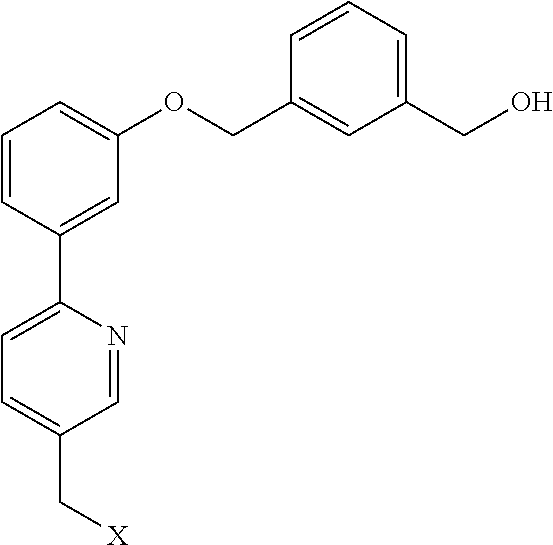 |
| X038 |
 |
| X050 |
 |
| X051 |
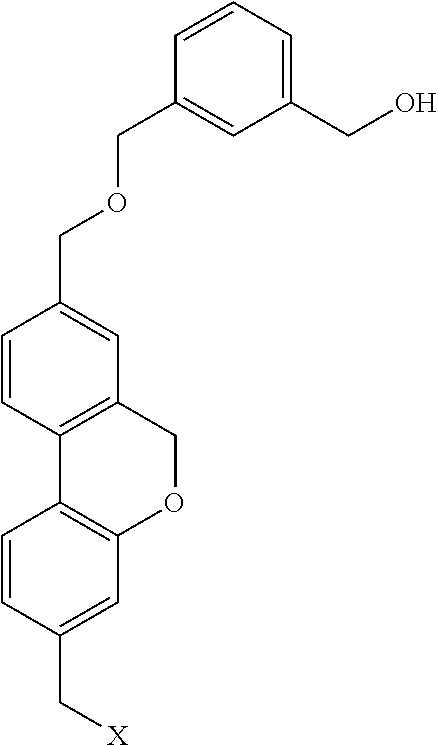 |
| X052 |
 |
| X058 |
 |
| X059 |
 |
| X060 |
 |
| X061 |
 |
| X062 |
 |
| X063 |
 |
| X064 |
 |
| X065 |
 |
| X066 |
 |
| X067 |
 |
| X068 |
 |
| X069 |
 |
| X097 |
 |
| X098 |
 |
| X109 |
 |
| X110 |
 |
| X111 |
 |
| X112 |
 |
| X113 |
 |
| X1009 |
 |
| X1010 |
 |
| X1011 |
 |
| X1012 |
 |
| X1013 |
 |
| X1015 |
 |
| X1016 |
 |
| X1017 |
 |
| X1018 |
 |
| X1019 |
 |
| X1020 |
 |
| X1021 |
 |
| X1022 |
 |
| X1024 |
 |
| X1025 |
 |
| X1026 |
 |
| X1027 |
 |
| X1028 |
 |
| X1047 |
 |
| X1048 |
 |
| X1049 |
 |
| X1062 |
 |
| X1063 |
 |
| X1064 |
 |
| TABLE 2A | |
| Nickname | |
| (Alternative | |
| Structure | nickname) |
| RNAi agents wherein the 3′ end of a 18-mer strand terminates in a phosphate or modified internucleoside linker and further comprises, in 5′ to 3′ order: a spacer, a second phosphate, and a 3′ end cap. The second phosphate and 3′ end cap are shown. |
 |
C3 amino |
 |
C7 amino |
 |
C8 |
 |
C10 |
 |
X027 |
 |
X038 |
 |
X050 |
 |
X051 |
 |
X052 |
 |
X058 |
 |
X059 |
 |
X060 |
 |
X061 |
 |
X062 |
 |
X063 |
 |
X064 |
 |
X065 |
 |
X066 |
 |
X067 |
 |
X068 |
 |
X069 |
 |
X097 |
 |
X098 |
 |
X109 |
 |
X110 |
 |
X111 |
 |
X112 |
 |
X113 |
 |
X1009 |
 |
X1011 |
 |
X1012 |
 |
X1013 |
 |
X1015 |
 |
X1016 |
 |
X1017 |
 |
X1018 |
 |
X1019 |
 |
X1020 |
 |
X1021 |
 |
X1022 |
 |
X1024 |
 |
X1025 |
 |
X1026 |
 |
X1027 |
 |
X1028 |
 |
X1047 |
 |
X1048 |
 |
X1049 |
 |
Ribitol (rib or ribp) |
| 2.B. RNAi agents comprising 18-mer strand, wherein, as shown here, the 3′ end of the 18- mer strand terminates in a phosphate or modified internucleoside linker and further comprises, in 5′ to 3′ order: a spacer, a second phosphate, and a 3′ end cap. The 3′ terminal phosphate of the 18-mer strand, spacer, second phosphate and 3′ end cap are shown. |
 |
C3pC6 |
 |
ribpC3 (ribC3) |
 |
ribpC6 (ribC6) |
 |
ribpC8 (ribC8) |
 |
ribpC10 (ribC10) |
 |
ribpCl2 (ribC12) |
 |
ribpBP (ribBP) |
 |
ribpX058 (ribX058) |
 |
2′DeoxyribC3 |
 |
2′DeoxyribC6 |
 |
2′DeoxyribC8 |
 |
2′DeoxyribC10 |
 |
2′DeoxyribC12 |
 |
2′-DeoxyribBP |
 |
Diribitol (dirib or diribp) |
| Additional structures include, inter alia: ribpX027, ribpX038, ribpX050, ribpX051, ribpX052, ribpX059, ribpX060, ribpX061, ribpX062, ribpX063, ribpX064, ribpX065, ribpX066, ribpX067, ribpX068, ribpX069, ribpX097, ribpX098, ribpX109, ribpX110, ribpX111, ribpX112, ribpX113, ribpX1009, ribpX1011, ribpX1012, ribpX1013, ribpX1015, ribpX1016, ribpX1017, ribpX1018, ribpX1019, ribpX1020, ribpX1021, ribpX1022, ribpX1024, ribpX1025, ribpX1026, ribpX1027, ribpX1028, ribpX1047, ribpX1048, and ribpX1049. These represent a spacer which is ribitol, a phosphate, and a 3′end cap which is X027, X038, X050, etc. |
| 2.C. RNAi agents comprising a 18-mer strand, wherein, as shown here, the 3′ end of the 18-mer strand terminates in a modified internucleoside linker and further comprises, in 5′ to 3′ order: a spacer, a modified internucleoside linker, and a 3′ end cap. Example modified internucleoside linkers and 3′ end caps are shown. |
 |
PS-C6 |
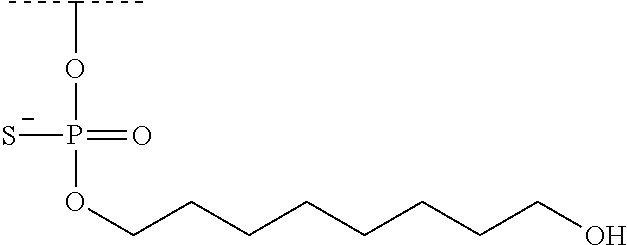 |
PS-C8 |
 |
PS-C10 |
 |
PS-C12 |
 |
PS-BP |
 |
PS-X058 |
 |
PS-X097 |
 |
PS-X098 |
 |
PS-X109 |
 |
PS-X110 |
 |
PS-X111 |
-
- RNAi agents comprising a 3′ end cap described herein are thus useful in RNA interference of target gene.

In various additional embodiments, one or more phosphate group is replaced by:

where R3 is selected from O−, S−, NH2, BH3, CH3, C1-6 alkyl, C6-10 aryl, C1-6 alkoxy and C6-10 aryl-oxy, wherein C1-6 alkyl and C6-10 aryl are unsubstituted or optionally independently substituted with 1 to 3 groups independently selected from halo, hydroxyl and NH2; and R4 is selected from O, S, NH, or CH2. Some of these replacement phosphate groups are also shown in

W=O, S, NH, CH2, . . .
X1, X2=O−, S−, NH2, BH3 −, CH3, alkyl, aryl, O-alkyl, O-aryl, . . .
Y=O, S, NH, CH2, . . .
Z=C, Si, P, S, As, Se, Sb, Te, . . .
R1=H, OH, F, NH2, O-alkyl, O-aryl, O-alkyl-aryl, O-aryl-alkyl, NH-alkyl, N-dialkyl, . . .
R2=alkyl, aryl, alkyl-aryl, aryl-alkyl, . . . (PAZ ligand)
BASE=H, adenine, cytosine, guanine, uracil, thymine, . . .


| TABLE 5 | ||||||
| siRNA | Format | siRNA passenger | Format | siRNA guide | ||
| ID | Project | Serum | sense | sequence | anti | sequence |
| 144033 | mFVII 3′-caps | Mouse | S17 | uGu cuu GGu uuc AAu | A12 | UUu AAU UGA AAC cAA |
| uA5 5 C3 | GA6 5 C3 | |||||
| 149853 | mFVII 3′-caps | Mouse | S17 | uGu cuu GGu uuc AAu | A12 | UUu AAU UGA AAC cAA |
| uA5 5 C6 | GA6 5 C6 | |||||
| 149855 | mFVII 3′-caps | Mouse | S17 | uGu cuu GGu uuc AAu | A12 | UUu AAU UGA AAC cAA |
| uA5 5 C12 | GA6 5 C12 | |||||
| 149857 | mFVII 3′-caps | Mouse | S17 | uGu cuu GGu uuc AAu | A12 | UUu AAU UGA AAC cAA |
| uA5 g5 lycol | GA6 5 glycol | |||||
| 149859 | mFVII 3′-caps | Mouse | S17 | uGu cuu GGu uuc AAu | A12 | UUu AAU UGA AAC cAA |
| uA5 5 cyclohex | GA6 5 cyclohex | |||||
| 149861 | mFVII 3′-caps | Mouse | S17 | uGu cuu GGu uuc AAu | A12 | UUu AAU UGA AAC cAA |
| uA5 5 phenyl | GA6 5 phenyl | |||||
| 149863 | mFVII 3′-caps | Mouse | S17 | uGu cuu GGu uuc AAu | A12 | UUu AAU UGA AAC cAA |
| uA5 5 biphenyl | GA6 5 biphenyl | |||||
| 149865 | mFVII 3′-caps | Mouse | S17 | uGu cuu GGu uuc AAu | A12 | UUu AAU UGA AAC cAA |
| uA5 5 lithochol | GA6 5 lithochol | |||||
| 149867 | mFVII 3′-caps | Mouse | S17 | uGu cuu GGu uuc AAu | A12 | UUu AAU UGA AAC cAA |
| uA5 5 amino C7 | GA6 5 amino C7 | |||||
| 149869 | mFVII 3′-caps | Mouse | S17 | uGu cuu GGu uuc AAu | A12 | UUu AAU UGA AAC cAA |
| uA5 5 amino C3 | GA6 5 amino C3 | |||||
| 8548 | Luc stability | Mouse | S0 | TCGAAGTACTCAGCGTAAG | A0 | CTTACGCTGAGTACTTCGA |
| Ctrl. | TT | TT | ||||
| 144049 | mFVII w/o cap | Mouse | S1 | uGu cuu GGu uuc AAu | A1 | UUu AAU UGA AAC cAA |
| uAA AdTsdT | GAc AdTsdT | |||||
| 144033 | mFVII 3′-caps | Human | S17 | uGu cuu GGu uuc AAu | A12 | UUu AAU UGA AAC cAA |
| uA5 5 C3 | GA6 5 C3 | |||||
| 149853 | mFVII 3′-caps | Human | S17 | uGu cuu GGu uuc AAu | A12 | UUu AAU UGA AAC cAA |
| uA5 5 C6 | GA6 5 C6 | |||||
| 149855 | mFVII 3′-caps | Human | S17 | uGu cuu GGu uuc AAu | A12 | UUu AAU UGA AAC cAA |
| uA5 5 C12 | GA6 5 C12 | |||||
| 149857 | mFVII 3′-caps | Human | S17 | uGu cuu GGu uuc AAu | A12 | UUu AAU UGA AAC cAA |
| uA5 5 glycol | GA6 5 glycol | |||||
| 149859 | mFVII 3′-caps | Human | S17 | uGu cuu GGu uuc AAu | A12 | UUu AAU UGA AAC cAA |
| uA5 5 cyclohex | GA6 5 cyclohex | |||||
| 149861 | mFVII 3′-caps | Human | S17 | uGu cuu GGu uuc AAu | A12 | UUu AAU UGA AAC cAA |
| uA5 5 phenyl | GA6 5 phenyl | |||||
| 149863 | mFVII 3′-caps | Human | S17 | uGu cuu GGu uuc AAu | A12 | UUu AAU UGA AAC cAA |
| uA5 5 biphenyl | GA6 5 biphenyl | |||||
| 149865 | mFVII 3′-caps | Human | S17 | uGu cuu GGu uuc AAu | A12 | UUu AAU UGA AAC cAA |
| uA5 5 lithochol | GA6 5 lithochol | |||||
| 149867 | mFVII 3′-caps | Human | S17 | uGu cuu GGu uuc AAu | A12 | UUu AAU UGA AAC cAA |
| uA5 5 amino C7 | GA6 5 amino C7 | |||||
| 149869 | mFVII 3′-caps | Human | S17 | uGu cuu GGu uuc AAu | A12 | UUu AAU UGA AAC cAA |
| uA5 5 amino C3 | GA6 5 amino C3 | |||||
| 144049 | mFVII w/o cap | Human | NA | NA | A12 | UUu AAU UGA AAC cAA |
| anti | GAc AdTsdT | |||||
| 144053 | mFVII w/o cap | Human | S17 | uGu cuu GGu uuc AAu | NA | NA |
| sense | uAA AdTsdT | |||||


Materials and Methods:
| Example 2.A | X027 succinate ester |
| Example 2.B | X038 succinate ester |
| Example 2.C | X052 succinate ester |
| Example 2.D | X058 succinate ester |
| Example 2.E | X067 succinate ester |
| Example 2.F | X069 succinate ester |
| Example 2.G | General procedure for the high density loading of |
| controlled pore glass supports with PAZ ligand succinates | |
| Example 2.H | Synthesis of X050, X059, X061, X062, X065, X068 |
| alcohols and succinate esters | |
| Example 2.I | X060 and X064 alcohols and succinate esters |
| Example 2.J. | X063 succinate ester |
| Example 2.K | X066 succinate ester |
| Example 2.L | X051 succinate ester |
| Example 2.M | Synthesis of X097 succinate ester |
| Example 2.N | Synthesis of X098 succinate ester |
| Example 2.O | Synthesis of siRNA conjugated with X109 |
| Example 2.P | Synthesis of siRNA conjugated with X110 |
| Example 2.Q | Synthesis of siRNA conjugated with X111 |
| Example 2.R | Synthesis of siRNA conjugated with X112 |
| Example 2.S | Synthesis of siRNA conjugated with X113 |
| Example 2.T | General procedure for the high density loading of |
| controlled pore glass supports with PAZ ligand succinates | |
| Example 2.A | X027 succinate ester |
| Example 2.B | X038 succinate ester |
| Example 2.C | X052 succinate ester |
| Example 2.D | X058 succinate ester |
| Example 2.E | X067 succinate ester |
| Example 2.F | X069 succinate ester |
| Example 2.G | General procedure for the high density loading of |
| controlled pore glass supports with PAZ ligand succinates | |
| Example 2.H | Synthesis of X050, X059, X061, X062, X065, X068 |
| alcohols and succinate esters | |
| Example 2.I | X060 and X064 alcohols and succinate esters |
| Example 2.J. | X063 succinate ester |
| Example 2.K | X066 succinate ester |
| Example 2.L | X051 succinate ester |
| Example 2.M | Synthesis of X097 succinate ester |
| Example 2.N | Synthesis of X098 succinate ester |
| Example 2.O | Synthesis of siRNA conjugated with X109 |
| Example 2.P | Synthesis of siRNA conjugated with X110 |
| Example 2.Q | Synthesis of siRNA conjugated with X111 |
| Example 2.R | Synthesis of siRNA conjugated with X112 |
| Example 2.S | Synthesis of siRNA conjugated with X113 |
| Example 2.T | General procedure for the high density loading of |
| controlled pore glass supports with PAZ ligand succinates | |


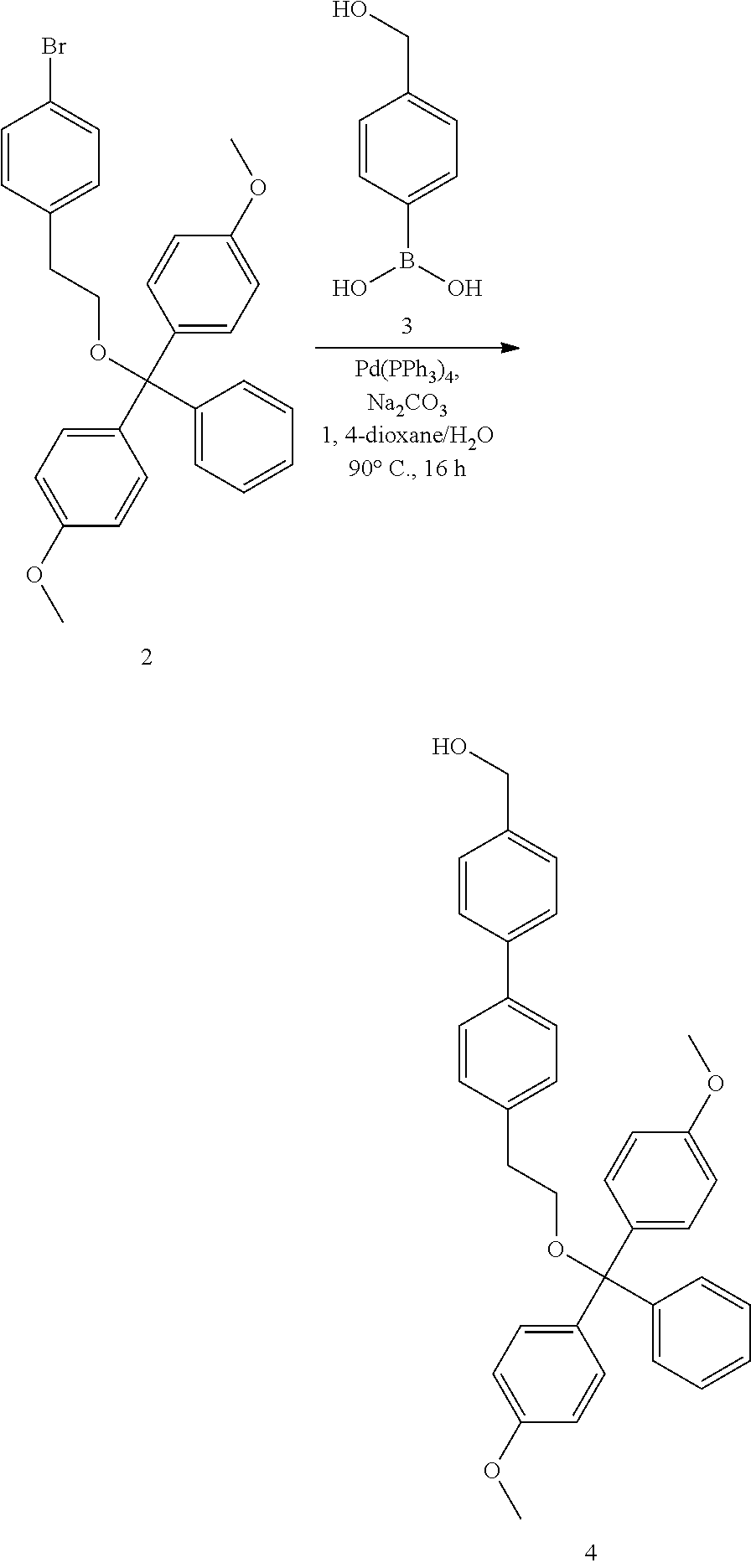


Ester


A mixture of N-hydroxysuccinimide (2.489 mg, 0.022 mmol), 1 (3.0 mg, 0.011 mmol), and DIC (2.73 mg, 0.022 mmol) in DMSO (200 uL) was stirred at RT for 12 h. 10 uL of reaction mixture was diluted with 190 uL DMSO. To the resulting solution was added a freshly ss-siRNA-(CH2)4—NH2 solution (2.00 mg, 0.325 umol in 80 uL PBS 8.5 buffer). The reaction mixture was vortexed and sat at RT for 2 h. The crude product was purified by HPLC with 10-40% 100 mM triethylammonium acetate in acetonitrile/water to afford 2. TOF MS (ES−): 6418.


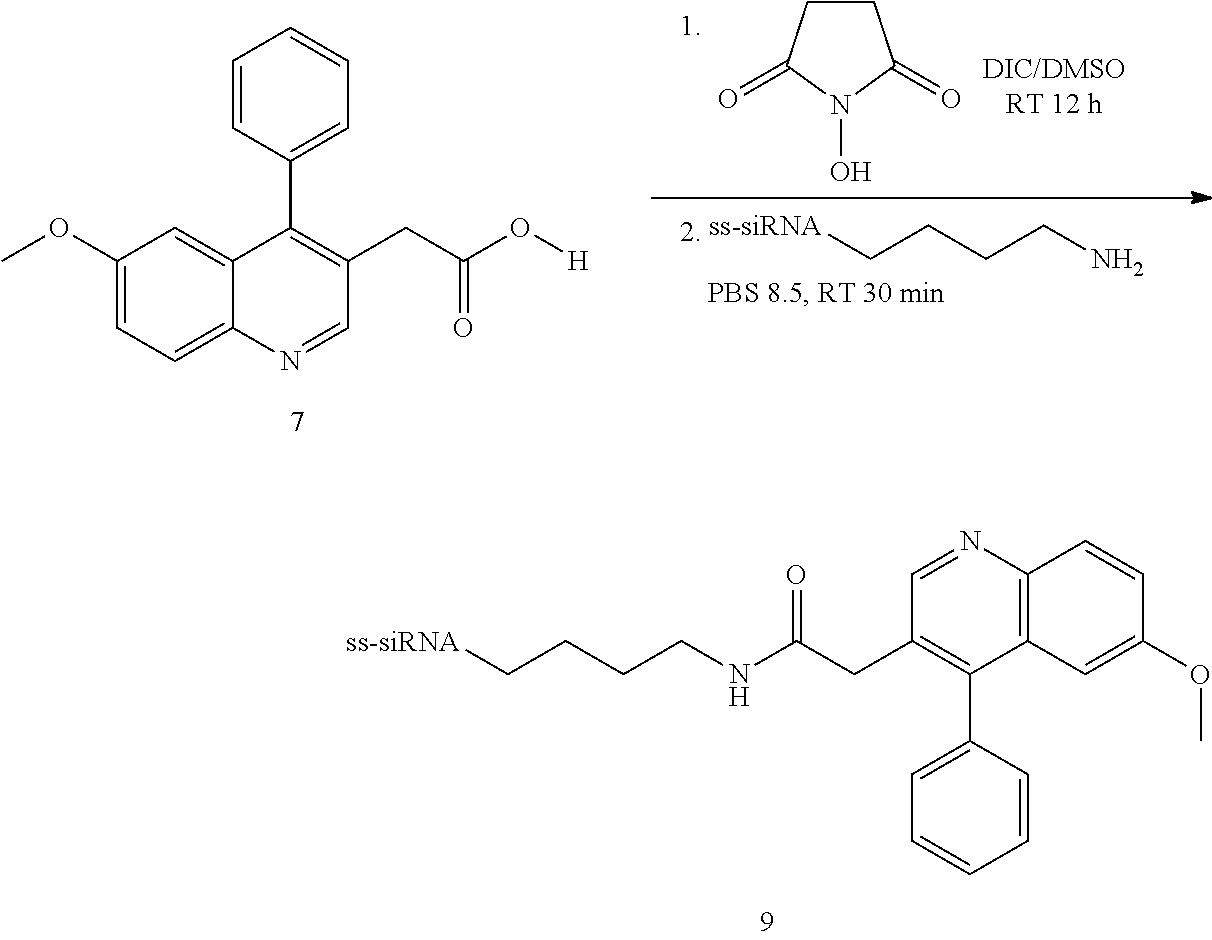


| TABLE 6 | ||||
| Oligo | Hepcidin | Hepcidin | ||
| Identifier | KD at 5 nM | (approx.) | ||
| (Nickname) | in vitro (%) | IC50 | ||
| BP | 68 | 2.3 | ||
| (biphenyl) | ||||
| X027 | 57 | 3.3 | ||
| X038 | 62 | 2.6 | ||
| X050 | 61 | 4.0 | ||
| X051 | 61 | 3.4 | ||
| X052 | 64 | 3.0 | ||
| X058 | 68 | 2.7 | ||
| |
55 | 4.1 | ||
| X060 | 65 | 3.5 | ||
| X061 | 61 | 3.0 | ||
| X062 | 63 | 3.5 | ||
| X063 | 56 | 3.7 | ||
| |
60 | 3.1 | ||
| X065 | 66 | 3.0 | ||
| X066 | 49 | 4.9 | ||
| X067 | 66 | 2.5 | ||
| X068 | 63 | 3.0 | ||
| X069 | 81 | 1.5 | ||
| C6 | 66 | 2.6 | ||
-
- PBS
- LNP569-Hamp254-X052 (SL52-49CE)-3 mg/kg
- LNP569-Hamp254-X058 (IL54-43-XE)-3 mg/kg
- LNP569-Hamp254-X067 (YL55-48RE)-3 mg/kg
- LNP569-Hamp254-X038 (CL51-551E)-3 mg/kg
- LNP569-Hamp254-X069 (GA35-240F)-3 mg/kg
- LNP569-Hamp254-X027 (ML59-39NE)-3 mg/kg
- LNP569-Hamp254-C6 control-3 mg/kg
- LNP569 is a lipid nanoparticle preparation of the RNAi agent.
-
- PBS
- LNP569-Hamp254 A160_S38-3 mg/kg
- LNP569-Hamp254 A160_S42-3 mg/kg
- LNP569-Hamp254 A160_S45-3 mg/kg
- LNP569-Hamp254 A161_S38-3 mg/kg
- LNP569-Hamp254 A161_S42-3 mg/kg
- LNP569-Hamp254 A161_S45-3 mg/kg
48 Hour Timepoint.
Assess Hepcidin Knockdown in Liver (mRNA-qPCR)
| TABLE 7 |
| Efficacy of RNAi agents with a 3′ end cap to ELAVL1/HuR in Huh-7 cells in vitro |
| Nickname siTrack | siRNA | AV | SD | (dosing 1) | ||||
| 5.04 | 9.95 | 19.85 | 5.04 | 9.95 | 19.85 |
| % residual mRNA (qRT-PCR) |
| untreated-HB | untreated | 100.54 | 10.76 | |||||
| av_PSAT6-EYFP- | eYFP neg. |
110.06 | 104.72 | 101.98 | 6.52 | 13.38 | 11.84 | |
| N1_471_A25S27 | ||||||||
| av_PNAS-280_1_A25S27 | eYFP neg. |
102.15 | 96.16 | 98.87 | 15.02 | 6.60 | 9.41 | |
| hs_ELAVL1_1186_MAN_S42 | 18-mer siRNA with X059 | 45.17 | 20.58 | 10.24 | 2.84 | 0.63 | 0.79 | |
| hs_ELAVL1_1186_MAN_S42 | 18-mer siRNA with X050 | 26.69 | 11.48 | 6.92 | 0.99 | 2.40 | 1.41 | |
| hs_ELAVL1_1186_MAN_S42 | 18-mer siRNA with X061 | 26.11 | 11.49 | 6.25 | 5.81 | 0.99 | 0.74 | |
| hs_ELAVL1_1186_MAN_S42 | 18-mer siRNA with X051 | 25.35 | 10.80 | 6.88 | 3.28 | 0.61 | 0.86 | |
| hs_ELAVL1_1186_MAN_S42 | 18-mer siRNA with X027 | 24.54 | 11.67 | 6.17 | 2.90 | 1.38 | 1.03 | |
| hs_ELAVL1_1186_MAN_S42 | 18-mer siRNA with X062 | 24.35 | 11.68 | 5.66 | 2.88 | 1.46 | 1.17 | |
| hs_ELAVL1_1186_MAN_S42 | 18-mer siRNA with X060 | 23.86 | 9.27 | 5.62 | 1.10 | 0.86 | 0.76 | |
| hs_ELAVL1_1186_A106_S42 | 18-mer siRNA with C6 | 22.42 | 9.77 | 5.65 | 1.90 | 1.60 | 1.31 | |
| (X003) | ||||||||
| hs_ELAVL1_1186_MAN_S42 | 18-mer siRNA with X068 | 22.40 | 10.77 | 5.89 | 2.25 | 1.92 | 1.31 | |
| hs_ELAVL1_1186_MAN_S42 | 18-mer siRNA with X065 | 22.24 | 10.50 | 5.20 | 3.44 | 1.26 | 0.96 | |
| hs_ELAVL1_1186_MAN_S42 | 18-mer siRNA with X069 | 21.93 | 9.57 | 6.13 | 6.25 | 1.11 | 1.57 | |
| hs_ELAVL1_1186_MAN_S42 | 18-mer siRNA with X097 | 21.26 | 9.83 | 6.29 | 3.45 | 1.98 | 1.27 | |
| hs_ELAVL1_1186_MAN_S42 | 18-mer siRNA with X066 | 21.12 | 10.25 | 5.77 | 2.04 | 1.14 | 0.43 | |
| hs_ELAVL1_1186_MAN_S42 | 18-mer siRNA with X098 | 21.06 | 9.94 | 6.15 | 4.39 | 2.16 | 1.29 | |
| hs_ELAVL1_1186_MAN_S42 | 18-mer siRNA with X052 | 21.02 | 8.32 | 6.75 | 1.41 | 1.29 | 0.93 | |
| hs_ELAVL1_1186_MAN_S42 | 18-mer siRNA with X063 | 20.53 | 10.91 | 5.61 | 3.01 | 0.86 | 0.18 | |
| hs_ELAVL1_1186_A324_S42 | 18-mer siRNA with BP | 20.38 | 9.37 | 6.19 | 2.56 | 1.37 | 0.67 | |
| (X014) | ||||||||
| hs_ELAVL1_1186_A27_S30 | 19-mer pos. control | 19.90 | 8.03 | 5.40 | 1.40 | 0.98 | 0.37 | |
| hs_ELAVL1_1186_MAN_S42 | 18-mer siRNA with X038 | 19.80 | 10.60 | 5.26 | 2.52 | 0.75 | 0.75 | |
| hs_ELAVL1_1186_MAN_S42 | 18-mer siRNA with X067 | 19.07 | 11.38 | 5.82 | 2.02 | 3.00 | 0.94 | |
| hs_ELAVL1_1186_MAN_S42 | 18-mer siRNA with X058 | 18.40 | 10.36 | 6.23 | 2.70 | 2.78 | 0.42 | |
| hs_ELAVL1_1186_MAN_S42 | 18-mer siRNA with X064 | 18.33 | 9.84 | 6.49 | 3.03 | 0.45 | 1.67 | |
| hs_ELAVL1_1186_MAN_S42 | 18-mer siRNA with ribprib | 17.10 | 9.78 | 5.75 | 3.69 | 1.38 | 0.75 | |
| (X025) | ||||||||
| hs_ELAVL1_1186_A22_S26 | 21-mer pos. control | 16.68 | 8.61 | 5.15 | 2.39 | 1.17 | 0.86 | |
| pM | pM IC50 | |||
| 3′ end | study# | 1 | |
|
| X058 | 5.85 | 12.78 | ||
| X109 | 3.47 | 3.85 | ||
| X110 | 1.50 | 6.42 | ||
| X111 | 1.21 | 3.63 | ||
| X112 | 0.72 | 2.38 | ||
| X113 | 2.71 | 4.55 | ||
- 1. A composition comprising a HBV RNAi agent comprising a first and a second strand, wherein the sequence of the first and/or second strand is that of any sequence of Table 8C.
- 2. A composition comprising a HBV RNAi agent comprising a first and a second strand, wherein the sequence of the first and/or second strand is that of any sequence or an 18-nt portion of any sequence in any of Tables 8B-8E or 10.
- 3. A composition comprising a HBV RNAi agents comprising a first and a second strand, wherein the sequence of the first and/or second strand is that of any sequence of at least 15 contiguous nt of any sequence in any of Tables 8B-8E or 10 (e.g., nt 1-15 or nt 2-16 of any sequence in these tables).
- 4. The composition of any of
embodiments 1 to 3, wherein the HBV RNAi agent is blunt-ended. - 5. The composition of any of
embodiments 1 to 4, wherein the first and second strands are 18-mers and together form a blunt-ended duplex, and 3′ end of the first and/or second strand terminates in a phosphate or modified internucleoside linker and further comprises, in 5′ to 3′ order: a spacer and a 3′ end cap. - 6. The composition of any of
embodiments 1 to 5, wherein the spacer is ribitol. - 7. The composition of any of
embodiments 1 to 6, wherein the spacer is a ribitol, 2′-deoxyribitol, or 2′-methoxyethoxy ribitol (ribitol with 2′-MOE), a C3, C4, C5 or C6, or 4-methoxybutane-1,3-diol. - 8. The composition of any of
embodiments 1 to 7, wherein the 3′ end cap is C6. - 9. The composition of any of
embodiments 1 to 8, wherein the 3′ end cap is triethylene glycol, cyclohexyl, phenyl, BP (biphenyl), lithochol (lithocholic acid), adamantane, C3 amino, C7 amino, C3, C6, C8, C10, C12, X027, X038, X050, X051, X052, X058, X059, X060, X061, X062, X063, X064, X065, X066, X067, X068, X069, X097, X098, X109, X110, X111, X112, X113, X1009, X1010, X1011, X1012, X1013, X1015, X1016, X1017, X1018, X1019, X1020, X1021, X1022, X1024, X1025, X1026, X1027, X1028, X1047, X1048, X1049, X1062, X1063, X1064, or ribitol, or any 3′ end cap disclosed herein or known in the art. - 10. The composition of any of embodiments 1 to 9, wherein the modified internucleoside linker is selected from phosphorothioate, phosphorodithioate, phosphoramidate, boranophosphonoate, an amide linker, and a compound of formula (I):

-
- where R3 is selected from O−, S−, NH2, BH3, CH3, C1-6 alkyl, C6-10 aryl, C1-6 alkoxy and C6-10 aryl-oxy, wherein C1-6 alkyl and C6-10 aryl are unsubstituted or optionally independently substituted with 1 to 3 groups independently selected from halo, hydroxyl and NH2; and R4 is selected from O, S, NH, or CH2.
- 11. The composition of any of
embodiments 1 to 10, wherein one or more nucleotides is modified or is substituted with DNA, a peptide nucleic acid (PNA), locked nucleic acid (LNA), morpholino nucleotide, threose nucleic acid (TNA), glycol nucleic acid (GNA), arabinose nucleic acid (ANA), 2′-fluoroarabinose nucleic acid (FANA), cyclohexene nucleic acid (CeNA), anhydrohexitol nucleic acid (HNA), and/or unlocked nucleic acid (UNA). - 12. The composition of any of
embodiments 1 to 11, wherein the RNAi agent can be modified on one or both 5′ end. - 13. The composition of any of
embodiments 1 to 12, wherein the sense strand comprises a 5′ end cap which reduces the amount of the RNA interference mediated by this strand. - 14. The composition of any of
embodiments 1 to 13, wherein the sense strand comprises a 5′ end cap selected: a nucleotide lacking a 5′ phosphate or 5′-OH; a nucleotide lacking a 5′ phosphate or a 5′-OH and also comprising a 2-OMe or 2′-MOE modification; 5′-deoxy-2′-O-methyl modification; 5′-OME-dT; ddT; and 5′-OTr-dT. - 15. The composition of any of
embodiments 1 to 14, wherein at least one nucleotide is modified or substituted. - 16. The composition of
embodiment 15, wherein said at least one modified nucleotide is selected from among 2′ alkoxyribonucleotide, 2′ alkoxyalkoxy ribonucleotide, or 2′-fluoro ribonucleotide, and optionally said at least one modified nucleotide is selected from 2′-OMe, 2′-MOE and 2′-H. - 17. A method of treating, ameliorating or preventing HBV in a patient, comprising the step of administering to the patient a therapeutically effective amount of a composition of any of
embodiments 1 to 16.
Claims (14)
Priority Applications (1)
| Application Number | Priority Date | Filing Date | Title |
|---|---|---|---|
| US15/025,852 US10519446B2 (en) | 2013-10-04 | 2014-09-30 | Organic compounds to treat hepatitis B virus |
Applications Claiming Priority (3)
| Application Number | Priority Date | Filing Date | Title |
|---|---|---|---|
| US201361886760P | 2013-10-04 | 2013-10-04 | |
| PCT/US2014/058314 WO2015050871A2 (en) | 2013-10-04 | 2014-09-30 | Organic compounds to treat hepatitis b virus |
| US15/025,852 US10519446B2 (en) | 2013-10-04 | 2014-09-30 | Organic compounds to treat hepatitis B virus |
Publications (2)
| Publication Number | Publication Date |
|---|---|
| US20160215288A1 US20160215288A1 (en) | 2016-07-28 |
| US10519446B2 true US10519446B2 (en) | 2019-12-31 |
Family
ID=51842794
Family Applications (1)
| Application Number | Title | Priority Date | Filing Date |
|---|---|---|---|
| US15/025,852 Active US10519446B2 (en) | 2013-10-04 | 2014-09-30 | Organic compounds to treat hepatitis B virus |
Country Status (6)
| Country | Link |
|---|---|
| US (1) | US10519446B2 (en) |
| EP (1) | EP3052107B1 (en) |
| JP (1) | JP6546161B2 (en) |
| CN (1) | CN105792832B (en) |
| HK (1) | HK1221912A1 (en) |
| WO (1) | WO2015050871A2 (en) |
Cited By (1)
| Publication number | Priority date | Publication date | Assignee | Title |
|---|---|---|---|---|
| US11008570B2 (en) | 2013-10-04 | 2021-05-18 | Novartis Ag | 3′ end caps for RNAi agents for use in RNA interference |
Families Citing this family (9)
| Publication number | Priority date | Publication date | Assignee | Title |
|---|---|---|---|---|
| PT2726613T (en) | 2011-06-30 | 2018-10-26 | Arrowhead Pharmaceuticals Inc | Compositions and methods for inhibiting gene expression of hepatitis b virus |
| WO2015051366A2 (en) | 2013-10-04 | 2015-04-09 | Novartis Ag | Novel formats for organic compounds for use in rna interference |
| WO2015050871A2 (en) | 2013-10-04 | 2015-04-09 | Novartis Ag | Organic compounds to treat hepatitis b virus |
| US20170137821A1 (en) | 2015-07-17 | 2017-05-18 | Arcturus Therapeutics, Inc. | Molecules and agents for treating hepatitis b virus |
| JP6924744B2 (en) * | 2015-07-17 | 2021-08-25 | アークトゥラス・セラピューティクス・インコーポレイテッドArcturus Therapeutics,Inc. | Compositions and drugs for hepatitis B virus and their use |
| CN115957337A (en) | 2015-08-07 | 2023-04-14 | 箭头药业股份有限公司 | RNAi therapy for hepatitis B virus infection |
| JOP20190015A1 (en) | 2016-08-04 | 2019-02-04 | Arrowhead Pharmaceuticals Inc | RNAi AGENTS FOR HEPATITIS B VIRUS INFECTION |
| CN110446259B (en) * | 2018-05-04 | 2022-04-15 | 大唐移动通信设备有限公司 | Position determination method of paging opportunity and communication equipment |
| JP2023538630A (en) * | 2020-08-21 | 2023-09-08 | エフ. ホフマン-ラ ロシュ アーゲー | Use of A1CF inhibitors to treat hepatitis B virus infection |
Citations (103)
| Publication number | Priority date | Publication date | Assignee | Title |
|---|---|---|---|---|
| US3687808A (en) | 1969-08-14 | 1972-08-29 | Univ Leland Stanford Junior | Synthetic polynucleotides |
| US4065489A (en) | 1974-10-22 | 1977-12-27 | Merck Patent Gesellschaft Mit Beschrankter Haftung | Biphenyl esters and liquid crystalline mixtures comprising them |
| US4469863A (en) | 1980-11-12 | 1984-09-04 | Ts O Paul O P | Nonionic nucleic acid alkyl and aryl phosphonates and processes for manufacture and use thereof |
| WO1991006309A1 (en) | 1989-11-03 | 1991-05-16 | Vanderbilt University | Method of in vivo delivery of functioning foreign genes |
| US5023243A (en) | 1981-10-23 | 1991-06-11 | Molecular Biosystems, Inc. | Oligonucleotide therapeutic agent and method of making same |
| US5034506A (en) | 1985-03-15 | 1991-07-23 | Anti-Gene Development Group | Uncharged morpholino-based polymers having achiral intersubunit linkages |
| US5134066A (en) | 1989-08-29 | 1992-07-28 | Monsanto Company | Improved probes using nucleosides containing 3-dezauracil analogs |
| WO1993007883A1 (en) | 1991-10-24 | 1993-04-29 | Isis Pharmaceuticals, Inc. | Derivatized oligonucleotides having improved uptake and other properties |
| US5212295A (en) | 1990-01-11 | 1993-05-18 | Isis Pharmaceuticals | Monomers for preparation of oligonucleotides having chiral phosphorus linkages |
| US5214134A (en) | 1990-09-12 | 1993-05-25 | Sterling Winthrop Inc. | Process of linking nucleosides with a siloxane bridge |
| US5216141A (en) | 1988-06-06 | 1993-06-01 | Benner Steven A | Oligonucleotide analogs containing sulfur linkages |
| US5218105A (en) | 1990-07-27 | 1993-06-08 | Isis Pharmaceuticals | Polyamine conjugated oligonucleotides |
| US5264423A (en) | 1987-03-25 | 1993-11-23 | The United States Of America As Represented By The Department Of Health And Human Services | Inhibitors for replication of retroviruses and for the expression of oncogene products |
| US5264562A (en) | 1989-10-24 | 1993-11-23 | Gilead Sciences, Inc. | Oligonucleotide analogs with novel linkages |
| US5321131A (en) | 1990-03-08 | 1994-06-14 | Hybridon, Inc. | Site-specific functionalization of oligodeoxynucleotides for non-radioactive labelling |
| US5359044A (en) | 1991-12-13 | 1994-10-25 | Isis Pharmaceuticals | Cyclobutyl oligonucleotide surrogates |
| WO1994024116A1 (en) | 1993-04-09 | 1994-10-27 | Syntex Pharmaceuticals Limited | Heterocyclic derivatives in the treatment of ischaemia and related diseases |
| US5399676A (en) | 1989-10-23 | 1995-03-21 | Gilead Sciences | Oligonucleotides with inverted polarity |
| US5405939A (en) | 1987-10-22 | 1995-04-11 | Temple University Of The Commonwealth System Of Higher Education | 2',5'-phosphorothioate oligoadenylates and their covalent conjugates with polylysine |
| US5453496A (en) | 1988-05-26 | 1995-09-26 | University Patents, Inc. | Polynucleotide phosphorodithioate |
| US5455233A (en) | 1989-11-30 | 1995-10-03 | University Of North Carolina | Oligoribonucleoside and oligodeoxyribonucleoside boranophosphates |
| US5459255A (en) | 1990-01-11 | 1995-10-17 | Isis Pharmaceuticals, Inc. | N-2 substituted purines |
| US5466677A (en) | 1993-03-06 | 1995-11-14 | Ciba-Geigy Corporation | Dinucleoside phosphinates and their pharmaceutical compositions |
| US5466786A (en) | 1989-10-24 | 1995-11-14 | Gilead Sciences | 2'modified nucleoside and nucleotide compounds |
| US5470967A (en) | 1990-04-10 | 1995-11-28 | The Dupont Merck Pharmaceutical Company | Oligonucleotide analogs with sulfamate linkages |
| US5489677A (en) | 1990-07-27 | 1996-02-06 | Isis Pharmaceuticals, Inc. | Oligonucleoside linkages containing adjacent oxygen and nitrogen atoms |
| US5506351A (en) | 1992-07-23 | 1996-04-09 | Isis Pharmaceuticals | Process for the preparation of 2'-O-alkyl guanosine and related compounds |
| US5519134A (en) | 1994-01-11 | 1996-05-21 | Isis Pharmaceuticals, Inc. | Pyrrolidine-containing monomers and oligomers |
| US5539082A (en) | 1993-04-26 | 1996-07-23 | Nielsen; Peter E. | Peptide nucleic acids |
| US5541307A (en) | 1990-07-27 | 1996-07-30 | Isis Pharmaceuticals, Inc. | Backbone modified oligonucleotide analogs and solid phase synthesis thereof |
| US5552540A (en) | 1987-06-24 | 1996-09-03 | Howard Florey Institute Of Experimental Physiology And Medicine | Nucleoside derivatives |
| US5554746A (en) | 1994-05-16 | 1996-09-10 | Isis Pharmaceuticals, Inc. | Lactam nucleic acids |
| US5571902A (en) | 1993-07-29 | 1996-11-05 | Isis Pharmaceuticals, Inc. | Synthesis of oligonucleotides |
| US5578718A (en) | 1990-01-11 | 1996-11-26 | Isis Pharmaceuticals, Inc. | Thiol-derivatized nucleosides |
| US5581469A (en) | 1993-06-17 | 1996-12-03 | Goldstar Co., Ltd. | Apparatus for checking the lifetime of household electronic or electric appliances |
| US5587470A (en) | 1990-01-11 | 1996-12-24 | Isis Pharmaceuticals, Inc. | 3-deazapurines |
| US5587361A (en) | 1991-10-15 | 1996-12-24 | Isis Pharmaceuticals, Inc. | Oligonucleotides having phosphorothioate linkages of high chiral purity |
| US5591722A (en) | 1989-09-15 | 1997-01-07 | Southern Research Institute | 2'-deoxy-4'-thioribonucleosides and their antiviral activity |
| US5594121A (en) | 1991-11-07 | 1997-01-14 | Gilead Sciences, Inc. | Enhanced triple-helix and double-helix formation with oligomers containing modified purines |
| US5596091A (en) | 1994-03-18 | 1997-01-21 | The Regents Of The University Of California | Antisense oligonucleotides comprising 5-aminoalkyl pyrimidine nucleotides |
| US5597909A (en) | 1994-08-25 | 1997-01-28 | Chiron Corporation | Polynucleotide reagents containing modified deoxyribose moieties, and associated methods of synthesis and use |
| US5602240A (en) | 1990-07-27 | 1997-02-11 | Ciba Geigy Ag. | Backbone modified oligonucleotide analogs |
| US5608046A (en) | 1990-07-27 | 1997-03-04 | Isis Pharmaceuticals, Inc. | Conjugated 4'-desmethyl nucleoside analog compounds |
| US5610289A (en) | 1990-07-27 | 1997-03-11 | Isis Pharmaceuticals, Inc. | Backbone modified oligonucleotide analogues |
| US5646265A (en) | 1990-01-11 | 1997-07-08 | Isis Pharmceuticals, Inc. | Process for the preparation of 2'-O-alkyl purine phosphoramidites |
| US5663312A (en) | 1993-03-31 | 1997-09-02 | Sanofi | Oligonucleotide dimers with amide linkages replacing phosphodiester linkages |
| US5670633A (en) | 1990-01-11 | 1997-09-23 | Isis Pharmaceuticals, Inc. | Sugar modified oligonucleotides that detect and modulate gene expression |
| US5700920A (en) | 1992-07-01 | 1997-12-23 | Novartis Corporation | Carbocyclic nucleosides containing bicyclic rings, oligonucleotides therefrom, process for their preparation, their use and intermediates |
| WO1998038156A1 (en) | 1997-02-27 | 1998-09-03 | Takeda Chemical Industries, Ltd. | Amine compounds, their production and use as amyloid-beta production inhibitors |
| WO1999032619A1 (en) | 1997-12-23 | 1999-07-01 | The Carnegie Institution Of Washington | Genetic inhibition by double-stranded rna |
| US5998203A (en) | 1996-04-16 | 1999-12-07 | Ribozyme Pharmaceuticals, Inc. | Enzymatic nucleic acids containing 5'-and/or 3'-cap structures |
| WO2000022113A1 (en) | 1998-10-09 | 2000-04-20 | Ingene, Inc. | ENZYMATIC SYNTHESIS OF ssDNA |
| WO2000031105A1 (en) | 1998-11-20 | 2000-06-02 | Isis Pharmaceuticals, Inc. | Antisense modulation of inhibitor-kappa b kinase-beta expression |
| WO2000044895A1 (en) | 1999-01-30 | 2000-08-03 | Roland Kreutzer | Method and medicament for inhibiting the expression of a defined gene |
| US6127533A (en) | 1997-02-14 | 2000-10-03 | Isis Pharmaceuticals, Inc. | 2'-O-aminooxy-modified oligonucleotides |
| US6166197A (en) | 1995-03-06 | 2000-12-26 | Isis Pharmaceuticals, Inc. | Oligomeric compounds having pyrimidine nucleotide (S) with 2'and 5 substitutions |
| US6172209B1 (en) | 1997-02-14 | 2001-01-09 | Isis Pharmaceuticals Inc. | Aminooxy-modified oligonucleotides and methods for making same |
| WO2001029058A1 (en) | 1999-10-15 | 2001-04-26 | University Of Massachusetts | Rna interference pathway genes as tools for targeted genetic interference |
| US6262241B1 (en) | 1990-08-13 | 2001-07-17 | Isis Pharmaceuticals, Inc. | Compound for detecting and modulating RNA activity and gene expression |
| US6271358B1 (en) | 1998-07-27 | 2001-08-07 | Isis Pharmaceuticals, Inc. | RNA targeted 2′-modified oligonucleotides that are conformationally preorganized |
| WO2001074763A1 (en) | 2000-03-30 | 2001-10-11 | Bayer Aktiengesellschaft | Aryl and heteroaryl sulfonates |
| WO2003010059A1 (en) | 2001-07-23 | 2003-02-06 | Pradeep Yohanne Gupta | Piston for dispensing device dispensing device, product containing dispensing device, method of filling, and method of dispensing |
| WO2003020931A2 (en) | 2001-09-01 | 2003-03-13 | Galapagos Genomics N.V. | Sirna knockout assay method and constructs |
| US20030124651A1 (en) | 2001-12-04 | 2003-07-03 | Vijaya Pasupuleti | Oligonucleotides and methods for detecting hepatitis B viral nucleic acids |
| US20030143732A1 (en) | 2001-04-05 | 2003-07-31 | Kathy Fosnaugh | RNA interference mediated inhibition of adenosine A1 receptor (ADORA1) gene expression using short interfering RNA |
| WO2003070918A2 (en) | 2002-02-20 | 2003-08-28 | Ribozyme Pharmaceuticals, Incorporated | Rna interference by modified short interfering nucleic acid |
| US20030206887A1 (en) * | 1992-05-14 | 2003-11-06 | David Morrissey | RNA interference mediated inhibition of hepatitis B virus (HBV) using short interfering nucleic acid (siNA) |
| US20050032733A1 (en) | 2001-05-18 | 2005-02-10 | Sirna Therapeutics, Inc. | RNA interference mediated inhibition of gene expression using chemically modified short interfering nucleic acid (SiNA) |
| WO2005060697A2 (en) | 2003-12-19 | 2005-07-07 | Chiron Corporation | Cell transfecting formulations of small interfering rna, related compositions and methods of making and use |
| WO2005065719A1 (en) | 2004-01-12 | 2005-07-21 | Genesense Technologies Inc. | Antisense oligonucleotides directed to ribonucleotide reductase r2 and uses thereof in combination therapies for the treatment of cancer |
| WO2005116204A1 (en) | 2004-05-11 | 2005-12-08 | Rnai Co., Ltd. | Polynucleotide causing rna interfere and method of regulating gene expression with the use of the same |
| WO2006017932A1 (en) | 2004-08-18 | 2006-02-23 | Genesense Technologies Inc. | Small interfering rna molecules against ribonucleotide reductase and uses thereof |
| US7056704B2 (en) | 2000-12-01 | 2006-06-06 | Max-Planck-Gesellschaft Zur Foerderung Der Wissenschaften E.V. | RNA interference mediating small RNA molecules |
| US20070167393A1 (en) * | 2002-02-20 | 2007-07-19 | Sirna Therapeutics, Inc. | RNA INTERFERENCE MEDIATED INHIBITION OF GENE EXPRESSION USING CHEMICALLY MODIFIED SHORT INTERFERING NUCLEIC ACID (siNA) |
| WO2007107162A2 (en) | 2006-03-23 | 2007-09-27 | Santaris Pharma A/S | Small internally segmented interfering rna |
| WO2007128477A2 (en) | 2006-05-04 | 2007-11-15 | Novartis Ag | SHORT INTERFERING RIBONUCLEIC ACID (siRNA) FOR ORAL ADMINISTRATION |
| US20080145436A1 (en) | 2006-12-11 | 2008-06-19 | L'oreal | W/o emulsion |
| WO2008128622A2 (en) | 2007-04-24 | 2008-10-30 | Merck Patent Gmbh | Pyridine compounds for liquid-crystalline mixtures |
| WO2008147824A2 (en) | 2007-05-22 | 2008-12-04 | Mdrna, Inc. | Hydroxymethyl substituted rna oligonucleotides and rna complexes |
| US20090209626A1 (en) | 2008-02-11 | 2009-08-20 | Dharmacon, Inc. | Duplex Oligonucleotides with Enhanced Functionality in Gene Regulation |
| WO2010017870A1 (en) | 2008-08-14 | 2010-02-18 | Merck Patent Gmbh | Bicyclic triazole derivatives for treating tumors |
| WO2010032147A2 (en) | 2008-09-19 | 2010-03-25 | Pfizer Inc. | Hydroxamic acid derivatives useful as antibacterial agents |
| WO2010083384A2 (en) | 2009-01-16 | 2010-07-22 | Virginia Commonwealth University | Non-peptidyl, potent, and selective mu opioid receptor antagonists |
| WO2010135322A1 (en) | 2009-05-19 | 2010-11-25 | Medtronic, Inc. | Methods and devices for improved efficiency of rna delivery to cells |
| WO2011003780A1 (en) | 2009-07-06 | 2011-01-13 | F. Hoffmann-La Roche Ag | Bi-specific digoxigenin binding antibodies |
| WO2011034828A1 (en) | 2009-09-15 | 2011-03-24 | Sanofi-Aventis | Substituted para-biphenyloxymethyl dihydro oxazolopyrimidinones, preparation and use thereof |
| WO2011076807A2 (en) | 2009-12-23 | 2011-06-30 | Novartis Ag | Lipids, lipid compositions, and methods of using them |
| US8058255B2 (en) | 2004-12-23 | 2011-11-15 | Applied Biosystems, Llc | Methods and compositions concerning siRNA's as mediators of RNA interference |
| US8097716B2 (en) | 2003-08-28 | 2012-01-17 | Novartis Ag | Interfering RNA duplex having blunt-ends and 3′-modifications |
| WO2012027206A1 (en) | 2010-08-24 | 2012-03-01 | Merck Sharp & Dohme Corp. | SINGLE-STRANDED RNAi AGENTS CONTAINING AN INTERNAL, NON-NUCLEIC ACID SPACER |
| US8809293B2 (en) * | 2011-06-30 | 2014-08-19 | Arrowhead Madison Inc. | Compositions and methods for inhibiting gene expression of hepatitis B virus |
| WO2014136086A1 (en) | 2013-03-08 | 2014-09-12 | Novartis Ag | Lipids and lipid compositions for the delivery of active agents |
| US20140303232A1 (en) | 2013-03-08 | 2014-10-09 | Novartis Ag | Lipids and lipid compositions for the delivery of active agents |
| WO2015005499A1 (en) | 2013-07-12 | 2015-01-15 | 住友化学株式会社 | Tetrazolinone compound and use thereof |
| WO2015051045A2 (en) | 2013-10-04 | 2015-04-09 | Novartis Ag | 3'END CAPS FOR RNAi AGENTS FOR USE IN RNA INTERFERENCE |
| WO2015050871A2 (en) | 2013-10-04 | 2015-04-09 | Novartis Ag | Organic compounds to treat hepatitis b virus |
| WO2015051366A2 (en) | 2013-10-04 | 2015-04-09 | Novartis Ag | Novel formats for organic compounds for use in rna interference |
| WO2015051135A2 (en) | 2013-10-04 | 2015-04-09 | Novartis Ag | Organic compositions to treat hepcidin-related diseases |
| WO2015051044A2 (en) | 2013-10-04 | 2015-04-09 | Novartis Ag | Novel formats for organic compounds for use in rna interference |
| WO2015095346A1 (en) | 2013-12-19 | 2015-06-25 | Novartis Ag | Lipids and lipid compositions for the delivery of active agents |
| WO2015095340A1 (en) | 2013-12-19 | 2015-06-25 | Novartis Ag | Lipids and lipid compositions for the delivery of active agents |
| WO2016010840A1 (en) | 2014-07-16 | 2016-01-21 | Novartis Ag | Method of encapsulating a nucleic acid in a lipid nanoparticle host |
| WO2016037053A1 (en) | 2014-09-05 | 2016-03-10 | Novartis Ag | Lipids and lipid compositions for the delivery of active agents |
Family Cites Families (3)
| Publication number | Priority date | Publication date | Assignee | Title |
|---|---|---|---|---|
| GB0212303D0 (en) * | 2002-05-28 | 2002-07-10 | Isis Innovation | Molecular targetting of IGF-1 receptor |
| CN101426912A (en) * | 2005-08-17 | 2009-05-06 | 瑟纳治疗公司 | Chemically modified short interfering nucleic acid molecules that mediate RNA interference |
| CN103333890B (en) * | 2012-12-21 | 2015-04-15 | 厦门成坤生物技术有限公司 | RNA interference preparation used for treating viral hepatitis B |
-
2014
- 2014-09-30 WO PCT/US2014/058314 patent/WO2015050871A2/en not_active Ceased
- 2014-09-30 JP JP2016519839A patent/JP6546161B2/en active Active
- 2014-09-30 EP EP14790848.7A patent/EP3052107B1/en active Active
- 2014-09-30 US US15/025,852 patent/US10519446B2/en active Active
- 2014-09-30 CN CN201480054710.0A patent/CN105792832B/en active Active
- 2014-09-30 HK HK16110154.3A patent/HK1221912A1/en unknown
Patent Citations (122)
| Publication number | Priority date | Publication date | Assignee | Title |
|---|---|---|---|---|
| US3687808A (en) | 1969-08-14 | 1972-08-29 | Univ Leland Stanford Junior | Synthetic polynucleotides |
| US4065489A (en) | 1974-10-22 | 1977-12-27 | Merck Patent Gesellschaft Mit Beschrankter Haftung | Biphenyl esters and liquid crystalline mixtures comprising them |
| US4469863A (en) | 1980-11-12 | 1984-09-04 | Ts O Paul O P | Nonionic nucleic acid alkyl and aryl phosphonates and processes for manufacture and use thereof |
| US5023243A (en) | 1981-10-23 | 1991-06-11 | Molecular Biosystems, Inc. | Oligonucleotide therapeutic agent and method of making same |
| US5034506A (en) | 1985-03-15 | 1991-07-23 | Anti-Gene Development Group | Uncharged morpholino-based polymers having achiral intersubunit linkages |
| US5264423A (en) | 1987-03-25 | 1993-11-23 | The United States Of America As Represented By The Department Of Health And Human Services | Inhibitors for replication of retroviruses and for the expression of oncogene products |
| US5552540A (en) | 1987-06-24 | 1996-09-03 | Howard Florey Institute Of Experimental Physiology And Medicine | Nucleoside derivatives |
| US5405939A (en) | 1987-10-22 | 1995-04-11 | Temple University Of The Commonwealth System Of Higher Education | 2',5'-phosphorothioate oligoadenylates and their covalent conjugates with polylysine |
| US5453496A (en) | 1988-05-26 | 1995-09-26 | University Patents, Inc. | Polynucleotide phosphorodithioate |
| US5216141A (en) | 1988-06-06 | 1993-06-01 | Benner Steven A | Oligonucleotide analogs containing sulfur linkages |
| US5134066A (en) | 1989-08-29 | 1992-07-28 | Monsanto Company | Improved probes using nucleosides containing 3-dezauracil analogs |
| US5591722A (en) | 1989-09-15 | 1997-01-07 | Southern Research Institute | 2'-deoxy-4'-thioribonucleosides and their antiviral activity |
| US5399676A (en) | 1989-10-23 | 1995-03-21 | Gilead Sciences | Oligonucleotides with inverted polarity |
| US5466786B1 (en) | 1989-10-24 | 1998-04-07 | Gilead Sciences | 2' Modified nucleoside and nucleotide compounds |
| US5466786A (en) | 1989-10-24 | 1995-11-14 | Gilead Sciences | 2'modified nucleoside and nucleotide compounds |
| US5264562A (en) | 1989-10-24 | 1993-11-23 | Gilead Sciences, Inc. | Oligonucleotide analogs with novel linkages |
| WO1991006309A1 (en) | 1989-11-03 | 1991-05-16 | Vanderbilt University | Method of in vivo delivery of functioning foreign genes |
| US5455233A (en) | 1989-11-30 | 1995-10-03 | University Of North Carolina | Oligoribonucleoside and oligodeoxyribonucleoside boranophosphates |
| US5521302A (en) | 1990-01-11 | 1996-05-28 | Isis Pharmaceuticals, Inc. | Process for preparing oligonucleotides having chiral phosphorus linkages |
| US5459255A (en) | 1990-01-11 | 1995-10-17 | Isis Pharmaceuticals, Inc. | N-2 substituted purines |
| US5212295A (en) | 1990-01-11 | 1993-05-18 | Isis Pharmaceuticals | Monomers for preparation of oligonucleotides having chiral phosphorus linkages |
| US5587469A (en) | 1990-01-11 | 1996-12-24 | Isis Pharmaceuticals, Inc. | Oligonucleotides containing N-2 substituted purines |
| US5587470A (en) | 1990-01-11 | 1996-12-24 | Isis Pharmaceuticals, Inc. | 3-deazapurines |
| US5646265A (en) | 1990-01-11 | 1997-07-08 | Isis Pharmceuticals, Inc. | Process for the preparation of 2'-O-alkyl purine phosphoramidites |
| US5578718A (en) | 1990-01-11 | 1996-11-26 | Isis Pharmaceuticals, Inc. | Thiol-derivatized nucleosides |
| US5670633A (en) | 1990-01-11 | 1997-09-23 | Isis Pharmaceuticals, Inc. | Sugar modified oligonucleotides that detect and modulate gene expression |
| US5321131A (en) | 1990-03-08 | 1994-06-14 | Hybridon, Inc. | Site-specific functionalization of oligodeoxynucleotides for non-radioactive labelling |
| US5470967A (en) | 1990-04-10 | 1995-11-28 | The Dupont Merck Pharmaceutical Company | Oligonucleotide analogs with sulfamate linkages |
| US5608046A (en) | 1990-07-27 | 1997-03-04 | Isis Pharmaceuticals, Inc. | Conjugated 4'-desmethyl nucleoside analog compounds |
| US5541307A (en) | 1990-07-27 | 1996-07-30 | Isis Pharmaceuticals, Inc. | Backbone modified oligonucleotide analogs and solid phase synthesis thereof |
| US5610289A (en) | 1990-07-27 | 1997-03-11 | Isis Pharmaceuticals, Inc. | Backbone modified oligonucleotide analogues |
| US5489677A (en) | 1990-07-27 | 1996-02-06 | Isis Pharmaceuticals, Inc. | Oligonucleoside linkages containing adjacent oxygen and nitrogen atoms |
| US5218105A (en) | 1990-07-27 | 1993-06-08 | Isis Pharmaceuticals | Polyamine conjugated oligonucleotides |
| US5602240A (en) | 1990-07-27 | 1997-02-11 | Ciba Geigy Ag. | Backbone modified oligonucleotide analogs |
| US6262241B1 (en) | 1990-08-13 | 2001-07-17 | Isis Pharmaceuticals, Inc. | Compound for detecting and modulating RNA activity and gene expression |
| US5214134A (en) | 1990-09-12 | 1993-05-25 | Sterling Winthrop Inc. | Process of linking nucleosides with a siloxane bridge |
| US5587361A (en) | 1991-10-15 | 1996-12-24 | Isis Pharmaceuticals, Inc. | Oligonucleotides having phosphorothioate linkages of high chiral purity |
| WO1993007883A1 (en) | 1991-10-24 | 1993-04-29 | Isis Pharmaceuticals, Inc. | Derivatized oligonucleotides having improved uptake and other properties |
| US5594121A (en) | 1991-11-07 | 1997-01-14 | Gilead Sciences, Inc. | Enhanced triple-helix and double-helix formation with oligomers containing modified purines |
| US5359044A (en) | 1991-12-13 | 1994-10-25 | Isis Pharmaceuticals | Cyclobutyl oligonucleotide surrogates |
| US20030206887A1 (en) * | 1992-05-14 | 2003-11-06 | David Morrissey | RNA interference mediated inhibition of hepatitis B virus (HBV) using short interfering nucleic acid (siNA) |
| US5700920A (en) | 1992-07-01 | 1997-12-23 | Novartis Corporation | Carbocyclic nucleosides containing bicyclic rings, oligonucleotides therefrom, process for their preparation, their use and intermediates |
| US5506351A (en) | 1992-07-23 | 1996-04-09 | Isis Pharmaceuticals | Process for the preparation of 2'-O-alkyl guanosine and related compounds |
| US5466677A (en) | 1993-03-06 | 1995-11-14 | Ciba-Geigy Corporation | Dinucleoside phosphinates and their pharmaceutical compositions |
| US5663312A (en) | 1993-03-31 | 1997-09-02 | Sanofi | Oligonucleotide dimers with amide linkages replacing phosphodiester linkages |
| CN1120838A (en) | 1993-04-09 | 1996-04-17 | 辛泰克斯药品有限公司 | Heterocyclic derivatives in the treatment of ischaemia and related diseases |
| WO1994024116A1 (en) | 1993-04-09 | 1994-10-27 | Syntex Pharmaceuticals Limited | Heterocyclic derivatives in the treatment of ischaemia and related diseases |
| US5539082A (en) | 1993-04-26 | 1996-07-23 | Nielsen; Peter E. | Peptide nucleic acids |
| US5581469A (en) | 1993-06-17 | 1996-12-03 | Goldstar Co., Ltd. | Apparatus for checking the lifetime of household electronic or electric appliances |
| US5571902A (en) | 1993-07-29 | 1996-11-05 | Isis Pharmaceuticals, Inc. | Synthesis of oligonucleotides |
| US5519134A (en) | 1994-01-11 | 1996-05-21 | Isis Pharmaceuticals, Inc. | Pyrrolidine-containing monomers and oligomers |
| US5596091A (en) | 1994-03-18 | 1997-01-21 | The Regents Of The University Of California | Antisense oligonucleotides comprising 5-aminoalkyl pyrimidine nucleotides |
| US5554746A (en) | 1994-05-16 | 1996-09-10 | Isis Pharmaceuticals, Inc. | Lactam nucleic acids |
| US5597909A (en) | 1994-08-25 | 1997-01-28 | Chiron Corporation | Polynucleotide reagents containing modified deoxyribose moieties, and associated methods of synthesis and use |
| US6166197A (en) | 1995-03-06 | 2000-12-26 | Isis Pharmaceuticals, Inc. | Oligomeric compounds having pyrimidine nucleotide (S) with 2'and 5 substitutions |
| US5998203A (en) | 1996-04-16 | 1999-12-07 | Ribozyme Pharmaceuticals, Inc. | Enzymatic nucleic acids containing 5'-and/or 3'-cap structures |
| US6172209B1 (en) | 1997-02-14 | 2001-01-09 | Isis Pharmaceuticals Inc. | Aminooxy-modified oligonucleotides and methods for making same |
| US6127533A (en) | 1997-02-14 | 2000-10-03 | Isis Pharmaceuticals, Inc. | 2'-O-aminooxy-modified oligonucleotides |
| WO1998038156A1 (en) | 1997-02-27 | 1998-09-03 | Takeda Chemical Industries, Ltd. | Amine compounds, their production and use as amyloid-beta production inhibitors |
| WO1999032619A1 (en) | 1997-12-23 | 1999-07-01 | The Carnegie Institution Of Washington | Genetic inhibition by double-stranded rna |
| US6271358B1 (en) | 1998-07-27 | 2001-08-07 | Isis Pharmaceuticals, Inc. | RNA targeted 2′-modified oligonucleotides that are conformationally preorganized |
| WO2000022113A1 (en) | 1998-10-09 | 2000-04-20 | Ingene, Inc. | ENZYMATIC SYNTHESIS OF ssDNA |
| WO2000031105A1 (en) | 1998-11-20 | 2000-06-02 | Isis Pharmaceuticals, Inc. | Antisense modulation of inhibitor-kappa b kinase-beta expression |
| WO2000044895A1 (en) | 1999-01-30 | 2000-08-03 | Roland Kreutzer | Method and medicament for inhibiting the expression of a defined gene |
| US20040053875A1 (en) | 1999-01-30 | 2004-03-18 | Ribopharma Ag | Method and medicament for inhibiting the expression of a given gene |
| WO2001029058A1 (en) | 1999-10-15 | 2001-04-26 | University Of Massachusetts | Rna interference pathway genes as tools for targeted genetic interference |
| WO2001074763A1 (en) | 2000-03-30 | 2001-10-11 | Bayer Aktiengesellschaft | Aryl and heteroaryl sulfonates |
| CN1430602A (en) | 2000-03-30 | 2003-07-16 | 拜尔公司 | Ary-and heteroaryl sulfonates compounds |
| US20030232802A1 (en) | 2000-03-30 | 2003-12-18 | Markus Heil | Aryl and heteroaryl sulfonates |
| US7056704B2 (en) | 2000-12-01 | 2006-06-06 | Max-Planck-Gesellschaft Zur Foerderung Der Wissenschaften E.V. | RNA interference mediating small RNA molecules |
| EP1407044B1 (en) | 2000-12-01 | 2007-09-19 | Max-Planck-Gesellschaft zur Förderung der Wissenschaften e.V. | Rna interference mediating small rna molecules |
| US7078196B2 (en) | 2000-12-01 | 2006-07-18 | Max-Planck-Gesellschaft Zur Foerderung Der Wissenschaften, E.V. | RNA interference mediating small RNA molecules |
| US20030143732A1 (en) | 2001-04-05 | 2003-07-31 | Kathy Fosnaugh | RNA interference mediated inhibition of adenosine A1 receptor (ADORA1) gene expression using short interfering RNA |
| US20050032733A1 (en) | 2001-05-18 | 2005-02-10 | Sirna Therapeutics, Inc. | RNA interference mediated inhibition of gene expression using chemically modified short interfering nucleic acid (SiNA) |
| WO2003010059A1 (en) | 2001-07-23 | 2003-02-06 | Pradeep Yohanne Gupta | Piston for dispensing device dispensing device, product containing dispensing device, method of filling, and method of dispensing |
| WO2003020931A2 (en) | 2001-09-01 | 2003-03-13 | Galapagos Genomics N.V. | Sirna knockout assay method and constructs |
| US20030124651A1 (en) | 2001-12-04 | 2003-07-03 | Vijaya Pasupuleti | Oligonucleotides and methods for detecting hepatitis B viral nucleic acids |
| US20070167393A1 (en) * | 2002-02-20 | 2007-07-19 | Sirna Therapeutics, Inc. | RNA INTERFERENCE MEDIATED INHIBITION OF GENE EXPRESSION USING CHEMICALLY MODIFIED SHORT INTERFERING NUCLEIC ACID (siNA) |
| WO2003070918A2 (en) | 2002-02-20 | 2003-08-28 | Ribozyme Pharmaceuticals, Incorporated | Rna interference by modified short interfering nucleic acid |
| US8097716B2 (en) | 2003-08-28 | 2012-01-17 | Novartis Ag | Interfering RNA duplex having blunt-ends and 3′-modifications |
| WO2005060697A2 (en) | 2003-12-19 | 2005-07-07 | Chiron Corporation | Cell transfecting formulations of small interfering rna, related compositions and methods of making and use |
| WO2005065719A1 (en) | 2004-01-12 | 2005-07-21 | Genesense Technologies Inc. | Antisense oligonucleotides directed to ribonucleotide reductase r2 and uses thereof in combination therapies for the treatment of cancer |
| WO2005116204A1 (en) | 2004-05-11 | 2005-12-08 | Rnai Co., Ltd. | Polynucleotide causing rna interfere and method of regulating gene expression with the use of the same |
| EP1752536A1 (en) | 2004-05-11 | 2007-02-14 | RNAi Co., Ltd. | Polynucleotide causing rna interfere and method of regulating gene expression with the use of the same |
| WO2006017932A1 (en) | 2004-08-18 | 2006-02-23 | Genesense Technologies Inc. | Small interfering rna molecules against ribonucleotide reductase and uses thereof |
| US8058255B2 (en) | 2004-12-23 | 2011-11-15 | Applied Biosystems, Llc | Methods and compositions concerning siRNA's as mediators of RNA interference |
| WO2007107162A2 (en) | 2006-03-23 | 2007-09-27 | Santaris Pharma A/S | Small internally segmented interfering rna |
| US8404832B2 (en) | 2006-05-04 | 2013-03-26 | Novartis Ag | Short interfering ribonucleic acid (siRNA) for oral administration |
| US8404831B2 (en) | 2006-05-04 | 2013-03-26 | Novartis Ag | Short interfering ribonucleic acid (siRNA) for oral administration |
| WO2007128477A2 (en) | 2006-05-04 | 2007-11-15 | Novartis Ag | SHORT INTERFERING RIBONUCLEIC ACID (siRNA) FOR ORAL ADMINISTRATION |
| US8084600B2 (en) | 2006-05-04 | 2011-12-27 | Novartis Ag | Short interfering ribonucleic acid (siRNA) with improved pharmacological properties |
| US8344128B2 (en) | 2006-05-04 | 2013-01-01 | Novartis Ag | Short interfering ribonucleic acid (siRNA) for oral administration |
| US20080145436A1 (en) | 2006-12-11 | 2008-06-19 | L'oreal | W/o emulsion |
| WO2008128622A2 (en) | 2007-04-24 | 2008-10-30 | Merck Patent Gmbh | Pyridine compounds for liquid-crystalline mixtures |
| US20100127212A1 (en) | 2007-04-24 | 2010-05-27 | Merck Patent Gesellschaft Mit Beschrankter Haftung | Pyridine compounds for liquid-crystalline mixtures |
| WO2008147824A2 (en) | 2007-05-22 | 2008-12-04 | Mdrna, Inc. | Hydroxymethyl substituted rna oligonucleotides and rna complexes |
| US20090209626A1 (en) | 2008-02-11 | 2009-08-20 | Dharmacon, Inc. | Duplex Oligonucleotides with Enhanced Functionality in Gene Regulation |
| US20110135600A1 (en) | 2008-08-14 | 2011-06-09 | Merck Patent Gesellschaft Mit Beschrankter Haftung | Bicyclic traizole derivatives for treating of tumors |
| CN102123710A (en) | 2008-08-14 | 2011-07-13 | 默克专利有限公司 | Bicyclic triazole derivatives for treating tumors |
| WO2010017870A1 (en) | 2008-08-14 | 2010-02-18 | Merck Patent Gmbh | Bicyclic triazole derivatives for treating tumors |
| WO2010032147A2 (en) | 2008-09-19 | 2010-03-25 | Pfizer Inc. | Hydroxamic acid derivatives useful as antibacterial agents |
| WO2010083384A2 (en) | 2009-01-16 | 2010-07-22 | Virginia Commonwealth University | Non-peptidyl, potent, and selective mu opioid receptor antagonists |
| WO2010135322A1 (en) | 2009-05-19 | 2010-11-25 | Medtronic, Inc. | Methods and devices for improved efficiency of rna delivery to cells |
| WO2011003780A1 (en) | 2009-07-06 | 2011-01-13 | F. Hoffmann-La Roche Ag | Bi-specific digoxigenin binding antibodies |
| WO2011034828A1 (en) | 2009-09-15 | 2011-03-24 | Sanofi-Aventis | Substituted para-biphenyloxymethyl dihydro oxazolopyrimidinones, preparation and use thereof |
| WO2011076807A2 (en) | 2009-12-23 | 2011-06-30 | Novartis Ag | Lipids, lipid compositions, and methods of using them |
| WO2012027206A1 (en) | 2010-08-24 | 2012-03-01 | Merck Sharp & Dohme Corp. | SINGLE-STRANDED RNAi AGENTS CONTAINING AN INTERNAL, NON-NUCLEIC ACID SPACER |
| US8809293B2 (en) * | 2011-06-30 | 2014-08-19 | Arrowhead Madison Inc. | Compositions and methods for inhibiting gene expression of hepatitis B virus |
| WO2014136086A1 (en) | 2013-03-08 | 2014-09-12 | Novartis Ag | Lipids and lipid compositions for the delivery of active agents |
| US20140303232A1 (en) | 2013-03-08 | 2014-10-09 | Novartis Ag | Lipids and lipid compositions for the delivery of active agents |
| WO2015005499A1 (en) | 2013-07-12 | 2015-01-15 | 住友化学株式会社 | Tetrazolinone compound and use thereof |
| US20160150787A1 (en) | 2013-07-12 | 2016-06-02 | Sumitomo Chemical Company, Limited | Tetrazolinone compounds and applications thereof |
| WO2015051366A2 (en) | 2013-10-04 | 2015-04-09 | Novartis Ag | Novel formats for organic compounds for use in rna interference |
| WO2015050871A2 (en) | 2013-10-04 | 2015-04-09 | Novartis Ag | Organic compounds to treat hepatitis b virus |
| WO2015051135A2 (en) | 2013-10-04 | 2015-04-09 | Novartis Ag | Organic compositions to treat hepcidin-related diseases |
| WO2015051044A2 (en) | 2013-10-04 | 2015-04-09 | Novartis Ag | Novel formats for organic compounds for use in rna interference |
| WO2015051045A2 (en) | 2013-10-04 | 2015-04-09 | Novartis Ag | 3'END CAPS FOR RNAi AGENTS FOR USE IN RNA INTERFERENCE |
| US9988627B2 (en) * | 2013-10-04 | 2018-06-05 | Novartis Ag | Formats for organic compounds for use in RNA interference |
| WO2015095346A1 (en) | 2013-12-19 | 2015-06-25 | Novartis Ag | Lipids and lipid compositions for the delivery of active agents |
| WO2015095340A1 (en) | 2013-12-19 | 2015-06-25 | Novartis Ag | Lipids and lipid compositions for the delivery of active agents |
| WO2016010840A1 (en) | 2014-07-16 | 2016-01-21 | Novartis Ag | Method of encapsulating a nucleic acid in a lipid nanoparticle host |
| WO2016037053A1 (en) | 2014-09-05 | 2016-03-10 | Novartis Ag | Lipids and lipid compositions for the delivery of active agents |
Non-Patent Citations (157)
| Title |
|---|
| "Pre-Synthesis Labeling of Aminomodifier C3 or C7 CPG," Glen Research (Sterling VA). |
| Akhtar S., et al., "Nonviral delivery of synthetic siRNAs in vivo," Journal of Clinical Investigation (2007) 117: 3623-3632. |
| Al-Anouti, Fatme, et al., "Comparative Analysis of Antisense RNA, Double-Stranded RNA, and Delta Ribozyme-Mediated Gene Regulation in Toxoplasma gondii," Antisense and Nucleic Acid Drug Development, 12, 2002, pp. 275-281. |
| Ashayev, A.V. et al., "Amide Group Assisted 3′-Dephosphorylation of Oligonucleotides Synthesized on Universal A-Supports," Tetrahedron, 57, (2001) pp. 4977-4986. |
| Ashayev, A.V., "A New Universal Solid Support for Oligonucleotide Synthesis," Tetrahedron, 55, (1999) pp. 787-800. |
| Atherton E., et al., "The Fluorenylmethoxycarbonyl Amino Protecting Group," The Peptides, S. Udenfriend, J. Meienhofer, Eds., Academic Press, Inc. (1987) 9: 1-38. |
| Bartel, D. P., "MicroRNAs: Target Recognition and Regulatory Functions," Cell, 136, (2009), pp. 215-233. |
| Bass, Brenda L., "The Short Answer," News and Views, Macmillan Magazines Ltd, 2001, Nature, vol. 411, pp. 428-429. |
| Beigelman, Leonid, et al., "Chemical Modification of Hammerhead Ribozymes," Catalytic Activity and Nuclease Resistance, The Journal of Biological Chemistry, The American Society for Biochemistry and Molecular Biology, Inc., 1995, vol. 270, No. 43, Issue of Oct. 27, pp. 25702-2708. |
| Bentwich, I. et al., "Identification of Hundreds of Conserved and Nonconserved Human MicroRNAs," Nature Genetics, vol. 37, No. 7 (2005) pp. 766-770. |
| Berkner KL et al., "Development of adenovirus vectors for the expression of heterologous genes," BioTechniques (1988) 6: 616-629. |
| Bernstein, E. et al., "Role for a Bidentate Ribonuclease in the Initiation Step of RNA Interference," Nature, vol. 409, (2001) pp. 363-366. |
| Berst, F., et al., "A latent aryl hydrazine ‘safety-catch’ linker compatible with N-alkylation," Tetrahedron Letters, 2000, 41(34), 6649-6653. |
| Braasch, Dwain A., et al., "RNA Interference in Mammalian Cells by Chemically-Modified RNA," Biochemistry, 2003, 42, pp. 7967-7975. |
| Braasch, Dwaine A., et al., "Novel Antisense and Peptide Nucleic Acid Strategies for Controlling Gene Expression," Biochemistry, The American Chemical Society, 2002, vol. 41, No. 14, pp. 4503-4510. |
| Bradsher, C.K. et al., "Synthesis and Fungistatic Activity of Some 3-Hydroxybiphenyl Derivatives," Journal of the American Chemical Society, vol. 76, (1954) pp. 2357-2362. |
| Bramsen, Jesper B., et al., "A large-scale chemical modification screen identifies design rules to generate siRNAs with high activity, high stability and low toxicity," Nucleic Acids Research, 2009, vol. 37, No. 9, pp. 2867-2881 and supplementary Figures. |
| Brizzi, Antonella, et al., "Synthesis of new anandamide related compounds," Bollettino Chimico Farmaceutico, 2005, 144(4), e1/1-e1/19. |
| Brodersen, P. et al., "Widespread Translational Inhibition by Plant miRNAs and siRNAs," Science, 320, 1185 (2008) pp. 1185-1190. |
| Bucchini D et al., "Pancreatic expression of human insulin gene in transgenic mice," Proc. Natl. Acad. Sci. USA (1986) 83: 2511-2515. |
| CHEMICAL ABSTRACTS, 4 October 2012, Columbus, Ohio, US; MASUDA NAOYUKI, MIYAMOTO SATOSHI, KIKUCHI SHIGETOSHI ,SAMIZU KIYOHIRO, SATO FUMIE, SHIINA YASUHIRO, HAMAGUCHI WATARU, SEO RYUSHI, : "Preparation of pyrazole compounds as inhibitors of phosphodiesterase 10A" XP002736566 |
| CHEMICAL ABSTRACTS, Columbus, Ohio, US; CHEMICAL CATALOG; SUPPLIER: OAKWOOD PRODUCTS, INC. XP002736567 |
| CHEMICAL ABSTRACTS, Columbus, Ohio, US; CHEMICAL CATALOG; SUPPLIER: OTAVA CHEMICALS XP002736568 |
| CHEMICAL ABSTRACTS, Columbus, Ohio, US; CHEMICAL LIBRARY; SUPPLIER: RARE CHEMICALS GMBH XP002736569 |
| Chen S-H et al., "Gene therapy for brain tumers: Regression of experimental gliomas by adenovirus-mediated gene transfer in vivo," Proc. Natl. Acad. Sci. USA (1994) 91: 3054-3057. |
| Chinese Office Action dated Jun. 16, 2017 and English Translation. |
| Chinese Office Action with translation dated Dec. 5, 2017. |
| Chiu, Ya-Lin, et al., "siRNA function in RNAi: A chemical modification analysis," RNA Society, 2003, 9, pp. 1034-1048. |
| Chiu, Ya-Lin, et al., "Visualizing a Correlation between siRNA Localization, Cellular Uptake, and RNAi in Living Cells," Chemistry & Biology, vol. 11, 2004, pp. 1165-1175. |
| Choung, S. et al., "Chemical Modification of siRNAs to Improve Serum Stability without Loss of Efficacy," Biochemical and Biophysical Research Communications, 342 (2006) pp. 919-927. |
| Chu, Chia-Ying, et al., "Potent RNAi by Short RNA Triggers," RNA, vol. 14, No. 9 (2008) pp. 1714-1719. |
| Clerici, A. et al., "Facile Reduction of Aromatic Aldehydes, Ketones, Diketones and Oxo Aldehydes to Alcohols by an Aqueous TiCl3/NH3 System: Selectivity and Scope," Eur. J. Chem., 19, (2002) pp. 3326-3335. |
| Cone RD et al., "High-efficiency gene transfer into mammalian cells: Generation of helper-free recombinant retrovirus with broad mammalian host range," Proc. Natl. Acad. Sci. USA (1984) 81: 6349-6353. |
| Cook PD, "Medicinal Chemistry of Antisense Oligonucleotides—Future Opportunities," Anti-Cancer Drug Design (1991) 6: 585-607. |
| Corey, David R., "Chemical modification: the key to clinical application of RNA interference?," The Journal of Clinical Investigation, vol. 117, No. 12, 2007, pp. 3615-3622. |
| Cornetta K et al., "Safety tissues related to retroviral-mediated gene transfer in humans," Human Gene Therapy (1991) 2: 5-14. |
| Crooke et al., "Pharmacokinetic Properties of Several Novel Oligonucleotide Analogs in Mice," J. Pharmacal. Exp. Ther. (1996), 277: 923-927. |
| Crooke, Rosanne M., "Metabolism of Antisense Oligonucleotides in Rat Liver Homogenates," The Journal of Pharmacology and Experimental Therapeutics, 2000, vol. 292, No. 1, pp. 140-149. |
| Czauderna, F. et al., "Structural Variations and Stabilising Modifications of Synthetic siRNAs in Mammalian Cells," Nucleic Acids Research, vol. 31, No. 11, (2003), pp. 2705-2716. |
| Dande, Prasad, et al., "Improving RNA Interference in Mammalian Cells by 4′-Thio-Modified Small Interfering RNA (siRNA): Effect on siRNA Activity and Nuclease Stability When Used in Combination with 2′-O-Alkyl Modifications," J. Med. Chem., 2006, 49, pp. 1624-1634. |
| Danos O et al., "Safe and efficient generation of recombinant retroviruses with amphotropic and ecotropic host ranges," Proc. Natl. Acad. Sci. USA (1988) 85: 6460-6464. |
| Database Registry (Online), Database Accession No. 1267961-49-8, Abstract, (Mar. 10, 2011), Chemical Catalog; Supplier: Otava Chemicals, XP002736568, 1pp. |
| Database Registry (Online), Database Accession No. 1349719-03-4 (Dec. 6, 2011), Chemical Catalog; Supplier: Oakwood Products, Inc. XP002736567, 1 pp. |
| Database Registry (Online), Database Accession No. 2012:1445296 (2012), Chemical Abstracts Service, "Preparation of pyrazole compounds as inhibitors of phosphodiesterase 10A," WO2012133607; XP002736566, pp. 1-3. |
| Database Registry (Online), Database Accession No. 773872-41-6 (Nov. 2, 2004), Chemical Library: Supplier: Rare Chemicals GmbH, XP002736569, 1 pp. |
| Database Registry, Apr. 23, 2008, RN 1016512-00-7, Retrieved from STN international [online]; retrieved on Apr. 27, 2018. |
| Database Registry, Apr. 23, 2008, RN 1016749-67-9, Retrieved from STN international [online]; retrieved on Apr. 27, 2018. |
| Deleavey, G.F. et al., "Chemical Modification of siRNA," Current Protocols in Nucleic Acid Chemistry, Supplement 39 (2009) pp. 16.3.1-16.3.22. |
| Delgado C et al., "The Uses and Properties of PEG-Linked Proteins," Critical Reviews in Therapeutic Drug Carrier Systems (1992) 9(3,4): 249-304. |
| Docherty K et al., "Nutrient regulation of insulin gene expression," FASEB J. (1994) 8: 20-24. |
| Dorsett, Yair, "siRNAs: Applications in Functional Genomics and Potential as Therapeutics," 2004, vol. 3, pp. 318-329. |
| Elbashir, S.M. et al., "Duplexes of 21-Nucleotide RNAs Mediate RNA Interference in Cultured Mammalian Cells," Nature, vol. 411, (2001) pp. 494-498. |
| Elbashir, S.M. et al., "Functional Anatomy of SiRNAs for Mediating Efficient RNAi in Drosophila melanogaster Embryo Lysate," The EMBO Journal, vol. 20, No. 23, (2001) pp. 6877-6888. |
| Elbashir, S.M. et al., "RNA Interference is Mediated by 21-and 22-Nucleotide RNAs," Genes Dev., 15, (2001) pp. 188-200. |
| Englisch U et al., "Chemically Modified Oligonucleotides as Probes and Inhibitors," Angewandte Chemie, International Edition (1991) 30(6): 613-629. |
| Frank, F. et al., "Structural Basis for 5′-Nucleotide Base-Specific Recognition of Guide RNA by Human AGO2," Nature, vol. 465 (2010) pp. 818-822. |
| Friedman, R.C. et al., "Most Mammalian mRNAs Are Conserved Targets of MicroRNAs," Genome Research, 19, (2009) pp. 92-105. |
| Gassmann M et al., "Maintenance of an extrachromosomal plasmid vector in mouse embryonic stem cells," Proc. Natl. Acad. Sci. USA (1995) 92: 1292-1296. |
| Greene et al., Protective Groups in Organic Synthesis, Chapter 2, 2d ed., John Wiley & Sons, New York, 1991, and Oligonucleotides and Analogues a Practical Approach, Ekstein, F. Ed., IRL Press, N.Y., 1991. |
| Guzaev, A. P. et al., "A Conformationally Preorganized Universal Solid Support for Efficient Oligonucleotide Synthesis," J. Am. Chem. Soc., 125, (2003) pp. 2380-2381. |
| Hadwiger, P. et al., "Chemical Modifications to Achieve Increased Stability and Sensitive Detection of siRNA," RNA Interference Technology, Edited by Krishnarao Appasani, Cambridge University Press (2005) pp. 194-206. |
| Hamm ML et al., "Incorporation of 2′-Deoxy-2′-mercaptocytidine into Oligonucleotides via Phosphoramidite Chemistry," J.Org. Chem. (1997) 62: 3415-3420. |
| Harborth, J. et al., "Sequence, Chemical, and Structural Variation of Small Interfering RNAs and Short Hairpin RNAs and the Effect on Mamalian Gene Silencing," Antisense and Nucleic Acid Drug Develoopment, 13:83, (2003) pp. 83-105. |
| HBV genotype A DNA, complete genome, isolate HB-JI444AF; GenBank Accession No. AP007263; Dec. 5, 2008. |
| HBV genotype B DNA, complete genome, isolate AH-2; GenBank Accession No. AB602818; Sep. 8, 2011. |
| HBV genotype C DNA, complete genome, isolate NAB47; GenBank Accession No. AB644286; Feb. 17, 2012. |
| HBV genotype D DNA, complete genome, isolate GRS08538; GenBank Accession No. AB554024; Dec. 28, 2010. |
| He, L. et al., "MicroRNAs: Small RNAs with a Big Role in Gene Regulation," Nature Reviews/Genetics, vol. 5, (2004) pp. 522-531. |
| Hoerter et al. "siRNA-Like Double-Stranded RNAs are Specifically Protected Against Degradation in Human Cell Extract," PLoS One, vol. 6, Issue 5, May 27, 2011, pp. 1-9. |
| Hsu K-HL et al., "Immunogenicity of Recombinant Adenovirus—Respiratory Syncytial Virus Vaccines with Adenovirus Types 4, 5, and 7 Vectors in Dogs and a Chimpanzee," J. Infectious Disease, (1992) 166: 769-775. |
| Hutvágner, G. et al., "A Cellular Function for the RNA-Interference Enzyme Dicer in the Maturation of the let-7 Small Temporal RNA," Science, vol. 293, (2001) pp. 834-838. |
| Ikeda et al, "Ligand-Targeting Delivery of Therapeutic siRNA," Pharmaceutical Research (2006) 23: 1631-1640. |
| International Search Report and Written Opinion for International Patent Application No. PCT/US2014/058705 dated Jun. 12, 2015, 28 pp. |
| International Search Report of PCT/US2014/058314. |
| International Search Report of PCT/US2014/059301. |
| Jackson, A.L. et al., "Expression Profiling Reveals Off-Target Gene Regulation by RNAi," Nature Biotechnology, vol. 21, No. 6, (2003) pp. 635-637. |
| Japanese Office Action with translation dated Jul. 10, 2018. |
| Jia, X. et al., "Iridium Complexes of New NCP Pincer Ligands: Catalytic Alkane Dehydrogenation and Alkene Isomerization," Chem. Commun. 50 (2014) pp. 11056-11059. |
| Kabanov, et al., "A new class of antivirals; antisense oligonucleotides combined with a hydrophobic substituent effectively inhibit influenza virus reproduction and synthesis of virus-specific proteins in MDCK cells," FEBS Lett. (1990) 259: 327-330. |
| Kawasaki, Hiroaki, et al., "World of small RNAs: from ribozymes to siRNA and miRNA," International Society of Differentiation, 2004, 72, pp. 58-64. |
| Kayo Yoshikawa, et al., "Incorporation of Biaryl Units into 5′ and 3′ Ends of Sense and Antisense Strands of si RNA Duplexes Improves Strand Selectivity and Nuclease Resistance," Bioconjugate Chemistry, vol. 22, No. 1, pp. 42-49, published on Dec. 9, 2010. |
| Khan, Alim, et al., "Sustained Polymeric Delivery of Gene Silencing Antisense ODNs, siRNA, DNAzymes an dRibozymes: In Vitro and In Vivo Studies," Journal of Drug Targeting, Jul. 2004, vol. 12, 6, pp. 393-404. |
| Kim, Sun Hwa, et al., "Local and systemic delivery of VEGF siRNA using polyelectrolyte complex micelles for effective treatment of cancer," Journal of Controlled Release, 129, 2008, pp. 107-116. |
| Kraynack, B. et al., "Small Interfering RNAs Containing Full 2′-O-Methylribonucleotide-Modified Sense Strands Display Argonaute2/elF2C2-Dependent Activity," RNA, 12, (2006) pp. 163-176. |
| Kroschwitz JL, "Monomers," Encyclopedia of Polymer Science and Engineering, John Wiley & Sons, New York, pp. 715-727. |
| Kumar, R. et al., "Efficient Synthesis of Antisense Phosphorothioate Oligonucleotides Using a Universal Solid Support," Tetrahedron, 62, (2006) pp. 4528-4534. |
| Kusenda, B. et al., "MicroRNA Biogenesis, Functionality and Cancer Relevance," Biomed Pap Med Fac Univ Palacky Olomouc Czech Repub., 150(2), (2006) pp. 205-215. |
| Layzer, J.M. et al., "In Vivo Activity of Nuclease-Resistant siRNAs," RNA, 10, (2004) pp. 766-771. |
| Letsinger RL et al., "Cholesteryl-conjugated oligonucleotides: Synthesis, properties, and activity as inhibitors of replication of human immunodeficiency virus in cell culture," Proc. Natl. Acad. Sci. USA (1989) 85: 5553-5556. |
| Lewis, B.P. et al., "Conserved Seed Pairing, Often Flanked by Adenosines, Indicates that Thousands of Human Genes are MicroRNA Targets," Cell, vol. 120, (2005) pp. 15-20. |
| Lewis, B.P. et al., "Prediction of Mammalian MicroRNA Targets," Cell Press, vol. 115 (2003) pp. 787-798. |
| Li S et al., "Folate-Mediated Targeting of Antisense Oligodeoxynucleotides to Ovarian Cancer Cells," Pharmaceutical Research (1998) 15(10): 1540-4545. |
| Lim, L.P. et al., "The microRNAs of Caenorhabditis Elegans," Genes & Development, 17, (2003) pp. 991-1008. |
| Lingel, A. et al., "Nucleic Acid 3′—end Recognition by the Argonaute2 PAZ Domain," Nature Structural & Molecular Biology, vol. 11, No. 6, (2004) pp. 576-577. |
| Lingel, A. et al., "Structure and Nucleic-Acid Binding of the Drosophila Argonaute 2 PAZ Domain," Nature, vol. 426, (2003) pp. 465-469. |
| Lipardi, C. et al., "RNAi as Random Degradative PCR: siRNA Primers Convert mRNA into dsRNAs that Are Degraded to Generate New siRNAs," Cell Press, vol. 107 (2001) pp. 297-307. |
| Lombardo, A. et al., "Gene Editing in Human Stem Cells Using Zinc Finger Nucleases and Integrase-Defective Lentiviral Vector Delivery," Nature Biotechnology, vol. 25, No. 11, (2007) pp. 1298-1306. |
| Ma, J-B. et al., "Structural Basis for Overhang-Specific Small Interfering RNA Recognition by the PAZ Domain," Nature, 429: 318-322 (2004) pp. 1-12. |
| Macrae, I.J. et al., "Structural Basis for Double-Stranded RNA Processing by Dicer," Science, 13 (2006) pp. 195-198. Reproduced in RNA: Collection, a booklet from Science, at pp. 16-22. |
| Manoharan M et al., "Chemical Modifications to Improve Uptake and Bioavailability of Antisense Oligonucleotides," Ann. N.Y. Acad. Sci. (1992) 660: 306-309. |
| Manoharan M et al., "Cholic Acid-Oligonucleotide Conjugates for Antisense Applications," Bioorg. Med. & Chem. Lett. (1994) 4: 1053-1060. |
| Manoharan M et al., "Introduction of a Lipophilic Thioether Tether in the Minor Groove of Nucleic Acids for Antisense Applications," Bioorg. & Med. Chem. Letters (1993) 3: 2765-2770. |
| Manoharan M et al., "Lipidic Nucleic Acids," Tetrahedron Letters (1995) 36: 3651-3654. |
| Manoharan M et al., "Oligonucleotide Conjugates: Alteration of the Pharmacokinetic Properties of Antisense Agents," Nucleosides & Nucleotides (1995) 14: 969-973. |
| Manoharan M., "Oligonucleotide Conjugates as Potential Antisense Drugs with Improved Uptake, Biodistribution, Targeted Delivery, and Mechanism of Action," Antisense & Nucleic Acid Drug Devel. (2002) 12: 103-128. |
| Martin, V.P. "38. Ein neuer Zugang zu 2′-0-Alkylribonucleosiden und Eigenschaften deren Oligonucleotide," Helvetica Chimica Acta, vol. 78 (1995) pp. 486-504. (Abstract in English). |
| Mishra RK et al., "Improved leishmanicidal effect of phosphorothioate antisense oligonucleotides by LDL-mediated delivery," Biohim. et Biophysica Acta (1995) 1264: 229-237. |
| Miyagishi, Makoto, et al., "Comparison of the Suppressive Effects of Antisense Oligonucleotides and siRNAs Directed Against the Same Targets in Mammalian Cells," Antisense and Nucleic Acid Drug Development, 13, 2003, pp. 1-7. |
| Mor, M. et al., "Cyclohexylcarbamic Acid 3′- or 4′-Substituted Biphenyl-3-yl Esters as Fatty Acid Amide Hydrolase Inhibitors: Synthesis, Quantitative Structure—Activity Relationships, and Molecular Modeling Studies," J. Med. Chem., 47, (2004) pp. 4998-5008. |
| Morrissey, D.V. et al., "Potent and Persistent in vivo anti-HBV Activity of Chemically Modified siRNAs," Nature Biotechnology, vol. 23, No. 8, (2005) pp. 1002-1007. |
| Myers, J.W. et al., "Dicer in RNAi: Its Roles in vivo and utility in vitro," RNA Interference Technology, Edited by: Krishnarao Appasani, Cambridge University Press, pp. 29-54. |
| Nawrot B et al., "Chemical and Structural Diversity of siRNA Molecules," Current Topics in Medicinal Chemistry (2006) 6: 913-925. |
| Nguyen T et al., "RNAi therapeutics: an update on delivery," Current Opinion in Molecular Therapeutics (2008) 10(2): 158-167. |
| Nykänen, A. et al., "ATP Requirements and Small Interfering RNA Structure in the RNA Interference Pathway," Cell, vol. 107, (2001) pp. 309-321. |
| Oberhauser et al., "Effective incorporation of 2′-O-methyl-oligoribonucleotides Into Liposomes an dEnhanced Cell Association Through Modification with Tiocholesterol," Nucl. Acids Research (1992) 20: 533-538. |
| Parker, J.S. et al., "Structural Insights into mRNA Recognition from a PIWI Domain-siRNA Guide Complex," Nature, 434(7033) (2005) pp. 663-666. Reproduced in Europe PMC Founders Group pp. 1-8. |
| Parrish, Susan, et al., "Functional anatomy of a dsRNA Trigger: Differential Requirement for the Two Trigger Strands in RNA Interference," Molecular Cell, vol. 6, 2000, pp. 1077-1087. |
| Polisuin NN et al., "Synthesis of Oligonucleotides Containing 2′-Azido-and2′-amino-2′deoxyuridine Using Phosphotriester Chemistry," Tetrahedron Letters (1996) 37(19): 3227-3230. |
| Pon, R. T. et al., "Hydroquinone-O,O′—diacetic Acid (‘Q-linker’) as a Replacement for Succinyl and Oxalyl Linker Arms in Solid Phase Oligonucleotide Synthesis," Nucleic Acids Research, vol. 25, No. 18, (1997) pp. 3629-3635. |
| Prakash, Thazha, P., "Positional Effect of Chemical Modifications on Short Interference RNA Activity in Mammalian Cells," J. Med. Chem., 2005, 48, pp. 4247-4253. |
| RN 773872-85-8, ACS, STN Registry Database, Nov. 2, 2004; RN 191724-10-4, ACS, STN Registry Database, Jul. 25, 1997. |
| Rosenfeld MA et al., "Adenovirus-mediated transfer of a recombinant alpha 1-antitrypsin gene to the lung epithelium in vivo," Science (1991) 252: 431-434. |
| Rosenfeld MA et al., "In vivo transfer of the human cystic fibrosis transmembrane conductance regulator gene to the airway epithelium," Cell (1992) 68(1): 143-155. |
| Saison-Behmoaras et al., "Short Modified Antisense Oligonucleotides Directed Against Ha-ras Point Mutation Induce Selective Cleavage of the mRNA and Inhibit T24 Cells Proliferation," The EMBO Journal (1991) 10: 1111-1118. |
| Samukov VV et al., "2-(4-Nitrophenyl)sulfonylethoxycarbonyl (Nsc) Group as a Base-Labile α-Amino Protection for Solid Phase Peptide Synthesis," Tetrahedron Letters (1994) 35(42): 7821-7824. |
| Sanghvi, Antisense Research and Applications, (1993) Chapter 15, p. 289-302, Crook ST and Lebleu B ed., CRC Press. |
| Sato, A. et al., "Polymer Brush-Stabilized Polyplex for a siRNA Carrier with Long Circulatory Half-Life," Journal of Controlled Release, 122, (2007) pp. 209-216. |
| Schauer, S.E. et al., DICER-LIKE1: Blind Men and Elephants in Arabidopsis Development, TRENDS in Plant Science, vol. 7, No. 11, (2002) pp. 487-491. |
| Schwarz, D.S. et al., "Evidence that siRNAs Function as Guides, Not Primers, in the Drosophila and Human RNAi Pathways," Molecular Cell, vol. 10, (2002) pp. 537-548. |
| Scott, S. et al., "Innovation and Perspectives in Solid Phase Synthesis," Ed Roger Epton, Mayflower Worldwide (1994) pp. 115-124. |
| Senzer, N. et al., "Phase I Trial of "bi-shRNAifurin/GMCSF DNA/Autologous Tumor Cell" Vaccine (FANG) in Advanced Cancer," Molecular Therapy, vol. 20, No. 3., (2012) pp. 679-686. |
| Seung-H.K. et al., "2-Pyridyl and 3-Pyridylzinc Bromides: Direct Preparation and Coupling Reaction," Tetrahedron, 66 (2010) pp. 3135-3146. |
| Shah, Samit, et al., "An ESI-MS method for characterization of native and modified oligonucleotides used for RNA interference and other biological applications," Nature Protocol, Division of Pharmaceutical Sciences, vol. 3, No. 3, 2008, pp. 351-356. |
| Sharp, P.A., "RNA Interference—2001," Genes & Development, 15, (2001) pp. 485-490. |
| Shea et al., "Synthesis, Hybridzation Properties and Antiviral Activity of Lipid-oligodeoxynucleotide Conjugates," Nucl. Acids Research (1990) 18: 3777-3783. |
| Sioud, M., Ribozymes and siRNAs: From Structure to Preclinical Applications, HEP, 2006, 173: pp. 223-242. |
| Song, E. et al., "RNA Interference Targeting Fas Protects Mice from Fulminant Hepatitis," Nature Medicine, vol. 9, No. 3. (2003) pp. 347-351. |
| Song, Ji-Joon, et al., "The Crystal Structure of the Argonaute2 PAZ Domain Reveals an RNA Binding Motif in RNAi Effector Complexes," Nature Structural Biology, vol. 10, No. 12, (2003) pp. 1026-1032. |
| Sun, X. et al., "Asymmetric RNA Duplexes Mediate RNA Interference in Mammalian Cells," Nature Biotechnology, vol. 26, No. 12, (2008) pp. 1379-1382. |
| Svinarchuk et al., "Inhibition of HIV proliferation in MT-4 cells by antisense oligonucleotide conjugated to lipophilic groups," Biochimie (1993) 75: 49-54. |
| Takahashi, Mayumi, et al., "Synthesis and characterization of 2′-modified-4′-thioRNA: a comprehensive comparison of nuclease stability," Nucleic Acids Research, 2009, vol. 37, No. 4, pp. 1353-1362. |
| Tavernarakis, Nektarios, et al., "Heritable and inducible genetic interference by double-stranded RNA encoded by transgenes," Nature America Inc., 2000, vol. 24, pp. 180-183. |
| Terrazas, M. et al., "RNA Major Groove Modifications Improve siRNA Stability and Biological Activity," Nucleic Acids Research, vol. 37, No. 2. (2009) pp. 346-353. |
| Thomson JB et al., "Synthesis and Properties of Diuridine Phosphate Analogues Containing Thio and Amino Modifications," J. Org. Chem. (1996) 61: 6273-6281. |
| Wagner RW, "The state of the art in antisense research," Nature Medicine (1995) 1(11): 1116-1118. |
| Wang, Z. et al., "RNA Interference and Cancer Therapy," Pharm. Res., 28, (2011) pp. 2983-2995. |
| Williams DJ et al., "Thermodynamic Comparison of the Salt Dependence of Natural RNA Hairpins and RNA Hairpins with Non-Nucleotide Spacers," Biochemistry (1996) 35: 14665-14670. |
| Xiang, S. et al., "Short Hairpin RNA-Expressing Bacteria Elicit RNA Interference in Mammals," Nature Biotechnology, vol. 24, No. 6, (2006) pp. 697-702. |
| Yamato, K. et al., "Enhanced Specificity of HPV16 E6E7 siRNA by RNA-DNA Chimera Modification," Cancer Gene Therapy, 18, (2011) pp. 587-597. |
| Yan, K. S. et al., "Structure and Conserved RNA Binding of the PAZ Domain," Nature, vol. 426, (2003) pp. 469-474. |
| Zamboni, "Liposomal, Nanoparticle, and Conjugated Formulations of Anticancer Agents," Clin. Cancer Res. (2005) 11: 8230-8234. |
| Zamore, P.D. et al., "Ribo-gnome: The Big World of Small RNAs," Science, 309 (2005) pp. 1519-1524. |
| Zamore, P.D. et al., "RNAi: Double-Stranded RNA Directs the ATP-Dependent Cleavage of mRNA at 21 to 23 Nucleotide Intervals," Cell, vol. 101, (2000) pp. 25-33. |
| Zendegui, J.G. et al., "In Vivo Stability and Kinetics of Absorption and Disposition of 3′ Phosphopropyl Amine Oligonucleotides," Nucleic Acids Research, vol. 20, No. 2, (1992) pp. 307-314. |
| Zhang, H. et al., "Single Processing Center Models for Human Dicer and Bacterial RNase III," Cell, vol. 118, (2004) pp. 57-68. |
| Zhang, R. et al., "Small But Influential: The Role of MicroRNAs on Gene Regulatory Network and 3′UTR Evolution," J. Genet. Genomics, 36 (2009) pp. 1-6. |
| Zhang, Y-L, et al., "RNA Interference inhibits hepatitis B virus of different genotypes in vitro and in vivo," BMC Microbiol. 2010, vol. 10:214, p. 1-10. |
Cited By (1)
| Publication number | Priority date | Publication date | Assignee | Title |
|---|---|---|---|---|
| US11008570B2 (en) | 2013-10-04 | 2021-05-18 | Novartis Ag | 3′ end caps for RNAi agents for use in RNA interference |
Also Published As
| Publication number | Publication date |
|---|---|
| EP3052107A2 (en) | 2016-08-10 |
| CN105792832A (en) | 2016-07-20 |
| WO2015050871A3 (en) | 2015-07-02 |
| EP3052107B1 (en) | 2018-05-02 |
| WO2015050871A2 (en) | 2015-04-09 |
| CN105792832B (en) | 2021-03-23 |
| US20160215288A1 (en) | 2016-07-28 |
| HK1221912A1 (en) | 2017-06-16 |
| JP6546161B2 (en) | 2019-07-17 |
| JP2016534031A (en) | 2016-11-04 |
Similar Documents
| Publication | Publication Date | Title |
|---|---|---|
| US9988627B2 (en) | Formats for organic compounds for use in RNA interference | |
| US20250313836A1 (en) | Chiral design | |
| US20160215288A1 (en) | Organic compounds to treat hepatitis b virus | |
| US20240229026A1 (en) | Chiral control | |
| US11008570B2 (en) | 3′ end caps for RNAi agents for use in RNA interference | |
| US10450568B2 (en) | Oligonucleotide compositions and methods thereof | |
| JP2019516680A (en) | Oligonucleotide composition and method thereof | |
| US20250223588A1 (en) | Oligonucleotides with 2'-deoxy-2'-f-2'-c-methyl nucleotides | |
| WO2015051044A2 (en) | Novel formats for organic compounds for use in rna interference | |
| HK1230658B (en) | Chiral design |
Legal Events
| Date | Code | Title | Description |
|---|---|---|---|
| AS | Assignment |
Owner name: NOVARTIS AG, SWITZERLAND Free format text: ASSIGNMENT OF ASSIGNORS INTEREST;ASSIGNOR:NOVARTIS VACCINES AND DIAGNOSTICS, INC.;REEL/FRAME:045424/0050 Effective date: 20140715 Owner name: NOVARTIS INSTITUTES FOR BIOMEDICAL RESEARCH INC., Free format text: ASSIGNMENT OF ASSIGNORS INTEREST;ASSIGNORS:ZHU, MEICHENG;BARYZA, JEREMY;GENO, ERIN;AND OTHERS;SIGNING DATES FROM 20140707 TO 20140814;REEL/FRAME:045423/0757 Owner name: NOVARTIS PHARMA AG, SWITZERLAND Free format text: ASSIGNMENT OF ASSIGNORS INTEREST;ASSIGNORS:BLOMMERS, MARCEL;FERNANDEZ, CESAR;GOSSERT, ALVAR;AND OTHERS;SIGNING DATES FROM 20140424 TO 20140513;REEL/FRAME:045424/0078 Owner name: NOVARTIS VACCINES AND DIAGNOSTICS, INC., CALIFORNI Free format text: ASSIGNMENT OF ASSIGNORS INTEREST;ASSIGNOR:HOLDORF, MEGHAN;REEL/FRAME:045423/0905 Effective date: 20140714 Owner name: NOVARTIS AG, SWITZERLAND Free format text: ASSIGNMENT OF ASSIGNORS INTEREST;ASSIGNOR:NOVARTIS INSTITUTES FOR BIOMEDICAL RESEARCH INC.;REEL/FRAME:045423/0849 Effective date: 20140827 Owner name: NOVARTIS AG, SWITZERLAND Free format text: ASSIGNMENT OF ASSIGNORS INTEREST;ASSIGNOR:NOVARTIS PHARMA AG;REEL/FRAME:045424/0150 Effective date: 20140611 |
|
| STPP | Information on status: patent application and granting procedure in general |
Free format text: RESPONSE TO NON-FINAL OFFICE ACTION ENTERED AND FORWARDED TO EXAMINER |
|
| STPP | Information on status: patent application and granting procedure in general |
Free format text: NOTICE OF ALLOWANCE MAILED -- APPLICATION RECEIVED IN OFFICE OF PUBLICATIONS |
|
| STPP | Information on status: patent application and granting procedure in general |
Free format text: DOCKETED NEW CASE - READY FOR EXAMINATION |
|
| STPP | Information on status: patent application and granting procedure in general |
Free format text: NOTICE OF ALLOWANCE MAILED -- APPLICATION RECEIVED IN OFFICE OF PUBLICATIONS |
|
| STPP | Information on status: patent application and granting procedure in general |
Free format text: PUBLICATIONS -- ISSUE FEE PAYMENT VERIFIED |
|
| STCF | Information on status: patent grant |
Free format text: PATENTED CASE |
|
| MAFP | Maintenance fee payment |
Free format text: PAYMENT OF MAINTENANCE FEE, 4TH YEAR, LARGE ENTITY (ORIGINAL EVENT CODE: M1551); ENTITY STATUS OF PATENT OWNER: LARGE ENTITY Year of fee payment: 4 |