US10494326B2 - Process for the alkoxycarbonylation of ethers - Google Patents
Process for the alkoxycarbonylation of ethers Download PDFInfo
- Publication number
- US10494326B2 US10494326B2 US15/651,169 US201715651169A US10494326B2 US 10494326 B2 US10494326 B2 US 10494326B2 US 201715651169 A US201715651169 A US 201715651169A US 10494326 B2 US10494326 B2 US 10494326B2
- Authority
- US
- United States
- Prior art keywords
- alkyl
- cycloalkyl
- aryl
- heteroaryl
- process according
- Prior art date
- Legal status (The legal status is an assumption and is not a legal conclusion. Google has not performed a legal analysis and makes no representation as to the accuracy of the status listed.)
- Active
Links
- 0 [1*]P([2*])CC1=C(CP([3*])[4*])C=CC=C1 Chemical compound [1*]P([2*])CC1=C(CP([3*])[4*])C=CC=C1 0.000 description 10
- WKORNPSVAFGDRF-UHFFFAOYSA-N CC(C)(C)P(CC1=C(CP(C2=CC=CC=N2)C(C)(C)C)C=CC=C1)C1=CC=CC=N1 Chemical compound CC(C)(C)P(CC1=C(CP(C2=CC=CC=N2)C(C)(C)C)C=CC=C1)C1=CC=CC=N1 WKORNPSVAFGDRF-UHFFFAOYSA-N 0.000 description 2
- TXLJCDSMVWTLJR-SOMDJPRCSA-K *.BrC1=NC=CC=C1.CC(C)(C)P(Cl)Cl.CC(C)(C)[P@@](Cl)C1=CC=CC=N1.CC(C)[Mg]Cl.Cl[Mg]C1=NC=CC=C1.[Li]Cl Chemical compound *.BrC1=NC=CC=C1.CC(C)(C)P(Cl)Cl.CC(C)(C)[P@@](Cl)C1=CC=CC=N1.CC(C)[Mg]Cl.Cl[Mg]C1=NC=CC=C1.[Li]Cl TXLJCDSMVWTLJR-SOMDJPRCSA-K 0.000 description 1
- SFCNPIUDAIFHRD-UHFFFAOYSA-N CC(C)(C)P(CC1=C(CP(C(C)(C)C)C(C)(C)C)C=CC=C1)C(C)(C)C Chemical compound CC(C)(C)P(CC1=C(CP(C(C)(C)C)C(C)(C)C)C=CC=C1)C(C)(C)C SFCNPIUDAIFHRD-UHFFFAOYSA-N 0.000 description 1
- BTTXGWAHAHEKEQ-UHFFFAOYSA-N COC(=O)CC(C)C.COC(C)(C)C Chemical compound COC(=O)CC(C)C.COC(C)(C)C BTTXGWAHAHEKEQ-UHFFFAOYSA-N 0.000 description 1
- PSJXDRJDRBXLGP-UHFFFAOYSA-L CP(CC1=CC=CC=C1CP(C)C(C)(C)C)C(C)(C)C.ClCC1=CC=CC=C1CCl.Cl[Mg]CC1=CC=CC=C1C[Mg]Cl Chemical compound CP(CC1=CC=CC=C1CP(C)C(C)(C)C)C(C)(C)C.ClCC1=CC=CC=C1CCl.Cl[Mg]CC1=CC=CC=C1C[Mg]Cl PSJXDRJDRBXLGP-UHFFFAOYSA-L 0.000 description 1
Classifications
-
- C—CHEMISTRY; METALLURGY
- C07—ORGANIC CHEMISTRY
- C07C—ACYCLIC OR CARBOCYCLIC COMPOUNDS
- C07C67/00—Preparation of carboxylic acid esters
- C07C67/36—Preparation of carboxylic acid esters by reaction with carbon monoxide or formates
- C07C67/37—Preparation of carboxylic acid esters by reaction with carbon monoxide or formates by reaction of ethers with carbon monoxide
-
- B—PERFORMING OPERATIONS; TRANSPORTING
- B01—PHYSICAL OR CHEMICAL PROCESSES OR APPARATUS IN GENERAL
- B01J—CHEMICAL OR PHYSICAL PROCESSES, e.g. CATALYSIS OR COLLOID CHEMISTRY; THEIR RELEVANT APPARATUS
- B01J27/00—Catalysts comprising the elements or compounds of halogens, sulfur, selenium, tellurium, phosphorus or nitrogen; Catalysts comprising carbon compounds
- B01J27/06—Halogens; Compounds thereof
- B01J27/128—Halogens; Compounds thereof with iron group metals or platinum group metals
- B01J27/13—Platinum group metals
-
- B—PERFORMING OPERATIONS; TRANSPORTING
- B01—PHYSICAL OR CHEMICAL PROCESSES OR APPARATUS IN GENERAL
- B01J—CHEMICAL OR PHYSICAL PROCESSES, e.g. CATALYSIS OR COLLOID CHEMISTRY; THEIR RELEVANT APPARATUS
- B01J31/00—Catalysts comprising hydrides, coordination complexes or organic compounds
- B01J31/16—Catalysts comprising hydrides, coordination complexes or organic compounds containing coordination complexes
- B01J31/24—Phosphines, i.e. phosphorus bonded to only carbon atoms, or to both carbon and hydrogen atoms, including e.g. sp2-hybridised phosphorus compounds such as phosphabenzene, phosphole or anionic phospholide ligands
-
- C—CHEMISTRY; METALLURGY
- C07—ORGANIC CHEMISTRY
- C07C—ACYCLIC OR CARBOCYCLIC COMPOUNDS
- C07C67/00—Preparation of carboxylic acid esters
- C07C67/48—Separation; Purification; Stabilisation; Use of additives
- C07C67/62—Use of additives, e.g. for stabilisation
-
- C—CHEMISTRY; METALLURGY
- C07—ORGANIC CHEMISTRY
- C07C—ACYCLIC OR CARBOCYCLIC COMPOUNDS
- C07C69/00—Esters of carboxylic acids; Esters of carbonic or haloformic acids
- C07C69/02—Esters of acyclic saturated monocarboxylic acids having the carboxyl group bound to an acyclic carbon atom or to hydrogen
- C07C69/12—Acetic acid esters
- C07C69/14—Acetic acid esters of monohydroxylic compounds
-
- C—CHEMISTRY; METALLURGY
- C07—ORGANIC CHEMISTRY
- C07C—ACYCLIC OR CARBOCYCLIC COMPOUNDS
- C07C69/00—Esters of carboxylic acids; Esters of carbonic or haloformic acids
- C07C69/02—Esters of acyclic saturated monocarboxylic acids having the carboxyl group bound to an acyclic carbon atom or to hydrogen
- C07C69/22—Esters of acyclic saturated monocarboxylic acids having the carboxyl group bound to an acyclic carbon atom or to hydrogen having three or more carbon atoms in the acid moiety
- C07C69/24—Esters of acyclic saturated monocarboxylic acids having the carboxyl group bound to an acyclic carbon atom or to hydrogen having three or more carbon atoms in the acid moiety esterified with monohydroxylic compounds
-
- C—CHEMISTRY; METALLURGY
- C07—ORGANIC CHEMISTRY
- C07F—ACYCLIC, CARBOCYCLIC OR HETEROCYCLIC COMPOUNDS CONTAINING ELEMENTS OTHER THAN CARBON, HYDROGEN, HALOGEN, OXYGEN, NITROGEN, SULFUR, SELENIUM OR TELLURIUM
- C07F9/00—Compounds containing elements of Groups 5 or 15 of the Periodic Table
- C07F9/02—Phosphorus compounds
- C07F9/547—Heterocyclic compounds, e.g. containing phosphorus as a ring hetero atom
- C07F9/553—Heterocyclic compounds, e.g. containing phosphorus as a ring hetero atom having one nitrogen atom as the only ring hetero atom
- C07F9/576—Six-membered rings
- C07F9/58—Pyridine rings
-
- B—PERFORMING OPERATIONS; TRANSPORTING
- B01—PHYSICAL OR CHEMICAL PROCESSES OR APPARATUS IN GENERAL
- B01J—CHEMICAL OR PHYSICAL PROCESSES, e.g. CATALYSIS OR COLLOID CHEMISTRY; THEIR RELEVANT APPARATUS
- B01J2531/00—Additional information regarding catalytic systems classified in B01J31/00
- B01J2531/80—Complexes comprising metals of Group VIII as the central metal
- B01J2531/82—Metals of the platinum group
- B01J2531/824—Palladium
Definitions
- the invention relates to a novel process for the alkoxycarbonylation of ethers.
- alkoxycarbonylation of ethylenically unsaturated compounds is a known process for the preparation of esters.
- ethylenically unsaturated compounds olefins
- carbon monoxide and alcohols in the presence of a metal-ligand complex to give the corresponding esters.
- the metal used is palladium.
- the following scheme shows the general reaction equation of an alkoxycarbonylation:
- the problem addressed by the present invention is that of providing an alkoxycarbonylation process for preparing esters that uses raw materials other than ethylenically unsaturated compounds as a starting product.
- an alkoxycarbonylation process for preparing esters that uses raw materials other than ethylenically unsaturated compounds as a starting product.
- ethers as a starting product for the alkoxycarbonylation.
- the invention therefore relates to a process comprising the following process steps:
- R 1 , R 2 , R 3 , R 4 are each independently selected from —(C 1 -C 12 )-alkyl, —(C 3 -C 12 )-cycloalkyl, —(C 3 -C 12 )-heterocycloalkyl, —(C 6 -C 20 )-aryl, —(C 3 -C 20 )-heteroaryl; at least one of the R 1 , R 2 , R 3 , R 4 radicals is a —(C 3 -C 20 )-heteroaryl radical; and R 1 , R 2 , R 3 , R 4 , if they are —(C 1 -C 12 )-alkyl, —(C 3 -C 12 )-cycloalkyl, —(C 3 -C 12 )-heterocycloalkyl, —(C 6 -C 20 )-aryl or
- process steps a), b), c) and d) can be effected in any desired sequence.
- the addition of CO is effected after the co-reactants have been initially charged in steps a) to c).
- Steps d) and e) can be effected simultaneously or successively.
- CO can also be fed in in two or more steps, in such a way that, for example, a portion of the CO is first fed in, then the mixture is heated, and then a further portion of CO is fed in.
- the phosphine ligands according to the invention are compounds of one of the formulae (II) and (III)
- R 1 , R 2 , R 3 , R 4 radicals are each as defined above.
- the phosphine ligand according to the invention is a compound of the formula (II), wherein the R 1 , R 2 , R 3 , R 4 radicals have the meaning mentioned above.
- (C 1 -C 12 )-alkyl encompasses straight-chain and branched alkyl groups having 1 to 12 carbon atoms. These are preferably (C 1 -C 8 )-alkyl groups, more preferably (C 1 -C 6 )-alkyl, most preferably (C 1 -C 4 )-alkyl.
- Suitable (C 1 -C 12 )-alkyl groups are especially methyl, ethyl, propyl, isopropyl, n-butyl, iso-butyl, sec-butyl, tert-butyl, n-pentyl, 2-pentyl, 2-methylbutyl, 3-methylbutyl, 1,2-dimethylpropyl, 1,1-dimethylpropyl, 2,2-dimethylpropyl, 1-ethylpropyl, n-hexyl, 2-hexyl, 2-methylpentyl, 3-methylpentyl, 4-methylpentyl, 1,1-dimethylbutyl, 1,2-dimethylbutyl, 2,2-dimethylbutyl, 1,3-dimethylbutyl, 2,3-dimethylbutyl, 3,3-dimethylbutyl, 1,1,2-trimethylpropyl, 1,2,2-trimethylpropyl, 1-ethylbutyl, 1-ethyl-2
- the elucidations relating to the expression (C 1 -C 12 )-alkyl also apply particularly to the alkyl groups in —O—(C 1 -C 12 )-alkyl, —S—(C 1 -C 12 )-alkyl, —CONH—(C 1 -C 12 )-alkyl, —CO—(C 1 -C 12 )-alkyl and —N—[(C 1 -C 12 )-alkyl] 2 .
- (C 3 -C 12 )-cycloalkyl encompasses mono-, bi- or tricyclic hydrocarbyl groups having 3 to 12 carbon atoms. Preferably, these groups are (C 5 -C 12 )-cycloalkyl.
- the (C 3 -C 12 )-cycloalkyl groups have preferably 3 to 8, more preferably 5 or 6, ring atoms.
- Suitable (C 3 -C 12 )-cycloalkyl groups are especially cyclopropyl, cyclobutyl, cyclopentyl, cyclohexyl, cycloheptyl, cyclooctyl, cyclododecyl, cyclopentadecyl, norbornyl, adamantyl.
- the elucidations relating to the expression (C 3 -C 12 )-cycloalkyl also apply particularly to the cycloalkyl groups in —O—(C 3 -C 12 )-cycloalkyl, —S—(C 3 -C 12 )-cycloalkyl, —COO—(C 3 -C 12 )-cycloalkyl, —CONH—(C 3 -C 12 )-cycloalkyl, —CO—(C 3 -C 12 )-cycloalkyl.
- (C 3 -C 12 )-heterocycloalkyl encompasses nonaromatic, saturated or partly unsaturated cycloaliphatic groups having 3 to 12 carbon atoms, where one or more of the ring carbon atoms are replaced by heteroatoms.
- the (C 3 -C 12 )-heterocycloalkyl groups have preferably 3 to 8, more preferably 5 or 6, ring atoms and are optionally substituted by aliphatic side chains.
- the heterocycloalkyl groups as opposed to the cycloalkyl groups, one or more of the ring carbon atoms are replaced by heteroatoms or heteroatom-containing groups.
- heteroatoms or the heteroatom-containing groups are preferably selected from O, S, N, N( ⁇ O), C( ⁇ O), S( ⁇ O).
- a (C 3 -C 12 )-heterocycloalkyl group in the context of this invention is thus also ethylene oxide.
- Suitable (C 3 -C 12 )-heterocycloalkyl groups are especially tetrahydrothiophenyl, tetrahydrofuryl, tetrahydropyranyl and dioxanyl.
- (C 6 -C 20 )-aryl encompasses mono- or polycyclic aromatic hydrocarbyl radicals having 6 to 20 carbon atoms. These are preferably (C 6 -C 14 )-aryl, more preferably (C 6 -C 10 )-aryl.
- Suitable (C 6 -C 20 )-aryl groups are especially phenyl, naphthyl, indenyl, fluorenyl, anthracenyl, phenanthrenyl, naphthacenyl, chrysenyl, pyrenyl, coronenyl.
- Preferred (C 6 -C 20 )-aryl groups are phenyl, naphthyl and anthracenyl.
- (C 3 -C 20 )-heteroaryl encompasses mono- or polycyclic aromatic hydrocarbyl radicals having 3 to 20 carbon atoms, where one or more of the carbon atoms are replaced by heteroatoms. Preferred heteroatoms are N, O and S.
- the (C 3 -C 20 )-heteroaryl groups have 3 to 20, preferably 6 to 14 and more preferably 6 to 10 ring atoms.
- Suitable (C 3 -C 20 )-heteroaryl groups are especially furyl, thienyl, pyrrolyl, oxazolyl, isoxazolyl, thiazolyl, isothiazolyl, imidazolyl, pyrazolyl, furazanyl, tetrazolyl, pyridyl, pyridazinyl, pyrimidyl, pyrazinyl, benzofuranyl, indolyl, isoindolyl, benzimidazolyl, quinolyl, isoquinolyl.
- halogen especially encompasses fluorine, chlorine, bromine and iodine. Particular preference is given to fluorine and chlorine.
- the R 1 , R 2 , R 3 , R 4 radicals if they are —(C 1 -C 12 )-alkyl, —(C 3 -C 12 )-cycloalkyl, —(C 3 -C 12 )-heterocycloalkyl, —(C 6 -C 20 )-aryl, or —(C 3 -C 20 )-heteroaryl, may each independently be substituted by one or more substituents selected from —(C 1 -C 12 )-alkyl, —(C 3 -C 12 )-cycloalkyl, —(C 3 -C 12 )-heterocycloalkyl, —O—(C 1 -C 12 )-alkyl, —O—(C 1 -C 12 )-alkyl-(C 6 -C 20 )-aryl, —O—(C 3 -C 12 )-cycloalkyl,
- the R 1 , R 2 , R 3 , R 4 radicals if they are —(C 1 -C 12 )-alkyl, —(C 3 -C 12 )-cycloalkyl, —(C 3 -C 12 )-heterocycloalkyl, —(C 6 -C 20 )-aryl, or —(C 3 -C 20 )-heteroaryl, may each independently be substituted by one or more substituents selected from —(C 1 -C 12 )-alkyl, —(C 3 -C 12 )-cycloalkyl, —O—(C 1 -C 12 )-alkyl, —O—(C 1 -C 12 )-alkyl-(C 6 -C 20 )-aryl, —O—(C 3 -C 12 )-cycloalkyl, —(C 6 -C 20 )-aryl, —(C 6 -C 20 )
- the R 1 , R 2 , R 3 , R 4 radicals if they are —(C 1 -C 12 )-alkyl, —(C 3 -C 12 )-cycloalkyl, —(C 3 -C 12 )-heterocycloalkyl, —(C 6 -C 20 )-aryl, or —(C 3 -C 20 )-heteroaryl, may each independently be substituted by one or more substituents selected from —(C 1 -C 12 )-alkyl, —O—(C 1 -C 12 )-alkyl-(C 6 -C 20 )-aryl, —(C 3 -C 20 )-heteroaryl, —(C 3 -C 20 )-heteroaryl-(C 1 -C 12 )-alkyl, —(C 3 -C 20 )-heteroaryl-O—(C 1 -C 12 )-alky
- the R 1 , R 2 , R 3 , R 4 radicals if they are —(C 1 -C 12 -alkyl, —(C 3 -C 12 )-cycloalkyl, —(C 3 -C 12 )-heterocycloalkyl, —(C 6 -C 20 )-aryl, or —(C 3 -C 20 )-heteroaryl, may each independently be substituted by one or more substituents selected from —(C 1 -C 12 )-alkyl and —(C 3 -C 20 )-heteroaryl.
- the R 1 , R 2 , R 3 , R 4 radicals are unsubstituted if they are —(C 1 -C 12 )-alkyl, —(C 3 -C 12 )-cycloalkyl, or —(C 3 -C 12 )-heterocycloalkyl, and may be substituted as described if they are —(C 6 -C 20 )-aryl, or —(C 3 -C 20 )-heteroaryl.
- the R 1 , R 2 , R 3 , R 4 radicals are unsubstituted if they are —(C 1 -C 12 )-alkyl, —(C 3 -C 12 )-cycloalkyl, —(C 3 -C 12 )-heterocycloalkyl, —(C 6 -C 20 )-aryl, or —(C 3 -C 20 )-heteroaryl.
- R 1 , R 2 , R 3 , R 4 are each independently selected from —(C 1 -C 12 )-alkyl, —(C 6 -C 20 )-aryl, —(C 3 -C 20 )-heteroaryl;
- R 1 , R 2 , R 3 , R 4 radicals is a —(C 3 -C 20 )-heteroaryl radical
- R 1 , R 2 , R 3 , R 4 if they are —(C 1 -C 12 )-alkyl, —(C 6 -C 20 )-aryl or —(C 3 -C 20 )-heteroaryl, may each independently be substituted by one or more of the above-described substituents.
- At least two of the R 1 , R 2 , R 3 , R 4 radicals are a —(C 3 -C 20 )-heteroaryl radical.
- R 1 and R 3 radicals are each a —(C 3 -C 20 )-heteroaryl radical and may each independently be substituted by one or more of the substituents described above.
- R 2 and R 4 are independently selected from —(C 1 -C 12 )-alkyl, —(C 3 -C 12 )-cycloalkyl, —(C 3 -C 12 )-heterocycloalkyl, —(C 6 -C 20 )-aryl, more preferably from —(C 1 -C 12 )-alkyl, —(C 3 -C 12 )-cycloalkyl, —(C 6 -C 20 )-aryl, most preferably from —(C 1 -C 12 )-alkyl.
- R 2 and R 4 may independently be substituted by one or more of the above-described substituents.
- the R 1 , R 2 , R 3 and R 4 radicals are a —(C 6 -C 20 )-heteroaryl radical and may each independently be substituted by one or more of the substituents described above.
- the R 1 , R 2 , R 3 and R 4 radicals are each independently selected from heteroaryl radicals having five to ten ring atoms, preferably five or six ring atoms.
- the R 1 , R 2 , R 3 and R 4 radicals if they are a heteroaryl radical, are a heteroaryl radical having five ring atoms.
- the R 1 , R 2 , R 3 and R 4 radicals are each independently selected from heteroaryl radicals having six to ten ring atoms.
- the R 1 , R 2 , R 3 and R 4 radicals are a heteroaryl radical having six ring atoms.
- the R 1 , R 2 , R 3 and R 4 radicals are selected from furyl, thienyl, pyrrolyl, oxazolyl, isoxazolyl, thiazolyl, isothiazolyl, imidazolyl, pyrazolyl, furazanyl, tetrazolyl, pyridyl, pyridazinyl, pyrimidyl, pyrazinyl, benzofuranyl, indolyl, isoindolyl, benzimidazolyl, quinolyl, isoquinolyl, where the heteroaryl radicals mentioned may be substituted as described above.
- the R 1 , R 2 , R 3 and R 4 radicals are selected from furyl, thienyl, pyrrolyl, imidazolyl, pyridyl, pyrimidyl, indolyl, where the heteroaryl radicals mentioned may be substituted as described above.
- the R 1 , R 2 , R 3 and R 4 radicals are selected from 2-furyl, 2-thienyl, 2-pyrrolyl, 2-imidazolyl, 2-pyridyl, 2-pyrimidyl, 2-indolyl, where the heteroaryl radicals mentioned may be substituted as described above.
- the R 1 , R 2 , R 3 and R 4 radicals are selected from 2-furyl, 2-thienyl, N-methyl-2-pyrrolyl, N-phenyl-2-pyrrolyl, N-(2-methoxyphenyl)-2-pyrrolyl, 2-pyrrolyl, N-methyl-2-imidazolyl, 2-imidazolyl, 2-pyridyl, 2-pyrimidyl, N-phenyl-2-indolyl, 2-indolyl, where the heteroaryl radicals mentioned have no further substitution.
- the R 1 , R 2 , R 3 and R 4 radicals are pyridyl, especially 2-pyridyl.
- R 1 and R 3 are a pyridyl radical, preferably 2-pyridyl, and R 2 and R 4 are —(C 1 -C 12 )-alkyl, where R 1 , R 2 , R 3 and R 4 may each be substituted as described above.
- the phosphine ligand is a compound of formula (1):
- the ethers used as a reactant in step a) in the process of the invention comprise 3 to 30 carbon atoms, preferably 3 to 22 carbon atoms, more preferably 3 to 12 carbon atoms.
- the ethers may derive from primary, secondary or tertiary alcohols.
- the ethers may also be cyclic ethers.
- the ethers are acyclic and derive from a primary, secondary or tertiary alcohol.
- the ethers Preferably the ethers derive from a secondary or tertiary alcohol.
- Particularly preferred ethers are those deriving from a tertiary alcohol.
- the ether is a compound of the formula (IV)
- R 5 is selected from —(C 1 -C 12 )-alkyl, —(C 3 -C 12 )-cycloalkyl, —(C 6 -C 20 )-aryl
- R 6 and R 7 each independently are selected from —H, —(C 1 -C 12 )-alkyl, —(C 3 -C 12 )-cycloalkyl, —(C 6 -C 20 )-aryl
- R 8 is selected from —(C 1 -C 12 )-alkyl, —(C 3 -C 12 )-cycloalkyl, —(C 6 -C 20 )-aryl.
- R 5 and R 8 are each —(C 1 -C 12 )-alkyl, Preferably R 5 and R 8 are each selected from methyl, ethyl, n-propyl, 2-propyl, n-butyl, 2-butyl, sec-butyl, tert-butyl, n-pentyl, 2-pentyl, 3-pentyl, 2-methylbutyl, 3-methylbutyl, 3-methylbut-2-yl, 2-methylbut-2-yl, 2,2-dimethylpropyl. With particular preference R 5 and R 8 are each selected from methyl and ethyl. Most preferably R 5 and R 8 are each methyl.
- R 6 and R 7 each independently are selected from —H, —(C 1 -C 12 )-alkyl and —(C 6 -C 20 )-aryl.
- R 6 and R 7 each independently are selected from —H, methyl, ethyl, n-propyl, 2-propyl, n-butyl, 2-butyl, sec-butyl, tert-butyl, n-pentyl, 2-pentyl, 3-pentyl, 2-methylbutyl, 3-methylbutyl, 3-methylbut-2-yl, 2-methylbut-2-yl, 2,2-dimethylpropyl and phenyl.
- R 6 and R 7 are each independently selected from —H, methyl, ethyl, n-propyl, 2-propyl, n-butyl, 2-butyl, sec-butyl, tert-butyl and phenyl.
- radicals R 6 and R 7 are —H.
- R 6 and R 7 each independently are selected from —(C 1 -C 12 )-alkyl and —(C 6 -C 20 )-aryl.
- R 6 and R 7 in this case are each independently selected from methyl, ethyl, n-propyl, 2-propyl, n-butyl, 2-butyl, sec-butyl, tert-butyl, n-pentyl, 2-pentyl, 3-pentyl, 2-methylbutyl, 3-methylbutyl, 3-methylbut-2-yl, 2-methylbut-2-yl, 2,2-dimethylpropyl and phenyl.
- R 6 and R 7 in this case are each independently selected from methyl, ethyl, n-propyl, 2-propyl, n-butyl, 2-butyl, sec-butyl, tert-butyl and phenyl.
- R 5 may be methyl
- R 6 and R 7 are each independently selected from methyl, tert-butyl and phenyl.
- the ether is methyl tert-butyl ether.
- the alkoxycarbonylation according to the invention is catalysed by a Pd complex.
- the Pd complex may either be added in process step b) as a preformed complex comprising Pd and the phosphine ligands or be formed in situ from a compound comprising Pd and the free phosphine ligand.
- the compound comprising Pd is also referred to as catalyst precursor.
- the preferred complexes may also comprise further ligands which coordinate to the metal atom. These are, for example, ethylenically unsaturated compounds or anions. Suitable additional ligands are, for example, styrene, acetate anions, maleimides (e.g. N-methylmaleimide), 1,4-naphthoquinone, trifluoroacetate anions or chloride anions.
- additional ligands are, for example, styrene, acetate anions, maleimides (e.g. N-methylmaleimide), 1,4-naphthoquinone, trifluoroacetate anions or chloride anions.
- the ligand can be added in excess, such that the unbound ligand is also present in the reaction mixture.
- the compound comprising Pd is selected from palladium chloride (PdCl 2 ), palladium(II) acetylacetonate [Pd(acac) 2 ], palladium(II) acetate [Pd(OAc) 2 ], dichloro(1,5-cyclooctadiene)palladium(II) [Pd(cod) 2 Cl 2 ], bis(dibenzylideneacetone)palladium [Pd(dba) 2 ], bis(acetonitrile)dichloropalladium(II) [Pd(CH 3 CN) 2 Cl 2 ], palladium(cinnamyl) dichloride [Pd(cinnamyl)Cl 2 ].
- the compound comprising Pd is PdCl 2 , Pd(acac) 2 or Pd(OAc) 2 .
- Pd(acac) 2 is particularly suitable.
- the alcohol in process step c) may be branched or linear, cyclic, alicyclic or partly cyclic and is especially a C 1 - to C 30 -alkanol. It is possible to use monoalcohols or polyalcohols.
- an aliphatic alcohol is used.
- An aliphatic alcohol in the context of this invention refers to an alcohol which does not comprise any aromatic groups, i.e., for example, an alkanol, alkenol or alkynol.
- the alcohol in process step c) comprises preferably 1 to 30 carbon atoms, more preferably 1 to 22 carbon atoms, especially preferably 1 to 12 carbon atoms. It may be a monoalcohol or a polyalcohol.
- the alcohol may, in addition to the one or more hydroxyl groups, contain further functional groups.
- the alcohol may additionally comprise one or more functional groups selected from carboxyl, thiocarboxyl, sulpho, sulphinyl, carboxylic anhydride, imide, carboxylic ester, sulphonic ester, carbamoyl, sulphamoyl, cyano, carbonyl, carbonothioyl, sulphhydryl, amino, ether, thioether, or silyl groups and/or halogen substituents.
- the alcohol does not comprise any further functional groups except for hydroxyl groups.
- the alcohol in process step c) is selected from the group of the monoalcohols.
- the alcohol in process step c) is selected from: methanol, ethanol, 1-propanol, 2-propanol, 1-butanol, 2-butanol, sec-butanol, tert-butanol, 1-pentanol, 2-pentanol, 3-pentanol, 1-hexanol, cyclohexanol, 2-ethylhexanol, isononanol, 2-propylheptanol, phenol, benzyl alcohol.
- the alcohol in process step c) is selected from methanol, ethanol, 1-propanol, 1-butanol, 1-pentanol, 1-hexanol, 2-propanol, tort-butanol, 3-pentanol, cyclohexanol, and mixtures thereof.
- the alcohol in process step c) is selected from the group of the polyalcohols.
- the alcohol in process step c) is selected from: diols, triols, tetraols.
- the alcohol in process step c) is selected from: cyclohexane-1,2-diol, ethane-1,2-diol, propane-1,3-diol, glycerol, butane-1,2,4-triol, 2-hydroxymethylpropane-1,3-diol, 1,2,6-trihydroxyhexane, pentaerythritol, 1,1,1-tri(hydroxymethyl)ethane, catechol, resorcinol and hydroxyhydroquinone.
- the alcohol in process step c) is selected from: sucrose, fructose, mannose, sorbose, galactose and glucose.
- the alcohol in process step c) is selected from methanol, ethanol, 1-propanol, 1-butanol, 1-pentanol, 1-hexanol.
- the alcohol in process step c) is selected from methanol and ethanol.
- the alcohol in process step c) is methanol.
- the alcohol in process step c) is used in excess.
- the alcohol in process step c) is used simultaneously as solvent.
- a further solvent is used, selected from: toluene, xylene, tetrahydrofuran (THF) and methylene chloride (CH 2 Cl 2 ).
- CO is fed in in step d) preferably at a partial CO pressure between 0.1 and 10 MPa (1 to 100 bar), preferably between 1 and 8 MPa (10 to 80 bar), more preferably between 2 and 4 MPa (20 to 40 bar).
- the reaction mixture is heated in step e) of the process according to the invention preferably to a temperature between 10° C. and 180° C., preferably between 20 and 160° C., more preferably between 40 and 120° C., in order to convert the ether to an ester.
- the molar ratio of the ether initially charged in step a) to the alcohol added in step c) is preferably between 1:1 and 1:20, more preferably 1:2 to 1:10, more preferably 1:3 to 1:4.
- the mass ratio of Pd to the ether initially charged in step a) is preferably between 0.001% and 0.5% by weight, preferably between 0.01% and 0.1% by weight, more preferably between 0.01% and 0.05% by weight.
- the molar ratio of the phosphine ligand to Pd is preferably between 0.1:1 and 400:1, preferably between 0.5:1 and 400:1, more preferably between 1:1 and 100:1, most preferably between 2:1 and 50:1.
- the process is conducted with addition of an acid.
- the process therefore additionally comprises step c′): adding an acid to the reaction mixture.
- This may preferably be a Br ⁇ nsted or Lewis acid.
- Suitable Br ⁇ nsted acids preferably have an acid strength of pK a ⁇ 5, preferably an acid strength of pK a ⁇ 3.
- the reported acid strength pK a is based on the pK a determined under standard conditions (25° C., 1.01325 bar).
- the acid strength pK a in the context of this invention relates to the pK a , of the first protolysis step.
- the acid is not a carboxylic acid.
- Suitable Br ⁇ nsted acids are, for example, perchloric acid, sulphuric acid, phosphoric acid, methylphosphonic acid and sulphonic acids.
- the acid is sulphuric acid or a sulphonic acid.
- Suitable sulphonic acids are, for example, methanesulphonic acid, trifluoromethanesulphonic acid, tert-butanesulphonic acid, p-toluenesulphonic acid (PTSA), 2-hydroxypropane-2-sulphonic acid, 2,4,6-trimethylbenzenesulphonic acid and dodecylsulphonic acid.
- Particularly preferred acids are sulphuric acid, methanesulphonic acid, trifluoromethanesulphonic acid and p-toluenesulphonic acid.
- a Lewis acid used may, for example, be aluminium triflate.
- the amount of acid added in step c′) is 0.3 to 40 mol %, preferably 0.4 to 15 mol %, more preferably 0.5 to 5 mol %, most preferably 0.6 to 4 mol %, based on the molar amount of the ether used in step a).
- the recording of nuclear resonance spectra was effected on Bruker Avance 300 or Bruker Avance 400, gas chromatography analysis on Agilent GC 7890A, elemental analysis on Leco TruSpec CHNS and Varian ICP-OES 715, and ESI-TOF mass spectrometry on Thermo Electron Finnigan MAT 95-XP and Agilent 6890 N/5973 instruments.
- the Grignard for the synthesis of chloro-2-pyridyl-t-butylphosphine is prepared by the “Knochel method” with isopropylmagnesium chloride (Angew. Chem. 2004, 43, 2222-2226).
- the workup is effected according to the method of Budzelaar (Organometallics 1990, 9, 1222-1227).
- the aqueous solution is extracted with a pipette of ether and the organic phase is dried over Na 2 SO 4 .
- a GC of the ethereal solution is recorded.
- a large amount of pyridine has formed compared to 2-bromopyridine, conversions are high. At ⁇ 10° C., there has been little conversion. After warming up to room temperature and stirring for 1-2 hours, the reaction solution turns brown-yellow. A GC test shows complete conversion. Now the Grignard solution can be slowly added dropwise with a syringe pump to a solution of 1.748 g (11 mmol) of dichloro-tert-butylphosphine in 10 ml of THF which has been cooled to ⁇ 15° C. beforehand.
- dichloro-tert-butylphosphine solution is cooled. At room temperature, considerable amounts of dipyridyl-tert-butylphosphine would be obtained. A clear yellow solution is initially formed, which then turns cloudy. The mixture is left to warm up to room temperature and to stir overnight. According to GC-MS, a large amount of product has formed. The solvent is removed under high vacuum and a whitish solid which is brown in places is obtained. The solid is suspended with 20 ml of heptane and the solid is comminuted in an ultrasound bath. After allowing the white solid to settle out, the solution is decanted. The operation is repeated twice with 10-20 ml each time of heptane.
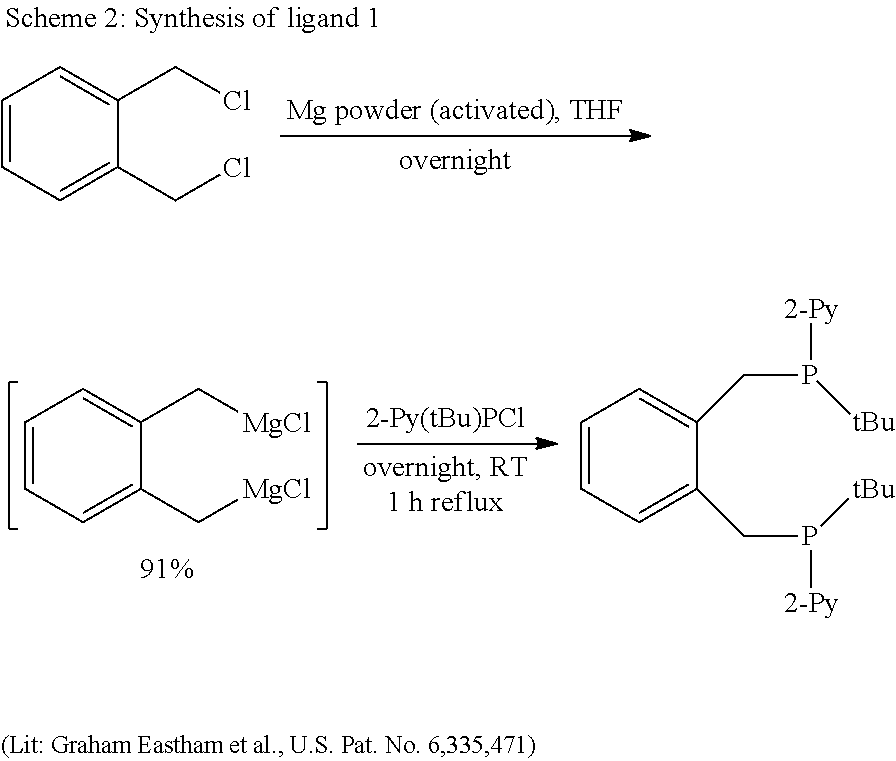
- Ligand 1 ( ⁇ , ⁇ ′-bis(2-pyridyl(t-butyl)phosphino)o-xylene)
- the cloudy THF solution is decanted and the activated magnesium powder is washed twice with 1-2 ml of THF. Then another 20 ml of fresh THF are added.
- a solution of 1.21 g (6.9 mmol) of ⁇ , ⁇ ′-dichloro-o-xylene in 70 ml of THE is slowly added dropwise with a syringe pump. The THF solution gradually turns a darker colour.
- the THF suspension is filtered to remove the unconverted magnesium powder and the content of Grignard compound is determined as follows:
- a 4 ml glass reaction vessel (vial) is charged under argon with Pd(acac) 2 (1.52 mg, 0.25 mol %), PTSA (14.3 mg, 3.75 mol %) and a magnetic stirrer. Then MeOH (2 ml) and MTBE (0.24 ml, 2 mmol) are added under argon.
- This vial is placed in a metal plate fabricated for the purpose, and the plate with vial is transferred into a 300 ml autoclave from Parr Instruments.
- the autoclave is purged three times with CO and then charged with 50 bar of CO at room temperature.
- the reaction is carried out with magnetic stirring at 120° C. for 20 hours. After cooling down to room temperature, the autoclave is carefully let down.
- the yield was conducted by GC analysis with isooctane (200 ⁇ l) as internal standard (0% yield of methyl 3-methylbutaonate).
- a 4 ml glass reaction vessel (vial) is charged under argon with Pd(acac) 2 (1.52 mg, 0.25 mol %), PTSA (14.3 mg, 3.75 mol %), 3 (8.72 mg, 1 mol %) and a magnetic stirrer. Then MeOH (2 ml) and MTBE (0.24 ml, 2 mmol) are added under argon.
- This vial is placed in a metal plate fabricated for the purpose, and the plate with vial is transferred into a 300 ml autoclave from Parr Instruments. The autoclave is purged three times with CO and then charged with 50 bar of CO at room temperature. The reaction is carried out with magnetic stirring at 120° C. for 20 hours. After cooling down to room temperature, the autoclave is carefully let down. The yield was conducted by GC analysis with isooctane (200 ⁇ l) as internal standard (0% yield of methyl 3-methylbutaonate).
- a 4 ml glass reaction vessel (vial) is charged under argon with Pd(acac) 2 (1.52 mg, 0.25 mol %), PTSA (14.3 mg, 3.75 mol %), 1 (8.7 mg, 1 mol %) and a magnetic stirrer. Then MeOH (2 ml) and MTBE (0.24 ml, 2 mmol) are added under argon.
- This vial is placed in a metal plate fabricated for the purpose, and the plate with vial is transferred into a 300 ml autoclave from Parr Instruments. The autoclave is purged three times with CO and then charged with 50 bar of CO at room temperature. The reaction is carried out with magnetic stirring at 120° C. for 20 hours. After cooling down to room temperature, the autoclave is carefully let down. The yield was conducted by GC analysis with isooctane (200 ⁇ l) as internal standard (73% yield of methyl 3-methylbutaonate).
Landscapes
- Chemical & Material Sciences (AREA)
- Organic Chemistry (AREA)
- Chemical Kinetics & Catalysis (AREA)
- Engineering & Computer Science (AREA)
- Materials Engineering (AREA)
- Health & Medical Sciences (AREA)
- Life Sciences & Earth Sciences (AREA)
- Biochemistry (AREA)
- General Health & Medical Sciences (AREA)
- Molecular Biology (AREA)
- Inorganic Chemistry (AREA)
- Organic Low-Molecular-Weight Compounds And Preparation Thereof (AREA)
- Catalysts (AREA)
- Low-Molecular Organic Synthesis Reactions Using Catalysts (AREA)
Abstract
-
- a) introducing an ether having 3 to 30 carbon atoms;
- b) adding a phosphine ligand and a compound which comprises Pd, or adding a complex comprising Pd and a phosphine ligand;
- c) adding an alcohol;
- d) supplying CO;
- e) heating the reaction mixture, the ether being reacted for form an ester;
- where the phosphine ligand is a compound of formula (I)

where
- m and n are each independently 0 or 1;
- R1, R2, R3, R4 are each independently selected from —(C1-C12)-alkyl, —(C3-C12)-cycloalkyl, —(C3-C12)-heterocycloalkyl, —(C6-C20)-aryl, —(C3-C20)-heteroaryl;
- at least one of the R1, R2, R3, R4 radicals is a —(C3-C20)-heteroaryl radical; and
- R1, R2, R3, R4, if they are —(C1-C12)-alkyl, —(C3-C12)-cycloalkyl, —(C3-C12)-heterocycloalkyl, —(C6-C20)-aryl or —(C3-C20)-heteroaryl,
- may each independently be substituted by one or more substituents selected from —(C1-C12)-alkyl, —(C3-C12)-cycloalkyl, —(C3-C12)-heterocycloalkyl, —O—(C1-C12)-alkyl, —O—(C1-C12)-alkyl-(C6-C20)-aryl, —O—(C3-C12)-cycloalkyl, —S—(C1-C12)-alkyl, —S—(C3-C12)-cycloalkyl, —COO—(C1-C12)-alkyl, —COO—(C3-C12)-cycloalkyl, —CONH—(C1-C12)-alkyl, —CONH—(C3-C12)-cycloalkyl, —CO—(C1-C12)-alkyl, —CO—(C3-C12)-cycloalkyl, —N—[(C1-C12)-alkyl]2, —(C6-C20)-aryl, —(C6-C20)-aryl-(C1-C12)-alkyl, —(C6-C20)-aryl-O—(C1-C12)-alkyl, —(C3-C20)-heteroaryl, —(C3-C20)-heteroaryl-(C1-C12)-alkyl, —(C3-C20)-heteroaryl-O—(C1-C12)-alkyl, —COOH, —OH, —SO3H, —NH2, halogen.
Description


where
m and n are each independently 0 or 1;
R1, R2, R3, R4 are each independently selected from —(C1-C12)-alkyl, —(C3-C12)-cycloalkyl, —(C3-C12)-heterocycloalkyl, —(C6-C20)-aryl, —(C3-C20)-heteroaryl;
at least one of the R1, R2, R3, R4 radicals is a —(C3-C20)-heteroaryl radical;
and
R1, R2, R3, R4, if they are —(C1-C12)-alkyl, —(C3-C12)-cycloalkyl, —(C3-C12)-heterocycloalkyl, —(C6-C20)-aryl or —(C3-C20)-heteroaryl,
may each independently be substituted by one or more substituents selected from —(C1-C12)-alkyl, —(C3-C12)-cycloalkyl, —(C3-C12)-heterocycloalkyl, —O—(C1-C12)-alkyl, —O—(C1-C12)-alkyl-(C6-C20)-aryl, —O—(C3-C12)-cycloalkyl, —S—(C1-C12)-alkyl, —S—(C3-C12)-cycloalkyl, —COO—(C1-C12)-alkyl, —COO—(C3-C12)-cycloalkyl, —CONH—(C1-C12)-alkyl, —CONH—(C3-C12)-cycloalkyl, —CO—(C1-C12)-alkyl, —CO—(C3-C12)-cycloalkyl, —N—[(C1-C12)-alkyl]2, —(C6-C20)-aryl, —(C6-C20)-aryl-(C1-C12)-alkyl, —(C6-C20)-aryl-O—(C1-C12)-alkyl, —(C3-C20)-heteroaryl, —(C3-C20)-heteroaryl-(C1-C12)-alkyl, —(C3-C20)-heteroaryl-O—(C1-C12)-alkyl, —COOH, —OH, —SC3H, —NH2, halogen.


where R5 is selected from —(C1-C12)-alkyl, —(C3-C12)-cycloalkyl, —(C6-C20)-aryl;
R6 and R7 each independently are selected from —H, —(C1-C12)-alkyl, —(C3-C12)-cycloalkyl, —(C6-C20)-aryl;
and R8 is selected from —(C1-C12)-alkyl, —(C3-C12)-cycloalkyl, —(C6-C20)-aryl.



| Yield of methyl | |||||
| Example | Ligand | Solvent | 3-methylbutanoate | ||
| 1 (CE) | — | methanol | 0% | ||
| 2 (CE) | 3 | methanol | 0% | ||
| 3 | 1 | methanol | 73% | ||
| CE: Comparative example | |||||
Claims (14)


Applications Claiming Priority (3)
| Application Number | Priority Date | Filing Date | Title |
|---|---|---|---|
| EP16180054.5A EP3272730B1 (en) | 2016-07-19 | 2016-07-19 | Method for the alkoxycarbonylation of ethers |
| EP16180054.5 | 2016-07-19 | ||
| EP16180054 | 2016-07-19 |
Publications (2)
| Publication Number | Publication Date |
|---|---|
| US20180022685A1 US20180022685A1 (en) | 2018-01-25 |
| US10494326B2 true US10494326B2 (en) | 2019-12-03 |
Family
ID=56464082
Family Applications (1)
| Application Number | Title | Priority Date | Filing Date |
|---|---|---|---|
| US15/651,169 Active US10494326B2 (en) | 2016-07-19 | 2017-07-17 | Process for the alkoxycarbonylation of ethers |
Country Status (11)
| Country | Link |
|---|---|
| US (1) | US10494326B2 (en) |
| EP (1) | EP3272730B1 (en) |
| JP (1) | JP6498727B2 (en) |
| KR (1) | KR101960176B1 (en) |
| CN (1) | CN107628949B (en) |
| CA (1) | CA2973840C (en) |
| ES (1) | ES2718747T3 (en) |
| MX (1) | MX374196B (en) |
| MY (1) | MY172666A (en) |
| SG (1) | SG10201705861SA (en) |
| TW (1) | TWI668208B (en) |
Families Citing this family (1)
| Publication number | Priority date | Publication date | Assignee | Title |
|---|---|---|---|---|
| CN113912646B (en) * | 2021-11-18 | 2024-05-17 | 浙江新化化工股份有限公司 | Preparation method of bidentate phosphine ligand |
Citations (10)
| Publication number | Priority date | Publication date | Assignee | Title |
|---|---|---|---|---|
| GB1232317A (en) | 1968-12-30 | 1971-05-19 | ||
| US5315030A (en) | 1993-09-29 | 1994-05-24 | Ethyl Corporation | Catalytic carbonylation of ethers and thioethers |
| US5399747A (en) | 1994-01-27 | 1995-03-21 | Albemarle Corporation | Process for preparing carboxylic acids by carbonylation of ethers and thioethers |
| TW318839B (en) | 1994-12-22 | 1997-11-01 | Ici Plc | Process for the carbonylation of ethylene and catalyst system for use therein |
| US6175036B1 (en) | 1997-02-26 | 2001-01-16 | Dsm N.V. | Process to prepare a pentenoic acid derivative |
| WO2001047861A1 (en) | 1999-12-29 | 2001-07-05 | Exxonmobil Chemical Patents Inc. | Production of esters |
| US6335471B1 (en) | 1997-08-13 | 2002-01-01 | Ineos Acrylics Uk Limited | Method of manufacturing phosphine compound |
| US7309798B2 (en) | 2005-05-05 | 2007-12-18 | The Regents Of The University Of California | Process for carbonylation of alkyl ethers |
| WO2011083305A1 (en) | 2010-01-05 | 2011-07-14 | Lucite International Uk Limited | Process for the carbonylation of ethylenically unsaturated compounds, novel carbonylation ligands and catalyst systems incorporating such ligands |
| US20170022138A1 (en) | 2015-07-23 | 2017-01-26 | Evonik Degussa Gmbh | Butyl-bridged diphosphine ligands for alkoxycarbonylation |
Family Cites Families (1)
| Publication number | Priority date | Publication date | Assignee | Title |
|---|---|---|---|---|
| GB1224518A (en) * | 1968-11-11 | 1971-03-10 | Shell Int Research | Preparation of carboxylic esters |
-
2016
- 2016-07-19 EP EP16180054.5A patent/EP3272730B1/en active Active
- 2016-07-19 ES ES16180054T patent/ES2718747T3/en active Active
-
2017
- 2017-07-13 MX MX2017009231A patent/MX374196B/en active IP Right Grant
- 2017-07-14 JP JP2017137959A patent/JP6498727B2/en active Active
- 2017-07-17 CA CA2973840A patent/CA2973840C/en active Active
- 2017-07-17 TW TW106123840A patent/TWI668208B/en active
- 2017-07-17 SG SG10201705861SA patent/SG10201705861SA/en unknown
- 2017-07-17 MY MYPI2017702609A patent/MY172666A/en unknown
- 2017-07-17 US US15/651,169 patent/US10494326B2/en active Active
- 2017-07-18 CN CN201710585190.1A patent/CN107628949B/en active Active
- 2017-07-18 KR KR1020170090739A patent/KR101960176B1/en active Active
Patent Citations (24)
| Publication number | Priority date | Publication date | Assignee | Title |
|---|---|---|---|---|
| GB1232317A (en) | 1968-12-30 | 1971-05-19 | ||
| US5315030A (en) | 1993-09-29 | 1994-05-24 | Ethyl Corporation | Catalytic carbonylation of ethers and thioethers |
| US5399747A (en) | 1994-01-27 | 1995-03-21 | Albemarle Corporation | Process for preparing carboxylic acids by carbonylation of ethers and thioethers |
| TW318839B (en) | 1994-12-22 | 1997-11-01 | Ici Plc | Process for the carbonylation of ethylene and catalyst system for use therein |
| EP0799180B1 (en) | 1994-12-22 | 1999-06-30 | Imperial Chemical Industries Plc | Process for the carbonylation of ethylene and catalyst system for use therein |
| US6348621B1 (en) | 1994-12-22 | 2002-02-19 | Imperial Chemical Industries Plc | Process for the carbonylation of ethylene and catalyst system for use therein |
| US6175036B1 (en) | 1997-02-26 | 2001-01-16 | Dsm N.V. | Process to prepare a pentenoic acid derivative |
| JP2001513103A (en) | 1997-02-26 | 2001-08-28 | ディーエスエム エヌ.ブイ. | Method for producing pentenoic acid derivative |
| US6335471B1 (en) | 1997-08-13 | 2002-01-01 | Ineos Acrylics Uk Limited | Method of manufacturing phosphine compound |
| WO2001047861A1 (en) | 1999-12-29 | 2001-07-05 | Exxonmobil Chemical Patents Inc. | Production of esters |
| JP2003519112A (en) | 1999-12-29 | 2003-06-17 | エクソンモービル ケミカル パテンツ インコーポレイテッド | Method for producing ester |
| US7005537B2 (en) | 1999-12-29 | 2006-02-28 | Exxonmobil Chemical Patents Inc. | Production of esters |
| US7309798B2 (en) | 2005-05-05 | 2007-12-18 | The Regents Of The University Of California | Process for carbonylation of alkyl ethers |
| TWI304806B (en) | 2005-05-05 | 2009-01-01 | Univ California | Process for carbonylation of alkyl ethers |
| WO2011083305A1 (en) | 2010-01-05 | 2011-07-14 | Lucite International Uk Limited | Process for the carbonylation of ethylenically unsaturated compounds, novel carbonylation ligands and catalyst systems incorporating such ligands |
| JP2013516449A (en) | 2010-01-05 | 2013-05-13 | ルーサイト インターナショナル ユーケー リミテッド | Method for carbonylation of ethylenically unsaturated compounds, novel carbonylation ligands and catalyst systems incorporating such ligands |
| US8969560B2 (en) | 2010-01-05 | 2015-03-03 | Lucite International Uk Limited | Process for the carbonylation of ethylenically unsaturated compounds, novel carbonylation ligands and catalyst systems incorporating such ligands |
| US9381503B2 (en) | 2010-01-05 | 2016-07-05 | Lucite International Uk Limited | Process for the carbonylation of ethylenically unsaturated compounds, novel carbonylation ligands and catalyst systems incorporating such ligands |
| US20170022138A1 (en) | 2015-07-23 | 2017-01-26 | Evonik Degussa Gmbh | Butyl-bridged diphosphine ligands for alkoxycarbonylation |
| US20170022139A1 (en) | 2015-07-23 | 2017-01-26 | Evonik Degussa Gmbh | Monophosphine compounds and palladium catalysts based thereon for the alkoxycarbonylation of ethylenically unsaturated compounds |
| US20170022235A1 (en) | 2015-07-23 | 2017-01-26 | Evonik Degussa Gmbh | Ferrocene-based compounds and palladium catalysts based thereon for the alkoxycarbonylation of ethylenically unsaturated compounds |
| US20170022236A1 (en) | 2015-07-23 | 2017-01-26 | Evonik Degussa Gmbh | Ferrocene-based compounds and palladium catalysts based thereon for the alkoxycarbonylation of ethylenically unsaturated compounds |
| US20170022137A1 (en) | 2015-07-23 | 2017-01-26 | Evonik Degussa Gmbh | Benzene-based diphosphine ligands for alkoxycarbonylation |
| US20170022234A1 (en) | 2015-07-23 | 2017-01-26 | Evonik Degussa Gmbh | Phosphine ligand and palladium catalysts based thereon for the alkoxycarbonylation of ethylenically unsaturated compounds |
Non-Patent Citations (18)
| Title |
|---|
| Armarego, Wilfred L.F., et al. Purification of Laboratory Chemicals, Butterworth Heinemann (Elsevier), 6th edition, Oxford 2009 (index and chapter abstracts provided). |
| Budzelaar, Peter H.M. et al. Synthesis and Coordination Chemistry of a New Class of Binucleating Ligands: Pyridyl-Substituted Diphosphines. Organometallics 1990, vol. 9, pp. 1222-1227. |
| European Search Report dated Jan. 5, 2017 for EP 16 18 0054 (1 page). |
| Harris, Robin K. et al. Further Conventions for NMR Shielding and Chemical Shifts. Pure Appl. Chem., 2008, vol. 80, pp. 59-84. |
| Harris, Robin K. et al. NMR Nomenclature, Nuclear Spin Properties and Conventions for Chemical Shifts. Pure Appl. Chem., 2001, vol. 73, pp. 1795-1818. |
| Japanese Office Action dated Oct. 16, 2018 for JP Patent Application No. 2017-137959 (3 pages in Japanese with English machine translation). |
| Köppe Ralf, et al. Quntenchemische und Experimentelle Untersuchungen zur Stabilität und Struktur von GaAs5 und InAs5. Angew. Chem. 2004, vol. 116, pp. 2222-2225. |
| Taiwanese Search Report dated Jan. 15, 2019 in TW 106123840 (1 page). |
| U.S. Appl. No. 15/649,743, Dong, et al., filed Jul. 14, 2017. |
| U.S. Appl. No. 15/649,759, Dong, et al., filed Jul. 14, 2017. |
| U.S. Appl. No. 15/649,770, Dong, et al., filed Jul. 14, 2017. |
| U.S. Appl. No. 15/649,781, Dong, et al., filed Jul. 14, 2017. |
| U.S. Appl. No. 15/651,042, Fang, et al., filed Jul. 17, 2017. |
| U.S. Appl. No. 15/651,062, Dong, et al., filed Jul. 17, 2017. |
| U.S. Appl. No. 15/651,105, Dong, et al., filed Jul. 17, 2017. |
| W. Clegg, G. R. Eastham, M. R. J. Eisegood, R. P. Tooze, X. L. Wang, K. Whiston. Highly active and selective catalysts for the production of methyl propanoate via the methoxycarbonylation of ethene. Chem. Commun. 1999, 1877-1878. |
| Zhou, H., et al. Catalytic carbonylation of α-(6-methoxyl-2-naphthyl)ethanol to methyl esters of naproxen using PdCl2-CuCl2-PPh3-acid catalyst system. Journal of Organometallic Chemistry. 1998. vol. 556. pp. 239-242. |
| Zhou, H., et al. Catalytic carbonylation of α-(6-methoxyl-2-naphthyl)ethanol to methyl esters of naproxen using PdCl2—CuCl2—PPh3-acid catalyst system. Journal of Organometallic Chemistry. 1998. vol. 556. pp. 239-242. |
Also Published As
| Publication number | Publication date |
|---|---|
| ES2718747T3 (en) | 2019-07-04 |
| TWI668208B (en) | 2019-08-11 |
| EP3272730A1 (en) | 2018-01-24 |
| EP3272730B1 (en) | 2019-01-02 |
| KR101960176B1 (en) | 2019-03-19 |
| US20180022685A1 (en) | 2018-01-25 |
| MX2017009231A (en) | 2018-09-10 |
| TW201815740A (en) | 2018-05-01 |
| CN107628949B (en) | 2020-08-04 |
| MX374196B (en) | 2025-03-05 |
| CA2973840C (en) | 2019-06-25 |
| KR20180009717A (en) | 2018-01-29 |
| MY172666A (en) | 2019-12-09 |
| JP2018058819A (en) | 2018-04-12 |
| JP6498727B2 (en) | 2019-04-10 |
| CN107628949A (en) | 2018-01-26 |
| SG10201705861SA (en) | 2018-02-27 |
| CA2973840A1 (en) | 2018-01-19 |
Similar Documents
| Publication | Publication Date | Title |
|---|---|---|
| US20230348356A1 (en) | Butyl-bridged diphosphine ligands for alkoxycarbonylation | |
| US10544174B2 (en) | Process for the alkoxycarbonylation of ethylenically unsaturated compounds with monophosphine ligands | |
| US20180022773A1 (en) | 1, 1' -bis(phosphino)ferrocene ligands for alkoxycarbonylation | |
| US11028110B2 (en) | Process for the alkoxycarbonylation of alcohols | |
| US10087134B2 (en) | Process for the preparation of esters by means of carbonylation of ethers | |
| US10494326B2 (en) | Process for the alkoxycarbonylation of ethers |
Legal Events
| Date | Code | Title | Description |
|---|---|---|---|
| AS | Assignment |
Owner name: EVONIK DEGUSSA GMBH, GERMANY Free format text: ASSIGNMENT OF ASSIGNORS INTEREST;ASSIGNORS:DONG, KAIWU;JACKSTELL, RALF;NEUMANN, HELFRIED;AND OTHERS;SIGNING DATES FROM 20171216 TO 20180129;REEL/FRAME:045303/0001 |
|
| STPP | Information on status: patent application and granting procedure in general |
Free format text: RESPONSE TO NON-FINAL OFFICE ACTION ENTERED AND FORWARDED TO EXAMINER |
|
| STPP | Information on status: patent application and granting procedure in general |
Free format text: FINAL REJECTION MAILED |
|
| STPP | Information on status: patent application and granting procedure in general |
Free format text: RESPONSE AFTER FINAL ACTION FORWARDED TO EXAMINER |
|
| STPP | Information on status: patent application and granting procedure in general |
Free format text: ADVISORY ACTION MAILED |
|
| STPP | Information on status: patent application and granting procedure in general |
Free format text: NOTICE OF ALLOWANCE MAILED -- APPLICATION RECEIVED IN OFFICE OF PUBLICATIONS |
|
| STPP | Information on status: patent application and granting procedure in general |
Free format text: NOTICE OF ALLOWANCE MAILED -- APPLICATION RECEIVED IN OFFICE OF PUBLICATIONS |
|
| STPP | Information on status: patent application and granting procedure in general |
Free format text: PUBLICATIONS -- ISSUE FEE PAYMENT VERIFIED |
|
| STCF | Information on status: patent grant |
Free format text: PATENTED CASE |
|
| AS | Assignment |
Owner name: EVONIK OPERATIONS GMBH, GERMANY Free format text: CHANGE OF NAME;ASSIGNOR:EVONIK DEGUSSA GMBH;REEL/FRAME:052254/0052 Effective date: 20191104 |
|
| MAFP | Maintenance fee payment |
Free format text: PAYMENT OF MAINTENANCE FEE, 4TH YEAR, LARGE ENTITY (ORIGINAL EVENT CODE: M1551); ENTITY STATUS OF PATENT OWNER: LARGE ENTITY Year of fee payment: 4 |
|
| AS | Assignment |
Owner name: EVONIK OXENO GMBH & CO. KG, GERMANY Free format text: ASSIGNMENT OF ASSIGNORS INTEREST;ASSIGNOR:EVONIK OPERATIONS GMBH;REEL/FRAME:066242/0585 Effective date: 20231012 |