US10485656B2 - Intraocular lens system with folding features - Google Patents

Intraocular lens system with folding features Download PDF

Info

Publication number
US10485656B2
US10485656B2 US15/928,473 US201815928473A US10485656B2 US 10485656 B2 US10485656 B2 US 10485656B2 US 201815928473 A US201815928473 A US 201815928473A US 10485656 B2 US10485656 B2 US 10485656B2
Authority
US
United States
Prior art keywords
lens element
active lens
mechanical indentations
mechanical
pair
Prior art date
Legal status (The legal status is an assumption and is not a legal conclusion. Google has not performed a legal analysis and makes no representation as to the accuracy of the status listed.)
Active
Application number
US15/928,473
Other versions
US20180206980A1 (en
Inventor
Joshua N. Haddock
Dimitri T. Azar
Current Assignee (The listed assignees may be inaccurate. Google has not performed a legal analysis and makes no representation or warranty as to the accuracy of the list.)
Verily Life Sciences LLC
Original Assignee
Verily Life Sciences LLC
Priority date (The priority date is an assumption and is not a legal conclusion. Google has not performed a legal analysis and makes no representation as to the accuracy of the date listed.)
Filing date
Publication date
Application filed by Verily Life Sciences LLC filed Critical Verily Life Sciences LLC
Priority to US15/928,473 priority Critical patent/US10485656B2/en
Publication of US20180206980A1 publication Critical patent/US20180206980A1/en
Priority to US16/665,265 priority patent/US20200054444A1/en
Application granted granted Critical
Publication of US10485656B2 publication Critical patent/US10485656B2/en
Assigned to TWENTY TWENTY THERAPEUTICS LLC reassignment TWENTY TWENTY THERAPEUTICS LLC ASSIGNMENT OF ASSIGNORS INTEREST (SEE DOCUMENT FOR DETAILS). Assignors: VERILY LIFE SCIENCES LLC
Assigned to VERILY LIFE SCIENCES LLC reassignment VERILY LIFE SCIENCES LLC ASSIGNMENT OF ASSIGNORS INTEREST (SEE DOCUMENT FOR DETAILS). Assignors: TWENTY TWENTY THERAPEUTICS LLC
Active legal-status Critical Current
Anticipated expiration legal-status Critical

Links

Images

Classifications

    • AHUMAN NECESSITIES
    • A61MEDICAL OR VETERINARY SCIENCE; HYGIENE
    • A61FFILTERS IMPLANTABLE INTO BLOOD VESSELS; PROSTHESES; DEVICES PROVIDING PATENCY TO, OR PREVENTING COLLAPSING OF, TUBULAR STRUCTURES OF THE BODY, e.g. STENTS; ORTHOPAEDIC, NURSING OR CONTRACEPTIVE DEVICES; FOMENTATION; TREATMENT OR PROTECTION OF EYES OR EARS; BANDAGES, DRESSINGS OR ABSORBENT PADS; FIRST-AID KITS
    • A61F2/00Filters implantable into blood vessels; Prostheses, i.e. artificial substitutes or replacements for parts of the body; Appliances for connecting them with the body; Devices providing patency to, or preventing collapsing of, tubular structures of the body, e.g. stents
    • A61F2/02Prostheses implantable into the body
    • A61F2/14Eye parts, e.g. lenses or corneal implants; Artificial eyes
    • A61F2/16Intraocular lenses
    • A61F2/1613Intraocular lenses having special lens configurations, e.g. multipart lenses; having particular optical properties, e.g. pseudo-accommodative lenses, lenses having aberration corrections, diffractive lenses, lenses for variably absorbing electromagnetic radiation, lenses having variable focus
    • A61F2/1648Multipart lenses
    • AHUMAN NECESSITIES
    • A61MEDICAL OR VETERINARY SCIENCE; HYGIENE
    • A61FFILTERS IMPLANTABLE INTO BLOOD VESSELS; PROSTHESES; DEVICES PROVIDING PATENCY TO, OR PREVENTING COLLAPSING OF, TUBULAR STRUCTURES OF THE BODY, e.g. STENTS; ORTHOPAEDIC, NURSING OR CONTRACEPTIVE DEVICES; FOMENTATION; TREATMENT OR PROTECTION OF EYES OR EARS; BANDAGES, DRESSINGS OR ABSORBENT PADS; FIRST-AID KITS
    • A61F2/00Filters implantable into blood vessels; Prostheses, i.e. artificial substitutes or replacements for parts of the body; Appliances for connecting them with the body; Devices providing patency to, or preventing collapsing of, tubular structures of the body, e.g. stents
    • A61F2/02Prostheses implantable into the body
    • A61F2/14Eye parts, e.g. lenses or corneal implants; Artificial eyes
    • A61F2/16Intraocular lenses
    • A61F2/1613Intraocular lenses having special lens configurations, e.g. multipart lenses; having particular optical properties, e.g. pseudo-accommodative lenses, lenses having aberration corrections, diffractive lenses, lenses for variably absorbing electromagnetic radiation, lenses having variable focus
    • A61F2/1624Intraocular lenses having special lens configurations, e.g. multipart lenses; having particular optical properties, e.g. pseudo-accommodative lenses, lenses having aberration corrections, diffractive lenses, lenses for variably absorbing electromagnetic radiation, lenses having variable focus having adjustable focus; power activated variable focus means, e.g. mechanically or electrically by the ciliary muscle or from the outside
    • AHUMAN NECESSITIES
    • A61MEDICAL OR VETERINARY SCIENCE; HYGIENE
    • A61FFILTERS IMPLANTABLE INTO BLOOD VESSELS; PROSTHESES; DEVICES PROVIDING PATENCY TO, OR PREVENTING COLLAPSING OF, TUBULAR STRUCTURES OF THE BODY, e.g. STENTS; ORTHOPAEDIC, NURSING OR CONTRACEPTIVE DEVICES; FOMENTATION; TREATMENT OR PROTECTION OF EYES OR EARS; BANDAGES, DRESSINGS OR ABSORBENT PADS; FIRST-AID KITS
    • A61F2/00Filters implantable into blood vessels; Prostheses, i.e. artificial substitutes or replacements for parts of the body; Appliances for connecting them with the body; Devices providing patency to, or preventing collapsing of, tubular structures of the body, e.g. stents
    • A61F2/02Prostheses implantable into the body
    • A61F2/14Eye parts, e.g. lenses or corneal implants; Artificial eyes
    • A61F2/16Intraocular lenses
    • A61F2002/1681Intraocular lenses having supporting structure for lens, e.g. haptics
    • A61F2002/16905Having means on lens to reduce overall dimension of lens for insertion into small incision
    • A61F2002/169051Segmented zones
    • A61F2002/169053Segments fold
    • AHUMAN NECESSITIES
    • A61MEDICAL OR VETERINARY SCIENCE; HYGIENE
    • A61FFILTERS IMPLANTABLE INTO BLOOD VESSELS; PROSTHESES; DEVICES PROVIDING PATENCY TO, OR PREVENTING COLLAPSING OF, TUBULAR STRUCTURES OF THE BODY, e.g. STENTS; ORTHOPAEDIC, NURSING OR CONTRACEPTIVE DEVICES; FOMENTATION; TREATMENT OR PROTECTION OF EYES OR EARS; BANDAGES, DRESSINGS OR ABSORBENT PADS; FIRST-AID KITS
    • A61F2250/00Special features of prostheses classified in groups A61F2/00 - A61F2/26 or A61F2/82 or A61F9/00 or A61F11/00 or subgroups thereof
    • A61F2250/0001Means for transferring electromagnetic energy to implants
    • AHUMAN NECESSITIES
    • A61MEDICAL OR VETERINARY SCIENCE; HYGIENE
    • A61FFILTERS IMPLANTABLE INTO BLOOD VESSELS; PROSTHESES; DEVICES PROVIDING PATENCY TO, OR PREVENTING COLLAPSING OF, TUBULAR STRUCTURES OF THE BODY, e.g. STENTS; ORTHOPAEDIC, NURSING OR CONTRACEPTIVE DEVICES; FOMENTATION; TREATMENT OR PROTECTION OF EYES OR EARS; BANDAGES, DRESSINGS OR ABSORBENT PADS; FIRST-AID KITS
    • A61F2250/00Special features of prostheses classified in groups A61F2/00 - A61F2/26 or A61F2/82 or A61F9/00 or A61F11/00 or subgroups thereof
    • A61F2250/0014Special features of prostheses classified in groups A61F2/00 - A61F2/26 or A61F2/82 or A61F9/00 or A61F11/00 or subgroups thereof having different values of a given property or geometrical feature, e.g. mechanical property or material property, at different locations within the same prosthesis
    • A61F2250/0029Special features of prostheses classified in groups A61F2/00 - A61F2/26 or A61F2/82 or A61F9/00 or A61F11/00 or subgroups thereof having different values of a given property or geometrical feature, e.g. mechanical property or material property, at different locations within the same prosthesis differing in bending or flexure capacity

Definitions

  • This disclosure relates generally to intraocular lenses, and in particular but not exclusively, relates to active accommodating intraocular lens systems.
  • Intraocular lenses are used to treat a wide variety of physical maladies including near-sightedness, far-sightedness, astigmatism, and cataracts. IOLs are placed within an eye by cutting the eye open and inserting the IOL. Typically an IOL includes a small lens with side struts, called haptics, which are used to hold the lens in place inside the eye.
  • haptics side struts
  • IOL insertion for the treatment of cataracts is a common ophthalmological surgical procedures in the United States and around the world. The procedure is frequently completed under local anesthesia and usually takes less than 30 minutes. Furthermore, the recovery time is relatively short (approximately 2-3 weeks).
  • one major disadvantage associated with cataracts lens replacement surgery, and the conventional IOLs used is that IOLs are typically only focused for long distance sight. While patients who undergo standard IOL implantation no longer experience cloudy vision from cataracts, they largely lose their ability to accommodate (change the focal length of their eye(s) from near to far).
  • accommodating IOLs have been developed that incorporate an active focusing optic to mimic the natural accommodative process. While these accommodating IOLs offer significant improvement over their non-accommodating counterparts, rarely does the vision of the person receiving the lens return to the pre-cataracts natural-lens state.
  • FIG. 1 is a cross sectional illustration of an eye including an intraocular lens system, in accordance with an embodiment of the disclosure.
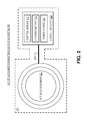
  • FIG. 2 illustrates a functional block diagram of an active accommodating intraocular lens system, in accordance with an embodiment of the disclosure.
  • FIGS. 3A-3E illustrate a variety of fold and mechanical indentation patterns that can be implemented with an active lens element, in accordance with several embodiments of the disclosure.
  • FIG. 4A is a top-down illustration of a mechanical indentation on an active lens element, in accordance with an embodiment of the disclosure.
  • FIG. 4B is a side view illustration of the mechanical indentation in FIG. 4A , in accordance with an embodiment of the disclosure.
  • FIG. 5 is a flow chart for a method of inserting an active accommodating intraocular lens system into an eye, in accordance with an embodiment of the disclosure.
  • Embodiments of an apparatus and method for an active accommodating intraocular lens system are described herein.
  • numerous specific details are set forth to provide a thorough understanding of the embodiments.
  • One skilled in the relevant art will recognize, however, that the techniques described herein can be practiced without one or more of the specific details, or with other methods, components, materials, etc.
  • well-known structures, materials, or operations are not shown or described in detail to avoid obscuring certain aspects.
  • FIG. 1 is a cross sectional illustration of an eye including an intraocular lens (IOL) system 100 , in accordance with an embodiment of the disclosure.
  • IOL system 100 has been inserted into the eye to replace the eye's natural lens which may have been removed for a variety of reasons including cataracts surgery.
  • IOL system 100 works to provide optical accommodation by employing one or more microelectronic and/or optical devices that allow the eye to readily focus on different focal distances. These microelectronic and/or optical devices may be disposed in/on a lens or may include a physically distinct lens controller system.
  • IOL system 100 includes a lens with a liquid crystal optical component that utilizes variable optical power for dynamic accommodation control.
  • a microelectronic control system is disposed along the perimeter of the lens to control the liquid crystal optical component. It should be noted that while IOL system 100 is useful to remedy problems associated with accommodation, it may also be used to solve other problems and may even be used to enhance eyesight beyond natural constraints.
  • IOL system 100 is surgically implanted into the eye. Limiting the size of the incision is important in order to reduce surgical recovery time and minimize the chance of post-surgical complications which may impact the patient's vision. Accordingly, the lens element of IOL system 100 may be folded such that the cross-sectional area of IOL system 100 is reduced as it is inserted into the eye. By folding IOL system 100 the surgeon may make a much smaller incision than would otherwise be required.
  • FIG. 2 illustrates a functional block diagram of an active accommodating intraocular lens system 200 , in accordance with an embodiment of the disclosure.
  • the illustrated embodiment of active accommodating IOL system 200 includes active lens element 201 , control circuitry 203 , encapsulation layer 221 , and conductive tether 205 .
  • the illustrated embodiment of control circuitry 203 includes control module 211 , charging module 213 , and power source 215 .
  • Active lens element 201 provides dynamic optical power for active accommodation, and is coupled to control circuitry 203 which controls active lens element 201 during the active accommodation process.
  • control circuitry 203 is separate from active lens element 201 and is coupled via a conductive tether 205 .
  • control circuitry 203 may be physically included in/on active lens element 201 or immediately adjacent thereto. Control circuitry 203 may be disposed along the periphery of active lens element 201 to avoid interference with optical accommodation devices that may be disposed in the center of active lens element 201 .
  • active lens element 201 may include liquid crystal devices in the center of active lens element 201 .
  • active lens element 201 may include fluidic devices, electrowetting devices, microelectromechanical (MEMS) devices, or the like in the center of active lens element 201 which change their optical power dynamically to adjust for the best focus for the patient.
  • MEMS microelectromechanical
  • Control circuitry 203 may contain a variety of sub elements including control module 211 .
  • control module 211 is coupled to control active lens element 201 .
  • control logic in control module 211 is implemented as hardware logic (e.g. ASIC, FPCA, etc.) and/or firmware instructions. However, in another embodiment control logic may be implemented in software (which can be altered after active accommodating IOL system 200 has been inserted into the eye), or a combination of hardware and software.
  • Power source 215 is coupled to provide power to both control module 211 and active lens element 201 .
  • power source 215 includes a battery such as a lithium ion battery or the like.
  • power source 215 may include a capacitor.
  • Power source 215 is coupled to charging module 213 which provides charge to the power source 215 .
  • charging module 213 may contain a photovoltaic device.
  • charging module 213 includes an inductive charging system.
  • the inductive charging system may receive electromagnetic radiation and convert the electromagnetic radiation into charge via induction.
  • charging module 213 may receive electromagnetic radiation from an inductive charging apparatus.
  • the user of the active accommodating IOL system 200 may be notified of a low-power situation by a display in active lens element 201 , prompting the user to use the charging apparatus.
  • the active accommodating IOL system 200 may communicate with the charging apparatus via a variety of electromagnetic transmission technologies including backscatter radio-frequency identification, or the like. In this manner, software installed on the active accommodating IOL system 200 may be updated.
  • active accommodating IOL system 200 is encased in encapsulation layer 221 .
  • Encapsulation layer 221 is disposed on an outer surface of active accommodating IOL system 200 .
  • Encapsulation layer 221 may include a single layer or many layers of encapsulant that is spray coated, dip coated, or the like onto active accommodating IOL system 200 .
  • encapsulation layer 221 may cover all, or only some of, active accommodating IOL system 200 .
  • encapsulation layer 221 includes a bio-compatible polymer material such as: silicone, polyethylene, polypropylene, polymethymethacrylate, polyethyleneoxide, polyvinylalcohol, or otherwise.
  • FIGS. 3A-3E illustrate a variety of fold lines 309 and mechanical indentation 307 patterns that can be implemented with active lens element 301 , in accordance with several embodiments of the disclosure.
  • the active accommodating IOL system e.g. active accommodating IOL system 200
  • an incision is made in the receiving eye.
  • active lens element 301 is folded to reduce its cross-sectional area.
  • mechanical indentations 307 are made along a perimeter of the active lens element 301 .
  • the mechanical indentations 307 form structurally weakened locations in the active lens element 301 .
  • These mechanical indentations 307 allow for the ophthalmic surgeon to fold active lens element 301 along predetermined folding lines 309 .
  • FIG. 3A illustrates one embodiment of active lens element 301 where a first pair of mechanical indentations 307 define terminal ends of a first folding line 309 .
  • This first pair of mechanical indentations 307 promotes folding of the active lens element 301 along first folding line 309 .
  • the first pair of mechanical indentations 307 is positioned along the perimeter of active lens element 301 so that first folding line 309 symmetrically bisects active lens element 301 in half.
  • FIG. 3B illustrates one embodiment of active lens element 301 where a first pair of mechanical indentations 307 define terminal ends of a first folding line 309 .
  • the first pair of mechanical indentations 307 promotes folding of the active lens element 301 along first folding line 309 .
  • the depicted embodiment also shows a second pair of mechanical indentations 307 which are positioned to provide symmetry of mechanical indentations 307 . It is believed that symmetry of optical defects/aberrations is preferable in vision correction devices and procedures. It is worth noting that in at least one embodiment of the present disclosure; the length along the perimeter of active lens element 301 between all adjacent mechanical indentations 307 is equal to provide symmetry of optical aberrations that may be induced by said indentations.
  • FIG. 3C illustrates one embodiment of active lens element 301 where active lens element 301 is folded into three sections to further reduce the size of the incision in the eye.
  • a first pair of mechanical indentations 307 and a second pair of mechanical indentations 307 are positioned on the perimeter of active lens element 301 .
  • the first pair of mechanical indentations 307 and the second pair of mechanical indentations 307 define terminal ends of a first folding line 309 and a second folding line 309 , respectively.
  • the first folding line 309 and the second folding line 309 extend between the first pair of mechanical indentations 307 and the second pair of mechanical indentations 307 and promote folding of the active lens element 301 .
  • the length along the perimeter of active lens element 301 between all mechanical indentations 307 is equal to provide symmetry of optical aberrations that may be induced by said indentations.
  • FIG. 3D illustrates one embodiment of active lens element 301 where active lens element 301 is again folded into three sections.
  • a first pair of mechanical indentations 307 a second pair of mechanical indentations 307 , and a third pair of mechanical indentations 307 are positioned on the perimeter of active lens element 301 .
  • the first pair of mechanical indentations 307 and the second pair of mechanical indentations 307 define terminal ends of a first folding line 309 and a second folding line 309 , respectively.
  • the first folding line 309 and the second folding line 309 extend between the first pair of mechanical indentations 307 and the second pair of mechanical indentations 307 and promote folding of the active lens element 301 .
  • a length along the perimeter of active lens element 301 between all adjacent mechanical indentations 307 is equal.
  • one mechanical indentation 307 (from the third pair of mechanical indentations 307 ) is disposed along the perimeter of active lens element 301 between the terminal ends of the first folding line 309 and between the terminal ends of the second folding line 309 .
  • the third pair of mechanical indentations 307 is disposed to provide symmetry of mechanical indentations 307 .
  • FIG. 3E illustrates one embodiment of active lens element 301 where active lens element 301 is folded into three sections.
  • a first pair of mechanical indentations 307 a second pair of mechanical indentations 307 , a third pair of mechanical indentations 307 , and a fourth pair of mechanical indentations 307 are positioned on the perimeter of active lens element 301 .
  • the first pair of mechanical indentations 307 and the second pair of mechanical indentations 307 define terminal ends of a first folding line 309 and a second folding line 309 , respectively.
  • the first folding line 309 and the second folding line 309 extend between the first pair of mechanical indentations 307 and the second pair of mechanical indentations 307 and promote folding of the active lens element 301 .
  • a length along the perimeter of active lens element 301 between all adjacent mechanical indentations 307 is equal.
  • two mechanical indentations 307 are disposed along the perimeter of active lens element 301 between the terminal ends of the first folding line 309 and between the terminal ends of the second folding line 309 .
  • the third pair of mechanical indentations 307 and the fourth pair of mechanical indentations 307 are disposed to provide symmetry of mechanical indentations 307 .
  • mechanical indentations 307 may extend from the perimeter of active lens element 301 towards the center of active lens element 301 a majority of the distance to the center of active lens element 301 . In several embodiments, mechanical indentations 307 may extend from the perimeter of active lens element 301 towards the center of active lens element 301 a length such that mechanical indentations 307 do not contact the optical devices in active lens element 301 . In this way, optical distortion resulting from mechanical indentations 307 is reduced.
  • mechanical indentations 307 may be relatively large and extend from the perimeter of active lens element 301 towards the center of active lens element 301 a length that is 45% or less of the radius of active lens element 301 . In other embodiments, mechanical indentations 307 may be relatively small and extend from the perimeter of active lens element 301 towards the center of active lens element 301 a length that is 5% or less of the radius of active lens element 301 . Further, mechanical indentations 307 may be wider than they are long, longer than they are wide, or length and width may be equal.
  • mechanical indentations 307 may extend through the bulk of active lens element 301 (creating a hole in active lens element 301 ), or may only extend through part of active lens element 301 (creating a divot in active lens element 301 ). Additionally, the depth of mechanical indentations 307 may vary as a function of location on active lens element 301 .
  • an odd number of mechanical indentations 307 may be positioned on the perimeter of active lens element 301 . Odd or even number mechanical indentations 307 may have consistent indentation geometry on the same active lens element 301 , or indentation geometry that differs between mechanical indentations 307 on the same active lens element 301 . Additionally, in some embodiments of the active accommodating IOL system, more than two folding lines 309 may be disposed on active lens element 301 . Folding lines 309 do not necessarily have to be parallel to one another and may even bisect other folding lines 309 .
  • active lens element 301 does not necessarily have to be circular. Active lens element 301 may take the shape of a rectangle, hexagon, octagon, or other polygon. Furthermore, mechanical indentations 307 may be disposed on active lens element 301 such that they are disposed on an encapsulation layer (e.g. encapsulation layer 221 ) encasing active lens element 301 .
  • an encapsulation layer e.g. encapsulation layer 221
  • FIG. 4A is a top-down illustration of a mechanical indentation 407 on an active lens element 401 , in accordance with an embodiment of the disclosure.
  • mechanical indentation 407 is rounded and does not extend through or across active lens element 401 .
  • mechanical indentation 407 may not be rounded, and may extend through active lens element 401 .
  • mechanical indentation 407 may extend across active lens element 401 any distance along folding line 409 .
  • FIG. 4B is a side view illustration of the mechanical indentation in FIG. 4A , in accordance with an embodiment of the disclosure.
  • a single mechanical indentation 407 includes two score marks in the frontside and backside of active lens element 401 .
  • the score mark on the frontside of active lens element 401 may have a different indentation geometry than the score mark on the backside of active lens element 401 . This may useful during folding since one of the score marks may experience tensile stress where the other experiences compressive stress.
  • mechanical indentation 407 can be made from a single score mark on the frontside or the backside of active lens element 401 , or may extend through active lens element 401 . Additionally, mechanical indentations 407 may be disposed on an outer edge of active lens element 401 . Mechanical indentation 407 may take the form of: a score, a divot, a cut, a mark, an inclusion, a perforation, a thinning, and/or a weakening. Mechanical indentations 407 , may be rounded or have corners.
  • FIG. 5 is a flow chart 500 for a method of inserting an active accommodating intraocular lens system (e.g. active accommodating IOL system 200 ) into an eye, in accordance with an embodiment of the disclosure.
  • an active accommodating intraocular lens system e.g. active accommodating IOL system 200
  • FIG. 5 is a flow chart 500 for a method of inserting an active accommodating intraocular lens system (e.g. active accommodating IOL system 200 ) into an eye, in accordance with an embodiment of the disclosure.
  • active accommodating intraocular lens system e.g. active accommodating IOL system 200
  • FIG. 5 is a flow chart 500 for a method of inserting an active accommodating intraocular lens system (e.g. active accommodating IOL system 200 ) into an eye, in accordance with an embodiment of the disclosure.
  • the order in which some or all of the method blocks appear should not be deemed limiting. Rather, one of ordinary skill in the art having the benefit of the present disclosure will understand that some of the method blocks may be executed in a variety of orders
  • Method block 501 details folding the active lens element (e.g. active lens element 301 ). This reduces the size of the incision necessary to insert and place the active accommodating IOL system into the eye.
  • Folding the active lens element may include folding the active lens element along at least one fold line where the at least one fold line is defined by mechanical indentations disposed on a perimeter of the active lens element. A first pair of the mechanical indentations may be used to define terminal ends of a first fold line extending between the first pair of the mechanical indentations.
  • Method block 503 provides for incising the eye to insert the active accommodating intraocular lens system into the eye.
  • it is important to make the smallest incision possible.
  • folding the active lens element helps achieve this goal by allowing the accommodating IOL system to fit through a smaller incision.
  • Method block 505 provides for inserting the active accommodating IOL system into the eye. After incising the eye, the ophthalmic surgeon slides the folded active accommodating IOL system into the eye through the incision. Depending on the fold pattern of the device, incision geometry can be tailored to minimize recovery time.
  • Method block 507 details unfolding and positioning the active accommodating IOL system in the eye. This requires the surgeon to place the accommodating IOL system in the proper compartment within the eye and ensure that it has been fully unfolded such that light can properly pass through the intraocular lens.
  • the active lens element may include two flexible struts (“haptics”) acting like tension springs to center the active lens element within the proper eye compartment.
  • the surgeon or patient may charge the active accommodating intraocular lens system within the eye.
  • a charging system may be electrically coupled to the control circuitry in the IOL device to receive electromagnetic radiation and convert the electromagnetic radiation into charge via an inductive process.
  • the charging system may be disposed in the active lens element itself or may physically separate from the active lens element.

Landscapes

  • Health & Medical Sciences (AREA)
  • Ophthalmology & Optometry (AREA)
  • Cardiology (AREA)
  • Oral & Maxillofacial Surgery (AREA)
  • Transplantation (AREA)
  • Engineering & Computer Science (AREA)
  • Biomedical Technology (AREA)
  • Heart & Thoracic Surgery (AREA)
  • Vascular Medicine (AREA)
  • Life Sciences & Earth Sciences (AREA)
  • Animal Behavior & Ethology (AREA)
  • General Health & Medical Sciences (AREA)
  • Public Health (AREA)
  • Veterinary Medicine (AREA)
  • Prostheses (AREA)

Abstract

A method of folding and unfolding an active accommodating intraocular lens system includes folding an active lens element along at least one folding line. The at least one folding line is defined by mechanical indentations disposed on a perimeter of the active lens element, and a first pair of the mechanical indentations define terminal ends of a first folding line extending between the first pair of the mechanical indentations. The active lens element is unfolded.

Description

CROSS-REFERENCE TO RELATED APPLICATIONS
This application is a divisional of U.S. application Ser. No. 14/945,261, filed Nov. 18, 2015, the contents of which are incorporated herein by reference.
TECHNICAL FIELD
This disclosure relates generally to intraocular lenses, and in particular but not exclusively, relates to active accommodating intraocular lens systems.
BACKGROUND INFORMATION
Intraocular lenses (IOLs) are used to treat a wide variety of physical maladies including near-sightedness, far-sightedness, astigmatism, and cataracts. IOLs are placed within an eye by cutting the eye open and inserting the IOL. Typically an IOL includes a small lens with side struts, called haptics, which are used to hold the lens in place inside the eye.
IOL insertion for the treatment of cataracts is a common ophthalmological surgical procedures in the United States and around the world. The procedure is frequently completed under local anesthesia and usually takes less than 30 minutes. Furthermore, the recovery time is relatively short (approximately 2-3 weeks). However, one major disadvantage associated with cataracts lens replacement surgery, and the conventional IOLs used, is that IOLs are typically only focused for long distance sight. While patients who undergo standard IOL implantation no longer experience cloudy vision from cataracts, they largely lose their ability to accommodate (change the focal length of their eye(s) from near to far).
To remedy this problem, accommodating IOLs have been developed that incorporate an active focusing optic to mimic the natural accommodative process. While these accommodating IOLs offer significant improvement over their non-accommodating counterparts, rarely does the vision of the person receiving the lens return to the pre-cataracts natural-lens state.
BRIEF DESCRIPTION OF THE DRAWINGS
Non-limiting and non-exhaustive embodiments of the invention are described with reference to the following figures, wherein like reference numerals refer to like parts throughout the various views unless otherwise specified. The drawings are not necessarily to scale, emphasis instead being placed upon illustrating the principles being described.
FIG. 1 is a cross sectional illustration of an eye including an intraocular lens system, in accordance with an embodiment of the disclosure.
FIG. 2 illustrates a functional block diagram of an active accommodating intraocular lens system, in accordance with an embodiment of the disclosure.
FIGS. 3A-3E illustrate a variety of fold and mechanical indentation patterns that can be implemented with an active lens element, in accordance with several embodiments of the disclosure.
FIG. 4A is a top-down illustration of a mechanical indentation on an active lens element, in accordance with an embodiment of the disclosure.
FIG. 4B is a side view illustration of the mechanical indentation in FIG. 4A, in accordance with an embodiment of the disclosure.
FIG. 5 is a flow chart for a method of inserting an active accommodating intraocular lens system into an eye, in accordance with an embodiment of the disclosure.
DETAILED DESCRIPTION
Embodiments of an apparatus and method for an active accommodating intraocular lens system are described herein. In the following description numerous specific details are set forth to provide a thorough understanding of the embodiments. One skilled in the relevant art will recognize, however, that the techniques described herein can be practiced without one or more of the specific details, or with other methods, components, materials, etc. In other instances, well-known structures, materials, or operations are not shown or described in detail to avoid obscuring certain aspects.
Reference throughout this specification to “one embodiment” or “an embodiment” means that a particular feature, structure, or characteristic described in connection with the embodiment is included in at least one embodiment of the present invention. Thus, the appearances of the phrases “in one embodiment” or “in an embodiment” in various places throughout this specification are not necessarily all referring to the same embodiment. Furthermore, the particular features, structures, or characteristics may be combined in any suitable manner in one or more embodiments.
FIG. 1 is a cross sectional illustration of an eye including an intraocular lens (IOL) system 100, in accordance with an embodiment of the disclosure. In the depicted embodiment, IOL system 100 has been inserted into the eye to replace the eye's natural lens which may have been removed for a variety of reasons including cataracts surgery. In operation, IOL system 100 works to provide optical accommodation by employing one or more microelectronic and/or optical devices that allow the eye to readily focus on different focal distances. These microelectronic and/or optical devices may be disposed in/on a lens or may include a physically distinct lens controller system. In one embodiment, IOL system 100 includes a lens with a liquid crystal optical component that utilizes variable optical power for dynamic accommodation control. In one embodiment, a microelectronic control system is disposed along the perimeter of the lens to control the liquid crystal optical component. It should be noted that while IOL system 100 is useful to remedy problems associated with accommodation, it may also be used to solve other problems and may even be used to enhance eyesight beyond natural constraints.
In the depicted example, IOL system 100 is surgically implanted into the eye. Limiting the size of the incision is important in order to reduce surgical recovery time and minimize the chance of post-surgical complications which may impact the patient's vision. Accordingly, the lens element of IOL system 100 may be folded such that the cross-sectional area of IOL system 100 is reduced as it is inserted into the eye. By folding IOL system 100 the surgeon may make a much smaller incision than would otherwise be required.
FIG. 2 illustrates a functional block diagram of an active accommodating intraocular lens system 200, in accordance with an embodiment of the disclosure. The illustrated embodiment of active accommodating IOL system 200 includes active lens element 201, control circuitry 203, encapsulation layer 221, and conductive tether 205. The illustrated embodiment of control circuitry 203 includes control module 211, charging module 213, and power source 215. Active lens element 201 provides dynamic optical power for active accommodation, and is coupled to control circuitry 203 which controls active lens element 201 during the active accommodation process. In the depicted embodiment, control circuitry 203 is separate from active lens element 201 and is coupled via a conductive tether 205. However, in another embodiment, control circuitry 203 may be physically included in/on active lens element 201 or immediately adjacent thereto. Control circuitry 203 may be disposed along the periphery of active lens element 201 to avoid interference with optical accommodation devices that may be disposed in the center of active lens element 201. In one embodiment, active lens element 201 may include liquid crystal devices in the center of active lens element 201. In another embodiment, active lens element 201 may include fluidic devices, electrowetting devices, microelectromechanical (MEMS) devices, or the like in the center of active lens element 201 which change their optical power dynamically to adjust for the best focus for the patient.
Control circuitry 203 may contain a variety of sub elements including control module 211. In the depicted embodiment, control module 211 is coupled to control active lens element 201. In one embodiment, control logic in control module 211 is implemented as hardware logic (e.g. ASIC, FPCA, etc.) and/or firmware instructions. However, in another embodiment control logic may be implemented in software (which can be altered after active accommodating IOL system 200 has been inserted into the eye), or a combination of hardware and software. Power source 215 is coupled to provide power to both control module 211 and active lens element 201. In one embodiment, power source 215 includes a battery such as a lithium ion battery or the like. In another embodiment, power source 215 may include a capacitor. Power source 215 is coupled to charging module 213 which provides charge to the power source 215. In one embodiment, charging module 213 may contain a photovoltaic device. In another embodiment, charging module 213 includes an inductive charging system. The inductive charging system may receive electromagnetic radiation and convert the electromagnetic radiation into charge via induction. Once active accommodating IOL system 200 has been successfully inserted into the eye, charging module 213 may receive electromagnetic radiation from an inductive charging apparatus. The user of the active accommodating IOL system 200 may be notified of a low-power situation by a display in active lens element 201, prompting the user to use the charging apparatus. Additionally, the active accommodating IOL system 200 may communicate with the charging apparatus via a variety of electromagnetic transmission technologies including backscatter radio-frequency identification, or the like. In this manner, software installed on the active accommodating IOL system 200 may be updated.
In the depicted embodiment, active accommodating IOL system 200 is encased in encapsulation layer 221. Encapsulation layer 221 is disposed on an outer surface of active accommodating IOL system 200. Encapsulation layer 221 may include a single layer or many layers of encapsulant that is spray coated, dip coated, or the like onto active accommodating IOL system 200. Furthermore, encapsulation layer 221 may cover all, or only some of, active accommodating IOL system 200. In one embodiment, encapsulation layer 221 includes a bio-compatible polymer material such as: silicone, polyethylene, polypropylene, polymethymethacrylate, polyethyleneoxide, polyvinylalcohol, or otherwise.
FIGS. 3A-3E illustrate a variety of fold lines 309 and mechanical indentation 307 patterns that can be implemented with active lens element 301, in accordance with several embodiments of the disclosure. During implantation of the active accommodating IOL system (e.g. active accommodating IOL system 200), an incision is made in the receiving eye. In order to reduce the length of the incision, active lens element 301 is folded to reduce its cross-sectional area. To facilitate folding, mechanical indentations 307 are made along a perimeter of the active lens element 301. The mechanical indentations 307 form structurally weakened locations in the active lens element 301. These mechanical indentations 307 allow for the ophthalmic surgeon to fold active lens element 301 along predetermined folding lines 309.
FIG. 3A illustrates one embodiment of active lens element 301 where a first pair of mechanical indentations 307 define terminal ends of a first folding line 309. This first pair of mechanical indentations 307 promotes folding of the active lens element 301 along first folding line 309. In the depicted embodiment, the first pair of mechanical indentations 307 is positioned along the perimeter of active lens element 301 so that first folding line 309 symmetrically bisects active lens element 301 in half.
FIG. 3B illustrates one embodiment of active lens element 301 where a first pair of mechanical indentations 307 define terminal ends of a first folding line 309. The first pair of mechanical indentations 307 promotes folding of the active lens element 301 along first folding line 309. The depicted embodiment also shows a second pair of mechanical indentations 307 which are positioned to provide symmetry of mechanical indentations 307. It is believed that symmetry of optical defects/aberrations is preferable in vision correction devices and procedures. It is worth noting that in at least one embodiment of the present disclosure; the length along the perimeter of active lens element 301 between all adjacent mechanical indentations 307 is equal to provide symmetry of optical aberrations that may be induced by said indentations.
FIG. 3C illustrates one embodiment of active lens element 301 where active lens element 301 is folded into three sections to further reduce the size of the incision in the eye. In the depicted embodiment, a first pair of mechanical indentations 307 and a second pair of mechanical indentations 307 are positioned on the perimeter of active lens element 301. The first pair of mechanical indentations 307 and the second pair of mechanical indentations 307 define terminal ends of a first folding line 309 and a second folding line 309, respectively. The first folding line 309 and the second folding line 309 extend between the first pair of mechanical indentations 307 and the second pair of mechanical indentations 307 and promote folding of the active lens element 301. In one embodiment, the length along the perimeter of active lens element 301 between all mechanical indentations 307 is equal to provide symmetry of optical aberrations that may be induced by said indentations.
FIG. 3D illustrates one embodiment of active lens element 301 where active lens element 301 is again folded into three sections. In the depicted embodiment, a first pair of mechanical indentations 307, a second pair of mechanical indentations 307, and a third pair of mechanical indentations 307 are positioned on the perimeter of active lens element 301. The first pair of mechanical indentations 307 and the second pair of mechanical indentations 307 define terminal ends of a first folding line 309 and a second folding line 309, respectively. The first folding line 309 and the second folding line 309 extend between the first pair of mechanical indentations 307 and the second pair of mechanical indentations 307 and promote folding of the active lens element 301. In one embodiment, a length along the perimeter of active lens element 301 between all adjacent mechanical indentations 307 is equal. In the depicted embodiment, one mechanical indentation 307 (from the third pair of mechanical indentations 307) is disposed along the perimeter of active lens element 301 between the terminal ends of the first folding line 309 and between the terminal ends of the second folding line 309. In one embodiment, the third pair of mechanical indentations 307 is disposed to provide symmetry of mechanical indentations 307.
FIG. 3E illustrates one embodiment of active lens element 301 where active lens element 301 is folded into three sections. In the depicted embodiment, a first pair of mechanical indentations 307, a second pair of mechanical indentations 307, a third pair of mechanical indentations 307, and a fourth pair of mechanical indentations 307 are positioned on the perimeter of active lens element 301. The first pair of mechanical indentations 307 and the second pair of mechanical indentations 307 define terminal ends of a first folding line 309 and a second folding line 309, respectively. The first folding line 309 and the second folding line 309 extend between the first pair of mechanical indentations 307 and the second pair of mechanical indentations 307 and promote folding of the active lens element 301. In one embodiment, a length along the perimeter of active lens element 301 between all adjacent mechanical indentations 307 is equal. In the depicted embodiment, two mechanical indentations 307 (from the third pair and the fourth pair of mechanical indentations 307) are disposed along the perimeter of active lens element 301 between the terminal ends of the first folding line 309 and between the terminal ends of the second folding line 309. In one embodiment, the third pair of mechanical indentations 307 and the fourth pair of mechanical indentations 307 are disposed to provide symmetry of mechanical indentations 307.
In several embodiments not depicted, mechanical indentations 307 may extend from the perimeter of active lens element 301 towards the center of active lens element 301 a majority of the distance to the center of active lens element 301. In several embodiments, mechanical indentations 307 may extend from the perimeter of active lens element 301 towards the center of active lens element 301 a length such that mechanical indentations 307 do not contact the optical devices in active lens element 301. In this way, optical distortion resulting from mechanical indentations 307 is reduced. In several embodiments, where active lens element 301 is circular, mechanical indentations 307 may be relatively large and extend from the perimeter of active lens element 301 towards the center of active lens element 301 a length that is 45% or less of the radius of active lens element 301. In other embodiments, mechanical indentations 307 may be relatively small and extend from the perimeter of active lens element 301 towards the center of active lens element 301 a length that is 5% or less of the radius of active lens element 301. Further, mechanical indentations 307 may be wider than they are long, longer than they are wide, or length and width may be equal. In some embodiments, mechanical indentations 307 may extend through the bulk of active lens element 301 (creating a hole in active lens element 301), or may only extend through part of active lens element 301 (creating a divot in active lens element 301). Additionally, the depth of mechanical indentations 307 may vary as a function of location on active lens element 301.
Although the embodiments depicted in FIGS. 3A-3E show even numbers of mechanical indentations 307, in several embodiments not depicted, an odd number of mechanical indentations 307 may be positioned on the perimeter of active lens element 301. Odd or even number mechanical indentations 307 may have consistent indentation geometry on the same active lens element 301, or indentation geometry that differs between mechanical indentations 307 on the same active lens element 301. Additionally, in some embodiments of the active accommodating IOL system, more than two folding lines 309 may be disposed on active lens element 301. Folding lines 309 do not necessarily have to be parallel to one another and may even bisect other folding lines 309. Furthermore, active lens element 301 does not necessarily have to be circular. Active lens element 301 may take the shape of a rectangle, hexagon, octagon, or other polygon. Furthermore, mechanical indentations 307 may be disposed on active lens element 301 such that they are disposed on an encapsulation layer (e.g. encapsulation layer 221) encasing active lens element 301.
FIG. 4A is a top-down illustration of a mechanical indentation 407 on an active lens element 401, in accordance with an embodiment of the disclosure. In the depicted example, mechanical indentation 407 is rounded and does not extend through or across active lens element 401. However, in another embodiment, mechanical indentation 407 may not be rounded, and may extend through active lens element 401. Additionally, mechanical indentation 407 may extend across active lens element 401 any distance along folding line 409.
FIG. 4B is a side view illustration of the mechanical indentation in FIG. 4A, in accordance with an embodiment of the disclosure. In the depicted embodiment, a single mechanical indentation 407 includes two score marks in the frontside and backside of active lens element 401. Although the depicted embodiment shows two score marks with identical geometry, in one or more embodiments, the score mark on the frontside of active lens element 401 may have a different indentation geometry than the score mark on the backside of active lens element 401. This may useful during folding since one of the score marks may experience tensile stress where the other experiences compressive stress. In other embodiments, mechanical indentation 407 can be made from a single score mark on the frontside or the backside of active lens element 401, or may extend through active lens element 401. Additionally, mechanical indentations 407 may be disposed on an outer edge of active lens element 401. Mechanical indentation 407 may take the form of: a score, a divot, a cut, a mark, an inclusion, a perforation, a thinning, and/or a weakening. Mechanical indentations 407, may be rounded or have corners.
FIG. 5 is a flow chart 500 for a method of inserting an active accommodating intraocular lens system (e.g. active accommodating IOL system 200) into an eye, in accordance with an embodiment of the disclosure. The order in which some or all of the method blocks appear should not be deemed limiting. Rather, one of ordinary skill in the art having the benefit of the present disclosure will understand that some of the method blocks may be executed in a variety of orders not illustrated, or even in parallel.
Method block 501 details folding the active lens element (e.g. active lens element 301). This reduces the size of the incision necessary to insert and place the active accommodating IOL system into the eye. Folding the active lens element may include folding the active lens element along at least one fold line where the at least one fold line is defined by mechanical indentations disposed on a perimeter of the active lens element. A first pair of the mechanical indentations may be used to define terminal ends of a first fold line extending between the first pair of the mechanical indentations.
Method block 503 provides for incising the eye to insert the active accommodating intraocular lens system into the eye. In order to reduce recovery time and minimize the probability of surgical complication, it is important to make the smallest incision possible. Hence, folding the active lens element helps achieve this goal by allowing the accommodating IOL system to fit through a smaller incision.
Method block 505 provides for inserting the active accommodating IOL system into the eye. After incising the eye, the ophthalmic surgeon slides the folded active accommodating IOL system into the eye through the incision. Depending on the fold pattern of the device, incision geometry can be tailored to minimize recovery time.
Method block 507 details unfolding and positioning the active accommodating IOL system in the eye. This requires the surgeon to place the accommodating IOL system in the proper compartment within the eye and ensure that it has been fully unfolded such that light can properly pass through the intraocular lens. In one embodiment, the active lens element may include two flexible struts (“haptics”) acting like tension springs to center the active lens element within the proper eye compartment.
In some embodiments of the method not depicted, the surgeon or patient may charge the active accommodating intraocular lens system within the eye. A charging system may be electrically coupled to the control circuitry in the IOL device to receive electromagnetic radiation and convert the electromagnetic radiation into charge via an inductive process. The charging system may be disposed in the active lens element itself or may physically separate from the active lens element.
The above description of illustrated embodiments of the invention, including what is described in the Abstract, is not intended to be exhaustive or to limit the invention to the precise forms disclosed. While specific embodiments of, and examples for, the invention are described herein for illustrative purposes, various modifications are possible within the scope of the invention, as those skilled in the relevant art will recognize.
These modifications can be made to the invention in light of the above detailed description. The terms used in the following claims should not be construed to limit the invention to the specific embodiments disclosed in the specification. Rather, the scope of the invention is to be determined entirely by the following claims, which are to be construed in accordance with established doctrines of claim interpretation.

Claims (16)

What is claimed is:
1. A method of creating an intraocular lens (IOL) system, comprising:
forming an active lens element to provide dynamic optical power; and
creating mechanical indentations disposed along a perimeter of the active lens element, wherein the mechanical indentations form structurally weakened locations in the active lens element, wherein a first pair of the mechanical indentations define terminal ends of a first folding line extending between the first pair of the mechanical indentations, and wherein the first pair of the mechanical indentations promote folding of the active lens element along the first folding line.
2. The method of claim 1, wherein creating the mechanical indentations includes at least one of scoring, cutting, marking, perforating, thinning, or weakening the active lens element.
3. The method of claim 1, wherein creating the first pair of the mechanical indentations includes positioning the first pair of mechanical indentations along the perimeter of the active lens element so that the first folding line symmetrically bisects the active lens element in half.
4. The method of claim 1, further comprising creating a second pair of the mechanical indentations, wherein a length along the perimeter of the active lens element between all adjacent mechanical indentations is equal.
5. The method of claim 1, further comprising forming an optical device disposed proximate to a center of the active lens element to provide the dynamic optical power.
6. The method of claim 5, further comprising forming control circuitry coupled to the optical device to control the dynamic optical power, wherein the optical device includes liquid crystal.
7. The method of claim 1, wherein forming the active lens element includes forming an encapsulation layer that encapsulates the active lens element by at least one of spray coating or dip coating.
8. The method of claim 7, wherein the forming the encapsulation layer includes at least one of using silicone, polyethylene, polypropylene, polymethymethacrylate, polyethyleneoxide, or polyvinylalcohol.
9. The method of claim 1, wherein the mechanical indentations include a plurality of indentation pairs, including the first pair.
10. The method of claim 9, wherein each of the plurality of indentation pairs are disposed along the perimeter of the active lens element, and wherein each of the mechanical indentations are separated from each other one of the mechanical indentations such that a length along the perimeter of the active lens element between any two adjacent ones of the mechanical indentations is equal.
11. The method of claim 1, wherein each of the mechanical indentations, including the first pair, are separated from each other one of the mechanical indentations such that a length along the perimeter of the active lens element between any two adjacent ones of the mechanical indentations is equal.
12. The method of claim 1, wherein at least one of the mechanical indentations is offset from an optical device disposed proximate to a center of the active lens element and extends partially from the perimeter of the active lens element towards the center of the active lens element.
13. The method of claim 12, wherein a length of the at least one of the mechanical indentations is 45% or less of a radius of the active lens element.
14. The method of claim 12, wherein a length of the at least one of the mechanical indentations is 5% or less of a radius of the active lens element.
15. The method of claim 1, wherein at least one of the mechanical indentations does not extend through a thickness of the active lens element.
16. The method of claim 15, wherein the at least one of the mechanical indentations indents a front side and a back side of the active lens element.
US15/928,473 2015-11-18 2018-03-22 Intraocular lens system with folding features Active US10485656B2 (en)

Priority Applications (2)

Application Number Priority Date Filing Date Title
US15/928,473 US10485656B2 (en) 2015-11-18 2018-03-22 Intraocular lens system with folding features
US16/665,265 US20200054444A1 (en) 2015-11-18 2019-10-28 Intraocular lens system with folding features

Applications Claiming Priority (2)

Application Number Priority Date Filing Date Title
US14/945,261 US9956073B2 (en) 2015-11-18 2015-11-18 Intraocular lens system with folding features
US15/928,473 US10485656B2 (en) 2015-11-18 2018-03-22 Intraocular lens system with folding features

Related Parent Applications (1)

Application Number Title Priority Date Filing Date
US14/945,261 Division US9956073B2 (en) 2015-11-18 2015-11-18 Intraocular lens system with folding features

Related Child Applications (1)

Application Number Title Priority Date Filing Date
US16/665,265 Division US20200054444A1 (en) 2015-11-18 2019-10-28 Intraocular lens system with folding features

Publications (2)

Publication Number Publication Date
US20180206980A1 US20180206980A1 (en) 2018-07-26
US10485656B2 true US10485656B2 (en) 2019-11-26

Family

ID=57223777

Family Applications (3)

Application Number Title Priority Date Filing Date
US14/945,261 Active 2036-02-05 US9956073B2 (en) 2015-11-18 2015-11-18 Intraocular lens system with folding features
US15/928,473 Active US10485656B2 (en) 2015-11-18 2018-03-22 Intraocular lens system with folding features
US16/665,265 Abandoned US20200054444A1 (en) 2015-11-18 2019-10-28 Intraocular lens system with folding features

Family Applications Before (1)

Application Number Title Priority Date Filing Date
US14/945,261 Active 2036-02-05 US9956073B2 (en) 2015-11-18 2015-11-18 Intraocular lens system with folding features

Family Applications After (1)

Application Number Title Priority Date Filing Date
US16/665,265 Abandoned US20200054444A1 (en) 2015-11-18 2019-10-28 Intraocular lens system with folding features

Country Status (5)

Country Link
US (3) US9956073B2 (en)
EP (1) EP3376998A1 (en)
CN (1) CN108348330B (en)
AU (1) AU2016355060B2 (en)
WO (1) WO2017087104A1 (en)

Families Citing this family (8)

* Cited by examiner, † Cited by third party
Publication number Priority date Publication date Assignee Title
CA2838637C (en) 2011-06-10 2020-11-17 Board Of Regents Of The University Of Nebraska Methods, systems, and devices relating to surgical end effectors
CA3184269A1 (en) 2014-02-18 2015-08-27 Alcon, Inc. Modular intraocular lens designs, tools and methods
US10342561B2 (en) 2014-09-12 2019-07-09 Board Of Regents Of The University Of Nebraska Quick-release end effectors and related systems and methods
AU2015380300B2 (en) 2015-01-30 2020-01-02 Alcon Inc. Modular intraocular lens designs
WO2017079449A1 (en) 2015-11-04 2017-05-11 Clarvista Medical, Inc. Modular intraocular lens designs, tools and methods
WO2018039606A1 (en) 2016-08-25 2018-03-01 Virtual Incision Corporation Quick-release tool coupler and related systems and methods
US11382736B2 (en) * 2017-06-27 2022-07-12 Alcon Inc. Injector, intraocular lens system, and related methods
WO2019113420A1 (en) * 2017-12-07 2019-06-13 Honigsbaum Richard F Shrink-wrap anchored and shrink-wrapped actuated accommodative intraocular lenses and methods for implantation thereof

Citations (14)

* Cited by examiner, † Cited by third party
Publication number Priority date Publication date Assignee Title
US4608049A (en) 1982-06-28 1986-08-26 Kelman Charles D Intraocular lens and method of inserting an intraocular lens into an eye
US4657546A (en) * 1983-07-08 1987-04-14 Shearing Steven P Intraocular lens
US4704124A (en) 1985-01-22 1987-11-03 Shearing Steven P Intraocular lens
US4725278A (en) * 1985-01-22 1988-02-16 Shearing Steven P Intraocular lens
US4834754A (en) * 1983-07-08 1989-05-30 Shearing Steven P Intraocular lens
US4878912A (en) 1988-11-09 1989-11-07 Castleman Lawrence D Foldable intraocular disc lens
US5171319A (en) 1992-02-10 1992-12-15 Keates Richard H Foldable intraocular lens system
WO1997043984A1 (en) 1996-05-17 1997-11-27 Helmut Payer An ocular implant
US20110015733A1 (en) * 2009-07-14 2011-01-20 Ocular Optics, Inc. Folding Designs for Intraocular Lenses
US20110137391A1 (en) 2008-06-03 2011-06-09 Leigh C Roger Foldable coil for an implantable medical device
US20130245754A1 (en) * 2010-11-15 2013-09-19 Elenza Inc. Adaptive intraocular lens
US20150216652A1 (en) * 2012-08-24 2015-08-06 Biolnic Ug Intraocular lens, in particular ciliary intraocular lens
US20150272727A1 (en) 2014-03-27 2015-10-01 Mark Humayun Intraocular lens with coupling features
US9155614B2 (en) 2007-01-22 2015-10-13 E-Vision Smart Optics, Inc. Flexible dynamic electro-active lens

Family Cites Families (3)

* Cited by examiner, † Cited by third party
Publication number Priority date Publication date Assignee Title
DE50013494D1 (en) * 1999-12-14 2006-11-02 Boehm Hans Georg Focusable intraocular lens
US6443985B1 (en) * 2001-08-27 2002-09-03 Randall Woods Intraocular lens implant having eye accommodating capabilities
CN101039635A (en) * 2004-08-24 2007-09-19 视觉隔膜技术股份有限公司 Foldable intraocular lens with adaptable haptics

Patent Citations (14)

* Cited by examiner, † Cited by third party
Publication number Priority date Publication date Assignee Title
US4608049A (en) 1982-06-28 1986-08-26 Kelman Charles D Intraocular lens and method of inserting an intraocular lens into an eye
US4657546A (en) * 1983-07-08 1987-04-14 Shearing Steven P Intraocular lens
US4834754A (en) * 1983-07-08 1989-05-30 Shearing Steven P Intraocular lens
US4704124A (en) 1985-01-22 1987-11-03 Shearing Steven P Intraocular lens
US4725278A (en) * 1985-01-22 1988-02-16 Shearing Steven P Intraocular lens
US4878912A (en) 1988-11-09 1989-11-07 Castleman Lawrence D Foldable intraocular disc lens
US5171319A (en) 1992-02-10 1992-12-15 Keates Richard H Foldable intraocular lens system
WO1997043984A1 (en) 1996-05-17 1997-11-27 Helmut Payer An ocular implant
US9155614B2 (en) 2007-01-22 2015-10-13 E-Vision Smart Optics, Inc. Flexible dynamic electro-active lens
US20110137391A1 (en) 2008-06-03 2011-06-09 Leigh C Roger Foldable coil for an implantable medical device
US20110015733A1 (en) * 2009-07-14 2011-01-20 Ocular Optics, Inc. Folding Designs for Intraocular Lenses
US20130245754A1 (en) * 2010-11-15 2013-09-19 Elenza Inc. Adaptive intraocular lens
US20150216652A1 (en) * 2012-08-24 2015-08-06 Biolnic Ug Intraocular lens, in particular ciliary intraocular lens
US20150272727A1 (en) 2014-03-27 2015-10-01 Mark Humayun Intraocular lens with coupling features

Non-Patent Citations (4)

* Cited by examiner, † Cited by third party
Title
Australian First Examination Report dated Jun. 25, 2018 for Australian Application No. 2016355060, filed Nov. 14, 2016, 4 pages.
First Office Action for Chinese Patent Application No. 201680067316.X, dated Apr. 30, 2019, 22 pages.
International Preliminary Report on Patentability with Written Opinion dated May 22, 2018, for International Application No. PCT/US2016/057132, filed Oct. 14, 2016, 8 pages.
International Search Report and Written Opinion from the International Searching Authority dated Dec. 23, 2016 or International Application No. PCT/US2016/057132, filed Oct. 14, 2016, 16 pages.

Also Published As

Publication number Publication date
AU2016355060B2 (en) 2018-10-18
CN108348330B (en) 2021-03-09
US20170135809A1 (en) 2017-05-18
US20200054444A1 (en) 2020-02-20
WO2017087104A1 (en) 2017-05-26
AU2016355060A1 (en) 2018-04-26
CN108348330A (en) 2018-07-31
US20180206980A1 (en) 2018-07-26
US9956073B2 (en) 2018-05-01
EP3376998A1 (en) 2018-09-26

Similar Documents

Publication Publication Date Title
US10485656B2 (en) Intraocular lens system with folding features
KR102652996B1 (en) Intraocular pseudophakic contact lenses and related systems and methods
US10390939B2 (en) Micro-incision IOL and positioning of the IOL in the eye
EP3618765B1 (en) Accommodating intraocular lens system
CN113558818B (en) Intraocular lens contact lenses with mechanisms for anterior leaflet fixation through the capsular wall and related systems and methods
WO2015022514A1 (en) Intraocular lens system
US20110015733A1 (en) Folding Designs for Intraocular Lenses
TWI651081B (en) Asymmetric capsular ring for inhibiting capsular opacification
AU2020409129B2 (en) Intraocular pseudophakic contact lens with mechanism for securing by anterior leaflet of capsular wall and related system and method
US20220226103A1 (en) Intraocular lens having a haptic structure with a streamlined cross-sectional geometry
US20190091009A1 (en) Intraocular lenses having open-loop haptic structures
US10925721B2 (en) Optical implantable member
US20170333181A1 (en) Dual element accommodating intraocular lens devices, systems, and methods
EP3522829A1 (en) Open, seal-less intraocular lens
US20170348091A1 (en) Dual region accommodating intraocular lens devices, systems, and methods
US20210121285A1 (en) Intraocular lens having an asymmetric hinged closed-loop haptic structure
HK40056093B (en) Intraocular pseudophakic contact lens with mechanism for securing by anterior leaflet of capsular wall and related system and method

Legal Events

Date Code Title Description
FEPP Fee payment procedure

Free format text: ENTITY STATUS SET TO UNDISCOUNTED (ORIGINAL EVENT CODE: BIG.); ENTITY STATUS OF PATENT OWNER: LARGE ENTITY

STPP Information on status: patent application and granting procedure in general

Free format text: NON FINAL ACTION MAILED

STPP Information on status: patent application and granting procedure in general

Free format text: RESPONSE TO NON-FINAL OFFICE ACTION ENTERED AND FORWARDED TO EXAMINER

STPP Information on status: patent application and granting procedure in general

Free format text: NOTICE OF ALLOWANCE MAILED -- APPLICATION RECEIVED IN OFFICE OF PUBLICATIONS

STPP Information on status: patent application and granting procedure in general

Free format text: PUBLICATIONS -- ISSUE FEE PAYMENT VERIFIED

STCF Information on status: patent grant

Free format text: PATENTED CASE

MAFP Maintenance fee payment

Free format text: PAYMENT OF MAINTENANCE FEE, 4TH YEAR, LARGE ENTITY (ORIGINAL EVENT CODE: M1551); ENTITY STATUS OF PATENT OWNER: LARGE ENTITY

Year of fee payment: 4

AS Assignment

Owner name: TWENTY TWENTY THERAPEUTICS LLC, CALIFORNIA

Free format text: ASSIGNMENT OF ASSIGNORS INTEREST;ASSIGNOR:VERILY LIFE SCIENCES LLC;REEL/FRAME:064163/0186

Effective date: 20230606

AS Assignment

Owner name: VERILY LIFE SCIENCES LLC, TEXAS

Free format text: ASSIGNMENT OF ASSIGNORS INTEREST;ASSIGNOR:TWENTY TWENTY THERAPEUTICS LLC;REEL/FRAME:068846/0001

Effective date: 20240807