US10465030B2 - Nanoparticles complexed with functionalizable enhanced affinity ligands and use thereof - Google Patents
Nanoparticles complexed with functionalizable enhanced affinity ligands and use thereof Download PDFInfo
- Publication number
- US10465030B2 US10465030B2 US15/101,516 US201415101516A US10465030B2 US 10465030 B2 US10465030 B2 US 10465030B2 US 201415101516 A US201415101516 A US 201415101516A US 10465030 B2 US10465030 B2 US 10465030B2
- Authority
- US
- United States
- Prior art keywords
- group
- dimethylammonio
- moiety
- methacrylamidopropyl
- ligand
- Prior art date
- Legal status (The legal status is an assumption and is not a legal conclusion. Google has not performed a legal analysis and makes no representation as to the accuracy of the status listed.)
- Active
Links
- 0 **C([5*])([6*])C([4*])(*B)C(=O)C([2*])([3*])C([1*])([H])** Chemical compound **C([5*])([6*])C([4*])(*B)C(=O)C([2*])([3*])C([1*])([H])** 0.000 description 28
- YIQFCDKJAMVRGA-UHFFFAOYSA-N BCCNC(C)=O Chemical compound BCCNC(C)=O YIQFCDKJAMVRGA-UHFFFAOYSA-N 0.000 description 1
- CMSKQBUVPVYUHE-UHFFFAOYSA-N CC(=O)NCCCNC(=O)CCCCC(S)CCS Chemical compound CC(=O)NCCCNC(=O)CCCCC(S)CCS CMSKQBUVPVYUHE-UHFFFAOYSA-N 0.000 description 1
- XHTNPXPSNRGILW-UHFFFAOYSA-O CC(=O)NCCC[N+](C)(C)CCCS(C)(=O)=O Chemical compound CC(=O)NCCC[N+](C)(C)CCCS(C)(=O)=O XHTNPXPSNRGILW-UHFFFAOYSA-O 0.000 description 1
- MNLLBBDWVCYJNC-UHFFFAOYSA-N CC(=O)NCNC(=O)CC(S)CCS Chemical compound CC(=O)NCNC(=O)CC(S)CCS MNLLBBDWVCYJNC-UHFFFAOYSA-N 0.000 description 1
- GZBLRCRTRRRPDQ-UHFFFAOYSA-N CC(=O)NC[N+](C)(C)CCCS(=O)(=O)[O-] Chemical compound CC(=O)NC[N+](C)(C)CCCS(=O)(=O)[O-] GZBLRCRTRRRPDQ-UHFFFAOYSA-N 0.000 description 1
- VEGHYELTMXUYDC-UHFFFAOYSA-N CCC(=O)NCNC(C)=O.S.S Chemical compound CCC(=O)NCNC(C)=O.S.S VEGHYELTMXUYDC-UHFFFAOYSA-N 0.000 description 1
- XOVAWUREHMKZQP-UHFFFAOYSA-N CCC(C)(CC(C)(C)C(=O)NCCCNC(=O)CCCCC(S)CCS)C(=O)NCCC[N+](C)(C)C(=O)CCS(=O)(=O)[O-] Chemical compound CCC(C)(CC(C)(C)C(=O)NCCCNC(=O)CCCCC(S)CCS)C(=O)NCCC[N+](C)(C)C(=O)CCS(=O)(=O)[O-] XOVAWUREHMKZQP-UHFFFAOYSA-N 0.000 description 1
- RCZKPELOLUDPIR-UHFFFAOYSA-N CCC.CCC(C)(CC(C)(CC(C)(C)C(=O)NCCCNC(=O)CCCCC(S)CCS)C(=O)NCCC[N+](C)(C)CCCS(=O)(=O)[O-])C(=O)NCCOCCN.CCC(C)(CC(C)(CC(C)(C)C(=O)NCCCNC(=O)CCCCC1CCSS1)C(=O)NCCC[N+](C)(C)CCCS(=O)(=O)[O-])C(=O)NCCCN.CCN.CN.CN Chemical compound CCC.CCC(C)(CC(C)(CC(C)(C)C(=O)NCCCNC(=O)CCCCC(S)CCS)C(=O)NCCC[N+](C)(C)CCCS(=O)(=O)[O-])C(=O)NCCOCCN.CCC(C)(CC(C)(CC(C)(C)C(=O)NCCCNC(=O)CCCCC1CCSS1)C(=O)NCCC[N+](C)(C)CCCS(=O)(=O)[O-])C(=O)NCCCN.CCN.CN.CN RCZKPELOLUDPIR-UHFFFAOYSA-N 0.000 description 1
- PMDCZENCAXMSOU-UHFFFAOYSA-N CCNC(C)=O Chemical compound CCNC(C)=O PMDCZENCAXMSOU-UHFFFAOYSA-N 0.000 description 1
- UFULAYFCSOUIOV-UHFFFAOYSA-N NCCS Chemical compound NCCS UFULAYFCSOUIOV-UHFFFAOYSA-N 0.000 description 1
- FVISPCMERFUPPE-UHFFFAOYSA-N O=COCCOCCOCCOCCOCCOCCOCCOCCOCCS Chemical compound O=COCCOCCOCCOCCOCCOCCOCCOCCOCCS FVISPCMERFUPPE-UHFFFAOYSA-N 0.000 description 1
- UAEQUXKDKOVLOU-UHFFFAOYSA-N O=COCCS Chemical compound O=COCCS UAEQUXKDKOVLOU-UHFFFAOYSA-N 0.000 description 1
Images


Classifications
-
- C—CHEMISTRY; METALLURGY
- C08—ORGANIC MACROMOLECULAR COMPOUNDS; THEIR PREPARATION OR CHEMICAL WORKING-UP; COMPOSITIONS BASED THEREON
- C08F—MACROMOLECULAR COMPOUNDS OBTAINED BY REACTIONS ONLY INVOLVING CARBON-TO-CARBON UNSATURATED BONDS
- C08F228/00—Copolymers of compounds having one or more unsaturated aliphatic radicals, each having only one carbon-to-carbon double bond, and at least one being terminated by a bond to sulfur or by a heterocyclic ring containing sulfur
- C08F228/02—Copolymers of compounds having one or more unsaturated aliphatic radicals, each having only one carbon-to-carbon double bond, and at least one being terminated by a bond to sulfur or by a heterocyclic ring containing sulfur by a bond to sulfur
-
- C—CHEMISTRY; METALLURGY
- C09—DYES; PAINTS; POLISHES; NATURAL RESINS; ADHESIVES; COMPOSITIONS NOT OTHERWISE PROVIDED FOR; APPLICATIONS OF MATERIALS NOT OTHERWISE PROVIDED FOR
- C09K—MATERIALS FOR MISCELLANEOUS APPLICATIONS, NOT PROVIDED FOR ELSEWHERE
- C09K11/00—Luminescent materials, e.g. electroluminescent or chemiluminescent
- C09K11/02—Use of particular materials as binders, particle coatings or suspension media therefor
- C09K11/025—Use of particular materials as binders, particle coatings or suspension media therefor non-luminescent particle coatings or suspension media
-
- C—CHEMISTRY; METALLURGY
- C09—DYES; PAINTS; POLISHES; NATURAL RESINS; ADHESIVES; COMPOSITIONS NOT OTHERWISE PROVIDED FOR; APPLICATIONS OF MATERIALS NOT OTHERWISE PROVIDED FOR
- C09K—MATERIALS FOR MISCELLANEOUS APPLICATIONS, NOT PROVIDED FOR ELSEWHERE
- C09K11/00—Luminescent materials, e.g. electroluminescent or chemiluminescent
- C09K11/08—Luminescent materials, e.g. electroluminescent or chemiluminescent containing inorganic luminescent materials
- C09K11/56—Luminescent materials, e.g. electroluminescent or chemiluminescent containing inorganic luminescent materials containing sulfur
- C09K11/562—Chalcogenides
- C09K11/565—Chalcogenides with zinc cadmium
-
- C—CHEMISTRY; METALLURGY
- C09—DYES; PAINTS; POLISHES; NATURAL RESINS; ADHESIVES; COMPOSITIONS NOT OTHERWISE PROVIDED FOR; APPLICATIONS OF MATERIALS NOT OTHERWISE PROVIDED FOR
- C09K—MATERIALS FOR MISCELLANEOUS APPLICATIONS, NOT PROVIDED FOR ELSEWHERE
- C09K11/00—Luminescent materials, e.g. electroluminescent or chemiluminescent
- C09K11/08—Luminescent materials, e.g. electroluminescent or chemiluminescent containing inorganic luminescent materials
- C09K11/88—Luminescent materials, e.g. electroluminescent or chemiluminescent containing inorganic luminescent materials containing selenium, tellurium or unspecified chalcogen elements
- C09K11/881—Chalcogenides
- C09K11/883—Chalcogenides with zinc or cadmium
-
- G—PHYSICS
- G01—MEASURING; TESTING
- G01N—INVESTIGATING OR ANALYSING MATERIALS BY DETERMINING THEIR CHEMICAL OR PHYSICAL PROPERTIES
- G01N33/00—Investigating or analysing materials by specific methods not covered by groups G01N1/00 - G01N31/00
- G01N33/48—Biological material, e.g. blood, urine; Haemocytometers
- G01N33/50—Chemical analysis of biological material, e.g. blood, urine; Testing involving biospecific ligand binding methods; Immunological testing
- G01N33/53—Immunoassay; Biospecific binding assay; Materials therefor
- G01N33/543—Immunoassay; Biospecific binding assay; Materials therefor with an insoluble carrier for immobilising immunochemicals
- G01N33/54353—Immunoassay; Biospecific binding assay; Materials therefor with an insoluble carrier for immobilising immunochemicals with ligand attached to the carrier via a chemical coupling agent
-
- G—PHYSICS
- G01—MEASURING; TESTING
- G01N—INVESTIGATING OR ANALYSING MATERIALS BY DETERMINING THEIR CHEMICAL OR PHYSICAL PROPERTIES
- G01N33/00—Investigating or analysing materials by specific methods not covered by groups G01N1/00 - G01N31/00
- G01N33/48—Biological material, e.g. blood, urine; Haemocytometers
- G01N33/50—Chemical analysis of biological material, e.g. blood, urine; Testing involving biospecific ligand binding methods; Immunological testing
- G01N33/58—Chemical analysis of biological material, e.g. blood, urine; Testing involving biospecific ligand binding methods; Immunological testing involving labelled substances
- G01N33/585—Chemical analysis of biological material, e.g. blood, urine; Testing involving biospecific ligand binding methods; Immunological testing involving labelled substances with a particulate label, e.g. coloured latex
- G01N33/587—Nanoparticles
Definitions
- the present invention relates to functionalizable ligands, nanoparticles complexed with said ligands, preferably nanocrystals complexed with ligands, and their use for bio-imaging.
- Functionalization of QDs surface presents many advantages. Especially, a second imaging agent may be coupled at the surface of the QD, to enable bimodal imaging. On another hand, functionalizing QDs' surface by coupling bio-targeting moieties is interesting for bio-imaging. Functionalization by a therapeutically active molecule may also be interesting.
- QD syntheses provide colloidal solutions of fluorescent nanocrystals capped with ligands. Functionalization of QD may thus be performed by functionalizing ligands presents at their surface.
- Typical QD syntheses provide QDs capped with hydrophobic ligands, while the use of QDs in live-cell imaging requires their complete solubility in water as well as an excellent compatibility with biological media.
- one method is to perform cap exchange, consisting in the replacement of original ligands by hydrophilic ones, bearing a chemical function able to bind to the nanocrystal surface (Chan et al. Science 1998, 281:2016 and Mattoussi et al. J. Am. Chem. Soc. 2000, 122:12142). Cap exchange results in small and stable QDs.
- Ligand exchange provides a versatile method to control the size, the nature of the ligand as well as its affinity for the QD surface (ligands that are too strong can indeed dissolve the QD, while ligands that are not strong enough can detach from the QD surface).
- Ligand desorption is a strong limitation for the use of QDs in bio-imaging. This desorption, favored in high diluted conditions, causes indeed a loss of colloidal stability and functionality, as well as an increase in aggregation and non-specific adsorption. As a consequence, continued efforts have been made to improve the affinity of passivating ligands for the QD surface. The design of these replacing ligands is also guided by further needs for biological applications of quantum dots, namely: small size; stability over a large pH range, at elevated salt concentrations and in a cellular medium; low non-specific adsorption; and possible functionalization afterwards.
- the Applicant developed a multidentate zwitterionic ligand L2, issued from the copolymerization of a bidentate monomer and a monozwitterionic monomer (Scheme 1) (Giovanelli et al. Langmuir 2012, 28, 15177-15184).
- QD functionalization was performed for L2-NH 2 by conjugation with fluorescein.
- L2-PEG-NH 2 -capped QDs were also conjugated via their amine function, with either biotin or avidin by peptidic coupling after capping QD.
- the Applicant provided a first generation of hydrophilic ligands having a very good affinity for QD and being functionalizable.
- functionalization requires to use at least three different monomers to form the ligand: an anchoring monomer, an hydrophilic monomer and a functionalizable monomer. Therefore, the resulting ligand is quite complex.
- functionalization of this type of ligand modifies its anchoring properties and therefore modifies the stability of the QD.
- anchoring moieties of L2 ligand may be labile. If there is a sufficient number of anchoring functions in the ligand, a part of them is not linked to the surface of the QD and they may be used for functionalizing the ligand, without decreasing the anchoring stability. This presents the advantage of not requiring a modification of the ligand by a third functionalizable monomer. There is only the need to control the length of the ligand to ensure that there is a sufficient number of anchoring monomers to achieved both anchoring and functionalization.
- the Applicant evidenced that the ligand of the invention, which may be synthesized by radical polymerization in presence of CTA (chain transfer agent), bears one functionalizable end. Indeed, it was surprisingly shown that upon CTA polymerization, ligands bearing at the first end a hydrogen atom and at the other end the CTA were predominantly obtained, whereas numerous possibilities were expected for ends of the polymeric chain.
- CTA chain transfer agent
- orthogonal functionalization of the ligand may be envisaged to introduce 2 types of functional groups on the ligand and thus on the QD.
- a first functional group may be introduced at one end of the ligand, while a second functional group may be introduced on some on the anchoring moieties on lateral chains.
- the Applicant herein provides a new ligand of QDs, which is a copolymer obtained from at least 2 monomers, said monomers being:
- the functionalizable ligand of the invention presents the advantage that even coated on QDs, functionalizable end groups of the polymer are accessible to conjugation. Therefore, the ligand may be functionalized after complexation of QD.
- This invention thus relates to a nanomaterial comprising:
- the nanoparticle is a nanocrystal and the nanocrystal is a 0D, 1D, or 2D nanocrystal, preferably a nanosheet, a nanorod, a nanoplatelet, a nanoplate, a nanoprism, a nanowall, a nanodisk, a nanoparticle, a nanowire, a nanopowder, a nanotube, a nanotetrapod, a nanoribbon, a nanobelt, a nanoneedle, a nanocube, a nanoball, a nanocoil, a nanocone, a nanopiller, a nanoflower, or a quantum dot.
- the ligand is of formula (II):
- the ligand is of formula (I-e′):
- the ligand is of formula (I-f′):
- the invention further relates to a ligand which is a copolymer of general formula (I): H—P[(A) x -co-(B) y ] n -L-R
- the ligand of the invention is of general formula (II):
- the ligand of the invention is of formula (I-e):
- the ligand of the invention is of formula (I-f):
- L represents an alkylene linking group having 1 to 20 chain atoms and optionally interrupted or terminated by —O— or —S—.
- R represents —COOH or —NH 2 .
- the invention also relates to a water-soluble composition comprising nanomaterials according to the invention.
- the present invention further relates to the use of a nanomaterial according to the invention or of the water-soluble composition according to the invention for bioimaging, biotargeting, medical imaging or biosensing.
- the invention also relates to a method for manufacturing the ligand according the invention comprising polymerizing an anchoring monomer A and a hydrophilic monomer B in presence of an initiator and a chain transfer agent (CTA), wherein anchoring monomer A and a hydrophilic monomer B are as defined above.
- CTA chain transfer agent
- the present invention further relates to a method for manufacturing the nanomaterial according to the invention comprising:
- the present invention relates to a ligand which is a copolymer obtained from at least 2 monomers, said monomers being:
- the material for which the first moiety M A has affinity is selected from the group comprising metals, semiconductors, oxides, lanthanides or mixtures thereof.
- the material is preferably selected from gold, iron, silver, copper, aluminum, platinum, lead, palladium, iron oxide, titanium dioxide, cerium oxide, metal chalcogenide, metal pnictide, cadmium, zinc, magnesium, mercury, gallium, indium, thallium, cobalt, tin or mixtures thereof.
- the material for which the first moiety M A has affinity is under the form of particles, preferably nanoparticles.
- nanoparticles may be nanocrystals.
- the present invention relates to a ligand which is a copolymer obtained from at least 2 monomers, said monomers being:
- the functional group is selected from the group comprising —NH 2 , —COOH, —OH, —SH, —CHO, ketone, halide; activated ester such as for example N-hydroxysuccinimide ester, N-hydroxyglutarimide ester or maleimide ester; activated carboxylic acid such as for example acid anhydride or acid halide; isothiocyanate; isocyanate; alkyne; azide; glutaric anhydride, succinic anhydride, maleic anhydride; hydrazide; chloroformate, maleimide, alkene, silane, hydrazone, oxime and furan.
- activated ester such as for example N-hydroxysuccinimide ester, N-hydroxyglutarimide ester or maleimide ester
- activated carboxylic acid such as for example acid anhydride or acid halide
- isothiocyanate isocyanate
- alkyne azide
- the bioactive group is selected from the group comprising avidin or streptavidin; antibody such as a monoclonal antibody or a single chain antibody; sugars; a protein or peptide sequence having a specific binding affinity for an affinity target, such as for example an avimer or an affibody (the affinity target may be for example a protein, a nucleic acid, a peptide, a metabolite or a small molecule), antigens, steroids, vitamins, drugs, haptens, metabolites, toxins, environmental pollutants, amino acids, peptides, proteins, aptamers, nucleic acids, nucleotides, peptide nucleic acid (PNA), folates, carbohydrates, lipids, phospholipid, lipoprotein, lipopolysaccharide, liposome hormone, polysaccharide, polymers, polyhistidine tags, fluorophores.
- avidin or streptavidin such as a monoclonal antibody or a single chain antibody
- sugars such as
- monomers A and B are methacrylamide monomers.
- the first moiety M A having affinity for the surface of a nanocrystal has preferably affinity for a metal present at the surface of a nanocrystal or for a material E present at the surface of a nanocrystal and selected in the group of O, S, Se, Te, N, P, As, and mixture thereof.
- metal present at the surface of a nanocrystal include, but are not limited to, gold, iron oxide, titanium dioxide, cerium oxide, metal chalcogenide, metal pnictide, cadmium, zinc, magnesium, mercury, aluminium, gallium, indium, thallium, copper, cobalt, platinum, silver, tin, lead and mixtures thereof.
- the ligand of the invention is a copolymer having a plurality of monomers including monomer A and monomer B. In one embodiment, said ligand is a random, alternate or block copolymer. In another embodiment, the ligand is a statistic copolymer. In another embodiment, said ligand is a random or block copolymer consisting essentially of monomer A and monomer B. In one embodiment of the invention, said ligand is a multi-dentate ligand.
- preferred monomers A are those described in the following table:
- preferred monomers B are those described in the following table:
- preferred -L-R are those described in the following table:
- the ligand of the present invention is a copolymer of general formula (I): H—P-[(A) x -co-(B) y ] n -L-R
- R represents —COOH or —NH 2 .
- L represents an alkylene linking group having 1 to 20 chain atoms, preferably 1 to 12 chain atoms, preferably 1, 2, 3, 4, 5, 6, 7, 8, 9, 10, 11 or 12 chain atoms, and optionally interrupted or terminated by —O— or —S—.
- L is of formula —S—(CH 2 ) n1 —, wherein n 1 is a positive integer ranging from 1 to 20, preferably 1 to 5, more preferably 1, 2 or 3.
- L represents an alkylene linking group having 3 to 20 chain atoms, preferably 3 to 12 chain atoms, preferably 3, 4, 5, 6, 7, 8, 9, 10, 11 or 12 chain atoms, and optionally interrupted or terminated by —O— or —S—.
- L is of formula —S—(CH 2 ) n1 —, wherein n 1 is a positive integer higher than 2, preferably 3 to 12 chain atoms, preferably 3, 4, 5, 6, 7, 8, 9, 10, 11 or 12 chain atoms.
- L represents an ethylene glycol derivative, preferably of formula —[CH 2 —CH 2 —O] n2 —(CH 2 ) n3 —S— wherein n 2 and n 3 are each independently positive integers and n 2 +n 3 is higher than 2; preferably n 2 +n 3 is ranging from 3 to 230.
- L represents an ethylene glycol derivative, preferably of formula —[CH 2 —CH 2 —O] n2 —(CH 2 ) n3 —S— wherein n 2 and n 3 are each independently positive integers and n 2 +n 3 is ranging from 3 to 120; preferably is 3, 4, 5, 6, 7, 8, 9, 10, 11, 12, 13, 14, 15, 16, 17, 18, 19, 20, 21, 22, 23, 24, 25, 26, 27, 28, 29, 30, 31, 32, 33, 34, 35, 36, 37, 38, 39, 40, 41, 42, 43, 44, 45, 46, 47, 48, 49, 50, 51, 52, 53, 54, 55, 56, 57, 58, 59, 60, 61, 62, 63, 64, 65, 66, 67, 68, 69, 70, 71, 72, 73, 74, 75, 76, 77, 78, 79, 80, 81, 82, 83, 84, 85, 86, 87, 88, 89, 90, 91,
- L represents an ethylene glycol derivative, preferably of formula —[CH 2 —CH 2 —O] n2 —(CH 2 ) n3 —S— wherein n 2 and n 3 are each independently positive integers and n 2 +n 3 is ranging from 3 to 50; preferably is 3, 4, 5, 6, 7, 8, 9, 10, 11, 12, 13, 14, 15, 16, 17, 18, 19, 20, 21, 22, 23, 24, 25, 26, 27, 28, 29, 30, 31, 32, 33, 34, 35, 36, 37, 38, 39, 40, 41, 42, 43, 44, 45, 46, 47, 48, 49 and 50.
- L represents an ethylene glycol derivative, preferably of formula —[CH 2 —CH 2 —O] n2 —(CH 2 ) n3 —S— wherein n 2 and n 3 are each independently positive integers ranging from 1 to 20, preferably 1, 2, 3, 4, 5, 6 7, 8, 9 or 10, more preferably n 2 is equal to 8 and n 3 is equal to 2.
- L represents a poly(ethylene glycol) derivative having a molecular weight less than 10 000 g/mol; preferably less than 5 000 g/mol; more preferably less than 1 000 g/mol.
- L represents a poly(ethylene glycol) derivative having a molecular weight ranging from 300 g/mol to 1 000 g/mol. In one embodiment, L represents a poly(ethylene glycol) derivative having a molecular weight ranging from 44 g/mol to 300 g/mol.
- L represents a poly(ethylene glycol) derivative having a molecular weight of about 400 g/mol.
- L represents a poly(ethylene glycol) derivative having a molecular weight of about 300 g/mol.
- -L-R represents —S—(CH 2 ) n3 —[CH 2 —CH 2 —O] n2 —COOH wherein n 2 and n 3 are each independently positive integers and n 2 +n 3 is higher than 2; preferably n 2 +n 3 is ranging from 3 to 230; more preferably ranging from 5 to 115: more preferably n 2 is equal to 8 and n 3 is equal to 2.
- -L-R does not represent —S—(CH 2 ) n3 —COOH wherein n 3 is ranging from 1 to 11.
- -L-R does not represent —S—(CH 2 ) n3 —NH 2 wherein n 3 is ranging from 2 to 11.
- n is ranging from 1 to 1000, from 1 to 499, from 1 to 249, from 1 to 99, from 5 to 75, from 5 to 50, from 10 to 50, from 10 to 30, from 5 to 35, from 5 to 25, from 15 to 25.
- x and y are each independently a percentage of n, preferably a percentage selected in the group of 1, 2, 3, 4, 5, 6, 7, 8, 9, 10, 11, 12, 13, 14, 15, 16, 17, 18, 19, 20, 21, 22, 23, 24, 25, 26, 27, 28, 29, 30, 31, 32, 33, 34, 35, 36, 37, 38, 39, 40, 41, 42, 43, 44, 45, 46, 47, 48, 49, 50% of n.
- the ligand of the present invention is a copolymer of general formula (II):
- R 2 , R 3 , R 5 and R 6 are H.
- R 1 and R 4 are alkyl groups, preferably methyl.
- said first moiety M A having affinity for the surface of a nanocrystal and in particular affinity for a metal present at the surface of a nanocrystal includes, but is not limited to, a thiol moiety, a dithiol moiety, an imidazole moiety, a catechol moiety, a pyridine moiety, a pyrrole moiety, a thiophene moiety, a thiazole moiety, a pyrazine moiety, a carboxylic acid or carboxylate moiety, a naphthyridine moiety, a phosphine moiety, a phosphine oxide moiety, a phenol moiety, a primary amine moiety, a secondary amine moiety, a tertiary amine moiety, a quaternary amine moiety, an aromatic amine moiety, or a combination thereof.
- said first moiety M A having affinity for the surface of a nanocrystal and in particular affinity for a material E selected in the group of O, S, Se, Te, N, P, As, and mixture thereof includes, but is not limited to, an imidazole moiety, a pyridine moiety, a pyrrole moiety, a thiazole moiety, a pyrazine moiety, a naphthyridine moiety, a phosphine moiety, a phosphine oxide moiety, a primary amine moiety, a secondary amine moiety, a tertiary amine moiety, a quaternary amine moiety, an aromatic amine moiety, or a combination thereof.
- said first moiety M A having affinity for the surface of a nanocrystal is a dithiol moiety, preferably a propane-1,3-dithiol, more preferably a propan-1-yl-1,3-dithiol moiety.
- said second moiety M B being hydrophilic includes, but is not limited to, a zwitterionic moiety (i.e. any compound having both a negative charge and a positive charge, preferably a group with both an ammonium group and a sulfonate group or a group with both an ammonium group and a carboxylate group) such as for example an aminocarboxylate, an aminosulfonate, a carboxybetaine moiety wherein the ammonium group may be included in an aliphatic chain, a five-membered cycle, a five-membered heterocycle comprising 1, 2 or 3 further nitrogen atoms, a six-membered cycle, a six-membered heterocycle comprising 1, 2, 3 or 4 further nitrogen atoms, a sulfobetaine moiety wherein the ammonium group may be included in an aliphatic chain, a five-membered cycle, a five-membered heterocycle comprising 1, 2 or 3 further nitrogen atoms, a
- a suitable poly(ether)glycol moiety is —[O—CH 2 —CHR′] n —R′′, wherein R′ can be H or C 1 -C 3 alkyl, R′′ can be H, —OH, C 1 -C 6 alkyl, C 1 -C 6 alkoxy, aryl, aryloxy, arylalkyl, or arylalkoxy and n can be an integer in the range of 1 to 120, preferably of 1 to 60, more preferably of 1 to 30.
- said second moiety M B being hydrophilic is not a PEG moiety.
- said second moiety M B being hydrophilic is a sulfobetaine group.
- the ligand of the present invention is a copolymer of general formula (III):
- each of x′ and x′′ is independently a percentage of n, preferably a percentage selected in the group of 0, 1, 2, 3, 4, 5, 6, 7, 8, 9, 10, 11, 12, 13, 14, 15, 16, 17, 18, 19, 20, 21, 22, 23, 24, 25, 26, 27, 28, 29, 30, 31, 32, 33, 34, 35, 36, 37, 38, 39, 40, 41, 42, 43, 44, 45, 46, 47, 48, 49, 50% of n, with the condition that at least one of x′ and x′′ is not 0%.
- each of y′ and y′′ is independently a percentage of n, preferably a percentage selected in the group of 0, 1, 2, 3, 4, 5, 6, 7, 8, 9, 10, 11, 12, 13, 14, 15, 16, 17, 18, 19, 20, 21, 22, 23, 24, 25, 26, 27, 28, 29, 30, 31, 32, 33, 34, 35, 36, 37, 38, 39, 40, 41, 42, 43, 44, 45, 46, 47, 48, 49, 50% of n, with the condition that at least one of y′ and y′′ is not 0%.
- R 2 ′, R 3 ′, R 2 ′′, R 3 ′′, R 5 ′, R 6 ′, R 5 ′′ and R 6 ′′ are H.
- R 1 ′, R 1 ′′, R 4 ′ and R 4 ′′ are alkyl groups, preferably methyl.
- said moiety M A comprises said moieties M A ′ and M A ′′.
- said moiety M B comprises said moieties M B ′ and M B ′′.
- said x is equal to x′+x′′. In one embodiment of the invention, said y is equal to y′+y′′.
- said first moieties M A ′ and M A ′′ having affinity for the surface of a nanocrystal and in particular affinity for a metal present at the surface of a nanocrystal include, but is not limited to, a thiol moiety, a dithiol moiety, an imidazole moiety, a catechol moiety, a pyridine moiety, a pyrrole moiety, a thiophene moiety, a thiazole moiety, a pyrazine moiety, a carboxylic acid or carboxylate moiety, a naphthyridine moiety, a phosphine moiety, a phosphine oxide moiety, a phenol moiety, a primary amine moiety, a secondary amine moiety, a tertiary amine moiety, a quaternary amine moiety, an aromatic amine moiety, or a combination thereof.
- said first moieties M A ′ and M A ′′ having affinity for the surface of a nanocrystal and in particular affinity for a material E selected in the group of O, S, Se, Te, N, P, As, and mixture thereof include, but is not limited to, an imidazole moiety, a pyridine moiety, a pyrrole moiety, a thiazole moiety, a pyrazine moiety, a naphthyridine moiety, a phosphine moiety, a phosphine oxide moiety, a primary amine moiety, a secondary amine moiety, a tertiary amine moiety, a quaternary amine moiety, an aromatic amine moiety, or a combination thereof.
- said first moiety M A ′ having affinity for the surface of a nanocrystal is a dithiol moiety and said first moiety M A ′′ having affinity for the surface of a nanocrystal is an imidazole moiety.
- said second moieties M B ′ and M B ′′ being hydrophilic include, but is not limited to, a zwitterionic moiety (i.e. any compound having both a negative charge and a positive charge, preferably a group with both an ammonium group and a sulfonate group or a group with both an ammonium group and a carboxylate group) such as for example an aminocarboxylate, an aminosulfonate, a carboxybetaine moiety wherein the ammonium group may be included in an aliphatic chain, a five-membered cycle, a five-membered heterocycle comprising 1, 2 or 3 further nitrogen atoms, a six-membered cycle, a six-membered heterocycle comprising 1, 2, 3 or 4 further nitrogen atoms, a sulfobetaine moiety wherein the ammonium group may be included in an aliphatic chain, a five-membered cycle, a five-membered heterocycle comprising 1, 2 or 3
- said second moiety M B ′ being hydrophilic is a sulfobetaine group and said second moiety M B ′′ being hydrophilic is a PEG moiety or a poly(ether)glycol moiety.
- the ligand of the invention is a copolymer synthesized from at least 2 monomers, said monomers being:
- R A comprising the first moiety M A can have the formula -L A -M A , wherein L A can be a bond or an alkylene, alkenylene, or arylene linking group having 1 to 50 chain atoms and can be optionally interrupted or terminated by —O—, —S—, —NR 7 —, wherein R 7 is H or alkyl, —CO—, —NHCO—, —CONH— or a combination thereof and M A corresponds to the first moiety as described here above.
- L A is —C( ⁇ O)—NH—(CH 2 ) m —NH—C( ⁇ O)—(CH 2 ) p —, wherein m is an integer ranging from 1 to 20, preferably from 1 to 10, preferably from 1 to 5, preferably 2, 3, 4 and p is an integer ranging from 1 to 20, preferably from 1 to 10, preferably from 1 to 6, preferably 3, 4, 5.
- -L A -M A is:
- n, p and M A are as defined above, preferably m is equal to 3 and p is equal to 4.
- M A is a dithiol moiety and -L A -M A may be represented by:
- n, p and M A are as defined above, preferably m is equal to 3 and p is equal to 4.
- m, p and M A are as defined above preferably m is equal to 3 and p is equal to 4.
- -L A -M A is:
- R B comprising the second moiety M B can have the formula -L B -M B , wherein L B can be a bond or an alkylene, alkenylene, or arylene linking group having 1 to 50 chain atoms and can be optionally interrupted or terminated by —O—, —S—, —NR 7 —, wherein R 7 is H or alkyl, —CO—, —NHCO—, —CONH— or a combination thereof and M B corresponds to the second moiety as described here above.
- -L B -M B is:
- q and M B are as defined above, preferably q is equal to 3.
- -L B -M B may be represented by:
- q is as defined above and M B is a zwitterionic moiety, preferably q is equal to 3.
- -L B -M B may be represented by:
- the ligand of the invention is of formula (I-a):
- n, x, y, L, R, L A , M A , L B and R B are as defined above.
- the ligand of the invention is of formula (I-b):
- n, x, y, L, R, m, p, M A , L B and M B are as defined above.
- the ligand of the invention is of formula (I-c):
- n, x, y, L, R, q, M B , L A and M A are as defined above.
- the ligand of the invention is of formula (I-d):
- n, x, y, L, R, m, p, M A , q and M B are as defined above.
- the ligand of the invention is of formula (I-e):
- n, x, y, L and R are as defined in formula (I) above; or a reduced form thereof.
- the ligand of the invention is of formula (I-f):
- n, x, y and L are as defined in formula (I) above; or a reduced form thereof.
- the ligand has a molecular weight from about 1,000 g/mol to about 200,000 g/mol, preferably from about 1,000 g/mol to about 100,000 g/mol, preferably from about 1,000 g/mol to about 50,000 g/mol, from about 2,000 g/mol to 50,000 g/mol, more preferably from about 2,000 g/mol to about 10,000 g/mol, from about 2,000 g/mol to 10,000 g/mol.
- the ligand has a polydispersity index inferior to 10, preferably inferior to 9, 8, 7, 6, 5, 4, 3, 2, 1.
- the ligand has a ratio of monomers A/B in number from about 1/99 to about 99/1. In a particular embodiment, the ligand has a ratio of monomers A/B in number from about 1/99 to about 50/50, preferably from about 3/97 to about 40/60, more preferably from about 10/90 to about 50/50. In another particular embodiment, the ligand has a ratio of monomers A/B in number from about 50/50 to about 99/1, preferably from about 40/60 to about 90/10.
- the ligand has a ratio of monomers A/B in number from about 1/99 to about 75/25, preferably from about 5/95 to about 50/50, more preferably from about 5/95 to about 25/75. In a specific embodiment, the ligand has a ratio of monomers A/B in number of about 50/50. In a specific embodiment, the ligand has a ratio of monomers A/B in number of about 20/80.
- the synthesis of the ligand may be performed in presence of monomer A and monomer B with a ratio of molar amounts of A to B ranging from 1/99 to 99/1, preferably from 5/95 to 50/50, preferably from 10/90 to 50/50; preferably from 10/90 to 30/70, more preferably 20/80.
- the ligand is a copolymer synthesized from at least 3 monomers, said monomers being:
- the ligand of the present invention is a copolymer of general formula (IV): H—P[(A) x -co-(B) y -co-(C) z ] n -L-R
- the ligand of the present invention is a copolymer of general formula (V):
- R 2 , R 3 , R 5 , R 6 , R 9 , and R 10 are H.
- R 1 , R 4 , and R 8 are alkyl groups, preferably methyl.
- said third moiety M C being hydrophobic includes, but is not limited to, alkyl, aryl, alkylaryl, arylalkyl, alkenyl groups.
- preferred monomers C are those described in the following table:
- R C comprising the third moiety M C can have the formula -L C -M C , wherein L C can be a bond or an alkylene, alkenylene or arylene linking group having 1 to 8 chain atoms.
- said first moiety M A is not a dihydrolipoic acid (DHLA) moiety.
- said first moiety M A is not an imidazole moiety.
- B when B comprises a monomer comprising a second moiety M B which is a PEG moiety, then B further comprises at least one monomer comprising a second moiety M B which is not a PEG moiety.
- the second moiety M B is not a PEG moiety.
- the second moiety M B when the first moiety M A is an imidazole moiety, the second moiety M B is not a sulfobetaine moiety. In a specific embodiment of the invention, when the first moiety M A is an imidazole moiety, the second moiety M B is not —N + (Me) 2 -(CH 2 ) 2 —SO 3 ⁇ or —N + (Me) 2 -(CH 2 ) 3 —SO 3 ⁇ .
- the second moiety M B when the first moiety M A is an imidazole moiety, the second moiety M B is not a carboxybetaine moiety. In a specific embodiment of the invention, when the first moiety M A is an imidazole moiety, the second moiety M B is not —N + (Me) 2 -(CH 2 ) 2 —COO ⁇ .
- the second moiety M B when the first moiety M A is an imidazole moiety, the second moiety M B is not a phosphobetaine moiety. In a specific embodiment of the invention, when the first moiety M A is an imidazole moiety, the second moiety M B is not —O—P(O 2 ⁇ )—P—(CH 2 ) 2 —N + (Me) 3 .
- the first moiety M A is a dithiol group
- B comprises a monomer comprising a second moiety M B ′ which is a PEG moiety
- B further comprises at least one monomer comprising a second moiety M B ′′ which is not a PEG moiety.
- preferred ligands comprise combinations of monomers A and B as described in the table above and -L-R is —S—(CH 2 ) 2 —(O—CH 2 —CH 2 ) 8 —COOH, —S—(CH 2 ) 12 —COOH or any -L-R described hereabove.
- the present invention further relates to a method of manufacturing of the ligand of the invention.
- the manufacturing process of the ligand of the invention comprises polymerizing an anchoring monomer A and a hydrophilic monomer B in presence of an initiator and a chain transfer agent (CTA).
- CTA chain transfer agent
- the synthesis of the ligand may be performed by any radical polymerization known by those skilled in the art.
- the synthesis of the ligand may be performed by controlled radical polymerization such as RAFT polymerization (Reversible Addition-Fragmentation chain Transfer), ATRP (Atom Transfer Radical Polymerization), NMP (Nitroxide Mediated Polymerization) or iodine transfer polymerization.
- the synthesis of the ligand may be performed by non-controlled radical polymerization.
- the synthesis of the ligand may be performed in presence of a monomer A and monomer B and a solvent such as for example acetic acid, THF, water or a mixture thereof.
- a solvent such as for example acetic acid, THF, water or a mixture thereof.
- the solvent is acetic acid.
- the polymerization is performed at a temperature ranging from 40° C. to 100° C., preferably from 50° C. to 70° C., more preferably at about 60° C.
- the polymerization is performed for a period of time ranging from 0.5 to 24 hours, preferably from 12 to 18 hours.
- the polymerization of monomers A and B is initiated by an initiator such as for example a diazoinitiator, preferably azobisisobutyronitrile (AIBN), 2,2′-azobis(2-methylpropionamidine); a peroxide, preferably acyl peroxides, acetyl peroxides, benzoyl peroxides, alkyl peroxides, hydroperoxides, acyl alkylsulfonyl peroxides, dialkyl peroxydicarbonates, diperoxyketals, ketone peroxides; a perester; an azo; a disulfide; a tetrazene; a persulfate compounds.
- an initiator such as for example a diazoinitiator, preferably azobisisobutyronitrile (AIBN), 2,2′-azobis(2-methylpropionamidine); a peroxide, preferably acyl peroxides, acetyl per
- the polymerization of monomers A and B is performed in presence of a chain transfer agent (CTA) comprising a moiety -L-R, wherein L and R are as defined above.
- CTA chain transfer agent
- the chain transfer agent (CTA) does not comprise a moiety -L-R which is —S—(CH 2 ) 2 —COOH.
- the polymerization of monomers A and B is performed in presence of a chain transfer agent (CTA), wherein the CTA is a substituted alkylthiol or a disulfide.
- CTA chain transfer agent
- the alkylthiol or the disulfide is substituted by a group selected from COOH, NH 2 , PEG, DNA, RNA, PNA, polysaccharide, peptide or any functional group or any bioactive group as defined herein.
- the chain transfer agent is not a RAFT agent; preferably is not a chain transfer agent selected from trithiocarbonate, dithiocarbamate or dithiobenzoate.
- the chain transfer agent (CTA) is not dibenzyl carbonotrithioate.
- the molar quantity of the initiator is ranging from 0.1 to 15%, preferably from 0.1% to 10%, in moles relative to the molar amount of monomers.
- the molar quantity of the chain transfer agent is different from 0 and is ranging up to 50%, preferably up to 20%.
- the molar quantity of the chain transfer agent is ranging from 10 ⁇ 6 % to 20%, from 10 ⁇ 5 % to 20%, from 10 ⁇ 4 % to 20%, from 10 ⁇ 3 % to 20%, from 10 ⁇ 2 % to 20%, from 0.1 to 15%, from 1% to 15%, from 2% to 15%, from 5% to 15% in moles relative to the molar amount of monomers.
- the molar quantity of the chain transfer agent is 10% in moles relative to the molar amount of monomers.
- the molar quantity of the chain transfer agent is 5% in moles relative to the molar amount of monomers.
- the functionalizable/functionalized material of the invention comprises a material and at least one ligand according to the invention.
- the material is selected from the group comprising metals, semiconductors, oxides, lanthanides or mixtures thereof.
- the material is preferably selected from gold, iron, silver, copper, aluminum, platinum, lead, palladium, iron oxide, titanium dioxide, cerium oxide, metal chalcogenide, metal pnictide, cadmium, zinc, magnesium, mercury, gallium, indium, thallium, cobalt, tin or mixtures thereof.
- the material is under the form of particles.
- the particles of the invention have the shape of a sphere, a cube, a tetrahedron, a rod, a wire, a platelet, a tube, a cube, a ribbon, or mixture thereof.
- particles are microparticles or nanoparticles, preferably nanoparticles.
- microparticles are microspheres.
- nanoparticles are nanocrystals, preferably under the form of quantum dots.
- said nanocrystal is a 0D, 1D, or 2D nanocrystal.
- said nanocrystal may be for instance a nanosheet, a nanorod, a nanoplatelet, a nanoplate, a nanoprism, a nanowall, a nanodisk, a nanoparticle, a nanowire, a nanopowder, a nanotube, a nanotetrapod, a nanoribbon, a nanobelt, a nanoneedle, a nanocube, a nanoball, a nanocoil, a nanocone, a nanopiller, a nanoflower, or a quantum dot.
- said nanocrystal is inorganic. In another embodiment, said nanocrystal is organic.
- said nanocrystal is a semiconductor material, a ceramic material, a magnetic material or a metallic material.
- said nanocrystal is a semi-conductor selected from group IV, group IIIA-VA, group IIA-VIA, group IIIA-VIA, group IA-IIIA-VIA, group IIA-VA, group WA-VIA, group VIB-VIA, group VB-VIA, or group IVB-VIA.
- said material MxEy comprises cationic elements M and anionic elements E in stoichiometric ratio, said stoichiometric ratio being characterized by values of x and y corresponding to absolute values of mean oxidation number of elements E and M respectively.
- said nanocrystal is a material selected from Si, Ge, CdS, CdSe, CdTe, ZnS, ZnSe, ZnTe, HgS, HgSe, HgTe, PbS, PbSe, PbTe, CuInS 2 , CuInSe 2 , AgInS 2 , AgInSe 2 , CuS, Cu 2 S, Ag 2 S, Ag 2 Se, Ag 2 Te, InN, InP, InAs, InSb, In 2 S 3 , Cd 3 P 2 , Zn 3 P 2 , Cd 3 As 2 , Zn 3 As 2 , ZnO, AN, AlP, AlAs, AlSb, GaN, GaP, GaAs, GaSb, FeS 2 , TiO 2 , Bi 2 S 3 , Bi 2 Se 3 , Bi 2 Te 3 , MoS 2 , WS 2 , VO 2 , and alloys and mixtures thereof.
- said nanocrystal is a metallic material such as gold, silver, copper, aluminum, iron, platinum, lead, palladium, iron oxide, titanium dioxide, cerium oxide, metal chalcogenide, metal pnictide, cadmium, zinc, magnesium, mercury, gallium, indium, thallium, cobalt, tin or mixtures thereof.
- said nanocrystal presents a heterostructure, which means that the nanocrystal of the invention is partially coated by at least one layer of inorganic material.
- a semiconductor nanocrystal is capable of emitting electromagnetic radiation upon excitation (i.e., the semiconductor nanocrystal is luminescent) and includes a “core” of one or more first semiconductor materials, and may be surrounded by a “shell” of a second semiconductor material.
- a semiconductor nanocrystal core surrounded by a semiconductor shell is referred to as a “core/shell” semiconductor nanocrystal.
- the surrounding “shell” material will preferably have a bandgap energy that is larger than the bandgap energy of the core material and may be chosen to have an atomic spacing close to that of the “core” substrate.
- the nanocrystal of the invention presents a core/shell structure, i.e. the nanocrystal comprises a core and a shell of semiconducting material.
- the nanocrystal of the invention has a core/shell structure, i.e. the core is totally coated by at least one layer of inorganic material.
- said quantum dots are core/shell type I quantum dots.
- Said type I quantum dot can have a band alignment between the core and the shell such that the exciton created in the shell is transferred in the core where it recombines radiatively.
- the nanocrystal of the invention comprises a core totally coated by a first layer of inorganic material, said first layer being partially or totally surrounded by at least one further layer of inorganic material.
- said core and said at least one layer of inorganic material have the same composition or do not have the same composition.
- said core and said at least one layer of inorganic material may be a semi-conductor from group IV, group IIIA-VA, group IIA-VIA, group IIIA-VIA, group IA-IIIA-VIA, group IIA-VA, group IVA-VIA, group VIB-VIA, group VB-VIA, or group IVB-VIA.
- said core and said at least one layer of inorganic material may comprise a material MxEy, wherein:
- said core and said at least one layer of inorganic material may be composed of a material from Si, Ge, CdS, CdSe, CdTe, ZnS, ZnSe, ZnTe, HgS, HgSe, HgTe, PbS, PbSe, PbTe, CuInS 2 , CuInSe 2 , AgInS 2 , AgInSe 2 , CuS, Cu 2 S, Ag 2 S, Ag 2 Se, Ag 2 Te, InN, InP, InAs, InSb, In 2 S 3 , Cd 3 P 2 , Zn 3 P 2 , Cd 3 As 2 , Zn 3 As 2 , ZnO, AN, AlP, AlAs, AlSb, GaN, GaP, GaAs, GaSb, FeS 2 , TiO 2 , Bi 2 S 3 , Bi 2 Se 3 , Bi 2 Te 3 , MoS 2 , WS 2 , VO 2 , and alloy
- the core and/or the shell can be a semiconductor material including, but not limited to, those of the group II-VI (ZnS, ZnSe, ZnTe, CdS, CdSe, CdTe, HgS, HgSe, HgTe, MgS, MgSe, MgTe, CaS, CaSe, CaTe, SrS, SrSe, SrTe, BaS, BaSe, BaTe, and the like) and III-V (GaN, GaP, GaAs, GaSb, InN, InP, InAs, InSb, and the like) and IV (Ge, Si, and the like) and IV-VI (PbS, PbSe) and I-III-VI-2 (CuInS 2 , CuInSe 2 , AgInS 2 , AgInSe 2 , CuGaS 2 , CuGaSe 2 , AgGaSe 2 , AgGaSe 2 , Ag
- the nanocrystal of the invention presents a heterostructure comprising a metallic material and semiconductor material.
- the functionalizable/functionalized material of the invention comprises:
- the material complexed by the ligand of the invention is a nanoparticle, leading to a functionalizable/functionalized nanomaterial.
- the nanomaterial of the invention comprises:
- the nanomaterial of the invention comprises:
- the nanomaterial of the invention comprises:
- the nanomaterial of the invention comprises a ligand of formula (I) wherein R is an activated function such as for example and activated ester or an activated carboxylic acid, preferably an activated ester, more preferably N-hydroxysuccinimide ester.
- R is an activated function such as for example and activated ester or an activated carboxylic acid, preferably an activated ester, more preferably N-hydroxysuccinimide ester.
- the nanomaterial of the invention comprises a nanocrystal complexed by the ligand of formula (II):
- the nanomaterial of the invention comprises a nanocrystal complexed by the ligand of formula (I-e′):
- n, x, y, L and R are as defined in formula (I) above.
- the nanoparticle of the invention comprises a nanocrystal complexed by the ligand of formula (I-f′):
- n, x, y and L are as defined in formula (I) above.
- L represents an alkylene linking group having 1 to 20 chain atoms and optionally interrupted or terminated by —O— or —S—. More preferably, L is of formula —S—(CH 2 ) n1 , wherein n 1 is a positive integer ranging from 1 to 20, preferably 1 to 5, more preferably 1, 2 or 3.
- L represents an ethylene glycol derivative, preferably of formula —[CH 2 —CH 2 —O] n2 —(CH 2 ) n3 —S— wherein n 2 and n 3 are each independently positive integers ranging from 1 to 20, preferably 1, 2, 3, 4, 5, 6 7, 8, 9 or 10, more preferably n 2 is equal to 8 and n 3 is equal to 2.
- the nanomaterial of the invention comprises a ligand of formula (I) wherein R is a bioactive group, preferably a protein or an antibody.
- Preferred embodiments relative to the ligand of formula (I) of the invention described above apply to the ligand of formula (I) comprised in the nanomaterial of the invention.
- the nanomaterial of the invention comprises a ligand of formula (I) wherein the number of ligand per dot is ranging from less than 100; preferably less than 50 ligands per dots; more preferably less than 30 ligands per dots. In one embodiment, the number of ligand per dot is about 20 ligands.
- the nanomaterial of the invention comprises a ligand of formula (I) wherein the number of fluorophores per dot is ranging from less than 100; preferably less than 20; preferably is 1, 2, 3, 4, 5, 6, 7, 8, 9, 10, 11, 12, 13, 14, 15, 16, 17, 18, 19, or 20 fluorophores per dot; preferably is ranging from more than 0 to 1. In one embodiment, the number of fluorophores per dot is 0.5.
- Another object of the invention is a method for complexing at least one ligand of the invention to at least one material, preferably at least one nanoparticle, more preferably at least one nanocrystal, comprising:
- said weakly binding ligand or molecule may be MPA, or trimethylsilylating agents, or trialkyl oxonium salts (Meerwein's salt), or any monothiol, or amine ligands.
- said first step is performed in basic chloroform and leads to the precipitation of the nanocrystal complexed to the intermediate ligand and to the homogeneous dispersion of the nanocrystal into water at room temperature. In another embodiment, said first step is performed in ethanol and leads to the precipitation of the nanocrystal complexed to the intermediate ligand.
- said second step is performed in an aqueous medium such as 20 mM aqueous NaCl at about 50° C. to 75° C., preferably 60° C., overnight, to remove the weak intermediate ligand and replace it by the ligand of the invention.
- an aqueous medium such as 20 mM aqueous NaCl at about 50° C. to 75° C., preferably 60° C., overnight, to remove the weak intermediate ligand and replace it by the ligand of the invention.
- said method may further comprise an ultrafiltration step and then an ultracentrifugation step in an aqueous sucrose gradient.
- the process for manufacturing the nanomaterial of the invention may further comprise a subsequent step of bio-conjugation to introduce a bioactive group at the end of the polymeric chain of the ligand.
- some of the M A moieties of the anchoring monomers A of the ligand of the invention may be functionalized by bioactive groups, once the ligand has been complexed to the nanocrystal.
- the process for manufacturing the nanomaterial of the invention comprises:
- the nanomaterial of the invention may be obtained by the complexation of the ligand of formula (I) of the invention with a nanocrystal. Once complexed with the nanocrystal, the ligand of formula (I) may be modified, especially by activation of functional group R present at one end of the ligand. Moreover, the ligand of formula (I) may be modified by conjugation of a bioactive group to the functional group or activated functional group present at one end of the ligand, leading to functionalized ligand of formula (I).
- the nanomaterial of the invention is activated by modifying the terminal end R of the ligand of formula (I) under the form of a terminal N-hydroxysuccinimide ester.
- Such activation enables the conjugation of bioactive groups comprising an amino group.
- Another object of the invention is a water-soluble composition
- a water-soluble composition comprising at least one quantum dot, nanoplatelet or quantum dot having its lateral dimensions larger than its thickness, complexed with at least one ligand of the invention.
- Another object of the invention is the use of said quantum dot, nanoplatelet or quantum dot having its lateral dimensions larger than its thickness, complexed with at least one ligand of the invention for bioimaging, biotargeting, medical imaging, biosensing.
- FIGS. 1A and 1B are 1 H NMR spectra recorded in D 2 O showing the monomer consumption during the polymer synthesis, between the initial state of the polymerization ( FIG. 1A ) and the end of the polymerization ( FIG. 1B ).
- FIGS. 2A et 2 B are photographs of coated dots QD-PEG-SA, QD-SA and QD-PEG-COOH observed without any apparatus after reaction with biotin-coated agarose beads.
- FIG. 2C is a photograph of coated dots QD-PEG-SA, QD-SA and QD-PEG-COOH observed by microscopy after reaction with biotin-coated agarose beads.
- AIBN azobisisobutyronitrile
- APMA.HCl N-(3-aminopropyl)methacrylamide hydrochloride
- CTA Chain Transfer Agent
- DCC dicyclohexylcarbodiimide
- EDC 1-Ethyl-3-[3-dimethylaminopropyl]carbodiimide hydrochloride
- LA 5-(1,2-dithiolan-3-yl)pentanoic acid, also known as lipoic acid;
- MES buffer 2-(N-morpholino)ethanesulfonic acid aqueous buffer
- PEG poly(ethylene glycol);
- SPP 3-sulfopropyldimethyl-3-methacrylamidopropylammonium inner salt.
- Streptavidin was purchased from Biospa; APMA.HCl was purchased from Tebu-bio; SPP and 3-[3-methacrylamidopropyl-(dimethyl)ammonio]propane-1-sulfonate), from Raschig GmbH (RaleMer SPP); all other chemicals used therein were purchased from Sigma-Aldrich. All of these purchased chemicals were used without further purification unless otherwise specified. Chromatography on silica was carried out on Kieselgel 60 (230-240 mesh, Merck) and analytical TLC was performed on Merck precoated silica gel (60 F 254 ) 1 H NMR spectrum was recorded on a Bruker Avance DPX 400 spectrometer at 400.13 MHz. Chemical shifts ( ⁇ ) are expressed in ppm and coupling constant (J) in hertz. Absorption measurements were carried out with a Cary 5E UV-vis-NIR spectrophotometer (Varian).
- a pale yellow solution containing a white precipitate was obtained.
- the solution was washed by a 0.1 M aqueous HCl solution (2 ⁇ 50 mL), deionized water (1 ⁇ 50 mL) and a 0.2 M aqueous NaOH solution (2 ⁇ 50 mL).
- the organic phase was separated, dried over MgSO 4 , filtrated and concentrated under reduced pressure.
- the crude residue was purified by chromatography on silica (eluent: hexane/ethyl acetate 1/4, then hexane/acetone 1/1) to give A (2.88 g, 8.71 mmol, 78%) as a pale yellow solid.
- the polymerization step consisted of the radical copolymerization of two methacrylamides: one containing the precursor of a dithiol anchoring function (monomer A, obtained as described above), the other including a sulfobetaine group (monomer B, SPP commercially available).
- the amounts of initiating agent AIBN (2,2′-Azobis(2-methylpropionitrile)) and of CTA were chosen in various molar equivalents relative to the total amount of monomers, in order to form various length chains.
- Various monomer/CTA molar ratios have been tested between 10/1 and 40/1.
- the monomers conversion rates were determined by 1 H NMR in D 2 O (classically over 90%).
- Monomer B (SPP, 1.17 g, 4 mmol, 4 equiv.), monomer A (5-(1,2-dithiolan-3-yl)-N-(3-methacrylamidopropyl)pentanamide, 331 mg, 1 mmol, 1 equiv.) and CTA (0.5 mmol, 0.5 equiv.) were dissolved in acetic acid (20 mL) in a sealed septum flask. The mixture was degassed with argon and then heated at 60° C. A solution of AIBN (82 mg, 0.5 mmol, 0.5 equiv.) in acetic acid (2 mL) under argon atmosphere was further added in one portion.
- AIBN 82 mg, 0.5 mmol, 0.5 equiv.
- the mixture was stirred overnight at 60° C. Acetic acid was evaporated under reduced pressure. To remove residual acetic acid traces, the residue was dissolved in 20 mL of deionized water and evaporated under reduced pressure (two times). The residue was then dissolved in 20 mL of deionized water and extracted three times with 20 mL of dichloromethane. The aqueous phase was precipitated in 9-fold excess of ethanol. The precipitated polymer was separated by centrifugation (50 mL centrifuge tubes, 2500 rpm, 10 min), washed 2 times with ethanol and then dried overnight under vacuum. The polymer was obtained as a yellow-brown solid (950 mg, 61%).
- CTA Chain Transfer Agents
- MPA Mercaptopropionic acid
- the ligand is referred to as “ligandCOOH”.
- the ligand is referred to as “ligand-(CH 2 ) 2 COOH” and in the case wherein the ligand is obtained by polymerization with a CTA comprising a PEG moiety, the ligand is referred to as “ligand-PEG-COOH”.
- the ligand is referred to as “ligandNH 2 ”.
- CdSe/CdS/ZnS QDs 600-nm-emitting CdSe/CdS/ZnS QDs were synthesized using slight modifications of previously published procedures.
- CdSe cores were synthesized by reaction of trioctylphosphine selenide and cadmium oleate in octadecene, oleylamine and trioctylphosphine oxide.
- Three monolayers of CdS shell, followed by two monolayers of ZnS, were grown using cadmium oleate, zinc oleate and sulfur diluted in octadecene following the SILAR (Successive Ionic Layer Adsorption and Reaction) procedure.
- SILAR Successessive Ionic Layer Adsorption and Reaction
- a two-step process was chosen.
- a first exchange was performed using pure mercaptopropionic acid (MPA), on as-synthesized QDs precipitated in ethanol.
- the QDs were kept overnight at 60° C. in order to have QDs surface was saturated by MPA.
- the excess of MPA was removed and QDs were dispersed in DMF.
- the MPA were then deprotonated using a large excess of tert-butoxide.
- the QDs became then instable in organic solvents and were precipitated and washed with ethanol.
- QDs were then suspended in a sodium tetraborate (pH 9, 10 mM) water-based buffer.
- an aqueous solution of previously reduced ligand of the invention (by NaBH 4 ) was added to perform the second ligand exchange.
- the aqueous medium was kept overnight at 60° C. to move from the weak intermediate QD covered by MPA to QD-ligand.
- the polymer excess was removed by Vivaspin® filtration.
- the QD-ligand did not show any change in quantum yield after the ligand exchange.
- CdSe/CdS/ZnS core/shell QDs in hexane (0.2-2 nmol respectively for 650-550 nm QDs) were precipitated with ethanol (0.5 mL) and centrifuged (13000 rpm, 5 min). The supernatant was removed. The QDs were dispersed in 3-mercaptopropionic acid (MPA) (0.2 mL). The mixture was sonicated to obtain a homogenous dispersion. The QDs dispersion was stored at 60° C. overnight to perform first cap exchange. The QDs were centrifuged (13000 rpm, 2 min) and the MPA phase was discarded.
- MPA 3-mercaptopropionic acid
- the QDs were dispersed in DMF (0.2 mL) under sonication. 2 mg of potassium tert-butoxide were added and QDs dispersion was sonicated (1 min). The mixture was centrifuged (13000 rpm, 2 min). The uncolored DMF phase was discarded. The precipitated QDs were washed twice with ethanol (2 ⁇ 0.5 mL EtOH). The QDs were dispersed in sodium tetraborate (pH9 10 mM). Typically, at this step, QDs colloidal dispersion was clear.
- aqueous solution of the ligand of the invention 10 mg/mL
- NaBH 4 1 mg/mg of polymer
- the aqueous QDs dispersion was stored at 60° C. overnight to perform the second cap exchange.
- the excess of free ligand and reagents were removed by three washing by membrane ultrafiltration (Sartorius Vivaspin®500 ⁇ L disposable filter—cutoff 100 kDa) at 13000 rpm in 20 mM aqueous NaCl. QDs-ligand were finally taken up in 20 mM aqueous NaCl.
- QDs-ligandCOOH resulting coated QDs are referred to as “QDs-ligandCOOH”.
- the ligand of the invention is obtained by polymerization with “mercapto-carboxilic acid containing compounds” as CTA (for example: mercaptopropionic acid or O-(2-Carboxyethyl)-O′-(2-mercaptoethyl)heptaethylene glycol), an acidic function is advantageously introduced at one extremity of the ligand (respectively “ligand(CH 2 ) 2 COOH” and “ligand-PEG-COOH”).
- CTA mercapto-carboxilic acid containing compounds
- CTA for example: mercaptopropionic acid or O-(2-Carboxyethyl)-O′-(2-mercaptoethyl)heptaethylene glycol
- an acidic function is advantageously introduced at one extremity of the ligand (respectively “ligand(CH 2 ) 2 COOH” and “ligand-PEG-COOH”).
- QD-ligandNHS reactive N-hydroxysuccinimide
- QDs-ligand-(CH 2 ) 2 —COOH represents quantum dots coated with a ligand copolymer wherein the end carboxylic function is from 3-mercaptopropionic acid.
- QDs-ligand-(CH 2 ) 2 —NHS correspond to the corresponding dots after the reaction with N-hydroxysuccinimide.
- QDs-ligand-PEG-COOH represents quantum dots coated with a ligand copolymer wherein the end carboxylic function is from a CTA comprising a PEG moiety; especially from (2-carboxyethyl)-O′-(2-mercaptoethyl)heptaethylene glycol.
- QDs-ligand-PEG-NHS corresponds to the corresponding dots after the reaction with N-hydroxysuccinimide.
- QDs-ligandNHS Dried QDs-ligandNHS (2.5 mg) were dispersed in 120 ⁇ L streptavidine or antibody solution (10 mg/mL in aqueous NaHCO 3 0.2 M pH 8.4). Protein excess was eliminated by ultracentrifugation on sucrose gradient (40%-10%). QDs-proteins/QDs-antibody were finally taken up in 0.2M aqueous NaHCO 3 .
- quantum dots are coated with a ligand comprising a —S—(CH 2 ) 2 —COOH end obtained from mercaptopropionic acid (QDs-ligand-(CH 2 ) 2 —COOH)
- QDs-ligand-(CH 2 ) 2 —COOH the reaction between the resulting quantum dots and the agarose beads does not lead to fluorescent beads.
- the Applicant thinks that the size of the spacer affects the functionalization of the coated-quantum dots.
- the skilled human in the art knows that carboxylic function has good affinity for the surface of dots.
- increasing the size of the spacer L would have favored the coiling of the end of the ligand chain on the dots surface, preventing the functionalization by a protein, a fluorophore or an antibody.
- the number of fluorophores grafted on a quantum dots is calculated by the ratio between the absorption band of QDs (at 350 nm) and the absorption band of fluorophores (at 650 nm).
Landscapes
- Chemical & Material Sciences (AREA)
- Health & Medical Sciences (AREA)
- Engineering & Computer Science (AREA)
- Life Sciences & Earth Sciences (AREA)
- Immunology (AREA)
- Molecular Biology (AREA)
- Biomedical Technology (AREA)
- Urology & Nephrology (AREA)
- Hematology (AREA)
- Organic Chemistry (AREA)
- Materials Engineering (AREA)
- Medicinal Chemistry (AREA)
- Food Science & Technology (AREA)
- General Physics & Mathematics (AREA)
- Cell Biology (AREA)
- Biotechnology (AREA)
- Pathology (AREA)
- Microbiology (AREA)
- Physics & Mathematics (AREA)
- Analytical Chemistry (AREA)
- Biochemistry (AREA)
- General Health & Medical Sciences (AREA)
- Inorganic Chemistry (AREA)
- Nanotechnology (AREA)
- Chemical Kinetics & Catalysis (AREA)
- Polymers & Plastics (AREA)
- Medicinal Preparation (AREA)
- Addition Polymer Or Copolymer, Post-Treatments, Or Chemical Modifications (AREA)
Abstract
Description


-
- one anchoring monomer A having a side-chain comprising a first moiety MA having affinity for the surface of a nanocrystal, and
- one hydrophilic monomer B having a side-chain comprising a second moiety MB being hydrophilic,
wherein one end of the copolymer is a hydrogen atom and the other end comprises a functionalizable group.
-
- a nanoparticle, preferably a nanocrystal; and
- at least one ligand which is a copolymer of formula (I)
H—P[(A)x-co-(B)y]n-L-R- wherein
- A represents an anchoring monomer having a side-chain comprising a first moiety MA having affinity for the surface of a nanocrystal;
- B represents a hydrophilic monomer having a side-chain comprising a second moiety MB being hydrophilic;
- n represents a positive integer, preferably an integer ranging from 1 to 1000, preferably from 1 to 499, from 1 to 249 or from 1 to 99;
- x and y represent each independently a percentage of n, wherein x and y are different from 0% of n and different from 100% of n, preferably ranging from more than 0% to less than 100% of n, preferably from more than 0% to 80% of n, from more than 0% to 50% of n; wherein x+y is equal to 100% of n;
- R represents:
- a functional group selected from the group comprising —NH2, —COOH, —OH, —SH, —CHO, ketone, halide; activated ester such as for example N-hydroxysuccinimide ester, N-hydroxyglutarimide ester or maleimide ester; activated carboxylic acid such as for example acid anhydride or acid halide; isothiocyanate; isocyanate; alkyne; azide; glutaric anhydride, succinic anhydride, maleic anhydride; hydrazide; chloroformate, maleimide, alkene, silane, hydrazone, oxime and furan;
- a bioactive group selected from the group comprising avidin or streptavidin; antibody such as a monoclonal antibody or a single chain antibody; sugars; a protein or peptide sequence having a specific binding affinity for an affinity target, such as for example an avimer or an affibody (the affinity target may be for example a protein, a nucleic acid, a peptide, a metabolite or a small molecule), antigens, steroids, vitamins, drugs, haptens, metabolites, toxins, environmental pollutants, amino acids, peptides, proteins, aptamers, nucleic acids, nucleotides, peptide nucleic acid (PNA), folates, carbohydrates, lipids, phospholipid, lipoprotein, lipopolysaccharide, liposome hormone, polysaccharide, polymers, polyhistidine tags, fluorophores; and
- L represents a bound or a spacer selected from the group comprising alkylene, alkenylene, arylene or arylalkyl linking groups having 1 to 50 chain atoms, wherein the linking group can be optionally interrupted or terminated by —O—, —S—, —NR7—, wherein R7 is H or alkyl, —CO—, —NHCO—, —CONH— or a combination thereof; or a spacer selected from the group comprising DNA, RNA, peptide nucleic acid (PNA), polysaccharide, peptide.

-
- wherein
- n, x, y, L and R are as defined above;
- RA represents a group comprising the first moiety MA having affinity for the surface of a nanocrystal;
- RB represents a group comprising the second moiety MB being hydrophilic;
- R1, R2, R3, R4, R5 and R6 represent each independently H or a group selected from the alkyl, alkenyl, aryl, hydroxyl, halogen, alkoxy and carboxylate, amide.

-
- wherein n, x, y, L and R are as defined above.

-
- wherein n, x, y and L are as defined above.
H—P[(A)x-co-(B)y]n-L-R
-
- wherein
- A represents an anchoring monomer having a side-chain comprising a first moiety MA having affinity for the surface of a nanocrystal;
- B represents a hydrophilic monomer having a side-chain comprising a second moiety MB being hydrophilic;
- n represents a positive integer, preferably an integer ranging from 1 to 1000, preferably from 1 to 499, from 1 to 249 or from 1 to 99;
- x and y represent each independently a percentage of n, wherein x and y are different from 0% of n and different from 100% of n, preferably ranging from more than 0% to less than 100% of n, preferably from more than 0% to 80% of n, from more than 0% to 50% of n; wherein x+y is equal to 100% of n;
- R represents:
- a functional group selected from the group comprising —NH2, —COOH, —OH, —SH, —CHO, ketone, halide; activated ester such as for example N-hydroxysuccinimide ester, N-hydroxyglutarimide ester or maleimide ester; activated carboxylic acid such as for example acid anhydride or acid halide; isothiocyanate; isocyanate; alkyne; azide; glutaric anhydride, succinic anhydride, maleic anhydride; hydrazide; chloroformate, maleimide, alkene, silane, hydrazone, oxime and furan; and
- a bioactive group selected from the group comprising avidin or streptavidin; antibody such as a monoclonal antibody or a single chain antibody; sugars; a protein or peptide sequence having a specific binding affinity for an affinity target, such as for example an avimer or an affibody (the affinity target may be for example a protein, a nucleic acid, a peptide, a metabolite or a small molecule), antigens, steroids, vitamins, drugs, haptens, metabolites, toxins, environmental pollutants, amino acids, peptides, proteins, aptamers, nucleic acids, nucleotides, peptide nucleic acid (PNA), folates, carbohydrates, lipids, phospholipid, lipoprotein, lipopolysaccharide, liposome hormone, polysaccharide, polymers, polyhistidine tags, fluorophores; and
- L represents a bound or a spacer selected from the group comprising alkylene, alkenylene, arylene or arylalkyl linking groups having 1 to 50 chain atoms, wherein the linking group can be optionally interrupted or terminated by —O—, —S—, —NR7—, wherein R7 is H or alkyl, —CO—, —NHCO—, —CONH— or a combination thereof; or a spacer selected from the group comprising DNA, RNA, peptide nucleic acid (PNA), polysaccharide, peptide.

-
- wherein
- n, x, y, L and R are as defined above;
- RA represents a group comprising the first moiety MA having affinity for the surface of a nanocrystal;
- RB represents a group comprising the second moiety MB being hydrophilic;
- R1, R2, R3, R4, R5 and R6 represent each independently H or a group selected from the alkyl, alkenyl, aryl, hydroxyl, halogen, alkoxy and carboxylate, amide.

-
- wherein n, x, y, L and R are as defined above.

-
- wherein n, x, y and L are as defined above.
-
- optionally a first step of complexation of nanocrystals with an intermediate ligand being a weakly binding ligand or a small molecule ensuring the homogeneous dispersion of the nanocrystal into a solvent miscible in part with water;
- a step of monophasic exchange at about 40° C. to about 100° C. in an aqueous medium overnight to remove the weak intermediate ligand and replace it by the ligand according to the invention;
- optionally one or more subsequent steps selected from:
- in the case wherein R represents a functional group in the ligand of formula (I), a step of bio-conjugation to introduce a bioactive group at the end of the polymeric chain of the ligand;
- functionalization of some of the MA moieties of the anchoring monomers A of the ligand by bioactive groups.
-
- “chain-transfer agent” refers to a substance able to react 1) either with a radical initiator during a polymerization reaction and the radical active center is transferred from the initiator to said substance, allowing said substance to initiate another radical (co)polymerization, or 2) said substance may react with a growing macromolecular chain during a polymerization reaction allowing transferring the radical active center from the growing chain to said substance and thus allowing said substance the initiation of another radical (co)polymerization.
- “functional group” refers to a group selected from —NH2, —COOH, —OH, —SH, —CHO, ketone, halide; activated ester such as for example N-hydroxysuccinimide ester, N-hydroxyglutarimide ester or maleimide ester; activated carboxylic acid such as for example acid anhydride or acid halide; isothiocyanate; isocyanate; alkyne; azide; glutaric anhydride, succinic anhydride, maleic anhydride; hydrazide; chloroformate, maleimide, alkene, silane, hydrazone, oxime and furan.
- “bioactive group” refers to a chemical group suitable to induce site-specific delivery of the compound once administered. In a preferred embodiment of the invention, the bioactive group is selected from the group comprising avidin or streptavidin; antibody such as a monoclonal antibody or a single chain antibody; sugars; a protein or peptide sequence having a specific binding affinity for an affinity target, such as for example an avimer or an affibody (the affinity target may be for example a protein, a nucleic acid, a peptide, a metabolite or a small molecule), antigens, steroids, vitamins, drugs, haptens, metabolites, toxins, environmental pollutants, amino acids, peptides, proteins, aptamers, nucleotides, nucleic acids, folates, carbohydrates, lipids, phospholipid, lipoprotein, lipopolysaccharide, liposome hormone, polysaccharide, polymers, polyhistidine tags, fluorophores.
- “alkyl” refers to any saturated linear or branched hydrocarbon chain, with 1 to 50 carbon atoms, preferably 1 to 6 carbon atoms, and more preferably methyl, ethyl, propyl, isopropyl, n-butyl, sec-butyl, isobutyl and tert-butyl. The alkyl group may be substituted by a saturated or unsaturated aryl group.
- When the suffix “ene” (“alkylene”) is used in conjunction with an alkyl group, this is intended to mean the alkyl group as defined herein having two single bonds as points of attachment to other groups. The term “alkylene” includes methylene, ethylene, methylmethylene, propylene, ethylethylene, and 1,2-dimethylethylene.
- “alkenyl” refers to any linear or branched hydrocarbon chain having at least one double bond, of 2 to 50 carbon atoms, and preferably 2 to 6 carbon atoms. The alkenyl group may be substituted. Examples of alkenyl groups are ethenyl, 2-propenyl, 2-butenyl, 3-butenyl, 2-pentenyl and its isomers, 2-hexenyl and its isomers, 2,4-pentadienyl and the like. The alkenyl group may be substituted by a saturated or unsaturated aryl group.
- “alkynyl” refers to any linear or branched hydrocarbon chain having at least one triple bond, of 2 to 50 carbon atoms, and preferably 2 to 6 carbon atoms.
- The terms “alkenylene” means an alkenyl group as defined above having two single bonds as points of attachment to other groups.
- “aryl” refers to a mono- or polycyclic system of 5 to 20, and preferably 6 to 12, carbon atoms having one or more aromatic rings (when there are two rings, it is called a biaryl) among which it is possible to cite the phenyl group, the biphenyl group, the 1-naphthyl group, the 2-naphthyl group, the tetrahydronaphthyl group, the indanyl group and the binaphthyl group. The term aryl also means any aromatic ring including at least one heteroatom chosen from an oxygen, nitrogen or sulfur atom. The aryl group can be substituted by 1 to 3 substituents chosen independently of one another, among a hydroxyl group, a linear or branched alkyl group comprising 1, 2, 3, 4, 5 or 6 carbon atoms, in particular methyl, ethyl, propyl, butyl, an alkoxy group or a halogen atom, in particular bromine, chlorine and iodine, a nitro group, a cyano group, an azido group, an adhehyde group, a boronato group, a phenyl, CF3, methylenedioxy, ethylenedioxy, SO2NRR′, NRR′, COOR (where R and R′ are each independently selected from the group consisting of H and alkyl), an second aryl group which may be substituted as above. Non-limiting examples of aryl comprise phenyl, biphenylyl, biphenylenyl, 5- or 6-tetralinyl, naphthalen-1- or -2-yl, 4-, 5-, 6 or 7-indenyl, 1- 2-, 3-, 4- or 5-acenaphtylenyl, 3-, 4- or 5-acenaphtenyl, 1- or 2-pentalenyl, 4- or 5-indanyl, 5-, 6-, 7- or 8-tetrahydronaphthyl, 1,2,3,4-tetrahydronaphthyl, 1,4-dihydronaphthyl, 1-, 2-, 3-, 4- or 5-pyrenyl.
- The term “arylene” as used herein is intended to include divalent carbocyclic aromatic ring systems such as phenylene, biphenylylene, naphthylene, indenylene, pentalenylene, azulenylene and the like.
- “cycle” refers to a saturated, partially unsaturated or unsaturated cyclic group.
- “heterocycle” refers to a saturated, partially unsaturated or unsaturated cyclic group comprising at least on heteroatom.
- “halogen” means fluoro, chloro, bromo, or iodo. Preferred halo groups are fluoro and chloro.
- “alkoxy” refers to any O-alkyl group, preferably an O-alkyl group wherein the alkyl group has 1 to 6 carbon atoms.
- “aryloxy” refers to any O-aryl group.
- “arylalkyl” refers to an alkyl group substituted by an aryl group, such as for example the phenyl-methyl group.
- “arylalkoxy” refers to an alkoxy group substituted by an aryl group.
- “amine” refers to any group derived from ammoniac NH3 by substitution of one or more hydrogen atoms with an organic radical.
- “azido” refers to —N3 group.
- “acidic function” refers to —COOH group.
- “activated acidic function” refers to an acidic function wherein the —OH is replaced by a better leaving group.
- “activated alcoholic function” refers to an alcoholic function modified to be a better leaving group.
- “hydrophilic” refers to a molecule or portion of a molecule that has a tendency to interact with or be dissolved by water and other polar substances.
-
- one anchoring monomer A having a side-chain comprising a first moiety MA having affinity for the surface of a material; and
- one hydrophilic monomer B having a side-chain comprising a second moiety MB being hydrophilic;
and wherein one end of copolymer is H and the other end comprises a functional group or a bioactive group.
-
- one anchoring monomer A having a side-chain comprising a first moiety MA having affinity for the surface of a nanocrystal; and
- one hydrophilic monomer B having a side-chain comprising a second moiety MB being hydrophilic;
and wherein one end of copolymer is H and the other end comprises a functional group or a bioactive group.
| Compound | |
| n° | Name |
| A1 | 5-(1,2-dithiolan-3-yl)-N-(3-methacrylamidopropyl)pentanamide |
| A2 | 6-(1,2-dithiolan-3-yl)-N-(3-methacrylamidopropyl)hexanamide |
| A3 | 7-(1,2-dithiolan-3-yl)-N-(3-methacrylamidopropyl)heptanamide |
| A4 | 8-(1,2-dithiolan-3-yl)-N-(3-methacrylamidopropyl)octanamide |
| A5 | 9-(1,2-dithiolan-3-yl)-N-(3-methacrylamidopropyl)nonanamide |
| A6 | 10-(1,2-dithiolan-3-yl)-N-(3-methacrylamidopropyl)decanamide |
| A7 | 5-(1,2-dithiolan-3-yl)-N-(3-acrylamidopropyl)pentanamide |
| A8 | 6-(1,2-dithiolan-3-yl)-N-(3-acrylamidopropyl)hexanamide |
| A9 | 7-(1,2-dithiolan-3-yl)-N-(3-acrylamidopropyl)heptanamide |
| A10 | 8-(1,2-dithiolan-3-yl)-N-(3-acrylamidopropyl)octanamide |
| A11 | 9-(1,2-dithiolan-3-yl)-N-(3-acrylamidopropyl)nonanamide |
| A12 | 10-(1,2-dithiolan-3-yl)-N-(3-acrylamidopropyl)decanamide |
| A13 | 3-(5-(1,2-dithiolan-3-yl)pentanamido)propyl methacrylate |
| A14 | 3-(6-(1,2-dithiolan-3-yl)hexanamido)propyl methacrylate |
| A15 | 3-(7-(1,2-dithiolan-3-yl)heptanamido)propyl methacrylate |
| A16 | 3-(8-(1,2-dithiolan-3-yl)octanamido)propyl methacrylate |
| A17 | 3-(9-(1,2-dithiolan-3-yl)nonanamido)propyl methacrylate |
| A18 | 3-(10-(1,2-dithiolan-3-yl)decanamido)propyl methacrylate |
| A19 | 3-(11-(1,2-dithiolan-3-yl)pentanamido)propyl acrylate |
| A20 | 3-(6-(1,2-dithiolan-3-yl)hexanamido)propyl acrylate |
| A21 | 3-(7-(1,2-dithiolan-3-ylheptamido)propyl acrylate |
| A22 | 3-(8-(1,2-dithiolan-3-yl)octanamido)propyl acrylate |
| A23 | 3-(9-(1,2-dithiolan-3-yl)nonanamido)propyl acrylate |
| A24 | 3-(10-(1,2-dithiolan-3-yl)decanamido)propyl acrylate |
| A25 | 5-mercapto-N-(3-methacrylamidopropyl)pentanamide |
| A26 | 6-mercapto-N-(3-methacrylamidopropyl)hexanamide |
| A27 | 7-mercapto-N-(3-methacrylamidopropyl)heptanamide |
| A28 | 8-mercapto-N-(3-methacrylamidopropyl)octanamide |
| A29 | 9-mercapto-N-(3-methacrylamidopropyl)nonanamide |
| A30 | 10-mercapto-N-(3-methacrylamidopropyl)decanamide |
| A31 | N-(3-acrylamidopropyl)-5-mercaptopentanamide |
| A32 | N-(3-acrylamidopropyl)-6-mercaptohexanamide |
| A33 | N-(3-acrylamidopropyl)-7-mercaptoheptanamide |
| A34 | N-(3-acrylamidopropyl)-8-mercaptooctanamide |
| A35 | N-(3-acrylamidopropyl)-9-mercaptononanamide |
| A36 | N-(3-acrylamidopropyl)-10-mercaptodecanamide |
| A37 | 3-(5-mercaptopentanamido)propyl methacrylate |
| A38 | 3-(6-mercaptohexanamido)propyl methacrylate |
| A39 | 3-(7-mercaptoheptanamido)propyl methacrylate |
| A40 | 3-(8-mercaptooctanamido)propyl methacrylate |
| A41 | 3-(9-mercaptononanamido)propyl methacrylate |
| A42 | 3-(10-mercaptodecanamido)propyl methacrylate |
| A43 | 3-(5-mercaptopentanamido)propyl acrylate |
| A44 | 3-(6-mercaptohexanamido)propyl acrylate |
| A45 | 3-(7-mercaptoheptanamido)propyl acrylate |
| A46 | 3-(8-mercaptooctanamido)propyl acrylate |
| A47 | 3-(9-mercaptononanamido)propyl acrylate |
| A48 | 3-(10-mercaptodecanamido)propyl acrylate |
| A49 | 5-((3-methacrylamidopropyl)amino)-5-oxopentanoic acid |
| A50 | 6-((3-methacrylamidopropyl)amino)-6-oxohexanoic acid |
| A51 | 7-((3-methacrylamidopropyl)amino)-7-oxoheptanoic acid |
| A52 | 8-((3-methacrylamidopropyl)amino)-8-oxooctanoic acid |
| A53 | 9-((3-methacrylamidopropyl)amino)-9-oxononanoic acid |
| A54 | 10-((3-methacrylamidopropyl)amino)-10-oxodecanoic acid |
| A55 | 5-((3-acrylamidopropyl)amino)-5-oxopentanoic acid |
| A56 | 6-((3-acrylamidopropyl)amino)-6-oxohexanoic acid |
| A57 | 7-((3-acrylamidopropyl)amino)-7-oxoheptanoic acid |
| A58 | 8-((3-acrylamidopropyl)amino)-8-oxooctanoic acid |
| A59 | 9-((3-acrylamidopropyl)amino)-9-oxononanoic acid |
| A60 | 10-((3-acrylamidopropyl)amino)-10-oxodecanoic acid |
| A61 | 5-((3-(methacryloyloxy)propyl)amino)-5-oxopentanoic acid |
| A62 | 6-((3-(methacryloyloxy)propyl)amino)-6-oxohexanoic acid |
| A63 | 7-((3-(methacryloyloxy)propyl)amino)-7-oxoheptanoic acid |
| A64 | 8-((3-(methacryloyloxy)propyl)amino)-8-oxooctanoic acid |
| A65 | 9-((3-(methacryloyloxy)propyl)amino)-9-oxononanoic acid |
| A66 | 10-((3-(methacryloyloxy)propyl)amino)-10-oxodecanoic acid |
| A67 | 5-((3-(acryloyloxy)propyl)amino)-5-oxopentanoic acid |
| A68 | 6-((3-(acryloyloxy)propyl)amino)-6-oxohexanoic acid |
| A69 | 7-((3-(acryloyloxy)propyl)amino)-7-oxoheptanoic acid |
| A70 | 8-((3-(acryloyloxy)propyl)amino)-8-oxooctanoic acid |
| A71 | 9-((3-(acryloyloxy)propyl)amino)-9-oxononanoic acid |
| A72 | 10-((3-(acryloyloxy)propyl)amino)-10-oxodecanoic acid |
| A73 | 5-amino-N-(3-methacrylamidopropyl)pentanamide |
| A74 | 6-amino-N-(3-methacrylamidopropyl)hexanamide |
| A75 | 7-amino-N-(3-methacrylamidopropyl)heptanamide |
| A76 | 8-amino-N-(3-methacrylamidopropyl)octanamide |
| A77 | 9-amino-N-(3-methacrylamidopropyl)nonanamide |
| A78 | 10-amino-N-(3-methacrylamidopropyl)decanamide |
| A79 | N-(3-acrylamidopropyl)-5-aminopentanamide |
| A80 | N-(3-acrylamidopropyl)-6-aminohexanamide |
| A81 | N-(3-acrylamidopropyl)-7-aminheptanamide |
| A82 | N-(3-acrylamidopropyl)-8-aminooctanamide |
| A83 | N-(3-acrylamidopropyl)-9-aminononanamide |
| A84 | N-(3-acrylamidopropyl)-10-aminodecanamide |
| A85 | 3-(5-aminopentanamido)propyl methacrylate |
| A86 | 3-(6-aminohexanamido)propyl methacrylate |
| A87 | 3-(7-aminoheptanamido)propyl methacrylate |
| A88 | 3-(8-aminooctanamido)propyl methacrylate |
| A89 | 3-(9-aminononamido)propyl methacrylate |
| A90 | 3-(10-aminodecanamido)propyl methacrylate |
| A91 | 3-(5-aminopentanamido)propyl acrylate |
| A92 | 3-(6-aminohexanamido)propyl acrylate |
| A93 | 3-(7-aminoheptanamido)propyl acrylate |
| A94 | 3-(8-aminooctanamido)propyl acrylate |
| A95 | 3-(9-aminononamido)propyl acrylate |
| A96 | 3-(10-aminodecanamido)propyl acrylate |
| Compound | |
| n° | Name |
| B1 | 3-((3-methacrylamidopropyl)dimethylammonio) |
| propane-1-sulfonate | |
| B2 | 5-((3-methacrylamidopropyl)dimethylammonio) |
| pentane-1-sulfonate | |
| B3 | 6-((3-methacrylamidopropyl)dimethylammonio) |
| hexane-1-sulfonate | |
| B4 | 7-((3-methacrylamidopropyl)dimethylammonio) |
| heptane-1-sulfonate | |
| B5 | 8-((3-methacrylamidopropyl)dimethylammonio) |
| octane-1-sulfonate | |
| B6 | 9-((3-methacrylamidopropyl)dimethylammonio) |
| nonane-1-sulfonate | |
| B7 | 10-((3-methacrylamidopropyl)dimethylammonio) |
| décane-1-sulfonate | |
| B8 | 3-((4-methacrylamidobutyl)dimethylammonio) |
| propane-1-sulfonate | |
| B9 | 3-((5-methacrylamidopentyl)dimethylammonio) |
| propane-1-sulfonate | |
| B10 | 3-((6-methacrylamidohexyl)dimethylammonio) |
| propane-1-sulfonate | |
| B11 | 3-((7-methacrylamidoheptyl)dimethylammonio) |
| propane-1-sulfonate | |
| B12 | 3-((8-methacrylamidooctyl)dimethylammonio) |
| propane-1-sulfonate | |
| B13 | 3-((9-methacrylamidononyl)dimethylammonio) |
| propane-1-sulfonate | |
| B14 | 3-((10-methacrylamidodecyl)dimethylammonio) |
| propane-1-sulfonate | |
| B15 | 3-((3-acrylamidopropyl)dimethylammonio) |
| propane-1-sulfonate | |
| B16 | 5-((3-acrylamidopropyl)dimethylammonio) |
| pentane-1-sulfonate | |
| B17 | 6-((3-acrylamidopropyl)dimethylammonio) |
| hexane-1-sulfonate | |
| B18 | 7-((3-acrylamidopropyl)dimethylammonio) |
| heptane-1-sulfonate | |
| B19 | 8-((3-acrylamidopropyl)dimethylammonio) |
| octane-1-sulfonate | |
| B20 | 9-((3-acrylamidopropyl)dimethylammonio) |
| nonane-1-sulfonate | |
| B21 | 10((3-acrylamidopropyl)dimethylammonio) |
| décane-1-sulfonate | |
| B22 | 3-((4-acrylamidobutyl)dimethylammonio) |
| propane-1-sulfonate | |
| B23 | 3-((5-acrylamidopentyl)dimethylammonio) |
| propane-1-sulfonate | |
| B24 | 3-((6-acrylamidohexyl)dimethylammonio) |
| propane-1-sulfonate | |
| B25 | 3-((7-acrylamidoheptyl)dimethylammonio) |
| propane-1-sulfonate | |
| B26 | 3-((8-acrylamidooctyl)dimethylammonio) |
| propane-1-sulfonate | |
| B27 | 3-((9-acrylamidononyl)dimethylammonio) |
| propane-1-sulfonate | |
| B28 | 3-((10-acrylamidodecyl)dimethylammonio) |
| propane-1-sulfonate | |
| B29 | 3-((3-(methacryloyloxy)propyl)dimethylammonio) |
| propane-1-sulfonate | |
| B30 | 5-((3-(methacryloyloxy)propyl)dimethylammonio) |
| pentane-1-sulfonate | |
| B31 | 6-((3-(methacryloyloxy)propyl)dimethylammonio) |
| hexane-1-sulfonate | |
| B32 | 7-((3-(methacryloyloxy)propyl)dimethylammonio) |
| heptane-1-sulfonate | |
| B33 | 8-((3-(methacryloyloxy)propyl)dimethylammonio) |
| octane-1-sulfonate | |
| B34 | 9-((3-(methacryloyloxy)propyl)dimethylammonio) |
| nonane-1-sulfonate | |
| B35 | 10-((3-(methacryloyloxy)propyl)dimethylammonio) |
| décane-1-sulfonate | |
| B36 | 3-((4-(methacryloyloxy)butyl)dimethylammonio) |
| propane-1-sulfonate | |
| B37 | 3-((5-(methacryloyloxy)pentyl)dimethylammonio) |
| propane-1-sulfonate | |
| B38 | 3-((6-(methacryloyloxy)hexyl)dimethylammonio) |
| propane-1-sulfonate | |
| B39 | 3-((7-(methacryloyloxy)heptyl)dimethylammonio) |
| propane-1-sulfonate | |
| B40 | 3-((8-(methacryloyloxy)octyl)dimethylammonio) |
| propane-1-sulfonate | |
| B41 | 3-((9-(methacryloyloxy)nonyl)dimethylammonio) |
| propane-1-sulfonate | |
| B42 | 3-((10-(methacryloyloxy)decyl)dimethylammonio) |
| propane-1-sulfonate | |
| B43 | 3-((3-(acryloyloxy)propyl)dimethylammonio) |
| propane-1-sulfonate | |
| B44 | 5-((3-(acryloyloxy)propyl)dimethylammonio) |
| pentane-1-sulfonate | |
| B45 | 6-((3-(acryloyloxy)propyl)dimethylammonio) |
| hexane-1-sulfonate | |
| B46 | 7-((3-(acryloyloxy)propyl)dimethylammonio) |
| heptane-1-sulfonate | |
| B47 | 8-((3-(acryloyloxy)propyl)dimethylammonio) |
| octane-1-sulfonate | |
| B48 | 9-((3-(acryloyloxy)propyl)dimethylammonio) |
| nonane-1-sulfonate | |
| B49 | 10-((3-(acryloyloxy)propyl)dimethylammonio) |
| décane-1-sulfonate | |
| B50 | 3-((4-(acryloyloxy)butyl)dimethylammonio) |
| propane-1-sulfonate | |
| B51 | 3-((5-(acryloyloxy)pentyl)dimethylammonio) |
| propane-1-sulfonate | |
| B52 | 3-((6-(acryloyloxy)hexyl)dimethylammonio) |
| propane-1-sulfonate | |
| B53 | 3-((7-(methacryloyloxy)heptyl)dimethylammonio) |
| propane-1-sulfonate | |
| B54 | 3-((8-(acryloyloxy)octyl)dimethylammonio) |
| propane-1-sulfonate | |
| B55 | 3-((9-(acryloyloxy)nonyl)dimethylammonio) |
| propane-1-sulfonate | |
| B56 | 3-((10-(acryloyloxy)decyl)dimethylammonio) |
| propane-1-sulfonate | |
| B57 | 4-((3-methacrylamidopropyl)dimethylammonio)butanoate |
| B58 | 5-((3-methacrylamidopropyl)dimethylammonio)pentanoate |
| B59 | 6-((3-methacrylamidopropyl)dimethylammonio)hexanoate |
| B60 | 7-((3-methacrylamidopropyl)dimethylammonio)heptanoate |
| B61 | 8-((3-methacrylamidopropyl)dimethylammonio)octanoate |
| B62 | 9-((3-methacrylamidopropyl)dimethylammonio)nonanoate |
| B63 | 10-((3-methacrylamidopropyl)dimethylammonio)decanoate |
| B64 | 4-((4-methacrylamidobutyl)dimethylammonio)butanoate |
| B65 | 4-((5-methacrylamidopentyl)dimethylammonio)butanoate |
| B66 | 4-((6-methacrylamidohexyl)dimethylammonio)butanoate |
| B67 | 4-((7-methacrylamidoheptyl)dimethylammonio)butanoate |
| B68 | 4-((8-methacrylamidooctyl)dimethylammonio)butanoate |
| B69 | 4-((9-methacrylamidononyl)dimethylammonio)butanoate |
| B70 | 4-((10-methacrylamidodecyl)dimethylammonio)butanoate |
| B71 | 4-((3-acrylamidopropyl)dimethylammonio)butanoate |
| B72 | 5-((3-acrylamidopropyl)dimethylammonio)pentanoate |
| B73 | 6-((3-acrylamidopropyl)dimethylammonio)hexanoate |
| B74 | 7-((3-acrylamidopropyl)dimethylammonio)heptanoate |
| B75 | 8-((3-acrylamidopropyl)dimethylammonio)octanoate |
| B76 | 9-((3-acrylamidopropyl)dimethylammonio)nonanoate |
| B77 | 10-((3-acrylamidopropyl)dimethylammonio)decanoate |
| B78 | 4-((4-acrylamidobutyl)dimethylammonio)butanoate |
| B79 | 4-((5-acrylamidopentyl)dimethylammonio)butanoate |
| B80 | 4-((6-acrylamidohexyl)dimethylammonio)butanoate |
| B81 | 4-((7-acrylamidoheptyl)dimethylammonio)butanoate |
| B82 | 4-(8-acrylamidooctyl)dimethylammonio)butanoate |
| B83 | 4-(9-acrylamidononyl)dimethylammonio)butanoate |
| B84 | 4-((10-acrylamidodecyl)dimethylammonio)butanoate |
| B85 | 4-((3-methacryloyloxypropyl)dimethylammonio)butanoate |
| B86 | 5-((3-methacryloyloxypropyl)dimethylammonio)pentanoate |
| B87 | 6-((3-methacryloyloxypropyl)dimethylammonio)hexanoate |
| B88 | 7-((3-methacryloyloxypropyl)dimethylammonio)heptanoate |
| B89 | 8-((3-methacryloyloxypropyl)dimethylammonio)octanoate |
| B90 | 9-((3-methacryloyloxypropyl)dimethylammonio)nonanoate |
| B91 | 10-((3-methacryloyloxypropyl)dimethylammonio)decanoate |
| B92 | 4-((4-methacryloyloxybutyl)dimethylammonio)butanoate |
| B93 | 4-((5-methacryloyloxpentyl)dimethylammonio)butanoate |
| B94 | 4-((6-methacryloyloxyhexyl)dimethylammonio)butanoate |
| B95 | 4-((7-methacryloyloxyheptyl)dimethylammonio)butanoate |
| B96 | 4-(9-methacryloyloxynonyl)dimethylammonio)butanoate |
| B97 | 4-((10-methacryloyloxydecyl)dimethylammonio)butanoate |
| B98 | 4-((3-acryloyloxypropyl)dimethylammonio)butanoate |
| B99 | 5-((3-acryloyloxypropyl)dimethylammonio)pentanoate |
| B100 | 6-((3-acryloyloxypropyl)dimethylammonio)hexanoate |
| B101 | 7-((3-acryloyloxypropyl)dimethylammonio)heptanoate |
| B102 | 8-((3-acryloyloxypropyl)dimethylammonio)octanoate |
| B103 | 9-((3-acryloyloxypropyl)dimethylammonio)nonanoate |
| B104 | 10-((3-acryloyloxypropyl)dimethylammonio)decanoate |
| B105 | 4-((4-acryloyloxybutyl)dimethylammonio)butanoate |
| B106 | 4-((5-acryloyloxypentyl)dimethylammonio)butanoate |
| B107 | 4-((6-acryloyloxyhexyl)dimethylammonio)butanoate |
| B108 | 4-((7-acryloyloxyheptyl)dimethylammonio)butanoate |
| B109 | 4-((9-acryloyloxynonyl)dimethylammonio)butanoate |
| B110 | 4-((10-acryloyloxydecyl)dimethylammonio)butanoate |
| Compound | |||
| n° | Chemical structure | ||
| LR1 | —S—(CH2)2—(O—CH2—CH2)8—COOH | ||
| LR2 | —S—(CH2)3—(O—CH2—CH2)8—COOH | ||
| LR3 | —S—(CH2)4—(O—CH2—CH2)8—COOH | ||
| LR4 | —S—(CH2)5—(O—CH2—CH2)8—COOH | ||
| LR5 | —S—(CH2)6—(O—CH2—CH2)8—COOH | ||
| LR6 | —S—(CH2)7—(O—CH2—CH2)8—COOH | ||
| LR7 | —S—(CH2)8—(O—CH2—CH2)8—COOH | ||
| LR8 | —S—(CH2)9—(O—CH2—CH2)8—COOH | ||
| LR9 | —S—(CH2)10—(O—CH2—CH2)8—COOH | ||
| LR10 | —S—(CH2)2—(O—CH2—CH2)9—COOH | ||
| LR11 | —S—(CH2)2—(O—CH2—CH2)10—COOH | ||
| LR12 | —S—(CH2)2—(O—CH2—CH2)11—COOH | ||
| LR13 | —S—(CH2)2—(O—CH2—CH2)12—COOH | ||
| LR14 | —S—(CH2)2—(O—CH2—CH2)13—COOH | ||
| LR15 | —S—(CH2)2—(O—CH2—CH2)14—COOH | ||
| LR16 | —S—(CH2)2—(O—CH2—CH2)15—COOH | ||
| LR17 | —S—(CH2)2—(O—CH2—CH2)16—COOH | ||
| LR18 | —S—(CH2)2—(O—CH2—CH2)17—COOH | ||
| LR19 | —S—(CH2)2—(O—CH2—CH2)18—COOH | ||
| LR20 | —S—(CH2)2—(O—CH2—CH2)19—COOH | ||
| LR21 | —S—(CH2)2—(O—CH2—CH2)20—COOH | ||
| LR22 | —S—(CH2)2—(O—CH2—CH2)8—CO—NHS | ||
| LR23 | —S—(CH2)3—(O—CH2—CH2)8—CO—NHS | ||
| LR24 | —S—(CH2)4—(O—CH2—CH2)8—CO—NHS | ||
| LR25 | —S—(CH2)5—(O—CH2—CH2)8—CO—NHS | ||
| LR26 | —S—(CH2)6—(O—CH2—CH2)8—CO—NHS | ||
| LR27 | —S—(CH2)7—(O—CH2—CH2)8—CO—NHS | ||
| LR28 | —S—(CH2)8—(O—CH2—CH2)8—CO—NHS | ||
| LR29 | —S—(CH2)9—(O—CH2—CH2)8—CO—NHS | ||
| LR30 | —S—(CH2)10—(O—CH2—CH2)8—COOH | ||
| LR31 | —S—(CH2)2—(O—CH2—CH2)9—CO—NHS | ||
| LR32 | —S—(CH2)2—(O—CH2—CH2)10—CO—NHS | ||
| LR33 | —S—(CH2)2—(O—CH2—CH2)11—CO—NHS | ||
| LR34 | —S—(CH2)2—(O—CH2—CH2)12—CO—NHS | ||
| LR35 | —S—(CH2)2—(O—CH2—CH2)13—CO—NHS | ||
| LR36 | —S—(CH2)2—(O—CH2—CH2)14—CO—NHS | ||
| LR37 | —S—(CH2)2—(O—CH2—CH2)15—CO—NHS | ||
| LR38 | —S—(CH2)2—(O—CH2—CH2)16—CO—NHS | ||
| LR39 | —S—(CH2)2—(O—CH2—CH2)17—CO—NHS | ||
| LR40 | —S—(CH2)2—(O—CH2—CH2)18—CO—NHS | ||
| LR41 | —S—(CH2)2—(O—CH2—CH2)19—CO—NHS | ||
| LR42 | —S—(CH2)2—(O—CH2—CH2)20—CO—NHS | ||
| LR43 | —S—(CH2)3—COOH | ||
| LR44 | —S—(CH2)4—COOH | ||
| LR45 | —S—(CH2)5—COOH | ||
| LR46 | —S—(CH2)6—COOH | ||
| LR47 | —S—(CH2)7—COOH | ||
| LR48 | —S—(CH2)8—COOH | ||
| LR49 | —S—(CH2)9—COOH | ||
| LR50 | —S—(CH2)10—COOH | ||
| LR51 | —S—(CH2)3—CO—NHS | ||
| LR52 | —S—(CH2)4—CO—NHS | ||
| LR53 | —S—(CH2)5—CO—NHS | ||
| LR54 | —S—(CH2)6—CO—NHS | ||
| LR55 | —S—(CH2)7—CO—NHS | ||
| LR56 | —S—(CH2)8—CO—NHS | ||
| LR57 | —S—(CH2)9—CO—NHS | ||
| LR58 | —S—(CH2)10—CO—NHS | ||
H—P-[(A)x-co-(B)y]n-L-R
-
- wherein
- A represents an anchoring monomer having a side-chain comprising a first moiety MA having affinity for the surface of a nanocrystal;
- B represents a hydrophilic monomer having a side-chain comprising a second moiety MB being hydrophilic;
- n represents a positive integer, preferably an integer ranging from 1 to 1000, preferably from 1 to 499, from 1 to 249 or from 1 to 99;
- x and y represent each independently a percentage of n, wherein x and y are different from 0% of n and different from 100% of n, preferably ranging from more than 0% to less than 100% of n, preferably from more than 0% to 80% of n, from more than 0% to 50% of n; wherein x+y is equal to 100% of n;
- R represents:
- a functional group selected from the group comprising —NH2, —COOH, —OH, —SH, —CHO, ketone, halide; activated ester such as for example N-hydroxysuccinimide ester, N-hydroxyglutarimide ester or maleimide ester; activated carboxylic acid such as for example acid anhydride or acid halide; isothiocyanate; isocyanate; alkyne; azide; glutaric anhydride, succinic anhydride, maleic anhydride; hydrazide; chloroformate, maleimide, alkene, silane, hydrazone, oxime and furan; and
- a bioactive group selected from the group comprising avidin or streptavidin; antibody such as a monoclonal antibody or a single chain antibody; sugars; a protein or peptide sequence having a specific binding affinity for an affinity target, such as for example an avimer or an affibody (the affinity target may be for example a protein, a nucleic acid, a peptide, a metabolite or a small molecule), antigens, steroids, vitamins, drugs, haptens, metabolites, toxins, environmental pollutants, amino acids, peptides, proteins, aptamers, nucleic acids, nucleotides, peptide nucleic acid (PNA), folates, carbohydrates, lipids, phospholipid, lipoprotein, lipopolysaccharide, liposome hormone, polysaccharide, polymers, polyhistidine tags, fluorophores; and L represents a bound or a spacer selected from the group comprising alkylene, alkenylene, arylene or arylalkyl linking groups having 1 to 50 chain atoms, wherein the linking group can be optionally interrupted or terminated by —O—, —S—, —NR7—, wherein R7 is H or alkyl, —CO—, —NHCO—, —CONH— or a combination thereof; or a spacer selected from the group comprising DNA, RNA, peptide nucleic acid (PNA), polysaccharide, peptide.

-
- wherein
- n, x, y, L and R are as defined in formula (I);
- RA represents a group comprising the first moiety MA having affinity for the surface of a nanocrystal;
- RB represents a group comprising the second moiety MB being hydrophilic;
- R1, R2, R3, R4, R5 and R6 represent each independently H or a group selected from the alkyl, alkenyl, aryl, hydroxyl, halogen, alkoxy and carboxylate, amide.

-
- wherein
- L and R are as defined in formula (I);
- RA′ and RA″ represent respectively a group comprising a first moiety MA′ and a group comprising a first moiety MA″, said moieties MA′ and MA″ having affinity for the surface of a nanocrystal;
- RB′ and RB″ represent respectively a group comprising a second moiety
- MB′ and a group comprising a second moiety MB″, said moieties MB′ and MB″ being hydrophilic;
- R1′, R2′, R3′, R4′, R5′, R6′, R1″, R2″, R3″, R4″, R5″ and R6″ represent each independently H or a group selected from the alkyl, alkenyl, aryl, hydroxyl, halogen, alkoxy and carboxylate, amide;
- n represents a positive integer, preferably an integer ranging from 1 to 1000, preferably from 1 to 499, from 1 to 249 or from 1 to 99;
- x′ and x″ represent each independently a percentage of n, wherein at least one of x′ and x″ is different from 0% of n; wherein x′ and x″ are different from 100% of n, preferably x′ and x″ are ranging from more than 0% to less than 100% of n, preferably from more than 0% to 50% of n, from more than 0% to 50% of n;
- y′ and y″ represent each independently a percentage of n, wherein at least one of y′ and y″ is different from 0% of n; wherein y′ and y″ are different from 100% of n, preferably y′ and y″ are from more than 0% to less than 100% of n, preferably from more than 0% to 50% of n, from more than 0% to 50% of n;
- wherein x′+x″+y′+y″ is equal to 100% of n.
-
- one anchoring monomer A wherein MA is a dithiol group,
- one hydropohilic monomer B wherein MB is a sulfobetaine group.
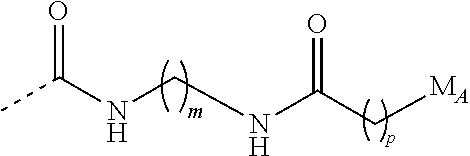
wherein m, p and MA are as defined above, preferably m is equal to 3 and p is equal to 4.

wherein m, p and MA are as defined above, preferably m is equal to 3 and p is equal to 4.

wherein m, p and MA are as defined above preferably m is equal to 3 and p is equal to 4.


wherein q and MB are as defined above, preferably q is equal to 3.

wherein q is as defined above and MB is a zwitterionic moiety, preferably q is equal to 3.

wherein q is as defined above, preferably q is equal to 3
-
- s is an integer ranging from 1 to 5, preferably s is equal 2, 3 or 4,
- R12, R13, R14 and R15 are each independently H, or a group selected from an alkyl, alkenyl, aryl, hydroxyle, halogen, alkoxy, carboxylate.

wherein q is as defined above, preferably q is equal to 3,
-
- s is an integer ranging from 1 to 5, preferably s is equal 2, 3 or 4,
- t is 1 or 2,
- R14 and R15 are each independently H, or a group selected from an alkyl, alkenyl, aryl, hydroxyle, halogen, alkoxy, carboxylate,
- X1, X2 and X3 are each independently N or C,
- the bounds represented by a dotted line being each independently either absent or present,
- R12, R16, R17, R18, R19, R20 and R21 are each independently H, or a group selected from an alkyl, alkenyl, aryl, hydroxyle, halogen, alkoxy, carboxylate, or may be absent when the bound represented by a dotted line is present.

wherein q is as defined above.


wherein n, x, y, L, R, LA, MA, LB and RB are as defined above.

wherein n, x, y, L, R, m, p, MA, LB and MB are as defined above.

wherein n, x, y, L, R, q, MB, LA and MA are as defined above.

wherein n, x, y, L, R, m, p, MA, q and MB are as defined above.

wherein n, x, y, L and R are as defined in formula (I) above; or a reduced form thereof.

wherein n, x, y and L are as defined in formula (I) above; or a reduced form thereof.
-
- one anchoring monomer A as defined above,
- one hydrophilic monomer B as defined above,
- one hydrophobic monomer C having a side-chain comprising a hydrophobic function MC,
and wherein one end of copolymer is H and the other end comprises a functional group or a bioactive group.
H—P[(A)x-co-(B)y-co-(C)z]n-L-R
-
- wherein
- A, B, L, R and n are as defined above;
- C represents an hydrophobic monomer having a side-chain comprising a moiety MC being hydrophobic;
- x, y and z represent each independently a percentage of n, wherein x and y are different from 0% of n and different from 100% of n, preferably x, y and z are ranging from more than 0% to less than 100% of n, preferably from more than 0% to 80% of n, from more than 0% to 50% of n and wherein x+y+z is equal to 100% of n.

-
- wherein
- n, L, R, RA, RB, R1, R2, R3, R4, R5 and R6 are as defined above;
- RC represents a group comprising the third moiety MC being hydrophobic;
- R8, R9, and R10 represent each independently H or a group selected from the alkyl, alkenyl, aryl, hydroxyl, halogen, alkoxy and carboxylate, amide;
- x, y and z represent each independently a percentage of n, wherein x and y are different from 0% of n and different from 100% of n, preferably x, y and z are ranging from more than 0% to less than 100% of n, preferably from more than 0% to 80% of n, from more than 0% to 50% of n; and wherein x+y+z is equal to 100% of n.
| Compound | |||
| n° | Name | ||
| C-1 | N-hexylmethacrylamide | ||
| C-2 | N-heptylmethacrylamide | ||
| C-3 | N-octylmethacrylamide | ||
| C-4 | N-nonylmethacrylamide | ||
| C-5 | N-decylmethacrylamide | ||
| C-6 | N-hexylacrylamide | ||
| C-7 | N-heptylacrylamide | ||
| C-8 | N-octylacrylamide | ||
| C-9 | N-nonylacrylamide | ||
| C-10 | N-decylacrylamide | ||
| C-11 | N-(2-(1H-imidazol-1-yl)ethyl)methacrylamide | ||
| C-12 | N-(2-(1H-imidazol-1-yl)ethyl)acrylamide | ||
| C-13 | N-(2-(4H-imidazol-4-yl)ethyl)methacrylamide | ||
| C-14 | N-(2-(4H-imidazol-4-yl)ethyl)acrylamide | ||
| C-15 | N-phenylmethacrylamide | ||
| C-16 | N-benzylmethacrylamide | ||
| C-17 | N-isopropylmethacrylamide | ||
| C-18 | N-isobutylmethacrylamide | ||
| C-19 | N-phenylacrylamide | ||
| C-20 | N-benzylacrylamide | ||
| C-21 | N-isopropylacrylamide | ||
| C-22 | N-isobutylacrylamide | ||
| C-23 | N-hexylmethacrylate | ||
| C-24 | N-heptylmethacrylate | ||
| C-25 | N-octylmethacrylate | ||
| C-26 | N-nonylmethacrylate | ||
| C-27 | N-decylmethacrylate | ||
| C-28 | N-hexylacrylate | ||
| C-29 | N-heptylacrylate | ||
| C-30 | N-octylacrylate | ||
| C-31 | N-nonylacrylate | ||
| C-32 | N-decylacrylate | ||
| C-33 | N-(2-(1H-imidazol-1-yl)ethyl)methacrylate | ||
| C-34 | N-(2-(1H-imidazol-1-yl)ethyl)acrylate | ||
| C-35 | N-(2-(4H-imidazol-4-yl)ethyl)methacrylate | ||
| C-36 | N-(2-(4H-imidazol-4-yl)ethyl)acrylate | ||
| C-37 | N-phenylmethacrylate | ||
| C-38 | N-benzylmethacrylate | ||
| C-39 | N-isopropylmethacrylate | ||
| C-40 | N-isobutylmethacrylate | ||
| C-41 | N-phenylacrylate | ||
| C-42 | N-benzylacrylate | ||
| C-43 | N-isopropylacrylate | ||
| C-44 | N-isobutylacrylate | ||
| N° | A | B |
| 1 | 5(1,2-dithiolan-3-yl)- | 3-((3- |
| N-(3-methacryl- | methacrylamidopropyl)dimethylammonio) | |
| amidopro- | propane-1-sulfonate | |
| pyl)pentanamide | ||
| 2 | 6-(1,2-dithiolan- | 3-((3- |
| 3-yl)-N-(3- | methacrylamidopropyl)dimethylammonio) | |
| methacrylamido- | propane-1-sulfonate | |
| propyl)hexanamide | ||
| 3 | 7-(1,2-dithiolan- | 3-((3- |
| 3-yl)-N-(3- | methacrylamidopropyl)dimethylammonio) | |
| methacrylamido- | propane-1-sulfonate | |
| propyl)heptanamide | ||
| 4 | 8-(1,2-dithiolan- | 3-((3- |
| 3-yl)-N-(3- | methacrylamidopropyl)dimethylammonio) | |
| methacrylamido- | propane-1-sulfonate | |
| propyl)octanamide | ||
| 5 | 9-(1,2-dithiolan- | 3-((3- |
| 3-yl)-N-(3- | methacrylamidopropyl)dimethylammonio) | |
| methacrylamido- | propane-1-sulfonate | |
| propyl)nonanamide | ||
| 6 | 10-(1,2-dithiolan- | 3-((3- |
| 3-yl)-N-(3- | methacrylamidopropyl)dimethylammonio) | |
| methacrylamido- | propane-1-sulfonate | |
| propyl)decanamide | ||
| 7 | 5-(1,2-dithiolan- | 3-((3- |
| 3-yl)-N-(3-acryl- | methacrylamidopropyl)dimethylammonio) | |
| amidopropyl)pen- | propane-1-sulfonate | |
| tanamide | ||
| 8 | 6-(1,2-dithiolan- | 3-((3- |
| 3-yl)-N-(3- | methacrylamidopropyl)dimethylammonio) | |
| acrylamidopro- | propane-1-sulfonate | |
| pyl)hexanamide | ||
| 9 | 7-(1,2-dithiolan- | 3-((3- |
| 3-yl)-N-(3-acryl- | methacrylamidopropyl)dimethylammonio) | |
| amidopropyl)hepta- | propane-1-sulfonate | |
| namide | ||
| 10 | 8-(1,2-dithiolan- | 3-((3- |
| 3-yl)-N-(3-acryl- | methacrylamidopropyl)dimethylammonio) | |
| amidopropyl)octa- | propane-1-sulfonate | |
| namide | ||
| 11 | 9-(1,2-dithiolan- | 3-((3- |
| 3-yl)-N-(3-acryl- | methacrylamidopropyl)dimethylammonio) | |
| amidopropyl)nona- | propane-1-sulfonate | |
| namide | ||
| 12 | 10-(1,2-dithiolan- | 3-((3- |
| 3-yl)-N-(3-acryl- | methacrylamidopropyl)dimethylammonio) | |
| amidopropyl)deca- | propane-1-sulfonate | |
| namide | ||
| 13 | 3-(5-(1,2-dithiolan-3- | 3-((3- |
| yl)pentanamido)propyl | methacrylamidopropyl)dimethylammonio) | |
| methacrylate | propane-1-sulfonate | |
| 14 | 3-(6-(1,2-dithiolan-3- | 3-((3- |
| yl)hexanamido)propyl | methacrylamidopropyl)dimethylammonio) | |
| methacrylate | propane-1-sulfonate | |
| 15 | 3-(7-(1,2-dithiolan-3- | 3-((3- |
| yl)heptanamido)propyl | methacrylamidopropyl)dimethylammonio) | |
| methacrylate | propane-1-sulfonate | |
| 16 | 3-(8-(1,2-dithiolan-3- | 3-((3- |
| yl)octanamido)propyl | methacrylamidopropyl)dimethylammonio) | |
| methacrylate | propane-1-sulfonate | |
| 17 | 3-(9-(1,2-dithiolan-3- | 3-((3- |
| yl)nonanamido)propyl | methacrylamidopropyl)dimethylammonio) | |
| methacrylate | propane-1-sulfonate | |
| 18 | 3-(10-(1,2- | 3-((3- |
| dithiolan-3- | methacrylamidopropyl)dimethylammonio) | |
| yl)decanamido)propyl | propane-1-sulfonate | |
| methacrylate | ||
| 19 | 3-(5-(1,2-dithiolan-3- | 3-((3- |
| yl)pentanamido)propyl | methacrylamidopropyl)dimethylammonio) | |
| acrylate | propane-1-sulfonate | |
| 20 | 3-(6-(1,2-dithiolan-3- | 3-((3- |
| yl)hexanamido)propyl | methacrylamidopropyl)dimethylammonio) | |
| acrylate | propane-1-sulfonate | |
| 21 | 3-(7-(1,2-dithiolan-3- | 3-((3- |
| ylheptamido)propyl | methacrylamidopropyl)dimethylammonio) | |
| acrylate | propane-1-sulfonate | |
| 22 | 3-(8-(1,2-dithiolan-3- | 3-((3- |
| yl)octanamido)propyl | methacrylamidopropyl)dimethylammonio) | |
| acrylate | propane-1-sulfonate | |
| 23 | 3-(9-(1,2-dithiolan-3- | 3-((3- |
| yl)nonanamido)propyl | methacrylamidopropyl)dimethylammonio) | |
| acrylate | propane-1-sulfonate | |
| 24 | 3-(10-(1,2- | 3-((3- |
| dithiolan-3- | methacrylamidopropyl)dimethylammonio) | |
| yl)decanamido)propyl | propane-1-sulfonate | |
| acrylate | ||
| 25 | 5-mercapto-N-(3- | 3-((3- |
| methacrylamido- | methacrylamidopropyl)dimethylammonio) | |
| propyl)pentanamide | propane-1-sulfonate | |
| 26 | 6-mercapto-N-(3- | 3-((3- |
| methacrylamido- | methacrylamidopropyl)dimethylammonio) | |
| propyl)hexanamide | propane-1-sulfonate | |
| 27 | 7-mercapto-N-(3- | 3-((3- |
| methacrylamido- | methacrylamidopropyl)dimethylammonio) | |
| propyl)heptanamide | propane-1-sulfonate | |
| 28 | 8-mercapto-N-(3- | 3-((3- |
| methacrylamido- | methacrylamidopropyl)dimethylammonio) | |
| propyl)octanamide | propane-1-sulfonate | |
| 29 | 9-mercapto-N-(3- | 3-((3- |
| methacrylamido- | methacrylamidopropyl)dimethylammonio) | |
| propyl)nonanamide | propane-1-sulfonate | |
| 30 | 10-mercapto-N-(3- | 3-((3- |
| methacrylamido- | methacrylamidopropyl)dimethylammonio) | |
| propyl)decanamide | propane-1-sulfonate | |
| 31 | N-(3-acryl | 3-((3- |
| amidopropyl)-5- | methacrylamidopropyl)dimethylammonio) | |
| mercaptopentanamide | propane-1-sulfonate | |
| 32 | N-(3-acryl- | 3-((3- |
| amidopropyl)-6- | methacrylamidopropyl)dimethylammonio) | |
| mercaptohexanamide | propane-1-sulfonate | |
| 33 | N-(3-acryl- | 3-((3- |
| amidopropyl)-7- | methacrylamidopropyl)dimethylammonio) | |
| mercaptoheptanamide | propane-1-sulfonate | |
| 34 | N-(3-acryl- | 3-((3- |
| amidopropyl)- | methacrylamidopropyl)dimethylammonio) | |
| 8-mercaptooctanamide | propane-1-sulfonate | |
| 35 | N-(3-acryl- | 3-((3- |
| amidopropyl)-9- | methacrylamidopropyl)dimethylammonio) | |
| mercaptononanamide | propane-1-sulfonate | |
| 36 | N-(3-acryl- | 3-((3- |
| amidopropyl)-10- | methacrylamidopropyl)dimethylammonio) | |
| mercaptodecanamide | propane-1-sulfonate | |
| 37 | 3-(5-mercapto- | 3-((3- |
| pentanamido)propyl | methacrylamidopropyl)dimethylammonio) | |
| methacrylate | propane-1-sulfonate | |
| 38 | 3-(6-mercapto- | 3-((3- |
| hexanamido)propyl | methacrylamidopropyl)dimethylammonio) | |
| methacrylate | propane-1-sulfonate | |
| 39 | 3-(7-mercapto- | 3-((3- |
| heptanamido)propyl | methacrylamidopropyl)dimethylammonio) | |
| methacrylate | propane-1-sulfonate | |
| 40 | 3-(8-mercapto- | 3-((3- |
| octanamido)propyl | methacrylamidopropyl)dimethylammonio) | |
| methacrylate | propane-1-sulfonate | |
| 41 | 3-(9-mercapto- | 3-((3- |
| nonanamido)propyl | methacrylamidopropyl)dimethylammonio) | |
| methacrylate | propane-1-sulfonate | |
| 42 | 3-(10-mercapto- | 3-((3- |
| decanamido)propyl | methacrylamidopropyl)dimethylammonio) | |
| methacrylate | propane-1-sulfonate | |
| 43 | 3-(5-mercapto- | 3-((3- |
| pentanamido)propyl | methacrylamidopropyl)dimethylammonio) | |
| acrylate | propane-1-sulfonate | |
| 44 | 3-(6-mercapto- | 3-((3- |
| hexanamido)propyl | methacrylamidopropyl)dimethylammonio) | |
| acrylate | propane-1-sulfonate | |
| 45 | 3-(7-mercapto- | 3-((3- |
| heptanamido)propyl | methacrylamidopropyl)dimethylammonio) | |
| acrylate | propane-1-sulfonate | |
| 46 | 3-(8-mercapto- | 3-((3- |
| octanamido)propyl | methacrylamidopropyl)dimethylammonio) | |
| acrylate | propane-1-sulfonate | |
| 47 | 3-(9-mercapto- | 3-((3- |
| nonanamido)propyl | methacrylamidopropyl)dimethylammonio) | |
| acrylate | propane-1-sulfonate | |
| 48 | 3-(10-mercapto- | 3-((3- |
| decanamido)propyl | methacrylamidopropyl)dimethylammonio) | |
| acrylate | propane-1-sulfonate | |
| 49 | 5-((3-methacryl- | 3-((3- |
| amidopropyl)amino)- | methacrylamidopropyl)dimethylammonio) | |
| 5-oxopentanoic acid | propane-1-sulfonate | |
| 50 | 6-((3-methacry- | 3-((3- |
| lamidopropyl)amino)- | methacrylamidopropyl)dimethylammonio) | |
| 6-oxohexanoic acid | propane-1-sulfonate | |
| 51 | 7-((3-methacryl- | 3-((3- |
| amidopropyl)amino)- | methacrylamidopropyl)dimethylammonio) | |
| 7-oxoheptanoic acid | propane-1-sulfonate | |
| 52 | 8-((3-methacryl- | 3-((3- |
| amidopropyl)amino)- | methacrylamidopropyl)dimethylammonio) | |
| 8-oxooctanoic acid | propane-1-sulfonate | |
| 53 | 9-((3-methacryl- | 3-((3- |
| amidopropyl)amino)- | methacrylamidopropyl)dimethylammonio) | |
| 9-oxononanoic acid | propane-1-sulfonate | |
| 54 | 10-((3-methacryl- | 3-((3- |
| amidopropyl)amino)- | methacrylamidopropyl)dimethylammonio) | |
| 10-oxodecanoic acid | propane-1-sulfonate | |
| 55 | 5-((3-acrylamido- | 3-((3- |
| propyl)amino)-5- | methacrylamidopropyl)dimethylammonio) | |
| oxopentanoic acid | propane-1-sulfonate | |
| 56 | 6-((3-acrylamido- | 3-((3- |
| propyl)amino)-6- | methacrylamidopropyl)dimethylammonio) | |
| oxohexanoic acid | propane-1-sulfonate | |
| 57 | 7-((3-acrylamido- | 3-((3- |
| propyl)amino)-7- | methacrylamidopropyl)dimethylammonio) | |
| oxoheptanoic acid | propane-1-sulfonate | |
| 58 | 8-((3-acrylamido- | 3-((3- |
| propyl)amino)-8- | methacrylamidopropyl)dimethylammonio) | |
| oxooctanoic acid | propane-1-sulfonate | |
| 59 | 9-((3-acrylamido- | 3-((3- |
| propyl)amino)-9- | methacrylamidopropyl)dimethylammonio) | |
| oxononanoic acid | propane-1-sulfonate | |
| 60 | 10-((3-acryl- | 3-((3- |
| amidopropyl)amino)- | methacrylamidopropyl)dimethylammonio) | |
| 10-oxodecanoic acid | propane-1-sulfonate | |
| 61 | 5-((3-(metha- | 3-((3- |
| cryloyloxy)pro- | methacrylamidopropyl)dimethylammonio) | |
| pyl)amino)- | propane-1-sulfonate | |
| 5-oxopentanoic acid | ||
| 62 | 6-((3-(metha- | 3-((3- |
| cryloyloxy)pro- | methacrylamidopropyl)dimethylammonio) | |
| pyl)amino)- | propane-1-sulfonate | |
| 6-oxohexanoic acid | ||
| 63 | 7-((3-(metha- | 3-((3- |
| cryloyloxy)pro- | methacrylamidopropyl)dimethylammonio) | |
| pyl)amino)- | propane-1-sulfonate | |
| 7-oxoheptanoic acid | ||
| 64 | 8-((3-(metha- | 3-((3- |
| cryloyloxy)pro- | methacrylamidopropyl)dimethylammonio) | |
| pyl)amino)- | propane-1-sulfonate | |
| 8-oxooctanoic acid | ||
| 65 | 9-((3-(metha- | 3-((3- |
| cryloyloxy)pro- | methacrylamidopropyl)dimethylammonio) | |
| pyl)amino)- | propane-1-sulfonate | |
| 9-oxononanoic acid | ||
| 66 | 10-((3-(metha- | 3-((3- |
| cryloyloxy)pro- | methacrylamidopropyl)dimethylammonio) | |
| pyl)amino)- | propane-1-sulfonate | |
| 10-oxodecanoic acid | ||
| 67 | 5-((3- | 3-((3- |
| (acryloyloxy)pro- | methacrylamidopropyl)dimethylammonio) | |
| pyl)amino)-5- | propane-1-sulfonate | |
| oxopentanoic acid | ||
| 68 | 6-((3- | 3-((3- |
| (acryloyloxy)pro- | methacrylamidopropyl)dimethylammonio) | |
| pyl)amino)-6- | propane-1-sulfonate | |
| oxohexanoic acid | ||
| 69 | 7-((3- | 3-((3- |
| (acryloyloxy)pro- | methacrylamidopropyl)dimethylammonio) | |
| pyl)amino)-7- | propane-1-sulfonate | |
| oxoheptanoic acid | ||
| 70 | 8-((3- | 3-((3- |
| (acryloyloxy)pro- | methacrylamidopropyl)dimethylammonio) | |
| pyl)amino)-8- | propane-1-sulfonate | |
| oxooctanoic acid | ||
| 71 | 9-((3- | 3-((3- |
| (acryloyloxy)pro- | methacrylamidopropyl)dimethylammonio) | |
| pyl)amino)-9- | propane-1-sulfonate | |
| oxononanoic acid | ||
| 72 | 10-((3- | 3-((3- |
| (acryloyloxy)pro- | methacrylamidopropyl)dimethylammonio) | |
| pyl)amino)-10- | propane-1-sulfonate | |
| oxodecanoic acid | ||
| 73 | 5-amino-N-(3- | 3-((3- |
| methacrylamido- | methacrylamidopropyl)dimethylammonio) | |
| propyl)pentanamide | propane-1-sulfonate | |
| 74 | 6-amino-N-(3- | 3-((3- |
| methacrylamido- | methacrylamidopropyl)dimethylammonio) | |
| propyl)hexanamide | propane-1-sulfonate | |
| 75 | 7-amino-N-(3- | 3-((3- |
| methacrylamido- | methacrylamidopropyl)dimethylammonio) | |
| propyl)heptanamide | propane-1-sulfonate | |
| 76 | 8-amino-N-(3- | 3-((3- |
| methacrylamido- | methacrylamidopropyl)dimethylammonio) | |
| propyl)octanamide | propane-1-sulfonate | |
| 77 | 9-amino-N-(3- | 3-((3- |
| methacrylamido- | methacrylamidopropyl)dimethylammonio) | |
| propyl)nonanamide | propane-1-sulfonate | |
| 78 | 10-amino-N-(3- | 3-((3- |
| methacrylamido- | methacrylamidopropyl)dimethylammonio) | |
| propyl)decanamide | propane-1-sulfonate | |
| 79 | N-(3-acryl- | 3-((3- |
| amidopropyl)- | methacrylamidopropyl)dimethylammonio) | |
| 5-aminopentanamide | propane-1-sulfonate | |
| 80 | N-(3-acryl- | 3-((3- |
| amidopropyl)- | methacrylamidopropyl)dimethylammonio) | |
| 6-aminohexanamide | propane-1-sulfonate | |
| 81 | N-(3-acryl- | 3-((3- |
| amidopropyl)- | methacrylamidopropyl)dimethylammonio) | |
| 7-aminheptanamide | propane-1-sulfonate | |
| 82 | N-(3-acryl- | 3-((3- |
| amidopropyl)- | methacrylamidopropyl)dimethylammonio) | |
| 8-aminooctanamide | propane-1-sulfonate | |
| 83 | N-(3-acryl- | 3-((3- |
| amidopropyl)- | methacrylamidopropyl)dimethylammonio) | |
| 9-aminononanamide | propane-1-sulfonate | |
| 84 | N-(3-acryl- | 3-((3- |
| amidopropyl)- | methacrylamidopropyl)dimethylammonio) | |
| 10-aminodecanamide | propane-1-sulfonate | |
| 85 | 3-(5-aminopenta- | 3-((3- |
| namido)propyl | methacrylamidopropyl)dimethylammonio) | |
| methacrylate | propane-1-sulfonate | |
| 86 | 3-(6-aminohexa- | 3-((3- |
| namido)propyl | methacrylamidopropyl)dimethylammonio) | |
| methacrylate | propane-1-sulfonate | |
| 87 | 3-(7-aminohepta- | 3-((3- |
| namido)propyl | methacrylamidopropyl)dimethylammonio) | |
| methacrylate | propane-1-sulfonate | |
| 88 | 3-(8-aminoocta- | 3-((3- |
| namido)propyl | methacrylamidopropyl)dimethylammonio) | |
| methacrylate | propane-1-sulfonate | |
| 89 | 3-(9-amino- | 3-((3- |
| nonamido)propyl | methacrylamidopropyl)dimethylammonio) | |
| methacrylate | propane-1-sulfonate | |
| 90 | 3-(10-aminodeca- | 3-((3- |
| namido)propyl | methacrylamidopropyl)dimethylammonio) | |
| methacrylate | propane-1-sulfonate | |
| 91 | 3-(5-aminopenta- | 3-((3- |
| namido)propyl | methacrylamidopropyl)dimethylammonio) | |
| acrylate | propane-1-sulfonate | |
| 92 | 3-(6-aminohexa- | 3-((3- |
| namido)propyl | methacrylamidopropyl)dimethylammonio) | |
| acrylate | propane-1-sulfonate | |
| 93 | 3-(7-aminohepta- | 3-((3- |
| namido)propyl | methacrylamidopropyl)dimethylammonio) | |
| acrylate | propane-1-sulfonate | |
| 94 | 3-(8-aminoocta- | 3-((3- |
| namido)propyl | methacrylamidopropyl)dimethylammonio) | |
| acrylate | propane-1-sulfonate | |
| 95 | 3-(9-amino- | 3-((3- |
| nonamido)propyl | methacrylamidopropyl)dimethylammonio) | |
| acrylate | propane-1-sulfonate | |
| 96 | 3-(10-aminodeca- | 3-((3- |
| namido)propyl | methacrylamidopropyl)dimethylammonio) | |
| acrylate | propane-1-sulfonate | |
| 97 | 5-(1H-imidazol- | 3-((3- |
| 1-yl)-N-(3- | methacrylamidopropyl)dimethylammonio) | |
| methacrylamido- | propane-1-sulfonate | |
| propyl)pentanamide | ||
| 98 | 6-(1H-imidazol- | 3-((3- |
| 1-yl)-N-(3- | methacrylamidopropyl)dimethylammonio) | |
| methacrylamido- | propane-1-sulfonate | |
| propyl)hexanamide | ||
| 99 | 7-(1H-imidazol-1-yl)- | 3-((3- |
| N-(3-methacrylamido- | methacrylamidopropyl)dimethylammonio) | |
| propyl)heptanamide | propane-1-sulfonate | |
| 100 | 8-(1H-imidazol-1-yl)- | 3-((3- |
| N-(3-methacrylamido- | methacrylamidopropyl)dimethylammonio) | |
| propyl)octanamide | propane-1-sulfonate | |
| 101 | 9-(1H-imidazol-1-yl)- | 3-((3- |
| N-(3-methacrylamido- | methacrylamidopropyl)dimethylammonio) | |
| propyl)nonanamide | propane-1-sulfonate | |
| 102 | 10-(1H- | 3-((3- |
| imidazol-1-yl)- | methacrylamidopropyl)dimethylammonio) | |
| N-(3-methacrylamido- | propane-1-sulfonate | |
| propyl)decanamide | ||
| 103 | N-(3-acryl- | 3-((3- |
| amidopropyl)- | methacrylamidopropyl)dimethylammonio) | |
| 5-(1H-imidazol- | propane-1-sulfonate | |
| 1-yl)pentanamide | ||
| 104 | N-(3-acryl- | 3-((3- |
| amidopropyl)- | methacrylamidopropyl)dimethylammonio) | |
| 6-(1H-imidazol- | propane-1-sulfonate | |
| 1-yl)hexanamide | ||
| 105 | N-(3-acryl- | 3-((3- |
| amidopropyl)- | methacrylamidopropyl)dimethylammonio) | |
| 7-(1H-imidazol- | propane-1-sulfonate | |
| 1-yl)hepanamide | ||
| 106 | N-(3-acryl- | 3-((3- |
| amidopropyl)- | methacrylamidopropyl)dimethylammonio) | |
| 8-(1H-imidazol- | propane-1-sulfonate | |
| 1-yl)octanamide | ||
| 107 | N-(3-acryl- | 3-((3- |
| amidopropyl)- | methacrylamidopropyl)dimethylammonio) | |
| 9-(1H-imidazol- | propane-1-sulfonate | |
| 1-yl)nonanamide | ||
| 108 | N-(3-acrylamido- | 3-((3- |
| propyl)-10-(1H- | methacrylamidopropyl)dimethylammonio) | |
| imidazol-1- | propane-1-sulfonate | |
| yl)decanamide | ||
| 109 | 3-(5-(1H-imidazol-1- | 3-((3- |
| yl)pentanamido)propyl | methacrylamidopropyl)dimethylammonio) | |
| methacrylate | propane-1-sulfonate | |
| 110 | 3-(6-(1H-imidazol-1- | 3-((3- |
| yl)hexanamido)propyl | methacrylamidopropyl)dimethylammonio) | |
| methacrylate | propane-1-sulfonate | |
| 111 | 3-(7-(1H-imidazol-1- | 3-((3- |
| yl)heptanamido)propyl | methacrylamidopropyl)dimethylammonio) | |
| methacrylate | propane-1-sulfonate | |
| 112 | 3-(8-(1H-imidazol-1- | 3-((3- |
| yl)octanamido)propyl | methacrylamidopropyl)dimethylammonio) | |
| methacrylate | propane-1-sulfonate | |
| 113 | 3-(9-(1H-imidazol-1- | 3-((3- |
| yl)nonanamido)propyl | methacrylamidopropyl)dimethylammonio) | |
| methacrylate | propane-1-sulfonate | |
| 114 | 3-(10-(1H-imidazol-1- | 3-((3- |
| yl)decanamido)propyl | methacrylamidopropyl)dimethylammonio) | |
| methacrylate | propane-1-sulfonate | |
| 115 | 3-(5-(1H-imidazol-1- | 3-((3- |
| yl)pentanamido)propyl | methacrylamidopropyl)dimethylammonio) | |
| acrylate | propane-1-sulfonate | |
| 116 | 3-(6-(1H-imidazol-1- | 3-((3- |
| yl)hexanamido)propyl | methacrylamidopropyl)dimethylammonio) | |
| acrylate | propane-1-sulfonate | |
| 117 | 3-(7-(1H-imidazol-1- | 3-((3- |
| yl)heptanamido)propyl | methacrylamidopropyl)dimethylammonio) | |
| acrylate | propane-1-sulfonate | |
| 118 | 3-(8-(1H-imidazol-1- | 3-((3- |
| yl)octanamido)propyl | methacrylamidopropyl)dimethylammonio) | |
| acrylate | propane-1-sulfonate | |
| 119 | 3-(9-(1H-imidazol-1- | 3-((3- |
| yl)nonanamido)propyl | methacrylamidopropyl)dimethylammonio) | |
| acrylate | propane-1-sulfonate | |
| 120 | 3-(10-(1H-imidazol-1- | 3-((3- |
| yl)decanamido)propyl | methacrylamidopropyl)dimethylammonio) | |
| acrylate | propane-1-sulfonate | |
| 121 | 5-(1,2-dithiolan-3-yl)- | 4-((3- |
| N-(3-methacrylamido- | methacrylamidopropyl)dimethylammonio) | |
| propyl)pentanamide | butanoate | |
| 122 | 6-(1,2-dithiolan-3-yl)- | 4-((3- |
| N-(3-methacrylamido- | methacrylamidopropyl)dimethylammonio) | |
| propyl)hexanamide | butanoate | |
| 123 | 7-(1,2-dithiolan-3-yl)- | 4-((3- |
| N-(3-methacrylamido- | methacrylamidopropyl)dimethylammonio) | |
| propyl)heptanamide | butanoate | |
| 124 | 8-(1,2-dithiolan-3-yl)- | 4-((3- |
| N-(3-methacrylamido- | methacrylamidopropyl)dimethylammonio) | |
| propyl)octanamide | butanoate | |
| 125 | 9-(1,2-dithiolan-3-yl)- | 4-((3- |
| N-(3-methacrylamido- | methacrylamidopropyl)dimethylammonio) | |
| propyl)nonanamide | butanoate | |
| 126 | 10-(1,2- | 4-((3- |
| dithiolan-3-yl)- | methacrylamidopropyl)dimethylammonio) | |
| N-(3-methacrylamido- | butanoate | |
| propyl)decanamide | ||
| 127 | 5-(1,2-dithiolan-3-yl)- | 4-((3- |
| N-(3-acrylamidopro- | methacrylamidopropyl)dimethylammonio) | |
| pyl)pentanamide | butanoate | |
| 128 | 6-(1,2-dithiolan-3-yl)- | 4-((3- |
| N-(3-acrylamidopro- | methacrylamidopropyl)dimethylammonio) | |
| pyl)hexanamide | butanoate | |
| 129 | 7-(1,2-dithiolan-3-yl)- | 4-((3- |
| N-(3-acrylamidopro- | methacrylamidopropyl)dimethylammonio) | |
| pyl)heptanamide | butanoate | |
| 130 | 8-(1,2-dithiolan-3-yl)- | 4-((3- |
| N-(3-acrylamidopro- | methacrylamidopropyl)dimethylammonio) | |
| pyl)octanamide | butanoate | |
| 131 | 9-(1,2-dithiolan-3-yl)- | 4-((3- |
| N-(3-acrylamidopro- | methacrylamidopropyl)dimethylammonio) | |
| pyl)nonanamide | butanoate | |
| 132 | 10-(1,2- | 4-((3- |
| dithiolan-3-yl)- | methacrylamidopropyl)dimethylammonio) | |
| N-(3-acrylamidopro- | butanoate | |
| pyl)decanamide | ||
| 133 | 3-(5-(1,2-dithiolan-3- | 4-((3- |
| yl)pentanamido)propyl | methacrylamidopropyl)dimethylammonio) | |
| methacrylate | butanoate | |
| 134 | 3-(5-(1,2-dithiolan-3- | 4-((3- |
| yl)hexanamido)propyl | methacrylamidopropyl)dimethylammonio) | |
| methacrylate | butanoate | |
| 135 | 3-(5-(1,2-dithiolan-3- | 4-((3- |
| yl)heptanamido)propyl | methacrylamidopropyl)dimethylammonio) | |
| methacrylate | butanoate | |
| 136 | 3-(5-(1,2-dithiolan-3- | 4-((3- |
| yl)octanamido)propyl | methacrylamidopropyl)dimethylammonio) | |
| methacrylate | butanoate | |
| 137 | 3-(5-(1,2-dithiolan-3- | 4-((3- |
| yl)nonanamido)propyl | methacrylamidopropyl)dimethylammonio) | |
| methacrylate | butanoate | |
| 138 | 3-(5-(1,2-dithiolan-3- | 4-((3- |
| yl)decanamido)propyl | methacrylamidopropyl)dimethylammonio) | |
| methacrylate | butanoate | |
| 139 | 3-(5-(1,2-dithiolan-3- | 4-((3- |
| yl)pentanamido)propyl | methacrylamidopropyl)dimethylammonio) | |
| acrylate | butanoate | |
| 140 | 3-(5-(1,2-dithiolan-3- | 4-((3- |
| yl)hexanamido)propyl | methacrylamidopropyl)dimethylammonio) | |
| acrylate | butanoate | |
| 141 | 3-(5-(1,2-dithiolan-3- | 4-((3- |
| ylheptamido)propyl | methacrylamidopropyl)dimethylammonio) | |
| acrylate | butanoate | |
| 142 | 3-(5-(1,2-dithiolan-3- | 4-((3- |
| yl)octanamido)propyl | methacrylamidopropyl)dimethylammonio) | |
| acrylate | butanoate | |
| 143 | 3-(5-(1,2-dithiolan-3- | 4-((3- |
| yl)nonanamido)propyl | methacrylamidopropyl)dimethylammonio) | |
| acrylate | butanoate | |
| 144 | 3-(5-(1,2-dithiolan-3- | 4-((3- |
| yl)decanamido)propyl | methacrylamidopropyl)dimethylammonio) | |
| acrylate | butanoate | |
| 145 | 5-mercapto-N-(3- | 4-((3- |
| methacrylamido- | methacrylamidopropyl)dimethylammonio) | |
| propyl)pentanamide | butanoate | |
| 146 | 6-mercapto-N-(3- | 4-((3- |
| methacrylamido- | methacrylamidopropyl)dimethylammonio) | |
| propyl)hexanamide | butanoate | |
| 147 | 7-mercapto-N-(3- | 4-((3- |
| methacrylamido- | methacrylamidopropyl)dimethylammonio) | |
| propyl)heptanamide | butanoate | |
| 148 | 8-mercapto-N-(3- | 4-((3- |
| methacrylamido- | methacrylamidopropyl)dimethylammonio) | |
| propyl)octanamide | butanoate | |
| 149 | 9-mercapto-N-(3- | 4-((3- |
| methacrylamido- | methacrylamidopropyl)dimethylammonio) | |
| propyl)nonanamide | butanoate | |
| 150 | 10-mercapto-N-(3- | 4-((3- |
| methacrylamido- | methacrylamidopropyl)dimethylammonio) | |
| propyl)decanamide | butanoate | |
| 151 | N-(3-acryl- | 4-((3- |
| amidopropyl)- | methacrylamidopropyl)dimethylammonio) | |
| 5-mercapto- | butanoate | |
| pentanamide | ||
| 152 | N-(3-acryl- | 4-((3- |
| amidopropyl)- | methacrylamidopropyl)dimethylammonio) | |
| 6-mercapto- | butanoate | |
| hexanamide | ||
| 153 | N-(3-acryl- | 4-((3- |
| amidopropyl)- | methacrylamidopropyl)dimethylammonio) | |
| 7-mercapto- | butanoate | |
| heptanamide | ||
| 154 | N-(3-acryl | 4-((3- |
| amidopropyl)- | methacrylamidopropyl)dimethylammonio) | |
| 8-mercapto- | butanoate | |
| octanamide | ||
| 155 | N-(3-acryl- | 4-((3- |
| amidopropyl)- | methacrylamidopropyl)dimethylammonio) | |
| 9-mercapto- | butanoate | |
| nonanamide | ||
| 156 | N-(3-acrylamido- | 4-((3- |
| propyl)-10- | methacrylamidopropyl)dimethylammonio) | |
| mercaptodecanamide | butanoate | |
| 157 | 3-(5-mercapto- | 4-((3- |
| pentanamido)propyl | methacrylamidopropyl)dimethylammonio) | |
| methacrylate | butanoate | |
| 158 | 3-(6-mercapto | 4-((3- |
| hexanamido)propyl | methacrylamidopropyl)dimethylammonio) | |
| methacrylate | butanoate | |
| 159 | 3-(7-mercapto- | 4-((3- |
| heptanamido)propyl | methacrylamidopropyl)dimethylammonio) | |
| methacrylate | butanoate | |
| 160 | 3-(8-mercapto- | 4-((3- |
| octanamido)propyl | methacrylamidopropyl)dimethylammonio) | |
| methacrylate | butanoate | |
| 161 | 3-(9-mercapto- | 4-((3- |
| nonanamido)propyl | methacrylamidopropyl)dimethylammonio) | |
| methacrylate | butanoate | |
| 162 | 3-(10-mercapto- | 4-((3- |
| decanamido)propyl | methacrylamidopropyl)dimethylammonio) | |
| methacrylate | butanoate | |
| 163 | 3-(5-mercapto- | 4-((3- |
| pentanamido)propyl | methacrylamidopropyl)dimethylammonio) | |
| acrylate | butanoate | |
| 164 | 3-(6-mercapto- | 4-((3- |
| hexanamido)propyl | methacrylamidopropyl)dimethylammonio) | |
| acrylate | butanoate | |
| 165 | 3-(7-mercapto- | 4-((3- |
| heptanamido)propyl | methacrylamidopropyl)dimethylammonio) | |
| acrylate | butanoate | |
| 166 | 3-(8-mercapto- | 4-((3- |
| octanamido)propyl | methacrylamidopropyl)dimethylammonio) | |
| acrylate | butanoate | |
| 167 | 3-(9-mercapto- | 4-((3- |
| nonanamido)propyl | methacrylamidopropyl)dimethylammonio) | |
| acrylate | butanoate | |
| 168 | 3-(10-mercapto- | 4-((3- |
| decanamido)propyl | methacrylamidopropyl)dimethylammonio) | |
| acrylate | butanoate | |
| 169 | 5-((3-methacryl- | 4-((3- |
| amido- | methacrylamidopropyl)dimethylammonio) | |
| propyl)amino)-5- | butanoate | |
| oxopentanoic acid | ||
| 170 | 6-((3-methacryl- | 4-((3- |
| amido- | methacrylamidopropyl)dimethylammonio) | |
| propyl)amino)-6- | butanoate | |
| oxohexanoic acid | ||
| 171 | 7-((3-methacryl- | 4-((3- |
| amido- | methacrylamidopropyl)dimethylammonio) | |
| propyl)amino)-7- | butanoate | |
| oxoheptanoic acid | ||
| 172 | 8-((3-methacryl- | 4-((3- |
| amido- | methacrylamidopropyl)dimethylammonio) | |
| propyl)amino)-8- | butanoate | |
| oxooctanoic acid | ||
| 173 | 9-((3-methacryl- | 4-((3- |
| amido- | methacrylamidopropyl)dimethylammonio) | |
| propyl)amino)-9- | butanoate | |
| oxononanoic acid | ||
| 174 | 10-((3-methacryl- | 4-((3- |
| amidopropyl)amino)- | methacrylamidopropyl)dimethylammonio) | |
| 10-oxodecanoic acid | butanoate | |
| 175 | 5-((3-acrylamido- | 4-((3- |
| propyl)amino)-5- | methacrylamidopropyl)dimethylammonio) | |
| oxopentanoic acid | butanoate | |
| 176 | 6-((3-acrylamido- | 4-((3- |
| propyl)amino)-6- | methacrylamidopropyl)dimethylammonio) | |
| oxohexanoic acid | butanoate | |
| 177 | 7-((3-acrylamido- | 4-((3- |
| propyl)amino)-7- | methacrylamidopropyl)dimethylammonio) | |
| oxoheptanoic acid | butanoate | |
| 178 | 8-((3-acrylamido- | 4-((3- |
| propyl)amino)-8- | methacrylamidopropyl)dimethylammonio) | |
| oxooctanoic acid | butanoate | |
| 179 | 9-((3-acrylamido- | 4-((3- |
| propyl)amino)-9- | methacrylamidopropyl)dimethylammonio) | |
| oxononanoic acid | butanoate | |
| 180 | 10-((3-acrylamido- | 4-((3- |
| propyl)amino)-10- | methacrylamidopropyl)dimethylammonio) | |
| oxodecanoic acid | butanoate | |
| 181 | 5-((3-(metha- | 4-((3- |
| cryloyloxy)pro- | methacrylamidopropyl)dimethylammonio) | |
| pyl)amino)- | butanoate | |
| 5-oxopentanoic acid | ||
| 182 | 6-((3-(metha- | 4-((3- |
| cryloyloxy)pro- | methacrylamidopropyl)dimethylammonio) | |
| pyl)amino)- | butanoate | |
| 6-oxohexanoic acid | ||
| 183 | 7-((3-(metha- | 4-((3- |
| cryloyloxy)pro- | methacrylamidopropyl)dimethylammonio) | |
| pyl)amino)- | butanoate | |
| 7-oxoheptanoic acid | ||
| 184 | 8-((3-(metha- | 4-((3- |
| cryloyloxy)pro- | methacrylamidopropyl)dimethylammonio) | |
| pyl)amino)- | butanoate | |
| 8-oxooctanoic acid | ||
| 185 | 9-((3-(metha- | 4-((3- |
| cryloyloxy)pro- | methacrylamidopropyl)dimethylammonio) | |
| pyl)amino)- | butanoate | |
| 9-oxononanoic acid | ||
| 186 | 10-((3-(metha- | 4-((3- |
| cryloyloxy)pro- | methacrylamidopropyl)dimethylammonio) | |
| pyl)amino)- | butanoate | |
| 10-oxodecanoic acid | ||
| 187 | 5-((3- | 4-((3- |
| (acryloyloxy)pro- | methacrylamidopropyl)dimethylammonio) | |
| pyl)amino)-5- | butanoate | |
| oxopentanoic acid | ||
| 188 | 6-((3- | 4-((3- |
| (acryloyloxy)pro- | methacrylamidopropyl)dimethylammonio) | |
| pyl)amino)-6- | butanoate | |
| oxohexanoic acid | ||
| 189 | 7-((3- | 4-((3- |
| (acryloyloxy)pro- | methacrylamidopropyl)dimethylammonio) | |
| pyl)amino)-7- | butanoate | |
| oxoheptanoic acid | ||
| 190 | 8-((3- | 4-((3- |
| (acryloyloxy)pro- | methacrylamidopropyl)dimethylammonio) | |
| pyl)amino)-8- | butanoate | |
| oxooctanoic acid | ||
| 191 | 9-((3- | 4-((3- |
| (acryloyloxy)pro- | methacrylamidopropyl)dimethylammonio) | |
| pyl)amino)-9- | butanoate | |
| oxononanoic acid | ||
| 192 | 10-((3- | 4-((3- |
| (acryloyloxy)pro- | methacrylamidopropyl)dimethylammonio) | |
| pyl)amino)-10- | butanoate | |
| oxodecanoic acid | ||
| 193 | 5-amino-N-(3- | 4-((3- |
| methacrylamido- | methacrylamidopropyl)dimethylammonio) | |
| propyl)pentanamide | butanoate | |
| 194 | 6-amino-N-(3- | 4-((3- |
| methacrylamido- | methacrylamidopropyl)dimethylammonio) | |
| propyl)hexanamide | butanoate | |
| 195 | 7-amino-N-(3- | 4-((3- |
| methacrylamido- | methacrylamidopropyl)dimethylammonio) | |
| propyl)heptanamide | butanoate | |
| 196 | 8-amino-N-(3- | 4-((3- |
| methacrylamido- | methacrylamidopropyl)dimethylammonio) | |
| propyl)octanamide | butanoate | |
| 197 | 9-amino-N-(3- | 4-((3- |
| methacrylamido- | methacrylamidopropyl)dimethylammonio) | |
| propyl)nonanamide | butanoate | |
| 198 | 10-amino-N-(3- | 4-((3- |
| methacrylamido- | methacrylamidopropyl)dimethylammonio) | |
| propyl)decanamide | butanoate | |
| 199 | N-(3- | 4-((3- |
| acrylamidopropyl)- | methacrylamidopropyl)dimethylammonio) | |
| 5-aminopentanamide | butanoate | |
| 200 | N-(3- | 4-((3- |
| acrylamidopropyl)- | methacrylamidopropyl)dimethylammonio) | |
| 6-aminohexanamide | butanoate | |
| 201 | N-(3- | 4-((3- |
| acrylamidopropyl)- | methacrylamidopropyl)dimethylammonio) | |
| 7-aminheptanamide | butanoate | |
| 202 | N-(3- | 4-((3- |
| acrylamidopropyl)- | methacrylamidopropyl)dimethylammonio) | |
| 8-aminooctanamide | butanoate | |
| 203 | N-(3- | 4-((3- |
| acrylamidopropyl)- | methacrylamidopropyl)dimethylammonio) | |
| 9-aminononanamide | butanoate | |
| 204 | N-(3-acrylamido- | 4-((3- |
| propyl)-10- | methacrylamidopropyl)dimethylammonio) | |
| aminodecanamide | butanoate | |
| 205 | 3-(5-aminopenta- | 4-((3- |
| namido)propyl | methacrylamidopropyl)dimethylammonio) | |
| methacrylate | butanoate | |
| 206 | 3-(6-aminohexa- | 4-((3- |
| namido)propyl | methacrylamidopropyl)dimethylammonio) | |
| methacrylate | butanoate | |
| 207 | 3-(7-aminohepta- | 4-((3- |
| namido)propyl | methacrylamidopropyl)dimethylammonio) | |
| methacrylate | butanoate | |
| 208 | 3-(8-aminoocta- | 4-((3- |
| namido)propyl | methacrylamidopropyl)dimethylammonio) | |
| methacrylate | butanoate | |
| 209 | 3-(9-amino- | 4-((3- |
| nonamido)propyl | methacrylamidopropyl)dimethylammonio) | |
| methacrylate | butanoate | |
| 210 | 3-(10-aminodeca- | 4-((3- |
| namido)propyl | methacrylamidopropyl)dimethylammonio) | |
| methacrylate | butanoate | |
| 211 | 3-(5-aminopenta- | 4-((3- |
| namido)propyl | methacrylamidopropyl)dimethylammonio) | |
| acrylate | butanoate | |
| 212 | 3-(6-aminohexa- | 4-((3- |
| namido)propyl | methacrylamidopropyl)dimethylammonio) | |
| acrylate | butanoate | |
| 213 | 3-(7-aminohepta- | 4-((3- |
| namido)propyl | methacrylamidopropyl)dimethylammonio) | |
| acrylate | butanoate | |
| 214 | 3-(8-aminoocta- | 4-((3- |
| namido)propyl | methacrylamidopropyl)dimethylammonio) | |
| acrylate | butanoate | |
| 215 | 3-(9-amino- | 4-((3- |
| nonamido)propyl | methacrylamidopropyl)dimethylammonio) | |
| acrylate | butanoate | |
| 216 | 3-(10-amino- | 4-((3- |
| decanamido)propyl | methacrylamidopropyl)dimethylammonio) | |
| acrylate | butanoate | |
-
- M is Zn, Cd, Hg, Cu, Ag, Al, Ga, In, Si, Ge, Pb, Sb, Pd, Fe, Au, Ti, Bi, W, Mo, V or a mixture thereof,
- E is O, S, Se, Te, N, P, As, or a mixture thereof, and
- x and y are independently a decimal number from 0 to 5, at the condition that when x is 0, y is not 0 and inversely.
-
- M is Zn, Cd, Hg, Cu, Ag, Al, Ga, In, Si, Ge, Pb, Sb, Pd, Fe, Au, Ti, Bi, W, Mo, V or a mixture thereof,
- E is O, S, Se, Te, N, P, As, or a mixture thereof, and
- x and y are independently a decimal number from 0 to 5, at the condition that when x is 0, y is not 0 and inversely.
-
- a material, preferably under the form of particles; and
- at least one ligand according to the invention.
-
- a nanoparticle, preferably a nanocrystal; and
- at least one ligand according to the invention.
-
- a nanoparticle as described above, preferably a nanocrystal; and
- at least one ligand according to the invention which is a copolymer of formula (I):
H—P[(A)x-co-(B)y]n-L-R - wherein
- A represents an anchoring monomer having a side-chain comprising a first moiety MA having affinity for the surface of a nanocrystal;
- B represents a hydrophilic monomer having a side-chain comprising a second moiety MB being hydrophilic;
- n represents a positive integer, preferably an integer ranging from 1 to 1000, preferably from 1 to 499, from 1 to 249 or from 1 to 99;
- x and y represent each independently a percentage of n, wherein x and y are different from 0% of n and different from 100% of n, preferably ranging from more than 0% to less than 100% of n, preferably from more than 0% to 80% of n, from more than 0% to 50% of n; wherein x+y is equal to 100% of n;
- R represents:
- a functional group selected from the group comprising —NH2, —COOH, —OH, —SH, —CHO, ketone, halide; activated ester such as for example N-hydroxysuccinimide ester, N-hydroxyglutarimide ester or maleimide ester; activated carboxylic acid such as for example acid anhydride or acid halide; isothiocyanate; isocyanate; alkyne; azide; glutaric anhydride, succinic anhydride, maleic anhydride; hydrazide; chloroformate, maleimide, alkene, silane, hydrazone, oxime and furan;
- a bioactive group selected from the group comprising avidin or streptavidin; antibody such as a monoclonal antibody or a single chain antibody; sugars; a protein or peptide sequence having a specific binding affinity for an affinity target, such as for example an avimer or an affibody (the affinity target may be for example a protein, a nucleic acid, a peptide, a metabolite or a small molecule), antigens, steroids, vitamins, drugs, haptens, metabolites, toxins, environmental pollutants, amino acids, peptides, proteins, aptamers, nucleic acids, nucleotides, peptide nucleic acid (PNA), folates, carbohydrates, lipids, phospholipid, lipoprotein, lipopolysaccharide, liposome hormone, polysaccharide, polymers, polyhistidine tags, fluorophores; and
- L represents a bound or a spacer selected from the group comprising alkylene, alkenylene, arylene or arylalkyl linking groups having 1 to 50 chain atoms, wherein the linking group can be optionally interrupted or terminated by —O—, —S—, —NR7—, wherein R7 is H or alkyl, —CO—, —NHCO—, —CONH— or a combination thereof; or a spacer selected from the group comprising DNA, RNA, peptide nucleic acid (PNA), polysaccharide, peptide.
-
- a nanocrystal as described above; and
- an outer layer including at least one ligand according to the invention which is a copolymer of formula (I) as described above.

-
- wherein
- n, x, y, L and R are as defined in formula (I);
- RA represents a group comprising the first moiety MA having affinity for the surface of a nanocrystal;
- RB represents a group comprising the second moiety MB being hydrophilic;
- R1, R2, R3, R4, R5 and R6 represent each independently H or a group selected from the alkyl, alkenyl, aryl, hydroxyl, halogen, alkoxy and carboxylate, amide.

wherein n, x, y, L and R are as defined in formula (I) above.

wherein n, x, y and L are as defined in formula (I) above.
-
- optionally a first step of complexation of the material, preferably nanoparticles, more preferably nanocrystals, with an intermediate ligand being a weakly binding ligand or a small molecule (Meerwein's salt) ensuring the homogeneous dispersion of the nanocrystal into a solvent miscible in part with water,
- a step of monophasic exchange at about 40° C. to about 100° C. in an aqueous medium overnight to remove the weak intermediate ligand and replace it by the ligand of the invention.
-
- optionally a first step of complexation of nanocrystals with an intermediate ligand being a weakly binding ligand or a small molecule (Meerwein's salt) ensuring the homogeneous dispersion of the nanocrystal into a solvent miscible in part with water;
- a step of monophasic exchange at about 40° C. to about 100° C. in an aqueous medium overnight to remove the weak intermediate ligand and replace it by the ligand of the invention;
- optionally one or more subsequent steps selected from:
- in the case wherein R represents a functional group in the ligand of formula (I), a step of bio-conjugation to introduce a bioactive group at the end of the polymeric chain of the ligand;
- functionalization of some of the MA moieties of the anchoring monomers A of the ligand by bioactive groups.


A general procedure is given for the synthesis a ligand with x=2 and n=10.
| Chain Transfer | ||
| Agents (CTA) | 0.5 mmol | Structures |
| Mercaptopropionic acid (MPA) | 42 | μL |
 |
| Cysteamine | 38 | mg |
 |
| O-(2-carboxyethyl)- O′-(2-mercaptoethyl) heptaethylene glycol | 229 | mg |
 |

Biomolecules Functionalization of QDs:
| TABLE 1 |
| Results of the test on biotin-coated agarose beads. |
| Reaction | |||
| with | |||
| biotin- | |||
| coated | |||
| |
|
Obtained | agarose |
| (coated quantum dots) | (protein-NH2) | product | beads* |
| QDs-ligand-PEG-COOH | Streptavidin | QDs-PEG-SA | + |
| QDs-ligand- | Streptavidin | QDs-SA | 0 |
| (CH2)2—COOH | |||
| QDs-ligand-PEG-COOH | — | QDs-PEG- |
0 |
| QDs-ligand- | — | QDs-(CH2)2—COOH | 0 |
| (CH2)2—COOH | |||
| *+: positive result; | |||
| 0: negative result | |||
| Functionalized QDs | Number of fluorophores (F) by QD | ||
| QDs-PEG-F | 0.5 | ||
| QDs- |
0 | ||
Claims (11)
H-Poly[(A)x-co-(B)y]n-L-R


H-Poly[(A)x-co-(B)y]n-L-R
H-Poly[(A)x-co-(B)y]n-L-R

Applications Claiming Priority (4)
| Application Number | Priority Date | Filing Date | Title |
|---|---|---|---|
| EP13195737 | 2013-12-04 | ||
| EP13195737.5 | 2013-12-04 | ||
| EP13195737 | 2013-12-04 | ||
| PCT/EP2014/076655 WO2015082656A1 (en) | 2013-12-04 | 2014-12-04 | Nanoparticles complexed with functionalizable enhanced affinity ligands and use thereof |
Related Parent Applications (1)
| Application Number | Title | Priority Date | Filing Date |
|---|---|---|---|
| PCT/EP2014/076655 A-371-Of-International WO2015082656A1 (en) | 2013-12-04 | 2014-12-04 | Nanoparticles complexed with functionalizable enhanced affinity ligands and use thereof |
Related Child Applications (1)
| Application Number | Title | Priority Date | Filing Date |
|---|---|---|---|
| US16/588,259 Continuation US20200024382A1 (en) | 2013-12-04 | 2019-09-30 | Nanoparticles complexed with functionalizable enhanced affinity ligands and use thereof |
Publications (2)
| Publication Number | Publication Date |
|---|---|
| US20160304648A1 US20160304648A1 (en) | 2016-10-20 |
| US10465030B2 true US10465030B2 (en) | 2019-11-05 |
Family
ID=49683622
Family Applications (2)
| Application Number | Title | Priority Date | Filing Date |
|---|---|---|---|
| US15/101,516 Active US10465030B2 (en) | 2013-12-04 | 2014-12-04 | Nanoparticles complexed with functionalizable enhanced affinity ligands and use thereof |
| US16/588,259 Abandoned US20200024382A1 (en) | 2013-12-04 | 2019-09-30 | Nanoparticles complexed with functionalizable enhanced affinity ligands and use thereof |
Family Applications After (1)
| Application Number | Title | Priority Date | Filing Date |
|---|---|---|---|
| US16/588,259 Abandoned US20200024382A1 (en) | 2013-12-04 | 2019-09-30 | Nanoparticles complexed with functionalizable enhanced affinity ligands and use thereof |
Country Status (3)
| Country | Link |
|---|---|
| US (2) | US10465030B2 (en) |
| EP (1) | EP3077476B1 (en) |
| WO (1) | WO2015082656A1 (en) |
Families Citing this family (12)
| Publication number | Priority date | Publication date | Assignee | Title |
|---|---|---|---|---|
| JP7034908B2 (en) * | 2015-09-29 | 2022-03-14 | メルク パテント ゲーエムベーハー | Photosensitive composition and color conversion film |
| EP3445332B1 (en) * | 2016-04-18 | 2022-04-27 | University of Maryland, College Park | Harnessing quantum dots to study, visualize, and promote immune tolerance |
| CA3024129A1 (en) | 2016-05-16 | 2017-11-23 | The Board Of Regents Of The University Of Texas System | Cationic sulfonamide amino lipids and amphiphilic zwitterionic amino lipids |
| US11491231B2 (en) * | 2017-03-31 | 2022-11-08 | University of Pittsburgh—of the Commonwealth System of Higher Education | Peptide-oligonucleotide chimeras (POCs) as programmable biomolecular constructs for the assembly of morphologically-tunable soft materials |
| WO2018213627A1 (en) | 2017-05-17 | 2018-11-22 | Quadion Llc | Zwitterionic monomers, polyzwitterionic polymers formed therefrom, surface functionalization and surface modification |
| WO2020096708A2 (en) * | 2018-10-03 | 2020-05-14 | Northwestern University | Two-dimensional semiconductor based printable optoelectronic inks, fabricating methods and applications of same |
| US20200148803A1 (en) * | 2018-11-09 | 2020-05-14 | Ada Foundation | Polymerizable multifunctional antimicrobial quaternary ammonium monomers, methods of synthesis, and uses thereof |
| CN109935667A (en) * | 2019-04-10 | 2019-06-25 | 福建省南安市清信石材有限公司 | A kind of semiconductor light-emitting elements |
| CN110643346A (en) * | 2019-09-05 | 2020-01-03 | 深圳市华星光电半导体显示技术有限公司 | Quantum dot coordination method, quantum dot and display device |
| JP2025503471A (en) * | 2021-12-21 | 2025-02-04 | ピーティー・エスピーイー・サブコ・エルエルシー | Synthesis, Capping, and Dispersion of High Refractive Index Nanocrystals and Nanocomposites |
| CN114460159B (en) * | 2022-02-17 | 2023-11-03 | 河南中医药大学 | ALP activity detection kit based on photo-ATRP signal amplification strategy and application method thereof |
| CN114907765B (en) * | 2022-05-09 | 2023-07-04 | 南京贝迪新材料科技股份有限公司 | Quantum dot materials containing thiol-alkene-isocyanate matrices |
Citations (1)
| Publication number | Priority date | Publication date | Assignee | Title |
|---|---|---|---|---|
| US20050277739A1 (en) | 2004-06-10 | 2005-12-15 | Agency For Science, Technology And Research | Novel temperature and pH sensitive copolymers |
-
2014
- 2014-12-04 US US15/101,516 patent/US10465030B2/en active Active
- 2014-12-04 WO PCT/EP2014/076655 patent/WO2015082656A1/en not_active Ceased
- 2014-12-04 EP EP14809375.0A patent/EP3077476B1/en active Active
-
2019
- 2019-09-30 US US16/588,259 patent/US20200024382A1/en not_active Abandoned
Patent Citations (1)
| Publication number | Priority date | Publication date | Assignee | Title |
|---|---|---|---|---|
| US20050277739A1 (en) | 2004-06-10 | 2005-12-15 | Agency For Science, Technology And Research | Novel temperature and pH sensitive copolymers |
Non-Patent Citations (12)
| Title |
|---|
| Chan, W et al., "Quantum Dot Bioconjugates for Ultrasensitive Nonisotopic Detection", Science, vol. 281, No. 5385, Sep. 1998, pp. 2016-2018. |
| Chen, X et al., "Novel zwiterrionic copolymers with diohydrolipoic acid: synthesis and preparartion of nonfouling nanorods", Macromoelcules, vol. 46, No. 1, Dec. 2012, pp. 119-127. |
| European Search Report, from corresponding European Appln. No. EP13195737, dated Apr. 24, 2014. |
| Giovanelli, E et al., "Highly enhanced affinity of multidentate versus bidentate zwitterionic ligands for long-term quantum dot bioimaging", Langmuir, vol. 28, No. 43, Sep. 2012, pp. 15177-15184. |
| International Search Report, from corresponding PCT Appln. No. PCT/EP2014/076655, dated Jan. 8, 2015. |
| Mattoussi, H et al., "Self-Assembly of CdSe-ZnS Quantum Dot Bioconjugates Using an Engineered Recombinant Protein", Journal of the American Chemical Society, vol. 122, No. 49, Nov. 2000, pp. 12142-12150. |
| Mattoussi, H et al., "Self-Assembly of CdSe—ZnS Quantum Dot Bioconjugates Using an Engineered Recombinant Protein", Journal of the American Chemical Society, vol. 122, No. 49, Nov. 2000, pp. 12142-12150. |
| Sun et al. Functionalization of quantum dots with multidentate zwitterionic ligands: impact on cellular interactions and cytotoxicity. J. of Materials Chemistry B, 2013, vol. 1, pp. 6137-6146. (Year: 2013). * |
| Yildiz et al. Hydrophilic CdSe-ZnS core-shell quantum dots with reactive functional groups on their surface. Langmuir 2010, vol. 26, No. 13, pp. 11503-11511. (Year: 2010). * |
| Yildiz et al. Hydrophilic CdSe—ZnS core-shell quantum dots with reactive functional groups on their surface. Langmuir 2010, vol. 26, No. 13, pp. 11503-11511. (Year: 2010). * |
| Yildiz, I et al., "Hydrophilic CdSe-ZnS core shell quantum dots with reactive functional groups on their surface", Langmuir, vol. 26, No. 13, Jul. 2010, pp. 11503-11511. |
| Yildiz, I et al., "Hydrophilic CdSe—ZnS core shell quantum dots with reactive functional groups on their surface", Langmuir, vol. 26, No. 13, Jul. 2010, pp. 11503-11511. |
Also Published As
| Publication number | Publication date |
|---|---|
| WO2015082656A1 (en) | 2015-06-11 |
| EP3077476B1 (en) | 2020-02-12 |
| US20200024382A1 (en) | 2020-01-23 |
| EP3077476A1 (en) | 2016-10-12 |
| US20160304648A1 (en) | 2016-10-20 |
Similar Documents
| Publication | Publication Date | Title |
|---|---|---|
| US10465030B2 (en) | Nanoparticles complexed with functionalizable enhanced affinity ligands and use thereof | |
| US10233291B2 (en) | Enhanced affinity ligands | |
| Di Corato et al. | Water solubilization of hydrophobic nanocrystals by means of poly (maleic anhydride-alt-1-octadecene) | |
| Li et al. | Aqueous synthesis of CdTe nanocrystals: progresses and perspectives | |
| Lesnyak et al. | Colloidal semiconductor nanocrystals: the aqueous approach | |
| Gaponik et al. | Thiol-capped CdTe nanocrystals: progress and perspectives of the related research fields | |
| Ehlert et al. | Polymer ligand exchange to control stabilization and compatibilization of nanocrystals | |
| Tamang et al. | Aqueous phase transfer of InP/ZnS nanocrystals conserving fluorescence and high colloidal stability | |
| Liu et al. | Bifunctional multidentate ligand modified highly stable water-soluble quantum dots | |
| US8894891B2 (en) | Copolymer-associated nanomaterial | |
| US7335345B2 (en) | Synthesis of water soluble nanocrystalline quantum dots and uses thereof | |
| US9759727B2 (en) | Ligands for semiconductor nanocrystals | |
| US9011818B2 (en) | Materials and methods for biological imaging | |
| WO2008133598A1 (en) | Forming crosslinked-glutathione on nanostructure | |
| Zhang et al. | Revisiting the principles of preparing aqueous quantum dots for biological applications: the effects of surface ligands on the physicochemical properties of quantum dots | |
| US20190153171A1 (en) | Enhanced affinity ligands | |
| CN114958333B (en) | High-fluorescence-intensity hydrophobic perovskite nanocrystalline and preparation method and application thereof | |
| Li et al. | Stable water-soluble quantum dots capped by poly (ethylene glycol) modified dithiocarbamate | |
| Generalova et al. | Optical sensing quantum dot-labeled polyacrolein particles prepared by layer-by-layer deposition technique | |
| JP2007178239A (en) | Hydrophilic quantum dots | |
| Chomoucka et al. | Synthesis of glutathione coated quantum dots | |
| KR101354647B1 (en) | Method for controlling surface charge of nanoparticle by introducing ligand sequentially | |
| JP2010069357A (en) | Method for manufacturing nanoparticle dispersion | |
| Tang et al. | Ripening of Gold Clusters into a Single Domain on Semiconductor Quantum Rods during Langmuir–Blodgett Deposition | |
| Susumu et al. | Thioctic Acid-Based Compact Hydrophilic Ligands for Biocompatible Quantum Dots and Gold Nanoparticles: Facile Synthesis and Improved Utility |
Legal Events
| Date | Code | Title | Description |
|---|---|---|---|
| AS | Assignment |
Owner name: NEXDOT, FRANCE Free format text: ASSIGNMENT OF ASSIGNORS INTEREST;ASSIGNORS:NADAL, BRICE;GRAZON, CHLOE;DEVILLE, STEPHANIE;SIGNING DATES FROM 20160930 TO 20161003;REEL/FRAME:041261/0424 |
|
| STPP | Information on status: patent application and granting procedure in general |
Free format text: NON FINAL ACTION MAILED |
|
| STPP | Information on status: patent application and granting procedure in general |
Free format text: RESPONSE TO NON-FINAL OFFICE ACTION ENTERED AND FORWARDED TO EXAMINER |
|
| STPP | Information on status: patent application and granting procedure in general |
Free format text: NOTICE OF ALLOWANCE MAILED -- APPLICATION RECEIVED IN OFFICE OF PUBLICATIONS |
|
| STPP | Information on status: patent application and granting procedure in general |
Free format text: PUBLICATIONS -- ISSUE FEE PAYMENT VERIFIED |
|
| STCF | Information on status: patent grant |
Free format text: PATENTED CASE |
|
| MAFP | Maintenance fee payment |
Free format text: PAYMENT OF MAINTENANCE FEE, 4TH YR, SMALL ENTITY (ORIGINAL EVENT CODE: M2551); ENTITY STATUS OF PATENT OWNER: SMALL ENTITY Year of fee payment: 4 |