US10434280B2 - Bio hue lamp - Google Patents
Bio hue lamp Download PDFInfo
- Publication number
- US10434280B2 US10434280B2 US15/558,396 US201615558396A US10434280B2 US 10434280 B2 US10434280 B2 US 10434280B2 US 201615558396 A US201615558396 A US 201615558396A US 10434280 B2 US10434280 B2 US 10434280B2
- Authority
- US
- United States
- Prior art keywords
- light
- light source
- luminescent material
- lighting apparatus
- range
- Prior art date
- Legal status (The legal status is an assumption and is not a legal conclusion. Google has not performed a legal analysis and makes no representation as to the accuracy of the status listed.)
- Active, expires
Links
Images



Classifications
-
- A—HUMAN NECESSITIES
- A61—MEDICAL OR VETERINARY SCIENCE; HYGIENE
- A61N—ELECTROTHERAPY; MAGNETOTHERAPY; RADIATION THERAPY; ULTRASOUND THERAPY
- A61N5/00—Radiation therapy
- A61N5/06—Radiation therapy using light
- A61N5/0613—Apparatus adapted for a specific treatment
- A61N5/0618—Psychological treatment
-
- A—HUMAN NECESSITIES
- A61—MEDICAL OR VETERINARY SCIENCE; HYGIENE
- A61N—ELECTROTHERAPY; MAGNETOTHERAPY; RADIATION THERAPY; ULTRASOUND THERAPY
- A61N5/00—Radiation therapy
- A61N5/06—Radiation therapy using light
-
- A—HUMAN NECESSITIES
- A61—MEDICAL OR VETERINARY SCIENCE; HYGIENE
- A61M—DEVICES FOR INTRODUCING MEDIA INTO, OR ONTO, THE BODY; DEVICES FOR TRANSDUCING BODY MEDIA OR FOR TAKING MEDIA FROM THE BODY; DEVICES FOR PRODUCING OR ENDING SLEEP OR STUPOR
- A61M21/00—Other devices or methods to cause a change in the state of consciousness; Devices for producing or ending sleep by mechanical, optical, or acoustical means, e.g. for hypnosis
- A61M21/02—Other devices or methods to cause a change in the state of consciousness; Devices for producing or ending sleep by mechanical, optical, or acoustical means, e.g. for hypnosis for inducing sleep or relaxation, e.g. by direct nerve stimulation, hypnosis, analgesia
-
- F—MECHANICAL ENGINEERING; LIGHTING; HEATING; WEAPONS; BLASTING
- F21—LIGHTING
- F21K—NON-ELECTRIC LIGHT SOURCES USING LUMINESCENCE; LIGHT SOURCES USING ELECTROCHEMILUMINESCENCE; LIGHT SOURCES USING CHARGES OF COMBUSTIBLE MATERIAL; LIGHT SOURCES USING SEMICONDUCTOR DEVICES AS LIGHT-GENERATING ELEMENTS; LIGHT SOURCES NOT OTHERWISE PROVIDED FOR
- F21K9/00—Light sources using semiconductor devices as light-generating elements, e.g. using light-emitting diodes [LED] or lasers
- F21K9/60—Optical arrangements integrated in the light source, e.g. for improving the colour rendering index or the light extraction
- F21K9/64—Optical arrangements integrated in the light source, e.g. for improving the colour rendering index or the light extraction using wavelength conversion means distinct or spaced from the light-generating element, e.g. a remote phosphor layer
-
- F—MECHANICAL ENGINEERING; LIGHTING; HEATING; WEAPONS; BLASTING
- F21—LIGHTING
- F21V—FUNCTIONAL FEATURES OR DETAILS OF LIGHTING DEVICES OR SYSTEMS THEREOF; STRUCTURAL COMBINATIONS OF LIGHTING DEVICES WITH OTHER ARTICLES, NOT OTHERWISE PROVIDED FOR
- F21V9/00—Elements for modifying spectral properties, polarisation or intensity of the light emitted, e.g. filters
- F21V9/30—Elements containing photoluminescent material distinct from or spaced from the light source
-
- H05B33/0854—
-
- H05B33/0872—
-
- H—ELECTRICITY
- H05—ELECTRIC TECHNIQUES NOT OTHERWISE PROVIDED FOR
- H05B—ELECTRIC HEATING; ELECTRIC LIGHT SOURCES NOT OTHERWISE PROVIDED FOR; CIRCUIT ARRANGEMENTS FOR ELECTRIC LIGHT SOURCES, IN GENERAL
- H05B45/00—Circuit arrangements for operating light-emitting diodes [LED]
- H05B45/20—Controlling the colour of the light
-
- H—ELECTRICITY
- H05—ELECTRIC TECHNIQUES NOT OTHERWISE PROVIDED FOR
- H05B—ELECTRIC HEATING; ELECTRIC LIGHT SOURCES NOT OTHERWISE PROVIDED FOR; CIRCUIT ARRANGEMENTS FOR ELECTRIC LIGHT SOURCES, IN GENERAL
- H05B45/00—Circuit arrangements for operating light-emitting diodes [LED]
- H05B45/20—Controlling the colour of the light
- H05B45/22—Controlling the colour of the light using optical feedback
-
- H—ELECTRICITY
- H05—ELECTRIC TECHNIQUES NOT OTHERWISE PROVIDED FOR
- H05B—ELECTRIC HEATING; ELECTRIC LIGHT SOURCES NOT OTHERWISE PROVIDED FOR; CIRCUIT ARRANGEMENTS FOR ELECTRIC LIGHT SOURCES, IN GENERAL
- H05B47/00—Circuit arrangements for operating light sources in general, i.e. where the type of light source is not relevant
- H05B47/10—Controlling the light source
- H05B47/16—Controlling the light source by timing means
-
- A—HUMAN NECESSITIES
- A61—MEDICAL OR VETERINARY SCIENCE; HYGIENE
- A61M—DEVICES FOR INTRODUCING MEDIA INTO, OR ONTO, THE BODY; DEVICES FOR TRANSDUCING BODY MEDIA OR FOR TAKING MEDIA FROM THE BODY; DEVICES FOR PRODUCING OR ENDING SLEEP OR STUPOR
- A61M21/00—Other devices or methods to cause a change in the state of consciousness; Devices for producing or ending sleep by mechanical, optical, or acoustical means, e.g. for hypnosis
- A61M2021/0005—Other devices or methods to cause a change in the state of consciousness; Devices for producing or ending sleep by mechanical, optical, or acoustical means, e.g. for hypnosis by the use of a particular sense, or stimulus
- A61M2021/0044—Other devices or methods to cause a change in the state of consciousness; Devices for producing or ending sleep by mechanical, optical, or acoustical means, e.g. for hypnosis by the use of a particular sense, or stimulus by the sight sense
-
- A—HUMAN NECESSITIES
- A61—MEDICAL OR VETERINARY SCIENCE; HYGIENE
- A61M—DEVICES FOR INTRODUCING MEDIA INTO, OR ONTO, THE BODY; DEVICES FOR TRANSDUCING BODY MEDIA OR FOR TAKING MEDIA FROM THE BODY; DEVICES FOR PRODUCING OR ENDING SLEEP OR STUPOR
- A61M21/00—Other devices or methods to cause a change in the state of consciousness; Devices for producing or ending sleep by mechanical, optical, or acoustical means, e.g. for hypnosis
- A61M2021/0005—Other devices or methods to cause a change in the state of consciousness; Devices for producing or ending sleep by mechanical, optical, or acoustical means, e.g. for hypnosis by the use of a particular sense, or stimulus
- A61M2021/0083—Other devices or methods to cause a change in the state of consciousness; Devices for producing or ending sleep by mechanical, optical, or acoustical means, e.g. for hypnosis by the use of a particular sense, or stimulus especially for waking up
-
- A—HUMAN NECESSITIES
- A61—MEDICAL OR VETERINARY SCIENCE; HYGIENE
- A61N—ELECTROTHERAPY; MAGNETOTHERAPY; RADIATION THERAPY; ULTRASOUND THERAPY
- A61N5/00—Radiation therapy
- A61N5/06—Radiation therapy using light
- A61N2005/0658—Radiation therapy using light characterised by the wavelength of light used
- A61N2005/0662—Visible light
- A61N2005/0663—Coloured light
-
- F—MECHANICAL ENGINEERING; LIGHTING; HEATING; WEAPONS; BLASTING
- F21—LIGHTING
- F21Y—INDEXING SCHEME ASSOCIATED WITH SUBCLASSES F21K, F21L, F21S and F21V, RELATING TO THE FORM OR THE KIND OF THE LIGHT SOURCES OR OF THE COLOUR OF THE LIGHT EMITTED
- F21Y2113/00—Combination of light sources
- F21Y2113/10—Combination of light sources of different colours
- F21Y2113/13—Combination of light sources of different colours comprising an assembly of point-like light sources
-
- F—MECHANICAL ENGINEERING; LIGHTING; HEATING; WEAPONS; BLASTING
- F21—LIGHTING
- F21Y—INDEXING SCHEME ASSOCIATED WITH SUBCLASSES F21K, F21L, F21S and F21V, RELATING TO THE FORM OR THE KIND OF THE LIGHT SOURCES OR OF THE COLOUR OF THE LIGHT EMITTED
- F21Y2115/00—Light-generating elements of semiconductor light sources
- F21Y2115/10—Light-emitting diodes [LED]
-
- Y—GENERAL TAGGING OF NEW TECHNOLOGICAL DEVELOPMENTS; GENERAL TAGGING OF CROSS-SECTIONAL TECHNOLOGIES SPANNING OVER SEVERAL SECTIONS OF THE IPC; TECHNICAL SUBJECTS COVERED BY FORMER USPC CROSS-REFERENCE ART COLLECTIONS [XRACs] AND DIGESTS
- Y02—TECHNOLOGIES OR APPLICATIONS FOR MITIGATION OR ADAPTATION AGAINST CLIMATE CHANGE
- Y02B—CLIMATE CHANGE MITIGATION TECHNOLOGIES RELATED TO BUILDINGS, e.g. HOUSING, HOUSE APPLIANCES OR RELATED END-USER APPLICATIONS
- Y02B20/00—Energy efficient lighting technologies, e.g. halogen lamps or gas discharge lamps
- Y02B20/40—Control techniques providing energy savings, e.g. smart controller or presence detection
Definitions
- the invention relates to a lighting apparatus for providing white light.
- the invention further relates to the use of such lighting apparatus to support the human circadian rhythm.
- WO2008/146219 describes methods and systems for emitting light that can provide a desired light-induced physiological stimulus and a desired luminous stimulus.
- the light can be controlled to vary the physiological stimulus within a predetermined first range while maintaining the luminous stimulus within a predetermined second range that is useful for a number of self and/or space illumination applications.
- an apparatus may include a controller for controlling the drive currents supplied to a plurality of light-emitting elements having different spectral characteristics, wherein the combination of currents is controlled such that the mixed light emitted is associated with the desired physiological and luminous stimuli.
- WO 2015/014936 A1 discloses a lighting unit comprising a first light source, a second light source, a first wavelength converting, a second wavelength converting element, wherein the lighting unit further comprises a transport infrastructure configured to arrange the first light source, the second light source, the first wavelength converting element, and the second wavelength converting element in a first configuration or a second configuration by transport of one or more of these, wherein in the first configuration and the second configuration the lighting unit provides lighting unit light having substantially the same color point while having different color rendering indices. With such lighting unit, it is possible to switch between high CRI-low efficiency and low CRI-high efficiency at a given color temperature (or color point).
- melatonin a hormone that promotes sleep during night time.
- CCT correlated color temperature
- intensity suppresses melatonin production in the body and as a result energizes people, making them more awake and alert.
- CCT correlated color temperature
- Such lighting apparatus especially may be used for supporting the human circadian rhythm, may be especially tunable in the melanopsin sensitive wavelength range, may be especially tunable over a large color temperature range, or may have sufficiently high CRI values over a substantial part of the variable correlated color temperature range.
- the lighting apparatus may especially be used for maximizing alertness when desired, such as being configured to maximize alertness in predetermined conditions and/or for not disrupting the human circadian rhythm in other predetermined conditions.
- the human eye has melanopsin containing photoreceptors, affecting melatonin secretion, which are sensitive in a specific wavelength range.
- the relative spectral sensitivity for photopic and melanopic receptors are provided in FIG. 1 . If the spectral power in the melanopic wavelength range is absent or low, melatonin hormone production will be enabled to promote sleep. If the spectral power in the melanopic range is high enough, melatonin production will be suppressed and consequently we will become more alert.
- the effectiveness of suppressing melatonin production can be expressed in terms of the melanopsin effectiveness factor (MEF).
- MEF melanopsin effectiveness factor
- This factor is calculated by multiplying the spectral power distribution of the light emitted by a lighting apparatus (SPD( ⁇ )) with the melanopic sensitivity function (m( ⁇ )) divided by the product of SPD( ⁇ ) and the photopic sensitivity (V( ⁇ )), normalized by the areas of m( ⁇ ) and V( ⁇ ), see equation 1 (and see also FIG. 1 ).
- a three-channel lighting apparatus with the option to support the human circadian rhythm.
- a blue LED and a green phosphor (“luminescent material”)
- the range of biological activity that can be induced by the light emitted by the three-channel lighting apparatus is optimized.
- intensities of the LEDs a bigger range in melanopsin effectiveness factor, at the same CCT range (from daylight down to dimmed halogen), can be obtained.
- a lighting apparatus can be made that (better) supports the circadian rhythm and/or influences the level of alertness.
- the proposed lighting apparatus can produce light covering a range of a factor of about 4 in melanopsin effectiveness at the same photopic light level, i.e., (substantially) without adjusting the photopic light flux.
- the spectral power of the lighting apparatus can be adjusted at low CCT values to (further) reduce the MEF value.
- the biological activity induced by the lighting apparatus is a product of amount of light and spectral content (e.g. the melanopic flux).
- the lighting apparatus contains two green/blue channels, combined with a red channel (3-channels in total).
- a lighting apparatus can be made with optimal melanopsin activation for the high CCT settings, and a very low melanopsin activation level for the low CCT setting.
- the lighting apparatus can automatically follow the day/night rhythm including a BBL-dimming characteristic. Both the spectral distribution of the light and the light level of this light of the lighting apparatus can be adjusted.
- the invention especially provides in a first aspect three (different types of) light sources, which are independently controllable in intensity, wherein the first light source is configured to provide blue light and one or more of green and yellow light; a second light source is configured to provide blue light, other than the blue light of the first light source and green light; and a third light source is configured to provide red light.
- a correlated color temperature range of at least 2000 K such as e.g. between at least 2000-4000 K, even more especially over a range of at least 3000 K, such as e.g.
- a CRI of at least 80 can be achieved, with a CRI of at least 80, especially within about 15 SDCM (standard deviation of color matching) from the BBL (black body locus), more especially within about 10 SDCM from the BBL, even more especially within about 5 SDCM from the BBL, and having a melanopsin effectiveness range (MEF) of especially at least about 3.5, such as even at least about 4.
- this may be achieved with the blue light of the light sources having a dominant wavelength below 490 nm, with the dominant wavelength of the blue light of the first light source being smaller than the dominant wavelength of the blue light of the second light source.
- a lighting apparatus that is intended to support the biorhythm, and is herein therefore also indicated as “bio hue lamp” or “bio hue lighting apparatus”.
- the lighting apparatus is configured to provide a melanopsin effectiveness range per temperature unit of at least 0.915/1000 K, such as at least 0.920/1000 K.
- a MEF range of 3.5 over a temperature of 3800 K would provide a melanopsin effectiveness range per temperature unit of 0.921/1000 K.
- the invention provides a lighting apparatus configured to provide white light with a variable correlated color temperature
- the lighting apparatus comprises: (a) a first light source configured to provide first light source light, wherein the first light source light comprises blue light having a first light source dominant wavelength selected from the range of 400-460 nm, especially in the range of 420-460, such as in the range of 430-460 nm, like 430-450 nm, like 440-450 nm, wherein the first light source is configured to irradiate a first luminescent material with said first light source light, wherein the first luminescent material is configured to convert part of the first light source light into first luminescent material light, wherein the first luminescent material light comprises one or more of green and yellow light, and wherein the first luminescent material light has a first luminescent material dominant wavelength; (b) a second light source configured to provide second light source light, wherein the second light source light comprises blue light having a second light source dominant wavelength selected from the range of 450
- such lighting apparatus may be used for providing white light tunable over a correlated color temperature range of at least about 2000 K, especially for supporting bio rhythm. It also appears that such lighting apparatus may have a first melanopsin effectiveness at a first correlated color temperature and a second melanopsin effectiveness at a second correlated color temperature, wherein the second correlated color temperature is larger than the first correlated color temperature, and wherein the ratio of the second melanopsin effectiveness to the first melanopsin effectiveness is equal to or larger than 3.5.
- the melanopsin-containing photoreceptors may e.g.
- the color temperature may be chosen to be relatively low (but increasing), while the MEF value may be relatively high (and increasing), to facilitate waking up.
- the color temperatures just before bed time and early in the morning may substantially be the same, whereas the MEF value may differ.
- the lighting apparatus is in an embodiment especially configured to provide at least two different types of white light: a first white light having a high correlated color temperature and a second white light having a low correlated color temperature, wherein the spectral overlap with the melanopic sensitivity curve may especially be smaller for the first white light than for the second white light.
- white light herein, is known to the person skilled in the art. It especially relates to light having a correlated color temperature (CCT) between about 2000 K and 8000 K, especially in the range of about 2700 K and 6500 K, such as in the range of 2000-5700 K, and especially within about 15 SDCM (standard deviation of color matching) from the BBL (black body locus), especially within about 10 SDCM from the BBL, even more especially within about 5 SDCM from the BBL.
- the lighting apparatus may especially have a variable correlated color temperature over at least about 2000 K such as e.g. between at least about 2000-4000 K, even more especially at least over a range of at least about 3000 K, such as e.g. between at least about 2000-5000 K, or even variable over a correlated color temperature range of at least about 2000-5700 K.
- the light sources are especially solid state light sources.
- the light sources comprise solid state LED light sources (such as a LED or laser diode).
- the term “light source” may also relate to a plurality of light sources, such as 2-20 (solid state) LED light sources.
- the term LED may also refer to a plurality of LEDs.
- Both the first light source and the second light source are configured to provide blue light, especially with a difference in dominant wavelengths in the range of about 15-30 nm, such as at least about 20 nm (see further also below).
- the third light source is configured to provide red light.
- substantially no blue light may be perceived, even when the red light source is based on conversion of blue light.
- the amount of blue light leakage should be low (otherwise a CCT as low as 2000K cannot be made), and if any, especially in the 400-460 nm wavelength range (low contribution to the MEF value).
- the third light source may comprise a third solid state light source configured to provide third solid state light source light, wherein the third solid state light source light comprises blue light, wherein the third solid state light source is configured to irradiate a third luminescent material with third solid state light source light, and wherein the third luminescent material is configured to convert (at least) part of the third solid state light source light into third luminescent material light, wherein the third luminescent material light comprises red light.
- the third luminescent material may in principle be any red luminescent material excitable by the third solid state light source, such as inorganic phosphors, like a divalent europium based nitride phosphor and/or a quantum dot based phosphor, or organic phosphors, or a combination of two or more different phosphors.
- the third light source may optionally also provide light source light at a longer (or shorter) wavelength than blue light.
- especially substantially all visible light generated by the third light source is absorbed (and at least partially converted) into third luminescent material light in those embodiments wherein the third light source is radiationally coupled with a third luminescent material.
- especially at least 90% of the total power (W) in the visible part of the spectrum of the red light source is in the red, even more especially at least 95% of the total power in the visible part.
- the term “radiationally coupled” especially means that the light source and the luminescent material are associated with each other so that at least part of the radiation emitted by the light source is received by the luminescent material (and at least partly converted into luminescence).
- the first light source is especially radiationally coupled with the first luminescent material and the second light source is especially radiationally coupled with the second luminescent material.
- the third (solid state) light source is especially radiationally coupled to the third luminescent material.
- Luminescent materials of specific interest are inorganic luminescent materials, even more especially (independently) selected form the classes of sulfides, nitrides and oxynitrides.
- sulfides nitrides
- oxynitrides nitrides
- red luminescent materials are discussed, especially for application in/with the third light source.
- a class of relevant luminescent materials include the MD:Eu class (herein also indicated as the (Sr,Ba,Ca)(Se,S):Eu class), which is the class of alkaline earth chalcogenide systems.
- M is especially selected from the group of earth alkaline elements (Mg, Ca, Sr, Ba)
- D is especially selected from the group of S and Se.
- the materials within this class have a cubic rock salt crystal structure. Examples of members within this class are SrS:Eu, CaS:Eu, CaSe:Eu, etc.
- a further class of relevant luminescent materials includes the M 2 Z 5 N 8 :Eu class (herein also indicated as the Sr 2 Si 5 N 8 :Eu class), which is the class of nitridosilicate systems.
- M is especially selected from the group of earth alkaline elements (Mg, Ca, Sr, Ba), especially at least Sr, and Z is especially selected from the group of Si, Ge, Ti, Hf, Zr, Sn, especially at least Si.
- the materials within this class have an orthorhombic crystal structure.
- An example of a member within this class is SrCaSi 5 N 8 :Eu.
- the luminescent material comprises a luminescent material of the class of M 2 SiF 6 :Mn (tetravalent manganese), wherein M is especially selected from the group consisting of Rb and K.
- the luminescent material may comprise M′ x M 2-2x AX 6 doped with tetravalent manganese.
- Relevant alkaline cations (M) are sodium (Na), potassium (K) and rubidium (Rb).
- M comprises at least potassium.
- M comprises at least rubidium.
- M comprises at least potassium
- a fraction comprises K + and an optionally remaining fraction comprises one or more other monovalent (alkaline) cations (see also below).
- M comprises at least potassium and rubidium.
- the M′ x M 2-2x AX 6 luminescent material has the hexagonal phase.
- the M′ x M 2-2x AX 6 luminescent material has the cubic phase.
- Relevant alkaline earth cations (M′) are magnesium (Mg), strontium (Sr), calcium (Ca) and barium (Ba), especially one or more of Sr and Ba.
- a combination of different alkaline cations may be applied.
- a combination of different alkaline earth cations may be applied.
- a combination of one or more alkaline cations and one or more alkaline earth cations may be applied.
- KRb 0.5 Sr 0.25 AX 6 might be applied.
- MGD 3 N 4 :Eu class (herein also indicated as the SrLiAl 3 N 4 :Eu class), which is the class of nitridoaluminate systems.
- M is especially selected from the group of earth alkaline elements (Mg, Ca, Sr, Ba), especially at least Sr.
- D is especially selected from the group of B, Al, Ga, Sc, especially at least Al, and G is especially selected from the group of alkaline elements (such as Li, Na, K, etc.), especially at least Li.
- the materials within this class have a triclinic potassium lithium plumbate type crystal structure or a tetragonal sodium lithium silicate type crystal structure.
- An example of a member within this class is SrLiAl 3 N 4 :Eu.
- red luminescent material is selected from the group consisting of the class of M 2 Si 5 N 8 :Eu and the class of MLiAl 3 N 4 :Eu, wherein M is independently selected from the group consisting of Ca, Mg, Sr, and Ba, especially at least one or more of Ca and Sr, yet even more especially at least Sr.
- the term “class” herein especially refers to a group of materials that have the same crystallographic structure. Further, the term “class” may also include partial substitutions of cations and/or anions. For instance, in some of the above-mentioned classes Al—O may partially be replaced by Si—N (or the other way around). Hence, in yet a further embodiment the red luminescent material is selected from the group consisting of (Ba,Sr,Ca) 2 Si 5-x Al x N 8-x O x :Eu, wherein x is in the range of 0-4, especially equal to or lower than 1, such as 0, and (Ca,Sr)LiAl 3 N 4 :Eu.
- the red luminescent material comprises one or more of (Sr,Ca) 2 Si 5 N 8 :Eu, and SrLiAl 3 N 4 :Eu.
- the third luminescent material comprises MAlSiN 3 :Eu(II) (i.e. a divalent europium doped alkaline earth aluminum silicon nitride), wherein M comprises one or more elements selected from the group consisting of barium (Ba), strontium (Sr) and calcium (Ca), especially M comprises at least one or more of calcium and strontium, especially at least strontium.
- Eu(II) indicates divalent europium.
- :Eu and similar terms indicate that the inorganic material is doped with Eu, or other elements (ions), as known in the art.
- the third light source comprises a third solid state light source configured to provide red third solid state light source light (such as a red emitting LED, or a red emitting OLED).
- red third solid state light source light such as a red emitting LED, or a red emitting OLED.
- the first light source and the second light source are each independently also especially selected from the group of solid state light sources, such as a LED or laser diode.
- the term “light source” may relate to a plurality of light sources, such as 2-20 (solid state) LED light sources.
- the first and the second light source are especially configured to address with their respective light source light different luminescent materials, with the first luminescent material being addressed by the first light source and the second luminescent material being addressed by the second light source.
- the different luminescent materials are predominantly irradiated by the respective light source.
- each luminescent material receives for more than 50% of the total irradiated power, especially more than 80% of the irradiated power, radiation from the respective light source.
- the respective light sources are radiationally coupled with their respective luminescent materials (see also above).
- the lighting apparatus comprises a first LED package comprising the first light source and the first luminescent material and/or a second LED package comprising the second light source and the second luminescent material.
- the lighting apparatus may thus also comprise a third LED package comprising the third solid state light source and the third luminescent material.
- upstream and downstream relate to an arrangement of items or features relative to the propagation of the light from a light generating means (here the especially the first light source), wherein relative to a first position within a beam of light from the light generating means, a second position in the beam of light closer to the light generating means is “upstream”, and a third position within the beam of light further away from the light generating means is “downstream”.
- the blue light of both first and second light sources is substantially below 490 nm, such as equal to or smaller than 475 nm.
- This wavelength is about the maximum of the melanopic curve ( ⁇ 490 nm).
- the second light source dominant wavelength ⁇ 490 nm, even more especially ⁇ 475 nm.
- the first light source dominant wavelength is smaller than the second light source dominant wavelength, and thus the first light source dominant wavelength in this embodiment is by definition ⁇ 490 nm.
- the first light source light has a dominant wavelength selected from the range of 430-450 nm
- the second light source light has a dominant wavelength selected from the range of 450-475 nm.
- the difference in dominant wavelengths (of the first light source light and the second light source light) is in the range of at least 10 nm, especially in the range of 15-30 nm. In such embodiment, especially the high melanopsin effectiveness ratio change may be obtained.
- any suitable luminescent material may be chosen, being inorganic or organic, or combinations of inorganic and organic phosphors (see also above).
- the first luminescent material and the second luminescent material are selected from the group of cerium doped garnet luminescent materials.
- one or more of the first luminescent material and the second luminescent material are selected from the group of quantum dot luminescent materials.
- the luminescent materials may also (each independently) be selected from the group consisting of luminescent oxide materials.
- the first luminescent material is configured to emit in the green-yellow and the second luminescent material is configured to emit in the green.
- the first luminescent material light of the first luminescent material has a dominant wavelength selected from the range of 550-590 nm
- the second luminescent material light of the second luminescent material has a dominant wavelength selected from the range of 520-550 nm.
- especially suitable may be garnet type of luminescent material (see also above).
- the first luminescent material and the second luminescent material comprise A 3 B 5 O 12 :Ce 3+ , wherein A is selected from the group consisting of Y, Gd, Tb and Lu, and wherein B is selected from the group consisting of Al, Ga and Sc.
- the first luminescent material and/or second luminescent material may (thus) comprise a garnet material.
- the first luminescent material and/or second luminescent material may comprise a luminescent ceramic.
- the garnet material, especially the ceramic garnet material is herein also indicated as “luminescent material”.
- the luminescent material comprises a A 3 B 5 O 12 :Ce 3+ (garnet material), wherein A is especially selected from the group consisting of Sc, Y, Tb, Gd, and Lu, wherein B is especially selected from the group consisting of Al, Sc and Ga. More especially, A comprises one or more of yttrium (Y), gadolinium (Gd) and lutetium (Lu), and B comprises aluminum (Al). Such garnet may be doped with cerium (Ce), and optionally with other luminescent species such as praseodymium (Pr). In a specific embodiment, B consists of about 40% or more of Al and 60% or less of Ga.
- B comprises aluminum (Al), however, B may also partly comprise gallium (Ga) and/or scandium (Sc) and/or indium (In), especially up to about 20% of Al, more especially up to about 10% of Al may be replaced (i.e. the A ions essentially consist of 90 or more mole % of Al and 10 or less mole % of one or more of Ga, Sc and In); B may especially comprise up to about 10% gallium.
- B and O may at least partly be replaced by Si and N.
- the element A may especially be selected from the group consisting of yttrium (Y), gadolinium (Gd), terbium (Tb) and lutetium (Lu).
- both the first luminescent material and the second luminescent material may comprise Y and Lu (i.e. A elements), but the former comprises more Y than the latter and the latter comprises more Lu than the former.
- the former luminescent material has a dominant wavelength at a longer wavelength than the latter luminescent material.
- LuAG i.e. Y 3 Ga 5 O 12 :Ce 3+
- mixtures of such luminescent materials may be applied, but also mix crystals may be applied, such as (YLu 2 Ga 4 AlO 12 :Ce 3+ ).
- the luminescent materials described herein are especially indicated with their chemical formulas. Even thought the elements are indicated, the presence of impurities and/or other phases is not excluded.
- the luminescent material (“phosphor”) may also include impurities, like one or more of halogen impurities and metal impurities.
- the luminescent material may next to the one or more luminescent materials as defined herein, also include other phases, like one or more of the—already indicated (remaining—flux material, remaining starting material(s) and one or more phases that are also formed during synthesis of the one or more (respective) luminescent materials.
- the luminescent material may also include other phases, like one or more of the—already indicated (remaining)—flux material, remaining starting material(s) and one or more phases that are also formed during synthesis of the one or more (respective) luminescent materials.
- the weight percentage of such other phase(s) will be below about 10 wt. % (relative to the total weight of the luminescent material. This is known in the art.
- the luminescent material may also include impurities.
- impurities This is known in the art.
- chemical formulas like MAlSiN 3 :Eu(II), etc. do not exclude the presence of impurities, for instance up to a total of about 500 ppm, especially up to about 200 ppm, even more especially up to about 100 ppm.
- impurities that may (nevertheless) be present can for instance be selected from the group consisting of Li, Na, K, Sc, Y, Ti, Zr, V, Nb, Cr, Mo, Mn, Fe, Ru, Co, Rh, Ni, Pd, Cu, Zn, V, C, N, O, F, Al, Si, P, S, Cl, Ga, Ge, Se, Br, Lu, La, Ce, Pr, Nd, Sm, Eu, Gd, Tb, Dy, Ho, Er, Tm, Yb, Hf, Ta, W, Re, Os, Ir, Pt, Tl, Pb, and Bi.
- impurities are listed.
- MAlSiN 3 :Eu(II) When for instance the chemical formula indicates the availability of Li or Eu, these are—even when available in small amounts not considered as impurities.
- MAlSiN 3 :Eu(II) Eu is not an impurity, but MAlSiN 3 :Eu(II) may include e.g. 150 ppm Hf or Na or Mg (as impurity/impurities).
- the luminescent material may include one or more of scattering particles and a halide salt.
- the lighting apparatus may comprise a control unit.
- This control unit is especially configured to independently control the first light source, the second light source and the third light source, to provide said white light having a variable correlated color temperature.
- the intensities of these respective light sources may be tuned to vary the correlated color temperature (and MEF), e.g. in the above indicted ranges, e.g. by continuously adjusting.
- white light is provided comprising one or more of (a) said first light source light and said first luminescent material light and especially also said red light source light, and (b) said second light source light and said second luminescent material light and especially also said red light source light.
- the white light comprises said red light and only said first light source light and said first luminescent material light, which may be a low correlated color temperature white light (with low MEF).
- the white light may comprise said red light and only said second light source light and said second luminescent material light, which may be a high correlated color temperature white light (with high MEF).
- the lighting apparatus may be used for providing white light tunable over a correlated color temperature range of at least 2000 K, and for providing a variable spectral power distribution in the blue range of the spectrum as function of the correlated color temperature.
- control unit is configured to control the first light source, the second light source and the third light source. Especially, the control unit is thus configured to control the intensity of the first light source light, the second light source light and the third light source light.
- the control unit can especially control the light sources independently, though especially the two or more light sources together provide the white light (of the lighting apparatus. Further, especially the control unit is configured to control the first light source, the second light source and the third light source as function of one or more of a time signal and an ambient light sensor. In this way, the lighting apparatus may e.g. automatically adjust the correlated color temperature.
- control unit may also be configured to control the light sources as function of a user input value.
- the lighting apparatus further comprising a fourth light source configured to provide fourth light source light, comprising cyan light.
- control unit is further configured to control the melanopsin effectiveness factor (MEF) of the white light.
- MEF melanopsin effectiveness factor
- the white light may be tuned to the desired MEF, e.g. a high factor during the day, and a decreasing factor when approaching bed time.
- the control unit may further especially also be configured to control the melanopsin effectiveness factor (MEF) as function of the correlated color temperature of the white light (and/or of the day time).
- the lighting apparatus may further include a user interface.
- the user interface may be used to control (via the control unit) for instance one or more of the correlated color temperature, a color temperature scheme, an intensity of the white light, in input value related to the MEF, etc.
- the input value related to MEF may e.g. include input value like “bed time” (thus reducing MEF), “wake up” (increasing MEF), “increase alertness” (increasing MEF), “relax” (decreasing MEF), etc. etc.
- the user interface can be included in a remote control, such as a classical remote control, substantially only suitable for controlling the lighting apparatus.
- the user interface may also be included in a smart device, such as a mobile phone or other portable device including an app as user interface.
- the user interface may communicate wired or wireless, especially wireless, with the control unit.
- the user interface and the control unit are especially functionally connected.
- the lighting apparatus may be part of a lighting system, wherein the lighting apparatus may be functionally connected to one or more other devices, including one or more other lighting apparatus.
- the invention also provides a lighting system comprising one or more, especially a plurality, lighting apparatus.
- the MEF value may be chosen by the control unit as function of the day time, with e.g. a low MEF before sleeping and a high MEF to get awake, or shortly after lunch.
- the MEF value may be selected in dependence of a human activity (or inactivity).
- the MEF value may be selected as function of location, e.g. a relative higher MEF in a control room, or part of a control room, and a lower MEF at e.g. an relax area.
- the MEF may be selected as function of a sensor, wherein the sensor is configured to sense human activity and/or human alertness. For instance, when a human starts falling asleep at a location and/or time where alertness is needed, the MEF value may be increased (when driving a car or other vehicle like a coach, a train, a truck, etc.; in a control room, etc. etc.).
- violet light or “violet emission” especially relates to light having a wavelength in the range of about 380-440 nm.
- blue light or “blue emission” especially relates to light having a wavelength in the range of about 440-495 nm (including some violet and cyan hues). In the present invention, blue light is especially related to light having a wavelength in the range of 400-495 nm.
- green light or “green emission” especially relate to light having a wavelength in the range of about 495-570 nm.
- yellow light or “yellow emission” especially relate to light having a wavelength in the range of about 570-590 nm.
- range light or “orange emission” especially relate to light having a wavelength in the range of about 590-620 nm.
- red light or “red emission” especially relate to light having a wavelength in the range of about 620-780 nm.
- pink light or “pink emission” refers to light having a blue and a red component.
- visible or “visible emission” refer to light having a wavelength in the range of about 380-780 nm.
- the lighting apparatus may be part of or may be applied in e.g. office lighting systems, household application systems, shop lighting systems, home lighting systems, accent lighting systems, spot lighting systems, theater lighting systems, fiber-optics application systems, projection systems, self-lit display systems, pixelated display systems, segmented display systems, warning sign systems, medical lighting application systems, indicator sign systems, decorative lighting systems, portable systems, automotive applications, green house lighting systems, horticulture lighting.
- FIG. 1 shows the melanopic (solid line) (curve m) and photopic (dashed line) (curve p) human eye normalized sensitivity functions (R. J. Lucas, et al., Measuring and using light in the melanopsin age, Trends in Neurosciences, Volume 37, issue 1, January 2014, pp 1-9; http://www.sciencedirect.com/science/article/pii/S0166223613001975);
- FIG. 2 shows an example of the tuning of the emission spectrum and thereby the correlated color temperature with an embodiment of the lighting apparatus
- FIG. 3 a shows the CRI, R9 and MEF as a function of CCT, for a lamp using 450 nm blue LEDs (reference);
- FIG. 3 b shows CRI, R9 and MEF as a function of CCT, for a lighting apparatus using a combination of 440 and 462 nm blue LEDs. Dotted blue line: variation in MEF value for standard LED lamp;
- FIG. 3 c shows CRI, R9 and MEF as a function of CCT, for a lighting apparatus using a combination of 440 and 462 nm blue LEDs (in combination with direct red LED). Dotted blue line: variation in MEF value for standard LED lamp;
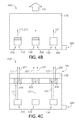
- FIGS. 4 a -4 c schematically depict embodiments of the lighting apparatus.
- FIG. 5 schematically depicts some aspects of the invention.
- FIG. 1 shows the relative melanopic (m) and photopic (p) human eye sensitivity functions.
- the maximum sensitivity for the melanopic function is at 490 nm, the full width half maximum values are at 447 nm and 531 nm.
- FIG. 2 shows an example of the tuning of the emission spectrum and thereby the correlated color temperature with an embodiment of the lighting apparatus.
- an embodiment was used with a blue LED with dominant wavelength at 440 nm, with YAG:Ce 3+ , a blue LED with dominant wavelength at 462 m, with LuAG:Ce, and with a red LED with a dominant wavelength at 613 nm.
- the lowest curve (solid curve), has a relative high red contribution, and a relative low blue contribution, with the blue contribution at lower wavelengths, which is the relative warm white light.
- the highest curve has a relative high blue contribution, which blue contribution has shifted to a wavelength closer to the melanopic maximum (relative to the lower curves). Hence, this is relative cool white light, with a higher MEF value than the lower curves.
- FIG. 3 a shows the CRI, R9 and MEF as a function of CCT, for a lamp using 450 nm blue LEDs (reference).
- a 3-channel solution is used without optimized blue pump LEDs:
- the MEF ratio is 3.2, with a MEF value of 0.31 at 2200 K and a MEF value of 0.91 at 5700 K.
- the difference in dominant wavelengths of the light sources is zero.
- FIG. 3 b shows CRI, R9 and MEF as a function of CCT, for a lighting apparatus using a combination of 440 and 462 nm blue LEDs.
- Dotted line variation in MEF value for standard (std.) LED lamp.
- an optimized 3-channel solution is chosen: 3-channel solution having optimal blue pump LEDs:
- the MEF range is much larger, with a MEF at 2200 K of 0.29 and a MEF at 5700 K of 1.18, which is a dynamical spectral MEF range of 4.1 (ratio).
- the difference in dominant wavelengths of the light sources is about 22 nm.
- FIG. 3 c shows CRI, R9 and MEF as a function of CCT, for a lighting apparatus using a combination of 440 and 462 nm blue LEDs (in combination with direct red LED). Dotted line: variation in MEF value for standard (std.) LED lamp.
- another embodiment of an optimized 3-channel solution is chosen:
- the CRI is over 80, and a large range of MEF values can be bridged with the lighting apparatus.
- the MEF value is 0.37 and at 6200 K the MEF value is 1.29, thereby providing a dynamical range of 3.5.
- the difference in dominant wavelengths of the light sources is about 22 nm.
- FIGS. 4 a -4 c schematically depict embodiments of the lighting apparatus.
- FIG. 4 a schematically depicts an embodiment of a lighting apparatus 100 configured to provide white light 101 with a variable correlated color temperature.
- the lighting apparatus 100 comprises a first light source 110 configured to provide first light source light 111 , wherein the first light source light 111 comprises blue light having a first light source dominant wavelength selected from the range of 400-460 nm, wherein the first light source 110 is configured to irradiate a first luminescent material 210 with said first light source light 111 , wherein the first luminescent material 210 is configured to convert part of the first light source light 111 into first luminescent material light 211 , wherein the first luminescent material light 211 comprises one or more of green and yellow light, and wherein the first luminescent material light 211 has a first luminescent material dominant wavelength.
- the lighting apparatus 100 comprises a second light source 120 configured to provide second light source light 121 , wherein the second light source light 121 comprises blue light having a second light source dominant wavelength selected from the range of 450-490 nm, wherein the second light source 120 is configured to irradiate a second luminescent material 220 with second light source light 121 , and wherein the second luminescent material 220 is configured to convert part of the second light source light 121 into second luminescent material light 221 , wherein the second luminescent material light 221 comprises one or more of green and yellow light, and wherein the second luminescent material light 221 has a second luminescent material dominant wavelength.
- the second light source light 121 comprises blue light having a second light source dominant wavelength selected from the range of 450-490 nm
- the second light source 120 is configured to irradiate a second luminescent material 220 with second light source light 121
- the second luminescent material 220 is configured to convert part of the second light source light 121 into
- the lighting apparatus 100 further comprises a third light source 130 configured to provide red light source light 131 .
- the lighting apparatus comprises a control unit 300 , configured to independently control the first light source 110 , the second light source 120 and the third light source 130 , to provide said white light 101 having a variable correlated color temperature, wherein said white light 101 comprise (optionally) said red light source light 131 and one or more of (a) said first light source light 111 and said first luminescent material light 211 , and (b) said second light source light 121 and said second luminescent material light 221 .
- the control unit is adapted to control the first light source, the second light source and the third light source.
- the control unit is thus configured to control the intensity of the first light source light, the second light source light and the third light source light.
- the third light source 130 comprises a third solid state light source 1130 configured to provide third solid state light source light 1131 , wherein the third solid state light source light 1131 comprises blue light, wherein the third solid state light source 1130 is configured to irradiate a third luminescent material 230 with third solid state light source light 1131 , and wherein the third luminescent material 1130 is configured to convert part of the third solid state light source light 1131 into third luminescent material light 231 , wherein the third luminescent material light 231 comprises red light.
- the amount of solid state light source light 1131 is especially low; especially substantially all the solid state light source light 1131 is absorbed by the third luminescent material 230 .
- the third luminescent material 230 comprises MAlSiN 3 :Eu(II), wherein M comprises one or more elements selected from the group consisting of barium (Ba), strontium (Sr) and calcium (Ca).
- the lighting apparatus comprises a first LED package 310 comprising the first light source 110 and the first luminescent material 210 , a second LED package 320 comprising the second light source 120 and the second luminescent material 220 , and a third LED package 330 comprising the third light source 130 and the third luminescent material 230 .
- Reference 170 indicates an optional diffusor.
- the lighting apparatus 100 will in general comprise a plurality of first light sources, a plurality of second light sources and a plurality of third light sources.
- FIG. 4 b schematically depicts the same embodiment as of FIG. 4 a , but now the third light source 130 comprises a third solid state light source 1130 configured to provide red third solid state light source light 1131 (i.e. without a luminescent material).
- FIG. 4 c schematically depicts a remote solution. Note that predominantly each light source is associated with the relevant luminescent material. Would the third light source be a red emitting light source without luminescent material, instead of luminescent material a light transmissive part may be included? The light sources are radiationally coupled with the respective luminescent materials.
- FIG. 5 schematically depicts some aspects of the invention. It shows very schematically a blue LED emission with a dominant wavelength D 1 .
- the peak maximum and dominant wavelength may substantially be the same. Further, it shows with a dashed curve the melanopsin curve (see FIG. 1 ). As also this curve is substantially symmetrical, the peak maximum and dominant wavelength may substantially be the same. The emission curve at longer wavelength is substantially asymmetric. Hence, here the dominant wavelength may differ from the peak maximum.
- the term “substantially” herein, such as in “substantially all light” or in “substantially consists”, will be understood by the person skilled in the art.
- the term “substantially” may also include embodiments with “entirely”, “completely”, “all”, etc. Hence, in embodiments the adjective substantially may also be removed.
- the term “substantially” may also relate to 90% or higher, such as 95% or higher, especially 99% or higher, even more especially 99.5% or higher, including 100%.
- the term “comprise” includes also embodiments wherein the term “comprises” means “consists of”.
- the term “and/or” especially relates to one or more of the items mentioned before and after “and/or”.
- a phrase “item 1 and/or item 2” and similar phrases may relate to one or more of item 1 and item 2.
- the term “comprising” may in an embodiment refer to “consisting of” but may in another embodiment also refer to “containing at least the defined species and optionally one or more other species”.
- the invention further applies to a device comprising one or more of the characterizing features described in the description and/or shown in the attached drawings.
- the invention further pertains to a method or process comprising one or more of the characterizing features described in the description and/or shown in the attached drawings.
Landscapes
- Health & Medical Sciences (AREA)
- Engineering & Computer Science (AREA)
- Biomedical Technology (AREA)
- General Health & Medical Sciences (AREA)
- Life Sciences & Earth Sciences (AREA)
- Veterinary Medicine (AREA)
- Public Health (AREA)
- Animal Behavior & Ethology (AREA)
- Physics & Mathematics (AREA)
- Psychology (AREA)
- Nuclear Medicine, Radiotherapy & Molecular Imaging (AREA)
- Pathology (AREA)
- Radiology & Medical Imaging (AREA)
- Psychiatry (AREA)
- Child & Adolescent Psychology (AREA)
- Developmental Disabilities (AREA)
- Hospice & Palliative Care (AREA)
- Social Psychology (AREA)
- Anesthesiology (AREA)
- General Engineering & Computer Science (AREA)
- Spectroscopy & Molecular Physics (AREA)
- Optics & Photonics (AREA)
- Microelectronics & Electronic Packaging (AREA)
- Pain & Pain Management (AREA)
- Acoustics & Sound (AREA)
- Heart & Thoracic Surgery (AREA)
- Hematology (AREA)
- Led Device Packages (AREA)
- Luminescent Compositions (AREA)
- Circuit Arrangement For Electric Light Sources In General (AREA)
- Radiation-Therapy Devices (AREA)
Abstract
Description
Hence, the above indicated summations are over the visible range of 380-780 nm.
-
- Channel 1: 450 nm blue+YAG
- Channel 2: 450 nm blue+LuAG
- Channel 3: MAlSiN3:Eu(II)
-
- Channel 1: 440 nm blue+YAG
- Channel 2: 462 nm blue+LuAG
- Channel 3: MAlSiN3:Eu(II) (same as above)
-
- Channel 1: 440 nm blue+YAG
- Channel 2: 462 nm blue+LuAG
- Channel 3: 613 nm red LED
Claims (15)
Applications Claiming Priority (4)
| Application Number | Priority Date | Filing Date | Title |
|---|---|---|---|
| EP15159899.2 | 2015-03-19 | ||
| EP15159899 | 2015-03-19 | ||
| EP15159899 | 2015-03-19 | ||
| PCT/EP2016/055696 WO2016146688A1 (en) | 2015-03-19 | 2016-03-16 | Bio hue lamp |
Publications (2)
| Publication Number | Publication Date |
|---|---|
| US20180056027A1 US20180056027A1 (en) | 2018-03-01 |
| US10434280B2 true US10434280B2 (en) | 2019-10-08 |
Family
ID=52736879
Family Applications (1)
| Application Number | Title | Priority Date | Filing Date |
|---|---|---|---|
| US15/558,396 Active 2036-06-09 US10434280B2 (en) | 2015-03-19 | 2016-03-16 | Bio hue lamp |
Country Status (8)
| Country | Link |
|---|---|
| US (1) | US10434280B2 (en) |
| EP (1) | EP3271013B1 (en) |
| JP (1) | JP6408166B2 (en) |
| CN (1) | CN107427687B (en) |
| DK (1) | DK3271013T3 (en) |
| PL (1) | PL3271013T3 (en) |
| RU (1) | RU2700375C2 (en) |
| WO (1) | WO2016146688A1 (en) |
Cited By (5)
| Publication number | Priority date | Publication date | Assignee | Title |
|---|---|---|---|---|
| US10582586B2 (en) * | 2018-05-29 | 2020-03-03 | Juganu Ltd. | Adjustable white light illumination devices |
| US20210351328A1 (en) * | 2019-01-24 | 2021-11-11 | Dai Nippon Printing Co., Ltd. | Led lighting sheet for animal/plant growth, led lighting module for animal/plant growth, shelf for animal/plant growth rack, animal/plant growth rack, animal/plant growth factory, and led lighting unit for animal/plant growth |
| US11938338B2 (en) | 2018-04-24 | 2024-03-26 | Koninklijke Philips N.V. | Light therapy system and method |
| US12527132B2 (en) | 2020-09-15 | 2026-01-13 | Nichia Corporation | Light emitting device |
| US12543417B2 (en) | 2020-03-31 | 2026-02-03 | Nichia Corporation | Light emission device and light fixture comprising same |
Families Citing this family (72)
| Publication number | Priority date | Publication date | Assignee | Title |
|---|---|---|---|---|
| US10838253B2 (en) | 2012-12-28 | 2020-11-17 | Industrial Technology Research Institute | Light source apparatus and display apparatus |
| US10201056B1 (en) * | 2014-12-02 | 2019-02-05 | Musco Corporation | Varying color of LED light using metamers |
| EP3335527A1 (en) * | 2015-08-13 | 2018-06-20 | Philips Lighting Holding B.V. | Sleepy light |
| US10253257B2 (en) * | 2015-11-25 | 2019-04-09 | Intematix Corporation | Coated narrow band red phosphor |
| US10212766B2 (en) * | 2015-12-18 | 2019-02-19 | Musco Corporation | Lighting optimized for melanopic vision |
| US10786648B2 (en) * | 2016-06-03 | 2020-09-29 | Musco Corporation | Apparatus, method, and system for providing tunable circadian lighting at constant perceived brightness and color |
| JP6883094B2 (en) | 2016-09-12 | 2021-06-09 | ルミレッズ リミテッド ライアビリティ カンパニー | Lighting system with reduced melanopic spectrum |
| US10595376B2 (en) | 2016-09-13 | 2020-03-17 | Biological Innovation & Optimization Systems, LLC | Systems and methods for controlling the spectral content of LED lighting devices |
| US20180338359A1 (en) * | 2017-01-26 | 2018-11-22 | Biological Innovation & Optimization Systems, LLC | Systems and methods of dynamic illumination and temporally coordinated spectral control and biological dimming |
| US11246197B2 (en) | 2017-03-28 | 2022-02-08 | Signify Holding B.V. | Light source and method for augmenting color perception for color deficient persons |
| CN109121243B (en) * | 2017-06-26 | 2020-09-15 | 财团法人工业技术研究院 | Light source device and display device |
| DE102017118339A1 (en) | 2017-08-11 | 2019-02-14 | Osram Opto Semiconductors Gmbh | Light-emitting component, lamp and use of a lamp and a light-emitting component |
| US10837607B2 (en) * | 2017-09-26 | 2020-11-17 | Lumileds Llc | Light emitting device with improved warm-white color point |
| JP6940764B2 (en) * | 2017-09-28 | 2021-09-29 | 日亜化学工業株式会社 | Light emitting device |
| EP3735572A1 (en) | 2018-01-02 | 2020-11-11 | Signify Holding B.V. | Light melanopic activity indicator |
| EP3738412A4 (en) | 2018-01-11 | 2022-02-09 | Ecosense Lighting Inc. | MULTI-CHANNEL SYSTEMS TO PROVIDE TUNABLE LIGHT WITH HIGH COLOR RENDERING AND BIOLOGICAL EFFECTS |
| WO2019140309A1 (en) | 2018-01-11 | 2019-07-18 | Ecosense Lighting Inc. | Switchable systems for white light with high color rendering and biological effects |
| EP3737469A4 (en) | 2018-01-11 | 2021-11-10 | Ecosense Lighting Inc. | Display lighting systems with circadian effects |
| US20190336789A1 (en) * | 2018-04-26 | 2019-11-07 | Osram Gmbh | Methods of Controlling Lighting Systems for Light Related Health and Systems Incorporating the same |
| US10529900B2 (en) * | 2018-05-05 | 2020-01-07 | Ideal Industries Lighting Llc | Solid state lighting device providing spectral power distribution with enhanced perceived brightness |
| US11330686B2 (en) | 2018-08-31 | 2022-05-10 | Signify Holding B.V. | Cyan enriched white light |
| CN109404747A (en) * | 2018-09-05 | 2019-03-01 | 浙江凯耀照明股份有限公司 | One kind having multispectral health-care lamp |
| EP3847428B1 (en) | 2018-09-07 | 2022-03-09 | Signify Holding B.V. | Light melanopic activity indicator |
| DE102018122283A1 (en) * | 2018-09-12 | 2020-03-12 | Osram Opto Semiconductors Gmbh | LIGHTING ARRANGEMENT |
| US11783748B2 (en) | 2018-11-08 | 2023-10-10 | Korrus, Inc. | Display lighting systems with bioactive lighting |
| US20220001200A1 (en) | 2018-11-08 | 2022-01-06 | Ecosense Lighting Inc. | Switchable bioactive lighting |
| US12073775B2 (en) | 2018-11-08 | 2024-08-27 | Korrus, Inc. | Display lighting systems with bioactive lighting |
| WO2020097580A1 (en) * | 2018-11-08 | 2020-05-14 | Ecosense Lighting Inc. | Bioactive panel lighting systems |
| WO2020114894A1 (en) | 2018-12-04 | 2020-06-11 | Signify Holding B.V. | Crisp white tuning |
| MX2021006727A (en) * | 2018-12-07 | 2021-09-21 | Lutron Tech Co Llc | LIGHT SOURCE TO MAINTAIN CIRCADIAN PARAMETERS AND ALLOW FLEXIBILITY WHEN CHANGING INTENSITY AND COLOR TEMPERATURE. |
| US11212890B2 (en) | 2019-01-25 | 2021-12-28 | Biological Innovation And Optimization Systems, Llc | Dual-mode spectral dimming lighting system |
| US10420184B1 (en) | 2019-01-25 | 2019-09-17 | Biological Innovation And Optimization Systems, Llc | Bio-dimming lighting system |
| JP2020136619A (en) * | 2019-02-25 | 2020-08-31 | パナソニックIpマネジメント株式会社 | Light emitting device and lighting device |
| JP2020136597A (en) * | 2019-02-25 | 2020-08-31 | パナソニックIpマネジメント株式会社 | Light emitting device and lighting device |
| JP7133774B2 (en) * | 2019-02-27 | 2022-09-09 | パナソニックIpマネジメント株式会社 | lighting equipment |
| JP7125618B2 (en) * | 2019-03-29 | 2022-08-25 | 日亜化学工業株式会社 | light emitting device |
| JP7159946B2 (en) * | 2019-03-29 | 2022-10-25 | 東芝ライテック株式会社 | lighting system |
| CN111755429B (en) * | 2019-03-29 | 2024-07-09 | 日亚化学工业株式会社 | Light-emitting device |
| US10959304B2 (en) * | 2019-04-09 | 2021-03-23 | Nichia Corporation | Lighting control system |
| JP6940796B2 (en) * | 2019-04-09 | 2021-09-29 | 日亜化学工業株式会社 | Lighting control system and lighting equipment. |
| CN110085728A (en) * | 2019-04-10 | 2019-08-02 | 厦门立达信照明有限公司 | Realize the method and LED light source of low blue light harm, high circadian rhythm factor light |
| WO2020212325A1 (en) | 2019-04-15 | 2020-10-22 | Signify Holding B.V. | Cytochrome c oxidase activating lighting system for mitochondrial activation and ocular health |
| US11145793B2 (en) * | 2019-05-09 | 2021-10-12 | Lumileds Llc | Light emitting diode with high melanopic spectral content |
| WO2020254573A1 (en) | 2019-06-20 | 2020-12-24 | Signify Holding B.V. | Neuropsin activating light element for ocular dopamine supporting ocular growth and health |
| US11953194B2 (en) * | 2019-08-20 | 2024-04-09 | Signify Holding, B.V. | High quality white laser-based light source by indirect pumping of red phosphor |
| JP7833393B2 (en) | 2019-08-20 | 2026-03-19 | シグニファイ ホールディング ビー ヴィ | High-intensity light source with high CRI |
| JP7142188B1 (en) | 2019-09-18 | 2022-09-26 | シグニファイ ホールディング ビー ヴィ | High intensity light source with high CRI |
| WO2021063878A1 (en) * | 2019-10-01 | 2021-04-08 | Signify Holding B.V. | High-intensity color tunable white laser light source using green phosphor |
| JP7510068B2 (en) * | 2019-10-30 | 2024-07-03 | 日亜化学工業株式会社 | Lighting fixtures, dimming control systems |
| EP3824952A1 (en) * | 2019-11-22 | 2021-05-26 | Seaborough Life Science B.V. | General lighting with photobiomodulation |
| CN115362760B (en) | 2020-04-09 | 2025-11-04 | 昕诺飞控股有限公司 | Black vision system using cyan pumps on white LEDs |
| US12377286B2 (en) | 2023-01-26 | 2025-08-05 | Suninlyf Bio Inc. | Anti-infective and therapeutic electromagnetic emission methods and devices |
| WO2021219442A1 (en) * | 2020-04-30 | 2021-11-04 | Signify Holding B.V. | High intensity light source with high cri for low ctt using green laser pumped phosphor |
| CN115606321B (en) * | 2020-05-15 | 2025-11-04 | 昕诺飞控股有限公司 | Black vision system with high CRI using cyan direct emitter |
| JP7633512B2 (en) * | 2020-05-29 | 2025-02-20 | 日亜化学工業株式会社 | Light-emitting device |
| EP4165344A1 (en) * | 2020-06-16 | 2023-04-19 | Signify Holding B.V. | High-intensity light source with high cri |
| JP7174266B2 (en) * | 2020-06-30 | 2022-11-17 | 日亜化学工業株式会社 | light emitting device |
| US20230389146A1 (en) * | 2020-10-20 | 2023-11-30 | Lumileds Llc | Tunable white lighting system with high color fidelity and adjustable melanopic content |
| KR20220094290A (en) * | 2020-12-28 | 2022-07-06 | 삼성전자주식회사 | White light emitting device and lighting apparatus |
| CN112747263B (en) * | 2020-12-31 | 2025-06-24 | 欧普照明股份有限公司 | A light source module and a lighting device including the light source module |
| WO2022143329A1 (en) * | 2020-12-31 | 2022-07-07 | 欧普照明股份有限公司 | Light source module and illumination device comprising same |
| JP7706899B2 (en) | 2021-03-04 | 2025-07-14 | ソウル セミコンダクター カンパニー リミテッド | How to use a white light source and a white light source |
| JP7625139B2 (en) * | 2021-09-14 | 2025-01-31 | シグニファイ ホールディング ビー ヴィ | Color control using high frequency wavelength swept sources and phosphors |
| JP7743672B2 (en) * | 2021-10-18 | 2025-09-25 | 栄一 誉田 | Illumination device and illumination method |
| US12538394B2 (en) | 2021-12-27 | 2026-01-27 | Signify Holding B.V. | High intensity BBL dimmable light source |
| US11864290B1 (en) * | 2022-01-24 | 2024-01-02 | Wangs Alliance Corporation | Dim-to-warm lighting |
| EP4516068A1 (en) * | 2022-04-25 | 2025-03-05 | Signify Holding B.V. | Melanopic light sensitivity |
| US11802682B1 (en) | 2022-08-29 | 2023-10-31 | Wangs Alliance Corporation | Modular articulating lighting |
| EP4635259A1 (en) * | 2022-12-15 | 2025-10-22 | Signify Holding B.V. | Cyan enhanced sources with 2° matched leds and correct 10° color points |
| US12156315B2 (en) | 2022-12-28 | 2024-11-26 | Wangs Alliance Corporation | Dynamic dim-to-warm with color-tunable fixtures |
| US12292169B1 (en) | 2024-07-10 | 2025-05-06 | Wangs Alliance Corporation | Shadowless connector |
| WO2026041612A1 (en) * | 2024-08-23 | 2026-02-26 | Signify Holding B.V. | High light color quality light module |
Citations (13)
| Publication number | Priority date | Publication date | Assignee | Title |
|---|---|---|---|---|
| JP2005063687A (en) | 2003-08-11 | 2005-03-10 | Sharp Corp | Light emitting device and display device |
| WO2007116341A1 (en) | 2006-04-11 | 2007-10-18 | Koninklijke Philips Electronics N.V. | Controlling a photo-biological effect with light |
| WO2008069103A1 (en) | 2006-12-08 | 2008-06-12 | Sharp Kabushiki Kaisha | Light source and light irradiating device |
| US20080231214A1 (en) | 2007-03-19 | 2008-09-25 | Seoul Semiconductor Co., Ltd. | Light emitting device having various color temperature |
| WO2008146219A1 (en) | 2007-05-31 | 2008-12-04 | Koninklijke Philips Electronics, N.V. | Method and system for providing illumination and physiological stimuli |
| US20090303694A1 (en) | 2006-03-31 | 2009-12-10 | Seoul Semiconductor Co., Ltd. | Light emitting device and lighting system having the same |
| US20100171441A1 (en) | 2007-05-25 | 2010-07-08 | Koninklijke Philips Electronics N.V. | Lighting system for creating a biological effect |
| US20110084614A1 (en) | 2009-10-08 | 2011-04-14 | Summalux, Llc | Led lighting system |
| US20120069551A1 (en) | 2008-12-23 | 2012-03-22 | Matthias Bues | Display system having circadian effect on humans |
| US20130140988A1 (en) | 2011-12-05 | 2013-06-06 | Fredric S. Maxik | Tunable led lamp for producing biologically-adjusted light |
| WO2014009865A1 (en) | 2012-07-11 | 2014-01-16 | Koninklijke Philips N.V. | Lighting device capable of providing horticulture light and method of illuminating horticulture |
| US20140117877A1 (en) | 2012-10-31 | 2014-05-01 | Arborlight, LLC | Natural daylight emulating light fixtures and systems |
| WO2015014936A1 (en) | 2013-08-02 | 2015-02-05 | Koninklijke Philips N.V. | Color rendering index tunable lamp and luminaire |
Family Cites Families (9)
| Publication number | Priority date | Publication date | Assignee | Title |
|---|---|---|---|---|
| US8125137B2 (en) | 2005-01-10 | 2012-02-28 | Cree, Inc. | Multi-chip light emitting device lamps for providing high-CRI warm white light and light fixtures including the same |
| BRPI0906849B8 (en) * | 2008-01-17 | 2021-07-27 | Koninklijke Philips Nv | lighting device, and, method of providing a wake-up stimulus by means of a lighting device |
| KR101121731B1 (en) | 2008-10-24 | 2012-06-05 | 서울반도체 주식회사 | Light emitting apparatus |
| JP5909694B2 (en) * | 2011-01-24 | 2016-04-27 | パナソニックIpマネジメント株式会社 | Lighting device |
| RU2502917C2 (en) * | 2011-12-30 | 2013-12-27 | Закрытое Акционерное Общество "Научно-Производственная Коммерческая Фирма "Элтан Лтд" | Light diode source of white light with combined remote photoluminiscent converter |
| CN203289685U (en) * | 2012-12-26 | 2013-11-13 | 山东华泰光源有限公司 | LED lighting system with circadian rhythm regulating function |
| US9039746B2 (en) | 2013-02-08 | 2015-05-26 | Cree, Inc. | Solid state light emitting devices including adjustable melatonin suppression effects |
| JP2015018693A (en) * | 2013-07-11 | 2015-01-29 | パナソニック株式会社 | Lighting fixture, illuminating device and light-emitting module |
| US9410664B2 (en) * | 2013-08-29 | 2016-08-09 | Soraa, Inc. | Circadian friendly LED light source |
-
2016
- 2016-03-16 CN CN201680016538.9A patent/CN107427687B/en active Active
- 2016-03-16 EP EP16713763.7A patent/EP3271013B1/en active Active
- 2016-03-16 DK DK16713763.7T patent/DK3271013T3/en active
- 2016-03-16 JP JP2017548270A patent/JP6408166B2/en active Active
- 2016-03-16 RU RU2017134278A patent/RU2700375C2/en active
- 2016-03-16 WO PCT/EP2016/055696 patent/WO2016146688A1/en not_active Ceased
- 2016-03-16 US US15/558,396 patent/US10434280B2/en active Active
- 2016-03-16 PL PL16713763T patent/PL3271013T3/en unknown
Patent Citations (13)
| Publication number | Priority date | Publication date | Assignee | Title |
|---|---|---|---|---|
| JP2005063687A (en) | 2003-08-11 | 2005-03-10 | Sharp Corp | Light emitting device and display device |
| US20090303694A1 (en) | 2006-03-31 | 2009-12-10 | Seoul Semiconductor Co., Ltd. | Light emitting device and lighting system having the same |
| WO2007116341A1 (en) | 2006-04-11 | 2007-10-18 | Koninklijke Philips Electronics N.V. | Controlling a photo-biological effect with light |
| WO2008069103A1 (en) | 2006-12-08 | 2008-06-12 | Sharp Kabushiki Kaisha | Light source and light irradiating device |
| US20080231214A1 (en) | 2007-03-19 | 2008-09-25 | Seoul Semiconductor Co., Ltd. | Light emitting device having various color temperature |
| US20100171441A1 (en) | 2007-05-25 | 2010-07-08 | Koninklijke Philips Electronics N.V. | Lighting system for creating a biological effect |
| WO2008146219A1 (en) | 2007-05-31 | 2008-12-04 | Koninklijke Philips Electronics, N.V. | Method and system for providing illumination and physiological stimuli |
| US20120069551A1 (en) | 2008-12-23 | 2012-03-22 | Matthias Bues | Display system having circadian effect on humans |
| US20110084614A1 (en) | 2009-10-08 | 2011-04-14 | Summalux, Llc | Led lighting system |
| US20130140988A1 (en) | 2011-12-05 | 2013-06-06 | Fredric S. Maxik | Tunable led lamp for producing biologically-adjusted light |
| WO2014009865A1 (en) | 2012-07-11 | 2014-01-16 | Koninklijke Philips N.V. | Lighting device capable of providing horticulture light and method of illuminating horticulture |
| US20140117877A1 (en) | 2012-10-31 | 2014-05-01 | Arborlight, LLC | Natural daylight emulating light fixtures and systems |
| WO2015014936A1 (en) | 2013-08-02 | 2015-02-05 | Koninklijke Philips N.V. | Color rendering index tunable lamp and luminaire |
Cited By (9)
| Publication number | Priority date | Publication date | Assignee | Title |
|---|---|---|---|---|
| US11938338B2 (en) | 2018-04-24 | 2024-03-26 | Koninklijke Philips N.V. | Light therapy system and method |
| US10582586B2 (en) * | 2018-05-29 | 2020-03-03 | Juganu Ltd. | Adjustable white light illumination devices |
| US10925134B2 (en) | 2018-05-29 | 2021-02-16 | Juganu Ltd. | Adjustable white light illumination devices |
| US11320115B2 (en) | 2018-05-29 | 2022-05-03 | Juganu Ltd. | Adjustable white light illumination devices |
| US11692686B2 (en) | 2018-05-29 | 2023-07-04 | Juganu Ltd. | Adjustable white light illumination devices |
| US20210351328A1 (en) * | 2019-01-24 | 2021-11-11 | Dai Nippon Printing Co., Ltd. | Led lighting sheet for animal/plant growth, led lighting module for animal/plant growth, shelf for animal/plant growth rack, animal/plant growth rack, animal/plant growth factory, and led lighting unit for animal/plant growth |
| US11990569B2 (en) * | 2019-01-24 | 2024-05-21 | Dai Nippon Printing Co., Ltd. | LED lighting sheet for animal/plant growth, LED lighting module for animal/plant growth, shelf for animal/plant growth rack, animal/plant growth rack, animal/plant growth factory, and LED lighting unit for animal/plant growth |
| US12543417B2 (en) | 2020-03-31 | 2026-02-03 | Nichia Corporation | Light emission device and light fixture comprising same |
| US12527132B2 (en) | 2020-09-15 | 2026-01-13 | Nichia Corporation | Light emitting device |
Also Published As
| Publication number | Publication date |
|---|---|
| US20180056027A1 (en) | 2018-03-01 |
| DK3271013T3 (en) | 2018-10-15 |
| RU2017134278A (en) | 2019-04-03 |
| EP3271013B1 (en) | 2018-08-22 |
| CN107427687B (en) | 2019-11-01 |
| EP3271013A1 (en) | 2018-01-24 |
| RU2017134278A3 (en) | 2019-07-24 |
| CN107427687A (en) | 2017-12-01 |
| JP2018511386A (en) | 2018-04-26 |
| JP6408166B2 (en) | 2018-10-17 |
| WO2016146688A1 (en) | 2016-09-22 |
| RU2700375C2 (en) | 2019-09-16 |
| PL3271013T3 (en) | 2019-02-28 |
Similar Documents
| Publication | Publication Date | Title |
|---|---|---|
| US10434280B2 (en) | Bio hue lamp | |
| EP3845033B1 (en) | Cyan enriched white light | |
| JP3820266B2 (en) | Display device | |
| JP7312920B2 (en) | Melanopic optical system using cyan-excited white LEDs | |
| JP5770269B2 (en) | White light source and white light source system using the same | |
| JP6081368B2 (en) | White light source and white light source system using the same | |
| JP2009224277A (en) | Indoor lighting device | |
| CN115606321B (en) | Black vision system with high CRI using cyan direct emitter | |
| EP3317370A1 (en) | Led lamp with slow decay red phosphor resulting in cct variation with light output | |
| WO2020212325A1 (en) | Cytochrome c oxidase activating lighting system for mitochondrial activation and ocular health | |
| CN112413456A (en) | Light source modules, lamps |
Legal Events
| Date | Code | Title | Description |
|---|---|---|---|
| AS | Assignment |
Owner name: PHILIPS LIGHTING HOLDING B.V., NETHERLANDS Free format text: ASSIGNMENT OF ASSIGNORS INTEREST;ASSIGNORS:PEETERS, MARTINUS PETRUS JOSEPH;BROERSMA, REMY CYRILLE;SUN, YUEJUN;AND OTHERS;SIGNING DATES FROM 20160322 TO 20170707;REEL/FRAME:043592/0308 |
|
| FEPP | Fee payment procedure |
Free format text: ENTITY STATUS SET TO UNDISCOUNTED (ORIGINAL EVENT CODE: BIG.); ENTITY STATUS OF PATENT OWNER: LARGE ENTITY |
|
| STPP | Information on status: patent application and granting procedure in general |
Free format text: DOCKETED NEW CASE - READY FOR EXAMINATION |
|
| STPP | Information on status: patent application and granting procedure in general |
Free format text: NOTICE OF ALLOWANCE MAILED -- APPLICATION RECEIVED IN OFFICE OF PUBLICATIONS |
|
| AS | Assignment |
Owner name: SIGNIFY HOLDING B.V., NETHERLANDS Free format text: CHANGE OF NAME;ASSIGNOR:PHILIPS LIGHTING HOLDING B.V.;REEL/FRAME:049957/0374 Effective date: 20190205 |
|
| STPP | Information on status: patent application and granting procedure in general |
Free format text: PUBLICATIONS -- ISSUE FEE PAYMENT VERIFIED |
|
| STCF | Information on status: patent grant |
Free format text: PATENTED CASE |
|
| MAFP | Maintenance fee payment |
Free format text: PAYMENT OF MAINTENANCE FEE, 4TH YEAR, LARGE ENTITY (ORIGINAL EVENT CODE: M1551); ENTITY STATUS OF PATENT OWNER: LARGE ENTITY Year of fee payment: 4 |