US10424744B2 - Compound and organic electronic device comprising the same - Google Patents
Compound and organic electronic device comprising the same Download PDFInfo
- Publication number
- US10424744B2 US10424744B2 US15/416,576 US201715416576A US10424744B2 US 10424744 B2 US10424744 B2 US 10424744B2 US 201715416576 A US201715416576 A US 201715416576A US 10424744 B2 US10424744 B2 US 10424744B2
- Authority
- US
- United States
- Prior art keywords
- unsubstituted
- substituted
- compound
- group
- independently
- Prior art date
- Legal status (The legal status is an assumption and is not a legal conclusion. Google has not performed a legal analysis and makes no representation as to the accuracy of the status listed.)
- Expired - Fee Related, expires
Links
- KTADSLDAUJLZGL-UHFFFAOYSA-N BrC1=C(C2=CC=CC=C2)C=CC=C1 Chemical compound BrC1=C(C2=CC=CC=C2)C=CC=C1 KTADSLDAUJLZGL-UHFFFAOYSA-N 0.000 description 6
- PEAIZUJFNSSGHL-UHFFFAOYSA-N O=C1C2=C(C=CC=C2)C2=C(C=CC=C2)C2=C1C=C(Br)C=C2 Chemical compound O=C1C2=C(C=CC=C2)C2=C(C=CC=C2)C2=C1C=C(Br)C=C2 PEAIZUJFNSSGHL-UHFFFAOYSA-N 0.000 description 5
- XBQJINRILBCTIF-UHFFFAOYSA-N C1=CC2=C(C=C1)C1=C(C=CC=C1)C1(C3=C2C=CC=C3)C2=C(C=CC=C2)C2=C1C=CC=C2.CC.CCN(C)[Ar].CCN([Ar])[Ar].[Ar].[Ar].[Ar] Chemical compound C1=CC2=C(C=C1)C1=C(C=CC=C1)C1(C3=C2C=CC=C3)C2=C(C=CC=C2)C2=C1C=CC=C2.CC.CCN(C)[Ar].CCN([Ar])[Ar].[Ar].[Ar].[Ar] XBQJINRILBCTIF-UHFFFAOYSA-N 0.000 description 4
- BOXBBAVLJRNECD-UHFFFAOYSA-N BrC1=CC2=C(C=C1)C1=C(C=CC=C1)C1=C(C=C(Br)C=C1)C21C2=C(C=CC=C2)C2=C1C=CC=C2 Chemical compound BrC1=CC2=C(C=C1)C1=C(C=CC=C1)C1=C(C=C(Br)C=C1)C21C2=C(C=CC=C2)C2=C1C=CC=C2 BOXBBAVLJRNECD-UHFFFAOYSA-N 0.000 description 3
- URWHDAVJASOPDW-UHFFFAOYSA-N O=C1C2=C(C=CC(Br)=C2)C2=C(C=CC=C2)C2=C1C=C(Br)C=C2 Chemical compound O=C1C2=C(C=CC(Br)=C2)C2=C(C=CC=C2)C2=C1C=C(Br)C=C2 URWHDAVJASOPDW-UHFFFAOYSA-N 0.000 description 3
- ZNTXJPXHBQVQOL-UHFFFAOYSA-N O=C1C2=C(C=CC(N(C3=CC=CC=C3)C3=CC=CC=C3)=C2)C2=C(C=CC=C2)C2=C1C=C(N(C1=CC=CC=C1)C1=CC=CC=C1)C=C2 Chemical compound O=C1C2=C(C=CC(N(C3=CC=CC=C3)C3=CC=CC=C3)=C2)C2=C(C=CC=C2)C2=C1C=C(N(C1=CC=CC=C1)C1=CC=CC=C1)C=C2 ZNTXJPXHBQVQOL-UHFFFAOYSA-N 0.000 description 3
- VLRRZBCNGZITJC-UHFFFAOYSA-N O=C1C2=C(C=CC=C2)C2=C(C=CC=C2)C2=C1C=CC(Br)=C2 Chemical compound O=C1C2=C(C=CC=C2)C2=C(C=CC=C2)C2=C1C=CC(Br)=C2 VLRRZBCNGZITJC-UHFFFAOYSA-N 0.000 description 3
- DRKHIWKXLZCAKP-UHFFFAOYSA-N BrC1=C(C2=C(Br)C=CC=C2)C=CC=C1 Chemical compound BrC1=C(C2=C(Br)C=CC=C2)C=CC=C1 DRKHIWKXLZCAKP-UHFFFAOYSA-N 0.000 description 2
- HEGGZXZRDJFBMC-UHFFFAOYSA-N BrC1=CC2=C(C=C1)C1(C3=C(C=CC=C3)C3=C2C=CC=C3)C2=C(C=CC=C2)C2=C1C=CC=C2 Chemical compound BrC1=CC2=C(C=C1)C1(C3=C(C=CC=C3)C3=C2C=CC=C3)C2=C(C=CC=C2)C2=C1C=CC=C2 HEGGZXZRDJFBMC-UHFFFAOYSA-N 0.000 description 2
- AXFWOALQHNFZOY-UHFFFAOYSA-N BrC1=CC2=C(C=C1)C1=C(C=CC=C1)C1=C(C=CC=C1)C21C2=C(C=CC=C2)C2=C1C=CC=C2 Chemical compound BrC1=CC2=C(C=C1)C1=C(C=CC=C1)C1=C(C=CC=C1)C21C2=C(C=CC=C2)C2=C1C=CC=C2 AXFWOALQHNFZOY-UHFFFAOYSA-N 0.000 description 2
- XDVUOKWABQIQJE-UHFFFAOYSA-N BrC1=CC=CC2=C1C1=C(C=CC=C1)C21C2=C(C=CC(N(C3=CC=CC=C3)C3=CC=CC=C3)=C2)C2=C(C=CC=C2)C2=C1C=C(N(C1=CC=CC=C1)C1=CC=CC=C1)C=C2 Chemical compound BrC1=CC=CC2=C1C1=C(C=CC=C1)C21C2=C(C=CC(N(C3=CC=CC=C3)C3=CC=CC=C3)=C2)C2=C(C=CC=C2)C2=C1C=C(N(C1=CC=CC=C1)C1=CC=CC=C1)C=C2 XDVUOKWABQIQJE-UHFFFAOYSA-N 0.000 description 2
- ZSJCFTZIBYOPEB-UHFFFAOYSA-N C.C1=CC=C(C2=CC=C(N(C3=CC4=C(C=C3)C3=C(C=CC=C3)C3=C(C=CC=C3)C43C4=C(C=CC=C4)C4=C3C=CC=C4)C3=C4OC5=C(C=CC=C5)C4=CC=C3)C=C2)C=C1.C1=CC=C(C2=CC=C(N(C3=CC=C(C4=CC5=C(C=C4)C4=C(C=CC=C4)C4=C(C=CC=C4)C54C5=C(C=CC=C5)C5=C4C=CC=C5)C=C3)C3=C4OC5=C(C=CC=C5)C4=CC=C3)C=C2)C=C1.CC1(C)C2=C(C=CC=C2)C2=C1C=C(N(C1=CC=C(C3=CC=CC=C3)C=C1)C1=CC=C(C3=CC4=C(C=C3)C3=C(C=CC=C3)C3=C(C=CC=C3)C43C4=C(C=CC=C4)C4=C3C=CC=C4)C=C1)C=C2 Chemical compound C.C1=CC=C(C2=CC=C(N(C3=CC4=C(C=C3)C3=C(C=CC=C3)C3=C(C=CC=C3)C43C4=C(C=CC=C4)C4=C3C=CC=C4)C3=C4OC5=C(C=CC=C5)C4=CC=C3)C=C2)C=C1.C1=CC=C(C2=CC=C(N(C3=CC=C(C4=CC5=C(C=C4)C4=C(C=CC=C4)C4=C(C=CC=C4)C54C5=C(C=CC=C5)C5=C4C=CC=C5)C=C3)C3=C4OC5=C(C=CC=C5)C4=CC=C3)C=C2)C=C1.CC1(C)C2=C(C=CC=C2)C2=C1C=C(N(C1=CC=C(C3=CC=CC=C3)C=C1)C1=CC=C(C3=CC4=C(C=C3)C3=C(C=CC=C3)C3=C(C=CC=C3)C43C4=C(C=CC=C4)C4=C3C=CC=C4)C=C1)C=C2 ZSJCFTZIBYOPEB-UHFFFAOYSA-N 0.000 description 2
- BADFDBRWFNYTME-UHFFFAOYSA-N C1=CC2=C(C=C1)C1=C(C=CC=C1)N(C1=CC3=C(C=C1)C1=C(C=CC=C1)C1=C(C=C(N4C5=C(C=CC=C5)C5=C(C=CC=C5)C5=C4C=CC=C5)C=C1)C31C3=C(C=CC=C3)C3=C1C=CC=C3)C1=C2C=CC=C1.C1=CC=C(C2=CC3=C(C=C2)C2=C(C=CC=C2)C32C3=C(C=CC(N(C4=CC=CC=C4)C4=CC=CC=C4)=C3)C3=C(C=CC=C3)C3=C2C=C(N(C2=CC=CC=C2)C2=CC=CC=C2)C=C3)C=C1.C1=CC=C(N(C2=CC=CC=C2)C2=CC3=C(C=C2)C2=C(C=CC=C2)C2=C(C=C(N(C4=CC=CC=C4)C4=CC=CC=C4)C=C2)C32C3=C(C=CC=C3)C3=C2C=CC(C2=CC=NC=C2)=C3)C=C1.C1=CC=C(N(C2=CC=CC=C2)C2=CC3=C(C=C2)C2=C(C=CC=C2)C2=C(C=C(N(C4=CC=CC=C4)C4=CC=CC=C4)C=C2)C32C3=C(C=CC=C3)C3=C2C=CC=C3C2=CC=NC=C2)C=C1 Chemical compound C1=CC2=C(C=C1)C1=C(C=CC=C1)N(C1=CC3=C(C=C1)C1=C(C=CC=C1)C1=C(C=C(N4C5=C(C=CC=C5)C5=C(C=CC=C5)C5=C4C=CC=C5)C=C1)C31C3=C(C=CC=C3)C3=C1C=CC=C3)C1=C2C=CC=C1.C1=CC=C(C2=CC3=C(C=C2)C2=C(C=CC=C2)C32C3=C(C=CC(N(C4=CC=CC=C4)C4=CC=CC=C4)=C3)C3=C(C=CC=C3)C3=C2C=C(N(C2=CC=CC=C2)C2=CC=CC=C2)C=C3)C=C1.C1=CC=C(N(C2=CC=CC=C2)C2=CC3=C(C=C2)C2=C(C=CC=C2)C2=C(C=C(N(C4=CC=CC=C4)C4=CC=CC=C4)C=C2)C32C3=C(C=CC=C3)C3=C2C=CC(C2=CC=NC=C2)=C3)C=C1.C1=CC=C(N(C2=CC=CC=C2)C2=CC3=C(C=C2)C2=C(C=CC=C2)C2=C(C=C(N(C4=CC=CC=C4)C4=CC=CC=C4)C=C2)C32C3=C(C=CC=C3)C3=C2C=CC=C3C2=CC=NC=C2)C=C1 BADFDBRWFNYTME-UHFFFAOYSA-N 0.000 description 2
- HECHZFGXRLXNGB-UHFFFAOYSA-N C1=CC2=C(C=C1)C1=C(C=CC=C1)N(C1=CC3=C(C=C1)C1=C(C=CC=C1)C1=C(C=CC=C1)C31C3=C(C=CC=C3)C3=C1C=CC=C3)C1=C2C=CC=C1.C1=CC=C(N(C2=CC3=C(C=C2)C2=C(C=CC=C2)C2=C(C=CC=C2)C32C3=C(C=CC=C3)C3=C2C=CC=C3)C2=C3OC4=C(C=CC=C4)C4=C(C=CC=C4)C3=CC=C2)C=C1.C1=CC=C(N(C2=CC=CC=C2)C2=CC=C(C3=CC4=C(C=C3)C3=C(C=CC=C3)C3=C(C=CC=C3)C43C4=C(C=CC=C4)C4=C3C=CC=C4)C=C2)C=C1.C1=CC=C(N(C2=CC=CC=C2)C2=CC=CC(C3=CC4=C(C=C3)C3(C5=C(C=CC=C5)C5=C4C=CC=C5)C4=C(C=CC=C4)C4=C3C=CC=C4)=C2)C=C1.CC1(C)C2=C(C=CC=C2)C2=C1C=C(N(C1=CC3=C(C=C1)C1=C(C=CC=C1)C1=C(C=CC=C1)C31C3=C(C=CC=C3)C3=C1C=CC=C3)C1=CC=CC=C1C1=CC=CC=C1)C=C2 Chemical compound C1=CC2=C(C=C1)C1=C(C=CC=C1)N(C1=CC3=C(C=C1)C1=C(C=CC=C1)C1=C(C=CC=C1)C31C3=C(C=CC=C3)C3=C1C=CC=C3)C1=C2C=CC=C1.C1=CC=C(N(C2=CC3=C(C=C2)C2=C(C=CC=C2)C2=C(C=CC=C2)C32C3=C(C=CC=C3)C3=C2C=CC=C3)C2=C3OC4=C(C=CC=C4)C4=C(C=CC=C4)C3=CC=C2)C=C1.C1=CC=C(N(C2=CC=CC=C2)C2=CC=C(C3=CC4=C(C=C3)C3=C(C=CC=C3)C3=C(C=CC=C3)C43C4=C(C=CC=C4)C4=C3C=CC=C4)C=C2)C=C1.C1=CC=C(N(C2=CC=CC=C2)C2=CC=CC(C3=CC4=C(C=C3)C3(C5=C(C=CC=C5)C5=C4C=CC=C5)C4=C(C=CC=C4)C4=C3C=CC=C4)=C2)C=C1.CC1(C)C2=C(C=CC=C2)C2=C1C=C(N(C1=CC3=C(C=C1)C1=C(C=CC=C1)C1=C(C=CC=C1)C31C3=C(C=CC=C3)C3=C1C=CC=C3)C1=CC=CC=C1C1=CC=CC=C1)C=C2 HECHZFGXRLXNGB-UHFFFAOYSA-N 0.000 description 2
- XONIPIPIMZOSHC-UHFFFAOYSA-N C1=CC=C(C2=C(N(C3=CC4=C(C=C3)C3(C5=C(C=CC=C5)C5=C4C=CC=C5)C4=C(C=CC=C4)C4=C3C=CC=C4)C3=C4C(=CC=C3)OC3=C4C=CC=C3)C=CC=C2)C=C1.C1=CC=C(C2=CC=C(N(C3=CC=C(C4=CC5=C(C=C4)C4(C6=C(C=CC=C6)C6=C5C=CC=C6)C5=C(C=CC=C5)C5=C4C=CC=C5)C=C3)C3=C4C(=CC=C3)OC3=C4C=CC=C3)C=C2)C=C1.CC1(C)C2=CC(N(C3=CC4=C(C=C3)C3(C5=C(C=CC=C5)C5=C4C=CC=C5)C4=C(C=CC=C4)C4=C3C=CC=C4)C3=C4C(=CC=C3)OC3=C4C=CC=C3)=CC=C2C2=C1C=CC=C2 Chemical compound C1=CC=C(C2=C(N(C3=CC4=C(C=C3)C3(C5=C(C=CC=C5)C5=C4C=CC=C5)C4=C(C=CC=C4)C4=C3C=CC=C4)C3=C4C(=CC=C3)OC3=C4C=CC=C3)C=CC=C2)C=C1.C1=CC=C(C2=CC=C(N(C3=CC=C(C4=CC5=C(C=C4)C4(C6=C(C=CC=C6)C6=C5C=CC=C6)C5=C(C=CC=C5)C5=C4C=CC=C5)C=C3)C3=C4C(=CC=C3)OC3=C4C=CC=C3)C=C2)C=C1.CC1(C)C2=CC(N(C3=CC4=C(C=C3)C3(C5=C(C=CC=C5)C5=C4C=CC=C5)C4=C(C=CC=C4)C4=C3C=CC=C4)C3=C4C(=CC=C3)OC3=C4C=CC=C3)=CC=C2C2=C1C=CC=C2 XONIPIPIMZOSHC-UHFFFAOYSA-N 0.000 description 2
- ZUGUNNNJEGKJTH-UHFFFAOYSA-N C1=CC=C(C2=C(N(C3=CC4=C(C=C3)C3(C5=C(C=CC=C5)C5=C4C=CC=C5)C4=C(C=CC=C4)C4=C3C=CC=C4)C3=C4OC5=C(C=CC=C5)C4=CC=C3)C=CC=C2)C=C1.C1=CC=C(C2=CC=C(N(C3=CC4=C(C=C3)C3(C5=C(C=CC=C5)C5=C4C=CC=C5)C4=C(C=CC=C4)C4=C3C=CC=C4)C3=C4C(=CC=C3)OC3=C4C=CC=C3)C=C2)C=C1.CC1(C)C2=CC(N(C3=CC4=C(C=C3)C3(C5=C(C=CC=C5)C5=C4C=CC=C5)C4=C(C=CC=C4)C4=C3C=CC=C4)C3=C4OC5=C(C=CC=C5)C4=CC=C3)=CC=C2C2=C1C=CC=C2 Chemical compound C1=CC=C(C2=C(N(C3=CC4=C(C=C3)C3(C5=C(C=CC=C5)C5=C4C=CC=C5)C4=C(C=CC=C4)C4=C3C=CC=C4)C3=C4OC5=C(C=CC=C5)C4=CC=C3)C=CC=C2)C=C1.C1=CC=C(C2=CC=C(N(C3=CC4=C(C=C3)C3(C5=C(C=CC=C5)C5=C4C=CC=C5)C4=C(C=CC=C4)C4=C3C=CC=C4)C3=C4C(=CC=C3)OC3=C4C=CC=C3)C=C2)C=C1.CC1(C)C2=CC(N(C3=CC4=C(C=C3)C3(C5=C(C=CC=C5)C5=C4C=CC=C5)C4=C(C=CC=C4)C4=C3C=CC=C4)C3=C4OC5=C(C=CC=C5)C4=CC=C3)=CC=C2C2=C1C=CC=C2 ZUGUNNNJEGKJTH-UHFFFAOYSA-N 0.000 description 2
- YIKBNOFPYKIFME-UHFFFAOYSA-N C1=CC=C(C2=C(N(C3=CC4=C(C=C3)C3(C5=C(C=CC=C5)C5=C4C=CC=C5)C4=C(C=CC=C4)C4=C3C=CC=C4)C3=C4OC5=C(C=CC=C5)C5=C(C=CC=C5)C4=CC=C3)C=CC=C2)C=C1.C1=CC=C(N(C2=CC3=C(C=C2)OC2=C(C=CC=C2)C2=C3C=CC=C2)C2=CC3=C(C=C2)C2(C4=C(C=CC=C4)C4=C3C=CC=C4)C3=C(C=CC=C3)C3=C2C=CC=C3)C=C1.CC1(C)C2=CC(N(C3=CC4=C(C=C3)C3(C5=C(C=CC=C5)C5=C4C=CC=C5)C4=C(C=CC=C4)C4=C3C=CC=C4)C3=C4OC5=C(C=CC=C5)C5=C(C=CC=C5)C4=CC=C3)=CC=C2C2=C1C=CC=C2 Chemical compound C1=CC=C(C2=C(N(C3=CC4=C(C=C3)C3(C5=C(C=CC=C5)C5=C4C=CC=C5)C4=C(C=CC=C4)C4=C3C=CC=C4)C3=C4OC5=C(C=CC=C5)C5=C(C=CC=C5)C4=CC=C3)C=CC=C2)C=C1.C1=CC=C(N(C2=CC3=C(C=C2)OC2=C(C=CC=C2)C2=C3C=CC=C2)C2=CC3=C(C=C2)C2(C4=C(C=CC=C4)C4=C3C=CC=C4)C3=C(C=CC=C3)C3=C2C=CC=C3)C=C1.CC1(C)C2=CC(N(C3=CC4=C(C=C3)C3(C5=C(C=CC=C5)C5=C4C=CC=C5)C4=C(C=CC=C4)C4=C3C=CC=C4)C3=C4OC5=C(C=CC=C5)C5=C(C=CC=C5)C4=CC=C3)=CC=C2C2=C1C=CC=C2 YIKBNOFPYKIFME-UHFFFAOYSA-N 0.000 description 2
- LBPCHOOJYCPAAS-UHFFFAOYSA-N C1=CC=C(C2=C(N(C3=CC4=C(C=C3)C3=C(C=CC=C3)C3=C(C=CC=C3)C43C4=C(C=CC=C4)C4=C3C=CC=C4)C3=C/C4=C(/C=C/3)C3=C(C=CC=C3)N(C3=CC=CC=C3)C3=C4C=CC=C3)C=CC=C2)C=C1.C1=CC=C(C2=CC=C(N(C3=CC4=C(C=C3)C3=C(C=CC=C3)C3=C(C=CC=C3)C43C4=C(C=CC=C4)C4=C3C=CC=C4)C3=C/C4=C(/C=C/3)C3=C(C=CC=C3)N(C3=CC=CC=C3)C3=C4C=CC=C3)C=C2)C=C1.C1=CC=C(N(C2=CC3=C(C=C2)C2(C4=C(C=CC=C4)C4=C3C=CC=C4)C3=C(C=CC=C3)C3=C2C=CC=C3)C2=CC=CC3=C2N(C2=CC=CC=C2)C2=C(C=CC=C2)C2=C3C=CC=C2)C=C1 Chemical compound C1=CC=C(C2=C(N(C3=CC4=C(C=C3)C3=C(C=CC=C3)C3=C(C=CC=C3)C43C4=C(C=CC=C4)C4=C3C=CC=C4)C3=C/C4=C(/C=C/3)C3=C(C=CC=C3)N(C3=CC=CC=C3)C3=C4C=CC=C3)C=CC=C2)C=C1.C1=CC=C(C2=CC=C(N(C3=CC4=C(C=C3)C3=C(C=CC=C3)C3=C(C=CC=C3)C43C4=C(C=CC=C4)C4=C3C=CC=C4)C3=C/C4=C(/C=C/3)C3=C(C=CC=C3)N(C3=CC=CC=C3)C3=C4C=CC=C3)C=C2)C=C1.C1=CC=C(N(C2=CC3=C(C=C2)C2(C4=C(C=CC=C4)C4=C3C=CC=C4)C3=C(C=CC=C3)C3=C2C=CC=C3)C2=CC=CC3=C2N(C2=CC=CC=C2)C2=C(C=CC=C2)C2=C3C=CC=C2)C=C1 LBPCHOOJYCPAAS-UHFFFAOYSA-N 0.000 description 2
- XUKZDBVGQNPANV-UHFFFAOYSA-N C1=CC=C(C2=C(N(C3=CC4=C(C=C3)C3=C(C=CC=C3)C3=C(C=CC=C3)C43C4=C(C=CC=C4)C4=C3C=CC=C4)C3=C/C4=C(\C=C/3)C3=C(C=CC=C3)OC3=C4C=CC=C3)C=CC=C2)C=C1.C1=CC=C(C2=CC=C(N(C3=CC4=C(C=C3)C3=C(C=CC=C3)C3=C(C=CC=C3)C43C4=C(C=CC=C4)C4=C3C=CC=C4)C3=C/C4=C(\C=C/3)C3=C(C=CC=C3)OC3=C4C=CC=C3)C=C2)C=C1.C1=CC=C(N(C2=CC3=C(C=C2)C2=C(C=CC=C2)C2=C(C=CC=C2)C32C3=C(C=CC=C3)C3=C2C=CC=C3)C2=C/C3=C(\C=C/2)C2=C(C=CC=C2)OC2=C3C=CC=C2)C=C1 Chemical compound C1=CC=C(C2=C(N(C3=CC4=C(C=C3)C3=C(C=CC=C3)C3=C(C=CC=C3)C43C4=C(C=CC=C4)C4=C3C=CC=C4)C3=C/C4=C(\C=C/3)C3=C(C=CC=C3)OC3=C4C=CC=C3)C=CC=C2)C=C1.C1=CC=C(C2=CC=C(N(C3=CC4=C(C=C3)C3=C(C=CC=C3)C3=C(C=CC=C3)C43C4=C(C=CC=C4)C4=C3C=CC=C4)C3=C/C4=C(\C=C/3)C3=C(C=CC=C3)OC3=C4C=CC=C3)C=C2)C=C1.C1=CC=C(N(C2=CC3=C(C=C2)C2=C(C=CC=C2)C2=C(C=CC=C2)C32C3=C(C=CC=C3)C3=C2C=CC=C3)C2=C/C3=C(\C=C/2)C2=C(C=CC=C2)OC2=C3C=CC=C2)C=C1 XUKZDBVGQNPANV-UHFFFAOYSA-N 0.000 description 2
- JXUCHWFFDUPPFE-UHFFFAOYSA-N C1=CC=C(C2=C(N(C3=CC4=C(C=C3)C3=C(C=CC=C3)C3=C(C=CC=C3)C43C4=C(C=CC=C4)C4=C3C=CC=C4)C3=C/C4=C(\C=C/3)OC3=C(C=CC=C3)C3=C4C=CC=C3)C=CC=C2)C=C1.C1=CC=C(C2=CC=C(N(C3=CC4=C(C=C3)C3=C(C=CC=C3)C3=C(C=CC=C3)C43C4=C(C=CC=C4)C4=C3C=CC=C4)C3=C/C4=C(\C=C/3)OC3=C(C=CC=C3)C3=C4C=CC=C3)C=C2)C=C1.CC1(C)C2=CC(N(C3=CC4=C(C=C3)C3=C(C=CC=C3)C3=C(C=CC=C3)C43C4=C(C=CC=C4)C4=C3C=CC=C4)C3=C/C4=C(\C=C/3)OC3=C(C=CC=C3)C3=C4C=CC=C3)=CC=C2C2=C1C=CC=C2 Chemical compound C1=CC=C(C2=C(N(C3=CC4=C(C=C3)C3=C(C=CC=C3)C3=C(C=CC=C3)C43C4=C(C=CC=C4)C4=C3C=CC=C4)C3=C/C4=C(\C=C/3)OC3=C(C=CC=C3)C3=C4C=CC=C3)C=CC=C2)C=C1.C1=CC=C(C2=CC=C(N(C3=CC4=C(C=C3)C3=C(C=CC=C3)C3=C(C=CC=C3)C43C4=C(C=CC=C4)C4=C3C=CC=C4)C3=C/C4=C(\C=C/3)OC3=C(C=CC=C3)C3=C4C=CC=C3)C=C2)C=C1.CC1(C)C2=CC(N(C3=CC4=C(C=C3)C3=C(C=CC=C3)C3=C(C=CC=C3)C43C4=C(C=CC=C4)C4=C3C=CC=C4)C3=C/C4=C(\C=C/3)OC3=C(C=CC=C3)C3=C4C=CC=C3)=CC=C2C2=C1C=CC=C2 JXUCHWFFDUPPFE-UHFFFAOYSA-N 0.000 description 2
- GGFSLQQZZVSFGD-UHFFFAOYSA-N C1=CC=C(C2=C(N(C3=CC4=C(C=C3)C3=C(C=CC=C3)C3=C(C=CC=C3)C43C4=C(C=CC=C4)C4=C3C=CC=C4)C3=C4C(=CC=C3)OC3=C4C=CC=C3)C=CC=C2)C=C1.C1=CC=C(C2=CC=C(N(C3=CC4=C(C=C3)OC3=C4C=CC=C3)C3=CC4=C(C=C3)C3=C(C=CC=C3)C3=C(C=CC=C3)C43C4=C(C=CC=C4)C4=C3C=CC=C4)C=C2)C=C1.C1=CC=C(C2=CC=C(N(C3=CC=C(C4=CC5=C(C=C4)C4=C(C=CC=C4)C4=C(C=CC=C4)C54C5=C(C=CC=C5)C5=C4C=CC=C5)C=C3)C3=CC4=C(C=C3)OC3=C4C=CC=C3)C=C2)C=C1 Chemical compound C1=CC=C(C2=C(N(C3=CC4=C(C=C3)C3=C(C=CC=C3)C3=C(C=CC=C3)C43C4=C(C=CC=C4)C4=C3C=CC=C4)C3=C4C(=CC=C3)OC3=C4C=CC=C3)C=CC=C2)C=C1.C1=CC=C(C2=CC=C(N(C3=CC4=C(C=C3)OC3=C4C=CC=C3)C3=CC4=C(C=C3)C3=C(C=CC=C3)C3=C(C=CC=C3)C43C4=C(C=CC=C4)C4=C3C=CC=C4)C=C2)C=C1.C1=CC=C(C2=CC=C(N(C3=CC=C(C4=CC5=C(C=C4)C4=C(C=CC=C4)C4=C(C=CC=C4)C54C5=C(C=CC=C5)C5=C4C=CC=C5)C=C3)C3=CC4=C(C=C3)OC3=C4C=CC=C3)C=C2)C=C1 GGFSLQQZZVSFGD-UHFFFAOYSA-N 0.000 description 2
- SMVCXCJBHZHLJN-UHFFFAOYSA-N C1=CC=C(C2=C(N(C3=CC4=C(C=C3)C3=C(C=CC=C3)C3=C(C=CC=C3)C43C4=C(C=CC=C4)C4=C3C=CC=C4)C3=C4OC5=C(C=CC=C5)C4=CC=C3)C=CC=C2)C=C1.C1=CC=C(C2=CC=C(N(C3=CC4=C(C=C3)C3=C(C=CC=C3)C3=C(C=CC=C3)C43C4=C(C=CC=C4)C4=C3C=CC=C4)C3=C4C(=CC=C3)OC3=C4C=CC=C3)C=C2)C=C1.C1=CC=C(C2=CC=C(N(C3=CC=C(C4=CC5=C(C=C4)C4=C(C=CC=C4)C4=C(C=CC=C4)C54C5=C(C=CC=C5)C5=C4C=CC=C5)C=C3)C3=C4C(=CC=C3)OC3=C4C=CC=C3)C=C2)C=C1 Chemical compound C1=CC=C(C2=C(N(C3=CC4=C(C=C3)C3=C(C=CC=C3)C3=C(C=CC=C3)C43C4=C(C=CC=C4)C4=C3C=CC=C4)C3=C4OC5=C(C=CC=C5)C4=CC=C3)C=CC=C2)C=C1.C1=CC=C(C2=CC=C(N(C3=CC4=C(C=C3)C3=C(C=CC=C3)C3=C(C=CC=C3)C43C4=C(C=CC=C4)C4=C3C=CC=C4)C3=C4C(=CC=C3)OC3=C4C=CC=C3)C=C2)C=C1.C1=CC=C(C2=CC=C(N(C3=CC=C(C4=CC5=C(C=C4)C4=C(C=CC=C4)C4=C(C=CC=C4)C54C5=C(C=CC=C5)C5=C4C=CC=C5)C=C3)C3=C4C(=CC=C3)OC3=C4C=CC=C3)C=C2)C=C1 SMVCXCJBHZHLJN-UHFFFAOYSA-N 0.000 description 2
- OVKBGWIFVBZREB-UHFFFAOYSA-N C1=CC=C(C2=C(N(C3=CC4=C(C=C3)C3=C(C=CC=C3)C3=C(C=CC=C3)C43C4=C(C=CC=C4)C4=C3C=CC=C4)C3=C4\OC5=C(C=CC=C5)C5=C(C=CC=C5)\C4=C/C=C\3)C=CC=C2)C=C1.C1=CC=C(N(C2=CC3=C(C=C2)C2=C(C=CC=C2)C2=C(C=CC=C2)C32C3=C(C=CC=C3)C3=C2C=CC=C3)C2=C/C3=C(\C=C/2)OC2=C(C=CC=C2)C2=C3C=CC=C2)C=C1.CC1(C)C2=CC(N(C3=CC4=C(C=C3)C3=C(C=CC=C3)C3=C(C=CC=C3)C43C4=C(C=CC=C4)C4=C3C=CC=C4)C3=C4\OC5=C(C=CC=C5)C5=C(C=CC=C5)\C4=C/C=C\3)=CC=C2C2=C1C=CC=C2 Chemical compound C1=CC=C(C2=C(N(C3=CC4=C(C=C3)C3=C(C=CC=C3)C3=C(C=CC=C3)C43C4=C(C=CC=C4)C4=C3C=CC=C4)C3=C4\OC5=C(C=CC=C5)C5=C(C=CC=C5)\C4=C/C=C\3)C=CC=C2)C=C1.C1=CC=C(N(C2=CC3=C(C=C2)C2=C(C=CC=C2)C2=C(C=CC=C2)C32C3=C(C=CC=C3)C3=C2C=CC=C3)C2=C/C3=C(\C=C/2)OC2=C(C=CC=C2)C2=C3C=CC=C2)C=C1.CC1(C)C2=CC(N(C3=CC4=C(C=C3)C3=C(C=CC=C3)C3=C(C=CC=C3)C43C4=C(C=CC=C4)C4=C3C=CC=C4)C3=C4\OC5=C(C=CC=C5)C5=C(C=CC=C5)\C4=C/C=C\3)=CC=C2C2=C1C=CC=C2 OVKBGWIFVBZREB-UHFFFAOYSA-N 0.000 description 2
- NZAQIHXWUIEDTD-UHFFFAOYSA-N C1=CC=C(C2=C(N(C3=CC4=C(C=C3)C3=C(C=CC=C3)O4)C3=CC4=C(C=C3)C3(C5=C(C=CC=C5)C5=C4C=CC=C5)C4=C(C=CC=C4)C4=C3C=CC=C4)C=CC=C2)C=C1.C1=CC=C(C2=CC=C(N(C3=CC=C(C4=CC5=C(C=C4)C4(C6=C(C=CC=C6)C6=C5C=CC=C6)C5=C(C=CC=C5)C5=C4C=CC=C5)C=C3)C3=CC4=C(C=C3)C3=C(C=CC=C3)O4)C=C2)C=C1.CC1(C)C2=CC(N(C3=CC4=C(C=C3)C3=C(C=CC=C3)O4)C3=CC4=C(C=C3)C3(C5=C(C=CC=C5)C5=C4C=CC=C5)C4=C(C=CC=C4)C4=C3C=CC=C4)=CC=C2C2=C1C=CC=C2 Chemical compound C1=CC=C(C2=C(N(C3=CC4=C(C=C3)C3=C(C=CC=C3)O4)C3=CC4=C(C=C3)C3(C5=C(C=CC=C5)C5=C4C=CC=C5)C4=C(C=CC=C4)C4=C3C=CC=C4)C=CC=C2)C=C1.C1=CC=C(C2=CC=C(N(C3=CC=C(C4=CC5=C(C=C4)C4(C6=C(C=CC=C6)C6=C5C=CC=C6)C5=C(C=CC=C5)C5=C4C=CC=C5)C=C3)C3=CC4=C(C=C3)C3=C(C=CC=C3)O4)C=C2)C=C1.CC1(C)C2=CC(N(C3=CC4=C(C=C3)C3=C(C=CC=C3)O4)C3=CC4=C(C=C3)C3(C5=C(C=CC=C5)C5=C4C=CC=C5)C4=C(C=CC=C4)C4=C3C=CC=C4)=CC=C2C2=C1C=CC=C2 NZAQIHXWUIEDTD-UHFFFAOYSA-N 0.000 description 2
- BIQZROBDHHJTRN-UHFFFAOYSA-N C1=CC=C(C2=C(N(C3=CC4=C(C=C3)C3=C(C=CC=C3)O4)C3=CC4=C(C=C3)C3=C(C=CC=C3)C3=C(C=CC=C3)C43C4=C(C=CC=C4)C4=C3C=CC=C4)C=CC=C2)C=C1.C1=CC=C(C2=CC=C(N(C3=CC4=C(C=C3)C3=C(C=CC=C3)O4)C3=CC4=C(C=C3)C3=C(C=CC=C3)C3=C(C=CC=C3)C43C4=C(C=CC=C4)C4=C3C=CC=C4)C=C2)C=C1.C1=CC=C(C2=CC=C(N(C3=CC=C(C4=CC5=C(C=C4)C4=C(C=CC=C4)C4=C(C=CC=C4)C54C5=C(C=CC=C5)C5=C4C=CC=C5)C=C3)C3=CC4=C(C=C3)C3=C(C=CC=C3)O4)C=C2)C=C1 Chemical compound C1=CC=C(C2=C(N(C3=CC4=C(C=C3)C3=C(C=CC=C3)O4)C3=CC4=C(C=C3)C3=C(C=CC=C3)C3=C(C=CC=C3)C43C4=C(C=CC=C4)C4=C3C=CC=C4)C=CC=C2)C=C1.C1=CC=C(C2=CC=C(N(C3=CC4=C(C=C3)C3=C(C=CC=C3)O4)C3=CC4=C(C=C3)C3=C(C=CC=C3)C3=C(C=CC=C3)C43C4=C(C=CC=C4)C4=C3C=CC=C4)C=C2)C=C1.C1=CC=C(C2=CC=C(N(C3=CC=C(C4=CC5=C(C=C4)C4=C(C=CC=C4)C4=C(C=CC=C4)C54C5=C(C=CC=C5)C5=C4C=CC=C5)C=C3)C3=CC4=C(C=C3)C3=C(C=CC=C3)O4)C=C2)C=C1 BIQZROBDHHJTRN-UHFFFAOYSA-N 0.000 description 2
- WWVUJGMOJFOCIZ-UHFFFAOYSA-N C1=CC=C(C2=C(N(C3=CC4=C(C=C3)C3=C(C=CC=C3)OC3=C4C=CC=C3)C3=CC4=C(C=C3)C3(C5=C(C=CC=C5)C5=C4C=CC=C5)C4=C(C=CC=C4)C4=C3C=CC=C4)C=CC=C2)C=C1.C1=CC=C(C2=CC=C(N(C3=CC4=C(C=C3)C3=C(C=CC=C3)OC3=C4C=CC=C3)C3=CC4=C(C=C3)C3(C5=C(C=CC=C5)C5=C4C=CC=C5)C4=C(C=CC=C4)C4=C3C=CC=C4)C=C2)C=C1.C1=CC=C(N(C2=CC3=C(C=C2)C2=C(C=CC=C2)OC2=C3C=CC=C2)C2=CC3=C(C=C2)C2(C4=C(C=CC=C4)C4=C3C=CC=C4)C3=C(C=CC=C3)C3=C2C=CC=C3)C=C1.CC1(C)C2=CC(N(C3=CC4=C(C=C3)C3=C(C=CC=C3)OC3=C4C=CC=C3)C3=CC4=C(C=C3)C3(C5=C(C=CC=C5)C5=C4C=CC=C5)C4=C(C=CC=C4)C4=C3C=CC=C4)=CC=C2C2=C1C=CC=C2 Chemical compound C1=CC=C(C2=C(N(C3=CC4=C(C=C3)C3=C(C=CC=C3)OC3=C4C=CC=C3)C3=CC4=C(C=C3)C3(C5=C(C=CC=C5)C5=C4C=CC=C5)C4=C(C=CC=C4)C4=C3C=CC=C4)C=CC=C2)C=C1.C1=CC=C(C2=CC=C(N(C3=CC4=C(C=C3)C3=C(C=CC=C3)OC3=C4C=CC=C3)C3=CC4=C(C=C3)C3(C5=C(C=CC=C5)C5=C4C=CC=C5)C4=C(C=CC=C4)C4=C3C=CC=C4)C=C2)C=C1.C1=CC=C(N(C2=CC3=C(C=C2)C2=C(C=CC=C2)OC2=C3C=CC=C2)C2=CC3=C(C=C2)C2(C4=C(C=CC=C4)C4=C3C=CC=C4)C3=C(C=CC=C3)C3=C2C=CC=C3)C=C1.CC1(C)C2=CC(N(C3=CC4=C(C=C3)C3=C(C=CC=C3)OC3=C4C=CC=C3)C3=CC4=C(C=C3)C3(C5=C(C=CC=C5)C5=C4C=CC=C5)C4=C(C=CC=C4)C4=C3C=CC=C4)=CC=C2C2=C1C=CC=C2 WWVUJGMOJFOCIZ-UHFFFAOYSA-N 0.000 description 2
- YDTYUVDRMHSOLF-UHFFFAOYSA-N C1=CC=C(C2=C(N(C3=CC4=C(C=C3)N(C3=CC=CC=C3)C3=C(C=CC=C3)C3=C4C=CC=C3)C3=CC4=C(C=C3)C3(C5=C(C=CC=C5)C5=C4C=CC=C5)C4=C(C=CC=C4)C4=C3C=CC=C4)C=CC=C2)C=C1.C1=CC=C(N(C2=CC3=C(C=C2)C2=C(C=CC=C2)C2=C(C=CC=C2)C32C3=C(C=CC=C3)C3=C2C=CC=C3)C2=CC=CC3=C2N(C2=CC=CC=C2)C2=C(C=CC=C2)C2=C3C=CC=C2)C=C1.CC1(C)C2=CC(N(C3=CC4=C(C=C3)N(C3=CC=CC=C3)C3=C(C=CC=C3)C3=C4C=CC=C3)C3=CC4=C(C=C3)C3(C5=C(C=CC=C5)C5=C4C=CC=C5)C4=C(C=CC=C4)C4=C3C=CC=C4)=CC=C2C2=C1C=CC=C2 Chemical compound C1=CC=C(C2=C(N(C3=CC4=C(C=C3)N(C3=CC=CC=C3)C3=C(C=CC=C3)C3=C4C=CC=C3)C3=CC4=C(C=C3)C3(C5=C(C=CC=C5)C5=C4C=CC=C5)C4=C(C=CC=C4)C4=C3C=CC=C4)C=CC=C2)C=C1.C1=CC=C(N(C2=CC3=C(C=C2)C2=C(C=CC=C2)C2=C(C=CC=C2)C32C3=C(C=CC=C3)C3=C2C=CC=C3)C2=CC=CC3=C2N(C2=CC=CC=C2)C2=C(C=CC=C2)C2=C3C=CC=C2)C=C1.CC1(C)C2=CC(N(C3=CC4=C(C=C3)N(C3=CC=CC=C3)C3=C(C=CC=C3)C3=C4C=CC=C3)C3=CC4=C(C=C3)C3(C5=C(C=CC=C5)C5=C4C=CC=C5)C4=C(C=CC=C4)C4=C3C=CC=C4)=CC=C2C2=C1C=CC=C2 YDTYUVDRMHSOLF-UHFFFAOYSA-N 0.000 description 2
- VDAKGQBXDCYPNL-UHFFFAOYSA-N C1=CC=C(C2=C(N(C3=CC4=C(C=C3)N(C3=CC=CC=C3)C3=C(C=CC=C3)C3=C4C=CC=C3)C3=CC4=C(C=C3)C3=C(C=CC=C3)C3=C(C=CC=C3)C43C4=C(C=CC=C4)C4=C3C=CC=C4)C=CC=C2)C=C1.C1=CC=C(C2=CC=C(N(C3=CC4=C(C=C3)N(C3=CC=CC=C3)C3=C(C=CC=C3)C3=C4C=CC=C3)C3=CC4=C(C=C3)C3=C(C=CC=C3)C3=C(C=CC=C3)C43C4=C(C=CC=C4)C4=C3C=CC=C4)C=C2)C=C1.C1=CC=C(N(C2=CC3=C(C=C2)N(C2=CC=CC=C2)C2=C(C=CC=C2)C2=C3C=CC=C2)C2=CC3=C(C=C2)C2=C(C=CC=C2)C2=C(C=CC=C2)C32C3=C(C=CC=C3)C3=C2C=CC=C3)C=C1 Chemical compound C1=CC=C(C2=C(N(C3=CC4=C(C=C3)N(C3=CC=CC=C3)C3=C(C=CC=C3)C3=C4C=CC=C3)C3=CC4=C(C=C3)C3=C(C=CC=C3)C3=C(C=CC=C3)C43C4=C(C=CC=C4)C4=C3C=CC=C4)C=CC=C2)C=C1.C1=CC=C(C2=CC=C(N(C3=CC4=C(C=C3)N(C3=CC=CC=C3)C3=C(C=CC=C3)C3=C4C=CC=C3)C3=CC4=C(C=C3)C3=C(C=CC=C3)C3=C(C=CC=C3)C43C4=C(C=CC=C4)C4=C3C=CC=C4)C=C2)C=C1.C1=CC=C(N(C2=CC3=C(C=C2)N(C2=CC=CC=C2)C2=C(C=CC=C2)C2=C3C=CC=C2)C2=CC3=C(C=C2)C2=C(C=CC=C2)C2=C(C=CC=C2)C32C3=C(C=CC=C3)C3=C2C=CC=C3)C=C1 VDAKGQBXDCYPNL-UHFFFAOYSA-N 0.000 description 2
- WOMIZKMZNFKXJU-UHFFFAOYSA-N C1=CC=C(C2=C(N(C3=CC4=C(C=C3)OC3=C(C=CC=C3)C3=C4C=CC=C3)C3=CC4=C(C=C3)C3(C5=C(C=CC=C5)C5=C4C=CC=C5)C4=C(C=CC=C4)C4=C3C=CC=C4)C=CC=C2)C=C1.C1=CC=C(C2=CC=C(N(C3=CC4=C(C=C3)OC3=C(C=CC=C3)C3=C4C=CC=C3)C3=CC4=C(C=C3)C3(C5=C(C=CC=C5)C5=C4C=CC=C5)C4=C(C=CC=C4)C4=C3C=CC=C4)C=C2)C=C1.CC1(C)C2=CC(N(C3=CC4=C(C=C3)OC3=C(C=CC=C3)C3=C4C=CC=C3)C3=CC4=C(C=C3)C3(C5=C(C=CC=C5)C5=C4C=CC=C5)C4=C(C=CC=C4)C4=C3C=CC=C4)=CC=C2C2=C1C=CC=C2 Chemical compound C1=CC=C(C2=C(N(C3=CC4=C(C=C3)OC3=C(C=CC=C3)C3=C4C=CC=C3)C3=CC4=C(C=C3)C3(C5=C(C=CC=C5)C5=C4C=CC=C5)C4=C(C=CC=C4)C4=C3C=CC=C4)C=CC=C2)C=C1.C1=CC=C(C2=CC=C(N(C3=CC4=C(C=C3)OC3=C(C=CC=C3)C3=C4C=CC=C3)C3=CC4=C(C=C3)C3(C5=C(C=CC=C5)C5=C4C=CC=C5)C4=C(C=CC=C4)C4=C3C=CC=C4)C=C2)C=C1.CC1(C)C2=CC(N(C3=CC4=C(C=C3)OC3=C(C=CC=C3)C3=C4C=CC=C3)C3=CC4=C(C=C3)C3(C5=C(C=CC=C5)C5=C4C=CC=C5)C4=C(C=CC=C4)C4=C3C=CC=C4)=CC=C2C2=C1C=CC=C2 WOMIZKMZNFKXJU-UHFFFAOYSA-N 0.000 description 2
- OICWNHUXNCOGQN-UHFFFAOYSA-N C1=CC=C(C2=C(N(C3=CC4=C(C=C3)OC3=C4C=CC=C3)C3=CC4=C(C=C3)C3(C5=C(C=CC=C5)C5=C4C=CC=C5)C4=C(C=CC=C4)C4=C3C=CC=C4)C=CC=C2)C=C1.C1=CC=C(C2=CC=C(N(C3=CC4=C(C=C3)OC3=C4C=CC=C3)C3=CC4=C(C=C3)C3(C5=C(C=CC=C5)C5=C4C=CC=C5)C4=C(C=CC=C4)C4=C3C=CC=C4)C=C2)C=C1.C1=CC=C(C2=CC=C(N(C3=CC=C(C4=CC5=C(C=C4)C4(C6=C(C=CC=C6)C6=C5C=CC=C6)C5=C(C=CC=C5)C5=C4C=CC=C5)C=C3)C3=CC4=C(C=C3)OC3=C4C=CC=C3)C=C2)C=C1 Chemical compound C1=CC=C(C2=C(N(C3=CC4=C(C=C3)OC3=C4C=CC=C3)C3=CC4=C(C=C3)C3(C5=C(C=CC=C5)C5=C4C=CC=C5)C4=C(C=CC=C4)C4=C3C=CC=C4)C=CC=C2)C=C1.C1=CC=C(C2=CC=C(N(C3=CC4=C(C=C3)OC3=C4C=CC=C3)C3=CC4=C(C=C3)C3(C5=C(C=CC=C5)C5=C4C=CC=C5)C4=C(C=CC=C4)C4=C3C=CC=C4)C=C2)C=C1.C1=CC=C(C2=CC=C(N(C3=CC=C(C4=CC5=C(C=C4)C4(C6=C(C=CC=C6)C6=C5C=CC=C6)C5=C(C=CC=C5)C5=C4C=CC=C5)C=C3)C3=CC4=C(C=C3)OC3=C4C=CC=C3)C=C2)C=C1 OICWNHUXNCOGQN-UHFFFAOYSA-N 0.000 description 2
- PXNUVQBNKLVCQV-UHFFFAOYSA-N C1=CC=C(C2=C(N(C3=CC=C4OC5=C(C=CC=C5)C4=C3)C3=CC4=C(C=C3)C3=C(C=CC=C3)C3=C(C=CC=C3)C43C4=C(C=CC=C4)C4=C3C=CC=C4)C=CC=C2)C=C1.CC1(C)C2=CC(N(C3=CC=C(C4=CC5=C(C=C4)C4=C(C=CC=C4)C4=C(C=CC=C4)C54C5=C(C=CC=C5)C5=C4C=CC=C5)C=C3)C3=CC=C4OC5=C(C=CC=C5)C4=C3)=CC=C2C2=C1C=CC=C2.CC1(C)C2=CC(N(C3=CC=C4OC5=C(C=CC=C5)C4=C3)C3=CC4=C(C=C3)C3=C(C=CC=C3)C3=C(C=CC=C3)C43C4=C(C=CC=C4)C4=C3C=CC=C4)=CC=C2C2=C1C=CC=C2 Chemical compound C1=CC=C(C2=C(N(C3=CC=C4OC5=C(C=CC=C5)C4=C3)C3=CC4=C(C=C3)C3=C(C=CC=C3)C3=C(C=CC=C3)C43C4=C(C=CC=C4)C4=C3C=CC=C4)C=CC=C2)C=C1.CC1(C)C2=CC(N(C3=CC=C(C4=CC5=C(C=C4)C4=C(C=CC=C4)C4=C(C=CC=C4)C54C5=C(C=CC=C5)C5=C4C=CC=C5)C=C3)C3=CC=C4OC5=C(C=CC=C5)C4=C3)=CC=C2C2=C1C=CC=C2.CC1(C)C2=CC(N(C3=CC=C4OC5=C(C=CC=C5)C4=C3)C3=CC4=C(C=C3)C3=C(C=CC=C3)C3=C(C=CC=C3)C43C4=C(C=CC=C4)C4=C3C=CC=C4)=CC=C2C2=C1C=CC=C2 PXNUVQBNKLVCQV-UHFFFAOYSA-N 0.000 description 2
- AKTSDHYXIKJYAH-UHFFFAOYSA-N C1=CC=C(C2=CC=C(C3=CC=C(N(C4=CC=CC=C4)C4=CC5=C(C=C4)C4(C6=C(C=CC=C6)C6=C5C=CC=C6)C5=C(C=CC=C5)C5=C4C=CC=C5)C=C3)C=C2)C=C1.C1=CC=C(C2=CC=C(C3=CC=C(N(C4=CC=CC=C4)C4=CC=C(C5=CC6=C(C=C5)C5(C7=C(C=CC=C7)C7=C6C=CC=C7)C6=C(C=CC=C6)C6=C5C=CC=C6)C=C4)C=C3)C=C2)C=C1.CC1(C)C2=CC(N(C3=CC4=C(C=C3)C3=C(C=CC=C3)C3=C(C=CC=C3)C43C4=C(C=CC=C4)C4=C3C=CC=C4)C3=C/C4=C(\C=C/3)C3=C(C=CC=C3)OC3=C4C=CC=C3)=CC=C2C2=C1C=CC=C2 Chemical compound C1=CC=C(C2=CC=C(C3=CC=C(N(C4=CC=CC=C4)C4=CC5=C(C=C4)C4(C6=C(C=CC=C6)C6=C5C=CC=C6)C5=C(C=CC=C5)C5=C4C=CC=C5)C=C3)C=C2)C=C1.C1=CC=C(C2=CC=C(C3=CC=C(N(C4=CC=CC=C4)C4=CC=C(C5=CC6=C(C=C5)C5(C7=C(C=CC=C7)C7=C6C=CC=C7)C6=C(C=CC=C6)C6=C5C=CC=C6)C=C4)C=C3)C=C2)C=C1.CC1(C)C2=CC(N(C3=CC4=C(C=C3)C3=C(C=CC=C3)C3=C(C=CC=C3)C43C4=C(C=CC=C4)C4=C3C=CC=C4)C3=C/C4=C(\C=C/3)C3=C(C=CC=C3)OC3=C4C=CC=C3)=CC=C2C2=C1C=CC=C2 AKTSDHYXIKJYAH-UHFFFAOYSA-N 0.000 description 2
- PNPFCSJLRXLLTE-UHFFFAOYSA-N C1=CC=C(C2=CC=C(C3=CC=C(N(C4=CC=CC=C4)C4=CC5=C(C=C4)C4=C(C=CC=C4)C4=C(C=CC=C4)C54C5=C(C=CC=C5)C5=C4C=CC=C5)C=C3)C=C2)C=C1.C1=CC=C(C2=CC=C(N(C3=CC=C(C4=CC=CC=C4)C=C3)C3=CC4=C(C=C3)C3=C(C=CC=C3)C3=C(C=CC=C3)C43C4=C(C=CC=C4)C4=C3C=CC=C4)C=C2)C=C1.C1=CC=C(N(C2=CC=CC=C2)C2=CC3=C(C=C2)C2=C(C=CC=C2)C2=C(C=CC=C2)C32C3=C(C=CC=C3)C3=C2C=CC=C3)C=C1.CC1(C)C2=C(C=CC=C2)C2=C1C=C(N(C1=CC=C(C3=CC=CC=C3)C=C1)C1=CC3=C(C=C1)C1=C(C=CC=C1)C1=C(C=CC=C1)C31C3=C(C=CC=C3)C3=C1C=CC=C3)C=C2 Chemical compound C1=CC=C(C2=CC=C(C3=CC=C(N(C4=CC=CC=C4)C4=CC5=C(C=C4)C4=C(C=CC=C4)C4=C(C=CC=C4)C54C5=C(C=CC=C5)C5=C4C=CC=C5)C=C3)C=C2)C=C1.C1=CC=C(C2=CC=C(N(C3=CC=C(C4=CC=CC=C4)C=C3)C3=CC4=C(C=C3)C3=C(C=CC=C3)C3=C(C=CC=C3)C43C4=C(C=CC=C4)C4=C3C=CC=C4)C=C2)C=C1.C1=CC=C(N(C2=CC=CC=C2)C2=CC3=C(C=C2)C2=C(C=CC=C2)C2=C(C=CC=C2)C32C3=C(C=CC=C3)C3=C2C=CC=C3)C=C1.CC1(C)C2=C(C=CC=C2)C2=C1C=C(N(C1=CC=C(C3=CC=CC=C3)C=C1)C1=CC3=C(C=C1)C1=C(C=CC=C1)C1=C(C=CC=C1)C31C3=C(C=CC=C3)C3=C1C=CC=C3)C=C2 PNPFCSJLRXLLTE-UHFFFAOYSA-N 0.000 description 2
- DDMXJNVWRUWCHN-UHFFFAOYSA-N C1=CC=C(C2=CC=C(C3=CC=C(N(C4=CC=CC=C4)C4=CC=C(C5=CC6=C(C=C5)C5=C(C=CC=C5)C5=C(C=CC=C5)C65C6=C(C=CC=C6)C6=C5C=CC=C6)C=C4)C=C3)C=C2)C=C1.C1=CC=C(C2=CC=C(N(C3=CC=C(C4=CC=CC=C4)C=C3)C3=CC=C(C4=CC5=C(C=C4)C4=C(C=CC=C4)C4=C(C=CC=C4)C54C5=C(C=CC=C5)C5=C4C=CC=C5)C=C3)C=C2)C=C1.CC1(C)C2=C(C=CC=C2)C2=C1C=C(N(C1=CC3=C(C=C1)C1(C4=C(C=CC=C4)C4=C3C=CC=C4)C3=C(C=CC=C3)C3=C1C=CC=C3)C1=C(C3=CC=CC=C3)C=CC=C1)C=C2 Chemical compound C1=CC=C(C2=CC=C(C3=CC=C(N(C4=CC=CC=C4)C4=CC=C(C5=CC6=C(C=C5)C5=C(C=CC=C5)C5=C(C=CC=C5)C65C6=C(C=CC=C6)C6=C5C=CC=C6)C=C4)C=C3)C=C2)C=C1.C1=CC=C(C2=CC=C(N(C3=CC=C(C4=CC=CC=C4)C=C3)C3=CC=C(C4=CC5=C(C=C4)C4=C(C=CC=C4)C4=C(C=CC=C4)C54C5=C(C=CC=C5)C5=C4C=CC=C5)C=C3)C=C2)C=C1.CC1(C)C2=C(C=CC=C2)C2=C1C=C(N(C1=CC3=C(C=C1)C1(C4=C(C=CC=C4)C4=C3C=CC=C4)C3=C(C=CC=C3)C3=C1C=CC=C3)C1=C(C3=CC=CC=C3)C=CC=C1)C=C2 DDMXJNVWRUWCHN-UHFFFAOYSA-N 0.000 description 2
- QTASPBUOUUWAGP-UHFFFAOYSA-N C1=CC=C(C2=CC=C(N(C3=CC4=C(C=C3)C3(C5=C(C=CC=C5)C5=C4C=CC=C5)C4=C(C=CC=C4)C4=C3C=CC=C4)C3=C(C4=CC=CC=C4)C=CC=C3)C=C2)C=C1.C1=CC=C(C2=CC=C(N(C3=CC=C(C4=CC=CC=C4)C=C3)C3=CC4=C(C=C3)C3(C5=C(C=CC=C5)C5=C4C=CC=C5)C4=C(C=CC=C4)C4=C3C=CC=C4)C=C2)C=C1.C1=CC=C(C2=CC=C(N(C3=CC=C(C4=CC=CC=C4)C=C3)C3=CC=C(C4=CC5=C(C=C4)C4(C6=C(C=CC=C6)C6=C5C=CC=C6)C5=C(C=CC=C5)C5=C4C=CC=C5)C=C3)C=C2)C=C1 Chemical compound C1=CC=C(C2=CC=C(N(C3=CC4=C(C=C3)C3(C5=C(C=CC=C5)C5=C4C=CC=C5)C4=C(C=CC=C4)C4=C3C=CC=C4)C3=C(C4=CC=CC=C4)C=CC=C3)C=C2)C=C1.C1=CC=C(C2=CC=C(N(C3=CC=C(C4=CC=CC=C4)C=C3)C3=CC4=C(C=C3)C3(C5=C(C=CC=C5)C5=C4C=CC=C5)C4=C(C=CC=C4)C4=C3C=CC=C4)C=C2)C=C1.C1=CC=C(C2=CC=C(N(C3=CC=C(C4=CC=CC=C4)C=C3)C3=CC=C(C4=CC5=C(C=C4)C4(C6=C(C=CC=C6)C6=C5C=CC=C6)C5=C(C=CC=C5)C5=C4C=CC=C5)C=C3)C=C2)C=C1 QTASPBUOUUWAGP-UHFFFAOYSA-N 0.000 description 2
- GIUUAZZENRYVPN-UHFFFAOYSA-N C1=CC=C(C2=CC=C(N(C3=CC4=C(C=C3)C3(C5=C(C=CC=C5)C5=C4C=CC=C5)C4=C(C=CC=C4)C4=C3C=CC=C4)C3=C/C4=C(/C=C/3)C3=C(C=CC=C3)N(C3=CC=CC=C3)C3=C4C=CC=C3)C=C2)C=C1.C1=CC=C(C2=CC=C(N(C3=CC4=C(C=C3)C3(C5=C(C=CC=C5)C5=C4C=CC=C5)C4=C(C=CC=C4)C4=C3C=CC=C4)C3=CC=CC4=C3N(C3=CC=CC=C3)C3=C(C=CC=C3)C3=C4C=CC=C3)C=C2)C=C1.C1=CC=C(C2=CC=CC=C2N(C2=CC3=C(C=C2)C2(C4=C(C=CC=C4)C4=C3C=CC=C4)C3=C(C=CC=C3)C3=C2C=CC=C3)C2=CC=CC3=C2N(C2=CC=CC=C2)C2=C(C=CC=C2)C2=C3C=CC=C2)C=C1.C1=CC=C(N2C3=C(C=CC=C3)C3=C(/C=C(N(C4=CC=CC=C4)C4=CC5=C(C=C4)C4(C6=C(C=CC=C6)C6=C5C=CC=C6)C5=C(C=CC=C5)C5=C4C=CC=C5)/C=C/3)C3=C2C=CC=C3)C=C1 Chemical compound C1=CC=C(C2=CC=C(N(C3=CC4=C(C=C3)C3(C5=C(C=CC=C5)C5=C4C=CC=C5)C4=C(C=CC=C4)C4=C3C=CC=C4)C3=C/C4=C(/C=C/3)C3=C(C=CC=C3)N(C3=CC=CC=C3)C3=C4C=CC=C3)C=C2)C=C1.C1=CC=C(C2=CC=C(N(C3=CC4=C(C=C3)C3(C5=C(C=CC=C5)C5=C4C=CC=C5)C4=C(C=CC=C4)C4=C3C=CC=C4)C3=CC=CC4=C3N(C3=CC=CC=C3)C3=C(C=CC=C3)C3=C4C=CC=C3)C=C2)C=C1.C1=CC=C(C2=CC=CC=C2N(C2=CC3=C(C=C2)C2(C4=C(C=CC=C4)C4=C3C=CC=C4)C3=C(C=CC=C3)C3=C2C=CC=C3)C2=CC=CC3=C2N(C2=CC=CC=C2)C2=C(C=CC=C2)C2=C3C=CC=C2)C=C1.C1=CC=C(N2C3=C(C=CC=C3)C3=C(/C=C(N(C4=CC=CC=C4)C4=CC5=C(C=C4)C4(C6=C(C=CC=C6)C6=C5C=CC=C6)C5=C(C=CC=C5)C5=C4C=CC=C5)/C=C/3)C3=C2C=CC=C3)C=C1 GIUUAZZENRYVPN-UHFFFAOYSA-N 0.000 description 2
- PCXMTHWMTQRSJS-UHFFFAOYSA-N C1=CC=C(C2=CC=C(N(C3=CC4=C(C=C3)C3(C5=C(C=CC=C5)C5=C4C=CC=C5)C4=C(C=CC=C4)C4=C3C=CC=C4)C3=C4OC5=C(C=CC=C5)C4=CC=C3)C=C2)C=C1.C1=CC=C(C2=CC=C(N(C3=CC=C(C4=CC5=C(C=C4)C4(C6=C(C=CC=C6)C6=C5C=CC=C6)C5=C(C=CC=C5)C5=C4C=CC=C5)C=C3)C3=C4OC5=C(C=CC=C5)C4=CC=C3)C=C2)C=C1.CC1(C)C2=C(C=CC=C2)C2=C1C=C(N(C1=CC=C(C3=CC=CC=C3)C=C1)C1=CC=C(C3=CC4=C(C=C3)C3(C5=C(C=CC=C5)C5=C4C=CC=C5)C4=C(C=CC=C4)C4=C3C=CC=C4)C=C1)C=C2 Chemical compound C1=CC=C(C2=CC=C(N(C3=CC4=C(C=C3)C3(C5=C(C=CC=C5)C5=C4C=CC=C5)C4=C(C=CC=C4)C4=C3C=CC=C4)C3=C4OC5=C(C=CC=C5)C4=CC=C3)C=C2)C=C1.C1=CC=C(C2=CC=C(N(C3=CC=C(C4=CC5=C(C=C4)C4(C6=C(C=CC=C6)C6=C5C=CC=C6)C5=C(C=CC=C5)C5=C4C=CC=C5)C=C3)C3=C4OC5=C(C=CC=C5)C4=CC=C3)C=C2)C=C1.CC1(C)C2=C(C=CC=C2)C2=C1C=C(N(C1=CC=C(C3=CC=CC=C3)C=C1)C1=CC=C(C3=CC4=C(C=C3)C3(C5=C(C=CC=C5)C5=C4C=CC=C5)C4=C(C=CC=C4)C4=C3C=CC=C4)C=C1)C=C2 PCXMTHWMTQRSJS-UHFFFAOYSA-N 0.000 description 2
- KFHQVRSVEGIZOR-UHFFFAOYSA-N C1=CC=C(C2=CC=C(N(C3=CC4=C(C=C3)C3(C5=C(C=CC=C5)C5=C4C=CC=C5)C4=C(C=CC=C4)C4=C3C=CC=C4)C3=C4OC5=C(C=CC=C5)C5=C(C=CC=C5)C4=CC=C3)C=C2)C=C1.C1=CC=C(N(C2=CC3=C(C=C2)C2(C4=C(C=CC=C4)C4=C3C=CC=C4)C3=C(C=CC=C3)C3=C2C=CC=C3)C2=C3OC4=C(C=CC=C4)C4=C(C=CC=C4)C3=CC=C2)C=C1.CC1(C)C2=CC(N(C3=CC=C(C4=CC5=C(C=C4)C4(C6=C(C=CC=C6)C6=C5C=CC=C6)C5=C(C=CC=C5)C5=C4C=CC=C5)C=C3)C3=CC4=C(C=C3)C3=C(C=CC=C3)O4)=CC=C2C2=C1C=CC=C2 Chemical compound C1=CC=C(C2=CC=C(N(C3=CC4=C(C=C3)C3(C5=C(C=CC=C5)C5=C4C=CC=C5)C4=C(C=CC=C4)C4=C3C=CC=C4)C3=C4OC5=C(C=CC=C5)C5=C(C=CC=C5)C4=CC=C3)C=C2)C=C1.C1=CC=C(N(C2=CC3=C(C=C2)C2(C4=C(C=CC=C4)C4=C3C=CC=C4)C3=C(C=CC=C3)C3=C2C=CC=C3)C2=C3OC4=C(C=CC=C4)C4=C(C=CC=C4)C3=CC=C2)C=C1.CC1(C)C2=CC(N(C3=CC=C(C4=CC5=C(C=C4)C4(C6=C(C=CC=C6)C6=C5C=CC=C6)C5=C(C=CC=C5)C5=C4C=CC=C5)C=C3)C3=CC4=C(C=C3)C3=C(C=CC=C3)O4)=CC=C2C2=C1C=CC=C2 KFHQVRSVEGIZOR-UHFFFAOYSA-N 0.000 description 2
- VSZZWGHKACZIIX-UHFFFAOYSA-N C1=CC=C(C2=CC=C(N(C3=CC4=C(C=C3)C3=C(C=CC=C3)C3=C(C=CC=C3)C43C4=C(C=CC=C4)C4=C3C=CC=C4)C3=C4\OC5=C(C=CC=C5)C5=C(C=CC=C5)\C4=C/C=C\3)C=C2)C=C1.CC1(C)C2=CC(N(C3=CC4=C(C=C3)C3=C(C=CC=C3)O4)C3=CC4=C(C=C3)C3=C(C=CC=C3)C3=C(C=CC=C3)C43C4=C(C=CC=C4)C4=C3C=CC=C4)=CC=C2C2=C1C=CC=C2.CC1(C)C2=CC(N(C3=CC=C(C4=CC5=C(C=C4)C4=C(C=CC=C4)C4=C(C=CC=C4)C54C5=C(C=CC=C5)C5=C4C=CC=C5)C=C3)C3=CC4=C(C=C3)C3=C(C=CC=C3)O4)=CC=C2C2=C1C=CC=C2 Chemical compound C1=CC=C(C2=CC=C(N(C3=CC4=C(C=C3)C3=C(C=CC=C3)C3=C(C=CC=C3)C43C4=C(C=CC=C4)C4=C3C=CC=C4)C3=C4\OC5=C(C=CC=C5)C5=C(C=CC=C5)\C4=C/C=C\3)C=C2)C=C1.CC1(C)C2=CC(N(C3=CC4=C(C=C3)C3=C(C=CC=C3)O4)C3=CC4=C(C=C3)C3=C(C=CC=C3)C3=C(C=CC=C3)C43C4=C(C=CC=C4)C4=C3C=CC=C4)=CC=C2C2=C1C=CC=C2.CC1(C)C2=CC(N(C3=CC=C(C4=CC5=C(C=C4)C4=C(C=CC=C4)C4=C(C=CC=C4)C54C5=C(C=CC=C5)C5=C4C=CC=C5)C=C3)C3=CC4=C(C=C3)C3=C(C=CC=C3)O4)=CC=C2C2=C1C=CC=C2 VSZZWGHKACZIIX-UHFFFAOYSA-N 0.000 description 2
- RFTAHLPNMHCIEK-UHFFFAOYSA-N C1=CC=C(C2=CC=C(N(C3=CC4=C(C=C3)C3=C(C=CC=C3)C3=C(C=CC=C3)C43C4=C(C=CC=C4)C4=C3C=CC=C4)C3=CC=CC4=C3N(C3=CC=CC=C3)C3=C(C=CC=C3)C3=C4C=CC=C3)C=C2)C=C1.C1=CC=C(C2=CC=CC=C2N(C2=CC3=C(C=C2)C2=C(C=CC=C2)C2=C(C=CC=C2)C32C3=C(C=CC=C3)C3=C2C=CC=C3)C2=CC=CC3=C2N(C2=CC=CC=C2)C2=C(C=CC=C2)C2=C3C=CC=C2)C=C1.C1=CC=C(N2C3=C(C=CC=C3)C3=C(/C=C(N(C4=CC=CC=C4)C4=CC5=C(C=C4)C4=C(C=CC=C4)C4=C(C=CC=C4)C54C5=C(C=CC=C5)C5=C4C=CC=C5)/C=C/3)C3=C2C=CC=C3)C=C1 Chemical compound C1=CC=C(C2=CC=C(N(C3=CC4=C(C=C3)C3=C(C=CC=C3)C3=C(C=CC=C3)C43C4=C(C=CC=C4)C4=C3C=CC=C4)C3=CC=CC4=C3N(C3=CC=CC=C3)C3=C(C=CC=C3)C3=C4C=CC=C3)C=C2)C=C1.C1=CC=C(C2=CC=CC=C2N(C2=CC3=C(C=C2)C2=C(C=CC=C2)C2=C(C=CC=C2)C32C3=C(C=CC=C3)C3=C2C=CC=C3)C2=CC=CC3=C2N(C2=CC=CC=C2)C2=C(C=CC=C2)C2=C3C=CC=C2)C=C1.C1=CC=C(N2C3=C(C=CC=C3)C3=C(/C=C(N(C4=CC=CC=C4)C4=CC5=C(C=C4)C4=C(C=CC=C4)C4=C(C=CC=C4)C54C5=C(C=CC=C5)C5=C4C=CC=C5)/C=C/3)C3=C2C=CC=C3)C=C1 RFTAHLPNMHCIEK-UHFFFAOYSA-N 0.000 description 2
- QDVPBKLJFNPOPJ-UHFFFAOYSA-N C1=CC=C(C2=CC=C(N(C3=CC4=C(C=C3)C3=C(C=CC=C3)C3=C(C=CC=C3)C43C4=C(C=CC=C4)C4=C3C=CC=C4)C3=CC=CC=C3C3=CC=CC=C3)C=C2)C=C1.C1=CC=C(C2=CC=C(N(C3=CC=C(C4=CC(C5=CC=CO5)=CC=C4)C=C3)C3=CC4=C(C=C3)C3=C(C=CC=C3)C3=C(C=CC=C3)C43C4=C(C=CC=C4)C4=C3C=CC=C4)C=C2)C=C1.C1=CC=C(C2=CC=CC=C2N(C2=CC3=C(C=C2)C2=C(C=CC=C2)C2=C(C=CC=C2)C32C3=C(C=CC=C3)C3=C2C=CC=C3)C2=CC=CC=C2C2=CC=CC=C2)C=C1 Chemical compound C1=CC=C(C2=CC=C(N(C3=CC4=C(C=C3)C3=C(C=CC=C3)C3=C(C=CC=C3)C43C4=C(C=CC=C4)C4=C3C=CC=C4)C3=CC=CC=C3C3=CC=CC=C3)C=C2)C=C1.C1=CC=C(C2=CC=C(N(C3=CC=C(C4=CC(C5=CC=CO5)=CC=C4)C=C3)C3=CC4=C(C=C3)C3=C(C=CC=C3)C3=C(C=CC=C3)C43C4=C(C=CC=C4)C4=C3C=CC=C4)C=C2)C=C1.C1=CC=C(C2=CC=CC=C2N(C2=CC3=C(C=C2)C2=C(C=CC=C2)C2=C(C=CC=C2)C32C3=C(C=CC=C3)C3=C2C=CC=C3)C2=CC=CC=C2C2=CC=CC=C2)C=C1 QDVPBKLJFNPOPJ-UHFFFAOYSA-N 0.000 description 2
- UCUGKQWTVUUWDJ-UHFFFAOYSA-N C1=CC=C(C2=CC=C(N(C3=CC4=C(C=C3)C3=C(C=CC=C3)O4)C3=CC4=C(C=C3)C3(C5=C(C=CC=C5)C5=C4C=CC=C5)C4=C(C=CC=C4)C4=C3C=CC=C4)C=C2)C=C1.CC1(C)C2=CC(N(C3=CC4=C(C=C3)OC3=C4C=CC=C3)C3=CC4=C(C=C3)C3(C5=C(C=CC=C5)C5=C4C=CC=C5)C4=C(C=CC=C4)C4=C3C=CC=C4)=CC=C2C2=C1C=CC=C2.CC1(C)C2=CC(N(C3=CC=C(C4=CC5=C(C=C4)C4(C6=C(C=CC=C6)C6=C5C=CC=C6)C5=C(C=CC=C5)C5=C4C=CC=C5)C=C3)C3=CC4=C(C=C3)OC3=C4C=CC=C3)=CC=C2C2=C1C=CC=C2 Chemical compound C1=CC=C(C2=CC=C(N(C3=CC4=C(C=C3)C3=C(C=CC=C3)O4)C3=CC4=C(C=C3)C3(C5=C(C=CC=C5)C5=C4C=CC=C5)C4=C(C=CC=C4)C4=C3C=CC=C4)C=C2)C=C1.CC1(C)C2=CC(N(C3=CC4=C(C=C3)OC3=C4C=CC=C3)C3=CC4=C(C=C3)C3(C5=C(C=CC=C5)C5=C4C=CC=C5)C4=C(C=CC=C4)C4=C3C=CC=C4)=CC=C2C2=C1C=CC=C2.CC1(C)C2=CC(N(C3=CC=C(C4=CC5=C(C=C4)C4(C6=C(C=CC=C6)C6=C5C=CC=C6)C5=C(C=CC=C5)C5=C4C=CC=C5)C=C3)C3=CC4=C(C=C3)OC3=C4C=CC=C3)=CC=C2C2=C1C=CC=C2 UCUGKQWTVUUWDJ-UHFFFAOYSA-N 0.000 description 2
- PBNDEXNOGZEELQ-UHFFFAOYSA-N C1=CC=C(C2=CC=C(N(C3=CC4=C(C=C3)N(C3=CC=CC=C3)C3=C(C=CC=C3)C3=C4C=CC=C3)C3=CC4=C(C=C3)C3(C5=C(C=CC=C5)C5=C4C=CC=C5)C4=C(C=CC=C4)C4=C3C=CC=C4)C=C2)C=C1.C1=CC=C(N(C2=CC3=C(C=C2)N(C2=CC=CC=C2)C2=C(C=CC=C2)C2=C3C=CC=C2)C2=CC3=C(C=C2)C2(C4=C(C=CC=C4)C4=C3C=CC=C4)C3=C(C=CC=C3)C3=C2C=CC=C3)C=C1.CC1(C)C2=CC(N(C3=CC4=C(C=C3)N(C3=CC=CC=C3)C3=C(C=CC=C3)C3=C4C=CC=C3)C3=CC4=C(C=C3)C3=C(C=CC=C3)C3=C(C=CC=C3)C43C4=C(C=CC=C4)C4=C3C=CC=C4)=CC=C2C2=C1C=CC=C2 Chemical compound C1=CC=C(C2=CC=C(N(C3=CC4=C(C=C3)N(C3=CC=CC=C3)C3=C(C=CC=C3)C3=C4C=CC=C3)C3=CC4=C(C=C3)C3(C5=C(C=CC=C5)C5=C4C=CC=C5)C4=C(C=CC=C4)C4=C3C=CC=C4)C=C2)C=C1.C1=CC=C(N(C2=CC3=C(C=C2)N(C2=CC=CC=C2)C2=C(C=CC=C2)C2=C3C=CC=C2)C2=CC3=C(C=C2)C2(C4=C(C=CC=C4)C4=C3C=CC=C4)C3=C(C=CC=C3)C3=C2C=CC=C3)C=C1.CC1(C)C2=CC(N(C3=CC4=C(C=C3)N(C3=CC=CC=C3)C3=C(C=CC=C3)C3=C4C=CC=C3)C3=CC4=C(C=C3)C3=C(C=CC=C3)C3=C(C=CC=C3)C43C4=C(C=CC=C4)C4=C3C=CC=C4)=CC=C2C2=C1C=CC=C2 PBNDEXNOGZEELQ-UHFFFAOYSA-N 0.000 description 2
- VHIDAVIANZTYBB-UHFFFAOYSA-N C1=CC=C(C2=CC=C(N(C3=CC4=C(C=C3)N(C3=CC=CC=C3)C3=C4C=CC=C3)C3=CC4=C(C=C3)C3(C5=C(C=CC=C5)C5=C4C=CC=C5)C4=C(C=CC=C4)C4=C3C=CC=C4)C=C2)C=C1.C1=CC=C(C2=CC=C(N(C3=CC=C(C4=CC(C5=CC=CO5)=CC=C4)C=C3)C3=CC4=C(C=C3)C3(C5=C(C=CC=C5)C5=C4C=CC=C5)C4=C(C=CC=C4)C4=C3C=CC=C4)C=C2)C=C1.C1=CC=C(C2=CC=CC=C2N(C2=CC3=C(C=C2)C2(C4=C(C=CC=C4)C4=C3C=CC=C4)C3=C(C=CC=C3)C3=C2C=CC=C3)C2=CC=CC=C2C2=CC=CC=C2)C=C1 Chemical compound C1=CC=C(C2=CC=C(N(C3=CC4=C(C=C3)N(C3=CC=CC=C3)C3=C4C=CC=C3)C3=CC4=C(C=C3)C3(C5=C(C=CC=C5)C5=C4C=CC=C5)C4=C(C=CC=C4)C4=C3C=CC=C4)C=C2)C=C1.C1=CC=C(C2=CC=C(N(C3=CC=C(C4=CC(C5=CC=CO5)=CC=C4)C=C3)C3=CC4=C(C=C3)C3(C5=C(C=CC=C5)C5=C4C=CC=C5)C4=C(C=CC=C4)C4=C3C=CC=C4)C=C2)C=C1.C1=CC=C(C2=CC=CC=C2N(C2=CC3=C(C=C2)C2(C4=C(C=CC=C4)C4=C3C=CC=C4)C3=C(C=CC=C3)C3=C2C=CC=C3)C2=CC=CC=C2C2=CC=CC=C2)C=C1 VHIDAVIANZTYBB-UHFFFAOYSA-N 0.000 description 2
- MQEHCVOMJBODNL-UHFFFAOYSA-N C1=CC=C(C2=CC=C(N(C3=CC4=C(C=C3)N(C3=CC=CC=C3)C3=C4C=CC=C3)C3=CC4=C(C=C3)C3=C(C=CC=C3)C3=C(C=CC=C3)C43C4=C(C=CC=C4)C4=C3C=CC=C4)C=C2)C=C1.C1=CC=C(C2=CC=C(N(C3=CC=C(C4=C5OC6=C(C=CC=C6)C5=CC=C4)C=C3)C3=CC4=C(C=C3)C3=C(C=CC=C3)C3=C(C=CC=C3)C43C4=C(C=CC=C4)C4=C3C=CC=C4)C=C2)C=C1.C1=CC=C(C2=CC=CC=C2N(C2=CC=C(C3=C4OC5=C(C=CC=C5)C4=CC=C3)C=C2)C2=CC3=C(C=C2)C2=C(C=CC=C2)C2=C(C=CC=C2)C32C3=C(C=CC=C3)C3=C2C=CC=C3)C=C1 Chemical compound C1=CC=C(C2=CC=C(N(C3=CC4=C(C=C3)N(C3=CC=CC=C3)C3=C4C=CC=C3)C3=CC4=C(C=C3)C3=C(C=CC=C3)C3=C(C=CC=C3)C43C4=C(C=CC=C4)C4=C3C=CC=C4)C=C2)C=C1.C1=CC=C(C2=CC=C(N(C3=CC=C(C4=C5OC6=C(C=CC=C6)C5=CC=C4)C=C3)C3=CC4=C(C=C3)C3=C(C=CC=C3)C3=C(C=CC=C3)C43C4=C(C=CC=C4)C4=C3C=CC=C4)C=C2)C=C1.C1=CC=C(C2=CC=CC=C2N(C2=CC=C(C3=C4OC5=C(C=CC=C5)C4=CC=C3)C=C2)C2=CC3=C(C=C2)C2=C(C=CC=C2)C2=C(C=CC=C2)C32C3=C(C=CC=C3)C3=C2C=CC=C3)C=C1 MQEHCVOMJBODNL-UHFFFAOYSA-N 0.000 description 2
- QSDVLLREPHMILK-UHFFFAOYSA-N C1=CC=C(C2=CC=C(N(C3=CC=C(C4=C5OC6=C(C=CC=C6)C5=CC=C4)C=C3)C3=CC4=C(C=C3)C3(C5=C(C=CC=C5)C5=C4C=CC=C5)C4=C(C=CC=C4)C4=C3C=CC=C4)C=C2)C=C1.C1=CC=C(C2=CC=CC=C2N(C2=CC=C(C3=C4OC5=C(C=CC=C5)C4=CC=C3)C=C2)C2=CC3=C(C=C2)C2(C4=C(C=CC=C4)C4=C3C=CC=C4)C3=C(C=CC=C3)C3=C2C=CC=C3)C=C1.CC1(C)C2=C(C=CC=C2)C2=C1C=C(N(C1=CC=C(C3=CC=CC=C3)C=C1)C1=CC3=C(C=C1)C1(C4=C(C=CC=C4)C4=C3C=CC=C4)C3=C(C=CC=C3)C3=C1C=CC=C3)C=C2 Chemical compound C1=CC=C(C2=CC=C(N(C3=CC=C(C4=C5OC6=C(C=CC=C6)C5=CC=C4)C=C3)C3=CC4=C(C=C3)C3(C5=C(C=CC=C5)C5=C4C=CC=C5)C4=C(C=CC=C4)C4=C3C=CC=C4)C=C2)C=C1.C1=CC=C(C2=CC=CC=C2N(C2=CC=C(C3=C4OC5=C(C=CC=C5)C4=CC=C3)C=C2)C2=CC3=C(C=C2)C2(C4=C(C=CC=C4)C4=C3C=CC=C4)C3=C(C=CC=C3)C3=C2C=CC=C3)C=C1.CC1(C)C2=C(C=CC=C2)C2=C1C=C(N(C1=CC=C(C3=CC=CC=C3)C=C1)C1=CC3=C(C=C1)C1(C4=C(C=CC=C4)C4=C3C=CC=C4)C3=C(C=CC=C3)C3=C1C=CC=C3)C=C2 QSDVLLREPHMILK-UHFFFAOYSA-N 0.000 description 2
- HAWUVWAOLDNHRY-UHFFFAOYSA-N C1=CC=C(C2=CC=CC=C2N(C2=CC3=C(C=C2)C2=C(C=CC=C2)N(C2=CC=CC=C2)C2=C3C=CC=C2)C2=CC3=C(C=C2)C2(C4=C(C=CC=C4)C4=C3C=CC=C4)C3=C(C=CC=C3)C3=C2C=CC=C3)C=C1 Chemical compound C1=CC=C(C2=CC=CC=C2N(C2=CC3=C(C=C2)C2=C(C=CC=C2)N(C2=CC=CC=C2)C2=C3C=CC=C2)C2=CC3=C(C=C2)C2(C4=C(C=CC=C4)C4=C3C=CC=C4)C3=C(C=CC=C3)C3=C2C=CC=C3)C=C1 HAWUVWAOLDNHRY-UHFFFAOYSA-N 0.000 description 2
- JYXLUZLVHGGYMW-UHFFFAOYSA-N C1=CC=C(C2=CC=CC=C2N(C2=CC=CC=C2)C2=CC3=C(C=C2)C2=C(C=CC=C2)C2=C(C=C(N(C4=CC=CC=C4)C4=C(C5=CC=CC=C5)C=CC=C4)C=C2)C32C3=C(C=CC=C3)C3=C2C=CC=C3)C=C1.C1=CC=C(N(C2=CC3=C(C=C2)C2=C(C=CC=C2)C2=C(C=C(N(C4=CC=CC=C4)C4=C5C=CC=CC5=CC=C4)C=C2)C32C3=C(C=CC=C3)C3=C2C=CC=C3)C2=CC=CC3=C2C=CC=C3)C=C1.C1=CC=C(N(C2=CC=CC=C2)C2=CC3=C(C=C2)C2=C(C=CC=C2)C2=C(C=C(N(C4=CC=CC=C4)C4=CC=CC=C4)C=C2)C32C3=C(C=CC=C3)C3=C2C=CC=C3)C=C1.CC1=CC=C(N(C2=CC(C)=C(C)C=C2)C2=CC3=C(C=C2)C2=C(C=CC=C2)C2=C(C=C(N(C4=CC=C(C)C(C)=C4)C4=CC(C)=C(C)C=C4)C=C2)C32C3=C(C=CC=C3)C3=C2C=CC=C3)C=C1C.CC1=CC=C(N(C2=CC=C(C)C=C2)C2=CC3=C(C=C2)C2=C(C=CC=C2)C2=C(C=C(N(C4=CC=C(C)C=C4)C4=CC=C(C)C=C4)C=C2)C32C3=C(C=CC=C3)C3=C2C=CC=C3)C=C1 Chemical compound C1=CC=C(C2=CC=CC=C2N(C2=CC=CC=C2)C2=CC3=C(C=C2)C2=C(C=CC=C2)C2=C(C=C(N(C4=CC=CC=C4)C4=C(C5=CC=CC=C5)C=CC=C4)C=C2)C32C3=C(C=CC=C3)C3=C2C=CC=C3)C=C1.C1=CC=C(N(C2=CC3=C(C=C2)C2=C(C=CC=C2)C2=C(C=C(N(C4=CC=CC=C4)C4=C5C=CC=CC5=CC=C4)C=C2)C32C3=C(C=CC=C3)C3=C2C=CC=C3)C2=CC=CC3=C2C=CC=C3)C=C1.C1=CC=C(N(C2=CC=CC=C2)C2=CC3=C(C=C2)C2=C(C=CC=C2)C2=C(C=C(N(C4=CC=CC=C4)C4=CC=CC=C4)C=C2)C32C3=C(C=CC=C3)C3=C2C=CC=C3)C=C1.CC1=CC=C(N(C2=CC(C)=C(C)C=C2)C2=CC3=C(C=C2)C2=C(C=CC=C2)C2=C(C=C(N(C4=CC=C(C)C(C)=C4)C4=CC(C)=C(C)C=C4)C=C2)C32C3=C(C=CC=C3)C3=C2C=CC=C3)C=C1C.CC1=CC=C(N(C2=CC=C(C)C=C2)C2=CC3=C(C=C2)C2=C(C=CC=C2)C2=C(C=C(N(C4=CC=C(C)C=C4)C4=CC=C(C)C=C4)C=C2)C32C3=C(C=CC=C3)C3=C2C=CC=C3)C=C1 JYXLUZLVHGGYMW-UHFFFAOYSA-N 0.000 description 2
- HOPICOJHEBHAHS-UHFFFAOYSA-N C1=CC=C(CC2=CC=CC3=C2OC2=C(C=CC=C2)C2=C3C=CC=C2)C=C1 Chemical compound C1=CC=C(CC2=CC=CC3=C2OC2=C(C=CC=C2)C2=C3C=CC=C2)C=C1 HOPICOJHEBHAHS-UHFFFAOYSA-N 0.000 description 2
- FJXLBOYQMQAAKL-UHFFFAOYSA-N C1=CC=C(N(C2=CC3=C(C=C2)C2=C(C=CC=C2)C2=C(C=CC=C2)C32C3=C(C=CC=C3)C3=C2C=CC=C3)C2=C3C=CC=CC3=CC=C2)C=C1.C1=CC=C(N(C2=CC=CC=C2)C2=CC(C3=CC4=C(C=C3)C3=C(C=CC=C3)C3=C(C=CC=C3)C43C4=C(C=CC=C4)C4=C3C=CC=C4)=CC=C2)C=C1.C1=CC=C(N(C2=CC=CC=C2)C2=CC=C(C3=CC4=C(C=C3)C3(C5=C(C=CC=C5)C5=C4C=CC=C5)C4=C(C=CC=C4)C4=C3C=CC=C4)C=C2)C=C1.CC1(C)C2=C(C=CC=C2)C2=C1C=C(N(C1=CC3=C(C=C1)C1=C(C=CC=C1)C1=C(C=CC=C1)C31C3=C(C=CC=C3)C3=C1C=CC=C3)C1=CC=CC3=C1OC1=C3C=CC=C1)C=C2.CC1(C)C2=CC(N(C3=CC4=C(C=C3)C3=C(C=CC=C3)C3=C(C=CC=C3)C43C4=C(C=CC=C4)C4=C3C=CC=C4)C3=CC=CC4=C3C3=C(C=CC=C3)O4)=CC=C2C2=C1C=CC=C2 Chemical compound C1=CC=C(N(C2=CC3=C(C=C2)C2=C(C=CC=C2)C2=C(C=CC=C2)C32C3=C(C=CC=C3)C3=C2C=CC=C3)C2=C3C=CC=CC3=CC=C2)C=C1.C1=CC=C(N(C2=CC=CC=C2)C2=CC(C3=CC4=C(C=C3)C3=C(C=CC=C3)C3=C(C=CC=C3)C43C4=C(C=CC=C4)C4=C3C=CC=C4)=CC=C2)C=C1.C1=CC=C(N(C2=CC=CC=C2)C2=CC=C(C3=CC4=C(C=C3)C3(C5=C(C=CC=C5)C5=C4C=CC=C5)C4=C(C=CC=C4)C4=C3C=CC=C4)C=C2)C=C1.CC1(C)C2=C(C=CC=C2)C2=C1C=C(N(C1=CC3=C(C=C1)C1=C(C=CC=C1)C1=C(C=CC=C1)C31C3=C(C=CC=C3)C3=C1C=CC=C3)C1=CC=CC3=C1OC1=C3C=CC=C1)C=C2.CC1(C)C2=CC(N(C3=CC4=C(C=C3)C3=C(C=CC=C3)C3=C(C=CC=C3)C43C4=C(C=CC=C4)C4=C3C=CC=C4)C3=CC=CC4=C3C3=C(C=CC=C3)O4)=CC=C2C2=C1C=CC=C2 FJXLBOYQMQAAKL-UHFFFAOYSA-N 0.000 description 2
- RPQPMEFMAOSAIT-UHFFFAOYSA-N C1=CC=C(N(C2=CC3=C(C=C2)C2=C(C=CC=C2)C2=C(C=CC=C2)C32C3=C(C=CC=C3)C3=C2C=CC=C3)C2=C3OC4=C(C=CC=C4)C4=C(C=CC=C4)C3=CC=C2)C=C1 Chemical compound C1=CC=C(N(C2=CC3=C(C=C2)C2=C(C=CC=C2)C2=C(C=CC=C2)C32C3=C(C=CC=C3)C3=C2C=CC=C3)C2=C3OC4=C(C=CC=C4)C4=C(C=CC=C4)C3=CC=C2)C=C1 RPQPMEFMAOSAIT-UHFFFAOYSA-N 0.000 description 2
- UHUDJCAIOZAOPK-UHFFFAOYSA-N C1=CC=C(N(C2=CC=CC=C2)C2=CC3=C(C=C2)C2=C(C=CC=C2)C2=C(C=C(N(C4=CC=CC=C4)C4=CC=CC=C4)C=C2)C32C3=C(C=CC=C3)C3=C2C=CC=C3C2=CC=NC=C2)C=C1 Chemical compound C1=CC=C(N(C2=CC=CC=C2)C2=CC3=C(C=C2)C2=C(C=CC=C2)C2=C(C=C(N(C4=CC=CC=C4)C4=CC=CC=C4)C=C2)C32C3=C(C=CC=C3)C3=C2C=CC=C3C2=CC=NC=C2)C=C1 UHUDJCAIOZAOPK-UHFFFAOYSA-N 0.000 description 2
- ZUDQCOCCLFRLMT-UHFFFAOYSA-N C1=CC=C(N(C2=CC=CC=C2)C2=CC=C(C3=CC4=C(C=C3)C3=C(C=CC=C3)C3=C(C=CC=C3)C43C4=C(C=CC=C4)C4=C3C=CC=C4)C=C2)C=C1 Chemical compound C1=CC=C(N(C2=CC=CC=C2)C2=CC=C(C3=CC4=C(C=C3)C3=C(C=CC=C3)C3=C(C=CC=C3)C43C4=C(C=CC=C4)C4=C3C=CC=C4)C=C2)C=C1 ZUDQCOCCLFRLMT-UHFFFAOYSA-N 0.000 description 2
- LORWNPDPRZVAJW-UHFFFAOYSA-N CC.CC.CN(C1=CC2=C(C=C1)C1=C(C=CC=C1)C2(C)C)C1=CC=CC=C1C1=CC=C(C2=CC=CC=C2)C=C1.CN(C1=CC2=C(C=C1)C1=C(C=CC=C1)OC1=C2C=CC=C1)C1=CC=CC=C1C1=CC=CC=C1.CN(C1=CC=C(C2=CC=CC=C2)C=C1)C1=CC2=C(C=C1)C1=C(C=CC=C1)OC1=C2C=CC=C1.CN(C1=CC=C2C(=C1)C(C)(C)C1=C2C=CC=C1)C1=CC2=C(C=C1)C1=C(C=CC=C1)OC1=C2C=CC=C1.CN(C1=CC=CC=C1)C1=C2C=CC=CC2=CC=C1.CN(C1=CC=CC=C1)C1=CC=CC=C1.CN(C1=CC=CC=C1)C1=CC=CC=C1 Chemical compound CC.CC.CN(C1=CC2=C(C=C1)C1=C(C=CC=C1)C2(C)C)C1=CC=CC=C1C1=CC=C(C2=CC=CC=C2)C=C1.CN(C1=CC2=C(C=C1)C1=C(C=CC=C1)OC1=C2C=CC=C1)C1=CC=CC=C1C1=CC=CC=C1.CN(C1=CC=C(C2=CC=CC=C2)C=C1)C1=CC2=C(C=C1)C1=C(C=CC=C1)OC1=C2C=CC=C1.CN(C1=CC=C2C(=C1)C(C)(C)C1=C2C=CC=C1)C1=CC2=C(C=C1)C1=C(C=CC=C1)OC1=C2C=CC=C1.CN(C1=CC=CC=C1)C1=C2C=CC=CC2=CC=C1.CN(C1=CC=CC=C1)C1=CC=CC=C1.CN(C1=CC=CC=C1)C1=CC=CC=C1 LORWNPDPRZVAJW-UHFFFAOYSA-N 0.000 description 2
- RSOWXUGVBOBKKI-UHFFFAOYSA-N CC.CC.CN(C1=CC=CC=C1)C1=CC=CC=C1.CN(C1=CC=CC=C1)C1=CC=CC=C1 Chemical compound CC.CC.CN(C1=CC=CC=C1)C1=CC=CC=C1.CN(C1=CC=CC=C1)C1=CC=CC=C1 RSOWXUGVBOBKKI-UHFFFAOYSA-N 0.000 description 2
- GUTJITRKAMCHSD-UHFFFAOYSA-N CC1(C)C2=C(C=CC=C2)C2=C1/C=C(N)\C=C/2 Chemical compound CC1(C)C2=C(C=CC=C2)C2=C1/C=C(N)\C=C/2 GUTJITRKAMCHSD-UHFFFAOYSA-N 0.000 description 2
- HIITURKYDRDLJM-UHFFFAOYSA-N CC1(C)C2=C(C=CC=C2)C2=C1C=C(CC1=C3C(=CC=C1)OC1=C3C=CC=C1)C=C2 Chemical compound CC1(C)C2=C(C=CC=C2)C2=C1C=C(CC1=C3C(=CC=C1)OC1=C3C=CC=C1)C=C2 HIITURKYDRDLJM-UHFFFAOYSA-N 0.000 description 2
- YVXQSGBERKTCOX-UHFFFAOYSA-N CC1(C)C2=C(C=CC=C2)C2=C1C=C(CC1=C3OC4=C(C=CC=C4)C3=CC=C1)C=C2 Chemical compound CC1(C)C2=C(C=CC=C2)C2=C1C=C(CC1=C3OC4=C(C=CC=C4)C3=CC=C1)C=C2 YVXQSGBERKTCOX-UHFFFAOYSA-N 0.000 description 2
- BHFSVSHQXSDNJN-UHFFFAOYSA-N CC1=CC2=C(C=C1)C1(C3=C(C=CC(CN([Ar])[Ar])=C3)C3=C(C=CC=C3)C3=C1C=C(CN([Ar])[Ar])C=C3)C1=C2C=CC=C1.[Ar].[Ar].[Ar].[Ar].[Ar].[Ar] Chemical compound CC1=CC2=C(C=C1)C1(C3=C(C=CC(CN([Ar])[Ar])=C3)C3=C(C=CC=C3)C3=C1C=C(CN([Ar])[Ar])C=C3)C1=C2C=CC=C1.[Ar].[Ar].[Ar].[Ar].[Ar].[Ar] BHFSVSHQXSDNJN-UHFFFAOYSA-N 0.000 description 2
- XTLGYYNBHPJBGV-UHFFFAOYSA-N CC1=CC2=C(C=C1)C1=C(C=CC=C1)C21C2=C(C=CC(CN([Ar])[Ar])=C2)C2=C(C=CC=C2)C2=C1C=C(CN([Ar])[Ar])C=C2.CC1=CC=CC2=C1C1=C(C=CC=C1)C21C2=C(C=CC(CN([Ar])[Ar])=C2)C2=C(C=CC=C2)C2=C1C=C(CN([Ar])[Ar])C=C2.[Ar].[Ar].[Ar].[Ar].[Ar].[Ar].[Ar].[Ar].[Ar].[Ar].[Ar].[Ar].[Ar].[Ar].[Ar].[Ar].[Ar].[Ar].[Ar].[Ar].[Ar]N([Ar])CC1=CC2=C(C=C1)C1(C3=C(C=CC=C3)C3=C2C=CC=C3)C2=C(C=CC=C2)C2=C1C=CC=C2.[Ar]N([Ar])CC1=CC2=C(C=C1)C1=C(C=CC=C1)C1=C(C=C(CN([Ar])[Ar])C=C1)C21C2=C(C=CC=C2)C2=C1C=CC=C2.[Ar]N([Ar])CC1=CC2=C(C=C1)C1=C(C=CC=C1)C1=C(C=CC=C1)C21C2=C(C=CC=C2)C2=C1C=CC=C2 Chemical compound CC1=CC2=C(C=C1)C1=C(C=CC=C1)C21C2=C(C=CC(CN([Ar])[Ar])=C2)C2=C(C=CC=C2)C2=C1C=C(CN([Ar])[Ar])C=C2.CC1=CC=CC2=C1C1=C(C=CC=C1)C21C2=C(C=CC(CN([Ar])[Ar])=C2)C2=C(C=CC=C2)C2=C1C=C(CN([Ar])[Ar])C=C2.[Ar].[Ar].[Ar].[Ar].[Ar].[Ar].[Ar].[Ar].[Ar].[Ar].[Ar].[Ar].[Ar].[Ar].[Ar].[Ar].[Ar].[Ar].[Ar].[Ar].[Ar]N([Ar])CC1=CC2=C(C=C1)C1(C3=C(C=CC=C3)C3=C2C=CC=C3)C2=C(C=CC=C2)C2=C1C=CC=C2.[Ar]N([Ar])CC1=CC2=C(C=C1)C1=C(C=CC=C1)C1=C(C=C(CN([Ar])[Ar])C=C1)C21C2=C(C=CC=C2)C2=C1C=CC=C2.[Ar]N([Ar])CC1=CC2=C(C=C1)C1=C(C=CC=C1)C1=C(C=CC=C1)C21C2=C(C=CC=C2)C2=C1C=CC=C2 XTLGYYNBHPJBGV-UHFFFAOYSA-N 0.000 description 2
- IRQVRQMIVQLQDN-UHFFFAOYSA-N CC1=CC2=C(C=C1)N(C1=CC=CC=C1)C1=C(C=CC=C1)C1=C2C=CC=C1.CN(C1=CC(C2=CC=CC=C2)=CC=C1)C1=C2C(=C\C=C/1)/C1=C(C=CC=C1)C1=C(C=CC=C1)N/2C1=CC=CC=C1.CN(C1=CC=C(C2=CC=CC=C2)C=C1)C1=C2C(=C\C=C/1)/C1=C(C=CC=C1)C1=C(C=CC=C1)N/2C1=CC=CC=C1.CN(C1=CC=C2C(=C1)C1=C(C=CC=C1)C1=C(C=CC=C1)N2C1=CC=CC=C1)C1=CC2=C(C=C1)C1=C(C=CC=C1)C2(C)C.CN(C1=CC=CC=C1)C1=C2C(=CC=C1)C1=C(C=CC=C1)C1=C(C=CC=C1)N2C1=CC=CC=C1.CN1C2=C(C=CC=C2)C2=C(C=CC=C2)C2=C1C=CC=C2 Chemical compound CC1=CC2=C(C=C1)N(C1=CC=CC=C1)C1=C(C=CC=C1)C1=C2C=CC=C1.CN(C1=CC(C2=CC=CC=C2)=CC=C1)C1=C2C(=C\C=C/1)/C1=C(C=CC=C1)C1=C(C=CC=C1)N/2C1=CC=CC=C1.CN(C1=CC=C(C2=CC=CC=C2)C=C1)C1=C2C(=C\C=C/1)/C1=C(C=CC=C1)C1=C(C=CC=C1)N/2C1=CC=CC=C1.CN(C1=CC=C2C(=C1)C1=C(C=CC=C1)C1=C(C=CC=C1)N2C1=CC=CC=C1)C1=CC2=C(C=C1)C1=C(C=CC=C1)C2(C)C.CN(C1=CC=CC=C1)C1=C2C(=CC=C1)C1=C(C=CC=C1)C1=C(C=CC=C1)N2C1=CC=CC=C1.CN1C2=C(C=CC=C2)C2=C(C=CC=C2)C2=C1C=CC=C2 IRQVRQMIVQLQDN-UHFFFAOYSA-N 0.000 description 2
- OCTYCIAUIRHBFT-UHFFFAOYSA-N CN(C1=CC2=C(C=C1)C1=C(C=CC=C1)C2(C)C)C1=CC=CC=C1C1=CC=CC=C1.CN(C1=CC=C(C2=C3OC4=C(C=CC=C4)C3=CC=C2)C=C1)C1=CC=CC=C1C1=CC=CC=C1.CN(C1=CC=C(C2=CC=CC=C2)C=C1)C1=C2OC3=C(C=CC=C3)C2=CC=C1.CN(C1=CC=C(C2=CC=CC=C2)C=C1)C1=CC2=C(C=C1)C1=C(C=CC=C1)C2(C)C.CN(C1=CC=C(C2=CC=CC=C2)C=C1)C1=CC2=C(C=C1)N(C1=CC=CC=C1)C1=C2C=CC=C1.CN(C1=CC=C2C(=C1)C(C)(C)C1=C2C=CC=C1)C1=CC2=C(C=C1)OC1=C2C=CC=C1 Chemical compound CN(C1=CC2=C(C=C1)C1=C(C=CC=C1)C2(C)C)C1=CC=CC=C1C1=CC=CC=C1.CN(C1=CC=C(C2=C3OC4=C(C=CC=C4)C3=CC=C2)C=C1)C1=CC=CC=C1C1=CC=CC=C1.CN(C1=CC=C(C2=CC=CC=C2)C=C1)C1=C2OC3=C(C=CC=C3)C2=CC=C1.CN(C1=CC=C(C2=CC=CC=C2)C=C1)C1=CC2=C(C=C1)C1=C(C=CC=C1)C2(C)C.CN(C1=CC=C(C2=CC=CC=C2)C=C1)C1=CC2=C(C=C1)N(C1=CC=CC=C1)C1=C2C=CC=C1.CN(C1=CC=C2C(=C1)C(C)(C)C1=C2C=CC=C1)C1=CC2=C(C=C1)OC1=C2C=CC=C1 OCTYCIAUIRHBFT-UHFFFAOYSA-N 0.000 description 2
- CSFHNECNNMVFFE-UHFFFAOYSA-N CN(C1=CC2=C(C=C1)C1=C(C=CC=C1)O2)C1=CC=CC=C1C1=CC=CC=C1.CN(C1=CC=C(C2=CC=CC=C2)C=C1)C1=C2OC3=C(C=CC=C3)C3=C(C=CC=C3)C2=CC=C1.CN(C1=CC=C(C2=CC=CC=C2)C=C1)C1=CC2=C(C=C1)C1=C(C=CC=C1)O2.CN(C1=CC=C2C(=C1)C(C)(C)C1=C2C=CC=C1)C1=CC2=C(C=C1)C1=C(C=CC=C1)O2.CN(C1=CC=C2C(=C1)C(C)(C)C1=C2C=CC=C1)C1=CC2=C(C=C1)OC1=C2C=CC=C1.CN(C1=CC=CC=C1)C1=C2OC3=C(C=CC=C3)C3=C(C=CC=C3)C2=CC=C1.CN(C1=CC=CC=C1C1=CC=CC=C1)C1=C2OC3=C(C=CC=C3)C3=C(C=CC=C3)C2=CC=C1 Chemical compound CN(C1=CC2=C(C=C1)C1=C(C=CC=C1)O2)C1=CC=CC=C1C1=CC=CC=C1.CN(C1=CC=C(C2=CC=CC=C2)C=C1)C1=C2OC3=C(C=CC=C3)C3=C(C=CC=C3)C2=CC=C1.CN(C1=CC=C(C2=CC=CC=C2)C=C1)C1=CC2=C(C=C1)C1=C(C=CC=C1)O2.CN(C1=CC=C2C(=C1)C(C)(C)C1=C2C=CC=C1)C1=CC2=C(C=C1)C1=C(C=CC=C1)O2.CN(C1=CC=C2C(=C1)C(C)(C)C1=C2C=CC=C1)C1=CC2=C(C=C1)OC1=C2C=CC=C1.CN(C1=CC=CC=C1)C1=C2OC3=C(C=CC=C3)C3=C(C=CC=C3)C2=CC=C1.CN(C1=CC=CC=C1C1=CC=CC=C1)C1=C2OC3=C(C=CC=C3)C3=C(C=CC=C3)C2=CC=C1 CSFHNECNNMVFFE-UHFFFAOYSA-N 0.000 description 2
- PMCAGIBIAVTENW-UHFFFAOYSA-N CN(C1=CC2=C(C=C1)N(C1=CC=CC=C1)C1=C(C=CC=C1)C1=C2C=CC=C1)C1=CC=CC=C1C1=CC=CC=C1.CN(C1=CC=C(C2=CC=CC=C2)C=C1)C1=C/C2=C(/C=C/1)C1=C(C=CC=C1)N(C1=CC=CC=C1)C1=C2C=CC=C1.CN(C1=CC=C(C2=CC=CC=C2)C=C1)C1=CC2=C(C=C1)N(C1=CC=CC=C1)C1=C(C=CC=C1)C1=C2C=CC=C1.CN(C1=CC=CC=C1)C1=C/C2=C(/C=C/1)C1=C(C=CC=C1)N(C1=CC=CC=C1)C1=C2C=CC=C1.CN(C1=CC=CC=C1)C1=CC2=C(C=C1)N(C1=CC=CC=C1)C1=C(C=CC=C1)C1=C2C=CC=C1 Chemical compound CN(C1=CC2=C(C=C1)N(C1=CC=CC=C1)C1=C(C=CC=C1)C1=C2C=CC=C1)C1=CC=CC=C1C1=CC=CC=C1.CN(C1=CC=C(C2=CC=CC=C2)C=C1)C1=C/C2=C(/C=C/1)C1=C(C=CC=C1)N(C1=CC=CC=C1)C1=C2C=CC=C1.CN(C1=CC=C(C2=CC=CC=C2)C=C1)C1=CC2=C(C=C1)N(C1=CC=CC=C1)C1=C(C=CC=C1)C1=C2C=CC=C1.CN(C1=CC=CC=C1)C1=C/C2=C(/C=C/1)C1=C(C=CC=C1)N(C1=CC=CC=C1)C1=C2C=CC=C1.CN(C1=CC=CC=C1)C1=CC2=C(C=C1)N(C1=CC=CC=C1)C1=C(C=CC=C1)C1=C2C=CC=C1 PMCAGIBIAVTENW-UHFFFAOYSA-N 0.000 description 2
- SEJLGRGJPPQGFE-UHFFFAOYSA-N CN(C1=CC2=C(C=C1)OC1=C(C=CC=C1)C1=C2C=CC=C1)C1=CC=CC=C1C1=CC=CC=C1.CN(C1=CC=C(C2=CC=CC=C2)C=C1)C1=CC2=C(C=C1)OC1=C(C=CC=C1)C1=C2C=CC=C1.CN(C1=CC=C2C(=C1)C(C)(C)C1=C2C=CC=C1)C1=C2OC3=C(C=CC=C3)C3=C(C=CC=C3)C2=CC=C1.CN(C1=CC=C2C(=C1)C(C)(C)C1=C2C=CC=C1)C1=CC2=C(C=C1)OC1=C(C=CC=C1)C1=C2C=CC=C1.CN(C1=CC=CC=C1)C1=CC2=C(C=C1)C1=C(C=CC=C1)OC1=C2C=CC=C1.CN(C1=CC=CC=C1)C1=CC2=C(C=C1)OC1=C(C=CC=C1)C1=C2C=CC=C1 Chemical compound CN(C1=CC2=C(C=C1)OC1=C(C=CC=C1)C1=C2C=CC=C1)C1=CC=CC=C1C1=CC=CC=C1.CN(C1=CC=C(C2=CC=CC=C2)C=C1)C1=CC2=C(C=C1)OC1=C(C=CC=C1)C1=C2C=CC=C1.CN(C1=CC=C2C(=C1)C(C)(C)C1=C2C=CC=C1)C1=C2OC3=C(C=CC=C3)C3=C(C=CC=C3)C2=CC=C1.CN(C1=CC=C2C(=C1)C(C)(C)C1=C2C=CC=C1)C1=CC2=C(C=C1)OC1=C(C=CC=C1)C1=C2C=CC=C1.CN(C1=CC=CC=C1)C1=CC2=C(C=C1)C1=C(C=CC=C1)OC1=C2C=CC=C1.CN(C1=CC=CC=C1)C1=CC2=C(C=C1)OC1=C(C=CC=C1)C1=C2C=CC=C1 SEJLGRGJPPQGFE-UHFFFAOYSA-N 0.000 description 2
- OOMDAAUXNQCSLG-UHFFFAOYSA-N CN(C1=CC2=C(C=C1)OC1=C2C=CC=C1)C1=CC=CC=C1C1=CC=CC=C1.CN(C1=CC=C(C2=CC=CC=C2)C=C1)C1=C2C(=CC=C1)CC1=C2C=CC=C1.CN(C1=CC=C(C2=CC=CC=C2)C=C1)C1=CC2=C(C=C1)OC1=C2C=CC=C1.CN(C1=CC=C2C(=C1)C(C)(C)C1=C2C=CC=C1)C1=C2C(=CC=C1)CC1=C2C=CC=C1.CN(C1=CC=C2C(=C1)C(C)(C)C1=C2C=CC=C1)C1=C2OC3=C(C=CC=C3)C2=CC=C1.CN(C1=CC=CC=C1C1=CC=CC=C1)C1=C2C(=CC=C1)CC1=C2C=CC=C1.CN(C1=CC=CC=C1C1=CC=CC=C1)C1=C2OC3=C(C=CC=C3)C2=CC=C1 Chemical compound CN(C1=CC2=C(C=C1)OC1=C2C=CC=C1)C1=CC=CC=C1C1=CC=CC=C1.CN(C1=CC=C(C2=CC=CC=C2)C=C1)C1=C2C(=CC=C1)CC1=C2C=CC=C1.CN(C1=CC=C(C2=CC=CC=C2)C=C1)C1=CC2=C(C=C1)OC1=C2C=CC=C1.CN(C1=CC=C2C(=C1)C(C)(C)C1=C2C=CC=C1)C1=C2C(=CC=C1)CC1=C2C=CC=C1.CN(C1=CC=C2C(=C1)C(C)(C)C1=C2C=CC=C1)C1=C2OC3=C(C=CC=C3)C2=CC=C1.CN(C1=CC=CC=C1C1=CC=CC=C1)C1=C2C(=CC=C1)CC1=C2C=CC=C1.CN(C1=CC=CC=C1C1=CC=CC=C1)C1=C2OC3=C(C=CC=C3)C2=CC=C1 OOMDAAUXNQCSLG-UHFFFAOYSA-N 0.000 description 2
- CODFTXQULRPVHN-UHFFFAOYSA-N CN(C1=CC=C(C2=CC=CC=C2)C=C1)C1=C2C(=CC=C1)OC1=C2C=CC=C1.CN(C1=CC=C(C2=CC=CC=C2)C=C1)C1=C2OC3=C(C=CC=C3)C2=CC=C1.CN(C1=CC=C(C2=CC=CC=C2)C=C1)C1=CC2=C(C=C1)C1=C(C=CC=C1)O2.CN(C1=CC=C(C2=CC=CC=C2)C=C1)C1=CC2=C(C=C1)OC1=C2C=CC=C1.CN(C1=CC=C2C(=C1)C(C)(C)C1=C2C=CC=C1)C1=CC2=C(C=C1)C1=C(C=CC=C1)O2.CN(C1=CC=C2C(=C1)C(C)(C)C1=C2C=CC=C1)C1=CC2=C(C=C1)OC1=C2C=CC=C1 Chemical compound CN(C1=CC=C(C2=CC=CC=C2)C=C1)C1=C2C(=CC=C1)OC1=C2C=CC=C1.CN(C1=CC=C(C2=CC=CC=C2)C=C1)C1=C2OC3=C(C=CC=C3)C2=CC=C1.CN(C1=CC=C(C2=CC=CC=C2)C=C1)C1=CC2=C(C=C1)C1=C(C=CC=C1)O2.CN(C1=CC=C(C2=CC=CC=C2)C=C1)C1=CC2=C(C=C1)OC1=C2C=CC=C1.CN(C1=CC=C2C(=C1)C(C)(C)C1=C2C=CC=C1)C1=CC2=C(C=C1)C1=C(C=CC=C1)O2.CN(C1=CC=C2C(=C1)C(C)(C)C1=C2C=CC=C1)C1=CC2=C(C=C1)OC1=C2C=CC=C1 CODFTXQULRPVHN-UHFFFAOYSA-N 0.000 description 2
- DHYLPWVRQBFLMD-UHFFFAOYSA-N CN(C1=CC=C(C2=CC=CC=C2)C=C1)C1=C2OC3=C(C=CC=C3)C3=C(C=CC=C3)C2=CC=C1.CN(C1=CC=C(C2=CC=CC=C2)C=C1)C1=CC2=C(C=C1)C1=C(C=CC=C1)OC1=C2C=CC=C1.CN(C1=CC=C(C2=CC=CC=C2)C=C1)C1=CC2=C(C=C1)OC1=C(C=CC=C1)C1=C2C=CC=C1.CN(C1=CC=C2C(=C1)C(C)(C)C1=C2C=CC=C1)C1=C2OC3=C(C=CC=C3)C3=C(C=CC=C3)C2=CC=C1.CN(C1=CC=C2C(=C1)C(C)(C)C1=C2C=CC=C1)C1=CC2=C(C=C1)C1=C(C=CC=C1)OC1=C2C=CC=C1.CN(C1=CC=C2C(=C1)C(C)(C)C1=C2C=CC=C1)C1=CC2=C(C=C1)OC1=C(C=CC=C1)C1=C2C=CC=C1 Chemical compound CN(C1=CC=C(C2=CC=CC=C2)C=C1)C1=C2OC3=C(C=CC=C3)C3=C(C=CC=C3)C2=CC=C1.CN(C1=CC=C(C2=CC=CC=C2)C=C1)C1=CC2=C(C=C1)C1=C(C=CC=C1)OC1=C2C=CC=C1.CN(C1=CC=C(C2=CC=CC=C2)C=C1)C1=CC2=C(C=C1)OC1=C(C=CC=C1)C1=C2C=CC=C1.CN(C1=CC=C2C(=C1)C(C)(C)C1=C2C=CC=C1)C1=C2OC3=C(C=CC=C3)C3=C(C=CC=C3)C2=CC=C1.CN(C1=CC=C2C(=C1)C(C)(C)C1=C2C=CC=C1)C1=CC2=C(C=C1)C1=C(C=CC=C1)OC1=C2C=CC=C1.CN(C1=CC=C2C(=C1)C(C)(C)C1=C2C=CC=C1)C1=CC2=C(C=C1)OC1=C(C=CC=C1)C1=C2C=CC=C1 DHYLPWVRQBFLMD-UHFFFAOYSA-N 0.000 description 2
- YBLRSNJOMYPBJV-UHFFFAOYSA-N CN(C1=CC=C(C2=CC=CC=C2)C=C1)C1=CC2=C(C=C1)C1=C(C=CC=C1)C2(C)C.CN(C1=CC=C(C2=CC=CC=C2)C=C1)C1=CC2=C(C=C1)N(C1=CC=CC=C1)C1=C2C=CC=C1.CN(C1=CC=C(C2=CC=CC=C2)C=C1)C1=CC=C(C2=CC(C3=CC=CO3)=CC=C2)C=C1.CN(C1=CC=C(C2=CC=CC=C2)C=C1)C1=CC=C(C2=CC=CC=C2)C=C1.CN(C1=CC=C2C(=C1)C(C)(C)C1=C2C=CC=C1)C1=CC2=C(C=C1)OC1=C2C=CC=C1.CN(C1=CC=CC=C1)C1=CC=C(C2=CC=C(C3=CC=CC=C3)C=C2)C=C1 Chemical compound CN(C1=CC=C(C2=CC=CC=C2)C=C1)C1=CC2=C(C=C1)C1=C(C=CC=C1)C2(C)C.CN(C1=CC=C(C2=CC=CC=C2)C=C1)C1=CC2=C(C=C1)N(C1=CC=CC=C1)C1=C2C=CC=C1.CN(C1=CC=C(C2=CC=CC=C2)C=C1)C1=CC=C(C2=CC(C3=CC=CO3)=CC=C2)C=C1.CN(C1=CC=C(C2=CC=CC=C2)C=C1)C1=CC=C(C2=CC=CC=C2)C=C1.CN(C1=CC=C2C(=C1)C(C)(C)C1=C2C=CC=C1)C1=CC2=C(C=C1)OC1=C2C=CC=C1.CN(C1=CC=CC=C1)C1=CC=C(C2=CC=C(C3=CC=CC=C3)C=C2)C=C1 YBLRSNJOMYPBJV-UHFFFAOYSA-N 0.000 description 2
- AQOOVEGTODHFHE-UHFFFAOYSA-N CN(C1=CC=C(C2=CC=CC=C2)C=C1)C1=CC=C(C2=CC(C3=CC=CO3)=CC=C2)C=C1.CN(C1=CC=C(C2=CC=CC=C2)C=C1)C1=CC=C(C2=CC=CC=C2)C=C1.CN(C1=CC=C(C2=CC=CC=C2)C=C1)C1=CC=CC=C1C1=CC=CC=C1.CN(C1=CC=CC=C1)C1=CC=C(C2=CC=C(C3=CC=CC=C3)C=C2)C=C1.CN(C1=CC=CC=C1C1=CC=CC=C1)C1=C(C2=CC=CC=C2)C=CC=C1.CN(C1=CC=CC=C1C1=CC=CC=C1)C1=C/C2=C(/C=C/1)C1=C(C=CC=C1)N(C1=CC=CC=C1)C1=C2C=CC=C1 Chemical compound CN(C1=CC=C(C2=CC=CC=C2)C=C1)C1=CC=C(C2=CC(C3=CC=CO3)=CC=C2)C=C1.CN(C1=CC=C(C2=CC=CC=C2)C=C1)C1=CC=C(C2=CC=CC=C2)C=C1.CN(C1=CC=C(C2=CC=CC=C2)C=C1)C1=CC=CC=C1C1=CC=CC=C1.CN(C1=CC=CC=C1)C1=CC=C(C2=CC=C(C3=CC=CC=C3)C=C2)C=C1.CN(C1=CC=CC=C1C1=CC=CC=C1)C1=C(C2=CC=CC=C2)C=CC=C1.CN(C1=CC=CC=C1C1=CC=CC=C1)C1=C/C2=C(/C=C/1)C1=C(C=CC=C1)N(C1=CC=CC=C1)C1=C2C=CC=C1 AQOOVEGTODHFHE-UHFFFAOYSA-N 0.000 description 2
- GRTMSPFFWKXDPH-UHFFFAOYSA-N CN(C1=CC=CC=C1)C1=C(C2=CC=CC=C2)C=CC=C1 Chemical compound CN(C1=CC=CC=C1)C1=C(C2=CC=CC=C2)C=CC=C1 GRTMSPFFWKXDPH-UHFFFAOYSA-N 0.000 description 2
- OSSUSOFMUFIAAO-UHFFFAOYSA-N ClC1=CC(C2=CC3=C(C=C2)C2=C(C=CC=C2)C2=C(C=CC=C2)C32C3=C(C=CC=C3)C3=C2C=CC=C3)=CC=C1 Chemical compound ClC1=CC(C2=CC3=C(C=C2)C2=C(C=CC=C2)C2=C(C=CC=C2)C32C3=C(C=CC=C3)C3=C2C=CC=C3)=CC=C1 OSSUSOFMUFIAAO-UHFFFAOYSA-N 0.000 description 2
- SUISRBGHKUDAOQ-UHFFFAOYSA-N ClC1=CC2=C(C=C1)C1=C(C=CC=C1)C21C2=C(C=CC(N(C3=CC=CC=C3)C3=CC=CC=C3)=C2)C2=C(C=CC=C2)C2=C1C=C(N(C1=CC=CC=C1)C1=CC=CC=C1)C=C2 Chemical compound ClC1=CC2=C(C=C1)C1=C(C=CC=C1)C21C2=C(C=CC(N(C3=CC=CC=C3)C3=CC=CC=C3)=C2)C2=C(C=CC=C2)C2=C1C=C(N(C1=CC=CC=C1)C1=CC=CC=C1)C=C2 SUISRBGHKUDAOQ-UHFFFAOYSA-N 0.000 description 2
- WSHZWUXRWQVZQP-UHFFFAOYSA-N ClC1=CC=C(C2=C(Br)C=CC=C2)C=C1 Chemical compound ClC1=CC=C(C2=C(Br)C=CC=C2)C=C1 WSHZWUXRWQVZQP-UHFFFAOYSA-N 0.000 description 2
- QUETYGRROGPTJY-UHFFFAOYSA-N ClC1=CC=C(C2=CC3=C(C=C2)C2=C(C=CC=C2)C2=C(C=CC=C2)C32C3=C(C=CC=C3)C3=C2C=CC=C3)C=C1 Chemical compound ClC1=CC=C(C2=CC3=C(C=C2)C2=C(C=CC=C2)C2=C(C=CC=C2)C32C3=C(C=CC=C3)C3=C2C=CC=C3)C=C1 QUETYGRROGPTJY-UHFFFAOYSA-N 0.000 description 2
- PAYRUJLWNCNPSJ-UHFFFAOYSA-N NC1=CC=CC=C1 Chemical compound NC1=CC=CC=C1 PAYRUJLWNCNPSJ-UHFFFAOYSA-N 0.000 description 2
- YCRQUWHEFXGYHS-UHFFFAOYSA-N OC1(C2=C(C3=CC=CC=C3)C=CC=C2)C2=C(C=CC=C2)C2=C(C=CC=C2)C2=C1C=CC(Br)=C2 Chemical compound OC1(C2=C(C3=CC=CC=C3)C=CC=C2)C2=C(C=CC=C2)C2=C(C=CC=C2)C2=C1C=CC(Br)=C2 YCRQUWHEFXGYHS-UHFFFAOYSA-N 0.000 description 2
- 0 *[2H].CC1=CC(C)=C2C(=C1)C1=N(C3=C(C=C1)C(CC(C)C)=CC=C3)[Ir]21OC(C)=CC(C)=O1 Chemical compound *[2H].CC1=CC(C)=C2C(=C1)C1=N(C3=C(C=C1)C(CC(C)C)=CC=C3)[Ir]21OC(C)=CC(C)=O1 0.000 description 1
- NXKXAFAOLYREIZ-UHFFFAOYSA-N B.C1=CC(C2=C3C=CC=CC3=C(C3=CC=CC4=C3C=CC=C4)C3=C2C=CC=C3)=CC(C2=CC=CC3=C2C=CC=C3)=C1 Chemical compound B.C1=CC(C2=C3C=CC=CC3=C(C3=CC=CC4=C3C=CC=C4)C3=C2C=CC=C3)=CC(C2=CC=CC3=C2C=CC=C3)=C1 NXKXAFAOLYREIZ-UHFFFAOYSA-N 0.000 description 1
- WUYYVOWEBMOELQ-UHFFFAOYSA-N Br/C1=C/C=C\C2=C1C1=C(C=CC=C1)O2 Chemical compound Br/C1=C/C=C\C2=C1C1=C(C=CC=C1)O2 WUYYVOWEBMOELQ-UHFFFAOYSA-N 0.000 description 1
- DYTYBRPMNQQFFL-UHFFFAOYSA-N Br/C1=C/C=C\C2=C1OC1=C2C=CC=C1 Chemical compound Br/C1=C/C=C\C2=C1OC1=C2C=CC=C1 DYTYBRPMNQQFFL-UHFFFAOYSA-N 0.000 description 1
- RGJLVVOBBRGSID-UHFFFAOYSA-N BrC1=C(C2=C(Br)C=CC=C2)C=CC=C1.BrC1=CC=CC2=C1C1=C(C=CC=C1)C21C2=C(C=CC(N(C3=CC=CC=C3)C3=CC=CC=C3)=C2)C2=C(C=CC=C2)C2=C1C=C(N(C1=CC=CC=C1)C1=CC=CC=C1)C=C2.O=C1C2=C(C=CC(N(C3=CC=CC=C3)C3=CC=CC=C3)=C2)C2=C(C=CC=C2)C2=C1C=C(N(C1=CC=CC=C1)C1=CC=CC=C1)C=C2.OC1(C2=C(C3=CC=CC=C3Br)C=CC=C2)C2=C(C=CC(N(C3=CC=CC=C3)C3=CC=CC=C3)=C2)C2=C(C=CC=C2)C2=C1C=C(N(C1=CC=CC=C1)C1=CC=CC=C1)C=C2 Chemical compound BrC1=C(C2=C(Br)C=CC=C2)C=CC=C1.BrC1=CC=CC2=C1C1=C(C=CC=C1)C21C2=C(C=CC(N(C3=CC=CC=C3)C3=CC=CC=C3)=C2)C2=C(C=CC=C2)C2=C1C=C(N(C1=CC=CC=C1)C1=CC=CC=C1)C=C2.O=C1C2=C(C=CC(N(C3=CC=CC=C3)C3=CC=CC=C3)=C2)C2=C(C=CC=C2)C2=C1C=C(N(C1=CC=CC=C1)C1=CC=CC=C1)C=C2.OC1(C2=C(C3=CC=CC=C3Br)C=CC=C2)C2=C(C=CC(N(C3=CC=CC=C3)C3=CC=CC=C3)=C2)C2=C(C=CC=C2)C2=C1C=C(N(C1=CC=CC=C1)C1=CC=CC=C1)C=C2 RGJLVVOBBRGSID-UHFFFAOYSA-N 0.000 description 1
- JQBAWHUCZYUMGE-UHFFFAOYSA-O BrC1=C(C2=CC=CC=C2)C=CC=C1.BrC1=CC2=C(C=C1)C1=C(C=CC=C1)C1=C(C=CC=C1)C21C2=C(C=CC=C2)C2=C1C=CC=C2.O=C1C2=C(C=CC=C2)C2=C(C=CC=C2)C2=C1C=C(Br)C=C2.OC1(C2=C(C3=CC=CC=C3)C=CC=C2)C2=C(C=CC=C2)C2=C(C=CC=C2)C2=C1C=C(Br)C=C2.[H+] Chemical compound BrC1=C(C2=CC=CC=C2)C=CC=C1.BrC1=CC2=C(C=C1)C1=C(C=CC=C1)C1=C(C=CC=C1)C21C2=C(C=CC=C2)C2=C1C=CC=C2.O=C1C2=C(C=CC=C2)C2=C(C=CC=C2)C2=C1C=C(Br)C=C2.OC1(C2=C(C3=CC=CC=C3)C=CC=C2)C2=C(C=CC=C2)C2=C(C=CC=C2)C2=C1C=C(Br)C=C2.[H+] JQBAWHUCZYUMGE-UHFFFAOYSA-O 0.000 description 1
- BPNJNGFSPYNFDZ-UHFFFAOYSA-N BrC1=CC=CC2=C1OC1=C(C=CC=C1)C1=C2C=CC=C1 Chemical compound BrC1=CC=CC2=C1OC1=C(C=CC=C1)C1=C2C=CC=C1 BPNJNGFSPYNFDZ-UHFFFAOYSA-N 0.000 description 1
- OWFWPEIJXZUZON-UHFFFAOYSA-N C.C1=CC=C(C2=NC(C3=CC=CC=C3)=NC(N3C4=C(C=CC=C4)C4=CC=C5C6=C(C=CC=C6)N(C6=CC=CC=C6)C5=C43)=N2)C=C1 Chemical compound C.C1=CC=C(C2=NC(C3=CC=CC=C3)=NC(N3C4=C(C=CC=C4)C4=CC=C5C6=C(C=CC=C6)N(C6=CC=CC=C6)C5=C43)=N2)C=C1 OWFWPEIJXZUZON-UHFFFAOYSA-N 0.000 description 1
- IMXOMGSWKLUAPZ-UHFFFAOYSA-N C1=CC2=C(C=C1)C1=C(C=CC=C1)C1=C(C=CC=C1)N2 Chemical compound C1=CC2=C(C=C1)C1=C(C=CC=C1)C1=C(C=CC=C1)N2 IMXOMGSWKLUAPZ-UHFFFAOYSA-N 0.000 description 1
- FBQLGSXTOYGCPJ-UHFFFAOYSA-N C1=CC2=C(C=C1)C1=C(C=CC=C1)N(C1=CC3=C(C=C1)C1=C(C=CC=C1)C1=C(C=CC=C1)C31C3=C(C=CC=C3)C3=C1C=CC=C3)C1=C2C=CC=C1 Chemical compound C1=CC2=C(C=C1)C1=C(C=CC=C1)N(C1=CC3=C(C=C1)C1=C(C=CC=C1)C1=C(C=CC=C1)C31C3=C(C=CC=C3)C3=C1C=CC=C3)C1=C2C=CC=C1 FBQLGSXTOYGCPJ-UHFFFAOYSA-N 0.000 description 1
- MHTGEBCRIYKOIO-UHFFFAOYSA-N C1=CC=C(C2=CC3=C(C=C2)C2=C(C=CC=C2)C32C3=C(C=CC(N(C4=CC=CC=C4)C4=CC=CC=C4)=C3)C3=C(C=CC=C3)C3=C2C=C(N(C2=CC=CC=C2)C2=CC=CC=C2)C=C3)C=C1 Chemical compound C1=CC=C(C2=CC3=C(C=C2)C2=C(C=CC=C2)C32C3=C(C=CC(N(C4=CC=CC=C4)C4=CC=CC=C4)=C3)C3=C(C=CC=C3)C3=C2C=C(N(C2=CC=CC=C2)C2=CC=CC=C2)C=C3)C=C1 MHTGEBCRIYKOIO-UHFFFAOYSA-N 0.000 description 1
- BQFIIADCVFHAKC-UHFFFAOYSA-N C1=CC=C(C2=CC=C(C3=CC(C4=CC(N5C6=C(C=CC=C6)C6=C5C=CC=C6)=CC(N5C6=C(C=CC=C6)C6=C5C=CC=C6)=C4)=NC(C4=CC=CC=C4)=N3)C=C2)C=C1 Chemical compound C1=CC=C(C2=CC=C(C3=CC(C4=CC(N5C6=C(C=CC=C6)C6=C5C=CC=C6)=CC(N5C6=C(C=CC=C6)C6=C5C=CC=C6)=C4)=NC(C4=CC=CC=C4)=N3)C=C2)C=C1 BQFIIADCVFHAKC-UHFFFAOYSA-N 0.000 description 1
- INXRVCAUTYCYAU-UHFFFAOYSA-N C1=CC=C(C2=CC=C(C3=CC=C(N(C4=CC=CC=C4)C4=CC5=C(C=C4)C4=C(C=CC=C4)C4=C(C=CC=C4)C54C5=C(C=CC=C5)C5=C4C=CC=C5)C=C3)C=C2)C=C1 Chemical compound C1=CC=C(C2=CC=C(C3=CC=C(N(C4=CC=CC=C4)C4=CC5=C(C=C4)C4=C(C=CC=C4)C4=C(C=CC=C4)C54C5=C(C=CC=C5)C5=C4C=CC=C5)C=C3)C=C2)C=C1 INXRVCAUTYCYAU-UHFFFAOYSA-N 0.000 description 1
- BXULDUDPDXYLRG-UHFFFAOYSA-N C1=CC=C(C2=CC=C(C3=CC=C(N(C4=CC=CC=C4)C4=CC=C(C5=CC=C(N(C6=CC=C(C7=CC=CC=C7)C=C6)C6=CC=C(C7=CC=CC=C7)C=C6)C=C5)C=C4)C=C3)C=C2)C=C1.[IH-2] Chemical compound C1=CC=C(C2=CC=C(C3=CC=C(N(C4=CC=CC=C4)C4=CC=C(C5=CC=C(N(C6=CC=C(C7=CC=CC=C7)C=C6)C6=CC=C(C7=CC=CC=C7)C=C6)C=C5)C=C4)C=C3)C=C2)C=C1.[IH-2] BXULDUDPDXYLRG-UHFFFAOYSA-N 0.000 description 1
- JSIYSSUGKOVRMZ-UHFFFAOYSA-N C1=CC=C(C2=CC=C(CC3=CC=C(C4=CC=CC=C4)C=C3)C=C2)C=C1 Chemical compound C1=CC=C(C2=CC=C(CC3=CC=C(C4=CC=CC=C4)C=C3)C=C2)C=C1 JSIYSSUGKOVRMZ-UHFFFAOYSA-N 0.000 description 1
- PGRWIVLPPPVQRC-UHFFFAOYSA-N C1=CC=C(C2=CC=C(N(C3=CC=C(C4=CC=CC=C4)C=C3)C3=CC4=C(C=C3)C3=C(C=CC=C3)C3=C(C=CC=C3)C43C4=C(C=CC=C4)C4=C3C=CC=C4)C=C2)C=C1 Chemical compound C1=CC=C(C2=CC=C(N(C3=CC=C(C4=CC=CC=C4)C=C3)C3=CC4=C(C=C3)C3=C(C=CC=C3)C3=C(C=CC=C3)C43C4=C(C=CC=C4)C4=C3C=CC=C4)C=C2)C=C1 PGRWIVLPPPVQRC-UHFFFAOYSA-N 0.000 description 1
- IYRVHWGDSSJLEJ-UHFFFAOYSA-N C1=CC=C(C2=CC=CC=C2N(C2=CC=CC=C2)C2=CC3=C(C=C2)C2=C(C=CC=C2)C2=C(C=C(N(C4=CC=CC=C4)C4=C(C5=CC=CC=C5)C=CC=C4)C=C2)C32C3=C(C=CC=C3)C3=C2C=CC=C3)C=C1 Chemical compound C1=CC=C(C2=CC=CC=C2N(C2=CC=CC=C2)C2=CC3=C(C=C2)C2=C(C=CC=C2)C2=C(C=C(N(C4=CC=CC=C4)C4=C(C5=CC=CC=C5)C=CC=C4)C=C2)C32C3=C(C=CC=C3)C3=C2C=CC=C3)C=C1 IYRVHWGDSSJLEJ-UHFFFAOYSA-N 0.000 description 1
- VBJWDGGEJNGTET-UHFFFAOYSA-N C1=CC=C(C2=NC(C3=CC=CC=C3)=NC(N3C4=C(C=CC=C4)C4=CC=C5C6=C(C=CC=C6)N(C6=CC=CC=C6)C5=C43)=N2)C=C1 Chemical compound C1=CC=C(C2=NC(C3=CC=CC=C3)=NC(N3C4=C(C=CC=C4)C4=CC=C5C6=C(C=CC=C6)N(C6=CC=CC=C6)C5=C43)=N2)C=C1 VBJWDGGEJNGTET-UHFFFAOYSA-N 0.000 description 1
- YMBLSNQXTLZCHU-UHFFFAOYSA-N C1=CC=C(CC2=CC=C(C3=CC=C(C4=CC=CC=C4)C=C3)C=C2)C=C1 Chemical compound C1=CC=C(CC2=CC=C(C3=CC=C(C4=CC=CC=C4)C=C3)C=C2)C=C1 YMBLSNQXTLZCHU-UHFFFAOYSA-N 0.000 description 1
- KTHUKEZOIFYPEH-UHFFFAOYSA-N C1=CC=C(CC2=CC=CC3=C2C=CC=C3)C=C1 Chemical compound C1=CC=C(CC2=CC=CC3=C2C=CC=C3)C=C1 KTHUKEZOIFYPEH-UHFFFAOYSA-N 0.000 description 1
- CZZYITDELCSZES-UHFFFAOYSA-N C1=CC=C(CC2=CC=CC=C2)C=C1 Chemical compound C1=CC=C(CC2=CC=CC=C2)C=C1 CZZYITDELCSZES-UHFFFAOYSA-N 0.000 description 1
- WQOGBPRAEPGGFA-UHFFFAOYSA-N C1=CC=C(CC2=CC=CC=C2)C=C1.O=C1C2=C(C=CC(Br)=C2)C2=C(C=CC=C2)C2=C1C=C(Br)C=C2.O=C1C2=C(C=CC(N(C3=CC=CC=C3)C3=CC=CC=C3)=C2)C2=C(C=CC=C2)C2=C1C=C(N(C1=CC=CC=C1)C1=CC=CC=C1)C=C2 Chemical compound C1=CC=C(CC2=CC=CC=C2)C=C1.O=C1C2=C(C=CC(Br)=C2)C2=C(C=CC=C2)C2=C1C=C(Br)C=C2.O=C1C2=C(C=CC(N(C3=CC=CC=C3)C3=CC=CC=C3)=C2)C2=C(C=CC=C2)C2=C1C=C(N(C1=CC=CC=C1)C1=CC=CC=C1)C=C2 WQOGBPRAEPGGFA-UHFFFAOYSA-N 0.000 description 1
- MTELFQJXQIVHDI-UHFFFAOYSA-N C1=CC=C(N(C2=CC3=C(C=C2)C2=C(C=CC=C2)C2=C(C=C(N(C4=CC=CC=C4)C4=C5C=CC=CC5=CC=C4)C=C2)C32C3=C(C=CC=C3)C3=C2C=CC=C3)C2=CC=CC3=C2C=CC=C3)C=C1 Chemical compound C1=CC=C(N(C2=CC3=C(C=C2)C2=C(C=CC=C2)C2=C(C=C(N(C4=CC=CC=C4)C4=C5C=CC=CC5=CC=C4)C=C2)C32C3=C(C=CC=C3)C3=C2C=CC=C3)C2=CC=CC3=C2C=CC=C3)C=C1 MTELFQJXQIVHDI-UHFFFAOYSA-N 0.000 description 1
- VDKVXNVDSXAUBO-UHFFFAOYSA-N C1=CC=C(N(C2=CC3=C(C=C2)C2=C(C=CC=C2)C2=C(C=CC=C2)C32C3=C(C=CC=C3)C3=C2C=CC=C3)C2=C3C=CC=CC3=CC=C2)C=C1 Chemical compound C1=CC=C(N(C2=CC3=C(C=C2)C2=C(C=CC=C2)C2=C(C=CC=C2)C32C3=C(C=CC=C3)C3=C2C=CC=C3)C2=C3C=CC=CC3=CC=C2)C=C1 VDKVXNVDSXAUBO-UHFFFAOYSA-N 0.000 description 1
- IVEHKLVBEVUDBG-UHFFFAOYSA-N C1=CC=C(N(C2=CC=CC=C2)C2=CC(C3=CC4=C(C=C3)C3=C(C=CC=C3)C3=C(C=CC=C3)C43C4=C(C=CC=C4)C4=C3C=CC=C4)=CC=C2)C=C1 Chemical compound C1=CC=C(N(C2=CC=CC=C2)C2=CC(C3=CC4=C(C=C3)C3=C(C=CC=C3)C3=C(C=CC=C3)C43C4=C(C=CC=C4)C4=C3C=CC=C4)=CC=C2)C=C1 IVEHKLVBEVUDBG-UHFFFAOYSA-N 0.000 description 1
- OOOGCJUEHYIYDS-UHFFFAOYSA-N C1=CC=C(N(C2=CC=CC=C2)C2=CC3=C(C=C2)C2=C(C=CC=C2)C2=C(C=C(N(C4=CC=CC=C4)C4=CC=CC=C4)C=C2)C32C3=C(C=CC=C3)C3=C2C=CC=C3)C=C1 Chemical compound C1=CC=C(N(C2=CC=CC=C2)C2=CC3=C(C=C2)C2=C(C=CC=C2)C2=C(C=C(N(C4=CC=CC=C4)C4=CC=CC=C4)C=C2)C32C3=C(C=CC=C3)C3=C2C=CC=C3)C=C1 OOOGCJUEHYIYDS-UHFFFAOYSA-N 0.000 description 1
- FBRYTRAQHPGKQJ-UHFFFAOYSA-N C1=CC=C(N(C2=CC=CC=C2)C2=CC3=C(C=C2)C2=C(C=CC=C2)C2=C(C=CC=C2)C32C3=C(C=CC=C3)C3=C2C=CC=C3)C=C1 Chemical compound C1=CC=C(N(C2=CC=CC=C2)C2=CC3=C(C=C2)C2=C(C=CC=C2)C2=C(C=CC=C2)C32C3=C(C=CC=C3)C3=C2C=CC=C3)C=C1 FBRYTRAQHPGKQJ-UHFFFAOYSA-N 0.000 description 1
- NJVSFOMTEFOHMI-UHFFFAOYSA-N C1=CC=C(NC2=C(C3=CC=CC=C3)C=CC=C2)C=C1 Chemical compound C1=CC=C(NC2=C(C3=CC=CC=C3)C=CC=C2)C=C1 NJVSFOMTEFOHMI-UHFFFAOYSA-N 0.000 description 1
- MXGSIHRNPSIVBR-UHFFFAOYSA-N C1=COC=C1.C1CCOC1.C[K].O=C1C2=C(C=CC=C2)C2=C(C3=C1C=C(Br)C=C3)C1C=CC2O1.O=C1C2=C(C=CC=C2)C2=C(C3=C1C=C(Br)C=C3)C1CCC2O1.O=C1C2=C(C=CC=C2)C2=C(C=CC=C2)C2=C1C=C(Br)C=C2.O=C1C2=C(C=CC=C2)CCC2=C1C=C(Br)C=C2.O=C1C2=CC=CC=C2C(Br)C(Br)C2=C1C=C(Br)C=C2 Chemical compound C1=COC=C1.C1CCOC1.C[K].O=C1C2=C(C=CC=C2)C2=C(C3=C1C=C(Br)C=C3)C1C=CC2O1.O=C1C2=C(C=CC=C2)C2=C(C3=C1C=C(Br)C=C3)C1CCC2O1.O=C1C2=C(C=CC=C2)C2=C(C=CC=C2)C2=C1C=C(Br)C=C2.O=C1C2=C(C=CC=C2)CCC2=C1C=C(Br)C=C2.O=C1C2=CC=CC=C2C(Br)C(Br)C2=C1C=C(Br)C=C2 MXGSIHRNPSIVBR-UHFFFAOYSA-N 0.000 description 1
- NETVTLWQPMNKRM-DIYDOPDJSA-N CC(C)C1=CC=C(N(C2=CC3=C(C=C2)C2=C(C=C4C(=C2)C(C)(C)C2=C\4C4=C(C=CC=C4)/C(N(C4=CC=C(C(C)C)C=C4)C4=C5OC6=C(/C=C\C=C/6)C5=CC=C4)=C\2)C3(C)C)C2=C3\OC4=C(C=CC=C4)\C3=C/C=C\2)C=C1.[2H]B Chemical compound CC(C)C1=CC=C(N(C2=CC3=C(C=C2)C2=C(C=C4C(=C2)C(C)(C)C2=C\4C4=C(C=CC=C4)/C(N(C4=CC=C(C(C)C)C=C4)C4=C5OC6=C(/C=C\C=C/6)C5=CC=C4)=C\2)C3(C)C)C2=C3\OC4=C(C=CC=C4)\C3=C/C=C\2)C=C1.[2H]B NETVTLWQPMNKRM-DIYDOPDJSA-N 0.000 description 1
- FVSKIJLHXBVZON-UHFFFAOYSA-N CC1(C)C2=C(C=CC=C2)C2=C1C(N(C1=CC=CC=C1C1=CC=CC=C1)C1=C/C3=C(\C=C/1)C1=C(C=CC=C1)C31C3=C(C=CC=C3)C3=C1C=CC=C3)=CC=C2.[H-] Chemical compound CC1(C)C2=C(C=CC=C2)C2=C1C(N(C1=CC=CC=C1C1=CC=CC=C1)C1=C/C3=C(\C=C/1)C1=C(C=CC=C1)C31C3=C(C=CC=C3)C3=C1C=CC=C3)=CC=C2.[H-] FVSKIJLHXBVZON-UHFFFAOYSA-N 0.000 description 1
- RCYZBAOMIPELST-UHFFFAOYSA-N CC1(C)C2=C(C=CC=C2)C2=C1C=C(CC1=CC=C(C3=CC=CC=C3)C=C1)C=C2 Chemical compound CC1(C)C2=C(C=CC=C2)C2=C1C=C(CC1=CC=C(C3=CC=CC=C3)C=C1)C=C2 RCYZBAOMIPELST-UHFFFAOYSA-N 0.000 description 1
- RYWFMWNLVUHZTP-UHFFFAOYSA-N CC1(C)C2=C(C=CC=C2)C2=C1C=C(CC1=CC=CC=C1C1=CC=CC=C1)C=C2 Chemical compound CC1(C)C2=C(C=CC=C2)C2=C1C=C(CC1=CC=CC=C1C1=CC=CC=C1)C=C2 RYWFMWNLVUHZTP-UHFFFAOYSA-N 0.000 description 1
- BVLHHTUFRORPBX-UHFFFAOYSA-N CC1(C)C2=C(C=CC=C2)C2=C1C=C(N(C1=CC3=C(C=C1)C1(C4=C(C=CC=C4)C4=C3C=CC=C4)C3=C(C=CC=C3)C3=C1C=CC=C3)C1=C(C3=CC=CC=C3)C=CC=C1)C=C2 Chemical compound CC1(C)C2=C(C=CC=C2)C2=C1C=C(N(C1=CC3=C(C=C1)C1(C4=C(C=CC=C4)C4=C3C=CC=C4)C3=C(C=CC=C3)C3=C1C=CC=C3)C1=C(C3=CC=CC=C3)C=CC=C1)C=C2 BVLHHTUFRORPBX-UHFFFAOYSA-N 0.000 description 1
- LQSIYVBEGSPWTN-UHFFFAOYSA-N CC1(C)C2=C(C=CC=C2)C2=C1C=C(N(C1=CC3=C(C=C1)C1=C(C=CC=C1)C1=C(C=CC=C1)C31C3=C(C=CC=C3)C3=C1C=CC=C3)C1=CC=CC3=C1OC1=C3C=CC=C1)C=C2 Chemical compound CC1(C)C2=C(C=CC=C2)C2=C1C=C(N(C1=CC3=C(C=C1)C1=C(C=CC=C1)C1=C(C=CC=C1)C31C3=C(C=CC=C3)C3=C1C=CC=C3)C1=CC=CC3=C1OC1=C3C=CC=C1)C=C2 LQSIYVBEGSPWTN-UHFFFAOYSA-N 0.000 description 1
- ZBBNJBODDBJCNS-UHFFFAOYSA-N CC1(C)C2=C(C=CC=C2)C2=C1C=C(N(C1=CC3=C(C=C1)C1=C(C=CC=C1)C1=C(C=CC=C1)C31C3=C(C=CC=C3)C3=C1C=CC=C3)C1=CC=CC=C1C1=CC=CC=C1)C=C2 Chemical compound CC1(C)C2=C(C=CC=C2)C2=C1C=C(N(C1=CC3=C(C=C1)C1=C(C=CC=C1)C1=C(C=CC=C1)C31C3=C(C=CC=C3)C3=C1C=CC=C3)C1=CC=CC=C1C1=CC=CC=C1)C=C2 ZBBNJBODDBJCNS-UHFFFAOYSA-N 0.000 description 1
- DYHHCFRBVLQRGF-UHFFFAOYSA-N CC1(C)C2=C(C=CC=C2)C2=C1C=C(N(C1=CC=C(C3=CC=CC=C3)C=C1)C1=CC3=C(C=C1)C1=C(C=CC=C1)C1=C(C=CC=C1)C31C3=C(C=CC=C3)C3=C1C=CC=C3)C=C2 Chemical compound CC1(C)C2=C(C=CC=C2)C2=C1C=C(N(C1=CC=C(C3=CC=CC=C3)C=C1)C1=CC3=C(C=C1)C1=C(C=CC=C1)C1=C(C=CC=C1)C31C3=C(C=CC=C3)C3=C1C=CC=C3)C=C2 DYHHCFRBVLQRGF-UHFFFAOYSA-N 0.000 description 1
- AJVGDTSNYOCUPX-UHFFFAOYSA-N CC1(C)C2=C(C=CC=C2)C2=CC=CC(N(C3=C(C4=CC=CC=C4)C=CC=C3)/C3=C/C=C\C4=C3C3=C(C=CC=C3)C43C4=C(C=CC=C4)C4=C3C=CC=C4)=C21.[H-2] Chemical compound CC1(C)C2=C(C=CC=C2)C2=CC=CC(N(C3=C(C4=CC=CC=C4)C=CC=C3)/C3=C/C=C\C4=C3C3=C(C=CC=C3)C43C4=C(C=CC=C4)C4=C3C=CC=C4)=C21.[H-2] AJVGDTSNYOCUPX-UHFFFAOYSA-N 0.000 description 1
- OPRUZWTVNJXHDV-UHFFFAOYSA-N CC1(C)C2=CC(N(C3=CC4=C(C=C3)C3=C(C=CC=C3)C3=C(C=CC=C3)C43C4=C(C=CC=C4)C4=C3C=CC=C4)C3=CC=CC4=C3C3=C(C=CC=C3)O4)=CC=C2C2=C1C=CC=C2 Chemical compound CC1(C)C2=CC(N(C3=CC4=C(C=C3)C3=C(C=CC=C3)C3=C(C=CC=C3)C43C4=C(C=CC=C4)C4=C3C=CC=C4)C3=CC=CC4=C3C3=C(C=CC=C3)O4)=CC=C2C2=C1C=CC=C2 OPRUZWTVNJXHDV-UHFFFAOYSA-N 0.000 description 1
- NLTIETZTDSJANS-UHFFFAOYSA-N CC1(C)OB(C2=CC=NC=C2)OC1(C)C Chemical compound CC1(C)OB(C2=CC=NC=C2)OC1(C)C NLTIETZTDSJANS-UHFFFAOYSA-N 0.000 description 1
- SPMRLYHNCGOGGA-UHFFFAOYSA-N CC1(C)c2cc(Nc3c(c(cccc4)c4[o]4)c4ccc3)ccc2-c2ccccc12 Chemical compound CC1(C)c2cc(Nc3c(c(cccc4)c4[o]4)c4ccc3)ccc2-c2ccccc12 SPMRLYHNCGOGGA-UHFFFAOYSA-N 0.000 description 1
- OJVUQWKIMRTAIT-UHFFFAOYSA-N CC1=CC2=N(C=C1)[Ir]1(C3=CC=C4C5=C(C=CC=C5)OC4=C32)C2=C(C=CC=C2)C2=CC=CC=N21 Chemical compound CC1=CC2=N(C=C1)[Ir]1(C3=CC=C4C5=C(C=CC=C5)OC4=C32)C2=C(C=CC=C2)C2=CC=CC=N21 OJVUQWKIMRTAIT-UHFFFAOYSA-N 0.000 description 1
- TWNICQBDBDUTPA-UHFFFAOYSA-N CC1=CC=C(CC2=CC(C)=C(C)C=C2)C=C1C Chemical compound CC1=CC=C(CC2=CC(C)=C(C)C=C2)C=C1C TWNICQBDBDUTPA-UHFFFAOYSA-N 0.000 description 1
- HZAWPPRBCALFRN-UHFFFAOYSA-N CC1=CC=C(CC2=CC=C(C)C=C2)C=C1 Chemical compound CC1=CC=C(CC2=CC=C(C)C=C2)C=C1 HZAWPPRBCALFRN-UHFFFAOYSA-N 0.000 description 1
- RGQSWSNUCQXOIC-UHFFFAOYSA-N CC1=CC=C(N(C2=CC(C)=C(C)C=C2)C2=CC3=C(C=C2)C2=C(C=CC=C2)C2=C(C=C(N(C4=CC=C(C)C(C)=C4)C4=CC(C)=C(C)C=C4)C=C2)C32C3=C(C=CC=C3)C3=C2C=CC=C3)C=C1C Chemical compound CC1=CC=C(N(C2=CC(C)=C(C)C=C2)C2=CC3=C(C=C2)C2=C(C=CC=C2)C2=C(C=C(N(C4=CC=C(C)C(C)=C4)C4=CC(C)=C(C)C=C4)C=C2)C32C3=C(C=CC=C3)C3=C2C=CC=C3)C=C1C RGQSWSNUCQXOIC-UHFFFAOYSA-N 0.000 description 1
- ISPOOUWQKPHDCZ-UHFFFAOYSA-N CC1=CC=C(N(C2=CC=C(C)C=C2)C2=CC3=C(C=C2)C2=C(C=CC=C2)C2=C(C=C(N(C4=CC=C(C)C=C4)C4=CC=C(C)C=C4)C=C2)C32C3=C(C=CC=C3)C3=C2C=CC=C3)C=C1 Chemical compound CC1=CC=C(N(C2=CC=C(C)C=C2)C2=CC3=C(C=C2)C2=C(C=CC=C2)C2=C(C=C(N(C4=CC=C(C)C=C4)C4=CC=C(C)C=C4)C=C2)C32C3=C(C=CC=C3)C3=C2C=CC=C3)C=C1 ISPOOUWQKPHDCZ-UHFFFAOYSA-N 0.000 description 1
- HCOKQWFARADTJZ-UHFFFAOYSA-N CN.[Ar].[Ar].[Ar]Br.[H]N([Ar])[Ar] Chemical compound CN.[Ar].[Ar].[Ar]Br.[H]N([Ar])[Ar] HCOKQWFARADTJZ-UHFFFAOYSA-N 0.000 description 1
- DGLBDQLNVDKEHZ-UHFFFAOYSA-N O=C1C2=C(C=CC(Br)=C2)C2=C(C3=C1C=C(Br)C=C3)C1C=CC2O1 Chemical compound O=C1C2=C(C=CC(Br)=C2)C2=C(C3=C1C=C(Br)C=C3)C1C=CC2O1 DGLBDQLNVDKEHZ-UHFFFAOYSA-N 0.000 description 1
- MXOJTZWXCXZWAN-UHFFFAOYSA-N O=C1C2=C(C=CC(Br)=C2)C2=C(C3=C1C=C(Br)C=C3)C1CCC2O1 Chemical compound O=C1C2=C(C=CC(Br)=C2)C2=C(C3=C1C=C(Br)C=C3)C1CCC2O1 MXOJTZWXCXZWAN-UHFFFAOYSA-N 0.000 description 1
- VUPDRYTXGYYYBO-UHFFFAOYSA-N O=C1C2=C(C=CC(Br)=C2)CCC2=C1C=C(Br)C=C2 Chemical compound O=C1C2=C(C=CC(Br)=C2)CCC2=C1C=C(Br)C=C2 VUPDRYTXGYYYBO-UHFFFAOYSA-N 0.000 description 1
- LVWNSDDWPLWFSJ-UHFFFAOYSA-N O=C1C2=C(C=CC=C2)C2=C(C3=C1C=C(Br)C=C3)C1C=CC2O1 Chemical compound O=C1C2=C(C=CC=C2)C2=C(C3=C1C=C(Br)C=C3)C1C=CC2O1 LVWNSDDWPLWFSJ-UHFFFAOYSA-N 0.000 description 1
- MRJGELYVARCTAS-UHFFFAOYSA-N O=C1C2=C(C=CC=C2)C2=C(C3=C1C=C(Br)C=C3)C1CCC2O1 Chemical compound O=C1C2=C(C=CC=C2)C2=C(C3=C1C=C(Br)C=C3)C1CCC2O1 MRJGELYVARCTAS-UHFFFAOYSA-N 0.000 description 1
- PVPGYJAGAVYUJN-UHFFFAOYSA-N O=C1C2=C(C=CC=C2)C2=C(C3=C1C=CC(Br)=C3)C1C=CC2O1 Chemical compound O=C1C2=C(C=CC=C2)C2=C(C3=C1C=CC(Br)=C3)C1C=CC2O1 PVPGYJAGAVYUJN-UHFFFAOYSA-N 0.000 description 1
- XGYHGPDYGLNWEF-UHFFFAOYSA-N O=C1C2=C(C=CC=C2)C2=C(C3=C1C=CC(Br)=C3)C1CCC2O1 Chemical compound O=C1C2=C(C=CC=C2)C2=C(C3=C1C=CC(Br)=C3)C1CCC2O1 XGYHGPDYGLNWEF-UHFFFAOYSA-N 0.000 description 1
- HYKKSGGCBKGVQG-UHFFFAOYSA-N O=C1C2=C(C=CC=C2)CCC2=C1C=C(Br)C=C2 Chemical compound O=C1C2=C(C=CC=C2)CCC2=C1C=C(Br)C=C2 HYKKSGGCBKGVQG-UHFFFAOYSA-N 0.000 description 1
- RETMCOLKYGSMIP-UHFFFAOYSA-N O=C1C2=C(C=CC=C2)CCC2=C1C=CC(Br)=C2 Chemical compound O=C1C2=C(C=CC=C2)CCC2=C1C=CC(Br)=C2 RETMCOLKYGSMIP-UHFFFAOYSA-N 0.000 description 1
- BWYGNOVADUUAHH-UHFFFAOYSA-N O=C1C2=CC(Br)=CC=C2C(Br)C(Br)C2=C1C=C(Br)C=C2 Chemical compound O=C1C2=CC(Br)=CC=C2C(Br)C(Br)C2=C1C=C(Br)C=C2 BWYGNOVADUUAHH-UHFFFAOYSA-N 0.000 description 1
- GLSMGKRAILNFNJ-UHFFFAOYSA-N O=C1C2=CC=CC=C2C(Br)C(Br)C2=C1C=C(Br)C=C2 Chemical compound O=C1C2=CC=CC=C2C(Br)C(Br)C2=C1C=C(Br)C=C2 GLSMGKRAILNFNJ-UHFFFAOYSA-N 0.000 description 1
- JGEDRSBOLFRPMX-UHFFFAOYSA-N O=C1C2=CC=CC=C2C(Br)C(Br)C2=C1C=CC(Br)=C2 Chemical compound O=C1C2=CC=CC=C2C(Br)C(Br)C2=C1C=CC(Br)=C2 JGEDRSBOLFRPMX-UHFFFAOYSA-N 0.000 description 1
- SDEAGACSNFSZCU-UHFFFAOYSA-N OB(O)C1=CC=CC(Cl)=C1 Chemical compound OB(O)C1=CC=CC(Cl)=C1 SDEAGACSNFSZCU-UHFFFAOYSA-N 0.000 description 1
- MWYQJYACXACQBR-UHFFFAOYSA-N OBOC1=CC=C(Cl)C=C1 Chemical compound OBOC1=CC=C(Cl)C=C1 MWYQJYACXACQBR-UHFFFAOYSA-N 0.000 description 1
- DKTXXUNXVCHYDO-UHFFFAOYSA-N OBOC1=CC=CC=C1 Chemical compound OBOC1=CC=CC=C1 DKTXXUNXVCHYDO-UHFFFAOYSA-N 0.000 description 1
- UMSUMTIYYYTFGZ-UHFFFAOYSA-N OC1(C2=C(C3=CC=C(Cl)C=C3)C=CC=C2)C2=C(C=CC(N(C3=CC=CC=C3)C3=CC=CC=C3)=C2)C2=C(C=CC=C2)C2=C1C=C(N(C1=CC=CC=C1)C1=CC=CC=C1)C=C2 Chemical compound OC1(C2=C(C3=CC=C(Cl)C=C3)C=CC=C2)C2=C(C=CC(N(C3=CC=CC=C3)C3=CC=CC=C3)=C2)C2=C(C=CC=C2)C2=C1C=C(N(C1=CC=CC=C1)C1=CC=CC=C1)C=C2 UMSUMTIYYYTFGZ-UHFFFAOYSA-N 0.000 description 1
- BIGMRGFHANZVOX-UHFFFAOYSA-N OC1(C2=C(C3=CC=CC=C3)C=CC=C2)C2=C(C=CC(Br)=C2)C2=C(C=CC=C2)C2=C1C=C(Br)C=C2 Chemical compound OC1(C2=C(C3=CC=CC=C3)C=CC=C2)C2=C(C=CC(Br)=C2)C2=C(C=CC=C2)C2=C1C=C(Br)C=C2 BIGMRGFHANZVOX-UHFFFAOYSA-N 0.000 description 1
- KRCKUNNSWXATIL-UHFFFAOYSA-N OC1(C2=C(C3=CC=CC=C3)C=CC=C2)C2=C(C=CC=C2)C2=C(C=CC=C2)C2=C1C=C(Br)C=C2 Chemical compound OC1(C2=C(C3=CC=CC=C3)C=CC=C2)C2=C(C=CC=C2)C2=C(C=CC=C2)C2=C1C=C(Br)C=C2 KRCKUNNSWXATIL-UHFFFAOYSA-N 0.000 description 1
- IDOAWBZLOIQBPB-UHFFFAOYSA-N OC1(C2=C(C3=CC=CC=C3Br)C=CC=C2)C2=C(C=CC(N(C3=CC=CC=C3)C3=CC=CC=C3)=C2)C2=C(C=CC=C2)C2=C1C=C(N(C1=CC=CC=C1)C1=CC=CC=C1)C=C2 Chemical compound OC1(C2=C(C3=CC=CC=C3Br)C=CC=C2)C2=C(C=CC(N(C3=CC=CC=C3)C3=CC=CC=C3)=C2)C2=C(C=CC=C2)C2=C1C=C(N(C1=CC=CC=C1)C1=CC=CC=C1)C=C2 IDOAWBZLOIQBPB-UHFFFAOYSA-N 0.000 description 1
- OGQNNUOGXDHJDW-UHFFFAOYSA-N [C-]#[N+]C1=NC2=C(N=C1C#N)C1=C(N=C(C#N)C(C#N)=N1)C1=C2N=C([N+]#[C-])C([N+]#[C-])=N1 Chemical compound [C-]#[N+]C1=NC2=C(N=C1C#N)C1=C(N=C(C#N)C(C#N)=N1)C1=C2N=C([N+]#[C-])C([N+]#[C-])=N1 OGQNNUOGXDHJDW-UHFFFAOYSA-N 0.000 description 1
- FQHFBFXXYOQXMN-UHFFFAOYSA-M [Li-]1OC2=CC=CC3=CC=C[N+]1=C32 Chemical compound [Li-]1OC2=CC=CC3=CC=C[N+]1=C32 FQHFBFXXYOQXMN-UHFFFAOYSA-M 0.000 description 1
Images


Classifications
-
- C—CHEMISTRY; METALLURGY
- C07—ORGANIC CHEMISTRY
- C07F—ACYCLIC, CARBOCYCLIC OR HETEROCYCLIC COMPOUNDS CONTAINING ELEMENTS OTHER THAN CARBON, HYDROGEN, HALOGEN, OXYGEN, NITROGEN, SULFUR, SELENIUM OR TELLURIUM
- C07F15/00—Compounds containing elements of Groups 8, 9, 10 or 18 of the Periodic Table
- C07F15/0006—Compounds containing elements of Groups 8, 9, 10 or 18 of the Periodic Table compounds of the platinum group
- C07F15/0033—Iridium compounds
-
- H01L51/0085—
-
- C—CHEMISTRY; METALLURGY
- C07—ORGANIC CHEMISTRY
- C07C—ACYCLIC OR CARBOCYCLIC COMPOUNDS
- C07C211/00—Compounds containing amino groups bound to a carbon skeleton
- C07C211/43—Compounds containing amino groups bound to a carbon skeleton having amino groups bound to carbon atoms of six-membered aromatic rings of the carbon skeleton
- C07C211/54—Compounds containing amino groups bound to a carbon skeleton having amino groups bound to carbon atoms of six-membered aromatic rings of the carbon skeleton having amino groups bound to two or three six-membered aromatic rings
-
- C—CHEMISTRY; METALLURGY
- C07—ORGANIC CHEMISTRY
- C07C—ACYCLIC OR CARBOCYCLIC COMPOUNDS
- C07C211/00—Compounds containing amino groups bound to a carbon skeleton
- C07C211/43—Compounds containing amino groups bound to a carbon skeleton having amino groups bound to carbon atoms of six-membered aromatic rings of the carbon skeleton
- C07C211/57—Compounds containing amino groups bound to a carbon skeleton having amino groups bound to carbon atoms of six-membered aromatic rings of the carbon skeleton having amino groups bound to carbon atoms of six-membered aromatic rings being part of condensed ring systems of the carbon skeleton
- C07C211/61—Compounds containing amino groups bound to a carbon skeleton having amino groups bound to carbon atoms of six-membered aromatic rings of the carbon skeleton having amino groups bound to carbon atoms of six-membered aromatic rings being part of condensed ring systems of the carbon skeleton with at least one of the condensed ring systems formed by three or more rings
-
- C—CHEMISTRY; METALLURGY
- C07—ORGANIC CHEMISTRY
- C07C—ACYCLIC OR CARBOCYCLIC COMPOUNDS
- C07C255/00—Carboxylic acid nitriles
- C07C255/49—Carboxylic acid nitriles having cyano groups bound to carbon atoms of six-membered aromatic rings of a carbon skeleton
- C07C255/50—Carboxylic acid nitriles having cyano groups bound to carbon atoms of six-membered aromatic rings of a carbon skeleton to carbon atoms of non-condensed six-membered aromatic rings
- C07C255/51—Carboxylic acid nitriles having cyano groups bound to carbon atoms of six-membered aromatic rings of a carbon skeleton to carbon atoms of non-condensed six-membered aromatic rings containing at least two cyano groups bound to the carbon skeleton
-
- C—CHEMISTRY; METALLURGY
- C07—ORGANIC CHEMISTRY
- C07D—HETEROCYCLIC COMPOUNDS
- C07D209/00—Heterocyclic compounds containing five-membered rings, condensed with other rings, with one nitrogen atom as the only ring hetero atom
- C07D209/56—Ring systems containing three or more rings
- C07D209/80—[b, c]- or [b, d]-condensed
- C07D209/82—Carbazoles; Hydrogenated carbazoles
- C07D209/86—Carbazoles; Hydrogenated carbazoles with only hydrogen atoms, hydrocarbon or substituted hydrocarbon radicals, directly attached to carbon atoms of the ring system
-
- C—CHEMISTRY; METALLURGY
- C07—ORGANIC CHEMISTRY
- C07D—HETEROCYCLIC COMPOUNDS
- C07D209/00—Heterocyclic compounds containing five-membered rings, condensed with other rings, with one nitrogen atom as the only ring hetero atom
- C07D209/56—Ring systems containing three or more rings
- C07D209/80—[b, c]- or [b, d]-condensed
- C07D209/82—Carbazoles; Hydrogenated carbazoles
- C07D209/88—Carbazoles; Hydrogenated carbazoles with hetero atoms or with carbon atoms having three bonds to hetero atoms with at the most one bond to halogen, e.g. ester or nitrile radicals, directly attached to carbon atoms of the ring system
-
- C—CHEMISTRY; METALLURGY
- C07—ORGANIC CHEMISTRY
- C07D—HETEROCYCLIC COMPOUNDS
- C07D213/00—Heterocyclic compounds containing six-membered rings, not condensed with other rings, with one nitrogen atom as the only ring hetero atom and three or more double bonds between ring members or between ring members and non-ring members
- C07D213/02—Heterocyclic compounds containing six-membered rings, not condensed with other rings, with one nitrogen atom as the only ring hetero atom and three or more double bonds between ring members or between ring members and non-ring members having three double bonds between ring members or between ring members and non-ring members
- C07D213/04—Heterocyclic compounds containing six-membered rings, not condensed with other rings, with one nitrogen atom as the only ring hetero atom and three or more double bonds between ring members or between ring members and non-ring members having three double bonds between ring members or between ring members and non-ring members having no bond between the ring nitrogen atom and a non-ring member or having only hydrogen or carbon atoms directly attached to the ring nitrogen atom
- C07D213/06—Heterocyclic compounds containing six-membered rings, not condensed with other rings, with one nitrogen atom as the only ring hetero atom and three or more double bonds between ring members or between ring members and non-ring members having three double bonds between ring members or between ring members and non-ring members having no bond between the ring nitrogen atom and a non-ring member or having only hydrogen or carbon atoms directly attached to the ring nitrogen atom containing only hydrogen and carbon atoms in addition to the ring nitrogen atom
-
- C—CHEMISTRY; METALLURGY
- C07—ORGANIC CHEMISTRY
- C07D—HETEROCYCLIC COMPOUNDS
- C07D213/00—Heterocyclic compounds containing six-membered rings, not condensed with other rings, with one nitrogen atom as the only ring hetero atom and three or more double bonds between ring members or between ring members and non-ring members
- C07D213/02—Heterocyclic compounds containing six-membered rings, not condensed with other rings, with one nitrogen atom as the only ring hetero atom and three or more double bonds between ring members or between ring members and non-ring members having three double bonds between ring members or between ring members and non-ring members
- C07D213/04—Heterocyclic compounds containing six-membered rings, not condensed with other rings, with one nitrogen atom as the only ring hetero atom and three or more double bonds between ring members or between ring members and non-ring members having three double bonds between ring members or between ring members and non-ring members having no bond between the ring nitrogen atom and a non-ring member or having only hydrogen or carbon atoms directly attached to the ring nitrogen atom
- C07D213/06—Heterocyclic compounds containing six-membered rings, not condensed with other rings, with one nitrogen atom as the only ring hetero atom and three or more double bonds between ring members or between ring members and non-ring members having three double bonds between ring members or between ring members and non-ring members having no bond between the ring nitrogen atom and a non-ring member or having only hydrogen or carbon atoms directly attached to the ring nitrogen atom containing only hydrogen and carbon atoms in addition to the ring nitrogen atom
- C07D213/22—Heterocyclic compounds containing six-membered rings, not condensed with other rings, with one nitrogen atom as the only ring hetero atom and three or more double bonds between ring members or between ring members and non-ring members having three double bonds between ring members or between ring members and non-ring members having no bond between the ring nitrogen atom and a non-ring member or having only hydrogen or carbon atoms directly attached to the ring nitrogen atom containing only hydrogen and carbon atoms in addition to the ring nitrogen atom containing two or more pyridine rings directly linked together, e.g. bipyridyl
-
- C—CHEMISTRY; METALLURGY
- C07—ORGANIC CHEMISTRY
- C07D—HETEROCYCLIC COMPOUNDS
- C07D213/00—Heterocyclic compounds containing six-membered rings, not condensed with other rings, with one nitrogen atom as the only ring hetero atom and three or more double bonds between ring members or between ring members and non-ring members
- C07D213/02—Heterocyclic compounds containing six-membered rings, not condensed with other rings, with one nitrogen atom as the only ring hetero atom and three or more double bonds between ring members or between ring members and non-ring members having three double bonds between ring members or between ring members and non-ring members
- C07D213/04—Heterocyclic compounds containing six-membered rings, not condensed with other rings, with one nitrogen atom as the only ring hetero atom and three or more double bonds between ring members or between ring members and non-ring members having three double bonds between ring members or between ring members and non-ring members having no bond between the ring nitrogen atom and a non-ring member or having only hydrogen or carbon atoms directly attached to the ring nitrogen atom
- C07D213/24—Heterocyclic compounds containing six-membered rings, not condensed with other rings, with one nitrogen atom as the only ring hetero atom and three or more double bonds between ring members or between ring members and non-ring members having three double bonds between ring members or between ring members and non-ring members having no bond between the ring nitrogen atom and a non-ring member or having only hydrogen or carbon atoms directly attached to the ring nitrogen atom with substituted hydrocarbon radicals attached to ring carbon atoms
- C07D213/36—Radicals substituted by singly-bound nitrogen atoms
- C07D213/38—Radicals substituted by singly-bound nitrogen atoms having only hydrogen or hydrocarbon radicals attached to the substituent nitrogen atom
-
- C—CHEMISTRY; METALLURGY
- C07—ORGANIC CHEMISTRY
- C07D—HETEROCYCLIC COMPOUNDS
- C07D213/00—Heterocyclic compounds containing six-membered rings, not condensed with other rings, with one nitrogen atom as the only ring hetero atom and three or more double bonds between ring members or between ring members and non-ring members
- C07D213/02—Heterocyclic compounds containing six-membered rings, not condensed with other rings, with one nitrogen atom as the only ring hetero atom and three or more double bonds between ring members or between ring members and non-ring members having three double bonds between ring members or between ring members and non-ring members
- C07D213/04—Heterocyclic compounds containing six-membered rings, not condensed with other rings, with one nitrogen atom as the only ring hetero atom and three or more double bonds between ring members or between ring members and non-ring members having three double bonds between ring members or between ring members and non-ring members having no bond between the ring nitrogen atom and a non-ring member or having only hydrogen or carbon atoms directly attached to the ring nitrogen atom
- C07D213/24—Heterocyclic compounds containing six-membered rings, not condensed with other rings, with one nitrogen atom as the only ring hetero atom and three or more double bonds between ring members or between ring members and non-ring members having three double bonds between ring members or between ring members and non-ring members having no bond between the ring nitrogen atom and a non-ring member or having only hydrogen or carbon atoms directly attached to the ring nitrogen atom with substituted hydrocarbon radicals attached to ring carbon atoms
- C07D213/54—Radicals substituted by carbon atoms having three bonds to hetero atoms with at the most one bond to halogen, e.g. ester or nitrile radicals
- C07D213/57—Nitriles
-
- C—CHEMISTRY; METALLURGY
- C07—ORGANIC CHEMISTRY
- C07D—HETEROCYCLIC COMPOUNDS
- C07D223/00—Heterocyclic compounds containing seven-membered rings having one nitrogen atom as the only ring hetero atom
- C07D223/14—Heterocyclic compounds containing seven-membered rings having one nitrogen atom as the only ring hetero atom condensed with carbocyclic rings or ring systems
-
- C—CHEMISTRY; METALLURGY
- C07—ORGANIC CHEMISTRY
- C07D—HETEROCYCLIC COMPOUNDS
- C07D235/00—Heterocyclic compounds containing 1,3-diazole or hydrogenated 1,3-diazole rings, condensed with other rings
- C07D235/02—Heterocyclic compounds containing 1,3-diazole or hydrogenated 1,3-diazole rings, condensed with other rings condensed with carbocyclic rings or ring systems
- C07D235/04—Benzimidazoles; Hydrogenated benzimidazoles
- C07D235/18—Benzimidazoles; Hydrogenated benzimidazoles with aryl radicals directly attached in position 2
-
- C—CHEMISTRY; METALLURGY
- C07—ORGANIC CHEMISTRY
- C07D—HETEROCYCLIC COMPOUNDS
- C07D239/00—Heterocyclic compounds containing 1,3-diazine or hydrogenated 1,3-diazine rings
- C07D239/02—Heterocyclic compounds containing 1,3-diazine or hydrogenated 1,3-diazine rings not condensed with other rings
- C07D239/24—Heterocyclic compounds containing 1,3-diazine or hydrogenated 1,3-diazine rings not condensed with other rings having three or more double bonds between ring members or between ring members and non-ring members
- C07D239/26—Heterocyclic compounds containing 1,3-diazine or hydrogenated 1,3-diazine rings not condensed with other rings having three or more double bonds between ring members or between ring members and non-ring members with only hydrogen atoms, hydrocarbon or substituted hydrocarbon radicals, directly attached to ring carbon atoms
-
- C—CHEMISTRY; METALLURGY
- C07—ORGANIC CHEMISTRY
- C07D—HETEROCYCLIC COMPOUNDS
- C07D239/00—Heterocyclic compounds containing 1,3-diazine or hydrogenated 1,3-diazine rings
- C07D239/70—Heterocyclic compounds containing 1,3-diazine or hydrogenated 1,3-diazine rings condensed with carbocyclic rings or ring systems
- C07D239/72—Quinazolines; Hydrogenated quinazolines
- C07D239/74—Quinazolines; Hydrogenated quinazolines with only hydrogen atoms, hydrocarbon or substituted hydrocarbon radicals, attached to ring carbon atoms of the hetero ring
-
- C—CHEMISTRY; METALLURGY
- C07—ORGANIC CHEMISTRY
- C07D—HETEROCYCLIC COMPOUNDS
- C07D251/00—Heterocyclic compounds containing 1,3,5-triazine rings
- C07D251/02—Heterocyclic compounds containing 1,3,5-triazine rings not condensed with other rings
- C07D251/12—Heterocyclic compounds containing 1,3,5-triazine rings not condensed with other rings having three double bonds between ring members or between ring members and non-ring members
- C07D251/14—Heterocyclic compounds containing 1,3,5-triazine rings not condensed with other rings having three double bonds between ring members or between ring members and non-ring members with hydrogen or carbon atoms directly attached to at least one ring carbon atom
- C07D251/24—Heterocyclic compounds containing 1,3,5-triazine rings not condensed with other rings having three double bonds between ring members or between ring members and non-ring members with hydrogen or carbon atoms directly attached to at least one ring carbon atom to three ring carbon atoms
-
- C—CHEMISTRY; METALLURGY
- C07—ORGANIC CHEMISTRY
- C07D—HETEROCYCLIC COMPOUNDS
- C07D307/00—Heterocyclic compounds containing five-membered rings having one oxygen atom as the only ring hetero atom
- C07D307/02—Heterocyclic compounds containing five-membered rings having one oxygen atom as the only ring hetero atom not condensed with other rings
- C07D307/34—Heterocyclic compounds containing five-membered rings having one oxygen atom as the only ring hetero atom not condensed with other rings having two or three double bonds between ring members or between ring members and non-ring members
- C07D307/38—Heterocyclic compounds containing five-membered rings having one oxygen atom as the only ring hetero atom not condensed with other rings having two or three double bonds between ring members or between ring members and non-ring members with substituted hydrocarbon radicals attached to ring carbon atoms
- C07D307/52—Radicals substituted by nitrogen atoms not forming part of a nitro radical
-
- C—CHEMISTRY; METALLURGY
- C07—ORGANIC CHEMISTRY
- C07D—HETEROCYCLIC COMPOUNDS
- C07D307/00—Heterocyclic compounds containing five-membered rings having one oxygen atom as the only ring hetero atom
- C07D307/77—Heterocyclic compounds containing five-membered rings having one oxygen atom as the only ring hetero atom ortho- or peri-condensed with carbocyclic rings or ring systems
- C07D307/91—Dibenzofurans; Hydrogenated dibenzofurans
-
- C—CHEMISTRY; METALLURGY
- C07—ORGANIC CHEMISTRY
- C07D—HETEROCYCLIC COMPOUNDS
- C07D313/00—Heterocyclic compounds containing rings of more than six members having one oxygen atom as the only ring hetero atom
- C07D313/02—Seven-membered rings
- C07D313/06—Seven-membered rings condensed with carbocyclic rings or ring systems
-
- C—CHEMISTRY; METALLURGY
- C07—ORGANIC CHEMISTRY
- C07D—HETEROCYCLIC COMPOUNDS
- C07D401/00—Heterocyclic compounds containing two or more hetero rings, having nitrogen atoms as the only ring hetero atoms, at least one ring being a six-membered ring with only one nitrogen atom
- C07D401/02—Heterocyclic compounds containing two or more hetero rings, having nitrogen atoms as the only ring hetero atoms, at least one ring being a six-membered ring with only one nitrogen atom containing two hetero rings
- C07D401/04—Heterocyclic compounds containing two or more hetero rings, having nitrogen atoms as the only ring hetero atoms, at least one ring being a six-membered ring with only one nitrogen atom containing two hetero rings directly linked by a ring-member-to-ring-member bond
-
- C—CHEMISTRY; METALLURGY
- C07—ORGANIC CHEMISTRY
- C07D—HETEROCYCLIC COMPOUNDS
- C07D401/00—Heterocyclic compounds containing two or more hetero rings, having nitrogen atoms as the only ring hetero atoms, at least one ring being a six-membered ring with only one nitrogen atom
- C07D401/02—Heterocyclic compounds containing two or more hetero rings, having nitrogen atoms as the only ring hetero atoms, at least one ring being a six-membered ring with only one nitrogen atom containing two hetero rings
- C07D401/10—Heterocyclic compounds containing two or more hetero rings, having nitrogen atoms as the only ring hetero atoms, at least one ring being a six-membered ring with only one nitrogen atom containing two hetero rings linked by a carbon chain containing aromatic rings
-
- C—CHEMISTRY; METALLURGY
- C07—ORGANIC CHEMISTRY
- C07D—HETEROCYCLIC COMPOUNDS
- C07D401/00—Heterocyclic compounds containing two or more hetero rings, having nitrogen atoms as the only ring hetero atoms, at least one ring being a six-membered ring with only one nitrogen atom
- C07D401/14—Heterocyclic compounds containing two or more hetero rings, having nitrogen atoms as the only ring hetero atoms, at least one ring being a six-membered ring with only one nitrogen atom containing three or more hetero rings
-
- C—CHEMISTRY; METALLURGY
- C09—DYES; PAINTS; POLISHES; NATURAL RESINS; ADHESIVES; COMPOSITIONS NOT OTHERWISE PROVIDED FOR; APPLICATIONS OF MATERIALS NOT OTHERWISE PROVIDED FOR
- C09K—MATERIALS FOR MISCELLANEOUS APPLICATIONS, NOT PROVIDED FOR ELSEWHERE
- C09K11/00—Luminescent materials, e.g. electroluminescent or chemiluminescent
- C09K11/06—Luminescent materials, e.g. electroluminescent or chemiluminescent containing organic luminescent materials
-
- H01L51/0056—
-
- H01L51/0057—
-
- H01L51/006—
-
- H01L51/0061—
-
- H01L51/0067—
-
- H01L51/0072—
-
- H01L51/5016—
-
- H—ELECTRICITY
- H10—SEMICONDUCTOR DEVICES; ELECTRIC SOLID-STATE DEVICES NOT OTHERWISE PROVIDED FOR
- H10K—ORGANIC ELECTRIC SOLID-STATE DEVICES
- H10K50/00—Organic light-emitting devices
- H10K50/10—OLEDs or polymer light-emitting diodes [PLED]
- H10K50/11—OLEDs or polymer light-emitting diodes [PLED] characterised by the electroluminescent [EL] layers
-
- H—ELECTRICITY
- H10—SEMICONDUCTOR DEVICES; ELECTRIC SOLID-STATE DEVICES NOT OTHERWISE PROVIDED FOR
- H10K—ORGANIC ELECTRIC SOLID-STATE DEVICES
- H10K85/00—Organic materials used in the body or electrodes of devices covered by this subclass
- H10K85/30—Coordination compounds
- H10K85/341—Transition metal complexes, e.g. Ru(II)polypyridine complexes
- H10K85/342—Transition metal complexes, e.g. Ru(II)polypyridine complexes comprising iridium
-
- H—ELECTRICITY
- H10—SEMICONDUCTOR DEVICES; ELECTRIC SOLID-STATE DEVICES NOT OTHERWISE PROVIDED FOR
- H10K—ORGANIC ELECTRIC SOLID-STATE DEVICES
- H10K85/00—Organic materials used in the body or electrodes of devices covered by this subclass
- H10K85/60—Organic compounds having low molecular weight
- H10K85/615—Polycyclic condensed aromatic hydrocarbons, e.g. anthracene
-
- H—ELECTRICITY
- H10—SEMICONDUCTOR DEVICES; ELECTRIC SOLID-STATE DEVICES NOT OTHERWISE PROVIDED FOR
- H10K—ORGANIC ELECTRIC SOLID-STATE DEVICES
- H10K85/00—Organic materials used in the body or electrodes of devices covered by this subclass
- H10K85/60—Organic compounds having low molecular weight
- H10K85/615—Polycyclic condensed aromatic hydrocarbons, e.g. anthracene
- H10K85/624—Polycyclic condensed aromatic hydrocarbons, e.g. anthracene containing six or more rings
-
- H—ELECTRICITY
- H10—SEMICONDUCTOR DEVICES; ELECTRIC SOLID-STATE DEVICES NOT OTHERWISE PROVIDED FOR
- H10K—ORGANIC ELECTRIC SOLID-STATE DEVICES
- H10K85/00—Organic materials used in the body or electrodes of devices covered by this subclass
- H10K85/60—Organic compounds having low molecular weight
- H10K85/615—Polycyclic condensed aromatic hydrocarbons, e.g. anthracene
- H10K85/625—Polycyclic condensed aromatic hydrocarbons, e.g. anthracene containing at least one aromatic ring having 7 or more carbon atoms, e.g. azulene
-
- H—ELECTRICITY
- H10—SEMICONDUCTOR DEVICES; ELECTRIC SOLID-STATE DEVICES NOT OTHERWISE PROVIDED FOR
- H10K—ORGANIC ELECTRIC SOLID-STATE DEVICES
- H10K85/00—Organic materials used in the body or electrodes of devices covered by this subclass
- H10K85/60—Organic compounds having low molecular weight
- H10K85/615—Polycyclic condensed aromatic hydrocarbons, e.g. anthracene
- H10K85/626—Polycyclic condensed aromatic hydrocarbons, e.g. anthracene containing more than one polycyclic condensed aromatic rings, e.g. bis-anthracene
-
- H—ELECTRICITY
- H10—SEMICONDUCTOR DEVICES; ELECTRIC SOLID-STATE DEVICES NOT OTHERWISE PROVIDED FOR
- H10K—ORGANIC ELECTRIC SOLID-STATE DEVICES
- H10K85/00—Organic materials used in the body or electrodes of devices covered by this subclass
- H10K85/60—Organic compounds having low molecular weight
- H10K85/631—Amine compounds having at least two aryl rest on at least one amine-nitrogen atom, e.g. triphenylamine
-
- H—ELECTRICITY
- H10—SEMICONDUCTOR DEVICES; ELECTRIC SOLID-STATE DEVICES NOT OTHERWISE PROVIDED FOR
- H10K—ORGANIC ELECTRIC SOLID-STATE DEVICES
- H10K85/00—Organic materials used in the body or electrodes of devices covered by this subclass
- H10K85/60—Organic compounds having low molecular weight
- H10K85/631—Amine compounds having at least two aryl rest on at least one amine-nitrogen atom, e.g. triphenylamine
- H10K85/633—Amine compounds having at least two aryl rest on at least one amine-nitrogen atom, e.g. triphenylamine comprising polycyclic condensed aromatic hydrocarbons as substituents on the nitrogen atom
-
- H—ELECTRICITY
- H10—SEMICONDUCTOR DEVICES; ELECTRIC SOLID-STATE DEVICES NOT OTHERWISE PROVIDED FOR
- H10K—ORGANIC ELECTRIC SOLID-STATE DEVICES
- H10K85/00—Organic materials used in the body or electrodes of devices covered by this subclass
- H10K85/60—Organic compounds having low molecular weight
- H10K85/631—Amine compounds having at least two aryl rest on at least one amine-nitrogen atom, e.g. triphenylamine
- H10K85/636—Amine compounds having at least two aryl rest on at least one amine-nitrogen atom, e.g. triphenylamine comprising heteroaromatic hydrocarbons as substituents on the nitrogen atom
-
- H—ELECTRICITY
- H10—SEMICONDUCTOR DEVICES; ELECTRIC SOLID-STATE DEVICES NOT OTHERWISE PROVIDED FOR
- H10K—ORGANIC ELECTRIC SOLID-STATE DEVICES
- H10K85/00—Organic materials used in the body or electrodes of devices covered by this subclass
- H10K85/60—Organic compounds having low molecular weight
- H10K85/649—Aromatic compounds comprising a hetero atom
- H10K85/653—Aromatic compounds comprising a hetero atom comprising only oxygen as heteroatom
-
- H—ELECTRICITY
- H10—SEMICONDUCTOR DEVICES; ELECTRIC SOLID-STATE DEVICES NOT OTHERWISE PROVIDED FOR
- H10K—ORGANIC ELECTRIC SOLID-STATE DEVICES
- H10K85/00—Organic materials used in the body or electrodes of devices covered by this subclass
- H10K85/60—Organic compounds having low molecular weight
- H10K85/649—Aromatic compounds comprising a hetero atom
- H10K85/654—Aromatic compounds comprising a hetero atom comprising only nitrogen as heteroatom
-
- H—ELECTRICITY
- H10—SEMICONDUCTOR DEVICES; ELECTRIC SOLID-STATE DEVICES NOT OTHERWISE PROVIDED FOR
- H10K—ORGANIC ELECTRIC SOLID-STATE DEVICES
- H10K85/00—Organic materials used in the body or electrodes of devices covered by this subclass
- H10K85/60—Organic compounds having low molecular weight
- H10K85/649—Aromatic compounds comprising a hetero atom
- H10K85/657—Polycyclic condensed heteroaromatic hydrocarbons
- H10K85/6572—Polycyclic condensed heteroaromatic hydrocarbons comprising only nitrogen in the heteroaromatic polycondensed ring system, e.g. phenanthroline or carbazole
-
- H—ELECTRICITY
- H10—SEMICONDUCTOR DEVICES; ELECTRIC SOLID-STATE DEVICES NOT OTHERWISE PROVIDED FOR
- H10K—ORGANIC ELECTRIC SOLID-STATE DEVICES
- H10K85/00—Organic materials used in the body or electrodes of devices covered by this subclass
- H10K85/60—Organic compounds having low molecular weight
- H10K85/649—Aromatic compounds comprising a hetero atom
- H10K85/657—Polycyclic condensed heteroaromatic hydrocarbons
- H10K85/6574—Polycyclic condensed heteroaromatic hydrocarbons comprising only oxygen in the heteroaromatic polycondensed ring system, e.g. cumarine dyes
-
- C—CHEMISTRY; METALLURGY
- C07—ORGANIC CHEMISTRY
- C07C—ACYCLIC OR CARBOCYCLIC COMPOUNDS
- C07C2603/00—Systems containing at least three condensed rings
- C07C2603/02—Ortho- or ortho- and peri-condensed systems
- C07C2603/04—Ortho- or ortho- and peri-condensed systems containing three rings
- C07C2603/06—Ortho- or ortho- and peri-condensed systems containing three rings containing at least one ring with less than six ring members
- C07C2603/10—Ortho- or ortho- and peri-condensed systems containing three rings containing at least one ring with less than six ring members containing five-membered rings
- C07C2603/12—Ortho- or ortho- and peri-condensed systems containing three rings containing at least one ring with less than six ring members containing five-membered rings only one five-membered ring
- C07C2603/18—Fluorenes; Hydrogenated fluorenes
-
- C—CHEMISTRY; METALLURGY
- C07—ORGANIC CHEMISTRY
- C07C—ACYCLIC OR CARBOCYCLIC COMPOUNDS
- C07C2603/00—Systems containing at least three condensed rings
- C07C2603/93—Spiro compounds
- C07C2603/95—Spiro compounds containing "not free" spiro atoms
- C07C2603/98—Spiro compounds containing "not free" spiro atoms containing at least one ring with more than six ring members
-
- C—CHEMISTRY; METALLURGY
- C07—ORGANIC CHEMISTRY
- C07C—ACYCLIC OR CARBOCYCLIC COMPOUNDS
- C07C2603/00—Systems containing at least three condensed rings
- C07C2603/93—Spiro compounds
- C07C2603/95—Spiro compounds containing "not free" spiro atoms
- C07C2603/98—Spiro compounds containing "not free" spiro atoms containing at least one ring with more than six ring members
- C07C2603/99—Spiro compounds containing "not free" spiro atoms containing at least one ring with more than six ring members containing eight-membered rings
-
- C—CHEMISTRY; METALLURGY
- C09—DYES; PAINTS; POLISHES; NATURAL RESINS; ADHESIVES; COMPOSITIONS NOT OTHERWISE PROVIDED FOR; APPLICATIONS OF MATERIALS NOT OTHERWISE PROVIDED FOR
- C09K—MATERIALS FOR MISCELLANEOUS APPLICATIONS, NOT PROVIDED FOR ELSEWHERE
- C09K2211/00—Chemical nature of organic luminescent or tenebrescent compounds
- C09K2211/10—Non-macromolecular compounds
- C09K2211/1003—Carbocyclic compounds
- C09K2211/1007—Non-condensed systems
-
- C—CHEMISTRY; METALLURGY
- C09—DYES; PAINTS; POLISHES; NATURAL RESINS; ADHESIVES; COMPOSITIONS NOT OTHERWISE PROVIDED FOR; APPLICATIONS OF MATERIALS NOT OTHERWISE PROVIDED FOR
- C09K—MATERIALS FOR MISCELLANEOUS APPLICATIONS, NOT PROVIDED FOR ELSEWHERE
- C09K2211/00—Chemical nature of organic luminescent or tenebrescent compounds
- C09K2211/10—Non-macromolecular compounds
- C09K2211/1003—Carbocyclic compounds
- C09K2211/1011—Condensed systems
-
- C—CHEMISTRY; METALLURGY
- C09—DYES; PAINTS; POLISHES; NATURAL RESINS; ADHESIVES; COMPOSITIONS NOT OTHERWISE PROVIDED FOR; APPLICATIONS OF MATERIALS NOT OTHERWISE PROVIDED FOR
- C09K—MATERIALS FOR MISCELLANEOUS APPLICATIONS, NOT PROVIDED FOR ELSEWHERE
- C09K2211/00—Chemical nature of organic luminescent or tenebrescent compounds
- C09K2211/10—Non-macromolecular compounds
- C09K2211/1003—Carbocyclic compounds
- C09K2211/1014—Carbocyclic compounds bridged by heteroatoms, e.g. N, P, Si or B
-
- C—CHEMISTRY; METALLURGY
- C09—DYES; PAINTS; POLISHES; NATURAL RESINS; ADHESIVES; COMPOSITIONS NOT OTHERWISE PROVIDED FOR; APPLICATIONS OF MATERIALS NOT OTHERWISE PROVIDED FOR
- C09K—MATERIALS FOR MISCELLANEOUS APPLICATIONS, NOT PROVIDED FOR ELSEWHERE
- C09K2211/00—Chemical nature of organic luminescent or tenebrescent compounds
- C09K2211/10—Non-macromolecular compounds
- C09K2211/1018—Heterocyclic compounds
- C09K2211/1022—Heterocyclic compounds bridged by heteroatoms, e.g. N, P, Si or B
-
- C—CHEMISTRY; METALLURGY
- C09—DYES; PAINTS; POLISHES; NATURAL RESINS; ADHESIVES; COMPOSITIONS NOT OTHERWISE PROVIDED FOR; APPLICATIONS OF MATERIALS NOT OTHERWISE PROVIDED FOR
- C09K—MATERIALS FOR MISCELLANEOUS APPLICATIONS, NOT PROVIDED FOR ELSEWHERE
- C09K2211/00—Chemical nature of organic luminescent or tenebrescent compounds
- C09K2211/10—Non-macromolecular compounds
- C09K2211/1018—Heterocyclic compounds
- C09K2211/1025—Heterocyclic compounds characterised by ligands
- C09K2211/1029—Heterocyclic compounds characterised by ligands containing one nitrogen atom as the heteroatom
-
- C—CHEMISTRY; METALLURGY
- C09—DYES; PAINTS; POLISHES; NATURAL RESINS; ADHESIVES; COMPOSITIONS NOT OTHERWISE PROVIDED FOR; APPLICATIONS OF MATERIALS NOT OTHERWISE PROVIDED FOR
- C09K—MATERIALS FOR MISCELLANEOUS APPLICATIONS, NOT PROVIDED FOR ELSEWHERE
- C09K2211/00—Chemical nature of organic luminescent or tenebrescent compounds
- C09K2211/10—Non-macromolecular compounds
- C09K2211/1018—Heterocyclic compounds
- C09K2211/1025—Heterocyclic compounds characterised by ligands
- C09K2211/1029—Heterocyclic compounds characterised by ligands containing one nitrogen atom as the heteroatom
- C09K2211/1033—Heterocyclic compounds characterised by ligands containing one nitrogen atom as the heteroatom with oxygen
-
- C—CHEMISTRY; METALLURGY
- C09—DYES; PAINTS; POLISHES; NATURAL RESINS; ADHESIVES; COMPOSITIONS NOT OTHERWISE PROVIDED FOR; APPLICATIONS OF MATERIALS NOT OTHERWISE PROVIDED FOR
- C09K—MATERIALS FOR MISCELLANEOUS APPLICATIONS, NOT PROVIDED FOR ELSEWHERE
- C09K2211/00—Chemical nature of organic luminescent or tenebrescent compounds
- C09K2211/10—Non-macromolecular compounds
- C09K2211/1018—Heterocyclic compounds
- C09K2211/1025—Heterocyclic compounds characterised by ligands
- C09K2211/1088—Heterocyclic compounds characterised by ligands containing oxygen as the only heteroatom
-
- C—CHEMISTRY; METALLURGY
- C09—DYES; PAINTS; POLISHES; NATURAL RESINS; ADHESIVES; COMPOSITIONS NOT OTHERWISE PROVIDED FOR; APPLICATIONS OF MATERIALS NOT OTHERWISE PROVIDED FOR
- C09K—MATERIALS FOR MISCELLANEOUS APPLICATIONS, NOT PROVIDED FOR ELSEWHERE
- C09K2211/00—Chemical nature of organic luminescent or tenebrescent compounds
- C09K2211/18—Metal complexes
- C09K2211/185—Metal complexes of the platinum group, i.e. Os, Ir, Pt, Ru, Rh or Pd
-
- H01L51/0058—
-
- H01L51/0073—
-
- H01L51/42—
-
- H01L51/5056—
-
- H01L51/5072—
-
- H01L51/5088—
-
- H01L51/5096—
-
- H—ELECTRICITY
- H10—SEMICONDUCTOR DEVICES; ELECTRIC SOLID-STATE DEVICES NOT OTHERWISE PROVIDED FOR
- H10K—ORGANIC ELECTRIC SOLID-STATE DEVICES
- H10K2101/00—Properties of the organic materials covered by group H10K85/00
- H10K2101/10—Triplet emission
-
- H—ELECTRICITY
- H10—SEMICONDUCTOR DEVICES; ELECTRIC SOLID-STATE DEVICES NOT OTHERWISE PROVIDED FOR
- H10K—ORGANIC ELECTRIC SOLID-STATE DEVICES
- H10K30/00—Organic devices sensitive to infrared radiation, light, electromagnetic radiation of shorter wavelength or corpuscular radiation
-
- H—ELECTRICITY
- H10—SEMICONDUCTOR DEVICES; ELECTRIC SOLID-STATE DEVICES NOT OTHERWISE PROVIDED FOR
- H10K—ORGANIC ELECTRIC SOLID-STATE DEVICES
- H10K50/00—Organic light-emitting devices
- H10K50/10—OLEDs or polymer light-emitting diodes [PLED]
- H10K50/14—Carrier transporting layers
- H10K50/15—Hole transporting layers
-
- H—ELECTRICITY
- H10—SEMICONDUCTOR DEVICES; ELECTRIC SOLID-STATE DEVICES NOT OTHERWISE PROVIDED FOR
- H10K—ORGANIC ELECTRIC SOLID-STATE DEVICES
- H10K50/00—Organic light-emitting devices
- H10K50/10—OLEDs or polymer light-emitting diodes [PLED]
- H10K50/14—Carrier transporting layers
- H10K50/16—Electron transporting layers
-
- H—ELECTRICITY
- H10—SEMICONDUCTOR DEVICES; ELECTRIC SOLID-STATE DEVICES NOT OTHERWISE PROVIDED FOR
- H10K—ORGANIC ELECTRIC SOLID-STATE DEVICES
- H10K50/00—Organic light-emitting devices
- H10K50/10—OLEDs or polymer light-emitting diodes [PLED]
- H10K50/17—Carrier injection layers
-
- H—ELECTRICITY
- H10—SEMICONDUCTOR DEVICES; ELECTRIC SOLID-STATE DEVICES NOT OTHERWISE PROVIDED FOR
- H10K—ORGANIC ELECTRIC SOLID-STATE DEVICES
- H10K50/00—Organic light-emitting devices
- H10K50/10—OLEDs or polymer light-emitting diodes [PLED]
- H10K50/17—Carrier injection layers
- H10K50/171—Electron injection layers
-
- H—ELECTRICITY
- H10—SEMICONDUCTOR DEVICES; ELECTRIC SOLID-STATE DEVICES NOT OTHERWISE PROVIDED FOR
- H10K—ORGANIC ELECTRIC SOLID-STATE DEVICES
- H10K50/00—Organic light-emitting devices
- H10K50/10—OLEDs or polymer light-emitting diodes [PLED]
- H10K50/18—Carrier blocking layers
-
- Y—GENERAL TAGGING OF NEW TECHNOLOGICAL DEVELOPMENTS; GENERAL TAGGING OF CROSS-SECTIONAL TECHNOLOGIES SPANNING OVER SEVERAL SECTIONS OF THE IPC; TECHNICAL SUBJECTS COVERED BY FORMER USPC CROSS-REFERENCE ART COLLECTIONS [XRACs] AND DIGESTS
- Y02—TECHNOLOGIES OR APPLICATIONS FOR MITIGATION OR ADAPTATION AGAINST CLIMATE CHANGE
- Y02E—REDUCTION OF GREENHOUSE GAS [GHG] EMISSIONS, RELATED TO ENERGY GENERATION, TRANSMISSION OR DISTRIBUTION
- Y02E10/00—Energy generation through renewable energy sources
- Y02E10/50—Photovoltaic [PV] energy
- Y02E10/549—Organic PV cells
Definitions
- the present invention relates to a novel compound and an organic electronic device using the same.
- organic light emitting device OLED device
- OLED device organic light emitting device
- ITO transparent indium tin oxide
- EL organic electroluminescent
- the organic EL device currently becomes a new generation lighting device or display because of high brightness, fast response speed, light weight, compactness, true color, no difference in viewing angles, without using any LCD backlight plates, and low power consumption.
- an organic light emitting diode (OLED) 1 ′ shown as FIG. 1 is designed to consist of: a cathode 11 ′, an electron injection layer 13 ′, a light emitting layer 14 ′, a hole transport layer 16 ′, and an anode 18 ′.
- the object of the present disclosure is to provide a novel compound and an organic electronic device comprising the same.
- a compound is represented by Formula (I) below:
- Ar 1 , Ar 2 , Ar 3 , and Ar 4 are each independently hydrogen, deuterium, a substituted or unsubstituted C 1 -C 20 alkyl group, a substituted or unsubstituted C 6 -C 40 aryl group, a substituted or unsubstituted C 1 -C 40 heterocyclic group, or a substituted or unsubstituted amine group; or Ar 1 and Ar 2 together with the nitrogen atom to which they are bonded is a substituted or unsubstituted C 1 -C 40 heterocyclic group; or Ar 3 and Ar 4 together with the nitrogen atom to which they are bonded is a substituted or unsubstituted C 1 -C 40 heterocyclic group;
- L and Q are each independently a substituted or unsubstituted C 6 -C 40 arylene group
- G is deuterium, a substituted or unsubstituted C 1 -C 20 alkyl group, a substituted or unsubstituted C 6 -C 40 aryl group, a substituted or unsubstituted C 1 -C 40 heterocyclic group, or a substituted or unsubstituted amine group;
- n1 and n2 are each independently 0 or 1;
- n1 and m2 are each independently 0, 1 or 2, and with the proviso that m1 and m2 are not 0 at the same time;
- q 0, 1, or 2.
- an organic electronic device comprises: a first electrode; a second electrode; and an organic layer disposed between the first electrode and the second electrode, wherein the organic layer comprises the compound of the aforesaid Formula (I).
- the present disclosure provides a novel compound.
- the efficiency of the organic electronic device can be improved.
- the novel compound of the present disclosure is used as one material of an organic light emitting device, the luminous efficiency of the organic light emitting device can further be improved.
- FIG. 1 is a perspective view showing an OLED device of the prior art
- FIG. 2 is a perspective view showing an OLED device of the present invention.
- FIG. 3 is a perspective view showing an organic solar cell device of the present invention.
- FIG. 4 is 1H NMR data of Compound (1) (SGM178) of the present disclosure.
- FIG. 5 is 1H NMR data of Compound (2) (SGM179) of the present disclosure.
- FIG. 6 is 1H NMR data of Compound (3) (SGM180) of the present disclosure.
- FIG. 7 is 1H NMR data of Compound (4) (SGM181) of the present disclosure.
- FIG. 8 is 1H NMR data of Compound (5) (SGM182) of the present disclosure.
- FIG. 9 is 1H NMR data of Compound (6) (SGM271) of the present disclosure.
- FIG. 10 is 1H NMR data of Compound (8) (SGM410) of the present disclosure.
- FIG. 11 is 1H NMR data of Compound (9) (SGM436) of the present disclosure.
- FIG. 12 is 1H NMR data of Compound (10) (SGM437) of the present disclosure.
- FIG. 13 is 1H NMR data of Compound (11) (SGM438) of the present disclosure.
- FIG. 14 is 1H NMR data of Compound (12) (SGM439) of the present disclosure.
- FIG. 15 is 1H NMR data of Compound (13) (SGM273) of the present disclosure.
- FIG. 16 is 1H NMR data of Compound (15) (SGM116) of the present disclosure.
- FIG. 17 is 1H NMR data of Compound (16) (SGM175) of the present disclosure.
- FIG. 18 is 1H NMR data of Compound (17) (SGM176) of the present disclosure.
- FIG. 19 is 1H NMR data of Compound (18) (SGM177) of the present disclosure.
- FIG. 20 is 1H NMR data of Compound (19) (SGM542) of the present disclosure.
- FIG. 21 is 1H NMR data of Compound (21) (SGM563) of the present disclosure.
- FIG. 22 is 1H NMR data of Compound (23) (SGM562) of the present disclosure.
- FIG. 23 is 1H NMR data of Compound (24) (SGM575) of the present disclosure.
- a compound according to one exemplary embodiment may be represented by the following Formula (I).
- Ar 1 , Ar 2 , Ar 3 , and Ar 4 may be each independently hydrogen, deuterium, a substituted or unsubstituted C 1 -C 20 alkyl group, a substituted or unsubstituted C 6 -C 40 aryl group, a substituted or unsubstituted C 1 -C 40 heterocyclic group, or a substituted or unsubstituted amine group; or Ar 1 and Ar 2 together with the nitrogen atom to which they are bonded may be a substituted or unsubstituted C 1 -C 40 heterocyclic group; or Ar 3 and Ar 4 together with the nitrogen atom to which they are bonded may be a substituted or unsubstituted C 1 -C 40 heterocyclic group;
- L and Q may be each independently a substituted or unsubstituted C 6 -C 40 arylene group
- G may be deuterium, a substituted or unsubstituted C 1 -C 20 alkyl group, a substituted or unsubstituted C 6 -C 40 aryl group, a substituted or unsubstituted C 1 -C 40 heterocyclic group, or a substituted or unsubstituted amine group;
- n1 and n2 may be each independently 0 or 1;
- n1 and m2 may be each independently 0, 1 or 2, and with the proviso that m1 and m2 are not 0 at the same time;
- q may be 0, 1, or 2.
- Ar 1 , Ar 2 , Ar 3 , and Ar 4 can be each independently a substituted or unsubstituted C 6 -C 40 aryl group, or a substituted or unsubstituted C 1 -C 40 heterocyclic group; or Ar 1 and Ar 2 together with the nitrogen atom to which they are bonded can be a substituted or unsubstituted C 1 -C 40 heterocyclic group; or Ar 3 and Ar 4 together with the nitrogen atom to which they are bonded can be a substituted or unsubstituted C 1 -C 40 heterocyclic group.
- Ar 1 , Ar 2 , Ar 3 , and Ar 4 are each independently a substituted or unsubstituted C 6 -C 40 aryl group, or a substituted or unsubstituted C 1 -C 40 heteroaryl group; or Ar 1 and Ar 2 together with the nitrogen atom to which they are bonded is a substituted or unsubstituted C 1 -C 40 heteroaryl group; or Ar 3 and Ar 4 together with the nitrogen atom to which they are bonded is a substituted or unsubstituted C 1 -C 40 heteroaryl group.
- Ar 1 , Ar 2 , Ar 3 , and Ar 4 may be each independently substituted or unsubstituted phenyl, substituted or unsubstituted biphenyl, substituted or unsubstituted terphenyl, substituted or unsubstituted fluorenyl, substituted or unsubstituted tribenzyloxepinyl, substituted or unsubstituted dibenzofuranyl, substituted or unsubstituted dibenzothiofuranyl, substituted or unsubstituted naphthyl, or substituted or unsubstituted tribenzyl-azepinyl group.
- Ar 1 , Ar 2 , Ar 3 , and Ar 4 are each independently unsubstituted phenyl, phenyl substituted with alkyl, unsubstituted biphenyl, unsubstituted terphenyl, unsubstituted fluorenyl, fluorenyl substituted with alkyl, unsubstituted tribenzyloxepinyl, unsubstituted dibenzofuranyl, or unsubstituted naphthyl.
- m1 may be 1; and m2 may be 0 or 1. According to another embodiment, m1 may be 1 and m2 may be 0. According to further another embodiment, m1 may be 1 and m2 may be 1.
- Ar 1 and Ar 2 together with the nitrogen atom to which they are bonded is unsubstituted tribenzyl-azepinyl group.
- -L n1 -NAr 1 Ar 2 and -Q n2 -NAr 3 Ar 4 can be the same.
- m1 and m2 are 1, and -L n1 -NAr 1 Ar 2 and -Q n2 -NAr 3 Ar 4 can be the same.
- L and Q may be each independently substituted or unsubstituted phenylene, biphenylene, or naphthylene.
- L and Q are each independently unsubstituted phenylene.
- q may 0 or 1.
- G may be a substituted or unsubstituted C 6 -C 40 aryl group, or a substituted or unsubstituted C 1 -C 40 heterocyclic group.
- G is a substituted or unsubstituted C 6 -C 40 aryl group, or a substituted or unsubstituted C 1 -C 40 heteroaryl group containing a nitrogen atom. More preferably, G is substituted or unsubstituted phenyl, or unsubstituted pyridyl.
- G, -L n1 -NAr 1 Ar 2 and -Q n2 -NAr 3 Ar 4 can be the same or different.
- m1 is 1, m2 is 1 and q is 1
- -L n1 -NAr 1 Ar 2 and -Q n2 -NAr 3 Ar 4 can be the same and G and -L n1 -NAr 1 Ar 2 as well as -Q n2 -NAr 3 Ar 4 are different.
- the compound of Formula (I) can be represented by any one of Formulas (I-1) to (I-6) below.
- Ar 1 , Ar 2 , Ar 3 , Ar 4 , L, Q, G, n1, and n2 in Formulas (I-1) to (I-6) represent the same as those described above.
- -L n1 -NAr 1 Ar 2 and -Q n2 -NAr 3 Ar 4 can be each independently selected from the group consisting of:
- Ra and Rb are each independently C 1-20 alkyl, and x and y are each independently 1 or 2.
- Ra and Rb can be the same.
- X and y can be the same.
- Examples of Ra and Rb can be methyl, ethyl or propyl.
- n1 or n2 can be 0.
- n1 is 0 and n2 is 1. According to another embodiment, n1 is 1 and n2 is 1.
- L n1 -NAr 1 Ar 2 and -Q n2 -NAr 3 Ar 4 can be each independently selected from the group consisting of:
- L and Q can be each independently a substituted or unsubstituted C 6 -C 40 arylene group such as phenylene.
- the unsubstituted alkyl group can be linear or branched.
- the alkyl group include C 1 -C 20 alkyl, C 1-10 alkyl, or C 1-6 alkyl.
- Specific examples of the unsubstituted alkyl group include, but are not limited to, methyl, ethyl, n-propyl, iso-propyl, n-butyl, sec-butyl, iso-butyl, tert-butyl, pentyl, neo-pentyl, or hexyl.
- At least one hydrogen atom of the unsubstituted alkyl group may be substituted with a halogen group, an alkyl group, an alkenyl group, an alkoxy group, a cycloalkyl group, an aryl group, an arylalkyl group, an arylalkenyl group, a heterocyclic group, a nitrile group, or an acetylene group.
- the unsubstituted aryl group refers to aromatic hydrocarbon group.
- the aryl group can be C 6 -C 40 aryl, or C 6 -C 20 aryl.
- examples of the aryl group can a monocyclic, bicyclic, tricyclic, or polycyclic aromatic hydrocarbon group; wherein two or more rings may be fused to each other or linked to each other via a single bond.
- the unsubstituted aryl group include, but are not limited to phenyl, biphenylyl, terphenyl, quarterphenyl, naphthyl, anthryl, benzanthryl, phenanthryl, naphthacenyl, pyrenyl, chrysenyl, benzo[c]phenanthryl, benzo[g]chrysenyl, triphenylenyl, fluorenyl, spirobifluorenyl, benzofluorenyl, or dibenzofluorenyl.
- at least one hydrogen atom of the unsubstituted aryl group may be substituted with the same substituents described above related to the alkyl group.
- the definition of the arylene group is similar to those stated above, and the detail description of the arylene group is not repeated herein.
- the unsubstituted heterocyclic group refers to non-aromatic or aromatic hydrocarbon group.
- the heterocyclic group can be a C 1 -C 40 heterocyclic group, C 2 -C 20 heterocyclic group, or a C 4 -C 20 heterocyclic group.
- examples of the heterocyclic group can be a monocyclic, bicyclic, tricyclic, or polycyclic heteroaryl or heterocycloalkyl having at least one heteroatom which is selected from the group consisting of O, S and N; wherein two or more rings may be fused to each other or linked to each other via a single bond.
- unsubstituted heterocyclic group examples include, but are not limited to, pyroryl, pyrazinyl, pyridinyl, piperidinyl, indolyl, isoindolyl, imidazolyl, benzoimidazolyl, furyl, ozazolyl, thiazolyl, triazolyl, thiadiazolyl, benzothiazolyl, tetrazolyl, oxadiazolyl, triazinyl, carbazolyl, benzofuranyl, isobenzofuranyl, dibenzofuranyl, dibenzothiofuranyl, dibenzothiophenyl, quinolyl, isoquinolyl, quinoxalinyl, phenantridinyl, acridinyl, phenanthrolinyl, phenazinyl, phenothiazinyl, phenoxazinyl, oxazolyl, oxadiazo
- halogen includes F, Cl, Br and I; and preferably is F or Br.
- the unsubstituted alkoxy group refers to a moiety that the alkyl defined above coupled with an oxygen atom.
- the alkoxy group can include linear or branched C 1-10 alkoxy, or linear or branched C 1-6 alkoxy. Specific examples of alkoxy include, but are not limited to, methoxy, ethoxy, n-propoxy, iso-propoxy, n-butoxy, iso-butoxy, sec-butoxy, tert-butoxy, pentyloxy, neo-pentyloxy or hexyloxy.
- at least one hydrogen atom of the unsubstituted alkoxy group may be substituted with the same substituents described above related to the alkyl group.
- the unsubstituted cycloalkyl group refers to a monovalent saturated hydrocarbon ring system having 3 to 20 carbon atoms, or 3 to 12 carbon atoms.
- Specific examples of the unsubstituted cycloalkyl group include, but are not limited to, cyclopropyl, cyclobutyl, cyclopentyl, cyclohexyl, cycloheptyl, and cyclooctyl.
- at least one hydrogen atom of the unsubstituted cycloalkyl group may be substituted with the same substituents described above related to the alkyl group.
- the unsubstituted alkenyl group can be linear or branched, and have at least one carbon-carbon double bond.
- the alkenyl group include C 1 -C 20 alkenyl, C 1-10 alkenyl, or C 1-6 alkenyl.
- Specific examples of the unsubstituted alkenyl group include, but are not limited to ethenyl, propenyl, propenylene, allyl, or 1,4-butadienyl.
- at least one hydrogen atom of the unsubstituted alkenyl group may be substituted with the same substituents described above related to the alkyl group.
- Examples of the compound of Formula (I) may include any one of the following compounds (1) to (122).
- At least one hydrogen atom of the compounds (1) to (122) can further be optionally substituted with the aforementioned substituents.
- An organic electronic device comprising the aforementioned compounds is also provided in the present disclosure.
- the organic electronic device comprises: a first electrode; a second electrode; and an organic layer disposed between the first electrode and the second electrode, wherein the organic layer comprises any one of the aforementioned compounds.
- organic layer refers to single layer or multilayers disposed between the first electrode and the second electrode of the organic electronic device.
- the application of the organic electronic device of the present disclosure comprises, but is not limited to, an organic light emitting device, an organic solar cell device, an organic thin film transistor, an organic photodetector, a flat panel display, a computer monitor, a television, a billboard, a light for interior or exterior illumination, a light for interior or exterior signaling, a heads up display, a fully transparent display, a flexible display, a laser printer, a telephone, a cell phone, a tablet computer, a laptop computer, a digital camera, a camcorder, a viewfinder, a micro-display, a vehicle, a large area wall, a theater or stadium screen, or a sign.
- the organic electronic device of the present disclosure is applied to an organic light emitting device, or an organic solar cell device.
- the organic electronic device can be an organic light emitting device.
- FIG. 2 is a perspective view showing an exemplary structure of an organic light emitting device capable of using in one embodiment of the present disclosure.
- the organic light emitting device comprises: a substrate 11 ; an anode 12 ; a cathode 18 ; and an organic layer comprising a hole injection layer 13 , a hole transporting layer 14 , a light emitting layer 15 , an electron transporting layer 16 and an electron injection layer 17 .
- the present disclosure is not limited thereto.
- Other layers capable of improving the luminous efficiency of the organic light emitting device for example an electron blocking layer or a hole blocking layer, can also be formed in the organic light emitting device of the present disclosure.
- the electron blocking layer can be disposed between the hole transporting layer 14 and the light emitting layer 15 .
- the hole blocking layer can be disposed between the electron transporting layer 16 and the light emitting layer 15 .
- the organic light emitting device of the present disclosure may include a hole transporting layer, which comprises the aforesaid compounds.
- the organic light emitting device of the present disclosure may include a hole injection layer, which comprises the aforesaid compounds.
- the organic light emitting device of the present disclosure may include an electron blocking layer, which comprises the aforesaid compounds.
- the present disclosure is not limited thereto.
- the light emitting layer may contain a phosphorescent light emitting material which may comprise iridium or platinum. In another embodiment, the light emitting layer may contain a quantum dots or semiconductor nanocrystal materials. However, the present disclosure is not limited thereto.
- the organic electronic device can be an organic solar cell.
- FIG. 3 is a perspective view showing an exemplary structure of an organic solar cell used herein.
- the organic solar cell may comprise: a first electrode 21 ; a second electrode 22 ; and an organic layer 23 disposed between the first electrode 21 and the second electrode 22 and comprising any one of the aforesaid compounds.
- the organic layer 23 may be served as a carrier transport layer.
- the following syntheses are carried out, unless indicated otherwise, under a protected-gas atmosphere.
- the starting materials can be purchased from Aldrich or Alfa or obtained in accordance with literature procedures.
- the intermediates A1 to A10 and A14 to A15 were purchased from Aldrich or Alfa, and CAS No. were listed above.
- the intermediates A11 to A13 can be prepared according to the above Scheme I.
- the starting materials Ar 1 —NH 2 (arylamine) and Br—Ar 2 (arylbromide) are listed in the following Table 2.
- the intermediate B1 can be prepared according to the above Scheme II.
- intermediate B2 to BB were used the similar manner as those for preparing the intermediate B1, except that 3-bromodibenzo[a,d]cyclohepten-5-one was used for preparing the intermediate B1 replaced by 2-bromodibenzo[a,d]cyclohepten-5-one for preparing the intermediate B2, replaced by 3,7-dibromodibenzo[a,d]cyclohepten-5-one for preparing the intermediate B3, or replaced by dibenzo[a,d]cyclohepten-5-one for preparing the intermediate B4.
- the intermediates in all the steps, yields and MS analysis data are listed in the following Table 4.
- the intermediate B4 can be prepared according to the above Scheme III.
- the intermediate C1 can be prepared according to the above Scheme IV.
- the intermediate C6 and C7 can be prepared according to the above Scheme VI.
- a glass substrate having ITO (indium tin oxide) coated thereon to a thickness 1500 ⁇ was placed in distilled water containing a detergent dissolved therein, and was ultrasonically washed.
- the detergent was a product manufactured by Fischer Co., and the distilled water was filtered twice through a filter (Millipore Co.). After the ITO had been washed with detergent for 30 minutes, it was ultrasonically washed twice with distilled water for 10 minutes followed by isopropyl alcohol, acetone, and methanol, which was then dried, after which it was transported to a plasma cleaner. Then, the substrate was clean with oxygen plasma for 5 minutes, and then transferred to a vacuum evaporator.
- HAT was firstly deposited on the ITO substrate to form a first hole injection layer with a thickness of 100 ⁇ .
- HI-2 was deposited on the first hole injection layer with a dopant HAT (5.0 wt %) to form a second hole injection layer having a thickness of 750 ⁇ .
- HT-1 or compounds of the present disclosure was deposited to form a first hole transporting layer (HT1) with a thickness of 100 ⁇ ; and/or HT-2 or compounds of the present disclosure was deposited to form a second hole transporting layer (HT2) with a thickness of 100 ⁇ .
- BH with a dopant BD (3.5 wt %) was deposited on the first or second hole transporting layer to form a light emitting layer having a thickness of 250 ⁇ .
- ET with a dopant Liq (35.0 wt %) was deposited on the light emitting layer to form an electron transporting layer with a thickness of 250 ⁇ .
- Liq was deposited on the electron transporting layer to form an electron injection layer with a thickness of 15 ⁇ .
- A1 was deposited on the electron injection layer to form a cathode with a thickness of 1500 ⁇ .
- the preparation of the green OLED device was similar to that of the blue OLED device, except that the second hole injection layer, the light emitting layer and the electron transporting layer.
- the thickness of the second hole injection layer was 1300 ⁇ .
- GH with a dopant GD (10 wt %) was deposited on the first or second hole transporting layer to form a light emitting layer having a thickness of 400 ⁇ .
- the thickness of the electron transporting layer was 350 ⁇ .
- the preparation of the red OLED device was similar to that of the blue OLED device, except that the second hole injection layer, the light emitting layer and the electron transporting layer.
- the thickness of the second hole injection layer was 2100 ⁇ .
- RH with a dopant RD (3.5 wt %) was deposited on the first or second hole transporting layer to form a light emitting layer having a thickness of 300 ⁇ .
- the thickness of the electron transporting layer was 350 ⁇ .
- Example HT1 HT2 CIE (x, y) (V) (cd/A)
- Example 4 SGM116 G 2.72 74.2 (0.344, 0.619)
- Example 5 SGM175 G 2.65 77.0 (0.335, 0.626)
- Example 6 SGM176 G 2.73 76.3 (0.342, 0.621)
- Example 7 SGM178 G 2.81 77.7 (0.341, 0.622)
- Example 8 SGM179 G 2.76 77.7 (0.343, 0.621)
- Example 9 SGM180 G 2.89 73.7 (0.345, 0.619)
- Example 10 SGM181 G 2.72 73.7 (0.342, 0.621)
- Example 11 SGM563 G 3.00 72.4 (0.314, 0.639)
- Example 12 SGM177 — R 3.49 26.0 (0.659, 0.340)
- Example 13 SGM271 R 3.59 25.9 (0.658, 0.340)
- Example 14 SGM410 R 3.50 26.1 (0.658, 0.339)
- Example 15 SGM436 R 3.39 25.9 (0.660, 0.339)
- Example 16 SGM437 HT1 R 3.49 26.1 (0.661, 0.337)
- Example 18 SGM562 HT1 R 3.57 25.2 (0.658, 0.341)
- Example 19 SGM575 HT1 R 3.50 25.0 (0.658, 0.340) Comp Exp HT-1 HT-2 R 3.65 23.9 (3) (0.661, 0.338)
- the OLED devices applied with the compound of Formula (I) show improved luminous efficiency and low driving voltage. Therefore, the compound of Formula (I) of the present disclosure can effectively be used as a hole transporting material of an OLED device.
Landscapes
- Chemical & Material Sciences (AREA)
- Organic Chemistry (AREA)
- Engineering & Computer Science (AREA)
- Materials Engineering (AREA)
- Physics & Mathematics (AREA)
- Spectroscopy & Molecular Physics (AREA)
- Crystallography & Structural Chemistry (AREA)
- Inorganic Chemistry (AREA)
- Optics & Photonics (AREA)
- Electroluminescent Light Sources (AREA)
- Organic Low-Molecular-Weight Compounds And Preparation Thereof (AREA)
Abstract

wherein Ar1, Ar2, Ar3, Ar4, L, Q, G, n1, n2, m1, m2 and q represent the same as defined in the specification. In addition, an organic electronic device is also disclosed, and an organic layer therein comprises the novel compound of the present invention.
Description


wherein * represents bonding positions, Ra and Rb are each independently C1-20 alkyl, and x and y are each independently 1 or 2. Herein, Ra and Rb can be the same. X and y can be the same. Examples of Ra and Rb can be methyl, ethyl or propyl. In addition, n1 or n2 can be 0.


wherein * represents bonding positions. The definitions of Ra, Rb, x and y are the same as those illustrated above. In these two embodiments, L and Q can be each independently a substituted or unsubstituted C6-C40 arylene group such as phenylene.


| TABLE 1 |
| Intermediates A1 to A15 |
 | Intermediate A1 |
 | Intermediate A2 |
 | Intermediate A3 |
 | Intermediate A4 |
 | Intermediate A5 |
 | Intermediate A6 |
 | Intermediate A7 |
 | Intermediate A8 |
 | Intermediate A9 |
 | Intermediate A10 |
 | Intermediate A11 |
 | Intermediate A12 |
 | Intermediate A13 |
 | Intermediate A14 |
 | Intermediate A15 |
Intermediates A1 to A10 and A14 to A15

| TABLE 2 | ||||
| Yield | EA | |||
| Arylbromide | Arylamine | Intermediate | (%) | (FD-MS) |
 |
 |
 |
83.4 | C27H21NO (375.46) |
 |
 |
 |
80.2 | C27H21NO (375.46) |
 |
 |
 |
81.7 | C24H17NO (335.4) |
| TABLE 3 |
| Intermediates B1 to B4 |
 | Intermediate B1 |
 | Intermediate B2 |
 | Intermediate B3 |
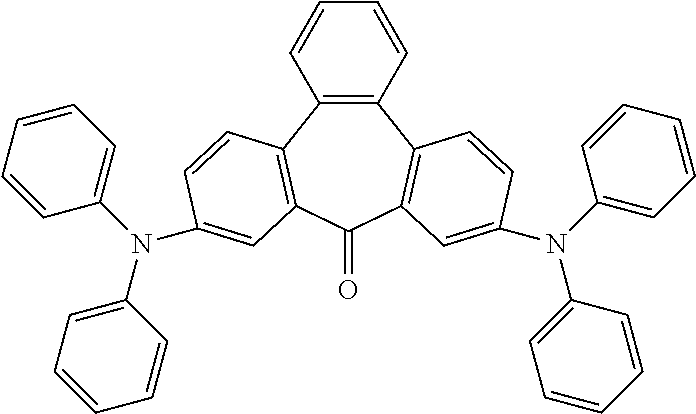 | Intermediate B4 |
Synthesis of Intermediate B1

| TABLE 4 | ||||
| | Starting | 1st | 2nd | |
| Structure |  |  |  | |
| Yield(%) | NA | 92.3 | 60.3 | |
| Formula | NA | C15H9Br3O | C19H11BrO2 | |
| (FD-MS) | (444.94) | (351.19) | ||
| Structure |  |  |  | |
| Yield(%) | NA | 91.5 | 58.2 | |
| Formula | NA | C15H9Br3O | C19H11BrO2 | |
| (FD-MS) | (444.94) | (351.19) | ||
| Structure |  |  |  | |
| Yield(%) | NA | 93.7 | 75.8 | |
| Formula | NA | C15H8Br4O | C19H10Br2O2 | |
| (FD-MS) | (523.84) | (430.09) | ||
| Step | 3rd-1 | 3rd-2 |
| Structure |  |  |
| Yield(%) | NA | 91.5 |
| Formula | C19H13BrO2 | C19H11BrO |
| (FD-MS) | (353.21) | (335.19) |
| Structure |  |  |
| Yield(%) | NA | 93.5 |
| Formula | C19H13BrO2 | C19H11BrO |
| (FD-MS) | (353.21) | (335.19) |
| Structure |  |  |
| Yield(%) | NA | 93.0 |
| Formula | C19H12Br2O2 | C19H10Br2O |
| (FD-MS) | (432.11) | (414.09) |
Synthesis of Intermediate B4

| TABLE 5 |
| Intermediates C1 to C7 |
 | Intermediate C1 |
 | Intermediate C2 |
 | Intermediate C3 |
 | Intermediate C4 |
 | Intermediate C5 |
 | Intermediate C6 |
 | Intermediate C7 |
Synthesis of Intermediate C1

| TABLE 6 | ||
| Biphenyl | ||
| Intermediate | Intermediate B | Spiro-alcohol |
 |  |  |
 |  |  |
 |  |  |
| Biphenyl | Yield | Formula | |
| Intermediate | Intermediate C | (%) | (FD-MS) |
 |  | 93.0 | C31H19Br (471.39) |
 |  | 91.5 | C31H19Br (471.39) |
 |  | 91.5 | C31H18Br2 (550.28) |
Synthesis of Intermediates C4 and C5

Step 1: Synthesis of Spiro Alcohol
| TABLE 7 | ||
| Biphenyl | ||
| Intermediate | Intermediate B | Spiro-alcohol |
 |  |  |
 |  |  |
| Biphenyl | Yield | Formula | |
| Intermediate | Intermediate C | (%) | (FD-MS) |
 |  | 84.7 | C31H17Br2Cl (584.73) |
 |  | 89.2 | C31H17Br2Cl (584.73) |
Synthesis of Intermediates C6 and C7

| TABLE 8 | ||||
| Yield | Formula | |||
| Intermediate C | Boronic acid | Intermediate C | (%) | (FD-MS) |
| Intermediate C1 |
 |
 |
82.8 | C37H23Cl (503.03) |
| Intermediate C1 |
 |
 |
83.1 | C36H22ClN (504.02) |


| TABLE 9 | |||||
| Yield | EA/ | ||||
| SGM | Intermediate | Intermediate | Embodiment | (%) | (FD-MS) |
| 178 (1) | Intermediate C1 | Intermediate A1 |
 |
75.3 | C43H29N (559.7) |
| 179 (2) | Intermediate C1 | Intermediate A2 |
 |
81.5 | C55H37N (711.89) |
| 180 (3) | Intermediate C1 | Intermediate A3 |
 |
76.2 | C55H37N (711.89) |
| 181 (4) | Intermediate C1 | Intermediate A4 |
 |
62.7 | C58H41N (751.95) |
| 182 (5) | Intermediate C1 | Intermediate A5 |
 |
79.2 | C58H41N (751.95) |
| 271 (6) | Intermediate C1 | Intermediate A6 |
 |
78.5 | C49H33N (635.79) |
| 410 (8) | Intermediate C1 | Intermediate A15 |
 |
65.1 | C49H31N (633.78) |
| 436 (9) | Intermediate C1 | Intermediate A14 |
 |
83.4 | C55H35NO (725.87) |
| 437 (10) | Intermediate C1 | Intermediate A11 |
 |
83.6 | C58H39NO (765.94) |
| 438 (11) | Intermediate C1 | Intermediate A12 |
 |
81.6 | C58H39NO (765.94) |
| 439 (12) | Intermediate C1 | Intermediate A12 |
 |
77.4 | C47H31N (609.76) |
| 273 (13) | Intermediate C1 | Intermediate A7 |
 |
74.4 | C49H33N (635.79) |
| 116 (15) | Intermediate C3 | Intermediate A1 |
 |
63.1 | C55H38N2 (726.9) |
| 175 (16) | Intermediate C3 | Intermediate A8 |
 |
61.9 | C63H54N2 (839.12) |
| 176 (17) | Intermediate C3 | Intermediate A15 |
 |
58.8 | C67H46N2 (879.1) |
| 177 (18) | Intermediate C3 | Intermediate A10 |
 |
54.7 | C63H42N2 (827.02) |
| 542 (19) | Intermediate C3 | Intermediate A9 |
 |
63.9 | C59H46N2 (783.01) |
| 563 (21) | Intermediate C4 | Intermediate A15 |
 |
78.2 | C60H41N3 (803.99) |
| 562 (23) | Intermediate C5 | Intermediate A14 |
 |
91.7 | C61H42N2 (803.00) |
| 575 (24) | Intermediate C2 | Intermediate A5 |
 |
74.6 | C58H41N (751.95) |
| TABLE 10 | |
 | 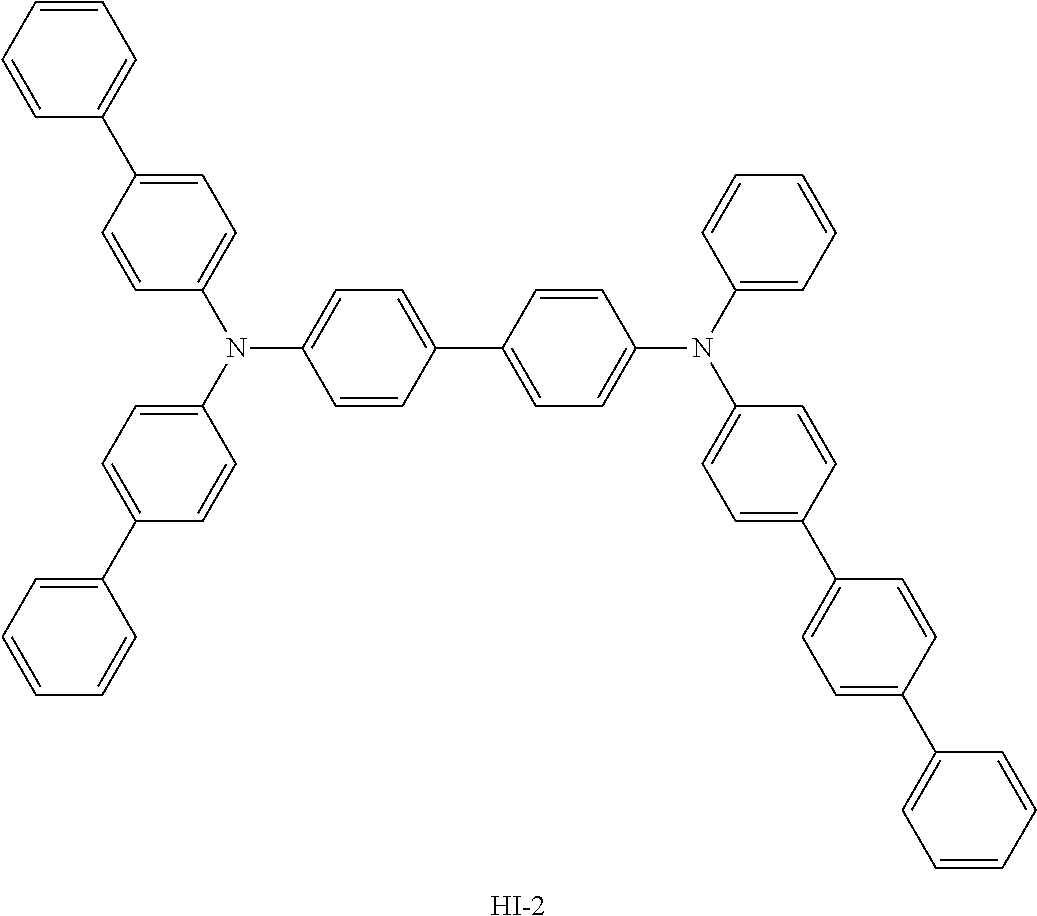 |
 |  |
 |
 |
 |  |
 |  |
 |  |
OLED Device Measurement
| TABLE 11 | |||||
| Color | Voltage | Efficiency | |||
| Example | HT1. | HT2 | CIE (x, y) | (V) | (cd/A) |
| Example 1 | SGM176 | — | B | 4.23 | 11.4 |
| (0.129, 0.170) | |||||
| Example 2 | SGM182 | — | B | 4.05 | 13.8 |
| (0.135, 0.177) | |||||
| Example 3 | — | SGM273 | B | 4.42 | 13.2 |
| (0.135, 0.176) | |||||
| Comp Exp | HT-1 | HT-2 | B | 4.39 | 12.1 |
| (1) | (0.135, 0.185) | ||||
| TABLE 12 | |||||
| Color | Voltage | Efficiency | |||
| Example | HT1 | HT2 | CIE (x, y) | (V) | (cd/A) |
| Example 4 | — | SGM116 | G | 2.72 | 74.2 |
| (0.344, 0.619) | |||||
| Example 5 | — | SGM175 | G | 2.65 | 77.0 |
| (0.335, 0.626) | |||||
| Example 6 | — | SGM176 | G | 2.73 | 76.3 |
| (0.342, 0.621) | |||||
| Example 7 | — | SGM178 | G | 2.81 | 77.7 |
| (0.341, 0.622) | |||||
| Example 8 | — | SGM179 | G | 2.76 | 77.7 |
| (0.343, 0.621) | |||||
| Example 9 | — | SGM180 | G | 2.89 | 73.7 |
| (0.345, 0.619) | |||||
| Example 10 | — | SGM181 | G | 2.72 | 73.7 |
| (0.342, 0.621) | |||||
| Example 11 | — | SGM563 | G | 3.00 | 72.4 |
| (0.314, 0.639) | |||||
| Comp Exp | HT-1 | HT-2 | G | 2.95 | 73.5 |
| (2) | (0.314, 0.637) | ||||
| TABLE 13 | |||||
| Effi- | |||||
| Color | Voltage | ciency | |||
| Example | HT1 | HT2 | CIE (x, y) | (V) | (cd/A) |
| Example 12 | SGM177 | — | R | 3.49 | 26.0 |
| (0.659, 0.340) | |||||
| Example 13 | — | SGM271 | R | 3.59 | 25.9 |
| (0.658, 0.340) | |||||
| Example 14 | — | SGM410 | R | 3.50 | 26.1 |
| (0.658, 0.339) | |||||
| Example 15 | — | SGM436 | R | 3.39 | 25.9 |
| (0.660, 0.339) | |||||
| Example 16 | SGM437 | HT1 | R | 3.49 | 26.1 |
| (0.661, 0.337) | |||||
| Example 17 | SGM439 | HT1 | R | 3.69 | 23.9 |
| (0.659, 0.340) | |||||
| Example 18 | SGM562 | HT1 | R | 3.57 | 25.2 |
| (0.658, 0.341) | |||||
| Example 19 | SGM575 | HT1 | R | 3.50 | 25.0 |
| (0.658, 0.340) | |||||
| Comp Exp | HT-1 | HT-2 | R | 3.65 | 23.9 |
| (3) | (0.661, 0.338) | ||||
Claims (24)


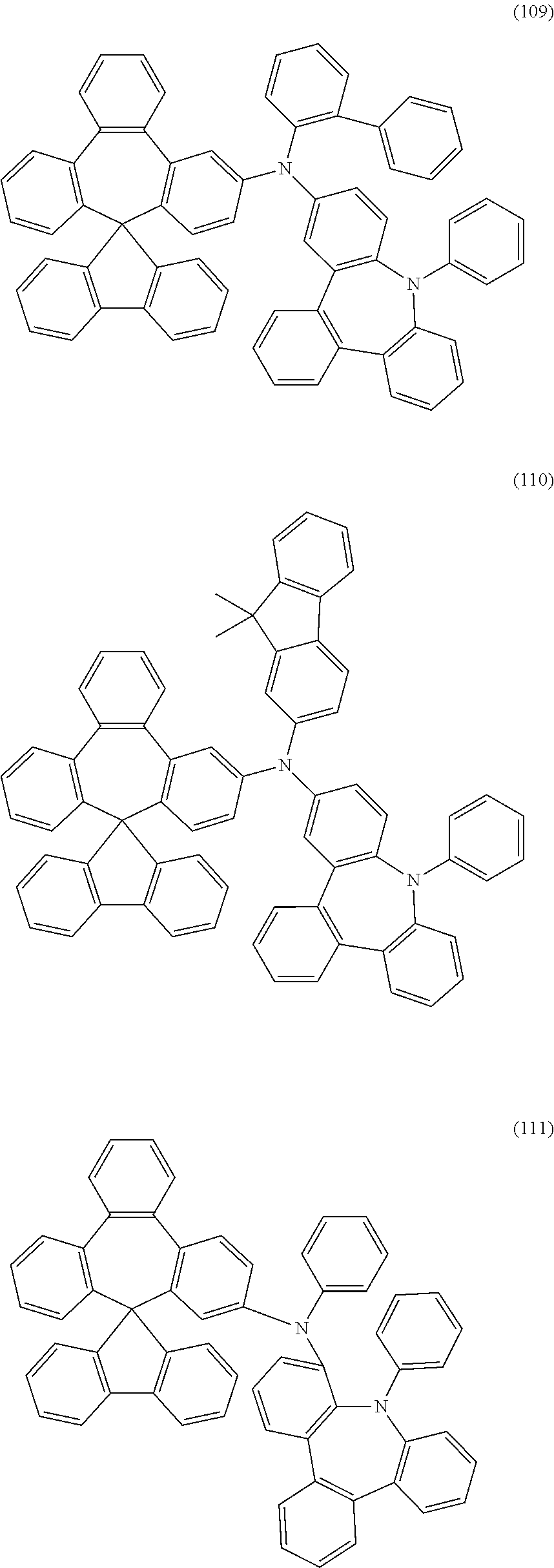


Priority Applications (1)
| Application Number | Priority Date | Filing Date | Title |
|---|---|---|---|
| US15/416,576 US10424744B2 (en) | 2016-01-27 | 2017-01-26 | Compound and organic electronic device comprising the same |
Applications Claiming Priority (2)
| Application Number | Priority Date | Filing Date | Title |
|---|---|---|---|
| US201662287724P | 2016-01-27 | 2016-01-27 | |
| US15/416,576 US10424744B2 (en) | 2016-01-27 | 2017-01-26 | Compound and organic electronic device comprising the same |
Publications (2)
| Publication Number | Publication Date |
|---|---|
| US20170213971A1 US20170213971A1 (en) | 2017-07-27 |
| US10424744B2 true US10424744B2 (en) | 2019-09-24 |
Family
ID=59359552
Family Applications (5)
| Application Number | Title | Priority Date | Filing Date |
|---|---|---|---|
| US15/412,834 Expired - Fee Related US10312459B2 (en) | 2016-01-27 | 2017-01-23 | Compound and organic electronic device using the same |
| US15/416,507 Expired - Fee Related US10431751B2 (en) | 2016-01-27 | 2017-01-26 | Compound and organic electronic device comprising the same |
| US15/416,576 Expired - Fee Related US10424744B2 (en) | 2016-01-27 | 2017-01-26 | Compound and organic electronic device comprising the same |
| US15/416,032 Abandoned US20170213990A1 (en) | 2016-01-27 | 2017-01-26 | Compound and electronic device including same |
| US15/416,616 Expired - Fee Related US10326087B2 (en) | 2016-01-27 | 2017-01-26 | Compound and organic electronic device comprising the same |
Family Applications Before (2)
| Application Number | Title | Priority Date | Filing Date |
|---|---|---|---|
| US15/412,834 Expired - Fee Related US10312459B2 (en) | 2016-01-27 | 2017-01-23 | Compound and organic electronic device using the same |
| US15/416,507 Expired - Fee Related US10431751B2 (en) | 2016-01-27 | 2017-01-26 | Compound and organic electronic device comprising the same |
Family Applications After (2)
| Application Number | Title | Priority Date | Filing Date |
|---|---|---|---|
| US15/416,032 Abandoned US20170213990A1 (en) | 2016-01-27 | 2017-01-26 | Compound and electronic device including same |
| US15/416,616 Expired - Fee Related US10326087B2 (en) | 2016-01-27 | 2017-01-26 | Compound and organic electronic device comprising the same |
Country Status (3)
| Country | Link |
|---|---|
| US (5) | US10312459B2 (en) |
| CN (5) | CN107011248B (en) |
| TW (5) | TWI629257B (en) |
Families Citing this family (13)
| Publication number | Priority date | Publication date | Assignee | Title |
|---|---|---|---|---|
| KR102740106B1 (en) | 2016-03-03 | 2024-12-09 | 메르크 파텐트 게엠베하 | Materials for organic electroluminescent devices |
| US10693075B2 (en) * | 2016-08-09 | 2020-06-23 | Shanghai Nichem Fine Chemical Co., Ltd. | Spiro compound and organic electronic device comprising the same |
| TWI658038B (en) * | 2016-12-07 | 2019-05-01 | 大陸商上海嶸彩光電材料有限公司 | Compound and its organic electronic device |
| JP6475793B2 (en) * | 2017-08-01 | 2019-02-27 | 彩豐精技股▲分▼有限公司 | Compound and organic electronic device using the same |
| WO2019066258A1 (en) * | 2017-09-26 | 2019-04-04 | Rohm And Haas Electronic Materials Korea Ltd. | Organic electroluminescent compound and organic electroluminescent device comprising the same |
| KR102158472B1 (en) | 2017-09-26 | 2020-09-23 | 롬엔드하스전자재료코리아유한회사 | Organic electroluminescent compound and organic electroluminescent device comprising the same |
| EP3502107B1 (en) * | 2017-12-20 | 2022-01-26 | Samsung Display Co., Ltd. | 1-aminodibenzofuran-based compound and organic light-emitting device including the same |
| KR102202058B1 (en) * | 2018-03-30 | 2021-01-11 | 주식회사 엘지화학 | Novel compound and organic light emitting device comprising the same |
| US11183641B2 (en) * | 2018-06-05 | 2021-11-23 | Shanghai Nichem Fine Chemical Co., Ltd. | Composition for an organic electronic device and organic electronic device using the same |
| WO2020009448A1 (en) * | 2018-07-03 | 2020-01-09 | Rohm And Haas Electronic Materials Korea Ltd. | A plurality of host materials and organic electroluminescent device comprising the same |
| US20200274070A1 (en) * | 2019-02-27 | 2020-08-27 | Shanghai Nichem Fine Chemical Co., Ltd. | Compound and organic electronic device using the same |
| CN110437133B (en) * | 2019-07-18 | 2022-10-14 | 中国科学院上海微系统与信息技术研究所 | A long-life room temperature phosphorescent material and its preparation method and application |
| CN110724105B (en) * | 2019-09-27 | 2021-05-04 | 宁波卢米蓝新材料有限公司 | Triphenylene nitrogen-containing seven-membered ring compound and preparation method and application thereof |
Citations (5)
| Publication number | Priority date | Publication date | Assignee | Title |
|---|---|---|---|---|
| KR20110041730A (en) | 2009-10-16 | 2011-04-22 | 에스에프씨 주식회사 | Condensed Aromatic Compounds and Organic Electroluminescent Devices Using the Same |
| KR20120093076A (en) | 2011-02-14 | 2012-08-22 | 에스에프씨 주식회사 | Fluorene derivatives and organic light-emitting diode including the same |
| WO2016087017A1 (en) | 2014-12-01 | 2016-06-09 | Merck Patent Gmbh | Materials for organic electroluminescent devices |
| CN106432107A (en) | 2015-08-04 | 2017-02-22 | 彩丰精技股份有限公司 | Novel compound and organic electronic device using the same |
| CN106467469A (en) | 2016-06-13 | 2017-03-01 | 江苏三月光电科技有限公司 | A kind of organic electroluminescent compounds and its application |
Family Cites Families (22)
| Publication number | Priority date | Publication date | Assignee | Title |
|---|---|---|---|---|
| US20020121638A1 (en) * | 2000-06-30 | 2002-09-05 | Vladimir Grushin | Electroluminescent iridium compounds with fluorinated phenylpyridines, phenylpyrimidines, and phenylquinolines and devices made with such compounds |
| US6864628B2 (en) * | 2000-08-28 | 2005-03-08 | Semiconductor Energy Laboratory Co., Ltd. | Light emitting device comprising light-emitting layer having triplet compound and light-emitting layer having singlet compound |
| JP3960765B2 (en) * | 2001-09-03 | 2007-08-15 | 三洋電機株式会社 | Luminescent material for light emitting device |
| KR100676965B1 (en) * | 2005-03-05 | 2007-02-02 | 주식회사 두산 | Novel Iridium Complexes and Organic Electroluminescent Devices Using the Same |
| US8778508B2 (en) * | 2006-12-08 | 2014-07-15 | Universal Display Corporation | Light-emitting organometallic complexes |
| DE102007031220B4 (en) * | 2007-07-04 | 2022-04-28 | Novaled Gmbh | Quinoid compounds and their use in semiconducting matrix materials, electronic and optoelectronic components |
| JP2010024149A (en) | 2008-07-16 | 2010-02-04 | Toyo Ink Mfg Co Ltd | Compound having seven-membered ring structure and its application |
| US8753756B2 (en) * | 2009-06-30 | 2014-06-17 | Chien-Hong Cheng | Green phosphorescent iridium complexes, fabrication method thereof and organic light-emitting diodes comprising the same |
| JP4474493B1 (en) * | 2009-07-31 | 2010-06-02 | 富士フイルム株式会社 | Organic electroluminescence device |
| TW201223956A (en) * | 2010-08-13 | 2012-06-16 | Solvay | Light emitting materials for electronics |
| KR20120047038A (en) | 2010-11-03 | 2012-05-11 | 에스에프씨 주식회사 | Amine derivatives and organoelectroluminescent device employing the same |
| KR101421521B1 (en) * | 2010-11-05 | 2014-07-24 | 에스에프씨 주식회사 | Amine derivative compounds and organic light-emitting diode including the same |
| US10305040B2 (en) * | 2011-11-17 | 2019-05-28 | Merck Patent Gmbh | Spiro dihydroacridine derivatives and the use thereof as materials for organic electroluminescence devices |
| KR102013400B1 (en) * | 2012-03-29 | 2019-08-22 | 에스에프씨 주식회사 | Indenophenanthrene derivatives and organic light emitting diodes comprising the derivatives |
| KR20130140303A (en) | 2012-06-14 | 2013-12-24 | (주) 에프엔지리서치 | Novel compounds for organic electroluminescent device |
| CN103936720B (en) * | 2013-12-12 | 2016-03-02 | 石家庄诚志永华显示材料有限公司 | Compound containing spiral shell fluorene structural units and preparation method thereof and application |
| CN103833507B (en) * | 2013-12-25 | 2016-08-17 | 石家庄诚志永华显示材料有限公司 | A series of electroluminescent organic materials and preparation method and application |
| TWI534141B (en) | 2014-10-15 | 2016-05-21 | 彩豐精技股份有限公司 | Bipolar compound derived from cis stilbene/helium spirochete |
| TWI558688B (en) | 2014-10-15 | 2016-11-21 | 彩豐精技股份有限公司 | Cis-stilbene/helium spirochete-derived optoelectronic material |
| WO2016124304A1 (en) * | 2015-02-03 | 2016-08-11 | Merck Patent Gmbh | Metal complexes |
| US10169105B2 (en) * | 2015-07-30 | 2019-01-01 | Qualcomm Incorporated | Method for simplified task-based runtime for efficient parallel computing |
| KR102573815B1 (en) | 2016-05-09 | 2023-09-04 | 삼성디스플레이 주식회사 | Polycyclic compound and organic electroluminescence device including the same |
-
2017
- 2017-01-23 US US15/412,834 patent/US10312459B2/en not_active Expired - Fee Related
- 2017-01-24 TW TW106102571A patent/TWI629257B/en not_active IP Right Cessation
- 2017-01-25 TW TW106103011A patent/TWI653215B/en not_active IP Right Cessation
- 2017-01-25 TW TW106103017A patent/TWI656110B/en not_active IP Right Cessation
- 2017-01-25 TW TW106103015A patent/TWI635068B/en not_active IP Right Cessation
- 2017-01-25 CN CN201710061133.3A patent/CN107011248B/en not_active Expired - Fee Related
- 2017-01-26 US US15/416,507 patent/US10431751B2/en not_active Expired - Fee Related
- 2017-01-26 CN CN201710061445.4A patent/CN107011182B/en not_active Expired - Fee Related
- 2017-01-26 US US15/416,576 patent/US10424744B2/en not_active Expired - Fee Related
- 2017-01-26 US US15/416,032 patent/US20170213990A1/en not_active Abandoned
- 2017-01-26 US US15/416,616 patent/US10326087B2/en not_active Expired - Fee Related
- 2017-01-26 CN CN201710057247.0A patent/CN107011181B/en active Active
- 2017-01-26 CN CN201710061447.3A patent/CN107011183B/en not_active Expired - Fee Related
- 2017-01-26 TW TW106103344A patent/TWI632148B/en not_active IP Right Cessation
- 2017-02-03 CN CN201710063301.2A patent/CN107011387B/en not_active Expired - Fee Related
Patent Citations (7)
| Publication number | Priority date | Publication date | Assignee | Title |
|---|---|---|---|---|
| KR20110041730A (en) | 2009-10-16 | 2011-04-22 | 에스에프씨 주식회사 | Condensed Aromatic Compounds and Organic Electroluminescent Devices Using the Same |
| KR20120093076A (en) | 2011-02-14 | 2012-08-22 | 에스에프씨 주식회사 | Fluorene derivatives and organic light-emitting diode including the same |
| WO2016087017A1 (en) | 2014-12-01 | 2016-06-09 | Merck Patent Gmbh | Materials for organic electroluminescent devices |
| TW201634441A (en) | 2014-12-01 | 2016-10-01 | 麥克專利有限公司 | Material for organic electroluminescent device |
| US20170317283A1 (en) * | 2014-12-01 | 2017-11-02 | Merck Patent Gmbh | Materials for organic electroluminescent devices |
| CN106432107A (en) | 2015-08-04 | 2017-02-22 | 彩丰精技股份有限公司 | Novel compound and organic electronic device using the same |
| CN106467469A (en) | 2016-06-13 | 2017-03-01 | 江苏三月光电科技有限公司 | A kind of organic electroluminescent compounds and its application |
Non-Patent Citations (19)
| Title |
|---|
| Evidence-1: Organic Chemistry (eighth edition), Paula Yurkanis Bruice, Global Edition, pp. 660, 661, 668, 678, Publication Date: Jan. 15, 2016, Pearson Education, Inc., NJ, USA; Pages/Lines Cited: pp. 660, 661, 668, 678. |
| Evidence-10: Switching of non-helical overcrowded tetrabenzoheptafulvalene derivatives, pp. 2029-2034, by Jiye Luo et al., Chemical Science, Publication Date: Jul. 21, 2011. Pages/Lines Cited: p. 2031 printed on bottom right corner, left col. |
| Evidence-11: Supporting Information for: Switching of Non-Helical Overcrowded Heptafulvalene Derivatives, pp. 1-59, by Jiye Luo et al., Publication Date: 2011, which is 1H NMR spectrum (p. 30) in Supporting Information from Evidence-10. Pages/Lines Cited: p. 30. |
| Evidence-12: The Synthesis of Novel p-Quinone Methides: O-Dealkylation of 5-(p-Alkyloxyaryl)-10,11-dihydrodibenzo[a,d]cyclohepten-5-ols and Related Compounds, pp. 2607-2619, by Benjamin Taljaard et al., Eur. J. Org. Chem., Publication Date: Dec. 31, 2005. Pages/Lines Cited: p. 2612 printed on bottom left corner, right col. |
| Evidence-13: Polycationic Ligands in Gold Catalysis: Synthesis and Applications of Extremely π‑Acidic Catalysts, pp. 18815-18823, by Javier Carreras et al., Journal of the American Chemical Society, Publication Date: Dec. 5, 2013. Pages/Lines Cited: p. 18817 printed on bottom. |
| Evidence-13: Polycationic Ligands in Gold Catalysis: Synthesis and Applications of Extremely π‑Acidic Catalysts, pp. 18815-18823, by Javier Carreras et al., Journal of the American Chemical Society, Publication Date: Dec. 5, 2013. Pages/Lines Cited: p. 18817 printed on bottom. |
| Evidence-14: Supplementary Information-Polycationic ligands in gold catalysis: Synthesis and applications of extremely π-acidic catalysts, pp. S1-S231, by Javier Carreras et al., Publication Date: 2013, which is 1H NMR spectrum (p. S200) in Supporting Information from Evidence-13. Pages/Lines Cited: S200 printed on bottom right corner. |
| Evidence-14: Supplementary Information—Polycationic ligands in gold catalysis: Synthesis and applications of extremely π-acidic catalysts, pp. S1-S231, by Javier Carreras et al., Publication Date: 2013, which is 1H NMR spectrum (p. S200) in Supporting Information from Evidence-13. Pages/Lines Cited: S200 printed on bottom right corner. |
| Evidence-15: Doubly ortho-linked quinoxaline/triarylamine hybrid as a bifunctional, dipolar electroluminescent template for optoelectronic applications, pp. 3980-3982, Chien-Tien Chen et al., Chem. Commun, Publication Date: Jul. 8, 2005. Pages/Lines Cited: p. 3980 printed on bottom left corner. |
| Evidence-16: Doubly Ortho-linked Quinoxaline/Triarylamine Hybrid as a Bifunctional, Dipolar Electroluminescent Template for Optoelectronic Applications, pp. 1-12, by Chien-Tien Chen et al., Publication Date: 2005, which is 1H NMR spectroscopic data (pp. 5 and 6) in Supporting Information from Evidence-15. Pages/Lines Cited: p. 5 and 6. |
| Evidence-2: Integration of 1H NMR spectra (proton) from NMR theory of Spectroscopy of Organic Chemistry Lecture Website at University of Colorado Boulder, which was built by Dr. Patty Feist et al. (from < http://www.orgchemboulder.com:80/Spectroscopy/nmrtheory/NMRtutorial.shtml> 1 page, Dec. 14, 2016, retrieved from Internet Wayback Machine < http://web.archive.org/web/20161214110543/http://www.orgchemboulder.com:80/Spectroscopy/nmrtheory/NMRtutorial.shtml> on Feb. 7, 2018); Pages/Lines Cited: lines 2-3 & 4-5. |
| Evidence-3: Real-Time Enzyme Kinetics by Quantitative NMR Spectroscopy and Determination of the Michaelis−Menten Constant Using the Lambert‑W Function, pp. 1943-1948, by Cheenou Her et al., J. Chem. Educ., 2015; Pages/Lines Cited: p. 1946 printed on bottom, right col., lines 13-17. |
| Evidence-3: Real-Time Enzyme Kinetics by Quantitative NMR Spectroscopy and Determination of the Michaelis−Menten Constant Using the Lambert‑W Function, pp. 1943-1948, by Cheenou Her et al., J. Chem. Educ., 2015; Pages/Lines Cited: p. 1946 printed on bottom, right col., lines 13-17. |
| Evidence-4: Proton Nuclear Magnetic Resonance Spectroscopy, Lecture of Structure Determination Using Spectroscopic Methods at University of Wisconsin, pp. 1-38, by Dr. Hans J. Reich, 2017 (from https://www.chem.wisc.edu/areas/reich/nmr/Notes-05-HMR-v26-part1.pdf); Pages/Lines Cited: p. 8, lines 3-4, Proton Nuclear Magnetic Resonance Spectroscopy. |
| Evidence-5: hint of step 4 "Check that the integration of the peak matches the number of hydrogens in the molecule", webpage of Golden Rules to Nuclear Magnetic Resonance Spectroscopy (NMR) Analysis, 1 page, by Dr. Madalee Gassaway, Publication Date: Oct. 23, 2017 (from http://blog.cambridgecoaching.com/golden-rules-to-nuclear-magnetic-resonance-spectroscopy-nmr-analysis-part-1-0); Pages/Lines Cited : hint of step 4, webpage of Golden Rules to Nuclear Magnetic Resonance Spectroscopy (NMR) Analysis. |
| Evidence-6: Doubly Ortho-Linked Quinoxaline/Diphenylfluorene Hybrids as Bipolar, Fluorescent Chameleons for Optoelectronic Applications, pp. 10992-10993, Chien-Tien Chen et al., J. Am. Chem. Soc., Publication Date: Aug. 8, 2006. Pages/Lines Cited: p. 10992 printed on bottom left corner, right col. |
| Evidence-7: Doubly Ortho-linked Quinoxaline/Diphenylfluorene Hybrids as Bipolar, Fluorescent Chameleons for Optoelectronic Applications, pp. S1-S23, by Chien-Tien Chen et al., Publication Date: 2006, which is 1H NMR spectrum (p. S20) in Supporting Information from Evidence-6. Pages/Lines Cited: S20 printed on top right corner. |
| Evidence-8: Doubly Ortho-Linked cis-4,4′-Bis(diarylamino)stilbene/Fluorene Hybrids as Efficient Nondoped, Sky-Blue Fluorescent Materials for Optoelectronic Applications, pp. 7478-7479, by Yi Wei et al., J. Am. Chem. Soc., Publication Date: May 25, 2007. Pages/Lines Cited: p. 7478 printed on bottom left corner, right col. |
| Evidence-9: Doubly Ortho-linked cis-4,4′-Bis(diarylamino)stilbene/Fluorene Hybrids as Efficient Non-doped, Sky-blue Fluorescent Materials for Optoelectronic Applications, pp. S1-S22, by Yi Wei et al., 2007, which is 1H NMR spectrum (p. S16) in Supporting Information from Evidence-8. Pages/Lines Cited: S16 printed on top right corner. |
Also Published As
| Publication number | Publication date |
|---|---|
| US20170213972A1 (en) | 2017-07-27 |
| US20170213978A1 (en) | 2017-07-27 |
| CN107011182B (en) | 2020-08-07 |
| CN107011183A (en) | 2017-08-04 |
| TWI653215B (en) | 2019-03-11 |
| CN107011183B (en) | 2019-05-24 |
| US10312459B2 (en) | 2019-06-04 |
| US20170213970A1 (en) | 2017-07-27 |
| CN107011182A (en) | 2017-08-04 |
| TW201726699A (en) | 2017-08-01 |
| US20170213971A1 (en) | 2017-07-27 |
| TW201726604A (en) | 2017-08-01 |
| TW201726609A (en) | 2017-08-01 |
| CN107011248B (en) | 2020-06-09 |
| US10326087B2 (en) | 2019-06-18 |
| CN107011248A (en) | 2017-08-04 |
| TW201726601A (en) | 2017-08-01 |
| TWI629257B (en) | 2018-07-11 |
| US10431751B2 (en) | 2019-10-01 |
| TWI635068B (en) | 2018-09-11 |
| TW201726603A (en) | 2017-08-01 |
| US20170213990A1 (en) | 2017-07-27 |
| TWI632148B (en) | 2018-08-11 |
| CN107011387B (en) | 2019-11-19 |
| CN107011181B (en) | 2020-09-15 |
| CN107011387A (en) | 2017-08-04 |
| TWI656110B (en) | 2019-04-11 |
| CN107011181A (en) | 2017-08-04 |
Similar Documents
| Publication | Publication Date | Title |
|---|---|---|
| US10424744B2 (en) | Compound and organic electronic device comprising the same | |
| US20190140177A1 (en) | Amine-substituted naphthalene derivatives and organic light emitting diodes including the same | |
| US20140217393A1 (en) | Organic electroluminescence element | |
| US11678572B2 (en) | Compound for organic optoelectronic device, composition for organic optoelectronic device, organic optoelectronic device and display apparatus | |
| US10580995B2 (en) | Compounds for organic electroluminescent components and organic electroluminescent devices using the same | |
| TW201412715A (en) | Compound for organic electroluminescent device and organic electroluminescent device comprising the same | |
| KR20190079181A (en) | Organic compounds and organic electro luminescence device comprising the same | |
| US11634430B2 (en) | Heterocyclic compound and organic light emitting element comprising same | |
| US10396292B2 (en) | Compound and organic electronic device using the same | |
| US20200365808A1 (en) | Organic electroluminescense device and electronic apparatus | |
| US20190372016A1 (en) | Compound and organic electronic device using the same | |
| US20230147959A1 (en) | Compound for organic optoelectronic device, composition for organic optoelectronic device, organic optoelectronic device and display device | |
| JP6446099B1 (en) | Novel compounds and organic electronic devices containing the same | |
| US10937968B2 (en) | Compound and organic electronic device using the same | |
| US20240051980A1 (en) | Organometallic compound and application thereof | |
| KR102040745B1 (en) | Novel compound and organic electronic device comprising the same | |
| JP6475786B2 (en) | Novel compounds and organic electronic devices containing the same | |
| KR102040744B1 (en) | Novel compound and organic electronic device comprising the same | |
| US20240107876A1 (en) | Organic electroluminescence device | |
| JP6539822B2 (en) | Novel compound and organic electronic device containing the same | |
| KR102040071B1 (en) | Novel compound and organic electronic device comprising the same | |
| US20250311618A1 (en) | Aromatic amine compound, organic electroluminescent device, and electronic apparatus | |
| US20230119772A1 (en) | Compound for organic optoelectronic device, composition for organic optoelectronic device, organic optoelectronic device and display device | |
| US20230117860A1 (en) | Compound for organic optoelectronic device, organic optoelectronic device, and display device | |
| US11393983B2 (en) | Phenyl biphenylpyrimidine compound and an organic electroluminescent device using the same |
Legal Events
| Date | Code | Title | Description |
|---|---|---|---|
| AS | Assignment |
Owner name: NICHEM FINE TECHNOLOGY CO., LTD., TAIWAN Free format text: ASSIGNMENT OF ASSIGNORS INTEREST;ASSIGNORS:LIAO, LIANG-DI;SHIEH, SHWU-TU;CHEN, CHI-CHUNG;REEL/FRAME:041123/0845 Effective date: 20170120 |
|
| STPP | Information on status: patent application and granting procedure in general |
Free format text: NON FINAL ACTION MAILED |
|
| AS | Assignment |
Owner name: SHANGHAI NICHEM FINE CHEMICAL CO., LTD., CHINA Free format text: ASSIGNMENT OF ASSIGNORS INTEREST;ASSIGNOR:NICHEM FINE TECHNOLOGY CO., LTD.;REEL/FRAME:049052/0344 Effective date: 20190425 |
|
| STPP | Information on status: patent application and granting procedure in general |
Free format text: RESPONSE TO NON-FINAL OFFICE ACTION ENTERED AND FORWARDED TO EXAMINER |
|
| STPP | Information on status: patent application and granting procedure in general |
Free format text: NOTICE OF ALLOWANCE MAILED -- APPLICATION RECEIVED IN OFFICE OF PUBLICATIONS |
|
| STPP | Information on status: patent application and granting procedure in general |
Free format text: PUBLICATIONS -- ISSUE FEE PAYMENT RECEIVED |
|
| STPP | Information on status: patent application and granting procedure in general |
Free format text: PUBLICATIONS -- ISSUE FEE PAYMENT VERIFIED |
|
| STCF | Information on status: patent grant |
Free format text: PATENTED CASE |
|
| FEPP | Fee payment procedure |
Free format text: MAINTENANCE FEE REMINDER MAILED (ORIGINAL EVENT CODE: REM.); ENTITY STATUS OF PATENT OWNER: SMALL ENTITY |
|
| LAPS | Lapse for failure to pay maintenance fees |
Free format text: PATENT EXPIRED FOR FAILURE TO PAY MAINTENANCE FEES (ORIGINAL EVENT CODE: EXP.); ENTITY STATUS OF PATENT OWNER: SMALL ENTITY |
|
| STCH | Information on status: patent discontinuation |
Free format text: PATENT EXPIRED DUE TO NONPAYMENT OF MAINTENANCE FEES UNDER 37 CFR 1.362 |
|
| FP | Lapsed due to failure to pay maintenance fee |
Effective date: 20230924 |