US10422388B2 - Propeller shaft - Google Patents
Propeller shaft Download PDFInfo
- Publication number
- US10422388B2 US10422388B2 US15/487,576 US201715487576A US10422388B2 US 10422388 B2 US10422388 B2 US 10422388B2 US 201715487576 A US201715487576 A US 201715487576A US 10422388 B2 US10422388 B2 US 10422388B2
- Authority
- US
- United States
- Prior art keywords
- circlip
- shaft
- ring member
- shaft section
- spline
- Prior art date
- Legal status (The legal status is an assumption and is not a legal conclusion. Google has not performed a legal analysis and makes no representation as to the accuracy of the status listed.)
- Active, expires
Links
Images



Classifications
-
- F—MECHANICAL ENGINEERING; LIGHTING; HEATING; WEAPONS; BLASTING
- F16—ENGINEERING ELEMENTS AND UNITS; GENERAL MEASURES FOR PRODUCING AND MAINTAINING EFFECTIVE FUNCTIONING OF MACHINES OR INSTALLATIONS; THERMAL INSULATION IN GENERAL
- F16D—COUPLINGS FOR TRANSMITTING ROTATION; CLUTCHES; BRAKES
- F16D1/00—Couplings for rigidly connecting two coaxial shafts or other movable machine elements
- F16D1/10—Quick-acting couplings in which the parts are connected by simply bringing them together axially
- F16D1/108—Quick-acting couplings in which the parts are connected by simply bringing them together axially having retaining means rotating with the coupling and acting by interengaging parts, i.e. positive coupling
- F16D1/116—Quick-acting couplings in which the parts are connected by simply bringing them together axially having retaining means rotating with the coupling and acting by interengaging parts, i.e. positive coupling the interengaging parts including a continuous or interrupted circumferential groove in the surface of one of the coupling parts
-
- F—MECHANICAL ENGINEERING; LIGHTING; HEATING; WEAPONS; BLASTING
- F16—ENGINEERING ELEMENTS AND UNITS; GENERAL MEASURES FOR PRODUCING AND MAINTAINING EFFECTIVE FUNCTIONING OF MACHINES OR INSTALLATIONS; THERMAL INSULATION IN GENERAL
- F16B—DEVICES FOR FASTENING OR SECURING CONSTRUCTIONAL ELEMENTS OR MACHINE PARTS TOGETHER, e.g. NAILS, BOLTS, CIRCLIPS, CLAMPS, CLIPS OR WEDGES; JOINTS OR JOINTING
- F16B21/00—Means for preventing relative axial movement of a pin, spigot, shaft or the like and a member surrounding it; Stud-and-socket releasable fastenings
- F16B21/10—Means for preventing relative axial movement of a pin, spigot, shaft or the like and a member surrounding it; Stud-and-socket releasable fastenings by separate parts
- F16B21/16—Means for preventing relative axial movement of a pin, spigot, shaft or the like and a member surrounding it; Stud-and-socket releasable fastenings by separate parts with grooves or notches in the pin or shaft
- F16B21/18—Means for preventing relative axial movement of a pin, spigot, shaft or the like and a member surrounding it; Stud-and-socket releasable fastenings by separate parts with grooves or notches in the pin or shaft with circlips or like resilient retaining devices, i.e. resilient in the plane of the ring or the like; Details
- F16B21/183—Means for preventing relative axial movement of a pin, spigot, shaft or the like and a member surrounding it; Stud-and-socket releasable fastenings by separate parts with grooves or notches in the pin or shaft with circlips or like resilient retaining devices, i.e. resilient in the plane of the ring or the like; Details internal, i.e. with spreading action
-
- F—MECHANICAL ENGINEERING; LIGHTING; HEATING; WEAPONS; BLASTING
- F16—ENGINEERING ELEMENTS AND UNITS; GENERAL MEASURES FOR PRODUCING AND MAINTAINING EFFECTIVE FUNCTIONING OF MACHINES OR INSTALLATIONS; THERMAL INSULATION IN GENERAL
- F16D—COUPLINGS FOR TRANSMITTING ROTATION; CLUTCHES; BRAKES
- F16D3/00—Yielding couplings, i.e. with means permitting movement between the connected parts during the drive
- F16D3/16—Universal joints in which flexibility is produced by means of pivots or sliding or rolling connecting parts
- F16D3/20—Universal joints in which flexibility is produced by means of pivots or sliding or rolling connecting parts one coupling part entering a sleeve of the other coupling part and connected thereto by sliding or rolling members
- F16D3/22—Universal joints in which flexibility is produced by means of pivots or sliding or rolling connecting parts one coupling part entering a sleeve of the other coupling part and connected thereto by sliding or rolling members the rolling members being balls, rollers, or the like, guided in grooves or sockets in both coupling parts
- F16D3/223—Universal joints in which flexibility is produced by means of pivots or sliding or rolling connecting parts one coupling part entering a sleeve of the other coupling part and connected thereto by sliding or rolling members the rolling members being balls, rollers, or the like, guided in grooves or sockets in both coupling parts the rolling members being guided in grooves in both coupling parts
-
- F—MECHANICAL ENGINEERING; LIGHTING; HEATING; WEAPONS; BLASTING
- F16—ENGINEERING ELEMENTS AND UNITS; GENERAL MEASURES FOR PRODUCING AND MAINTAINING EFFECTIVE FUNCTIONING OF MACHINES OR INSTALLATIONS; THERMAL INSULATION IN GENERAL
- F16D—COUPLINGS FOR TRANSMITTING ROTATION; CLUTCHES; BRAKES
- F16D3/00—Yielding couplings, i.e. with means permitting movement between the connected parts during the drive
- F16D3/84—Shrouds, e.g. casings, covers; Sealing means specially adapted therefor
- F16D3/843—Shrouds, e.g. casings, covers; Sealing means specially adapted therefor enclosed covers
- F16D3/845—Shrouds, e.g. casings, covers; Sealing means specially adapted therefor enclosed covers allowing relative movement of joint parts due to the flexing of the cover
-
- F—MECHANICAL ENGINEERING; LIGHTING; HEATING; WEAPONS; BLASTING
- F16—ENGINEERING ELEMENTS AND UNITS; GENERAL MEASURES FOR PRODUCING AND MAINTAINING EFFECTIVE FUNCTIONING OF MACHINES OR INSTALLATIONS; THERMAL INSULATION IN GENERAL
- F16D—COUPLINGS FOR TRANSMITTING ROTATION; CLUTCHES; BRAKES
- F16D1/00—Couplings for rigidly connecting two coaxial shafts or other movable machine elements
- F16D1/10—Quick-acting couplings in which the parts are connected by simply bringing them together axially
- F16D2001/103—Quick-acting couplings in which the parts are connected by simply bringing them together axially the torque is transmitted via splined connections
-
- F—MECHANICAL ENGINEERING; LIGHTING; HEATING; WEAPONS; BLASTING
- F16—ENGINEERING ELEMENTS AND UNITS; GENERAL MEASURES FOR PRODUCING AND MAINTAINING EFFECTIVE FUNCTIONING OF MACHINES OR INSTALLATIONS; THERMAL INSULATION IN GENERAL
- F16D—COUPLINGS FOR TRANSMITTING ROTATION; CLUTCHES; BRAKES
- F16D3/00—Yielding couplings, i.e. with means permitting movement between the connected parts during the drive
- F16D3/16—Universal joints in which flexibility is produced by means of pivots or sliding or rolling connecting parts
- F16D3/20—Universal joints in which flexibility is produced by means of pivots or sliding or rolling connecting parts one coupling part entering a sleeve of the other coupling part and connected thereto by sliding or rolling members
- F16D3/22—Universal joints in which flexibility is produced by means of pivots or sliding or rolling connecting parts one coupling part entering a sleeve of the other coupling part and connected thereto by sliding or rolling members the rolling members being balls, rollers, or the like, guided in grooves or sockets in both coupling parts
- F16D3/223—Universal joints in which flexibility is produced by means of pivots or sliding or rolling connecting parts one coupling part entering a sleeve of the other coupling part and connected thereto by sliding or rolling members the rolling members being balls, rollers, or the like, guided in grooves or sockets in both coupling parts the rolling members being guided in grooves in both coupling parts
- F16D2003/22313—Details of the inner part of the core or means for attachment of the core on the shaft
-
- F—MECHANICAL ENGINEERING; LIGHTING; HEATING; WEAPONS; BLASTING
- F16—ENGINEERING ELEMENTS AND UNITS; GENERAL MEASURES FOR PRODUCING AND MAINTAINING EFFECTIVE FUNCTIONING OF MACHINES OR INSTALLATIONS; THERMAL INSULATION IN GENERAL
- F16D—COUPLINGS FOR TRANSMITTING ROTATION; CLUTCHES; BRAKES
- F16D3/00—Yielding couplings, i.e. with means permitting movement between the connected parts during the drive
- F16D3/16—Universal joints in which flexibility is produced by means of pivots or sliding or rolling connecting parts
- F16D3/20—Universal joints in which flexibility is produced by means of pivots or sliding or rolling connecting parts one coupling part entering a sleeve of the other coupling part and connected thereto by sliding or rolling members
- F16D3/22—Universal joints in which flexibility is produced by means of pivots or sliding or rolling connecting parts one coupling part entering a sleeve of the other coupling part and connected thereto by sliding or rolling members the rolling members being balls, rollers, or the like, guided in grooves or sockets in both coupling parts
- F16D3/223—Universal joints in which flexibility is produced by means of pivots or sliding or rolling connecting parts one coupling part entering a sleeve of the other coupling part and connected thereto by sliding or rolling members the rolling members being balls, rollers, or the like, guided in grooves or sockets in both coupling parts the rolling members being guided in grooves in both coupling parts
- F16D2003/22326—Attachments to the outer joint member, i.e. attachments to the exterior of the outer joint member or to the shaft of the outer joint member
-
- F—MECHANICAL ENGINEERING; LIGHTING; HEATING; WEAPONS; BLASTING
- F16—ENGINEERING ELEMENTS AND UNITS; GENERAL MEASURES FOR PRODUCING AND MAINTAINING EFFECTIVE FUNCTIONING OF MACHINES OR INSTALLATIONS; THERMAL INSULATION IN GENERAL
- F16D—COUPLINGS FOR TRANSMITTING ROTATION; CLUTCHES; BRAKES
- F16D2300/00—Special features for couplings or clutches
- F16D2300/08—Details or arrangements of sealings not provided for in group F16D3/84
Definitions
- the present invention relates to a propeller shaft applicable to an automotive vehicle and others.
- JP 2013-194895 A discloses a propeller shaft for transmitting rotation from a drive source of a vehicle to driving wheels of the vehicle.
- the propeller shaft includes a shaft section extending in a vehicle longitudinal direction.
- the shaft section is connected at its first longitudinal end to a first shaft via a first constant velocity joint, and connected at its second longitudinal end to a second shaft via a second constant velocity joint, wherein the first shaft is connected to the drive source, and the second shaft is connected to the driving wheels.
- Each constant velocity joint includes an outer ring member, an inner ring member, and a plurality of balls.
- the shaft section is provided with the outer ring member, wherein the outer ring member has a tubular shape.
- the inner ring member has a tubular shape, and is disposed radially inside the outer ring member.
- the balls are disposed between the outer ring member and the inner ring member for transmitting a torque therebetween.
- the inner ring member includes a female spline part, which is formed in an inner peripheral side of the inner ring member, and configured to engage with a male spline part formed in an outer peripheral side of the first or second shaft.
- the inner ring member includes a female-spline-side annular groove, which is formed and extending circumferentially in the inner peripheral side of the inner ring member, and is defined by a first side wall, a second side wall, and a bottom wall between the first side wall and the second side wall, wherein the second side wall is closer to the shaft section than the first side wall.
- the female-spline-side annular groove is configured to receive a circlip, wherein the circlip is disposed in a male-spline-side annular groove formed and extending circumferentially in the outer peripheral side of the first or second shaft, and configured to expand into the female-spline-side annular groove, to restrict movement of the first or second shaft in the axial direction of the shaft section with respect to the inner ring member.
- a circlip-restricting surface is formed in the first side wall of the female-spline-side annular groove.
- the circlip-restricting surface is formed as an inclined surface having a large angle with respect to the axial direction of the shaft section for ensuring a force restricting movement of the circlip in the axial direction of the shaft section.
- the configuration that the circlip-restricting surface has the large angle with respect to the axial direction of the shaft section results in that a component of a reaction force in a radial direction of the shaft section against a pulling-out load applied to the first or second shaft is small with respect to the pulling-out load, wherein the component of the reaction force serves to compress the circlip in the radial direction.
- the first or second shaft may be detached unintentionally during the propeller shaft is in use.
- a propeller shaft which satisfies at least two requirements simultaneously, wherein a first requirement is to prevent detachment of a first or second shaft when in use, and a second requirement is to reduce a load of pulling out the first or second shaft when in detaching operation.
- a propeller shaft for transmitting rotation between a drive source of a vehicle and a driving wheel of the vehicle, comprises: a shaft section configured to be connected between a first shaft and a second shaft, wherein the first shaft is configured to be connected to the drive source, and wherein the second shaft is configured to be connected to the driving wheel; an outer ring member and an inner ring member, wherein the shaft section is provided with one of the outer ring member and the inner ring member as a first ring member, wherein the outer ring member has a tubular shape, wherein the inner ring member has a tubular shape, and wherein the inner ring member is disposed radially inside the outer ring member; a plurality of balls disposed between the outer ring member and the inner ring member; outer-ring-side engaging grooves formed in an inner peripheral side of the outer ring member, and configured to extend in an axial direction of the shaft section, wherein each outer-ring-side engaging groove is configured to restrict relative rotation between a corresponding
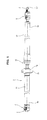
- FIG. 1 is a partially-cutaway side view of a propeller shaft according to a first embodiment of the present invention.
- FIG. 2 is a longitudinal sectional view of a first constant velocity joint of the propeller shaft of FIG. 1 when the first constant velocity joint is connected to an input shaft.
- FIG. 3 is an enlarged view of a part of the first constant velocity joint indicated by “A” in FIG. 2 .
- FIG. 4 is an enlarged view of the part of the first constant velocity joint indicated by “A” in FIG. 2 when eccentricity of a circlip with respect to the input shaft is maximized.
- FIG. 5 is a longitudinal sectional view of a second constant velocity joint of the propeller shaft of FIG. 1 when the second constant velocity joint is connected to an output shaft.
- FIG. 6 is an enlarged view of a part of a first constant velocity joint according to a reference example in which a circlip-restricting surface is monotonous, the part corresponding to the part “A” in FIG. 2 .
- FIG. 7 is an enlarged view of the part of the first constant velocity joint indicated by “A” in FIG. 2 when the circlip passes through a second inclined portion of a circlip-restricting surface.
- FIG. 8 is a graph showing changes of a pulling-out load applied to the input shaft in the first embodiment, a second embodiment, and the reference example.
- FIG. 9 is an enlarged view of the part of the first constant velocity joint indicated by “A” in FIG. 2 when the circlip-restricting surface is pressed and deformed by the circlip.
- FIG. 10 is an enlarged view of a part of a first constant velocity joint according to a second embodiment of the present invention, the part corresponding to the part “A” in FIG. 2 .
- FIG. 1 shows a partially-cutaway side view of a propeller shaft according to a first embodiment of the present invention.
- the propeller shaft is connected between an engine not shown as a drive source of an automotive vehicle and a set of driving wheels not shown, and configured as a power transmission line to transmit a torque from the engine to the driving wheels.
- the propeller shaft includes a shaft section 3 , a first constant velocity joint 4 , and a second constant velocity joint 5 .
- Shaft section 3 is configured to be connected between an input shaft 1 as a first shaft and an output shaft 2 as a second shaft.
- Input shaft 1 is connected to the drive source via a transmission not shown.
- Output shaft 2 is connected to the driving wheels via a differential gear not shown.
- First constant velocity joint 4 is attached to a first longitudinal end portion 3 a of shaft section 3 closer to the drive source side, and is configured to allow the input shaft 1 and shaft section 3 to rotate together.
- Second constant velocity joint 5 is attached to a second longitudinal end portion 3 b of shaft section 3 closer to the driving wheel side, and is configured to allow the shaft section 3 and output shaft 2 to rotate together.
- Shaft section 3 is provided with a center bearing 14 at its central portion. Center bearing 14 is fixed to an underside of a floor panel of a vehicle body not shown via a bracket 15 radially outside of center bearing 14 .
- input shaft 1 is made of an iron-based metal material, and includes a male spline part 6 in an outer peripheral surface of its distal end portion.
- the male spline part 6 of input shaft 1 includes a male-spline-side annular groove 7 in an outer peripheral surface of its distal end portion 6 a , wherein male-spline-side annular groove 7 has a substantially rectangular shape in cross section, and extends circumferentially in the outer peripheral surface.
- Male-spline-side annular groove 7 is configured to receive a circlip 8 .
- Circlip 8 has a substantially circular shape in cross section, and is configured to be fitted in male-spline-side annular groove 7 .
- Input shaft 1 is formed with a seal groove 9 at an outer peripheral surface of its larger diameter portion on a distal end side of its smaller diameter portion including the distal end portion 6 a , wherein seal groove 9 extends circumferentially in the outer peripheral surface.
- a seal ring 10 is fitted in seal groove 9 , wherein seal ring 10 is an annular seal member made of synthetic rubber.
- Shaft section 3 has a two-part structure, namely, includes a drive shaft 11 and a driven shaft 12 , as shown in FIG. 1 .
- Drive shaft 11 is made of an iron-based alloy, and connected to input shaft 1 via the first constant velocity joint 4 .
- Driven shaft 12 is also made of an iron-based alloy, and connected to output shaft 2 via the second constant velocity joint 5 .
- the longitudinal end of drive shaft 11 and the longitudinal end of driven shaft 12 facing each other are connected by a third constant velocity joint 13 .
- first constant velocity joint 4 is of an inner ring fixing type in which input shaft 1 is connected and fixed to an inner ring member 17 .
- First constant velocity joint 4 includes an outer ring part 16 , inner ring member 17 , balls 18 , and a cage 19 .
- Outer ring part 16 is formed integrally with a longitudinal end of drive shaft 11 opposite to another longitudinal end facing the driven shaft 12 (in other words, first longitudinal end portion 3 a of shaft section 3 ).
- Inner ring member 17 is disposed radially inside of outer ring part 16 , and configured to receive a torque from input shaft 1 .
- Balls 18 are disposed between outer ring part 16 and inner ring member 17 , and configured to roll therebetween and transmit the torque from inner ring member 17 to outer ring part 16 .
- Cage 19 has a cylindrical tubular shape, and is configured to accommodate and retain the balls 18 in corresponding windows 19 a , wherein each window 19 a is formed to extend through in radial directions of shaft section 3 .
- Outer ring part 16 has a cylindrical tubular shape or cup-shape whose diameter gradually increases toward a distal end portion 16 b closer to input shaft 1 from a proximal end portion 16 a closer to shaft section 3 .
- An inner peripheral surface 16 c of outer ring part 16 closer to distal end portion 16 b is in the form of an arc in longitudinal section, and formed with a plurality of outer-ring-side engaging grooves 20 .
- outer-ring-side engaging grooves 20 The number of outer-ring-side engaging grooves 20 is equal to that of balls 18 .
- Outer-ring-side engaging grooves 20 are arranged at even intervals in the circumferential direction in inner peripheral surface 16 c of outer ring part 16 .
- Each outer-ring-side engaging groove 20 extends in the axial direction of shaft section 3 , and has a semi-circular shape in cross section, and is configured to engage with a part of a corresponding one of balls 18 , to restrict relative rotation between the corresponding ball 18 and outer ring part 16 in the circumferential direction of shaft section 3 about the rotational axis of shaft section 3 .
- Inner ring member 17 is made of iron-based metal, and has a cylindrical tubular shape having a through hole 17 a extending through in the axial direction.
- Inner ring member 17 includes an outer peripheral surface 17 b having a spherical surface (in the form of an arc in longitudinal sectional view), wherein outer peripheral surface 17 b is formed with a plurality of inner-ring-side engaging grooves 21 .
- inner-ring-side engaging grooves 21 are equal to that of balls 18 , and therefore equal to that of outer-ring-side engaging grooves 20 .
- Inner-ring-side engaging grooves 21 are arranged at even intervals in the circumferential direction in outer peripheral surface 17 b of inner ring member 17 .
- Each inner-ring-side engaging groove 21 extends in the axial direction, facing a corresponding one of outer-ring-side engaging grooves 20 .
- Each inner-ring-side engaging groove 21 has a semi-circular shape in cross section, and is configured to engage with a corresponding one of balls 18 , to restrict relative rotation between the corresponding ball 18 and inner ring member 17 in the circumferential direction of shaft section 3 about the rotational axis of shaft section 3 .
- the region of the inner peripheral surface of through hole 17 a closer to shaft section 3 is formed with a female spline part 22 into which male spline part 6 of input shaft 1 is inserted and fitted in the axial direction.
- the region of female spline part 22 closer to shaft section 3 than its center in the axial direction is formed with a female-spline-side annular groove 23 which extends circumferentially and is configured to engage with circlip 8 of input shaft 1 .
- female-spline-side annular groove 23 is defined by a first side wall 23 a , a second side wall 23 b , and a bottom wall 23 c in cross section.
- the first side wall 23 a and second side wall 23 b define both ends of female-spline-side annular groove 23 in the axial direction of shaft section 3 , and face each other in the direction of shaft section 3 .
- Bottom wall 23 c is connected between first side wall 23 a and second side wall 23 b .
- the circlip 8 When male-spline-side annular groove 7 reaches the female-spline-side annular groove 23 , the circlip 8 is released from the compressed state, and expands outwardly in the radial direction by its elastic restoring force, and enters the female-spline-side annular groove 23 .
- the circlip 8 thereby serves to restrict movement of input shaft 1 with respect to inner ring member 17 in the axial direction of shaft section 3 .
- the first side wall 23 a farther from shaft section 3 in the axial direction is formed with a circlip-restricting surface 24 serving to prevent unintentional detachment of input shaft 1 when the propeller shaft is in normal use, while reducing a pulling-out load applied to input shaft 1 when input shaft 1 is pulled out of inner ring member 17 .
- Circlip-restricting surface 24 includes a first inclined surface 25 and a second inclined surface 26 .
- First inclined surface 25 has a first angle ⁇ 1 with respect to the axial direction of shaft section 3 , i.e. with respect to rotational axis L 1 of shaft section 3 , wherein first angle ⁇ 1 is an acute angle larger than 45 degrees. It is to be noted that the first angle ⁇ 1 is on the open side of circlip-restricting surface 24 facing a cross-section center O of circlip 8 .
- Second inclined surface 26 is located closer to rotational axis L 1 of shaft section 3 than first inclined surface 25 , and is continuous with first inclined surface 25 , and has a second angle ⁇ 2 with respect to the rotational axis L 1 of shaft section 3 , wherein second angle ⁇ 2 is an acute angle smaller than 45 degrees. It is to be noted that the second angle ⁇ 2 is on the open side of circlip-restricting surface 24 facing the cross-section center O of circlip 8 .
- FIG. 3 shows an imaginary line L 2 parallel to the rotational axis L 1 of shaft section 3 , wherein the first angle ⁇ 1 and second angle ⁇ 2 are shown with respect to imaginary line L 2 .
- First inclined surface 25 has a substantially straight shape in the longitudinal section shown in FIG. 3 taken along a plane passing through the rotational axis L 1 of shaft section 3 .
- first inclined surface 25 is a circular conical surface around the rotational axis L 1 .
- second inclined surface 26 has a substantially straight shape in the longitudinal section shown in FIG. 3 taken along a plane passing the rotational axis L 1 of shaft section 3 .
- second inclined surface 26 is a circular conical surface.
- the first inclined surface 25 has a dimension x 1
- second inclined surface 26 has a dimension x 2 , wherein the dimension x 2 is smaller than the dimension x 1 .
- a boundary portion B 1 of circlip-restricting surface 24 between first inclined surface 25 and second inclined surface 26 is located closer to the rotational axis L 1 of shaft section 3 in the radial direction of shaft section 3 than a contact portion P 1 of circlip-restricting surface 24 in contact with circlip 8 when circlip 8 is in free state in female-spline-side annular groove 23 .
- circlip 8 is configured to be maintained in a state allowed to contact the first inclined surface 25 when circlip 8 is in free state in female-spline-side annular groove 23 under no pulling-out load.
- boundary portion B 1 of circlip-restricting surface 24 between first inclined surface 25 and second inclined surface 26 is located closer to the rotational axis L 1 of shaft section 3 in the radial direction of shaft section 3 than the cross-section center O of circlip 8 (or than an imaginary line L 3 parallel to the rotational axis L 1 and passing through the cross-section center O) when circlip 8 is in free state in female-spline-side annular groove 23 .
- a radial clearance “c” is defined as a clearance between bottom wall 23 c of female-spline-side annular groove 23 and circlip 8 when the circlip 8 and input shaft 1 are coaxially arranged as indicated by an imaginary line
- the circlip 8 is assumed to be maximally displaced by a displacement “d” that is substantially equal to radial clearance c.
- the female-spline-side annular groove 23 including the first inclined surface 25 and second inclined surface 26 of circlip-restricting surface 24 is simultaneously formed by a single processing tool, i.e. a single cutting tool.
- the open end of through hole 17 a farther from shaft section 3 is formed with a sleeve-inserted portion 27 having a larger diameter than the portion including the female spline part 22 .
- a sleeve 28 constituting the first constant velocity joint 4 is pressed in and fixed to the sleeve-inserted portion 27 of inner ring member 17 .
- Sleeve 28 is made of an iron-based metal material, and has a cylindrical tubular shape, and is configured to allow insertion of input shaft 1 therein when input shaft 1 is connected to first constant velocity joint 4 .
- the inner peripheral surface of sleeve 28 is in contact with seal ring 10 of input shaft 1 , sealing liquid-tightly the internal space of first constant velocity joint 4 .
- a boot 29 is provided to extend between the outer peripheral surface of sleeve 28 and the outer peripheral surface of outer ring part 16 , covering the open front end 4 a of first constant velocity joint 4 .
- Boot 29 is made of synthetic rubber.
- the configuration that the separate sleeve 28 is pressed into inner ring member 17 may be modified such that inner ring member 17 is formed integrally with a sleeve part serving similarly as the sleeve 28 .
- FIG. 5 shows a longitudinal sectional view of second constant velocity joint 5 .
- Second constant velocity joint 5 is of an outer-ring-fixing type in which outer ring member 31 is connected and fixed to output shaft 2
- first constant velocity joint 4 is of the inner ring fixing type.
- Second constant velocity joint 5 includes an inner ring member 30 , an outer ring member 31 , balls 32 , and a cage 33 .
- Inner ring member 30 is connected to a stub shaft 12 a of driven shaft 12 opposite to its longitudinal end facing the drive shaft 11 (in other words, connected to a second longitudinal end portion 3 b of shaft section 3 ), and configured to receive a torque from shaft section 3 .
- Outer ring member 31 is disposed radially outside of inner ring member 30 .
- Balls 32 are disposed between inner ring member 30 and outer ring member 31 , and configured to roll therebetween and transmit the torque from inner ring member 30 to outer ring part 31 .
- Cage 33 has a cylindrical tubular shape, and is configured to accommodate and retain the balls 32 in corresponding windows 33 a , wherein each window 33 a is formed to extend through in the radial direction of shaft section 3 .
- Inner ring member 30 is made of iron-based metal, and has a cylindrical tubular shape, and includes a female spline part 30 a in its inner peripheral surface, wherein female spline part 30 a extends in the axial direction. Engagement between female spline part 30 a and a male spline part 12 b formed in a distal end portion of stub shaft 12 a allows the inner ring member 30 to rotate along with the driven shaft 12 .
- a retaining ring 34 is provided to prevent movement of inner ring member 30 with respect to stub shaft 12 a in the direction of detachment.
- Inner ring member 30 has an outer peripheral surface 30 b having a spherical shape (arc shape in longitudinal sectional view), and including a plurality of inner-ring-side engaging grooves 35 serving similarly as inner-ring-side engaging grooves 21 in first constant velocity joint 4 .
- Outer ring member 31 has a cylindrical tubular shape having a step, including a larger-diameter tubular part 31 a closer to shaft section 3 , and a smaller-diameter tubular part 31 b closer to output shaft 2 , wherein the larger-diameter tubular part 31 a is larger in diameter than the smaller-diameter tubular part 31 b .
- a seal cap 36 is provided between larger-diameter tubular part 31 a and smaller-diameter tubular part 31 b in outer ring member 31 , to separate the internal space of outer ring member 31 into the internal space of larger-diameter tubular part 31 a and the internal space of smaller-diameter tubular part 31 b from each other.
- the larger-diameter tubular part 31 a of outer ring member 31 is configured to have a specific inside diameter to accommodate the inner ring member 30 inside thereof.
- the inner peripheral surface of larger-diameter tubular part 31 a is formed with a plurality of outer-ring-side engaging grooves 37 .
- each outer-ring-side engaging groove 37 is similar to that of outer-ring-side engaging groove 20 in first constant velocity joint 4 , but different from outer-ring-side engaging groove 20 in that outer-ring-side engaging groove 37 has a larger size in the axial direction of shaft section 3 .
- Each outer-ring-side engaging groove 37 is configured to allow the corresponding ball 32 to roll in the axial direction of shaft section 3 , and thereby allow relative movement between shaft section 3 and outer ring member 31 .
- the end portion of the inner peripheral surface of larger-diameter tubular part 31 a closer to shaft section 3 is provided with a ring 38 for preventing the balls 32 from dropping from outer-ring-side engaging grooves 37 , wherein balls 32 are allowed to roll in the axial direction of shaft section 3 .
- a boot 39 is provided to extend between the outer peripheral surface of larger-diameter tubular part 31 a of outer ring member 31 and the outer peripheral surface of stub shaft 12 a , covering the open front end 5 a of second constant velocity joint 5 closer to shaft section 3 .
- Boot 39 is made of synthetic rubber.
- the smaller-diameter tubular part 31 b of outer ring member 31 is formed with female spline part 22 at part of its inner peripheral surface closer to shaft section 3 , wherein female spline part 22 is configured to engage with male spline part 6 of output shaft 2 by relative movement in the axial direction of shaft section 3 .
- the portion of the inner peripheral surface of smaller-diameter tubular part 31 b closer to shaft section 3 than the central portion of female spline part 22 is formed with female-spline-side annular groove 23 , wherein female-spline-side annular groove 23 extends circumferentially in the inner peripheral surface.
- One side wall of female-spline-side annular groove 23 farther from shaft section 3 is formed with circlip-restricting surface 24 .
- This configuration is the same as first constant velocity joint 4 , wherein the common reference numerals are used.
- the part of the inner peripheral surface of the smaller-diameter tubular part 31 b of outer ring member 31 closer to output shaft 2 than female spline part 22 is configured to be in press contact with seal ring 10 of output shaft 2 when output shaft 2 is connected to second constant velocity joint 5 , thereby sealing liquid-tightly the internal space of second constant velocity joint 5 .
- the circlip 8 is applied with a reaction force R perpendicular to circlip-restricting surface 24 and based on pulling-out load F, and is compressed with decreasing diameter by a component of reaction force R in the radial direction toward rotational axis L 1 , i.e. a compressing-direction component Ry.
- FIG. 6 shows a reference example in which circlip-restricting surface 24 is formed monotonous to have a relatively large angle with respect to the axial direction of shaft section 3 for ensuring to restrict axial movement of circlip 8 .
- the pulling-out load F required to allow complete detachment of input shaft 1 from inner ring member 17 rises in a quadratic manner as indicated by a narrow line in FIG. 8 .
- This disadvantage may be raised by an error in dimension of circlip-restricting surface 24 , and a burr occurring at a boundary between circlip-restricting surface 24 and end surface 22 a of female spline part 22 during cutting operation for circlip-restricting surface 24 .
- the configuration that circlip-restricting surface 24 is implemented by first inclined surface 25 and second inclined surface 26 having different angles allows smooth detachment of input shaft 1 from inner ring member 17 as follows.
- the compressing-direction component Ry acting on circlip 8 is remains small as shown in FIG. 3 .
- pulling-out load F exceeds a specific threshold value so that the contact portion of circlip 8 reaches the second inclined surface 26 , the compressing-direction component Ry acting on circlip 8 increases with change in the inclination of the contact point between circlip 8 and circlip-restricting surface 24 , as shown in FIG. 7 .
- the transition of the contact point of circlip 8 from first inclined surface 25 to second inclined surface 26 ensures the sufficient compressing-direction component Ry, and eliminates the necessity of excessive pulling-out load F applied to input shaft 1 as indicated by a bold solid line in FIG. 8 , and thereby allows the input shaft 1 to be pulled out from inner ring member 17 by stable pulling-out load F. This enhances the efficiency of pulling-out operation.
- first angle ⁇ 1 of first inclined surface 25 is larger than 45 degrees results in that the compressing-direction component Ry of reaction force R is relatively small with respect to pulling-out load F when circlip 8 is in contact with first inclined surface 25 .
- This serves to prevent the input shaft 1 from being easily pulled out, unless input shaft 1 is applied with large pulling-out load F intentionally. Accordingly, even when input shaft 1 is applied with a force in the direction of detachment due to an external force such as a reaction force from a road surface while the propeller shaft is in use, the input shaft 1 is prevented from dropping unintentionally.
- the configuration that the second angle ⁇ 2 is smaller than 45 degrees results in that after the contact point of circlip 8 reaches second inclined surface 26 , the compressing-direction component Ry of reaction force R is relatively large with respect to pulling-out load F, so that circlip 8 is easily compressed with decreasing diameter by this compressing-direction component Ry. This further enhances the efficiency of pulling-out operation.
- the configuration that the dimension x 1 of first inclined surface 25 in the axial direction of shaft section 3 is relatively large, serves to prevent the circlip 8 from being put into contact with second inclined surface 26 due to eccentric position of circlip 8 without prior contact with first inclined surface 25 , and thereby prevent circlip 8 from escaping from female-spline-side annular groove 23 , and thereby prevent input shaft 1 from being unintentionally released from inner ring member 17 .
- the configuration that the dimension x 2 of second inclined surface 26 in the axial direction of shaft section 3 is relatively small, serves to allow the size of first constant velocity joint 4 in the axial direction of shaft section 3 to be made compact, and thereby enhance the mountability of the propeller shaft to the vehicle.
- the configuration that the female-spline-side annular groove 23 including the first inclined surface 25 and second inclined surface 26 of circlip-restricting surface 24 is simultaneously formed by a single cutting tool, serves to reduce the number of operations, and also prevent the occurrence of a burr in the boundary portion B 1 of circlip-restricting surface 24 between first inclined surface 25 and second inclined surface 26 , and thereby suppress the pulling-out load F from being unintentionally raised by resistance by the burr.
- FIG. 10 shows a second embodiment of the present invention in which the longitudinal section of second inclined surface 26 taken along the plane containing the rotational axis L 1 of shaft section 3 is formed to have a rounded shape projecting toward the male-spline-side annular groove 7 .
- second inclined surface 26 projects toward male-spline-side annular groove 7 as compared to the first embodiment, so that the pulling-out load F required for circlip 8 to pass through the second inclined surface 26 is slightly larger than in the first embodiment, as indicated by a broken line in FIG. 8 .
- the boundary portion B 1 between first inclined surface 25 and second inclined surface 26 , and the boundary portion B 2 between second inclined surface 26 and end surface 22 a of female spline part 22 are rounded, so that the boundary portion B 1 and boundary portion B 2 are connected by a smooth continuous curved surface. This serves to allow the circlip 8 to smoothly slide on the circlip-restricting surface 24 , and thereby allow smooth pulling-out operation for input shaft 1 .
- the propeller shaft according to the present embodiments is characterized by the following features.
- a propeller shaft for transmitting rotation between a drive source of a vehicle and a driving wheel of the vehicle includes: a shaft section ( 3 ) configured to be connected between a first shaft ( 1 ) and a second shaft ( 2 ), wherein the first shaft ( 1 ) is configured to be connected to the drive source, and wherein the second shaft ( 2 ) is configured to be connected to the driving wheel; an outer ring member ( 16 ; 31 ) and an inner ring member ( 17 ; 30 ), wherein the shaft section ( 3 ) is provided with one of the outer ring member ( 16 ; 31 ) and the inner ring member ( 17 ; 30 ) as a first ring member ( 16 ; 30 ), wherein the outer ring member ( 16 ; 31 ) has a tubular shape, wherein the inner ring member ( 17 ; 30 ) has a tubular shape, and wherein the inner ring member ( 17 ; 30 ) is disposed radially inside the outer ring member ( 16 ; 31 ); a plurality
- the propeller shaft is further configured such that the first angle ( ⁇ 1 ) is larger than 45 degrees.
- the propeller shaft is further configured such that the second angle ( ⁇ 2 ) is smaller than 45 degrees.
- the propeller shaft is further configured such that a boundary portion (B 1 ) of the circlip-restricting part ( 24 ) between the first inclined portion ( 25 ) and the second inclined portion ( 26 ) is closer to the rotational axis (L 1 ) of the shaft section ( 3 ) than a contact portion (P 1 ) of the circlip-restricting part ( 24 ), wherein the circlip ( 8 ) is configured to be in contact with the contact portion (P 1 ) when the circlip ( 8 ) is in free state in the female-spline-side annular groove ( 23 ).
- the propeller shaft is further configured such that the boundary portion (B 1 ) of the circlip-restricting part ( 24 ) is closer to the rotational axis (L 1 ) of the shaft section ( 3 ) than a cross-section center (O) of the circlip ( 8 ) when the circlip ( 8 ) is in free state.
- the propeller shaft is further configured such that the second inclined portion ( 26 ) is smaller in dimension in the axial direction of the shaft section ( 3 ) than the first inclined portion ( 25 ).
- the propeller shaft is further configured such that the boundary portion (B 1 ) of the circlip-restricting part ( 24 ) is closer to the rotational axis (L 1 ) of the shaft section ( 3 ) than the cross-section center (O) of the circlip ( 8 ), even when eccentricity of the circlip ( 8 ) from the rotational axis (L 1 ) of the shaft section ( 3 ) in a radial direction of the shaft section ( 3 ) is maximized under condition that the circlip ( 8 ) is in the female-spline-side annular groove ( 23 ).
- the propeller shaft is further configured such that the boundary portion (B 1 ) of the circlip-restricting part ( 24 ) is closer to the rotational axis (L 1 ) of the shaft section ( 3 ) than the contact portion (P 1 ) of the circlip-restricting part ( 24 ), even when eccentricity of the circlip ( 8 ) from the rotational axis (L 1 ) of the shaft section ( 3 ) in a radial direction of the shaft section ( 3 ) is maximized under condition that the circlip ( 8 ) is in the female-spline-side annular groove ( 23 ).
- the propeller shaft is further configured such that the second inclined portion ( 26 ) of the circlip-restricting part ( 24 ) has a substantially straight shape in longitudinal sectional view along the axial direction of the shaft section ( 3 ).
- the propeller shaft is further configured such that the second inclined portion ( 26 ) of the circlip-restricting part ( 24 ) has a rounded shape projecting toward the male-spline-side annular groove ( 7 ) in longitudinal sectional view along the axial direction of the shaft section ( 3 ).
- the propeller shaft is further configured such that the first inclined portion ( 25 ) and the second inclined portion ( 26 ) of the circlip-restricting part ( 24 ) are formed simultaneously by a single processing tool.
Landscapes
- Engineering & Computer Science (AREA)
- General Engineering & Computer Science (AREA)
- Mechanical Engineering (AREA)
- Shafts, Cranks, Connecting Bars, And Related Bearings (AREA)
- Snaps, Bayonet Connections, Set Pins, And Snap Rings (AREA)
Abstract
Description
Claims (10)
Applications Claiming Priority (2)
| Application Number | Priority Date | Filing Date | Title |
|---|---|---|---|
| JP2016082561A JP6717647B2 (en) | 2016-04-18 | 2016-04-18 | Propeller shaft |
| JP2016-082561 | 2016-04-18 |
Publications (2)
| Publication Number | Publication Date |
|---|---|
| US20170298993A1 US20170298993A1 (en) | 2017-10-19 |
| US10422388B2 true US10422388B2 (en) | 2019-09-24 |
Family
ID=59980998
Family Applications (1)
| Application Number | Title | Priority Date | Filing Date |
|---|---|---|---|
| US15/487,576 Active 2037-11-10 US10422388B2 (en) | 2016-04-18 | 2017-04-14 | Propeller shaft |
Country Status (4)
| Country | Link |
|---|---|
| US (1) | US10422388B2 (en) |
| JP (1) | JP6717647B2 (en) |
| CN (1) | CN107304789B (en) |
| DE (1) | DE102017206513B4 (en) |
Cited By (1)
| Publication number | Priority date | Publication date | Assignee | Title |
|---|---|---|---|---|
| US20220372974A1 (en) * | 2019-10-01 | 2022-11-24 | Hmd Seal/Less Pumps Ltd. | Bush retention system |
Families Citing this family (4)
| Publication number | Priority date | Publication date | Assignee | Title |
|---|---|---|---|---|
| JP6951941B2 (en) * | 2017-10-27 | 2021-10-20 | 日東工器株式会社 | Pipe fitting |
| US10688639B2 (en) | 2018-04-24 | 2020-06-23 | Honda Motor Co., Ltd. | Front final gear assembly to propshaft clipping structure and installation method |
| US11761489B2 (en) | 2019-06-14 | 2023-09-19 | Gkn Driveline Deutschland Gmbh | Gear-tooth system and shaft/hub connection component |
| GB2612103B (en) * | 2021-10-22 | 2024-11-20 | Jaguar Land Rover Ltd | Rotating shaft coupling |
Citations (14)
| Publication number | Priority date | Publication date | Assignee | Title |
|---|---|---|---|---|
| FR2179471A5 (en) * | 1972-04-06 | 1973-11-16 | Benz Reinhard | |
| WO1992011466A1 (en) * | 1990-12-17 | 1992-07-09 | Ina Wälzlager Schaeffler Kg | Longitudinal-locking device for two components which can slide with respect to each other |
| US5499884A (en) * | 1992-03-12 | 1996-03-19 | Lohr & Bromkamp Gmbh | Hub attachment assembly |
| US5643092A (en) * | 1994-08-18 | 1997-07-01 | Girguis; Sobhy Labib | Assembly for axially fixing a splined hub on a splined shaft |
| US6019399A (en) * | 1996-05-09 | 2000-02-01 | Parker-Hannifin Corporation | Split-ring fluid coupling for corrugated tubing and method of assembly |
| US20020131817A1 (en) * | 2001-03-16 | 2002-09-19 | Teiji Yamamoto | Fixing structure for fixing a pin to a link in a caterpillar |
| US20040103946A1 (en) * | 2002-11-29 | 2004-06-03 | Eaton Corporation | Coupling assembly having a coupling member removably securable in an apparatus |
| US20060108793A1 (en) * | 2004-10-29 | 2006-05-25 | Mcgee Stephen | Quick connect coupling |
| US20060188328A1 (en) * | 2005-01-03 | 2006-08-24 | Inaki Gutierrez | Shaft/hub connection with securing system |
| US20060211505A1 (en) * | 2005-03-18 | 2006-09-21 | Yoshikazu Fukumura | Structure for preventing shaft of constant velocity joint from coming off |
| WO2007055685A1 (en) * | 2005-11-09 | 2007-05-18 | Gkn Driveline North America, Inc. | Constant velocity joints |
| US20130252746A1 (en) * | 2012-03-21 | 2013-09-26 | Hitachi Automotive Systems Kyushu, Ltd. | Propeller Shaft and Constant Velocity Universal Joint Used Therein |
| JP2013194895A (en) | 2012-03-22 | 2013-09-30 | Hitachi Automotive Systems Kyushu Ltd | Propeller shaft and constant-velocity universal joint used therein |
| DE102014200745A1 (en) * | 2014-01-16 | 2015-07-16 | Bosch Mahle Turbo Systems Gmbh & Co. Kg | Positive coupling arrangement between a housing bore and an associated plug-in tube |
Family Cites Families (3)
| Publication number | Priority date | Publication date | Assignee | Title |
|---|---|---|---|---|
| DE102012022308B4 (en) | 2012-11-14 | 2023-03-23 | Volkswagen Aktiengesellschaft | Shaft-hub connection with detachable axial lock |
| JP2014202231A (en) * | 2013-04-02 | 2014-10-27 | Ntn株式会社 | Constant velocity universal joint |
| CN105578330A (en) | 2014-10-15 | 2016-05-11 | 深圳富泰宏精密工业有限公司 | Earphone clamping device and earphone assembly using the same |
-
2016
- 2016-04-18 JP JP2016082561A patent/JP6717647B2/en active Active
-
2017
- 2017-03-27 CN CN201710187844.5A patent/CN107304789B/en active Active
- 2017-04-14 US US15/487,576 patent/US10422388B2/en active Active
- 2017-04-18 DE DE102017206513.3A patent/DE102017206513B4/en active Active
Patent Citations (23)
| Publication number | Priority date | Publication date | Assignee | Title |
|---|---|---|---|---|
| FR2179471A5 (en) * | 1972-04-06 | 1973-11-16 | Benz Reinhard | |
| WO1992011466A1 (en) * | 1990-12-17 | 1992-07-09 | Ina Wälzlager Schaeffler Kg | Longitudinal-locking device for two components which can slide with respect to each other |
| US5499884A (en) * | 1992-03-12 | 1996-03-19 | Lohr & Bromkamp Gmbh | Hub attachment assembly |
| US5643092A (en) * | 1994-08-18 | 1997-07-01 | Girguis; Sobhy Labib | Assembly for axially fixing a splined hub on a splined shaft |
| US6019399A (en) * | 1996-05-09 | 2000-02-01 | Parker-Hannifin Corporation | Split-ring fluid coupling for corrugated tubing and method of assembly |
| US6926460B2 (en) * | 2001-03-16 | 2005-08-09 | Komatsu Ltd. | Fixing structure for fixing a pin to a link in a caterpillar |
| US20020131817A1 (en) * | 2001-03-16 | 2002-09-19 | Teiji Yamamoto | Fixing structure for fixing a pin to a link in a caterpillar |
| US20040103946A1 (en) * | 2002-11-29 | 2004-06-03 | Eaton Corporation | Coupling assembly having a coupling member removably securable in an apparatus |
| US6866064B2 (en) * | 2002-11-29 | 2005-03-15 | Eaton Corporation | Coupling assembly having a coupling member removably securable in an apparatus |
| US20060108793A1 (en) * | 2004-10-29 | 2006-05-25 | Mcgee Stephen | Quick connect coupling |
| US7364207B2 (en) * | 2004-10-29 | 2008-04-29 | The Gates Corporation | Quick connect coupling |
| US7631905B2 (en) * | 2004-10-29 | 2009-12-15 | The Gates Corporation | quick connect coupling |
| US20080174111A1 (en) * | 2004-10-29 | 2008-07-24 | Mcgee Stephen | Quick connect coupling |
| US20060188328A1 (en) * | 2005-01-03 | 2006-08-24 | Inaki Gutierrez | Shaft/hub connection with securing system |
| US7614818B2 (en) * | 2005-01-03 | 2009-11-10 | Gkn Driveline International Gmbh | Shaft/hub connection with securing system |
| US7481711B2 (en) * | 2005-03-18 | 2009-01-27 | Ntn Corporation | Structure for preventing shaft of constant velocity joint from coming off |
| US20060211505A1 (en) * | 2005-03-18 | 2006-09-21 | Yoshikazu Fukumura | Structure for preventing shaft of constant velocity joint from coming off |
| WO2007055685A1 (en) * | 2005-11-09 | 2007-05-18 | Gkn Driveline North America, Inc. | Constant velocity joints |
| US20130252746A1 (en) * | 2012-03-21 | 2013-09-26 | Hitachi Automotive Systems Kyushu, Ltd. | Propeller Shaft and Constant Velocity Universal Joint Used Therein |
| US20140334873A1 (en) * | 2012-03-21 | 2014-11-13 | Hitachi Automotive Systems Kyushu, Ltd. | Propeller Shaft and Constant Velocity Universal Joint Used Therein |
| JP2013194895A (en) | 2012-03-22 | 2013-09-30 | Hitachi Automotive Systems Kyushu Ltd | Propeller shaft and constant-velocity universal joint used therein |
| US8864591B2 (en) | 2012-03-22 | 2014-10-21 | Hitachi Automotive Systems Kyushu, Ltd. | Propeller shaft and constant velocity universal joint used therein |
| DE102014200745A1 (en) * | 2014-01-16 | 2015-07-16 | Bosch Mahle Turbo Systems Gmbh & Co. Kg | Positive coupling arrangement between a housing bore and an associated plug-in tube |
Cited By (2)
| Publication number | Priority date | Publication date | Assignee | Title |
|---|---|---|---|---|
| US20220372974A1 (en) * | 2019-10-01 | 2022-11-24 | Hmd Seal/Less Pumps Ltd. | Bush retention system |
| US12435746B2 (en) * | 2019-10-01 | 2025-10-07 | Hmd Seal/Less Pumps Ltd. | Bush retention system |
Also Published As
| Publication number | Publication date |
|---|---|
| JP2017194066A (en) | 2017-10-26 |
| DE102017206513A1 (en) | 2017-10-19 |
| CN107304789B (en) | 2021-03-16 |
| US20170298993A1 (en) | 2017-10-19 |
| DE102017206513B4 (en) | 2023-03-16 |
| JP6717647B2 (en) | 2020-07-01 |
| CN107304789A (en) | 2017-10-31 |
Similar Documents
| Publication | Publication Date | Title |
|---|---|---|
| US8864591B2 (en) | Propeller shaft and constant velocity universal joint used therein | |
| US20170298993A1 (en) | Propeller shaft | |
| US10352368B2 (en) | Propeller shaft and constant-velocity joint used in said propeller shaft | |
| EP2857224A1 (en) | Bearing device for wheel | |
| JP2018009583A (en) | Power transmission shaft | |
| CN105358852B (en) | Bearing apparatus for wheel | |
| US10086649B2 (en) | Bearing device for wheel | |
| CN101351654A (en) | Direct Torque Flow Constant Velocity Joint with Collet Connection | |
| US7338378B1 (en) | Retainer for universal joint bearing cups | |
| JP6899663B2 (en) | Sliding constant velocity universal joint and its manufacturing method | |
| US11156253B2 (en) | Propeller shaft slip member with crash collapse assembly | |
| JP6486694B2 (en) | Constant velocity universal joint | |
| JP2015036266A (en) | Bearing device for wheel | |
| CN108884877B (en) | Boot and retaining member assembly for constant velocity joint | |
| JP2019056455A (en) | Constant velocity universal joint | |
| JP2009174661A (en) | Constant velocity universal joint | |
| JP2005219650A (en) | Bearing device for driving wheel | |
| JP2009079687A (en) | Boot attachment structure for universal joint | |
| JP2006232220A (en) | Bearing device for wheel and its manufacturing method | |
| JP2007022237A (en) | Bearing device for driving wheel | |
| JP2007032643A (en) | Flexible boots for constant velocity universal joint | |
| JP2008164106A (en) | Shaft slip-off preventing structure and slip-off preventing method | |
| JP2006240488A (en) | Wheel bearing device |
Legal Events
| Date | Code | Title | Description |
|---|---|---|---|
| AS | Assignment |
Owner name: HITACHI AUTOMOTIVE SYSTEMS, LTD., JAPAN Free format text: ASSIGNMENT OF ASSIGNORS INTEREST;ASSIGNORS:MABE, YASUTOMO;SUGIYAMA, KENICHI;TSUTSUMI, DAIKI;REEL/FRAME:042007/0712 Effective date: 20170327 |
|
| STPP | Information on status: patent application and granting procedure in general |
Free format text: NON FINAL ACTION MAILED |
|
| STPP | Information on status: patent application and granting procedure in general |
Free format text: RESPONSE TO NON-FINAL OFFICE ACTION ENTERED AND FORWARDED TO EXAMINER |
|
| STPP | Information on status: patent application and granting procedure in general |
Free format text: NOTICE OF ALLOWANCE MAILED -- APPLICATION RECEIVED IN OFFICE OF PUBLICATIONS |
|
| STPP | Information on status: patent application and granting procedure in general |
Free format text: PUBLICATIONS -- ISSUE FEE PAYMENT VERIFIED |
|
| STCF | Information on status: patent grant |
Free format text: PATENTED CASE |
|
| AS | Assignment |
Owner name: HITACHI ASTEMO, LTD., JAPAN Free format text: CHANGE OF NAME;ASSIGNOR:HITACHI AUTOMOTIVE SYSTEMS, LTD.;REEL/FRAME:056299/0447 Effective date: 20210101 |
|
| MAFP | Maintenance fee payment |
Free format text: PAYMENT OF MAINTENANCE FEE, 4TH YEAR, LARGE ENTITY (ORIGINAL EVENT CODE: M1551); ENTITY STATUS OF PATENT OWNER: LARGE ENTITY Year of fee payment: 4 |