US10414736B2 - Method of preparing ezetimibe and intermediate thereof - Google Patents

Method of preparing ezetimibe and intermediate thereof Download PDF

Info

Publication number
US10414736B2
US10414736B2 US16/146,129 US201816146129A US10414736B2 US 10414736 B2 US10414736 B2 US 10414736B2 US 201816146129 A US201816146129 A US 201816146129A US 10414736 B2 US10414736 B2 US 10414736B2
Authority
US
United States
Prior art keywords
compound
amount
chemical formula
fluorophenyl
mol
Prior art date
Legal status (The legal status is an assumption and is not a legal conclusion. Google has not performed a legal analysis and makes no representation as to the accuracy of the status listed.)
Active
Application number
US16/146,129
Other versions
US20190256479A1 (en
Inventor
Phil Ho Lee
Koo Yeon Lee
Yonghyeon Baek
Kyusik Um
Byeong Su Kim
Current Assignee (The listed assignees may be inaccurate. Google has not performed a legal analysis and makes no representation or warranty as to the accuracy of the list.)
University Industry Cooperation Foundation of Kangwon National University
Original Assignee
University Industry Cooperation Foundation of Kangwon National University
Priority date (The priority date is an assumption and is not a legal conclusion. Google has not performed a legal analysis and makes no representation as to the accuracy of the date listed.)
Filing date
Publication date
Application filed by University Industry Cooperation Foundation of Kangwon National University filed Critical University Industry Cooperation Foundation of Kangwon National University
Assigned to KANGWON NATIONAL UNIVERSITY INDUSTRY COOPERATION FOUNDATION reassignment KANGWON NATIONAL UNIVERSITY INDUSTRY COOPERATION FOUNDATION ASSIGNMENT OF ASSIGNORS INTEREST (SEE DOCUMENT FOR DETAILS). Assignors: BAEK, YONGHYEON, KIM, BYEONG SU, LEE, KOO YEON, LEE, PHIL HO, UM, KYUSIK
Publication of US20190256479A1 publication Critical patent/US20190256479A1/en
Application granted granted Critical
Publication of US10414736B2 publication Critical patent/US10414736B2/en
Active legal-status Critical Current
Anticipated expiration legal-status Critical

Links

Images

Classifications

    • CCHEMISTRY; METALLURGY
    • C07ORGANIC CHEMISTRY
    • C07DHETEROCYCLIC COMPOUNDS
    • C07D263/00Heterocyclic compounds containing 1,3-oxazole or hydrogenated 1,3-oxazole rings
    • C07D263/02Heterocyclic compounds containing 1,3-oxazole or hydrogenated 1,3-oxazole rings not condensed with other rings
    • C07D263/08Heterocyclic compounds containing 1,3-oxazole or hydrogenated 1,3-oxazole rings not condensed with other rings having one double bond between ring members or between a ring member and a non-ring member
    • C07D263/16Heterocyclic compounds containing 1,3-oxazole or hydrogenated 1,3-oxazole rings not condensed with other rings having one double bond between ring members or between a ring member and a non-ring member with hetero atoms or with carbon atoms having three bonds to hetero atoms with at the most one bond to halogen, e.g. ester or nitrile radicals, directly attached to ring carbon atoms
    • C07D263/18Oxygen atoms
    • C07D263/20Oxygen atoms attached in position 2
    • C07D263/26Oxygen atoms attached in position 2 with hetero atoms or acyl radicals directly attached to the ring nitrogen atom
    • CCHEMISTRY; METALLURGY
    • C07ORGANIC CHEMISTRY
    • C07DHETEROCYCLIC COMPOUNDS
    • C07D205/00Heterocyclic compounds containing four-membered rings with one nitrogen atom as the only ring hetero atom
    • C07D205/02Heterocyclic compounds containing four-membered rings with one nitrogen atom as the only ring hetero atom not condensed with other rings
    • C07D205/06Heterocyclic compounds containing four-membered rings with one nitrogen atom as the only ring hetero atom not condensed with other rings having one double bond between ring members or between a ring member and a non-ring member
    • C07D205/08Heterocyclic compounds containing four-membered rings with one nitrogen atom as the only ring hetero atom not condensed with other rings having one double bond between ring members or between a ring member and a non-ring member with one oxygen atom directly attached in position 2, e.g. beta-lactams
    • AHUMAN NECESSITIES
    • A61MEDICAL OR VETERINARY SCIENCE; HYGIENE
    • A61KPREPARATIONS FOR MEDICAL, DENTAL OR TOILETRY PURPOSES
    • A61K31/00Medicinal preparations containing organic active ingredients
    • A61K31/33Heterocyclic compounds
    • A61K31/395Heterocyclic compounds having nitrogen as a ring hetero atom, e.g. guanethidine or rifamycins
    • A61K31/397Heterocyclic compounds having nitrogen as a ring hetero atom, e.g. guanethidine or rifamycins having four-membered rings, e.g. azetidine
    • AHUMAN NECESSITIES
    • A61MEDICAL OR VETERINARY SCIENCE; HYGIENE
    • A61PSPECIFIC THERAPEUTIC ACTIVITY OF CHEMICAL COMPOUNDS OR MEDICINAL PREPARATIONS
    • A61P3/00Drugs for disorders of the metabolism
    • A61P3/06Antihyperlipidemics
    • BPERFORMING OPERATIONS; TRANSPORTING
    • B01PHYSICAL OR CHEMICAL PROCESSES OR APPARATUS IN GENERAL
    • B01JCHEMICAL OR PHYSICAL PROCESSES, e.g. CATALYSIS OR COLLOID CHEMISTRY; THEIR RELEVANT APPARATUS
    • B01J23/00Catalysts comprising metals or metal oxides or hydroxides, not provided for in group B01J21/00
    • B01J23/38Catalysts comprising metals or metal oxides or hydroxides, not provided for in group B01J21/00 of noble metals
    • B01J23/40Catalysts comprising metals or metal oxides or hydroxides, not provided for in group B01J21/00 of noble metals of the platinum group metals
    • B01J23/46Ruthenium, rhodium, osmium or iridium
    • B01J23/462Ruthenium
    • BPERFORMING OPERATIONS; TRANSPORTING
    • B01PHYSICAL OR CHEMICAL PROCESSES OR APPARATUS IN GENERAL
    • B01JCHEMICAL OR PHYSICAL PROCESSES, e.g. CATALYSIS OR COLLOID CHEMISTRY; THEIR RELEVANT APPARATUS
    • B01J31/00Catalysts comprising hydrides, coordination complexes or organic compounds
    • B01J31/02Catalysts comprising hydrides, coordination complexes or organic compounds containing organic compounds or metal hydrides
    • B01J31/12Catalysts comprising hydrides, coordination complexes or organic compounds containing organic compounds or metal hydrides containing organo-metallic compounds or metal hydrides
    • B01J31/14Catalysts comprising hydrides, coordination complexes or organic compounds containing organic compounds or metal hydrides containing organo-metallic compounds or metal hydrides of aluminium or boron
    • B01J31/146Catalysts comprising hydrides, coordination complexes or organic compounds containing organic compounds or metal hydrides containing organo-metallic compounds or metal hydrides of aluminium or boron of boron
    • BPERFORMING OPERATIONS; TRANSPORTING
    • B01PHYSICAL OR CHEMICAL PROCESSES OR APPARATUS IN GENERAL
    • B01JCHEMICAL OR PHYSICAL PROCESSES, e.g. CATALYSIS OR COLLOID CHEMISTRY; THEIR RELEVANT APPARATUS
    • B01J31/00Catalysts comprising hydrides, coordination complexes or organic compounds
    • B01J31/16Catalysts comprising hydrides, coordination complexes or organic compounds containing coordination complexes
    • B01J31/22Organic complexes
    • B01J31/2265Carbenes or carbynes, i.e.(image)
    • B01J31/2278Complexes comprising two carbene ligands differing from each other, e.g. Grubbs second generation catalysts
    • BPERFORMING OPERATIONS; TRANSPORTING
    • B01PHYSICAL OR CHEMICAL PROCESSES OR APPARATUS IN GENERAL
    • B01JCHEMICAL OR PHYSICAL PROCESSES, e.g. CATALYSIS OR COLLOID CHEMISTRY; THEIR RELEVANT APPARATUS
    • B01J31/00Catalysts comprising hydrides, coordination complexes or organic compounds
    • B01J31/26Catalysts comprising hydrides, coordination complexes or organic compounds containing in addition, inorganic metal compounds not provided for in groups B01J31/02 - B01J31/24
    • B01J31/38Catalysts comprising hydrides, coordination complexes or organic compounds containing in addition, inorganic metal compounds not provided for in groups B01J31/02 - B01J31/24 of titanium, zirconium or hafnium
    • CCHEMISTRY; METALLURGY
    • C07ORGANIC CHEMISTRY
    • C07CACYCLIC OR CARBOCYCLIC COMPOUNDS
    • C07C251/00Compounds containing nitrogen atoms doubly-bound to a carbon skeleton
    • C07C251/02Compounds containing nitrogen atoms doubly-bound to a carbon skeleton containing imino groups
    • C07C251/24Compounds containing nitrogen atoms doubly-bound to a carbon skeleton containing imino groups having carbon atoms of imino groups bound to carbon atoms of six-membered aromatic rings
    • BPERFORMING OPERATIONS; TRANSPORTING
    • B01PHYSICAL OR CHEMICAL PROCESSES OR APPARATUS IN GENERAL
    • B01JCHEMICAL OR PHYSICAL PROCESSES, e.g. CATALYSIS OR COLLOID CHEMISTRY; THEIR RELEVANT APPARATUS
    • B01J2231/00Catalytic reactions performed with catalysts classified in B01J31/00
    • B01J2231/50Redistribution or isomerisation reactions of C-C, C=C or C-C triple bonds
    • B01J2231/54Metathesis reactions, e.g. olefin metathesis
    • B01J2231/543Metathesis reactions, e.g. olefin metathesis alkene metathesis
    • CCHEMISTRY; METALLURGY
    • C07ORGANIC CHEMISTRY
    • C07BGENERAL METHODS OF ORGANIC CHEMISTRY; APPARATUS THEREFOR
    • C07B2200/00Indexing scheme relating to specific properties of organic compounds
    • C07B2200/07Optical isomers

Definitions

  • the present invention relates to a novel method of preparing ezetimibe and an intermediate thereof, and more particularly to a method of preparing ezetimibe using a Grubbs 2 nd catalyst and a Pearlman's catalyst and to an intermediate thereof.
  • Ezetimibe (Chemical Formula a), which is a drug used as an inhibitor of cholesterol absorption in small intestine, is used as a main material of Ezetrol and Vytorin, which are commercially available drugs for the treatment of hyperlipidemia.
  • the ezetimibe synthesis process developed by Schering-Plough, is problematic because Grignard reagents and organolithium reagents, which are difficult to handle and have a risk of explosion, are used, and moreover, hydrogen gas at 2 atm and 4 atm is used upon reduction and deprotection reactions. Therefore, it is necessary to develop a new reaction capable of progressing under mild conditions to replace the reaction requiring such harsh conditions. [Chemical Formula a]
  • ezetimibe may be synthesized by performing an intermolecular reaction under mild conditions through cross-metathesis using a Grubbs 2 nd catalyst and by conducting deprotection of a benzyl group under mild reaction conditions using hydrogen gas at atmospheric pressure in the presence of a Pearlman's catalyst.
  • the present invention is intended to provide a method of preparing ezetimibe including a cross-metathesis reaction using a Grubbs 2 nd catalyst and a deprotection reaction using a Pearlman's catalyst.
  • the present invention provides a method of preparing ezetimibe, which is a compound of Chemical Formula 11, comprising the following steps (1) to (7).
  • the method of preparing ezetimibe according to the present invention includes: (1) obtaining a compound of Chemical Formula 3 below by reacting a compound of Chemical Formula 1 below with a compound of Chemical Formula 2 below in the presence of DIPEA (diisopropylethylamine) and DMAP (dimethylaminopyridine); (2) obtaining a compound of Chemical Formula 5 below by reacting the compound of Chemical Formula 3 with a compound of Chemical Formula 4 below in the presence of TiCl 4 and DIPEA; (3) obtaining a compound of Chemical Formula 6 below by reacting the compound of Chemical Formula 5 in the presence of BSA (bis(trimethylsilyl)acetamide) and TBAF (tetrabutylammonium fluoride); (4) obtaining a compound of Chemical Formula 8 below by reacting the compound of Chemical Formula 6 with a compound of Chemical Formula 7 below in the presence of a Grubbs 2 nd catalyst and CuI; (5) obtaining a compound of Chemical Formula 9 below by reacting the compound of Chemical Formula 8 in the presence of Pd
  • Bn is benzyl
  • Bn is benzyl
  • Bn is benzyl
  • Bn is benzyl
  • Bn is benzyl
  • Bn is benzyl
  • the present invention provides intermediates of the above preparation method, particularly a compound of Chemical Formula 4 below, a compound of Chemical Formula 5 below, a compound of Chemical Formula 6 below, a compound of Chemical Formula 8 below, a compound of Chemical Formula 9 below, and a compound of Chemical Formula 10 below.
  • Bn is benzyl
  • Bn is benzyl
  • Bn is benzyl
  • Bn is benzyl
  • Bn is benzyl
  • Bn is benzyl
  • a method of preparing ezetimibe includes a cross-metathesis reaction using a Grubbs 2 nd catalyst and a deprotection reaction using a Pearlman's catalyst, whereby intermolecular cross-metathesis is carried out under mild conditions, and mild conditions using hydrogen gas at atmospheric pressure are applied, thus synthesizing ezetimibe.
  • the method of preparing ezetimibe according to the present invention is useful as an efficient ezetimibe synthesis technique in pharmaceutical fields using ezetimibe as a raw material.
  • FIG. 1 schematically shows the overall process of preparing ezetimibe according to the present invention
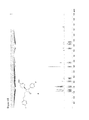
  • FIG. 2 shows the 1 H NMR spectrum of Compound 3
  • FIG. 3 shows the 13 C ⁇ 1 H ⁇ NMR spectrum of Compound 3
  • FIG. 4 shows the 1 H NMR spectrum of Compound 5
  • FIG. 5 shows the 13 C ⁇ 1 H ⁇ NMR spectrum of Compound 5
  • FIG. 6 shows the 19 F NMR spectrum of Compound 5
  • FIG. 7 shows the 1 H NMR spectrum of Compound 6
  • FIG. 8 shows the 13 C ⁇ 1 H ⁇ NMR spectrum of Compound 6
  • FIG. 9 shows the 19 F NMR spectrum of Compound 6
  • FIG. 10 shows the 1 H NMR spectrum of Compound 8.
  • FIG. 11 shows the 13 C ⁇ 1 H ⁇ NMR spectrum of Compound 8.
  • FIG. 12 shows the 19 F NMR spectrum of Compound 8.
  • FIG. 13 shows the 1 H NMR spectrum of Compound 9
  • FIG. 14 shows the 13 C ⁇ 1 H ⁇ NMR spectrum of Compound 9
  • FIG. 15 shows the 1 9 F NMR spectrum of Compound 9
  • FIG. 16 shows the 1 H NMR spectrum of Compound 10.
  • FIG. 17 shows the 13 C ⁇ 1 H ⁇ NMR spectrum of Compound 10
  • FIG. 18 shows the 19 F NMR spectrum of Compound 10
  • FIG. 19 shows the 1 H NMR spectrum of Compound 11
  • FIG. 20 shows the 13 C ⁇ 1 H ⁇ NMR spectrum of Compound 11.
  • FIG. 21 shows the 19 F NMR spectrum of Compound 11.
  • a method of preparing ezetimibe may be performed as shown in FIG. 1 .
  • the method of preparing ezetimibe according to the present invention includes performing an intermolecular reaction under mild conditions through cross-metathesis using a Grubbs 2 nd catalyst [step (4)], and performing deprotection of a benzyl group in the presence of a Pearlman's catalyst under mild conditions using hydrogen gas at atmospheric pressure [step (7)], whereby ezetimibe is synthesized.
  • Step (1) is obtaining a compound of Chemical Formula 3 by reacting a compound of Chemical Formula 1 with a compound of Chemical Formula 2 in the presence of DIPEA (diisopropylethylamine) and DMAP (dimethylaminopyridine).
  • DIPEA diisopropylethylamine
  • DMAP dimethylaminopyridine
  • pent-4-enoic acid (Compound 1) and oxalyl chloride are added to a solvent (e.g. DCM), added with DMF, reacted at about 40° C. (i.e. within the range from 30 to 50° C.), and then cooled to room temperature, after which the solvent is removed. Thereafter, the resulting product is added with a solvent and is reacted with a solution of (S)-4-phenyloxazolidin-2-one (Compound 2) and DMAP dissolved in the above solvent, thus obtaining (S)-3-(pent-4-enoyl)-4-phenyloxazolidin-2-one (Compound 3).
  • a solvent e.g. DCM
  • oxalyl chloride may be used in an amount of 0.5 to 2 equivalents, preferably 1 to 1.5 equivalents, and more preferably 1.2 equivalents, based on the amount of Compound 1.
  • DIPEA may be used in an amount of 1 to 3 equivalents, preferably 1.5 to 2.5 equivalents, and more preferably 2 equivalents, based on the amount of Compound 1.
  • DMAP may be used in an amount of 1 to 10 mol %, preferably 3 to 7 mol %, and more preferably 5 mol %, based on the amount of Compound 1.
  • Step (2) is obtaining a compound of Chemical Formula 5 by reacting the compound of Chemical Formula 3 with a compound of Chemical Formula 4 in the presence of TiCl 4 and DIPEA.
  • Compound 3 is dissolved in a solvent (e.g. DCM), cooled to about ⁇ 20° C. (i.e. within the range from ⁇ 30 to ⁇ 10° C.), added with TiCl 4 , reacted, added with DIPEA, and reacted.
  • a solvent e.g. DCM
  • TiCl 4 may be used in an amount of 0.5 to 2 equivalents, preferably 1 to 1.5 equivalents, and more preferably 1.1 equivalents, based on the amount of Compound 3.
  • DIPEA may be used in an amount of 1 to 3 equivalents, preferably 1.5 to 2.5 equivalents, and more preferably 2 equivalents, based on the amount of Compound 3.
  • Step (3) is obtaining a compound of Chemical Formula 6 by reacting the compound of Chemical Formula 5 in the presence of BSA (bis(trimethylsilyl)acetamide) and TBAF (tetrabutylammonium fluoride).
  • BSA bis(trimethylsilyl)acetamide
  • TBAF tetrabutylammonium fluoride
  • Compound 5 is added to a solvent (e.g. toluene), added with BSA, reacted at room temperature, added with TBAF-3H 2 O, and reacted, thus obtaining (3R,4S)-3-allyl-4-(4-(benzyloxy)phenyl)-1-(4-fluorophenyl)azetidin-2-one (Compound 6).
  • a solvent e.g. toluene
  • BSA may be used in an amount of 1 to 3 equivalents, preferably 1.5 to 2.5 equivalents, and more preferably 2 equivalents, based on the amount of Compound 5.
  • TBAF. may be used in an amount of 1 to 10 mol %, preferably 3 to 7 mol %, and more preferably 5 mol %, based on the amount of Compound 5.
  • Step (4) is obtaining a compound of Chemical Formula 8 by reacting the compound of Chemical Formula 6 with a compound of Chemical Formula 7 in the presence of a Grubbs 2 nd catalyst and CuI.
  • the Grubbs 2 nd catalyst may be used in an amount of 1 to 10 mol %, preferably 3 to 7 mol %, and more preferably 5 mol %, based on the amount of Compound 7.
  • CuI may be used in an amount of 1 to 50 mol %, preferably 5 to 20 mol %, and more preferably 10 mol %, based on the amount of Compound 7.
  • Step (5) is obtaining a compound of Chemical Formula 9 by reacting the compound of Chemical Formula 8 in the presence of Pd(OAc) 2 , benzoquinone and HClO 4 .
  • benzoquinone may be used in an amount of 0.5 to 5 equivalents, preferably 1 to 2 equivalents, and more preferably 1.5 equivalents, based on the amount of Compound 8.
  • Pd(OAc) 2 may be used in an amount of 1 to 10 mol %, preferably 1 to 5 mol %, and more preferably 3 mol %, based on the amount of Compound 8.
  • Step (6) is obtaining a compound of Chemical Formula 10 by reacting the compound of Chemical Formula 9 in the presence of a (R)-CBS catalyst and a borane dimethyl sulfide complex.
  • the (R)-CBS (Corey-Bakshi-Shibata) catalyst and Compound 9 are dissolved in a solvent (e.g. THF), stirred at about ⁇ 20° C. (i.e. within the range from ⁇ 30 to ⁇ 10° C.), added with the borane dimethyl sulfide complex, and reacted at about ⁇ 20° C. (i.e.
  • the (R)-CBS catalyst may be used in an amount of 1 to 50 mol %, preferably 10 to 30 mol %, and more preferably 20 mol %, based on the amount of Compound 9.
  • the borane dimethyl sulfide complex may be used in an amount of 0.5 to 5 equivalents, preferably 1 to 2 equivalents, and more preferably 1.2 equivalents, based on the amount of Compound 9.
  • Step (7) is obtaining a compound of Chemical Formula 11 by reacting the compound of Chemical Formula 10 in the presence of palladium hydroxide on carbon (a Pearlman's catalyst) and cyclohexane.
  • Compound 10 Pd(OH) 2 /C (palladium hydroxide on carbon) and cyclohexane are added to a solvent (e.g. MeOH) under hydrogen gas (H 2 ) at about 1 atm (i.e. within the range from 0.5 to 1.5 atm), and reacted at about 70° C. (i.e. within the range from 60 to 80° C.), thus obtaining (3R,4S)-1-(4-fluorophenyl)-3-((S)-3-(4-fluorophenyl)-3-hydroxypropyl)-4-(4-hydroxyphenyl)azetidin-2-one (Compound 11).
  • a solvent e.g. MeOH
  • H 2 hydrogen gas
  • Pd(OH) 2 /C may be used in an amount of 1 to 30 mol %, preferably 10 to 20 mol %, and more preferably 15 mol %, based on the amount of Compound 10.
  • cyclohexane may be used in an amount of 0.5 to 5 equivalents, preferably 1 to 2 equivalents, and more preferably 1.1 equivalents, based on the amount of Compound 10.
  • Step (1) Synthesis of (S)-3-(pent-4-enoyl)-4-phenyloxazolidin-2-one (Compound 3)
  • Pent-4-enoic acid (1, 2.04 mL, 20 mmol) was dissolved in a DCM (dichloromethane) solvent (66 mL) and oxalyl chloride (2.03 mL, 24 mmol) was then added dropwise thereto. Subsequently, DMF (dimethylformamide) (200 ⁇ L) was added thereto, and the reaction was carried out at 40° C. for 1 hr. The reaction solution was cooled to room temperature and the solvent was removed therefrom using an evaporator.
  • Step (2) Synthesis of (S)-3-((R)-2-((S)-(4-(benzyloxy)phenyl) ((4-fluorophenyl)amino)methyl)pent-4-enoyl)-4-phenyloxazolidin-2-one (Compound 5)
  • the temperature was elevated to room temperature, a 1 M H 2 SO 4 aqueous solution (224 mL, 13 mL/mmol) was added thereto, and the reaction was further carried out for 30 min.
  • the reaction was worked-up using a NaHCO 3 aqueous solution (600 mL) and ethyl acetate (400 mL, 133 mL ⁇ 3).
  • the ethyl acetate layer was dried with anhydrous MgSO 4 and then filtered. Further, recrystallization was performed using a MeOH/DCM (9/1) solvent.
  • Step (3) Synthesis of (3R,4S)-3-allyl-4-(4-(benzyloxy)phenyl)-1-(4-fluorophenyl) azetidin-2-one (Compound 6)
  • Step (4) Synthesis of (3R,4S)-4-(4-(benzyloxy)phenyl)-1-(4-fluorophenyl)-3-((E)-3-(4-fluorophenyl)allyl)azetidin-2-one (Compound 8)
  • Step (5) Synthesis of (3R,4S)-4-(4-(benzyloxy)phenyl)-1-(4-fluorophenyl)-3-(3-(4-fluorophenyl)-3-oxopropyl)azetidin-2-one (Compound 9)
  • Step (6) Synthesis of (3R,4S)-4-(4-(benzyloxy)phenyl)-1-(4-fluorophenyl)-3-((S)-3-(4-fluorophenyl)-3-hydroxypropyl) azetidin-2-one (Compound 10)
  • a (R)-CBS catalyst [(R)-methyl-CBS (Corey-Bakshi-Shibata) catalyst] (19.4 mg, 0.07 mmol) and (3R,4S)-4-(4-(benzyloxy)phenyl)-1-(4-fluorophenyl)-3-(3-(4-fluorophenyl)-3-oxopropyl)azetidin-2-one (9, 157.4 mg, 0.32 mmol) were dissolved in a THF (tetrahydrofuran) solvent (0.42 mL) and then stirred at ⁇ 20° C. for 5 min.
  • THF tetrahydrofuran
  • a borane dimethyl sulfide complex (Me 2 S.BH 3 ) (2 M solution in THF) (192 ⁇ L, 0.38 mmol) was added dropwise thereto at 0.5 mL/h, after which the reaction was carried out at ⁇ 20° C. for 2 hr [chiral reduction].
  • the reaction was terminated with MeOH (0.64 mL), and was then worked-up using a 1 M HCl aqueous solution (20 mL) and 15 mL (5 mL ⁇ 3) of ethyl acetate.
  • Step (7) Synthesis of (3R,4S)-1-(4-fluorophenyl)-3-((S)-3-(4-fluorophenyl)-3-hydroxypropyl)-4-(4-hydroxyphenyl) azetidin-2-one (Compound 11)

Landscapes

  • Chemical & Material Sciences (AREA)
  • Organic Chemistry (AREA)
  • Health & Medical Sciences (AREA)
  • Engineering & Computer Science (AREA)
  • Chemical Kinetics & Catalysis (AREA)
  • Materials Engineering (AREA)
  • Life Sciences & Earth Sciences (AREA)
  • Veterinary Medicine (AREA)
  • Public Health (AREA)
  • General Health & Medical Sciences (AREA)
  • Animal Behavior & Ethology (AREA)
  • Inorganic Chemistry (AREA)
  • Medicinal Chemistry (AREA)
  • Pharmacology & Pharmacy (AREA)
  • Nuclear Medicine, Radiotherapy & Molecular Imaging (AREA)
  • General Chemical & Material Sciences (AREA)
  • Obesity (AREA)
  • Hematology (AREA)
  • Diabetes (AREA)
  • Bioinformatics & Cheminformatics (AREA)
  • Epidemiology (AREA)
  • Low-Molecular Organic Synthesis Reactions Using Catalysts (AREA)
  • Organic Low-Molecular-Weight Compounds And Preparation Thereof (AREA)

Abstract

Disclosed is a method of preparing ezetimibe, including cross-metathesis using a Grubbs 2nd catalyst and deprotection using a Pearlman's catalyst, and an intermediate thereof. The method of preparing ezetimibe is useful as an efficient ezetimibe synthesis technique in pharmaceutical fields using ezetimibe as a raw material.

Description

CROSS-REFERENCE TO RELATED APPLICATIONS
The present application claims priority under 35 U.S.C. § 119 to Korean Patent Application No. 10-2018-0020490, filed on Feb. 21, 2018, in the Korean Intellectual Property Office, the entire contents of each of which are hereby incorporated by reference.
TECHNICAL FIELD
The present invention relates to a novel method of preparing ezetimibe and an intermediate thereof, and more particularly to a method of preparing ezetimibe using a Grubbs 2nd catalyst and a Pearlman's catalyst and to an intermediate thereof.
BACKGROUND ART
Ezetimibe (Chemical Formula a), which is a drug used as an inhibitor of cholesterol absorption in small intestine, is used as a main material of Ezetrol and Vytorin, which are commercially available drugs for the treatment of hyperlipidemia. The ezetimibe synthesis process, developed by Schering-Plough, is problematic because Grignard reagents and organolithium reagents, which are difficult to handle and have a risk of explosion, are used, and moreover, hydrogen gas at 2 atm and 4 atm is used upon reduction and deprotection reactions. Therefore, it is necessary to develop a new reaction capable of progressing under mild conditions to replace the reaction requiring such harsh conditions. [Chemical Formula a]
Figure US10414736-20190917-C00001
DISCLOSURE Technical Problem
The present inventors have studied mild reaction conditions by alleviating harsh reaction conditions typically using Grignard and organolithium reagents in the synthesis of ezetimibe and thus have ascertained that ezetimibe may be synthesized by performing an intermolecular reaction under mild conditions through cross-metathesis using a Grubbs 2nd catalyst and by conducting deprotection of a benzyl group under mild reaction conditions using hydrogen gas at atmospheric pressure in the presence of a Pearlman's catalyst.
Accordingly, the present invention is intended to provide a method of preparing ezetimibe including a cross-metathesis reaction using a Grubbs 2nd catalyst and a deprotection reaction using a Pearlman's catalyst.
Technical Solution
Therefore, the present invention provides a method of preparing ezetimibe, which is a compound of Chemical Formula 11, comprising the following steps (1) to (7).
The method of preparing ezetimibe according to the present invention includes: (1) obtaining a compound of Chemical Formula 3 below by reacting a compound of Chemical Formula 1 below with a compound of Chemical Formula 2 below in the presence of DIPEA (diisopropylethylamine) and DMAP (dimethylaminopyridine); (2) obtaining a compound of Chemical Formula 5 below by reacting the compound of Chemical Formula 3 with a compound of Chemical Formula 4 below in the presence of TiCl4 and DIPEA; (3) obtaining a compound of Chemical Formula 6 below by reacting the compound of Chemical Formula 5 in the presence of BSA (bis(trimethylsilyl)acetamide) and TBAF (tetrabutylammonium fluoride); (4) obtaining a compound of Chemical Formula 8 below by reacting the compound of Chemical Formula 6 with a compound of Chemical Formula 7 below in the presence of a Grubbs 2nd catalyst and CuI; (5) obtaining a compound of Chemical Formula 9 below by reacting the compound of Chemical Formula 8 in the presence of Pd(OAc)2, benzoquinone and HClO4; (6) obtaining a compound of Chemical Formula 10 below by reacting the compound of Chemical Formula 9 in the presence of an (R)-CBS (Corey-Bakshi-Shibata) catalyst and a borane dimethyl sulfide complex; and (7) obtaining a compound of Chemical Formula 11 below by reacting the compound of Chemical Formula 10 in the presence of palladium hydroxide on carbon and cyclohexane.
Figure US10414736-20190917-C00002
Figure US10414736-20190917-C00003
Figure US10414736-20190917-C00004
Figure US10414736-20190917-C00005
wherein Bn is benzyl.
Figure US10414736-20190917-C00006
wherein Bn is benzyl.
Figure US10414736-20190917-C00007
wherein Bn is benzyl.
Figure US10414736-20190917-C00008
Figure US10414736-20190917-C00009
wherein Bn is benzyl.
Figure US10414736-20190917-C00010
wherein Bn is benzyl.
Figure US10414736-20190917-C00011
wherein Bn is benzyl.
Figure US10414736-20190917-C00012
In addition, the present invention provides intermediates of the above preparation method, particularly a compound of Chemical Formula 4 below, a compound of Chemical Formula 5 below, a compound of Chemical Formula 6 below, a compound of Chemical Formula 8 below, a compound of Chemical Formula 9 below, and a compound of Chemical Formula 10 below.
Figure US10414736-20190917-C00013
wherein Bn is benzyl.
Figure US10414736-20190917-C00014
wherein Bn is benzyl.
Figure US10414736-20190917-C00015
wherein Bn is benzyl.
Figure US10414736-20190917-C00016
wherein Bn is benzyl.
Figure US10414736-20190917-C00017
wherein Bn is benzyl.
Figure US10414736-20190917-C00018
wherein Bn is benzyl.
Advantageous Effects
According to the present invention, a method of preparing ezetimibe includes a cross-metathesis reaction using a Grubbs 2nd catalyst and a deprotection reaction using a Pearlman's catalyst, whereby intermolecular cross-metathesis is carried out under mild conditions, and mild conditions using hydrogen gas at atmospheric pressure are applied, thus synthesizing ezetimibe.
Also, the method of preparing ezetimibe according to the present invention is useful as an efficient ezetimibe synthesis technique in pharmaceutical fields using ezetimibe as a raw material.
DESCRIPTION OF DRAWINGS
FIG. 1 schematically shows the overall process of preparing ezetimibe according to the present invention;
FIG. 2 shows the 1H NMR spectrum of Compound 3;
FIG. 3 shows the 13C{1H} NMR spectrum of Compound 3;
FIG. 4 shows the 1H NMR spectrum of Compound 5;
FIG. 5 shows the 13C{1H} NMR spectrum of Compound 5;
FIG. 6 shows the 19F NMR spectrum of Compound 5;
FIG. 7 shows the 1H NMR spectrum of Compound 6;
FIG. 8 shows the 13C{1H} NMR spectrum of Compound 6;
FIG. 9 shows the 19F NMR spectrum of Compound 6;
FIG. 10 shows the 1H NMR spectrum of Compound 8;
FIG. 11 shows the 13C{1H} NMR spectrum of Compound 8;
FIG. 12 shows the 19F NMR spectrum of Compound 8;
FIG. 13 shows the 1H NMR spectrum of Compound 9;
FIG. 14 shows the 13C{1H} NMR spectrum of Compound 9;
FIG. 15 shows the 19F NMR spectrum of Compound 9;
FIG. 16 shows the 1H NMR spectrum of Compound 10;
FIG. 17 shows the 13C{1H} NMR spectrum of Compound 10;
FIG. 18 shows the 19F NMR spectrum of Compound 10;
FIG. 19 shows the 1H NMR spectrum of Compound 11;
FIG. 20 shows the 13C{1H} NMR spectrum of Compound 11; and
FIG. 21 shows the 19F NMR spectrum of Compound 11.
BEST MODE
According to the present invention, a method of preparing ezetimibe may be performed as shown in FIG. 1. Specifically, the method of preparing ezetimibe according to the present invention includes performing an intermolecular reaction under mild conditions through cross-metathesis using a Grubbs 2ndcatalyst [step (4)], and performing deprotection of a benzyl group in the presence of a Pearlman's catalyst under mild conditions using hydrogen gas at atmospheric pressure [step (7)], whereby ezetimibe is synthesized.
<Step (1)>
Step (1) is obtaining a compound of Chemical Formula 3 by reacting a compound of Chemical Formula 1 with a compound of Chemical Formula 2 in the presence of DIPEA (diisopropylethylamine) and DMAP (dimethylaminopyridine).
Specifically, pent-4-enoic acid (Compound 1) and oxalyl chloride are added to a solvent (e.g. DCM), added with DMF, reacted at about 40° C. (i.e. within the range from 30 to 50° C.), and then cooled to room temperature, after which the solvent is removed. Thereafter, the resulting product is added with a solvent and is reacted with a solution of (S)-4-phenyloxazolidin-2-one (Compound 2) and DMAP dissolved in the above solvent, thus obtaining (S)-3-(pent-4-enoyl)-4-phenyloxazolidin-2-one (Compound 3).
In the above reaction, oxalyl chloride may be used in an amount of 0.5 to 2 equivalents, preferably 1 to 1.5 equivalents, and more preferably 1.2 equivalents, based on the amount of Compound 1.
Also, DIPEA may be used in an amount of 1 to 3 equivalents, preferably 1.5 to 2.5 equivalents, and more preferably 2 equivalents, based on the amount of Compound 1.
Also, DMAP may be used in an amount of 1 to 10 mol %, preferably 3 to 7 mol %, and more preferably 5 mol %, based on the amount of Compound 1.
<Step (2)>
Step (2) is obtaining a compound of Chemical Formula 5 by reacting the compound of Chemical Formula 3 with a compound of Chemical Formula 4 in the presence of TiCl4 and DIPEA.
Specifically, Compound 3 is dissolved in a solvent (e.g. DCM), cooled to about −20° C. (i.e. within the range from −30 to −10° C.), added with TiCl4, reacted, added with DIPEA, and reacted. The resulting reaction product is added to a solution of (Z)-1-(4-(benzyloxy)phenyl)-N-(4-fluorophenyl)methaneimine (Compound 4) in DCM, and is then reacted at about −20° C. (i.e. within the range from −30 to −10° C.), thus obtaining (S)-3-((R)-2-((S)-(4-(benzyloxy)phenyl) ((4-fluorophenyl)amino)methyl)pent-4-enoyl)-4-phenyloxazolidin-2-one (Compound 5).
In the above reaction, TiCl4 may be used in an amount of 0.5 to 2 equivalents, preferably 1 to 1.5 equivalents, and more preferably 1.1 equivalents, based on the amount of Compound 3.
Also, DIPEA may be used in an amount of 1 to 3 equivalents, preferably 1.5 to 2.5 equivalents, and more preferably 2 equivalents, based on the amount of Compound 3.
<Step (3)>
Step (3) is obtaining a compound of Chemical Formula 6 by reacting the compound of Chemical Formula 5 in the presence of BSA (bis(trimethylsilyl)acetamide) and TBAF (tetrabutylammonium fluoride).
Specifically, Compound 5 is added to a solvent (e.g. toluene), added with BSA, reacted at room temperature, added with TBAF-3H2O, and reacted, thus obtaining (3R,4S)-3-allyl-4-(4-(benzyloxy)phenyl)-1-(4-fluorophenyl)azetidin-2-one (Compound 6).
In the above reaction, BSA may be used in an amount of 1 to 3 equivalents, preferably 1.5 to 2.5 equivalents, and more preferably 2 equivalents, based on the amount of Compound 5.
Also, TBAF.may be used in an amount of 1 to 10 mol %, preferably 3 to 7 mol %, and more preferably 5 mol %, based on the amount of Compound 5.
<Step (4)>
Step (4) is obtaining a compound of Chemical Formula 8 by reacting the compound of Chemical Formula 6 with a compound of Chemical Formula 7 in the presence of a Grubbs 2nd catalyst and CuI.
Specifically, Compound 6, 1-fluoro-4-vinylbenzene (Compound 7), a Grubbs 2nd catalyst and CuI are added to a solvent (e.g. ether), reacted at about 40° C. (i.e. within the range from 30 to 50° C.), cooled to room temperature, and filtered through silica gel, thus obtaining (3R,4S)-4-(4-(benzyloxy)phenyl)-1-(4-fluorophenyl)-3-((E)-3-(4-fluorophenyl)allyl)azetidin-2-one (Compound 8).
In the above reaction, the Grubbs 2nd catalyst may be used in an amount of 1 to 10 mol %, preferably 3 to 7 mol %, and more preferably 5 mol %, based on the amount of Compound 7.
Also, CuI may be used in an amount of 1 to 50 mol %, preferably 5 to 20 mol %, and more preferably 10 mol %, based on the amount of Compound 7.
<Step (5)>
Step (5) is obtaining a compound of Chemical Formula 9 by reacting the compound of Chemical Formula 8 in the presence of Pd(OAc)2, benzoquinone and HClO4.
Specifically, Pd(OAc)2, benzoquinone and HClO4 are added to a solvent (e.g. acetonitrile), deoxygenated with stirring, added with Compound 8 dissolved in a solvent, and reacted, thus obtaining (3R,4S)-4-(4-(benzyloxy)phenyl)-1-(4-fluorophenyl)-3-(3-(4-fluorophenyl)-3-oxopropyl)azetidin-2-one (Compound 9).
In the above reaction, benzoquinone may be used in an amount of 0.5 to 5 equivalents, preferably 1 to 2 equivalents, and more preferably 1.5 equivalents, based on the amount of Compound 8.
Also, Pd(OAc)2 may be used in an amount of 1 to 10 mol %, preferably 1 to 5 mol %, and more preferably 3 mol %, based on the amount of Compound 8.
<Step (6)>
Step (6) is obtaining a compound of Chemical Formula 10 by reacting the compound of Chemical Formula 9 in the presence of a (R)-CBS catalyst and a borane dimethyl sulfide complex.
Specifically, the (R)-CBS (Corey-Bakshi-Shibata) catalyst and Compound 9 are dissolved in a solvent (e.g. THF), stirred at about −20° C. (i.e. within the range from −30 to −10° C.), added with the borane dimethyl sulfide complex, and reacted at about −20° C. (i.e. within the range from −30 to −10° C.), thus obtaining (3R,4S)-4-(4-(benzyloxy)phenyl)-1-(4-fluorophenyl)-3-((S)-3-(4-fluorophenyl)-3-hydroxypropyl)azetidin-2-one (Compound 10).
In the above reaction, the (R)-CBS catalyst may be used in an amount of 1 to 50 mol %, preferably 10 to 30 mol %, and more preferably 20 mol %, based on the amount of Compound 9.
Also, the borane dimethyl sulfide complex may be used in an amount of 0.5 to 5 equivalents, preferably 1 to 2 equivalents, and more preferably 1.2 equivalents, based on the amount of Compound 9.
<Step (7)>
Step (7) is obtaining a compound of Chemical Formula 11 by reacting the compound of Chemical Formula 10 in the presence of palladium hydroxide on carbon (a Pearlman's catalyst) and cyclohexane.
Here, Compound 10, Pd(OH)2/C (palladium hydroxide on carbon) and cyclohexane are added to a solvent (e.g. MeOH) under hydrogen gas (H2) at about 1 atm (i.e. within the range from 0.5 to 1.5 atm), and reacted at about 70° C. (i.e. within the range from 60 to 80° C.), thus obtaining (3R,4S)-1-(4-fluorophenyl)-3-((S)-3-(4-fluorophenyl)-3-hydroxypropyl)-4-(4-hydroxyphenyl)azetidin-2-one (Compound 11).
In the above reaction, Pd(OH)2/C may be used in an amount of 1 to 30 mol %, preferably 10 to 20 mol %, and more preferably 15 mol %, based on the amount of Compound 10.
Also, cyclohexane may be used in an amount of 0.5 to 5 equivalents, preferably 1 to 2 equivalents, and more preferably 1.1 equivalents, based on the amount of Compound 10.
A better understanding of the present invention will be given through the following example, which is merely set forth to illustrate the present invention but is not to be construed as limiting the scope of the present invention.
Example Step (1): Synthesis of (S)-3-(pent-4-enoyl)-4-phenyloxazolidin-2-one (Compound 3)
Figure US10414736-20190917-C00019
Pent-4-enoic acid (1, 2.04 mL, 20 mmol) was dissolved in a DCM (dichloromethane) solvent (66 mL) and oxalyl chloride (2.03 mL, 24 mmol) was then added dropwise thereto. Subsequently, DMF (dimethylformamide) (200 μL) was added thereto, and the reaction was carried out at 40° C. for 1 hr. The reaction solution was cooled to room temperature and the solvent was removed therefrom using an evaporator. Subsequently, the resulting product was diluted with DCM (66 mL) and was then added dropwise to a solution of (S)-4-phenyloxazolidin-2-one (2, 3590 mg, 22 mmol), DIPEA (diisopropylethylamine) (6968 μL, 40 mmol), and DMAP (dimethylaminopyridine) (122.17 mg, 1 mmol) dissolved in DCM (36.6 mL). The resulting reaction solution was stirred at room temperature for 2 hr. After completion of the reaction, the reaction was terminated with 0.5 M HCl (50 mL), followed by extraction with DCM (60 mL, 20 mL×3). The DCM layer was dried with anhydrous MgSO4 and then filtered. Further, column chromatography (ethyl acetate:hexane=1:2) was performed, thus yielding a desired compound (S)-3-(pent-4-enoyl)-4-phenyloxazolidin-2-one (3, 4219 mg, 86%) (FIGS. 2 and 3).
(S)-3-(pent-4-enoyl)-4-phenyloxazolidin-2-one (3)
4219 mg, 86%, White solid; Rf=0.5 (ethyl acetate:hexane=1:2); 1H NMR (400 MHz, CDCl3) δ 7.41-7.29 (m, 5H), 5.85-5.75 (m, 1H), 5.43 (dd, J=8.7 Hz, 3.6 Hz, 1H), 5.06-4.95 (m, 2H), 4.69 (t, J=8.8 Hz, 1H), 4.29 (dd, J=8.9 Hz, 3.64 Hz, 1H), 3.07-3.03 (m, 2H), 2.39-2.34 (m, 2H); 13C{1H} NMR (100 MHz, CDCl3) δ 172.2, 153.9, 139.2, 136.7, 129.3, 128.9, 126.1, 115.8, 70.2, 57.7, 35.0, 28.2; IR (KBr) 3069, 2979, 1780, 1706, 1385, 1326, 1200, 1060 cm−1; HRMS (EI) m/z: [M]+ Calcd for C14H15NO3 245.1052; Found 245.1051.
Step (2): Synthesis of (S)-3-((R)-2-((S)-(4-(benzyloxy)phenyl) ((4-fluorophenyl)amino)methyl)pent-4-enoyl)-4-phenyloxazolidin-2-one (Compound 5)
Figure US10414736-20190917-C00020
(S)-3-(pent-4-enoyl)-4-phenyloxazolidin-2-one (3, 4219 mg, 17.2 mmol) was dissolved in a DCM solvent (86 mL) and then cooled to −20° C. Subsequently, TiCl4 (1 M solution in DCM) (21.9 mL, 20.6 mmol) was slowly added thereto. The resulting reaction solution was allowed to react for 15 min. After 15 min, DIPEA (5992 μL, 34.4 mmol) was slowly added thereto. The reaction was carried out for 30 min, after which a solution of (Z)-1-(4-(benzyloxy)phenyl)-N-(4-fluorophenyl)methaneimine (4, 7878 mg, 25.8 mmol) dissolved in DCM (168 mL) was slowly added thereto. The reaction was carried out at −20° C. for 2 hr. Subsequently, AcOH (acetic acid) (5.7 mL, 0.33 mL/mmol) was diluted with DCM (17.2 mL, 1 mL/mmol) and then added to the reaction solution, followed by reaction for 30 min. The temperature was elevated to room temperature, a 1 M H2SO4 aqueous solution (224 mL, 13 mL/mmol) was added thereto, and the reaction was further carried out for 30 min. The reaction was worked-up using a NaHCO3 aqueous solution (600 mL) and ethyl acetate (400 mL, 133 mL×3). The ethyl acetate layer was dried with anhydrous MgSO4 and then filtered. Further, recrystallization was performed using a MeOH/DCM (9/1) solvent. The obtained solid was filtered using MeOH, thus yielding a desired compound (S)-3-((R)-2-((S)-(4-(benzyloxy)phenyl) ((4-fluorophenyl)amino)methyl)pent-4-enoyl)-4-phenyloxazolidin-2-one (5, 4735 mg, 50%) (FIGS. 4 to 6).
(S)-3-((R)-2-((S)-(4-(benzyloxy)phenyl) ((4-fluorophenyl)amino)methyl)pent-4-enoyl)-4-phenyloxazolidin-2-one (5)
4735 mg, 50%, White solid; 1H NMR (400 MHz, CDCl3) δ 7.44-7.33 (m, 5H), 7.18-7.14 (m, 3H), 7.08-7.05 (m, 4H), 6.89-6.86 (m, 2H), 6.77-6.72 (m, 2H), 6.41-6.38 (m, 2H), 5.76-5.66 (m, 1H), 5.41 (dd, J=8.5 Hz, 3.1 Hz, 1H), 5.03-4.98 (m, 5H), 4.67-4.56 (m, 2H), 4.41-4.37 (m, 1H), 4.18 (dd, J=8.7 Hz, 3.1 Hz, 1H), 2.49-2.41 (m, 1H), 2.12-2.06 (m, 1H); 13C{1H} NMR (100 MHz, CDCl3) δ 174.7, 158.3, 156.0 (J=234.9 Hz), 154.5, 143.0 (J=2.1 Hz), 138.5, 137.1, 134.9, 133.1, 129.1, 128.7, 128.4, 128.2, 128.2, 127.7, 125.4, 117.7, 115.6 (J=22.3 Hz), 115.13, 115.07, 115.0, 70.2, 60.9, 58.1, 48.5, 34.9; 19F NMR (376 MHz, CDCl3) δ −127.70; IR (KBr) 3064, 2918, 1772, 1704, 1509, 1385, 1200 cm−1; HRMS (EI) m/z: [M]+ Calcd for C34H31FN2O4 550.2268; Found 550.2266.
Step (3): Synthesis of (3R,4S)-3-allyl-4-(4-(benzyloxy)phenyl)-1-(4-fluorophenyl) azetidin-2-one (Compound 6)
Figure US10414736-20190917-C00021
(S)-3-((R)-2-((S)-(4-(benzyloxy)phenyl) ((4-fluorophenyl)amino)methyl)pent-4-enoyl)-4-phenyloxazolidin-2-one (5, 4735 mg, 8.6 mmol) was added to a toluene solvent (86 mL) and then stirred at room temperature for 15 min (so as to maximally prevent agglomeration of Compound 5). Further, BSA (3.99 mL, 17.2 mmol) was added thereto and then the reaction was carried out at room temperature for 30 min. After 30 min, TBAF (tetrabutylammonium fluoride)-3H2O (135.7 mg, 0.43 mmol) was added thereto. After 20 to 30 min, when the reaction solution became homogeneous, the reaction was terminated by the addition of AcOH (310 μL) diluted with MeOH (45 mL). The reaction solution was treated using an evaporator to remove the solvent therefrom, after which the reaction was worked-up using a NaHCO3 aqueous solution (60 mL) and ethyl acetate (60 mL, 20 mL×3). The ethyl acetate layer was dried with anhydrous MgSO4 and then filtered, followed by column chromatography (ethyl acetate:hexane=1:10), thus yielding a desired compound (3R,4S)-3-allyl-4-(4-(benzyloxy)phenyl)-1-(4-fluorophenyl)azetidin-2-one (6, 3033 mg, 91%) (FIGS. 7 to 9).
(3R,4S)-3-allyl-4-(4-(benzyloxy)phenyl)-1-(4-fluorophenyl)azetidin-2-one (6)
3033 mg, 91%, White solid; Rf=0.2 (ethyl acetate:hexane=1:2); 1H NMR (400 MHz, CDCl3) δ 7.43-7.33 (m, 5H), 7.26-7.23 (m, 4H), 6.98-6.91 (m, 4H), 5.91-5.81 (m, 1H), 5.18-5.11 (m, 2H), 5.05 (s, 2H), 4.62 (d, J=2.3 Hz, 1H), 3.20-3.16 (m, 1H), 2.73-2.67 (m, 1H), 2.59-2.51 (m, 1H); 13C{1H} NMR (100 MHz, CDCl3) δ 167.1, 159.2, 159.1 (J=243.0 Hz), 136.9, 134.2 134.1 (J=2.5 Hz), 129.8, 128.8, 128.3, 127.6, 127.5, 118.6 (J=7.9 Hz), 117.8, 115.9 (J=22.7 Hz), 115.6, 70.3, 60.5, 59.7, 32.9; 19F NMR (376 MHz, CDCl3) δ −118.23; IR (KBr) 3034, 2916, 1748, 1639, 1509, 1382, 1226, 1145 cm−1; HRMS (EI) m/z: [M]+ Calcd for C25H22FNO2 387.1635; Found 387.1634.
Step (4): Synthesis of (3R,4S)-4-(4-(benzyloxy)phenyl)-1-(4-fluorophenyl)-3-((E)-3-(4-fluorophenyl)allyl)azetidin-2-one (Compound 8)
Figure US10414736-20190917-C00022
(3R,4S)-3-allyl-4-(4-(benzyloxy)phenyl)-1-(4-fluorophenyl)azetidin-2-one (6, 58.12 mg, 0.15 mmol), 1-fluoro-4-vinylbenzene (7, 179 μL, 1.5 mmol), a Grubbs 2nd catalyst (6.37 mg, 0.0075 mmol) and CuI (2.86 mg, 0.015 mmol) were added to an ether solvent (1.5 mL) and then reacted at 40° C. for 1 hr. The reaction solution was cooled to room temperature and then filtered through silica gel using ethyl acetate, followed by column chromatography (ethyl acetate:hexane=1:10), thus yielding a desired compound (3R,4S)-4-(4-(benzyloxy)phenyl)-1-(4-fluorophenyl)-3-((E)-3-(4-fluorophenyl)allyl)azetidin-2-one (8, 50.56 mg, 70%) (FIGS. 10 to 12).
(3R,4S)-4-(4-(benzyloxy)phenyl)-1-(4-fluorophenyl)-3-((E)-3-(4-fluorophenyl)allyl)azetidin-2-one (8)
50.56 mg, 70%, White solid; Rf=0.2 (ethyl acetate:hexane=1:5); 1H NMR (400 MHz, CDCl3) δ 7.43-7.35 (m, 5H), 7.28-7.22 (m, 6H), 7.01-6.90 (m, 6H), 7.01-6.93 (m, 4H), 6.44 (d, J=15.9 Hz, 1H), 6.18-6.11 (m, 1H), 5.04 (s, 2H), 4.66 (d, J=2.3 Hz, 1H), 3.28-3.24 (m, 1H), 2.89-2.82 (m, 1H), 2.74-2.66 (m, 1H); 13C{1H} NMR (100 MHz, CDCl3) δ 166.9, 162.4 (J=246.7 Hz), 159.2, 159.1 (J=243.3 Hz), 136.8, 134.1 (J=2.7 Hz), 133.2 (J=3.2 Hz), 131.5, 129.8, 128.8, 128.2, 127.8 (J=7.9 Hz), 127.6, 127.4, 125.5 (J=2.0 Hz), 118.6 (J=7.8 Hz), 115.9 (J=22.7 Hz), 115.7 (J=2.6 Hz), 115.5, 70.3, 60.6, 60.0, 32.1; 19F NMR (376 MHz, CDCl3) δ −114.64, −118.08; IR (KBr) 3034, 2917, 1748, 1610, 1509, 1385, 1227, 1175, 1157, 1139 cm−1; HRMS (EI) m/z: [M]+ Calcd for C31H25F2NO2 481.1853; Found 481.1855.
Step (5): Synthesis of (3R,4S)-4-(4-(benzyloxy)phenyl)-1-(4-fluorophenyl)-3-(3-(4-fluorophenyl)-3-oxopropyl)azetidin-2-one (Compound 9)
Figure US10414736-20190917-C00023
Pd(OAc)2 (3.37 mg, 0.015 mmol), benzoquinone (81.07 mg, 0.75 mmol) and 70% HClO4 (0.15 M aqueous solution) (35 μL, 70 μL/mmol) were added to an acetonitrile solvent (1.25 mL), and then deoxygenated with stirring for 30 min. Subsequently, H2O (0.25 mL, 0.5 mL/mmol) was added thereto, followed by deoxygenation with vigorous stirring for 30 min. Subsequently, (3R,4S)-4-(4-(benzyloxy)phenyl)-1-(4-fluorophenyl)-3-((E)-3-(4-fluorophenyl)allyl)azetidin-2-one (8, 240.8 mg, 0.5 mmol) dissolved in acetonitrile (1.25 mL) was added dropwise thereto. The reaction was carried out for 4 hr, after which 70% HClO4 (0.15 M aqueous solution) (35 μL) was further added thereto, and the reaction was then carried out for 12 hr. After completion of the reaction, the reaction was terminated with H2O (30 mL) and extraction was performed using ethyl acetate (15 mL, 5 mL×3). The ethyl acetate layer was dried with anhydrous MgSO4 and then filtered, followed by column chromatography (ethyl acetate:hexane=1:5), thus yielding a desired compound (3R,4S)-4-(4-(benzyloxy)phenyl)-1-(4-fluorophenyl)-3-(3-(4-fluorophenyl)-3-oxopropyl)azetidin-2-one (9, 223.9 mg, 90%) (FIGS. 13 to 15).
(3R,4S)-4-(4-(benzyloxy)phenyl)-1-(4-fluorophenyl)-3-(3-(4-fluorophenyl)-3-oxopropyl) azetidin-2-one (9)
223.9 mg, 90%, White solid; Rf=0.2 (ethyl acetate:hexane=1:5); 1H NMR (400 MHz, CDCl3) δ 8.00-7.97 (m, 2H), 7.42-7.33 (m, 5H), 7.26-7.23 (m, 4H), 7.12 (t, J=8.6 Hz, 2H), 6.97-6.91 (m, 4H), 5.04 (s, 2H), 4.67 (d, J=2.1 Hz, 1H), 3.33-3.25 (m, 1H), 3.19-3.11 (m, 2H), 2.44-2.35 (m, 1H), 2.31-2.22 (m, 1H); 13C{1H} NMR (100 MHz, CDCl3) δ 197.5, 167.4, 166.0 (J=254.7 Hz), 159.2, 159.1 (J=243.4 Hz), 136.8, 134.0 (J=2.6 Hz), 133.2, (J=3.0 Hz), 130.9, 129.7, 128.8, 128.2, 127.5 (J=24.8 Hz), 118.6 (J=7.9 Hz), 116.0 (J=7.3 Hz), 115.8 (J=6.5 Hz), 115.7, 70.3, 61.3, 60.0, 35.7, 23.3; 19F NMR (376 MHz, CDCl3) δ −104.93, −118.06; IR (KBr) 3064, 2922, 2851, 1745, 1684, 1598, 1509, 1386, 1228, 1156 cm−1; HRMS (EI) m/z: [M]+ Calcd for C31H25F2NO3 497.1803; Found 497.1806.
Step (6): Synthesis of (3R,4S)-4-(4-(benzyloxy)phenyl)-1-(4-fluorophenyl)-3-((S)-3-(4-fluorophenyl)-3-hydroxypropyl) azetidin-2-one (Compound 10)
Figure US10414736-20190917-C00024
A (R)-CBS catalyst [(R)-methyl-CBS (Corey-Bakshi-Shibata) catalyst] (19.4 mg, 0.07 mmol) and (3R,4S)-4-(4-(benzyloxy)phenyl)-1-(4-fluorophenyl)-3-(3-(4-fluorophenyl)-3-oxopropyl)azetidin-2-one (9, 157.4 mg, 0.32 mmol) were dissolved in a THF (tetrahydrofuran) solvent (0.42 mL) and then stirred at −20° C. for 5 min. Subsequently, a borane dimethyl sulfide complex (Me2S.BH3) (2 M solution in THF) (192 μL, 0.38 mmol) was added dropwise thereto at 0.5 mL/h, after which the reaction was carried out at −20° C. for 2 hr [chiral reduction]. The reaction was terminated with MeOH (0.64 mL), and was then worked-up using a 1 M HCl aqueous solution (20 mL) and 15 mL (5 mL×3) of ethyl acetate. The extracted ethyl acetate layer was dried with anhydrous MgSO4 and then filtered, followed by column chromatography (ether:hexane=1:2), thus yielding a desired compound (3R,4S)-4-(4-(benzyloxy)phenyl)-1-(4-fluorophenyl)-3-((S)-3-(4-fluorophenyl)-3-hydroxypropyl) azetidin-2-one (10, 147.1 mg, 92%) (FIGS. 16 to 18).
(3R,4S)-4-(4-(benzyloxy)phenyl)-1-(4-fluorophenyl)-3-((S)-3-(4-fluorophenyl)-3-hydroxypropyl)azetidin-2-one (10)
147.1 mg, 92%, White solid; Rf=0.2 (ether:hexane=1:2); 1H NMR (400 MHz, CDCl3) δ 7.42-7.33 (m, 5H), 7.30-7.21 (m, 6H), 7.02-6.90 (m, 6H), 5.0 (s, 2H), 4.71-4.70 (m, 1H), 4.57 (d, J=2.0 Hz, 1H), 3.08-3.05 (m, 1H), 2.33 (s, 1H), 1.99-1.86 (m, 4H); 13C{1H} NMR (100 MHz, CDCl3) δ 167.8, 162.3 (J=245.5 Hz), 159.2, 159.1 (J=243.5 Hz), 140.2 (J=3.1 Hz), 136.8, 134.0 (J=2.4 Hz), 129.8, 128.8, 128.2, 127.6, 127.5 (J=8.1 Hz), 127.3, 118.5 (J=7.9 Hz), 115.9 (J=22.7 Hz), 115.7, 115.5 (J=21.3 Hz), 73.2, 70.3, 61.2, 60.4, 36.8, 25.1; 19F NMR (376 MHz, CDCl3) δ −114.87, −118.10; IR (KBr) 3064, 3034, 2926, 2864, 1883, 1743, 1608, 1510, 1387, 1223 cm−1; HRMS (EI) m/z: [M]+ Calcd for C31H27F2NO3 499.1959; Found 499.1960.
Step (7): Synthesis of (3R,4S)-1-(4-fluorophenyl)-3-((S)-3-(4-fluorophenyl)-3-hydroxypropyl)-4-(4-hydroxyphenyl) azetidin-2-one (Compound 11)
Figure US10414736-20190917-C00025
(3R,4S)-4-(4-(benzyloxy)phenyl)-1-(4-fluorophenyl)-3-((S)-3-(4-fluorophenyl)-3-hydroxypropyl) azetidin-2-one (10, 258 mg, 0.5 mmol), 20% Pd(OH)2/C (10.53 mg, 15 mol %) and cyclohexane (55.71 μL, 0.55 mmol) were added to a MeOH solvent (6.25 mL) under H2 (1 atm) and then reacted at 70° C. for 3 hr [deprotection]. After completion of the reaction, the reaction product was cooled to room temperature and then filtered through celite using ethyl acetate (25 mL). The filtered solution was concentrated and then recrystallized two times with MeOH and H2O (1/3, 3 mL/9 mL). The obtained solid was filtered using H2O (20 mL), thereby yielding a desired compound (3R,4S)-1-(4-fluorophenyl)-3-((S)-3-(4-fluorophenyl)-3-hydroxypropyl)-4-(4-hydroxyphenyl)azetidin-2-one (11, 203 mg, 99%) (FIGS. 19 to 21).
(3R,4S)-1-(4-fluorophenyl)-3-((S)-3-(4-fluorophenyl)-3-hydroxypropyl)-4-(4-hydroxyphenyl) azetidin-2-one (11)
203 mg, 99%, White solid; Rf=0.2 (ethyl acetate:hexane=1:1); 99% ee; [α]20 D −28.05 (c 0.15, MeOH) [lit.1 −28.1 (c 0.15, MeOH); 1H NMR (400 MHz, CD3OD) δ 7.34-7.27 (m, 4H), 7.21 (d, J=8.5 Hz, 2H), 7.06-6.96 (m, 4H), 6.81 (d, J=8.5 Hz, 2H), 4.87 (s, 2H), 4.74 (d, J=2.0 Hz, 1H), 4.63-4.60 (m, 1H), 3.10-3.07 (m, 1H), 1.97-1.84 (m, 4H); 13C{1H} NMR (100 MHz, CD3OD) δ 169.9, 163.5 (J=243.6 Hz), 160.5 (J=242.0 Hz), 159.0, 142.2 (J=3.0 Hz), 135.3 (J=2.7 Hz), 129.5, 128.8 (J=8.0 Hz), 128.6, 119.9 (J=7.9 Hz), 117.0, 116.6 (J=22.9 Hz), 115.9 (J=21.6 Hz), 73.8, 62.3, 61.2, 37.5, 26.1; 19F NMR (376 MHz, CD3OD) δ −117.77, −120.15; IR (KBr) 2947, 2924, 1722, 1604, 1509, 1391, 1223 cm−1; HRMS (EI) m/z: [M]+ Calcd for C24H21F2NO3 409.1489; Found 409.1488.
Although embodiments of the present invention have been described with reference to the accompanying drawings, those skilled in the art will appreciate that the present invention may be embodied in other specific forms without changing the technical spirit or essential features thereof. Thus, the embodiments described above should be understood to be non-limiting and illustrative in every way.

Claims (9)

The invention claimed is:
1. A method of preparing ezetimibe, which is a compound of Chemical Formula 11, comprising:
(1) obtaining a compound of Chemical Formula 3 below by reacting a compound of Chemical Formula 1 below with a compound of Chemical Formula 2 below in the presence of DIPEA (diisopropylethylamine) and DMAP (dimethylaminopyridine);
(2) obtaining a compound of Chemical Formula 5 below by reacting the compound of Chemical Formula 3 with a compound of Chemical Formula 4 below in the presence of TiCl4 and DIPEA;
(3) obtaining a compound of Chemical Formula 6 below by reacting the compound of Chemical Formula 5 in the presence of BSA (bis(trimethylsilyl) acetamide) and TBAF (tetrabutylammonium fluoride);
(4) obtaining a compound of Chemical Formula 8 below by reacting the compound of Chemical Formula 6 with a compound of Chemical Formula 7 below in the presence of a Grubbs 2nd catalyst and CuI;
(5) obtaining a compound of Chemical Formula 9 below by reacting the compound of Chemical Formula 8 in the presence of Pd(OAc)2, benzoquinone and HClO4;
(6) obtaining a compound of Chemical Formula 10 below by reacting the compound of Chemical Formula 9 in the presence of a (R)-CBS (Corey-Bakshi-Shibata) catalyst and a borane dimethyl sulfide complex; and
(7) obtaining a compound of Chemical Formula 11 below by reacting the compound of Chemical Formula 10 in the presence of palladium hydroxide on carbon and cyclohexane:
Figure US10414736-20190917-C00026
Figure US10414736-20190917-C00027
Figure US10414736-20190917-C00028
Figure US10414736-20190917-C00029
wherein Bn is benzyl,
Figure US10414736-20190917-C00030
wherein Bn is benzyl,
Figure US10414736-20190917-C00031
wherein Bn is benzyl,
Figure US10414736-20190917-C00032
Figure US10414736-20190917-C00033
wherein Bn is benzyl,
Figure US10414736-20190917-C00034
wherein Bn is benzyl,
Figure US10414736-20190917-C00035
wherein Bn is benzyl,
Figure US10414736-20190917-C00036
2. The method of claim 1, wherein in step (1), the DIPEA is used in an amount of 1 to 3 equivalents based on an amount of Compound 1, and the DMAP is used in an amount of 1 to 10 mol % based on the amount of Compound 1.
3. The method of claim 1, wherein in step (2), the TiCl4 is used in an amount of 0.5 to 2 equivalents based on an amount of Compound 3, and the DIPEA is used in an amount of 1 to 3 equivalents based on the amount of Compound 3.
4. The method of claim 1, wherein in step (3), the BSA is used in an amount of 1 to 3 equivalents based on an amount of Compound 5, and TBAF is used in an amount of 1 to 10 mol % based on the amount of Compound 5.
5. The method of claim 1, wherein in step (4), the Grubbs 2nd catalyst is used in an amount of 1 to 10 mol % based on an amount of Compound 7, and the CuI is used in an amount of 1 to 50 mol % based on the amount of Compound 7.
6. The method of claim 1, wherein in step (5), the benzoquinone is used in an amount of 0.5 to 5 equivalents based on an amount of Compound 8, and the Pd(OAc)2 is used in an amount of 1 to 10 mol % based on the amount of Compound 8.
7. The method of claim 1, wherein in step (6), the (R)-CBS catalyst is used in an amount of 1 to 50 mol % based on an amount of Compound 9, and the borane dimethyl sulfide complex is used in an amount of 0.5 to 5 equivalents based on the amount of Compound 9.
8. The method of claim 1, wherein in step (7), the palladium hydroxide on carbon is used in an amount of 1 to 30 mol % based on an amount of Compound 10, and the cyclohexane is used in an amount of 0.5 to 5 equivalents based on the amount of Compound 10.
9. A compound of Chemical Formula 5 below:
Figure US10414736-20190917-C00037
wherein Bn is benzyl.
US16/146,129 2018-02-21 2018-09-28 Method of preparing ezetimibe and intermediate thereof Active US10414736B2 (en)

Applications Claiming Priority (2)

Application Number Priority Date Filing Date Title
KR10-2018-0020490 2018-02-21
KR1020180020490A KR102078158B1 (en) 2018-02-21 2018-02-21 Process for preparing Ezetimibe and intermediate thereof

Publications (2)

Publication Number Publication Date
US20190256479A1 US20190256479A1 (en) 2019-08-22
US10414736B2 true US10414736B2 (en) 2019-09-17

Family

ID=67617585

Family Applications (1)

Application Number Title Priority Date Filing Date
US16/146,129 Active US10414736B2 (en) 2018-02-21 2018-09-28 Method of preparing ezetimibe and intermediate thereof

Country Status (2)

Country Link
US (1) US10414736B2 (en)
KR (1) KR102078158B1 (en)

Families Citing this family (2)

* Cited by examiner, † Cited by third party
Publication number Priority date Publication date Assignee Title
CN110845384B (en) * 2019-12-04 2021-07-20 广东省生物医药技术研究所 Dissociation method of titanium complex drug and application thereof
CN113621663A (en) * 2021-08-11 2021-11-09 艾美科健(中国)生物医药有限公司 Synthesis process of ezetimibe

Citations (4)

* Cited by examiner, † Cited by third party
Publication number Priority date Publication date Assignee Title
US20110183956A1 (en) * 2008-07-30 2011-07-28 Janez Mravljak Process for the synthesis of ezetimibe and intermediates useful therefor
KR101156588B1 (en) 2008-12-17 2012-06-20 한미약품 주식회사 Method of preparing ezetimibe and intermediates used therein
KR101491007B1 (en) 2008-12-16 2015-02-09 한미약품 주식회사 Process for preparing ezetimibe intermediate
KR20160116933A (en) 2015-03-31 2016-10-10 보령제약 주식회사 Method for the preparation of Ezetimibe

Patent Citations (4)

* Cited by examiner, † Cited by third party
Publication number Priority date Publication date Assignee Title
US20110183956A1 (en) * 2008-07-30 2011-07-28 Janez Mravljak Process for the synthesis of ezetimibe and intermediates useful therefor
KR101491007B1 (en) 2008-12-16 2015-02-09 한미약품 주식회사 Process for preparing ezetimibe intermediate
KR101156588B1 (en) 2008-12-17 2012-06-20 한미약품 주식회사 Method of preparing ezetimibe and intermediates used therein
KR20160116933A (en) 2015-03-31 2016-10-10 보령제약 주식회사 Method for the preparation of Ezetimibe

Non-Patent Citations (1)

* Cited by examiner, † Cited by third party
Title
M. Humpl et al., "Stereoselective Synthesis of Ezetimibe via Cross-Metathesis of Homoallylalcohols and α-Methylidene-β-Lactams" J. Org. Chem, 2016, 81 (17), pp. 7692-7699.

Also Published As

Publication number Publication date
KR20190100662A (en) 2019-08-29
US20190256479A1 (en) 2019-08-22
KR102078158B1 (en) 2020-02-17

Similar Documents

Publication Publication Date Title
RU2682660C9 (en) Method of obtaining pde4 inhibitor
US20230271985A1 (en) Preparation method for glufosinate
US20080032964A1 (en) Process for the synthesis of azetidinone
US12486232B2 (en) Method for preparing meta-functionalized pyridine compound
US10414736B2 (en) Method of preparing ezetimibe and intermediate thereof
US20180099930A1 (en) Method for preparing azetidinone compound and intermediate of azetidinone compound
US8158798B2 (en) Coupling process for preparing quinolone intermediates
JP2009530273A (en) Method for producing sulfonyl chloride derivative
CN108558692B (en) A kind of preparation method of amide compound
CN1075476A (en) The preparation method of 2-chloro-5-picoline
US20080194825A1 (en) Process for obtaining montelukast
CN115836041B (en) Method for producing optically active compound
CN100347179C (en) Novel synthetic intermediate of carbapenem compound for oral administration and its production method
US20100317868A1 (en) Method of preparing taxane derivatives and intermediates used therein
KR20230020170A (en) A new synthetic method of rucaparib
US7358394B2 (en) Process for preparing N,N′-dialkoxy-N, N′-dialkyl oxamide
US20260028315A1 (en) Improved preparation method for rucaparib
KR101348440B1 (en) One-pot Synthesis Method of Quinazoline-2,4-dione Derivatives
US8026395B1 (en) Process for the synthesis of anti-neoplasia agent VNP40101M
JP6889466B2 (en) A salt of an isolated compound containing an amide group, a method for producing the salt, and a method for synthesizing an amide compound using the salt.
US20240343689A1 (en) Synthesis of brivaracetam
JP3931231B2 (en) Method for producing asymmetric disulfide compound
JP2007077032A (en) Method for producing cyclohexane derivative
JP4710698B2 (en) Process for producing β-diketone compound having silyl ether group
WO2019200114A1 (en) Methods for preparing substituted dihydroindene-4-carboxamide compounds

Legal Events

Date Code Title Description
FEPP Fee payment procedure

Free format text: ENTITY STATUS SET TO UNDISCOUNTED (ORIGINAL EVENT CODE: BIG.); ENTITY STATUS OF PATENT OWNER: SMALL ENTITY

AS Assignment

Owner name: KANGWON NATIONAL UNIVERSITY INDUSTRY COOPERATION F

Free format text: ASSIGNMENT OF ASSIGNORS INTEREST;ASSIGNORS:LEE, PHIL HO;LEE, KOO YEON;BAEK, YONGHYEON;AND OTHERS;REEL/FRAME:047018/0779

Effective date: 20180912

FEPP Fee payment procedure

Free format text: ENTITY STATUS SET TO SMALL (ORIGINAL EVENT CODE: SMAL); ENTITY STATUS OF PATENT OWNER: SMALL ENTITY

STPP Information on status: patent application and granting procedure in general

Free format text: PUBLICATIONS -- ISSUE FEE PAYMENT VERIFIED

STCF Information on status: patent grant

Free format text: PATENTED CASE

MAFP Maintenance fee payment

Free format text: PAYMENT OF MAINTENANCE FEE, 4TH YR, SMALL ENTITY (ORIGINAL EVENT CODE: M2551); ENTITY STATUS OF PATENT OWNER: SMALL ENTITY

Year of fee payment: 4