US10412960B2 - Microparticles and nanoparticles made up of hydrophobized polysaccharides and an alpha-cyclodextrine - Google Patents
Microparticles and nanoparticles made up of hydrophobized polysaccharides and an alpha-cyclodextrine Download PDFInfo
- Publication number
- US10412960B2 US10412960B2 US14/390,221 US201314390221A US10412960B2 US 10412960 B2 US10412960 B2 US 10412960B2 US 201314390221 A US201314390221 A US 201314390221A US 10412960 B2 US10412960 B2 US 10412960B2
- Authority
- US
- United States
- Prior art keywords
- polysaccharide
- groups
- cyclodextrin
- sulphate
- formula
- Prior art date
- Legal status (The legal status is an assumption and is not a legal conclusion. Google has not performed a legal analysis and makes no representation as to the accuracy of the status listed.)
- Expired - Fee Related, expires
Links
- 229920001282 polysaccharide Polymers 0.000 title claims abstract description 264
- 239000005017 polysaccharide Substances 0.000 title claims abstract description 264
- 229920000858 Cyclodextrin Polymers 0.000 title claims description 158
- 239000011859 microparticle Substances 0.000 title abstract description 48
- 239000002105 nanoparticle Substances 0.000 title abstract description 39
- 150000004676 glycans Chemical class 0.000 title abstract description 5
- HFHDHCJBZVLPGP-RWMJIURBSA-N alpha-cyclodextrin Chemical compound OC[C@H]([C@H]([C@@H]([C@H]1O)O)O[C@H]2O[C@@H]([C@@H](O[C@H]3O[C@H](CO)[C@H]([C@@H]([C@H]3O)O)O[C@H]3O[C@H](CO)[C@H]([C@@H]([C@H]3O)O)O[C@H]3O[C@H](CO)[C@H]([C@@H]([C@H]3O)O)O3)[C@H](O)[C@H]2O)CO)O[C@@H]1O[C@H]1[C@H](O)[C@@H](O)[C@@H]3O[C@@H]1CO HFHDHCJBZVLPGP-RWMJIURBSA-N 0.000 claims abstract description 139
- 229920001450 Alpha-Cyclodextrin Polymers 0.000 claims abstract description 76
- 229940043377 alpha-cyclodextrin Drugs 0.000 claims abstract description 74
- 125000000217 alkyl group Chemical group 0.000 claims abstract description 58
- 239000000126 substance Substances 0.000 claims abstract description 27
- 150000004804 polysaccharides Chemical class 0.000 claims description 260
- 229920001661 Chitosan Polymers 0.000 claims description 148
- HFHDHCJBZVLPGP-UHFFFAOYSA-N schardinger α-dextrin Chemical compound O1C(C(C2O)O)C(CO)OC2OC(C(C2O)O)C(CO)OC2OC(C(C2O)O)C(CO)OC2OC(C(O)C2O)C(CO)OC2OC(C(C2O)O)C(CO)OC2OC2C(O)C(O)C1OC2CO HFHDHCJBZVLPGP-UHFFFAOYSA-N 0.000 claims description 144
- 125000002496 methyl group Chemical group [H]C([H])([H])* 0.000 claims description 120
- 125000001165 hydrophobic group Chemical group 0.000 claims description 117
- 239000002245 particle Substances 0.000 claims description 79
- 229910021653 sulphate ion Inorganic materials 0.000 claims description 76
- 229920001525 carrageenan Polymers 0.000 claims description 74
- QAOWNCQODCNURD-UHFFFAOYSA-L Sulfate Chemical compound [O-]S([O-])(=O)=O QAOWNCQODCNURD-UHFFFAOYSA-L 0.000 claims description 72
- 125000004432 carbon atom Chemical group C* 0.000 claims description 68
- 229920000669 heparin Polymers 0.000 claims description 64
- 229960002897 heparin Drugs 0.000 claims description 64
- 229920002307 Dextran Polymers 0.000 claims description 61
- 239000000679 carrageenan Substances 0.000 claims description 59
- 229940113118 carrageenan Drugs 0.000 claims description 59
- 229920002101 Chitin Polymers 0.000 claims description 55
- 235000010418 carrageenan Nutrition 0.000 claims description 52
- HTTJABKRGRZYRN-UHFFFAOYSA-N Heparin Chemical compound OC1C(NC(=O)C)C(O)OC(COS(O)(=O)=O)C1OC1C(OS(O)(=O)=O)C(O)C(OC2C(C(OS(O)(=O)=O)C(OC3C(C(O)C(O)C(O3)C(O)=O)OS(O)(=O)=O)C(CO)O2)NS(O)(=O)=O)C(C(O)=O)O1 HTTJABKRGRZYRN-UHFFFAOYSA-N 0.000 claims description 50
- 238000000034 method Methods 0.000 claims description 48
- 229920002674 hyaluronan Polymers 0.000 claims description 46
- 229960003160 hyaluronic acid Drugs 0.000 claims description 46
- 125000004430 oxygen atom Chemical group O* 0.000 claims description 45
- 238000002156 mixing Methods 0.000 claims description 42
- 239000000203 mixture Substances 0.000 claims description 42
- KIUKXJAPPMFGSW-DNGZLQJQSA-N (2S,3S,4S,5R,6R)-6-[(2S,3R,4R,5S,6R)-3-Acetamido-2-[(2S,3S,4R,5R,6R)-6-[(2R,3R,4R,5S,6R)-3-acetamido-2,5-dihydroxy-6-(hydroxymethyl)oxan-4-yl]oxy-2-carboxy-4,5-dihydroxyoxan-3-yl]oxy-5-hydroxy-6-(hydroxymethyl)oxan-4-yl]oxy-3,4,5-trihydroxyoxane-2-carboxylic acid Chemical compound CC(=O)N[C@H]1[C@H](O)O[C@H](CO)[C@@H](O)[C@@H]1O[C@H]1[C@H](O)[C@@H](O)[C@H](O[C@H]2[C@@H]([C@@H](O[C@H]3[C@@H]([C@@H](O)[C@H](O)[C@H](O3)C(O)=O)O)[C@H](O)[C@@H](CO)O2)NC(C)=O)[C@@H](C(O)=O)O1 KIUKXJAPPMFGSW-DNGZLQJQSA-N 0.000 claims description 40
- -1 fucan Polymers 0.000 claims description 39
- UHVMMEOXYDMDKI-JKYCWFKZSA-L zinc;1-(5-cyanopyridin-2-yl)-3-[(1s,2s)-2-(6-fluoro-2-hydroxy-3-propanoylphenyl)cyclopropyl]urea;diacetate Chemical group [Zn+2].CC([O-])=O.CC([O-])=O.CCC(=O)C1=CC=C(F)C([C@H]2[C@H](C2)NC(=O)NC=2N=CC(=CC=2)C#N)=C1O UHVMMEOXYDMDKI-JKYCWFKZSA-L 0.000 claims description 36
- 239000002253 acid Substances 0.000 claims description 34
- 125000004435 hydrogen atom Chemical group [H]* 0.000 claims description 34
- 229920000945 Amylopectin Polymers 0.000 claims description 32
- 125000003342 alkenyl group Chemical group 0.000 claims description 32
- 239000001913 cellulose Substances 0.000 claims description 31
- 229920002678 cellulose Polymers 0.000 claims description 31
- 229920001218 Pullulan Polymers 0.000 claims description 30
- 239000004373 Pullulan Substances 0.000 claims description 30
- 235000019423 pullulan Nutrition 0.000 claims description 30
- 239000000178 monomer Substances 0.000 claims description 29
- WQZGKKKJIJFFOK-VFUOTHLCSA-N beta-D-glucose Chemical compound OC[C@H]1O[C@@H](O)[C@H](O)[C@@H](O)[C@@H]1O WQZGKKKJIJFFOK-VFUOTHLCSA-N 0.000 claims description 27
- 125000004433 nitrogen atom Chemical group N* 0.000 claims description 27
- 229920002971 Heparan sulfate Polymers 0.000 claims description 24
- 229920001287 Chondroitin sulfate Polymers 0.000 claims description 23
- 229920001353 Dextrin Polymers 0.000 claims description 22
- 239000004375 Dextrin Substances 0.000 claims description 22
- 229920000288 Keratan sulfate Polymers 0.000 claims description 22
- 235000019425 dextrin Nutrition 0.000 claims description 22
- KXCLCNHUUKTANI-RBIYJLQWSA-N keratan Chemical compound CC(=O)N[C@@H]1[C@@H](O)C[C@@H](COS(O)(=O)=O)O[C@H]1O[C@@H]1[C@@H](O)[C@H](O[C@@H]2[C@H](O[C@@H](O[C@H]3[C@H]([C@@H](COS(O)(=O)=O)O[C@@H](O)[C@@H]3O)O)[C@H](NC(C)=O)[C@H]2O)COS(O)(=O)=O)O[C@H](COS(O)(=O)=O)[C@@H]1O KXCLCNHUUKTANI-RBIYJLQWSA-N 0.000 claims description 22
- 125000003178 carboxy group Chemical group [H]OC(*)=O 0.000 claims description 20
- 239000002537 cosmetic Substances 0.000 claims description 20
- 239000007787 solid Substances 0.000 claims description 20
- 239000002904 solvent Substances 0.000 claims description 20
- 125000002887 hydroxy group Chemical group [H]O* 0.000 claims description 19
- 239000000725 suspension Substances 0.000 claims description 18
- FPJHWYCPAOPVIV-VOZMEZHOSA-N (2R,3S,4R,5R,6R)-6-[(2R,3R,4R,5R,6R)-5-acetamido-2-(hydroxymethyl)-6-methoxy-3-sulfooxyoxan-4-yl]oxy-4,5-dihydroxy-3-methoxyoxane-2-carboxylic acid Chemical compound CO[C@@H]1O[C@H](CO)[C@H](OS(O)(=O)=O)[C@H](O[C@@H]2O[C@H]([C@@H](OC)[C@H](O)[C@H]2O)C(O)=O)[C@H]1NC(C)=O FPJHWYCPAOPVIV-VOZMEZHOSA-N 0.000 claims description 16
- 229920000045 Dermatan sulfate Polymers 0.000 claims description 16
- 229920002472 Starch Polymers 0.000 claims description 16
- 239000001814 pectin Substances 0.000 claims description 16
- 229920001277 pectin Polymers 0.000 claims description 16
- 235000010987 pectin Nutrition 0.000 claims description 16
- 239000008107 starch Substances 0.000 claims description 16
- 235000019698 starch Nutrition 0.000 claims description 16
- GJCOSYZMQJWQCA-UHFFFAOYSA-N 9H-xanthene Chemical compound C1=CC=C2CC3=CC=CC=C3OC2=C1 GJCOSYZMQJWQCA-UHFFFAOYSA-N 0.000 claims description 14
- 229920000856 Amylose Polymers 0.000 claims description 14
- 229920002558 Curdlan Polymers 0.000 claims description 14
- 239000001879 Curdlan Substances 0.000 claims description 14
- 235000010443 alginic acid Nutrition 0.000 claims description 14
- 229920000615 alginic acid Polymers 0.000 claims description 14
- 235000019316 curdlan Nutrition 0.000 claims description 14
- 229940078035 curdlan Drugs 0.000 claims description 14
- 238000005538 encapsulation Methods 0.000 claims description 14
- 238000006467 substitution reaction Methods 0.000 claims description 14
- 229920001285 xanthan gum Polymers 0.000 claims description 14
- 229920001221 xylan Polymers 0.000 claims description 14
- 150000004823 xylans Chemical class 0.000 claims description 14
- 230000003993 interaction Effects 0.000 claims description 12
- OVRNDRQMDRJTHS-FMDGEEDCSA-N N-acetyl-beta-D-glucosamine Chemical group CC(=O)N[C@H]1[C@H](O)O[C@H](CO)[C@@H](O)[C@@H]1O OVRNDRQMDRJTHS-FMDGEEDCSA-N 0.000 claims description 11
- 125000001495 ethyl group Chemical group [H]C([H])([H])C([H])([H])* 0.000 claims description 11
- 125000001449 isopropyl group Chemical group [H]C([H])([H])C([H])(*)C([H])([H])[H] 0.000 claims description 11
- 125000001436 propyl group Chemical group [H]C([*])([H])C([H])([H])C([H])([H])[H] 0.000 claims description 11
- MSWZFWKMSRAUBD-QZABAPFNSA-N beta-D-glucosamine Chemical group N[C@H]1[C@H](O)O[C@H](CO)[C@@H](O)[C@@H]1O MSWZFWKMSRAUBD-QZABAPFNSA-N 0.000 claims description 10
- 230000006196 deacetylation Effects 0.000 claims description 10
- 238000003381 deacetylation reaction Methods 0.000 claims description 10
- QGZKDVFQNNGYKY-UHFFFAOYSA-O ammonium group Chemical group [NH4+] QGZKDVFQNNGYKY-UHFFFAOYSA-O 0.000 claims description 9
- 150000001720 carbohydrates Chemical group 0.000 claims description 6
- 239000008194 pharmaceutical composition Substances 0.000 claims description 3
- 239000012736 aqueous medium Substances 0.000 abstract description 47
- 150000004665 fatty acids Chemical class 0.000 abstract description 31
- 235000014113 dietary fatty acids Nutrition 0.000 abstract description 30
- 239000000194 fatty acid Substances 0.000 abstract description 30
- 229930195729 fatty acid Natural products 0.000 abstract description 30
- 230000001225 therapeutic effect Effects 0.000 abstract description 4
- 238000005917 acylation reaction Methods 0.000 abstract description 3
- 0 CCCCCCCCCCCCCCCCCC(C1CC(C2)C2*C1)=C1CCC1 Chemical compound CCCCCCCCCCCCCCCCCC(C1CC(C2)C2*C1)=C1CCC1 0.000 description 102
- IPCSVZSSVZVIGE-UHFFFAOYSA-N hexadecanoic acid Chemical compound CCCCCCCCCCCCCCCC(O)=O IPCSVZSSVZVIGE-UHFFFAOYSA-N 0.000 description 65
- XLYOFNOQVPJJNP-UHFFFAOYSA-N water Substances O XLYOFNOQVPJJNP-UHFFFAOYSA-N 0.000 description 63
- FZWBNHMXJMCXLU-BLAUPYHCSA-N isomaltotriose Chemical compound O[C@@H]1[C@@H](O)[C@H](O)[C@@H](CO)O[C@@H]1OC[C@@H]1[C@@H](O)[C@H](O)[C@@H](O)[C@@H](OC[C@@H](O)[C@@H](O)[C@H](O)[C@@H](O)C=O)O1 FZWBNHMXJMCXLU-BLAUPYHCSA-N 0.000 description 45
- LFQSCWFLJHTTHZ-UHFFFAOYSA-N Ethanol Chemical compound CCO LFQSCWFLJHTTHZ-UHFFFAOYSA-N 0.000 description 43
- 230000015572 biosynthetic process Effects 0.000 description 39
- ZMXDDKWLCZADIW-UHFFFAOYSA-N N,N-Dimethylformamide Chemical compound CN(C)C=O ZMXDDKWLCZADIW-UHFFFAOYSA-N 0.000 description 34
- OKKJLVBELUTLKV-UHFFFAOYSA-N Methanol Chemical compound OC OKKJLVBELUTLKV-UHFFFAOYSA-N 0.000 description 33
- 239000000243 solution Substances 0.000 description 32
- 235000021314 Palmitic acid Nutrition 0.000 description 31
- WQEPLUUGTLDZJY-UHFFFAOYSA-N n-Pentadecanoic acid Natural products CCCCCCCCCCCCCCC(O)=O WQEPLUUGTLDZJY-UHFFFAOYSA-N 0.000 description 31
- 238000002360 preparation method Methods 0.000 description 29
- 238000012512 characterization method Methods 0.000 description 28
- 238000003756 stirring Methods 0.000 description 25
- YBJHBAHKTGYVGT-ZKWXMUAHSA-N (+)-Biotin Chemical compound N1C(=O)N[C@@H]2[C@H](CCCCC(=O)O)SC[C@@H]21 YBJHBAHKTGYVGT-ZKWXMUAHSA-N 0.000 description 24
- QTBSBXVTEAMEQO-UHFFFAOYSA-N Acetic acid Chemical compound CC(O)=O QTBSBXVTEAMEQO-UHFFFAOYSA-N 0.000 description 23
- ZQPPMHVWECSIRJ-KTKRTIGZSA-N oleic acid Chemical compound CCCCCCCC\C=C/CCCCCCCC(O)=O ZQPPMHVWECSIRJ-KTKRTIGZSA-N 0.000 description 23
- 238000002329 infrared spectrum Methods 0.000 description 22
- WRIDQFICGBMAFQ-UHFFFAOYSA-N (E)-8-Octadecenoic acid Natural products CCCCCCCCCC=CCCCCCCC(O)=O WRIDQFICGBMAFQ-UHFFFAOYSA-N 0.000 description 20
- LQJBNNIYVWPHFW-UHFFFAOYSA-N 20:1omega9c fatty acid Natural products CCCCCCCCCCC=CCCCCCCCC(O)=O LQJBNNIYVWPHFW-UHFFFAOYSA-N 0.000 description 20
- QSBYPNXLFMSGKH-UHFFFAOYSA-N 9-Heptadecensaeure Natural products CCCCCCCC=CCCCCCCCC(O)=O QSBYPNXLFMSGKH-UHFFFAOYSA-N 0.000 description 20
- 239000005642 Oleic acid Substances 0.000 description 20
- ZQPPMHVWECSIRJ-UHFFFAOYSA-N Oleic acid Natural products CCCCCCCCC=CCCCCCCCC(O)=O ZQPPMHVWECSIRJ-UHFFFAOYSA-N 0.000 description 20
- QXJSBBXBKPUZAA-UHFFFAOYSA-N isooleic acid Natural products CCCCCCCC=CCCCCCCCCC(O)=O QXJSBBXBKPUZAA-UHFFFAOYSA-N 0.000 description 20
- RTZKZFJDLAIYFH-UHFFFAOYSA-N Diethyl ether Chemical compound CCOCC RTZKZFJDLAIYFH-UHFFFAOYSA-N 0.000 description 18
- 239000004480 active ingredient Substances 0.000 description 18
- 238000006243 chemical reaction Methods 0.000 description 17
- 230000000694 effects Effects 0.000 description 17
- 239000007864 aqueous solution Substances 0.000 description 16
- 238000003786 synthesis reaction Methods 0.000 description 16
- CSCPPACGZOOCGX-UHFFFAOYSA-N Acetone Chemical compound CC(C)=O CSCPPACGZOOCGX-UHFFFAOYSA-N 0.000 description 15
- YMWUJEATGCHHMB-UHFFFAOYSA-N Dichloromethane Chemical compound ClCCl YMWUJEATGCHHMB-UHFFFAOYSA-N 0.000 description 15
- 238000001228 spectrum Methods 0.000 description 15
- WQZGKKKJIJFFOK-GASJEMHNSA-N Glucose Chemical compound OC[C@H]1OC(O)[C@H](O)[C@@H](O)[C@@H]1O WQZGKKKJIJFFOK-GASJEMHNSA-N 0.000 description 14
- 229920002683 Glycosaminoglycan Polymers 0.000 description 14
- 210000004027 cell Anatomy 0.000 description 14
- 238000003760 magnetic stirring Methods 0.000 description 14
- 238000005259 measurement Methods 0.000 description 14
- 125000002915 carbonyl group Chemical group [*:2]C([*:1])=O 0.000 description 13
- 229960001031 glucose Drugs 0.000 description 13
- 230000002209 hydrophobic effect Effects 0.000 description 13
- 239000003446 ligand Substances 0.000 description 13
- 239000000546 pharmaceutical excipient Substances 0.000 description 13
- 102000005962 receptors Human genes 0.000 description 13
- 108020003175 receptors Proteins 0.000 description 13
- 102000008394 Immunoglobulin Fragments Human genes 0.000 description 12
- 108010021625 Immunoglobulin Fragments Proteins 0.000 description 12
- 102000004856 Lectins Human genes 0.000 description 12
- 108090001090 Lectins Proteins 0.000 description 12
- JUJWROOIHBZHMG-UHFFFAOYSA-N Pyridine Chemical compound C1=CC=NC=C1 JUJWROOIHBZHMG-UHFFFAOYSA-N 0.000 description 12
- 229960002685 biotin Drugs 0.000 description 12
- 235000020958 biotin Nutrition 0.000 description 12
- 239000011616 biotin Substances 0.000 description 12
- 239000008103 glucose Substances 0.000 description 12
- 239000002523 lectin Substances 0.000 description 12
- 229910052757 nitrogen Inorganic materials 0.000 description 12
- 239000000047 product Substances 0.000 description 12
- 238000004627 transmission electron microscopy Methods 0.000 description 12
- LMDZBCPBFSXMTL-UHFFFAOYSA-N 1-Ethyl-3-(3-dimethylaminopropyl)carbodiimide Substances CCN=C=NCCCN(C)C LMDZBCPBFSXMTL-UHFFFAOYSA-N 0.000 description 11
- 230000006181 N-acylation Effects 0.000 description 11
- FAPWRFPIFSIZLT-UHFFFAOYSA-M Sodium chloride Chemical compound [Na+].[Cl-] FAPWRFPIFSIZLT-UHFFFAOYSA-M 0.000 description 11
- 238000004108 freeze drying Methods 0.000 description 11
- ARBOVOVUTSQWSS-UHFFFAOYSA-N hexadecanoyl chloride Chemical compound CCCCCCCCCCCCCCCC(Cl)=O ARBOVOVUTSQWSS-UHFFFAOYSA-N 0.000 description 11
- 238000000746 purification Methods 0.000 description 11
- 150000001875 compounds Chemical class 0.000 description 10
- 230000007613 environmental effect Effects 0.000 description 10
- 239000002609 medium Substances 0.000 description 10
- 239000003973 paint Substances 0.000 description 10
- LPXPTNMVRIOKMN-UHFFFAOYSA-M sodium nitrite Chemical compound [Na+].[O-]N=O LPXPTNMVRIOKMN-UHFFFAOYSA-M 0.000 description 10
- XLYOFNOQVPJJNP-ZSJDYOACSA-N Heavy water Chemical compound [2H]O[2H] XLYOFNOQVPJJNP-ZSJDYOACSA-N 0.000 description 9
- ZMANZCXQSJIPKH-UHFFFAOYSA-N Triethylamine Chemical compound CCN(CC)CC ZMANZCXQSJIPKH-UHFFFAOYSA-N 0.000 description 9
- CRBPUTPGJMOLKF-XKAQZKNMSA-N [(2r,3s,4r,5r,6s)-4,5-dihydroxy-3-[(2r,3r,4s,5s,6r)-3,4,5-trihydroxy-6-(hydroxymethyl)oxan-2-yl]oxy-6-[[(2r,3s,4s,5r,6r)-3,4,5-trihydroxy-6-[(2r,3s,4r,5r,6s)-4,5,6-trihydroxy-2-(hydroxymethyl)oxan-3-yl]oxyoxan-2-yl]methoxy]oxan-2-yl]methyl hexadecanoate Chemical compound O([C@H]1O[C@@H]([C@H]([C@H](O)[C@H]1O)O)CO[C@H]1O[C@@H]([C@H]([C@H](O)[C@H]1O)O[C@@H]1[C@@H]([C@@H](O)[C@H](O)[C@@H](CO)O1)O)COC(=O)CCCCCCCCCCCCCCC)[C@H]1[C@H](O)[C@@H](O)[C@@H](O)O[C@@H]1CO CRBPUTPGJMOLKF-XKAQZKNMSA-N 0.000 description 9
- 239000008186 active pharmaceutical agent Substances 0.000 description 9
- 239000004359 castor oil Substances 0.000 description 9
- 235000019438 castor oil Nutrition 0.000 description 9
- 150000002148 esters Chemical class 0.000 description 9
- ZEMPKEQAKRGZGQ-XOQCFJPHSA-N glycerol triricinoleate Natural products CCCCCC[C@@H](O)CC=CCCCCCCCC(=O)OC[C@@H](COC(=O)CCCCCCCC=CC[C@@H](O)CCCCCC)OC(=O)CCCCCCCC=CC[C@H](O)CCCCCC ZEMPKEQAKRGZGQ-XOQCFJPHSA-N 0.000 description 9
- 229910000069 nitrogen hydride Inorganic materials 0.000 description 9
- 239000000575 pesticide Substances 0.000 description 9
- 239000002244 precipitate Substances 0.000 description 9
- 238000000425 proton nuclear magnetic resonance spectrum Methods 0.000 description 9
- 210000002966 serum Anatomy 0.000 description 9
- DTQVDTLACAAQTR-UHFFFAOYSA-N Trifluoroacetic acid Chemical compound OC(=O)C(F)(F)F DTQVDTLACAAQTR-UHFFFAOYSA-N 0.000 description 8
- 229960000583 acetic acid Drugs 0.000 description 8
- WHGYBXFWUBPSRW-FOUAGVGXSA-N beta-cyclodextrin Chemical compound OC[C@H]([C@H]([C@@H]([C@H]1O)O)O[C@H]2O[C@@H]([C@@H](O[C@H]3O[C@H](CO)[C@H]([C@@H]([C@H]3O)O)O[C@H]3O[C@H](CO)[C@H]([C@@H]([C@H]3O)O)O[C@H]3O[C@H](CO)[C@H]([C@@H]([C@H]3O)O)O[C@H]3O[C@H](CO)[C@H]([C@@H]([C@H]3O)O)O3)[C@H](O)[C@H]2O)CO)O[C@@H]1O[C@H]1[C@H](O)[C@@H](O)[C@@H]3O[C@@H]1CO WHGYBXFWUBPSRW-FOUAGVGXSA-N 0.000 description 8
- RYYVLZVUVIJVGH-UHFFFAOYSA-N caffeine Chemical compound CN1C(=O)N(C)C(=O)C2=C1N=CN2C RYYVLZVUVIJVGH-UHFFFAOYSA-N 0.000 description 8
- 239000006185 dispersion Substances 0.000 description 8
- 239000000499 gel Substances 0.000 description 8
- 238000004806 packaging method and process Methods 0.000 description 8
- 239000000843 powder Substances 0.000 description 8
- NGNBDVOYPDDBFK-UHFFFAOYSA-N 2-[2,4-di(pentan-2-yl)phenoxy]acetyl chloride Chemical compound CCCC(C)C1=CC=C(OCC(Cl)=O)C(C(C)CCC)=C1 NGNBDVOYPDDBFK-UHFFFAOYSA-N 0.000 description 7
- FPQQSJJWHUJYPU-UHFFFAOYSA-N 3-(dimethylamino)propyliminomethylidene-ethylazanium;chloride Chemical compound Cl.CCN=C=NCCCN(C)C FPQQSJJWHUJYPU-UHFFFAOYSA-N 0.000 description 7
- 230000008901 benefit Effects 0.000 description 7
- 125000004185 ester group Chemical group 0.000 description 7
- 239000011521 glass Substances 0.000 description 7
- 238000004519 manufacturing process Methods 0.000 description 7
- 239000006072 paste Substances 0.000 description 7
- 230000029663 wound healing Effects 0.000 description 7
- QGZKDVFQNNGYKY-UHFFFAOYSA-N Ammonia Chemical compound N QGZKDVFQNNGYKY-UHFFFAOYSA-N 0.000 description 6
- LYCAIKOWRPUZTN-UHFFFAOYSA-N Ethylene glycol Chemical compound OCCO LYCAIKOWRPUZTN-UHFFFAOYSA-N 0.000 description 6
- 241000701806 Human papillomavirus Species 0.000 description 6
- 238000005481 NMR spectroscopy Methods 0.000 description 6
- 230000006179 O-acylation Effects 0.000 description 6
- HEMHJVSKTPXQMS-UHFFFAOYSA-M Sodium hydroxide Chemical compound [OH-].[Na+] HEMHJVSKTPXQMS-UHFFFAOYSA-M 0.000 description 6
- NKANXQFJJICGDU-QPLCGJKRSA-N Tamoxifen Chemical compound C=1C=CC=CC=1C(/CC)=C(C=1C=CC(OCCN(C)C)=CC=1)/C1=CC=CC=C1 NKANXQFJJICGDU-QPLCGJKRSA-N 0.000 description 6
- HEDRZPFGACZZDS-MICDWDOJSA-N Trichloro(2H)methane Chemical compound [2H]C(Cl)(Cl)Cl HEDRZPFGACZZDS-MICDWDOJSA-N 0.000 description 6
- 239000013543 active substance Substances 0.000 description 6
- 239000002671 adjuvant Substances 0.000 description 6
- 230000006870 function Effects 0.000 description 6
- 229920000642 polymer Polymers 0.000 description 6
- UMJSCPRVCHMLSP-UHFFFAOYSA-N pyridine Natural products COC1=CC=CN=C1 UMJSCPRVCHMLSP-UHFFFAOYSA-N 0.000 description 6
- 239000007921 spray Substances 0.000 description 6
- 239000006228 supernatant Substances 0.000 description 6
- ZWEHNKRNPOVVGH-UHFFFAOYSA-N 2-Butanone Chemical compound CCC(C)=O ZWEHNKRNPOVVGH-UHFFFAOYSA-N 0.000 description 5
- IAZDPXIOMUYVGZ-UHFFFAOYSA-N Dimethylsulphoxide Chemical compound CS(C)=O IAZDPXIOMUYVGZ-UHFFFAOYSA-N 0.000 description 5
- 241001112090 Pseudovirus Species 0.000 description 5
- 241000700584 Simplexvirus Species 0.000 description 5
- FHNINJWBTRXEBC-UHFFFAOYSA-N Sudan III Chemical compound OC1=CC=C2C=CC=CC2=C1N=NC(C=C1)=CC=C1N=NC1=CC=CC=C1 FHNINJWBTRXEBC-UHFFFAOYSA-N 0.000 description 5
- 150000001408 amides Chemical class 0.000 description 5
- 125000003277 amino group Chemical group 0.000 description 5
- 239000006071 cream Substances 0.000 description 5
- POULHZVOKOAJMA-UHFFFAOYSA-N dodecanoic acid Chemical compound CCCCCCCCCCCC(O)=O POULHZVOKOAJMA-UHFFFAOYSA-N 0.000 description 5
- 239000000839 emulsion Substances 0.000 description 5
- 239000007903 gelatin capsule Substances 0.000 description 5
- 239000008187 granular material Substances 0.000 description 5
- 239000007902 hard capsule Substances 0.000 description 5
- 239000006210 lotion Substances 0.000 description 5
- 229920002521 macromolecule Polymers 0.000 description 5
- 239000002674 ointment Substances 0.000 description 5
- 238000011020 pilot scale process Methods 0.000 description 5
- 108090000623 proteins and genes Proteins 0.000 description 5
- 239000011541 reaction mixture Substances 0.000 description 5
- 239000011780 sodium chloride Substances 0.000 description 5
- 235000002639 sodium chloride Nutrition 0.000 description 5
- 239000007901 soft capsule Substances 0.000 description 5
- 229940099373 sudan iii Drugs 0.000 description 5
- 239000004094 surface-active agent Substances 0.000 description 5
- 239000003826 tablet Substances 0.000 description 5
- ODLHGICHYURWBS-LKONHMLTSA-N trappsol cyclo Chemical compound CC(O)COC[C@H]([C@H]([C@@H]([C@H]1O)O)O[C@H]2O[C@@H]([C@@H](O[C@H]3O[C@H](COCC(C)O)[C@H]([C@@H]([C@H]3O)O)O[C@H]3O[C@H](COCC(C)O)[C@H]([C@@H]([C@H]3O)O)O[C@H]3O[C@H](COCC(C)O)[C@H]([C@@H]([C@H]3O)O)O[C@H]3O[C@H](COCC(C)O)[C@H]([C@@H]([C@H]3O)O)O3)[C@H](O)[C@H]2O)COCC(O)C)O[C@@H]1O[C@H]1[C@H](O)[C@@H](O)[C@@H]3O[C@@H]1COCC(C)O ODLHGICHYURWBS-LKONHMLTSA-N 0.000 description 5
- 238000002255 vaccination Methods 0.000 description 5
- 238000005303 weighing Methods 0.000 description 5
- RZVAJINKPMORJF-UHFFFAOYSA-N Acetaminophen Chemical compound CC(=O)NC1=CC=C(O)C=C1 RZVAJINKPMORJF-UHFFFAOYSA-N 0.000 description 4
- IJGRMHOSHXDMSA-UHFFFAOYSA-N Atomic nitrogen Chemical compound N#N IJGRMHOSHXDMSA-UHFFFAOYSA-N 0.000 description 4
- AOJJSUZBOXZQNB-TZSSRYMLSA-N Doxorubicin Chemical compound O([C@H]1C[C@@](O)(CC=2C(O)=C3C(=O)C=4C=CC=C(C=4C(=O)C3=C(O)C=21)OC)C(=O)CO)[C@H]1C[C@H](N)[C@H](O)[C@H](C)O1 AOJJSUZBOXZQNB-TZSSRYMLSA-N 0.000 description 4
- 239000001116 FEMA 4028 Substances 0.000 description 4
- 238000004566 IR spectroscopy Methods 0.000 description 4
- LPHGQDQBBGAPDZ-UHFFFAOYSA-N Isocaffeine Natural products CN1C(=O)N(C)C(=O)C2=C1N(C)C=N2 LPHGQDQBBGAPDZ-UHFFFAOYSA-N 0.000 description 4
- MUMGGOZAMZWBJJ-DYKIIFRCSA-N Testostosterone Chemical compound O=C1CC[C@]2(C)[C@H]3CC[C@](C)([C@H](CC4)O)[C@@H]4[C@@H]3CCC2=C1 MUMGGOZAMZWBJJ-DYKIIFRCSA-N 0.000 description 4
- 238000010521 absorption reaction Methods 0.000 description 4
- 150000008065 acid anhydrides Chemical class 0.000 description 4
- 239000003125 aqueous solvent Substances 0.000 description 4
- 235000011175 beta-cyclodextrine Nutrition 0.000 description 4
- 229960004853 betadex Drugs 0.000 description 4
- 229960001948 caffeine Drugs 0.000 description 4
- VJEONQKOZGKCAK-UHFFFAOYSA-N caffeine Natural products CN1C(=O)N(C)C(=O)C2=C1C=CN2C VJEONQKOZGKCAK-UHFFFAOYSA-N 0.000 description 4
- 239000007822 coupling agent Substances 0.000 description 4
- 239000003814 drug Substances 0.000 description 4
- 230000000887 hydrating effect Effects 0.000 description 4
- 239000007943 implant Substances 0.000 description 4
- DKYWVDODHFEZIM-UHFFFAOYSA-N ketoprofen Chemical compound OC(=O)C(C)C1=CC=CC(C(=O)C=2C=CC=CC=2)=C1 DKYWVDODHFEZIM-UHFFFAOYSA-N 0.000 description 4
- 229960000991 ketoprofen Drugs 0.000 description 4
- QIQXTHQIDYTFRH-UHFFFAOYSA-N octadecanoic acid Chemical compound CCCCCCCCCCCCCCCCCC(O)=O QIQXTHQIDYTFRH-UHFFFAOYSA-N 0.000 description 4
- 229960005489 paracetamol Drugs 0.000 description 4
- 239000013612 plasmid Substances 0.000 description 4
- 102000004169 proteins and genes Human genes 0.000 description 4
- 238000005160 1H NMR spectroscopy Methods 0.000 description 3
- WFDIJRYMOXRFFG-UHFFFAOYSA-N Acetic anhydride Chemical compound CC(=O)OC(C)=O WFDIJRYMOXRFFG-UHFFFAOYSA-N 0.000 description 3
- WEVYAHXRMPXWCK-UHFFFAOYSA-N Acetonitrile Chemical compound CC#N WEVYAHXRMPXWCK-UHFFFAOYSA-N 0.000 description 3
- 239000000592 Artificial Cell Substances 0.000 description 3
- UHOVQNZJYSORNB-UHFFFAOYSA-N Benzene Chemical compound C1=CC=CC=C1 UHOVQNZJYSORNB-UHFFFAOYSA-N 0.000 description 3
- 108091003079 Bovine Serum Albumin Proteins 0.000 description 3
- VEXZGXHMUGYJMC-UHFFFAOYSA-M Chloride anion Chemical compound [Cl-] VEXZGXHMUGYJMC-UHFFFAOYSA-M 0.000 description 3
- IAZDPXIOMUYVGZ-WFGJKAKNSA-N Dimethyl sulfoxide Chemical class [2H]C([2H])([2H])S(=O)C([2H])([2H])[2H] IAZDPXIOMUYVGZ-WFGJKAKNSA-N 0.000 description 3
- XEKOWRVHYACXOJ-UHFFFAOYSA-N Ethyl acetate Chemical compound CCOC(C)=O XEKOWRVHYACXOJ-UHFFFAOYSA-N 0.000 description 3
- 241000700588 Human alphaherpesvirus 1 Species 0.000 description 3
- 241000701074 Human alphaherpesvirus 2 Species 0.000 description 3
- 241000341655 Human papillomavirus type 16 Species 0.000 description 3
- VEXZGXHMUGYJMC-UHFFFAOYSA-N Hydrochloric acid Chemical class Cl VEXZGXHMUGYJMC-UHFFFAOYSA-N 0.000 description 3
- HEFNNWSXXWATRW-UHFFFAOYSA-N Ibuprofen Chemical compound CC(C)CC1=CC=C(C(C)C(O)=O)C=C1 HEFNNWSXXWATRW-UHFFFAOYSA-N 0.000 description 3
- 241000829100 Macaca mulatta polyomavirus 1 Species 0.000 description 3
- 241001465754 Metazoa Species 0.000 description 3
- AFVFQIVMOAPDHO-UHFFFAOYSA-M Methanesulfonate Chemical compound CS([O-])(=O)=O AFVFQIVMOAPDHO-UHFFFAOYSA-M 0.000 description 3
- AFVFQIVMOAPDHO-UHFFFAOYSA-N Methanesulfonic acid Chemical compound CS(O)(=O)=O AFVFQIVMOAPDHO-UHFFFAOYSA-N 0.000 description 3
- OVRNDRQMDRJTHS-UHFFFAOYSA-N N-acelyl-D-glucosamine Natural products CC(=O)NC1C(O)OC(CO)C(O)C1O OVRNDRQMDRJTHS-UHFFFAOYSA-N 0.000 description 3
- 229930012538 Paclitaxel Natural products 0.000 description 3
- 235000021355 Stearic acid Nutrition 0.000 description 3
- YXFVVABEGXRONW-UHFFFAOYSA-N Toluene Chemical compound CC1=CC=CC=C1 YXFVVABEGXRONW-UHFFFAOYSA-N 0.000 description 3
- 241000700605 Viruses Species 0.000 description 3
- LXNHXLLTXMVWPM-UHFFFAOYSA-N Vitamin B6 Natural products CC1=NC=C(CO)C(CO)=C1O LXNHXLLTXMVWPM-UHFFFAOYSA-N 0.000 description 3
- 230000009471 action Effects 0.000 description 3
- 150000001412 amines Chemical group 0.000 description 3
- 229910021529 ammonia Inorganic materials 0.000 description 3
- 229940035676 analgesics Drugs 0.000 description 3
- 239000000730 antalgic agent Substances 0.000 description 3
- 230000000844 anti-bacterial effect Effects 0.000 description 3
- 230000000840 anti-viral effect Effects 0.000 description 3
- MSWZFWKMSRAUBD-UHFFFAOYSA-N beta-D-galactosamine Natural products NC1C(O)OC(CO)C(O)C1O MSWZFWKMSRAUBD-UHFFFAOYSA-N 0.000 description 3
- 210000002421 cell wall Anatomy 0.000 description 3
- 238000005119 centrifugation Methods 0.000 description 3
- 239000003795 chemical substances by application Substances 0.000 description 3
- 229940097362 cyclodextrins Drugs 0.000 description 3
- 230000007423 decrease Effects 0.000 description 3
- 229960001760 dimethyl sulfoxide Drugs 0.000 description 3
- 239000012153 distilled water Substances 0.000 description 3
- 238000001035 drying Methods 0.000 description 3
- 238000002296 dynamic light scattering Methods 0.000 description 3
- 238000000921 elemental analysis Methods 0.000 description 3
- 230000002255 enzymatic effect Effects 0.000 description 3
- 230000032050 esterification Effects 0.000 description 3
- 238000005886 esterification reaction Methods 0.000 description 3
- 235000013305 food Nutrition 0.000 description 3
- 229960001680 ibuprofen Drugs 0.000 description 3
- 208000015181 infectious disease Diseases 0.000 description 3
- 230000002401 inhibitory effect Effects 0.000 description 3
- 230000000670 limiting effect Effects 0.000 description 3
- 239000002502 liposome Substances 0.000 description 3
- 239000000463 material Substances 0.000 description 3
- 239000012528 membrane Substances 0.000 description 3
- 239000000693 micelle Substances 0.000 description 3
- VLKZOEOYAKHREP-UHFFFAOYSA-N n-Hexane Chemical compound CCCCCC VLKZOEOYAKHREP-UHFFFAOYSA-N 0.000 description 3
- 229950006780 n-acetylglucosamine Drugs 0.000 description 3
- OQCDKBAXFALNLD-UHFFFAOYSA-N octadecanoic acid Natural products CCCCCCCC(C)CCCCCCCCC(O)=O OQCDKBAXFALNLD-UHFFFAOYSA-N 0.000 description 3
- 239000003960 organic solvent Substances 0.000 description 3
- 229960001592 paclitaxel Drugs 0.000 description 3
- 230000000644 propagated effect Effects 0.000 description 3
- RADKZDMFGJYCBB-UHFFFAOYSA-N pyridoxal hydrochloride Natural products CC1=NC=C(CO)C(C=O)=C1O RADKZDMFGJYCBB-UHFFFAOYSA-N 0.000 description 3
- ZUFQODAHGAHPFQ-UHFFFAOYSA-N pyridoxine hydrochloride Chemical compound Cl.CC1=NC=C(CO)C(CO)=C1O ZUFQODAHGAHPFQ-UHFFFAOYSA-N 0.000 description 3
- 238000010992 reflux Methods 0.000 description 3
- 238000011160 research Methods 0.000 description 3
- 238000004062 sedimentation Methods 0.000 description 3
- 239000002453 shampoo Substances 0.000 description 3
- 210000003491 skin Anatomy 0.000 description 3
- 239000008117 stearic acid Substances 0.000 description 3
- 239000000829 suppository Substances 0.000 description 3
- 239000006188 syrup Substances 0.000 description 3
- 235000020357 syrup Nutrition 0.000 description 3
- 229960001603 tamoxifen Drugs 0.000 description 3
- RCINICONZNJXQF-MZXODVADSA-N taxol Chemical compound O([C@@H]1[C@@]2(C[C@@H](C(C)=C(C2(C)C)[C@H](C([C@]2(C)[C@@H](O)C[C@H]3OC[C@]3([C@H]21)OC(C)=O)=O)OC(=O)C)OC(=O)[C@H](O)[C@@H](NC(=O)C=1C=CC=CC=1)C=1C=CC=CC=1)O)C(=O)C1=CC=CC=C1 RCINICONZNJXQF-MZXODVADSA-N 0.000 description 3
- 238000005199 ultracentrifugation Methods 0.000 description 3
- 229940088594 vitamin Drugs 0.000 description 3
- 229930003231 vitamin Natural products 0.000 description 3
- 235000013343 vitamin Nutrition 0.000 description 3
- 239000011782 vitamin Substances 0.000 description 3
- 235000019158 vitamin B6 Nutrition 0.000 description 3
- 239000011726 vitamin B6 Substances 0.000 description 3
- 229940011671 vitamin b6 Drugs 0.000 description 3
- WWYNJERNGUHSAO-XUDSTZEESA-N (+)-Norgestrel Chemical compound O=C1CC[C@@H]2[C@H]3CC[C@](CC)([C@](CC4)(O)C#C)[C@@H]4[C@@H]3CCC2=C1 WWYNJERNGUHSAO-XUDSTZEESA-N 0.000 description 2
- XMAYWYJOQHXEEK-OZXSUGGESA-N (2R,4S)-ketoconazole Chemical compound C1CN(C(=O)C)CCN1C(C=C1)=CC=C1OC[C@@H]1O[C@@](CN2C=NC=C2)(C=2C(=CC(Cl)=CC=2)Cl)OC1 XMAYWYJOQHXEEK-OZXSUGGESA-N 0.000 description 2
- OYHQOLUKZRVURQ-NTGFUMLPSA-N (9Z,12Z)-9,10,12,13-tetratritiooctadeca-9,12-dienoic acid Chemical compound C(CCCCCCC\C(=C(/C\C(=C(/CCCCC)\[3H])\[3H])\[3H])\[3H])(=O)O OYHQOLUKZRVURQ-NTGFUMLPSA-N 0.000 description 2
- GVJHHUAWPYXKBD-UHFFFAOYSA-N (±)-α-Tocopherol Chemical compound OC1=C(C)C(C)=C2OC(CCCC(C)CCCC(C)CCCC(C)C)(C)CCC2=C1C GVJHHUAWPYXKBD-UHFFFAOYSA-N 0.000 description 2
- QPFMBZIOSGYJDE-UHFFFAOYSA-N 1,1,2,2-tetrachloroethane Chemical compound ClC(Cl)C(Cl)Cl QPFMBZIOSGYJDE-UHFFFAOYSA-N 0.000 description 2
- 238000001644 13C nuclear magnetic resonance spectroscopy Methods 0.000 description 2
- 108020004774 Alkaline Phosphatase Proteins 0.000 description 2
- 102000002260 Alkaline Phosphatase Human genes 0.000 description 2
- PAYRUJLWNCNPSJ-UHFFFAOYSA-N Aniline Chemical compound NC1=CC=CC=C1 PAYRUJLWNCNPSJ-UHFFFAOYSA-N 0.000 description 2
- CIWBSHSKHKDKBQ-JLAZNSOCSA-N Ascorbic acid Chemical compound OC[C@H](O)[C@H]1OC(=O)C(O)=C1O CIWBSHSKHKDKBQ-JLAZNSOCSA-N 0.000 description 2
- 208000035143 Bacterial infection Diseases 0.000 description 2
- CFBPGTWHWDSOGP-WXTSPQMWSA-N CC(=O)NC1C(C)OC(CO)[C@@H](O[C@@H]2OC(CO)[C@@H](C)[C@H](O)C2N)[C@@H]1O Chemical compound CC(=O)NC1C(C)OC(CO)[C@@H](O[C@@H]2OC(CO)[C@@H](C)[C@H](O)C2N)[C@@H]1O CFBPGTWHWDSOGP-WXTSPQMWSA-N 0.000 description 2
- 241000222122 Candida albicans Species 0.000 description 2
- QGJOPFRUJISHPQ-UHFFFAOYSA-N Carbon disulfide Chemical compound S=C=S QGJOPFRUJISHPQ-UHFFFAOYSA-N 0.000 description 2
- 241000282552 Chlorocebus aethiops Species 0.000 description 2
- HEDRZPFGACZZDS-UHFFFAOYSA-N Chloroform Chemical compound ClC(Cl)Cl HEDRZPFGACZZDS-UHFFFAOYSA-N 0.000 description 2
- 229920000742 Cotton Polymers 0.000 description 2
- RGSFGYAAUTVSQA-UHFFFAOYSA-N Cyclopentane Chemical compound C1CCCC1 RGSFGYAAUTVSQA-UHFFFAOYSA-N 0.000 description 2
- 239000006144 Dulbecco’s modified Eagle's medium Substances 0.000 description 2
- BDAGIHXWWSANSR-UHFFFAOYSA-N Formic acid Chemical compound OC=O BDAGIHXWWSANSR-UHFFFAOYSA-N 0.000 description 2
- 206010017533 Fungal infection Diseases 0.000 description 2
- 241000282412 Homo Species 0.000 description 2
- 241000725303 Human immunodeficiency virus Species 0.000 description 2
- 239000005639 Lauric acid Substances 0.000 description 2
- OYHQOLUKZRVURQ-HZJYTTRNSA-N Linoleic acid Chemical compound CCCCC\C=C/C\C=C/CCCCCCCC(O)=O OYHQOLUKZRVURQ-HZJYTTRNSA-N 0.000 description 2
- 238000005004 MAS NMR spectroscopy Methods 0.000 description 2
- 208000031888 Mycoses Diseases 0.000 description 2
- LRHPLDYGYMQRHN-UHFFFAOYSA-N N-Butanol Chemical compound CCCCO LRHPLDYGYMQRHN-UHFFFAOYSA-N 0.000 description 2
- IMNFDUFMRHMDMM-UHFFFAOYSA-N N-Heptane Chemical compound CCCCCCC IMNFDUFMRHMDMM-UHFFFAOYSA-N 0.000 description 2
- ZDZOTLJHXYCWBA-VCVYQWHSSA-N N-debenzoyl-N-(tert-butoxycarbonyl)-10-deacetyltaxol Chemical compound O([C@H]1[C@H]2[C@@](C([C@H](O)C3=C(C)[C@@H](OC(=O)[C@H](O)[C@@H](NC(=O)OC(C)(C)C)C=4C=CC=CC=4)C[C@]1(O)C3(C)C)=O)(C)[C@@H](O)C[C@H]1OC[C@]12OC(=O)C)C(=O)C1=CC=CC=C1 ZDZOTLJHXYCWBA-VCVYQWHSSA-N 0.000 description 2
- 206010028980 Neoplasm Diseases 0.000 description 2
- 208000030852 Parasitic disease Diseases 0.000 description 2
- OFBQJSOFQDEBGM-UHFFFAOYSA-N Pentane Chemical compound CCCCC OFBQJSOFQDEBGM-UHFFFAOYSA-N 0.000 description 2
- OAICVXFJPJFONN-UHFFFAOYSA-N Phosphorus Chemical compound [P] OAICVXFJPJFONN-UHFFFAOYSA-N 0.000 description 2
- UIIMBOGNXHQVGW-UHFFFAOYSA-M Sodium bicarbonate Chemical compound [Na+].OC([O-])=O UIIMBOGNXHQVGW-UHFFFAOYSA-M 0.000 description 2
- 241000191967 Staphylococcus aureus Species 0.000 description 2
- NINIDFKCEFEMDL-UHFFFAOYSA-N Sulfur Chemical group [S] NINIDFKCEFEMDL-UHFFFAOYSA-N 0.000 description 2
- WYURNTSHIVDZCO-UHFFFAOYSA-N Tetrahydrofuran Chemical compound C1CCOC1 WYURNTSHIVDZCO-UHFFFAOYSA-N 0.000 description 2
- 102000004142 Trypsin Human genes 0.000 description 2
- 108090000631 Trypsin Proteins 0.000 description 2
- 208000036142 Viral infection Diseases 0.000 description 2
- DTOSIQBPPRVQHS-PDBXOOCHSA-N alpha-linolenic acid Chemical compound CC\C=C/C\C=C/C\C=C/CCCCCCCC(O)=O DTOSIQBPPRVQHS-PDBXOOCHSA-N 0.000 description 2
- 238000004458 analytical method Methods 0.000 description 2
- RDOXTESZEPMUJZ-UHFFFAOYSA-N anisole Chemical compound COC1=CC=CC=C1 RDOXTESZEPMUJZ-UHFFFAOYSA-N 0.000 description 2
- 230000003712 anti-aging effect Effects 0.000 description 2
- 230000003110 anti-inflammatory effect Effects 0.000 description 2
- 230000000845 anti-microbial effect Effects 0.000 description 2
- 230000001166 anti-perspirative effect Effects 0.000 description 2
- 229940053200 antiepileptics fatty acid derivative Drugs 0.000 description 2
- 229940121375 antifungal agent Drugs 0.000 description 2
- 239000000427 antigen Substances 0.000 description 2
- 102000036639 antigens Human genes 0.000 description 2
- 108091007433 antigens Proteins 0.000 description 2
- 239000003213 antiperspirant Substances 0.000 description 2
- 239000002249 anxiolytic agent Substances 0.000 description 2
- 230000000949 anxiolytic effect Effects 0.000 description 2
- 229940005530 anxiolytics Drugs 0.000 description 2
- 230000001580 bacterial effect Effects 0.000 description 2
- 208000022362 bacterial infectious disease Diseases 0.000 description 2
- 229940049706 benzodiazepine Drugs 0.000 description 2
- 150000001557 benzodiazepines Chemical class 0.000 description 2
- 229920002988 biodegradable polymer Polymers 0.000 description 2
- 239000004621 biodegradable polymer Substances 0.000 description 2
- 229940095731 candida albicans Drugs 0.000 description 2
- 210000000234 capsid Anatomy 0.000 description 2
- 235000014633 carbohydrates Nutrition 0.000 description 2
- 150000001732 carboxylic acid derivatives Chemical class 0.000 description 2
- 210000000845 cartilage Anatomy 0.000 description 2
- 230000001413 cellular effect Effects 0.000 description 2
- 230000008859 change Effects 0.000 description 2
- 150000001805 chlorine compounds Chemical class 0.000 description 2
- MVPPADPHJFYWMZ-UHFFFAOYSA-N chlorobenzene Chemical compound ClC1=CC=CC=C1 MVPPADPHJFYWMZ-UHFFFAOYSA-N 0.000 description 2
- 238000004140 cleaning Methods 0.000 description 2
- 239000011248 coating agent Substances 0.000 description 2
- 238000000576 coating method Methods 0.000 description 2
- 238000004040 coloring Methods 0.000 description 2
- 230000001877 deodorizing effect Effects 0.000 description 2
- 125000004431 deuterium atom Chemical group 0.000 description 2
- 238000003745 diagnosis Methods 0.000 description 2
- DCOPUUMXTXDBNB-UHFFFAOYSA-N diclofenac Chemical compound OC(=O)CC1=CC=CC=C1NC1=C(Cl)C=CC=C1Cl DCOPUUMXTXDBNB-UHFFFAOYSA-N 0.000 description 2
- 229960001259 diclofenac Drugs 0.000 description 2
- 239000007919 dispersible tablet Substances 0.000 description 2
- 229960003668 docetaxel Drugs 0.000 description 2
- 229960004679 doxorubicin Drugs 0.000 description 2
- 238000007876 drug discovery Methods 0.000 description 2
- 239000013604 expression vector Substances 0.000 description 2
- 239000012894 fetal calf serum Substances 0.000 description 2
- 238000001914 filtration Methods 0.000 description 2
- 239000012634 fragment Substances 0.000 description 2
- 230000002538 fungal effect Effects 0.000 description 2
- 229910001385 heavy metal Inorganic materials 0.000 description 2
- 229920000140 heteropolymer Polymers 0.000 description 2
- 230000036571 hydration Effects 0.000 description 2
- 238000006703 hydration reaction Methods 0.000 description 2
- JYGXADMDTFJGBT-VWUMJDOOSA-N hydrocortisone Chemical compound O=C1CC[C@]2(C)[C@H]3[C@@H](O)C[C@](C)([C@@](CC4)(O)C(=O)CO)[C@@H]4[C@@H]3CCC2=C1 JYGXADMDTFJGBT-VWUMJDOOSA-N 0.000 description 2
- 239000000017 hydrogel Substances 0.000 description 2
- 230000028993 immune response Effects 0.000 description 2
- 229960004125 ketoconazole Drugs 0.000 description 2
- 210000001985 kidney epithelial cell Anatomy 0.000 description 2
- 229960004400 levonorgestrel Drugs 0.000 description 2
- 210000004379 membrane Anatomy 0.000 description 2
- 244000005700 microbiome Species 0.000 description 2
- 235000013336 milk Nutrition 0.000 description 2
- 210000004080 milk Anatomy 0.000 description 2
- 230000003232 mucoadhesive effect Effects 0.000 description 2
- 210000004400 mucous membrane Anatomy 0.000 description 2
- HYIMSNHJOBLJNT-UHFFFAOYSA-N nifedipine Chemical compound COC(=O)C1=C(C)NC(C)=C(C(=O)OC)C1C1=CC=CC=C1[N+]([O-])=O HYIMSNHJOBLJNT-UHFFFAOYSA-N 0.000 description 2
- 229960001597 nifedipine Drugs 0.000 description 2
- LQNUZADURLCDLV-UHFFFAOYSA-N nitrobenzene Chemical compound [O-][N+](=O)C1=CC=CC=C1 LQNUZADURLCDLV-UHFFFAOYSA-N 0.000 description 2
- 238000000655 nuclear magnetic resonance spectrum Methods 0.000 description 2
- 235000016709 nutrition Nutrition 0.000 description 2
- 229910052698 phosphorus Inorganic materials 0.000 description 2
- 239000011574 phosphorus Substances 0.000 description 2
- 239000006187 pill Substances 0.000 description 2
- 229920000136 polysorbate Polymers 0.000 description 2
- 238000001556 precipitation Methods 0.000 description 2
- 239000003755 preservative agent Substances 0.000 description 2
- 230000002265 prevention Effects 0.000 description 2
- 125000002924 primary amino group Chemical group [H]N([H])* 0.000 description 2
- 102000004196 processed proteins & peptides Human genes 0.000 description 2
- 108090000765 processed proteins & peptides Proteins 0.000 description 2
- 230000005588 protonation Effects 0.000 description 2
- 230000002685 pulmonary effect Effects 0.000 description 2
- 229940125723 sedative agent Drugs 0.000 description 2
- 239000000932 sedative agent Substances 0.000 description 2
- 235000010288 sodium nitrite Nutrition 0.000 description 2
- 239000007944 soluble tablet Substances 0.000 description 2
- 238000007920 subcutaneous administration Methods 0.000 description 2
- 210000001179 synovial fluid Anatomy 0.000 description 2
- 150000003505 terpenes Chemical class 0.000 description 2
- 229960003604 testosterone Drugs 0.000 description 2
- 210000001519 tissue Anatomy 0.000 description 2
- 231100000331 toxic Toxicity 0.000 description 2
- 230000002588 toxic effect Effects 0.000 description 2
- QAEDZJGFFMLHHQ-UHFFFAOYSA-N trifluoroacetic anhydride Chemical compound FC(F)(F)C(=O)OC(=O)C(F)(F)F QAEDZJGFFMLHHQ-UHFFFAOYSA-N 0.000 description 2
- 239000012588 trypsin Substances 0.000 description 2
- 229960005486 vaccine Drugs 0.000 description 2
- 239000013598 vector Substances 0.000 description 2
- 210000003501 vero cell Anatomy 0.000 description 2
- 230000003612 virological effect Effects 0.000 description 2
- 150000003722 vitamin derivatives Chemical class 0.000 description 2
- 239000000341 volatile oil Substances 0.000 description 2
- 239000002351 wastewater Substances 0.000 description 2
- FYGDTMLNYKFZSV-BYLHFPJWSA-N β-1,4-galactotrioside Chemical group O[C@@H]1[C@@H](O)[C@H](O)[C@@H](CO)O[C@H]1O[C@@H]1[C@H](CO)O[C@@H](O[C@@H]2[C@@H](O[C@@H](O)[C@H](O)[C@H]2O)CO)[C@H](O)[C@H]1O FYGDTMLNYKFZSV-BYLHFPJWSA-N 0.000 description 2
- QCHFTSOMWOSFHM-WPRPVWTQSA-N (+)-Pilocarpine Chemical compound C1OC(=O)[C@@H](CC)[C@H]1CC1=CN=CN1C QCHFTSOMWOSFHM-WPRPVWTQSA-N 0.000 description 1
- YZOUYRAONFXZSI-SBHWVFSVSA-N (1S,3R,5R,6R,8R,10R,11R,13R,15R,16R,18R,20R,21R,23R,25R,26R,28R,30R,31S,33R,35R,36R,37S,38R,39S,40R,41S,42R,43S,44R,45S,46R,47S,48R,49S)-5,10,15,20,25,30,35-heptakis(hydroxymethyl)-37,39,40,41,42,43,44,45,46,47,48,49-dodecamethoxy-2,4,7,9,12,14,17,19,22,24,27,29,32,34-tetradecaoxaoctacyclo[31.2.2.23,6.28,11.213,16.218,21.223,26.228,31]nonatetracontane-36,38-diol Chemical compound O([C@@H]([C@H]([C@@H]1OC)OC)O[C@H]2[C@@H](O)[C@@H]([C@@H](O[C@@H]3[C@@H](CO)O[C@@H]([C@H]([C@@H]3O)OC)O[C@@H]3[C@@H](CO)O[C@@H]([C@H]([C@@H]3OC)OC)O[C@@H]3[C@@H](CO)O[C@@H]([C@H]([C@@H]3OC)OC)O[C@@H]3[C@@H](CO)O[C@@H]([C@H]([C@@H]3OC)OC)O3)O[C@@H]2CO)OC)[C@H](CO)[C@H]1O[C@@H]1[C@@H](OC)[C@H](OC)[C@H]3[C@@H](CO)O1 YZOUYRAONFXZSI-SBHWVFSVSA-N 0.000 description 1
- MLQBTMWHIOYKKC-KTKRTIGZSA-N (z)-octadec-9-enoyl chloride Chemical compound CCCCCCCC\C=C/CCCCCCCC(Cl)=O MLQBTMWHIOYKKC-KTKRTIGZSA-N 0.000 description 1
- UOCLXMDMGBRAIB-UHFFFAOYSA-N 1,1,1-trichloroethane Chemical compound CC(Cl)(Cl)Cl UOCLXMDMGBRAIB-UHFFFAOYSA-N 0.000 description 1
- SCYULBFZEHDVBN-UHFFFAOYSA-N 1,1-Dichloroethane Chemical compound CC(Cl)Cl SCYULBFZEHDVBN-UHFFFAOYSA-N 0.000 description 1
- RYHBNJHYFVUHQT-UHFFFAOYSA-N 1,4-Dioxane Chemical compound C1COCCO1 RYHBNJHYFVUHQT-UHFFFAOYSA-N 0.000 description 1
- BOVGTQGAOIONJV-BETUJISGSA-N 1-[(3ar,6as)-3,3a,4,5,6,6a-hexahydro-1h-cyclopenta[c]pyrrol-2-yl]-3-(4-methylphenyl)sulfonylurea Chemical compound C1=CC(C)=CC=C1S(=O)(=O)NC(=O)NN1C[C@H]2CCC[C@H]2C1 BOVGTQGAOIONJV-BETUJISGSA-N 0.000 description 1
- FPIPGXGPPPQFEQ-UHFFFAOYSA-N 13-cis retinol Natural products OCC=C(C)C=CC=C(C)C=CC1=C(C)CCCC1(C)C FPIPGXGPPPQFEQ-UHFFFAOYSA-N 0.000 description 1
- DBTMGCOVALSLOR-UHFFFAOYSA-N 32-alpha-galactosyl-3-alpha-galactosyl-galactose Natural products OC1C(O)C(O)C(CO)OC1OC1C(O)C(OC2C(C(CO)OC(O)C2O)O)OC(CO)C1O DBTMGCOVALSLOR-UHFFFAOYSA-N 0.000 description 1
- QFVHZQCOUORWEI-UHFFFAOYSA-N 4-[(4-anilino-5-sulfonaphthalen-1-yl)diazenyl]-5-hydroxynaphthalene-2,7-disulfonic acid Chemical compound C=12C(O)=CC(S(O)(=O)=O)=CC2=CC(S(O)(=O)=O)=CC=1N=NC(C1=CC=CC(=C11)S(O)(=O)=O)=CC=C1NC1=CC=CC=C1 QFVHZQCOUORWEI-UHFFFAOYSA-N 0.000 description 1
- STQGQHZAVUOBTE-UHFFFAOYSA-N 7-Cyan-hept-2t-en-4,6-diinsaeure Natural products C1=2C(O)=C3C(=O)C=4C(OC)=CC=CC=4C(=O)C3=C(O)C=2CC(O)(C(C)=O)CC1OC1CC(N)C(O)C(C)O1 STQGQHZAVUOBTE-UHFFFAOYSA-N 0.000 description 1
- 238000004483 ATR-FTIR spectroscopy Methods 0.000 description 1
- 108010022752 Acetylcholinesterase Proteins 0.000 description 1
- 102000012440 Acetylcholinesterase Human genes 0.000 description 1
- HJCMDXDYPOUFDY-WHFBIAKZSA-N Ala-Gln Chemical compound C[C@H](N)C(=O)N[C@H](C(O)=O)CCC(N)=O HJCMDXDYPOUFDY-WHFBIAKZSA-N 0.000 description 1
- 108010021809 Alcohol dehydrogenase Proteins 0.000 description 1
- 102000007698 Alcohol dehydrogenase Human genes 0.000 description 1
- 241000228245 Aspergillus niger Species 0.000 description 1
- 229930003347 Atropine Natural products 0.000 description 1
- 241000894006 Bacteria Species 0.000 description 1
- 208000006386 Bone Resorption Diseases 0.000 description 1
- 241000701822 Bovine papillomavirus Species 0.000 description 1
- DKPFZGUDAPQIHT-UHFFFAOYSA-N Butyl acetate Natural products CCCCOC(C)=O DKPFZGUDAPQIHT-UHFFFAOYSA-N 0.000 description 1
- NKUCNDNFIADGGN-SHGFYGTRSA-N C.C.C.CC.CC.CCCCCCCC/C=C/CCCCCCCC(=O)NC1C(OC)OC(CO)C(OC)C1O.CCCCCCCC/C=C/CCCCCCCC(=O)O.CCCCCCCC/C=C/CCCCCCCC(=O)O/C(CC)=N/CCCN(C)C.CCCCCCCC/C=C/CCCCCCCC(=O)[O-].CCCN(C)C.CCCN(C)CN=C=NCC.CNC(=O)NC.COC1OC(CO)C(OC)C(O)C1N.[HH+]N(=C=NCC)CN(C)CCC Chemical compound C.C.C.CC.CC.CCCCCCCC/C=C/CCCCCCCC(=O)NC1C(OC)OC(CO)C(OC)C1O.CCCCCCCC/C=C/CCCCCCCC(=O)O.CCCCCCCC/C=C/CCCCCCCC(=O)O/C(CC)=N/CCCN(C)C.CCCCCCCC/C=C/CCCCCCCC(=O)[O-].CCCN(C)C.CCCN(C)CN=C=NCC.CNC(=O)NC.COC1OC(CO)C(OC)C(O)C1N.[HH+]N(=C=NCC)CN(C)CCC NKUCNDNFIADGGN-SHGFYGTRSA-N 0.000 description 1
- OKTJSMMVPCPJKN-UHFFFAOYSA-N Carbon Chemical compound [C] OKTJSMMVPCPJKN-UHFFFAOYSA-N 0.000 description 1
- 241000606153 Chlamydia trachomatis Species 0.000 description 1
- GHXZTYHSJHQHIJ-UHFFFAOYSA-N Chlorhexidine Chemical compound C=1C=C(Cl)C=CC=1NC(N)=NC(N)=NCCCCCCN=C(N)N=C(N)NC1=CC=C(Cl)C=C1 GHXZTYHSJHQHIJ-UHFFFAOYSA-N 0.000 description 1
- 206010011224 Cough Diseases 0.000 description 1
- XDTMQSROBMDMFD-UHFFFAOYSA-N Cyclohexane Chemical compound C1CCCCC1 XDTMQSROBMDMFD-UHFFFAOYSA-N 0.000 description 1
- ZZZCUOFIHGPKAK-UHFFFAOYSA-N D-erythro-ascorbic acid Natural products OCC1OC(=O)C(O)=C1O ZZZCUOFIHGPKAK-UHFFFAOYSA-N 0.000 description 1
- RXVWSYJTUUKTEA-UHFFFAOYSA-N D-maltotriose Natural products OC1C(O)C(OC(C(O)CO)C(O)C(O)C=O)OC(CO)C1OC1C(O)C(O)C(O)C(CO)O1 RXVWSYJTUUKTEA-UHFFFAOYSA-N 0.000 description 1
- ZAFNJMIOTHYJRJ-UHFFFAOYSA-N Diisopropyl ether Chemical compound CC(C)OC(C)C ZAFNJMIOTHYJRJ-UHFFFAOYSA-N 0.000 description 1
- 239000006145 Eagle's minimal essential medium Substances 0.000 description 1
- 241000588724 Escherichia coli Species 0.000 description 1
- 108090000371 Esterases Proteins 0.000 description 1
- 241000233866 Fungi Species 0.000 description 1
- 241000207201 Gardnerella vaginalis Species 0.000 description 1
- 241000590002 Helicobacter pylori Species 0.000 description 1
- 241000617996 Human rotavirus Species 0.000 description 1
- RKUNBYITZUJHSG-UHFFFAOYSA-N Hyosciamin-hydrochlorid Natural products CN1C(C2)CCC1CC2OC(=O)C(CO)C1=CC=CC=C1 RKUNBYITZUJHSG-UHFFFAOYSA-N 0.000 description 1
- 206010020751 Hypersensitivity Diseases 0.000 description 1
- 101710128836 Large T antigen Proteins 0.000 description 1
- 241000186779 Listeria monocytogenes Species 0.000 description 1
- 241000551546 Minerva Species 0.000 description 1
- 241000187479 Mycobacterium tuberculosis Species 0.000 description 1
- 241000202934 Mycoplasma pneumoniae Species 0.000 description 1
- CMWTZPSULFXXJA-UHFFFAOYSA-N Naproxen Natural products C1=C(C(C)C(O)=O)C=CC2=CC(OC)=CC=C21 CMWTZPSULFXXJA-UHFFFAOYSA-N 0.000 description 1
- 241000588652 Neisseria gonorrhoeae Species 0.000 description 1
- 239000006057 Non-nutritive feed additive Substances 0.000 description 1
- CTQNGGLPUBDAKN-UHFFFAOYSA-N O-Xylene Chemical compound CC1=CC=CC=C1C CTQNGGLPUBDAKN-UHFFFAOYSA-N 0.000 description 1
- WRPYZTNVCLWIQK-UHFFFAOYSA-N OCC1OC2OC3C(CO)OC(OC4C(CO)OC(OC5C(CO)OC(OC6C(CO)OC(OC7C(CO)OC(OC1C(O)C2O)C(O)C7O)C(O)C6O)C(O)C5O)C(O)C4O)C(O)C3O.OCC1OC2OC3C(CO)OC(OC4C(CO)OC(OC5C(CO)OC(OC6C(CO)OC(OC7C(CO)OC(OC8C(CO)OC(OC1C(O)C2O)C(O)C8O)C(O)C7O)C(O)C6O)C(O)C5O)C(O)C4O)C(O)C3O.OCC1OC2OC3C(CO)OC(OC4C(CO)OC(OC5C(CO)OC(OC6C(CO)OC(OC7C(CO)OC(OC8C(CO)OC(OC9C(CO)OC(OC1C(O)C2O)C(O)C9O)C(O)C8O)C(O)C7O)C(O)C6O)C(O)C5O)C(O)C4O)C(O)C3O Chemical compound OCC1OC2OC3C(CO)OC(OC4C(CO)OC(OC5C(CO)OC(OC6C(CO)OC(OC7C(CO)OC(OC1C(O)C2O)C(O)C7O)C(O)C6O)C(O)C5O)C(O)C4O)C(O)C3O.OCC1OC2OC3C(CO)OC(OC4C(CO)OC(OC5C(CO)OC(OC6C(CO)OC(OC7C(CO)OC(OC8C(CO)OC(OC1C(O)C2O)C(O)C8O)C(O)C7O)C(O)C6O)C(O)C5O)C(O)C4O)C(O)C3O.OCC1OC2OC3C(CO)OC(OC4C(CO)OC(OC5C(CO)OC(OC6C(CO)OC(OC7C(CO)OC(OC8C(CO)OC(OC9C(CO)OC(OC1C(O)C2O)C(O)C9O)C(O)C8O)C(O)C7O)C(O)C6O)C(O)C5O)C(O)C4O)C(O)C3O WRPYZTNVCLWIQK-UHFFFAOYSA-N 0.000 description 1
- VREZDOWOLGNDPW-ALTGWBOUSA-N Pancratistatin Chemical compound C1=C2[C@H]3[C@@H](O)[C@H](O)[C@@H](O)[C@@H](O)[C@@H]3NC(=O)C2=C(O)C2=C1OCO2 VREZDOWOLGNDPW-ALTGWBOUSA-N 0.000 description 1
- VREZDOWOLGNDPW-MYVCAWNPSA-N Pancratistatin Natural products O=C1N[C@H]2[C@H](O)[C@H](O)[C@H](O)[C@H](O)[C@@H]2c2c1c(O)c1OCOc1c2 VREZDOWOLGNDPW-MYVCAWNPSA-N 0.000 description 1
- 241001631646 Papillomaviridae Species 0.000 description 1
- 229930182555 Penicillin Natural products 0.000 description 1
- CYTYCFOTNPOANT-UHFFFAOYSA-N Perchloroethylene Chemical group ClC(Cl)=C(Cl)Cl CYTYCFOTNPOANT-UHFFFAOYSA-N 0.000 description 1
- 241000255969 Pieris brassicae Species 0.000 description 1
- 241000404883 Pisa Species 0.000 description 1
- XBDQKXXYIPTUBI-UHFFFAOYSA-M Propionate Chemical compound CCC([O-])=O XBDQKXXYIPTUBI-UHFFFAOYSA-M 0.000 description 1
- 101710132701 Protein L1 Proteins 0.000 description 1
- 241000589517 Pseudomonas aeruginosa Species 0.000 description 1
- 231100000645 Reed–Muench method Toxicity 0.000 description 1
- 108020005091 Replication Origin Proteins 0.000 description 1
- 241000725643 Respiratory syncytial virus Species 0.000 description 1
- 108091028664 Ribonucleotide Proteins 0.000 description 1
- 241000702670 Rotavirus Species 0.000 description 1
- QCHFTSOMWOSFHM-UHFFFAOYSA-N SJ000285536 Natural products C1OC(=O)C(CC)C1CC1=CN=CN1C QCHFTSOMWOSFHM-UHFFFAOYSA-N 0.000 description 1
- VMHLLURERBWHNL-UHFFFAOYSA-M Sodium acetate Chemical compound [Na+].CC([O-])=O VMHLLURERBWHNL-UHFFFAOYSA-M 0.000 description 1
- UIIMBOGNXHQVGW-DEQYMQKBSA-M Sodium bicarbonate-14C Chemical compound [Na+].O[14C]([O-])=O UIIMBOGNXHQVGW-DEQYMQKBSA-M 0.000 description 1
- DBMJMQXJHONAFJ-UHFFFAOYSA-M Sodium laurylsulphate Chemical compound [Na+].CCCCCCCCCCCCOS([O-])(=O)=O DBMJMQXJHONAFJ-UHFFFAOYSA-M 0.000 description 1
- 241000194019 Streptococcus mutans Species 0.000 description 1
- CZMRCDWAGMRECN-UGDNZRGBSA-N Sucrose Chemical compound O[C@H]1[C@H](O)[C@@H](CO)O[C@@]1(CO)O[C@@H]1[C@H](O)[C@@H](O)[C@H](O)[C@@H](CO)O1 CZMRCDWAGMRECN-UGDNZRGBSA-N 0.000 description 1
- 229930006000 Sucrose Natural products 0.000 description 1
- 238000003917 TEM image Methods 0.000 description 1
- 239000004098 Tetracycline Substances 0.000 description 1
- JLRGJRBPOGGCBT-UHFFFAOYSA-N Tolbutamide Chemical compound CCCCNC(=O)NS(=O)(=O)C1=CC=C(C)C=C1 JLRGJRBPOGGCBT-UHFFFAOYSA-N 0.000 description 1
- XSTXAVWGXDQKEL-UHFFFAOYSA-N Trichloroethylene Chemical group ClC=C(Cl)Cl XSTXAVWGXDQKEL-UHFFFAOYSA-N 0.000 description 1
- 241000224527 Trichomonas vaginalis Species 0.000 description 1
- FPIPGXGPPPQFEQ-BOOMUCAASA-N Vitamin A Natural products OC/C=C(/C)\C=C\C=C(\C)/C=C/C1=C(C)CCCC1(C)C FPIPGXGPPPQFEQ-BOOMUCAASA-N 0.000 description 1
- 229930003268 Vitamin C Natural products 0.000 description 1
- 229930003316 Vitamin D Natural products 0.000 description 1
- QYSXJUFSXHHAJI-XFEUOLMDSA-N Vitamin D3 Natural products C1(/[C@@H]2CC[C@@H]([C@]2(CCC1)C)[C@H](C)CCCC(C)C)=C/C=C1\C[C@@H](O)CCC1=C QYSXJUFSXHHAJI-XFEUOLMDSA-N 0.000 description 1
- 229930003427 Vitamin E Natural products 0.000 description 1
- 206010052428 Wound Diseases 0.000 description 1
- 208000027418 Wounds and injury Diseases 0.000 description 1
- 241000607447 Yersinia enterocolitica Species 0.000 description 1
- KXKVLQRXCPHEJC-UHFFFAOYSA-N acetic acid trimethyl ester Natural products COC(C)=O KXKVLQRXCPHEJC-UHFFFAOYSA-N 0.000 description 1
- 229940022698 acetylcholinesterase Drugs 0.000 description 1
- 230000002378 acidificating effect Effects 0.000 description 1
- 125000002252 acyl group Chemical class 0.000 description 1
- 230000010933 acylation Effects 0.000 description 1
- 239000000674 adrenergic antagonist Substances 0.000 description 1
- 239000000443 aerosol Substances 0.000 description 1
- 239000003905 agrochemical Substances 0.000 description 1
- 229960002669 albendazole Drugs 0.000 description 1
- HXHWSAZORRCQMX-UHFFFAOYSA-N albendazole Chemical compound CCCSC1=CC=C2NC(NC(=O)OC)=NC2=C1 HXHWSAZORRCQMX-UHFFFAOYSA-N 0.000 description 1
- 125000003158 alcohol group Chemical group 0.000 description 1
- FPIPGXGPPPQFEQ-OVSJKPMPSA-N all-trans-retinol Chemical compound OC\C=C(/C)\C=C\C=C(/C)\C=C\C1=C(C)CCCC1(C)C FPIPGXGPPPQFEQ-OVSJKPMPSA-N 0.000 description 1
- 230000007815 allergy Effects 0.000 description 1
- 235000020661 alpha-linolenic acid Nutrition 0.000 description 1
- 229940124326 anaesthetic agent Drugs 0.000 description 1
- 230000003444 anaesthetic effect Effects 0.000 description 1
- 239000002269 analeptic agent Substances 0.000 description 1
- 210000003484 anatomy Anatomy 0.000 description 1
- 239000005557 antagonist Substances 0.000 description 1
- 230000003288 anthiarrhythmic effect Effects 0.000 description 1
- 239000003242 anti bacterial agent Substances 0.000 description 1
- 230000001466 anti-adreneric effect Effects 0.000 description 1
- 230000002456 anti-arthritic effect Effects 0.000 description 1
- 230000001088 anti-asthma Effects 0.000 description 1
- 230000002082 anti-convulsion Effects 0.000 description 1
- 230000003556 anti-epileptic effect Effects 0.000 description 1
- 230000000843 anti-fungal effect Effects 0.000 description 1
- 230000003276 anti-hypertensive effect Effects 0.000 description 1
- 229940121363 anti-inflammatory agent Drugs 0.000 description 1
- 239000002260 anti-inflammatory agent Substances 0.000 description 1
- 230000001022 anti-muscarinic effect Effects 0.000 description 1
- 230000001062 anti-nausea Effects 0.000 description 1
- 230000000118 anti-neoplastic effect Effects 0.000 description 1
- 230000002141 anti-parasite Effects 0.000 description 1
- 230000001139 anti-pruritic effect Effects 0.000 description 1
- 230000001754 anti-pyretic effect Effects 0.000 description 1
- 230000000692 anti-sense effect Effects 0.000 description 1
- 230000002921 anti-spasmodic effect Effects 0.000 description 1
- 230000000259 anti-tumor effect Effects 0.000 description 1
- 239000003416 antiarrhythmic agent Substances 0.000 description 1
- 229940124346 antiarthritic agent Drugs 0.000 description 1
- 239000000924 antiasthmatic agent Substances 0.000 description 1
- 229940088710 antibiotic agent Drugs 0.000 description 1
- 229940065524 anticholinergics inhalants for obstructive airway diseases Drugs 0.000 description 1
- 239000001961 anticonvulsive agent Substances 0.000 description 1
- 239000000935 antidepressant agent Substances 0.000 description 1
- 229940005513 antidepressants Drugs 0.000 description 1
- 239000003472 antidiabetic agent Substances 0.000 description 1
- 229940125708 antidiabetic agent Drugs 0.000 description 1
- 229960003965 antiepileptics Drugs 0.000 description 1
- 229940125715 antihistaminic agent Drugs 0.000 description 1
- 239000000739 antihistaminic agent Substances 0.000 description 1
- 229940030600 antihypertensive agent Drugs 0.000 description 1
- 239000002220 antihypertensive agent Substances 0.000 description 1
- 239000004599 antimicrobial Substances 0.000 description 1
- 239000002246 antineoplastic agent Substances 0.000 description 1
- 229940034982 antineoplastic agent Drugs 0.000 description 1
- 239000003963 antioxidant agent Substances 0.000 description 1
- 230000003078 antioxidant effect Effects 0.000 description 1
- 235000006708 antioxidants Nutrition 0.000 description 1
- 239000003096 antiparasitic agent Substances 0.000 description 1
- 229940125687 antiparasitic agent Drugs 0.000 description 1
- 239000003908 antipruritic agent Substances 0.000 description 1
- 239000000164 antipsychotic agent Substances 0.000 description 1
- 229940005529 antipsychotics Drugs 0.000 description 1
- 239000002221 antipyretic Substances 0.000 description 1
- 229940125716 antipyretic agent Drugs 0.000 description 1
- 229940124575 antispasmodic agent Drugs 0.000 description 1
- 239000003443 antiviral agent Substances 0.000 description 1
- 229940121357 antivirals Drugs 0.000 description 1
- 125000003118 aryl group Chemical group 0.000 description 1
- RKUNBYITZUJHSG-SPUOUPEWSA-N atropine Chemical compound O([C@H]1C[C@H]2CC[C@@H](C1)N2C)C(=O)C(CO)C1=CC=CC=C1 RKUNBYITZUJHSG-SPUOUPEWSA-N 0.000 description 1
- 229960000396 atropine Drugs 0.000 description 1
- XNEFYCZVKIDDMS-UHFFFAOYSA-N avobenzone Chemical compound C1=CC(OC)=CC=C1C(=O)CC(=O)C1=CC=C(C(C)(C)C)C=C1 XNEFYCZVKIDDMS-UHFFFAOYSA-N 0.000 description 1
- 230000010065 bacterial adhesion Effects 0.000 description 1
- 229940053193 barbiturates and derivative Drugs 0.000 description 1
- 239000011324 bead Substances 0.000 description 1
- 229960002246 beta-d-glucopyranose Drugs 0.000 description 1
- 239000000227 bioadhesive Substances 0.000 description 1
- 230000004071 biological effect Effects 0.000 description 1
- 239000012620 biological material Substances 0.000 description 1
- 230000033228 biological regulation Effects 0.000 description 1
- 239000002981 blocking agent Substances 0.000 description 1
- 210000004204 blood vessel Anatomy 0.000 description 1
- 230000008468 bone growth Effects 0.000 description 1
- 230000024279 bone resorption Effects 0.000 description 1
- 229940098773 bovine serum albumin Drugs 0.000 description 1
- 201000011510 cancer Diseases 0.000 description 1
- 229910052799 carbon Inorganic materials 0.000 description 1
- 238000001460 carbon-13 nuclear magnetic resonance spectrum Methods 0.000 description 1
- 230000015556 catabolic process Effects 0.000 description 1
- 125000003636 chemical group Chemical group 0.000 description 1
- 239000007795 chemical reaction product Substances 0.000 description 1
- 239000003153 chemical reaction reagent Substances 0.000 description 1
- 229940038705 chlamydia trachomatis Drugs 0.000 description 1
- WIIZWVCIJKGZOK-RKDXNWHRSA-N chloramphenicol Chemical compound ClC(Cl)C(=O)N[C@H](CO)[C@H](O)C1=CC=C([N+]([O-])=O)C=C1 WIIZWVCIJKGZOK-RKDXNWHRSA-N 0.000 description 1
- 229960005091 chloramphenicol Drugs 0.000 description 1
- 229960003260 chlorhexidine Drugs 0.000 description 1
- 239000000812 cholinergic antagonist Substances 0.000 description 1
- 230000000718 cholinopositive effect Effects 0.000 description 1
- 229960004022 clotrimazole Drugs 0.000 description 1
- VNFPBHJOKIVQEB-UHFFFAOYSA-N clotrimazole Chemical compound ClC1=CC=CC=C1C(N1C=NC=C1)(C=1C=CC=CC=1)C1=CC=CC=C1 VNFPBHJOKIVQEB-UHFFFAOYSA-N 0.000 description 1
- 239000003086 colorant Substances 0.000 description 1
- 238000012790 confirmation Methods 0.000 description 1
- 239000000470 constituent Substances 0.000 description 1
- 239000002872 contrast media Substances 0.000 description 1
- 238000013270 controlled release Methods 0.000 description 1
- 238000001816 cooling Methods 0.000 description 1
- 239000013256 coordination polymer Substances 0.000 description 1
- 239000006184 cosolvent Substances 0.000 description 1
- 239000013078 crystal Substances 0.000 description 1
- 125000004122 cyclic group Chemical group 0.000 description 1
- STQGQHZAVUOBTE-VGBVRHCVSA-N daunorubicin Chemical compound O([C@H]1C[C@@](O)(CC=2C(O)=C3C(=O)C=4C=CC=C(C=4C(=O)C3=C(O)C=21)OC)C(C)=O)[C@H]1C[C@H](N)[C@H](O)[C@H](C)O1 STQGQHZAVUOBTE-VGBVRHCVSA-N 0.000 description 1
- 229960000975 daunorubicin Drugs 0.000 description 1
- 239000000850 decongestant Substances 0.000 description 1
- 229940124581 decongestants Drugs 0.000 description 1
- 238000006731 degradation reaction Methods 0.000 description 1
- 239000005547 deoxyribonucleotide Substances 0.000 description 1
- 125000002637 deoxyribonucleotide group Chemical group 0.000 description 1
- 210000004207 dermis Anatomy 0.000 description 1
- 230000000249 desinfective effect Effects 0.000 description 1
- 238000001514 detection method Methods 0.000 description 1
- 229960003957 dexamethasone Drugs 0.000 description 1
- UREBDLICKHMUKA-CXSFZGCWSA-N dexamethasone Chemical compound C1CC2=CC(=O)C=C[C@]2(C)[C@]2(F)[C@@H]1[C@@H]1C[C@@H](C)[C@@](C(=O)CO)(O)[C@@]1(C)C[C@@H]2O UREBDLICKHMUKA-CXSFZGCWSA-N 0.000 description 1
- 239000008121 dextrose Substances 0.000 description 1
- 238000010586 diagram Methods 0.000 description 1
- 238000000502 dialysis Methods 0.000 description 1
- 229910003460 diamond Inorganic materials 0.000 description 1
- 239000010432 diamond Substances 0.000 description 1
- AAOVKJBEBIDNHE-UHFFFAOYSA-N diazepam Chemical compound N=1CC(=O)N(C)C2=CC=C(Cl)C=C2C=1C1=CC=CC=C1 AAOVKJBEBIDNHE-UHFFFAOYSA-N 0.000 description 1
- 229960003529 diazepam Drugs 0.000 description 1
- 235000015872 dietary supplement Nutrition 0.000 description 1
- MTHSVFCYNBDYFN-UHFFFAOYSA-N diethylene glycol Chemical compound OCCOCCO MTHSVFCYNBDYFN-UHFFFAOYSA-N 0.000 description 1
- 229960000616 diflunisal Drugs 0.000 description 1
- HUPFGZXOMWLGNK-UHFFFAOYSA-N diflunisal Chemical compound C1=C(O)C(C(=O)O)=CC(C=2C(=CC(F)=CC=2)F)=C1 HUPFGZXOMWLGNK-UHFFFAOYSA-N 0.000 description 1
- 210000002249 digestive system Anatomy 0.000 description 1
- 238000007865 diluting Methods 0.000 description 1
- POLCUAVZOMRGSN-UHFFFAOYSA-N dipropyl ether Chemical compound CCCOCCC POLCUAVZOMRGSN-UHFFFAOYSA-N 0.000 description 1
- 201000010099 disease Diseases 0.000 description 1
- 208000037265 diseases, disorders, signs and symptoms Diseases 0.000 description 1
- 238000004090 dissolution Methods 0.000 description 1
- 239000002934 diuretic Substances 0.000 description 1
- 229940030606 diuretics Drugs 0.000 description 1
- 125000003438 dodecyl group Chemical group [H]C([H])([H])C([H])([H])C([H])([H])C([H])([H])C([H])([H])C([H])([H])C([H])([H])C([H])([H])C([H])([H])C([H])([H])C([H])([H])C([H])([H])* 0.000 description 1
- 230000005672 electromagnetic field Effects 0.000 description 1
- 238000005265 energy consumption Methods 0.000 description 1
- 238000005516 engineering process Methods 0.000 description 1
- 210000002919 epithelial cell Anatomy 0.000 description 1
- 238000011067 equilibration Methods 0.000 description 1
- 235000020776 essential amino acid Nutrition 0.000 description 1
- 239000003797 essential amino acid Substances 0.000 description 1
- 238000002474 experimental method Methods 0.000 description 1
- 239000012530 fluid Substances 0.000 description 1
- 235000019253 formic acid Nutrition 0.000 description 1
- 235000011389 fruit/vegetable juice Nutrition 0.000 description 1
- 229960003883 furosemide Drugs 0.000 description 1
- ZZUFCTLCJUWOSV-UHFFFAOYSA-N furosemide Chemical compound C1=C(Cl)C(S(=O)(=O)N)=CC(C(O)=O)=C1NCC1=CC=CO1 ZZUFCTLCJUWOSV-UHFFFAOYSA-N 0.000 description 1
- 125000002519 galactosyl group Chemical group C1([C@H](O)[C@@H](O)[C@@H](O)[C@H](O1)CO)* 0.000 description 1
- GDSRMADSINPKSL-HSEONFRVSA-N gamma-cyclodextrin Chemical compound OC[C@H]([C@H]([C@@H]([C@H]1O)O)O[C@H]2O[C@@H]([C@@H](O[C@H]3O[C@H](CO)[C@H]([C@@H]([C@H]3O)O)O[C@H]3O[C@H](CO)[C@H]([C@@H]([C@H]3O)O)O[C@H]3O[C@H](CO)[C@H]([C@@H]([C@H]3O)O)O[C@H]3O[C@H](CO)[C@H]([C@@H]([C@H]3O)O)O[C@H]3O[C@H](CO)[C@H]([C@@H]([C@H]3O)O)O3)[C@H](O)[C@H]2O)CO)O[C@@H]1O[C@H]1[C@H](O)[C@@H](O)[C@@H]3O[C@@H]1CO GDSRMADSINPKSL-HSEONFRVSA-N 0.000 description 1
- 229940080345 gamma-cyclodextrin Drugs 0.000 description 1
- WIGCFUFOHFEKBI-UHFFFAOYSA-N gamma-tocopherol Natural products CC(C)CCCC(C)CCCC(C)CCCC1CCC2C(C)C(O)C(C)C(C)C2O1 WIGCFUFOHFEKBI-UHFFFAOYSA-N 0.000 description 1
- 239000012362 glacial acetic acid Substances 0.000 description 1
- 229960000346 gliclazide Drugs 0.000 description 1
- 150000008131 glucosides Chemical group 0.000 description 1
- 125000002791 glucosyl group Chemical group C1([C@H](O)[C@@H](O)[C@H](O)[C@H](O1)CO)* 0.000 description 1
- 238000010438 heat treatment Methods 0.000 description 1
- 229940037467 helicobacter pylori Drugs 0.000 description 1
- DMEGYFMYUHOHGS-UHFFFAOYSA-N heptamethylene Natural products C1CCCCCC1 DMEGYFMYUHOHGS-UHFFFAOYSA-N 0.000 description 1
- GNOIPBMMFNIUFM-UHFFFAOYSA-N hexamethylphosphoric triamide Chemical compound CN(C)P(=O)(N(C)C)N(C)C GNOIPBMMFNIUFM-UHFFFAOYSA-N 0.000 description 1
- FUZZWVXGSFPDMH-UHFFFAOYSA-N hexanoic acid Chemical compound CCCCCC(O)=O FUZZWVXGSFPDMH-UHFFFAOYSA-N 0.000 description 1
- 230000003054 hormonal effect Effects 0.000 description 1
- 229960000890 hydrocortisone Drugs 0.000 description 1
- 229910052739 hydrogen Inorganic materials 0.000 description 1
- 239000001257 hydrogen Substances 0.000 description 1
- 125000002768 hydroxyalkyl group Chemical group 0.000 description 1
- 125000004029 hydroxymethyl group Chemical group [H]OC([H])([H])* 0.000 description 1
- 239000003326 hypnotic agent Substances 0.000 description 1
- 230000000147 hypnotic effect Effects 0.000 description 1
- 230000036039 immunity Effects 0.000 description 1
- 229960003444 immunosuppressant agent Drugs 0.000 description 1
- 239000003018 immunosuppressive agent Substances 0.000 description 1
- 238000001727 in vivo Methods 0.000 description 1
- CGIGDMFJXJATDK-UHFFFAOYSA-N indomethacin Chemical compound CC1=C(CC(O)=O)C2=CC(OC)=CC=C2N1C(=O)C1=CC=C(Cl)C=C1 CGIGDMFJXJATDK-UHFFFAOYSA-N 0.000 description 1
- 229960000905 indomethacin Drugs 0.000 description 1
- 238000001802 infusion Methods 0.000 description 1
- 239000003112 inhibitor Substances 0.000 description 1
- 150000002484 inorganic compounds Chemical class 0.000 description 1
- 229910010272 inorganic material Inorganic materials 0.000 description 1
- 238000011835 investigation Methods 0.000 description 1
- 210000003292 kidney cell Anatomy 0.000 description 1
- 235000020778 linoleic acid Nutrition 0.000 description 1
- OYHQOLUKZRVURQ-IXWMQOLASA-N linoleic acid Natural products CCCCC\C=C/C\C=C\CCCCCCCC(O)=O OYHQOLUKZRVURQ-IXWMQOLASA-N 0.000 description 1
- 229960004488 linolenic acid Drugs 0.000 description 1
- KQQKGWQCNNTQJW-UHFFFAOYSA-N linolenic acid Natural products CC=CCCC=CCC=CCCCCCCCC(O)=O KQQKGWQCNNTQJW-UHFFFAOYSA-N 0.000 description 1
- 239000006166 lysate Substances 0.000 description 1
- FYGDTMLNYKFZSV-UHFFFAOYSA-N mannotriose Natural products OC1C(O)C(O)C(CO)OC1OC1C(CO)OC(OC2C(OC(O)C(O)C2O)CO)C(O)C1O FYGDTMLNYKFZSV-UHFFFAOYSA-N 0.000 description 1
- 230000004060 metabolic process Effects 0.000 description 1
- 229910052751 metal Inorganic materials 0.000 description 1
- 239000002184 metal Substances 0.000 description 1
- UZKWTJUDCOPSNM-UHFFFAOYSA-N methoxybenzene Substances CCCCOC=C UZKWTJUDCOPSNM-UHFFFAOYSA-N 0.000 description 1
- 125000001570 methylene group Chemical group [H]C([H])([*:1])[*:2] 0.000 description 1
- 229960000282 metronidazole Drugs 0.000 description 1
- VAOCPAMSLUNLGC-UHFFFAOYSA-N metronidazole Chemical compound CC1=NC=C([N+]([O-])=O)N1CCO VAOCPAMSLUNLGC-UHFFFAOYSA-N 0.000 description 1
- 238000001471 micro-filtration Methods 0.000 description 1
- 239000008267 milk Substances 0.000 description 1
- 230000004048 modification Effects 0.000 description 1
- 238000012986 modification Methods 0.000 description 1
- XLFWDASMENKTKL-UHFFFAOYSA-N molsidomine Chemical compound O1C(N=C([O-])OCC)=C[N+](N2CCOCC2)=N1 XLFWDASMENKTKL-UHFFFAOYSA-N 0.000 description 1
- 229960004027 molsidomine Drugs 0.000 description 1
- 239000003149 muscarinic antagonist Substances 0.000 description 1
- 230000003551 muscarinic effect Effects 0.000 description 1
- 229940035363 muscle relaxants Drugs 0.000 description 1
- 229940013390 mycoplasma pneumoniae Drugs 0.000 description 1
- 239000003158 myorelaxant agent Substances 0.000 description 1
- 229960002009 naproxen Drugs 0.000 description 1
- CMWTZPSULFXXJA-VIFPVBQESA-N naproxen Chemical compound C1=C([C@H](C)C(O)=O)C=CC2=CC(OC)=CC=C21 CMWTZPSULFXXJA-VIFPVBQESA-N 0.000 description 1
- 210000005036 nerve Anatomy 0.000 description 1
- 230000007935 neutral effect Effects 0.000 description 1
- 238000006386 neutralization reaction Methods 0.000 description 1
- 231100000252 nontoxic Toxicity 0.000 description 1
- 230000003000 nontoxic effect Effects 0.000 description 1
- 108020004707 nucleic acids Proteins 0.000 description 1
- 102000039446 nucleic acids Human genes 0.000 description 1
- 150000007523 nucleic acids Chemical class 0.000 description 1
- 229960000988 nystatin Drugs 0.000 description 1
- VQOXZBDYSJBXMA-NQTDYLQESA-N nystatin A1 Chemical compound O[C@H]1[C@@H](N)[C@H](O)[C@@H](C)O[C@H]1O[C@H]1/C=C/C=C/C=C/C=C/CC/C=C/C=C/[C@H](C)[C@@H](O)[C@@H](C)[C@H](C)OC(=O)C[C@H](O)C[C@H](O)C[C@H](O)CC[C@@H](O)[C@H](O)C[C@](O)(C[C@H](O)[C@H]2C(O)=O)O[C@H]2C1 VQOXZBDYSJBXMA-NQTDYLQESA-N 0.000 description 1
- 239000003921 oil Substances 0.000 description 1
- 235000021313 oleic acid Nutrition 0.000 description 1
- 229920001542 oligosaccharide Polymers 0.000 description 1
- 238000005580 one pot reaction Methods 0.000 description 1
- 210000000056 organ Anatomy 0.000 description 1
- 150000002894 organic compounds Chemical class 0.000 description 1
- VREZDOWOLGNDPW-UHFFFAOYSA-N pancratistatine Natural products C1=C2C3C(O)C(O)C(O)C(O)C3NC(=O)C2=C(O)C2=C1OCO2 VREZDOWOLGNDPW-UHFFFAOYSA-N 0.000 description 1
- 244000045947 parasite Species 0.000 description 1
- 230000001717 pathogenic effect Effects 0.000 description 1
- 229960000292 pectin Drugs 0.000 description 1
- 230000035515 penetration Effects 0.000 description 1
- 150000002960 penicillins Chemical class 0.000 description 1
- 229940124531 pharmaceutical excipient Drugs 0.000 description 1
- 230000000704 physical effect Effects 0.000 description 1
- 230000035790 physiological processes and functions Effects 0.000 description 1
- 229960001416 pilocarpine Drugs 0.000 description 1
- 239000004033 plastic Substances 0.000 description 1
- 229920003023 plastic Polymers 0.000 description 1
- 238000007747 plating Methods 0.000 description 1
- 230000010287 polarization Effects 0.000 description 1
- 229920001610 polycaprolactone Polymers 0.000 description 1
- 235000010482 polyoxyethylene sorbitan monooleate Nutrition 0.000 description 1
- 229950008882 polysorbate Drugs 0.000 description 1
- 229920000053 polysorbate 80 Polymers 0.000 description 1
- 230000002335 preservative effect Effects 0.000 description 1
- 239000006041 probiotic Substances 0.000 description 1
- 230000000529 probiotic effect Effects 0.000 description 1
- 235000018291 probiotics Nutrition 0.000 description 1
- BDERNNFJNOPAEC-UHFFFAOYSA-N propan-1-ol Chemical compound CCCO BDERNNFJNOPAEC-UHFFFAOYSA-N 0.000 description 1
- 239000003368 psychostimulant agent Substances 0.000 description 1
- 239000002516 radical scavenger Substances 0.000 description 1
- 230000002829 reductive effect Effects 0.000 description 1
- 230000001105 regulatory effect Effects 0.000 description 1
- 230000000717 retained effect Effects 0.000 description 1
- 239000002336 ribonucleotide Substances 0.000 description 1
- 125000002652 ribonucleotide group Chemical group 0.000 description 1
- 238000013341 scale-up Methods 0.000 description 1
- 150000003334 secondary amides Chemical class 0.000 description 1
- 150000003335 secondary amines Chemical group 0.000 description 1
- 238000000926 separation method Methods 0.000 description 1
- 239000001632 sodium acetate Substances 0.000 description 1
- 235000017281 sodium acetate Nutrition 0.000 description 1
- 235000017557 sodium bicarbonate Nutrition 0.000 description 1
- 229910000030 sodium bicarbonate Inorganic materials 0.000 description 1
- 235000011121 sodium hydroxide Nutrition 0.000 description 1
- 241000894007 species Species 0.000 description 1
- 230000002269 spontaneous effect Effects 0.000 description 1
- 239000000021 stimulant Substances 0.000 description 1
- 239000005720 sucrose Substances 0.000 description 1
- 235000000346 sugar Nutrition 0.000 description 1
- 150000008163 sugars Chemical class 0.000 description 1
- 230000009885 systemic effect Effects 0.000 description 1
- 235000007586 terpenes Nutrition 0.000 description 1
- 238000012360 testing method Methods 0.000 description 1
- 235000019364 tetracycline Nutrition 0.000 description 1
- 229940040944 tetracyclines Drugs 0.000 description 1
- 150000003522 tetracyclines Chemical class 0.000 description 1
- YLQBMQCUIZJEEH-UHFFFAOYSA-N tetrahydrofuran Natural products C=1C=COC=1 YLQBMQCUIZJEEH-UHFFFAOYSA-N 0.000 description 1
- 229960005371 tolbutamide Drugs 0.000 description 1
- 230000000699 topical effect Effects 0.000 description 1
- 238000012546 transfer Methods 0.000 description 1
- 230000007704 transition Effects 0.000 description 1
- UBOXGVDOUJQMTN-UHFFFAOYSA-N trichloroethylene Natural products ClCC(Cl)Cl UBOXGVDOUJQMTN-UHFFFAOYSA-N 0.000 description 1
- 238000000108 ultra-filtration Methods 0.000 description 1
- 229940124549 vasodilator Drugs 0.000 description 1
- 239000003071 vasodilator agent Substances 0.000 description 1
- 239000003981 vehicle Substances 0.000 description 1
- 235000019155 vitamin A Nutrition 0.000 description 1
- 239000011719 vitamin A Substances 0.000 description 1
- 235000019156 vitamin B Nutrition 0.000 description 1
- 239000011720 vitamin B Substances 0.000 description 1
- 235000019154 vitamin C Nutrition 0.000 description 1
- 239000011718 vitamin C Substances 0.000 description 1
- 235000019166 vitamin D Nutrition 0.000 description 1
- 239000011710 vitamin D Substances 0.000 description 1
- 150000003710 vitamin D derivatives Chemical class 0.000 description 1
- 235000019165 vitamin E Nutrition 0.000 description 1
- 239000011709 vitamin E Substances 0.000 description 1
- 229940046009 vitamin E Drugs 0.000 description 1
- 229940045997 vitamin a Drugs 0.000 description 1
- 229940046008 vitamin d Drugs 0.000 description 1
- 238000005406 washing Methods 0.000 description 1
- 239000008096 xylene Substances 0.000 description 1
- 229940098232 yersinia enterocolitica Drugs 0.000 description 1
Images


Classifications
-
- A—HUMAN NECESSITIES
- A01—AGRICULTURE; FORESTRY; ANIMAL HUSBANDRY; HUNTING; TRAPPING; FISHING
- A01N—PRESERVATION OF BODIES OF HUMANS OR ANIMALS OR PLANTS OR PARTS THEREOF; BIOCIDES, e.g. AS DISINFECTANTS, AS PESTICIDES OR AS HERBICIDES; PEST REPELLANTS OR ATTRACTANTS; PLANT GROWTH REGULATORS
- A01N25/00—Biocides, pest repellants or attractants, or plant growth regulators, characterised by their forms, or by their non-active ingredients or by their methods of application, e.g. seed treatment or sequential application; Substances for reducing the noxious effect of the active ingredients to organisms other than pests
- A01N25/34—Shaped forms, e.g. sheets, not provided for in any other sub-group of this main group
-
- A—HUMAN NECESSITIES
- A01—AGRICULTURE; FORESTRY; ANIMAL HUSBANDRY; HUNTING; TRAPPING; FISHING
- A01N—PRESERVATION OF BODIES OF HUMANS OR ANIMALS OR PLANTS OR PARTS THEREOF; BIOCIDES, e.g. AS DISINFECTANTS, AS PESTICIDES OR AS HERBICIDES; PEST REPELLANTS OR ATTRACTANTS; PLANT GROWTH REGULATORS
- A01N43/00—Biocides, pest repellants or attractants, or plant growth regulators containing heterocyclic compounds
- A01N43/02—Biocides, pest repellants or attractants, or plant growth regulators containing heterocyclic compounds having rings with one or more oxygen or sulfur atoms as the only ring hetero atoms
- A01N43/04—Biocides, pest repellants or attractants, or plant growth regulators containing heterocyclic compounds having rings with one or more oxygen or sulfur atoms as the only ring hetero atoms with one hetero atom
- A01N43/14—Biocides, pest repellants or attractants, or plant growth regulators containing heterocyclic compounds having rings with one or more oxygen or sulfur atoms as the only ring hetero atoms with one hetero atom six-membered rings
- A01N43/16—Biocides, pest repellants or attractants, or plant growth regulators containing heterocyclic compounds having rings with one or more oxygen or sulfur atoms as the only ring hetero atoms with one hetero atom six-membered rings with oxygen as the ring hetero atom
-
- A—HUMAN NECESSITIES
- A61—MEDICAL OR VETERINARY SCIENCE; HYGIENE
- A61K—PREPARATIONS FOR MEDICAL, DENTAL OR TOILETRY PURPOSES
- A61K31/00—Medicinal preparations containing organic active ingredients
- A61K31/70—Carbohydrates; Sugars; Derivatives thereof
- A61K31/715—Polysaccharides, i.e. having more than five saccharide radicals attached to each other by glycosidic linkages; Derivatives thereof, e.g. ethers, esters
- A61K31/716—Glucans
- A61K31/722—Chitin, chitosan
-
- A—HUMAN NECESSITIES
- A61—MEDICAL OR VETERINARY SCIENCE; HYGIENE
- A61K—PREPARATIONS FOR MEDICAL, DENTAL OR TOILETRY PURPOSES
- A61K31/00—Medicinal preparations containing organic active ingredients
- A61K31/70—Carbohydrates; Sugars; Derivatives thereof
- A61K31/715—Polysaccharides, i.e. having more than five saccharide radicals attached to each other by glycosidic linkages; Derivatives thereof, e.g. ethers, esters
- A61K31/726—Glycosaminoglycans, i.e. mucopolysaccharides
- A61K31/727—Heparin; Heparan
-
- A—HUMAN NECESSITIES
- A61—MEDICAL OR VETERINARY SCIENCE; HYGIENE
- A61K—PREPARATIONS FOR MEDICAL, DENTAL OR TOILETRY PURPOSES
- A61K31/00—Medicinal preparations containing organic active ingredients
- A61K31/70—Carbohydrates; Sugars; Derivatives thereof
- A61K31/715—Polysaccharides, i.e. having more than five saccharide radicals attached to each other by glycosidic linkages; Derivatives thereof, e.g. ethers, esters
- A61K31/731—Carrageenans
-
- A—HUMAN NECESSITIES
- A61—MEDICAL OR VETERINARY SCIENCE; HYGIENE
- A61K—PREPARATIONS FOR MEDICAL, DENTAL OR TOILETRY PURPOSES
- A61K47/00—Medicinal preparations characterised by the non-active ingredients used, e.g. carriers or inert additives; Targeting or modifying agents chemically bound to the active ingredient
- A61K47/50—Medicinal preparations characterised by the non-active ingredients used, e.g. carriers or inert additives; Targeting or modifying agents chemically bound to the active ingredient the non-active ingredient being chemically bound to the active ingredient, e.g. polymer-drug conjugates
- A61K47/51—Medicinal preparations characterised by the non-active ingredients used, e.g. carriers or inert additives; Targeting or modifying agents chemically bound to the active ingredient the non-active ingredient being chemically bound to the active ingredient, e.g. polymer-drug conjugates the non-active ingredient being a modifying agent
- A61K47/56—Medicinal preparations characterised by the non-active ingredients used, e.g. carriers or inert additives; Targeting or modifying agents chemically bound to the active ingredient the non-active ingredient being chemically bound to the active ingredient, e.g. polymer-drug conjugates the non-active ingredient being a modifying agent the modifying agent being an organic macromolecular compound, e.g. an oligomeric, polymeric or dendrimeric molecule
- A61K47/61—Medicinal preparations characterised by the non-active ingredients used, e.g. carriers or inert additives; Targeting or modifying agents chemically bound to the active ingredient the non-active ingredient being chemically bound to the active ingredient, e.g. polymer-drug conjugates the non-active ingredient being a modifying agent the modifying agent being an organic macromolecular compound, e.g. an oligomeric, polymeric or dendrimeric molecule the organic macromolecular compound being a polysaccharide or a derivative thereof
-
- A—HUMAN NECESSITIES
- A61—MEDICAL OR VETERINARY SCIENCE; HYGIENE
- A61K—PREPARATIONS FOR MEDICAL, DENTAL OR TOILETRY PURPOSES
- A61K47/00—Medicinal preparations characterised by the non-active ingredients used, e.g. carriers or inert additives; Targeting or modifying agents chemically bound to the active ingredient
- A61K47/50—Medicinal preparations characterised by the non-active ingredients used, e.g. carriers or inert additives; Targeting or modifying agents chemically bound to the active ingredient the non-active ingredient being chemically bound to the active ingredient, e.g. polymer-drug conjugates
- A61K47/69—Medicinal preparations characterised by the non-active ingredients used, e.g. carriers or inert additives; Targeting or modifying agents chemically bound to the active ingredient the non-active ingredient being chemically bound to the active ingredient, e.g. polymer-drug conjugates the conjugate being characterised by physical or galenical forms, e.g. emulsion, particle, inclusion complex, stent or kit
- A61K47/6949—Medicinal preparations characterised by the non-active ingredients used, e.g. carriers or inert additives; Targeting or modifying agents chemically bound to the active ingredient the non-active ingredient being chemically bound to the active ingredient, e.g. polymer-drug conjugates the conjugate being characterised by physical or galenical forms, e.g. emulsion, particle, inclusion complex, stent or kit inclusion complexes, e.g. clathrates, cavitates or fullerenes
- A61K47/6951—Medicinal preparations characterised by the non-active ingredients used, e.g. carriers or inert additives; Targeting or modifying agents chemically bound to the active ingredient the non-active ingredient being chemically bound to the active ingredient, e.g. polymer-drug conjugates the conjugate being characterised by physical or galenical forms, e.g. emulsion, particle, inclusion complex, stent or kit inclusion complexes, e.g. clathrates, cavitates or fullerenes using cyclodextrin
-
- A—HUMAN NECESSITIES
- A61—MEDICAL OR VETERINARY SCIENCE; HYGIENE
- A61K—PREPARATIONS FOR MEDICAL, DENTAL OR TOILETRY PURPOSES
- A61K9/00—Medicinal preparations characterised by special physical form
- A61K9/14—Particulate form, e.g. powders, Processes for size reducing of pure drugs or the resulting products, Pure drug nanoparticles
- A61K9/16—Agglomerates; Granulates; Microbeadlets ; Microspheres; Pellets; Solid products obtained by spray drying, spray freeze drying, spray congealing,(multiple) emulsion solvent evaporation or extraction
- A61K9/1605—Excipients; Inactive ingredients
- A61K9/1629—Organic macromolecular compounds
- A61K9/1652—Polysaccharides, e.g. alginate, cellulose derivatives; Cyclodextrin
-
- A—HUMAN NECESSITIES
- A61—MEDICAL OR VETERINARY SCIENCE; HYGIENE
- A61K—PREPARATIONS FOR MEDICAL, DENTAL OR TOILETRY PURPOSES
- A61K9/00—Medicinal preparations characterised by special physical form
- A61K9/48—Preparations in capsules, e.g. of gelatin, of chocolate
- A61K9/50—Microcapsules having a gas, liquid or semi-solid filling; Solid microparticles or pellets surrounded by a distinct coating layer, e.g. coated microspheres, coated drug crystals
- A61K9/51—Nanocapsules; Nanoparticles
- A61K9/5107—Excipients; Inactive ingredients
- A61K9/513—Organic macromolecular compounds; Dendrimers
- A61K9/5161—Polysaccharides, e.g. alginate, chitosan, cellulose derivatives; Cyclodextrin
-
- B—PERFORMING OPERATIONS; TRANSPORTING
- B82—NANOTECHNOLOGY
- B82Y—SPECIFIC USES OR APPLICATIONS OF NANOSTRUCTURES; MEASUREMENT OR ANALYSIS OF NANOSTRUCTURES; MANUFACTURE OR TREATMENT OF NANOSTRUCTURES
- B82Y5/00—Nanobiotechnology or nanomedicine, e.g. protein engineering or drug delivery
-
- Y—GENERAL TAGGING OF NEW TECHNOLOGICAL DEVELOPMENTS; GENERAL TAGGING OF CROSS-SECTIONAL TECHNOLOGIES SPANNING OVER SEVERAL SECTIONS OF THE IPC; TECHNICAL SUBJECTS COVERED BY FORMER USPC CROSS-REFERENCE ART COLLECTIONS [XRACs] AND DIGESTS
- Y10—TECHNICAL SUBJECTS COVERED BY FORMER USPC
- Y10T—TECHNICAL SUBJECTS COVERED BY FORMER US CLASSIFICATION
- Y10T428/00—Stock material or miscellaneous articles
- Y10T428/29—Coated or structually defined flake, particle, cell, strand, strand portion, rod, filament, macroscopic fiber or mass thereof
- Y10T428/2982—Particulate matter [e.g., sphere, flake, etc.]
Definitions
- the invention relates to microparticles and nanoparticles consisting of hydrophobized polysaccharides and an alpha-cyclodextrin.
- the invention also relates to the use thereof as an encapsulation system.
- particles capable of containing and of vectorizing or encapsulating an active ingredient are the subject of active research. These particles must be capable of trapping a substance of interest, of conveying it in the body to the target cell or tissue, and then releasing it without any change in its structure. It is important that these particles are not toxic.
- the latter often requires, in one step at least, the use of an organic solvent and/or the use of surfactants that are not biocompatible, sometimes under conditions of very high acidity. Removal of the molecules of solvent and/or of surfactant is often lengthy and incomplete, and adds a cost to the production of the particle.
- the toxic residual traces may moreover contribute to degradation of the active substances immobilized in the particles. This is why it is sought to produce these particles preferably in an aqueous medium, starting from polymers that are biocompatible and biodegradable.
- the polysaccharides form a very useful class of polymers in the field of encapsulation. These polysaccharides include chitosan, chitin, hyaluronic acid and the glycosaminoglycans (GAGs).
- GAGs glycosaminoglycans
- Chitosan is a linear heteropolymer of N-acetyl-D-glucosamine and D-glucosamine joined together at ⁇ (1-4) according to the formula:
- Chitosan nanoparticles have been used as adjuvants for vaccination by the mucosal route in animals ( Annales de Médecine Vcierinaire, 2003, 147, 343-350).
- An adjuvant is a substance which, when it is administered at the same time as an antigen, increases the immune response to this antigen.
- the advantage of vaccination by the mucosal route is the introduction of an immune response at the point of entry of microbes. Vaccines administered alone by the mucosal route have a low bioavailability. They must be co-administered with substances that promote their penetration or with adjuvants.
- Chitin is a linear heteropolymer of N-acetyl-D-glucosamine and D-glucosamine joined together at ⁇ (1-4) according to the formula:
- Chitin is a powerful hydrating agent, an effective scavenger of heavy metals, which are responsible for a great many contact allergies. It is used in the treatment of burns as it has wound-healing properties. Chitin is also used for filtering wastewater: it forms ionizable chains, allowing fixation of organic elements. It is also used in the food industry (manufacture of juice), as a processing aid.
- GAGs glycosaminoglycans
- Numerous viruses, bacteria, fungi and parasites are capable of binding to the GAGs present on the surface of the cells, thus facilitating their initial attachment and then entry into the cell followed by infection.
- GAGs and the sulphated polysaccharides have shown antibacterial activity against: Staphylococcus aureus, Gardnerella vaginalis, Mycobacterium tuberculosis, Listeria monocytogenes, Neisseria gonorrhoeae, Helicobacter pylori, Yersinia enterocolitica, Mycoplasma pneumoniae, Streptococcus mutans, Chlamydia trachomatis, Staphylococcus aureus, Escherichia coli, Pseudomonas aeruginosa (US 2005/0203055).
- sulphated polysaccharides such as cellulose sulphate, carrageenan, dextran sulphate, and dextrin sulphate have shown antimicrobial activity.
- Hyaluronic acid helps to protect the joints by increasing the viscosity of synovial fluid and by making cartilage more elastic.
- Hyaluronic acid is the only non-sulphated GAG.
- Hyaluronic acid is a natural constituent of the dermis and plays an important role in hydration, tonicity and elasticity of the skin.
- Polysaccharides grafted with hydrophobic chains are amphiphilic systems capable of spontaneous self-association in an aqueous medium in the form of micelles of the core-corona type that can accommodate an active ingredient ( Drug Discovery Today, 2012, 17, 623-629). However, their solubility in aqueous media decreases owing to the presence of the hydrophobic grafted chains.
- cyclic polysaccharides such as cyclodextrins
- cyclodextrins leads to the formation of particles constituting inclusion systems that are soluble in aqueous media.
- inclusion systems of variable size and structure, ranging from nanoparticle to hydrogel, are capable of vectorization a substance of interest.
- Gref et al. (US2005/004348A1) describe particles obtained by grafting one or more (for example two) cyclic polysaccharides, such as beta-cyclodextrin, onto a biodegradable polymer such as poly( ⁇ -caprolactone) and use thereof as vectors of active substances.
- the cyclic polysaccharide is bound covalently to the biodegradable polymer.
- This same patent describes the formation of nanoparticles by mixing a dextran bearing lauryl chains and a beta-cyclodextrin polymer.
- Bochot et al. (US2006/0188464A1; EP1590077B1 ; International Journal of Pharmaceutics, 2007, 339, 121) describe, in their publication and their applications, beads varying in size from 1 to 3 mm, obtained by mixing an oil and a solution of alpha-cyclodextrin. They do not use linear polysaccharides described above and, moreover, the particle size formed is in the millimeter range.
- One of the aims of the invention is to supply inclusion complexes between a polysaccharide and a cyclodextrin.
- Another aim of the invention is to propose microparticles or nanoparticles formed from the aforesaid inclusion complexes.
- Another aim is to supply a simple method for the preparation of said particles without necessarily using surfactants or organic solvents.
- the invention relates to the use of said particles as such, without necessarily adding substance(s) of interest.
- the invention relates to the use of said particles for encapsulating one or more substance(s) of interest.
- the invention relates to an inclusion complex formed between:
- the invention relates to an inclusion complex formed by the interaction between:
- inclusion complex denotes a system that results from the interaction of a “host” molecule that allows within its cavity one or more other “guest” molecules without any covalent bond being established.
- polysaccharide denotes a carbohydrate macromolecule formed by the chain formation of a large number of elementary sugars.
- the majority of the polysaccharides are hydrophilic, they carry —OH and/or —NH 2 , and/or —COOH, and/or —CH 2 —OH, and/or —SO 3 ⁇ groups, or groups derived from the latter. The nature of these groups allows them to be differentiated from a structural standpoint and from the standpoint of the physicochemical and biological properties.
- polysaccharide denotes a linear or branched polysaccharide.
- polysaccharide comprising hydrophobic groups means that the polysaccharide has been “hydrophobized” by grafting, on the —OH and/or —NH 2 , and/or —COOH, and/or —CH 2 —OH, and/or —SO 3 ⁇ groups, of alkyl chains that are naturally hydrophobic owing to their non-polar character.
- the “polysaccharide comprising hydrophobic groups” is therefore an amphiphilic polysaccharide. Under certain conditions, these polysaccharides are capable of self-association, forming micelles of the core-corona type in aqueous media ( Drug Discovery Today, 2012, 623-629).
- a “cyclodextrin” (or cycloamylose) is a cyclic oligosaccharide of ⁇ -D-glucopyranose joined together by ⁇ (1-4) bonds. It is a cage molecule of natural origin that makes it possible to encapsulate various molecules, in particular molecules of therapeutic interest. There are various sizes, each having the shape of a “lampshade”. It bears hydrophilic groups (—OH) located on the outside, the assembly delimiting a relatively hydrophobic cavity. This amphiphilic character allows cyclodextrin to enclose hydrophobic molecules within its cavity, to form water-soluble inclusion complexes. Its biodegradable nature predisposes it to important applications in the areas of agri-food, cosmetics and pharmaceuticals. Encapsulation in cyclodextrins in fact makes it possible to protect fragile molecules or ensure slow and controlled release thereof.
- alpha-cyclodextrin instead of a cyclodextrin polymer represents an obvious advantage from the economic and regulatory standpoint as this cyclodextrin is commercially available and is a recognized pharmaceutical excipient, accepted by the majority of pharmacopoeias.
- the polysaccharide and the cyclodextrin being bound non-covalently means that the interactions between these two molecules are van der Waals bonds and/or hydrogen bonds, and/or electrostatic bonds, and/or hydrophobic bonds, and not covalent bonds.
- inclusion complexes are thus formed exclusively by non-covalent bonds by simple mixing of alpha-cyclodextrin and polysaccharide grafted with hydrophobic groups.
- particles of varied size and structure may be formed.
- the invention thus relates to an inclusion complex formed by the interaction between at least:
- the polysaccharide is made up of at least 3 saccharide units, its molecular weight being in particular in the range from 100 Da to 1,000,000 kDa, and in particular is equal to 20 kDa, 145 kDa or 250 kDa.
- the polysaccharide is made up of at least 3 saccharide units, its molecular weight being in particular in the range from 5 kDa to 100,000 kDa, and in particular is equal to 20 kDa, 145 kDa or 250 kDa.
- the ratio of the concentration of the cyclodextrin to the concentration of the polysaccharide is in the range from 10 ⁇ 6 to 900,000, in particular in the range from 4 to 15, and in particular is equal to 10.
- the ratio of the concentration of the cyclodextrin to the concentration of the polysaccharide is in the range from 0.01 to 1500, in particular in the range from 4 to 15, and in particular is equal to 10.
- This parameter is very important as it makes it possible to modulate the particle size obtained from the aforesaid inclusion complex by altering the ratio of the concentration of the cyclodextrin to that of the polysaccharide.
- the average particle size might increase when the ratio of the concentration of the cyclodextrin to the concentration of the polysaccharide decreases.
- the ratio is less than 0.01, no particles are formed. If the ratio is greater than 20, particles are formed. Above a concentration ratio of 1500, and in particular for a concentration above 50 g/L, alpha-cyclodextrin is no longer water-soluble.
- the solubility of the polysaccharide is not a limiting factor in formation of the particles, as the latter form even if the polysaccharide is used in the form of a suspension in water. Being able to use a polysaccharide in the form of suspension for formulating nanoparticles and microparticles has the advantage that more-concentrated particles are obtained. With this new technology, polysaccharides that were difficult to formulate as nanoparticles or microparticles on account of their problems of solubility in water (in particular chitin) thus find new applications.
- this method is simple, and it reduces pollution of the environment, because it is not essential to use solvents, surfactants or reagents. It also lowers energy consumption. It does not necessarily use a heating step if a purification step is carried out after their preparation.
- the polysaccharides retain their properties, in particular antimicrobial, even after they are formulated as nanoparticles and microparticles.
- the invention relates in particular to an inclusion complex in which the polysaccharide is selected from chitosan, dextran, hyaluronic acid, amylose, amylopectin, pullulan, heparin, chitin, cellulose derivatives, heparan sulphate, dermatan sulphate, keratan sulphate, chondroitin sulphate, cellulose sulphate, dextran sulphate, dextrin sulphate, starch, pectin, the alginates, the carrageenans, fucan, curdlan, xylan, polyguluronic acid, xanthan, arabinan, polymannuronic acid, and derivatives thereof, and is in particular chitosan.
- the polysaccharide is selected from chitosan, dextran, hyaluronic acid, amylose, amylopectin, pullulan, heparin, chitin, cellulose derivatives,
- They may be neutral (dextran for example), or may have an overall positive charge (chitosan for example) or negative charge (heparin, hyaluronic acid, pectin).
- the polysaccharides have intrinsic properties even without adding active molecules.
- Chitosan has the advantage of being biocompatible and mucoadhesive, and may be used as adjuvant for vaccination by the mucosal route.
- Chitin has hydrating and wound-healing properties and is able to capture heavy metals and purify wastewater.
- the GAGs and the sulphated polysaccharides have activity for preventing, inhibiting and/or treating fungal, bacterial, viral and/or parasitic infections on biotic or abiotic surfaces.
- Hyaluronic acid is known to promote hydration, tonicity and elasticity of the skin and to protect the joints by increasing the viscosity of the synovial fluid and by making the cartilage more elastic.
- a biofilm is defined as an organized community of cells fixed to a biotic or abiotic surface, incorporated in extracellular material.
- the biofilms are the predominant form of life of microorganisms and constitute a means by which the latter display resistance to antimicrobial agents. They can colonize biotic surfaces such as the surface of cells, tissues or organs (for example the skin and the buccal, nasal, ocular, aural, vaginal, and rectal mucosae and/or the digestive system) or abiotic surfaces such as plastic, glass, metal or any other material on which microorganisms can develop.
- the degree of substitution of the polysaccharide with hydrophobic groups is from 0.001 to 100%, in particular from 0.05 to 50%.
- the degree of substitution of the polysaccharide with hydrophobic groups is from 0.1 to 70%, in particular equal to 2%, 13% or 17%.
- the degree of substitution reflects the number of hydrophobic groups bound to 100 saccharide units of the polysaccharide chain. It is determined by the experimental conditions of grafting and can be measured by nuclear magnetic resonance (NMR) or by elemental analysis for example.
- the hydrophobic groups are linear or branched, in particular linear, alkyl groups containing from 2 to 1000 carbon atoms, or linear or branched, in particular linear, alkenyl groups, which may contain at least one C ⁇ C double bond.
- the hydrophobic groups are linear or branched, in particular linear, alkyl groups containing from 2 to 20 carbon atoms, or linear or branched, in particular linear, alkenyl groups containing 2 to 20 carbon atoms and bearing from 1 to 4 C ⁇ C double bonds, conjugated or not.
- the hydrophobic groups are not aromatic groups.
- the fatty acids used for grafting the hydrophobic chains on the polysaccharide are in particular lauric acid, palmitic acid, oleic acid, stearic acid, linoleic acid, this list in no case being exhaustive and limiting.
- the hydrophobic groups are fixed covalently to the polysaccharide by a nitrogen atom of said polysaccharide.
- polysaccharides comprising amino groups, in particular chitosan and heparin.
- amino groups may undergo a reaction of N-acylation by reaction with a fatty acid or a fatty acid derivative such as a fatty acid chloride or a fatty acid anhydride.
- the hydrophobic groups are fixed covalently to the polysaccharide by one or more oxygen atoms of said polysaccharide.
- the hydrophobic groups are fixed covalently to the polysaccharide by one or more oxygen atoms of said polysaccharide, and in particular at the level of the carboxyl function COOH, and/or of a group CH 2 —OH and/or —SO 3 ⁇ of said polysaccharide.
- the O-acylation reaction leads to the formation of ester bonds that are easily degraded by esterases after administration in vivo.
- the hydrophobic groups are fixed covalently to the polysaccharide by a nitrogen, phosphorus or sulphur atom and by oxygen atoms of said polysaccharide in the proportions from 0.001 to 100%.
- the hydrophobic groups are fixed covalently to the polysaccharide by a nitrogen, phosphorus or sulphur atom and by oxygen atoms of said polysaccharide in the proportions from 0.5 to 20%.
- the polysaccharide contains amino groups and hydroxyl groups
- the amino groups are more reactive than the hydroxyl groups.
- the cyclodextrin CD has the formula:
- cyclodextrins are cyclic oligomers of ⁇ -D-glucopyranoses joined together by ⁇ (1-4) bonds.
- Three families are mainly used. They are the ⁇ -, ⁇ - and ⁇ -cyclodextrins formed respectively from 6, 7 or 8 glucopyranose subunits.
- cage molecules capable of receiving molecules by inclusion, species in particular of a hydrophobic nature.
- the size of the cavity depends on the nature of the cyclodextrin.
- the internal portion of the cavity is hydrophobic, and the external portion is hydrophilic.
- the —OH groups may be substituted, in particular with methyl, hydroxypropyl or sulphobutyl groups.
- the substitutions may increase the solubility of the cyclodextrin.
- the only cyclodextrin used in the invention is ⁇ -cyclodextrin.
- the advantage of this cyclodextrin is connected with its small size, which allows it to interact with the hydrophobic chains bound to the polysaccharide.
- the cyclodextrin is functionalized with a ligand selected from antibodies, antibody fragments, receptors, lectins, biotin or derivatives thereof.
- ligand denotes a molecule capable of binding covalently to CD.
- the ligand is selected from proteinaceous compounds in particular involved in the recognition and/or neutralization of pathogenic agents (antibodies or antibody fragments, receptors, lectins), involved in the metabolism of fatty acids (biotin and derivatives).
- the cyclodextrin is charged or uncharged.
- the cyclodextrin is substituted or unsubstituted.
- substituted cyclodextrin is meant for example a cyclodextrin substituted with an alkyl group, for example a methylated cyclodextrin, with a hydroxyalkyl group, with a maltosyl group, with a galactosyl group, or with any other molecules.
- Chitosan a linear polysaccharide of natural origin, composed randomly of D-glucosamine deacetylated units bound at ⁇ -(1-4) to N-acetyl-D-glucosamine acetylated units, is produced by chemical or enzymatic deacetylation of chitin.
- Chitosan is biocompatible and biodegradable. It is non-toxic, and bio-adhesive owing to interaction between the positive charges in acid medium (pH ⁇ 6.0-6.5) carried by the amine functions and the negative charges carried by the biological membranes. It also displays antibacterial and antiviral activity.
- Chitosan is soluble in an aqueous solution of acetic acid at low concentration by protonation of the amino groups present.
- the glucoside chain of chitosan is essentially hydrophilic.
- the polysaccharide then becomes amphiphilic and can form micelles, nanoparticles but also hydrogels at higher concentration by self-association in aqueous media. It is therefore possible to encapsulate active ingredients in the objects that it forms. It may be used for encapsulating active ingredients (paclitaxel, ibuprofen, etc.).
- chitosan bears hydrophobic groups grafted at the level of certain nitrogen atoms and has the formula:
- chitosan bears hydrophobic groups grafted at the level of certain nitrogen atoms and has the formula
- DDA of 50% denotes the boundary between chitin and chitosan: when the DDA is below 50%, it is called chitin, otherwise it is called chitosan.
- the —(CH 2 ) 14 —CH 3 group is derived from palmitic acid
- —(CH 2 ) 16 —CH 3 is derived from stearic acid
- —(CH 2 ) 7 —CH ⁇ CH—CH 2 —(CH 2 ) 7 —CH 3 is derived from linoleic acid
- —(CH 2 ) 7 —CH ⁇ CH—(CH 2 ) 7 —CH 3 is derived from oleic acid.
- the N-acylated chitosan is obtained from a reaction of the N-acylation type in the presence of a coupling agent, EDCI (1-ethyl-3-(3-dimethylaminopropyl)carbodiimide), which reacts with the carboxyl groups of the fatty acid (oleic or palmitic for example) to form an intermediate ester capable of binding to the free amino functions of the chitosan (Lee, K. Y., et al., Structural Determination and Interior Polarity of Self - Aggregates Prepared from Deoxycholic Acid - Modified Chitosan in Water , Macromolecules, 1998, 31, 2, 378-383).
- the following diagram shows the succession of reactions carried out in order to obtain an N-acylated chitosan, grafted with chains derived from oleic acid. The same procedure is followed with the other fatty acids such as palmitic acid for example.
- the IR and NMR spectra of the grafted chitosans reveal the secondary amine function obtained after N-acylation and the presence of the grafted alkyl chains.
- chitosan bears hydrophobic groups grafted at the level of oxygen atoms originating from the —OH groups and/or the —CH 2 OH groups fixed to the chitosan ring, and having the formula:
- n, m and R 4 have the meanings designated above.
- chitosan bears hydrophobic groups grafted at the level of oxygen atoms originating from the —OH groups and/or the —CH 2 OH groups fixed to the chitosan ring, and having the formula:
- R represents
- n, m and R 4 have the meanings designated above, and provided that R represents at least one group of formula
- the infrared (IR) spectra of the products obtained show a characteristic band of an ester bond at 1700 cm ⁇ 1 .
- the proton NMR spectra compared with that of native chitosan confirm the presence of the alkyl chains.
- chitosan bears hydrophobic groups grafted at the level of certain oxygen atoms and of certain nitrogen atoms, and has the formula:
- n, m and R 4 have the meanings designated above.
- chitosan bears hydrophobic groups grafted at the level of certain oxygen atoms and of certain nitrogen atoms, and has the formula:
- R represents
- n, m and R 4 have the meanings designated above, and provided that R represents at least one group of formula
- R 4 has the meanings designated above,
- Dextran is a polymer of dextrose.
- the IR spectrum of O-palmitoyl-dextran shows an absorption band corresponding to the carbonyl of the ester group.
- R 4 has the meanings designated above,
- R 4 has the meanings designated above,
- R 4 has the meanings designated above,
- Pullulan consists of maltotriose units.
- the three units of glucose that make up maltotriose are joined together by a glycosidic bond of the ⁇ -1,4 type, whereas the maltotrioses are joined together by glycosidic bonds of the ⁇ -1,6 type. It is grafted, in particular with palmitic acid.
- Comparison of the IR spectra of O-palmitoyl-pullulan and of native pullulan confirms the presence of the carbonyl of the ester group in the product obtained.
- R 4 has the meanings designated above,
- R 4 has the meanings designated above,
- R 4 has the meanings designated above,
- R 4 has the meanings designated above,
- R 4 has the meanings designated above,
- R 4 has the meanings designated above,
- R 4 has the meanings designated above,
- R 4 has the meanings designated above,
- R 4 has the meanings designated above,
- R 4 has the meanings designated above,
- R 4 has the meanings designated above,
- R 4 has the meanings designated above,
- R 4 has the meanings designated above,
- R 4 has the meanings designated above,
- R 4 has the meanings designated above,
- R 4 has the meanings designated above,
- R 4 has the meanings designated above,
- R 4 has the meanings designated above,
- R 4 has the meanings designated above,
- R 4 has the meanings designated above,
- R 4 has the meanings designated above,
- R 4 has the meanings designated above,
- the invention also relates to a particle with a size in the range from 10 nm to 100,000 nm containing inclusion complexes formed by interaction between at least
- the invention also relates to a particle of a size in the range from 50 nm to 10,000 nm containing inclusion complexes between:
- the invention relates to nanometric particles, of a size in the range from 10 nm to 1000 nm and micrometric particles of a size in the range from 1000 nm to 100,000 nm.
- the invention relates to nanometric particles, of a size in the range from 50 nm to 1000 nm and micrometric particles of a size in the range from 1000 nm to 10,000 nm.
- the invention relates to a particle of a size in the range from 10 nm to 100,000 nm containing inclusion complexes according to the invention formed by interaction between at least:
- the particle sizes formed were evaluated by quasi-elastic light scattering (QELS) on the one hand and by transmission electron microscopy (TEM) on the other hand.
- QELS quasi-elastic light scattering
- TEM transmission electron microscopy
- Size plays a very important role in connection with the quantity of active ingredient encapsulated, the applications envisaged, and the route of administration of the active ingredient.
- the invention also relates to a particle of a size in the range from 10 nm to 100,000 nm containing inclusion complexes formed by interaction between at least:
- the invention also relates to particles of a size in the range from 10 nm to 100,000 nm containing inclusion complexes formed by interaction between:
- the invention also relates to an encapsulation system containing one or more particles defined above, and a substance used for its properties in the pharmaceutical, paramedical, medical device, animal-feed, agrochemical, medical, cosmetic, veterinary, agri-food, pesticide, cosmetotextile, perfumery, and environmental fields (water purification for example) or in the paint, building and/or car industry.
- a medical device is an instrument, apparatus, equipment or software intended to be used for humans or animals for the purposes of: diagnosis, prevention, control, treatment or attenuation of a disease, diagnosis, control, treatment, attenuation or compensation of a wound or of a handicap, investigation or replacement or modification of the anatomy or of a physiological process, or control of conception.
- the substance has pharmaceutical properties and is selected from inorganic compounds and organic compounds, synthetic or natural.
- the encapsulation system defined above according to the invention may be used for preparing suitable compositions in the pharmaceutical, medical, paramedical, medical device, animal-feed, cosmetic, veterinary, agri-food, pesticide, cosmetotextile, perfumery, and environmental fields (water purification for example) or in the paint, packaging, building and/or car industry.
- the substance encapsulated may have pharmaceutical properties and may be an active ingredient for therapeutic use. It may belong to the following list, the latter in no case being limiting, to the group of compounds with vitamin properties, in particular vitamin A, vitamin E, vitamin C, the K vitamins, the B vitamins, vitamin D, antitumour compounds, in particular paclitaxel, docetaxel, tamoxifen, doxorubicin, analgesics, in particular paracetamol, anti-inflammatories, in particular diclofenac, ibuprofen, ketoprofen, antibiotics, in particular the penicillins, the tetracyclines, antifungals, in particular ketoconazole, clotrimazole, nystatin, chlorhexidine and derivatives thereof, antiparasitic agents, in particular albendazole, metronidazole, enzymatic compounds, in particular alkaline phosphatase, acetylcholinesterase, alcohol dehydrogenase, hormonal compounds, in particular testosterone,
- This substance for therapeutic use may be used in humans and in animals.
- the substance encapsulated may also have cosmetic properties and belong to the group of compounds with anti-inflammatory, anti-ageing, anti-ultraviolet (anti-UV), depigmenting, wound-healing, hydrating, perfuming, deodorizing, antibacterial, antiperspirant, cleaning, colouring, and preserving properties.
- anti-UV anti-ultraviolet
- the substance has nutritional properties and belongs to the group of compounds with vitamin, enzymatic, and sweetening properties. It may also be an essential oil, a colorant, a preservative, an antioxidant, or a probiotic.
- Some molecules or families of molecules that may be encapsulated are: molsidomine, ketoconazole, gliclazide, diclofenac, levonorgestrel, paclitaxel, docetaxel, tamoxifen, hydrocortisone, pancratistatin, ketoprofen, diazepam, ibuprofen, nifedipine, testosterone, tamoxifen, furosemide, tolbutamide, chloramphenicol, the benzodiazepines, naproxen, dexamethasone, diflunisal, anadamide, pilocarpine, daunorubicin, doxorubicin, the essential oils, the terpenes, the terpenoids.
- a solvent or a mixture of solvents may be envisaged, in particular: alkyl acetate (ethyl acetate, butyl acetate, methyl acetate), acetone, acetonitrile, acetic acid, methanoic acid, ammonia, acetic anhydride, aniline, anisole, benzene, butanol, butanone, chlorobenzene, chloroform, cyclohexane, cyclopentane, dichloroethane, dichloromethane, diisopropyl ether, dimethylformamide, dimethylsulphoxide, dioxane, water, ethanol, glycol ether, diethyl ether, ethylene glycol, heptane, hexamethylphosphoramide, hexane, methanol, methyl ethyl ketone, nitrobenzene, pentane, perchloroethylene, propyl acetate (ethyl acetate,
- the invention also relates to the use of the particles defined above.
- the invention thus relates to the use of said particles as medicaments, in particular as adjuvants for vaccination, treatment of burns, and/or for wound-healing.
- the invention also relates to the use of said particles in the preparation of medicaments having at least one activity for preventing, inhibiting and/or treating fungal, bacterial, viral and/or parasitic infections on biotic or abiotic surfaces.
- the invention also relates to the use of said particles as veterinary medicaments, in particular as adjuvants for vaccination.
- the invention also relates to the use of the particles as a cosmetic agent, in particular as anti-ageing, depigmenting, wound-healing, hydrating, perfuming, deodorizing, antiperspirant, cleaning, colouring, or preserving agent.
- the invention also relates to the use of the particles for carrying out a method for preparing devices, in particular wound-healing dressings, said devices comprising said particles, and being able to release said particles or one or more active substance(s) of interest contained in said particles.
- the invention also relates to a pharmaceutical composition containing, as active substance, the substance encapsulated in the particles, in solid form, or in the form of solution or suspension in a physiological medium, optionally enriched with an excipient such as glucose, sucrose or any other pharmaceutically acceptable excipient, usable for the following routes:
- pills in the form of pills (tablets), soft capsules, hard capsules (gelatin capsules), powders, granules, soluble or dispersible tablets, patches, implants, suppositories, solutions, suspension, syrup, pastes, creams, gels, emulsions, sprays, lotions, ointments, shampoos.
- the invention also relates to a pharmaceutical composition containing, as active substance, a substance encapsulated in inclusion complexes or in particles defined above, together with a pharmaceutically acceptable vehicle, in solid form, or in the form of solution or suspension in a physiological medium, usable by the following routes:
- parenteral oral, cutaneous, subcutaneous, nasal, pulmonary or ocular, and for any administration at the level of a mucous membrane, in particular in the form of pills (tablets), soft capsules, hard capsules (gelatin capsules), powders, granules, soluble or dispersible tablets, patches, implants, suppositories, solutions, suspension, syrup, pastes, creams, gels, emulsions, sprays, lotions, or ointments.
- the forms that are advantageous in the pharmaceutical field are tablets, soft capsules, hard capsules (gelatin capsules), powders, granules, patches, implants, suppositories, solutions, suspensions, syrups, pastes, creams, gels, emulsions, sprays, lotions and ointments.
- the forms that are advantageous in the paramedical field are dressings, catheters, compresses, gauze, hydrophilic cotton, normal saline, spray etc.
- the forms that are advantageous in the field of medical devices are implants, prostheses, equipment for washing and disinfecting instruments, compresses, dressings (in particular wound-healing dressings), sprays, gauzes, hydrophilic cotton etc.
- the forms that are advantageous in the veterinary field are the oral forms (tablets, powders, soft capsules, hard capsules (gelatin capsules), granules, pastes, solutions, suspensions), injectable forms (solutions, suspensions) and topical forms the action of which may be local or systemic (sprays, collars, ear tags, powders, lotions, ointments, shampoos, patches, emulsions, milk, gel, cream).
- the forms that are advantageous in the food sector are solutions, emulsions, pastes, gels, powders used alone or incorporated in food preparations; in the field of food supplements: mainly the oral forms (powders, tablets, hard capsules (gelatin capsules), granules, soft capsules, pastes, solutions, suspensions, infusions).
- the invention also relates to a cosmetic composition containing, as active substance, the substance encapsulated in the particles, and containing cosmetically acceptable excipients, usable in the form of gels, pastes, ointments, lotions, creams, milks, sticks, shampoos, powders, aerosols, and patches.
- the invention also relates to a method for preparing an inclusion complex comprising a step of mixing:
- the method for the preparation, according to the invention, of an inclusion complex comprises a step of mixing:
- the method for the preparation, according to the invention, of an inclusion complex comprises a step of mixing at least:
- the invention also relates to a method for preparing an inclusion complex as defined above, comprising a step of mixing at least
- the invention also relates to a method for preparing an inclusion complex as defined above, comprising a step of mixing at least:
- the invention also relates to a method for preparing an inclusion complex as defined above, comprising a step of mixing at least:
- the method for preparing an inclusion complex comprises a step of mixing
- the method for preparing an inclusion complex comprises a step of mixing at least:
- the invention also relates to a method for preparing an inclusion complex comprising a step of mixing:
- the method for preparing an inclusion complex comprises a step of mixing:
- the method for preparing an inclusion complex comprises a step of mixing:
- the method for preparing an inclusion complex comprises a step of mixing at least
- the method for preparing an inclusion complex comprises a step of mixing the polysaccharide:
- the method for preparing an inclusion complex comprises a step of mixing the polysaccharide
- the step of mixing the polysaccharide in aqueous solution or dispersion is carried out at a concentration in the range from 0.01 to 9000 g/L, in particular in the range from 1 to 600 g/L, and in particular equal to approximately 10 g/L,
- a cyclodextrin in particular ⁇ -CD, at a concentration in the range from 0.01 to 9000 g/L, in particular in the range from 1 to 300 g/L, and in particular equal to approximately 200 g/L.
- the step of mixing the polysaccharide in aqueous solution or dispersion is carried out at a concentration in the range from 1 to 150 g/L, in particular in the range from 5 to 50 g/L, and in particular equal to approximately 10 g/L,
- ⁇ -CD cyclodextrin
- the method for preparing an inclusion complex comprises a step of mixing the polysaccharide in dispersion in an aqueous medium
- the concentration of said polysaccharide being in the range from 0.01 to 9000 g/L of aqueous medium, in particular being in the range from 1 to 600 g/L of aqueous medium, and in particular being equal to approximately 1 g/L or equal to approximately 10 g/L of aqueous medium, with a cyclodextrin, ⁇ -CD, at a concentration in the range from 0.01 to 9000 g/L of aqueous medium, in particular in the range from 0.01 to 300 g/L of aqueous medium, and in particular equal to approximately 10 g/L of aqueous medium.
- the method for preparing an inclusion complex comprises a step of mixing the polysaccharide in dispersion in an aqueous medium
- the weight of said polysaccharide being in the range from 1 to 150 g/L of aqueous medium, in particular being in the range from 1 to 10 g/L of aqueous medium, and in particular being equal to approximately 1 g/L or equal to approximately 10 g/L of aqueous medium, with a cyclodextrin, ⁇ -CD, at a concentration in the range from 1 to 150 g/L of aqueous medium, in particular in the range from 1 to 50 g/L of aqueous medium, and in particular equal to approximately 10 g/L of aqueous medium.
- the complexes also form when the polysaccharide is used in the form of a suspension.
- the method for preparing an inclusion complex comprises a step of mixing the polysaccharide with a cyclodextrin, ⁇ -CD,
- the method for preparing an inclusion complex comprises a step of mixing the polysaccharide with a cyclodextrin, ⁇ -CD,
- stirring in particular magnetic
- stirring speed in the range from 10 to 1000 rpm
- stirring speed in particular at a stirring speed in the range from 100 to 500 rpm
- stirring speed equal to approximately 200 rpm
- the duration of stirring being in the range from 6 hours to 15 days, in particular from 24 hours to 96 hours, and in particular equal to approximately 72 hours.
- stirring in particular magnetic
- stirring speed in the range from 50 to 1000 rpm
- stirring speed in particular at a stirring speed in the range from 100 to 500 rpm
- stirring speed equal to approximately 200 rpm
- the duration of stirring being in the range from 24 hours to 15 days, in particular in the range from 24 hours to 48 hours, and in particular equal to approximately 36 hours.
- the method for preparing an inclusion complex also comprises a step of preparing a polysaccharide bearing hydrophobic groups, by a reaction of N-acylation
- R 4 represents:
- a coupling agent such as the N-(3-dimethylaminopropyl)-N-ethylcarbodiimide chloride (EDCI) at ambient temperature for 24 hours,
- the method for preparing an inclusion complex also comprises a step of preparing a polysaccharide bearing hydrophobic groups, by a reaction of N-acylation
- R 4 represents:
- a coupling agent such as N-(3-dimethylaminopropyl)-N-ethylcarbodiimide chloride (EDCI) at ambient temperature for 24 hours
- the reaction of N-acylation relates in particular to chitosan. It is carried out by the action of an acid chloride (Li, Y-Y. et al., 2006 , J. Appl. Polym. Sci. 102, 1968-1973), of a carboxylic acid, less reactive than the acid chloride, in the presence of the coupling agent EDCI, or by the action of acid anhydrides (Lee, K. Y. et al., 1995 , Biomaterials 16, 1211-1216; Lee, M. Y. et al., 2005 , Int. J. Biol. Macromol., 36, 152-158; Mourya, V. K. and Inamdar, N. N. (2008). React. Funct. Polym. 68 (6), 1013-1051).
- an acid chloride Li, Y-Y. et al., 2006 , J. Appl. Polym. Sci. 102, 1968-1973
- acid anhydrides Lee, K. Y
- Another embodiment of the method for preparing an inclusion complex comprises a step of preparing a polysaccharide bearing hydrophobic groups, by a reaction of O-acylation between said polysaccharide dissolved in methanesulphonate and 1 to 20 equivalents per unit of polysaccharide, of fatty acid chloride, the reaction being carried out at ambient temperature,
- polysaccharide and acid chloride being as designated above,
- the method for preparing an inclusion complex comprises a step of mixing between
- the percentage by weight of said polysaccharide being in the range from 0.1% to 15%, and in particular from 0.5% to 5%,
- the percentage by weight of the cyclodextrin being in the range from 0.1% to 15%, and in particular from 0.5% to 5%,
- the percentage by weight of water or of aqueous medium being in the range from 70% to 99.9%, and in particular from 90% to 99%,
- said mixing being carried out with stirring, in particular magnetic, at a stirring speed in the range from 50 to 1000 rpm, in particular at a stirring speed in the range from 100 to 500 rpm, and in particular at a stirring speed equal to approximately 200 rpm, at a temperature in the range from 4 to 60° C., in particular at a temperature in the range from 10 to 35° C., and in particular at a temperature equal to approximately 20° C., the duration of stirring being in the range from 24 hours to 15 days, in particular in the range from 24 hours to 48 hours, and in particular equal to approximately 36 hours, to obtain an inclusion complex in which the chitosan of formula I or II and the cyclodextrin are bound non-covalently.
- the method for preparing an inclusion complex comprises a step of mixing between
- R represents
- R 4 represents a hydrophobic group and is selected from:
- n the number of D-glucosamine units
- n the number of N-acetyl-D-glucosamine units
- the percentage by weight of said polysaccharide being in the range from 0.01% to 90%, and in particular from 0.5% to 5%,
- the percentage by weight of the cyclodextrin being in the range from 0.01% to 90%, and in particular from 0.5% to 5%,
- the percentage by weight of water or of aqueous medium being in the range from 10% to 99.99%, and in particular from 50% to 99.5%,
- said mixing being carried out with stirring, in particular magnetic, at a stirring speed in the range from 10 to 1000 rpm, in particular at a stirring speed in the range from 100 to 500 rpm, and in particular at a stirring speed equal to approximately 200 rpm, at a temperature in the range from 1 to 100° C., in particular at a temperature in the range from 10 to 35° C., and in particular at a temperature equal to approximately 20° C., the duration of stirring being in the range from 12 hours to 15 days, in particular in the range from 24 hours to 96 hours, and in particular equal to approximately 72 hours, to obtain an inclusion complex in which the chitosan of formula I or II and the cyclodextrin are bound non-covalently.
- the invention also relates to the particles obtained by the methods described above.
- the invention also relates to a chitosan bearing hydrophobic groups having as formula II:
- R 4 represents
- n the number of deacetylated units
- n the number of acetylated units
- the degree of deacetylation representing the percentage of m relative to the total number of units is greater than 50%.
- the invention also relates to a chitosan bearing hydrophobic groups having formula II:
- R represents
- R 4 represents
- n the number of D-glucosamine units
- n the number of N-acetyl-D-glucosamine units
- DDA degree of deacetylation
- the invention also relates to a carrageenan bearing hydrophobic groups having formula I and/or II:
- R represents
- R 4 represents
- the invention also relates to a heparin bearing hydrophobic groups having the formula:
- R represents
- R 4 represents
- the invention also relates to an amylopectin bearing hydrophobic groups having the formula:
- R represents
- R 4 represents
- the invention also relates to a pullulan bearing hydrophobic groups having the formula:
- R represents
- R 4 represents
- the invention also relates to a dextran bearing hydrophobic groups having the formula:
- R represents
- R 4 represents
- the invention also relates to a pectin bearing hydrophobic groups having the formula:
- R represents
- R 4 represents
- the invention also relates to hyaluronic acid bearing hydrophobic groups having the formula:
- R represents
- R 4 represents
- the invention also relates to a chitin bearing hydrophobic groups having the formula:
- R represents
- R 4 represents
- n the number of N-glucosamine units
- n the number of N-acetyl-glucosamine units
- the linear or branched alkyl group containing from 1 to 20 carbon atoms and the linear or branched alkenyl group containing 2 to 20 carbon atoms and bearing from 1 to 4 C ⁇ C double bonds, conjugated or not, are selected from the fatty acids.
- the invention also relates to a method for preparing an encapsulation system comprising a step of mixing particles containing inclusion complexes according to the invention,
- a substance used for its properties in the pharmaceutical, medical, paramedical, medical-device, animal-feed, cosmetic, veterinary, agri-food, pesticide, cosmetotextile, perfumery, and environmental fields water purification for example or in the paint, packaging, building and/or car industry, said substance being dissolved beforehand in an aqueous medium such as water, physiological serum, said medium optionally being enriched with glucose or containing any other excipient for pharmaceutical, medical, paramedical, medical-device, animal-feed, cosmetic, veterinary, agri-food, pesticide, cosmetotextile, perfumery, and environmental use (water purification for example) or in the paint, packaging, building and/or car industry, said medium optionally containing a co-solvent selected from ethanol or acetone, or a surfactant selected from the polysorbate derivatives, in particular Tween 80 or Tween 40, to obtain particles containing inclusion complexes containing said substance.
- an aqueous medium such as water, physiological serum
- the method for preparing an encapsulation system according to the invention comprises a step of mixing:
- the percentage by weight of said solvent being in the range from 0 to 50% and in particular equal to approximately 25%,
- the percentage by weight of said polysaccharide being in the range from 0.1% to 15%, and in particular from 0.5% to 5%,
- the percentage by weight of the cyclodextrin being in the range from 0.1% to 15%, and in particular from 0.5% to 5%,
- the percentage by weight of water or of aqueous medium being in the range from 30% to 99.9%, and in particular from 90% to 99%,
- the mixing step in the method for preparing an encapsulation system comprises a step of dissolving the active ingredient in an aqueous medium, followed by addition of the amphiphilic polysaccharide and ⁇ -cyclodextrin to the medium.
- the mixture is stirred magnetically for 3 days. In practice, however, it is possible to mix all the components at the same time.
- the particles may then be isolated
- FIG. 1 shows the IR spectrum characteristic of chitosan N-acylated with oleic acid (1) in comparison with that of native chitosan (2).
- FIG. 2 shows the formula of unmodified chitosan and its 1 H-NMR spectrum (300 MHz) in DCl at 1% v/v in D 2 O.
- the hydrogen atoms are numbered on the formula of the compound, these numbers being shown on the peaks of the NMR spectrum.
- FIG. 3 shows the 1 H-NMR spectrum (300 MHz) of chitosan after N-acylation with oleic acid dissolved in DCl at 1% v/v in D 2 O.
- FIG. 4 shows the IR spectrum of O-palmitoyl-chitosan (1) in comparison with native chitosan (2).
- FIG. 5 shows the proton NMR spectrum in DMSO-d 6 , of O-palmitoyl-chitosan.
- FIG. 6 shows the IR spectrum of O-palmitoyl-pullulan (1) in comparison with that of native pullulan (2).
- FIG. 7 shows the IR spectrum of O-palmitoyl-amylopectin (1) in comparison with that of native amylopectin (2).
- FIG. 8 shows the IR spectrum of O-palmitoyl-dextran (1) in comparison with that of native dextran (2).
- FIG. 8 a shows the IR spectrum of O-palmitoyl-dextran.
- FIG. 9 shows the IR spectrum of chitin esterified with palmitic acid (1) in comparison with that of native chitin (2).
- FIG. 9 a shows the IR spectrum of O-palmitoyl-chitin.
- FIG. 10 shows the 13 C-NMR spectrum in the solid state of O-oleoyl-chitin.
- FIG. 11 shows the IR spectrum characteristic of O-palmitoyl-heparin (1) in comparison with native heparin (2).
- FIG. 12 shows the IR spectrum characteristic of O-palmitoyl-carrageenan (1) in comparison with native carrageenan (2).
- FIG. 13 shows the IR spectrum characteristic of O-palmitoyl-hyaluronic acid (1) in comparison with native hyaluronic acid (2).
- FIG. 14 shows the images of different preparations of particles, obtained by transmission electron microscopy.
- FIG. 15 shows the ⁇ , ⁇ and ⁇ cyclodextrins. In the figure, the dimensions are given in Angstroms.
- FIG. 16 shows the effect of the concentration of O-palmitoyl-heparin DS 1% on the D h of the nanoparticles.
- FIG. 17 shows the effect of the concentration of ⁇ -CD on the D h of the microparticles consisting of O-palmitoyl-heparin DS2.
- FIG. 18 shows TEM observation of the particles consisting of O-palmitoyl-heparin DS2.
- FIG. 19 shows the effect of the concentration of ⁇ -CD on the D h of the microparticles consisting of O-palmitoyl-carrageenan DS1.
- FIG. 20 shows the effect of the concentration of O-palmitoyl-carrageenan DS1 on the D h of the microparticles.
- FIG. 21 shows the effect of the concentration of ⁇ -CD on the D h of the particles of O-palmitoyl-carrageenan DS2.
- FIG. 22 shows the effect of the concentration of O-palmitoyl-carrageenan DS3 on the D h of the microparticles formed.
- FIG. 23 ( 1 ) shows an image of the preparation ⁇ -cyclodextrin/native chitosan/water (10/1/89)% indicating absence of formation of nanoparticles or microparticles, obtained by transmission electron microscopy.
- FIG. 23 ( 2 ) shows nanoparticles consisting of ⁇ -cyclodextrin/MC6/water (10/1/89)%.
- FIG. 24 ( 1 ) shows an image of the nanoparticles at the laboratory scale, obtained by transmission electron microscopy.
- FIG. 24 ( 2 ) shows an image of the nanoparticles at the pilot scale, obtained in transmission electron microscopy.
- CD cyclodextrin
- Da unit of molecular weight in daltons, which corresponds to g/L
- HSV human herpes simplex virus
- HPV human papillomavirus
- RSV respiratory syncytial virus
- PA palmitic acid
- N- or O-acylated chitosan compounds obtained were analysed by proton NMR.
- various solvents may be used, such as deuterated water (D 2 O) with 1% v/v of DCl, deuterated chloroform (CDCl 3 ), deuterated dimethylsulphoxide (DMSO-d6).
- the spectra are recorded at ambient temperature. If the acylated polysaccharide is sparingly soluble or if the viscosity is high, the samples are heated to 85° C. and an electromagnetic field of 500 MHz is used.
- the spectra were recorded on an AVANCE II BRUKER spectrometer, using specialized techniques for NMR of solids, in particular magic angle spinning (MAS) and transfer of polarization from 1 H to 13 C (CP) to avoid the drawbacks connected with the sometimes very long relaxation times in the solid state.
- MAS magic angle spinning
- CP transfer of polarization from 1 H to 13 C
- the principle consists of bringing a crystal (diamond) into contact with the sample to be analysed, before the infrared beam is passed through.
- the particle sizes were evaluated from the hydrodynamic diameter.
- the average hydrodynamic diameters of the nanoparticles and microparticles were measured with a Zetasizer nanoseries Nano-ZS90 from the company Malvern instruments SA (Orsay, France) by quasi-elastic light scattering.
- the samples were diluted beforehand, taking 30 ⁇ L of suspension of nanoparticles or microparticles and diluting it in 1 mL of MilliQ® water.
- the measurements of the hydrodynamic diameters of the microparticles were repeated with a laser granulometer (MasterSizer 2000) from the company Malvern instruments SA (Orsay, France).
- TEM Transmission electron microscopy
- the active ingredients, vitamin B6, paracetamol, ketoprofen, indometacin, caffeine were obtained from the company INRESA, Bartenheim, France. Parsol 1789 is from the company DSM Nutritional Products, Germany.
- the castor oil was obtained from the company Croda, France.
- ⁇ -Cyclodextrin ( ⁇ -CD), methyl- ⁇ -cyclodextrin (Me- ⁇ -CD) Rameb®, degree of substitution ⁇ 1.8, MW 1320 g/mol, was purchased from Cyclolab (Budapest, Hungary).
- the molecular weight of the depolymerized chitosan is determined by capillary viscosimetry.
- DDA degree of deacetylation
- the IR spectra of the grafted chitosans obtained were recorded.
- the two curves in FIG. 1 reveal a very wide band between 3430 cm ⁇ 1 and 3440 cm ⁇ 1 corresponding to the OH groups ( FIG. 1 ).
- the native chitosan has weak absorption at the level of the vibration of the NH groups around 1578 cm ⁇ 1 .
- the bands at 2922 cm ⁇ 1 , 2853 cm ⁇ 1 , 1457 cm ⁇ 1 and 1198 cm ⁇ 1 they correspond to the alkyl chains of the fatty acid.
- the characteristics of the modified chitosans MC1-MC9 are presented in Table 1 below. The degree of substitution was calculated from the results of elemental analysis of the N-acylated chitosan and of native chitosan.
- Chitosan (250 kDa, 2 g) is dissolved in 20 mL of methanesulphonic acid, at ambient temperature under continuous magnetic stirring for one hour.
- the acid chloride (oleic or palmitic) is then added to the reaction mixture. After 5 hours, the mixture is cooled down in an ice bath to stop the reaction; a precipitate forms.
- the precipitate is dialysed for 12 hours, and then neutralized with sodium bicarbonate. It is then dialysed for 48 hours and lyophilized.
- the IR spectrum ( FIG. 4 ) of O-palmitoyl-chitosan shows a band characteristic of the carbonyls of an ester group at 1700 cm ⁇ 1 , and bands at 2916 cm ⁇ 1 , 2849 cm ⁇ 1 corresponding to the alkyl chains of the fatty acid.
- the characteristics of the modified chitosans MC10-MC12 are presented in Table 2 below. The degree of substitution was calculated from the results of elemental analysis of the O-acylated chitosan and of native chitosan.
- O-Palmitoyl-pullulan was prepared according to the reference of Sunamoto et al. (Sunamoto J., Sato T., Taguchi T., Hamazaki H., Naturally occurring polysaccharide derivatives which behave as an artificial cell wall on an artificial liposome, Macromolecules, 1992, 25, 5665-5670).
- Pullulan (5 g) is dissolved in anhydrous dimethylformamide (55 mL) at 60° C.
- 5 mL of anhydrous pyridine and palmitoyl chloride (5 equivalents per unit of glucose triholoside) are added to the solution obtained.
- the reaction mixture is stirred at 60° C. for 2 h and then for 1 h at ambient temperature.
- the mixture is poured into ethanol (350 mL).
- the precipitate obtained is extracted and washed with ethanol and then with diethyl ether.
- the white solid obtained is dried under vacuum.
- IR spectrum of O-palmitoyl-pullulan band at 1739 cm ⁇ 1 corresponding to the carbonyl of the ester group ( FIG. 6 ) and bands at 2916 cm ⁇ 1 , 2849 cm ⁇ 1 , 1467 cm ⁇ 1 and 1197 cm ⁇ 1 , corresponding to the alkyl chains of the fatty acid.
- Amylopectin (5 g) is mixed with anhydrous dimethylformamide. The mixture is stirred at 70° C. until the polysaccharide has completely dissolved. Then anhydrous triethylamine and palmitoyl chloride are added and then heated under stirring for 2 h. The solution is then diluted in methanol, resulting in precipitation of O-palmitoyl-amylopectin. The white solid obtained is filtered and then dried under vacuum.
- IR spectrum of O-palmitoyl-amylopectin band at 1739 cm ⁇ 1 corresponding to the carbonyl of the ester group ( FIG. 7 ) and in particular bands at 2916 cm ⁇ 1 , 2849 cm ⁇ 1 , 1462 cm ⁇ 1 corresponding to the alkyl chains of the fatty acid.
- O-Palmitoyl-amylopectin was prepared according to the reference of Sunamoto et al. (Sunamoto J., Sato T., Taguchi T., Hamazaki H., Naturally occurring polysaccharide derivatives which behave as an artificial cell wall on an artificial liposome, Macromolecules, 1992, 25, 5665-5670).
- Amylopectin (5 g) is mixed with 55 mL of anhydrous dimethylformamide at 60° C., under continuous magnetic stirring. 5 mL of anhydrous pyridine, and 1.2 mL of anhydrous DMF containing palmitoyl chloride are added to the solution obtained. The quantity of palmitoyl chloride was varied according to the desired degree of substitution.
- the reaction mixture is stirred at 60° C. for 2 h and then for 1 h at ambient temperature.
- the mixture is poured into 350 mL of ethanol.
- the white solid obtained is dried under vacuum.
- Dextran is suspended in anhydrous dimethylformamide. The mixture is stirred at 70° C. until the polysaccharide has completely dissolved. Then anhydrous triethylamine and palmitoyl chloride are added and then heated under stirring for 2 h. The solution is then diluted in methanol, resulting in the precipitation of O-palmitoyl-dextran. The white solid obtained is filtered and then dried under vacuum.
- IR spectrum of O-palmitoyl-dextran band at 1739 cm ⁇ 1 corresponding to the carbonyl of the ester group ( FIG. 8 ) and in particular bands at 2914 cm ⁇ 1 , 2853 cm ⁇ 1 corresponding to the alkyl chains of the fatty acid.
- O-Palmitoyl-dextran was prepared according to the protocol described by Sunamoto et al. (Sunamoto J., Sato T., Taguchi T., Hamazaki H., Naturally occurring polysaccharide derivatives which behave as an artificial cell wall on an artificial liposome, Macromolecules, 1992, 25, 5665-5670).
- Dextran (5 g) is mixed with 55 mL of anhydrous dimethylformamide at 60° C. 5 mL of anhydrous pyridine and palmitoyl chloride are added to the solution obtained. The reaction mixture is stirred at 60° C. for 2 hours and then for 1 hour at ambient temperature. The mixture is poured into 350 mL of ethanol. The precipitate obtained is extracted and washed with ethanol and then with diethyl ether. The white solid obtained is dried under vacuum.
- IR spectrum of O-palmitoyl-dextran ( FIG. 8 a ): bands at 2914 cm ⁇ 1 and at 2848 cm ⁇ 1 corresponding to the alkyl chains of the fatty acid.
- Chitin was esterified with oleic acid by the method described in the reference (Yang B. Y., Ding Q., Montgomery R., Preparation and physical properties of chitin fatty acids esters, Carbohydrate Research, 2009, 344 (3), 336-342).
- Chitin (7.5 g) dried beforehand under vacuum at 60° C. for 16 hours, is introduced into a mixture of trifluoroacetic acid (75 mL) and palmitic acid or oleic acid (28 g). The mixture is then heated at 70° C. under continuous stirring for 30 min, and then cooled down to ambient temperature.
- Esterification of chitin with palmitic acid or oleic acid is carried out in the presence of trifluoroacetic acid, which is known to be a promoter of esterification for other polysaccharides, in particular starch cited in the reference (Yang B. Y., Montgomery R., Acylation of Starch using Trifluoroacetic Anhydride Promoter, Starch—Stärke, 2006, 58 (10), 520-526).
- trifluoroacetic acid leads to the formation of the acid anhydride, which is much more reactive than the carboxylic acid itself. Being strongly electronegative and highly acidic, trifluoroacetic acid leads to the protonation of the amine functions, thus permitting preferential esterification on the alcohol functions.
- Characterization of O-oleoyl-chitin and O-palmitoyl-chitin Analysis by infrared spectroscopy is a quick and efficient method for identifying the chemical groups of the esterified chitin in comparison with the spectrum of native chitin.
- the spectrum shown in FIG. 9 is typical of chitin; the frequency of the carbonyl regions (CO) of the amides between 1600 cm ⁇ 1 and 1500 cm ⁇ 1 is of high intensity.
- the band corresponding to amide I is divided into two peaks at 1654 cm ⁇ 1 and 1619 cm ⁇ 1 .
- the band corresponding to amide II is single and is at 1556 cm 1 .
- FIG. 9 a Regarding the spectrum obtained for O-palmitoyl-chitin ( FIG. 9 a ), greater absorption is observed for the bands at 1649 cm ⁇ 1 and 1554 cm ⁇ 1 , which explains the presence of the carbonyl groups CO and amide II, thus demonstrating N-acylation of the free amine functions of the chitin.
- FIG. 9 a (1) also shows bands at 2916 cm ⁇ 1 and at 2849 cm ⁇ 1 corresponding to the alkyl chains of the fatty acid.
- Characterization by 13 C-NMR of the solid of the chitin esterified with oleic acid is particularly suitable for characterization of this derivative, which is insoluble in water and in the majority of organic solvents.
- the spectrum presented in FIG. 10 shows the presence of 9 resonance peaks with the values presented in Table 3 below.
- the heparin esterified with palmitic acid is purified by dissolving in 10 mL of distilled water and the addition of NaCl until a concentration of NaCl of 10% w/v is reached. Next, 20 mL of methanol is added and the precipitate formed is recovered on a sintered glass filter and then washed with 100 mL of ethanol and then 100 mL of acetone. The solid is dried under vacuum at ambient temperature.
- Characterization of O-palmitoyl-heparin Analysis by infrared spectroscopy ( FIG. 11 ) showed the presence of bands at 1620 and 1724 cm ⁇ 1 , which correspond to the carbonyl groups of the ester function. The bands at 1135 and 1187 cm ⁇ 1 correspond to the C—O groups of the ester function. The spectrum of O-palmitoyl-heparin also showed bands at 2849 and 2916 cm ⁇ 1 corresponding to the alkyl groups of palmitic acid.
- Carrageenan (2 g) is suspended in 10 mL of dichloromethane and 1, 2 or 3 mL of palmitic acid chloride contained in a flask.
- the O-palmitoyl-carrageenans obtained are designated DS1, DS2 and DS3 according to the quantity of acid chloride used in the reaction.
- the flask is placed under reflux under continuous magnetic stirring for 72 h at 30° C.
- the solid is recovered on a sintered glass filter and then washed twice with 100 mL of ethanol.
- the solid is dried under vacuum at ambient temperature for 12 h.
- Infrared characterization ( FIG. 12 ): Characterization of O-palmitoyl-carrageenan by infrared spectroscopy showed the presence of bands at 1699 cm ⁇ 1 and 1739 cm ⁇ 1 , which correspond to the carbonyl groups of the ester function. The bands at 1047 cm ⁇ 1 and 1207 cm ⁇ 1 correspond to the C—O groups of the ester function. The spectrum of O-palmitoyl-carrageenan also showed bands at 2848 cm ⁇ 1 and 2916 cm ⁇ 1 corresponding to the alkyl groups of palmitic acid.
- Hyaluronic acid (2 g) is mixed with 10 mL of dichloromethane and 2 mL of palmitic acid chloride contained in a flask. The flask is placed under reflux under continuous magnetic stirring for 5 days at 30° C. Next, the solid is recovered on a sintered glass filter and then washed twice with 100 mL of acetone. The solid is dried under vacuum at ambient temperature for 12 h.
- Infrared characterization ( FIG. 13 ): Characterization of O-palmitoyl-hyaluronic acid by infrared spectroscopy showed the presence of bands corresponding to the carbonyl groups of the ester function. The bands at 1048 and 1207 cm ⁇ 1 correspond to the C—O groups of the ester function. The spectrum of O-palmitoyl-hyaluronic acid also showed bands at 2848 and 2915 cm ⁇ 1 corresponding to the alkyl groups of palmitic acid.
- Example 13 Formation of Microparticles and Nanoparticles from ⁇ -Cyclodextrin and Acylated Polysaccharides: N-Palmitoyl-Chitosan and O-Oleoyl-Chitosan
- microparticles and nanoparticles were formed from ⁇ -cyclodextrin and polysaccharide grafted with fatty acids.
- the examples of the polysaccharides used are presented in the table below.
- the protocol consists of weighing the ⁇ -cyclodextrin and the O- or N-acylated polysaccharide in a small flask. Next, distilled water is added to the mixture of ⁇ -cyclodextrin and the O- or N-acylated polysaccharide. The mixture is magnetically stirred for 3 days.
- FIG. 14 An example of an image of particles observed using transmission electron microscopy is shown in FIG. 14 .
- the protocol adopted for encapsulating the hydrophilic active ingredients is to dissolve the active ingredient in water at an initial concentration as indicated in Table 5 and then adding the amphiphilic polysaccharide and the ⁇ -cyclodextrin. The mixture is magnetically stirred for 3 days. After this mixing for 3 days, the concentration of the active ingredient that has not been encapsulated is determined in the supernatant of the preparation. The supernatant is separated either by simple sedimentation or by centrifugation of the microparticles, or after ultracentrifugation in the case of the nanoparticles.
- the protocol consists of weighing O-palmitoyl-heparin DS1 and ⁇ -cyclodextrin in a flask. Next, water is added to the mixture. The whole is mixed for 72 h at ambient temperature using a magnetic stirring bar. The concentrations of O-palmitoyl-heparin DS1 and of ⁇ -cyclodextrin are shown in Table 6. The results of the measurements of the hydrodynamic diameters are shown in Table 6 and FIG. 16 .
- O-Palmitoyl-heparin DS2 and ⁇ -cyclodextrin were weighed in a flask. Next, water is added to the mixture. The whole is mixed for 72 h at ambient temperature using a magnetic stirring bar. The concentrations of O-palmitoyl-heparin DS2 and of ⁇ -cyclodextrin are shown in Table 7. The results of the measurements of the hydrodynamic diameters are shown in Table 7 and FIG. 17 .
- FIG. 18 shows an example of images obtained by observations using transmission electron microscopy of the nanoparticles consisting of heparin DS2. These images, obtained without contrast agents, show that these nanoparticles self-assemble in a well-structured manner in the form of a hexagon.
- O-Palmitoyl-carrageenan DS1 as well as ⁇ -cyclodextrin are weighed in a flask. Next, water is added to the mixture. The whole is mixed for 72 h at ambient temperature using a magnetic stirring bar The concentrations of O-palmitoyl-carrageenan and of ⁇ -cyclodextrin, and the results of the measurements of the hydrodynamic diameters, are shown in Table 8.
- O-Palmitoyl-carrageenan DS2 and ⁇ -cyclodextrin are weighed in a flask. Next, water is added to the mixture. The whole is mixed for 72 h at ambient temperature using a magnetic stirring bar. The concentrations of O-palmitoyl-carrageenan and of ⁇ -cyclodextrin, and the results of the measurements of the hydrodynamic diameters, are shown in Table 10.
- O-Palmitoyl-carrageenan DS3 and ⁇ -cyclodextrin are weighed in a flask. Next, water is added to the mixture. The whole is mixed for 72 h at ambient temperature. The concentrations of O-palmitoyl-carrageenan and of ⁇ -cyclodextrin, and the results of the measurements of the hydrodynamic diameters, are shown in Table 11.
- Concen- Concen- Concen- tration of tration ratio tration O-palmitoyl- ⁇ -CD/O- of ⁇ -CD carrageenan palmitoyl- Name (g/L) DS3 (g/L) carrageenan DS3 D h (nm) Carr16 100 2.5 40 1457 ⁇ 431 Carr17 100 5 20 2521 ⁇ 612 Carr18 100 10 10 3340 ⁇ 265 Carr19 100 20 5 5011 ⁇ 371 Carr20 100 30 3.3 6125 ⁇ 730
- Example 20 Manufacture of Microparticles and Nanoparticles Composed of N-Palmitoyl-Chitosan in the Presence of Castor Oil
- the microparticles and nanoparticles were formed from ⁇ -cyclodextrin and N-palmitoyl-chitosan MC9.
- concentrations used are presented in the table below.
- the protocol consists of weighing N-palmitoyl-chitosan, ⁇ -cyclodextrin and castor oil labelled beforehand with Sudan III. The addition of Sudan III makes it possible to detect the phenomena of instability of the preparations. Next, water is added to the mixture. The whole is mixed for 72 h at ambient temperature.
- Example 21 Manufacture of Microparticles Composed of O-Oleoyl-Chitin in the Presence of Castor Oil
- the microparticles were formed from ⁇ -cyclodextrin and O-oleoyl-chitin DS 0.68%.
- concentrations used are shown in the table below.
- the protocol consists of weighing O-oleoyl-chitin, ⁇ -cyclodextrin and castor oil labelled beforehand with Sudan III. The addition of Sudan III makes it possible to detect the phenomena of instability of the preparations.
- water is added to the mixture. The whole is mixed for 72 h at ambient temperature. The preparations observed by eye did not show phenomena of instability.
- the results of the measurements of size are presented in the following table.
- FIG. 23 (1) is an image obtained after observations using transmission electron microscopy and shows the absence of formation of nanoparticles or of microparticles in comparison with the images of the nanoparticles obtained with O-palmitoyl-chitosan MC6/ ⁇ -cyclodextrin/water (1/10/89)%.
- Lyophilization is a method of drying under vacuum at low temperature. The product containing water is frozen beforehand. Lyophilization is still the method of choice for drying heat-sensitive products.
- microparticles were prepared from ⁇ -cyclodextrin and N-oleoyl-chitosan, MC4, DS 13.47%.
- the protocol consists of weighing N-oleoyl-chitosan and ⁇ -cyclodextrin. The concentrations used are given in Table 14. Next, water is added to the mixture. The whole is mixed for 72 h at ambient temperature.
- Lyophilization is carried out on 1 mL of preparation containing the microparticles, frozen beforehand at ( ⁇ 20° C.) for 12 h, and then placed in the lyophilizer for 24 h.
- a pilot plant was designed composed of a reactor stirred with a mechanical stirrer of the propeller type. The stirring speed is fixed at 350 rpm. Regulation of the temperature at 25° C. is ensured by circulation of fluid (water/ethylene glycol) connected to a thermostat. 100-mL batches of microparticles are obtained by adding successively to the reactor (1 g) of chitosan of molecular weight 250 kDa N-acylated with 10 equivalents of palmitic acid (MC9, DS 17.01%), 10 g of ⁇ -cyclodextrin and MilliQ® water q.s. 100 mL.
- Example 25 Manufacture of Microparticles with a Mixture of Two Polysaccharides
- Kidney epithelial cells extracted from an African green monkey (Vero cells, (ATCC CCL-81), human epithelial cells Hep-2 and (ATCC CCL-23) and kidney epithelial cells extracted from an African green monkey (MA-104, ATCC CRL-2378.1) are cultured in monolayers in Eagle's minimum essential medium (MEM) (Gibco/BRL, Gaithersburg, Md.) supplemented with 10% of heat-inactivated fetal calf serum and 1% of antibiotic-antifungal solution (Zell Shield, Minerva Biolabs GmbH, Berlin, Germany).
- MEM Eagle's minimum essential medium
- the 293TT cell line derived from human embryonic kidney cells transformed with the large T antigen of simian virus 40 (SV40), is cultured in Dulbecco modified Eagle medium (DMEM) (Gibco-BRL, Gaithersburg, Md.) supplemented with 10% of fetal calf serum (FCS; Gibco-BRL), Glutamax-I 1% (Invitrogen, Carlsbad, Calif.) and 1% of non-essential amino acids (Sigma Aldrich, Steinheim, Germany).
- DMEM Dulbecco modified Eagle medium
- FCS fetal calf serum
- FCS fetal calf serum
- Glutamax-I 1% Invitrogen, Carlsbad, Calif.
- non-essential amino acids Sigma Aldrich, Steinheim, Germany.
- HSV-1 and HSV-2 Clinical isolates of HSV-1 and HSV-2 were supplied by Professor M. Pistello (University of Pisa, Italy). The HSV-1 and HSV-2 strains were propagated and titrated by the plating technique on Vero cells.
- the strain A2 RSV (ATCC VR-1540) was propagated and titrated by the Reed-Muench method on Hep-2 cells described previously (Donalisio et al., 2012).
- the strain of human rotavirus Wa(ATCC VR-2018) was activated with 5 ⁇ g/ml of porcine pancreatic trypsin of the IX type (Sigma, St. Louis, Mo.) for 30 min at 37° C. and propagated in MA104 cells using MEM medium containing 0.5 ⁇ g of trypsin per ml as described previously (Coulson et al., 1986). The stocks of virus were kept frozen ( ⁇ 80° C.).
- HPV PsV production The plasmids and 293TT cells used for producing pseudovirus (PsV) were supplied by John Schiller (National Cancer Institute, Bethesda, Md.). The details of the protocols and the maps of the plasmids of this study may be consulted on the following link: http://home.ccr.cancer.gov/lco/default.asp. HPV-16 pseudoviruses were produced by methods described previously (Buck et al., 2005).
- the 293TT cells are transfected with plasmids expressing the proteins of major and minor capsids of papillomaviruses (respectively L1 and L2) and a reporter plasmid expressing secreted alkaline phosphatase (SEAP), pYSEAP.
- SEAP alkaline phosphatase
- the capsids were matured overnight in a cellular lysate, and the clarified supernatant was then loaded above a density gradient from 27 to 33 to 39%, Optiprep (Sigma-Aldrich, St. Louis, Mo.), at ambient temperature for 4 h. The material was then centrifuged at 340,000 g for 3.5 h at 16° C.
- Example 27 Absence of the Formation of Particles Using the Derivatives of ⁇ -Cyclodextrin and O-Palmitoyl-Chitosan (MC12)
- Example 28 Absence of the Formation of Particles Using the Derivatives of ⁇ -Cyclodextrin and O-Oleoyl-Chitin
- Example 29 Absence of the Formation of Particles Using the Derivatives of ⁇ -Cyclodextrin and O-Palmitoyl-Pullulan
- O-Palmitoyl-hyaluronic acid and ⁇ -cyclodextrin are weighed in a flask. Next, water is added to the mixture. The whole is mixed for 72 h at ambient temperature. The concentration of ⁇ -cyclodextrin and the results of the measurements of the hydrodynamic diameters are shown in Table 25.
- Example 31 Encapsulation of the Active Ingredients in the Presence of a Solvent
- the protocol adopted for encapsulating the hydrophobic active ingredients is to dissolve the active ingredient in an ethanol/water mixture at an initial concentration as shown in Table 26 and then add the amphiphilic polysaccharide and the ⁇ -cyclodextrin. The mixture is maintained under magnetic stirring for 3 days. After mixing for 3 days, the concentration of the active ingredient that has not been encapsulated is determined in the supernatant of the preparation. The supernatant is separated either by simple sedimentation or by centrifugation of the microparticles, or after ultracentrifugation in the case of the nanoparticles.
Landscapes
- Health & Medical Sciences (AREA)
- Life Sciences & Earth Sciences (AREA)
- Chemical & Material Sciences (AREA)
- Engineering & Computer Science (AREA)
- General Health & Medical Sciences (AREA)
- Medicinal Chemistry (AREA)
- Pharmacology & Pharmacy (AREA)
- Epidemiology (AREA)
- Animal Behavior & Ethology (AREA)
- Public Health (AREA)
- Veterinary Medicine (AREA)
- Bioinformatics & Cheminformatics (AREA)
- Molecular Biology (AREA)
- Nanotechnology (AREA)
- Pest Control & Pesticides (AREA)
- Wood Science & Technology (AREA)
- Environmental Sciences (AREA)
- Zoology (AREA)
- Agronomy & Crop Science (AREA)
- Dentistry (AREA)
- Plant Pathology (AREA)
- Dermatology (AREA)
- Optics & Photonics (AREA)
- Medical Informatics (AREA)
- Biomedical Technology (AREA)
- Crystallography & Structural Chemistry (AREA)
- Physics & Mathematics (AREA)
- General Engineering & Computer Science (AREA)
- Biotechnology (AREA)
- Biophysics (AREA)
- Toxicology (AREA)
- Polysaccharides And Polysaccharide Derivatives (AREA)
- Medicinal Preparation (AREA)
Abstract
Description

in which
-
- m represents the number of D-glucosamine units,
- n represents the number of N-acetyl-D-glucosamine units,
provided that the percentage of m relative to the total number of units is greater than 50%.

in which
-
- m represents the number of D-glucosamine units,
- n represents the number of N-acetyl-D-glucosamine units,
provided that the percentage of m relative to the total number of units is below 50%.
-
- antiviral properties against human immunodeficiency virus (HIV), HSV, HPV, bovine papillomavirus (BPV)
- antiparasitic properties against Trichomonas vaginalis,
- antifungal properties against Aspergillus niger and Candida albicans.
-
- a polysaccharide comprising hydrophobic groups bound covalently to said polysaccharide,
- a cyclodextrin (CD) in the form of monomer, the polysaccharide and the cyclodextrin being bound non-covalently.
-
- a polysaccharide comprising hydrophobic groups bound covalently to said polysaccharide,
- and a cyclodextrin (CD) in the form of monomer,
the polysaccharide and the cyclodextrin being bound non-covalently.
-
- a polysaccharide selected from chitosan, dextran, hyaluronic acid, amylose, amylopectin, pullulan, heparin, chitin, heparan sulphate, dermatan sulphate, keratan sulphate, chondroitin sulphate, cellulose sulphate, dextran sulphate, dextrin sulphate, starch, pectin, the alginates, the carrageenans, fucan, curdlan, xylan, polyguluronic acid, xanthan, arabinan, polymannuronic acid, and derivatives thereof, said polysaccharide comprising hydrophobic groups selected from linear or branched alkyl groups containing from 2 to 1000 carbon atoms, or linear or branched, in particular linear, alkenyl groups, which may contain at least one C═C double bond, said hydrophobic groups being bound covalently to said polysaccharide,
- and an α-cyclodextrin (CD) in the form of monomer,
the polysaccharide and the cyclodextrin being bound non-covalently.
| Fatty acid | Formula |
| Lauric acid (12:0) |
 |
| Palmitic acid (16:0) |
 |
| Stearic acid (18:0) |
 |
| Linoleic acid (18:2 Δ9, 12) |
 |
| Linolenic acid (18:3 Δ9, 12, 15) |
 |
| Oleic acid (18:1 Δ9) |
 |

in which
-
- p is an integer equal to 6,
- R1, R2 and R3, which may be identical or different, in particular identical, are hydrogen atoms, alkyl groups comprising 1 to 3 carbon atoms, selected from methyls, ethyls, propyls, isopropyls, —NH2 amino groups, —NH3 + ammonium groups, or —SO4 2− sulphate groups, and are in particular hydrogen atoms or methyl groups, said CD being alpha-cyclodextrin (α-CD) in the form of monomer.

-
- the polysaccharide is a chitosan bearing hydrophobic groups,
- the cyclodextrin is α-CD.

in which
-
- m represents the number of deacetylated units,
- n represents the number of acetylated units,
provided that the degree of deacetylation (DDA) representing the percentage of m relative to the total number of units is greater than 50%, - R4 represents the hydrophobic group and is selected from:
- a linear or branched alkyl group containing from 1 to 20 carbon atoms, in particular the —(CH2)14—CH3 or —(CH2)16—CH3 groups,
- a linear or branched alkenyl group containing 2 to 20 carbon atoms and bearing from 1 to 4 C═C double bonds, conjugated or not, in particular the —(CH2)7—CH═CH—CH2—(CH2)7—CH3 or —(CH2)7—CH═CH—(CH2)7—CH3 groups.

in which
-
- m represents the number of D-glucosamine units,
- n represents the number of N-acetyl-D-glucosamine units,
provided that the degree of deacetylation (DDA) representing the percentage of m relative to the total number of units is greater than 50%, - R4 represents the hydrophobic group and is selected from:
- a linear or branched alkyl group containing from 1 to 1000 carbon atoms, in particular the —(CH2)14—CH3 or —(CH2)16—CH3 groups,
- a linear or branched alkenyl group containing 2 to 1000 carbon atoms and containing at least one C═C double bond, in particular the —(CH2)7—CH═CH—CH2—(CH2)7—CH3 or —(CH2)7—CH═CH—(CH2)7—CH3 groups.


in which n, m and R4 have the meanings designated above.

in which
-
- a hydrogen atom, or
- a group of formula

in which n, m and R4 have the meanings designated above, and provided that R represents at least one group of formula


in which n, m and R4 have the meanings designated above.
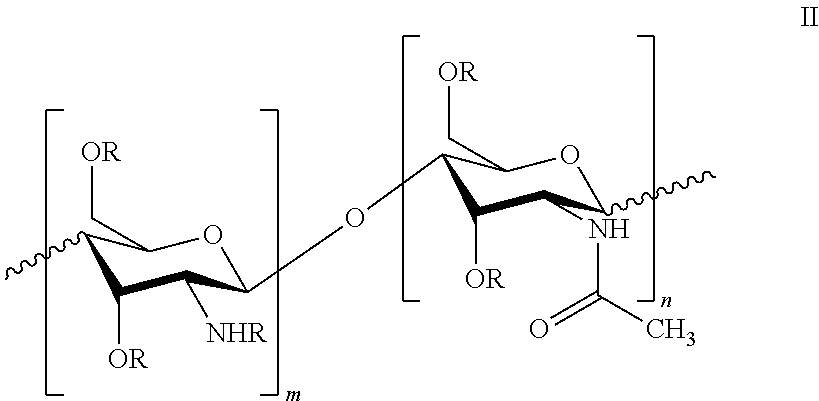
in which
-
- a hydrogen atom, or
- a group of formula

in which n, m and R4 have the meanings designated above, and provided that R represents at least one group of formula

-
- the polysaccharide is a dextran bearing hydrophobic groups, fixed by oxygen atoms of said dextran and representing groups of formula

in which
-
- the cyclodextrin is α-CD.
-
- the polysaccharide is hyaluronic acid bearing hydrophobic groups, fixed by oxygen atoms of said hyaluronic acid and representing groups of formula

in which
-
- the cyclodextrin is α-CD.
-
- the polysaccharide is an amylopectin bearing hydrophobic groups fixed by oxygen atoms of said amylopectin and representing groups of formula

in which
-
- the cyclodextrin is α-CD.
-
- the polysaccharide is a pullulan bearing hydrophobic groups fixed by oxygen atoms of said pullulan and representing groups of formula

in which
-
- the cyclodextrin is α-CD.
-
- the polysaccharide is a heparin bearing hydrophobic groups fixed by nitrogen atoms of said heparin and representing groups of formula

in which
-
- or the polysaccharide is a heparin bearing hydrophobic groups fixed by oxygen atoms of said heparin, these oxygens possibly originating from the hydroxyl or carboxyl groups of the heparin, and representing groups of formula

in which
-
- and the cyclodextrin is α-CD.
-
- the polysaccharide is a carrageenan bearing hydrophobic groups fixed by nitrogen atoms of said carrageenan sulphate and representing groups of formula

in which
-
- or the polysaccharide is a carrageenan bearing hydrophobic groups fixed by oxygen atoms of said carrageenan, these oxygens possibly originating from the hydroxyl or carboxyl groups of carrageenan, and representing groups of formula

in which
-
- and the cyclodextrin is α-CD.
-
- the polysaccharide is a hyaluronic acid bearing hydrophobic groups fixed by nitrogen atoms of said hyaluronic acid and representing groups of formula

in which
-
- or the polysaccharide is a hyaluronic acid bearing hydrophobic groups fixed by oxygen atoms of said hyaluronic acid, these oxygens possibly originating from the hydroxyl or carboxyl groups of the hyaluronic acid, and representing groups of formula

in which
-
- and the cyclodextrin is α-CD.
-
- the polysaccharide is a glycosaminoglycan bearing hydrophobic groups fixed by nitrogen atoms of said glycosaminoglycan and representing groups of formula

in which
-
- or the polysaccharide is a glycosaminoglycan bearing hydrophobic groups fixed by oxygen atoms of said glycosaminoglycan, these oxygens possibly originating from the hydroxyl or carboxyl groups of glycosaminoglycan, and representing groups of formula

in which
-
- and the cyclodextrin is α-CD.
-
- the polysaccharide is a carrageenan sulphate bearing hydrophobic groups fixed by nitrogen atoms of said carrageenan sulphate and representing groups of formula

in which
-
- or the polysaccharide is a carrageenan sulphate bearing hydrophobic groups fixed by oxygen atoms of said carrageenan sulphate, these oxygens possibly originating from the hydroxyl or carboxyl groups of carrageenan sulphate, and representing groups of formula

in which
-
- and the cyclodextrin is α-CD.
-
- the polysaccharide is a dextran sulphate bearing hydrophobic groups fixed by nitrogen atoms of said dextran sulphate and representing groups of formula

in which
-
- or the polysaccharide is a dextran sulphate bearing hydrophobic groups fixed by oxygen atoms of said dextran sulphate, these oxygens possibly originating from the hydroxyl or carboxyl groups of dextran sulphate, and representing groups of formula

in which
-
- and the cyclodextrin is α-CD.
-
- the polysaccharide is a cellulose sulphate bearing hydrophobic groups fixed by nitrogen atoms of said cellulose sulphate and representing groups of formula

in which
-
- or the polysaccharide is a cellulose sulphate bearing hydrophobic groups fixed by oxygen atoms of said cellulose sulphate, these oxygens possibly originating from the hydroxyl or carboxyl groups of cellulose sulphate, and representing groups of formula

in which
-
- and the cyclodextrin is α-CD.
-
- the polysaccharide is a heparan sulphate bearing hydrophobic groups fixed by nitrogen atoms of said heparan sulphate and representing groups of formula

in which
-
- or the polysaccharide is a heparan sulphate bearing hydrophobic groups fixed by oxygen atoms of said heparan sulphate, these oxygens possibly originating from the hydroxyl or carboxyl groups of the heparan sulphate, and representing groups of formula

in which
-
- and the cyclodextrin is α-CD.
-
- the polysaccharide is a keratan sulphate bearing hydrophobic groups fixed by nitrogen atoms of said keratan sulphate and representing groups of formula

in which
-
- or the polysaccharide is a keratan sulphate bearing hydrophobic groups fixed by oxygen atoms of said keratan sulphate, these oxygens possibly originating from the hydroxyl or carboxyl groups of keratan sulphate, and representing groups of formula

in which
-
- and the cyclodextrin is α-CD.
-
- the polysaccharide is a chondroitin sulphate bearing hydrophobic groups fixed by nitrogen atoms of said chondroitin sulphate and representing groups of formula

in which
-
- or the polysaccharide is a chondroitin sulphate bearing hydrophobic groups fixed by oxygen atoms of said chondroitin sulphate, these oxygens possibly originating from the hydroxyl or carboxyl groups of chondroitin sulphate, and representing groups of formula

in which
-
- and the cyclodextrin is α-CD.
-
- the polysaccharide is a dextrin sulphate bearing hydrophobic groups fixed by nitrogen atoms of said dextrin sulphate and representing groups of formula

in which
-
- or the polysaccharide is a dextrin sulphate bearing hydrophobic groups fixed by oxygen atoms of said dextrin sulphate, these oxygens possibly originating from the hydroxyl or carboxyl groups of dextrin sulphate, and representing groups of formula

in which
-
- and the cyclodextrin is α-CD.
-
- a polysaccharide comprising hydrophobic groups bound covalently to said polysaccharide, optionally functionalized with a ligand selected from antibodies, antibody fragments, receptors, lectins or biotin or derivatives thereof,
- a cyclodextrin in the form of monomer, optionally functionalized with a ligand selected from antibodies, antibody fragments, receptors, lectins or biotin or derivatives thereof.
-
- a polysaccharide comprising hydrophobic groups bound covalently to said polysaccharide, optionally functionalized with a ligand selected from antibodies, antibody fragments, receptors, lectins or biotin or derivatives thereof,
- and a cyclodextrin in the form of monomer, optionally functionalized with a ligand selected from antibodies, antibody fragments, receptors, lectins or biotin or derivatives thereof.
-
- one polysaccharide selected from chitosan, dextran, hyaluronic acid, amylose, amylopectin, pullulan, heparin, chitin, cellulose derivatives, heparan sulphate, dermatan sulphate, keratan sulphate, chondroitin sulphate, cellulose sulphate, dextran sulphate, dextrin sulphate, starch, pectin, the alginates, the carrageenans, fucan, curdlan, xylan, polyguluronic acid, xanthan, arabinan, polymannuronic acid, and derivatives thereof, comprising hydrophobic groups selected from linear or branched alkyl groups or linear or branched alkenyl groups bearing from 1 to 4 C═C double bonds, conjugated or not, said hydrophobic groups being bound covalently to said polysaccharide, optionally functionalized with a ligand selected from antibodies, antibody fragments, receptors, lectins or biotin or derivatives thereof,
- and one α-cyclodextrin in the form of monomer, optionally functionalized with a ligand selected from antibodies, antibody fragments, receptors, lectins or biotin or derivatives thereof.
-
- one polysaccharide selected from chitosan, dextran, hyaluronic acid, amylose, amylopectin, pullulan, heparin, chitin, cellulose derivatives, heparan sulphate, dermatan sulphate, keratan sulphate, chondroitin sulphate, cellulose sulphate, dextran sulphate, dextrin sulphate, starch, pectin, the alginates, the carrageenans, fucan, curdlan, xylan, polyguluronic acid, xanthan, arabinan, polymannuronic acid, and derivatives thereof, comprising hydrophobic groups selected from linear or branched alkyl groups containing from 2 to 1000 carbon atoms, or linear or branched, in particular linear, alkenyl groups, which may contain at least one C═C double bond, said hydrophobic groups being bound covalently to said polysaccharide, optionally functionalized with a ligand selected from antibodies, antibody fragments, receptors, lectins or biotin or derivatives thereof,
- and one α-cyclodextrin in the form of monomer, optionally functionalized with a ligand selected from antibodies, antibody fragments, receptors, lectins or biotin or derivatives thereof.
-
- a mixture of at least two polysaccharides selected from chitosan, dextran, hyaluronic acid, amylose, amylopectin, pullulan, heparin, chitin, cellulose derivatives, heparan sulphate, dermatan sulphate, keratan sulphate, chondroitin sulphate, cellulose sulphate, dextran sulphate, dextrin sulphate, starch, pectin, the alginates, the carrageenans, fucan, curdlan, xylan, polyguluronic acid, xanthan, arabinan, polymannuronic acid, and derivatives thereof, comprising hydrophobic groups selected from linear or branched alkyl groups containing from 2 to 1000 carbon atoms, or linear or branched, in particular linear, alkenyl groups, which may contain at least one C═C double bond, said hydrophobic groups being bound covalently to said polysaccharide, optionally functionalized with a ligand selected from antibodies, antibody fragments, receptors, lectins or biotin or derivatives thereof,
- and at least one α-cyclodextrin in the form of monomer, optionally functionalized with a ligand selected from antibodies, antibody fragments, receptors, lectins or biotin or derivatives thereof.
-
- a polysaccharide comprising hydrophobic groups bound covalently by a nitrogen atom or by one or more oxygen atoms to said polysaccharide,
- and a cyclodextrin (CD) in the form of monomer,
to obtain an inclusion complex in which said polysaccharide and said cyclodextrin are bound non-covalently.
-
- a polysaccharide comprising hydrophobic groups bound covalently to the polysaccharide by a nitrogen atom of said polysaccharide,
- and a cyclodextrin (CD) in the form of monomer,
to obtain an inclusion complex in which said polysaccharide and said cyclodextrin are bound non-covalently.
-
- one polysaccharide comprising hydrophobic groups bound covalently to the polysaccharide by a nitrogen atom of said polysaccharide, and
- one cyclodextrin (CD) in the form of monomer,
to obtain an inclusion complex in which said polysaccharide and said cyclodextrin are bound non-covalently.
-
- one polysaccharide in the form of suspension in a solvent, in particular water comprising hydrophobic groups bound covalently to the polysaccharide by oxygen atoms of said polysaccharide, and
- one α-cyclodextrin (CD) in the form of monomer,
to obtain an inclusion complex in which said polysaccharide and said cyclodextrin are bound non-covalently,
and in particular comprising a step of mixing: - a polysaccharide selected from chitosan, dextran, hyaluronic acid, amylose, amylopectin, pullulan, heparin, chitin, heparan sulphate, dermatan sulphate, keratan sulphate, chondroitin sulphate, cellulose sulphate, dextran sulphate, dextrin sulphate, starch, pectin, the alginates, the carrageenans, fucan, curdlan, xylan, polyguluronic acid, xanthan, arabinan, polymannuronic acid, and derivatives thereof,
said polysaccharide comprising hydrophobic groups of formula:

in which
-
- * represents the polysaccharide,
- R4 represents
- a linear or branched alkyl group containing from 1 to 1000 carbon atoms, in particular the —(CH2)14—CH3 or —(CH2)16—CH3 groups,
- a linear or branched alkenyl group containing 2 to 1000 carbon atoms and bearing at least one C═C double bond, in particular the —(CH2)7—CH═CH—CH2—(CH2)7—CH3 or —(CH2)7—CH═CH—(CH2)7—CH3 groups,
- and an α-cyclodextrin (CD) having the formula:

in which
-
- p is equal to 6,
- R1, R2 and R3, which may be identical or different, in particular identical, are hydrogen atoms, alkyl groups comprising 1 to 3 carbon atoms, selected from methyls, ethyls, propyls, isopropyls, —NH2 amino groups, —NH3 + ammonium groups, or —SO4 2− sulphate groups and are in particular hydrogen atoms or methyl groups,
said CD being alpha-cyclodextrin (α-CD) in the form of monomer,
to obtain an inclusion complex in which said polysaccharide and said cyclodextrin are bound non-covalently.
-
- a polysaccharide comprising hydrophobic groups bound covalently to the polysaccharide by oxygen atoms of said polysaccharide, and
- an α-cyclodextrin (CD) in the form of monomer in suspension in a solvent, in particular water,
to obtain an inclusion complex in which said polysaccharide and said cyclodextrin are bound non-covalently,
and in particular comprising a step of mixing: - a polysaccharide selected from chitosan, dextran, hyaluronic acid, amylose, amylopectin, pullulan, heparin, chitin, heparan sulphate, dermatan sulphate, keratan sulphate, chondroitin sulphate, cellulose sulphate, dextran sulphate, dextrin sulphate, starch, pectin, the alginates, the carrageenans, fucan, curdlan, xylan, polyguluronic acid, xanthan, arabinan, polymannuronic acid, and derivatives thereof,
said polysaccharide comprising hydrophobic groups of formula:

in which
-
- * represents the polysaccharide,
- R4 represents
- a linear or branched alkyl group containing from 1 to 1000 carbon atoms, in particular the —(CH2)14—CH3 or —(CH2)16—CH3 groups,
- a linear or branched alkenyl group containing 2 to 1000 carbon atoms and bearing at least one C═C double bond, in particular the —(CH2)7—CH═CH—CH2—(CH2)7—CH3 or —(CH2)7—CH═CH—(CH2)7—CH3 groups, and
- an α-cyclodextrin (CD) having the formula:

in which
-
- p is equal to 6,
- R1, R2 and R3, which may be identical or different, in particular identical, are hydrogen atoms, alkyl groups comprising 1 to 3 carbon atoms, selected from methyls, ethyls, propyls, isopropyls, —NH2 amino groups, —NH3 + ammonium groups, or —SO4 2− sulphate groups, and are in particular hydrogen atoms or methyl groups,
said CD being alpha-cyclodextrin (α-CD) in the form of monomer,
to obtain an inclusion complex in which said polysaccharide and said cyclodextrin are bound non-covalently.
-
- one polysaccharide in the form of suspension in a solvent, in particular water comprising hydrophobic groups bound covalently to the polysaccharide by oxygen atoms of said polysaccharide,
- and one α-cyclodextrin (CD) in the form of monomer, preferably in suspension in a solvent, in particular water,
to obtain an inclusion complex in which said polysaccharide and said cyclodextrin are bound non-covalently,
and in particular comprising a step of mixing: - a polysaccharide selected from chitosan, dextran, hyaluronic acid, amylose, amylopectin, pullulan, heparin, chitin, heparan sulphate, dermatan sulphate, keratan sulphate, chondroitin sulphate, cellulose sulphate, dextran sulphate, dextrin sulphate, starch, pectin, the alginates, the carrageenans, fucan, curdlan, xylan, polyguluronic acid, xanthan, arabinan, polymannuronic acid, and derivatives thereof,
said polysaccharide comprising hydrophobic groups of formula:

in which
-
- * represents the polysaccharide,
- R4 represents
- a linear or branched alkyl group containing from 1 to 1000 carbon atoms, in particular the —(CH2)14—CH3 or —(CH2)16—CH3 groups,
- a linear or branched alkenyl group containing 2 to 1000 carbon atoms and bearing at least one C═C double bond, in particular the —(CH2)7—CH═CH—CH2—(CH2)7—CH3 or —(CH2)7—CH═CH—(CH2)7—CH3 groups, and
- an α-cyclodextrin (CD) having the formula:

in which
-
- p is equal to 6,
- R1, R2 and R3, which may be identical or different, in particular identical, are hydrogen atoms, alkyl groups comprising 1 to 3 carbon atoms, selected from methyls, ethyls, propyls, isopropyls, —NH2 amino groups, —NH3 + ammonium groups, or —SO4 2− sulphate groups, and are in particular hydrogen atoms or methyl groups,
said CD being alpha-cyclodextrin (α-CD) in the form of monomer,
to obtain an inclusion complex in which said polysaccharide and said cyclodextrin are bound non-covalently.
-
- a polysaccharide comprising hydrophobic groups bound covalently to the polysaccharide by oxygen atoms of said polysaccharide,
- and a cyclodextrin (CD) in the form of monomer,
to obtain an inclusion complex in which said polysaccharide and said cyclodextrin are bound non-covalently.
-
- one polysaccharide comprising hydrophobic groups bound covalently to the polysaccharide by oxygen atoms of said polysaccharide,
- and one cyclodextrin (CD) in the form of monomer,
to obtain an inclusion complex in which said polysaccharide and said cyclodextrin are bound non-covalently.
-
- a chitosan comprising hydrophobic groups fixed covalently to the chitosan by one or more oxygen atoms of said chitosan,
- and an α-cyclodextrin (CD),
and in particular comprising a step of mixing between a chitosan of formula I:

or a chitosan of formula II:

in which
-
- m represents the number of D-glucosamine units,
- n represents the number of N-acetyl-D-glucosamine units,
provided that the degree of deacetylation representing the percentage of m relative to the total number of units is greater than 50%, - R4 represents a hydrophobic group and is selected from:
- a linear or branched alkyl group containing from 1 to 1000 carbon atoms, in particular the —(CH2)14—CH3 or —(CH2)16—CH3 groups,
- a linear or branched alkenyl group containing 2 to 1000 carbon atoms and bearing from 1 to 4 C═C double bonds, conjugated or not, in particular the —(CH2)7—CH═CH—CH2—(CH2)7—CH3 or —(CH2)7—CH═CH—(CH2)7—CH3 groups,
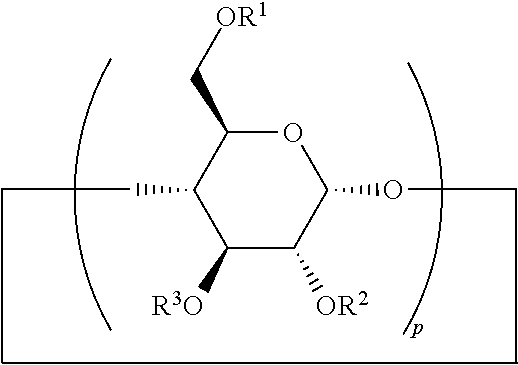
in which
-
- p is equal to 6,
- R1, R2 and R3, which may be identical or different, in particular identical, are hydrogen atoms, alkyl groups comprising 1 to 3 carbon atoms, selected from methyls, ethyls, propyls, isopropyls, —NH2 amino groups, —NH3 + ammonium groups, or —SO4 − sulphate groups, and are in particular hydrogen atoms or methyl groups,
said CD being alpha-cyclodextrin (α-CD) in the form of monomer,
at a concentration in the range from 0.01 to 9000 g/L of aqueous medium, in particular in the range from 1 to 300 g/L of aqueous medium, and in particular equal to approximately 200 g/L of aqueous medium,
to obtain an inclusion complex in which the chitosan of formula I and the cyclodextrin are bound non-covalently.
-
- several polysaccharides comprising hydrophobic groups fixed covalently to the aforesaid polysaccharides by a nitrogen atom and/or by one or more oxygen atoms of said polysaccharides, the polysaccharides being chitosan, dextran, hyaluronic acid, amylose, amylopectin, pullulan, heparin, chitin, cellulose derivatives, heparan sulphate, dermatan sulphate, keratan sulphate, chondroitin sulphate, cellulose sulphate, dextran sulphate, dextrin sulphate, starch, pectin, the alginates, the carrageenans, fucan, curdlan, xylan, polyguluronic acid, xanthan, arabinan, polymannuronic acid, and derivatives thereof,
- a cyclodextrin (CD),
to obtain an inclusion complex in which the polysaccharides and the cyclodextrin are bound non-covalently. The use of several polysaccharides may offer the advantage of modulating the properties of the particles by altering the ratio of the polysaccharides. Thus, it is expected that the size, the overall charge and the intended applications of these particles may be modulated.
-
- a polysaccharide selected from chitosan, dextran, hyaluronic acid, amylose, amylopectin, pullulan, heparin, chitin, cellulose derivatives, heparan sulphate, dermatan sulphate, keratan sulphate, chondroitin sulphate, cellulose sulphate, dextran sulphate, dextrin sulphate, starch, pectin, the alginates, the carrageenans, fucan, curdlan, xylan, polyguluronic acid, xanthan, arabinan, polymannuronic acid, and derivatives thereof, and is in particular chitosan,
said polysaccharide comprising hydrophobic groups of formula:
- a polysaccharide selected from chitosan, dextran, hyaluronic acid, amylose, amylopectin, pullulan, heparin, chitin, cellulose derivatives, heparan sulphate, dermatan sulphate, keratan sulphate, chondroitin sulphate, cellulose sulphate, dextran sulphate, dextrin sulphate, starch, pectin, the alginates, the carrageenans, fucan, curdlan, xylan, polyguluronic acid, xanthan, arabinan, polymannuronic acid, and derivatives thereof, and is in particular chitosan,

in which
-
- * represents the polysaccharide,
- R4 represents:
- a linear or branched alkyl group containing from 1 to 20 carbon atoms, in particular the —(CH2)14—CH3 or —(CH2)16—CH3 groups,
- a linear or branched alkenyl group containing 2 to 20 carbon atoms and bearing from 1 to 4 C═C double bonds, conjugated or not, in particular the —(CH2)7—CH═CH—CH2—(CH2)7—CH3 or —(CH2)7—CH═CH—(CH2)7—CH3 groups, and
- a cyclodextrin (CD) having the formula:

in which
-
- p is an integer equal to 6,
- R1, R2 and R3, which may be identical or different, in particular identical, are hydrogen atoms, alkyl groups comprising 1 to 3 carbon atoms, selected from methyls, ethyls, propyls, isopropyls, —NH2 amino groups, —NH3 − ammonium groups, or —SO4 2− sulphate groups, and are in particular hydrogen atoms or methyl groups,
said CD being alpha-cyclodextrin (α-CD) in the form of monomer,
to obtain an inclusion complex in which said polysaccharide and said cyclodextrin are bound non-covalently.
-
- one polysaccharide selected from chitosan, dextran, hyaluronic acid, amylose, amylopectin, pullulan, heparin, chitin, cellulose derivatives, heparan sulphate, dermatan sulphate, keratan sulphate, chondroitin sulphate, cellulose sulphate, dextran sulphate, dextrin sulphate, starch, pectin, the alginates, the carrageenans, fucan, curdlan, xylan, polyguluronic acid, xanthan, arabinan, polymannuronic acid, and derivatives thereof, and is in particular chitosan,
said polysaccharide comprising hydrophobic groups of formula:
- one polysaccharide selected from chitosan, dextran, hyaluronic acid, amylose, amylopectin, pullulan, heparin, chitin, cellulose derivatives, heparan sulphate, dermatan sulphate, keratan sulphate, chondroitin sulphate, cellulose sulphate, dextran sulphate, dextrin sulphate, starch, pectin, the alginates, the carrageenans, fucan, curdlan, xylan, polyguluronic acid, xanthan, arabinan, polymannuronic acid, and derivatives thereof, and is in particular chitosan,

in which
-
- * represents the polysaccharide,
- R4 represents:
- a linear or branched alkyl group containing from 1 to 20 carbon atoms, in particular the —(CH2)14—CH3 or —(CH2)16—CH3 groups,
- a linear or branched alkenyl group containing 2 to 20 carbon atoms and bearing from 1 to 4 C═C double bonds, conjugated or not, in particular the —(CH2)7—CH═CH—CH2—(CH2)7—CH3 or —(CH2)7—CH═CH—(CH2)7—CH3 groups,
- and a cyclodextrin (CD) having the formula:

in which
-
- p is an integer equal to 6,
- R1, R2 and R3, which may be identical or different, in particular identical, are hydrogen atoms, alkyl groups comprising 1 to 3 carbon atoms, selected from methyls, ethyls, propyls, isopropyls, —NH2 amino groups, —NH3 + ammonium groups, or —SO4 2− sulphate groups, and are in particular hydrogen atoms or methyl groups,
said CD being alpha-cyclodextrin (α-CD) in the form of monomer,
to obtain an inclusion complex in which said polysaccharide and said cyclodextrin are bound non-covalently.
-
- in aqueous solution at a concentration in the range from 0.01 to 9000 g/L, in particular in the range from 1 to 600 g/L, and in particular equal to approximately 10 g/L, the aqueous solvent being selected from pure water, an aqueous solution with pH in the range from 1 to 7 or from 7 to 14, in particular in the range from 5 to 7, or a physiological serum solution optionally enriched with glucose or containing any other excipient for pharmaceutical, medical, paramedical, medical-device, animal-feed, cosmetic, veterinary, agri-food, pesticide, cosmetotextile, perfumery, and environmental use (water purification for example) or in the paint, packaging, building and/or car industry,
- or in dispersion in an aqueous medium selected from pure water, an aqueous solution with pH in the range from 1 to 7 or from 7 to 14, in particular in the range from 5 to 7, or a physiological serum solution optionally enriched with glucose or containing any other excipient for pharmaceutical, medical, paramedical, medical-device, animal-feed, cosmetic, veterinary, agri-food, pesticide, cosmetotextile, perfumery, and environmental use (water purification for example) or in the paint, packaging, building and/or car industry, with a cyclodextrin, α-CD.
-
- in aqueous solution at a concentration in the range from 1 to 150 g/L, in particular in the range from 5 to 50 g/L, and in particular equal to approximately 10 g/L, the aqueous solvent being selected from pure water, an aqueous solution with pH in the range from 1 to 7 or from 7 to 12, in particular in the range from 5 to 7, or a physiological serum solution optionally enriched with glucose or containing any other excipient for pharmaceutical, cosmetic, agri-food or veterinary use,
- or in dispersion in an aqueous medium selected from pure water, an aqueous solution with pH in the range from 1 to 7 or from 7 to 12, in particular in the range from 5 to 7, or a physiological serum solution optionally enriched with glucose or containing any other excipient for pharmaceutical, cosmetic, agri-food or veterinary use,
with a cyclodextrin, α-CD.
with a cyclodextrin, α-CD, at a concentration in the range from 0.01 to 9000 g/L of aqueous medium, in particular in the range from 0.01 to 300 g/L of aqueous medium, and in particular equal to approximately 10 g/L of aqueous medium.
with a cyclodextrin, α-CD, at a concentration in the range from 1 to 150 g/L of aqueous medium, in particular in the range from 1 to 50 g/L of aqueous medium, and in particular equal to approximately 10 g/L of aqueous medium.
-
- the percentage by weight of said polysaccharide being in the range from 0.01% to 90%, and in particular from 0.5% to 50%,
- the percentage by weight of the cyclodextrin being in the range from 0.01% to 90%, and in particular from 0.5% to 50%,
- the percentage by weight of water or of aqueous medium being in the range from 10% to 99.99%, and in particular from 50% to 99.5%.
-
- the percentage by weight of said polysaccharide being in the range from 0.1% to 15%, and in particular from 0.5% to 5%,
- the percentage by weight of the cyclodextrin being in the range from 0.1% to 15%, and in particular from 0.5% to 5%,
- the percentage by weight of water or of aqueous medium being in the range from 70% to 99.9%, and in particular from 90% to 99%.
-
- a linear or branched alkyl group containing from 1 to 1000 carbon atoms, in particular the —(CH2)14—CH3 or —(CH2)16—CH3 groups,
- a linear or branched alkenyl group containing 2 to 1000 carbon atoms and bearing at least one C═C double bond, in particular the —(CH2)7—CH═CH—CH2—(CH2)7—CH3 or —(CH2)7—CH═CH—(CH2)7—CH3 groups,
-
- a linear or branched alkyl group containing from 1 to 20 carbon atoms, in particular the —(CH2)14—CH3 or —(CH2)16—CH3 groups,
- a linear or branched alkenyl group containing 2 to 20 carbon atoms and bearing from 1 to 4 C═C double bonds, conjugated or not, in particular the —(CH2)7—CH═CH—CH2—(CH2)7—CH3 or —(CH2)7—CH═CH—(CH2)7—CH3 groups,
-
- one chitosan comprising hydrophobic groups fixed covalently to the chitosan by a nitrogen atom and/or by one or more oxygen atoms of said chitosan,
- and one cyclodextrin (CD),
to obtain an inclusion complex in which the chitosan and the cyclodextrin are bound non-covalently.
-
- one chitosan comprising hydrophobic groups fixed covalently to the chitosan by a nitrogen atom and/or by one or more oxygen atoms of said chitosan,
- and one cyclodextrin (CD),
to obtain an inclusion complex in which the chitosan and the cyclodextrin are bound non-covalently.

a chitosan of formula:

in which
-
- m represents the number of deacetylated units,
- n represents the number of acetylated units,
provided that the degree of deacetylation representing the percentage of m relative to the total number of units is greater than 50%, - R4 represents a hydrophobic group and is selected from:
- a linear or branched alkyl group containing from 1 to 20 carbon atoms, in particular the —(CH2)14—CH3 or —(CH2)16—CH3 groups,
- a linear or branched alkenyl group containing 2 to 20 carbon atoms and bearing from 1 to 4 C═C double bonds, conjugated or not, in particular the —(CH2)7—CH═CH—CH2—(CH2)7—CH3 or —(CH2)7—CH═CH—(CH2)7—CH3 groups,

in which
-
- p is an integer equal to 6,
- R1, R2 and R3, which may be identical or different, in particular identical, are hydrogen atoms, alkyl groups comprising 1 to 3 carbon atoms, selected from methyls, ethyls, propyls, isopropyls, —NH2 amino groups, —NH3 + ammonium groups, or —SO4 2− sulphate groups, and are in particular hydrogen atoms or methyl groups,
said CD being alpha-cyclodextrin (α-CD) in the form of monomer,
at a concentration in the range from 1 to 150 g/L of aqueous medium, in particular in the range from 1 to 50 g/L of aqueous medium, and in particular equal to approximately 10 g/L of aqueous medium,
said chitosans of formula I or II being - in aqueous solution at a concentration in the range from 1 to 150 g/L, in particular being in the range from 1 to 10 g/L, and in particular being equal to approximately 1 or equal to approximately 10 g/L,
the aqueous solvent being selected from pure water, an aqueous solution with pH in the range from 1 to 7 or from 7 to 12, in particular in the range from 5 to 7, or a physiological serum solution optionally enriched with glucose or containing any other excipient for pharmaceutical, cosmetic, agri-food or veterinary use, - or in dispersion in an aqueous medium selected from pure water, an aqueous solution with pH in the range from 1 to 7 or from 7 to 12, in particular in the range from 5 to 7, or a physiological serum solution optionally enriched with glucose or containing any other excipient for pharmaceutical, cosmetic, agri-food or veterinary use,
the weight of said polysaccharide being in the range from 1 to 150 g/L of aqueous medium, in particular being in the range from 1 to 10 g/L of aqueous medium, and in particular being equal to 1 g/L or 10 g/L of aqueous medium,
at a temperature in the range from 4 to 60° C., in particular at a temperature in the range from 10 to 35° C., and in particular at a temperature equal to approximately 20° C.,
the duration of stirring being in the range from 24 hours to 15 days, in particular in the range from 24 hours to 48 hours, and in particular equal to approximately 36 hours,
to obtain an inclusion complex in which the chitosan of formula I or II and the cyclodextrin are bound non-covalently.
-
- a chitosan of formula:

or a chitosan of formula:

in which
-
- a hydrogen atom, or
- a group of formula

in which
-
- a linear or branched alkyl group containing from 1 to 1000 carbon atoms, in particular the —(CH2)14—CH3 or —(CH2)16—CH3 groups,
- a linear or branched alkenyl group containing 2 to 1000 carbon atoms and bearing at least one C═C double bond, in particular the —(CH2)7—CH═CH—CH2—(CH2)7—CH3 or —(CH2)7—CH═CH—(CH2)7—CH3 groups,
provided that R represents at least one group of formula


in which
-
- p is an integer equal to 6,
- R1, R2 and R3, which may be identical or different, in particular identical, are hydrogen atoms, alkyl groups comprising 1 to 3 carbon atoms, selected from methyls, ethyls, propyls, isopropyls, —NH2 amino groups, —NH3 + ammonium groups, or —SO4 2− sulphate groups, and are in particular hydrogen atoms or methyl groups,
said CD being alpha-cyclodextrin (α-CD) in the form of monomer,
at a concentration in the range from 0.01 to 9000 g/L of aqueous medium, in particular in the range from 1 to 300 g/L of aqueous medium, and in particular equal to approximately 200 g/L of aqueous medium,
said chitosans of formula I or II being - in aqueous solution at a concentration in the range from 0.01 to 9000 g/L, in particular being in the range from 1 to 300 g/L, and in particular being equal to approximately 200 g/L,
the aqueous solvent being selected from pure water, an aqueous solution with pH in the range from 1 to 7 or from 7 to 14, in particular in the range from 5 to 7, or a physiological serum solution optionally enriched with glucose or containing any other excipient for pharmaceutical, medical, paramedical, medical-device, animal-feed, cosmetic, veterinary, agri-food, pesticide, cosmetotextile, perfumery, and environmental use (water purification for example) or in the paint, packaging, building and/or car industry, - or in dispersion in an aqueous medium selected from pure water, an aqueous solution with pH in the range from 0 to 7 or from 7 to 14, in particular in the range from 5 to 7, or a physiological serum solution optionally enriched with glucose or containing any other excipient for pharmaceutical, medical, paramedical, medical-device, animal-feed, cosmetic, veterinary, agri-food, pesticide, cosmetotextile, perfumery, and environmental use (water purification for example) or in the paint, packaging, building and/or car industry,
the weight of said polysaccharide being in the range from 0.01 to 9000 g/L of aqueous medium, in particular being in the range from 1 to 60 g/L of aqueous medium, and in particular being equal to 1 g/L or 10 g/L of aqueous medium,
at a temperature in the range from 1 to 100° C., in particular at a temperature in the range from 10 to 35° C., and in particular at a temperature equal to approximately 20° C.,
the duration of stirring being in the range from 12 hours to 15 days, in particular in the range from 24 hours to 96 hours, and in particular equal to approximately 72 hours,
to obtain an inclusion complex in which the chitosan of formula I or II and the cyclodextrin are bound non-covalently.

in which
-
- a linear or branched alkyl group containing from 1 to 20 carbon atoms, in particular the —(CH2)14—CH3 or —(CH2)16—CH3 groups,
- a linear or branched alkenyl group containing 2 to 20 carbon atoms and bearing from 1 to 4 C═C double bonds, conjugated or not, in particular the —(CH2)7—CH═CH—CH2—(CH2)7—CH3 or —(CH2)7—CH═CH—(CH2)7—CH3 groups,

in which
-
- a hydrogen atom, or
- a group of formula

in which
-
- a linear or branched alkyl group containing from 1 to 1000 carbon atoms, in particular the —(CH2)14—CH3 or —(CH2)16—CH3 groups,
- a linear or branched alkenyl group containing 2 to 1000 carbon atoms and bearing at least one C═C double bond, in particular the —(CH2)7—CH═CH—CH2—(CH2)7—CH3 or —(CH2)7—CH═CH—(CH2)7—CH3 groups,
provided that R represents at least one group of formula


-
- a hydrogen atom, or
- a group of formula

in which
-
- a linear or branched alkyl group containing from 1 to 1000 carbon atoms, in particular the —(CH2)14—CH3 or —(CH2)16—CH3 groups,
- a linear or branched alkenyl group containing 2 to 1000 carbon atoms and bearing at least one C═C double bond, in particular the —(CH2)7—CH═CH—CH2—(CH2)7—CH3 or —(CH2)7—CH═CH—(CH2)7—CH3 groups,
provided that R represents at least one group of formula


in which
-
- a hydrogen atom, or
- a group of formula

R4 represents
-
- a linear or branched alkyl group containing from 1 to 1000 carbon atoms, in particular the —(CH2)14—CH3 or —(CH2)16—CH3 groups,
- a linear or branched alkenyl group containing 2 to 1000 carbon atoms and bearing at least one C═C double bond, in particular the —(CH2)7—CH═CH—CH2—(CH2)7—CH3 or —(CH2)7—CH═CH—(CH2)7—CH3 groups,
provided that R represents at least one group of formula


-
- a hydrogen atom, or
- a group of formula

in which
-
- a linear or branched alkyl group containing from 1 to 1000 carbon atoms, in particular the —(CH2)14—CH3 or —(CH2)16—CH3 groups,
- a linear or branched alkenyl group containing 2 to 1000 carbon atoms and bearing at least one C═C double bond, in particular the —(CH2)7—CH═CH—CH2—(CH2)7—CH3 or —(CH2)7—CH═CH—(CH2)7—CH3 groups,
provided that R represents at least one group of formula


-
- a hydrogen atom, or
- a group of formula

in which
-
- a linear or branched alkyl group containing from 1 to 1000 carbon atoms, in particular the —(CH2)14—CH3 or —(CH2)16—CH3 groups,
- a linear or branched alkenyl group containing 2 to 1000 carbon atoms and bearing at least one C═C double bond, in particular the —(CH2)—CH═CH—CH2—(CH2)7—CH3 or —(CH2)7—CH═CH—(CH2)7—CH3 groups,
provided that R represents at least one group of formula


in which
-
- a hydrogen atom, or
- a group of formula

in which
-
- a linear or branched alkyl group containing from 1 to 20 carbon atoms, in particular the —(CH2)14—CH3 or —(CH2)16—CH3 groups,
- a linear or branched alkenyl group containing 2 to 20 carbon atoms and bearing from 1 to 4 C═C double bonds, conjugated or not, in particular the —(CH2)7—CH═CH—CH2—(CH2)7—CH3 or —(CH2)7—CH═CH—(CH2)7—CH3 groups,
provided that R represents at least one group of formula


in which
-
- a hydrogen atom, or
- a group of formula

-
- a linear or branched alkyl group containing from 1 to 20 carbon atoms, in particular the —(CH2)14—CH3 or —(CH2)16—CH3 groups,
- a linear or branched alkenyl group containing 2 to 20 carbon atoms and bearing from 1 to 4 C═C double bonds, conjugated or not, the —(CH2)7—CH═CH—CH2—(CH2)7—CH3 or —(CH2)7—CH═CH—(CH2)7—CH3 groups.
provided that R represents at least one group of formula


in which
-
- a hydrogen atom, or
- a group of formula

-
- a linear or branched alkyl group containing from 1 to 1000 carbon atoms, in particular the —(CH2)14—CH3 or —(CH2)16—CH3 groups,
- a linear or branched alkenyl group containing 2 to 1000 carbon atoms and bearing at least one C═C double bond, in particular the —(CH2)7—CH═CH—CH2—(CH2)7—CH3 or —(CH2)7—CH═CH—(CH2)7—CH3 groups,
provided that R represents at least one group of formula


-
- a hydrogen atom, or
- a group of formula

in which
-
- a linear or branched alkyl group containing from 1 to 1000 carbon atoms, in particular the —(CH2)14—CH3 or —(CH2)16—CH3 groups,
- a linear or branched alkenyl group containing 2 to 1000 carbon atoms and bearing at least one C═C double bond, in particular the —(CH2)7—CH═CH—CH2—(CH2)7—CH3 or —(CH2)7—CH═CH—(CH2)7—CH3 groups,
provided that R represents at least one group of formula

said substance being dissolved beforehand in an aqueous medium such as water, physiological serum, said medium optionally being enriched with glucose or containing any other excipient for pharmaceutical, medical, paramedical, medical-device, animal-feed, cosmetic, veterinary, agri-food, pesticide, cosmetotextile, perfumery, and environmental use (water purification for example) or in the paint, packaging, building and/or car industry,
said medium optionally containing a co-solvent selected from ethanol or acetone, or a surfactant selected from the polysorbate derivatives, in
-
- a polysaccharide comprising hydrophobic groups fixed covalently to the polysaccharide by a nitrogen atom and by oxygen atoms of said polysaccharide,
said polysaccharide being selected from chitosan, dextran, hyaluronic acid, amylose, amylopectin, pullulan, heparin, chitin, cellulose derivatives, heparan sulphate, dermatan sulphate, keratan sulphate, chondroitin sulphate, cellulose sulphate, dextran sulphate, dextrin sulphate, starch, pectin, the alginates, the carrageenans, fucan, curdlan, xylan, polyguluronic acid, xanthan, arabinan, polymannuronic acid, and derivatives thereof, and is in particular chitosan, - a cyclodextrin designated above,
- a substance used for its properties in the pharmaceutical, medical, paramedical, medical-device, animal-feed, cosmetic, veterinary, agri-food, pesticide, cosmetotextile, perfumery, and environmental fields (water purification for example) or in the paint, packaging, building and/or car industry,
- a polysaccharide comprising hydrophobic groups fixed covalently to the polysaccharide by a nitrogen atom and by oxygen atoms of said polysaccharide,
-
- either by sedimentation, or by centrifugation if they are microparticles (hydrodynamic diameter greater than a micrometer),
- or by ultracentrifugation or by membrane separation methods such as ultrafiltration and microfiltration, if they are nanoparticles (hydrodynamic diameter less than a micrometer).
| TABLE 1 |
| Characteristics of the N-acylated chitosans |
| Grafted | MW of | Degree of | |||
| Modified | hydrophobic | chitosan used | substitution | ||
| chitosan | group | (kDa) | (%) | ||
| MC1 | Oleic acid | 250 | 1.19 | ||
| MC2 | Oleic acid | 250 | 1.67 | ||
| MC3 | Oleic acid | 250 | 7.43 | ||
| MC4 | Oleic acid | 145 | 13.47 | ||
| | Oleic acid | 20 | 5.61 | ||
| | Oleic acid | 20 | 6.35 | ||
| MC7 | Palmitic acid | 250 | 0.55 | ||
| MC8 | Palmitic acid | 250 | 13.12 | ||
| MC9 | Palmitic acid | 250 | 17.01 | ||
| TABLE 2 |
| Characteristics of the O-acylated chitosans |
| Grafted | MW of | Degree of | |||
| Modified | hydrophobic | chitosan used | substitution | ||
| chitosan | group | (kDa) | (%) | ||
| MC10 | Oleic acid | 250 | 1.41 | ||
| MC11 | Palmitic acid | 250 | 2.25 | ||
| MC12 | Palmitic acid | 250 | 4.64 | ||
| TABLE 3 |
| Shifts obtained in NMR of the solid carbon of O-oleoyl- |
| chitin expressed in ppm and the corresponding functions |
| Function | Shift (ppm) | ||
| ═CH—, —CH2—, —CH3 | 14.29, 22.93, 29.81 | ||
| C2 | 55.35 | ||
| C6 | 60.96 | ||
| C3-C5 | 73.87 | ||
| C4 | 83.85 | ||
| C1 | 104.03 | ||
| C═O amide and ester | 173.79 | ||
| TABLE 4 |
| Sizes of the particles obtained from N-acylated or O-acylated chitosan |
| Percentage | Percentage | ||||||
| Molecular | by weight of | by weight | Percentage | Particle | |||
| weight | Fatty | DS | amphiphilic | of α- | by weight | size | |
| polysaccharide | (kDa) | acid | (%) | polysaccharide | cyclodextrin | of water | (nm)* |
| N-acylated | 250 | PA | 13.12 | 1 | 10 | 89 | 7320 ± 1823 |
| chitosan | |||||||
| O-acylated | 250 | OA | 4.64 | 1 | 10 | 89 | 2090 ± 367 |
| chitosan | |||||||
| *Hydrodynamic diameter expressed by volume. | |||||||
| TABLE 5 |
| Example of active molecules encapsulated. |
| Initial | Encapsu- | ||||
| Polysac- | concentration of | Concentration | lation | ||
| charide | active molecules | encapsulated | yield | ||
| used | (g/L) | (g/L) | (%) | ||
| Vitamin B6 | MC8 | 194 | 104.65 | 53.94 |
| Vitamin B6 | MC9 | 2.31 | 1.52 | 65.82 |
| Paracetamol | MC11 | 2.34 | 0.78 | 33.33 |
| Caffeine | MC8 | 21.7 | 3.15 | 17.53 |
| Caffeine | MC6 | 21.7 | 3.59 | 16.55 |
| Caffeine | MC9 | 2.33 | 0.51 | 22.23 |
| TABLE 6 |
| Effect of varying the concentration of O-palmitoyl-heparin on the |
| hydrodynamic diameter of the nanoparticles composed of heparin DS2 |
| Concen- | Concen- | |||
| Concen- | tration of | tration | ||
| tration | O-palmitoyl- | ratio α-CD/O- | ||
| of α-CD | heparin | palmitoyl- | ||
| Name | (g/L) | DS1 (g/L) | heparin DS1 | Dh (nm) |
| |
0 | 10 | 0 | No formation of |
| | ||||
| Hep2 | ||||
| 100 | 10 | 10 | 344 ± 105 | |
| |
100 | 5 | 20 | 344 ± 128 |
| |
100 | 2.5 | 40 | 659 ± 260 |
| TABLE 7 |
| Effect of varying the concentration of α-CD on the hydrodynamic |
| diameter of the nanoparticles consisting of heparin DS2 |
| Concen- | Concen- | |||
| Concen- | tration of | tration | ||
| tration | O-palmitoyl- | ratio α-CD/O- | ||
| of α-CD | heparin | palmitoyl- | ||
| Name | (g/L) | DS2 (g/L) | heparin DS2 | Dh (nm) |
| |
0 | 10 | 0 | No formation of |
| | ||||
| Hep6 | ||||
| 100 | 10 | 10 | 340 ± 19 | |
| |
50 | 10 | 5 | 355 ± 11 |
| Hep8 | 25 | 10 | 2.5 | 410 ± 24 |
| TABLE 8 |
| Effect of varying the concentration of α-CD on the hydrodynamic |
| diameter of the microparticles consisting of carrageenan DS1 |
| Variation in the quantity of α-cyclodextrin (FIG. 19) |
| Concen- | Concen- | |||
| Concen- | tration of | tration | ||
| tration | O-palmitoyl- | ratio α-CD/O- | ||
| of α-CD | carrageenan | palmitoyl- | ||
| Name | (g/L) | DS1 (g/L) | carrageenan DS1 | Dh (nm) |
| |
0 | 10 | 0 | No formation of |
| particles, the | ||||
| product is insolu- | ||||
| ble in | ||||
| Carr2 | ||||
| 100 | 10 | 10 | 1196 ± 242 | |
| Carr3 | 51 | 10 | 5 | 2053 ± 642 |
| Carr4 | 27 | 10 | 2.7 | 3613 ± 800 |
| TABLE 9 |
| Effect of varying the concentration of O-palmitoyl-carrageenan on the hy- |
| drodynamic diameter of the microparticles consisting of carrageenan DS1 |
| Variation in the quantity of O-palmitoyl-carrageenan DS1 (FIG. 20) |
| Concen- | Concen- | |||
| Concen- | tration of | tration | ||
| tration | O-palmitoyl- | ratio α-CD/O- | ||
| of α-CD | carrageenan | palmitoyl- | ||
| Name | (g/L) | DS1 (g/L) | carrageenan DS1 | Dh (nm) |
| |
100 | 2.5 | 40 | 1089 ± 272 |
| |
100 | 5 | 20 | 1277 ± 218 |
| |
100 | 10 | 10 | 1196 ± 242 |
| |
100 | 20 | 5 | 1384 ± 225 |
| |
100 | 30 | 3.3 | 1658 ± 403 |
| TABLE 10 |
| Effect of varying the concentration of α-CD on the hydrodynamic diame- |
| ter of the microparticles and nanoparticles composed of carrageenan DS2 |
| Variation in the quantity of α-cyclodextrin (FIG. 21) |
| Concen- | Concen- | |||
| Concen- | tration of | tration | ||
| tration | O-palmitoyl- | ratio α-CD/O- | ||
| of α-CD | carrageenan | palmitoyl- | ||
| Name | (g/L) | DS2 (g/L) | carrageenan DS2 | Dh (nm) |
| Carr10 | 0 | 10 | 0 | No formation of |
| particles, the | ||||
| product is insolu- | ||||
| ble in | ||||
| Carr11 | ||||
| 100 | 10 | 10 | 3409 ± 226 | |
| Carr12 | 50 | 10 | 5 | 2804 ± 288 |
| Carr13 | 25 | 10 | 2.5 | 1412 ± 290 |
| |
10 | 10 | 1 | 1129 ± 491 |
| Carr15 | 5 | 10 | 0.5 | 365 ± 114 |
| TABLE 11 |
| Effect of varying the concentration of O-palmitoyl-carrageenan on the hy- |
| drodynamic diameter of the microparticles composed of carrageenan DS3 |
| Variation in the quantity of O-palmitoyl-carrageenan DS3. |
| Concen- | Concen- | |||
| Concen- | tration of | tration ratio | ||
| tration | O-palmitoyl- | α-CD/O- | ||
| of α-CD | carrageenan | palmitoyl- | ||
| Name | (g/L) | DS3 (g/L) | carrageenan DS3 | Dh (nm) |
| |
100 | 2.5 | 40 | 1457 ± 431 |
| |
100 | 5 | 20 | 2521 ± 612 |
| |
100 | 10 | 10 | 3340 ± 265 |
| |
100 | 20 | 5 | 5011 ± 371 |
| |
100 | 30 | 3.3 | 6125 ± 730 |
| TABLE 12 |
| Effect of varying the concentration of castor oil |
| on the hydrodynamic diameter of the microparticles |
| and nanoparticles composed of chitosan MC9 |
| Concentration | Concentration of | Concentration of | |
| of α-CD (g/L) | MC9 DS 17.01% (g/L) | castor oil (g/L) | Dh (nm) |
| 100 | 25 | 0 | 1416 ± 45 |
| 100 | 25 | 13 | 896 ± 44 |
| 100 | 25 | 23 | 964 ± 31 |
| TABLE 13 |
| Effect of varying the concentration of castor oil |
| and the concentration of O-oleoyl-chitin on the |
| hydrodynamic diameter of the microparticles |
| Concentration of | |||
| Concentration | O-oleoyl-chitin | Concentration of | |
| of α-CD (g/L) | DS 0.68% (g/L) | castor oil (g/L) | Dh (nm) |
| 100 | 25 | 0 | 2734 ± 206 |
| 100 | 25 | 13 | 2057 ± 54 |
| 100 | 25 | 19.5 | 1875 ± 121 |
| 100 | 50 | 0 | 1487 ± 58 |
| 100 | 50 | 12 | 1579 ± 98 |
| 100 | 50 | 19.5 | 1310 ± 38 |
| TABLE 14 |
| Measurement of the hydrodynamic diameters of the particles |
| (of chitosan MC4: 145 kDa N-acylated with OA and a |
| DS 13.47%) before and after lyophilization |
| Concentration | Dh (nm) |
| of N-oleoyl- | Concentration | Before | After | |
| chitosan (g/L) | of α-CD (g/L) | | lyophilization | |
| 10 | 20 | 3050 ± 345 | 2880 ± 1102 |
| 10 | 100 | 1300 ± 139 | 1910 ± 173 |
| TABLE 15 |
| Results of measurements of the hydrodynamic diameters |
| of the microparticles obtained at the pilot scale in comparison |
| with those obtained at the laboratory scale |
| Laboratory scale | Pilot scale | ||
| |
2 |
100 mL | ||
| prepared | ||||
| Dh (nm) | 1680 ± 437 | 1730 ± 110 | ||
| TABLE 16 |
| Hydrodynamic diameters of the microparticles composed of |
| a mixture of O-palmitoyl-chitosan and O-palmitoyl-dextran |
| Concentration | Concentration | ||
| Concentration | of O-palmitoyl- | of O-palmitoyl- | |
| of α-CD (g/L) | chitosan (g/L) | dextran (g/L) | Dh (nm) |
| 100 | 7.6 | 2.5 | 1707 ± 122 |
| 100 | 2.5 | 7.5 | 3261 ± 230 |
| TABLE 17 |
| Hydrodynamic diameters of the microparticles composed of a |
| mixture of O-palmitoyl-chitosan and O-palmitoyl-pullulan |
| Concentration | Concentration | ||
| Concentration | of O-palmitoyl- | of O-palmitoyl- | |
| of α-CD (g/L) | chitosan (g/L) | pullulan (g/L) | Dh (nm) |
| 100 | 7.7 | 2.5 | 2292 ± 89 |
| 100 | 5 | 5 | 2908 ± 112 |
| 100 | 2.5 | 7.5 | 2057 ± 271 |
| TABLE 18 |
| Hydrodynamic diameters of the microparticles composed of |
| a mixture of O-palmitoyl-chitin and O-palmitoyl-dextran |
| Concentration | Concentration | ||
| Concentration | of O-oleoyl- | of O-palmitoyl- | |
| of α-CD (g/L) | chitin (g/L) | dextran (g/L) | Dh (nm) |
| 100 | 7.6 | 2.5 | 4899 ± 185 |
| 100 | 2.5 | 7.5 | 3960 ± 311 |
| TABLE 20 |
| Hydrodynamic diameters of the microparticles composed of |
| a mixture of O-palmitoyl-chitin and O-palmitoyl-pullulan |
| Concentration | Concentration | ||
| Concentration | of O-oleoyl- | of O-palmitoyl- | |
| of α-CD (g/L) | chitin (g/L) | pullulan (g/L) | Dh (nm) |
| 100 | 5 | 5 | 3372 ± 283 |
| 100 | 2.5 | 7.5 | 3342 ± 210 |
| TABLE 21 |
| Values of the median effective concentration (EC50) in μg/mL. |
| Hep2 | Hep3 | Hep4 | Hep8 | ||
| HSV-1 | 0.99 | 1.25 | 1.13 | 6.61 | ||
| HSV-2 | 0.65 | 0.83 | 1.22 | 3.65 | ||
| HPV-16 | 1.96 | 0.24 | 3.95 | 2.55 | ||
| RSV | 0.24 | 0.28 | 0.27 | 0.36 | ||
| Rotavirus | — | — | — | — | ||
| TABLE 22 |
| Absence of the formation of particles by mixing O-palmitoyl- |
| chitosan (MC12) with HP-β-CD or Me-β-CD |
| Concentration | Concentration | Appearance of the | |
| CD used | of MC12 (g/L) | of CD (g/L) | preparation |
| HP-β-CD | 1.25 | 100 | Large insoluble white |
| 2.5 | 100 | aggregates | |
| 5 | 100 | ||
| 5 | 10 | ||
| 5 | 15 | ||
| 5 | 20 | ||
| 5 | 25 | ||
| 5 | 50 | ||
| Me-β-CD | 2.5 | 100 | |
| 5 | 100 | ||
| 10 | 100 | ||
| 5 | 10 | ||
| 5 | 15 | ||
| 5 | 20 | ||
| 5 | 25 | ||
| 5 | 50 | ||
| TABLE 23 |
| Absence of the formation of particles using the |
| derivatives of β-cyclodextrin and O-oleoyl-chitin |
| Concentration | |||
| O-oleoyl-chitin | Concentration | Appearance of the | |
| CD used | DS 0.1% (g/L) | CD (g/L) | preparation |
| HP-β-CD | 2.5 | 100 | Large white aggregates |
| 5 | 100 | ||
| 10 | 100 | ||
| 5 | 10 | ||
| 5 | 15 | ||
| 5 | 20 | ||
| 5 | 25 | ||
| Me-β-CD | 2.5 | 100 | White aggregates |
| 5 | 100 | ||
| 10 | 100 | ||
| 5 | 10 | ||
| 5 | 15 | ||
| 5 | 20 | ||
| 5 | 25 | ||
| 5 | 50 | ||
| TABLE 24 |
| Absence of the formation of particles using the derivatives |
| of β-cyclodextrin and O-palmitoyl-pullulan |
| Concentration of | |||
| O-palmitoyl- | Concentration | Appearance of the | |
| CD used | pullulan (g/L) | CD (g/L) | preparation |
| HP-β- | 2.5 | 100 | Solution: dissolution of |
| CD | 5 | 100 | O-palmitoyl- |
| 10 | 100 | White aggregates | |
| 5 | 10 | ||
| 5 | 15 | ||
| 5 | 20 | ||
| 5 | 25 | ||
| Me-β- | 2.5 | 100 | |
| CD | 5 | 100 | |
| 10 | 100 | ||
| 5 | 10 | ||
| TABLE 25 |
| Effect of varying the concentration of α-CD on the size |
| of the microparticles consisting of O-palmitoyl-hyaluronic acid |
| Concentration | Concentration | ||
| of O-palmitoyl- | ratio α-CD/ | ||
| Concentration | hyaluronic | O-palmitoyl- | |
| of α-CD (g/L) | acid (g/L) | acid hyaluronic | Dh (nm) |
| 0 | 10 | 0 | Absence of the |
| formation of | |||
| particles, presence | |||
| of large insoluble | |||
| aggregates | |||
| 25 | 10 | 2.5 | 1946 ± 589 |
| 100 | 10 | 10 | 2479 ± 334 |
| TABLE 26 |
| Example of encapsulated active molecules. |
| Initial | Encapsu- | |||||
| Poly | concentration | lated | Encapsu- | |||
| Ethanol/ | saccha- | of active | concen- | lation | ||
| water | ride | molecules | tration | yield | ||
| % v/v | used | (g/L) | (g/L) | (%) | ||
| |
40/60 | MC6 | 3.5 | 1.09 | 31.12 |
Claims (13)


Applications Claiming Priority (4)
| Application Number | Priority Date | Filing Date | Title |
|---|---|---|---|
| FR1253242 | 2012-04-06 | ||
| FR1253242A FR2989001B1 (en) | 2012-04-06 | 2012-04-06 | MICROPARTICLES AND NANOPARTICLES COMPRISING HYDROPHOBIC POLYSACCHARIDES AND ALPHA-CYCLODEXTRIN |
| FR12/53242 | 2012-04-06 | ||
| PCT/FR2013/000089 WO2013150193A1 (en) | 2012-04-06 | 2013-04-05 | Microparticles and nanoparticles made up of hydrophobized polysaccharides and an alpha-cyclodextrine |
Publications (2)
| Publication Number | Publication Date |
|---|---|
| US20150151005A1 US20150151005A1 (en) | 2015-06-04 |
| US10412960B2 true US10412960B2 (en) | 2019-09-17 |
Family
ID=48237055
Family Applications (1)
| Application Number | Title | Priority Date | Filing Date |
|---|---|---|---|
| US14/390,221 Expired - Fee Related US10412960B2 (en) | 2012-04-06 | 2013-04-05 | Microparticles and nanoparticles made up of hydrophobized polysaccharides and an alpha-cyclodextrine |
Country Status (4)
| Country | Link |
|---|---|
| US (1) | US10412960B2 (en) |
| EP (1) | EP2833919A1 (en) |
| FR (1) | FR2989001B1 (en) |
| WO (1) | WO2013150193A1 (en) |
Cited By (2)
| Publication number | Priority date | Publication date | Assignee | Title |
|---|---|---|---|---|
| US11708424B1 (en) * | 2022-05-12 | 2023-07-25 | Javad Karimi | Inclusion of chitosan and herbal extracts as an antimicrobial agent |
| IT202200004574A1 (en) | 2022-03-10 | 2023-09-10 | Sergio Ammendola | N-acetylglucosamine nanoparticles and their applications |
Families Citing this family (17)
| Publication number | Priority date | Publication date | Assignee | Title |
|---|---|---|---|---|
| AR095937A1 (en) * | 2013-04-05 | 2015-11-25 | Acraf | POTENTIAL OF SOLUBILITY IN GLUCOGEN BASED WATER |
| FR3006315B1 (en) | 2013-05-31 | 2015-10-02 | Centre Nat Rech Scient | COMPATIBLE SELF-ASSOCIATIVE MICROPARTICLES AND NANOPARTICLES OF PROTEINS |
| FR3011470B1 (en) * | 2013-10-09 | 2017-01-06 | Centre Nat De La Rech Scient (Cnrs) | ANTIFUNGAL COMPOSITION COMPRISING AN ANTIFUNGAL AGENT AND HYDROPHOBIC CHITOSAN |
| US9259357B2 (en) | 2014-04-16 | 2016-02-16 | Loma Linda University | Composition, preparation, and use of chitosan shards for biomedical applications |
| FR3033134B1 (en) | 2015-02-27 | 2018-05-04 | Centre National De La Recherche Scientifique (Cnrs) | HYALURONIC ACID PARTICLES FOR COSMETIC OR DERMATOLOGICAL APPLICATIONS |
| WO2018024902A1 (en) * | 2016-08-04 | 2018-02-08 | Biokawthar Technologies | Uses of hydrophobically-modified hyaluronic acid through amide and/or hydrazide linkages in cosmetics and/or dermatology |
| EP3609507B1 (en) * | 2017-04-13 | 2024-08-14 | Medcura, Inc. | Variable-size hydrophobically-modified polymers |
| US20210260244A1 (en) * | 2018-06-29 | 2021-08-26 | Merz Pharma Gmbh & Co. Kgaa | Fatty acid-grafted hyaluronic acid, dermal filler formulations comprising same, process for preparation and use thereof |
| IT201800007683A1 (en) | 2018-07-31 | 2020-01-31 | Altergon Sa | Synergistic cooperative compositions useful for soft tissue augmentation, drug release and related fields |
| EA038202B1 (en) * | 2019-03-05 | 2021-07-22 | Общество с ограниченной ответственностью "Инмед" | Method for preparing modified chitosan, solution for preparing hemostatic material, method for preparing hemostatic material, hemostatic material |
| CN110527114B (en) * | 2019-09-17 | 2022-05-17 | 成都工业学院 | A method for preparing starch-β-cyclodextrin microspheres based on inverse latex method |
| CN112843336B (en) * | 2021-03-04 | 2022-10-25 | 首都医科大学 | A kind of nanoparticle, gel for promoting dentin regeneration and preparation method and application thereof |
| CN114904384B (en) * | 2021-06-04 | 2023-08-22 | 浙江施维康生物医学材料有限公司 | Biological enzyme-containing air purifying agent and preparation method thereof |
| CN114794231B (en) * | 2022-05-18 | 2023-03-21 | 中国热带农业科学院南亚热带作物研究所 | Chitosan plant essential oil microcapsule composite coating preservative, preparation method and application |
| CN118647385A (en) * | 2022-09-26 | 2024-09-13 | 林峙谙 | Novel compositions comprising terpenoids and macromolecules and uses thereof |
| CN115477774B (en) * | 2022-10-13 | 2025-11-21 | 合肥工业大学 | Starch-based colon dual-targeting microgel and preparation method and application thereof |
| FR3147951A1 (en) | 2023-04-19 | 2024-10-25 | Paris Sciences Et Lettres | PARTICLES OF MONOSACCHARIDES MODIFIED BY A HYDROPHOBIC CHAIN AND CYCLODEXTRIN. |
Citations (11)
| Publication number | Priority date | Publication date | Assignee | Title |
|---|---|---|---|---|
| US4228160A (en) * | 1978-01-27 | 1980-10-14 | Chinoin Gyogyszer Es Vegyeszeti Termekek Gyara Rt. | Inclusion complex of cyclodextrin and indomethacin and a process for the preparation thereof, method of use and pharmaceutical composition |
| US4371673A (en) * | 1980-07-21 | 1983-02-01 | The United States Of America As Represented By The Secretary Of The Department Of Health And Human Services | Water soluble forms of retinoids |
| US4670419A (en) * | 1982-07-28 | 1987-06-02 | Takeda Chemical Industries, Ltd. | Pharmaceutical composition and its rectal use |
| US4696918A (en) * | 1984-11-02 | 1987-09-29 | Johnson Matthey Public Limited Company | Solubilized platinum compound |
| JP2003267817A (en) | 2002-03-18 | 2003-09-25 | Pias Arise Kk | Skin distributing and permeating composition and skin care preparation and cosmetic formulated with the composition |
| US20040109888A1 (en) * | 2002-10-09 | 2004-06-10 | Insert Therapeutics, Inc. | Cyclodextrin-based materials, compositions and uses related thereto |
| US20050004348A1 (en) | 2002-12-23 | 2005-01-06 | Miyamoto Ken-Ichi | Novel type II Na/Pi cotransporters and type II Na/Pi cotransporter expression regulatory factors |
| US20050203055A1 (en) | 2000-06-30 | 2005-09-15 | Zaneveld Lourens J.D. | Cellulose sulfate and other sulfated polysaccharides to prevent and treat papilloma virus infection and other infections |
| WO2008003685A1 (en) | 2006-07-06 | 2008-01-10 | Henkel Ag & Co. Kgaa | O/w emulsion |
| US20080220030A1 (en) | 2005-06-02 | 2008-09-11 | Universidade De Santiago De Compostela | Nanoparticles Comprising Chitosan and Cyclodextrin |
| US7682635B2 (en) * | 2002-07-11 | 2010-03-23 | Centre National De La Recherche Scientifique (C.N.R.S.) | Aqueous dispersions of nanometric or micrometric particles for encapsulating chemical compounds |
Family Cites Families (1)
| Publication number | Priority date | Publication date | Assignee | Title |
|---|---|---|---|---|
| FR2850040B1 (en) | 2003-01-20 | 2005-03-11 | Centre Nat Rech Scient | SYSTEMS FOR MICROENCAPSULATION AND THEIR APPLICATIONS |
-
2012
- 2012-04-06 FR FR1253242A patent/FR2989001B1/en not_active Expired - Fee Related
-
2013
- 2013-04-05 EP EP13719892.5A patent/EP2833919A1/en not_active Withdrawn
- 2013-04-05 WO PCT/FR2013/000089 patent/WO2013150193A1/en not_active Ceased
- 2013-04-05 US US14/390,221 patent/US10412960B2/en not_active Expired - Fee Related
Patent Citations (11)
| Publication number | Priority date | Publication date | Assignee | Title |
|---|---|---|---|---|
| US4228160A (en) * | 1978-01-27 | 1980-10-14 | Chinoin Gyogyszer Es Vegyeszeti Termekek Gyara Rt. | Inclusion complex of cyclodextrin and indomethacin and a process for the preparation thereof, method of use and pharmaceutical composition |
| US4371673A (en) * | 1980-07-21 | 1983-02-01 | The United States Of America As Represented By The Secretary Of The Department Of Health And Human Services | Water soluble forms of retinoids |
| US4670419A (en) * | 1982-07-28 | 1987-06-02 | Takeda Chemical Industries, Ltd. | Pharmaceutical composition and its rectal use |
| US4696918A (en) * | 1984-11-02 | 1987-09-29 | Johnson Matthey Public Limited Company | Solubilized platinum compound |
| US20050203055A1 (en) | 2000-06-30 | 2005-09-15 | Zaneveld Lourens J.D. | Cellulose sulfate and other sulfated polysaccharides to prevent and treat papilloma virus infection and other infections |
| JP2003267817A (en) | 2002-03-18 | 2003-09-25 | Pias Arise Kk | Skin distributing and permeating composition and skin care preparation and cosmetic formulated with the composition |
| US7682635B2 (en) * | 2002-07-11 | 2010-03-23 | Centre National De La Recherche Scientifique (C.N.R.S.) | Aqueous dispersions of nanometric or micrometric particles for encapsulating chemical compounds |
| US20040109888A1 (en) * | 2002-10-09 | 2004-06-10 | Insert Therapeutics, Inc. | Cyclodextrin-based materials, compositions and uses related thereto |
| US20050004348A1 (en) | 2002-12-23 | 2005-01-06 | Miyamoto Ken-Ichi | Novel type II Na/Pi cotransporters and type II Na/Pi cotransporter expression regulatory factors |
| US20080220030A1 (en) | 2005-06-02 | 2008-09-11 | Universidade De Santiago De Compostela | Nanoparticles Comprising Chitosan and Cyclodextrin |
| WO2008003685A1 (en) | 2006-07-06 | 2008-01-10 | Henkel Ag & Co. Kgaa | O/w emulsion |
Non-Patent Citations (28)
| Title |
|---|
| Auzely-Velty, Rachel. "Self-assembling polysaccharide systems based on cyclodextrin complexation: Synthesis, properties and potential applications in the biomaterials field." Comptes Rendus Chimie 14.2-3 (2011): 167-177. * |
| Burckbuchler Virginie et al.: "Rheological and structural characterization of the interactions between cyclodextrin compounds and hydrophobically modified alginate" Biomacromolecules vol. 7. No. 6. Jun. 2006 (Jun. 2006), pp. 1871-1878, XP002685063, abstract figures 1.6. |
| C�LINE GALANT , ANNA-LENA KJ�NIKSEN , GIAO T. M. NGUYEN , KENNETH D. KNUDSEN , BO NYSTR�M: "Altering associations in aqueous solutions of a hydrophobically modified alginate in the presence of beta-cyclodextrin monomers.", JOURNAL OF PHYSICAL CHEMISTRY PART B, AMERICAN CHEMICAL SOCIETY, US, vol. 110, no. 1, 12 January 2006 (2006-01-12), US, pages 190 - 195, XP002685062, ISSN: 1520-6106, DOI: 10.1021/JP0518759 |
| Desbrieres J et al: "Hydrophobic Derivatives of Chitosan: Characterization and Rheological Behaviour", International Journal of Biological Macromolecules. Elsevier BV. NL, vol. 19. No. 1 Jan. 1, 1996 (Jan. 1, 1996). pp. 21-28 XP000944914, ISSN: 0141-8130. DOI: 10.1016/0141-8130(96)01095-1 the whole document. |
| DESBRIERES J., MARTINEZ C., RINAUDO M.: "HYDROPHOBIC DERIVATIVES OF CHITOSAN: CHARACTERIZATION AND RHEOLOGICAL BEHAVIOUR.", INTERNATIONAL JOURNAL OF BIOLOGICAL MACROMOLECULES., ELSEVIER BV, NL, vol. 19., no. 01., 1 January 1996 (1996-01-01), NL, pages 21 - 28., XP000944914, ISSN: 0141-8130, DOI: 10.1016/0141-8130(96)01095-1 |
| Dowling M B et al.: "A self-assembling hydrophobically modified chitosan capable of reversible hemostatic action", Biomaterials Elsevier Science Ltd. UK, vol. 32, No. 13, May 2011 (May 2011), pp. 3351-3357, XP002685064, ISSN: 0142-9612 p. 3352, section 2.2 figure 4. |
| FR Search Report, dated Oct. 11, 2014, from corresponding FR application. |
| Fülöp, Z., et al. "Self-assembly of cyclodextrins: formation of cyclodextrin polymer based nanoparticles." Journal of Drug Delivery Science and Technology 22.3 (2012): 215-221. * |
| Galant Celine et al.: "Altering associations in aqueous solutions of a hydrophobically modified alginate in the presence of beta-cyclodextrin monomers." The Journal of Physical Chemistry. B Jan. 12, 2006 LNKD-PUBMED:16471520, vol. 110. No. 1. Jan. 12, 2006 (Jan. 12, 2006). pp. 190-195. XP002685062, ISSN:1520-6106 abstract p. 190. left column. last phrase-right column. second paragraph p. 191. section "Synthesis and Solution Preparation" p. 194, section "Conclusions" figure 6. |
| HITOSHI SASHIWA , NORIOKI KAWASAKI , ATSUYOSHI NAKAYAMA , EINOSUKE MURAKI , NOBORU YAMAMOTO , HONG ZHU , HIROSHI NAGANO , YOSHIHIK: "Chemical modification of chitosan. 13.<1> Synthesis of organosoluble, palladium adsorbable, and biodegradable chitosan derivatives toward the chemical plating on plastics", BIOMACROMOLECULES, AMERICAN CHEMICAL SOCIETY, US, vol. 3, no. 5, 1 September 2002 (2002-09-01), US, pages 1120 - 1125, XP002685074, ISSN: 1525-7797, DOI: 10.1021/BM0200478 |
| Huh Kang Moo et al.: "Supramolecular hydrogel formation based on inclusion complexation between poly(ethylene glycol)-modified chitosan and alpha-cyclodextrin", Macromolecular Bioscience Feb. 20, 2004 LNKD-PUBMED:15468199, vol. 4, No. 2, Feb. 20, 2004 (Feb. 20, 2004), pp. 92-99, XP002685060, ISSN: 1616-5187 p. 92 p. 93, schema 1 p. 94; table 1 p. 94, left-hand column, paragraph 2 figure 9 p. 99, section "Conclusions". |
| International Search Report, dated Jun. 20, 2013, from corresponding PCT application. |
| KANG MOO HUH, YONG WOO CHO, HESSON CHUNG, ICK CHAN KWON, SEO YOUNG JEONG, TOORU OOYA, WON KYU LEE, SHINTARO SASAKI, NOBUHIKO YUI: "Supramolecular hydrogel formation based on inclusion complexation between poly(ethylene glycol)-modified chitosan and alpha-cyclodextrin.", MACROMOLECULAR BIOSCIENCE, WILEY-VCH VERLAG GMBH, DE, vol. 4, no. 2, 20 February 2004 (2004-02-20), DE, pages 92 - 99, XP002685060, ISSN: 1616-5187, DOI: 10.1002/MABI.200300037 |
| Karlberg Maria et al.: "Gels of hydrophobically modified hydroxyethyl cellulose cross-linked by amylose, Competition with cyclodextrin", Langmuir: The ACS Journal of Surfaces and Colloids Feb. 28, 2006 LNKDPUBMED: 16489813, vo 1. 22, No. 5, Feb. 28, 2006 (Feb. 28, 2006), pp. 2241-2248, XP002685065, ISSN: 0743-7463 abstract p. 2242, left-hand column, paragraph 1 p. 2242, section "Materials" p. 2248, section "Concluding Discussion". |
| Layre, Anne-Magali, et al. "Tuning the interactions in cyclodextrin polymer nanoassennblies." European Polymer Journal 45.11 (2009): 3016-3026. * |
| MARIA KARLBERG , LENNART PICULELL , SYLVAINE RAGOUT: "Gels of hydrophobically modified hydroxyethyl cellulose cross-linked by amylose. Competition with cyclodextrin.", LANGMUIR, AMERICAN CHEMICAL SOCIETY, US, vol. 22, no. 5, 28 February 2006 (2006-02-28), US, pages 2241 - 2248, XP002685065, ISSN: 0743-7463, DOI: 10.1021/LA052177I |
| MATTHEW B. DOWLING, RAKESH KUMAR, MARK A. KEIBLER, JOHN R. HESS, GRANT V. BOCHICCHIO, SRINIVASA R. RAGHAVAN: "A self-assembling hydrophobically modified chitosan capable of reversible hemostatic action", BIOMATERIALS., ELSEVIER SCIENCE PUBLISHERS BV., BARKING., GB, vol. 32, no. 13, 1 May 2011 (2011-05-01), GB, pages 3351 - 3357, XP002685064, ISSN: 0142-9612, DOI: 10.1016/J.BIOMATERIALS.2010.12.033 |
| Mourya, V. K., and Nazma N. Inamdar. "Chitosan-modifications and applications: opportunities galore." Reactive and Functional polymers 68.6 (2008): 1013-1051. * |
| Othman M et al.: "A comprehensive study of the spontaneous formation of nanoassemblies in water by a "lock-and-key" interaction between two associative polymers", Journal of Colloid and Interface Science, Academic Press, New York, NY, US, vo 1. 354, No. 2, Feb. 15, 2011 (Feb. 15, 2011), pp. 517-527, XP027580318, ISSN: 0021-9797 [retrieved on Dec. 30, 2010] the whole document. |
| OTHMAN, M. ; BOUCHEMAL, K. ; COUVREUR, P. ; DESMAELE, D. ; MORVAN, E. ; POUGET, T. ; GREF, R.: "A comprehensive study of the spontaneous formation of nanoassemblies in water by a ''lock-and-key'' interaction between two associative polymers", JOURNAL OF COLLOID AND INTERFACE SCIENCE, ACADEMIC PRESS,INC., US, vol. 354, no. 2, 15 February 2011 (2011-02-15), US, pages 517 - 527, XP027580318, ISSN: 0021-9797 |
| Rinaudo M et al.: "Specific interactions in modified chitosan systems", Biomacromolecules, vol. 6. No. 5. Sep. 2005 (Sep. 2005), pp. 2396-2407. XP002685061, ISSN: 1525-7797, p. 2396. "introduction" p. 2397, section "Synthesis of Alkyl Chitosan" p. 2402-2403. section "(a) Interaction of Alkylated Chitosan and Free CD" figure 13. |
| RINAUDO M, AUZELY R, VALLIN C, MULLAGALIEV I.: "Specific interactions in modified chitosan systems", BIOMACROMOLECULES, AMERICAN CHEMICAL SOCIETY, US, vol. 6, no. 5, 12 September 2005 (2005-09-12), US, pages 2396 - 2407, XP002685061, ISSN: 1525-7797, DOI: 10.1021/bm0580025 |
| Sashiwa H et al.: "Chemical modification of chitosan. 13.<1> Synthesis of organosoluble, palladium adsorbable, and biodegradable chitosan derivatives toward the chemical plating on plastics", Biomacromolecules 200209 US LNKDDOI: I0.I021/BM0200478, vol. 3, No. 5, Sep. 2002 (Sep. 2002), pp. 1120-1125, XP002685074, ISSN: 1525-7797 p. 1121, schema 1 et tableau 1. |
| Sihorkar V et al.: "Potential of polysaccharide anchored liposomes in drug delivery, targeting and immunization", Journal of Pharmacy and Pharmaceutical Sciences 2001 CA, vol. 4, No. 2, 2001, pp. 138-158, XP002698669, ISSN: 1482-1826 scheme 1: O-palmitoylPullulan. |
| SIHORKAR V, VYAS S P: "Potential of polysaccharide anchored liposomes in drug delivery, targeting and immunization", JOURNAL OF PHARMACY AND PHARMACEUTICAL SCIENCES, CANADIAN SOCIETY FOR PHARMACEUTICAL SCIENCES, EDMONTON, CA, vol. 4, no. 2, 1 May 2001 (2001-05-01), CA, pages 138 - 158, XP002698669, ISSN: 1482-1826 |
| Stella, Valentine J., and Roger A. Rajewski. "Cyclodextrins: their future in drug formulation and delivery." Pharmaceutical research 14.5 (1997): 556-567. * |
| Van De Manakker, Frank, et al. "Cyclodextrin-based polymeric materials: synthesis, properties, and pharmaceutical/biomedical applications." Biomacromolecules 10.12 (2009): 3157-3175. * |
| VIRGINIE BURCKBUCHLER , ANNA-LENA KJ�NIKSEN , C�LINE GALANT , REIDAR LUND , CATHERINE AMIEL , KENNETH D. KNUDSEN , AND BO NYSTR�M: "Rheological and structural characterization of the interactions between cyclodextrin compounds and hydrophobically modified alginate", BIOMACROMOLECULES, AMERICAN CHEMICAL SOCIETY, US, vol. 7, no. 6, 12 June 2006 (2006-06-12), US, pages 1871 - 1878, XP002685063, ISSN: 1525-7797, DOI: 10.1021/BM060149O |
Cited By (3)
| Publication number | Priority date | Publication date | Assignee | Title |
|---|---|---|---|---|
| IT202200004574A1 (en) | 2022-03-10 | 2023-09-10 | Sergio Ammendola | N-acetylglucosamine nanoparticles and their applications |
| US11708424B1 (en) * | 2022-05-12 | 2023-07-25 | Javad Karimi | Inclusion of chitosan and herbal extracts as an antimicrobial agent |
| US12071490B2 (en) * | 2022-05-12 | 2024-08-27 | Javad Karimi | Method for production of antimicrobial polymers |
Also Published As
| Publication number | Publication date |
|---|---|
| FR2989001A1 (en) | 2013-10-11 |
| FR2989001B1 (en) | 2017-07-21 |
| US20150151005A1 (en) | 2015-06-04 |
| WO2013150193A1 (en) | 2013-10-10 |
| EP2833919A1 (en) | 2015-02-11 |
Similar Documents
| Publication | Publication Date | Title |
|---|---|---|
| US10412960B2 (en) | Microparticles and nanoparticles made up of hydrophobized polysaccharides and an alpha-cyclodextrine | |
| Sarmento et al. | Chitosan-based systems for biopharmaceuticals: delivery, targeting and polymer therapeutics | |
| Mikušová et al. | Advances in chitosan-based nanoparticles for drug delivery | |
| Singh et al. | Alginate based nanoparticles and its application in drug delivery systems | |
| Desai et al. | Chitosan: a potential biopolymer in drug delivery and biomedical applications | |
| Quiñones et al. | Chitosan based self-assembled nanoparticles in drug delivery | |
| Bashir et al. | N-succinyl chitosan preparation, characterization, properties and biomedical applications: a state of the art review | |
| Altuntaş et al. | Biopolymer-based nanogel approach in drug delivery: basic concept and current developments | |
| Liu et al. | Progress in rigid polysaccharide-based nanocomposites with therapeutic functions | |
| Zhao et al. | Hyaluronic acid oligosaccharide modified redox-responsive mesoporous silica nanoparticles for targeted drug delivery | |
| Tan et al. | Development and characterization of nanostructured lipid carriers based chitosan thermosensitive hydrogel for delivery of dexamethasone | |
| Soliman et al. | Hydrocaffeic acid–chitosan nanoparticles with enhanced stability, mucoadhesion and permeation properties | |
| Gonzalez-Gaitano et al. | Drug carrier systems based on cyclodextrin supramolecular assemblies and polymers: present and perspectives | |
| Alamdarnejad et al. | Synthesis and characterization of thiolated carboxymethyl chitosan-graft-cyclodextrin nanoparticles as a drug delivery vehicle for albendazole | |
| CA2610403A1 (en) | Nanoparticles comprising chitosan and cyclodextrin | |
| Wang et al. | Preparation and evaluation of anti-neuroexcitation peptide (ANEP) loaded N-trimethyl chitosan chloride nanoparticles for brain-targeting | |
| Laha et al. | Novel propyl karaya gum nanogels for bosentan: In vitro and in vivo drug delivery performance | |
| Ayyavu et al. | Synthesis and characterization of cystamine conjugated chitosan-SS-mPEG based 5-Fluorouracil loaded polymeric nanoparticles for redox responsive drug release | |
| Tonegawa et al. | Emerging nanoassembly of polyrotaxanes comprising acetylated α-cyclodextrins and high-molecular-weight axle polymer | |
| Martínez et al. | Polysaccharide-based nanoparticles for controlled release formulations | |
| Gao et al. | Amphiphilic graft copolymers of quaternized alginate-g-polytetrahydrofuran for anti-protein surfaces, curcumin carriers, and antibacterial materials | |
| Ganie et al. | Pullulan: properties and applications | |
| CN103342757B (en) | A kind of amphipathic chondroitin sulfate derivatives and its preparation method and application | |
| Mesa et al. | Chitosan nanoparticles: An overview on preparation, characterization and biomedical applications | |
| US10111961B2 (en) | Self-associating microparticles and nanoparticles consisting of proteins |
Legal Events
| Date | Code | Title | Description |
|---|---|---|---|
| AS | Assignment |
Owner name: CENTRE NATIONAL DE LA RECHERCHE SCIENTIFIQUE, FRAN Free format text: ASSIGNMENT OF ASSIGNORS INTEREST;ASSIGNOR:BOUCHEMAL, KAWTHAR;REEL/FRAME:037149/0182 Effective date: 20151009 |
|
| AS | Assignment |
Owner name: UNIVERSITE PARIS-SUD (50% PART INTEREST), FRANCE Free format text: ASSIGNMENT OF ASSIGNORS INTEREST;ASSIGNOR:CENTRE NATIONAL DE LA RECHERCHE SCIENTIFIQUE;REEL/FRAME:037163/0061 Effective date: 20150401 |
|
| STPP | Information on status: patent application and granting procedure in general |
Free format text: NOTICE OF ALLOWANCE MAILED -- APPLICATION RECEIVED IN OFFICE OF PUBLICATIONS |
|
| STPP | Information on status: patent application and granting procedure in general |
Free format text: PUBLICATIONS -- ISSUE FEE PAYMENT VERIFIED |
|
| STCF | Information on status: patent grant |
Free format text: PATENTED CASE |
|
| FEPP | Fee payment procedure |
Free format text: MAINTENANCE FEE REMINDER MAILED (ORIGINAL EVENT CODE: REM.); ENTITY STATUS OF PATENT OWNER: LARGE ENTITY |
|
| LAPS | Lapse for failure to pay maintenance fees |
Free format text: PATENT EXPIRED FOR FAILURE TO PAY MAINTENANCE FEES (ORIGINAL EVENT CODE: EXP.); ENTITY STATUS OF PATENT OWNER: LARGE ENTITY |
|
| STCH | Information on status: patent discontinuation |
Free format text: PATENT EXPIRED DUE TO NONPAYMENT OF MAINTENANCE FEES UNDER 37 CFR 1.362 |
|
| FP | Lapsed due to failure to pay maintenance fee |
Effective date: 20230917 |