US10407547B2 - Methods of producing compounds from 5-(halomethyl)furfural - Google Patents
Methods of producing compounds from 5-(halomethyl)furfural Download PDFInfo
- Publication number
- US10407547B2 US10407547B2 US15/310,728 US201515310728A US10407547B2 US 10407547 B2 US10407547 B2 US 10407547B2 US 201515310728 A US201515310728 A US 201515310728A US 10407547 B2 US10407547 B2 US 10407547B2
- Authority
- US
- United States
- Prior art keywords
- formula
- compound
- salt
- acid
- ammonia
- Prior art date
- Legal status (The legal status is an assumption and is not a legal conclusion. Google has not performed a legal analysis and makes no representation as to the accuracy of the status listed.)
- Active
Links
- 150000001875 compounds Chemical class 0.000 title claims abstract description 578
- 238000000034 method Methods 0.000 title claims abstract description 209
- HYBBIBNJHNGZAN-UHFFFAOYSA-N furfural Chemical compound O=CC1=CC=CO1 HYBBIBNJHNGZAN-UHFFFAOYSA-N 0.000 title abstract description 137
- QGZKDVFQNNGYKY-UHFFFAOYSA-N Ammonia Chemical compound N QGZKDVFQNNGYKY-UHFFFAOYSA-N 0.000 claims description 226
- 150000003839 salts Chemical class 0.000 claims description 168
- 229910021529 ammonia Inorganic materials 0.000 claims description 99
- 125000000217 alkyl group Chemical group 0.000 claims description 95
- 229910052739 hydrogen Inorganic materials 0.000 claims description 90
- 239000001257 hydrogen Substances 0.000 claims description 90
- 239000003054 catalyst Substances 0.000 claims description 87
- 239000011541 reaction mixture Substances 0.000 claims description 80
- 239000002253 acid Substances 0.000 claims description 65
- 125000004435 hydrogen atom Chemical group [H]* 0.000 claims description 40
- 239000007848 Bronsted acid Substances 0.000 claims description 12
- RYGMFSIKBFXOCR-UHFFFAOYSA-N Copper Chemical compound [Cu] RYGMFSIKBFXOCR-UHFFFAOYSA-N 0.000 claims description 12
- 229910052802 copper Inorganic materials 0.000 claims description 12
- 239000010949 copper Substances 0.000 claims description 12
- 125000001475 halogen functional group Chemical group 0.000 claims 10
- NAQMVNRVTILPCV-UHFFFAOYSA-N hexane-1,6-diamine Chemical compound NCCCCCCN NAQMVNRVTILPCV-UHFFFAOYSA-N 0.000 abstract description 71
- JHIVVAPYMSGYDF-UHFFFAOYSA-N cyclohexanone Chemical compound O=C1CCCCC1 JHIVVAPYMSGYDF-UHFFFAOYSA-N 0.000 abstract description 60
- JBKVHLHDHHXQEQ-UHFFFAOYSA-N epsilon-caprolactam Chemical compound O=C1CCCCCN1 JBKVHLHDHHXQEQ-UHFFFAOYSA-N 0.000 abstract description 53
- 239000004677 Nylon Substances 0.000 abstract description 24
- 229920001778 nylon Polymers 0.000 abstract description 24
- ACCCMOQWYVYDOT-UHFFFAOYSA-N hexane-1,1-diol Chemical compound CCCCCC(O)O ACCCMOQWYVYDOT-UHFFFAOYSA-N 0.000 abstract description 7
- SYECJBOWSGTPLU-UHFFFAOYSA-N hexane-1,1-diamine Chemical compound CCCCCC(N)N SYECJBOWSGTPLU-UHFFFAOYSA-N 0.000 abstract description 6
- 0 [1*]C1C(=C)CCCC1[2*] Chemical compound [1*]C1C(=C)CCCC1[2*] 0.000 description 163
- 229920000642 polymer Polymers 0.000 description 56
- XEXIPRQHXNUUAA-UHFFFAOYSA-N [5-(aminomethyl)oxolan-2-yl]methanamine Chemical compound NCC1CCC(CN)O1 XEXIPRQHXNUUAA-UHFFFAOYSA-N 0.000 description 38
- KAZRCBVXUOCTIO-UHFFFAOYSA-N 5-(chloromethyl)furan-2-carbaldehyde Chemical compound ClCC1=CC=C(C=O)O1 KAZRCBVXUOCTIO-UHFFFAOYSA-N 0.000 description 37
- UFHFLCQGNIYNRP-UHFFFAOYSA-N Hydrogen Chemical compound [H][H] UFHFLCQGNIYNRP-UHFFFAOYSA-N 0.000 description 36
- 238000006243 chemical reaction Methods 0.000 description 36
- 125000005843 halogen group Chemical group 0.000 description 32
- 229910052751 metal Inorganic materials 0.000 description 29
- 239000002184 metal Substances 0.000 description 29
- IJGRMHOSHXDMSA-UHFFFAOYSA-N Atomic nitrogen Chemical compound N#N IJGRMHOSHXDMSA-UHFFFAOYSA-N 0.000 description 28
- XXMIOPMDWAUFGU-UHFFFAOYSA-N hexane-1,6-diol Chemical compound OCCCCCCO XXMIOPMDWAUFGU-UHFFFAOYSA-N 0.000 description 24
- 239000000047 product Substances 0.000 description 24
- NUINAHPIQAGHEB-UHFFFAOYSA-N 5-(aminomethyl)furan-2-carbaldehyde Chemical compound NCC1=CC=C(C=O)O1 NUINAHPIQAGHEB-UHFFFAOYSA-N 0.000 description 22
- WEVYAHXRMPXWCK-UHFFFAOYSA-N Acetonitrile Chemical compound CC#N WEVYAHXRMPXWCK-UHFFFAOYSA-N 0.000 description 21
- 230000015572 biosynthetic process Effects 0.000 description 21
- CURLTUGMZLYLDI-UHFFFAOYSA-N Carbon dioxide Chemical compound O=C=O CURLTUGMZLYLDI-UHFFFAOYSA-N 0.000 description 20
- KDLHZDBZIXYQEI-UHFFFAOYSA-N Palladium Chemical compound [Pd] KDLHZDBZIXYQEI-UHFFFAOYSA-N 0.000 description 20
- VYPSYNLAJGMNEJ-UHFFFAOYSA-N Silicium dioxide Chemical compound O=[Si]=O VYPSYNLAJGMNEJ-UHFFFAOYSA-N 0.000 description 20
- 239000002904 solvent Substances 0.000 description 20
- UNVGBIALRHLALK-UHFFFAOYSA-N 1,5-Hexanediol Chemical compound CC(O)CCCCO UNVGBIALRHLALK-UHFFFAOYSA-N 0.000 description 16
- UALYCKSVHDYQRP-UHFFFAOYSA-N 6-hydroxyhexan-2-one Chemical compound CC(=O)CCCCO UALYCKSVHDYQRP-UHFFFAOYSA-N 0.000 description 16
- QTBSBXVTEAMEQO-UHFFFAOYSA-N Acetic acid Chemical compound CC(O)=O QTBSBXVTEAMEQO-UHFFFAOYSA-N 0.000 description 16
- 239000000203 mixture Substances 0.000 description 16
- TVMXDCGIABBOFY-UHFFFAOYSA-N octane Chemical compound CCCCCCCC TVMXDCGIABBOFY-UHFFFAOYSA-N 0.000 description 16
- 238000003786 synthesis reaction Methods 0.000 description 16
- HEMHJVSKTPXQMS-UHFFFAOYSA-M Sodium hydroxide Chemical compound [OH-].[Na+] HEMHJVSKTPXQMS-UHFFFAOYSA-M 0.000 description 15
- YXFVVABEGXRONW-UHFFFAOYSA-N Toluene Chemical compound CC1=CC=CC=C1 YXFVVABEGXRONW-UHFFFAOYSA-N 0.000 description 15
- -1 for example Polymers 0.000 description 15
- BASFCYQUMIYNBI-UHFFFAOYSA-N platinum Chemical compound [Pt] BASFCYQUMIYNBI-UHFFFAOYSA-N 0.000 description 15
- 235000011089 carbon dioxide Nutrition 0.000 description 14
- 238000011010 flushing procedure Methods 0.000 description 14
- 150000002431 hydrogen Chemical group 0.000 description 14
- 239000000543 intermediate Substances 0.000 description 14
- 229910052757 nitrogen Inorganic materials 0.000 description 14
- 238000002330 electrospray ionisation mass spectrometry Methods 0.000 description 13
- 238000004519 manufacturing process Methods 0.000 description 13
- OKKJLVBELUTLKV-UHFFFAOYSA-N methanol Natural products OC OKKJLVBELUTLKV-UHFFFAOYSA-N 0.000 description 13
- 238000003756 stirring Methods 0.000 description 13
- RZMLFDPCVRKIQV-UHFFFAOYSA-N 5-(aminomethyl)oxolane-2-carboxylic acid Chemical compound NCC1CCC(C(O)=O)O1 RZMLFDPCVRKIQV-UHFFFAOYSA-N 0.000 description 12
- NBIIXXVUZAFLBC-UHFFFAOYSA-N Phosphoric acid Chemical compound OP(O)(O)=O NBIIXXVUZAFLBC-UHFFFAOYSA-N 0.000 description 12
- QAOWNCQODCNURD-UHFFFAOYSA-N Sulfuric acid Chemical compound OS(O)(=O)=O QAOWNCQODCNURD-UHFFFAOYSA-N 0.000 description 12
- 159000000021 acetate salts Chemical class 0.000 description 12
- CSCPPACGZOOCGX-UHFFFAOYSA-N Acetone Chemical compound CC(C)=O CSCPPACGZOOCGX-UHFFFAOYSA-N 0.000 description 10
- 229910052783 alkali metal Inorganic materials 0.000 description 10
- 229910052681 coesite Inorganic materials 0.000 description 10
- 229910052906 cristobalite Inorganic materials 0.000 description 10
- 238000006722 reduction reaction Methods 0.000 description 10
- 239000000377 silicon dioxide Substances 0.000 description 10
- 229910052682 stishovite Inorganic materials 0.000 description 10
- 229910052905 tridymite Inorganic materials 0.000 description 10
- XLYOFNOQVPJJNP-UHFFFAOYSA-N water Substances O XLYOFNOQVPJJNP-UHFFFAOYSA-N 0.000 description 10
- HTJJDEAJWSSXSW-UHFFFAOYSA-N (5-methanimidoylfuran-2-yl)methanamine Chemical compound N=CC1=CC=C(O1)CN HTJJDEAJWSSXSW-UHFFFAOYSA-N 0.000 description 9
- WYURNTSHIVDZCO-UHFFFAOYSA-N Tetrahydrofuran Chemical compound C1CCOC1 WYURNTSHIVDZCO-UHFFFAOYSA-N 0.000 description 9
- 150000001340 alkali metals Chemical class 0.000 description 9
- URLKBWYHVLBVBO-UHFFFAOYSA-N Para-Xylene Chemical group CC1=CC=C(C)C=C1 URLKBWYHVLBVBO-UHFFFAOYSA-N 0.000 description 8
- YSROLFRCSMHGRO-UHFFFAOYSA-N [5-(azidomethyl)furan-2-yl]methanimine Chemical compound N(=[N+]=[N-])CC1=CC=C(O1)C=N YSROLFRCSMHGRO-UHFFFAOYSA-N 0.000 description 8
- 230000005587 bubbling Effects 0.000 description 8
- 125000001495 ethyl group Chemical group [H]C([H])([H])C([H])([H])* 0.000 description 8
- 238000011065 in-situ storage Methods 0.000 description 8
- 125000002496 methyl group Chemical group [H]C([H])([H])* 0.000 description 8
- 125000001436 propyl group Chemical group [H]C([*])([H])C([H])([H])C([H])([H])[H] 0.000 description 8
- 125000000008 (C1-C10) alkyl group Chemical group 0.000 description 7
- 125000003837 (C1-C20) alkyl group Chemical group 0.000 description 7
- 150000001540 azides Chemical class 0.000 description 7
- 239000007787 solid Substances 0.000 description 7
- FUHVYJBSPHDDNU-UHFFFAOYSA-N 5-(aminomethyl)furan-2-carboxylic acid Chemical compound NCC1=CC=C(C(O)=O)O1 FUHVYJBSPHDDNU-UHFFFAOYSA-N 0.000 description 6
- 229920002292 Nylon 6 Polymers 0.000 description 6
- NPXOKRUENSOPAO-UHFFFAOYSA-N Raney nickel Chemical compound [Al].[Ni] NPXOKRUENSOPAO-UHFFFAOYSA-N 0.000 description 6
- PXIPVTKHYLBLMZ-UHFFFAOYSA-N Sodium azide Chemical compound [Na+].[N-]=[N+]=[N-] PXIPVTKHYLBLMZ-UHFFFAOYSA-N 0.000 description 6
- DTQVDTLACAAQTR-UHFFFAOYSA-N Trifluoroacetic acid Chemical compound OC(=O)C(F)(F)F DTQVDTLACAAQTR-UHFFFAOYSA-N 0.000 description 6
- 229910000147 aluminium phosphate Inorganic materials 0.000 description 6
- 125000001246 bromo group Chemical group Br* 0.000 description 6
- 125000001309 chloro group Chemical group Cl* 0.000 description 6
- BDAGIHXWWSANSR-UHFFFAOYSA-N methanoic acid Natural products OC=O BDAGIHXWWSANSR-UHFFFAOYSA-N 0.000 description 6
- 229910052763 palladium Inorganic materials 0.000 description 6
- YLQBMQCUIZJEEH-UHFFFAOYSA-N tetrahydrofuran Natural products C=1C=COC=1 YLQBMQCUIZJEEH-UHFFFAOYSA-N 0.000 description 6
- HJYHSCTYDCMXPG-UHFFFAOYSA-N 5-(bromomethyl)furan-2-carbaldehyde Chemical compound BrCC1=CC=C(C=O)O1 HJYHSCTYDCMXPG-UHFFFAOYSA-N 0.000 description 5
- YMWUJEATGCHHMB-UHFFFAOYSA-N Dichloromethane Chemical compound ClCCl YMWUJEATGCHHMB-UHFFFAOYSA-N 0.000 description 5
- 229910052784 alkaline earth metal Inorganic materials 0.000 description 5
- QVGXLLKOCUKJST-UHFFFAOYSA-N atomic oxygen Chemical compound [O] QVGXLLKOCUKJST-UHFFFAOYSA-N 0.000 description 5
- 238000004821 distillation Methods 0.000 description 5
- 238000002290 gas chromatography-mass spectrometry Methods 0.000 description 5
- 239000000463 material Substances 0.000 description 5
- 229910000069 nitrogen hydride Inorganic materials 0.000 description 5
- 230000001590 oxidative effect Effects 0.000 description 5
- 239000001301 oxygen Substances 0.000 description 5
- 229910052760 oxygen Inorganic materials 0.000 description 5
- 229910052697 platinum Inorganic materials 0.000 description 5
- 230000000379 polymerizing effect Effects 0.000 description 5
- 239000002243 precursor Substances 0.000 description 5
- 229910052702 rhenium Inorganic materials 0.000 description 5
- WUAPFZMCVAUBPE-UHFFFAOYSA-N rhenium atom Chemical compound [Re] WUAPFZMCVAUBPE-UHFFFAOYSA-N 0.000 description 5
- 229910052703 rhodium Inorganic materials 0.000 description 5
- 239000010948 rhodium Substances 0.000 description 5
- MHOVAHRLVXNVSD-UHFFFAOYSA-N rhodium atom Chemical compound [Rh] MHOVAHRLVXNVSD-UHFFFAOYSA-N 0.000 description 5
- SMNDYUVBFMFKNZ-UHFFFAOYSA-M 2-furoate Chemical compound [O-]C(=O)C1=CC=CO1 SMNDYUVBFMFKNZ-UHFFFAOYSA-M 0.000 description 4
- NIIXHKOGJUSUTI-UHFFFAOYSA-N 5-(azidomethyl)furan-2-carboxylic acid Chemical compound OC(=O)C1=CC=C(CN=[N+]=[N-])O1 NIIXHKOGJUSUTI-UHFFFAOYSA-N 0.000 description 4
- 239000002841 Lewis acid Substances 0.000 description 4
- 229920000557 Nafion® Polymers 0.000 description 4
- PXHVJJICTQNCMI-UHFFFAOYSA-N Nickel Chemical compound [Ni] PXHVJJICTQNCMI-UHFFFAOYSA-N 0.000 description 4
- 239000007868 Raney catalyst Substances 0.000 description 4
- 229910000564 Raney nickel Inorganic materials 0.000 description 4
- FAPWRFPIFSIZLT-UHFFFAOYSA-M Sodium chloride Chemical class [Na+].[Cl-] FAPWRFPIFSIZLT-UHFFFAOYSA-M 0.000 description 4
- 150000003841 chloride salts Chemical class 0.000 description 4
- ARUVKPQLZAKDPS-UHFFFAOYSA-L copper(II) sulfate Chemical compound [Cu+2].[O-][S+2]([O-])([O-])[O-] ARUVKPQLZAKDPS-UHFFFAOYSA-L 0.000 description 4
- 239000012045 crude solution Substances 0.000 description 4
- 150000007517 lewis acids Chemical class 0.000 description 4
- 239000007788 liquid Substances 0.000 description 4
- 238000001953 recrystallisation Methods 0.000 description 4
- 238000010992 reflux Methods 0.000 description 4
- 238000004007 reversed phase HPLC Methods 0.000 description 4
- 238000010792 warming Methods 0.000 description 4
- RYHBNJHYFVUHQT-UHFFFAOYSA-N 1,4-Dioxane Chemical compound C1COCCO1 RYHBNJHYFVUHQT-UHFFFAOYSA-N 0.000 description 3
- 238000005160 1H NMR spectroscopy Methods 0.000 description 3
- OSWFIVFLDKOXQC-UHFFFAOYSA-N 4-(3-methoxyphenyl)aniline Chemical compound COC1=CC=CC(C=2C=CC(N)=CC=2)=C1 OSWFIVFLDKOXQC-UHFFFAOYSA-N 0.000 description 3
- WIYJKZWJJKNXAI-UHFFFAOYSA-N 5-(azidomethyl)furan-2-carbaldehyde Chemical compound [N-]=[N+]=NCC1=CC=C(C=O)O1 WIYJKZWJJKNXAI-UHFFFAOYSA-N 0.000 description 3
- XGJWKRJQEOSFCO-UHFFFAOYSA-N 5-(chloromethyl)furan-2-carboxylic acid Chemical compound OC(=O)C1=CC=C(CCl)O1 XGJWKRJQEOSFCO-UHFFFAOYSA-N 0.000 description 3
- PRCOHDSOXCGBAX-UHFFFAOYSA-N CCCCCCC(=O)NC Chemical compound CCCCCCC(=O)NC PRCOHDSOXCGBAX-UHFFFAOYSA-N 0.000 description 3
- VMHLLURERBWHNL-UHFFFAOYSA-M Sodium acetate Chemical compound [Na+].CC([O-])=O VMHLLURERBWHNL-UHFFFAOYSA-M 0.000 description 3
- 150000007513 acids Chemical class 0.000 description 3
- 229910000366 copper(II) sulfate Inorganic materials 0.000 description 3
- 235000019253 formic acid Nutrition 0.000 description 3
- 239000010931 gold Substances 0.000 description 3
- 239000011261 inert gas Substances 0.000 description 3
- FUFBMIHFPDFFEZ-UHFFFAOYSA-N 1,6-diaminohexan-1-ol Chemical compound NCCCCCC(N)O FUFBMIHFPDFFEZ-UHFFFAOYSA-N 0.000 description 2
- SMNDYUVBFMFKNZ-UHFFFAOYSA-N 2-furoic acid Chemical class OC(=O)C1=CC=CO1 SMNDYUVBFMFKNZ-UHFFFAOYSA-N 0.000 description 2
- JOOXCMJARBKPKM-UHFFFAOYSA-N 4-oxopentanoic acid Chemical compound CC(=O)CCC(O)=O JOOXCMJARBKPKM-UHFFFAOYSA-N 0.000 description 2
- NOEGNKMFWQHSLB-UHFFFAOYSA-N 5-hydroxymethylfurfural Chemical compound OCC1=CC=C(C=O)O1 NOEGNKMFWQHSLB-UHFFFAOYSA-N 0.000 description 2
- SLXKOJJOQWFEFD-UHFFFAOYSA-N 6-aminohexanoic acid Chemical compound NCCCCCC(O)=O SLXKOJJOQWFEFD-UHFFFAOYSA-N 0.000 description 2
- 239000002028 Biomass Substances 0.000 description 2
- PECTVQAVSFUWHU-UHFFFAOYSA-N CCC(=O)C1=CC=C(CC)O1 Chemical compound CCC(=O)C1=CC=C(CC)O1 PECTVQAVSFUWHU-UHFFFAOYSA-N 0.000 description 2
- XOPNJBZUZMWLME-UHFFFAOYSA-N CCC(=O)C1CCC(CC)O1 Chemical compound CCC(=O)C1CCC(CC)O1 XOPNJBZUZMWLME-UHFFFAOYSA-N 0.000 description 2
- LFQSCWFLJHTTHZ-UHFFFAOYSA-N Ethanol Chemical compound CCO LFQSCWFLJHTTHZ-UHFFFAOYSA-N 0.000 description 2
- XLYOFNOQVPJJNP-ZSJDYOACSA-N Heavy water Chemical compound [2H]O[2H] XLYOFNOQVPJJNP-ZSJDYOACSA-N 0.000 description 2
- DGAQECJNVWCQMB-PUAWFVPOSA-M Ilexoside XXIX Chemical group C[C@@H]1CC[C@@]2(CC[C@@]3(C(=CC[C@H]4[C@]3(CC[C@@H]5[C@@]4(CC[C@@H](C5(C)C)OS(=O)(=O)[O-])C)C)[C@@H]2[C@]1(C)O)C)C(=O)O[C@H]6[C@@H]([C@H]([C@@H]([C@H](O6)CO)O)O)O.[Na+] DGAQECJNVWCQMB-PUAWFVPOSA-M 0.000 description 2
- SAGPXLDIQXIKKS-UHFFFAOYSA-N NCC1=CC=C(C=O)O1.O=CC1=CC=C(CCl)O1 Chemical compound NCC1=CC=C(C=O)O1.O=CC1=CC=C(CCl)O1 SAGPXLDIQXIKKS-UHFFFAOYSA-N 0.000 description 2
- NEJQSLFAITWEQS-UHFFFAOYSA-N NCC1=CC=C(C=O)O1.O=CC1=CC=C(CCl)O1.O=S(=O)=[Cu](=O)=O Chemical compound NCC1=CC=C(C=O)O1.O=CC1=CC=C(CCl)O1.O=S(=O)=[Cu](=O)=O NEJQSLFAITWEQS-UHFFFAOYSA-N 0.000 description 2
- 229920000305 Nylon 6,10 Polymers 0.000 description 2
- RKLNNVXYCFDVMQ-UHFFFAOYSA-L O=C([Na]O)C1=CC=C(CCl)O1.O=CC1=CC=C(CCl)O1.O[Na] Chemical compound O=C([Na]O)C1=CC=C(CCl)O1.O=CC1=CC=C(CCl)O1.O[Na] RKLNNVXYCFDVMQ-UHFFFAOYSA-L 0.000 description 2
- WCJIUQVBQSTBDE-UHFFFAOYSA-N [Rh].[Re] Chemical group [Rh].[Re] WCJIUQVBQSTBDE-UHFFFAOYSA-N 0.000 description 2
- 150000001342 alkaline earth metals Chemical class 0.000 description 2
- 229960002684 aminocaproic acid Drugs 0.000 description 2
- 239000001913 cellulose Substances 0.000 description 2
- 229920002678 cellulose Polymers 0.000 description 2
- FFHWGQQFANVOHV-UHFFFAOYSA-N dimethyldioxirane Chemical compound CC1(C)OO1 FFHWGQQFANVOHV-UHFFFAOYSA-N 0.000 description 2
- 150000002009 diols Chemical class 0.000 description 2
- 238000001914 filtration Methods 0.000 description 2
- CHTHALBTIRVDBM-UHFFFAOYSA-N furan-2,5-dicarboxylic acid Chemical compound OC(=O)C1=CC=C(C(O)=O)O1 CHTHALBTIRVDBM-UHFFFAOYSA-N 0.000 description 2
- 239000007789 gas Substances 0.000 description 2
- 125000004430 oxygen atom Chemical group O* 0.000 description 2
- NXJCBFBQEVOTOW-UHFFFAOYSA-L palladium(2+);dihydroxide Chemical compound O[Pd]O NXJCBFBQEVOTOW-UHFFFAOYSA-L 0.000 description 2
- 229910052708 sodium Inorganic materials 0.000 description 2
- 239000011734 sodium Substances 0.000 description 2
- 239000000126 substance Substances 0.000 description 2
- 125000004192 tetrahydrofuran-2-yl group Chemical group [H]C1([H])OC([H])(*)C([H])([H])C1([H])[H] 0.000 description 2
- SVXSAGRRLUYZBY-UHFFFAOYSA-N (5-formylfuran-2-yl)methylazanium chloride Chemical compound [Cl-].C(=O)C1=CC=C(O1)C[NH3+] SVXSAGRRLUYZBY-UHFFFAOYSA-N 0.000 description 1
- PCZHHBOJPSQUNS-UHFFFAOYSA-N (5-methyloxolan-2-yl)methanol Chemical compound CC1CCC(CO)O1 PCZHHBOJPSQUNS-UHFFFAOYSA-N 0.000 description 1
- CCDRPZFMDMKZSZ-UHFFFAOYSA-N 5-(ethoxymethyl)furan-2-carbaldehyde Chemical compound CCOCC1=CC=C(C=O)O1 CCDRPZFMDMKZSZ-UHFFFAOYSA-N 0.000 description 1
- OUDFNZMQXZILJD-UHFFFAOYSA-N 5-methyl-2-furaldehyde Chemical compound CC1=CC=C(C=O)O1 OUDFNZMQXZILJD-UHFFFAOYSA-N 0.000 description 1
- CEWDTFLISAWJHG-UHFFFAOYSA-N 6-amino-2-hydroxyhexanoic acid Chemical compound NCCCCC(O)C(O)=O CEWDTFLISAWJHG-UHFFFAOYSA-N 0.000 description 1
- 239000004953 Aliphatic polyamide Substances 0.000 description 1
- RZQZTXPEZJOXHS-UHFFFAOYSA-N C.C=C(O)CCCCCl.C=C(O)CCCCCl.CC(=O)CCCCCl.CC(=O)CCCCO.CC1=CCC(CO)O1.C[Rh].O=C1CCCCC1.O=CC1=CC=C(CCl)O1.[HH].[H]COCC1=CC=C(C)O1 Chemical compound C.C=C(O)CCCCCl.C=C(O)CCCCCl.CC(=O)CCCCCl.CC(=O)CCCCO.CC1=CCC(CO)O1.C[Rh].O=C1CCCCC1.O=CC1=CC=C(CCl)O1.[HH].[H]COCC1=CC=C(C)O1 RZQZTXPEZJOXHS-UHFFFAOYSA-N 0.000 description 1
- VTPBPMJWYNDRAQ-UHFFFAOYSA-N C.O=CC1=CC=C(CCl)O1.[N-]=[N+]=NCC1=CC=C(C=N)O1.[N-]=[N+]=NCC1=CC=C(C=O)O1.[N-]=[N+]=N[Na] Chemical compound C.O=CC1=CC=C(CCl)O1.[N-]=[N+]=NCC1=CC=C(C=N)O1.[N-]=[N+]=NCC1=CC=C(C=O)O1.[N-]=[N+]=N[Na] VTPBPMJWYNDRAQ-UHFFFAOYSA-N 0.000 description 1
- ZWNMNXXVDUMBPZ-UHFFFAOYSA-N C=C(O)CCCCCl.CC(=O)CCCCCl.CC(=O)CCCCO.CC(C)=O.CC(O)CCCCO.CC1(C)OO1.CC1CCC(CO)O1.C[Rh].O=C1CCCCC1.O=CC1=CC=C(CCl)O1 Chemical compound C=C(O)CCCCCl.CC(=O)CCCCCl.CC(=O)CCCCO.CC(C)=O.CC(O)CCCCO.CC1(C)OO1.CC1CCC(CO)O1.C[Rh].O=C1CCCCC1.O=CC1=CC=C(CCl)O1 ZWNMNXXVDUMBPZ-UHFFFAOYSA-N 0.000 description 1
- HFXZCFLLTKXTMU-UHFFFAOYSA-N CC(=O)CCCCCl.CC(=O)CCCCO.O=C1CCCCC1 Chemical compound CC(=O)CCCCCl.CC(=O)CCCCO.O=C1CCCCC1 HFXZCFLLTKXTMU-UHFFFAOYSA-N 0.000 description 1
- QGCNGWWUNGLVAG-UHFFFAOYSA-N CC(=O)CCCCO.CC(C)=O.CC(O)CCCCO.CC1(C)OO1 Chemical compound CC(=O)CCCCO.CC(C)=O.CC(O)CCCCO.CC1(C)OO1 QGCNGWWUNGLVAG-UHFFFAOYSA-N 0.000 description 1
- YPKRBCLUZGDLBZ-UHFFFAOYSA-K CC(=O)OCC1=CC=C(C=O)O1.CC(=O)OCC1CCC(CO)O1.CC(=O)O[Na].CC(=O)O[Na].CCC(O)CCCCO.CCCCCC(O)CO.CCCCCCCO.C[Rh].O.O=CC1=CC=C(CCl)O1.OCCCCCCO.O[Na].[HH] Chemical compound CC(=O)OCC1=CC=C(C=O)O1.CC(=O)OCC1CCC(CO)O1.CC(=O)O[Na].CC(=O)O[Na].CCC(O)CCCCO.CCCCCC(O)CO.CCCCCCCO.C[Rh].O.O=CC1=CC=C(CCl)O1.OCCCCCCO.O[Na].[HH] YPKRBCLUZGDLBZ-UHFFFAOYSA-K 0.000 description 1
- FSSJWSWMFJHVJK-UHFFFAOYSA-N CC(=O)OCC1=CC=C(C=O)O1.CC(=O)OCC1CCC(CO)O1.[HH] Chemical compound CC(=O)OCC1=CC=C(C=O)O1.CC(=O)OCC1CCC(CO)O1.[HH] FSSJWSWMFJHVJK-UHFFFAOYSA-N 0.000 description 1
- RLHQRBZPMFFWJC-UHFFFAOYSA-M CC(=O)OCC1=CC=C(C=O)O1.CC(=O)O[Na].O=CC1=CC=C(CCl)O1 Chemical compound CC(=O)OCC1=CC=C(C=O)O1.CC(=O)O[Na].O=CC1=CC=C(CCl)O1 RLHQRBZPMFFWJC-UHFFFAOYSA-M 0.000 description 1
- RTUKPVAZMNWAAQ-UHFFFAOYSA-N CC(=O)OCC1CCC(CO)O1.CCC(O)CCCCO.CCCCCC(O)CO.CCCCCCCO.C[Rh].O Chemical compound CC(=O)OCC1CCC(CO)O1.CCC(O)CCCCO.CCCCCC(O)CO.CCCCCCCO.C[Rh].O RTUKPVAZMNWAAQ-UHFFFAOYSA-N 0.000 description 1
- FHCJGHLGOUDPDD-UHFFFAOYSA-L CC(=O)O[Na].CCCCCCCO.OCCCCCCO.O[Na] Chemical compound CC(=O)O[Na].CCCCCCCO.OCCCCCCO.O[Na] FHCJGHLGOUDPDD-UHFFFAOYSA-L 0.000 description 1
- CCOJRMZVKVCHOG-UHFFFAOYSA-N CC(O)CCCCO.CC1CCC(CO)O1.C[Rh] Chemical compound CC(O)CCCCO.CC1CCC(CO)O1.C[Rh] CCOJRMZVKVCHOG-UHFFFAOYSA-N 0.000 description 1
- ZYSPKKBINAGXEO-UHFFFAOYSA-N CC1CCC(CO)O1.O=CC1=CC=C(CCl)O1 Chemical compound CC1CCC(CO)O1.O=CC1=CC=C(CCl)O1 ZYSPKKBINAGXEO-UHFFFAOYSA-N 0.000 description 1
- NBWSANSUFYOQKE-UHFFFAOYSA-L CCC(=O)C1=CC=C(CC)O1.CCC(=O)C1CCC(CC)O1.CCCCCC(O)C(=O)NC.CCCCCCC(=O)NC.C[Rh].N.NCC1=CC=C(C(=O)O)O1.O=C([Na]O)C1=CC=C(CCl)O1.O=CC1=CC=C(CCl)O1.O[Na].[HH] Chemical compound CCC(=O)C1=CC=C(CC)O1.CCC(=O)C1CCC(CC)O1.CCCCCC(O)C(=O)NC.CCCCCCC(=O)NC.C[Rh].N.NCC1=CC=C(C(=O)O)O1.O=C([Na]O)C1=CC=C(CCl)O1.O=CC1=CC=C(CCl)O1.O[Na].[HH] NBWSANSUFYOQKE-UHFFFAOYSA-L 0.000 description 1
- DFDFFMMGLOCMEC-UHFFFAOYSA-N CCC(=O)C1=CC=C(CC)O1.CCC(=O)C1CCC(CC)O1.[HH] Chemical compound CCC(=O)C1=CC=C(CC)O1.CCC(=O)C1CCC(CC)O1.[HH] DFDFFMMGLOCMEC-UHFFFAOYSA-N 0.000 description 1
- TWBUTVKBUAEBDY-UHFFFAOYSA-N CCC(=O)C1=CC=C(CC)O1.NCC1=CC=C(C(=O)O)O1 Chemical compound CCC(=O)C1=CC=C(CC)O1.NCC1=CC=C(C(=O)O)O1 TWBUTVKBUAEBDY-UHFFFAOYSA-N 0.000 description 1
- WODQQUVHDVVXPX-UHFFFAOYSA-N CCC(=O)C1CCC(CC)O1.CCCCCC(O)C(=O)NC.CCCCCCC(=O)NC.C[Rh] Chemical compound CCC(=O)C1CCC(CC)O1.CCCCCC(O)C(=O)NC.CCCCCCC(=O)NC.C[Rh] WODQQUVHDVVXPX-UHFFFAOYSA-N 0.000 description 1
- FYMBSIAAOBMEJF-UHFFFAOYSA-N C[Rh].NCC1CCC(C(=O)O)O1.NCCCCC(O)C(=O)O.NCCCCCC(=O)O.NCCCCCC(=O)O.O.O=C1CCCCCN1 Chemical compound C[Rh].NCC1CCC(C(=O)O)O1.NCCCCC(O)C(=O)O.NCCCCCC(=O)O.NCCCCCC(=O)O.O.O=C1CCCCCN1 FYMBSIAAOBMEJF-UHFFFAOYSA-N 0.000 description 1
- NTCOAZSMUQBRIL-UHFFFAOYSA-N C[Rh].NCC1CCC(CN)O1.NCCCCC(O)CN.NCCCCCCN.O Chemical compound C[Rh].NCC1CCC(CN)O1.NCCCCC(O)CN.NCCCCCCN.O NTCOAZSMUQBRIL-UHFFFAOYSA-N 0.000 description 1
- GMEONFUTDYJSNV-UHFFFAOYSA-N Ethyl levulinate Chemical compound CCOC(=O)CCC(C)=O GMEONFUTDYJSNV-UHFFFAOYSA-N 0.000 description 1
- JHWNWJKBPDFINM-UHFFFAOYSA-N Laurolactam Chemical compound O=C1CCCCCCCCCCCN1 JHWNWJKBPDFINM-UHFFFAOYSA-N 0.000 description 1
- YPSQJJPLPNJVNX-UHFFFAOYSA-N N.N.N.N=CC1=CC=C(CN)O1.NCC1=CC=C(C=O)O1.NCC1CCC(CN)O1.O=CC1=CC=C(CCl)O1.[HH].[N-]=[N+]=NCC1=CC=C(C=N)O1.[N-]=[N+]=NCC1=CC=C(C=O)O1.[N-]=[N+]=N[Na] Chemical compound N.N.N.N=CC1=CC=C(CN)O1.NCC1=CC=C(C=O)O1.NCC1CCC(CN)O1.O=CC1=CC=C(CCl)O1.[HH].[N-]=[N+]=NCC1=CC=C(C=N)O1.[N-]=[N+]=NCC1=CC=C(C=O)O1.[N-]=[N+]=N[Na] YPSQJJPLPNJVNX-UHFFFAOYSA-N 0.000 description 1
- KNOZZCAICPDVJI-UHFFFAOYSA-N N.N=CC1=CC=C(CN)O1.NCC1=CC=C(C=O)O1.O=CC1=CC=C(CCl)O1 Chemical compound N.N=CC1=CC=C(CN)O1.NCC1=CC=C(C=O)O1.O=CC1=CC=C(CCl)O1 KNOZZCAICPDVJI-UHFFFAOYSA-N 0.000 description 1
- LQFOVCYTBDEWFU-UHFFFAOYSA-N N.N=CC1=CC=C(CN)O1.O=CC1=CC=C(CCl)O1 Chemical compound N.N=CC1=CC=C(CN)O1.O=CC1=CC=C(CCl)O1 LQFOVCYTBDEWFU-UHFFFAOYSA-N 0.000 description 1
- NSZIEUGCCBPPJQ-UHFFFAOYSA-M N.NCC1=CC=C(C(=O)O)O1.O=C([Na]O)C1=CC=C(CCl)O1 Chemical compound N.NCC1=CC=C(C(=O)O)O1.O=C([Na]O)C1=CC=C(CCl)O1 NSZIEUGCCBPPJQ-UHFFFAOYSA-M 0.000 description 1
- TWCCGINLVUKWCY-UHFFFAOYSA-N N=CC1=CC=C(CN)O1.NCC1CCC(CN)O1.[HH].[N-]=[N+]=NCC1=CC=C(C=N)O1 Chemical compound N=CC1=CC=C(CN)O1.NCC1CCC(CN)O1.[HH].[N-]=[N+]=NCC1=CC=C(C=N)O1 TWCCGINLVUKWCY-UHFFFAOYSA-N 0.000 description 1
- QKJWCMWLFMRPLU-UHFFFAOYSA-N NCCCCC(CN)O Chemical compound NCCCCC(CN)O QKJWCMWLFMRPLU-UHFFFAOYSA-N 0.000 description 1
- 229920000571 Nylon 11 Polymers 0.000 description 1
- 229920000299 Nylon 12 Polymers 0.000 description 1
- 229920003189 Nylon 4,6 Polymers 0.000 description 1
- 229920002302 Nylon 6,6 Polymers 0.000 description 1
- SAGPXLDIQXIKKS-UHFFFAOYSA-O O=CC1=CC=C(CCl)O1.[Cl-].[NH3+]CC1=CC=C(C=O)O1 Chemical compound O=CC1=CC=C(CCl)O1.[Cl-].[NH3+]CC1=CC=C(C=O)O1 SAGPXLDIQXIKKS-UHFFFAOYSA-O 0.000 description 1
- 238000006036 Oppenauer oxidation reaction Methods 0.000 description 1
- YGPZYYDTPXVBRA-RTDBHSBRSA-N [(2r,3s,4r,5r,6s)-2-[[(2r,3r,4r,5s,6r)-3-[[(3r)-3-dodecanoyloxytetradecanoyl]amino]-6-(hydroxymethyl)-5-phosphonooxy-4-[(3r)-3-tetradecanoyloxytetradecanoyl]oxyoxan-2-yl]oxymethyl]-3,6-dihydroxy-5-[[(3r)-3-hydroxytetradecanoyl]amino]oxan-4-yl] (3r)-3-hydr Chemical compound O1[C@H](CO)[C@@H](OP(O)(O)=O)[C@H](OC(=O)C[C@@H](CCCCCCCCCCC)OC(=O)CCCCCCCCCCCCC)[C@@H](NC(=O)C[C@@H](CCCCCCCCCCC)OC(=O)CCCCCCCCCCC)[C@@H]1OC[C@@H]1[C@@H](O)[C@H](OC(=O)C[C@H](O)CCCCCCCCCCC)[C@@H](NC(=O)C[C@H](O)CCCCCCCCCCC)[C@@H](O)O1 YGPZYYDTPXVBRA-RTDBHSBRSA-N 0.000 description 1
- 230000002378 acidificating effect Effects 0.000 description 1
- 229920003231 aliphatic polyamide Polymers 0.000 description 1
- 150000004703 alkoxides Chemical class 0.000 description 1
- PNEYBMLMFCGWSK-UHFFFAOYSA-N aluminium oxide Inorganic materials [O-2].[O-2].[O-2].[Al+3].[Al+3] PNEYBMLMFCGWSK-UHFFFAOYSA-N 0.000 description 1
- 238000005576 amination reaction Methods 0.000 description 1
- 150000001413 amino acids Chemical group 0.000 description 1
- 239000002551 biofuel Substances 0.000 description 1
- 125000000484 butyl group Chemical group [H]C([*])([H])C([H])([H])C([H])([H])C([H])([H])[H] 0.000 description 1
- 239000003153 chemical reaction reagent Substances 0.000 description 1
- 239000007810 chemical reaction solvent Substances 0.000 description 1
- 238000004587 chromatography analysis Methods 0.000 description 1
- 238000004440 column chromatography Methods 0.000 description 1
- 238000001816 cooling Methods 0.000 description 1
- 229910000365 copper sulfate Inorganic materials 0.000 description 1
- 229910052593 corundum Inorganic materials 0.000 description 1
- 150000004985 diamines Chemical class 0.000 description 1
- 239000003480 eluent Substances 0.000 description 1
- 239000000446 fuel Substances 0.000 description 1
- PCHJSUWPFVWCPO-UHFFFAOYSA-N gold Chemical compound [Au] PCHJSUWPFVWCPO-UHFFFAOYSA-N 0.000 description 1
- 229910052737 gold Inorganic materials 0.000 description 1
- 238000010438 heat treatment Methods 0.000 description 1
- TZMQHOJDDMFGQX-UHFFFAOYSA-N hexane-1,1,1-triol Chemical compound CCCCCC(O)(O)O TZMQHOJDDMFGQX-UHFFFAOYSA-N 0.000 description 1
- GFMIDCCZJUXASS-UHFFFAOYSA-N hexane-1,1,6-triol Chemical compound OCCCCCC(O)O GFMIDCCZJUXASS-UHFFFAOYSA-N 0.000 description 1
- 238000004128 high performance liquid chromatography Methods 0.000 description 1
- 150000002466 imines Chemical class 0.000 description 1
- 150000002576 ketones Chemical class 0.000 description 1
- 229940040102 levulinic acid Drugs 0.000 description 1
- FEMOMIGRRWSMCU-UHFFFAOYSA-N ninhydrin Chemical compound C1=CC=C2C(=O)C(O)(O)C(=O)C2=C1 FEMOMIGRRWSMCU-UHFFFAOYSA-N 0.000 description 1
- 238000004816 paper chromatography Methods 0.000 description 1
- 238000005191 phase separation Methods 0.000 description 1
- 239000012264 purified product Substances 0.000 description 1
- 238000007142 ring opening reaction Methods 0.000 description 1
- 150000003333 secondary alcohols Chemical class 0.000 description 1
- 239000001632 sodium acetate Substances 0.000 description 1
- 235000017281 sodium acetate Nutrition 0.000 description 1
- 239000011780 sodium chloride Substances 0.000 description 1
- 239000000243 solution Substances 0.000 description 1
- 239000004575 stone Substances 0.000 description 1
- 235000000346 sugar Nutrition 0.000 description 1
- 150000008163 sugars Chemical class 0.000 description 1
- JSPLKZUTYZBBKA-UHFFFAOYSA-N trioxidane Chemical compound OOO JSPLKZUTYZBBKA-UHFFFAOYSA-N 0.000 description 1
- 238000005406 washing Methods 0.000 description 1
- 229910001845 yogo sapphire Inorganic materials 0.000 description 1
- 229910052725 zinc Inorganic materials 0.000 description 1
- 239000011701 zinc Substances 0.000 description 1
- 239000011592 zinc chloride Substances 0.000 description 1
- JIAARYAFYJHUJI-UHFFFAOYSA-L zinc dichloride Chemical compound [Cl-].[Cl-].[Zn+2] JIAARYAFYJHUJI-UHFFFAOYSA-L 0.000 description 1
Images


Classifications
-
- C—CHEMISTRY; METALLURGY
- C08—ORGANIC MACROMOLECULAR COMPOUNDS; THEIR PREPARATION OR CHEMICAL WORKING-UP; COMPOSITIONS BASED THEREON
- C08G—MACROMOLECULAR COMPOUNDS OBTAINED OTHERWISE THAN BY REACTIONS ONLY INVOLVING UNSATURATED CARBON-TO-CARBON BONDS
- C08G69/00—Macromolecular compounds obtained by reactions forming a carboxylic amide link in the main chain of the macromolecule
- C08G69/02—Polyamides derived from amino-carboxylic acids or from polyamines and polycarboxylic acids
- C08G69/08—Polyamides derived from amino-carboxylic acids or from polyamines and polycarboxylic acids derived from amino-carboxylic acids
-
- C—CHEMISTRY; METALLURGY
- C07—ORGANIC CHEMISTRY
- C07C—ACYCLIC OR CARBOCYCLIC COMPOUNDS
- C07C209/00—Preparation of compounds containing amino groups bound to a carbon skeleton
- C07C209/68—Preparation of compounds containing amino groups bound to a carbon skeleton from amines, by reactions not involving amino groups, e.g. reduction of unsaturated amines, aromatisation, or substitution of the carbon skeleton
-
- C—CHEMISTRY; METALLURGY
- C07—ORGANIC CHEMISTRY
- C07C—ACYCLIC OR CARBOCYCLIC COMPOUNDS
- C07C211/00—Compounds containing amino groups bound to a carbon skeleton
- C07C211/01—Compounds containing amino groups bound to a carbon skeleton having amino groups bound to acyclic carbon atoms
- C07C211/02—Compounds containing amino groups bound to a carbon skeleton having amino groups bound to acyclic carbon atoms of an acyclic saturated carbon skeleton
- C07C211/09—Diamines
- C07C211/12—1,6-Diaminohexanes
-
- C—CHEMISTRY; METALLURGY
- C07—ORGANIC CHEMISTRY
- C07C—ACYCLIC OR CARBOCYCLIC COMPOUNDS
- C07C29/00—Preparation of compounds having hydroxy or O-metal groups bound to a carbon atom not belonging to a six-membered aromatic ring
- C07C29/132—Preparation of compounds having hydroxy or O-metal groups bound to a carbon atom not belonging to a six-membered aromatic ring by reduction of an oxygen containing functional group
-
- C—CHEMISTRY; METALLURGY
- C07—ORGANIC CHEMISTRY
- C07C—ACYCLIC OR CARBOCYCLIC COMPOUNDS
- C07C29/00—Preparation of compounds having hydroxy or O-metal groups bound to a carbon atom not belonging to a six-membered aromatic ring
- C07C29/132—Preparation of compounds having hydroxy or O-metal groups bound to a carbon atom not belonging to a six-membered aromatic ring by reduction of an oxygen containing functional group
- C07C29/136—Preparation of compounds having hydroxy or O-metal groups bound to a carbon atom not belonging to a six-membered aromatic ring by reduction of an oxygen containing functional group of >C=O containing groups, e.g. —COOH
- C07C29/147—Preparation of compounds having hydroxy or O-metal groups bound to a carbon atom not belonging to a six-membered aromatic ring by reduction of an oxygen containing functional group of >C=O containing groups, e.g. —COOH of carboxylic acids or derivatives thereof
- C07C29/149—Preparation of compounds having hydroxy or O-metal groups bound to a carbon atom not belonging to a six-membered aromatic ring by reduction of an oxygen containing functional group of >C=O containing groups, e.g. —COOH of carboxylic acids or derivatives thereof with hydrogen or hydrogen-containing gases
-
- C—CHEMISTRY; METALLURGY
- C07—ORGANIC CHEMISTRY
- C07C—ACYCLIC OR CARBOCYCLIC COMPOUNDS
- C07C45/00—Preparation of compounds having >C = O groups bound only to carbon or hydrogen atoms; Preparation of chelates of such compounds
- C07C45/27—Preparation of compounds having >C = O groups bound only to carbon or hydrogen atoms; Preparation of chelates of such compounds by oxidation
- C07C45/29—Preparation of compounds having >C = O groups bound only to carbon or hydrogen atoms; Preparation of chelates of such compounds by oxidation of hydroxy groups
-
- C—CHEMISTRY; METALLURGY
- C07—ORGANIC CHEMISTRY
- C07C—ACYCLIC OR CARBOCYCLIC COMPOUNDS
- C07C45/00—Preparation of compounds having >C = O groups bound only to carbon or hydrogen atoms; Preparation of chelates of such compounds
- C07C45/61—Preparation of compounds having >C = O groups bound only to carbon or hydrogen atoms; Preparation of chelates of such compounds by reactions not involving the formation of >C = O groups
- C07C45/65—Preparation of compounds having >C = O groups bound only to carbon or hydrogen atoms; Preparation of chelates of such compounds by reactions not involving the formation of >C = O groups by splitting-off hydrogen atoms or functional groups; by hydrogenolysis of functional groups
- C07C45/66—Preparation of compounds having >C = O groups bound only to carbon or hydrogen atoms; Preparation of chelates of such compounds by reactions not involving the formation of >C = O groups by splitting-off hydrogen atoms or functional groups; by hydrogenolysis of functional groups by dehydration
-
- C—CHEMISTRY; METALLURGY
- C07—ORGANIC CHEMISTRY
- C07D—HETEROCYCLIC COMPOUNDS
- C07D223/00—Heterocyclic compounds containing seven-membered rings having one nitrogen atom as the only ring hetero atom
- C07D223/02—Heterocyclic compounds containing seven-membered rings having one nitrogen atom as the only ring hetero atom not condensed with other rings
- C07D223/06—Heterocyclic compounds containing seven-membered rings having one nitrogen atom as the only ring hetero atom not condensed with other rings with hetero atoms or with carbon atoms having three bonds to hetero atoms with at the most one bond to halogen, e.g. ester or nitrile radicals, directly attached to ring carbon atoms
- C07D223/08—Oxygen atoms
- C07D223/10—Oxygen atoms attached in position 2
-
- C—CHEMISTRY; METALLURGY
- C07—ORGANIC CHEMISTRY
- C07D—HETEROCYCLIC COMPOUNDS
- C07D307/00—Heterocyclic compounds containing five-membered rings having one oxygen atom as the only ring hetero atom
- C07D307/02—Heterocyclic compounds containing five-membered rings having one oxygen atom as the only ring hetero atom not condensed with other rings
- C07D307/04—Heterocyclic compounds containing five-membered rings having one oxygen atom as the only ring hetero atom not condensed with other rings having no double bonds between ring members or between ring members and non-ring members
- C07D307/10—Heterocyclic compounds containing five-membered rings having one oxygen atom as the only ring hetero atom not condensed with other rings having no double bonds between ring members or between ring members and non-ring members with substituted hydrocarbon radicals attached to ring carbon atoms
- C07D307/16—Radicals substituted by carbon atoms having three bonds to hetero atoms with at the most one bond to halogen, e.g. ester or nitrile radicals
-
- C—CHEMISTRY; METALLURGY
- C07—ORGANIC CHEMISTRY
- C07D—HETEROCYCLIC COMPOUNDS
- C07D307/00—Heterocyclic compounds containing five-membered rings having one oxygen atom as the only ring hetero atom
- C07D307/02—Heterocyclic compounds containing five-membered rings having one oxygen atom as the only ring hetero atom not condensed with other rings
- C07D307/34—Heterocyclic compounds containing five-membered rings having one oxygen atom as the only ring hetero atom not condensed with other rings having two or three double bonds between ring members or between ring members and non-ring members
- C07D307/38—Heterocyclic compounds containing five-membered rings having one oxygen atom as the only ring hetero atom not condensed with other rings having two or three double bonds between ring members or between ring members and non-ring members with substituted hydrocarbon radicals attached to ring carbon atoms
- C07D307/52—Radicals substituted by nitrogen atoms not forming part of a nitro radical
-
- C—CHEMISTRY; METALLURGY
- C08—ORGANIC MACROMOLECULAR COMPOUNDS; THEIR PREPARATION OR CHEMICAL WORKING-UP; COMPOSITIONS BASED THEREON
- C08G—MACROMOLECULAR COMPOUNDS OBTAINED OTHERWISE THAN BY REACTIONS ONLY INVOLVING UNSATURATED CARBON-TO-CARBON BONDS
- C08G69/00—Macromolecular compounds obtained by reactions forming a carboxylic amide link in the main chain of the macromolecule
- C08G69/02—Polyamides derived from amino-carboxylic acids or from polyamines and polycarboxylic acids
- C08G69/04—Preparatory processes
-
- C—CHEMISTRY; METALLURGY
- C08—ORGANIC MACROMOLECULAR COMPOUNDS; THEIR PREPARATION OR CHEMICAL WORKING-UP; COMPOSITIONS BASED THEREON
- C08G—MACROMOLECULAR COMPOUNDS OBTAINED OTHERWISE THAN BY REACTIONS ONLY INVOLVING UNSATURATED CARBON-TO-CARBON BONDS
- C08G69/00—Macromolecular compounds obtained by reactions forming a carboxylic amide link in the main chain of the macromolecule
- C08G69/02—Polyamides derived from amino-carboxylic acids or from polyamines and polycarboxylic acids
- C08G69/26—Polyamides derived from amino-carboxylic acids or from polyamines and polycarboxylic acids derived from polyamines and polycarboxylic acids
-
- C—CHEMISTRY; METALLURGY
- C08—ORGANIC MACROMOLECULAR COMPOUNDS; THEIR PREPARATION OR CHEMICAL WORKING-UP; COMPOSITIONS BASED THEREON
- C08G—MACROMOLECULAR COMPOUNDS OBTAINED OTHERWISE THAN BY REACTIONS ONLY INVOLVING UNSATURATED CARBON-TO-CARBON BONDS
- C08G69/00—Macromolecular compounds obtained by reactions forming a carboxylic amide link in the main chain of the macromolecule
- C08G69/02—Polyamides derived from amino-carboxylic acids or from polyamines and polycarboxylic acids
- C08G69/26—Polyamides derived from amino-carboxylic acids or from polyamines and polycarboxylic acids derived from polyamines and polycarboxylic acids
- C08G69/28—Preparatory processes
-
- C—CHEMISTRY; METALLURGY
- C07—ORGANIC CHEMISTRY
- C07C—ACYCLIC OR CARBOCYCLIC COMPOUNDS
- C07C2601/00—Systems containing only non-condensed rings
- C07C2601/12—Systems containing only non-condensed rings with a six-membered ring
- C07C2601/14—The ring being saturated
Definitions
- the present disclosure relates generally to methods of producing one or more compounds from 5-(halomethyl)furfural, and more specifically to methods of producing cyclohexanone, hexanediamine, hexanediol, hexamethylenediamine, caprolactam and nylon from 5-(chloromethyl)furfural.
- 5-(Halomethyl)furfural may be obtained from renewable sources, such as biomass, and may be used to produce a variety of bio-based fuels, polymers, and other commodity and specialty chemicals.
- 5-(halomethyl)furfural may be converted into 5-(ethoxymethyl)furfural or 5-methylfurfural, both of which may serve a precursor to produce biofuels.
- 5-(Halomethyl)furfural may also be converted to ethyl levulinate, which is a diesel oxygenate.
- 5-(Halomethyl)furfural may also be converted to levulinic acid, 5-(hydroxymethyl)furfural, and 2,5-furandicarboxylic acid which are known to be useful precursors to various chemicals.
- R 1 and R 2 are each independently hydrogen or alkyl, by:
- cyclohexanone by:
- R 1 and R 2 are each independently hydrogen or alkyl, by:
- hexane-1,6-diol by:
- R 1 and R 2 are each independently hydrogen or alkyl, by:
- hexamethylenediamine by:
- R 1 and R 2 are each independently hydrogen or alkyl, by:
- R 1 and R 2 are each independently hydrogen or alkyl, by:
- R 1 and R 2 are each independently hydrogen or alkyl, by:
- caprolactam by:
- R 1 and R 2 are each independently hydrogen or alkyl, by:
- n is an integer greater than 0;
- a compound of formula (D), a compound of formula (F), a compound of formula (I), a compound of formula (R), or any combination thereof for the production of various polymers, including, for example, nylon.
- compositions that include a compound of formula (D), a compound of formula (F), a compound of formula (I), a compound of formula (R), or any combination thereof, produced according to any of the methods described herein.
- compositions that include cyclohexanone, hexane-1,6-diol, hexamethylenediamine, caprolactam, or nylon produced according to any of the methods described herein.
- FIG. 1 depicts an exemplary scheme to produce cyclohexanone from 5-(halomethyl)furfural.
- FIG. 2 depicts an exemplary scheme to produce 1,6-hexanediol from 5-(halomethyl)furfural.
- FIG. 3A , FIG. 3B , FIG. 3C , and FIG. 4 depict exemplary schemes to produce hexamethylenediamine from 5-(halomethyl)furfural.
- FIG. 5 depicts an exemplary scheme to produce caprolactam from 5-(halomethyl)furfural.
- FIG. 6 depicts an exemplary scheme to produce nylon-6 from 5-(halomethyl)furfural.
- FIG. 7 depicts exemplary schemes to produce nylon.
- Such compounds produced may include, for example, cyclohexanone, hexanediamine, hexanediol, hexamethylenediamine, caprolactam and nylon.
- Such compounds may be used as precursors to produce various products.
- cyclohexanone, hexanediamine, hexanediol, hexamethylenediamine, and caprolactam may each serve as precursors for producing polymers, such as nylon.
- 5-(halomethyl)furfural used in the methods described herein may be provided by any commercially available sources or produced by any suitable methods known in the art.
- 5-(halomethyl)furfural may be produced from sugars, cellulose or biomass. See e.g., WO 2012/170520; Mascal & Nikitin, ChemSusChem 2009, 2, 859; Szmant & Chundury, J. Chem. Tech. Biotechnol. 1981, 31, 205-212; Liu et al., J. Phys. Chem. A, 2011, 115, 13628-13641; Fenton and Gostling, J. Chem.
- R 1 and R 2 are each independently hydrogen or alkyl.
- the compound of formula (D) may be produced from a compound of formula (A):
- R 1 and R 2 are both hydrogen; and the compound of formula (A) is 5-(halomethyl)furfural, and the compound of formula (D) is cyclohexanone.
- R 1 and R 2 are each independently alkyl.
- R 1 is hydrogen, and R 2 is alkyl.
- the alkyl may be C 1-20 alkyl, C 1-15 alkyl, C 1-10 alkyl, or C 1-5 alkyl. In one variation, the alkyl may be selected from methyl, ethyl, or propyl.
- the method of producing a compound of formula (D) from a compound of formula (A) includes:
- R 1 and R 2 for formulae (A), (B), (C) and (D) are the same.
- variations of R 1 and R 2 for formulae (A) and (D) detailed throughout apply equally to formulae (B) and (C), the same as if each and every variation was specifically and individually listed for formulae (B) and (C).
- R 1 and R 2 are both hydrogen, and with reference to FIG. 1 , process 100 is an exemplary scheme for producing cyclohexanone 108 from 5-(halomethyl)furfural 102 .
- the 5-(halomethyl)furfural may be 5-(chloromethyl)furfural, wherein X is chloro; or 5-(bromomethyl)furfural, wherein X is bromo.
- 5-(Halomethyl)furfural 102 is reduced to form hexane-1,5-diol 104 .
- the reduction may be performed in the presence of hydrogen and a catalyst, such as a metal catalyst.
- the metal catalyst may be a palladium catalyst.
- 5-(halomethyl)furfural 102 may be converted into an intermediate, (5-methyltetrahydrofuran-2-yl)methanol, which is in turn converted to hexane-1,5-diol 104 .
- this intermediate may be isolated before further conversion into hexane-1,5-diol 104 .
- the reduction and ring opening to form hexane-1,5-diol 104 from 5-(halomethyl)furfural 102 may be performed without isolating this intermediate.
- hexane-1,5-diol 104 is then selectively oxidized to form 6-hydroxyhexan-2-one 106 .
- the secondary alcohol of hexane-1,5-diol 104 may be selectively oxidized to a ketone via Oppenauer oxidation.
- 6-Hydroxyhexan-2-one 106 is then cyclized to form cyclohexanone 108 .
- 6-hydroxyhexan-2-one 106 may be cyclized to form cyclohexanone 108 under acidic conditions, for example, in the presence of a Lewis acid.
- a Lewis acid that may be used is zinc halide (ZnX 2 ) and an acid (HX), where X, in certain variations, may be chloro or bromo.
- 6-hydroxyhexan-2-one 106 may be converted into an intermediate, 6-halohex-1-en-2-ol, which is in turn converted to cyclohexanone 108 .
- this intermediate may be isolated before further conversion into cyclohexanone 108 .
- the cyclizing to form cyclohexanone 108 from 6-hydroxyhexan-2-one 106 may be performed without isolating this intermediate.
- R 1 and R 2 are each independently hydrogen or alkyl.
- the compound of formula (F) may be produced from a compound of formula (A):
- R 1 and R 2 are both hydrogen; and the compound of formula (A) is 5-(halomethyl)furfural, and the compound of formula (D) is hexane-1,6-diol.
- R 1 and R 2 are each independently alkyl.
- R 1 is hydrogen, and R 2 is alkyl.
- the alkyl may be C 1-20 alkyl, C 1-15 alkyl, C 1-10 alkyl, or C 1-5 alkyl. In one variation, the alkyl may be selected from methyl, ethyl, or propyl.
- the method of producing a compound of formula (F) from a compound of formula (A) includes:
- an alkanolate salt is used. It should generally be understood that alkanolate may also be known in the art as alkoxide, and an alkanolate salt may also be known in the art as an alkoxide salt.
- the alkanolate salt is made up of an s block element and O(alkyl).
- the s block element may be an alkali metal or alkaline earth metal.
- the alkanolate salt is R x R a , wherein R x is an alkali metal, and R a is O(alkyl). It should be understood that the connection of O(alkyl) to the parent structure is through the oxygen atom.
- an acetate salt is used.
- the acetate salt is made up of an s block element and CO 2 (alkyl).
- the s block element may be an alkali metal or alkaline earth metal.
- the acetate salt is R x R a , wherein R x is an alkali metal, and R a is CO 2 (alkyl). It should be understood that the connection of CO 2 (alkyl) to the parent structure is through the oxygen atom.
- the alkyl of R a may be C 1-20 alkyl, C 1-15 alkyl, C 1-10 alkyl, or C 1-5 alkyl. In one variation, the alkyl of R a may be selected from methyl, ethyl, or propyl.
- R 1 and R 2 are both hydrogen, and with reference to FIG. 2 , process 200 is an exemplary scheme for producing hexane-1,6-diol 206 from 5-(halomethyl)furfural 202 .
- the 5-(halomethyl)furfural may be 5-(chloromethyl)furfural, wherein X is chloro; or 5-(bromomethyl)furfural, wherein X is bromo.
- 5-(Halomethyl)furfural 202 is contacted with a salt of formula R x R a to produce 5-(alkoxymethyl)furan-2-carbaldehyde 204 .
- the salt may be an alkanolate salt, where R a is O(alkyl); or an acetate salt, where R a is COO(alkyl).
- R a is O(alkyl); or an acetate salt, where R a is COO(alkyl).
- the alkyl of R a is methyl, ethyl, propyl or butyl.
- R x is sodium.
- the 5-(alkoxymethyl)furan-2-carbaldehyde 204 is then reduced to produce hexane-1,6-diol 206 .
- the 5-(alkoxymethyl)furan-2-carbaldehyde 204 may be converted into one or more intermediates.
- the 5-(alkoxymethyl)furan-2-carbaldehyde 204 may be converted into (5-(alkoxymethyl)tetrahydrofuran-2-yl)methanol, which may in turn be converted to hexane-1,6-diol 206 .
- the (5-(alkoxymethyl)tetrahydrofuran-2-yl)methanol may also be converted into 6-alkoxyhexanediol, such as 6-alkoxyhexane-1,1-diol and 6-alkoxyhexane-1,5-diol; and hexanetriol, such as hexane-1,1,6-triol.
- 6-alkoxyhexanediol such as 6-alkoxyhexane-1,1-diol and 6-alkoxyhexane-1,5-diol
- hexanetriol such as hexane-1,1,6-triol.
- one or more of these intermediates may be isolated before further conversion into hexane-1,6-diol 206 .
- the reduction of 5-(alkoxymethyl)furan-2-carbaldehyde 204 to hexane-1,6-diol 206 may be performed without isolating any
- R 1 and R 2 are each independently hydrogen or alkyl.
- the salt of the compound of formula (I) is a compound of formula (I-X):
- a compound and/or a salt thereof may refer to (a) the compound, (b) a mixture of the compound and its salt, (c) or the salt of the compound.
- a compound of formula (I) is produced.
- a mixture of the compound of formula (I) and its salt is produced.
- the salt of the compound of formula (I) such as a compound of formula (I-X), is produced.
- the compound of formula (I) and/or a salt thereof may be produced from a compound of formula (A):
- R 1 and R 2 are both hydrogen; and the compound of formula (A) is 5-(halomethyl)furfural, and the compound of formula (I) is hexamethylenediamine.
- R 1 and R 2 are each independently alkyl.
- R 1 is hydrogen, and R 2 is alkyl.
- the alkyl may be C 1-20 alkyl, C 1-15 alkyl, C 1-10 alkyl, or C 1-5 alkyl. In one variation, the alkyl may be selected from methyl, ethyl, or propyl.
- the method of producing a compound of formula (I) from a compound of formula (A) includes:
- the salt of the compound of formula (H) is a compound of formula (H-X):
- a compound of formula (H) is produced.
- a mixture of the compound of formula (H) and its salt is produced.
- the salt of the compound of formula (H), such as a compound of formula (H-X) is produced
- the converting of the compound of formula (A) to a compound of formula (H) and/or a salt thereof includes:
- the salt of the compound of formula (G) is a compound of formula (G-X):
- a compound of formula (G) is produced.
- a mixture of the compound of formula (G) and its salt is produced.
- the salt of the compound of formula (G), such as a compound of formula (G-X) is produced.
- the compound of formula (A) and the ammonia are further combined with a metal catalyst to produce the compound of formula (G) and/or a salt thereof.
- the metal catalyst is a copper catalyst.
- the ammonia is liquid ammonia.
- the ammonia is gaseous ammonia.
- the ammonia may be produced in situ using any suitable methods known in the art.
- ammonia in a solvent can be used by bubbling gaseous ammonia in a solvent.
- the converting of the compound of formula (A) to a compound of formula (H) includes:
- the converting of the compound of formula (A) to the compound of formula (L) includes:
- the azide is an alkali metal azide. Suitable examples of azides that may be used include sodium azide.
- the ammonia is liquid ammonia. In other variations, the ammonia is gaseous ammonia. In certain variations, the ammonia may be produced in situ using any suitable methods known in the art. In other variations, ammonia in a solvent can be used by bubbling gaseous ammonia in a solvent.
- R 1 and R 2 for formula (A) are the same as for formulae (G), (G-X), (H), (H-X), (K) and (L).
- R 1 and R 2 for formulae (A), (I) and (I-X) detailed throughout apply equally to formulae (G), (G-X), (H), (H-X), (K) and (L), the same as if each and every variation was specifically and individually listed for formulae (G), (G-X), (H), (H-X), (K) and (L).
- R 1 and R 2 are both hydrogen
- process 300 is an exemplary scheme for producing hexamethylenediamine 306 from 5-(halomethyl)furfural 302 .
- hexamethylenediamine may also be referred to as hexane-1,6-diamine or 1,6-hexanediamine.
- the 5-(halomethyl)furfural may be 5-(chloromethyl)furfural, wherein X is chloro; or 5-(bromomethyl)furfural, wherein X is bromo.
- 5-(Halomethyl)furfural 302 undergoes amination to produce (5-(iminomethyl)furan-2-yl)methanamine 304 , which can be reduced to form (tetrahydrofuran-2,5-diyl)dimethanamine 306 .
- the conversion of compound 302 to compound 304 may be performed, in certain embodiments, in the presence of a catalyst.
- the catalyst is a metal catalyst.
- the catalyst is a copper catalyst.
- the (5-(iminomethyl)furan-2-yl)methanamine may be isolated before reduction into (tetrahydrofuran-2,5-diyl)dimethanamine 304 .
- (tetrahydrofuran-2,5-diyl)dimethanamine 304 is reduced to hexamethylenediamine 306 .
- (tetrahydrofuran-2,5-diyl)dimethanamine 304 may first be converted to an intermediate, 1,6-diaminohexan-1-ol.
- this intermediate may be isolated before conversion into hexamethylenediamine 306 .
- the conversion of the 1,6-diaminohexan-1-ol to hexamethylenediamine 306 may be performed without isolating the intermediate.
- R 1 and R 2 are both hydrogen, and with reference to FIG. 4 , hexamethylenediamine may be produced from 5-(halomethyl)furfural according to exemplary process 400 .
- 5-(Halomethyl)furfural 402 is converted to 5-(azidomethyl)furan-2-carbaldehyde 404 , which is in turn converted to (5-(azidomethyl)furan-2-yl)methanimine 406 .
- (5-(Azidomethyl)furan-2-yl)methanimine 406 can be reduced to (tetrahydrofuran-2,5-diyl)dimethanamine 408 , which is then reduced to hexamethylenediamine 410 according to the process described in process 300 ( FIG. 3A ) above.
- the method of producing a compound of formula (I) and/or a salt thereof from a compound of formula (A) involves the production of a compound of formula (J):
- R 1 and R 2 are as defined for formula (I) above.
- the method of producing the compound of formula (J) and/or a salt thereof from the compound of formula (A) includes:
- the ammonia is liquid ammonia. In another variation, the ammonia is gaseous ammonia. In certain variations, the ammonia may be produced in situ using any suitable methods known in the art. In other variations, ammonia in a solvent can be used by bubbling gaseous ammonia in a solvent.
- the salt of the compound of formula (J) is a compound of formula (J-X):
- a compound of formula (J) is produced.
- a mixture of the compound of formula (J) and its salt is produced.
- the salt of the compound of formula (J) such as a compound of formula (J-X), is produced.
- the ammonia is liquid ammonia. In another variation, the ammonia is gaseous ammonia. In certain variations, the ammonia may be produced in situ using any suitable methods known in the art. In other variations, ammonia in a solvent can be used by bubbling gaseous ammonia in a solvent.
- the acid is HY, wherein Y is halo.
- the acid is a Bronsted acid.
- the acid is a Bronsted acid with a pKa equal to or lower than 9.
- the acid is sulfuric acid, phosphoric acid, trifluoroacetic acid, acetic acid, or formic acid.
- the acid is sulfuric acid or phosphoric acid. Any combinations of the acids described herein may also be used.
- the method further includes producing a compound of formula (J-Y) from at least a portion of the reaction mixture, wherein the compound of formula (J-Y) is:
- the ammonia is liquid ammonia. In another variation, the ammonia is gaseous ammonia. In certain variations, the ammonia may be produced in situ using any suitable methods known in the art. In other variations, ammonia in a solvent can be used by bubbling gaseous ammonia in a solvent.
- the adding of the acid to the reaction mixture of step (b) produces the compound of formula (J-X), or a compound of formula (J-Y), as described herein, or a combination thereof.
- the combining of the isolated compound of formula (J) with the acid produces the compound of formula (J-X), or a compound of formula (J-Y), as described herein, or a combination thereof.
- the compound of formula (A) and the ammonia are further combined with a metal catalyst to form the reaction mixture.
- the metal catalyst is a copper catalyst. Suitable examples of copper catalysts include copper sulfate.
- the ammonia is liquid ammonia. In another variation, the ammonia is gaseous ammonia. In certain variations, the ammonia may be produced in situ using any suitable methods known in the art. In other variations, ammonia in a solvent can be used by bubbling gaseous ammonia in a solvent.
- R 1 and R 2 are each independently hydrogen or alkyl, by:
- the salt of the compound of formula (J) is a compound of formula (J-X)
- the salt of the compound of formula (H) is a compound of formula (H-X):
- the compound of formula (H) and/or a salt thereof may be isolated, before further reduction to produce the compound of formula (I) and/or a salt thereof.
- the compound of formula (J) and/or a salt thereof is reduced in the presence of additional ammonia, hydrogen and a catalyst to produce the compound of formula (H) of a salt thereof.
- the ammonia is liquid ammonia.
- the ammonia is gaseous ammonia.
- the ammonia may be produced in situ using any suitable methods known in the art.
- ammonia in a solvent can be used by bubbling gaseous ammonia in a solvent.
- the catalyst may be a palladium catalyst, a platinum catalyst, or a nickel catalyst.
- Suitable catalysts may include, for example, Pd/C, Pt/C or Raney nickel.
- the compound of formula (H) and/or a salt thereof is further reduced in the presence of additional hydrogen and additional catalyst.
- the additional catalyst is a rhodium-rhenium catalyst. Suitable catalysts include, for example, Rh—Re/SiO 2 .
- R 1 and R 2 are each independently hydrogen or alkyl, by:
- the acid is HY, wherein Y is halo.
- the acid is a Bronsted acid.
- the acid is a Bronsted acid with a pKa equal to or lower than 9.
- the acid is sulfuric acid, phosphoric acid, trifluoroacetic acid, acetic acid, or formic acid.
- the acid is sulfuric acid or phosphoric acid. Any combinations of the acids described herein may also be used.
- the method further includes producing a compound of formula (J-Y) from at least a portion of the reaction mixture, wherein the compound of formula (J-Y) is:
- the compound of formula (J-X) is further reduced in the presence of ammonia to produce a compound of formula (H-X):
- R 1 and R 2 for formula (A) are the same as for formulae (G), (H), (H-X), (H-Y), (K) and (L).
- R 1 and R 2 for formulae (A) and (I) detailed throughout apply equally to formulae (G), (H), (H-X), (H-Y), (K) and (L), the same as if each and every variation was specifically and individually listed for formulae (G), (H), (H-X), (H-Y), (K) and (L).
- R 1 and R 2 are both hydrogen
- process 310 is another exemplary scheme for producing hexamethylenediamine from 5-(halomethyl)furfural.
- 5-(Halomethyl)furfural 312 may be combined with ammonia to produce 5-(aminomethyl)furan-2-carbaldehyde 314 or a halide salt thereof (compound 316 ).
- Compounds 314 and 316 can then be combined with additional ammonia, as well as hydrogen and a catalyst to produce (tetrahydrofuran-2,5-diyl)dimethanamine 318 or a halide salt thereof (compound 320 ).
- the catalyst is a metal catalyst.
- the catalyst may be a palladium catalyst, a platinum catalyst, or a nickel catalyst. Suitable catalysts may include, for example, Pd/C, Pt/C or Raney nickel.
- (tetrahydrofuran-2,5-diyl)dimethanamine 318 or a halide salt thereof may subsequently be further reduced to produce hexamethylenediamine 322 and/or a salt thereof (compound 324 ) in the presence of hydrogen and a catalyst.
- the catalyst is a metal catalyst.
- the catalyst may be a rhodium catalyst, a rhenium catalyst, or a rhodium/rhenium catalyst. Suitable catalysts may include, for example, Rh—Re/SiO 2 .
- process 330 is yet another exemplary scheme to produce hexamethylenediamine from 5-(halomethyl)furfural.
- 5-(Halomethyl)furfural 332 may be combined with ammonia and acid to produce 5-(aminomethyl)furan-2-carbaldehyde 334 and a halide salt thereof (compound 336 ).
- the acid is HY, wherein Y is halo. When such an acid is used, a mixture of salts (compounds 334 and 336 ) may be obtained.
- the acid may be a Bronsted acid.
- the acid is a Bronsted acid with a pKa equal to or lower than 9.
- the acid is sulfuric acid, phosphoric acid, trifluoroacetic acid, acetic acid, or formic acid.
- the acid is sulfuric acid or phosphoric acid.
- a combination of the acids described herein may also be used.
- compounds 334 and 336 can then be combined with additional ammonia, hydrogen and a catalyst to produce (tetrahydrofuran-2,5-diyl)dimethanamine 338 and halide salts thereof (compounds 340 and 342 ).
- the catalyst is a metal catalyst.
- the catalyst may be a palladium catalyst, a platinum catalyst, or a nickel catalyst. Suitable catalysts may include, for example, Pd/C, Pt/C or Raney nickel.
- (tetrahydrofuran-2,5-diyl)dimethanamine 338 and the halide salts thereof may subsequently be further reduced to produce hexamethylenediamine 344 and/or salts thereof (compounds 346 and 348 ).
- the catalyst is a metal catalyst.
- the catalyst may be a rhodium catalyst, a rhenium catalyst, or a rhodium/rhenium catalyst. Suitable catalysts may include, for example, Rh—Re/SiO 2 .
- (tetrahydrofuran-2,5-diyl)dimethanamine 306 ( FIG. 3A ), 318 ( FIG. 3B ) and 338 ( FIG. 3C ) and salts thereof (where applicable) may be isolated before reduction to form the hexamethylenediamine.
- exemplary process 300 FIG. 3A
- exemplary process 310 FIG. 3B
- exemplary process 330 FIG. 3C
- exemplary process 400 FIG. 4
- the conditions described throughout with respect to exemplary process 300 ( FIG. 3A ), exemplary process 310 ( FIG. 3B ), exemplary process 330 ( FIG. 3C ) and exemplary process 400 ( FIG. 4 ) may also apply to the method of producing the compounds of formulae (I) and (I-X) from the compound of formula (A), including, for example, via the compounds of formulae (G) and (G-X) and (H), (H-X) and (H-Y), or via the compounds of formulae (K), (L) and (H), or via the compounds of formula (J) and (J-X), or via the compounds of (J-X) and (J-Y).
- R 1 and R 2 are each independently hydrogen or alkyl.
- the compound of formula (R) may be produced from a compound of formula (A):
- R 1 and R 2 are both hydrogen; and the compound of formula (A) is 5-(halomethyl)furfural, and the compound of formula (R) is caprolactam.
- R 1 and R 2 are each independently alkyl.
- R 1 is hydrogen, and R 2 is alkyl.
- the alkyl may be C 1-20 alkyl, C 1-15 alkyl, C 1-10 alkyl, or C 1-5 alkyl. In one variation, the alkyl may be selected from methyl, ethyl, or propyl.
- the method of producing a compound of formula (R) from a compound of formula (A) includes:
- the converting of the compound of formula (A) to the compound of formula (P) and/or a salt thereof includes:
- a salt of the compound of formula (N) may exist when R w is —NH 2 , such that the salt is a compound of formula (N-1-X):
- the converting of the compound of formula (A) to the compound of formula (N) and/or a salt thereof includes:
- the compound of formula (A) is combined with R t (OH) 2 , wherein R t is an alkali earth metal, to produce the compound of formula (M).
- the ammonia is liquid ammonia. In another variation, the ammonia is gaseous ammonia. In certain variations, the ammonia may be produced in situ using any suitable methods known in the art. In other variations, ammonia in a solvent can be used by bubbling gaseous ammonia in a solvent.
- the compound of formula (N) is a compound of formula (N-1):
- R 1 and R 2 are as defined for formula (R) above.
- the converting of the compound of formula (A) to the compound of formula (N) includes:
- the compound of formula (A) is combined with R t (OH) 2 , wherein R t is an alkali earth metal, to produce the compound of formula (M).
- R 1 and R 2 are as defined for formula (R) above.
- the compound of formula (A) and R t OH are further combined with a metal in the presence of oxygen to produce the compound of formula (M).
- the metal is gold, palladium, platinum, or copper, or any combination thereof.
- the converting of the compound of formula (P) and/or a salt thereof to the compound of formula (R) includes:
- the salt of the compound of formula (Q) is a compound of formula (Q-X):
- R 1 and R 2 for formulae (A) and (R) detailed throughout apply equally to formulae (M), (N), (N-1), (N-1-X), (N-2), (P), (P-X), (Q) and (Q-X) the same as if each and every variation was specifically and individually listed for formulae (M), (N), (N-1), (N-1-X), (N-2), (P), (P-X), (Q) and (Q-X).
- R 1 and R 2 are both hydrogen, and with reference to FIG. 5 , process 500 is an exemplary scheme for producing caprolactam 510 from 5-(halomethyl)furfural 502 .
- the 5-(halomethyl)furfural may be 5-(chloromethyl)furfural, wherein X is chloro; or 5-(bromomethyl)furfural, wherein X is bromo.
- 5-(Halomethyl)furfural 502 is converted to 5-(halomethyl)furan-2-carboxylate 504 in the presence of metal, oxygen and a salt.
- the salt has a formula R t OH, where R t is an alkali metal.
- the salt has a formula NaOH
- compound 504 is sodium 5-(halomethyl)furan-2-carboxylate.
- other salts may be used, such as a salt of formula R t (OH) 2 , wherein R t is an alkali earth metal.
- 5-(halomethyl)furan-2-carboxylate 504 is contacted with NH 3 to produce 5-(aminomethyl)furan-2-carboxylic acid 506 (i.e., when R w is NH 2 ).
- 5-(halomethyl)furan-2-carboxylate 504 is contacted with N 3 to produce 5-(azidomethyl)furan-2-carboxylic acid 506 (i.e., when R w is N 3 ).
- Compound 506 is then reduced to 5-(aminomethyl)tetrahydrofuran-2-carboxylic acid 508 , which can then be converted to caprolactam 510 .
- 5-(aminomethyl)tetrahydrofuran-2-carboxylic acid 508 may be converted into one or more intermediates.
- 5-(aminomethyl)tetrahydrofuran-2-carboxylic acid 508 may be converted to 6-aminohexanoic acid, which may then be converted to caprolactam 510 .
- 5-(aminomethyl)tetrahydrofuran-2-carboxylic acid 508 may be converted to 6-amino-2-hydroxyhexanoic acid, which may then be converted into 6-aminohexanoic acid 512 .
- the converting of the compound of formula (P) and/or a salt thereof to the compound of formula (R) and/or a salt thereof includes:
- the salt of formula (P) is a compound of formula (P-X):
- a compound of formula (P) is produced.
- a mixture of the compound of formula (P) and its salt is produced.
- the salt of the compound of formula (P) such as a compound of formula (P-X), is produced.
- a compound of formula (Q) is produced.
- a mixture of the compound of formula (Q) and its salt is produced.
- the salt of the compound of formula (Q) such as a compound of formula (Q-X), is produced.
- R 1 and R 2 for formula (R) detailed throughout apply equally to formulae (N), (N-1), (N-1-X), (P), (P-X), (Q) and (Q-X) the same as if each and every variation was specifically and individually listed for formulae (N), (N-1), (N-1-X), (P), (P-X), (Q) and (Q-X).
- the polymer of formula (V) may be produced from a compound of formula (N-1) and/or a salt thereof:
- R 1 and R 2 are as defined for formula (V) above.
- the compound of formula (N-1) and/or a salt thereof may be produced according to any of the methods described herein, including, for example, from the compounds of formulae (A) and (M), as described herein.
- R 1 and R 2 are both hydrogen; and the compound of formula (N-1) is 5-(aminomethyl)furan-2-carboxylic acid, and the polymer of formula (V) is nylon.
- the polymer of formula (V) is a polymer of formula (X):
- n is an integer greater than 1.
- R 1 and R 2 are each independently alkyl.
- R 1 is hydrogen
- R 2 is alkyl.
- the alkyl may be C 1-20 alkyl, C 1-15 alkyl, C 1-10 alkyl, or C 1-5 alkyl.
- the alkyl may be selected from methyl, ethyl, or propyl.
- the method of producing a polymer of formula (V) from the compound of formula (N-1) and/or a salt thereof, as described herein includes:
- the polymer of formula (V) may be produced from a compound of formula (D), or a compound of formula (F), or a compound of formula (I), or a compound of formula (R), or any combinations thereof. Any suitable methods known in the art to convert such compounds may be used. See FIG. 7 . It should be understood that when the compound of formula (D), (F), (I) or (R), or any combination thereof, is used to produce the polymer of formula (V), R 1 and R 2 in formulae (D), (F), (I) or (R), and (V) are the same.
- R 1 and R 2 are both hydrogen; and the compound of formula (D) is cyclohexanone, the compound of formula (F) is hexane-1,6-diol, the compound of formula (I) is hexamethylenediamine, the compound of formula (R) is caprolactam, and the polymer of formula (V) is nylon.
- the cyclohexanone, hexane-1,6-diol, hexamethylenediamine, caprolactam, or any combination thereof, produced from 5-(halomethyl)furfural by the methods described herein may be used as precursors to produce nylon.
- Nylon refers to a family of aliphatic polyamides. Examples of nylon include nylon-6,6; nylon-6; nylon-6,9; nylon-6,10; nylon-6,12; nylon-11; nylon-12 and nylon-4,6. In one embodiment, the nylon is nylon-6.
- R 1 and R 2 are each independently alkyl.
- R 1 is hydrogen
- R 2 is alkyl.
- the alkyl may be C 1-20 alkyl, C 1-15 alkyl, C 1-10 alkyl, or C 1-5 alkyl.
- the alkyl may be selected from methyl, ethyl, or propyl.
- FIG. 6 provides exemplary process 600 for producing nylon-6 from 5-(halomethyl)furfural.
- the 5-(halomethyl)furfural may be 5-(chloromethyl)furfural, wherein X is chloro; or 5-(bromomethyl)furfural, wherein X is bromo.
- R 1 and R 2 are each independently hydrogen or alkyl
- R 1 and R 2 are each independently hydrogen or alkyl
- R 1 and R 2 are each independently hydrogen or alkyl
- R 1 and R 2 are each independently hydrogen or alkyl
- R 1 and R 2 are as defined for formula (J-X) above;
- R 1 and R 2 are as defined for formula (J-X) above;
- R 1 and R 2 are each independently hydrogen or alkyl
- R 1 and R 2 are each independently hydrogen or alkyl
- R 1 and R 2 are each independently hydrogen or alkyl
- n is an integer greater than 0;
- a round bottom flask equipped with a stir bar is cooled to ⁇ 56° C. with a dry ice/n-octane bath and equipped with a cold finger condenser cooled with a dry ice/n-octane mixture.
- Ammonia gas is slowly introduced into the setup which will be trapped in its liquid form.
- 5-chloromethylfurfural is slowly added dropwise to liquid ammonia which behaves as a solvent and a reagent. After stiffing for 1-2 hours, the ammonia is evacuated from the flask while warming up the flask to room temperature. The resulting residue is directly used in the following reduction reaction.
- CMF 5-(chloromethyl)furfural
- toluene To a round bottom flask equipped with a stir bar is added 5-(chloromethyl)furfural (CMF) and toluene. The reaction mixture is cooled to 0° C. and NaN 3 is slowly added. The reaction mixture is slowly warmed up to room temperature until complete CMF conversion is achieved. The resulting NaCl salt is then filtered off from the reaction mixture. Then toluene is evaporated to yield the azide aldehyde product.
- CMF 5-(chloromethyl)furfural
- CMF 5-chloromethylfurfural
- PEG 1000 -DIL poly(ethylene glycol)
- dioxane a parr reactor
- the reactor is then flushed three times with nitrogen and subsequently with NH 3 .
- the reactor is pressurized to 1 bar, and the reaction mixture is stirred and heated to 60° C. for 3 h. After cooling down the parr reactor, the reaction mixture is concentrated.
- the diamine crude compound, Rh—Re/SiO 2 catalyst, water, Nafion SAC-13 are added to a parr reactor.
- the reactor is then flushed three times with nitrogen and subsequently with hydrogen. After flushing, the reactor is pressurized to 10 bar, and the reaction mixture is stirred and heated to 80° C. for 10 h.
- Product conversion and selectivity are analyzed by gas chromatography-mass spectrometry (GCMS).
- CMF 5-chloromethylfurfural
- NaOAc sodium acetate
- p-xylene p-xylene
- a parr reactor is loaded with the previous crude solution and Raney-Ni. The reactor is then flushed three times with nitrogen and subsequently with hydrogen. After flushing, the reactor is pressurized to 90 bar, and the reaction mixture is stirred and heated to 100° C. for 10 h. Product conversion and selectivity are analyzed by reverse phase HPLC. The crude reaction mixture is concentrated under vacuum.
- the previous crude residue, Rh—Re/SiO 2 catalyst, Nafion SAC-13 and water are added to a parr reactor.
- the reactor is then flushed three times with nitrogen and subsequently with hydrogen. After flushing, the reactor is pressurized to 10 bar, and the reaction mixture is stirred and heated to 80° C. for 10 h. Product conversion and selectivity are analyzed by GCMS.
- the crude reaction mixture is carried over to the next reaction.
- CMF 5-chloromethylfurfural
- Au gold hydroxide
- NaOH sodium hydroxide
- THF tetrahydrofuran
- a parr reactor is loaded with the previous crude solution and Pd(OH) 2 /C.
- the reactor is then flushed three times with nitrogen and subsequently with hydrogen. After flushing, the reactor is pressurized to 3 bar, and the reaction mixture is stirred and heated to 50° C. for 1 h.
- Product conversion and selectivity are analyzed by reverse phase HPLC.
- the crude reaction mixture is used as it is in the next step or the product can also be purified by recrystallization.
- the previous reaction mixture (or purified product), Rh—Re/SiO 2 catalyst, Nafion SAC-13 are added to a parr reactor.
- the reactor is then flushed three times with nitrogen and subsequently with hydrogen. After flushing, the reactor is pressurized to 10 bar, and the reaction mixture is stirred and heated to 80° C. for 10 h.
- Product conversion and selectivity are analyzed by GCMS. Either open or closed form of caprolactam can be obtained in this reaction.
- a round bottom flask equipped with a stir bar is cooled to ⁇ 56° C. with a dry ice/n-octane bath and equipped with a cold finger condenser cooled with a dry ice/n-octane mixture.
- Ammonia gas is slowly introduced into the setup which will be trapped in its liquid form.
- 5-(chloromethyl)furancarboxylate is slowly added to liquid ammonia.
- the ammonia is evacuated from the flask while warming up the flask to room temperature. Solvent is evaporated and the resulting residue is purified by recrystallization.
- a parr reactor is loaded with the previous crude solution and Pd(OH) 2 /C.
- the reactor is then flushed three times with nitrogen and subsequently with hydrogen. After flushing, the reactor is pressurized to 3 bar, and the reaction mixture is stirred and heated to 50° C. for 1 h.
- Product conversion and selectivity are analyzed by reverse phase HPLC.
- the crude reaction mixture is used as it is in the next step or the product can also be purified by recrystallization.
- the previous reaction mixture (tetrahydrofuran amide polymer in DMF), Rh—Re/SiO 2 catalyst, Nafion SAC-13 are added to a parr reactor.
- the reactor is then flushed three times with nitrogen and subsequently with hydrogen. After flushing, the reactor is pressurized to 10 bar, and the reaction mixture is stirred and heated to 80° C. for 10 h.
- Nylon 6 is then purified by continuous washing with DMF.
- Apparatus setup Ammonia gas was delivered to an empty 3-neck flask through a sparge stone, which was connected to another 3-neck round bottom flask (reaction flask) equipped with a dewar condenser and a stir bar.
- the dewar condenser was connected from the top to another 2-neck empty flask, which was connected to a water bubbler for ammonia trapping.
- the apparatus was first flame dried and flushed under inert gas before introduction of ammonia gas.
- the reaction flask was cooled to ⁇ 40° C. using an acetonitrile/dry ice bath and the dewar condenser was cooled to ⁇ 78° C. using acetone/dry ice.
- the ammonia was then introduced into the system at 1-2 psi until 70 ml of liquid ammonia was condensed into the reaction flask.
- solid CMF (0.202 g) was introduced.
- the reaction mixture was stirred for 1.5 h. An aliquot of the reaction mixture was diluted in acetonitrile and was analyzed by electrospray ionization mass spectrometry (ESI-MS).
- Example 7A The same apparatus setup as Example 7A above was used in this example.
- the apparatus was first flame dried and flushed under inert gas before introduction of ammonia gas.
- the reaction flask was cooled to ⁇ 40° C. using an acetonitrile/dry ice bath and the dewar condenser was cooled to ⁇ 78° C. using acetone/dry ice.
- the ammonia was then introduced into the system at 1-2 psi until 70 ml of liquid ammonia was condensed into the reaction flask.
- solid CMF (0.202 g) was introduced.
- the reaction mixture was allowed to stir for 2 h, and then CuSO 4 (6.6 mg, 3%) was added.
- the reaction mixture was allowed to stir for an additional 40 minutes. An aliquot of the reaction mixture was diluted in acetonitrile and was analyzed by ESI-MS.
- This example demonstrates the synthesis of a chloride salt of 5-(aminomethyl)furan-2-carbaldehyde from 5-(chloromethyl)furfural (CMF).
- the chloride salt is also referred to as (5-formylfuran-2-yl)methanaminium chloride.
- Example 7A The same apparatus setup as Example 7A above was used in this example.
- the apparatus was first flame dried and flushed under inert gas before introduction of ammonia gas.
- the reaction flask was cooled to ⁇ 40° C. using an acetonitrile/dry ice bath and the dewar condenser was cooled to ⁇ 78° C. using acetone/dry ice.
- the ammonia was then introduced into the system at 1-2 psi until 30-40 ml of liquid ammonia was condensed into the reaction flask.
- solid CMF (1.16 g) was introduced.
- the reaction mixture was allowed to stir for 5 minutes at ⁇ 40° C.
Landscapes
- Chemical & Material Sciences (AREA)
- Organic Chemistry (AREA)
- Chemical Kinetics & Catalysis (AREA)
- Health & Medical Sciences (AREA)
- Medicinal Chemistry (AREA)
- Polymers & Plastics (AREA)
- Organic Low-Molecular-Weight Compounds And Preparation Thereof (AREA)
Abstract
Description

wherein R1 and R2 are each independently hydrogen or alkyl, by:
-
- converting a compound of formula (A) to a compound of formula (B), wherein:
- the compound of formula (A) is:
- converting a compound of formula (A) to a compound of formula (B), wherein:

-
-
-
- wherein:
- R1 and R2 are as defined for formula (D) above, and
- X is halo, and
- wherein:
- the compound of formula (B) is:
-
-

-
-
-
- wherein R1 and R2 are as defined for formula (D) above;
-
- oxidizing the compound of formula (B) to a compound of formula (C), wherein:
- the compound of formula (C) is:
-

-
-
- wherein R1 and R2 are as defined for formula (D) above; and
- cyclizing the compound of formula (C) to produce the compound of formula (D).
-
-
- converting 5-(halomethyl)furfural to hexane-1,5-diol;
- oxidizing the hexane-1,5-diol to produce 6-hydroxyhexan-2-one; and
- cyclizing the 6-hydroxyhexan-2-one to produce cyclohexanone.

wherein R1 and R2 are each independently hydrogen or alkyl, by:
-
- combining a compound of formula (A) with an alkanolate or acetate salt to produce a compound of formula (E), wherein:
- the compound of formula (A) is:
- combining a compound of formula (A) with an alkanolate or acetate salt to produce a compound of formula (E), wherein:

-
-
-
- wherein:
- R1 and R2 are as defined for formula (F) above, and
- X is halo, and
- wherein:
- the compound of formula (E) is:
-
-

-
-
-
- wherein:
- R1 and R2 are as defined for formula (D) above, and
- Ra is O(alkyl) when an alkanolate salt is used, and Ra is CO2(alkyl) when an acetate salt is used; and
- wherein:
-
- reducing the compound of formula (E) to produce the compound of formula (F).
-
-
- contacting 5-(halomethyl)furfural with an alkanolate or acetate salt to produce 5-(alkoxymethyl)furan-2-carbaldehyde; and
- reducing the 5-(alkoxymethyl)furan-2-carbaldehyde to produce hexane-1,6-diol.

and/or a salt thereof, wherein R1 and R2 are each independently hydrogen or alkyl, by:
-
- converting a compound of formula (A) to a compound of formula (H) and/or a salt thereof, wherein:
- the compound of formula (A) is:
- converting a compound of formula (A) to a compound of formula (H) and/or a salt thereof, wherein:

-
-
-
- wherein:
- R1 and R2 are as defined for formula (I) above, and
- X is halo, and
- wherein:
- the compound of formula (H) is:
-
-

-
-
-
- wherein R1 and R2 are as defined for formula (I) above; and
-
- converting the compound of formula (H) and/or a salt thereof to the compound of formula (I) and/or a salt thereof.
-
-
- converting 5-(halomethyl)furfural to (tetrahydrofuran-2,5-diyl)dimethanamine; and
- converting the (tetrahydrofuran-2,5-diyl)dimethanamine to hexamethylenediamine.

and/or a salt thereof, wherein R1 and R2 are each independently hydrogen or alkyl, by:
-
- combining a compound of formula (A) with ammonia to form a reaction mixture, wherein:
- the compound of formula (A) is:
- combining a compound of formula (A) with ammonia to form a reaction mixture, wherein:

-
-
-
- wherein:
- R1 and R2 are as defined for formula (J) above, and
- X is halo, and
- wherein:
-
- producing the compound of formula (J) and/or a salt thereof from at least a portion of the reaction mixture.
-

and/or a salt thereof, wherein R1 and R2 are each independently hydrogen or alkyl, by:
-
- combining a compound of formula (A) with ammonia to produce a compound of formula (J) and/or a salt thereof, wherein:
- the compound of formula (A) is:
- combining a compound of formula (A) with ammonia to produce a compound of formula (J) and/or a salt thereof, wherein:

-
-
-
- wherein:
- R1 and R2 are as defined for formula (I) above, and
- X is halo, and
- wherein:
- the compound of formula (J) is:
-
-

-
-
-
- wherein R1 and R2 are as defined for formula (I) above;
-
- reducing the compound of formula (J) and/or a salt thereof to produce a compound of formula (H) and/or a salt thereof, wherein:
- the compound of formula (H) is:
-

-
-
-
- wherein R1 and R2 are as defined for formula (I) above; and
-
- further reducing the compound of formula (H) and/or a salt thereof to produce the compound of formula (I) and/or a salt thereof.
-

wherein R1 and R2 are each independently hydrogen or alkyl, by:
-
- converting a compound of formula (A) to a compound of formula (P) and/or a salt thereof, wherein:
- the compound of formula (A) is:
- converting a compound of formula (A) to a compound of formula (P) and/or a salt thereof, wherein:

-
-
-
- wherein:
- R1 and R2 are as defined for formula (R) above, and
- X is halo, and
- wherein:
- the compound of formula (P) is:
-
-

-
-
-
- wherein R1 and R2 are as defined for formula (R) above; and
-
- converting the compound of formula (P) and/or a salt thereof to the compound of formula (R).
-
-
- converting 5-(halomethyl)furfural to 5-(aminomethyl)tetrahydrofuran-2-carboxylic acid; and
- converting the 5-(aminomethyl)tetrahydrofuran-2-carboxylic acid to caprolactam.

wherein R1 and R2 are each independently hydrogen or alkyl, by:
-
- reducing a compound of formula (N-1) and/or a salt thereof to produce a compound of formula (P) and/or a salt thereof, wherein:
- the compound of formula (N-1) is:
- reducing a compound of formula (N-1) and/or a salt thereof to produce a compound of formula (P) and/or a salt thereof, wherein:

-
-
-
- wherein R1 and R2 are as defined for formula (R) above, and
- the compound of formula (P) is:
-
-

-
-
-
- wherein R1 and R2 are as defined for formula (R) above; and
-
- converting the compound of formula (P) and/or salt thereof to the compound of formula (R).
-

wherein:
-
- R1 and R2 are each independently hydrogen or alkyl, and
- n is greater than 1,
by: - polymerizing a compound of formula (N-1) and/or a salt thereof to produce a polymer of formula (T), wherein:
- the compound of formula (N-1) is:

-
-
-
- wherein R1 and R2 are as defined for formula (V) above, and
- the polymer of formula (T) is:
-
-

-
-
-
- wherein R1, R2 and n are as defined for formula (V) above;
-
- reducing the polymer of formula (T) to a polymer of formula (U), wherein:
- the polymer of formula (U) is:
-

-
-
- wherein R1, R2 and n are as defined for formula (V) above; and
- converting the polymer of formula (U) to the polymer of formula (V).
-

wherein:
-
- R1 and R2 are each independently hydrogen or alkyl, and
- n is greater than 1,
from a compound of formula (D), a compound of formula (F), a compound of formula (I), a compound of formula (R), or any combination thereof, produced according to any of the methods described herein.

wherein n is an integer greater than 0;
- by:
- converting 5-(halomethyl)furfural to 5-(aminomethyl)furan-2-carboxylic acid; and
- polymerizing the 5-(aminomethyl)furan-2-carboxylic acid to form a polymer of formula (X1):

-
- reducing the polymer of formula (X1) to form a polymer of formula (X2):

-
- and
- converting the polymer of formula (X2) to the nylon of formula (X).

wherein R1 and R2 are each independently hydrogen or alkyl.

wherein:
-
- R1 and R2 are as defined for formula (D) above, and
- X is halo.
-
- converting the compound of formula (A) to a compound of formula (B), wherein:
- the compound of formula (B) is:
- converting the compound of formula (A) to a compound of formula (B), wherein:

-
-
-
- wherein R1 and R2 are as defined for formula (D) above;
-
- oxidizing the compound of formula (B) to a compound of formula (C), wherein:
- the compound of formula (C) is:
-

-
-
-
- wherein R1 and R2 are as defined for formula (D) above; and
-
- cyclizing the compound of formula (C) to produce the compound of formula (D).
-

wherein R1 and R2 are each independently hydrogen or alkyl.

wherein:
-
- R1 and R2 are as defined for formula (F) above, and
- X is halo.
-
- combining a compound of formula (A) with an alkanolate or acetate salt to produce a compound of formula (E), wherein:
- the compound of formula (E) is:
- combining a compound of formula (A) with an alkanolate or acetate salt to produce a compound of formula (E), wherein:

-
-
-
- wherein:
- R1 and R2 are as defined for formula (F) above, and
- Ra is O(alkyl) when an alkanolate salt is used, and Ra is CO2(alkyl) when an acetate salt is used; and
- wherein:
-
- reducing the compound of formula (E) to produce the compound of formula (F).
-

and/or a salt thereof, wherein R1 and R2 are each independently hydrogen or alkyl.

wherein X is halo.

wherein:
-
- R1 and R2 are as defined for formula (I) above, and
- X is halo.
-
- converting a compound of formula (A) to a compound of formula (H) and/or a salt thereof, wherein:

-
-
- wherein R1 and R2 are as defined for formula (I) above; and
- converting the compound of formula (H) to the compound of formula (I).
-

wherein:
-
- R1 and R2 are as defined for formula (I) above; and
- X is as defined for formula (A) above.
-
- combining the compound of formula (A) with ammonia to produce a compound of formula (G) and/or a salt thereof:

-
-
- wherein R1 and R2 are as defined for formula (I) above; and
- converting the compound of formula (G) and/or a salt thereof to the compound of formula (H) and/or a salt thereof.
-

wherein:
-
- R1 and R2 are as defined for formula (I) above; and
- X is as defined for formula (A) above.
-
- converting the compound of formula (A) to a compound of formula (L):

-
-
- wherein R1 and R2 are as defined for formula (I) above; and
- converting the compound of formula (L) to the compound of formula (H).
-
-
- combining the compound of formula (A) with an azide to produce a compound of formula (K):

-
-
- wherein R1 and R2 are as defined for formula (I) above; and
- combining the compound of formula (K) with ammonia to produce the compound of formula (L).
-

and/or a salt thereof, wherein R1 and R2 are as defined for formula (I) above.
-
- combining the compound of formula (A) with ammonia to form a reaction mixture; and
- producing the compound of formula (J) and/or a salt thereof from at least a portion of the reaction mixture.

wherein:
-
- R1 and R2 are as defined for formula (J) above, and
- X is as defined for formula (A) above.

wherein:
-
- R1 and R2 are each independently hydrogen or alkyl, and
- X is halo,
by: - combining a compound of formula (A), as described herein, with ammonia and acid to form a reaction mixture; and
- producing the compound of formula (J-X) from at least a portion of the reaction mixture.

wherein:
-
- R1 and R2 are as defined for formula (J-X) above, and
- Y is as defined for the acid.

wherein:
-
- R1 and R2 are each independently hydrogen or alkyl, and
- X is halo,
by: - a) combining a compound of formula (A), as described herein, with ammonia to form a reaction mixture;
- b) producing a compound of formula (J), as described herein, in the reaction mixture; and
- c) adding an acid, as described herein to the reaction mixture of step (b) to produce the compound of formula (J-X).

wherein:
-
- R1 and R2 are each independently hydrogen or alkyl, and
- X is halo,
by: - a) combining a compound of formula (A), as described herein, with ammonia to form a reaction mixture;
- b) producing a compound of formula (J), as described herein, from at least a portion of the reaction mixture;
- c) isolating the compound of formula (J) produced; and
- d) combining the isolated compound of formula (J) with an acid to produce the compound of formula (J-X).

and/or a salt thereof, wherein R1 and R2 are each independently hydrogen or alkyl, by:
-
- combining a compound of formula (A), as described herein, with ammonia to produce a compound of formula (J) and/or a salt thereof, as described herein;
- reducing the compound of formula (J) and/or a salt thereof in the presence of ammonia to produce the compound of formula (H) and/or a salt thereof, as described herein; and
- further reducing the compound of formula (H) and/or a salt thereof to produce the compound of formula (I) and/or a salt thereof.


and/or a salt thereof, wherein R1 and R2 are each independently hydrogen or alkyl, by:
-
- combining a compound of formula (A), as described herein, with ammonia and an acid to produce a compound of formula (J) and/or a salt thereof, as described herein;
- reducing the compound of formula (J) and/or a salt thereof in the presence of ammonia to produce the compound of formula (H) and/or a salt thereof, as described herein; and
- further reducing the compound of formula (H) and/or a salt thereof to produce the compound of formula (I) and/or a salt thereof.

wherein:
-
- R1 and R2 are as defined for formula (I) above, and
- Y is as defined for the acid.


wherein R1 and R2 are each independently hydrogen or alkyl.

wherein:
-
- R1 and R2 are as defined for formula (R) above, and
- X is halo.
-
- converting the compound of formula (A) to a compound of formula (P) and/or a salt thereof:

-
-
- wherein R1 and R2 are as defined for formula (R) above; and
- converting the compound of formula (P) and/or a salt thereof to the compound of formula (R).
-
-
- converting the compound of formula (A) to a compound of formula (N) and/or a salt thereof:

-
-
- wherein:
- R1 and R2 are as defined for formula (R) above, and
- Rw is —NH2 or —N3; and
- wherein:
- reducing the compound of formula (N) to the compound of formula (P).
-

wherein X is as defined for formula (A) above.
-
- combining the compound of formula (A) with RtOH, wherein Rt is an alkali metal, to produce the compound of formula (M):

-
-
- wherein Rt is as defined above; and
- combining the compound of formula (M) with ammonia to produce the compound of formula (N) and/or a salt thereof, wherein Rw is —NH2.
-

wherein R1 and R2 are as defined for formula (R) above.
-
- combining the compound of formula (A) with RtOH, wherein Rt is an alkali metal, to produce the compound of formula (M), wherein:
- the compound of formula (M) is:
- combining the compound of formula (A) with RtOH, wherein Rt is an alkali metal, to produce the compound of formula (M), wherein:

-
-
-
- wherein Rt is as defined above; and
-
- combining the compound of formula (M) with an azide to produce the compound of formula (N), wherein Rw is —N3.
-

wherein R1 and R2 are as defined for formula (R) above.
-
- converting the compound of formula (P) and/or a salt thereof to a compound of formula (Q) and/or a salt thereof:

-
-
- wherein R1 and R2 are as defined for formula (R) above; and
- cyclizing the compound of formula (Q) to produce the compound of formula (R).
-

wherein X is as defined for formula (A) above.
-
- reducing a compound of formula (N-1) and/or a salt thereof, as described herein, to produce a compound of formula (P) and/or a salt thereof:

-
-
- wherein R1 and R2 are as defined for formula (R) above; and
- converting the compound of formula (P) to the compound of formula (R).
-
-
- converting the compound of formula (P) and/or a salt thereof to a compound of formula (Q) and/or a salt thereof:

-
-
- wherein R1 and R2 are as defined for formula (R) above; and
- cyclizing the compound of formula (Q) to produce the compound of formula (R).
-

and
the salt of formula (Q) is a compound of formula (Q-X):


wherein:
-
- R1 and R2 are each independently hydrogen or alkyl, and
- n is greater than 1.

wherein R1 and R2 are as defined for formula (V) above.

wherein n is an integer greater than 1.
-
- polymerizing the compound of formula (N-1) and/or a salt thereof to produce a polymer of formula (T):

-
-
- wherein R1, R2 and n are as defined for formula (V) above;
- reducing the polymer of formula (T) to a polymer of formula (U), wherein:
- the polymer of formula (U) is:
-

-
-
- wherein R1, R2 and n are as defined for formula (V) above; and
- converting the polymer of formula (U) to the polymer of formula (V).
-
- 1. A method of producing a compound of formula (D):

wherein R1 and R2 are each independently hydrogen or alkyl,
- the method comprising:
- converting a compound of formula (A) to a compound of formula (B), wherein:
- the compound of formula (A) is:
- converting a compound of formula (A) to a compound of formula (B), wherein:
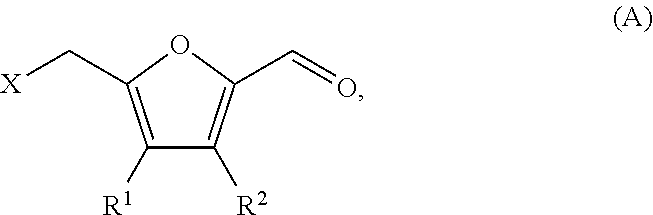
-
-
-
- wherein:
- R1 and R2 are as defined for formula (D) above, and
- X is halo, and
- wherein:
- the compound of formula (B) is:
-
-

-
-
-
- wherein R1 and R2 are as defined for formula (D) above;
-
- oxidizing the compound of formula (B) to a compound of formula (C), wherein:
- the compound of formula (C) is:
-

-
-
-
- wherein R1 and R2 are as defined for formula (D) above; and
-
- cyclizing the compound of formula (C) to produce the compound of formula (D).
-
- 2. The method of
embodiment 1, wherein R1 and R2 are both hydrogen. - 3. The method of
embodiment - 4. The method of
embodiment 3, wherein the acid is a Lewis acid. - 5. A method of producing cyclohexanone, comprising:
- converting 5-(halomethyl)furfural to hexane-1,5-diol;
- oxidizing the hexane-1,5-diol to produce 6-hydroxyhexan-2-one; and
- cyclizing the 6-hydroxyhexan-2-one to produce cyclohexanone.
- 6. The method of embodiment 5, wherein the 6-hydroxyhexan-2-one to is cyclized to produce the cyclohexanone in the presence of an acid.
- 7. The method of
embodiment 6, wherein the acid is a Lewis acid. - 8. A method of producing a compound of formula (F):

wherein R1 and R2 are each independently hydrogen or alkyl,
- the method comprising:
- combining a compound of formula (A) with an alkanolate or acetate salt to produce a compound of formula (E), wherein:
- the compound of formula (A) is:
- combining a compound of formula (A) with an alkanolate or acetate salt to produce a compound of formula (E), wherein:

-
-
-
- wherein:
- R1 and R2 are as defined for formula (F) above, and
- X is halo, and
- wherein:
- the compound of formula (E) is:
-
-

-
-
-
- wherein:
- R1 and R2 are as defined for formula (F) above, and
- Ra is O(alkyl) when an alkanolate salt is used, and Ra is CO2(alkyl) when an acetate salt is used; and
- wherein:
-
- reducing the compound of formula (E) to produce the compound of formula (F).
-
- 9. The method of embodiment 8, wherein R1 and R2 are both hydrogen.
- 10. A method of producing hexane-1,6-diol, comprising:
- contacting 5-(halomethyl)furfural with an alkanolate or acetate salt to produce 5-(alkoxymethyl)furan-2-carbaldehyde; and
- reducing the 5-(alkoxymethyl)furan-2-carbaldehyde to produce hexane-1,6-diol.

or a salt thereof, wherein R1 and R2 are each independently hydrogen or alkyl,
- the method comprising:
- converting a compound of formula (A) to a compound of formula (H) and/or a salt thereof, wherein:
- the compound of formula (A) is:
- converting a compound of formula (A) to a compound of formula (H) and/or a salt thereof, wherein:

-
-
-
- wherein:
- R1 and R2 are as defined for formula (I) above, and
- X is halo, and
- wherein:
- the compound of formula (H) is:
-
-

-
-
-
- wherein R1 and R2 are as defined for formula (I) above; and
-
- converting the compound of formula (H) and/or a salt thereof to the compound of formula (I).
-
- 12. The method of embodiment 11, wherein R1 and R2 are both hydrogen.
- 13. The method of embodiment 11 or 12, wherein the converting of the compound of formula (A) to a compound of formula (H) and/or a salt thereof comprises:
- combining the compound of formula (A) with ammonia to produce a compound of formula (G) and/or a salt thereof, wherein:
- the compound of formula (G) is:
- combining the compound of formula (A) with ammonia to produce a compound of formula (G) and/or a salt thereof, wherein:

-
-
-
- wherein R1 and R2 are as defined for formula (I) above; and
-
- converting the compound of formula (G) and/or a salt thereof to the compound of formula (H) and/or a salt thereof.
-
- 14. The method of embodiment 13, wherein the compound of formula (A) and the ammonia are further combined with a metal catalyst to produce the compound of formula (G) and/or a salt thereof.
- 15. The method of embodiment 14, wherein the metal catalyst is a copper catalyst.
- 16. The method of embodiment 11 or 12, wherein the converting of the compound of formula (A) to a compound of formula (H) comprises:
- converting the compound of formula (A) to a compound of formula (L), wherein:
- the compound of formula (L) is:
- converting the compound of formula (A) to a compound of formula (L), wherein:

-
-
-
- wherein R1 and R2 are as defined for formula (I) above; and
-
- converting the compound of formula (L) to the compound of formula (H).
-
- 17. The method of embodiment 16, wherein the converting of the compound of formula (A) to the compound of formula (L) comprises:
- combining the compound of formula (A) with an azide to produce a compound of formula (K), wherein:
- the compound of formula (K) is:
- combining the compound of formula (A) with an azide to produce a compound of formula (K), wherein:

-
-
-
- wherein R1 and R2 are as defined for formula (I) above; and
-
- combining the compound of formula (K) with ammonia to produce the compound of formula (L).
-
- 18. A method of producing hexamethylenediamine, comprising:
- converting 5-(halomethyl)furfural to (tetrahydrofuran-2,5-diyl)dimethanamine; and
- converting the (tetrahydrofuran-2,5-diyl)dimethanamine to hexamethylenediamine.
- 19. The method of embodiment 18, wherein the converting of 5-(halomethyl)furfural to (tetrahydrofuran-2,5-diyl)dimethanamine comprises:
- converting the 5-(halomethyl)furfural to (5-(iminomethyl)furan-2-yl)methanamine; and
- converting the (5-(iminomethyl)furan-2-yl)methanamine to the (tetrahydrofuran-2,5-diyl)dimethanamine.
- 20. The method of embodiment 18, wherein the converting of 5-(halomethyl)furfural to (tetrahydrofuran-2,5-diyl)dimethanamine comprises:
- combining the 5-(halomethyl)furfural with ammonia to produce (5-(iminomethyl)furan-2-yl)methanamine; and
- reducing the (5-(iminomethyl)furan-2-yl)methanamine to produce the (tetrahydrofuran-2,5-diyl)dimethanamine.
- 21. The method of embodiment 20, wherein the 5-(halomethyl)furfural and the ammonia are further combined with a metal catalyst to produce the (5-(iminomethyl)furan-2-yl)methanamine.
- 22. The method of embodiment 21, wherein the metal catalyst is a copper catalyst.
- 23. The method of embodiment 18, wherein the converting of 5-(halomethyl)furfural to (tetrahydrofuran-2,5-diyl)dimethanamine comprises:
- converting the 5-(halomethyl)furfural to (5-(azidomethyl)furan-2-yl)methanimine; and
- converting the (5-(azidomethyl)furan-2-yl)methanimine to the (tetrahydrofuran-2,5-diyl)dimethanamine.
- 24. The method of embodiment 23, wherein the converting of the 5-(halomethyl)furfural to (5-(azidomethyl)furan-2-yl)methanimine comprises:
- combining the 5-(halomethyl)furfural with an azide to produce 5-(azidomethyl)furan-2-carbaldehyde; and
- combining the 5-(azidomethyl)furan-2-carbaldehyde with ammonia to produce the (5-(azidomethyl)furan-2-yl)methanimine.
- 25. A method of producing a compound of formula (J):

and/or a salt thereof, wherein R1 and R2 are each independently hydrogen or alkyl,
- the method comprising:
- combining a compound of formula (A) with ammonia to form a reaction mixture, wherein:
- the compound of formula (A) is:
- combining a compound of formula (A) with ammonia to form a reaction mixture, wherein:

-
-
-
- wherein:
- R1 and R2 are as defined for formula (J) above, and
- X is halo, and
- wherein:
-
- producing the compound of formula (J) and/or a salt thereof from at least a portion of the reaction mixture.
-
- 26. The method of embodiment 25, wherein R1 and R2 are both hydrogen.
- 27. The method of embodiment 25 or 26, wherein the salt of the compound of formula (J) is a compound of formula (J-X):

wherein:
-
- R1 and R2 are as defined for formula (J) above, and
- X is as defined for formula (A) above.
- 28. A method of producing a compound of formula (J-X):

wherein:
-
- R1 and R2 are each independently hydrogen or alkyl, and
- X is halo,
- the method comprising:
- combining a compound of formula (A) with ammonia and acid to form a reaction mixture, wherein:
- the compound of formula (A) is:
- combining a compound of formula (A) with ammonia and acid to form a reaction mixture, wherein:

-
-
-
- wherein:
- R1 and R2 are as defined for formula (J-X) above, and
- X is halo, and
- wherein:
-
- producing the compound of formula (J-X) from at least a portion of the reaction mixture.
-
- 29. The method of embodiment 28, wherein R1 and R2 are both hydrogen.
- 30. The method of embodiment 28 or 29, wherein the acid is HY, wherein Y is halo.
- 31. The method of embodiment 28 or 29, wherein the acid is a Bronsted acid.
- 32. The method of embodiment 30, further comprising producing a compound of formula (J-Y) from at least a portion of the reaction mixture, wherein the compound of formula (J-Y) is:

wherein:
-
- R1 and R2 are as defined for formula (J-X) above, and
- Y is as defined for the acid.
- 33. A method of producing a compound of formula (J-X):

wherein:
-
- R1 and R2 are each independently hydrogen or alkyl, and
- X is halo,
- the method comprising:
- a) combining a compound of formula (A) with ammonia to form a reaction mixture, wherein:
- the compound of formula (A) is:
- a) combining a compound of formula (A) with ammonia to form a reaction mixture, wherein:

-
-
-
- wherein:
- R1 and R2 are as defined for formula (J-X) above, and
- X is halo;
- wherein:
-
- b) producing a compound of formula (J) in the reaction mixture, wherein the compound of formula (J) is:
-

wherein R1 and R2 are as defined for formula (J-X) above; and
-
- c) adding an acid to the reaction mixture of step (b) to produce the compound of formula (J-X).
- 34. The method of embodiment 33, wherein R1 and R2 are both hydrogen.
- 35. The method of embodiment 33 or 34, wherein the acid is HY, wherein Y is halo.
- 36. The method of embodiment 33 or 34, wherein the acid is a Bronsted acid.
- 37. The method of embodiment 35, wherein the adding of the acid to the reaction mixture of step (b) produces the compound of formula (J-X), or a compound of formula (J-Y), or a combination thereof, wherein the compound of formula (J-Y) is:

wherein:
-
- R1 and R2 are as defined for formula (J-X) above, and
- Y is as defined for the acid.
- 38. A method of producing a compound of formula (J-X):

wherein:
-
- R1 and R2 are each independently hydrogen or alkyl, and
- X is halo,
- the method comprising:
- a) combining a compound of formula (A) with ammonia to form a reaction mixture, wherein:
- the compound of formula (A) is:
- a) combining a compound of formula (A) with ammonia to form a reaction mixture, wherein:

-
-
-
- wherein:
- R1 and R2 are as defined for formula (J-X) above, and
- X is halo;
- wherein:
-
- b) producing a compound of formula (J) from at least a portion of the reaction mixture, wherein the compound of formula (J) is:
-

wherein R1 and R2 are as defined for formula (J-X) above; and
-
- c) isolating the compound of formula (J) produced; and
- d) combining the isolated compound of formula (J) with an acid to produce the compound of formula (J-X).
- 39. The method of embodiment 38, wherein R1 and R2 are both hydrogen.
- 40. The method of embodiment 38 or 39, wherein the acid is HY, wherein Y is halo.
- 41. The method of embodiment 38 or 39, wherein the acid is a Bronsted acid.
- 42. The method of any one of embodiments 38 to 40, wherein the combining of the isolated compound of formula (J) with the acid produces the compound of formula (J-X), or a compound of formula (J-Y), or a combination thereof, wherein the compound of formula (J-Y) is:

wherein:
-
- R1 and R2 are as defined for formula (J-X) above, and
- Y is as defined for the acid.
- 43. The method of any one of embodiments 25 to 42, wherein the compound of formula (A) and the ammonia are further combined with a metal catalyst to form the reaction mixture.
- 44. The method of embodiment 43, wherein the metal catalyst is a copper catalyst.
- 45. A method of producing a compound of formula (I):

or a salt thereof, wherein R1 and R2 are each independently hydrogen or alkyl,
- the method comprising:
- combining a compound of formula (A) with ammonia to produce a compound of formula (J) and/or a salt thereof, wherein:
- the compound of formula (A) is:
- combining a compound of formula (A) with ammonia to produce a compound of formula (J) and/or a salt thereof, wherein:

-
-
-
- wherein:
- R1 and R2 are as defined for formula (I) above, and
- X is halo, and
- wherein:
- the compound of formula (J) is:
-
-

-
-
-
- and/or a salt thereof, wherein R1 and R2 are as defined for formula (I) above; and
-
- reducing the compound of formula (J) and/or a salt thereof in the presence of additional ammonia to produce the compound of formula (H) and/or a salt thereof, wherein:
- the compound of formula (H) is:
-

-
-
-
- wherein R1 and R2 are as defined for formula (I) above; and
-
- further reducing the compound of formula (H) and/or a salt thereof to produce the compound of formula (I) and/or a salt thereof.
-
- 46. The method of embodiment 45, wherein R1 and R2 are both hydrogen.
- 47. The method of embodiment 45 or 46, wherein the compound of formula (J) and/or a salt thereof is reduced in the presence of the additional ammonia, hydrogen and a metal catalyst to produce the compound of formula (H) and/or a salt thereof.
- 48. The method of embodiment 47, wherein the metal catalyst is a palladium catalyst, a platinum catalyst, or a nickel catalyst, or any combination thereof.
- 49. The method of embodiment 48, wherein the metal catalyst is Pd/C, Pt/C or Raney nickel, or any combination thereof.
- 50. The method of any one of embodiments 45 to 49, wherein the compound of formula (H) and/or a salt thereof is further reduced in the presence of hydrogen and an additional metal catalyst.
- 51. The method of embodiment 50, wherein the additional metal catalyst is a rhodium catalyst, a rhenium catalyst, or a rhodium-rhenium catalyst.
- 52. The method of embodiment 51, wherein the additional metal catalyst is Rh—Re/SiO2.
- 53. The method of any one of embodiments 45 to 52, wherein the compound of formula (A) and the ammonia are further combined with a metal catalyst to produce the compound of formula (J) and/or a salt thereof.
- 54. The method of embodiment 55, wherein the metal catalyst is a copper catalyst.
- 55. A method of producing a compound of formula (R):

wherein R1 and R2 are each independently hydrogen or alkyl,
- the method comprising:
- converting a compound of formula (A) to a compound of formula (P) and/or a salt thereof, wherein:
- the compound of formula (A) is:
- converting a compound of formula (A) to a compound of formula (P) and/or a salt thereof, wherein:

-
-
-
- wherein:
- R1 and R2 are as defined for formula (R) above, and
- X is halo, and
- wherein:
- the compound of formula (P) is:
-
-

-
-
-
- wherein R1 and R2 are as defined for formula (R) above; and
-
- converting the compound of formula (P) and/or a salt thereof to the compound of formula (R).
-
- 56. The method of embodiment 55, wherein R1 and R2 are both hydrogen.
- 57. The method of embodiment 55 or 56, wherein the converting of the compound of formula (A) to the compound of formula (P) and/or a salt thereof comprises:
- converting the compound of formula (A) to a compound of formula (N) and/or a salt thereof, wherein:
- the compound of formula (N) is:
- converting the compound of formula (A) to a compound of formula (N) and/or a salt thereof, wherein:

-
-
-
- wherein:
- R1 and R2 are as defined for formula (R) above, and
- Rw is —NH2 or —N3; and
- wherein:
-
- reducing the compound of formula (N) and/or a salt thereof to the compound of formula (P) and/or a salt thereof.
-
- 58. The method of embodiment 57, wherein the converting of the compound of formula (A) to the compound of formula (N) and/or a salt thereof comprises:
- combining the compound of formula (A) with RtOH, wherein Rt is an alkali metal, to produce the compound of formula (M), wherein:
- the compound of formula (M) is:
- combining the compound of formula (A) with RtOH, wherein Rt is an alkali metal, to produce the compound of formula (M), wherein:

-
-
-
- wherein Rt is as defined above; and
-
- combining the compound of formula (M) with ammonia to produce the compound of formula (N) and/or a salt thereof, wherein Rw is —NH2.
-
- 59. The method of embodiment 57, wherein the converting of the compound of formula (A) to the compound of formula (N) comprises:
- combining the compound of formula (A) with RtOH, wherein Rt is an alkali metal, to produce the compound of formula (M), wherein:
- the compound of formula (M) is:
- combining the compound of formula (A) with RtOH, wherein Rt is an alkali metal, to produce the compound of formula (M), wherein:

-
-
-
- wherein Rt is as defined above; and
-
- combining the compound of formula (M) with an azide to produce the compound of formula (N), wherein Rw is —N3.
-
- 60. The method of embodiment 55 or 59, wherein the compound of formula (A) and RtOH are further combined with a metal in the presence of oxygen to produce the compound of formula (M).
- 61. The method of any one of embodiments 55 to 60, wherein the converting of the compound of formula (P) and/or a salt thereof to the compound of formula (R) and/or a salt thereof comprises:
- converting the compound of formula (P) and/or a salt thereof to a compound of formula (Q) and/or a salt thereof, wherein:
- the compound of formula (Q) is:
- converting the compound of formula (P) and/or a salt thereof to a compound of formula (Q) and/or a salt thereof, wherein:

-
-
-
- wherein R1 and R2 are as defined for formula (R) above; and
-
- cyclizing the compound of formula (Q) and/or a salt thereof to produce the compound of formula (R).
-
- 62. A method for producing caprolactam, comprising:
- converting 5-(halomethyl)furfural to 5-(aminomethyl)tetrahydrofuran-2-carboxylic acid; and
- converting the 5-(aminomethyl)tetrahydrofuran-2-carboxylic acid to caprolactam.
- 63. A method of producing a compound of formula (R):

wherein R1 and R2 are each independently hydrogen or alkyl,
- the method comprising:
- reducing a compound of formula (N-1) and/or a salt thereof to produce a compound of formula (P) and/or a salt thereof, wherein:
- the compound of formula (N-1) is:
- reducing a compound of formula (N-1) and/or a salt thereof to produce a compound of formula (P) and/or a salt thereof, wherein:

-
-
-
- wherein R1 and R2 are as defined for formula (R) above, and
- the compound of formula (P) is:
-
-

-
-
-
- wherein R1 and R2 are as defined for formula (R) above; and
-
- converting the compound of formula (P) and/or salt thereof to the compound of formula (R).
-
- 64. The method of embodiment 63, wherein R1 and R2 are both hydrogen.
- 65. The method of embodiment 63 or 64, wherein the compound of formula (N-1) and/or a salt thereof is produced according to the method of any one of embodiments 54 to 57.
- 66. The method of any one of embodiments 63 to 65, wherein the converting of the compound of formula (P) and/or a salt thereof to the compound of formula (R) comprises:
- converting the compound of formula (P) and/or a salt thereof to a compound of formula (Q) and/or a salt thereof, wherein:
- the compound of formula (Q) is:
- converting the compound of formula (P) and/or a salt thereof to a compound of formula (Q) and/or a salt thereof, wherein:

-
-
-
- wherein R1 and R2 are as defined for formula (R) above; and
-
- cyclizing the compound of formula (Q) and/or a salt thereof to produce the compound of formula (R).
-
- 67. A method of producing a polymer of formula (V):

wherein:
-
- R1 and R2 are each independently hydrogen or alkyl, and
- n is greater than 1,
- the method comprising:
- polymerizing a compound of formula (N-1) and/or a salt thereof to produce a polymer of formula (T), wherein:
- the compound of formula (N-1) is:
- polymerizing a compound of formula (N-1) and/or a salt thereof to produce a polymer of formula (T), wherein:

-
-
-
- wherein R1 and R2 are as defined for formula (V) above, and
- the polymer of formula (T) is:
-
-

-
-
-
- wherein R1, R2 and n are as defined for formula (V) above;
-
- reducing the polymer of formula (T) to a polymer of formula (U), wherein:
- the polymer of formula (U) is:
-

-
-
- wherein R1, R2 and n are as defined for formula (V) above; and
- converting the polymer of formula (U) to the polymer of formula (V).
-
- 68. A method of producing a polymer of formula (V):

wherein:
-
- R1 and R2 are each independently hydrogen or alkyl, and
- n is greater than 1,
- the method comprising:
- providing a compound of formula (D) produced according to the method of any one of
embodiments 1 to 4; and - converting the compound of formula (D) to the polymer of formula (V).
- providing a compound of formula (D) produced according to the method of any one of
- 69. A method of producing a polymer of formula (V):

wherein:
-
- R1 and R2 are each independently hydrogen or alkyl, and
- n is greater than 1,
- the method comprising:
- providing a compound of formula (F) produced according to the method of embodiment 8 or 9; and
- converting the compound of formula (F) to the polymer of formula (V).
- 70. A method of producing a polymer of formula (V):

wherein:
-
- R1 and R2 are each independently hydrogen or alkyl, and
- n is greater than 1,
- the method comprising:
- providing a compound of formula (I) produced according to the method of any one of embodiments 11 to 17 and 45 to 54; and
- converting the compound of formula (I) to the polymer of formula (V).
- 71. A method of producing a polymer of formula (V):

wherein:
-
- R1 and R2 are each independently hydrogen or alkyl, and
- n is greater than 1,
- the method comprising:
- providing a compound of formula (R) produced according to the method of any one of embodiments 55 to 61 and 63 to 66; and
- converting the compound of formula (R) to the polymer of formula (V).
- 72. A method for producing nylon, comprising:
- providing:
- (i) cyclohexanone according to the method of any one of embodiments 5 to 7, or
- (ii) hexane-1,6-diol according to the method of embodiment 10, or
- (iii) hexamethylenediamine according to the method of any one of embodiments 18 to 24; or
- (iv) caprolactam according to the method of embodiment 62,
- or any combination thereof; and
- converting the cyclohexanone, the hexane-1,6-diol, the hexamethylenediamine, the caprolactam, or any combination thereof, to nylon.
- providing:
- 73. A method for producing nylon having the structure of formula (X):

wherein n is an integer greater than 0;
- the method comprising:
- converting 5-(halomethyl)furfural to 5-(aminomethyl)furan-2-carboxylic acid; and
- polymerizing the 5-(aminomethyl)furan-2-carboxylic acid to form a polymer of formula (X1):

-
- reducing the polymer of formula (X1) to form a polymer of formula (X2):

-
- and
- converting the polymer of formula (X2) to the nylon of formula (X).
- 74. A polymer of formula (U):

wherein:
-
- R1 and R2 are each independently hydrogen or alkyl, and
- n is greater than 1.

Materials and Methods


Materials and Methods


Materials and Methods


Materials and Methods


Claims (9)


Priority Applications (1)
| Application Number | Priority Date | Filing Date | Title |
|---|---|---|---|
| US15/310,728 US10407547B2 (en) | 2014-05-12 | 2015-05-12 | Methods of producing compounds from 5-(halomethyl)furfural |
Applications Claiming Priority (3)
| Application Number | Priority Date | Filing Date | Title |
|---|---|---|---|
| US201461992060P | 2014-05-12 | 2014-05-12 | |
| PCT/US2015/030364 WO2015175528A1 (en) | 2014-05-12 | 2015-05-12 | Methods of producing compounds from 5-(halomethyl)furfural |
| US15/310,728 US10407547B2 (en) | 2014-05-12 | 2015-05-12 | Methods of producing compounds from 5-(halomethyl)furfural |
Publications (2)
| Publication Number | Publication Date |
|---|---|
| US20170081470A1 US20170081470A1 (en) | 2017-03-23 |
| US10407547B2 true US10407547B2 (en) | 2019-09-10 |
Family
ID=54480551
Family Applications (1)
| Application Number | Title | Priority Date | Filing Date |
|---|---|---|---|
| US15/310,728 Active US10407547B2 (en) | 2014-05-12 | 2015-05-12 | Methods of producing compounds from 5-(halomethyl)furfural |
Country Status (5)
| Country | Link |
|---|---|
| US (1) | US10407547B2 (en) |
| EP (1) | EP3142997A1 (en) |
| CN (1) | CN106660935A (en) |
| TW (1) | TW201609681A (en) |
| WO (1) | WO2015175528A1 (en) |
Cited By (3)
| Publication number | Priority date | Publication date | Assignee | Title |
|---|---|---|---|---|
| US20190359582A1 (en) * | 2016-12-22 | 2019-11-28 | Rhodia Operations | Process for producing a tetrahydrofuran compound comprising at least two amine functional groups |
| US11214559B2 (en) * | 2017-07-21 | 2022-01-04 | Mitsubishi Gas Chemical Company, Inc. | Method for producing 2,5-bis(aminomethyl)furan |
| US20220106436A1 (en) * | 2019-01-22 | 2022-04-07 | Mitsubishi Gas Chemical Company, Inc. | Composition, cured product, method for manufacturing cured product, method for manufacturing coating film, and method for manufacturing composition |
Families Citing this family (9)
| Publication number | Priority date | Publication date | Assignee | Title |
|---|---|---|---|---|
| CN107474026B (en) * | 2016-06-08 | 2020-08-04 | 中国科学院大连化学物理研究所 | A kind of preparation method of 2,5-diaminomethyltetrahydrofuran |
| WO2019061299A1 (en) * | 2017-09-29 | 2019-04-04 | Rhodia Operations | Process for preparing aminomethyl substituted heterocycloalkane |
| WO2019073987A1 (en) | 2017-10-11 | 2019-04-18 | 三菱瓦斯化学株式会社 | Method for producing 2,5-bis (aminomethyl) tetrahydrofuran |
| WO2019073988A1 (en) | 2017-10-11 | 2019-04-18 | 三菱瓦斯化学株式会社 | Method for producing 2,5-bis(aminomethyl) tetrahydrofuran |
| CN111100015B (en) * | 2018-10-29 | 2021-04-23 | 中国科学院大连化学物理研究所 | A kind of method for preparing fatty amine compound |
| CN111116374B (en) * | 2019-12-04 | 2020-12-15 | 北京理工大学 | A kind of method for synthesizing π-π bond co-crystal with aminolutamide and 2-nitrobenzoic acid |
| CN112979474B (en) * | 2019-12-13 | 2022-09-06 | 中国科学院大连化学物理研究所 | Method for synthesizing 1, 6-hexanediamine by catalyzing 2, 5-dicyanofuran hydrogenation ring opening |
| CN112079726B (en) * | 2020-09-22 | 2023-01-24 | 江苏扬农化工集团有限公司 | Method for synthesizing hexamethylene diamine and co-producing n-hexylamine and cyclohexylimine |
| CN116655476B (en) * | 2023-05-26 | 2025-04-04 | 北京大学 | Preparation method of amino alcohol |
Citations (24)
| Publication number | Priority date | Publication date | Assignee | Title |
|---|---|---|---|---|
| DE1013425B (en) | 1953-09-17 | 1957-08-08 | Phrix Werke Ag | Process for the production of new, polyamide-like polycondensation products |
| JPH11180937A (en) | 1997-12-22 | 1999-07-06 | Noguchi Inst | Method for producing 5-aminolevulinic acid |
| WO2003024955A2 (en) | 2001-09-18 | 2003-03-27 | Sunesis Pharmaceuticals, Inc. | Small molecule inhibitors of caspases |
| US20050032707A1 (en) | 2003-08-08 | 2005-02-10 | Dabur Research Foundation | Novel peptides comprising furanoid sugar amino acids for the treatment of cancer |
| US20060004088A1 (en) | 2002-10-22 | 2006-01-05 | Oct Inc. | Furan derivatives for preventing and curing osteoporosis and pharmaceutical compositions containing the same |
| US20070106024A1 (en) | 2005-11-09 | 2007-05-10 | Tsou Andy H | Thermoplastic elastomer compositions and methods for making the same |
| US20070112225A1 (en) | 2004-11-05 | 2007-05-17 | Basf Aktiengesellschaft | Method for producing 1, 6 hexane diol |
| WO2007147804A1 (en) | 2006-06-21 | 2007-12-27 | Transfurans Chemicals | Method for modifying wood and wood thereby obtained |
| CN101137608A (en) | 2004-12-07 | 2008-03-05 | 罗狄亚化学公司 | Process for preparing cyclohexanone |
| WO2009103560A1 (en) | 2008-02-22 | 2009-08-27 | Uhde Inventa-Fischer Gmbh | PRODUCTION OF LACTAMS BY AMMOXIMATIσN OF CYCLIC KETONES |
| CN101878208A (en) | 2007-08-31 | 2010-11-03 | 普渡制药公司 | Substituted quinoxaline-type piperidine compounds and uses thereof |
| US20100317069A1 (en) | 2009-05-07 | 2010-12-16 | Burk Mark J | Microorganisms and methods for the biosynthesis of adipate, hexamethylenediamine and 6-aminocaproic acid |
| WO2011096812A1 (en) | 2010-02-04 | 2011-08-11 | Via Ingenio B.V. | Method and apparatus for modifying wood, and wood product |
| US20120035399A1 (en) | 2009-04-08 | 2012-02-09 | Basf Se | Method for producing 1,6-hexanediol by hydrogenation of oligo- and polyesters |
| US20120070592A1 (en) | 2009-05-26 | 2012-03-22 | Stall Alan D | Permeable Polymeric Films and Methods of Making Same |
| US20120142886A1 (en) | 2004-06-10 | 2012-06-07 | Board Of Trustees Of Michigan State University | Synthesis of Caprolactam From Lysine |
| WO2012170520A1 (en) | 2011-06-09 | 2012-12-13 | Micromidas Inc. | Utilizing a multiphase reactor for the conversion of biomass to produce substituted furans |
| US20130085255A1 (en) | 2011-04-09 | 2013-04-04 | Amyris, Inc. | Process for Preparing Caprolactam and Polyamides Therefrom |
| US20130184495A1 (en) | 2012-01-18 | 2013-07-18 | Rennovia, Inc. | Process for production of hexamethylenediamine from carbohydrate-containing materials and intermediates therefor |
| US20130245316A1 (en) | 2012-03-15 | 2013-09-19 | Micromidas, Inc. | Methods of producing para-xylene and terephthalic acid |
| US20130267719A1 (en) | 2010-08-19 | 2013-10-10 | Peter Mikochik | Conversion of 5-(chloromethyl)-2-furaldehyde into 5-methyl-2-furoic acid and derivatives thereof |
| WO2014043468A1 (en) | 2012-09-14 | 2014-03-20 | Micromidas Inc. | Methods of producing para-xylene and terephthalic acid |
| WO2014066746A1 (en) | 2012-10-26 | 2014-05-01 | Micromidas, Inc. | Methods for producing 5-(halomethyl) furfural |
| WO2015060829A1 (en) | 2013-10-22 | 2015-04-30 | Empire Technology Development Llc | Compounds and methods for producing nylon 6 |
-
2015
- 2015-05-12 TW TW104115027A patent/TW201609681A/en unknown
- 2015-05-12 WO PCT/US2015/030364 patent/WO2015175528A1/en not_active Ceased
- 2015-05-12 CN CN201580037208.3A patent/CN106660935A/en active Pending
- 2015-05-12 EP EP15792596.7A patent/EP3142997A1/en not_active Withdrawn
- 2015-05-12 US US15/310,728 patent/US10407547B2/en active Active
Patent Citations (29)
| Publication number | Priority date | Publication date | Assignee | Title |
|---|---|---|---|---|
| DE1013425B (en) | 1953-09-17 | 1957-08-08 | Phrix Werke Ag | Process for the production of new, polyamide-like polycondensation products |
| JPH11180937A (en) | 1997-12-22 | 1999-07-06 | Noguchi Inst | Method for producing 5-aminolevulinic acid |
| WO2003024955A2 (en) | 2001-09-18 | 2003-03-27 | Sunesis Pharmaceuticals, Inc. | Small molecule inhibitors of caspases |
| US20060004088A1 (en) | 2002-10-22 | 2006-01-05 | Oct Inc. | Furan derivatives for preventing and curing osteoporosis and pharmaceutical compositions containing the same |
| US20050032707A1 (en) | 2003-08-08 | 2005-02-10 | Dabur Research Foundation | Novel peptides comprising furanoid sugar amino acids for the treatment of cancer |
| US20120142886A1 (en) | 2004-06-10 | 2012-06-07 | Board Of Trustees Of Michigan State University | Synthesis of Caprolactam From Lysine |
| CN100439304C (en) | 2004-11-05 | 2008-12-03 | 巴斯福股份公司 | Process for preparing 1, 6-hexanediol |
| US20070112225A1 (en) | 2004-11-05 | 2007-05-17 | Basf Aktiengesellschaft | Method for producing 1, 6 hexane diol |
| CN101137608A (en) | 2004-12-07 | 2008-03-05 | 罗狄亚化学公司 | Process for preparing cyclohexanone |
| US20080064902A1 (en) | 2004-12-07 | 2008-03-13 | Rhodia Chimie | Method for the Production of Cyclohexanone |
| US20070106024A1 (en) | 2005-11-09 | 2007-05-10 | Tsou Andy H | Thermoplastic elastomer compositions and methods for making the same |
| US20100062276A1 (en) | 2006-06-21 | 2010-03-11 | Transfurans Chemicals | Method for modifying wood and wood thereby obtained |
| WO2007147804A1 (en) | 2006-06-21 | 2007-12-27 | Transfurans Chemicals | Method for modifying wood and wood thereby obtained |
| CN101878208A (en) | 2007-08-31 | 2010-11-03 | 普渡制药公司 | Substituted quinoxaline-type piperidine compounds and uses thereof |
| WO2009103560A1 (en) | 2008-02-22 | 2009-08-27 | Uhde Inventa-Fischer Gmbh | PRODUCTION OF LACTAMS BY AMMOXIMATIσN OF CYCLIC KETONES |
| US20120035399A1 (en) | 2009-04-08 | 2012-02-09 | Basf Se | Method for producing 1,6-hexanediol by hydrogenation of oligo- and polyesters |
| US20100317069A1 (en) | 2009-05-07 | 2010-12-16 | Burk Mark J | Microorganisms and methods for the biosynthesis of adipate, hexamethylenediamine and 6-aminocaproic acid |
| US20130303723A1 (en) | 2009-05-07 | 2013-11-14 | Genomatica, Inc. | Microorganisms and methods for the biosynthesis of adipate, hexamethylenediamine and 6-aminocaproic acid |
| US20120070592A1 (en) | 2009-05-26 | 2012-03-22 | Stall Alan D | Permeable Polymeric Films and Methods of Making Same |
| WO2011096812A1 (en) | 2010-02-04 | 2011-08-11 | Via Ingenio B.V. | Method and apparatus for modifying wood, and wood product |
| US20130267719A1 (en) | 2010-08-19 | 2013-10-10 | Peter Mikochik | Conversion of 5-(chloromethyl)-2-furaldehyde into 5-methyl-2-furoic acid and derivatives thereof |
| US20130085255A1 (en) | 2011-04-09 | 2013-04-04 | Amyris, Inc. | Process for Preparing Caprolactam and Polyamides Therefrom |
| WO2012170520A1 (en) | 2011-06-09 | 2012-12-13 | Micromidas Inc. | Utilizing a multiphase reactor for the conversion of biomass to produce substituted furans |
| US20140100378A1 (en) | 2011-06-09 | 2014-04-10 | Micromidas, Inc. | Utilizing a multiphase reactor for the conversion of biomass to produce substituted furans |
| US20130184495A1 (en) | 2012-01-18 | 2013-07-18 | Rennovia, Inc. | Process for production of hexamethylenediamine from carbohydrate-containing materials and intermediates therefor |
| US20130245316A1 (en) | 2012-03-15 | 2013-09-19 | Micromidas, Inc. | Methods of producing para-xylene and terephthalic acid |
| WO2014043468A1 (en) | 2012-09-14 | 2014-03-20 | Micromidas Inc. | Methods of producing para-xylene and terephthalic acid |
| WO2014066746A1 (en) | 2012-10-26 | 2014-05-01 | Micromidas, Inc. | Methods for producing 5-(halomethyl) furfural |
| WO2015060829A1 (en) | 2013-10-22 | 2015-04-30 | Empire Technology Development Llc | Compounds and methods for producing nylon 6 |
Non-Patent Citations (19)
| Title |
|---|
| Buntara et al., "Caprolactam from Renewable Resources: Catalytic Conversion of 5-Hydroxymethylfurfural into Caprolactone" Angewandte Chemie International Ed., vol. 50, 2011, pp. 7083-7087. |
| Fenton et al. "XLI.-Bromomethylfurfuraldehyde", Journal of the Chemical Society, Transactions, vol. 75, Jan. 1, 1899, pp. 423-433. |
| Fenton et al. "XLI.—Bromomethylfurfuraldehyde", Journal of the Chemical Society, Transactions, vol. 75, Jan. 1, 1899, pp. 423-433. |
| Fenton et al., "LXXXV-Derivatives of Methylfurfural", Journal of the Chemical Society, Transactions, vol. 79, Jan. 1, 1901, pp. 807-816. |
| Fenton et al., "LXXXV—Derivatives of Methylfurfural", Journal of the Chemical Society, Transactions, vol. 79, Jan. 1, 1901, pp. 807-816. |
| Hawker et al., "Synthesis and Evaluation of Novel Heteroaromatic Substrates of GABA Aminotransferase", Bioorganic and Medicinal Chemistry, vol. 20, No. 19, Oct. 1, 2012, pp. 5763-5773. |
| Hibbert et al., "Studies on Cellulose Chemistry II. The Action of Dry Hydrogen Bromide on Carbohydrates and Polysaccharides1,2", Journal of the American Chemical Society, vol. 45, 1923, pp. 176-182. |
| International Preliminary Report on Patentability received for PCT Application No. PCT/US2015/030364, dated Nov. 24, 2016, 14 pages. |
| International Search Report and Written Opinion received for PCT Patent Application No. PCT/US2015/030364, dated Jul. 30, 2015, 17 pages. |
| Kiruthika et al., "Cul-Catalyzed Coupling of gem-Dibromovinylanilides and Sulfonamides: An Efficient Method for the Synthesis of 2-Amidoindoles and Indolo[1,2-a]quinazolines", Org. Lett., vol. 16, Dec. 30, 2013, pp. 484-487. |
| Lapina et al., "Reactions of Alkyl (Halomethyl) Furancarboxylates with Hexamethylenetetramine", Russian Journal of General Chemistry, vol. 76, No. 8, 2006, pp. 1304-1309. |
| Liu et al., "Theoretical Studies on Thermochemistry for Conversion of 5-Chloromethylfurfural into Valuable Chemicals", The Journal of Physical Chemistry A, vol. 115, No. 46, Nov. 24, 2011, pp. 13628-13641. |
| Mascal et al., "Dramatic Advancements in the Saccharide to 5-(Chloromethyl)furfural Conversion Reaction", Chemsuschem, vol. 2, 2009, pp. 859-861. |
| Morrison. Organic Chemistry, fourth edition, 1983, pp. 206-207 and 898-900. * |
| Ogawa et al., "The Structure of an Antibiotic Kanamycin", Bulletin of the Agricultural Chemical Society of Japan, vol. 23, No. 4, 1959, pp. 289-310. |
| Prasad et al., "Furanoid Sugar Amino Acids as Dipeptide Mimics in Design of Analogs of Vasoactive Intestinal Peptide Receptor Binding Inhibitor", Journal of Peptide Research, vol. 66, 2005, pp. 75-84. |
| Shmagina et al., "Preparation of 5-Aminomethyl-2-Furancarboxylic Acid and its Butyl Ether", Body of the State Chemical Industry COM.ITE / Gagosplane USSR, No. 1, Mar. 28, 1965, pp. 44-46. (See Communication Under 37 CFR § 1.98(a) (3)). |
| Singh et al., "Preferential Polymerization of 5-(Aminomethyl)-2-Furancarboxylic Acid (Amfc) Into a Cyclic Tripeptide", Journal of Theoretical and Computational Chemistry vol. 03, 2004, pp. 555. |
| Szmant et al., "The Preparation of 5-Chloromethylfurfuraldehyde from High Fructose Corn Syrup and other Carbohydrates", Journal of Chemical Technology and Biotechnology, vol. 31, 1981, pp. 205-212. |
Cited By (3)
| Publication number | Priority date | Publication date | Assignee | Title |
|---|---|---|---|---|
| US20190359582A1 (en) * | 2016-12-22 | 2019-11-28 | Rhodia Operations | Process for producing a tetrahydrofuran compound comprising at least two amine functional groups |
| US11214559B2 (en) * | 2017-07-21 | 2022-01-04 | Mitsubishi Gas Chemical Company, Inc. | Method for producing 2,5-bis(aminomethyl)furan |
| US20220106436A1 (en) * | 2019-01-22 | 2022-04-07 | Mitsubishi Gas Chemical Company, Inc. | Composition, cured product, method for manufacturing cured product, method for manufacturing coating film, and method for manufacturing composition |
Also Published As
| Publication number | Publication date |
|---|---|
| TW201609681A (en) | 2016-03-16 |
| CN106660935A (en) | 2017-05-10 |
| US20170081470A1 (en) | 2017-03-23 |
| WO2015175528A1 (en) | 2015-11-19 |
| EP3142997A1 (en) | 2017-03-22 |
Similar Documents
| Publication | Publication Date | Title |
|---|---|---|
| US20170081470A1 (en) | Methods of producing compounds from 5-(halomethyl)furfural | |
| US8927743B2 (en) | Process for obtaining dronedarone | |
| US9932336B2 (en) | Process for the preparation of apixaban and intermediates thereof | |
| US20160009649A1 (en) | Process for the preparation of 4-alkoxy-3-hydroxypicolinic acids | |
| CN111793016B (en) | Preparation method of larotinib intermediate and intermediate compound | |
| JP5570524B2 (en) | Process for producing 5-formyl-pyridine-2,3-dicarboxylic acid ester | |
| CN111170870B (en) | Synthesis method of 3-methyl-1, 6-hexamethylenediamine | |
| JP2024015065A (en) | Method for producing 2,5-furandicarboxylic acid | |
| US9994677B2 (en) | Methods and compounds for producing nylon 12 | |
| US8357803B2 (en) | Process for the preparation of 2,3,4,9-tetrahydro-1H-β-carbolin-3-carboxylic acid esters | |
| US20080033154A1 (en) | Process for Producing 3-Aminomethyltetrahydrofuran Derivative | |
| CN111100014B (en) | Preparation method of 1, 3-cyclohexyldimethylamine | |
| RU2855930C2 (en) | METHOD FOR PRODUCING 7-(4,7-DIAZASPIRO[2.5]OCTAN-7-YL)-2-(2,8-DIMETHYLIMIDAZO[1,2-b]PYRIDAZIN-6-YL)PYRIDO[1,2-a]PYRIMIDIN-4-ONE AND INTERMEDIATE COMPOUNDS RELATED THERETO | |
| JP6182507B2 (en) | Method for producing 2,3-dihalogenoaniline | |
| US20140005395A1 (en) | 4-(2-(6-substituted-hexylidene) hydrazinyl)benzonitrile and preparation thereof | |
| EP0672646B1 (en) | Process for producing beta-nitro-enamines and intermediates thereof | |
| JP2009501196A (en) | Process for the preparation of 2-methoxycarbonylmethyl-6,6-dimethyl-2-tetrahydropyran-carboxylic acid | |
| CN108997157B (en) | Method for preparing amide by Beckmann rearrangement reaction of ketoxime | |
| JP4345671B2 (en) | Process for producing tetrahydropyran-4-ol, its intermediate and process for its production | |
| JP3804078B2 (en) | Process for producing β-nitroenamine | |
| CN110015996A (en) | A kind of method for synthesizing 2'-spirocyclyl-substituted three-membered carbocyclic nucleosides | |
| KR100848977B1 (en) | Process for producing 3-aminomethyltetrahydrofuran derivative | |
| TW202610622A (en) | Process for the preparation of 2-(3,5-dichloro-1-methyl-indazol-4-yl)-1-[(1s,3r)-3-(hydroxymethyl)-5-(1-hydroxy-1-methyl-ethyl)-1-methyl-3,4-dihydro-1h-isoquinolin-2-yl]ethanone monohydrate | |
| WO2008015525A2 (en) | An improved process for the preparation of alfuzosin hydrochloride | |
| JP2003026672A (en) | New method of production for 3-aminooxetan and intermediate |
Legal Events
| Date | Code | Title | Description |
|---|---|---|---|
| AS | Assignment |
Owner name: MICROMIDAS, INC., CALIFORNIA Free format text: ASSIGNMENT OF ASSIGNORS INTEREST;ASSIGNORS:MASUNO, MAKOTO NATHANAEL;HIRSCH-WEIL, DIMITRI A;SMITH, RYAN L.;AND OTHERS;SIGNING DATES FROM 20170331 TO 20170407;REEL/FRAME:045561/0936 |
|
| FEPP | Fee payment procedure |
Free format text: ENTITY STATUS SET TO UNDISCOUNTED (ORIGINAL EVENT CODE: BIG.); ENTITY STATUS OF PATENT OWNER: LARGE ENTITY |
|
| STPP | Information on status: patent application and granting procedure in general |
Free format text: RESPONSE TO NON-FINAL OFFICE ACTION ENTERED AND FORWARDED TO EXAMINER |
|
| STPP | Information on status: patent application and granting procedure in general |
Free format text: NOTICE OF ALLOWANCE MAILED -- APPLICATION RECEIVED IN OFFICE OF PUBLICATIONS |
|
| STPP | Information on status: patent application and granting procedure in general |
Free format text: PUBLICATIONS -- ISSUE FEE PAYMENT RECEIVED |
|
| STPP | Information on status: patent application and granting procedure in general |
Free format text: PUBLICATIONS -- ISSUE FEE PAYMENT VERIFIED |
|
| FEPP | Fee payment procedure |
Free format text: PETITION RELATED TO MAINTENANCE FEES GRANTED (ORIGINAL EVENT CODE: PTGR); ENTITY STATUS OF PATENT OWNER: LARGE ENTITY |
|
| STCF | Information on status: patent grant |
Free format text: PATENTED CASE |
|
| AS | Assignment |
Owner name: PM OPERATING, LTD., TEXAS Free format text: SECURITY INTEREST;ASSIGNOR:MICROMIDAS, INC,;REEL/FRAME:050980/0661 Effective date: 20191108 |
|
| AS | Assignment |
Owner name: ORIGIN MATERIALS OPERATING, INC., CALIFORNIA Free format text: CHANGE OF NAME;ASSIGNOR:MICROMIDAS, INC.;REEL/FRAME:059109/0403 Effective date: 20210924 |
|
| MAFP | Maintenance fee payment |
Free format text: PAYMENT OF MAINTENANCE FEE, 4TH YEAR, LARGE ENTITY (ORIGINAL EVENT CODE: M1551); ENTITY STATUS OF PATENT OWNER: LARGE ENTITY Year of fee payment: 4 |