US10344028B2 - Organic semiconductor compound, production method thereof, and organic electronic device using the same - Google Patents
Organic semiconductor compound, production method thereof, and organic electronic device using the same Download PDFInfo
- Publication number
- US10344028B2 US10344028B2 US15/964,451 US201815964451A US10344028B2 US 10344028 B2 US10344028 B2 US 10344028B2 US 201815964451 A US201815964451 A US 201815964451A US 10344028 B2 US10344028 B2 US 10344028B2
- Authority
- US
- United States
- Prior art keywords
- independently
- alkyl
- organic semiconductor
- semiconductor compound
- organic
- Prior art date
- Legal status (The legal status is an assumption and is not a legal conclusion. Google has not performed a legal analysis and makes no representation as to the accuracy of the status listed.)
- Active
Links
- 0 CC.CC.[3*]N1C(=[Y])S/C(=C\C2=CC=C(C3=CC=C(/C=C4\S/C(=[Y]/[Y][Y])N([4*])\C4=[Y]/[Y][Y][Y])C3)C2)C1=[Y] Chemical compound CC.CC.[3*]N1C(=[Y])S/C(=C\C2=CC=C(C3=CC=C(/C=C4\S/C(=[Y]/[Y][Y])N([4*])\C4=[Y]/[Y][Y][Y])C3)C2)C1=[Y] 0.000 description 9
- LXEFWGLRNZTZGH-BADJJBNTSA-N CCCCC(CC)CN1C(=O)/C(=C/C2=CC(F)=C(C3=C(F)C=C(/C=C4\SC(=S)N(CC(CC)CCCC)C4=O)S3)S2)SC1=S.CCCCC(CC)CN1C(=O)/C(=C/C2=CC=C(C3=C(F)C=C(/C=C4\SC(=S)N(CC(CC)CCCC)C4=O)S3)S2)SC1=S.CCCCCCC(CCCC)CN1C(=O)/C(=C/C2=CC=C(C3=C(F)C=C(/C=C4\SC(=S)N(CC(CCCC)CCCCCC)C4=O)S3)S2)SC1=S.CCCCCCCCN1C(=O)/C(=C/C2=CC(F)=C(C3=C(F)C=C(/C=C4\SC(=S)N(CCCCCCCC)C4=O)S3)S2)SC1=S Chemical compound CCCCC(CC)CN1C(=O)/C(=C/C2=CC(F)=C(C3=C(F)C=C(/C=C4\SC(=S)N(CC(CC)CCCC)C4=O)S3)S2)SC1=S.CCCCC(CC)CN1C(=O)/C(=C/C2=CC=C(C3=C(F)C=C(/C=C4\SC(=S)N(CC(CC)CCCC)C4=O)S3)S2)SC1=S.CCCCCCC(CCCC)CN1C(=O)/C(=C/C2=CC=C(C3=C(F)C=C(/C=C4\SC(=S)N(CC(CCCC)CCCCCC)C4=O)S3)S2)SC1=S.CCCCCCCCN1C(=O)/C(=C/C2=CC(F)=C(C3=C(F)C=C(/C=C4\SC(=S)N(CCCCCCCC)C4=O)S3)S2)SC1=S LXEFWGLRNZTZGH-BADJJBNTSA-N 0.000 description 3
- QGDBTYNLJATEIA-SMHKWXQASA-N CCCCC(CC)CN1C(=O)/C(=C/C2=CC=C(C3=CC=C(/C=C4\SC(=S)N(CC(CC)CCCC)C4=O)O3)O2)SC1=S.CCCCCCC(CCCC)CN1C(=O)/C(=C/C2=CC(F)=C(C3=C(F)C=C(/C=C4\SC(=S)N(CC(CCCC)CCCCCC)C4=O)S3)S2)SC1=S.CCCCCCCCN1C(=O)/C(=C/C2=CC(F)=C(C3=C(F)C=C(/C=C4\SC(=S)N(CCCCCCCC)C4=O)[Se]3)[Se]2)SC1=S.CCCCCCCCN1C(=O)/C(=C/C2=CC=C(C3=C(F)C=C(/C=C4\SC(=S)N(CCCCCCCC)C4=O)[Se]3)[Se]2)SC1=S.CCCCCCCCN1C(=O)/C(=C/C2=CC=C(C3=CC=C(/C=C4\SC(=S)N(CCCCCCCC)C4=O)O3)O2)SC1=S Chemical compound CCCCC(CC)CN1C(=O)/C(=C/C2=CC=C(C3=CC=C(/C=C4\SC(=S)N(CC(CC)CCCC)C4=O)O3)O2)SC1=S.CCCCCCC(CCCC)CN1C(=O)/C(=C/C2=CC(F)=C(C3=C(F)C=C(/C=C4\SC(=S)N(CC(CCCC)CCCCCC)C4=O)S3)S2)SC1=S.CCCCCCCCN1C(=O)/C(=C/C2=CC(F)=C(C3=C(F)C=C(/C=C4\SC(=S)N(CCCCCCCC)C4=O)[Se]3)[Se]2)SC1=S.CCCCCCCCN1C(=O)/C(=C/C2=CC=C(C3=C(F)C=C(/C=C4\SC(=S)N(CCCCCCCC)C4=O)[Se]3)[Se]2)SC1=S.CCCCCCCCN1C(=O)/C(=C/C2=CC=C(C3=CC=C(/C=C4\SC(=S)N(CCCCCCCC)C4=O)O3)O2)SC1=S QGDBTYNLJATEIA-SMHKWXQASA-N 0.000 description 3
- IUEBASLKDCMEQP-GOPWRZARSA-N CCCCC(CC)CN1C(=O)/C(=C/C2=CC=C(C3=CC=C(/C=C4\SC(=S)N(CC(CC)CCCC)C4=O)S3)S2)SC1=S.CCCCCCC(CCCC)CN1C(=O)/C(=C/C2=CC=C(C3=CC=C(/C=C4\SC(=S)N(CC(CCCC)CCCCCC)C4=O)S3)S2)SC1=S.CCCCCCCCN1C(=O)/C(=C/C2=CC=C(C3=C(F)C=C(/C=C4\SC(=S)N(CCCCCCCC)C4=O)S3)S2)SC1=S.CCCCCCCCN1C(=O)/C(=C/C2=CC=C(C3=CC=C(/C=C4\SC(=S)N(CCCCCCCC)C4=O)S3)S2)SC1=S.CCCCCCCCN1C(=O)/C(=C/C2=CC=C(C3=CC=C(/C=C4\SC(=S)N(CCCCCCCC)C4=O)[Se]3)[Se]2)SC1=S Chemical compound CCCCC(CC)CN1C(=O)/C(=C/C2=CC=C(C3=CC=C(/C=C4\SC(=S)N(CC(CC)CCCC)C4=O)S3)S2)SC1=S.CCCCCCC(CCCC)CN1C(=O)/C(=C/C2=CC=C(C3=CC=C(/C=C4\SC(=S)N(CC(CCCC)CCCCCC)C4=O)S3)S2)SC1=S.CCCCCCCCN1C(=O)/C(=C/C2=CC=C(C3=C(F)C=C(/C=C4\SC(=S)N(CCCCCCCC)C4=O)S3)S2)SC1=S.CCCCCCCCN1C(=O)/C(=C/C2=CC=C(C3=CC=C(/C=C4\SC(=S)N(CCCCCCCC)C4=O)S3)S2)SC1=S.CCCCCCCCN1C(=O)/C(=C/C2=CC=C(C3=CC=C(/C=C4\SC(=S)N(CCCCCCCC)C4=O)[Se]3)[Se]2)SC1=S IUEBASLKDCMEQP-GOPWRZARSA-N 0.000 description 3
- HUGVOEYYLOSUOU-NZVRXQSCSA-N CCCCC(CC)CN1C(=O)/C(=C/C2=CC=C(C3=CC=C(/C=C4\SC(=S)N(CC(CC)CCCC)C4=O)[Se]3)[Se]2)SC1=S.CCCCCCC(CCCC)CN1C(=O)/C(=C/C2=CC=C(C3=CC=C(/C=C4\SC(=S)N(CC(CCCC)CCCCCC)C4=O)O3)O2)SC1=S.CCCCCCC(CCCC)CN1C(=O)/C(=C/C2=CC=C(C3=CC=C(/C=C4\SC(=S)N(CC(CCCC)CCCCCC)C4=O)[Se]3)[Se]2)SC1=S.CCCCCCC1=C(C2=C(CCCCCC)C=C(/C=C3\SC(=S)N(CC)C3=O)S2)SC(/C=C2\SC(=S)N(CC)C2=O)=C1 Chemical compound CCCCC(CC)CN1C(=O)/C(=C/C2=CC=C(C3=CC=C(/C=C4\SC(=S)N(CC(CC)CCCC)C4=O)[Se]3)[Se]2)SC1=S.CCCCCCC(CCCC)CN1C(=O)/C(=C/C2=CC=C(C3=CC=C(/C=C4\SC(=S)N(CC(CCCC)CCCCCC)C4=O)O3)O2)SC1=S.CCCCCCC(CCCC)CN1C(=O)/C(=C/C2=CC=C(C3=CC=C(/C=C4\SC(=S)N(CC(CCCC)CCCCCC)C4=O)[Se]3)[Se]2)SC1=S.CCCCCCC1=C(C2=C(CCCCCC)C=C(/C=C3\SC(=S)N(CC)C3=O)S2)SC(/C=C2\SC(=S)N(CC)C2=O)=C1 HUGVOEYYLOSUOU-NZVRXQSCSA-N 0.000 description 3
- HWIZSNQJDGAQBK-FUJBVOCNSA-N CCCCC(CC)COC(=O)C1=C(C2=C(C(=O)OCC(CC)CCCC)C=C(/C=C3\SC(=S)N(CC(CC)CCCC)C3=O)O2)OC(/C=C2\SC(=S)N(CC(CC)CCCC)C2=O)=C1.CCCCCCCCCCCCN1C(=O)/C(=C/C2=CC(C(=O)OCC(CC)CCCC)=C(C3=C(C(=O)OCC(CC)CCCC)C=C(/C=C4\SC(=S)N(CCCCCCCCCCCC)C4=O)O3)O2)SC1=S.CCCCCCCCCCN1C(=O)/C(=C/C2=CC(C(=O)OCC(CC)CCCC)=C(C3=C(C(=O)OCC(CC)CCCC)C=C(/C=C4\SC(=S)N(CCCCCCCCCC)C4=O)O3)O2)SC1=S Chemical compound CCCCC(CC)COC(=O)C1=C(C2=C(C(=O)OCC(CC)CCCC)C=C(/C=C3\SC(=S)N(CC(CC)CCCC)C3=O)O2)OC(/C=C2\SC(=S)N(CC(CC)CCCC)C2=O)=C1.CCCCCCCCCCCCN1C(=O)/C(=C/C2=CC(C(=O)OCC(CC)CCCC)=C(C3=C(C(=O)OCC(CC)CCCC)C=C(/C=C4\SC(=S)N(CCCCCCCCCCCC)C4=O)O3)O2)SC1=S.CCCCCCCCCCN1C(=O)/C(=C/C2=CC(C(=O)OCC(CC)CCCC)=C(C3=C(C(=O)OCC(CC)CCCC)C=C(/C=C4\SC(=S)N(CCCCCCCCCC)C4=O)O3)O2)SC1=S HWIZSNQJDGAQBK-FUJBVOCNSA-N 0.000 description 3
- IUDQLHKYNQODBE-QHGHVONJSA-N CCCCC(CC)COC(=O)C1=C(C2=C(C(=O)OCC(CC)CCCC)C=C(/C=C3\SC(=S)N(CC(CC)CCCC)C3=O)S2)SC(/C=C2\SC(=S)N(CC(CC)CCCC)C2=O)=C1.CCCCCCCCCCCCN1C(=O)/C(=C/C2=CC(C(=O)OCC(CC)CCCC)=C(C3=C(C(=O)OCC(CC)CCCC)C=C(/C=C4\SC(=S)N(CCCCCCCCCCCC)C4=O)S3)S2)SC1=S.CCCCCCCCCCCCN1C(=O)/C(=C/C2=CC(C(=O)OCCCCCC)=C(C3=C(C(=O)OCCCCCC)C=C(/C=C4\SC(=S)N(CCCCCCCCCCCC)C4=O)S3)S2)SC1=S.CCCCCCCCCCN1C(=O)/C(=C/C2=CC(C(=O)OCC(CC)CCCC)=C(C3=C(C(=O)OCC(CC)CCCC)C=C(/C=C4\SC(=S)N(CCCCCCCCCC)C4=O)S3)S2)SC1=S.CCCCCCCCCCN1C(=O)/C(=C/C2=CC(C(=O)OCCCCCC)=C(C3=C(C(=O)OCCCCCC)C=C(/C=C4\SC(=S)N(CCCCCCCCCC)C4=O)S3)S2)SC1=S.CCCCCCOC(=O)C1=C(C2=C(C(=O)OCCCCCC)C=C(/C=C3\SC(=S)N(CC(CC)CCCC)C3=O)S2)SC(/C=C2\SC(=S)N(CC(CC)CCCC)C2=O)=C1 Chemical compound CCCCC(CC)COC(=O)C1=C(C2=C(C(=O)OCC(CC)CCCC)C=C(/C=C3\SC(=S)N(CC(CC)CCCC)C3=O)S2)SC(/C=C2\SC(=S)N(CC(CC)CCCC)C2=O)=C1.CCCCCCCCCCCCN1C(=O)/C(=C/C2=CC(C(=O)OCC(CC)CCCC)=C(C3=C(C(=O)OCC(CC)CCCC)C=C(/C=C4\SC(=S)N(CCCCCCCCCCCC)C4=O)S3)S2)SC1=S.CCCCCCCCCCCCN1C(=O)/C(=C/C2=CC(C(=O)OCCCCCC)=C(C3=C(C(=O)OCCCCCC)C=C(/C=C4\SC(=S)N(CCCCCCCCCCCC)C4=O)S3)S2)SC1=S.CCCCCCCCCCN1C(=O)/C(=C/C2=CC(C(=O)OCC(CC)CCCC)=C(C3=C(C(=O)OCC(CC)CCCC)C=C(/C=C4\SC(=S)N(CCCCCCCCCC)C4=O)S3)S2)SC1=S.CCCCCCCCCCN1C(=O)/C(=C/C2=CC(C(=O)OCCCCCC)=C(C3=C(C(=O)OCCCCCC)C=C(/C=C4\SC(=S)N(CCCCCCCCCC)C4=O)S3)S2)SC1=S.CCCCCCOC(=O)C1=C(C2=C(C(=O)OCCCCCC)C=C(/C=C3\SC(=S)N(CC(CC)CCCC)C3=O)S2)SC(/C=C2\SC(=S)N(CC(CC)CCCC)C2=O)=C1 IUDQLHKYNQODBE-QHGHVONJSA-N 0.000 description 3
- GYBPSJVVWITNLU-QEHYPNCISA-N CCCCCCC1=C(C2=C(CCCCCC)C=C(/C=C3\SC(=S)N(CC(CC)CCCC)C3=O)S2)SC(/C=C2\SC(=S)N(CC(CC)CCCC)C2=O)=C1.CCCCCCC1=C(C2=C(CCCCCC)C=C(/C=C3\SC(=S)N(CC(CCCC)CCCCCC)C3=O)S2)SC(/C=C2\SC(=S)N(CC(CCCC)CCCCCC)C2=O)=C1 Chemical compound CCCCCCC1=C(C2=C(CCCCCC)C=C(/C=C3\SC(=S)N(CC(CC)CCCC)C3=O)S2)SC(/C=C2\SC(=S)N(CC(CC)CCCC)C2=O)=C1.CCCCCCC1=C(C2=C(CCCCCC)C=C(/C=C3\SC(=S)N(CC(CCCC)CCCCCC)C3=O)S2)SC(/C=C2\SC(=S)N(CC(CCCC)CCCCCC)C2=O)=C1 GYBPSJVVWITNLU-QEHYPNCISA-N 0.000 description 3
- PUHRWCAGFLDHFT-VZBOOOIRSA-N CCCCCCC1=C(C2=C(CCCCCC)C=C(/C=C3\SC(=S)N(CC)C3=O)O2)OC(/C=C2\SC(=S)N(CC)C2=O)=C1.CCCCCCCCCCCCN1C(=O)/C(=C/C2=CC(C(=O)OCCCCCC)=C(C3=C(C(=O)OCCCCCC)C=C(/C=C4\SC(=S)N(CCCCCCCCCCCC)C4=O)O3)O2)SC1=S.CCCCCCCCCCCCN1C(=O)/C(=C/C2=CC(CCCCCC)=C(C3=C(CCCCCC)C=C(/C=C4\SC(=S)N(CCCCCCCCCCCC)C4=O)O3)O2)SC1=S.CCCCCCCCCCN1C(=O)/C(=C/C2=CC(C(=O)OCCCCCC)=C(C3=C(C(=O)OCCCCCC)C=C(/C=C4\SC(=S)N(CCCCCCCCCC)C4=O)O3)O2)SC1=S.CCCCCCCCCCN1C(=O)/C(=C/C2=CC(CCCCCC)=C(C3=C(CCCCCC)C=C(/C=C4\SC(=S)N(CCCCCCCCCC)C4=O)O3)O2)SC1=S.CCCCCCCCN1C(=O)/C(=C/C2=CC(CCCCCC)=C(C3=C(CCCCCC)C=C(/C=C4\SC(=S)N(CCCCCCCC)C4=O)O3)O2)SC1=S.CCCCCCOC(=O)C1=C(C2=C(C(=O)OCCCCCC)C=C(/C=C3\SC(=S)N(CC(CC)CCCC)C3=O)O2)OC(/C=C2\SC(=S)N(CC(CC)CCCC)C2=O)=C1 Chemical compound CCCCCCC1=C(C2=C(CCCCCC)C=C(/C=C3\SC(=S)N(CC)C3=O)O2)OC(/C=C2\SC(=S)N(CC)C2=O)=C1.CCCCCCCCCCCCN1C(=O)/C(=C/C2=CC(C(=O)OCCCCCC)=C(C3=C(C(=O)OCCCCCC)C=C(/C=C4\SC(=S)N(CCCCCCCCCCCC)C4=O)O3)O2)SC1=S.CCCCCCCCCCCCN1C(=O)/C(=C/C2=CC(CCCCCC)=C(C3=C(CCCCCC)C=C(/C=C4\SC(=S)N(CCCCCCCCCCCC)C4=O)O3)O2)SC1=S.CCCCCCCCCCN1C(=O)/C(=C/C2=CC(C(=O)OCCCCCC)=C(C3=C(C(=O)OCCCCCC)C=C(/C=C4\SC(=S)N(CCCCCCCCCC)C4=O)O3)O2)SC1=S.CCCCCCCCCCN1C(=O)/C(=C/C2=CC(CCCCCC)=C(C3=C(CCCCCC)C=C(/C=C4\SC(=S)N(CCCCCCCCCC)C4=O)O3)O2)SC1=S.CCCCCCCCN1C(=O)/C(=C/C2=CC(CCCCCC)=C(C3=C(CCCCCC)C=C(/C=C4\SC(=S)N(CCCCCCCC)C4=O)O3)O2)SC1=S.CCCCCCOC(=O)C1=C(C2=C(C(=O)OCCCCCC)C=C(/C=C3\SC(=S)N(CC(CC)CCCC)C3=O)O2)OC(/C=C2\SC(=S)N(CC(CC)CCCC)C2=O)=C1 PUHRWCAGFLDHFT-VZBOOOIRSA-N 0.000 description 3
- ZXOADCZEPDSJSU-IQYAEPJNSA-N CCCCCCCCCCCCN1C(=O)/C(=C/C2=CC(F)=C(C3=C(F)C=C(/C=C4\SC(=S)N(CCCCCCCCCCCC)C4=O)S3)S2)SC1=S.CCCCCCCCCCCCN1C(=O)/C(=C/C2=CC=C(C3=C(F)C=C(/C=C4\SC(=S)N(CCCCCCCCCCCC)C4=O)S3)S2)SC1=S.CCCCCCCCCCCCN1C(=O)/C(=C/C2=CC=C(C3=CC=C(/C=C4\SC(=S)N(CCCCCCCCCCCC)C4=O)O3)O2)SC1=S.CCCCCCCCCCCCN1C(=O)/C(=C/C2=CC=C(C3=CC=C(/C=C4\SC(=S)N(CCCCCCCCCCCC)C4=O)S3)S2)SC1=S.CCCCCCCCCCN1C(=O)/C(=C/C2=CC(F)=C(C3=C(F)C=C(/C=C4\SC(=S)N(CCCCCCCCCC)C4=O)S3)S2)SC1=S.CCCCCCCCCCN1C(=O)/C(=C/C2=CC=C(C3=C(F)C=C(/C=C4\SC(=S)N(CCCCCCCCCC)C4=O)S3)S2)SC1=S.CCCCCCCCCCN1C(=O)/C(=C/C2=CC=C(C3=CC=C(/C=C4\SC(=S)N(CCCCCCCCCC)C4=O)O3)O2)SC1=S.CCCCCCCCCCN1C(=O)/C(=C/C2=CC=C(C3=CC=C(/C=C4\SC(=S)N(CCCCCCCCCC)C4=O)S3)S2)SC1=S Chemical compound CCCCCCCCCCCCN1C(=O)/C(=C/C2=CC(F)=C(C3=C(F)C=C(/C=C4\SC(=S)N(CCCCCCCCCCCC)C4=O)S3)S2)SC1=S.CCCCCCCCCCCCN1C(=O)/C(=C/C2=CC=C(C3=C(F)C=C(/C=C4\SC(=S)N(CCCCCCCCCCCC)C4=O)S3)S2)SC1=S.CCCCCCCCCCCCN1C(=O)/C(=C/C2=CC=C(C3=CC=C(/C=C4\SC(=S)N(CCCCCCCCCCCC)C4=O)O3)O2)SC1=S.CCCCCCCCCCCCN1C(=O)/C(=C/C2=CC=C(C3=CC=C(/C=C4\SC(=S)N(CCCCCCCCCCCC)C4=O)S3)S2)SC1=S.CCCCCCCCCCN1C(=O)/C(=C/C2=CC(F)=C(C3=C(F)C=C(/C=C4\SC(=S)N(CCCCCCCCCC)C4=O)S3)S2)SC1=S.CCCCCCCCCCN1C(=O)/C(=C/C2=CC=C(C3=C(F)C=C(/C=C4\SC(=S)N(CCCCCCCCCC)C4=O)S3)S2)SC1=S.CCCCCCCCCCN1C(=O)/C(=C/C2=CC=C(C3=CC=C(/C=C4\SC(=S)N(CCCCCCCCCC)C4=O)O3)O2)SC1=S.CCCCCCCCCCN1C(=O)/C(=C/C2=CC=C(C3=CC=C(/C=C4\SC(=S)N(CCCCCCCCCC)C4=O)S3)S2)SC1=S ZXOADCZEPDSJSU-IQYAEPJNSA-N 0.000 description 3
- FGBCMKCNPIFGTC-OTMNIUQESA-N CCCCC(CC)CN1C(=O)/C(=C/C2=CC=C(C3=C(F)C=C(/C=C4\SC(=S)N(CC(CC)CCCC)C4=O)S3)S2)SC1=S Chemical compound CCCCC(CC)CN1C(=O)/C(=C/C2=CC=C(C3=C(F)C=C(/C=C4\SC(=S)N(CC(CC)CCCC)C4=O)S3)S2)SC1=S FGBCMKCNPIFGTC-OTMNIUQESA-N 0.000 description 2
- RTPBXGOBXUWGQY-YXHOTNNGSA-N CCCCC(CC)CN1C(=O)/C(=C/C2=CC(F)=C(C3=C(F)C=C(/C=C4\SC(=S)N(CC(CC)CCCC)C4=O)S3)S2)SC1=S Chemical compound CCCCC(CC)CN1C(=O)/C(=C/C2=CC(F)=C(C3=C(F)C=C(/C=C4\SC(=S)N(CC(CC)CCCC)C4=O)S3)S2)SC1=S RTPBXGOBXUWGQY-YXHOTNNGSA-N 0.000 description 1
- OQVDCRBZGJNUQB-HJTNQMAYSA-N CCCCC(CC)CN1C(=O)/C(=C/C2=CC=C(C3=CC=C(/C=C4\SC(=S)N(CC(CC)CCCC)C4=O)O3)O2)SC1=S Chemical compound CCCCC(CC)CN1C(=O)/C(=C/C2=CC=C(C3=CC=C(/C=C4\SC(=S)N(CC(CC)CCCC)C4=O)O3)O2)SC1=S OQVDCRBZGJNUQB-HJTNQMAYSA-N 0.000 description 1
- HNNRNSIUECWKFM-HJTNQMAYSA-N CCCCC(CC)CN1C(=O)/C(=C/C2=CC=C(C3=CC=C(/C=C4\SC(=S)N(CC(CC)CCCC)C4=O)S3)S2)SC1=S Chemical compound CCCCC(CC)CN1C(=O)/C(=C/C2=CC=C(C3=CC=C(/C=C4\SC(=S)N(CC(CC)CCCC)C4=O)S3)S2)SC1=S HNNRNSIUECWKFM-HJTNQMAYSA-N 0.000 description 1
- BPLBFPUGYSQGNH-MFYXSQMNSA-N CCCCC(CC)CN1C(=O)/C(=C/C2=CC=C(C3=CC=C(/C=C4\SC(=S)N(CC(CC)CCCC)C4=O)[Se]3)[Se]2)SC1=S Chemical compound CCCCC(CC)CN1C(=O)/C(=C/C2=CC=C(C3=CC=C(/C=C4\SC(=S)N(CC(CC)CCCC)C4=O)[Se]3)[Se]2)SC1=S BPLBFPUGYSQGNH-MFYXSQMNSA-N 0.000 description 1
- MPESKELYEXXTAM-HEPSPIFKSA-N CCCCC(CC)COC(=O)C1=C(C2=C(C(=O)OCC(CC)CCCC)C=C(/C=C3\SC(=S)N(CC(CC)CCCC)C3=O)O2)OC(/C=C2\SC(=S)N(CC(CC)CCCC)C2=O)=C1 Chemical compound CCCCC(CC)COC(=O)C1=C(C2=C(C(=O)OCC(CC)CCCC)C=C(/C=C3\SC(=S)N(CC(CC)CCCC)C3=O)O2)OC(/C=C2\SC(=S)N(CC(CC)CCCC)C2=O)=C1 MPESKELYEXXTAM-HEPSPIFKSA-N 0.000 description 1
- NBPUISFNCRFBSV-HEPSPIFKSA-N CCCCC(CC)COC(=O)C1=C(C2=C(C(=O)OCC(CC)CCCC)C=C(/C=C3\SC(=S)N(CC(CC)CCCC)C3=O)S2)SC(/C=C2\SC(=S)N(CC(CC)CCCC)C2=O)=C1 Chemical compound CCCCC(CC)COC(=O)C1=C(C2=C(C(=O)OCC(CC)CCCC)C=C(/C=C3\SC(=S)N(CC(CC)CCCC)C3=O)S2)SC(/C=C2\SC(=S)N(CC(CC)CCCC)C2=O)=C1 NBPUISFNCRFBSV-HEPSPIFKSA-N 0.000 description 1
- OORWFLQFTWLKKM-DQWRGTGXSA-N CCCCCCC(CCCC)CN1C(=O)/C(=C/C2=CC(F)=C(C3=C(F)C=C(/C=C4\SC(=S)N(CC(CCCC)CCCCCC)C4=O)S3)S2)SC1=S Chemical compound CCCCCCC(CCCC)CN1C(=O)/C(=C/C2=CC(F)=C(C3=C(F)C=C(/C=C4\SC(=S)N(CC(CCCC)CCCCCC)C4=O)S3)S2)SC1=S OORWFLQFTWLKKM-DQWRGTGXSA-N 0.000 description 1
- DIKYRIWKENAFPN-XMQRHNBDSA-N CCCCCCC(CCCC)CN1C(=O)/C(=C/C2=CC=C(C3=C(F)C=C(/C=C4\SC(=S)N(CC(CCCC)CCCCCC)C4=O)S3)S2)SC1=S Chemical compound CCCCCCC(CCCC)CN1C(=O)/C(=C/C2=CC=C(C3=C(F)C=C(/C=C4\SC(=S)N(CC(CCCC)CCCCCC)C4=O)S3)S2)SC1=S DIKYRIWKENAFPN-XMQRHNBDSA-N 0.000 description 1
- RDOZQMSGSWNWQP-SDURLSCFSA-N CCCCCCC(CCCC)CN1C(=O)/C(=C/C2=CC=C(C3=CC=C(/C=C4\SC(=S)N(CC(CCCC)CCCCCC)C4=O)O3)O2)SC1=S Chemical compound CCCCCCC(CCCC)CN1C(=O)/C(=C/C2=CC=C(C3=CC=C(/C=C4\SC(=S)N(CC(CCCC)CCCCCC)C4=O)O3)O2)SC1=S RDOZQMSGSWNWQP-SDURLSCFSA-N 0.000 description 1
- OKFXRVBFOWHRSL-SDURLSCFSA-N CCCCCCC(CCCC)CN1C(=O)/C(=C/C2=CC=C(C3=CC=C(/C=C4\SC(=S)N(CC(CCCC)CCCCCC)C4=O)S3)S2)SC1=S Chemical compound CCCCCCC(CCCC)CN1C(=O)/C(=C/C2=CC=C(C3=CC=C(/C=C4\SC(=S)N(CC(CCCC)CCCCCC)C4=O)S3)S2)SC1=S OKFXRVBFOWHRSL-SDURLSCFSA-N 0.000 description 1
- WHMXPOONCIXUIF-LYWFMZLMSA-N CCCCCCC(CCCC)CN1C(=O)/C(=C/C2=CC=C(C3=CC=C(/C=C4\SC(=S)N(CC(CCCC)CCCCCC)C4=O)[Se]3)[Se]2)SC1=S Chemical compound CCCCCCC(CCCC)CN1C(=O)/C(=C/C2=CC=C(C3=CC=C(/C=C4\SC(=S)N(CC(CCCC)CCCCCC)C4=O)[Se]3)[Se]2)SC1=S WHMXPOONCIXUIF-LYWFMZLMSA-N 0.000 description 1
- XLCUWOCUQSMLPW-KJLMGFARSA-N CCCCCCC1=C(C2=C(CCCCCC)C=C(/C=C3\SC(=S)N(CC(CC)CCCC)C3=O)S2)SC(/C=C2\SC(=S)N(CC(CC)CCCC)C2=O)=C1 Chemical compound CCCCCCC1=C(C2=C(CCCCCC)C=C(/C=C3\SC(=S)N(CC(CC)CCCC)C3=O)S2)SC(/C=C2\SC(=S)N(CC(CC)CCCC)C2=O)=C1 XLCUWOCUQSMLPW-KJLMGFARSA-N 0.000 description 1
- LWVDWFJHFPWPFM-RYMWFAGJSA-N CCCCCCC1=C(C2=C(CCCCCC)C=C(/C=C3\SC(=S)N(CC(CCCC)CCCCCC)C3=O)S2)SC(/C=C2\SC(=S)N(CC(CCCC)CCCCCC)C2=O)=C1 Chemical compound CCCCCCC1=C(C2=C(CCCCCC)C=C(/C=C3\SC(=S)N(CC(CCCC)CCCCCC)C3=O)S2)SC(/C=C2\SC(=S)N(CC(CCCC)CCCCCC)C2=O)=C1 LWVDWFJHFPWPFM-RYMWFAGJSA-N 0.000 description 1
- ULVUMMPEARADST-DQIQZUARSA-N CCCCCCC1=C(C2=C(CCCCCC)C=C(/C=C3\SC(=S)N(CC)C3=O)O2)OC(/C=C2\SC(=S)N(CC)C2=O)=C1 Chemical compound CCCCCCC1=C(C2=C(CCCCCC)C=C(/C=C3\SC(=S)N(CC)C3=O)O2)OC(/C=C2\SC(=S)N(CC)C2=O)=C1 ULVUMMPEARADST-DQIQZUARSA-N 0.000 description 1
- XBNWEIYWOGIMGF-DQIQZUARSA-N CCCCCCC1=C(C2=C(CCCCCC)C=C(/C=C3\SC(=S)N(CC)C3=O)S2)SC(/C=C2\SC(=S)N(CC)C2=O)=C1 Chemical compound CCCCCCC1=C(C2=C(CCCCCC)C=C(/C=C3\SC(=S)N(CC)C3=O)S2)SC(/C=C2\SC(=S)N(CC)C2=O)=C1 XBNWEIYWOGIMGF-DQIQZUARSA-N 0.000 description 1
- KUGXFHXZNJKPTI-DHQAUHHZSA-N CCCCCCCC(C)N(C(/C(/S1)=C/c2ccc(-c3ccc(/C=C(/C(N4C(C)CCCCCCC)=O)\SC4=S)[s]3)[s]2)=O)C1=S Chemical compound CCCCCCCC(C)N(C(/C(/S1)=C/c2ccc(-c3ccc(/C=C(/C(N4C(C)CCCCCCC)=O)\SC4=S)[s]3)[s]2)=O)C1=S KUGXFHXZNJKPTI-DHQAUHHZSA-N 0.000 description 1
- DFYBUEOEIWHADM-AGMPFDPLSA-N CCCCCCCCCCCCN1C(=O)/C(=C/C2=CC(C(=O)OCC(CC)CCCC)=C(C3=C(C(=O)OCC(CC)CCCC)C=C(/C=C4\SC(=S)N(CCCCCCCCCCCC)C4=O)O3)O2)SC1=S Chemical compound CCCCCCCCCCCCN1C(=O)/C(=C/C2=CC(C(=O)OCC(CC)CCCC)=C(C3=C(C(=O)OCC(CC)CCCC)C=C(/C=C4\SC(=S)N(CCCCCCCCCCCC)C4=O)O3)O2)SC1=S DFYBUEOEIWHADM-AGMPFDPLSA-N 0.000 description 1
- BPIBUIIOVOUWNC-AGMPFDPLSA-N CCCCCCCCCCCCN1C(=O)/C(=C/C2=CC(C(=O)OCC(CC)CCCC)=C(C3=C(C(=O)OCC(CC)CCCC)C=C(/C=C4\SC(=S)N(CCCCCCCCCCCC)C4=O)S3)S2)SC1=S Chemical compound CCCCCCCCCCCCN1C(=O)/C(=C/C2=CC(C(=O)OCC(CC)CCCC)=C(C3=C(C(=O)OCC(CC)CCCC)C=C(/C=C4\SC(=S)N(CCCCCCCCCCCC)C4=O)S3)S2)SC1=S BPIBUIIOVOUWNC-AGMPFDPLSA-N 0.000 description 1
- IJYUZHCBMJYNQU-RDMSJHBESA-N CCCCCCCCCCCCN1C(=O)/C(=C/C2=CC(C(=O)OCCCCCC)=C(C3=C(C(=O)OCCCCCC)C=C(/C=C4\SC(=S)N(CCCCCCCCCCCC)C4=O)O3)O2)SC1=S Chemical compound CCCCCCCCCCCCN1C(=O)/C(=C/C2=CC(C(=O)OCCCCCC)=C(C3=C(C(=O)OCCCCCC)C=C(/C=C4\SC(=S)N(CCCCCCCCCCCC)C4=O)O3)O2)SC1=S IJYUZHCBMJYNQU-RDMSJHBESA-N 0.000 description 1
- ARRMVEWZFGGZFC-RDMSJHBESA-N CCCCCCCCCCCCN1C(=O)/C(=C/C2=CC(C(=O)OCCCCCC)=C(C3=C(C(=O)OCCCCCC)C=C(/C=C4\SC(=S)N(CCCCCCCCCCCC)C4=O)S3)S2)SC1=S Chemical compound CCCCCCCCCCCCN1C(=O)/C(=C/C2=CC(C(=O)OCCCCCC)=C(C3=C(C(=O)OCCCCCC)C=C(/C=C4\SC(=S)N(CCCCCCCCCCCC)C4=O)S3)S2)SC1=S ARRMVEWZFGGZFC-RDMSJHBESA-N 0.000 description 1
- NHAORICUKNXDOW-RDMSJHBESA-N CCCCCCCCCCCCN1C(=O)/C(=C/C2=CC(CCCCCC)=C(C3=C(CCCCCC)C=C(/C=C4\SC(=S)N(CCCCCCCCCCCC)C4=O)O3)O2)SC1=S Chemical compound CCCCCCCCCCCCN1C(=O)/C(=C/C2=CC(CCCCCC)=C(C3=C(CCCCCC)C=C(/C=C4\SC(=S)N(CCCCCCCCCCCC)C4=O)O3)O2)SC1=S NHAORICUKNXDOW-RDMSJHBESA-N 0.000 description 1
- QMRBLNTXIHQPRX-YSBSNMNTSA-N CCCCCCCCCCCCN1C(=O)/C(=C/C2=CC(F)=C(C3=C(F)C=C(/C=C4\SC(=S)N(CCCCCCCCCCCC)C4=O)S3)S2)SC1=S Chemical compound CCCCCCCCCCCCN1C(=O)/C(=C/C2=CC(F)=C(C3=C(F)C=C(/C=C4\SC(=S)N(CCCCCCCCCCCC)C4=O)S3)S2)SC1=S QMRBLNTXIHQPRX-YSBSNMNTSA-N 0.000 description 1
- IJDWWJRHZGGPLV-QWCVDIPXSA-N CCCCCCCCCCCCN1C(=O)/C(=C/C2=CC=C(C3=C(F)C=C(/C=C4\SC(=S)N(CCCCCCCCCCCC)C4=O)S3)S2)SC1=S Chemical compound CCCCCCCCCCCCN1C(=O)/C(=C/C2=CC=C(C3=C(F)C=C(/C=C4\SC(=S)N(CCCCCCCCCCCC)C4=O)S3)S2)SC1=S IJDWWJRHZGGPLV-QWCVDIPXSA-N 0.000 description 1
- RLKDROAWCAHDLS-YSVNBZGQSA-N CCCCCCCCCCCCN1C(=O)/C(=C/C2=CC=C(C3=CC=C(/C=C4\SC(=S)N(CCCCCCCCCCCC)C4=O)O3)O2)SC1=S Chemical compound CCCCCCCCCCCCN1C(=O)/C(=C/C2=CC=C(C3=CC=C(/C=C4\SC(=S)N(CCCCCCCCCCCC)C4=O)O3)O2)SC1=S RLKDROAWCAHDLS-YSVNBZGQSA-N 0.000 description 1
- LWOAMDKXVJNFTM-YSVNBZGQSA-N CCCCCCCCCCCCN1C(=O)/C(=C/C2=CC=C(C3=CC=C(/C=C4\SC(=S)N(CCCCCCCCCCCC)C4=O)S3)S2)SC1=S Chemical compound CCCCCCCCCCCCN1C(=O)/C(=C/C2=CC=C(C3=CC=C(/C=C4\SC(=S)N(CCCCCCCCCCCC)C4=O)S3)S2)SC1=S LWOAMDKXVJNFTM-YSVNBZGQSA-N 0.000 description 1
- NLBPLWRPNNKZIR-RYMWFAGJSA-N CCCCCCCCCCN1C(=O)/C(=C/C2=CC(C(=O)OCC(CC)CCCC)=C(C3=C(C(=O)OCC(CC)CCCC)C=C(/C=C4\SC(=S)N(CCCCCCCCCC)C4=O)O3)O2)SC1=S Chemical compound CCCCCCCCCCN1C(=O)/C(=C/C2=CC(C(=O)OCC(CC)CCCC)=C(C3=C(C(=O)OCC(CC)CCCC)C=C(/C=C4\SC(=S)N(CCCCCCCCCC)C4=O)O3)O2)SC1=S NLBPLWRPNNKZIR-RYMWFAGJSA-N 0.000 description 1
- XWCGFPYPILOHFQ-RYMWFAGJSA-N CCCCCCCCCCN1C(=O)/C(=C/C2=CC(C(=O)OCC(CC)CCCC)=C(C3=C(C(=O)OCC(CC)CCCC)C=C(/C=C4\SC(=S)N(CCCCCCCCCC)C4=O)S3)S2)SC1=S Chemical compound CCCCCCCCCCN1C(=O)/C(=C/C2=CC(C(=O)OCC(CC)CCCC)=C(C3=C(C(=O)OCC(CC)CCCC)C=C(/C=C4\SC(=S)N(CCCCCCCCCC)C4=O)S3)S2)SC1=S XWCGFPYPILOHFQ-RYMWFAGJSA-N 0.000 description 1
- CMCZYTLTLRSCIH-CSMBQKPMSA-N CCCCCCCCCCN1C(=O)/C(=C/C2=CC(C(=O)OCCCCCC)=C(C3=C(C(=O)OCCCCCC)C=C(/C=C4\SC(=S)N(CCCCCCCCCC)C4=O)O3)O2)SC1=S Chemical compound CCCCCCCCCCN1C(=O)/C(=C/C2=CC(C(=O)OCCCCCC)=C(C3=C(C(=O)OCCCCCC)C=C(/C=C4\SC(=S)N(CCCCCCCCCC)C4=O)O3)O2)SC1=S CMCZYTLTLRSCIH-CSMBQKPMSA-N 0.000 description 1
- PLQQDZPLRBWHPK-CSMBQKPMSA-N CCCCCCCCCCN1C(=O)/C(=C/C2=CC(C(=O)OCCCCCC)=C(C3=C(C(=O)OCCCCCC)C=C(/C=C4\SC(=S)N(CCCCCCCCCC)C4=O)S3)S2)SC1=S Chemical compound CCCCCCCCCCN1C(=O)/C(=C/C2=CC(C(=O)OCCCCCC)=C(C3=C(C(=O)OCCCCCC)C=C(/C=C4\SC(=S)N(CCCCCCCCCC)C4=O)S3)S2)SC1=S PLQQDZPLRBWHPK-CSMBQKPMSA-N 0.000 description 1
- PXLOULOKWPCPLP-CSMBQKPMSA-N CCCCCCCCCCN1C(=O)/C(=C/C2=CC(CCCCCC)=C(C3=C(CCCCCC)C=C(/C=C4\SC(=S)N(CCCCCCCCCC)C4=O)O3)O2)SC1=S Chemical compound CCCCCCCCCCN1C(=O)/C(=C/C2=CC(CCCCCC)=C(C3=C(CCCCCC)C=C(/C=C4\SC(=S)N(CCCCCCCCCC)C4=O)O3)O2)SC1=S PXLOULOKWPCPLP-CSMBQKPMSA-N 0.000 description 1
- NFNCGFKTBGONEU-HONQWNAWSA-N CCCCCCCCCCN1C(=O)/C(=C/C2=CC(F)=C(C3=C(F)C=C(/C=C4\SC(=S)N(CCCCCCCCCC)C4=O)S3)S2)SC1=S Chemical compound CCCCCCCCCCN1C(=O)/C(=C/C2=CC(F)=C(C3=C(F)C=C(/C=C4\SC(=S)N(CCCCCCCCCC)C4=O)S3)S2)SC1=S NFNCGFKTBGONEU-HONQWNAWSA-N 0.000 description 1
- QJDZJSLIRIWAOG-ZPEMYOGYSA-N CCCCCCCCCCN1C(=O)/C(=C/C2=CC=C(C3=C(F)C=C(/C=C4\SC(=S)N(CCCCCCCCCC)C4=O)S3)S2)SC1=S Chemical compound CCCCCCCCCCN1C(=O)/C(=C/C2=CC=C(C3=C(F)C=C(/C=C4\SC(=S)N(CCCCCCCCCC)C4=O)S3)S2)SC1=S QJDZJSLIRIWAOG-ZPEMYOGYSA-N 0.000 description 1
- GDOKZLLUVCZWRL-WVMMTVHUSA-N CCCCCCCCCCN1C(=O)/C(=C/C2=CC=C(C3=CC=C(/C=C4\SC(=S)N(CCCCCCCCCC)C4=O)O3)O2)SC1=S Chemical compound CCCCCCCCCCN1C(=O)/C(=C/C2=CC=C(C3=CC=C(/C=C4\SC(=S)N(CCCCCCCCCC)C4=O)O3)O2)SC1=S GDOKZLLUVCZWRL-WVMMTVHUSA-N 0.000 description 1
- DHOYICIVLUIDJG-WVMMTVHUSA-N CCCCCCCCCCN1C(=O)/C(=C/C2=CC=C(C3=CC=C(/C=C4\SC(=S)N(CCCCCCCCCC)C4=O)S3)S2)SC1=S Chemical compound CCCCCCCCCCN1C(=O)/C(=C/C2=CC=C(C3=CC=C(/C=C4\SC(=S)N(CCCCCCCCCC)C4=O)S3)S2)SC1=S DHOYICIVLUIDJG-WVMMTVHUSA-N 0.000 description 1
- ZZXQMSLAZXAWDF-ZNUUIMKISA-N CCCCCCCCN1C(=O)/C(=C/C2=CC(CCCCCC)=C(C3=C(CCCCCC)C=C(/C=C4\SC(=S)N(CCCCCCCC)C4=O)O3)O2)SC1=S Chemical compound CCCCCCCCN1C(=O)/C(=C/C2=CC(CCCCCC)=C(C3=C(CCCCCC)C=C(/C=C4\SC(=S)N(CCCCCCCC)C4=O)O3)O2)SC1=S ZZXQMSLAZXAWDF-ZNUUIMKISA-N 0.000 description 1
- ZRLGHVFGHDSINH-DQIQZUARSA-N CCCCCCCCN1C(=O)/C(=C/C2=CC(F)=C(C3=C(F)C=C(/C=C4\SC(=S)N(CCCCCCCC)C4=O)S3)S2)SC1=S Chemical compound CCCCCCCCN1C(=O)/C(=C/C2=CC(F)=C(C3=C(F)C=C(/C=C4\SC(=S)N(CCCCCCCC)C4=O)S3)S2)SC1=S ZRLGHVFGHDSINH-DQIQZUARSA-N 0.000 description 1
- HIJDTMXSZUIPDP-DQIQZUARSA-N CCCCCCCCN1C(=O)/C(=C/C2=CC(F)=C(C3=C(F)C=C(/C=C4\SC(=S)N(CCCCCCCC)C4=O)[Se]3)[Se]2)SC1=S Chemical compound CCCCCCCCN1C(=O)/C(=C/C2=CC(F)=C(C3=C(F)C=C(/C=C4\SC(=S)N(CCCCCCCC)C4=O)[Se]3)[Se]2)SC1=S HIJDTMXSZUIPDP-DQIQZUARSA-N 0.000 description 1
- MIMMVFUECJEPLX-IRUXGPRYSA-N CCCCCCCCN1C(=O)/C(=C/C2=CC=C(C3=C(F)C=C(/C=C4\SC(=S)N(CCCCCCCC)C4=O)S3)S2)SC1=S.O=CC1=CC=C(C2=C(F)C=C(C=O)S2)S1 Chemical compound CCCCCCCCN1C(=O)/C(=C/C2=CC=C(C3=C(F)C=C(/C=C4\SC(=S)N(CCCCCCCC)C4=O)S3)S2)SC1=S.O=CC1=CC=C(C2=C(F)C=C(C=O)S2)S1 MIMMVFUECJEPLX-IRUXGPRYSA-N 0.000 description 1
- ZQJZPAXBCVNEOD-GLGFVMGMSA-N CCCCCCCCN1C(=O)/C(=C/C2=CC=C(C3=C(F)C=C(/C=C4\SC(=S)N(CCCCCCCC)C4=O)[Se]3)[Se]2)SC1=S Chemical compound CCCCCCCCN1C(=O)/C(=C/C2=CC=C(C3=C(F)C=C(/C=C4\SC(=S)N(CCCCCCCC)C4=O)[Se]3)[Se]2)SC1=S ZQJZPAXBCVNEOD-GLGFVMGMSA-N 0.000 description 1
- ZNLSCMSHDOBZJB-ZDSKVHJSSA-N CCCCCCCCN1C(=O)/C(=C/C2=CC=C(C3=CC=C(/C=C4\SC(=S)N(CCCCCCCC)C4=O)O3)O2)SC1=S Chemical compound CCCCCCCCN1C(=O)/C(=C/C2=CC=C(C3=CC=C(/C=C4\SC(=S)N(CCCCCCCC)C4=O)O3)O2)SC1=S ZNLSCMSHDOBZJB-ZDSKVHJSSA-N 0.000 description 1
- FKXPSYOHUHTKHK-KUADKREBSA-N CCCCCCCCN1C(=O)/C(=C/C2=CC=C(C3=CC=C(/C=C4\SC(=S)N(CCCCCCCC)C4=O)S3)S2)SC1=S.O=CC1=CC=C(C2=CC=C(C=O)S2)S1 Chemical compound CCCCCCCCN1C(=O)/C(=C/C2=CC=C(C3=CC=C(/C=C4\SC(=S)N(CCCCCCCC)C4=O)S3)S2)SC1=S.O=CC1=CC=C(C2=CC=C(C=O)S2)S1 FKXPSYOHUHTKHK-KUADKREBSA-N 0.000 description 1
- ZMDISHGVXRYQNY-YWWMNAGOSA-N CCCCCCCCN1C(=O)/C(=C/C2=CC=C(C3=CC=C(/C=C4\SC(=S)N(CCCCCCCC)C4=O)[Se]3)[Se]2)SC1=S.O=CC1=CC=C(C2=CC=C(C=O)[Se]2)[Se]1 Chemical compound CCCCCCCCN1C(=O)/C(=C/C2=CC=C(C3=CC=C(/C=C4\SC(=S)N(CCCCCCCC)C4=O)[Se]3)[Se]2)SC1=S.O=CC1=CC=C(C2=CC=C(C=O)[Se]2)[Se]1 ZMDISHGVXRYQNY-YWWMNAGOSA-N 0.000 description 1
- KXJBTLFPUYUMRD-KJLMGFARSA-N CCCCCCOC(=O)C1=C(C2=C(C(=O)OCCCCCC)C=C(/C=C3\SC(=S)N(CC(CC)CCCC)C3=O)O2)OC(/C=C2\SC(=S)N(CC(CC)CCCC)C2=O)=C1 Chemical compound CCCCCCOC(=O)C1=C(C2=C(C(=O)OCCCCCC)C=C(/C=C3\SC(=S)N(CC(CC)CCCC)C3=O)O2)OC(/C=C2\SC(=S)N(CC(CC)CCCC)C2=O)=C1 KXJBTLFPUYUMRD-KJLMGFARSA-N 0.000 description 1
- ZVHGDAIBWVPJRD-KJLMGFARSA-N CCCCCCOC(=O)C1=C(C2=C(C(=O)OCCCCCC)C=C(/C=C3\SC(=S)N(CC(CC)CCCC)C3=O)S2)SC(/C=C2\SC(=S)N(CC(CC)CCCC)C2=O)=C1 Chemical compound CCCCCCOC(=O)C1=C(C2=C(C(=O)OCCCCCC)C=C(/C=C3\SC(=S)N(CC(CC)CCCC)C3=O)S2)SC(/C=C2\SC(=S)N(CC(CC)CCCC)C2=O)=C1 ZVHGDAIBWVPJRD-KJLMGFARSA-N 0.000 description 1
- JRKUSCYPCOHYEP-FHKAHZFWSA-N COC(=O)CCCC1(C2=CC=CC=C2)CC123/C1=C4/C5=C6C7=C1C1=C8C9=C7/C7=C%10C6=C6C=C5C5=CC=C%11C(=C54)C2/C2=C4\C(=C\C=C/%112)\C2=C/C5=C(C%11=C9C7=C(C=C%11C5)/C=C\%10C6)\C8=C2\C4=C/13.[C-]#[N+]/C(C#N)=C1/C2=C(C=CC=C2)C(=O)/C1=C\C1=CC2=C(S1)/C1=C(\S2)C2=CC3=C(C=C2C1(C1=CC=C(CCCCCC)C=C1)C1=CC=C(CCCCCC)C=C1)C1=C(C2=C(C=C(/C=C4\C(=O)C5=C(C=CC=C5)\C4=C(\C#N)[N+]#[C-])S2)S1)C3(C1=CC=C(CCCCCC)C=C1)C1=CC=C(CCCCCC)C=C1 Chemical compound COC(=O)CCCC1(C2=CC=CC=C2)CC123/C1=C4/C5=C6C7=C1C1=C8C9=C7/C7=C%10C6=C6C=C5C5=CC=C%11C(=C54)C2/C2=C4\C(=C\C=C/%112)\C2=C/C5=C(C%11=C9C7=C(C=C%11C5)/C=C\%10C6)\C8=C2\C4=C/13.[C-]#[N+]/C(C#N)=C1/C2=C(C=CC=C2)C(=O)/C1=C\C1=CC2=C(S1)/C1=C(\S2)C2=CC3=C(C=C2C1(C1=CC=C(CCCCCC)C=C1)C1=CC=C(CCCCCC)C=C1)C1=C(C2=C(C=C(/C=C4\C(=O)C5=C(C=CC=C5)\C4=C(\C#N)[N+]#[C-])S2)S1)C3(C1=CC=C(CCCCCC)C=C1)C1=CC=C(CCCCCC)C=C1 JRKUSCYPCOHYEP-FHKAHZFWSA-N 0.000 description 1
- RXAXZMANGDHIJX-UHFFFAOYSA-N O=Cc1ccc(-c2ccc(C=O)[s]2)[s]1 Chemical compound O=Cc1ccc(-c2ccc(C=O)[s]2)[s]1 RXAXZMANGDHIJX-UHFFFAOYSA-N 0.000 description 1
Classifications
-
- C—CHEMISTRY; METALLURGY
- C07—ORGANIC CHEMISTRY
- C07D—HETEROCYCLIC COMPOUNDS
- C07D421/00—Heterocyclic compounds containing two or more hetero rings, at least one ring having selenium, tellurium, or halogen atoms as ring hetero atoms
- C07D421/14—Heterocyclic compounds containing two or more hetero rings, at least one ring having selenium, tellurium, or halogen atoms as ring hetero atoms containing three or more hetero rings
-
- C—CHEMISTRY; METALLURGY
- C07—ORGANIC CHEMISTRY
- C07D—HETEROCYCLIC COMPOUNDS
- C07D417/00—Heterocyclic compounds containing two or more hetero rings, at least one ring having nitrogen and sulfur atoms as the only ring hetero atoms, not provided for by group C07D415/00
- C07D417/14—Heterocyclic compounds containing two or more hetero rings, at least one ring having nitrogen and sulfur atoms as the only ring hetero atoms, not provided for by group C07D415/00 containing three or more hetero rings
-
- H01L51/0069—
-
- H—ELECTRICITY
- H10—SEMICONDUCTOR DEVICES; ELECTRIC SOLID-STATE DEVICES NOT OTHERWISE PROVIDED FOR
- H10K—ORGANIC ELECTRIC SOLID-STATE DEVICES
- H10K85/00—Organic materials used in the body or electrodes of devices covered by this subclass
- H10K85/10—Organic polymers or oligomers
- H10K85/111—Organic polymers or oligomers comprising aromatic, heteroaromatic, or aryl chains, e.g. polyaniline, polyphenylene or polyphenylene vinylene
- H10K85/113—Heteroaromatic compounds comprising sulfur or selene, e.g. polythiophene
-
- H—ELECTRICITY
- H10—SEMICONDUCTOR DEVICES; ELECTRIC SOLID-STATE DEVICES NOT OTHERWISE PROVIDED FOR
- H10K—ORGANIC ELECTRIC SOLID-STATE DEVICES
- H10K85/00—Organic materials used in the body or electrodes of devices covered by this subclass
- H10K85/60—Organic compounds having low molecular weight
- H10K85/649—Aromatic compounds comprising a hetero atom
- H10K85/653—Aromatic compounds comprising a hetero atom comprising only oxygen as heteroatom
-
- H—ELECTRICITY
- H10—SEMICONDUCTOR DEVICES; ELECTRIC SOLID-STATE DEVICES NOT OTHERWISE PROVIDED FOR
- H10K—ORGANIC ELECTRIC SOLID-STATE DEVICES
- H10K85/00—Organic materials used in the body or electrodes of devices covered by this subclass
- H10K85/60—Organic compounds having low molecular weight
- H10K85/649—Aromatic compounds comprising a hetero atom
- H10K85/655—Aromatic compounds comprising a hetero atom comprising only sulfur as heteroatom
-
- H—ELECTRICITY
- H10—SEMICONDUCTOR DEVICES; ELECTRIC SOLID-STATE DEVICES NOT OTHERWISE PROVIDED FOR
- H10K—ORGANIC ELECTRIC SOLID-STATE DEVICES
- H10K85/00—Organic materials used in the body or electrodes of devices covered by this subclass
- H10K85/60—Organic compounds having low molecular weight
- H10K85/649—Aromatic compounds comprising a hetero atom
- H10K85/656—Aromatic compounds comprising a hetero atom comprising two or more different heteroatoms per ring
-
- H01L51/4253—
-
- H—ELECTRICITY
- H10—SEMICONDUCTOR DEVICES; ELECTRIC SOLID-STATE DEVICES NOT OTHERWISE PROVIDED FOR
- H10K—ORGANIC ELECTRIC SOLID-STATE DEVICES
- H10K30/00—Organic devices sensitive to infrared radiation, light, electromagnetic radiation of shorter wavelength or corpuscular radiation
- H10K30/20—Organic devices sensitive to infrared radiation, light, electromagnetic radiation of shorter wavelength or corpuscular radiation comprising organic-organic junctions, e.g. donor-acceptor junctions
-
- H—ELECTRICITY
- H10—SEMICONDUCTOR DEVICES; ELECTRIC SOLID-STATE DEVICES NOT OTHERWISE PROVIDED FOR
- H10K—ORGANIC ELECTRIC SOLID-STATE DEVICES
- H10K30/00—Organic devices sensitive to infrared radiation, light, electromagnetic radiation of shorter wavelength or corpuscular radiation
- H10K30/30—Organic devices sensitive to infrared radiation, light, electromagnetic radiation of shorter wavelength or corpuscular radiation comprising bulk heterojunctions, e.g. interpenetrating networks of donor and acceptor material domains
-
- H—ELECTRICITY
- H10—SEMICONDUCTOR DEVICES; ELECTRIC SOLID-STATE DEVICES NOT OTHERWISE PROVIDED FOR
- H10K—ORGANIC ELECTRIC SOLID-STATE DEVICES
- H10K30/00—Organic devices sensitive to infrared radiation, light, electromagnetic radiation of shorter wavelength or corpuscular radiation
- H10K30/50—Photovoltaic [PV] devices
-
- Y—GENERAL TAGGING OF NEW TECHNOLOGICAL DEVELOPMENTS; GENERAL TAGGING OF CROSS-SECTIONAL TECHNOLOGIES SPANNING OVER SEVERAL SECTIONS OF THE IPC; TECHNICAL SUBJECTS COVERED BY FORMER USPC CROSS-REFERENCE ART COLLECTIONS [XRACs] AND DIGESTS
- Y02—TECHNOLOGIES OR APPLICATIONS FOR MITIGATION OR ADAPTATION AGAINST CLIMATE CHANGE
- Y02E—REDUCTION OF GREENHOUSE GAS [GHG] EMISSIONS, RELATED TO ENERGY GENERATION, TRANSMISSION OR DISTRIBUTION
- Y02E10/00—Energy generation through renewable energy sources
- Y02E10/50—Photovoltaic [PV] energy
- Y02E10/549—Organic PV cells
-
- Y—GENERAL TAGGING OF NEW TECHNOLOGICAL DEVELOPMENTS; GENERAL TAGGING OF CROSS-SECTIONAL TECHNOLOGIES SPANNING OVER SEVERAL SECTIONS OF THE IPC; TECHNICAL SUBJECTS COVERED BY FORMER USPC CROSS-REFERENCE ART COLLECTIONS [XRACs] AND DIGESTS
- Y02—TECHNOLOGIES OR APPLICATIONS FOR MITIGATION OR ADAPTATION AGAINST CLIMATE CHANGE
- Y02P—CLIMATE CHANGE MITIGATION TECHNOLOGIES IN THE PRODUCTION OR PROCESSING OF GOODS
- Y02P70/00—Climate change mitigation technologies in the production process for final industrial or consumer products
- Y02P70/50—Manufacturing or production processes characterised by the final manufactured product
Definitions
- the following disclosure relates to a novel organic semiconductor compound and an organic electronic device using the same, and more particularly, to an organic semiconductor compound in which a thiazolidine functional group is introduced into a heteroaromatic ring compound as a central backbone, a production method thereof, and an organic electronic device using the same.
- An organic thin film solar cell is a device using a donor material and an acceptor material together for a photoactive layer, and has advantages in that as compared to conventional inorganic semiconductor devices, a film forming condition is not complicated, and a material of a photoactive layer having a thin thickness of several hundreds of nanometers or less and being relatively inexpensive, in particular, a flexible device that is bendable freely, is capable of being produced. Thus, a number of researches on the organic thin film solar cell are underway.
- the organic thin film solar cell has a bonding structure of an electron donor and an electron acceptor, and exhibits a very rapid charge transfer phenomenon which is so-called “photoinduced charge transfer (PICT)” between the electron donor and the electron acceptor, i.e., a photovoltaic effect.
- PICT photoinduced charge transfer
- an organic semiconductor compound used as the electron donor is a semiconductor polymer
- various derivatives of a poly para-phenylenevinylene (hereinafter referred to as “PPV”)-based material and polythiophene (hereinafter referred to as “PT”) are used.
- PPV poly para-phenylenevinylene
- PT polythiophene
- C60 fullerene itself or a C60 fullerene derivative designed to easily dissolve C60 fullerene in an organic solvent is used as the electron acceptor
- perylene, 3,4,9,10-perylene tetra carboxylic acid diimide, phthalocyanine, pentacene, etc. are used as other small molecules.
- a contact area between the electron donor and the electron acceptor should be large, and two separated charges should be movable to an electrode without loss of charge.
- U.S. Patent Application Publication No. 2006-0011233 describes an organic photovoltaic device in which poly (3-hexylthiophene) (P3HT) is used as an electron donor, [6,6]-phenyl-C61-butyric acid methyl ester (C60-PCMB) is used as an electron acceptor, and a photoelectric conversion layer is introduced by a spin coating method.
- P3HT poly (3-hexylthiophene)
- C60-PCMB [6,6]-phenyl-C61-butyric acid methyl ester
- the compound for replacing the fullerene derivative a compound having high electron affinity similar to that of fullerene while simultaneously having excellent miscibility with the electron donor, high absorption coefficient, and excellent photo conversion efficiency, is required to be studied.
- An embodiment of the present disclosure is directed to providing a novel organic semiconductor compound, and a production method thereof.
- Another embodiment of the present disclosure is directed to providing an organic electronic device using the organic semiconductor compound.
- an organic semiconductor compound having a high light absorption coefficient and high charge mobility and excellent miscibility with an electron donor, wherein the organic semiconductor compound is represented by Chemical Formula 1 below:
- Z 1 and Z 2 are each independently O, S, or Se;
- Y 1 to Y 4 are each independently O, S, Se or CR a R b , and R a and R b are each independently cyano, a carboxyl group, (C1-C20)alkyl, (C1-C20)alkoxy or (C1-C20)alkoxycarbonyl;
- R 1 and R 2 are each independently halogen, (C1-C20)alkyl, halo(C1-C20)alkyl, (C1-C20)alkoxy, (C1-C20)alkylthio, (C1-C20)alkoxycarbonyl or (C6-C20)ar(C1-C20)alkyl;
- R 1 and R 2 are each independently 0 or an integer of 1 to 2, and when p and q are 2, R 1 and R 2 each may be the same as or different from each other; and
- R 3 and R 4 are each independently hydrogen or (C1-C20)alkyl.
- Z 1 and Z 2 are equally O, S, or Se; Y 1 to Y 4 are each independently O, S or Se; R 1 and R 2 are each independently halogen, (C1-C20)alkyl, halo(C1-C20)alkyl or (C1-C20)alkoxycarbonyl; p and q are each independently 0 or an integer of 1 to 2, and when p and q are 2, R 1 and R 2 each may be the same as or different from each other; and R 3 and R 4 may be each independently (C1-C20)alkyl.
- Y 1 and Y 2 may be different from each other, and Y 3 and Y 4 may be different from each other, and more preferably, the organic semiconductor compound of the present disclosure may be represented by Chemical Formula 2 below:
- Z 1 and Z 2 are each independently O, S, or Se;
- R 1 and R 2 are each independently halogen, (C1-C20)alkyl, halo(C1-C20)alkyl or (C1-C20)alkoxycarbonyl;
- R 1 and R 2 are each independently 0 or an integer of 1 to 2, and when p and q are 2, R 1 and R 2 each may be the same as or different from each other; and
- R 3 and R 4 are each independently (C1-C20)alkyl.
- Z 1 and Z 2 in the organic semiconductor compound according to an exemplary embodiment of the present disclosure may be equally O, S, or Se.
- the organic semiconductor compound may be selected from the following compounds, but is not limited thereto:
- a production method of the organic semiconductor compound represented by Chemical Formula 1 of the present disclosure including producing the organic semiconductor compound represented by Chemical Formula 1 above by reacting a dicarbaldehyde compound represented by Chemical Formula 3 below, a thiazolidine compound represented by Chemical Formula 4 below, and a thiazolidine compound represented by Chemical Formula 5 below:
- Z 1 and Z 2 are each independently O, S, or Se;
- Y 1 to Y 4 are each independently O, S, Se or CR a R b , and R a and R b are each independently cyano, a carboxyl group, (C1-C20)alkyl, (C1-C20)alkoxy or (C1-C20)alkoxycarbonyl;
- R 1 and R 2 are each independently halogen, (C1-C20)alkyl, halo(C1-C20)alkyl, (C1-C20)alkoxy, (C1-C20)alkylthio, (C1-C20)alkoxycarbonyl or (C6-C20)ar(C1-C20)alkyl;
- R 1 and R 2 are each independently 0 or an integer of 1 to 2, and when p and q are 2, R 1 and R 2 each may be the same as or different from each other; and
- R 3 and R 4 are each independently hydrogen or (C1-C20)alkyl.
- an organic electronic device including the organic semiconductor compound as described above.
- the organic electronic device may be an organic solar cell.
- the organic semiconductor compound may be included in a photoactive layer of the organic solar cell.
- the organic semiconductor compound may be included as an electron acceptor in a photoactive layer of the organic solar cell.
- the present disclosure provides a novel organic semiconductor compound that is useful as various photoelectric conversion materials, wherein the organic semiconductor compound is represented by Chemical Formula 1 below:
- Z 1 and Z 2 are each independently O, S, or Se;
- Y 1 to Y 4 are each independently O, S, Se or CR a R b , and R a and R b are each independently cyano, a carboxyl group, (C1-C20)alkyl, (C1-C20)alkoxy or (C1-C20)alkoxycarbonyl;
- R 1 and R 2 are each independently halogen, (C1-C20)alkyl, halo(C1-C20)alkyl, (C1-C20)alkoxy, (C1-C20)alkylthio, (C1-C20)alkoxycarbonyl or (C6-C20)ar(C1-C20)alkyl;
- R 1 and R 2 are each independently 0 or an integer of 1 to 2, and when p and q are 2, R 1 and R 2 each may be the same as or different from each other; and
- R 3 and R 4 are each independently hydrogen or (C1-C20)alkyl.
- the organic semiconductor compound represented by Chemical Formula 1 of the present disclosure has a wide absorption spectrum in a panchromatic region, excellent light absorption, and a low lowest unoccupied molecular orbital energy level (LUMO) to be very efficiently usable as an electron acceptor by introducing a thiazolidine functional group into a heteroaryl central backbone, specifically, a 5-membered heteroaromatic ring.
- LUMO lowest unoccupied molecular orbital energy level
- the organic semiconductor compound represented by Chemical Formula 1 of the present disclosure has a high crystallinity to have high charge mobility.
- the organic semiconductor compound is used as a compound for replacing a fullerene derivative according to the related art, thereby having high electron affinity while simultaneously having excellent miscibility with the electron donor to have high photoelectric conversion efficiency.
- Z 1 and Z 2 are equally O, S, or Se; Y 1 to Y 4 are each independently O, S or Se; R 1 and R 2 are each independently halogen, (C1-C20)alkyl, halo(C1-C20)alkyl or (C1-C20)alkoxycarbonyl; p and q are each independently 0 or an integer of 1 to 2, and when p and q are 2, R 1 and R 2 each may be the same as or different from each other; and R 3 and R 4 may be each independently (C1-C20)alkyl.
- Y 1 and Y 2 may be different from each other, and Y 3 and Y 4 may be different from each other, and more preferably, the organic semiconductor compound of the present disclosure may be represented by Chemical Formula 2 below:
- Z 1 and Z 2 are each independently O, S, or Se;
- R 1 and R 2 are each independently halogen, (C1-C20)alkyl, halo(C1-C20)alkyl or (C1-C20)alkoxycarbonyl;
- R 1 and R 2 are each independently 0 or an integer of 1 to 2, and when p and q are 2, R 1 and R 2 each may be the same as or different from each other; and
- R 3 and R 4 are each independently (C1-C20)alkyl.
- the organic semiconductor compound represented by Chemical Formula 2 has an absorption spectrum in a broader region by introducing a rhodanine functional group into the central backbone of two 5-membered heteroaromatic rings and has an excellent light absorption coefficient, and thus an organic electronic device obtained by employing the organic semiconductor compound has an extremely improved photoelectric conversion efficiency.
- Z 1 and Z 2 may be equally O, S, or Se.
- organic semiconductor compound of the present disclosure may be selected from the following compounds, but is not limited thereto:
- ⁇ aryl ⁇ described in the present disclosure is an organic radical derived from aromatic hydrocarbon by removal of one hydrogen, and includes a single ring system or a fused ring system including 4 to 7 ring atoms, preferably, 5 or 6 ring atoms in each ring, and even includes a form in which a plurality of aryls are connected by a single bond.
- Arylalkyl described in the present disclosure means a substituent in which at least one hydrogen present on the alkyl is substituted with aryl.
- Haloalkyl means a substituent in which at least one hydrogen present on the alkyl is substituted with halogen.
- the ‘(C1-C20)alkyl’ group described in the present disclosure is preferably (C1-C15)alkyl, and more preferably (C1-C10)alkyl.
- the ‘(C6-C20)aryl’ group is preferably (C6-C18)aryl, and more preferably (C6-C12)aryl.
- ‘(C1-C20)alkoxy’ group is preferably (C1-C15)alkoxy, and more preferably (C1-C10)alkoxy.
- ‘(C6-C20)aryl(C1-C20)alkyl’ group is preferably (C6-C18)aryl(C1-C15)alkyl, and more preferably (C6-C12)aryl(C1-C10)alkyl.
- the organic semiconductor compound represented by Chemical Formula 1 according to the present disclosure may be produced by including: reacting a dicarbaldehyde compound represented by Chemical Formula 3 below, a thiazolidine compound represented by Chemical Formula 4 below, and a thiazolidine compound represented by Chemical Formula 5 below to produce the organic semiconductor compound represented by Chemical Formula 1:
- Z 1 and Z 2 are each independently O, S, or Se;
- Y 1 to Y 4 are each independently O, S, Se or CR a R b , and R a and R b are each independently cyano, a carboxyl group, (C1-C20)alkyl, (C1-C20)alkoxy or (C1-C20)alkoxycarbonyl;
- R 1 and R 2 are each independently halogen, (C1-C20)alkyl group, a halo(C1-C20)alkyl, (C1-C20)alkoxy, (C1-C20)alkylthio, (C1-C20)alkoxycarbonyl or (C6-C20)ar(C1-C20)alkyl;
- R 1 and R 2 are each independently 0 or an integer of 1 to 2, and when p and q are 2, R 1 and R 2 each may be the same as or different from each other; and
- R 3 and R 4 are each independently hydrogen or (C1-C20)alkyl.
- the organic semiconductor compound of the present disclosure is easy to be produced with a high purity and a high yield by a simple process to thereby have very high industrial applicability.
- a solvent used in the production method of the present disclosure may be any conventional organic solvent, and may be preferably at least one selected from the group consisting of dichloromethane (DCM), dichloroethane (DCE), toluene, acetonitrile (MeCN), nitromethane, tetrahydrofuran (THF), N,N-dimethylformamide (DMF), and N,N-dimethylacetamide (DMA).
- DCM dichloromethane
- DCE dichloroethane
- MeCN acetonitrile
- THF tetrahydrofuran
- DMF N,N-dimethylformamide
- DMA N,N-dimethylacetamide
- a reaction temperature is any temperature as long as it is a temperature used in general organic synthesis, but may vary according to a reaction time, a reaction material, and an amount of a starting material. After complete consumption of a starting material is confirmed by TLC, etc., the reaction is completed. When the reaction is completed, an extraction process is performed, then the solvent is distilled under reduced pressure, and a target material may be separated and purified by general methods such as column chromatography, and the like.
- an organic electronic device including the organic semiconductor compound of the present disclosure.
- the organic electronic device of the present disclosure may be any device as long as it is a device in which the organic semiconductor compound of the present disclosure is usable.
- the organic electronic device may be an organic solar cell, an organic light emitting device, and an organic thin film transistor, and preferably, an organic solar cell.
- the organic semiconductor compound of the present disclosure may be included in a photoactive layer of the organic solar cell.
- the organic semiconductor compound of the present disclosure is an electron acceptor and is used as a compound for replacing a fullerene derivative that is conventionally used in the organic solar cell, and the organic solar cell in which the organic semiconductor compound is employed has improved photoelectric conversion efficiency.
- Organic semiconductor compounds 4 to 44 were produced by using the production methods of Examples 1 to 3, and structures and 1H NMR of the produced organic semiconductor compounds are shown in Table 1 below.
- ITO indium tin oxide
- first electrode positive electrode transparent electrode
- ZnO.NPs ZnO.NPs having a thickness of 30 nm was spin-coated on the ITO substrate.
- the substrate coated with ZnO.NPs was heat treated on a hot plate at 100 for 10 minutes.
- the device was then transferred to a glove box filled with argon.
- the photoactive layer was produced by applying an organic semiconductor solution on the ZnO layer at a thickness of 100 nm by a spin coating method, the organic semiconductor solution being obtained by dissolving the organic semiconductor compound of the present disclosure described in Table 2 below and PTB7-TH(Poly[4,8-bis(5-(2-ethylhexyl)thiophen-2-yl)benzo[1,2-b;4,5-b′]dithiophene-2,6-diyl-alt-(4-(2-ethylhexyl)-3-fluorothieno[3,4-b]thiophene-)-2-carboxylate-2-6-diyl)]) donor polymer in a chloroform solvent at a weight ratio of 1:1, followed by filtering using a 0.45 ⁇ m (PTFE) syringe filter.
- PTFE 0.45 ⁇ m
- MoO 3 having a thickness of 10 nm was deposited, and a 100 nm thick Ag electrode as a top electrode was deposited under 3 ⁇ 10 ⁇ 6 torr vacuum in a thermal evaporator to complete an organic solar cell.
- Open cell voltage (Voc), short circuit current (Jsc), fill factor (FF) and power conversion efficiency (PCE) which are electrical characteristics of the produced organic solar cell are shown in Table 2 below.
- An organic solar cell was produced by the same method as Example 45 except that the fullerene compound A having the above structure (Comparative Example 1) and a conventionally known non-fullerene-based compound ITIC (Comparative Example 2) were used instead of the organic semiconductor compound of the present disclosure, and electrical characteristics thereof are shown in Table 2 below.
- Example 1 1.05 14.70 59 9.02
- Example 46 Example 2 1.07 13.20 59 8.33
- Example 47 Example 3 1.01 15.10 57 8.69
- Example 48 Example 4 1.00 14.50 58 8.41
- Example 49 Example 5 1.00 14.30 57 8.15
- Example 50 Example 6 1.02 14.54 58 8.60
- Example 51 Example 7 1.01 14.21 57 8.18
- Example 52 Example 9 1.01 14.20 57 8.17
- Example 53 Example 11 1.02 14.80 58 8.76
- Example 54 Example 12 1.03 14.60 57 8.57
- Example 55 Example 13 1.04 14.20 56 8.27
- Example 56 Example 14 1.02 14.00 56 8.00
- Example 16 0.99 14.80 58 8.50
- Example 58 Example 17 1.00 14.70 57 8.38
- Example 59 Example 18 1.03 14.10 57 8.28
- Example 60 Example 21 1.04 14.07 55 8.05
- Example 61 Example 23 1.02 14.10 57 8.03
- Example 62 Example 24 1.02 14.07 56 8.04
- Example 21 1.04 14.07
- the organic semiconductor compound of the present disclosure in which the rhodanine functional group is introduced into the central backbone of two 5-membered heteroaromatic rings may be used as a compound for replacing a conventional fullerene derivative to thereby have high electron affinity while simultaneously having excellent miscibility with the electron acceptor, thereby having high photoelectric conversion efficiency.
- the organic semiconductor compound of the present disclosure may have the electron affinity higher than that of the conventionally known non-fullerene-based compound ITIC, and simultaneously, may also be excellent in miscibility with the electron donor, and thus the organic semiconductor compound may have a high photoelectric conversion efficiency.
- the organic semiconductor compound of the present disclosure has high light absorption and absorption spectrum in almost all wavelength (panchromatic) regions in a visible light region to thereby be usable as various organic semiconductor compounds and to be very useful as a photoelectric conversion material.
- novel organic semiconductor compound of the present disclosure has a low lowest unoccupied molecular orbital energy level (LUMO) to be usable as an electron acceptor, thereby being very useful as a photoelectric conversion material.
- LUMO lowest unoccupied molecular orbital energy level
- novel organic semiconductor compound of the present disclosure may have high crystallinity to have high charge mobility, and thus the organic electronic device including the organic semiconductor compound may have high efficiency.
- the novel organic semiconductor compound of the present disclosure is a small molecule and may be produced with a high purity and a high yield by a simple process to thereby have very high industrial applicability.
- the organic semiconductor compound of the present disclosure is used as the compound for replacing the fullerene derivative in an organic solar cell device using fullerene the electron acceptor according to the related art, thereby remarkably improving stability and efficiency of the organic solar cell to have very high utilization possibility as a non-fullerene-based electron acceptor.
Landscapes
- Chemical & Material Sciences (AREA)
- Organic Chemistry (AREA)
- Physics & Mathematics (AREA)
- Engineering & Computer Science (AREA)
- Materials Engineering (AREA)
- Spectroscopy & Molecular Physics (AREA)
- Electromagnetism (AREA)
- Photovoltaic Devices (AREA)
- Heterocyclic Carbon Compounds Containing A Hetero Ring Having Oxygen Or Sulfur (AREA)
Abstract
Description


| TABLE 1 | ||
| Structure of organic semiconductor | 1H NMR | |
| Example | compound | [300 MHz, CDCl3] |
| 4 |
 |
δ 7.89 (d, 2H), 7.86 (d, 2H), 7.42 (s, 2H), 4.11 (d, 4H), 1.92 (m, 2H), 1.55 (m, 4H), 1.31-1.25 (m, 8H), 1.19 (m, 4H), 0.88 (t, 12H) |
| 5 |
 |
δ 7.89 (d, 2H), 7.86 (d, 2H), 7.42 (s, 2H), 4.11 (d, 4H), 1.92 (m, 2H), 1.31- 1.25 (m, 32H), 0.88 (t, 12H) |
| 6 |
 |
δ 7.89 (d, 1H), 7.86 (d, 1H), 7.43 (d, 1H), 7.42 (s, 2H), 4.11 (d, 4H), 1.92 (m, 2H), 1.55 (m, 4H), 1.31-1.19 (m, 12H), 0.88 (t, 12H) |
| 7 |
 |
δ 7.89 (d, 1H), 7.86 (d, 1H), 7.43 (d, 1H), 7.42 (s, 2H), 4.11 (d, 4H), 1.92 (m, 2H), 1.31-1.19 (m, 32H), 0.88 (t, 12H) |
| 8 |
 |
δ 7.43 (s, 2H), 7.42 (s, 2H), 4.03 (d, 4H), 1.63 (m, 2H), 1.28-1.26 (m, 20H), 0.88 (t, 6H) |
| 9 |
 |
δ 7.43 (s, 2H), 7.42 (s, 2H), 4.03 (d, 4H), 1.92 (m, 2H), 1.55 (m, 2H), 1.31- 1.19 (m, 12H), 0.88 (t, 12H) |
| 10 |
 |
δ 7.43 (s, 2H), 7.42 (s, 2H), 4.03 (d, 4H), 1.92 (m, 2H), 1.31-1.19 (m, 28H), 0.88 (t, 12H) |
| 11 |
 |
δ 7.28 (s, 2H), 7.14 (s, 3H), 4.03 (d, 4H), 1.63 (m, 4H), 1.28-1.26 (m, 20H), 0.88 (t, 6H) |
| 12 |
 |
δ 7.28 (s, 2H), 7.14 (s, 2H), 4.03 (d, 4H), 1.63 (m, 4H), 1.28-1.26 (m, 20H), 0.88 (t, 6H) |
| 13 |
 |
δ 7.52 (d, 2H), 7.42 (d, 2H), 7.37 (s, 2H), 4.03 (d, 4H), 1.63 (m, 4H), 1.28- 1.26 (m, 20H), 0.88 (t, 6H) |
| 14 |
 |
δ 7.52 (d, 2H), 7.42 (d, 2H), 7.37 (s, 2H), 4.11 (d, 4H), 1.92 (m, 2H), 1.55 (m, 4H), 1.31-1.19 (m, 12H), 0.88 (t, 12H) |
| 15 |
 |
δ 7.52 (d, 2H), 7.42 (d, 2H), 7.37 (s, 2H), 4.11 (d, 4H), 1.92 (m, 2H), 1.31- 1.19 (m, 32H), 0.88 (t, 12H) |
| 16 |
 |
δ 7.28 (s, 2H), 7.14 (s, 4H), 4.11 (d, 4H), 1.92 (m, 2H), 1.55 (m, 4H), 1.31-1.19 (m, 12H), 0.88 (t, 12H) |
| 17 |
 |
δ 7.28 (d, 2H), 7.14 (s, 4H), 4.11 (d, 4H), 1.92 (m, 2H), 1.31-1.19 (m, 32H), 0.88 (t, 12H) |
| 18 |
 |
δ 7.56 (s, 2H), 7.42 (s, 2H), 4.07 (q, 4H), 2.68 (t, 4H), 1.50 (m, 4H), 1.30-1.20 (m, 18H), 0.88 (t, 6H) |
| 19 |
 |
δ 7.56 (s, 2H), 7.42 (s, 2H), 4.11 (d, 4H), 2.68 (t, 4H), 1.92 (m, 2H), 1.55-1.50 (m, 8H), 1.31-1.19 (m, 24H), 0.88 (t, 18H) |
| 20 |
 |
δ 7.56 (s, 2H), 7.42 (s, 2H), 4.11 (d, 4H), 2.68 (t, 4H), 1.92 (m, 2H), 1.50 (m, 4H), 1.31- 1.19 (m, 44H), 0.88 (t, 18H) |
| 21 |
 |
δ 7.52 (d, 2H), 7.42 (d, 2H), 7.37 (s, 2H), 4.03 (t, 4H), 1.63 (m, 4H), 1.28-1.26 (m, 28H), 0.88 (t, 6H) |
| 22 |
 |
[300 MHz, CHCl3]: δ 7.52 (d, 2H), 7.42 (d, 2H), 7.37 (s, 2H), 4.03 (t, 4H), 1.63 (m, 4H), 1.28- 1.26 (m, 36H), 0.88 (t, 6H) |
| 23 |
 |
δ 7.89-7.86 (m, 4H), 7.42 (s, 2H), 4.03 (t, 4H), 1.63 (m, 4H), 1.28-1.26 (m, 28H), 0.88 (t, 6H) |
| 24 |
 |
δ 7.89-7.86 (m, 4H), 7.42 (s, 2H), 4.03 (t, 4H), 1.63 (m, 4H), 1.28-1.26 (m, 36H), 0.88 (t, 6H) |
| 25 |
 |
δ 7.89-7.86 (m, 2H), 7.43 (d, 1H), 7.42 (s, 2H), 4.03 (t, 4H), 1.63 (m, 4H), 1.28-1.26 (m, 28H), 0.88 (t, 6H) |
| 26 |
 |
δ 7.89-7.86 (m, 2H), 7.43 (d, 1H), 7.42 (s, 2H), 4.03 (t, 4H), 1.63 (m, 4H), 1.28-1.26 (m, 36H), 0.88 (t, 6H) |
| 27 |
 |
δ 7.43 (s, 2H), 7.42 (s, 2H), 4.03 (t, 4H), 1.63 (m, 4H), 1.28-1.26 (m, 28H), 0.88 (t, 6H) |
| 28 |
 |
δ 7.43 (s, 2H), 7.42 (s, 2H), 4.03 (t, 4H), 1.63 (m, 4H), 1.28-1.26 (m, 36H), 0.88 (t, 6H) |
| 29 |
 |
δ 8.10 (s, 2H), 7.42 (s, 2H), 4.33 (t, 4H), 4.03 (t, 4H), 1.78 (m, 4H), 1.63 (m, 4H), 1.39-1.37 (m, 12H), 1.28-1.26 (m, 28H), 0.88 (t, 12H) |
| 30 |
 |
δ 8.10 (s, 2H), 7.42 (s, 2H), 4.33 (t, 4H), 4.03 (t, 4H), 1.78 (m, 4H), 1.63 (m, 4H), 1.39-1.37 (m, 12H), 1.28-1.26 (m, 36H), 0.88 (t, 12H) |
| 31 |
 |
δ 8.10 (s, 2H), 7.42 (s, 2H), 4.33 (t, 4H), 4.11 (t, 4H), 1.92 (m, 2H), 1.78 (m, 4H), 1.55 (m, 4H), 1.39-1.37 (m, 12H), 1.31-1.25 (m, 12H), 0.88 (t, 18H) |
| 32 |
 |
δ 8.10 (s, 2H), 7.42 (s, 2H), 4.33 (t, 4H), 4.11 (t, 4H), 1.92 (m, 2H), 1.78 (m, 4H), 1.55 (m, 4H), 1.39-1.37 (m, 12H), 1.31-1.25 (m, 12H), 0.88 (t, 18H) |
| 33 |
 |
δ 8.10 (s, 2H), 7.42 (s, 2H), 4.66 (d, 4H), 4.03 (t, 4H), 1.89 (m, 2H), 1.63 (m, 4H), 1.55 (m, 4H), 1.31-1.25 (m, 44H), 0.88 (t, 18H) |
| 34 |
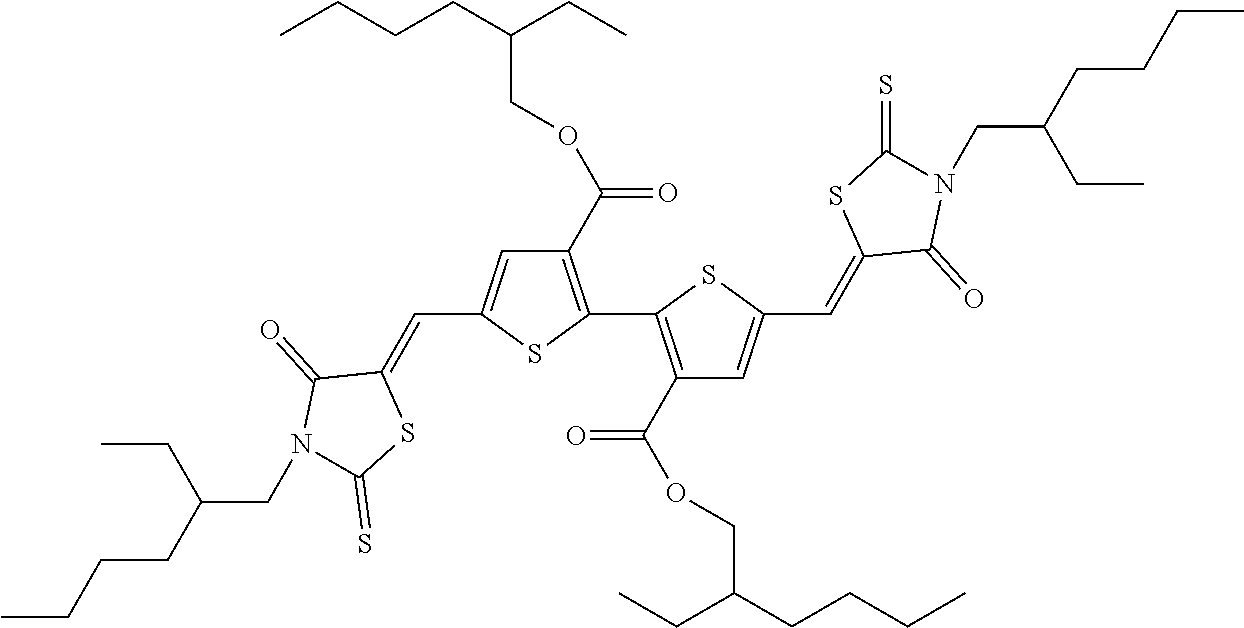 |
δ 8.10 (s, 2H), 7.42 (s, 2H), 4.66 (d, 4H), 4.11 (t, 4H), 1.92-1.89 (m, 4H), 1.55 (m, 8H), 1.31- 1.19 (m, 24H), 0.88 (t, 24H) |
| 35 |
 |
δ 7.37 (s, 2H), 6.94 (s, 2H), 4.07 (q, 4H), 2.63 (t, 4H), 1.59 (m, 4H), 1.30- 1.29 (m, 12H), 1.20 (t, 6H), 0.88 (t, 6H) |
| 36 |
 |
δ 7.37 (s, 2H), 6.94 (s, 2H), 4.03 (t, 4H), 2.63 (t, 4H), 1.63-1.59 (m, 8H), 1.30-1.26 (m, 32H), 0.88 (t, 12H) |
| 37 |
 |
δ 7.37 (s, 2H), 6.94 (s, 2H), 4.03 (t, 4H), 2.63 (t, 4H), 1.63-1.59 (m, 8H), 1.30-1.26 (m, 40H), 0.88 (t, 12H) |
| 38 |
 |
δ 7.37 (s, 2H), 6.94 (s, 2H), 4.03 (t, 4H), 2.63 (t, 4H), 1.63-1.59 (m, 8H), 1.30-1.26 (m, 48H), 0.88 (t, 12H) |
| 39 |
 |
δ 7.59 (s, 2H), 7.37 (s, 2H), 4.33 (t, 4H), 4.03 (t, 4H), 1.78 (m, 4H), 1.63 (m, 4H), 1.39-1.26 (m, 40H), 0.88 (t, 12H) |
| 40 |
 |
δ 7.59 (s, 2H), 7.37 (s, 2H), 4.33 (t, 4H), 4.03 (t, 4H), 1.78 (m, 4H), 1.63 (m, 4H), 1.39-1.26 (m, 48H), 0.88 (t, 12H) |
| 41 |
 |
δ 7.59 (s, 2H), 7.37 (s, 2H), 4.33 (t, 4H), 4.11 (t, 4H), 1.92 (m, 2H), 1.78 (m, 4H), 1.55 (m, 4H), 1.39-1.19 (m, 24H), 0.88 (t, 18H) |
| 42 |
 |
δ 7.59 (s, 2H), 7.37 (s, 2H), 4.66 (t, 4H), 4.03 (t, 4H), 1.89 (m, 2H), 1.63 (m, 4H), 1.55 (m, 4H), 1.39-1.19 (m, 40H), 0.88 (t, 18H) |
| 43 |
 |
δ 7.59 (s, 2H), 7.37 (s, 2H), 4.66 (t, 4H), 4.03 (t, 4H), 1.89 (m, 2H), 1.63 (m, 4H), 1.55 (m, 4H), 1.31-1.19 (m, 48H), 0.88 (t, 18H) |
| 44 |
 |
δ 7.59 (5, 2H), 7.37 (s, 2H), 4.66 (d, 4H), 4.11 (t, 4H), 1.92-1.89 (m, 4H), 1.55 (m, 8H), 1.31- 1.19 (m, 24H), 0.88 (t, 24H) |

| TABLE 2 | |||||
| Organic | Electron | Voc | Jsc | FF | PCE |
| solar cell | acceptor | [V] | [mA/cm2] | [%] | [%] |
| Example 45 | Example 1 | 1.05 | 14.70 | 59 | 9.02 |
| Example 46 | Example 2 | 1.07 | 13.20 | 59 | 8.33 |
| Example 47 | Example 3 | 1.01 | 15.10 | 57 | 8.69 |
| Example 48 | Example 4 | 1.00 | 14.50 | 58 | 8.41 |
| Example 49 | Example 5 | 1.00 | 14.30 | 57 | 8.15 |
| Example 50 | Example 6 | 1.02 | 14.54 | 58 | 8.60 |
| Example 51 | Example 7 | 1.01 | 14.21 | 57 | 8.18 |
| Example 52 | Example 9 | 1.01 | 14.20 | 57 | 8.17 |
| Example 53 | Example 11 | 1.02 | 14.80 | 58 | 8.76 |
| Example 54 | Example 12 | 1.03 | 14.60 | 57 | 8.57 |
| Example 55 | Example 13 | 1.04 | 14.20 | 56 | 8.27 |
| Example 56 | Example 14 | 1.02 | 14.00 | 56 | 8.00 |
| Example 57 | Example 16 | 0.99 | 14.80 | 58 | 8.50 |
| Example 58 | Example 17 | 1.00 | 14.70 | 57 | 8.38 |
| Example 59 | Example 18 | 1.03 | 14.10 | 57 | 8.28 |
| Example 60 | Example 21 | 1.04 | 14.07 | 55 | 8.05 |
| Example 61 | Example 23 | 1.02 | 14.10 | 57 | 8.03 |
| Example 62 | Example 24 | 1.02 | 14.07 | 56 | 8.04 |
| Example 63 | Example 25 | 1.05 | 14.23 | 57 | 8.52 |
| Example 64 | Example 26 | 1.04 | 14.19 | 56 | 8.26 |
| Comparative | Fullerene | 0.80 | 16.13 | 57 | 7.35 |
| Example 1 | compound A | ||||
| Comparative | ITIC | 0.82 | 14.08 | 65 | 7.46 |
| Example 2 | |||||
Claims (10)


Applications Claiming Priority (2)
| Application Number | Priority Date | Filing Date | Title |
|---|---|---|---|
| KR1020170098500A KR102002396B1 (en) | 2017-08-03 | 2017-08-03 | Novel organic semiconductor compound, its production method and organic electronic device using them |
| KR10-2017-0098500 | 2017-08-03 |
Publications (2)
| Publication Number | Publication Date |
|---|---|
| US20190040056A1 US20190040056A1 (en) | 2019-02-07 |
| US10344028B2 true US10344028B2 (en) | 2019-07-09 |
Family
ID=65229149
Family Applications (1)
| Application Number | Title | Priority Date | Filing Date |
|---|---|---|---|
| US15/964,451 Active US10344028B2 (en) | 2017-08-03 | 2018-04-27 | Organic semiconductor compound, production method thereof, and organic electronic device using the same |
Country Status (2)
| Country | Link |
|---|---|
| US (1) | US10344028B2 (en) |
| KR (1) | KR102002396B1 (en) |
Cited By (1)
| Publication number | Priority date | Publication date | Assignee | Title |
|---|---|---|---|---|
| US20220140254A1 (en) * | 2020-11-04 | 2022-05-05 | The Regents Of The University Of Michigan | Key materials for organic photovoltaics reliability |
Families Citing this family (1)
| Publication number | Priority date | Publication date | Assignee | Title |
|---|---|---|---|---|
| WO2024262173A1 (en) | 2023-06-19 | 2024-12-26 | 富士フイルム株式会社 | Photoelectric conversion element, imaging element, optical sensor, imaging element production method, and compound |
Citations (2)
| Publication number | Priority date | Publication date | Assignee | Title |
|---|---|---|---|---|
| US20060011233A1 (en) | 2002-05-22 | 2006-01-19 | Serdar Sariciftci | Method for the post-treatment of a photovoltaic cell |
| KR20160011039A (en) | 2014-07-21 | 2016-01-29 | 삼성전자주식회사 | Compound, organic optoelectronic device and image sensor |
Family Cites Families (1)
| Publication number | Priority date | Publication date | Assignee | Title |
|---|---|---|---|---|
| KR100728612B1 (en) | 2004-07-29 | 2007-06-14 | (주)위세아이텍 | Data Quality Management Method in Data Migration |
-
2017
- 2017-08-03 KR KR1020170098500A patent/KR102002396B1/en not_active Expired - Fee Related
-
2018
- 2018-04-27 US US15/964,451 patent/US10344028B2/en active Active
Patent Citations (2)
| Publication number | Priority date | Publication date | Assignee | Title |
|---|---|---|---|---|
| US20060011233A1 (en) | 2002-05-22 | 2006-01-19 | Serdar Sariciftci | Method for the post-treatment of a photovoltaic cell |
| KR20160011039A (en) | 2014-07-21 | 2016-01-29 | 삼성전자주식회사 | Compound, organic optoelectronic device and image sensor |
Non-Patent Citations (3)
| Title |
|---|
| Li et al., "Solution Processable Rhodanine-Based Small Molecule Organic Photovoltaic Cells with a Power Conversion Efficiency of 6.1%," Advanced Energy Materials, 2012, 2:74-77. |
| Ni et al., "A-D-A small molecules for solution-processed organic photovoltaic cells," Chem. Commun., 2015, 51:4936-4950. |
| Office Action dated Sep. 17, 2018, in KR Application No. 10-2017-0098500. |
Cited By (3)
| Publication number | Priority date | Publication date | Assignee | Title |
|---|---|---|---|---|
| US20220140254A1 (en) * | 2020-11-04 | 2022-05-05 | The Regents Of The University Of Michigan | Key materials for organic photovoltaics reliability |
| US11594686B2 (en) * | 2020-11-04 | 2023-02-28 | The Regents Of The University Of Michigan | Key materials for organic photovoltaics reliability |
| US11957048B2 (en) | 2020-11-04 | 2024-04-09 | The Regents Of The University Of Michigan | Key materials for organic photovoltaics reliability |
Also Published As
| Publication number | Publication date |
|---|---|
| KR102002396B1 (en) | 2019-07-23 |
| KR20190014707A (en) | 2019-02-13 |
| US20190040056A1 (en) | 2019-02-07 |
Similar Documents
| Publication | Publication Date | Title |
|---|---|---|
| JP6797019B2 (en) | Coupled polymers and devices incorporating them | |
| KR101986593B1 (en) | Novel organic semiconductor compound, its production method and organic electronic device using them | |
| US20120298976A1 (en) | N-Type Materials And Organic Electronic Devices | |
| US9640767B1 (en) | Electronic device including phosphine oxide functionalized triazine derivative and novel phosphine oxide functionalized triazine derivative | |
| KR20160097766A (en) | Hetero-cyclic compound, unimolecular, polymer and organic electronic device comprising the same | |
| KR101596132B1 (en) | Organic electronic device comprising fullerene derivatives | |
| US11401275B2 (en) | Non-fullerene based heterocyclic compound and organic electronic device including same | |
| KR102091053B1 (en) | Novel compound and organic electronic device using them | |
| KR102114177B1 (en) | Novel compound, its production method and organic electronic device using them | |
| US10344028B2 (en) | Organic semiconductor compound, production method thereof, and organic electronic device using the same | |
| CN110099908A (en) | Heterocyclic compound and organic electronic device comprising the same | |
| KR102093470B1 (en) | Novel compound and organic electronic device using them | |
| JP5946273B2 (en) | Organic semiconductor compound, and transistor and electronic device including the same | |
| CN106661048B (en) | Lime derivatives, photoelectric conversion materials and photoelectric conversion elements | |
| CN105980300B (en) | Fullerene derivative, organic solar cell using same, and manufacturing method thereof | |
| KR101535066B1 (en) | Double junction organic photovoltaic device fabricated using organic semiconductor compound, and organic electronic device that contains it | |
| KR101553806B1 (en) | Organic semiconductor compounds Containing Posphine oxide and Solar Cell Device Using This Material | |
| JP7591792B2 (en) | Naphthobisthiadiazole compound, its method of production, and organic semiconductor material and organic semiconductor device using said compound | |
| KR20140083969A (en) | Bibenzo[b]furan compound, photoelectric conversion material, and photoelectric conversion element | |
| KR20190064407A (en) | Novel compound and organic electronic device using them | |
| KR101386049B1 (en) | ORGANIC PHOTOVOLTAIC π-π CONJUGATED POLYMER AND MANUFACTURING METHOD THEREOF | |
| JP7029721B2 (en) | Compounds, organic semiconductor materials, organic semiconductor devices, organic solar cells and organic transistors | |
| KR102056515B1 (en) | Composition and organic electronic device comprising same | |
| KR101833215B1 (en) | Organic semiconducting compounds, manufacturing method thereof, and organic electronic device containing the same | |
| KR20130013780A (en) | Polymer with phenanthrothiadiazole thereof and photovoltaic device using same |
Legal Events
| Date | Code | Title | Description |
|---|---|---|---|
| AS | Assignment |
Owner name: KYONGGI UNIVERSITY INDUSTRY & ACADEMIA COOPERATION Free format text: ASSIGNMENT OF ASSIGNORS INTEREST;ASSIGNORS:LEE, JOHN CHEOL;LEE, SANG KYU;SHIN, WON SUK;AND OTHERS;REEL/FRAME:045653/0495 Effective date: 20180426 Owner name: KOREA RESEARCH INSTITUTE OF CHEMICAL TECHNOLOGY, K Free format text: ASSIGNMENT OF ASSIGNORS INTEREST;ASSIGNORS:LEE, JOHN CHEOL;LEE, SANG KYU;SHIN, WON SUK;AND OTHERS;REEL/FRAME:045653/0495 Effective date: 20180426 |
|
| FEPP | Fee payment procedure |
Free format text: ENTITY STATUS SET TO UNDISCOUNTED (ORIGINAL EVENT CODE: BIG.); ENTITY STATUS OF PATENT OWNER: SMALL ENTITY |
|
| FEPP | Fee payment procedure |
Free format text: ENTITY STATUS SET TO SMALL (ORIGINAL EVENT CODE: SMAL); ENTITY STATUS OF PATENT OWNER: SMALL ENTITY |
|
| STPP | Information on status: patent application and granting procedure in general |
Free format text: NOTICE OF ALLOWANCE MAILED -- APPLICATION RECEIVED IN OFFICE OF PUBLICATIONS |
|
| STPP | Information on status: patent application and granting procedure in general |
Free format text: PUBLICATIONS -- ISSUE FEE PAYMENT VERIFIED |
|
| STCF | Information on status: patent grant |
Free format text: PATENTED CASE |
|
| MAFP | Maintenance fee payment |
Free format text: PAYMENT OF MAINTENANCE FEE, 4TH YR, SMALL ENTITY (ORIGINAL EVENT CODE: M2551); ENTITY STATUS OF PATENT OWNER: SMALL ENTITY Year of fee payment: 4 |