US10340503B2 - Pouch-shaped secondary battery including electrode lead having notch formed therein - Google Patents
Pouch-shaped secondary battery including electrode lead having notch formed therein Download PDFInfo
- Publication number
- US10340503B2 US10340503B2 US16/029,177 US201816029177A US10340503B2 US 10340503 B2 US10340503 B2 US 10340503B2 US 201816029177 A US201816029177 A US 201816029177A US 10340503 B2 US10340503 B2 US 10340503B2
- Authority
- US
- United States
- Prior art keywords
- electrode lead
- lead
- pouch
- secondary battery
- electrode
- Prior art date
- Legal status (The legal status is an assumption and is not a legal conclusion. Google has not performed a legal analysis and makes no representation as to the accuracy of the status listed.)
- Active
Links
Images


Classifications
-
- H01M2/345—
-
- H—ELECTRICITY
- H01—ELECTRIC ELEMENTS
- H01M—PROCESSES OR MEANS, e.g. BATTERIES, FOR THE DIRECT CONVERSION OF CHEMICAL ENERGY INTO ELECTRICAL ENERGY
- H01M50/00—Constructional details or processes of manufacture of the non-active parts of electrochemical cells other than fuel cells, e.g. hybrid cells
- H01M50/10—Primary casings; Jackets or wrappings
- H01M50/116—Primary casings; Jackets or wrappings characterised by the material
- H01M50/124—Primary casings; Jackets or wrappings characterised by the material having a layered structure
-
- H—ELECTRICITY
- H01—ELECTRIC ELEMENTS
- H01M—PROCESSES OR MEANS, e.g. BATTERIES, FOR THE DIRECT CONVERSION OF CHEMICAL ENERGY INTO ELECTRICAL ENERGY
- H01M50/00—Constructional details or processes of manufacture of the non-active parts of electrochemical cells other than fuel cells, e.g. hybrid cells
- H01M50/50—Current conducting connections for cells or batteries
- H01M50/572—Means for preventing undesired use or discharge
- H01M50/574—Devices or arrangements for the interruption of current
- H01M50/578—Devices or arrangements for the interruption of current in response to pressure
-
- H01M2/0287—
-
- H01M2/06—
-
- H01M2/26—
-
- H01M2/30—
-
- H—ELECTRICITY
- H01—ELECTRIC ELEMENTS
- H01M—PROCESSES OR MEANS, e.g. BATTERIES, FOR THE DIRECT CONVERSION OF CHEMICAL ENERGY INTO ELECTRICAL ENERGY
- H01M50/00—Constructional details or processes of manufacture of the non-active parts of electrochemical cells other than fuel cells, e.g. hybrid cells
- H01M50/10—Primary casings; Jackets or wrappings
- H01M50/116—Primary casings; Jackets or wrappings characterised by the material
- H01M50/117—Inorganic material
- H01M50/119—Metals
-
- H—ELECTRICITY
- H01—ELECTRIC ELEMENTS
- H01M—PROCESSES OR MEANS, e.g. BATTERIES, FOR THE DIRECT CONVERSION OF CHEMICAL ENERGY INTO ELECTRICAL ENERGY
- H01M50/00—Constructional details or processes of manufacture of the non-active parts of electrochemical cells other than fuel cells, e.g. hybrid cells
- H01M50/10—Primary casings; Jackets or wrappings
- H01M50/116—Primary casings; Jackets or wrappings characterised by the material
- H01M50/121—Organic material
-
- H—ELECTRICITY
- H01—ELECTRIC ELEMENTS
- H01M—PROCESSES OR MEANS, e.g. BATTERIES, FOR THE DIRECT CONVERSION OF CHEMICAL ENERGY INTO ELECTRICAL ENERGY
- H01M50/00—Constructional details or processes of manufacture of the non-active parts of electrochemical cells other than fuel cells, e.g. hybrid cells
- H01M50/10—Primary casings; Jackets or wrappings
- H01M50/116—Primary casings; Jackets or wrappings characterised by the material
- H01M50/124—Primary casings; Jackets or wrappings characterised by the material having a layered structure
- H01M50/126—Primary casings; Jackets or wrappings characterised by the material having a layered structure comprising three or more layers
- H01M50/129—Primary casings; Jackets or wrappings characterised by the material having a layered structure comprising three or more layers with two or more layers of only organic material
-
- H—ELECTRICITY
- H01—ELECTRIC ELEMENTS
- H01M—PROCESSES OR MEANS, e.g. BATTERIES, FOR THE DIRECT CONVERSION OF CHEMICAL ENERGY INTO ELECTRICAL ENERGY
- H01M50/00—Constructional details or processes of manufacture of the non-active parts of electrochemical cells other than fuel cells, e.g. hybrid cells
- H01M50/10—Primary casings; Jackets or wrappings
- H01M50/172—Arrangements of electric connectors penetrating the casing
- H01M50/174—Arrangements of electric connectors penetrating the casing adapted for the shape of the cells
- H01M50/178—Arrangements of electric connectors penetrating the casing adapted for the shape of the cells for pouch or flexible bag cells
-
- H—ELECTRICITY
- H01—ELECTRIC ELEMENTS
- H01M—PROCESSES OR MEANS, e.g. BATTERIES, FOR THE DIRECT CONVERSION OF CHEMICAL ENERGY INTO ELECTRICAL ENERGY
- H01M50/00—Constructional details or processes of manufacture of the non-active parts of electrochemical cells other than fuel cells, e.g. hybrid cells
- H01M50/50—Current conducting connections for cells or batteries
- H01M50/528—Fixed electrical connections, i.e. not intended for disconnection
-
- H—ELECTRICITY
- H01—ELECTRIC ELEMENTS
- H01M—PROCESSES OR MEANS, e.g. BATTERIES, FOR THE DIRECT CONVERSION OF CHEMICAL ENERGY INTO ELECTRICAL ENERGY
- H01M50/00—Constructional details or processes of manufacture of the non-active parts of electrochemical cells other than fuel cells, e.g. hybrid cells
- H01M50/50—Current conducting connections for cells or batteries
- H01M50/531—Electrode connections inside a battery casing
- H01M50/536—Electrode connections inside a battery casing characterised by the method of fixing the leads to the electrodes, e.g. by welding
-
- H—ELECTRICITY
- H01—ELECTRIC ELEMENTS
- H01M—PROCESSES OR MEANS, e.g. BATTERIES, FOR THE DIRECT CONVERSION OF CHEMICAL ENERGY INTO ELECTRICAL ENERGY
- H01M50/00—Constructional details or processes of manufacture of the non-active parts of electrochemical cells other than fuel cells, e.g. hybrid cells
- H01M50/50—Current conducting connections for cells or batteries
- H01M50/543—Terminals
- H01M50/547—Terminals characterised by the disposition of the terminals on the cells
- H01M50/55—Terminals characterised by the disposition of the terminals on the cells on the same side of the cell
-
- H—ELECTRICITY
- H01—ELECTRIC ELEMENTS
- H01M—PROCESSES OR MEANS, e.g. BATTERIES, FOR THE DIRECT CONVERSION OF CHEMICAL ENERGY INTO ELECTRICAL ENERGY
- H01M50/00—Constructional details or processes of manufacture of the non-active parts of electrochemical cells other than fuel cells, e.g. hybrid cells
- H01M50/50—Current conducting connections for cells or batteries
- H01M50/543—Terminals
- H01M50/552—Terminals characterised by their shape
- H01M50/553—Terminals adapted for prismatic, pouch or rectangular cells
-
- H—ELECTRICITY
- H01—ELECTRIC ELEMENTS
- H01M—PROCESSES OR MEANS, e.g. BATTERIES, FOR THE DIRECT CONVERSION OF CHEMICAL ENERGY INTO ELECTRICAL ENERGY
- H01M2200/00—Safety devices for primary or secondary batteries
- H01M2200/20—Pressure-sensitive devices
-
- Y—GENERAL TAGGING OF NEW TECHNOLOGICAL DEVELOPMENTS; GENERAL TAGGING OF CROSS-SECTIONAL TECHNOLOGIES SPANNING OVER SEVERAL SECTIONS OF THE IPC; TECHNICAL SUBJECTS COVERED BY FORMER USPC CROSS-REFERENCE ART COLLECTIONS [XRACs] AND DIGESTS
- Y02—TECHNOLOGIES OR APPLICATIONS FOR MITIGATION OR ADAPTATION AGAINST CLIMATE CHANGE
- Y02E—REDUCTION OF GREENHOUSE GAS [GHG] EMISSIONS, RELATED TO ENERGY GENERATION, TRANSMISSION OR DISTRIBUTION
- Y02E60/00—Enabling technologies; Technologies with a potential or indirect contribution to GHG emissions mitigation
- Y02E60/10—Energy storage using batteries
Definitions
- the present disclosure relates to a pouch-shaped secondary battery including an electrode lead that includes a notch formed therein, and more particularly to a pouch-shaped secondary battery including an electrode lead having a notch formed therein, wherein the electrode lead is configured to be cut to secure the safety of a battery cell when the battery cell swells due to gas generated in the battery cell while the battery cell is in an abnormal state or when the pressure in the battery cell increases as a result of the battery cell being overcharged.
- втори ⁇ ное ⁇ лектро ⁇ ное ⁇ лектро ⁇ ество there are various kinds of secondary batteries, such as a nickel cadmium battery, a nickel hydride battery, a lithium ion battery, and a lithium ion polymer battery.
- Such secondary batteries have been used in large-sized products that require high output, such as an electric vehicle and a hybrid electric vehicle, a power storage device for storing surplus power or new and renewable energy, and a backup power storage device, as well as small-sized products, such as a digital camera, a portable digital versatile disc (DVD) player, an MP3 player, a cellular phone, a personal digital assistant (PDA), a portable game device, a power tool, and an electric bicycle (E-bike).
- a digital camera a portable digital versatile disc (DVD) player, an MP3 player, a cellular phone, a personal digital assistant (PDA), a portable game device, a power tool, and an electric bicycle (E-bike).
- a lithium secondary battery generally includes a positive electrode (a cathode), a separator, and a negative electrode (an anode).
- the materials of the positive electrode, the separator, and the negative electrode are selected in consideration of the lifespan, the charge and discharge capacity, the temperature characteristics, the safety, and the like of the battery.
- the lithium secondary battery is configured to have a three-layered structure, in which a positive electrode, a separator, and a negative electrode are sequentially stacked.
- the lithium secondary battery is configured to have a five-layered structure, in which a positive electrode, a separator, a negative electrode, a separator, and a positive electrode are sequentially stacked, or to have another five-layered structure, in which a negative electrode, a separator, a positive electrode, a separator, and a negative electrode are sequentially stacked.
- a plurality of unit cells is combined to constitute an electrode assembly or a secondary battery.
- a lithium secondary battery is charged and discharged through a process in which lithium ions from a lithium metal oxide of a positive electrode are repeatedly intercalated into a negative electrode, such as a graphite electrode, and the lithium ions are repeatedly deintercalated from the negative electrode.
- Heat may be generated from such a secondary battery in the event of occurrence of a short circuit in the secondary battery due to an external impact, overcharge of the secondary battery, or overdischarge of the secondary battery.
- an electrolyte may be decomposed in the secondary battery, and thermal runaway may occur in the secondary battery. That is, the safety of the secondary battery is compromised in several aspects.
- the secondary battery may explode for various reasons. In one example, the secondary battery may explode due to an increase in the pressure of the air in the secondary battery, which is caused by the decomposition of an electrolyte.
- gas may be generated in the secondary battery as a result of the electrochemical reaction between the electrolyte and an electrode active material.
- the gas generated in the secondary battery increases the pressure in the secondary battery. Consequently, the fastening force between parts constituting the secondary battery may be reduced, an external case of the secondary battery may be damaged, a protection circuit of the secondary battery may be operated prematurely, an electrode of the secondary battery may be deformed, a short circuit may occur in the secondary battery, or the secondary battery may explode.
- a protection circuit such as a protection circuit module (PCM)
- PCM protection circuit module
- a mechanical current interrupt device that physically interrupts the series connection of a battery pack using the pressure generated in the battery due to thermal expansion of the battery when the battery is overcharged in consideration of malfunction of the electronic parts of the battery.
- the current interrupt device of the battery pack there is widely used a method of physically cutting the series connection of the battery pack through the structure of the battery pack using only the pressure generated in the battery as the battery is expanded when the battery is overcharged in order to interrupt the flow of electric current in the battery pack.
- an electrode lead having a notch formed therein to interrupt the flow of electric current in a battery when the volume of the battery increases has not been suggested.
- Korean Registered Patent No. 1601135 discloses a pouch-shaped secondary battery configured to have a structure in which two lead plates are coupled to each other via a polymer material interposed between the lead plates, in which a vent notch is provided in order to rapidly discharge gas, generated in the secondary battery, out of the secondary battery when the pressure in the secondary battery reaches a predetermined level due to the gas, and in which first and second sealants, which are interposed between the lead plates, exhibit electrical insulation and thermal fusion properties.
- a structure in which an electrode lead having a notch formed therein is disposed in a lead box has not been suggested.
- Korean Patent Application Publication No. 2016-0125920 discloses a pouch-shaped secondary battery including an electrode assembly and a pouch sheathing member for receiving the electrode assembly, the pouch sheathing member including a first pouch unit and a second pouch unit, the first pouch unit and the second pouch unit being adhered to each other via a sealing unit, wherein the pouch-shaped secondary battery further includes a first electrode lead extending from the electrode assembly, the first electrode lead attached to the first pouch unit, a second electrode lead attached to the second pouch unit, the second electrode lead formed to protrude outwards from the pouch sheathing member, a first sealing member interposed between the first electrode lead and the second electrode lead for preventing the first electrode lead and the second electrode lead from contacting each other, and a film-shaped connection member for electrically connecting the first electrode lead and the second electrode lead to each other.
- a structure in which an electrode lead having a notch formed therein is disposed in a lead box has not been suggested.
- Korean Registered Patent No. 1192077 discloses a secondary battery including an electrode assembly, which includes a first electrode, a second electrode, and a separator provided between the first electrode and the second electrode, a battery case for receiving the electrode assembly, an electrode terminal electrically connected to the first electrode, and a lead tab extending from the inside of the battery case out of the battery case, the lead tab electrically connected to the first electrode via the electrode terminal, wherein the lead tab is formed to be separated from at least a portion of the electrode terminal such that, when the battery case is deformed in the state in which the lead tab is in contact with the battery case, the lead tab can be electrically disconnected from the first electrode, the secondary battery further includes an adhesive member for adhering the lead tab to the electrode terminal, and the adhesive member is provided with a through-hole, through which the lead tab is electrically connected to the electrode terminal.
- an electrode assembly which includes a first electrode, a second electrode, and a separator provided between the first electrode and the second electrode
- a battery case for receiving the electrode assembly
- Korean Registered Patent No. 1447064 discloses a battery cell configured such that an electrode assembly having a positive-electrode/separator/negative-electrode structure is mounted in a receiving unit of a battery case, wherein tabs (electrode tabs) having no active material coated thereon protrude from electrode plates that constitute the electrode assembly, an electrode lead for electrically connecting the electrode tabs to each other is disposed at one end of a stack of the electrode tabs, and the electrode lead is inserted into the electrode tabs at the electrical connection between the electrode tabs and the electrode lead due to the deformation of the electrode lead, whereby physical coupling between the electrode tabs and the electrode lead is achieved.
- a structure in which an electrode lead having a notch formed therein is disposed in a lead box has not been suggested.
- An object of the present disclosure is to provide a secondary battery including a lead box configured to receive an electrode lead having a notch formed therein, the lead box being disposed on a sealed portion of a battery case, in order to secure the safety of a battery cell when the pressure in the battery increases due to gas generated in the battery cell while the battery cell is in an abnormal state or when the battery cell is overcharged.
- a pouch-shaped secondary battery including an electrode assembly configured to have a structure in which a positive electrode and a negative electrode are stacked in the state in which a separator is interposed between the positive electrode and the negative electrode, an electrode lead electrically connected to electrode tabs of the electrode assembly, a pouch-shaped battery case made of a laminate sheet including an outer coating layer, a metal layer, and an inner sealant layer, and a lead box located on a sealed portion of the battery case for receiving the electrode lead, wherein the electrode lead includes a lower electrode lead, electrically connected to the electrode tabs, and an upper electrode lead, a portion of which is coupled to the lower electrode lead, the thickness of the upper electrode lead being relatively large.
- a closed-loop-type notch may be formed in one surface of the upper electrode lead.
- the surface of the upper electrode lead within the boundary of the closed-loop-type notch may be coupled to the lower electrode lead.
- the depth of the closed-loop-type notch may not be uniform.
- a pair of notches may be formed in one surface of the upper electrode lead, and each of the pair of notches may be formed in a direction that is perpendicular to the longitudinal direction of the electrode lead.
- the central part of the upper electrode lead, disposed between the notches, may be coupled to the lower electrode lead.
- the notches may be configured such that the depth of a proximal notch that is disposed inside is greater than the depth of a distal notch that is disposed outside.
- the thickness of the upper electrode lead at the part thereof at which the proximal notch is formed may be 10% to 90% of the thickness of the upper electrode lead at the part thereof at which no notches are formed.
- the upper electrode lead and/or the lower electrode lead may extend from the inner surface of a proximal side of the lead box to the inner surface of a distal side of the lead box such that the lower part of the lead box is hermetically sealed by the electrode lead.
- the pressure in the lower part of the lead box that is hermetically sealed may be less than atmospheric pressure or 1.5 atm.
- An opening may be formed in the upper part of the lead box to face a receiving unit of the battery case, in which the electrode assembly is received.
- the upper electrode lead and the lower electrode lead may extend through the lead box in the state of being fixed to a proximal side surface and a distal side surface of the lead box, respectively, a proximal end of the lower electrode lead may be coupled to the electrode tabs, and a distal end of the upper electrode lead may be withdrawn out of the battery case.
- the lower electrode lead may include inclined portions at opposite sides of the coupling part thereof that is coupled to the central part of the upper electrode lead.
- Each of the inclined portions may be made of an elastic material or a conductive metal material.
- the closed-loop-type notch may be formed in a circular shape, an oval shape, or a polygonal shape.
- the closed-loop-type notch may be continuously formed such that the depth of the closed-loop-type notch increases in the inward direction and decreases in the outward direction.
- the maximum depth of the notch may be 30% to 90% of the thickness of the electrode lead, and the minimum depth of the notch may be 10% to 50% of the thickness of the electrode lead under the condition that the minimum depth of the notch is less than the maximum depth of the notch.
- An adhesive layer may be formed at each of the upper surface and the lower surface of the lead box.
- the lead box may be made of an electrically insulating material.
- a device including a secondary battery that includes the safety feature discloses herein.
- the device may be selected from the group consisting of an electronic device, an electric vehicle, a hybrid electric vehicle, and a power storage device.
- a secondary battery including an electrode lead having notches formed therein according to the present disclosure may prevent the flow of electric current in the secondary battery when the secondary battery is in an abnormal state as well as when the secondary battery is overcharged.
- the secondary battery according to the present disclosure may prevent a reduction in the energy density of the secondary battery in the case in which an additional complicated device is provided in the secondary battery.
- the secondary battery according to the present disclosure may cut the electrode lead through deformation of the electrode lead in the case in which the pressure in the lower part of the lead box is lower than the pressure in the upper part of the lead box when the secondary battery swells due to gas generated in the secondary battery.
- FIG. 1 is a view showing an illustrative conventional pouch-shaped battery cell
- FIG. 2 is a view showing an increase in the volume of the illustrative pouch-shaped battery cell due to gas generated in the battery cell;
- FIG. 3 is a view showing a lead box configured to receive an electrode lead having a notch formed therein according to an exemplary embodiment of the present disclosure
- FIG. 4 is a view showing a pouch-shaped secondary battery including a lead box configured to receive an electrode lead having a closed-loop-type notch formed therein according to another exemplary embodiment of the present disclosure, before and after the pouch-shaped secondary battery is short-circuited;
- FIG. 5 is a view showing a pouch-shaped secondary battery including a lead box configured to receive an electrode lead having a pair of notches formed therein according to yet another exemplary embodiment of the present disclosure, before and after the pouch-shaped secondary battery is short-circuited;
- FIG. 6 is a view showing an electrode lead unit of the pouch-shaped secondary battery including the lead box configured to receive the electrode lead having the closed-loop-type notch formed therein according to the exemplary embodiment of the present disclosure, before and after the electrode lead unit is cut;
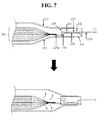
- FIG. 7 is a view showing an electrode lead unit of the pouch-shaped secondary battery including the lead box configured to receive the electrode lead having the pair of notches formed therein according to the exemplary embodiment of the present disclosure, before and after the electrode lead unit is cut.
- FIG. 1 is a view showing an illustrative conventional pouch-shaped battery cell.
- a lithium secondary battery is manufactured as follows. First, a mixture of an active material, a binder, and a plasticizer is applied to a positive electrode current collector and to a negative electrode current collector in order to manufacture a positive electrode plate and a negative electrode plate, respectively. Subsequently, a plurality of positive electrode plates and a plurality of negative electrode plates are stacked with separators interposed respectively between the positive electrode plates and the negative electrode plates to manufacture a battery cell having a predetermined shape. Subsequently, the battery cell is placed in a battery case, an electrolytic solution is injected into the battery case, and the battery case is sealed, whereby a secondary battery, such as a battery pack, is manufactured.
- a secondary battery such as a battery pack
- Electrode leads are connected to a general electrode assembly.
- Each of the electrode leads is configured to have a structure in which one end of the electrode lead is connected to the electrode assembly, the other end of the electrode lead is exposed outside of the battery case, and the battery case, in which the electrode assembly is disposed, is sealed by an adhesive layer, such as a sealant layer, at the portion of the battery case from which the electrode lead extends outwards from the battery case.
- each current collector plate of the electrode assembly includes a coated part, on which an electrode active material is coated, and a distal part (hereinafter, referred to as a “non-coated part”), on which the electrode active material is not coated.
- Each of the electrode tabs may be formed by cutting the non-coated part, or may be a separate conductive member connected to the non-coated part by ultrasonic welding. As shown, the electrode tabs may protrude in one direction such that the electrode tabs are formed at the electrode assembly to be arranged side by side. Alternatively, the electrode tabs may protrude in opposite directions.
- Each electrode tab serves as a path along which electrons move between the inside and the outside of the battery.
- the electrode leads are connected to respective electrode tabs by spot welding.
- the electrode leads may extend in the same direction or in opposite directions depending on the position at which positive electrode tabs and negative electrode tabs are formed.
- a positive electrode lead and a negative electrode lead may be made of different materials.
- the positive electrode lead may be made of the same material as the positive electrode plate, such as an aluminum (Al) material
- the negative electrode lead may be made of the same material as the negative electrode plate, such as a copper (Cu) material or a copper material coated with nickel (Ni).
- the electrode leads are electrically connected to external terminals via terminal parts thereof.
- a pouch sheathing member contains the electrode assembly in a sealed state such that a portion of each of the electrode leads, i.e. the terminal part of each of the electrode leads, is exposed from the pouch sheathing member.
- a sealing layer such as a sealant layer, is interposed between each of the electrode leads and the pouch sheathing member.
- the pouch sheathing member is provided at the edge thereof with a sealed region. A horizontal slit in each of the electrode leads is spaced apart from the sealed region toward a joint.
- each of the electrode leads is formed so as to have an inverted T shape
- the leg part of the T shape protrudes outwards from the pouch sheathing member, whereas a portion of the head part of the T shape is disposed in the sealed region.
- a positive electrode current collector plate is made of an aluminum material
- a negative electrode current collector plate is made of a copper material.
- copper foil tends to rupture more easily than aluminum foil.
- the negative electrode lead may rupture more easily than the positive electrode lead.
- an electrode lead capable of rupturing with less effort is used as the negative electrode lead.
- the electrode assembly When the secondary battery is in a normal state, the electrode assembly is isolated from the outside due to the sealing layer.
- the battery case may swell. When swelling occurs, a weak portion of the battery case or a weak adhesion portion between another component of the secondary battery and the battery case ruptures, whereby gas is exhausted from the battery.
- the amount of electrolyte that is injected into the secondary battery may be adjusted, or the short-circuit pressure of a current interrupt device (CID) may be adjusted.
- CID current interrupt device
- the safety of the battery is reduced when the battery is overcharged. In other words, it is difficult not only to secure the safety of the battery when the battery is overcharged but also to secure the safety of the battery when the battery is used in a high-temperature situation.
- FIG. 2 is a view showing an increase in the volume of the illustrative pouch-shaped battery cell due to gas generated in the battery cell.
- a pouch-shaped battery case includes a gas barrier layer and a sealant layer.
- the pouch-shaped battery case may further include a surface protective layer, which is the outermost layer formed on the gas barrier layer.
- the gas barrier layer is configured to prevent the introduction of gas into the battery cell.
- the gas barrier layer is mainly made of aluminum (Al) foil.
- the sealant layer is the innermost layer of the pouch-shaped battery case, which contacts the member disposed in the pouch-shaped battery case, i.e. a cell.
- the surface protective layer is mainly made of a nylon resin in consideration of wear resistance and heat resistance.
- the pouch-shaped battery case is manufactured by forming a film having the above-described stack structure into the shape of a pouch.
- Components that constitute the cell such as positive electrodes, negative electrodes, and separators, are disposed in the pouch-shaped battery case in the state of being impregnated with an electrolytic solution.
- the sealant layers are sealed by thermal bonding at the entrance of the pouch-shaped battery case. Since each of the sealant layers contacts the components that constitute the cell, it is necessary for each of the sealant layers to exhibit high insulation and high resistance to the electrolytic solution. In addition, it is necessary for each of the sealant layers to exhibit high sealability to such an extent that the pouch-shaped battery case can be isolated from the outside.
- a sealant layer is made of a polyolefin-based resin, such as polypropylene (PP) or polyethylene (PE).
- PP polypropylene
- PE polyethylene
- each of the sealant layers of the pouch-shaped battery case is mainly made of polypropylene (PP), since polypropylene exhibits desirable mechanical properties, such as high tensile strength, high rigidity, high surface hardness, and high impact resistance, as well as high resistance to an electrolytic solution.
- the conventional pouch-shaped secondary battery is unsafe from the aspect of risk of explosion.
- heat and/or pressure are generated in a cell while electricity is produced/used (i.e. charged/discharged) in the cell (i.e. while an oxidation-reduction reaction occurs in the cell).
- High heat and/or pressure may be generated in the cell due to overcharging of the cell or a short circuit in the cell, which may be caused by an abnormal reaction in the cell.
- the cell may explode due to heat and/or pressure.
- the conventional pouch-shaped secondary battery is not provided with any technical means that is capable of preventing the secondary battery from exploding. As a result, the conventional pouch-shaped secondary battery is exposed to a risk of explosion.
- a pouch-shaped secondary battery may include an electrode assembly in which a positive electrode and a negative electrode are stacked with a separator interposed between the positive electrode and the negative electrode, an electrode lead electrically connected to electrode tabs of the electrode assembly, a pouch-shaped battery case made of a laminate sheet including an outer coating layer, a metal layer, and an inner sealant layer, and a lead box disposed on a sealed portion of the battery case for receiving the electrode lead, wherein the electrode lead may include a lower electrode lead, which is electrically connected to the electrode tabs, and an upper electrode lead, a portion of which is coupled to the lower electrode lead.
- the electrode lead may include a lower electrode lead electrically connected to the electrode tabs, and the thickness of the lower electrode lead may be relatively small.
- each of the upper electrode lead and the lower electrode lead may be made of a material coated with conductive foil or a conductive metal.
- Each of the upper electrode lead and the lower electrode lead may be made of a polymer resin.
- the polymer resin, of which each of the upper electrode lead and the lower electrode lead is made, may include a conductive agent.
- graphite such as natural graphite or artificial graphite
- carbon black such as carbon black, acetylene black, Ketjen black, channel black, furnace black, lamp black, or summer black
- conductive fiber such as carbon fiber or metallic fiber
- metallic powder such as carbon fluoride powder, aluminum powder, nickel powder, gold powder
- the thickness of the upper electrode lead may be less than the thickness of the lower electrode lead.
- the thickness of the upper electrode lead may be within a range from 200 ⁇ m to 5 mm, preferably from 200 ⁇ m to 2 mm to improve the conduction performance, heat dissipation performance, and energy density of the secondary battery.
- a closed-loop-type notch 435 may be formed in one surface of the upper electrode lead. Specifically, a portion of the lower surface of an upper electrode lead 425 b may be coupled to the upper surface of a lower electrode lead 425 a , and a notch 435 having a circular planar shape may be formed in the surface of the upper electrode lead 425 b that is opposite the surface of the upper electrode lead 425 b that is coupled to the lower electrode lead.
- the notch may be formed to have an oval shape or a polygonal shape, in addition to the circular shape, but the present disclosure is not limited thereto.
- the closed-loop-type notch 435 may be formed such that the depth and width of the notch are uniform. Alternatively, the depth and width of the notch may not be uniform such that the notch may initiate a rupture from one side thereof.
- the closed-loop type notch 435 may be configured to have a structure in which the depth and width of the notch gradually increase toward the lower electrode lead 425 a and in which the depth and width of the notch gradually decrease toward the upper electrode lead 425 b .
- the depth and width of the notch may continuously increase or decrease. Alternatively, the depth and width of the notch may discontinuously increase or decrease.
- the maximum depth of the notch may be 30% to 90% of the thickness of the electrode lead, and the minimum depth of the notch may be 10% to 50% of the thickness of the electrode lead under the condition that the minimum depth of the notch is less than the maximum depth of the notch.
- An opening 229 , 329 and 429 may be formed in the upper part of a lead box 226 , 326 and 426 for receiving the electrode lead having the notch formed therein. Gas generated in the battery cell may flow into the lead box through the opening 229 , 329 and 429 .
- the closed-loop-type notch may be initiated to rupture from the weak portion thereof, and the entirety of the notch may rupture.
- the lower electrode lead coupling part may be separated from the upper electrode lead coupling part, and displaced downwards, whereby the path of electrons may be interrupted.
- a pair of notches 231 and 232 may be formed in the upper electrode lead in a direction that is perpendicular to the longitudinal direction of the electrode lead.
- An upper electrode lead coupling part 227 and 327 which is disposed between the notches, may be coupled to a lower electrode lead coupling part 228 and 328 .
- each of the electrode leads 225 a and 225 b in the direction that is parallel to the notches 231 and 232 may be the same as the width of each of the electrode leads 225 a and 225 b .
- the lower electrode lead may extend from the inner surface of a proximal side of the lead box to the inner surface of a distal side of the lead box such that the lower part of the lead box has a structure that is hermetically sealed by the lower electrode lead.
- the pressure in the lower part of the lead box, which is hermetically sealed may be lower than atmospheric pressure or 1.5 atm.
- an opening 229 and 329 may be formed in the upper part of the lead box to face a receiving unit of the battery case, in which the electrode assembly is received.
- the upper electrode lead 225 b and 325 b and the lower electrode lead 225 a and 325 a may extend through the lead box 226 and 326 in the state of being fixed to a proximal side surface and a distal side surface of the lead box, respectively.
- a proximal end of the lower electrode lead may be coupled to the electrode tabs, and a distal end of the upper electrode lead may be withdrawn out of the battery case.
- the lower electrode lead may include inclined portions 233 and 333 at opposite sides of the coupling part thereof that is coupled to the central part of the upper electrode lead.
- Each of the inclined portions may be made of an elastic material or a conductive metal material.
- the notches may be formed to have different depths.
- the depth of the notch 231 that is disposed inside may be greater than the depth of the notch 232 that is disposed outside.
- the notch that is disposed inside is hereinafter termed a proximal notch 231
- the notch that is disposed outside is hereinafter termed a distal notch 232 .
- the terms “inside” and “proximal” correspond to the side that faces the electrode assembly, and the terms “outside” and “distal” correspond to the outside of the pouch-shaped battery case.
- the thickness of the upper electrode lead at the part thereof at which the inside notch is formed may be 10% to 90% of the thickness of the upper electrode lead at the part thereof at which no notches are formed to allow the electrode lead to be cut when gas is generated in the battery due to an abnormal state of the battery.
- an adhesive layer may be formed at each of the upper surface and the lower surface of the lead box.
- the lead box may be made of an electrically insulating material.
- the present disclosure may provide a device including a secondary battery including the safety feature disclosed above.
- the device may be selected from the group consisting of an electronic device, an electric vehicle, a hybrid electric vehicle, and a power storage device.
- the thickness of the lead box may be 500 ⁇ m or more, preferably 500 ⁇ m to 2 mm to improve the conduction performance, heat dissipation performance, and energy density of the secondary battery.
- the space defined by the lower electrode lead, the inclined portions, and the lead box may be filled with air and/or inert gas.
- the inert gas may include at least one of nitrogen or argon.
- the pressure in the lower part of the lead box may be within a range from 0 to 1.5 atm.
- the inner pressure condition may be differently set depending on the thickness of the notch and the target pressure at which the notch ruptures. In the case in which the set inner pressure is low, the flow of electric current in the electrode assembly may be interrupted when the battery is in a normal state. In the case in which the set inner pressure is high, the flow of electric current in the electrode assembly may not be interrupted when the battery is in an abnormal state.
- the lead box may be made of a non-conductive resin or a material coated with a non-conductive resin.
- the polymer which is a thermosetting polymer resin, may include at least one selected from among an acrylic resin, an epoxy resin, an ethylene propylene diene monomer (EPDM) resin, a chlorinated polyethylene (CPE) resin, silicone, polyurethane, a urea resin, a melamine resin, a phenol resin, an unsaturated ester resin, polypropylene (PP), polyethylene (PE), polyimide, and polyamide.
- an acrylic resin may be used as thermosetting polymer resin.
- the lower electrode lead may abut the part of the upper electrode lead between the notches.
- the upper electrode lead and the lower electrode lead may extend through the lead box in the state of being fixed to a proximal side surface and a distal side surface of the lead box, respectively.
- a proximal end of the lower electrode lead may be coupled to the electrode tabs, and a distal end of the upper electrode lead may be withdrawn out of the battery case.
- At least one opening may be formed in one side of the lead box. Gas generated in the pouch-shaped battery cell when the pouch-shaped battery cell is in an abnormal state may be introduced into the lead box through the opening in the case in which the pouch-shaped battery cell swells due to the gas generated therein.
- the lead box may be provided with insertion holes, through which the upper electrode lead and the lower electrode lead can be inserted.
- the process of the electrode lead being cut will be described.
- gas may be generated in the secondary battery, and the pressure in the secondary battery may increase.
- the pouch-shaped battery case may swell.
- the gas generated in the secondary battery may be introduced into the lead box through the opening formed in the lead box.
- the lower electrode lead may shrink or be deformed, whereby the lower electrode lead may be separated from the upper electrode lead. As a result, the electrode lead may be cut.
- the electrode lead may be cut initially from the notches, which are asymmetrically formed in the upper electrode lead.
- the inclined portions may be inverted by the pressure in the lower part of the lead box to interrupt the flow of electric current in the battery.
- the pressure in the lower part of the lead box, in which the inclined portions are disposed, may be less than 1.5 atm.
- At least one lithium-containing metal oxide selected from the group of a lithium cobalt oxide, a lithium nickel oxide, a lithium manganese oxide, a lithium cobalt-nickel oxide, a lithium cobalt-manganese oxide, a lithium manganese-nickel oxide, a lithium cobalt-nickel-manganese oxide, a lithium iron phosphate oxide having an olivine structure, a lithium manganese oxide having a spinel structure, and an oxide obtained by replacing at least one of the above-specified elements with another element(s) different from the above-specified elements or doping another element(s) different from the above-specified elements may be used as the positive electrode active material.
- the another element(s) may be at least one selected from the group consisting of Al, Mg, Mn, Ni, Co, Cr, V, and Fe.
- a lithium metal for example, an alloy of lithium and metal, such as aluminum, zinc, bismuth, cadmium, antimony, silicon, lead, tin, gallium, or indium
- amorphous carbon crystalline carbon, carbon composite, or SnO 2
- the present disclosure is not limited thereto.
- the present disclosure may provide a device including a pouch-shaped secondary battery with a safety feature disclosed above.
- the device may be selected from the group consisting of an electronic device, an electric vehicle, a hybrid electric vehicle, and a power storage device.
Landscapes
- Chemical & Material Sciences (AREA)
- Chemical Kinetics & Catalysis (AREA)
- Electrochemistry (AREA)
- General Chemical & Material Sciences (AREA)
- Inorganic Chemistry (AREA)
- Connection Of Batteries Or Terminals (AREA)
- Sealing Battery Cases Or Jackets (AREA)
Abstract
Description
Claims (20)
Applications Claiming Priority (2)
| Application Number | Priority Date | Filing Date | Title |
|---|---|---|---|
| KR10-2017-0085717 | 2017-07-06 | ||
| KR1020170085717A KR101999529B1 (en) | 2017-07-06 | 2017-07-06 | Pouch-Type Secondary Battery Having Electrode Lead with Couple Notch |
Publications (2)
| Publication Number | Publication Date |
|---|---|
| US20190013509A1 US20190013509A1 (en) | 2019-01-10 |
| US10340503B2 true US10340503B2 (en) | 2019-07-02 |
Family
ID=64904173
Family Applications (1)
| Application Number | Title | Priority Date | Filing Date |
|---|---|---|---|
| US16/029,177 Active US10340503B2 (en) | 2017-07-06 | 2018-07-06 | Pouch-shaped secondary battery including electrode lead having notch formed therein |
Country Status (2)
| Country | Link |
|---|---|
| US (1) | US10340503B2 (en) |
| KR (1) | KR101999529B1 (en) |
Families Citing this family (7)
| Publication number | Priority date | Publication date | Assignee | Title |
|---|---|---|---|---|
| KR102684909B1 (en) * | 2019-03-12 | 2024-07-15 | 에스케이온 주식회사 | Pouch-type secondary battery and battery module having thereof |
| KR102848520B1 (en) * | 2019-12-02 | 2025-08-21 | 주식회사 엘지에너지솔루션 | Secondary Battery Including Electrode Leads that Cut Off Current in the Event of Venting |
| KR102882418B1 (en) * | 2019-12-12 | 2025-11-06 | 현대자동차주식회사 | Secondary battery |
| US20220003824A1 (en) * | 2020-07-01 | 2022-01-06 | The Government Of The United States Of America, As Represented By The Secretary Of The Navy | Nuclear magnetic resonance spectroscopy of rechargeable pouch cell batteries |
| CN115020931B (en) * | 2021-12-30 | 2023-04-11 | 荣耀终端有限公司 | Battery and electronic device |
| KR102810454B1 (en) * | 2022-07-04 | 2025-05-21 | 주식회사 엘지에너지솔루션 | Rechargeable battery |
| KR20240019436A (en) * | 2022-08-04 | 2024-02-14 | 에스케이온 주식회사 | Secondary battery, battery module and device comprising the same |
Citations (23)
| Publication number | Priority date | Publication date | Assignee | Title |
|---|---|---|---|---|
| KR20000014824A (en) * | 1998-08-25 | 2000-03-15 | 장용균 | Safety vent of rectangular lithium ion battery |
| US20090162749A1 (en) * | 2007-12-21 | 2009-06-25 | Lee Jang-Ho | Electrode tab for secondary battery and secondary battery using the same |
| WO2009078372A1 (en) | 2007-12-18 | 2009-06-25 | Tyco Electronics Raychem K.K. | Ptc device, ptc device manufacturing method and electric device provided with ptc device |
| US20090305126A1 (en) * | 2006-05-01 | 2009-12-10 | Lg Chem, Ltd | Secondary battery having electrode with self cutting part to be destructed on application of over-current |
| US20110104520A1 (en) | 2009-11-02 | 2011-05-05 | Changbum Ahn | Secondary battery and battery pack using the same |
| KR20110048470A (en) * | 2009-11-02 | 2011-05-11 | 삼성에스디아이 주식회사 | Secondary Battery and Battery Pack Using the Same |
| JP2011249128A (en) | 2010-05-26 | 2011-12-08 | Uchihashi Estec Co Ltd | Thermal fuse and method for manufacturing thermal fuse |
| KR20120139590A (en) | 2011-06-17 | 2012-12-27 | 주식회사 엘지화학 | Element used for secondary battery and manufacturing method thereof, and secondary battery and multi-battery system manufactured by using the element |
| KR101447064B1 (en) | 2012-03-26 | 2014-10-07 | 주식회사 엘지화학 | Battery Cell of Improved Connection Reliability and Battery Pack Comprising the Same |
| US20150072185A1 (en) * | 2012-10-18 | 2015-03-12 | Lg Chem, Ltd. | Electrode lead and secondary battery having the same |
| KR20150074439A (en) | 2013-12-24 | 2015-07-02 | 현대자동차주식회사 | Safety unit for overcharge of battery |
| US20160028068A1 (en) * | 2013-09-26 | 2016-01-28 | Lg Chem, Ltd. | Secondary battery and electrode lead assembly applied thereto |
| KR101601123B1 (en) | 2013-05-28 | 2016-03-08 | 주식회사 엘지화학 | Secondary battery comprising two electrode lead detachable from each other |
| KR101601135B1 (en) | 2013-05-31 | 2016-03-08 | 주식회사 엘지화학 | Secondary battery and Electrode lead assembly applied for the same |
| KR101614434B1 (en) | 2012-08-31 | 2016-05-02 | 주식회사 엘지화학 | Battery cell with improved safety |
| US20160141593A1 (en) | 2014-11-14 | 2016-05-19 | Hyundai Motor Company | Battery system improving operation reliability of swelling cid |
| US20160197335A1 (en) * | 2015-01-07 | 2016-07-07 | Samsung Sdi Co., Ltd. | Secondary battery |
| KR20160125920A (en) | 2015-04-22 | 2016-11-01 | 주식회사 엘지화학 | Secondary battery with improved stability |
| KR20160129763A (en) | 2015-04-30 | 2016-11-09 | 주식회사 엘지화학 | Lithium secondary battery with improved safety by using bimetal tab |
| KR20160144325A (en) | 2015-06-08 | 2016-12-16 | 주식회사 엘지화학 | Electrode lead and secondary battery including the same |
| KR20170021102A (en) | 2015-08-17 | 2017-02-27 | 주식회사 엘지화학 | Battery Cell |
| US20170125786A1 (en) | 2015-11-04 | 2017-05-04 | Hyundai Motor Company | Battery cell |
| KR20170060937A (en) | 2015-11-25 | 2017-06-02 | 삼성에스디아이 주식회사 | Rechargeable battery |
-
2017
- 2017-07-06 KR KR1020170085717A patent/KR101999529B1/en active Active
-
2018
- 2018-07-06 US US16/029,177 patent/US10340503B2/en active Active
Patent Citations (33)
| Publication number | Priority date | Publication date | Assignee | Title |
|---|---|---|---|---|
| KR100274938B1 (en) | 1998-08-25 | 2000-12-15 | 장용균 | The safety vent of square lithium ion battery |
| KR20000014824A (en) * | 1998-08-25 | 2000-03-15 | 장용균 | Safety vent of rectangular lithium ion battery |
| US20090305126A1 (en) * | 2006-05-01 | 2009-12-10 | Lg Chem, Ltd | Secondary battery having electrode with self cutting part to be destructed on application of over-current |
| US20120026635A1 (en) | 2007-12-18 | 2012-02-02 | Hiroyuki Koyama | Ptc device, ptc device manufacturing method, and electric device provided with ptc device |
| WO2009078372A1 (en) | 2007-12-18 | 2009-06-25 | Tyco Electronics Raychem K.K. | Ptc device, ptc device manufacturing method and electric device provided with ptc device |
| US20090162749A1 (en) * | 2007-12-21 | 2009-06-25 | Lee Jang-Ho | Electrode tab for secondary battery and secondary battery using the same |
| US20110104520A1 (en) | 2009-11-02 | 2011-05-05 | Changbum Ahn | Secondary battery and battery pack using the same |
| KR20110048470A (en) * | 2009-11-02 | 2011-05-11 | 삼성에스디아이 주식회사 | Secondary Battery and Battery Pack Using the Same |
| KR101192077B1 (en) | 2009-11-02 | 2012-10-17 | 삼성에스디아이 주식회사 | Secondary battery and battery pack using the same |
| JP2011249128A (en) | 2010-05-26 | 2011-12-08 | Uchihashi Estec Co Ltd | Thermal fuse and method for manufacturing thermal fuse |
| KR20120139590A (en) | 2011-06-17 | 2012-12-27 | 주식회사 엘지화학 | Element used for secondary battery and manufacturing method thereof, and secondary battery and multi-battery system manufactured by using the element |
| US20160126526A1 (en) | 2011-06-17 | 2016-05-05 | Lg Chem, Ltd. | Component for secondary battery and manufacturing method thereof, and secondary battery and multi-battery system manufactured by using the component |
| KR101447064B1 (en) | 2012-03-26 | 2014-10-07 | 주식회사 엘지화학 | Battery Cell of Improved Connection Reliability and Battery Pack Comprising the Same |
| KR101614434B1 (en) | 2012-08-31 | 2016-05-02 | 주식회사 엘지화학 | Battery cell with improved safety |
| US20150072185A1 (en) * | 2012-10-18 | 2015-03-12 | Lg Chem, Ltd. | Electrode lead and secondary battery having the same |
| KR101601123B1 (en) | 2013-05-28 | 2016-03-08 | 주식회사 엘지화학 | Secondary battery comprising two electrode lead detachable from each other |
| KR101601135B1 (en) | 2013-05-31 | 2016-03-08 | 주식회사 엘지화학 | Secondary battery and Electrode lead assembly applied for the same |
| US20160028068A1 (en) * | 2013-09-26 | 2016-01-28 | Lg Chem, Ltd. | Secondary battery and electrode lead assembly applied thereto |
| US9893344B2 (en) | 2013-12-24 | 2018-02-13 | Hyundai Motor Company | Safety device for preventing overcharging of battery |
| KR20150074439A (en) | 2013-12-24 | 2015-07-02 | 현대자동차주식회사 | Safety unit for overcharge of battery |
| US20160141593A1 (en) | 2014-11-14 | 2016-05-19 | Hyundai Motor Company | Battery system improving operation reliability of swelling cid |
| KR20160057860A (en) | 2014-11-14 | 2016-05-24 | 현대자동차주식회사 | Battery system improving operational reliability of swelling cid |
| US20160197335A1 (en) * | 2015-01-07 | 2016-07-07 | Samsung Sdi Co., Ltd. | Secondary battery |
| KR20160125920A (en) | 2015-04-22 | 2016-11-01 | 주식회사 엘지화학 | Secondary battery with improved stability |
| US20180053976A1 (en) | 2015-04-22 | 2018-02-22 | Lg Chem, Ltd. | Secondary battery having improved safety |
| KR20160129763A (en) | 2015-04-30 | 2016-11-09 | 주식회사 엘지화학 | Lithium secondary battery with improved safety by using bimetal tab |
| US20180062151A1 (en) | 2015-04-30 | 2018-03-01 | Lg Chem, Ltd. | Lithium secondary battery having improved safety by using bimetal tab |
| KR20160144325A (en) | 2015-06-08 | 2016-12-16 | 주식회사 엘지화학 | Electrode lead and secondary battery including the same |
| US20180062131A1 (en) | 2015-06-08 | 2018-03-01 | Lg Chem, Ltd. | Electrode lead and secondary battery having same |
| KR20170021102A (en) | 2015-08-17 | 2017-02-27 | 주식회사 엘지화학 | Battery Cell |
| US20170125786A1 (en) | 2015-11-04 | 2017-05-04 | Hyundai Motor Company | Battery cell |
| KR101734703B1 (en) * | 2015-11-04 | 2017-05-11 | 현대자동차주식회사 | Battery Cell |
| KR20170060937A (en) | 2015-11-25 | 2017-06-02 | 삼성에스디아이 주식회사 | Rechargeable battery |
Also Published As
| Publication number | Publication date |
|---|---|
| KR20190005296A (en) | 2019-01-16 |
| US20190013509A1 (en) | 2019-01-10 |
| KR101999529B1 (en) | 2019-07-12 |
Similar Documents
| Publication | Publication Date | Title |
|---|---|---|
| US11063325B2 (en) | Pouch-shaped secondary battery including electrode lead using conductive polymer | |
| US10340503B2 (en) | Pouch-shaped secondary battery including electrode lead having notch formed therein | |
| KR102268402B1 (en) | The Pouch Type Secondary Battery | |
| US8895181B2 (en) | Battery module | |
| US10693177B2 (en) | Lead for lithium secondary battery having excellent stability against overcharge and pouch type lithium secondary battery comprising the same | |
| KR100947982B1 (en) | Electrode assembly and pouch type lithium secondary battery having same | |
| KR101459179B1 (en) | Pouch type secondary battery | |
| JP2010525524A (en) | Battery cell with improved safety | |
| US10644345B2 (en) | Short circuiting structure for lithium secondary battery having excellent stability against overcharge and pouch type lithium secondary batter comprising the same | |
| KR101472202B1 (en) | Pouch for secondary battery and secondary battery using the same | |
| KR100954588B1 (en) | Cap assembly and secondary battery comprising the same | |
| US10535859B2 (en) | Pouch-shaped secondary battery including micro-perforated electrode lead having adhesive properties | |
| KR102295034B1 (en) | Pouch Type Lithium Secondary Battery comprising Lead Wing having External Force Properties | |
| KR102294996B1 (en) | Lithium Secondary Battery comprising Electrode Lead using Electric-Conductive Tube | |
| US20060057462A1 (en) | Lithium ion secondary battery | |
| KR102285645B1 (en) | Pouch Type Lithium Secondary Battery comprising Switch Type CID | |
| KR20100093376A (en) | Secondary battery |
Legal Events
| Date | Code | Title | Description |
|---|---|---|---|
| FEPP | Fee payment procedure |
Free format text: ENTITY STATUS SET TO UNDISCOUNTED (ORIGINAL EVENT CODE: BIG.); ENTITY STATUS OF PATENT OWNER: LARGE ENTITY |
|
| AS | Assignment |
Owner name: LG CHEM, LTD., KOREA, REPUBLIC OF Free format text: ASSIGNMENT OF ASSIGNORS INTEREST;ASSIGNORS:PARK, JONG PIL;KIM, KYOUNG HO;LEE, MIN WOO;REEL/FRAME:046598/0130 Effective date: 20180726 |
|
| STPP | Information on status: patent application and granting procedure in general |
Free format text: RESPONSE TO NON-FINAL OFFICE ACTION ENTERED AND FORWARDED TO EXAMINER |
|
| STPP | Information on status: patent application and granting procedure in general |
Free format text: NOTICE OF ALLOWANCE MAILED -- APPLICATION RECEIVED IN OFFICE OF PUBLICATIONS |
|
| STPP | Information on status: patent application and granting procedure in general |
Free format text: PUBLICATIONS -- ISSUE FEE PAYMENT VERIFIED |
|
| STCF | Information on status: patent grant |
Free format text: PATENTED CASE |
|
| AS | Assignment |
Owner name: LG ENERGY SOLUTION, LTD., KOREA, REPUBLIC OF Free format text: ASSIGNMENT OF ASSIGNORS INTEREST;ASSIGNOR:LG CHEM, LTD.;REEL/FRAME:058295/0068 Effective date: 20211027 |
|
| MAFP | Maintenance fee payment |
Free format text: PAYMENT OF MAINTENANCE FEE, 4TH YEAR, LARGE ENTITY (ORIGINAL EVENT CODE: M1551); ENTITY STATUS OF PATENT OWNER: LARGE ENTITY Year of fee payment: 4 |