US10333174B2 - Lithium ion secondary battery and method for manufacturing same - Google Patents
Lithium ion secondary battery and method for manufacturing same Download PDFInfo
- Publication number
- US10333174B2 US10333174B2 US15/560,639 US201615560639A US10333174B2 US 10333174 B2 US10333174 B2 US 10333174B2 US 201615560639 A US201615560639 A US 201615560639A US 10333174 B2 US10333174 B2 US 10333174B2
- Authority
- US
- United States
- Prior art keywords
- electrode
- secondary battery
- lithium ion
- electrolyte solution
- ion secondary
- Prior art date
- Legal status (The legal status is an assumption and is not a legal conclusion. Google has not performed a legal analysis and makes no representation as to the accuracy of the status listed.)
- Active, expires
Links
- HBBGRARXTFLTSG-UHFFFAOYSA-N Lithium ion Chemical compound [Li+] HBBGRARXTFLTSG-UHFFFAOYSA-N 0.000 title claims abstract description 59
- 229910001416 lithium ion Inorganic materials 0.000 title claims abstract description 59
- 238000004519 manufacturing process Methods 0.000 title claims description 25
- 238000000034 method Methods 0.000 title claims description 19
- 239000008151 electrolyte solution Substances 0.000 claims abstract description 78
- -1 sulfonic acid ester compound Chemical class 0.000 claims abstract description 43
- NINIDFKCEFEMDL-UHFFFAOYSA-N Sulfur Chemical compound [S] NINIDFKCEFEMDL-UHFFFAOYSA-N 0.000 claims abstract description 40
- 229910052717 sulfur Inorganic materials 0.000 claims abstract description 40
- 239000011593 sulfur Substances 0.000 claims abstract description 40
- 239000011248 coating agent Substances 0.000 claims abstract description 26
- 238000000576 coating method Methods 0.000 claims abstract description 26
- 238000010438 heat treatment Methods 0.000 claims abstract description 24
- 229920003235 aromatic polyamide Polymers 0.000 claims description 21
- PXHVJJICTQNCMI-UHFFFAOYSA-N nickel Substances [Ni] PXHVJJICTQNCMI-UHFFFAOYSA-N 0.000 claims description 21
- 239000004760 aramid Substances 0.000 claims description 20
- 229910052782 aluminium Inorganic materials 0.000 claims description 17
- 239000002131 composite material Substances 0.000 claims description 10
- 238000002347 injection Methods 0.000 claims description 9
- 239000007924 injection Substances 0.000 claims description 9
- RSNHXDVSISOZOB-UHFFFAOYSA-N lithium nickel Chemical compound [Li].[Ni] RSNHXDVSISOZOB-UHFFFAOYSA-N 0.000 claims description 8
- 229920005989 resin Polymers 0.000 claims description 8
- 239000011347 resin Substances 0.000 claims description 8
- 229910052742 iron Inorganic materials 0.000 claims description 6
- 229910052748 manganese Inorganic materials 0.000 claims description 6
- 238000002844 melting Methods 0.000 claims description 6
- 230000008018 melting Effects 0.000 claims description 6
- 238000005979 thermal decomposition reaction Methods 0.000 claims description 6
- 229910052719 titanium Inorganic materials 0.000 claims description 6
- 229910052788 barium Inorganic materials 0.000 claims description 5
- 229910052796 boron Inorganic materials 0.000 claims description 4
- 229920006015 heat resistant resin Polymers 0.000 claims description 4
- 150000003014 phosphoric acid esters Chemical class 0.000 claims description 4
- 229910052749 magnesium Inorganic materials 0.000 claims description 3
- 238000007789 sealing Methods 0.000 claims description 3
- 125000004432 carbon atom Chemical group C* 0.000 description 35
- 239000010410 layer Substances 0.000 description 34
- 150000001875 compounds Chemical class 0.000 description 22
- 239000007774 positive electrode material Substances 0.000 description 20
- 238000005470 impregnation Methods 0.000 description 19
- 229910052751 metal Inorganic materials 0.000 description 18
- 239000002184 metal Substances 0.000 description 18
- 125000000217 alkyl group Chemical group 0.000 description 16
- 239000000654 additive Substances 0.000 description 15
- 239000000463 material Substances 0.000 description 15
- OKTJSMMVPCPJKN-UHFFFAOYSA-N Carbon Chemical compound [C] OKTJSMMVPCPJKN-UHFFFAOYSA-N 0.000 description 14
- 125000004435 hydrogen atom Chemical group [H]* 0.000 description 14
- 239000007773 negative electrode material Substances 0.000 description 14
- 239000002253 acid Substances 0.000 description 12
- 239000003795 chemical substances by application Substances 0.000 description 12
- KMTRUDSVKNLOMY-UHFFFAOYSA-N Ethylene carbonate Chemical compound O=C1OCCO1 KMTRUDSVKNLOMY-UHFFFAOYSA-N 0.000 description 11
- 239000011149 active material Substances 0.000 description 11
- 230000000996 additive effect Effects 0.000 description 10
- 239000002904 solvent Substances 0.000 description 10
- XAGFODPZIPBFFR-UHFFFAOYSA-N aluminium Chemical compound [Al] XAGFODPZIPBFFR-UHFFFAOYSA-N 0.000 description 9
- 125000004122 cyclic group Chemical group 0.000 description 9
- 229910044991 metal oxide Inorganic materials 0.000 description 9
- 150000004706 metal oxides Chemical class 0.000 description 9
- 239000011148 porous material Substances 0.000 description 9
- GWAOOGWHPITOEY-UHFFFAOYSA-N 1,5,2,4-dioxadithiane 2,2,4,4-tetraoxide Chemical compound O=S1(=O)CS(=O)(=O)OCO1 GWAOOGWHPITOEY-UHFFFAOYSA-N 0.000 description 8
- OIFBSDVPJOWBCH-UHFFFAOYSA-N Diethyl carbonate Chemical compound CCOC(=O)OCC OIFBSDVPJOWBCH-UHFFFAOYSA-N 0.000 description 8
- VYPSYNLAJGMNEJ-UHFFFAOYSA-N Silicium dioxide Chemical compound O=[Si]=O VYPSYNLAJGMNEJ-UHFFFAOYSA-N 0.000 description 8
- 125000003118 aryl group Chemical group 0.000 description 8
- 239000011230 binding agent Substances 0.000 description 8
- 239000011888 foil Substances 0.000 description 8
- 229910052744 lithium Inorganic materials 0.000 description 8
- 229920002981 polyvinylidene fluoride Polymers 0.000 description 8
- 239000007772 electrode material Substances 0.000 description 7
- DQWPFSLDHJDLRL-UHFFFAOYSA-N triethyl phosphate Chemical compound CCOP(=O)(OCC)OCC DQWPFSLDHJDLRL-UHFFFAOYSA-N 0.000 description 7
- WHXSMMKQMYFTQS-UHFFFAOYSA-N Lithium Chemical compound [Li] WHXSMMKQMYFTQS-UHFFFAOYSA-N 0.000 description 6
- 239000002033 PVDF binder Substances 0.000 description 6
- 239000004642 Polyimide Substances 0.000 description 6
- 239000004743 Polypropylene Substances 0.000 description 6
- 210000004027 cell Anatomy 0.000 description 6
- 239000011883 electrode binding agent Substances 0.000 description 6
- 229910002804 graphite Inorganic materials 0.000 description 6
- 239000010439 graphite Substances 0.000 description 6
- 125000005843 halogen group Chemical group 0.000 description 6
- 239000012528 membrane Substances 0.000 description 6
- 229910052759 nickel Inorganic materials 0.000 description 6
- 229920001721 polyimide Polymers 0.000 description 6
- 229920001155 polypropylene Polymers 0.000 description 6
- 238000003860 storage Methods 0.000 description 6
- 229910045601 alloy Inorganic materials 0.000 description 5
- 239000000956 alloy Substances 0.000 description 5
- 230000000052 comparative effect Effects 0.000 description 5
- 238000001035 drying Methods 0.000 description 5
- 238000011156 evaluation Methods 0.000 description 5
- 125000003709 fluoroalkyl group Chemical group 0.000 description 5
- 229910003002 lithium salt Inorganic materials 0.000 description 5
- 159000000002 lithium salts Chemical class 0.000 description 5
- 230000014759 maintenance of location Effects 0.000 description 5
- 150000002739 metals Chemical class 0.000 description 5
- 239000004745 nonwoven fabric Substances 0.000 description 5
- RUOJZAUFBMNUDX-UHFFFAOYSA-N propylene carbonate Chemical compound CC1COC(=O)O1 RUOJZAUFBMNUDX-UHFFFAOYSA-N 0.000 description 5
- 229910052814 silicon oxide Inorganic materials 0.000 description 5
- 239000000243 solution Substances 0.000 description 5
- 239000010936 titanium Substances 0.000 description 5
- ZZXUZKXVROWEIF-UHFFFAOYSA-N 1,2-butylene carbonate Chemical compound CCC1COC(=O)O1 ZZXUZKXVROWEIF-UHFFFAOYSA-N 0.000 description 4
- RYGMFSIKBFXOCR-UHFFFAOYSA-N Copper Chemical compound [Cu] RYGMFSIKBFXOCR-UHFFFAOYSA-N 0.000 description 4
- 229910001290 LiPF6 Inorganic materials 0.000 description 4
- 239000004952 Polyamide Substances 0.000 description 4
- 239000004698 Polyethylene Substances 0.000 description 4
- 239000006230 acetylene black Substances 0.000 description 4
- 125000003545 alkoxy group Chemical group 0.000 description 4
- 125000002947 alkylene group Chemical group 0.000 description 4
- 239000003575 carbonaceous material Substances 0.000 description 4
- 229920001577 copolymer Polymers 0.000 description 4
- VUPKGFBOKBGHFZ-UHFFFAOYSA-N dipropyl carbonate Chemical compound CCCOC(=O)OCCC VUPKGFBOKBGHFZ-UHFFFAOYSA-N 0.000 description 4
- 239000002612 dispersion medium Substances 0.000 description 4
- 230000000694 effects Effects 0.000 description 4
- 229920002647 polyamide Polymers 0.000 description 4
- 229920000573 polyethylene Polymers 0.000 description 4
- 239000004810 polytetrafluoroethylene Substances 0.000 description 4
- 229920001343 polytetrafluoroethylene Polymers 0.000 description 4
- 150000003839 salts Chemical class 0.000 description 4
- 229910052710 silicon Inorganic materials 0.000 description 4
- 239000002002 slurry Substances 0.000 description 4
- 229920003048 styrene butadiene rubber Polymers 0.000 description 4
- SBLRHMKNNHXPHG-UHFFFAOYSA-N 4-fluoro-1,3-dioxolan-2-one Chemical compound FC1COC(=O)O1 SBLRHMKNNHXPHG-UHFFFAOYSA-N 0.000 description 3
- RTZKZFJDLAIYFH-UHFFFAOYSA-N Diethyl ether Chemical compound CCOCC RTZKZFJDLAIYFH-UHFFFAOYSA-N 0.000 description 3
- 239000004734 Polyphenylene sulfide Substances 0.000 description 3
- QVGXLLKOCUKJST-UHFFFAOYSA-N atomic oxygen Chemical compound [O] QVGXLLKOCUKJST-UHFFFAOYSA-N 0.000 description 3
- 229910052799 carbon Inorganic materials 0.000 description 3
- 229910052802 copper Inorganic materials 0.000 description 3
- 239000010949 copper Substances 0.000 description 3
- 229920001971 elastomer Polymers 0.000 description 3
- 239000003792 electrolyte Substances 0.000 description 3
- 150000002148 esters Chemical class 0.000 description 3
- JBTWLSYIZRCDFO-UHFFFAOYSA-N ethyl methyl carbonate Chemical compound CCOC(=O)OC JBTWLSYIZRCDFO-UHFFFAOYSA-N 0.000 description 3
- 239000012982 microporous membrane Substances 0.000 description 3
- 229910052760 oxygen Inorganic materials 0.000 description 3
- 239000001301 oxygen Substances 0.000 description 3
- 229920000069 polyphenylene sulfide Polymers 0.000 description 3
- 238000010248 power generation Methods 0.000 description 3
- 239000005060 rubber Substances 0.000 description 3
- 229910052709 silver Inorganic materials 0.000 description 3
- 125000001424 substituent group Chemical group 0.000 description 3
- 229910052723 transition metal Inorganic materials 0.000 description 3
- 150000003624 transition metals Chemical class 0.000 description 3
- FSSPGSAQUIYDCN-UHFFFAOYSA-N 1,3-Propane sultone Chemical compound O=S1(=O)CCCO1 FSSPGSAQUIYDCN-UHFFFAOYSA-N 0.000 description 2
- RNFJDJUURJAICM-UHFFFAOYSA-N 2,2,4,4,6,6-hexaphenoxy-1,3,5-triaza-2$l^{5},4$l^{5},6$l^{5}-triphosphacyclohexa-1,3,5-triene Chemical compound N=1P(OC=2C=CC=CC=2)(OC=2C=CC=CC=2)=NP(OC=2C=CC=CC=2)(OC=2C=CC=CC=2)=NP=1(OC=1C=CC=CC=1)OC1=CC=CC=C1 RNFJDJUURJAICM-UHFFFAOYSA-N 0.000 description 2
- 229910000838 Al alloy Inorganic materials 0.000 description 2
- 229910003005 LiNiO2 Inorganic materials 0.000 description 2
- SECXISVLQFMRJM-UHFFFAOYSA-N N-Methylpyrrolidone Chemical compound CN1CCCC1=O SECXISVLQFMRJM-UHFFFAOYSA-N 0.000 description 2
- 239000004962 Polyamide-imide Substances 0.000 description 2
- 229920002125 Sokalan® Polymers 0.000 description 2
- RTAQQCXQSZGOHL-UHFFFAOYSA-N Titanium Chemical compound [Ti] RTAQQCXQSZGOHL-UHFFFAOYSA-N 0.000 description 2
- XLOMVQKBTHCTTD-UHFFFAOYSA-N Zinc monoxide Chemical compound [Zn]=O XLOMVQKBTHCTTD-UHFFFAOYSA-N 0.000 description 2
- PNEYBMLMFCGWSK-UHFFFAOYSA-N aluminium oxide Inorganic materials [O-2].[O-2].[O-2].[Al+3].[Al+3] PNEYBMLMFCGWSK-UHFFFAOYSA-N 0.000 description 2
- 229910003481 amorphous carbon Inorganic materials 0.000 description 2
- 229910021383 artificial graphite Inorganic materials 0.000 description 2
- 229910052797 bismuth Inorganic materials 0.000 description 2
- 229910052791 calcium Inorganic materials 0.000 description 2
- 239000002134 carbon nanofiber Substances 0.000 description 2
- 229920002678 cellulose Polymers 0.000 description 2
- 239000001913 cellulose Substances 0.000 description 2
- 239000011247 coating layer Substances 0.000 description 2
- 238000002485 combustion reaction Methods 0.000 description 2
- 239000013078 crystal Substances 0.000 description 2
- 150000005676 cyclic carbonates Chemical class 0.000 description 2
- 230000007547 defect Effects 0.000 description 2
- IEJIGPNLZYLLBP-UHFFFAOYSA-N dimethyl carbonate Chemical compound COC(=O)OC IEJIGPNLZYLLBP-UHFFFAOYSA-N 0.000 description 2
- 239000011267 electrode slurry Substances 0.000 description 2
- FKRCODPIKNYEAC-UHFFFAOYSA-N ethyl propionate Chemical compound CCOC(=O)CC FKRCODPIKNYEAC-UHFFFAOYSA-N 0.000 description 2
- 239000010419 fine particle Substances 0.000 description 2
- 239000003063 flame retardant Substances 0.000 description 2
- 125000002887 hydroxy group Chemical group [H]O* 0.000 description 2
- 229910052738 indium Inorganic materials 0.000 description 2
- 238000004255 ion exchange chromatography Methods 0.000 description 2
- 230000010220 ion permeability Effects 0.000 description 2
- 239000005001 laminate film Substances 0.000 description 2
- 229910052746 lanthanum Inorganic materials 0.000 description 2
- 229910052745 lead Inorganic materials 0.000 description 2
- 238000005259 measurement Methods 0.000 description 2
- QSHDDOUJBYECFT-UHFFFAOYSA-N mercury Chemical compound [Hg] QSHDDOUJBYECFT-UHFFFAOYSA-N 0.000 description 2
- 229910052753 mercury Inorganic materials 0.000 description 2
- 125000000956 methoxy group Chemical group [H]C([H])([H])O* 0.000 description 2
- TZIHFWKZFHZASV-UHFFFAOYSA-N methyl formate Chemical compound COC=O TZIHFWKZFHZASV-UHFFFAOYSA-N 0.000 description 2
- 239000012046 mixed solvent Substances 0.000 description 2
- 239000011255 nonaqueous electrolyte Substances 0.000 description 2
- 150000005684 open-chain carbonates Chemical class 0.000 description 2
- 239000003960 organic solvent Substances 0.000 description 2
- MHYFEEDKONKGEB-UHFFFAOYSA-N oxathiane 2,2-dioxide Chemical compound O=S1(=O)CCCCO1 MHYFEEDKONKGEB-UHFFFAOYSA-N 0.000 description 2
- 229910052697 platinum Inorganic materials 0.000 description 2
- 239000004584 polyacrylic acid Substances 0.000 description 2
- 229920002312 polyamide-imide Polymers 0.000 description 2
- 239000005020 polyethylene terephthalate Substances 0.000 description 2
- 229920000139 polyethylene terephthalate Polymers 0.000 description 2
- 230000009467 reduction Effects 0.000 description 2
- 239000010703 silicon Substances 0.000 description 2
- 239000004071 soot Substances 0.000 description 2
- 229910001220 stainless steel Inorganic materials 0.000 description 2
- 239000010935 stainless steel Substances 0.000 description 2
- 239000003115 supporting electrolyte Substances 0.000 description 2
- 229910052714 tellurium Inorganic materials 0.000 description 2
- 229910052718 tin Inorganic materials 0.000 description 2
- XOLBLPGZBRYERU-UHFFFAOYSA-N tin dioxide Chemical compound O=[Sn]=O XOLBLPGZBRYERU-UHFFFAOYSA-N 0.000 description 2
- 229910001887 tin oxide Inorganic materials 0.000 description 2
- 229910052725 zinc Inorganic materials 0.000 description 2
- 239000011701 zinc Substances 0.000 description 2
- NVJUHMXYKCUMQA-UHFFFAOYSA-N 1-ethoxypropane Chemical compound CCCOCC NVJUHMXYKCUMQA-UHFFFAOYSA-N 0.000 description 1
- YEVQZPWSVWZAOB-UHFFFAOYSA-N 2-(bromomethyl)-1-iodo-4-(trifluoromethyl)benzene Chemical compound FC(F)(F)C1=CC=C(I)C(CBr)=C1 YEVQZPWSVWZAOB-UHFFFAOYSA-N 0.000 description 1
- VWEYDBUEGDKEHC-UHFFFAOYSA-N 3-methyloxathiolane 2,2-dioxide Chemical compound CC1CCOS1(=O)=O VWEYDBUEGDKEHC-UHFFFAOYSA-N 0.000 description 1
- RAEHYISCRHEVNT-UHFFFAOYSA-N 5-methyloxathiolane 2,2-dioxide Chemical compound CC1CCS(=O)(=O)O1 RAEHYISCRHEVNT-UHFFFAOYSA-N 0.000 description 1
- 229920002134 Carboxymethyl cellulose Polymers 0.000 description 1
- VYZAMTAEIAYCRO-UHFFFAOYSA-N Chromium Chemical compound [Cr] VYZAMTAEIAYCRO-UHFFFAOYSA-N 0.000 description 1
- 229910020596 CmF2m+1SO2 Inorganic materials 0.000 description 1
- 229910000881 Cu alloy Inorganic materials 0.000 description 1
- 229910002983 Li2MnO3 Inorganic materials 0.000 description 1
- 229910032387 LiCoO2 Inorganic materials 0.000 description 1
- 229910001305 LiMPO4 Inorganic materials 0.000 description 1
- 229910002993 LiMnO2 Inorganic materials 0.000 description 1
- 229910002991 LiNi0.5Co0.2Mn0.3O2 Inorganic materials 0.000 description 1
- 229910012742 LiNi0.5Co0.3Mn0.2O2 Inorganic materials 0.000 description 1
- 229910002995 LiNi0.8Co0.15Al0.05O2 Inorganic materials 0.000 description 1
- 229910015866 LiNi0.8Co0.1Al0.1O2 Inorganic materials 0.000 description 1
- 229910015872 LiNi0.8Co0.1Mn0.1O2 Inorganic materials 0.000 description 1
- 229910001228 Li[Ni1/3Co1/3Mn1/3]O2 (NCM 111) Inorganic materials 0.000 description 1
- 229910017198 LixMn1.5Ni0.5O4 Inorganic materials 0.000 description 1
- 229910015329 LixMn2O4 Inorganic materials 0.000 description 1
- 229910013343 LiyNi(1-x)MxO2 Inorganic materials 0.000 description 1
- XBDQKXXYIPTUBI-UHFFFAOYSA-M Propionate Chemical compound CCC([O-])=O XBDQKXXYIPTUBI-UHFFFAOYSA-M 0.000 description 1
- XUIMIQQOPSSXEZ-UHFFFAOYSA-N Silicon Chemical compound [Si] XUIMIQQOPSSXEZ-UHFFFAOYSA-N 0.000 description 1
- BQCADISMDOOEFD-UHFFFAOYSA-N Silver Chemical compound [Ag] BQCADISMDOOEFD-UHFFFAOYSA-N 0.000 description 1
- 239000002174 Styrene-butadiene Substances 0.000 description 1
- 208000015778 Undifferentiated pleomorphic sarcoma Diseases 0.000 description 1
- 238000002441 X-ray diffraction Methods 0.000 description 1
- QCWXUUIWCKQGHC-UHFFFAOYSA-N Zirconium Chemical compound [Zr] QCWXUUIWCKQGHC-UHFFFAOYSA-N 0.000 description 1
- VZUPOJJVIYVMIT-UHFFFAOYSA-N [Mo].[Ni].[Cr].[Fe] Chemical compound [Mo].[Ni].[Cr].[Fe] VZUPOJJVIYVMIT-UHFFFAOYSA-N 0.000 description 1
- KXKVLQRXCPHEJC-UHFFFAOYSA-N acetic acid trimethyl ester Natural products COC(C)=O KXKVLQRXCPHEJC-UHFFFAOYSA-N 0.000 description 1
- 150000007933 aliphatic carboxylic acids Chemical class 0.000 description 1
- 125000003342 alkenyl group Chemical group 0.000 description 1
- 239000004411 aluminium Substances 0.000 description 1
- 229910000147 aluminium phosphate Inorganic materials 0.000 description 1
- 125000003277 amino group Chemical group 0.000 description 1
- 125000004429 atom Chemical group 0.000 description 1
- 230000004888 barrier function Effects 0.000 description 1
- 229910001593 boehmite Inorganic materials 0.000 description 1
- 238000009835 boiling Methods 0.000 description 1
- 229910021393 carbon nanotube Inorganic materials 0.000 description 1
- 239000002041 carbon nanotube Substances 0.000 description 1
- 125000002915 carbonyl group Chemical group [*:2]C([*:1])=O 0.000 description 1
- 239000001768 carboxy methyl cellulose Substances 0.000 description 1
- 235000010948 carboxy methyl cellulose Nutrition 0.000 description 1
- 239000008112 carboxymethyl-cellulose Substances 0.000 description 1
- 230000015556 catabolic process Effects 0.000 description 1
- 230000001413 cellular effect Effects 0.000 description 1
- 238000006243 chemical reaction Methods 0.000 description 1
- 125000001309 chloro group Chemical group Cl* 0.000 description 1
- 229910052804 chromium Inorganic materials 0.000 description 1
- 239000011651 chromium Substances 0.000 description 1
- 239000000470 constituent Substances 0.000 description 1
- 238000007796 conventional method Methods 0.000 description 1
- 238000001816 cooling Methods 0.000 description 1
- 239000011889 copper foil Substances 0.000 description 1
- 125000000753 cycloalkyl group Chemical group 0.000 description 1
- 238000000354 decomposition reaction Methods 0.000 description 1
- 230000007423 decrease Effects 0.000 description 1
- 238000006731 degradation reaction Methods 0.000 description 1
- 210000001787 dendrite Anatomy 0.000 description 1
- 238000013461 design Methods 0.000 description 1
- 238000000113 differential scanning calorimetry Methods 0.000 description 1
- QHGJSLXSVXVKHZ-UHFFFAOYSA-N dilithium;dioxido(dioxo)manganese Chemical compound [Li+].[Li+].[O-][Mn]([O-])(=O)=O QHGJSLXSVXVKHZ-UHFFFAOYSA-N 0.000 description 1
- 238000007599 discharging Methods 0.000 description 1
- 230000005611 electricity Effects 0.000 description 1
- 125000001033 ether group Chemical group 0.000 description 1
- 150000002170 ethers Chemical class 0.000 description 1
- 125000001301 ethoxy group Chemical group [H]C([H])([H])C([H])([H])O* 0.000 description 1
- 125000001495 ethyl group Chemical group [H]C([H])([H])C([H])([H])* 0.000 description 1
- 125000000816 ethylene group Chemical group [H]C([H])([*:1])C([H])([H])[*:2] 0.000 description 1
- 239000004744 fabric Substances 0.000 description 1
- 230000002349 favourable effect Effects 0.000 description 1
- 239000000835 fiber Substances 0.000 description 1
- 229910052731 fluorine Inorganic materials 0.000 description 1
- 125000001153 fluoro group Chemical group F* 0.000 description 1
- 125000004428 fluoroalkoxy group Chemical group 0.000 description 1
- 239000000446 fuel Substances 0.000 description 1
- 229910052736 halogen Inorganic materials 0.000 description 1
- 150000002367 halogens Chemical class 0.000 description 1
- 230000017525 heat dissipation Effects 0.000 description 1
- FAHBNUUHRFUEAI-UHFFFAOYSA-M hydroxidooxidoaluminium Chemical compound O[Al]=O FAHBNUUHRFUEAI-UHFFFAOYSA-M 0.000 description 1
- 230000006872 improvement Effects 0.000 description 1
- 229910003437 indium oxide Inorganic materials 0.000 description 1
- PJXISJQVUVHSOJ-UHFFFAOYSA-N indium(iii) oxide Chemical compound [O-2].[O-2].[O-2].[In+3].[In+3] PJXISJQVUVHSOJ-UHFFFAOYSA-N 0.000 description 1
- 239000011256 inorganic filler Substances 0.000 description 1
- 229910003475 inorganic filler Inorganic materials 0.000 description 1
- 239000007788 liquid Substances 0.000 description 1
- 229910001547 lithium hexafluoroantimonate(V) Inorganic materials 0.000 description 1
- 229910001540 lithium hexafluoroarsenate(V) Inorganic materials 0.000 description 1
- FUJCRWPEOMXPAD-UHFFFAOYSA-N lithium oxide Chemical compound [Li+].[Li+].[O-2] FUJCRWPEOMXPAD-UHFFFAOYSA-N 0.000 description 1
- 229910001947 lithium oxide Inorganic materials 0.000 description 1
- MHCFAGZWMAWTNR-UHFFFAOYSA-M lithium perchlorate Chemical compound [Li+].[O-]Cl(=O)(=O)=O MHCFAGZWMAWTNR-UHFFFAOYSA-M 0.000 description 1
- 229910001486 lithium perchlorate Inorganic materials 0.000 description 1
- 229910001537 lithium tetrachloroaluminate Inorganic materials 0.000 description 1
- 229910001496 lithium tetrafluoroborate Inorganic materials 0.000 description 1
- 229910021437 lithium-transition metal oxide Inorganic materials 0.000 description 1
- 230000007774 longterm Effects 0.000 description 1
- 238000000691 measurement method Methods 0.000 description 1
- CXHHBNMLPJOKQD-UHFFFAOYSA-M methyl carbonate Chemical compound COC([O-])=O CXHHBNMLPJOKQD-UHFFFAOYSA-M 0.000 description 1
- 125000002496 methyl group Chemical group [H]C([H])([H])* 0.000 description 1
- 125000001570 methylene group Chemical group [H]C([H])([*:1])[*:2] 0.000 description 1
- 238000002156 mixing Methods 0.000 description 1
- 239000000203 mixture Substances 0.000 description 1
- 229910021382 natural graphite Inorganic materials 0.000 description 1
- 150000004767 nitrides Chemical class 0.000 description 1
- 239000012299 nitrogen atmosphere Substances 0.000 description 1
- 239000010450 olivine Substances 0.000 description 1
- 229910052609 olivine Inorganic materials 0.000 description 1
- TWNQGVIAIRXVLR-UHFFFAOYSA-N oxo(oxoalumanyloxy)alumane Chemical compound O=[Al]O[Al]=O TWNQGVIAIRXVLR-UHFFFAOYSA-N 0.000 description 1
- 238000004806 packaging method and process Methods 0.000 description 1
- 239000002245 particle Substances 0.000 description 1
- 230000035515 penetration Effects 0.000 description 1
- 230000000737 periodic effect Effects 0.000 description 1
- 230000002093 peripheral effect Effects 0.000 description 1
- 125000000951 phenoxy group Chemical group [H]C1=C([H])C([H])=C(O*)C([H])=C1[H] 0.000 description 1
- 125000000843 phenylene group Chemical group C1(=C(C=CC=C1)*)* 0.000 description 1
- NBIIXXVUZAFLBC-UHFFFAOYSA-N phosphoric acid Substances OP(O)(O)=O NBIIXXVUZAFLBC-UHFFFAOYSA-N 0.000 description 1
- 229910052698 phosphorus Inorganic materials 0.000 description 1
- 239000002861 polymer material Substances 0.000 description 1
- 238000001556 precipitation Methods 0.000 description 1
- 125000002572 propoxy group Chemical group [*]OC([H])([H])C(C([H])([H])[H])([H])[H] 0.000 description 1
- 125000001436 propyl group Chemical group [H]C([*])([H])C([H])([H])C([H])([H])[H] 0.000 description 1
- 125000004805 propylene group Chemical group [H]C([H])([H])C([H])([*:1])C([H])([H])[*:2] 0.000 description 1
- 230000002040 relaxant effect Effects 0.000 description 1
- 239000000377 silicon dioxide Substances 0.000 description 1
- 239000004332 silver Substances 0.000 description 1
- 239000002356 single layer Substances 0.000 description 1
- 229910052596 spinel Inorganic materials 0.000 description 1
- 239000011029 spinel Substances 0.000 description 1
- 230000003068 static effect Effects 0.000 description 1
- 150000003459 sulfonic acid esters Chemical class 0.000 description 1
- 125000000472 sulfonyl group Chemical group *S(*)(=O)=O 0.000 description 1
- 229920001169 thermoplastic Polymers 0.000 description 1
- 229920005992 thermoplastic resin Polymers 0.000 description 1
- 125000002023 trifluoromethyl group Chemical group FC(F)(F)* 0.000 description 1
- WVLBCYQITXONBZ-UHFFFAOYSA-N trimethyl phosphate Chemical compound COP(=O)(OC)OC WVLBCYQITXONBZ-UHFFFAOYSA-N 0.000 description 1
- XZZNDPSIHUTMOC-UHFFFAOYSA-N triphenyl phosphate Chemical compound C=1C=CC=CC=1OP(OC=1C=CC=CC=1)(=O)OC1=CC=CC=C1 XZZNDPSIHUTMOC-UHFFFAOYSA-N 0.000 description 1
- RXPQRKFMDQNODS-UHFFFAOYSA-N tripropyl phosphate Chemical compound CCCOP(=O)(OCCC)OCCC RXPQRKFMDQNODS-UHFFFAOYSA-N 0.000 description 1
- 238000004402 ultra-violet photoelectron spectroscopy Methods 0.000 description 1
- 230000004580 weight loss Effects 0.000 description 1
- 239000013585 weight reducing agent Substances 0.000 description 1
- 238000004804 winding Methods 0.000 description 1
- 239000002759 woven fabric Substances 0.000 description 1
- 239000011787 zinc oxide Substances 0.000 description 1
- 229910052726 zirconium Inorganic materials 0.000 description 1
Images


Classifications
-
- H—ELECTRICITY
- H01—ELECTRIC ELEMENTS
- H01M—PROCESSES OR MEANS, e.g. BATTERIES, FOR THE DIRECT CONVERSION OF CHEMICAL ENERGY INTO ELECTRICAL ENERGY
- H01M10/00—Secondary cells; Manufacture thereof
- H01M10/05—Accumulators with non-aqueous electrolyte
- H01M10/058—Construction or manufacture
- H01M10/0585—Construction or manufacture of accumulators having only flat construction elements, i.e. flat positive electrodes, flat negative electrodes and flat separators
-
- H—ELECTRICITY
- H01—ELECTRIC ELEMENTS
- H01M—PROCESSES OR MEANS, e.g. BATTERIES, FOR THE DIRECT CONVERSION OF CHEMICAL ENERGY INTO ELECTRICAL ENERGY
- H01M10/00—Secondary cells; Manufacture thereof
- H01M10/04—Construction or manufacture in general
- H01M10/0413—Large-sized flat cells or batteries for motive or stationary systems with plate-like electrodes
-
- H—ELECTRICITY
- H01—ELECTRIC ELEMENTS
- H01M—PROCESSES OR MEANS, e.g. BATTERIES, FOR THE DIRECT CONVERSION OF CHEMICAL ENERGY INTO ELECTRICAL ENERGY
- H01M10/00—Secondary cells; Manufacture thereof
- H01M10/05—Accumulators with non-aqueous electrolyte
- H01M10/052—Li-accumulators
- H01M10/0525—Rocking-chair batteries, i.e. batteries with lithium insertion or intercalation in both electrodes; Lithium-ion batteries
-
- H—ELECTRICITY
- H01—ELECTRIC ELEMENTS
- H01M—PROCESSES OR MEANS, e.g. BATTERIES, FOR THE DIRECT CONVERSION OF CHEMICAL ENERGY INTO ELECTRICAL ENERGY
- H01M10/00—Secondary cells; Manufacture thereof
- H01M10/05—Accumulators with non-aqueous electrolyte
- H01M10/056—Accumulators with non-aqueous electrolyte characterised by the materials used as electrolytes, e.g. mixed inorganic/organic electrolytes
- H01M10/0564—Accumulators with non-aqueous electrolyte characterised by the materials used as electrolytes, e.g. mixed inorganic/organic electrolytes the electrolyte being constituted of organic materials only
- H01M10/0566—Liquid materials
- H01M10/0569—Liquid materials characterised by the solvents
-
- H01M2/16—
-
- H—ELECTRICITY
- H01—ELECTRIC ELEMENTS
- H01M—PROCESSES OR MEANS, e.g. BATTERIES, FOR THE DIRECT CONVERSION OF CHEMICAL ENERGY INTO ELECTRICAL ENERGY
- H01M4/00—Electrodes
- H01M4/02—Electrodes composed of, or comprising, active material
- H01M4/04—Processes of manufacture in general
- H01M4/0402—Methods of deposition of the material
- H01M4/0404—Methods of deposition of the material by coating on electrode collectors
-
- H—ELECTRICITY
- H01—ELECTRIC ELEMENTS
- H01M—PROCESSES OR MEANS, e.g. BATTERIES, FOR THE DIRECT CONVERSION OF CHEMICAL ENERGY INTO ELECTRICAL ENERGY
- H01M4/00—Electrodes
- H01M4/02—Electrodes composed of, or comprising, active material
- H01M4/13—Electrodes for accumulators with non-aqueous electrolyte, e.g. for lithium-accumulators; Processes of manufacture thereof
- H01M4/131—Electrodes based on mixed oxides or hydroxides, or on mixtures of oxides or hydroxides, e.g. LiCoOx
-
- H—ELECTRICITY
- H01—ELECTRIC ELEMENTS
- H01M—PROCESSES OR MEANS, e.g. BATTERIES, FOR THE DIRECT CONVERSION OF CHEMICAL ENERGY INTO ELECTRICAL ENERGY
- H01M4/00—Electrodes
- H01M4/02—Electrodes composed of, or comprising, active material
- H01M4/36—Selection of substances as active materials, active masses, active liquids
- H01M4/48—Selection of substances as active materials, active masses, active liquids of inorganic oxides or hydroxides
- H01M4/485—Selection of substances as active materials, active masses, active liquids of inorganic oxides or hydroxides of mixed oxides or hydroxides for inserting or intercalating light metals, e.g. LiTi2O4 or LiTi2OxFy
-
- H—ELECTRICITY
- H01—ELECTRIC ELEMENTS
- H01M—PROCESSES OR MEANS, e.g. BATTERIES, FOR THE DIRECT CONVERSION OF CHEMICAL ENERGY INTO ELECTRICAL ENERGY
- H01M4/00—Electrodes
- H01M4/02—Electrodes composed of, or comprising, active material
- H01M4/36—Selection of substances as active materials, active masses, active liquids
- H01M4/48—Selection of substances as active materials, active masses, active liquids of inorganic oxides or hydroxides
- H01M4/50—Selection of substances as active materials, active masses, active liquids of inorganic oxides or hydroxides of manganese
- H01M4/505—Selection of substances as active materials, active masses, active liquids of inorganic oxides or hydroxides of manganese of mixed oxides or hydroxides containing manganese for inserting or intercalating light metals, e.g. LiMn2O4 or LiMn2OxFy
-
- H—ELECTRICITY
- H01—ELECTRIC ELEMENTS
- H01M—PROCESSES OR MEANS, e.g. BATTERIES, FOR THE DIRECT CONVERSION OF CHEMICAL ENERGY INTO ELECTRICAL ENERGY
- H01M4/00—Electrodes
- H01M4/02—Electrodes composed of, or comprising, active material
- H01M4/36—Selection of substances as active materials, active masses, active liquids
- H01M4/48—Selection of substances as active materials, active masses, active liquids of inorganic oxides or hydroxides
- H01M4/52—Selection of substances as active materials, active masses, active liquids of inorganic oxides or hydroxides of nickel, cobalt or iron
- H01M4/525—Selection of substances as active materials, active masses, active liquids of inorganic oxides or hydroxides of nickel, cobalt or iron of mixed oxides or hydroxides containing iron, cobalt or nickel for inserting or intercalating light metals, e.g. LiNiO2, LiCoO2 or LiCoOxFy
-
- H—ELECTRICITY
- H01—ELECTRIC ELEMENTS
- H01M—PROCESSES OR MEANS, e.g. BATTERIES, FOR THE DIRECT CONVERSION OF CHEMICAL ENERGY INTO ELECTRICAL ENERGY
- H01M50/00—Constructional details or processes of manufacture of the non-active parts of electrochemical cells other than fuel cells, e.g. hybrid cells
- H01M50/40—Separators; Membranes; Diaphragms; Spacing elements inside cells
- H01M50/489—Separators, membranes, diaphragms or spacing elements inside the cells, characterised by their physical properties, e.g. swelling degree, hydrophilicity or shut down properties
- H01M50/491—Porosity
-
- H—ELECTRICITY
- H01—ELECTRIC ELEMENTS
- H01M—PROCESSES OR MEANS, e.g. BATTERIES, FOR THE DIRECT CONVERSION OF CHEMICAL ENERGY INTO ELECTRICAL ENERGY
- H01M4/00—Electrodes
- H01M4/02—Electrodes composed of, or comprising, active material
- H01M2004/021—Physical characteristics, e.g. porosity, surface area
-
- H—ELECTRICITY
- H01—ELECTRIC ELEMENTS
- H01M—PROCESSES OR MEANS, e.g. BATTERIES, FOR THE DIRECT CONVERSION OF CHEMICAL ENERGY INTO ELECTRICAL ENERGY
- H01M2220/00—Batteries for particular applications
- H01M2220/20—Batteries in motive systems, e.g. vehicle, ship, plane
-
- H—ELECTRICITY
- H01—ELECTRIC ELEMENTS
- H01M—PROCESSES OR MEANS, e.g. BATTERIES, FOR THE DIRECT CONVERSION OF CHEMICAL ENERGY INTO ELECTRICAL ENERGY
- H01M2300/00—Electrolytes
- H01M2300/0017—Non-aqueous electrolytes
- H01M2300/0025—Organic electrolyte
- H01M2300/0028—Organic electrolyte characterised by the solvent
-
- Y—GENERAL TAGGING OF NEW TECHNOLOGICAL DEVELOPMENTS; GENERAL TAGGING OF CROSS-SECTIONAL TECHNOLOGIES SPANNING OVER SEVERAL SECTIONS OF THE IPC; TECHNICAL SUBJECTS COVERED BY FORMER USPC CROSS-REFERENCE ART COLLECTIONS [XRACs] AND DIGESTS
- Y02—TECHNOLOGIES OR APPLICATIONS FOR MITIGATION OR ADAPTATION AGAINST CLIMATE CHANGE
- Y02E—REDUCTION OF GREENHOUSE GAS [GHG] EMISSIONS, RELATED TO ENERGY GENERATION, TRANSMISSION OR DISTRIBUTION
- Y02E60/00—Enabling technologies; Technologies with a potential or indirect contribution to GHG emissions mitigation
- Y02E60/10—Energy storage using batteries
-
- Y—GENERAL TAGGING OF NEW TECHNOLOGICAL DEVELOPMENTS; GENERAL TAGGING OF CROSS-SECTIONAL TECHNOLOGIES SPANNING OVER SEVERAL SECTIONS OF THE IPC; TECHNICAL SUBJECTS COVERED BY FORMER USPC CROSS-REFERENCE ART COLLECTIONS [XRACs] AND DIGESTS
- Y02—TECHNOLOGIES OR APPLICATIONS FOR MITIGATION OR ADAPTATION AGAINST CLIMATE CHANGE
- Y02P—CLIMATE CHANGE MITIGATION TECHNOLOGIES IN THE PRODUCTION OR PROCESSING OF GOODS
- Y02P70/00—Climate change mitigation technologies in the production process for final industrial or consumer products
- Y02P70/50—Manufacturing or production processes characterised by the final manufactured product
-
- Y02P70/54—
-
- Y—GENERAL TAGGING OF NEW TECHNOLOGICAL DEVELOPMENTS; GENERAL TAGGING OF CROSS-SECTIONAL TECHNOLOGIES SPANNING OVER SEVERAL SECTIONS OF THE IPC; TECHNICAL SUBJECTS COVERED BY FORMER USPC CROSS-REFERENCE ART COLLECTIONS [XRACs] AND DIGESTS
- Y02—TECHNOLOGIES OR APPLICATIONS FOR MITIGATION OR ADAPTATION AGAINST CLIMATE CHANGE
- Y02T—CLIMATE CHANGE MITIGATION TECHNOLOGIES RELATED TO TRANSPORTATION
- Y02T10/00—Road transport of goods or passengers
- Y02T10/60—Other road transportation technologies with climate change mitigation effect
- Y02T10/70—Energy storage systems for electromobility, e.g. batteries
-
- Y02T10/7011—
Definitions
- the present invention relates to a lithium ion secondary battery, particularly to a lithium ion secondary battery in which impregnation property of an electrolyte solution into an electrode is improved, and further relates to a method of manufacturing the lithium ion secondary battery.
- Non-aqueous electrolyte secondary batteries such as lithium ion secondary batteries have advantages such as high energy density, excellent long-term reliability and the like, and therefore they have been put into practical use in notebook-type personal computers and mobile phones.
- the performance of electronic device has been improved and its use in electric vehicles and the like have been advanced, and thus further improvement of battery characteristics such as capacity, energy density, safety and the like are strongly desired.
- Patent Document 1 discloses a separator for a battery using a porous film composed of an aromatic polyamide represented by a particular formula, in which aromatic rings having para orientation occupy 90 mol % or more of all aromatic rings, the coefficient of static friction ⁇ s of 0.3 to 1.8, and Mw/Mn which is the ratio of the weight average molecular weight Mw to the number average molecular weight Mn of the aromatic polyamide is in the range of 1.3 ⁇ Mw/Mn ⁇ 4.5.
- Patent Document 2 discloses that by the use of a separator of laminated porous film having the laminate of a heat-resistant layer containing a heat-resistant resin and a shutdown layer containing a thermoplastic resin, the thermal film-breakdown of the secondary battery can be prevented.
- a method of increasing the impregnation time from when the electrolyte solution is injected to when initial charge is performed, a method of adding small vibration and periodic vibration at the time of injecting the electrolyte solution, and a method of heating a battery container after injecting the solution for example such as a method of controlling an outer wall temperature of a battery can to be 30° C. or higher and 50° C. or lower (Patent Document 3) and the like have been proposed.
- Patent Document 1 Japanese Patent No. 5151033
- Patent Document 2 International Publication WO 2008/062895 pamphlet
- Patent Document 3 Japanese Patent Laid-Open Publication No. H10 (1998)-208776
- an object of the present invention to provide a lithium ion secondary battery having an electrode having a high energy density and an improved impregnation property of an electrolyte solution.
- a lithium ion secondary battery comprising an electrode element comprising a positive electrode, a negative electrode and a separator, and an electrolyte solution
- a coating amount per unit area of the positive electrode is 50 mg/cm 2 or more and an electrode density of the positive electrode is 3.3 g/cc or more
- a coating amount per unit area of the negative electrode is 24 mg/cm 2 or more and an electrode density of the negative electrode is 1.5 g/cc or more
- the separator has a shrinking ratio of 2% or less by heat treatment at 80° C. for 6 hours,
- the electrolyte solution comprises at least one sulfonic acid ester compound
- a ratio of a sulfur content in the central portion (As) and a sulfur content in the edge portion (Bs) of the positive electrode and the negative electrode, in each, is 0.7 ⁇ As/Bs ⁇ 1.1.
- a lithium ion secondary battery comprising an electrode element comprising a positive electrode, a negative electrode and a separator, and an electrolyte solution
- a shrinking ratio of the separator by heat treatment at 80° C. for 6 hours is 2% or less
- an electrode element comprising a positive electrode, a negative electrode and a separator
- the electrolyte solution is heated to 80° C. or higher to perform injection.
- the present invention it is possible to provide a lithium ion secondary battery in which the impregnation property of an electrolyte solution to an electrode is improved.
- FIG. 1 is a schematic top view of a stacked electrode included in a lithium ion secondary battery according to one embodiment of the present invention.
- FIG. 2 is a schematic sectional view of an electrode element included in a lithium ion secondary battery according to one embodiment of the present invention.
- FIG. 3 is a sectional view of a lithium ion secondary battery according to one embodiment of the present invention.
- FIG. 4 is a schematic sectional view showing a structure of a stacked laminate type of a secondary battery according to one embodiment of the present invention.
- FIG. 5 is an exploded perspective view showing the basic structure of a film-packaged battery.
- FIG. 6 is a cross-sectional view schematically showing a cross section of the battery in FIG. 5 .
- the inventors of the present invention have found that in a lithium ion secondary battery using an electrode having a high energy density, as an indicator of impregnation property of an electrolyte solution, when a concentration difference of a sulfur component derived from an electrolyte solution additive in an electrode is within a particular range, a lithium ion secondary battery having excellent battery characteristics can be obtained.
- the lithium ion secondary battery according to the present embodiment has (1) a positive electrode having a coating amount per unit area of 50 mg/cm 2 or more and an electrode density of 3.3 g/cc or more and a negative electrode having a coating amount per unit area of 24 mg/cm 2 or more and an electrode density of 1.5 g/cc or more, (2) a shrinking ratio of 2% or less by heat treatment at 80° C.
- the electrolyte solution comprising a sulfur-containing additive such as a sulfonic acid ester and (4) in the positive electrode and the negative electrode, a ratio of a sulfur content in the central portion (As) and a sulfur content in the edge portion (Bs) of the positive electrode and the negative electrode, in each, is 0.7 ⁇ As/Bs ⁇ 1.1.
- the ratio (As/Bs) of the sulfur content in the electrode is 0.7 or more, since the interior of the electrode is sufficiently impregnated with the electrolyte solution, a capacity closer to the design capacity can be taken out.
- the ratio of the sulfur content (As/Bs) is more preferably in the range of 0.8 ⁇ As/Bs ⁇ 1.1, and further preferably is the range of 0.9 ⁇ As/Bs ⁇ 1.01.
- FIG. 1 is a schematic top view of a stacked electrode included in an electrode element of a stacked type lithium ion secondary battery.
- the electrolyte solution penetrates from the periphery of the electrode active material layer toward the center. Therefore, the impregnation of the electrolyte solution takes a long time and the coating film concentration of the additive is lower in the central portion (A) than that in the edge portion (B).
- the edge portion (B) is defined as a region outside of an ellipse having major axis (a) cm ⁇ minor axis (b) cm inscribed in the rectangle
- the central portion (A) is defined as a central region which is 20% (area ratio) of the ellipse.
- the sulfur content in the central portion (As) is the average value of the sulfur concentration at any five points in the region A
- the sulfur content in the edge portion (Bs) is the average value of the sulfur concentration at any five points in the region B.
- a known method may be used, but for example, the sulfur concentration may be specified by oxygen combustion ion chromatography.
- the degree of impregnation of the electrolyte solution into the electrode varies depending on the tab (one-sided tab, both-sided tabs, tab width etc.) included by the electrode element, the condition of standing the electrode element during impregnation, the shape of the lithium ion secondary battery and the like.
- the sulfur concentration in the region with the lowest sulfur concentration in the electrode may be evaluated as the sulfur content (As) and the sulfur concentration in the region with the highest sulfur concentration in the electrode may be evaluated as the sulfur content (Bs).
- the sulfur concentration may be evaluated, for example, by dividing the electrode active material layer into five regions in the long-side direction and dividing it into five regions in the short-side direction, thereby dividing the electrode active material layer into a total of 25 regions, and by measuring the sulfur concentration in each region.
- the positive electrode according to the present example embodiment comprises a positive electrode current collector and a positive electrode active material layer formed on one side or both sides of the positive electrode current collector.
- the positive electrode according to the present embodiment has a high energy density, specifically, a coating amount (deposit) per unit area is 50 mg/cm 2 or more and the electrode density is 3.3 g/cc or more. From the viewpoint of increasing the energy density, the coating amount per unit area of the positive electrode is more preferably 55 mg/cm 2 or more, further preferably 60 mg/cm 2 or more, and the electrode density is more preferably 3.35 g/cc or more, further preferably 3.4 g/cc or more. Although the upper limit is not particularly limited, it is preferable that the coating amount per unit area is 70 mg/cm 2 or less and the electrode density is 3.7 g/cc or less.
- the coating amount (deposit) per unit area of the electrode represents ⁇ Mass of an active material layer (mg)/Coating area of active material layer (cm 2 ) ⁇
- the electrode density (mg/cc) represents ⁇ Mass of an active material layer (mg)/Volume of an active material layer (cc) ⁇ .
- the mass of an active material layer represents the total mass of an active material, a binder, and, if necessary, a conductive auxiliary material and the like, which constitute the active material layer after drying. When the active material layer is applied on both sides of the current collector, it represents the mass of the active material layer on one side.
- the positive electrode active material is not particularly limited as long as it can absorb and desorb lithium, and known positive electrode active materials can be used.
- a compound having high capacity is preferably contained.
- the high capacity compound include lithium nickelate (LiNiO 2 ), or lithium nickel composite oxides in which a part of the Ni of lithium nickelate is replaced by another metal element, and layered lithium nickel composite oxides represented by the following formula (A) are preferred.
- the positive electrode active material it is preferred that in the formula (A), 0 ⁇ x ⁇ 1, 0 ⁇ y ⁇ 1.2, and M is at least one element selected from the group consisting of Co, Al, Mn, Fe, Ti, and B.
- the Ni content is high, that is, so-called high-nickel lithium nickel composite oxides are preferably contained.
- Such a compound has a high capacity because it has a high Ni content, and has a longer lifetime as compared with LiNiO 2 because a part of Ni is substituted.
- a compound represented by the following formula (1) is exemplified. Li ⁇ Ni ⁇ Me ⁇ O 2 (1)
- Me is at least one selected from the group consisting of Co, Mn, Al, Fe, Mg, Ba, Ti and B.
- ⁇ is more preferably 1 ⁇ 1.2.
- ⁇ is more preferably ⁇ 0.6, further more preferably ⁇ 0.7, and still particularly more preferably ⁇ 0.8.
- Me preferably comprises at least one selected from Co, Mn, Al, and Fe, and more preferably comprises at least one selected from Co, Mn and Al.
- LiNi 0.8 Mn 0.15 Co 0.05 O 2 LiNi 0.8 Co 0.1 Mn 0.1 O 2 , LiNi 0.8 Co 0.15 Al 0.05 O 2 , and LiNi 0.8 Co 0.1 Al 0.1 O 2 may be preferably used.
- the above high-nickel lithium nickel composite oxide may be used alone or in combination of two or more. From the viewpoint of increasing the capacity, it is preferable that the above high-nickel lithium nickel composite oxide is contained in an amount of preferably 75% by mass or more, more preferably 85% by mass or more, still more preferably 90% by mass or more, and still more particularly preferably 95% by mass or more. Also, 100% by mass may be preferable.
- More specific examples may include LiNi 0.4 Co 0.8 Mn 0.3 O 2 (abbreviated as NCM433), LiNi 1/3 Co 1/3 Mn 1/3 O 2 , LiNi 0.5 Co 0.2 Mn 0.3 O 2 (abbreviated as NCM523), and LiNi 0.5 Co 0.3 Mn 0.2 O 2 (abbreviated as NCM532) (also including those in which the content of each transition metal fluctuates by about 10% in these compounds).
- two or more compounds represented by the formula (A) may be mixed and used, and, for example, it is also preferred that NCM532 or NCM523 and NCM433 are mixed in the range of 9:1 to 1:9 (as a typical example, 2:1) and used. Further, by mixing a material in which the content of Ni is high ( ⁇ is 0.6 or more) in the formula (1) and a material in which the content of Ni does not exceed 0.5 ( ⁇ is 0.5 or less, for example, NCM433), a battery having high capacity and high thermal stability can also be formed.
- Examples of the positive electrode active materials other than the above include lithium manganate having a layered structure or a spinel structure such as LiMnO 2 , Li x Mn 2 O 4 (0 ⁇ x ⁇ 2), Li 2 MnO 3 , and Li x Mn 1.5 Ni 0.5 O 4 (0 ⁇ x ⁇ 2); LiCoO 2 or materials in which a part of the transition metal in this material is replaced by other metal(s); materials in which Li is excessive as compared with the stoichiometric composition in these lithium transition metal oxides; materials having olivine structure such as LiMPO 4 , and the like.
- materials in which a part of elements in these metal oxides is substituted by Al, Fe, P, Ti, Si, Pb, Sn, In, Bi, Ag, Ba, Ca, Hg, Pd, Pt, Te, Zn, La are also usable.
- any of the positive electrode active materials described above may be used alone or in combination of two or more.
- the positive electrode binder examples include, but not particularly limited to, for example, polyvinylidene fluoride, vinylidene fluoride-hexafluoropropylene copolymer, vinylidene fluoride-tetrafluoroethylene copolymer, styrene-butadiene copolymer rubber (SBR), polytetrafluoroethylene, polypropylene, polyethylene, polyimide, polyamideimide, polyacrylic acid and the like.
- SBR styrene-butadiene copolymer rubber
- polytetrafluoroethylene polypropylene
- polyethylene polyimide
- polyamideimide polyacrylic acid and the like.
- the amount of the positive electrode binder is preferably 2 to 10 parts by mass based on 100 parts by mass of the positive electrode active material, from the viewpoint of the binding strength and energy density that are in a trade-off relation with each other.
- a conductive assisting agent may be added for the purpose of lowering the impedance.
- the conductive assisting agent include, flake-like, soot, and fibrous carbon fine particles and the like, for example, graphite, carbon black, acetylene black, vapor grown carbon fibers and the like.
- the content of the conductive assisting agent for the positive electrode is preferably 1 to 5 parts by mass with respect to 100 parts by mass of the positive electrode active material.
- the positive electrode current collector is not particularly limited, but for example, a current collector using aluminum, an aluminum alloy, iron-nickel-chromium-molybdenum based stainless steel can be used.
- the positive electrode according to the present embodiment can be produced by a known method. For example, a slurry containing a positive electrode active material, a binder and, if necessary, a conductive assisting agent and the like and a dispersion medium is applied on a current collector so that the coating amount after drying is in the particular range, dried to remove the dispersion medium, and then pressed to form a positive electrode to obtain the particular electrode density.
- the positive electrode active material layer is formed so that the current collector has an extension portion to be connected to a positive electrode terminal. That is, the positive electrode active material layer is not coated on this extension portion.
- the negative electrode according to the present embodiment comprises a negative electrode current collector and a negative electrode active material layer formed on one side or both sides of the negative electrode current collector.
- the negative electrode according to the present example embodiment has high energy density, the coating amount (deposit) per unit area is 24 mg/cm 2 or more, and the electrode density is 1.5 g/cc or more.
- the coating amount per unit area of the negative electrode is more preferably 25 mg/cm 2 or more and further preferably 26 mg/cm 2 or more, and the electrode density is more preferably 1.55 g/cc or more and further preferably 1.6 g/cc or more.
- the upper limit is not particularly limited, it is preferable that the coating amount per unit area is 30 mg/cm 2 or less and the electrode density is 1.7 g/cc or less.
- the negative electrode active material in the present embodiment is not particularly limited, and examples thereof include carbon materials capable of absorbing and desorbing lithium ions, metals capable of forming an alloy with lithium, a metal oxide capable of absorbing and desorbing lithium ions, and the like.
- Examples of the carbon material include graphite (natural graphite, artificial graphite, etc.), amorphous carbon, diamond-like carbon, carbon nanotube, or composites of these.
- Highly crystalline graphite has high electrical conductivity and is excellent in adhesion to a negative electrode current collector made of a metal such as copper and in voltage flatness.
- amorphous carbons having a low crystallinity exhibit relatively small volume expansion, and therefore have effect of highly relaxing the volume expansion of the whole negative electrode, and hardly undergo the degradation due to nonuniformity such as crystal grain boundaries and defects.
- metals examples include Al, Si, Pb, Sn, In, Bi, Ag, Ba, Ca, Hg, Pd, Pt, Te, Zn, La, and alloys of two or more of these. These metals or alloys may be used in combination of two or more. In addition, these metals or alloys may contain one or more nonmetallic elements.
- the metal oxide examples include silicon oxide, aluminum oxide, tin oxide, indium oxide, zinc oxide, lithium oxide, and composites of these. It is preferable to include tin oxide or silicon oxide, and more preferably silicon oxide, as a negative electrode active material. This is because silicon oxide is relatively stable and hardly causes reaction with other compounds. It is also preferable that all or a part thereof has an amorphous structure. Further, the amorphous structure is considered to have relatively few nonuniformity-associated elements, such as crystal grain boundaries and defects. The fact that all or a part of the metal oxide has an amorphous structure can be confirmed by X-ray diffraction measurement (general XRD measurement).
- a peak characteristic to the metal oxide is observed, but in the case where all or a part of the metal oxide has an amorphous structure, a peak characteristic to metal oxide is observed as a broad peak.
- Carbon materials, metals, and metal oxides may be not only used alone, but also in combination.
- similar materials such as graphite and amorphous carbon may be mixed with each other, or different materials such as graphite and silicon may be mixed.
- carbon materials such as graphite
- the negative electrode binder the same materials as those for the positive electrode binder may be used.
- the negative electrode binder include polyvinylidene fluoride, vinylidene fluoride-hexafluoropropylene copolymer, vinylidene fluoride-tetrafluoroethylene copolymer, styrene-butadiene copolymer rubber, polytetrafluoroethylene, polypropylene, polyethylene, polyimide, polyamideimide, polyacrylic acid and the like.
- polyvinylidene fluoride or polytetrafluoroethylene is preferable from the viewpoint of versatility and low cost, and polyvinylidene fluoride is more preferable.
- the amount of the negative electrode binder is preferably 1 to 20 parts by mass based on 100 parts by mass of the negative electrode active material, from the viewpoint of the binding strength and energy density being in a trade-off relation with each other. It is also possible to mix a styrene-butadiene copolymer rubber and carboxymethyl cellulose to prepare a binder.
- a conductive assisting agent may be added for the purpose of lowering the impedance.
- the conductive assisting agent include, flake-like, soot, and fibrous carbon fine particles and the like, for example, carbon black, acetylene black, vapor grown carbon fibers and the like.
- the content of the conductive assisting agent is preferably 0.3 to 5 parts by mass with respect to 100 parts by mass of the negative electrode active material.
- the negative electrode current collector from the view point of electrochemical stability, aluminum, nickel, stainless steel, chromium, copper, silver, and alloys thereof are preferred.
- shape thereof foil, flat plate, mesh and the like are exemplified. In particular, copper or an alloy of copper is preferable.
- the negative electrode according to the present embodiment can be produced by a known method. For example, a slurry containing a negative electrode active material, a binder and, if necessary, a conductive assisting agent and the like and a dispersion medium is applied on a current collector so that the coating amount after drying fails within a desired range, dried to remove the dispersion medium, and then pressed to form a negative electrode.
- the negative electrode active material layer is formed so that the current collector has an extension portion to be connected to a negative electrode terminal. That is, the negative electrode active material layer is not coated on this extension portion.
- the separator according to the present embodiment it is preferable to use a separator having a small heat shrinking ratio. Specifically, it is preferable that the shrinking ratio by heat treatment at 80° C. for 6 hours is 2% or less, more preferably 1% or less, and further preferably 0.5% or less. It is also preferable that it is 0% (it does not shrink).
- the heat resistance of the lithium ion secondary battery can be enhanced. Further, by using a separator having a small shrinking ratio by heat treatment at 80° C. for 6 hours, a manufacturing method including the step of heating and injecting the electrolyte solution can be employed as described later and thus, impregnation property of the electrolyte solution into the electrode can be further improved.
- the heat shrinking ratio of the separator is measured by the following method.
- a separator is cut into strips of 1 cm width and 10 cm length, and marked at points (2 total points) 1 cm from both ends of the long side, and the distance (A) between the two points before the heat treatment is measured.
- the separator strips are allowed to stand for 6 hours in a state where substantially no tension is applied in a thermostat oven at 80° C., then cooled to room temperature (eg. 25° C.), and then the distance (B) between the two points is measured.
- the shrinking ratio of the separator is calculated by, ⁇ A distance (A) between two points before heat treatment ⁇ a distance (B) between two points after heat treatment ⁇ /a distance (A) between two points before heat treatment ⁇ 100% Measurement is performed for five samples in each case of the longitudinal direction and the width direction of the separator to obtain the average value.
- the shrinking ratio in the longitudinal direction and the shrinking ratio in the width direction are different, the larger one is taken as the shrinking ratio in this specification.
- the material constituting the separator is not particularly limited as long as it satisfies the above-mentioned shrinking ratio, but the material that can be used is, for example, a heat-resistant resin component having a heat melting temperature or thermal decomposition temperature of 160° C. or higher, preferably 180° C. or higher.
- heat-resistant resin component examples include polyethylene terephthalate, cellulose, aramid, polyimide, polyamide, polyphenylene sulfide, and the like.
- cellulose, aramid, polyimide, polyamide and polyphenylene sulfide are preferable.
- heat resistance is 300° C. or higher, heat shrinking is small and shape retention is good, aramid, polyimide, polyamide and polyphenylene sulfide are more preferable, and aramid, polyimide and polyamide are further more preferable, and aramid is particularly preferable.
- the “heat melting temperature” refers to the temperature measured by differential scanning calorimetry (DSC) according to JIS K 7121
- the “thermal decomposition temperature” refers to the temperature at which the weight decreases by 10% (10% weight loss temperature) when the temperature is raised from 25° C. by rate of 10° C./min in an air flow
- “heat resistance is 800° C. or higher” means that no deformation such as softening is observed at least at 300° C.
- the phrase “heat melting or thermal decomposition temperature is 160° C. or higher” means that either a heat melting temperature or a thermal decomposition temperature, which is lower, is 160° C. or higher.
- the thermal decomposition temperature is 160° C. or higher.
- Aramid is an aromatic polyamide in which one or more kinds of aromatic groups are directly linked by amide bond.
- the aromatic group is, for example, a phenylene group, and two aromatic rings may be bonded by oxygen, sulfur or an alkylene group (for example, a methylene group, an ethylene group, a propylene group or the like).
- These aromatic groups may have a substituent, and examples of the substituent include an alkyl group (for example, a methyl group, an ethyl group, a propyl group, etc.), an alkoxy group (for example, a methoxy group, an ethoxy group, propoxy group, etc.), halogen (such as chloro group) and the like.
- the aramid bonds may be either para type or meta type.
- aramids which can be preferably used in the present embodiment include polymetaphenylene isophthalamide, polyparaphenylene terephthalamide, copolyparaphenylene 3,4′-oxydiphenylene terephthalamlde, and the like, but not limited to these.
- any structure can be employed as a structure of the separator as long as it has good lithium ion permeability and mechanical strength.
- a fiber aggregate such as a woven fabric or a nonwoven fabric, and a microporous membrane may be used. Further, it may be a combination of two or more different components and/or structures.
- a nonwoven fabric separator tends to cause a self-discharge failure due to a microshort circuit when metallic lithium is formed in a dendrite shape, and therefore a microporous membrane separator is preferable.
- it may further have a layer containing an inorganic filler such as oxides or nitrides of aluminum, silicon, zirconium, titanium and the like, for example, alumina, boehmite, fine silica particles and the like.
- an inorganic filler such as oxides or nitrides of aluminum, silicon, zirconium, titanium and the like, for example, alumina, boehmite, fine silica particles and the like.
- the average pore diameter of the separator in the present embodiment is preferably 0.01 ⁇ m or more, more preferably 0.05 ⁇ m or more, and further preferably 0.1 ⁇ m or more. By having an average pore diameter of 0.1 ⁇ m or more, better lithium ion permeability can be maintained. Further, the average pore diameter is preferably 1.5 ⁇ m or less, more preferably 1 ⁇ m or less, and still more preferably 0.5 ⁇ m or less. When the average pore diameter is 1.5 ⁇ m or less, it is possible to suppress a short circuit due to precipitation of lithium. From the same viewpoint, it is preferable that the maximum pore diameter of the nonwoven fabric is 5 ⁇ m or less. The pore diameter of the nonwoven fabric can be measured by the bubble point method and the mean flow method described in SIM-F-316. Further, the average pore diameter can be taken as an average value of measured values at arbitrary five places of the separator.
- the porosity thereof is preferably 40% or more, more preferably 50% or more, and further preferably 60% or more. In addition, it is preferably 90% or less, and more preferably 80% or less. When the porosity is within the above range, sufficient mechanical strength and good rate property can be obtained.
- Porosity (%) [1 ⁇ (bulk density ⁇ (g/cm 3 )/theoretical density of material ⁇ 0 (g/cm 3 ))] ⁇ 100
- a direct observation method using an electron microscope and a mercury penetration method using a mercury porosimeter are exemplified.
- the thickness of the separator in this embodiment is not particularly limited, it is generally preferably 8 ⁇ m or more and 30 ⁇ m or less, more preferably 9 ⁇ m or more and 27 ⁇ m or less, and still more preferably 10 ⁇ m or more and 25 ⁇ m or less.
- the thickness of the separator is 10 ⁇ m or more, the safety of the secondary battery can be further enhanced.
- the thickness of the separator is 25 ⁇ m or less, it is possible to maintain a favorable charge/discharge rate.
- a nonaqueous electrolyte solution containing a nonaqueous solvent and a supporting salt that is stable at the operating potential of the battery is preferable.
- nonaqueous solvents include aprotic organic solvents, for examples, cyclic carbonates such as propylene carbonate (PC), ethylene carbonate (EC) and butylene carbonate (BC); open-chain carbonates such as dimethyl carbonate (DMC), diethyl carbonate (DEC), ethyl methyl carbonate (EMC) and dipropyl carbonate (DPC); aliphatic carboxylic acid esters such as propylene carbonate derivatives, methyl formate, methyl acetate and ethyl propionate; ethers such as diethyl ether and ethyl propyl ether; and fluorinated aprotic organic solvents obtainable by substituting at least a part of the hydrogen atoms of these compounds with fluorine atom(s), and the like.
- aprotic organic solvents for examples, cyclic carbonates such as propylene carbonate (PC), ethylene carbonate (EC) and butylene carbonate (BC); open-chain carbonates such
- cyclic or open-chain carbonate(s) such as ethylene carbonate (EC), propylene carbonate (PC), butylene carbonate (BC), dimethyl carbonate (DMC), diethyl carbonate (DEC), ethyl methyl carbonate (MEC), dipropyl carbonate (DPC) and the like, and fluorinated compound(s) thereof is preferably contained.
- EC ethylene carbonate
- PC propylene carbonate
- BC butylene carbonate
- DMC dimethyl carbonate
- DEC diethyl carbonate
- MEC ethyl methyl carbonate
- DPC dipropyl carbonate
- fluorinated compound(s) thereof is preferably contained.
- a flame retardant solvent such as a phosphoric acid ester represented by the following formula: O ⁇ P(OR s )(OR t )(OR u ) is preferably contained.
- R s , R t and R u each independently represent an alkyl group, an alkenyl group, an aryl group, or a cycloalkyl group, and at least two of R s , R t and R u may be bonded to form a cyclic structure.
- R s , R t and R u are each independently 10 or less, and it is more preferred that all of R s , R t and R u are an alkyl group or an aryl group.
- the phosphoric acid ester examples include a phosphoric acid triester such as trimethyl phosphate, triethyl phosphate, tripropyl phosphate, trioctyl phosphate and triphenyl phosphate; among them, triethyl phosphate (TEP) represented by the following formula: O ⁇ P(OCH 2 CH 3 ) 3 is preferable.
- TEP triethyl phosphate
- Nonaqueous solvent may be used alone, or in combination of two or more.
- lithium salts can be used.
- lithium salts include LiPF 6 , lithium imide salts, LiAsF 6 , LiAlCl 4 , LiClO 4 , LiBF 4 , LiSbF 6 and the like.
- lithium imide salt LiN(C k F 2k+1 SO 2 )(C m F 2m+1 SO 2 ) (wherein k and m are each independently a natural number, preferably 1 or 2) is exemplified. These may be used alone or in combination of two or more of these. From the viewpoint of cost reduction, LiPF 6 is preferable.
- the concentration of the lithium salt in the electrolyte solution is preferably 0.7 mol/L or more and 2.0 mol/L or less.
- concentration of the lithium salt is 0.7 mol/L or more, sufficient ionic conductivity can be obtained.
- concentration of the lithium salt is 2.0 mol/L or less, the viscosity can be lowered and movement of lithium ions is not disturbed.
- the electrolyte solution in the present embodiment preferably contains sulfur-based additives such as a sulfonic acid ester compound.
- sulfonic acid ester compound may include cyclic monosulfonic acid ester compounds, cyclic disulfonic acid ester compounds, open-chain sulfonic acid ester compounds, and the like.
- these additives can form a film on the electrode when initial charge and discharge of the secondary battery is conducted, which can suppress the decomposition of the electrolyte solution and supporting salt. Furthermore, in the lithium ion secondary battery according to the present embodiment having improved impregnation property of the electrolyte solution, the impregnation property of these electrolyte solution additives is also improved along with impregnation of the electrolyte solution. As a result, the difference of the additive concentration depending on the portions, such as the central portion and the edge portion of the electrode, is reduced, and thus an more excellent film can be formed.
- cyclic monosulfonic acid ester compounds include, for example, compounds represented by the following formula (2).
- n is an integer of 0 or more and 2 or less.
- R 5 to R 10 independently one another, represent a hydrogen atom, a substituted or unsubstituted alkyl group having 1 to 12 carbon atoms, a substituted or unsubstituted fluoroalkyl group having 1 to 6 carbon atoms, a polyfluoroalkyl group having 1 to 6 carbon atoms.
- n is preferably 0 or 1
- R 5 to R 10 independently one another, represent a hydrogen atom, a substituted or unsubstituted alkyl group having 1 to 12 carbon atoms, a polyfluoroalkyl group having 1 to 5 carbon atoms, and more preferably, independently one another, represent a hydrogen atom or a polyfluoroalkyl group having 1 to 5 carbon atoms. More preferably, all of R 5 to R 10 are hydrogen atoms, or one or two of R 5 to R 10 is a polyfluoroalkyl group having 1 to 5 carbon atoms and the others are hydrogen atoms.
- the above-mentioned polyfluoroalkyl group having 1 to 5 carbon atoms is preferably a trifluoromethyl group.
- cyclic monosulfonic acid ester compounds include 1,3-propane sultone, 1,2-propane sultone, 1,4-butane sultone, 1,2-butane sultone, 1,3-butane sultone, 2,4-butane sultone, 1,3-pentane sultone and the like.
- cyclic disulfonic acid ester compounds include compound represented by the following formula (3).
- R 1 and R 2 are each independently represents a substituent selected from the group consisting of a hydrogen atom, an alkyl group having 1 to 5 carbon atoms, a halogen group, and an amino group.
- R 3 represents an alkylene group having 1 to 5 carbon atoms, a carbonyl group, a sulfonyl group, a fluoroalkylene group having 1 to 6 carbon atoms, or a divalent group having 2 to 6 carbon atoms in which alkylene units or fluoroalkylene units are bonded via an ether group.
- R 1 and R 2 are each independently preferably a hydrogen atom, an alkyl group having 1 to 3 carbon atoms or a halogen group, and R 3 is more preferably an alkylene group or fluoroalkylene group having 1 or 2 carbon atoms.
- cyclic disulfonic acid ester represented by the formula (3) include, but are not limited to, the following compounds.
- open-chain chain disulfonic acid ester for example, open-chain disulfonic acid esters represented by the following formula (4) can be exemplified.
- R 4 and R 7 independently each other, represent an atom or a group selected from the group consisting of a hydrogen atom, an alkyl group having 1 to 5 carbon atoms, an alkoxy group having 1 to 5 carbon atoms, an fluoroalkyl group having 1 to 5 carbon atoms, an polyfluoroalkyl group having 1 to 5 carbon atoms, —SO 2 X 3 (X 3 is an alkyl group having 1 to 5 carbon atoms), —SY 1 (Y 1 is an alkyl group having 1 to 5 carbon atoms), —COZ (Z is a hydrogen atom or an alkyl group having 1 to 5 carbon atoms), and a halogen atom.
- R 5 and R 6 independently each other, represent an alkyl group having 1 to 5 carbon atoms, an alkoxy group having 1 to 5 carbon atoms, a phenoxy group, a fluoroalkyl group having 1 to 5 carbon atoms, a polyfluoroalkyl group having 1 to 5 carbon atoms, a fluoroalkoxy group having 1 to 5 carbon atoms, a polyfluoroalkoxy group having 1 to 5 carbon atoms, a hydroxyl group, a halogen atom, —NX 4 X 5 (X 4 and X 5 independently each other represent a hydrogen atom or an alkyl group having 1 to 5 carbon atoms) and —NY 2 CONY 3 Y 4 (Y 2 to Y 4 , independently each other, represent a hydrogen atom or an alkyl group having 1 to 5 carbon atoms).
- R 4 and R 7 are, independently each other, preferably a hydrogen atom, an alkyl group having 1 or 2 carbon atoms, a fluoroalkyl group having 1 or 2 carbon atoms, or a halogen atom
- R 5 and R 6 independently each other, represent an alkyl group having 1 to 3 carbon atoms, an alkoxy group having 1 to 3 carbon atoms, a fluoroalkyl group having 1 to 3 carbon atoms, a hydroxyl group or a halogen atom.
- Examples of the open-chain disulfonic acid ester compound represented by the formula (4) include, but not limited to, the following compounds.
- Particularly preferred compounds of the open-chain disulfonic acid ester compound represented by the formula (4) include, for example, compounds in which R 4 and R 7 are hydrogen atoms and R 5 and R 6 are methoxy groups (Compound (101)), but it is not limited thereto.
- the sulfonic acid ester compound used in the present embodiment is preferably cyclic monosulfonic acid ester compounds such as 1,3-propane sultone, 1,4-butane sultone or the like, and cyclic disulfonic acid ester compounds such as methylene methane disulfonic acid ester compound (compound (3-1)).
- the content of the sulfur-based additive is preferably in the range of 0.005% by mass to 10% by mass and more preferably from 0.01% by mass to 5% by mass. When it is contained in an amount of 005% by mass, or more a sufficient film effect can be obtained. When the content is 10% by mass or less, it is possible to suppress an increase in the viscosity of the electrolyte solution and an increase in resistance accompanied thereby.
- the sulfur-based additives may be used alone or in combination of two or more.
- the electrolyte solution may further contain additives other than the above sulfur-based additive.
- An outer package can be appropriately selected as long as it has stability in an electrolyte solution and sufficient steam barrier properties.
- laminate films such as polypropylene, polyethylene or the like coated with aluminium, silica or alumina can be used as the outer package.
- the outer package other than the film include a metal case and a resin case.
- the outer package may be constituted by a single member or may be constituted by combining a plurality of members. In one embodiment, it is preferable to use an aluminum laminate film from the viewpoints of weight reduction, heat dissipation and easiness of proccessability.
- a secondary battery according to the present embodiment may have a structure in which an electrode element having a positive electrode and a negative electrode disposed so as to face each other and an electrolyte solution are enclosed in the outer package.
- Secondary batteries may be selected from, depending on a structure of electrode or a shape, various types such as cylindrical type, flat spirally wound prismatic type, stacked square shape type, coin type, flat wound laminated type and stacked laminate type and the like.
- the present invention can be applied to any type of secondary battery, the stacked laminate type is preferable in that it is inexpensive and has excellent flexibility in designing the cell capacity by changing the number of stacked electrodes.
- FIG. 2 is a schematic cross-sectional view showing a structure of an electrode element included in a stacked laminate type secondary battery according to one embodiment of the present invention.
- this electrode element one or more positive electrodes c and one or more negative electrodes a are alternately stacked with the separator b sandwiched therebetween.
- the positive electrode current collector e of each positive electrode c is welded to each other at its end part which is not covered with the positive electrode active material layer to form an electrical connection, and the positive electrode terminal f is further welded to the welded portion.
- the negative electrode current collector d of each negative electrode a is welded to each other at its end part which is not covered with the negative electrode active material layer to form an electrical connection, and the negative electrode terminal g is further welded to the welded portion.
- the shape and size of the active material layer are not particularly limited, for example, as a stacked laminate type battery, it is possible to have a substantially rectangular shape with a long side of 3 to 70 cm and a short side of 2 to 60 cm
- FIG. 3 shows a laminate-type secondary battery as an example of a secondary battery according to this embodiment.
- the separator 5 is sandwiched between a positive electrode comprising a positive electrode active material layer 1 containing a positive electrode active material and a positive electrode current collector 3 and a negative electrode comprising a negative electrode active material layer 2 and a negative electrode current collector 4 .
- the positive electrode current collector 3 is connected to a positive electrode lead terminal 8
- the negative electrode current collector 4 is connected to a negative electrode lead terminal 7 .
- a packaging laminate 6 is used for the outer package, and the inside of the secondary battery is filled with an electrolyte solution.
- an electrode element also referred to as “battery element” or “electrode stack” may have, as shown in FIG. 4 , an arrangement in which a plurality of positive electrodes and a plurality of negative electrodes are stacked via separators.
- Examples of the laminate resin film used for the laminate type include aluminum, aluminum alloy and titanium foil, and the like.
- Examples of the material of the heat bonding portion of the metal laminate resin film include thermoplastic polymer materials such as polyethylene, polypropylene, polyethylene terephthalate and the like.
- each of the metal laminate resin layer and the metal foil layer is not limited to one layer, and may be two or more layers.
- a secondary battery having a structure as shown in FIG. 5 and FIG. 6 may be provided.
- This secondary battery comprises a battery element 20 , a film package 10 housing the battery element 20 together with an electrolyte, and a positive electrode tab 51 and a negative electrode tab 52 (hereinafter these are also simply referred to as “electrode tabs”).
- a plurality of positive electrodes 30 and a plurality of negative electrodes 40 are alternately stacked with separators 25 sandwiched therebetween as shown in FIG. 6 .
- an electrode material 32 is applied to both surfaces of a metal foil 31
- an electrode material 42 is applied to both surfaces of a metal foil 41 in the same manner.
- the present invention is not necessarily limited to stacking type batteries and may also be applied to batteries such as a winding type.
- the electrode tabs are drawn out on both sides of the package, but a secondary battery to which the present invention may be applied may have an arrangement in which the electrode tabs are drawn out on one side of the package as shown in FIG. 5 .
- the metal foils of the positive electrodes and the negative electrodes each have an extended portion in part of the outer periphery.
- the extended portions of the negative electrode metal foils are brought together into one and connected to the negative electrode tab 52
- the extended portions of the positive electrode metal foils are brought together into one and connected to the positive electrode tab 51 (see FIG. 6 ).
- the portion in which the extended portions are brought together into one in the stacking direction in this manner is also referred to as a “current collecting portion” or the like.
- the film package 10 is composed of two films 10 - 1 and 10 - 2 in this example.
- the films 10 - 1 and 10 - 2 are heat-sealed to each other in the peripheral portion of the battery element 20 and hermetically sealed.
- the positive electrode tab 51 and the negative electrode tab 52 are drawn out in the same direction from one short side of the film package 10 hermetically sealed in this manner.
- the electrode tabs may be drawn out from different two sides respectively.
- FIG. 5 and FIG. 6 an example in which a cup portion is formed in one film 10 - 1 and a cup portion is not formed in the other film 10 - 2 is shown, but other than this, an arrangement in which cup portions are formed in both films (not illustrated), an arrangement in which a cup portion is not formed in either film (not illustrated), and the like may also be adopted.
- the lithium ion secondary battery according to the present embodiment can be produced, for example, by the following manufacturing method.
- a further embodiment of the present invention relates to a method for producing a lithium ion secondary battery.
- the method of manufacturing a lithium ion secondary battery according to the present embodiment is a method of manufacturing a lithium ion secondary battery comprising an electrode element comprising a positive electrode, a negative electrode and a separator, and an electrolyte solution,
- a shrinking ratio of the separator by heat treatment at 80° C. for 6 hours is 2% or less
- an electrode element comprising a positive electrode, a negative electrode and a separator
- the electrolyte solution in the step of injecting the electrolyte solution, is heated to 80° C. or higher to perform the injection.
- the present embodiment by using a high heat resistant separator having a shrinking ratio of 2% or less by heat treatment at 80° C. for 6 hours, it is possible to perform heating the electrolytic solution to 80° C. or higher during the manufacturing process. This makes it possible to lower the viscosity of the electrolyte solution and to improve the impregnation property of the electrolyte solution to the electrode.
- the temperature for heating the electrolyte solution can be appropriately set within the range of 80° C. or higher in consideration of the combination with the type and concentration of the nonaqueous solvent and supporting salt used for the electrolytic solution. From the viewpoint of lowering the viscosity of the electrolyte solution, the temperature is more preferably 85° C. or higher, and in some cases, the heating temperature higher than 90° C. is more preferable.
- the upper limit of the heating temperature is preferably 105° C. or less in consideration of the boiling point of the nonaqueous solvent of the electrolyte solution and the heat resistance of the outer package and the like.
- Injection of the electrolyte solution may be followed by quick cooling to the ambient temperature, or the high temperature state of 80° C. or higher may be maintained in a state where the electrolytic solution and the electrode element are in contact.
- the time to maintain the high temperature state is preferably in the range of 1 minute to 24 hours in consideration of production efficiency.
- any configuration may be employed as long as it is a secondary battery using a separator having a shrinking ratio of 2% or less by heat treatment at 80° C. for 6 hours.
- the constituent components can be appropriately selected from those detailed in the present specification as described above.
- the method of manufacturing a lithium ion secondary battery according to the present embodiment is suitable for manufacturing a lithium ion secondary battery which comprises a positive electrode having a coating amount per unit area of 50 mg/cm 2 or more and an electrode density of 3.3 g/cc or more and a negative electrode having a coating amount of 24 mg/cm 2 or more and an electrode density of 1.5 g/cc or more.
- Such electrodes have small porosity and contain pores with small pore diameters, and therefore it is difficult to sufficiently impregnate the electrodes with an electrolyte solution in a short time by the conventional method of manufacturing a secondary battery.
- the method of manufacturing a lithium ion secondary battery according to the present embodiment is suitable for manufacturing a lithium ion secondary battery using a single layer microporous film composed of an aramid resin as a separator having a small thermal shrinking ratio. Since the microporous film comprising an aramid resin has a small shrinking ratio at high temperature, the effect of improving the impregnation by the manufacturing method according to this embodiment can be highly achieved.
- the lithium ion secondary battery according to the present embodiment is suitable for manufacturing a lithium ion secondary battery using an electrolyte solution containing a sulfur-based additive such as a sulfonic acid ester compound, a lithium ion secondary battery using a flame retardant solvent such as phosphoric acid ester or the like, and a lithium ion secondary battery containing a lithium nickel composite oxide represented by the above formula (1) as a positive electrode active material.
- a sulfur-based additive such as a sulfonic acid ester compound
- a lithium ion secondary battery using a flame retardant solvent such as phosphoric acid ester or the like
- a lithium ion secondary battery containing a lithium nickel composite oxide represented by the above formula (1) as a positive electrode active material.
- a plurality of secondary batteries according to the present embodiment may be combined to form an assembled battery.
- the assembled battery may be configured by connecting two or more secondary batteries according to the present embodiment in series or in parallel or in combination of both.
- the connection in series and/or parallel makes it possible to adjust the capacitance and voltage freely.
- the number of secondary batteries included in the assembled battery can be set appropriately according to the battery capacity and output.
- the secondary battery or the assembled battery according to the present embodiment can be used in vehicles.
- Vehicles according to an embodiment of the present invention include hybrid vehicles, fuel cell vehicles, electric vehicles (besides four-wheel vehicles (cars, trucks, commercial vehicles such as buses, light automobiles, etc.) two-wheeled vehicle (bike) and tricycle), and the like.
- the vehicles according to the present embodiment is not limited to automobiles, it may be a variety of power source of other vehicles, such as a moving body like a train.
- the secondary battery or the assembled battery according to the present embodiment can be used in power storage system.
- the power storage systems according to the present embodiment include, for example, those which is connected between the commercial power supply and loads of household appliances and used as a backup power source or an auxiliary power in the event of power outage or the like, or those used as a large scale power storage that stabilize power output with large time variation supplied by renewable energy, for example, solar power generation.
- LiNi 0.8 Mn 0.15 Co 0.05 O 2 as a positive electrode active material, PVdF as a binder and acetylene black as a conductive assisting agent were mixed at a weight ratio of 92/4/4 and kneaded using N-methylpyrrolidone as a solvent to prepare a positive electrode slurry.
- the prepared slurry was applied to both sides of an aluminum foil current collector having a thickness of 20 ⁇ m so that the coating amount per unit area after drying was 50 mg/cm 2 , then dried, and further pressed to adjust the electrode density to 3.3 g/cc to obtain a positive electrode.
- Three prepared positive electrodes and four negative electrodes were stacked via aramid microporous membranes (shrinking ratio of less than 0.5% at 80° C. for 6 hours). End portions of the positive electrode current collectors on which the positive electrode active material was not formed and end portions of the negative electrode current collectors on which the negative electrode active material was not formed were respectively welded. To the respective welded portions, a positive electrode terminal formed of aluminum and a negative electrode terminal formed of nickel were further welded respectively to obtain an electrode element having a planar stacked structure.
- MMDS compound (3-1)
- the prepared electrode element was enclosed in an aluminum laminate outer package and sandwiched between two hot plates. Keeping this configuration, the liquid inlet port was directed upward and heated to 80° C. Thereafter, the electrolyte solution heated to 80° C. in a separate thermostatic oven was injected. It was moved to a vacuum chamber and the pressure was reduced to 0.1 atm. The step of the injection and the pressure reduction was repeated three times. Thereafter, the outer package was sealed while reducing the pressure to 0.1 atm, to obtain a lithium ion secondary battery.
- the prepared secondary battery was charged and discharged once in a thermostatic oven kept at 25° C., and the initial discharge capacity was measured. Charging was performed at 1 C up to 4.2 V and then at constant voltage for 2.5 hours in total, and discharge was performed at 1 C to 2.5 V as constant current discharge.
- the positive electrode and the negative electrode were taken out from the secondary battery after 1 cycle was performed.
- the sulfur content (A) in the central portion and the sulfur content (B) in the edge portion were measured.
- the electrode recovered by disassembling the cell was cut, and washed with diethyl carbonate.
- the amount of SOx generated when heated to 1000° C. by oxygen combustion ion chromatography was measured, and the sulfur concentration (wt %) per weight of the active material layer was calculated.
- the measured value is an average value of the positive electrodes (3 pieces) and the negative electrodes (4 pieces) in each case.
- a secondary battery was prepared and evaluated in the same manner as in Example 1 except that an aramid nonwoven fabric (shrinking ratio of less than 0.5% by heat treatment at 80° C. for 6 hours) was used as a separator. The results are shown in Table 1.
- a secondary battery was prepared and evaluated in the same manner as in Example 1 except that the injection of electrolyte solution was performed using an electrolyte solution heated to 95° C. in a thermostatic oven at 95° C. The results are shown in Table 1.
- TEP triethyl phosphate
- FEC fluoroethylene carbonate
- MMDS compound (3-1)
- a secondary battery was prepared and evaluated in the same manner as in Example 1 except that the injection of electrolyte solution was performed using an electrolyte solution at room temperature (25° C.). The results are shown in Table 1.
- a secondary battery was prepared and evaluated in the same manner as in Example 1 except that a polypropylene microporous membrane (shrinking ratio of 2% or more by heat treatment at 80° C. for 6 hours) was used as the separator. The results are shown in Table 1.
- the battery according to the present invention can be utilized in, for example, all the industrial fields requiring a power supply and the industrial fields pertaining to the transportation, storage and supply of electric energy.
- it can be used in, for example, power supplies for mobile equipment such as cellular phones and notebook personal computers; power supplies for moving/transporting media such as trains, satellites and submarines including electrically driven vehicles such as an electric vehicle, a hybrid vehicle, an electric motorbike, and an electric-assisted bike; backup power supplies for UPSs; and electricity storage facilities for storing electric power generated by photovoltaic power generation, wind power generation and the like.
Landscapes
- Chemical & Material Sciences (AREA)
- Chemical Kinetics & Catalysis (AREA)
- Electrochemistry (AREA)
- General Chemical & Material Sciences (AREA)
- Engineering & Computer Science (AREA)
- Manufacturing & Machinery (AREA)
- Inorganic Chemistry (AREA)
- Materials Engineering (AREA)
- Condensed Matter Physics & Semiconductors (AREA)
- General Physics & Mathematics (AREA)
- Physics & Mathematics (AREA)
- Secondary Cells (AREA)
- Cell Separators (AREA)
- Battery Electrode And Active Subsutance (AREA)
Abstract
Description
{Mass of an active material layer (mg)/Coating area of active material layer (cm2)}, and
the electrode density (mg/cc) represents
{Mass of an active material layer (mg)/Volume of an active material layer (cc)}.
Here, the mass of an active material layer represents the total mass of an active material, a binder, and, if necessary, a conductive auxiliary material and the like, which constitute the active material layer after drying. When the active material layer is applied on both sides of the current collector, it represents the mass of the active material layer on one side.
(Positive Electrode Active Material)
LiyNi(1-x)MxO2 (A)
wherein 0≤x<1, 0<y≤1.5, and M is at least one element selected from the group consisting of Co, Al, Mn, Fe, Mg, Ba, Ti and B.
LiαNiβMeγO2 (1)
{A distance (A) between two points before heat treatment−a distance (B) between two points after heat treatment}/a distance (A) between two points before heat treatment×100%
Measurement is performed for five samples in each case of the longitudinal direction and the width direction of the separator to obtain the average value. When the shrinking ratio in the longitudinal direction and the shrinking ratio in the width direction are different, the larger one is taken as the shrinking ratio in this specification.
Porosity (%)=[1−(bulk density ρ (g/cm3)/theoretical density of material ρ0 (g/cm3))]×100
As the other measurement methods, a direct observation method using an electron microscope and a mercury penetration method using a mercury porosimeter are exemplified.
O═P(ORs)(ORt)(ORu)
is preferably contained. In the formula, Rs, Rt and Ru each independently represent an alkyl group, an alkenyl group, an aryl group, or a cycloalkyl group, and at least two of Rs, Rt and Ru may be bonded to form a cyclic structure. It is preferred that the number of carbon atoms of Rs, Rt and Ru are each independently 10 or less, and it is more preferred that all of Rs, Rt and Ru are an alkyl group or an aryl group.
O═P(OCH2CH3)3
is preferable.

(In the formula (2), n is an integer of 0 or more and 2 or less. R5 to R10, independently one another, represent a hydrogen atom, a substituted or unsubstituted alkyl group having 1 to 12 carbon atoms, a substituted or unsubstituted fluoroalkyl group having 1 to 6 carbon atoms, a polyfluoroalkyl group having 1 to 6 carbon atoms.)


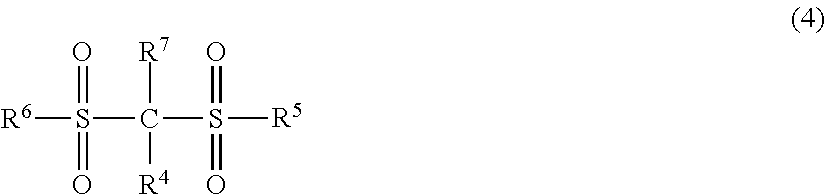


| TABLE 1 | ||||||
| separator | ||||||
| (heat | temperature | sulfur | initial | |||
| shrinking | at injection | content | discharge | capacity | ||
| ratio | of electrolyte | electrolyte | ratio | capacity | retention | |
| (%)) | solution | solution | (As/Bs) | (mAh) | (%) | |
| Example 1 | aramid | 80° C. | EC/DEC | Posi:1.0 | 1850 | 82 |
| microporous | (30/70) + | Nega:1.0 | ||||
| membrane | MMDS | |||||
| Example 2 | aramid | 80° C. | EC/DEC | Posi:0.9 | 1820 | 78 |
| nonwoven | (30/70) + | Nega:1.0 | ||||
| fabric | MMDS | |||||
| (0.5%) | ||||||
| Example 3 | aramid | 95° C. | EC/DEC | Posi:1.0 | 1860 | 81 |
| microporous | (30/70) + | Nega:1.0 | ||||
| membrane | MMDS | |||||
| (0.5%) | ||||||
| Example 4 | aramid | 95° C. | TEP/FEC | Posi:0.8 | 1800 | 72 |
| microporous | (97.5/2) + | Nega0.9 | ||||
| membrane | MMDS | |||||
| (0.5%) | ||||||
| Comparative | aramid | 25° C. | EC/DEC | Posi:0.69 | 1780 | 65 |
| Example 1 | microporous | (30/70) + | Nega:0.69 | |||
| membrane | MMDS | |||||
| (0.5%) | ||||||
| Comparative | polypropylene | 80° C. | EC/DEC | n.d. | 100 or less | n.d. |
| Example 2 | microporous | (30/70) + | (short | |||
| membrane | MMDS | circuit | ||||
| (2%) | failure) | |||||
| Posi = positive electrode; | ||||||
| Nega = negative electrode; | ||||||
| n.d. = not determined | ||||||
- a negative electrode
- b separator
- c positive electrode
- d negative electrode current collector
- e positive electrode current collector
- f positive electrode terminal
- g negative electrode terminal
- 1 positive electrode active material layer
- 2 negative electrode active material layer
- 3 positive electrode current collector
- 4 negative electrode current collector
- 5 separator
- 6 laminate package
- 7 negative electrode lead terminal
- 8 positive electrode lead terminal
- 10 film package
- 20 battery element
- 25 separator
- 30 positive electrode
- 40 negative electrode
Claims (10)
LiαNiβMeγO2 (1)
Applications Claiming Priority (3)
| Application Number | Priority Date | Filing Date | Title |
|---|---|---|---|
| JP2015-061777 | 2015-03-24 | ||
| JP2015061777 | 2015-03-24 | ||
| PCT/JP2016/058998 WO2016152860A1 (en) | 2015-03-24 | 2016-03-22 | Lithium ion secondary battery and method for manufacturing same |
Publications (2)
| Publication Number | Publication Date |
|---|---|
| US20180090792A1 US20180090792A1 (en) | 2018-03-29 |
| US10333174B2 true US10333174B2 (en) | 2019-06-25 |
Family
ID=56978546
Family Applications (1)
| Application Number | Title | Priority Date | Filing Date |
|---|---|---|---|
| US15/560,639 Active 2036-05-20 US10333174B2 (en) | 2015-03-24 | 2016-03-22 | Lithium ion secondary battery and method for manufacturing same |
Country Status (3)
| Country | Link |
|---|---|
| US (1) | US10333174B2 (en) |
| JP (1) | JPWO2016152860A1 (en) |
| WO (1) | WO2016152860A1 (en) |
Families Citing this family (9)
| Publication number | Priority date | Publication date | Assignee | Title |
|---|---|---|---|---|
| JP6946694B2 (en) * | 2017-03-29 | 2021-10-06 | Tdk株式会社 | Lithium ion secondary battery |
| WO2018198742A1 (en) * | 2017-04-26 | 2018-11-01 | Necエナジーデバイス株式会社 | Lithium ion secondary battery, method for producing lithium ion secondary battery, and electrolyte solution for lithium ion secondary batteries |
| KR102553591B1 (en) * | 2017-06-12 | 2023-07-11 | 삼성전자주식회사 | Lithium secondary battery comprising phosphate-based additive |
| JP6957257B2 (en) * | 2017-07-31 | 2021-11-02 | パナソニック株式会社 | Positive electrode for non-aqueous electrolyte secondary battery, and non-aqueous electrolyte secondary battery |
| JP7231188B2 (en) * | 2018-10-02 | 2023-03-01 | エリーパワー株式会社 | Manufacturing method of lithium ion battery |
| KR102673001B1 (en) * | 2018-11-02 | 2024-06-05 | 현대자동차주식회사 | Cathode for lithium air battery, method for producting thereof and lithium air battery comprising the same |
| JP7480579B2 (en) * | 2020-05-07 | 2024-05-10 | 株式会社Gsユアサ | Nonaqueous electrolyte storage element and method for producing same |
| DE112021004844T5 (en) * | 2020-09-17 | 2023-07-13 | Murata Manufacturing Co., Ltd. | SECONDARY BATTERY |
| CN116908073A (en) * | 2023-08-31 | 2023-10-20 | 蜂巢能源科技股份有限公司 | Calculation method of theoretical porosity of coated diaphragm and application thereof |
Citations (20)
| Publication number | Priority date | Publication date | Assignee | Title |
|---|---|---|---|---|
| JPH10208776A (en) | 1997-01-28 | 1998-08-07 | Fuji Film Selltec Kk | Manufacture of lithium secondary battery |
| JPH11307133A (en) | 1998-02-19 | 1999-11-05 | Matsushita Electric Ind Co Ltd | Manufacturing method of organic electrolyte battery |
| JP2001266890A (en) | 2000-03-16 | 2001-09-28 | Matsushita Electric Ind Co Ltd | Non-aqueous electrolyte secondary battery and method for producing the same |
| WO2002093678A1 (en) | 2001-05-10 | 2002-11-21 | Nisshinbo Industries, Inc. | Polymer gel electrolyte-use composition and method of pouring non-aqueous electrolyte solution |
| JP2003217587A (en) | 2002-01-25 | 2003-07-31 | Ngk Insulators Ltd | Lithium secondary battery |
| JP2004006286A (en) | 2002-03-28 | 2004-01-08 | Sanyo Electric Co Ltd | Organic electroluminescent panel |
| WO2008062895A1 (en) | 2006-11-21 | 2008-05-29 | Sumitomo Chemical Company, Limited | Powder for positive electrode active material and positive electrode active material |
| JP2011171108A (en) | 2010-02-18 | 2011-09-01 | Sanyo Electric Co Ltd | Non-aqueous electrolyte secondary battery |
| JP5151033B2 (en) | 2006-01-31 | 2013-02-27 | 東レ株式会社 | Porous film composed of aromatic polyamide, battery separator, and method for producing the same |
| JP5168989B2 (en) | 2006-04-12 | 2013-03-27 | 東レ株式会社 | Lithium ion secondary battery |
| WO2013062056A1 (en) | 2011-10-28 | 2013-05-02 | 旭化成株式会社 | Non-aqueous secondary battery |
| JP2013519968A (en) | 2010-02-12 | 2013-05-30 | フォルツ・インテレクチュアル・プロパティ・アー・ゲー | Rechargeable electrochemical battery cell |
| JP2013114848A (en) | 2011-11-28 | 2013-06-10 | Panasonic Corp | Lithium ion secondary battery and method for manufacturing the same |
| JP2013254633A (en) | 2012-06-06 | 2013-12-19 | Asahi Kasei Corp | Electrolyte for electrochemical device, and lithium ion secondary battery |
| WO2014132684A1 (en) | 2013-03-01 | 2014-09-04 | 住友電気工業株式会社 | Sealing structure for closed-type cell, and closed-type cell |
| WO2014189329A1 (en) | 2013-05-23 | 2014-11-27 | 주식회사 엘지화학 | Lithium secondary battery comprising multilayered active material layer |
| US20150155555A1 (en) * | 2012-08-02 | 2015-06-04 | Nissan Motor Co,. Ltd. | Non-aqueous organic electrolyte secondary cell |
| US20150349332A1 (en) * | 2013-01-11 | 2015-12-03 | Nec Corporation | Lithium ion secondary battery |
| US20170207488A1 (en) * | 2016-01-15 | 2017-07-20 | Aruna Zhamu | Production process for alkali metal-sulfur batteries having high volumetric and gravimetric energy densities |
| US20170207484A1 (en) * | 2016-01-15 | 2017-07-20 | Aruna Zhamu | Alkali Metal-Sulfur Batteries Having High Volumetric and Gravimetric Energy Densities |
Family Cites Families (1)
| Publication number | Priority date | Publication date | Assignee | Title |
|---|---|---|---|---|
| JP4561041B2 (en) * | 2002-03-28 | 2010-10-13 | Tdk株式会社 | Lithium secondary battery |
-
2016
- 2016-03-22 WO PCT/JP2016/058998 patent/WO2016152860A1/en not_active Ceased
- 2016-03-22 JP JP2017508360A patent/JPWO2016152860A1/en not_active Ceased
- 2016-03-22 US US15/560,639 patent/US10333174B2/en active Active
Patent Citations (20)
| Publication number | Priority date | Publication date | Assignee | Title |
|---|---|---|---|---|
| JPH10208776A (en) | 1997-01-28 | 1998-08-07 | Fuji Film Selltec Kk | Manufacture of lithium secondary battery |
| JPH11307133A (en) | 1998-02-19 | 1999-11-05 | Matsushita Electric Ind Co Ltd | Manufacturing method of organic electrolyte battery |
| JP2001266890A (en) | 2000-03-16 | 2001-09-28 | Matsushita Electric Ind Co Ltd | Non-aqueous electrolyte secondary battery and method for producing the same |
| WO2002093678A1 (en) | 2001-05-10 | 2002-11-21 | Nisshinbo Industries, Inc. | Polymer gel electrolyte-use composition and method of pouring non-aqueous electrolyte solution |
| JP2003217587A (en) | 2002-01-25 | 2003-07-31 | Ngk Insulators Ltd | Lithium secondary battery |
| JP2004006286A (en) | 2002-03-28 | 2004-01-08 | Sanyo Electric Co Ltd | Organic electroluminescent panel |
| JP5151033B2 (en) | 2006-01-31 | 2013-02-27 | 東レ株式会社 | Porous film composed of aromatic polyamide, battery separator, and method for producing the same |
| JP5168989B2 (en) | 2006-04-12 | 2013-03-27 | 東レ株式会社 | Lithium ion secondary battery |
| WO2008062895A1 (en) | 2006-11-21 | 2008-05-29 | Sumitomo Chemical Company, Limited | Powder for positive electrode active material and positive electrode active material |
| JP2013519968A (en) | 2010-02-12 | 2013-05-30 | フォルツ・インテレクチュアル・プロパティ・アー・ゲー | Rechargeable electrochemical battery cell |
| JP2011171108A (en) | 2010-02-18 | 2011-09-01 | Sanyo Electric Co Ltd | Non-aqueous electrolyte secondary battery |
| WO2013062056A1 (en) | 2011-10-28 | 2013-05-02 | 旭化成株式会社 | Non-aqueous secondary battery |
| JP2013114848A (en) | 2011-11-28 | 2013-06-10 | Panasonic Corp | Lithium ion secondary battery and method for manufacturing the same |
| JP2013254633A (en) | 2012-06-06 | 2013-12-19 | Asahi Kasei Corp | Electrolyte for electrochemical device, and lithium ion secondary battery |
| US20150155555A1 (en) * | 2012-08-02 | 2015-06-04 | Nissan Motor Co,. Ltd. | Non-aqueous organic electrolyte secondary cell |
| US20150349332A1 (en) * | 2013-01-11 | 2015-12-03 | Nec Corporation | Lithium ion secondary battery |
| WO2014132684A1 (en) | 2013-03-01 | 2014-09-04 | 住友電気工業株式会社 | Sealing structure for closed-type cell, and closed-type cell |
| WO2014189329A1 (en) | 2013-05-23 | 2014-11-27 | 주식회사 엘지화학 | Lithium secondary battery comprising multilayered active material layer |
| US20170207488A1 (en) * | 2016-01-15 | 2017-07-20 | Aruna Zhamu | Production process for alkali metal-sulfur batteries having high volumetric and gravimetric energy densities |
| US20170207484A1 (en) * | 2016-01-15 | 2017-07-20 | Aruna Zhamu | Alkali Metal-Sulfur Batteries Having High Volumetric and Gravimetric Energy Densities |
Non-Patent Citations (1)
| Title |
|---|
| International Search Report dated Jun. 7, 2016, in corresponding PCT International Application No. PCT/JP2016/058998. |
Also Published As
| Publication number | Publication date |
|---|---|
| JPWO2016152860A1 (en) | 2018-01-18 |
| WO2016152860A1 (en) | 2016-09-29 |
| US20180090792A1 (en) | 2018-03-29 |
Similar Documents
| Publication | Publication Date | Title |
|---|---|---|
| EP3276732B1 (en) | Lithium-ion secondary cell and method for manufacturing same | |
| US20180090792A1 (en) | Lithium ion secondary battery and method for manufacturing same | |
| US10756337B2 (en) | Lithium ion secondary battery | |
| CN104871343B (en) | Separator, electrode element, electrical energy storage device and method for manufacturing the separator | |
| JP7173121B2 (en) | High safety and high energy density battery | |
| JP6683191B2 (en) | Secondary battery | |
| US10608244B2 (en) | Lithium ion secondary battery | |
| US10777817B2 (en) | Lithium ion secondary battery | |
| JPWO2017204213A1 (en) | Lithium ion secondary battery | |
| JP7476936B2 (en) | Film-covered battery, battery pack, and method for manufacturing said film-covered battery | |
| US20190393554A1 (en) | Lithium ion secondary battery | |
| US9905849B2 (en) | Electrode assembly and lithium secondary battery including the same | |
| WO2018212027A1 (en) | Electrolyte solution for lithium ion secondary batteries and lithium ion secondary battery using same | |
| US10833364B2 (en) | Lithium-ion secondary battery | |
| US20180013169A1 (en) | Lithium ion secondary battery | |
| JP6973621B2 (en) | Lithium ion secondary battery | |
| JP6809449B2 (en) | Lithium ion secondary battery | |
| US20180159105A1 (en) | Lithium-ion battery | |
| KR20240151590A (en) | Methode for preparing lithium secondary battery and lithium secondary battery |
Legal Events
| Date | Code | Title | Description |
|---|---|---|---|
| FEPP | Fee payment procedure |
Free format text: ENTITY STATUS SET TO UNDISCOUNTED (ORIGINAL EVENT CODE: BIG.); ENTITY STATUS OF PATENT OWNER: LARGE ENTITY |
|
| AS | Assignment |
Owner name: NEC CORPORATION, JAPAN Free format text: ASSIGNMENT OF ASSIGNORS INTEREST;ASSIGNORS:KAWASAKI, DAISUKE;SHIMURA, KENICHI;YOSHIDA, NOBORU;AND OTHERS;REEL/FRAME:043679/0050 Effective date: 20170628 |
|
| STPP | Information on status: patent application and granting procedure in general |
Free format text: NOTICE OF ALLOWANCE MAILED -- APPLICATION RECEIVED IN OFFICE OF PUBLICATIONS |
|
| STPP | Information on status: patent application and granting procedure in general |
Free format text: PUBLICATIONS -- ISSUE FEE PAYMENT VERIFIED |
|
| STCF | Information on status: patent grant |
Free format text: PATENTED CASE |
|
| MAFP | Maintenance fee payment |
Free format text: PAYMENT OF MAINTENANCE FEE, 4TH YEAR, LARGE ENTITY (ORIGINAL EVENT CODE: M1551); ENTITY STATUS OF PATENT OWNER: LARGE ENTITY Year of fee payment: 4 |