US10333071B2 - Organic light emitting device - Google Patents
Organic light emitting device Download PDFInfo
- Publication number
- US10333071B2 US10333071B2 US15/228,818 US201615228818A US10333071B2 US 10333071 B2 US10333071 B2 US 10333071B2 US 201615228818 A US201615228818 A US 201615228818A US 10333071 B2 US10333071 B2 US 10333071B2
- Authority
- US
- United States
- Prior art keywords
- group
- substituted
- salt
- unsubstituted
- alkyl
- Prior art date
- Legal status (The legal status is an assumption and is not a legal conclusion. Google has not performed a legal analysis and makes no representation as to the accuracy of the status listed.)
- Active, expires
Links
- 0 [1*]OCC1=C2C([9*])=C([8*])C([7*])=C([6*])C2=C(C)C2=C1C([2*])=C([3*])C([4*])=C2[5*].[11*]C1=C([12*])C([13*])=C([14*])C2=C1C(CC)=C1C([18*])=C([17*])C([16*])=C([15*])C1=C2CC Chemical compound [1*]OCC1=C2C([9*])=C([8*])C([7*])=C([6*])C2=C(C)C2=C1C([2*])=C([3*])C([4*])=C2[5*].[11*]C1=C([12*])C([13*])=C([14*])C2=C1C(CC)=C1C([18*])=C([17*])C([16*])=C([15*])C1=C2CC 0.000 description 52
- HKPIOJWYUJKHSN-UHFFFAOYSA-N COC1=CC=C(C2=C3C=CC=CC3=C(C3=C4C=CC=CC4=CC=N3)C3=CC=CC=C32)C=C1.COC1=CC=C(C2=C3C=CC=CC3=C(C3=CC4=C(N=CC=C4)N=C3)C3=CC=CC=C32)C=C1.COC1=CC=C(C2=C3C=CC=CC3=C(C3=NC4=C(C=C3)C=NC=C4)C3=CC=CC=C32)C=C1.COC1=CC=C(C2=C3C=CC=CC3=C(C3=NC4=C(C=C3)N=CC=C4)C3=CC=CC=C32)C=C1.COC1=CC=C(C2=C3C=CC=CC3=C(C3=NC4=C(C=CC=N4)C=C3)C3=CC=CC=C32)C=C1.COC1=CC=C(C2=C3C=CC=CC3=C(C3=NC4=C(C=CN=C4)C=C3)C3=CC=CC=C32)C=C1 Chemical compound COC1=CC=C(C2=C3C=CC=CC3=C(C3=C4C=CC=CC4=CC=N3)C3=CC=CC=C32)C=C1.COC1=CC=C(C2=C3C=CC=CC3=C(C3=CC4=C(N=CC=C4)N=C3)C3=CC=CC=C32)C=C1.COC1=CC=C(C2=C3C=CC=CC3=C(C3=NC4=C(C=C3)C=NC=C4)C3=CC=CC=C32)C=C1.COC1=CC=C(C2=C3C=CC=CC3=C(C3=NC4=C(C=C3)N=CC=C4)C3=CC=CC=C32)C=C1.COC1=CC=C(C2=C3C=CC=CC3=C(C3=NC4=C(C=CC=N4)C=C3)C3=CC=CC=C32)C=C1.COC1=CC=C(C2=C3C=CC=CC3=C(C3=NC4=C(C=CN=C4)C=C3)C3=CC=CC=C32)C=C1 HKPIOJWYUJKHSN-UHFFFAOYSA-N 0.000 description 2
- KCSLUVJVBUFLCN-UHFFFAOYSA-N COC1=CC=C(C2=C3C=CC=CC3=C(C3=C4C=CC=CC4=CN=C3)C3=CC=CC=C32)C=C1.COC1=CC=C(C2=C3C=CC=CC3=C(C3=C4C=CC=CC4=NC=C3)C3=CC=CC=C32)C=C1.COC1=CC=C(C2=C3C=CC=CC3=C(C3=C4C=CC=CC4=NC=N3)C3=CC=CC=C32)C=C1.COC1=CC=C(C2=C3C=CC=CC3=C(C3=C4C=CN=CC4=CC=N3)C3=CC=CC=C32)C=C1.COC1=CC=C(C2=C3C=CC=CC3=C(C3=C4C=NC=CC4=CC=N3)C3=CC=CC=C32)C=C1.COC1=CC=C(C2=C3C=CC=CC3=C(C3=C4N=CC=CC4=CC=N3)C3=CC=CC=C32)C=C1 Chemical compound COC1=CC=C(C2=C3C=CC=CC3=C(C3=C4C=CC=CC4=CN=C3)C3=CC=CC=C32)C=C1.COC1=CC=C(C2=C3C=CC=CC3=C(C3=C4C=CC=CC4=NC=C3)C3=CC=CC=C32)C=C1.COC1=CC=C(C2=C3C=CC=CC3=C(C3=C4C=CC=CC4=NC=N3)C3=CC=CC=C32)C=C1.COC1=CC=C(C2=C3C=CC=CC3=C(C3=C4C=CN=CC4=CC=N3)C3=CC=CC=C32)C=C1.COC1=CC=C(C2=C3C=CC=CC3=C(C3=C4C=NC=CC4=CC=N3)C3=CC=CC=C32)C=C1.COC1=CC=C(C2=C3C=CC=CC3=C(C3=C4N=CC=CC4=CC=N3)C3=CC=CC=C32)C=C1 KCSLUVJVBUFLCN-UHFFFAOYSA-N 0.000 description 2
- BTQDLMAWKBBVHY-UHFFFAOYSA-N COC1=CC=C(C2=C3C=CC=CC3=C(C3=C4C=CC=NC4=CC=N3)C3=CC=CC=C32)C=C1.COC1=CC=C(C2=C3C=CC=CC3=C(C3=C4C=CC=NC4=CN=C3)C3=CC=CC=C32)C=C1.COC1=CC=C(C2=C3C=CC=CC3=C(C3=C4C=NC=CC4=CN=C3)C3=CC=CC=C32)C=C1.COC1=CC=C(C2=C3C=CC=CC3=C(C3=C4C=NC=CC4=NC=C3)C3=CC=CC=C32)C=C1.COC1=CC=C(C2=C3C=CC=CC3=C(C3=C4N=CC=CC4=CN=C3)C3=CC=CC=C32)C=C1.COC1=CC=C(C2=C3C=CC=CC3=C(C3=C4N=CC=CC4=NC=C3)C3=CC=CC=C32)C=C1 Chemical compound COC1=CC=C(C2=C3C=CC=CC3=C(C3=C4C=CC=NC4=CC=N3)C3=CC=CC=C32)C=C1.COC1=CC=C(C2=C3C=CC=CC3=C(C3=C4C=CC=NC4=CN=C3)C3=CC=CC=C32)C=C1.COC1=CC=C(C2=C3C=CC=CC3=C(C3=C4C=NC=CC4=CN=C3)C3=CC=CC=C32)C=C1.COC1=CC=C(C2=C3C=CC=CC3=C(C3=C4C=NC=CC4=NC=C3)C3=CC=CC=C32)C=C1.COC1=CC=C(C2=C3C=CC=CC3=C(C3=C4N=CC=CC4=CN=C3)C3=CC=CC=C32)C=C1.COC1=CC=C(C2=C3C=CC=CC3=C(C3=C4N=CC=CC4=NC=C3)C3=CC=CC=C32)C=C1 BTQDLMAWKBBVHY-UHFFFAOYSA-N 0.000 description 2
- LRLKEBZUCRRPQG-UHFFFAOYSA-N COC1=CC=C(C2=C3C=CC=CC3=C(C3=C4C=CC=NC4=NC=C3)C3=CC=CC=C32)C=C1.COC1=CC=C(C2=C3C=CC=CC3=C(C3=C4C=CN=CC4=NC=C3)C3=CC=CC=C32)C=C1.COC1=CC=C(C2=C3C=CC=CC3=C(C3=CC4=C(C=CC5=C4C=CC=C5)C=N3)C3=CC=CC=C32)C=C1.COC1=CC=C(C2=C3C=CC=CC3=C(C3=CC4=C(C=CC5=C4C=CC=C5)N=C3)C3=CC=CC=C32)C=C1.COC1=CC=C(C2=C3C=CC=CC3=C(C3=NC4=C(C=C3)C=CC3=C4C=CC=C3)C3=CC=CC=C32)C=C1.COC1=CC=C(C2=C3C=CC=CC3=C(C3=NC4=C(C=CC5=C4C=CC=C5)C=N3)C3=CC=CC=C32)C=C1 Chemical compound COC1=CC=C(C2=C3C=CC=CC3=C(C3=C4C=CC=NC4=NC=C3)C3=CC=CC=C32)C=C1.COC1=CC=C(C2=C3C=CC=CC3=C(C3=C4C=CN=CC4=NC=C3)C3=CC=CC=C32)C=C1.COC1=CC=C(C2=C3C=CC=CC3=C(C3=CC4=C(C=CC5=C4C=CC=C5)C=N3)C3=CC=CC=C32)C=C1.COC1=CC=C(C2=C3C=CC=CC3=C(C3=CC4=C(C=CC5=C4C=CC=C5)N=C3)C3=CC=CC=C32)C=C1.COC1=CC=C(C2=C3C=CC=CC3=C(C3=NC4=C(C=C3)C=CC3=C4C=CC=C3)C3=CC=CC=C32)C=C1.COC1=CC=C(C2=C3C=CC=CC3=C(C3=NC4=C(C=CC5=C4C=CC=C5)C=N3)C3=CC=CC=C32)C=C1 LRLKEBZUCRRPQG-UHFFFAOYSA-N 0.000 description 2
- SLQOEYGIIDUQDQ-UHFFFAOYSA-N COC1=CC=C(C2=C3C=CC=CC3=C(C3=CC4=C(C=CC5=C4C=CC=N5)C=N3)C3=CC=CC=C32)C=C1.COC1=CC=C(C2=C3C=CC=CC3=C(C3=CC4=C(C=CC5=C4C=CN=C5)N=C3)C3=CC=CC=C32)C=C1.COC1=CC=C(C2=C3C=CC=CC3=C(C3=CC4=C(C=CC5=C4C=NC=C5)N=C3)C3=CC=CC=C32)C=C1.COC1=CC=C(C2=C3C=CC=CC3=C(C3=CC4=C(C=CC5=C4N=CC=C5)N=C3)C3=CC=CC=C32)C=C1.COC1=CC=C(C2=C3C=CC=CC3=C(C3=CC4=C(C=NC5=C4C=CC=C5)N=C3)C3=CC=CC=C32)C=C1.COC1=CC=C(C2=C3C=CC=CC3=C(C3=CC4=C(N=C3)N=CC3=C4C=CC=C3)C3=CC=CC=C32)C=C1 Chemical compound COC1=CC=C(C2=C3C=CC=CC3=C(C3=CC4=C(C=CC5=C4C=CC=N5)C=N3)C3=CC=CC=C32)C=C1.COC1=CC=C(C2=C3C=CC=CC3=C(C3=CC4=C(C=CC5=C4C=CN=C5)N=C3)C3=CC=CC=C32)C=C1.COC1=CC=C(C2=C3C=CC=CC3=C(C3=CC4=C(C=CC5=C4C=NC=C5)N=C3)C3=CC=CC=C32)C=C1.COC1=CC=C(C2=C3C=CC=CC3=C(C3=CC4=C(C=CC5=C4N=CC=C5)N=C3)C3=CC=CC=C32)C=C1.COC1=CC=C(C2=C3C=CC=CC3=C(C3=CC4=C(C=NC5=C4C=CC=C5)N=C3)C3=CC=CC=C32)C=C1.COC1=CC=C(C2=C3C=CC=CC3=C(C3=CC4=C(N=C3)N=CC3=C4C=CC=C3)C3=CC=CC=C32)C=C1 SLQOEYGIIDUQDQ-UHFFFAOYSA-N 0.000 description 2
- BISZGNSAKJVSDH-UHFFFAOYSA-N COC1=CC=C(C2=C3C=CC=CC3=C(C3=CC4=C(C=CC5=C4C=CC=N5)N=C3)C3=CC=CC=C32)C=C1.COC1=CC=C(C2=C3C=CC=CC3=C(C3=NC4=C(C=C3)C=CC3=C4C=CN=C3)C3=CC=CC=C32)C=C1.COC1=CC=C(C2=C3C=CC=CC3=C(C3=NC4=C(C=C3)C=CC3=C4C=NC=C3)C3=CC=CC=C32)C=C1.COC1=CC=C(C2=C3C=CC=CC3=C(C3=NC4=C(C=C3)C=CC3=C4N=CC=C3)C3=CC=CC=C32)C=C1.COC1=CC=C(C2=C3C=CC=CC3=C(C3=NC4=C(C=C3)C=NC3=C4C=CC=C3)C3=CC=CC=C32)C=C1.COC1=CC=C(C2=C3C=CC=CC3=C(C3=NC4=C(C=C3)N=CC3=C4C=CC=C3)C3=CC=CC=C32)C=C1 Chemical compound COC1=CC=C(C2=C3C=CC=CC3=C(C3=CC4=C(C=CC5=C4C=CC=N5)N=C3)C3=CC=CC=C32)C=C1.COC1=CC=C(C2=C3C=CC=CC3=C(C3=NC4=C(C=C3)C=CC3=C4C=CN=C3)C3=CC=CC=C32)C=C1.COC1=CC=C(C2=C3C=CC=CC3=C(C3=NC4=C(C=C3)C=CC3=C4C=NC=C3)C3=CC=CC=C32)C=C1.COC1=CC=C(C2=C3C=CC=CC3=C(C3=NC4=C(C=C3)C=CC3=C4N=CC=C3)C3=CC=CC=C32)C=C1.COC1=CC=C(C2=C3C=CC=CC3=C(C3=NC4=C(C=C3)C=NC3=C4C=CC=C3)C3=CC=CC=C32)C=C1.COC1=CC=C(C2=C3C=CC=CC3=C(C3=NC4=C(C=C3)N=CC3=C4C=CC=C3)C3=CC=CC=C32)C=C1 BISZGNSAKJVSDH-UHFFFAOYSA-N 0.000 description 2
- CKSSVQMPECJSBH-UHFFFAOYSA-N COC1=CC=C(C2=C3C=CC=CC3=C(C3=CC4=C(C=CC5=C4C=CN=C5)C=N3)C3=CC=CC=C32)C=C1.COC1=CC=C(C2=C3C=CC=CC3=C(C3=CC4=C(C=CC5=C4C=NC=C5)C=N3)C3=CC=CC=C32)C=C1.COC1=CC=C(C2=C3C=CC=CC3=C(C3=CC4=C(C=CC5=C4N=CC=C5)C=N3)C3=CC=CC=C32)C=C1.COC1=CC=C(C2=C3C=CC=CC3=C(C3=CC4=C(C=N3)C=NC3=C4C=CC=C3)C3=CC=CC=C32)C=C1.COC1=CC=C(C2=C3C=CC=CC3=C(C3=CC4=C(C=N3)N=CC3=C4C=CC=C3)C3=CC=CC=C32)C=C1.COC1=CC=C(C2=C3C=CC=CC3=C(C3=NC4=C(C=CC5=C4C=CC=C5)N=C3)C3=CC=CC=C32)C=C1 Chemical compound COC1=CC=C(C2=C3C=CC=CC3=C(C3=CC4=C(C=CC5=C4C=CN=C5)C=N3)C3=CC=CC=C32)C=C1.COC1=CC=C(C2=C3C=CC=CC3=C(C3=CC4=C(C=CC5=C4C=NC=C5)C=N3)C3=CC=CC=C32)C=C1.COC1=CC=C(C2=C3C=CC=CC3=C(C3=CC4=C(C=CC5=C4N=CC=C5)C=N3)C3=CC=CC=C32)C=C1.COC1=CC=C(C2=C3C=CC=CC3=C(C3=CC4=C(C=N3)C=NC3=C4C=CC=C3)C3=CC=CC=C32)C=C1.COC1=CC=C(C2=C3C=CC=CC3=C(C3=CC4=C(C=N3)N=CC3=C4C=CC=C3)C3=CC=CC=C32)C=C1.COC1=CC=C(C2=C3C=CC=CC3=C(C3=NC4=C(C=CC5=C4C=CC=C5)N=C3)C3=CC=CC=C32)C=C1 CKSSVQMPECJSBH-UHFFFAOYSA-N 0.000 description 2
- BUROXBXHPPCROT-UHFFFAOYSA-N COC1=CC=C(C2=C3C=CC=CC3=C(C3=CC4=C(C=CC=C4)C=N3)C3=CC=CC=C32)C=C1.COC1=CC=C(C2=C3C=CC=CC3=C(C3=CC4=C(C=CC=C4)N=C3)C3=CC=CC=C32)C=C1.COC1=CC=C(C2=C3C=CC=CC3=C(C3=CC4=C(C=CC=N4)C=N3)C3=CC=CC=C32)C=C1.COC1=CC=C(C2=C3C=CC=CC3=C(C3=NC4=C(C=CC=C4)C=C3)C3=CC=CC=C32)C=C1.COC1=CC=C(C2=C3C=CC=CC3=C(C3=NC4=C(C=CC=C4)C=N3)C3=CC=CC=C32)C=C1.COC1=CC=C(C2=C3C=CC=CC3=C(C3=NC4=C(C=CC=C4)N=C3)C3=CC=CC=C32)C=C1 Chemical compound COC1=CC=C(C2=C3C=CC=CC3=C(C3=CC4=C(C=CC=C4)C=N3)C3=CC=CC=C32)C=C1.COC1=CC=C(C2=C3C=CC=CC3=C(C3=CC4=C(C=CC=C4)N=C3)C3=CC=CC=C32)C=C1.COC1=CC=C(C2=C3C=CC=CC3=C(C3=CC4=C(C=CC=N4)C=N3)C3=CC=CC=C32)C=C1.COC1=CC=C(C2=C3C=CC=CC3=C(C3=NC4=C(C=CC=C4)C=C3)C3=CC=CC=C32)C=C1.COC1=CC=C(C2=C3C=CC=CC3=C(C3=NC4=C(C=CC=C4)C=N3)C3=CC=CC=C32)C=C1.COC1=CC=C(C2=C3C=CC=CC3=C(C3=NC4=C(C=CC=C4)N=C3)C3=CC=CC=C32)C=C1 BUROXBXHPPCROT-UHFFFAOYSA-N 0.000 description 2
- LBNKGPPRGQTCEE-UHFFFAOYSA-N COC1=CC=C(C2=C3C=CC=CC3=C(C3=CC4=C(C=CC=N4)N=C3)C3=CC=CC=C32)C=C1.COC1=CC=C(C2=C3C=CC=CC3=C(C3=CC4=C(C=CN=C4)C=N3)C3=CC=CC=C32)C=C1.COC1=CC=C(C2=C3C=CC=CC3=C(C3=CC4=C(C=CN=C4)N=C3)C3=CC=CC=C32)C=C1.COC1=CC=C(C2=C3C=CC=CC3=C(C3=CC4=C(C=N3)N=CC=C4)C3=CC=CC=C32)C=C1.COC1=CC=C(C2=C3C=CC=CC3=C(C3=CC4=C(C=NC=C4)C=N3)C3=CC=CC=C32)C=C1.COC1=CC=C(C2=C3C=CC=CC3=C(C3=CC4=C(C=NC=C4)N=C3)C3=CC=CC=C32)C=C1 Chemical compound COC1=CC=C(C2=C3C=CC=CC3=C(C3=CC4=C(C=CC=N4)N=C3)C3=CC=CC=C32)C=C1.COC1=CC=C(C2=C3C=CC=CC3=C(C3=CC4=C(C=CN=C4)C=N3)C3=CC=CC=C32)C=C1.COC1=CC=C(C2=C3C=CC=CC3=C(C3=CC4=C(C=CN=C4)N=C3)C3=CC=CC=C32)C=C1.COC1=CC=C(C2=C3C=CC=CC3=C(C3=CC4=C(C=N3)N=CC=C4)C3=CC=CC=C32)C=C1.COC1=CC=C(C2=C3C=CC=CC3=C(C3=CC4=C(C=NC=C4)C=N3)C3=CC=CC=C32)C=C1.COC1=CC=C(C2=C3C=CC=CC3=C(C3=CC4=C(C=NC=C4)N=C3)C3=CC=CC=C32)C=C1 LBNKGPPRGQTCEE-UHFFFAOYSA-N 0.000 description 2
- MLGDBFYRGHCZTL-UHFFFAOYSA-N B=NS.BrC1=C2C=CC=CC2=CC2=C1C=CC=C2.COC1=CC=C(B(O)O)C=C1.COC1=CC=C(Br)C=C1.COC1=CC=C(C2=C3C=CC=CC3=C(Br)C3=C2C=CC=C3)C=C1.COC1=CC=C(C2=C3C=CC=CC3=C(C3=CC4=C(C=CC=C4)N=C3)C3=C2C=CC=C3)C=C1.COC1=CC=C(C2=C3C=CC=CC3=CC3=C2C=CC=C3)C=C1.ClC(Cl)Cl.OB(O)C1=CC2=C(C=CC=C2)N=C1 Chemical compound B=NS.BrC1=C2C=CC=CC2=CC2=C1C=CC=C2.COC1=CC=C(B(O)O)C=C1.COC1=CC=C(Br)C=C1.COC1=CC=C(C2=C3C=CC=CC3=C(Br)C3=C2C=CC=C3)C=C1.COC1=CC=C(C2=C3C=CC=CC3=C(C3=CC4=C(C=CC=C4)N=C3)C3=C2C=CC=C3)C=C1.COC1=CC=C(C2=C3C=CC=CC3=CC3=C2C=CC=C3)C=C1.ClC(Cl)Cl.OB(O)C1=CC2=C(C=CC=C2)N=C1 MLGDBFYRGHCZTL-UHFFFAOYSA-N 0.000 description 1
- JORGVPNDYYDHNI-UHFFFAOYSA-N B=NS.BrC1=C2C=CC=CC2=CC2=C1C=CC=C2.COC1=CC=C(B(O)O)C=C1.COC1=CC=C(Br)C=C1.COC1=CC=C(C2=C3C=CC=CC3=C(Br)C3=C2C=CC=C3)C=C1.COC1=CC=C(C2=C3C=CC=CC3=C(C3=NC4=C(C=C3)C=CC3=C4N=CC=C3)C3=C2C=CC=C3)C=C1.COC1=CC=C(C2=C3C=CC=CC3=CC3=C2C=CC=C3)C=C1.ClC(Cl)Cl.OB(O)C1=NC2=C(C=C1)C=CC1=C2N=CC=C1 Chemical compound B=NS.BrC1=C2C=CC=CC2=CC2=C1C=CC=C2.COC1=CC=C(B(O)O)C=C1.COC1=CC=C(Br)C=C1.COC1=CC=C(C2=C3C=CC=CC3=C(Br)C3=C2C=CC=C3)C=C1.COC1=CC=C(C2=C3C=CC=CC3=C(C3=NC4=C(C=C3)C=CC3=C4N=CC=C3)C3=C2C=CC=C3)C=C1.COC1=CC=C(C2=C3C=CC=CC3=CC3=C2C=CC=C3)C=C1.ClC(Cl)Cl.OB(O)C1=NC2=C(C=C1)C=CC1=C2N=CC=C1 JORGVPNDYYDHNI-UHFFFAOYSA-N 0.000 description 1
- NBGFRIBSUGAHIM-UHFFFAOYSA-N B=NS.BrC1=C2C=CC=CC2=CC2=C1C=CC=C2.COC1=CC=C(B(O)O)C=C1.COC1=CC=C(Br)C=C1.COC1=CC=C(C2=C3C=CC=CC3=C(Br)C3=C2C=CC=C3)C=C1.COC1=CC=C(C2=C3C=CC=CC3=C(C3=NC4=C(C=CC=C4)C=C3)C3=C2C=CC=C3)C=C1.COC1=CC=C(C2=C3C=CC=CC3=CC3=C2C=CC=C3)C=C1.ClC(Cl)Cl.OB(O)C1=NC2=C(C=CC=C2)C=C1 Chemical compound B=NS.BrC1=C2C=CC=CC2=CC2=C1C=CC=C2.COC1=CC=C(B(O)O)C=C1.COC1=CC=C(Br)C=C1.COC1=CC=C(C2=C3C=CC=CC3=C(Br)C3=C2C=CC=C3)C=C1.COC1=CC=C(C2=C3C=CC=CC3=C(C3=NC4=C(C=CC=C4)C=C3)C3=C2C=CC=C3)C=C1.COC1=CC=C(C2=C3C=CC=CC3=CC3=C2C=CC=C3)C=C1.ClC(Cl)Cl.OB(O)C1=NC2=C(C=CC=C2)C=C1 NBGFRIBSUGAHIM-UHFFFAOYSA-N 0.000 description 1
- FVWLQJZBJNYOEH-HGUGXOTLSA-N BN=P.C1=CC=C(N(C2=CC3=C(C=C2)C2=C(C=C(N(C4=CC=CC=C4)C4=C5C=CC=CC5=CC=C4)C=C2)C32C3=CC=CC=C3C3=CC=CC=C32)C2=C3C=CC=CC3=CC=C2)C=C1.C1=CC=C(N(C2=CC=C(C3=CC=C(N(C4=CC=CC=C4)C4=C/C5=C(C=CC=C5)/C=C\4)C=C3)C=C2)C2=CC3=C(C=CC=C3)C=C2)C=C1.C1=CC=C(N(C2=CC=C(C3=CC=C(N(C4=CC=CC=C4)C4=C5C=CC=CC5=CC=C4)C=C3)C=C2)C2=C3C=CC=CC3=CC=C2)C=C1.CC1=CC(N(C2=CC=CC=C2)C2=CC3=C(C=C2)C2=C(C=C(N(C4=CC=CC=C4)C4=CC=CC(C)=C4)C=C2)C32C3=CC=CC=C3C3=CC=CC=C32)=CC=C1.CC1=CC=CC(N(C2=CC=CC=C2)C2=CC=C(C3=CC=C(N(C4=CC=CC=C4)C4=CC=CC(C)=C4)C=C3)C=C2)=C1.[2H]P[3H] Chemical compound BN=P.C1=CC=C(N(C2=CC3=C(C=C2)C2=C(C=C(N(C4=CC=CC=C4)C4=C5C=CC=CC5=CC=C4)C=C2)C32C3=CC=CC=C3C3=CC=CC=C32)C2=C3C=CC=CC3=CC=C2)C=C1.C1=CC=C(N(C2=CC=C(C3=CC=C(N(C4=CC=CC=C4)C4=C/C5=C(C=CC=C5)/C=C\4)C=C3)C=C2)C2=CC3=C(C=CC=C3)C=C2)C=C1.C1=CC=C(N(C2=CC=C(C3=CC=C(N(C4=CC=CC=C4)C4=C5C=CC=CC5=CC=C4)C=C3)C=C2)C2=C3C=CC=CC3=CC=C2)C=C1.CC1=CC(N(C2=CC=CC=C2)C2=CC3=C(C=C2)C2=C(C=C(N(C4=CC=CC=C4)C4=CC=CC(C)=C4)C=C2)C32C3=CC=CC=C3C3=CC=CC=C32)=CC=C1.CC1=CC=CC(N(C2=CC=CC=C2)C2=CC=C(C3=CC=C(N(C4=CC=CC=C4)C4=CC=CC(C)=C4)C=C3)C=C2)=C1.[2H]P[3H] FVWLQJZBJNYOEH-HGUGXOTLSA-N 0.000 description 1
- GJULESPJZGFALE-UHFFFAOYSA-N BN=P.C1=CC=C(N(C2=CC=C(C3=CC=C(N(C4=CC=CC=C4)C4=C5C=CC=CC5=CC=C4)C=C3)C=C2)C2=C3C=CC=CC3=CC=C2)C=C1.C1=CC=C(N2C3=C(C=CC=C3)/N=C\2C2=CC=C(C3=CC4=C(C5=CC6=C(C=CC=C6)C=C5)C5=C(C=CC=C5)C(C5=CC6=C(C=CC=C6)C=C5)=C4C=C3)C=C2)C=C1.CC1=CC=CC(N(C2=CC=CC=C2)C2=CC=C(N(C3=CC=C(N(C4=CC=CC=C4)C4=CC=CC(C)=C4)C=C3)C3=CC=C(N(C4=CC=CC=C4)C4=CC(C)=CC=C4)C=C3)C=C2)=C1 Chemical compound BN=P.C1=CC=C(N(C2=CC=C(C3=CC=C(N(C4=CC=CC=C4)C4=C5C=CC=CC5=CC=C4)C=C3)C=C2)C2=C3C=CC=CC3=CC=C2)C=C1.C1=CC=C(N2C3=C(C=CC=C3)/N=C\2C2=CC=C(C3=CC4=C(C5=CC6=C(C=CC=C6)C=C5)C5=C(C=CC=C5)C(C5=CC6=C(C=CC=C6)C=C5)=C4C=C3)C=C2)C=C1.CC1=CC=CC(N(C2=CC=CC=C2)C2=CC=C(N(C3=CC=C(N(C4=CC=CC=C4)C4=CC=CC(C)=C4)C=C3)C3=CC=C(N(C4=CC=CC=C4)C4=CC(C)=CC=C4)C=C3)C=C2)=C1 GJULESPJZGFALE-UHFFFAOYSA-N 0.000 description 1
- COCWKIZMRIKJFY-UHFFFAOYSA-N C.C1=CC=C(C2=CC=NC3=C4N=CC=C(C5=CC=CC=C5)C4=CC=C23)C=C1.CBP.CC1=NC2=C3N=C(C)C=C(C4=CC=CC=C4)C3=CC=C2C(C2=CC=CC=C2)=C1 Chemical compound C.C1=CC=C(C2=CC=NC3=C4N=CC=C(C5=CC=CC=C5)C4=CC=C23)C=C1.CBP.CC1=NC2=C3N=C(C)C=C(C4=CC=CC=C4)C3=CC=C2C(C2=CC=CC=C2)=C1 COCWKIZMRIKJFY-UHFFFAOYSA-N 0.000 description 1
- QCDNPAWTEPZNTN-UHFFFAOYSA-N C/C1=C/C2=C(/C=C(/C)C3=C2C=CC=C3)C2=C1C=CC=C2.CC.CC.CC.CC.CC.CC.CC.CC.CC.CC1=CC(C)=C2/C=C\C=C/C2=N1.CC1=CC2=C(C=C1)C1=CC=CC=C1N2C.CC1=CC2=C(C=C1)C=CC(C)=C2.CC1=CN=C(C)C=C1.CC1=NC(C)=C2/C=C\C=C/C2=C1.CC1=NC(C)=C2/C=C\C=C/C2=N1 Chemical compound C/C1=C/C2=C(/C=C(/C)C3=C2C=CC=C3)C2=C1C=CC=C2.CC.CC.CC.CC.CC.CC.CC.CC.CC.CC1=CC(C)=C2/C=C\C=C/C2=N1.CC1=CC2=C(C=C1)C1=CC=CC=C1N2C.CC1=CC2=C(C=C1)C=CC(C)=C2.CC1=CN=C(C)C=C1.CC1=NC(C)=C2/C=C\C=C/C2=C1.CC1=NC(C)=C2/C=C\C=C/C2=N1 QCDNPAWTEPZNTN-UHFFFAOYSA-N 0.000 description 1
- KMDKUZZRXHBAMQ-UHFFFAOYSA-N C1=CC2=C(C=C1)C(C1=C3C=CC=CC3=C(C3=CC=C(C4=C5/C=C\C6=C7=C(C=CC6)C=CC(=C57)C=C4)C=C3)C3=C1C=CC=C3)=CC=C2.C1=CC2=CC(C3=CC=C(C4=C5C=CC=CC5=C(C5=CC=CC6=C5C=CC=C6)C5=C4C=CC=C5)C=C3)=C3C=CC=CC3=C2C=C1.C1=CC2=CC=C(C3=C4C=CC=CC4=C(C4=CC=C(C5=C6/C=C\C7=C8=C(C=CC7)C=CC(=C68)C=C5)C=C4)C4=C3C=CC=C4)C=C2C=C1.C1=CC2=CC=C(C3=C4C=CC=CC4=C(C4=CC=C(C5=C6C=CC=CC6=C6C=CC=CC6=C5)C=C4)C4=C3C=CC=C4)C=C2C=C1.C1=CC=C(C2=C3C=CC=CC3=C(C3=C4C=CC=CC4=C(C4=CC=CC5=C4C=CC=C5)C4=C3C=CC=C4)C=C2)C=C1.C1=CC=C(C2=CC3=C(C=C2)C=C(C2=C4C=CC=CC4=C(C4=CC=CC5=C4C=CC=C5)C4=C2C=CC=C4)C=C3)C=C1 Chemical compound C1=CC2=C(C=C1)C(C1=C3C=CC=CC3=C(C3=CC=C(C4=C5/C=C\C6=C7=C(C=CC6)C=CC(=C57)C=C4)C=C3)C3=C1C=CC=C3)=CC=C2.C1=CC2=CC(C3=CC=C(C4=C5C=CC=CC5=C(C5=CC=CC6=C5C=CC=C6)C5=C4C=CC=C5)C=C3)=C3C=CC=CC3=C2C=C1.C1=CC2=CC=C(C3=C4C=CC=CC4=C(C4=CC=C(C5=C6/C=C\C7=C8=C(C=CC7)C=CC(=C68)C=C5)C=C4)C4=C3C=CC=C4)C=C2C=C1.C1=CC2=CC=C(C3=C4C=CC=CC4=C(C4=CC=C(C5=C6C=CC=CC6=C6C=CC=CC6=C5)C=C4)C4=C3C=CC=C4)C=C2C=C1.C1=CC=C(C2=C3C=CC=CC3=C(C3=C4C=CC=CC4=C(C4=CC=CC5=C4C=CC=C5)C4=C3C=CC=C4)C=C2)C=C1.C1=CC=C(C2=CC3=C(C=C2)C=C(C2=C4C=CC=CC4=C(C4=CC=CC5=C4C=CC=C5)C4=C2C=CC=C4)C=C3)C=C1 KMDKUZZRXHBAMQ-UHFFFAOYSA-N 0.000 description 1
- GXFWFFQWROTMAD-UHFFFAOYSA-N C1=CC2=C(C=C1)C(C1=C3C=CC=CC3=C(C3=CC=C(C4=C5C/C=C6/CC=CC7=C6C5=C(C=C7)C=C4)C=C3)C3=C1C=CC=C3)=CC=C2.C1=CC2=CC=C(C3=C4C=CC=CC4=C(C4=CC=C(C5=C6C/C=C7/CC=CC8=C7C6=C(C=C8)C=C5)C=C4)C4=C3C=CC=C4)C=C2C=C1.C1=CC2=CC=C(C3=C4C=CC=CC4=C(C4=CC=C(C5=C6C=CC=CC6=C6C=CC=CC6=C5)C=C4)C4=C3C=CC=C4)C=C2C=C1.C1=CC=C(C2=C3C=CC=CC3=C(C3=C4C=CC=CC4=C(C4=CC=C5C=CC=CC5=C4)C4=C3C=CC=C4)C=C2)C=C1.C1=CC=C(C2=C3C=CC=CC3=C(C3=C4C=CC=CC4=C(C4=CC=CC5=C4C=CC=C5)C4=C3C=CC=C4)C=C2)C=C1.C1=CC=C(C2=CC3=C(C=C2)C=C(C2=C4C=CC=CC4=C(C4=CC=CC5=C4C=CC=C5)C4=C2C=CC=C4)C=C3)C=C1 Chemical compound C1=CC2=C(C=C1)C(C1=C3C=CC=CC3=C(C3=CC=C(C4=C5C/C=C6/CC=CC7=C6C5=C(C=C7)C=C4)C=C3)C3=C1C=CC=C3)=CC=C2.C1=CC2=CC=C(C3=C4C=CC=CC4=C(C4=CC=C(C5=C6C/C=C7/CC=CC8=C7C6=C(C=C8)C=C5)C=C4)C4=C3C=CC=C4)C=C2C=C1.C1=CC2=CC=C(C3=C4C=CC=CC4=C(C4=CC=C(C5=C6C=CC=CC6=C6C=CC=CC6=C5)C=C4)C4=C3C=CC=C4)C=C2C=C1.C1=CC=C(C2=C3C=CC=CC3=C(C3=C4C=CC=CC4=C(C4=CC=C5C=CC=CC5=C4)C4=C3C=CC=C4)C=C2)C=C1.C1=CC=C(C2=C3C=CC=CC3=C(C3=C4C=CC=CC4=C(C4=CC=CC5=C4C=CC=C5)C4=C3C=CC=C4)C=C2)C=C1.C1=CC=C(C2=CC3=C(C=C2)C=C(C2=C4C=CC=CC4=C(C4=CC=CC5=C4C=CC=C5)C4=C2C=CC=C4)C=C3)C=C1 GXFWFFQWROTMAD-UHFFFAOYSA-N 0.000 description 1
- RBYSNTUKRWEURL-UHFFFAOYSA-N C1=CC2=C(C=C1)C(C1=C3C=CC=CC3=C(C3=CC=C(C4=CC5=C(C=C4)OC4=C5C=CC=C4)C=C3)C3=C1C=CC=C3)=CC=C2.C1=CC2=CC=C(C3=C4C=CC=CC4=C(C4=CC=C(C5=CC6=C(C=C5)OC5=C6C=CC=C5)C=C4)C4=C3C=CC=C4)C=C2C=C1.C1=CC=C(C2=C3C=CC=CC3=C(C3=C4C=CC=CC4=C(C4=CC=C5C=CC=CC5=C4)C4=C3C=CC=C4)C=C2)C=C1.C1=CC=C(C2=CC3=C(C=C2)C=C(C2=C4C=CC=CC4=C(C4=CC=C5C=CC=CC5=C4)C4=C2C=CC=C4)C=C3)C=C1.C1=CC=C(N2C3=C(C=CC=C3)C3=C2C=CC(C2=C4C=CC=CC4=C(C4=CC=C5C=CC=CC5=C4)C4=C2C=CC=C4)=C3)C=C1.C1=CC=C(N2C3=C(C=CC=C3)C3=C2C=CC(C2=C4C=CC=CC4=C(C4=CC=CC5=C4C=CC=C5)C4=C2C=CC=C4)=C3)C=C1 Chemical compound C1=CC2=C(C=C1)C(C1=C3C=CC=CC3=C(C3=CC=C(C4=CC5=C(C=C4)OC4=C5C=CC=C4)C=C3)C3=C1C=CC=C3)=CC=C2.C1=CC2=CC=C(C3=C4C=CC=CC4=C(C4=CC=C(C5=CC6=C(C=C5)OC5=C6C=CC=C5)C=C4)C4=C3C=CC=C4)C=C2C=C1.C1=CC=C(C2=C3C=CC=CC3=C(C3=C4C=CC=CC4=C(C4=CC=C5C=CC=CC5=C4)C4=C3C=CC=C4)C=C2)C=C1.C1=CC=C(C2=CC3=C(C=C2)C=C(C2=C4C=CC=CC4=C(C4=CC=C5C=CC=CC5=C4)C4=C2C=CC=C4)C=C3)C=C1.C1=CC=C(N2C3=C(C=CC=C3)C3=C2C=CC(C2=C4C=CC=CC4=C(C4=CC=C5C=CC=CC5=C4)C4=C2C=CC=C4)=C3)C=C1.C1=CC=C(N2C3=C(C=CC=C3)C3=C2C=CC(C2=C4C=CC=CC4=C(C4=CC=CC5=C4C=CC=C5)C4=C2C=CC=C4)=C3)C=C1 RBYSNTUKRWEURL-UHFFFAOYSA-N 0.000 description 1
- AWAMZBVYKHLONB-UHFFFAOYSA-N C1=CC2=C(C=C1)C(C1=C3C=CC=CC3=C(C3=CC=C(C4=CC5=C(C=C4)OC4=C5C=CC=C4)C=C3)C3=C1C=CC=C3)=CC=C2.C1=CC2=CC=C(C3=C4C=CC=CC4=C(C4=CC=C(C5=CC6=C(C=C5)OC5=C6C=CC=C5)C=C4)C4=C3C=CC=C4)C=C2C=C1.C1=CC=C(C2=C3C=CC=CC3=C(C3=CC=C(C4=C5C=CC=CC5=CC=C4)C=C3)C3=C2C=CC=C3)C=C1.C1=CC=C(C2=CC3=C(C=C2)C=C(C2=C4C=CC=CC4=C(C4=CC=C5C=CC=CC5=C4)C4=C2C=CC=C4)C=C3)C=C1.C1=CC=C(N2C3=C(C=CC=C3)C3=C2C=CC(C2=C4C=CC=CC4=C(C4=CC=C5C=CC=CC5=C4)C4=C2C=CC=C4)=C3)C=C1.C1=CC=C(N2C3=C(C=CC=C3)C3=C2C=CC(C2=C4C=CC=CC4=C(C4=CC=CC5=C4C=CC=C5)C4=C2C=CC=C4)=C3)C=C1 Chemical compound C1=CC2=C(C=C1)C(C1=C3C=CC=CC3=C(C3=CC=C(C4=CC5=C(C=C4)OC4=C5C=CC=C4)C=C3)C3=C1C=CC=C3)=CC=C2.C1=CC2=CC=C(C3=C4C=CC=CC4=C(C4=CC=C(C5=CC6=C(C=C5)OC5=C6C=CC=C5)C=C4)C4=C3C=CC=C4)C=C2C=C1.C1=CC=C(C2=C3C=CC=CC3=C(C3=CC=C(C4=C5C=CC=CC5=CC=C4)C=C3)C3=C2C=CC=C3)C=C1.C1=CC=C(C2=CC3=C(C=C2)C=C(C2=C4C=CC=CC4=C(C4=CC=C5C=CC=CC5=C4)C4=C2C=CC=C4)C=C3)C=C1.C1=CC=C(N2C3=C(C=CC=C3)C3=C2C=CC(C2=C4C=CC=CC4=C(C4=CC=C5C=CC=CC5=C4)C4=C2C=CC=C4)=C3)C=C1.C1=CC=C(N2C3=C(C=CC=C3)C3=C2C=CC(C2=C4C=CC=CC4=C(C4=CC=CC5=C4C=CC=C5)C4=C2C=CC=C4)=C3)C=C1 AWAMZBVYKHLONB-UHFFFAOYSA-N 0.000 description 1
- LPAFHUHCIBODCH-UHFFFAOYSA-H C1=CC2=C(C=C1)C(C1=CC=C(C3=NC(C4=CC5=C(C=CC=C5)C5=C4C=CC=C5)=CC(C4=CC5=C(C=CC=C5)C5=C4C=CC=C5)=N3)C=C1)=NC=C2.C1=CC2=C3C(=C1)O[Al]14(O/C5=C/C=C\C6=C5N1=CC=C6)(O/C1=C/C=C\C5=C1N4=CC=C5)/C3=C/C=C\2.C1=CC2=CC(C3=CC=C(C4=NC(C5=CC6=C(C=CC=C6)C6=C5C=CC=C6)=NC(C5=CC6=C(C=CC=C6)C6=C5C=CC=C6)=N4)C=C3)=CN=C2C=C1.CC1=N2C3=C(C=C1)/C=C\C=C/3O[AlH]21(OC2=CC=C(C3=CC=CC=C3)C=C2)OC2=CC=CC3=C2/N1=C(C)\C=C/3 Chemical compound C1=CC2=C(C=C1)C(C1=CC=C(C3=NC(C4=CC5=C(C=CC=C5)C5=C4C=CC=C5)=CC(C4=CC5=C(C=CC=C5)C5=C4C=CC=C5)=N3)C=C1)=NC=C2.C1=CC2=C3C(=C1)O[Al]14(O/C5=C/C=C\C6=C5N1=CC=C6)(O/C1=C/C=C\C5=C1N4=CC=C5)/C3=C/C=C\2.C1=CC2=CC(C3=CC=C(C4=NC(C5=CC6=C(C=CC=C6)C6=C5C=CC=C6)=NC(C5=CC6=C(C=CC=C6)C6=C5C=CC=C6)=N4)C=C3)=CN=C2C=C1.CC1=N2C3=C(C=C1)/C=C\C=C/3O[AlH]21(OC2=CC=C(C3=CC=CC=C3)C=C2)OC2=CC=CC3=C2/N1=C(C)\C=C/3 LPAFHUHCIBODCH-UHFFFAOYSA-H 0.000 description 1
- STAINBIAWLIXPY-UHFFFAOYSA-M C1=CC2=C(C=C1)C1=N(CO2)C2=C(C=CC=C2)S1.[Li]1OC2=CC=CC3=C2/N1=C\C=C/3 Chemical compound C1=CC2=C(C=C1)C1=N(CO2)C2=C(C=CC=C2)S1.[Li]1OC2=CC=CC3=C2/N1=C\C=C/3 STAINBIAWLIXPY-UHFFFAOYSA-M 0.000 description 1
- NLTFTXLTZQWUHZ-UHFFFAOYSA-N C1=CC2=C(C=C1)C=C(C1=C3C=CC=CC3=C(C3=CC=CC4=C3C=CC=C4)C3=C1C=CC=C3)C=C2.C1=CC2=CC=C(C3=C4C=CC=CC4=C(C4=CC=C5C=CC=CC5=C4)C4=C3C=CC=C4)C=C2C=C1.C1=CC=C(C2=CC=C(C3=C4C=CC=CC4=C(C4=CC=C5C=CC=CC5=C4)C4=C3C=CC=C4)C=C2)C=C1.C1=CC=C(C2=CC=C(C3=C4C=CC=CC4=C(C4=CC=CC5=C4C=CC=C5)C4=C3C=CC=C4)C=C2)C=C1.CC(C)(C)C1=CC=C(C2=C3C=CC=CC3=C(C3=CC=C4C=CC=CC4=C3)C3=C2C=CC=C3)C=C1.CC(C)(C)C1=CC=C(C2=C3C=CC=CC3=C(C3=CC=CC4=C3C=CC=C4)C3=C2C=CC=C3)C=C1 Chemical compound C1=CC2=C(C=C1)C=C(C1=C3C=CC=CC3=C(C3=CC=CC4=C3C=CC=C4)C3=C1C=CC=C3)C=C2.C1=CC2=CC=C(C3=C4C=CC=CC4=C(C4=CC=C5C=CC=CC5=C4)C4=C3C=CC=C4)C=C2C=C1.C1=CC=C(C2=CC=C(C3=C4C=CC=CC4=C(C4=CC=C5C=CC=CC5=C4)C4=C3C=CC=C4)C=C2)C=C1.C1=CC=C(C2=CC=C(C3=C4C=CC=CC4=C(C4=CC=CC5=C4C=CC=C5)C4=C3C=CC=C4)C=C2)C=C1.CC(C)(C)C1=CC=C(C2=C3C=CC=CC3=C(C3=CC=C4C=CC=CC4=C3)C3=C2C=CC=C3)C=C1.CC(C)(C)C1=CC=C(C2=C3C=CC=CC3=C(C3=CC=CC4=C3C=CC=C4)C3=C2C=CC=C3)C=C1 NLTFTXLTZQWUHZ-UHFFFAOYSA-N 0.000 description 1
- FNAIPRRIDALWHY-UHFFFAOYSA-N C1=CC2=C(C=C1)C=C(C1=C3C=CC=CC3=C(C3=CC=CC4=C3C=CC=C4)C3=C1C=CC=C3)C=C2.C1=CC=C(C2=CC=C(C3=C4C=CC=CC4=C(C4=CC=C5C=CC=CC5=C4)C4=C3C=CC=C4)C=C2)C=C1.C1=CC=C(C2=CC=C(C3=C4C=CC=CC4=C(C4=CC=CC5=C4C=CC=C5)C4=C3C=CC=C4)C=C2)C=C1.CC(C)(C)C1=CC=C(C2=C3C=CC=CC3=C(C3=CC4=C(C=CC=C4)C4=C3C=CC=C4)C3=C2C=CC=C3)C=C1.CC(C)(C)C1=CC=C(C2=C3C=CC=CC3=C(C3=CC=C4C=CC=CC4=C3)C3=C2C=CC=C3)C=C1.CC(C)(C)C1=CC=C(C2=C3C=CC=CC3=C(C3=CC=CC4=C3C=CC=C4)C3=C2C=CC=C3)C=C1 Chemical compound C1=CC2=C(C=C1)C=C(C1=C3C=CC=CC3=C(C3=CC=CC4=C3C=CC=C4)C3=C1C=CC=C3)C=C2.C1=CC=C(C2=CC=C(C3=C4C=CC=CC4=C(C4=CC=C5C=CC=CC5=C4)C4=C3C=CC=C4)C=C2)C=C1.C1=CC=C(C2=CC=C(C3=C4C=CC=CC4=C(C4=CC=CC5=C4C=CC=C5)C4=C3C=CC=C4)C=C2)C=C1.CC(C)(C)C1=CC=C(C2=C3C=CC=CC3=C(C3=CC4=C(C=CC=C4)C4=C3C=CC=C4)C3=C2C=CC=C3)C=C1.CC(C)(C)C1=CC=C(C2=C3C=CC=CC3=C(C3=CC=C4C=CC=CC4=C3)C3=C2C=CC=C3)C=C1.CC(C)(C)C1=CC=C(C2=C3C=CC=CC3=C(C3=CC=CC4=C3C=CC=C4)C3=C2C=CC=C3)C=C1 FNAIPRRIDALWHY-UHFFFAOYSA-N 0.000 description 1
- ULVQMYYTSAWKDC-UHFFFAOYSA-N C1=CC2=C(C=C1)C=C(C1=CC=C(C3=C4C=CC=CC4=C(C4=CC=CC5=C4C=CC=C5)C4=C3C=CC=C4)C=C1)C=C2.C1=CC2=CC(C3=CC=C(C4=C5C=CC=CC5=C(C5=CC=CC6=C5C=CC=C6)C5=C4C=CC=C5)C=C3)=C3C=CC=CC3=C2C=C1.C1=CC2=CC=C(C3=C4C=CC=CC4=C(C4=CC=C(C5=C6C=CC=CC6=CC=C5)C=C4)C4=C3C=CC=C4)C=C2C=C1.C1=CC2=CC=C(C3=C4C=CC=CC4=C(C4=CC=C(C5=CC6=C(C=CC=C6)C=C5)C=C4)C4=C3C=CC=C4)C=C2C=C1.C1=CC2=CC=CC(C3=CC=C(C4=C5C=CC=CC5=C(C5=CC=CC6=C5C=CC=C6)C5=C4C=CC=C5)C=C3)=C2C=C1.CC(C)(C)C1=CC=C(C2=C3C=CC=CC3=C(C3=CC=C4/C=C\C5=CC=CC6=C5C4=C3C=C6)C3=C2C=CC=C3)C=C1 Chemical compound C1=CC2=C(C=C1)C=C(C1=CC=C(C3=C4C=CC=CC4=C(C4=CC=CC5=C4C=CC=C5)C4=C3C=CC=C4)C=C1)C=C2.C1=CC2=CC(C3=CC=C(C4=C5C=CC=CC5=C(C5=CC=CC6=C5C=CC=C6)C5=C4C=CC=C5)C=C3)=C3C=CC=CC3=C2C=C1.C1=CC2=CC=C(C3=C4C=CC=CC4=C(C4=CC=C(C5=C6C=CC=CC6=CC=C5)C=C4)C4=C3C=CC=C4)C=C2C=C1.C1=CC2=CC=C(C3=C4C=CC=CC4=C(C4=CC=C(C5=CC6=C(C=CC=C6)C=C5)C=C4)C4=C3C=CC=C4)C=C2C=C1.C1=CC2=CC=CC(C3=CC=C(C4=C5C=CC=CC5=C(C5=CC=CC6=C5C=CC=C6)C5=C4C=CC=C5)C=C3)=C2C=C1.CC(C)(C)C1=CC=C(C2=C3C=CC=CC3=C(C3=CC=C4/C=C\C5=CC=CC6=C5C4=C3C=C6)C3=C2C=CC=C3)C=C1 ULVQMYYTSAWKDC-UHFFFAOYSA-N 0.000 description 1
- YOESSZHAMIOUTK-UHFFFAOYSA-N C1=CC2=C(C=C1)C=C(C1=CC=C(C3=C4C=CC=CC4=C(C4=CC=CC5=C4C=CC=C5)C4=C3C=CC=C4)C=C1)C=C2.C1=CC2=CC=C(C3=C4C=CC=CC4=C(C4=CC=C(C5=C/C6=C(C=CC=C6)/C=C\5)C=C4)C4=C3C=CC=C4)C=C2C=C1.C1=CC2=CC=C(C3=C4C=CC=CC4=C(C4=CC=C(C5=C6C=CC=CC6=CC=C5)C=C4)C4=C3C=CC=C4)C=C2C=C1.C1=CC2=CC=CC(C3=CC=C(C4=C5C=CC=CC5=C(C5=CC=CC6=C5C=CC=C6)C5=C4C=CC=C5)C=C3)=C2C=C1.CC(C)(C)C1=CC=C(C2=C3C=CC=CC3=C(C3=CC4=C(C=CC=C4)C4=C3C=CC=C4)C3=C2C=CC=C3)C=C1.CC(C)(C)C1=CC=C(C2=C3C=CC=CC3=C(C3=CC=C4/C=C\C5=CC=CC6=C5C4=C3C=C6)C3=C2C=CC=C3)C=C1 Chemical compound C1=CC2=C(C=C1)C=C(C1=CC=C(C3=C4C=CC=CC4=C(C4=CC=CC5=C4C=CC=C5)C4=C3C=CC=C4)C=C1)C=C2.C1=CC2=CC=C(C3=C4C=CC=CC4=C(C4=CC=C(C5=C/C6=C(C=CC=C6)/C=C\5)C=C4)C4=C3C=CC=C4)C=C2C=C1.C1=CC2=CC=C(C3=C4C=CC=CC4=C(C4=CC=C(C5=C6C=CC=CC6=CC=C5)C=C4)C4=C3C=CC=C4)C=C2C=C1.C1=CC2=CC=CC(C3=CC=C(C4=C5C=CC=CC5=C(C5=CC=CC6=C5C=CC=C6)C5=C4C=CC=C5)C=C3)=C2C=C1.CC(C)(C)C1=CC=C(C2=C3C=CC=CC3=C(C3=CC4=C(C=CC=C4)C4=C3C=CC=C4)C3=C2C=CC=C3)C=C1.CC(C)(C)C1=CC=C(C2=C3C=CC=CC3=C(C3=CC=C4/C=C\C5=CC=CC6=C5C4=C3C=C6)C3=C2C=CC=C3)C=C1 YOESSZHAMIOUTK-UHFFFAOYSA-N 0.000 description 1
- FRGPQKXWSHJYFK-UHFFFAOYSA-H C1=CC2=C3C(=C1)O[Al]14(OC5=CC=CC6=C5/N1=C\C=C/6)(O/C1=C/C=C\C5=C1N4=CC=C5)N3=CC=C2.C1=CC=C(C2=NN=C(C3=CC=CC=C3)N2C2=CC=CC3=C2C=CC=C3)C=C1.CC(C)(C)C1=CC=C(C2=NN=C(C3=CC=C(C4=CC=CC=C4)C=C3)N2C2=CC=CC=C2)C=C1.CC1=N2C3=C(C=CC=C3O[AlH]23(OC2=CC=C(C4=CC=CC=C4)C=C2)O/C2=C/C=C\C4=C2N3=C(C)C=C4)C=C1 Chemical compound C1=CC2=C3C(=C1)O[Al]14(OC5=CC=CC6=C5/N1=C\C=C/6)(O/C1=C/C=C\C5=C1N4=CC=C5)N3=CC=C2.C1=CC=C(C2=NN=C(C3=CC=CC=C3)N2C2=CC=CC3=C2C=CC=C3)C=C1.CC(C)(C)C1=CC=C(C2=NN=C(C3=CC=C(C4=CC=CC=C4)C=C3)N2C2=CC=CC=C2)C=C1.CC1=N2C3=C(C=CC=C3O[AlH]23(OC2=CC=C(C4=CC=CC=C4)C=C2)O/C2=C/C=C\C4=C2N3=C(C)C=C4)C=C1 FRGPQKXWSHJYFK-UHFFFAOYSA-H 0.000 description 1
- ROTPLYQBJAXRGJ-UHFFFAOYSA-N C1=CC2=CC(C3=CC=C(C4=NC(C5=CC=C(C6=CC7=C(C=CC=C7)C7=C6C=CC=C7)C=C5)=CC(C5=CC6=C(C=CC=C6)C6=C5C=CC=C6)=N4)C=C3)=CN=C2C=C1.C1=CC=C2C(=C1)C(C1=CC=C3C=CC=CC3=C1)=C1C=CC(C3=CC=C(C4=CC5=C(C=CC=C5)N=C4)N=C3)=CC1=C2C1=CC=C2C=CC=CC2=C1.C1=CN=C(C2=CC=C(C3=NC(C4=CC5=C(C=CC=C5)C5=C4C=CC=C5)=CC(C4=CC5=C(C=CC=C5)C5=C4C=CC=C5)=N3)C=C2)C=C1 Chemical compound C1=CC2=CC(C3=CC=C(C4=NC(C5=CC=C(C6=CC7=C(C=CC=C7)C7=C6C=CC=C7)C=C5)=CC(C5=CC6=C(C=CC=C6)C6=C5C=CC=C6)=N4)C=C3)=CN=C2C=C1.C1=CC=C2C(=C1)C(C1=CC=C3C=CC=CC3=C1)=C1C=CC(C3=CC=C(C4=CC5=C(C=CC=C5)N=C4)N=C3)=CC1=C2C1=CC=C2C=CC=CC2=C1.C1=CN=C(C2=CC=C(C3=NC(C4=CC5=C(C=CC=C5)C5=C4C=CC=C5)=CC(C4=CC5=C(C=CC=C5)C5=C4C=CC=C5)=N3)C=C2)C=C1 ROTPLYQBJAXRGJ-UHFFFAOYSA-N 0.000 description 1
- VIZUPBYFLORCRA-UHFFFAOYSA-N C1=CC2=CC=C(C3=C4C=CC=CC4=C(C4=CC=C5/C=C\C=C/C5=C4)C4=C3C=CC=C4)C=C2C=C1 Chemical compound C1=CC2=CC=C(C3=C4C=CC=CC4=C(C4=CC=C5/C=C\C=C/C5=C4)C4=C3C=CC=C4)C=C2C=C1 VIZUPBYFLORCRA-UHFFFAOYSA-N 0.000 description 1
- ZQRKWNXPWLYEPC-UHFFFAOYSA-N C1=CC2=CC=C(C3=C4C=CC=CC4=C(C4=CC=C5C=CC=CC5=C4)C4=C3C=CC=C4)C=C2C=C1.C1=CC2=CC=CC(C3=C4C=CC=CC4=C(C4=CC=CC5=C4C=CC=C5)C4=C3C=CC=C4)=C2C=C1.C1=CC=C(C2=C3C=CC=CC3=C(C3=CC4=C(C=CC=C4)C4=C3C=CC=C4)C3=C2C=CC=C3)C=C1.C1=CC=C(C2=C3C=CC=CC3=C(C3=CC=C4C/C=C5/C=CC=C6/C=C\C3=C4C65)C3=C2C=CC=C3)C=C1.C1=CC=C(C2=C3C=CC=CC3=C(C3=CC=C4C=CC=CC4=C3)C3=C2C=CC=C3)C=C1.CC1(C)C2=CC(C3=C4C=CC=CC4=C(C4=CC=CC=C4)C4=C3C=CC=C4)=C3C=CC=CC3=C2C2=C1C=CC=C2 Chemical compound C1=CC2=CC=C(C3=C4C=CC=CC4=C(C4=CC=C5C=CC=CC5=C4)C4=C3C=CC=C4)C=C2C=C1.C1=CC2=CC=CC(C3=C4C=CC=CC4=C(C4=CC=CC5=C4C=CC=C5)C4=C3C=CC=C4)=C2C=C1.C1=CC=C(C2=C3C=CC=CC3=C(C3=CC4=C(C=CC=C4)C4=C3C=CC=C4)C3=C2C=CC=C3)C=C1.C1=CC=C(C2=C3C=CC=CC3=C(C3=CC=C4C/C=C5/C=CC=C6/C=C\C3=C4C65)C3=C2C=CC=C3)C=C1.C1=CC=C(C2=C3C=CC=CC3=C(C3=CC=C4C=CC=CC4=C3)C3=C2C=CC=C3)C=C1.CC1(C)C2=CC(C3=C4C=CC=CC4=C(C4=CC=CC=C4)C4=C3C=CC=C4)=C3C=CC=CC3=C2C2=C1C=CC=C2 ZQRKWNXPWLYEPC-UHFFFAOYSA-N 0.000 description 1
- RHQMPGSJRXCZBK-ISLYRVAYSA-N C1=CC2=CC=C(N(C3=CC=C(/C=C/C4=CC=C(N(C5=CC=C6C=CC=CC6=C5)C5=CC6=C(C=CC=C6)C=C5)C=C4)C=C3)C3=CC4=C(C=CC=C4)C=C3)C=C2C=C1 Chemical compound C1=CC2=CC=C(N(C3=CC=C(/C=C/C4=CC=C(N(C5=CC=C6C=CC=CC6=C5)C5=CC6=C(C=CC=C6)C=C5)C=C4)C=C3)C3=CC4=C(C=CC=C4)C=C3)C=C2C=C1 RHQMPGSJRXCZBK-ISLYRVAYSA-N 0.000 description 1
- NNROKDIGALFEHY-UHFFFAOYSA-N C1=CC2=CC=CC(C3=C4C=CC=CC4=C(C4=CC=CC5=C4C=CC=C5)C4=C3C=CC=C4)=C2C=C1.C1=CC=C(C2=C3C=CC=CC3=C(C3=CC4=C(C=CC=C4)C4=C3C=CC=C4)C3=C2C=CC=C3)C=C1.C1=CC=C(C2=C3C=CC=CC3=C(C3=CC=C4/C=C\C5C=CC=C6/C=C\C3=C4C65)C3=C2C=CC=C3)C=C1.C1=CC=C(C2=C3C=CC=CC3=C(C3=CC=C4C=CC=CC4=C3)C3=C2C=CC=C3)C=C1.C1=CC=C(C2=C3C=CC=CC3=C(C3=CC=CC4=C3C=CC=C4)C3=C2C=CC=C3)C=C1.CC1(C)C2=CC(C3=C4C=CC=CC4=C(C4=CC=CC=C4)C4=C3C=CC=C4)=C3C=CC=CC3=C2C2=C1C=CC=C2 Chemical compound C1=CC2=CC=CC(C3=C4C=CC=CC4=C(C4=CC=CC5=C4C=CC=C5)C4=C3C=CC=C4)=C2C=C1.C1=CC=C(C2=C3C=CC=CC3=C(C3=CC4=C(C=CC=C4)C4=C3C=CC=C4)C3=C2C=CC=C3)C=C1.C1=CC=C(C2=C3C=CC=CC3=C(C3=CC=C4/C=C\C5C=CC=C6/C=C\C3=C4C65)C3=C2C=CC=C3)C=C1.C1=CC=C(C2=C3C=CC=CC3=C(C3=CC=C4C=CC=CC4=C3)C3=C2C=CC=C3)C=C1.C1=CC=C(C2=C3C=CC=CC3=C(C3=CC=CC4=C3C=CC=C4)C3=C2C=CC=C3)C=C1.CC1(C)C2=CC(C3=C4C=CC=CC4=C(C4=CC=CC=C4)C4=C3C=CC=C4)=C3C=CC=CC3=C2C2=C1C=CC=C2 NNROKDIGALFEHY-UHFFFAOYSA-N 0.000 description 1
- KFIPYBBSNYJYMQ-UHFFFAOYSA-N C1=CC=C(C2=C3C=CC(C4=C5C=CC=CC5=C5C=CC=CC5=C4)=CC3=C(C3=CC=CC=C3)C3=CC=CC=C32)C=C1 Chemical compound C1=CC=C(C2=C3C=CC(C4=C5C=CC=CC5=C5C=CC=CC5=C4)=CC3=C(C3=CC=CC=C3)C3=CC=CC=C32)C=C1 KFIPYBBSNYJYMQ-UHFFFAOYSA-N 0.000 description 1
- HGMPMUHPPBLERD-UHFFFAOYSA-N C1=CC=C(C2=C3C=CC(C4=CC=C(/C5=N/C6=C(C=CC=C6)N5C5=CC=CC=C5)C=C4)=CC3=C(C3=CC=CC=C3)C3=CC=CC=C32)C=C1.C1=CC=C(C2=CC(C3=CC=CC=C3)=CC(C3=C4C=CC(C5=CC=C(/C6=N/C7=C(C=CC=C7)N6C6=CC=CC=C6)C=C5)=CC4=C(C4=CC(C5=CC=CC=C5)=CC(C5=CC=CC=C5)=C4)C4=CC=CC=C43)=C2)C=C1.C1=CC=C(C2=CC=CC=C2C2=C3C=CC(C4=CC=C(/C5=N/C6=C(C=CC=C6)N5C5=CC=CC=C5)C=C4)=CC3=C(C3=CC=CC=C3C3=CC=CC=C3)C3=CC=CC=C32)C=C1.C1=CC=C(N2C3=C(C=CC=C3)/N=C\2C2=CC=C(C3=CC4=C(C5=CC=CC6=C5C=CC=C6)C5=CC=CC=C5C(C5=CC=CC6=C5C=CC=C6)=C4C=C3)C=C2)C=C1 Chemical compound C1=CC=C(C2=C3C=CC(C4=CC=C(/C5=N/C6=C(C=CC=C6)N5C5=CC=CC=C5)C=C4)=CC3=C(C3=CC=CC=C3)C3=CC=CC=C32)C=C1.C1=CC=C(C2=CC(C3=CC=CC=C3)=CC(C3=C4C=CC(C5=CC=C(/C6=N/C7=C(C=CC=C7)N6C6=CC=CC=C6)C=C5)=CC4=C(C4=CC(C5=CC=CC=C5)=CC(C5=CC=CC=C5)=C4)C4=CC=CC=C43)=C2)C=C1.C1=CC=C(C2=CC=CC=C2C2=C3C=CC(C4=CC=C(/C5=N/C6=C(C=CC=C6)N5C5=CC=CC=C5)C=C4)=CC3=C(C3=CC=CC=C3C3=CC=CC=C3)C3=CC=CC=C32)C=C1.C1=CC=C(N2C3=C(C=CC=C3)/N=C\2C2=CC=C(C3=CC4=C(C5=CC=CC6=C5C=CC=C6)C5=CC=CC=C5C(C5=CC=CC6=C5C=CC=C6)=C4C=C3)C=C2)C=C1 HGMPMUHPPBLERD-UHFFFAOYSA-N 0.000 description 1
- YBSUTSQXDBCBOT-UHFFFAOYSA-N C1=CC=C(C2=C3C=CC(N4CCCC5=CC=CC=C54)=CC3=C(C3=CC=CC=C3)C3=CC=C(N4CCCC5=CC=CC=C54)C=C32)C=C1 Chemical compound C1=CC=C(C2=C3C=CC(N4CCCC5=CC=CC=C54)=CC3=C(C3=CC=CC=C3)C3=CC=C(N4CCCC5=CC=CC=C54)C=C32)C=C1 YBSUTSQXDBCBOT-UHFFFAOYSA-N 0.000 description 1
- JSBSMHROMJVBQT-UHFFFAOYSA-N C1=CC=C(C2=C3C=CC=CC3=C(C3=C4C=CC=CC4=C(C4=CC=CC=C4)C4=C3C=CC=C4)C=C2)C=C1.C1=CC=C(C2=C3C=CC=CC3=C(C3=CC=C(C4=C5/C=C\C6=CC=CC7=C6C5=C(C=C7)C=C4)C=C3)C3=C2C=CC=C3)C=C1.C1=CC=C(C2=C3C=CC=CC3=C(C3=CC=C(C4=C5C=CC=CC5=C5C=CC=CC5=C4)C=C3)C3=C2C=CC=C3)C=C1.C1=CC=C(C2=C3C=CC=CC3=C(C3=CC=C(C4=CC5=C(C=C4)N(C4=CC=CC=C4)C4=C5C=CC=C4)C=C3)C3=C2C=CC=C3)C=C1.C1=CC=C(C2=C3C=CC=CC3=C(C3=CC=C(C4=CC5=C(C=CC=C5)C=C4)C=C3)C3=C2C=CC=C3)C=C1.CC1(C)C2=CC(C3=CC=C(C4=C5C=CC=CC5=C(C5=CC=CC=C5)C5=C4C=CC=C5)C=C3)=CC=C2C2=C1C=CC=C2 Chemical compound C1=CC=C(C2=C3C=CC=CC3=C(C3=C4C=CC=CC4=C(C4=CC=CC=C4)C4=C3C=CC=C4)C=C2)C=C1.C1=CC=C(C2=C3C=CC=CC3=C(C3=CC=C(C4=C5/C=C\C6=CC=CC7=C6C5=C(C=C7)C=C4)C=C3)C3=C2C=CC=C3)C=C1.C1=CC=C(C2=C3C=CC=CC3=C(C3=CC=C(C4=C5C=CC=CC5=C5C=CC=CC5=C4)C=C3)C3=C2C=CC=C3)C=C1.C1=CC=C(C2=C3C=CC=CC3=C(C3=CC=C(C4=CC5=C(C=C4)N(C4=CC=CC=C4)C4=C5C=CC=C4)C=C3)C3=C2C=CC=C3)C=C1.C1=CC=C(C2=C3C=CC=CC3=C(C3=CC=C(C4=CC5=C(C=CC=C5)C=C4)C=C3)C3=C2C=CC=C3)C=C1.CC1(C)C2=CC(C3=CC=C(C4=C5C=CC=CC5=C(C5=CC=CC=C5)C5=C4C=CC=C5)C=C3)=CC=C2C2=C1C=CC=C2 JSBSMHROMJVBQT-UHFFFAOYSA-N 0.000 description 1
- AOTQZLUQAMJMSQ-UHFFFAOYSA-N C1=CC=C(C2=C3C=CC=CC3=C(C3=C4C=CC=CC4=C(C4=CC=CC=C4)C4=C3C=CC=C4)C=C2)C=C1.C1=CC=C(C2=CC(C3=C4C=CC=CC4=C(C4=CC=CC=C4)C4=C3C=CC=C4)=C3C=CC=CC3=C2)C=C1.C1=CC=C(C2=CC3=CC=CC(C4=C5C=CC=CC5=C(C5=CC=CC=C5)C5=C4C=CC=C5)=C3C=C2)C=C1.C1=CC=C(C2=CC=CC3=C(C4=C5C=CC=CC5=C(C5=CC=CC=C5)C5=C4C=CC=C5)C=CC=C23)C=C1.CC1=CC2=C(C=C1)C(C1=CC=CC3=C1C=CC=C3)=C1C=CC=CC1=C2C1=CC=CC=C1 Chemical compound C1=CC=C(C2=C3C=CC=CC3=C(C3=C4C=CC=CC4=C(C4=CC=CC=C4)C4=C3C=CC=C4)C=C2)C=C1.C1=CC=C(C2=CC(C3=C4C=CC=CC4=C(C4=CC=CC=C4)C4=C3C=CC=C4)=C3C=CC=CC3=C2)C=C1.C1=CC=C(C2=CC3=CC=CC(C4=C5C=CC=CC5=C(C5=CC=CC=C5)C5=C4C=CC=C5)=C3C=C2)C=C1.C1=CC=C(C2=CC=CC3=C(C4=C5C=CC=CC5=C(C5=CC=CC=C5)C5=C4C=CC=C5)C=CC=C23)C=C1.CC1=CC2=C(C=C1)C(C1=CC=CC3=C1C=CC=C3)=C1C=CC=CC1=C2C1=CC=CC=C1 AOTQZLUQAMJMSQ-UHFFFAOYSA-N 0.000 description 1
- UQEWNDIBTRNUMI-UHFFFAOYSA-N C1=CC=C(C2=C3C=CC=CC3=C(C3=CC=C(C4=C5/C=C\C6=CC=CC7=C6C5=C(C=C7)C=C4)C=C3)C3=C2C=CC=C3)C=C1.C1=CC=C(C2=C3C=CC=CC3=C(C3=CC=C(C4=C5C=CC=CC5=C5C=CC=CC5=C4)C=C3)C3=C2C=CC=C3)C=C1.C1=CC=C(C2=C3C=CC=CC3=C(C3=CC=C(C4=C5C=CC=CC5=CC=C4)C=C3)C3=C2C=CC=C3)C=C1.C1=CC=C(C2=C3C=CC=CC3=C(C3=CC=C(C4=CC5=C(C=C4)N(C4=CC=CC=C4)C4=C5C=CC=C4)C=C3)C3=C2C=CC=C3)C=C1.C1=CC=C(C2=C3C=CC=CC3=C(C3=CC=C(C4=CC5=C(C=CC=C5)C=C4)C=C3)C3=C2C=CC=C3)C=C1.CC1(C)C2=CC(C3=CC=C(C4=C5C=CC=CC5=C(C5=CC=CC=C5)C5=C4C=CC=C5)C=C3)=CC=C2C2=C1C=CC=C2 Chemical compound C1=CC=C(C2=C3C=CC=CC3=C(C3=CC=C(C4=C5/C=C\C6=CC=CC7=C6C5=C(C=C7)C=C4)C=C3)C3=C2C=CC=C3)C=C1.C1=CC=C(C2=C3C=CC=CC3=C(C3=CC=C(C4=C5C=CC=CC5=C5C=CC=CC5=C4)C=C3)C3=C2C=CC=C3)C=C1.C1=CC=C(C2=C3C=CC=CC3=C(C3=CC=C(C4=C5C=CC=CC5=CC=C4)C=C3)C3=C2C=CC=C3)C=C1.C1=CC=C(C2=C3C=CC=CC3=C(C3=CC=C(C4=CC5=C(C=C4)N(C4=CC=CC=C4)C4=C5C=CC=C4)C=C3)C3=C2C=CC=C3)C=C1.C1=CC=C(C2=C3C=CC=CC3=C(C3=CC=C(C4=CC5=C(C=CC=C5)C=C4)C=C3)C3=C2C=CC=C3)C=C1.CC1(C)C2=CC(C3=CC=C(C4=C5C=CC=CC5=C(C5=CC=CC=C5)C5=C4C=CC=C5)C=C3)=CC=C2C2=C1C=CC=C2 UQEWNDIBTRNUMI-UHFFFAOYSA-N 0.000 description 1
- MVNNPLDVDPXCIM-UHFFFAOYSA-N C1=CC=C(C2=C3C=CC=CC3=C(C3=CC=CC4=C3C=CC=C4)C3=C2C=CC=C3)C=C1.CCOC1=CC=C(C2=C3C=CC=CC3=C(C3=CC4=C(C=CC=C4)C=N3)C3=CC=CC=C32)C=C1.COC1=CC2=CC=C(C3=C4C=CC=CC4=C(C4=CC5=C(C=CC=C5)C=N4)C4=CC=CC=C43)C=C2C=C1.COC1=CC=C(C2=C3C=CC=CC3=C(C3=C4C=CN=CC4=CN=C3)C3=CC=CC=C32)C=C1.COC1=CC=C(C2=C3C=CC=CC3=C(C3=CC4=C(C=CC=C4)C=N3)C3=CC=CC=C32)C2=C1C=CC=C2.COC1=CC=C(C2=C3C=CC=CC3=C(C3=NC4=C(C=C3)C=CC3=C4C=CC=N3)C3=CC=CC=C32)C=C1 Chemical compound C1=CC=C(C2=C3C=CC=CC3=C(C3=CC=CC4=C3C=CC=C4)C3=C2C=CC=C3)C=C1.CCOC1=CC=C(C2=C3C=CC=CC3=C(C3=CC4=C(C=CC=C4)C=N3)C3=CC=CC=C32)C=C1.COC1=CC2=CC=C(C3=C4C=CC=CC4=C(C4=CC5=C(C=CC=C5)C=N4)C4=CC=CC=C43)C=C2C=C1.COC1=CC=C(C2=C3C=CC=CC3=C(C3=C4C=CN=CC4=CN=C3)C3=CC=CC=C32)C=C1.COC1=CC=C(C2=C3C=CC=CC3=C(C3=CC4=C(C=CC=C4)C=N3)C3=CC=CC=C32)C2=C1C=CC=C2.COC1=CC=C(C2=C3C=CC=CC3=C(C3=NC4=C(C=C3)C=CC3=C4C=CC=N3)C3=CC=CC=C32)C=C1 MVNNPLDVDPXCIM-UHFFFAOYSA-N 0.000 description 1
- FRMNENTYLWMMQD-UHFFFAOYSA-N C1=CC=C(C2=CC(C3=C4C=CC=CC4=C(C4=CC=CC=C4)C4=C3C=CC=C4)=C3C=CC=CC3=C2)C=C1.C1=CC=C(C2=CC3=CC=CC(C4=C5C=CC=CC5=C(C5=CC=CC=C5)C5=C4C=CC=C5)=C3C=C2)C=C1.C1=CC=C(C2=CC=CC3=C(C4=C5C=CC=CC5=C(C5=CC=CC=C5)C5=C4C=CC=C5)C=CC=C23)C=C1.CC(C)(C)C1=CC2=C(C=C1)C(C1=CC=CC3=C1C=CC=C3)=C1C=CC=CC1=C2C1=CC=CC=C1.CC1=CC2=C(C=C1)C(C1=CC=CC3=C1C=CC=C3)=C1C=CC=CC1=C2C1=CC=CC=C1 Chemical compound C1=CC=C(C2=CC(C3=C4C=CC=CC4=C(C4=CC=CC=C4)C4=C3C=CC=C4)=C3C=CC=CC3=C2)C=C1.C1=CC=C(C2=CC3=CC=CC(C4=C5C=CC=CC5=C(C5=CC=CC=C5)C5=C4C=CC=C5)=C3C=C2)C=C1.C1=CC=C(C2=CC=CC3=C(C4=C5C=CC=CC5=C(C5=CC=CC=C5)C5=C4C=CC=C5)C=CC=C23)C=C1.CC(C)(C)C1=CC2=C(C=C1)C(C1=CC=CC3=C1C=CC=C3)=C1C=CC=CC1=C2C1=CC=CC=C1.CC1=CC2=C(C=C1)C(C1=CC=CC3=C1C=CC=C3)=C1C=CC=CC1=C2C1=CC=CC=C1 FRMNENTYLWMMQD-UHFFFAOYSA-N 0.000 description 1
- ZEPAIGVKPZCVRL-UHFFFAOYSA-N C1=CC=C(C2=CC(C3=CC=CC=C3)=CC(C3=CC4=C(C5=CC=C(C6=NC=CC=C6)C=C5)C5=CC=CC=C5C(C5=CC=C(C6=CC=CC=N6)C=C5)=C4C=C3)=C2)C=C1.C1=CC=C(C2=CC(C3=CC=CC=C3)=CC(C3=CC4=C(C5=CC=CC(C6=CC=CC=N6)=C5)C5=CC=CC=C5C(C5=CC(C6=NC=CC=C6)=CC=C5)=C4C=C3)=C2)C=C1.C1=CC=C(C2=CC=C(C3=C4C=CC(C5=C6C=CC=CC6=CC=C5)=CC4=C(C4=CC=C(C5=NC=CC=C5)C=C4)C4=CC=CC=C43)C=C2)N=C1 Chemical compound C1=CC=C(C2=CC(C3=CC=CC=C3)=CC(C3=CC4=C(C5=CC=C(C6=NC=CC=C6)C=C5)C5=CC=CC=C5C(C5=CC=C(C6=CC=CC=N6)C=C5)=C4C=C3)=C2)C=C1.C1=CC=C(C2=CC(C3=CC=CC=C3)=CC(C3=CC4=C(C5=CC=CC(C6=CC=CC=N6)=C5)C5=CC=CC=C5C(C5=CC(C6=NC=CC=C6)=CC=C5)=C4C=C3)=C2)C=C1.C1=CC=C(C2=CC=C(C3=C4C=CC(C5=C6C=CC=CC6=CC=C5)=CC4=C(C4=CC=C(C5=NC=CC=C5)C=C4)C4=CC=CC=C43)C=C2)N=C1 ZEPAIGVKPZCVRL-UHFFFAOYSA-N 0.000 description 1
- KZOGYKRCCAHGKX-UHFFFAOYSA-N C1=CC=C(C2=CC3=C(C4=CC=CC(C5=CC=NC=C5)=C4)C4=CC=CC=C4C(C4=CC(C5=CC=NC=C5)=CC=C4)=C3C=C2)C=C1.C1=CC=C(C2=CC3=C(C4=CN=C(C5=NC=CC=C5)C=C4)C4=CC=CC=C4C(C4=CC=C(C5=CC=CC=N5)N=C4)=C3C=C2)C=C1.C1=CC=C(N2C3=C(C=CC=C3)/N=C\2C2=CC=C(C3=CC4=C(C5=CC6=C(C=CC=C6)C=C5)C5=CC=CC=C5C(C5=CC6=C(C=CC=C6)C=C5)=C4C=C3)C=C2)C=C1 Chemical compound C1=CC=C(C2=CC3=C(C4=CC=CC(C5=CC=NC=C5)=C4)C4=CC=CC=C4C(C4=CC(C5=CC=NC=C5)=CC=C4)=C3C=C2)C=C1.C1=CC=C(C2=CC3=C(C4=CN=C(C5=NC=CC=C5)C=C4)C4=CC=CC=C4C(C4=CC=C(C5=CC=CC=N5)N=C4)=C3C=C2)C=C1.C1=CC=C(N2C3=C(C=CC=C3)/N=C\2C2=CC=C(C3=CC4=C(C5=CC6=C(C=CC=C6)C=C5)C5=CC=CC=C5C(C5=CC6=C(C=CC=C6)C=C5)=C4C=C3)C=C2)C=C1 KZOGYKRCCAHGKX-UHFFFAOYSA-N 0.000 description 1
- IWWYDWKVDWUBFK-UHFFFAOYSA-N C1=CC=C(C2=CC=C(N(C3=CC=C(C4=CC5=C(C=C4)N(C4=CC=CC=C4)C4=C5/C=C\C=C/4)C=C3)C3=CC=C4C(=C3)C(C3=CC=CC=C3)(C3=CC=CC=C3)C3=C4C=CC=C3)C=C2)C=C1.C1=CC=C(C2=CC=C(N(C3=CC=C(C4=CC5=C(C=C4)N(C4=CC=CC=C4)C4=C5/C=C\C=C/4)C=C3)C3=CC=C4C(=C3)C3(C5=C4C=CC=C5)C4=C(C=CC=C4)C4=C3C=CC=C4)C=C2)C=C1.CC1(C)C2=CC(N(C3=CC=CC=C3)C3=CC=C(C4=CC5=C(C=C4)N(C4=CC=C(C6=CC=CC=C6)C=C4)C4=C5/C=C\C=C/4)C=C3)=CC=C2C2=C1C=CC=C2 Chemical compound C1=CC=C(C2=CC=C(N(C3=CC=C(C4=CC5=C(C=C4)N(C4=CC=CC=C4)C4=C5/C=C\C=C/4)C=C3)C3=CC=C4C(=C3)C(C3=CC=CC=C3)(C3=CC=CC=C3)C3=C4C=CC=C3)C=C2)C=C1.C1=CC=C(C2=CC=C(N(C3=CC=C(C4=CC5=C(C=C4)N(C4=CC=CC=C4)C4=C5/C=C\C=C/4)C=C3)C3=CC=C4C(=C3)C3(C5=C4C=CC=C5)C4=C(C=CC=C4)C4=C3C=CC=C4)C=C2)C=C1.CC1(C)C2=CC(N(C3=CC=CC=C3)C3=CC=C(C4=CC5=C(C=C4)N(C4=CC=C(C6=CC=CC=C6)C=C4)C4=C5/C=C\C=C/4)C=C3)=CC=C2C2=C1C=CC=C2 IWWYDWKVDWUBFK-UHFFFAOYSA-N 0.000 description 1
- GWAQMFGWUPNACP-UHFFFAOYSA-N C1=CC=C(C2=CC=C(N(C3=CC=C(C4=CC=C(N(C5=CC=C(C6=CC=CC=C6)C=C5)C5=CC6=C(C=C5)N(C5=CC=CC=C5)C5=C6C=CC=C5)C=C4)C=C3)C3=CC=C4C(=C3)C3=C(C=CC=C3)N4C3=CC=CC=C3)C=C2)C=C1.C1=CC=C(C2=CC=CC(N(C3=CC=C(C4=CC=C(N(C5=CC=CC(C6=CC=CC=C6)=C5)C5=CC6=C(C=C5)N(C5=CC=CC=C5)C5=C6C=CC=C5)C=C4)C=C3)C3=CC=C4C(=C3)C3=C(C=CC=C3)N4C3=CC=CC=C3)=C2)C=C1.C1=CC=C(N2C3=CC=C(N(C4=CC=C(C5=CC=C(N(C6=CC7=C(C=C6)N(C6=CC=CC=C6)C6=C7C=CC=C6)/C6=C/C=C\C7=C6C=CC=C7)C=C5)C=C4)C4=C5C=CC=CC5=CC=C4)C=C3C3=C2C=CC=C3)C=C1.FC1=CC=C(N2C3=CC=C(N(C4=CC=CC=C4)C4=CC=C(C5=CC=C(N(C6=CC=CC=C6)C6=CC7=C(C=C6)N(C6=CC=C(F)C=C6)C6=C7C=CC=C6)C=C5)C=C4)C=C3C3=C2C=CC=C3)C=C1 Chemical compound C1=CC=C(C2=CC=C(N(C3=CC=C(C4=CC=C(N(C5=CC=C(C6=CC=CC=C6)C=C5)C5=CC6=C(C=C5)N(C5=CC=CC=C5)C5=C6C=CC=C5)C=C4)C=C3)C3=CC=C4C(=C3)C3=C(C=CC=C3)N4C3=CC=CC=C3)C=C2)C=C1.C1=CC=C(C2=CC=CC(N(C3=CC=C(C4=CC=C(N(C5=CC=CC(C6=CC=CC=C6)=C5)C5=CC6=C(C=C5)N(C5=CC=CC=C5)C5=C6C=CC=C5)C=C4)C=C3)C3=CC=C4C(=C3)C3=C(C=CC=C3)N4C3=CC=CC=C3)=C2)C=C1.C1=CC=C(N2C3=CC=C(N(C4=CC=C(C5=CC=C(N(C6=CC7=C(C=C6)N(C6=CC=CC=C6)C6=C7C=CC=C6)/C6=C/C=C\C7=C6C=CC=C7)C=C5)C=C4)C4=C5C=CC=CC5=CC=C4)C=C3C3=C2C=CC=C3)C=C1.FC1=CC=C(N2C3=CC=C(N(C4=CC=CC=C4)C4=CC=C(C5=CC=C(N(C6=CC=CC=C6)C6=CC7=C(C=C6)N(C6=CC=C(F)C=C6)C6=C7C=CC=C6)C=C5)C=C4)C=C3C3=C2C=CC=C3)C=C1 GWAQMFGWUPNACP-UHFFFAOYSA-N 0.000 description 1
- MSCDADKJBWQNIQ-UHFFFAOYSA-N C1=CC=C(C2=NN=C(C3=CC=CC=C3)N2C2=CC=CC3=C2C=CC=C3)C=C1.CC(C)(C)C1=CC=C(C2=NN=C(C3=CC=C(C4=CC=CC=C4)C=C3)N2C2=CC=CC=C2)C=C1 Chemical compound C1=CC=C(C2=NN=C(C3=CC=CC=C3)N2C2=CC=CC3=C2C=CC=C3)C=C1.CC(C)(C)C1=CC=C(C2=NN=C(C3=CC=C(C4=CC=CC=C4)C=C3)N2C2=CC=CC=C2)C=C1 MSCDADKJBWQNIQ-UHFFFAOYSA-N 0.000 description 1
- NTMBVHUKLJAHGC-UHFFFAOYSA-N C1=CC=C(N(C2=CC=C(C3=CC=C(N(C4=CC=CC=C4)C4=CC5=C(C=C4)N(C4=CC=CC=C4)C4=C5C=CC=C4)C=C3)C=C2)C2=CC=C3C(=C2)C2=C(C=CC=C2)N3C2=CC=CC=C2)C=C1.CC1=CC=C(N(C2=CC=C(C3=CC=C(N(C4=CC=C(C)C=C4)C4=CC5=C(C=C4)N(C4=CC=CC=C4)C4=C5C=CC=C4)C=C3)C=C2)C2=CC=C3C(=C2)C2=C(C=CC=C2)N3C2=CC=CC=C2)C=C1.FC1=CC=C(N(C2=CC=C(C3=CC=C(N(C4=CC=C(F)C=C4)C4=CC5=C(C=C4)N(C4=CC=CC=C4)C4=C5C=CC=C4)C=C3)C=C2)C2=CC=C3C(=C2)C2=C(C=CC=C2)N3C2=CC=CC=C2)C=C1.N#CC1=CC=C(N(C2=CC=C(C3=CC=C(N(C4=CC=C(C#N)C=C4)C4=CC5=C(C=C4)N(C4=CC=CC=C4)C4=C5C=CC=C4)C=C3)C=C2)C2=CC=C3C(=C2)C2=C(C=CC=C2)N3C2=CC=CC=C2)C=C1 Chemical compound C1=CC=C(N(C2=CC=C(C3=CC=C(N(C4=CC=CC=C4)C4=CC5=C(C=C4)N(C4=CC=CC=C4)C4=C5C=CC=C4)C=C3)C=C2)C2=CC=C3C(=C2)C2=C(C=CC=C2)N3C2=CC=CC=C2)C=C1.CC1=CC=C(N(C2=CC=C(C3=CC=C(N(C4=CC=C(C)C=C4)C4=CC5=C(C=C4)N(C4=CC=CC=C4)C4=C5C=CC=C4)C=C3)C=C2)C2=CC=C3C(=C2)C2=C(C=CC=C2)N3C2=CC=CC=C2)C=C1.FC1=CC=C(N(C2=CC=C(C3=CC=C(N(C4=CC=C(F)C=C4)C4=CC5=C(C=C4)N(C4=CC=CC=C4)C4=C5C=CC=C4)C=C3)C=C2)C2=CC=C3C(=C2)C2=C(C=CC=C2)N3C2=CC=CC=C2)C=C1.N#CC1=CC=C(N(C2=CC=C(C3=CC=C(N(C4=CC=C(C#N)C=C4)C4=CC5=C(C=C4)N(C4=CC=CC=C4)C4=C5C=CC=C4)C=C3)C=C2)C2=CC=C3C(=C2)C2=C(C=CC=C2)N3C2=CC=CC=C2)C=C1 NTMBVHUKLJAHGC-UHFFFAOYSA-N 0.000 description 1
- YGSLCMZVLKWPGV-UHFFFAOYSA-N CC(C#N)=C1C(F)=C(F)C(=C(C#N)C#N)C(F)=C1F.[C-]#[N+]C1=NC2=C(N=C1C#N)C1=C(N=C(C#N)C(C#N)=N1)C1=C2N=C([N+]#[C-])C(C#N)=N1 Chemical compound CC(C#N)=C1C(F)=C(F)C(=C(C#N)C#N)C(F)=C1F.[C-]#[N+]C1=NC2=C(N=C1C#N)C1=C(N=C(C#N)C(C#N)=N1)C1=C2N=C([N+]#[C-])C(C#N)=N1 YGSLCMZVLKWPGV-UHFFFAOYSA-N 0.000 description 1
- XZBNUBZUFLBKDN-UHFFFAOYSA-N CC(C)(C)C1=CC2=C(C=C1)C(C1=CC3=C(C=CC=C3)C3=C1C=CC=C3)=C1C=CC=CC1=C2C1=CC=CC=C1.CC(C)(C)C1=CC2=C(C=C1)C(C1=CC=CC3=C1C=CC=C3)=C1C=CC=CC1=C2C1=C2C=CC=CC2=CC=C1.CC1=CC2=C(C=C1)C(C1=CC3=C(C=CC=C3)C3=C1C=CC=C3)=C1C=CC=CC1=C2C1=CC=CC=C1.CC1=CC2=C(C=C1)C(C1=CC=CC3=C1C=CC=C3)=C1C=CC=CC1=C2C1=C2C=CC=CC2=CC=C1.C[Si](C)(C)C1=CC2=C(C=C1)C(C1=CC3=C(C=CC=C3)C3=C1C=CC=C3)=C1C=CC=CC1=C2C1=CC=CC=C1 Chemical compound CC(C)(C)C1=CC2=C(C=C1)C(C1=CC3=C(C=CC=C3)C3=C1C=CC=C3)=C1C=CC=CC1=C2C1=CC=CC=C1.CC(C)(C)C1=CC2=C(C=C1)C(C1=CC=CC3=C1C=CC=C3)=C1C=CC=CC1=C2C1=C2C=CC=CC2=CC=C1.CC1=CC2=C(C=C1)C(C1=CC3=C(C=CC=C3)C3=C1C=CC=C3)=C1C=CC=CC1=C2C1=CC=CC=C1.CC1=CC2=C(C=C1)C(C1=CC=CC3=C1C=CC=C3)=C1C=CC=CC1=C2C1=C2C=CC=CC2=CC=C1.C[Si](C)(C)C1=CC2=C(C=C1)C(C1=CC3=C(C=CC=C3)C3=C1C=CC=C3)=C1C=CC=CC1=C2C1=CC=CC=C1 XZBNUBZUFLBKDN-UHFFFAOYSA-N 0.000 description 1
- NCAVSUCXDVUMKH-UHFFFAOYSA-N CC(C)(C)C1=CC2=C(C=C1)C(C1=CC3=C(C=CC=C3)C3=C1C=CC=C3)=C1C=CC=CC1=C2C1=CC=CC=C1.CC(C)(C)C1=CC2=C(C=C1)C(C1=CC=CC3=C1C=CC=C3)=C1C=CC=CC1=C2C1=C2C=CC=CC2=CC=C1.CC1=CC2=C(C=C1)C(C1=CC=CC3=C1C=CC=C3)=C1C=CC=CC1=C2C1=C2C=CC=CC2=CC=C1.C[Si](C)(C)C1=CC2=C(C=C1)C(C1=CC3=C(C=CC=C3)C3=C1C=CC=C3)=C1C=CC=CC1=C2C1=CC=CC=C1.C[Si](C)(C)C1=CC2=C(C=C1)C(C1=CC=CC3=C1C=CC=C3)=C1C=CC=CC1=C2C1=C2C=CC=CC2=CC=C1 Chemical compound CC(C)(C)C1=CC2=C(C=C1)C(C1=CC3=C(C=CC=C3)C3=C1C=CC=C3)=C1C=CC=CC1=C2C1=CC=CC=C1.CC(C)(C)C1=CC2=C(C=C1)C(C1=CC=CC3=C1C=CC=C3)=C1C=CC=CC1=C2C1=C2C=CC=CC2=CC=C1.CC1=CC2=C(C=C1)C(C1=CC=CC3=C1C=CC=C3)=C1C=CC=CC1=C2C1=C2C=CC=CC2=CC=C1.C[Si](C)(C)C1=CC2=C(C=C1)C(C1=CC3=C(C=CC=C3)C3=C1C=CC=C3)=C1C=CC=CC1=C2C1=CC=CC=C1.C[Si](C)(C)C1=CC2=C(C=C1)C(C1=CC=CC3=C1C=CC=C3)=C1C=CC=CC1=C2C1=C2C=CC=CC2=CC=C1 NCAVSUCXDVUMKH-UHFFFAOYSA-N 0.000 description 1
- YHMXIEJVQPPLBW-UHFFFAOYSA-N CC(C)(C)C1=CC2=C(C=C1)C(C1=CC=C3/C=C\C4=C5C(=CC=C4)/C=C\C1=C35)=C1C=CC=CC1=C2C1=CC=CC=C1.CC1=CC2=C(C=C1)C(C1=CC3=C(C=CC=C3)C3=C1C=CC=C3)=C1C=CC=CC1=C2C1=CC=CC=C1.CC1=CC2=C(C=C1)C(C1=CC=C3/C=C\C4=C5C(=CC=C4)/C=C\C1=C35)=C1C=CC=CC1=C2C1=CC=CC=C1.C[Si](C)(C)C1=CC2=C(C=C1)C(C1=CC=C3C/C=C4/C=CC=C5/C=C\C1=C3C54)=C1C=CC=CC1=C2C1=CC=CC=C1.C[Si](C)(C)C1=CC2=C(C=C1)C(C1=CC=C3C=CC=CC3=C1)=C1C=CC=CC1=C2C1=CC=CC=C1 Chemical compound CC(C)(C)C1=CC2=C(C=C1)C(C1=CC=C3/C=C\C4=C5C(=CC=C4)/C=C\C1=C35)=C1C=CC=CC1=C2C1=CC=CC=C1.CC1=CC2=C(C=C1)C(C1=CC3=C(C=CC=C3)C3=C1C=CC=C3)=C1C=CC=CC1=C2C1=CC=CC=C1.CC1=CC2=C(C=C1)C(C1=CC=C3/C=C\C4=C5C(=CC=C4)/C=C\C1=C35)=C1C=CC=CC1=C2C1=CC=CC=C1.C[Si](C)(C)C1=CC2=C(C=C1)C(C1=CC=C3C/C=C4/C=CC=C5/C=C\C1=C3C54)=C1C=CC=CC1=C2C1=CC=CC=C1.C[Si](C)(C)C1=CC2=C(C=C1)C(C1=CC=C3C=CC=CC3=C1)=C1C=CC=CC1=C2C1=CC=CC=C1 YHMXIEJVQPPLBW-UHFFFAOYSA-N 0.000 description 1
- RRXMXCYRHLQLSF-UHFFFAOYSA-N CC(C)(C)C1=CC2=C(C=C1)C(C1=CC=C3/C=C\C4=C5C(=CC=C4)/C=C\C1=C35)=C1C=CC=CC1=C2C1=CC=CC=C1.CC1=CC2=C(C=C1)C(C1=CC=C3/C=C\C4=C5C(=CC=C4)/C=C\C1=C35)=C1C=CC=CC1=C2C1=CC=CC=C1.C[Si](C)(C)C1=CC2=C(C=C1)C(C1=CC=C3/C=C\C4=C5C(=CC=C4)/C=C\C1=C35)=C1C=CC=CC1=C2C1=CC=CC=C1.C[Si](C)(C)C1=CC2=C(C=C1)C(C1=CC=C3C=CC=CC3=C1)=C1C=CC=CC1=C2C1=CC=CC=C1 Chemical compound CC(C)(C)C1=CC2=C(C=C1)C(C1=CC=C3/C=C\C4=C5C(=CC=C4)/C=C\C1=C35)=C1C=CC=CC1=C2C1=CC=CC=C1.CC1=CC2=C(C=C1)C(C1=CC=C3/C=C\C4=C5C(=CC=C4)/C=C\C1=C35)=C1C=CC=CC1=C2C1=CC=CC=C1.C[Si](C)(C)C1=CC2=C(C=C1)C(C1=CC=C3/C=C\C4=C5C(=CC=C4)/C=C\C1=C35)=C1C=CC=CC1=C2C1=CC=CC=C1.C[Si](C)(C)C1=CC2=C(C=C1)C(C1=CC=C3C=CC=CC3=C1)=C1C=CC=CC1=C2C1=CC=CC=C1 RRXMXCYRHLQLSF-UHFFFAOYSA-N 0.000 description 1
- PNQVPLXGCDNBMA-UHFFFAOYSA-N CC(C)(C)C1=CC2=C(C=C1)C(C1=CC=C3C=CC=CC3=C1)=C1C=C(C(C)(C)C)C=CC1=C2C1=CC2=C(C=CC=C2)C=C1.CC(C)(C)C1=CC2=C(C=C1)C(C1=CC=CC3=C1C=CC=C3)=C1C=C(C(C)(C)C)C=CC1=C2C1=CC2=C(C=CC=C2)C=C1.CC1=CC2=C(C=C1)C(C1=CC=C3C=CC=CC3=C1)=C1C=C(C)C=CC1=C2C1=CC2=C(C=CC=C2)C=C1.C[Si](C)(C)C1=CC2=C(C=C1)C(C1=CC=CC3=C1C=CC=C3)=C1C=C([Si](C)(C)C)C=CC1=C2C1=CC2=C(C=CC=C2)C=C1 Chemical compound CC(C)(C)C1=CC2=C(C=C1)C(C1=CC=C3C=CC=CC3=C1)=C1C=C(C(C)(C)C)C=CC1=C2C1=CC2=C(C=CC=C2)C=C1.CC(C)(C)C1=CC2=C(C=C1)C(C1=CC=CC3=C1C=CC=C3)=C1C=C(C(C)(C)C)C=CC1=C2C1=CC2=C(C=CC=C2)C=C1.CC1=CC2=C(C=C1)C(C1=CC=C3C=CC=CC3=C1)=C1C=C(C)C=CC1=C2C1=CC2=C(C=CC=C2)C=C1.C[Si](C)(C)C1=CC2=C(C=C1)C(C1=CC=CC3=C1C=CC=C3)=C1C=C([Si](C)(C)C)C=CC1=C2C1=CC2=C(C=CC=C2)C=C1 PNQVPLXGCDNBMA-UHFFFAOYSA-N 0.000 description 1
- MMCPLIHPMFJRBE-UHFFFAOYSA-N CC(C)(C)C1=CC2=C(C=C1)C(C1=CC=C3C=CC=CC3=C1)=C1C=C(C(C)(C)C)C=CC1=C2C1=CC2=C(C=CC=C2)C=C1.CC1=CC2=C(C=C1)C(C1=CC=C3C=CC=CC3=C1)=C1C=C(C)C=CC1=C2C1=CC2=C(C=CC=C2)C=C1.C[Si](C)(C)C1=CC2=C(C=C1)C(C1=CC=C3C=CC=CC3=C1)=C1C=C([Si](C)(C)C)C=CC1=C2C1=CC2=C(C=CC=C2)C=C1.C[Si](C)(C)C1=CC2=C(C=C1)C(C1=CC=CC3=C1C=CC=C3)=C1C=C([Si](C)(C)C)C=CC1=C2C1=CC2=C(C=CC=C2)C=C1 Chemical compound CC(C)(C)C1=CC2=C(C=C1)C(C1=CC=C3C=CC=CC3=C1)=C1C=C(C(C)(C)C)C=CC1=C2C1=CC2=C(C=CC=C2)C=C1.CC1=CC2=C(C=C1)C(C1=CC=C3C=CC=CC3=C1)=C1C=C(C)C=CC1=C2C1=CC2=C(C=CC=C2)C=C1.C[Si](C)(C)C1=CC2=C(C=C1)C(C1=CC=C3C=CC=CC3=C1)=C1C=C([Si](C)(C)C)C=CC1=C2C1=CC2=C(C=CC=C2)C=C1.C[Si](C)(C)C1=CC2=C(C=C1)C(C1=CC=CC3=C1C=CC=C3)=C1C=C([Si](C)(C)C)C=CC1=C2C1=CC2=C(C=CC=C2)C=C1 MMCPLIHPMFJRBE-UHFFFAOYSA-N 0.000 description 1
- YCPIFYNTBVWUKL-UHFFFAOYSA-N CC(C)(C)C1=CC2=C(C=C1)C(C1=CC=C3C=CC=CC3=C1)=C1C=C(C(C)(C)C)C=CC1=C2C1=CC=CC=C1.CC1=CC2=C(C=C1)C(C1=CC=C3C=CC=CC3=C1)=C1C=C(C)C=CC1=C2C1=CC=CC=C1.CC1=CC2=C(C=C1)C(C1=CC=CC3=C1C=CC=C3)=C1C=C(C)C=CC1=C2C1=C2C=CC=CC2=CC=C1.C[Si](C)(C)C1=CC2=C(C=C1)C(C1=CC=C3C=CC=CC3=C1)=C1C=C([Si](C)(C)C)C=CC1=C2C1=CC=CC=C1 Chemical compound CC(C)(C)C1=CC2=C(C=C1)C(C1=CC=C3C=CC=CC3=C1)=C1C=C(C(C)(C)C)C=CC1=C2C1=CC=CC=C1.CC1=CC2=C(C=C1)C(C1=CC=C3C=CC=CC3=C1)=C1C=C(C)C=CC1=C2C1=CC=CC=C1.CC1=CC2=C(C=C1)C(C1=CC=CC3=C1C=CC=C3)=C1C=C(C)C=CC1=C2C1=C2C=CC=CC2=CC=C1.C[Si](C)(C)C1=CC2=C(C=C1)C(C1=CC=C3C=CC=CC3=C1)=C1C=C([Si](C)(C)C)C=CC1=C2C1=CC=CC=C1 YCPIFYNTBVWUKL-UHFFFAOYSA-N 0.000 description 1
- WREVENODZMHECU-UHFFFAOYSA-N CC(C)(C)C1=CC2=C(C=C1)C(C1=CC=C3C=CC=CC3=C1)=C1C=C(C(C)(C)C)C=CC1=C2C1=CC=CC=C1.CC1=CC2=C(C=C1)C(C1=CC=C3C=CC=CC3=C1)=C1C=C(C)C=CC1=C2C1=CC=CC=C1.C[Si](C)(C)C1=CC2=C(C=C1)C(C1=CC=C3C=CC=CC3=C1)=C1C=C([Si](C)(C)C)C=CC1=C2C1=CC=CC=C1.C[Si](C)(C)C1=CC2=C(C=C1)C(C1=CC=CC3=C1C=CC=C3)=C1C=C([Si](C)(C)C)C=CC1=C2C1=CC=CC=C1 Chemical compound CC(C)(C)C1=CC2=C(C=C1)C(C1=CC=C3C=CC=CC3=C1)=C1C=C(C(C)(C)C)C=CC1=C2C1=CC=CC=C1.CC1=CC2=C(C=C1)C(C1=CC=C3C=CC=CC3=C1)=C1C=C(C)C=CC1=C2C1=CC=CC=C1.C[Si](C)(C)C1=CC2=C(C=C1)C(C1=CC=C3C=CC=CC3=C1)=C1C=C([Si](C)(C)C)C=CC1=C2C1=CC=CC=C1.C[Si](C)(C)C1=CC2=C(C=C1)C(C1=CC=CC3=C1C=CC=C3)=C1C=C([Si](C)(C)C)C=CC1=C2C1=CC=CC=C1 WREVENODZMHECU-UHFFFAOYSA-N 0.000 description 1
- ZVZVBZWHDBPLRW-UHFFFAOYSA-N CC(C)(C)C1=CC2=C(C=C1)C(C1=CC=C3C=CC=CC3=C1)=C1C=CC=CC1=C2C1=CC2=C(C=CC=C2)C=C1.CC(C)(C)C1=CC2=C(C=C1)C(C1=CC=CC3=C1C=CC=C3)=C1C=CC=CC1=C2C1=CC2=C(C=CC=C2)C=C1.CC1=CC2=C(C=C1)C(C1=CC=C3C=CC=CC3=C1)=C1C=CC=CC1=C2C1=CC2=C(C=CC=C2)C=C1.CC1=CC2=C(C=C1)C(C1=CC=CC3=C1C=CC=C3)=C1C=CC=CC1=C2C1=CC2=C(C=CC=C2)C=C1.C[Si](C)(C)C1=CC2=C(C=C1)C(C1=CC=CC3=C1C=CC=C3)=C1C=CC=CC1=C2C1=CC2=C(C=CC=C2)C=C1 Chemical compound CC(C)(C)C1=CC2=C(C=C1)C(C1=CC=C3C=CC=CC3=C1)=C1C=CC=CC1=C2C1=CC2=C(C=CC=C2)C=C1.CC(C)(C)C1=CC2=C(C=C1)C(C1=CC=CC3=C1C=CC=C3)=C1C=CC=CC1=C2C1=CC2=C(C=CC=C2)C=C1.CC1=CC2=C(C=C1)C(C1=CC=C3C=CC=CC3=C1)=C1C=CC=CC1=C2C1=CC2=C(C=CC=C2)C=C1.CC1=CC2=C(C=C1)C(C1=CC=CC3=C1C=CC=C3)=C1C=CC=CC1=C2C1=CC2=C(C=CC=C2)C=C1.C[Si](C)(C)C1=CC2=C(C=C1)C(C1=CC=CC3=C1C=CC=C3)=C1C=CC=CC1=C2C1=CC2=C(C=CC=C2)C=C1 ZVZVBZWHDBPLRW-UHFFFAOYSA-N 0.000 description 1
- QKDDQWAKHXNRMI-UHFFFAOYSA-N CC(C)(C)C1=CC2=C(C=C1)C(C1=CC=C3C=CC=CC3=C1)=C1C=CC=CC1=C2C1=CC2=C(C=CC=C2)C=C1.CC(C)(C)C1=CC2=C(C=C1)C(C1=CC=CC3=C1C=CC=C3)=C1C=CC=CC1=C2C1=CC=C(C2=CC=CC=C2)C=C1.CC1=CC2=C(C=C1)C(C1=CC=CC3=C1C=CC=C3)=C1C=CC=CC1=C2C1=CC=C(C2=CC=CC=C2)C=C1.C[Si](C)(C)C1=CC2=C(C=C1)C(C1=CC=C3C=CC=CC3=C1)=C1C=CC=CC1=C2C1=CC2=C(C=CC=C2)C=C1 Chemical compound CC(C)(C)C1=CC2=C(C=C1)C(C1=CC=C3C=CC=CC3=C1)=C1C=CC=CC1=C2C1=CC2=C(C=CC=C2)C=C1.CC(C)(C)C1=CC2=C(C=C1)C(C1=CC=CC3=C1C=CC=C3)=C1C=CC=CC1=C2C1=CC=C(C2=CC=CC=C2)C=C1.CC1=CC2=C(C=C1)C(C1=CC=CC3=C1C=CC=C3)=C1C=CC=CC1=C2C1=CC=C(C2=CC=CC=C2)C=C1.C[Si](C)(C)C1=CC2=C(C=C1)C(C1=CC=C3C=CC=CC3=C1)=C1C=CC=CC1=C2C1=CC2=C(C=CC=C2)C=C1 QKDDQWAKHXNRMI-UHFFFAOYSA-N 0.000 description 1
- IOLCAZYAJCIJRB-UHFFFAOYSA-N CC(C)(C)C1=CC2=C(C=C1)C(C1=CC=C3C=CC=CC3=C1)=C1C=CC=CC1=C2C1=CC=C(C2=CC=CC=C2)C=C1.CC(C)(C)C1=CC2=C(C=C1)C(C1=CC=CC3=C1C=CC=C3)=C1C=C(C(C)(C)C)C=CC1=C2C1=CC=CC=C1.CC1=CC2=C(C)C3=C(C=C(C)C=C3)C(C)=C2C=C1.CC1=CC2=C(C=C1)C(C1=CC=C3C=CC=CC3=C1)=C1C=CC=CC1=C2C1=CC=C(C2=CC=CC=C2)C=C1.C[Si](C)(C)C1=CC2=C(C=C1)C(C1=CC=CC3=C1C=CC=C3)=C1C=CC=CC1=C2C1=CC=C(C2=CC=CC=C2)C=C1 Chemical compound CC(C)(C)C1=CC2=C(C=C1)C(C1=CC=C3C=CC=CC3=C1)=C1C=CC=CC1=C2C1=CC=C(C2=CC=CC=C2)C=C1.CC(C)(C)C1=CC2=C(C=C1)C(C1=CC=CC3=C1C=CC=C3)=C1C=C(C(C)(C)C)C=CC1=C2C1=CC=CC=C1.CC1=CC2=C(C)C3=C(C=C(C)C=C3)C(C)=C2C=C1.CC1=CC2=C(C=C1)C(C1=CC=C3C=CC=CC3=C1)=C1C=CC=CC1=C2C1=CC=C(C2=CC=CC=C2)C=C1.C[Si](C)(C)C1=CC2=C(C=C1)C(C1=CC=CC3=C1C=CC=C3)=C1C=CC=CC1=C2C1=CC=C(C2=CC=CC=C2)C=C1 IOLCAZYAJCIJRB-UHFFFAOYSA-N 0.000 description 1
- FXILJDAEGBQGCZ-UHFFFAOYSA-N CC(C)(C)C1=CC2=C(C=C1)C(C1=CC=C3C=CC=CC3=C1)=C1C=CC=CC1=C2C1=CC=C(C2=CC=CC=C2)C=C1.CC(C)(C)C1=CC2=C(C=C1)C(C1=CC=CC3=C1C=CC=C3)=C1C=C(C(C)(C)C)C=CC1=C2C1=CC=CC=C1.CC1=CC2=C(C)C3=C(C=C(C)C=C3)C(C)=C2C=C1.C[Si](C)(C)C1=CC2=C(C=C1)C(C1=CC=CC3=C1C=CC=C3)=C1C=C([Si](C)(C)C)C=CC1=C2C1=CC=CC=C1 Chemical compound CC(C)(C)C1=CC2=C(C=C1)C(C1=CC=C3C=CC=CC3=C1)=C1C=CC=CC1=C2C1=CC=C(C2=CC=CC=C2)C=C1.CC(C)(C)C1=CC2=C(C=C1)C(C1=CC=CC3=C1C=CC=C3)=C1C=C(C(C)(C)C)C=CC1=C2C1=CC=CC=C1.CC1=CC2=C(C)C3=C(C=C(C)C=C3)C(C)=C2C=C1.C[Si](C)(C)C1=CC2=C(C=C1)C(C1=CC=CC3=C1C=CC=C3)=C1C=C([Si](C)(C)C)C=CC1=C2C1=CC=CC=C1 FXILJDAEGBQGCZ-UHFFFAOYSA-N 0.000 description 1
- ZORAOZNGSSLNOD-UHFFFAOYSA-N CC(C)(C)C1=CC2=C(C=C1)C(C1=CC=C3C=CC=CC3=C1)=C1C=CC=CC1=C2C1=CC=CC=C1.CC(C)(C)C1=CC2=C(C=C1)C(C1=CC=CC3=C1C=CC=C3)=C1C=CC=CC1=C2C1=CC=CC=C1.CC1=CC2=C(C=C1)C(C1=CC=C3C=CC=CC3=C1)=C1C=CC=CC1=C2C1=CC=CC=C1.C[Si](C)(C)C1=CC2=C(C=C1)C(C1=CC=CC3=C1C=CC=C3)=C1C=CC=CC1=C2C1=CC=CC=C1 Chemical compound CC(C)(C)C1=CC2=C(C=C1)C(C1=CC=C3C=CC=CC3=C1)=C1C=CC=CC1=C2C1=CC=CC=C1.CC(C)(C)C1=CC2=C(C=C1)C(C1=CC=CC3=C1C=CC=C3)=C1C=CC=CC1=C2C1=CC=CC=C1.CC1=CC2=C(C=C1)C(C1=CC=C3C=CC=CC3=C1)=C1C=CC=CC1=C2C1=CC=CC=C1.C[Si](C)(C)C1=CC2=C(C=C1)C(C1=CC=CC3=C1C=CC=C3)=C1C=CC=CC1=C2C1=CC=CC=C1 ZORAOZNGSSLNOD-UHFFFAOYSA-N 0.000 description 1
- DRAXBMIDUCMIDR-UHFFFAOYSA-N CC(C)(C)C1=CC2=C(C=C1)C(C1=CC=C3C=CC=CC3=C1)=C1C=CC=CC1=C2C1=CC=CC=C1.CC1=CC2=C(C=C1)C(C1=CC=C3C=CC=CC3=C1)=C1C=CC=CC1=C2C1=CC=CC=C1.C[Si](C)(C)C1=CC2=C(C=C1)C(C1=CC=CC3=C1C=CC=C3)=C1C=CC=CC1=C2C1=CC=CC=C1 Chemical compound CC(C)(C)C1=CC2=C(C=C1)C(C1=CC=C3C=CC=CC3=C1)=C1C=CC=CC1=C2C1=CC=CC=C1.CC1=CC2=C(C=C1)C(C1=CC=C3C=CC=CC3=C1)=C1C=CC=CC1=C2C1=CC=CC=C1.C[Si](C)(C)C1=CC2=C(C=C1)C(C1=CC=CC3=C1C=CC=C3)=C1C=CC=CC1=C2C1=CC=CC=C1 DRAXBMIDUCMIDR-UHFFFAOYSA-N 0.000 description 1
- DCDNSOLCJVQHSR-UHFFFAOYSA-N CC(C)(C)C1=CC2=C(C=C1)C(C1=CC=CC3=C1C=CC=C3)=C1C=C(C(C)(C)C)C=CC1=C2C1=C2C=CC=CC2=CC=C1.CC(C)(C)C1=CC2=C(C=C1)C(C1=CC=CC3=C1C=CC=C3)=C1C=C(C(C)(C)C)C=CC1=C2C1=CC2=C(C=CC=C2)C=C1.CC1=CC2=C(C=C1)C(C1=CC=CC3=C1C=CC=C3)=C1C=C(C)C=CC1=C2C1=CC2=C(C=CC=C2)C=C1.C[Si](C)(C)C1=CC2=C(C=C1)C(C1=CC=CC3=C1C=CC=C3)=C1C=C([Si](C)(C)C)C=CC1=C2C1=C2C=CC=CC2=CC=C1 Chemical compound CC(C)(C)C1=CC2=C(C=C1)C(C1=CC=CC3=C1C=CC=C3)=C1C=C(C(C)(C)C)C=CC1=C2C1=C2C=CC=CC2=CC=C1.CC(C)(C)C1=CC2=C(C=C1)C(C1=CC=CC3=C1C=CC=C3)=C1C=C(C(C)(C)C)C=CC1=C2C1=CC2=C(C=CC=C2)C=C1.CC1=CC2=C(C=C1)C(C1=CC=CC3=C1C=CC=C3)=C1C=C(C)C=CC1=C2C1=CC2=C(C=CC=C2)C=C1.C[Si](C)(C)C1=CC2=C(C=C1)C(C1=CC=CC3=C1C=CC=C3)=C1C=C([Si](C)(C)C)C=CC1=C2C1=C2C=CC=CC2=CC=C1 DCDNSOLCJVQHSR-UHFFFAOYSA-N 0.000 description 1
- HXTPNOXFEYEXSG-UHFFFAOYSA-N CC(C)(C)C1=CC2=C(C=C1)C(C1=CC=CC3=C1C=CC=C3)=C1C=C(C(C)(C)C)C=CC1=C2C1=C2C=CC=CC2=CC=C1.CC1=CC2=C(C=C1)C(C1=CC=CC3=C1C=CC=C3)=C1C=C(C)C=CC1=C2C1=C2C=CC=CC2=CC=C1.CC1=CC2=C(C=C1)C(C1=CC=CC3=C1C=CC=C3)=C1C=C(C)C=CC1=C2C1=CC2=C(C=CC=C2)C=C1.C[Si](C)(C)C1=CC2=C(C=C1)C(C1=CC=CC3=C1C=CC=C3)=C1C=C([Si](C)(C)C)C=CC1=C2C1=C2C=CC=CC2=CC=C1 Chemical compound CC(C)(C)C1=CC2=C(C=C1)C(C1=CC=CC3=C1C=CC=C3)=C1C=C(C(C)(C)C)C=CC1=C2C1=C2C=CC=CC2=CC=C1.CC1=CC2=C(C=C1)C(C1=CC=CC3=C1C=CC=C3)=C1C=C(C)C=CC1=C2C1=C2C=CC=CC2=CC=C1.CC1=CC2=C(C=C1)C(C1=CC=CC3=C1C=CC=C3)=C1C=C(C)C=CC1=C2C1=CC2=C(C=CC=C2)C=C1.C[Si](C)(C)C1=CC2=C(C=C1)C(C1=CC=CC3=C1C=CC=C3)=C1C=C([Si](C)(C)C)C=CC1=C2C1=C2C=CC=CC2=CC=C1 HXTPNOXFEYEXSG-UHFFFAOYSA-N 0.000 description 1
- UVHODJSHPALGDS-UHFFFAOYSA-N CC(C)(C)C1=CC2=C(C=C1)C(C1=CC=CC3=C1C=CC=C3)=C1C=CC=CC1=C2C1=CC2=C(C=CC=C2)C=C1.CC1=CC2=C(C=C1)C(C1=CC=C3C=CC=CC3=C1)=C1C=CC=CC1=C2C1=CC2=C(C=CC=C2)C=C1.CC1=CC2=C(C=C1)C(C1=CC=CC3=C1C=CC=C3)=C1C=CC=CC1=C2C1=CC2=C(C=CC=C2)C=C1.C[Si](C)(C)C1=CC2=C(C=C1)C(C1=CC=CC3=C1C=CC=C3)=C1C=CC=CC1=C2C1=C2C=CC=CC2=CC=C1.C[Si](C)(C)C1=CC2=C(C=C1)C(C1=CC=CC3=C1C=CC=C3)=C1C=CC=CC1=C2C1=CC2=C(C=CC=C2)C=C1 Chemical compound CC(C)(C)C1=CC2=C(C=C1)C(C1=CC=CC3=C1C=CC=C3)=C1C=CC=CC1=C2C1=CC2=C(C=CC=C2)C=C1.CC1=CC2=C(C=C1)C(C1=CC=C3C=CC=CC3=C1)=C1C=CC=CC1=C2C1=CC2=C(C=CC=C2)C=C1.CC1=CC2=C(C=C1)C(C1=CC=CC3=C1C=CC=C3)=C1C=CC=CC1=C2C1=CC2=C(C=CC=C2)C=C1.C[Si](C)(C)C1=CC2=C(C=C1)C(C1=CC=CC3=C1C=CC=C3)=C1C=CC=CC1=C2C1=C2C=CC=CC2=CC=C1.C[Si](C)(C)C1=CC2=C(C=C1)C(C1=CC=CC3=C1C=CC=C3)=C1C=CC=CC1=C2C1=CC2=C(C=CC=C2)C=C1 UVHODJSHPALGDS-UHFFFAOYSA-N 0.000 description 1
- IREFGBMNDKRKFG-UHFFFAOYSA-N CC(C)(C)C1=CC2=C(C=C1)C(C1=CC=CC3=C1C=CC=C3)=C1C=CC=CC1=C2C1=CC=C(C2=CC=CC=C2)C=C1.CC1=CC2=C(C=C1)C(C1=CC=C3C=CC=CC3=C1)=C1C=CC=CC1=C2C1=CC=C(C2=CC=CC=C2)C=C1.CC1=CC2=C(C=C1)C(C1=CC=CC3=C1C=CC=C3)=C1C=CC=CC1=C2C1=CC=C(C2=CC=CC=C2)C=C1.C[Si](C)(C)C1=CC2=C(C=C1)C(C1=CC=C3C=CC=CC3=C1)=C1C=CC=CC1=C2C1=CC2=C(C=CC=C2)C=C1.C[Si](C)(C)C1=CC2=C(C=C1)C(C1=CC=CC3=C1C=CC=C3)=C1C=CC=CC1=C2C1=CC=C(C2=CC=CC=C2)C=C1 Chemical compound CC(C)(C)C1=CC2=C(C=C1)C(C1=CC=CC3=C1C=CC=C3)=C1C=CC=CC1=C2C1=CC=C(C2=CC=CC=C2)C=C1.CC1=CC2=C(C=C1)C(C1=CC=C3C=CC=CC3=C1)=C1C=CC=CC1=C2C1=CC=C(C2=CC=CC=C2)C=C1.CC1=CC2=C(C=C1)C(C1=CC=CC3=C1C=CC=C3)=C1C=CC=CC1=C2C1=CC=C(C2=CC=CC=C2)C=C1.C[Si](C)(C)C1=CC2=C(C=C1)C(C1=CC=C3C=CC=CC3=C1)=C1C=CC=CC1=C2C1=CC2=C(C=CC=C2)C=C1.C[Si](C)(C)C1=CC2=C(C=C1)C(C1=CC=CC3=C1C=CC=C3)=C1C=CC=CC1=C2C1=CC=C(C2=CC=CC=C2)C=C1 IREFGBMNDKRKFG-UHFFFAOYSA-N 0.000 description 1
- ZVFQEOPUXVPSLB-UHFFFAOYSA-N CC(C)(C)c(cc1)ccc1-c1nnc(-c(cc2)ccc2-c2ccccc2)[n]1-c1ccccc1 Chemical compound CC(C)(C)c(cc1)ccc1-c1nnc(-c(cc2)ccc2-c2ccccc2)[n]1-c1ccccc1 ZVFQEOPUXVPSLB-UHFFFAOYSA-N 0.000 description 1
- YMRZWDGIFDPUSM-UHFFFAOYSA-N CC.CC.CC.CC.CC.CC.CC.CC.CC.CC.CC.CC.CC1=CC=C2C=NC3=C(C=CC=C3)C2=N1.CC1=CC=C2N=CC3=C(C=CC=C3)C2=N1.CC1=CN=C2C=CC3=C(C=CC=N3)C2=C1.CC1=CN=C2C=CC3=C(C=CN=C3)C2=C1.CC1=CN=C2C=CC3=C(C=NC=C3)C2=C1.CC1=CN=C2C=CC3=C(N=CC=C3)C2=C1 Chemical compound CC.CC.CC.CC.CC.CC.CC.CC.CC.CC.CC.CC.CC1=CC=C2C=NC3=C(C=CC=C3)C2=N1.CC1=CC=C2N=CC3=C(C=CC=C3)C2=N1.CC1=CN=C2C=CC3=C(C=CC=N3)C2=C1.CC1=CN=C2C=CC3=C(C=CN=C3)C2=C1.CC1=CN=C2C=CC3=C(C=NC=C3)C2=C1.CC1=CN=C2C=CC3=C(N=CC=C3)C2=C1 YMRZWDGIFDPUSM-UHFFFAOYSA-N 0.000 description 1
- GHCDZEBAYCTSEK-UHFFFAOYSA-N CC.CC.CC.CC.CC.CC.CC.CC.CC.CC.CC.CC.CC1=CN=C2C=NC3=C(C=CC=C3)C2=C1.CC1=CN=C2N=CC3=C(C=CC=C3)C2=C1.CC1=NC=C2C=CC3=C(C=CC=N3)C2=C1.CC1=NC=C2C=CC3=C(C=CN=C3)C2=C1.CC1=NC=C2C=CC3=C(C=NC=C3)C2=C1.CC1=NC=C2C=CC3=C(N=CC=C3)C2=C1 Chemical compound CC.CC.CC.CC.CC.CC.CC.CC.CC.CC.CC.CC.CC1=CN=C2C=NC3=C(C=CC=C3)C2=C1.CC1=CN=C2N=CC3=C(C=CC=C3)C2=C1.CC1=NC=C2C=CC3=C(C=CC=N3)C2=C1.CC1=NC=C2C=CC3=C(C=CN=C3)C2=C1.CC1=NC=C2C=CC3=C(C=NC=C3)C2=C1.CC1=NC=C2C=CC3=C(N=CC=C3)C2=C1 GHCDZEBAYCTSEK-UHFFFAOYSA-N 0.000 description 1
- ZHOZVEVTOHCYAO-UHFFFAOYSA-N CC.CC.CC.CC.CC.CC.CC.CC.CC.CC.CC.CC1=C(C)C=CC=C1.CC1=CC(C)=C2C=CC=CC2=C1.CC1=CC2=C(C=C1)C1=C(C=C2)C=C(C)C=C1.CC1=CC2=C(C=C1)C=C(C)C1=C2C=CC=C1.CC1=CC2=C(C=C1)N(C)C1=CC=CC=C12.CC1=CC=C(C)O1.CC1=CC=C(C)S1.CC1=CC=C2C=C3C=C(C)C=CC3=CC2=C1 Chemical compound CC.CC.CC.CC.CC.CC.CC.CC.CC.CC.CC.CC1=C(C)C=CC=C1.CC1=CC(C)=C2C=CC=CC2=C1.CC1=CC2=C(C=C1)C1=C(C=C2)C=C(C)C=C1.CC1=CC2=C(C=C1)C=C(C)C1=C2C=CC=C1.CC1=CC2=C(C=C1)N(C)C1=CC=CC=C12.CC1=CC=C(C)O1.CC1=CC=C(C)S1.CC1=CC=C2C=C3C=C(C)C=CC3=CC2=C1 ZHOZVEVTOHCYAO-UHFFFAOYSA-N 0.000 description 1
- WMOQPORNLKOEHG-UHFFFAOYSA-N CC.CC.CC.CC.CC.CC.CC.CC.CC.CC.CC.CC1=C2C=CC=CC2=NC=N1.CC1=CC=C2C=CN=CC2=N1.CC1=CC=C2C=NC=NC2=C1.CC1=CC=C2N=CN=CC2=C1.CC1=CN=C2C=CN=CC2=C1.CC1=CN=C2C=NC=CC2=C1.CC1=CN=C2N=CC=CC2=C1.CC1=NC=C2C=CC=NC2=C1.CC1=NC=C2C=CN=CC2=C1.CC1=NC=C2C=NC=CC2=C1.CC1=NC=C2N=CC=CC2=C1 Chemical compound CC.CC.CC.CC.CC.CC.CC.CC.CC.CC.CC.CC1=C2C=CC=CC2=NC=N1.CC1=CC=C2C=CN=CC2=N1.CC1=CC=C2C=NC=NC2=C1.CC1=CC=C2N=CN=CC2=C1.CC1=CN=C2C=CN=CC2=C1.CC1=CN=C2C=NC=CC2=C1.CC1=CN=C2N=CC=CC2=C1.CC1=NC=C2C=CC=NC2=C1.CC1=NC=C2C=CN=CC2=C1.CC1=NC=C2C=NC=CC2=C1.CC1=NC=C2N=CC=CC2=C1 WMOQPORNLKOEHG-UHFFFAOYSA-N 0.000 description 1
- PVBFMQXAUPFBSV-UHFFFAOYSA-N CC.CC.CC.CC.CC.CC.CC.CC.CC.CC.CC1=C2C=CC=CC2=C(C)C2=C1C=CC=C2.CC1=C2C=CC=CC2=C(C)C=C1.CC1=CC=C(C)C=C1.CC1=CC=C2C(=C1)[Y]C1=C2C=CC(C)=C1.CC1=CC=C2C=C(C)C=CC2=C1.CC1=CC=C2[Y]C3=C(C=C(C)C=C3)C2=C1.CC1=CC=CC(C)=C1.CC1=CC=CC2=C(C)C=CC=C12 Chemical compound CC.CC.CC.CC.CC.CC.CC.CC.CC.CC.CC1=C2C=CC=CC2=C(C)C2=C1C=CC=C2.CC1=C2C=CC=CC2=C(C)C=C1.CC1=CC=C(C)C=C1.CC1=CC=C2C(=C1)[Y]C1=C2C=CC(C)=C1.CC1=CC=C2C=C(C)C=CC2=C1.CC1=CC=C2[Y]C3=C(C=C(C)C=C3)C2=C1.CC1=CC=CC(C)=C1.CC1=CC=CC2=C(C)C=CC=C12 PVBFMQXAUPFBSV-UHFFFAOYSA-N 0.000 description 1
- GYSIOSXHSYXTEG-UHFFFAOYSA-N CC.CC.CC.CC.CC.CC.CC.CC.CC.CC.CC1=C2C=CC=NC2=CC=N1.CC1=C2C=CC=NC2=CN=C1.CC1=C2C=CN=CC2=CN=C1.CC1=C2C=CN=CC2=NC=C1.CC1=C2C=NC=CC2=CN=C1.CC1=C2N=CC=CC2=CN=C1.CC1=CC=C2C=CC3=C(C=CC=C3)C2=N1.CC1=NC=C2C=CC3=C(C=CC=C3)C2=C1 Chemical compound CC.CC.CC.CC.CC.CC.CC.CC.CC.CC.CC1=C2C=CC=NC2=CC=N1.CC1=C2C=CC=NC2=CN=C1.CC1=C2C=CN=CC2=CN=C1.CC1=C2C=CN=CC2=NC=C1.CC1=C2C=NC=CC2=CN=C1.CC1=C2N=CC=CC2=CN=C1.CC1=CC=C2C=CC3=C(C=CC=C3)C2=N1.CC1=NC=C2C=CC3=C(C=CC=C3)C2=C1 GYSIOSXHSYXTEG-UHFFFAOYSA-N 0.000 description 1
- VKTOWQSFQWKFPD-UHFFFAOYSA-N CC.CC.CC.CC.CC.CC.CC.CC.CC.CC.CC1=CC(C)=NC=C1.CC1=CC=CC(C)=N1.CC1=CC=NC(C)=C1.CC1=CN=C(C)C=C1.CC1=CN=C(C)C=N1.CC1=CN=C(C)C=N1.CC1=CN=C(C)N=C1.CC1=CN=C(C)N=C1.CC1=CN=CC(C)=C1.CC1=NC(C)=NC=C1 Chemical compound CC.CC.CC.CC.CC.CC.CC.CC.CC.CC.CC1=CC(C)=NC=C1.CC1=CC=CC(C)=N1.CC1=CC=NC(C)=C1.CC1=CN=C(C)C=C1.CC1=CN=C(C)C=N1.CC1=CN=C(C)C=N1.CC1=CN=C(C)N=C1.CC1=CN=C(C)N=C1.CC1=CN=CC(C)=C1.CC1=NC(C)=NC=C1 VKTOWQSFQWKFPD-UHFFFAOYSA-N 0.000 description 1
- ABGXXXNBNVJRHW-UHFFFAOYSA-N CC.CC.CC.CC.CC.CC.CC.CC.CC.CC1=C2C=CC=CC2=CC=N1.CC1=C2C=CC=CC2=CN=C1.CC1=C2C=CC=CC2=NC=C1.CC1=CC2=CC=CN=C2C=C1.CC1=CC2=NC=CC=C2C=C1.CC1=CC=CC2=CC=CN=C12.CC1=CC=CC2=CN=CC=C12.CC1=CC=CC2=NC=CC=C12.CC1=NC=C2C=CC=CC2=C1 Chemical compound CC.CC.CC.CC.CC.CC.CC.CC.CC.CC1=C2C=CC=CC2=CC=N1.CC1=C2C=CC=CC2=CN=C1.CC1=C2C=CC=CC2=NC=C1.CC1=CC2=CC=CN=C2C=C1.CC1=CC2=NC=CC=C2C=C1.CC1=CC=CC2=CC=CN=C12.CC1=CC=CC2=CN=CC=C12.CC1=CC=CC2=NC=CC=C12.CC1=NC=C2C=CC=CC2=C1 ABGXXXNBNVJRHW-UHFFFAOYSA-N 0.000 description 1
- XVDMBZYTXKGYTM-UHFFFAOYSA-N CC.CC.CC.CC.CC.CC.CC.CC.CC.CC1=C2C=CC=NC2=NC=C1.CC1=C2C=CN=CC2=CC=N1.CC1=C2C=NC=CC2=CC=N1.CC1=C2C=NC=CC2=NC=C1.CC1=C2C=NC=NC2=CC=C1.CC1=C2N=CC=CC2=CC=N1.CC1=C2N=CC=CC2=NC=C1.CC1=C2N=CC=NC2=CC=C1.CC1=C2N=CN=CC2=CC=C1 Chemical compound CC.CC.CC.CC.CC.CC.CC.CC.CC.CC1=C2C=CC=NC2=NC=C1.CC1=C2C=CN=CC2=CC=N1.CC1=C2C=NC=CC2=CC=N1.CC1=C2C=NC=CC2=NC=C1.CC1=C2C=NC=NC2=CC=C1.CC1=C2N=CC=CC2=CC=N1.CC1=C2N=CC=CC2=NC=C1.CC1=C2N=CC=NC2=CC=C1.CC1=C2N=CN=CC2=CC=C1 XVDMBZYTXKGYTM-UHFFFAOYSA-N 0.000 description 1
- UVQHOELRNVDWJR-UHFFFAOYSA-N CC.CC.CC.CC.CC.CC.CC.CC.CC.CC1=CC2=CC=NC=C2C=C1.CC1=CC2=CN=CC=C2C=C1.CC1=CC=C2C=CC=NC2=N1.CC1=CC=C2C=NC=CC2=N1.CC1=CC=C2N=CC=CC2=N1.CC1=CC=CC2=CC=NC=C12.CC1=CN=C2C=CC=CC2=N1.CC1=CN=C2C=CC=NC2=C1.CC1=NC=C2C=CC=CC2=N1 Chemical compound CC.CC.CC.CC.CC.CC.CC.CC.CC.CC1=CC2=CC=NC=C2C=C1.CC1=CC2=CN=CC=C2C=C1.CC1=CC=C2C=CC=NC2=N1.CC1=CC=C2C=NC=CC2=N1.CC1=CC=C2N=CC=CC2=N1.CC1=CC=CC2=CC=NC=C12.CC1=CN=C2C=CC=CC2=N1.CC1=CN=C2C=CC=NC2=C1.CC1=NC=C2C=CC=CC2=N1 UVQHOELRNVDWJR-UHFFFAOYSA-N 0.000 description 1
- UVOLPKBPODDJGF-UHFFFAOYSA-N CC.CC.CC.CC.CC.CC.CC.CC.CC1=CC2=C3C(=C1)/C=C\C1=CC(C)=CC(=C13)C=C2.CC1=CC2=C3C(=CC=C2)/C(C)=C\C2=CC=CC1=C23.CC1=CC=C(C)C2=C1/C=C1/C=CC=C/C1=C/2.CC1=CC=C2/C=C\C3=C(C)C=CC4=C3C2=C1C=C4.CC1=CC=CC2=C1/C=C1/C=CC=C/C1=C/2C Chemical compound CC.CC.CC.CC.CC.CC.CC.CC.CC1=CC2=C3C(=C1)/C=C\C1=CC(C)=CC(=C13)C=C2.CC1=CC2=C3C(=CC=C2)/C(C)=C\C2=CC=CC1=C23.CC1=CC=C(C)C2=C1/C=C1/C=CC=C/C1=C/2.CC1=CC=C2/C=C\C3=C(C)C=CC4=C3C2=C1C=C4.CC1=CC=CC2=C1/C=C1/C=CC=C/C1=C/2C UVOLPKBPODDJGF-UHFFFAOYSA-N 0.000 description 1
- YGYUTXLBDZVXAG-UHFFFAOYSA-N CC.CC.CC.CC.CC1=CC(C)=NC=N1.CC1=CC2=CC=CC(C)=C2C=C1.CC1=CC=NC(C)=N1.CC1=CN=CC(C)=N1.CC1=NC(C)=NC(C)=N1 Chemical compound CC.CC.CC.CC.CC1=CC(C)=NC=N1.CC1=CC2=CC=CC(C)=C2C=C1.CC1=CC=NC(C)=N1.CC1=CN=CC(C)=N1.CC1=NC(C)=NC(C)=N1 YGYUTXLBDZVXAG-UHFFFAOYSA-N 0.000 description 1
- YQARIBNRBDRDIN-UHFFFAOYSA-N CC1(C)C2=CC(N(C3=CC=C(C4=CC5=C(C=C4)N(C4=CC=CC=C4)C4=C5/C=C\C=C/4)C=C3)C3=CC=C4C(=C3)C(C)(C)C3=C4C=CC=C3)=CC=C2C2=C1C=CC=C2.CC1(C)C2=CC(N(C3=CC=C4C(=C3)C(C)(C)C3=C4C=CC=C3)C3=CC4=C(C=C3)N(C3=CC=CC=C3)C3=C4/C=C\C=C/3)=CC=C2C2=C1C=CC=C2.CC1(C)C2=CC(N(C3=CC=CC(C4=CC=CC=C4)=C3)C3=CC=C(C4=CC5=C(C=C4)N(C4=CC=CC=C4)C4=C5/C=C\C=C/4)C4=C3C=CC=C4)=CC=C2C2=C1C=CC=C2 Chemical compound CC1(C)C2=CC(N(C3=CC=C(C4=CC5=C(C=C4)N(C4=CC=CC=C4)C4=C5/C=C\C=C/4)C=C3)C3=CC=C4C(=C3)C(C)(C)C3=C4C=CC=C3)=CC=C2C2=C1C=CC=C2.CC1(C)C2=CC(N(C3=CC=C4C(=C3)C(C)(C)C3=C4C=CC=C3)C3=CC4=C(C=C3)N(C3=CC=CC=C3)C3=C4/C=C\C=C/3)=CC=C2C2=C1C=CC=C2.CC1(C)C2=CC(N(C3=CC=CC(C4=CC=CC=C4)=C3)C3=CC=C(C4=CC5=C(C=C4)N(C4=CC=CC=C4)C4=C5/C=C\C=C/4)C4=C3C=CC=C4)=CC=C2C2=C1C=CC=C2 YQARIBNRBDRDIN-UHFFFAOYSA-N 0.000 description 1
- AWTZLCWHVLPJCP-UHFFFAOYSA-N CC1(C)C2=CC(N(C3=CC=C(C4=CC5=C(C=C4)N(C4=CC=CC=C4)C4=C5/C=C\C=C/4)C=C3)C3=CC=CC(C4=CC=CC=C4)=C3)=CC=C2C2=C1C=CC=C2.CC1(C)C2=CC(N(C3=CC=C(C4=CC=CC=C4)C=C3)C3=CC=C(C4=CC5=C(C=C4)N(C4=CC=CC=C4)C4=C5/C=C\C=C/4)C=C3)=CC=C2C2=C1C=CC=C2.CC1(C)C2=CC(N(C3=CC=CC=C3)C3=CC=C(C4=CC5=C(C=C4)N(C4=CC=CC=C4)C4=C5/C=C\C=C/4)C=C3)=CC=C2C2=C1C=CC=C2 Chemical compound CC1(C)C2=CC(N(C3=CC=C(C4=CC5=C(C=C4)N(C4=CC=CC=C4)C4=C5/C=C\C=C/4)C=C3)C3=CC=CC(C4=CC=CC=C4)=C3)=CC=C2C2=C1C=CC=C2.CC1(C)C2=CC(N(C3=CC=C(C4=CC=CC=C4)C=C3)C3=CC=C(C4=CC5=C(C=C4)N(C4=CC=CC=C4)C4=C5/C=C\C=C/4)C=C3)=CC=C2C2=C1C=CC=C2.CC1(C)C2=CC(N(C3=CC=CC=C3)C3=CC=C(C4=CC5=C(C=C4)N(C4=CC=CC=C4)C4=C5/C=C\C=C/4)C=C3)=CC=C2C2=C1C=CC=C2 AWTZLCWHVLPJCP-UHFFFAOYSA-N 0.000 description 1
- PXRGZACZEWWSGG-UHFFFAOYSA-N CC1(C)C2=CC(N(C3=CC=C(C4=CC5=C(C=C4)N(C4=CC=CC=C4)C4=C5/C=C\C=C/4)C=C3)C3=CC=CC(C4=CC=CN=C4)=C3)=CC=C2C2=C1C=CC=C2.CC1(C)C2=CC(N(C3=CC=C(C4=CC5=C(C=C4)N(C4=CC=CC=C4)C4=C5/C=C\C=C/4)C=C3)C3=CC=CC=N3)=CC=C2C2=C1C=CC=C2.CC1(C)C2=CC(N(C3=CC=C(C4=CN=CC=C4)C=C3)C3=CC=C(C4=CC5=C(C=C4)N(C4=CC=CC=C4)C4=C5/C=C\C=C/4)C=C3)=CC=C2C2=C1C=CC=C2 Chemical compound CC1(C)C2=CC(N(C3=CC=C(C4=CC5=C(C=C4)N(C4=CC=CC=C4)C4=C5/C=C\C=C/4)C=C3)C3=CC=CC(C4=CC=CN=C4)=C3)=CC=C2C2=C1C=CC=C2.CC1(C)C2=CC(N(C3=CC=C(C4=CC5=C(C=C4)N(C4=CC=CC=C4)C4=C5/C=C\C=C/4)C=C3)C3=CC=CC=N3)=CC=C2C2=C1C=CC=C2.CC1(C)C2=CC(N(C3=CC=C(C4=CN=CC=C4)C=C3)C3=CC=C(C4=CC5=C(C=C4)N(C4=CC=CC=C4)C4=C5/C=C\C=C/4)C=C3)=CC=C2C2=C1C=CC=C2 PXRGZACZEWWSGG-UHFFFAOYSA-N 0.000 description 1
- LQZLLITUEMNAAZ-UHFFFAOYSA-N CC1=CC=C(N(C2=CC(C)=C(C)C=C2)C2=CC=C3/C=C\C4=C5C(=CC=C4N(C4=CC=C(C)C(C)=C4)C4=CC(C)=C(C)C=C4)C=CC2=C35)C=C1C Chemical compound CC1=CC=C(N(C2=CC(C)=C(C)C=C2)C2=CC=C3/C=C\C4=C5C(=CC=C4N(C4=CC=C(C)C(C)=C4)C4=CC(C)=C(C)C=C4)C=CC2=C35)C=C1C LQZLLITUEMNAAZ-UHFFFAOYSA-N 0.000 description 1
- UVDOZGACEHZUJI-UHFFFAOYSA-N CCOC1=CC=C(C2=C3C=CC=CC3=C(C3=CC4=C(C=CC=C4)C=N3)C3=CC=CC=C32)C2=C1C=CC=C2.COC1=CC2=CC=C(C3=C4C=CC=CC4=C(C4=CC5=C(C=CC=C5)C=N4)C4=CC=CC=C43)C=C2C=C1.COC1=CC=C(C2=C3C=CC=CC3=C(C3=C4C=CN=CC4=CN=C3)C3=CC=CC=C32)C=C1.COC1=CC=C(C2=C3C=CC=CC3=C(C3=CC4=C(C=CC=C4)C=N3)C3=CC=CC=C32)C2=C1C=CC=C2.COC1=CC=C(C2=C3C=CC=CC3=C(C3=NC4=C(C=C3)C=CC3=C4C=CC=N3)C3=CC=CC=C32)C=C1 Chemical compound CCOC1=CC=C(C2=C3C=CC=CC3=C(C3=CC4=C(C=CC=C4)C=N3)C3=CC=CC=C32)C2=C1C=CC=C2.COC1=CC2=CC=C(C3=C4C=CC=CC4=C(C4=CC5=C(C=CC=C5)C=N4)C4=CC=CC=C43)C=C2C=C1.COC1=CC=C(C2=C3C=CC=CC3=C(C3=C4C=CN=CC4=CN=C3)C3=CC=CC=C32)C=C1.COC1=CC=C(C2=C3C=CC=CC3=C(C3=CC4=C(C=CC=C4)C=N3)C3=CC=CC=C32)C2=C1C=CC=C2.COC1=CC=C(C2=C3C=CC=CC3=C(C3=NC4=C(C=C3)C=CC3=C4C=CC=N3)C3=CC=CC=C32)C=C1 UVDOZGACEHZUJI-UHFFFAOYSA-N 0.000 description 1
- QVZGHIKMZJWWJY-UHFFFAOYSA-N COC1=CC=C(C2=C3C=CC=CC3=C(C3=CC4=C(C=CC=C4)N=C3)C3=CC=CC=C32)C=C1 Chemical compound COC1=CC=C(C2=C3C=CC=CC3=C(C3=CC4=C(C=CC=C4)N=C3)C3=CC=CC=C32)C=C1 QVZGHIKMZJWWJY-UHFFFAOYSA-N 0.000 description 1
- DNEITBLMXPJCBC-UHFFFAOYSA-N COC1=CC=C(C2=C3C=CC=CC3=C(C3=NC4=C(C=C3)C=CC3=C4N=CC=C3)C3=CC=CC=C32)C=C1 Chemical compound COC1=CC=C(C2=C3C=CC=CC3=C(C3=NC4=C(C=C3)C=CC3=C4N=CC=C3)C3=CC=CC=C32)C=C1 DNEITBLMXPJCBC-UHFFFAOYSA-N 0.000 description 1
- SPUVENFGAVAHCF-UHFFFAOYSA-N COC1=CC=C(C2=C3C=CC=CC3=C(C3=NC4=C(C=CC=C4)C=C3)C3=CC=CC=C32)C=C1 Chemical compound COC1=CC=C(C2=C3C=CC=CC3=C(C3=NC4=C(C=CC=C4)C=C3)C3=CC=CC=C32)C=C1 SPUVENFGAVAHCF-UHFFFAOYSA-N 0.000 description 1
- IVULZVYQGYWQNU-UHFFFAOYSA-N C[Si](C)(C)C1=CC2=C(C=C1)C(C1=CC=C3C=CC=CC3=C1)=C1C=C([Si](C)(C)C)C=CC1=C2C1=CC2=C(C=CC=C2)C=C1 Chemical compound C[Si](C)(C)C1=CC2=C(C=C1)C(C1=CC=C3C=CC=CC3=C1)=C1C=C([Si](C)(C)C)C=CC1=C2C1=CC2=C(C=CC=C2)C=C1 IVULZVYQGYWQNU-UHFFFAOYSA-N 0.000 description 1
- AOQKGYRILLEVJV-UHFFFAOYSA-N c(cc1)ccc1-c1nnc(-c2ccccc2)[n]1-c1c(cccc2)c2ccc1 Chemical compound c(cc1)ccc1-c1nnc(-c2ccccc2)[n]1-c1c(cccc2)c2ccc1 AOQKGYRILLEVJV-UHFFFAOYSA-N 0.000 description 1
Images


Classifications
-
- H01L51/0052—
-
- H—ELECTRICITY
- H10—SEMICONDUCTOR DEVICES; ELECTRIC SOLID-STATE DEVICES NOT OTHERWISE PROVIDED FOR
- H10K—ORGANIC ELECTRIC SOLID-STATE DEVICES
- H10K85/00—Organic materials used in the body or electrodes of devices covered by this subclass
- H10K85/60—Organic compounds having low molecular weight
- H10K85/615—Polycyclic condensed aromatic hydrocarbons, e.g. anthracene
-
- C—CHEMISTRY; METALLURGY
- C07—ORGANIC CHEMISTRY
- C07D—HETEROCYCLIC COMPOUNDS
- C07D215/00—Heterocyclic compounds containing quinoline or hydrogenated quinoline ring systems
- C07D215/02—Heterocyclic compounds containing quinoline or hydrogenated quinoline ring systems having no bond between the ring nitrogen atom and a non-ring member or having only hydrogen atoms or carbon atoms directly attached to the ring nitrogen atom
- C07D215/12—Heterocyclic compounds containing quinoline or hydrogenated quinoline ring systems having no bond between the ring nitrogen atom and a non-ring member or having only hydrogen atoms or carbon atoms directly attached to the ring nitrogen atom with substituted hydrocarbon radicals attached to ring carbon atoms
- C07D215/14—Radicals substituted by oxygen atoms
-
- C—CHEMISTRY; METALLURGY
- C07—ORGANIC CHEMISTRY
- C07D—HETEROCYCLIC COMPOUNDS
- C07D471/00—Heterocyclic compounds containing nitrogen atoms as the only ring hetero atoms in the condensed system, at least one ring being a six-membered ring with one nitrogen atom, not provided for by groups C07D451/00 - C07D463/00
- C07D471/02—Heterocyclic compounds containing nitrogen atoms as the only ring hetero atoms in the condensed system, at least one ring being a six-membered ring with one nitrogen atom, not provided for by groups C07D451/00 - C07D463/00 in which the condensed system contains two hetero rings
- C07D471/04—Ortho-condensed systems
-
- C—CHEMISTRY; METALLURGY
- C09—DYES; PAINTS; POLISHES; NATURAL RESINS; ADHESIVES; COMPOSITIONS NOT OTHERWISE PROVIDED FOR; APPLICATIONS OF MATERIALS NOT OTHERWISE PROVIDED FOR
- C09K—MATERIALS FOR MISCELLANEOUS APPLICATIONS, NOT PROVIDED FOR ELSEWHERE
- C09K11/00—Luminescent materials, e.g. electroluminescent or chemiluminescent
- C09K11/02—Use of particular materials as binders, particle coatings or suspension media therefor
- C09K11/025—Use of particular materials as binders, particle coatings or suspension media therefor non-luminescent particle coatings or suspension media
-
- C—CHEMISTRY; METALLURGY
- C09—DYES; PAINTS; POLISHES; NATURAL RESINS; ADHESIVES; COMPOSITIONS NOT OTHERWISE PROVIDED FOR; APPLICATIONS OF MATERIALS NOT OTHERWISE PROVIDED FOR
- C09K—MATERIALS FOR MISCELLANEOUS APPLICATIONS, NOT PROVIDED FOR ELSEWHERE
- C09K11/00—Luminescent materials, e.g. electroluminescent or chemiluminescent
- C09K11/06—Luminescent materials, e.g. electroluminescent or chemiluminescent containing organic luminescent materials
-
- H01L51/0058—
-
- H01L51/0072—
-
- H—ELECTRICITY
- H10—SEMICONDUCTOR DEVICES; ELECTRIC SOLID-STATE DEVICES NOT OTHERWISE PROVIDED FOR
- H10K—ORGANIC ELECTRIC SOLID-STATE DEVICES
- H10K85/00—Organic materials used in the body or electrodes of devices covered by this subclass
- H10K85/40—Organosilicon compounds, e.g. TIPS pentacene
-
- H—ELECTRICITY
- H10—SEMICONDUCTOR DEVICES; ELECTRIC SOLID-STATE DEVICES NOT OTHERWISE PROVIDED FOR
- H10K—ORGANIC ELECTRIC SOLID-STATE DEVICES
- H10K85/00—Organic materials used in the body or electrodes of devices covered by this subclass
- H10K85/60—Organic compounds having low molecular weight
- H10K85/615—Polycyclic condensed aromatic hydrocarbons, e.g. anthracene
- H10K85/622—Polycyclic condensed aromatic hydrocarbons, e.g. anthracene containing four rings, e.g. pyrene
-
- H—ELECTRICITY
- H10—SEMICONDUCTOR DEVICES; ELECTRIC SOLID-STATE DEVICES NOT OTHERWISE PROVIDED FOR
- H10K—ORGANIC ELECTRIC SOLID-STATE DEVICES
- H10K85/00—Organic materials used in the body or electrodes of devices covered by this subclass
- H10K85/60—Organic compounds having low molecular weight
- H10K85/615—Polycyclic condensed aromatic hydrocarbons, e.g. anthracene
- H10K85/626—Polycyclic condensed aromatic hydrocarbons, e.g. anthracene containing more than one polycyclic condensed aromatic rings, e.g. bis-anthracene
-
- H—ELECTRICITY
- H10—SEMICONDUCTOR DEVICES; ELECTRIC SOLID-STATE DEVICES NOT OTHERWISE PROVIDED FOR
- H10K—ORGANIC ELECTRIC SOLID-STATE DEVICES
- H10K85/00—Organic materials used in the body or electrodes of devices covered by this subclass
- H10K85/60—Organic compounds having low molecular weight
- H10K85/649—Aromatic compounds comprising a hetero atom
- H10K85/657—Polycyclic condensed heteroaromatic hydrocarbons
- H10K85/6572—Polycyclic condensed heteroaromatic hydrocarbons comprising only nitrogen in the heteroaromatic polycondensed ring system, e.g. phenanthroline or carbazole
-
- C—CHEMISTRY; METALLURGY
- C09—DYES; PAINTS; POLISHES; NATURAL RESINS; ADHESIVES; COMPOSITIONS NOT OTHERWISE PROVIDED FOR; APPLICATIONS OF MATERIALS NOT OTHERWISE PROVIDED FOR
- C09K—MATERIALS FOR MISCELLANEOUS APPLICATIONS, NOT PROVIDED FOR ELSEWHERE
- C09K2211/00—Chemical nature of organic luminescent or tenebrescent compounds
- C09K2211/10—Non-macromolecular compounds
- C09K2211/1003—Carbocyclic compounds
- C09K2211/1007—Non-condensed systems
-
- C—CHEMISTRY; METALLURGY
- C09—DYES; PAINTS; POLISHES; NATURAL RESINS; ADHESIVES; COMPOSITIONS NOT OTHERWISE PROVIDED FOR; APPLICATIONS OF MATERIALS NOT OTHERWISE PROVIDED FOR
- C09K—MATERIALS FOR MISCELLANEOUS APPLICATIONS, NOT PROVIDED FOR ELSEWHERE
- C09K2211/00—Chemical nature of organic luminescent or tenebrescent compounds
- C09K2211/10—Non-macromolecular compounds
- C09K2211/1003—Carbocyclic compounds
- C09K2211/1011—Condensed systems
-
- C—CHEMISTRY; METALLURGY
- C09—DYES; PAINTS; POLISHES; NATURAL RESINS; ADHESIVES; COMPOSITIONS NOT OTHERWISE PROVIDED FOR; APPLICATIONS OF MATERIALS NOT OTHERWISE PROVIDED FOR
- C09K—MATERIALS FOR MISCELLANEOUS APPLICATIONS, NOT PROVIDED FOR ELSEWHERE
- C09K2211/00—Chemical nature of organic luminescent or tenebrescent compounds
- C09K2211/10—Non-macromolecular compounds
- C09K2211/1018—Heterocyclic compounds
- C09K2211/1025—Heterocyclic compounds characterised by ligands
- C09K2211/1029—Heterocyclic compounds characterised by ligands containing one nitrogen atom as the heteroatom
-
- C—CHEMISTRY; METALLURGY
- C09—DYES; PAINTS; POLISHES; NATURAL RESINS; ADHESIVES; COMPOSITIONS NOT OTHERWISE PROVIDED FOR; APPLICATIONS OF MATERIALS NOT OTHERWISE PROVIDED FOR
- C09K—MATERIALS FOR MISCELLANEOUS APPLICATIONS, NOT PROVIDED FOR ELSEWHERE
- C09K2211/00—Chemical nature of organic luminescent or tenebrescent compounds
- C09K2211/10—Non-macromolecular compounds
- C09K2211/1018—Heterocyclic compounds
- C09K2211/1025—Heterocyclic compounds characterised by ligands
- C09K2211/1044—Heterocyclic compounds characterised by ligands containing two nitrogen atoms as heteroatoms
-
- H01L2251/558—
-
- H01L51/5024—
-
- H01L51/5056—
-
- H01L51/5072—
-
- H01L51/5088—
-
- H01L51/5092—
-
- H01L51/5096—
-
- H01L51/5206—
-
- H01L51/5221—
-
- H—ELECTRICITY
- H10—SEMICONDUCTOR DEVICES; ELECTRIC SOLID-STATE DEVICES NOT OTHERWISE PROVIDED FOR
- H10K—ORGANIC ELECTRIC SOLID-STATE DEVICES
- H10K50/00—Organic light-emitting devices
- H10K50/10—OLEDs or polymer light-emitting diodes [PLED]
- H10K50/11—OLEDs or polymer light-emitting diodes [PLED] characterised by the electroluminescent [EL] layers
Definitions
- One or more aspects of example embodiments of the present disclosure are related to an organic light-emitting device.
- Organic light emitting devices are self-emission devices that may have wide viewing angles, high contrast ratios, short response times, and/or excellent brightness, driving voltage, and/or response speed characteristics compared to devices in the related art, and may produce full-color images.
- An example organic light-emitting device may include a first electrode on a substrate, and a hole transport region, an emission layer, an electron transport region, and a second electrode sequentially positioned on the first electrode. Holes provided from the first electrode may move toward the emission layer through the hole transport region, and electrons provided from the second electrode may move toward the emission layer through the electron transport region. Carriers (such as holes and electrons) may recombine in the emission layer to produce excitons. These excitons may change (e.g., transition or radiatively decay) from an excited state to the ground state to thereby generate light.
- One or more aspects of example embodiments of the present disclosure are directed toward an organic light-emitting device having high efficiency and a long lifespan.
- organic layer includes a first compound represented by Formula 1 and a second compound represented by Formula 2:
- L 1 , L 11 , and L 12 may each independently be selected from a substituted or unsubstituted C 3 -C 10 cycloalkylene group, a substituted or unsubstituted C 1 -C 10 heterocycloalkylene group, a substituted or unsubstituted C 3 -C 10 cycloalkenylene group, a substituted or unsubstituted C 1 -C 10 heterocycloalkenylene group, a substituted or unsubstituted C 6 -C 60 arylene group, a substituted or unsubstituted C 1 -C 60 heteroarylene group, a substituted or unsubstituted divalent non-aromatic condensed polycyclic group, and a substituted or unsubstituted divalent non-aromatic condensed heteropolycyclic group,
- a1, a11, and a12 may each independently be an integer selected from 0 to 5.
- a1 is 2 or more
- a plurality of L 1 groups may be identical to or different from each other
- a plurality of L 11 groups may be identical to or different from each other
- a plurality of L 12 groups may be identical to or different from each other
- Ar 1 may be a substituted or unsubstituted electron transport group
- Ar 11 and Ar 12 may each independently be selected from a substituted or unsubstituted C 3 -C 10 cycloalkyl group, a substituted or unsubstituted C 1 -C 10 heterocycloalkyl group, a substituted or unsubstituted C 3 -C 10 cycloalkenyl group, a substituted or unsubstituted C 1 -C 10 heterocycloalkenyl group, a substituted or unsubstituted C 6 -C 60 aryl group, a substituted or unsubstituted C 1 -C 60 heteroaryl group, a substituted or unsubstituted monovalent non-aromatic condensed polycyclic group, and a substituted or unsubstituted monovalent non-aromatic condensed heteropolycyclic group,
- R 1 may be selected from the group consisting of:
- a C 1 -C 60 alkyl group substituted with at least one selected from deuterium, —F, —Cl, —Br, —I, a hydroxyl group, a cyano group, a nitro group, a carboxylic acid group or a salt thereof, a sulfonic acid group or a salt thereof, and a phosphoric acid group or a salt thereof,
- R 2 to R 9 and R 11 to R 18 may each independently be selected from:
- substituted electron transport group substituted C 3 -C 10 cycloalkylene group, substituted C 1 -C 10 heterocycloalkylene group, substituted C 3 -C 10 cycloalkenylene group, substituted C 1 -C 10 heterocycloalkenylene group, substituted C 6 -C 60 arylene group, substituted C 1 -C 60 heteroarylene group, substituted divalent non-aromatic condensed polycyclic group, substituted divalent non-aromatic condensed heteropolycyclic group, substituted C 1 -C 60 alkyl group, substituted C 2 -C 60 alkenyl group, substituted C 2 -C 60 alkynyl group, substituted C 1 -C 60 alkoxy group, substituted C 3 -C 10 cycloalkyl group, substituted C 1 -C 10 heterocycloalkyl group, substituted C 3 -C 10 cycloalkenyl group, substituted C 1 -C 10 heterocycl
- deuterium —F, —Cl, —Br, —I, a hydroxyl group, a cyano group, a nitro group, an amino group, an amidino group, a hydrazine group, a hydrazone group, a carboxylic acid group or a salt thereof, a sulfonic acid group or a salt thereof, a phosphoric acid group or a salt thereof, a C 1 -C 60 alkyl group, a C 2 -C 60 alkenyl group, a C 2 -C 60 alkynyl group, a C 1 -C 60 alkoxy group;
- Q 1 to Q 7 , Q 11 to Q 17 , Q 21 to Q 27 , and Q 31 to Q 37 may each independently be selected from hydrogen, deuterium, —F, —Cl, —Br, —I, a hydroxyl group, a cyano group, a nitro group, an amino group, an amidino group, a hydrazine group, a hydrazone group, a carboxylic acid group or a salt thereof, a sulfonic acid group or a salt thereof, a phosphoric acid group or a salt thereof, a C 1 -C 60 alkyl group, a C 2 -C 60 alkenyl group, a C 2 -C 60 alkynyl group, a C 1 -C 60 alkoxy group, a C 3 -C 10 cycloalkyl group, a C 1 -C 10 heterocycloalkyl group, a C 3 -C 10 cycloalkenyl group, a C 1
- FIG. 1 is a schematic view showing the structure of an organic light-emitting device according to an embodiment of the present disclosure
- FIG. 2 is a graph of weight (percent, %) versus temperature (Celsius degree, ° C.), illustrating the results of thermogravimetric analysis (TGA) performed on Compound 1-2;
- FIG. 3 is a graph of heat flow (mW) versus temperature (° C.), illustrating the results of differential scanning calorimetry (DSC) performed on Compound 1-2;
- FIG. 4 is a graph of weight (%) versus temperature (° C.), illustrating the results of TGA performed on Compound 1-3;
- FIG. 5 is a graph of heat flow (mW) versus temperature (° C.), illustrating the results of DSC performed on Compound 1-3;
- FIG. 6 is a graph of weight (%) versus temperature (° C.), illustrating the results of TGA performed on Compound 1-52;
- FIG. 7 is a graph of heat flow (mW) versus temperature (° C.), illustrating the results of DSC performed on Compound 1-52.
- An organic light-emitting device may include a first electrode, a second electrode facing the first electrode, an emission layer between the first electrode and the second electrode, a hole transport region between the first electrode and the emission layer, and an electron transport region between the emission layer and the second electrode.
- the first electrode may be an anode.
- the second electrode may be a cathode. Descriptions of the first electrode and the second electrode may be understood by referring to the description provided herein.
- the organic layer may include a first compound represented by Formula 1 and a second compound represented by Formula 2:
- L 1 , L 11 , and L 12 may each independently be selected from a substituted or unsubstituted C 3 -C 10 cycloalkylene group, a substituted or unsubstituted C 1 -C 10 heterocycloalkylene group, a substituted or unsubstituted C 3 -C 10 cycloalkenylene group, a substituted or unsubstituted C 1 -C 10 heterocycloalkenylene group, a substituted or unsubstituted C 6 -C 60 arylene group, a substituted or unsubstituted C 1 -C 60 heteroarylene group, a substituted or unsubstituted divalent non-aromatic condensed polycyclic group, and a substituted or unsubstituted divalent non-aromatic condensed heteropolycyclic group.
- L 1 , L 11 , and L 12 may each independently be selected from the group consisting of:
- Q 31 to Q 33 may each independently be selected from a C 1 -C 10 alkyl group, a C 1 -C 10 alkoxy group, a phenyl group, a biphenyl group, a terphenyl group, and a naphthyl group.
- L 1 , L 11 , and L 12 may each independently be selected from groups represented by Formulae 3-1 to 3-43:
- Y 1 may be selected from O, S, C(Z 3 )(Z 4 ), N(Z 5 ), and Si(Z 6 )(Z 7 ), and
- Z 1 to Z 7 may each independently be selected from hydrogen, deuterium, —F, —Cl, —Br, —I, a hydroxyl group, a cyano group, a nitro group, an amino group, an amidino group, a hydrazine group, a hydrazone group, a carboxylic acid group or a salt thereof, a sulfonic acid group or a salt thereof, a phosphoric acid group or a salt thereof, a C 1 -C 20 alkyl group, a C 1 -C 20 alkoxy group, a phenyl group, a biphenyl group, a terphenyl group, a naphthyl group, a fluorenyl group, a spirobifluorenyl group, a benzofluorenyl group, a dibenzofluorenyl group, a phenanthrenyl group, an anthracenyl group, a pyrenyl
- Q 31 to Q 33 may each independently be selected from a C 1 -C 10 alkyl group, a C 1 -C 10 alkoxy group, a phenyl group, a biphenyl group, a terphenyl group, and a naphthyl group,
- d2 may be an integer selected from 1 and 2
- d3 may be an integer selected from 1 to 3
- d4 may be an integer selected from 1 to 4
- d5 may be an integer selected from 1 to 5
- d6 may be an integer selected from 1 to 6
- d8 may be an integer selected from 1 to 8.
- L 1 , L 11 , and L 12 may each independently be selected from the group consisting of:
- a phenylene group a naphthylene group, a fluorenylene group, a benzofluorenylene group, a phenanthrenylene group, an anthracenylene group, a pyrenylene group, a chrysenylene group;
- Q 31 to Q 33 may each independently be selected from a C 1 -C 10 alkyl group, a C 1 -C 10 alkoxy group, a phenyl group, a biphenyl group, a terphenyl group, and a naphthyl group.
- a1 in Formula 1 indicates the number of L 1 groups, and a1 may be an integer selected from 0 to 5. In some embodiments, a1 may be selected from 1 and 2, but embodiments of the present disclosure are not limited thereto. When a1 is 0, *-(L 1 ) a1 -*′ may be a single bond. When a1 is 2, two L 1 groups may be identical to or different from each other.
- a11 in Formula 2 indicates the number of L 11 groups, and a1 may be an integer selected from 0 to 5. In some embodiments, a11 may be selected from 0 and 1, but embodiments of the present disclosure are not limited thereto. When a11 is 0, *-(L 11 ) a11 -*′ may be a single bond.
- a12 in Formula 2 indicates the number of L 12 groups, and a1 may be an integer selected from 0 to 5. In some embodiments, a12 may be selected from 0 and 1, but embodiments of the present disclosure are not limited thereto. When a12 is 0, *-(L 12 ) a12 -*′ may be a single bond.
- Ar 1 may be a substituted or unsubstituted electron transport group.
- Ar 1 may be selected from the group consisting of:
- Q 31 to Q 33 may each independently be selected from a C 1 -C 10 alkyl group, a C 1 -C 10 alkoxy group, a phenyl group, a biphenyl group, a terphenyl group, and a naphthyl group.
- Ar 1 may be selected from the group consisting of:
- a pyridinyl group a pyrazinyl group, a pyrimidinyl group, a quinolinyl group, an isoquinolinyl group, a benzoquinolinyl group, a benzoisoquinolinyl group, a naphthyridinyl group, a benzonaphthyridinyl group, a quinoxalinyl group, a quinazolinyl group, a phenanthridinyl group, a phenanthrolinyl group, a benzophenanthrolinyl group, a benzimidazolyl group, a naphthoimidazolyl group, a triazinyl group, an imidazopyridinyl group, an imidazopyrimidinyl group, an imidazoquinolinyl group, an imidazoisoquinolinyl group; and
- a pyridinyl group a pyrazinyl group, a pyrimidinyl group, a quinolinyl group, an isoquinolinyl group, a benzoquinolinyl group, a benzoisoquinolinyl group, a naphthyridinyl group, a benzonaphthyridinyl group, a quinoxalinyl group, a quinazolinyl group, a phenanthridinyl group, a phenanthrolinyl group, a benzophenanthrolinyl group, a benzimidazolyl group, a naphthoimidazolyl group, a triazinyl group, an imidazopyridinyl group, an imidazopyrimidinyl group, an imidazoquinolinyl group, and an imidazoisoquinolinyl group, each substituted with at least one selected from deuterium, a C
- Q 31 to Q 33 may each independently be selected from a C 1 -C 10 alkyl group, a C 1 -C 10 alkoxy group, a phenyl group, a biphenyl group, a terphenyl group, and a naphthyl group.
- Ar 1 may be selected from groups represented by Formulae 7-1 to 7-101:
- R 61 to R 63 may each independently be selected from hydrogen, deuterium, a C 1 -C 20 alkyl group, a phenyl group, a biphenyl group, a terphenyl group, a naphthyl group, a fluorenyl group, a carbazolyl group, a pyridinyl group, and —Si(Q 31 )(Q 32 )(Q 33 ),
- Q 31 to Q 33 may each independently be selected from a C 1 -C 10 alkyl group, a C 1 -C 10 alkoxy group, a phenyl group, a biphenyl group, a terphenyl group, and a naphthyl group,
- b62 may be an integer selected from 1 and 2
- b63 may be an integer selected from 1 to 3
- b64 may be an integer selected from 1 to 4
- b65 may be an integer selected from 1 to 5
- b66 may be an integer selected from 1 to 6, and * may indicate a binding site to an adjacent atom.
- Ar 1 may be selected from the group consisting of:
- a pyridinyl group a pyrazinyl group, a pyrimidinyl group, a quinolinyl group, an isoquinolinyl group, a benzoquinolinyl group, a benzoisoquinolinyl group, a naphthyridinyl group, a benzonaphthyridinyl group, a quinoxalinyl group, a quinazolinyl group, a phenanthridinyl group, a phenanthrolinyl group, a benzophenanthrolinyl group; and
- a pyridinyl group a pyrazinyl group, a pyrimidinyl group, a quinolinyl group, an isoquinolinyl group, a benzoquinolinyl group, a benzoisoquinolinyl group, a naphthyridinyl group, a benzonaphthyridinyl group, a quinoxalinyl group, a quinazolinyl group, a phenanthridinyl group, a phenanthrolinyl group, and a benzophenanthrolinyl group, each substituted with at least one selected from deuterium, a C 1 -C 20 alkyl group, a phenyl group, a biphenyl group, a terphenyl group, a naphthyl group, a fluorenyl group, a carbazolyl group, a pyridinyl group, and —Si(Q 31
- Q 31 to Q 33 may each independently be selected from a C 1 -C 10 alkyl group, a C 1 -C 10 alkoxy group, a phenyl group, a biphenyl group, a terphenyl group, and a naphthyl group, but embodiments of the present disclosure are not limited thereto.
- Ar 11 and Ar 12 may each independently be selected from a substituted or unsubstituted C 3 -C 10 cycloalkyl group, a substituted or unsubstituted C 1 -C 10 heterocycloalkyl group, a substituted or unsubstituted C 3 -C 10 cycloalkenyl group, a substituted or unsubstituted C 1 -C 10 heterocycloalkenyl group, a substituted or unsubstituted C 6 -C 60 aryl group, a substituted or unsubstituted C 1 -C 60 heteroaryl group, a substituted or unsubstituted monovalent non-aromatic condensed polycyclic group, and a substituted or unsubstituted monovalent non-aromatic condensed heteropolycyclic group.
- Ar 11 and Ar 12 may each independently be selected from the group consisting of:
- a phenyl group a biphenyl group, a terphenyl group, a pentalenyl group, an indenyl group, a naphthyl group, an azulenyl group, a heptalenyl group, an indacenyl group, an acenaphthyl group, a fluorenyl group, a spirobifluorenyl group, a benzofluorenyl group, a dibenzofluorenyl group, a phenalenyl group, a phenanthrenyl group, an anthracenyl group, a fluoranthenyl group, a triphenylenyl group, a pyrenyl group, a chrysenyl group, a naphthacenyl group, a picenyl group, a perylenyl group, a pentaphenyl group, a hexacenyl group
- a phenyl group a biphenyl group, a lerphenyl group, a pentalenyl group, an indenyl group, a naphthyl group, an azulenyl group, a heptalenyl group, an indacenyl group, an acenaphthyl group, a fluorenyl group, a spirobifluorenyl group, a benzofluorenyl group, a dibenzofluorenyl group, a phenalenyl group, a phenanthrenyl group, an anthracenyl group, a fluoranthenyl group, a triphenylenyl group, a pyrenyl group, a chrysenyl group, a naphthacenyl group, a picenyl group, a perylenyl group, a pentaphenyl group, a hexacenyl group
- Q 31 to Q 33 may each independently be selected from a C 1 -C 10 alkyl group, a C 1 -C 10 alkoxy group, a phenyl group, a biphenyl group, a terphenyl group, and a naphthyl group.
- Ar 11 and Ar 12 may each independently be selected from groups represented by Formulae 5-1 to 5-23:
- Y 31 may be selected from O, S, C(Z 33 )(Z 34 ), N(Z 35 ), and Si(Z 36 )(Z 37 ), and
- Z 31 to Z 37 may each independently be selected from:
- Q 31 to Q 33 may each independently be selected from a C 1 -C 10 alkyl group, a C 1 -C 10 alkoxy group, a phenyl group, a biphenyl group, a terphenyl group, and a naphthyl group,
- e3 may be an integer selected from 1 to 3
- e4 may be an integer selected from 1 to 4
- e5 may be an integer selected from 1 to 5
- e6 may be an integer selected from 1 to 6
- e7 may be an integer selected from 1 to 7
- e8 may be an integer selected from 1 to 8
- e9 may be an integer selected from 1 to 9, and * may indicate a binding site to an adjacent atom.
- Ar 11 and Ar 12 may each independently be selected from groups represented by Formulae 6-1 to 6-54, but embodiments of the present disclosure are not limited thereto:
- * may indicate a binding site to an adjacent atom.
- R 1 may be selected from the group consisting of:
- a C 1 -C 60 alkyl group substituted with at least one selected from deuterium, —F, —Cl, —Br, —I, a hydroxyl group, a cyano group, a nitro group, a carboxylic acid group or a salt thereof, a sulfonic acid group or a salt thereof, and a phosphoric acid group or a salt thereof, and
- R 2 to R 9 and R 11 to R 18 may each independently be selected from:
- R 1 may be selected from the group consisting of:
- a C 1 -C 60 alkyl group substituted with at least one selected from deuterium, —F, —Cl, —Br, —I, a hydroxyl group, a cyano group, a nitro group, a carboxylic acid group or a salt thereof, a sulfonic acid group or a salt thereof, and a phosphoric acid group or a salt thereof, and
- R 2 to R 9 and R 11 to R 18 may each independently be selected from the group consisting of:
- a phenyl group a biphenyl group, a terphenyl group, a naphthyl group, a fluorenyl group, a spirobifluorenyl group, a benzofluorenyl group, a dibenzofluorenyl group, a phenanthrenyl group, an anthracenyl group, a triphenylenyl group, a pyrenyl group, a chrysenyl group, a pyrrolyl group, a thiophenyl group, a furanyl group, an imidazolyl group, a pyrazolyl group, a thiazolyl group, an isothiazolyl group, an oxazolyl group, an isoxazolyl group, a pyridinyl group, a pyrazinyl group, a pyrimidinyl group, a pyridazinyl group, a quinolin
- Q 1 to Q 3 and Q 31 to Q 33 may each independently be selected from a C 1 -C 10 alkyl group, a phenyl group, a biphenyl group, a terphenyl group, and a naphthyl group.
- R 1 may be selected from the group consisting of:
- a C 1 -C 20 alkyl group substituted with at least one selected from deuterium, —F, —Cl, —Br, —I, a hydroxyl group, a cyano group, a nitro group, a carboxylic acid group or a salt thereof, a sulfonic acid group or a salt thereof, and a phosphoric acid group or a salt thereof, but embodiments of the present disclosure are not limited thereto.
- R 2 to R 9 and R 11 to R 18 may each independently be selected from the group consisting of:
- a C 1 -C 10 alkyl group and a C 1 -C 10 alkoxy group each substituted with at least one selected from deuterium, —F, —Cl, —Br, —I, a hydroxyl group, a cyano group, a nitro group, an amino group, an amidino group, a hydrazine group, a hydrazone group, a carboxylic acid group or a salt thereof, a sulfonic acid group or a salt thereof, a phosphoric acid group or a salt thereof, a C 1 -C 10 alkyl group, a C 1 -C 10 alkoxy group, and —Si(Q 31 )(Q 32 )(Q 33 ); and
- Q 1 to Q 3 and Q 31 to Q 33 may each independently be selected from a C 1 -C 10 alkyl group, a phenyl group, a biphenyl group, a terphenyl group, and a naphthyl group, but embodiments of the present disclosure are not limited thereto.
- the first compound may be represented by Formula 1A
- the second compound may be represented by one selected from Formulae 2A to 2C, but embodiments of the present disclosure are not limited thereto:
- L 1 , L 11 , L 12 , a11, a12, Ar 1 , Ar 11 , Ar 12 , R 1 , R 13 , and R 17 may each be the same as described herein in connection with Formulae 1 and 2, provided that R 13 and R 17 are both not hydrogen.
- L 1 , L 11 , and L 12 may each independently be selected from the group consisting of:
- a phenylene group a naphthylene group, a fluorenylene group, a benzofluorenylene group, a phenanthrenylene group, an anthracenylene group, a pyrenylene group, a chrysenylene group;
- a11 and a12 may each independently be selected from 0 and 1,
- Ar 1 may be selected from the group consisting of:
- a pyridinyl group a pyrazinyl group, a pyrimidinyl group, a quinolinyl group, an isoquinolinyl group, a benzoquinolinyl group, a benzoisoquinolinyl group, a naphthyridinyl group, a benzonaphthyridinyl group, a quinoxalinyl group, a quinazolinyl group, a phenanthridinyl group, a phenanthrolinyl group, a benzophenanthrolinyl group; and
- a pyridinyl group a pyrazinyl group, a pyrimidinyl group, a quinolinyl group, an isoquinolinyl group, a benzoquinolinyl group, a benzoisoquinolinyl group, a naphthyridinyl group, a benzonaphthyridinyl group, a quinoxalinyl group, a quinazolinyl group, a phenanthridinyl group, a phenanthrolinyl group, and a benzophenanthrolinyl group, each substituted with at least one selected from deuterium, a C 1 -C 20 alkyl group, a phenyl group, a biphenyl group, a terphenyl group, a naphthyl group, a fluorenyl group, a carbazolyl group, a pyridinyl group, and —Si(Q 31
- Ar 11 and Ar 12 may each independently be selected from the group consisting of:
- a phenyl group a biphenyl group, a terphenyl group, a naphthyl group, a fluorenyl group, a spirobifluorenyl group, a benzofluorenyl group, a dibenzofluorenyl group, a phenanthrenyl group, an anthracenyl group, a pyrenyl group, a chrysenyl group, a naphthacenyl group, a carbazolyl group, a benzofuranyl group, a dibenzofuranyl group, a benzothiophenyl group, a dibenzothiophenyl group; and
- a phenyl group a biphenyl group, a terphenyl group, a naphthyl group, a fluorenyl group, a spirobifluorenyl group, a benzofluorenyl group, a dibenzofluorenyl group, a phenanthrenyl group, an anthracenyl group, a pyrenyl group, a chrysenyl group, a naphthacenyl group, a carbazolyl group, a benzofuranyl group, a dibenzofuranyl group, a benzothiophenyl group, and a dibenzothiophenyl group, each substituted with at least one selected from deuterium, —F, —Cl, —Br, —I, a hydroxyl group, a cyano group, a nitro group, an amino group, an amidino group, a hydrazine group, a hydra
- R 1 may be selected from the group consisting of:
- a C 1 -C 20 alkyl group substituted with at least one selected from deuterium, —F, —Cl, —Br, —I, a hydroxyl group, a cyano group, a nitro group, a carboxylic acid group or a salt thereof, a sulfonic acid group or a salt thereof, and a phosphoric acid group or a salt thereof, and
- R 13 to R 17 may each independently be selected from the group consisting of:
- deuterium —F, —Cl, —Br, —I, a hydroxyl group, a cyano group, a nitro group, a carboxylic acid group or a salt thereof, a sulfonic acid group or a salt thereof, a phosphoric acid group or a salt thereof, a C 1 -C 10 alkyl group, a C 1 -C 10 alkoxy group;
- a C 1 -C 10 alkyl group and a C 1 -C 10 alkoxy group each substituted with at least one selected from deuterium, —F, —Cl, —Br, —I, a hydroxyl group, a cyano group, a nitro group, an amino group, an amidino group, a hydrazine group, a hydrazone group, a carboxylic acid group or a salt thereof, a sulfonic acid group or a salt thereof, a phosphoric acid group or a salt thereof, a C 1 -C 10 alkyl group, a C 1 -C 10 alkoxy group, and —Si(Q 31 )(Q 32 )(Q 33 ); and
- Q 1 to Q 3 and Q 31 to Q 33 may each independently be selected from a methyl group, an ethyl group, an n-propyl group, an iso-propyl group, an n-butyl group, an iso-butyl group, a sec-butyl group, a tert-butyl group, a phenyl group, a biphenyl group, a terphenyl group, a naphthyl group, and a fluorenyl group, but embodiments of the present disclosure are not limited thereto.
- the first compound may be represented by Formula 1A-1
- the second compound may be represented by one selected from Formulae 2A to 2C, but embodiments of the present disclosure are not limited thereto:
- L 11 , L 12 , a11, a12, Ar 1 , Ar 11 , Ar 12 , R 1 , R 13 , and R 17 may each be the same as described herein in connection with Formulae 1 and 2, provided that R 13 and R 17 are both not hydrogen.
- the first electrode may be an anode
- the second electrode may be a cathode
- the organic layer may include a hole transport region between the first electrode and the emission layer and an electron transport region between the emission layer and the second electrode,
- the hole transport region may include at least one selected from a hole injection layer, a hole transport layer, a buffer layer, and an electron blocking layer, and
- the electron transport region may include at least one selected from a hole blocking layer, an electron transport layer, and an electron injection layer.
- the emission layer may include a dopant and a host.
- the dopant may include the first compound
- the host may include the second compound
- the amount of the host may be greater than the amount of the dopant.
- the first compound may be represented by one selected from Compounds 1-1 to 1-59
- the second compound may be represented by one selected from Compounds 2-1 to 2-81, but embodiments of the present disclosure are not limited thereto:
- the organic layer of the organic light-emitting device may include the first compound and the second compound to thereby realize a blue organic light-emitting device exhibiting high efficiency and a long lifespan.
- the alkoxy group in the first compound may contribute to a blue organic light-emitting device exhibiting high color coordination characteristics.
- the organic layer may include i) a hole transport region between the first electrode (anode) and the emission layer, the hole transport region including at least one selected from a hole injection layer, a hole transport layer, a buffer layer, and an electron blocking layer and ii) an electron transport region between the emission layer and the second electrode (cathode), the electron transport region including at least one selected from a hole blocking layer, an electron transport layer, and an electron injection layer.
- organic layer may refer to a single layer and/or a plurality of layers between the first electrode and the second electrode in an organic light-emitting device.
- the material included in the “organic layer” is not limited to being an organic material.
- FIG. 1 is a schematic view illustrating the structure of an organic light-emitting device 10 according to an embodiment of the present disclosure.
- the organic light-emitting device 10 may include a first electrode 110 , an organic layer 150 , and a second electrode 190 .
- a substrate may be under the first electrode 110 or on the second electrode 190 .
- the substrate may be a glass substrate or a transparent plastic substrate, each having excellent mechanical strength, thermal stability, transparency, surface smoothness, ease of handling, and/or water resistance.
- the first electrode 110 may be formed by depositing and/or sputtering a material for forming the first electrode 110 on the substrate.
- the material for the first electrode 110 may be selected from materials with a high work function to facilitate hole injection.
- the first electrode 110 may be a reflective electrode, a semi-transmissive electrode, or a transmissive electrode.
- the material for the first electrode 110 may be a transparent and/or highly conductive material. Non-limiting examples of such a material may include indium tin oxide (ITO), indium zinc oxide (IZO), tin oxide (SnO 2 ), and zinc oxide (ZnO).
- the first electrode 110 is a semi-transmissive electrode or a reflective electrode
- at least one selected from magnesium (Mg), aluminum (Al), aluminum-lithium (Al—Li), calcium (Ca), magnesium-indium (Mg—In), and magnesium-silver (Mg—Ag) may be used as a material for the first electrode 110 .
- the first electrode 110 may have a single-layer structure or a multi-layer structure including a plurality of layers.
- the first electrode 110 may have a triple-layer structure of ITO/Ag/ITO, but embodiments of the present disclosure are not limited thereto.
- the organic layer 150 may be on the first electrode 110 .
- the organic layer 150 may include an emission layer.
- the organic layer 150 may further include a hole transport region between the first electrode and the emission layer and an electron transport region between the emission layer and the second electrode.
- the hole transport region may include at least one selected from a hole injection layer (HIL), a hole transport layer (HTL), a buffer layer, and an electron blocking layer (EBL), and the electron transport region may include at least one selected from a hole blocking layer (HBL), an electron transport layer (ETL), and an electron injection layer (EIL), but embodiments of the present disclosure are not limited thereto.
- HIL hole injection layer
- HTL hole transport layer
- EBL electron blocking layer
- EIL electron injection layer
- the hole transport region may have a single-layered structure including a single material, a single-layered structure including a plurality of different materials, or a multi-layered structure having a plurality of layers including a plurality of different materials.
- the hole transport region may have a single-layered structure formed of a plurality of different materials, a structure of hole injection layer/hole transport layer, a structure of hole injection layer/hole transport layer/buffer layer, a structure of hole injection layer/buffer layer, a structure of hole transport layer/buffer layer, or a structure of hole injection layer/hole transport layer/electron blocking layer, wherein layers of each structure are sequentially stacked on the first electrode 110 in each stated order, but embodiments of the present disclosure are not limited thereto.
- the hole injection layer may be formed on the first electrode 110 using one or more suitable methods, e.g., vacuum deposition, spin coating, casting, a Langmuir-Blodgett (LB) method, ink-jet printing, laser printing, and/or laser-induced thermal imaging (LITI).
- suitable methods e.g., vacuum deposition, spin coating, casting, a Langmuir-Blodgett (LB) method, ink-jet printing, laser printing, and/or laser-induced thermal imaging (LITI).
- the vacuum deposition may be performed at a temperature of about 100° C. to about 500° C., at a vacuum degree of about 10 ⁇ 8 Torr to about 10 ⁇ 3 Torr, and at a vacuum deposition rate of about 0.01 Angstroms per second ( ⁇ /sec) to about 100 ⁇ /sec, depending on the compound to be deposited in the hole injection layer, and the structure of the hole injection layer to be formed.
- the spin coating may be performed at a coating rate of about 2,000 revolutions per minute (rpm) to about 5,000 rpm, and at a temperature of about 80° C. to about 200° C., depending on the compound to be deposited in the hole injection layer, and the structure of a hole injection layer to be formed.
- the hole transport layer may be formed on the first electrode 110 or on the hole injection layer using one or more suitable methods (such as vacuum deposition, spin coating, casting, an LB method, ink-jet printing, laser printing, and/or LITI).
- suitable methods such as vacuum deposition, spin coating, casting, an LB method, ink-jet printing, laser printing, and/or LITI.
- the conditions used for vacuum deposition and coating may be similar to the vacuum deposition and coating conditions used for forming the hole injection layer.
- the hole transport region may include at least one selected from m-MTDATA, TDATA, 2-TNATA, NPB, ⁇ -NPB, TPD, Spiro-TPD, Spiro-NPB, methylated NPB, TAPC, HMTPD, 4,4′,4′′-tris(N-carbazolyl)triphenylamine (TCTA), polyaniline/dodecylbenzenesulfonic acid (PANI/DBSA), poly(3,4-ethylenedioxythiophene)/poly(4-styrenesulfonate) (PEDOT/PSS), polyaniline/camphor sulfonic acid (PANI/CSA), polyaniline/poly(4-styrenesulfonate) (PANI/PSS), a compound represented by Formula 201, and a compound represented by Formula 202:
- L 201 to L 205 may each be the same as described herein in connection with L 1 ,
- xa1 to xa4 may each independently be selected from 0, 1, 2, and 3,
- xa5 may be selected from 1, 2, 3, 4, and 5, and
- R 201 to R 204 may each independently be selected from a substituted or unsubstituted C 3 -C 10 cycloalkyl group, a substituted or unsubstituted C 1 -C 10 heterocycloalkyl group, a substituted or unsubstituted C 3 -C 10 cycloalkenyl group, a substituted or unsubstituted C 1 -C 10 heterocycloalkenyl group, a substituted or unsubstituted C 6 -C 60 aryl group, a substituted or unsubstituted C 6 -C 60 aryloxy group, a substituted or unsubstituted C 6 -C 60 arylthio group, a substituted or unsubstituted C 1 -C 60 heteroaryl group, a substituted or unsubstituted monovalent non-aromatic condensed polycyclic group, and a substituted or unsubstituted monovalent non-aromatic condensed
- L 201 to L 205 may each independently be selected from the group consisting of:
- xa1 to xa4 may each independently be selected from 0, 1, and 2,
- xa5 may be selected from 1, 2, and 3, and
- R 201 to R 204 may each independently be selected from the group consisting of:
- a phenyl group a biphenyl group, a terphenyl group, a naphthyl group, a fluorenyl group, a spirobifluorenyl group, a benzofluorenyl group, a dibenzofluorenyl group, a phenanthrenyl group, an anthracenyl group, a pyrenyl group, a chrysenyl group, a pyridinyl group, a pyrazinyl group, a pyrimidinyl group, a pyridazinyl group, a quinolinyl group, an isoquinolinyl group, a quinoxalinyl group, a quinazolinyl group, a carbazolyl group, a triazinyl group; and
- a phenyl group a biphenyl group, a terphenyl group, a naphthyl group, a fluorenyl group, a spirobifluorenyl group, a benzofluorenyl group, a dibenzofluorenyl group, a phenanthrenyl group, an anthracenyl group, a pyrenyl group, a chrysenyl group, a pyridinyl group, a pyrazinyl group, a pyrimidinyl group, a pyridazinyl group, a quinolinyl group, an isoquinolinyl group, a quinoxalinyl group, a quinazolinyl group, a carbazolyl group, and a triazinyl group, each substituted with at least one selected from deuterium, —F, —Cl, —Br, —I, a hydroxyl group
- the compound represented by Formula 201 may be represented by Formula 201A:
- the compound represented by Formula 201 may be represented by Formula 201A-1, but embodiments of the present disclosure are not limited thereto:
- the compound represented by Formula 202 may be represented by Formula 202A, but embodiments of the present disclosure are not limited thereto:
- L 201 to L 203 , xa1 to xa3, xa5, and R 202 to R 204 may each be the same as described herein in connection with Formulae 201 and 202.
- R 211 and R 212 may each be the same as described herein in connection with R 203 ; and R 213 to R 216 may each independently be selected from hydrogen, deuterium, —F, —Cl, —Br, —I, a hydroxyl group, a cyano group, a nitro group, an amino group, an amidino group, a hydrazine group, a hydrazone group, a carboxylic acid group or a salt thereof, a sulfonic acid group or a salt thereof, a phosphoric acid group or a salt thereof, a C 1 -C 60 alkyl group, a C 2 -C 60 alkenyl group, a C 2 -C 60 alkynyl group, a C 1 -C 60 alkoxy group, a C 3 -C 10 cycloalkyl group, a C 1 -C 10 heterocycloalkyl group, a C 3 -C 10 cycloalkenyl group,
- the compound represented by Formula 201 and the compound represented by Formula 202 may be or include at least one selected from Compounds HT1 to HT20, but embodiments of the present disclosure are not limited thereto:
- the thickness of the hole transport region may be about 100 ⁇ to about 10,000 ⁇ , and in some embodiments, about 100 ⁇ to about 1,000 ⁇ .
- the thickness of the hole injection layer may be about 100 ⁇ to about 10,000 ⁇ , and in some embodiments, about 100 ⁇ to about 1,000 ⁇ .
- the thickness of the hole transport layer may be about 50 ⁇ to about 2,000 ⁇ , and in some embodiments, about 100 ⁇ to about 1,500 ⁇ .
- the hole transport region may include a charge-generating material to improve conductive properties.
- the charge-generating material may be homogeneously or non-homogeneously dispersed throughout the hole transport region.
- the charge-generating material may be, for example, a p-dopant.
- the p-dopant may be selected from a quinone derivative, a metal oxide, and a cyano group-containing compound, but embodiments of the present disclosure are not limited thereto.
- Non-limiting examples of the p-dopant may include quinone derivatives (such as tetracyanoquinonedimethane (TCNQ) and/or 2,3,5,6-tetrafluoro-tetracyano-1,4-benzoquinonedimethane (F4-TCNQ)); metal oxides (such as a tungsten oxide and/or a molybdenum oxide); and Compound HT-D1, but embodiments of the present disclosure are not limited thereto:
- quinone derivatives such as tetracyanoquinonedimethane (TCNQ) and/or 2,3,5,6-tetrafluoro-tetracyano-1,4-benzoquinonedimethane (F4-TCNQ)
- metal oxides such as a tungsten oxide and/or a molybdenum oxide
- Compound HT-D1 but embodiments of the present disclosure are not limited thereto:
- the hole transport region may further include, in addition to the hole injection layer and the hole transport layer, at least one selected from a buffer layer and an electron blocking layer. Since the buffer layer may compensate for an optical resonance distance according to a wavelength of light emitted from the emission layer (e.g., be used to adjust the optical resonance distance to match the wavelength of light emitted from the emission layer), the light-emission efficiency of the resulting organic light-emitting device may be improved. Materials included in the hole transport region may also be included in the buffer layer. In some embodiments, the electron blocking layer may prevent or reduce injection of electrons from the electron transport region.
- An emission layer may be formed on the first electrode 110 or on the hole transport region using one or more suitable methods (such as vacuum deposition, spin coating, casting, an LB method, ink-jet printing, laser printing, and/or LITI).
- suitable methods such as vacuum deposition, spin coating, casting, an LB method, ink-jet printing, laser printing, and/or LITI.
- the deposition and coating conditions used for the emission layer may be similar to the deposition and coating conditions used for the hole injection layer.
- the emission layer may be patterned into a red emission layer, a green emission layer, or a blue emission layer, according to a sub-pixel.
- the emission layer may have a stacked structure of a red emission layer, a green emission layer, and a blue emission layer, or may include a red-light emission material, a green-light emission material, and a blue-light emission material, which may be mixed with each other in a single layer to thereby emit white light.
- the emission layer may include a host and a dopant.
- the host may include the second compound, and the dopant may include the first compound.
- the amount of the dopant in the emission layer may be, in general, about 0.01 part by weight to about 15 parts by weight based on 100 parts by weight of the host, but embodiments of the present disclosure are not limited thereto.
- the thickness of the emission layer may be about 1 nm to about 400 nm, and in some embodiments, about 10 nm to about 100 nm. When the thickness of the emission layer is within these ranges, excellent light-emission characteristics may be achieved without a substantial increase in driving voltage.
- An electron transport region may be on the emission layer.
- the electron transport region may include at least one selected from a hole blocking layer, an electron transport layer (ETL), and an electron injection layer, but embodiments of the present disclosure are not limited thereto.
- ETL electron transport layer
- the electron transport region may have a structure of electron transport layer/electron injection layer or a structure of hole blocking layer/electron transport layer/electron injection layer, wherein layers of each structure are sequentially stacked on the emission layer in each stated order, but embodiments of the present disclosure are not limited thereto.
- the organic layer 150 of the organic light-emitting device 10 may include an electron transport region between the emission layer and the second electrode 190 .
- the hole blocking layer may be formed on the emission layer using one or more suitable methods (such as vacuum deposition, spin coating, casting, an LB method, ink-jet printing, laser printing, and/or LITI).
- suitable methods such as vacuum deposition, spin coating, casting, an LB method, ink-jet printing, laser printing, and/or LITI.
- the deposition and coating conditions used for the hole blocking layer may be similar to the deposition and coating conditions used for the hole injection layer.
- the hole blocking layer may include, for example, at least one selected from BCP and Bphen, but embodiments of the present disclosure are not limited thereto:
- the thickness of the hole blocking layer may be about 20 ⁇ to about 1,000 ⁇ , and in some embodiments, about 30 ⁇ to about 300 ⁇ . When the thickness of the hole blocking layer is within these ranges, excellent hole blocking characteristics may be achieved without a substantial increase in driving voltage.
- the electron transport region may include an electron transport layer.
- the electron transport layer may be formed on the emission layer or on the hole blocking layer using one or more suitable methods (such as vacuum deposition, spin coating, casting, an LB method, ink-jet printing, laser printing, and/or LITI).
- suitable methods such as vacuum deposition, spin coating, casting, an LB method, ink-jet printing, laser printing, and/or LITI.
- the vacuum deposition and coating conditions used for the electron transport layer may be similar to the vacuum deposition and coating conditions used for the hole injection layer.
- the electron transport layer may include at least one selected from a compound represented by Formula 601 and a compound represented by Formula 602: Ar 601 -[(L 601 ) xe1 -E 601 ] xe2 .
- Formula 601
- Ar 601 may be selected from the group consisting of:
- L 601 may be the same as described herein in connection with L 201 ,
- E 601 may be selected from the group consisting of:
- xe1 may be selected from 0, 1, 2, and 3, and
- xe2 may be selected from 1, 2, 3, and 4.
- X 611 may be selected from N and C-(L 611 ) xe611 -R 611 ;
- X 612 may be selected from N and C-(L 612 ) xe612 -R 612 ;
- X 613 may be selected from N and C-(L 613 ) xe613 -R 613 , and at least one selected from X 611 to X 613 may be N,
- L 611 to L 616 may each be the same as described herein in connection with L 1 ,
- R 611 to R 616 may each independently be selected from the group consisting of:
- a phenyl group a biphenyl group, a terphenyl group, a naphthyl group, a fluorenyl group, a spiro-fluorenyl group, a benzofluorenyl group, a dibenzofluorenyl group, a phenanthrenyl group, an anthracenyl group, a pyrenyl group, a chrysenyl group, a pyridinyl group, a pyrazinyl group, a pyrimidinyl group, a pyridazinyl group, a quinolinyl group, an isoquinolinyl group, a quinoxalinyl group, a quinazolinyl group, a carbazolyl group, a triazinyl group; and
- a phenyl group a biphenyl group, a terphenyl group, a naphthyl group, a fluorenyl group, a spiro-fluorenyl group, a benzofluorenyl group, a dibenzofluorenyl group, a phenanthrenyl group, an anthracenyl group, a pyrenyl group, a chrysenyl group, a pyridinyl group, a pyrazinyl group, a pyrimidinyl group, a pyridazinyl group, a quinolinyl group, an isoquinolinyl group, a quinoxalinyl group, a quinazolinyl group, carbazolyl, and a triazinyl group, each substituted with at least one selected from deuterium, —F, —Cl, —Br, —I, a hydroxyl group,
- xe611 to xe616 may each independently be selected from 0, 1, 2, and 3.
- the compound represented by Formula 601 and the compound represented by Formula 602 may each independently be selected from Compounds ET1 to ET15:
- the electron transport layer may include at least one selected from BCP, Bphen, Alq 3 , BAlq, TAZ, and NTAZ:
- the thickness of the electron transport layer may be about 100 ⁇ to about 1,000 ⁇ , and in some embodiments, about 150 ⁇ to about 500 ⁇ . When the thickness of the electron transport layer is within these ranges, excellent electron transport characteristics may be achieved without a substantial increase in driving voltage.
- the electron transport layer may further include a metal-containing material, in addition to the materials described above.
- the metal-containing material may include a Li complex.
- Non-limiting examples of the Li complex may include Compound ET-D1 (lithium quinolate, LiQ) and ET-D2:
- the electron transport region may include an electron injection layer that facilitates electron injection from the second electrode 190 .
- the electron injection layer may be formed on the electron transport layer using one or more suitable methods (such as vacuum deposition, spin coating, casting, an LB method, ink-jet printing, laser printing, and/or LITI).
- suitable methods such as vacuum deposition, spin coating, casting, an LB method, ink-jet printing, laser printing, and/or LITI.
- the vacuum deposition and coating conditions used for the electron injection layer may be similar to the vacuum deposition and coating conditions used for the hole injection layer.
- the electron injection layer may include at least one selected from LiF, NaCl, CsF, Li 2 O, BaO, and LiQ.
- the thickness of the electron injection layer may be about 1 ⁇ to about 100 ⁇ , and in some embodiments, about 3 ⁇ to about 90 ⁇ . When the thickness of the electron injection layer is within these ranges, excellent electron injection characteristics may be achieved without a substantial increase in driving voltage.
- the second electrode 190 may be on the organic layer 150 .
- the second electrode 190 may be a cathode that is an electron injection electrode.
- the material for forming the second electrode 190 may be a material having a low work function, for example, a metal, an alloy, an electrically conductive compound, and/or a mixture thereof.
- Non-limiting examples of the material for forming the second electrode 190 may include lithium (Li), magnesium (Mg), aluminum (Al), aluminum-lithium (Al—Li), calcium (Ca), magnesium-indium (Mg—In), and magnesium-silver (Mg—Ag).
- the material for forming the second electrode 190 may be ITO or IZO.
- the second electrode 190 may be a semi-transmissive electrode or a transmissive electrode.
- C 1 -C 60 alkyl group refers to a linear or branched aliphatic hydrocarbon monovalent group having 1 to 60 carbon atoms, and non-limiting examples thereof may include a methyl group, an ethyl group, a propyl group, an iso-butyl group, a sec-butyl group, a tert-butyl group, a pentyl group, an iso-amyl group, and a hexyl group.
- C 1 -C 60 alkylene group refers to a divalent group having substantially the same structure as the C 1 -C 60 alkyl group.
- C 1 -C 60 alkoxy group refers to a monovalent group represented by —O-A 101 (where A 101 is a C 1 -C 60 alkyl group). Non-limiting examples thereof may include a methoxy group, an ethoxy group, and an isopropyloxy group.
- C 2 -C 60 alkenyl group refers to a hydrocarbon group having at least one carbon-carbon double bond in the body (e.g., middle) or at the terminus of the C 2 -C 60 alkyl group. Non-limiting examples thereof may include an ethenyl group, a propenyl group, and a butenyl group.
- C 2 -C 60 alkenylene group refers to a divalent group having as the same structure as the C 2 -C 60 alkenyl group.
- C 2 -C 60 alkynyl group refers to a hydrocarbon group having at least one carbon-carbon triple bond in the body (e.g., middle) or at the terminus of the C 2 -C 60 alkyl group. Non-limiting examples thereof may include an ethynyl group and a propynyl group.
- C 2 -C 60 alkynylene group refers to a divalent group having substantially the same structure as the C 2 -C 60 alkynyl group.
- C 3 -C 10 cycloalkyl group refers to a monovalent monocyclic saturated hydrocarbon group including 3 to 10 carbon atoms, and non-limiting examples thereof may include a cyclopropyl group, a cyclobutyl group, a cyclopentyl group, a cyclohexyl group, and a cycloheptyl group.
- C 3 -C 10 cycloalkylene group refers to a divalent group having substantially the same structure as the C 3 -C 10 cycloalkyl group.
- C 1 -C 10 heterocycloalkyl group refers to a monovalent monocyclic group including at least one heteroatom selected from nitrogen (N), oxygen (O), silicon (Si), phosphorus (P), and sulfur (S) as a ring-forming atom in addition to 1 to 10 carbon atoms. Non-limiting examples thereof may include a tetrahydrofuranyl group and a tetrahydrothiophenyl group.
- C 1 -C 10 heterocycloalkylene group refers to a divalent group having substantially the same structure as the C 1 -C 10 heterocycloalkyl group.
- C 3 -C 10 cycloalkenyl group refers to a monovalent monocyclic group that has 3 to 10 carbon atoms and at least one double bond in its ring, and is not aromatic. Non-limiting examples thereof may include a cyclopentenyl group, a cyclohexenyl group, and a cycloheptenyl group.
- C 3 -C 10 cycloalkenylene group refers to a divalent group having substantially the same structure as the C 3 -C 10 cycloalkenyl group.
- C 1 -C 10 heterocycloalkenyl group refers to a monovalent monocyclic group including at least one heteroatom selected from N, O, Si, P, and S as a ring-forming atom, 1 to 10 carbon atoms, and at least one double bond in its ring.
- Non-limiting examples of the C 1 -C 10 heterocycloalkenyl group may include a 2,3-hydrofuranyl group and a 2,3-hydrothiophenyl group.
- C 1 -C 10 heterocycloalkenylene group refers to a divalent group having substantially the same structure as the C 1 -C 10 heterocycloalkenyl group.
- C 60 -C 60 aryl group refers to a monovalent group having a carbocyclic aromatic system having 6 to 60 carbon atoms.
- C 60 -C 60 arylene group refers to a divalent group having a carbocyclic aromatic system having 6 to 60 carbon atoms.
- Non-limiting examples of the C 6 -C 60 aryl group may include a phenyl group, a naphthyl group, an anthracenyl group, a phenanthrenyl group, a pyrenyl group, and a chrysenyl group.
- the rings may be fused (e.g., condensed) to each other.
- C 1 -C 60 heteroaryl group refers to a monovalent group having a carbocyclic aromatic system including at least one heteroatom selected from N, O, Si, P, and S as a ring-forming atom in addition to 1 to 60 carbon atoms.
- C 1 -C 60 heteroarylene group refers to a divalent group having a carbocyclic aromatic system including at least one heteroatom selected from N, O, P, and S as a ring-forming atom in addition to 1 to 60 carbon atoms.
- Non-limiting examples of the C 1 -C 60 heteroaryl group may include a pyridinyl group, a pyrimidinyl group, a pyrazinyl group, a pyridazinyl group, a triazinyl group, a quinolinyl group, and an isoquinolinyl group.
- the C 1 -C 60 heteroaryl group and the C 1 -C 60 heteroarylene group each include a plurality of rings, the rings may be fused (e.g., condensed) to each other.
- C 6 -C 60 aryloxy group refers to a group represented by —O-A 102 (where A 102 is a C 6 -C 60 aryl group).
- C 6 -C 60 arylthio group refers to a group represented by —S-A 103 (where A 103 is a C 6 -C 60 aryl group).
- the term “monovalent non-aromatic condensed polycyclic group” as used herein refers to a monovalent group that has two or more rings condensed (e.g., coupled) to each other, has only carbon atoms as ring-forming atoms (for example, 8 to 60 carbon atoms), and is non-aromatic in the entire molecular structure.
- a non-limiting example of the monovalent non-aromatic condensed polycyclic group may include a fluorenyl group.
- divalent non-aromatic condensed polycyclic group refers to a divalent group having substantially the same structure as the monovalent non-aromatic condensed polycyclic group.
- the term “monovalent non-aromatic condensed heteropolycyclic group” as used herein refers to a monovalent group that has two or more rings condensed (e.g., coupled) to each other, has a heteroatom selected from N, O, Si, P, and S in addition to carbon atoms (for example, 2 to 60 carbon atoms), as ring-forming atoms, and is non-aromatic in the entire molecular structure.
- a non-limiting example of the monovalent non-aromatic condensed heteropolycyclic group may include a carbazolyl group.
- divalent non-aromatic condensed hetero-polycyclic group refers to a divalent group having substantially the same structure as the monovalent non-aromatic condensed hetero-polycyclic group.
- deuterium —F, —Cl, —Br, —I, a hydroxyl group, a cyano group, a nitro group, an amino group, an amidino group, a hydrazine group, a hydrazone group, a carboxylic acid group or a salt thereof, a sulfonic acid group or a salt thereof, a phosphoric acid group or a salt thereof, a C 1 -C 60 alkyl group, a C 2 -C 60 alkenyl group, a C 2 -C 60 alkynyl group, a C 1 -C 60 alkoxy group;
- Q 1 to Q 7 , Q 11 to Q 17 , Q 21 to Q 27 , and Q 31 to Q 37 may each independently be selected from hydrogen, deuterium, —F, —Cl, —Br, —I, a hydroxyl group, a cyano group, a nitro group, an amino group, an amidino group, a hydrazine group, a hydrazone group, a carboxylic acid group or a salt thereof, a sulfonic acid group or a salt thereof, a phosphoric acid group or a salt thereof, a C 1 -C 60 alkyl group, a C 2 -C 60 alkenyl group, a C 2 -C 60 alkynyl group, a C 1 -C 60 alkoxy group, a C 3 -C 10 cycloalkyl group, a C 1 -C 10 heterocycloalkyl group, a C 3 -C 10 cycloalkenyl group, a C 1
- Thermal analysis under an N 2 atmosphere was carried out via thermogravimetric analysis (TGA) (from ambient temperature to about 800° C. at a rate of 10° C./min) and differential scanning calorimetry (DSC) (from ambient temperature to about 400° C.) on Compounds 1-2, 1-3, and 1-52 (TGA pan type: Pt Pan in disposable Al Pan; DSC pan type: disposable Al pan).
- TGA pan type Pt Pan in disposable Al Pan
- DSC pan type disposable Al pan
- ITO glass substrate available from Corning Co., Ltd
- ITO as an anode was cut to a size of 50 millimeters (mm) ⁇ 50 mm ⁇ 0.7 mm, sonicated in isopropyl alcohol and pure water for 5 minutes in each solvent, cleaned with ultraviolet rays for 30 minutes, exposed to ozone, and mounted on a vacuum deposition apparatus.
- 2-TNATA was vacuum-deposited on the ITO anode to form a hole injection layer having a thickness of about 600 ⁇ .
- NPB was then deposited on the hole injection layer to form a hole transport layer having a thickness of about 300 ⁇ , thereby forming a hole transport region.
- Compound 2-7 (as a host) and Compound 1-2 (as a dopant) were co-deposited on the hole transport region at a weight ratio of about 95:5 to form an emission layer having a thickness of about 400 ⁇ .
- Compound 201 was deposited on the emission layer to form an electron transport layer having a thickness of about 300 ⁇ , LiF was deposited on the electron transport layer to form an electron injection layer having a thickness of about 10 ⁇ , and aluminum (Al) was vacuum-deposited on the electron injection layer to form a cathode having a thickness of about 1,000 ⁇ , thereby completing the manufacture of an organic light-emitting device.
- Deposition equipment (Sunicel plus 200) manufactured by Sunic System Ltd. was used in the deposition.
- the driving voltage, current density, efficiency, color-coordination, and T95 lifespan of each of the organic light-emitting devices manufactured in Examples 1 and 3 and Comparative Examples 1 to 3 were measured using a Keithley 236 source-measure unit (SMU) and a PR650 luminance meter. The results thereof are shown in Table 2.
- the T95 lifespan indicates the time elapsed (in hours) for the luminance of the organic light-emitting device to decline to 95% of its initial luminance (at a current density of 10 mA/cm 2 ).
- an organic light-emitting device may have high efficiency and long lifespan.
- any numerical range recited herein is intended to include all subranges of the same numerical precision subsumed within the recited range.
- a range of “1.0 to 10.0” is intended to include all subranges between (and including) the recited minimum value of 1.0 and the recited maximum value of 10.0, that is, having a minimum value equal to or greater than 1.0 and a maximum value equal to or less than 10.0, such as, for example, 2.4 to 7.6.
- Any maximum numerical limitation recited herein is intended to include all lower numerical limitations subsumed therein and any minimum numerical limitation recited in this specification is intended to include all higher numerical limitations subsumed therein. Accordingly, Applicant reserves the right to amend this specification, including the claims, to expressly recite any sub-range subsumed within the ranges expressly recited herein.
Landscapes
- Chemical & Material Sciences (AREA)
- Organic Chemistry (AREA)
- Engineering & Computer Science (AREA)
- Materials Engineering (AREA)
- Physics & Mathematics (AREA)
- Spectroscopy & Molecular Physics (AREA)
- Electroluminescent Light Sources (AREA)
- Optics & Photonics (AREA)
Abstract

When compounds represented by Formulae 1 and 2 are included in the emission layer, organic light-emitting devices may exhibit improved driving voltage, improved luminance, improved efficiency, and/or improved lifespans.
Description


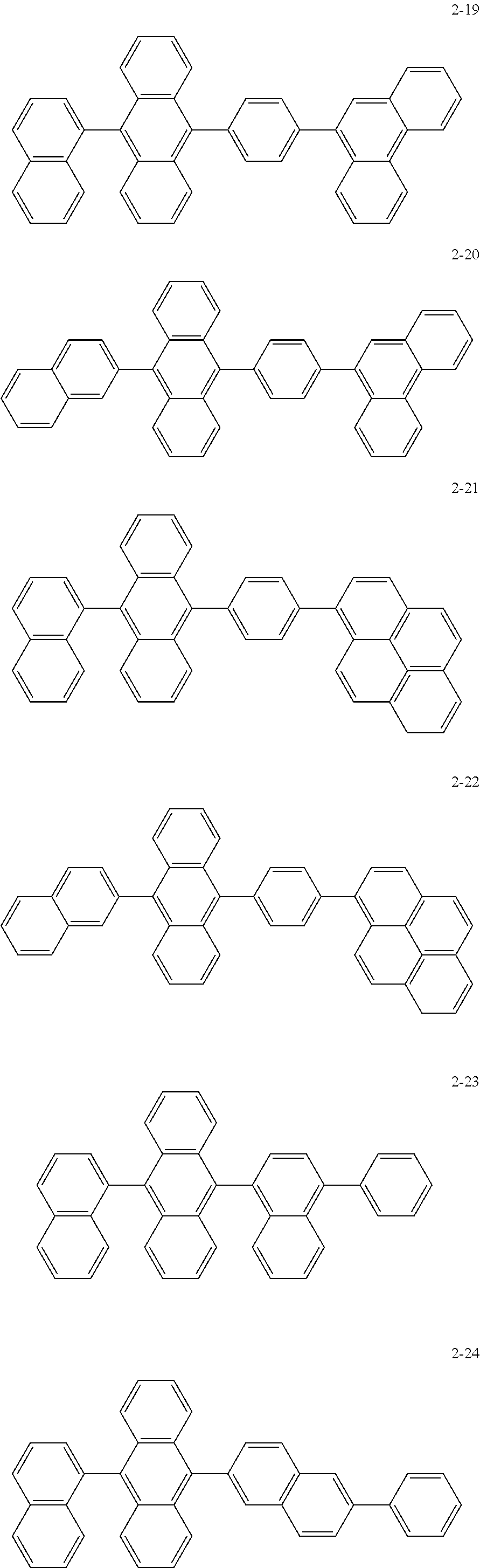


Ar601-[(L601)xe1-E601]xe2. Formula 601


| TABLE 1 | |||
| TGA (5% weight loss) | DSC | ||
| Compound 1-2 | Td: 346° C. | Tm: 235° C. | ||
| Compound 1-3 | Td: 339° C. | Tg: 96° C. | ||
| Compound 1-52 | Td: 375° C. | Tg: 97° C. | ||

| TABLE 2 | ||||||
| Driving Voltage | Efficiency | Color-coordinate | T95 lifespan | |||
| Host | Dopant | [V] | [cd/A] | CIE x | CIE y | [hr @ 100 mA/cm2] | |
| Example 1 | Compound 2-7 | Compound 1-2 | 3.4 | 5.2 | 0.151 | 0.115 | 160 |
| Example 2 | Compound 2-7 | Compound 1-3 | 3.4 | 5.1 | 0.150 | 0.118 | 150 |
| Example 3 | Compound 2-7 | Compound 1-52 | 3.4 | 5.3 | 0.151 | 0.124 | 150 |
| Comparative | Compound 2-7 | Dopant A | 4.4 | 4.5 | 0.151 | 0.162 | 70 |
| Example 1 | |||||||
| Comparative | Compound 2-7 | Dopant B | 4.2 | 5.2 | 0.150 | 0.152 | 110 |
| Example 2 | |||||||
| Comparative | Compound A | Compound B | 4.2 | 6.2 | 0.175 | 0.238 | 80 |
| Example 3 | |||||||
 |
|||||||
 |
|||||||
 |
|||||||
 |
|||||||
 |
|||||||
 |
|||||||
 |
|||||||
 |
|||||||
Claims (19)


Applications Claiming Priority (2)
| Application Number | Priority Date | Filing Date | Title |
|---|---|---|---|
| KR10-2015-0149739 | 2015-10-27 | ||
| KR1020150149739A KR102606275B1 (en) | 2015-10-27 | 2015-10-27 | Organic light emitting device |
Publications (2)
| Publication Number | Publication Date |
|---|---|
| US20170117478A1 US20170117478A1 (en) | 2017-04-27 |
| US10333071B2 true US10333071B2 (en) | 2019-06-25 |
Family
ID=58559153
Family Applications (1)
| Application Number | Title | Priority Date | Filing Date |
|---|---|---|---|
| US15/228,818 Active 2037-02-01 US10333071B2 (en) | 2015-10-27 | 2016-08-04 | Organic light emitting device |
Country Status (2)
| Country | Link |
|---|---|
| US (1) | US10333071B2 (en) |
| KR (1) | KR102606275B1 (en) |
Families Citing this family (13)
| Publication number | Priority date | Publication date | Assignee | Title |
|---|---|---|---|---|
| EP3196187A4 (en) | 2014-09-19 | 2018-04-18 | Idemitsu Kosan Co., Ltd | Novel compound |
| CN116583131A (en) * | 2017-04-26 | 2023-08-11 | Oti照明公司 | Method for patterning a coating on a surface and apparatus comprising the patterned coating |
| JP7264488B2 (en) * | 2017-05-17 | 2023-04-25 | オーティーアイ ルミオニクス インコーポレーテッド | Methods and devices containing conductive coatings for selectively depositing conductive coatings over patterned coatings |
| US11751415B2 (en) | 2018-02-02 | 2023-09-05 | Oti Lumionics Inc. | Materials for forming a nucleation-inhibiting coating and devices incorporating same |
| CN108586353B (en) * | 2018-06-15 | 2020-08-18 | 华南理工大学 | An organic light-emitting material based on anthracene and its derivatives, preparation method and application thereof |
| WO2020027323A1 (en) * | 2018-08-03 | 2020-02-06 | 出光興産株式会社 | Organic electroluminescent element and electronic device |
| KR102601118B1 (en) * | 2018-08-31 | 2023-11-09 | 주식회사 엘지화학 | Novel compound and organic light emitting device comprising the same |
| CN113631550A (en) * | 2019-03-22 | 2021-11-09 | 株式会社半导体能源研究所 | Organic compounds, light-emitting devices, light-emitting devices, electronic equipment and lighting devices |
| KR102775962B1 (en) * | 2019-07-12 | 2025-03-07 | 엘티소재주식회사 | Heterocyclic compound and organic light emitting device comprising the same |
| CN114075116B (en) * | 2020-08-20 | 2024-12-06 | 江苏三月科技股份有限公司 | A spirofluorene compound and an organic electroluminescent device containing the compound |
| CN112239414B (en) * | 2020-09-29 | 2022-03-29 | 华南理工大学 | A class of blue organic semiconductor materials based on 2,6-di-tert-butylanthracene and their preparation methods and applications |
| CN116102395B (en) * | 2021-11-08 | 2025-03-04 | 北京绿人科技有限责任公司 | Organic compounds and their applications and organic electroluminescent devices |
| CN117486859B (en) * | 2023-10-31 | 2026-04-24 | 石家庄诚志永华显示材料有限公司 | An organic electroluminescent compound, a composition comprising the same, and an organic electroluminescent device. |
Citations (17)
| Publication number | Priority date | Publication date | Assignee | Title |
|---|---|---|---|---|
| JPH07138561A (en) | 1993-11-17 | 1995-05-30 | Idemitsu Kosan Co Ltd | Organic electroluminescent device |
| JPH0812600A (en) | 1994-04-26 | 1996-01-16 | Tdk Corp | Phenylanthracene derivative and organic el element |
| JPH08239655A (en) | 1995-03-06 | 1996-09-17 | Idemitsu Kosan Co Ltd | Organic electroluminescent device |
| US5635308A (en) | 1994-04-26 | 1997-06-03 | Tdk Corporation | Phenylanthracene derivative and organic EL element |
| US5759444A (en) * | 1995-09-25 | 1998-06-02 | Toyo Ink Manufacturing Co., Ltd. | Light-emitting material for organic electroluminescence device, and organic electroluminescence device for which the light-emitting material is adapted |
| US20040161633A1 (en) * | 2003-02-19 | 2004-08-19 | Lg Electronics Inc. | Organic electroluminescent device |
| KR20050019907A (en) | 2002-07-19 | 2005-03-03 | 이데미쓰 고산 가부시키가이샤 | Organic electroluminescent devices and organic luminescent medium |
| US20060159957A1 (en) * | 2004-07-14 | 2006-07-20 | Idemitsu Kosan Co., Ltd. | Aromatic amine derivative and organic electroluminescence device employing the same |
| US20060222886A1 (en) * | 2005-04-04 | 2006-10-05 | Raymond Kwong | Arylpyrene compounds |
| US20070122656A1 (en) * | 2005-11-30 | 2007-05-31 | Eastman Kodak Company | Electroluminescent device containing an anthracene derivative |
| KR20080114812A (en) | 2006-03-24 | 2008-12-31 | 메르크 파텐트 게엠베하 | New Materials for Organic Electroluminescent Devices |
| KR20100094413A (en) | 2009-02-17 | 2010-08-26 | 에스에프씨 주식회사 | Anthracene derivative and organoelectroluminescent device employing the same |
| KR20100110895A (en) | 2008-02-13 | 2010-10-13 | 메르크 파텐트 게엠베하 | Novel materials for organic electroluminescent devices |
| KR20110123701A (en) | 2010-05-07 | 2011-11-15 | 에스에프씨 주식회사 | Anthracene-based compound and organic electroluminescent device comprising the same |
| KR20120117675A (en) | 2011-04-15 | 2012-10-24 | 에스에프씨 주식회사 | Pyrene derivative compounds and organic light-emitting diode including the same |
| KR20150001966A (en) | 2013-06-28 | 2015-01-07 | 삼성디스플레이 주식회사 | Organic Light Emitting Diode Device |
| KR20150043020A (en) | 2013-10-14 | 2015-04-22 | 에스에프씨 주식회사 | Antracene derivatives and organic light-emitting diode including the same |
Family Cites Families (2)
| Publication number | Priority date | Publication date | Assignee | Title |
|---|---|---|---|---|
| JP4807013B2 (en) * | 2005-09-02 | 2011-11-02 | 東レ株式会社 | Light emitting device material and light emitting device |
| JP6381201B2 (en) * | 2012-11-21 | 2018-08-29 | ケミプロ化成株式会社 | Substituted aromatic compounds, blue light emitting materials, organic EL devices |
-
2015
- 2015-10-27 KR KR1020150149739A patent/KR102606275B1/en active Active
-
2016
- 2016-08-04 US US15/228,818 patent/US10333071B2/en active Active
Patent Citations (21)
| Publication number | Priority date | Publication date | Assignee | Title |
|---|---|---|---|---|
| JPH07138561A (en) | 1993-11-17 | 1995-05-30 | Idemitsu Kosan Co Ltd | Organic electroluminescent device |
| JPH0812600A (en) | 1994-04-26 | 1996-01-16 | Tdk Corp | Phenylanthracene derivative and organic el element |
| US5635308A (en) | 1994-04-26 | 1997-06-03 | Tdk Corporation | Phenylanthracene derivative and organic EL element |
| JPH08239655A (en) | 1995-03-06 | 1996-09-17 | Idemitsu Kosan Co Ltd | Organic electroluminescent device |
| US5759444A (en) * | 1995-09-25 | 1998-06-02 | Toyo Ink Manufacturing Co., Ltd. | Light-emitting material for organic electroluminescence device, and organic electroluminescence device for which the light-emitting material is adapted |
| KR20090111355A (en) | 2002-07-19 | 2009-10-26 | 이데미쓰 고산 가부시키가이샤 | Organic electroluminescent device and organic light emitting medium |
| KR20050019907A (en) | 2002-07-19 | 2005-03-03 | 이데미쓰 고산 가부시키가이샤 | Organic electroluminescent devices and organic luminescent medium |
| US20050064233A1 (en) | 2002-07-19 | 2005-03-24 | Idemitsu Kosan Co., Ltd. | Organic electroluminescence device and organic light emitting medium |
| US20040161633A1 (en) * | 2003-02-19 | 2004-08-19 | Lg Electronics Inc. | Organic electroluminescent device |
| US20060159957A1 (en) * | 2004-07-14 | 2006-07-20 | Idemitsu Kosan Co., Ltd. | Aromatic amine derivative and organic electroluminescence device employing the same |
| US20060222886A1 (en) * | 2005-04-04 | 2006-10-05 | Raymond Kwong | Arylpyrene compounds |
| US20070122656A1 (en) * | 2005-11-30 | 2007-05-31 | Eastman Kodak Company | Electroluminescent device containing an anthracene derivative |
| US20090146139A1 (en) | 2006-03-24 | 2009-06-11 | Merck Patent Gmbh | Materials for organic electroluminescent devices |
| KR20080114812A (en) | 2006-03-24 | 2008-12-31 | 메르크 파텐트 게엠베하 | New Materials for Organic Electroluminescent Devices |
| KR20100110895A (en) | 2008-02-13 | 2010-10-13 | 메르크 파텐트 게엠베하 | Novel materials for organic electroluminescent devices |
| US20100327270A1 (en) | 2008-02-13 | 2010-12-30 | Merck Patent Gmbh | Novel materials for organic electroluminescent devices |
| KR20100094413A (en) | 2009-02-17 | 2010-08-26 | 에스에프씨 주식회사 | Anthracene derivative and organoelectroluminescent device employing the same |
| KR20110123701A (en) | 2010-05-07 | 2011-11-15 | 에스에프씨 주식회사 | Anthracene-based compound and organic electroluminescent device comprising the same |
| KR20120117675A (en) | 2011-04-15 | 2012-10-24 | 에스에프씨 주식회사 | Pyrene derivative compounds and organic light-emitting diode including the same |
| KR20150001966A (en) | 2013-06-28 | 2015-01-07 | 삼성디스플레이 주식회사 | Organic Light Emitting Diode Device |
| KR20150043020A (en) | 2013-10-14 | 2015-04-22 | 에스에프씨 주식회사 | Antracene derivatives and organic light-emitting diode including the same |
Non-Patent Citations (2)
| Title |
|---|
| Haykir et al. Thin Solid Films 2013, 548, 171-177. (Year: 2013). * |
| Tang, C. W. et al.; "Organic electroluminescent diodes"; Appl. Phys. Lett.; vol. 51; Sep. 21, 1987; pp. 913-915. |
Also Published As
| Publication number | Publication date |
|---|---|
| US20170117478A1 (en) | 2017-04-27 |
| KR20170049717A (en) | 2017-05-11 |
| KR102606275B1 (en) | 2023-12-05 |
Similar Documents
| Publication | Publication Date | Title |
|---|---|---|
| US11856842B2 (en) | Organic light-emitting device | |
| US10333071B2 (en) | Organic light emitting device | |
| US10333074B2 (en) | Organic light-emitting device | |
| US9711736B2 (en) | Condensed cyclic compound and organic light-emitting device comprising the same | |
| US10608189B2 (en) | Condensed cyclic compounds and organic light-emitting devices including the same | |
| US10170703B2 (en) | Condensed cyclic compound and organic light-emitting device including the same | |
| US11793063B2 (en) | Condensed-cyclic compound and organic light emitting device including the same | |
| US10629825B2 (en) | Organic light-emitting device | |
| US9809743B2 (en) | Condensed-cyclic compound and organic light-emitting device including the same | |
| US20160233428A1 (en) | Organic light-emitting device | |
| US10121974B2 (en) | Condensed-cyclic compound and organic light-emitting device comprising the same | |
| US20160308144A1 (en) | Condensed cyclic compound and organic light-emitting device comprising the same | |
| US20160233434A1 (en) | Compound and organic light-emitting device including the same | |
| US10211405B2 (en) | Organic light-emitting device | |
| US10418566B2 (en) | Condensed cyclic compound and organic light-emitting device comprising the same | |
| US10170705B2 (en) | Organic light-emitting device | |
| US20170133599A1 (en) | Organic light-emitting device | |
| US10290820B2 (en) | Amine-based compound and organic light-emitting device including the same | |
| US10186666B2 (en) | Condensed-cyclic compound and organic light emitting device including the same | |
| US11223018B2 (en) | Condensed cyclic compound and organic light-emitting device including the same | |
| US10038147B2 (en) | Organic light-emitting device | |
| US20170047521A1 (en) | Organic light-emitting device | |
| US10519174B2 (en) | Amine-based compound and organic light-emitting device including the same | |
| US9793500B2 (en) | Condensed cyclic compound and organic light-emitting device including the same | |
| US9818960B2 (en) | Condensed cyclic compound and organic light-emitting device including the same |
Legal Events
| Date | Code | Title | Description |
|---|---|---|---|
| AS | Assignment |
Owner name: SAMSUNG DISPLAY CO., LTD., KOREA, DEMOCRATIC PEOPL Free format text: ASSIGNMENT OF ASSIGNORS INTEREST;ASSIGNORS:KIM, SEHUN;HONG, JONGIN;JEONG, SEONGJIN;AND OTHERS;REEL/FRAME:039347/0280 Effective date: 20160707 Owner name: SEOUL NATIONAL UNIVERSITY R&DB FOUNDATION, KOREA, Free format text: ASSIGNMENT OF ASSIGNORS INTEREST;ASSIGNORS:KIM, SEHUN;HONG, JONGIN;JEONG, SEONGJIN;AND OTHERS;REEL/FRAME:039347/0280 Effective date: 20160707 |
|
| AS | Assignment |
Owner name: SAMSUNG DISPLAY CO., LTD., KOREA, REPUBLIC OF Free format text: CORRECTIVE ASSIGNMENT TO CORRECT THE COUNTRY FOR BOTH ASSIGNEE'S PREVIOUSLY RECORDED AT REEL: 039347 FRAME: 0280. ASSIGNOR(S) HEREBY CONFIRMS THE ASSIGNMENT;ASSIGNORS:KIM, SEHUN;HONG, JONGIN;JEONG, SEONGJIN;AND OTHERS;REEL/FRAME:041747/0077 Effective date: 20160707 Owner name: SEOUL NATIONAL UNIVERSITY R&DB FOUNDATION, KOREA, Free format text: CORRECTIVE ASSIGNMENT TO CORRECT THE COUNTRY FOR BOTH ASSIGNEE'S PREVIOUSLY RECORDED AT REEL: 039347 FRAME: 0280. ASSIGNOR(S) HEREBY CONFIRMS THE ASSIGNMENT;ASSIGNORS:KIM, SEHUN;HONG, JONGIN;JEONG, SEONGJIN;AND OTHERS;REEL/FRAME:041747/0077 Effective date: 20160707 |
|
| STPP | Information on status: patent application and granting procedure in general |
Free format text: NOTICE OF ALLOWANCE MAILED -- APPLICATION RECEIVED IN OFFICE OF PUBLICATIONS |
|
| STPP | Information on status: patent application and granting procedure in general |
Free format text: PUBLICATIONS -- ISSUE FEE PAYMENT VERIFIED |
|
| STCF | Information on status: patent grant |
Free format text: PATENTED CASE |
|
| MAFP | Maintenance fee payment |
Free format text: PAYMENT OF MAINTENANCE FEE, 4TH YEAR, LARGE ENTITY (ORIGINAL EVENT CODE: M1551); ENTITY STATUS OF PATENT OWNER: LARGE ENTITY Year of fee payment: 4 |