US10314357B2 - Anatomy shading for garments - Google Patents
Anatomy shading for garments Download PDFInfo
- Publication number
- US10314357B2 US10314357B2 US15/213,793 US201615213793A US10314357B2 US 10314357 B2 US10314357 B2 US 10314357B2 US 201615213793 A US201615213793 A US 201615213793A US 10314357 B2 US10314357 B2 US 10314357B2
- Authority
- US
- United States
- Prior art keywords
- garment
- brightness
- pair
- brightness gradient
- gradient
- Prior art date
- Legal status (The legal status is an assumption and is not a legal conclusion. Google has not performed a legal analysis and makes no representation as to the accuracy of the status listed.)
- Active, expires
Links
Images




Classifications
-
- A—HUMAN NECESSITIES
- A41—WEARING APPAREL
- A41H—APPLIANCES OR METHODS FOR MAKING CLOTHES, e.g. FOR DRESS-MAKING OR FOR TAILORING, NOT OTHERWISE PROVIDED FOR
- A41H3/00—Patterns for cutting-out; Methods of drafting or marking-out such patterns, e.g. on the cloth
- A41H3/04—Making patterns by modelling on the human body
-
- A—HUMAN NECESSITIES
- A41—WEARING APPAREL
- A41D—OUTERWEAR; PROTECTIVE GARMENTS; ACCESSORIES
- A41D1/00—Garments
- A41D1/06—Trousers
-
- A—HUMAN NECESSITIES
- A41—WEARING APPAREL
- A41D—OUTERWEAR; PROTECTIVE GARMENTS; ACCESSORIES
- A41D2400/00—Functions or special features of garments
- A41D2400/38—Shaping the contour of the body or adjusting the figure
Definitions
- the human vision system automatically interprets brightness gradients, such as those formed on jeans, as three-dimensional forms.
- human beings automatically assign an attractiveness to the three-dimensional forms. Therefore, when a pair of jeans having a particular finish is worn by an individual, others automatically make determinations as to the attractiveness of the individual's lower body based in part on the nature of the finish.
- a problem with existing finishes is that they can actually make the individual's form less attractive to others, a result that is clearly not desired by the individual wearing the garment. It would therefore be desirable to form patterns on jeans, or other garments, that do not reduce the attractiveness of the wearer. Indeed, it would be desirable to form patterns on garments that make the wearer more physically attractive.
- anatomy shading is any deliberate manipulation and/or addition of shading (a brightness gradient) to a pattern on a garment in order to change the perceived shape of a wearer of the garment toward a desired appearance.
- FIG. 1 is a schematic diagram of ideal female buttocks and thighs in side view.
- FIG. 2 is a photograph of ideal features for female buttocks and thighs in rear view.
- FIG. 3 shows renderings of three-quarter, side, and rear views of an ideal size 2 avatar.
- FIG. 4 shows renderings of rear views of ideal size 6, 10, and 14 avatars.
- FIG. 5 is schematic illustration of the process of applying a pattern to jeans using a template created from an ideal avatar.
- FIG. 6 is a schematic drawing illustrating how the brightness of the pattern varies relative to the perspective of an orthographic viewer.
- FIG. 7 is a graphical representation of sets of control points C(x, y, and z) for the rear view of ideal size 14, 10, 6, and 2 avatars.
- FIG. 8 is a graphical representation of sets of control points C(x, y, and z) for the three quarter view of ideal size 14, 10, 6, and 2 avatars.
- FIG. 9 is a graphical representation of sets of control points C(x, y, and z) for the side view of size ideal 14, 10, 6, and 2 avatars.
- FIG. 10 shows instructions that were provided to subjects in an experiment to evaluate anatomy patterns formed on jeans.
- FIG. 11 is a graph of the results of the experiment described in FIG. 10 .
- FIG. 12 is a rendering of an optimal anatomy-shading finish for size 2 jeans.
- FIG. 13 is a rendering of an optimal anatomy-shading finish for size 6 jeans.
- FIG. 14 is a rendering of an optimal anatomy-shading finish for size 10 jeans.
- FIG. 15 is a rendering of an optimal anatomy-shading finish for size 14 jeans.
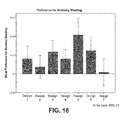
- FIG. 16 is a graph that shows the preference for anatomy-shading finishes versus standard finishes.
- FIG. 17 is a digital photograph of the back side of a pair of size 6 women's jeans that have been anatomy shaded using a laser process. The same jeans are depicted three times: first in color, second in grayscale, and third in grayscale with reference letters.
- FIG. 18 is a digital photograph of the back side of a pair of size 14 women's jeans that have been anatomy shaded using a laser process. The same jeans are depicted three times: first in color, second in grayscale, and third in grayscale with reference letters.
- FIG. 19 is a flow diagram illustrating a method for designing an anatomy shaded garment or a body-enhancing garment, in accordance with an aspect of the disclosure.
- FIG. 20 is a flow diagram illustrating a method for designing an anatomy shaded garment or a body-enhancing garment, in accordance with an aspect of the disclosure.
- the garments include a shading that forms a brightness gradient across the surface of the garment that emulates the contours of an ideally proportioned body. Because the brightness gradient is based upon ideal proportions of the human form and because the brain interprets the gradients as three-dimensional shapes, the gradients create a three-dimensional interpretation of a maximally attractive form, thereby increasing the attractiveness of the garment wearer.
- the brightness gradients are generated by creating ideally attractive three-dimensional models of the human form for each of multiple garment sizes and illuminating the models to generate brightness gradients that can be used to create two-dimensional templates, which can be used to form the patterns on the garments. Because the patterns are based on the anatomy of an ideally proportioned body, the patterns can be referred to as “anatomy shading.”
- clothing shading patterns can be utilized to capitalize upon the natural operation of the human vision system and brain.
- brightness gradient patterns can be provided on garments that trick the visual system into visualizing attractive three-dimensional shapes.
- garment patterns that can be used to increase the perceived attractiveness of the garment wearer. More particularly, described below are jeans “finishes” for the posterior of women's jeans that increase the attractiveness of the wearer's buttocks and upper thighs. While this specific application is discussed in detail, it is noted that the same principles can be applied to create shading patterns for substantially any body part and substantially any garment. Additionally, while use of the shading patterns is discussed for achieving a more attractive body shape, the shading patterns may be utilized for creating the perception of any desired body shape whether attractive or not.
- FIG. 1 is a schematic diagram of a female buttock and thigh in side view that identifies various distances that can be used to gauge attractiveness.
- point A identifies the location of the greater trochanter
- point B identifies the point of maximal projection of the mans veneris
- point C identifies the point of maximal gluteal projection
- point D identifies the location of the anterior superior iliac spine.
- FIG. 2 is a photograph of ideally proportioned female buttocks and thighs in rear view and identifies various areas that have an impact upon attractiveness.
- Area 1 is the lateral depression formed by the lateral border of the gluteus maximus, the quadratus femoris, and the insertions of the gluteus maxims and vastus lateralis to the greater trochanter (hereinafter the “lateral gluteal depression”).
- Area 2 is the infragluteal fold created by the ischial tuberosity, the insertions of the semitendinous muscle and long belly of the biceps femoris, and the lower border of the gluteus maximus (hereinafter the “infragluteal fold”).
- Area 3 is the supragluteal fossette positioned over the posterior superior iliac spine and created by the multifidus muscle, the lumbodorsal aponeurosis, and the insertion of the gluteus maximus (hereinafter the “supragluteal fossette”).
- Area 4 is the V-shaped crease arising in the proximal portion of the gluteal crease (hereinafter the “V-shaped crease”). According to Cuenca-Guerra & Quezada in “What Makes Buttocks Beautiful?
- a template can be created that gives the observer the impression of the shapes that result from some or all of these criteria, the attractiveness of a wearer of a pair of jeans having a finish based upon the template can be increased.
- templates of the type described above can be created in a variety of ways.
- templates can be created based upon three-dimensional computer models, or avatars, of ideal human forms. More particularly, an ideal avatar can be created for each of multiple body (e.g., pant) sizes for the purpose of creating a template for each size.
- FIG. 3 shows an example size 2 avatar in three-quarters, side, and rear view that was created with a software program called V-StitcherTM. The avatar shown in this figure was created so as to satisfy each of Criteria 1-4 identified above.
- FIG. 4 shows further avatars for sizes 6, 10, and 14 (from left to right) in rear view. Again, each avatar satisfies Criteria 1-4 and, therefore, each is an ideal avatar for its particular size.
- each avatar has been virtually illuminated so as to cast shadows on the avatars that reveal the contours of the avatars' shapes.
- the illumination is an ideal illumination that both emulates natural lighting and best reveals the avatar's contours. This lighting therefore creates a three-dimensional brightness gradient across the surface of each avatar that accentuates the contours of the avatar.
- the image in the left panel of FIG. 5 shows a simulation of a size 10 pair of jeans prior to applying a pattern.
- the jeans therefore have a uniform blue color and show minimal brightness gradients on the body.
- the image in the right panel of the figure shows a simulation of the jeans after the application of a pattern that was based upon a two-dimensional template, which is shown in the center panel.
- the template was created by capturing a two-dimensional snapshot of the three-dimensional ideal size 6 avatar from the rear perspective (see left image in FIG. 4 ).
- the pattern can be formed on the jeans in a variety of ways. In some embodiments, the pattern can be formed by manually or automatically abrading the garment (denim) substrate to create relatively light areas. In other embodiments, the relatively light areas can be formed by using a laser process.
- the jeans have been lightened in areas that are brightest in the template to emulate the three-dimensional shape of an ideal body. Accordingly, the jeans have “anatomy shading” that simulates the lighting that falls on an ideally proportioned three-dimensional body.
- the pattern/shading forms a brightness gradient that tricks the visual system into seeing the ideal three-dimensional shape. Because the brightness gradient emulates from the ideal avatar, which is based upon the ideal body shape, the gradient reflects at least some of the criteria for ideal buttocks and thighs described above.
- the brightness gradient pattern has relatively bright spots associated with high points of the contours of ideally proportioned buttocks and relatively dark spots associated with low points of the contours of the ideally proportioned buttocks.
- the brightness gradient is relatively bright in the areas associated with the central region of each buttock.
- the gradient is relatively dark in the areas associated with the infragluteal folds of the ideally proportioned body (Area 2 ) and the medial V-shaped crease (Area 4 ) of the ideally portioned body, which directly correspond with Criteria 2 and 4 identified above.
- this is in direct contrast with conventional jeans finishes, which often are lightened in the areas of the infragluteal fold and/or the medial V-shaped crease.
- the brightness gradient can further be described in terms of the perspective of the observer. This is illustrated in FIG. 6 , which schematically shows a buttock 10 of a jeans wearer and the eye 12 of an orthographic observer.
- the surface normal, n points toward the observer, who observes the buttock 10 along the direction of a unit vector ⁇ circumflex over ( ⁇ ) ⁇ .
- the brightness of the gradient on the jeans is maximal at the normal point and decreases as the angle ⁇ away from the normal increases.
- FIG. 7 provides graphical representations of four sets of control points that are the basis for brightness gradients for the rear view of apparent in sizes 14, 10, 6, and 2 (from left to right). The control points are not shown numerically, but instead are represented by individual pixels in the graphical representations. In these graphical representations, the function b(x, y) is rendered as the brightness of pixels in three-dimensional space.
- V _ ( ⁇ ⁇ x , ⁇ ⁇ y ) is the gradient.
- a polynomial function such as a spline curve.
- the brightness gradient can be obtained by: (1) creating a surface spline from the control points, (2) scaling the surface spline, (3) computing the slope at each control point, (4) interpolating a surface that matches the slope at each control point, (5) discretizing this surface, (6) adding to each point Gaussian noise of zero mean and standard deviation less than 10% of the standard deviation of the entire surface, and (7) selecting the subset of the discretized surface that corresponds appropriate to the location on the garment.
- Step (6) allows for small variations in anatomy finishes due to effects such as laser noise and the microstructure of the fabric of the garment.
- FIG. 8 provides a graphical representation of sets of control points that can be used as the basis for providing a brightness gradient to the three-quarter view of apparel for sizes 14, 10, 6, and 2 (from left to right).
- FIG. 9 provides a graphical representation of sets of control points that can be used as the basis for a brightness gradient to the side view of apparel for sizes 14, 10, 6, and 2 (from left to right). All control points in these examples are available as arrays of 860 x 2,423 numbers, which were used to generate the graphical representations.
- FIG. 10 shows the full instructions displayed before the experiment. Participants made adjustments on jeans observed from the rear view, the three-quarters view, and the side view.
- This graph identifies the optimal visibility for the brightness gradient for size 2, 6, 10, and 14, jeans and for each direction of view (rear, three-quarters, side).
- the x axis of the graph corresponds to the jean size while the y axis corresponds to the mean shading value, which is a measure of the overall contrast in the anatomy shading region, which extended from the waist to the knees.
- the mean shading value therefore provides an indication of how noticeable the anatomy shading is.
- a value of “0” corresponds to no contrast (i.e., the region is completely dark) while a value of “100” corresponds to maximal contrast with the background jean (i.e., the region is completely white).
- the optimal magnitude of the brightness gradient varies between sizes and views.
- the ideal mean shading value for a size 2 pair of jeans is about 14, while the ideal mean shading value for a size 14 pair of jeans is about 8.
- the optimal anatomy shading that was determined through the experimentation for sizes 2, 6, 10, and 14 is illustrated in FIGS. 12-15 , respectively.
- the anatomy shading provided on each pair of jeans is similar to that shown in the image of the right panel of FIG. 5 , irrespective of the magnitude. Therefore, in each case, the high points of the buttocks are relatively light while infragluteal fold and V-shaped crease areas are relatively dark.
- anatomy shaded pants according to the present invention may comprise, either singly or in any combination, (a) relatively bright spots associated with the central region of each buttock, (b) relatively dark spots associated with the infragluteal folds, and (c) relatively bright spots associated with the upper rear thighs of the ideally proportioned body.
- the location and size of the relatively bright and dark spots may vary depending on the size of the pant or jean.
- the brightness gradient applied to a garment decreases in intensity or is made less bright as the garment increases in size.
- the brightness gradient applied to a garment increases in intensity or is made brighter as the garment decreases in size.
- a size 2 garment will have a brighter brightness gradient than a size 4
- a size 4 garment will have a brighter brightness gradient than a size 6
- a size 10 garment will have a darker or less bright brightness gradient than a size 8.
- the brightness gradient is adjusted before application based on size in these embodiments, when the garments are laid flat the brain will perceive the garments as having the same brightness gradients even though they are different.
- the brightness gradient may decrease in brightness by 1%, 2%, 3%, 4% or 5% for each increase in size of a garment. These percentages are exemplary only are not meant to be limiting.
- the relatively bright spots associated with the central region of each buttock may have center points that are generally vertically located between 4.5 and 7.5 inches above the crotch level, and generally horizontally located between 1.5 and 4.5 inches from the center seam; alternatively vertically located between 5 and 7 inches above the crotch level, and horizontally located between 2 and 4 inches from the center seam; alternatively vertically located between 5.5 and 7 inches above the crotch level, and horizontally located between 2.2 and 3.5 inches from the center seam; alternatively vertically located between 5.7 and 6.7 inches above the crotch level, and horizontally located between 2.5 and 3 inches from the center seam.
- the relatively bright spots associated with the central region of each buttock may have center points that are generally vertically located between 4.5 and 7.5 inches above the crotch level, and generally horizontally located between 1.5 and 4.5 inches from the center seam; alternatively vertically located between 5 and 7 inches above the crotch level, and horizontally located between 2 and 4 inches from the center seam; alternatively vertically located between 5.5 and 6.5 inches above the crotch level, and horizontally located between 2.3 and 3.2 inches from the center seam; alternatively vertically located between 5.7 and 6.1 inches above the crotch level, and horizontally located between 2.5 and 3 inches from the center seam.
- the relatively bright spots associated with the central region of each buttock may have center points that are generally vertically located between 5.5 and 7.5 inches above the crotch level, and generally horizontally located between 1.5 and 4.5 inches from the center seam; alternatively vertically located between 6 and 7 inches above the crotch level, and horizontally located between 2 and 4 inches from the center seam; alternatively vertically located between 6.2 and 6.8 inches above the crotch level, and horizontally located between 2.2 and 3.5 inches from the center seam; alternatively vertically located between 6.5 and 6.8 inches above the crotch level, and horizontally located between 2.7 and 2.9 inches from the center seam.
- each bright spot may vary but may be spherical, oval or aspherical.
- the bright spots will have a variable area depending on the gradient level.
- each bright spot may have an area of between 20 and 40 square inches, alternatively between 25 and 35 square inches.
- the relatively dark spots associated with the infragluteal folds may have center points that are generally vertically located between 0.5 inches below and 4 inches above the crotch level, and generally horizontally located between 3 and 6.5 inches from the center seam; alternatively vertically located between 0 and 3 inches above the crotch level, and horizontally located between 3.5 and 6 inches from the center seam; alternatively vertically located between 1 and 2.5 inches above the crotch level, and horizontally located between 4 and 5.5 inches from the center seam; alternatively vertically located between 1.3 and 2.3 inches above the crotch level, and horizontally located between 4 and 5 inches from the center seam.
- the relatively dark spots associated with the infragluteal folds may have center points that are generally vertically located between 0.5 inches below and 2.5 inches above the crotch level, and generally horizontally located between 3.5 and 6.5 inches from the center seam; alternatively vertically located between 0 and 2 inches above the crotch level, and horizontally located between 4 and 6 inches from the center seam; alternatively vertically located between 0.5 and 1.5 inches above the crotch level, and horizontally located between 4.5 and 5.5 inches from the center seam; alternatively vertically located between 1 and 1.3 inches above the crotch level, and horizontally located between 4.7 and 5.5 inches from the center seam.
- the relatively dark spots associated with the infragluteal folds may have center points that are generally vertically located between 1.5 and 4 inches above the crotch level, and generally horizontally located between 3 and 6 inches from the center seam; alternatively vertically located between 2 and 3.5 inches above the crotch level, and horizontally located between 3.5 and 5.5 inches from the center seam; alternatively vertically located between 2 and 3 inches above the crotch level, and horizontally located between 4 and 5 inches from the center seam; alternatively vertically located between 2.3 and 2.7 inches above the crotch level, and horizontally located between 4.2 and 4.7 inches from the center seam.
- each dark spot may vary but may generally be an irregular elongated oval or curving projection that extends outwards from the crotch.
- the dark spots will have a variable area depending on the gradient level.
- each dark spot may have an area of between 4 and 20 square inches, alternatively between 5 and 15 square inches, alternatively between 6 and 12 square inches.
- the relatively bright spots associated with the upper rear thighs may have center points that are generally vertically located between 1.5 and 4.5 inches below the crotch level, and generally horizontally located between 5 and 8 inches from the inner seam of the leg; alternatively vertically located between 2 and 4 inches below the crotch level, and horizontally located between 5.5 and 7.5 inches from the inner seam of the leg; alternatively vertically located between 2 and 3 inches below the crotch level, and horizontally located between 6 and 7 inches from the inner seam of the leg; alternatively vertically located between 2.5 and 3 inches below the crotch level, and horizontally located between 6 and 6.8 inches from the inner seam of the leg.
- the relatively bright spots associated with the upper rear thighs may have center points that are generally vertically located between 1.5 and 3.5 inches below the crotch level, and generally horizontally located between 5 and 7.5 inches from the inner seam of the leg; alternatively vertically located between 2 and 3 inches below the crotch level, and horizontally located between 5.5 and 7 inches from the inner seam of the leg; alternatively vertically located between 2.2 and 2.8 inches below the crotch level, and horizontally located between 5.8 and 6.7 inches from the inner seam of the leg; alternatively vertically located between 2.3 and 2.7 inches below the crotch level, and horizontally located between 6 and 6.5 inches from the inner seam of the leg.
- the relatively bright spots associated with the upper rear thighs may have center points that are generally vertically located between 1.5 and 4.5 inches below the crotch level, and generally horizontally located between 5 and 8 inches from the inner seam of the leg; alternatively vertically located between 2 and 4 inches below the crotch level, and horizontally located between 5.5 and 7.3 inches from the inner seam of the leg; alternatively vertically located between 2.5 and 3.5 inches below the crotch level, and horizontally located between 6 and 7 inches from the inner seam of the leg; alternatively vertically located between 2.8 and 3.2 inches below the crotch level, and horizontally located between 6.3 and 6.9 inches from the inner seam of the leg.
- each bright spot may vary but may generally be an elongated regular or irregular (or partial regular or irregular) oval.
- the bright spots will have a variable area depending on the gradient level.
- each bright spot may have an area of between 20 and 80 square inches, alternatively between 20 and 50 square inches, alternatively between 25 and 40 square inches.
- the magnitude of the brightness of the bright spots and the degree of contrast between the bright spots and the dark spots may vary.
- the magnitude of the brightness of bright spots on jeans and other garments can be measured through use of a spectroradiometer.
- the peak magnitude of the brightness of the bright spots on the garments described herein, as measured by spectroradiometer under normal indoor fluorescent lighting may range anywhere from 2.5 to 6 cd/m2 , alternatively 2.8 to 5 cd/m2 , alternatively 3 to 4 cd/m2.
- FIG. 17 is a digital photograph of the back side of a pair of size 6 women's jeans that have been anatomy shaded using a laser process in accordance with the present invention.
- the digital image was analyzed to determine the location of the relatively bright spots associated with the central region of each buttock (points A and B in FIG. 17 ), the location of the relatively dark spots associated with the infragluteal folds (points C and D in FIG. 17 ), and the location of the relatively bright spots associated with the upper rear thighs (points E and F in FIG. 17 ).
- Table 1 lists values that were obtained from digital analysis of the photograph, as well as spectroradiometer readings that were taken on the jeans themselves. The first row lists the (x, y) coordinates of each point on the image.
- the second row list the digital brightness value for each point, where a value of zero is black and a value of 1 is maximum brightness.
- the third row lists the approximate horizontal distance of each point from the left edge of the center seam (from the inseam for the upper rear thighs) in inches.
- the fourth row lists the approximate vertical distance of each point from the crotch level (the top of the inseam of the jeans) in inches.
- the fifth row lists the luminance of each point in cd/m2, as measured under normal indoor fluorescent lighting with a SpectraScan® PR670 by Photo Research.
- FIG. 18 is a digital photograph of the back side of a pair of size 14 women's jeans that have been anatomy shaded using a laser process in accordance with the present invention.
- the digital image was analyzed to determine the location of the relatively bright spots associated with the central region of each buttock (points A and B in FIG. 18 ), the location of the relatively dark spots associated with the infragluteal folds (points C and D in FIG. 18 ), and the location of the relatively bright spots associated with the upper rear thighs (points E and F in FIG. 18 ).
- Table 2 lists values that were obtained from digital analysis of the photograph, as well as spectroradiometer readings that were taken on the jeans themselves. The rows in the table contain the same information as described for Table 1.
- anatomy shading may be performed by adjusting the shading on clothing based on rules of perception (such as the principles of the geodesic assumption) after visible inspection on live models.
- anatomy shading is based on the shading differences between an actual body shape of a selected feature and a desired body shape for that selected feature.
- a method 1600 for anatomy shading may be utilized as illustrated in FIG. 19 .
- FIG. 19 is a flow diagram illustrating a method 1900 for designing an anatomy-shaded garment or a body-enhancing garment, in accordance with an aspect of the disclosure.
- Anatomy shading uses the rules of perception to change a perceived size and/or shape of the anatomy of the wearer.
- anatomy shading is used to increase the attractiveness of the wearer.
- the body-enhancing garment may be a pair of pants, a shirt, a jacket, a pair of shorts, a skirt, a dress, a pair of leggings, a pair of capris, a bra, a piece of underwear, a piece of swim wear, a pair of shoes, and/or a pair of skorts. This list is exemplary only and is not meant to be limiting.
- the garment may be any clothing item for a human.
- the routine or method 1900 begins at operation 1902 , where a desired 3-D body shape or one or more features of the body is identified.
- the feature may be any body part or area of the body that is covered by the garment.
- the feature may be the buttocks, thighs, waist, chest, shoulders, bosom, legs, arms, and/or or the chest. This list is exemplary only and is not meant to be limiting.
- the desired 3-D body shape is generated by one or more computing devices.
- the feature may be any portion of a human body.
- the desired 3-D body shape is an attractive body shape based on known attractive size and shape ranges. For example, FIGS.
- the desired 3-D body shape accentuates or minimizes the appearance of a specific feature of the body.
- the desired body shape may be any desired range of sizes and/or shapes for one or more features.
- method 1900 moves to operation 1904 .
- light is applied to the desired 3-D body shape to determine the shadowing or brightness gradient (or shaded pattern) created by the desired 3-D body upon the application of light.
- operation 1904 is performed by one or more computing devices.
- FIGS. 3 and 4 illustrate different examples of a performance of operation 1904 .
- FIGS. 3 and 4 illustrate avatars that have been virtually illuminated so as to cast shadows on the avatars that reveal the contours of the avatars' shapes.
- the illumination is an ideal illumination that emulates natural lighting and/or reveals the 3-D body shape. This lighting creates a 3-D brightness gradient across the surface of a desired body.
- a 2-D image of the 3-D brightness gradient is created.
- operation 1906 is performed by one or more computing devices.
- the formed 2-D image provides a template for adding the brightness gradient to a garment that changes the perception of the identified feature towards the appearance of the desired 3-D body shape.
- a consumer may further adjust the determined brightness gradient formed during operation 1906 .
- This input may come from an adjustment task where the consumer can adjust the amount of shading or brightness on a simulated garment. For example, the consumer may move a slider left or right, where left simulates less shading and right simulates more shading. Consumer preferences are then accumulated to inform the preferred amount of shading or brightness to apply to the garment during operation 1906 .
- the brightness gradient based on the 2-D image and/or the consumer preferences are applied to a garment.
- the determined brightness gradient is applied to a garment with a machine (such as a laser or digital printer) and/or in an automated assembly process.
- the determined brightness gradient is manually added to the garment.
- the determined brightness gradient is applied manually and via a machine to the garment.
- the brightness gradient has to be adjusted or transformed before application to the garment. This adjustment ensures that the finished garment creates one or more 3-D brightness gradients when worn on the body that are consistent with the brightness gradients created by the illuminated desired 3-D body shape. As such, the 2-D image of the brightness gradient must be adjusted so that the brightness gradients are applied to the garment in the correct position, size, and intensity.
- the brightness gradient may be adjusted based on the size of the garment at operation 1908 . For example, the brightness of the determined brightness gradient may be decreased as the size of the garment increases. Alternatively, the brightness of the brightness gradient may be adjusted or increased as the size of the garment decreases.
- the brightness gradient may be adjusted or transformed based on a visible contrast range of each product, printing technique, finishing technique and/or dyes at operation 1908 .
- the visible contrast range may be dependent on the dry process (laser or manual application) and/or a wet process (washing with enzyme, softener, bleach, pumice stone, potassium permanganate, and/or chlorine).
- the 2-D image is calibrated to fall within that contrast range created by the wet and dry processes.
- the brightness gradient may also need to be adjusted or calibrated to fall within that contrast range created by these printing techniques.
- the brightness gradient is adjusted after visual inspection of the garment with an applied brightness gradient while being worn by a model or mannequin.
- the adjustments to the brightness gradient made after a visible inspection ensure that a finished garment is consistent with the brightness gradients created by the illuminated desired 3-D body shape when applied to the garment.
- the body-enhancing garment may be a pair of pants, a shirt, a jacket, a pair of shorts, a skirt, a dress, a pair of leggings, a pair of capris, a bra, a piece of underwear, a piece of swim wear, a pair of shoes, and/or a pair of skorts.
- the method 2000 includes: selecting a feature for anatomy shading at operation 2002 ; determining a desired appearance for the selected feature at operation 2004 ; determining one or more brightness gradients for changing a perception of the selected feature toward the desired appearance based on the rules of perception at operation 2006 ; and adding the one or more brightness gradients to the garment at operation 2008 .
- Operation 2006 may include determining the positioning of the one or more brightness gradients on the garment.
- the feature may be one or more different body parts.
- operation 2008 is performed, manually, by a machine, such as a laser or printer, and/or by an automated process.
- the desired appearance is an attractive appearance.
- operation 2008 includes adjusting the one or more determined brightness gradients before application to the garment to ensure that the applied one or more brightness gradients emulates the determined one or more brightness gradients upon application to the garment and when the garment in worn.
- the one or more brightness gradients may be adjusted so that the brightness gradients are applied to the garment in the correct position, size, and intensity.
- the brightness gradient may be adjusted based on the size of the garment. For example, smaller sizes may receive a more intense or brighter brightness gradient than larger sizes.
- the brightness gradient may be adjusted or calibrated based on the visible contrast range of a garment.
- the brightness gradient may be adjusted after visible inspection of the garment with an applied brightness gradient while being worn by a model or mannequin.
- the amount of shading, sizing, and/or positioning of the one or more brightness gradients is determined or adjusted based on consumer feedback during the determining of the one or more brightness gradients at operation 2006 .
- the darkness, positioning, and/or sizing of the one or more shading patterns may be determined by utilizing an adjustment task where consumers may adjust the amount of shading or brightness on a simulated garment. For example, the consumer may move a slider left or right, where left simulates less shading, increased sizing and/or location shifting and right simulates more shading, decreased sizing and/or location shifting. Consumer preferences are then accumulated to inform the preferred amount of shading (sizing and/or location) to apply to the one or more brightness gradients at operation 2006 .
- anatomy shading comprising brightness gradients can be applied to areas other than just the buttocks and rear thighs of jeans.
- anatomy shading can be provided to the calves and the fronts of the thighs of jeans to emulate ideal proportions of those areas of the body.
- anatomy shading can be provided on other pants, as well as other garments, which may include underwear, shorts, and shirts.
- anatomy shading that emulates ideal male proportions can be provided to men's garments in a similar manner.
Landscapes
- Engineering & Computer Science (AREA)
- Textile Engineering (AREA)
- Details Of Garments (AREA)
Abstract
Description
-
- 1. The distance between points A and C (
FIG. 1 ) should be twice as large as the distance between points A and B; - 2. The infragluteal fold (
Area 2;FIG. 2 ) should not extend beyond two-thirds the width of the thigh; - 3. The lower spine (
FIG. 1 ) should be angled out five to seven degrees from vertical; and - 4. The V-shaped crease (
Area 4;FIG. 2 ) should be about the size shown in the photograph.
- 1. The distance between points A and C (
is the gradient. These mathematics indicate that one can obtain a brightness gradient from a set of control points C(x, y, z) by using a polynomial function, such as a spline curve. For example, the brightness gradient can be obtained by: (1) creating a surface spline from the control points, (2) scaling the surface spline, (3) computing the slope at each control point, (4) interpolating a surface that matches the slope at each control point, (5) discretizing this surface, (6) adding to each point Gaussian noise of zero mean and standard deviation less than 10% of the standard deviation of the entire surface, and (7) selecting the subset of the discretized surface that corresponds appropriate to the location on the garment. Step (6) allows for small variations in anatomy finishes due to effects such as laser noise and the microstructure of the fabric of the garment.
| TABLE 1 | |||||||
| A | B | C | D | E | F | ||
| (X, Y) | (1667, | (2062, | (1484, | (2204, | (1397, | (2271, |
| Coordinate | 390) | 395) | 772) | 767) | 1028) | 1034) |
| Brightness | 0.4549 | 0.4549 | 0.2902 | 0.27059 | 0.42745 | 0.43137 |
| Value (0-1) | ||||||
| Approximate | 2.5 | 3 | 5 | 5 | 6 | 6.5 |
| distance from | ||||||
| center seam | ||||||
| (in.) | ||||||
| Approximate | 6 | 5.75 | 1 | 1.25 | −2.5 | −2.5 |
| distance from | ||||||
| crotch level | ||||||
| (in.) | ||||||
| Luminance | 3.583 | 3.384 | 2.067 | 2.163 | 3.083 | 2.652 |
| (cd/mL) | ||||||
| TABLE 2 | |||||||
| A | B | C | D | E | F | ||
| (X, Y) | (1729, | (2180, | (1568, | (2278, | (1454, | (2386, |
| Coordinate | 637) | 667) | 962) | 975) | 1301) | 1299) |
| Brightness | 0.61569 | 0.53333 | 0.23922 | 0.2549 | 0.47843 | 0.43922 |
| Value (0-1) | ||||||
| Approximate | 2.5 | 2.75 | 4.25 | 4.5 | 6.75 | 6.5 |
| distance from | ||||||
| center seam | ||||||
| (in.) | ||||||
| Approximate | 6.5 | 6.75 | 2.5 | 2.5 | −3 | −3 |
| distance from | ||||||
| crotch level | ||||||
| (in.) | ||||||
| Luminance | 3.907 | 4.065 | 2.237 | 2.053 | 3.912 | 4.039 |
| (cd/mL) | ||||||
Claims (20)
Priority Applications (6)
| Application Number | Priority Date | Filing Date | Title |
|---|---|---|---|
| US15/213,793 US10314357B2 (en) | 2013-10-18 | 2016-07-19 | Anatomy shading for garments |
| EP17745614.2A EP3487340A1 (en) | 2016-07-19 | 2017-07-19 | Anatomy shading for garments |
| PCT/US2017/042885 WO2018017729A1 (en) | 2016-07-19 | 2017-07-19 | Anatomy shading for garments |
| JP2019502730A JP2019521262A (en) | 2016-07-19 | 2017-07-19 | Anatomy shading for garments |
| KR1020197004398A KR20190028778A (en) | 2016-07-19 | 2017-07-19 | Anatomical organization sound film for clothing |
| CN201780053346.XA CN109661185A (en) | 2016-07-19 | 2017-07-19 | Anatomical Shading of Clothing |
Applications Claiming Priority (3)
| Application Number | Priority Date | Filing Date | Title |
|---|---|---|---|
| US201361892749P | 2013-10-18 | 2013-10-18 | |
| US14/517,339 US20150106993A1 (en) | 2013-10-18 | 2014-10-17 | Anatomy shading for garments |
| US15/213,793 US10314357B2 (en) | 2013-10-18 | 2016-07-19 | Anatomy shading for garments |
Related Parent Applications (1)
| Application Number | Title | Priority Date | Filing Date |
|---|---|---|---|
| US14/517,339 Continuation-In-Part US20150106993A1 (en) | 2013-10-18 | 2014-10-17 | Anatomy shading for garments |
Publications (2)
| Publication Number | Publication Date |
|---|---|
| US20160324234A1 US20160324234A1 (en) | 2016-11-10 |
| US10314357B2 true US10314357B2 (en) | 2019-06-11 |
Family
ID=57222062
Family Applications (1)
| Application Number | Title | Priority Date | Filing Date |
|---|---|---|---|
| US15/213,793 Active 2035-11-01 US10314357B2 (en) | 2013-10-18 | 2016-07-19 | Anatomy shading for garments |
Country Status (1)
| Country | Link |
|---|---|
| US (1) | US10314357B2 (en) |
Cited By (3)
| Publication number | Priority date | Publication date | Assignee | Title |
|---|---|---|---|---|
| US11129422B2 (en) | 2016-07-18 | 2021-09-28 | The H.D. Lee Company, Inc. | Body-enhancing garment and garment construction |
| USD945121S1 (en) | 2016-01-29 | 2022-03-08 | The H.D. Lee Company, Inc. | Pant with anatomy enhancing pockets |
| US11344071B2 (en) | 2013-10-18 | 2022-05-31 | The H.D. Lee Company, Inc. | Anatomy shading for garments |
Families Citing this family (8)
| Publication number | Priority date | Publication date | Assignee | Title |
|---|---|---|---|---|
| USD835384S1 (en) * | 2016-07-18 | 2018-12-11 | Vf Corporation | Dress with anatomy enhancing patterning |
| USD838935S1 (en) * | 2016-07-18 | 2019-01-29 | Vf Corporation | Dress with anatomy enhancing shading |
| US10327487B2 (en) | 2016-07-19 | 2019-06-25 | Vf Corporation | Body-enhancing garment and garment design |
| DK3750515T3 (en) * | 2016-08-22 | 2025-03-31 | Sanko Tekstil Isletmeleri San Ve Tic As | COMPRESSION GARMENT WITH MULTIPLE COMPRESSION FORCES AND METHOD FOR FORMING THEREOF |
| EP3346038B1 (en) * | 2017-01-05 | 2019-06-05 | Jeanología, S.L. | Method for laser engraving of clothing and corresponding machine |
| USD840638S1 (en) | 2017-07-20 | 2019-02-19 | The H.D. Lee Company, Inc. | Pant with color blocked yoke |
| USD841940S1 (en) | 2017-07-20 | 2019-03-05 | The H.D. Lee Company, Inc. | Double seam yoke and stitching detail |
| USD838085S1 (en) | 2017-07-20 | 2019-01-15 | The H.D. Lee Company, Inc. | Double seam yoke |
Citations (93)
| Publication number | Priority date | Publication date | Assignee | Title |
|---|---|---|---|---|
| US407024A (en) | 1889-07-16 | Pocket for rubber coats | ||
| US564373A (en) | 1896-07-21 | Overalls | ||
| US693276A (en) | 1901-12-09 | 1902-02-11 | Simon Klavinsky | Overalls. |
| US1654064A (en) | 1927-06-09 | 1927-12-27 | Zaki Joseph | Hosiery |
| US1697255A (en) | 1928-02-18 | 1929-01-01 | Harry S Wolff | Stocking |
| US1817053A (en) | 1929-02-18 | 1931-08-04 | Oscar U Zerk | Hosiery |
| US1852138A (en) | 1930-05-28 | 1932-04-05 | Oscar U Zerk | Hosiery and method of making the same |
| US2381580A (en) | 1942-06-27 | 1945-08-07 | Morris A Einbinder | Garment |
| US2718640A (en) | 1952-12-30 | 1955-09-27 | Jerome L Suckle | Garment appendages |
| US2840824A (en) | 1955-11-22 | 1958-07-01 | Nadine B Horner | Non-spill pocket |
| US3683419A (en) | 1970-09-11 | 1972-08-15 | Robert B Lewis | Moire pattern garment |
| US3691971A (en) | 1971-06-16 | 1972-09-19 | Robert W Clarke | Multiple ply moire textile |
| US3696845A (en) | 1969-01-28 | 1972-10-10 | Acker & Soehne Ohg Jakob | Curtain |
| USD259820S (en) | 1980-05-05 | 1981-07-14 | Englishtown Sportswear, Ltd. | Pocket for jeans or the like |
| US4282609A (en) | 1977-10-25 | 1981-08-11 | Concepts For Women, Inc. | Appearance modifying panty hose |
| USD263766S (en) | 1979-07-17 | 1982-04-13 | Englishtown Sportswear Ltd. | Pocket for jeans or the like |
| USD278377S (en) | 1982-09-22 | 1985-04-16 | Englishtown Sportswear, Ltd. | Pocket for jeans or the like |
| USD278376S (en) | 1982-09-22 | 1985-04-16 | Englishtown Sportswear, Ltd. | Pocket for jeans or the like |
| USD278471S (en) | 1982-09-22 | 1985-04-23 | Englishtown Sportswear, Ltd. | Pocket for jeans or the like |
| US4888713A (en) | 1986-09-05 | 1989-12-19 | Cdi Technologies, Inc. | Surface detail mapping system |
| US5065458A (en) | 1990-10-04 | 1991-11-19 | Johnson Mary S | Appearance modifying garments |
| US5535451A (en) | 1995-04-27 | 1996-07-16 | Sun Apparel Inc. | Pants garment with buttocks enhancement |
| US5990444A (en) | 1995-10-30 | 1999-11-23 | Costin; Darryl J. | Laser method and system of scribing graphics |
| US6175966B1 (en) | 1998-11-25 | 2001-01-23 | Vantage Customs Classics, Inc. | Garment having a closeable pocket which conceals embroidery and method of producing a garment having a closeable pocket which conceals embroidery |
| USD483924S1 (en) | 2002-04-01 | 2003-12-23 | G-Star International Bv | Pair of trousers |
| JP2004156153A (en) | 2002-11-01 | 2004-06-03 | Wacoal Corp | Body-fitting garment |
| US20040205879A1 (en) | 2003-04-17 | 2004-10-21 | Christopher Leba | Pocket construction |
| USD511606S1 (en) | 2003-10-29 | 2005-11-22 | Casucci S.P.A. | Jeans |
| WO2006032096A1 (en) | 2004-09-23 | 2006-03-30 | Skins Compression Garments Pty Limited | Compression garments and a method of manufacture |
| FR2876880A3 (en) | 2004-10-22 | 2006-04-28 | Desayes Jacques Julian | Garment with zones in lighter and darker colours to enhance visual appearance of wearer's silhouette |
| US7058987B2 (en) | 2003-09-26 | 2006-06-13 | Bullet 50 | Utility pants for law enforcement personnel |
| US7107621B2 (en) | 2004-06-03 | 2006-09-19 | Frank Meekins | Optical illusion wear |
| USD528742S1 (en) | 2005-03-22 | 2006-09-26 | Cotec S.A | Pocket for a garment or similar article |
| US20060235656A1 (en) | 2003-04-21 | 2006-10-19 | National Institute Of Advanced Industrial Science Technology | Product shape designing device |
| USD532958S1 (en) | 2005-09-21 | 2006-12-05 | Kerrits Activewear, Inc. | Equestrian riding pants |
| WO2007055072A1 (en) | 2005-11-09 | 2007-05-18 | Tomoya Deguchi | Garment wearable closely fitted to body |
| WO2007112494A1 (en) | 2006-04-03 | 2007-10-11 | Jest Technologies Pty Ltd | An improved compression garment and method of manufacture |
| US20070266478A1 (en) | 2006-05-05 | 2007-11-22 | Girod Elizabeth M | Garments having an inside out appearance |
| USD558954S1 (en) | 2007-03-29 | 2008-01-08 | Indigo Group U.S.A., Inc. | Jean pockets |
| US20080271226A1 (en) | 2005-02-24 | 2008-11-06 | Erana Ahumada Elisa Del Carmen | Garments in Order to Lift the Buttocks |
| USD584487S1 (en) | 2008-02-05 | 2009-01-13 | Eko Enterprise Llc | Pants pocket |
| USD586084S1 (en) | 2007-11-09 | 2009-02-10 | Chali Annette Mendoza | Jeans |
| USD592829S1 (en) | 2008-09-11 | 2009-05-26 | Arman Kepekchyan | Article of clothing |
| US20090144173A1 (en) * | 2004-12-27 | 2009-06-04 | Yeong-Il Mo | Method for converting 2d image into pseudo 3d image and user-adapted total coordination method in use artificial intelligence, and service business method thereof |
| US20090157021A1 (en) | 2007-12-14 | 2009-06-18 | Sullivan Suzanne K | Articles with informative patterns, and methods of making the same |
| USD600882S1 (en) | 2008-03-25 | 2009-09-29 | Johnson Jr Edward | Pants with peanut shaped fasteners |
| US20100064409A1 (en) | 2005-06-22 | 2010-03-18 | Bruce Bary Buckley | Shape enhancing garment |
| US20100136882A1 (en) | 2008-11-28 | 2010-06-03 | Aliska Malish | No end slimming garments |
| US20100192283A1 (en) | 2009-02-04 | 2010-08-05 | Sae-A Trading Co., Ltd. | Pants Having Hip-Up Function |
| US7814576B2 (en) | 2005-01-26 | 2010-10-19 | Yugen Kaisha Nakazawa Kenkyushitsu | Tights |
| US20110010818A1 (en) | 2005-12-06 | 2011-01-20 | Tony Hood | Garment backpack |
| CN301600315S (en) | 2010-11-19 | 2011-07-06 | 山东江辰时装有限公司 | Jeans (York 1) |
| US20110185477A1 (en) | 2010-02-04 | 2011-08-04 | Olenicoff Kim L | Garment-attachable holder |
| US20110214216A1 (en) | 2010-03-04 | 2011-09-08 | Frank Zarabi | Supportive and slimming apparel |
| USD650154S1 (en) | 2009-05-22 | 2011-12-13 | Saavedra John A | Garment |
| WO2012004365A1 (en) | 2010-07-07 | 2012-01-12 | V!Go Group N.V. | Improved sportswear |
| US20120023644A1 (en) | 2010-07-30 | 2012-02-02 | Max Mara S.R.L. Societa' Unipersonale | Pocket for articles of clothing, a method for realising a pocket and relevant articles of clothing |
| USD686800S1 (en) | 2012-06-19 | 2013-07-30 | Suzette Kelly | Jeans |
| US20130219589A1 (en) | 2010-02-02 | 2013-08-29 | Reverse Gear, Llc | Reversible pocket |
| WO2013154445A1 (en) | 2012-04-12 | 2013-10-17 | Irmãos Vila Nova, S.A. | Denim trousers for lady |
| US20140035913A1 (en) * | 2012-08-03 | 2014-02-06 | Ebay Inc. | Virtual dressing room |
| US20140096309A1 (en) | 2012-10-08 | 2014-04-10 | JoElla Hughes | System and method for an improved appearance of a pair of pants |
| US20140150166A1 (en) | 2012-11-30 | 2014-06-05 | Jeffrey Hall | Twin seam panel trousers |
| US20140165265A1 (en) | 2012-09-10 | 2014-06-19 | Levi Strauss & Co. | Shaped Fit Sizing System with Body Shaping |
| US20140182044A1 (en) | 2012-08-06 | 2014-07-03 | Brian Cole | Secure invisible garment pocket |
| US20140273742A1 (en) | 2013-03-15 | 2014-09-18 | Spanx, Inc. | Posterior-Lifting Garment and Methods of Assembling The Same |
| US8959665B1 (en) | 2011-06-08 | 2015-02-24 | Wrangler Apparel Corp. | Bottom garment having improved tummy control |
| US8984668B2 (en) | 2012-09-10 | 2015-03-24 | Levi Strauss & Co. | Body shaping fit system |
| US20150082516A1 (en) | 2013-09-21 | 2015-03-26 | Vinh D. Doan | Hip pocket pants, shorts and skirts |
| US20150106993A1 (en) * | 2013-10-18 | 2015-04-23 | The Regents Of The University Of California | Anatomy shading for garments |
| USD732801S1 (en) | 2012-10-22 | 2015-06-30 | Magevonna | Back pockets for designer jeans |
| USD733398S1 (en) | 2012-07-27 | 2015-07-07 | Stacey Ellis | Curved denim jeans |
| US20150213646A1 (en) | 2014-01-28 | 2015-07-30 | Siemens Aktiengesellschaft | Method and System for Constructing Personalized Avatars Using a Parameterized Deformable Mesh |
| USD735973S1 (en) | 2012-03-20 | 2015-08-11 | Indigo Sun, LLC | |
| US20150339853A1 (en) | 2013-01-02 | 2015-11-26 | Embodee Corp. | Footwear digitization system and method |
| US9326552B2 (en) | 2013-03-15 | 2016-05-03 | Spanx, Inc. | Abdominal-restraint garment and methods of assembling the same |
| USD758696S1 (en) | 2014-10-03 | 2016-06-14 | Diesel S.p.A. | Jeans |
| USD758695S1 (en) | 2014-10-03 | 2016-06-14 | Diesel S.p.A. | Jeans |
| US20160189431A1 (en) | 2014-12-25 | 2016-06-30 | Kabushiki Kaisha Toshiba | Virtual try-on system, virtual try-on terminal, virtual try-on method, and computer program product |
| USD762072S1 (en) | 2013-10-22 | 2016-07-26 | Renee Greenstein | Set of pockets with decorative pattern |
| US20160227854A1 (en) | 2015-02-05 | 2016-08-11 | Sharon Irla Ellis | Methods For Producing Garments And Garment Designs |
| USD764755S1 (en) | 2015-04-30 | 2016-08-30 | AMO Denim, LLC | Pants with twisted outseam |
| USD768359S1 (en) | 2015-03-10 | 2016-10-11 | Diesel S.p.A. | Jeans |
| US9468239B2 (en) | 2014-08-01 | 2016-10-18 | Juan Antonio Said Battah | Trouser for male users that lifts and shapes the form of the buttocks |
| USD769579S1 (en) | 2015-09-21 | 2016-10-25 | Joel B. Griffin | Garment |
| USD770728S1 (en) | 2012-12-06 | 2016-11-08 | Jeffrey Peter Jaklinski | Backward pants |
| USD793033S1 (en) | 2015-09-14 | 2017-08-01 | VF Jeanswear Limited Partnership | Comfort fit liner for a bottom garment |
| US9801420B2 (en) | 2013-03-15 | 2017-10-31 | Spanx, Inc. | Abdominal-restraint garment and methods of assembling the same |
| USD802256S1 (en) | 2016-01-29 | 2017-11-14 | V.F. Corporation | Pant with anatomy enhancing pockets |
| US20180014590A1 (en) | 2016-07-18 | 2018-01-18 | Vf Corporation | Body-enhancing garment and garment construction |
| WO2018017732A1 (en) | 2016-07-19 | 2018-01-25 | Vf Corporation | Body-enhancing garment and garment design |
| US20180110273A1 (en) | 2016-07-18 | 2018-04-26 | Vf Corporation | Body perception changing baffles and baffle construction |
| US20180168256A1 (en) | 2016-07-19 | 2018-06-21 | HD Lee Company, Inc. | Body-perception enhancing striped garment and systems and methods for creation thereof |
Family Cites Families (2)
| Publication number | Priority date | Publication date | Assignee | Title |
|---|---|---|---|---|
| US2876880A (en) * | 1956-08-09 | 1959-03-10 | Ibm | Low inertia magnetic disc clutch |
| US6943575B2 (en) * | 2002-07-29 | 2005-09-13 | Micron Technology, Inc. | Method, circuit and system for determining burn-in reliability from wafer level burn-in |
-
2016
- 2016-07-19 US US15/213,793 patent/US10314357B2/en active Active
Patent Citations (102)
| Publication number | Priority date | Publication date | Assignee | Title |
|---|---|---|---|---|
| US564373A (en) | 1896-07-21 | Overalls | ||
| US407024A (en) | 1889-07-16 | Pocket for rubber coats | ||
| US693276A (en) | 1901-12-09 | 1902-02-11 | Simon Klavinsky | Overalls. |
| US1654064A (en) | 1927-06-09 | 1927-12-27 | Zaki Joseph | Hosiery |
| US1697255A (en) | 1928-02-18 | 1929-01-01 | Harry S Wolff | Stocking |
| US1817053A (en) | 1929-02-18 | 1931-08-04 | Oscar U Zerk | Hosiery |
| US1852138A (en) | 1930-05-28 | 1932-04-05 | Oscar U Zerk | Hosiery and method of making the same |
| US2381580A (en) | 1942-06-27 | 1945-08-07 | Morris A Einbinder | Garment |
| US2718640A (en) | 1952-12-30 | 1955-09-27 | Jerome L Suckle | Garment appendages |
| US2840824A (en) | 1955-11-22 | 1958-07-01 | Nadine B Horner | Non-spill pocket |
| US3696845A (en) | 1969-01-28 | 1972-10-10 | Acker & Soehne Ohg Jakob | Curtain |
| US3683419A (en) | 1970-09-11 | 1972-08-15 | Robert B Lewis | Moire pattern garment |
| US3691971A (en) | 1971-06-16 | 1972-09-19 | Robert W Clarke | Multiple ply moire textile |
| US4282609A (en) | 1977-10-25 | 1981-08-11 | Concepts For Women, Inc. | Appearance modifying panty hose |
| USD263766S (en) | 1979-07-17 | 1982-04-13 | Englishtown Sportswear Ltd. | Pocket for jeans or the like |
| USD259820S (en) | 1980-05-05 | 1981-07-14 | Englishtown Sportswear, Ltd. | Pocket for jeans or the like |
| USD278377S (en) | 1982-09-22 | 1985-04-16 | Englishtown Sportswear, Ltd. | Pocket for jeans or the like |
| USD278376S (en) | 1982-09-22 | 1985-04-16 | Englishtown Sportswear, Ltd. | Pocket for jeans or the like |
| USD278471S (en) | 1982-09-22 | 1985-04-23 | Englishtown Sportswear, Ltd. | Pocket for jeans or the like |
| US4888713A (en) | 1986-09-05 | 1989-12-19 | Cdi Technologies, Inc. | Surface detail mapping system |
| US4888713B1 (en) | 1986-09-05 | 1993-10-12 | Cdi Technologies, Inc. | Surface detail mapping system |
| US5065458A (en) | 1990-10-04 | 1991-11-19 | Johnson Mary S | Appearance modifying garments |
| US5535451A (en) | 1995-04-27 | 1996-07-16 | Sun Apparel Inc. | Pants garment with buttocks enhancement |
| US5990444A (en) | 1995-10-30 | 1999-11-23 | Costin; Darryl J. | Laser method and system of scribing graphics |
| US6175966B1 (en) | 1998-11-25 | 2001-01-23 | Vantage Customs Classics, Inc. | Garment having a closeable pocket which conceals embroidery and method of producing a garment having a closeable pocket which conceals embroidery |
| USD483924S1 (en) | 2002-04-01 | 2003-12-23 | G-Star International Bv | Pair of trousers |
| JP2004156153A (en) | 2002-11-01 | 2004-06-03 | Wacoal Corp | Body-fitting garment |
| US20040205879A1 (en) | 2003-04-17 | 2004-10-21 | Christopher Leba | Pocket construction |
| US20060235656A1 (en) | 2003-04-21 | 2006-10-19 | National Institute Of Advanced Industrial Science Technology | Product shape designing device |
| US7058987B2 (en) | 2003-09-26 | 2006-06-13 | Bullet 50 | Utility pants for law enforcement personnel |
| USD511606S1 (en) | 2003-10-29 | 2005-11-22 | Casucci S.P.A. | Jeans |
| US7107621B2 (en) | 2004-06-03 | 2006-09-19 | Frank Meekins | Optical illusion wear |
| WO2006032096A1 (en) | 2004-09-23 | 2006-03-30 | Skins Compression Garments Pty Limited | Compression garments and a method of manufacture |
| FR2876880A3 (en) | 2004-10-22 | 2006-04-28 | Desayes Jacques Julian | Garment with zones in lighter and darker colours to enhance visual appearance of wearer's silhouette |
| US20090144173A1 (en) * | 2004-12-27 | 2009-06-04 | Yeong-Il Mo | Method for converting 2d image into pseudo 3d image and user-adapted total coordination method in use artificial intelligence, and service business method thereof |
| US7814576B2 (en) | 2005-01-26 | 2010-10-19 | Yugen Kaisha Nakazawa Kenkyushitsu | Tights |
| US20080271226A1 (en) | 2005-02-24 | 2008-11-06 | Erana Ahumada Elisa Del Carmen | Garments in Order to Lift the Buttocks |
| USD528742S1 (en) | 2005-03-22 | 2006-09-26 | Cotec S.A | Pocket for a garment or similar article |
| US20100064409A1 (en) | 2005-06-22 | 2010-03-18 | Bruce Bary Buckley | Shape enhancing garment |
| USD532958S1 (en) | 2005-09-21 | 2006-12-05 | Kerrits Activewear, Inc. | Equestrian riding pants |
| WO2007055072A1 (en) | 2005-11-09 | 2007-05-18 | Tomoya Deguchi | Garment wearable closely fitted to body |
| US20110010818A1 (en) | 2005-12-06 | 2011-01-20 | Tony Hood | Garment backpack |
| WO2007112494A1 (en) | 2006-04-03 | 2007-10-11 | Jest Technologies Pty Ltd | An improved compression garment and method of manufacture |
| US20070266478A1 (en) | 2006-05-05 | 2007-11-22 | Girod Elizabeth M | Garments having an inside out appearance |
| USD558954S1 (en) | 2007-03-29 | 2008-01-08 | Indigo Group U.S.A., Inc. | Jean pockets |
| USD586084S1 (en) | 2007-11-09 | 2009-02-10 | Chali Annette Mendoza | Jeans |
| US20090157021A1 (en) | 2007-12-14 | 2009-06-18 | Sullivan Suzanne K | Articles with informative patterns, and methods of making the same |
| USD584487S1 (en) | 2008-02-05 | 2009-01-13 | Eko Enterprise Llc | Pants pocket |
| USD600882S1 (en) | 2008-03-25 | 2009-09-29 | Johnson Jr Edward | Pants with peanut shaped fasteners |
| USD592829S1 (en) | 2008-09-11 | 2009-05-26 | Arman Kepekchyan | Article of clothing |
| US20100136882A1 (en) | 2008-11-28 | 2010-06-03 | Aliska Malish | No end slimming garments |
| US20100192283A1 (en) | 2009-02-04 | 2010-08-05 | Sae-A Trading Co., Ltd. | Pants Having Hip-Up Function |
| USD650154S1 (en) | 2009-05-22 | 2011-12-13 | Saavedra John A | Garment |
| US20130219589A1 (en) | 2010-02-02 | 2013-08-29 | Reverse Gear, Llc | Reversible pocket |
| US20110185477A1 (en) | 2010-02-04 | 2011-08-04 | Olenicoff Kim L | Garment-attachable holder |
| US20110214216A1 (en) | 2010-03-04 | 2011-09-08 | Frank Zarabi | Supportive and slimming apparel |
| WO2012004365A1 (en) | 2010-07-07 | 2012-01-12 | V!Go Group N.V. | Improved sportswear |
| US20120023644A1 (en) | 2010-07-30 | 2012-02-02 | Max Mara S.R.L. Societa' Unipersonale | Pocket for articles of clothing, a method for realising a pocket and relevant articles of clothing |
| US8869313B2 (en) | 2010-07-30 | 2014-10-28 | Max Mara S.R.L. Societa' Unipersonale | Pocket for articles of clothing, a method for realising a pocket and relevant articles of clothing |
| CN301600315S (en) | 2010-11-19 | 2011-07-06 | 山东江辰时装有限公司 | Jeans (York 1) |
| US8959665B1 (en) | 2011-06-08 | 2015-02-24 | Wrangler Apparel Corp. | Bottom garment having improved tummy control |
| CN301869010S (en) | 2011-11-15 | 2012-03-28 | 陈建生 | Jeans (9) |
| USD735973S1 (en) | 2012-03-20 | 2015-08-11 | Indigo Sun, LLC | |
| WO2013154445A1 (en) | 2012-04-12 | 2013-10-17 | Irmãos Vila Nova, S.A. | Denim trousers for lady |
| USD686800S1 (en) | 2012-06-19 | 2013-07-30 | Suzette Kelly | Jeans |
| CN302245667S (en) | 2012-07-04 | 2012-12-26 | 泰兴市宏阳服装有限公司 | Jeans (13) |
| CN302245662S (en) | 2012-07-04 | 2012-12-26 | 泰兴市宏阳服装有限公司 | Jeans (28) |
| USD733398S1 (en) | 2012-07-27 | 2015-07-07 | Stacey Ellis | Curved denim jeans |
| US20140035913A1 (en) * | 2012-08-03 | 2014-02-06 | Ebay Inc. | Virtual dressing room |
| US20140182044A1 (en) | 2012-08-06 | 2014-07-03 | Brian Cole | Secure invisible garment pocket |
| US20140165265A1 (en) | 2012-09-10 | 2014-06-19 | Levi Strauss & Co. | Shaped Fit Sizing System with Body Shaping |
| US8984668B2 (en) | 2012-09-10 | 2015-03-24 | Levi Strauss & Co. | Body shaping fit system |
| US20150196068A1 (en) | 2012-09-10 | 2015-07-16 | Levi Strauss & Co. | Body Shaping Fit System |
| US20140096309A1 (en) | 2012-10-08 | 2014-04-10 | JoElla Hughes | System and method for an improved appearance of a pair of pants |
| USD732801S1 (en) | 2012-10-22 | 2015-06-30 | Magevonna | Back pockets for designer jeans |
| US20140150166A1 (en) | 2012-11-30 | 2014-06-05 | Jeffrey Hall | Twin seam panel trousers |
| USD770728S1 (en) | 2012-12-06 | 2016-11-08 | Jeffrey Peter Jaklinski | Backward pants |
| US20150339853A1 (en) | 2013-01-02 | 2015-11-26 | Embodee Corp. | Footwear digitization system and method |
| CN302554428S (en) | 2013-01-11 | 2013-09-04 | 蔡建雷 | jeans |
| US20140273742A1 (en) | 2013-03-15 | 2014-09-18 | Spanx, Inc. | Posterior-Lifting Garment and Methods of Assembling The Same |
| US9326552B2 (en) | 2013-03-15 | 2016-05-03 | Spanx, Inc. | Abdominal-restraint garment and methods of assembling the same |
| US9801420B2 (en) | 2013-03-15 | 2017-10-31 | Spanx, Inc. | Abdominal-restraint garment and methods of assembling the same |
| US20150082516A1 (en) | 2013-09-21 | 2015-03-26 | Vinh D. Doan | Hip pocket pants, shorts and skirts |
| US20150106993A1 (en) * | 2013-10-18 | 2015-04-23 | The Regents Of The University Of California | Anatomy shading for garments |
| USD762072S1 (en) | 2013-10-22 | 2016-07-26 | Renee Greenstein | Set of pockets with decorative pattern |
| US20150213646A1 (en) | 2014-01-28 | 2015-07-30 | Siemens Aktiengesellschaft | Method and System for Constructing Personalized Avatars Using a Parameterized Deformable Mesh |
| US9468239B2 (en) | 2014-08-01 | 2016-10-18 | Juan Antonio Said Battah | Trouser for male users that lifts and shapes the form of the buttocks |
| USD758695S1 (en) | 2014-10-03 | 2016-06-14 | Diesel S.p.A. | Jeans |
| USD758696S1 (en) | 2014-10-03 | 2016-06-14 | Diesel S.p.A. | Jeans |
| US20160189431A1 (en) | 2014-12-25 | 2016-06-30 | Kabushiki Kaisha Toshiba | Virtual try-on system, virtual try-on terminal, virtual try-on method, and computer program product |
| US20160227854A1 (en) | 2015-02-05 | 2016-08-11 | Sharon Irla Ellis | Methods For Producing Garments And Garment Designs |
| USD768359S1 (en) | 2015-03-10 | 2016-10-11 | Diesel S.p.A. | Jeans |
| USD764755S1 (en) | 2015-04-30 | 2016-08-30 | AMO Denim, LLC | Pants with twisted outseam |
| USD793033S1 (en) | 2015-09-14 | 2017-08-01 | VF Jeanswear Limited Partnership | Comfort fit liner for a bottom garment |
| USD769579S1 (en) | 2015-09-21 | 2016-10-25 | Joel B. Griffin | Garment |
| USD802256S1 (en) | 2016-01-29 | 2017-11-14 | V.F. Corporation | Pant with anatomy enhancing pockets |
| US20180014590A1 (en) | 2016-07-18 | 2018-01-18 | Vf Corporation | Body-enhancing garment and garment construction |
| US20180014583A1 (en) | 2016-07-18 | 2018-01-18 | Vf Corporation | Body-enhancing garment and garment construction |
| US20180110273A1 (en) | 2016-07-18 | 2018-04-26 | Vf Corporation | Body perception changing baffles and baffle construction |
| WO2018017732A1 (en) | 2016-07-19 | 2018-01-25 | Vf Corporation | Body-enhancing garment and garment design |
| US20180020752A1 (en) | 2016-07-19 | 2018-01-25 | Vf Corporation | Body-enhancing garment and garment design |
| US20180168256A1 (en) | 2016-07-19 | 2018-06-21 | HD Lee Company, Inc. | Body-perception enhancing striped garment and systems and methods for creation thereof |
Non-Patent Citations (19)
| Title |
|---|
| "How to Find the Perfect Skinny Jeans", Aug. 29, 2012, denimblog.com, site visited Feb. 9, 2017, <http://www.denimblog.com/2012/08/how-to-find-the-perfect-skinny-jeans/>, 2 pgs. |
| "Pocket Picker", Jun. 13, 2011, bluemooney.wordpress.com, site visited Feb. 9, 2017, <https://bluemooney.wordpress.com/2011/06/13/pocket-picker/>, 2 pgs. |
| "Presto Pockets", Apr. 5, 2011, "Macaroni & Cheese" Blog, visited Feb. 9, 2017, <http://mac-aroni-ncheese.blogspot.com/2011/04/tutorial-presto-pockets.html>. |
| "Truly WOW Slim Leg Jeans Long Simply Be", Aug. 1, 2012, 3 pages, http://www.simplybe.co/uk/shop/truly-wow-slimleg-jeans-long.co.uk/shop/truly-wow-slim-leg-jeans-long/qy094/product/details/show.action?pdBoUid=5205#colour;size. |
| "Xtreme Gray Butt Li Ft Jeans 32 and 38 Inseam", May 16, 2011, hotsexyfit.com, site visited Feb. 14, 2017, <http://www.hotsexyfit.com/XTREME-GRAY-BUTT-LI FT-JEANS.html>, 2 pgs. |
| Anonymous, "Kilowog muscle suit", Aug. 3, 2010, XP055371226, http://theleagueofheroes.yuku.com. Retreived from the Internet: http://theleagueofheroes.yuku.com/topic9266/Kilowog-muscle-suit#.WRL4-HpMek5, 7 pages. |
| Cuenca-Guerra, et al., "What makes Buttocks Beautiful" A Review and Classification of the Determinants of Gluteal Beauty and the Surgical Techniques to Achieve Them, Aesthetic Plastic Surgery, 2004 Springer Science + Business Media, Inc. 2004. |
| European Extended Search Report in Application 14854060.2, dated May 18, 2017, 9 pages. |
| Hoffman, "Visual Intelligence: How We Create What We See", Published by W.W. Norton, 2000. |
| Lee Jeans, The Geek Lounge, Jun. 4, 2014, https://geek.lounge.wordpress.com/tag/lee-jeans. |
| Men's Jeans and women's jeans and denim jacket measurements to check or make your own pattern, Oct. 11, 2007, https://web.archive.org/web/20071011004827/http://www.jeansinfo.org/measurements.html. |
| PCT International Search Report in PCT/US2014/061277, dated Jan. 27, 2015, 10 pages. |
| PCT International Search Report in PCT/US2017/042200, dated Nov. 28, 2017, 22 pages. |
| PCT International Search Report in PCT/US2017/042885, dated Sep. 11, 2017, 14 pages. |
| PCT International Search Report in PCT/US2017/042888, dated Sep. 11, 2017, 15 pages. |
| PCT International Search Report in PCT/US2018/017967, dated Apr. 26, 2018, 14 pages. |
| PCT Invitiation to Pay Additional Fees in PCT/US2017/0422000, dated Sep. 20, 2017, 15 pages. |
| Spoon Graphics, "8 Free Stipple Shading Brushes for Abode Illustrator" May 25, 2015, https://blog.spoongraphics.co.uk/freebies/8-free-stripple-shading-brushes-for-adobe-illustrator. |
| U.S. Appl. No. 29/553,279, 312 Amendment filed Apr. 12, 2017, 10 pages. |
Cited By (3)
| Publication number | Priority date | Publication date | Assignee | Title |
|---|---|---|---|---|
| US11344071B2 (en) | 2013-10-18 | 2022-05-31 | The H.D. Lee Company, Inc. | Anatomy shading for garments |
| USD945121S1 (en) | 2016-01-29 | 2022-03-08 | The H.D. Lee Company, Inc. | Pant with anatomy enhancing pockets |
| US11129422B2 (en) | 2016-07-18 | 2021-09-28 | The H.D. Lee Company, Inc. | Body-enhancing garment and garment construction |
Also Published As
| Publication number | Publication date |
|---|---|
| US20160324234A1 (en) | 2016-11-10 |
Similar Documents
| Publication | Publication Date | Title |
|---|---|---|
| US11344071B2 (en) | Anatomy shading for garments | |
| US10314357B2 (en) | Anatomy shading for garments | |
| US10327487B2 (en) | Body-enhancing garment and garment design | |
| US20180168256A1 (en) | Body-perception enhancing striped garment and systems and methods for creation thereof | |
| US11129422B2 (en) | Body-enhancing garment and garment construction | |
| WO2018148716A1 (en) | Body-perception enhancing striped garment and systems and methods for creation thereof | |
| EP3487340A1 (en) | Anatomy shading for garments | |
| HK40007225A (en) | Anatomy shading for garments | |
| HK1223520B (en) | Method for anatomy shading for garments | |
| HK40009447B (en) | Body-enhancing garment | |
| HK40070874A (en) | Body-enhancing garment | |
| WO2019040290A1 (en) | Garment with body perception changing baffles and baffle construction |
Legal Events
| Date | Code | Title | Description |
|---|---|---|---|
| AS | Assignment |
Owner name: VF CORPORATION, NORTH CAROLINA Free format text: ASSIGNMENT OF ASSIGNORS INTEREST;ASSIGNORS:HOFFMAN, DONALD;PESHEK, DARREN J.;DULL, STEPHEN F.;AND OTHERS;SIGNING DATES FROM 20160721 TO 20160907;REEL/FRAME:039804/0322 Owner name: THE REGENTS OF THE UNIVERSITY OF CALIFORNIA, CALIF Free format text: ASSIGNMENT OF ASSIGNORS INTEREST;ASSIGNORS:HOFFMAN, DONALD;PESHEK, DARREN J.;DULL, STEPHEN F.;AND OTHERS;SIGNING DATES FROM 20160721 TO 20160907;REEL/FRAME:039804/0322 |
|
| STPP | Information on status: patent application and granting procedure in general |
Free format text: NOTICE OF ALLOWANCE MAILED -- APPLICATION RECEIVED IN OFFICE OF PUBLICATIONS |
|
| STPP | Information on status: patent application and granting procedure in general |
Free format text: PUBLICATIONS -- ISSUE FEE PAYMENT VERIFIED |
|
| STCF | Information on status: patent grant |
Free format text: PATENTED CASE |
|
| AS | Assignment |
Owner name: THE H.D. LEE COMPANY, INC., DELAWARE Free format text: ASSIGNMENT OF ASSIGNORS INTEREST;ASSIGNOR:VF CORPORATION;REEL/FRAME:052656/0707 Effective date: 20190523 |
|
| AS | Assignment |
Owner name: THE H.D. LEE COMPANY, INC., DELAWARE Free format text: CORRECTIVE ASSIGNMENT TO CORRECT THE PATENT APPLICATIONS PREVIOUSLY RECORDED AT REEL: 052656 FRAME: 0707. ASSIGNOR(S) HEREBY CONFIRMS THE ASSIGNMENT;ASSIGNOR:VF CORPORATION;REEL/FRAME:054678/0039 Effective date: 20190523 |
|
| AS | Assignment |
Owner name: JPMORGAN CHASE BANK, N.A., AS COLLATERAL AGENT, ILLINOIS Free format text: PATENT SECURITY AGREEMENT;ASSIGNORS:THE H.D. LEE COMPANY, INC.;WRANGLER APPAREL CORP.;REEL/FRAME:058570/0335 Effective date: 20211229 |
|
| MAFP | Maintenance fee payment |
Free format text: PAYMENT OF MAINTENANCE FEE, 4TH YEAR, LARGE ENTITY (ORIGINAL EVENT CODE: M1551); ENTITY STATUS OF PATENT OWNER: LARGE ENTITY Year of fee payment: 4 |
|
| AS | Assignment |
Owner name: JPMORGAN CHASE BANK, N.A., ILLINOIS Free format text: PATENT SECURITY AGREEMENT;ASSIGNORS:WRANGLER APPAREL CORP.;THE H.D. LEE COMPANY, INC.;REEL/FRAME:071824/0398 Effective date: 20250408 |