US10312068B2 - Charged particle detector - Google Patents

Charged particle detector Download PDF

Info

Publication number
US10312068B2
US10312068B2 US15/740,164 US201615740164A US10312068B2 US 10312068 B2 US10312068 B2 US 10312068B2 US 201615740164 A US201615740164 A US 201615740164A US 10312068 B2 US10312068 B2 US 10312068B2
Authority
US
United States
Prior art keywords
mcp
charged particle
particle detector
microchannel plate
electron
Prior art date
Legal status (The legal status is an assumption and is not a legal conclusion. Google has not performed a legal analysis and makes no representation as to the accuracy of the status listed.)
Active
Application number
US15/740,164
Other versions
US20180174810A1 (en
Inventor
Motohiro Suyama
Hiroshi Kobayashi
Shinya Hattori
Current Assignee (The listed assignees may be inaccurate. Google has not performed a legal analysis and makes no representation or warranty as to the accuracy of the list.)
Hamamatsu Photonics KK
Original Assignee
Hamamatsu Photonics KK
Priority date (The priority date is an assumption and is not a legal conclusion. Google has not performed a legal analysis and makes no representation as to the accuracy of the date listed.)
Filing date
Publication date
Application filed by Hamamatsu Photonics KK filed Critical Hamamatsu Photonics KK
Assigned to HAMAMATSU PHOTONICS K.K. reassignment HAMAMATSU PHOTONICS K.K. ASSIGNMENT OF ASSIGNORS INTEREST (SEE DOCUMENT FOR DETAILS). Assignors: HATTORI, SHINYA, KOBAYASHI, HIROSHI, SUYAMA, MOTOHIRO
Publication of US20180174810A1 publication Critical patent/US20180174810A1/en
Application granted granted Critical
Publication of US10312068B2 publication Critical patent/US10312068B2/en
Active legal-status Critical Current
Anticipated expiration legal-status Critical

Links

Images

Classifications

    • HELECTRICITY
    • H01ELECTRIC ELEMENTS
    • H01JELECTRIC DISCHARGE TUBES OR DISCHARGE LAMPS
    • H01J49/00Particle spectrometers or separator tubes
    • H01J49/02Details
    • H01J49/025Detectors specially adapted to particle spectrometers
    • GPHYSICS
    • G01MEASURING; TESTING
    • G01TMEASUREMENT OF NUCLEAR OR X-RADIATION
    • G01T1/00Measuring X-radiation, gamma radiation, corpuscular radiation, or cosmic radiation
    • G01T1/16Measuring radiation intensity
    • G01T1/24Measuring radiation intensity with semiconductor detectors
    • G01T1/241Electrode arrangements, e.g. continuous or parallel strips or the like
    • GPHYSICS
    • G01MEASURING; TESTING
    • G01TMEASUREMENT OF NUCLEAR OR X-RADIATION
    • G01T1/00Measuring X-radiation, gamma radiation, corpuscular radiation, or cosmic radiation
    • G01T1/16Measuring radiation intensity
    • G01T1/28Measuring radiation intensity with secondary-emission detectors
    • HELECTRICITY
    • H01ELECTRIC ELEMENTS
    • H01JELECTRIC DISCHARGE TUBES OR DISCHARGE LAMPS
    • H01J43/00Secondary-emission tubes; Electron-multiplier tubes
    • H01J43/04Electron multipliers
    • H01J43/06Electrode arrangements
    • H01J43/18Electrode arrangements using essentially more than one dynode
    • H01J43/24Dynodes having potential gradient along their surfaces
    • HELECTRICITY
    • H01ELECTRIC ELEMENTS
    • H01JELECTRIC DISCHARGE TUBES OR DISCHARGE LAMPS
    • H01J49/00Particle spectrometers or separator tubes
    • H01J49/02Details
    • H01J49/06Electron- or ion-optical arrangements
    • H01J49/067Ion lenses, apertures, skimmers
    • HELECTRICITY
    • H01ELECTRIC ELEMENTS
    • H01JELECTRIC DISCHARGE TUBES OR DISCHARGE LAMPS
    • H01J49/00Particle spectrometers or separator tubes
    • H01J49/02Details
    • H01J49/06Electron- or ion-optical arrangements

Definitions

  • the present invention relates to a charged particle detector arranged in a vacuum chamber of a mass spectroscope and the like for detecting ions and electrons.
  • a configuration of a charged particle detector applicable to a mass spectroscope and the like for example, an ion detector, a configuration to which an electron multiplier tube is applied, a configuration to which a microchannel plate (hereinafter referred to as MCP) is applied, a configuration obtained by combining the MCP and an electron impact diode and the like are known.
  • MCP microchannel plate
  • the configuration obtained by combining the MCP and the electron impact diode is characterized by its long device life and large maximum output current.
  • a time response characteristic thereof greatly depends on a size of the electron impact diode (an area of an electron incident surface).
  • Patent Document 1 discloses the ion detector formed of the MCP, a focusing ring, and the electron impact diode is disclosed as the ion detector as described above.
  • a plurality of channels arranged in parallel in a state of being inclined by a bias angle of approximately 1 to 2 degrees is provided.
  • Patent Document 2 discloses a time-of-flight mass spectrometer array device provided with an MCP detector including a center hole for a laser applied to a sample and a pin anode arranged in a position deviated from the center hole of the MCP.
  • Patent Document 1 Japanese Patent Application Laid-Open No. H07-073847
  • Patent Document 2 Japanese Translation of PCT International Application Laid-Open No. 2004-502276
  • Patent Document 1 discloses the MCP in which each channel is inclined by the bias angle, as is understood from an example of electron trajectories illustrated in FIG. 3 , there is neither disclosure nor suggestion of a problem concerning focusing of the electron trajectories due to the bias angle of the MCP.
  • Patent Document 2 described above, the pin anode is eccentrically arranged with respect to a central axis of the MCP due to presence of the center hole provided for laser irradiation; however, this Patent Document 2 neither discloses nor suggests the problem concerning the focusing of the electron trajectories due to the bias angle of the MCP. Therefore, in the conventional charged particle detector, an influence of the bias angle set in the MCP on the electron trajectories is not examined at all.
  • the bias angle of the MCP is an inclination angle of the channel provided for preventing incident charged particles from passing through the MCP without impacting an inner wall of each channel. Conventionally, since the MCP is applied to imaging in most cases, naturally, the above-mentioned problem is not recognized.
  • the electron impact diode applied to the conventional ion detector includes a photodiode, an avalanche photodiode and the like, unlike an ordinary photodiode, this is characterized in that an oxide film (passivation film) formed on a surface thereof is extremely thin or there is no oxide film formed.
  • the “electron impact diode” is hereinafter simply referred to as PD.
  • the trajectories of the electrons emitted from the MCP, especially a position of a focusing spot of the electrons vary depending on an initial speed of the electrons emitted in a bias angle direction described below.
  • the present invention is achieved to solve the above-described problems, and an object thereof is to provide a charged particle detector to which the combination of the MCP having a predetermined bias angle and the electron impact diode is applied, the charged particle detector having a structure for improving the response characteristic as compared to that of the conventional particle detector.
  • an electrostatic lens focus electrode
  • a charged particle detector is at least provided with the MCP having a predetermined bias angle, the PD, and the focus electrode, and realizes a structure to which a smaller PD (diode including smaller electron incident surface) may be applied. That is, the MCP has: an input surface on which charged particles are incident; an output surface from which secondary electrons are emitted; and a plurality of through holes (channels) each communicating the input surface with the output surface.
  • Each through hole having a secondary electron emission surface on an inner wall thereof is arranged such that a central axis thereof is inclined by at least a bias angle defined by an acute angle with respect to the output surface.
  • the PD has the electron incident surface arranged so as to face the MCP having an area smaller than an area of an effective region of the MCP.
  • the focus electrode provided between the MCP, and the PD has: a first opening located on an MCP side; a second opening located on a PD side; and has a shape continuously surrounding the trajectories of the secondary electrons traveling from the MCP to the PD.
  • bias angle is intended to mean an angle (acute angle) formed by a reference axis orthogonal to the output surface of the MCP and the central axis of each through hole, and each through hole is arranged so as to be inclined with respect to the output surface of the MCP in order to prevent the incident charged particles from passing through the MCP without impacting the inner wall of each of the through holes.
  • the electron incident surface of the PD is eccentrically arranged in a bias angle direction with respect to a central axis of the MCP.
  • the “bias angle direction” is defined on a reference plane coincident with the electron incident surface of the PD, by a direction from an intersection between the reference axis and the reference plane to an intersection between a central axis of a reference through hole and the reference plane, the reference axis passing through a center of an opening coincident with the output surface of the MCP out of openings of the reference through hole and orthogonal to the output surface and the reference plane to an intersection between a central axis of the reference through hole and the reference plane, the reference through hole selected from the plurality of through holes.
  • the PD is eccentrically arranged such that a center of the electron incident surface deviates by a predetermined distance in the bias angle direction, with respect to an intersection between the central axis of the MCP and the reference plane, the central axis of the MCP being the axis passing through a center of the effective region of the MCP and orthogonal to the output surface.
  • At least a part of the focus electrode such as an emitting end opening (second opening) of the focus electrode, for example, is eccentrically arranged in the bias angle direction, with respect to the central axis of the MCP.
  • at least a part of the focus electrode is eccentrically arranged such that a center of the second opening of the focus electrode deviates by a predetermined distance in the bias angle direction, with respect to the intersection between the central axis of the MCP and the reference plane, the central axis of the MCP being the axis passing through the center of the effective region and orthogonal to the output surface.
  • the focus electrode may be set to have the same potential as the output surface of the MCP.
  • the focus electrode may be set to have the same potential as the electron incident surface of the PD. According to the third and fourth aspects, by making the potential of the focus electrode the same as the potential of the output surface of the MCP or the PD, it becomes possible to drive the charged particle detector with smaller power (simplification of a feeding structure).
  • the charged particle detector may further be provided with a mesh electrode provided between the MCP and the focus electrode.
  • a maximum width of the electron incident surface in the PD is 3 mm or shorter.
  • a spot diameter of the secondary electrons reaching the electron incident surface of the PD from the output surface of the MCP is 1 mm or shorter.
  • the focus electrode may be constituted by: a body portion continuously surrounding the trajectories of the secondary electrons directed from the MCP to the PD; and a flange member for defining a center position and a size of the second opening.
  • the body portion is constituted by a plurality of hollow members sequentially arranged from the MCP to the PD.
  • the charged particle detector may be further provided with a board on a main surface of which an electron impact diode is mounted, and a resin flange having an opening for allowing passage of the secondary electrons directed from the MCP to the PD, resin flange being arranged between the focus electrode and the board.
  • a PD is eccentrically arranged with respect to the central axis of the MCP, or a center of an emitting end opening of a focus electrode is eccentrically arranged, so that it is possible to use a smaller PD (for example, a maximum width of an electron incident surface is 3 mm or shorter), and as a result, a high-speed response of the charged particle detector may be realized.
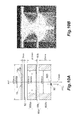
  • FIG. 1 is a view for illustrating a schematic configuration and an operation principle of a charged particle detector according to the present embodiment.
  • FIG. 2 is a view for illustrating a relationship between an electron incident surface of a PD and a spot diameter of secondary electrons on the electron incident surface (a region size on the electron incident surface which the secondary electrons reach).
  • FIGS. 3A and 3B are views for illustrating a structure of an MCP applicable to the charged particle detector according to the present embodiment.
  • FIGS. 4A and 4B are views for illustrating a bias angle direction.
  • FIG. 5 is an assembly process chart of the charged particle detector according to a first embodiment.
  • FIGS. 6A and 6B are a perspective view and a cross-sectional view of the charged particle detector according to the first embodiment.
  • FIGS. 7A and 7B are views illustrating a positional relationship between an MCP and a PD and equipotential lines and trajectories of secondary electrons in a space between the MCP and the PD in a charged particle detector according to a comparative example.
  • FIGS. 8A and 8B are views illustrating a positional relationship between an MCP and a PD and equipotential lines and trajectories of secondary electrons in a space between the MCP and the PD in the charged particle detector according to the first embodiment.
  • FIGS. 9A and 9B are views illustrating a specific structure and a simulation result of the trajectories of the secondary electrons for an example of the charged particle detector according to the first embodiment.
  • FIGS. 10A and 10B are views illustrating a specific structure and a simulation result of the trajectories of the secondary electrons for another example of the charged particle detector according to the first embodiment.
  • FIGS. 11A and 11B are views for illustrating a structure of a flange portion of a focus electrode in a charged particle detector according to a second embodiment.
  • FIGS. 12A and 12B are views illustrating a positional relationship between an MCP and a PD and equipotential lines and trajectories of secondary electrons in a space between the MCP and the PD in an example of the charged particle detector according to the second embodiment.
  • FIGS. 13A and 13B are views for illustrating a cross-sectional structure of a charged particle detector according to a third embodiment.
  • FIG. 1 is a view for illustrating a schematic configuration and an operation principle of a charged particle detector according to the present embodiment.
  • a charged particle detector 1 according to the present embodiment is provided with a microchannel plate (MCP) 10 , an electron impact diode (PD) 80 which receives secondary electrons outputted from the MCP 10 , and a focus electrode 60 for focusing trajectories of the secondary electrons emitted from the MCP 10 provided between the MCP 10 and the PD 80 .
  • the MCP 10 includes an input surface 10 a which incident charged particles reach, an output surface 10 b which emits the secondary electrons generated in response to the incident charged particles, and a plurality of through holes arranged in parallel in a state inclined by a predetermined bias angle.
  • the focus electrode 60 is formed of a hollow body portion 60 a and a flange portion 60 b set to have the same potential.
  • the hollow body portion 60 a includes a through hole 60 a 1 for focusing the trajectories of the secondary electrons in the vicinity of a central axis AX 1 of the MCP 10 .
  • the flange portion 60 b includes an opening 60 b 1 for adjusting a spot diameter of a focusing spot of the secondary electrons reaching a reference plane 100 coincident with an electron incident surface of the PD 80 .
  • a position of the focusing spot of the secondary electrons on the reference plane 100 deviates from the central axis AX 1 of the MCP 10 depending on the bias angle of the MCP 10 . That is, in the configuration in which the PD 80 is arranged such that a center C 1 of the electron incident surface is located on the central axis AX 1 of the MCP 10 , as illustrated in FIGS. 7A and 7B , for example, a part of the secondary electrons emitted from the MCP 10 cannot reach the electron incident surface of the PD 80 . Therefore, in a case where an influence of the bias angle of the MCP 10 on the electron trajectories is not taken into consideration, it is difficult to downsize the PD 80 .
  • a configuration in which the PD 80 is eccentrically arranged in a bias angle direction indicated by arrow S 1 in FIG. 1 along the reference plane 100 , and/or a configuration in which a center C 2 of the opening 60 b 1 of the flange portion 60 b is eccentrically arranged in a bias angle direction indicated by arrow S 2 in FIG. 1 are/is adopted.
  • FIG. 2 is a view for illustrating a relationship between an electron incident surface 800 of the PD 80 and a spot diameter of a focusing spot SP of the secondary electrons on the electron incident surface 800 .
  • the PD 80 (the center C 1 of the electron incident surface 800 ) and/or the center C 2 of the opening 60 b 1 of the flange portion 60 b are/is eccentrically arranged in the bias angle direction defined by the bias angle of the MCP 10 with respect to the central axis AX 1 of the MCP 10 , so that the PD 80 itself may be downsized. Therefore, in the present embodiment, a maximum width of the electron incident surface 800 in the PD 80 is 3 mm or shorter, and preferably 1 mm or shorter. A maximum spot diameter of the focusing spot SP of the secondary electrons is 1 mm or shorter.
  • FIG. 3A is a perspective view for illustrating a structure of the MCP 10
  • FIG. 3B is a cross-sectional view of the MCP 10 as seen in a direction indicated by arrow A in FIG. 3A .
  • the MCP 10 is known as an electron multiplying element provided with a plate-shaped structure (main body) in which a plurality of channels is regularly arranged. That is, the MCP 10 is a thin disk-shaped structure (main body) of which main component is lead glass in which a plurality of through holes 12 extending in a thickness direction (direction from the input surface 10 a to the output surface 10 b ) is arranged except for an annular outer peripheral portion 11 with electrodes 13 formed on both surfaces of the structure by vapor deposition.
  • the electrode 13 does not cover an entire surface of the MCP 10 but is formed such that the outer peripheral portion 11 of the MCP 10 is exposed by 0.5 mm to 1.0 mm from an outer peripheral end.
  • a plurality of through holes 12 is arranged in parallel in a state inclined by a predetermined bias angle with respect to the output surface 10 b of the MCP 10 , and a secondary electron emission surface 121 is formed on an inner wall (channel wall) surface of each of them.
  • the “bias angle” is defined by a reference axis AX 2 perpendicular to the output surface 10 b of the MCP 10 and a central axis AX 3 of each through hole 12 .
  • an acute angle formed by the reference axis AX 2 and the central axis AX 3 of the reference through hole intersecting with the same at the opening center O 1 is a bias angle ⁇ .
  • the bias angle direction is specified on the basis of the bias angle ⁇ of the MCP 10 defined in the above-described manner. Specifically, as illustrated in FIG. 4A , on the reference plane 100 coincident with the electron incident surface 800 of the PD 80 , an intersection between the reference axis AX 2 passing through the center O 1 of the opening coincident with the output surface 10 b of the MCP 10 out of the openings of the reference through hole and orthogonal to the output surface 10 b and the reference plane 100 is defined as O 2 . An intersection between the central axis AX 3 of the reference through hole and the reference plane 100 is defined as O 3 . At that time, a direction indicated by arrow S 3 from the intersection O 2 to the intersection O 3 on the reference plane 100 is the bias angle direction.
  • FIG. 4B is a plan view of the MCP 10 when the MCP 10 is seen from the input surface 10 a.
  • a direction from a tip of the marker 14 to the center of the MCP 10 is the bias angle direction.
  • a hatched region R is an effective region of the MCP 10 on which the charged particles may incident, and in the present embodiment, the PD whose area is smaller than an area of the effective region R is applied.
  • FIG. 5 is an assembly process chart of a charged particle detector 1 A according to a first embodiment
  • FIG. 6A is a perspective view of the charged particle detector 1 A obtained through an assembly process illustrated in FIG. 5
  • FIG. 6B is a cross-sectional view of the charged particle detector 1 A taken along line X 1 -X 1 in FIG. 6A
  • an axis AX C1 illustrated in FIG. 6B is an axis passing through a center C 1 of an electron incident surface 800 of a PD 80 and perpendicular to the electron incident surface 800 (an axis parallel to a central axis AX 1 of an MCP 10 ).
  • a metal cap 5 In the assembly process of the charged particle detector 1 A, a metal cap 5 , an MCP input side electrode 30 a (hereinafter referred to as MCP-In electrode), a spacer 20 including a through hole 20 a for accommodating the MCP 10 , an MCP output side electrode 30 b (hereinafter referred to as MCP-Out electrode), an upper insulating ring 40 a, a mesh electrode 50 , a lower insulating ring 40 b, and a focus electrode 60 are sequentially arranged in a direction from the MCP 10 to the focus electrode 60 (direction along the central axis AX 1 of the MCP 10 ), and each of the metal cap 5 , the MCP-In electrode 30 a, the spacer 20 , the MCP-Out electrode 30 b, the upper insulating ring 40 a, the mesh electrode 50 , and the lower insulating ring 40 b is fixed to the focus electrode 60 by means of four resin screws 6 a to 6 d.
  • spacers 65 a to 65 d and a bleeder circuit board 70 on which the PD 80 is mounted are sequentially arranged in a direction from the focus electrode 60 to the PD 80 (the direction along the central axis AX 1 of the MCP 10 ) and each of the spacers 65 a to 65 d and the bleeder circuit board 70 is fixed to the focus electrode 60 by means of four resin screws 91 a to 91 d.
  • the metal cap 5 is a metal disk including a window 5 a for defining an effective region R (see FIG. 4B ) of the MCP 10 , and is provided with four screw holes for holding the resin screws 6 a to 6 d in a penetrating state so as to surround the window 5 a.
  • the MCP 10 is interposed between the MCP-In electrode 30 a and the MCP-Out electrode 30 b in a state of being accommodated in the through hole 20 a of the spacer 20 having a disk shape.
  • the MCP-In electrode 30 a is electrically connected to an electrode 13 formed on an input surface 10 a of the MCP 10
  • the MCP-Out electrode 30 b is electrically connected to the electrode 13 formed on an output surface 10 b of the MCP 10 .
  • the MCP-In electrode 30 a includes an opening 30 a 1 for exposing the input surface 10 a of the MCP 10 and a feeding unit 30 a 2 electrically connected to a feeding pin 92 d at a predetermined voltage in order to set the MCP-In electrode 30 a to have a predetermined potential. Furthermore, the MCP-In electrode 30 a is provided with four screw holes for holding the resin screws 6 a to 6 d in a penetrating state so as to surround the opening 30 a 1 .
  • the MCP-Out electrode 30 b includes an opening 30 b 1 for exposing the output surface 10 b of the MCP 10 and a feeding unit 30 b 2 electrically connected to a feeding pin 92 c at a predetermined voltage in order to set the MCP-Out electrode 30 b to have a predetermined potential. Furthermore, the MCP-Out electrode 30 b is with four screw holes for holding the resin screws 6 a to 6 d in a penetrating state so as to surround the opening 30 b 1 .
  • the mesh electrode 50 has a disk shape provided with an opening in which a metal mesh 50 a is arranged and includes a feeding unit 50 b electrically connected to a feeding pin 92 b at a predetermined voltage in order to set the mesh electrode 50 to have a predetermined potential.
  • the mesh electrode 50 is interposed between the upper insulating ring 40 a provided with an opening 40 a 1 for exposing the metal mesh 50 a and the lower insulating ring 40 b provided with an opening 40 b 1 for exposing the metal mesh 50 a.
  • the upper insulating ring 40 a serves as an insulating spacer for electrically separating the MCP-Out electrode 30 b from the mesh electrode 50 and the lower insulating ring 40 b serves as an insulating spacer for electrically separating the mesh electrode 50 from the focus electrode 60 .
  • the upper insulating ring 40 a and the lower insulating ring 40 b are provided with four screw holes so as to surround the openings 40 a 1 and 40 b 1 , respectively.
  • the focus electrode 60 has a cylindrical shape as a whole and has the central axis AX 1 of the MCP 10 as an axial center. Specifically, the focus electrode 60 is formed of a hollow body portion 60 a including a through hole 60 a 1 (defining an incident side opening of the focus electrode 60 ) for allowing secondary electrons from the output surface 10 b of the MCP 10 to pass, and a flange portion 60 b including an opening 60 b 1 for defining an emitting side opening of the focus electrode 60 .
  • the flange portion 60 b is in contact with the hollow body portion 60 a to be at the same potential and includes feeding units 60 b 2 and 60 b 3 electrically connected to feeding pins 92 a and 92 c at a predetermined voltage in order to set the flange portion 60 b to have a predetermined potential.
  • four screw holes for the resin screws 6 a to 6 d are provided on an incident end side of the hollow body portion 60 a so as to surround the through hole 60 a 1
  • four screw holes for the resin screws 91 a to 91 d are provided on an emitting end side thereof, so as to surround the through hole 60 a 1 .
  • Four screw holes for the resin screws 91 a to 91 d are provided on the flange portion 60 b so as to surround the opening 60 b 1 .
  • spacers 65 a to 65 d made of an insulating material are arranged between the flange portion 60 b and the bleeder circuit board 70 , and the spacers 65 a to 65 d are also provided with screw holes for allowing the resin screws 91 a to 91 d to pass through, respectively.
  • the bleeder circuit board 70 is provided with the PD 80 mounted on a main surface thereof, and with the four feeding pins 92 a to 92 d for supplying predetermined voltages to the MCP-In electrode 30 a, the MCP-Out electrode 30 b, the mesh electrode 50 , and the flange portion 60 b.
  • the feeding pin 92 c is electrically connected to the feeding unit 30 b 2 of the MCP-Out electrode 30 b and the feeding unit 60 b 3 of the flange portion 60 b for setting the MCP-Out electrode 30 b and the flange portion 60 b to have the same potential together with the hollow body portion 60 a.
  • a sub miniature type A (SMA) connector for taking out a signal from the PD 80 is attached to a surface on a side opposite to the surface on which the PD 80 is mounted, and a bleeder circuit 90 for supplying predetermined voltages to the feeding pins 92 a to 92 d is fabricated.
  • the charged particle detector 1 A is obtained by fixing the metal cap 5 , the MCP-In electrode 30 a, the spacer 20 accommodating the MCP 10 , the MCP-Out electrode 30 b, the upper insulating ring 40 a, the mesh electrode 50 , and the lower insulating ring 40 b on the incident end side of the hollow body portion 60 a (forming a part of the focus electrode 60 ) by means of the four resin screws 6 a to 6 d, and fixing the flange portion 60 b, the four spacers 65 a to 65 d, and the bleeder circuit board 70 to the emitting end side of the hollow body portion 60 a by means of the four resin screws 91 a to 91 d.
  • the focus electrode 60 is set to have the same potential as the output surface 10 b of the MCP 10 in the first embodiment; however, the focus electrode 60 may also be set to have the same potential as the electron incident surface 800 of the PD 80 .
  • the potential of the focus electrode 60 By making the potential of the focus electrode 60 the same as the potential of the output surface 10 b of the MCP 10 or the PD 80 (electron incident surface 800 ) in this manner, the charged particle detector may be driven with smaller power.
  • eccentric arrangement of the PD 80 and eccentric arrangement of the opening 60 b 1 in the flange portion 60 b are described in detail with reference to FIGS. 7A to 12B .
  • FIG. 7A is a plan view illustrating a positional relationship between an MCP 10 and a PD 80 (a plan view of the MCP 10 as seen from an input surface 10 a of the MCP 10 ) in a charged particle detector according to a comparative example.
  • Such charged particle detector is obtained through an assembly process illustrated in FIG. 5 .
  • FIG. 7B corresponding to a cross-sectional view of the charged particle detector according to the comparative example taken along line X 2 -X 2 in FIG. 7A illustrates equipotential lines and trajectories of secondary electrons in a space between the MCP 10 and the PD 80 .
  • a direction from a marker 14 toward a center of the MCP 10 is a bias angle direction by the marker 14 provided on the MCP 10 .
  • the PD 10 is arranged such that a center C 1 of an electron incident surface 800 and the center of the MCP 10 are coincident with each other, and an influence of a bias angle of the MCP 10 on the electron trajectories is not taken into consideration. Therefore, as illustrated in FIG.
  • a focusing spot of the secondary electrons reaching a reference plane 100 from an output surface 10 b of the MCP 10 deviates from a central axis AX 1 of the MCP 10 and a part of the secondary electrons reaching the reference plane 100 is not received by the PD 80 .
  • FIGS. 8A and 8B illustrate a case where the PD 80 is eccentrically arranged with respect to the central axis AX 1 of the MCP 10 in an example of the charged particle detector 1 A according to the first embodiment. That is, FIG. 8A is a plan view illustrating a positional relationship between the MCP 10 and the PD 80 (a plan view of the MCP 10 as seen from the input surface 10 a of the MCP 10 ) as an example of the charged particle detector 1 A of this example obtained through the assembly process illustrated in FIG. 5 .
  • FIG. 8B corresponding to a cross-sectional view of the charged particle detector 1 A taken along line X 3 -X 3 in FIG. 8A illustrates equipotential lines and trajectories of the secondary electrons in a space between the MCP 10 and the PD 80 .
  • a direction from a marker 14 toward a center of the MCP 10 is a bias angle direction by the marker 14 provided on the MCP 10
  • the PD 10 is such that the center C 1 of the electron incident surface 800 is arranged in the bias angle direction indicated by the marker 14 . Therefore, as illustrated in FIG. 8B , even in a case where a focusing spot of the secondary electrons reaching the reference plane 100 from the output surface 10 b of the MCP 10 deviates from the central axis AX 1 of the MCP 10 , a large part of the secondary electrons reaching the reference plane 100 is efficiently received by the PD 80 .
  • This configuration also enables application of a compact PD.
  • FIGS. 9A to 10B are examples in which the PD 80 is eccentrically arranged with respect to the central axis AX 1 of the MCP 10 ; the example of FIGS. 9A and 9B is the example of the charged particle detector in which the hollow body portion 60 a forming a part of the focus electrode 60 is made of a single member.
  • FIG. 9A illustrates a specific sectional cross-sectional structure of the charged particle detector including the hollow body portion 60 a of the single member, and FIG.
  • FIG. 9B illustrates the simulation result of the trajectories of the secondary electrons in the charged particle detector illustrated in FIG. 9A .
  • FIGS. 10A and 10B illustrate the example of the charged particle detector in which the hollow body portion 60 a forming a part of the focus electrode 60 is formed of a first body portion 600 a (hollow member) located on an MCP 10 side and a second body portion 600 b (hollow member) located on a PD 80 side.
  • FIG. 10A illustrates a specific cross-sectional structure of the charged particle detector in which the hollow body portion 60 a is constituted by the first body portion 600 a and the second body portion 600 b
  • FIG. 10B illustrates the simulation result of the trajectories of the secondary electrons in the charged particle detector illustrated in FIG. 10A .
  • a diameter of the effective region R in the MCP 10 is 10 mm.
  • a thickness of the mesh electrode 50 is 0.5 mm.
  • a distance between the MCP 10 and the mesh electrode 50 is 3 mm.
  • an inner diameter of the hollow body portion 60 a is 22 mm and a diameter of the opening 60 b 1 of the flange portion 60 b is 16 mm. Meanwhile, a thickness of the flange portion 60 b is 0.5 mm.
  • An outer peripheral diameter of the hollow body portion 60 a is 34 mm.
  • an amount of deviation of the center C 1 of the electron incident surface 800 of the PD 80 (in the drawing, AX C1 represents a central axis of the electron incident surface 800 ) with respect to the central axis AX 1 of the MCP 10 is 0.9 mm ( FIG. 9B ).
  • the hollow body portion 60 a of the focus electrode 60 is formed of the first body portion 600 a arranged on the MCP 10 side and the second body portion 600 b arranged on the PD 80 side.
  • the first body portion 600 a is set to have the same potential as the MCP-Out electrode 30 b in a state of being in electrical contact with the flange portion 60 b.
  • the second body portion 600 b is set to have the same potential as the PD 80 in a state in which the PD 80 is mounted on a side opposite to the first body portion 600 a.
  • the diameter of the effective region R in the MCP 10 is 25 mm.
  • a thickness of the mesh electrode 50 is 0.5 mm.
  • a distance between the MCP 10 and the mesh electrode 50 is 3 mm.
  • An inner diameter of the first body portion 600 a forming a part of the hollow body portion 60 a of the focus electrode 60 is 50 mm and the diameter of the opening 60 b 1 of the flange portion 60 b is 40 mm.
  • a total thickness of the first body portion 600 a and the flange portion 60 b is 20.5 mm.
  • a thickness of the second body portion 600 b is 27 mm, and outer peripheral diameters of the first and second body portions 600 a and 600 b are both 70 mm.
  • the amount of deviation of the center C 1 of the electron incident surface 800 of the PD 80 (in the drawing, AX C1 represents the central axis of the electron incident surface 800 ) with respect to the central axis AX 1 of the MCP 10 is 1.5 mm ( FIG. 10B ).
  • FIGS. 11A to 12B are views for illustrating a configuration in which a center of an opening 60 b 1 in a flange portion 60 b of a focus electrode 60 is eccentric with respect to a central axis AX 1 of an MCP 10 in a configuration in which a PD 80 is arranged such that a center of an electron incident surface 800 is located on the central axis AX 1 of the MCP 10 as a characteristic structure of a charged particle detector according to a second embodiment.
  • the configuration of the charged particle detector according to the second embodiment is similar to that of a charged particle detector 1 A ( FIGS. 5, 6A, and 6B ) according to the first embodiment described above except for a structure of the flange portion 60 b in the focus electrode 60 .
  • FIGS. 11A and 11B are the views for illustrating the structure of the flange portion 60 b in which the center of the opening 60 b 1 is eccentric with respect to the central axis AX 1 of the MCP 10 in the focus electrode 60 as a characteristic configuration of the charged particle detector according to the second embodiment.
  • the opening 60 b 1 of the flange portion 60 b is formed such that the central axis AX 1 of the MCP 10 is coincident with a center C 2 of the opening 60 b 1 when the charged particle detector is assembled as illustrated in FIG. 11A .
  • the center C 2 of the opening 60 b 1 is eccentric with respect to the central axis AX 1 of the MCP 10 in a bias angle direction indicated by a marker 14 of the MCP 10 .
  • FIG. 12A is a plan view of the MCP 10 as seen from an input surface 10 a side of the MCP 10
  • FIG. 12B corresponds to a cross-sectional view of the charged particle detector taken along line X 4 -X 4 in FIG. 12A
  • the charged particle detector according to the second embodiment has a structure in which one side (a left side in FIG.
  • the trajectories of the secondary electrons emitted from an output surface 10 b of the MCP 10 are temporarily greatly eccentric in the bias angle direction due to an influence of the bias angle of the MCP 10 , but it is adjusted that a position of a focusing spot of the secondary electrons approaches a central axis AX 1 side of the MCP 10 by the opening 60 b 1 of the flange portion 60 b.
  • FIGS. 13A and 13B are views for illustrating a cross-sectional structure of a charged particle detector according to a third embodiment, and a charged particle detector 1 B according to the third embodiment has a structure similar to that of a charged particle detector 1 A according to the first embodiment described above except for a connecting structure between a focus electrode 60 and a bleeder circuit board 70 . That is, the charged particle detector 1 B according to the third embodiment is aimed to improve maintenance work in a situation in which this is fixed to a vacuum chamber of a mass spectroscope and the like and has a structure in which only a PD 80 may be easily replaced. Meanwhile, FIG.
  • FIG. 13A is a cross-sectional view illustrating a configuration of the charged particle detector 1 B according to the third embodiment attached to an opening 210 of a vacuum chamber 200 .
  • FIG. 13B is a cross-sectional view illustrating a state in which only a bleeder circuit board 70 on which the PD 80 is mounted is removed from the vacuum chamber 200 .
  • FIGS. 13A and 13B corresponding to cross-sectional views taken along line X 5 -X 5 of FIG. 6A , and an axis AX C1 in the drawings is an axis passing through a center C 1 of an electron incident surface 800 of the PD 80 and perpendicular to the electron incident surface 800 (an axis parallel to the central axis AX 1 of the MCP 10 ).
  • gain deterioration (life end) of the charged particle detector is mainly due to a decrease in electron implantation gain of the PD 80 .
  • electrons applied to the PD 80 cause deposition of amorphous carbon on the PD 80 . Therefore, in a configuration obtained by combination of the MCP 10 and the PD 80 reaching the life end, the gain may be recovered by replacing only the PD 80 .
  • a device upper stage including the MCP 10 and the focus electrode 60 of the charged particle detector 1 B is fixed to a resin flange (insulating flange) 300 installed outside the vacuum chamber 200 so as to surround the opening 210 by means of four resin screws (only two resin screws 91 b and 91 d are illustrated in FIG. 13A ) in a state of being inserted into the opening 210 of the vacuum chamber 200 .
  • a device lower stage including the bleeder circuit board 70 on which the PD 80 is mounted is fixed to the resin flange 300 from the outside of the vacuum chamber 200 by means of four resin screws (only 93 b and 93 d are illustrated in the drawing). Meanwhile, feeding pins 92 a to 92 d for driving the charged particle detector 1 B and a SMA connector 95 for outputting signals are attached to the bleeder circuit board 70 , and they serve as a vacuum flange.
  • the device upper stage is located inside (a vacuum side of) the vacuum chamber 200
  • the device lower stage is located outside (an atmosphere side of) the vacuum chamber 200
  • an O-ring 350 for sealing is attached to a contact portion between the vacuum chamber 200 and the resin flange 300 in order to maintain airtightness in the vacuum chamber 200 .
  • the O-ring 350 is also attached between the resin flange 300 and the bleeder circuit board 70 .

Landscapes

  • Chemical & Material Sciences (AREA)
  • Analytical Chemistry (AREA)
  • Physics & Mathematics (AREA)
  • Health & Medical Sciences (AREA)
  • Life Sciences & Earth Sciences (AREA)
  • General Physics & Mathematics (AREA)
  • High Energy & Nuclear Physics (AREA)
  • Molecular Biology (AREA)
  • Spectroscopy & Molecular Physics (AREA)
  • Measurement Of Radiation (AREA)
  • Electron Tubes For Measurement (AREA)

Abstract

A charged particle detector according to the embodiment is provided with an MCP and a PD arranged with a focus electrode interposed therebetween in order to improve a response characteristic as compared to a conventional one in a configuration in which the MCP having a bias angle and the PD are combined. The MCP includes a plurality of through holes each inclined by a bias angle θ and the PD is eccentrically arranged such that a center of an electron incident surface deviates by a predetermined distance in a bias angle direction S3 with respect to a central axis AX1 of the MCP.

Description

TECHNICAL FIELD
The present invention relates to a charged particle detector arranged in a vacuum chamber of a mass spectroscope and the like for detecting ions and electrons.
BACKGROUND ART
As a configuration of a charged particle detector applicable to a mass spectroscope and the like, for example, an ion detector, a configuration to which an electron multiplier tube is applied, a configuration to which a microchannel plate (hereinafter referred to as MCP) is applied, a configuration obtained by combining the MCP and an electron impact diode and the like are known. Especially, the configuration obtained by combining the MCP and the electron impact diode is characterized by its long device life and large maximum output current. On the other hand, a time response characteristic thereof greatly depends on a size of the electron impact diode (an area of an electron incident surface).
Following Patent Document 1 discloses the ion detector formed of the MCP, a focusing ring, and the electron impact diode is disclosed as the ion detector as described above. In the MCP applied to such ion detector, a plurality of channels arranged in parallel in a state of being inclined by a bias angle of approximately 1 to 2 degrees is provided.
In contrast, following Patent Document 2 discloses a time-of-flight mass spectrometer array device provided with an MCP detector including a center hole for a laser applied to a sample and a pin anode arranged in a position deviated from the center hole of the MCP.
CITATION LIST Patent Literature
Patent Document 1: Japanese Patent Application Laid-Open No. H07-073847
Patent Document 2: Japanese Translation of PCT International Application Laid-Open No. 2004-502276
SUMMARY OF INVENTION Technical Problem
As a result of examining the conventional charged particle detector, the inventors found the following problems. That is, although Patent Document 1 described above discloses the MCP in which each channel is inclined by the bias angle, as is understood from an example of electron trajectories illustrated in FIG. 3, there is neither disclosure nor suggestion of a problem concerning focusing of the electron trajectories due to the bias angle of the MCP. In addition, in Patent Document 2 described above, the pin anode is eccentrically arranged with respect to a central axis of the MCP due to presence of the center hole provided for laser irradiation; however, this Patent Document 2 neither discloses nor suggests the problem concerning the focusing of the electron trajectories due to the bias angle of the MCP. Therefore, in the conventional charged particle detector, an influence of the bias angle set in the MCP on the electron trajectories is not examined at all.
The bias angle of the MCP is an inclination angle of the channel provided for preventing incident charged particles from passing through the MCP without impacting an inner wall of each channel. Conventionally, since the MCP is applied to imaging in most cases, naturally, the above-mentioned problem is not recognized.
In addition, although the electron impact diode applied to the conventional ion detector includes a photodiode, an avalanche photodiode and the like, unlike an ordinary photodiode, this is characterized in that an oxide film (passivation film) formed on a surface thereof is extremely thin or there is no oxide film formed. In this specification, the “electron impact diode” is hereinafter simply referred to as PD. Although a capacity of the PD decreases as the electron incident surface decreases, the influence of the bias angle of the MCP on the electron trajectories is not taken into consideration in the conventional ion detector, so that it is difficult to downsize the PD, and as a result, there is also a problem that a sufficient response characteristic cannot be obtained. Meanwhile, according to the findings of the inventors, it is found that the trajectories of the electrons emitted from the MCP, especially a position of a focusing spot of the electrons vary depending on an initial speed of the electrons emitted in a bias angle direction described below.
The present invention is achieved to solve the above-described problems, and an object thereof is to provide a charged particle detector to which the combination of the MCP having a predetermined bias angle and the electron impact diode is applied, the charged particle detector having a structure for improving the response characteristic as compared to that of the conventional particle detector.
Solution to Problem
In a configuration to which a combination of an MCP and a PD is applied, in order to obtain a sufficient response characteristic, it is preferable to decrease an electron incident surface (effective area) in the PD. Therefore, in order to focus trajectories of electrons emitted from the MCP on a small PD, an electrostatic lens (focus electrode) is required.
In order to achieve the above-described object, a charged particle detector according to the present embodiment is at least provided with the MCP having a predetermined bias angle, the PD, and the focus electrode, and realizes a structure to which a smaller PD (diode including smaller electron incident surface) may be applied. That is, the MCP has: an input surface on which charged particles are incident; an output surface from which secondary electrons are emitted; and a plurality of through holes (channels) each communicating the input surface with the output surface. Each through hole having a secondary electron emission surface on an inner wall thereof is arranged such that a central axis thereof is inclined by at least a bias angle defined by an acute angle with respect to the output surface. The PD has the electron incident surface arranged so as to face the MCP having an area smaller than an area of an effective region of the MCP. The focus electrode provided between the MCP, and the PD has: a first opening located on an MCP side; a second opening located on a PD side; and has a shape continuously surrounding the trajectories of the secondary electrons traveling from the MCP to the PD. Meanwhile, in this specification, “bias angle” is intended to mean an angle (acute angle) formed by a reference axis orthogonal to the output surface of the MCP and the central axis of each through hole, and each through hole is arranged so as to be inclined with respect to the output surface of the MCP in order to prevent the incident charged particles from passing through the MCP without impacting the inner wall of each of the through holes.
As described above, in a case of the charged particle detector constituted by the combination of the MCP and the PD, electron multiplication of approximately 1000 times in the MCP and the electron multiplication of approximately 1000 times that of the MCP in the PD become possible. Since the electron multiplication is performed by the combination of the MCP and the PD in this manner, there is an effect that a dynamic range is expanded. Since the electron multiplication in the PD is performed inside the PD, an electron multiplication factor never decreases due to contamination of a surface (contamination of the electron incident surface).
Especially, in a first aspect according to the present embodiment, the electron incident surface of the PD is eccentrically arranged in a bias angle direction with respect to a central axis of the MCP. Specifically, the “bias angle direction” is defined on a reference plane coincident with the electron incident surface of the PD, by a direction from an intersection between the reference axis and the reference plane to an intersection between a central axis of a reference through hole and the reference plane, the reference axis passing through a center of an opening coincident with the output surface of the MCP out of openings of the reference through hole and orthogonal to the output surface and the reference plane to an intersection between a central axis of the reference through hole and the reference plane, the reference through hole selected from the plurality of through holes. At that time, the PD is eccentrically arranged such that a center of the electron incident surface deviates by a predetermined distance in the bias angle direction, with respect to an intersection between the central axis of the MCP and the reference plane, the central axis of the MCP being the axis passing through a center of the effective region of the MCP and orthogonal to the output surface.
Also, in a second aspect according to the present embodiment, instead of eccentricity of the PD, at least a part of the focus electrode such as an emitting end opening (second opening) of the focus electrode, for example, is eccentrically arranged in the bias angle direction, with respect to the central axis of the MCP. Specifically, at least a part of the focus electrode is eccentrically arranged such that a center of the second opening of the focus electrode deviates by a predetermined distance in the bias angle direction, with respect to the intersection between the central axis of the MCP and the reference plane, the central axis of the MCP being the axis passing through the center of the effective region and orthogonal to the output surface.
As a third aspect applicable to the above-described first or second aspect, the focus electrode may be set to have the same potential as the output surface of the MCP. As a fourth aspect applicable to at least any one of the above-described first to third aspects, the focus electrode may be set to have the same potential as the electron incident surface of the PD. According to the third and fourth aspects, by making the potential of the focus electrode the same as the potential of the output surface of the MCP or the PD, it becomes possible to drive the charged particle detector with smaller power (simplification of a feeding structure).
As a fifth aspect applicable to at least any one of the above-described first to fourth aspects, the charged particle detector may further be provided with a mesh electrode provided between the MCP and the focus electrode.
As a sixth aspect applicable to at least any one of the above-described first to fifth aspects, it is preferable that a maximum width of the electron incident surface in the PD is 3 mm or shorter. On the other hand, as a seventh aspect applicable to at least any one of the first to sixth aspects, a spot diameter of the secondary electrons reaching the electron incident surface of the PD from the output surface of the MCP is 1 mm or shorter.
Meanwhile, as an eighth aspect applicable to at least any one of the above-described first to seventh aspects, the focus electrode may be constituted by: a body portion continuously surrounding the trajectories of the secondary electrons directed from the MCP to the PD; and a flange member for defining a center position and a size of the second opening. As a ninth aspect applicable to at least any one of the above-described first to eighth aspects, it is preferable that the body portion is constituted by a plurality of hollow members sequentially arranged from the MCP to the PD. Furthermore, as a tenth aspect applicable to at least any one of the above-described first to ninth aspects, the charged particle detector may be further provided with a board on a main surface of which an electron impact diode is mounted, and a resin flange having an opening for allowing passage of the secondary electrons directed from the MCP to the PD, resin flange being arranged between the focus electrode and the board.
Meanwhile, the embodiments according to the present invention may be more sufficiently understood by the following detailed description and the accompanying drawings. The examples are given for illustrative purposes only and should not be considered as limiting the present invention.
A further application range of the present invention becomes clear from the following detailed description. Although the detailed description and specific examples describe preferred embodiments of the invention, they are given by way of illustration only, and it is clear that various modifications and improvements within the scope of the present invention are obvious to those skilled in the art from the detailed description.
Advantageous Effects of Invention
According to the present embodiment, even in a case where trajectories of secondary electrons are eccentric due to a bias angle of an MCP, a PD is eccentrically arranged with respect to the central axis of the MCP, or a center of an emitting end opening of a focus electrode is eccentrically arranged, so that it is possible to use a smaller PD (for example, a maximum width of an electron incident surface is 3 mm or shorter), and as a result, a high-speed response of the charged particle detector may be realized.
Furthermore, in the configuration described above, electron multiplication is performed in both the MCP and the PD, so that a gain of the MCP may be lowered and further improvement in linearity may be realized. In addition, this is also effective for the MCP with a large bias angle set, and improvement in mass resolution (reduction in jitter) may also be expected.
BRIEF DESCRIPTION OF DRAWINGS
FIG. 1 is a view for illustrating a schematic configuration and an operation principle of a charged particle detector according to the present embodiment.
FIG. 2 is a view for illustrating a relationship between an electron incident surface of a PD and a spot diameter of secondary electrons on the electron incident surface (a region size on the electron incident surface which the secondary electrons reach).
FIGS. 3A and 3B are views for illustrating a structure of an MCP applicable to the charged particle detector according to the present embodiment.
FIGS. 4A and 4B are views for illustrating a bias angle direction.
FIG. 5 is an assembly process chart of the charged particle detector according to a first embodiment.
FIGS. 6A and 6B are a perspective view and a cross-sectional view of the charged particle detector according to the first embodiment.
FIGS. 7A and 7B are views illustrating a positional relationship between an MCP and a PD and equipotential lines and trajectories of secondary electrons in a space between the MCP and the PD in a charged particle detector according to a comparative example.
FIGS. 8A and 8B are views illustrating a positional relationship between an MCP and a PD and equipotential lines and trajectories of secondary electrons in a space between the MCP and the PD in the charged particle detector according to the first embodiment.
FIGS. 9A and 9B are views illustrating a specific structure and a simulation result of the trajectories of the secondary electrons for an example of the charged particle detector according to the first embodiment.
FIGS. 10A and 10B are views illustrating a specific structure and a simulation result of the trajectories of the secondary electrons for another example of the charged particle detector according to the first embodiment.
FIGS. 11A and 11B are views for illustrating a structure of a flange portion of a focus electrode in a charged particle detector according to a second embodiment.
FIGS. 12A and 12B are views illustrating a positional relationship between an MCP and a PD and equipotential lines and trajectories of secondary electrons in a space between the MCP and the PD in an example of the charged particle detector according to the second embodiment.
FIGS. 13A and 13B are views for illustrating a cross-sectional structure of a charged particle detector according to a third embodiment.
DESCRIPTION OF EMBODIMENTS
Hereinafter, various embodiments of a charged particle detector according to the present invention are described in detail with reference to the attached drawings. Meanwhile, in the description of the drawings, the same reference sign is assigned to the same elements and the description thereof is not repeated. Furthermore, the present invention is not limited to these illustrations, but it is intended that this is disclosed by the scope of claims and that equivalents of the scope of claims and all modifications within the scope are included therein.
FIG. 1 is a view for illustrating a schematic configuration and an operation principle of a charged particle detector according to the present embodiment. In FIG. 1, a charged particle detector 1 according to the present embodiment is provided with a microchannel plate (MCP) 10, an electron impact diode (PD) 80 which receives secondary electrons outputted from the MCP 10, and a focus electrode 60 for focusing trajectories of the secondary electrons emitted from the MCP 10 provided between the MCP 10 and the PD 80. The MCP 10 includes an input surface 10 a which incident charged particles reach, an output surface 10 b which emits the secondary electrons generated in response to the incident charged particles, and a plurality of through holes arranged in parallel in a state inclined by a predetermined bias angle. The focus electrode 60 is formed of a hollow body portion 60 a and a flange portion 60 b set to have the same potential. The hollow body portion 60 a includes a through hole 60 a 1 for focusing the trajectories of the secondary electrons in the vicinity of a central axis AX1 of the MCP 10. The flange portion 60 b includes an opening 60 b 1 for adjusting a spot diameter of a focusing spot of the secondary electrons reaching a reference plane 100 coincident with an electron incident surface of the PD 80.
In the above-described device configuration, a position of the focusing spot of the secondary electrons on the reference plane 100 deviates from the central axis AX1 of the MCP 10 depending on the bias angle of the MCP 10. That is, in the configuration in which the PD 80 is arranged such that a center C1 of the electron incident surface is located on the central axis AX1 of the MCP 10, as illustrated in FIGS. 7A and 7B, for example, a part of the secondary electrons emitted from the MCP 10 cannot reach the electron incident surface of the PD 80. Therefore, in a case where an influence of the bias angle of the MCP 10 on the electron trajectories is not taken into consideration, it is difficult to downsize the PD 80.
In the present embodiment, while taking the above-described influence of the bias angle of the MCP 10 on the electron trajectories into consideration, a configuration in which the PD 80 is eccentrically arranged in a bias angle direction indicated by arrow S1 in FIG. 1 along the reference plane 100, and/or a configuration in which a center C2 of the opening 60 b 1 of the flange portion 60 b is eccentrically arranged in a bias angle direction indicated by arrow S2 in FIG. 1 are/is adopted.
FIG. 2 is a view for illustrating a relationship between an electron incident surface 800 of the PD 80 and a spot diameter of a focusing spot SP of the secondary electrons on the electron incident surface 800. In the present embodiment, the PD 80 (the center C1 of the electron incident surface 800) and/or the center C2 of the opening 60 b 1 of the flange portion 60 b are/is eccentrically arranged in the bias angle direction defined by the bias angle of the MCP 10 with respect to the central axis AX1 of the MCP 10, so that the PD 80 itself may be downsized. Therefore, in the present embodiment, a maximum width of the electron incident surface 800 in the PD 80 is 3 mm or shorter, and preferably 1 mm or shorter. A maximum spot diameter of the focusing spot SP of the secondary electrons is 1 mm or shorter.
Next, a specific configuration, the bias angle, and the bias angle direction of the MCP 10 applied to the charged particle detector 1 according to the present embodiment are described in detail with reference to FIGS. 3A to 4B. Meanwhile, FIG. 3A is a perspective view for illustrating a structure of the MCP 10, and FIG. 3B is a cross-sectional view of the MCP 10 as seen in a direction indicated by arrow A in FIG. 3A.
As illustrated in FIG. 3A, the MCP 10 is known as an electron multiplying element provided with a plate-shaped structure (main body) in which a plurality of channels is regularly arranged. That is, the MCP 10 is a thin disk-shaped structure (main body) of which main component is lead glass in which a plurality of through holes 12 extending in a thickness direction (direction from the input surface 10 a to the output surface 10 b) is arranged except for an annular outer peripheral portion 11 with electrodes 13 formed on both surfaces of the structure by vapor deposition. The electrode 13 does not cover an entire surface of the MCP 10 but is formed such that the outer peripheral portion 11 of the MCP 10 is exposed by 0.5 mm to 1.0 mm from an outer peripheral end.
As illustrated in FIG. 3B, a plurality of through holes 12 is arranged in parallel in a state inclined by a predetermined bias angle with respect to the output surface 10 b of the MCP 10, and a secondary electron emission surface 121 is formed on an inner wall (channel wall) surface of each of them. The “bias angle” is defined by a reference axis AX2 perpendicular to the output surface 10 b of the MCP 10 and a central axis AX3 of each through hole 12. That is, as for the through hole selected from a plurality of through holes 12 (a reference through hole), when the reference axis AX2 passing through a center O1 of an opening coincident with the output surface 10 b out of the openings of the reference through holes is defined, an acute angle formed by the reference axis AX2 and the central axis AX3 of the reference through hole intersecting with the same at the opening center O1 is a bias angle θ.
Furthermore, the bias angle direction is specified on the basis of the bias angle θ of the MCP 10 defined in the above-described manner. Specifically, as illustrated in FIG. 4A, on the reference plane 100 coincident with the electron incident surface 800 of the PD 80, an intersection between the reference axis AX2 passing through the center O1 of the opening coincident with the output surface 10 b of the MCP 10 out of the openings of the reference through hole and orthogonal to the output surface 10 b and the reference plane 100 is defined as O2. An intersection between the central axis AX3 of the reference through hole and the reference plane 100 is defined as O3. At that time, a direction indicated by arrow S3 from the intersection O2 to the intersection O3 on the reference plane 100 is the bias angle direction.
Specifically, when the PD 80 is made eccentric with respect to the central axis AX1 of the MCP 10, this is realized by moving the center C1 of the electron incident surface 800 of the PD 80 with respect to the central axis AX1 of the MCP 10 in the bias angle direction S3 defined as described above. Also, when the opening 60 b 1 of the flange portion 60 b is made eccentric with respect to the central axis AX1 of the MCP 10, this is realized by moving the center C2 of the opening 60 b 1 of the flange portion 60 b with respect to the central axis AX1 of the MCP 10 in the bias angle direction S3 defined as described above.
Meanwhile, in the present embodiment, in order to enable confirmation of the bias angle direction defined by the bias angle θ of the MCP 10 when assembling the charged particle detector 1, as illustrated in FIG. 4B, the MCP 10 is provided with a marker 14 indicating the bias angle direction. FIG. 4B is a plan view of the MCP 10 when the MCP 10 is seen from the input surface 10 a. In the plan view of FIG. 4B, a direction from a tip of the marker 14 to the center of the MCP 10 (an intersection between the central axis AX1 and the input surface 10 a) is the bias angle direction. In FIG. 4B, a hatched region R is an effective region of the MCP 10 on which the charged particles may incident, and in the present embodiment, the PD whose area is smaller than an area of the effective region R is applied.
(First Embodiment)
FIG. 5 is an assembly process chart of a charged particle detector 1A according to a first embodiment, and FIG. 6A is a perspective view of the charged particle detector 1A obtained through an assembly process illustrated in FIG. 5. FIG. 6B is a cross-sectional view of the charged particle detector 1A taken along line X1-X1 in FIG. 6A. Meanwhile, an axis AXC1 illustrated in FIG. 6B is an axis passing through a center C1 of an electron incident surface 800 of a PD 80 and perpendicular to the electron incident surface 800 (an axis parallel to a central axis AX1 of an MCP 10).
In the assembly process of the charged particle detector 1A, a metal cap 5, an MCP input side electrode 30 a (hereinafter referred to as MCP-In electrode), a spacer 20 including a through hole 20 a for accommodating the MCP 10, an MCP output side electrode 30 b (hereinafter referred to as MCP-Out electrode), an upper insulating ring 40 a, a mesh electrode 50, a lower insulating ring 40 b, and a focus electrode 60 are sequentially arranged in a direction from the MCP 10 to the focus electrode 60 (direction along the central axis AX1 of the MCP 10), and each of the metal cap 5, the MCP-In electrode 30 a, the spacer 20, the MCP-Out electrode 30 b, the upper insulating ring 40 a, the mesh electrode 50, and the lower insulating ring 40 b is fixed to the focus electrode 60 by means of four resin screws 6 a to 6 d. Furthermore, four spacers 65 a to 65 d and a bleeder circuit board 70 on which the PD 80 is mounted are sequentially arranged in a direction from the focus electrode 60 to the PD 80 (the direction along the central axis AX1 of the MCP 10) and each of the spacers 65 a to 65 d and the bleeder circuit board 70 is fixed to the focus electrode 60 by means of four resin screws 91 a to 91 d.
Specifically, the metal cap 5 is a metal disk including a window 5 a for defining an effective region R (see FIG. 4B) of the MCP 10, and is provided with four screw holes for holding the resin screws 6 a to 6 d in a penetrating state so as to surround the window 5 a.
The MCP 10 is interposed between the MCP-In electrode 30 a and the MCP-Out electrode 30 b in a state of being accommodated in the through hole 20 a of the spacer 20 having a disk shape. At that time, the MCP-In electrode 30 a is electrically connected to an electrode 13 formed on an input surface 10 a of the MCP 10, and similarly the MCP-Out electrode 30 b is electrically connected to the electrode 13 formed on an output surface 10 b of the MCP 10. Meanwhile, the MCP-In electrode 30 a includes an opening 30 a 1 for exposing the input surface 10 a of the MCP 10 and a feeding unit 30 a 2 electrically connected to a feeding pin 92 d at a predetermined voltage in order to set the MCP-In electrode 30 a to have a predetermined potential. Furthermore, the MCP-In electrode 30 a is provided with four screw holes for holding the resin screws 6 a to 6 d in a penetrating state so as to surround the opening 30 a 1. In contrast, the MCP-Out electrode 30 b includes an opening 30 b 1 for exposing the output surface 10 b of the MCP 10 and a feeding unit 30 b 2 electrically connected to a feeding pin 92 c at a predetermined voltage in order to set the MCP-Out electrode 30 b to have a predetermined potential. Furthermore, the MCP-Out electrode 30 b is with four screw holes for holding the resin screws 6 a to 6 d in a penetrating state so as to surround the opening 30 b 1.
The mesh electrode 50 has a disk shape provided with an opening in which a metal mesh 50 a is arranged and includes a feeding unit 50 b electrically connected to a feeding pin 92 b at a predetermined voltage in order to set the mesh electrode 50 to have a predetermined potential. The mesh electrode 50 is interposed between the upper insulating ring 40 a provided with an opening 40 a 1 for exposing the metal mesh 50 a and the lower insulating ring 40 b provided with an opening 40 b 1 for exposing the metal mesh 50 a. Meanwhile, the upper insulating ring 40 a serves as an insulating spacer for electrically separating the MCP-Out electrode 30 b from the mesh electrode 50 and the lower insulating ring 40 b serves as an insulating spacer for electrically separating the mesh electrode 50 from the focus electrode 60. The upper insulating ring 40 a and the lower insulating ring 40 b are provided with four screw holes so as to surround the openings 40 a 1 and 40 b 1, respectively.
The focus electrode 60 has a cylindrical shape as a whole and has the central axis AX1 of the MCP 10 as an axial center. Specifically, the focus electrode 60 is formed of a hollow body portion 60 a including a through hole 60 a 1 (defining an incident side opening of the focus electrode 60) for allowing secondary electrons from the output surface 10 b of the MCP 10 to pass, and a flange portion 60 b including an opening 60 b 1 for defining an emitting side opening of the focus electrode 60. The flange portion 60 b is in contact with the hollow body portion 60 a to be at the same potential and includes feeding units 60 b 2 and 60 b 3 electrically connected to feeding pins 92 a and 92 c at a predetermined voltage in order to set the flange portion 60 b to have a predetermined potential. Meanwhile, four screw holes for the resin screws 6 a to 6 d are provided on an incident end side of the hollow body portion 60 a so as to surround the through hole 60 a 1, and four screw holes for the resin screws 91 a to 91 d are provided on an emitting end side thereof, so as to surround the through hole 60 a 1. Four screw holes for the resin screws 91 a to 91 d are provided on the flange portion 60 b so as to surround the opening 60 b 1.
Four spacers 65 a to 65 d made of an insulating material are arranged between the flange portion 60 b and the bleeder circuit board 70, and the spacers 65 a to 65 d are also provided with screw holes for allowing the resin screws 91 a to 91 d to pass through, respectively. The bleeder circuit board 70 is provided with the PD 80 mounted on a main surface thereof, and with the four feeding pins 92 a to 92 d for supplying predetermined voltages to the MCP-In electrode 30 a, the MCP-Out electrode 30 b, the mesh electrode 50, and the flange portion 60 b. Meanwhile, the feeding pin 92 c is electrically connected to the feeding unit 30 b 2 of the MCP-Out electrode 30 b and the feeding unit 60 b 3 of the flange portion 60 b for setting the MCP-Out electrode 30 b and the flange portion 60 b to have the same potential together with the hollow body portion 60 a. On the bleeder circuit board 70, a sub miniature type A (SMA) connector for taking out a signal from the PD 80 is attached to a surface on a side opposite to the surface on which the PD 80 is mounted, and a bleeder circuit 90 for supplying predetermined voltages to the feeding pins 92 a to 92 d is fabricated.
The charged particle detector 1A according to the first embodiment is obtained by fixing the metal cap 5, the MCP-In electrode 30 a, the spacer 20 accommodating the MCP 10, the MCP-Out electrode 30 b, the upper insulating ring 40 a, the mesh electrode 50, and the lower insulating ring 40 b on the incident end side of the hollow body portion 60 a (forming a part of the focus electrode 60) by means of the four resin screws 6 a to 6 d, and fixing the flange portion 60 b, the four spacers 65 a to 65 d, and the bleeder circuit board 70 to the emitting end side of the hollow body portion 60 a by means of the four resin screws 91 a to 91 d. Meanwhile, in order to prevent a feeding structure from being complicated, the focus electrode 60 is set to have the same potential as the output surface 10 b of the MCP 10 in the first embodiment; however, the focus electrode 60 may also be set to have the same potential as the electron incident surface 800 of the PD 80. By making the potential of the focus electrode 60 the same as the potential of the output surface 10 b of the MCP 10 or the PD 80 (electron incident surface 800) in this manner, the charged particle detector may be driven with smaller power.
Next, in the charged particle detector assembled in the above-described manner, eccentric arrangement of the PD 80 and eccentric arrangement of the opening 60 b 1 in the flange portion 60 b are described in detail with reference to FIGS. 7A to 12B.
First, FIG. 7A is a plan view illustrating a positional relationship between an MCP 10 and a PD 80 (a plan view of the MCP 10 as seen from an input surface 10 a of the MCP 10) in a charged particle detector according to a comparative example. Such charged particle detector is obtained through an assembly process illustrated in FIG. 5. FIG. 7B corresponding to a cross-sectional view of the charged particle detector according to the comparative example taken along line X2-X2 in FIG. 7A illustrates equipotential lines and trajectories of secondary electrons in a space between the MCP 10 and the PD 80.
In the charged particle detector according to this comparative example, it is understood that a direction from a marker 14 toward a center of the MCP 10 is a bias angle direction by the marker 14 provided on the MCP 10. In contrast, the PD 10 is arranged such that a center C1 of an electron incident surface 800 and the center of the MCP 10 are coincident with each other, and an influence of a bias angle of the MCP 10 on the electron trajectories is not taken into consideration. Therefore, as illustrated in FIG. 7B, a focusing spot of the secondary electrons reaching a reference plane 100 from an output surface 10 b of the MCP 10 deviates from a central axis AX1 of the MCP 10 and a part of the secondary electrons reaching the reference plane 100 is not received by the PD 80.
On the other hand, FIGS. 8A and 8B illustrate a case where the PD 80 is eccentrically arranged with respect to the central axis AX1 of the MCP 10 in an example of the charged particle detector 1A according to the first embodiment. That is, FIG. 8A is a plan view illustrating a positional relationship between the MCP 10 and the PD 80 (a plan view of the MCP 10 as seen from the input surface 10 a of the MCP 10) as an example of the charged particle detector 1A of this example obtained through the assembly process illustrated in FIG. 5. FIG. 8B corresponding to a cross-sectional view of the charged particle detector 1A taken along line X3-X3 in FIG. 8A illustrates equipotential lines and trajectories of the secondary electrons in a space between the MCP 10 and the PD 80.
In the charged particle detector 1A according to this example, it is understood that a direction from a marker 14 toward a center of the MCP 10 is a bias angle direction by the marker 14 provided on the MCP 10, and the PD 10 is such that the center C1 of the electron incident surface 800 is arranged in the bias angle direction indicated by the marker 14. Therefore, as illustrated in FIG. 8B, even in a case where a focusing spot of the secondary electrons reaching the reference plane 100 from the output surface 10 b of the MCP 10 deviates from the central axis AX1 of the MCP 10, a large part of the secondary electrons reaching the reference plane 100 is efficiently received by the PD 80. This configuration also enables application of a compact PD.
Subsequently, a more specific simulation result is illustrated regarding the example of the charged particle detector 1A (configuration in which the PD 80 is eccentrically arranged) illustrated in FIGS. 8A and 8B. FIGS. 9A to 10B are examples in which the PD 80 is eccentrically arranged with respect to the central axis AX1 of the MCP 10; the example of FIGS. 9A and 9B is the example of the charged particle detector in which the hollow body portion 60 a forming a part of the focus electrode 60 is made of a single member. Especially, FIG. 9A illustrates a specific sectional cross-sectional structure of the charged particle detector including the hollow body portion 60 a of the single member, and FIG. 9B illustrates the simulation result of the trajectories of the secondary electrons in the charged particle detector illustrated in FIG. 9A. On the other hand, FIGS. 10A and 10B illustrate the example of the charged particle detector in which the hollow body portion 60 a forming a part of the focus electrode 60 is formed of a first body portion 600 a (hollow member) located on an MCP 10 side and a second body portion 600 b (hollow member) located on a PD 80 side. Especially, FIG. 10A illustrates a specific cross-sectional structure of the charged particle detector in which the hollow body portion 60 a is constituted by the first body portion 600 a and the second body portion 600 b, and FIG. 10B illustrates the simulation result of the trajectories of the secondary electrons in the charged particle detector illustrated in FIG. 10A.
In the example of FIGS. 9A and 9B, as illustrated in FIG. 9A, a diameter of the effective region R in the MCP 10 is 10 mm. A thickness of the mesh electrode 50 is 0.5 mm. A distance between the MCP 10 and the mesh electrode 50 is 3 mm. In the focus electrode 60, an inner diameter of the hollow body portion 60 a is 22 mm and a diameter of the opening 60 b 1 of the flange portion 60 b is 16 mm. Meanwhile, a thickness of the flange portion 60 b is 0.5 mm. An outer peripheral diameter of the hollow body portion 60 a is 34 mm. In this example, an amount of deviation of the center C1 of the electron incident surface 800 of the PD 80 (in the drawing, AXC1 represents a central axis of the electron incident surface 800) with respect to the central axis AX1 of the MCP 10 is 0.9 mm (FIG. 9B).
On the other hand, in the example of FIGS. 10A and 10B, the hollow body portion 60 a of the focus electrode 60 is formed of the first body portion 600 a arranged on the MCP 10 side and the second body portion 600 b arranged on the PD 80 side. The first body portion 600 a is set to have the same potential as the MCP-Out electrode 30 b in a state of being in electrical contact with the flange portion 60 b. The second body portion 600 b is set to have the same potential as the PD 80 in a state in which the PD 80 is mounted on a side opposite to the first body portion 600 a.
As illustrated in FIG. 10A, the diameter of the effective region R in the MCP 10 is 25 mm. A thickness of the mesh electrode 50 is 0.5 mm. A distance between the MCP 10 and the mesh electrode 50 is 3 mm. An inner diameter of the first body portion 600 a forming a part of the hollow body portion 60 a of the focus electrode 60 is 50 mm and the diameter of the opening 60 b 1 of the flange portion 60 b is 40 mm. Meanwhile, a total thickness of the first body portion 600 a and the flange portion 60 b is 20.5 mm. A thickness of the second body portion 600 b is 27 mm, and outer peripheral diameters of the first and second body portions 600 a and 600 b are both 70 mm. Furthermore, the amount of deviation of the center C1 of the electron incident surface 800 of the PD 80 (in the drawing, AXC1 represents the central axis of the electron incident surface 800) with respect to the central axis AX1 of the MCP 10 is 1.5 mm (FIG. 10B).
(Second Embodiment)
FIGS. 11A to 12B are views for illustrating a configuration in which a center of an opening 60 b 1 in a flange portion 60 b of a focus electrode 60 is eccentric with respect to a central axis AX1 of an MCP 10 in a configuration in which a PD 80 is arranged such that a center of an electron incident surface 800 is located on the central axis AX1 of the MCP 10 as a characteristic structure of a charged particle detector according to a second embodiment. Meanwhile, the configuration of the charged particle detector according to the second embodiment is similar to that of a charged particle detector 1A (FIGS. 5, 6A, and 6B) according to the first embodiment described above except for a structure of the flange portion 60 b in the focus electrode 60.
That is, FIGS. 11A and 11B are the views for illustrating the structure of the flange portion 60 b in which the center of the opening 60 b 1 is eccentric with respect to the central axis AX1 of the MCP 10 in the focus electrode 60 as a characteristic configuration of the charged particle detector according to the second embodiment. Normally, the opening 60 b 1 of the flange portion 60 b is formed such that the central axis AX1 of the MCP 10 is coincident with a center C2 of the opening 60 b 1 when the charged particle detector is assembled as illustrated in FIG. 11A. However, in the second embodiment, as illustrated in FIG. 11B, the center C2 of the opening 60 b 1 is eccentric with respect to the central axis AX1 of the MCP 10 in a bias angle direction indicated by a marker 14 of the MCP 10.
In the above-described configuration, a positional relationship between the MCP 10 and the PD 80 is illustrated in FIG. 12A, and equipotential lines and trajectories of secondary electrons in a space between the MCP 10 and the PD 80 are illustrated in FIG. 12B. Meanwhile, FIG. 12A is a plan view of the MCP 10 as seen from an input surface 10 a side of the MCP 10, and FIG. 12B corresponds to a cross-sectional view of the charged particle detector taken along line X4-X4 in FIG. 12A. As is understood from FIG. 12B, the charged particle detector according to the second embodiment has a structure in which one side (a left side in FIG. 12B) of the flange portion 60 b projects in a through hole 60 a 1 of a hollow body portion 60 a by a length Dl and the other side (a right side in FIG. 12B) of the flange portion 60 b projects by a length D2 (>D1), and as a result, a state in which the center C2 of the opening 60 b 1 is eccentric with respect to the central axis AX1 of the MCP 10 in the bias angle direction indicated by the marker 14 of the MCP 10 is realized.
That is, as illustrated in FIG. 12B, the trajectories of the secondary electrons emitted from an output surface 10 b of the MCP 10 are temporarily greatly eccentric in the bias angle direction due to an influence of the bias angle of the MCP 10, but it is adjusted that a position of a focusing spot of the secondary electrons approaches a central axis AX1 side of the MCP 10 by the opening 60 b 1 of the flange portion 60 b.
(Third Embodiment)
FIGS. 13A and 13B are views for illustrating a cross-sectional structure of a charged particle detector according to a third embodiment, and a charged particle detector 1B according to the third embodiment has a structure similar to that of a charged particle detector 1A according to the first embodiment described above except for a connecting structure between a focus electrode 60 and a bleeder circuit board 70. That is, the charged particle detector 1B according to the third embodiment is aimed to improve maintenance work in a situation in which this is fixed to a vacuum chamber of a mass spectroscope and the like and has a structure in which only a PD 80 may be easily replaced. Meanwhile, FIG. 13A is a cross-sectional view illustrating a configuration of the charged particle detector 1B according to the third embodiment attached to an opening 210 of a vacuum chamber 200. FIG. 13B is a cross-sectional view illustrating a state in which only a bleeder circuit board 70 on which the PD 80 is mounted is removed from the vacuum chamber 200. FIGS. 13A and 13B corresponding to cross-sectional views taken along line X5-X5 of FIG. 6A, and an axis AXC1 in the drawings is an axis passing through a center C1 of an electron incident surface 800 of the PD 80 and perpendicular to the electron incident surface 800 (an axis parallel to the central axis AX1 of the MCP 10).
Generally, gain deterioration (life end) of the charged particle detector is mainly due to a decrease in electron implantation gain of the PD 80. When ions are detected by the charged particle detector 1B, electrons applied to the PD 80 cause deposition of amorphous carbon on the PD 80. Therefore, in a configuration obtained by combination of the MCP 10 and the PD 80 reaching the life end, the gain may be recovered by replacing only the PD 80.
As illustrated in FIG. 13A, a device upper stage including the MCP 10 and the focus electrode 60 of the charged particle detector 1B is fixed to a resin flange (insulating flange) 300 installed outside the vacuum chamber 200 so as to surround the opening 210 by means of four resin screws (only two resin screws 91 b and 91 d are illustrated in FIG. 13A) in a state of being inserted into the opening 210 of the vacuum chamber 200. Furthermore, a device lower stage including the bleeder circuit board 70 on which the PD 80 is mounted is fixed to the resin flange 300 from the outside of the vacuum chamber 200 by means of four resin screws (only 93 b and 93 d are illustrated in the drawing). Meanwhile, feeding pins 92 a to 92 d for driving the charged particle detector 1B and a SMA connector 95 for outputting signals are attached to the bleeder circuit board 70, and they serve as a vacuum flange.
With the above-described configuration, the device upper stage is located inside (a vacuum side of) the vacuum chamber 200, and the device lower stage is located outside (an atmosphere side of) the vacuum chamber 200. Meanwhile, an O-ring 350 for sealing is attached to a contact portion between the vacuum chamber 200 and the resin flange 300 in order to maintain airtightness in the vacuum chamber 200. For the similar reason, the O-ring 350 is also attached between the resin flange 300 and the bleeder circuit board 70.
When replacing the PD 80 from a state in which the charged particle detector 1B is attached to the opening 210 of the vacuum chamber 200 in the above-described manner (FIG. 13A), by removing the resin screws 93 b and 93 d from the resin flange 300 as illustrated in FIG. 13B, it becomes possible to separate the bleeder circuit board 70 on which the PD 80 is mounted from the vacuum chamber 200. After the separation, a procedure opposite to the above-described separation operation is performed, that is, the detached bleeder circuit board 70 is replaced by another bleeder circuit board on which a normally operable PD 80 is mounted to be attached to the resin flange 300 by means of the resin screws 93 b and 93 d.
From the above description of the present invention, it is obvious that the present invention may be variously modified. Such modifications cannot be regarded as departing from the spirit and scope of the present invention and improvements obvious to all those skilled in the art are included in following claims.
REFERENCE SIGNS LIST
1, 1A, 1B . . . Charged particle detector; 10 . . . MCP (microchannel plate); 12 . . . Through hole; 121 . . . Secondary electron emission surface; 30 a . . . MCP input side electrode (MCP-In); 30 b . . . MCP output side electrode (MCP-Out); 50 . . . Mesh electrode; 60 . . . Focus electrode, 60 a . . . Hollow body portion; 600 a . . . First body portion; 600 b . . . Second body portion; 60 b . . . Flange portion; 60 b 1 . . . Opening; 80 . . . PD (electron impact diode); 800 . . . Electron incident surface; and 70 . . . Bleeder circuit board (board).

Claims (18)

The invention claimed is:
1. A charged particle detector comprising:
a microchannel plate having: an input surface on which charged particles are incident; an output surface from which secondary electrons are emitted; and a plurality of through holes each communicating the input surface with the output surface and having a secondary electron emission surface on an inner wall thereof, the plurality of through holes arranged such that a central axis of each is inclined at least by a bias angle defined by an acute angle with respect to the output surface;
an electron impact diode arranged so as to face the microchannel plate and having an electron incident surface whose area is smaller than an area of an effective region of the microchannel plate; and
a focus electrode provided between the microchannel plate and the electron impact diode, the focus electrode having a shape to continuously surround trajectories of the secondary electrons directed from the microchannel plate to the electron impact diode,
wherein, where a bias angle direction is, on a reference plane coincident with the electron incident surface, defined as a direction from an intersection between a reference axis and the reference plane to an intersection between a central axis of a reference through hole and the reference plane, the reference axis passing through a center of an opening coincident with the output surface out of openings of the reference through hole and orthogonal to the output surface, the reference through hole selected from the plurality of through holes,
the electron impact diode is eccentrically arranged such that, with respect to an intersection between a central axis of the microchannel plate and the reference plane, a center of the electron incident surface deviates by a predetermined distance in the bias angle direction, the central axis of the microchannel plate being an axis passing through a center of the effective region and orthogonal to the output surface.
2. The charged particle detector according to claim 1,
wherein the focus electrode is set to have the same potential as the output surface of the microchannel plate.
3. The charged particle detector according to claim 1,
wherein the focus electrode is set to have the same potential as the electron incident surface of the electron impact diode.
4. The charged particle detector according to claim 1, further comprising:
a mesh electrode provided between the microchannel plate and the focus electrode.
5. The charged particle detector according to claim 1,
wherein a maximum width of the electron incident surface in the electron impact diode is 3 mm or shorter.
6. The charged particle detector according to claim 1,
wherein a spot diameter of the secondary electrons reaching the electron incident surface of the electron impact diode from the output surface of the microchannel plate is 1 mm or shorter.
7. The charged particle detector according to claim 1,
wherein the focus electrode is constituted by: a body portion continuously surrounding the trajectories of the secondary electrons directed from the microchannel plate to the electron impact diode; and a flange member for defining a center position and a size of the second opening.
8. The charged particle detector according to claim 7,
wherein the body portion is constituted by a plurality of hollow members sequentially arranged from the microchannel plate to the electron impact diode.
9. The charged particle detector according to claim 1, further comprising:
a board on a main surface of which the electron impact diode is mounted; and
a resin flange having an opening for allowing the secondary electrons directed from the microchannel plate to the electron impact diode to pass therethrough, the resin flange arranged between the focus electrode and the board.
10. A charged particle detector comprising:
a microchannel plate having: an input surface on which charged particles are incident; an output surface from which secondary electrons are emitted; and a plurality of through holes each communicating the input surface with the output surface and having a secondary electron emission surface on an inner wall thereof, the plurality of through holes arranged such that a central axis of each is inclined at least by a bias angle defined by an acute angle with respect to the output surface;
an electron impact diode arranged so as to face the microchannel plate and having an electron incident surface whose area is smaller than an area of an effective region of the microchannel plate; and
a focus electrode provided between the microchannel plate and the electron impact diode, the focus electrode having: a first opening located on a side of the microchannel plate; a second opening located on a side of the electron impact diode; and a shape to continuously surround trajectories of the secondary electrons directed from the microchannel plate to the electron impact diode,
wherein, where a bias angle direction is, on a reference plane coincident with the electron incident surface, defined as a direction from an intersection between a reference axis and the reference plane to an intersection between a central axis of a reference through hole and the reference plane, the reference axis passing through a center of an opening coincident with the output surface out of openings of the reference through hole and orthogonal to the output surface, the reference through hole selected from the plurality of through holes,
at least a part of the focus electrode is eccentrically arranged such that, with respect to an intersection between a central axis of the microchannel plate and the reference plane, a center of the second opening deviates by a predetermined distance in the bias angle direction, the central axis of the microchannel plate being an axis passing through a center of the effective region and orthogonal to the output surface.
11. The charged particle detector according to claim 10,
wherein the focus electrode is set to have the same potential as the output surface of the microchannel plate.
12. The charged particle detector according to claim 10,
wherein the focus electrode is set to have the same potential as the electron incident surface of the electron impact diode.
13. The charged particle detector according to claim 10, further comprising:
a mesh electrode provided between the microchannel plate and the focus electrode.
14. The charged particle detector according to claim 10,
wherein a maximum width of the electron incident surface in the electron impact diode is 3 mm or shorter.
15. The charged particle detector according to claim 10,
wherein a spot diameter of the secondary electrons reaching the electron incident surface of the electron impact diode from the output surface of the microchannel plate is 1 mm or shorter.
16. The charged particle detector according to claim 10,
wherein the focus electrode is constituted by: a body portion continuously surrounding the trajectories of the secondary electrons directed from the microchannel plate to the electron impact diode; and a flange member for defining a center position and a size of the second opening.
17. The charged particle detector according to claim 16,
wherein the body portion is constituted by a plurality of hollow members sequentially arranged from the microchannel plate to the electron impact diode.
18. The charged particle detector according to claim 10, further comprising:
a board on a main surface of which the electron impact diode is mounted; and
a resin flange having an opening for allowing the secondary electrons directed from the microchannel plate to the electron impact diode to pass therethrough, the resin flange arranged between the focus electrode and the board.
US15/740,164 2015-07-02 2016-06-30 Charged particle detector Active US10312068B2 (en)

Applications Claiming Priority (3)

Application Number Priority Date Filing Date Title
JP2015133538A JP6452561B2 (en) 2015-07-02 2015-07-02 Charged particle detector
JP2015-133538 2015-07-02
PCT/JP2016/069496 WO2017002936A1 (en) 2015-07-02 2016-06-30 Charged particle detector

Publications (2)

Publication Number Publication Date
US20180174810A1 US20180174810A1 (en) 2018-06-21
US10312068B2 true US10312068B2 (en) 2019-06-04

Family

ID=57608271

Family Applications (1)

Application Number Title Priority Date Filing Date
US15/740,164 Active US10312068B2 (en) 2015-07-02 2016-06-30 Charged particle detector

Country Status (4)

Country Link
US (1) US10312068B2 (en)
JP (1) JP6452561B2 (en)
CN (1) CN107710380B (en)
WO (1) WO2017002936A1 (en)

Families Citing this family (13)

* Cited by examiner, † Cited by third party
Publication number Priority date Publication date Assignee Title
JP6959882B2 (en) * 2018-02-22 2021-11-05 浜松ホトニクス株式会社 Ion detector
JP6974210B2 (en) * 2018-02-22 2021-12-01 浜松ホトニクス株式会社 Ion detector
GB201810824D0 (en) * 2018-06-01 2018-08-15 Micromass Ltd An outer source assembly and associated components
JP7081995B2 (en) * 2018-06-22 2022-06-07 浜松ホトニクス株式会社 MCP assembly and charged particle detector
JP7021012B2 (en) * 2018-06-22 2022-02-16 浜松ホトニクス株式会社 MCP assembly and charged particle detector
JP7174663B2 (en) * 2019-04-01 2022-11-17 浜松ホトニクス株式会社 ion detector
JP7333292B2 (en) * 2020-06-11 2023-08-24 浜松ホトニクス株式会社 ion detector
JP7330138B2 (en) 2020-06-11 2023-08-21 浜松ホトニクス株式会社 ion detector
CN111965688B (en) * 2020-08-12 2021-04-09 中国科学院国家空间科学中心 Atomic identification system and method based on secondary electron yield of carbon film
CN112255666B (en) * 2020-10-23 2022-11-18 中国工程物理研究院激光聚变研究中心 Neutron sensitive microchannel plate
JP7496293B2 (en) 2020-11-20 2024-06-06 浜松ホトニクス株式会社 Detector
CN117296126A (en) * 2021-05-11 2023-12-26 英福康公司 Time-of-flight mass spectrometer assembly with secondary flange
CN115020184B (en) * 2022-05-09 2024-04-16 北方夜视科技(南京)研究院有限公司 Compact light annular microchannel plate assembly for space exploration

Citations (6)

* Cited by examiner, † Cited by third party
Publication number Priority date Publication date Assignee Title
US5326978A (en) 1992-12-17 1994-07-05 Intevac, Inc. Focused electron-bombarded detector
WO2002001599A2 (en) 2000-06-28 2002-01-03 The Johns Hopkins University Time-of-flight mass spectrometer array instrument
WO2005104178A2 (en) 2004-04-26 2005-11-03 Micromass Uk Limited Mass spectrometer
JP2011129362A (en) 2009-12-17 2011-06-30 Institute Of Physical & Chemical Research Microchannel plate assembly and microchannel plate detector
CN103227097A (en) 2012-01-25 2013-07-31 浜松光子学株式会社 Ion detector
CN103730323A (en) 2012-10-10 2014-04-16 浜松光子学株式会社 Mcp unit, mcp detector, and time-of-flight mass spectrometer

Patent Citations (11)

* Cited by examiner, † Cited by third party
Publication number Priority date Publication date Assignee Title
US5326978A (en) 1992-12-17 1994-07-05 Intevac, Inc. Focused electron-bombarded detector
JPH0773847A (en) 1992-12-17 1995-03-17 Intevac Inc Focused electron impact detector
WO2002001599A2 (en) 2000-06-28 2002-01-03 The Johns Hopkins University Time-of-flight mass spectrometer array instrument
JP2004502276A (en) 2000-06-28 2004-01-22 ザ ジョンズ ホプキンズ ユニバーシティ Time-of-flight mass spectrometer array device
WO2005104178A2 (en) 2004-04-26 2005-11-03 Micromass Uk Limited Mass spectrometer
JP2007535104A (en) 2004-04-26 2007-11-29 マイクロマス ユーケー リミテッド Mass spectrometer
US20080121796A1 (en) 2004-04-26 2008-05-29 Micromass Uk Limited Mass Spectrometer
JP2011129362A (en) 2009-12-17 2011-06-30 Institute Of Physical & Chemical Research Microchannel plate assembly and microchannel plate detector
CN103227097A (en) 2012-01-25 2013-07-31 浜松光子学株式会社 Ion detector
CN103730323A (en) 2012-10-10 2014-04-16 浜松光子学株式会社 Mcp unit, mcp detector, and time-of-flight mass spectrometer
JP2014078388A (en) 2012-10-10 2014-05-01 Hamamatsu Photonics Kk Mcp unit, mcp detector and time-of-flight mass spectrometer

Non-Patent Citations (1)

* Cited by examiner, † Cited by third party
Title
International Preliminary Report on Patentability dated Jan. 11, 2018 for PCT/JP2016/069496.

Also Published As

Publication number Publication date
US20180174810A1 (en) 2018-06-21
WO2017002936A1 (en) 2017-01-05
CN107710380A (en) 2018-02-16
JP2017016918A (en) 2017-01-19
JP6452561B2 (en) 2019-01-16
CN107710380B (en) 2019-06-18

Similar Documents

Publication Publication Date Title
US10312068B2 (en) Charged particle detector
CN106463336B (en) With the right angle time-of-flight detector to prolong the service life
US6777675B2 (en) Detector optics for electron beam inspection system
EP2297763B1 (en) Charged particle detection system and method
US20110133072A1 (en) Ion mobility spectometer and detecting method using the same
US8013294B2 (en) Charged-particle detector
JP5049174B2 (en) Time-of-flight mass spectrometer and charged particle detector used therefor
JP2018073703A (en) Mass spectrometer
JP5345784B2 (en) Photomultiplier tube with reduced transition time.
JP6535250B2 (en) Charged particle detector and control method thereof
US9312116B2 (en) Mass distribution spectrometry method and mass distribution spectrometer
US11315772B2 (en) MCP assembly and charged particle detector
JP7528191B2 (en) Focal Plane Detector
US11139153B2 (en) MCP assembly and charged particle detector
EP3871247B1 (en) Ion detector
US7855510B2 (en) Photomultiplier tube
CN113557587B (en) Ion detection device
US7714299B2 (en) Particle detector
JP4832898B2 (en) Electron tube
US20050253062A1 (en) Detector for a co-axial bipolar time-of-flight mass spectrometer
Grzelakowski et al. The miniature cylindrical mirror analyzer: A new tool for surface analysis
US10381189B2 (en) X-ray tube

Legal Events

Date Code Title Description
AS Assignment

Owner name: HAMAMATSU PHOTONICS K.K., JAPAN

Free format text: ASSIGNMENT OF ASSIGNORS INTEREST;ASSIGNORS:SUYAMA, MOTOHIRO;KOBAYASHI, HIROSHI;HATTORI, SHINYA;REEL/FRAME:044491/0725

Effective date: 20171108

FEPP Fee payment procedure

Free format text: ENTITY STATUS SET TO UNDISCOUNTED (ORIGINAL EVENT CODE: BIG.); ENTITY STATUS OF PATENT OWNER: LARGE ENTITY

STPP Information on status: patent application and granting procedure in general

Free format text: NOTICE OF ALLOWANCE MAILED -- APPLICATION RECEIVED IN OFFICE OF PUBLICATIONS

STPP Information on status: patent application and granting procedure in general

Free format text: PUBLICATIONS -- ISSUE FEE PAYMENT VERIFIED

STCF Information on status: patent grant

Free format text: PATENTED CASE

MAFP Maintenance fee payment

Free format text: PAYMENT OF MAINTENANCE FEE, 4TH YEAR, LARGE ENTITY (ORIGINAL EVENT CODE: M1551); ENTITY STATUS OF PATENT OWNER: LARGE ENTITY

Year of fee payment: 4