US10294426B2 - Liquid crystalline media having homeotropic alignment - Google Patents
Liquid crystalline media having homeotropic alignment Download PDFInfo
- Publication number
- US10294426B2 US10294426B2 US15/321,596 US201515321596A US10294426B2 US 10294426 B2 US10294426 B2 US 10294426B2 US 201515321596 A US201515321596 A US 201515321596A US 10294426 B2 US10294426 B2 US 10294426B2
- Authority
- US
- United States
- Prior art keywords
- denotes
- independently
- atoms
- group
- another
- Prior art date
- Legal status (The legal status is an assumption and is not a legal conclusion. Google has not performed a legal analysis and makes no representation as to the accuracy of the status listed.)
- Active, expires
Links
- 239000007788 liquid Substances 0.000 title description 2
- 239000000654 additive Substances 0.000 claims abstract description 66
- 150000001875 compounds Chemical class 0.000 claims description 108
- 125000004432 carbon atom Chemical group C* 0.000 claims description 84
- -1 1,4-phenylene, 1,3-phenylene, naphthalene-1,4-diyl Chemical group 0.000 claims description 71
- 125000000217 alkyl group Chemical group 0.000 claims description 64
- 229910052731 fluorine Inorganic materials 0.000 claims description 58
- 229910052801 chlorine Inorganic materials 0.000 claims description 53
- 239000000758 substrate Substances 0.000 claims description 46
- 125000002496 methyl group Chemical group [H]C([H])([H])* 0.000 claims description 34
- 229910052739 hydrogen Inorganic materials 0.000 claims description 30
- 125000004435 hydrogen atom Chemical group [H]* 0.000 claims description 29
- 125000006850 spacer group Chemical group 0.000 claims description 26
- 230000000996 additive effect Effects 0.000 claims description 25
- 238000000034 method Methods 0.000 claims description 17
- 125000003118 aryl group Chemical group 0.000 claims description 16
- 229910052740 iodine Inorganic materials 0.000 claims description 16
- 125000003545 alkoxy group Chemical group 0.000 claims description 14
- 125000004430 oxygen atom Chemical group O* 0.000 claims description 14
- 125000004453 alkoxycarbonyl group Chemical group 0.000 claims description 13
- 125000004448 alkyl carbonyl group Chemical group 0.000 claims description 13
- 125000005196 alkyl carbonyloxy group Chemical group 0.000 claims description 13
- 229910052698 phosphorus Inorganic materials 0.000 claims description 13
- 125000003342 alkenyl group Chemical group 0.000 claims description 12
- 125000001072 heteroaryl group Chemical group 0.000 claims description 12
- 238000004519 manufacturing process Methods 0.000 claims description 12
- 229910052757 nitrogen Inorganic materials 0.000 claims description 12
- 125000005194 alkoxycarbonyloxy group Chemical group 0.000 claims description 11
- 125000001140 1,4-phenylene group Chemical group [H]C1=C([H])C([*:2])=C([H])C([H])=C1[*:1] 0.000 claims description 10
- 125000000623 heterocyclic group Chemical group 0.000 claims description 10
- 125000004434 sulfur atom Chemical group 0.000 claims description 10
- 125000002723 alicyclic group Chemical group 0.000 claims description 9
- 125000001495 ethyl group Chemical group [H]C([H])([H])C([H])([H])* 0.000 claims description 9
- 229910052794 bromium Inorganic materials 0.000 claims description 8
- 125000004122 cyclic group Chemical group 0.000 claims description 8
- CERQOIWHTDAKMF-UHFFFAOYSA-M Methacrylate Chemical compound CC(=C)C([O-])=O CERQOIWHTDAKMF-UHFFFAOYSA-M 0.000 claims description 7
- 229920006395 saturated elastomer Polymers 0.000 claims description 7
- 125000003178 carboxy group Chemical group [H]OC(*)=O 0.000 claims description 6
- 125000000753 cycloalkyl group Chemical group 0.000 claims description 6
- 230000005684 electric field Effects 0.000 claims description 6
- 229910052736 halogen Inorganic materials 0.000 claims description 6
- 150000002367 halogens Chemical class 0.000 claims description 6
- 125000005842 heteroatom Chemical group 0.000 claims description 6
- 125000001181 organosilyl group Chemical group [SiH3]* 0.000 claims description 6
- 125000003107 substituted aryl group Chemical group 0.000 claims description 6
- 125000000304 alkynyl group Chemical group 0.000 claims description 5
- 238000006116 polymerization reaction Methods 0.000 claims description 5
- 125000005407 trans-1,4-cyclohexylene group Chemical group [H]C1([H])C([H])([H])[C@]([H])([*:2])C([H])([H])C([H])([H])[C@@]1([H])[*:1] 0.000 claims description 5
- 125000001989 1,3-phenylene group Chemical group [H]C1=C([H])C([*:1])=C([H])C([*:2])=C1[H] 0.000 claims description 4
- 125000005828 4,4′-bicyclohexylene group Chemical group [H]C1([H])C([H])([H])C([H])(C([H])([H])C([H])([H])C1([H])[*:1])C1([H])C([H])([H])C([H])([H])C([H])([*:2])C([H])([H])C1([H])[H] 0.000 claims description 4
- 125000002887 hydroxy group Chemical group [H]O* 0.000 claims description 4
- AHHWIHXENZJRFG-UHFFFAOYSA-N oxetane Chemical compound C1COC1 AHHWIHXENZJRFG-UHFFFAOYSA-N 0.000 claims description 4
- 229910052760 oxygen Inorganic materials 0.000 claims description 4
- 230000008569 process Effects 0.000 claims description 4
- 125000005714 2,5- (1,3-dioxanylene) group Chemical group [H]C1([H])OC([H])([*:1])OC([H])([H])C1([H])[*:2] 0.000 claims description 3
- 230000009471 action Effects 0.000 claims description 3
- ZYMKZMDQUPCXRP-UHFFFAOYSA-N fluoro prop-2-enoate Chemical compound FOC(=O)C=C ZYMKZMDQUPCXRP-UHFFFAOYSA-N 0.000 claims description 3
- 125000003709 fluoroalkyl group Chemical group 0.000 claims description 3
- 238000002360 preparation method Methods 0.000 claims description 3
- ANQVAFUCYRTKOQ-UHFFFAOYSA-N cyclobutylidenecyclobutane Chemical group C1CCC1=C1CCC1 ANQVAFUCYRTKOQ-UHFFFAOYSA-N 0.000 claims description 2
- 238000011049 filling Methods 0.000 claims description 2
- SZTBMYHIYNGYIA-UHFFFAOYSA-M 2-chloroacrylate Chemical compound [O-]C(=O)C(Cl)=C SZTBMYHIYNGYIA-UHFFFAOYSA-M 0.000 claims 1
- WWQRDAMGSQVYAE-UHFFFAOYSA-N 2-ethenoxyprop-2-enoic acid Chemical compound OC(=O)C(=C)OC=C WWQRDAMGSQVYAE-UHFFFAOYSA-N 0.000 claims 1
- 229920001577 copolymer Polymers 0.000 claims 1
- 150000002118 epoxides Chemical class 0.000 claims 1
- 239000004973 liquid crystal related substance Substances 0.000 abstract description 13
- 230000000694 effects Effects 0.000 abstract description 11
- 210000002421 cell wall Anatomy 0.000 abstract description 2
- 125000000524 functional group Chemical group 0.000 abstract description 2
- 239000000203 mixture Substances 0.000 description 98
- 239000010410 layer Substances 0.000 description 69
- 210000004027 cell Anatomy 0.000 description 66
- 0 *C.*C.*C.*C.*C.*C.*C.*C.*C.*C.*C1=C(C2=CC=C(C3=CC=C(CP)C=C3)C=C2)C=CC(C)=C1.*C1=C(C2=CC=C(C3CCC(CP)CC3)C=C2)C=CC(C)=C1.*C1=C(C2=CC=C(CCC3=CC=C(CP)C=C3)C=C2)C=CC(C)=C1.*C1=C(C2=CC=C(CP)C=C2)C=CC(C)=C1.*C1=CC(C2=CC=C(CP)C=C2)=CC=C1C1=CC=C(C)C=C1.*C1=CC(C2CCC(CP)CC2)=CC=C1C1=CC=C(C)C=C1.*C1=CC(CP)=CC=C1C1=CC=C(C)C=C1.CC1=CC=C(C2CCC(CP)CC2)C=C1.CC1=CC=C(CCC2=CC=C(CP)C=C2)C=C1.CC1=CC=C(CCC2CCC(CP)CC2)C=C1.CC1CCC(C2CCC(CP)CC2)CC1 Chemical compound *C.*C.*C.*C.*C.*C.*C.*C.*C.*C.*C1=C(C2=CC=C(C3=CC=C(CP)C=C3)C=C2)C=CC(C)=C1.*C1=C(C2=CC=C(C3CCC(CP)CC3)C=C2)C=CC(C)=C1.*C1=C(C2=CC=C(CCC3=CC=C(CP)C=C3)C=C2)C=CC(C)=C1.*C1=C(C2=CC=C(CP)C=C2)C=CC(C)=C1.*C1=CC(C2=CC=C(CP)C=C2)=CC=C1C1=CC=C(C)C=C1.*C1=CC(C2CCC(CP)CC2)=CC=C1C1=CC=C(C)C=C1.*C1=CC(CP)=CC=C1C1=CC=C(C)C=C1.CC1=CC=C(C2CCC(CP)CC2)C=C1.CC1=CC=C(CCC2=CC=C(CP)C=C2)C=C1.CC1=CC=C(CCC2CCC(CP)CC2)C=C1.CC1CCC(C2CCC(CP)CC2)CC1 0.000 description 55
- YMWUJEATGCHHMB-UHFFFAOYSA-N Dichloromethane Chemical compound ClCCl YMWUJEATGCHHMB-UHFFFAOYSA-N 0.000 description 45
- 239000000460 chlorine Substances 0.000 description 39
- XEKOWRVHYACXOJ-UHFFFAOYSA-N Ethyl acetate Chemical compound CCOC(C)=O XEKOWRVHYACXOJ-UHFFFAOYSA-N 0.000 description 33
- WYURNTSHIVDZCO-UHFFFAOYSA-N Tetrahydrofuran Chemical compound C1CCOC1 WYURNTSHIVDZCO-UHFFFAOYSA-N 0.000 description 28
- YXFVVABEGXRONW-UHFFFAOYSA-N Toluene Chemical compound CC1=CC=CC=C1 YXFVVABEGXRONW-UHFFFAOYSA-N 0.000 description 24
- IMNFDUFMRHMDMM-UHFFFAOYSA-N N-Heptane Chemical compound CCCCCCC IMNFDUFMRHMDMM-UHFFFAOYSA-N 0.000 description 22
- HEDRZPFGACZZDS-MICDWDOJSA-N Trichloro(2H)methane Chemical compound [2H]C(Cl)(Cl)Cl HEDRZPFGACZZDS-MICDWDOJSA-N 0.000 description 22
- 239000000047 product Substances 0.000 description 21
- 238000012360 testing method Methods 0.000 description 21
- 239000012071 phase Substances 0.000 description 20
- 229920000642 polymer Polymers 0.000 description 19
- 150000003254 radicals Chemical class 0.000 description 18
- XLYOFNOQVPJJNP-UHFFFAOYSA-N water Substances O XLYOFNOQVPJJNP-UHFFFAOYSA-N 0.000 description 17
- 230000004044 response Effects 0.000 description 16
- YLQBMQCUIZJEEH-UHFFFAOYSA-N tetrahydrofuran Natural products C=1C=COC=1 YLQBMQCUIZJEEH-UHFFFAOYSA-N 0.000 description 16
- 230000015572 biosynthetic process Effects 0.000 description 15
- 238000005516 engineering process Methods 0.000 description 15
- 238000003786 synthesis reaction Methods 0.000 description 15
- 238000005160 1H NMR spectroscopy Methods 0.000 description 14
- 239000004642 Polyimide Substances 0.000 description 14
- VYPSYNLAJGMNEJ-UHFFFAOYSA-N Silicium dioxide Chemical compound O=[Si]=O VYPSYNLAJGMNEJ-UHFFFAOYSA-N 0.000 description 14
- 229920001721 polyimide Polymers 0.000 description 14
- 239000000741 silica gel Substances 0.000 description 14
- 229910002027 silica gel Inorganic materials 0.000 description 14
- 239000012074 organic phase Substances 0.000 description 13
- 239000011541 reaction mixture Substances 0.000 description 13
- 230000002269 spontaneous effect Effects 0.000 description 12
- 125000000999 tert-butyl group Chemical group [H]C([H])([H])C(*)(C([H])([H])[H])C([H])([H])[H] 0.000 description 12
- HIXDQWDOVZUNNA-UHFFFAOYSA-N 2-(3,4-dimethoxyphenyl)-5-hydroxy-7-methoxychromen-4-one Chemical compound C=1C(OC)=CC(O)=C(C(C=2)=O)C=1OC=2C1=CC=C(OC)C(OC)=C1 HIXDQWDOVZUNNA-UHFFFAOYSA-N 0.000 description 11
- RTZKZFJDLAIYFH-UHFFFAOYSA-N ether Substances CCOCC RTZKZFJDLAIYFH-UHFFFAOYSA-N 0.000 description 11
- 238000006243 chemical reaction Methods 0.000 description 10
- VEXZGXHMUGYJMC-UHFFFAOYSA-N Hydrochloric acid Chemical compound Cl VEXZGXHMUGYJMC-UHFFFAOYSA-N 0.000 description 9
- PMZURENOXWZQFD-UHFFFAOYSA-L Sodium Sulfate Chemical compound [Na+].[Na+].[O-]S([O-])(=O)=O PMZURENOXWZQFD-UHFFFAOYSA-L 0.000 description 9
- 229910052938 sodium sulfate Inorganic materials 0.000 description 9
- 235000011152 sodium sulphate Nutrition 0.000 description 9
- 239000012043 crude product Substances 0.000 description 8
- 238000002161 passivation Methods 0.000 description 8
- FAPWRFPIFSIZLT-UHFFFAOYSA-M Sodium chloride Chemical compound [Na+].[Cl-] FAPWRFPIFSIZLT-UHFFFAOYSA-M 0.000 description 7
- ZMANZCXQSJIPKH-UHFFFAOYSA-N Triethylamine Chemical compound CCN(CC)CC ZMANZCXQSJIPKH-UHFFFAOYSA-N 0.000 description 7
- 239000003381 stabilizer Substances 0.000 description 7
- 125000000876 trifluoromethoxy group Chemical group FC(F)(F)O* 0.000 description 7
- WEVYAHXRMPXWCK-UHFFFAOYSA-N Acetonitrile Chemical compound CC#N WEVYAHXRMPXWCK-UHFFFAOYSA-N 0.000 description 6
- XKRFYHLGVUSROY-UHFFFAOYSA-N Argon Chemical compound [Ar] XKRFYHLGVUSROY-UHFFFAOYSA-N 0.000 description 6
- OKKJLVBELUTLKV-UHFFFAOYSA-N Methanol Chemical compound OC OKKJLVBELUTLKV-UHFFFAOYSA-N 0.000 description 6
- FXBFXFKGXJTPOG-UHFFFAOYSA-N [4-[2-[4-[2-ethyl-4-(3-hydroxypropyl)phenyl]-3-fluorophenyl]ethyl]phenyl] 2-methylprop-2-enoate Chemical compound C(C)C1=C(C=CC(=C1)CCCO)C1=C(C=C(C=C1)CCC1=CC=C(C=C1)OC(C(=C)C)=O)F FXBFXFKGXJTPOG-UHFFFAOYSA-N 0.000 description 6
- 239000011248 coating agent Substances 0.000 description 6
- 238000000576 coating method Methods 0.000 description 6
- 239000013078 crystal Substances 0.000 description 6
- UAOMVDZJSHZZME-UHFFFAOYSA-N diisopropylamine Chemical compound CC(C)NC(C)C UAOMVDZJSHZZME-UHFFFAOYSA-N 0.000 description 6
- QUPDWYMUPZLYJZ-UHFFFAOYSA-N ethyl Chemical compound C[CH2] QUPDWYMUPZLYJZ-UHFFFAOYSA-N 0.000 description 6
- 230000003287 optical effect Effects 0.000 description 6
- 238000003756 stirring Methods 0.000 description 6
- UHOVQNZJYSORNB-UHFFFAOYSA-N Benzene Chemical compound C1=CC=CC=C1 UHOVQNZJYSORNB-UHFFFAOYSA-N 0.000 description 5
- IAZDPXIOMUYVGZ-WFGJKAKNSA-N Dimethyl sulfoxide Chemical compound [2H]C([2H])([2H])S(=O)C([2H])([2H])[2H] IAZDPXIOMUYVGZ-WFGJKAKNSA-N 0.000 description 5
- LFQSCWFLJHTTHZ-UHFFFAOYSA-N Ethanol Chemical compound CCO LFQSCWFLJHTTHZ-UHFFFAOYSA-N 0.000 description 5
- WLIHGKUXDHOKHD-UHFFFAOYSA-N [4-[4-[4-hydroxy-3-(hydroxymethyl)butyl]phenyl]phenyl] 2-methylprop-2-enoate Chemical compound OCC(CCC1=CC=C(C=C1)C1=CC=C(C=C1)OC(C(=C)C)=O)CO WLIHGKUXDHOKHD-UHFFFAOYSA-N 0.000 description 5
- 238000001816 cooling Methods 0.000 description 5
- 230000007774 longterm Effects 0.000 description 5
- 239000011159 matrix material Substances 0.000 description 5
- 239000000126 substance Substances 0.000 description 5
- LMDZBCPBFSXMTL-UHFFFAOYSA-N 1-ethyl-3-(3-dimethylaminopropyl)carbodiimide Chemical compound CCN=C=NCCCN(C)C LMDZBCPBFSXMTL-UHFFFAOYSA-N 0.000 description 4
- XUFOEXVECXYPMP-UHFFFAOYSA-N 2-[4-[2-[4-[2-ethyl-4-(3-hydroxypropyl)phenyl]-3-fluorophenyl]ethyl]phenoxy]ethyl 2-methylprop-2-enoate Chemical compound C1(C=2C=CC(CCC3=CC=C(OCCOC(=O)C(=C)C)C=C3)=CC=2F)=CC=C(CCCO)C=C1CC XUFOEXVECXYPMP-UHFFFAOYSA-N 0.000 description 4
- VHYFNPMBLIVWCW-UHFFFAOYSA-N 4-Dimethylaminopyridine Chemical compound CN(C)C1=CC=NC=C1 VHYFNPMBLIVWCW-UHFFFAOYSA-N 0.000 description 4
- NIXOWILDQLNWCW-UHFFFAOYSA-M Acrylate Chemical compound [O-]C(=O)C=C NIXOWILDQLNWCW-UHFFFAOYSA-M 0.000 description 4
- WSFSSNUMVMOOMR-UHFFFAOYSA-N Formaldehyde Chemical compound O=C WSFSSNUMVMOOMR-UHFFFAOYSA-N 0.000 description 4
- CERQOIWHTDAKMF-UHFFFAOYSA-N Methacrylic acid Chemical compound CC(=C)C(O)=O CERQOIWHTDAKMF-UHFFFAOYSA-N 0.000 description 4
- BZLVMXJERCGZMT-UHFFFAOYSA-N Methyl tert-butyl ether Chemical compound COC(C)(C)C BZLVMXJERCGZMT-UHFFFAOYSA-N 0.000 description 4
- KDLHZDBZIXYQEI-UHFFFAOYSA-N Palladium Chemical compound [Pd] KDLHZDBZIXYQEI-UHFFFAOYSA-N 0.000 description 4
- JUJWROOIHBZHMG-UHFFFAOYSA-N Pyridine Chemical compound C1=CC=NC=C1 JUJWROOIHBZHMG-UHFFFAOYSA-N 0.000 description 4
- UIIMBOGNXHQVGW-UHFFFAOYSA-M Sodium bicarbonate Chemical compound [Na+].OC([O-])=O UIIMBOGNXHQVGW-UHFFFAOYSA-M 0.000 description 4
- 230000008901 benefit Effects 0.000 description 4
- 230000008859 change Effects 0.000 description 4
- NNBZCPXTIHJBJL-UHFFFAOYSA-N decalin Chemical compound C1CCCC2CCCCC21 NNBZCPXTIHJBJL-UHFFFAOYSA-N 0.000 description 4
- 239000003999 initiator Substances 0.000 description 4
- 125000001997 phenyl group Chemical group [H]C1=C([H])C([H])=C(*)C([H])=C1[H] 0.000 description 4
- 239000011241 protective layer Substances 0.000 description 4
- 239000007787 solid Substances 0.000 description 4
- 239000002904 solvent Substances 0.000 description 4
- SWOCAOLPNYJCGI-UHFFFAOYSA-N C(C)(C)(C)[Si]1(OCC(CO1)CCC1=CC=C(C=C1)C1=CC=C(C=C1)O)C(C)(C)C Chemical compound C(C)(C)(C)[Si]1(OCC(CO1)CCC1=CC=C(C=C1)C1=CC=C(C=C1)O)C(C)(C)C SWOCAOLPNYJCGI-UHFFFAOYSA-N 0.000 description 3
- IGDGWVXFZNEINJ-UHFFFAOYSA-N C(C1=CC=CC=C1)OC1=CC=C(C=C1)C1=CC=C(C=C1)CCC1CO[Si](OC1)(C(C)(C)C)C(C)(C)C Chemical compound C(C1=CC=CC=C1)OC1=CC=C(C=C1)C1=CC=C(C=C1)CCC1CO[Si](OC1)(C(C)(C)C)C(C)(C)C IGDGWVXFZNEINJ-UHFFFAOYSA-N 0.000 description 3
- NLZUEZXRPGMBCV-UHFFFAOYSA-N CC1=CC(C(C)(C)C)=C(O)C(C(C)(C)C)=C1 Chemical compound CC1=CC(C(C)(C)C)=C(O)C(C(C)(C)C)=C1 NLZUEZXRPGMBCV-UHFFFAOYSA-N 0.000 description 3
- VCJNKHSVXPORGN-UHFFFAOYSA-N CC1CC2C3CC(C)C(C3)C2C1.CCC1=CC=C(C2=CC(C)=CC(C)=C2)C=C1 Chemical compound CC1CC2C3CC(C)C(C3)C2C1.CCC1=CC=C(C2=CC(C)=CC(C)=C2)C=C1 VCJNKHSVXPORGN-UHFFFAOYSA-N 0.000 description 3
- JUJZODUQWZZPDO-UHFFFAOYSA-N CCC1(C)CCC(C)CC1 Chemical compound CCC1(C)CCC(C)CC1 JUJZODUQWZZPDO-UHFFFAOYSA-N 0.000 description 3
- OKTJSMMVPCPJKN-UHFFFAOYSA-N Carbon Chemical group [C] OKTJSMMVPCPJKN-UHFFFAOYSA-N 0.000 description 3
- 229910021595 Copper(I) iodide Inorganic materials 0.000 description 3
- XDTMQSROBMDMFD-UHFFFAOYSA-N Cyclohexane Chemical compound C1CCCCC1 XDTMQSROBMDMFD-UHFFFAOYSA-N 0.000 description 3
- RWRDLPDLKQPQOW-UHFFFAOYSA-N Pyrrolidine Chemical compound C1CCNC1 RWRDLPDLKQPQOW-UHFFFAOYSA-N 0.000 description 3
- 150000001345 alkine derivatives Chemical class 0.000 description 3
- 125000002947 alkylene group Chemical group 0.000 description 3
- 229910052786 argon Inorganic materials 0.000 description 3
- 230000005540 biological transmission Effects 0.000 description 3
- 239000003054 catalyst Substances 0.000 description 3
- LSXDOTMGLUJQCM-UHFFFAOYSA-M copper(i) iodide Chemical compound I[Cu] LSXDOTMGLUJQCM-UHFFFAOYSA-M 0.000 description 3
- 238000011161 development Methods 0.000 description 3
- 230000018109 developmental process Effects 0.000 description 3
- 125000003700 epoxy group Chemical group 0.000 description 3
- DMEGYFMYUHOHGS-UHFFFAOYSA-N heptamethylene Natural products C1CCCCCC1 DMEGYFMYUHOHGS-UHFFFAOYSA-N 0.000 description 3
- RAXXELZNTBOGNW-UHFFFAOYSA-N imidazole Natural products C1=CNC=N1 RAXXELZNTBOGNW-UHFFFAOYSA-N 0.000 description 3
- 125000001449 isopropyl group Chemical group [H]C([H])([H])C([H])(*)C([H])([H])[H] 0.000 description 3
- 125000000956 methoxy group Chemical group [H]C([H])([H])O* 0.000 description 3
- 230000000704 physical effect Effects 0.000 description 3
- 229910052717 sulfur Inorganic materials 0.000 description 3
- 125000002023 trifluoromethyl group Chemical group FC(F)(F)* 0.000 description 3
- WQADWIOXOXRPLN-UHFFFAOYSA-N 1,3-dithiane Chemical compound C1CSCSC1 WQADWIOXOXRPLN-UHFFFAOYSA-N 0.000 description 2
- IUZUDOCMFRFJPX-UHFFFAOYSA-N 1-(4-bromo-2-ethylphenyl)-2-fluoro-4-[2-(4-phenylmethoxyphenyl)ethynyl]benzene Chemical group C(C1=CC=CC=C1)OC1=CC=C(C=C1)C#CC1=CC(=C(C=C1)C1=C(C=C(C=C1)Br)CC)F IUZUDOCMFRFJPX-UHFFFAOYSA-N 0.000 description 2
- CKSALGFTLKSNRD-UHFFFAOYSA-N 1-bromo-2-fluoro-4-[2-(4-phenylmethoxyphenyl)ethynyl]benzene Chemical compound C(C1=CC=CC=C1)OC1=CC=C(C=C1)C#CC1=CC(=C(C=C1)Br)F CKSALGFTLKSNRD-UHFFFAOYSA-N 0.000 description 2
- VFWCMGCRMGJXDK-UHFFFAOYSA-N 1-chlorobutane Chemical compound CCCCCl VFWCMGCRMGJXDK-UHFFFAOYSA-N 0.000 description 2
- XQHAOXRZNLCKJO-UHFFFAOYSA-N 1-ethynyl-4-phenylmethoxybenzene Chemical compound C1=CC(C#C)=CC=C1OCC1=CC=CC=C1 XQHAOXRZNLCKJO-UHFFFAOYSA-N 0.000 description 2
- YBYIRNPNPLQARY-UHFFFAOYSA-N 1H-indene Chemical compound C1=CC=C2CC=CC2=C1 YBYIRNPNPLQARY-UHFFFAOYSA-N 0.000 description 2
- ZWEHNKRNPOVVGH-UHFFFAOYSA-N 2-Butanone Chemical compound CCC(C)=O ZWEHNKRNPOVVGH-UHFFFAOYSA-N 0.000 description 2
- KDCGOANMDULRCW-UHFFFAOYSA-N 7H-purine Chemical compound N1=CNC2=NC=NC2=C1 KDCGOANMDULRCW-UHFFFAOYSA-N 0.000 description 2
- CSCPPACGZOOCGX-UHFFFAOYSA-N Acetone Chemical compound CC(C)=O CSCPPACGZOOCGX-UHFFFAOYSA-N 0.000 description 2
- DRRXWETWERZTGK-UHFFFAOYSA-N B.CCC(CC)CC.CCC1CCCCC1.CCCC Chemical compound B.CCC(CC)CC.CCC1CCCCC1.CCCC DRRXWETWERZTGK-UHFFFAOYSA-N 0.000 description 2
- CPELXLSAUQHCOX-UHFFFAOYSA-M Bromide Chemical compound [Br-] CPELXLSAUQHCOX-UHFFFAOYSA-M 0.000 description 2
- GFTAMOHTHUZBAJ-UHFFFAOYSA-N C(C)(C)(C)[Si](OCCCC1=CC(=C(C=C1)C1=C(C=C(C=C1)CCC1=CC=C(C=C1)O)F)CC)(C)C Chemical compound C(C)(C)(C)[Si](OCCCC1=CC(=C(C=C1)C1=C(C=C(C=C1)CCC1=CC=C(C=C1)O)F)CC)(C)C GFTAMOHTHUZBAJ-UHFFFAOYSA-N 0.000 description 2
- QSVVHRHGAFNQDI-UHFFFAOYSA-N C(C)(C)(C)[Si](OCCCC1=CC(=C(C=C1)C1=C(C=C(C=C1)CCC1=CC=C(OCCO)C=C1)F)CC)(C)C Chemical compound C(C)(C)(C)[Si](OCCCC1=CC(=C(C=C1)C1=C(C=C(C=C1)CCC1=CC=C(OCCO)C=C1)F)CC)(C)C QSVVHRHGAFNQDI-UHFFFAOYSA-N 0.000 description 2
- FLFFUXAYGNZYMG-UHFFFAOYSA-N C(C)(C)(C)[Si]1(OCC(CO1)CCC1=CC=C(C=C1)C1=CC=C(C=C1)OC(C(=C)C)=O)C(C)(C)C Chemical compound C(C)(C)(C)[Si]1(OCC(CO1)CCC1=CC=C(C=C1)C1=CC=C(C=C1)OC(C(=C)C)=O)C(C)(C)C FLFFUXAYGNZYMG-UHFFFAOYSA-N 0.000 description 2
- UTHUGCOIEBHNMZ-UHFFFAOYSA-N C(C1=CC=CC=C1)OC1=CC=C(C=C1)C#CC1=CC(=C(C=C1)B(O)O)F Chemical compound C(C1=CC=CC=C1)OC1=CC=C(C=C1)C#CC1=CC(=C(C=C1)B(O)O)F UTHUGCOIEBHNMZ-UHFFFAOYSA-N 0.000 description 2
- VSEZPAZJMOOEJH-UHFFFAOYSA-N C(C1=CC=CC=C1)OC1=CC=C(C=C1)C#CC1=CC(=C(C=C1)C1=C(C=C(C=C1)C#CCO[Si](C)(C)C(C)(C)C)CC)F Chemical compound C(C1=CC=CC=C1)OC1=CC=C(C=C1)C#CC1=CC(=C(C=C1)C1=C(C=C(C=C1)C#CCO[Si](C)(C)C(C)(C)C)CC)F VSEZPAZJMOOEJH-UHFFFAOYSA-N 0.000 description 2
- RUUGKAFFZZZVAR-UHFFFAOYSA-N C.C.C.C.C.C.C.C.C.CC.CC.CC.CC1CCC(CC2CCC(CC3CCC(CP)CC3)CC2)CC1 Chemical compound C.C.C.C.C.C.C.C.C.CC.CC.CC.CC1CCC(CC2CCC(CC3CCC(CP)CC3)CC2)CC1 RUUGKAFFZZZVAR-UHFFFAOYSA-N 0.000 description 2
- CJLIEWBCICLWIA-QKTRHJEOSA-N C.C.C.CC.CC.CC.CC.CCC12CCC(CC)(CC1)CC2.CCC1=CC=C(C23CCC(CC)(CC2)CC3)C=C1.CCC1=CC=C(C2=CC(CC)=CC(CC)=C2)C=C1.CCCC1(CCC)CCC(C2=CC=C(CC)C=C2)CC1.CCCC1(CCC)CCC(C2CCC(CC)CC2)CC1.CCCC1(CCC)CCC(C2CCC(CCC)(CCC)CC2)CC1.CCCC1CC2C3CC(CCC)C(C3)C2C1.CCOC1OC[C@@H](OCC)[C@H](OCC)[C@H]1OCC.[H]C1(CC)CCC(C2([H])CCC(CC)CC2)CC1.[H]C1(CC)CCC(CC)CC1.[H]C1(CC)CCC(CC2([H])CCC(CC)CC2)CC1 Chemical compound C.C.C.CC.CC.CC.CC.CCC12CCC(CC)(CC1)CC2.CCC1=CC=C(C23CCC(CC)(CC2)CC3)C=C1.CCC1=CC=C(C2=CC(CC)=CC(CC)=C2)C=C1.CCCC1(CCC)CCC(C2=CC=C(CC)C=C2)CC1.CCCC1(CCC)CCC(C2CCC(CC)CC2)CC1.CCCC1(CCC)CCC(C2CCC(CCC)(CCC)CC2)CC1.CCCC1CC2C3CC(CCC)C(C3)C2C1.CCOC1OC[C@@H](OCC)[C@H](OCC)[C@H]1OCC.[H]C1(CC)CCC(C2([H])CCC(CC)CC2)CC1.[H]C1(CC)CCC(CC)CC1.[H]C1(CC)CCC(CC2([H])CCC(CC)CC2)CC1 CJLIEWBCICLWIA-QKTRHJEOSA-N 0.000 description 2
- YUCXMEXSSZYDFA-UHFFFAOYSA-N C.C.C.CC.CC.CC.CCC1=CC=C(C2=CC(=O)C3=CC(CC)=CC=C3O2)C=C1.CCC1=CC=C(C2=CC3=C(C=C(CC)C=C3)OC2=O)C=C1.CCC1=CC=C(C2=CC3=C(C=C(CC)C=C3CC)OC2=O)C=C1.CCC1=CC=C(C2=CC3=C(OC2=O)C(CC)=C(CC)C=C3)C=C1.CCC1=CC=C(C2=CC3=C(OC2=O)C(CC)=CC(CC)=C3)C=C1.CCC1=CC=C2/C=C(C3=CC4=C(C=C(CC)C(CC)=C4)OC3=O)\C=C/C2=C1.CCc1ccc(-c2ccc(-c3ccc(CC)cc3)cc2)cc1.[HH].[H]C1(c2ccc(-c3ccc(CC)c(C)c3C)cc2)CCC(CC)CC1 Chemical compound C.C.C.CC.CC.CC.CCC1=CC=C(C2=CC(=O)C3=CC(CC)=CC=C3O2)C=C1.CCC1=CC=C(C2=CC3=C(C=C(CC)C=C3)OC2=O)C=C1.CCC1=CC=C(C2=CC3=C(C=C(CC)C=C3CC)OC2=O)C=C1.CCC1=CC=C(C2=CC3=C(OC2=O)C(CC)=C(CC)C=C3)C=C1.CCC1=CC=C(C2=CC3=C(OC2=O)C(CC)=CC(CC)=C3)C=C1.CCC1=CC=C2/C=C(C3=CC4=C(C=C(CC)C(CC)=C4)OC3=O)\C=C/C2=C1.CCc1ccc(-c2ccc(-c3ccc(CC)cc3)cc2)cc1.[HH].[H]C1(c2ccc(-c3ccc(CC)c(C)c3C)cc2)CCC(CC)CC1 YUCXMEXSSZYDFA-UHFFFAOYSA-N 0.000 description 2
- ZEUVWDNXESQHOV-ONEGZZNKSA-N C/C=C/Cc1ccc(-c2ccc(C)cc2)cc1 Chemical compound C/C=C/Cc1ccc(-c2ccc(C)cc2)cc1 ZEUVWDNXESQHOV-ONEGZZNKSA-N 0.000 description 2
- QVSDIZYZJOQZCA-UHFFFAOYSA-N C=C(C)C(=O)OC1=CC=C(CCC2=CC=C(C3=C(CC)C=C(CCO)C=C3)C(CC)=C2)C=C1 Chemical compound C=C(C)C(=O)OC1=CC=C(CCC2=CC=C(C3=C(CC)C=C(CCO)C=C3)C(CC)=C2)C=C1 QVSDIZYZJOQZCA-UHFFFAOYSA-N 0.000 description 2
- GILYNZYETCKUBT-UHFFFAOYSA-N C=C(C)C(=O)OC1=CC=C(CCC2=CC=C(C3=C(CC)C=C(CCO)C=C3)C=C2CC)C=C1 Chemical compound C=C(C)C(=O)OC1=CC=C(CCC2=CC=C(C3=C(CC)C=C(CCO)C=C3)C=C2CC)C=C1 GILYNZYETCKUBT-UHFFFAOYSA-N 0.000 description 2
- PIDZFULBJBFRDE-UHFFFAOYSA-N C=C(C)C(=O)OCCCC1=CC(F)=C(CCC2=CC=C(CCCC(CO)(CO)CCC)C=C2CC)C=C1 Chemical compound C=C(C)C(=O)OCCCC1=CC(F)=C(CCC2=CC=C(CCCC(CO)(CO)CCC)C=C2CC)C=C1 PIDZFULBJBFRDE-UHFFFAOYSA-N 0.000 description 2
- WPNNAHWYWSMZJH-UHFFFAOYSA-N C=C(C)C(=O)OCCCC1=CC(F)=C(CCC2=CC=C(CCCO)C=C2CC)C=C1 Chemical compound C=C(C)C(=O)OCCCC1=CC(F)=C(CCC2=CC=C(CCCO)C=C2CC)C=C1 WPNNAHWYWSMZJH-UHFFFAOYSA-N 0.000 description 2
- LOOFFDYLUYCSCW-UHFFFAOYSA-N C=C(C)C(=O)OCCCC1=CC=C(C2=CC=C(C3=C(CC)C=C(CCCC(CO)CO)C=C3)C(F)=C2)C=C1 Chemical compound C=C(C)C(=O)OCCCC1=CC=C(C2=CC=C(C3=C(CC)C=C(CCCC(CO)CO)C=C3)C(F)=C2)C=C1 LOOFFDYLUYCSCW-UHFFFAOYSA-N 0.000 description 2
- HYNGRHCOGGZKCQ-UHFFFAOYSA-N C=C(C)C(=O)OCCCC1=CC=C(C2=CC=C(C3=CC=C(OC(=O)C(=C)C)C=C3)C(F)=C2)C=C1 Chemical compound C=C(C)C(=O)OCCCC1=CC=C(C2=CC=C(C3=CC=C(OC(=O)C(=C)C)C=C3)C(F)=C2)C=C1 HYNGRHCOGGZKCQ-UHFFFAOYSA-N 0.000 description 2
- MEBUOMCYHCPIAM-UHFFFAOYSA-N C=C(C)C(=O)OCCCC1=CC=C(CCC2=CC=C(C3=C(CC)C=C(CCC(CO)(CO)CCC)C=C3)C(F)=C2)C=C1 Chemical compound C=C(C)C(=O)OCCCC1=CC=C(CCC2=CC=C(C3=C(CC)C=C(CCC(CO)(CO)CCC)C=C3)C(F)=C2)C=C1 MEBUOMCYHCPIAM-UHFFFAOYSA-N 0.000 description 2
- MUDNPCGCKYLQNK-UHFFFAOYSA-N C=C(C)C(=O)OCCCC1=CC=C(CCC2=CC=C(C3=C(CC)C=C(CCC(CO)CO)C=C3)C(F)=C2)C=C1 Chemical compound C=C(C)C(=O)OCCCC1=CC=C(CCC2=CC=C(C3=C(CC)C=C(CCC(CO)CO)C=C3)C(F)=C2)C=C1 MUDNPCGCKYLQNK-UHFFFAOYSA-N 0.000 description 2
- LPSPLAJBHCKLGD-UHFFFAOYSA-N C=C(C)C(=O)OCCCC1=CC=C(CCC2=CC=C(C3=C(CC)C=C(CCCC(CO)CO)C=C3)C(CC)=C2)C=C1 Chemical compound C=C(C)C(=O)OCCCC1=CC=C(CCC2=CC=C(C3=C(CC)C=C(CCCC(CO)CO)C=C3)C(CC)=C2)C=C1 LPSPLAJBHCKLGD-UHFFFAOYSA-N 0.000 description 2
- OVCJXJDRQQBETG-UHFFFAOYSA-N C=CC(=O)OC1=CC=C(C2=CC=C(OC(=O)C=C)C=C2)C=C1 Chemical compound C=CC(=O)OC1=CC=C(C2=CC=C(OC(=O)C=C)C=C2)C=C1 OVCJXJDRQQBETG-UHFFFAOYSA-N 0.000 description 2
- CTWLCXDRIVVBOJ-UHFFFAOYSA-N CC(C(=O)OC1=CC=C(C=C1)CCC1=CC(=C(C=C1)C1=C(C=C(C=C1)CCCO[Si](C)(C)C(C)(C)C)CC)F)=C Chemical compound CC(C(=O)OC1=CC=C(C=C1)CCC1=CC(=C(C=C1)C1=C(C=C(C=C1)CCCO[Si](C)(C)C(C)(C)C)CC)F)=C CTWLCXDRIVVBOJ-UHFFFAOYSA-N 0.000 description 2
- UWVNOXYYQGWKKS-UHFFFAOYSA-N CC(C(=O)OCCOC1=CC=C(C=C1)CCC1=CC(=C(C=C1)C1=C(C=C(C=C1)CCCO[Si](C)(C)C(C)(C)C)CC)F)=C Chemical compound CC(C(=O)OCCOC1=CC=C(C=C1)CCC1=CC(=C(C=C1)C1=C(C=C(C=C1)CCCO[Si](C)(C)C(C)(C)C)CC)F)=C UWVNOXYYQGWKKS-UHFFFAOYSA-N 0.000 description 2
- VFBJXXJYHWLXRM-UHFFFAOYSA-N CC(C)(C)C1=CC(CCC(=O)OCCSCCOC(=O)CCC2=CC(C(C)(C)C)=C(O)C(C(C)(C)C)=C2)=CC(C(C)(C)C)=C1O Chemical compound CC(C)(C)C1=CC(CCC(=O)OCCSCCOC(=O)CCC2=CC(C(C)(C)C)=C(O)C(C(C)(C)C)=C2)=CC(C(C)(C)C)=C1O VFBJXXJYHWLXRM-UHFFFAOYSA-N 0.000 description 2
- PFEFOYRSMXVNEL-UHFFFAOYSA-N CC(C)(C)c1cc(C(C)(C)C)c(O)c(C(C)(C)C)c1 Chemical compound CC(C)(C)c1cc(C(C)(C)C)c(O)c(C(C)(C)C)c1 PFEFOYRSMXVNEL-UHFFFAOYSA-N 0.000 description 2
- MDWVSAYEQPLWMX-UHFFFAOYSA-N CC(C)(C)c1cc(Cc2cc(C(C)(C)C)c(O)c(C(C)(C)C)c2)cc(C(C)(C)C)c1O Chemical compound CC(C)(C)c1cc(Cc2cc(C(C)(C)C)c(O)c(C(C)(C)C)c2)cc(C(C)(C)C)c1O MDWVSAYEQPLWMX-UHFFFAOYSA-N 0.000 description 2
- OQJREQQJYSBJNR-UHFFFAOYSA-N CC.CC.CC.CC.CC.CC.CC.CC.CC.CC.CC.CC.CC.CC.CC.CC.CC.CC.CC.CC.CC.CC.CC.CC.CCc1ccc(-c2ccc(CC)cc2)cc1.CCc1ccc(-c2ccc(CC)cn2)cc1.CCc1ccc(-c2ncc(CC)cn2)cc1.CCc1ccc(CC)cc1.CCc1ccc(Cc2ccc(CC)cc2)cc1.CCc1ccc(Cc2ccc(Cc3ccc(CC)cc3)cc2)cc1.CCc1ccc2c(ccc3cc(CC)ccc32)c1.CCc1ccc2cc(CC)ccc2c1.CCc1ccc2cc(CC)ncc2c1.CCc1ccc2cc3cc(CC)ccc3cc2c1.CCc1cnc2cc(CC)ccc2c1 Chemical compound CC.CC.CC.CC.CC.CC.CC.CC.CC.CC.CC.CC.CC.CC.CC.CC.CC.CC.CC.CC.CC.CC.CC.CC.CCc1ccc(-c2ccc(CC)cc2)cc1.CCc1ccc(-c2ccc(CC)cn2)cc1.CCc1ccc(-c2ncc(CC)cn2)cc1.CCc1ccc(CC)cc1.CCc1ccc(Cc2ccc(CC)cc2)cc1.CCc1ccc(Cc2ccc(Cc3ccc(CC)cc3)cc2)cc1.CCc1ccc2c(ccc3cc(CC)ccc32)c1.CCc1ccc2cc(CC)ccc2c1.CCc1ccc2cc(CC)ncc2c1.CCc1ccc2cc3cc(CC)ccc3cc2c1.CCc1cnc2cc(CC)ccc2c1 OQJREQQJYSBJNR-UHFFFAOYSA-N 0.000 description 2
- SPNNTPPCXNILTL-UHFFFAOYSA-N CC.CC.CC.CC.CC.CC.CC.CC.CC.CC.CC.CC.CC.CC.CC.CC1=CC=C(C2=CC=C(CCC(C)C)C=C2)C=C1.CCC(CC)C1=CC=C(C2=CC=C(C)C=C2)C=C1.CCC(CC)CC1=CC2=C(C=C1)C1=C(C=C(C)C=C1)CC2.CCC(CC)CC1=CC=C(C2=CC=C(C)C=C2)C=C1.CCC(CC)CC1=CC=C(C2=CC=C(C3=CC=C(C)C=C3)C=C2)C=C1.CCC1=CC=C(C2=CC=C(CC)C(CC)=C2)C=C1.CCCC1=CC=C(C2=CC(C3=CC=C(CCC)C=C3)=CC(C3=CC=C(CCC)C=C3)=C2)C=C1.CCCC1=CC=C(C2=CC(CCC)=CC(C3=CC=C(CCC)C=C3)=C2)C=C1 Chemical compound CC.CC.CC.CC.CC.CC.CC.CC.CC.CC.CC.CC.CC.CC.CC.CC1=CC=C(C2=CC=C(CCC(C)C)C=C2)C=C1.CCC(CC)C1=CC=C(C2=CC=C(C)C=C2)C=C1.CCC(CC)CC1=CC2=C(C=C1)C1=C(C=C(C)C=C1)CC2.CCC(CC)CC1=CC=C(C2=CC=C(C)C=C2)C=C1.CCC(CC)CC1=CC=C(C2=CC=C(C3=CC=C(C)C=C3)C=C2)C=C1.CCC1=CC=C(C2=CC=C(CC)C(CC)=C2)C=C1.CCCC1=CC=C(C2=CC(C3=CC=C(CCC)C=C3)=CC(C3=CC=C(CCC)C=C3)=C2)C=C1.CCCC1=CC=C(C2=CC(CCC)=CC(C3=CC=C(CCC)C=C3)=C2)C=C1 SPNNTPPCXNILTL-UHFFFAOYSA-N 0.000 description 2
- RZTDESRVPFKCBH-UHFFFAOYSA-N CC1=CC=C(C2=CC=C(C)C=C2)C=C1 Chemical compound CC1=CC=C(C2=CC=C(C)C=C2)C=C1 RZTDESRVPFKCBH-UHFFFAOYSA-N 0.000 description 2
- HZKGHINKMPMXLL-UHFFFAOYSA-N CC1CCC(C)OC1.CC1COC(C)OC1.[HH].[H]C1(C)CCC(C)CC1 Chemical compound CC1CCC(C)OC1.CC1COC(C)OC1.[HH].[H]C1(C)CCC(C)CC1 HZKGHINKMPMXLL-UHFFFAOYSA-N 0.000 description 2
- XFKZUQLCOCPOMG-UHFFFAOYSA-N CCCCCC1=CC=C(CCC2=CC(CC)=C(C3=CC=C(CCC(CO)CO)C=C3CC)C=C2)C=C1 Chemical compound CCCCCC1=CC=C(CCC2=CC(CC)=C(C3=CC=C(CCC(CO)CO)C=C3CC)C=C2)C=C1 XFKZUQLCOCPOMG-UHFFFAOYSA-N 0.000 description 2
- UGUZKGKCFWAUGE-CDFIDJLWSA-N CCOC1C[C@H](OCC)[C@H](OCC)CO1.CCOC1OC[C@@H](OCC)[C@@H](OCC)[C@@H]1OCC.CCO[C@@H]1[C@H](OCC)OC[C@@H](OCC)[C@H]1OCC.CCO[C@H]1O[C@H](OCC)[C@H](OCC)[C@@H](OCC)[C@@H]1OCC Chemical compound CCOC1C[C@H](OCC)[C@H](OCC)CO1.CCOC1OC[C@@H](OCC)[C@@H](OCC)[C@@H]1OCC.CCO[C@@H]1[C@H](OCC)OC[C@@H](OCC)[C@H]1OCC.CCO[C@H]1O[C@H](OCC)[C@H](OCC)[C@@H](OCC)[C@@H]1OCC UGUZKGKCFWAUGE-CDFIDJLWSA-N 0.000 description 2
- DBLHOBLHKVAQSR-UHFFFAOYSA-N Cc1ccc(-c2ccc(-c3ccc(C)cc3)c(F)c2)cc1 Chemical compound Cc1ccc(-c2ccc(-c3ccc(C)cc3)c(F)c2)cc1 DBLHOBLHKVAQSR-UHFFFAOYSA-N 0.000 description 2
- KIXWJXZJLZZAQG-UHFFFAOYSA-N Cc1ccc(-c2ccc(-c3ccc(F)cc3F)cc2F)cc1 Chemical compound Cc1ccc(-c2ccc(-c3ccc(F)cc3F)cc2F)cc1 KIXWJXZJLZZAQG-UHFFFAOYSA-N 0.000 description 2
- ZAMOUSCENKQFHK-UHFFFAOYSA-N Chlorine atom Chemical compound [Cl] ZAMOUSCENKQFHK-UHFFFAOYSA-N 0.000 description 2
- RGSFGYAAUTVSQA-UHFFFAOYSA-N Cyclopentane Chemical compound C1CCCC1 RGSFGYAAUTVSQA-UHFFFAOYSA-N 0.000 description 2
- PXGOKWXKJXAPGV-UHFFFAOYSA-N Fluorine Chemical compound FF PXGOKWXKJXAPGV-UHFFFAOYSA-N 0.000 description 2
- UFHFLCQGNIYNRP-UHFFFAOYSA-N Hydrogen Chemical compound [H][H] UFHFLCQGNIYNRP-UHFFFAOYSA-N 0.000 description 2
- SIKJAQJRHWYJAI-UHFFFAOYSA-N Indole Chemical compound C1=CC=C2NC=CC2=C1 SIKJAQJRHWYJAI-UHFFFAOYSA-N 0.000 description 2
- KFZMGEQAYNKOFK-UHFFFAOYSA-N Isopropanol Chemical compound CC(C)O KFZMGEQAYNKOFK-UHFFFAOYSA-N 0.000 description 2
- MZRVEZGGRBJDDB-UHFFFAOYSA-N N-Butyllithium Chemical compound [Li]CCCC MZRVEZGGRBJDDB-UHFFFAOYSA-N 0.000 description 2
- PCNDJXKNXGMECE-UHFFFAOYSA-N Phenazine Natural products C1=CC=CC2=NC3=CC=CC=C3N=C21 PCNDJXKNXGMECE-UHFFFAOYSA-N 0.000 description 2
- NQRYJNQNLNOLGT-UHFFFAOYSA-N Piperidine Chemical compound C1CCNCC1 NQRYJNQNLNOLGT-UHFFFAOYSA-N 0.000 description 2
- KYQCOXFCLRTKLS-UHFFFAOYSA-N Pyrazine Chemical compound C1=CN=CC=N1 KYQCOXFCLRTKLS-UHFFFAOYSA-N 0.000 description 2
- KAESVJOAVNADME-UHFFFAOYSA-N Pyrrole Chemical compound C=1C=CNC=1 KAESVJOAVNADME-UHFFFAOYSA-N 0.000 description 2
- SMWDFEZZVXVKRB-UHFFFAOYSA-N Quinoline Chemical compound N1=CC=CC2=CC=CC=C21 SMWDFEZZVXVKRB-UHFFFAOYSA-N 0.000 description 2
- CDBYLPFSWZWCQE-UHFFFAOYSA-L Sodium Carbonate Chemical compound [Na+].[Na+].[O-]C([O-])=O CDBYLPFSWZWCQE-UHFFFAOYSA-L 0.000 description 2
- DHXVGJBLRPWPCS-UHFFFAOYSA-N Tetrahydropyran Chemical compound C1CCOCC1 DHXVGJBLRPWPCS-UHFFFAOYSA-N 0.000 description 2
- YTPLMLYBLZKORZ-UHFFFAOYSA-N Thiophene Chemical compound C=1C=CSC=1 YTPLMLYBLZKORZ-UHFFFAOYSA-N 0.000 description 2
- OGAODYYAIYYJJA-CZEFNJPISA-N [HH].[HH].[H]C1(/C=C/C)CCC(C2([H])CCC(C)CC2)CC1 Chemical compound [HH].[HH].[H]C1(/C=C/C)CCC(C2([H])CCC(C)CC2)CC1 OGAODYYAIYYJJA-CZEFNJPISA-N 0.000 description 2
- PNOIYRAYBDEAHV-UHFFFAOYSA-N [HH].[HH].[H]C1(C)CCC(C2([H])CCC(C)CC2)CC1 Chemical compound [HH].[HH].[H]C1(C)CCC(C2([H])CCC(C)CC2)CC1 PNOIYRAYBDEAHV-UHFFFAOYSA-N 0.000 description 2
- SVXRQVVJYYSTIE-UHFFFAOYSA-N [HH].[HH].[H]C1(C)CCC(c2ccc(-c3ccc(C4([H])CCC(C)CC4)cc3F)cc2)CC1 Chemical compound [HH].[HH].[H]C1(C)CCC(c2ccc(-c3ccc(C4([H])CCC(C)CC4)cc3F)cc2)CC1 SVXRQVVJYYSTIE-UHFFFAOYSA-N 0.000 description 2
- GMTQZBSPYFTAIE-UHFFFAOYSA-N [HH].[HH].[H]C1(C2CCC([H])(C(F)(F)Oc3ccc(F)c(F)c3)CC2)CCC(C)CC1 Chemical compound [HH].[HH].[H]C1(C2CCC([H])(C(F)(F)Oc3ccc(F)c(F)c3)CC2)CCC(C)CC1 GMTQZBSPYFTAIE-UHFFFAOYSA-N 0.000 description 2
- UDXWKSMUBQJMET-UHFFFAOYSA-N [HH].[HH].[H]C1(C2CCC(c3ccc(C)c(F)c3F)CC2)CCC(C=C)CC1 Chemical compound [HH].[HH].[H]C1(C2CCC(c3ccc(C)c(F)c3F)CC2)CCC(C=C)CC1 UDXWKSMUBQJMET-UHFFFAOYSA-N 0.000 description 2
- BVCKBFPZABZRNT-UHFFFAOYSA-N [HH].[HH].[H]C1(c2ccc(C)c(F)c2F)CCC(C2([H])CCC(C)CC2)CC1 Chemical compound [HH].[HH].[H]C1(c2ccc(C)c(F)c2F)CCC(C2([H])CCC(C)CC2)CC1 BVCKBFPZABZRNT-UHFFFAOYSA-N 0.000 description 2
- OSJTWQQCWYMEDT-UHFFFAOYSA-N [HH].[HH].[H]C1(c2ccc(C)cc2)CCC(C2([H])CCC(CC=C)CC2)CC1 Chemical compound [HH].[HH].[H]C1(c2ccc(C)cc2)CCC(C2([H])CCC(CC=C)CC2)CC1 OSJTWQQCWYMEDT-UHFFFAOYSA-N 0.000 description 2
- BBIGGEHUAVOLKD-UHFFFAOYSA-N [HH].[H]C1(c2ccc(-c3ccc(C)cc3)c(F)c2)CCC(C)CC1 Chemical compound [HH].[H]C1(c2ccc(-c3ccc(C)cc3)c(F)c2)CCC(C)CC1 BBIGGEHUAVOLKD-UHFFFAOYSA-N 0.000 description 2
- AVALEJRZJFPGHB-UHFFFAOYSA-N [HH].[H]C1(c2ccc(C)c(F)c2F)CCC(C)CC1 Chemical compound [HH].[H]C1(c2ccc(C)c(F)c2F)CCC(C)CC1 AVALEJRZJFPGHB-UHFFFAOYSA-N 0.000 description 2
- DZBUGLKDJFMEHC-UHFFFAOYSA-N acridine Chemical compound C1=CC=CC2=CC3=CC=CC=C3N=C21 DZBUGLKDJFMEHC-UHFFFAOYSA-N 0.000 description 2
- 230000002411 adverse Effects 0.000 description 2
- MWPLVEDNUUSJAV-UHFFFAOYSA-N anthracene Chemical compound C1=CC=CC2=CC3=CC=CC=C3C=C21 MWPLVEDNUUSJAV-UHFFFAOYSA-N 0.000 description 2
- IOJUPLGTWVMSFF-UHFFFAOYSA-N benzothiazole Chemical compound C1=CC=C2SC=NC2=C1 IOJUPLGTWVMSFF-UHFFFAOYSA-N 0.000 description 2
- YNHIGQDRGKUECZ-UHFFFAOYSA-L bis(triphenylphosphine)palladium(ii) dichloride Chemical compound [Cl-].[Cl-].[Pd+2].C1=CC=CC=C1P(C=1C=CC=CC=1)C1=CC=CC=C1.C1=CC=CC=C1P(C=1C=CC=CC=1)C1=CC=CC=C1 YNHIGQDRGKUECZ-UHFFFAOYSA-L 0.000 description 2
- 125000002837 carbocyclic group Chemical group 0.000 description 2
- 229910052799 carbon Inorganic materials 0.000 description 2
- WDECIBYCCFPHNR-UHFFFAOYSA-N chrysene Chemical compound C1=CC=CC2=CC=C3C4=CC=CC=C4C=CC3=C21 WDECIBYCCFPHNR-UHFFFAOYSA-N 0.000 description 2
- ZYGHJZDHTFUPRJ-UHFFFAOYSA-N coumarin Chemical compound C1=CC=C2OC(=O)C=CC2=C1 ZYGHJZDHTFUPRJ-UHFFFAOYSA-N 0.000 description 2
- HGCIXCUEYOPUTN-UHFFFAOYSA-N cyclohexene Chemical compound C1CCC=CC1 HGCIXCUEYOPUTN-UHFFFAOYSA-N 0.000 description 2
- 125000001559 cyclopropyl group Chemical group [H]C1([H])C([H])([H])C1([H])* 0.000 description 2
- TXCDCPKCNAJMEE-UHFFFAOYSA-N dibenzofuran Chemical compound C1=CC=C2C3=CC=CC=C3OC2=C1 TXCDCPKCNAJMEE-UHFFFAOYSA-N 0.000 description 2
- IYYZUPMFVPLQIF-UHFFFAOYSA-N dibenzothiophene Chemical compound C1=CC=C2C3=CC=CC=C3SC2=C1 IYYZUPMFVPLQIF-UHFFFAOYSA-N 0.000 description 2
- 229940043279 diisopropylamine Drugs 0.000 description 2
- 239000002019 doping agent Substances 0.000 description 2
- 239000000706 filtrate Substances 0.000 description 2
- 239000011737 fluorine Substances 0.000 description 2
- 239000011521 glass Substances 0.000 description 2
- 238000004128 high performance liquid chromatography Methods 0.000 description 2
- 239000001257 hydrogen Substances 0.000 description 2
- 230000006872 improvement Effects 0.000 description 2
- 238000011065 in-situ storage Methods 0.000 description 2
- PQNFLJBBNBOBRQ-UHFFFAOYSA-N indane Chemical compound C1=CC=C2CCCC2=C1 PQNFLJBBNBOBRQ-UHFFFAOYSA-N 0.000 description 2
- 230000003993 interaction Effects 0.000 description 2
- AWJUIBRHMBBTKR-UHFFFAOYSA-N isoquinoline Chemical compound C1=NC=CC2=CC=CC=C21 AWJUIBRHMBBTKR-UHFFFAOYSA-N 0.000 description 2
- CTAPFRYPJLPFDF-UHFFFAOYSA-N isoxazole Chemical compound C=1C=NOC=1 CTAPFRYPJLPFDF-UHFFFAOYSA-N 0.000 description 2
- 239000000463 material Substances 0.000 description 2
- 125000002950 monocyclic group Chemical group 0.000 description 2
- 239000000178 monomer Substances 0.000 description 2
- 125000004123 n-propyl group Chemical group [H]C([H])([H])C([H])([H])C([H])([H])* 0.000 description 2
- LXNAVEXFUKBNMK-UHFFFAOYSA-N palladium(II) acetate Substances [Pd].CC(O)=O.CC(O)=O LXNAVEXFUKBNMK-UHFFFAOYSA-N 0.000 description 2
- YJVFFLUZDVXJQI-UHFFFAOYSA-L palladium(ii) acetate Chemical compound [Pd+2].CC([O-])=O.CC([O-])=O YJVFFLUZDVXJQI-UHFFFAOYSA-L 0.000 description 2
- NFHFRUOZVGFOOS-UHFFFAOYSA-N palladium;triphenylphosphane Chemical compound [Pd].C1=CC=CC=C1P(C=1C=CC=CC=1)C1=CC=CC=C1.C1=CC=CC=C1P(C=1C=CC=CC=1)C1=CC=CC=C1.C1=CC=CC=C1P(C=1C=CC=CC=1)C1=CC=CC=C1.C1=CC=CC=C1P(C=1C=CC=CC=1)C1=CC=CC=C1 NFHFRUOZVGFOOS-UHFFFAOYSA-N 0.000 description 2
- YNPNZTXNASCQKK-UHFFFAOYSA-N phenanthrene Chemical compound C1=CC=C2C3=CC=CC=C3C=CC2=C1 YNPNZTXNASCQKK-UHFFFAOYSA-N 0.000 description 2
- RDOWQLZANAYVLL-UHFFFAOYSA-N phenanthridine Chemical compound C1=CC=C2C3=CC=CC=C3C=NC2=C1 RDOWQLZANAYVLL-UHFFFAOYSA-N 0.000 description 2
- ISWSIDIOOBJBQZ-UHFFFAOYSA-N phenol group Chemical group C1(=CC=CC=C1)O ISWSIDIOOBJBQZ-UHFFFAOYSA-N 0.000 description 2
- 125000000843 phenylene group Chemical group C1(=C(C=CC=C1)*)* 0.000 description 2
- 125000003367 polycyclic group Chemical group 0.000 description 2
- BWHMMNNQKKPAPP-UHFFFAOYSA-L potassium carbonate Chemical compound [K+].[K+].[O-]C([O-])=O BWHMMNNQKKPAPP-UHFFFAOYSA-L 0.000 description 2
- BBEAQIROQSPTKN-UHFFFAOYSA-N pyrene Chemical compound C1=CC=C2C=CC3=CC=CC4=CC=C1C2=C43 BBEAQIROQSPTKN-UHFFFAOYSA-N 0.000 description 2
- UMJSCPRVCHMLSP-UHFFFAOYSA-N pyridine Natural products COC1=CC=CN=C1 UMJSCPRVCHMLSP-UHFFFAOYSA-N 0.000 description 2
- XSCHRSMBECNVNS-UHFFFAOYSA-N quinoxaline Chemical compound N1=CC=NC2=CC=CC=C21 XSCHRSMBECNVNS-UHFFFAOYSA-N 0.000 description 2
- 238000010992 reflux Methods 0.000 description 2
- 229910052711 selenium Inorganic materials 0.000 description 2
- 238000004904 shortening Methods 0.000 description 2
- 229910000030 sodium bicarbonate Inorganic materials 0.000 description 2
- 125000001424 substituent group Chemical group 0.000 description 2
- 239000000725 suspension Substances 0.000 description 2
- 230000002459 sustained effect Effects 0.000 description 2
- QNODIIQQMGDSEF-UHFFFAOYSA-N (1-hydroxycyclohexyl)-phenylmethanone Chemical compound C=1C=CC=CC=1C(=O)C1(O)CCCCC1 QNODIIQQMGDSEF-UHFFFAOYSA-N 0.000 description 1
- DMJHEIDWSIAXCS-UHFFFAOYSA-N (4-phenylmethoxyphenyl)boronic acid Chemical compound C1=CC(B(O)O)=CC=C1OCC1=CC=CC=C1 DMJHEIDWSIAXCS-UHFFFAOYSA-N 0.000 description 1
- ICPSWZFVWAPUKF-UHFFFAOYSA-N 1,1'-spirobi[fluorene] Chemical compound C1=CC=C2C=C3C4(C=5C(C6=CC=CC=C6C=5)=CC=C4)C=CC=C3C2=C1 ICPSWZFVWAPUKF-UHFFFAOYSA-N 0.000 description 1
- ZFXBERJDEUDDMX-UHFFFAOYSA-N 1,2,3,5-tetrazine Chemical compound C1=NC=NN=N1 ZFXBERJDEUDDMX-UHFFFAOYSA-N 0.000 description 1
- UGUHFDPGDQDVGX-UHFFFAOYSA-N 1,2,3-thiadiazole Chemical compound C1=CSN=N1 UGUHFDPGDQDVGX-UHFFFAOYSA-N 0.000 description 1
- JYEUMXHLPRZUAT-UHFFFAOYSA-N 1,2,3-triazine Chemical compound C1=CN=NN=C1 JYEUMXHLPRZUAT-UHFFFAOYSA-N 0.000 description 1
- HTJMXYRLEDBSLT-UHFFFAOYSA-N 1,2,4,5-tetrazine Chemical compound C1=NN=CN=N1 HTJMXYRLEDBSLT-UHFFFAOYSA-N 0.000 description 1
- BBVIDBNAYOIXOE-UHFFFAOYSA-N 1,2,4-oxadiazole Chemical compound C=1N=CON=1 BBVIDBNAYOIXOE-UHFFFAOYSA-N 0.000 description 1
- YGTAZGSLCXNBQL-UHFFFAOYSA-N 1,2,4-thiadiazole Chemical compound C=1N=CSN=1 YGTAZGSLCXNBQL-UHFFFAOYSA-N 0.000 description 1
- FYADHXFMURLYQI-UHFFFAOYSA-N 1,2,4-triazine Chemical compound C1=CN=NC=N1 FYADHXFMURLYQI-UHFFFAOYSA-N 0.000 description 1
- UDGKZGLPXCRRAM-UHFFFAOYSA-N 1,2,5-thiadiazole Chemical compound C=1C=NSN=1 UDGKZGLPXCRRAM-UHFFFAOYSA-N 0.000 description 1
- UUSUFQUCLACDTA-UHFFFAOYSA-N 1,2-dihydropyrene Chemical compound C1=CC=C2C=CC3=CCCC4=CC=C1C2=C43 UUSUFQUCLACDTA-UHFFFAOYSA-N 0.000 description 1
- FKASFBLJDCHBNZ-UHFFFAOYSA-N 1,3,4-oxadiazole Chemical compound C1=NN=CO1 FKASFBLJDCHBNZ-UHFFFAOYSA-N 0.000 description 1
- MBIZXFATKUQOOA-UHFFFAOYSA-N 1,3,4-thiadiazole Chemical compound C1=NN=CS1 MBIZXFATKUQOOA-UHFFFAOYSA-N 0.000 description 1
- JIHQDMXYYFUGFV-UHFFFAOYSA-N 1,3,5-triazine Chemical compound C1=NC=NC=N1 JIHQDMXYYFUGFV-UHFFFAOYSA-N 0.000 description 1
- BCMCBBGGLRIHSE-UHFFFAOYSA-N 1,3-benzoxazole Chemical compound C1=CC=C2OC=NC2=C1 BCMCBBGGLRIHSE-UHFFFAOYSA-N 0.000 description 1
- VDFVNEFVBPFDSB-UHFFFAOYSA-N 1,3-dioxane Chemical compound C1COCOC1 VDFVNEFVBPFDSB-UHFFFAOYSA-N 0.000 description 1
- RYHBNJHYFVUHQT-UHFFFAOYSA-N 1,4-Dioxane Chemical compound C1COCCO1 RYHBNJHYFVUHQT-UHFFFAOYSA-N 0.000 description 1
- FLBAYUMRQUHISI-UHFFFAOYSA-N 1,8-naphthyridine Chemical compound N1=CC=CC2=CC=CN=C21 FLBAYUMRQUHISI-UHFFFAOYSA-N 0.000 description 1
- AZUYLZMQTIKGSC-UHFFFAOYSA-N 1-[6-[4-(5-chloro-6-methyl-1H-indazol-4-yl)-5-methyl-3-(1-methylindazol-5-yl)pyrazol-1-yl]-2-azaspiro[3.3]heptan-2-yl]prop-2-en-1-one Chemical compound ClC=1C(=C2C=NNC2=CC=1C)C=1C(=NN(C=1C)C1CC2(CN(C2)C(C=C)=O)C1)C=1C=C2C=NN(C2=CC=1)C AZUYLZMQTIKGSC-UHFFFAOYSA-N 0.000 description 1
- OCODJNASCDFXSR-UHFFFAOYSA-N 1-bromo-2-fluoro-4-iodobenzene Chemical compound FC1=CC(I)=CC=C1Br OCODJNASCDFXSR-UHFFFAOYSA-N 0.000 description 1
- OUQSGILAXUXMGI-UHFFFAOYSA-N 1-bromo-4-phenylmethoxybenzene Chemical compound C1=CC(Br)=CC=C1OCC1=CC=CC=C1 OUQSGILAXUXMGI-UHFFFAOYSA-N 0.000 description 1
- WPWHSFAFEBZWBB-UHFFFAOYSA-N 1-butyl radical Chemical compound [CH2]CCC WPWHSFAFEBZWBB-UHFFFAOYSA-N 0.000 description 1
- WJFKNYWRSNBZNX-UHFFFAOYSA-N 10H-phenothiazine Chemical compound C1=CC=C2NC3=CC=CC=C3SC2=C1 WJFKNYWRSNBZNX-UHFFFAOYSA-N 0.000 description 1
- TZMSYXZUNZXBOL-UHFFFAOYSA-N 10H-phenoxazine Chemical compound C1=CC=C2NC3=CC=CC=C3OC2=C1 TZMSYXZUNZXBOL-UHFFFAOYSA-N 0.000 description 1
- QWENRTYMTSOGBR-UHFFFAOYSA-N 1H-1,2,3-Triazole Chemical compound C=1C=NNN=1 QWENRTYMTSOGBR-UHFFFAOYSA-N 0.000 description 1
- HYZJCKYKOHLVJF-UHFFFAOYSA-N 1H-benzimidazole Chemical compound C1=CC=C2NC=NC2=C1 HYZJCKYKOHLVJF-UHFFFAOYSA-N 0.000 description 1
- BAXOFTOLAUCFNW-UHFFFAOYSA-N 1H-indazole Chemical compound C1=CC=C2C=NNC2=C1 BAXOFTOLAUCFNW-UHFFFAOYSA-N 0.000 description 1
- USYCQABRSUEURP-UHFFFAOYSA-N 1h-benzo[f]benzimidazole Chemical compound C1=CC=C2C=C(NC=N3)C3=CC2=C1 USYCQABRSUEURP-UHFFFAOYSA-N 0.000 description 1
- KWVGIHKZDCUPEU-UHFFFAOYSA-N 2,2-dimethoxy-2-phenylacetophenone Chemical compound C=1C=CC=CC=1C(OC)(OC)C(=O)C1=CC=CC=C1 KWVGIHKZDCUPEU-UHFFFAOYSA-N 0.000 description 1
- VEPOHXYIFQMVHW-XOZOLZJESA-N 2,3-dihydroxybutanedioic acid (2S,3S)-3,4-dimethyl-2-phenylmorpholine Chemical compound OC(C(O)C(O)=O)C(O)=O.C[C@H]1[C@@H](OCCN1C)c1ccccc1 VEPOHXYIFQMVHW-XOZOLZJESA-N 0.000 description 1
- DKCPKDPYUFEZCP-UHFFFAOYSA-N 2,6-di-tert-butylphenol Chemical compound CC(C)(C)C1=CC=CC(C(C)(C)C)=C1O DKCPKDPYUFEZCP-UHFFFAOYSA-N 0.000 description 1
- UXGVMFHEKMGWMA-UHFFFAOYSA-N 2-benzofuran Chemical compound C1=CC=CC2=COC=C21 UXGVMFHEKMGWMA-UHFFFAOYSA-N 0.000 description 1
- LYTMVABTDYMBQK-UHFFFAOYSA-N 2-benzothiophene Chemical compound C1=CC=CC2=CSC=C21 LYTMVABTDYMBQK-UHFFFAOYSA-N 0.000 description 1
- UHFFVFAKEGKNAQ-UHFFFAOYSA-N 2-benzyl-2-(dimethylamino)-1-(4-morpholin-4-ylphenyl)butan-1-one Chemical compound C=1C=C(N2CCOCC2)C=CC=1C(=O)C(CC)(N(C)C)CC1=CC=CC=C1 UHFFVFAKEGKNAQ-UHFFFAOYSA-N 0.000 description 1
- FWOHDAGPWDEWIB-UHFFFAOYSA-N 2-bromoethoxymethylbenzene Chemical compound BrCCOCC1=CC=CC=C1 FWOHDAGPWDEWIB-UHFFFAOYSA-N 0.000 description 1
- FERMXAIPYPPWEA-UHFFFAOYSA-N 2-chloro-3-ethenoxyprop-2-enoic acid Chemical compound C=COC=C(C(=O)O)Cl FERMXAIPYPPWEA-UHFFFAOYSA-N 0.000 description 1
- XMLYCEVDHLAQEL-UHFFFAOYSA-N 2-hydroxy-2-methyl-1-phenylpropan-1-one Chemical compound CC(C)(O)C(=O)C1=CC=CC=C1 XMLYCEVDHLAQEL-UHFFFAOYSA-N 0.000 description 1
- LWRBVKNFOYUCNP-UHFFFAOYSA-N 2-methyl-1-(4-methylsulfanylphenyl)-2-morpholin-4-ylpropan-1-one Chemical compound C1=CC(SC)=CC=C1C(=O)C(C)(C)N1CCOCC1 LWRBVKNFOYUCNP-UHFFFAOYSA-N 0.000 description 1
- VHMICKWLTGFITH-UHFFFAOYSA-N 2H-isoindole Chemical compound C1=CC=CC2=CNC=C21 VHMICKWLTGFITH-UHFFFAOYSA-N 0.000 description 1
- WSJSTSCCPKSQMR-UHFFFAOYSA-N 3-[4-[4-[2-(2,2-ditert-butyl-1,3,2-dioxasilinan-5-yl)ethyl]phenyl]phenyl]-2-methylprop-2-enoic acid Chemical compound CC(=CC1=CC=C(C=C1)C2=CC=C(C=C2)CCC3CO[Si](OC3)(C(C)(C)C)C(C)(C)C)C(=O)O WSJSTSCCPKSQMR-UHFFFAOYSA-N 0.000 description 1
- JWKQXPHYKRQLEJ-UHFFFAOYSA-N 4-bromo-2-ethyl-1-iodobenzene Chemical compound CCC1=CC(Br)=CC=C1I JWKQXPHYKRQLEJ-UHFFFAOYSA-N 0.000 description 1
- 229960000549 4-dimethylaminophenol Drugs 0.000 description 1
- NSPMIYGKQJPBQR-UHFFFAOYSA-N 4H-1,2,4-triazole Chemical compound C=1N=CNN=1 NSPMIYGKQJPBQR-UHFFFAOYSA-N 0.000 description 1
- 125000001054 5 membered carbocyclic group Chemical group 0.000 description 1
- 125000004008 6 membered carbocyclic group Chemical group 0.000 description 1
- 125000001960 7 membered carbocyclic group Chemical group 0.000 description 1
- 125000003627 8 membered carbocyclic group Chemical group 0.000 description 1
- BPMFPOGUJAAYHL-UHFFFAOYSA-N 9H-Pyrido[2,3-b]indole Chemical compound C1=CC=C2C3=CC=CC=C3NC2=N1 BPMFPOGUJAAYHL-UHFFFAOYSA-N 0.000 description 1
- KPWRPZIXJMQMQW-UHFFFAOYSA-N B.CCC1CCCCC1.CCCC Chemical compound B.CCC1CCCCC1.CCCC KPWRPZIXJMQMQW-UHFFFAOYSA-N 0.000 description 1
- MMNDAVBFWKEJIY-UHFFFAOYSA-N BCCC.CCC(CC)CC.CCC1CCCCC1 Chemical compound BCCC.CCC(CC)CC.CCC1CCCCC1 MMNDAVBFWKEJIY-UHFFFAOYSA-N 0.000 description 1
- FMMWHPNWAFZXNH-UHFFFAOYSA-N Benz[a]pyrene Chemical compound C1=C2C3=CC=CC=C3C=C(C=C3)C2=C2C3=CC=CC2=C1 FMMWHPNWAFZXNH-UHFFFAOYSA-N 0.000 description 1
- LTIXCFPRNQZQLQ-UHFFFAOYSA-N BrC1=CC(=C(C=C1)C1=CC=C(C=C1)O)CC Chemical compound BrC1=CC(=C(C=C1)C1=CC=C(C=C1)O)CC LTIXCFPRNQZQLQ-UHFFFAOYSA-N 0.000 description 1
- WKBOTKDWSSQWDR-UHFFFAOYSA-N Bromine atom Chemical compound [Br] WKBOTKDWSSQWDR-UHFFFAOYSA-N 0.000 description 1
- ZIKMTQFIAZCHDD-UHFFFAOYSA-N C.C.C.C.C.C.C.C.C.C.C.C.C.C.C.C.C.C.CC.CC.CC.CC.CC.CC.CC.CC.CC.CC.CC.CC.CC.CC.CC.CC1=CC=C(CC2=CC=C(CC3=CC=C(CP)C=C3)C=C2)C=C1.CC1=CC=C(CC2=CC=C(CC3CCC(CP)CC3)C=C2)C=C1.CC1=CC=C(CC2=CC=C(CP)C=C2)C=C1.CC1=CC=C(CC2CCC(CC3CCC(CP)CC3)CC2)C=C1.CC1=CC=C(CC2CCC(CP)CC2)C=C1.CC1CCC(CC2CCC(CP)CC2)CC1 Chemical compound C.C.C.C.C.C.C.C.C.C.C.C.C.C.C.C.C.C.CC.CC.CC.CC.CC.CC.CC.CC.CC.CC.CC.CC.CC.CC.CC.CC1=CC=C(CC2=CC=C(CC3=CC=C(CP)C=C3)C=C2)C=C1.CC1=CC=C(CC2=CC=C(CC3CCC(CP)CC3)C=C2)C=C1.CC1=CC=C(CC2=CC=C(CP)C=C2)C=C1.CC1=CC=C(CC2CCC(CC3CCC(CP)CC3)CC2)C=C1.CC1=CC=C(CC2CCC(CP)CC2)C=C1.CC1CCC(CC2CCC(CP)CC2)CC1 ZIKMTQFIAZCHDD-UHFFFAOYSA-N 0.000 description 1
- BEASRGAQSTWISD-UHFFFAOYSA-N C.C.C.C.C.C.C.C.C.C.C.C.CC.CC.CC.CC.CC.CC.CC.CC.CC.CC.CC.CC.CC.CC.CC.CC1=CC=C(CC2=CC=C(CC3=CC=C(CP)C=C3)C=C2)C=C1.CC1=CC=C(CC2=CC=C(CC3CCC(CP)CC3)C=C2)C=C1.CC1=CC=C(CC2=CC=C(CC3CCC(CP)CC3)C=C2)C=C1.CC1=CC=C(CC2=CC=C(CP)C=C2)C=C1.CC1=CC=C(CC2CCC(CP)CC2)C=C1.CC1CCC(CC2CCC(CP)CC2)CC1 Chemical compound C.C.C.C.C.C.C.C.C.C.C.C.CC.CC.CC.CC.CC.CC.CC.CC.CC.CC.CC.CC.CC.CC.CC.CC1=CC=C(CC2=CC=C(CC3=CC=C(CP)C=C3)C=C2)C=C1.CC1=CC=C(CC2=CC=C(CC3CCC(CP)CC3)C=C2)C=C1.CC1=CC=C(CC2=CC=C(CC3CCC(CP)CC3)C=C2)C=C1.CC1=CC=C(CC2=CC=C(CP)C=C2)C=C1.CC1=CC=C(CC2CCC(CP)CC2)C=C1.CC1CCC(CC2CCC(CP)CC2)CC1 BEASRGAQSTWISD-UHFFFAOYSA-N 0.000 description 1
- OBRXKGPCOLNIQX-OGKIIUBNSA-N C.C=C1CC(CC)OC1=O.CC1=C(C)C(=O)N(C)C1=O.COCC1(C)COC1.[2H]C[W]1OC1C Chemical compound C.C=C1CC(CC)OC1=O.CC1=C(C)C(=O)N(C)C1=O.COCC1(C)COC1.[2H]C[W]1OC1C OBRXKGPCOLNIQX-OGKIIUBNSA-N 0.000 description 1
- AHDUYJXBUUFUCT-UHFFFAOYSA-N C.CCC.CCC(CC)CC Chemical compound C.CCC.CCC(CC)CC AHDUYJXBUUFUCT-UHFFFAOYSA-N 0.000 description 1
- DOAUEWQVEBEDSU-UHFFFAOYSA-N C.Cc1cc(F)c(C)c(F)c1.Cc1cc(F)c(C)c(F)c1.Cc1cc(F)c(C)c(F)c1.Cc1cc(F)c(C)c(F)c1.Cc1cc(F)c(C)c(F)c1.Cc1ccc(C)c(F)c1.Cc1ccc(C)c(F)c1.Cc1ccc(C)c(F)c1.Cc1ccc(C)c(F)c1.Cc1ccc(C)cc1.Cc1ccc(C)cc1.Cc1ccc(C)cc1.Cc1ccc(C)cc1.Cc1ccc(C)cc1.Cc1ccc(Cl)c(F)c1 Chemical compound C.Cc1cc(F)c(C)c(F)c1.Cc1cc(F)c(C)c(F)c1.Cc1cc(F)c(C)c(F)c1.Cc1cc(F)c(C)c(F)c1.Cc1cc(F)c(C)c(F)c1.Cc1ccc(C)c(F)c1.Cc1ccc(C)c(F)c1.Cc1ccc(C)c(F)c1.Cc1ccc(C)c(F)c1.Cc1ccc(C)cc1.Cc1ccc(C)cc1.Cc1ccc(C)cc1.Cc1ccc(C)cc1.Cc1ccc(C)cc1.Cc1ccc(Cl)c(F)c1 DOAUEWQVEBEDSU-UHFFFAOYSA-N 0.000 description 1
- CWVKCMPGSHUOSA-ZOGBMKMPSA-N C/C=C/C1CCC(c2ccc(-c3ccc(C4CCC(/C=C/C)CC4)cc3)cc2)CC1.[HH].[HH] Chemical compound C/C=C/C1CCC(c2ccc(-c3ccc(C4CCC(/C=C/C)CC4)cc3)cc2)CC1.[HH].[HH] CWVKCMPGSHUOSA-ZOGBMKMPSA-N 0.000 description 1
- HTGLVZBSFVBCOV-ONEGZZNKSA-N C/C=C/Cc1ccc(-c2ccc(-c3ccc(C)cc3)cc2F)cc1 Chemical compound C/C=C/Cc1ccc(-c2ccc(-c3ccc(C)cc3)cc2F)cc1 HTGLVZBSFVBCOV-ONEGZZNKSA-N 0.000 description 1
- COIINSBROFEMHA-GGWOSOGESA-N C/C=C/c1ccc(-c2ccc(/C=C/C)cc2)cc1 Chemical compound C/C=C/c1ccc(-c2ccc(/C=C/C)cc2)cc1 COIINSBROFEMHA-GGWOSOGESA-N 0.000 description 1
- OZHJUCROENERIT-ONEGZZNKSA-N C/C=C/c1ccc(-c2ccc(C)cc2)cc1 Chemical compound C/C=C/c1ccc(-c2ccc(C)cc2)cc1 OZHJUCROENERIT-ONEGZZNKSA-N 0.000 description 1
- GWOVOZIGKBOENB-UHFFFAOYSA-N C=C(C)C(=O)OC1=C(F)C(F)=C(C2=C(F)C(F)=C(OC(=O)C(=C)C)C=C2)C=C1 Chemical compound C=C(C)C(=O)OC1=C(F)C(F)=C(C2=C(F)C(F)=C(OC(=O)C(=C)C)C=C2)C=C1 GWOVOZIGKBOENB-UHFFFAOYSA-N 0.000 description 1
- QZBCQJFNQHQXHI-UHFFFAOYSA-N C=C(C)C(=O)OC1=C(F)C(F)=C(C2=CC(F)=C(OC(=O)C(=C)C)C(F)=C2)C=C1 Chemical compound C=C(C)C(=O)OC1=C(F)C(F)=C(C2=CC(F)=C(OC(=O)C(=C)C)C(F)=C2)C=C1 QZBCQJFNQHQXHI-UHFFFAOYSA-N 0.000 description 1
- FWLSUMDABYKQRS-UHFFFAOYSA-N C=C(C)C(=O)OC1=C(F)C=C(C2=C(F)C(F)=C(OC(=O)C(=C)C)C=C2)C=C1 Chemical compound C=C(C)C(=O)OC1=C(F)C=C(C2=C(F)C(F)=C(OC(=O)C(=C)C)C=C2)C=C1 FWLSUMDABYKQRS-UHFFFAOYSA-N 0.000 description 1
- RXOUBDUTSAEHPT-UHFFFAOYSA-N C=C(C)C(=O)OC1=C(F)C=C(C2=CC(F)=C(OC(=O)C(=C)C)C=C2)C=C1 Chemical compound C=C(C)C(=O)OC1=C(F)C=C(C2=CC(F)=C(OC(=O)C(=C)C)C=C2)C=C1 RXOUBDUTSAEHPT-UHFFFAOYSA-N 0.000 description 1
- IRJJPRHIZZGYJR-UHFFFAOYSA-N C=C(C)C(=O)OC1=C(F)C=C(C2=CC=C(CCC(CO)CO)C=C2)C=C1 Chemical compound C=C(C)C(=O)OC1=C(F)C=C(C2=CC=C(CCC(CO)CO)C=C2)C=C1 IRJJPRHIZZGYJR-UHFFFAOYSA-N 0.000 description 1
- MQBFTCBDGBDHEB-UHFFFAOYSA-N C=C(C)C(=O)OC1=CC(F)=C(C2=C(F)C(F)=C(OC(=O)C(=C)C)C=C2)C=C1 Chemical compound C=C(C)C(=O)OC1=CC(F)=C(C2=C(F)C(F)=C(OC(=O)C(=C)C)C=C2)C=C1 MQBFTCBDGBDHEB-UHFFFAOYSA-N 0.000 description 1
- WKPXJNQXDLRWRO-UHFFFAOYSA-N C=C(C)C(=O)OC1=CC(F)=C(C2=C(F)C=C(OC(=O)C(=C)C)C=C2)C=C1 Chemical compound C=C(C)C(=O)OC1=CC(F)=C(C2=C(F)C=C(OC(=O)C(=C)C)C=C2)C=C1 WKPXJNQXDLRWRO-UHFFFAOYSA-N 0.000 description 1
- WVXBPTBBWMARNQ-UHFFFAOYSA-N C=C(C)C(=O)OC1=CC(F)=C(C2=CC(F)=C(OC(=O)C(=C)C)C=C2)C=C1 Chemical compound C=C(C)C(=O)OC1=CC(F)=C(C2=CC(F)=C(OC(=O)C(=C)C)C=C2)C=C1 WVXBPTBBWMARNQ-UHFFFAOYSA-N 0.000 description 1
- PJIOXBWUDIUVNC-UHFFFAOYSA-N C=C(C)C(=O)OC1=CC(F)=C(C2=CC=C(CCCC(CO)CO)C=C2)C=C1 Chemical compound C=C(C)C(=O)OC1=CC(F)=C(C2=CC=C(CCCC(CO)CO)C=C2)C=C1 PJIOXBWUDIUVNC-UHFFFAOYSA-N 0.000 description 1
- FEJAXUREYYSKSK-UHFFFAOYSA-N C=C(C)C(=O)OC1=CC(F)=C(C2=CC=C(CCCC(CO)CO)C=C2CC)C=C1 Chemical compound C=C(C)C(=O)OC1=CC(F)=C(C2=CC=C(CCCC(CO)CO)C=C2CC)C=C1 FEJAXUREYYSKSK-UHFFFAOYSA-N 0.000 description 1
- VPUFDECLTSSOJC-UHFFFAOYSA-N C=C(C)C(=O)OC1=CC(F)=C(C2=CC=C(CCCO)C=C2)C=C1 Chemical compound C=C(C)C(=O)OC1=CC(F)=C(C2=CC=C(CCCO)C=C2)C=C1 VPUFDECLTSSOJC-UHFFFAOYSA-N 0.000 description 1
- CXEATELAKSEKFD-UHFFFAOYSA-N C=C(C)C(=O)OC1=CC(F)=C(C2=CC=C(CCCO)C=C2CC)C=C1 Chemical compound C=C(C)C(=O)OC1=CC(F)=C(C2=CC=C(CCCO)C=C2CC)C=C1 CXEATELAKSEKFD-UHFFFAOYSA-N 0.000 description 1
- QGDATJVSILSMRI-UHFFFAOYSA-N C=C(C)C(=O)OC1=CC(F)=C(C2=CC=C(CCO)C=C2)C=C1 Chemical compound C=C(C)C(=O)OC1=CC(F)=C(C2=CC=C(CCO)C=C2)C=C1 QGDATJVSILSMRI-UHFFFAOYSA-N 0.000 description 1
- ANGUHPWNTCJCRA-UHFFFAOYSA-N C=C(C)C(=O)OC1=CC(F)=C(C2=CC=C(CCO)C=C2CC)C=C1 Chemical compound C=C(C)C(=O)OC1=CC(F)=C(C2=CC=C(CCO)C=C2CC)C=C1 ANGUHPWNTCJCRA-UHFFFAOYSA-N 0.000 description 1
- VYOUWSDAVDMKJI-UHFFFAOYSA-N C=C(C)C(=O)OC1=CC(F)=C(CCC2=CC=C(CCCO)C=C2CC)C=C1 Chemical compound C=C(C)C(=O)OC1=CC(F)=C(CCC2=CC=C(CCCO)C=C2CC)C=C1 VYOUWSDAVDMKJI-UHFFFAOYSA-N 0.000 description 1
- YQPNDYIIVLUIFX-UHFFFAOYSA-N C=C(C)C(=O)OC1=CC(F)=C(CCC2=CC=C(CCO)C=C2CC)C=C1 Chemical compound C=C(C)C(=O)OC1=CC(F)=C(CCC2=CC=C(CCO)C=C2CC)C=C1 YQPNDYIIVLUIFX-UHFFFAOYSA-N 0.000 description 1
- FOWYTMMNFFXNKU-UHFFFAOYSA-N C=C(C)C(=O)OC1=CC2=C(C=C1)C1=C(C=C2)C=C(OC(=O)C(=C)C)C=C1 Chemical compound C=C(C)C(=O)OC1=CC2=C(C=C1)C1=C(C=C2)C=C(OC(=O)C(=C)C)C=C1 FOWYTMMNFFXNKU-UHFFFAOYSA-N 0.000 description 1
- SMWVFBJTHKAMEK-UHFFFAOYSA-N C=C(C)C(=O)OC1=CC=C(/C2=C/C(=O)C3=CC(OC(=O)C(=C)C)=CC=C3O2)C=C1 Chemical compound C=C(C)C(=O)OC1=CC=C(/C2=C/C(=O)C3=CC(OC(=O)C(=C)C)=CC=C3O2)C=C1 SMWVFBJTHKAMEK-UHFFFAOYSA-N 0.000 description 1
- KIUZVODWGWDBML-UHFFFAOYSA-N C=C(C)C(=O)OC1=CC=C(C2=C(F)C(F)=C(OC(=O)C(=C)C)C=C2)C=C1 Chemical compound C=C(C)C(=O)OC1=CC=C(C2=C(F)C(F)=C(OC(=O)C(=C)C)C=C2)C=C1 KIUZVODWGWDBML-UHFFFAOYSA-N 0.000 description 1
- YVRPNPBKFJIWIY-UHFFFAOYSA-N C=C(C)C(=O)OC1=CC=C(C2=C(F)C=C(C3=CC=C(CCCO)C=C3)C=C2)C=C1 Chemical compound C=C(C)C(=O)OC1=CC=C(C2=C(F)C=C(C3=CC=C(CCCO)C=C3)C=C2)C=C1 YVRPNPBKFJIWIY-UHFFFAOYSA-N 0.000 description 1
- NZSJMPNYKXEQDS-UHFFFAOYSA-N C=C(C)C(=O)OC1=CC=C(C2=C(F)C=C(C3=CC=C(CCCO)C=C3)C=C2)C=C1.OCCCC1=CC=C(C2=CC(F)=C(C3=CC=C(O)C=C3)C=C2)C=C1 Chemical compound C=C(C)C(=O)OC1=CC=C(C2=C(F)C=C(C3=CC=C(CCCO)C=C3)C=C2)C=C1.OCCCC1=CC=C(C2=CC(F)=C(C3=CC=C(O)C=C3)C=C2)C=C1 NZSJMPNYKXEQDS-UHFFFAOYSA-N 0.000 description 1
- YOIDDLQFBOHPPB-UHFFFAOYSA-N C=C(C)C(=O)OC1=CC=C(C2=C(F)C=C(OC(=O)C(=C)C)C=C2)C=C1 Chemical compound C=C(C)C(=O)OC1=CC=C(C2=C(F)C=C(OC(=O)C(=C)C)C=C2)C=C1 YOIDDLQFBOHPPB-UHFFFAOYSA-N 0.000 description 1
- ZWJMKDWSBGLFEL-UHFFFAOYSA-N C=C(C)C(=O)OC1=CC=C(C2=CC(F)=C(OC(=O)C(=C)C)C=C2)C=C1 Chemical compound C=C(C)C(=O)OC1=CC=C(C2=CC(F)=C(OC(=O)C(=C)C)C=C2)C=C1 ZWJMKDWSBGLFEL-UHFFFAOYSA-N 0.000 description 1
- IBPRDTXXRUGUMH-UHFFFAOYSA-N C=C(C)C(=O)OC1=CC=C(C2=CC3=CC=C(OC(=O)C(=C)C)C=C3OC2=O)C=C1 Chemical compound C=C(C)C(=O)OC1=CC=C(C2=CC3=CC=C(OC(=O)C(=C)C)C=C3OC2=O)C=C1 IBPRDTXXRUGUMH-UHFFFAOYSA-N 0.000 description 1
- LINPIJYIYXFLCE-UHFFFAOYSA-N C=C(C)C(=O)OC1=CC=C(C2=CC=C(C3=C(F)C=C(OC(=O)C(=C)C)C=C3)C=C2)C=C1 Chemical compound C=C(C)C(=O)OC1=CC=C(C2=CC=C(C3=C(F)C=C(OC(=O)C(=C)C)C=C3)C=C2)C=C1 LINPIJYIYXFLCE-UHFFFAOYSA-N 0.000 description 1
- QMZWQOSUOMNGCF-UHFFFAOYSA-N C=C(C)C(=O)OC1=CC=C(C2=CC=C(C3=CC=C(OC(=O)C(=C)C)C=C3)C(F)=C2)C=C1 Chemical compound C=C(C)C(=O)OC1=CC=C(C2=CC=C(C3=CC=C(OC(=O)C(=C)C)C=C3)C(F)=C2)C=C1 QMZWQOSUOMNGCF-UHFFFAOYSA-N 0.000 description 1
- REPLXSIHYJKBMK-UHFFFAOYSA-N C=C(C)C(=O)OC1=CC=C(C2=CC=C(C3=CC=C(OC(=O)C(=C)C)C=C3)C(F)=C2F)C=C1 Chemical compound C=C(C)C(=O)OC1=CC=C(C2=CC=C(C3=CC=C(OC(=O)C(=C)C)C=C3)C(F)=C2F)C=C1 REPLXSIHYJKBMK-UHFFFAOYSA-N 0.000 description 1
- XOFBZSWMJXVFDT-UHFFFAOYSA-N C=C(C)C(=O)OC1=CC=C(C2=CC=C(CCC(CO)CO)C=C2)C=C1.C=C(C)C(=O)OC1=CC=C(C2=CC=C(CCC3CO[Si](C(C)(C)C)(C(C)(C)C)OC3)C=C2)C=C1 Chemical compound C=C(C)C(=O)OC1=CC=C(C2=CC=C(CCC(CO)CO)C=C2)C=C1.C=C(C)C(=O)OC1=CC=C(C2=CC=C(CCC3CO[Si](C(C)(C)C)(C(C)(C)C)OC3)C=C2)C=C1 XOFBZSWMJXVFDT-UHFFFAOYSA-N 0.000 description 1
- NSNPVDGPZYVFMG-UHFFFAOYSA-N C=C(C)C(=O)OC1=CC=C(C2=CC=C(CCC3CO[Si](C(C)(C)C)(C(C)(C)C)OC3)C=C2)C=C1.CC(C)(C)[Si]1(C(C)(C)C)OCC(CCC2=CC=C(C3=CC=C(O)C=C3)C=C2)CO1 Chemical compound C=C(C)C(=O)OC1=CC=C(C2=CC=C(CCC3CO[Si](C(C)(C)C)(C(C)(C)C)OC3)C=C2)C=C1.CC(C)(C)[Si]1(C(C)(C)C)OCC(CCC2=CC=C(C3=CC=C(O)C=C3)C=C2)CO1 NSNPVDGPZYVFMG-UHFFFAOYSA-N 0.000 description 1
- FIQXZVYCHFNBIX-UHFFFAOYSA-N C=C(C)C(=O)OC1=CC=C(C2=CC=C(CCCC(CO)CO)C=C2)C=C1 Chemical compound C=C(C)C(=O)OC1=CC=C(C2=CC=C(CCCC(CO)CO)C=C2)C=C1 FIQXZVYCHFNBIX-UHFFFAOYSA-N 0.000 description 1
- TUUPOJHBWUVJQX-UHFFFAOYSA-N C=C(C)C(=O)OC1=CC=C(C2=CC=C(CCCO)C=C2)C=C1 Chemical compound C=C(C)C(=O)OC1=CC=C(C2=CC=C(CCCO)C=C2)C=C1 TUUPOJHBWUVJQX-UHFFFAOYSA-N 0.000 description 1
- SSGZBQRVFLMKMT-UHFFFAOYSA-N C=C(C)C(=O)OC1=CC=C(C2=CC=C(CCO)C=C2)C=C1 Chemical compound C=C(C)C(=O)OC1=CC=C(C2=CC=C(CCO)C=C2)C=C1 SSGZBQRVFLMKMT-UHFFFAOYSA-N 0.000 description 1
- HVTJQICZTQZLSK-UHFFFAOYSA-N C=C(C)C(=O)OC1=CC=C(C2=CC=C(OC(=O)C(=C)C)C=C2)C=C1 Chemical compound C=C(C)C(=O)OC1=CC=C(C2=CC=C(OC(=O)C(=C)C)C=C2)C=C1 HVTJQICZTQZLSK-UHFFFAOYSA-N 0.000 description 1
- PEEIZPBHMXUXLA-UHFFFAOYSA-N C=C(C)C(=O)OC1=CC=C(CCC2=CC=C(C3=C(CC)C=C(CCC(CO)CO)C=C3)C(F)=C2)C=C1 Chemical compound C=C(C)C(=O)OC1=CC=C(CCC2=CC=C(C3=C(CC)C=C(CCC(CO)CO)C=C3)C(F)=C2)C=C1 PEEIZPBHMXUXLA-UHFFFAOYSA-N 0.000 description 1
- KMKCSPYHWGEKOF-UHFFFAOYSA-N C=C(C)C(=O)OC1=CC=C(CCC2=CC=C(C3=C(CC)C=C(CCO)C=C3)C(F)=C2)C=C1 Chemical compound C=C(C)C(=O)OC1=CC=C(CCC2=CC=C(C3=C(CC)C=C(CCO)C=C3)C(F)=C2)C=C1 KMKCSPYHWGEKOF-UHFFFAOYSA-N 0.000 description 1
- IYTRPRLQBGXUCP-UHFFFAOYSA-N C=C(C)C(=O)OC1=CC=C2C=C(C3=CC=C(OC)C=C3)C(=O)OC2=C1 Chemical compound C=C(C)C(=O)OC1=CC=C2C=C(C3=CC=C(OC)C=C3)C(=O)OC2=C1 IYTRPRLQBGXUCP-UHFFFAOYSA-N 0.000 description 1
- FKRRGIZBYWZEHY-UHFFFAOYSA-N C=C(C)C(=O)OC1=CC=C2C=C(OC(=O)C(=C)C)C=CC2=C1 Chemical compound C=C(C)C(=O)OC1=CC=C2C=C(OC(=O)C(=C)C)C=CC2=C1 FKRRGIZBYWZEHY-UHFFFAOYSA-N 0.000 description 1
- ZDYYOOORHSKQPU-UHFFFAOYSA-N C=C(C)C(=O)OC1=CC=C2O/C(C3=CC=C(OC)C=C3)=C\C(=O)C2=C1 Chemical compound C=C(C)C(=O)OC1=CC=C2O/C(C3=CC=C(OC)C=C3)=C\C(=O)C2=C1 ZDYYOOORHSKQPU-UHFFFAOYSA-N 0.000 description 1
- SDPNMRIVODRFHP-MHUZGRKSSA-N C=C(C)C(=O)OC1OC[C@@H](OC(=O)C(=C)C)[C@@H](OC(=O)C(=C)C)[C@@H]1OC(=O)C(=C)C Chemical compound C=C(C)C(=O)OC1OC[C@@H](OC(=O)C(=C)C)[C@@H](OC(=O)C(=C)C)[C@@H]1OC(=O)C(=C)C SDPNMRIVODRFHP-MHUZGRKSSA-N 0.000 description 1
- VDKJTBJDGUKTDR-UHFFFAOYSA-N C=C(C)C(=O)OCC(COC(=O)C(=C)C)CC1=CC=C(C2=CC=C(OC(=O)C(=C)C)C=C2)C=C1 Chemical compound C=C(C)C(=O)OCC(COC(=O)C(=C)C)CC1=CC=C(C2=CC=C(OC(=O)C(=C)C)C=C2)C=C1 VDKJTBJDGUKTDR-UHFFFAOYSA-N 0.000 description 1
- QBZKZKHDBGXEOR-UHFFFAOYSA-N C=C(C)C(=O)OCC1=CC=C(C2=CC=C(OC(=O)C(=C)C)C=C2)C=C1 Chemical compound C=C(C)C(=O)OCC1=CC=C(C2=CC=C(OC(=O)C(=C)C)C=C2)C=C1 QBZKZKHDBGXEOR-UHFFFAOYSA-N 0.000 description 1
- PEFZCSOBXJKLSY-UHFFFAOYSA-N C=C(C)C(=O)OCCC(=O)OC1=CC=C(C2=CC(OC(=O)C(=C)C)=CC(C3=CC=C(OC(=O)CCOC(=O)C(=C)C)C=C3)=C2)C=C1 Chemical compound C=C(C)C(=O)OCCC(=O)OC1=CC=C(C2=CC(OC(=O)C(=C)C)=CC(C3=CC=C(OC(=O)CCOC(=O)C(=C)C)C=C3)=C2)C=C1 PEFZCSOBXJKLSY-UHFFFAOYSA-N 0.000 description 1
- AGCWVVZCIVSJPL-UHFFFAOYSA-N C=C(C)C(=O)OCCC1(CCOC(=O)C(=C)C)CCC(C2CCC(CCC)CC2)CC1 Chemical compound C=C(C)C(=O)OCCC1(CCOC(=O)C(=C)C)CCC(C2CCC(CCC)CC2)CC1 AGCWVVZCIVSJPL-UHFFFAOYSA-N 0.000 description 1
- MLBKYMIELUANBV-UHFFFAOYSA-N C=C(C)C(=O)OCCC1(CCOC(=O)C(=C)C)CCC(CCC)CC1 Chemical compound C=C(C)C(=O)OCCC1(CCOC(=O)C(=C)C)CCC(CCC)CC1 MLBKYMIELUANBV-UHFFFAOYSA-N 0.000 description 1
- VQFILRVNQCWANT-UHFFFAOYSA-N C=C(C)C(=O)OCCC1=CC=C(C2=CC=C(OC(=O)C(=C)C)C=C2)C=C1 Chemical compound C=C(C)C(=O)OCCC1=CC=C(C2=CC=C(OC(=O)C(=C)C)C=C2)C=C1 VQFILRVNQCWANT-UHFFFAOYSA-N 0.000 description 1
- POSNEWWLRCBCLT-UHFFFAOYSA-N C=C(C)C(=O)OCCCC1=CC(F)=C(C2=CC=C(CCC(CC)(CO)CO)C=C2)C=C1 Chemical compound C=C(C)C(=O)OCCCC1=CC(F)=C(C2=CC=C(CCC(CC)(CO)CO)C=C2)C=C1 POSNEWWLRCBCLT-UHFFFAOYSA-N 0.000 description 1
- YLPWLSPSGNQTRG-UHFFFAOYSA-N C=C(C)C(=O)OCCCC1=CC(F)=C(C2=CC=C(CCC(CC)(CO)CO)C=C2CC)C=C1 Chemical compound C=C(C)C(=O)OCCCC1=CC(F)=C(C2=CC=C(CCC(CC)(CO)CO)C=C2CC)C=C1 YLPWLSPSGNQTRG-UHFFFAOYSA-N 0.000 description 1
- BPDWCBLKPZKZGF-UHFFFAOYSA-N C=C(C)C(=O)OCCCC1=CC(F)=C(C2=CC=C(CCC(CO)(CO)CCC)C=C2CC)C=C1 Chemical compound C=C(C)C(=O)OCCCC1=CC(F)=C(C2=CC=C(CCC(CO)(CO)CCC)C=C2CC)C=C1 BPDWCBLKPZKZGF-UHFFFAOYSA-N 0.000 description 1
- HMHPEBZCDKGRLN-UHFFFAOYSA-N C=C(C)C(=O)OCCCC1=CC(F)=C(CCC2=CC=C(CCC(CC)(CO)CO)C=C2CC)C=C1 Chemical compound C=C(C)C(=O)OCCCC1=CC(F)=C(CCC2=CC=C(CCC(CC)(CO)CO)C=C2CC)C=C1 HMHPEBZCDKGRLN-UHFFFAOYSA-N 0.000 description 1
- NPYFSLMQLGWQID-UHFFFAOYSA-N C=C(C)C(=O)OCCCC1=CC(F)=C(CCC2=CC=C(CCC(CO)(CO)CCC)C=C2CC)C=C1 Chemical compound C=C(C)C(=O)OCCCC1=CC(F)=C(CCC2=CC=C(CCC(CO)(CO)CCC)C=C2CC)C=C1 NPYFSLMQLGWQID-UHFFFAOYSA-N 0.000 description 1
- PWIDYQCZWAFVCU-UHFFFAOYSA-N C=C(C)C(=O)OCCCC1=CC(F)=C(CCC2=CC=C(CCC(CO)CO)C=C2CC)C=C1 Chemical compound C=C(C)C(=O)OCCCC1=CC(F)=C(CCC2=CC=C(CCC(CO)CO)C=C2CC)C=C1 PWIDYQCZWAFVCU-UHFFFAOYSA-N 0.000 description 1
- QQCWKVVXISMOJF-UHFFFAOYSA-N C=C(C)C(=O)OCCCC1=CC(F)=C(CCC2=CC=C(CCCC(CC)(CO)CO)C=C2CC)C=C1 Chemical compound C=C(C)C(=O)OCCCC1=CC(F)=C(CCC2=CC=C(CCCC(CC)(CO)CO)C=C2CC)C=C1 QQCWKVVXISMOJF-UHFFFAOYSA-N 0.000 description 1
- PHORNQFYJMZMFL-UHFFFAOYSA-N C=C(C)C(=O)OCCCC1=CC(F)=C(CCC2=CC=C(CCCC(CO)CO)C=C2CC)C=C1 Chemical compound C=C(C)C(=O)OCCCC1=CC(F)=C(CCC2=CC=C(CCCC(CO)CO)C=C2CC)C=C1 PHORNQFYJMZMFL-UHFFFAOYSA-N 0.000 description 1
- BASZVONHBTWARK-UHFFFAOYSA-N C=C(C)C(=O)OCCCC1=CC(F)=C(CCC2=CC=C(CCO)C=C2CC)C=C1 Chemical compound C=C(C)C(=O)OCCCC1=CC(F)=C(CCC2=CC=C(CCO)C=C2CC)C=C1 BASZVONHBTWARK-UHFFFAOYSA-N 0.000 description 1
- GMZDMQMQYGRCJX-UHFFFAOYSA-N C=C(C)C(=O)OCCCC1=CC2=C(C=C1)C1=C(C=C2)C=C(OC(=O)C(=C)C)C=C1 Chemical compound C=C(C)C(=O)OCCCC1=CC2=C(C=C1)C1=C(C=C2)C=C(OC(=O)C(=C)C)C=C1 GMZDMQMQYGRCJX-UHFFFAOYSA-N 0.000 description 1
- UQUJACIEZUHYCR-UHFFFAOYSA-N C=C(C)C(=O)OCCCC1=CC=C(C2=C(CC)C=C(CCC(CO)CO)C=C2)C(F)=C1 Chemical compound C=C(C)C(=O)OCCCC1=CC=C(C2=C(CC)C=C(CCC(CO)CO)C=C2)C(F)=C1 UQUJACIEZUHYCR-UHFFFAOYSA-N 0.000 description 1
- XELPVQOBHSAKPX-UHFFFAOYSA-N C=C(C)C(=O)OCCCC1=CC=C(C2=C(CC)C=C(CCO)C=C2)C(F)=C1 Chemical compound C=C(C)C(=O)OCCCC1=CC=C(C2=C(CC)C=C(CCO)C=C2)C(F)=C1 XELPVQOBHSAKPX-UHFFFAOYSA-N 0.000 description 1
- FYPKWTFSNVOQJG-UHFFFAOYSA-N C=C(C)C(=O)OCCCC1=CC=C(C2=CC=C(C3=C(CC)C=C(CCC(CC)(CO)CO)C=C3)C(F)=C2)C=C1 Chemical compound C=C(C)C(=O)OCCCC1=CC=C(C2=CC=C(C3=C(CC)C=C(CCC(CC)(CO)CO)C=C3)C(F)=C2)C=C1 FYPKWTFSNVOQJG-UHFFFAOYSA-N 0.000 description 1
- WDLDDITWCTXBGN-UHFFFAOYSA-N C=C(C)C(=O)OCCCC1=CC=C(C2=CC=C(C3=C(CC)C=C(CCC(CO)CO)C=C3)C(F)=C2)C=C1 Chemical compound C=C(C)C(=O)OCCCC1=CC=C(C2=CC=C(C3=C(CC)C=C(CCC(CO)CO)C=C3)C(F)=C2)C=C1 WDLDDITWCTXBGN-UHFFFAOYSA-N 0.000 description 1
- XNHNIUUFXYRNQZ-UHFFFAOYSA-N C=C(C)C(=O)OCCCC1=CC=C(C2=CC=C(C3=C(CC)C=C(CCCC(CC)(CO)CO)C=C3)C(CC)=C2)C=C1 Chemical compound C=C(C)C(=O)OCCCC1=CC=C(C2=CC=C(C3=C(CC)C=C(CCCC(CC)(CO)CO)C=C3)C(CC)=C2)C=C1 XNHNIUUFXYRNQZ-UHFFFAOYSA-N 0.000 description 1
- XTJPBHDMBDITLA-UHFFFAOYSA-N C=C(C)C(=O)OCCCC1=CC=C(C2=CC=C(C3=C(CC)C=C(CCCC(CC)(CO)CO)C=C3)C(F)=C2)C=C1 Chemical compound C=C(C)C(=O)OCCCC1=CC=C(C2=CC=C(C3=C(CC)C=C(CCCC(CC)(CO)CO)C=C3)C(F)=C2)C=C1 XTJPBHDMBDITLA-UHFFFAOYSA-N 0.000 description 1
- RXAGSMHJGOQUNT-UHFFFAOYSA-N C=C(C)C(=O)OCCCC1=CC=C(C2=CC=C(C3=C(CC)C=C(CCCO)C=C3)C(F)=C2)C=C1 Chemical compound C=C(C)C(=O)OCCCC1=CC=C(C2=CC=C(C3=C(CC)C=C(CCCO)C=C3)C(F)=C2)C=C1 RXAGSMHJGOQUNT-UHFFFAOYSA-N 0.000 description 1
- CQBPMNVHCKKNCH-UHFFFAOYSA-N C=C(C)C(=O)OCCCC1=CC=C(C2=CC=C(C3=C(CC)C=C(CCO)C=C3)C(F)=C2)C=C1 Chemical compound C=C(C)C(=O)OCCCC1=CC=C(C2=CC=C(C3=C(CC)C=C(CCO)C=C3)C(F)=C2)C=C1 CQBPMNVHCKKNCH-UHFFFAOYSA-N 0.000 description 1
- DANWKOYYRXZSAD-UHFFFAOYSA-N C=C(C)C(=O)OCCCC1=CC=C(C2=CC=C(CCC(CC)(CO)CO)C=C2)C=C1 Chemical compound C=C(C)C(=O)OCCCC1=CC=C(C2=CC=C(CCC(CC)(CO)CO)C=C2)C=C1 DANWKOYYRXZSAD-UHFFFAOYSA-N 0.000 description 1
- IRBRGOWDHFFEOG-UHFFFAOYSA-N C=C(C)C(=O)OCCCC1=CC=C(C2=CC=C(CCC(CO)CO)C=C2)C=C1 Chemical compound C=C(C)C(=O)OCCCC1=CC=C(C2=CC=C(CCC(CO)CO)C=C2)C=C1 IRBRGOWDHFFEOG-UHFFFAOYSA-N 0.000 description 1
- LMDANBMZOBCYGN-UHFFFAOYSA-N C=C(C)C(=O)OCCCC1=CC=C(C2=CC=C(CCC(CO)CO)C=C2)C=C1F Chemical compound C=C(C)C(=O)OCCCC1=CC=C(C2=CC=C(CCC(CO)CO)C=C2)C=C1F LMDANBMZOBCYGN-UHFFFAOYSA-N 0.000 description 1
- KYWVHDZSOHFOHZ-UHFFFAOYSA-N C=C(C)C(=O)OCCCC1=CC=C(C2=CC=C(CCO)C=C2)C=C1 Chemical compound C=C(C)C(=O)OCCCC1=CC=C(C2=CC=C(CCO)C=C2)C=C1 KYWVHDZSOHFOHZ-UHFFFAOYSA-N 0.000 description 1
- UWTITEUQVYEMOK-UHFFFAOYSA-N C=C(C)C(=O)OCCCC1=CC=C(C2=CC=C(CCO)C=C2)C=C1F Chemical compound C=C(C)C(=O)OCCCC1=CC=C(C2=CC=C(CCO)C=C2)C=C1F UWTITEUQVYEMOK-UHFFFAOYSA-N 0.000 description 1
- CYBOLFHAZZXVDM-UHFFFAOYSA-N C=C(C)C(=O)OCCCC1=CC=C(C2=CC=C(OC(=O)C(=C)C)C=C2)C=C1 Chemical compound C=C(C)C(=O)OCCCC1=CC=C(C2=CC=C(OC(=O)C(=C)C)C=C2)C=C1 CYBOLFHAZZXVDM-UHFFFAOYSA-N 0.000 description 1
- FKJPVXICJKBACW-UHFFFAOYSA-N C=C(C)C(=O)OCCCC1=CC=C(CCC2=CC=C(C3=C(CC)C=C(CCC(CC)(CO)CO)C=C3)C(F)=C2)C=C1 Chemical compound C=C(C)C(=O)OCCCC1=CC=C(CCC2=CC=C(C3=C(CC)C=C(CCC(CC)(CO)CO)C=C3)C(F)=C2)C=C1 FKJPVXICJKBACW-UHFFFAOYSA-N 0.000 description 1
- UXCOQARMPNLIGI-UHFFFAOYSA-N C=C(C)C(=O)OCCCC1=CC=C(CCC2=CC=C(C3=C(CC)C=C(CCC(CO)(CO)CCCC)C=C3)C(CC)=C2)C=C1 Chemical compound C=C(C)C(=O)OCCCC1=CC=C(CCC2=CC=C(C3=C(CC)C=C(CCC(CO)(CO)CCCC)C=C3)C(CC)=C2)C=C1 UXCOQARMPNLIGI-UHFFFAOYSA-N 0.000 description 1
- IGNTZCZCNYYBSY-UHFFFAOYSA-N C=C(C)C(=O)OCCCC1=CC=C(CCC2=CC=C(C3=C(CC)C=C(CCC(CO)(CO)CCCC)C=C3)C(F)=C2)C=C1 Chemical compound C=C(C)C(=O)OCCCC1=CC=C(CCC2=CC=C(C3=C(CC)C=C(CCC(CO)(CO)CCCC)C=C3)C(F)=C2)C=C1 IGNTZCZCNYYBSY-UHFFFAOYSA-N 0.000 description 1
- YPXLBVMLZKLFRY-UHFFFAOYSA-N C=C(C)C(=O)OCCCC1=CC=C(CCC2=CC=C(C3=C(CC)C=C(CCC(CO)CO)C=C3)C(CC)=C2)C=C1 Chemical compound C=C(C)C(=O)OCCCC1=CC=C(CCC2=CC=C(C3=C(CC)C=C(CCC(CO)CO)C=C3)C(CC)=C2)C=C1 YPXLBVMLZKLFRY-UHFFFAOYSA-N 0.000 description 1
- CADRNLSJZHCEAZ-UHFFFAOYSA-N C=C(C)C(=O)OCCCC1=CC=C(CCC2=CC=C(C3=C(CC)C=C(CCCC(CC)(CO)CO)C=C3)C(CC)=C2)C=C1 Chemical compound C=C(C)C(=O)OCCCC1=CC=C(CCC2=CC=C(C3=C(CC)C=C(CCCC(CC)(CO)CO)C=C3)C(CC)=C2)C=C1 CADRNLSJZHCEAZ-UHFFFAOYSA-N 0.000 description 1
- NHFGNKXHYWZXRF-UHFFFAOYSA-N C=C(C)C(=O)OCCCC1=CC=C(CCC2=CC=C(C3=C(CC)C=C(CCCC(CC)(CO)CO)C=C3)C(F)=C2)C=C1 Chemical compound C=C(C)C(=O)OCCCC1=CC=C(CCC2=CC=C(C3=C(CC)C=C(CCCC(CC)(CO)CO)C=C3)C(F)=C2)C=C1 NHFGNKXHYWZXRF-UHFFFAOYSA-N 0.000 description 1
- HVTCOBALHRRLIJ-UHFFFAOYSA-N C=C(C)C(=O)OCCCC1=CC=C(CCC2=CC=C(C3=C(CC)C=C(CCCC(CO)(CO)CCC)C=C3)C(F)=C2)C=C1 Chemical compound C=C(C)C(=O)OCCCC1=CC=C(CCC2=CC=C(C3=C(CC)C=C(CCCC(CO)(CO)CCC)C=C3)C(F)=C2)C=C1 HVTCOBALHRRLIJ-UHFFFAOYSA-N 0.000 description 1
- YSWAJLCVKNLYTE-UHFFFAOYSA-N C=C(C)C(=O)OCCCC1=CC=C(CCC2=CC=C(C3=C(CC)C=C(CCCC(CO)CO)C=C3)C(C)=C2)C=C1 Chemical compound C=C(C)C(=O)OCCCC1=CC=C(CCC2=CC=C(C3=C(CC)C=C(CCCC(CO)CO)C=C3)C(C)=C2)C=C1 YSWAJLCVKNLYTE-UHFFFAOYSA-N 0.000 description 1
- XMLWYSNYHSIKRO-UHFFFAOYSA-N C=C(C)C(=O)OCCCC1=CC=C(CCC2=CC=C(C3=C(CC)C=C(CCCC(CO)CO)C=C3)C(F)=C2)C=C1 Chemical compound C=C(C)C(=O)OCCCC1=CC=C(CCC2=CC=C(C3=C(CC)C=C(CCCC(CO)CO)C=C3)C(F)=C2)C=C1 XMLWYSNYHSIKRO-UHFFFAOYSA-N 0.000 description 1
- SJJOEOBFYHFXNY-UHFFFAOYSA-N C=C(C)C(=O)OCCCC1=CC=C(CCC2=CC=C(C3=C(CC)C=C(CCCC(CO)CO)C=C3)C=C2CC)C=C1 Chemical compound C=C(C)C(=O)OCCCC1=CC=C(CCC2=CC=C(C3=C(CC)C=C(CCCC(CO)CO)C=C3)C=C2CC)C=C1 SJJOEOBFYHFXNY-UHFFFAOYSA-N 0.000 description 1
- PZECWVYOYWMFJQ-UHFFFAOYSA-N C=C(C)C(=O)OCCCC1=CC=C(CCC2=CC=C(C3=C(CC)C=C(CCCO)C=C3)C(CC)=C2)C=C1 Chemical compound C=C(C)C(=O)OCCCC1=CC=C(CCC2=CC=C(C3=C(CC)C=C(CCCO)C=C3)C(CC)=C2)C=C1 PZECWVYOYWMFJQ-UHFFFAOYSA-N 0.000 description 1
- KHTFQGNKGHJHNH-UHFFFAOYSA-N C=C(C)C(=O)OCCCC1=CC=C(CCC2=CC=C(C3=C(CC)C=C(CCCO)C=C3)C(F)=C2)C=C1 Chemical compound C=C(C)C(=O)OCCCC1=CC=C(CCC2=CC=C(C3=C(CC)C=C(CCCO)C=C3)C(F)=C2)C=C1 KHTFQGNKGHJHNH-UHFFFAOYSA-N 0.000 description 1
- VMMNHPQHXZNTJC-UHFFFAOYSA-N C=C(C)C(=O)OCCCC1=CC=C(CCC2=CC=C(C3=C(CC)C=C(CCO)C=C3)C(CC)=C2)C=C1 Chemical compound C=C(C)C(=O)OCCCC1=CC=C(CCC2=CC=C(C3=C(CC)C=C(CCO)C=C3)C(CC)=C2)C=C1 VMMNHPQHXZNTJC-UHFFFAOYSA-N 0.000 description 1
- HINVFXLSFIKVDB-UHFFFAOYSA-N C=C(C)C(=O)OCCCC1=CC=C(CCC2=CC=C(C3=C(CC)C=C(CCO)C=C3)C(F)=C2)C=C1 Chemical compound C=C(C)C(=O)OCCCC1=CC=C(CCC2=CC=C(C3=C(CC)C=C(CCO)C=C3)C(F)=C2)C=C1 HINVFXLSFIKVDB-UHFFFAOYSA-N 0.000 description 1
- XSMTYHCWXRADEL-UHFFFAOYSA-N C=C(C)C(=O)OCCCC1=CC=C2C=C(C3=CC=C(OC(=O)C(=C)C)C=C3)C(=O)OC2=C1 Chemical compound C=C(C)C(=O)OCCCC1=CC=C2C=C(C3=CC=C(OC(=O)C(=C)C)C=C3)C(=O)OC2=C1 XSMTYHCWXRADEL-UHFFFAOYSA-N 0.000 description 1
- WUWPZVWYFRCJFT-UHFFFAOYSA-N C=C(C)C(=O)OCCCC1=CC=C2C=C(C3=CC=C(OC)C=C3)C(=O)OC2=C1 Chemical compound C=C(C)C(=O)OCCCC1=CC=C2C=C(C3=CC=C(OC)C=C3)C(=O)OC2=C1 WUWPZVWYFRCJFT-UHFFFAOYSA-N 0.000 description 1
- YNTLGXSQDGNYGS-UHFFFAOYSA-N C=C(C)C(=O)OCCCC1CCC(C2=CC=C(C3=C(CC)C=C(CCC(CC)(CO)CO)C=C3)C(F)=C2)CC1 Chemical compound C=C(C)C(=O)OCCCC1CCC(C2=CC=C(C3=C(CC)C=C(CCC(CC)(CO)CO)C=C3)C(F)=C2)CC1 YNTLGXSQDGNYGS-UHFFFAOYSA-N 0.000 description 1
- POPWUYKRNIPFMB-UHFFFAOYSA-N C=C(C)C(=O)OCCCC1CCC(C2=CC=C(C3=C(CC)C=C(CCC(CO)(CO)CCC)C=C3)C(F)=C2)CC1 Chemical compound C=C(C)C(=O)OCCCC1CCC(C2=CC=C(C3=C(CC)C=C(CCC(CO)(CO)CCC)C=C3)C(F)=C2)CC1 POPWUYKRNIPFMB-UHFFFAOYSA-N 0.000 description 1
- ORUXZKCLQRSVND-UHFFFAOYSA-N C=C(C)C(=O)OCCCC1CCC(C2=CC=C(C3=C(CC)C=C(CCC(CO)CO)C=C3)C=C2)CC1 Chemical compound C=C(C)C(=O)OCCCC1CCC(C2=CC=C(C3=C(CC)C=C(CCC(CO)CO)C=C3)C=C2)CC1 ORUXZKCLQRSVND-UHFFFAOYSA-N 0.000 description 1
- MYODUANPHFEHAW-UHFFFAOYSA-N C=C(C)C(=O)OCCCC1CCC(C2=CC=C(C3=C(CC)C=C(CCCC(CC)(CO)CO)C=C3)C(F)=C2)CC1 Chemical compound C=C(C)C(=O)OCCCC1CCC(C2=CC=C(C3=C(CC)C=C(CCCC(CC)(CO)CO)C=C3)C(F)=C2)CC1 MYODUANPHFEHAW-UHFFFAOYSA-N 0.000 description 1
- HSCOTWLVMSQZSO-UHFFFAOYSA-N C=C(C)C(=O)OCCCC1CCC(C2=CC=C(C3=C(CC)C=C(CCCC(CO)(CO)CCC)C=C3)C(F)=C2)CC1 Chemical compound C=C(C)C(=O)OCCCC1CCC(C2=CC=C(C3=C(CC)C=C(CCCC(CO)(CO)CCC)C=C3)C(F)=C2)CC1 HSCOTWLVMSQZSO-UHFFFAOYSA-N 0.000 description 1
- ZHGRKWYVYYJNGU-UHFFFAOYSA-N C=C(C)C(=O)OCCCC1CCC(C2=CC=C(C3=C(CC)C=C(CCCC(CO)(CO)CCCC)C=C3)C(F)=C2)CC1 Chemical compound C=C(C)C(=O)OCCCC1CCC(C2=CC=C(C3=C(CC)C=C(CCCC(CO)(CO)CCCC)C=C3)C(F)=C2)CC1 ZHGRKWYVYYJNGU-UHFFFAOYSA-N 0.000 description 1
- ZADZWMCFONKYTB-UHFFFAOYSA-N C=C(C)C(=O)OCCCC1CCC(C2=CC=C(C3=C(CC)C=C(CCCC(CO)CO)C=C3)C=C2)CC1 Chemical compound C=C(C)C(=O)OCCCC1CCC(C2=CC=C(C3=C(CC)C=C(CCCC(CO)CO)C=C3)C=C2)CC1 ZADZWMCFONKYTB-UHFFFAOYSA-N 0.000 description 1
- GXBUIFCVCRZWLI-UHFFFAOYSA-N C=C(C)C(=O)OCCCC1CCC(C2CCC(C3=C(CC)C=C(CCC(CC)(CO)CO)C=C3)CC2)CC1 Chemical compound C=C(C)C(=O)OCCCC1CCC(C2CCC(C3=C(CC)C=C(CCC(CC)(CO)CO)C=C3)CC2)CC1 GXBUIFCVCRZWLI-UHFFFAOYSA-N 0.000 description 1
- DPUZXFMBOVYLQB-UHFFFAOYSA-N C=C(C)C(=O)OCCCC1CCC(C2CCC(C3=C(CC)C=C(CCC(CO)CO)C=C3)CC2)CC1 Chemical compound C=C(C)C(=O)OCCCC1CCC(C2CCC(C3=C(CC)C=C(CCC(CO)CO)C=C3)CC2)CC1 DPUZXFMBOVYLQB-UHFFFAOYSA-N 0.000 description 1
- CAIYUXRKTDMMRJ-UHFFFAOYSA-N C=C(C)C(=O)OCCCC1CCC(C2CCC(C3=C(CC)C=C(CCCC(CC)(CO)CO)C=C3)CC2)CC1 Chemical compound C=C(C)C(=O)OCCCC1CCC(C2CCC(C3=C(CC)C=C(CCCC(CC)(CO)CO)C=C3)CC2)CC1 CAIYUXRKTDMMRJ-UHFFFAOYSA-N 0.000 description 1
- PAPOZPZXBPMTCU-UHFFFAOYSA-N C=C(C)C(=O)OCCCC1CCC(C2CCC(C3=C(CC)C=C(CCCC(CO)CO)C=C3)CC2)CC1 Chemical compound C=C(C)C(=O)OCCCC1CCC(C2CCC(C3=C(CC)C=C(CCCC(CO)CO)C=C3)CC2)CC1 PAPOZPZXBPMTCU-UHFFFAOYSA-N 0.000 description 1
- AIPRDKFAQQHOHH-UHFFFAOYSA-N C=C(C)C(=O)OCCCC1CCC(CCC2=CC=C(C3=C(CC)C=C(CCC(CO)CO)C=C3)C(CC)=C2)CC1 Chemical compound C=C(C)C(=O)OCCCC1CCC(CCC2=CC=C(C3=C(CC)C=C(CCC(CO)CO)C=C3)C(CC)=C2)CC1 AIPRDKFAQQHOHH-UHFFFAOYSA-N 0.000 description 1
- BCZNBICPDISRFE-UHFFFAOYSA-N C=C(C)C(=O)OCCCC1CCC(CCC2=CC=C(C3=C(CC)C=C(CCCC(CO)CO)C=C3)C(F)=C2)CC1 Chemical compound C=C(C)C(=O)OCCCC1CCC(CCC2=CC=C(C3=C(CC)C=C(CCCC(CO)CO)C=C3)C(F)=C2)CC1 BCZNBICPDISRFE-UHFFFAOYSA-N 0.000 description 1
- KPHFAOUXRFRDNO-FEFWDCFMSA-N C=C(C)C(=O)OCCCCC(=O)OC1C[C@H](OC(=O)CCCCOC(=O)C(=C)C)[C@H](OC(=O)CCCCOC(=O)C(=C)C)CO1 Chemical compound C=C(C)C(=O)OCCCCC(=O)OC1C[C@H](OC(=O)CCCCOC(=O)C(=C)C)[C@H](OC(=O)CCCCOC(=O)C(=C)C)CO1 KPHFAOUXRFRDNO-FEFWDCFMSA-N 0.000 description 1
- UXQBWDVDVZVFJB-ORHRHGBZSA-N C=C(C)C(=O)OCCCCC(=O)OC1OC[C@@H](OC(=O)CCCCOC(=O)C(=C)C)[C@H](OC(=O)CCCCOC(=O)C(=C)C)[C@H]1OC(=O)CCCCOC(=O)C(=C)C Chemical compound C=C(C)C(=O)OCCCCC(=O)OC1OC[C@@H](OC(=O)CCCCOC(=O)C(=C)C)[C@H](OC(=O)CCCCOC(=O)C(=C)C)[C@H]1OC(=O)CCCCOC(=O)C(=C)C UXQBWDVDVZVFJB-ORHRHGBZSA-N 0.000 description 1
- ASRZXFQAOPHHPT-UHFFFAOYSA-N C=C(C)C(=O)OCCCCC1=C(CCCCOC(=O)C(=C)C)C2=C(C=C1)C=C(C1=CC=C(OC(=O)C(=C)C)C=C1)C(=O)O2 Chemical compound C=C(C)C(=O)OCCCCC1=C(CCCCOC(=O)C(=C)C)C2=C(C=C1)C=C(C1=CC=C(OC(=O)C(=C)C)C=C1)C(=O)O2 ASRZXFQAOPHHPT-UHFFFAOYSA-N 0.000 description 1
- NJJLVZKAVFKYSB-UHFFFAOYSA-N C=C(C)C(=O)OCCCCC1=CC2=C(C=C(C3=CC=C(OC(=O)C(=C)C)C=C3)C(=O)O2)C(CCCCOC(=O)C(=C)C)=C1 Chemical compound C=C(C)C(=O)OCCCCC1=CC2=C(C=C(C3=CC=C(OC(=O)C(=C)C)C=C3)C(=O)O2)C(CCCCOC(=O)C(=C)C)=C1 NJJLVZKAVFKYSB-UHFFFAOYSA-N 0.000 description 1
- UCTRJBBIBXESRX-UHFFFAOYSA-N C=C(C)C(=O)OCCCCC1=CC2=C(C=C1)C1=C(C=C2)C=C(OC(=O)C(=C)C)C=C1 Chemical compound C=C(C)C(=O)OCCCCC1=CC2=C(C=C1)C1=C(C=C2)C=C(OC(=O)C(=C)C)C=C1 UCTRJBBIBXESRX-UHFFFAOYSA-N 0.000 description 1
- KMZSSDLEDVQTQL-UHFFFAOYSA-N C=C(C)C(=O)OCCCCC1=CC2=C(C=C1CCCCOC(=O)C(=C)C)OC(=O)C(C1=CC=C(OC(=O)C(=C)C)C=C1)=C2 Chemical compound C=C(C)C(=O)OCCCCC1=CC2=C(C=C1CCCCOC(=O)C(=C)C)OC(=O)C(C1=CC=C(OC(=O)C(=C)C)C=C1)=C2 KMZSSDLEDVQTQL-UHFFFAOYSA-N 0.000 description 1
- NDRYBHMYCHQQTG-UHFFFAOYSA-N C=C(C)C(=O)OCCCCC1=CC2=C(OC(=O)C(C3=CC=C(OC(=O)C(=C)C)C=C3)=C2)C(CCCCOC(=O)C(=C)C)=C1 Chemical compound C=C(C)C(=O)OCCCCC1=CC2=C(OC(=O)C(C3=CC=C(OC(=O)C(=C)C)C=C3)=C2)C(CCCCOC(=O)C(=C)C)=C1 NDRYBHMYCHQQTG-UHFFFAOYSA-N 0.000 description 1
- AZBZPFOOPQLWSL-UHFFFAOYSA-N C=C(C)C(=O)OCCCCCCOC(=O)C1CCC(C2CCC(CCCCC)CC2)CC1 Chemical compound C=C(C)C(=O)OCCCCCCOC(=O)C1CCC(C2CCC(CCCCC)CC2)CC1 AZBZPFOOPQLWSL-UHFFFAOYSA-N 0.000 description 1
- CBFGEORXWXEHBL-UHFFFAOYSA-N C=C(C)C(=O)OCCCCOC(=O)C1CCC(CCC)CC1 Chemical compound C=C(C)C(=O)OCCCCOC(=O)C1CCC(CCC)CC1 CBFGEORXWXEHBL-UHFFFAOYSA-N 0.000 description 1
- MNGICODETJMVNK-UHFFFAOYSA-N C=C(C)C(=O)OCCCOC1=CC=C(C(=O)OC2=CC=C(OC(=O)C3=CC=C(OCCCOC(C)=O)C=C3)C(C)=C2)C=C1 Chemical compound C=C(C)C(=O)OCCCOC1=CC=C(C(=O)OC2=CC=C(OC(=O)C3=CC=C(OCCCOC(C)=O)C=C3)C(C)=C2)C=C1 MNGICODETJMVNK-UHFFFAOYSA-N 0.000 description 1
- VFAZLYHZROXZRQ-UHFFFAOYSA-N C=C(C)C(=O)OCCCOC1=CC=C(C2=CC(C3=CC(F)=C(OCCCOC(=O)C(=C)C)C=C3)=CC(OC(=O)C(=C)C)=C2)C=C1F Chemical compound C=C(C)C(=O)OCCCOC1=CC=C(C2=CC(C3=CC(F)=C(OCCCOC(=O)C(=C)C)C=C3)=CC(OC(=O)C(=C)C)=C2)C=C1F VFAZLYHZROXZRQ-UHFFFAOYSA-N 0.000 description 1
- OEXWVWRHLGBXCZ-UHFFFAOYSA-N C=C(C)C(=O)OCCCOC1=CC=C(C2=CC(OC(=O)C(=C)C)=CC(C3=CC=C(OCCCOC(=O)C(=C)C)C=C3)=C2)C=C1 Chemical compound C=C(C)C(=O)OCCCOC1=CC=C(C2=CC(OC(=O)C(=C)C)=CC(C3=CC=C(OCCCOC(=O)C(=C)C)C=C3)=C2)C=C1 OEXWVWRHLGBXCZ-UHFFFAOYSA-N 0.000 description 1
- NFWSLZFGJZIYNN-UHFFFAOYSA-N C=C(C)C(=O)OCCOC1=CC=C(C2=CC(F)=C(OC(=O)C(=C)C)C=C2)C=C1OCCOC(=O)C(=C)C Chemical compound C=C(C)C(=O)OCCOC1=CC=C(C2=CC(F)=C(OC(=O)C(=C)C)C=C2)C=C1OCCOC(=O)C(=C)C NFWSLZFGJZIYNN-UHFFFAOYSA-N 0.000 description 1
- KAZUCOZVDCWOLT-UHFFFAOYSA-N C=C(C)C(=O)OCCOC1=CC=C(C2=CC=C(C3=C(CC)C=C(CCC(CC)(CO)CO)C=C3)C(F)=C2)C=C1 Chemical compound C=C(C)C(=O)OCCOC1=CC=C(C2=CC=C(C3=C(CC)C=C(CCC(CC)(CO)CO)C=C3)C(F)=C2)C=C1 KAZUCOZVDCWOLT-UHFFFAOYSA-N 0.000 description 1
- MNAFJBWFVFFANM-UHFFFAOYSA-N C=C(C)C(=O)OCCOC1=CC=C(C2=CC=C(C3=C(CC)C=C(CCC(CO)CO)C=C3)C(F)=C2)C=C1 Chemical compound C=C(C)C(=O)OCCOC1=CC=C(C2=CC=C(C3=C(CC)C=C(CCC(CO)CO)C=C3)C(F)=C2)C=C1 MNAFJBWFVFFANM-UHFFFAOYSA-N 0.000 description 1
- AZYONDBJYLMHCN-UHFFFAOYSA-N C=C(C)C(=O)OCCOC1=CC=C(C2=CC=C(C3=C(CC)C=C(CCCC(CC)(CO)CO)C=C3)C(F)=C2)C=C1 Chemical compound C=C(C)C(=O)OCCOC1=CC=C(C2=CC=C(C3=C(CC)C=C(CCCC(CC)(CO)CO)C=C3)C(F)=C2)C=C1 AZYONDBJYLMHCN-UHFFFAOYSA-N 0.000 description 1
- IYXPHVJEZUGZCH-UHFFFAOYSA-N C=C(C)C(=O)OCCOC1=CC=C(C2=CC=C(C3=C(CC)C=C(CCCC(CO)CO)C=C3)C(F)=C2)C=C1 Chemical compound C=C(C)C(=O)OCCOC1=CC=C(C2=CC=C(C3=C(CC)C=C(CCCC(CO)CO)C=C3)C(F)=C2)C=C1 IYXPHVJEZUGZCH-UHFFFAOYSA-N 0.000 description 1
- HCKJNTKHYDIWCS-UHFFFAOYSA-N C=C(C)C(=O)OCCOC1=CC=C(C2=CC=C(C3=C(CC)C=C(CCCO)C=C3)C(CC)=C2)C=C1 Chemical compound C=C(C)C(=O)OCCOC1=CC=C(C2=CC=C(C3=C(CC)C=C(CCCO)C=C3)C(CC)=C2)C=C1 HCKJNTKHYDIWCS-UHFFFAOYSA-N 0.000 description 1
- LPCPKIDENYIKHE-UHFFFAOYSA-N C=C(C)C(=O)OCCOC1=CC=C(C2=CC=C(C3=C(CC)C=C(CCCO)C=C3)C(F)=C2)C=C1 Chemical compound C=C(C)C(=O)OCCOC1=CC=C(C2=CC=C(C3=C(CC)C=C(CCCO)C=C3)C(F)=C2)C=C1 LPCPKIDENYIKHE-UHFFFAOYSA-N 0.000 description 1
- JYSBDTOIHXCEGT-UHFFFAOYSA-N C=C(C)C(=O)OCCOC1=CC=C(C2=CC=C(C3=C(CC)C=C(CCO)C=C3)C(F)=C2)C=C1 Chemical compound C=C(C)C(=O)OCCOC1=CC=C(C2=CC=C(C3=C(CC)C=C(CCO)C=C3)C(F)=C2)C=C1 JYSBDTOIHXCEGT-UHFFFAOYSA-N 0.000 description 1
- QVEVRMAXBFNUOD-UHFFFAOYSA-N C=C(C)C(=O)OCCOC1=CC=C(C2=CC=C(OC(=O)C(=C)C)C=C2)C=C1OCCOC(=O)C(=C)C Chemical compound C=C(C)C(=O)OCCOC1=CC=C(C2=CC=C(OC(=O)C(=C)C)C=C2)C=C1OCCOC(=O)C(=C)C QVEVRMAXBFNUOD-UHFFFAOYSA-N 0.000 description 1
- QPCHOWLQTSZECI-UHFFFAOYSA-N C=C(C)C(=O)OCCOC1=CC=C(CCC2=CC=C(C3=C(CC)C=C(CCC(CC)(CO)CO)C=C3)C(F)=C2)C=C1 Chemical compound C=C(C)C(=O)OCCOC1=CC=C(CCC2=CC=C(C3=C(CC)C=C(CCC(CC)(CO)CO)C=C3)C(F)=C2)C=C1 QPCHOWLQTSZECI-UHFFFAOYSA-N 0.000 description 1
- PYLHDRKXLFQAIB-UHFFFAOYSA-N C=C(C)C(=O)OCCOC1=CC=C(CCC2=CC=C(C3=C(CC)C=C(CCC(CO)CO)C=C3)C(CC)=C2)C=C1 Chemical compound C=C(C)C(=O)OCCOC1=CC=C(CCC2=CC=C(C3=C(CC)C=C(CCC(CO)CO)C=C3)C(CC)=C2)C=C1 PYLHDRKXLFQAIB-UHFFFAOYSA-N 0.000 description 1
- DPFGKIBNOYPCAR-UHFFFAOYSA-N C=C(C)C(=O)OCCOC1=CC=C(CCC2=CC=C(C3=C(CC)C=C(CCC(CO)CO)C=C3)C(F)=C2)C=C1 Chemical compound C=C(C)C(=O)OCCOC1=CC=C(CCC2=CC=C(C3=C(CC)C=C(CCC(CO)CO)C=C3)C(F)=C2)C=C1 DPFGKIBNOYPCAR-UHFFFAOYSA-N 0.000 description 1
- RSEYCPYPCZCDKX-UHFFFAOYSA-N C=C(C)C(=O)OCCOC1=CC=C(CCC2=CC=C(C3=C(CC)C=C(CCCC(CC)(CO)CO)C=C3)C(F)=C2)C=C1 Chemical compound C=C(C)C(=O)OCCOC1=CC=C(CCC2=CC=C(C3=C(CC)C=C(CCCC(CC)(CO)CO)C=C3)C(F)=C2)C=C1 RSEYCPYPCZCDKX-UHFFFAOYSA-N 0.000 description 1
- CZWHLRZJCUUWJS-UHFFFAOYSA-N C=C(C)C(=O)OCCOC1=CC=C(CCC2=CC=C(C3=C(CC)C=C(CCCC(CO)(CO)CCC)C=C3)C(F)=C2)C=C1 Chemical compound C=C(C)C(=O)OCCOC1=CC=C(CCC2=CC=C(C3=C(CC)C=C(CCCC(CO)(CO)CCC)C=C3)C(F)=C2)C=C1 CZWHLRZJCUUWJS-UHFFFAOYSA-N 0.000 description 1
- CEZXIOZXWQGFRL-UHFFFAOYSA-N C=C(C)C(=O)OCCOC1=CC=C(CCC2=CC=C(C3=C(CC)C=C(CCCC(CO)CO)C=C3)C(CC)=C2)C=C1 Chemical compound C=C(C)C(=O)OCCOC1=CC=C(CCC2=CC=C(C3=C(CC)C=C(CCCC(CO)CO)C=C3)C(CC)=C2)C=C1 CEZXIOZXWQGFRL-UHFFFAOYSA-N 0.000 description 1
- VAFGJVCLPJVJJH-UHFFFAOYSA-N C=C(C)C(=O)OCCOC1=CC=C(CCC2=CC=C(C3=C(CC)C=C(CCCC(CO)CO)C=C3)C(F)=C2)C=C1 Chemical compound C=C(C)C(=O)OCCOC1=CC=C(CCC2=CC=C(C3=C(CC)C=C(CCCC(CO)CO)C=C3)C(F)=C2)C=C1 VAFGJVCLPJVJJH-UHFFFAOYSA-N 0.000 description 1
- XQKPUGHGHFCEPP-UHFFFAOYSA-N C=C(C)C(=O)OCCOC1=CC=C(CCC2=CC=C(C3=C(CC)C=C(CCO)C=C3)C(F)=C2)C=C1 Chemical compound C=C(C)C(=O)OCCOC1=CC=C(CCC2=CC=C(C3=C(CC)C=C(CCO)C=C3)C(F)=C2)C=C1 XQKPUGHGHFCEPP-UHFFFAOYSA-N 0.000 description 1
- WQPDEFDHYLJWQR-YGJXFZMTSA-N C=C1CC(CC)OC1=O.CC1=C(C)C(=O)N(C)C1=O.COCC1(C)COC1.[2H]C[W]1OC1C Chemical compound C=C1CC(CC)OC1=O.CC1=C(C)C(=O)N(C)C1=O.COCC1(C)COC1.[2H]C[W]1OC1C WQPDEFDHYLJWQR-YGJXFZMTSA-N 0.000 description 1
- XOZZCLNQBUTQDC-UHFFFAOYSA-N C=CC(=O)OC1=C(F)C(F)=C(C2=C(F)C(F)=C(OC(=O)C=C)C=C2)C=C1 Chemical compound C=CC(=O)OC1=C(F)C(F)=C(C2=C(F)C(F)=C(OC(=O)C=C)C=C2)C=C1 XOZZCLNQBUTQDC-UHFFFAOYSA-N 0.000 description 1
- LQWXPLYHAIHCSU-UHFFFAOYSA-N C=CC(=O)OC1=C(F)C(F)=C(C2=CC(F)=C(OC(=O)C=C)C(F)=C2)C=C1 Chemical compound C=CC(=O)OC1=C(F)C(F)=C(C2=CC(F)=C(OC(=O)C=C)C(F)=C2)C=C1 LQWXPLYHAIHCSU-UHFFFAOYSA-N 0.000 description 1
- DXEMZQBFKPPVFX-UHFFFAOYSA-N C=CC(=O)OC1=C(F)C=C(C2=C(F)C(F)=C(OC(=O)C=C)C=C2)C=C1 Chemical compound C=CC(=O)OC1=C(F)C=C(C2=C(F)C(F)=C(OC(=O)C=C)C=C2)C=C1 DXEMZQBFKPPVFX-UHFFFAOYSA-N 0.000 description 1
- AFRDPGOLKQBNDI-UHFFFAOYSA-N C=CC(=O)OC1=C(F)C=C(C2=CC(F)=C(OC(=O)C=C)C=C2)C=C1 Chemical compound C=CC(=O)OC1=C(F)C=C(C2=CC(F)=C(OC(=O)C=C)C=C2)C=C1 AFRDPGOLKQBNDI-UHFFFAOYSA-N 0.000 description 1
- PAPYPEADCWGBHS-UHFFFAOYSA-N C=CC(=O)OC1=CC(F)=C(C2=C(F)C(F)=C(OC(=O)C=C)C=C2)C=C1 Chemical compound C=CC(=O)OC1=CC(F)=C(C2=C(F)C(F)=C(OC(=O)C=C)C=C2)C=C1 PAPYPEADCWGBHS-UHFFFAOYSA-N 0.000 description 1
- GOULTWHZUIFTQG-UHFFFAOYSA-N C=CC(=O)OC1=CC(F)=C(C2=C(F)C=C(OC(=O)C=C)C=C2)C=C1 Chemical compound C=CC(=O)OC1=CC(F)=C(C2=C(F)C=C(OC(=O)C=C)C=C2)C=C1 GOULTWHZUIFTQG-UHFFFAOYSA-N 0.000 description 1
- MIQDLBSZVTUOMG-UHFFFAOYSA-N C=CC(=O)OC1=CC(F)=C(C2=CC(F)=C(OC(=O)C=C)C=C2)C=C1 Chemical compound C=CC(=O)OC1=CC(F)=C(C2=CC(F)=C(OC(=O)C=C)C=C2)C=C1 MIQDLBSZVTUOMG-UHFFFAOYSA-N 0.000 description 1
- RYAQSUCWHYFJFC-UHFFFAOYSA-N C=CC(=O)OC1=CC2=C(C=C1)C1=C(C=C2)C=C(OC(=O)C=C)C=C1 Chemical compound C=CC(=O)OC1=CC2=C(C=C1)C1=C(C=C2)C=C(OC(=O)C=C)C=C1 RYAQSUCWHYFJFC-UHFFFAOYSA-N 0.000 description 1
- HHILHTUNOKZWSB-UHFFFAOYSA-N C=CC(=O)OC1=CC=C(/C2=C/C(=O)C3=CC(OC(=O)C=C)=CC=C3O2)C=C1 Chemical compound C=CC(=O)OC1=CC=C(/C2=C/C(=O)C3=CC(OC(=O)C=C)=CC=C3O2)C=C1 HHILHTUNOKZWSB-UHFFFAOYSA-N 0.000 description 1
- SXRZAJJEJKDSKX-UHFFFAOYSA-N C=CC(=O)OC1=CC=C(C2=C(F)C(F)=C(OC(=O)C=C)C=C2)C=C1 Chemical compound C=CC(=O)OC1=CC=C(C2=C(F)C(F)=C(OC(=O)C=C)C=C2)C=C1 SXRZAJJEJKDSKX-UHFFFAOYSA-N 0.000 description 1
- HQCCDNQOJRASSP-UHFFFAOYSA-N C=CC(=O)OC1=CC=C(C2=C(F)C=C(OC(=O)C=C)C=C2)C=C1 Chemical compound C=CC(=O)OC1=CC=C(C2=C(F)C=C(OC(=O)C=C)C=C2)C=C1 HQCCDNQOJRASSP-UHFFFAOYSA-N 0.000 description 1
- CEQFPXKIFRTXNQ-UHFFFAOYSA-N C=CC(=O)OC1=CC=C(C2=CC(F)=C(OC(=O)C=C)C=C2)C=C1 Chemical compound C=CC(=O)OC1=CC=C(C2=CC(F)=C(OC(=O)C=C)C=C2)C=C1 CEQFPXKIFRTXNQ-UHFFFAOYSA-N 0.000 description 1
- QQOXBVMVPRRXMQ-UHFFFAOYSA-N C=CC(=O)OC1=CC=C(C2=CC3=CC=C(OC(=O)C=C)C=C3OC2=O)C=C1 Chemical compound C=CC(=O)OC1=CC=C(C2=CC3=CC=C(OC(=O)C=C)C=C3OC2=O)C=C1 QQOXBVMVPRRXMQ-UHFFFAOYSA-N 0.000 description 1
- LLGNKHHYPKSAON-UHFFFAOYSA-N C=CC(=O)OC1=CC=C(C2=CC=C(C3=C(F)C=C(OC(=O)C=C)C=C3)C=C2)C=C1 Chemical compound C=CC(=O)OC1=CC=C(C2=CC=C(C3=C(F)C=C(OC(=O)C=C)C=C3)C=C2)C=C1 LLGNKHHYPKSAON-UHFFFAOYSA-N 0.000 description 1
- UPXVJWVBOJZQPF-UHFFFAOYSA-N C=CC(=O)OC1=CC=C(C2=CC=C(C3=CC=C(OC(=O)C=C)C=C3)C(F)=C2)C=C1 Chemical compound C=CC(=O)OC1=CC=C(C2=CC=C(C3=CC=C(OC(=O)C=C)C=C3)C(F)=C2)C=C1 UPXVJWVBOJZQPF-UHFFFAOYSA-N 0.000 description 1
- FEHJWFASWHTYSP-UHFFFAOYSA-N C=CC(=O)OC1=CC=C(C2=CC=C(C3=CC=C(OC(=O)C=C)C=C3)C(F)=C2F)C=C1 Chemical compound C=CC(=O)OC1=CC=C(C2=CC=C(C3=CC=C(OC(=O)C=C)C=C3)C(F)=C2F)C=C1 FEHJWFASWHTYSP-UHFFFAOYSA-N 0.000 description 1
- TVROXKPZFFFDCK-UHFFFAOYSA-N C=CC(=O)OC1=CC=C(C2=CC=C(C=C)C=C2)C=C1 Chemical compound C=CC(=O)OC1=CC=C(C2=CC=C(C=C)C=C2)C=C1 TVROXKPZFFFDCK-UHFFFAOYSA-N 0.000 description 1
- PTEKZESSWHEMSC-UHFFFAOYSA-N C=CC(=O)OC1=CC=C2C=C(C3=CC=C(OC)C=C3)C(=O)OC2=C1 Chemical compound C=CC(=O)OC1=CC=C2C=C(C3=CC=C(OC)C=C3)C(=O)OC2=C1 PTEKZESSWHEMSC-UHFFFAOYSA-N 0.000 description 1
- DTWNAZOAKFVCTO-UHFFFAOYSA-N C=CC(=O)OC1=CC=C2C=C(OC(=O)C=C)C=CC2=C1 Chemical compound C=CC(=O)OC1=CC=C2C=C(OC(=O)C=C)C=CC2=C1 DTWNAZOAKFVCTO-UHFFFAOYSA-N 0.000 description 1
- SLPZYQYEIZAMPU-UHFFFAOYSA-N C=CC(=O)OC1=CC=C2O/C(C3=CC=C(OC)C=C3)=C\C(=O)C2=C1 Chemical compound C=CC(=O)OC1=CC=C2O/C(C3=CC=C(OC)C=C3)=C\C(=O)C2=C1 SLPZYQYEIZAMPU-UHFFFAOYSA-N 0.000 description 1
- AQCVAGDHUZOZOR-FDRYDLNHSA-N C=CC(=O)OC1OC[C@@H](OC(=O)C=C)[C@@H](OC(=O)C=C)[C@@H]1OC(=O)C=C Chemical compound C=CC(=O)OC1OC[C@@H](OC(=O)C=C)[C@@H](OC(=O)C=C)[C@@H]1OC(=O)C=C AQCVAGDHUZOZOR-FDRYDLNHSA-N 0.000 description 1
- KDGZFVBOJNKLLP-UHFFFAOYSA-N C=CC(=O)OCC1=CC=C(C2=CC=C(OC(=O)C=C)C=C2)C=C1 Chemical compound C=CC(=O)OCC1=CC=C(C2=CC=C(OC(=O)C=C)C=C2)C=C1 KDGZFVBOJNKLLP-UHFFFAOYSA-N 0.000 description 1
- DLPTVLSTVKNHCW-UHFFFAOYSA-N C=CC(=O)OCCC1(CCOC(=O)C=C)CCC(C2CCC(CCC)CC2)CC1 Chemical compound C=CC(=O)OCCC1(CCOC(=O)C=C)CCC(C2CCC(CCC)CC2)CC1 DLPTVLSTVKNHCW-UHFFFAOYSA-N 0.000 description 1
- BDTLRMJSQLNQPF-UHFFFAOYSA-N C=CC(=O)OCCC1(CCOC(=O)C=C)CCC(CCC)CC1 Chemical compound C=CC(=O)OCCC1(CCOC(=O)C=C)CCC(CCC)CC1 BDTLRMJSQLNQPF-UHFFFAOYSA-N 0.000 description 1
- IWUAUDYZMFCBMP-UHFFFAOYSA-N C=CC(=O)OCCC1=CC=C(C2=CC=C(OC(=O)C=C)C=C2)C=C1 Chemical compound C=CC(=O)OCCC1=CC=C(C2=CC=C(OC(=O)C=C)C=C2)C=C1 IWUAUDYZMFCBMP-UHFFFAOYSA-N 0.000 description 1
- TXFLPUCRJHPOHY-UHFFFAOYSA-N C=CC(=O)OCCCC1=CC2=C(C=C1)C1=C(C=C2)C=C(OC(=O)C=C)C=C1 Chemical compound C=CC(=O)OCCCC1=CC2=C(C=C1)C1=C(C=C2)C=C(OC(=O)C=C)C=C1 TXFLPUCRJHPOHY-UHFFFAOYSA-N 0.000 description 1
- WQGFMRMZAAEJJQ-UHFFFAOYSA-N C=CC(=O)OCCCC1=CC=C(C2=CC=C(C3=CC=C(OC(=O)C=C)C=C3)C(F)=C2)C=C1 Chemical compound C=CC(=O)OCCCC1=CC=C(C2=CC=C(C3=CC=C(OC(=O)C=C)C=C3)C(F)=C2)C=C1 WQGFMRMZAAEJJQ-UHFFFAOYSA-N 0.000 description 1
- BTLYMLKEWQFEIJ-UHFFFAOYSA-N C=CC(=O)OCCCC1=CC=C(C2=CC=C(OC(=O)C=C)C=C2)C=C1 Chemical compound C=CC(=O)OCCCC1=CC=C(C2=CC=C(OC(=O)C=C)C=C2)C=C1 BTLYMLKEWQFEIJ-UHFFFAOYSA-N 0.000 description 1
- MISHTVMUAYPBCW-UHFFFAOYSA-N C=CC(=O)OCCCC1=CC=C2C=C(C3=CC=C(OC(=O)C=C)C=C3)C(=O)OC2=C1 Chemical compound C=CC(=O)OCCCC1=CC=C2C=C(C3=CC=C(OC(=O)C=C)C=C3)C(=O)OC2=C1 MISHTVMUAYPBCW-UHFFFAOYSA-N 0.000 description 1
- RCGMSPQINMINIZ-UHFFFAOYSA-N C=CC(=O)OCCCC1=CC=C2C=C(C3=CC=C(OC)C=C3)C(=O)OC2=C1 Chemical compound C=CC(=O)OCCCC1=CC=C2C=C(C3=CC=C(OC)C=C3)C(=O)OC2=C1 RCGMSPQINMINIZ-UHFFFAOYSA-N 0.000 description 1
- KFQLXBRETNBPKB-DPONRAIZSA-N C=CC(=O)OCCCCC(=O)OC1C[C@H](OC(=O)CCCCOC(=O)C=C)[C@H](OC(=O)CCCCOC(=O)C=C)CO1 Chemical compound C=CC(=O)OCCCCC(=O)OC1C[C@H](OC(=O)CCCCOC(=O)C=C)[C@H](OC(=O)CCCCOC(=O)C=C)CO1 KFQLXBRETNBPKB-DPONRAIZSA-N 0.000 description 1
- MZHBEHZHCQPPON-GBSVEARDSA-N C=CC(=O)OCCCCC(=O)OC1OC[C@@H](OC(=O)CCCCOC(=O)C=C)[C@H](OC(=O)CCCCOC(=O)C=C)[C@H]1OC(=O)CCCCOC(=O)C=C Chemical compound C=CC(=O)OCCCCC(=O)OC1OC[C@@H](OC(=O)CCCCOC(=O)C=C)[C@H](OC(=O)CCCCOC(=O)C=C)[C@H]1OC(=O)CCCCOC(=O)C=C MZHBEHZHCQPPON-GBSVEARDSA-N 0.000 description 1
- JTBMRKKDLFZDLY-UHFFFAOYSA-N C=CC(=O)OCCCCC1=CC2=C(C=C1)C1=C(C=C2)C=C(OC(=O)C=C)C=C1 Chemical compound C=CC(=O)OCCCCC1=CC2=C(C=C1)C1=C(C=C2)C=C(OC(=O)C=C)C=C1 JTBMRKKDLFZDLY-UHFFFAOYSA-N 0.000 description 1
- PEYBGCIGYPOFLX-UHFFFAOYSA-N C=CC(=O)OCCCCCCOC(=O)C1CCC(C2CCC(CCCCC)CC2)CC1 Chemical compound C=CC(=O)OCCCCCCOC(=O)C1CCC(C2CCC(CCCCC)CC2)CC1 PEYBGCIGYPOFLX-UHFFFAOYSA-N 0.000 description 1
- XHNCSMCMYJNZMC-UHFFFAOYSA-N C=CC(=O)OCCCCOC(=O)C1CCC(CCC)CC1 Chemical compound C=CC(=O)OCCCCOC(=O)C1CCC(CCC)CC1 XHNCSMCMYJNZMC-UHFFFAOYSA-N 0.000 description 1
- LEFHGJSFGSBGPT-UHFFFAOYSA-N C=CC(=O)OCCCOC1=CC=C(C(=O)OC2=CC=C(OC(=O)C3=CC=C(OCCCOC(C)=O)C=C3)C(C)=C2)C=C1 Chemical compound C=CC(=O)OCCCOC1=CC=C(C(=O)OC2=CC=C(OC(=O)C3=CC=C(OCCCOC(C)=O)C=C3)C(C)=C2)C=C1 LEFHGJSFGSBGPT-UHFFFAOYSA-N 0.000 description 1
- PNPXVJUNVRCEAD-UHFFFAOYSA-N C=CC1=CC=C2C=C(OC(=O)C(=C)C)C=CC2=C1 Chemical compound C=CC1=CC=C2C=C(OC(=O)C(=C)C)C=CC2=C1 PNPXVJUNVRCEAD-UHFFFAOYSA-N 0.000 description 1
- ANYYGUULHJOGAL-UHFFFAOYSA-N C=CCc1ccc(-c2ccc(-c3ccc(C)c(F)c3F)cc2)c(F)c1F Chemical compound C=CCc1ccc(-c2ccc(-c3ccc(C)c(F)c3F)cc2)c(F)c1F ANYYGUULHJOGAL-UHFFFAOYSA-N 0.000 description 1
- CNLNKSDLHRMFFH-UHFFFAOYSA-N C=CCc1ccc(-c2ccc(-c3ccc(C)cc3)c(F)c2F)cc1 Chemical compound C=CCc1ccc(-c2ccc(-c3ccc(C)cc3)c(F)c2F)cc1 CNLNKSDLHRMFFH-UHFFFAOYSA-N 0.000 description 1
- KISIVPACHYBHOC-UHFFFAOYSA-N C=O.CCCCCCCCCCCCCCCCCCOC(C)c1cc(C(C)(C)C)c(O)c(C(C)(C)C)c1 Chemical compound C=O.CCCCCCCCCCCCCCCCCCOC(C)c1cc(C(C)(C)C)c(O)c(C(C)(C)C)c1 KISIVPACHYBHOC-UHFFFAOYSA-N 0.000 description 1
- UWSMKYBKUPAEJQ-UHFFFAOYSA-N CC(C)(C)C1=CC(C(C)(C)C)=C(O)C(N2N=C3C=CC(Cl)=CC3=N2)=C1 Chemical compound CC(C)(C)C1=CC(C(C)(C)C)=C(O)C(N2N=C3C=CC(Cl)=CC3=N2)=C1 UWSMKYBKUPAEJQ-UHFFFAOYSA-N 0.000 description 1
- OKOBUGCCXMIKDM-UHFFFAOYSA-N CC(C)(C)C1=CC(CCC(=O)NCCCCCCNC(=O)CCC2=CC(C(C)(C)C)=C(O)C(C(C)(C)C)=C2)=CC(C(C)(C)C)=C1O Chemical compound CC(C)(C)C1=CC(CCC(=O)NCCCCCCNC(=O)CCC2=CC(C(C)(C)C)=C(O)C(C(C)(C)C)=C2)=CC(C(C)(C)C)=C1O OKOBUGCCXMIKDM-UHFFFAOYSA-N 0.000 description 1
- HCILJBJJZALOAL-UHFFFAOYSA-N CC(C)(C)C1=CC(CCC(=O)NNC(=O)CCC2=CC(C(C)(C)C)=C(O)C(C(C)(C)C)=C2)=CC(C(C)(C)C)=C1O Chemical compound CC(C)(C)C1=CC(CCC(=O)NNC(=O)CCC2=CC(C(C)(C)C)=C(O)C(C(C)(C)C)=C2)=CC(C(C)(C)C)=C1O HCILJBJJZALOAL-UHFFFAOYSA-N 0.000 description 1
- BGYHLZZASRKEJE-UHFFFAOYSA-N CC(C)(C)C1=CC(CCC(=O)OCC(COC(=O)CCC2=CC(C(C)(C)C)=C(O)C(C(C)(C)C)=C2)(COC(=O)CCC2=CC(C(C)(C)C)=C(O)C(C(C)(C)C)=C2)COC(=O)CCC2=CC(C(C)(C)C)=C(O)C(C(C)(C)C)=C2)=CC(C(C)(C)C)=C1O Chemical compound CC(C)(C)C1=CC(CCC(=O)OCC(COC(=O)CCC2=CC(C(C)(C)C)=C(O)C(C(C)(C)C)=C2)(COC(=O)CCC2=CC(C(C)(C)C)=C(O)C(C(C)(C)C)=C2)COC(=O)CCC2=CC(C(C)(C)C)=C(O)C(C(C)(C)C)=C2)=CC(C(C)(C)C)=C1O BGYHLZZASRKEJE-UHFFFAOYSA-N 0.000 description 1
- ZVVFVKJZNVSANF-UHFFFAOYSA-N CC(C)(C)C1=CC(CCC(=O)OCCCCCCOC(=O)CCC2=CC(C(C)(C)C)=C(O)C(C(C)(C)C)=C2)=CC(C(C)(C)C)=C1O Chemical compound CC(C)(C)C1=CC(CCC(=O)OCCCCCCOC(=O)CCC2=CC(C(C)(C)C)=C(O)C(C(C)(C)C)=C2)=CC(C(C)(C)C)=C1O ZVVFVKJZNVSANF-UHFFFAOYSA-N 0.000 description 1
- VNQNXQYZMPJLQX-UHFFFAOYSA-N CC(C)(C)C1=CC(CN2C(=O)N(CC3=CC(C(C)(C)C)=C(O)C(C(C)(C)C)=C3)C(=O)N(CC3=CC(C(C)(C)C)=C(O)C(C(C)(C)C)=C3)C2=O)=CC(C(C)(C)C)=C1O Chemical compound CC(C)(C)C1=CC(CN2C(=O)N(CC3=CC(C(C)(C)C)=C(O)C(C(C)(C)C)=C3)C(=O)N(CC3=CC(C(C)(C)C)=C(O)C(C(C)(C)C)=C3)C2=O)=CC(C(C)(C)C)=C1O VNQNXQYZMPJLQX-UHFFFAOYSA-N 0.000 description 1
- LHPPDQUVECZQSW-UHFFFAOYSA-N CC(C)(C)C1=CC(N2N=C3C=CC=CC3=N2)=C(O)C(C(C)(C)C)=C1 Chemical compound CC(C)(C)C1=CC(N2N=C3C=CC=CC3=N2)=C(O)C(C(C)(C)C)=C1 LHPPDQUVECZQSW-UHFFFAOYSA-N 0.000 description 1
- AGYNNTXLCRPTJS-UHFFFAOYSA-N CC(C)(C)CC(C)(C)C1=CC=C(O)C(CN2N=C3C=CC=CC3=N2)=C1 Chemical compound CC(C)(C)CC(C)(C)C1=CC=C(O)C(CN2N=C3C=CC=CC3=N2)=C1 AGYNNTXLCRPTJS-UHFFFAOYSA-N 0.000 description 1
- KRWQRADEYRMSRG-UHFFFAOYSA-N CC(C)(C)[Si]1(C(C)(C)C)OCC(CCC2=CC=C(Br)C=C2)CO1.CC1=CC=C(B(O)O)C=C1.CC1=CC=C(C2=CC=C(CCC3CO[Si](C(C)(C)C)(C(C)(C)C)OC3)C=C2)C=C1 Chemical compound CC(C)(C)[Si]1(C(C)(C)C)OCC(CCC2=CC=C(Br)C=C2)CO1.CC1=CC=C(B(O)O)C=C1.CC1=CC=C(C2=CC=C(CCC3CO[Si](C(C)(C)C)(C(C)(C)C)OC3)C=C2)C=C1 KRWQRADEYRMSRG-UHFFFAOYSA-N 0.000 description 1
- OIWBABVYAGOVOC-UHFFFAOYSA-N CC(C)(C)[Si]1(C(C)(C)C)OCC(CCC2=CC=C(C3=CC=C(O)C=C3)C=C2)CO1.CC1=CC=C(C2=CC=C(CCC3CO[Si](C(C)(C)C)(C(C)(C)C)OC3)C=C2)C=C1 Chemical compound CC(C)(C)[Si]1(C(C)(C)C)OCC(CCC2=CC=C(C3=CC=C(O)C=C3)C=C2)CO1.CC1=CC=C(C2=CC=C(CCC3CO[Si](C(C)(C)C)(C(C)(C)C)OC3)C=C2)C=C1 OIWBABVYAGOVOC-UHFFFAOYSA-N 0.000 description 1
- HOCWTGDCAJRNOL-UHFFFAOYSA-N CC(C)(C)[Si]1(OCC(CCC2=CC=C(Br)C=C2)CO1)C(C)(C)C Chemical compound CC(C)(C)[Si]1(OCC(CCC2=CC=C(Br)C=C2)CO1)C(C)(C)C HOCWTGDCAJRNOL-UHFFFAOYSA-N 0.000 description 1
- GSOYMOAPJZYXTB-UHFFFAOYSA-N CC(C)(C)c1cc(-c2cc(C(C)(C)C)c(O)c(C(C)(C)C)c2)cc(C(C)(C)C)c1O Chemical compound CC(C)(C)c1cc(-c2cc(C(C)(C)C)c(O)c(C(C)(C)C)c2)cc(C(C)(C)C)c1O GSOYMOAPJZYXTB-UHFFFAOYSA-N 0.000 description 1
- OLFNXLXEGXRUOI-UHFFFAOYSA-N CC(C)(C1=CC=CC=C1)C1=CC(N2N=C3C=CC=CC3=N2)=C(O)C(C(C)(C)C2=CC=CC=C2)=C1 Chemical compound CC(C)(C1=CC=CC=C1)C1=CC(N2N=C3C=CC=CC3=N2)=C(O)C(C(C)(C)C2=CC=CC=C2)=C1 OLFNXLXEGXRUOI-UHFFFAOYSA-N 0.000 description 1
- ZYYNGCFLXSZDQY-UHFFFAOYSA-N CC(C)C(C1CC(C(C)(C)C)C(O)CC1C)C1CC(C(C)(C)C)C(O)CC1C.O.O Chemical compound CC(C)C(C1CC(C(C)(C)C)C(O)CC1C)C1CC(C(C)(C)C)C(O)CC1C.O.O ZYYNGCFLXSZDQY-UHFFFAOYSA-N 0.000 description 1
- WEZXGGUAPNXFTH-UHFFFAOYSA-N CC(CCN)CCN.CCC(CN)CCOC.CCCC(C)(CO)CO.CCCC(CCN)CCN.CCCC(CN)CN.CCCC(CO)(CO)CC(F)(F)F.CCCC(CO)(CO)CCC.CCCC(CO)(CO)CCC.CCCC(CO)(CO)CO.CCCCC(CN)CN.CCCCC(CO)(CO)CCC.CCCCC(CO)(CO)CO.CCCCCN.CCCCN.CCCN.COCCN Chemical compound CC(CCN)CCN.CCC(CN)CCOC.CCCC(C)(CO)CO.CCCC(CCN)CCN.CCCC(CN)CN.CCCC(CO)(CO)CC(F)(F)F.CCCC(CO)(CO)CCC.CCCC(CO)(CO)CCC.CCCC(CO)(CO)CO.CCCCC(CN)CN.CCCCC(CO)(CO)CCC.CCCCC(CO)(CO)CO.CCCCCN.CCCCN.CCCN.COCCN WEZXGGUAPNXFTH-UHFFFAOYSA-N 0.000 description 1
- CDZUDVJXSQARGP-UHFFFAOYSA-N CC(CCN)CCN.CCCC(C)(CO)CO.CCCC(C)(CO)CO.CCCC(CC)(CO)CO.CCCC(CCN)CCN.CCCC(CN)CN.CCCC(CO)(CO)CC(F)(F)F.CCCC(CO)(CO)CCC.CCCC(CO)(CO)CCC.CCCC(CO)(CO)CO.CCCCC(CN)CN.CCCCC(CO)(CO)CCC.CCCCC(CO)(CO)CO.CCCCCN.CCCCN.CCCN.COCCC(CN)CN.COCCN Chemical compound CC(CCN)CCN.CCCC(C)(CO)CO.CCCC(C)(CO)CO.CCCC(CC)(CO)CO.CCCC(CCN)CCN.CCCC(CN)CN.CCCC(CO)(CO)CC(F)(F)F.CCCC(CO)(CO)CCC.CCCC(CO)(CO)CCC.CCCC(CO)(CO)CO.CCCCC(CN)CN.CCCCC(CO)(CO)CCC.CCCCC(CO)(CO)CO.CCCCCN.CCCCN.CCCN.COCCC(CN)CN.COCCN CDZUDVJXSQARGP-UHFFFAOYSA-N 0.000 description 1
- WEJAMTFKYYAYMH-UHFFFAOYSA-N CC(CCO)CCO.CCC(CCO)CCO.CCC(CO)(CO)CCOC.CCC(CO)CO.CCCC(C)(CO)CO.CCCC(CC)(CO)CO.CCCC(CCO)CCO.CCCC(CO)(CO)CCOC.CCCC(CO)CO.CCCCC(C)(CO)CO.CCCCC(CC)(CO)CO.CCCCC(CO)(CO)CCC.CCCCC(CO)(CO)CCCC.CCCCC(CO)CO.CCCCCO.CCCCO.CCCO.CCO.COCCC(C)(CO)CO.COCCC(CO)CO.COCCO Chemical compound CC(CCO)CCO.CCC(CCO)CCO.CCC(CO)(CO)CCOC.CCC(CO)CO.CCCC(C)(CO)CO.CCCC(CC)(CO)CO.CCCC(CCO)CCO.CCCC(CO)(CO)CCOC.CCCC(CO)CO.CCCCC(C)(CO)CO.CCCCC(CC)(CO)CO.CCCCC(CO)(CO)CCC.CCCCC(CO)(CO)CCCC.CCCCC(CO)CO.CCCCCO.CCCCO.CCCO.CCO.COCCC(C)(CO)CO.COCCC(CO)CO.COCCO WEJAMTFKYYAYMH-UHFFFAOYSA-N 0.000 description 1
- YBXAMCNPCIKFIU-UHFFFAOYSA-N CC(CCO)CCO.CCC(CCO)CCO.CCC(CO)(CO)CCOC.CCC(CO)CO.CCCC(CCO)CCO.CCCC(CO)(CO)CCOC.CCCC(CO)CO.CCCCC(C)(CO)CO.CCCCC(CC)(CO)CO.CCCCC(CO)(CO)CCC.CCCCC(CO)(CO)CCCC.CCCCC(CO)CO.CCCCCO.CCCCO.CCCO.CCO.COCCC(C)(CO)CO.COCCC(CO)CO.COCCO Chemical compound CC(CCO)CCO.CCC(CCO)CCO.CCC(CO)(CO)CCOC.CCC(CO)CO.CCCC(CCO)CCO.CCCC(CO)(CO)CCOC.CCCC(CO)CO.CCCCC(C)(CO)CO.CCCCC(CC)(CO)CO.CCCCC(CO)(CO)CCC.CCCCC(CO)(CO)CCCC.CCCCC(CO)CO.CCCCCO.CCCCO.CCCO.CCO.COCCC(C)(CO)CO.COCCC(CO)CO.COCCO YBXAMCNPCIKFIU-UHFFFAOYSA-N 0.000 description 1
- DHAYQKNYTOMPGY-UHFFFAOYSA-N CC.CC1=CC=C(C)C=C1 Chemical compound CC.CC1=CC=C(C)C=C1 DHAYQKNYTOMPGY-UHFFFAOYSA-N 0.000 description 1
- XITRBUPOXXBIJN-UHFFFAOYSA-N CC1(C)CC(OC(=O)CCCCCCCCC(=O)OC2CC(C)(C)NC(C)(C)C2)CC(C)(C)N1 Chemical compound CC1(C)CC(OC(=O)CCCCCCCCC(=O)OC2CC(C)(C)NC(C)(C)C2)CC(C)(C)N1 XITRBUPOXXBIJN-UHFFFAOYSA-N 0.000 description 1
- OCWYEMOEOGEQAN-UHFFFAOYSA-N CC1=CC(N2N=C3/C=C\C(Cl)=C/C3=N2)=C(O)C(C(C)(C)C)=C1 Chemical compound CC1=CC(N2N=C3/C=C\C(Cl)=C/C3=N2)=C(O)C(C(C)(C)C)=C1 OCWYEMOEOGEQAN-UHFFFAOYSA-N 0.000 description 1
- MCPKSFINULVDNX-UHFFFAOYSA-N CC1=CC(N2N=C3C=CC=CC3=N2)=C(O)C=C1 Chemical compound CC1=CC(N2N=C3C=CC=CC3=N2)=C(O)C=C1 MCPKSFINULVDNX-UHFFFAOYSA-N 0.000 description 1
- FIMVMYXUGWSJKE-UHFFFAOYSA-N CC1=CC=C(C)C=C1.Cc1ccc(C)cc1 Chemical compound CC1=CC=C(C)C=C1.Cc1ccc(C)cc1 FIMVMYXUGWSJKE-UHFFFAOYSA-N 0.000 description 1
- KUOPFHIWUZPTQD-UHFFFAOYSA-N CC1=CC=C(c2cc(F)c(C(F)(F)Oc3cc(F)c(F)c(F)c3)c(F)c2)S1 Chemical compound CC1=CC=C(c2cc(F)c(C(F)(F)Oc3cc(F)c(F)c(F)c3)c(F)c2)S1 KUOPFHIWUZPTQD-UHFFFAOYSA-N 0.000 description 1
- PDWMOQVAYQELOO-UHFFFAOYSA-N CC1=CC=C(c2ccc(-c3cc(F)c(C(F)(F)Oc4cc(F)c(F)c(F)c4)c(F)c3)cc2)S1 Chemical compound CC1=CC=C(c2ccc(-c3cc(F)c(C(F)(F)Oc4cc(F)c(F)c(F)c4)c(F)c3)cc2)S1 PDWMOQVAYQELOO-UHFFFAOYSA-N 0.000 description 1
- WKHRDGKOKYBNDZ-UHFFFAOYSA-N CC1CC(C)C1 Chemical compound CC1CC(C)C1 WKHRDGKOKYBNDZ-UHFFFAOYSA-N 0.000 description 1
- NQPUWSWOZYYACR-UHFFFAOYSA-N CC1CC(C)C1.CC1CC2(C1)CC(C)C2 Chemical compound CC1CC(C)C1.CC1CC2(C1)CC(C)C2 NQPUWSWOZYYACR-UHFFFAOYSA-N 0.000 description 1
- DBNJHALFULGNPI-UHFFFAOYSA-N CC1CC=C(c2ccc(C3=CCC(C)CC3)c(F)c2F)CC1 Chemical compound CC1CC=C(c2ccc(C3=CCC(C)CC3)c(F)c2F)CC1 DBNJHALFULGNPI-UHFFFAOYSA-N 0.000 description 1
- KQQLMPRNYUXDIW-UHFFFAOYSA-N CC1CCC(C)CC1.[HH].[H]C1(C)CCC(C)CC1 Chemical compound CC1CCC(C)CC1.[HH].[H]C1(C)CCC(C)CC1 KQQLMPRNYUXDIW-UHFFFAOYSA-N 0.000 description 1
- RGMZZTDSBZBQJM-UHFFFAOYSA-N CC1CCC(C2Cc3ccc(F)c(F)c3C2(F)F)CC1.[HH] Chemical compound CC1CCC(C2Cc3ccc(F)c(F)c3C2(F)F)CC1.[HH] RGMZZTDSBZBQJM-UHFFFAOYSA-N 0.000 description 1
- KCDARTPIIAKDRX-UHFFFAOYSA-N CC1CCC(c2ccc(-c3cc(F)c(C(F)(F)Oc4cc(F)c(F)c(F)c4)c(F)c3)cc2)OC1 Chemical compound CC1CCC(c2ccc(-c3cc(F)c(C(F)(F)Oc4cc(F)c(F)c(F)c4)c(F)c3)cc2)OC1 KCDARTPIIAKDRX-UHFFFAOYSA-N 0.000 description 1
- DPXQUZPBLORMBV-UHFFFAOYSA-N CC1CCC(c2ccc(-c3cc(F)c(OC=C(F)F)c(F)c3)cc2)OC1 Chemical compound CC1CCC(c2ccc(-c3cc(F)c(OC=C(F)F)c(F)c3)cc2)OC1 DPXQUZPBLORMBV-UHFFFAOYSA-N 0.000 description 1
- YJXXYDOWRWUZNM-UHFFFAOYSA-N CC1CCC2CC(c3cc(F)c(F)c(F)c3)CCC2C1 Chemical compound CC1CCC2CC(c3cc(F)c(F)c(F)c3)CCC2C1 YJXXYDOWRWUZNM-UHFFFAOYSA-N 0.000 description 1
- RPMUDXVQHUECRE-UHFFFAOYSA-N CC1COC(C)OC1 Chemical compound CC1COC(C)OC1 RPMUDXVQHUECRE-UHFFFAOYSA-N 0.000 description 1
- OOPLGVZJGSRDFW-UHFFFAOYSA-N CC1COC(c2cc(C(C)(C)C)c(O)c(C(C)(C)C)c2)OC1 Chemical compound CC1COC(c2cc(C(C)(C)C)c(O)c(C(C)(C)C)c2)OC1 OOPLGVZJGSRDFW-UHFFFAOYSA-N 0.000 description 1
- LVLNEKGFNHMRAU-UHFFFAOYSA-N CC1COC(c2ccc(-c3ccc(-c4cc(F)c(F)c(F)c4)c(F)c3)cc2)OC1 Chemical compound CC1COC(c2ccc(-c3ccc(-c4cc(F)c(F)c(F)c4)c(F)c3)cc2)OC1 LVLNEKGFNHMRAU-UHFFFAOYSA-N 0.000 description 1
- JRADGYCYMNJUTC-UHFFFAOYSA-N CC1COC(c2ccc(-c3ccc(-c4cc(F)c(OC(F)F)c(F)c4)c(F)c3)cc2)OC1 Chemical compound CC1COC(c2ccc(-c3ccc(-c4cc(F)c(OC(F)F)c(F)c4)c(F)c3)cc2)OC1 JRADGYCYMNJUTC-UHFFFAOYSA-N 0.000 description 1
- MAHFEVIBSGTLHC-UHFFFAOYSA-N CCC(C)C(O)c1ccc(-c2ccc(C#N)cc2)cc1 Chemical compound CCC(C)C(O)c1ccc(-c2ccc(C#N)cc2)cc1 MAHFEVIBSGTLHC-UHFFFAOYSA-N 0.000 description 1
- DNJQGRFZQMOYGM-UHFFFAOYSA-N CCC(C)Cc1ccc(-c2ccc(C#N)cc2)cc1 Chemical compound CCC(C)Cc1ccc(-c2ccc(C#N)cc2)cc1 DNJQGRFZQMOYGM-UHFFFAOYSA-N 0.000 description 1
- AORMDLNPRGXHHL-UHFFFAOYSA-N CCC(CC)CC Chemical compound CCC(CC)CC AORMDLNPRGXHHL-UHFFFAOYSA-N 0.000 description 1
- CCMYETBLCKZIFH-UHFFFAOYSA-N CCC(OC(=O)c1ccc(-c2ccc(C)cc2)cc1)c1ccccc1 Chemical compound CCC(OC(=O)c1ccc(-c2ccc(C)cc2)cc1)c1ccccc1 CCMYETBLCKZIFH-UHFFFAOYSA-N 0.000 description 1
- WFASLDVJIFQNOT-UHFFFAOYSA-N CCC.CCC(CC)(CC)CC.CCC(CC)CC Chemical compound CCC.CCC(CC)(CC)CC.CCC(CC)CC WFASLDVJIFQNOT-UHFFFAOYSA-N 0.000 description 1
- TZPSLKFDUGTJHV-UHFFFAOYSA-N CCC.CCC(CC)CC Chemical compound CCC.CCC(CC)CC TZPSLKFDUGTJHV-UHFFFAOYSA-N 0.000 description 1
- FFUCONSWYMCXOS-UHFFFAOYSA-N CCC1=C(C2=CC=C(CCC3=CC=C(OCCOCC4=CC=CC=C4)C=C3)C=C2F)C=CC(CCCO[Si](C)(C)C(C)(C)C)=C1 Chemical compound CCC1=C(C2=CC=C(CCC3=CC=C(OCCOCC4=CC=CC=C4)C=C3)C=C2F)C=CC(CCCO[Si](C)(C)C(C)(C)C)=C1 FFUCONSWYMCXOS-UHFFFAOYSA-N 0.000 description 1
- RVQKTYVZLIRDRK-UHFFFAOYSA-N CCCC1=CC=C(C2=CC=C(CCC(CO)CO)C=C2CC)C=C1 Chemical compound CCCC1=CC=C(C2=CC=C(CCC(CO)CO)C=C2CC)C=C1 RVQKTYVZLIRDRK-UHFFFAOYSA-N 0.000 description 1
- ZFBCQTFIRICHKJ-XFRKNZMESA-N CCCC1=CC=C(C2=CC=C(CCC(CO)CO)C=C2CC)C=C1.[H][C@]1([C@]2([H])CC[C@@H](CCCCC)CC2)CC[C@H](CO)CC1 Chemical compound CCCC1=CC=C(C2=CC=C(CCC(CO)CO)C=C2CC)C=C1.[H][C@]1([C@]2([H])CC[C@@H](CCCCC)CC2)CC[C@H](CO)CC1 ZFBCQTFIRICHKJ-XFRKNZMESA-N 0.000 description 1
- NFGJHIQLGQWRIN-UHFFFAOYSA-N CCCC1=CC=C(C2=CC=C(CO)C=C2)C(F)=C1 Chemical compound CCCC1=CC=C(C2=CC=C(CO)C=C2)C(F)=C1 NFGJHIQLGQWRIN-UHFFFAOYSA-N 0.000 description 1
- FPLMCQOYXVSLRU-UHFFFAOYSA-N CCCCC(C1=CC(C(C)(C)C)=C(O)C(C(C)(C)C)=C1)C(C(=O)OC1CC(C)(C)N(C)C(C)(C)C1)C(=O)OC1CC(C)(C)N(C)C(C)(C)C1 Chemical compound CCCCC(C1=CC(C(C)(C)C)=C(O)C(C(C)(C)C)=C1)C(C(=O)OC1CC(C)(C)N(C)C(C)(C)C1)C(=O)OC1CC(C)(C)N(C)C(C)(C)C1 FPLMCQOYXVSLRU-UHFFFAOYSA-N 0.000 description 1
- KMGODVKLSNAZQR-UHFFFAOYSA-N CCCCCC1=CC=C(C2=CC=C(C3=CC=C(CCC(CO)CO)C=C3)C(CC)=C2)C=C1 Chemical compound CCCCCC1=CC=C(C2=CC=C(C3=CC=C(CCC(CO)CO)C=C3)C(CC)=C2)C=C1 KMGODVKLSNAZQR-UHFFFAOYSA-N 0.000 description 1
- UYTJTSQWBNJJLL-UHFFFAOYSA-N CCCCCC1=CC=C(CCC2=CC(F)=C(C3=CC=C(CCC(CO)CO)C=C3CC)C=C2)C=C1 Chemical compound CCCCCC1=CC=C(CCC2=CC(F)=C(C3=CC=C(CCC(CO)CO)C=C3CC)C=C2)C=C1 UYTJTSQWBNJJLL-UHFFFAOYSA-N 0.000 description 1
- QQPMUQQIBYFTHT-UHFFFAOYSA-N CCCCCCC(C)OC(=O)c1ccc(OC(=O)c2ccc(C)cc2)cc1 Chemical compound CCCCCCC(C)OC(=O)c1ccc(OC(=O)c2ccc(C)cc2)cc1 QQPMUQQIBYFTHT-UHFFFAOYSA-N 0.000 description 1
- AGZJUCCBJPCYQB-UHFFFAOYSA-N CCCCCCC(C)Oc1c(F)cc(-c2ccc(C34CCC(CCCCC)(CC3)CC4)cc2)cc1F Chemical compound CCCCCCC(C)Oc1c(F)cc(-c2ccc(C34CCC(CCCCC)(CC3)CC4)cc2)cc1F AGZJUCCBJPCYQB-UHFFFAOYSA-N 0.000 description 1
- HGGNQGYPVWIEQZ-UHFFFAOYSA-N CCCCCCC(C)Oc1ccc(C(=O)Oc2ccc(CCCCC)cc2)cc1 Chemical compound CCCCCCC(C)Oc1ccc(C(=O)Oc2ccc(CCCCC)cc2)cc1 HGGNQGYPVWIEQZ-UHFFFAOYSA-N 0.000 description 1
- PSMYELRXRQIDAX-UHFFFAOYSA-N CCCCCCCCCCCCCOCC(O)COC1=CC(O)=C(C2=NC(C3=CC=C(C)C=C3C)=NC(C3=CC=C(C)C=C3C)=N2)C=C1 Chemical compound CCCCCCCCCCCCCOCC(O)COC1=CC(O)=C(C2=NC(C3=CC=C(C)C=C3C)=NC(C3=CC=C(C)C=C3C)=N2)C=C1 PSMYELRXRQIDAX-UHFFFAOYSA-N 0.000 description 1
- SITYOOWCYAYOKL-UHFFFAOYSA-N CCCCCCCCCCCCOCC(O)COC1=CC(O)=C(C2=NC(C3=CC=C(C)C=C3C)=NC(C3=CC=C(C)C=C3C)=N2)C=C1 Chemical compound CCCCCCCCCCCCOCC(O)COC1=CC(O)=C(C2=NC(C3=CC=C(C)C=C3C)=NC(C3=CC=C(C)C=C3C)=N2)C=C1 SITYOOWCYAYOKL-UHFFFAOYSA-N 0.000 description 1
- XQAABEDPVQWFPN-UHFFFAOYSA-N CCCCCCCCOC(=O)CCC1=CC(C(C)(C)C)=C(O)C(N2N=C3C=CC=CC3=N2)=C1 Chemical compound CCCCCCCCOC(=O)CCC1=CC(C(C)(C)C)=C(O)C(N2N=C3C=CC=CC3=N2)=C1 XQAABEDPVQWFPN-UHFFFAOYSA-N 0.000 description 1
- QRLSTWVLSWCGBT-UHFFFAOYSA-N CCCCCCCCSC1=NC(NC2=CC(C(C)(C)C)=C(O)C(C(C)(C)C)=C2)=NC(SCCCCCCCC)=N1 Chemical compound CCCCCCCCSC1=NC(NC2=CC(C(C)(C)C)=C(O)C(C(C)(C)C)=C2)=NC(SCCCCCCCC)=N1 QRLSTWVLSWCGBT-UHFFFAOYSA-N 0.000 description 1
- SGOLSTJTDXSZNT-XBTDCMMSSA-N CCCCC[C@H]1CC[C@H](C2=CC=C(C3=C(CC)C=C(CCCC(CO)CO)C=C3)C=C2)CC1 Chemical compound CCCCC[C@H]1CC[C@H](C2=CC=C(C3=C(CC)C=C(CCCC(CO)CO)C=C3)C=C2)CC1 SGOLSTJTDXSZNT-XBTDCMMSSA-N 0.000 description 1
- KAMICHKQQKXKHY-RZFKFIIISA-N CCCCC[C@H]1CC[C@H](C2=CC=C(C3=C(CC)C=C(CCCO)C=C3)C=C2)CC1 Chemical compound CCCCC[C@H]1CC[C@H](C2=CC=C(C3=C(CC)C=C(CCCO)C=C3)C=C2)CC1 KAMICHKQQKXKHY-RZFKFIIISA-N 0.000 description 1
- ZNLGWMIACVJVBD-UHFFFAOYSA-N CCCCCc1ccc(-c2ccc(C(=O)OC(CC)c3ccccc3)cc2)cc1 Chemical compound CCCCCc1ccc(-c2ccc(C(=O)OC(CC)c3ccccc3)cc2)cc1 ZNLGWMIACVJVBD-UHFFFAOYSA-N 0.000 description 1
- ZCWSUZJGZZFSHM-UHFFFAOYSA-N CCOC(=O)CCc1cc(C(C)(C)C)c(O)c(C(C)(C)C)c1 Chemical compound CCOC(=O)CCc1cc(C(C)(C)C)c(O)c(C(C)(C)C)c1 ZCWSUZJGZZFSHM-UHFFFAOYSA-N 0.000 description 1
- FGLPRATYWAVIGH-UHFFFAOYSA-N CC[Y]C1=CC(C)=CC([Y]CC)=C1.CC[Y]C1=CC(C)=CC([Y]CC)=C1[Y]CC.CC[Y]C1=CC=C(C)C=C1[Y]CC Chemical compound CC[Y]C1=CC(C)=CC([Y]CC)=C1.CC[Y]C1=CC(C)=CC([Y]CC)=C1[Y]CC.CC[Y]C1=CC=C(C)C=C1[Y]CC FGLPRATYWAVIGH-UHFFFAOYSA-N 0.000 description 1
- RSOILICUEWXSLA-UHFFFAOYSA-N CN1C(C)(C)CC(OC(=O)CCCCCCCCC(=O)OC2CC(C)(C)N(C)C(C)(C)C2)CC1(C)C Chemical compound CN1C(C)(C)CC(OC(=O)CCCCCCCCC(=O)OC2CC(C)(C)N(C)C(C)(C)C2)CC1(C)C RSOILICUEWXSLA-UHFFFAOYSA-N 0.000 description 1
- UJRDRFZCRQNLJM-UHFFFAOYSA-N COC(=O)CCC1=CC(N2N=C3C=CC=CC3=N2)=C(O)C(C(C)(C)C)=C1 Chemical compound COC(=O)CCC1=CC(N2N=C3C=CC=CC3=N2)=C(O)C(C(C)(C)C)=C1 UJRDRFZCRQNLJM-UHFFFAOYSA-N 0.000 description 1
- PXMJCECEFTYEKE-UHFFFAOYSA-N COC(=O)CCc1cc(C(C)(C)C)c(O)c(C(C)(C)C)c1 Chemical compound COC(=O)CCc1cc(C(C)(C)C)c(O)c(C(C)(C)C)c1 PXMJCECEFTYEKE-UHFFFAOYSA-N 0.000 description 1
- UPVYFJALDJUSOV-UHFFFAOYSA-N COC(=O)c1cc(C(C)(C)C)c(O)c(C(C)(C)C)c1 Chemical compound COC(=O)c1cc(C(C)(C)C)c(O)c(C(C)(C)C)c1 UPVYFJALDJUSOV-UHFFFAOYSA-N 0.000 description 1
- YGPQKRYLXIKKAZ-XZVVQQHRSA-N COCC1(C)COC1.[2H]C[W]1OC1C Chemical compound COCC1(C)COC1.[2H]C[W]1OC1C YGPQKRYLXIKKAZ-XZVVQQHRSA-N 0.000 description 1
- ZWWOZSJQTONBSQ-UHFFFAOYSA-N COc1ccc(-c2ccc(-c3ccc(C)cc3)c(F)c2F)cc1 Chemical compound COc1ccc(-c2ccc(-c3ccc(C)cc3)c(F)c2F)cc1 ZWWOZSJQTONBSQ-UHFFFAOYSA-N 0.000 description 1
- SRFSRQRDBNFGIP-UHFFFAOYSA-N COc1ccc(-c2ccc(C)cc2)c(F)c1F Chemical compound COc1ccc(-c2ccc(C)cc2)c(F)c1F SRFSRQRDBNFGIP-UHFFFAOYSA-N 0.000 description 1
- LWLMKXVCGIMEFU-UHFFFAOYSA-N COc1ccc(C2=CCC(C)CC2)c(F)c1F Chemical compound COc1ccc(C2=CCC(C)CC2)c(F)c1F LWLMKXVCGIMEFU-UHFFFAOYSA-N 0.000 description 1
- YSJWKFLHNWPXGS-UHFFFAOYSA-N COc1ccc(F)c(F)c1F.[HH].[HH].[H]C1(OCF)CCC(C2([H])CCC(C)CC2)CC1 Chemical compound COc1ccc(F)c(F)c1F.[HH].[HH].[H]C1(OCF)CCC(C2([H])CCC(C)CC2)CC1 YSJWKFLHNWPXGS-UHFFFAOYSA-N 0.000 description 1
- OMEKJKKNQAECAA-UHFFFAOYSA-N COc1ccc(F)c(F)c1F.[HH].[H]C1(OCF)CCC(C)CC1 Chemical compound COc1ccc(F)c(F)c1F.[HH].[H]C1(OCF)CCC(C)CC1 OMEKJKKNQAECAA-UHFFFAOYSA-N 0.000 description 1
- DDSXRBXNODZBQL-UHFFFAOYSA-N COc1ccc(F)c(F)c1F.[HH].[H]C1(c2ccc(OCF)cc2)CCC(C)CC1 Chemical compound COc1ccc(F)c(F)c1F.[HH].[H]C1(c2ccc(OCF)cc2)CCC(C)CC1 DDSXRBXNODZBQL-UHFFFAOYSA-N 0.000 description 1
- SRPRCRQLESEXOT-NAOUJUTFSA-N C[C@@H](C(CC1)CCC1C(CCc1cc(C)c2F)Cc1c2F)I Chemical compound C[C@@H](C(CC1)CCC1C(CCc1cc(C)c2F)Cc1c2F)I SRPRCRQLESEXOT-NAOUJUTFSA-N 0.000 description 1
- XDDWGCDDDRZKQN-UHFFFAOYSA-N C[Si](C)(C)C#CC1=CC=C(OCC2=CC=CC=C2)C=C1 Chemical compound C[Si](C)(C)C#CC1=CC=C(OCC2=CC=CC=C2)C=C1 XDDWGCDDDRZKQN-UHFFFAOYSA-N 0.000 description 1
- BFIMMTCNYPIMRN-UHFFFAOYSA-N Cc1cc(C)c(C)c(C)c1 Chemical compound Cc1cc(C)c(C)c(C)c1 BFIMMTCNYPIMRN-UHFFFAOYSA-N 0.000 description 1
- CBPMAFPTGJZUSN-UHFFFAOYSA-N Cc1cc(O)c(C(C)(C)C)cc1Cc1cc(C(C)(C)C)c(O)cc1C Chemical compound Cc1cc(O)c(C(C)(C)C)cc1Cc1cc(C(C)(C)C)c(O)cc1C CBPMAFPTGJZUSN-UHFFFAOYSA-N 0.000 description 1
- HXIQYSLFEXIOAV-UHFFFAOYSA-N Cc1cc(O)c(C(C)(C)C)cc1Sc1cc(C(C)(C)C)c(O)cc1C Chemical compound Cc1cc(O)c(C(C)(C)C)cc1Sc1cc(C(C)(C)C)c(O)cc1C HXIQYSLFEXIOAV-UHFFFAOYSA-N 0.000 description 1
- ISNUNAKCGIYSBK-UHFFFAOYSA-N Cc1ccc(-c2cc(F)c(C(F)(F)Oc3cc(F)c(F)c(F)c3)c(F)c2)cc1 Chemical compound Cc1ccc(-c2cc(F)c(C(F)(F)Oc3cc(F)c(F)c(F)c3)c(F)c2)cc1 ISNUNAKCGIYSBK-UHFFFAOYSA-N 0.000 description 1
- GLPOVXGYIOOLDC-UHFFFAOYSA-N Cc1ccc(-c2ccc(-c3cc(F)c(C(F)(F)Oc4cc(F)c(F)c(F)c4)c(F)c3)c(F)c2)cc1 Chemical compound Cc1ccc(-c2ccc(-c3cc(F)c(C(F)(F)Oc4cc(F)c(F)c(F)c4)c(F)c3)c(F)c2)cc1 GLPOVXGYIOOLDC-UHFFFAOYSA-N 0.000 description 1
- WBVQTMYUJCROHW-UHFFFAOYSA-N Cc1ccc(-c2ccc(-c3cc(F)c(F)c(F)c3)c(F)c2)cc1 Chemical compound Cc1ccc(-c2ccc(-c3cc(F)c(F)c(F)c3)c(F)c2)cc1 WBVQTMYUJCROHW-UHFFFAOYSA-N 0.000 description 1
- QMZTZZBYSDIMRT-UHFFFAOYSA-N Cc1ccc(-c2ccc(-c3ccc(-c4cc(F)c(F)c(F)c4)c(F)c3)cc2)cc1 Chemical compound Cc1ccc(-c2ccc(-c3ccc(-c4cc(F)c(F)c(F)c4)c(F)c3)cc2)cc1 QMZTZZBYSDIMRT-UHFFFAOYSA-N 0.000 description 1
- JTHGNWBHBUUDMU-UHFFFAOYSA-N Cc1ccc(-c2ccc(-c3ccc(C)c(F)c3F)cc2)c(F)c1F Chemical compound Cc1ccc(-c2ccc(-c3ccc(C)c(F)c3F)cc2)c(F)c1F JTHGNWBHBUUDMU-UHFFFAOYSA-N 0.000 description 1
- CZAHFOPTDGBEOA-UHFFFAOYSA-N Cc1ccc(-c2ccc(-c3ccc(C)cc3)c(F)c2F)cc1.Cc1ccc(-c2ccc(C)c(F)c2F)cc1.[HH].[HH].[HH].[HH].[HH].[HH].[HH].[HH].[H]C1(c2ccc(-c3ccc(C)c(F)c3F)cc2)CCC(C)CC1.[H]C1(c2ccc(-c3ccc(C)c(F)c3F)cc2)CCC(C)CC1.[H]C1(c2ccc(C)c(F)c2F)CCC(C)CC1.[H]C1(c2ccc(C)c(F)c2F)CCC(C)CC1.[H]C1(c2ccc(C)c(F)c2F)CCC(C2([H])CCC(C)CC2)CC1.[H]C1(c2ccc(C)c(F)c2F)CCC(C2([H])CCC(C)CC2)CC1 Chemical compound Cc1ccc(-c2ccc(-c3ccc(C)cc3)c(F)c2F)cc1.Cc1ccc(-c2ccc(C)c(F)c2F)cc1.[HH].[HH].[HH].[HH].[HH].[HH].[HH].[HH].[H]C1(c2ccc(-c3ccc(C)c(F)c3F)cc2)CCC(C)CC1.[H]C1(c2ccc(-c3ccc(C)c(F)c3F)cc2)CCC(C)CC1.[H]C1(c2ccc(C)c(F)c2F)CCC(C)CC1.[H]C1(c2ccc(C)c(F)c2F)CCC(C)CC1.[H]C1(c2ccc(C)c(F)c2F)CCC(C2([H])CCC(C)CC2)CC1.[H]C1(c2ccc(C)c(F)c2F)CCC(C2([H])CCC(C)CC2)CC1 CZAHFOPTDGBEOA-UHFFFAOYSA-N 0.000 description 1
- OQKJTSLXIXWHBU-UHFFFAOYSA-N Cc1ccc(-c2ccc(-c3ccc(Cl)cc3)c(F)c2)c(F)c1 Chemical compound Cc1ccc(-c2ccc(-c3ccc(Cl)cc3)c(F)c2)c(F)c1 OQKJTSLXIXWHBU-UHFFFAOYSA-N 0.000 description 1
- GZSQAYLWWKUZSG-UHFFFAOYSA-N Cc1ccc(-c2ccc(-c3ccc(F)cc3)c(F)c2)c(F)c1 Chemical compound Cc1ccc(-c2ccc(-c3ccc(F)cc3)c(F)c2)c(F)c1 GZSQAYLWWKUZSG-UHFFFAOYSA-N 0.000 description 1
- QHSYDKVZCXQNFY-UHFFFAOYSA-N Cc1ccc(-c2ccc(C#Cc3c(F)cc(C)cc3F)cc2)cc1 Chemical compound Cc1ccc(-c2ccc(C#Cc3c(F)cc(C)cc3F)cc2)cc1 QHSYDKVZCXQNFY-UHFFFAOYSA-N 0.000 description 1
- UPMCFYYDKALFLC-UHFFFAOYSA-N Cc1ccc(-c2ccc(C#Cc3cc(F)c(F)c(F)c3)cc2)c(F)c1 Chemical compound Cc1ccc(-c2ccc(C#Cc3cc(F)c(F)c(F)c3)cc2)c(F)c1 UPMCFYYDKALFLC-UHFFFAOYSA-N 0.000 description 1
- QLNBFKWXAHUBFS-UHFFFAOYSA-N Cc1ccc(-c2ccc(C(F)(F)Oc3cc(F)c(F)c(F)c3)cc2)c(F)c1 Chemical compound Cc1ccc(-c2ccc(C(F)(F)Oc3cc(F)c(F)c(F)c3)cc2)c(F)c1 QLNBFKWXAHUBFS-UHFFFAOYSA-N 0.000 description 1
- JEIYRGQYLKQJFU-UHFFFAOYSA-N Cc1ccc(-c2ccc(Cl)cc2)c(F)c1 Chemical compound Cc1ccc(-c2ccc(Cl)cc2)c(F)c1 JEIYRGQYLKQJFU-UHFFFAOYSA-N 0.000 description 1
- RRRXKWHCQSQKGH-UHFFFAOYSA-N Cc1ccc(C(F)(F)Oc2cc(F)c(F)c(F)c2)cc1 Chemical compound Cc1ccc(C(F)(F)Oc2cc(F)c(F)c(F)c2)cc1 RRRXKWHCQSQKGH-UHFFFAOYSA-N 0.000 description 1
- FDEYNQHYWGZWRS-UHFFFAOYSA-N Cc1ccc(C2CCC(C)CC2)cc1.O Chemical compound Cc1ccc(C2CCC(C)CC2)cc1.O FDEYNQHYWGZWRS-UHFFFAOYSA-N 0.000 description 1
- YEOIKYPHELFNRH-UHFFFAOYSA-N Cc1ccc2c(c1F)COc1c-2ccc(C)c1F Chemical compound Cc1ccc2c(c1F)COc1c-2ccc(C)c1F YEOIKYPHELFNRH-UHFFFAOYSA-N 0.000 description 1
- MDUJXTSUHVJGMT-UHFFFAOYSA-N Cc1cnc(-c2ccc(-c3ccc(F)cc3)cc2)nc1 Chemical compound Cc1cnc(-c2ccc(-c3ccc(F)cc3)cc2)nc1 MDUJXTSUHVJGMT-UHFFFAOYSA-N 0.000 description 1
- PVQUTZBSRMRTNS-UHFFFAOYSA-N Cc1cnc(-c2ccc(F)cc2)nc1 Chemical compound Cc1cnc(-c2ccc(F)cc2)nc1 PVQUTZBSRMRTNS-UHFFFAOYSA-N 0.000 description 1
- 102100024873 Ceramide-1-phosphate transfer protein Human genes 0.000 description 1
- 101710189399 Ceramide-1-phosphate transfer protein Proteins 0.000 description 1
- 239000005977 Ethylene Substances 0.000 description 1
- JNCMHMUGTWEVOZ-UHFFFAOYSA-N F[CH]F Chemical compound F[CH]F JNCMHMUGTWEVOZ-UHFFFAOYSA-N 0.000 description 1
- YHBTXTFFTYXOFV-UHFFFAOYSA-N Liquid thiophthene Chemical compound C1=CSC2=C1C=CS2 YHBTXTFFTYXOFV-UHFFFAOYSA-N 0.000 description 1
- AFCARXCZXQIEQB-UHFFFAOYSA-N N-[3-oxo-3-(2,4,6,7-tetrahydrotriazolo[4,5-c]pyridin-5-yl)propyl]-2-[[3-(trifluoromethoxy)phenyl]methylamino]pyrimidine-5-carboxamide Chemical compound O=C(CCNC(=O)C=1C=NC(=NC=1)NCC1=CC(=CC=C1)OC(F)(F)F)N1CC2=C(CC1)NN=N2 AFCARXCZXQIEQB-UHFFFAOYSA-N 0.000 description 1
- 239000004988 Nematic liquid crystal Substances 0.000 description 1
- PXHVJJICTQNCMI-UHFFFAOYSA-N Nickel Chemical compound [Ni] PXHVJJICTQNCMI-UHFFFAOYSA-N 0.000 description 1
- JCXJVPUVTGWSNB-UHFFFAOYSA-N Nitrogen dioxide Chemical compound O=[N]=O JCXJVPUVTGWSNB-UHFFFAOYSA-N 0.000 description 1
- AWAHJWOUUATOJD-UHFFFAOYSA-N O.[HH].[H]C1(C2CC(F)C(F)C(F)C2)CCC(C2OCC(C)CO2)CC1 Chemical compound O.[HH].[H]C1(C2CC(F)C(F)C(F)C2)CCC(C2OCC(C)CO2)CC1 AWAHJWOUUATOJD-UHFFFAOYSA-N 0.000 description 1
- OGODBHRLOLPZKV-UHFFFAOYSA-N O.[HH].[H]C1(C2CCC(C(=O)Oc3ccc(OC(F)(F)F)c(F)c3)CC2)CCC(C)CC1 Chemical compound O.[HH].[H]C1(C2CCC(C(=O)Oc3ccc(OC(F)(F)F)c(F)c3)CC2)CCC(C)CC1 OGODBHRLOLPZKV-UHFFFAOYSA-N 0.000 description 1
- SALZBCFDLPKSDA-UHFFFAOYSA-N O.[HH].[H]C1(C2CCC(C3=CCC(C)CC3)C(F)C2F)CCC(C)CC1 Chemical compound O.[HH].[H]C1(C2CCC(C3=CCC(C)CC3)C(F)C2F)CCC(C)CC1 SALZBCFDLPKSDA-UHFFFAOYSA-N 0.000 description 1
- ZCQWOFVYLHDMMC-UHFFFAOYSA-N Oxazole Chemical compound C1=COC=N1 ZCQWOFVYLHDMMC-UHFFFAOYSA-N 0.000 description 1
- WTKZEGDFNFYCGP-UHFFFAOYSA-N Pyrazole Chemical compound C=1C=NNC=1 WTKZEGDFNFYCGP-UHFFFAOYSA-N 0.000 description 1
- CZPWVGJYEJSRLH-UHFFFAOYSA-N Pyrimidine Chemical compound C1=CN=CN=C1 CZPWVGJYEJSRLH-UHFFFAOYSA-N 0.000 description 1
- 229910007161 Si(CH3)3 Inorganic materials 0.000 description 1
- XBDYBAVJXHJMNQ-UHFFFAOYSA-N Tetrahydroanthracene Natural products C1=CC=C2C=C(CCCC3)C3=CC2=C1 XBDYBAVJXHJMNQ-UHFFFAOYSA-N 0.000 description 1
- DPOPAJRDYZGTIR-UHFFFAOYSA-N Tetrazine Chemical compound C1=CN=NN=N1 DPOPAJRDYZGTIR-UHFFFAOYSA-N 0.000 description 1
- YPWFISCTZQNZAU-UHFFFAOYSA-N Thiane Chemical compound C1CCSCC1 YPWFISCTZQNZAU-UHFFFAOYSA-N 0.000 description 1
- FZWLAAWBMGSTSO-UHFFFAOYSA-N Thiazole Chemical compound C1=CSC=N1 FZWLAAWBMGSTSO-UHFFFAOYSA-N 0.000 description 1
- DGEZNRSVGBDHLK-UHFFFAOYSA-N [1,10]phenanthroline Chemical compound C1=CN=C2C3=NC=CC=C3C=CC2=C1 DGEZNRSVGBDHLK-UHFFFAOYSA-N 0.000 description 1
- OCBFFGCSTGGPSQ-UHFFFAOYSA-N [CH2]CC Chemical compound [CH2]CC OCBFFGCSTGGPSQ-UHFFFAOYSA-N 0.000 description 1
- HKPRKLVFLKAANY-UHFFFAOYSA-N [HH].[HH].[HH].[H]C1(C)CCC(C(=O)C2([H])CCC(C3([H])CCC(C)CC3)CC2)CC1 Chemical compound [HH].[HH].[HH].[H]C1(C)CCC(C(=O)C2([H])CCC(C3([H])CCC(C)CC3)CC2)CC1 HKPRKLVFLKAANY-UHFFFAOYSA-N 0.000 description 1
- FIOONANUZRKXAT-UHFFFAOYSA-N [HH].[HH].[HH].[H]C1(C)CCC(OCC2([H])CCC(C3([H])CCC(C)CC3)CC2)CC1 Chemical compound [HH].[HH].[HH].[H]C1(C)CCC(OCC2([H])CCC(C3([H])CCC(C)CC3)CC2)CC1 FIOONANUZRKXAT-UHFFFAOYSA-N 0.000 description 1
- SDMXUEJSSGRKNZ-UHFFFAOYSA-N [HH].[HH].[HH].[H]C1(C2CCC([H])(C3CCC([H])(C(F)(F)Oc4cc(F)c(F)c(F)c4)CC3)CC2)CCC(C)CC1 Chemical compound [HH].[HH].[HH].[H]C1(C2CCC([H])(C3CCC([H])(C(F)(F)Oc4cc(F)c(F)c(F)c4)CC3)CC2)CCC(C)CC1 SDMXUEJSSGRKNZ-UHFFFAOYSA-N 0.000 description 1
- FPIOZBLUSSSAJO-ZOGBMKMPSA-N [HH].[HH].[H]C1(/C=C/C)CCC(C2([H])CCC(/C=C/C)CC2)CC1 Chemical compound [HH].[HH].[H]C1(/C=C/C)CCC(C2([H])CCC(/C=C/C)CC2)CC1 FPIOZBLUSSSAJO-ZOGBMKMPSA-N 0.000 description 1
- GYLSCGDGFQAVGS-ZQCUGPJGSA-N [HH].[HH].[H]C1(/C=C/C2CCC([H])(c3ccc(OC(F)(F)F)cc3)CC2)CCC(/C=C/C)CC1 Chemical compound [HH].[HH].[H]C1(/C=C/C2CCC([H])(c3ccc(OC(F)(F)F)cc3)CC2)CCC(/C=C/C)CC1 GYLSCGDGFQAVGS-ZQCUGPJGSA-N 0.000 description 1
- QDPZUGMBHRLESA-UHFFFAOYSA-N [HH].[HH].[H]C1(C(=O)Oc2cc(F)c(F)c(F)c2)CCC(C2([H])CCC(C)CC2)CC1 Chemical compound [HH].[HH].[H]C1(C(=O)Oc2cc(F)c(F)c(F)c2)CCC(C2([H])CCC(C)CC2)CC1 QDPZUGMBHRLESA-UHFFFAOYSA-N 0.000 description 1
- WJTOIFHQIQPHIP-KQPXPOBSSA-N [HH].[HH].[H]C1(C(C2CCC([H])(c3cc(F)c(F)c(F)c3)CC2)=C(F)(F)(F)F)CCC(C)CC1 Chemical compound [HH].[HH].[H]C1(C(C2CCC([H])(c3cc(F)c(F)c(F)c3)CC2)=C(F)(F)(F)F)CCC(C)CC1 WJTOIFHQIQPHIP-KQPXPOBSSA-N 0.000 description 1
- QUSJTHZLEMNCCR-YNBYRHLUSA-N [HH].[HH].[H]C1(C(C2CCC([H])(c3ccc(F)c(F)c3)CC2)=C(F)(F)(F)F)CCC(C)CC1 Chemical compound [HH].[HH].[H]C1(C(C2CCC([H])(c3ccc(F)c(F)c3)CC2)=C(F)(F)(F)F)CCC(C)CC1 QUSJTHZLEMNCCR-YNBYRHLUSA-N 0.000 description 1
- HQZGQWHBBUFKFP-YHPRVSEPSA-N [HH].[HH].[H]C1(C)CCC(/C=C/C2([H])CCC(C)CC2)CC1 Chemical compound [HH].[HH].[H]C1(C)CCC(/C=C/C2([H])CCC(C)CC2)CC1 HQZGQWHBBUFKFP-YHPRVSEPSA-N 0.000 description 1
- JNAYXDDSHPQBKM-UHFFFAOYSA-N [HH].[HH].[H]C1(C)CCC(c2ccc(-c3ccc(C4([H])CCC(C)CC4)c(F)c3F)c(F)c2F)CC1 Chemical compound [HH].[HH].[H]C1(C)CCC(c2ccc(-c3ccc(C4([H])CCC(C)CC4)c(F)c3F)c(F)c2F)CC1 JNAYXDDSHPQBKM-UHFFFAOYSA-N 0.000 description 1
- RTAQXJWUBAMFKA-UHFFFAOYSA-N [HH].[HH].[H]C1(C)CCC(c2ccc(-c3ccc(C4([H])CCC(C)CC4)cc3)c(F)c2F)CC1 Chemical compound [HH].[HH].[H]C1(C)CCC(c2ccc(-c3ccc(C4([H])CCC(C)CC4)cc3)c(F)c2F)CC1 RTAQXJWUBAMFKA-UHFFFAOYSA-N 0.000 description 1
- IBSJGXDHDZCIOG-UHFFFAOYSA-N [HH].[HH].[H]C1(C)CCC(c2ccc(-c3ccc(C4([H])CCC(C)CC4)cc3)cc2)CC1 Chemical compound [HH].[HH].[H]C1(C)CCC(c2ccc(-c3ccc(C4([H])CCC(C)CC4)cc3)cc2)CC1 IBSJGXDHDZCIOG-UHFFFAOYSA-N 0.000 description 1
- MXMLQSOGCBEULV-UHFFFAOYSA-N [HH].[HH].[H]C1(C2CCC(CCc3ccc(C)cc3)CC2)CCC(C)CC1 Chemical compound [HH].[HH].[H]C1(C2CCC(CCc3ccc(C)cc3)CC2)CCC(C)CC1 MXMLQSOGCBEULV-UHFFFAOYSA-N 0.000 description 1
- IJNXXXFGFRYFRD-UHFFFAOYSA-N [HH].[HH].[H]C1(C2CCC([H])(C(F)(F)Oc3cc(F)c(F)c(F)c3)CC2)CCC(C)CC1 Chemical compound [HH].[HH].[H]C1(C2CCC([H])(C(F)(F)Oc3cc(F)c(F)c(F)c3)CC2)CCC(C)CC1 IJNXXXFGFRYFRD-UHFFFAOYSA-N 0.000 description 1
- PBWZIKSSFHBXEX-UHFFFAOYSA-N [HH].[HH].[H]C1(C2CCC([H])(C(F)(F)Oc3ccc(OC)c(F)c3F)CC2)CCC(C)CC1 Chemical compound [HH].[HH].[H]C1(C2CCC([H])(C(F)(F)Oc3ccc(OC)c(F)c3F)CC2)CCC(C)CC1 PBWZIKSSFHBXEX-UHFFFAOYSA-N 0.000 description 1
- UHVONIVCVKTIJN-UHFFFAOYSA-N [HH].[HH].[H]C1(C2CCc3cc(C)c(F)c(F)c3C2)CCC(C)CC1 Chemical compound [HH].[HH].[H]C1(C2CCc3cc(C)c(F)c(F)c3C2)CCC(C)CC1 UHVONIVCVKTIJN-UHFFFAOYSA-N 0.000 description 1
- DMPKCNGDQKGIQT-UHFFFAOYSA-N [HH].[HH].[H]C1(C=C)CCC(C2([H])CCC(C)CC2)CC1 Chemical compound [HH].[HH].[H]C1(C=C)CCC(C2([H])CCC(C)CC2)CC1 DMPKCNGDQKGIQT-UHFFFAOYSA-N 0.000 description 1
- IVSGHVDDVNEUOV-UHFFFAOYSA-N [HH].[HH].[H]C1(CC=C)CCC(C2([H])CCC(C)CC2)CC1 Chemical compound [HH].[HH].[H]C1(CC=C)CCC(C2([H])CCC(C)CC2)CC1 IVSGHVDDVNEUOV-UHFFFAOYSA-N 0.000 description 1
- ATKZGAJHEHNTBS-UHFFFAOYSA-N [HH].[HH].[H]C1(CCC)CCC(C2([H])CCC(c3ccc(CC(C)CC)cc3)CC2)CC1 Chemical compound [HH].[HH].[H]C1(CCC)CCC(C2([H])CCC(c3ccc(CC(C)CC)cc3)CC2)CC1 ATKZGAJHEHNTBS-UHFFFAOYSA-N 0.000 description 1
- RZLNHLXZNABHPR-UHFFFAOYSA-N [HH].[HH].[H]C1(CCC2CCC([H])(C(F)(F)Oc3cc(F)c(F)c(F)c3)CC2)CCC(C)CC1 Chemical compound [HH].[HH].[H]C1(CCC2CCC([H])(C(F)(F)Oc3cc(F)c(F)c(F)c3)CC2)CCC(C)CC1 RZLNHLXZNABHPR-UHFFFAOYSA-N 0.000 description 1
- HOOAFXXJSQFPNG-UHFFFAOYSA-N [HH].[HH].[H]C1(CCC2CCc3cc(C)c(F)c(F)c3C2)CCC(C)CC1 Chemical compound [HH].[HH].[H]C1(CCC2CCc3cc(C)c(F)c(F)c3C2)CCC(C)CC1 HOOAFXXJSQFPNG-UHFFFAOYSA-N 0.000 description 1
- GIMKJTRMHIDDHT-UHFFFAOYSA-N [HH].[HH].[H]C1(CCCCC)CCC(c2ccc(COOC(COC(=O)c3ccc(C4([H])CCC(CCCCC)CC4)cc3)c3ccccc3)cc2)CC1 Chemical compound [HH].[HH].[H]C1(CCCCC)CCC(c2ccc(COOC(COC(=O)c3ccc(C4([H])CCC(CCCCC)CC4)cc3)c3ccccc3)cc2)CC1 GIMKJTRMHIDDHT-UHFFFAOYSA-N 0.000 description 1
- LGOMGRFVTKXJLF-UHFFFAOYSA-N [HH].[HH].[H]C1(c2cc(F)c(OC(C)CCCCCC)c(F)c2)CCC(C2([H])CCC(CCC)CC2)CC1 Chemical compound [HH].[HH].[H]C1(c2cc(F)c(OC(C)CCCCCC)c(F)c2)CCC(C2([H])CCC(CCC)CC2)CC1 LGOMGRFVTKXJLF-UHFFFAOYSA-N 0.000 description 1
- BHCSTFHQIDBYEH-UHFFFAOYSA-N [HH].[HH].[H]C1(c2cc3ccc(C)c(F)c3c(F)c2F)CCC(C2([H])CCC(C)CC2)CC1 Chemical compound [HH].[HH].[H]C1(c2cc3ccc(C)c(F)c3c(F)c2F)CCC(C2([H])CCC(C)CC2)CC1 BHCSTFHQIDBYEH-UHFFFAOYSA-N 0.000 description 1
- GJAFTRYVMBEINT-UHFFFAOYSA-N [HH].[HH].[H]C1(c2ccc(-c3cc(F)c(F)c(F)c3)c(F)c2)CCC(C2([H])CCC(C)CC2)CC1 Chemical compound [HH].[HH].[H]C1(c2ccc(-c3cc(F)c(F)c(F)c3)c(F)c2)CCC(C2([H])CCC(C)CC2)CC1 GJAFTRYVMBEINT-UHFFFAOYSA-N 0.000 description 1
- HQRZFNNAFJNAIZ-UHFFFAOYSA-N [HH].[HH].[H]C1(c2ccc(-c3ccc(OC)c(F)c3F)c(F)c2F)CCC(C2([H])CCC(C)CC2)CC1 Chemical compound [HH].[HH].[H]C1(c2ccc(-c3ccc(OC)c(F)c3F)c(F)c2F)CCC(C2([H])CCC(C)CC2)CC1 HQRZFNNAFJNAIZ-UHFFFAOYSA-N 0.000 description 1
- ASCMUHIENAWMMK-UHFFFAOYSA-N [HH].[HH].[H]C1(c2ccc(C)c(F)c2F)CCC(C2([H])CCC(CC=C)CC2)CC1 Chemical compound [HH].[HH].[H]C1(c2ccc(C)c(F)c2F)CCC(C2([H])CCC(CC=C)CC2)CC1 ASCMUHIENAWMMK-UHFFFAOYSA-N 0.000 description 1
- ONUQFBUANWOPPM-CZEFNJPISA-N [HH].[HH].[H]C1(c2ccc(C)cc2)CCC(C2([H])CCC(/C=C/C)CC2)CC1 Chemical compound [HH].[HH].[H]C1(c2ccc(C)cc2)CCC(C2([H])CCC(/C=C/C)CC2)CC1 ONUQFBUANWOPPM-CZEFNJPISA-N 0.000 description 1
- PDNWEKRITCKIIC-UHFFFAOYSA-N [HH].[HH].[H]C1(c2ccc(C)cc2)CCC(C2([H])CCC(C=C)CC2)CC1 Chemical compound [HH].[HH].[H]C1(c2ccc(C)cc2)CCC(C2([H])CCC(C=C)CC2)CC1 PDNWEKRITCKIIC-UHFFFAOYSA-N 0.000 description 1
- SERFKXARZJERRC-UHFFFAOYSA-N [HH].[HH].[H]C1(c2ccc(CC=C)c(F)c2F)CCC(C2([H])CCC(C)CC2)CC1 Chemical compound [HH].[HH].[H]C1(c2ccc(CC=C)c(F)c2F)CCC(C2([H])CCC(C)CC2)CC1 SERFKXARZJERRC-UHFFFAOYSA-N 0.000 description 1
- XNOPOGYRBOXCPW-UHFFFAOYSA-N [HH].[HH].[H]C1(c2ccc(COC)c(F)c2F)CCC(C2([H])CCC(C)CC2)CC1 Chemical compound [HH].[HH].[H]C1(c2ccc(COC)c(F)c2F)CCC(C2([H])CCC(C)CC2)CC1 XNOPOGYRBOXCPW-UHFFFAOYSA-N 0.000 description 1
- KQSOTCUATIDGPG-UHFFFAOYSA-N [HH].[HH].[H]C1(c2ccc(F)c(F)c2)CCC(C2([H])CCC(C=C)CC2)CC1 Chemical compound [HH].[HH].[H]C1(c2ccc(F)c(F)c2)CCC(C2([H])CCC(C=C)CC2)CC1 KQSOTCUATIDGPG-UHFFFAOYSA-N 0.000 description 1
- IEBATJAPAJKBPF-UHFFFAOYSA-N [HH].[HH].[H]C1(c2ccc(OC(C#C)CCCCC)c(F)c2F)CCC(C2([H])CCC(CCC)CC2)CC1 Chemical compound [HH].[HH].[H]C1(c2ccc(OC(C#C)CCCCC)c(F)c2F)CCC(C2([H])CCC(CCC)CC2)CC1 IEBATJAPAJKBPF-UHFFFAOYSA-N 0.000 description 1
- PNWYNPCUYIHVBL-LBEJWNQZSA-N [HH].[H]C1(/C=C/c2ccc(C)c(F)c2F)CCC(C=C)CC1 Chemical compound [HH].[H]C1(/C=C/c2ccc(C)c(F)c2F)CCC(C=C)CC1 PNWYNPCUYIHVBL-LBEJWNQZSA-N 0.000 description 1
- JLORTSWMNDIZAB-UHFFFAOYSA-N [HH].[H]C1(C(F)(F)Oc2cc(F)c(F)c(F)c2)CCC(C)CC1 Chemical compound [HH].[H]C1(C(F)(F)Oc2cc(F)c(F)c(F)c2)CCC(C)CC1 JLORTSWMNDIZAB-UHFFFAOYSA-N 0.000 description 1
- ABFGZZQTPRSIKJ-UHFFFAOYSA-N [HH].[H]C1(C(F)(F)Oc2cc(F)c(F)c(F)c2)CCC(C2CCC(C)CO2)CC1 Chemical compound [HH].[H]C1(C(F)(F)Oc2cc(F)c(F)c(F)c2)CCC(C2CCC(C)CO2)CC1 ABFGZZQTPRSIKJ-UHFFFAOYSA-N 0.000 description 1
- DMGFSRJIAPOQGW-UHFFFAOYSA-N [HH].[H]C1(C(F)(F)Oc2ccc(OC)c(F)c2F)CCC(C)CC1 Chemical compound [HH].[H]C1(C(F)(F)Oc2ccc(OC)c(F)c2F)CCC(C)CC1 DMGFSRJIAPOQGW-UHFFFAOYSA-N 0.000 description 1
- KYMLKHPCLRFUTJ-UHFFFAOYSA-N [HH].[H]C1(C2CC=C(c3ccc(C)c(F)c3F)CC2)CCC(C)CC1 Chemical compound [HH].[H]C1(C2CC=C(c3ccc(C)c(F)c3F)CC2)CCC(C)CC1 KYMLKHPCLRFUTJ-UHFFFAOYSA-N 0.000 description 1
- GTMHZWRUILFORQ-UHFFFAOYSA-N [HH].[H]C1(C2CCC(c3cc(F)c(F)c(F)c3)=C(F)C2)CCC(C)CC1 Chemical compound [HH].[H]C1(C2CCC(c3cc(F)c(F)c(F)c3)=C(F)C2)CCC(C)CC1 GTMHZWRUILFORQ-UHFFFAOYSA-N 0.000 description 1
- XBUUCECSGWQUJL-UHFFFAOYSA-N [HH].[H]C1(C2COC(c3cc(F)c(C(F)(F)Oc4cc(F)c(F)c(F)c4)c(F)c3)OC2)CCC(C)CC1 Chemical compound [HH].[H]C1(C2COC(c3cc(F)c(C(F)(F)Oc4cc(F)c(F)c(F)c4)c(F)c3)OC2)CCC(C)CC1 XBUUCECSGWQUJL-UHFFFAOYSA-N 0.000 description 1
- YMEUJPCRRFYPGD-UHFFFAOYSA-N [HH].[H]C1(C2COC(c3cc(F)c(F)c(F)c3)OC2)CCC(C)CC1 Chemical compound [HH].[H]C1(C2COC(c3cc(F)c(F)c(F)c3)OC2)CCC(C)CC1 YMEUJPCRRFYPGD-UHFFFAOYSA-N 0.000 description 1
- WGAQBCPQFGSRMH-UHFFFAOYSA-N [HH].[H]C1(CCC)CCC(C2COc3ccc4ccccc4c3-c3c(ccc4ccccc34)OC2)CC1 Chemical compound [HH].[H]C1(CCC)CCC(C2COc3ccc4ccccc4c3-c3c(ccc4ccccc34)OC2)CC1 WGAQBCPQFGSRMH-UHFFFAOYSA-N 0.000 description 1
- QIKQJKIDABNTSC-UHFFFAOYSA-N [HH].[H]C1(CCc2cc3ccc(C)c(F)c3c(F)c2F)CCC(C)CC1 Chemical compound [HH].[H]C1(CCc2cc3ccc(C)c(F)c3c(F)c2F)CCC(C)CC1 QIKQJKIDABNTSC-UHFFFAOYSA-N 0.000 description 1
- WDVBERNIUAUKAZ-UHFFFAOYSA-N [HH].[H]C1(CCc2ccc(C)c(F)c2F)CCC(C=C)CC1 Chemical compound [HH].[H]C1(CCc2ccc(C)c(F)c2F)CCC(C=C)CC1 WDVBERNIUAUKAZ-UHFFFAOYSA-N 0.000 description 1
- WOPGCKHHPDGLBD-UHFFFAOYSA-N [HH].[H]C1(c2cc(C(C)(C)C)c(O)c(C(C)(C)C)c2)CCC(C)CC1 Chemical compound [HH].[H]C1(c2cc(C(C)(C)C)c(O)c(C(C)(C)C)c2)CCC(C)CC1 WOPGCKHHPDGLBD-UHFFFAOYSA-N 0.000 description 1
- FLIVRQGZWMTJPW-UHFFFAOYSA-N [HH].[H]C1(c2cc(F)c(C(F)(F)Oc3cc(F)c(F)c(F)c3)c(F)c2)CCC(C)CC1 Chemical compound [HH].[H]C1(c2cc(F)c(C(F)(F)Oc3cc(F)c(F)c(F)c3)c(F)c2)CCC(C)CC1 FLIVRQGZWMTJPW-UHFFFAOYSA-N 0.000 description 1
- BIAPDDTZBOBWQS-UHFFFAOYSA-N [HH].[H]C1(c2cc(O)c(C#N)c(F)c2)CCC(C)CC1 Chemical compound [HH].[H]C1(c2cc(O)c(C#N)c(F)c2)CCC(C)CC1 BIAPDDTZBOBWQS-UHFFFAOYSA-N 0.000 description 1
- ILDNGMPJHVSNOK-UHFFFAOYSA-N [HH].[H]C1(c2cc3ccc(C)c(F)c3c(F)c2F)CCC(C)CC1 Chemical compound [HH].[H]C1(c2cc3ccc(C)c(F)c3c(F)c2F)CCC(C)CC1 ILDNGMPJHVSNOK-UHFFFAOYSA-N 0.000 description 1
- CBEAAKWCYDRFPJ-UHFFFAOYSA-N [HH].[H]C1(c2ccc(-c3cc(F)c(C(F)(F)Oc4cc(F)c(F)c(F)c4)c(F)c3)c(F)c2)CCC(C)CC1 Chemical compound [HH].[H]C1(c2ccc(-c3cc(F)c(C(F)(F)Oc4cc(F)c(F)c(F)c4)c(F)c3)c(F)c2)CCC(C)CC1 CBEAAKWCYDRFPJ-UHFFFAOYSA-N 0.000 description 1
- NSRCWQLMAWIUQX-UHFFFAOYSA-N [HH].[H]C1(c2ccc(-c3cc(F)c(F)c(F)c3)c(F)c2)CCC(C)CC1 Chemical compound [HH].[H]C1(c2ccc(-c3cc(F)c(F)c(F)c3)c(F)c2)CCC(C)CC1 NSRCWQLMAWIUQX-UHFFFAOYSA-N 0.000 description 1
- PVLGFMZZNDWYGK-UHFFFAOYSA-N [HH].[H]C1(c2ccc(-c3cc(F)c(OC=C(F)F)c(F)c3)cc2)CCC(C)CC1 Chemical compound [HH].[H]C1(c2ccc(-c3cc(F)c(OC=C(F)F)c(F)c3)cc2)CCC(C)CC1 PVLGFMZZNDWYGK-UHFFFAOYSA-N 0.000 description 1
- VXOIHOIUOCQFPQ-UHFFFAOYSA-N [HH].[H]C1(c2ccc(-c3ccc(-c4cc(F)c(F)c(F)c4)c(F)c3)cc2)CCC(C)CC1 Chemical compound [HH].[H]C1(c2ccc(-c3ccc(-c4cc(F)c(F)c(F)c4)c(F)c3)cc2)CCC(C)CC1 VXOIHOIUOCQFPQ-UHFFFAOYSA-N 0.000 description 1
- WMFFKXADTFLKNL-UHFFFAOYSA-N [HH].[H]C1(c2ccc(-c3ccc(-c4cc(F)c(OC(F)(F)F)c(F)c4)c(F)c3)cc2)CCC(C)CC1 Chemical compound [HH].[H]C1(c2ccc(-c3ccc(-c4cc(F)c(OC(F)(F)F)c(F)c4)c(F)c3)cc2)CCC(C)CC1 WMFFKXADTFLKNL-UHFFFAOYSA-N 0.000 description 1
- NLIDGKDFTREPHQ-UHFFFAOYSA-N [HH].[H]C1(c2ccc(-c3ccc(-c4ccc(C)c(F)c4)c(F)c3F)cc2)CCC(C)CC1 Chemical compound [HH].[H]C1(c2ccc(-c3ccc(-c4ccc(C)c(F)c4)c(F)c3F)cc2)CCC(C)CC1 NLIDGKDFTREPHQ-UHFFFAOYSA-N 0.000 description 1
- ORVBOJWGYFSARI-UHFFFAOYSA-N [HH].[H]C1(c2ccc(-c3ccc(-c4ccc(C)cc4)c(F)c3)cc2)CCC(C)CC1 Chemical compound [HH].[H]C1(c2ccc(-c3ccc(-c4ccc(C)cc4)c(F)c3)cc2)CCC(C)CC1 ORVBOJWGYFSARI-UHFFFAOYSA-N 0.000 description 1
- VTPJYRVLIMGNIA-UHFFFAOYSA-N [HH].[H]C1(c2ccc(-c3ccc(-c4ccc(F)c(F)c4)c(F)c3)cc2)CCC(C)CC1 Chemical compound [HH].[H]C1(c2ccc(-c3ccc(-c4ccc(F)c(F)c4)c(F)c3)cc2)CCC(C)CC1 VTPJYRVLIMGNIA-UHFFFAOYSA-N 0.000 description 1
- GNIUYYPTYYKYSK-UHFFFAOYSA-N [HH].[H]C1(c2ccc(-c3ccc(-c4ccc(OC)c(F)c4)c(F)c3F)cc2)CCC(C)CC1 Chemical compound [HH].[H]C1(c2ccc(-c3ccc(-c4ccc(OC)c(F)c4)c(F)c3F)cc2)CCC(C)CC1 GNIUYYPTYYKYSK-UHFFFAOYSA-N 0.000 description 1
- TXGNSLYDGWDGEJ-UHFFFAOYSA-N [HH].[H]C1(c2ccc(-c3ccc(C)c(F)c3F)cc2)CCC(C=C)CC1 Chemical compound [HH].[H]C1(c2ccc(-c3ccc(C)c(F)c3F)cc2)CCC(C=C)CC1 TXGNSLYDGWDGEJ-UHFFFAOYSA-N 0.000 description 1
- FVGDECSVJMGMRB-UHFFFAOYSA-N [HH].[H]C1(c2ccc(-c3ccc(C)cc3)cc2)CCC(C)CC1 Chemical compound [HH].[H]C1(c2ccc(-c3ccc(C)cc3)cc2)CCC(C)CC1 FVGDECSVJMGMRB-UHFFFAOYSA-N 0.000 description 1
- DZCNGOJNYJZOID-UHFFFAOYSA-N [HH].[H]C1(c2ccc(-c3ccc(F)c(F)c3)c(F)c2)CCC(C)CC1 Chemical compound [HH].[H]C1(c2ccc(-c3ccc(F)c(F)c3)c(F)c2)CCC(C)CC1 DZCNGOJNYJZOID-UHFFFAOYSA-N 0.000 description 1
- XPOYJHCTWNSVAR-UHFFFAOYSA-N [HH].[H]C1(c2ccc(-c3ccc(OC)c(F)c3F)cc2)CCC(C)CC1 Chemical compound [HH].[H]C1(c2ccc(-c3ccc(OC)c(F)c3F)cc2)CCC(C)CC1 XPOYJHCTWNSVAR-UHFFFAOYSA-N 0.000 description 1
- OVZOEAAXWCMYFF-UHFFFAOYSA-N [HH].[H]C1(c2ccc(C#Cc3cc(F)c(F)c(F)c3)cc2)CCC(C)CC1 Chemical compound [HH].[H]C1(c2ccc(C#Cc3cc(F)c(F)c(F)c3)cc2)CCC(C)CC1 OVZOEAAXWCMYFF-UHFFFAOYSA-N 0.000 description 1
- NDGNUXAOPPVFJV-UHFFFAOYSA-N [HH].[H]C1(c2ccc(C(F)(F)Oc3ccc(OC)c(F)c3F)cc2)CCC(C)CC1 Chemical compound [HH].[H]C1(c2ccc(C(F)(F)Oc3ccc(OC)c(F)c3F)cc2)CCC(C)CC1 NDGNUXAOPPVFJV-UHFFFAOYSA-N 0.000 description 1
- HFLMVBACIPIDRN-UHFFFAOYSA-N [HH].[H]C1(c2ccc(C(OO)c3ccc(OC(F)(F)F)cc3)c(F)c2)CCC(C)CC1 Chemical compound [HH].[H]C1(c2ccc(C(OO)c3ccc(OC(F)(F)F)cc3)c(F)c2)CCC(C)CC1 HFLMVBACIPIDRN-UHFFFAOYSA-N 0.000 description 1
- OASVQCKFIVMEPM-UHFFFAOYSA-N [HH].[H]C1(c2ccc(C)c(F)c2F)CCC(C=C)CC1 Chemical compound [HH].[H]C1(c2ccc(C)c(F)c2F)CCC(C=C)CC1 OASVQCKFIVMEPM-UHFFFAOYSA-N 0.000 description 1
- CPFPBKOFZHRGRY-UHFFFAOYSA-N [HH].[H]C1(c2ccc(C)cc2)CCC(C)CC1 Chemical compound [HH].[H]C1(c2ccc(C)cc2)CCC(C)CC1 CPFPBKOFZHRGRY-UHFFFAOYSA-N 0.000 description 1
- DUYYQAVZFCOGNR-UHFFFAOYSA-N [HH].[H]C1(c2ccc(Cl)cc2)CCC(C)CC1 Chemical compound [HH].[H]C1(c2ccc(Cl)cc2)CCC(C)CC1 DUYYQAVZFCOGNR-UHFFFAOYSA-N 0.000 description 1
- INVLOIFBNZWMEH-BJILWQEISA-N [HH].[H]C1(c2ccc(OC)c(F)c2F)CCC(/C=C/C)CC1 Chemical compound [HH].[H]C1(c2ccc(OC)c(F)c2F)CCC(/C=C/C)CC1 INVLOIFBNZWMEH-BJILWQEISA-N 0.000 description 1
- YAKQTRBYNCQQLT-UHFFFAOYSA-N [HH].[H]C1(c2ccc(OC)cc2)CCC(C)CC1 Chemical compound [HH].[H]C1(c2ccc(OC)cc2)CCC(C)CC1 YAKQTRBYNCQQLT-UHFFFAOYSA-N 0.000 description 1
- USUMKTMZBMYJKU-UHFFFAOYSA-N [HH].[H]C1(c2ccc3c(c2F)Oc2c-3ccc(OC)c2F)CCC(C)CC1 Chemical compound [HH].[H]C1(c2ccc3c(c2F)Oc2c-3ccc(OC)c2F)CCC(C)CC1 USUMKTMZBMYJKU-UHFFFAOYSA-N 0.000 description 1
- WCLNGBQPTVENHV-HIHNZJBYSA-N [H][C@@]12CC=C3C[C@@H](OC(=O)CCCCCCCC)CC[C@]3(C)[C@@]1([H])CC[C@]1(C)C([C@H](C)CCCC(C)C)CC[C@@]21[H] Chemical compound [H][C@@]12CC=C3C[C@@H](OC(=O)CCCCCCCC)CC[C@]3(C)[C@@]1([H])CC[C@]1(C)C([C@H](C)CCCC(C)C)CC[C@@]21[H] WCLNGBQPTVENHV-HIHNZJBYSA-N 0.000 description 1
- ZGQDWQYYUGUDAA-OPMHRUBESA-N [H][C@]1([C@]2([H])CC[C@@H](CCCCC)CC2)CC[C@H](CO)CC1 Chemical compound [H][C@]1([C@]2([H])CC[C@@H](CCCCC)CC2)CC[C@H](CO)CC1 ZGQDWQYYUGUDAA-OPMHRUBESA-N 0.000 description 1
- 150000001252 acrylic acid derivatives Chemical class 0.000 description 1
- 125000003302 alkenyloxy group Chemical group 0.000 description 1
- 125000005120 alkyl cycloalkyl alkyl group Chemical group 0.000 description 1
- 125000005119 alkyl cycloalkyl group Chemical group 0.000 description 1
- 238000013459 approach Methods 0.000 description 1
- RFRXIWQYSOIBDI-UHFFFAOYSA-N benzarone Chemical compound CCC=1OC2=CC=CC=C2C=1C(=O)C1=CC=C(O)C=C1 RFRXIWQYSOIBDI-UHFFFAOYSA-N 0.000 description 1
- 150000001555 benzenes Chemical group 0.000 description 1
- WMUIZUWOEIQJEH-UHFFFAOYSA-N benzo[e][1,3]benzoxazole Chemical compound C1=CC=C2C(N=CO3)=C3C=CC2=C1 WMUIZUWOEIQJEH-UHFFFAOYSA-N 0.000 description 1
- FZICDBOJOMQACG-UHFFFAOYSA-N benzo[h]isoquinoline Chemical compound C1=NC=C2C3=CC=CC=C3C=CC2=C1 FZICDBOJOMQACG-UHFFFAOYSA-N 0.000 description 1
- QRUDEWIWKLJBPS-UHFFFAOYSA-N benzotriazole Chemical compound C1=CC=C2N[N][N]C2=C1 QRUDEWIWKLJBPS-UHFFFAOYSA-N 0.000 description 1
- 239000012964 benzotriazole Substances 0.000 description 1
- ZADPBFCGQRWHPN-UHFFFAOYSA-N boronic acid Chemical compound OBO ZADPBFCGQRWHPN-UHFFFAOYSA-N 0.000 description 1
- GDTBXPJZTBHREO-UHFFFAOYSA-N bromine Substances BrBr GDTBXPJZTBHREO-UHFFFAOYSA-N 0.000 description 1
- 125000005569 butenylene group Chemical group 0.000 description 1
- 150000001721 carbon Chemical group 0.000 description 1
- 239000007795 chemical reaction product Substances 0.000 description 1
- 238000004587 chromatography analysis Methods 0.000 description 1
- WCZVZNOTHYJIEI-UHFFFAOYSA-N cinnoline Chemical compound N1=NC=CC2=CC=CC=C21 WCZVZNOTHYJIEI-UHFFFAOYSA-N 0.000 description 1
- 229940125898 compound 5 Drugs 0.000 description 1
- 238000009833 condensation Methods 0.000 description 1
- 230000005494 condensation Effects 0.000 description 1
- 239000013256 coordination polymer Substances 0.000 description 1
- 229960000956 coumarin Drugs 0.000 description 1
- 235000001671 coumarin Nutrition 0.000 description 1
- 238000002425 crystallisation Methods 0.000 description 1
- 125000001316 cycloalkyl alkyl group Chemical group 0.000 description 1
- 125000001995 cyclobutyl group Chemical group [H]C1([H])C([H])([H])C([H])(*)C1([H])[H] 0.000 description 1
- 125000000582 cycloheptyl group Chemical group [H]C1([H])C([H])([H])C([H])([H])C([H])([H])C([H])(*)C([H])([H])C1([H])[H] 0.000 description 1
- 150000001934 cyclohexanes Chemical class 0.000 description 1
- 125000000113 cyclohexyl group Chemical group [H]C1([H])C([H])([H])C([H])([H])C([H])(*)C([H])([H])C1([H])[H] 0.000 description 1
- 125000000640 cyclooctyl group Chemical group [H]C1([H])C([H])([H])C([H])([H])C([H])([H])C([H])(*)C([H])([H])C([H])([H])C1([H])[H] 0.000 description 1
- NLUNLVTVUDIHFE-UHFFFAOYSA-N cyclooctylcyclooctane Chemical compound C1CCCCCCC1C1CCCCCCC1 NLUNLVTVUDIHFE-UHFFFAOYSA-N 0.000 description 1
- 125000001511 cyclopentyl group Chemical group [H]C1([H])C([H])([H])C([H])([H])C([H])(*)C1([H])[H] 0.000 description 1
- 125000004786 difluoromethoxy group Chemical group [H]C(F)(F)O* 0.000 description 1
- KPUWHANPEXNPJT-UHFFFAOYSA-N disiloxane Chemical compound [SiH3]O[SiH3] KPUWHANPEXNPJT-UHFFFAOYSA-N 0.000 description 1
- 238000004090 dissolution Methods 0.000 description 1
- HKNRNTYTYUWGLN-UHFFFAOYSA-N dithieno[3,2-a:2',3'-d]thiophene Chemical compound C1=CSC2=C1SC1=C2C=CS1 HKNRNTYTYUWGLN-UHFFFAOYSA-N 0.000 description 1
- 238000001035 drying Methods 0.000 description 1
- 230000009977 dual effect Effects 0.000 description 1
- 125000005678 ethenylene group Chemical group [H]C([*:1])=C([H])[*:2] 0.000 description 1
- 230000002349 favourable effect Effects 0.000 description 1
- GVEPBJHOBDJJJI-UHFFFAOYSA-N fluoranthrene Natural products C1=CC(C2=CC=CC=C22)=C3C2=CC=CC3=C1 GVEPBJHOBDJJJI-UHFFFAOYSA-N 0.000 description 1
- RMBPEFMHABBEKP-UHFFFAOYSA-N fluorene Chemical compound C1=CC=C2C3=C[CH]C=CC3=CC2=C1 RMBPEFMHABBEKP-UHFFFAOYSA-N 0.000 description 1
- JKFAIQOWCVVSKC-UHFFFAOYSA-N furazan Chemical compound C=1C=NON=1 JKFAIQOWCVVSKC-UHFFFAOYSA-N 0.000 description 1
- IKDUDTNKRLTJSI-UHFFFAOYSA-N hydrazine hydrate Chemical compound O.NN IKDUDTNKRLTJSI-UHFFFAOYSA-N 0.000 description 1
- 239000005457 ice water Substances 0.000 description 1
- PJULCNAVAGQLAT-UHFFFAOYSA-N indeno[2,1-a]fluorene Chemical compound C1=CC=C2C=C3C4=CC5=CC=CC=C5C4=CC=C3C2=C1 PJULCNAVAGQLAT-UHFFFAOYSA-N 0.000 description 1
- PZOUSPYUWWUPPK-UHFFFAOYSA-N indole Natural products CC1=CC=CC2=C1C=CN2 PZOUSPYUWWUPPK-UHFFFAOYSA-N 0.000 description 1
- RKJUIXBNRJVNHR-UHFFFAOYSA-N indolenine Natural products C1=CC=C2CC=NC2=C1 RKJUIXBNRJVNHR-UHFFFAOYSA-N 0.000 description 1
- HOBCFUWDNJPFHB-UHFFFAOYSA-N indolizine Chemical compound C1=CC=CN2C=CC=C21 HOBCFUWDNJPFHB-UHFFFAOYSA-N 0.000 description 1
- 238000011835 investigation Methods 0.000 description 1
- PNDPGZBMCMUPRI-UHFFFAOYSA-N iodine Chemical compound II PNDPGZBMCMUPRI-UHFFFAOYSA-N 0.000 description 1
- ZLTPDFXIESTBQG-UHFFFAOYSA-N isothiazole Chemical compound C=1C=NSC=1 ZLTPDFXIESTBQG-UHFFFAOYSA-N 0.000 description 1
- QSHDDOUJBYECFT-UHFFFAOYSA-N mercury Chemical compound [Hg] QSHDDOUJBYECFT-UHFFFAOYSA-N 0.000 description 1
- 229910052753 mercury Inorganic materials 0.000 description 1
- 125000005397 methacrylic acid ester group Chemical group 0.000 description 1
- SNVLJLYUUXKWOJ-UHFFFAOYSA-N methylidenecarbene Chemical compound C=[C] SNVLJLYUUXKWOJ-UHFFFAOYSA-N 0.000 description 1
- 125000000740 n-pentyl group Chemical group [H]C([H])([H])C([H])([H])C([H])([H])C([H])([H])C([H])([H])* 0.000 description 1
- 125000001624 naphthyl group Chemical group 0.000 description 1
- 239000012299 nitrogen atmosphere Substances 0.000 description 1
- NIHNNTQXNPWCJQ-UHFFFAOYSA-N o-biphenylenemethane Natural products C1=CC=C2CC3=CC=CC=C3C2=C1 NIHNNTQXNPWCJQ-UHFFFAOYSA-N 0.000 description 1
- WCPAKWJPBJAGKN-UHFFFAOYSA-N oxadiazole Chemical compound C1=CON=N1 WCPAKWJPBJAGKN-UHFFFAOYSA-N 0.000 description 1
- 229910052763 palladium Inorganic materials 0.000 description 1
- 239000002245 particle Substances 0.000 description 1
- SLIUAWYAILUBJU-UHFFFAOYSA-N pentacene Chemical compound C1=CC=CC2=CC3=CC4=CC5=CC=CC=C5C=C4C=C3C=C21 SLIUAWYAILUBJU-UHFFFAOYSA-N 0.000 description 1
- 125000002080 perylenyl group Chemical group C1(=CC=C2C=CC=C3C4=CC=CC5=CC=CC(C1=C23)=C45)* 0.000 description 1
- CSHWQDPOILHKBI-UHFFFAOYSA-N peryrene Natural products C1=CC(C2=CC=CC=3C2=C2C=CC=3)=C3C2=CC=CC3=C1 CSHWQDPOILHKBI-UHFFFAOYSA-N 0.000 description 1
- 229950000688 phenothiazine Drugs 0.000 description 1
- 238000006068 polycondensation reaction Methods 0.000 description 1
- 230000008092 positive effect Effects 0.000 description 1
- 229910000027 potassium carbonate Inorganic materials 0.000 description 1
- 239000002244 precipitate Substances 0.000 description 1
- 125000006410 propenylene group Chemical group 0.000 description 1
- 125000001436 propyl group Chemical group [H]C([*])([H])C([H])([H])C([H])([H])[H] 0.000 description 1
- CPNGPNLZQNNVQM-UHFFFAOYSA-N pteridine Chemical compound N1=CN=CC2=NC=CN=C21 CPNGPNLZQNNVQM-UHFFFAOYSA-N 0.000 description 1
- PBMFSQRYOILNGV-UHFFFAOYSA-N pyridazine Chemical compound C1=CC=NN=C1 PBMFSQRYOILNGV-UHFFFAOYSA-N 0.000 description 1
- JWVCLYRUEFBMGU-UHFFFAOYSA-N quinazoline Chemical compound N1=CN=CC2=CC=CC=C21 JWVCLYRUEFBMGU-UHFFFAOYSA-N 0.000 description 1
- 230000005855 radiation Effects 0.000 description 1
- 238000007142 ring opening reaction Methods 0.000 description 1
- MABNMNVCOAICNO-UHFFFAOYSA-N selenophene Chemical compound C=1C=C[se]C=1 MABNMNVCOAICNO-UHFFFAOYSA-N 0.000 description 1
- 235000017557 sodium bicarbonate Nutrition 0.000 description 1
- 229910000029 sodium carbonate Inorganic materials 0.000 description 1
- 239000011780 sodium chloride Substances 0.000 description 1
- JAKYJVJWXKRTSJ-UHFFFAOYSA-N sodium;oxido(oxo)borane;tetrahydrate Chemical compound O.O.O.O.[Na+].[O-]B=O JAKYJVJWXKRTSJ-UHFFFAOYSA-N 0.000 description 1
- 230000006641 stabilisation Effects 0.000 description 1
- 239000007858 starting material Substances 0.000 description 1
- 238000003860 storage Methods 0.000 description 1
- 238000006467 substitution reaction Methods 0.000 description 1
- ZYDKYFIXEYSNPO-UHFFFAOYSA-N tert-butyl-dimethyl-prop-2-ynoxysilane Chemical compound CC(C)(C)[Si](C)(C)OCC#C ZYDKYFIXEYSNPO-UHFFFAOYSA-N 0.000 description 1
- IFLREYGFSNHWGE-UHFFFAOYSA-N tetracene Chemical compound C1=CC=CC2=CC3=CC4=CC=CC=C4C=C3C=C21 IFLREYGFSNHWGE-UHFFFAOYSA-N 0.000 description 1
- RAOIDOHSFRTOEL-UHFFFAOYSA-N tetrahydrothiophene Chemical compound C1CCSC1 RAOIDOHSFRTOEL-UHFFFAOYSA-N 0.000 description 1
- CXWXQJXEFPUFDZ-UHFFFAOYSA-N tetralin Chemical compound C1=CC=C2CCCCC2=C1 CXWXQJXEFPUFDZ-UHFFFAOYSA-N 0.000 description 1
- 150000003536 tetrazoles Chemical class 0.000 description 1
- NMFKEMBATXKZSP-UHFFFAOYSA-N thieno[3,2-b]thiophene Chemical compound S1C=CC2=C1C=CS2.S1C=CC2=C1C=CS2 NMFKEMBATXKZSP-UHFFFAOYSA-N 0.000 description 1
- 239000010409 thin film Substances 0.000 description 1
- 229930192474 thiophene Natural products 0.000 description 1
- 230000009466 transformation Effects 0.000 description 1
- 125000006168 tricyclic group Chemical group 0.000 description 1
- WRECIMRULFAWHA-UHFFFAOYSA-N trimethyl borate Chemical compound COB(OC)OC WRECIMRULFAWHA-UHFFFAOYSA-N 0.000 description 1
- CWMFRHBXRUITQE-UHFFFAOYSA-N trimethylsilylacetylene Chemical compound C[Si](C)(C)C#C CWMFRHBXRUITQE-UHFFFAOYSA-N 0.000 description 1
- 238000001291 vacuum drying Methods 0.000 description 1
Classifications
-
- C—CHEMISTRY; METALLURGY
- C09—DYES; PAINTS; POLISHES; NATURAL RESINS; ADHESIVES; COMPOSITIONS NOT OTHERWISE PROVIDED FOR; APPLICATIONS OF MATERIALS NOT OTHERWISE PROVIDED FOR
- C09K—MATERIALS FOR MISCELLANEOUS APPLICATIONS, NOT PROVIDED FOR ELSEWHERE
- C09K19/00—Liquid crystal materials
- C09K19/52—Liquid crystal materials characterised by components which are not liquid crystals, e.g. additives with special physical aspect: solvents, solid particles
- C09K19/54—Additives having no specific mesophase characterised by their chemical composition
- C09K19/542—Macromolecular compounds
-
- C—CHEMISTRY; METALLURGY
- C09—DYES; PAINTS; POLISHES; NATURAL RESINS; ADHESIVES; COMPOSITIONS NOT OTHERWISE PROVIDED FOR; APPLICATIONS OF MATERIALS NOT OTHERWISE PROVIDED FOR
- C09K—MATERIALS FOR MISCELLANEOUS APPLICATIONS, NOT PROVIDED FOR ELSEWHERE
- C09K19/00—Liquid crystal materials
- C09K19/04—Liquid crystal materials characterised by the chemical structure of the liquid crystal components, e.g. by a specific unit
- C09K19/06—Non-steroidal liquid crystal compounds
- C09K19/066—Non-steroidal liquid crystal compounds containing one heterocyclic ring having oxygen as heteroatom
-
- C—CHEMISTRY; METALLURGY
- C09—DYES; PAINTS; POLISHES; NATURAL RESINS; ADHESIVES; COMPOSITIONS NOT OTHERWISE PROVIDED FOR; APPLICATIONS OF MATERIALS NOT OTHERWISE PROVIDED FOR
- C09K—MATERIALS FOR MISCELLANEOUS APPLICATIONS, NOT PROVIDED FOR ELSEWHERE
- C09K19/00—Liquid crystal materials
- C09K19/04—Liquid crystal materials characterised by the chemical structure of the liquid crystal components, e.g. by a specific unit
- C09K19/06—Non-steroidal liquid crystal compounds
- C09K19/08—Non-steroidal liquid crystal compounds containing at least two non-condensed rings
- C09K19/10—Non-steroidal liquid crystal compounds containing at least two non-condensed rings containing at least two benzene rings
- C09K19/14—Non-steroidal liquid crystal compounds containing at least two non-condensed rings containing at least two benzene rings linked by a carbon chain
-
- C—CHEMISTRY; METALLURGY
- C09—DYES; PAINTS; POLISHES; NATURAL RESINS; ADHESIVES; COMPOSITIONS NOT OTHERWISE PROVIDED FOR; APPLICATIONS OF MATERIALS NOT OTHERWISE PROVIDED FOR
- C09K—MATERIALS FOR MISCELLANEOUS APPLICATIONS, NOT PROVIDED FOR ELSEWHERE
- C09K19/00—Liquid crystal materials
- C09K19/04—Liquid crystal materials characterised by the chemical structure of the liquid crystal components, e.g. by a specific unit
- C09K19/06—Non-steroidal liquid crystal compounds
- C09K19/08—Non-steroidal liquid crystal compounds containing at least two non-condensed rings
- C09K19/10—Non-steroidal liquid crystal compounds containing at least two non-condensed rings containing at least two benzene rings
- C09K19/14—Non-steroidal liquid crystal compounds containing at least two non-condensed rings containing at least two benzene rings linked by a carbon chain
- C09K19/16—Non-steroidal liquid crystal compounds containing at least two non-condensed rings containing at least two benzene rings linked by a carbon chain the chain containing carbon-to-carbon double bonds, e.g. stilbenes
-
- C—CHEMISTRY; METALLURGY
- C09—DYES; PAINTS; POLISHES; NATURAL RESINS; ADHESIVES; COMPOSITIONS NOT OTHERWISE PROVIDED FOR; APPLICATIONS OF MATERIALS NOT OTHERWISE PROVIDED FOR
- C09K—MATERIALS FOR MISCELLANEOUS APPLICATIONS, NOT PROVIDED FOR ELSEWHERE
- C09K19/00—Liquid crystal materials
- C09K19/04—Liquid crystal materials characterised by the chemical structure of the liquid crystal components, e.g. by a specific unit
- C09K19/06—Non-steroidal liquid crystal compounds
- C09K19/32—Non-steroidal liquid crystal compounds containing condensed ring systems, i.e. fused, bridged or spiro ring systems
-
- C—CHEMISTRY; METALLURGY
- C09—DYES; PAINTS; POLISHES; NATURAL RESINS; ADHESIVES; COMPOSITIONS NOT OTHERWISE PROVIDED FOR; APPLICATIONS OF MATERIALS NOT OTHERWISE PROVIDED FOR
- C09K—MATERIALS FOR MISCELLANEOUS APPLICATIONS, NOT PROVIDED FOR ELSEWHERE
- C09K19/00—Liquid crystal materials
- C09K19/04—Liquid crystal materials characterised by the chemical structure of the liquid crystal components, e.g. by a specific unit
- C09K19/06—Non-steroidal liquid crystal compounds
- C09K19/32—Non-steroidal liquid crystal compounds containing condensed ring systems, i.e. fused, bridged or spiro ring systems
- C09K19/321—Compounds containing a bicyclo [2,2,2] octane ring
-
- G—PHYSICS
- G02—OPTICS
- G02F—OPTICAL DEVICES OR ARRANGEMENTS FOR THE CONTROL OF LIGHT BY MODIFICATION OF THE OPTICAL PROPERTIES OF THE MEDIA OF THE ELEMENTS INVOLVED THEREIN; NON-LINEAR OPTICS; FREQUENCY-CHANGING OF LIGHT; OPTICAL LOGIC ELEMENTS; OPTICAL ANALOGUE/DIGITAL CONVERTERS
- G02F1/00—Devices or arrangements for the control of the intensity, colour, phase, polarisation or direction of light arriving from an independent light source, e.g. switching, gating or modulating; Non-linear optics
- G02F1/01—Devices or arrangements for the control of the intensity, colour, phase, polarisation or direction of light arriving from an independent light source, e.g. switching, gating or modulating; Non-linear optics for the control of the intensity, phase, polarisation or colour
- G02F1/13—Devices or arrangements for the control of the intensity, colour, phase, polarisation or direction of light arriving from an independent light source, e.g. switching, gating or modulating; Non-linear optics for the control of the intensity, phase, polarisation or colour based on liquid crystals, e.g. single liquid crystal display cells
- G02F1/133—Constructional arrangements; Operation of liquid crystal cells; Circuit arrangements
- G02F1/1333—Constructional arrangements; Manufacturing methods
- G02F1/1343—Electrodes
- G02F1/134309—Electrodes characterised by their geometrical arrangement
-
- C—CHEMISTRY; METALLURGY
- C09—DYES; PAINTS; POLISHES; NATURAL RESINS; ADHESIVES; COMPOSITIONS NOT OTHERWISE PROVIDED FOR; APPLICATIONS OF MATERIALS NOT OTHERWISE PROVIDED FOR
- C09K—MATERIALS FOR MISCELLANEOUS APPLICATIONS, NOT PROVIDED FOR ELSEWHERE
- C09K19/00—Liquid crystal materials
- C09K19/04—Liquid crystal materials characterised by the chemical structure of the liquid crystal components, e.g. by a specific unit
- C09K2019/0425—Liquid crystal materials characterised by the chemical structure of the liquid crystal components, e.g. by a specific unit characterized by a specific unit that results in a functional effect
-
- C—CHEMISTRY; METALLURGY
- C09—DYES; PAINTS; POLISHES; NATURAL RESINS; ADHESIVES; COMPOSITIONS NOT OTHERWISE PROVIDED FOR; APPLICATIONS OF MATERIALS NOT OTHERWISE PROVIDED FOR
- C09K—MATERIALS FOR MISCELLANEOUS APPLICATIONS, NOT PROVIDED FOR ELSEWHERE
- C09K19/00—Liquid crystal materials
- C09K19/04—Liquid crystal materials characterised by the chemical structure of the liquid crystal components, e.g. by a specific unit
- C09K2019/0444—Liquid crystal materials characterised by the chemical structure of the liquid crystal components, e.g. by a specific unit characterized by a linking chain between rings or ring systems, a bridging chain between extensive mesogenic moieties or an end chain group
- C09K2019/0448—Liquid crystal materials characterised by the chemical structure of the liquid crystal components, e.g. by a specific unit characterized by a linking chain between rings or ring systems, a bridging chain between extensive mesogenic moieties or an end chain group the end chain group being a polymerizable end group, e.g. -Sp-P or acrylate
-
- C—CHEMISTRY; METALLURGY
- C09—DYES; PAINTS; POLISHES; NATURAL RESINS; ADHESIVES; COMPOSITIONS NOT OTHERWISE PROVIDED FOR; APPLICATIONS OF MATERIALS NOT OTHERWISE PROVIDED FOR
- C09K—MATERIALS FOR MISCELLANEOUS APPLICATIONS, NOT PROVIDED FOR ELSEWHERE
- C09K19/00—Liquid crystal materials
- C09K19/04—Liquid crystal materials characterised by the chemical structure of the liquid crystal components, e.g. by a specific unit
- C09K19/06—Non-steroidal liquid crystal compounds
- C09K19/08—Non-steroidal liquid crystal compounds containing at least two non-condensed rings
- C09K19/10—Non-steroidal liquid crystal compounds containing at least two non-condensed rings containing at least two benzene rings
- C09K19/12—Non-steroidal liquid crystal compounds containing at least two non-condensed rings containing at least two benzene rings at least two benzene rings directly linked, e.g. biphenyls
- C09K2019/121—Compounds containing phenylene-1,4-diyl (-Ph-)
- C09K2019/122—Ph-Ph
-
- C—CHEMISTRY; METALLURGY
- C09—DYES; PAINTS; POLISHES; NATURAL RESINS; ADHESIVES; COMPOSITIONS NOT OTHERWISE PROVIDED FOR; APPLICATIONS OF MATERIALS NOT OTHERWISE PROVIDED FOR
- C09K—MATERIALS FOR MISCELLANEOUS APPLICATIONS, NOT PROVIDED FOR ELSEWHERE
- C09K19/00—Liquid crystal materials
- C09K19/04—Liquid crystal materials characterised by the chemical structure of the liquid crystal components, e.g. by a specific unit
- C09K19/06—Non-steroidal liquid crystal compounds
- C09K19/08—Non-steroidal liquid crystal compounds containing at least two non-condensed rings
- C09K19/10—Non-steroidal liquid crystal compounds containing at least two non-condensed rings containing at least two benzene rings
- C09K19/12—Non-steroidal liquid crystal compounds containing at least two non-condensed rings containing at least two benzene rings at least two benzene rings directly linked, e.g. biphenyls
- C09K2019/121—Compounds containing phenylene-1,4-diyl (-Ph-)
- C09K2019/123—Ph-Ph-Ph
-
- C—CHEMISTRY; METALLURGY
- C09—DYES; PAINTS; POLISHES; NATURAL RESINS; ADHESIVES; COMPOSITIONS NOT OTHERWISE PROVIDED FOR; APPLICATIONS OF MATERIALS NOT OTHERWISE PROVIDED FOR
- C09K—MATERIALS FOR MISCELLANEOUS APPLICATIONS, NOT PROVIDED FOR ELSEWHERE
- C09K19/00—Liquid crystal materials
- C09K19/04—Liquid crystal materials characterised by the chemical structure of the liquid crystal components, e.g. by a specific unit
- C09K19/06—Non-steroidal liquid crystal compounds
- C09K19/08—Non-steroidal liquid crystal compounds containing at least two non-condensed rings
- C09K19/30—Non-steroidal liquid crystal compounds containing at least two non-condensed rings containing saturated or unsaturated non-aromatic rings, e.g. cyclohexane rings
- C09K19/3001—Cyclohexane rings
- C09K19/3003—Compounds containing at least two rings in which the different rings are directly linked (covalent bond)
- C09K2019/3004—Cy-Cy
-
- C—CHEMISTRY; METALLURGY
- C09—DYES; PAINTS; POLISHES; NATURAL RESINS; ADHESIVES; COMPOSITIONS NOT OTHERWISE PROVIDED FOR; APPLICATIONS OF MATERIALS NOT OTHERWISE PROVIDED FOR
- C09K—MATERIALS FOR MISCELLANEOUS APPLICATIONS, NOT PROVIDED FOR ELSEWHERE
- C09K19/00—Liquid crystal materials
- C09K19/04—Liquid crystal materials characterised by the chemical structure of the liquid crystal components, e.g. by a specific unit
- C09K19/06—Non-steroidal liquid crystal compounds
- C09K19/08—Non-steroidal liquid crystal compounds containing at least two non-condensed rings
- C09K19/30—Non-steroidal liquid crystal compounds containing at least two non-condensed rings containing saturated or unsaturated non-aromatic rings, e.g. cyclohexane rings
- C09K19/3001—Cyclohexane rings
- C09K19/3003—Compounds containing at least two rings in which the different rings are directly linked (covalent bond)
- C09K2019/3009—Cy-Ph
-
- C—CHEMISTRY; METALLURGY
- C09—DYES; PAINTS; POLISHES; NATURAL RESINS; ADHESIVES; COMPOSITIONS NOT OTHERWISE PROVIDED FOR; APPLICATIONS OF MATERIALS NOT OTHERWISE PROVIDED FOR
- C09K—MATERIALS FOR MISCELLANEOUS APPLICATIONS, NOT PROVIDED FOR ELSEWHERE
- C09K19/00—Liquid crystal materials
- C09K19/04—Liquid crystal materials characterised by the chemical structure of the liquid crystal components, e.g. by a specific unit
- C09K19/06—Non-steroidal liquid crystal compounds
- C09K19/08—Non-steroidal liquid crystal compounds containing at least two non-condensed rings
- C09K19/30—Non-steroidal liquid crystal compounds containing at least two non-condensed rings containing saturated or unsaturated non-aromatic rings, e.g. cyclohexane rings
- C09K19/3001—Cyclohexane rings
- C09K19/3003—Compounds containing at least two rings in which the different rings are directly linked (covalent bond)
- C09K2019/301—Cy-Cy-Ph
-
- C—CHEMISTRY; METALLURGY
- C09—DYES; PAINTS; POLISHES; NATURAL RESINS; ADHESIVES; COMPOSITIONS NOT OTHERWISE PROVIDED FOR; APPLICATIONS OF MATERIALS NOT OTHERWISE PROVIDED FOR
- C09K—MATERIALS FOR MISCELLANEOUS APPLICATIONS, NOT PROVIDED FOR ELSEWHERE
- C09K19/00—Liquid crystal materials
- C09K19/04—Liquid crystal materials characterised by the chemical structure of the liquid crystal components, e.g. by a specific unit
- C09K19/06—Non-steroidal liquid crystal compounds
- C09K19/08—Non-steroidal liquid crystal compounds containing at least two non-condensed rings
- C09K19/30—Non-steroidal liquid crystal compounds containing at least two non-condensed rings containing saturated or unsaturated non-aromatic rings, e.g. cyclohexane rings
- C09K19/3001—Cyclohexane rings
- C09K19/3003—Compounds containing at least two rings in which the different rings are directly linked (covalent bond)
- C09K2019/3016—Cy-Ph-Ph
-
- C—CHEMISTRY; METALLURGY
- C09—DYES; PAINTS; POLISHES; NATURAL RESINS; ADHESIVES; COMPOSITIONS NOT OTHERWISE PROVIDED FOR; APPLICATIONS OF MATERIALS NOT OTHERWISE PROVIDED FOR
- C09K—MATERIALS FOR MISCELLANEOUS APPLICATIONS, NOT PROVIDED FOR ELSEWHERE
- C09K19/00—Liquid crystal materials
- C09K19/04—Liquid crystal materials characterised by the chemical structure of the liquid crystal components, e.g. by a specific unit
- C09K19/06—Non-steroidal liquid crystal compounds
- C09K19/08—Non-steroidal liquid crystal compounds containing at least two non-condensed rings
- C09K19/30—Non-steroidal liquid crystal compounds containing at least two non-condensed rings containing saturated or unsaturated non-aromatic rings, e.g. cyclohexane rings
- C09K19/3001—Cyclohexane rings
- C09K19/3028—Cyclohexane rings in which at least two rings are linked by a carbon chain containing carbon to carbon single bonds
- C09K2019/3036—Cy-C2H4-Ph
-
- C—CHEMISTRY; METALLURGY
- C09—DYES; PAINTS; POLISHES; NATURAL RESINS; ADHESIVES; COMPOSITIONS NOT OTHERWISE PROVIDED FOR; APPLICATIONS OF MATERIALS NOT OTHERWISE PROVIDED FOR
- C09K—MATERIALS FOR MISCELLANEOUS APPLICATIONS, NOT PROVIDED FOR ELSEWHERE
- C09K19/00—Liquid crystal materials
- C09K19/04—Liquid crystal materials characterised by the chemical structure of the liquid crystal components, e.g. by a specific unit
- C09K19/06—Non-steroidal liquid crystal compounds
- C09K19/08—Non-steroidal liquid crystal compounds containing at least two non-condensed rings
- C09K19/30—Non-steroidal liquid crystal compounds containing at least two non-condensed rings containing saturated or unsaturated non-aromatic rings, e.g. cyclohexane rings
- C09K19/3001—Cyclohexane rings
- C09K19/3028—Cyclohexane rings in which at least two rings are linked by a carbon chain containing carbon to carbon single bonds
- C09K2019/304—Cy-C2H4-Ph-Ph
-
- C—CHEMISTRY; METALLURGY
- C09—DYES; PAINTS; POLISHES; NATURAL RESINS; ADHESIVES; COMPOSITIONS NOT OTHERWISE PROVIDED FOR; APPLICATIONS OF MATERIALS NOT OTHERWISE PROVIDED FOR
- C09K—MATERIALS FOR MISCELLANEOUS APPLICATIONS, NOT PROVIDED FOR ELSEWHERE
- C09K19/00—Liquid crystal materials
- C09K19/52—Liquid crystal materials characterised by components which are not liquid crystals, e.g. additives with special physical aspect: solvents, solid particles
- C09K19/54—Additives having no specific mesophase characterised by their chemical composition
- C09K19/542—Macromolecular compounds
- C09K2019/548—Macromolecular compounds stabilizing the alignment; Polymer stabilized alignment
-
- G—PHYSICS
- G02—OPTICS
- G02F—OPTICAL DEVICES OR ARRANGEMENTS FOR THE CONTROL OF LIGHT BY MODIFICATION OF THE OPTICAL PROPERTIES OF THE MEDIA OF THE ELEMENTS INVOLVED THEREIN; NON-LINEAR OPTICS; FREQUENCY-CHANGING OF LIGHT; OPTICAL LOGIC ELEMENTS; OPTICAL ANALOGUE/DIGITAL CONVERTERS
- G02F1/00—Devices or arrangements for the control of the intensity, colour, phase, polarisation or direction of light arriving from an independent light source, e.g. switching, gating or modulating; Non-linear optics
- G02F1/01—Devices or arrangements for the control of the intensity, colour, phase, polarisation or direction of light arriving from an independent light source, e.g. switching, gating or modulating; Non-linear optics for the control of the intensity, phase, polarisation or colour
- G02F1/13—Devices or arrangements for the control of the intensity, colour, phase, polarisation or direction of light arriving from an independent light source, e.g. switching, gating or modulating; Non-linear optics for the control of the intensity, phase, polarisation or colour based on liquid crystals, e.g. single liquid crystal display cells
- G02F1/133—Constructional arrangements; Operation of liquid crystal cells; Circuit arrangements
- G02F1/1333—Constructional arrangements; Manufacturing methods
- G02F1/1337—Surface-induced orientation of the liquid crystal molecules, e.g. by alignment layers
- G02F1/133742—Surface-induced orientation of the liquid crystal molecules, e.g. by alignment layers for homeotropic alignment
-
- G—PHYSICS
- G02—OPTICS
- G02F—OPTICAL DEVICES OR ARRANGEMENTS FOR THE CONTROL OF LIGHT BY MODIFICATION OF THE OPTICAL PROPERTIES OF THE MEDIA OF THE ELEMENTS INVOLVED THEREIN; NON-LINEAR OPTICS; FREQUENCY-CHANGING OF LIGHT; OPTICAL LOGIC ELEMENTS; OPTICAL ANALOGUE/DIGITAL CONVERTERS
- G02F1/00—Devices or arrangements for the control of the intensity, colour, phase, polarisation or direction of light arriving from an independent light source, e.g. switching, gating or modulating; Non-linear optics
- G02F1/01—Devices or arrangements for the control of the intensity, colour, phase, polarisation or direction of light arriving from an independent light source, e.g. switching, gating or modulating; Non-linear optics for the control of the intensity, phase, polarisation or colour
- G02F1/13—Devices or arrangements for the control of the intensity, colour, phase, polarisation or direction of light arriving from an independent light source, e.g. switching, gating or modulating; Non-linear optics for the control of the intensity, phase, polarisation or colour based on liquid crystals, e.g. single liquid crystal display cells
- G02F1/137—Devices or arrangements for the control of the intensity, colour, phase, polarisation or direction of light arriving from an independent light source, e.g. switching, gating or modulating; Non-linear optics for the control of the intensity, phase, polarisation or colour based on liquid crystals, e.g. single liquid crystal display cells characterised by the electro-optical or magneto-optical effect, e.g. field-induced phase transition, orientation effect, guest-host interaction or dynamic scattering
- G02F1/13706—Devices or arrangements for the control of the intensity, colour, phase, polarisation or direction of light arriving from an independent light source, e.g. switching, gating or modulating; Non-linear optics for the control of the intensity, phase, polarisation or colour based on liquid crystals, e.g. single liquid crystal display cells characterised by the electro-optical or magneto-optical effect, e.g. field-induced phase transition, orientation effect, guest-host interaction or dynamic scattering the liquid crystal having positive dielectric anisotropy
-
- G—PHYSICS
- G02—OPTICS
- G02F—OPTICAL DEVICES OR ARRANGEMENTS FOR THE CONTROL OF LIGHT BY MODIFICATION OF THE OPTICAL PROPERTIES OF THE MEDIA OF THE ELEMENTS INVOLVED THEREIN; NON-LINEAR OPTICS; FREQUENCY-CHANGING OF LIGHT; OPTICAL LOGIC ELEMENTS; OPTICAL ANALOGUE/DIGITAL CONVERTERS
- G02F1/00—Devices or arrangements for the control of the intensity, colour, phase, polarisation or direction of light arriving from an independent light source, e.g. switching, gating or modulating; Non-linear optics
- G02F1/01—Devices or arrangements for the control of the intensity, colour, phase, polarisation or direction of light arriving from an independent light source, e.g. switching, gating or modulating; Non-linear optics for the control of the intensity, phase, polarisation or colour
- G02F1/13—Devices or arrangements for the control of the intensity, colour, phase, polarisation or direction of light arriving from an independent light source, e.g. switching, gating or modulating; Non-linear optics for the control of the intensity, phase, polarisation or colour based on liquid crystals, e.g. single liquid crystal display cells
- G02F1/137—Devices or arrangements for the control of the intensity, colour, phase, polarisation or direction of light arriving from an independent light source, e.g. switching, gating or modulating; Non-linear optics for the control of the intensity, phase, polarisation or colour based on liquid crystals, e.g. single liquid crystal display cells characterised by the electro-optical or magneto-optical effect, e.g. field-induced phase transition, orientation effect, guest-host interaction or dynamic scattering
- G02F1/13712—Devices or arrangements for the control of the intensity, colour, phase, polarisation or direction of light arriving from an independent light source, e.g. switching, gating or modulating; Non-linear optics for the control of the intensity, phase, polarisation or colour based on liquid crystals, e.g. single liquid crystal display cells characterised by the electro-optical or magneto-optical effect, e.g. field-induced phase transition, orientation effect, guest-host interaction or dynamic scattering the liquid crystal having negative dielectric anisotropy
-
- G02F2001/133742—
-
- G02F2001/13706—
-
- G02F2001/13712—
Definitions
- the present invention relates to liquid-crystalline media (LC media) having negative or positive dielectric anisotropy, comprising a low-molecular-weight component and a polymerisable component.
- the polymerisable component comprises self-aligning, polymerisable mesogens (polymerisable self-alignment additives) which effect homeotropic (vertical) alignment of the LC media at a surface or the cell walls of a liquid-crystal display (LC display).
- the invention therefore also encompasses LC displays having homeotropic alignment of the liquid-crystalline medium (LC medium) without alignment layers for homeotropic alignment.
- the invention discloses novel structures for polymerisable self-alignment additives which have a certain position of the functional groups.
- VAN vertical aligned nematic displays
- MVA multi-domain vertical alignment
- MVA multi-domain vertical alignment
- PVA patterned vertical alignment, for example: Kim, Sang Soo, paper 15.4: “Super PVA Sets New State-of-the-Art for LCD-TV”, SID 2004 International Symposium, Digest of Technical Papers, XXXV, Book II, pp. 760 to 763)
- ASV advanced super view, for example: Shigeta, Mitzuhiro and Fukuoka, Hirofumi, paper 15.2: “Development of High Quality LCD TV”, SID 2004 International Symposium, Digest of Technical Papers, XXXV, Book II, pp.
- VA displays which comprise LC media having positive dielectric anisotropy are described in S. H. Lee et al. Appl. Phys. Lett . (1997), 71, 2851-2853. These displays use interdigital electrodes arranged on a substrate surface (in-plane addressing electrode configuration having a comb-shaped structure), as employed, inter alia, in the commercially available IPS (in-plane switching) displays (as disclosed, for example, in DE 40 00 451 and EP 0 588 568), and have a homeotropic arrangement of the liquid-crystal medium, which changes to a planar arrangement on application of an electric field.
- IPS in-plane switching
- VA-IPS displays are also known under the name positive-VA and HT-VA.
- VA-IPS displays In all such displays (referred to below in general as VA-IPS displays), an alignment layer is applied to both substrate surfaces for homeotropic alignment of the LC medium; the production of this layer has hitherto been associated with considerable effort.
- LC phases which have to satisfy a multiplicity of requirements. Particularly important here are chemical resistance to moisture, air, the materials in the substrate surfaces and physical influences, such as heat, infrared, visible and ultraviolet radiation and direct and alternating electric fields.
- LC phases are required to have a liquid-crystalline mesophase in a suitable temperature range and low viscosity.
- VA and VA-IPS displays are generally intended to have very high specific resistance at the same time as a large working-temperature range, short response times and a low threshold voltage, with the aid of which various grey shades can be produced.
- a polyimide layer on the substrate surfaces ensures homeotropic alignment of the liquid crystal.
- the production of a suitable alignment layer in the display requires considerable effort.
- interactions of the alignment layer with the LC medium may impair the electrical resistance of the display. Owing to possible interactions of this type, the number of suitable liquid-crystal components is considerably reduced. It would therefore be desirable to achieve homeotropic alignment of the LC medium without polyimide.
- VA displays have significantly better viewing-angle dependences and are therefore used principally for televisions and monitors.
- PS polymer sustained
- PSA polymer sustained alignment
- a small amount (for example 0.3% by weight, typically ⁇ 1% by weight) of one or more polymerisable compound(s) is added to the LC medium and, after introduction into the LC cell, is polymerised or crosslinked in situ, usually by UV photopolymerisation, between the electrodes with or without an applied electrical voltage.
- polymerisable mesogenic or liquid-crystalline compounds also known as reactive mesogens or “RMs”
- PSA technology has hitherto been employed principally for LC media having negative dielectric anisotropy.
- PSA PSA is used below as representative of PS displays and PSA displays.
- PSA-VA, PSA-OCB, PSA-IPS, PSA-FFS and PSA-TN displays are known.
- the polymerisation of the polymerisable compound(s) preferably takes place with an applied electrical voltage in the case of PSA-VA and PSA-OCB displays, and with or without an applied electrical voltage in the case of PSA-IPS displays.
- the PS(A) method results in a ‘pretilt’ in the cell.
- the bend structure In the case of PSA-OCB displays, for example, it is possible for the bend structure to be stabilised so that an offset voltage is unnecessary or can be reduced.
- the pretilt has a positive effect on the response times.
- a standard MVA or PVA pixel and electrode layout can be used for PSA-VA displays.
- PSA-VA displays are described, for example, in JP 10-036847 A, EP 1 170 626 A2, U.S. Pat. Nos. 6,861,107, 7,169,449, US 2004/0191428 A1, US 2006/0066793 A1 and US 2006/0103804 A1.
- PSA-OCB displays are described, for example, in T.-J- Chen et al., Jpn. J. Appl. Phys. (2006), 45, 2702-2704 and S. H. Kim, L.-C- Chien, Jpn. J. Appl. Phys. (2004), 43, 7643-7647.
- PSA-IPS displays are described, for example, in U.S. Pat. No. 6,177,972 and Appl. Phys. Lett. (1999), 75(21), 3264.
- PSA-TN displays are described, for example, in Optics Express (2004), 12(7), 1221.
- PSA-VA-IPS displays are disclosed, for example, in
- PSA displays can be operated as active-matrix or passive-matrix (PM) displays.
- active-matrix displays individual pixels are usually addressed by integrated, non-linear active elements, such as, for example, transistors (for example thin-film transistors or “TFTs”), while in the case of passive-matrix displays, individual pixels are usually addressed by the multiplex method, both methods being known from the prior art.
- transistors for example thin-film transistors or “TFTs”
- passive-matrix displays individual pixels are usually addressed by the multiplex method, both methods being known from the prior art.
- optimisation of the response times, but also of the contrast and luminance (i.e. also transmission), of the LC display is still sought after.
- the PSA method can provide crucial advantages here.
- a shortening of the response times, which correlate with a pretilt which can be measured in test cells, can be achieved without significant adverse effects on other parameters.
- P denotes a polymerisable group, usually an acrylate or methacrylate group, as described, for example, in U.S. Pat. No. 7,169,449.
- WO 2012/038026 A1 describes self-aligning mesogens (non-polymerisable, conventional self-alignment additives) containing a hydroxyl group which is located on a mesogenic basic structure comprising two or more rings.
- the structures disclosed therein do not contain a polymerisable group arranged in accordance with the invention.
- the present invention relates to an LC medium comprising a low-molecular-weight, non-polymerisable, liquid-crystalline component and a polymerisable or polymerised component comprising one or more compounds of the formula I, where the polymerised component is obtainable by polymerisation of the polymerisable component, P-Sp-[A 3 -Z 3 ] m -[A 2 ] k -[Z 2 ] n -A 1 -R a (I)
- the polymerisable or polymerised component of the LC medium optionally comprises further polymerisable compounds. Use is preferably made of those which are suitable for the PSA principle.
- the invention furthermore relates to an LC display comprising an LC cell having two substrates and at least two electrodes, where at least one substrate is transparent to light and at least one substrate has one or two electrodes, and a layer of an LC medium according to the invention located between the substrates.
- the LC display is preferably one of the PSA type.
- the invention furthermore relates to the use of compounds of the formula I as additive for LC media for effecting homeotropic alignment with respect to a surface delimiting the LC medium.
- a further aspect of the present invention is a process for the preparation of an LC medium according to the invention, which is characterised in that one or more polymerisable self-alignment additives (compounds of the formula I) are mixed with a low-molecular-weight, liquid-crystalline component, and optionally one or more polymerisable compounds and optionally a further, non-polymerisable self-alignment additive (for example of the formula I′) and/or any desired additives are added.
- one or more polymerisable self-alignment additives compounds of the formula I
- a further, non-polymerisable self-alignment additive for example of the formula I′
- the invention furthermore relates to a process for the production of an LC display comprising an LC cell having two substrates and at least two electrodes, where at least one substrate is transparent to light and at least one substrate has one or two electrodes, comprising the process steps:
- the use according to the invention of the self-alignment additives as additives of LC media is not tied to particular LC media.
- the LC medium or the non-polymerisable component present therein can have positive or negative dielectric anisotropy.
- the LC medium is preferably nematic, since most displays based on the VA principle comprise nematic LC media.
- the polymerisable self-alignment additive is introduced into the LC medium as additive. It effects homeotropic alignment of the liquid crystal with respect to the substrate surfaces (such as, for example, a surface made from glass or coated with ITO or with polyimide).
- the polar anchor group interacts with the substrate surface. This causes the self-alignment additives on the substrate surface to align and induce homeotropic alignment of the liquid crystal.
- the anchor group should be sterically accessible, i.e.
- phenolic head groups -Ph-OH in which Ph denotes phenylene which is substituted by 1 to 4 groups L are preferably not encompassed.
- the LC cell of the LC display according to the invention preferably has no alignment layer, in particular no polyimide layer for homeotropic alignment of the LC medium.
- Alignment layer here means a layer which is already present before the cell is filled.
- the polymerised component of the LC medium is in this connection not regarded as an alignment layer.
- this layer is, in accordance with the invention, not the cause of the homeotropic alignment. Rubbing of, for example, polyimide layers is, in accordance with the invention, not necessary in order to achieve homeotropic alignment of the LC medium with respect to the substrate surface.
- the LC display according to the invention is preferably a VA display comprising an LC medium having negative dielectric anisotropy and electrodes arranged on opposite substrates.
- a VA-IPS display comprising an LC medium having positive dielectric anisotropy and interdigital electrodes arranged at least on one substrate.
- the polymerisable self-alignment additive of the formula I is preferably employed in a concentration of less than 10% by weight, particularly preferably ⁇ 5% by weight and very particularly ⁇ 3% by weight. It is preferably employed in a concentration of at least 0.05% by weight, preferably at least 0.2% by weight.
- the use of 0.1 to 2.5% by weight of the self-alignment additive generally already results in completely homeotropic alignment of the LC layer in the case of the usual cell thicknesses (3 to 4 ⁇ m) with the conventional substrate materials and under the conventional conditions of the production processes of an LC display. Due to the polymerisable nature, higher concentrations of self-alignment additives are also possible without influencing the LC medium in the long term, since the polymerisable substance is bound again by the polymerisation.
- the LC medium according to the invention may also comprise further self-alignment additives which are not polymerisable or have a different structure.
- the LC medium therefore comprises one or more self-alignment additives without a polymerisable group (conventional self-alignment additives).
- concentration of the polymerisable self-alignment additives and the conventional self-alignment additives together is preferably the values indicated above, i.e., for example, 0.1 to 2.5% by weight.
- non-polymerisable self-alignment additives can have a structure of the formula I′: R 1 -[A 3 -Z 3 ] m -[A 2 ] k -[Z 2 ] n -A 1 -R a I′ in which m, k, n and the group R a are as defined for formula I above, and
- the formula I′ contains no polymerisable group -Sp-P or P.
- the anchor group R a contains by definition one, two or three groups X 1 , which are intended to serve as bonding element to a surface.
- the spacer groups are intended to form a flexible bond between the mesogenic group with rings and the group(s) X 1 .
- the structure of the spacer groups is therefore very variable and in the most general case of the formula I not definitively defined. The person skilled in the art will recognise that a multiplicity of possible variations of chains come into question here.
- anchor groups of the formula R a are selected from the following part-formulae, where the group R a is bonded to the group A 1 of the formula I or I′ via the dashed bond:
- the anchor group R a in the above formulae I and I′ and sub-formulae thereof particularly preferably contains one, two or three OH groups.
- spacer group or “spacer”, generally denoted by “Sp” (or Sp a/c/d/1/2/3 ) herein, is known to the person skilled in the art and is described in the literature, for example in Pure Appl. Chem. 73(5), 888 (2001) and C. Tschierske, G. Pelzl, S. Diele, Angew. Chem. (2004), 116, 6340-6368.
- the term “spacer group” or “spacer” denotes a connecting group, for example an alkylene group, which connects a mesogenic group to a polymerisable group. Whereas the mesogenic group generally contains rings, the spacer group is generally without ring systems, i.e.
- the spacer (the spacer group) is a bridge between linked functional structural parts which facilitates a certain spatial flexibility to one another.
- index k in the formula I preferably denotes 1, m preferably denotes 1 or 2, particularly preferably 1, and n preferably denotes 0.
- the group L preferably denotes H, F, Cl, CH 3 , ethyl, propyl, cyclopropyl or isopropyl.
- the group Sp b preferably denotes a trivalent group of the formula selected from CH, C(Me), C(CH 2 CH 3 ) or N, or the tetravalent group C (tetravalent carbon atom).
- the group Sp a preferably does not denote a single bond, particularly preferably denotes a group selected from the formulae —CH 2 —, —CH 2 CH 2 —, —OCH 2 CH 2 —, —CH 2 CH 2 CH 2 —, —OCH 2 CH 2 CH 2 —, —CH 2 CH 2 CH 2 CH 2 —, —OCH 2 CH 2 CH 2 CH 2 —, —CH 2 CH 2 OCH 2 CH 2 —, —OCH 2 CH 2 OCH 2 CH 2 —.
- the group Sp c or Sp d preferably denotes a group selected from the formulae —CH 2 —, —CH 2 CH 2 —, —CH 2 CH 2 CH 2 —, —CH 2 CH 2 CH 2 CH 2 —, —CH 2 CH 2 OCH 2 CH 2 —.
- the ring groups A 1 , A 2 , A 3 in the above formulae I and I′ and sub-formulae thereof preferably each independently denote 1,4- or 1,3-phenylene, naphthalene-1,4-diyl or naphthalene-2,6-diyl, where, in addition, one or more CH groups in these groups may be replaced by N, cyclohexane-1,4-diyl, in which, in addition, one or more non-adjacent CH 2 groups may be replaced by O and/or S, 3,3′-bicyclobutylidene, 1,4-cyclohexenylene, bicyclo[1.1.1]pentane-1,3-diyl, bicyclo[2.2.2]octane-1,4-diyl, spiro[3.3]heptane-2,6-diyl, piperidine-1,4-diyl, decahydronaphthalene-2,6-diyl
- At least one of the groups A 1 , A 2 and A 3 is substituted by at least one group L, where in this case L does not denote H.
- the groups A 1 , A 2 , A 3 each independently denote a group selected from
- the compounds of the formula I preferably encompass one or more compounds of the formula I1,
- R a , A 1 , A 2 , A 3 , Z 2 , Z 3 , L, Sp, P, m, k and n are as defined for formula I, and
- r1, r2, r3 independently denote 0, 1, 2 or 3.
- r1+r2+r3>0 in the formulae I1 and IA, IB and IC, and correspondingly r1+r2>0 and L does not denote H for formulae ID, IE and IF, i.e. at least one lateral substituent L is present within the groups A 1 , A 2 , A 3 or A 1 , A 2 .
- the compounds according to the invention containing such a group L have, inter alia, improved solubility.
- the index n preferably, in each case independently, denotes 0.
- R 1 , Sp, P, L and R a independently are as defined for formula I.
- the compounds of the formula I′ (conventional self-alignment additives) preferably encompass compounds of the formulae IA′, IB′, IC′, ID′ or IE′:
- R 1 , R a , Z 2 , Z 3 , L and n independently are as defined for the above formula I′, and
- r1, r2, r3 independently denote 0, 1, 2, 3 or 4, preferably 0, 1 or 2.
- aryl denotes an aromatic carbon group or a group derived therefrom.
- heteroaryl denotes “aryl” as defined above containing one or more heteroatoms.
- Aryl and heteroaryl groups may be monocyclic or polycyclic, i.e. they may contain one ring (such as, for example, phenyl) or two or more fused rings. At least one of the rings here has an aromatic configuration.
- Heteroaryl groups contain one or more heteroatoms, preferably selected from O, N, S and Se.
- aryl groups having 6 to 25 C atoms and mono-, bi- or tricyclic heteroaryl groups having 2 to 25 C atoms, which optionally contain fused rings.
- Preferred aryl groups are, for example, phenyl, naphthyl, anthracene, phenanthrene, pyrene, dihydropyrene, chrysene, perylene, tetracene, pentacene, benzopyrene, fluorene, indene, indenofluorene, spirobifluorene, etc.
- Preferred heteroaryl groups are, for example, 5-membered rings, such as pyrrole, pyrazole, imidazole, 1,2,3-triazole, 1,2,4-triazole, tetrazole, furan, thiophene, selenophene, oxazole, isoxazole, 1,2-thiazole, 1,3-thiazole, 1,2,3-oxadiazole, 1,2,4-oxadiazole, 1,2,5-oxadiazole, 1,3,4-oxadiazole, 1,2,3-thiadiazole, 1,2,4-thiadiazole, 1,2,5-thiadiazole, 1,3,4-thiadiazole, 6-membered rings, such as pyridine, pyridazine, pyrimidine, pyrazine, 1,3,5-triazine, 1,2,4-triazine, 1,2,3-triazine, 1,2,4,5-tetrazine, 1,2,3,4-tetrazine, 1,
- the (non-aromatic) alicyclic and heterocyclic groups encompass both saturated rings, i.e. those containing exclusively single bonds, and also partially unsaturated rings, i.e. those which may also contain multiple bonds.
- Heterocyclic rings contain one or more heteroatoms, preferably selected from Si, O N, S and Se.
- the (non-aromatic) alicyclic and heterocyclic groups may be monocyclic, i.e. contain only one ring (such as, for example, cyclohexane), or polycyclic, i.e. contain a plurality of rings (such as, for example, decahydronaphthalene or bicyclooctane). Particular preference is given to saturated groups. Preference is furthermore given to mono-, bi- or tricyclic groups having 3 to 25 C atoms.
- Preferred alicyclic and heterocyclic groups are, for example, 5-membered groups, such as cyclopentane, tetrahydrofuran, tetrahydrothiofuran, pyrrolidine, 6-membered groups, such as cyclohexane, cyclohexene, tetrahydropyran, tetrahydrothiopyran, 1,3-dioxane, 1,3-dithiane, piperidine, 7-membered groups, such as cycloheptane, and fused groups, such as tetrahydronaphthalene, decahydronaphthalene, indane, bicyclo[1.1.1]pentane-1,3-diyl, bicyclo[2.2.2]octane-1,4-diyl, spiro[3.3]heptane-2,6-diyl, octahydro-4,7-methanoindane-2,5-di
- alkyl denotes a straight-chain or branched, saturated or unsaturated, preferably saturated, aliphatic hydrocarbon radical having 1 to 15 (i.e. 1, 2, 3, 4, 5, 6, 7, 8, 9, 10, 11, 12, 13, 14 or 15) carbon atoms.
- cyclic alkyl encompasses alkyl groups which have at least one carbocyclic part, i.e., for example, also cycloalkylalkyl, alkylcycloalkyl and alkylcycloalkylalkyl.
- the carbocyclic groups encompass, for example, cyclopropyl, cyclobutyl, cyclopentyl, cyclohexyl, cycloheptyl, cyclooctyl, etc.
- Halogen in connection with the present invention stands for fluorine, chlorine, bromine or iodine, preferably for fluorine or chlorine.
- the polymerisable component of the LC medium according to the invention preferably comprises further polymerisable or (partially) polymerised compounds.
- These are preferably conventional polymerisable compounds without an anchor group, preferably mesogenic compounds, in particular those which are suitable for the PSA technique.
- Polymerisable compounds which are preferred for this purpose are the structures indicated below for formula M and the sub-formulae thereof.
- the polymer formed therefrom is able to stabilise the alignment of the LC medium, optionally form a passivation layer and optionally generate a pre-tilt.
- the LC media according to the invention therefore preferably comprise >0 to ⁇ 5% by weight, particularly preferably 0.05 to 1% by weight and very particularly preferably 0.2 to 1% by weight of polymerisable compounds without an anchor group R a , in particular compounds of the formula M as defined below and the preferred formulae falling thereunder.
- the polymerisation of the polymerisable component(s) is carried out together or in part-steps under different polymerisation conditions.
- the polymerisation is preferably carried out under the action of UV light.
- the polymerisation is initiated with the aid of a polymerisation initiator and UV light.
- a voltage can optionally be applied to the electrodes of the cell or another electric field can be applied in order additionally to influence the alignment of the LC medium.
- LC media according to the invention which, besides the compounds of the formula I, comprise further polymerisable or (partially) polymerised compounds (without an anchor group) and further self-alignment additives which are not polymerisable.
- further non-polymerisable self-alignment additives are preferably those as described above, cf. formulae I′, IA′, IB′, IC′, ID′, IE′.
- the optionally present further monomers of the polymerisable component of the LC medium are preferably described by the following formula M: P 1 -Sp 1 -A 2 -(Z 1 -A 1 ) n -Sp 2 -P 2 M
- P 1 , P 2 each, independently of one another, denote a polymerisable group
- Sp 1 , Sp 2 on each occurrence denote a spacer group or a single bond
- a 1 , A 2 each, independently of one another, denote a radical selected from the following groups:
- one or more H atoms in these radicals may be replaced by a group L or -Sp 3 -P, and/or one or more double bonds may be replaced by single bonds, and/or one or more CH groups may be replaced by N,
- P 3 denotes a polymerisable group
- Sp 3 denotes a spacer group
- n denotes 0, 1, 2 or 3, preferably 1 or 2
- Z 1 in each case, independently of one another, denotes —CO—O—, —O—CO—, —CH 2 O—, —OCH 2 —, —CF 2 O—, —OCF 2 —, or —(CH 2 ) n —, where n is 2, 3 or 4, —O—, —CO—, —C(R c R d )—, —CH 2 CF 2 —, —CF 2 CF 2 — or a single bond,
- L on each occurrence denotes F, Cl, CN, SCN, SF 5 or straight-chain or branched, in each case optionally mono- or polyfluorinated alkyl, alkoxy, alkenyl, alkynyl, alkylcarbonyl, alkoxycarbonyl, alkylcarbonyloxy or alkoxycarbonyloxy having 1 to 12 C atoms,
- R 0 , R 00 each, independently of one another, denote H, F or straight-chain or branched alkyl having 1 to 12 C atoms, in which, in addition, one or more H atoms may be replaced by F,
- M denotes —O—, —S—, —CH 2 —, —CHY 1 — or —CY 1 Y 2 —, and
- Y 1 and Y 2 each, independently of one another, have one of the meanings indicated above for R 0 or denote Cl or CN, and preferably H, F, Cl, CN, OCF 3 or CF 3 ,
- W 1 , W 2 each, independently of one another, denote —CH 2 CH 2 —, —CH ⁇ CH—, —CH 2 —O—, —O—CH 2 —, —C(R c R d )— or —O—,
- R c and R d each, independently of one another, denote H or alkyl having 1 to 6 C atoms, preferably H, methyl or ethyl.
- one or more of the groups P 1 -Sp 1 -, -Sp 2 -P 2 and -Sp 3 -P 3 may denote a radical R aa , with the proviso that at least one of the groups P 1 -Sp 1 -, -Sp 2 -P 2 and -Sp 3 -P 3 present does not denote R aa ,
- R aa denotes H, F, Cl, CN or straight-chain or branched alkyl having 1 to 25 C atoms, in which, in addition, one or more non-adjacent CH 2 groups may each be replaced, independently of one another, by C(R 0 ) ⁇ C(R 00 )—, —C ⁇ C—, —O—, —S—, —CO—, —CO—O—, —O—CO—, —O—CO—O— in such a way that O and/or S atoms are not linked directly to one another, and in which, in addition, one or more H atoms may be replaced by F, Cl, CN or P 1 -Sp 1 -, particularly preferably straight-chain or branched, optionally mono- or polyfluorinated alkyl, alkoxy, alkenyl, alkynyl, alkylcarbonyl, alkoxycarbonyl or alkylcarbonyloxy having 1 to 12 C atoms (where the
- the polymerisable group P, P 1 , P 2 or P 3 in the formulae above and below is a group which is suitable for a polymerisation reaction, such as, for example, free-radical or ionic chain polymerisation, polyaddition or polycondensation, or for a polymer-analogous reaction, for example addition or condensation onto a main polymer chain.
- a polymerisation reaction such as, for example, free-radical or ionic chain polymerisation, polyaddition or polycondensation, or for a polymer-analogous reaction, for example addition or condensation onto a main polymer chain.
- groups for chain polymerisation in particular those containing a C ⁇ C double bond or —C ⁇ C— triple bond
- groups which are suitable for polymerisation with ring opening such as, for example, oxetane or epoxide groups.
- P/P 1 /P 2 /P 3 are selected from the group consisting of CH 2 ⁇ CW 1 —CO—O—, CH 2 ⁇ CW 1 —CO—,
- Particularly preferred groups P/P 1 /P 2 /P 3 are selected from the group consisting of CH 2 ⁇ CW 1 —CO—O—, CH 2 ⁇ CW 1 —CO—,
- P/P 1 /P 2 /P 3 are selected from the group consisting of CH 2 ⁇ CW 1 —CO—O—, in particular CH 2 ⁇ CH—CO—O—, CH 2 ⁇ C(CH 3 )—CO—O— and CH 2 ⁇ CF—CO—O—, furthermore CH 2 ⁇ CH—O—, (CH 2 ⁇ CH) 2 CH—O—CO—, (CH 2 ⁇ CH) 2 CH—O—,
- Very particularly preferred groups P/P 1 /P 2 /P 3 are therefore selected from the group consisting of acrylate, methacrylate, fluoroacrylate, furthermore vinyloxy, chloroacrylate, oxetane and epoxide groups, and of these in turn preferably an acrylate or methacrylate group.
- Preferred spacer groups Sp, Sp 1 , Sp 2 or Sp 3 are a single bond or selected from the formula Sp′′-X′′, so that the radical P 1/2 -Sp 1/2 - conforms to the formula P 1/2 -SP′′-X′′-, where
- Sp′′ denotes alkylene having 1 to 20, preferably 1 to 12, C atoms, which is optionally mono- or polysubstituted by F, Cl, Br, I or CN and in which, in addition, one or more non-adjacent CH 2 groups may each be replaced, independently of one another, by —O—, —S—, —Si(R 00 R 000 )—, —CO—, —CO—O—, —O—CO—, —O—CO—O—, —S—CO—, —CO—S—, —N(R 00 )—CO—O—, —O—CO—N(R 00 )—, —N(R 00 )—CO—N(R 00 )—, —CH ⁇ CH— or —C ⁇ C— in such a way that O and/or S atoms are not linked directly to one another,
- X′′ denotes —O—, —S—, —CO—, —CO—O—, —O—CO—, —O—CO—O—, —CO—N(R 00 )—, —N(R 00 )—CO—, —N(R 00 )—CO—N(R 00 )—, —OCH 2 —, —CH 2 O—, —SCH 2 —, —CH 2 S—, —CF 2 O—, —OCF 2 —, —CF 2 S—, —SCF 2 —, —CF 2 CH 2 —, —CH 2 CF 2 —, —CF 2 CF 2 —, —CH ⁇ N—, —N ⁇ N—, —CH ⁇ CR 0 —, —CY 2 ⁇ CY 3 —, —C ⁇ C—, —CH ⁇ CH—CO—O—, —O—CO—CH ⁇ CH— or a single bond,
- R 00 in each case independently denotes alkyl having 1 to 12 C atoms
- R 000 in each case independently denotes H or alkyl having 1 to 12 C atoms
- Y 2 and Y 3 each, independently of one another, denote H, F, Cl or CN.
- X′′ is preferably —O—, —S—, —CO—, —COO—, —OCO—, —O—COO— or a single bond.
- Typical spacer groups Sp′′ are, for example, a single bond, —(CH 2 ) p1 -, —(CH 2 CH 2 O) q1 —CH 2 CH 2 —, —CH 2 CH 2 —S—CH 2 CH 2 —, or —(SiR 00 R 000 —O) p1 -, in which p1 is an integer from 1 to 12, q1 is an integer from 1 to 3, and R 00 and R 000 have the meanings indicated above.
- Particularly preferred groups -Sp′′-X′′— are —(CH 2 ) p1 -, —(CH 2 ) p1 —O—, —(CH 2 ) p1 —O—CO—, —(CH 2 ) p1 —O—CO—O—, in which p1 and q1 have the meanings indicated above.
- Particularly preferred groups Sp′′ are, for example, in each case straight-chain ethylene, propylene, butylene, pentylene, hexylene, heptylene, octylene, nonylene, decylene, undecylene, dodecylene, octadecylene, ethyleneoxyethylene, methyleneoxybutylene, ethylenethioethylene, ethylene-N-methylimino-ethylene, 1-methylalkylene, ethenylene, propenylene and butenylene.
- the substances of the formula M do not contain an anchor group, i.e. do not contain a group —OH, —NH 2 , —SH, —NHR 11 , —C(O)OH or —CHO.
- Suitable and preferred (co)monomers for use in displays according to the invention are selected, for example, from the following formulae:
- P 1 , P 2 and P 3 each, independently of one another, denote a polymerisable group, preferably having one of the meanings indicated above and below for P, preferably an acrylate, methacrylate, fluoroacrylate, oxetane, vinyloxy or epoxide group,
- Sp 1 , Sp 2 and Sp 3 each, independently of one another, denote a single bond or a spacer group, preferably having one of the meanings indicated above and below for M, and particularly preferably —(CH 2 ) p1 -, —(CH 2 ) p1 —O—, —(CH 2 ) p1 —CO—O— or —(CH 2 ) p1 —O—CO—O—, in which p1 is an integer from 1 to 12, and where the bonding to the adjacent ring in the last-mentioned groups takes place via the O atom,
- radicals P 1 -Sp 1 -, P 2 -Sp 2 - and P 3 -Sp 3 - may denote a radical R aa , with the proviso that at least one of the radicals P 1 -Sp 1 -, P 2 -Sp 2 - and P 3 -Sp 3 - present does not denote R aa ,
- R aa denotes H, F, Cl, CN or straight-chain or branched alkyl having 1 to 25 C atoms, in which, in addition, one or more non-adjacent CH 2 groups may each be replaced, independently of one another, by C(R 0 ) ⁇ C(R 00 )—, —C ⁇ C—, —O—, —S—, —CO—, —CO—O—, —O—CO—, —O—CO—O— in such a way that O and/or S atoms are not linked directly to one another, and in which, in addition, one or more H atoms may be replaced by F, Cl, CN or P 1 -Sp 1 -, preferably straight-chain or branched, optionally mono- or polyfluorinated alkyl, alkoxy, alkenyl, alkynyl, alkylcarbonyl, alkoxycarbonyl or alkylcarbonyloxy having 1 to 12 C atoms (where the al
- R 0 , R 00 each, independently of one another and on each occurrence identically or differently, denote H or alkyl having 1 to 12 C atoms,
- R y and R z each, independently of one another, denote H, F, CH 3 or CF 3 ,
- X 1 , X 2 and X 3 each, independently of one another, denote —CO—O—, O—CO— or a single bond,
- Z 1 denotes —O—, —CO—, —C(R y R z )— or —CF 2 CF 2 —,
- Z 2 and Z 3 each, independently of one another, denote —CO—O—, —O—CO—, —CH 2 O—, —OCH 2 —, —CF 2 O—, —OCF 2 — or —(CH 2 ) n —, where n is 2, 3 or 4,
- L on each occurrence denotes F, Cl, CN, SCN, SF 5 or straight-chain or branched, optionally mono- or polyfluorinated alkyl, alkoxy, alkenyl, alkynyl, alkylcarbonyl, alkoxycarbonyl, alkylcarbonyloxy or alkoxycarbonyloxy having 1 to 12 C atoms, preferably F,
- L′ and L′′ each, independently of one another, denote H, F or Cl,
- r denotes 0, 1, 2, 3 or 4,
- s denotes 0, 1, 2 or 3
- t denotes 0, 1 or 2
- x denotes 0 or 1.
- L on each occurrence identically or differently, has one of the above meanings and preferably denotes F, Cl, CN, NO 2 , CH 3 , C 2 H 5 , C(CH 3 ) 3 , CH(CH 3 ) 2 , CH 2 CH(CH 3 )C 2 H 5 , OCH 3 , OC 2 H 5 , COCH 3 , COC 2 H 5 , COOCH 3 , COOC 2 H 5 , CF 3 , OCF 3 , OCHF 2 , OC 2 F 5 or P-Sp-, particularly preferably F, Cl, CN, CH 3 , C 2 H 5 , OCH 3 , COCH 3 , OCF 3 or P-Sp-, very particularly preferably F, Cl, CH 3 , OCH 3 , COCH 3 or OCF 3 , in particular F or CH 3 .
- the LC medium or the polymerisable component preferably comprises one or more compounds selected from the group of the formulae M1-M28, particularly preferably from the group of the formulae M2-M15, very particularly preferably from the group of the formulae M2, M3, M9, M14 and M15.
- the LC medium or the polymerisable component preferably comprises no compounds of the formula M10 in which Z 2 and Z 3 denote —(CO)O— or —O(CO)—.
- the polymerisable compounds are polymerised or crosslinked (if a polymerisable compound contains two or more polymerisable groups) by in-situ polymerisation in the LC medium between the substrates of the LC display, optionally with application of a voltage.
- the polymerisation can be carried out in one step. It is also possible firstly to carry out the polymerisation with application of a voltage in a first step in order to produce a pretilt angle, and subsequently, in a second polymerisation step, to polymerise or crosslink the compounds which have not fully reacted in the first step without an applied voltage (“end curing”).
- Suitable and preferred polymerisation methods are, for example, thermal or photopolymerisation, preferably photopolymerisation, in particular UV photopolymerisation.
- One or more initiators can optionally also be added here.
- Suitable conditions for the polymerisation and suitable types and amounts of initiators are known to the person skilled in the art and are described in the literature.
- Suitable for free-radical polymerisation are, for example, the commercially available photoinitiators Irgacure651®, Irgacure184®, Irgacure907®, Irgacure369® or Darocure1173® (Ciba AG). If an initiator is employed, its proportion is preferably 0.001 to 5% by weight, particularly preferably 0.001 to 1% by weight.
- the polymerisable component or the LC medium may also comprise one or more stabilisers in order to prevent undesired spontaneous polymerisation of the RMs, for example during storage or transport.
- Suitable types and amounts of stabilisers are known to the person skilled in the art and are described in the literature. Particularly suitable are, for example, the commercially available stabilisers from the Irganox® series (Ciba AG), such as, for example, Irganox® 1076. If stabilisers are employed, their proportion, based on the total amount of the RMs or the polymerisable component, is preferably 10-10,000 ppm, particularly preferably 50-500 ppm.
- the LC media for use in the LC displays according to the invention comprise an LC mixture (“host mixture”) comprising one or more, preferably two or more, low-molecular-weight (i.e. monomeric or unpolymerised) compounds.
- host mixture comprising one or more, preferably two or more, low-molecular-weight (i.e. monomeric or unpolymerised) compounds.
- the latter are stable or unreactive with respect to a polymerisation reaction under the conditions used for the polymerisation of the polymerisable compounds.
- any dielectrically negative or positive LC mixture which is suitable for use in conventional VA and VA-IPS displays is suitable as host mixture.
- the proportion of the host mixture for liquid-crystal displays is generally 95% by weight or more, preferably 97% by weight or more
- Suitable LC mixtures are known to the person skilled in the art and are described in the literature.
- LC media for VA displays having negative dielectric anisotropy are described, for example, in EP 1 378 557 A1 or WO 2013/004372.
- Suitable LC mixtures having positive dielectric anisotropy which are suitable for LCDs and especially for IPS displays are known, for example, from JP 07-181 439 (A), EP 0 667 555, EP 0 673 986, DE 195 09 410, DE 195 28 106, DE 195 28 107, WO 96/23 851 and WO 96/28 521.
- LC medium which additionally comprises one or more compounds selected from the group of the compounds of the formulae A, B and C,
- R 2A , R 2B and R 2C each, independently of one another, denote H, an alkyl radical having up to 15 C atoms which is unsubstituted, monosubstituted by CN or CF 3 or at least monosubstituted by halogen, where, in addition, one or more CH 2 groups in these radicals may be replaced by —O—, —S—,
- L 1 -4 each, independently of one another, denote F, Cl, CF 3 or CHF 2 ,
- Z 2 and Z 2 each, independently of one another, denote a single bond, —CH 2 CH 2 —, —CH ⁇ CH—, —CF 2 O—, —OCF 2 —, —CH 2 O—, —OCH 2 —, —COO—, —OCO—, —C 2 F 4 —, —CF ⁇ CF—, —CH ⁇ CHCH 2 O—,
- p denotes 1 or 2, preferably 1,
- q denotes 0 or 1
- v denotes 1 to 6.
- Z 2 can have identical or different meanings.
- Z 2 and Z 2′ can have identical or different meanings.
- R 2A , R 2B and R 2C each preferably denote alkyl having 1-6 C atoms, in particular CH 3 , C 2 H 5 , n-C 3 H 7 , n-C 4 H 9 , n-C 5 H 11 .
- Z 2 and Z 2′ in the formulae A and B preferably each, independently of one another, denote a single bond, furthermore a —C 2 H 4 — bridge.
- Z 2′ is preferably a single bond, or if Z 2′ ⁇ —C 2 H 4 —, Z 2 is preferably a single bond.
- (O)C v H 2v+1 preferably denotes OC v H 2v+1 , furthermore C v H 2v+1 .
- (O)C v H 2v+1 preferably denotes C v H 2v+1 .
- L 3 and L 4 preferably each denote F.
- Preferred compounds of the formulae A, B and C are, for example:
- alkyl and alkyl* each, independently of one another, denote a straight-chain alkyl radical having 1-6 C atoms.
- the LC medium preferably has a ⁇ of ⁇ 1.5 to ⁇ 8.0, in particular ⁇ 2.5 to ⁇ 6.0.
- the values of the birefringence ⁇ n in the liquid-crystal mixture are generally between 0.07 and 0.16, preferably between 0.08 and 0.12.
- the rotational viscosity ⁇ 1 at 20° C. before the polymerisation is preferably ⁇ 165 mPa ⁇ s, in particular ⁇ 140 mPa ⁇ s.
- LC medium which additionally comprises one or more compounds of the formulae II and/or III:
- ring A denotes 1,4-phenylene or trans-1,4-cyclohexylene
- a 0 or 1
- R 3 in each case, independently of one another, denotes alkyl having 1 to 9 C atoms or alkenyl having 2 to 9 C atoms, preferably alkenyl having 2 to 9 C atoms, and
- R 4 in each case, independently of one another, denotes an unsubstituted or halogenated alkyl radical having 1 to 12 C atoms, where, in addition, one or two non-adjacent CH 2 groups may be replaced by —O—, —CH ⁇ CH—, —CH ⁇ CF—, —(CO)—, —O(CO)— or —(CO)O— in such a way that O atoms are not linked directly to one another, and preferably denotes alkyl having 1 to 12 C atoms or alkenyl having 2 to 9 C atoms.
- the compounds of the formula II are preferably selected from the group consisting of the following formulae:
- R 3a and R 4a each, independently of one another, denote H, CH 3 , C 2 H 5 or C 3 H 7
- alkyl denotes a straight-chain alkyl group having 1 to 8, preferably 1, 2, 3, 4 or 5, C atoms.
- R 3a and R 4a denote H, CH 3 or C 2 H 5 .
- the LC medium preferably comprises one or more compounds of the formulae IV and V:
- R 0 denotes an alkyl or alkoxy radical having 1 to 15 C atoms, in which, in addition, one or more CH 2 groups in these radicals are optionally substituted, independently of one another, by —C ⁇ C—, —CF 2 O—, —CH ⁇ CH—,
- ring B independently of one another, denotes 1,4-phenylene, optionally substituted by one or two F or Cl,
- X 0 denotes F, Cl, CN, SF 5 , SCN, NCS, a halogenated alkyl group, a halogenated alkenyl group, a halogenated alkoxy group or a halogenated alkenyloxy group, each having up to 6 C atoms,
- Y 1-4 each, independently of one another, denote H or F,
- Z 0 denotes —CF 2 O—, —(CO)O— or a single bond
- c denotes 0, 1 or 2, preferably 1 or 2,
- R 0 preferably denotes straight-chain alkyl or alkenyl having 2 to 7 C atoms
- X 0 preferably denotes F, OCF 3 , Cl or CF 3 , in particular F.
- the nematic phase of the dielectrically negative or positive LC medium in accordance with the invention preferably has a nematic phase in a temperature range from 10° C. or less to 60° C. or more, particularly preferably from 0 or less to 70° C. or more.
- 1,4-substituted cyclohexane is represented by
- the LC media according to the invention comprise one or more compounds selected from the group consisting of compounds from Tables A and B.
- the LC media optionally comprise 0 to 10% by weight, in particular 0.01 to 5% by weight, particularly preferably 0.1 to 3% by weight, of dopants, preferably selected from the group consisting of compounds from Table C.
- the LC media preferably comprise 0 to 10% by weight, in particular 1 ppm to 5% by weight, particularly preferably 1 ppm to 1% by weight, of stabilisers.
- the LC media preferably comprise one or more stabilisers selected from the group consisting of compounds from Table D.
- the mesogenic media comprise one or more compounds selected from the group of the compounds from Table E.
- Table F shows illustrative compounds which can be employed in the LC media in accordance with the present invention, preferably as non-polymerisable self-alignment additives.
- LC media and LC medium The same applies to the terms “component” in each case encompasses one or more substances, compounds and/or particles.
- the polymerisable compounds are polymerised in the display or test cell by irradiation with UVA light (usually 365 nm) of defined intensity for a prespecified time, with a voltage optionally being applied simultaneously to the display (usually 10 to 30 V alternating current, 1 kHz).
- a 100 mW/cm 2 mercury vapour lamp is used, and the intensity is measured using a standard UV meter (Ushio UNI meter) fitted with a 320 nm (optionally 340 nm) band-pass filter.
- the compounds employed, if not commercially available, are synthesised by standard laboratory procedures.
- the LC media originate from Merck KGaA, Germany.
- ⁇ 1.74 ppm (q, 6.71 Hz, 2H, CH 2 ), 2.01 (s, 3H, CH 3 ), 2.65 (t, 7.67 Hz, 2H, CH 2 ), 3.43 (t, 6.17 Hz, 2H, CH 2 —O), 4.47 (t, 5.06 Hz, 1H, OH), 5.90 (s, 1H), 6.30 (s, 1H), 7.29 (m e , 4H), 7.69-7.54 (m, 7H).
- MTB ether methyl tert-butyl ether
- water 100 ml of methyl tert-butyl ether (MTB ether) and 100 ml of water are subsequently added, and the mixture is acidified using 2 M hydrochloric acid.
- the aq. phase is separated off and extracted three times with MTB ether.
- the combined org. phases are washed with sat. sodium chloride solution and dried over sodium sulfate.
- ⁇ 1.62-1.46 (m, 3H), 2.02 (s, 3H, CH 3 ), 2.65 (m e , 2H), 3.43 (m e , 4H), 4.33 (t, 5.23 Hz, 2H, OH), 5.91 (m e , 1H), 6.30 (s, 1H), 7.24 (d, 8.67 Hz, 2H), 7.30 (d, 8.21 Hz, 2H), 7.58 (d, 8.21 Hz, 2H), 7.69 (d, 8.68 Hz, 2H).
- the organic phase is separated off, and the water phase is washed twice with MTB ether.
- the combined organic phases are then washed 1 ⁇ with water and 1 ⁇ with saturated NaCl solution, dried over sodium sulfate, filtered and evaporated in vacuo.
- the crude product obtained is filtered through 3 l of silica gel with heptane, giving 88.8 g of the product as a brown oil.
- the cooled reaction mixture is then introduced into a mixture of ice-water and ethyl acetate (EA) and carefully acidified using dilute hydrochloric acid.
- EA ethyl acetate
- the organic phase is separated off, and the water phase is extracted twice with EA.
- the combined organic phases are washed with water and saturated NaCl solution, dried over sodium sulfate, filtered and evaporated.
- the crude product obtained is dissolved in warm toluene and filtered through 4 l of silica gel.
- the product obtained is subsequently crystallised from a mixture of 3 l of heptane and 300 ml of toluene at 5° C., giving 80 g of the product as golden-coloured crystals.
- the water phase is extracted by stirring with MTB ether, and the combined organic phases are washed with saturated NaCl solution and dried over sodium sulfate, filtered and evaporated.
- the crude product obtained (dark-brown crystals) is washed by stirring with hot toluene (1:20) and cooled to RT overnight, filtered off with suction and dried in a vacuum drying cabinet, giving 54 g of the product as beige crystals.
- a sufficient amount of water and ethyl acetate (EA) are then added to the reaction mixture, and the organic phase is separated off.
- the water phase is extracted twice with EA, and the combined organic phases are washed with saturated NaCl solution.
- the organic phase remains a suspension and is warmed to complete dissolution, sodium sulfate is added at the temperature for drying, and the mixture is filtered while warm and allowed to cool (5° C.) for crystallisation.
- the crystalline product is filtered off with suction and rinsed with cold toluene, giving the product (22.2 g) as white crystals.
- the reaction mixture is allowed to cool to RT, water is added, and the mixture is extracted with MTB ether.
- the phases are separated, the water phase is extracted with MTB ether, and the combined organic phases are washed with saturated NaCl solution, dried over sodium sulfate, filtered and evaporated in vacuo.
- the crude product is filtered through silica gel with chlorobutane/heptane (1:1) and crystallised from isopropanol (1:20), giving 17.4 g of the product.
- ⁇ 0.00 ppm (s, 6H, Si(CH 3 ) 2 ), 0.78 (s, 9H, Si(C(CH 3 ) 3 ), 0.89 (t, 7.57 Hz, 3H, CH 3 ), 2.30 (q, 7.53, 2H, CH 2 CH 3 ), 4.38 (s, 2H, CH 2 —OSi(CH 3 ) 2 C(CH 3 ) 3 , 4.91 (s, 2H, benzylic CH 2 ), 6.78 (d, 8.85 Hz, 2H, arom.-H), 6.93 (d, 7.85 Hz, 1H, arom.-H), 7.25-7.04 (m, 9H, arom.-H), 7.29 (d, 8.83 Hz, 2H, arom.-H).
- ⁇ 1.00 (t, 7.57 Hz, 3H, CH 3 ), 1.76 (m e , 2H), 2.07 (s, 3H, CH 3 ), 2.42 (q, 7.55 Hz, 2H), 2.64 (t, 7.92 Hz, 2H), 2.96 (s, 4H, phenyl-CH 2 —CH 2 -phenyl), 3.46 (q, 6.4 Hz, 2H), 4.46 (t, 5.15, 1H, OH), 5.89 (s, 1H), 6.27 (s, 1H), 6.64 (d, 11.9 Hz, 1H, arom.-H), 7.04 (d, 7.71 Hz, 1H, arom.-H), 7.15-7.06 (m, 3H, arom.-H), 7.21-7.16 (m, 4H, arom.-H), 7.32 (d, 8.54 Hz, 2H, arom.-H).
- reaction product is chromatographed on silica gel with heptane/ethyl acetate, and the product fractions are evaporated in vacuo.
- product is subsequently dried at 40° C. and 1.6 ⁇ 10 ⁇ 4 bar for 3 hours in order to remove solvent residues, giving 3.6 g of the desired product.
- LC media according to the invention are prepared using the following liquid-crystalline mixtures consisting of low-molecular-weight components in the percentage proportions by weight indicated.
- H12 Nematic host mixture ( ⁇ ⁇ 0) CY-3-O4 12.00% Clearing point [° C.]: 86.0 CY-5-O2 10.00% ⁇ n [589 nm, 20° C.]: 0.110 CY-5-O4 8.00% ⁇ [1 kHz, 20° C.]: ⁇ 5.0 CCY-3-O2 8.00% ⁇ ⁇ [1 kHz, 20° C.]: 3.8 CCY-4-O2 7.00% ⁇ ⁇ [1 kHz, 20° C.]: 8.8 CCY-5-O2 6.00% K 1 [pN, 20° C.]: 14.7 CCY-2-1 8.00% K 3 [pN, 20° C.]: 16.0 CCY-3-1 7.00% ⁇ 1 [mPa ⁇ s, 20° C.]: 250 CPY-3-O2 9.00% V 0 [20° C., V]: 1.90 CPY-3-O2 9.00% BCH-32 6.00% PCH-
- H16 Nematic host mixture ( ⁇ ⁇ 0) PGU-2-F 3.50% Clearing point [° C.]: 77.0 PGU-3-F 7.00% ⁇ n [589 nm, 20° C.]: 0.105 CC-3-V1 15.00% ⁇ [1 kHz, 20° C.]: 7.2 CC-4-V 18.00% ⁇ ⁇ [1 kHz, 20° C.]: 10.3 CC-5-V 20.00% ⁇ ⁇ [1 kHz, 20° C.]: 3.1 CCP-V-1 6.00% K 1 [pN, 20° C.]: 15.3 APUQU-3-F 15.00% K 3 [pN, 20° C.]: 13.5 PUQU-3-F 5.50% ⁇ 1 [mPa ⁇ s, 20° C.]: 63 PGP-2-4 3.00% V 0 [20° C., V]: 1.53 BCH-32 7.00%
- H17 Nematic host mixture ( ⁇ ⁇ 0) APUQU-2-F 6.00% Clearing point [° C.]: 74.0 APUQU-3-F 12.00% ⁇ n [589 nm, 20° C.]: 0.120 PUQU-3-F 18.00% ⁇ [1 kHz, 20° C.]: 17.4 CPGU-3-OT 9.00% ⁇ ⁇ [1 kHz, 20° C.]: 22.0 CCGU-3-F 3.00% ⁇ ⁇ [1 kHz, 20° C.]: 4.5 BCH-3F.F.F 14.00% K 1 [pN, 20° C.]: 10.1 CCQU-3-F 10.00% K 3 [pN, 20° C.]: 10.8 CC-3-V 25.00% ⁇ 1 [mPa ⁇ s, 20° C.]: 111 PGP-2-2V 3.00% V 0 [20° C., V]: 0.80
- H20 Nematic host mixture ( ⁇ ⁇ 0) CC-3-V 28.50% Clearing point [° C.]: 85.6 CCP-V1 3.00% ⁇ n [589 nm, 20° C.]: 0.121 CCPC-33 2.00% ⁇ [1 kHz, 20° C.]: 19.5 PGU-2-F 4.00% ⁇ ⁇ [1 kHz, 20° C.]: 23.8 CCQU-3-F 8.00% ⁇ ⁇ [1 kHz, 20° C.]: 4.3 CCQU-5-F 6.00% K 1 [pN, 20° C.]: 11.6 CCGU-3-F 3.00% K 3 [pN, 20° C.]: 12.7 PUQU-2-F 2.00% ⁇ 1 [mPa ⁇ s, 20° C.]: 126 PUQU-3-F 10.00% V 0 [20° C., V]: 0.81 APUQU-2-F 6.00% APUQU-3-F 9.00% PGUQU-3-
- PSAAs polymerisable self-alignment additives
- Polymerisable self-alignment additive 1 (1.0% by weight) is added to a nematic LC medium H1 of the VA type ( ⁇ 0), and the mixture is homogenised.
- the mixture formed is introduced into a test cell (without polyimide alignment layer, layer thickness d ⁇ 4.0 ⁇ m, ITO coating on both sides, without passivation layer).
- the LC medium has a spontaneous homeotropic (vertical) alignment with respect to the substrate surfaces. This alignment remains stable up to the clearing point, and the VA cell formed can be switched reversibly by application of a voltage.
- VA alignment layers which are used for PM-VA, PVA, MVA and analogous technologies are no longer necessary with the use of additives such as polymerisable self-alignment additive 1.
- Polymerisable self-alignment additive 1 (1.0% by weight) is added to a nematic LC medium H15 of the VA-IPS type ( ⁇ >0), and the mixture is homogenised.
- the mixture formed is introduced into a test cell (without polyimide alignment layer, layer thickness d ⁇ 4 ⁇ m, ITO interdigital electrodes arranged on one substrate surface, glass on the opposite substrate surface, without passivation layer).
- the LC medium has a spontaneous homeotropic (vertical) alignment with respect to the substrate surfaces. This alignment remains stable up to the clearing point, and the VA-IPS cell formed can be switched reversibly by application of a voltage.
- VA alignment layers which are used for VA-IPS, HT-VA and analogous technologies are no longer necessary with the use of additives such as polymerisable self-alignment additive 1.
- Polymerisable self-alignment additives 2 (1.5% by weight) and 3 (2.0% by weight) are added to a nematic LC medium H1 ( ⁇ 0) analogously to Mixture Example 1, and the mixture is homogenised.
- the mixtures formed are introduced into test cells without pre-alignment layer.
- the LC media have a spontaneous homeotropic (vertical) alignment with respect to the substrate surfaces. This alignment remains stable up to the clearing point, and the VA cells formed can be switched reversibly by application of a voltage.
- Polymerisable self-alignment additives 2 (1.5% by weight) and 3 (2.0% by weight) are added to a nematic LC medium H15 ( ⁇ >0) analogously to Mixture Example 2, and the mixture is homogenised.
- the mixtures formed are introduced into test cells without pre-alignment layer.
- the LC media have a spontaneous homeotropic (vertical) alignment with respect to the substrate surfaces. This alignment remains stable up to the clearing point, and the VA-IPS cells formed can be switched reversibly by application of a voltage.
- Polymerisable self-alignment additive 1 (1.0% by weight) is added to nematic
- LC media H2-H14 ( ⁇ 0) analogously to Mixture Example 1, and the mixture is homogenised.
- the mixtures formed are introduced into test cells without pre-alignment layer (cf. Mixture Example 1).
- the LC media have a spontaneous homeotropic (vertical) alignment with respect to the substrate surfaces. This alignment remains stable up to the clearing point, and the VA cells formed can be switched reversibly by application of a voltage.
- Polymerisable self-alignment additive 1 (1.0% by weight) is added to nematic LC media H16-H20 ( ⁇ >0) analogously to Mixture Example 2, and the mixture is homogenised.
- the mixtures formed are introduced into test cells without pre-alignment layer (cf. Mixture Example 2).
- the LC media have a spontaneous homeotropic (vertical) alignment with respect to the substrate surfaces. This alignment remains stable up to the clearing point, and the VA-IPS cells formed can be switched reversibly by application of a voltage.
- a polymerisable self-alignment additive 1 (0.3% by weight) and in each case a non-polymerisable self-alignment additive A-1 (1.5% by weight) or A-2 (0.3% by weight) are added to a nematic LC medium H1 of the VA type ( ⁇ 0), and the mixture is homogenised.
- the mixture formed is introduced into a test cell (without polyimide alignment layer, cell thickness d ⁇ 4.0 ⁇ m, ITO coating on both sides, without passivation layer).
- the LC medium has a spontaneous homeotropic (vertical) alignment to the substrate surfaces. This alignment remains stable up to the clearing point, and the VA cell formed can be switched reversibly by application of a voltage.
- VA alignment layers which are used for PM-VA, PVA, MVA and analogous technologies are no longer necessary on use of additives such as the polymerisable self-alignment additive 1 in combination with A-1 or A-2.
- a polymerisable self-alignment additive 1 (1.0% by weight) or 2 (1.5% by weight) is added to a nematic LC medium H1 ( ⁇ 0), and the mixture is homogenised.
- the mixtures formed are introduced into test cells (without polyimide alignment layer, cell thickness d ⁇ 4.0 ⁇ m, ITO coating on both sides, without passivation layer).
- the LC media have a spontaneous homeotropic (vertical) alignment with respect to the substrate surfaces. This alignment remains stable up to the clearing point, and the VA cell formed can be switched reversibly by application of a voltage.
- the VA cells While a voltage greater than the optical threshold voltage (for example 14 Vpp) is applied, the VA cells are irradiated with UV light having an intensity of 100 mW/cm 2 at 20° C. or 40° C. with a 340 nm band-pass filter. This causes polymerisation of the polymerisable compounds. The homeotropic alignment is thus additionally stabilised, a ‘pre-tilt’ is established, and a polymer layer forms.
- the PSA-VA cells obtained can be switched reversibly up to the clearing point on application of a voltage. The response times are shortened compared with the unpolymerised cell.
- the threshold voltages (V 10 ) change (Table 1).
- the polymerisation can also be carried out without application of a voltage.
- the homeotropic alignment is thus additionally stabilised and a polymer layer forms without a ‘pre-tilt’ being established.
- the polymer layer acts as protective layer and improves the long-term stability of the PSA-VA cell.
- VA alignment layers which are used for PSA, PS-VA and analogous technologies are no longer necessary with the use of additives such as the polymerisable self-alignment additives 1 and 2.
- a polymerisable compound RM-41 (0.3% by weight) and a polymerisable self-alignment additive 1 (1.0% by weight) are added to a nematic LC medium H1 ( ⁇ 0), and the mixture is homogenised.
- the mixtures formed are introduced into test cells (without polyimide alignment layer, cell thickness d ⁇ 4.0 ⁇ m, ITO coating on both sides, without passivation layer).
- the LC media have a spontaneous homeotropic (vertical) alignment with respect to the substrate surfaces. This alignment remains stable up to the clearing point, and the VA cell formed can be switched reversibly by application of a voltage.
- the VA cells While a voltage greater than the optical threshold voltage (for example 14 Vpp) is applied, the VA cells are irradiated with UV light having an intensity of 100 mW/cm 2 at 20° C. or 40° C. with a 340 nm band-pass filter. This causes polymerisation of the polymerisable compounds. The homeotropic alignment is thus additionally stabilised, a pre-tilt is established, and a polymer layer forms.
- the PSA-VA cells obtained can be switched reversibly up to the clearing point by application of a voltage. The response times are shortened compared with the unpolymerised cell.
- the threshold voltages (V 10 ) change (Table 1).
- the polymerisation can also be carried out without application of a voltage.
- the homeotropic alignment is thus additionally stabilised and a polymer layer forms without a ‘pre-tilt’ being established.
- the polymer layer acts as protective layer and improves the long-term stability of the PSA-VA cell.
- VA alignment layers which are used for PSA, PS-VA and analogous technologies are no longer necessary with the use of additives such as the polymerisable self-alignment additives 1 in combination with RM-41.
- a polymerisable self-alignment additive 1 (0.3% by weight) and an unpolymerisable self-alignment additive A-2 (0.3% by weight) are added to a nematic LC medium H1 of the VA type ( ⁇ 0), and the mixture is homogenised.
- the mixtures formed are introduced into test cells (without polyimide alignment layer, cell thickness d ⁇ 4.0 ⁇ m, ITO coating on both sides, without passivation layer).
- the LC media have a spontaneous homeotropic (vertical) alignment with respect to the substrate surfaces. This alignment remains stable up to the clearing point, and the VA cell formed can be switched reversibly by application of a voltage.
- the VA cells While a voltage greater than the optical threshold voltage (for example 14 Vpp) is applied, the VA cells are irradiated with UV light having an intensity of 100 mW/cm 2 at 20° C. or 40° C. with a 340 nm band-pass filter. This causes polymerisation of the polymerisable compounds. The homeotropic alignment is thus additionally stabilised, a ‘pre-tilt’ is established, and a polymer layer forms.
- the PSA-VA cells obtained can be switched reversibly up to the clearing point on application of a voltage. The response times are shortened compared with the unpolymerised cell.
- the threshold voltages (V 10 ) change (Table 1).
- the polymerisation can also be carried out without application of a voltage.
- the homeotropic alignment is thus additionally stabilised and a polymer layer forms without a ‘pre-tilt’ being established.
- the polymer layer acts as protective layer and improves the long-term stability of the PSA-VA cell.
- VA alignment layers which are used for PSA, PS-VA and analogous technologies are no longer necessary with the use of additives such as polymerisable self-alignment additive 1 in combination with A-2.
- a polymerisable compound RM-41 (0.3% by weight), a polymerisable self-alignment additive 1 (0.3% by weight) and an unpolymerisable self-alignment additive A-1 (1.5% by weight) are added to a nematic LC medium H1 of the VA type ( ⁇ 0), and the mixture is homogenised.
- the mixtures formed are introduced into test cells (without polyimide alignment layer, cell thickness d ⁇ 4.0 ⁇ m, ITO coating on both sides, without passivation layer).
- the LC media have a spontaneous homeotropic (vertical) alignment with respect to the substrate surfaces. This alignment remains stable up to the clearing point, and the VA cell formed can be switched reversibly by application of a voltage.
- the VA cells While a voltage greater than the optical threshold voltage (for example 14 Vpp) is applied, the VA cells are irradiated with UV light having an intensity of 100 mW/cm 2 at 20° C. or 40° C. with a 340 nm band-pass filter. This causes polymerisation of the polymerisable compounds. The homeotropic alignment is thus additionally stabilised, a ‘pre-tilt’ is established, and a polymer layer forms.
- the PSA-VA cells obtained can be switched reversibly up to the clearing point on application of a voltage. The response times are shortened compared with the unpolymerised cell.
- the threshold voltages (V 10 ) change (Table 1).
- the polymerisation can also be carried out without application of a voltage.
- the homeotropic alignment is thus additionally stabilised and a polymer layer forms without a ‘pre-tilt’ being established.
- the polymer layer acts as protective layer and improves the long-term stability of the PSA-VA cell.
- VA alignment layers which are used for PSA, PS-VA and analogous technologies are no longer necessary with the use of additives such as polymerisable self-alignment additive 1 in combination with RM-41 and A-2.
- Threshold voltages V 10 of VA and PSA cells Host H1 in combination with polymerisable self-alignment additive (PSOA). Polymerisation conditions: 340 nm band-pass filter, 20° C., 0 Vpp, 10 min, 100 mW/cm 2 . Response Mixture Further UV Cell time/ms Example PSOA comp.
- PSOA polymerisable self-alignment additive
Landscapes
- Chemical & Material Sciences (AREA)
- Crystallography & Structural Chemistry (AREA)
- Engineering & Computer Science (AREA)
- Materials Engineering (AREA)
- Organic Chemistry (AREA)
- Physics & Mathematics (AREA)
- Nonlinear Science (AREA)
- Geometry (AREA)
- Mathematical Physics (AREA)
- General Physics & Mathematics (AREA)
- Optics & Photonics (AREA)
- Liquid Crystal Substances (AREA)
- Liquid Crystal (AREA)
- Organic Low-Molecular-Weight Compounds And Preparation Thereof (AREA)
Abstract
The present invention relates to liquid-crystalline media (LC media) having negative or positive dielectric anisotropy, comprising a low-molecular-weight component and a polymerizable component. The polymerizable component comprises self-aligning, polymerizable mesogens (polymerizable self-alignment additives) which effect homeotropic (vertical) alignment of the LC media at a surface or the cell walls of a liquid-crystal display (LC display). The invention therefore also encompasses LC displays having homeotropic alignment of the LC medium without alignment layers. The invention discloses novel structures for polymerizable self-alignment additives which have a certain position of the functional groups.
Description
The present invention relates to liquid-crystalline media (LC media) having negative or positive dielectric anisotropy, comprising a low-molecular-weight component and a polymerisable component. The polymerisable component comprises self-aligning, polymerisable mesogens (polymerisable self-alignment additives) which effect homeotropic (vertical) alignment of the LC media at a surface or the cell walls of a liquid-crystal display (LC display). The invention therefore also encompasses LC displays having homeotropic alignment of the liquid-crystalline medium (LC medium) without alignment layers for homeotropic alignment. The invention discloses novel structures for polymerisable self-alignment additives which have a certain position of the functional groups.
The principle of electrically controlled birefringence, the ECB effect or also DAP (deformation of aligned phases) effect, was described for the first time in 1971 (M. F. Schieckel and K. Fahrenschon, “Deformation of nematic liquid crystals with vertical orientation in electrical fields”, Appl. Phys. Lett. 19 (1971), 3912). This was followed by papers by J. F. Kahn (Appl. Phys. Lett. 20 (1972), 1193) and G. Labrunie and J. Robert (J. Appl. Phys. 44 (1973), 4869).
The papers by J. Robert and F. Clerc (SID 80 Digest Techn. Papers (1980), 30), J. Duchene (Displays 7 (1986), 3) and H. Schad (SID 82 Digest Techn. Papers (1982), 244) showed that liquid-crystalline phases must have high values for the ratio of the elastic constants K3/K1, high values for the optical anisotropy Δn and values for the dielectric anisotropy of Δε≤−0.5 in order to be suitable for use in high-information display elements based on the ECB effect. Electro-optical display elements based on the ECB effect have homeotropic edge alignment (VA technology=vertically aligned).
Displays which use the ECB effect, as so-called VAN (vertically aligned nematic) displays, for example in the MVA (multi-domain vertical alignment, for example: Yoshide, H. et al., paper 3.1: “MVA LCD for Notebook or Mobile PCs . . . ”, SID 2004 International Symposium, Digest of Technical Papers, XXXV, Book I, pp. 6 to 9, and Liu, C. T. et al., paper 15.1: “A 46-inch TFT-LCD HDTV Technology . . . ”, SID 2004 International Symposium, Digest of Technical Papers, XXXV, Book II, pp. 750 to 753), PVA (patterned vertical alignment, for example: Kim, Sang Soo, paper 15.4: “Super PVA Sets New State-of-the-Art for LCD-TV”, SID 2004 International Symposium, Digest of Technical Papers, XXXV, Book II, pp. 760 to 763), ASV (advanced super view, for example: Shigeta, Mitzuhiro and Fukuoka, Hirofumi, paper 15.2: “Development of High Quality LCD TV”, SID 2004 International Symposium, Digest of Technical Papers, XXXV, Book II, pp. 754 to 757) modes, have established themselves as one of the three more recent types of liquid-crystal display that are currently the most important, in particular for television applications, besides IPS (in-plane switching) displays (for example: Yeo, S. D., paper 15.3: “An LC Display for the TV Application”, SID 2004 International Symposium, Digest of Technical Papers, XXXV, Book II, pp. 758 & 759) and the long-known TN (twisted nematic) displays. The technologies are compared in general form, for example, in Souk, Jun, SID Seminar 2004, seminar M-6: “Recent Advances in LCD Technology”, Seminar Lecture Notes, M-6/1 to M-6/26, and Miller, Ian, SID Seminar 2004, seminar M-7: “LCD-Television”, Seminar Lecture Notes, M-7/1 to M-7/32. Although the response times of modern ECB displays have already been significantly improved by addressing methods with overdrive, for example: Kim, Hyeon Kyeong et al., paper 9.1: “A 57-in. Wide UXGA TFT-LCD for HDTV Application”, SID 2004 International Symposium, Digest of Technical Papers, XXXV, Book I, pp. 106 to 109, the achievement of video-compatible response times, in particular on switching of grey shades, is still a problem which has not yet been satisfactorily solved.
Considerable effort is associated with the production of VA displays having two or more domains of different preferential direction. It is an aim of this invention to simplify the production processes and the display devices themselves without giving up the advantages of VA technology, such as relatively short response times and good viewing-angle dependence.
VA displays which comprise LC media having positive dielectric anisotropy are described in S. H. Lee et al. Appl. Phys. Lett. (1997), 71, 2851-2853. These displays use interdigital electrodes arranged on a substrate surface (in-plane addressing electrode configuration having a comb-shaped structure), as employed, inter alia, in the commercially available IPS (in-plane switching) displays (as disclosed, for example, in DE 40 00 451 and EP 0 588 568), and have a homeotropic arrangement of the liquid-crystal medium, which changes to a planar arrangement on application of an electric field.
Further developments of the above-mentioned display can be found, for example, in K. S. Hun et al. J. Appl. Phys. (2008), 104, 084515 (DSIPS: ‘double-side in-plane switching’ for improvements of driver voltage and transmission), M. Jiao et al. App. Phys. Lett (2008), 92, 111101 (DFFS: ‘dual fringe field switching’ for improved response times) and Y. T. Kim et al. Jap. J. App. Phys. (2009), 48, 110205 (VAS: ‘viewing angle switchable’ LCD). In addition, VA-IPS displays are also known under the name positive-VA and HT-VA.
In all such displays (referred to below in general as VA-IPS displays), an alignment layer is applied to both substrate surfaces for homeotropic alignment of the LC medium; the production of this layer has hitherto been associated with considerable effort.
It is an aim of this invention to simplify the production processes themselves without giving up the advantages of VA-IPS technology, such as relatively short response times, good viewing-angle dependence and high contrast.
Industrial application of these effects in electro-optical display elements requires LC phases, which have to satisfy a multiplicity of requirements. Particularly important here are chemical resistance to moisture, air, the materials in the substrate surfaces and physical influences, such as heat, infrared, visible and ultraviolet radiation and direct and alternating electric fields.
Furthermore, industrially usable LC phases are required to have a liquid-crystalline mesophase in a suitable temperature range and low viscosity.
VA and VA-IPS displays are generally intended to have very high specific resistance at the same time as a large working-temperature range, short response times and a low threshold voltage, with the aid of which various grey shades can be produced.
In conventional VA and VA-IPS displays, a polyimide layer on the substrate surfaces ensures homeotropic alignment of the liquid crystal. The production of a suitable alignment layer in the display requires considerable effort. In addition, interactions of the alignment layer with the LC medium may impair the electrical resistance of the display. Owing to possible interactions of this type, the number of suitable liquid-crystal components is considerably reduced. It would therefore be desirable to achieve homeotropic alignment of the LC medium without polyimide.
The disadvantage of the active-matrix TN displays frequently used is due to their comparatively low contrast, the relatively high viewing-angle dependence and the difficulty of producing grey shades in these displays.
VA displays have significantly better viewing-angle dependences and are therefore used principally for televisions and monitors.
A further development are the so-called PS (polymer sustained) or PSA (polymer sustained alignment) displays, for which the term “polymer stabilised” is also occasionally used. The PSA displays are distinguished by the shortening of the response times without significant adverse effects on other parameters, such as, in particular, the favourable viewing-angle dependence of the contrast.
In these displays, a small amount (for example 0.3% by weight, typically <1% by weight) of one or more polymerisable compound(s) is added to the LC medium and, after introduction into the LC cell, is polymerised or crosslinked in situ, usually by UV photopolymerisation, between the electrodes with or without an applied electrical voltage. The addition of polymerisable mesogenic or liquid-crystalline compounds, also known as reactive mesogens or “RMs”, to the LC mixture has proven particularly suitable. PSA technology has hitherto been employed principally for LC media having negative dielectric anisotropy.
Unless indicated otherwise, the term “PSA” is used below as representative of PS displays and PSA displays.
In the meantime, the PSA principle is being used in diverse classical LC displays. Thus, for example, PSA-VA, PSA-OCB, PSA-IPS, PSA-FFS and PSA-TN displays are known. The polymerisation of the polymerisable compound(s) preferably takes place with an applied electrical voltage in the case of PSA-VA and PSA-OCB displays, and with or without an applied electrical voltage in the case of PSA-IPS displays. As can be demonstrated in test cells, the PS(A) method results in a ‘pretilt’ in the cell. In the case of PSA-OCB displays, for example, it is possible for the bend structure to be stabilised so that an offset voltage is unnecessary or can be reduced. In the case of PSA-VA displays, the pretilt has a positive effect on the response times. A standard MVA or PVA pixel and electrode layout can be used for PSA-VA displays. In addition, however, it is also possible, for example, to manage with only one structured electrode side and no protrusions, which significantly simplifies production and at the same time results in very good contrast at the same time as very good light transmission.
PSA-VA displays are described, for example, in JP 10-036847 A, EP 1 170 626 A2, U.S. Pat. Nos. 6,861,107, 7,169,449, US 2004/0191428 A1, US 2006/0066793 A1 and US 2006/0103804 A1. PSA-OCB displays are described, for example, in T.-J- Chen et al., Jpn. J. Appl. Phys. (2006), 45, 2702-2704 and S. H. Kim, L.-C- Chien, Jpn. J. Appl. Phys. (2004), 43, 7643-7647. PSA-IPS displays are described, for example, in U.S. Pat. No. 6,177,972 and Appl. Phys. Lett. (1999), 75(21), 3264. PSA-TN displays are described, for example, in Optics Express (2004), 12(7), 1221. PSA-VA-IPS displays are disclosed, for example, in WO 2010/089092 A1.
Like the conventional LC displays described above, PSA displays can be operated as active-matrix or passive-matrix (PM) displays. In the case of active-matrix displays, individual pixels are usually addressed by integrated, non-linear active elements, such as, for example, transistors (for example thin-film transistors or “TFTs”), while in the case of passive-matrix displays, individual pixels are usually addressed by the multiplex method, both methods being known from the prior art.
In particular for monitor and especially TV applications, optimisation of the response times, but also of the contrast and luminance (i.e. also transmission), of the LC display is still sought after. The PSA method can provide crucial advantages here. In particular in the case of PSA-VA displays, a shortening of the response times, which correlate with a pretilt which can be measured in test cells, can be achieved without significant adverse effects on other parameters.
In the prior art, polymerisable compounds of the following formula, for example, are used for PSA-VA:

in which P denotes a polymerisable group, usually an acrylate or methacrylate group, as described, for example, in U.S. Pat. No. 7,169,449.
The effort for the production of a polyimide layer, treatment of the layer and improvement with bumps or polymer layers is relatively great. A simplifying technology which on the one hand reduces production costs and on the other hand helps to optimise the image quality (viewing-angle dependence, contrast, response times) would therefore be desirable.
The specification WO 2012/038026 A1 describes self-aligning mesogens (non-polymerisable, conventional self-alignment additives) containing a hydroxyl group which is located on a mesogenic basic structure comprising two or more rings. The structures disclosed therein do not contain a polymerisable group arranged in accordance with the invention.
However, the existing approaches for obtaining VA display applications without polyimide layer are not yet entirely satisfactory.
The present invention relates to an LC medium comprising a low-molecular-weight, non-polymerisable, liquid-crystalline component and a polymerisable or polymerised component comprising one or more compounds of the formula I, where the polymerised component is obtainable by polymerisation of the polymerisable component,
P-Sp-[A3-Z3]m-[A2]k-[Z2]n-A1-Ra (I)
P-Sp-[A3-Z3]m-[A2]k-[Z2]n-A1-Ra (I)
-
- in which
- A1, A2, A3 each, independently of one another, denote an aromatic, heteroaromatic, alicyclic or heterocyclic group, which may also contain fused rings, and which may also be mono- or polysubstituted by a group L,
- L in each case, independently of one another, denotes H, F, Cl, Br, I, —CN, —NO2, —NCO, —NCS, —OCN, —SCN, —C(═O)N(R0)2, —C(═O)R0, optionally substituted silyl, optionally substituted aryl or cycloalkyl having 3 to 20 C atoms, or straight-chain or branched alkyl, alkoxy, alkylcarbonyl, alkoxycarbonyl, alkylcarbonyloxy or alkoxycarbonyloxy having 1 to 25 C atoms, in which, in addition, one or more H atoms may be replaced by F or Cl,
- P denotes a polymerisable group,
- Sp denotes a spacer group (also called spacer) or a single bond,
- Z2 in each case, independently of one another, denotes —O—, —S—, —CO—, —CO—O—, —OCO—, —O—CO—O—, —OCH2—, —CH2O—, —SCH2—, —CH2S—, —CF2O—, —OCF2—, —CF2S—, —SCF2—, —(CH2)n1—, —CF2CH2—, —CH2CF2—, —(CF2)n1—, —CH═CH—, —CF═CF—, —C≡C—, —CH═CH—COO—, —OCO—CH═CH—, —(CR0R00)n1—,
- Z3 in each case, independently of one another, denotes a single bond, —O—, —S—, —CO—, —CO—O—, —OCO—, —O—CO—O—, —OCH2—, —CH2O—, —SCH2—, —CH2S—, —CF2O—, —OCF2—, —CF2S—, —SCF2—, —(CH2)n1—, —CF2CH2—, —CH2CF2—, —(CF2)n1—, —CH═CH—, —CF═CF—, —C≡C—, —CH═CH—COO—, —OCO—CH═CH—, —(CR0R00)n1—,
- n1 denotes 1, 2, 3 or 4,
- n denotes 0 or 1,
- m denotes 0, 1, 2, 3, 4, 5 or 6, preferably 0, 1, 2 or 3,
- k denotes 0 or 1,
- R0 in each case, independently of one another, denotes alkyl having 1 to 12 C atoms,
- R00 in each case, independently of one another, denotes H or alkyl having 1 to 12 C atoms,
- Ra denotes an anchor group of the formula

-
- p denotes 1 or 2,
- q denotes 2 or 3,
- B denotes a substituted or unsubstituted ring system or condensed ring system, preferably a 5- to 6-membered ring system, in particular selected from benzene, pyridine, cyclohexane, dioxane, tetrahydrofuran or tetrahydropyran,
- Y, independently of one another, denotes —O—, —S—, —C(O)—, —C(O)O—, —OC(O)—, —NR11— or a single bond,
- o denotes 0 or 1,
- X1, independently of one another, denotes H, alkyl, fluoroalkyl, OH, NH2, NHR11, NR11 2, OR11, C(O)OH, —CHO, where at least one group X1 denotes a radical selected from —OH, —NH2, NHR11, C(O)OH and —CHO,
- R11 denotes alkyl having 1 to 12 C atoms,
- Spa, Spc, Spd each, independently of one another, denote a spacer group or a single bond,
- Spb denotes a tri- or tetravalent group, preferably CH, N or C.
The polymerisable or polymerised component of the LC medium optionally comprises further polymerisable compounds. Use is preferably made of those which are suitable for the PSA principle.
The invention furthermore relates to an LC display comprising an LC cell having two substrates and at least two electrodes, where at least one substrate is transparent to light and at least one substrate has one or two electrodes, and a layer of an LC medium according to the invention located between the substrates. The LC display is preferably one of the PSA type.
The invention furthermore relates to novel compounds of the formula I, as disclosed above and below, which are characterised in that they have two or more rings, i.e. compounds of the formula I in which k=1.
The invention furthermore relates to the use of compounds of the formula I as additive for LC media for effecting homeotropic alignment with respect to a surface delimiting the LC medium.
A further aspect of the present invention is a process for the preparation of an LC medium according to the invention, which is characterised in that one or more polymerisable self-alignment additives (compounds of the formula I) are mixed with a low-molecular-weight, liquid-crystalline component, and optionally one or more polymerisable compounds and optionally a further, non-polymerisable self-alignment additive (for example of the formula I′) and/or any desired additives are added.
The invention furthermore relates to a process for the production of an LC display comprising an LC cell having two substrates and at least two electrodes, where at least one substrate is transparent to light and at least one substrate has one or two electrodes, comprising the process steps:
filling of the cell with an LC medium according to the invention, where homeotropic (vertical) alignment of the LC medium with respect to the substrate surfaces becomes established, and
polymerisation of the polymerisable component(s), optionally with application of a voltage to the cell or under the action of an electric field, in one or more process steps.
The use according to the invention of the self-alignment additives as additives of LC media is not tied to particular LC media. The LC medium or the non-polymerisable component present therein can have positive or negative dielectric anisotropy. The LC medium is preferably nematic, since most displays based on the VA principle comprise nematic LC media.
The polymerisable self-alignment additive is introduced into the LC medium as additive. It effects homeotropic alignment of the liquid crystal with respect to the substrate surfaces (such as, for example, a surface made from glass or coated with ITO or with polyimide). In view of the investigations in connection with this invention, it appears that the polar anchor group interacts with the substrate surface. This causes the self-alignment additives on the substrate surface to align and induce homeotropic alignment of the liquid crystal. In this view, the anchor group should be sterically accessible, i.e. not, as in the case of a phenolic (phenyl-substituted) OH group, surrounded by tert-butyl groups in the ortho position, as is the case, for example, in 2,6-di-tert-butylphenol, i.e. compounds containing a head group (corresponding to the radicals Ra or -A1-Ra) of the formula

are preferably not encompassed in formula I and the sub-formulae. More generally, phenolic head groups -Ph-OH in which Ph denotes phenylene which is substituted by 1 to 4 groups L are preferably not encompassed.
The LC cell of the LC display according to the invention preferably has no alignment layer, in particular no polyimide layer for homeotropic alignment of the LC medium. Alignment layer here means a layer which is already present before the cell is filled. The polymerised component of the LC medium is in this connection not regarded as an alignment layer. In the case where an LC cell nevertheless has an alignment layer or a comparable layer, this layer is, in accordance with the invention, not the cause of the homeotropic alignment. Rubbing of, for example, polyimide layers is, in accordance with the invention, not necessary in order to achieve homeotropic alignment of the LC medium with respect to the substrate surface. The LC display according to the invention is preferably a VA display comprising an LC medium having negative dielectric anisotropy and electrodes arranged on opposite substrates. Alternatively, it is a VA-IPS display comprising an LC medium having positive dielectric anisotropy and interdigital electrodes arranged at least on one substrate.
The polymerisable self-alignment additive of the formula I is preferably employed in a concentration of less than 10% by weight, particularly preferably ≤5% by weight and very particularly ≤3% by weight. It is preferably employed in a concentration of at least 0.05% by weight, preferably at least 0.2% by weight. The use of 0.1 to 2.5% by weight of the self-alignment additive generally already results in completely homeotropic alignment of the LC layer in the case of the usual cell thicknesses (3 to 4 μm) with the conventional substrate materials and under the conventional conditions of the production processes of an LC display. Due to the polymerisable nature, higher concentrations of self-alignment additives are also possible without influencing the LC medium in the long term, since the polymerisable substance is bound again by the polymerisation.
Besides the polymerisable self-alignment additives of the formula I, the LC medium according to the invention may also comprise further self-alignment additives which are not polymerisable or have a different structure. In a preferred embodiment, the LC medium therefore comprises one or more self-alignment additives without a polymerisable group (conventional self-alignment additives). The concentration of the polymerisable self-alignment additives and the conventional self-alignment additives together is preferably the values indicated above, i.e., for example, 0.1 to 2.5% by weight. With a combination of self-alignment additives with and without a polymerisable group, the additional advantage is achieved that the self-alignment of the LC medium becomes more stable to the influence of stress (increased processability).
The further, non-polymerisable self-alignment additives can have a structure of the formula I′:
R1-[A3-Z3]m-[A2]k-[Z2]n-A1-Ra I′
in which m, k, n and the group Ra are as defined for formula I above, and
R1-[A3-Z3]m-[A2]k-[Z2]n-A1-Ra I′
in which m, k, n and the group Ra are as defined for formula I above, and
-
- A1, A2, A3 each, independently of one another, denote an aromatic, heteroaromatic, alicyclic or heterocyclic group, which may also contain fused rings, and which may also be mono- or polysubstituted by a group L,
- Z2 in each case, independently of one another, denotes —O—, —S—, —CO—, —CO—O—, —OCO—, —O—CO—O—, —OCH2—, —CH2O—, —SCH2—, —CH2S—, —CF2O—, —OCF2—, —CF2S—, —SCF2—, —(CH2)n1—, —CF2CH2—, —CH2CF2—, —(CF2)n1—, —CH═CH—, —CF═CF—, —C≡C—, —CH═CH—COO—, —OCO—CH═CH—, —(CR0R00)n1—,
- Z3 in each case, independently of one another, denotes a single bond, —O—, —S—, —CO—, —CO—O—, —OCO—, —O—CO—O—, —OCH2—, —CH2O—, —SCH2—, —CH2S—, —CF2O—, —OCF2—, —CF2S—, —SCF2—, —(CH2)n1—, —CF2CH2—, —CH2CF2—, —(CF2)n1—, —CH═CH—, —CF═CF—, —C≡C—, —CH═CH—COO—, —OCO—CH═CH—, —(CR0R00)n1—,
- n1 denotes 1, 2, 3 or 4,
- L in each case, independently of one another, denotes H, F, Cl, Br, I, —CN, —NO2, —NCO, —NCS, —OCN, —SCN, —C(═O)N(R0)2, —C(═O)R0, optionally substituted silyl, optionally substituted aryl or cycloalkyl having 3 to 20 C atoms, or straight-chain or branched alkyl, alkoxy, alkylcarbonyl, alkoxycarbonyl, alkylcarbonyloxy or alkoxycarbonyloxy having 1 to 25 C atoms, in which, in addition, one or more H atoms may be replaced by F or Cl,
- R0 in each case, independently of one another, denotes alkyl having 1 to 12 C atoms,
- R00 in each case, independently of one another, denotes H or alkyl having 1 to 12 C atoms, and
- R1, independently of one another, denotes H, halogen, straight-chain, branched or cyclic alkyl having 1 to 25 C atoms, in which, in addition, one or more non-adjacent CH2 groups may be replaced by —O—, —S—, —CO—, —CO—O—, —O—CO—, —O—CO—O— in such a way that O and/or S atoms are not linked directly to one another and in which, in addition, one or more H atoms may be replaced by F or Cl.
In contrast to the formula I, the formula I′ contains no polymerisable group -Sp-P or P.
Preferred and illustrative structures of the self-alignment additives, in particular the polymerisable self-alignment additives, are disclosed below:
The anchor group Ra contains by definition one, two or three groups X1, which are intended to serve as bonding element to a surface. The spacer groups are intended to form a flexible bond between the mesogenic group with rings and the group(s) X1. The structure of the spacer groups is therefore very variable and in the most general case of the formula I not definitively defined. The person skilled in the art will recognise that a multiplicity of possible variations of chains come into question here.
An anchor group of the formula

as defined above and below,
preferably stands for an anchor group selected from the following formulae:

in which in each case independently the groups are as defined above and below,
particularly preferably for a group of the formulae

in which in each case independently the groups are as defined above and below.
Particularly preferred anchor groups of the formula Ra are selected from the following part-formulae, where the group Ra is bonded to the group A1 of the formula I or I′ via the dashed bond:


The anchor group Ra in the above formulae I and I′ and sub-formulae thereof particularly preferably contains one, two or three OH groups.
The term “spacer group” or “spacer”, generally denoted by “Sp” (or Spa/c/d/1/2/3) herein, is known to the person skilled in the art and is described in the literature, for example in Pure Appl. Chem. 73(5), 888 (2001) and C. Tschierske, G. Pelzl, S. Diele, Angew. Chem. (2004), 116, 6340-6368. In the present disclosure, the term “spacer group” or “spacer” denotes a connecting group, for example an alkylene group, which connects a mesogenic group to a polymerisable group. Whereas the mesogenic group generally contains rings, the spacer group is generally without ring systems, i.e. is in chain form, where the chain may also be branched. The term chain is applied, for example, to an alkylene group. Substitutions on and in the chain, for example by —O— or —COO—, are generally included. In functional terms, the spacer (the spacer group) is a bridge between linked functional structural parts which facilitates a certain spatial flexibility to one another.
The index k in the formula I preferably denotes 1, m preferably denotes 1 or 2, particularly preferably 1, and n preferably denotes 0.
The group L preferably denotes H, F, Cl, CH3, ethyl, propyl, cyclopropyl or isopropyl.
The group Spb preferably denotes a trivalent group of the formula selected from CH, C(Me), C(CH2CH3) or N, or the tetravalent group C (tetravalent carbon atom).
The group Spa preferably does not denote a single bond, particularly preferably denotes a group selected from the formulae —CH2—, —CH2CH2—, —OCH2CH2—, —CH2CH2CH2—, —OCH2CH2CH2—, —CH2CH2CH2CH2—, —OCH2CH2CH2CH2—, —CH2CH2OCH2CH2—, —OCH2CH2OCH2CH2—.
The group Spc or Spd preferably denotes a group selected from the formulae —CH2—, —CH2CH2—, —CH2CH2CH2—, —CH2CH2CH2CH2—, —CH2CH2OCH2CH2—.
An above-defined anchor group of the formula

preferably stands for

in which Y, Spd and X1 are as defined for formula I.
The ring groups A1, A2, A3 in the above formulae I and I′ and sub-formulae thereof preferably each independently denote 1,4- or 1,3-phenylene, naphthalene-1,4-diyl or naphthalene-2,6-diyl, where, in addition, one or more CH groups in these groups may be replaced by N, cyclohexane-1,4-diyl, in which, in addition, one or more non-adjacent CH2 groups may be replaced by O and/or S, 3,3′-bicyclobutylidene, 1,4-cyclohexenylene, bicyclo[1.1.1]pentane-1,3-diyl, bicyclo[2.2.2]octane-1,4-diyl, spiro[3.3]heptane-2,6-diyl, piperidine-1,4-diyl, decahydronaphthalene-2,6-diyl, 1,2,3,4-tetrahydronaphthalene-2,6-diyl, indane-2,5-diyl or octahydro-4,7-methanoindane-2,5-diyl, perhydrocyclo-penta[a]phenanthrene-3,17-diyl (in particular gonane-3,17-diyl), where all these groups may be unsubstituted or mono- or polysubstituted by a group L.
Preferably, at least one of the groups A1, A2 and A3, if present, is substituted by at least one group L, where in this case L does not denote H.
Particularly preferably, the groups A1, A2, A3 each independently denote a group selected from
-
- a) the group consisting of 1,4-phenylene and 1,3-phenylene, in which, in addition, one or more H atoms may be replaced by L,
- b) the group consisting of trans-1,4-cyclohexylene, 1,4-cyclohexenylene and 4,4′-bicyclohexylene, in which, in addition, one or more non-adjacent CH2 groups may be replaced by —O— and/or —S— and in which, in addition, one or more H atoms may be replaced by F or L. The groups A1 and A2 especially preferably denote a group from the above sub-group a). A1 and A2 independently very particularly preferably denote 1,4-phenylene or cyclohexane-1,4-diyl, each of which may be mono- or polysubstituted by a group L.
The compounds of the formula I preferably encompass one or more compounds of the formula I1,

and more preferably of the formulae IA, IB, IC, ID, IE or IF:

in which in each case independently Ra, A1, A2, A3, Z2, Z3, L, Sp, P, m, k and n are as defined for formula I, and
r1, r2, r3 independently denote 0, 1, 2 or 3.
Furthermore, it is, in a particular embodiment of the invention, preferred that r1+r2+r3>0 in the formulae I1 and IA, IB and IC, and correspondingly r1+r2>0 and L does not denote H for formulae ID, IE and IF, i.e. at least one lateral substituent L is present within the groups A1, A2, A3 or A1, A2. The compounds according to the invention containing such a group L have, inter alia, improved solubility.
In the formulae I and I′ above and below and in the preferred sub-formulae, the index n preferably, in each case independently, denotes 0.
Particularly preferred compounds of the formula I are illustrated by the following formulae:


in which R1, Sp, P, L and Ra independently are as defined for formula I.
The compounds of the formula I′ (conventional self-alignment additives) preferably encompass compounds of the formulae IA′, IB′, IC′, ID′ or IE′:

in which R1, Ra, Z2, Z3, L and n independently are as defined for the above formula I′, and
r1, r2, r3 independently denote 0, 1, 2, 3 or 4, preferably 0, 1 or 2.
The preparation of the conventional self-alignment additives is disclosed, for example, in the specification WO 2012/038026.
The term “aryl” denotes an aromatic carbon group or a group derived therefrom. The term “heteroaryl” denotes “aryl” as defined above containing one or more heteroatoms.
Aryl and heteroaryl groups may be monocyclic or polycyclic, i.e. they may contain one ring (such as, for example, phenyl) or two or more fused rings. At least one of the rings here has an aromatic configuration. Heteroaryl groups contain one or more heteroatoms, preferably selected from O, N, S and Se.
Particular preference is given to mono-, bi- or tricyclic aryl groups having 6 to 25 C atoms and mono-, bi- or tricyclic heteroaryl groups having 2 to 25 C atoms, which optionally contain fused rings. Preference is furthermore given to 5-, 6- or 7-membered aryl and heteroaryl groups, in which, in addition, one or more CH groups may be replaced by N, S or O in such a way that O atoms and/or S atoms are not linked directly to one another.
Preferred aryl groups are, for example, phenyl, naphthyl, anthracene, phenanthrene, pyrene, dihydropyrene, chrysene, perylene, tetracene, pentacene, benzopyrene, fluorene, indene, indenofluorene, spirobifluorene, etc.
Preferred heteroaryl groups are, for example, 5-membered rings, such as pyrrole, pyrazole, imidazole, 1,2,3-triazole, 1,2,4-triazole, tetrazole, furan, thiophene, selenophene, oxazole, isoxazole, 1,2-thiazole, 1,3-thiazole, 1,2,3-oxadiazole, 1,2,4-oxadiazole, 1,2,5-oxadiazole, 1,3,4-oxadiazole, 1,2,3-thiadiazole, 1,2,4-thiadiazole, 1,2,5-thiadiazole, 1,3,4-thiadiazole, 6-membered rings, such as pyridine, pyridazine, pyrimidine, pyrazine, 1,3,5-triazine, 1,2,4-triazine, 1,2,3-triazine, 1,2,4,5-tetrazine, 1,2,3,4-tetrazine, 1,2,3,5-tetrazine, or condensed groups, such as indole, isoindole, indolizine, indazole, benzimidazole, benzotriazole, purine, naphthimidazole, phenanthrimidazole, pyridimidazole, pyrazinimidazole, quinoxalinimidazole, benzoxazole, naphthoxazole, anthroxazole, phenanthroxazole, isoxazole, benzothiazole, benzofuran, isobenzofuran, dibenzofuran, quinoline, isoquinoline, pteridine, benzo-5,6-quinoline, benzo-6,7-quinoline, benzo-7,8-quinoline, benzoisoquinoline, acridine, phenothiazine, phenoxazine, benzopyridazine, benzopyrimidine, quinoxaline, phenazine, naphthyridine, azacarbazole, benzocarboline, phenanthridine, phenanthroline, thieno[2,3b]thiophene, thieno[3,2b]thiophene, dithienothiophene, isobenzothiophene, dibenzothiophene, benzothiadiazothiophene, coumarin or combinations of these groups.
The (non-aromatic) alicyclic and heterocyclic groups encompass both saturated rings, i.e. those containing exclusively single bonds, and also partially unsaturated rings, i.e. those which may also contain multiple bonds. Heterocyclic rings contain one or more heteroatoms, preferably selected from Si, O N, S and Se.
The (non-aromatic) alicyclic and heterocyclic groups may be monocyclic, i.e. contain only one ring (such as, for example, cyclohexane), or polycyclic, i.e. contain a plurality of rings (such as, for example, decahydronaphthalene or bicyclooctane). Particular preference is given to saturated groups. Preference is furthermore given to mono-, bi- or tricyclic groups having 3 to 25 C atoms. Preference is furthermore given to 5-, 6-, 7- or 8-membered carbocyclic groups, in which, in addition, one or more C atoms may be replaced by Si and/or one or more CH groups may be replaced by N and/or one or more non-adjacent CH2 groups may be replaced by —O— and/or —S—.
Preferred alicyclic and heterocyclic groups are, for example, 5-membered groups, such as cyclopentane, tetrahydrofuran, tetrahydrothiofuran, pyrrolidine, 6-membered groups, such as cyclohexane, cyclohexene, tetrahydropyran, tetrahydrothiopyran, 1,3-dioxane, 1,3-dithiane, piperidine, 7-membered groups, such as cycloheptane, and fused groups, such as tetrahydronaphthalene, decahydronaphthalene, indane, bicyclo[1.1.1]pentane-1,3-diyl, bicyclo[2.2.2]octane-1,4-diyl, spiro[3.3]heptane-2,6-diyl, octahydro-4,7-methanoindane-2,5-diyl.
In connection with the present invention, the term “alkyl” denotes a straight-chain or branched, saturated or unsaturated, preferably saturated, aliphatic hydrocarbon radical having 1 to 15 (i.e. 1, 2, 3, 4, 5, 6, 7, 8, 9, 10, 11, 12, 13, 14 or 15) carbon atoms.
The term “cyclic alkyl” encompasses alkyl groups which have at least one carbocyclic part, i.e., for example, also cycloalkylalkyl, alkylcycloalkyl and alkylcycloalkylalkyl. The carbocyclic groups encompass, for example, cyclopropyl, cyclobutyl, cyclopentyl, cyclohexyl, cycloheptyl, cyclooctyl, etc.
“Halogen” in connection with the present invention stands for fluorine, chlorine, bromine or iodine, preferably for fluorine or chlorine.
The above preferred compounds of the formula I can in principle be prepared by the following illustrative synthetic routes (Schemes 1a-3b):


Besides the compounds of the formula I, the polymerisable component of the LC medium according to the invention preferably comprises further polymerisable or (partially) polymerised compounds. These are preferably conventional polymerisable compounds without an anchor group, preferably mesogenic compounds, in particular those which are suitable for the PSA technique. Polymerisable compounds which are preferred for this purpose are the structures indicated below for formula M and the sub-formulae thereof. The polymer formed therefrom is able to stabilise the alignment of the LC medium, optionally form a passivation layer and optionally generate a pre-tilt.
The LC media according to the invention therefore preferably comprise >0 to <5% by weight, particularly preferably 0.05 to 1% by weight and very particularly preferably 0.2 to 1% by weight of polymerisable compounds without an anchor group Ra, in particular compounds of the formula M as defined below and the preferred formulae falling thereunder.
The polymerisation of the polymerisable component(s) is carried out together or in part-steps under different polymerisation conditions. The polymerisation is preferably carried out under the action of UV light. In general, the polymerisation is initiated with the aid of a polymerisation initiator and UV light. In the case of the preferred acrylates, virtually complete polymerisation is achieved in this way. During the polymerisation, a voltage can optionally be applied to the electrodes of the cell or another electric field can be applied in order additionally to influence the alignment of the LC medium.
Particular preference is given to LC media according to the invention which, besides the compounds of the formula I, comprise further polymerisable or (partially) polymerised compounds (without an anchor group) and further self-alignment additives which are not polymerisable. These further non-polymerisable self-alignment additives are preferably those as described above, cf. formulae I′, IA′, IB′, IC′, ID′, IE′.
The optionally present further monomers of the polymerisable component of the LC medium are preferably described by the following formula M:
P1-Sp1-A2-(Z1-A1)n-Sp2-P2 M
P1-Sp1-A2-(Z1-A1)n-Sp2-P2 M
in which the individual radicals have the following meanings:
P1, P2 each, independently of one another, denote a polymerisable group,
Sp1, Sp2 on each occurrence, identically or differently, denote a spacer group or a single bond,
A1, A2 each, independently of one another, denote a radical selected from the following groups:
-
- a) the group consisting of trans-1,4-cyclohexylene, 1,4-cyclohexenylene and 4,4′-bicyclohexylene, in which, in addition, one or more non-adjacent CH2 groups may be replaced by —O— and/or —S— and in which, in addition, one or more H atoms may be replaced by a group L, or a radical of the formula

-
- b) the group consisting of 1,4-phenylene and 1,3-phenylene, in which, in addition, one or two CH groups may be replaced by N and in which, in addition, one or more H atoms may be replaced by a group L or -Sp3-P,
- c) the group consisting of tetrahydropyran-2,5-diyl, 1,3-dioxane-2,5-diyl, tetrahydrofuran-2,5-diyl, cyclobutane-1,3-diyl, piperidine-1,4-diyl, thiophene-2,5-diyl and selenophene-2,5-diyl, each of which may also be mono- or polysubstituted by L,
- d) the group consisting of saturated, partially unsaturated or fully unsaturated, and optionally substituted, polycyclic radicals having 5 to 20 cyclic C atoms, one or more of which may, in addition, be replaced by heteroatoms, preferably selected from the group consisting of bicyclo[1.1.1]pentane-1,3-diyl, bicyclo[2.2.2]octane-1,4-diyl, spiro[3.3]heptane-2,6-diyl,


where, in addition, one or more H atoms in these radicals may be replaced by a group L or -Sp3-P, and/or one or more double bonds may be replaced by single bonds, and/or one or more CH groups may be replaced by N,
P3 denotes a polymerisable group,
Sp3 denotes a spacer group,
n denotes 0, 1, 2 or 3, preferably 1 or 2,
Z1 in each case, independently of one another, denotes —CO—O—, —O—CO—, —CH2O—, —OCH2—, —CF2O—, —OCF2—, or —(CH2)n—, where n is 2, 3 or 4, —O—, —CO—, —C(RcRd)—, —CH2CF2—, —CF2CF2— or a single bond,
L on each occurrence, identically or differently, denotes F, Cl, CN, SCN, SF5 or straight-chain or branched, in each case optionally mono- or polyfluorinated alkyl, alkoxy, alkenyl, alkynyl, alkylcarbonyl, alkoxycarbonyl, alkylcarbonyloxy or alkoxycarbonyloxy having 1 to 12 C atoms,
R0, R00 each, independently of one another, denote H, F or straight-chain or branched alkyl having 1 to 12 C atoms, in which, in addition, one or more H atoms may be replaced by F,
M denotes —O—, —S—, —CH2—, —CHY1— or —CY1Y2—, and
Y1 and Y2 each, independently of one another, have one of the meanings indicated above for R0 or denote Cl or CN, and preferably H, F, Cl, CN, OCF3 or CF3,
W1, W2 each, independently of one another, denote —CH2CH2—, —CH═CH—, —CH2—O—, —O—CH2—, —C(RcRd)— or —O—,
Rc and Rd each, independently of one another, denote H or alkyl having 1 to 6 C atoms, preferably H, methyl or ethyl.
where one or more of the groups P1-Sp1-, -Sp2-P2 and -Sp3-P3 may denote a radical Raa, with the proviso that at least one of the groups P1-Sp1-, -Sp2-P2 and -Sp3-P3 present does not denote Raa,
Raa denotes H, F, Cl, CN or straight-chain or branched alkyl having 1 to 25 C atoms, in which, in addition, one or more non-adjacent CH2 groups may each be replaced, independently of one another, by C(R0)═C(R00)—, —C≡C—, —O—, —S—, —CO—, —CO—O—, —O—CO—, —O—CO—O— in such a way that O and/or S atoms are not linked directly to one another, and in which, in addition, one or more H atoms may be replaced by F, Cl, CN or P1-Sp1-, particularly preferably straight-chain or branched, optionally mono- or polyfluorinated alkyl, alkoxy, alkenyl, alkynyl, alkylcarbonyl, alkoxycarbonyl or alkylcarbonyloxy having 1 to 12 C atoms (where the alkenyl and alkynyl radicals contain at least two C atoms and the branched radicals contain at least three C atoms), where the groups —OH, —NH2, —SH, —NHR, —C(O)OH and —CHO are not present in Raa.
The polymerisable group P, P1, P2 or P3 in the formulae above and below is a group which is suitable for a polymerisation reaction, such as, for example, free-radical or ionic chain polymerisation, polyaddition or polycondensation, or for a polymer-analogous reaction, for example addition or condensation onto a main polymer chain. Particular preference is given to groups for chain polymerisation, in particular those containing a C═C double bond or —C≡C— triple bond, and groups which are suitable for polymerisation with ring opening, such as, for example, oxetane or epoxide groups.
Preferred groups P/P1/P2/P3 are selected from the group consisting of CH2═CW1—CO—O—, CH2═CW1—CO—,

CH2═CW2—(O)k3—, CW1═CH—CO—(O)k3—, CH3—CH═CH—O—, (CH2═CH)2CH—OCO—, (CH2═CH—CH2)2CH—OCO—, (CH2═CH)2CH—O—, (CH2═CH—CH2)2N—, (CH2═CH—CH2)2N—CO—, CH2═CH—(COO)k1-Phe-(O)k2—, CH2═CH—(CO)k1-Phe-(O)k2—, Phe-CH═CH—, HOOC— and W4W5W6Si—, in which W1 denotes H, F, Cl, CN, CF3, phenyl or alkyl having 1 to 5 C atoms, in particular H, F, Cl or CH3, W2 and W3 each, independently of one another, denote H or alkyl having 1 to 5 C atoms, in particular H, methyl, ethyl or n-propyl, W4, W5 and W6 each, independently of one another, denote Cl, oxaalkyl or oxacarbonylalkyl having 1 to 5 C atoms, W7 and W8 each, independently of one another, denote H, Cl or alkyl having 1 to 5 C atoms, Phe denotes 1,4-phenylene, which is optionally substituted by one or more radicals L as defined above which are other than P-Sp-, k1, k2 and k3 each, independently of one another, denote 0 or 1, k3 preferably denotes 1, and k4 denotes an integer from 1 to 10.
Particularly preferred groups P/P1/P2/P3 are selected from the group consisting of CH2═CW1—CO—O—, CH2═CW1—CO—,

CH2═CW2—O—, CW1═CH—CO—(O)k3—, (CH2═CH)2CH—OCO—, (CH2═CH—CH2)2CH—OCO—, (CH2═CH)2CH—O—, (CH2═CH—CH2)2N—, (CH2═CH—CH2)2N—CO—, CH2═CW1—CO—NH—, CH2═CH—(COO)k1-Phe-(O)k2—, CH2═CH—(CO)k1-Phe-(O)k2—, Phe-CH═CH— and W4W5W6Si—, in which W1 denotes H, F, Cl, CN, CF3, phenyl or alkyl having 1 to 5 C atoms, in particular H, F, Cl or CH3, W2 and W3 each, independently of one another, denote H or alkyl having 1 to 5 C atoms, in particular H, methyl, ethyl or n-propyl, W4, W5 and W6 each, independently of one another, denote Cl, oxaalkyl or oxacarbonylalkyl having 1 to 5 C atoms, W7 and W8 each, independently of one another, denote H, Cl or alkyl having 1 to 5 C atoms, Phe denotes 1,4-phenylene, k1, k2 and k3 each, independently of one another, denote 0 or 1, k3 preferably denotes 1, and k4 denotes an integer from 1 to 10.
Very particularly preferred groups P/P1/P2/P3 are selected from the group consisting of CH2═CW1—CO—O—, in particular CH2═CH—CO—O—, CH2═C(CH3)—CO—O— and CH2═CF—CO—O—, furthermore CH2═CH—O—, (CH2═CH)2CH—O—CO—, (CH2═CH)2CH—O—,

Very particularly preferred groups P/P1/P2/P3 are therefore selected from the group consisting of acrylate, methacrylate, fluoroacrylate, furthermore vinyloxy, chloroacrylate, oxetane and epoxide groups, and of these in turn preferably an acrylate or methacrylate group.
Preferred spacer groups Sp, Sp1, Sp2 or Sp3 are a single bond or selected from the formula Sp″-X″, so that the radical P1/2-Sp1/2- conforms to the formula P1/2-SP″-X″-, where
Sp″ denotes alkylene having 1 to 20, preferably 1 to 12, C atoms, which is optionally mono- or polysubstituted by F, Cl, Br, I or CN and in which, in addition, one or more non-adjacent CH2 groups may each be replaced, independently of one another, by —O—, —S—, —Si(R00R000)—, —CO—, —CO—O—, —O—CO—, —O—CO—O—, —S—CO—, —CO—S—, —N(R00)—CO—O—, —O—CO—N(R00)—, —N(R00)—CO—N(R00)—, —CH═CH— or —C≡C— in such a way that O and/or S atoms are not linked directly to one another,
X″ denotes —O—, —S—, —CO—, —CO—O—, —O—CO—, —O—CO—O—, —CO—N(R00)—, —N(R00)—CO—, —N(R00)—CO—N(R00)—, —OCH2—, —CH2O—, —SCH2—, —CH2S—, —CF2O—, —OCF2—, —CF2S—, —SCF2—, —CF2CH2—, —CH2CF2—, —CF2CF2—, —CH═N—, —N═CH—, —N═N—, —CH═CR0—, —CY2═CY3—, —C≡C—, —CH═CH—CO—O—, —O—CO—CH═CH— or a single bond,
R00 in each case independently denotes alkyl having 1 to 12 C atoms,
R000 in each case independently denotes H or alkyl having 1 to 12 C atoms, and
Y2 and Y3 each, independently of one another, denote H, F, Cl or CN.
X″ is preferably —O—, —S—, —CO—, —COO—, —OCO—, —O—COO— or a single bond.
Typical spacer groups Sp″ are, for example, a single bond, —(CH2)p1-, —(CH2CH2O)q1—CH2CH2—, —CH2CH2—S—CH2CH2—, or —(SiR00R000—O)p1-, in which p1 is an integer from 1 to 12, q1 is an integer from 1 to 3, and R00 and R000 have the meanings indicated above.
Particularly preferred groups -Sp″-X″— are —(CH2)p1-, —(CH2)p1—O—, —(CH2)p1—O—CO—, —(CH2)p1—O—CO—O—, in which p1 and q1 have the meanings indicated above.
Particularly preferred groups Sp″ are, for example, in each case straight-chain ethylene, propylene, butylene, pentylene, hexylene, heptylene, octylene, nonylene, decylene, undecylene, dodecylene, octadecylene, ethyleneoxyethylene, methyleneoxybutylene, ethylenethioethylene, ethylene-N-methylimino-ethylene, 1-methylalkylene, ethenylene, propenylene and butenylene.
The substances of the formula M do not contain an anchor group, i.e. do not contain a group —OH, —NH2, —SH, —NHR11, —C(O)OH or —CHO.
Suitable and preferred (co)monomers for use in displays according to the invention are selected, for example, from the following formulae:


in which the individual radicals have the following meanings:
P1, P2 and P3 each, independently of one another, denote a polymerisable group, preferably having one of the meanings indicated above and below for P, preferably an acrylate, methacrylate, fluoroacrylate, oxetane, vinyloxy or epoxide group,
Sp1, Sp2 and Sp3 each, independently of one another, denote a single bond or a spacer group, preferably having one of the meanings indicated above and below for M, and particularly preferably —(CH2)p1-, —(CH2)p1—O—, —(CH2)p1—CO—O— or —(CH2)p1—O—CO—O—, in which p1 is an integer from 1 to 12, and where the bonding to the adjacent ring in the last-mentioned groups takes place via the O atom,
where, in addition, one or more of the radicals P1-Sp1-, P2-Sp2- and P3-Sp3- may denote a radical Raa, with the proviso that at least one of the radicals P1-Sp1-, P2-Sp2- and P3-Sp3- present does not denote Raa,
Raa denotes H, F, Cl, CN or straight-chain or branched alkyl having 1 to 25 C atoms, in which, in addition, one or more non-adjacent CH2 groups may each be replaced, independently of one another, by C(R0)═C(R00)—, —C≡C—, —O—, —S—, —CO—, —CO—O—, —O—CO—, —O—CO—O— in such a way that O and/or S atoms are not linked directly to one another, and in which, in addition, one or more H atoms may be replaced by F, Cl, CN or P1-Sp1-, preferably straight-chain or branched, optionally mono- or polyfluorinated alkyl, alkoxy, alkenyl, alkynyl, alkylcarbonyl, alkoxycarbonyl or alkylcarbonyloxy having 1 to 12 C atoms (where the alkenyl and alkynyl radicals have at least two C atoms and the branched radicals have at least three C atoms), where —OH, —NH2, —SH, —NHR, —C(O)OH and —CHO are not present in the group Raa,
R0, R00 each, independently of one another and on each occurrence identically or differently, denote H or alkyl having 1 to 12 C atoms,
Ry and Rz each, independently of one another, denote H, F, CH3 or CF3,
X1, X2 and X3 each, independently of one another, denote —CO—O—, O—CO— or a single bond,
Z1 denotes —O—, —CO—, —C(RyRz)— or —CF2CF2—,
Z2 and Z3 each, independently of one another, denote —CO—O—, —O—CO—, —CH2O—, —OCH2—, —CF2O—, —OCF2— or —(CH2)n—, where n is 2, 3 or 4,
L on each occurrence, identically or differently, denotes F, Cl, CN, SCN, SF5 or straight-chain or branched, optionally mono- or polyfluorinated alkyl, alkoxy, alkenyl, alkynyl, alkylcarbonyl, alkoxycarbonyl, alkylcarbonyloxy or alkoxycarbonyloxy having 1 to 12 C atoms, preferably F,
L′ and L″ each, independently of one another, denote H, F or Cl,
r denotes 0, 1, 2, 3 or 4,
s denotes 0, 1, 2 or 3,
t denotes 0, 1 or 2,
x denotes 0 or 1.
In the compounds of the formulae M1 to M42, the ring group

preferably denotes

in which L, on each occurrence identically or differently, has one of the above meanings and preferably denotes F, Cl, CN, NO2, CH3, C2H5, C(CH3)3, CH(CH3)2, CH2CH(CH3)C2H5, OCH3, OC2H5, COCH3, COC2H5, COOCH3, COOC2H5, CF3, OCF3, OCHF2, OC2F5 or P-Sp-, particularly preferably F, Cl, CN, CH3, C2H5, OCH3, COCH3, OCF3 or P-Sp-, very particularly preferably F, Cl, CH3, OCH3, COCH3 or OCF3, in particular F or CH3.
The LC medium or the polymerisable component preferably comprises one or more compounds selected from the group of the formulae M1-M28, particularly preferably from the group of the formulae M2-M15, very particularly preferably from the group of the formulae M2, M3, M9, M14 and M15. The LC medium or the polymerisable component preferably comprises no compounds of the formula M10 in which Z2 and Z3 denote —(CO)O— or —O(CO)—.
For the production of PSA displays, the polymerisable compounds are polymerised or crosslinked (if a polymerisable compound contains two or more polymerisable groups) by in-situ polymerisation in the LC medium between the substrates of the LC display, optionally with application of a voltage. The polymerisation can be carried out in one step. It is also possible firstly to carry out the polymerisation with application of a voltage in a first step in order to produce a pretilt angle, and subsequently, in a second polymerisation step, to polymerise or crosslink the compounds which have not fully reacted in the first step without an applied voltage (“end curing”).
Suitable and preferred polymerisation methods are, for example, thermal or photopolymerisation, preferably photopolymerisation, in particular UV photopolymerisation. One or more initiators can optionally also be added here. Suitable conditions for the polymerisation and suitable types and amounts of initiators are known to the person skilled in the art and are described in the literature. Suitable for free-radical polymerisation are, for example, the commercially available photoinitiators Irgacure651®, Irgacure184®, Irgacure907®, Irgacure369® or Darocure1173® (Ciba AG). If an initiator is employed, its proportion is preferably 0.001 to 5% by weight, particularly preferably 0.001 to 1% by weight.
The polymerisable component or the LC medium may also comprise one or more stabilisers in order to prevent undesired spontaneous polymerisation of the RMs, for example during storage or transport. Suitable types and amounts of stabilisers are known to the person skilled in the art and are described in the literature. Particularly suitable are, for example, the commercially available stabilisers from the Irganox® series (Ciba AG), such as, for example, Irganox® 1076. If stabilisers are employed, their proportion, based on the total amount of the RMs or the polymerisable component, is preferably 10-10,000 ppm, particularly preferably 50-500 ppm.
Besides the self-alignment additives described above and the optional polymerisable compounds (M) described above, the LC media for use in the LC displays according to the invention comprise an LC mixture (“host mixture”) comprising one or more, preferably two or more, low-molecular-weight (i.e. monomeric or unpolymerised) compounds. The latter are stable or unreactive with respect to a polymerisation reaction under the conditions used for the polymerisation of the polymerisable compounds. In principle, any dielectrically negative or positive LC mixture which is suitable for use in conventional VA and VA-IPS displays is suitable as host mixture. The proportion of the host mixture for liquid-crystal displays is generally 95% by weight or more, preferably 97% by weight or more
Suitable LC mixtures are known to the person skilled in the art and are described in the literature. LC media for VA displays having negative dielectric anisotropy are described, for example, in EP 1 378 557 A1 or WO 2013/004372.
Suitable LC mixtures having positive dielectric anisotropy which are suitable for LCDs and especially for IPS displays are known, for example, from JP 07-181 439 (A), EP 0 667 555, EP 0 673 986, DE 195 09 410, DE 195 28 106, DE 195 28 107, WO 96/23 851 and WO 96/28 521.
Preferred embodiments of the liquid-crystalline medium having negative dielectric anisotropy according to the invention are indicated below:
LC medium which additionally comprises one or more compounds selected from the group of the compounds of the formulae A, B and C,

in which
R2A, R2B and R2C each, independently of one another, denote H, an alkyl radical having up to 15 C atoms which is unsubstituted, monosubstituted by CN or CF3 or at least monosubstituted by halogen, where, in addition, one or more CH2 groups in these radicals may be replaced by —O—, —S—,

—C≡C—, —CF2O—, —OCF2—, —OC—O— or —O—CO— in such a way that O atoms are not linked directly to one another,
L1-4 each, independently of one another, denote F, Cl, CF3 or CHF2,
Z2 and Z2 each, independently of one another, denote a single bond, —CH2CH2—, —CH═CH—, —CF2O—, —OCF2—, —CH2O—, —OCH2—, —COO—, —OCO—, —C2F4—, —CF═CF—, —CH═CHCH2O—,
p denotes 1 or 2, preferably 1,
q denotes 0 or 1, and
v denotes 1 to 6.
In the compounds of the formulae A and B, Z2 can have identical or different meanings. In the compounds of the formula B, Z2 and Z2′ can have identical or different meanings. In the compounds of the formulae A, B and C, R2A, R2B and R2C each preferably denote alkyl having 1-6 C atoms, in particular CH3, C2H5, n-C3H7, n-C4H9, n-C5H11.
In the compounds of the formulae A and B, L1, L2, L3 and L4 preferably denote L1=L2=F and L3=L4=F, furthermore L1=F and L2=Cl, L1=Cl and L2=F, L3=F and L4=Cl, L3=Cl and L4=F. Z2 and Z2′ in the formulae A and B preferably each, independently of one another, denote a single bond, furthermore a —C2H4— bridge.
If Z2═—C2H4— in the formula B, Z2′ is preferably a single bond, or if Z2′═—C2H4—, Z2 is preferably a single bond. In the compounds of the formulae A and B, (O)CvH2v+1 preferably denotes OCvH2v+1, furthermore CvH2v+1. In the compounds of the formula C, (O)CvH2v+1 preferably denotes CvH2v+1. In the compounds of the formula C, L3 and L4 preferably each denote F.
Preferred compounds of the formulae A, B and C are, for example:

in which alkyl and alkyl* each, independently of one another, denote a straight-chain alkyl radical having 1-6 C atoms.
The LC medium preferably has a Δε of −1.5 to −8.0, in particular −2.5 to −6.0.
The values of the birefringence Δn in the liquid-crystal mixture are generally between 0.07 and 0.16, preferably between 0.08 and 0.12. The rotational viscosity γ1 at 20° C. before the polymerisation is preferably ≤165 mPa·s, in particular ≤140 mPa·s.
Preferred embodiments of the liquid-crystalline medium according to the invention having negative or positive dielectric anisotropy are indicated below:
LC medium which additionally comprises one or more compounds of the formulae II and/or III:

in which
ring A denotes 1,4-phenylene or trans-1,4-cyclohexylene,
a is 0 or 1,
R3 in each case, independently of one another, denotes alkyl having 1 to 9 C atoms or alkenyl having 2 to 9 C atoms, preferably alkenyl having 2 to 9 C atoms, and
R4 in each case, independently of one another, denotes an unsubstituted or halogenated alkyl radical having 1 to 12 C atoms, where, in addition, one or two non-adjacent CH2 groups may be replaced by —O—, —CH═CH—, —CH═CF—, —(CO)—, —O(CO)— or —(CO)O— in such a way that O atoms are not linked directly to one another, and preferably denotes alkyl having 1 to 12 C atoms or alkenyl having 2 to 9 C atoms.
The compounds of the formula II are preferably selected from the group consisting of the following formulae:

in which R3a and R4a each, independently of one another, denote H, CH3, C2H5 or C3H7, and “alkyl” denotes a straight-chain alkyl group having 1 to 8, preferably 1, 2, 3, 4 or 5, C atoms. Particular preference is given to compounds of the formulae IIa and IIf, in particular those in which R3a denotes H or CH3, preferably H, and compounds of the formula IIc, in particular those in which R3a and R4a denote H, CH3 or C2H5.
Preferred embodiments of the liquid-crystalline medium according to the invention having positive dielectric anisotropy are given below:
The LC medium preferably comprises one or more compounds of the formulae IV and V:

in which
R0 denotes an alkyl or alkoxy radical having 1 to 15 C atoms, in which, in addition, one or more CH2 groups in these radicals are optionally substituted, independently of one another, by —C≡C—, —CF2O—, —CH═CH—,

—O—, —(CO)O— or —O(CO)— in such a way that O atoms are not linked directly to one another, and in which, in addition, one or more H atoms may optionally be replaced by halogen,
ring A denotes

ring B, independently of one another, denotes 1,4-phenylene, optionally substituted by one or two F or Cl,

X0 denotes F, Cl, CN, SF5, SCN, NCS, a halogenated alkyl group, a halogenated alkenyl group, a halogenated alkoxy group or a halogenated alkenyloxy group, each having up to 6 C atoms,
Y1-4 each, independently of one another, denote H or F,
Z0 denotes —CF2O—, —(CO)O— or a single bond, and
c denotes 0, 1 or 2, preferably 1 or 2,

preferably denotes

R0 preferably denotes straight-chain alkyl or alkenyl having 2 to 7 C atoms,
X0 preferably denotes F, OCF3, Cl or CF3, in particular F.
The nematic phase of the dielectrically negative or positive LC medium in accordance with the invention preferably has a nematic phase in a temperature range from 10° C. or less to 60° C. or more, particularly preferably from 0 or less to 70° C. or more.
For the purposes of the present application, the two formulae for substituted benzene rings

are equivalent. 1,4-substituted cyclohexane is represented by

which is preferably in the 1,4-trans-configuration.
A phenylene ring of the formula

which is substituted by the group L is substituted by a group L at precisely one position as desired.
In the present application and in the examples below, the structures of the liquid-crystal compounds are indicated by means of acronyms, with the transformation into chemical formulae taking place in accordance with Tables A and B below. All radicals CnH2n+1 and CmH2m+1 are straight-chain alkyl radicals having n and m C atoms respectively; n, m, z and k are integers and preferably denote 1, 2, 3, 4, 5, 6, 7, 8, 9, 10, 11 or 12. The coding in Table B is self-evident. In Table A, only the acronym for the parent structure is indicated. In individual cases, the acronym for the parent structure is followed, separated by a dash, by a code for the substituents R1*, R2*, L1* and L2*:
| Code for R1*, | ||||
| R2*, L1*, L2*, L3* | R1* | R2* | L1* | L2* |
| nm | CnH2n+1 | CmH2m+1 | H | H |
| nOm | CnH2n+1 | OCmH2m+1 | H | H |
| nO•m | OCnH2n+1 | CmH2m+1 | H | H |
| n | CnH2n+1 | CN | H | H |
| nN•F | CnH2n+1 | CN | F | H |
| nN•F•F | CnH2n+1 | CN | F | F |
| nF | CnH2n+1 | F | H | H |
| nCl | CnH2n+1 | Cl | H | H |
| nOF | OCnH2n+1 | F | H | H |
| nF•F | CnH2n+1 | F | F | H |
| nF•F•F | CnH2n+1 | F | F | F |
| nOCF3 | CnH2n+1 | OCF3 | H | H |
| nOCF3•F | CnH2n+1 | OCF3 | F | H |
| n-Vm | CnH2n+1 | —CH═CH—CmH2m+1 | H | H |
| nV-Vm | CnH2n+1—CH═CH— | —CH═CH—CmH2m+1 | H | H |
Preferred mixture components are found in Tables A and B.
| TABLE A |
 |
| PYP |
 |
| BCH |
 |
| CCH |
 |
| PYRP |
 |
| CBC |
 |
| CCP |
 |
| CPTP |
 |
| ECCP |
 |
| EPCH |
 |
| CH |
 |
| PTP |
 |
| CP |
 |
| CEPTP |
 |
| CECP |
 |
| PCH |
 |
| CCPC |
 |
| BECH |
 |
| EBCH |
 |
| B |
 |
| CGG |
 |
| CFU |
 |
| CPC |
 |
| FET-nF |
 |
| CGU |
| TABLE B |
 |
| CCH-nm |
 |
| CC-n-V |
 |
| CCH-nOm |
 |
| CC-n-V1 |
 |
| CC-n-mV |
 |
| PP-n-Om |
 |
| PCH-nm |
 |
| CY-n-Om |
 |
| CY-V-Om |
 |
| CVC-n-m |
 |
| CEY-V-m |
 |
| CCP-V-m |
 |
| PP-n-m |
 |
| PP-n-Vm |
 |
| PCH-nOm |
 |
| CY-n-m |
 |
| CY-nV-(O)m |
 |
| CVY-V-m |
 |
| PY-n-(O)m |
 |
| CCP-Vn-m |
 |
| CCY-n-m |
 |
| CCY-V-m |
 |
| CCY-V-Om |
 |
| CCY-n-zOm |
 |
| CPY-n-(O)m |
 |
| CQY-n-(O)m |
 |
| CCQY-n-(O)m |
 |
| CPQY-n-(O)m |
 |
| CCY-n-Om |
 |
| CCY-Vn-m |
 |
| CCY-n-OmV |
 |
| CCOC-n-m |
 |
| CPY-V-Om |
 |
| CQIY-n-(O)m |
 |
| CCQIY-n-(O)m |
 |
| CPQIY-n-Om |
 |
| CLY-n-(O)m |
 |
| LYLI-n-m |
 |
| PGIGI-n-F |
 |
| PYP-n-(O)m |
 |
| YPY-n-m |
 |
| BCH-nm |
 |
| CPYP-n-(O)m |
 |
| CPYC-n-m |
 |
| CYLI-n-m |
 |
| LY-n-(O)m |
 |
| PGP-n-m |
 |
| PYP-n-mV |
 |
| YPY-n-mV |
 |
| BCH-nmF |
 |
| CPGP-n-m |
 |
| CYYC-n-m |
 |
| CCYY-n-m |
 |
| CBC-nm |
 |
| CNap-n-Om |
 |
| CENap-n-Om |
 |
| CETNap-n-Om |
 |
| DFDBC-n(O)-(O)m |
 |
| APU-n-OXF |
 |
| CPYG-n-(O)m |
 |
| CBC-nmF |
 |
| CCNap-n-Om |
 |
| CTNap-n-Om |
 |
| CK-n-F |
 |
| C-DFDBF-n-(O)m |
 |
| ACQU-n-F |
 |
| APUQU-n-F |
 |
| BCH-n.Fm |
 |
| CBC-nmF |
 |
| ECCP-nm |
 |
| PGP-n-m |
 |
| CDUQU-n-F |
 |
| CDU-n-F |
 |
| CFU-n-F |
 |
| CCZU-n-F |
 |
| CGU-n-F |
 |
| DCU-n-F |
 |
| CGG-n-F |
 |
| CC-nV-Vm |
 |
| CCP-Vn-m |
 |
| CCP-nV-m |
 |
| CCQU-n-F |
 |
| CPPC-nV-Vm |
 |
| CCQG-n-F |
 |
| CPZG-n-OT |
 |
| CCG-V-F |
 |
| CC-n-Vm |
 |
| CQU-n-F |
 |
| Dec-U-n-F |
 |
| CPGP-n-m |
 |
| CWCG-n-F |
 |
| CCOC-n-m |
 |
| CPTU-n-F |
 |
| PQU-n-F |
 |
| PGU-n-F |
 |
| CWCU-n-F |
 |
| PPTUI-n-m |
 |
| GPTU-n-F |
 |
| PUQU-n-F |
 |
| CGZP-n-OT |
 |
| CCGU-n-F |
 |
| DPGU-n-F |
 |
| CUQU-n-F |
 |
| CCCQU-n-F |
 |
| CGUQU-n-F |
 |
| CPGU-n-OT |
 |
| CCQG-n-F |
 |
| DPGU-n-OT |
 |
| PYP-n-F |
 |
| CPGU-n-F |
 |
| CVCP-1V-OT |
 |
| PP-nV-Vm |
 |
| CWCQU-n-F |
 |
| PPGU-n-F |
 |
| PGUQU-n-F |
 |
| CPU-n-OXF |
 |
| CPGG-n-F |
 |
| GGP-n-Cl |
 |
| PP-1-nVm |
 |
| GPQU-n-F |
 |
| PGP-n-kVm |
 |
| PP-n-kVm |
 |
| PCH-nCl |
 |
| GGP-n-F |
 |
| SUQU-n-F |
 |
| SPUQU-n-F |
 |
| MPP-n-F |
 |
| GP-n-Cl |
 |
| PGIGI-n-F |
| n, m, z, independently of one another, prefferably denote 1,2, 3, 4, 5 or 6. |
In a preferred embodiment of the present invention, the LC media according to the invention comprise one or more compounds selected from the group consisting of compounds from Tables A and B.
| TABLE C |
 |
| C 15 |
 |
| CM 21 |
 |
| CM 44 |
 |
| CM 47 |
 |
| CB 15 |
 |
| R/S-811 |
 |
| CM 45 |
 |
| CN |
 |
| R/S-2011 |
 |
| R/S-4011 |
 |
| R/S-1011 |
 |
| R/S-3011 |
 |
| R/S-5011 |
| Table C indicates possible chiral dopants which can be added to the LC media according to the invention. |
The LC media optionally comprise 0 to 10% by weight, in particular 0.01 to 5% by weight, particularly preferably 0.1 to 3% by weight, of dopants, preferably selected from the group consisting of compounds from Table C.
| TABLE D |
 |
 |
 |
 |
 |
 |
 |
 |
 |
 |
 |
 |
 |
 |
 |
 |
 |
 |
 |
 |
 |
 |
 |
 |
 |
 |
 |
 |
 |
 |
 |
 |
 |
 |
 |
| Table D indicates possible stabilisers which can be added to the LC media according to the invention. |
| (n here denotes an integer from 1 to 12, preferable 1, 2, 3, 4, 5, 6, 7 or 8, terminal methyl groups are not shown). |
The LC media preferably comprise 0 to 10% by weight, in particular 1 ppm to 5% by weight, particularly preferably 1 ppm to 1% by weight, of stabilisers. The LC media preferably comprise one or more stabilisers selected from the group consisting of compounds from Table D.
| TABLE E | |
 |
RM-1 |
 |
RM-2 |
 |
RM-3 |
 |
RM-4 |
 |
RM-5 |
 |
RM-6 |
 |
RM-7 |
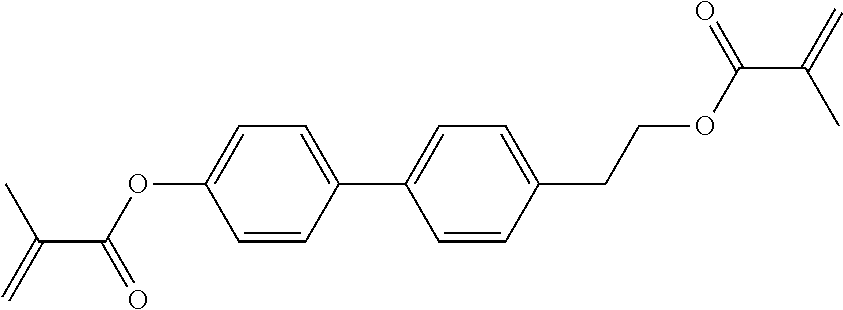 |
RM-8 |
 |
RM-9 |
 |
RM-10 |
 |
RM-11 |
 |
RM-12 |
 |
RM-13 |
 |
RM-14 |
 |
RM-15 |
 |
RM-16 |
 |
RM-17 |
 |
RM-18 |
 |
RM-19 |
 |
RM-20 |
 |
RM-21 |
 |
RM-22 |
 |
RM-23 |
 |
RM-24 |
 |
RM-25 |
 |
RM-26 |
 |
RM-27 |
 |
RM-28 |
 |
RM-29 |
 |
RM-30 |
 |
RM-31 |
 |
RM-32 |
 |
RM-33 |
 |
RM-34 |
 |
RM-35 |
 |
RM-36 |
 |
RM-37 |
 |
RM-38 |
 |
RM-39 |
 |
RM-40 |
 |
RM-41 |
 |
RM-42 |
 |
RM-43 |
 |
RM-44 |
 |
RM-45 |
 |
RM-46 |
 |
RM-47 |
 |
RM-48 |
 |
RM-49 |
 |
RM-50 |
 |
RM-51 |
 |
RM-52 |
 |
RM-53 |
 |
RM-54 |
 |
RM-55 |
 |
RM-56 |
 |
RM-57 |
 |
RM-58 |
 |
RM-59 |
 |
RM-60 |
 |
RM-61 |
 |
RM-62 |
 |
RM-63 |
 |
RM-64 |
 |
RM-65 |
 |
RM-66 |
 |
RM-67 |
 |
RM-68 |
 |
RM-69 |
 |
RM-70 |
 |
RM-71 |
 |
RM-72 |
 |
RM-73 |
 |
RM-74 |
 |
RM-75 |
 |
RM-76 |
 |
RM-77 |
 |
RM-78 |
 |
RM-79 |
 |
RM-80 |
 |
RM-81 |
 |
RM-82 |
 |
RM-83 |
 |
RM-84 |
| Table E shows illustrative compounds which can be used in the LC media in accordance with the present invention, preferably as polymerisable compounds. | |
In a preferred embodiment of the present invention, the mesogenic media comprise one or more compounds selected from the group of the compounds from Table E.
| TABLE F | |
 |
A-1 |
 |
A-2 |
 |
A-3 |
 |
A-4 |
 |
A-5 |
 |
A-6 |
 |
A-7 |
 |
A-8 |
| Table F shows illustrative compounds which can be employed in the LC media in accordance with the present invention, preferably as non-polymerisable self-alignment additives. | |
In the present application, the term “compounds”, also written as “compound(s)”, denotes, unless explicitly indicated otherwise, both one and also a plurality of compounds. Conversely, the term “compound” generally also encompasses a plurality of compounds, if this is possible according to the definition and is not indicated otherwise. The same applies to the terms LC media and LC medium. The term “component” in each case encompasses one or more substances, compounds and/or particles.
In addition, the following abbreviations and symbols are used:
-
- ne extraordinary refractive index at 20° C. and 589 nm,
- no ordinary refractive index at 20° C. and 589 nm,
- Δn optical anisotropy at 20° C. and 589 nm,
- ε⊥ dielectric permittivity perpendicular to the director at 20° C. and 1 kHz,
- ε∥ dielectric permittivity parallel to the director at 20° C. and 1 kHz,
- Δε dielectric anisotropy at 20° C. and 1 kHz,
- cl.p., T(N,l) clearing point [° C.],
- γ1 rotational viscosity at 20° C. [mPa·s],
- K1 elastic constant, “splay” deformation at 20° C. [pN],
- K2 elastic constant, “twist” deformation at 20° C. [pN],
- K3 elastic constant, “bend” deformation at 20° C. [pN]
- V0 capacitive threshold (Freedericks threshold) at 20° C. [V].
Unless explicitly noted otherwise, all concentrations in the present application are quoted in percent by weight and relate to the corresponding mixture as a whole comprising all solid or liquid-crystalline components, without solvents.
All physical properties are and have been determined in accordance with “Merck Liquid Crystals, Physical Properties of Liquid Crystals”, Status Nov. 1997, Merck KGaA, Germany, and apply for a temperature of 20° C., and Δn is determined at 589 nm and Δε at 1 kHz, unless explicitly indicated otherwise in each case.
The polymerisable compounds are polymerised in the display or test cell by irradiation with UVA light (usually 365 nm) of defined intensity for a prespecified time, with a voltage optionally being applied simultaneously to the display (usually 10 to 30 V alternating current, 1 kHz). In the examples, unless indicated otherwise, a 100 mW/cm2 mercury vapour lamp is used, and the intensity is measured using a standard UV meter (Ushio UNI meter) fitted with a 320 nm (optionally 340 nm) band-pass filter.
The following examples explain the present invention without intending to restrict it in any way. However, the physical properties make clear to the person skilled in the art what properties can be achieved and in what ranges they can be modified. In particular, the combination of the various properties which can preferably be achieved is thus well defined for the person skilled in the art.
Further combinations of the embodiments and variants of the invention in accordance with the description also arise from the claims.
The compounds employed, if not commercially available, are synthesised by standard laboratory procedures. The LC media originate from Merck KGaA, Germany.

6.50 g (20.1 mmol) of 2′-fluoro-4″-(3-hydroxypropyl)-[1,1′;4′,1″]terphenyl-4-ol (CAS No. 1299463-47-0) are suspended in 100 ml of dichloromethane (DCM) and 10 ml of THF, 1.75 ml (20.6 mmol) of methacrylic acid and 245 mg (2.0 mmol) of DMAP are added, and a solution of 3.44 g (22.2 mmol) of 1-(3-dimethylaminopropyl)-3-ethylcarbodiimide (EDC) in 50 ml of dichloromethane is added dropwise with ice-cooling. After 1 h, the cooling is removed, and the batch is stirred at room temperature (RT) overnight. The solvent is removed in vacuo, the residue is chromatographed on silica gel with heptane/ethyl acetate (10%-70%), and the product obtained (Rf=0.3, heptane/ethyl acetate (1:1)) is recrystallised from acetonitrile, giving 2′-fluoro-4″-(3-hydroxypropyl)-[1,1′;4′,1″]terphenyl-4-yl 2-methylacrylate as colourless crystals.
Phases: C 139° C. I
1H-NMR (500 MHz, DMSO-d6)
δ=1.74 ppm (q, 6.71 Hz, 2H, CH2), 2.01 (s, 3H, CH3), 2.65 (t, 7.67 Hz, 2H, CH2), 3.43 (t, 6.17 Hz, 2H, CH2—O), 4.47 (t, 5.06 Hz, 1H, OH), 5.90 (s, 1H), 6.30 (s, 1H), 7.29 (me, 4H), 7.69-7.54 (m, 7H).

1) 5-[2-(4′-Benzyloxybiphenyl-4-yl)ethyl]-2,2-di-tert-butyl-1,3,2-dioxasilinane

60 ml of THF, 5.00 g (22 mmol) of 4-benzyloxybenzeneboronic acid, 8.00 g (22 mmol) of 5-[2-(4-bromophenyl)ethyl]-2,2-di-tert-butyl-1,3,2-dioxasilinane and 0.28 g of bis(triphenylphosphine)palladium(II) chloride and 0.02 ml of hydrazinium hydroxide are added to 4.14 g (30 mmol) of sodium metaborate tetrahydrate in 12 ml of water, and the batch is heated under reflux overnight. 100 ml of methyl tert-butyl ether (MTB ether) and 100 ml of water are subsequently added, and the mixture is acidified using 2 M hydrochloric acid. The aq. phase is separated off and extracted three times with MTB ether. The combined org. phases are washed with sat. sodium chloride solution and dried over sodium sulfate. The solvent is removed in vacuo, the residue is filtered through silica gel with heptane/ethyl acetate (7:3 to 1:1), and the crude product is recrystallised from acetonitrile, giving 5-[2-(4′-benzyloxy-biphenyl-4-yl)ethyl]-2,2-di-tert-butyl-1,3,2-dioxasilinane as a colourless solid.

5-[2-(4′-Benzyloxybiphenyl-4-yl)ethyl]-2,2-di-tert-butyl-1,3,2-dioxasilinane is hydrogenated to completeness in THF on palladium/activated carbon catalyst. The catalyst is filtered off, the filtrate is evaporated, and the residue is recrystallised from heptane, giving 4′-[2-(2,2-di-tert-butyl-1,3,2-dioxasilinan-5-yl)-ethyl]biphenyl-4-ol as colourless, wadding-like needles.
1H NMR (500 MHz, CDCl3)
δ=1.02 ppm (s, 9H, tBu) 1.06 (s, 9H, tBu), 1.42 (me, 2H, —CH2—), 2.19 (me, 1H, >CH—), 2.68 (me, 2H, Ar—CH2—), 3.83 (t, J=11.1 Hz, 2H, CH2O), 4.17 (dd, J=4.3 Hz, J=11.1 Hz, 2H, CH2O), 4.93 (s, 1H, OH), 6.95 (AB-d, J=8.6 Hz, 2H, Ar—H), 7.26 (AB-d, J=8.2 Hz, 2H, Ar—H), 7.52 (AB-d, J=8.5 Hz, 2H, Ar—H).

4′-[2-(2,2-Di-tert-butyl-1,3,2-dioxasilinan-5-yl)ethyl]biphenyl-4-ol is reacted with methacrylic acid analogously to Example 1, giving 4′-[2-(2,2-di-tert-butyl-1,3,2-dioxasilinan-5-yl)ethyl]biphenyl-4-yl2-methylacrylate as colourless crystals.
1H NMR (500 MHz, CDCl3)
δ=1.03 ppm (s, 9H, tBu) 1.06 (s, 9H, tBu), 1.43 (me, 2H, —CH2—), 2.12 (me, 3H, CH3), 2.19 (me, 1H, >CH—), 2.69 (me, 2H, Ar—CH2—), 3.85 (t, J=11.2 Hz, 2H, CH2O), 4.18 (dd, J=4.2 Hz, J=11.2 Hz, 2H, CH2O), 5.83 (me, 1H, ═CHH), 6.43 (me, 1H, ═CHH), 7.25 (AB-d, J=8.7 Hz, 2H, Ar—H), 7.29 (AB-d, J=8.3 Hz, 2H, Ar—H), 7.57 (AB-d, J=8.3 Hz, 2H, Ar—H), 7.67 (AB-d, J=8.7 Hz, 2H, Ar—H).

300 mg (0.624 mmol) of 4′-[2-(2,2-di-tert-butyl-1,3,2-dioxasilinan-5-yl)ethyl]-biphenyl-4-yl 2-methylacrylate are dissolved in 10 ml of dichloromethane, and 1.2 g (7.4 mmol) of triethylamine trishydrogenfluoride are added with ice-cooling. The cooling is removed, and the batch is left to stir at RT overnight. The solution is subsequently filtered through 100 g of silica gel, subsequently eluted with dichloromethane/methanol (9:1), and the filtrate is evaporated. The residue is digested with heptane and filtered off, giving 4′-(4-hydroxy-3-hydroxymethylbutyl)biphenyl-4-yl 2-methylacrylate as a colourless solid.
1H-NMR (500 MHz, DMSO-d6)
δ=1.62-1.46 (m, 3H), 2.02 (s, 3H, CH3), 2.65 (me, 2H), 3.43 (me, 4H), 4.33 (t, 5.23 Hz, 2H, OH), 5.91 (me, 1H), 6.30 (s, 1H), 7.24 (d, 8.67 Hz, 2H), 7.30 (d, 8.21 Hz, 2H), 7.58 (d, 8.21 Hz, 2H), 7.69 (d, 8.68 Hz, 2H).

1) Synthesis of 4′-bromo-2′-ethylbiphenyl-4-ol A

100.0 g (380 mmol) of 1-benzyloxy-4-bromobenzene and 55.99 g (570 mmol) of ethynyltrimethylsilane are dissolved in 1.07 I of diisopropylamine, and the mixture is degassed using a stream of argon for 60 min. 2.56 g (11.40 mmol) of palladium(II) acetate, 6.62 g (22.8 mmol) of tri-tert-butylphosphonium tetra-fluoroborate and 724 mg (3.80 mmol) of copper(I) iodide are then added, and the mixture is stirred at 60° C. for 18 h. When the reaction is complete, the reaction mixture is carefully added to a mixture of ice and methyl tert-butyl ether (MTB ether) and adjusted to pH=7-8. The organic phase is separated off, and the water phase is washed twice with MTB ether. The combined organic phases are then washed 1× with water and 1× with saturated NaCl solution, dried over sodium sulfate, filtered and evaporated in vacuo. The crude product obtained is filtered through 3 l of silica gel with heptane, giving 88.8 g of the product as a brown oil.
MS (El): 280.1 [M+]
1H NMR (500 MHz, CDCl3) δ=0.24 (s, 9H, Si(CH3)3), 5.04 (s, 2H, benzylic CH2), 6.88 (d, 8.9 Hz, arom.-H), 7.29-7.41 (m, 7H, arom.-H).

17.7 g (317 mmol) of KOH are carefully dissolved in 577 ml of methanol under a nitrogen atmosphere with stirring. The alkyne A is then added, and the reaction mixture is stirred at room temperature (RT) for 18 h. Water is carefully added to the reaction mixture, the latter is neutralised using dilute HCl, the water phase is extracted twice with MTB ether, and the combined organic phases are washed with water, dried over sodium sulfate, filtered and evaporated, giving 70 g of the crude product as a brown liquid, which is chromatographed on silica gel with heptane/chlorobutane (3:1), giving 54 g of the product having a purity of 99.9% (GC).

50.0 g (240.1 mmol) of alkyne B and 73.7 g (240 mmol) of 1-bromo-2-fluoro-4-iodobenzene are dissolved in a mixture of 166 ml of triethylamine and 389 ml of tetrahydrofuran (THF) with stirring, and the mixture is degassed. 3.37 g (5.0 mmol) of bis(triphenylphosphine)palladium(II) chloride and 0.91 g (4.82 mmol) of copper(I) iodide are subsequently added. After addition of the catalyst, the reaction mixture warms to 60° C., and the reaction is complete after about 10 min. The cooled reaction mixture is then introduced into a mixture of ice-water and ethyl acetate (EA) and carefully acidified using dilute hydrochloric acid. The organic phase is separated off, and the water phase is extracted twice with EA. The combined organic phases are washed with water and saturated NaCl solution, dried over sodium sulfate, filtered and evaporated. The crude product obtained is dissolved in warm toluene and filtered through 4 l of silica gel. The product obtained is subsequently crystallised from a mixture of 3 l of heptane and 300 ml of toluene at 5° C., giving 80 g of the product as golden-coloured crystals.

86.4 g (227 mmol) of bromide C are dissolved in 1380 ml of THF and cooled to −78° C. The starting material precipitates out again at this temperature, but redissolves after addition of 155.8 ml (249 mmol) of n-butyllithium. After the addition, the mixture is stirred at −78° C. for a further 60 min, 28.3 ml (249 mmol) of trimethyl borate are subsequently carefully added, and the mixture is stirred at −78° C. for 20 min. The reaction mixture is then allowed to warm slowly to 0° C., acidified using 2 N hydrochloric acid with cooling, subsequently stirred briefly, and the phases are separated. The water phase is extracted by stirring with MTB ether, and the combined organic phases are washed with saturated NaCl solution and dried over sodium sulfate, filtered and evaporated. The crude product obtained (dark-brown crystals) is washed by stirring with hot toluene (1:20) and cooled to RT overnight, filtered off with suction and dried in a vacuum drying cabinet, giving 54 g of the product as beige crystals.

25.0 g (72.0 mmol) of boronic acid D, 22.4 g (72.0 mmol) of 4-bromo-2-ethyl-1-iodobenzene and 18.3 g (173 mmol) of sodium carbonate are suspended in a mixture of 337 ml of ethanol, 230 ml of toluene and 68 ml of water and degassed under argon. 1.67 g (1.44 mmol) of tetrakis(triphenylphosphine)-palladium(0) are subsequently added, and the mixture is heated to 80° C. The beige suspension is subsequently refluxed for 3 h and, when the conversion is complete (thin-layer check), cooled to RT. A sufficient amount of water and ethyl acetate (EA) are then added to the reaction mixture, and the organic phase is separated off. The water phase is extracted twice with EA, and the combined organic phases are washed with saturated NaCl solution. The organic phase remains a suspension and is warmed to complete dissolution, sodium sulfate is added at the temperature for drying, and the mixture is filtered while warm and allowed to cool (5° C.) for crystallisation. The crystalline product is filtered off with suction and rinsed with cold toluene, giving the product (22.2 g) as white crystals.
MS (El): 486.1 [M+]
1H NMR (500 MHz, CDCl3) δ=1.07 ppm (t, 7.5 Hz, 3H, CH3), 2.48 (q, 7.4, 14.8 Hz, CH2CH3), 5.08 (s, 2H, benzylic CH2), 6.96 (d, 8.7 Hz, 2H, arom.-H), 7.04 (d, 8.2 Hz, 1H, arom.-H), 7.16 (t, 7.8 Hz, 1 h, arom.-H), 7.27 (d, 10 Hz, 1H, arom.-H), 7.32-7.52 (m, 10H, arom.-H).

19.2 g (40.0 mmol) of bromide E and 24.06 ml (118.7 mmol) of tert-butyl-dimethylprop-2-ynyloxysilane are dissolved in 403 ml of diisopropylamine and degassed while argon is passed in (30 min). 444 mg (1.98 mmol) of palladium(II) acetate, 573.8 mg (1.978 mmol) of tri-tert-butylphosphonium tetra-fluoroborate and 301.3 mg (1.582 mmol) of copper(I) iodide are then added to the reaction mixture, and the mixture is stirred under reflux for 3 h. The reaction mixture is allowed to cool to RT, water is added, and the mixture is extracted with MTB ether. The phases are separated, the water phase is extracted with MTB ether, and the combined organic phases are washed with saturated NaCl solution, dried over sodium sulfate, filtered and evaporated in vacuo. The crude product is filtered through silica gel with chlorobutane/heptane (1:1) and crystallised from isopropanol (1:20), giving 17.4 g of the product.
1H NMR (500 MHz, CDCl3)
δ=0.00 ppm (s, 6H, Si(CH3)2), 0.78 (s, 9H, Si(C(CH3)3), 0.89 (t, 7.57 Hz, 3H, CH3), 2.30 (q, 7.53, 2H, CH2CH3), 4.38 (s, 2H, CH2—OSi(CH3)2C(CH3)3, 4.91 (s, 2H, benzylic CH2), 6.78 (d, 8.85 Hz, 2H, arom.-H), 6.93 (d, 7.85 Hz, 1H, arom.-H), 7.25-7.04 (m, 9H, arom.-H), 7.29 (d, 8.83 Hz, 2H, arom.-H).
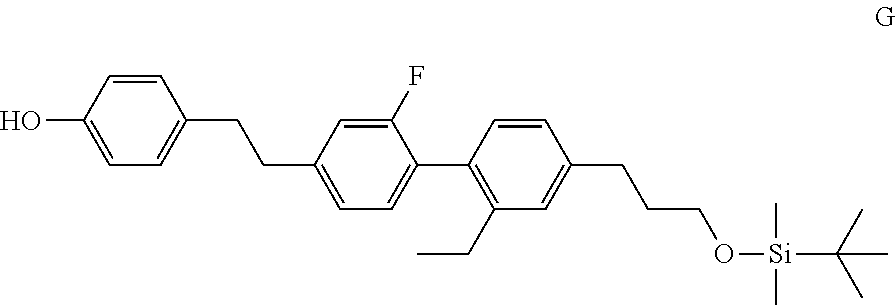
16.7 g (28.0 mmol) of alkyne F are dissolved in 170 ml of THF and hydrogenated at room temperature (RT) and atmospheric pressure for 58 h with 5.7 g of sponge nickel catalyst (water-wet) and 4.2 l of hydrogen. When the reaction is complete, the reaction solution is filtered, evaporated and filtered through silica gel with dichloromethane (DCM), giving 13.5 g of the product.
1H NMR (500 MHz, CDCl3)
δ=0.00 ppm (s, 6H, Si(CH3)2), 0.84 (s, 9H, Si(C(CH3)3), 0.99 (t, 7.58 Hz, 3H, CH3), 1.82 (me, 2H), 2.41 (q, 7.54 Hz, 2H), 2.63 (t, 7.95 Hz, 2H), 2.96 (s, 4H, phenyl-CH2—CH2-phenyl), 3.45 (q, 6.4 Hz, 2H), 4.46 (t, 5.15 Hz, 1H, OH), 6.67 (d, 8.49 Hz, 2H, arom.-H), 6.84 (dd, 1.41, 10.61 Hz, 1H, arom.-H), 6.88 (dd, 1.53, 7.73 Hz, 1H, arom.-H), 6.96 (d, 8.43 Hz, 2H, arom.-H), 7.06-6.98 (m, 4H, arom.-H).

3.00 g (6.09 mmol) of alcohol G, 37.2 mg (0.30 mmol) of 4-(dimethylamino)-pyridine and 0.72 ml (8.52 mmol) of methacrylic acid are initially introduced in 45 ml of dichloromethane and cooled to 0° C. A solution of 1.51 ml (8.52 mmol) of 1-(3-dimethylaminopropyl)-3-ethylcarbodiimide in 20 ml of dichloromethane is then added dropwise, and the mixture is allowed to warm to RT. After stirring at RT for a further 2 days and when the reaction is complete, the reaction mixture is chromatographed directly on silica gel with dichloromethane, giving 2.6 g of the product having a purity of 99% (HPLC).
1H NMR (500 MHz, CDCl3)
δ=0.00 ppm (s, 6H, Si(CH3)2), 0.85 (s, 9H, Si(C(CH3)3), 1.00 (t, 7.57 Hz, 3H, CH3), 1.82 (me, 2H, CH2), 1.99 (s, 3H, CH3), 2.42 (q, 7.53, 2H), 2.64 (t, 7.93 Hz, 2H), 2.89 (s, 4H, phenyl-CH2—CH2-phenyl), 3.61 (t, 6.32 Hz, 2H), 5.67 (s, 1H), 6.27 (s, 1H), 6.64 (d, 11.9 Hz, 1H, arom.-H), 6.91 (dd, 1.53, 7.72 Hz, 1H, arom.-H), 6.98 (d, 8.5 Hz, 2H, arom.-H), 7.09-6.98 (m, 4H, arom.-H), 7.13 (d, 8.47 Hz, 2H, arom.-H).

2.60 g (4.63 mmol) of silyl ether H are dissolved in 56 ml of tetrahydrofuran (THF), the solution is cooled to 0° C., and 2.66 ml (2 mol/l, 5.33 mmol) of HCl are added dropwise. The reaction solution is allowed to warm to room temperature and, after 3 hours, carefully neutralised using sodium hydrogen-carbonate solution. MTB ether is added, the mixture is extracted, and the phases are separated. The organic phase is washed with water, dried over sodium sulfate, filtered and evaporated. The crude product is chromatographed on silica gel with heptane/ethyl acetate, and the product fractions are evaporated, giving 1.3 g (67%) of the product as a crystalline solid having a purity of 99.9% (HPLC).
Phases: Tg 15° C. C 88° C. I
1H NMR (500 MHz, DMSO-D6)
δ=1.00 (t, 7.57 Hz, 3H, CH3), 1.76 (me, 2H), 2.07 (s, 3H, CH3), 2.42 (q, 7.55 Hz, 2H), 2.64 (t, 7.92 Hz, 2H), 2.96 (s, 4H, phenyl-CH2—CH2-phenyl), 3.46 (q, 6.4 Hz, 2H), 4.46 (t, 5.15, 1H, OH), 5.89 (s, 1H), 6.27 (s, 1H), 6.64 (d, 11.9 Hz, 1H, arom.-H), 7.04 (d, 7.71 Hz, 1H, arom.-H), 7.15-7.06 (m, 3H, arom.-H), 7.21-7.16 (m, 4H, arom.-H), 7.32 (d, 8.54 Hz, 2H, arom.-H).

1) Synthesis of 4-{2-[2′-ethyl-2-fluoro-4′-(3-hydroxypropyl)biphenyl-4-yl]ethyl}-phenyl 2-methylacrylate H

8.20 g (16.5 mmol) of alcohol G (cf. example above) are dissolved in 119 ml of ethyl methyl ketone, and 5.69 g (41 mmol) of potassium carbonate are added. 13.14 g (61.1 mmol) of 2-bromoethoxymethylbenzene are subsequently added in portions, and the mixture is refluxed for 48 h. The reaction mixture is subsequently allowed to cool to room temperature (RT), filtered and rinsed with acetone. The organic phases are evaporated and purified by chromatography on silica gel with toluene, giving 7.3 g of the desired product.
1H NMR (500 MHz, CDCl3)
δ=0.00 ppm (s, 6H, Si(CH3)2), 0.84 (s, 9H, Si(C(CH3)3), 1.00 (t, 7.56 Hz, 3H, CH3), 1.80 (me, 2H), 2.42 (q, 7.53 Hz, 2H), 2.63 (t, 7.92 Hz, 2H), 2.84 (s, 4H, phenyl-CH2—CH2-phenyl), 3.61 (t, 6.3 Hz, 2H), 3.76 (t, 4.84 Hz, 2H), 4.07 (t, 5.08 Hz, 2H), 4.57 (s, 2H), 6.68 (d, 8.6 Hz, 2H, arom.-H), 6.86 (dd, 10.61, 1.42 Hz, 1H, arom.-H), 6.89 (dd, 7.72, 1.56 Hz, 1H, arom.-H), 7.11-6.97 (m, 7H, arom.-H), 7.24-7.16 (m, 1H, arom.-H, superimposed with toluene) 7.32-7.25 (m, 3H, arom.-H, superimposed with toluene).

6.4 g (10.0 mmol) of benzyl ester K are dissolved in 70 ml of tetrahydrofuran, and 0.39 g (3.87 mmol) of NEt3 and 12.0 g of 5% Pd/C (54% of water) are added. The mixture is subsequently stirred at 50° C. and a hydrogen pressure of 5 bar for 82 h. The reaction mixture is filtered, and the crude product is filtered through silica gel with dichloromethane and MTB ether, giving 5.5 g of the desired product.
1H NMR (500 MHz, CDCl3)
δ=0.00 ppm (s, 6H, Si(CH3)2), 0.85 (s, 9H, Si(C(CH3)3), 1.00 (t, 7.57 Hz, 3H, CH3), 1.82 (me, 2H), 1.92 (t, 6.25 Hz, 1H, OH), 2.42 (q, 7.52 Hz, 2H), 2.64 (t, 7.95 Hz, 2H), 2.85 (s, 4H, phenyl-CH2—CH2-phenyl), 3.61 (t, 6.3 Hz, 2H), 3.89 (m, 2H), 4.07 (t, 4.64 Hz, 2H), 6.78 (d, 8.5 Hz, 2H, arom.-H), 6.86 (d, 10.69, 1H, arom.-H), 6.89 (d, 7.74 Hz, 1H, arom.-H), 7.07-6.98 (m, 6H, arom.-H).

5.60 g (10.4 mmol) of alcohol M, 5.19 ml (61.5 mmol) of methacrylic acid and 62.6 mg (0.512 mmol) of 4-(dimethylamino)pyridine are dissolved in 45 ml of dichloromethane (DCM) and cooled to 0° C. 10.87 ml (61.5 mmol) of EDC (dissolved in 30 ml of DCM) are then added, and the mixture is stirred at RT for 48 h. The reaction mixture is chromatographed directly on 250 g of silica gel with DCM, and the product fractions are evaporated in vacuo, giving 5.6 g of the desired product.
1H NMR (500 MHz, CDCl3)
δ=0.00 ppm (s, 6H, Si(CH3)2), 0.85 (s, 9H, Si(C(CH3)3), 1.00 (t, 7.57 Hz, 3H, CH3), 1.81 (me, 2H), 1.89 (s, 3H), 2.42 (q, 7.54 Hz, 2H), 2.64 (t, 7.94 Hz, 2H), 2.85 (s, 4H, phenyl-CH2—CH2-phenyl), 3.61 (t, 6.3 Hz, 2H), 4.14 (t, 4.8 Hz, 2H), 4.42 (t, 5.02 Hz, 2H), 5.51 (s, 1H), 6.07 (s, 1H), 6.78 (d, 8.6 Hz, 2H, arom.-H), 6.86 (dd, 10.57, 1.33 Hz, 1H, arom.-H), 6.89 (dd, 7.74, 1.48 Hz, 1H, arom.-H), 7.1-6.97 (m, 6H, arom.-H).

5.60 g (9.30 mmol) of methacrylic acid ester M are dissolved in 112 ml of tetrahydrofuran (THF), the solution is cooled to 0° C., and 5.27 ml (10.5 mmol/2 N) of hydrochloric acid are added dropwise. The reaction solution is allowed to warm to room temperature and stirred for 3 h. When the reaction is complete, the mixture is carefully neutralised using NaHCO3 solution, and the product is extracted a number of times with MTB ether. The combined organic phases are dried over sodium sulfate, filtered and evaporated. The reaction product is chromatographed on silica gel with heptane/ethyl acetate, and the product fractions are evaporated in vacuo. The product is subsequently dried at 40° C. and 1.6·10−4 bar for 3 hours in order to remove solvent residues, giving 3.6 g of the desired product.
Phases: Tg −24° C. I
1H NMR (500 MHz, CDCl3)
δ=1.10 (t, 7.57 Hz, 3H, CH3), 1.32 (s, 1H, OH), 1.81 (me, 2H), 1.98 (me, 5H), 2.53 (q, 7.54 Hz, 2H), 2.77 (t, 7.92 Hz, 2H), 2.95 (s, 4H, phenyl-CH2—CH2-phenyl), 3.76 (t, 6.42 Hz, 2H), 4.24 (t, 4.75 Hz, 2H), 4.52 (t, 5.0 Hz, 2H), 5.61 (s, 1H), 6.17 (s, 1H), 6.88 (d, 8.56 Hz, 2H, arom.-H), 6.96 (dd, 10.56, 1.01 Hz, 1H, arom.-H), 7.04 (d, 7.75, 1.29 Hz, 1H, arom.-H), 7.2-7.08 (m, 6H, arom.-H).
The following example compounds are prepared analogously to the above examples:
| No. | Structure of the example compound |
| 5. |
 |
| 6. |
 |
| 7. |
 |
| 8. |
 |
| 9. |
 |
| 10. |
 |
| 11. |
 |
| 12. |
 |
| 13. |
 |
| 14. |
 |
| 15. |
 |
| 16. |
 |
| 17. |
 |
| 18. |
 |
| 19. |
 |
| 20. |
 |
| 21. |
 |
| 22. |
 |
| 23. |
 |
| 24. |
 |
| 25. |
 |
| 26. |
 |
| 27. |
 |
| 28. |
 |
| 29. |
 |
| 30. |
 |
| 31. |
 |
| 32. |
 |
| 33. |
 |
| 34. |
 |
| 35. |
 |
| 36. |
 |
| 37. |
 |
| 38. |
 |
| 39. |
 |
| 40. |
 |
| 41. |
 |
| 42. |
 |
| 43. |
 |
| 44. |
 |
| 45. |
 |
| 46. |
 |
| 47. |
 |
| 48. |
 |
| 49. |
 |
| 50. |
 |
| 51. |
 |
| 52. |
 |
| 53. |
 |
| 54. |
 |
| 55. |
 |
| 56. |
 |
| 57. |
 |
| 58. |
 |
| 59. |
 |
| 60. |
 |
| 61. |
 |
| 62. |
 |
| 63. |
 |
| 64. |
 |
| 65. |
 |
| 66. |
 |
| 67. |
 |
| 68. |
 |
| 69. |
 |
| 70. |
 |
| 71. |
 |
| 72. |
 |
| 73. |
 |
| 74. |
 |
| 75. |
 |
| 76. |
 |
| 77. |
 |
| 78. |
 |
| 79. |
 |
| 80. |
 |
| 81. |
 |
| 82. |
 |
| 83. |
 |
| 84. |
 |
| 85. |
 |
| 86. |
 |
| 87. |
 |
| 88. |
 |
| 89. |
 |
| 90. |
 |
| 91. |
 |
LC media according to the invention are prepared using the following liquid-crystalline mixtures consisting of low-molecular-weight components in the percentage proportions by weight indicated.
| H1: Nematic host mixture (Δε < 0) |
| CY-3-O2 | 15.50% | Clearing point [° C.]: | 75.1 | ||
| CCY-3-O3 | 8.00% | Δn [589 nm, 20° C.]: | 0.098 | ||
| CCY-4-O2 | 10.00% | Δε [1 kHz, 20° C.]: | −3.0 | ||
| CPY-2-O2 | 5.50% | ε∥ [1 kHz, 20° C.]: | 3.4 | ||
| CPY-3-O2 | 11.50% | ε⊥ [1 kHz, 20° C.]: | 6.4 | ||
| CCH-34 | 9.25% | K1 [pN, 20° C.]: | 13.1 | ||
| CCH-23 | 24.50% | K3 [pN, 20° C.]: | 13.3 | ||
| PYP-2-3 | 8.75% | γ1 [mPa · s, 20° C.]: | 113 | ||
| PCH-301 | 7.00% | V0 [20° C., V]: | 2.22 | ||
| H2: Nematic host mixture (Δε < 0) |
| CY-3-O4 | 14.00% | Clearing point [° C.]: | 80.0 | ||
| CCY-3-O2 | 9.00% | Δn [589 nm, 20° C.]: | 0.090 | ||
| CCY-3-O3 | 9.00% | Δε [1 kHz, 20° C.]: | −3.3 | ||
| CPY-2-O2 | 10.00% | ε∥ [1 kHz, 20° C.]: | 3.4 | ||
| CPY-3-O2 | 10.00% | ε⊥ [1 kHz, 20° C.]: | 6.7 | ||
| CCY-3-1 | 8.00% | K1 [pN, 20° C.]: | 15.1 | ||
| CCH-34 | 9.00% | K3 [pN, 20° C.]: | 14.6 | ||
| CCH-35 | 6.00% | γ1 [mPa · s, 20° C.]: | 140 | ||
| PCH-53 | 10.00% | V0 [20° C., V]: | 2.23 | ||
| CCH-301 | 6.00% | ||||
| CCH-303 | 9.00% | ||||
| H3: Nematic host mixture (Δε < 0) |
| CC-3-V1 | 9.00% | Clearing point [° C.]: | 74.7 | ||
| CCH-23 | 18.00% | Δn [589 nm, 20° C.]: | 0.098 | ||
| CCH-34 | 3.00% | Δε [1 kHz, 20° C.]: | −3.4 | ||
| CCH-35 | 7.00% | ε∥ [1 kHz, 20° C.]: | 3.5 | ||
| CCP-3-1 | 5.50% | ε⊥ [1 kHz, 20° C.]: | 6.9 | ||
| CCY-3-O2 | 11.50% | K1 [pN, 20° C.]: | 14.9 | ||
| CPY-2-O2 | 8.00% | K3 [pN, 20° C.]: | 15.9 | ||
| CPY-3-O2 | 11.00% | γ1 [mPa · s, 20° C.]: | 108 | ||
| CY-3-O2 | 15.50% | V0 [20° C., V]: | 2.28 | ||
| PY-3-O2 | 11.50% | ||||
| H4: Nematic host mixture (Δε < 0) |
| CC-3-V | 37.50% | Clearing point [° C.]: | 74.8 | ||
| CC-3-V1 | 2.00% | Δn [589 nm, 20° C.]: | 0.099 | ||
| CCY-4-O2 | 14.50% | Δε [1 kHz, 20° C.]: | −2.9 | ||
| CPY-2-O2 | 10.50% | ε∥ [1 kHz, 20° C.]: | 3.7 | ||
| CPY-3-O2 | 9.50% | ε⊥ [1 kHz, 20° C.]: | 6.6 | ||
| CY-3-O2 | 15.00% | K1 [pN, 20° C.]: | 12.2 | ||
| CY-3-O4 | 4.50% | K3 [pN, 20° C.]: | 13.4 | ||
| PYP-2-4 | 5.50% | γ1 [mPa · s, 20° C.]: | 92 | ||
| PPGU-3-F | 1.00% | V0 [20° C., V]: | 2.28 | ||
| H5: Nematic host mixture (Δε < 0) |
| CCH-23 | 20.00% | Clearing point [° C.]: | 74.8 | ||
| CCH-301 | 6.00% | Δn [589 nm, 20° C.]: | 0.105 | ||
| CCH-34 | 6.00% | Δε [1 kHz, 20° C.]: | −3.2 | ||
| CCP-3-1 | 3.00% | ε∥ [1 kHz, 20° C.]: | 3.5 | ||
| CCY-3-O2 | 11.00% | ε⊥ [1 kHz, 20° C.]: | 6.8 | ||
| CPY-2-O2 | 12.00% | K1 [pN, 20° C.]: | 12.7 | ||
| CPY-3-O2 | 11.00% | K3 [pN, 20° C.]: | 13.6 | ||
| CY-3-O2 | 14.00% | γ1 [mPa · s, 20° C.]: | 120 | ||
| CY-3-O4 | 4.00% | V0 [20° C., V]: | 2.16 | ||
| PCH-301 | 4.00% | ||||
| PYP-2-3 | 9.00% | ||||
| H6: Nematic host mixture (Δε < 0) |
| CC-4-V | 17.00% | Clearing point [° C.]: | 106.1 | ||
| CCP-V-1 | 15.00% | Δn [589 nm, 20° C.]: | 0.120 | ||
| CCPC-33 | 2.50% | Δε [1 kHz, 20° C.]: | −3.6 | ||
| CCY-3-O2 | 4.00% | ε∥ [1 kHz, 20° C.]: | 3.5 | ||
| CCY-3-O3 | 5.00% | ε⊥ [1 kHz, 20° C.]: | 7.0 | ||
| CCY-4-O2 | 5.00% | K1 [pN, 20° C.]: | 16.8 | ||
| CLY-3-O2 | 3.50% | K3 [pN, 20° C.]: | 17.3 | ||
| CLY-3-O3 | 2.00% | γ1 [mPa · s, 20° C.]: | 207 | ||
| CPY-2-O2 | 8.00% | V0 [20° C., V]: | 2.33 | ||
| CPY-3-O2 | 10.00% | ||||
| CY-3-O4 | 17.00% | ||||
| PYP-2-3 | 11.00% | ||||
| H7: Nematic host mixture (Δε < 0) |
| CY-3-O2 | 15.00% | Clearing point [° C.]: | 75.5 | ||
| CCY-4-O2 | 9.50% | Δn [589 nm, 20° C.]: | 0.108 | ||
| CCY-5-O2 | 5.00% | Δε [1 kHz, 20° C.]: | −3.0 | ||
| CPY-2-O2 | 9.00% | ε∥ [1 kHz, 20° C.]: | 3.5 | ||
| CPY-3-O2 | 9.00% | ε⊥ [1 kHz, 20° C.]: | 6.5 | ||
| CCH-34 | 9.00% | K1 [pN, 20° C.]: | 12.9 | ||
| CCH-23 | 22.00% | K3 [pN, 20° C.]: | 13.0 | ||
| PYP-2-3 | 7.00% | γ1 [mPa · s, 20° C.]: | 115 | ||
| PYP-2-4 | 7.50% | V0 [20° C., V]: | 2.20 | ||
| PCH-301 | 7.00% | ||||
| H8: Nematic host mixture (Δε < 0) |
| CY-3-O2 | 15.00% | Clearing point [° C.]: | 74.7 | ||
| CY-5-O2 | 6.50% | Δn [589 nm, 20° C.]: | 0.108 | ||
| CCY-3-O2 | 11.00% | Δε [1 kHz, 20° C.]: | −3.0 | ||
| CPY-2-O2 | 5.50% | ε∥ [1 kHz, 20° C.]: | 3.6 | ||
| CPY-3-O2 | 10.50% | ε⊥ [1 kHz, 20° C.]: | 6.6 | ||
| CC-3-V | 28.50% | K1 [pN, 20° C.]: | 12.9 | ||
| CC-3-V1 | 10.00% | K3 [pN, 20° C.]: | 15.7 | ||
| PYP-2-3 | 12.50% | γ1 [mPa · s, 20° C.]: | 97 | ||
| PPGU-3-F | 0.50% | V0 [20° C., V]: | 2.42 | ||
| H9: Nematic host mixture (Δε < 0) |
| CCH-35 | 9.50% | Clearing point [° C.]: | 79.1 | ||
| CCH-501 | 5.00% | Δn [589 nm, 20° C.]: | 0.091 | ||
| CCY-2-1 | 9.50% | Δε [1 kHz, 20° C.]: | −3.6 | ||
| CCY-3-1 | 10.50% | ε∥ [1 kHz, 20° C.]: | 3.5 | ||
| CCY-3-O2 | 10.50% | ε⊥ [1 kHz, 20° C.]: | 7.1 | ||
| CCY-5-O2 | 9.50% | K1 [pN, 20° C.]: | 14.6 | ||
| CPY-2-O2 | 12.00% | K3 [pN, 20° C.]: | 14.5 | ||
| CY-3-O4 | 9.00% | γ1 [mPa · s, 20° C.]: | 178 | ||
| CY-5-O4 | 11.00% | V0 [20° C., V]: | 2.12 | ||
| PCH-53 | 13.50% | ||||
| H10: Nematic host mixture (Δε < 0) |
| BCH-32 | 4.00% | Clearing point [° C.]: | 74.8 | ||
| CC-3-V1 | 8.00% | Δn [589 nm, 20° C.]: | 0.106 | ||
| CCH-23 | 13.00% | Δε [1 kHz, 20° C.]: | −3.5 | ||
| CCH-34 | 7.00% | ε∥ [1 kHz, 20° C.]: | 3.6 | ||
| CCH-35 | 7.00% | ε⊥ [1 kHz, 20° C.]: | 7.1 | ||
| CCY-3-O2 | 13.00% | K1 [pN, 20° C.]: | 14.8 | ||
| CPY-2-O2 | 7.00% | K3 [pN, 20° C.]: | 15.8 | ||
| CPY-3-O2 | 12.00% | γ1 [mPa · s, 20° C.]: | 115 | ||
| CY-3-O2 | 12.00% | V0 [20° C., V]: | 2.23 | ||
| PCH-301 | 2.00% | ||||
| PY-3-O2 | 15.00% | ||||
| H11: Nematic host mixture (Δε < 0) |
| CY-3-O4 | 22.00% | Clearing point [° C.]: | 86.9 | ||
| CY-5-O4 | 12.00% | Δn [589 nm, 20° C.]: | 0.111 | ||
| CCY-3-O2 | 6.00% | Δε [1 kHz, 20° C.]: | −4.9 | ||
| CCY-3-O3 | 6.00% | ε∥ [1 kHz, 20° C.]: | 3.8 | ||
| CCY-4-O2 | 6.00% | ε⊥ [1 kHz, 20° C.]: | 8.7 | ||
| CPY-2-O2 | 10.00% | K1 [pN, 20° C.]: | 14.9 | ||
| CPY-3-O2 | 10.00% | K3 [pN, 20° C.]: | 15.9 | ||
| PYP-2-3 | 7.00% | γ1 [mPa · s, 20° C.]: | 222 | ||
| CC-3-V1 | 7.00% | V0 [20° C., V]: | 1.91 | ||
| CC-5-V | 10.00% | ||||
| CCPC-33 | 2.00% | ||||
| CCPC-35 | 2.00% | ||||
| H12: Nematic host mixture (Δε < 0) |
| CY-3-O4 | 12.00% | Clearing point [° C.]: | 86.0 | ||
| CY-5-O2 | 10.00% | Δn [589 nm, 20° C.]: | 0.110 | ||
| CY-5-O4 | 8.00% | Δε [1 kHz, 20° C.]: | −5.0 | ||
| CCY-3-O2 | 8.00% | ε∥ [1 kHz, 20° C.]: | 3.8 | ||
| CCY-4-O2 | 7.00% | ε⊥ [1 kHz, 20° C.]: | 8.8 | ||
| CCY-5-O2 | 6.00% | K1 [pN, 20° C.]: | 14.7 | ||
| CCY-2-1 | 8.00% | K3 [pN, 20° C.]: | 16.0 | ||
| CCY-3-1 | 7.00% | γ1 [mPa · s, 20° C.]: | 250 | ||
| CPY-3-O2 | 9.00% | V0 [20° C., V]: | 1.90 | ||
| CPY-3-O2 | 9.00% | ||||
| BCH-32 | 6.00% | ||||
| PCH-53 | 10.00% | ||||
| H13: Nematic host mixture (Δε < 0) |
| CC-3-V1 | 10.25% | Clearing point [° C.]: | 74.7 | ||
| CCH-23 | 18.50% | Δn [589 nm, 20° C.]: | 0.103 | ||
| CCH-35 | 6.75% | Δε [1 kHz, 20° C.]: | −3.1 | ||
| CCP-3-1 | 6.00% | ε∥ [1 kHz, 20° C.]: | 3.4 | ||
| CCY-3-1 | 2.50% | ε⊥ [1 kHz, 20° C.]: | 6.4 | ||
| CCY-3-O2 | 12.00% | K1 [pN, 20° C.]: | 15.4 | ||
| CPY-2-O2 | 6.00% | K3 [pN, 20° C.]: | 16.8 | ||
| CPY-3-O2 | 9.75% | γ1 [mPa · s, 20° C.]: | 104 | ||
| CY-3-O2 | 11.50% | V0 [20° C., V]: | 2.46 | ||
| PP-1-2V1 | 3.75% | ||||
| PY-3-O2 | 13.00% | ||||
| H14: Nematic host mixture (Δε < 0) |
| CC-3-V | 27.50% | Clearing point [° C.]: | 74.7 | ||
| CC-3-V1 | 10.00% | Δn [589 nm, 20° C.]: | 0.104 | ||
| CCH-35 | 8.00% | Δε [1 kHz, 20° C.]: | −3.0 | ||
| CCY-3-O2 | 9.25% | ε∥ [1 kHz, 20° C.]: | 3.4 | ||
| CLY-3-O2 | 10.00% | ε⊥ [1 kHz, 20° C.]: | 6.4 | ||
| CPY-3-O2 | 11.75% | K1 [pN, 20° C.]: | 15.3 | ||
| PY-3-O2 | 14.00% | K3 [pN, 20° C.]: | 16.2 | ||
| PY-4-O2 | 9.00% | γ1 [mPa · s, 20° C.]: | 88 | ||
| PYP-2-4 | 0.50% | V0 [20° C., V]: | 2.44 | ||
| H15: Nematic host mixture (Δε < 0) |
| CC-4-V | 10.00% | Clearing point [° C.]: | 77.0 | ||
| CC-5-V | 13.50% | Δn [589 nm, 20° C.]: | 0.113 | ||
| PGU-3-F | 6.50% | Δε [1 kHz, 20° C.]: | 19.2 | ||
| ACQU-2-F | 10.00% | ε∥ [1 kHz, 20° C.]: | 23.8 | ||
| ACQU-3-F | 12.00% | ε⊥ [1 kHz, 20° C.]: | 4.6 | ||
| PUQU-3-F | 11.00% | K1 [pN, 20° C.]: | 11.5 | ||
| CCP-V-1 | 12.00% | K3 [pN, 20° C.]: | 11.1 | ||
| APUQU-2-F | 6.00% | γ1 [mPa · s, 20° C.]: | 122 | ||
| APUQU-3-F | 7.00% | V0 [20° C., V]: | 0.81 | ||
| PGUQU-3-F | 8.00% | ||||
| CPGU-3-OT | 4.00% | ||||
| H16: Nematic host mixture (Δε < 0) |
| PGU-2-F | 3.50% | Clearing point [° C.]: | 77.0 | ||
| PGU-3-F | 7.00% | Δn [589 nm, 20° C.]: | 0.105 | ||
| CC-3-V1 | 15.00% | Δε [1 kHz, 20° C.]: | 7.2 | ||
| CC-4-V | 18.00% | ε∥ [1 kHz, 20° C.]: | 10.3 | ||
| CC-5-V | 20.00% | ε⊥ [1 kHz, 20° C.]: | 3.1 | ||
| CCP-V-1 | 6.00% | K1 [pN, 20° C.]: | 15.3 | ||
| APUQU-3-F | 15.00% | K3 [pN, 20° C.]: | 13.5 | ||
| PUQU-3-F | 5.50% | γ1 [mPa · s, 20° C.]: | 63 | ||
| PGP-2-4 | 3.00% | V0 [20° C., V]: | 1.53 | ||
| BCH-32 | 7.00% | ||||
| H17: Nematic host mixture (Δε < 0) |
| APUQU-2-F | 6.00% | Clearing point [° C.]: | 74.0 | ||
| APUQU-3-F | 12.00% | Δn [589 nm, 20° C.]: | 0.120 | ||
| PUQU-3-F | 18.00% | Δε [1 kHz, 20° C.]: | 17.4 | ||
| CPGU-3-OT | 9.00% | ε∥ [1 kHz, 20° C.]: | 22.0 | ||
| CCGU-3-F | 3.00% | ε⊥ [1 kHz, 20° C.]: | 4.5 | ||
| BCH-3F.F.F | 14.00% | K1 [pN, 20° C.]: | 10.1 | ||
| CCQU-3-F | 10.00% | K3 [pN, 20° C.]: | 10.8 | ||
| CC-3-V | 25.00% | γ1 [mPa · s, 20° C.]: | 111 | ||
| PGP-2-2V | 3.00% | V0 [20° C., V]: | 0.80 | ||
| H18: Nematic host mixture (Δε < 0) |
| PUQU-3-F | 15.00% | Clearing point [° C.]: | 74.3 | ||
| APUQU-2-F | 5.00% | Δn [589 nm, 20° C.]: | 0.120 | ||
| APUQU-3-F | 12.00% | Δε [1 kHz, 20° C.]: | 14.9 | ||
| CCQU-3-F | 11.00% | ε∥ [1 kHz, 20° C.]: | 19.1 | ||
| CCQU-5-F | 1.50% | ε⊥ [1 kHz, 20° C.]: | 4.3 | ||
| CPGU-3-OT | 5.00% | K1 [pN, 20° C.]: | 11.2 | ||
| CCP-30CF3 | 4.50% | K3 [pN, 20° C.]: | 10.8 | ||
| CGU-3-F | 10.00% | γ1 [mPa · s, 20° C.]: | 98 | ||
| PGP-2-3 | 1.50% | V0 [20° C., V]: | 0.91 | ||
| PGP-2-2V | 8.00% | ||||
| CC-3-V | 26.50% | ||||
| H19: Nematic host mixture (Δε < 0) |
| CCQU-3-F | 9.00% | Clearing point [° C.]: | 94.5 | ||
| CCQU-5-F | 9.00% | Δn [589 nm, 20° C.]: | 0.121 | ||
| PUQU-3-F | 16.00% | Δε [1 kHz, 20° C.]: | 20.4 | ||
| APUQU-2-F | 8.00% | ε∥ [1 kHz, 20° C.]: | 24.7 | ||
| APUQU-3-F | 9.00% | ε⊥ [1 kHz, 20° C.]: | 4.3 | ||
| PGUQU-3-F | 8.00% | K1 [pN, 20° C.]: | 12.1 | ||
| CPGU-3-OT | 7.00% | K3 [pN, 20° C.]: | 13.9 | ||
| CC-4-V | 18.00% | γ1 [mPa · s, 20° C.]: | 163 | ||
| CC-5-V | 5.00% | V0 [20° C., V]: | 0.81 | ||
| CCP-V-1 | 6.00% | ||||
| CCPC-33 | 3.00% | ||||
| PPGU-3-F | 2.00% | ||||
| H20: Nematic host mixture (Δε < 0) |
| CC-3-V | 28.50% | Clearing point [° C.]: | 85.6 | ||
| CCP-V1 | 3.00% | Δn [589 nm, 20° C.]: | 0.121 | ||
| CCPC-33 | 2.00% | Δε [1 kHz, 20° C.]: | 19.5 | ||
| PGU-2-F | 4.00% | ε∥ [1 kHz, 20° C.]: | 23.8 | ||
| CCQU-3-F | 8.00% | ε⊥ [1 kHz, 20° C.]: | 4.3 | ||
| CCQU-5-F | 6.00% | K1 [pN, 20° C.]: | 11.6 | ||
| CCGU-3-F | 3.00% | K3 [pN, 20° C.]: | 12.7 | ||
| PUQU-2-F | 2.00% | γ1 [mPa · s, 20° C.]: | 126 | ||
| PUQU-3-F | 10.00% | V0 [20° C., V]: | 0.81 | ||
| APUQU-2-F | 6.00% | ||||
| APUQU-3-F | 9.00% | ||||
| PGUQU-3-F | 5.00% | ||||
| PGUQU-4-F | 5.00% | ||||
| PGUQU-5-F | 4.00% | ||||
| CPGU-3-OT | 4.00% | ||||
| PPGU-3-F | 0.50% | ||||
The following polymerisable self-alignment additives (PSAAs) are used:
| PSAA No. | Structure |
| 1 |
 |
| 2 |
 |
| 3 |
 |
The following polymerisable compound is used:

The following non-polymerisable self-alignment additives are used:

Polymerisable self-alignment additive 1 (1.0% by weight) is added to a nematic LC medium H1 of the VA type (Δε<0), and the mixture is homogenised.
Use in Test cells without Pre-Alignment Layer:
The mixture formed is introduced into a test cell (without polyimide alignment layer, layer thickness d≈4.0 μm, ITO coating on both sides, without passivation layer). The LC medium has a spontaneous homeotropic (vertical) alignment with respect to the substrate surfaces. This alignment remains stable up to the clearing point, and the VA cell formed can be switched reversibly by application of a voltage.
VA alignment layers which are used for PM-VA, PVA, MVA and analogous technologies are no longer necessary with the use of additives such as polymerisable self-alignment additive 1.
Polymerisable self-alignment additive 1 (1.0% by weight) is added to a nematic LC medium H15 of the VA-IPS type (Δε>0), and the mixture is homogenised.
Use in Test Cells without Pre-Alignment Layer:
The mixture formed is introduced into a test cell (without polyimide alignment layer, layer thickness d≈4 μm, ITO interdigital electrodes arranged on one substrate surface, glass on the opposite substrate surface, without passivation layer). The LC medium has a spontaneous homeotropic (vertical) alignment with respect to the substrate surfaces. This alignment remains stable up to the clearing point, and the VA-IPS cell formed can be switched reversibly by application of a voltage.
VA alignment layers which are used for VA-IPS, HT-VA and analogous technologies are no longer necessary with the use of additives such as polymerisable self-alignment additive 1.
Polymerisable self-alignment additives 2 (1.5% by weight) and 3 (2.0% by weight) are added to a nematic LC medium H1 (Δε<0) analogously to Mixture Example 1, and the mixture is homogenised. The mixtures formed are introduced into test cells without pre-alignment layer. The LC media have a spontaneous homeotropic (vertical) alignment with respect to the substrate surfaces. This alignment remains stable up to the clearing point, and the VA cells formed can be switched reversibly by application of a voltage.
Polymerisable self-alignment additives 2 (1.5% by weight) and 3 (2.0% by weight) are added to a nematic LC medium H15 (Δε>0) analogously to Mixture Example 2, and the mixture is homogenised. The mixtures formed are introduced into test cells without pre-alignment layer. The LC media have a spontaneous homeotropic (vertical) alignment with respect to the substrate surfaces. This alignment remains stable up to the clearing point, and the VA-IPS cells formed can be switched reversibly by application of a voltage.
Polymerisable self-alignment additive 1 (1.0% by weight) is added to nematic
LC media H2-H14 (Δε<0) analogously to Mixture Example 1, and the mixture is homogenised. The mixtures formed are introduced into test cells without pre-alignment layer (cf. Mixture Example 1). The LC media have a spontaneous homeotropic (vertical) alignment with respect to the substrate surfaces. This alignment remains stable up to the clearing point, and the VA cells formed can be switched reversibly by application of a voltage.
Polymerisable self-alignment additive 1 (1.0% by weight) is added to nematic LC media H16-H20 (Δε>0) analogously to Mixture Example 2, and the mixture is homogenised. The mixtures formed are introduced into test cells without pre-alignment layer (cf. Mixture Example 2). The LC media have a spontaneous homeotropic (vertical) alignment with respect to the substrate surfaces. This alignment remains stable up to the clearing point, and the VA-IPS cells formed can be switched reversibly by application of a voltage.
A polymerisable self-alignment additive 1 (0.3% by weight) and in each case a non-polymerisable self-alignment additive A-1 (1.5% by weight) or A-2 (0.3% by weight) are added to a nematic LC medium H1 of the VA type (Δε<0), and the mixture is homogenised.
Use in Test Cells without Alignment Layer:
The mixture formed is introduced into a test cell (without polyimide alignment layer, cell thickness d≈4.0 μm, ITO coating on both sides, without passivation layer). The LC medium has a spontaneous homeotropic (vertical) alignment to the substrate surfaces. This alignment remains stable up to the clearing point, and the VA cell formed can be switched reversibly by application of a voltage.
VA alignment layers which are used for PM-VA, PVA, MVA and analogous technologies are no longer necessary on use of additives such as the polymerisable self-alignment additive 1 in combination with A-1 or A-2.
In each case a polymerisable self-alignment additive 1 (1.0% by weight) or 2 (1.5% by weight) is added to a nematic LC medium H1 (Δε<0), and the mixture is homogenised.
Use in Test Cells without Pre-Alignment Layer:
The mixtures formed are introduced into test cells (without polyimide alignment layer, cell thickness d≈4.0 μm, ITO coating on both sides, without passivation layer). The LC media have a spontaneous homeotropic (vertical) alignment with respect to the substrate surfaces. This alignment remains stable up to the clearing point, and the VA cell formed can be switched reversibly by application of a voltage.
While a voltage greater than the optical threshold voltage (for example 14 Vpp) is applied, the VA cells are irradiated with UV light having an intensity of 100 mW/cm2 at 20° C. or 40° C. with a 340 nm band-pass filter. This causes polymerisation of the polymerisable compounds. The homeotropic alignment is thus additionally stabilised, a ‘pre-tilt’ is established, and a polymer layer forms. The PSA-VA cells obtained can be switched reversibly up to the clearing point on application of a voltage. The response times are shortened compared with the unpolymerised cell. The threshold voltages (V10) change (Table 1).
The polymerisation can also be carried out without application of a voltage. The homeotropic alignment is thus additionally stabilised and a polymer layer forms without a ‘pre-tilt’ being established. The polymer layer acts as protective layer and improves the long-term stability of the PSA-VA cell.
VA alignment layers which are used for PSA, PS-VA and analogous technologies are no longer necessary with the use of additives such as the polymerisable self-alignment additives 1 and 2.
A polymerisable compound RM-41 (0.3% by weight) and a polymerisable self-alignment additive 1 (1.0% by weight) are added to a nematic LC medium H1 (Δε<0), and the mixture is homogenised.
Use in Test cells without Alignment Layer:
The mixtures formed are introduced into test cells (without polyimide alignment layer, cell thickness d≈4.0 μm, ITO coating on both sides, without passivation layer). The LC media have a spontaneous homeotropic (vertical) alignment with respect to the substrate surfaces. This alignment remains stable up to the clearing point, and the VA cell formed can be switched reversibly by application of a voltage.
While a voltage greater than the optical threshold voltage (for example 14 Vpp) is applied, the VA cells are irradiated with UV light having an intensity of 100 mW/cm2 at 20° C. or 40° C. with a 340 nm band-pass filter. This causes polymerisation of the polymerisable compounds. The homeotropic alignment is thus additionally stabilised, a pre-tilt is established, and a polymer layer forms. The PSA-VA cells obtained can be switched reversibly up to the clearing point by application of a voltage. The response times are shortened compared with the unpolymerised cell. The threshold voltages (V10) change (Table 1).
The polymerisation can also be carried out without application of a voltage. The homeotropic alignment is thus additionally stabilised and a polymer layer forms without a ‘pre-tilt’ being established. The polymer layer acts as protective layer and improves the long-term stability of the PSA-VA cell.
VA alignment layers which are used for PSA, PS-VA and analogous technologies are no longer necessary with the use of additives such as the polymerisable self-alignment additives 1 in combination with RM-41.
A polymerisable self-alignment additive 1 (0.3% by weight) and an unpolymerisable self-alignment additive A-2 (0.3% by weight) are added to a nematic LC medium H1 of the VA type (Δε<0), and the mixture is homogenised.
Use in Test Cells without Pre-Alignment Layer:
The mixtures formed are introduced into test cells (without polyimide alignment layer, cell thickness d≈4.0 μm, ITO coating on both sides, without passivation layer). The LC media have a spontaneous homeotropic (vertical) alignment with respect to the substrate surfaces. This alignment remains stable up to the clearing point, and the VA cell formed can be switched reversibly by application of a voltage.
While a voltage greater than the optical threshold voltage (for example 14 Vpp) is applied, the VA cells are irradiated with UV light having an intensity of 100 mW/cm2 at 20° C. or 40° C. with a 340 nm band-pass filter. This causes polymerisation of the polymerisable compounds. The homeotropic alignment is thus additionally stabilised, a ‘pre-tilt’ is established, and a polymer layer forms. The PSA-VA cells obtained can be switched reversibly up to the clearing point on application of a voltage. The response times are shortened compared with the unpolymerised cell. The threshold voltages (V10) change (Table 1).
The polymerisation can also be carried out without application of a voltage. The homeotropic alignment is thus additionally stabilised and a polymer layer forms without a ‘pre-tilt’ being established. The polymer layer acts as protective layer and improves the long-term stability of the PSA-VA cell.
VA alignment layers which are used for PSA, PS-VA and analogous technologies are no longer necessary with the use of additives such as polymerisable self-alignment additive 1 in combination with A-2.
A polymerisable compound RM-41 (0.3% by weight), a polymerisable self-alignment additive 1 (0.3% by weight) and an unpolymerisable self-alignment additive A-1 (1.5% by weight) are added to a nematic LC medium H1 of the VA type (Δε<0), and the mixture is homogenised.
Use in Test Cells without Pre-Alignment Layer:
The mixtures formed are introduced into test cells (without polyimide alignment layer, cell thickness d≈4.0 μm, ITO coating on both sides, without passivation layer). The LC media have a spontaneous homeotropic (vertical) alignment with respect to the substrate surfaces. This alignment remains stable up to the clearing point, and the VA cell formed can be switched reversibly by application of a voltage.
While a voltage greater than the optical threshold voltage (for example 14 Vpp) is applied, the VA cells are irradiated with UV light having an intensity of 100 mW/cm2 at 20° C. or 40° C. with a 340 nm band-pass filter. This causes polymerisation of the polymerisable compounds. The homeotropic alignment is thus additionally stabilised, a ‘pre-tilt’ is established, and a polymer layer forms. The PSA-VA cells obtained can be switched reversibly up to the clearing point on application of a voltage. The response times are shortened compared with the unpolymerised cell. The threshold voltages (V10) change (Table 1).
The polymerisation can also be carried out without application of a voltage. The homeotropic alignment is thus additionally stabilised and a polymer layer forms without a ‘pre-tilt’ being established. The polymer layer acts as protective layer and improves the long-term stability of the PSA-VA cell.
VA alignment layers which are used for PSA, PS-VA and analogous technologies are no longer necessary with the use of additives such as polymerisable self-alignment additive 1 in combination with RM-41 and A-2.
| TABLE 1 |
| Threshold voltages V10 of VA and PSA cells. Host H1 |
| in combination with polymerisable self-alignment additive |
| (PSOA). Polymerisation conditions: 340 nm band-pass filter, |
| 20° C., 0 Vpp, 10 min, 100 mW/cm2. |
| Response | ||||||
| Mixture | Further | UV | Cell | time/ms | ||
| Example | PSOA | comp. | irradiation | type | V10/V | 0 V→5 V |
| 1 | 1 | No | VA | 2.47 | 27 | |
| 3 | 2 | No | VA | 2.47 | 34 | |
| 27 | 1 | A-1 | No | VA | 2.55 | 25 |
| 28 | 1 | A-2 | No | VA | 2.50 | 26 |
| 1a | 1 | Yes | PSA | 4.54 | 15 | |
| 1b | 1 | RM-41 | Yes | PSA | 4.81 | 17 |
| 3a | 2 | Yes | PSA | 2.63 | 17 | |
| 27b | 1 | A-1, | Yes | PSA | 2.57 | 22 |
| RM-41 | ||||||
| 28a | 1 | A-2 | Yes | PSA | 2.58 | 23 |
Claims (29)
1. A LC medium comprising:
i) a low-molecular-weight, non polymerizable liquid-crystalline component
and
ii) one or more polymerizable compounds of the formula I,
or
a polymerized component obtainable by polymerization of the polymerisable compound of formula I,
P-Sp-[A3-Z3]m-[A2]k-[Z2]n-A1-Ra (I)
P-Sp-[A3-Z3]m-[A2]k-[Z2]n-A1-Ra (I)
in which
A1, A2, A3 each, independently of one another, denote an aromatic, heteroaromatic, alicyclic or heterocyclic group, which may also contain fused rings, and which may also be mono- or polysubstituted by a group L,
L in each case, independently of one another, denotes H, F, Cl, Br, I, —CN, —NO2, —NCO, —NCS, —OCN, —SCN, —C(═O)N(R0)2, —C(═O)R0, optionally substituted silyl, optionally substituted aryl or cycloalkyl having 3 to 20 C atoms, or straight-chain or branched alkyl, alkoxy, alkylcarbonyl, alkoxycarbonyl, alkylcarbonyloxy or alkoxycarbonyloxy having 1 to 25 C atoms, in which, in addition, one or more H atoms may be replaced by F or Cl,
P denotes a polymerizable group,
Sp denotes a spacer group or a single bond,
Z2 in each case, independently of one another, denotes —O—, —S—, —CO—, —CO—O—, —OCO—, —O—CO—O—, —OCH2—, —CH2O—, —SCH2—, —CH2S—, —CF2O—, —OCF2—, —CF2S—, —SCF2—, —(CH2)n1—, —CF2CH2—, —CH2CF2—, —(CF2)n1—, —CH═CH—, —CF═CF—, —C≡C—, —CH═CH—COO—, —OCO—CH═CH—, —(CR0R00)n1—,
Z3 in each case, independently of one another, denotes a single bond, —O—, —S—, —CO—, —CO—O—, —OCO—, —O—CO—O—, —OCH2—, —CH2O—, —SCH2—, —CH2S—, —CF2O—, —OCF2—, —CF2S—, —SCF2—, —(CH2)n1—, —CF2CH2—, —CH2CF2—, —(CF2)n1—, —CH═CH—, —CF═CF—, —C≡C—, —CH═CH—COO—, —OCO—CH═CH—, —(CR0R00)n1—,
n1 denotes 1, 2, 3 or 4,
n denotes 0 or 1,
m denotes 0, 1, 2, 3, 4, 5 or 6,
k denotes 0 or 1,
R0 in each case, independently of one another, denotes alkyl having 1 to 12 C atoms,
R00 in each case, independently of one another, denotes H or alkyl having 1 to 12 C atoms,
Ra denotes an anchor group of the formula

p denotes 1 or 2,
q denotes 2 or 3,
B denotes a substituted or unsubstituted ring system or condensed ring system,
Y, independently of one another, denotes —O—, —S—, —C(O)—, —C(O)O—, —OC(O)—, —NR11— or a single bond,
o denotes 0 or 1,
X1, independently of one another, denotes H, alkyl, fluoroalkyl, OH, NH2, NHR11, NR11 2, OR11, C(O)OH, —CHO,
where at least one group X1 denotes a radical selected from —OH, —NH2, NHR11, C(O)OH and —CHO,
R11 denotes alkyl having 1 to 12 C atoms,
Spa, Spc, Spd each, independently of one another, denote a spacer group or a single bond, and
Spb denotes a tri- or tetravalent group.
2. A Medium according to claim 1 , wherein, for formula I,
A1, A2, A3 each, independently of one another, denote 1,4-phenylene, 1,3-phenylene, naphthalene-1,4-diyl or naphthalene-2,6-diyl, where, in addition, one or more CH groups in these groups may be replaced by N, cyclohexane-1,4-diyl, in which, in addition, one or more non-adjacent CH2 groups may be replaced by O and/or S, 3,3′-bicyclobutylidene, 1,4-cyclohexenylene, bicyclo[1.1.1]pentane-1,3-diyl, bicyclo[2.2.2]octane-1,4-diyl, spiro[3.3]heptane-2,6-diyl, piperidine-1,4-diyl, decahydronaphthalene-2,6-diyl, 1,2,3,4-tetrahydronaphthalene-2,6-diyl, indane-2,5-diyl or octahydro-4,7-methanoindane-2,5-diyl, perhydrocyclopenta[a]phenanthrene-3,17-diyl (in particular gonane-3,17-diyl),
where all these groups may be unsubstituted or mono- or polysubstituted by a group L.
3. A Medium according to claim 1 , wherein the compound of the formula I is a compound of the formula I1,

in which
Ra, A1, A2, A3, Z2, Z3, L, Sp, P, k, m and n independently are as defined in claim 1 , and
r1, r2, r3 independently denote 0, 1, 2 or 3.
4. A LC medium according to claim 1 , wherein the compound of the formula I contains in total at least one group L on the groups A1, A2 and A3, as are present.
5. A LC medium according to claim 1 , wherein the one or more compounds of the formula I are selected from compounds of the formulae IA, IB, IC, ID, IE or IF:

in which Ra, Z2, Z3, L, Sp, P and n independently are as defined in claim 1 , and
r1, r2, r3 independently denote 0, 1, 2 or 3.
6. A LC medium according to claim 1 , wherein, besides one or more compounds of the formula I, the polymerizable or polymerized component comprises one or more further polymerizable or polymerized compounds, where the polymerized component is obtainable by polymerization of the polymerizable component.
7. A LC medium according to claim 1 , wherein one or more compounds of the formula I, additionally comprises one or more non-polymerizable compounds of the formula I′,
R1-[A3-Z3]m-[A2]k-[Z2]a-A1-Ra I′
R1-[A3-Z3]m-[A2]k-[Z2]a-A1-Ra I′
in which m, k, n and the group Ra are as defined for formula I according to claim 1 , and
A1, A2, A3 each, independently of one another, denote an aromatic, heteroaromatic, alicyclic or heterocyclic group, which may also contain fused rings, and which may also be mono- or polysubstituted by a group L,
Z2 in each case, independently of one another, denotes —O—, —S—, —CO—, —CO—O—, —OCO—, —O—CO—O—, —OCH2—, —CH2O—, —SCH2—, —CH2S—, —CF2O—, —OCF2—, —CF2S—, —SCF2—, —(CH2)n1—, —CF2CH2—, —CH2CF2—, —(CF2)n1—, —CH═CH—, —CF═CF—, —C≡C—, —CH═CH—COO—, —OCO—CH═CH—, —(CR0R00)n1—,
Z3 in each case, independently of one another, denotes a single bond, —O—, —S—, —CO—, —CO—O—, —OCO—, —O—CO—O—, —OCH2—, —CH2O—, —SCH2—, —CH2S—, —CF2O—, —OCF2—, —CF2S—, —SCF2—, —(CH2)n1—, —CF2CH2—, —CH2CF2—, —(CF2)n1—, —CH═CH—, —CF═CF—, —C≡C—, —CH═CH—COO—, —OCO—CH═CH—, —(CR0R00)n1—,
n1 denotes 1, 2, 3 or 4,
L in each case, independently of one another, denotes H, F, Cl, Br, I, —CN, —NO2, —NCO, —NCS, —OCN, —SCN, —C(═O)N(R0)2, —C(═O)R0, optionally substituted silyl, optionally substituted aryl or cycloalkyl having 3 to 20 C atoms, or straight-chain or branched alkyl, alkoxy, alkylcarbonyl, alkoxycarbonyl, alkylcarbonyloxy or alkoxycarbonyloxy having 1 to 25 C atoms, in which, in addition, one or more H atoms may be replaced by F or Cl,
R0 in each case, independently of one another, denotes alkyl having 1 to 12 C atoms,
R00 in each case, independently of one another, denotes H or alkyl having 1 to 12 C atoms,
and
R1, independently of one another, denotes H, halogen, straight-chain, branched or cyclic alkyl having 1 to 25 C atoms, in which, in addition, one or more non-adjacent CH2 groups may be replaced by —O—, —S—, —CO—, —CO—O—, —O—CO—, —O—CO—O— in such a way that O and/or S atoms are not linked directly to one another and in which, in addition, one or more H atoms may be replaced by F or Cl.
8. A LC medium according to claim 7 , which comprises one or more polymerizable compounds selected from the following formulae:

in which R1, Ra, Z2, Z3, L and n independently are as defined in claim 7 , and
r1, r2, r3 independently denote 0, 1, 2, 3 or 4.
9. A LC medium according to claim 1 , which comprises one or more compounds of the formula I selected from the following formulae:


in which L, Sp, P and Ra independently are as defined in claim 1 .
10. A LC medium according to claim 1 , wherein the group Ra in formula I or the sub-formulae contains one, two or three OH groups.
11. A LC medium according to claim 1 , wherein the group Ra denotes a group selected from

in which Spa, Spb, Spc, p and X1 have the meaning as in claim 1 .
12. A LC medium according to claim 1 , wherein the group Ra denotes a group selected from the part-formulae


13. A LC medium according to claim 1 , wherein for the compound of the formula I,
n=0.
14. A LC medium according to claim 1 , wherein for the compound of the formula I, the group P is selected from vinyloxy, acrylate, methacrylate, fluoroacrylate, chloroacrylate, oxetane and epoxide.
15. A LC medium according to claim 1 , which in it comprises the compounds of the formula I in a concentration of less than 10% by weight.
16. A LC medium according to claim 1 , which comprises one or more polymerizable compounds of the formula M or a (co)polymer comprising compounds of the formula M:
P1-Sp1-A2-(Z1-A1)n-Sp2-P2 M
P1-Sp1-A2-(Z1-A1)n-Sp2-P2 M
in which the individual radicals have the following meanings:
P1, P2 each independently denote a polymerizable group,
Sp1, Sp2 each independently denote a spacer group,
A1, A2 each, independently of one another, denote a radical selected from the following groups:
a) the group consisting of trans-1,4-cyclohexylene, 1,4-cyclohexenylene and 4,4′-bicyclohexylene, in which, in addition, one or more non-adjacent CH2 groups may be replaced by —O— and/or —S— and in which, in addition, one or more H atoms may be replaced by a group L, or selected from

b) the group consisting of 1,4-phenylene and 1,3-phenylene, in which, in addition, one or two CH groups may be replaced by N and in which, in addition, one or more H atoms may be replaced by a group L or -Sp3-P,
c) the group consisting of tetrahydropyran-2,5-diyl, 1,3-dioxane-2,5-diyl, tetrahydrofuran-2,5-diyl, cyclobutane-1,3-diyl, piperidine-1,4-diyl, thiophene-2,5-diyl and selenophene-2,5-diyl, each of which may also be mono- or polysubstituted by a group L,
d) the group consisting of saturated, partially unsaturated or fully unsaturated, and optionally substituted, polycyclic radicals having 5 to 20 cyclic C atoms, one or more of which may, in addition, be replaced by heteroatoms, preferably selected from the group consisting of bicyclo[1.1.1]pentane-1,3-diyl, bicyclo[2.2.2]octane-1,4-diyl, spiro-[3.3]heptane-2,6-diyl,


where, in addition, one or more H atoms in these radicals may be replaced by a group L or -Sp3-P, and/or one or more double bonds may be replaced by single bonds, and/or one or more CH groups may be replaced by N,
P3 denotes a polymerizable group,
Sp3 denotes a spacer group,
n denotes 0, 1, 2 or 3,
Z1 in each case, independently of one another, denotes —CO—O—, —O—CO—, —CH2O—, —OCH2—, —CF2O—, —OCF2—, or —(CH2)n—, where n is 2, 3 or 4, —O—, —CO—, —C(RcRd)—, —CH2CF2—, —CF2CF2— or a single bond,
L on each occurrence, identically or differently, denotes F, Cl, CN, SCN, SF5 or straight-chain or branched, in each case optionally fluorinated, alkyl, alkoxy, alkylcarbonyl, alkoxycarbonyl, alkylcarbonyloxy or alkoxycarbonyloxy having 1 to 12 C atoms,
R0, R00 each, independently of one another, denote H, F or straight-chain or branched alkyl having 1 to 12 C atoms, in which, in addition, one or more H atoms may be replaced by F,
M denotes —O—, —S—, —CH2—, —CHY1— or —CY1Y2—,
Y1 and Y2 each, independently of one another, have one of the meanings indicated above for R0 or denote Cl or CN,
W1, W2 each, independently of one another, denote —CH2CH2—, —CH═CH—, —CH2—O—, —O—CH2—, —C(RcRd)— or —O—, and
Rc and Rd each, independently of one another, denote H or alkyl having 1 to 6 C atoms, preferably H, methyl or ethyl,
where one or more of the groups P1-Sp1-, -Sp2-P2 and -Sp3-P3 may denote a radical Raa, with the proviso that at least one of the groups P1-Sp1-, -Sp2-P2 and -Sp3-P3 present does not denote Raa,
Raa denotes H, F, Cl, CN or straight-chain or branched alkyl having 1 to 25 C atoms, in which, in addition, one or more non-adjacent CH2 groups may each be replaced, independently of one another, by C(R0)═C(R00)—, —C≡C—, —O—, —S—, —CO—, —CO—O—, —O—CO—, —O—CO—O— in such a way that O and/or S atoms are not linked directly to one another, and in which, in addition, one or more H atoms may be replaced by F, Cl, CN or P1-Sp1-, where the groups —OH, —NH2, —SH, —NHR, —C(O)OH and —CHO are not present in Raa.
17. A LC medium according to claim 1 , wherein the polymerizable or polymerized component comprises 0.01 to 5% by weight of one or more compounds of the formula M
P1-Sp1-A2-(Z1-A1)n-Sp2-P2 M
P1-Sp1-A2-(Z1-A1)n-Sp2-P2 M
in which the individual radicals have the following meanings:
p1, P2 each independently denote a polymerizable group,
Sp1, Sp2 each independently denote a spacer group,
A1, A2 each, independently of one another, denote a radical selected from the following groups:
a) the group consisting of trans-1,4-cyclohexylene, 1,4-cyclohexenylene and 4,4′-bicyclohexylene, in which, in addition, one or more non-adjacent CH2 groups may be replaced by —O— and/or —S— and in which, in addition, one or more H atoms may be replaced by a group L, or selected from

b) the group consisting of 1,4-phenylene and 1,3-phenylene, in which, in addition, one or two CH groups may be replaced by N and in which, in addition, one or more H atoms may be replaced by a group L or -Sp3-P,
c) the group consisting of tetrahydropyran-2,5-diyl, 1,3-dioxane-2,5-diyl, tetrahydrofuran-2,5-diyl, cyclobutane-1,3-diyl, piperidine-1,4-diyl, thiophene-2,5-diyl and selenophene-2,5-diyl, each of which may also be mono- or polysubstituted by a group L,
d) the group consisting of saturated, partially unsaturated or fully unsaturated, and optionally substituted, polycyclic radicals having 5 to 20 cyclic C atoms, one or more of which may, in addition, be replaced by heteroatoms, preferably selected from the group consisting of bicyclo[1.1.1]pentane-1,3-diyl, bicyclo[2.2.2]octane-1,4-diyl, spiro-[3.3]heptane-2,6-diyl,


where, in addition, one or more H atoms in these radicals may be replaced by a group L or -Sp3-P, and/or one or more double bonds may be replaced by single bonds, and/or one or more CH groups may be replaced by N,
P3 denotes a polymerizable group,
Sp3 denotes a spacer group,
n denotes 0, 1, 2 or 3,
Z1 in each case, independently of one another, denotes —CO—O—, —O—CO—, —CH2O—, —OCH2—, —CF2O—, —OCF2—, or —(CH2)n—, where n is 2, 3 or 4, —O—, —CO—, —C(RcRd)—, —CH2CF2—, —CF2CF2— or a single bond,
L on each occurrence, identically or differently, denotes F, Cl, CN, SCN, SF5 or straight-chain or branched, in each case optionally fluorinated, alkyl, alkoxy, alkylcarbonyl, alkoxycarbonyl, alkylcarbonyloxy or alkoxycarbonyloxy having 1 to 12 C atoms,
R0, R00 each, independently of one another, denote H, F or straight-chain or branched alkyl having 1 to 12 C atoms, in which, in addition, one or more H atoms may be replaced by F,
M denotes —O—, —S—, —CH2—, —CHY1— or —CY1Y2—,
Y1 and Y2 each, independently of one another, ha one of the meanings indicated above for R0 or denote Cl or CN,
W1, W2 each, independently of one another, denote —CH2CH2—, —CH═CH—, —CH2—O—, —O—CH2—, —C(RcRd)— or —O—, and
Rc and Rd each, independently of one another, denote H or alkyl having 1 to 6 C atoms, preferably H, methyl or ethyl,
where one or more of the groups P1-Sp1-, -Sp2-P2 and -Sp3-P3 may denote a radical Raa, with the proviso that at least one of the groups P1-Sp1-, -Sp2-P2 and -Sp3-P3 present does not denote Raa,
Raa denotes H, F, Cl, CN or straight-chain or branched alkyl having 1 to 25 C atoms, in which, in addition, one or more non-adjacent CH2 groups may each be replaced, independently of one another, by C(R0)═C(R00)—, —C≡C—, —O—, —S—, —CO—, —CO—O—, —O—CO—, —O—CO—O— in such a way that O and/or S atoms are not linked directly to one another, and in which, in addition, one or more H atoms may be replaced by F, Cl, CN or P1-Sp1-, where the groups —OH, —NH2, —SH, —NHR, —C(O)OH and —CHO are not present in Raa,
and/or 0.01 to 10% by weight of one or more non-polymerizable compounds of the formula I′
R1-[A3-Z3]m-[A2]k-[Z2]n-A1-Ra I′
R1-[A3-Z3]m-[A2]k-[Z2]n-A1-Ra I′
in which m, k, n and the group Ra are as defined for formula I according to claim 1 , and
A1, A2, A3 each, independently of one another, denote an aromatic, heteroaromatic, alicyclic or heterocyclic group, which may also contain fused rings, and which may also be mono- or polysubstituted by a group L,
Z2 in each case, independently of one another, denotes —O—, —S—, —CO—, —CO—O—, —OCO—, —O—CO—O—, —OCH2—, —CH2O—, —SCH2—, —CH2S—, —CF2O—, —OCF2—, —CF2S—, —SCF2—, —(CH2)n1—, —CF2CH2—, —CH2CF2—, —(CF2)n1—, —CH═CH—, —CF═CF—, —C≡C—, —CH═CH—COO—, —OCO—CH═CH—, —(CR0R00)n1—,
Z3 in each case, independently of one another, denotes a single bond, —O—, —S—, —CO—, —CO—O—, —OCO—, —O—CO—O—, —OCH2—, —CH2O—, —SCH2—, —CH2S—, —CF2O—, —OCF2—, —CF2S—, —SCF2—, —(CH2)n1—, —CF2CH2—, —CH2CF2—, —(CF2)n1—, —CH═CH—, —CF═CF—, —C≡C—, —CH═CH—COO—, —OCO—CH═CH—, —(CR0R00)n1—,
n1 denotes 1, 2, 3 or 4,
L in each case, independently of one another, denotes H, F, Cl, Br, I, —CN, —NO2, —NCO, —NCS, —OCN, —SCN, —C(═O)N(R0)2, —C(═O)R0, optionally substituted silyl, optionally substituted aryl or cycloalkyl having 3 to 20 C atoms, or straight-chain or branched alkyl, alkoxy, alkylcarbonyl, alkoxycarbonyl, alkylcarbonyloxy or alkoxycarbonyloxy having 1 to 25 C atoms, in which, in addition, one or more H atoms may be replaced by F or Cl,
R0 in each case, independently of one another, denotes alkyl having 1 to 12 C atoms,
R00 in each case, independently of one another, denotes H or alkyl having 1 to 12 C atoms,
and
R1, independently of one another, denotes H, halogen, straight-chain, branched or cyclic alkyl having 1 to 25 C atoms, in which, in addition, one or more non-adjacent CH2 groups may be replaced by —O—, —S—, —CO—, —CO—O—, —O—CO—, —O—CO—O— in such a way that O and/or S atoms are not linked directly to one another and in which, in addition, one or more H atoms may be replaced by F or Cl.
18. A LC medium according to claim 1 , wherein the polymerizable or polymerized component comprises one or more compounds selected from the compounds of the following formulae:


in which the individual radicals have the following meanings:
P1, P2 and P3 each, independently of one another, denote a polymerizable group,
Sp1, Sp2 and Sp3 each, independently of one another, denote a single bond or a spacer group,
where, in addition, one or more of the radicals P1-Sp1-, P2-Sp2- and P3-Sp3- may denote a radical Raa, with the proviso that at least one of the radicals P1-Sp1-, P2-Sp2- and P3-Sp3- present does not denote Raa,
Raa denotes H, F, Cl, CN or straight-chain or branched alkyl having 1 to 25 C atoms, in which, in addition, one or more non-adjacent CH2 groups may each be replaced, independently of one another, by C(R0)═C(R00)—, —C≡C—, —N(R0)—, —O—, —S—, —CO—, —CO—O—, —O—CO—, —O—CO—O— in such a way that O and/or S atoms are not linked directly to one another, and in which, in addition, one or more H atoms may be replaced by F, Cl, CN or P1-Sp1-, where —OH, —NH2, —SH, —NHR, —C(O)OH and —CHO are not present in the group Raa,
R0, R00 each, independently of one another and on each occurrence identically or differently, denote H or alkyl having 1 to 12 C atoms,
Ry and Rz each, independently of one another, denote H, F, CH3 or CF3,
X1, X2 and X3 each, independently of one another, denote —CO—O—, O-CO- or a single bond,
Z1 denotes —O—, —CO—, —C(RyRz)— or —CF2CF2—,
Z2 and Z3 each, independently of one another, denote —CO—O—, —O—CO—, —CH2O—, —OCH2—, —CF2O—, —OCF2— or —(CH2)n—, where n is 2, 3 or 4,
L on each occurrence, identically or differently, denotes F, Cl, CN, SCN, SF5 or straight-chain or branched, optionally mono- or polyfluorinated alkyl, alkoxy, alkenyl, alkynyl, alkylcarbonyl, alkoxycarbonyl, alkylcarbonyloxy or alkoxycarbonyloxy having 1 to 12 C atoms,
L′ and L″ each, independently of one another, denote H, F or Cl,
r denotes 0, 1, 2, 3 or 4,
s denotes 0, 1, 2 or 3,
t denotes 0, 1 or 2, and
x denotes 0 or 1.
19. A LC display comprising an LC cell having two substrates and at least two electrodes, where at least one substrate is transparent to light and at least one substrate has one or two electrodes, and having a layer of an LC medium according to claim 1 located between the substrates,
where the compound of the formula I is suitable for effecting homeotropic alignment of the LC medium with respect to the substrate surfaces.
20. A LC display according to claim 19 , wherein the substrates have no alignment layers for homeotropic alignment.
21. A LC display according to claim 19 , wherein the substrates have alignment layers on one or both sides.
22. A LC display according to claim 19 , which is a VA display containing an LC medium having negative dielectric anisotropy and electrodes arranged on opposite substrates.
23. A LC display according to claim 19 , which is a VA-IPS display containing an LC medium having positive dielectric anisotropy and interdigital electrodes arranged on at least one substrate.
24. A Process for the preparation of an LC medium, wherein one or more compounds of the formula I according to claim 1 are mixed with a low-molecular-weight liquid-crystalline component, and one or more polymerizable compounds and/or any desired additives are optionally added.
25. A compound of the formula I
P-Sp-[A3-Z3]m-[A2]k-[Z2]n-A1-Ra (I)
P-Sp-[A3-Z3]m-[A2]k-[Z2]n-A1-Ra (I)
in which
A1, A2, A3 each, independently of one another, denote an aromatic, heteroaromatic, alicyclic or heterocyclic group, which may also contain fused rings, and which may also be mono- or polysubstituted by a group L,
L in each case, independently of one another, denotes H, F, Cl, Br, I, —CN, —NO2, —NCO, —NCS, —OCN, —SCN, —C(═O)N(R0)2, —C(═O)R0, optionally substituted silyl, optionally substituted aryl or cycloalkyl having 3 to 20 C atoms, or straight-chain or branched alkyl, alkoxy, alkylcarbonyl, alkoxycarbonyl, alkylcarbonyloxy or alkoxycarbonyloxy having 1 to 25 C atoms, in which, in addition, one or more H atoms may be replaced by F or Cl,
P denotes a polymerizable group,
Sp denotes a spacer group or a single bond,
Z2 in each case, independently of one another, denotes —O—, —S—, —CO—, —CO—O—, —OCO—, —O—CO—O—, —OCH2—, —CH2O—, —SCH2—, —CH2S—, —CF2O—, —OCF2—, —CF2S—, —SCF2—, —(CH2)n1—, —CF2CH2—, —CH2CF2—, —(CF2)n1—, —CH═CH—, —CF═CF—, —C≡C—, —CH═CH—COO—, —OCO—CH═CH—, —(CR0R00)n1—,
Z3 in each case, independently of one another, denotes a single bond, —O—, —S—, —CO—, —CO—O—, —OCO—, —O—CO—O—, —OCH2—, —CH2O—, —SCH2—, —CH2S—, —CF2O—, —OCF2—, —CF2S—, —SCF2—, —(CH2)n1—CF2CH2—, —CH2CF2—, —(CF2)n1—, —CH═CH—, —CF═CF—, —C≡C—, —CH═CH—COO—, —OCO—CH═CH—, —(CR0R00)n1—,
n1 denotes 1, 2, 3 or 4,
n denotes 0 or 1,
m denotes 0, 1, 2, 3, 4, 5 or 6,
k denotes 0 or 1,
R0 in each case, independently of one another, denotes alkyl having 1 to 12 C atoms,
R00 in each case, independently of one another, denotes H or alkyl having 1 to 12 C atoms,
Ra denotes an anchor group of the formula

p denotes 1 or 2,
q denotes 2 or 3,
B denotes a substituted or unsubstituted ring system or condensed ring system,
Y, independently of one another, denotes —O—, —S—, —C(O)—, —C(O)O—, —OC(O)—, —NR11— or a single bond,
o denotes 0 or 1,
X1, independently of one another, denotes H, alkyl, fluoroalkyl, OH, NH2, NHR11, NR11 2, OR11, C(O)OH, —CHO,
where at least one group X1 denotes a radical selected from —OH, —NH2, NHR11, C(O)OH and —CHO,
R11 denotes alkyl having 1 to 12 C atoms,
Spa, Spc, Spd each, independently of one another, denote a spacer group or a single bond, and
Spb denotes a tri- or tetravalent group.
26. A compound according to claim 25 , wherein m=1 or 2, and k=1.
27. A compound according to claim 25 , wherein A1 and A2 independently denote 1,4-phenylene or cyclohexane-1,4-diyl, each of which may independently be mono- or polysubstituted by a group L.
28. A method for effecting homeotropic alignment with respect to a surface delimiting the LC medium, which comprises including compound of formula I according to claim 25 as an additive in said LC medium where the compounds of formula I are optionally polymerized after the homeotropic alignment has been effected.
29. A Process for the production of an LC display comprising an LC cell having two substrates and at least two electrodes, where at least one substrate is transparent to light and at least one substrate has one or two electrodes, comprising the process steps of:
filling of the cell with an LC medium according to claim 1 , where homeotropic alignment of the LC medium with respect to the substrate surfaces is established, and
polymerization of the polymerizable component(s), optionally with application of a voltage to the cell or under the action of an electric field, in one or more process steps.
Applications Claiming Priority (4)
| Application Number | Priority Date | Filing Date | Title |
|---|---|---|---|
| DE102014011129 | 2014-07-28 | ||
| DE102014011129 | 2014-07-28 | ||
| DE102014011129.6 | 2014-07-28 | ||
| PCT/EP2015/001281 WO2016015803A1 (en) | 2014-07-28 | 2015-06-25 | Liquid crystalline media having homeotropic alignment |
Publications (2)
| Publication Number | Publication Date |
|---|---|
| US20180208848A1 US20180208848A1 (en) | 2018-07-26 |
| US10294426B2 true US10294426B2 (en) | 2019-05-21 |
Family
ID=53514149
Family Applications (1)
| Application Number | Title | Priority Date | Filing Date |
|---|---|---|---|
| US15/321,596 Active 2035-07-10 US10294426B2 (en) | 2014-07-28 | 2015-06-25 | Liquid crystalline media having homeotropic alignment |
Country Status (8)
| Country | Link |
|---|---|
| US (1) | US10294426B2 (en) |
| EP (1) | EP3174955B1 (en) |
| JP (1) | JP6896614B2 (en) |
| KR (1) | KR102452385B1 (en) |
| CN (1) | CN106536679B (en) |
| DE (1) | DE102015008172A1 (en) |
| TW (1) | TWI675094B (en) |
| WO (1) | WO2016015803A1 (en) |
Cited By (2)
| Publication number | Priority date | Publication date | Assignee | Title |
|---|---|---|---|---|
| US11274254B2 (en) | 2018-02-05 | 2022-03-15 | Merck Patent Gmbh | Compounds for the homeotropic alignment of liquid-crystalline media |
| US11390811B2 (en) | 2017-06-29 | 2022-07-19 | Dic Corporation | Liquid crystal composition and liquid crystal display element |
Families Citing this family (50)
| Publication number | Priority date | Publication date | Assignee | Title |
|---|---|---|---|---|
| AU2014237340C1 (en) | 2013-03-15 | 2018-11-08 | Global Blood Therapeutics, Inc. | Compounds and uses thereof for the modulation of hemoglobin |
| EA202092627A1 (en) | 2013-11-18 | 2021-09-30 | Глобал Блад Терапьютикс, Инк. | COMPOUNDS AND THEIR APPLICATIONS FOR HEMOGLOBIN MODULATION |
| EP3730590B1 (en) * | 2014-03-10 | 2025-12-24 | Merck Patent GmbH | Liquid crystal media with homeotropic alignment |
| CN107849457B (en) | 2015-07-23 | 2021-11-30 | 捷恩智株式会社 | Liquid crystal composition and liquid crystal display element |
| US20180355249A1 (en) * | 2015-12-08 | 2018-12-13 | Jnc Corporation | Liquid crystal composition and liquid crystal display device |
| CN108473874A (en) * | 2016-02-25 | 2018-08-31 | 捷恩智株式会社 | Liquid crystal composition and liquid crystal display element |
| KR102596355B1 (en) * | 2016-03-09 | 2023-10-31 | 삼성디스플레이 주식회사 | Liquid crystal display |
| CN105936830A (en) * | 2016-04-22 | 2016-09-14 | 深圳市华星光电技术有限公司 | Liquid crystal material, liquid crystal display panel manufacturing method and liquid crystal display panel |
| CN106281363B (en) * | 2016-07-18 | 2019-01-22 | 深圳市华星光电技术有限公司 | Auto-orientation Liquid crystal medium composition, liquid crystal display panel and preparation method thereof |
| KR20190032456A (en) | 2016-07-20 | 2019-03-27 | 메르크 파텐트 게엠베하 | A switching layer for use in an optical switching element |
| CN106281364B (en) * | 2016-07-21 | 2019-01-22 | 深圳市华星光电技术有限公司 | Auto-orientation Liquid crystal medium composition, liquid crystal display panel and preparation method thereof |
| CN109563409A (en) * | 2016-08-03 | 2019-04-02 | 捷恩智株式会社 | Liquid crystal display element, display device |
| JPWO2018043144A1 (en) * | 2016-09-01 | 2018-08-30 | Dic株式会社 | Liquid crystal display element |
| TWI710623B (en) * | 2016-09-09 | 2020-11-21 | 日商捷恩智股份有限公司 | Liquid crystal composition and its use, liquid crystal display element |
| TWI737834B (en) * | 2016-10-26 | 2021-09-01 | 日商迪愛生股份有限公司 | Spontaneous alignment aid for liquid crystal composition |
| JP2018077465A (en) * | 2016-11-01 | 2018-05-17 | 住友化学株式会社 | Compound, liquid crystal composition, optical film, polarizing plate and optical display |
| DE102017010159A1 (en) * | 2016-11-21 | 2018-05-24 | Merck Patent Gmbh | Compounds for homeotropic alignment of liquid-crystalline media |
| KR102490072B1 (en) | 2016-12-08 | 2023-01-17 | 제이엔씨 주식회사 | Liquid crystal device in reverse mode |
| CN108239545B (en) * | 2016-12-23 | 2022-02-25 | 江苏和成显示科技有限公司 | Liquid crystal composition having negative dielectric anisotropy and display device thereof |
| JP6624305B2 (en) * | 2017-06-01 | 2019-12-25 | Dic株式会社 | Polymerizable monomer, liquid crystal composition and liquid crystal display device using the same |
| US11312906B2 (en) | 2017-06-01 | 2022-04-26 | Dic Corporation | Polymerizable monomer, liquid crystal composition using polymerizable monomer, and liquid crystal display device |
| KR102360774B1 (en) * | 2017-08-04 | 2022-02-09 | 삼성디스플레이 주식회사 | Liquid crystal display device and method of manufacturing the same |
| WO2019049673A1 (en) * | 2017-09-08 | 2019-03-14 | Dic株式会社 | Alignment assistant, liquid crystal composition and liquid crystal display element |
| KR20190047153A (en) | 2017-10-25 | 2019-05-08 | 삼성디스플레이 주식회사 | Liquid crystal composition, liquid crystal display device using the same, and method of manufacturing liquid crystal display device |
| KR102349230B1 (en) * | 2017-12-13 | 2022-01-10 | 주식회사 이엔에프테크놀로지 | Liquid crystal composition having vertical alignment stability |
| EP3502210B1 (en) | 2017-12-20 | 2020-09-09 | Merck Patent GmbH | Liquid-crystal medium |
| EP3502209B1 (en) * | 2017-12-20 | 2020-10-14 | Merck Patent GmbH | Liquid-crystalline media having homeotropic alignment |
| TWI774891B (en) | 2017-12-22 | 2022-08-21 | 日商迪愛生股份有限公司 | Liquid crystal composition and liquid crystal display element |
| CN108003897A (en) * | 2017-12-25 | 2018-05-08 | 深圳市华星光电技术有限公司 | Vertical-tropism agent, auto-orientation liquid crystal compound and its application |
| CN108048114A (en) * | 2017-12-28 | 2018-05-18 | 深圳市华星光电技术有限公司 | Auto-orientation liquid crystal adjuvant, auto-orientation liquid crystal compound and its application |
| CN111770909B (en) * | 2018-03-01 | 2024-01-30 | Dic株式会社 | Polymerizable compound, liquid crystal composition using same, and liquid crystal display element |
| CN108410475A (en) | 2018-03-01 | 2018-08-17 | 深圳市华星光电半导体显示技术有限公司 | A kind of liquid crystal material and liquid crystal display panel |
| CN110872520B (en) * | 2018-08-31 | 2022-12-09 | 石家庄诚志永华显示材料有限公司 | Liquid crystal display device |
| CN111040779B (en) * | 2018-10-15 | 2022-06-10 | 北京八亿时空液晶科技股份有限公司 | Liquid crystal vertical self-alignment additive and preparation method and application thereof |
| CN111073663A (en) * | 2018-10-22 | 2020-04-28 | 北京八亿时空液晶科技股份有限公司 | A novel self-aligning additive and its preparation method and application |
| TW202033752A (en) * | 2018-11-30 | 2020-09-16 | 日商Dic股份有限公司 | Alignment aid, liquid crystal composition and liquid crystal display element |
| JP2020105238A (en) * | 2018-12-26 | 2020-07-09 | Dic株式会社 | Liquid crystal composition and liquid crystal display device |
| TWI719394B (en) * | 2019-01-25 | 2021-02-21 | 達興材料股份有限公司 | Additive and application thereof |
| JP2020173424A (en) * | 2019-04-08 | 2020-10-22 | Jsr株式会社 | Liquid crystal element, manufacturing method therefor, and liquid crystal composition |
| CN110746985A (en) * | 2019-10-29 | 2020-02-04 | 武汉华星光电技术有限公司 | Self-orientation liquid crystal medium mixture, liquid crystal display panel and manufacturing method thereof |
| CN111040780A (en) * | 2019-12-27 | 2020-04-21 | Tcl华星光电技术有限公司 | Self-aligned liquid crystal, display device and preparation method thereof |
| TWI895354B (en) | 2020-02-13 | 2025-09-01 | 德商馬克專利公司 | Liquid crystal device |
| CN113214083B (en) * | 2021-04-06 | 2022-04-22 | 北京八亿时空液晶科技股份有限公司 | Self-alignment polymerizable compound and application thereof |
| CN116904209B (en) * | 2023-06-09 | 2025-02-18 | 重庆汉朗精工科技有限公司 | Polymerizable liquid crystal composition and display device thereof |
| CN116904208B (en) * | 2023-06-09 | 2025-02-18 | 重庆汉朗精工科技有限公司 | Liquid crystal composition and display device thereof |
| CN116970407B (en) * | 2023-06-09 | 2025-02-18 | 重庆汉朗精工科技有限公司 | Dielectric negative liquid crystal composition and display device thereof |
| CN117004407B (en) * | 2023-06-09 | 2025-02-18 | 重庆汉朗精工科技有限公司 | Dielectric negative liquid crystal composition and display device thereof |
| CN116904206B (en) * | 2023-06-09 | 2025-02-18 | 重庆汉朗精工科技有限公司 | Negative liquid crystal composition and display device thereof |
| CN116904207B (en) * | 2023-06-09 | 2025-02-18 | 重庆汉朗精工科技有限公司 | Liquid crystal composition and display device thereof |
| CN116904205A (en) * | 2023-06-09 | 2023-10-20 | 重庆汉朗精工科技有限公司 | Negative dielectric liquid crystal composition and display device thereof |
Citations (10)
| Publication number | Priority date | Publication date | Assignee | Title |
|---|---|---|---|---|
| US20020102366A1 (en) | 2000-12-27 | 2002-08-01 | Koichi Sato | Compounds, polymeric compounds and method of utilizing the same |
| US20070286968A1 (en) | 2006-06-12 | 2007-12-13 | Fujifilm Corporation | Compound, liquid crystal composition, and their applications |
| WO2009086911A1 (en) | 2008-01-11 | 2009-07-16 | Merck Patent Gmbh | Reactive mesogenic compounds and mixtures |
| WO2009153168A1 (en) | 2008-06-17 | 2009-12-23 | Basf Se | Polymerizable chiral compounds containing 2,6-naphthyl- and isomannite units, and use thereof as chiral dopants |
| US7910020B2 (en) | 2008-06-27 | 2011-03-22 | Transitions Optical, Inc. | Liquid crystal compositions comprising mesogen containing compounds |
| DE102011108708A1 (en) | 2010-09-25 | 2012-03-29 | Merck Patent Gmbh | Liquid crystal displays and liquid crystal media with homeotropic alignment |
| WO2013004372A1 (en) | 2011-07-07 | 2013-01-10 | Merck Patent Gmbh | Liquid-crystalline medium |
| WO2014050426A1 (en) | 2012-09-25 | 2014-04-03 | 富士フイルム株式会社 | Liquid crystal composition, method for producing same, and film |
| CN104423098A (en) | 2013-09-02 | 2015-03-18 | 三星显示有限公司 | Liquid crystal display and method for manufacturing the same |
| US9809748B2 (en) * | 2014-03-10 | 2017-11-07 | Merck Patent Gmbh | Liquid-crystalline media having homeotropic alignment |
Family Cites Families (30)
| Publication number | Priority date | Publication date | Assignee | Title |
|---|---|---|---|---|
| JP2761909B2 (en) * | 1989-02-10 | 1998-06-04 | チッソ株式会社 | Alkenyl ester derivatives of fluorine-substituted phenylpyrimidines |
| DE4000451B4 (en) | 1990-01-09 | 2004-12-09 | Merck Patent Gmbh | Electro-optical liquid crystal switching element |
| DE69333323T2 (en) | 1992-09-18 | 2004-09-16 | Hitachi, Ltd. | A liquid crystal display device |
| DE4320633A1 (en) | 1993-06-22 | 1995-01-05 | Bayer Ag | Mixture of fluororubber and silicone / acrylate core / jacket rubber |
| JP3543351B2 (en) | 1994-02-14 | 2004-07-14 | 株式会社日立製作所 | Active matrix type liquid crystal display |
| TW262553B (en) | 1994-03-17 | 1995-11-11 | Hitachi Seisakusyo Kk | |
| US5993691A (en) | 1995-02-03 | 1999-11-30 | Merck Patent Gesellschaft Mit | Electro-optical liquid crystal display |
| DE19528106A1 (en) | 1995-02-03 | 1996-08-08 | Merck Patent Gmbh | In-plane-switching electro=optical LCD with short switching times |
| DE19528107B4 (en) | 1995-03-17 | 2010-01-21 | Merck Patent Gmbh | Liquid-crystalline medium and its use in an electro-optical liquid crystal display |
| DE19509410A1 (en) | 1995-03-15 | 1996-09-19 | Merck Patent Gmbh | Electro-optical liquid crystal display |
| JPH1036847A (en) | 1996-07-25 | 1998-02-10 | Seiko Epson Corp | Liquid crystal display device and method of manufacturing the same |
| US6177972B1 (en) | 1999-02-04 | 2001-01-23 | International Business Machines Corporation | Polymer stabilized in-plane switched LCD |
| JP4136193B2 (en) * | 1999-05-25 | 2008-08-20 | 日東電工株式会社 | Liquid crystal polymer composition, retardation plate and elliptically polarizing plate |
| JP2002023199A (en) | 2000-07-07 | 2002-01-23 | Fujitsu Ltd | Liquid crystal display device and manufacturing method thereof |
| JP4175826B2 (en) | 2002-04-16 | 2008-11-05 | シャープ株式会社 | Liquid crystal display |
| DE50306559D1 (en) | 2002-07-06 | 2007-04-05 | Merck Patent Gmbh | Liquid crystalline medium |
| JP2004294605A (en) | 2003-03-26 | 2004-10-21 | Fujitsu Display Technologies Corp | LCD panel |
| JP4387276B2 (en) | 2004-09-24 | 2009-12-16 | シャープ株式会社 | Liquid crystal display |
| JP2006139047A (en) | 2004-11-12 | 2006-06-01 | Sharp Corp | Liquid crystal display device and manufacturing method thereof |
| JP5076414B2 (en) * | 2005-11-29 | 2012-11-21 | Jnc株式会社 | Polymerizable optically active compound and composition thereof |
| JP2008164925A (en) * | 2006-12-28 | 2008-07-17 | Hayashi Telempu Co Ltd | Retardation film and method for producing the same |
| DE102010006691A1 (en) | 2009-02-06 | 2010-10-28 | Merck Patent Gmbh | Liquid-crystalline medium and liquid-crystal display |
| JP5556069B2 (en) * | 2009-07-03 | 2014-07-23 | Jnc株式会社 | Polymerizable liquid crystal compound, composition and polymer |
| JP5545519B2 (en) * | 2009-10-27 | 2014-07-09 | Dic株式会社 | Polymerizable compound |
| CN102093220B (en) * | 2009-12-11 | 2014-12-10 | Dic株式会社 | Preparation method of carboxylic acid and allyl carboxylate |
| JP5593890B2 (en) * | 2010-07-06 | 2014-09-24 | Dic株式会社 | Liquid crystal composition and liquid crystal device |
| WO2012104008A1 (en) * | 2011-02-05 | 2012-08-09 | Merck Patent Gmbh | Liquid crystal displays with homeotropic alignment |
| TWI622598B (en) * | 2011-03-29 | 2018-05-01 | Dainippon Ink & Chemicals | Polymerizable compound, polymerizable composition, and optical anisotropy |
| JP5962945B2 (en) * | 2011-10-21 | 2016-08-03 | Dic株式会社 | Polymerizable chiral compound |
| WO2013077343A1 (en) * | 2011-11-24 | 2013-05-30 | Jnc株式会社 | Polymerizable compound |
-
2015
- 2015-06-25 KR KR1020177005511A patent/KR102452385B1/en active Active
- 2015-06-25 EP EP15734294.0A patent/EP3174955B1/en active Active
- 2015-06-25 US US15/321,596 patent/US10294426B2/en active Active
- 2015-06-25 DE DE102015008172.1A patent/DE102015008172A1/en not_active Withdrawn
- 2015-06-25 JP JP2017504654A patent/JP6896614B2/en active Active
- 2015-06-25 WO PCT/EP2015/001281 patent/WO2016015803A1/en not_active Ceased
- 2015-06-25 CN CN201580039235.4A patent/CN106536679B/en active Active
- 2015-07-27 TW TW104124295A patent/TWI675094B/en active
Patent Citations (20)
| Publication number | Priority date | Publication date | Assignee | Title |
|---|---|---|---|---|
| US20020102366A1 (en) | 2000-12-27 | 2002-08-01 | Koichi Sato | Compounds, polymeric compounds and method of utilizing the same |
| US20070286968A1 (en) | 2006-06-12 | 2007-12-13 | Fujifilm Corporation | Compound, liquid crystal composition, and their applications |
| US8455563B2 (en) | 2008-01-11 | 2013-06-04 | Merck Patent Gmbh | Reactive mesogenic compounds and mixtures |
| WO2009086911A1 (en) | 2008-01-11 | 2009-07-16 | Merck Patent Gmbh | Reactive mesogenic compounds and mixtures |
| US20110178200A1 (en) | 2008-01-11 | 2011-07-21 | Merck Patent Gesellschaft Mit Beschrankter Haftung | Reactive mesogenic compounds and mixtures |
| WO2009153168A1 (en) | 2008-06-17 | 2009-12-23 | Basf Se | Polymerizable chiral compounds containing 2,6-naphthyl- and isomannite units, and use thereof as chiral dopants |
| US20110092718A1 (en) | 2008-06-17 | 2011-04-21 | Basf Se | Polymerizable chiral compounds comprising 2,6-naphthyl and isomannitol units, and use thereof as chiral dopants |
| US8608977B2 (en) | 2008-06-17 | 2013-12-17 | Basf Se | Polymerizable chiral compounds comprising 2,6-naphthyl and isomannitol units, and use thereof as chiral dopants |
| US7910020B2 (en) | 2008-06-27 | 2011-03-22 | Transitions Optical, Inc. | Liquid crystal compositions comprising mesogen containing compounds |
| US20130182202A1 (en) | 2010-09-25 | 2013-07-18 | Merck Patent Gesellschaft Mit Beschrankter Haftung | Liquid crystal displays and liquid crystalline media with homeotropic alignment |
| DE102011108708A1 (en) | 2010-09-25 | 2012-03-29 | Merck Patent Gmbh | Liquid crystal displays and liquid crystal media with homeotropic alignment |
| WO2013004372A1 (en) | 2011-07-07 | 2013-01-10 | Merck Patent Gmbh | Liquid-crystalline medium |
| US20140138581A1 (en) | 2011-07-07 | 2014-05-22 | Merck Patent Gmbh | Liquid-crystalline medium |
| US9234136B2 (en) | 2011-07-07 | 2016-01-12 | Merck Patent Gmbh | Liquid-crystalline medium |
| WO2014050426A1 (en) | 2012-09-25 | 2014-04-03 | 富士フイルム株式会社 | Liquid crystal composition, method for producing same, and film |
| US20150191652A1 (en) | 2012-09-25 | 2015-07-09 | Fujifilm Corporation | Liquid crystal composition, method for manufacturing the same, and film |
| US9464228B2 (en) | 2012-09-25 | 2016-10-11 | Fujifilm Corporation | Liquid crystal composition, method for manufacturing the same, and film |
| CN104423098A (en) | 2013-09-02 | 2015-03-18 | 三星显示有限公司 | Liquid crystal display and method for manufacturing the same |
| US9436039B2 (en) | 2013-09-02 | 2016-09-06 | Samsung Display Co., Ltd. | Liquid crystal display and method for manufacturing the same |
| US9809748B2 (en) * | 2014-03-10 | 2017-11-07 | Merck Patent Gmbh | Liquid-crystalline media having homeotropic alignment |
Non-Patent Citations (2)
| Title |
|---|
| International Search Report for PCT/EP2015/001281 dated Oct. 5, 2015. |
| Search Report in corresponding CN application No. 20158003925.4 dated Nov. 15, 2018 (pp. 1-10). |
Cited By (2)
| Publication number | Priority date | Publication date | Assignee | Title |
|---|---|---|---|---|
| US11390811B2 (en) | 2017-06-29 | 2022-07-19 | Dic Corporation | Liquid crystal composition and liquid crystal display element |
| US11274254B2 (en) | 2018-02-05 | 2022-03-15 | Merck Patent Gmbh | Compounds for the homeotropic alignment of liquid-crystalline media |
Also Published As
| Publication number | Publication date |
|---|---|
| EP3174955A1 (en) | 2017-06-07 |
| EP3174955B1 (en) | 2019-10-23 |
| KR20170040291A (en) | 2017-04-12 |
| CN106536679A (en) | 2017-03-22 |
| TW201610112A (en) | 2016-03-16 |
| DE102015008172A1 (en) | 2016-01-28 |
| CN106536679B (en) | 2020-08-07 |
| TWI675094B (en) | 2019-10-21 |
| US20180208848A1 (en) | 2018-07-26 |
| KR102452385B1 (en) | 2022-10-07 |
| WO2016015803A8 (en) | 2017-01-12 |
| WO2016015803A1 (en) | 2016-02-04 |
| JP6896614B2 (en) | 2021-06-30 |
| JP2017523289A (en) | 2017-08-17 |
Similar Documents
| Publication | Publication Date | Title |
|---|---|---|
| US10294426B2 (en) | Liquid crystalline media having homeotropic alignment | |
| US11015121B2 (en) | Liquid crystal displays and liquid crystalline media with homeotropic alignment | |
| US10513657B2 (en) | Liquid-crystalline media having homeotropic alignment | |
| US11072742B2 (en) | Liquid-crystalline media having homeotropic alignment | |
| US10538704B2 (en) | Compounds for the homeotropic alignment of liquid-crystalline media | |
| US9726933B2 (en) | Liquid-crystal displays and liquid-crystalline media having homeotropic alignment | |
| US11274254B2 (en) | Compounds for the homeotropic alignment of liquid-crystalline media | |
| US8313669B2 (en) | Liquid-crystal display | |
| US8304035B2 (en) | Liquid crystal display | |
| US20180258346A1 (en) | Liquid-crystalline media having homeotropic alignment | |
| US8956550B2 (en) | Liquid-crystalline medium | |
| US9133395B2 (en) | Polymerizable compounds and the use thereof in liquid-crystal displays | |
| US11299676B2 (en) | Polymerisable compounds and the use thereof in liquid-crystal displays | |
| US20230068853A1 (en) | Liquid crystal mixture and liquid crystal display |
Legal Events
| Date | Code | Title | Description |
|---|---|---|---|
| AS | Assignment |
Owner name: MERCK PATENT GMBH, GERMANY Free format text: ASSIGNMENT OF ASSIGNORS INTEREST;ASSIGNORS:ARCHETTI, GRAZIANO;HEPPERT, OLIVER;SAITO, IZUMI;AND OTHERS;SIGNING DATES FROM 20161021 TO 20161027;REEL/FRAME:040755/0161 |
|
| STPP | Information on status: patent application and granting procedure in general |
Free format text: PUBLICATIONS -- ISSUE FEE PAYMENT VERIFIED |
|
| STCF | Information on status: patent grant |
Free format text: PATENTED CASE |
|
| MAFP | Maintenance fee payment |
Free format text: PAYMENT OF MAINTENANCE FEE, 4TH YEAR, LARGE ENTITY (ORIGINAL EVENT CODE: M1551); ENTITY STATUS OF PATENT OWNER: LARGE ENTITY Year of fee payment: 4 |