US10249100B2 - Method and system for progressive drape update on avatar morph for virtual fitting - Google Patents
Method and system for progressive drape update on avatar morph for virtual fitting Download PDFInfo
- Publication number
- US10249100B2 US10249100B2 US15/689,435 US201715689435A US10249100B2 US 10249100 B2 US10249100 B2 US 10249100B2 US 201715689435 A US201715689435 A US 201715689435A US 10249100 B2 US10249100 B2 US 10249100B2
- Authority
- US
- United States
- Prior art keywords
- avatar
- obj
- information processing
- processing device
- morphable
- Prior art date
- Legal status (The legal status is an assumption and is not a legal conclusion. Google has not performed a legal analysis and makes no representation as to the accuracy of the status listed.)
- Expired - Fee Related
Links
Images




Classifications
-
- G—PHYSICS
- G06—COMPUTING OR CALCULATING; COUNTING
- G06T—IMAGE DATA PROCESSING OR GENERATION, IN GENERAL
- G06T19/00—Manipulating three-dimensional [3D] models or images for computer graphics
- G06T19/20—Editing of three-dimensional [3D] images, e.g. changing shapes or colours, aligning objects or positioning parts
-
- G06F17/50—
-
- G—PHYSICS
- G06—COMPUTING OR CALCULATING; COUNTING
- G06F—ELECTRIC DIGITAL DATA PROCESSING
- G06F30/00—Computer-aided design [CAD]
-
- G—PHYSICS
- G06—COMPUTING OR CALCULATING; COUNTING
- G06Q—INFORMATION AND COMMUNICATION TECHNOLOGY [ICT] SPECIALLY ADAPTED FOR ADMINISTRATIVE, COMMERCIAL, FINANCIAL, MANAGERIAL OR SUPERVISORY PURPOSES; SYSTEMS OR METHODS SPECIALLY ADAPTED FOR ADMINISTRATIVE, COMMERCIAL, FINANCIAL, MANAGERIAL OR SUPERVISORY PURPOSES, NOT OTHERWISE PROVIDED FOR
- G06Q30/00—Commerce
- G06Q30/06—Buying, selling or leasing transactions
- G06Q30/0601—Electronic shopping [e-shopping]
- G06Q30/0623—Electronic shopping [e-shopping] by investigating goods or services
-
- G—PHYSICS
- G06—COMPUTING OR CALCULATING; COUNTING
- G06T—IMAGE DATA PROCESSING OR GENERATION, IN GENERAL
- G06T19/00—Manipulating three-dimensional [3D] models or images for computer graphics
-
- G—PHYSICS
- G06—COMPUTING OR CALCULATING; COUNTING
- G06T—IMAGE DATA PROCESSING OR GENERATION, IN GENERAL
- G06T2200/00—Indexing scheme for image data processing or generation, in general
- G06T2200/04—Indexing scheme for image data processing or generation, in general involving 3D image data
-
- G—PHYSICS
- G06—COMPUTING OR CALCULATING; COUNTING
- G06T—IMAGE DATA PROCESSING OR GENERATION, IN GENERAL
- G06T2200/00—Indexing scheme for image data processing or generation, in general
- G06T2200/08—Indexing scheme for image data processing or generation, in general involving all processing steps from image acquisition to 3D model generation
-
- G—PHYSICS
- G06—COMPUTING OR CALCULATING; COUNTING
- G06T—IMAGE DATA PROCESSING OR GENERATION, IN GENERAL
- G06T2210/00—Indexing scheme for image generation or computer graphics
- G06T2210/16—Cloth
-
- G—PHYSICS
- G06—COMPUTING OR CALCULATING; COUNTING
- G06T—IMAGE DATA PROCESSING OR GENERATION, IN GENERAL
- G06T2215/00—Indexing scheme for image rendering
- G06T2215/16—Using real world measurements to influence rendering
Definitions
- the present invention relates to a method and system for progressive drape update on avatar morph for virtual fitting.
- the present invention contrives to solve the disadvantages of the prior art.
- An aspect of the invention provides a method and system for progressive drape update on avatar morph for virtual fitting.
- the method for progressive drape update on avatar morph for a virtual fitting system comprises steps for:
- the infrastructured avatar may comprise a body, a head, and hairs, a plurality of collision caps that wrap hands, feet, the head, and the hairs; a skeleton; a plurality of meshes provided for portions on surfaces of the infrastrutured avatar for the body and the head, and the body mesh may be rigged with respect to the skeleton, so that the body mesh is configured to deform as skeletal joint angles vary.
- the plurality of meshes may further comprise meshes for the hairs and eyeballs.
- the infrastructured avatar may further comprise one or more non-avatar components such as a plurality of garment layer cylinders.
- the OBJ avatar may be provided by and imported from a 3D body scanning system, and the OBJ avatar may have a single mesh including body, head, and hairs.
- the garment may be constructed by positioning and seaming panels for the garment, and each of the panels may be represented with coordinate data for points and lines forming the panel in the information processing device.
- the morphable avatar may comprise a single mesh and may be configured to wrap the infrastructured avatar, the OBJ avatar, and the transitioning shapes from the infrastructured avatar to the OBJ avatar.
- the steps for performing metamorphosis and applying physically-based simulation may comprise a step for performing progressively physically-based update of draping of the garment on the morphable avatar as the infrastructured avatar morphs to the OBJ avatar.
- the plurality of transitioning shapes of the morphable avatar may comprise from about ten (10) to about thirty (30) frames.
- the OBJ avatar may be represented by and given with an OBJ file (a geometry definition file format containing geometric vertices, texture coordinates, vertex normal and polygon faces) in an OBJ format.
- OBJ file a geometry definition file format containing geometric vertices, texture coordinates, vertex normal and polygon faces
- the OBJ avatar may be represented by and given with a landmarked OBJ protocol comprising the OBJ file and an OBJ landmark index (OBLIND) file containing a plurality of OBJ landmark indices (OBLINDs) for a plurality of landmarks on the OBJ avatar in a simple TXT format, and wherein the landmarks are marked at corresponding portions in both the morphabelavatar and the infrastructured avatar.
- OBLIND OBJ landmark index
- the landmarks may comprise Adam's Apple, Rear Adam's Apple, L-Inner Elbow, R-Inner Elbow, L-Medial Wrist, R-Medial Wrist, L-Lateral Wrist, R-Lateral Wrist, L-Thumb Tip, R-Thumb Tip, L-Middle Finger Tip, R-Middle Finger Tip, L-Front Ankle, R-Front Ankle, L-Rear Ankle, R-Rear Ankle, L-Foot Tip, R-Foot Tip, L-Heel, and R-Heel.
- the OBLIND file may include lists of indices of the landmarks in a specific order.
- the morphable avatar may be made to wrap the OBJ avatar with a constraint that in a wrapped result corresponding landmarks of the morphable avatar and the OBJ avatar coincide to each other.
- the plurality of transitioning shapes of the morphable avatar may comprise from about ten (10) to about thirty (30) frames including a first frame and a last frame, and the first frame may be a wrapping of the infrastructured avatar and the last frame is a wrapping of the OBJ avatar.
- the landmarked OBJ protocol may comprise the OBJ file and an OBLPIND text file listing about forty three (43) OBJ landmark vertex indices.
- the OBLPIND text file may have a first line indicating information on the avatar, and the OBLPIND text file may list the OBJ landmark vertex indices in a predetermined order.
- the OBJ landmark vertices may comprise about twenty eight (28) vertices in arms, about four (4) vertices in an upper body, and about eleven (11) vertices in a lower body.
- the vertices in the arms may be located at armpit, bicept front, bicept back, elbow front, elbow outer, elbow back, lower arm inner 70%, lower arm outer 70%, lower lower arm outer 40%, wrist inner, wrist outer, thumb tip, and middle finger tip.
- the vertices in the upper body may be located at Adam's apple front, Adam's apple back, left nipple, and right nipple, and the vertices in the lower body may be located at crotch, knee front, ankle front, ankle back, foot tip, and heel.
- the advantages of the present invention include: (1) the method and system for progressive drape update on avatar morph speeds up the virtual fitting system so that the customers do not need to wait in front of the virtual fitting system; (2) the method according to the invention shows the draping of a garment to a body generated from a body scanning system; (3) the PDU presented in this document is a simple but practically important idea when implementing a virtual fitting system; (4) the proposed idea is based on the observation that draping a garment anew is more difficult than PDUing an pre-draped garment, while the avatar is made to morph to the customer body shape; and (5) to our knowledge, the idea of using PDU for realizing the virtual fitting system is novel, and there has been no virtual fitting systems so far that is developed based on the PDU.
- FIG. 1 is a perspective view of an application of a virtual fitting system according to an embodiment of the invention
- FIG. 2 shows (Ta) an infrastructured avatar, (Tb) ⁇ (Te) metamorphosis of a morphable avatar, (Tf) an OBJ avatar at the top row, and (Ba) ⁇ (Bf) PDUs for the avatars according to an embodiment of the invention;
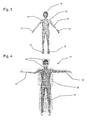
- FIG. 3 is a front view of an infrastructured avatar with collision caps on according to an embodiment of the invention.
- FIG. 4 is a front view of an infrastructured avatar equipped with garment layer cylinders according to an embodiment of the invention.
- FIG. 5 shows a plurality of first exemplary OBJ landmarks according to an embodiment of the invention
- FIG. 6 shows a plurality of second exemplary OBJ landmarks for the arms according to an embodiment of the invention
- FIG. 7 shows a plurality of second exemplary OBJ landmarks for an upper body according to an embodiment of the invention
- FIG. 8 shows a plurality of second exemplary OBJ landmarks for a lower body according to an embodiment of the invention
- FIG. 9 is a flow chart showing a method according to an embodiment of the invention.
- FIG. 10 shows a body mesh and a skeleton rigged to the body mesh for three different portions according to an embodiment of the invention
- FIG. 11 shows an example of an OBJ format according to an embodiment of the invention.
- FIG. 12 is a perspective view showing a 3D body scanning system according to an embodiment of the invention.
- the proposed invention is used for implementing the virtual fitting system, which should interactively show the draping of the given garment to the novel body OBJ that is generated from a body scanning system as shown in FIG. 1 .
- the 3D garment is constructed from the panels (i.e., sewing patterns). More specifically, for constructing a 3D garment, in the apparel CAD software, the fashion expert meticulously positions the panels around the body then stitches the corresponding line pairs. In summary, to construct a 3D garment, the panels should be (1) positioned and (2) seamed. Since the construction takes some time, it is out of question to do it in the presence of the customer. So from now on, we will assume the construction part is already complete.
- FIG. 2 shows avatar and PDUs according to embodiments of the invention.
- the avatar that is used for physically-based draping of 3D clothing (hereafter we call it the “infrastructured avatar”) consists of the body, head, and hair.
- the infrastructured avatar has a number of caps that wrap the hands, feet, head and hair, as shown in the figure on the top. We call them the collision caps.
- the collision caps are used only for the internal collision-related calculation, without being visualized.
- the normal look of the infrastructured avatar 10 is shown in FIG. 2 (Ta).
- the infrastructured avatar has the skeleton as well as the body mesh.
- the avatar surface consists of multiple meshes;
- the infrastructured avatar in addition to the mesh comprising the body and head, separate extra meshes are used for the hair and eye balls.
- the body mesh is rigged with respect to the skeleton so that the body mesh deforms as the skeletal joint angles vary.
- the infrastructured avatar additionally equips with the auxiliary non-avatar components such as the garment layer cylinders, as shown in the figure on the bottom.
- the infrastructured avatar which is suited for physically-based draping simulation, is a complex with various infrastructures built in it.
- the avatar imported from a 3D scanning system (we will call it the OBJ avatar 20 since it is usually given in the OBJ format) is simple. It consists of usually a single mesh in which the body, head, and hair are all included. An example is shown in FIG. 2 (Tf). Since the OBJ avatar is not equipped with the infrastructures, constructing and simulating clothes on it is more difficult than when the same job is done on the infrastructured avatar. An ideal thing would be the imported OBJ avatar can be converted to the infrastructured avatar. Due to the structural difference, a complete conversion is difficult: (1) it can take time, and (2) the conversion may be occasionally unsuccessful. In the context of developing a virtual fitting system, which should provide real-time service to the customer, the above imperfect and error-prone conversion is not a practically viable option.
- One use of the morphable avatar proposed in this proposal is to mediate the infrastructured and OBJ avatars in order to clothe the OBJ avatar.
- clothing a infrastructured avatar is easier than clothing an OBJ avatar due to the built-in infrastructures.
- the idea is to firstly complete the construction and draping afresh of the garment the infrastructured avatar, then progressively perform physically-based update of the draping as we make the infrastructured avatar morph to the OBJ avatar.
- PDU progressive drape update
- FIG. 2(T) shows the metamorphosis
- FIG. 2(B) shows the PDU over the metamorphosis.
- Metamorphosis The mesh comprising morphable avatar is made to gradually (e.g., over 10 ⁇ 30 frames) morph from the shape of the infrastructured avatar to that of the given OBJ avatar. ( FIG. 2 (Tb) ⁇ (Te))
- the vendor of the 3D body scanning system provides, in addition to the OBJ file, so-called the OBJ landmark index (OBLIND) file (to the virtual fitting program), which contains the OBJ landmark indices (OBLINDs) in the simple TXT format.
- OBLIND OBJ landmark index
- the package the OBJ file and the accompanying OBLIND file
- those landmarks are already marked in both the morphable avatar and the infrastructured avatar.
- the OBJ landmarks consist of the Adam's Apple, Rear Adam's Apple, L-Inner Elbow, etc. as summarized in the next page's table and figure.
- the included TXT file DBLIND.txt is a sample OBLIND file that lists the vertex indices of the OBJ landmarks in the order shown in the above table. If there are multiple candidate vertices (vague) for the landmark, any one of them can be chosen. The landmark vertices designation does not need to be done too meticulously, since the result is not very sensitive to the selection.
- the morphable avatar can be made to wrap OBJ body (as well as the full body) with the constraint that, in the wrapped result, the corresponding landmarks of the two avatars should coincide to each other. This constraint prevents the wrapping being done arbitrarily.
- Metamorphosis produces a number of transitioning shapes of the morphable avatar, in which the first frame is the infrastructured avatar wrap, and the last frame is the OBJ avatar wrap. The number of transitioning frames can be controlled.
- the landmarked OBJ is a protocol (proposed by Physan) for exchanging avatar OBJ, that enables the virtual fitting system work stably without any expert supervision.
- the landmarked OBJ protocol is to send the landmarked OBJ instead of the ordinary OBJ.
- a landmarked OBJ is simply an ordinary avatar OBJ along with a TXT file OBLPIND.txt that lists 43 OBJ landmark vertex indices.
- the first line of the OBLPIND.txt should tell whether the avatar is ⁇ Man, Women, Boy_1, Boy_3, Boy_5, Boy_7, Boy_9, Boy_11, Girl_1, Girl_3, Girl_5, Girl_7, Girl_9, Girl_11 ⁇ .
- OBJLVIND.txt lists the vertex indices of the OBJ corresponding to the landmarks in the pre-determined order.
- a sample OBLIND.txt reads like: 37 54 33 . . . , which may mean Left Armpit is vertex 37, Left Bicept Front is vertex 54, Left Bicept Back is vertex 33, etc. The whole set of the landmarks and their order are summarized in the next 4 page.
- 43 OBJ landmark vertices may include 28 (arms)+4 (upper body)+11 (lower body).
- OBJLVs/arm in the order of top-to-bottom: armpit, bicept front, bicept back, elbow front, elbow outer, elbow back, lower arm inner 70%, lower arm outer 70%, lower arm inner 40%, lower arm outer 40%, wrist inner, wrist outer, thumb tip, middle finger tip. Therefore, total 28 OBJLVs: left arm then right arm.
- lower arm inner 70% and lower arm outer 70% Measured from the elbow to the wrist, come down 30%. That position is lower arm 70%.
- An aspect of the invention provides a method and system for progressive drape update on avatar morph for virtual fitting.
- the method for progressive drape update on avatar morph for a virtual fitting system comprises steps for:
- the infrastructured avatar may comprise a body, a head, and hairs, a plurality of collision caps 12 that wrap hands, feet, the head, and the hairs; a skeleton (a group of joints connected to each other to represent the bone structure of human body in 3D graphics) 14 ; a plurality of meshes (a collection of vertices, edges, and faces that defines the shape of a polyhedral object in 3D) 16 provided for portions on surfaces of the infrastrutured avatar 10 for the body and the head, and the body mesh 16 may be rigged with respect to the skeleton 14 as shown in FIG. 10 , so that the body mesh 16 is configured to deform as skeletal joint angles vary.
- the plurality of meshes 16 may further comprise meshes for the hairs and eyeballs.
- the infrastructured avatar 10 may further comprise one or more non-avatar components such as a plurality of garment layer cylinders 18 .
- the OBJ avatar 20 may be provided by and imported from a 3D body scanning system, which is a system of capturing the human body in 3D point cloud using a 3D body scanner as shown in FIG. 12 , and the OBJ avatar 20 may have a single mesh including body, head, and hairs.
- a 3D body scanning system which is a system of capturing the human body in 3D point cloud using a 3D body scanner as shown in FIG. 12
- the OBJ avatar 20 may have a single mesh including body, head, and hairs.
- the garment 990 may be constructed by positioning and seaming panels for the garment, and each of the panels may be represented with coordinate data for points and lines forming the panel in the information processing device.
- the construction of the garment 990 has been described in detail in the applications by the applicant, which are incorporated by reference.
- the morphable avatar 30 may comprise a single mesh and may be configured to wrap the infrastructured avatar 10 , the OBJ avatar 20 , and the transitioning shapes from the infrastructured avatar 10 to the OBJ avatar 20 as shown in FIG. 2 .
- the steps (S 600 and S 700 ) for performing metamorphosis and applying physically-based simulation may comprise a step for performing progressively physically-based update of draping of the garment 990 on the morphable avatar 30 as the infrastructured avatar 10 morphs to the OBJ avatar 20 as shown in FIG. 2 .
- the plurality of transitioning shapes of the morphable avatar 30 may comprise from about ten (10) to about thirty (30) frames. That is, FIG. 2 shows just a few of them for an example.
- the OBJ avatar 20 may be represented by and given with an OBJ file, which is a geometry definition file format containing geometric vertices, texture coordinates, vertex normal and polygon faces, in an OBJ format as shown in FIG. 11 .
- OBJ file which is a geometry definition file format containing geometric vertices, texture coordinates, vertex normal and polygon faces, in an OBJ format as shown in FIG. 11 .
- the OBJ avatar 20 may be represented by and given with a landmarked OBJ protocol comprising the OBJ file and an OBJ landmark index (OBLIND) file containing a plurality of OBJ landmark indices (OBLINDs) for a plurality of landmarks (shown as red dots in FIGS. 6-8 ) on the OBJ avatar in a simple TXT format, and wherein the landmarks are marked at corresponding portions in both the morphable avatar 30 and the infrastructured avatar 10 .
- OOLIND OBJ landmark index
- the landmarks may comprise Adam's Apple, Rear Adam's Apple, L-Inner Elbow, R-Inner Elbow, L-Medial Wrist, R-Medial Wrist, L-Lateral Wrist, R-Lateral Wrist, L-Thumb Tip, R-Thumb Tip, L-Middle Finger Tip, R-Middle Finger Tip, L-Front Ankle, R-Front Ankle, L-Rear Ankle, R-Rear Ankle, L-Foot Tip, R-Foot Tip, L-Heel, and R-Heel.
- this exemplary choice is not limiting, but any number of any selection of landmarks can be used as long as they facilitate the processes in the present invention.
- the OBLIND file may include lists of indices of the landmarks in a specific order.
- the morphable avatar 30 may be made to wrap the OBJ avatar 20 with a constraint that in a wrapped result corresponding landmarks of the morphable avatar 30 and the OBJ avatar 20 coincide to each other.
- the plurality of transitioning shapes of the morphable avatar 30 may comprise from about ten (10) to about thirty (30) frames including a first frame 31 and a last frame 39 , and the first frame 31 may be a wrapping of the infrastructured avatar 10 and the last frame 39 is a wrapping of the OBJ avatar 20 as shown in FIG. 2 .
- the landmarked OBJ protocol may comprise the regular OBJ file and further an OBLPIND text file listing about forty three (43) OBJ landmark vertex indices.
- the OBLPIND text file may have a first line indicating information on the avatar, and the OBLPIND text file may list the OBJ landmark vertex indices in a predetermined order.
- the OBJ landmark vertices may comprise about twenty eight (28) vertices in arms, about four (4) vertices in an upper body, and about eleven (11) vertices in a lower body.
- the number and position of the vertices may be varied according to the situation of the method, and therefore are not limiting to an exact number and positions.
- the vertices in the arms may be located at armpit, bicept front, bicept back, elbow front, elbow outer, elbow back, lower arm inner 70%, lower arm outer 70%, lower lower arm outer 40%, wrist inner, wrist outer, thumb tip, and middle finger tip.
- the vertices in the upper body may be located at Adam's apple front, Adam's apple back, left nipple, and right nipple, and the vertices in the lower body may be located at crotch, knee front, ankle front, ankle back, foot tip, and heel.
- FIGS. 10-12 show a body mesh, a skeleton, an OBJ format, and a 3D body scanning system according to embodiments of the invention.
- the body mesh is rigged to an appropriate part of the skeleton for examples.
- the highlighted area shows that the model's thigh, shoulder, forearm is rigged to the thigh bone, shoulder blade, and forearm bone respectively.
- the skeleton 14 comprises a group of joints connected to each other to represent the bone structure of human body in 3D graphics
- each of the plurality of meshes 16 comprises a collection of vertices, edges, and faces that defines the shape of a polyhedral object in 3D and is provided for portions on surfaces of the infrastructured avatar 10 for the body and the head, and the body mesh 16 is rigged with respect to the skeleton 14 .
- the 3D body scanning system is a system for capturing the human body in 3D point cloud using a 3D body scanner and storing the captured data in the information processing device for further manipulating and calculating.
- the mesh, the skeleton, or the avatar is represented in terms of electronic data set in the information processing device and the electronic data set can be stored in one or more memory device in the information processing device and manipulated or calculated for each of the steps of the method of the invention, changing the physical states of the components of the information processing device.
- Those manipulated and calculated electronic data set which was not there in the begging of the method, can be used to display the avatar draped newly and inventively with a new garment.
- the basic definition of avatar with its components such as meshes and skeleton is known to the community of the art and the previous applications by the inventor, which are incorporated by reference in the above.
Landscapes
- Engineering & Computer Science (AREA)
- Physics & Mathematics (AREA)
- Business, Economics & Management (AREA)
- Theoretical Computer Science (AREA)
- General Physics & Mathematics (AREA)
- Finance (AREA)
- Accounting & Taxation (AREA)
- Software Systems (AREA)
- General Engineering & Computer Science (AREA)
- Computer Hardware Design (AREA)
- Computer Graphics (AREA)
- Economics (AREA)
- Development Economics (AREA)
- Marketing (AREA)
- Strategic Management (AREA)
- General Business, Economics & Management (AREA)
- Architecture (AREA)
- Evolutionary Computation (AREA)
- Geometry (AREA)
- Processing Or Creating Images (AREA)
Abstract
Description
-
- It consists of a single mesh.
- It has no skeleton, thus no rigging is defined.
- It can be made to wrap the infrastructured avatar or a OBJ avatar, as shown in
FIGS. 2(b) and (e) , respectively. Here, “wrap” means the morphable avatar mesh tightly wraps the infrastructured/OBJ avatar such that, although the meshes are different in the topology, their geometrical shape takes on the infrastructured/OBJ avatar. In such a case, we will call the morphable avatar as the wrapper and the infrastructured/OBJ avatar as the wrappee.
-
- We will refer the 43 OBJ landmark vertices as 43 OBJLVs as shown in
FIGS. 6-8 . - We will refer the 43 OBJ landmark vertex indices as 43 OBJLVINDs.
- We will refer the TXT file that lists the indices as OBJLVIND.txt.
- We will refer the 43 OBJ landmark vertices as 43 OBJLVs as shown in
Claims (18)
Priority Applications (1)
| Application Number | Priority Date | Filing Date | Title |
|---|---|---|---|
| US15/689,435 US10249100B2 (en) | 2016-08-29 | 2017-08-29 | Method and system for progressive drape update on avatar morph for virtual fitting |
Applications Claiming Priority (3)
| Application Number | Priority Date | Filing Date | Title |
|---|---|---|---|
| US201662380970P | 2016-08-29 | 2016-08-29 | |
| US201662420237P | 2016-11-10 | 2016-11-10 | |
| US15/689,435 US10249100B2 (en) | 2016-08-29 | 2017-08-29 | Method and system for progressive drape update on avatar morph for virtual fitting |
Publications (2)
| Publication Number | Publication Date |
|---|---|
| US20180061141A1 US20180061141A1 (en) | 2018-03-01 |
| US10249100B2 true US10249100B2 (en) | 2019-04-02 |
Family
ID=61243200
Family Applications (1)
| Application Number | Title | Priority Date | Filing Date |
|---|---|---|---|
| US15/689,435 Expired - Fee Related US10249100B2 (en) | 2016-08-29 | 2017-08-29 | Method and system for progressive drape update on avatar morph for virtual fitting |
Country Status (1)
| Country | Link |
|---|---|
| US (1) | US10249100B2 (en) |
Cited By (1)
| Publication number | Priority date | Publication date | Assignee | Title |
|---|---|---|---|---|
| US10769807B1 (en) | 2019-11-25 | 2020-09-08 | Pet3D Corp | System, method, and apparatus for clothing a pet |
Families Citing this family (3)
| Publication number | Priority date | Publication date | Assignee | Title |
|---|---|---|---|---|
| US10474927B2 (en) * | 2015-09-03 | 2019-11-12 | Stc. Unm | Accelerated precomputation of reduced deformable models |
| HK1253751A2 (en) * | 2018-07-04 | 2019-06-28 | 桂滨 | Method and apparatus for fitting an accessory object to an avatar |
| US20250218132A1 (en) * | 2024-01-02 | 2025-07-03 | Toshiba Global Commerce Solutions, Inc. | Pet supply simulations using augmented reality |
Citations (4)
| Publication number | Priority date | Publication date | Assignee | Title |
|---|---|---|---|---|
| US20100097395A1 (en) * | 2008-10-16 | 2010-04-22 | At&T Intellectual Property I, L.P. | System and method for presenting an avatar |
| US20140277683A1 (en) * | 2013-03-15 | 2014-09-18 | Neil Rohin Gupta | System and Method for Automated Manufacturing of Custom Apparel |
| US20150154453A1 (en) * | 2012-09-05 | 2015-06-04 | Body Pass Ltd. | System and method for deriving accurate body size measures from a sequence of 2d images |
| US20160110595A1 (en) * | 2014-10-17 | 2016-04-21 | Qiaosong Wang | Fast 3d model fitting and anthropometrics using synthetic data |
-
2017
- 2017-08-29 US US15/689,435 patent/US10249100B2/en not_active Expired - Fee Related
Patent Citations (4)
| Publication number | Priority date | Publication date | Assignee | Title |
|---|---|---|---|---|
| US20100097395A1 (en) * | 2008-10-16 | 2010-04-22 | At&T Intellectual Property I, L.P. | System and method for presenting an avatar |
| US20150154453A1 (en) * | 2012-09-05 | 2015-06-04 | Body Pass Ltd. | System and method for deriving accurate body size measures from a sequence of 2d images |
| US20140277683A1 (en) * | 2013-03-15 | 2014-09-18 | Neil Rohin Gupta | System and Method for Automated Manufacturing of Custom Apparel |
| US20160110595A1 (en) * | 2014-10-17 | 2016-04-21 | Qiaosong Wang | Fast 3d model fitting and anthropometrics using synthetic data |
Cited By (1)
| Publication number | Priority date | Publication date | Assignee | Title |
|---|---|---|---|---|
| US10769807B1 (en) | 2019-11-25 | 2020-09-08 | Pet3D Corp | System, method, and apparatus for clothing a pet |
Also Published As
| Publication number | Publication date |
|---|---|
| US20180061141A1 (en) | 2018-03-01 |
Similar Documents
| Publication | Publication Date | Title |
|---|---|---|
| US9892540B2 (en) | Image-based deformation of simulated characters of varied topology | |
| US10249100B2 (en) | Method and system for progressive drape update on avatar morph for virtual fitting | |
| US8590469B2 (en) | Method for panel positioning | |
| CN105354876B (en) | A kind of real-time volume fitting method based on mobile terminal | |
| CN112270731B (en) | A clothing fitting method and device | |
| EP0933728A2 (en) | A method and system for generating a stereoscopic image of a garment | |
| CN102982581A (en) | Virtual try-on system and method based on images | |
| JP6340313B2 (en) | Modeling system, modeling program, and modeling method | |
| US10395404B2 (en) | Image processing device for composite images, image processing system and storage medium | |
| JPWO2011155068A1 (en) | Character generation system, character generation method and program | |
| CN110675214A (en) | Virtual fitting somatosensory simulation method and system | |
| KR20190114676A (en) | a computer aided method for generating transferred patterns for garment draped on an avatar | |
| CN105069837B (en) | A kind of clothes trying analogy method and device | |
| EP2184714B1 (en) | Layering simulation apparatus, simulation method, simulation program | |
| CN114612358A (en) | Virtual clothing try-on system and method based on user image information collection | |
| KR101158453B1 (en) | Apparatus and Method for coordinating a simulated clothes with the three dimensional effect at plane using the two dimensions image data | |
| JP2008163525A (en) | Fabric pattern creation device, creation method, creation program | |
| JP7293036B2 (en) | Information processing device, information processing program, information processing system and information processing method | |
| JP5079801B2 (en) | Knitwear folding simulation apparatus, simulation method, and storage medium | |
| EP2189946A1 (en) | Wearing simulation device, wearing simulation method and wearing simulation pogram | |
| KR20210130420A (en) | System for smart three dimensional garment fitting and the method for providing garment fitting service using there of | |
| JP5010450B2 (en) | Dressing simulation device, simulation method, and simulation program | |
| CN112990997A (en) | Virtual fitting method | |
| KR20090099896A (en) | 3D character generating device and method and 3D character business method using same | |
| JP2023110395A (en) | Clothing virtual generation system |
Legal Events
| Date | Code | Title | Description |
|---|---|---|---|
| AS | Assignment |
Owner name: PHYSAN,INC., KOREA, REPUBLIC OF Free format text: ASSIGNMENT OF ASSIGNORS INTEREST;ASSIGNOR:CHOI, BONG OUK;REEL/FRAME:043439/0718 Effective date: 20170123 |
|
| FEPP | Fee payment procedure |
Free format text: ENTITY STATUS SET TO UNDISCOUNTED (ORIGINAL EVENT CODE: BIG.); ENTITY STATUS OF PATENT OWNER: SMALL ENTITY |
|
| FEPP | Fee payment procedure |
Free format text: ENTITY STATUS SET TO SMALL (ORIGINAL EVENT CODE: SMAL); ENTITY STATUS OF PATENT OWNER: SMALL ENTITY |
|
| STCF | Information on status: patent grant |
Free format text: PATENTED CASE |
|
| AS | Assignment |
Owner name: TG3D STUDIO.INC., KOREA, REPUBLIC OF Free format text: ASSIGNMENT OF ASSIGNORS INTEREST;ASSIGNOR:PHYSAN,INC.;REEL/FRAME:050203/0565 Effective date: 20190826 |
|
| AS | Assignment |
Owner name: TG3D STUDIO INC., TAIWAN Free format text: ASSIGNMENT OF ASSIGNORS INTEREST;ASSIGNOR:TG3D STUDIO.INC.;REEL/FRAME:058546/0172 Effective date: 20220103 |
|
| FEPP | Fee payment procedure |
Free format text: MAINTENANCE FEE REMINDER MAILED (ORIGINAL EVENT CODE: REM.); ENTITY STATUS OF PATENT OWNER: SMALL ENTITY |
|
| LAPS | Lapse for failure to pay maintenance fees |
Free format text: PATENT EXPIRED FOR FAILURE TO PAY MAINTENANCE FEES (ORIGINAL EVENT CODE: EXP.); ENTITY STATUS OF PATENT OWNER: SMALL ENTITY |
|
| STCH | Information on status: patent discontinuation |
Free format text: PATENT EXPIRED DUE TO NONPAYMENT OF MAINTENANCE FEES UNDER 37 CFR 1.362 |
|
| FP | Lapsed due to failure to pay maintenance fee |
Effective date: 20230402 |